Flashback : Dallas

A Miscellany: History, Ads, Pop Culture

Category: Roads & Bridges

Crossing the Trinity River Viaduct — 1946

streetcar-crossing-trinity_1946-denverpublibStreetcar on the Trinity River Viaduct (click for larger image)

by Paula Bosse

A few days ago I posted a photograph of a streetcar pulling into Oak Cliff, having just crossed the Trinity River Viaduct (link below). In this photo, we see what streetcars of the period looked like actually crossing the viaduct.

***

Photo by Robert F. Richardson, taken on June 5, 1946. From the Western History/Genealogy Dept., Denver Public Library, viewable here.

Photos of these double-ended streetcars taken from a distance present a bit of a Pushmi-Pullyu problem in determining which direction they’re heading, but if you enlarge the photo at the Denver Public Library link just above, you can see the silhouette of the operator at the eastbound end of the car, driving the car toward Dallas. UPDATE: I’m wrong! The car is moving toward O.C., not Dallas! That motorman silhouette is a figment of my imagination! See the comments below for tips on how an amateur like myself who’s never actually seen a streetcar can tell which direction one is moving. (Thanks, Bob and Bob for the correction!)

Streetcars ran back and forth across the Trinity River on a special trestle just south of the Oak Cliff Viaduct/Houston Street Viaduct. It had been in use since 1887 (through various renovations) and was demolished in the early 1970s to build the present-day Jefferson Street Viaduct. The streetcar shown is from the Dallas Railway & Terminal Co. fleet.

My previous post mentioned above, “Waiting for a Streetcar on a Sunny Winter Day in Oak Cliff — 1946,” contains a fantastic photo taken by the same photographer, four months earlier, showing people waiting for the approaching streetcar just after it’s crossed the river; that photo can be seen here.

*

Copyright © 2014 Paula Bosse. All Rights Reserved.
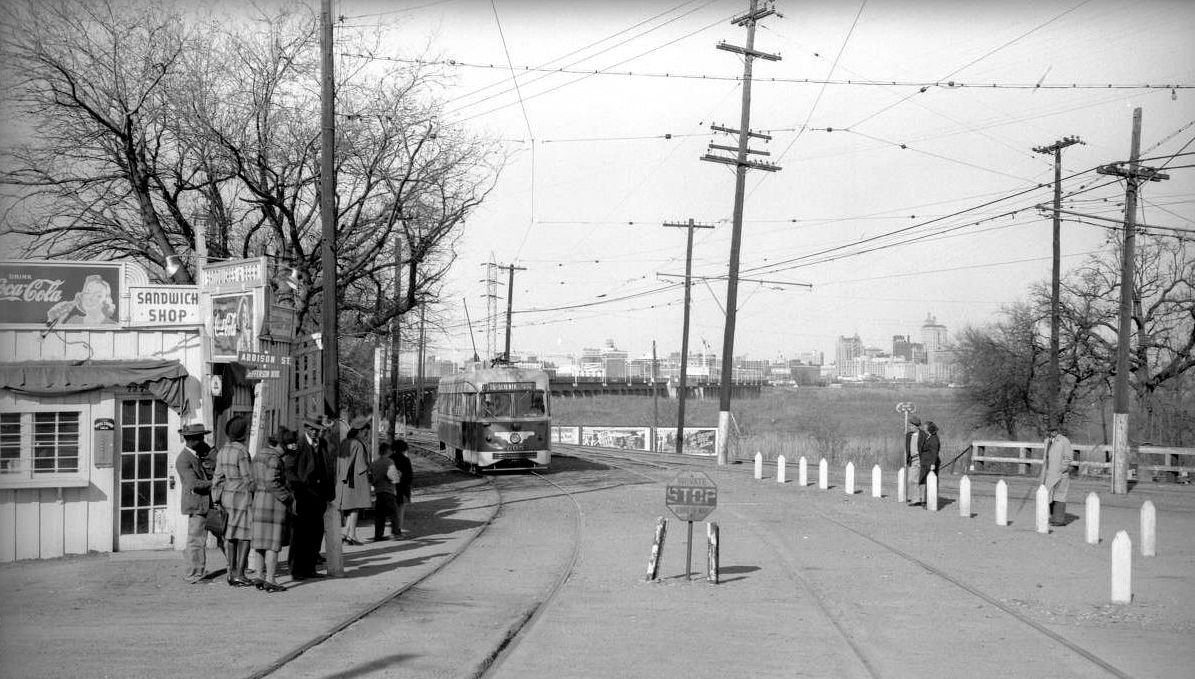
Waiting For a Streetcar on a Sunny Winter Day in Oak Cliff — 1946

jefferson-addison_denver-pub-lib_1946Addison St. & Jefferson Blvd. in Oak Cliff — Feb., 1946 (click for larger image)

by Paula Bosse

I love streetcars, photos from the 1940s, fashions of the ’40s, and views of the Dallas skyline. And here are all of these things, in one great, GREAT photograph. We see people waiting for the streetcar on a sunny Saturday in February, 1946 — in Oak Cliff, at E. Jefferson Blvd. and Addison St. The people at the left (outside Helen’s Sandwich Shop) are about to catch the car that has just crossed the Trinity River and head into Oak Cliff; the people on the right are waiting to go to Dallas. The Oak Farms Dairy is just out of frame at the top left, and Burnett Field is just out of frame at the bottom right. The Dallas skyline looms across the Trinity.

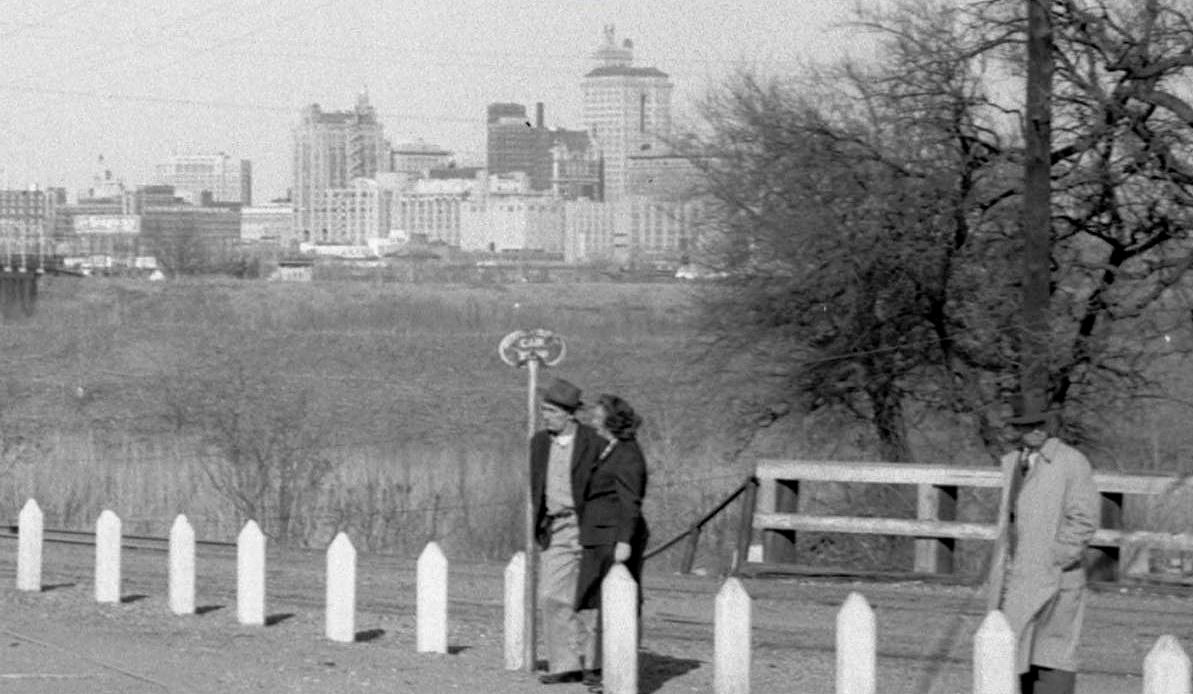
Below, I’ve zoomed-in a bit and cropped this fantastic photograph into two images to show, a bit more intimately, details of an ordinary moment in an ordinary day of ordinary people. What once was such a commonplace scene — people waiting for a streetcar or interurban — now seems completely out of the ordinary and quaintly nostalgic. (Nostalgic on its surface, anyway — not shown is the interior of the car which had specific black-only and white-only seating areas for passengers.) (As always, click for larger images.)

jefferson-addison-det1

jefferson-addison-det2

***

Photo by Robert W. Richardson, taken on February 2, 1946. From the Western History/Genealogy Dept., Denver Public Library, viewable here. More on rail enthusiast, writer, photographer, and preservationist Bob Richardson, here.

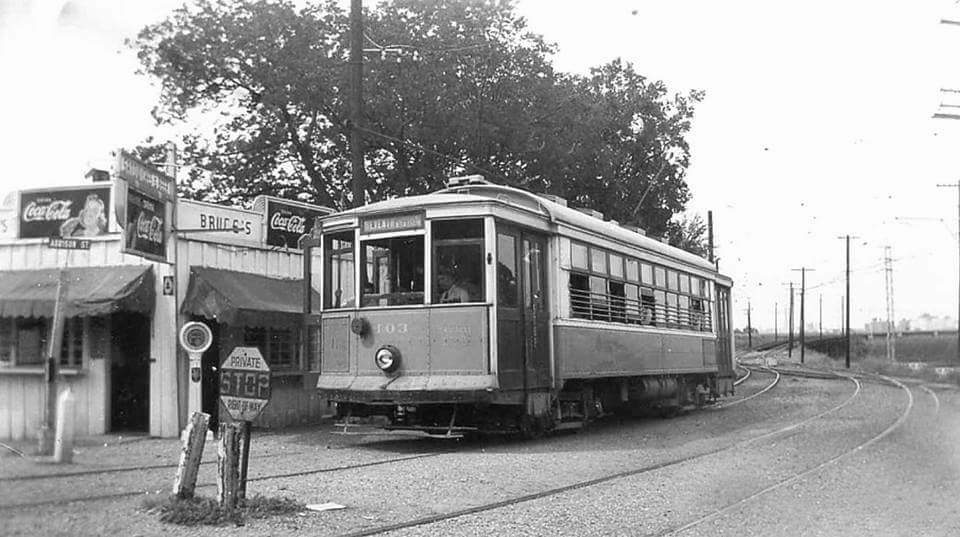
The same stop can be seen in this undated photo (source and photographer unknown):

oak-cliff-streetcar-stop_addison-jefferson

Streetcars ran back and forth across the Trinity River on a special trestle just south of the Oak Cliff Viaduct/Houston Street Viaduct. It had been in use since 1887 (through various renovations) and was demolished in the early 1970s to build the present-day Jefferson Street Viaduct.

To see a photo by the same photographer showing a streetcar actually on the trestle over the Trinity, see the post “Crossing the Trinity River Viaduct — 1946,” here.

Streetcar enthusiasts are incredibly, well, enthusiastic, and they keep precise track of where cars operated over their life spans. The car from the photo — Dallas Railway & Terminal Co. car #605 — was a PCC streetcar, built by the Pullman-Standard company in 1945; it was sold to the MTA in 1958 and was in operation in Boston for many years. See cool photos of the very same streetcar in operation over the years in both Dallas and Boston, here (scroll down to “605”). To see what the retired car looked like in 2002 — a bit worse for wear — click here.

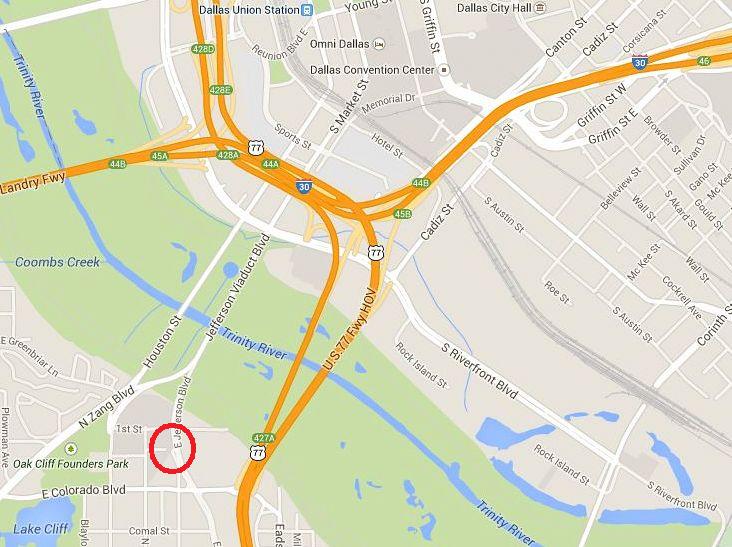
A distinctly less-wonderful view from roughly the same location, seen today, is here.

map_jefferson-addison_googleGoogle

Click pictures for larger images.

*

 Copyright © 2014 Paula Bosse. All Rights Reserved.

Oak Cliff Trolley — 1895

trolley_oak-cliff_stark_1895_hpl“Dallas from Oak Cliff” by Henry Stark, 1895/96 (click for larger image)

by Paula Bosse

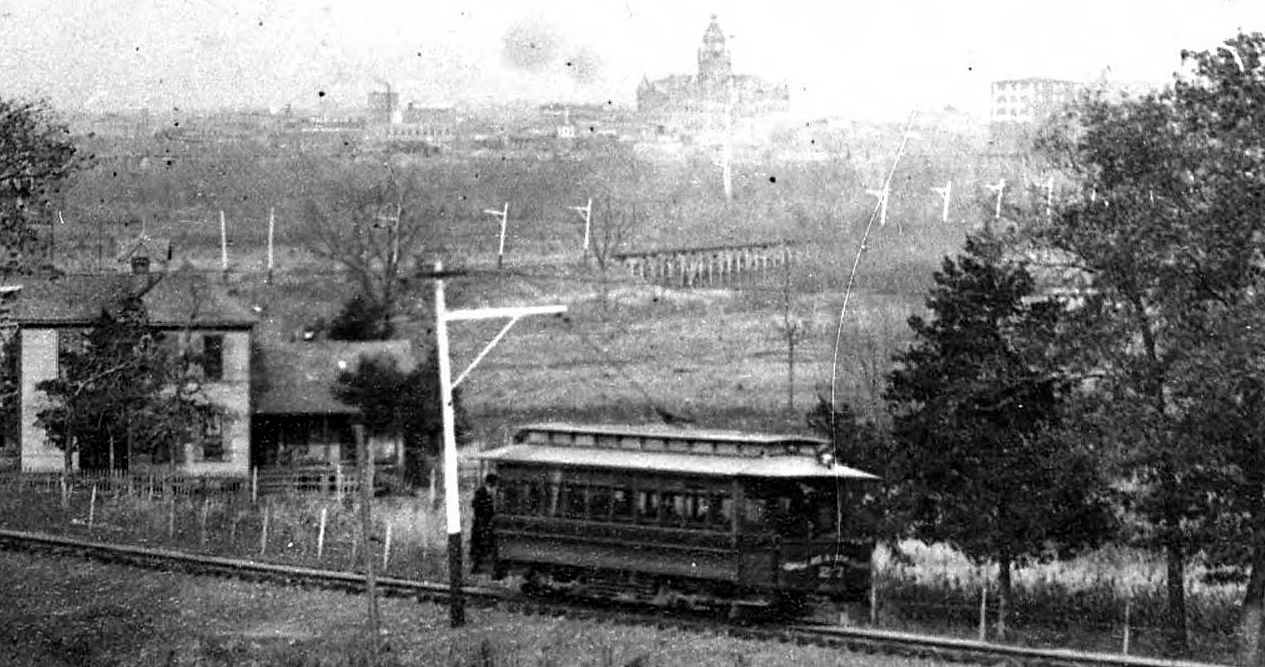
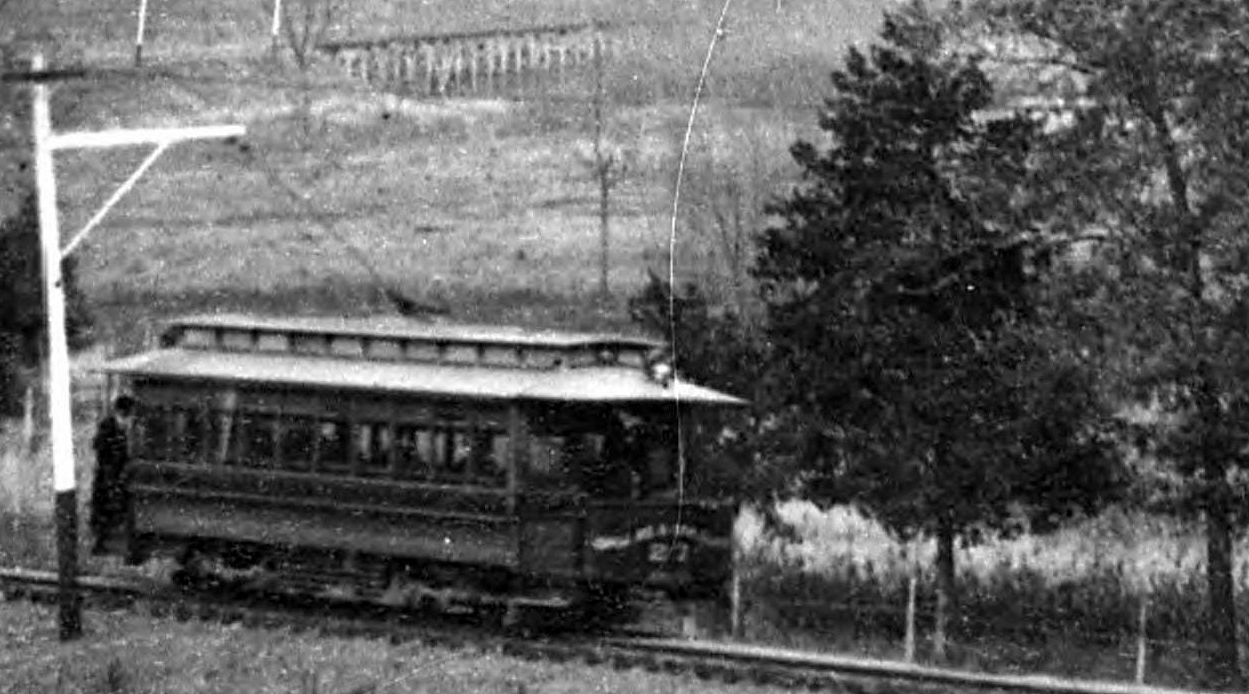
As present-day trolley service to Oak Cliff has been in the news in recent months, here’s a pastoral view of a little trolley chugging through the wilds of Oak Cliff in 1895. In the background, across the river, the still-fairly-new courthouse looms like a mirage. Below are a few details, magnified. (All images are much larger when clicked.) Enjoy!

trolley_oak-cliff_det1

trolley_oak-cliff_det2

trolley_oak-cliff_det3

trolley_oak-cliff_det4

***

Photo (labeled by the Houston Public Library as “Trolley moving through the woods”) is by Henry Stark, taken on a visit to Dallas in the winter of 1895/96; from the collection of the Houston Public Library — it can be viewed here.

For more on Henry Stark, see the previous post “Henry Stark’s ‘Bird’s Eye View of Dallas,'” here.

Other photos which I’ve “Zoomed In On the Details” can be seen here.

CLICK PHOTOS — REAL BIG.

*

Copyright © 2014 Paula Bosse. All Rights Reserved.
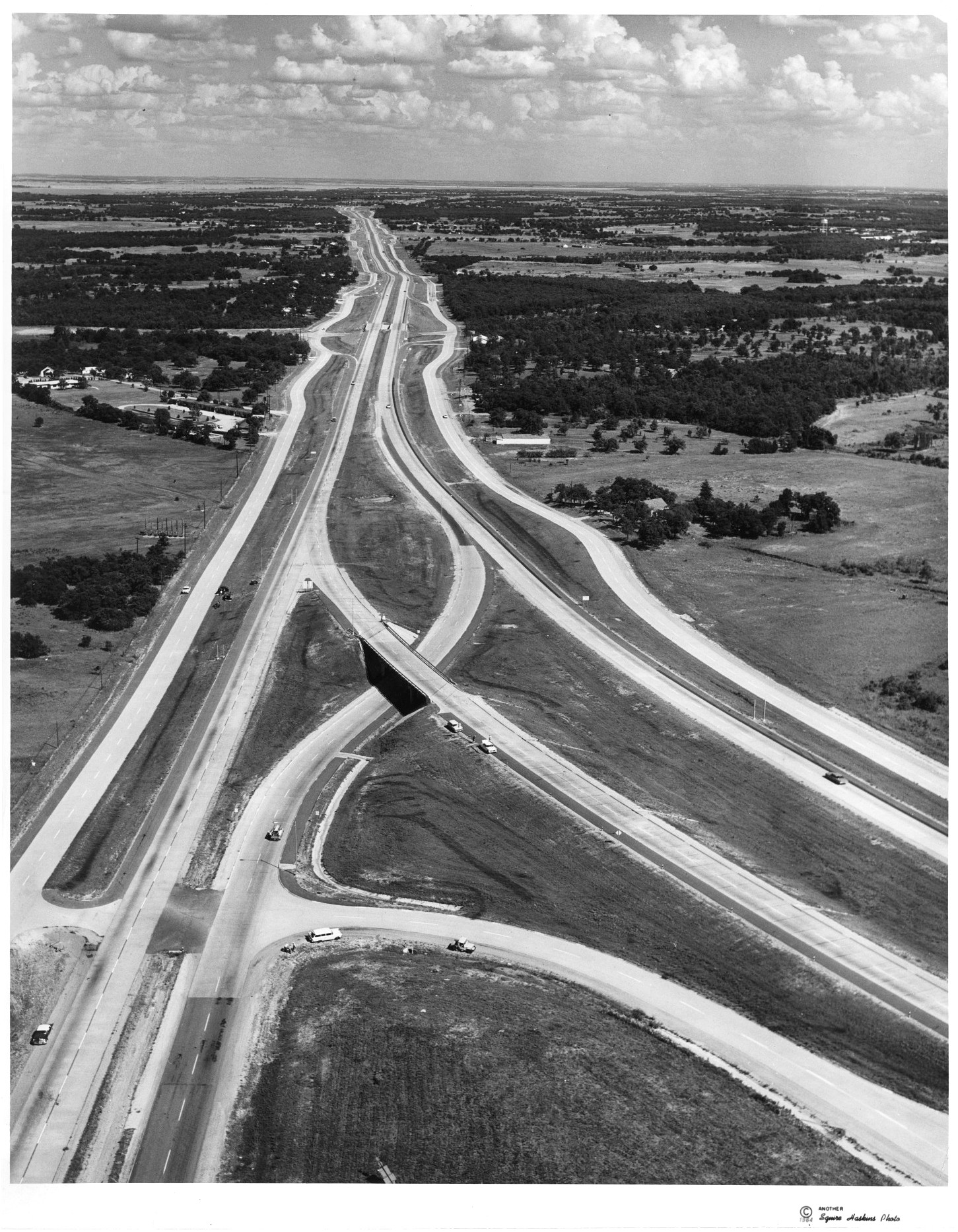
I-35E Looking South: A Landscape Blissfully Free of Cars and Strip Malls — 1964

I35E-south-from-denton_haskinsI-35, pre-sprawl — photo by Squire Haskins (GIGANTIC when clicked)

by Paula Bosse

This is I-35. …I-35! I’m not sure what stretch of the interstate this is exactly, but I think we’re looking north toward Denton south from Denton. I might cry. No sprawl!

*

UPDATE: I’ve had several comments about this photo from all over El Internet, and it appears that this is I-35E in Denton, looking south(east) toward Lake Lewisville (then Lake Dallas). More specifically, this shows the I-35 / US-77 (Dallas Dr.) interchange, with part of the old Hwy. 77 visible at the bottom of the photo. It’s been pointed out that the water tower at the top right is at the Denton State School. I hope this is correct! If anyone else has any suggestions, please let me know! (To see a 1965 road map of this area, see here.)

Here’s how it looks these days (thanks, Bill P.).

i35e_google-earth

***

Another amazing aerial photograph by Squire Haskins, from the collection of the Denton Public Library (with an incorrect description!). Accessible on the Portal to Texas History, here.

Click picture for larger image. In fact, it’ll get so big that it might break whatever device you’re viewing this on; proceed with caution.

*

Copyright © 2014 Paula Bosse. All Rights Reserved.
The Trinity River at the City’s Doorstep

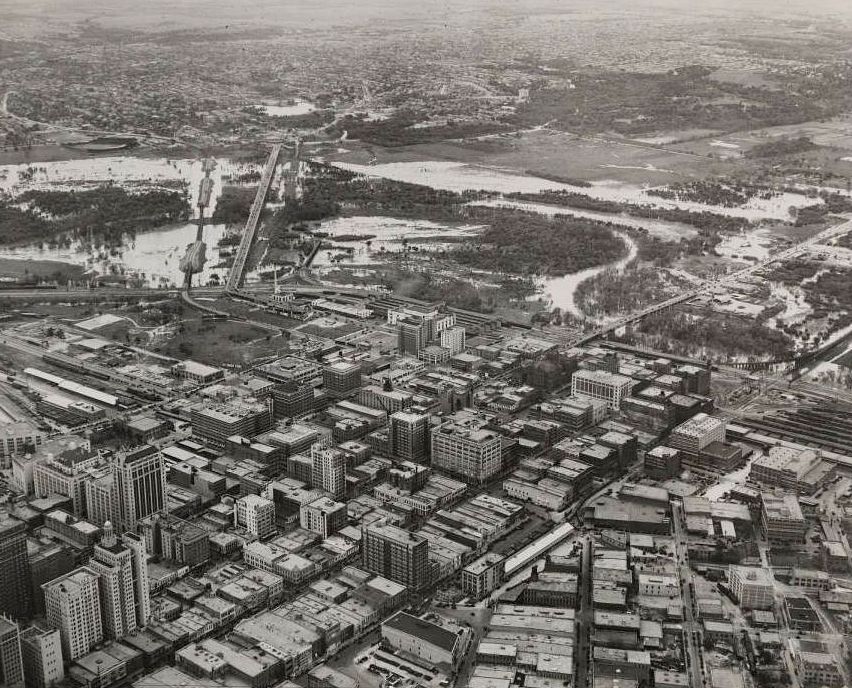
downtown_trinity_ca1920s_smu_foscueWhat? You didn’t know the Trinity River was straightened?

by Paula Bosse

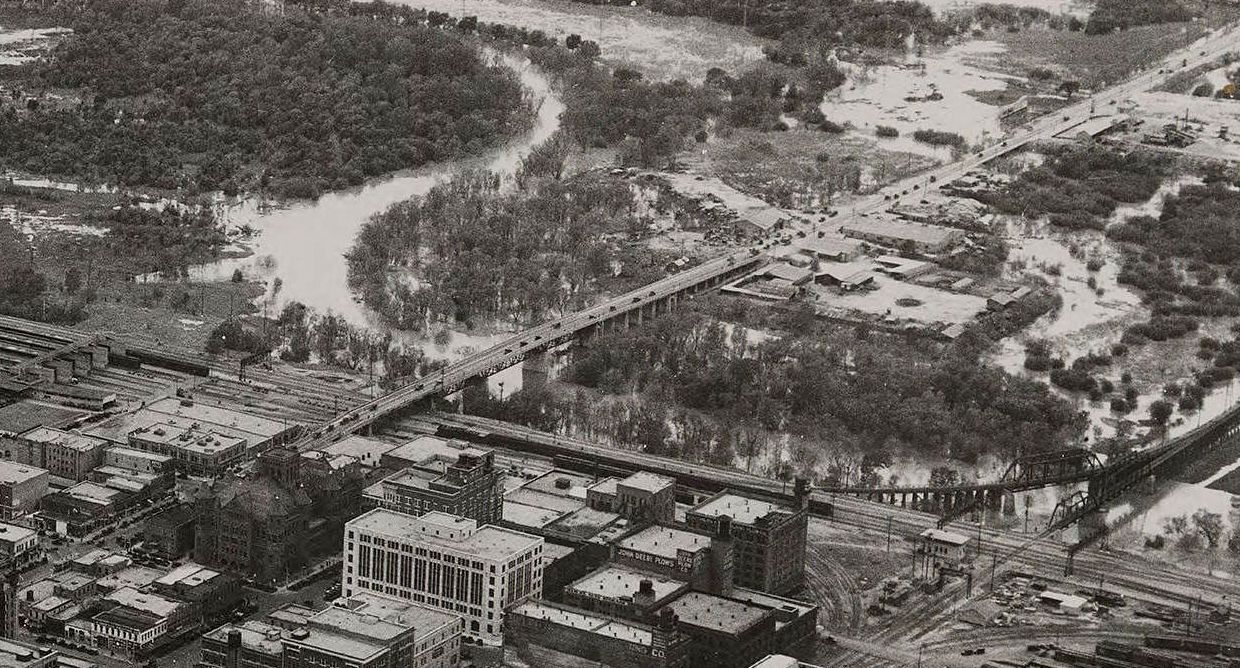
Back before Dallas decided to straighten out the Trinity River and move it a mile or two to the west (in an attempt to prevent future flooding), the river ran only about a block from the Old Red Courthouse. It’s so strange looking at this picture and seeing a river in a place where we’ve never seen it. It’s a shame they moved it (who knew you could “move a river”?), but flooding was a major issue, and, in fact, it looks like there was flooding the day this photo was taken. Below, you can see a magnified view — it looks so different from what we’re used to that it takes a second to get your bearings. Imagine how different Dallas would feel today if the Trinity had been allowed to run its natural course.

downtown_trinity_ca1920s_smu_foscue-det

***

Sources & Notes

Photograph by Lloyd M. Long, from the Edwin J. Foscue Map Library, Central University Libraries, Southern Methodist University; it can be seen here (with many of the buildings labeled) and here (without the labeling).

SMU has the photo dated “ca. 1930s or 1940s,” but I think it may be from the late ’20s. I’ve seen non-specific dates of the river’s realignment from the 1920s to the 1930s, but a couple of landmarks in the photo above place it sometime between 1925 (the year the Santa Fe buildings were constructed) and 1933 (the year the Hippodrome Theater — seen here, on Pacific — became the Joy Theater).

UPDATE: The river was straightened in 1928. See fascinating information about the when, where, why, and how of the Trinity River realignment, below in the comments — it was a true feat of modern engineering.

A few Trinity River-related links: the Trinity Commons Foundation site is here; the Trinity River Corridor Project site is here; and an interesting look at plans and proposals for the future of Dallas and the Trinity River can be read on the American Institute of Architects (Dallas) site here.

*

Copyright © 2014 Paula Bosse. All Rights Reserved.
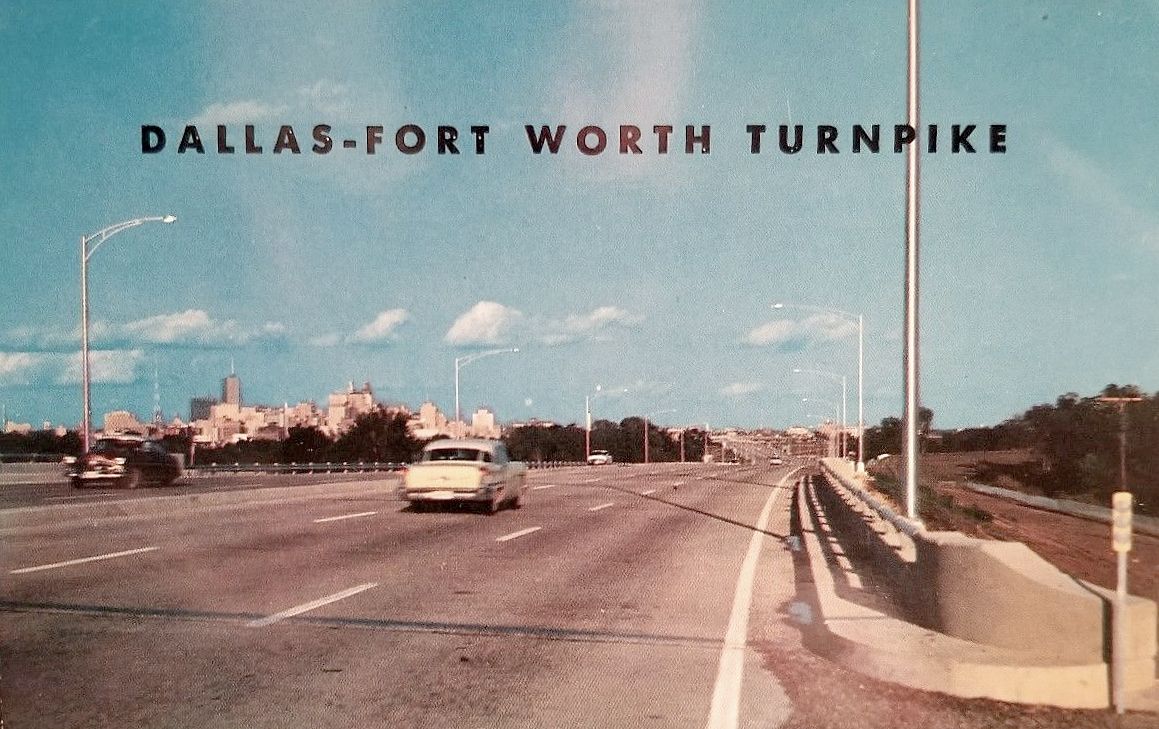
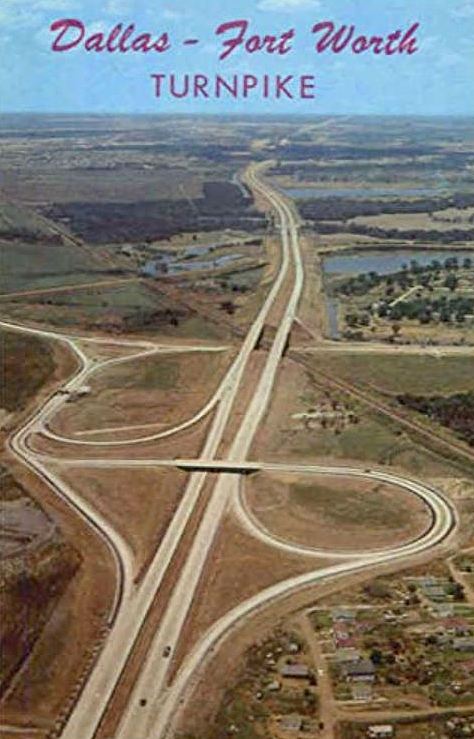
The DFW Turnpike, Unsullied by Traffic, Billboards, or Urban Sprawl — 1957

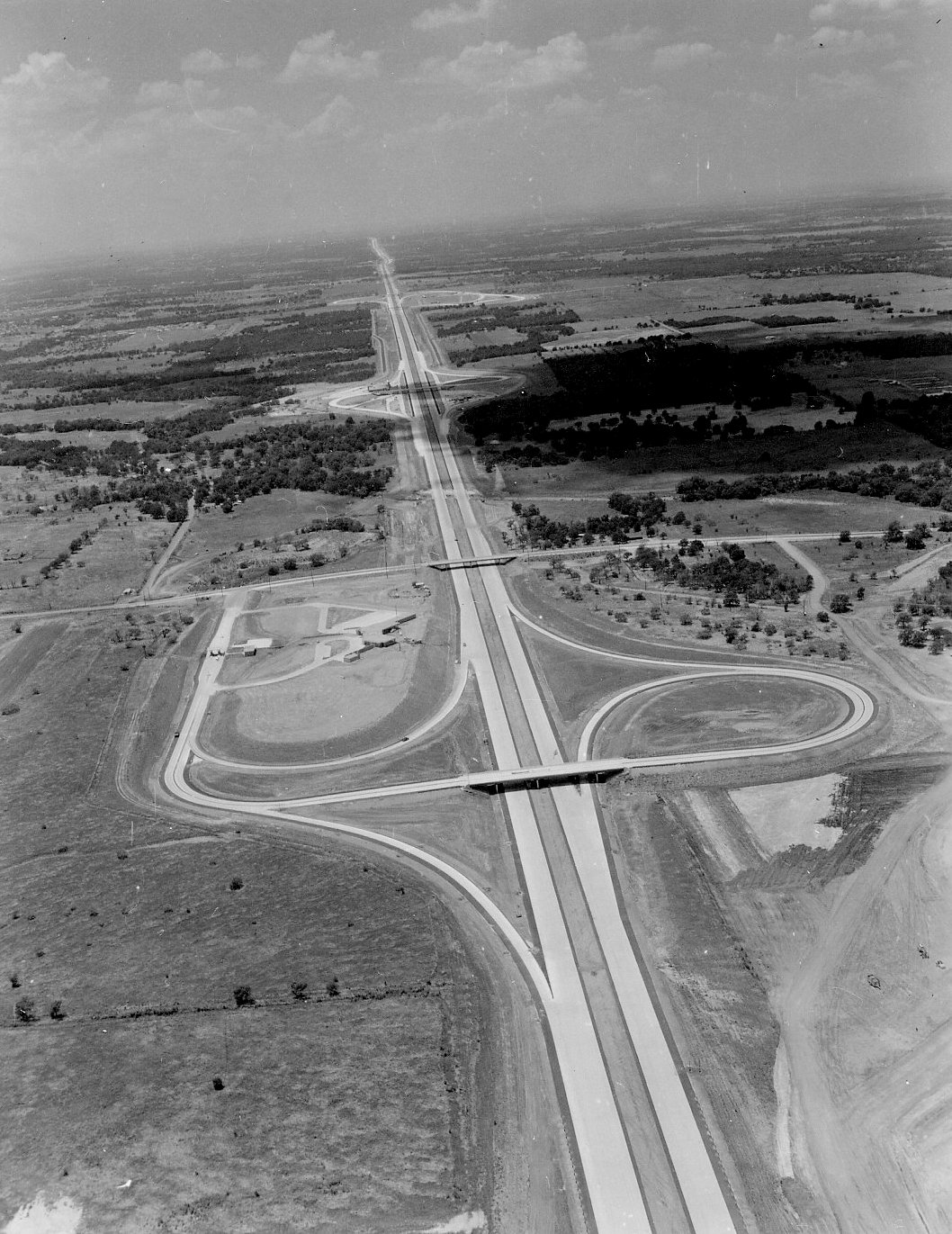
turnpike_west-from-360_1957The DFW Turnpike, 1957… (click for very large image!)

by Paula Bosse

Above, the Dallas-Fort Worth turnpike in 1957, before it opened for business. When this toll road was paid off in 1977, the toll booths were removed and it became I-30, a “free” highway. (This “toll-road-becoming-a-free-road” thing has happened only once in the history of Texas; I can’t imagine it will ever happen again.) This photo shows the turnpike heading west through Arlington, with Hwy. 360 crossing over it in the middle. Six Flags over Texas would be built in this wide open expanse four years later. And then … an explosion of development.

A Texas Highways article described the 30-mile stretch (“30 miles — 30 minutes!”) as being a blissful drive through “a landscape devoid of advertising signboards and commercial establishments” (!). In fact, the only businesses along the turnpike were two restaurants and two service stations. All the way from Dallas to Fort Worth … that was IT! You know, I’d gladly pay an obscenely exorbitant toll today if it meant I could drive that stretch of highway the way it was in this photo. A world without urban sprawl would be heaven.

I love this photo. The road ahead just disappears into the ether. And, Arlington, you’ve never looked better.

dfw_turnpike

dfw-turnpike_postcard

dfw-turnpike_flickr_coltera

dfw-turnpike_postcard_skyline

dallas-fw-turnpike_postcard

***

Sources & Notes

Top photo from Oscar Slotboom’s book Dallas-Fort Worth Freeways, credited to TxDOT Travel Information Division, 1957. His caption: “The view looks west along the turnpike just before it opened in  1957 with the  SH 360 intersection in the foreground…. Land on the left side of the turnpike just past SH 360 would soon be developed into Six Flags Over Texas…. The building alongside the turnpike was a Texas Turnpike Authority administrative office which was demolished in 2011.”

Postcards from around the internet.

For an informative read and LOTS of photos, I highly recommend Oscar Slotboom’s chapter on the DFW Turnpike, which you can access here (there are tons of historical photos). This chapter is from Slotboom’s exhaustive work Dallas-Fort Worth Freeways: Texas-Sized Ambition. The entire book has been made available online — for free (the home-page is here). You can read about Mr. Slotboom’s work in a Dallas Morning News interview by Robert Wilonsky here.

A fun read about the turnpike (yes, fun!) is an article from Texas Highways (Dec. 1957), here. (The article is spread over three web pages — don’t miss the links for all of the pages at the top of each page.)

By the way, when the turnpike opened, the toll was 50 cents. According to the Inflation Calculator, that would be equivalent in today’s money to just over $4.00. To drive from Dallas to Fort Worth quickly, through not-yet-developed green spaces and along a new highway uncluttered with billboards. A BARGAIN!

Click photo for larger image.

*

Copyright © 2014 Paula Bosse. All Rights Reserved.


“There Are Eight Million Stories in the Naked City…” — ca. 1920

1-ervay

by Paula Bosse

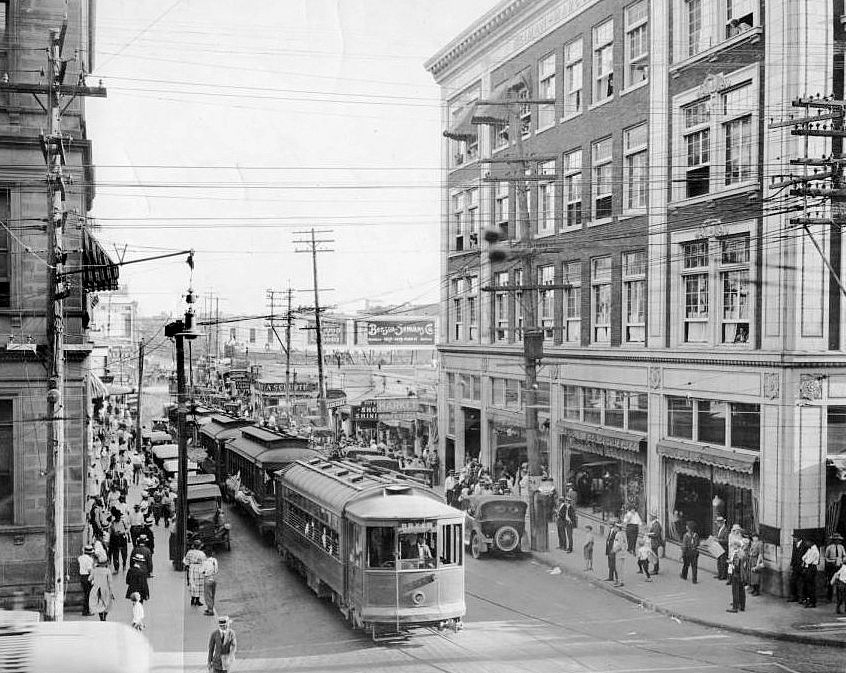
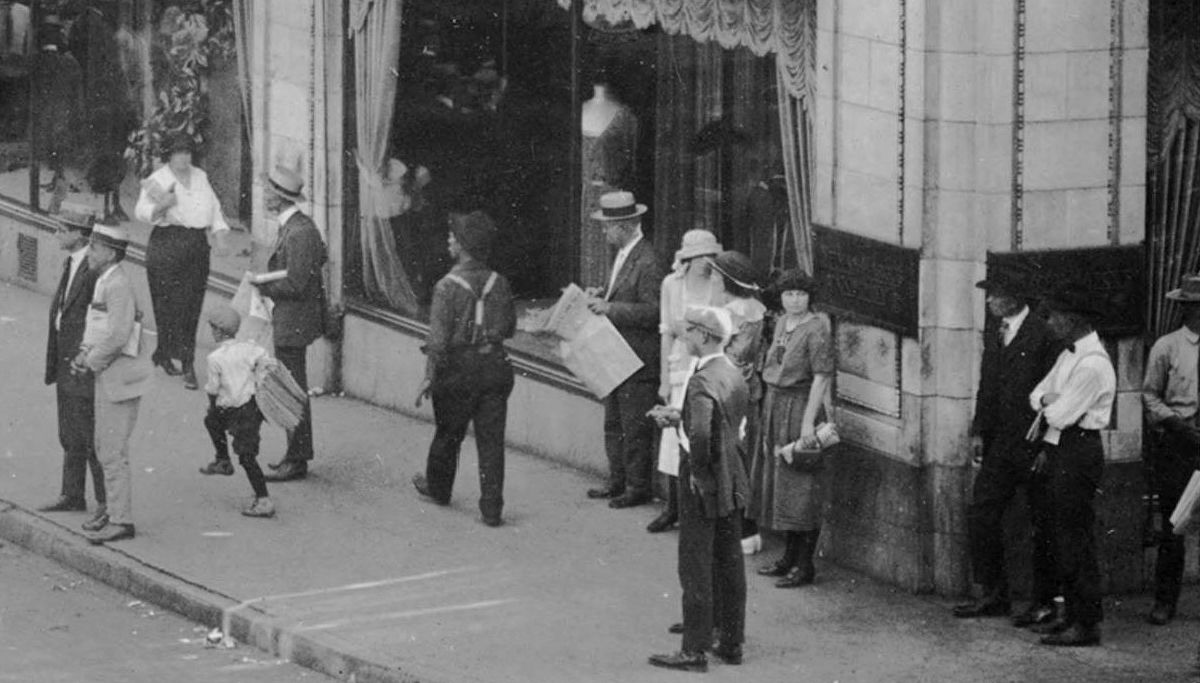
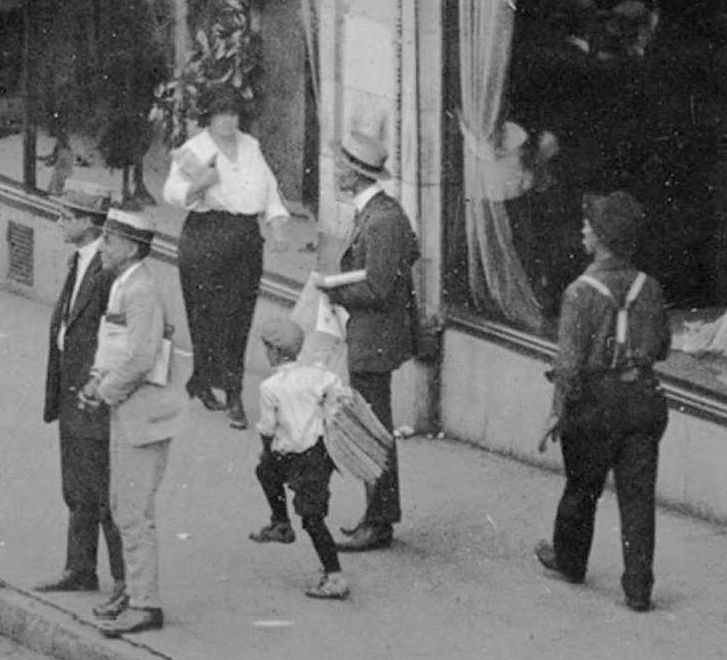
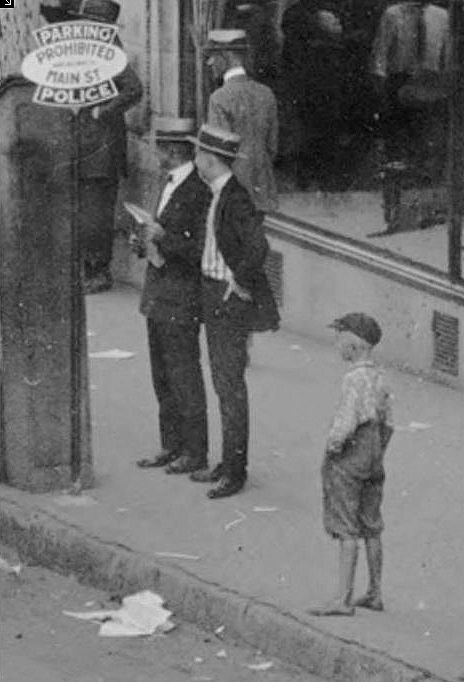
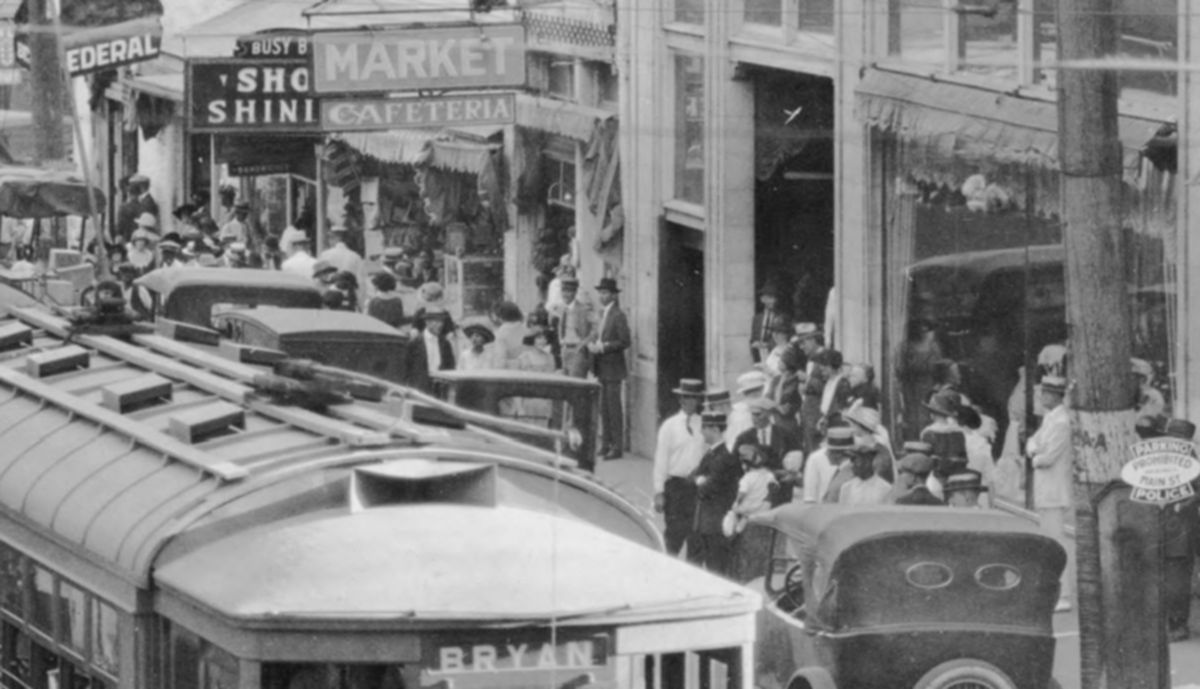
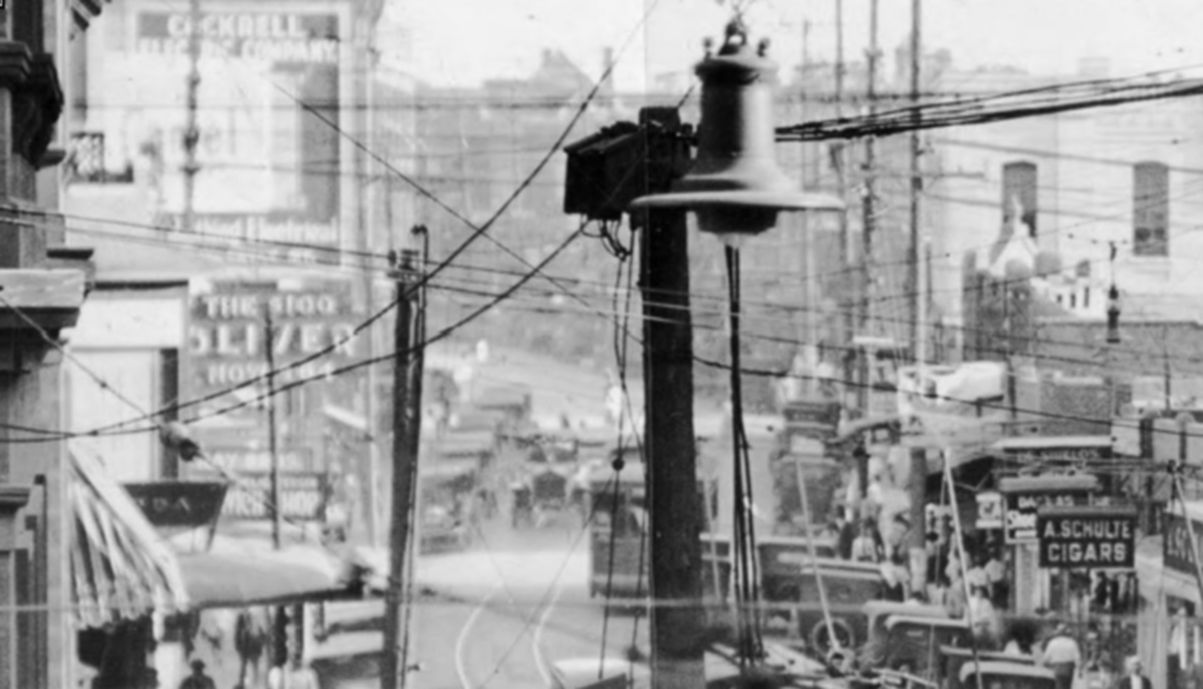
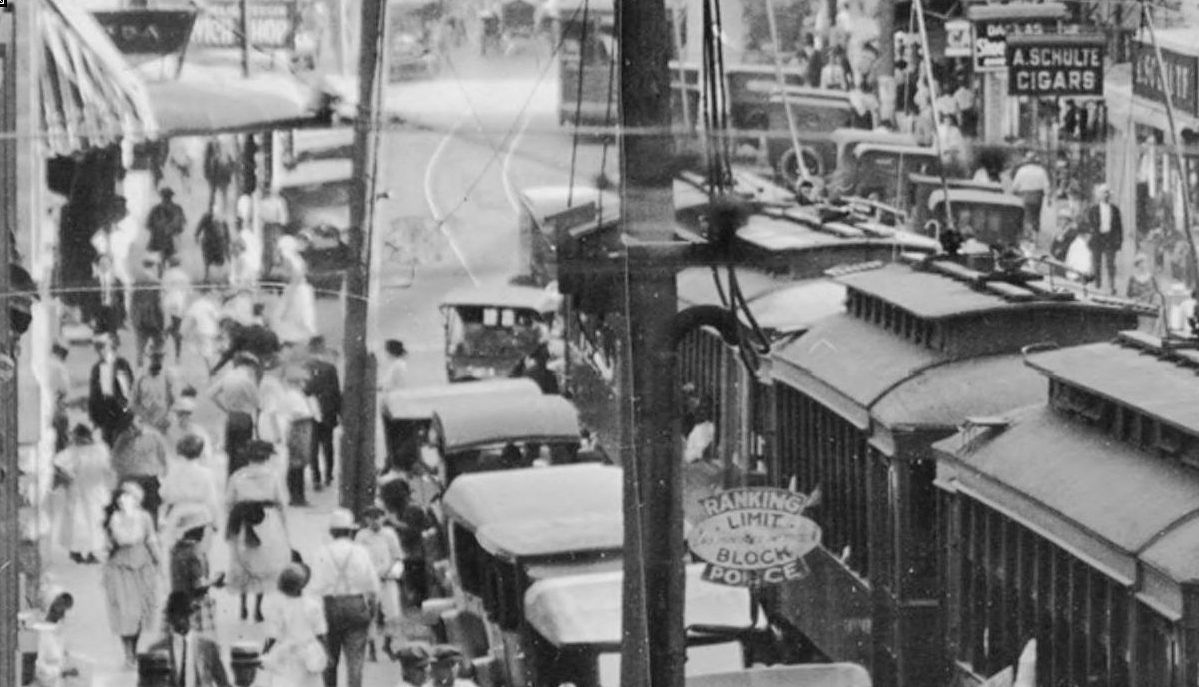
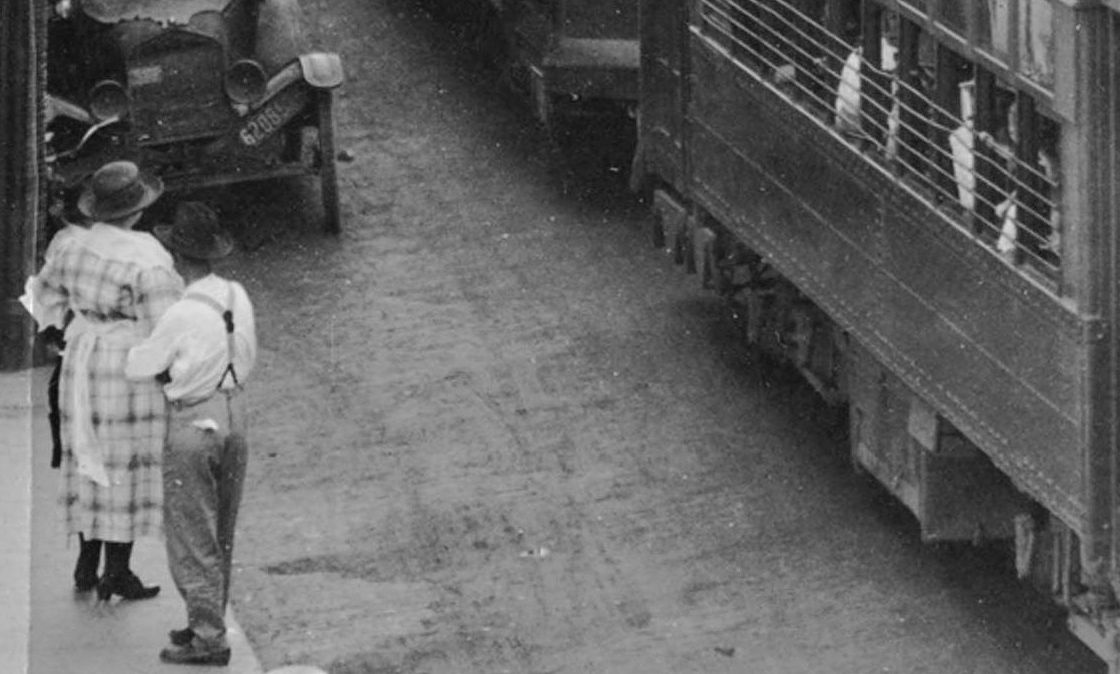
The photograph above, by George A. McAfee, shows Ervay Street, looking south from Main, in about 1920. Neiman’s is on the right. I’m not sure what the occasion was (I see special-event bunting….), but the two things that jump out right away are the number of people on the sidewalks and the amount of  congestion on the streets. In addition to private automobiles (driven by “automobilists” or “autoists,” as the papers of the day referred to them), the street is also packed with cars standing in the taxi rank (cab stand) at the left, and a long line of hulking streetcars. This busy intersection is jammed to capacity.

The city of Dallas was desperately trying to relieve its traffic problems around this time, and there were numerous articles in the papers addressing the concerns of how to manage the congestion of streets not originally designed to handle motor vehicle traffic. Dallas and Fort Worth were working on similar plans of re-routing traffic patterns and instituting something called “skip stop” wherein streetcars would stop every other block rather than every block. Streetcars, in fact, though convenient and necessary, seemed to cause the most headaches as far as backing up and slowing down traffic, as they were constantly stopping to take on and let off passengers. There was something called a “safety zone” that was being tried at the time. I’m not sure I completely understand it, but it allowed cars to pass streetcars in certain areas while they were stopped.

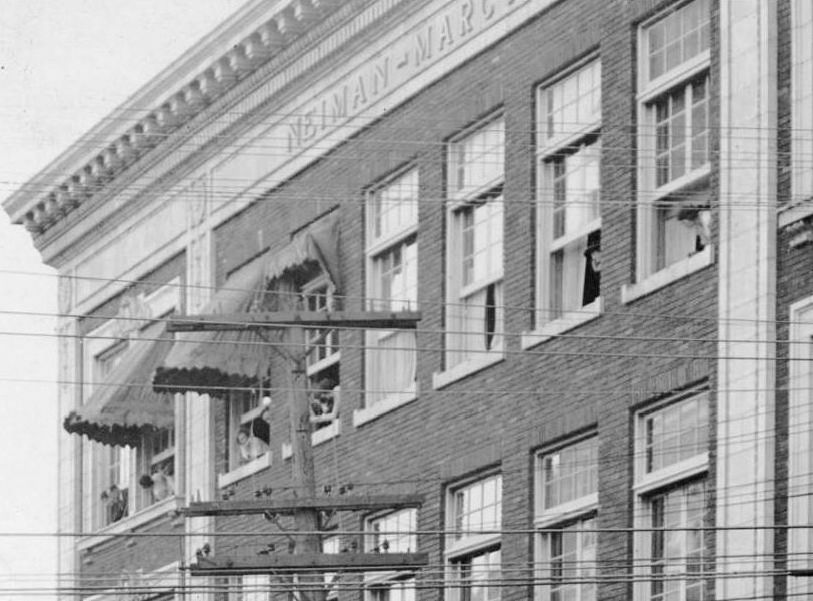
That traffic is crazy. But, to be perfectly honest, it’s far less interesting than all that human activity — hundreds of people just going about their daily business. It’s always fun to zoom in on these photos, and, below, I’ve broken the original photograph into several little vignettes. I love the people hanging out the Neiman-Marcus windows. And all those newsboys! Not quite as charming was all that overhead clutter of power lines and telephone lines; combined with the street traffic, it makes for a very claustrophobic — if vibrant — downtown street scene. (Click photos for larger images.)

2-ervay

3-ervay

4-ervay

5-ervayMy favorite “hidden” image in the larger photograph. The only moment of calm.

6-ervayI love this. The woman in front of the Neiman-Marcus plaque looking off into the distance, the display in the store window, the newsboy running down the street, the man in suspenders, the women’s fashions, and all those hats!

7-ervay

8-ervayA barefoot boy and litter everywhere.

9-ervay

10-ervay

11-ervayThe congestion is pretty bad above the streets, too.

12-ervay

13-ervayCabbies, newsboys, and working stiffs.

14-ervay

15-ervayI swear there was only one streetcar driver in Dallas, and he looked like this! Those motormen had a definite “look.”

***

Sources & Notes

Original photograph attributed to George A. McAfee, from the DeGolyer Library, Central University Libraries, Southern Methodist University, accessible here.

For other photos I’ve zoomed in on the details, see here.

*

Copyright © 2014 Paula Bosse. All Rights Reserved.
The Oak Cliff Viaduct & The Weird Composite Photo — 1912

oak-cliff-viaduct-panorama_c1912_LOC

First you take a photo of the beautiful new Oak Cliff Viaduct, above.

Then you take a photo of the Dallas skyline, below.

dallas-panorama-skyline_1912_LOC

Then you put them together and get this bizarro Franken-photo!

oak-cliff-viaduct-panorama_skyline_c1912_LOC

It doesn’t look like any view of Dallas you’ve ever seen, but it still looks pretty damn cool.

***

Sources & Notes

All these panoramic photos are in the collection of the Library of Congress, all from the studio of Johnson & Rogers. The top photo has a copyright date of March, 1912, and the bottom two have copyright dates of August, 1912. See these panoramic photos (as well as one of the Buckner Orphan’s Home in 1911) on the Library of Congress site here.

Would this unusual composite have been done for a fanciful postcard or some other kind of promotional material (for the city or for the photographers)? Was it just done for fun? Tellingly, it’s the only one of the three without the studio’s imprint. If anyone has further info on this, please let me know!

These photos are HUGE. Click to see larger images — and use that horizontal scrollbar!

*

Copyright © 2014 Paula Bosse. All Rights Reserved.

Stemmons and Inwood, Before and After

stemmons-inwood_haskins_1954

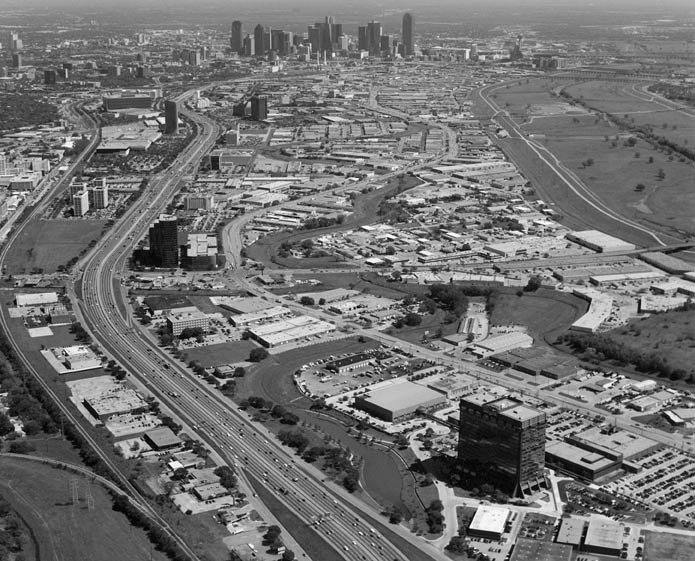
Stemmons and Inwood, looking southeasterly toward town, 1954. Below, pretty much the same shot, 1994.

stemmons-inwood_haskins-jr_1994

***

Top photo by the great Squire Haskins; bottom photo by the firm bearing his name that carried on after his death in 1984. Both from the Squire Haskins Photography Collection, Special Collections, University of Texas at Arlington Libraries.

For more on the life and career of Dallas photographer Squire Haskins, see the article “Squire Haskins: High Flying Images” by Brenda S. McClurkin, here.

Need a visual aid? See a Google Map view of the same area today, here.

Click photos for larger images.

*

Copyright © 2014 Paula Bosse. All Rights Reserved.
Industrial Blvd. Congestion — 1952

industrial-blvd_kimball-1954

by Paula Bosse

This photo of Industrial Boulevard is from Our City — Dallas by Justin F. Kimball. Below, a few of his paragraphs on Leslie Stemmons’ vision of what we now know as Industrial Boulevard. (Mr. Stemmons most likely did not foresee the tackiness and bail bonds emporia which now line this “boulevard.”)

Starting at the south end of the levee district, running north the whole length of the district with branches opening to Irving, to Wichita Falls, and to Denton and Gainesville, Industrial Boulevard, 130 feet wide, was dedicated for future traffic use at a time when there was no traffic at all.

One of those present at this stage of the district tells this story: “While the levees were being built and plans being made for the development of the properties, Mr. Stemmons took a group of railroad officials, including Mr. Upthegrove of St. Louis — a Dallas boy, then president of the Cotton Belt Lines — on an inspection tour through the area. There was then no such thing as Industrial Boulevard; Commerce Street west of the river was a narrow road which overflowed whenever the river reached flood stage. The surrounding land was covered with cockleburs, blood weeds and willows. On reaching the site of the present intersection of the Triple Underpass and Industrial Boulevard, Mr. Stemmons remarked, ‘Gentlemen, in twenty years this will be the busiest intersection in Dallas.’ Mr. Upthegrove, an old friend, looked up and said, “Les, you don’t mean that?’ ‘I was never more serious in my life,’ was the reply. Mr. Upthegrove looked around him and shook his head, ‘Gosh,’ he remarked, ‘from cockleburs to congestion.'”

Such is progress! In less than twenty years this intersection was reported to be the busiest intersection of vehicle traffic in the state. Planning, hard work, and faith bring wonders to pass.

***

Photo and text from Justin A. Kimball’s Our City –Dallas; Yesterday and Tomorrow (Dallas: Dallas Independent School District, 1954 — 2nd edition).

More on Leslie A. Stemmons here.

And an article from the months preceding the name-change from Industrial to Riverfront, here.

And if you, like I, wondered if “Mr. Upthegrove” was some sort of contrived Pythonesque name a la “Mr. Smoketoomuch,” it is, apparently, an actual surname. Good to know.

Click photo for larger image.