Flashback : Dallas

A Miscellany: History, Ads, Pop Culture

Category: Theaters

Pacific Avenue — 1925

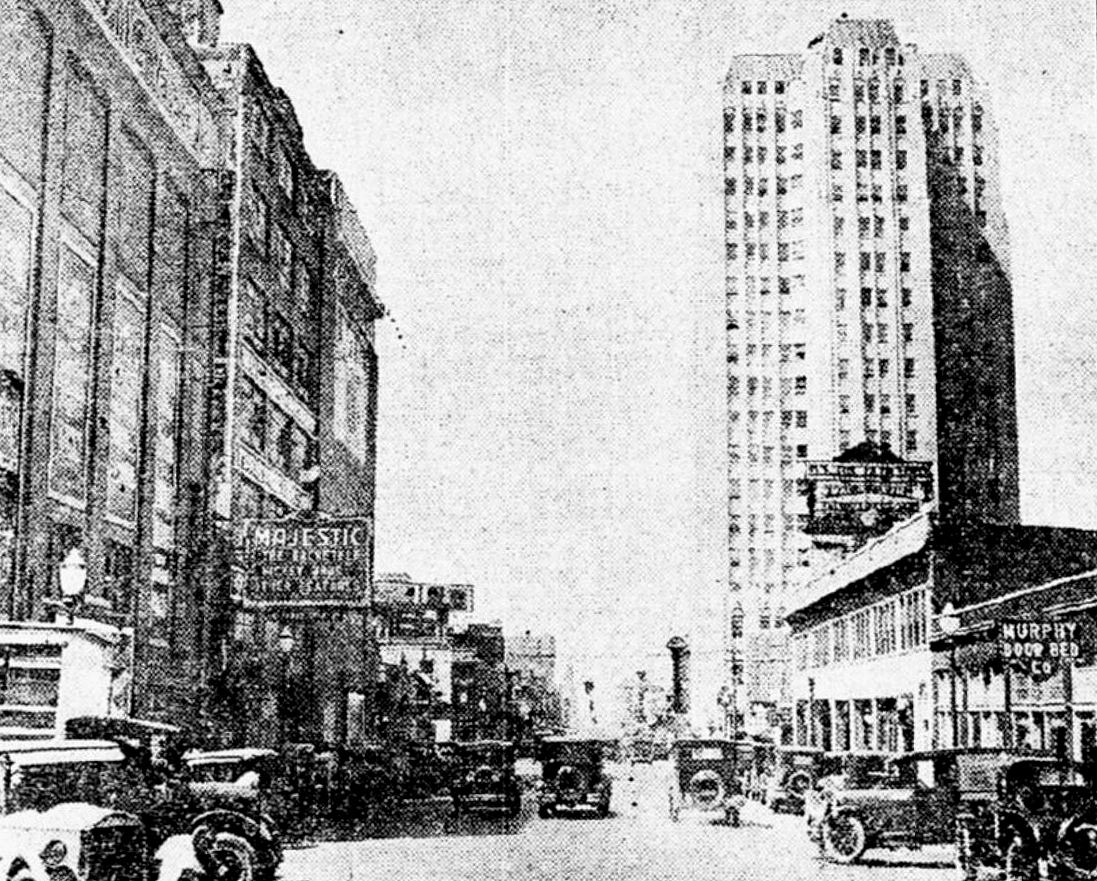
pacific_bryan_looking-east_lost-dallas_dotyThe back side of Elm, looking east…

by Paula Bosse

Elm Street gets all the glory as Theater Row, but what about Pacific? It had those very same theaters. …Sort of. Pacific gets overlooked a lot. When I see photos like this one — which shows Pacific Avenue looking east from Bryan — I always think of it as a photo showing the back side of Elm rather than as a photo showing Pacific. Always a bridesmaid, never the bride.

This photo was taken only a few short years after the Texas & Pacific railroad tracks were removed from Pacific, making it into an automobile and pedestrian thoroughfare only — no more frightening, smoke-belching trains rumbling right down the middle of the street. The city was hoping that Pacific would become a heavily commercial area like Elm, Main, and Commerce, but it never really reached those lofty heights.

I’ve always wondered if the theaters that lined Elm ever considered having entrances/box offices on both Elm and Pacific. I think that they were really only willing to slap a few posters and paint their names on their back, Pacific-facing walls. Elm Street was glitzy and glamorous. Pacific was not. Back in those early days when people were still trying to get used to Pacific Avenue being newly liberated from its railroad tracks, it might have been seen as something of an afterthought — as more of a very wide alley with traffic than as a contender for one of Dallas’ major streets.

But back to the theaters. In the photo above, we see the Old Mill at 1525-27 Elm (where “The Snob” was playing, featuring John Gilbert and Norma Shearer), the Capitol at 1521-23 Elm (which had Alla Nazimova in “The Redeeming Sin”), and the Jefferson Theater at 1517 Elm (featuring Harley Sadler’s repertory company appearing in “Honest Hypocrites and Saintly Sinners” between vaudeville acts). All of these were playing in May, 1925.

It’s interesting that the only business seen here on the south side of Pacific that had an address on both Elm and Pacific was Van Winkle’s Book Store (before it moved a couple of doors up Elm, it was at 1603 Elm/1614 Pacific). Note the sign advising “Free Passage to Elm Street” — several businesses allowed people to cut through their stores to get to the next street over because the blocks were incredibly long and would sometimes have necessitated pedestrians going three blocks out of their way just to get to their destination.

Other notable landmarks in the photo above: the Medical Arts Building (on the left) and the Dallas Athletic Club.

Here’s a view of Pacific from around the same time, looking west, from about Harwood.

pacific-looking-west_dmn_041430
1930

Most interesting detail in this photo? That Murphy Door Bed Co. sign!

***

Sources & Notes

Top photo from Lost Dallas by Mark Doty (Charleston: Arcadia Publishing, 2012).

*

Copyright © 2015 Paula Bosse. All Rights Reserved.

Elm Street at Night, Coming & Going — 1950s

elm-st-night_ebayHave a sudden hankering for a fistful of roasted peanuts?

by Paula Bosse

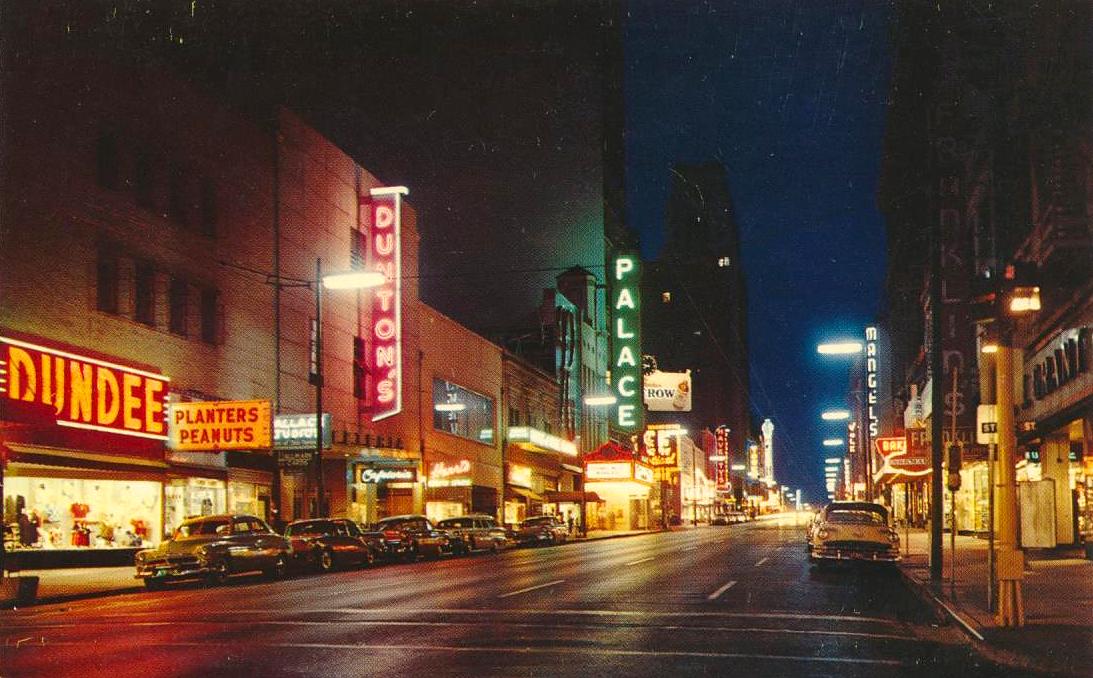
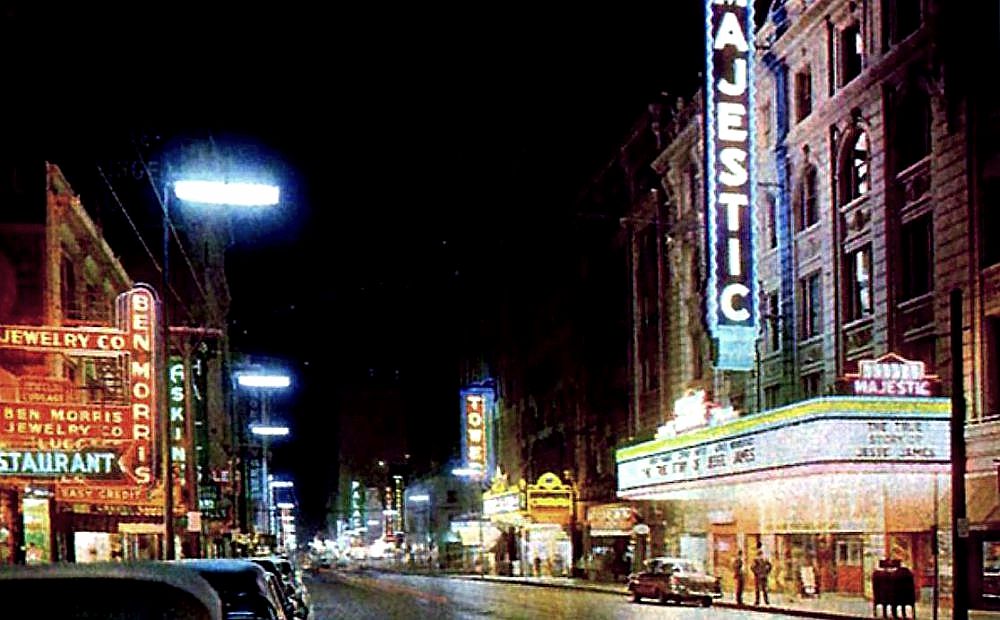
Two postcards from the Fabulous Fifties showing Dallas’ Theater Row, lit up at night — one looking east (above), and one looking west (below).

The top view — taken from about Stone — was probably taken in the early- to mid-’50s. (See the same view today, here.) The following Elm Street businesses — all of which can be seen in this postcard — were listed in the 1953 city directory:

1602 Elm — W. T. Grant (dept. store)
1605 — Dundee Smart Clothes
1607 — Planters Peanuts (This place fascinates me!)
1607a — Wallace Studios (photography studio)
1609 — Dunton’s Cafeteria
1610 — Franklin’s (women’s clothing)
1613 — Henri’s Hollywood Beauty Studio
1614 — Baker’s Shoes
1623 — Palace Theatre

ERVAY crosses
1700 — Mangel’s (women’s clothing)
1705 — Lee Optical
1713 — Haverty’s (furniture)
1806 — Volk Bros. (dept. store)

ST. PAUL crosses
1907 — Tower Theatre
1911 — Melba Theatre (barely visible)
1921 — Majestic Theatre

Here’s Elm looking west, taken at about North Harwood. (See the same view today, here.) The movie playing at the Majestic, “The True Story of Jesse James,” was released in February, 1957.

elm-street-night_ca1957

The businesses seen here, on the south side of the street:

1918 Elm — Hall’s Credit Clothiers
1922 — Askin’s Credit Clothing Store
1924 — Ben Morris Jewelry
1926 — Majestic Cafe (*possibly* — I’m not sure if it was there in 1958)

In all my wanderings through photos of old Dallas, my biggest regret is that I never experienced downtown-Dallas movie-going in the 1930s, 1940s, and 1950s. Mr. Peanut, we hardly knew ye (or in my case, I never knew ye).

***

Sources & Notes

Top postcard from eBay.

Second postcard from the Billy Holcomb Collection, found on Cinema Treasures here. (If anyone has a better image of this, let me know!)

The thought of buying warm, just-roasted nuts on the sidewalk of a busy downtown street makes me feel all nostalgic for something I’ve never actually experienced. It looks like the Planters Peanut shop was in a couple of different locations before it moved to the one seen above at 1607 Elm — first at 1519 Main (in about 1929), and then the 1500 block of Elm, next to Cullum & Boren (from 1931). Read a few memories of this Elm Street shop here; and see photos of a shop still operating in Memphis, here.

*

Copyright © 2015 Paula Bosse. All Rights Reserved.

Teatro Panamericano / Cine Festival — 1943-1981

teatro_villasana_1950sEl Panamericano (click for larger image) (Villasana)

by Paula Bosse

In 1937, Joaquin José (J. J.) Rodriguez opened the first theater in Dallas to show Spanish-language movies. It was the Azteca, at 1501 McKinney Avenue, one block away from the still-there El Fenix. He soon changed the name to the Colonia and later to El Patio.

colonia_1938-directory1938 city directory

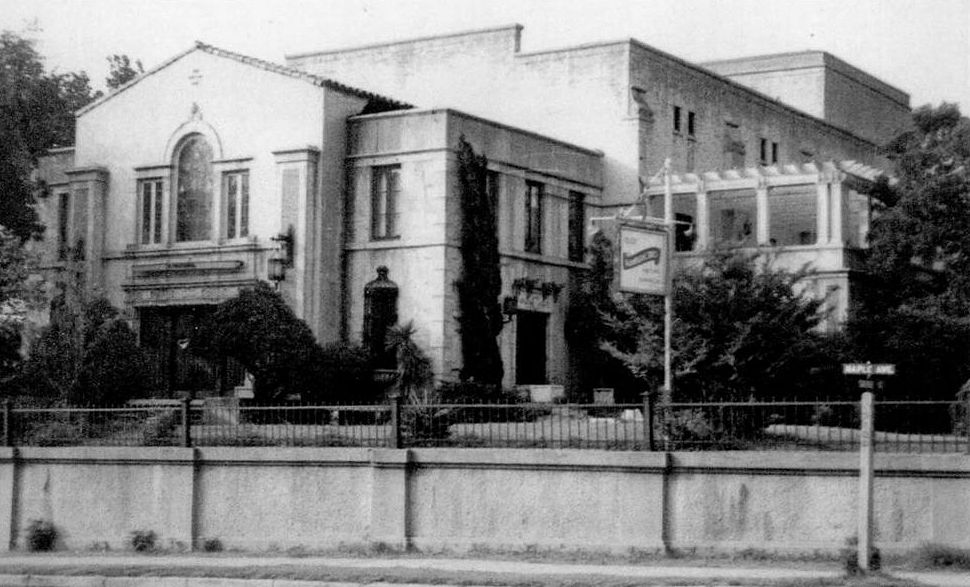
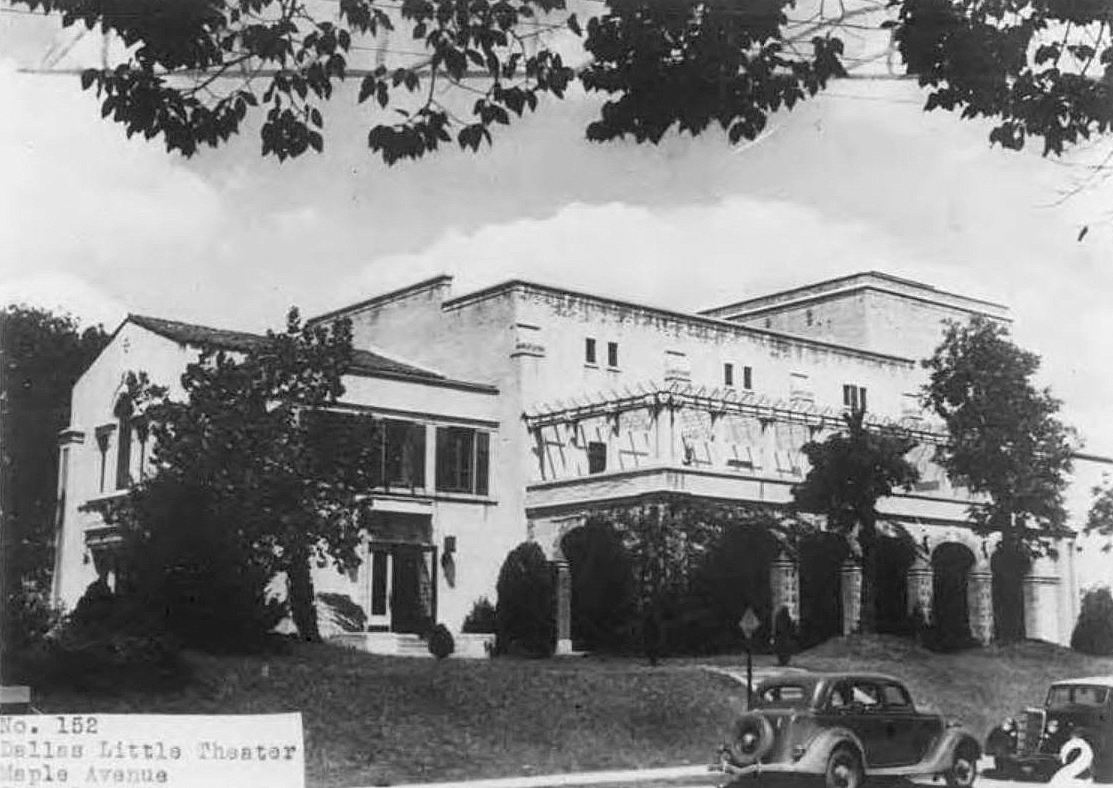
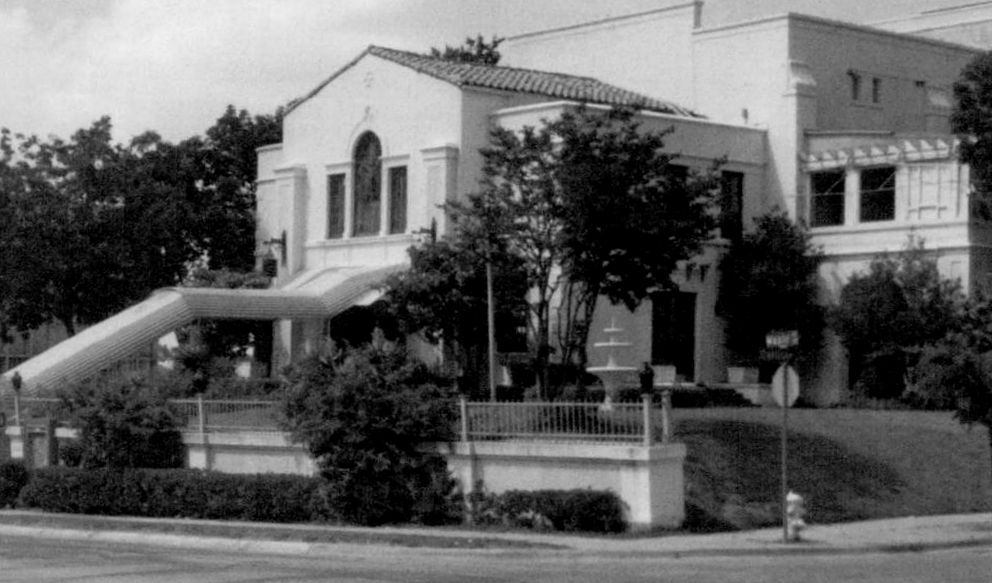
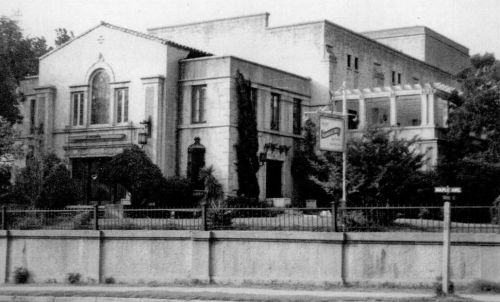
Even though a journalist later described this theater as being “dingy” and “unprepossessing” (DMN, July 31, 1944), the theater was quite successful, little surprise as the Hispanic community of the day was sorely underserved in almost every way. This endeavor was so successful that in the fall of 1943, the 36-year old entrepreneur made a big, BIG move: he bought the stunning and palatial Maple Avenue building that once housed the famed Dallas Little Theatre, an amateur theatrical group that had burst on the scene in 1927, but which had fallen on hard times in recent years.
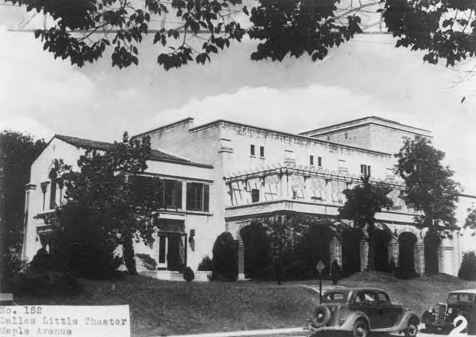
dallas-little-theater_degolyer-lib_SMU1930s

Rodriguez raised the necessary $35,000 (equivalent to almost half a million dollars in today’s money), bought the beautiful building at 3104 Maple, and renamed it Teatro Panamericano. The angle of the article that appeared in The Dallas Morning News on Sept. 22, 1943 announcing the new theater had the new moviehouse as being a boon to students and Anglo members of the community who might need to brush up on their Spanish rather than as a welcomed entertainment venue for the “Mexican colony” living and working in the adjacent Little Mexico neighborhood.

El Panamericano was an immediate success and soon became not only a place to see movies, but also a place for Dallas’ Spanish-speaking community to meet and mingle, with PLENTY of room for all sorts of events. (It was so big that Rodriguez and his family lived in back. He also had TWO offices and more storage space than he had things to store in it. No skimping on the parking lot either — one ad touted an acre of parking space.)

The theater’s importance to the Hispanic community of Dallas was both cultural and social:

For Mexican-Americans growing up in Dallas during the ’50s and ’60s, the films at El Panamericano, were a link with their historical and cultural heritage. For some, it would be their only exposure to cultural ties; for those whose families were stressing their Americanization by using only English in the home, it was a chance to practice their Spanish. (“Festival Fades, but Mexican Movies Thrive,” DMN, Aug. 9, 1981)

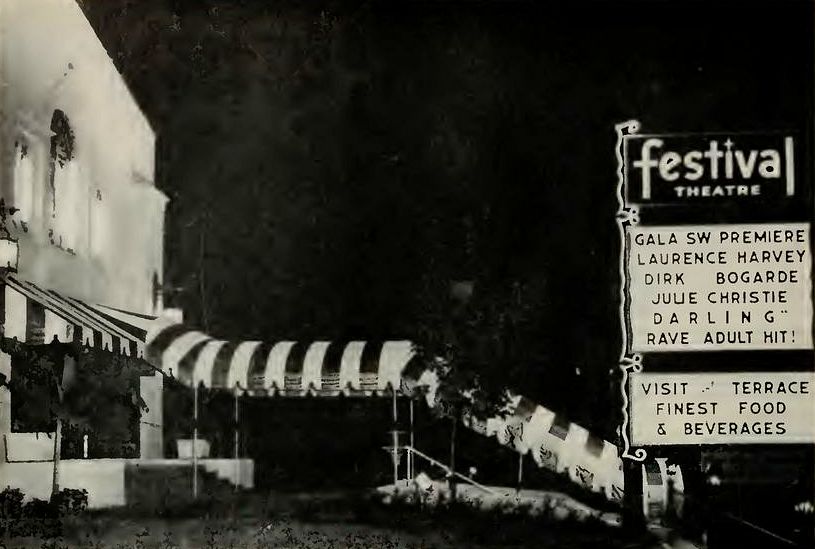
After more than 20 years of running a successful theater that catered to his core niche audience, Rodriguez was persuaded to change the theater’s focus. Mexican families had slowly moved out of the neighborhood, many to Oak Cliff where the Stevens Theater on Fort Worth Avenue had begun showing Spanish-language movies in the early ’60s and had siphoned off a large portion of Rodriguez’s audience. In 1965 the Panamericano became an arthouse cinema which showed mostly subtitled European films (and, later, underground and cult movies) — these were movie bills which were clearly aimed at college students and an upper-class Anglo audience. The Panamericano became the splashy Festival Theatre.
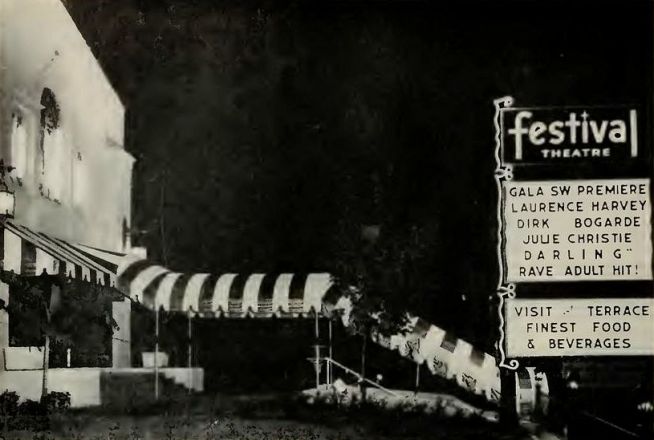
festival_box-office-mag_112265BoxOffice magazine, Nov. 22, 1965

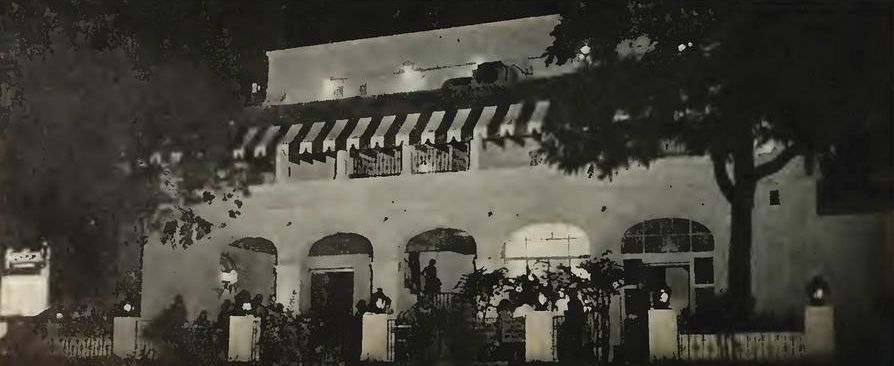
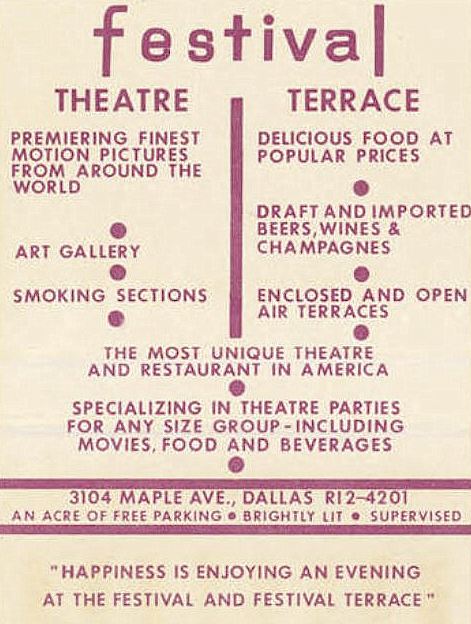
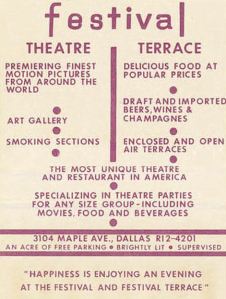
An indoor-outdoor restaurant — the Festival Terrace — was added, and it boasted of being “the only theater in the history of Texas with a wine and beer license.”
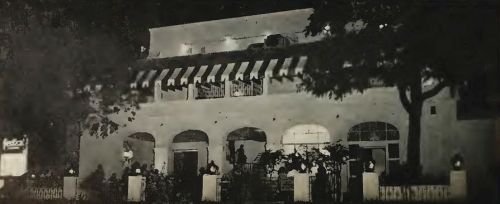
festival_box-office-mag_112265-restaurantBoxOffice magazine, Nov. 22, 1965

teatro_villasana_1960s1960s (Villasana)

As impressive as the Festival and its array of films were, the theater struggled, and Rodriguez later called this period a “big mistake.”

“As soon as I could, I changed it back to the way it was before. In fact, I lost money on that deal.” (DMN, Aug. 9, 1981)

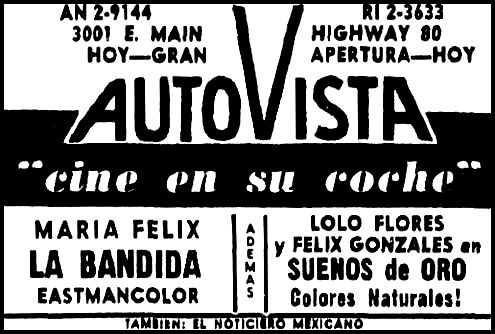
Another unusual misstep for Rodriguez at this time was his decision to open a drive-in that showed only Spanish-language films. What sounded like a great idea was another surprising failure for Rodriguez. Despite its non-stop advertising in the first half of 1965, the wonderfully-named Auto-Vista (located in Grand Prairie) lasted less than a year.
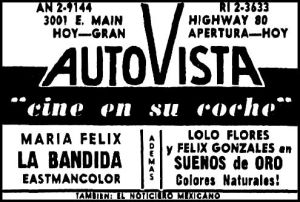
auto-vista_dmn_032565“Cine en su coche”! (March, 1965)

Rodriguez’s new-old Spanish-language theater — now the Cine Festival — was still popular, but it never regained its former glory. Rodriguez retired in 1981 and sold the property. Despite efforts by preservationists to save the beautiful Henry Coke Knight-designed building, it was demolished a few months later — in early January, 1982 — in the dead of night under cover of darkness (… that happens a lot in Dallas…). A nondescript office building was later built in its place.

J. J. Rodriguez died in 1993 at the age of 86, almost exactly 50 years after opening one of the most important entertainment venues for Dallas’ Hispanic population. He was a respected leader in the community and was for many years president of the Federation of Mexican Organizations, an organization he helped found in the 1930s. His theater was both culturally important and beloved by its patrons.

*
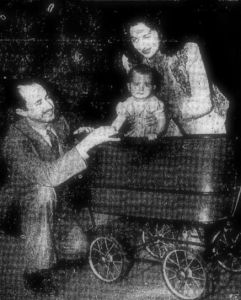
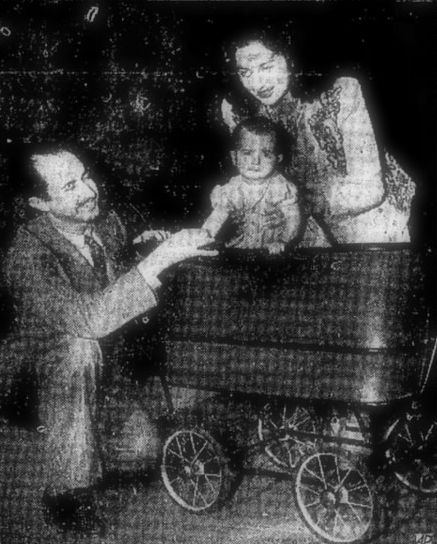
pampa-news_AP-073044J. J. with daughter and wife (Pampa News, July 30, 1944) AP photo
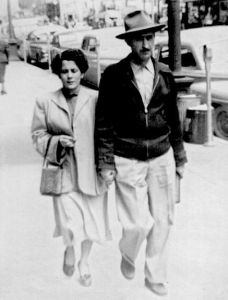
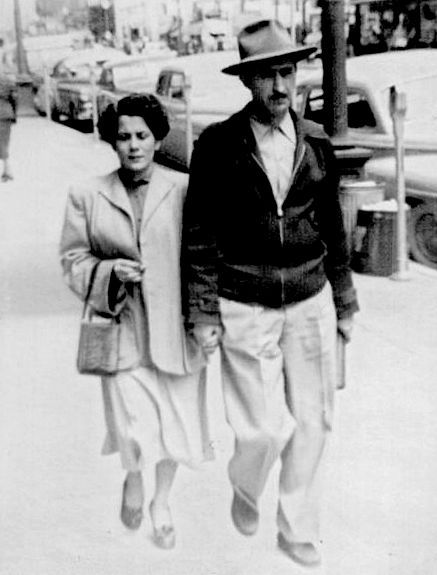
rodriguez_villasana_downtown_1940sWith his wife, Maria, downtown 1940s (Villasana)
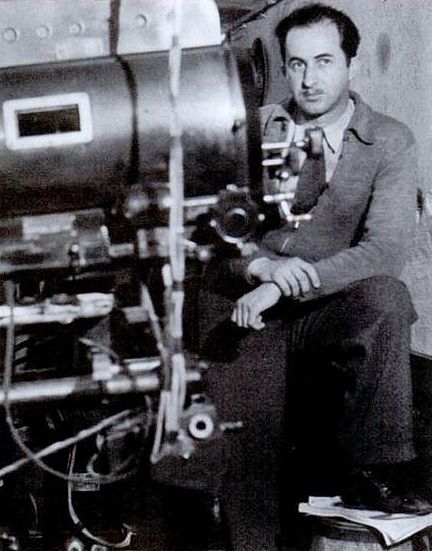
rodriguez_villasana_1950sIn the projection booth, 1950s (Villasana)

*

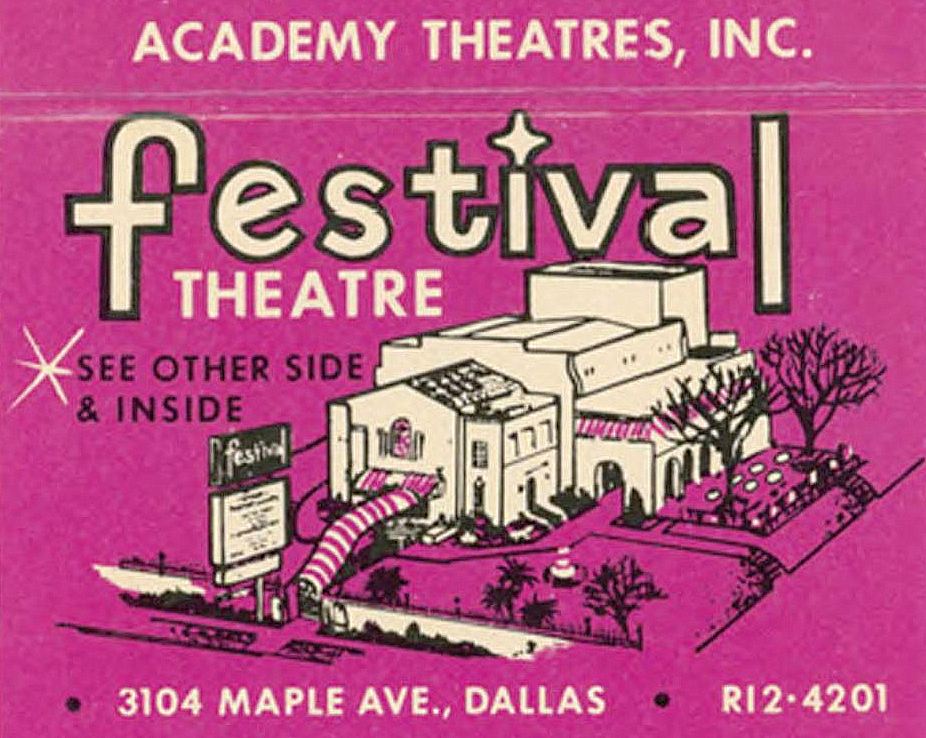
The matchbook cover image below gives an indication of how large the theater was. The building at 3401 Maple — at the corner of Carlisle, across Maple from the Maple Terrace — was gigantic.
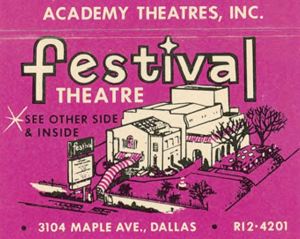
festival-theatre_cook-collection_degolyer_smu_matchbook-cover

festival-theatre_cook-collection_degolyer_smu_matchbook-insideMatchbook via George W. Cook Collection, SMU

In a Dallas Phorum discussion (here), the space was described thusly:

It was an interesting building with an outdoor terrace restaurant, a full proscenium stage, rehearsal space downstairs below the stage, dressing rooms, shop/storage areas, and even a puppet theatre built into a wall in the balcony lobby area.

To see what the corner of Maple and Carlisle looks like now, click here (have a hanky ready). Can you imagine how wonderful it would be to still have that elegant building and still see it in use as a theater and restaurant?

**

In what may well be research overkill, I thought it was odd that there was an Azteca Theatre at 1501 McKinney a year before Rodriguez owned it. I wondered if, in fact, Rodriguez had owned the first Spanish-language movie theater in Dallas, or whether that distinction belonged to Ramiro Cortez (whose name is often misspelled as Ramiro Cortes). It seems that Cortez’s theater might have featured live performances rather than motion pictures. Like Rodriguez, Cortez had ties to Dallas entertainment — read about him here.

azteca_1937-directory1937 city directory

***

Sources & Notes

Photos with “Villasana” under them are from the book Dallas’s Little Mexico by Sol Villasana (Charleston, SC: Arcadia Publishing, 2011); all are from the personal collection of Mariangel Rodriguez. More photos of J. J. Rodriguez can be seen here (click “Next” on top yellow bar).

The full article from the Nov. 22, 1965 issue of the industry journal, BoxOffice, includes additional photos and information and can be seen here and here.

All other images and clippings as noted.

Articles on J. J. Rodriguez and his theaters which appeared in The Dallas Morning News:

  • “Pan-American Theater to Aid Spanish Study” (DMN, Sept. 22, 1943)
  • “Teatro Panamericano” by John Rosenfield (DMN, Oct. 12, 1943)– coverage of opening night festivities
  • “Maple Location Regains Swank” by John Rosenfield (DMN, Sept. 18, 1965) — about the change from El Panamericano to the arthouse Festival Theater
  • “Festival Fades, but Mexican Movies Thrive: Theater Owner Says Adios to Film Business” by Mercedes Olivera (DMN, Aug. 9, 1981) — about the closing of the Festival Theater
  • “Encore No More” (DMN, Jan. 4, 1982) — photo of the partially demolished theater
  • “Rites Set for Hispanic Leader J. J. Rodriguez — He Co-Founded Federation of Mexican Organizations” by Veronica Puente (DMN, Sept. 26, 1993) — Rodriguez’s obituary

“Dallas Theater Owner Is One-Man Pan-American Agency” — a syndicated Associated Press article by William C. Barnard — can be read here.

Read about Teatro Panamericano at Cinema Treasures, here.

Read about the competing Stevens Theater in Oak Cliff on Fort Worth Avenue, here.

*

Copyright © 2015 Paula Bosse. All Rights Reserved.

Tower Theater — 1967

theater-row_preservation-dallasMovie premiere at the Tower, 1967 (click for larger image) photo, Lovita Irby

by Paula Bosse

Elm Street, probably Thursday July 6, 1967, when “The Dirty Dozen” opened at the Tower. Next door at the Capri was “Spartacus.” Down the street, at the Majestic, the second week of the James Bond movie, “You Only Live Twice.” At first I thought it was odd that there was little in the clothing that looked like 1967, but I guess there probably weren’t a lot of hippies standing in line to see “The Dirty Dozen.”

***

Photo by Lovita Irby, from the November 2013 Preservation Dallas newsletter, accessible in a PDF here.

Trivia: Appearing in “The Dirty Dozen” was Dallas native Trini Lopez.

Previous Flashback Dallas posts on Theatre Row/Theater Row, here.

*

Copyright © 2015 Paula Bosse. All Rights Reserved.


Three of Dallas’ Earliest “Photoplay Houses” — 1906-1913

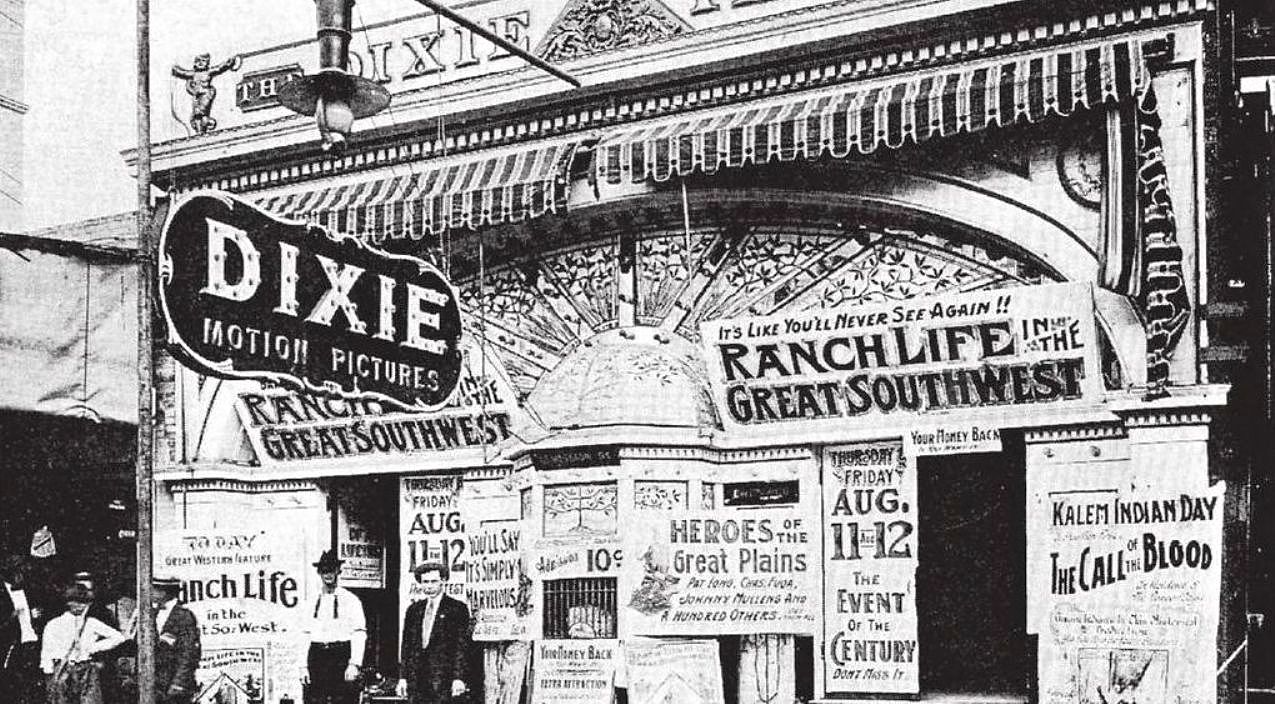
dixie-theater_1910_sherrod_smuDallas’ first movie house, here in 1910 on its third name (click for larger image)

by Paula Bosse

I seem to be deep into an unintended “Movie Week” here, all because I’ve been researching a photo of a little-known early suburban movie theater — and that’s how I stumbled onto a great article about Dallas’ first “picture shows.” The rather clunky title of the extremely informative Dallas Morning News article (which is linked below) is: “Startling Progress of Picture Shows; One-Third of Dallas’ Population Daily Entertained; History Local Houses; Dark Storerooms and Rickety Chairs Give Way to the Modern Photo-Play Theater” (March 9, 1913).

Some of the facts in the article are a bit off, but it’s fascinating to read that the first (or certainly ONE of the first) showings of a moving picture in Dallas was at the State Fair in 1897, when a boxing promoter presented what was one of the earliest “pay for view” matches in history — he showed footage of the highly publicized Jim Corbett-Bob Fitzsimmons Heavyweight Championship fight which had taken place a few months previously — the fight was originally intended to be fought in Dallas, but it was moved to Nevada, causing, one would assume, much consternation to those involved with the staging of and promotion of the fight. Not only did the promoter make back all the money he had invested locally in the thwarted boxing match, but he made a hefty profit trundling the film around the country for curious viewers (which included a large number of women who were not generally allowed to watch boxing matches).

Later, two men set up a projector in a second-story window and began showing movies on an open-air screen across the street, at Main and Lamar. It was popular, but it was also something of a traffic hazard. Also, there were itinerant hucksters who came and went, showing motion pictures wherever they could, moving from city to city.

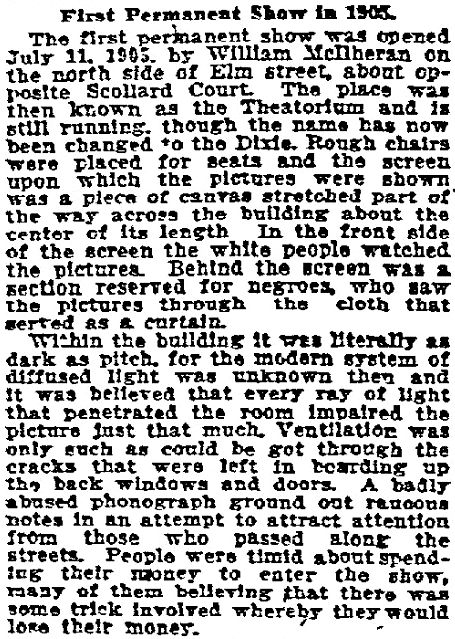
It wasn’t until the summer of 1906 that Dallas got its first permanent movie house when William McIlheran opened the Theatorium (a common word used around the country back then for a movie theater, but which, to virgin ears, sounds as odd as “Sportatorium” must to people who have never heard that word). It was at 311 Elm Street (which later became 1315 Elm), at about where Field is today, and it was the first movie theater on Theater Row! I love this description of what the place was like, from the DMN article mentioned above — even though the opening date is off by a year (click for larger image):

theatorium_dmn_030913DMN, March 9, 1913

theatorium_sherrod

With the arrival of this permanent theater (one with an actual roof over it), the moving picture had finally became more than just a mere novelty, and the success of the Theatorium started a mad dash of entrepreneurs opening up their own theaters. Within a month of the Theatorium’s opening, at least four more such houses were open for business.

At some point the Theatorium became the Wonderland (in 1907 or 1908), and it began showing so-called “talking films” (the talking was, apparently, provided by an off-stage actor providing the spoken dialogue while trying to match the silent actors’ lips on screen).

cameraphone_talking-pictures_dmn_101908The “Cameraphone” — DMN, Oct. 19, 1908
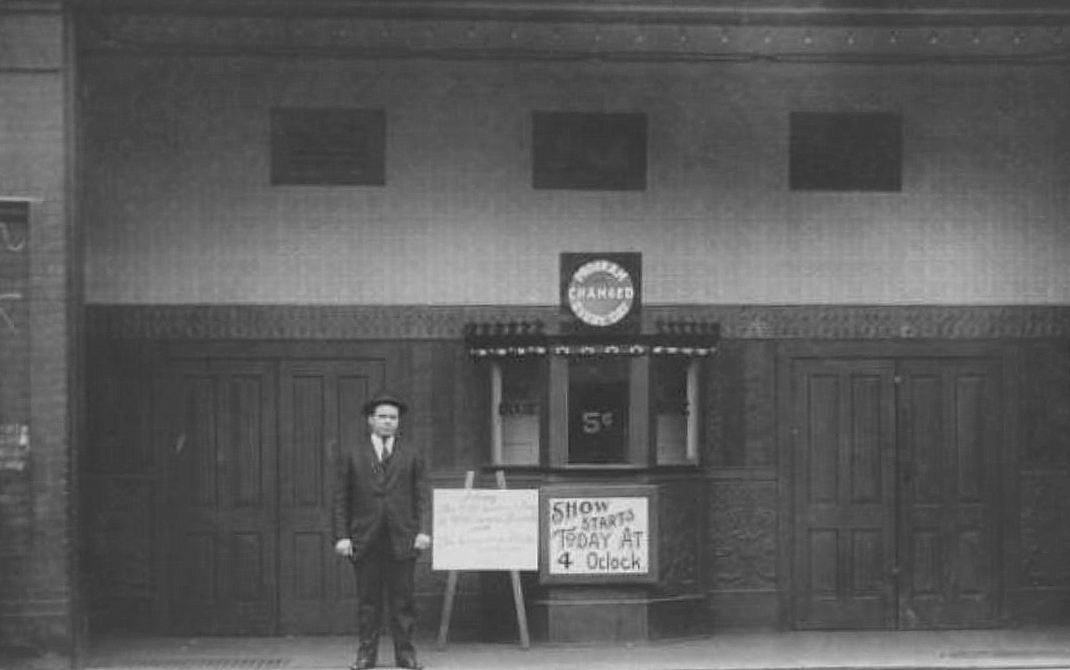
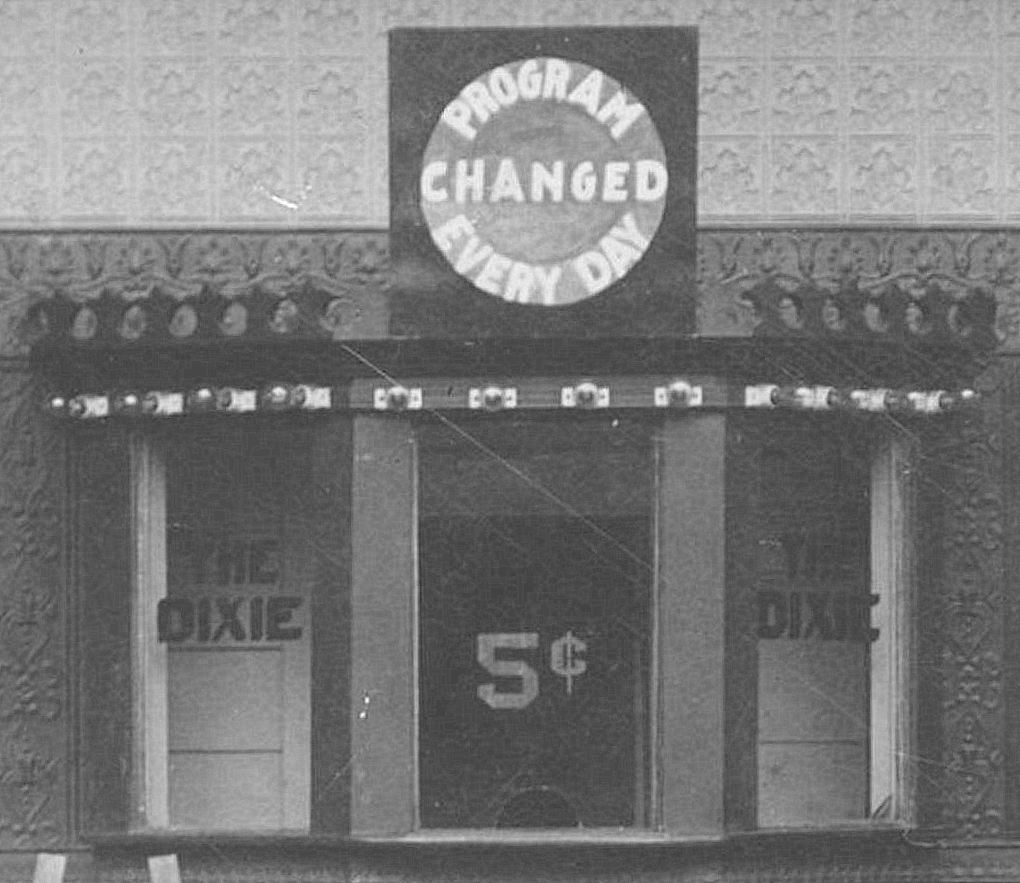
And finally, the Wonderland turned into the Dixie, seen at the top, in 1910, and below, in 1909.

dixie-theatre_1909_cook-colln_degolyer

dixie-theatre_1909_cook-colln_degolyer_detBox office, detail (click for larger image)

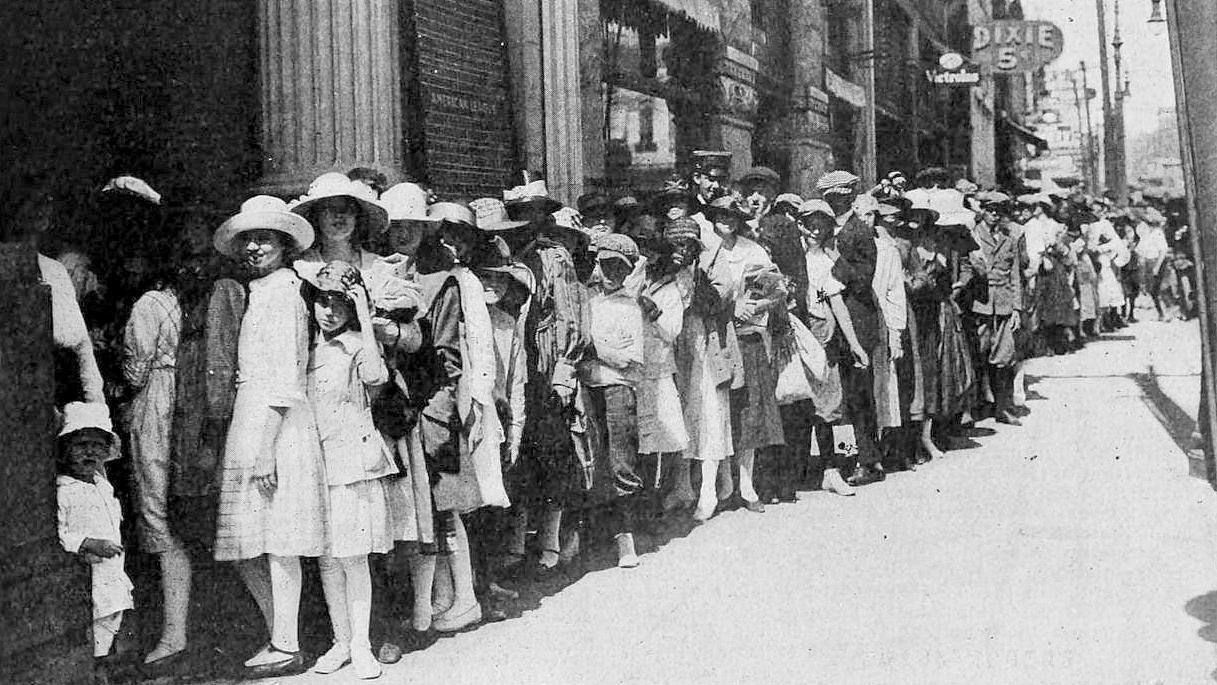
Another photo, from 1918, shows mostly children lined up in front of the theater, with the sign in the background. (They were lined up to see a WWI-related movie at the nearby Hippodrome; the photo is looking east along the north side of Elm, near where Field now intersects.)

hippodrome_dixie_elm-street_moving-picture-world_062218from The Moving Picture World magazine, June 22, 1918

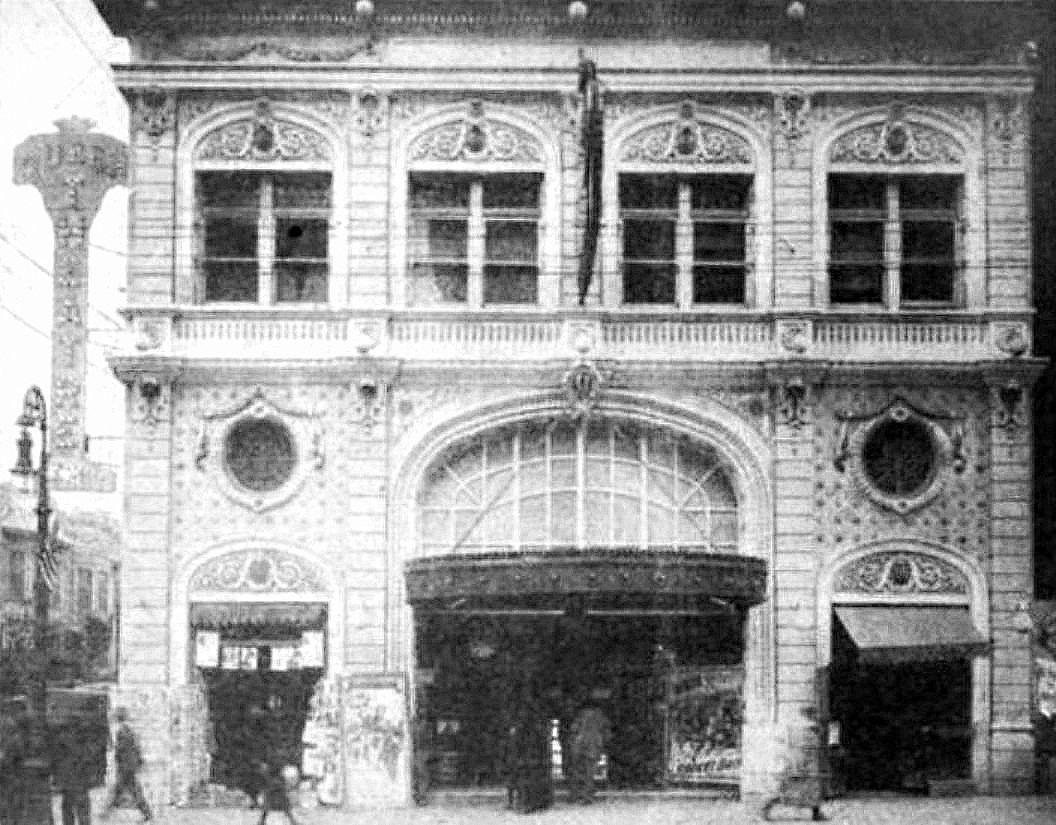
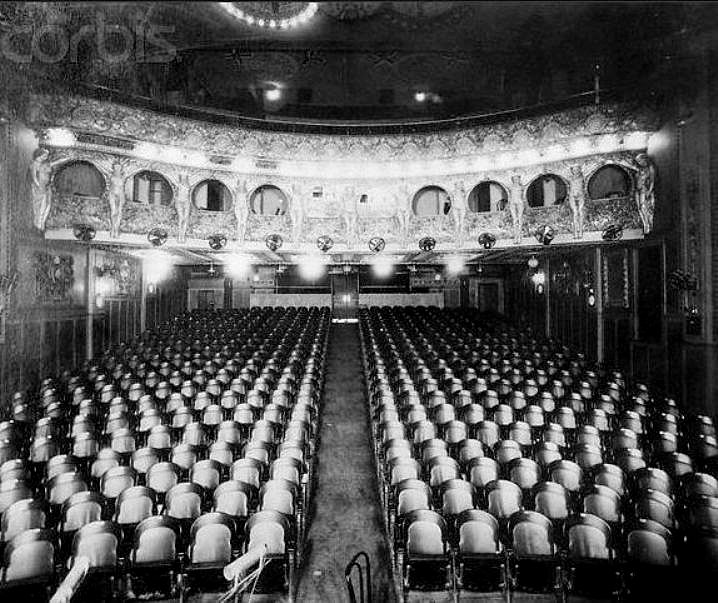
But it wasn’t until the beginning of 1913 that the first “palaces” arrived. The Queen Theatre opened first, at the corner of Elm and Akard. The DMN raved: “The most beautiful Photo-Play Theater in the South. Every man, woman and child in Texas should see this theater — truly a credit to the State” (DMN, Feb. 2, 1913).

queen_bldg-code-bk_1914Photo from Building Laws of the City of Dallas, 1914

queen_cinema-treasuresElm St. about 1917, with Queen on left — photo from CinemaTreasures.org

queen-theater-1939-CORBISInterior, 1930s — photo from CorbisImages.com

queen-theatre_dmn_102012DMN, Oct. 20, 1912

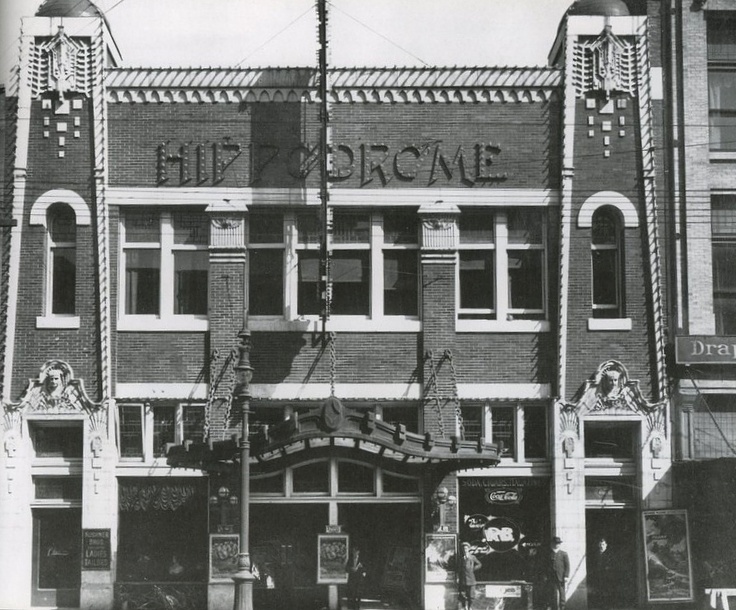
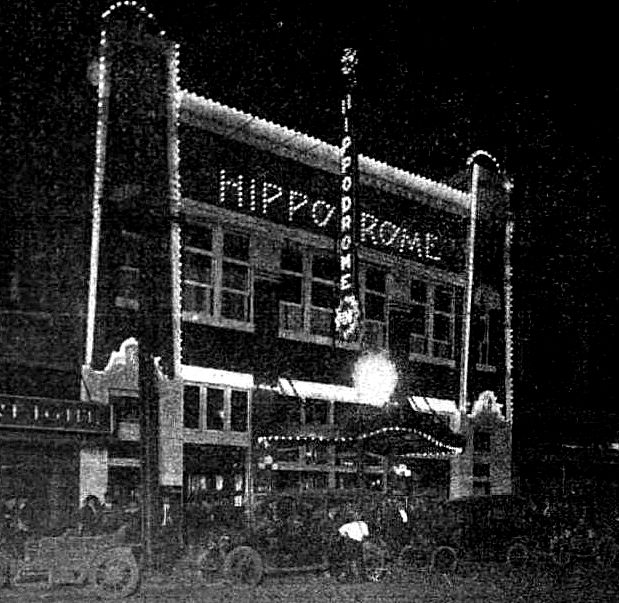
The Queen opened to rapturous crowds in January, 1913, but moviegoers barely had time to catch their collective breath when the Hippodrome opened at 1209 Elm, just a few weeks later, on March 1, 1913. It was “…conceded to being the finest moving picture house in the United States” (DMN, March 9, 1913).

hippodrome

hippodrome_bldg-code_1914Photo from Building Laws of the City of Dallas, 1914

hippodrome_dmn_022813DMN, Feb. 28, 1913

By the time the Queen and Hippodrome opened, movies had become a popular and profitable form of entertainment. In 1913 Dallas had 28 “picture shows” — 24 for white patrons and 4 for black patrons. Even vaudeville houses occasionally ran short films to pad out their live shows. And, notably, movie houses had begun to pop up away from downtown: in 1913 there were a dozen “suburban” theaters in residential areas of town (many of these, though, showed movies outdoors and thus operated only in the warmer months and at night).

There was a tremendous appetite for movies in Dallas in those early years, and when the money men realized that motion pictures weren’t just a here-today-gone-tomorrow novelty but a burgeoning industry, they dived in with enthusiasm.

Any tendency to cast the movies aside as a passing fad has given way to a realization that they are here to stay and that the crest of their popularity has not yet been approached. (DMN, March 9, 1913)

And Theater Row was off and running.

***

Sources & Notes

The top photo of the Dixie Theatre and the Theatorium ad are from the Hamon Arts Library, Southern Methodist University. I found them in Historic Dallas Theatres by D. Troy Sherrod. Sherrod’s passage on the Theatorium/Wonderland/Dixie is well worth reading, here. The second Dixie Theatre photo, with the man standing next to the box office, is from the George W. Cook Dallas/Texas Image Collection, DeGolyer Library, Central University Libraries, Southern Methodist University; it can be found here.

The very informative Dallas Morning News article of March 9, 1913 on the history of movie theaters in Dallas can be read here (it opens in a PDF, click the plus-sign at top of page to increase the text size).

Background on the Corbett-Fitzsimmons fight is here. Background on the now-legendary FILM of the fight is here; highlights of the 1897 film can be viewed here.

Many images larger when clicked.

*

Copyright © 2015 Paula Bosse. All Rights Reserved.


Dazzling Neon, Theater Row — 1929

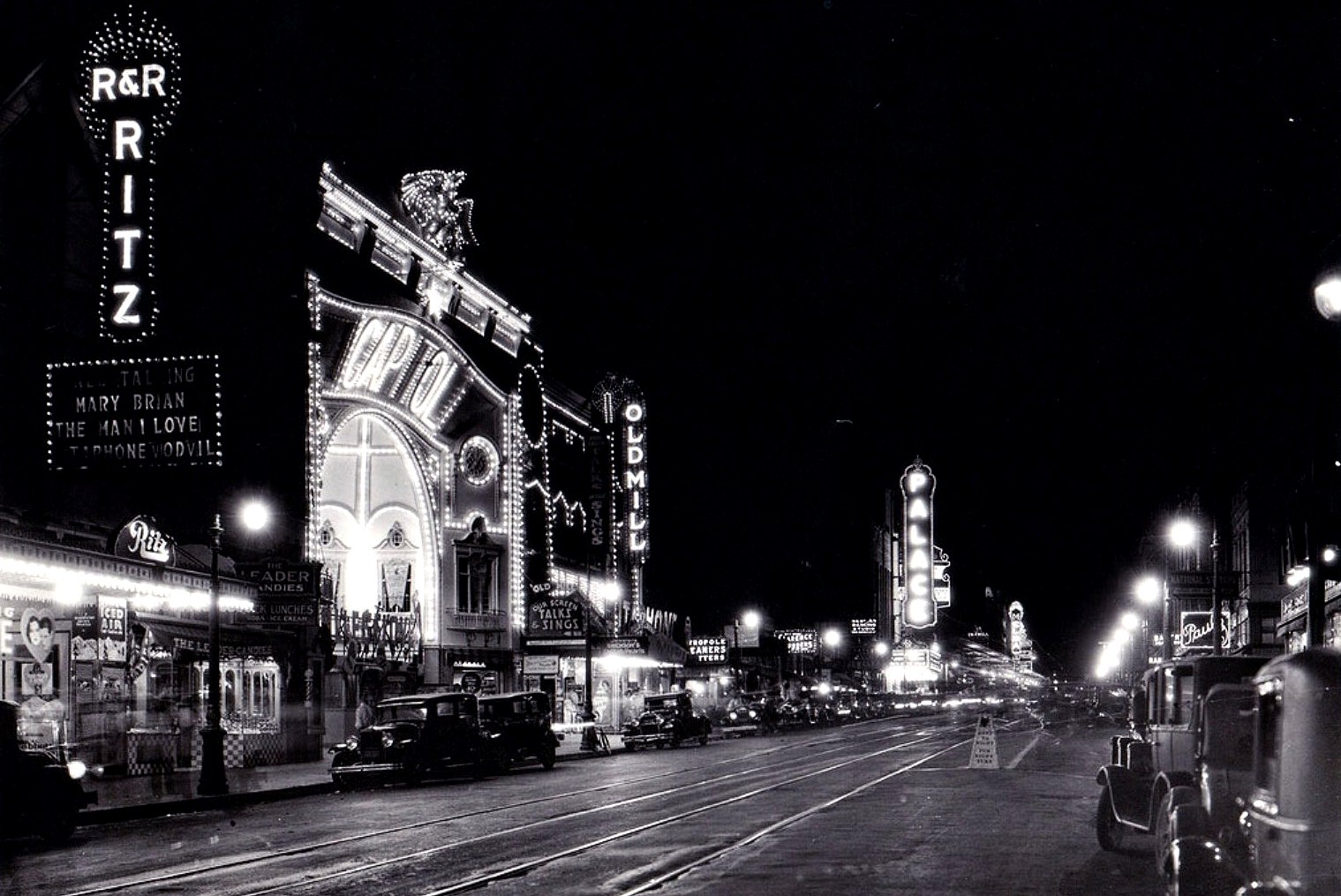
elm-st-night_capitol-old-mill_1929_shorpy“The lights are much brighter there…”

by Paula Bosse

Whoa. Elm Street in the ’20s.

The Ritz. The Capitol. The Old Mill. The Palace. The Melba. Iced air. Paul’s Shoes. What I wouldn’t give to have walked down Elm when it looked like this.

***

Sources & Notes

Photo from Shorpy.com, here.

Highlights from the 1929 and 1930 street directory (from about Akard, heading east):

  • 1517 Elm: Ritz Theatre
  • 1519: Leader Candy Co.
  • 1521: Fooshee’s Barber Shop
  • 1521-23: Capitol Theatre
  • 1525-27: Old Mill Theatre
  • 1600: Paul’s Shoes
  • 1601: Metropole Cleaners
  • 1603: Elm Pacific Arcade
  • 1605: Lontos Cafe
  • 1623-25: Palace Theatre
  • 1911-15: Melba Theatre
  • 1912-29: Majestic Theatre

 *

Copyright © 2015 Paula Bosse. All Rights Reserved.

Dallas’ First Two Drive-In Theaters — 1941

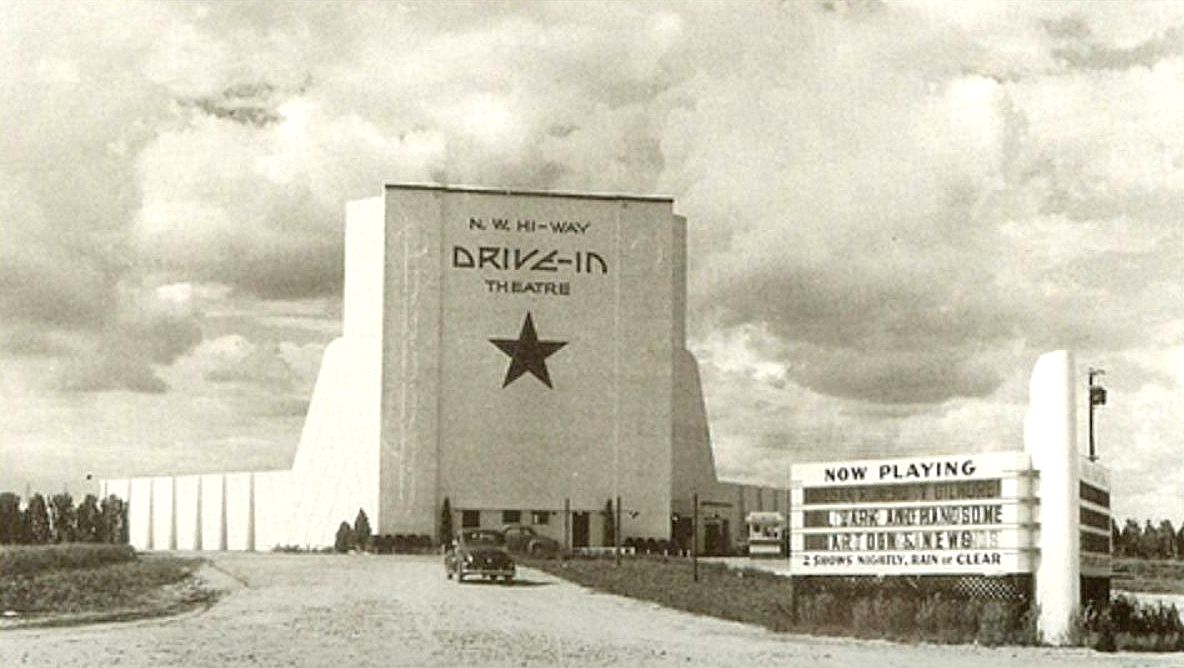
nwhwy-drive-in_july-1941Northwest Hi-Way Drive-In, July 1941

by Paula Bosse

The drive-in theater arrived in Dallas on June 20, 1941, the night that “Give Us Wings,” starring the Dead End Kids, played as the first feature of the Northwest Hi-Way Drive-In, located at the northwest corner of Northwest Highway and Hillcrest. It stood on twelve-and-a-half acres and had a 450-car capacity. The drive-in was opened by W. G. Underwood and Claude Ezell, who had opened similar outdoor movie theaters in San Antonio and Houston.

The Hi-Way (which appears to have usually been spelled “Highway”) featured something I had never seen in drive-in design: cars parked on terraced ramps, where the car behind was always slightly higher than the one in front of it so as to offer an unobstructed view, and speakers were on stands embedded in cement and were placed between cars (no in-car speakers).

Rain was apparently not a problem in this brave new world of outdoor entertainment — if it rained the show would go on (even though the opening was delayed by a few days because of rainy weather) — but fog was a problem, and in case of such weather, movie-goers would be issued a “fog-check” to come back another (fog-free) night.

A newspaper article appeared a few days before the theater’s opening, explaining what a drive-in was and how it worked. Here is the last paragraph:

According to Mr. Underwood 80 per cent of the people who attend drive-in theaters are non-theatergoers. These include people with children and no one to leave them with, semi-invalids, cripples and corpulent individuals who find it embarrassing to attend the regulation theaters. At the Drive-In there is no necessity for getting out of the car, an attendant meets you at the gate, takes your money and buys your tickets, while another wipes your windshield. A third pilots the car to a space on one of the ramps. These are widely spaced enough that any car may leave at any time. (Dallas Morning News, “Northwest Highway Drive-In To Open Tuesday, Rain Or Stars,” by Fairfax Nisbet, June 14, 1941)

Okay then.

The the weather eventually behaved, and the opening on June 20, 1941 was a success, with an almost-capacity audience. The drive-in had arrived in Big D.

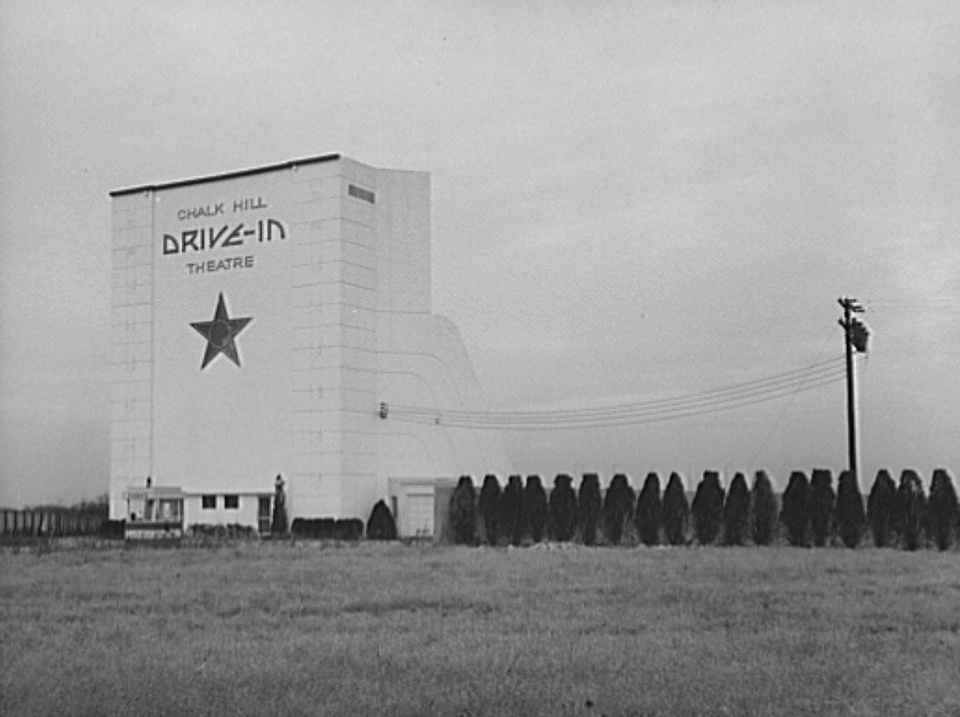
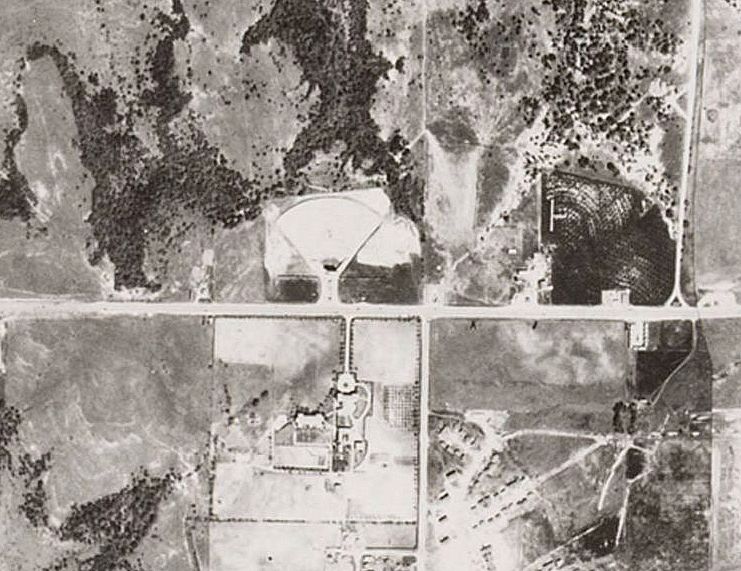
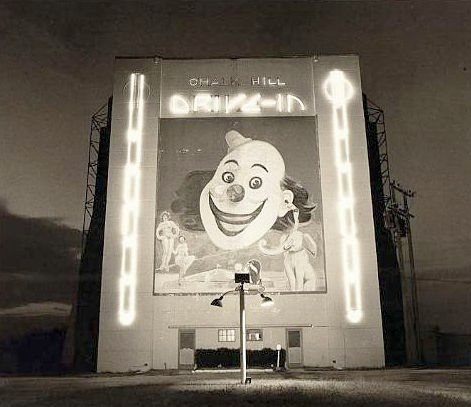
Two weeks later — on July 4, 1941 — Underwood and Ezell opened the Chalk Hill Drive-In in Oak Cliff, at about West Davis and Cockrell Hill Road. It looked almost exactly like the Northwest Highway drive-in, down to the great big star on the outside of it (to be replaced with a clown mural years later). The very first feature was “The Invisible Woman” with Virginia Bruce and John Barrymore.

chalk-hill-drive-in_1942_LOC1942, out on the Fort Worth pike (Library of Congress)

Both theaters had successful and relatively long lives. The Northwest Highway drive-in closed in 1963 when the land was purchased for development (the most notable occupant of the new businesses that occupied that corner was probably the fondly remembered Kip’s restaurant).

The Chalk Hill Drive-In closed in the late 1970s, and from what I can tell, it spent a couple of decades abandoned and decaying.

*

A few random tidbits.

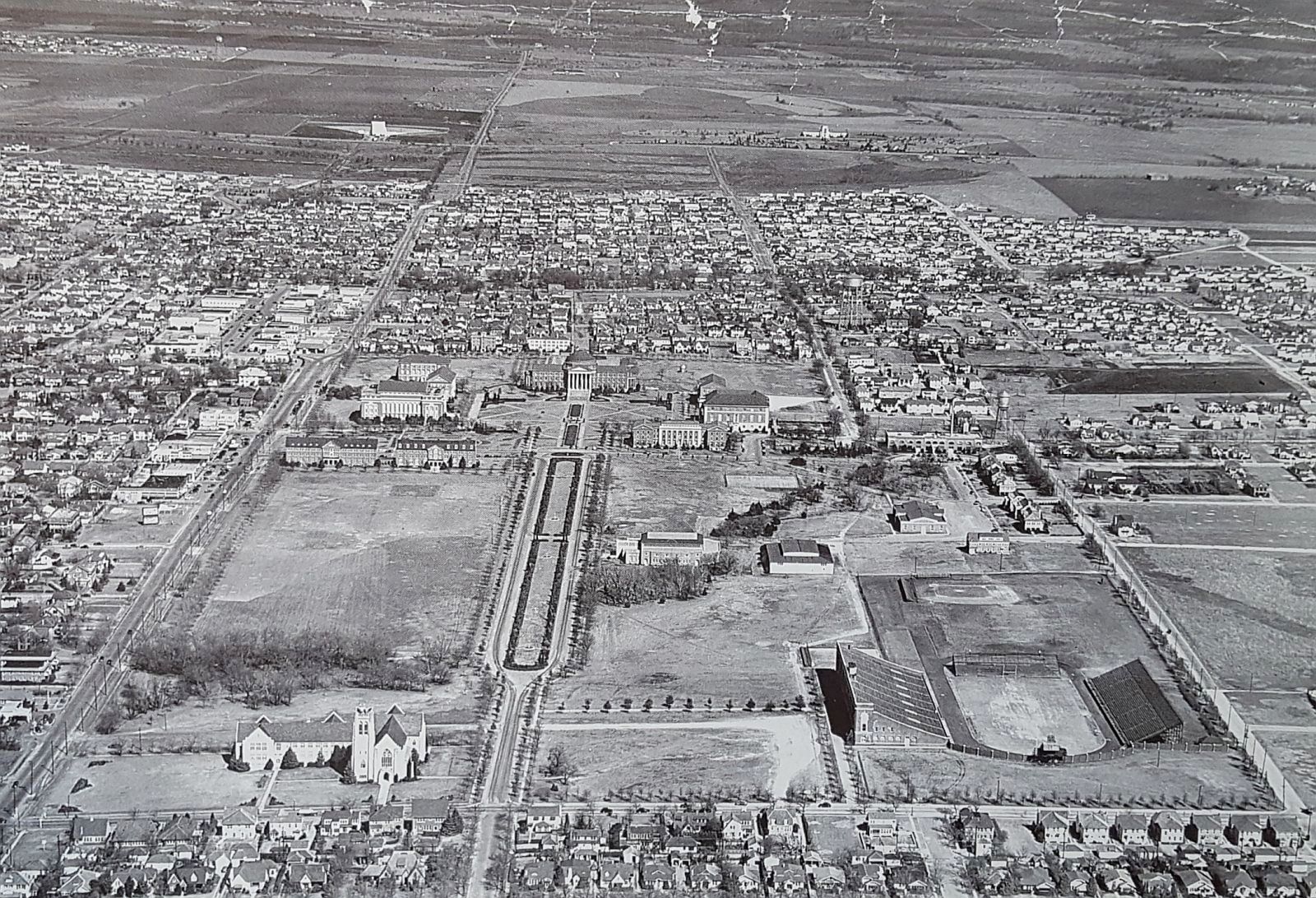
Here’s a 1945 aerial shot over SMU looking north — the drive-in is in the middle of all that wide-open Caruth farmland, seen just left of Hillcrest (the Hillcrest Mausoleum, built in 1936, can be seen to the right of Hillcrest; the Caruth Homestead is at the far right edge of the photo).

nw-hway-drive-in_1945_galloway_park-cities-photohistory

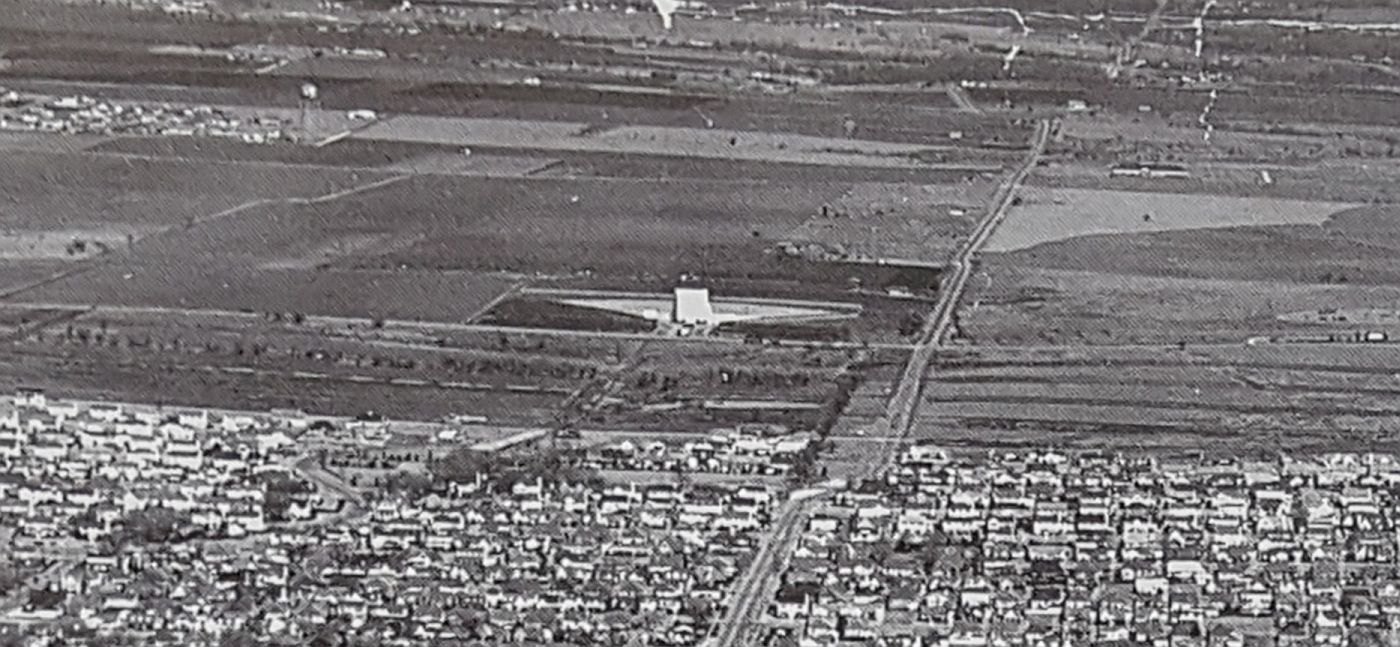
Here’s a detail, showing it up-close:

nw-hway-drive-in_1945_galloway_park-cities-photohistory_det

Two aerial shots by the United States Army Air Forces, taken for a USDA survey in 1945. First, the Northwest Highway Drive-In, with Northwest Highway running horizontally in the photo and Hillcrest running vertically.

nwhwy-hillcrest_usaaf_fosucue_smu_1945SMU

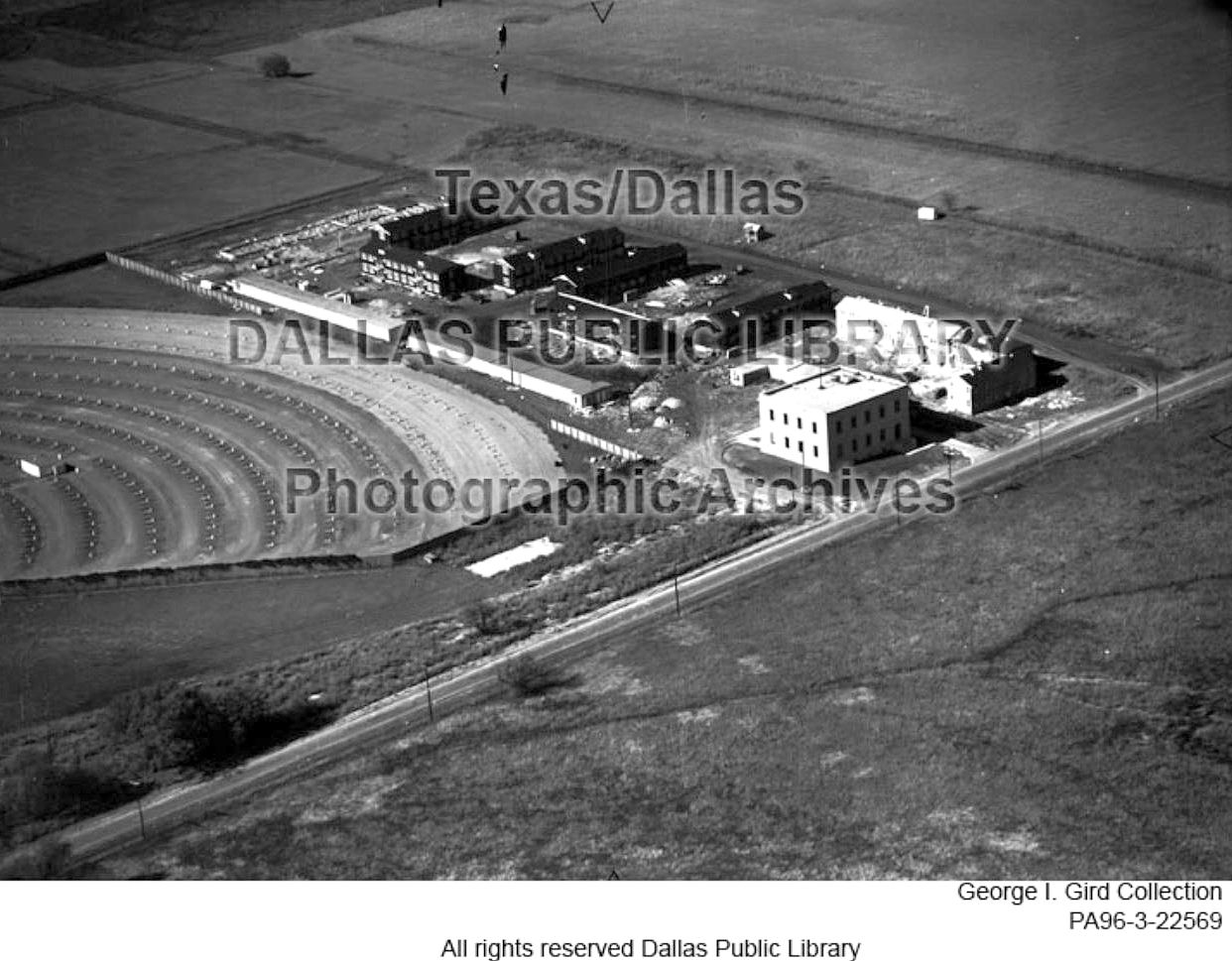
This aerial photo from 1947 shows a view to the northwest, with Hillcrest running from lower left corner to top right — it appears the photo was taken to show the new apartment complex just north of the parking area of the drive-in.

northwest-hi-way_drive-in_DPL_1947
Dallas Public Library

And Chalk Hill, with Highway 80 running horizontally:

chalk-hill_usaaf_smu_1945SMU

Chalk Hill again, this photo from 1973, with the clown face and circus theme that many remember:

chalk-hill-drive-in_1973_smithsonian
Photo by Steve Fitch, Smithsonian American Art Museum

A couple of amusing livestock-oriented drive-in-related human-interest blurbs appeared in the pages of The Dallas Morning News:

Some cattle going from Waco to Wisconsin stampeded through University Park when their truck caught fire on Greenville. Police herded most of the steers into a Northwest Highway drive-in theater. Five were found nuzzling zinnias at a home on Southwestern. (Lorrie Brooks, DMN, Sept. 18, 1952)

Cattle in 1952, donkeys in 1955:

University Park police early Wednesday captured two pet donkeys who escaped their pen at the Northwest Highway Drive-In Theater during the night. A startled passerby spotted the two donkeys grazing contentedly on a lawn at Centenary and Hillcrest, about four blocks from the theater…. Bill Duckett, manager of the theater, reported the loss of the two pets, which he keeps for the entertainment of the theater’s small-fry patrons. (DMN, May 26, 1955)

***

Sources & Notes

I’m not sure of the source of the top photo, but I’m pretty sure of when it was taken: the marquee shows that the movie “Tall, Dark and Handsome,” starring Cesar Romero, was playing; that movie ran at the Northwest Hi-Way Drive-In July 12-14, 1941.

The aerial photo (by Capt. Lloyd N. Young) showing SMU and the land that lay north of it is from the Highland Park United Methodist Church Archives; I found it in Diane Galloway’s fantastic book The Park Cities, A Photohistory.

The two aerial photos are details of larger photographs from the collection of Dallas Aerial Photographs, 1945 USDA Survey, Edwin J. Foscue Map Library, Central University Libraries, Southern Methodist University. The full (labeled) Northwest Highway photo is here; the Chalk Hill photo is here.

Two other aerial photos (from 1958) are interesting because they are a bit closer and because you can see the terraced ramps — they can be seen here (apologies for the watermarks — photos from HistoricAerials.com).

The Wikipedia entry for the Drive-In Theater is here.

The patent (with illustrations) for the drive-in theater, filed by Richard M. Hollingshead, Jr. in 1932 is here (it’s a very interesting read). I had no idea a drive-in movie theater could be patented. This cool drawing is part of it (click it to see it larger):

drive-in-patent_1

A great history of drive-ins in the Dallas-Fort Worth area can be found in the article “Starlit Skies and Memories” by Susan and Don Sanders; it appeared in the Spring, 1999 issue of Legacies, and can be read here. Great photos! (Who knew there was a drive-in on South Lamar — the Starlite — which catered exclusively to the black community?)

*

Copyright © 2015 Paula Bosse. All Rights Reserved.

WWII-Era Elm Street … In COLOR — 1945

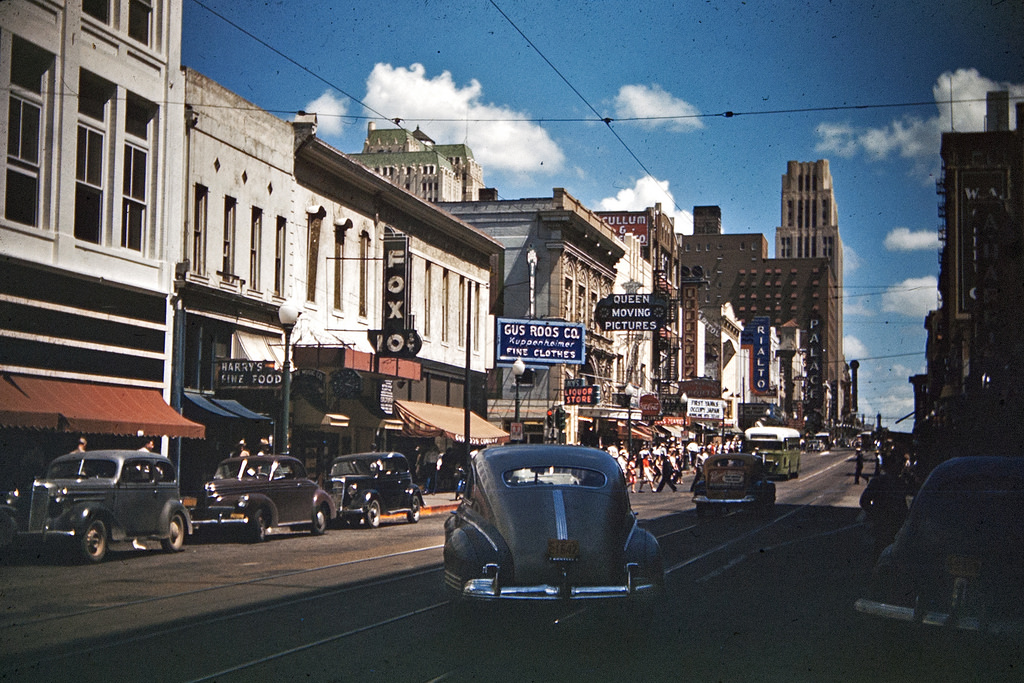
elm-street-color_1940s_jeppson-flickr(Click to see a larger image of this wonderful color photo!)

by Paula Bosse

This is one of my favorite photos of Dallas — mainly because it’s in COLOR! This absolutely fantastic photograph is from Noah Jeppson’s great website, Unvisited Dallas. Here we see Elm Street, looking east along Theater Row, taken from about the middle of the 1400 block of Elm. (To get your bearings, Gus Roos was at the northwest corner of Elm & Akard.) I LOVE this!

***

Sources & Notes

Photo from Noah Jeppson’s Unvisited Dallas post, “Elm Street 1945” — see the original post and read Noah’s description of the buildings seen in the photograph here. I don’t know where this photo came from, but I hope there are more color photos from this era out there. I would love to see them!

Other photos of this block (sadly, none in color) are in an earlier Flashback Dallas post, “Building Collapse on Elm Street — 1955,” here.

See several other fantastic COLOR photos in the Flashback Dallas post “Downtown Dallas in Color — 1940s and 1950s.”

*

Copyright © 2015 Paula Bosse. All Rights Reserved.

Orson Welles In Dallas — 1934-1940

orson-welles_cornell-tour_1934
Orson at 18 — publicity photo used for the Cornell tour, 1934

by Paula Bosse

Today is the 100th anniversary of the birth of Orson Welles. Welles was one of the truly great, innovative theater and film directors, an actor with a commanding presence, and a delightfully entertaining raconteur. His frenetically creative work on the New York stage, on radio, and in film (he wrote, produced, directed, and acted in his first film, Citizen Kane, when he was only 25) earned him/saddled him with the hard-to-deny sobriquet “Boy Genius.” His rise up the show-biz ladder was a quick one.

Orson’s first professional acting gig was as an unknown 18-year old repertory player in the touring company of famed actress Katharine Cornell who, along with British actor Basil Rathbone, starred in the three plays performed on the tour, which stopped in Dallas for a two-night engagement at the Melba theater, in February, 1934. The three plays performed in Dallas on February 19 and 20 (one a matinee) were “Romeo and Juliet” (Orson played Mercutio), “The Barretts of Wimpole Street” (he played Octavius Moulton-Barrett), and “Candida” (he played Marchbanks). Cornell was a huge draw, and there was a rush for tickets. The Melba begged her to extend her stay and add performances, but she declined.

The young Welles had gotten reviews on the tour which ranged from a dismissive mention in Variety that he was unable to speak Shakespeare’s lines properly and audibly (!), to raves from Charles Collins of The Chicago Tribune:

The cast is brilliant, and many of the secondary characters are acted with consummate skill. This is particularly true of Orson Welles’ Mercutio, which is an astonishing achievement for a youth still new on the stage. In his duel with Tybalt and his death scene, this Mercutio is a complete realization of Shakespeare’s bravest blade.

The star of the show was the then-very-famous Katharine Cornell, around whom most of the articles and reviews centered (she was, for instance, breathlessly reported to be staying at the Melrose during her Dallas stay) (I wonder if the lowly company players — i.e. Orson Welles — stayed there as well?). The Dallas Morning News theater critic, John Rosenfield — who mentioned this 1934 Dallas appearance in almost every succeeding article he ever wrote about Orson Welles over the next several decades — wrote the following before he saw Orson’s performances in any of the three plays:

Orson Welles, 18-year-old actor, who is apparently bulky enough to hold his own with adults, will be Mercutio. (DMN, Feb. 19, 1934)

After he saw his Mercutio:

Orson Welles’ Mercutio was up to the best standards known for this role. (DMN, Feb. 20, 1934)

When the tour finished, Welles quickly became a presence in the New York theater world. One of his early successes as a producer and director was his production of the so-called “Black Macbeth”/”Negro Macbeth”/”Voodoo Macbeth” — a hugely popular staging of Shakespeare’s “Macbeth” with an all-black cast, done under the auspices of the Federal Theatre Project in 1936. In August of that year — just two and a half years after his appearance as an unknown at the Melba — he took the production to Dallas where it made a splash at the Texas Centennial in the brand new bandshell.

macbeth_texas-centennial_dmn_081336Aug., 1936

macbeth_playbill_dallas_LOC(click for larger image)

Rosenfield was impressed by the lush design and the electric and inventive spectacle, but he was not a fan of the performances. A few years later, on the eve of the release of Citizen Kane, he wrote the following (which was much harsher than his original 1936 review):

We saw this production in Dallas during the Texas Centennial and could marvel at the artistic futility of such ingenuity. The Negro Macbeth, however, was something to be seen if only to be despised. (DMN, Oct. 29, 1941)

Oh dear.

In 1940, Welles was working on his first film, the legendary Citizen Kane. As filming began to wind down, he decided to go out on a short lecture tour because he was in desperate need of money (an all-too-common circumstance he found himself in throughout the entirety of his career). His topic was a vague “anecdotes of the stage and theories on the drama” — and it sounds like his “performances” were largely unscripted and unrehearsed. 

On October 29, 1940 — only a week or two after wrapping production on Citizen Kane — 25-year old Orson Welles spoke at McFarlin Auditorium on the SMU campus as part of the Community Course series of lectures. His topic: The Actor’s Place in the Theater. It was another packed house of adoring and/or curious Dallasites. Rosenfield was both entertained and annoyed by the rambling “lecture,” but Orson was undoubtedly delighted to talk for two hours before an adoring crowd, answer their questions about his craft, and collect a $1,200 check.

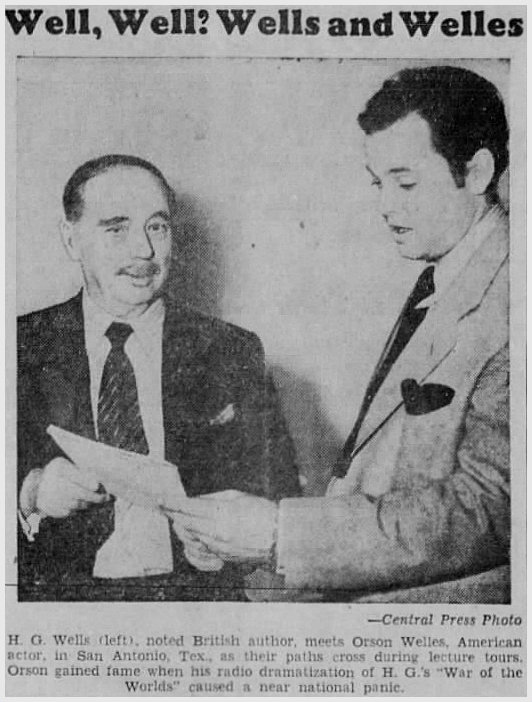
Orson’s appearance in Dallas was particularly noteworthy for the fact that the speaker scheduled to appear on the McFarlin stage just three days later was … H. G. Wells! At the time of this lecture tour, Orson was best known for his infamous 1938 radio adaption of H. G. Wells’ The War of the Worlds, the frighteningly realistic production that panicked the nation and led thousands to believe that the earth was being attacked by Martians. Rather surprisingly, Welles and Wells had never met.

According to a blurb in a Phoenix newspaper, Orson had cancelled a previously-scheduled meeting in Tucson in order to fly into Dallas earlier than planned. My guess is that he saw that H. G. Wells was also lecturing in Texas and realized that H. G.’s lecture in San Antonio the night before Orson’s own appearance in Dallas on the 29th was the only chance he had to meet the man who had provided the source-material for his (to-date) greatest career triumph.

A quick timeline:

  • Sun. Oct. 27, 1940: Orson arrives in Dallas, staying at the Baker Hotel.
  • Mon. Oct. 28: In the morning, Orson flies down to San Antonio to meet H. G. Wells and attend his lecture. The two meet, get along famously, have their photos taken, and give a short joint interview to San Antonio radio station KTSA (see below for link to recording). That evening, both fly to Dallas. Later that night, Orson (well known as an amateur magician) pops into The Mural Room in the Baker Hotel to catch the floor show featuring popular magician Russell Swann.
  • Tues. Oct. 29: H. G. Wells leaves Dallas for Denver, continuing his lecture tour. That morning Orson drives to Fort Worth to present a lecture and attend a luncheon at the River Crest Country Club. That night, he presents his lecture at McFarlin Auditorium at Southern Methodist University. After his lecture, he catches Russell Swann’s magic show for a second time. At 3:00 a.m. he flies to San Antonio for his lecture there.
  • Wed. Oct. 30: Orson lectures in San Antonio. It is the second anniversary of the broadcast of “The War of the Worlds.” Conveniently, newspapers around the country begin to run the photos of Welles and Wells taken on the 28th.
  • Thurs. Oct. 31: A Martian-free Halloween.
  • Fri. Nov. 1: H. G. Wells is back in Dallas for his lecture that night at McFarlin Auditorium.

welles-wells_san-antonio_102840

welles-wells_pottstown-pa-mercury_103140Pottsdown (PA) Mercury, Oct. 31, 1940

h-g-wells_dmn_102940DMN, Oct. 29, 1940

Whew.

Happy 100th, Orson! And thanks for everything.

***

Sources & Notes

Dates and sources of newspaper clippings as noted.

“Macbeth” playbill from the Library of Congress, here.

The timeline for the Welles-Wells meeting and their Dallas-related activities were gleaned from a report in the Oct. 30, 1940 edition of The Dallas Morning News.

And now, links galore.

  • Watch an entertaining short clip in which Orson talks about mind-reading and fortune-telling — which he says he indulged in on the Cornell tour — here.
  • Read the profile of the 18-year-old phenom which appeared in newspapers during the run of the Katharine Cornell tour, here.
  • Read about the “Voodoo Macbeth” here (scroll to the bottom to see fantastic photos).
  • Listen to the interview with Orson Welles and H. G. Wells that aired on San Antonio station KTSA, the day they met for the first time, on Oct. 28, 1940 — here.
  • Read about that still-chilling Mercury Theatre radio broadcast of The War of the Worlds, here.

Finally, my favorite Orson Welles-related quote from the erudite and not-without-humor arts critic of The Dallas Morning News, John Rosenfield. He wrote the following in his review of the set-in-Haiti “Macbeth” — about the aesthetic viability of future Shakespeare productions tailored for specific audiences:

…Mr. Welles hasn’t started a movement. His Negro “Macbeth” does not inspire us to corroborate a fabled Texas lawyer and make Antonio “The Merchant of Ennis.” (DMN, Aug. 16, 1936)

“THE MERCHANT OF ENNIS”! Someone! Make this happen!

*

Copyright © 2015 Paula Bosse. All Rights Reserved.

Roseland — 1916

roseland_terrill-yrbk_1916The Roseland Theater, 1613 Main St. (click for larger image)

by Paula Bosse

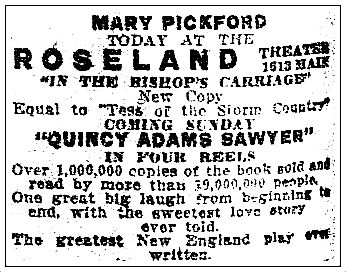
Despite its grainy quality, I really like this photo. It shows people walking past the Roseland Theater at 1613 Main Street, a theater I’d never heard of. I couldn’t find out much about it other than that it doesn’t seem to have lasted very long (from at least 1914 until at least 1916). It was owned/managed by P. G. Cameron, who ran several theaters and was in the general “amusements” business around town (he had run the Fair Grounds Skating Rink back in the aughts for a short while, until the place was shut down because of the discovery of a prostitution operation being conducted there … on city-owned property).

roseland_dmn_050914Dallas Morning News, May 9, 1914

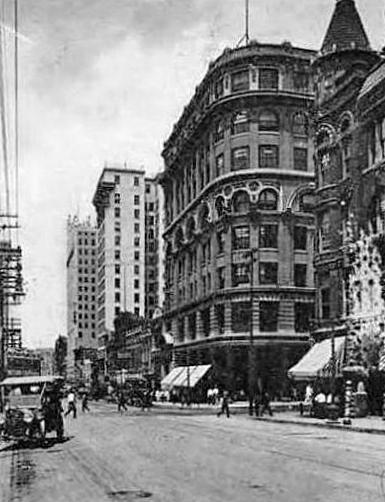
In 1916, the north side of Main Street contained three theaters: the Nickelodeon (1607 Main), the Roseland (1613 Main), and the Best (1615 Main). This is the much-beleaguered (and now mostly demolished) block of Main, which in 1916 was anchored by the dazzling Praetorian and Wilson buildings. The Roseland occupied part of what was once the Everts Jewelers building. Below, another view of this block in 1916, with the theater(s) on the right, about halfway between the tall white Praetorian Building and the stately rounded Wilson Building.

main-st_1916_smu-rotunda_sm Another grainy photo, Main looking west

I like this Roseland photo because it’s a candid shot taken by a teenager on the sidewalk of a lively downtown Dallas who had happened upon his teacher away from school. And the sign is cool. Too bad it’s so hard to see.

roseland_terrill-yrbk_1916_det

***

Sources & Notes

Photo from the 1916 Terrillian, the Terrill School yearbook. (The caption for the photo of one of the school’s teachers: “Passing by or coming out, Mr. F.?”)

Photo of Main Street, looking west, from the 1916 Rotunda, the yearbook of SMU.

See what the 1600 block of Main looked like in 1909, here. Much of the block has been demolished.

See the 1921 Sanborn map showing this block, here.

Below, a recent (2015) Google Street View of the building that housed the Roseland: the really lovely shorter white building. This building may already have been razed. What a shame. (UPDATE — 2018: Yep, demolished.) The current view (as I assume this block is ever-changing) can be seen on Google Street View here.

roseland_google2015, not long for this world….

*

Copyright © 2015 Paula Bosse. All Rights Reserved.