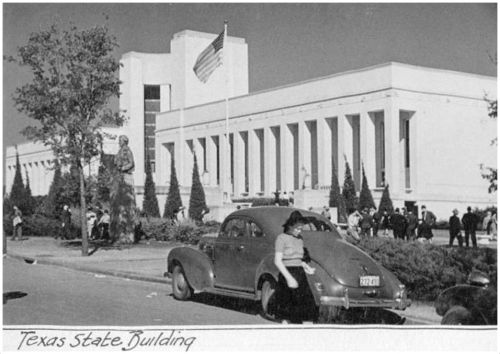
September is finally here, and that means the State Fair of Texas is only a few short weeks away. Check out the Flashback Dallas post “Snapshots of the Fair, 1936-1940” to see many of Lewis D. Fox’s amateur photos of the fair (and the Texas Centennial) from 1936-1940. And see the link at the bottom of the post to see the full collection of 100 or so of his State Fair photos from the Fox Photograph Collection in the Fort Worth Public Library Archives.
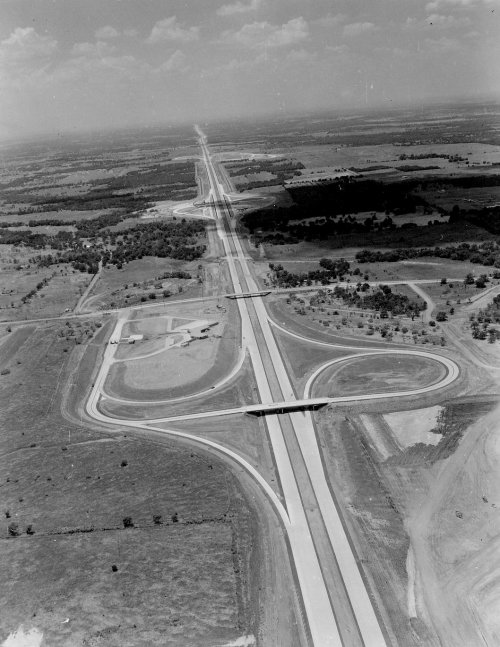
Three years ago I posted this wonderful photo of the blissfully empty, not-yet-opened Dallas-Fort Worth Turnpike — I loved it then, and I love it now. Read the original post — “The DFW Turnpike, Unsullied by Traffic, Billboards, or Urban Sprawl — 1957” — here.
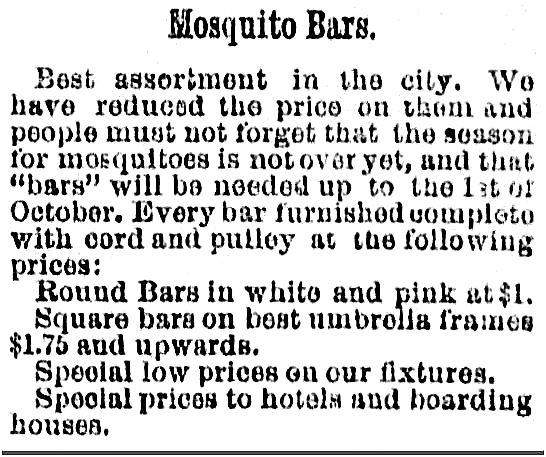
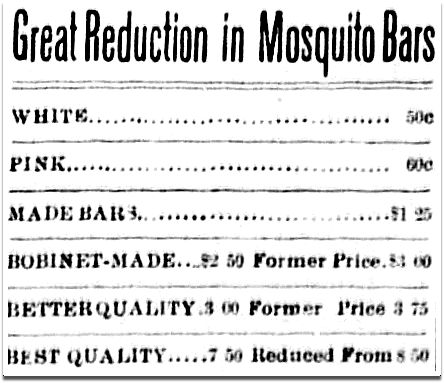
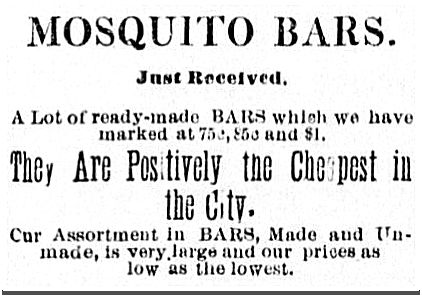
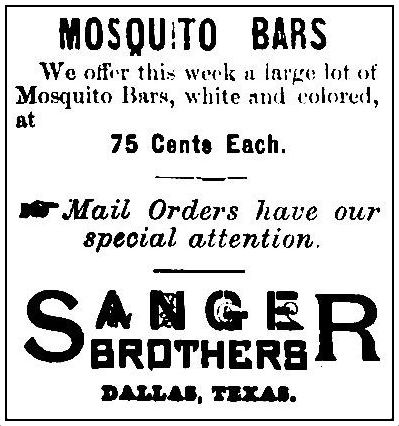
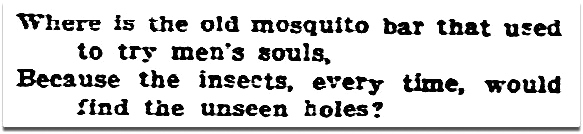
The “mosquito bar” — the human’s defense against blood-thirsty mosquitoes (and other annoying pests) — had its heyday in the US in the second half of the 19th century and the first couple of decades of the 20th century, before screens for windows and doors were commonplace in American homes. They were particularly necessary in the hot and sweaty Southern US states which were routinely plagued with mosquitoes. A typical mosquito bar ad looked like this one from Dallas merchants Sanger Bros. (click ads and clippings to see larger images):
Dallas Herald, Aug. 2, 1885
(According to the Inflation Calculator, $1.00 in 1885 money would be worth about $27.00 in today’s money, adjusted for inflation.)
The first Dallas ad I found for mosquito bars was from 1877 — like the clipping above, it is also from a Sanger Bros. ad (in fact, Sanger’s seemed to be mosquito-bar-central for 19th-century Dallas).
Dallas Herald, July 31, 1877
Dallas Herald, May 14, 1878
Dallas Herald, May 24, 1882
Southern Mercury, July 3, 1890
1894
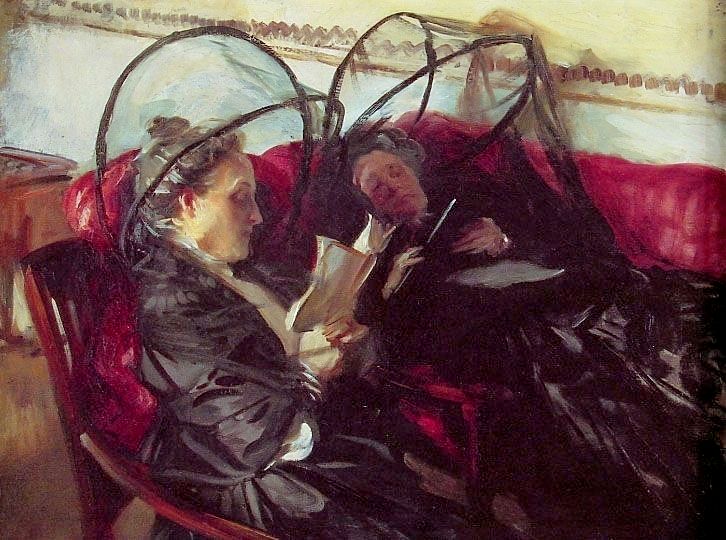
Mosquito bars were usually draped over beds, canopy-style, but the painting above (“Mosquito Nets” by John Singer Sargent, 1908) shows “personal” net-covered armatures, perfect for genteel ladies to relax inside of and read (while trying to keep cool despite being weighed down by what must have been uncomfortably heavy clothing).
The mesh netting or fine muslin used to drape beds (and cover windows and doors) was generally white or pink, sometimes green. Once inside the canopied beds, the netting was tucked under the mattress in order to seal all potential entry points in the mesh-walled fortress and allow the thankful occupants inside to sleep unmolested by mosquitoes (or other biting and stinging insects).
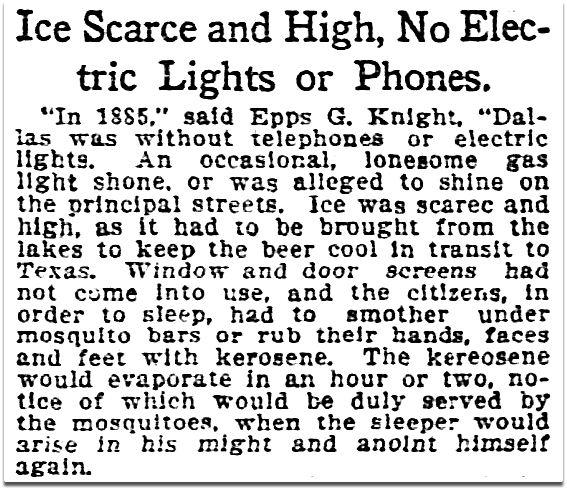
These bars became fairly standard in hotels and in many homes of the time, but if one could not afford the luxury of sleeping inside one of these things, the sleeper would often resort to rubbing him- or herself with kerosene if they wished to avoid being bitten throughout the night.
Dallas Morning News, Oct. 1, 1910
As much of a godsend as the bars were, they had their problems. The fine material was easily torn, and sometimes the mesh was so tightly knit that ventilation (and breathing!) was not optimal. Also, it was not unusual for them to catch fire — there are numerous newspaper reports of the bars being ignited by candles or gas-burning lamps or by careless or sleepy smokers smoking inside the canopy.
Dallas Herald, May 24, 1881
It was apparently a common precaution against midnight thievery for men who stayed in hotels to keep their money in the pockets of their pants and then fold the pants and place them beneath their pillows. The second line of defense was the mosquito netting tucked resolutely under the mattress of their canopied beds. The feeling was that a burglar would have to be pretty stealthy to breech a man’s mosquito bar and steal his pants from under his pillow without waking him. But never underestimate the Big City burglar (click article to see a larger image):
DMN, Sept. 10, 1888
After doors and windows began to be routinely covered with wire screens, the use of mosquito bars in homes and hotels waned, but their use continued in military encampments and hospitals, in recreational camping, and in swampy or tropical areas where the transmission of diseases like malaria and Dengue fever (transmitted by mosquitoes) posed health risks. Wire screens must have been a godsend.
Acme Screen Co., 1924
And if you don’t think that the prospect of a night without a mosquito bar (especially in the bayous of Louisiana…) wouldn’t inflame usually calmer heads, here’s a news story from 1910 about a man who shot a co-worker three times at close range because of a heated argument over which of them owned a mosquito bar. And this was in February! Lordy. Talk about your crime of passion. The moral of this story: do not mess with another man’s mosquito bar.
Town Talk (Alexandria, LA), Feb. 22, 1910
*
DMN, May 28, 1912
***
Sources & Notes
The top painting by John Singer Sargent — titled “Mosquito Nets” (1908) — is from the Detroit Institute of Arts; more on the painting can be found here.
Photo of draped bed is from the “Mosquito Net” Wikipedia page, here.
Other clippings and ads as noted. Dallas Herald and Southern Mercury newspaper scans are part of the huge database of scanned historical Texas newspapers found at the Portal to Texas History (to see newspapers, click this link and filter by “Counties,” “Decades,” “Years,” etc. on the left side of the page, or search by keywords at the top).
This post was adapted from a post I wrote for my other (non-Dallas) blog, High Shrink — that post, “The Mosquito Bar,” can be found here (it includes some great additional photographs and illustrations).
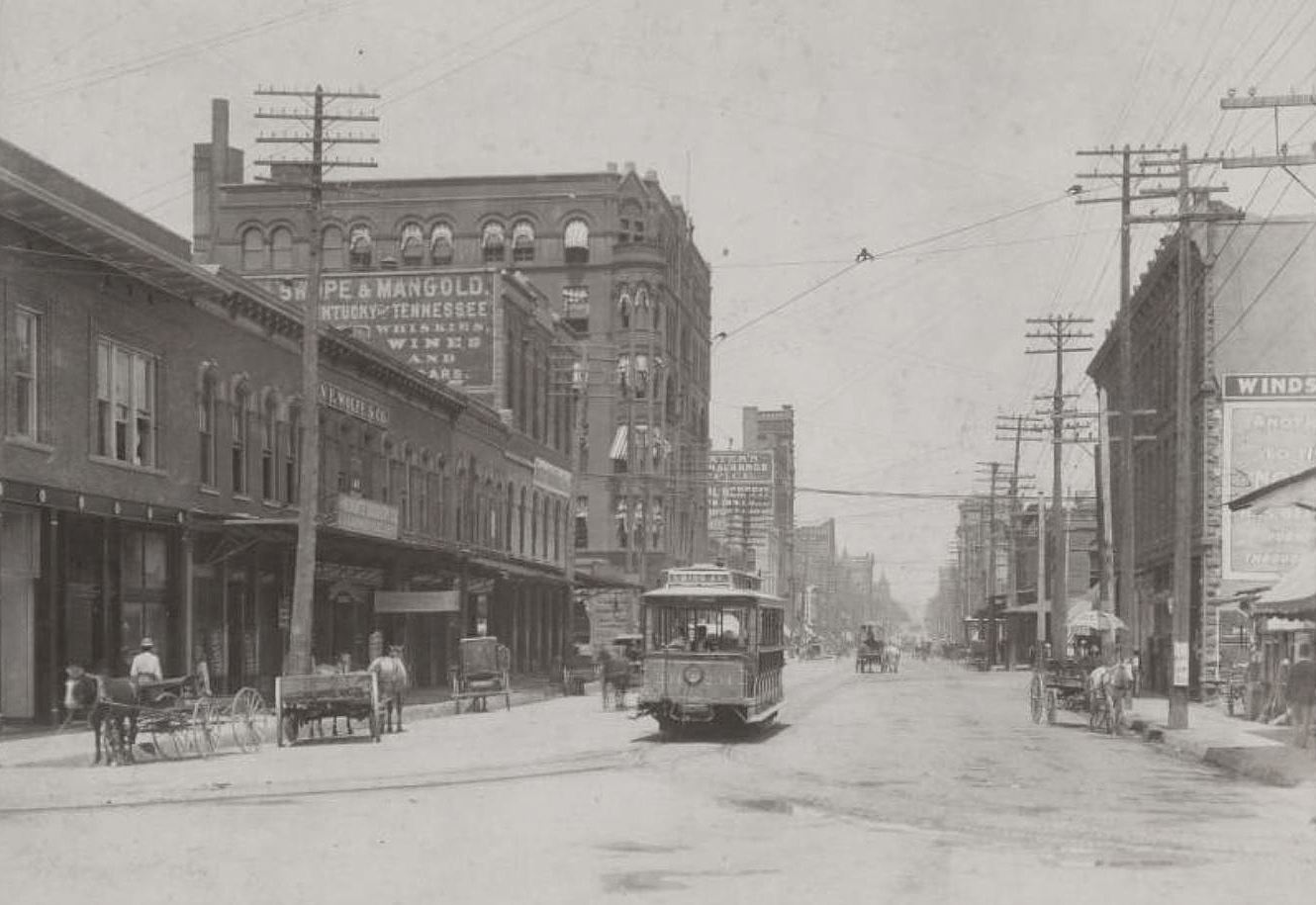
Here’s another great photo from the George W. Cook collection at SMU. This one shows Main Street sometime between 1899 and 1902 (the year asphalt was laid on Main and the year that Sanger Bros. expanded their building from two stories to six); we’re looking east from Market Street. (The aesthetically challenging view as seen today on Google is here.)
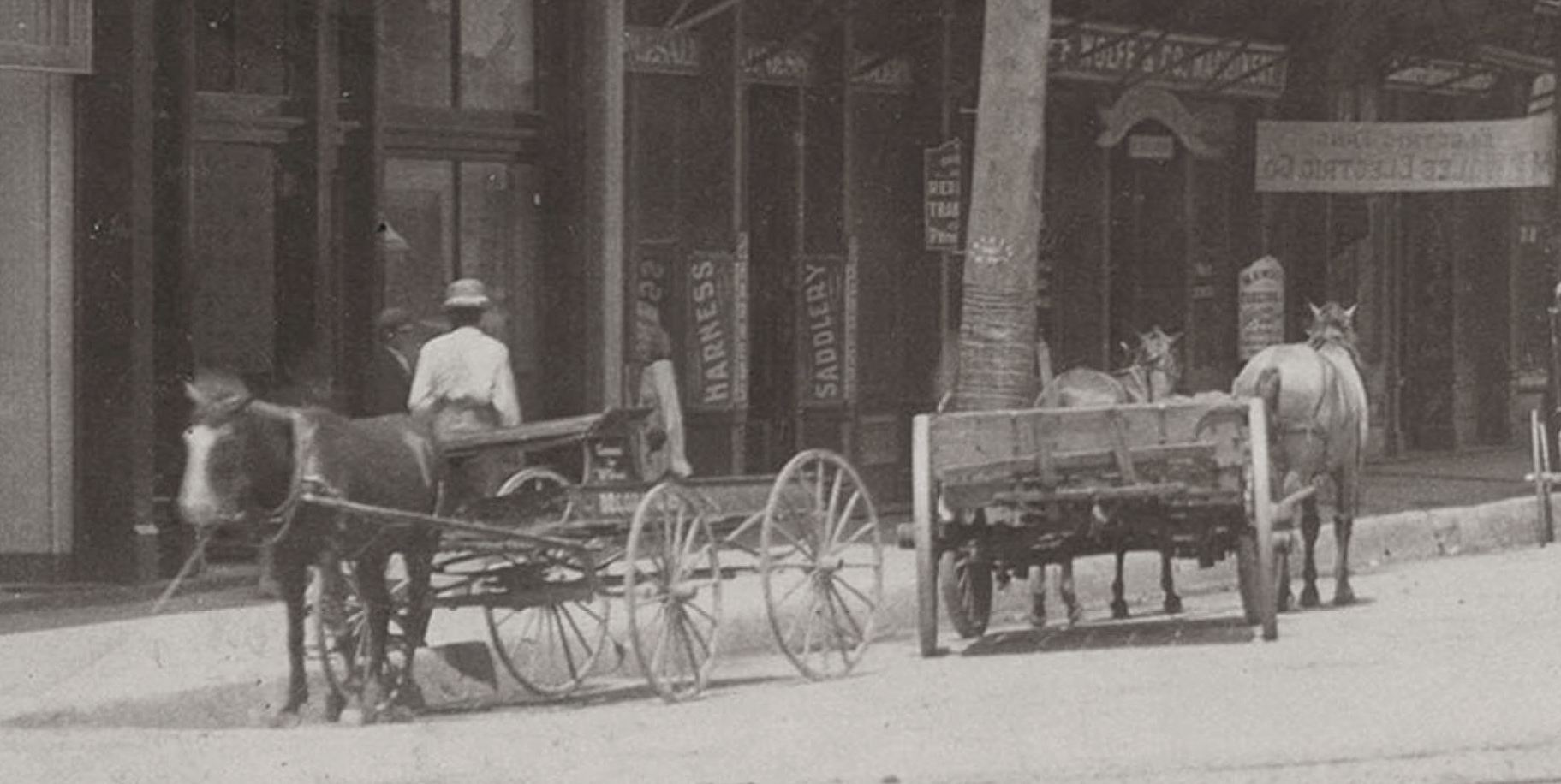
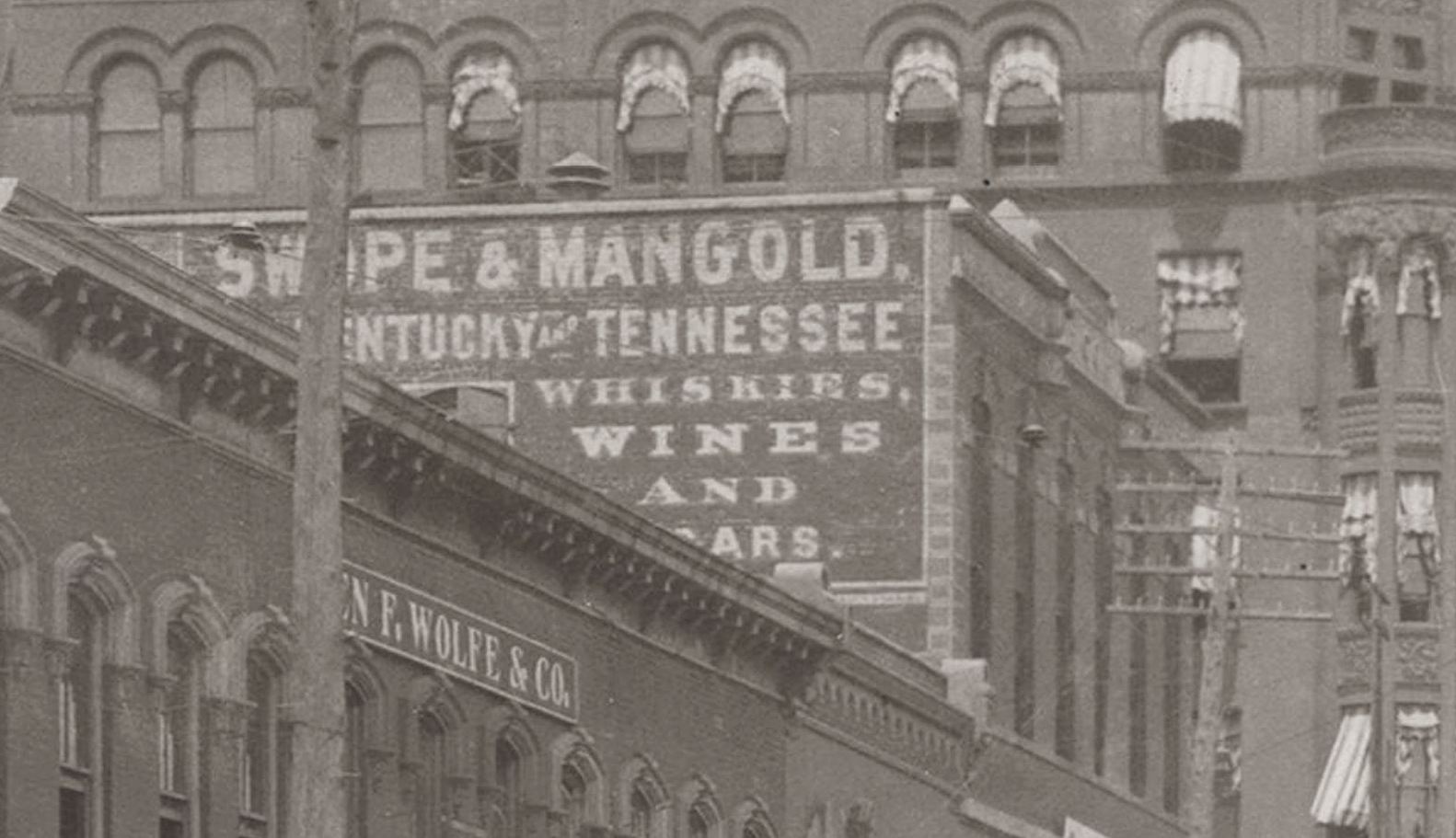
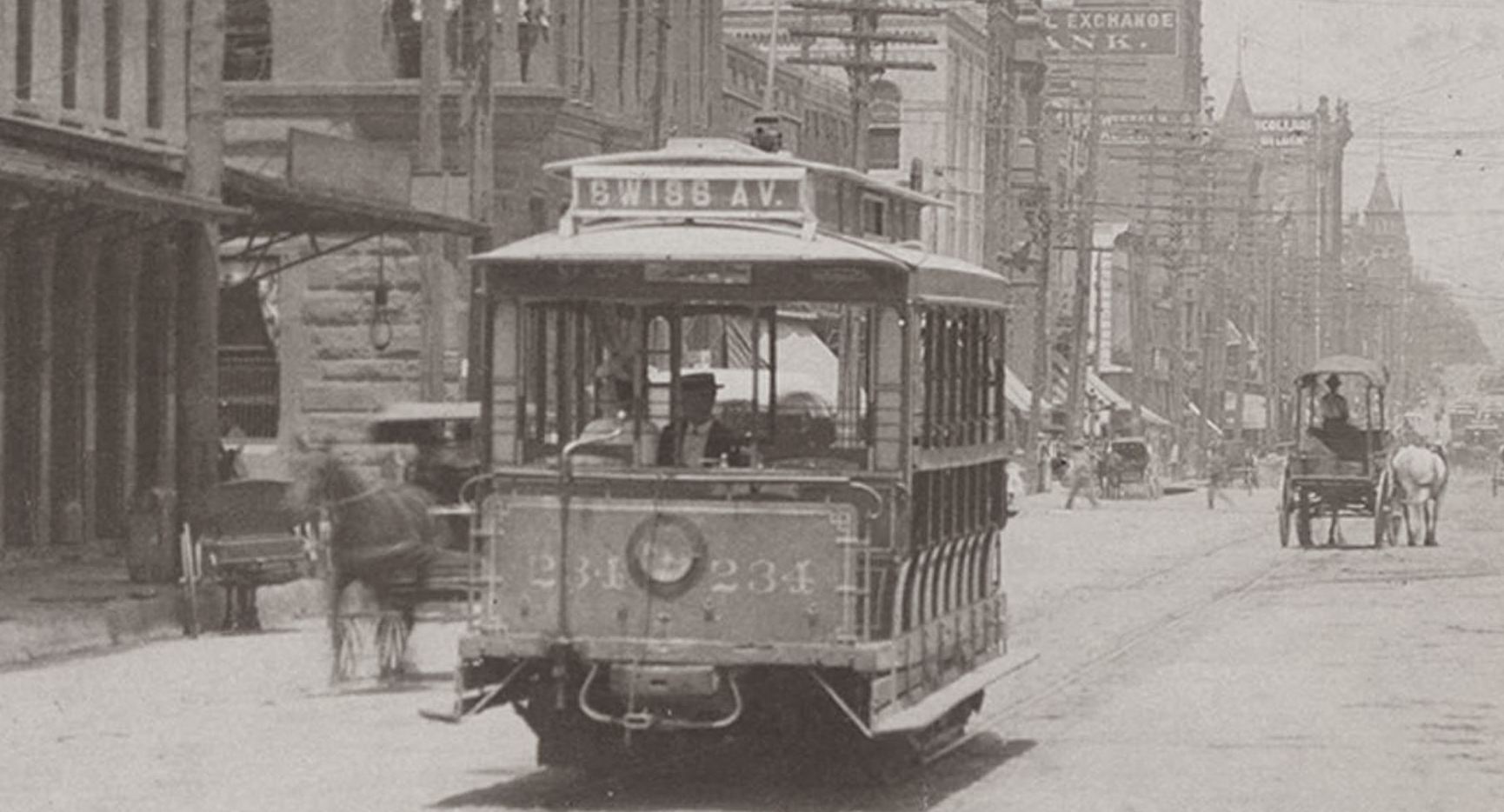
On the north side of Main (at the left), we can see horse-drawn wagons parked in front of a group of businesses including Konantz Saddlery Co., Ben F. Wolfe & Co. (machinery), a banner across the sidewalk for the Southwestern Electrical Engineering & Construction Co., Swope & Mangold wholesale and retail liquor company; then past Austin Street, on the corner, is the Trust Building, with the then-two-story Sanger Bros. building right next door (Sanger’s would build that up to six floors in 1902 and would eventually take over the Trust Building); across Lamar is the North Texas Building, with Charles L. Dexter’s insurance company advertised on the side; and, beyond, the Scollard Building, etc. The Windsor Hotel can be seen on the south side of the street in the foreground. And in the middle, an almost empty little streetcar with “Swiss Av.” on it, moving down Main underneath a canopy of hundreds of ugly electric wires zig-zagging overhead. Let’s zoom in around the photo to see a few closeups (all images are much larger when clicked).
Wagons parked at the curb:
*
Is that someone in the window looking down the street?
*
Swope & Mangold was one of the oldest “liquor concerns” in turn-of-the-century North Texas.
*
The electric streetcar shared the roadway with horses, buggies, and wagons.
*
I can’t quite make out the writing on the umbrella or on the sign posted on the pole. Part of the old Windsor Hotel can be seen at the right. At the bottom corner is a shop that sold “notions” and household goods, and just out of frame were a fish market and a meat market.
*
And the little Swiss Avenue car 234. Lotsa free seats.
*
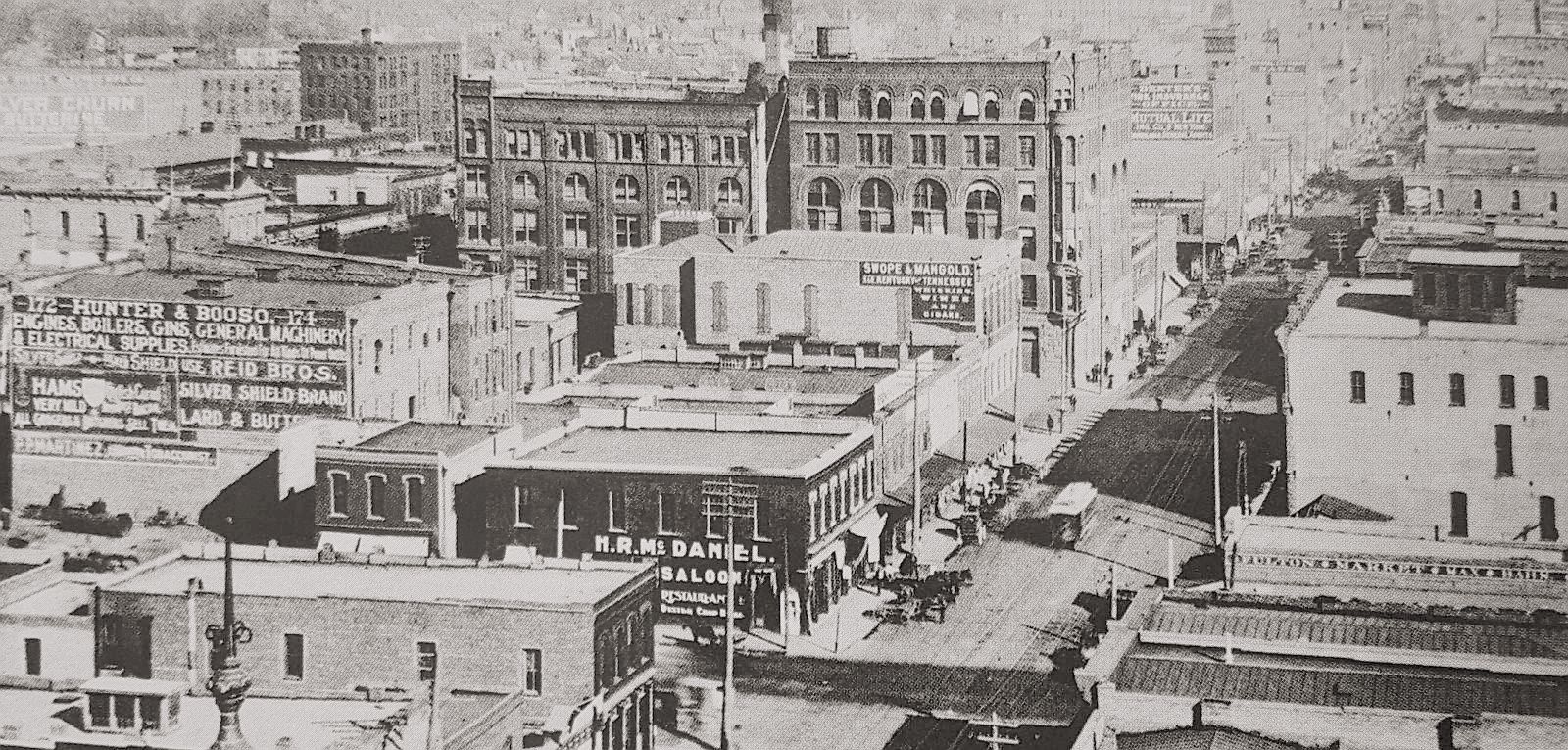
Here’s another view of Main Street looking east, taken around the same time. There’s even a streetcar in about the same spot.
*
See the 1899 Sanborn map for this general area here (note that Record Street was once Jefferson Street).
***
Sources & Notes
Top photo — titled “Main Street between Austin and Market Streets” — is from the George W. Cook Dallas/Texas Image Collection, DeGolyer Library, Central University Libraries, Southern Methodist University; more information on this photo is here.
The circa-1900 bird’s-eye view photo at the bottom is from the collection of the Dallas Historical Society, found in the book Dallas Rediscovered by William L. McDonald (p. 42).
One of Dallas’ favorite neon signs… (photo: Paula Bosse)
by Paula Bosse
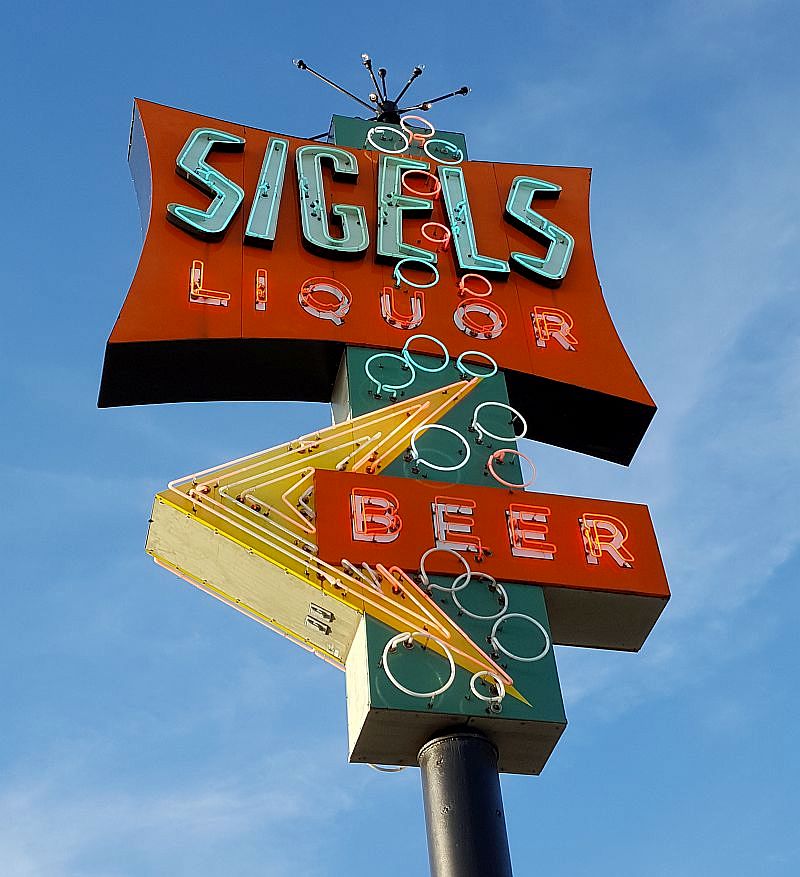
I stopped by Sigel’s liquor store the other day (as one does…) and saw this legendary Sigel’s sign, recently installed in its new home in the parking lot of the Sigel’s store on Greenville Avenue, between Lovers Lane and Southwestern Boulevard, across from the Old Town Shopping Center. I love this neon sign. (See a very large image of it here.)
The sign’s design can be traced back to Dallas artist Marvin M. Sigel (whose great-uncle Harry Sigel founded the business in 1905) — this Fabulous Fifties design was created around 1953 specifically for the then-new store at 5636 Lemmon Avenue (at Inwood). When that store closed in 2009, the sign was refurbished and moved up to the company’s Addison location until that store fell victim to the company’s bankruptcy and was closed. Here’s a video of the fabulous sign when it was in Addison, with close-ups of its flashing neon and dancing bubbles:
*
Marvin Meyer Sigel was born in Poland in 1932 and settled in Dallas in 1937 with his immigrant parents, both of whom had been doctors in Poland (his mother a dentist, his father an M.D.), although only his father continued to practice medicine in the United States. He lived in the vibrant Jewish enclave of South Dallas and went to Forest Avenue High School where he seems to have been a popular kid, interested in art, drumming, and ROTC. Below, a photo from the 1949 yearbook with the caption “Marvin ‘Hot Drums’ Sigel plays with the Swing Band.”
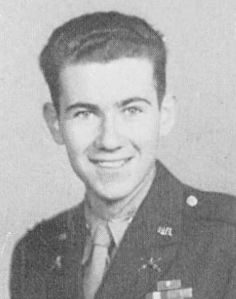
His Forest Avenue High School senior photo, from 1949:
And his 1953 senior photo from the University of Texas:
After studying art at both SMU (under Ed Bearden and DeForrest Judd) and the University of Texas and receiving his B.F.A. from UT in 1953, Sigel served a stint in the Eighth Army in Korea. Back in Dallas, he was remarkably active in the local art community — for decades — as both a fine artist and as an art instructor. He also worked for a while at Peter Wolf Associates, in advertising (on projects for companies like Braniff), and he even did a lot of the tedious paste-up work for Sigel’s ads (back when every picture of a bottle of wine or spirits had to be cut out individually and pasted into one of those huge ads!). But his passion was art, and at the same time he had those regular-paycheck gigs, he also managed to maintain a furious pace of painting new pieces to exhibit at a dizzying number of art shows. Below is an example of one of his watercolors, from 1957 (which was recently offered at auction by David Dike Fine Art). The title? “Cocktail Abstraction” — appropriate subject matter for a member of the Sigel family!
“Cocktail Abstraction” by Marvin Sigel (1957)
When the Sigel’s Liquor store No. 7 opened at Lemmon & Inwood, it was suggested by family members that, hey, we have an artist in the family, let’s get Marvin to design a sign for us. According to Marvin, his cousin Sidney Sigel, who ran the company, probably just wanted a “rectangular sign with block letters,” but other family members wanted something newer and more exciting — something modern that would jump out of a sea of boring rectangular signs with block letters and draw attention. And it certainly did just that. If, as reports have it, that dazzling neon sign was designed in 1953, Marvin Sigel was only 21 years old!
When news broke 56 years later, in 2009, that the Lemmon & Inwood store was closing, there was a concerned uproar from the public about what would happen to the sign. Mr. Sigel was a bit taken aback by how much the people of Dallas had grown to love that sign and considered it a city landmark. Marvin Sigel, then 77 years old, said in a 2009 Dallas Morning News interview, “It was clever, but I figured it would be replaced by something more clever in a half-dozen years.”
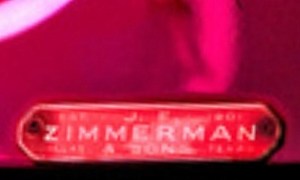
The sign was built by the venerable Dallas firm of J. F. Zimmerman & Sons (est. 1901) who for generations had installed decorative neon elements all around town and had built innumerable lighted signs for companies big and small — their work could be seen on the Mercantile Building’s wonderful tower, on the exterior of the downtown Titche’s store on Main Street, and in the instantly recognizable signs for places as varied as the Cotton Bowl, Big Town, and, presumably, various other Sigel’s stores around the city.
The sign which was moved from Store No. 7 at Lemmon & Inwood to Addison had on its pole a small plaque (seen here) which said:
This Non-Conforming Sign designed by Marvin Sigel was built in the early 1950s. It was moved from Dallas, TX at Lemmon Ave. & Inwood. After being granted a variance it was refurbished to Code and installed here in June of 2009. Sign refurbished and installed by Starlite Sign of Denton, TX.
Interestingly, the plaque on the new location of the sign has a slightly different text:
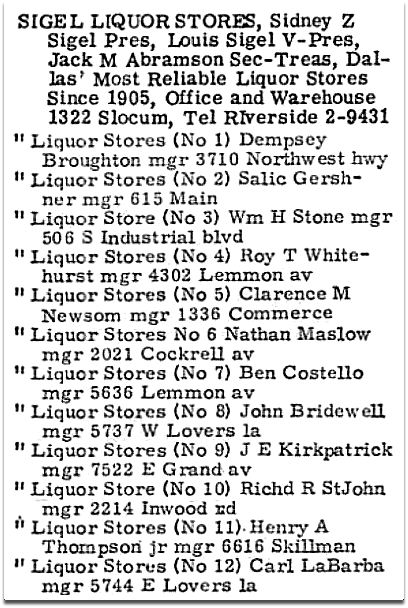
It appears that this is a different Sigel’s sign. In 1965, there were two Sigel’s stores on Lovers Lane: Store No. 8 was along the Miracle Mile on West Lovers Lane, near what is now the Dallas North Tollway, and Store No. 12 was on East Lovers Lane at Greenville (then near Louanns nightclub).
1965 Dallas directory
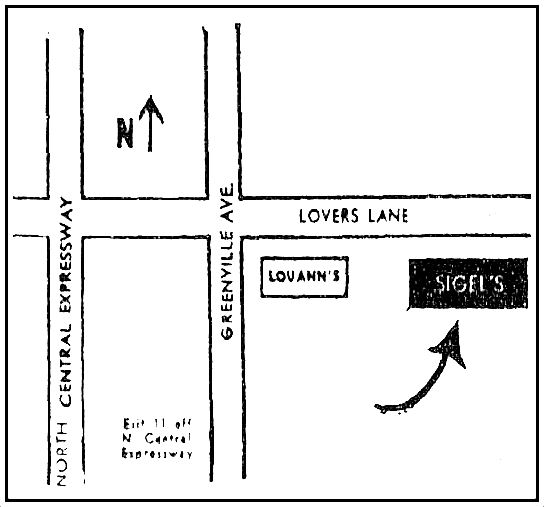
In an April 22, 2009 Dallas Morning News article by Jeffrey Weiss (“The Story Behind That Sigel’s Sign”), is this quote from Mr. Sigel’s son, David S. Z. Sigel, about the original sign at Lemmon & Inwood, with mention of another similar sign: “He created the designs for this sign, as well as a similar but smaller sign which stood outside the Lovers Lane store (where Central Market now stands) for many years.” Here’s a map from a November, 1964 grand opening ad for the new store at 5744 E. Lovers Lane:
Detail from a grand opening ad, Nov. 6, 1964
So is the sign currently standing in the parking lot of the Sigel’s Fine Wines & Great Spirits at 5757 Greenville Avenue the sign which originally stood only a short four-tenths of a mile away? I hope so! And if it is, welcome back to the neighborhood, cool sign!
Whichever sign this is, it is one of the greatest neon designs Dallas has ever had, and I’m so happy it’s survived for over a half-century, through phenomenal city growth, physical displacement, and even company bankruptcy.
Thanks, Marvin, for designing this wonderful sign! And thanks, Starlite Sign of Denton, for the beautiful refurbishing!
***
Sources & Notes *
Top photo and photo of blue plaque taken by me on July 27, 2017 at the Sigel’s store at 5757 Greenville Avenue.
YouTube video by Andrew F. Wood, shot in Addison in 2013.
Sources for other images as noted.
The Zimmerman & Sons nameplate can be seen on the original Lemmon & Inwood sign here (click to enlarge), posted on Flickr by Tim Anderson (a detail of his photo can be seen below) (there is another Zimmerman nameplate posted in the comments on that Flickr page); what appears to be a Zimmerman plate is on the side of the sign at the Greenville Avenue location facing the store’s entrance, not on the side seen in my photo at the top.
Please check out the Dallas Morning News article in theDMN archives titled “Sigel’s Sign Designer Surprised by Its Fame — Project for Family’s Liquor Store Wasn’t a Hit with Boss, He Recalls” by Jeffrey Weiss (April 28, 2009) in which Marvin Sigel discusses his famous sign.
Also, check out these related (online) DMN articles:
“Sigel’s Beverages, A 111-Year-Old Dallas Chain, Filed for Bankruptcy; Wants to Close 5 Stores” by Maria Halkias (Oct. 21, 2016), here
“Sigel’s Iconic Neon Sign Returning to Dallas After Years Wasting Away in Addison” by Robert Wilonsky (March 27, 2017), here
If anyone can verify that this sign is, in fact, the sign from Store No. 12 (Lovers & Greenville), please let me know!
UPDATE: Marvin Sigel died on Feb. 23, 2019 at the age of 87 (his obituary is on the Dallas Morning News website, here). After I wrote this post, Marvin’s son, David, contacted me to let me know his father had seen this and was delighted to know that people still appreciated his work. This was one of the most popular posts of the year. People absolutely still love your sign, Marvin! RIP.
Sluggish days of summer — seems like a good time for another round of updates to old posts. Most images are larger when clicked. To see the original post, click the title.
**
First, the postcard above shows Berkelely Avenue, Dallas, Texas. Berkeley Avenue was the original name of Armstrong Avenue, which runs through Highland Park. See more on the very early days of Armstrong at the post this has been added to: “The Rolling Hills of Highland Park — 1911.” (Source: Flickr stream, by Coltera, who suggests this might be the Berkley Avenue in Oak Cliff, but it’s definitely Highland Park.)
This ad for the then-under-construction Titche’s building — “the new shopping center … dedicated to the fine art of Better Living” has been added to the post “George Dahl’s Titche-Goettinger Building.” (Source: Sunset High School’s 1929 yearbook)
*
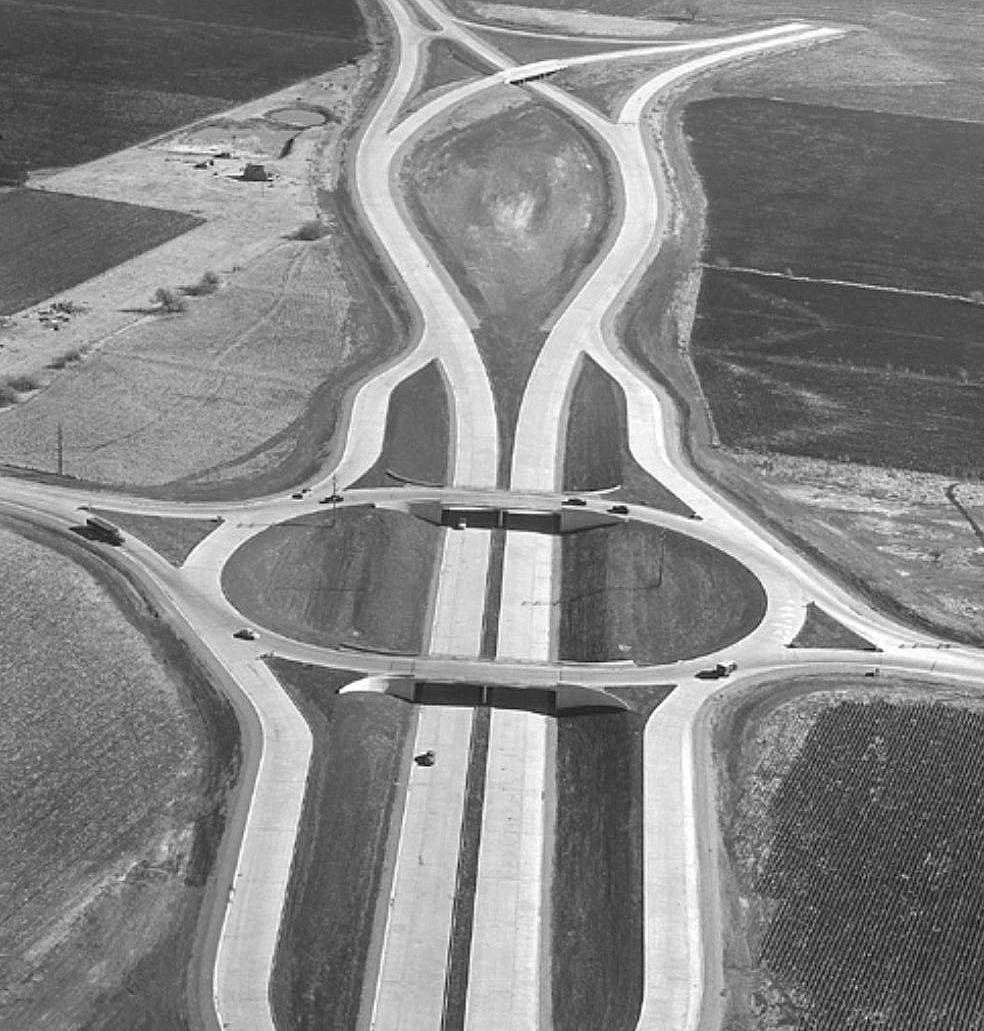
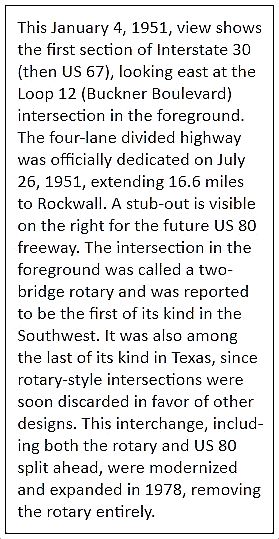
Photos of vehicle-free highways fascinate me. Here’s US 67, looking east to Loop 12/Buckner Blvd., with the “two-bridge rotary” intersection in the foreground — seen seven months before it opened in July, 1951. The photo and caption have been added to the amazingly popular post “The 67-80 Split Near Mesquite — ca. 1951.” (Source: Oscar Slotboom’s Dallas-Fort Worth Freeways)
Stuck in the middle of another hot summer, one’s mind is likely to drift to thoughts of refreshing beverages. Like Celery Cola. Yes, it was a thing. Read about it in my post from 2014 — “Celery Cola: ‘It Picks You Up!’ — 1909” — here.
Stoneleigh-Hotel-area Maple Avenue doesn’t look like this anymore. As beautiful as this neighborhood was, there were apparently a lot of desperate men living in some of those idyllic houses: it seems to have been suicide-central. More about this in the original 2015 post, “Turn-of-the-Century Maple Avenue,” here.
This is not one of the legendary phone book covers of KarlHoefle, but the work of a commercial artist who produced several similar city-skyline ads for Phelps Dodge. This one is a lot of fun to zoom into and see in detail — see a much larger image here.
But it’s even better in color. See the color version in my original post — “When ‘Big D’ Lights Up — Phelps Dodge Ad (1969)” — here.
Until last week, I don’t think I’d ever heard the 1969 song “The Back Side of Dallas,” sung by Jeannie C. Riley, who had had the blockbuster hit “Harper Valley PTA” the previous year. How have I never heard this? I was going to post it last week until I realized that it would be better to wait until today, because of this line from the song: “Meet me in Dallas on June the 23rd, his letter read.” And here we are, June 23rd.
The song, written by Jerry Foster and Bill Rice, was released in October, 1969. It wasn’t the huge, crossover, multi-award-winning monster hit that “Harper Valley PTA” was, but it did earn Jeannie another Grammy nomination (she lost to Tammy Wynette’s “Stand By Your Man” — if you’re going to lose, that’s a pretty great performance to lose to!).
Like “Harper Valley PTA,” it was one of several songs of the era which brought country music into the somewhat seedy realm of 1960s American culture. “The Back Side of Dallas” is about a small-town girl who finds herself a lonesome “working girl” in Dallas, chain-smoking king-size cigarettes, drinking in dingy bars, and popping pills. This ain’t no Kitty Wells song, y’all. (I’d love to hear Miranda Lambert — who also has an incredible country voice — cover this.)
Jeannie C. Riley — born in Anson, Texas in 1945 — was one of the first certifiable sex symbols in country music, always gorgeous, outfitted in miniskirts and go-go boots, with sky-high hair teased to a fare-thee-well. AND she had an absolutely fantastic voice. Below is video of a 24-year-old Jeannie C. Riley singing “Back Side of Dallas” on Del Reeves’ Country Carnival in 1969 (Del Reeves had some greatsongs in the ’60s, but his TV persona was a little too Dean Martin-wannabe for my taste … and … oh dear … that set!):
*
I prefer the studio version, below. I’ve listened to this song dozens of times now, and I haven’t gotten tired of it yet!
*
And here’s Jeannie singing it in 2011, still sounding great! (Her thick Texas accent is the absolute best, and her laugh is fantastic.) She talks about the song a bit at the beginning with Jerry Foster, one of the writers of the song — the song itself starts at about the 3:10 mark.
*
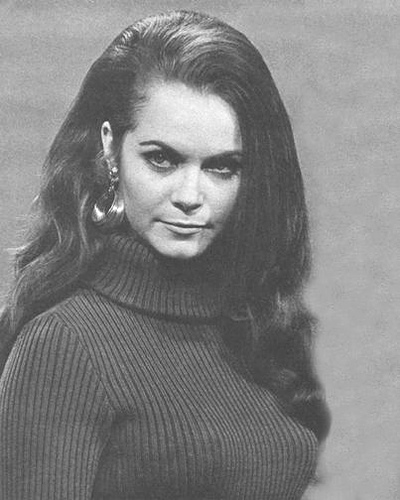
And, to round out this “June the 23rd” post, a few photos of Jeannie C. — surely one of the most photogenic faces and bad-ass vocalists in the history of country music. As my father used to say, “hot damn.”
“Harper Valley PTA” — you know you want to hear it. This is a great live version she did on, I think, the Wilburn Brothers Show, with Harold Morrison on dobro.
*
Not that anyone’s going to confuse the two songs, but this song has nothing to do with the 1915 song of the same name by Adolphus Hotel orchestra leader Jack Gardner (which you can read about here).























 Jeannie C. Riley


 Flashback : Dallas