Flashback : Dallas

A Miscellany: History, Ads, Pop Culture

Category: Vault

Dallas History on “Jeopardy”

delta_jeopardy_061917“What is….”

by Paula Bosse

Yesterday an old Flashback Dallas post from 2014 got a TON of hits. As the hits continued to rack up all day, I thought, “This is really weird.” The reason? Jeopardy! Even better, FINAL Jeopardy! Do you know the answer (…phrased in the form of a question)? See if you do, here.

*

Copyright © 2017 Paula Bosse. All Rights Reserved.

From the Vault: “The Manure Problem”

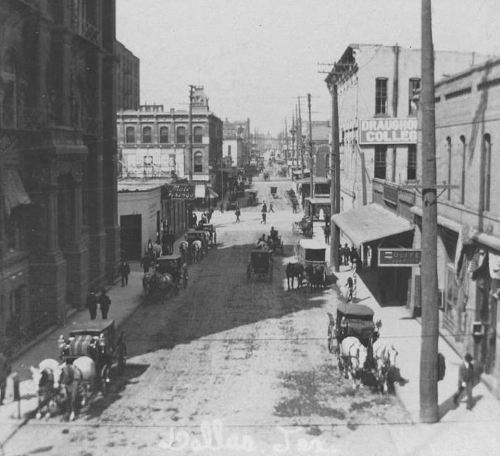
akard-looking-north_cook-colln_degolyer_smu_ca-1906See all those horses?

by Paula Bosse

There’s a headline that’ll get attention. Check out the post “‘Male Fixings’ and Horse Manure Akard Street, ca. 1906″ in which I wonder how cities used to deal with all the horse manure in the streets. (Augusts must have been especially unpleasant back then.)

*

Copyright © 2017 Paula Bosse. All Rights Reserved.


From the Vault: High School Football, 1909

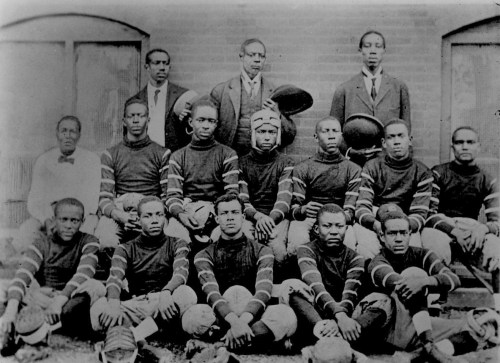
football-team-1909

by Paula Bosse

This is a great photo of intense facial expressions and odd photo manipulation from the J. L. Patton Collection of the Dallas Historical Society. A bit more about what appears to be the football team representing Dallas’ only black high school can be found in the original post “Dallas High School Football, 1909-Style,” here.

*

Copyright © 2017 Paula Bosse. All Rights Reserved.

Downtown Dallas, Last Week

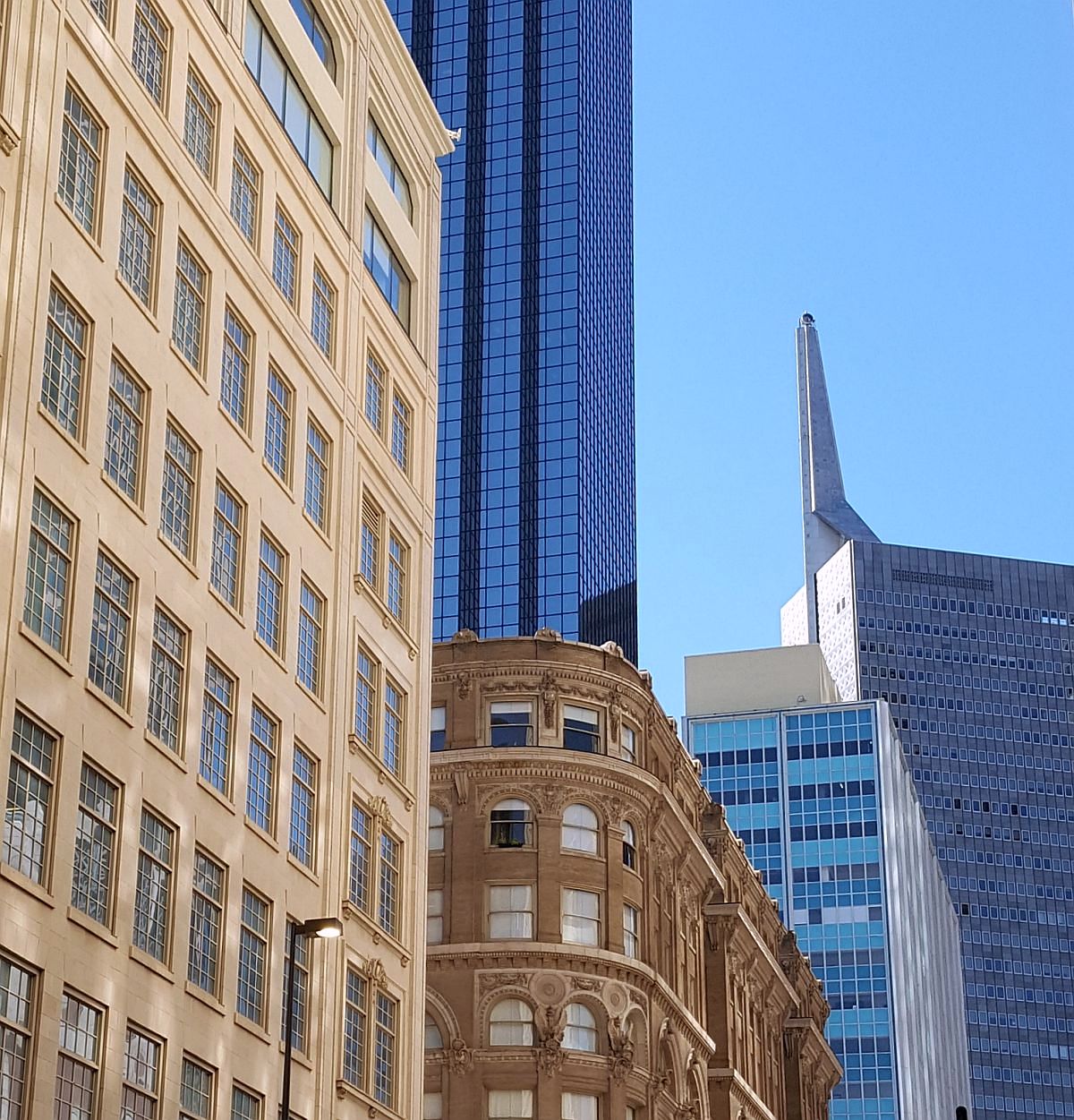
ervay-north-from-commerce_det_052417_bosseSo many architectural styles! (click for larger image)

by Paula Bosse

Last week I went downtown to check on the restoration of the St. Jude Chapel mosaic (I’ll write about that soon…). Sadly, I’m hardly ever downtown, so I took the opportunity to walk around a bit and was struck by how much construction and beautifying is going on. Parts of it are verging on the overly hipsterized, but, generally, downtown is looking better these days than I’ve ever seen it.

I parked at an incredibly affordable parking garage behind Neiman’s — Dal-Park on Commerce just west of Ervay (you do not have to be a Neiman’s customer to park there). Three bucks! (Just drive slowly on your way out — it’s kind of cool, but it’s like going down a spiral staircase … in a car.)

One of the first things you see when you emerge from the parking garage is the Mercantile Building. I never tire of seeing this building. (All photos in this post are much larger when clicked.)

mercantile-from-commerce_052417_bosse

*

Head north on Ervay from Commerce and you see that great view seen in the top photo — it’s kind of crazy to see so many wildly different styles of architecture, from so many eras all clustered together: the Neiman Marcus building (opened in 1914) on the left, the Wilson Building (1904), 211 N. Ervay (1958), the Republic Bank Building (1954), Thanksgiving Tower (1982), and just out of frame to the right, the Mercantile Bank Building (1943). Too bad the Old Red Courthouse (1891) is in the other direction! 

Heading up Ervay from Commerce, Neiman’s takes up the whole block to your left. The display windows on this side might not get the glory of the Main Street side, but the display seen in the photo below is great. I chuckled to myself when I realized that the star of a Neiman Marcus window was corrugated cardboard. But those dogs are fantastic! The name of the Dallas artist who made them is Loran Thrasher and you can see other examples of similar works at his website — click on “Installations.”

neiman-marcus-window_loran-thrasher_dogs_052417_bosse

*

As you approach Main Street you see this elegant sign (Neiman-Marcus, for me, will always have that hyphen in it!). (See what this block looked like around 1920, looking south from Main, here.)

neiman-marcus-sign_ervay_052417_bosse

*

Turn left on Main, and you’ll see this wonderful building across the street, just west of Stone Place — it’s one of the oldest buildings downtown, built sometime between 1892 and 1899. (I wrote about this building — and its two immediate neighbors — here.) I love this building which was very nicely restored by the fine folks at Architexas about 15 years ago.

sol-irlandes_052417_bosse

*

After admiring the Sol Irlandes building I turned around to see this surreal sight several stories above street-level.

joule-pool_052417_bosse

It’s an infinity pool — part of the Joule hotel (see what the pool looks like from up there here). It was pretty odd. If I felt a twinge of vertigo looking at this from the ground, I can’t even imagine how I would handle looking down. If the view isn’t obstructed, those brave swimmers can get a pretty good look at Pegasus (who is probably also a little concerned). This must be quite a sight at night.

joule-pool_pegasus_052417_bosse

*

Just to the right of the Magnolia Building, you can see the Adolphus peeking through.

adolphus_052417_bosse

*

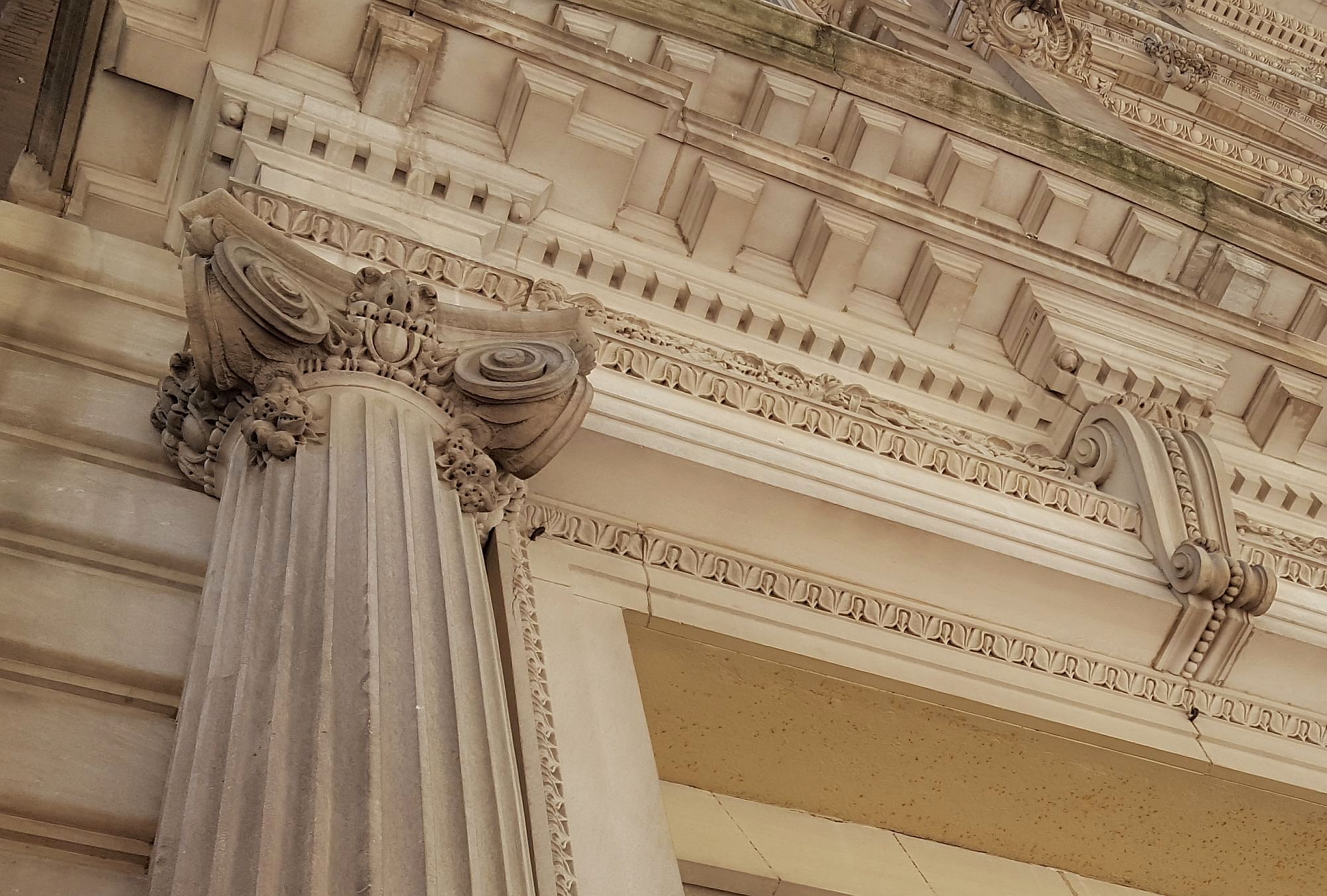
One of the most impressive buildings in Dallas is the Wilson Building, at Main and Ervay (…and Elm and Ervay). It’s even more impressive when you see it up-close. I love seeing all these intricate decorative details on a building so unlike anything else in Dallas. (See what it looked like under construction in 1902 here.) Thank you, Sanguinet & Staats, for building us such a lovely architectural landmark.

wilson-bldg_detail_052417_bosse

*

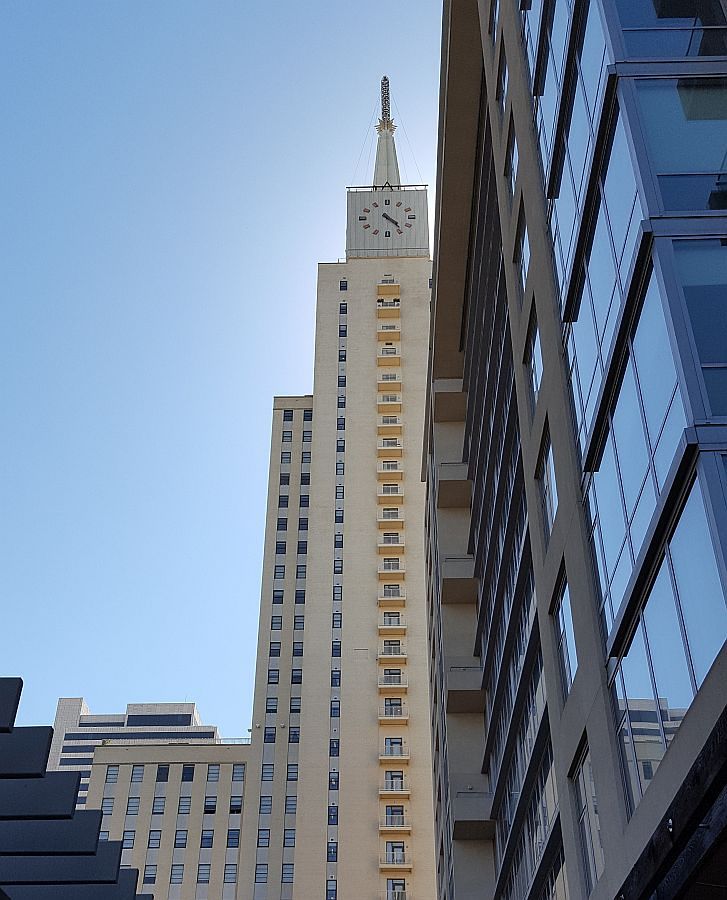
I decided to walk over to see how work on the Statler was coming, so I headed to Main Street Garden Park. This photo isn’t the best, but I wanted to get the Municipal Building (which is currently being restored to its original 1914 grandeur) in the same shot. The Statler is coming along nicely and should be open soon. I’ve always wanted to see inside that building. (Even if it no longer has its original heliport!)

municipal-bldg_statler_052417_bosse

*

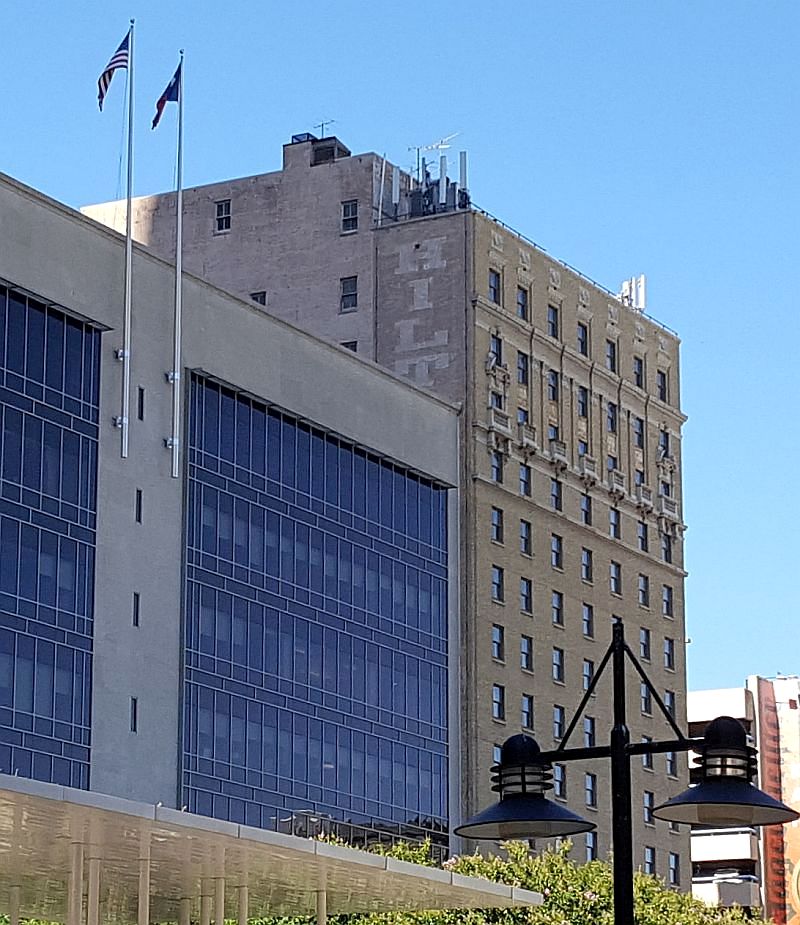
Speaking of the Statler Hilton Hotel (opened by Conrad Hilton in 1956), it’s nice to see that someone has repainted the “Hilt” on the side of what was the first hotel Conrad Hilton built anywhere, The Hilton Hotel, built at Main and Harwood in 1925 (it is now Hotel Indigo). (See the original “Hilton” sign in about 1925 here; it was repainted when it became the White Plaza a few years later.)

hilton-hotel_ghost-sign_052417_bosse

*

I took the photos above from St. Paul, looking east. I turned around and saw this great view of the Merc! It looks good from every angle. (Here it is around 1942, looking west from Harwood.)

mercantile-from-st-paul_052417_bosse

*

It’s nice to see that so many of Dallas’ landmark buildings are still looking good — and it’s also a little strange seeing the places I read about and write about every day standing right in front of me. I need to get back downtown again soon — there’s so much more to see.

***

Sources & Notes

All photos by Paula Bosse; they were taken on May 24, 2017.

All are much larger when clicked.

*

Copyright © 2017 Paula Bosse. All Rights Reserved.


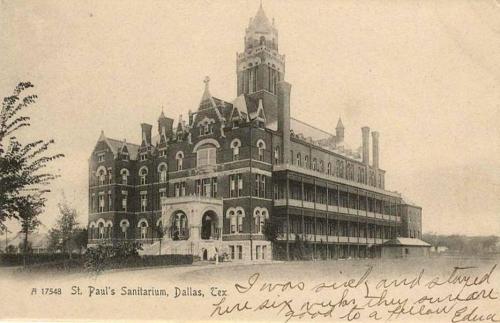
From the Vault: A Tour of St. Paul’s Sanitarium — 1910

st-pauls_flickr_coltera“They sure are good to a fellow…”

by Paula Bosse

A couple of years ago I posted several great photos taken inside St. Paul’s Sanitarium (later St. Paul’s Hospital) by noted Dallas photographer Charles Erwin Arnold. The photos are great. See them in the post “St. Paul’s Sanitarium — 1910,” here.

*

Copyright © 2017 Paula Bosse. All Rights Reserved.

From the Vault: KRLD’s Beautiful Art Deco-Style Transmitter Building — 1939

krld_transmitter_1939

by Paula Bosse

When even industrial buildings were aesthetically pleasing. See the original post — “KRLD’s Beautiful New Transmitter — 1939” — here.

*

Copyright © 2017 Paula Bosse. All Rights Reserved.

Roth’s, Fort Worth Avenue

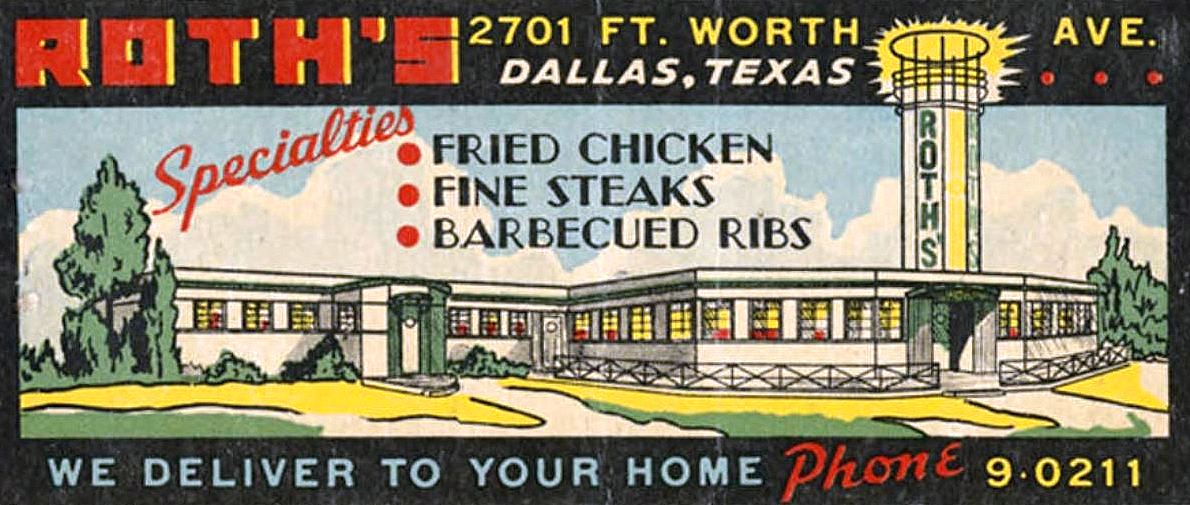
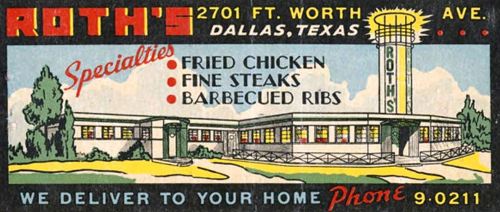
roths_cook-collection_smuSign me up, Mr. Roth…

by Paula Bosse

When I see a building like this, I always hope I can find a photo of it somewhere, but all I’ve been able to come up with is this energetic rendering from a 1940s matchbook cover. Roth’s (which was advertised variously as Roth’s Cafe, Roth’s Restaurant, and Roth’s Drive-In) was in Oak Cliff, on Fort Worth Avenue. It opened in about 1940 or ’41 and operated a surprisingly long time — until about 1967. When Roth’s opened, its address was 2701 Fort Worth Avenue, but around 1952 or ’53 the address became 2601. (I think the numbering might have changed rather than the business moving to a new location a block down the street.)

During World War II, Mustang Village — a large housing development originally built for wartime workers (and, later, for returning veterans and their families) — sprang up across Fort Worth Avenue from the restaurant. It was intended to be temporary housing only, but because Dallas suffered such a severe post-war housing shortage, Mustang Village (as well as its sister Oak Cliff “villages” La Reunion and Texan Courts) ended up being occupied into the ’50s. Suddenly there were a lot more people in that part of town, living, working, and, presumably, visiting restaurants.

As the 1960s dawned, Mustang Village was just a memory, and Roth’s new across-the-street neighbor was the enormous, brand new, headline-grabbing Bronco Bowl, which opened to much fanfare in September 1961. I don’t know whether such close proximity to that huge self-contained entertainment complex hurt or helped Roth’s business, but it certainly must have increased traffic along Fort Worth Avenue.

Roth’s continued operations until it closed in 1967, perhaps not so coincidentally, the same year that Oak Cliff’s beloved Sivils closed. Ernest Roth, like J. D. Sivils, most likely threw in the towel when a series of “wet” vs. “dry” votes in Oak Cliff continued to go against frustrated restaurant owners who insisted that their inability to sell beer and wine not only damaged their own businesses but also adversely affected the Oak Cliff economy. The last straw for Sivils and Roth may have been the unsuccessful petition drive in 1966/1967 to force a “beer election” (read about it here in a Morning News article from Aug. 17, 1966).

As far as that super-cool building seen at the top — I don’t know how long it remained standing, but when Roth’s closed, a mobile home dealer set up shop at 2601 Fort Worth Avenue, and mobile homes need a lot of parking space….

The building on the matchbook cover above is, unfortunately, long gone (as is the much-missed Bronco Bowl); the area today is occupied by asphalt, bland strip malls, and soulless corporate “architecture” (see what 2701 Fort Worth Avenue looks like today, here).

*

The man behind Roth’s was Ernest W. Roth, a Hungarian immigrant who had worked for many years as maître-d’ at the Adolphus Hotel’s tony Century Room. He decided to go out on his own, and around 1940, he and his business partner Joseph Weintraub (who was also his brother-in-law) opened the Oak Cliff restaurant which boasted two dining rooms (with a seating capacity of 350, suitable for parties and banquets), fine steaks, and, on the weekends, a live band and dancing. Ernest’s wife, Martha, and their son Milton were also part of the family business. When the restaurant opened, there wasn’t much more out there on the “Fort Worth cut-off,” but the place must have been doing something right, because Roth’s lasted for at least 27 years — an eternity in the restaurant business. It seems to have remained a popular Oak Cliff dining destination until it closed around 1967.

*

The real story, though, is the Roth family, especially Ernest’s mother, Johanna Roth, and even more especially, his older sister, Bertha Weintraub.

Johanna Rose Roth was born in 1863 in Budapest, where her father served as a member of the King’s Guard for Emperor Franz Josef. She and her husband and young children came to the United States about 1906 and, by 1913, eventually made their way to San Antonio. In the ’40s and ’50s she traveled by airplane back and forth between San Antonio and Dallas, visiting her five children and their families — she was known to the airlines as one of their most frequent customers (and one of their oldest). She died in Dallas in 1956 at the age of 92.

Johanna’s daughter Bertha Roth Weintraub had a very interesting life. She too was born in Hungary — in 1890. After her husband Joe’s death in the mid ’40s, a regular at her brother’s restaurant, Abe Weinstein — big-time entertainment promoter and burlesque club empresario — offered Bertha a job as cashier at the Colony Club, his “classy” burlesque nightclub located across from the Adolphus. She accepted and, amazingly, worked there for 28 years, retiring only when the club closed in 1972 — when she was 82 years old! It sounds like she led a full life, which took her from Budapest to New York to San Francisco to San Antonio to Austin and to Dallas; she bluffed her way into a job as a dress designer, ran a boarding house in a house once owned by former Texas governor James Hogg, hobnobbed with Zsa Zsa Gabor and Liberace, was a friend of Candy Barr, and, as a child, was consoled by the queen of Hungary. She died in Dallas in 1997, a week and a half before her 107th birthday. (The story Larry Powell wrote about her in The Dallas Morning News — “Aunt Bertha’s Book Filled With 97 Years of Memories” (DMN, Nov. 17, 1987) — is very entertaining and well worth tracking down in the News archives.)

weintraub-bertha-roth_texas-jewish-post_021590
Bertha Roth Weintraub

I feel certain that the extended Roth family found themselves entertained by quite a few unexpected stories around holiday dinner tables!

***

Sources & Notes

Matchbook cover (top image) is from the George W. Cook Dallas/Texas Image Collection, DeGolyer Library, Central University Libraries, Southern Methodist University; more info is here.

Photo of Bertha Weintraub is from The Texas Jewish Post (Feb. 15, 1990), via the Portal to Texas History, here.

*

Copyright © 2017 Paula Bosse. All Rights Reserved.

A Few Photo Additions to Past Posts — #5

main-poydras_squire-haskins_utaThe Do-Nut Merchant, holding down the fort… (click for larger image)

by Paula Bosse

Another round of photos I’ve come across recently and have added to previous posts. (All are larger when clicked — to see original posts, click the titles linked in blue.)

Above, a great photo showing Main Street, looking east from Poydras toward Lamar. It’s been added to the post “900 Block of Main, South Side — 1950s” which already contained a head-on view of this block. (Source: Squire Haskins Collection, UTA Special Collections, here. I saw it when Peter Kurilecz posted it to the Dallas History Guild Facebook group and I recognized the block by the “Do-Nut Merchant” sign — because who can forget a business called the Do-Nut Merchant?)

*

Here’s an aesthetically pleasing (if crooked), quaintly drawn plan of Tietze Park; I’ve added it to the post titled, well, “Tietze Park.” (Source: This is a screenshot from my phone — I think it was posted somewhere on Facebook, and I swore I would remember the source, but, of course, I do NOT remember the source.)

tietze park_plan

*

This is a very similar photo of the Municipal Building I posted last year in “Home Sweet Home at Commerce & Harwood,” but this one shows more of Commerce Street (seen at the right) looking east — I don’t see a lot of photos from this period showing the blocks immediately east of Harwood. (Source: George W. Cook Collection, DeGolyer Library, SMU)

municipal-bldg_cook-coll_degolyer_SMU

*

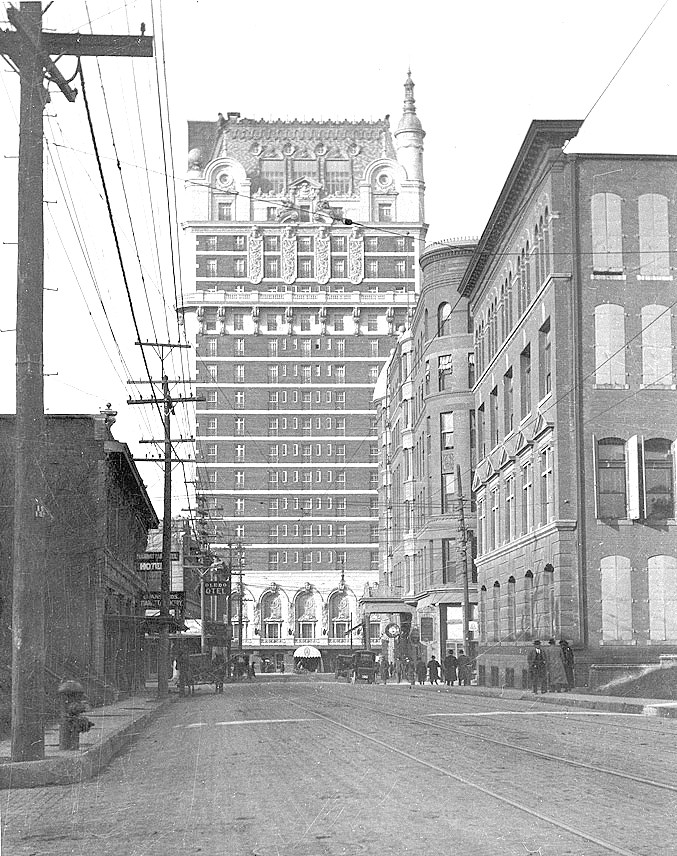
Six blocks west on Commerce is the Adolphus Hotel. This is another similar photo to one already posted, but different enough to be interesting. I’m adding this ca. 1913 view of the Adolphus (straight ahead) and the Oriental Hotel (at the right, middleground), seen looking north on Akard, to the post “The Adolphus, The Oriental, The Magnolia” — the only difference between the two is that this one was taken before the Magnolia Petroleum Building was built. (Source: Dallas Public Library, Texas/Dallas History Division, via D Magazine)

adolphus_1913_dpl_via-d-mag-online

*

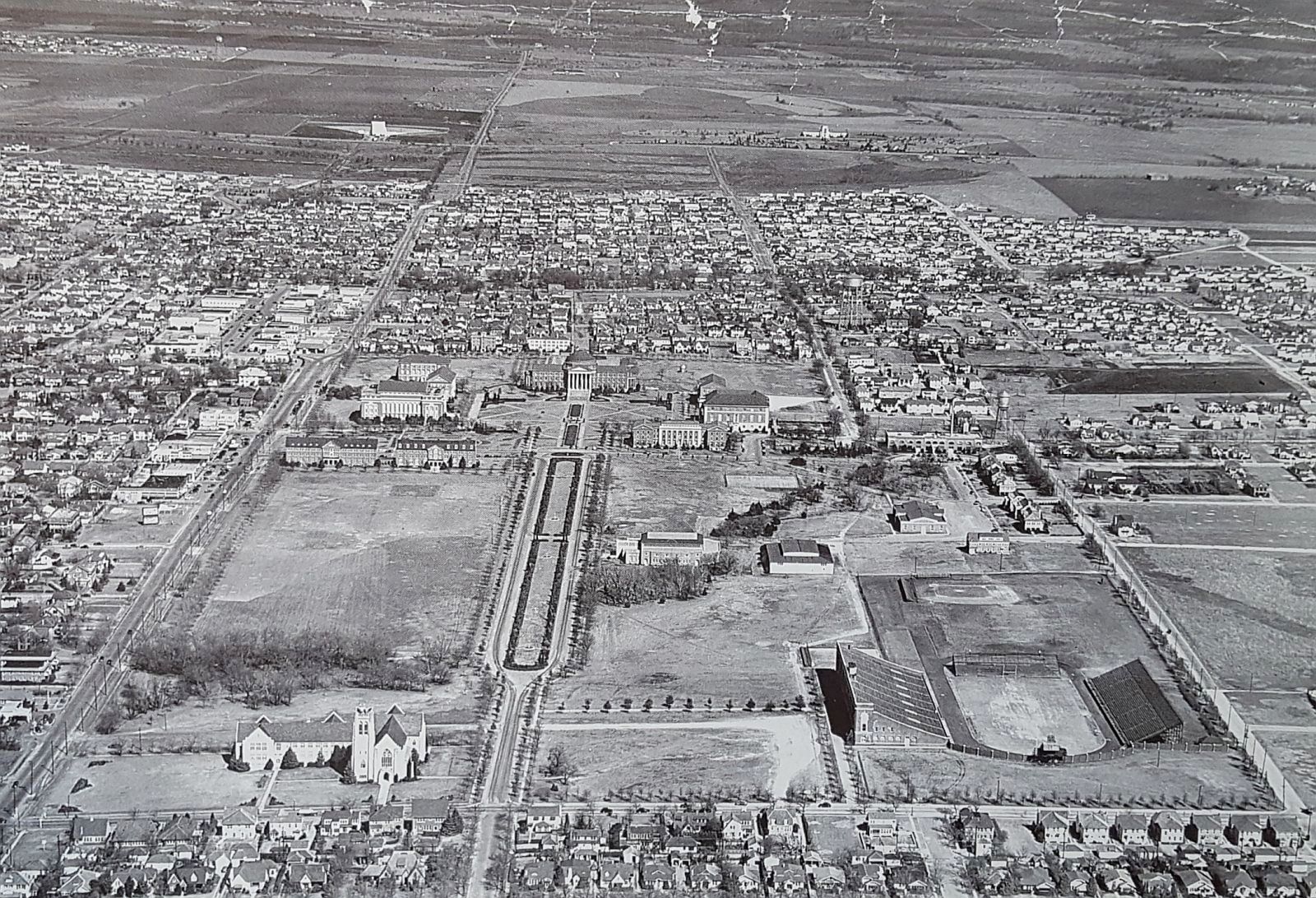
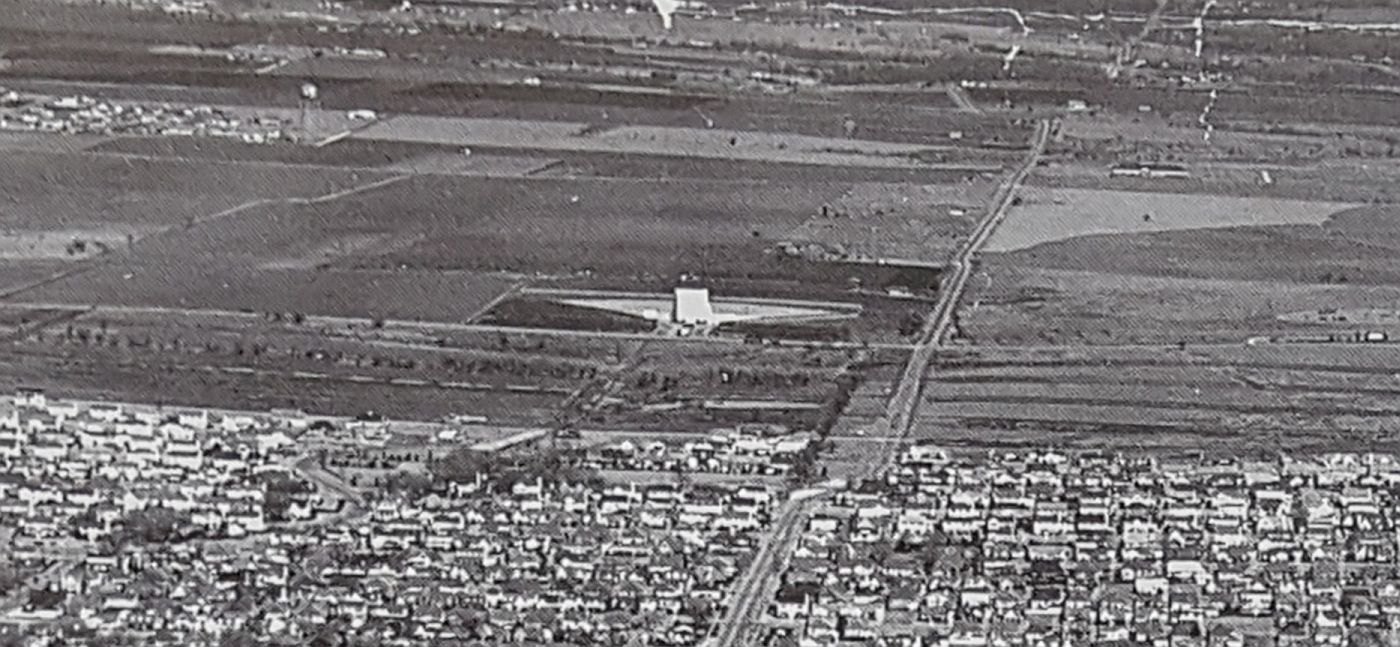
In what seems like another universe, this 1945 photo showing the SMU campus looking north shows mostly open Caruth farmland above Northwest Highway (the Caruth Homestead is at the far right). There are two non-farmland landmarks seen here: just right of the top middle is Hillcrest Mausoleum in Hillcrest Memorial Park (now Sparkman-Hillcrest Memorial Park); to the left of center (just west of Hillcrest) is the Northwest Hi-Way drive-in theater, which is why I’m adding this photo and detail to the post “Dallas’ First Two Drive-In Theaters — 1941.” (Source: Highland Park United Methodist Church Archives, reprinted in Diane Galloway’s book The Park Cities, A Photohistory)

nw-hway-drive-in_1945_galloway_park-cities-photohistory

nw-hway-drive-in_1945_galloway_park-cities-photohistory_det

*

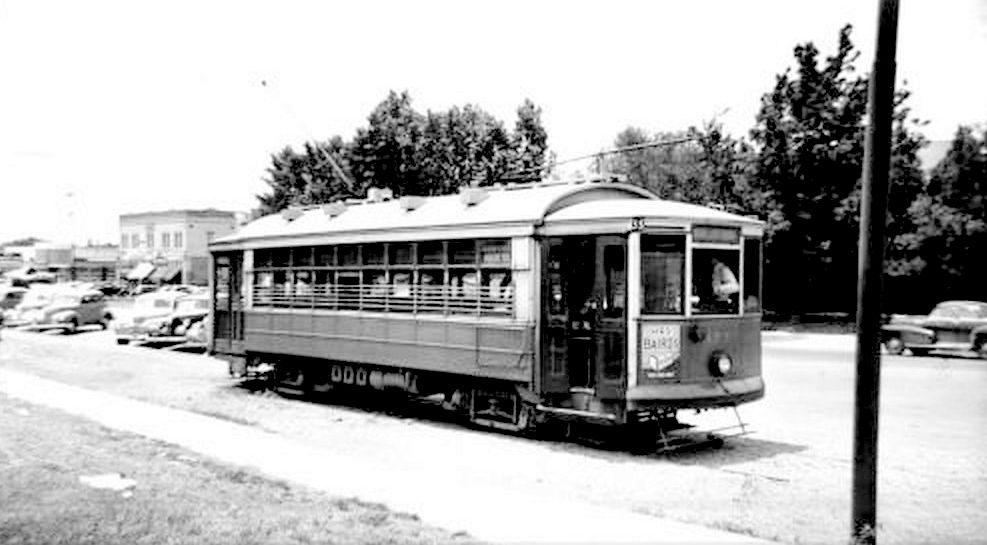
Last summer I wrote about the “Couch Building” — which most people remember as being the University Park home of Goff’s Hamburgers (which burned down last year) (and which can be seen in the aerial photo above if you whip out a magnifying glass). I was happy to see it in the 1947 photo below (behind and to the left of the “Highland Park/SMU” streetcar which is sitting at the end of the line, just south of Snider Plaza). I’ve added this to the post “University Park’s ‘Couch Building’ Goes Up In Flames (1929-2016.)” (Source: eBay photo, posted in the Retro Dallas, Texas Facebook group by Dallas historian Teresa Musgrove Gibson)

couch-bldg_061347_ebay

*

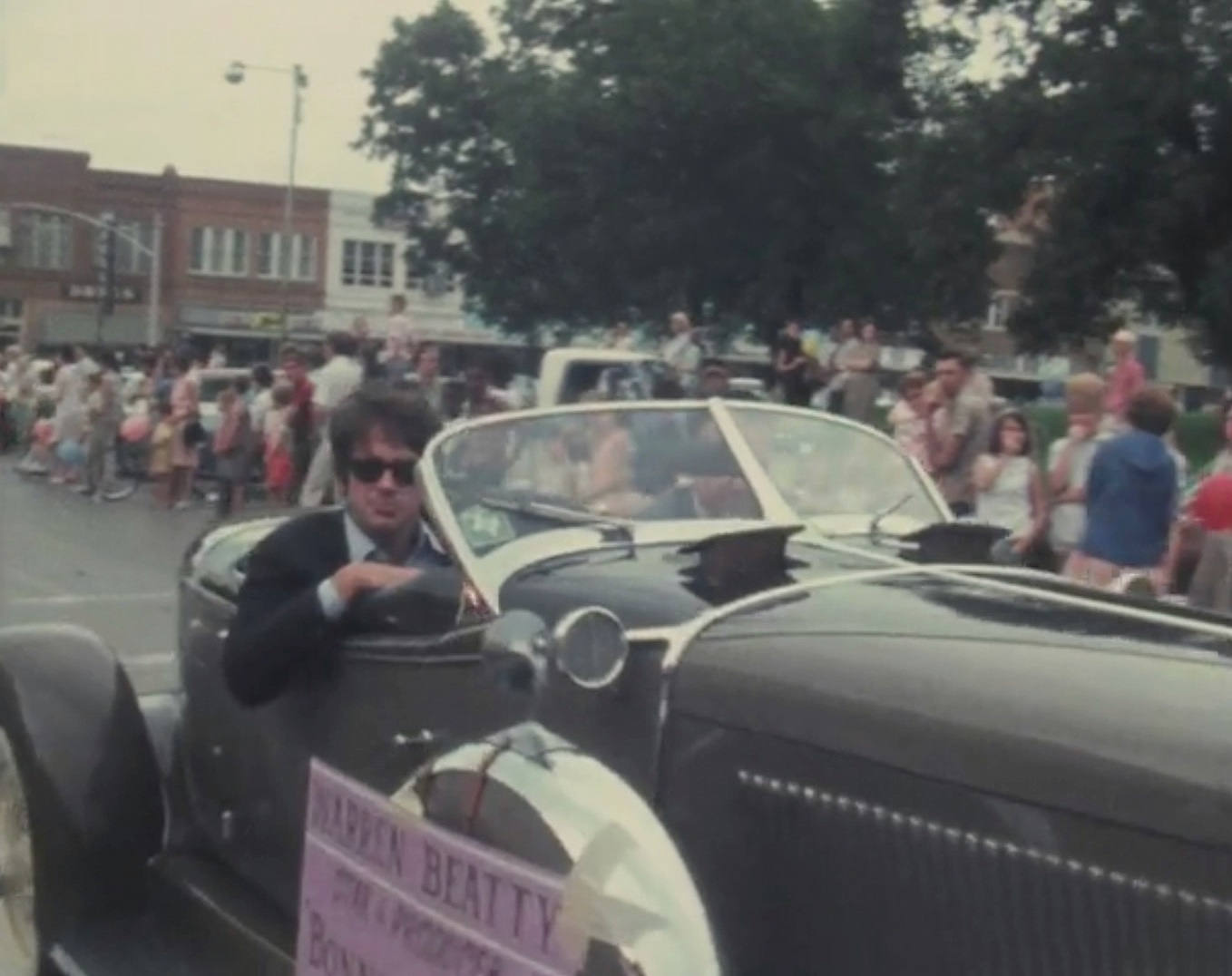
And, finally, I’m adding this link to the post “The Shooting of ‘Bonnie & Clyde’ — 1966.” It shows (silent) news footage from WBAP-TV (Ch. 5) of the Southwestern premiere of the movie Bonnie and Clyde at the Campus Theater in Denton, featuring stars of the movie Warren Beatty, Michael J. Pollard, and Estelle Parsons riding around the square in September, 1967. Below is a screen capture. The Bonnie and Clyde footage starts at about the 4:41 mark. (Source: KXAS-NBC 5 News Collection, UNT Special Libraries Collections, via the Portal to Texas History)

bonnie-and-clyde-movie_beatty_denton-premiere_wbap-tv_091367_portal

*

Copyright © 2017 Paula Bosse. All Rights Reserved.


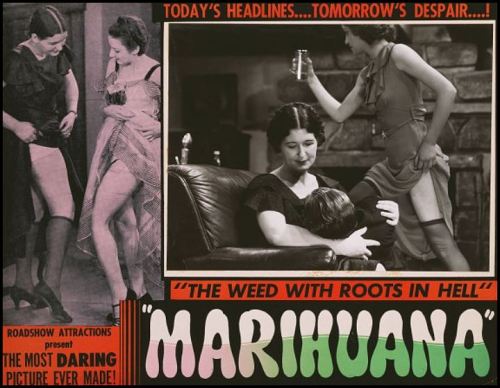
From the Vault: The Early Days of the Police Crackdown on “Loco Weed” in Dallas

marihuana-film_poster“The weed with roots in hell…”

by Paula Bosse

Read about the demon weed when it first began making headlines in the Dallas papers in the 1920s and ’30s in my post from last year, “‘Delusions of Affability’ — Marijuana in 1930s Dallas,” here.

*

Copyright © 2017 Paula Bosse. All Rights Reserved.

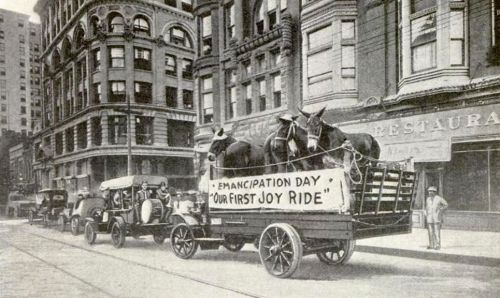
From the Vault: Joy-Riding Mules on Main Street — 1911

mule-joyride_pop-mechanics_jan-1912“Emancipation Day!”

by Paula Bosse

Mules on a “joy ride” down Main Street — something you (probably) don’t see every day. So what exactly was going on here? Find out in the original post from 2015, here.

*

Copyright © 2017 Paula Bosse. All Rights Reserved.