For some reason, I think I had always convinced myself that there weren’t slaves in the Dallas area. Wishful thinking, I suppose. A sobering post from last year — “Ads for Slaves, Lost Found, and For Sale in the Pages of The Dallas Herald” — contains several ads similar to the one above and can be read here.
Above, Dallas lunch ladies shelling what looks like black-eyed peas for an unidentified school’s midday meal. I can’t say I’ve ever imagined lunchroom employees ever doing something like this. In the 1920s and ’30s, schools used fresh foods when they could, but they were definitely using a lot of canned fruits and vegetables, too. All this effort — and all these women — for peas.
In a quick search for what school lunch menus were like in the late ’20s and early ’30s, here were a few delicacies that would never be found in a school cafeteria these days:
Roast veal
Sardine sandwiches
Creamed onions
“Italian hash”
Banana and peanut salad
Salmon loaf
Tongue salad
Stuffed dates
Prune whip/prune salad/prune pudding
Yummy!
***
Sources & Notes
Photo from the Texas/Dallas History & Archives Division, Dallas Public Library.
The carhop is an oddly American invention — and it began here in Dallas in the 1920s, with boys and young men serving customers in cars at J. G. Kirby’s Pig Stand drive-in restaurants. In 1940, Sivils hit Dallas, but this time with young women as servers — young women in skimpy outfits. There was no looking back — from then on, pretty girls showing a lot of leg and hoping for big tips carried trays of food, soft drinks, and beer to cars full of waiting customers.
One of the few remaining “old school” drive-ins is Keller’s on Northwest Highway, still doing good business today. Around 1974 or 1975, SMU film teacher Pat Korman made a short documentary about Dallas carhops past and present (the result, it seems, of reading a Dallas Morning News article by Rena Pederson). He interviewed B. J. Kirby (owner of Kirby’s steakhouse on Lower Greenville and son of Jesse Kirby, founder of the Pig Stand pig-sandwich empire, which, as legend has it, had the very first carhops), J. D. Sivils (owner of Sivils drive-ins, who, along with his wife, was an important figure in the evolution of curb-side dining), and Jack Keller (owner of Keller’s Hamburgers). The three businessmen reminisce about the early days of drive-in restaurants in Dallas as a lot of cool historical film footage unspools and photographs from the ’20s to the ’50s are flashed on the screen. Also interviewed are four women carhops who were working at Keller’s at the time, talking about their jobs.
It’s a cool film. Big cotton-candy hair, accents you wish were still around, and cans and cases of Schlitz, Schlitz, Schlitz.
The 14-minute film is in two parts on YouTube. Here is the first part:
*
And here is the second part:
*
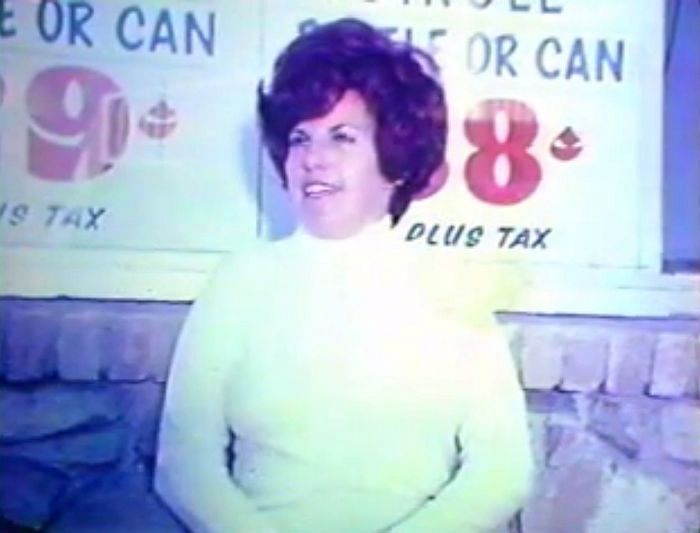
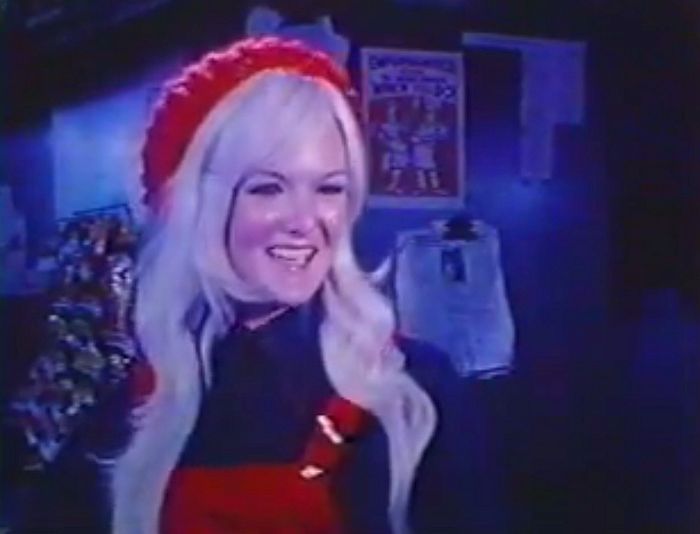
Below, screenshots of the interviewees.
Sandy
Shirley (as of Jan. 2015, she’s been a fixture at Keller’s for 50 years!)
Rita
Nancy
B. J. Kirby
J. D. Sivils
Jack Keller
No. 5 — 80¢
***
Sources & Notes
“Carhops” — filmed sometime in the early ’70s — was directed by Patrick Korman, shot by Ron Judkins, and produced by Don Pasquella. It premiered at Jesuit High School in April 1976. The film is on YouTube in two parts, here and here. (By the way, if you look at the YouTube comments under part two, you’ll see a comment from Sandy herself. She’s still looking good in the avatar photo.) (The music at the beginning and end of the film is great! I’m pretty sure it’s the legendary steel guitarist Ralph Mooney and the equally legendary guitarist James Burton; I love those guys! I urge to go get a copy of their album “Corn Pickin’ and Slick Slidin.'”)
Rena Pederson is thanked in the credits. She wrote a great article in The Dallas Morning News called “Carhops Fading, Those Were the Days” (Aug. 25, 1974) — she interviewed many of the same people seen in the film.
The Keller’s Northwest Highway location celebrates its 50th anniversary this year. Shirley — one of the carhops featured in the film — has worked there since it opened in 1965. As of Jan. 2015, she was still there! Go by and see her! Check out a Lakewood Advocate story on Shirley, here.
Also, take a look at a Dallas Morning News article on Keller’s 50th anniversary, here — scroll down to the slideshow to check out some great photos from its early days.
Read about sexy male carhops who plied their trade in skimpy outfits — a short-lived fad in Dallas inspired by the success of drive-ins like Sivils — in my previous post “Carhops as Sex Symbols — 1940,” here.
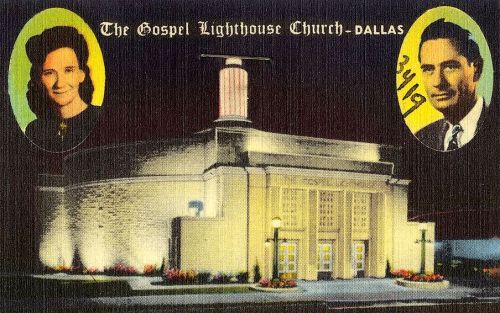
Every once in a while, I notice that an old post is getting a sudden increase in hits. Currently, it’s the one I wrote about J. C. Hibbard’s Gospel Lighthouse Church in Oak Cliff. I’m not sure why so many people are currently flocking to this post from last year (it’s had over a thousand views in the past couple of days), but I’m certainly glad that this architecturally unusual building (which, by the way, still stands) is getting a little attention. It was so cool-looking in old photos that I drove over to Oak Cliff to look at it in person, and I encourage others to do the same!
Read about this church and see several images inside and out, here.
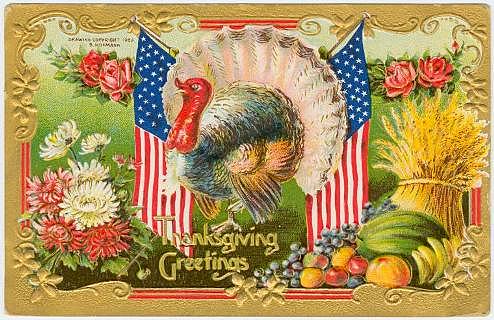
The celebration of Thanksgiving was a hard, hard sell to the Southern states. Read my previous post about why it wasn’t until Reconstruction that Texans finally decided to participate in the national holiday, here.
Hope this wasn’t between McKinney & Cedar Springs…
by Paula Bosse
When the fashionable and wealthy began to move their residences north from the downtown area, they built their homes along Maple Avenue, between McKinney and about where the Stoneleigh Hotel now stands. This exclusive neighborhood of imposing houses hit its stride in the first decade of the 20th century.
One of the well-to-do families who lived on Maple at this time was that of G. B. Dealey, founding editor of The Dallas Morning News. His son Ted Dealey wrote at length about all of his boyhood neighbors in his very entertaining book, Diaper Days of Dallas. Rather ominously, though, these amusing and colorful childhood memories end with this paragraph:
I hate to write this paragraph because some people may think I had a pernicious influence on the neighborhood. But there were five men living on Maple between McKinney and Cedar Springs who committed suicide in the 1900s. Not all in one day, or one week, or one month, of course, but over a period of years.
Wow. The distance between McKinney Avenue and Cedar Springs is only two-tenths of a mile!
The photo above was taken in 1879 from the top of the courthouse. Inside that very courthouse at this time, bad blood was brewing between the mayor and a lawyer, and three years later, one of them would kill the other in a courtroom. I don’t know why I love this story so much — probably because of the incredibly gory-but-matter-of-fact newspaper report of the 1882 shooting. Read about the political feud that ultimately erupted in gunfire from the bench — and see this photo really, really big — in my earlier post (updated with a few new links), here.
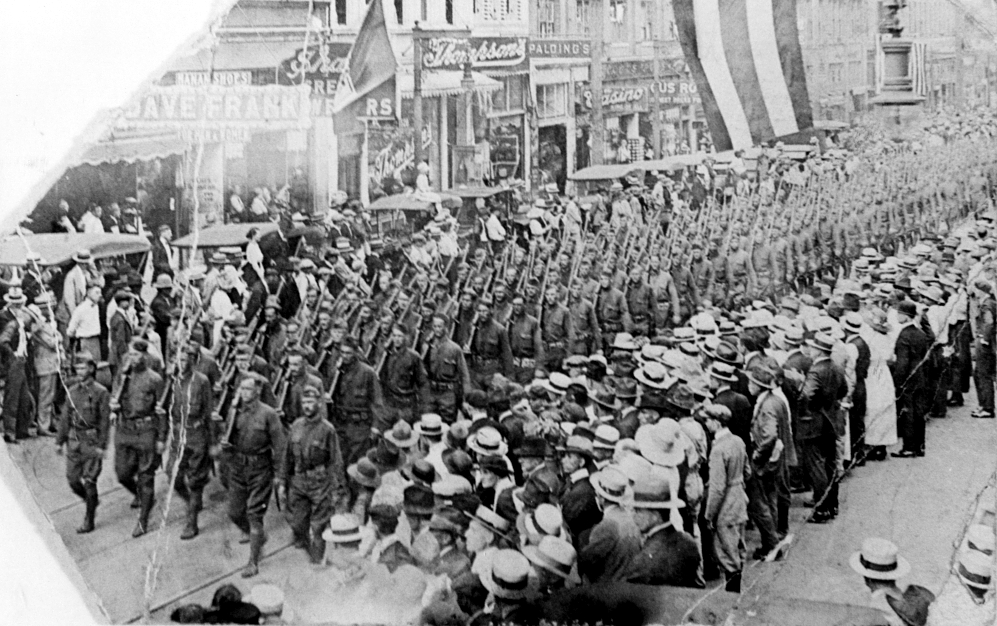
Soldiers returning from war — June, 1919 (click for larger image)
by Paula Bosse
Dallas learned that World War I had ended when they were awakened at 3:00 AM by a siren screeching from the top of the Adolphus Hotel. Read how ecstatic Dallasites celebrated, in my previous post, “Armistice Day! — 1918,” which can be read here.
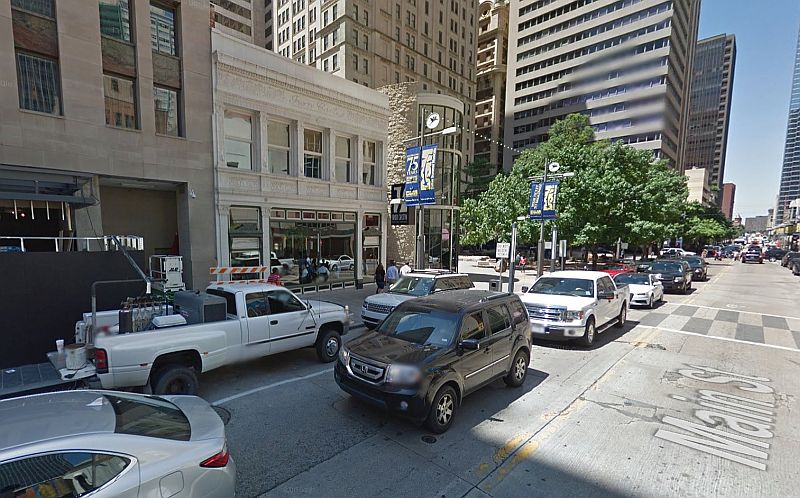
The photo above shows the 1500 block of Main Street, looking west toward Akard. The building with the Thompson’s sign was at 1520 Main, the address now belonging to Iron Cactus, seen below in the two-story white building. Same building? Looks like it.

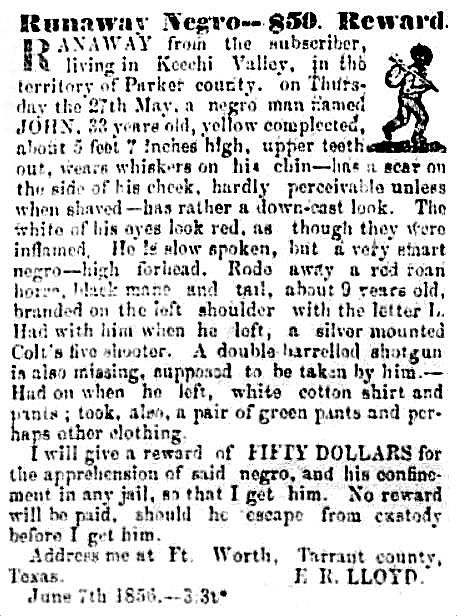 The Dallas Herald, June 7, 1856







 Flashback : Dallas