Flashback : Dallas

A Miscellany: History, Ads, Pop Culture

Category: Vault

A New Turbine Power Station for Big D — 1907

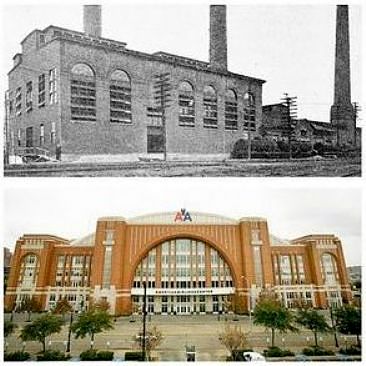
power-station_1907New and old power plants, 1907 (click for much larger image)

by Paula Bosse

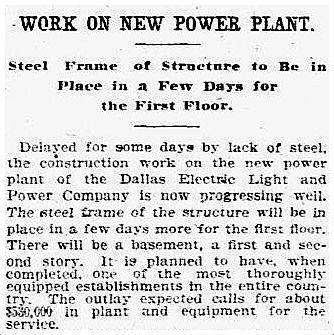
Construction began in 1906 on a new power plant for the Dallas Electric Light & Power Company. It was built next to the old power plant, and it furnished electricity for the city’s lighting and power needs as well as for its streetcars and interurban cars. When construction began, the project was expected to cost more than $500,000 (over $13 million in today’s money), a large (but necessary) expenditure for the growing city.

power-station_dmn_020906Dallas Morning News, Feb. 9, 1906

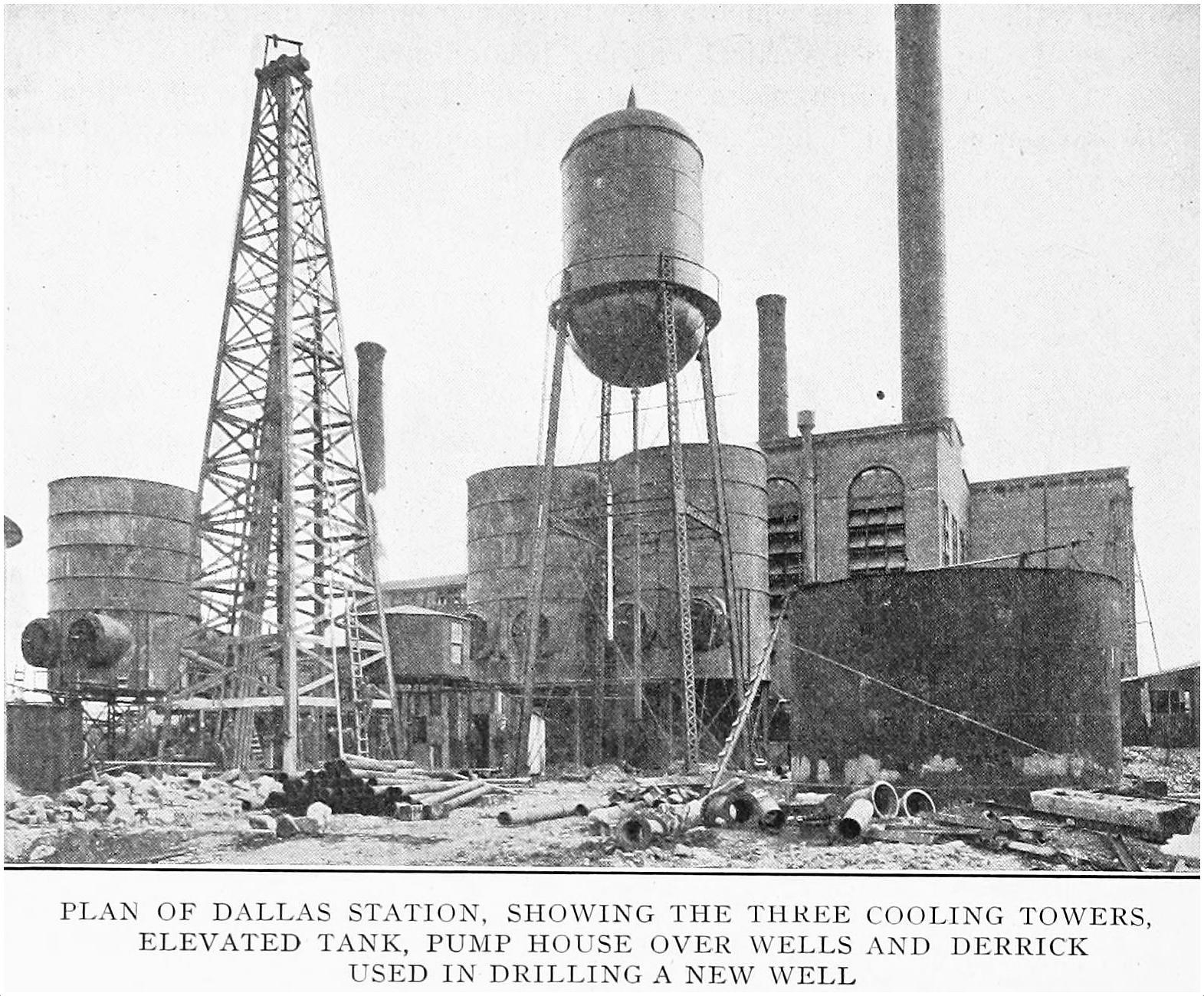
The photo at the top shows the new plant on the left, and the old 19th-century plant on the right. Here, a view from the other side:

power-station_ext_1907

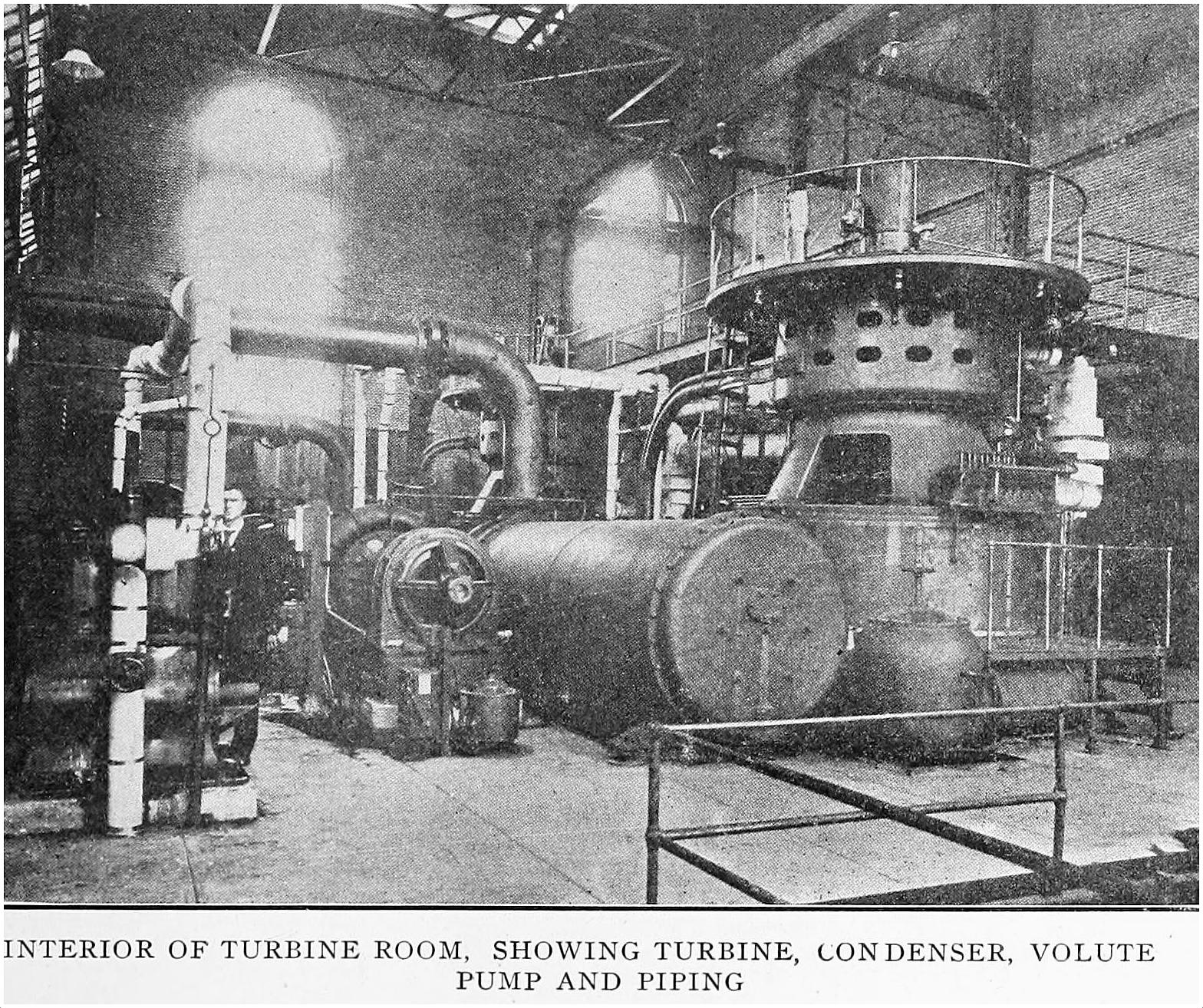
Inside? A lot of fascinating stuff that looked like this (as well as a stern-looking man who appears to be trying to avoid the camera):

turbine-rm_1907

The power station was northwest of downtown, between the MKT and Cotton Belt and Rock Island railroad yards (approximately where the American Airlines Center is today). Before the Trinity was straightened and moved, the plant was only about half a mile from the banks of the river. Even though the grade of the new station’s floor was built above the highest flood level, the historic flood of 1908 put the plant out of commission for several days, but — probably because it was filled with brand new equipment — the city’s power was restored much faster than one might have expected.

***

Sources & Notes

Photos are from the Street Railway Journal, May 18, 1907 (Vol. XXIX, No. 20). To view the entire 7-page article — which includes more photographs as well as several floorplans and schematics, all of which are very cool (even to someone like me who has absolutely no idea of what any of it means!) — check it out, here.

The American Airlines Center incorporated elements of the 1907 plant’s design into its own:

aac

My previous related post, “DP&L’s Twin Smokestacks,” can be read here.

Photos are much larger when clicked.

*

Copyright © 2015 Paula Bosse. All Rights Reserved.


“When ‘Big D’ Lights Up” — Phelps Dodge Ad (1969)

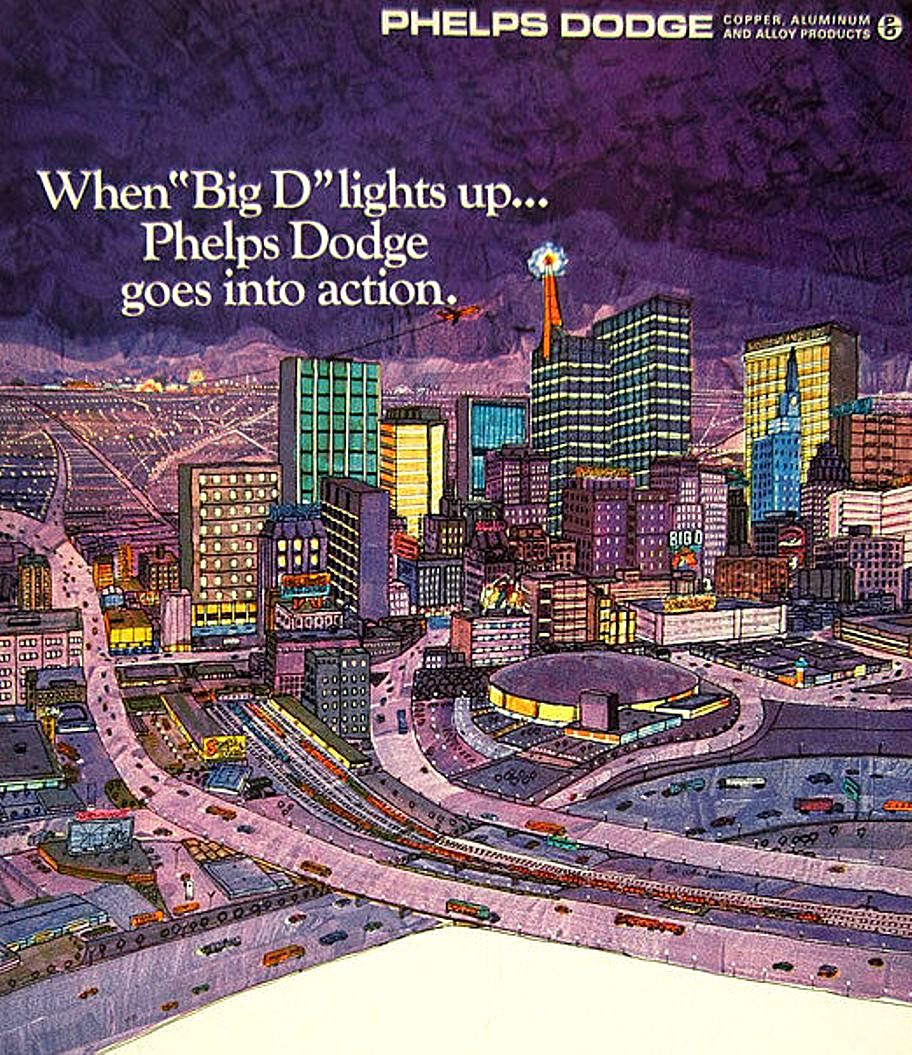
ad-phelps-dodge_1969_ebayCopper, aluminum, and alloys … EVERYWHERE!

by Paula Bosse

One doesn’t expect a cute, quirky drawing of Dallas to appear in an advertisement for an international mining company that excavates and manufactures “copper, aluminum, and alloy products.” But here you are, a 1969 Phelps Dodge ad featuring the Dallas skyline. It’s a bit reminiscent of both the delightful telephone book cover art of Karl Hoefle and the distinctive naive “matchstick men” art of L. S. Lowry. The ad copy is a lot less whimsical:

Dallas … a busy, prospering commercial center and Showplace of the Southwest. A bright, shining ever-changing city where the new is commonplace.

Look behind the splendor and the bright lights and you’ll see that Dallas is also a Phelps Dodge city. Our condenser tubes are used at the generating plants of the Dallas Power and Light Company. Our 135-kv transmission cables and other high-voltage power cables distribute power throughout the city … and the transformers, coils and motors wound with our magnet wire make things happen … from the flashing signs downtown, to factories along the river … to homes, stores, and offices everywhere.

Go north on Stemmons Freeway or west to Fort Worth on the Turnpike, or south on I-45 and Phelps Dodge buried lighting cables, telephone or coaxial CATV cables are following alongside. You’ll also find our building wire and aluminum conduit … our plumbing, gas and refrigeration copper tubing at work everywhere. Many new buildings, like the Statler Hilton Hotel, use PD building wire and copper tubing exclusively.

We specialize in conductors of electricity, liquids, gases and heat made of copper, aluminum and alloys. Look closely, and you’ll find Phelps Dodge products at work everywhere.

***

Sources & Notes

Ad found on eBay.

See the artwork from this same ad — only in black and white — here. Zoom in and look at the details. No Karl Hoefle, but still pretty cool.

ad-phelps-dodge_1969_bw_small

Interested in knowing more about Phelps Dodge? Wikipedia to the rescue, here.

The drawing is by commercial artist Lee Albertson, who, apparently, did a whole series of these ads, each featuring a different “copper, aluminum and alloy product”-enriched city, a few of which can be seen here.


*

Copyright © 2015 Paula Bosse. All Rights Reserved.

World War II: The Homefront — 1944

WWII-mother_dmn_051444Mrs. A. H. Curry

by Paula Bosse

This touching photo appeared in The Dallas Morning News on Mother’s Day, 1944. The caption:

HER DAY — Sons are scattered all over the world in a fight for a deep cause. Mother’s Day, 1944, isn’t the brightest we have ever had, but it is the most hopeful for the future. And it serves to call attention again to the fact that Mothers are still the greatest heroes of all. In Dallas, Mrs. A. H. Curry, 3719 Miramar, a Mother with six sons in the service — one of them missing in action — looks over the pictures of the men she reared who now fight for her safety at home.

(More about the Curry boys can be read in the full Mother’s Day article that accompanied this photo — an article written in the purplest of patriotic prose by Dallas Morning News editor Felix R. McKnight; read it here.)

curry_dmn_012465
Ethel Walz Curry (1883-1965)

Below, a photo of the Curry sons with their father, A. H. Curry (whose early career was spent with the Edison Company, working personally with Thomas Edison).

curry-brothers_dmn_091242DMN, Sept, 12, 1942

***

Sources & Notes

Photo and text appeared in The Dallas Morning News on May 14, 1944, Mother’s Day. Photo by E. W. Odom.

Mrs. Curry also had two daughters, Catherine and Carolyn. In one of those “everything is connected” discoveries, Catherine married Robert E. Grinnan who grew up in the Connor house I wrote about here.

*

Copyright © 2015 Paula Bosse. All Rights Reserved.

The Elegant Municipal Building — 1914

ciA very un-Dallas-looking building … and one of its finest

by Paula Bosse

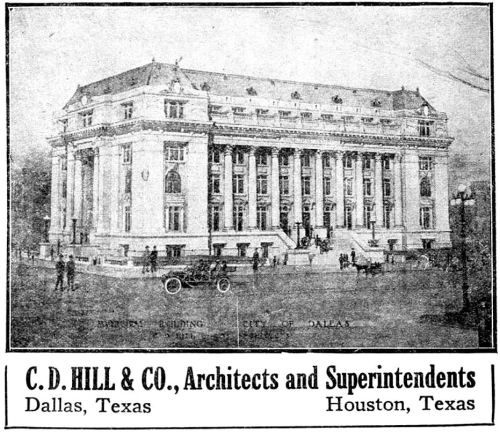
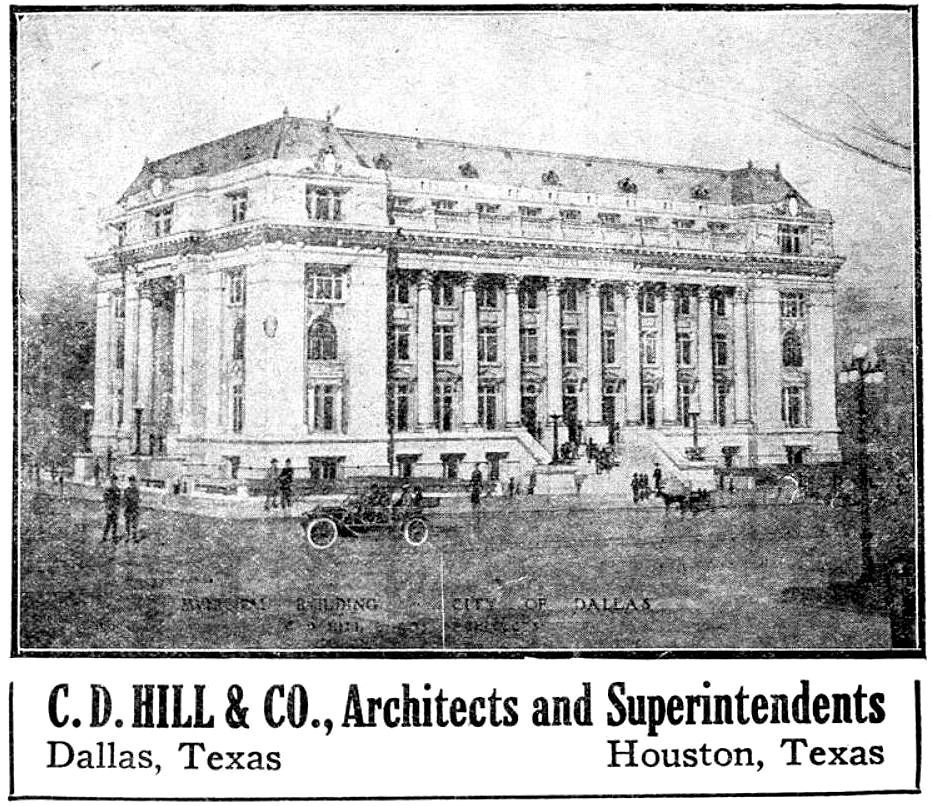
Appearing in the May 7, 1914 issue of Municipal Journal was a short article on Dallas’ then-under-construction Municipal Building and a drawing of what it would look like when completed.
municipal_bldg_watermelon-kid

Dallas Will Have Modern Municipal Building
Dallas, Tex. – The new municipal building of the city of Dallas is nearing completion and will be ready for occupancy in a few months. It will house all of the city departments and in addition will have a modern emergency hospital in the basement and public rest rooms for both men and women. The building is said to be a radical departure in architectural design from the usual type of public buildings in the South; it is constructed along simple but dignified lines. The structure will be of steel construction covered with blue Bedford stone, the five stories, basement and sub-basement will be a home worthy of the city of the hour, as Dallas people like to call their town. Ventilating and heating systems are being installed together with vacuum cleaners. The building, without furnishings, will cost about $550,000. C. D. Hill and Company are the architects. The structure was started by the Fred A. Jones Building Company, which failed just as the steel was up, and it is being finished within the estimates by the city under the supervision of the architects.

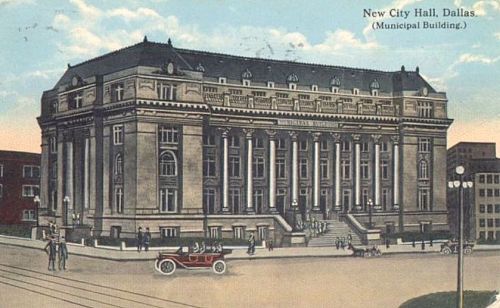
This new City Hall, located at Main, Harwood, and Commerce, was designed by Dallas architect C. D. Hill. Construction began in late 1913 — by January of 1914, its steel frame was in place.
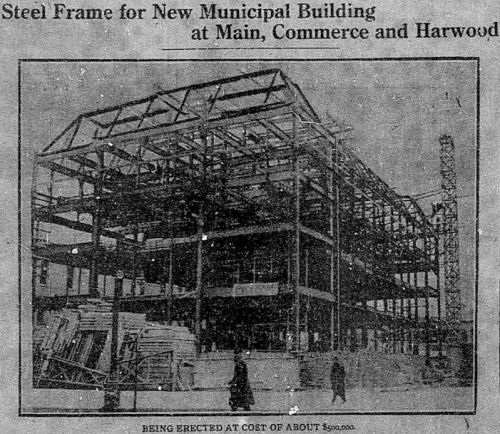
municipal-bldg_dmn_010114Dallas Morning News, Jan. 1, 1914

The cornerstone was laid in a Masonic ceremony on Valentine’s Day, 1914.

municipal- bldg_FWST_021514-cornerstoneFort Worth Star-Telegram, Feb. 15, 1914

As the construction was winding down, workmen complained of an “intolerable” swarm of mosquitoes flying around the site. Apparently an underground spring was flooding the sub-basement and providing palatial digs for endless cycles of constantly-hatching mosquitoes. (I wonder if the basement still floods on occasion?)
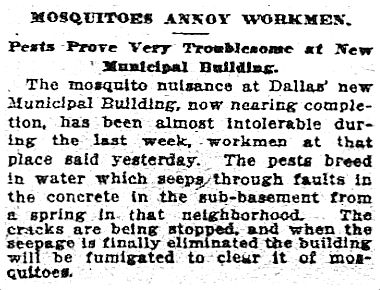
municipal-bldg_dmn_091014-mosquitoesDMN, Sept. 10, 1914

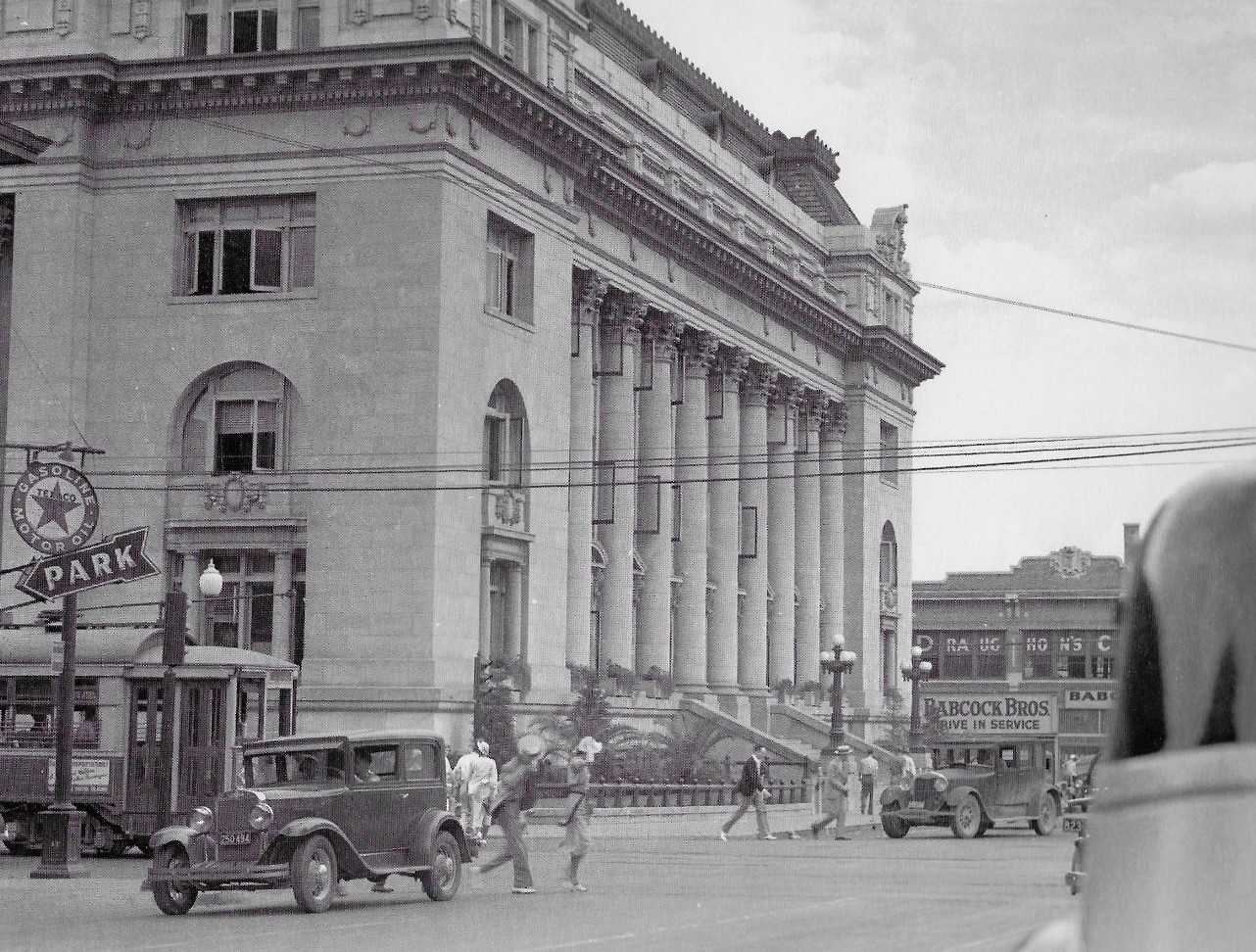
The building was officially opened on October 17, 1914. Here’s a grainy photo that absolutely does not do that beautiful building justice.

municipal-bldg_dmn_101714DMN, Oct. 17, 1914

When the doors were finally opened to the public, it was expected that a few thousand people would show up to tour their new municipal building — in actuality, the much-larger-than-anticipated crowd numbered somewhere between 12,000 and 15,000 curious Dallasites.

municipal-bldg_dmn-101814DMN, Oct. 18, 1914 (click for larger image)

The beautiful exterior was faced with granite and stone, and the interior boasted marble, mosaic tilework, and wood paneling. All of the furniture used in the building was made in Dallas. In addition to the mayor’s office, fire, police, and other municipal departments, the building also housed an emergency hospital, a sub-basement shooting range (!), and, on the 3rd floor, an 1,100-seat auditorium, with a 4th-floor gallery. (The auditorium was designed so that if, in the future, it was determined that it was not needed, it could easily be converted to office space by adding a few columns and beams — a renovation which obviously happened at some point.) Interestingly, the northern half of the top floor was left unfinished as the space was not needed at the time.

ALSO included in the new building’s amenities were much-needed public restrooms (or as they were euphemistically referred to back then, “comfort stations”). A men’s restroom and a women’s restroom (“positively divided with heavy walls”) were located under the Main Street sidewalk, accessible down stairs on either side of the building’s entrance. Up until this point, there was only ONE public “comfort station” in the city (for women and children) — at Fair Park. So for most downtown visitors, this might well have been the most exciting aspect of Dallas’ newest landmark.

The building referred to as both “City Hall” and “the Municipal Building” was considered to be one of the city’s finest and most elegantly imposing. But there are always a few people who just don’t like nice things, and there was a surprising amount of vandalism to the building in its first few weeks.
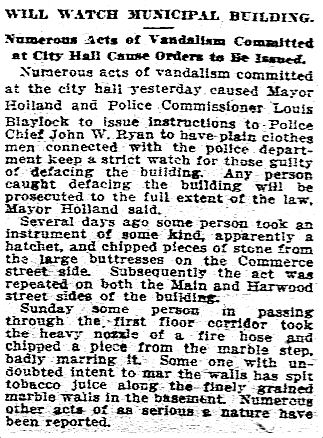
municipal-bldg_dmn_111014-vandalismDMN, Nov. 10, 1914

This is one of the truly great buildings in Dallas, and it just recently celebrated its 100th birthday. It is a Dallas Landmark and a Texas Recorded Historic Landmark. No longer a city property, it is now part of the University of North Texas Dallas College of Law campus (along with the old Titche’s building). UNT is currently working to restore and renovate this beautiful historic building. Thank you, UNT!

*

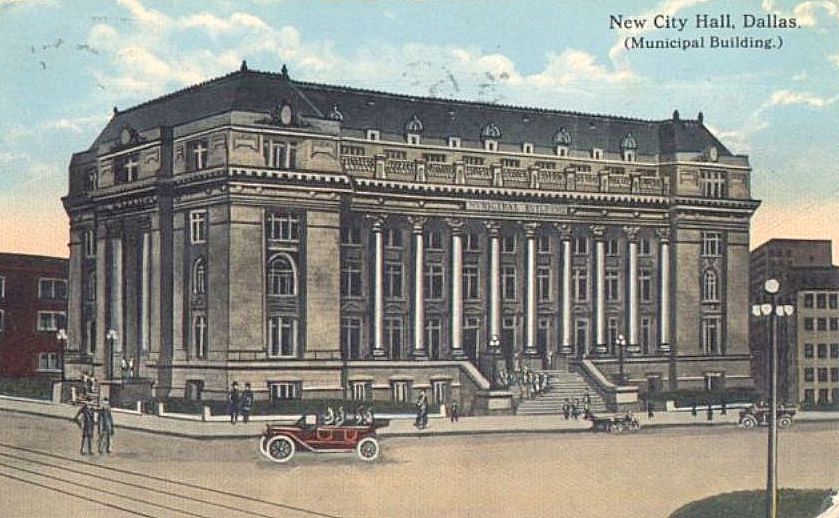
A few images of the building over the years. Here it is in its pristine early days:
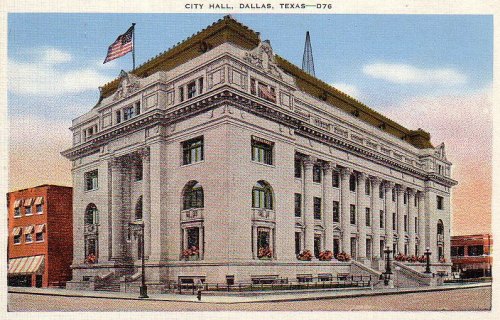
city_hall*

Then there was a weird middle-age-crazy period when someone thought that the addition of awnings would be a good idea (that person was incorrect).

municipal-bldg_color-ebay*

And, today, it’s back to looking distinguished and lovely. Thanks to the wonderful new open park in front of it, it has been given the stately space it deserves — what may be Dallas’ most beautiful building is finally able to be fully admired from a respectful distance.
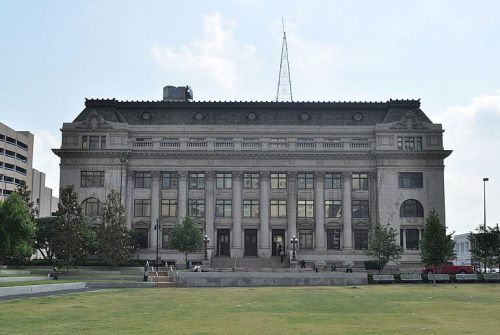
municipal-bldg-today_wikipediaJoe Mabel, Wikipedia

***

Sources & Notes

Top photo from the book Historic Photos of Dallas by Michael V. Hazel (Nashville: Turner Publishing Co., 2006).

Quote from Municipal Journal, Vol. XXXVI, No. 19 — May 7, 1914.

Photo of the old Municipal Building today by Joe Mabel, from Wikipedia. (And, yes, the parking garage of the Dallas Municipal Building is where Ruby shot Oswald.)

Newspaper photos and clippings as noted.

For a detailed description of the architectural details, design elements, and description of office and department locations within the building, see the article “Municipal Building Handsome Structure” (DMN, Oct. 4, 1914), here.

I’d love to know more about the little “aluminum trays, bearing a picture of the building” mentioned as being given away on opening day in an article above. There were FIVE THOUSAND of them given away. Surely there are some still around. Has anyone seen one of the these?
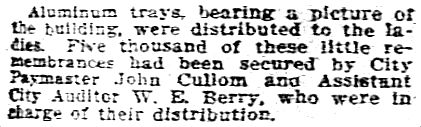
municipal-bldg_dmn_101814_aluminum-traysDMN, Oct. 18, 1914

municipal-bldg_c-d-hill_tx-almanac_19141914 Texas Almanac ad for C. D. Hill & Co.

*

Copyright © 2015 Paula Bosse. All Rights Reserved.

Iola Bridge

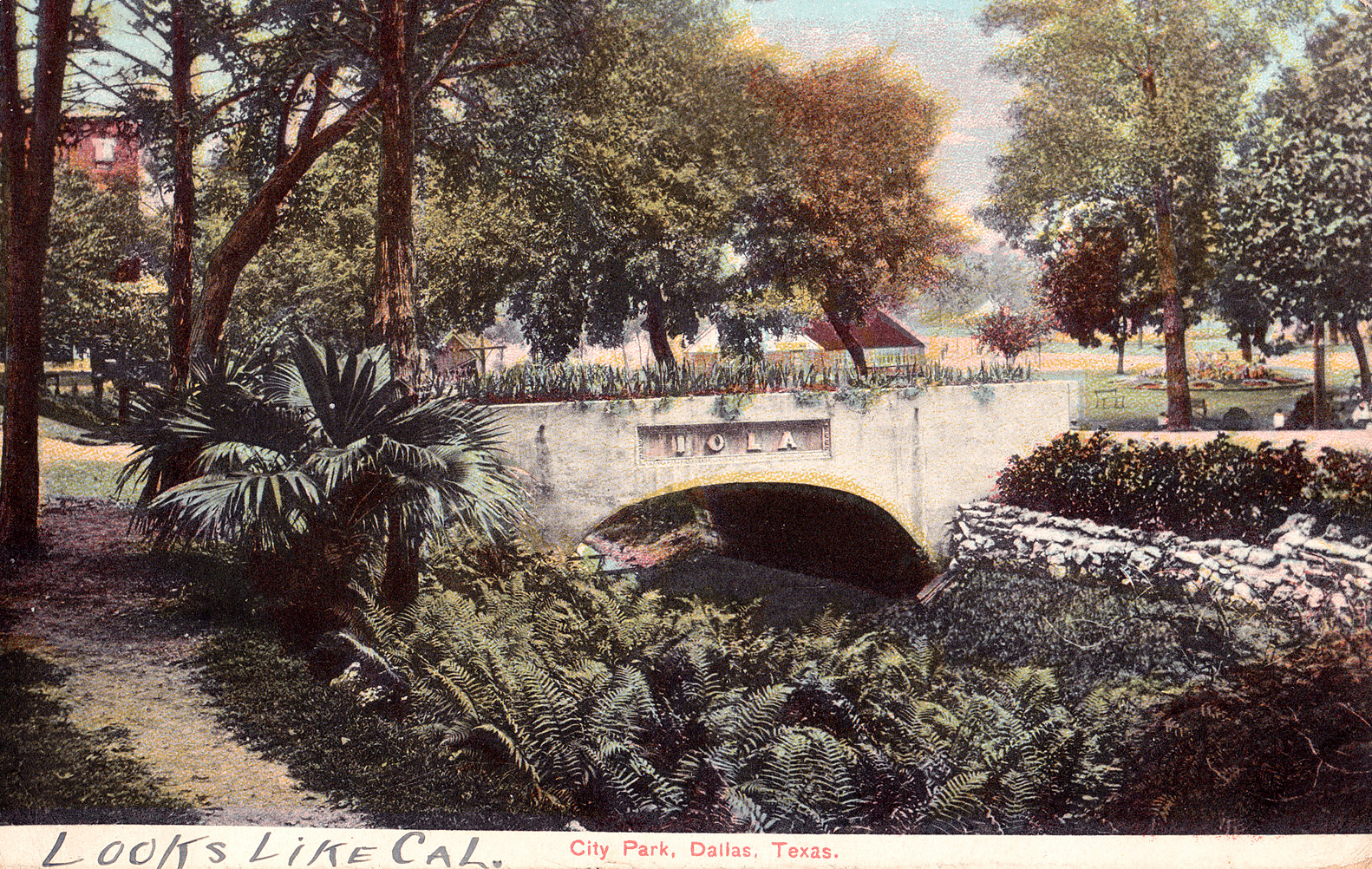
iola-bridge_city-park_ca-1908“Looks like California…” — City Park, ca. 1908

by Paula Bosse

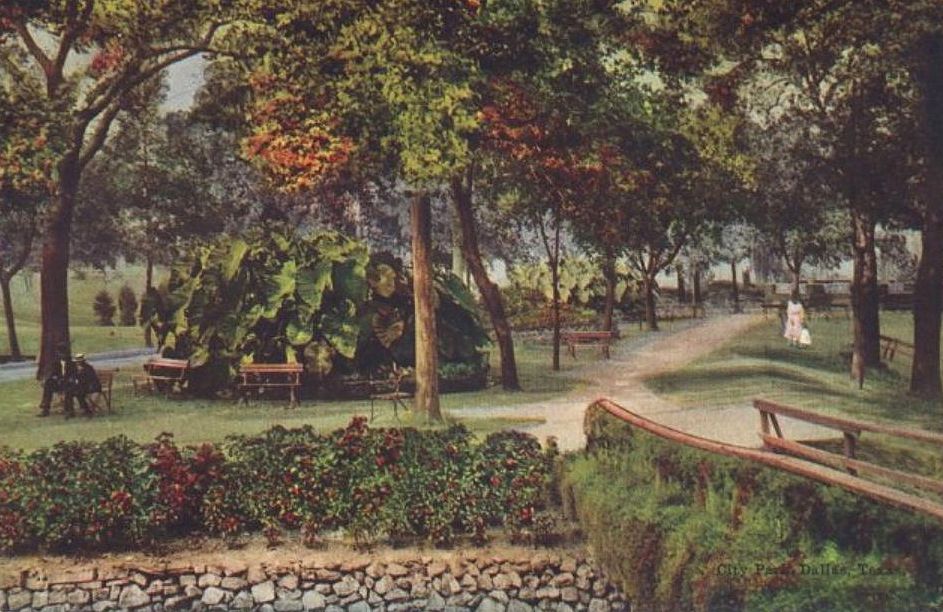
Old postcards of (Old) City Park always seem kind of mysterious to me. I’m fascinated by photos of what was, for many years, Dallas’ only park. It was very big and beautifully landscaped — and it was one of the things about the city that those of earlier generations were most proud of. The postcard views above and below are from the early days of the twentieth century, and, sadly, those views don’t exist anymore — it’s hard to believe they EVER existed here. Even though there’s a hint of what you might see at Reverchon Park, there’s little else about these images that looks like the Dallas of today. What a shame!

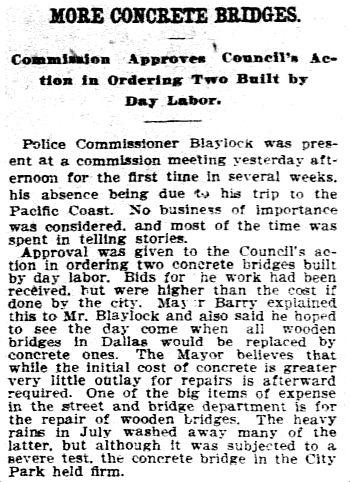
But what’s the story behind the attractive little “Iola” bridge? Built in 1905, it was, apparently, Dallas’ first (or possibly second) concrete bridge. The Iola bridge was far sturdier than the wooden bridges around Dallas, and a concrete bridge also required very little upkeep. In fact, this little bridge “of ornamental design” is actually kind of important — it was often cited by city planners and commissioners when discussing the construction of future bridges around the city.

concrete-bridges_dmn_081005Dallas Morning News, Aug. 10, 1905

It seems wooden bridges were being washed away almost as often as Dallas courthouses were burning down. In a letter that appeared in The News on Feb. 21, 1911, it was noted that, while wooden bridges were “under constant repair,” the concrete Iola bridge “has not required one dollar of outlay […] during its six years of existence.” So … cheaper and sturdier. Bye-bye, wooden bridges!

But “Iola”… where did that name come from? I thought it might have been the name of a wife or mother of a mayor or planner, but I suspect it was merely the name of the company that donated the cement for the bridge’s construction, the Iola Portland Cement Company. The company’s canny “civic donation” ultimately paid off BIG for them in the end. Not only did they supply the cement to build that first very pretty little bridge in a very pretty park, they also, ultimately, got whopping new orders from the city for all those new concrete bridges that began to be built — including, less than ten years later (when the Iola company’s West Dallas plant had been sold to the TEXAS Portland Cement Co.), the Trinity River-spanning Oak Cliff/Houston Street viaduct, which, when it opened in 1912, was the longest concrete bridge in the WORLD! And it all began with that unassuming bridge in scenic City Park, just south of the central business district.

*

iola-bridge_watermelon-kid

iola-bridge_dmn_100921aDMN, 1921

Below, a couple of views showing the charming and rather more rustic wooden bridges in the park.

bridge_city-park_watermelon-kid

wooden-bridges_city-park_watermelon-kid

iola-cement_directory-1905Ad from the 1905 Dallas directory

***

Sources & Notes

Top postcard found somewhere on the internet. All other postcards from The Watermelon Kid — here.

Black and white photo by Victor H. Schoffelmayer appeared in The Dallas Morning News on Oct. 9, 1921; it was one of several photographs of the Iola bridge, taken by members of the Dallas Camera Club.

A Dallas Morning News article from July 14, 1905 detailing the new improvements to City Park (including the concrete bridge) can be read here. (I don’t think the really wonderful-sounding “cascade” was ever built — and that’s a pity, because it sounds like it would have been beautiful!)

*

Copyright © 2015 Paula Bosse. All Rights Reserved.

Nolan Ryan’s Celebratory Pancake Breakfast — 1972

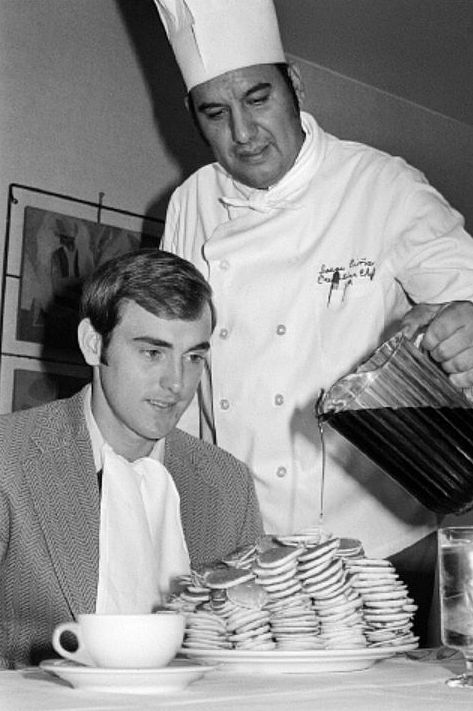
nolan-ryan© Bettmann/CORBIS

by Paula Bosse

In 1972, future baseball hall-of-famer and Texas Rangers legend Nolan Ryan (then a California Angel) was photographed in Dallas as he sat mesmerized by a platter of 302 silver-dollar pancakes and an iced-tea-sized pitcher of syrup. The celebratory breakfast was served to him at the Sheraton Dallas the morning after he became only the sixth pitcher in major league history to strike out more than 300 batters in a season. (His opponents the previous night — September 25, 1972 — had been the Rangers, the team he would one day play for and preside over as president and CEO.)

The UPI Telephoto wire photo ran on Sept. 27, 1972 above the following caption:

302 PANCAKES — Ever wonder what 302 strikeouts in a season will get you? If you’re a batter, you may lose your job, but if you’re a pitcher like Nolan Ryan, left, of the California Angels, [you] will at least get 302 silver dollar pancakes. This was the breakfast that awaited Ryan Tuesday after his 3-hit, 12-strikeout win over the Texas Rangers Monday. The executive chef at the Sheraton Dallas [Isaac Pina] produced the breakfast for the Alvin native, a former New York Met, who is the sixth pitcher in major league history to strike out more than 300 batters in one season.

Twelve strike-outs!

ryan_FWST_092672Fort Worth Star-Telegram, Sept. 26, 1972
Judging by the expression on his face at the next day’s breakfast table, it’s pretty obvious the 25-year old Nolan Ryan enjoyed his triumph.

***

Sources & Notes

Photo ©Bettmann/CORBIS. The photo is also seen on this page, from The Guardian, which shows a collection of really great historic baseball photos — a bit of a surprise, coming from a British newspaper!

The photo was published in newspapers around the country; the quoted wire copy appeared in the Sept. 27, 1972 edition of The Waxahachie Daily Light.

To read a passage from the book Nolan Ryan’s Pitcher’s Bible in which he writes about the importance of his high-carb breakfasts (Day One: Pancakes…), see here.

The Wikipedia entry on Nolan Ryan is here; his stats are here.

*

Copyright © 2015 Paula Bosse. All Rights Reserved.


The Periphery of the Texas State Fair Never Looked Better

state-fair_postcard_carrie-ednaApproaching the Fair Grounds…

by Paula Bosse

A couple of pretty, but unusual views of the fairgrounds, turn-of-the-century-ish. The message on the postcard at the top: “Carrie the fair was real good this year better than it has been for years. Edna”

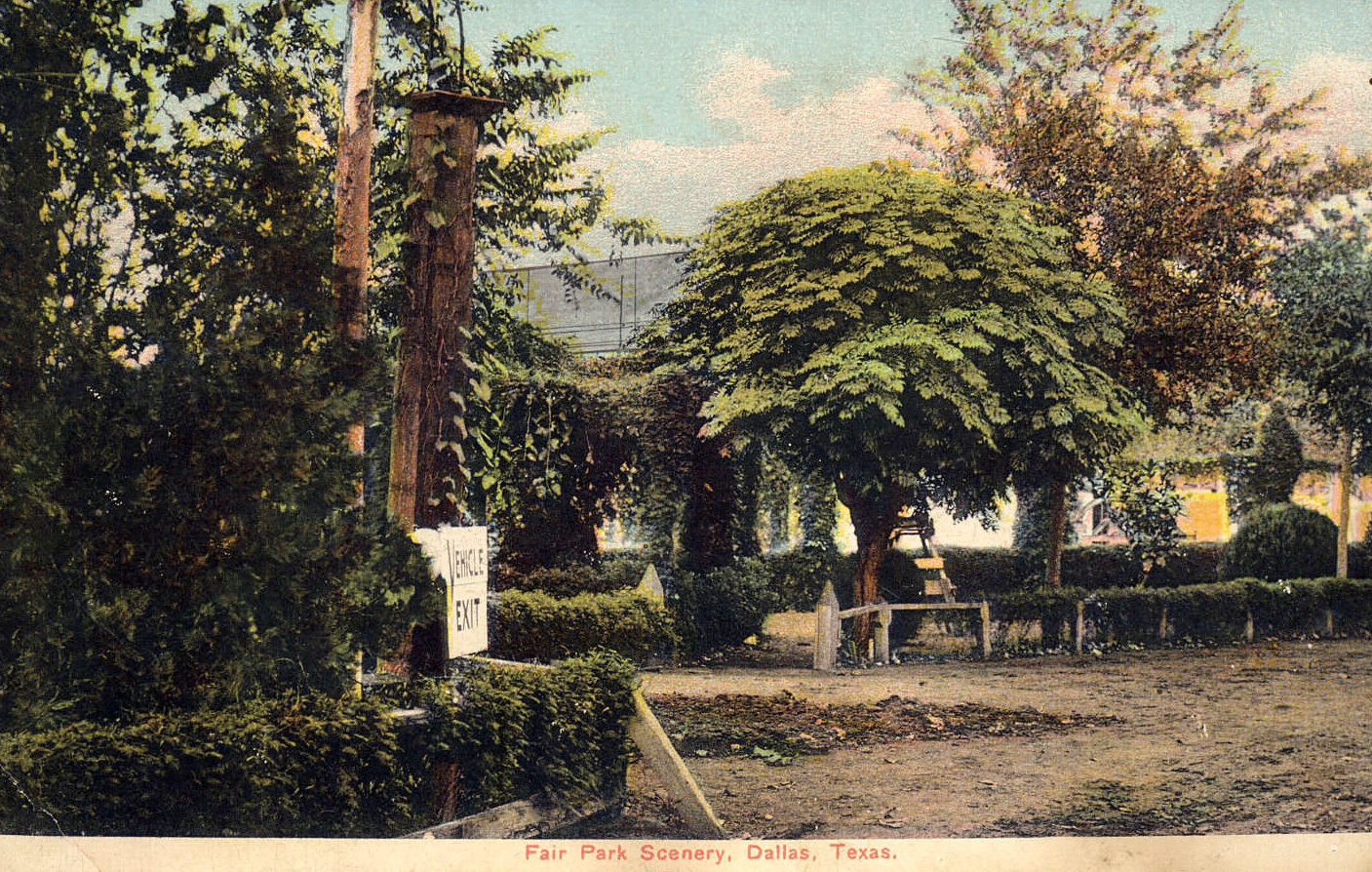
And then there’s this view, “Fair Park Scenery.” Same period as the top one? Later? It shows the “Vehicle Exit.” “Vehicles” meaning buggies and wagons?

state-fair-grounds_postcard_vehicle-exitLeaving the Fair Grounds… 

I think the top postcard shows the entrance — I have another view of the entrance that looks like this, from around 1900 (see it here). And the bottom card? “Scenery” near the Vehicle Exit. So … a parking lot? Or a road leading to the exit? Whatever it is, it’s not really all that “scenic.” Both postcards are fairly odd choices for picture postcards of the Texas State Fair, as neither one shows anything of the actual fair! But if people had fond memories of driving into or out of the State Fair, these were the postcards to buy!

***

Sources & Notes

Postcards from eBay. The second one is a photo by Clogenson.

Top postcard’s 2-cent stamp was issued in Nov. 1903, per Wikipedia.

*

Copyright © 2015 Paula Bosse. All Rights Reserved.

Not Dead Yet at McKinney & Routh

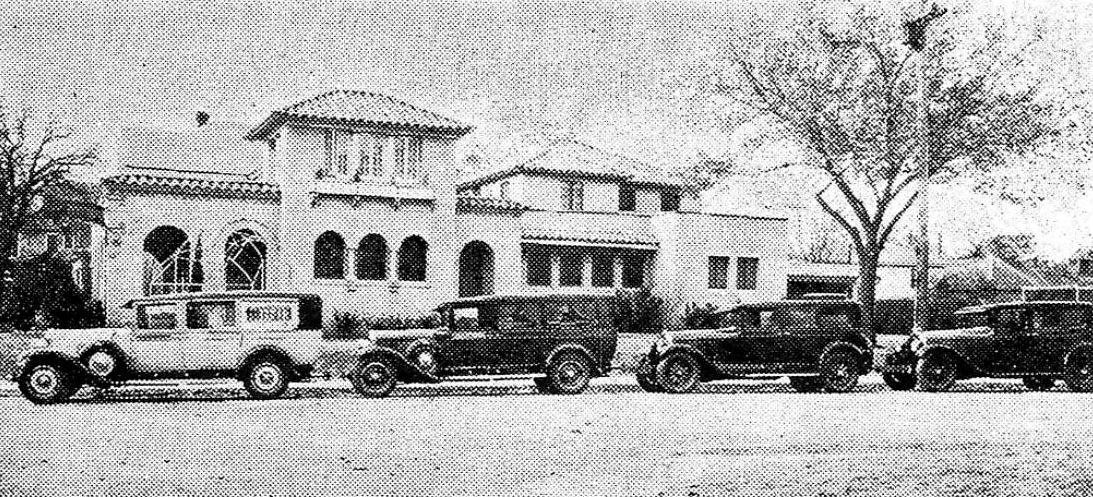
ad-funeral-home_mckinney-routh_directory-1929-detA fleet of Cadillacs in front of 2533 McKinney Ave.

by Paula Bosse

The photo above shows a truly beautiful, Spanish-style building that was built in 1927 at the northwest corner of McKinney Avenue and Routh Street. The view shows the Routh Street side. The person who took this photograph would have been standing across the street on the property of the dearly-departed McKinney Avenue Baptist Church (most recently transformed into the Hard Rock Cafe). You might be surprised to learn that the building in this photo still stands, and it’s mostly recognizable almost 90 years later.

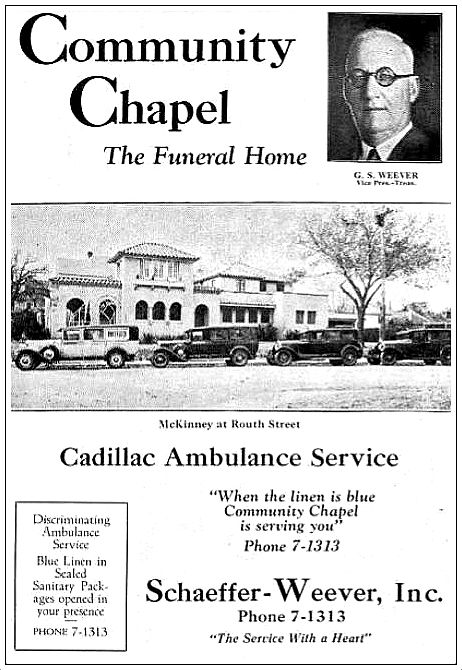
The Community Chapel Funeral Home (yes, a funeral home!) was designed by noted architect Clarence C. Bulger (whose father, C. W. Bulger, designed, among other things, the Praetorian Building downtown AND the just-mentioned McKinney Avenue Baptist Church which was right across the street).

ad-funeral-home_mckinney-routh_directory-1929City directory, 1929

In addition to the funeral home portion (reception area, business office, show rooms, “operating room” (!), chapel with seating for 100, and the euphemistically named “slumber room”), the building also contained a residence for the chief mortician and his embalmer wife, an apartment for the ambulance/hearse drivers, and a “pavilion for recreation of employees.” The building and its beautifully-appointed interior cost in excess of $100,000 (which the Inflation Calculator estimates is the equivalent of more than $13 million today!).

Also, an “oxygen plant” was somewhere on the grounds. I’ve never heard of an oxygen plant, but they seem to be a mortuary thing. Let’s hope recently-bereaved smokers were kept at a safe distance from all that highly flammable oxygen, because the company had a bunch of promotional matchbooks printed up, and I can only imagine they were readily available in tastefully-arranged candy dishes of every room of the establishment. And in those days, one didn’t necessarily step outside to smoke one’s anxiety away.

weever-funeral-home_fkickr1

weever-funeral-home_fkickr2

weever-funeral-home_1937-city-directory_ad1937 Dallas directory

The funeral home at 2533 McKinney Avenue lasted almost thirty years. Sometime in the mid-’50s it was renovated into office and retail space (classified ads mentioned 2-, 3-, and 4-office suites). That lovely interior must have been hacked up pretty bad. An early tenant was the Bankers Securities Corporation, shown below in a newspaper ad from 1956 (someone made some poor choices on that renovation of the exterior). (This view shows an entrance from McKinney rather than Routh.)

bankers-securities_dmn_012256-photoAd detail, Jan., 1956

For the next 40-odd years, 2533 McKinney Avenue was home to a variety of insurance agents, a fur salon, several companies that advertised in the classifieds for vague “salesmen” positions (one company did specify that it was looking for encyclopedia salesmen in 1963), art galleries, architect/design businesses, offices of “El Sol de Texas” (“the only Spanish-language newspaper in North Texas”), and antique shops.

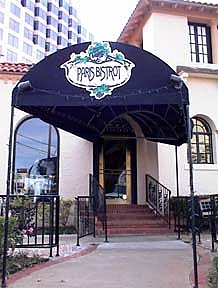
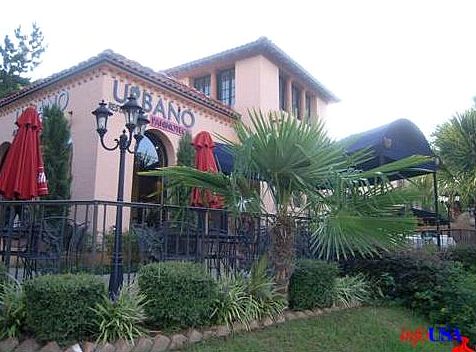
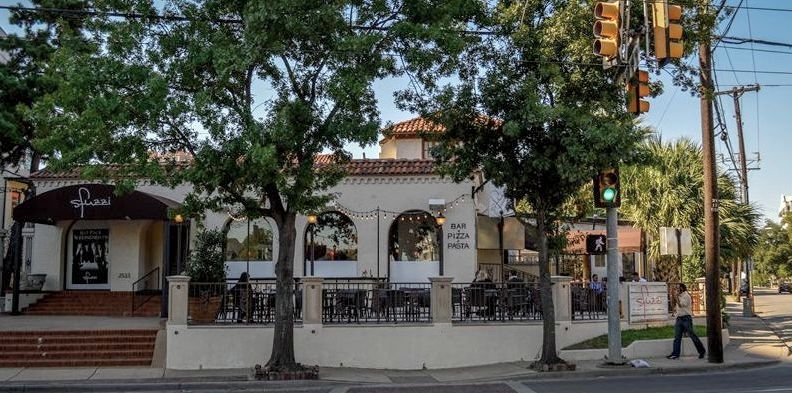
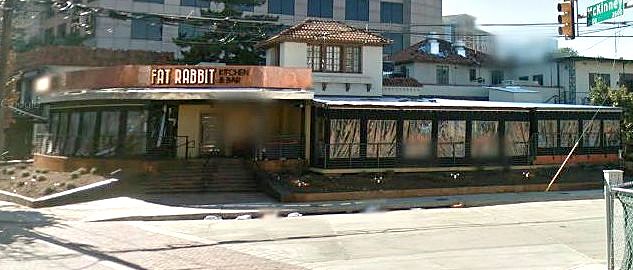
It all turned around, though, when the long-suffering building was re-renovated and became a restaurant space. Since at least 1999 when Uptown began to explode, it’s been home to bistros, cafes, and upscale eateries. The photos below show some of the restaurants that have set up shop there, and if you know what you’re looking at, the place really does look very similar to C. C. Bulger’s design from almost 90 years ago.

*

paris-bistrot_2001Le Paris Bistrot opened in 1999. The owner changed the name to Figaro Cafe in 2004 when the U.S. was going through an anti-French phase.

urbano_city-dataUrbano Paninoteca opened in 2007. Something called Split Peas Soup Cafe opened in 2009.

sfuzzi_scrumpliciousfood_sm

sfuzzi_yelpThen Sfuzzi opened with a big splash in 2010. (It had been a McKinney Avenue staple in the 1980s and ’90s, closed, and came back in 2010.) The first photo shows the Routh Street entrance, the second photo shows the McKinney entrance.

fat-rabbit_googleAnd now it’s the Fat Rabbit, which opened earlier this year. Let’s hope they get some landscaping in there STAT! (UPDATE: Fat Rabbit is now an ex-rabbit, and after spending some time of his own in the “slumber room,” he has joined the choir invisible. Next!)

And let’s hope that those tiled roofs and stuccoed walls remain a distinctive part of its future. I love the fact that it still looks a lot like it once did. And I actually like the fact that restaurants have been operating out of an old funeral home for over 15 years. Restaurateurs might be hesitant to publicize the building’s past (although I’m pretty sure most of them have been completely unaware of what the place used to be), but modern-day Harolds and Maudes might be giddy at the prospect of an unusual dining option and move this place right to the top of their date-night list. 

***

Sources & Notes

Top photo is a detail of the ad that appeared in the 1929 Dallas city directory. It shows four Cadillacs — a hearse, 5- and 7- passenger sedans, and an ambulance (“purchased from the Prather Cadillac Company”).

Matchbook artwork from Flickr, here.

The first Sfuzzi photo is from the food blog Scrumplicious Food, here. A GIGANTIC version of the photo can be seen here — you can look at all the details. Second photo of Sfuzzi from Yelp.

Fat Rabbit image from Google street view.

Sources of all other clippings and photos as noted.

Some images larger when clicked.

*

Copyright © 2015 Paula Bosse. All Rights Reserved.

Texas Independence Day: The Most Patriotic Bank Ad EVER — 1921

tx-flag

by Paula Bosse

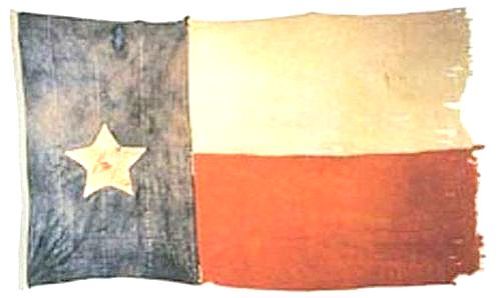
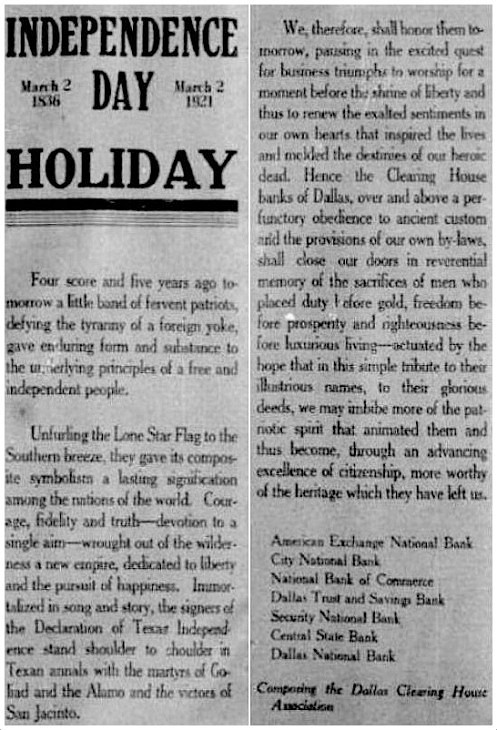
Today is the anniversary of Texas Independence. Below, you will find the most heart-swellingly patriotic bank ad ever penned. Before you plunge in, you might want to get a hanky. (Transcription below.)

tx-independence_ad_dmn_030121Dallas Morning News, March 1, 1921

Four score and five years ago tomorrow a little band of fervent patriots, defying the tyranny of a foreign yoke, gave enduring form and substance to the underlying principles of a free and independent people.

Unfurling the Lone Star Flag to the Southern breeze, they gave its composite symbolism a lasting signification among the nations of the world. Courage, fidelity and truth — devotion to a single aim — wrought out of the wilderness a new empire, dedicated to liberty and the pursuit of happiness. Immortalized in song and story, the signers of the Declaration of Texas Independence stand shoulder to shoulder in Texan annals with the martyrs of Goliad and the Alamo and the victors of San Jacinto.

We, therefore, shall honor them tomorrow, pausing in the excited quest for business triumphs to worship for a moment before the shrine of liberty and thus to renew the exalted sentiments in our own hearts that inspired the lives and melded the destinies of our heroic dead. Hence the Clearing House banks of Dallas, over and above a perfunctory obedience to ancient custom and the provisions of our own by-laws, shall close our doors in reverential memory of the sacrifices of men who placed duty before gold, freedom before prosperity and righteousness before luxurious living — actuated by the hope that in this simple tribute to their illustrious names, to their glorious deeds, we may imbibe more of the patriotic spirit that animated them and thus become, through an advancing excellence of citizenship, more worthy of the heritage which they have left us.

American Exchange National Bank
City National Bank
National Bank of Commerce
Dallas Trust and Savings Bank
Security National Bank
Central State Bank
Dallas National Bank

Composing the Dallas Clearing House Association

*

Remember the Alamo! And remember the men who placed “righteousness before luxurious living”! (Even though that last part’s not exactly a sentiment that Dallas is typically known for….)

*

Copyright © 2015 Paula Bosse. All Rights Reserved.

The Dunbar Branch: Dallas’ First Library for the African-American Community, 1931-1959

dunbar_hazel_dpl-bkThe Paul Laurence Dunbar Branch of the Dallas Public Library

by Paula Bosse

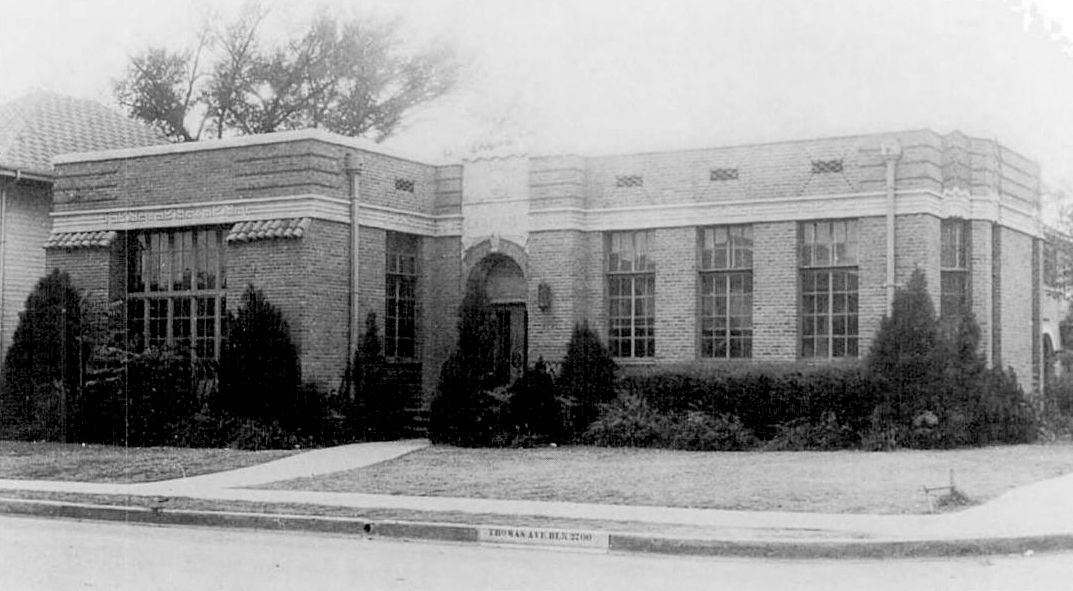
The Paul Laurence Dunbar Branch of the Dallas Public Library was the first library in Dallas to welcome and serve the African-American community. It opened in June, 1931 at the northwest corner of Thomas and Worthington in what was then the predominantly black neighborhood of “North Dallas” (the area is now known as “Uptown”), a thriving business and residential neighborhood which was home to everyone from the city’s black professionals who lived in large, lovely gingerbread-style houses, to middle- and lower-class black families who lived in more modest homes.

This was a time when almost every aspect of life was racially segregated — the grand downtown Carnegie Library was expressly off-limits to non-whites, and few of the black schools had any sort of functioning library. It was a long, hard bureaucratic battle of petitioning the city, the state, the Carnegie corporation … anyone … for a library which the city’s woefully underserved black citizens could call their own. It took years until the powers-that-be gave the go-ahead to finally build one. The building was designed by Dallas architects Ralph Bryan and Walter Sharp.

The charming one-story, brick-and-reinforced-concrete building was very, very popular and was a source of pride in the community. And it was beautiful!

dunbar_ref-and-reading-rm_hazelThe reference and reading room

dunbar-lib_hazel_062931-photoOpening-day crowds, June 1931

dunbar-children_hazel_1949Children in costumes to celebrate National Book Week, Nov. 1949

Even though the photo featured in the ad below is very grainy, it’s still kind of cool (from 1958, one year before the branch closed).

dunbar-branch-library_lincoln-high-school-yrbk-ad_19581958 Lincoln High School yearbook

dunbar-branch-library_lincoln-high-school-yrbk-ad_1958-det

In the late 1940s, construction began on Central Expressway. Unfortunately, this much-needed highway cut right through the heart of the North Dallas/State-Thomas/Freedman’s Town area. The destruction of many of the area’s buildings and displacement of many of its residents was a devastating blow to the African-American community who lived, worked, and shopped there. That and other economic forces led to the eventual dispersal of the area’s black population to other parts of the city. By the 1950s, the library had lost many of its core patrons, and in 1959 the Dunbar Branch closed. At some point that beautiful building, located just a few blocks south of McKinney Avenue, was demolished. The historic State-Thomas area has now been almost completely obliterated as “Uptown” has taken over. And another part of the city’s history has been lost.

***

Sources & Notes

All photos are from the book Dallas Public Library, Celebrating a Century of Service 1901-2001 by Michael V. Hazel (Denton: University of North Texas Press/Friends of the Dallas Public Library, 2001); photos are presumably from The Texas/Dallas History & Archives Division of the Dallas Public Library.

Hazel’s chapter on the Dunbar Branch is well worth reading. Not only is it interesting (and kind of shocking) to learn the lengths to which the black community had to go simply in order to have access to a library system which their tax dollars were helping to support, but there are also more wonderful photos like the ones above. The Dunbar chapter is accessible here.

Two articles of interest from the archives of The Dallas Morning News:

  • Description of the planned new “Negro branch” library (DMN, Aug. 15, 1930)
  • “City Plans To Sell Building” (DMN, May 15, 1959) — on the decision to close the branch and sell the building

The library’s (white) architects, Ralph Bryan and Walter Sharp also designed the nearby Moorland YMCA — it was built at almost the same time as the library, and, hallelujah, that building still stands, currently housing the Dallas Black Dance Theatre. A few years later Sharp designed Lincoln High School in South Dallas. All in all, these architects were responsible for three extremely important buildings that served Dallas’ black citizens.

Paul Laurence Dunbar (1872-1906) was one of the first nationally prominent African-American writers; more about him, here.

There is another Dunbar branch library in the Dallas Public Library system — the website for the Paul Laurence Dunbar Lancaster-Kiest Branch Library is here.

*

Copyright © 2015 Paula Bosse. All Rights Reserved.