Flashback : Dallas

A Miscellany: History, Ads, Pop Culture

Category: Vault

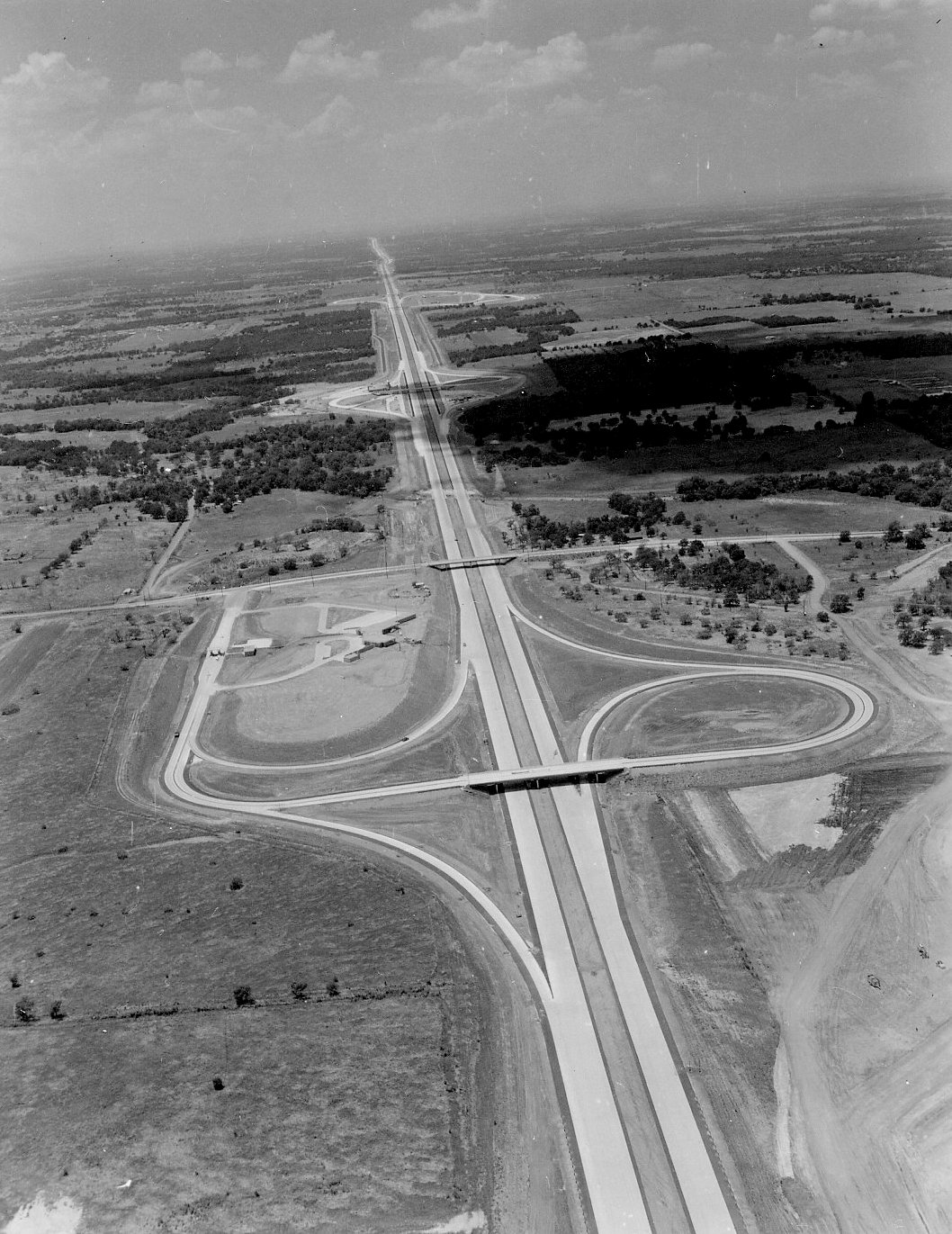
The DFW Turnpike, Unsullied by Traffic, Billboards, or Urban Sprawl — 1957

turnpike_west-from-360_1957The DFW Turnpike, 1957… (click for very large image!)

by Paula Bosse

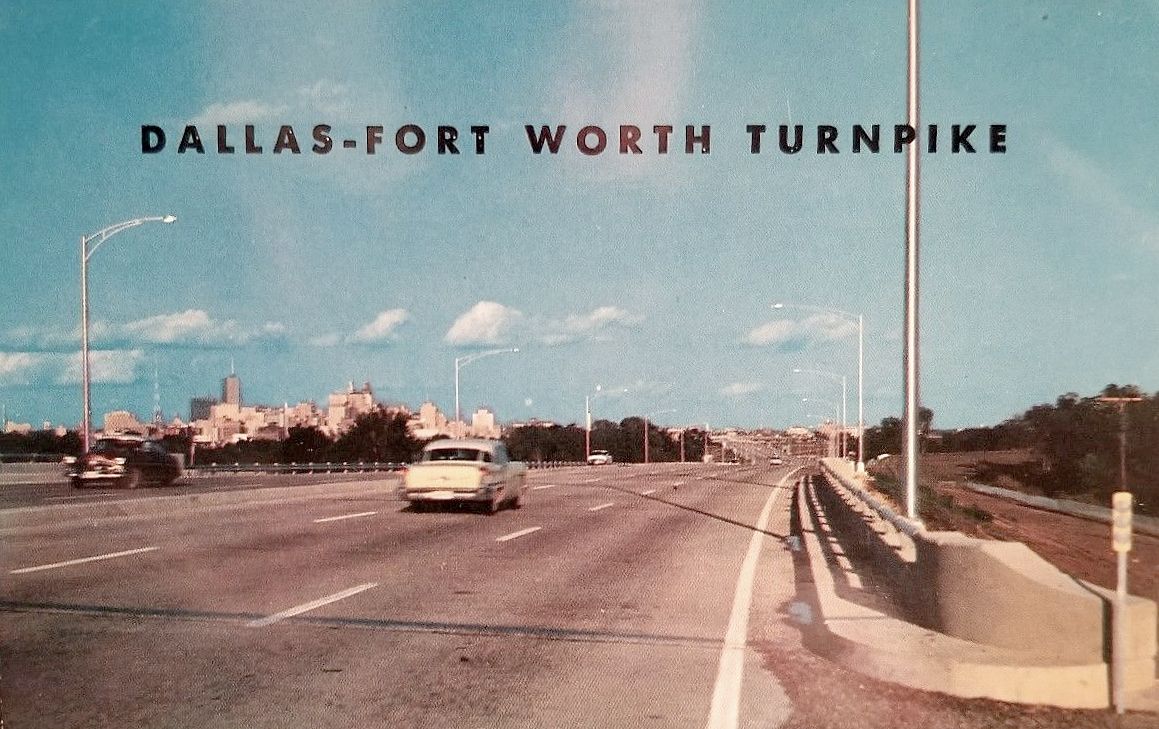
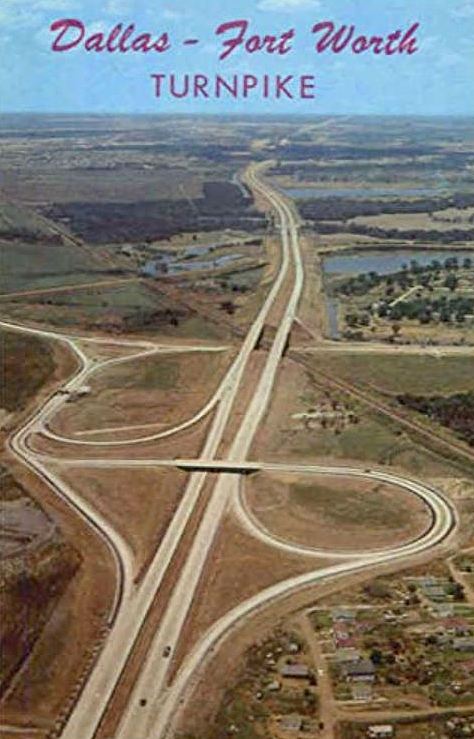
Above, the Dallas-Fort Worth turnpike in 1957, before it opened for business. When this toll road was paid off in 1977, the toll booths were removed and it became I-30, a “free” highway. (This “toll-road-becoming-a-free-road” thing has happened only once in the history of Texas; I can’t imagine it will ever happen again.) This photo shows the turnpike heading west through Arlington, with Hwy. 360 crossing over it in the middle. Six Flags over Texas would be built in this wide open expanse four years later. And then … an explosion of development.

A Texas Highways article described the 30-mile stretch (“30 miles — 30 minutes!”) as being a blissful drive through “a landscape devoid of advertising signboards and commercial establishments” (!). In fact, the only businesses along the turnpike were two restaurants and two service stations. All the way from Dallas to Fort Worth … that was IT! You know, I’d gladly pay an obscenely exorbitant toll today if it meant I could drive that stretch of highway the way it was in this photo. A world without urban sprawl would be heaven.

I love this photo. The road ahead just disappears into the ether. And, Arlington, you’ve never looked better.

dfw_turnpike

dfw-turnpike_postcard

dfw-turnpike_flickr_coltera

dfw-turnpike_postcard_skyline

dallas-fw-turnpike_postcard

***

Sources & Notes

Top photo from Oscar Slotboom’s book Dallas-Fort Worth Freeways, credited to TxDOT Travel Information Division, 1957. His caption: “The view looks west along the turnpike just before it opened in  1957 with the  SH 360 intersection in the foreground…. Land on the left side of the turnpike just past SH 360 would soon be developed into Six Flags Over Texas…. The building alongside the turnpike was a Texas Turnpike Authority administrative office which was demolished in 2011.”

Postcards from around the internet.

For an informative read and LOTS of photos, I highly recommend Oscar Slotboom’s chapter on the DFW Turnpike, which you can access here (there are tons of historical photos). This chapter is from Slotboom’s exhaustive work Dallas-Fort Worth Freeways: Texas-Sized Ambition. The entire book has been made available online — for free (the home-page is here). You can read about Mr. Slotboom’s work in a Dallas Morning News interview by Robert Wilonsky here.

A fun read about the turnpike (yes, fun!) is an article from Texas Highways (Dec. 1957), here. (The article is spread over three web pages — don’t miss the links for all of the pages at the top of each page.)

By the way, when the turnpike opened, the toll was 50 cents. According to the Inflation Calculator, that would be equivalent in today’s money to just over $4.00. To drive from Dallas to Fort Worth quickly, through not-yet-developed green spaces and along a new highway uncluttered with billboards. A BARGAIN!

Click photo for larger image.

*

Copyright © 2014 Paula Bosse. All Rights Reserved.


Deco Idealized: Fair Park Before the Centennial Exposition — 1936

tx-centennial_dmfa_bandshell

by Paula Bosse

The first rendering is so sleek and sharp and perfect that I want to cry. But the artist’s second conception? Well, now I know what the Fair Park band shell would look like plopped down in the middle of the manicured grounds of an English estate or an Italian villa (or maybe in the Clampetts’ backyard, out past the cement pond). …And it still looks damn good.

Text from the back of this postcard:

The center of musical activity will be the open air band shell and amphitheater, a permanent feature of the Civic Center — seating capacity, 5,000 — the band shell accommodates 150-piece band. The most imposing structure in the Civic Center is the Hall of Fine Arts, constructed of Texas stone, cost $500,000, housing a $5,000,000 art collection assembled from all parts of the world.

***

Click picture for much larger image.

*

Copyright © 2014 Paula Bosse. All Rights Reserved.

“There Are Eight Million Stories in the Naked City…” — ca. 1920

1-ervay

by Paula Bosse

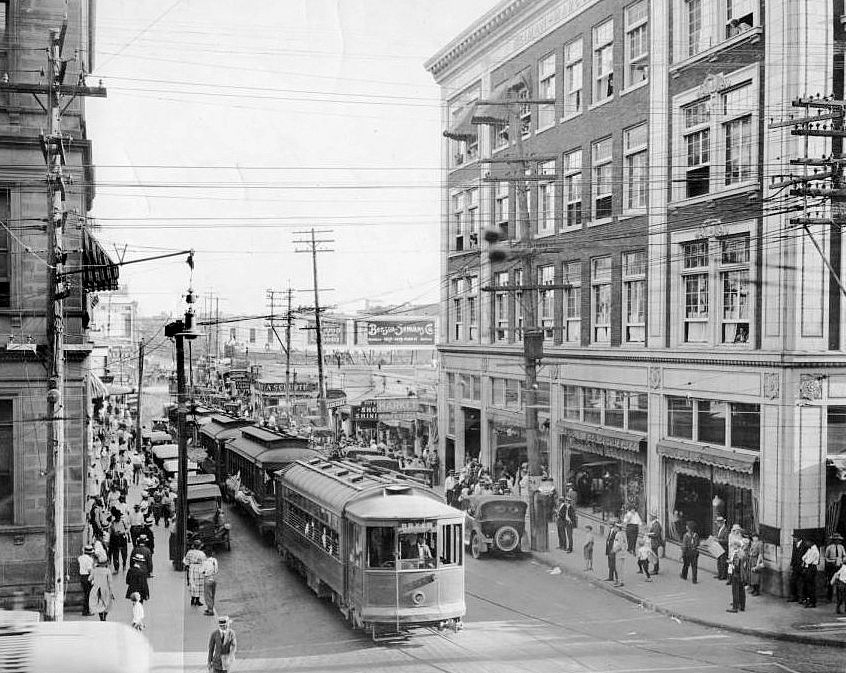
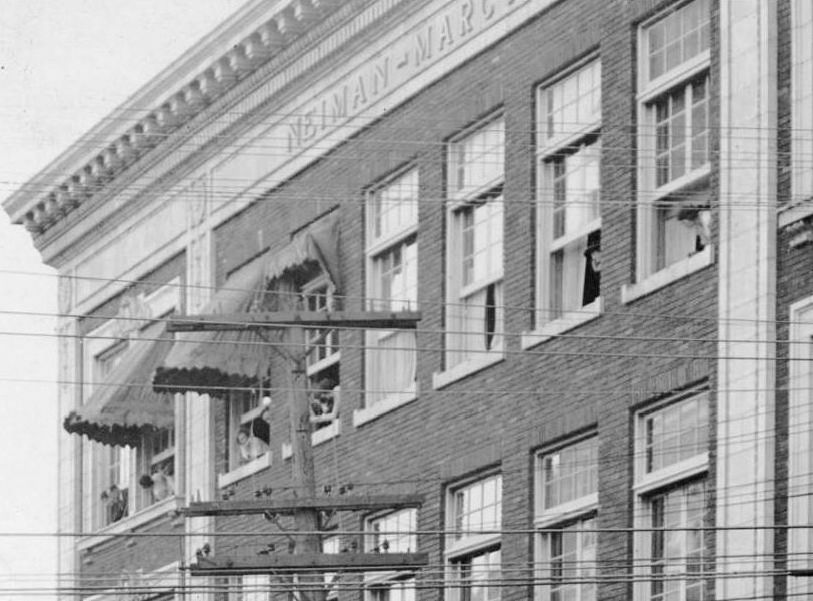
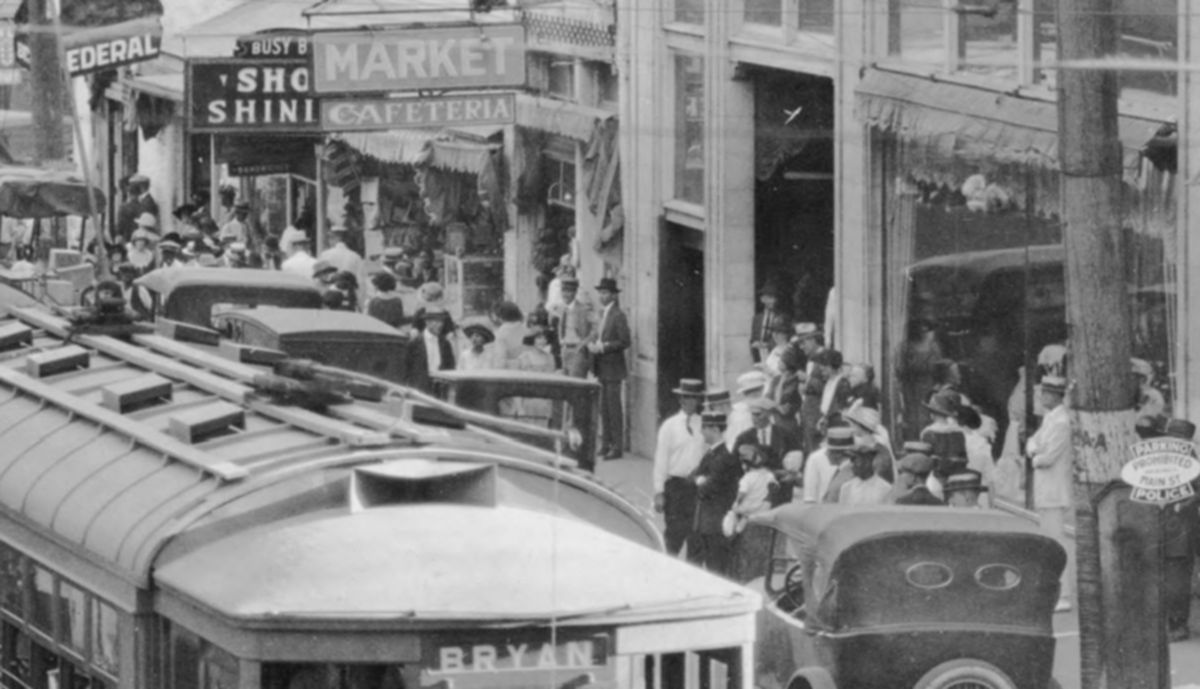
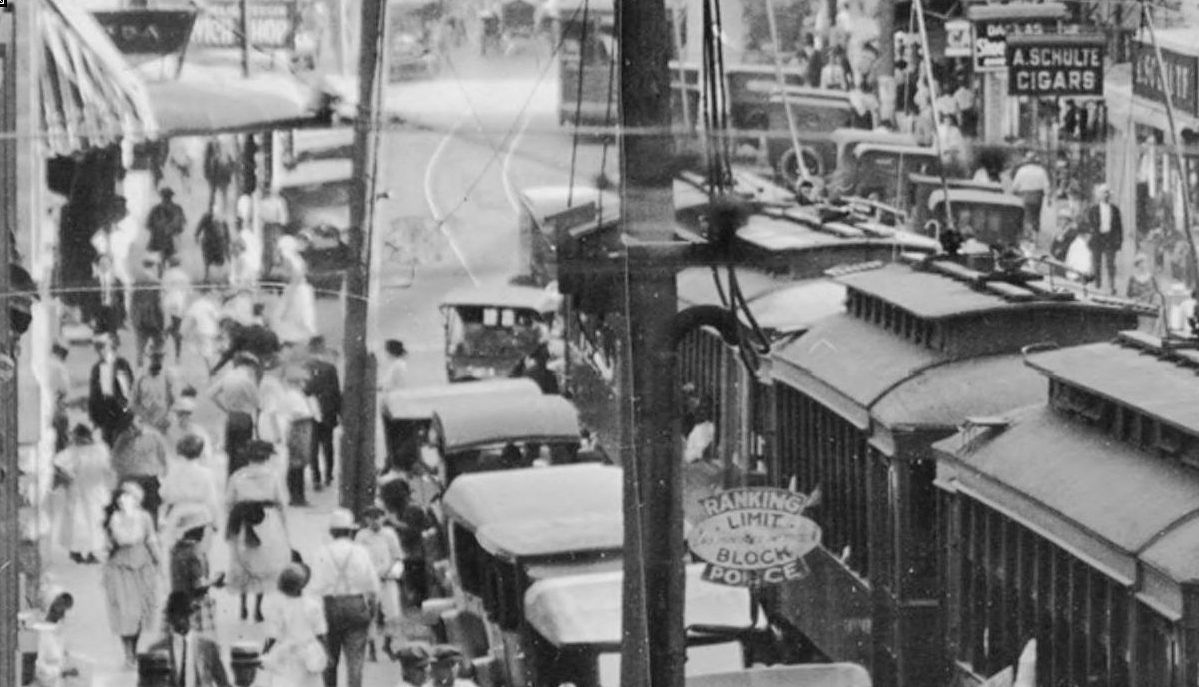
The photograph above, by George A. McAfee, shows Ervay Street, looking south from Main, in about 1920. Neiman’s is on the right. I’m not sure what the occasion was (I see special-event bunting….), but the two things that jump out right away are the number of people on the sidewalks and the amount of  congestion on the streets. In addition to private automobiles (driven by “automobilists” or “autoists,” as the papers of the day referred to them), the street is also packed with cars standing in the taxi rank (cab stand) at the left, and a long line of hulking streetcars. This busy intersection is jammed to capacity.

The city of Dallas was desperately trying to relieve its traffic problems around this time, and there were numerous articles in the papers addressing the concerns of how to manage the congestion of streets not originally designed to handle motor vehicle traffic. Dallas and Fort Worth were working on similar plans of re-routing traffic patterns and instituting something called “skip stop” wherein streetcars would stop every other block rather than every block. Streetcars, in fact, though convenient and necessary, seemed to cause the most headaches as far as backing up and slowing down traffic, as they were constantly stopping to take on and let off passengers. There was something called a “safety zone” that was being tried at the time. I’m not sure I completely understand it, but it allowed cars to pass streetcars in certain areas while they were stopped.

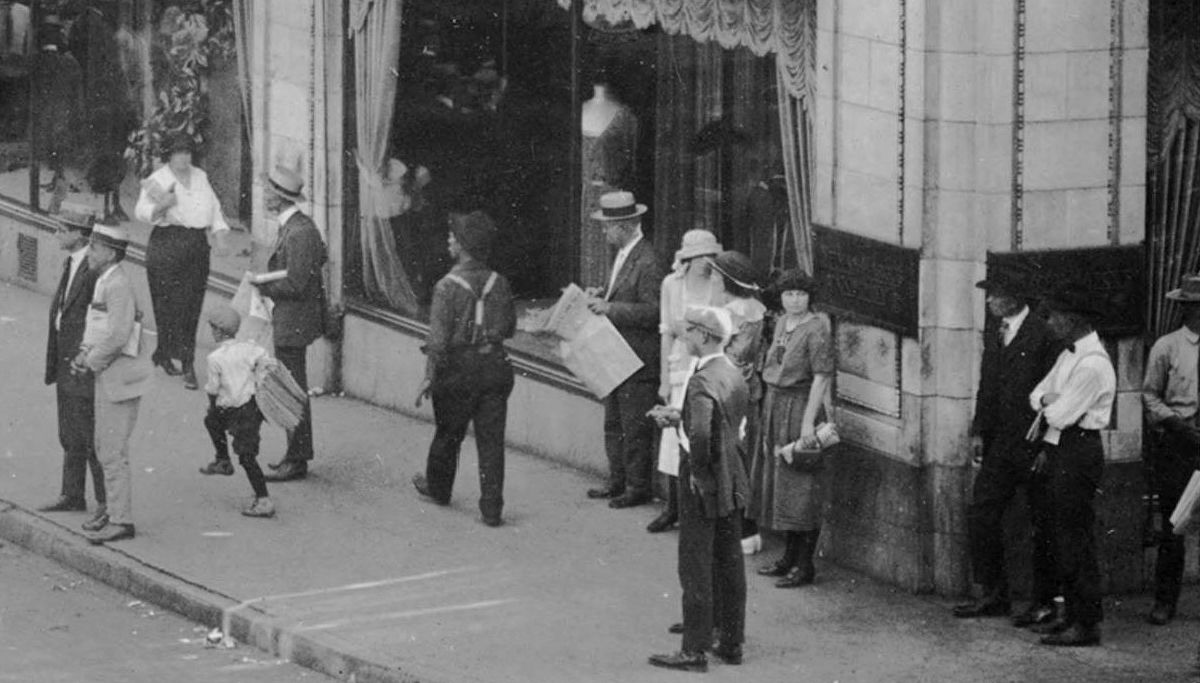
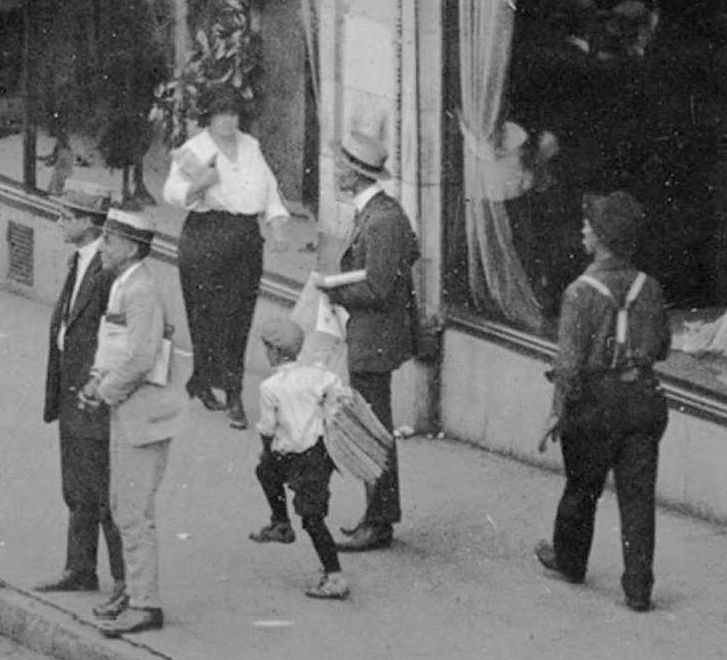
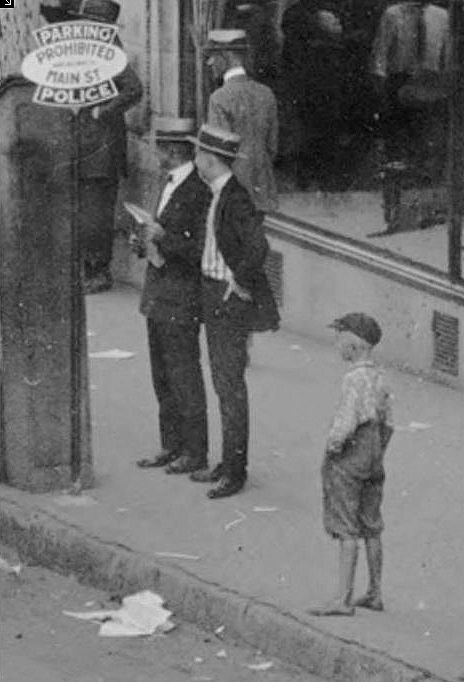
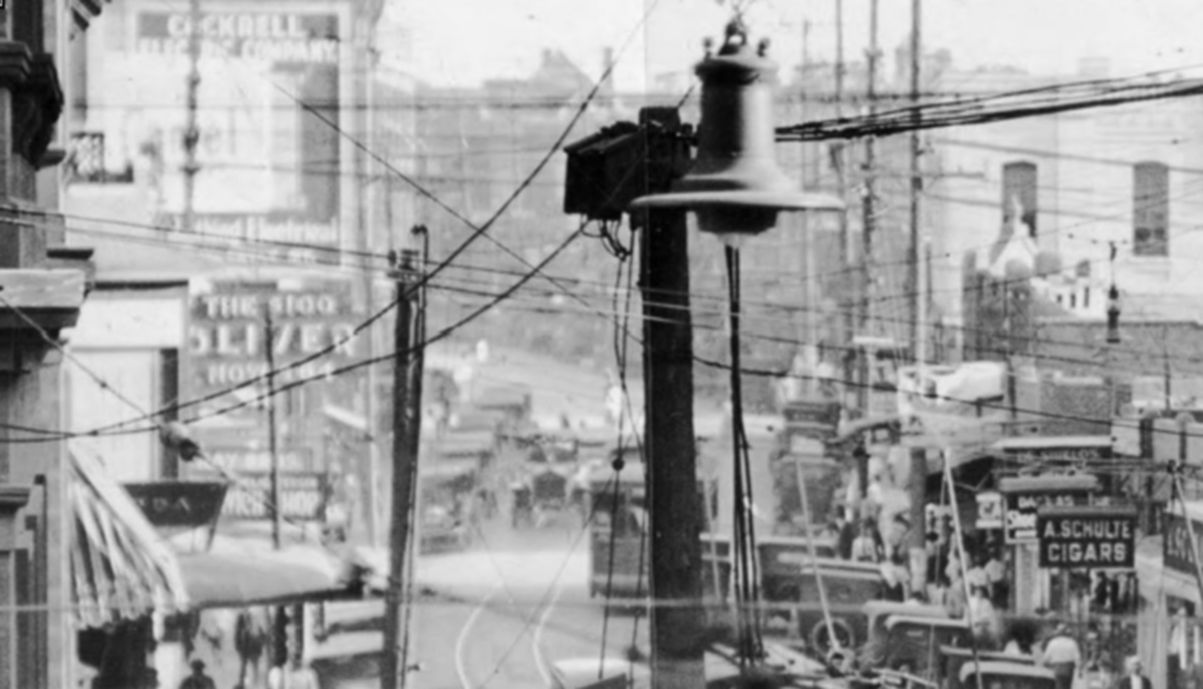
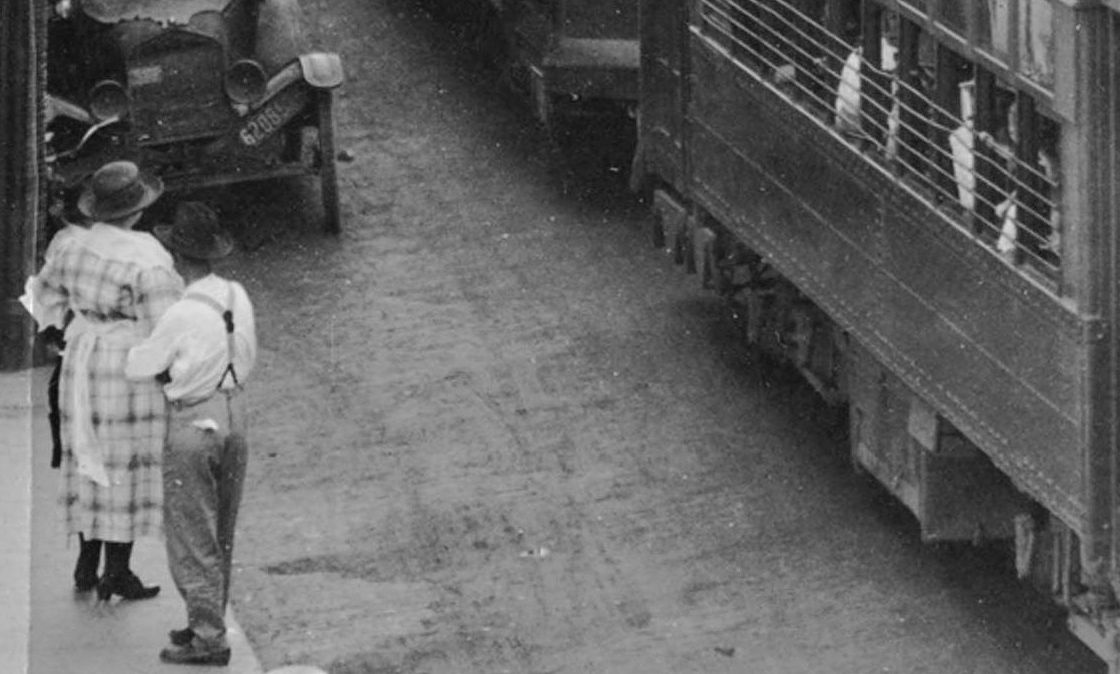
That traffic is crazy. But, to be perfectly honest, it’s far less interesting than all that human activity — hundreds of people just going about their daily business. It’s always fun to zoom in on these photos, and, below, I’ve broken the original photograph into several little vignettes. I love the people hanging out the Neiman-Marcus windows. And all those newsboys! Not quite as charming was all that overhead clutter of power lines and telephone lines; combined with the street traffic, it makes for a very claustrophobic — if vibrant — downtown street scene. (Click photos for larger images.)

2-ervay

3-ervay

4-ervay

5-ervayMy favorite “hidden” image in the larger photograph. The only moment of calm.

6-ervayI love this. The woman in front of the Neiman-Marcus plaque looking off into the distance, the display in the store window, the newsboy running down the street, the man in suspenders, the women’s fashions, and all those hats!

7-ervay

8-ervayA barefoot boy and litter everywhere.

9-ervay

10-ervay

11-ervayThe congestion is pretty bad above the streets, too.

12-ervay

13-ervayCabbies, newsboys, and working stiffs.

14-ervay

15-ervayI swear there was only one streetcar driver in Dallas, and he looked like this! Those motormen had a definite “look.”

***

Sources & Notes

Original photograph attributed to George A. McAfee, from the DeGolyer Library, Central University Libraries, Southern Methodist University, accessible here.

For other photos I’ve zoomed in on the details, see here.

*

Copyright © 2014 Paula Bosse. All Rights Reserved.

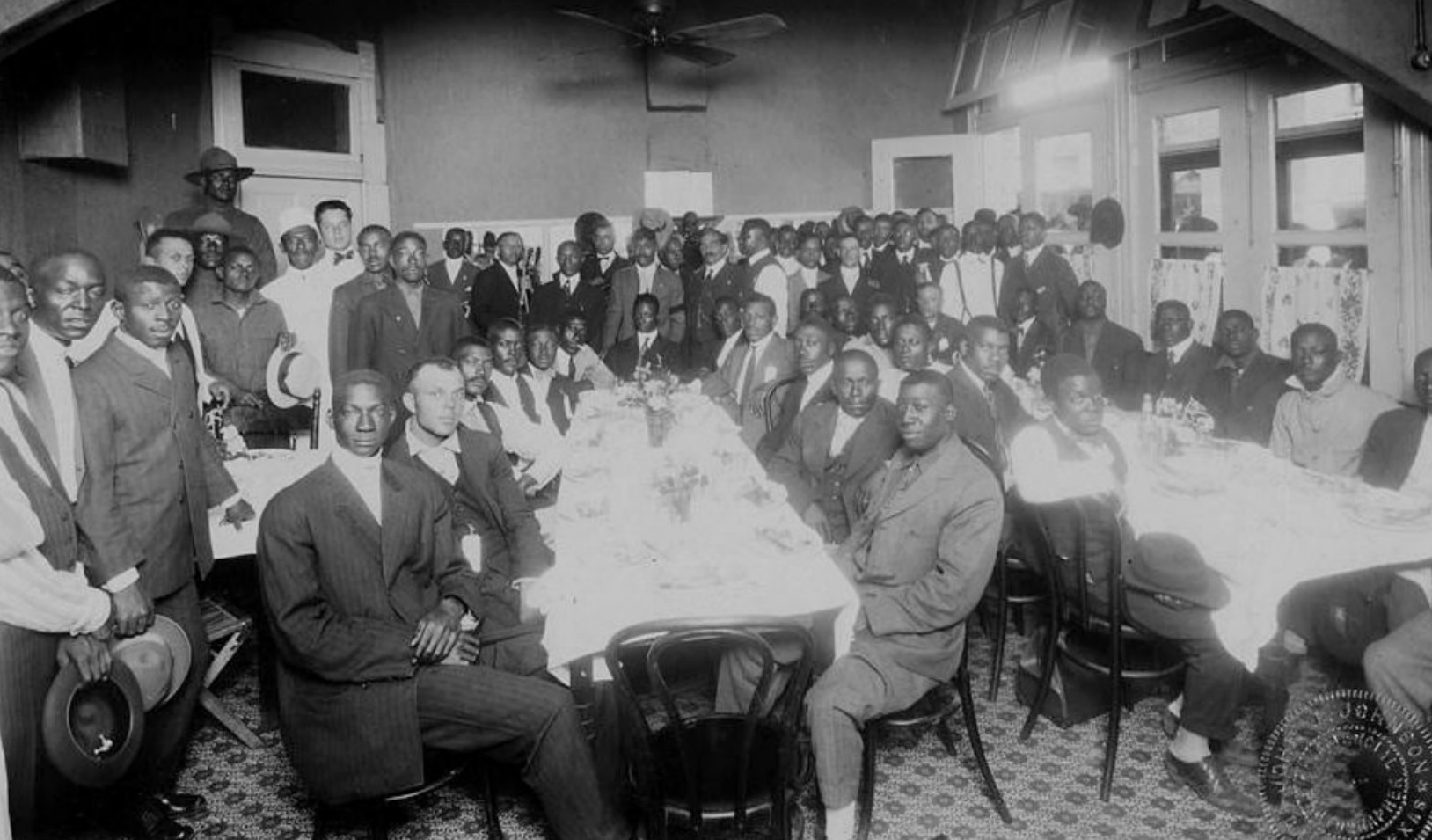
Black Troops from Dallas, Off to the Great War

WWI_black-soldiers_dallasRecruits in Dallas

by Paula Bosse

Above is a photo from the National Archives, described only as “Negro recruits having a turkey dinner just before leaving for a training camp. Dallas, Texas.” At the bottom right is the seal of Dallas photographer John J. Johnson who had worked for The Dallas Morning News as a photographer before World War I but was apparently working in a commissioned or freelance capacity here. The photo was taken on June 11, 1918, but the location is not known.

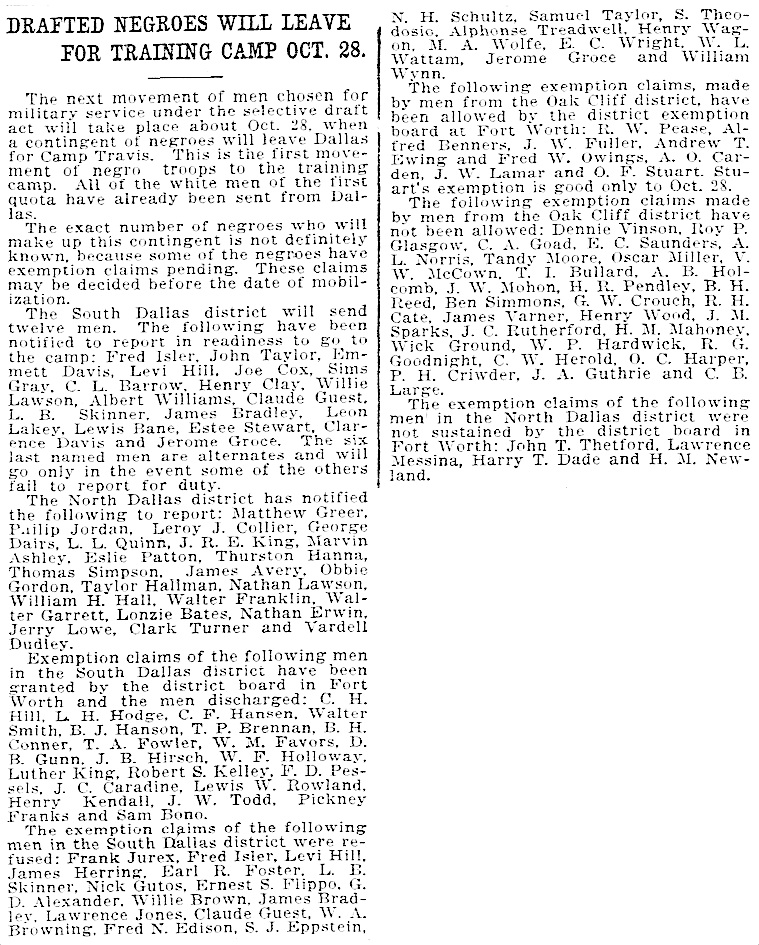
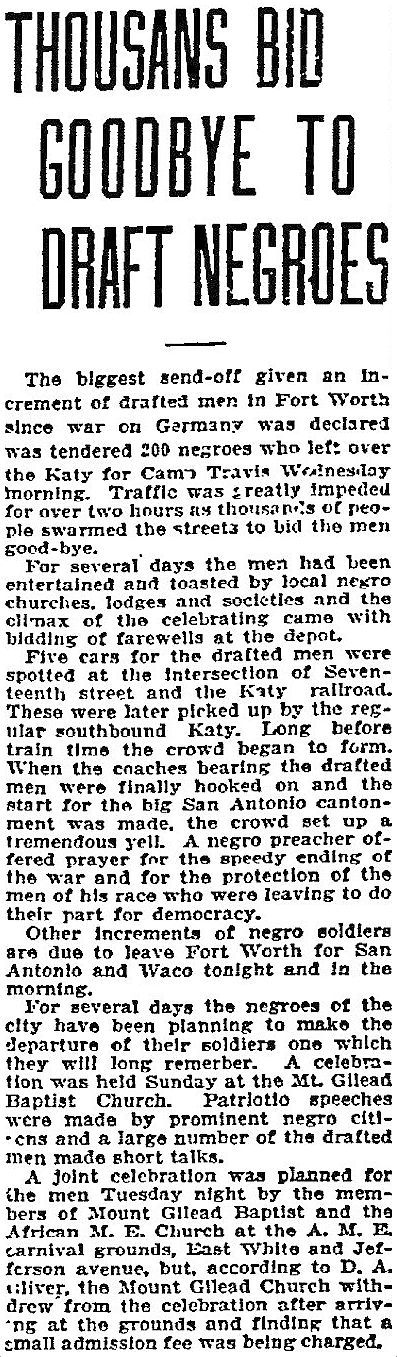
Eight months earlier, Black draftees left Dallas for the first time — they were headed to Camp Travis in San Antonio. (Click articles for larger images.)

WWI_black-draftees_dmn_101817Dallas Morning News, Oct. 18, 1917

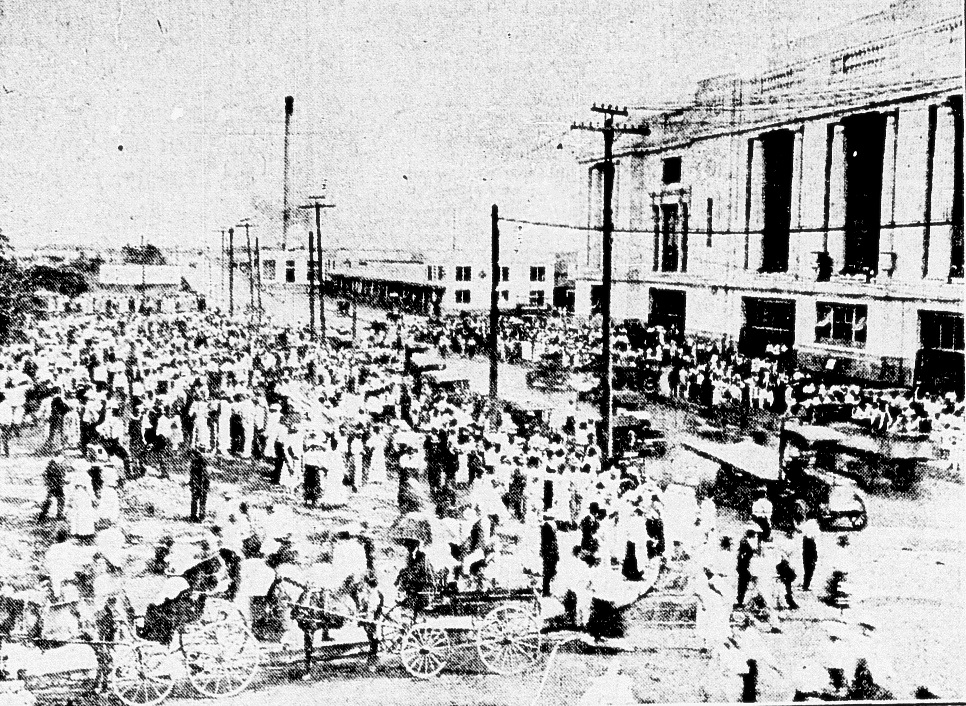
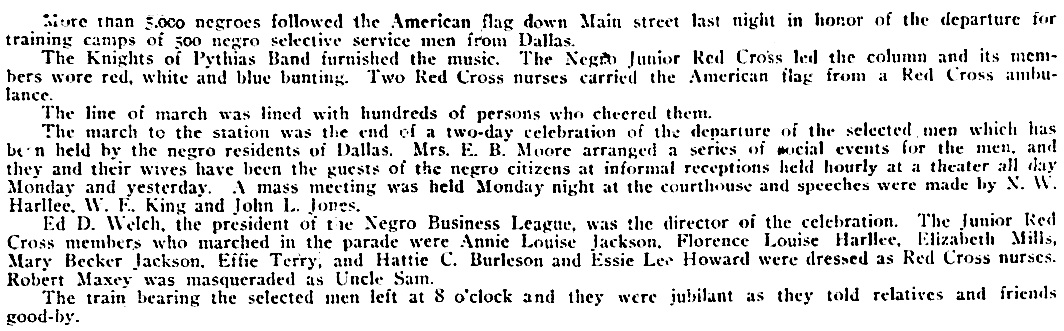
Much larger contingents of Black men left for training camp in the summer of 1918: more than 500 men left from Dallas and more than 200 from Fort Worth at the end of July. The photo below appeared in The Dallas Morning News under the headline “Scene at Union Station Last Night, When 500 Negroes Left for Camp.” (This photo was taken by John J. Johnson, the same photographer who took the photo at the top of this post.)

black-recruits_dmn_073118-photo

black-recruits_dmn_073118_captionPhoto and caption from the DMN, July 31, 1918

black-draftees_FWST_073118
Fort Worth Star-Telegram, July 31, 1918

There was a sizable number of Black soldiers at Camp Bowie in Fort Worth, and many of the reports from Fort Worth on the training of the “negro troops” are hard to read. I don’t think of myself as naive, but the blatant racism that was absolutely everywhere in the mainstream press at the time is stunning. Even when attempting to be complimentary, you see things like this:

If you imagine that the fact that these recruits are negroes made any difference to the white soldiers in camp you are mistaken, for the white soldiers cheered and threw up their hats as truck after truck of negroes passed by, and the darkies shouted back lustily. […]

“I’se glad I got heah at last,” said a big negro as he lined up for classification. “I won’t have to pick no mo’ cotton, no sah; all I’se have to do is to parade in a nice new uniform an’ get three meals an’ a nice new gun….” (Fort Worth Star-Telegram, Sept. 25, 1918)

I’m sure the white soldiers were happy to see fellow recruits showing up, but the journalists — in story after story — treated the “negroes” (they were rarely called “men”) as bumbling caricatures, inevitably quoted in dialect. The United States armed forces were not integrated until 1948, and Black troops were segregated from white troops, both in camp and on the battlefield (when they were allowed to fight — they were largely kept in service positions such as stevedores).

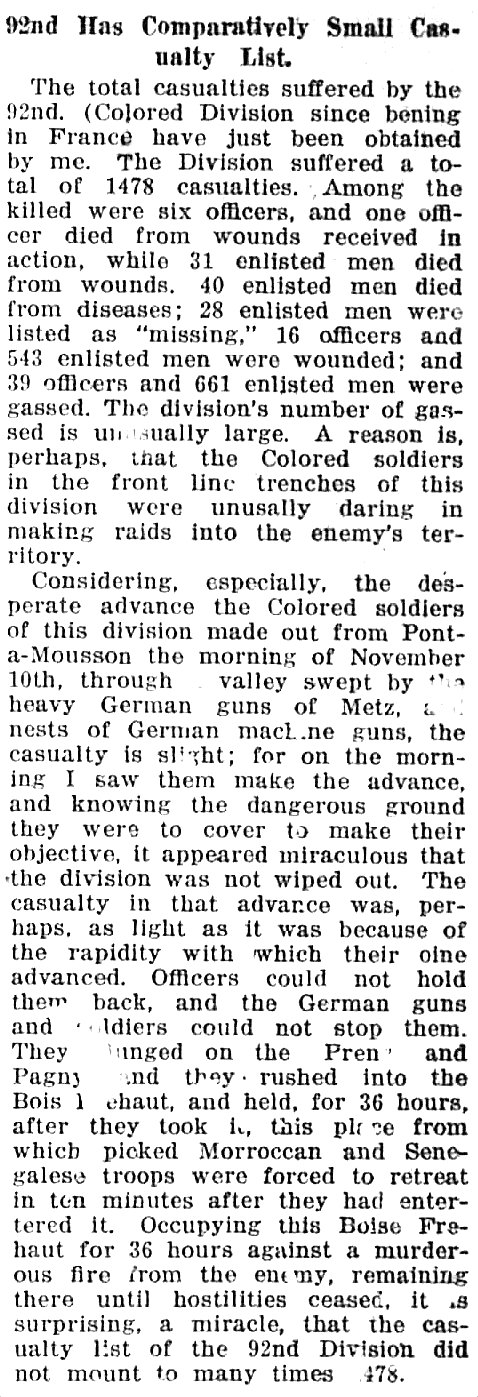
On this Memorial Day, I share a report from Ralph W. Tyler, a Black journalist who had reported throughout the war from the front lines, on the casualties of African American soldiers who died during World War I in the service of the U.S. Army:

casualties_black-troops_dallas-express_011119Dallas Express, Jan. 11, 1919

***

Sources & Notes

Top photo by John J. Johnson, from the National Archives is titled “Negro recuits [sic] having a turkey dinner just before leaving for a training camp. Dallas, Texas”; it can be accessed on the National Archives site here. An annotated version of this same photo appears under the title “Colored Troops — Negro recruits having a turkey dinner just before leaving for a training camp. Dallas, Texas” is here. (If anyone has additional info on the details of this photo, I’d love to know.)

“92nd Has Comparatively Small Casualty List” is an excerpt from Ralph W. Tyler’s article “General Order Commends Colored Officers” which appeared in The Dallas Express, Jan. 11, 1919. The full article can be read here.

For more info on the history of Black American soldiers, see the Wikipedia entry here; for info on the all-Black 92nd Infantry Division, see here.

Also, check out the blurb for the book Unjustly Dishonored: An African American Division in World War I by Robert H. Ferrell, here.

I’ve put a few articles on African American soldiers in WWI (including those cited above) in a PDF. A few of the articles appeared in the major Dallas and Fort Worth newspapers, and a couple appeared in The Dallas Express, the city’s newspaper published for a Black readership (including a rousing article by N. W. Harllee on the parade and celebration thrown by the city to honor the returning Black troops — WELL worth reading). Also included are a couple of unbelievable articles from the national press (including a lengthy one by a noted Stars and Bars reporter titled “Negro Soldiers Stationed at French Ports Sing and Dance While Unloading Ships”). The PDF can be accessed here (with articles in varying degrees of legibility).

The stirring and exhortative article “Dallas Gives Soldiers Befitting Celebration” by N. W. Harllee is in the PDF just mentioned, but it can also be found in a scan of The Dallas Express, here. UPDATE: Every scan of this article is hard to read, so I’ve tweaked the contrast to make it easier to read. You’ll have to magnify this sucker to read it, but it’s in a PDF here.

*

Copyright © 2014 Paula Bosse. All Rights Reserved.

The Shooting of “Bonnie & Clyde” — 1966

bonnie-clyde_unt_113066On location: Greenville Avenue (click for larger image)

by Paula Bosse

Today is the 80th anniversary of the ambush and killing of Bonnie and Clyde. Since I’ve written about Ted Hinton (one of the ambushers and erstwhile motor lodge operator) and Clyde Barrow (as a not-yet-completely-delinquent 17-year old) (and dressed up in a sailor suit), why not a brief look at the movie?

I was hoping to find a bunch of local as-it-was-happening anecdotes in the newspaper archives, but I found very little. (Hey, Dallas — you had a major motion picture with Hollywood celebrites in it — couldn’t you have devoted a little more ink to it?)

The photo at the top is the only one I could find that showed shooting (…as it were) at a Dallas location. The above was shot at the Vickery Courts motor lodge at 6949 Greenville Avenue (just north of Park Lane, across Greenville and up a bit from where the old Vickery Feed Store was).

So photos were practically non-existent, but I did learn that the interiors were shot at a large soundstage on Dyer, just off Greenville, called Stage 2, owned by Bill Stokes of Bill Stokes & Associates (where I spent a blink-of-an-eye interning back in high school).

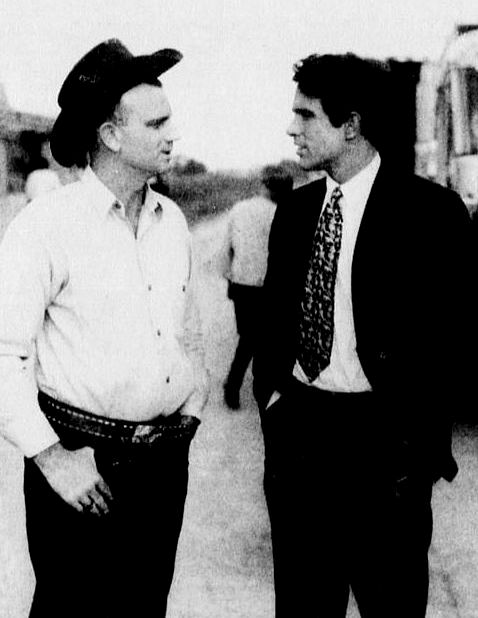
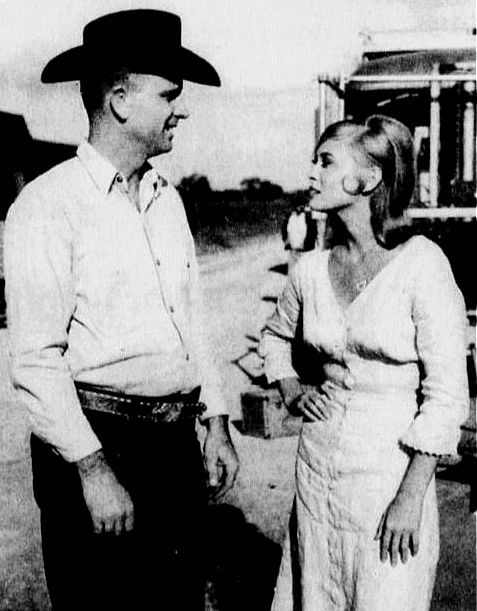
Below are two photos of Warren Beatty and Faye Dunaway between shots in Lavon, Texas, just outside Wylie — talking with one of the extras, Billy Joe Rogers, a saddlemaker from Wylie.

bonnie-clyde_lavon_beatty_102066

bonnie-clyde_lavon_dunaway-102066

The reactions to the finished movie from the local critics was interesting. The reviewer for The Dallas Morning News hated it. Hated it.

Bonnie and Clyde were a couple of rat punks who created terror in a vast area simply because they had no hesitation in gunning down those who stood in their way. […] They became for a brief span the nation’s most hunted outlaws and finally were shot down […] like the mad dogs they were. […] In a word: There is nothing entertaining about mad dogs; they should be killed — and quickly. (William A. Payne, DMN, Sept. 14, 1967)

I don’t know anything about the reviewer, William A. Payne, but my guess is that he vividly remembered the real-life Bonnie and Clyde and, like many other reviewers of the time, deplored the perceived glamorization of violence. (As an aside, I wondered why I wasn’t finding listings for “Bonnie and Clyde” in the early ’30s when I searched through the Dallas Morning News archives. As I learned from Mr. Payne, the two were commonly known as “Clyde and Bonnie” back then. So there you go!)

The review from Elston Brooks of The Fort Worth Star-Telegram, on the other hand, was ecstatic.

“Bonnie and Clyde,” which had every right to be a B-grade gangster shootout in double-breasted suits, is instead a shattering emotional experience, a fascinating film and  — oddly enough — an important motion picture. (Elston Brooks, FWST, Sept. 15, 1967)

My guess is that Brooks was about 30 years younger than Payne and had little, if any, personal connection to the real-life outlaws who killed real people.

*

The film ran up against a lot of studio problems. Warner Bros. head Jack Warner called it “the longest two hours and ten minutes I ever spent,” and the plan was to dump the movie in drive-ins and second-string-movie houses and be done with it. But producer-star Beatty was persistent and got it into the Montreal Film Festival where the positive reviews as well as the 9,000-word rave from Pauline Kael in The New Yorker assured it got the attention it merited. And it did. It was nominated for 10 Academy Awards and is considered a classic move of the 1960s.

*

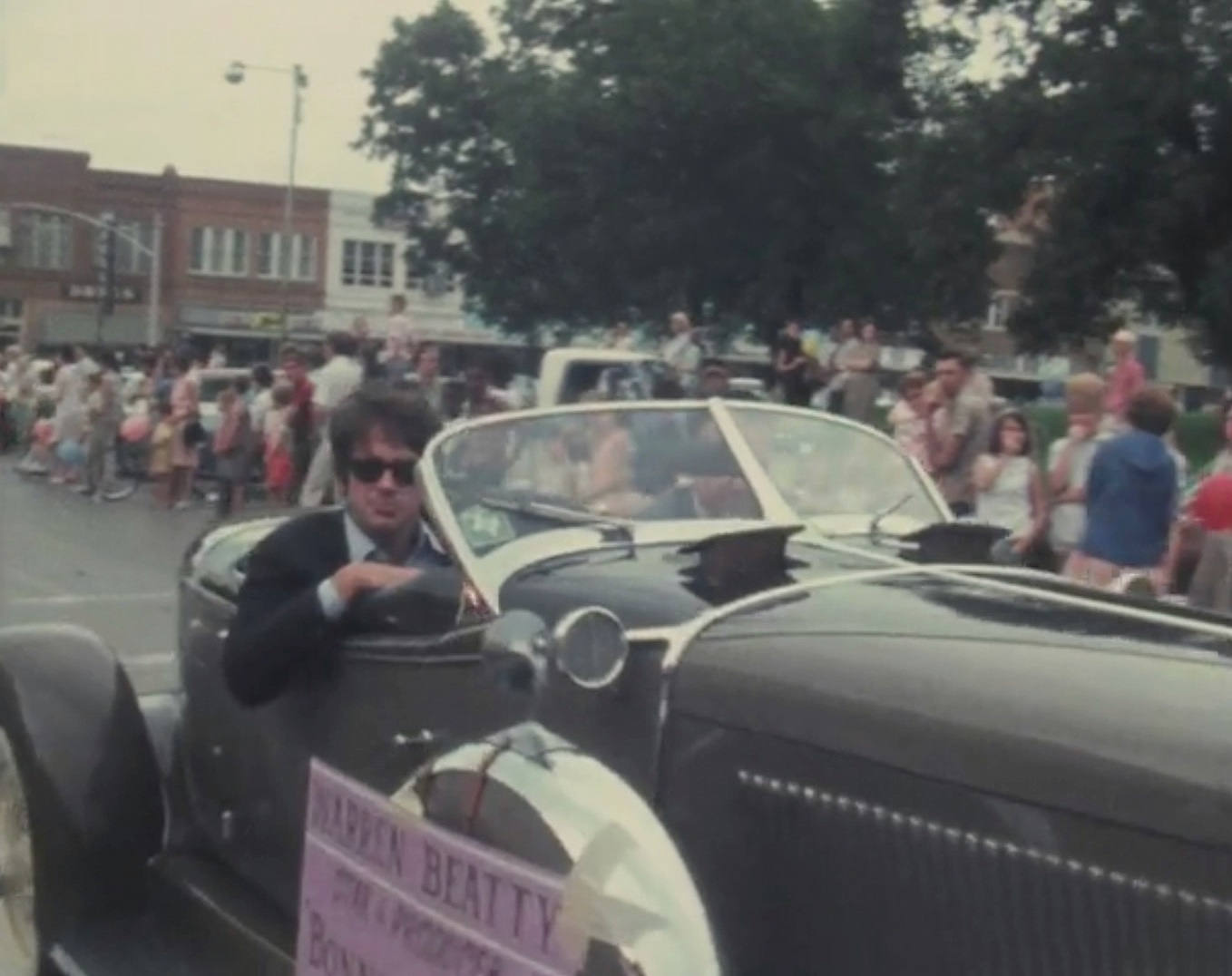
The movie had its Southwestern premiere at the Campus Theater in Denton in September, 1967. Watch (silent) news footage of the premiere from WBAP-TV (Ch. 5) at the Portal to Texas History, here (it begins about the 4:41 mark). Here’s a screen capture of Warren Beatty that day — also appearing were Michael J. Pollard and Estelle Parsons.

bonnie-and-clyde-movie_beatty_denton-premiere_wbap-tv_091367_portal

*

One last little interesting tidbit was what happened after the movie wrapped production in Dallas. Warren Beatty donated the so-called “death car” to a local wax museum. Unfortunately for the wax museum, the car’s bullet holes had been filled in to shoot another scene, so the museum had to search for someone to professionally and authentically re-riddle the car with bullet holes.

It’s always something.

***

Sources & Notes

Top dark and grainy photo of location shooting at Vickery Courts from The Campus Chat (newspaper of North Texas State University, Denton), Nov. 30, 1966.

Photos of Beatty and Dunaway in Lavon, Texas from The Wylie News, Oct. 20, 1966. An article and more photos from the set (local extras, etc.) can be found here and here.

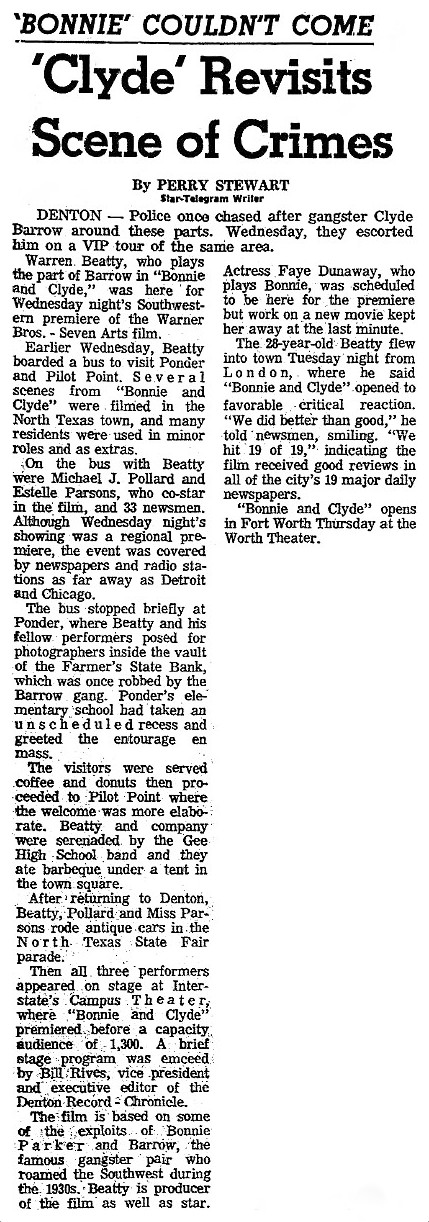
Here’s a bonus Fort Worth Star-Telegram article on the fun and unusual bus trip that Beatty and other stars of the film took to some of the small towns they’d filmed in when they were back in the area for the local premiere in Denton (click to read):

bonnie-clyde_fwst_091467
FWST, Sept. 14, 1967

And a good overview of the making of the film can be found at TCM’s website here.

*

Copyright © 2014 Paula Bosse. All Rights Reserved.


The Britling Cafeteria Serves Those Who Serve Themselves

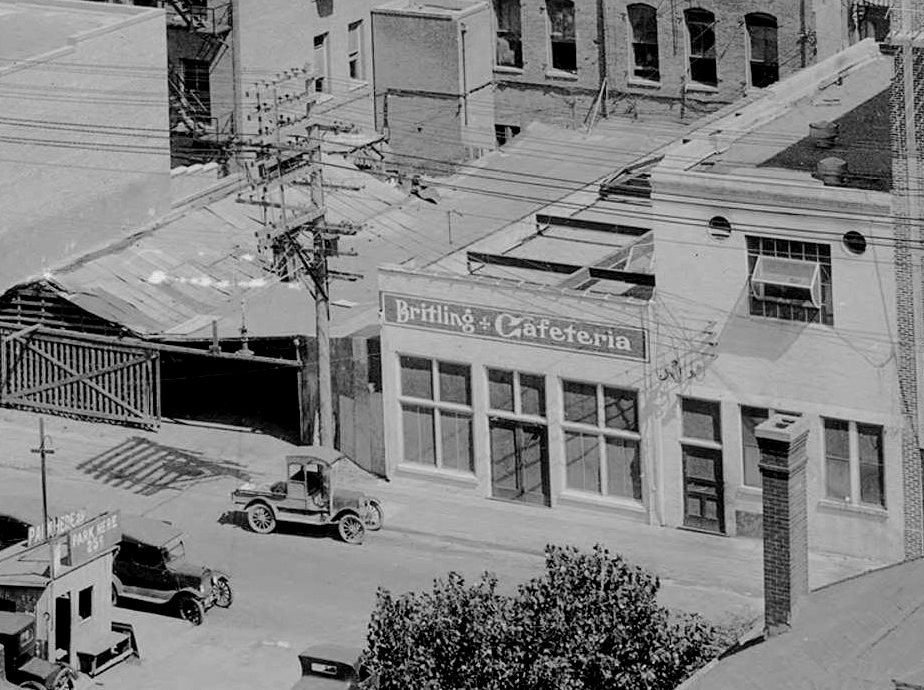
britling-cafeteria_rear-entrance_degolyerBritling Cafeteria’s rear entrance on Jackson St., 1920s

by Paula Bosse

A few weeks ago, I was zooming in on a view of the Dallas skyline when I saw an interesting restaurant sign: the Britling Cafeteria. After a little research, I learned that Britling Cafeterias are something of a cultural institution in Birmingham and Memphis (Elvis’ mother worked the coffee urn station in Memphis, and if that isn’t the sign of a Southern institution, I don’t know what is). Here in Texas, though … I’d never heard of it. It claimed to be the first cafeteria chain in the South, having begun in Birmingham in 1917 (and named for a character in, of all things, an H. G. Wells story). When the Dallas location opened at the end of 1922, it was only the sixth restaurant in the chain, joining others in Birmingham, Atlanta, and Memphis.

The Britling Cafeteria was at 1316 Commerce (“Right in the Heart of Things”), between Field and Akard. There were two entrances, one on Commerce and one on Jackson (seen in the photo above). It sounds pretty nice for a cafeteria — it was lavishly decorated in black and gold, lined with mirrors, filled with flowers, and it had a mezzanine and a raised platform for a live orchestra to provide background music. It had a seating capacity of 450, with an expected daily capacity of 3,000. We’re not talkin’ Luby’s here. Quick “Southern home-cooking” had arrived in Dallas, and it seems to have remained an active advertiser until the ads suddenly stopped in 1926. I hope Dallas enjoyed it while it had it.

Below is the interior of the Atlanta location, from about the same time as the Dallas location. Cafeterias were a whole lot nicer back then.

britling_atlanta

The first non-institutional cafeteria I can find mentioned in The Dallas Morning News was the one in the basement of the Praetorian Building (“Cleanliness, courteous, tipless”) in 1912, but the cafeteria “concept” must have still been fairly new to Dallas as the Britling advertisements that appeared in the week before the grand opening felt it necessary to explain how the system worked. “You’ll wait on yourself — and do it gladly.”

britling_dmn_112722abritling_dmn_112722b1922 (click to read)

But first, stop by for a “Day of Courtesy” preview — flowers for the ladies!

britling_open_dmn_1127221922

britling-cafeteria_forest-ave-high-school-yrbk_19231923

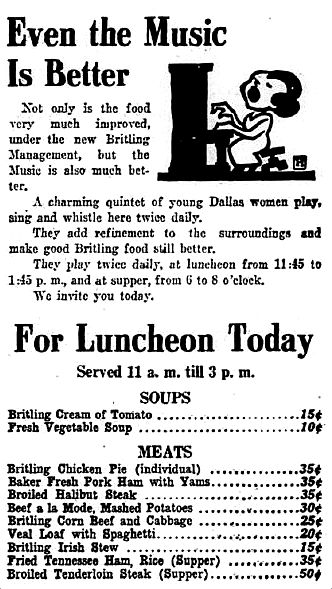
Below, a sample of some of the Southern home-cooking on the menu as well as the warning that there WILL be live music as “a charming quintet of young Dallas women play, sing and whistle (!) here twice daily.”

britling_dmn_030926abritling_dmn_030926b1926

britling_logo_dmn-112722

***

Sources & Notes

Photo is a detail from a larger view of the city from the DeGolyer Library, Southern Methodist University, seen in an earlier post here. The block in which the cafeteria was located is now 2 AT&T Plaza.

Postcard of the interior of the Atlanta Britling Cafeteria from somewhere on the internet.

More can be found in the DMN article “Britling Cafeteria Will Open” (Nov. 26, 1922), with details on the chain and specifics on the Dallas location, here.

Great short history on the cafeteria that every self-respecting citizen of Alabama and Tennessee is apparently familiar with can be found here.

An amusing first-hand account of a Texan (J. J. Taylor) visiting a newfangled cafeteria in San Francisco appeared in The Dallas Morning News on Aug. 25, 1912 and can be read here.

*

Copyright © 2014 Paula Bosse. All Rights Reserved.

Deep Ellum / Deep Elm / Deep Elem Blues

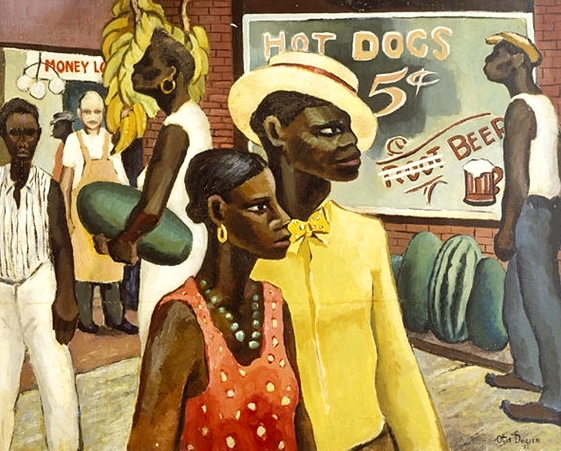
deep-elm-otis-dozier_1932“Deep Elm” – Otis Dozier, 1932

by Paula Bosse

“Deep Ellum Blues” has become a standard blues song, warning of/extolling the vices found in the once-thriving, predominantly black area of town, where a lot of people — black and white — enjoyed themselves (after dark) in clubs and bars, immersed in the sometimes shady goings-on that one tends to find on the other side of the tracks. The song (sometimes irritatingly called “Deep Elem Blues”) was first recorded in 1935 by the Lone Star Cowboys (popular performers in the Dallas area, better known as the Shelton Brothers). And now it’s become a blues standard, sung around the world by people who have no idea what a “Deep Ellum” is.

Below are four versions of the song that I like. (I searched for early performances by black musicians, but, according to Deep Ellum experts Alan Govenar and Jay Brakefield, there is only one that anyone seems to know about — by Booker Pittman, grandson of Booker T. Washington, and I couldn’t find it.)

But first, if you haven’t seen this wonderful short documentary by Alan Govenar about Deep Ellum in its original prime, it’s a must-see. (Bill Neely sings “Deep Ellum Blues” in this — it’s great. Listen for the extra verses.)

Below, the original version by the Lone Star Cowboys, who later changed their name to The Shelton Brothers and were well-known to Dallas audiences through their regular appearances at the Big D Jamboree and on local radio. (Listen to their follow-up, “What’s the Matter with Deep Elem?”)

My personal favorite, this hopping western-swing-big-band-rock-n-roll version by the always fabulous one-time Dallas resident Hank Thompson.

I can’t leave off this turbo-charged rockabilly version by Dallas’ own “Groovey” Joe Poovey!

And, finally, for good measure, one weird version, by the always reliable Charlie Feathers.

Remember y’all: KEEP YOUR MONEY IN YOUR SHOE!

***

Sources & Notes

“Deep Elm” painting by Otis Dozier (1932) — one of the Dallas Nine group — from the collection of the Dallas Museum of Art.

“Deep Ellum” film by Alan Govenar, one of Dallas’ leading blues and cultural historians and archivists. For more on the 1985 short film, see the FolkStreams site here. For Alan Govenar’s Documentary Arts website, see here.

For more on the history of Deep Ellum, I highly recommend Deep Ellum and Central Track, Where the Black and White Worlds of Dallas Converged by Alan B. Govenar and Jay F. Brakefield (Denton: UNT Press, 1998), as well as their recent revised/expanded book Deep Ellum, The Other Side of Dallas (College Station: Texas A & M University Press, 2013). Govenar and Brakefield have written the definitive history of Deep Ellum in these two volumes. You can read a bit about the song from the latter book here.

I wrote about another interesting song, “Dallas Blues” — considered by many to be the first blues song ever published — in the post “I’ve Got the Dallas Blues and Main Street Heart Disease,” here.

*

Copyright © 2014 Paula Bosse. All Rights Reserved.

“Mars Needs Women” — The Dallas Locations

1-mars-oak-lawnOak Lawn & Lemmon, 1966

by Paula Bosse

Chances are, if you’re a native Dallasite and you’re a cult movie buff, you’ve heard of Dallas filmmaker Larry Buchanan (1923-2004), the self-described “schlockmeister” who made a ton of low-budget movies in Dallas, almost all of which are considered to fall in the “so-bad-they’re-good” category. I’ve made it through only three of them, and while they’re definitely not great (or even good, really), there were moments I enjoyed.

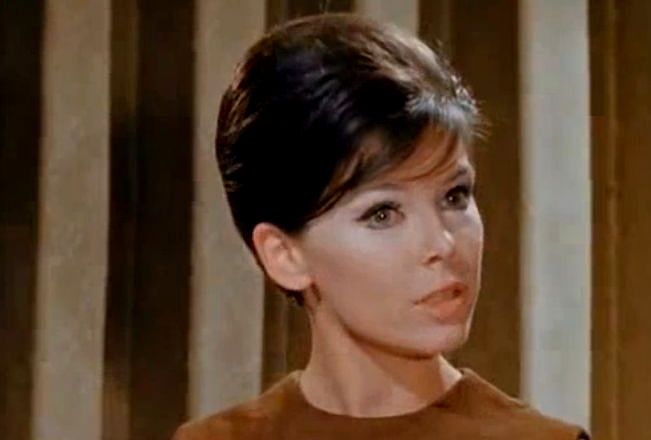
Buchanan’s most well-known movie — if only because the title has worked itself into the sci-fi vernacular — is Mars Needs Women, shot in Dallas in a couple of weeks in late 1966, starring former Disney child star Tommy Kirk and future star of “Batgirl,” Yvonne Craig. For me, the worst thing about the movie is its incredibly slow, molasses-like editing (courtesy of writer-director-editor Buchanan who was working on contract to churn out movies that had to be cut to a very specific running time, and he’s obviously padding here with interminably long scenes that drag and drag). And then there’s the dull stock footage and weird background music that I swear I’ve heard in every cheap Western ever made. Still … it has its charm.

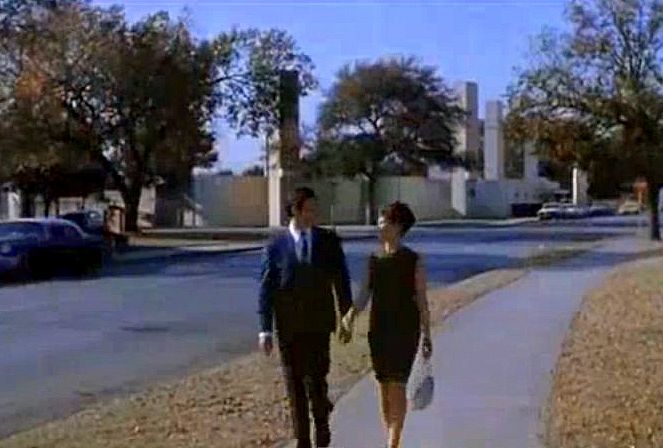
But the BEST thing about this movie (and, presumably, his others) is that it was shot entirely in Dallas, using a lot of instantly recognizable locations. (Every time I saw a place I knew, I perked up — it reminded me a bit of seeing Bottle Rocket for the first time — almost shocked to see common every-day places in an honest-to-god MOVIE!) So, if you don’t feel you can sit through the whole thing (available, by the way, in its entirety online — see link at bottom), I’ve watched it for you, with a whole bunch of screen shots. So feast your eyes on what Dallas looked like in November of 1966. (By the way, because the movie revolves around …. Mars needing women, the movie is actually set in Houston, home of the Johnson Space Center. Even though you see the very distinctive Dallas skyline — repeatedly. Houston! You wish, Houston!)

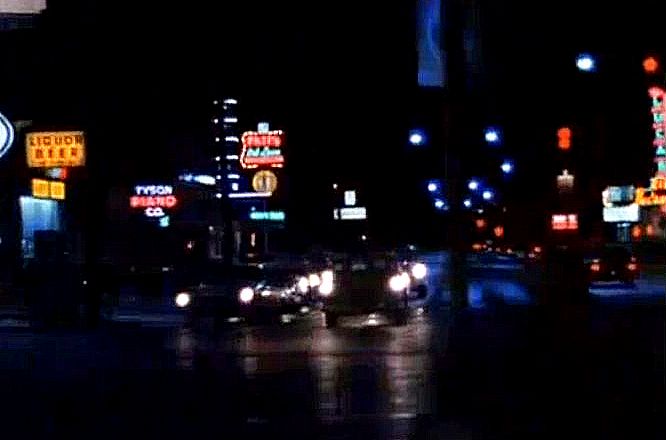
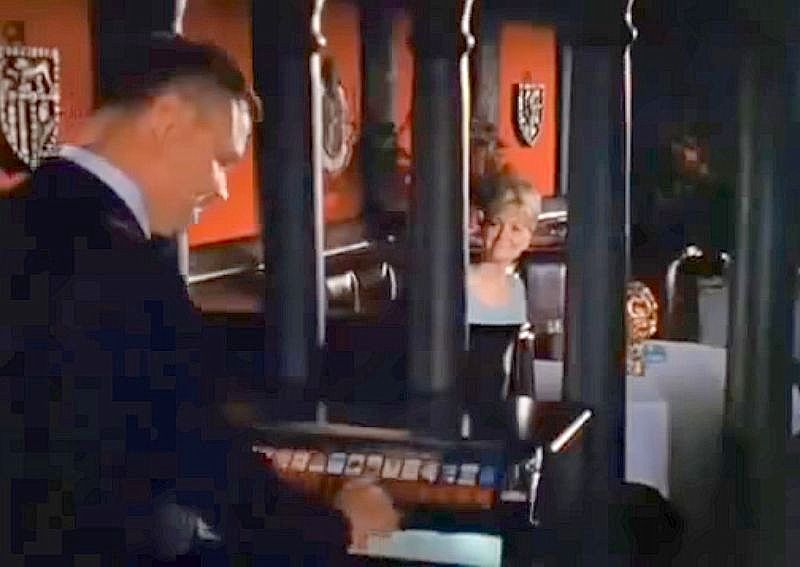
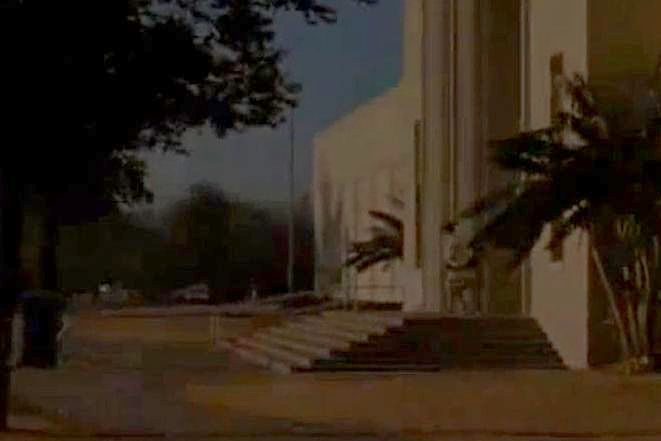
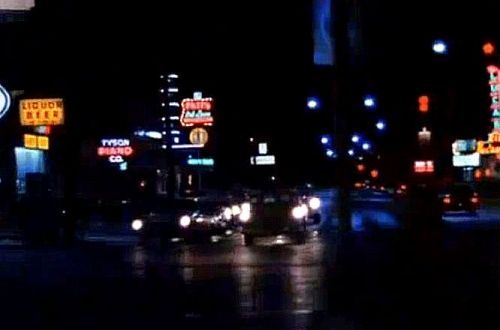
My favorite shot is the one at the top of this page and is seen in the first 90 seconds of the movie: Oak Lawn at Lemmon, with the familiar Lucas B & B sign at the right. This area was used a few more times. One character goes into the old Esquire theater, but, sadly, there was no establishing shot showing that great old neon sign. I think the first interior — showing a couple at a lounge — was shot in the swanky private club, Club Village, at 3211 Oak Lawn (at Hall), just a short hop from Oak Lawn and Lemmon.
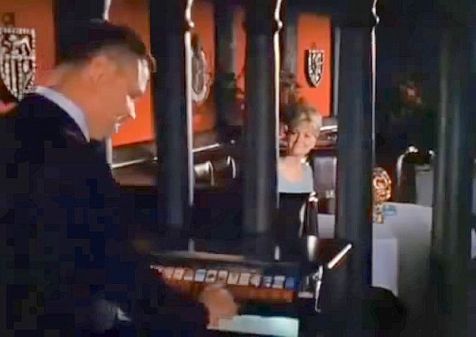
1966_club-village_mars-needs-women

Next, we’re off to White Rock Lake.

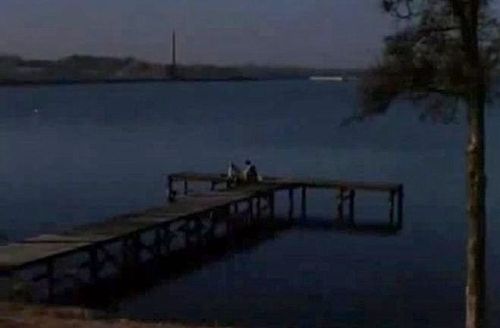
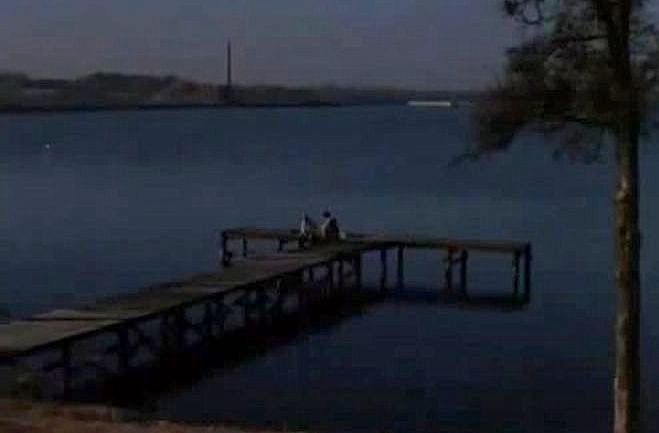
2-mars_pump1White Rock Lake. Shot day-for-night, with the pump station in the distance.
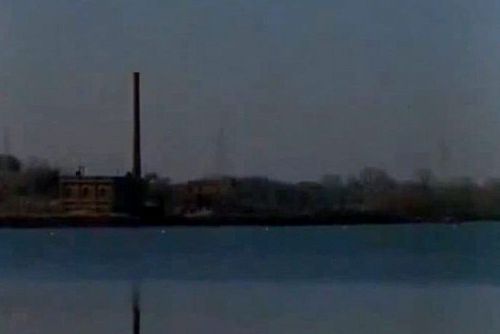
3-mars-pump2White Rock Lake pump station, where the Martians are headquartered as they search for healthy, single women to take back to Mars to help re-populate the planet.
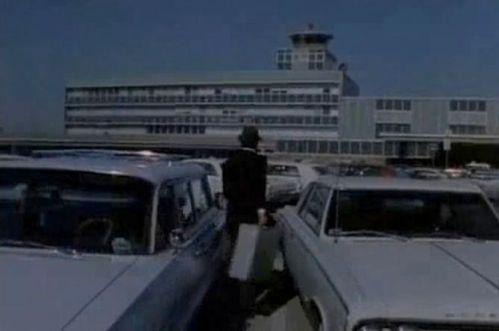
4-mars_love-field-extLove Field parking lot. Still shooting day-for-night. Badly.
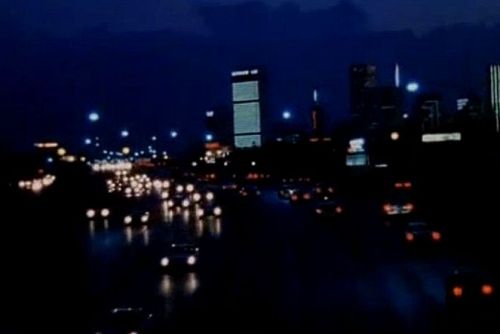
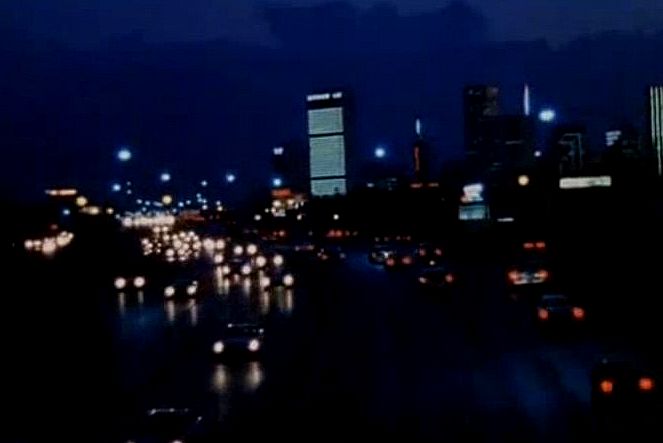
5- mars-southland-lifeThe Southland Life Building, etc., magically transported to Houston.
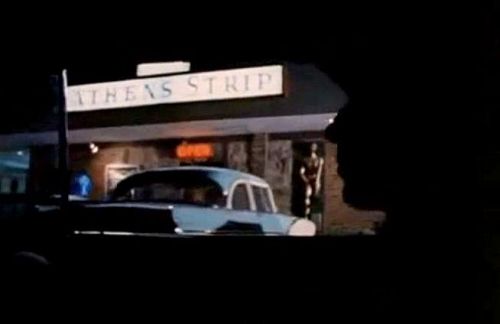
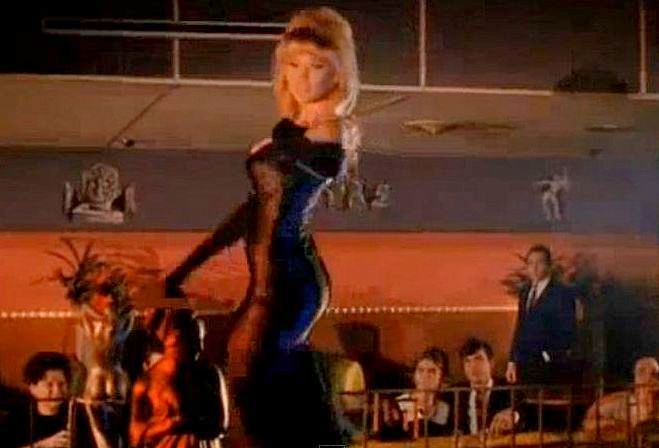
7-mars-athens-stripAthens Strip — a strip joint on Lower Greenville, one block north of the old Arcadia Theater. I’ve never heard of this place, but I came across the story of a guy who had visited the place back around this time and remembered one of the VERY unhappy dancers who hurled handfuls of the coins (!) that had been tossed onstage back into the audience, with such force that his face and chin sustained minor lacerations.
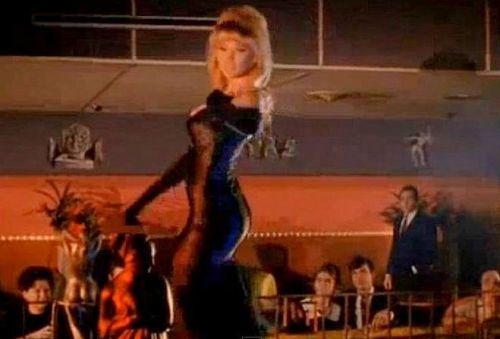
8-mars-needs-women_athens-strip_bubbles-cashLocal celebrity-stripper “Bubbles” Cash, inside Athens Strip. Plainclothes Martian (standing) ponders whether she has what it takes to birth a nation. (She does.)
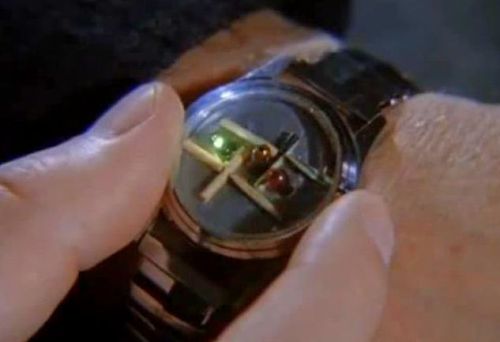
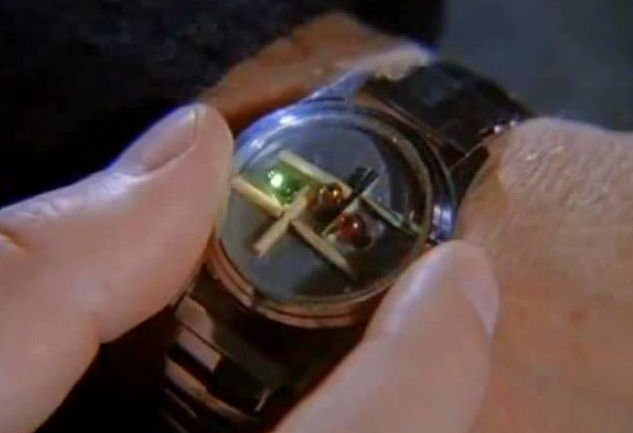
9-mars-watchMy favorite example of what a director is forced to resort to when there is no budget. This is some sort of sophisticated communication device. I think those are matchsticks.
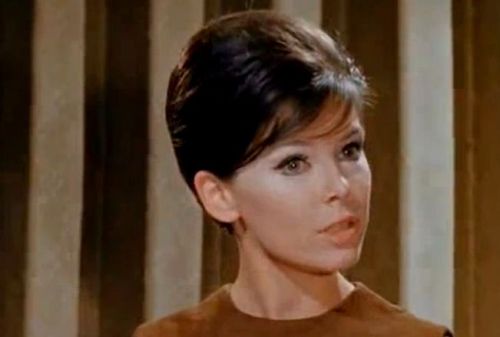
10-mars-yvonne-craigYvonne Craig, without a doubt the best actor in the movie. In fact, she’s really good. She had already made a few movies in Hollywood at this point, but the lure of a starring role brought her back to her hometown (where the newspapers reported she was happily staying with her parents during the two-week shoot).
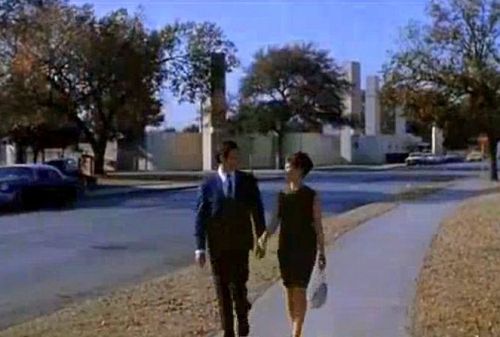
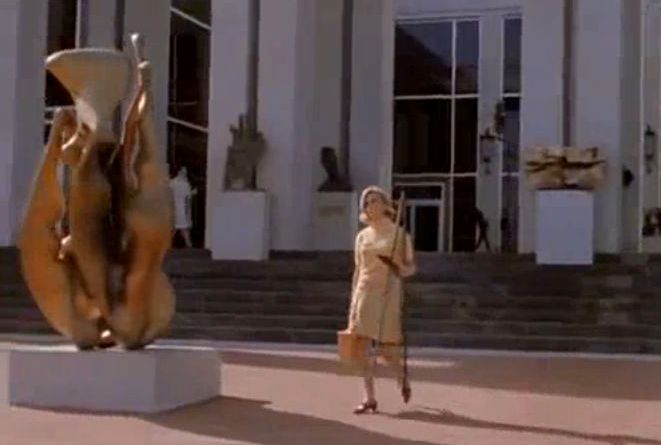
11- mars-band-shellMartian #1 and sexy space geneticist strolling through Fair Park — band shell behind them, to the left.
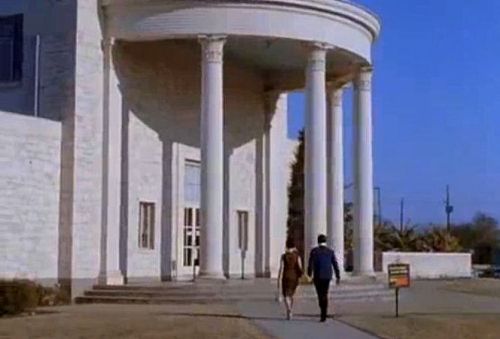
12-mars-planetariumThe Fair Park planetarium.

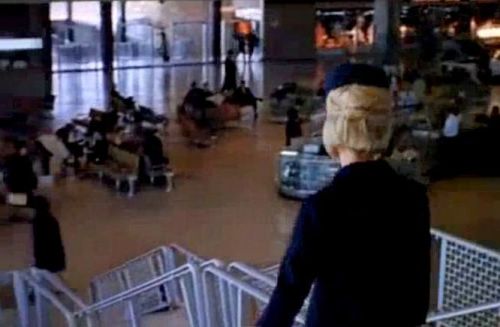
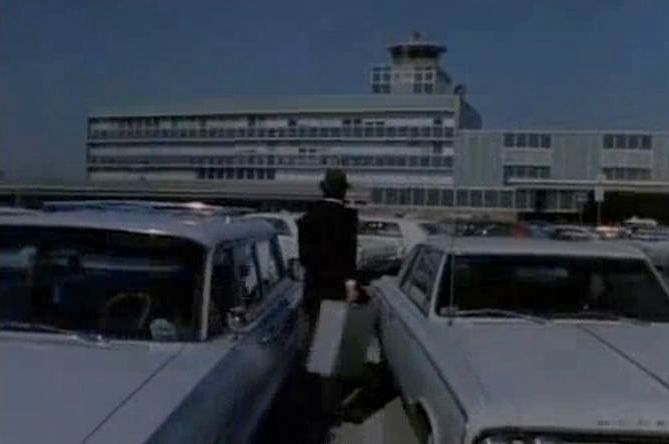
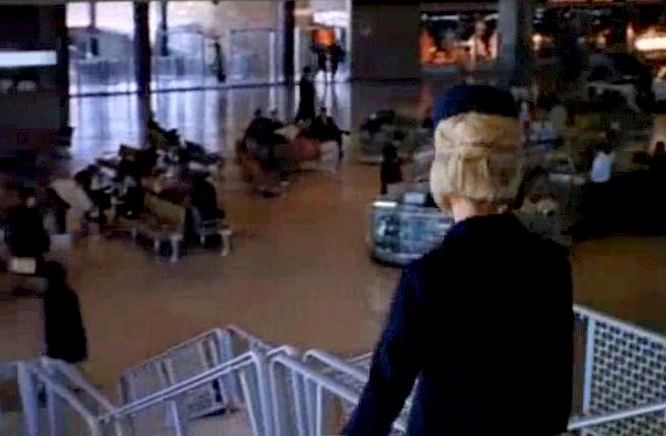
13-mars_love-fieldLove Field. I love the interior shots of the airport in this movie. (The stewardess walking down the stairs? Destined for Mars.)
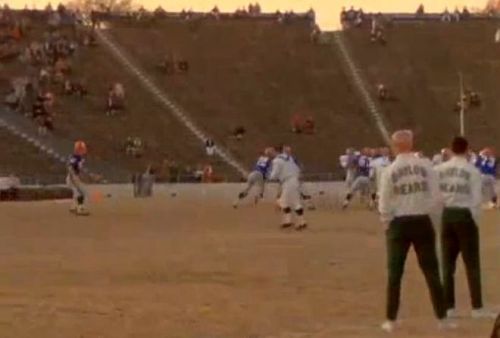
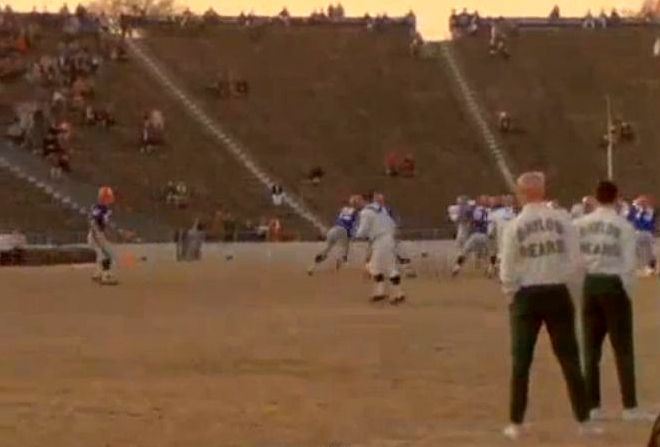
14-mars-cotton-bowlCotton Bowl, shot during a homecoming game between SMU and Baylor. Some shots show a packed stadium, some show this. Word of warning to the homecoming queen, Sherry Roberts: do NOT accept that flower delivery!
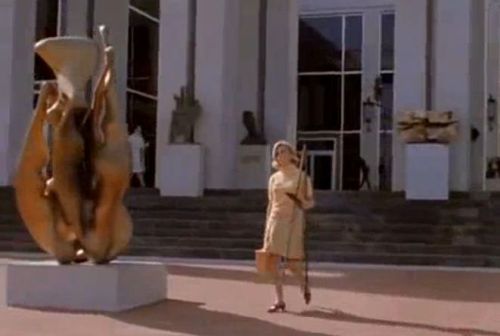
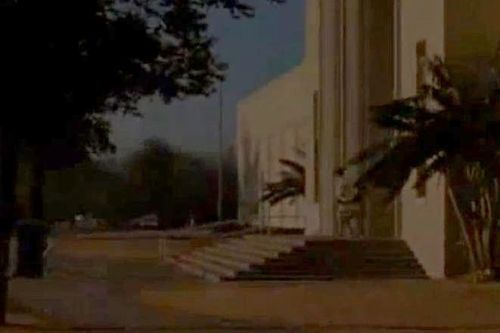
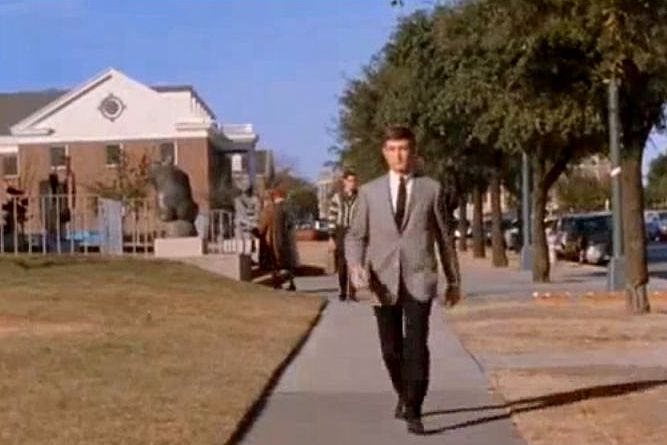
15-mars-meadowsSMU, Meadows School of the Arts. I love the pan across the front of the building. Mars Needs Co-Eds.
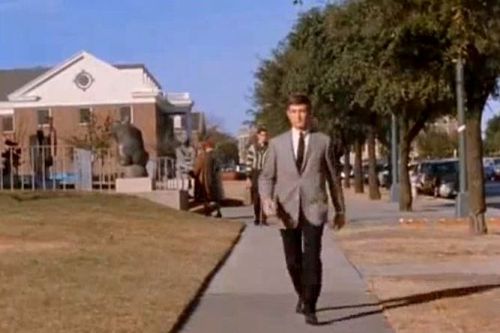
17-mars_BMOCSMU. BMOC (Big Martian On Campus).

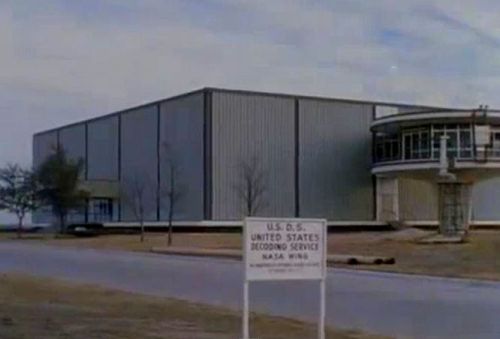
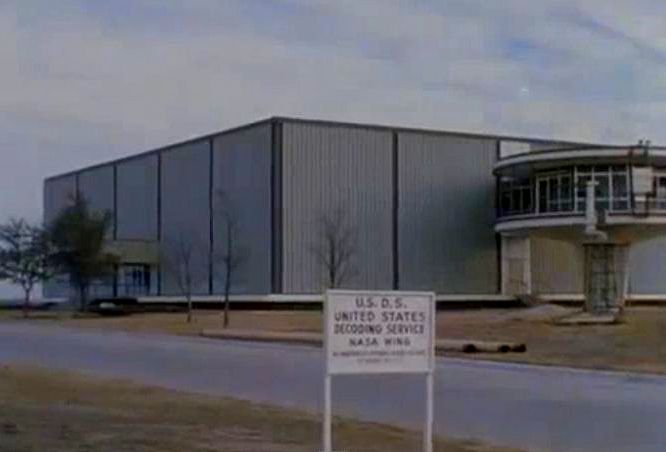
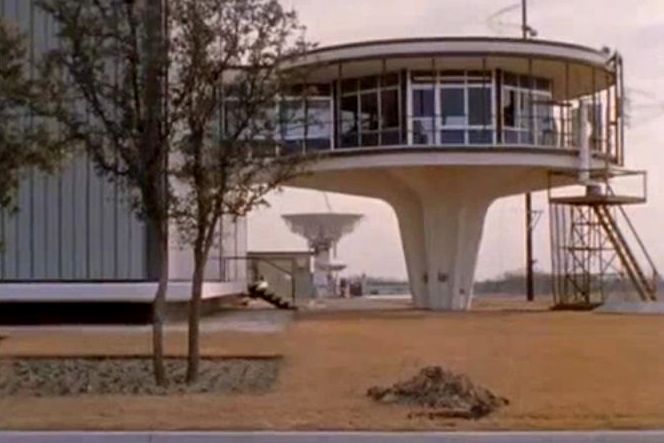
18-mars-collins-radioThe one location I couldn’t figure out. And it’s because it isn’t in Dallas. It’s the Collins Radio building in Richardson, a company that was absorbed by/bought out by/merged with Rockwell International. I think all the interior and exterior shots which are supposed to be NASA were shot here. How did a low-budget director like Larry Buchanan get into a place like that? According to a 1986 Texas Monthly article, Buchanan, in his day-job career as an ad-man, was hired by Collins Radio in 1961 to work in their “audio-visual” department” (the man who hired him was Harold Hoffman, whose later film work with Buchanan was done under the name Hal Dwain).
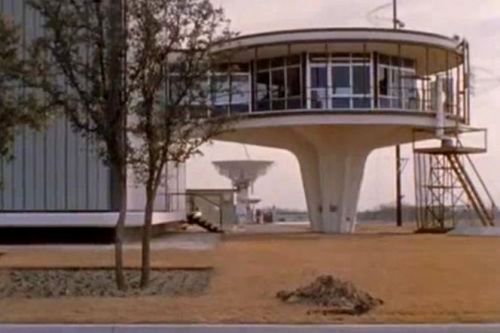
19-mars-collins-radioSo, yeah — COOL location.

20-mars_fair-parkMore Fair Park, more murky day-for-night.
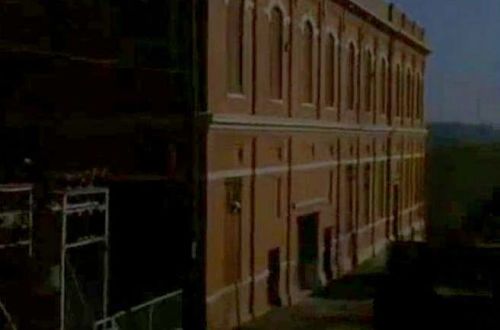
21-mars_pump3White Rock Lake pump station, aka the Martian lair.
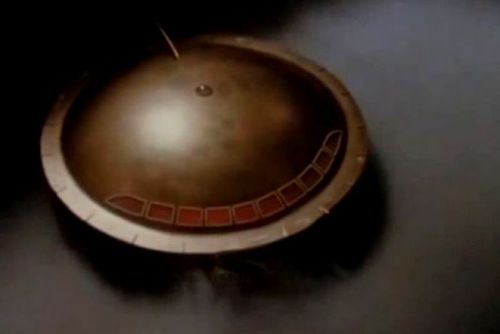
22-mars-saucerFANTASTIC flying saucer. Do the Martians get their five healthy, single women on board the ship and get them back home? You’ll have to watch it for yourself to find out.

23-mars-endYou tell ’em, Konnie.

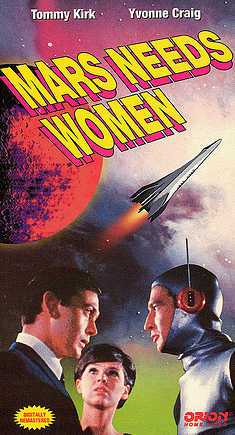
mars-needs-women_VHS-box

Check back in a few days for more on Larry Buchanan (including a long-lost photo of him at work back in his advertising days in the 1950s).

UPDATE: Here it is — Larry Buchanan filming a Chrysler spot in the Katy railyard in 1955 for Dallas’ Jamieson Film Company, here.

***

Sources & Notes

The entire movie is on YouTube in a pretty good print. Watch it here.

Larry Buchanan Wikipedia page is here.

Mars Needs Women Wikipedia page is here.

Collins Radio/Rockwell Collins Wikipedia page is here.

Consult the Dallas Morning News archives to read a somewhat sarcastic Dallas Morning News article by Kent Biffle on the shooting of the Cotton Bowl sequence (I miss his Texana columns!): “That UFO Was a Field Goal” (Nov. 20, 1966).

*

Copyright © 2014 Paula Bosse. All Rights Reserved.

“Electricity in Every Form” — 1909

ad-sanitarium_moran_1909(Click for larger image)

by Paula Bosse

There was a lot going on in 1909 on the 7th floor of the Wilson Building in the “extensive apartments” occupied by a local “institution” affiliated with the Battle Creek Sanitarium. Individuals could (and apparently did) avail themselves of the following treatments:

Some of the therapeutic measures employed are: Baths of various kinds scientifically administered by trained attendants. Electricity in every form. Every kind of general and special Massage. Mechanical Vibration by the most recent and efficient apparatus. Hydrotherapy (the scientific use of water) in its great variety of application. Electric Light Baths. Physical Culture.

Just let that soak in. Or surge through you. Administering your voltage? Say hello to Dr. F. B. Moran, below.

moran_sanitarium_dmn_102730

Yes, indeed.

***

Sources & Notes

Ad from the 1909 Worley’s city directory.

Photo of Dr. Moran from a 1930 ad so long-winded and dull I couldn’t finish reading it or fit it in here.

See the Battle Creek Sanitarium contraptions in action here.

Click ad for larger image.

*

Copyright © 2014 Paula Bosse. All Rights Reserved.
 

Reverchon Park, Site of a Hovel Town Once Known as “Woodchuck Hill”

reverchon_park_baseballAnyone for a little sport? Or a spell-checker?

by Paula Bosse

Before it became one of Dallas’ nicest parks, Reverchon (named for the French botanist Julien Reverchon who arrived in Dallas to join the La Réunion settlement) began life as a 36-acre plot of land called “Turtle Creek Park.” But before that, it was an open-air slum known as “Woodchuck Hill” — an eyesore of an area filled with tents and hovels where families lived in deplorable conditions. It was a pretty dangerous place — the only thing the violent “Squattertown” had going for it was that it was practically next door to Parkland Hospital at Maple and Oak Lawn. The injured and dying didn’t have far to go for medical attention. Or to breathe their last breaths. News reports such as the one below — from 1911 — were, sadly, fairly common (click for larger image):

woodchuck-hill_dmn_081711
Dallas Morning News, Aug. 17, 1911

In October, 1914 it was announced that the city had purchased this tract of land from the heirs of the pioneer Cole family in order to establish what would become Reverchon Park.

reverchon-park_dmn_101914
DMN, Oct. 19, 1914

A few months after the purchase of the land, the squatters were told to vacate the city’s new park property, and what had been a miserable slum was cleared away and transformed into one of the city’s prettiest “pleasure grounds.”

woodchuck-hill_dmn_031215
DMN, March 12, 1915

*

The following is from the Dallas Park Board’s 1915 report:

Pending suggestions for a more suitable one, Turtle Creek Park has been temporarily adopted as the name for this property. At the time of its purchase it corresponded in a measure to the slum districts of the great cities. It was known as “Woodchuck Hill,” and its inhabitants constituted a novel settlement for the city. They resided in make-shift houses and hovels built by the occupants who paid a small stipend each month in the shape of ground rent. The moral conditions of these people was bad, and they caused much concern to the Social Welfare Workers in particular.

In addition to an athletic field, this park is adaptable for an elaborate botanical garden. Being situated at the western base of the Turtle Creek Boulevard, which extends the entire length of the property, it will one day constitute one of the chief attractions of the city for visitors. It adjoins the water works property, comprising a total of 103 acres of city property, a large portion of which has already been beautified. The grounds surrounding the pumping station and the water purification plant have been laid out in lawns and flower beds. Near the center of this park and at the base of the hills on its northern boundaries is located Raccoon Springs. The springs flow a large volume of water to year round, and provide shady nooks with delightful surroundings.

*

Hovels below, in the “before” picture.

reverchon-park_before-1915

reverchon-park-1915

Turtle Creek Park
Located on Maple Avenue.
Area, 36 acres.
Acquired, 1915.
Cost of land, $40,000.

reverchon-plat_kessler_1915

***

Sources & Notes

Top postcard (with “Reverchon” misspelled — understandably so…), from somewhere in the wilds of the internet.

Quoted text and other images from Report for the Year 1914-1915 of the Park Board of the City of Dallas, With a Sketch of the Park System (Dallas: Park Board, 1915), which can be accessed as part of the Dallas Municipal Archives, here.

For more on the Dallas Parks System, the definitive source may well be Historic Dallas Parks by John Slate (Charleston: Arcadia Publishing, 2010); more info here.

Friends of Reverchon Park website here.

*

Copyright © 2014 Paula Bosse. All Rights Reserved.