Flashback : Dallas

A Miscellany: History, Ads, Pop Culture

Category: Vault

Garrett Park Aburst in Spring Flowers

by Paula Bosse

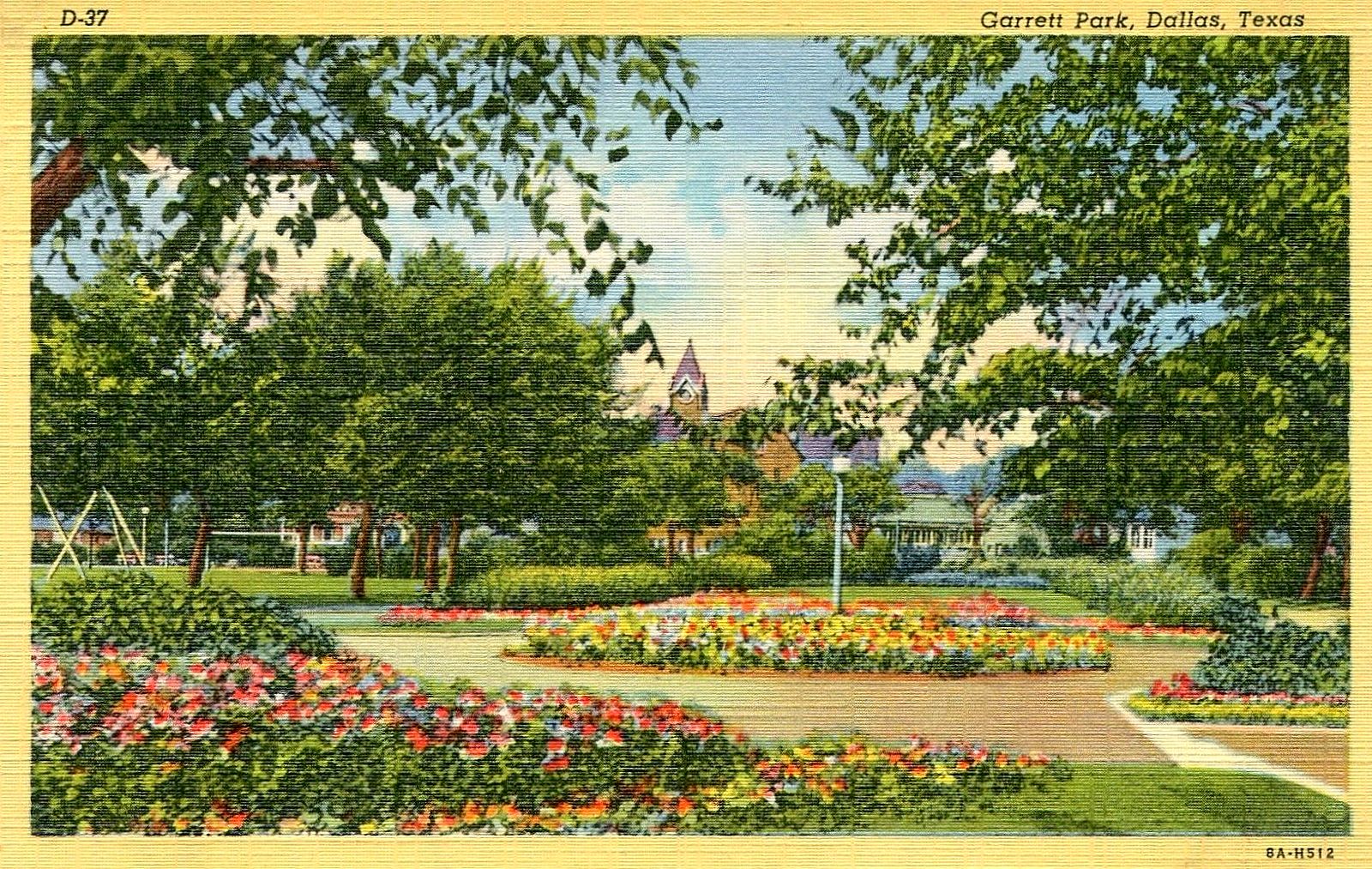
Garrett Park (at Munger and Bryan) was established in 1915. The postcard above shows it filled with leafy trees and bursting with brightly colored flowers. There is playground equipment at the left and, in the background, St. Mary’s College. The park is still there — just south of Ross Ave., past the lowest bit of Lowest Greenville — but the George Kessler-designed charm is almost entirely gone. The trees are sparser, and those flower beds? Below, a modern-day aerial view (click pictures to see larger images). Oh, how the mighty have fallen.

garrett-park_google-earth_sept-2017
Google Earth

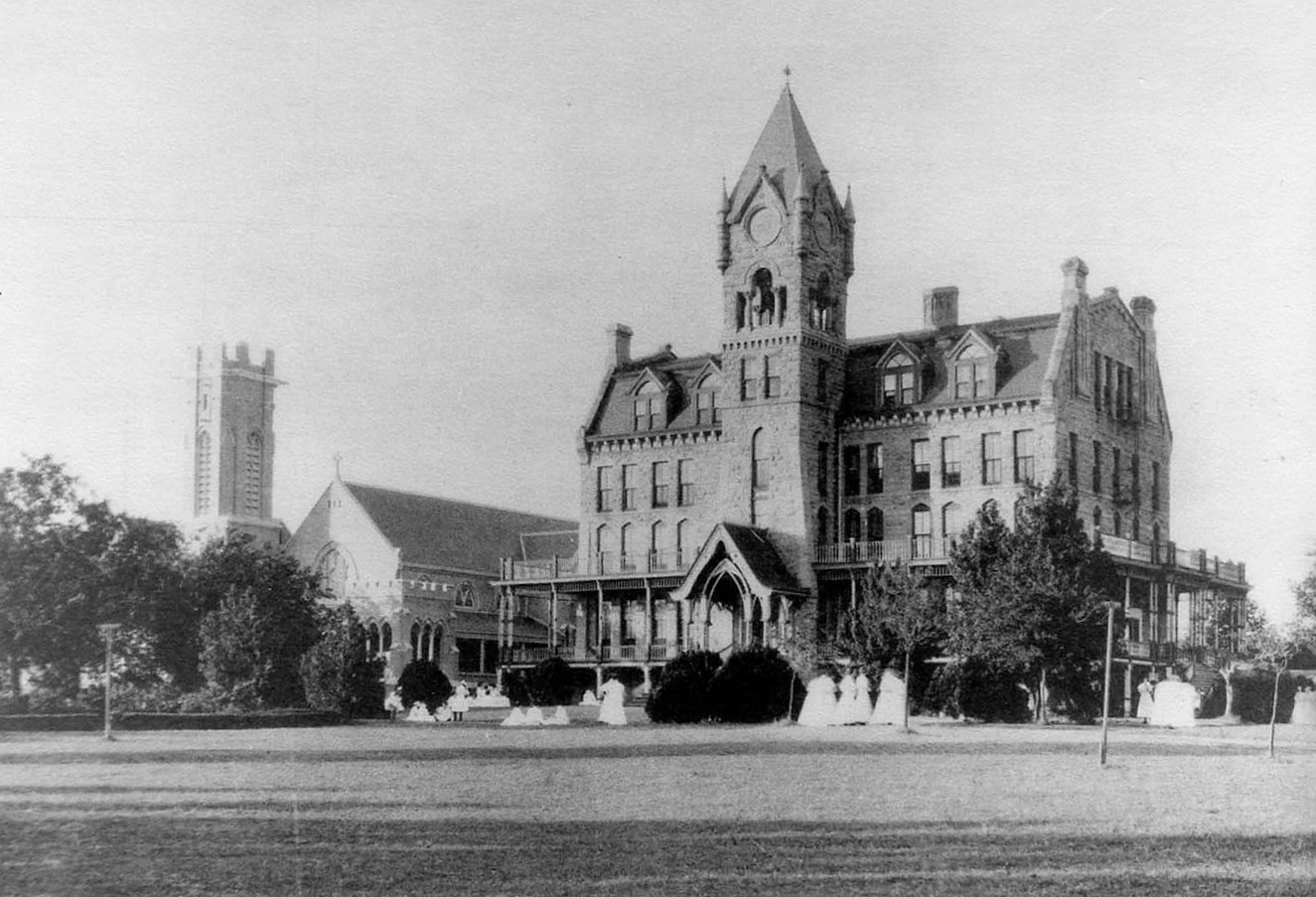
But back to more luxuriantly landscaped times. Before it became a city park, the land was once part of the sprawling campus of St. Mary’s College, a prestigious boarding school that prepared girls for college, run by the Episcopal Church since the 1880s. The school was on the far, far, FAR eastern edge of Dallas, and in the early days, the isolated area was so dominated by the school that it was referred to by everyone as “College Hill.” Below, a photo of St. Mary’s taken around 1908 — the land which later became Garrett Park was behind the school. (Note the tower of the school below which is seen in the postcard above. Also, note the tower of the next-door St. Matthew’s Cathedral — it is still standing at the corner of Ross and Henderson.)

st-marys-college_c1908St. Mary’s College, circa 1908

In September, 1914, St. Mary’s sold the adjoining five-and-a-half-acre parcel of land to the City of Dallas for $30,000 for use as a park.

garrett-park_dmn_091714_acquisitionDallas Morning News, Sept. 17, 1914

The park was officially named in honor of Bishop Alexander C. Garrett in February of 1915.

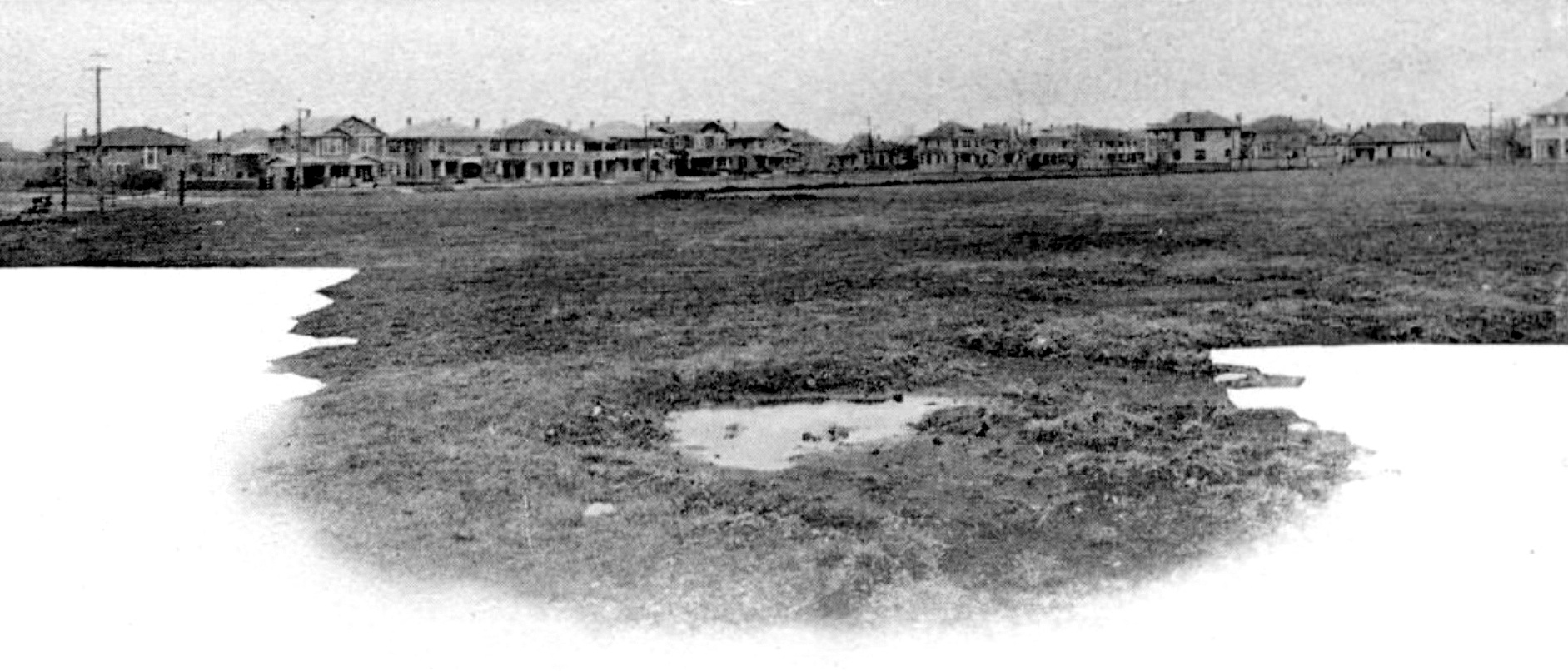
Below, a “before” photo showing “Garrett Park at Time of Purchase” (1914):

garrett-park-at-time-of-purchase_ca-1913

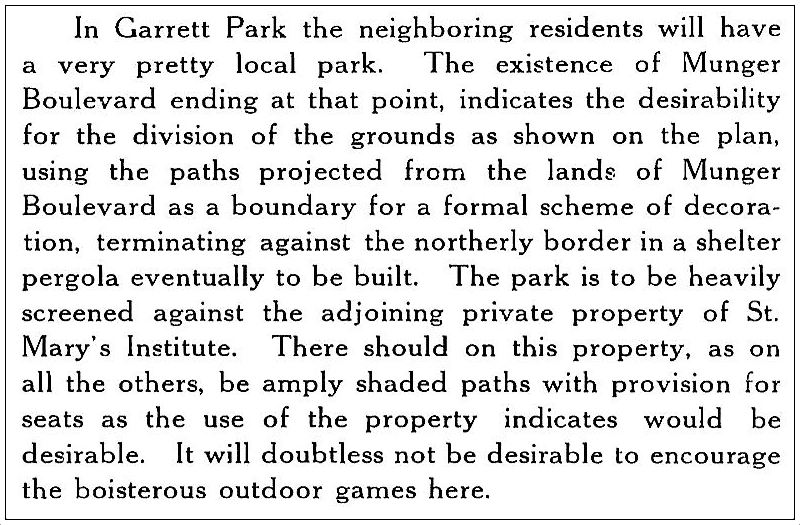
And descriptions of the new park from a 1914-1915 Park Board publication:

garrett-park_-park-board-report-1914-1915_portal

garrett-park_-park-board-report-1914-1915_p24_portal
1915

***

Sources & Notes

Top postcard is from the wilds of the internet.

Source of circa-1908 photo of St. Mary’s College is unknown.

Text and “before” photo of Garrett Park is from the Report for the Year 1914-15 of the Park Board of the City of Dallas; a scanned copy is available at the Portal to Texas History, here.

Map of Kessler’s plan of the park is from Jay Firsching’s article in the Spring, 2003 issue of Legacies; the Garrett Park passage begins on p. 12, here.

To get an idea of the size of the St. Mary campus and Garrett Park in 1922, the Sanborn map from that year is here.

See the location of Garrett Park on a current Google map, here.

Click pictures for larger images.

(This post was updated with additional text and new images on March 23, 2018.)

*

Copyright © 2014 Paula Bosse. All Rights Reserved.


Meet Your City of Dallas Flag, 1916-1967

Oh dear, no….

by Paula Bosse

This was the official flag of the City of Dallas, from 1916 to 1967. Um … ick.

The flag of Dallas County, adopted in 1975 and seen below, is actually worse.

dallas-county-flag

***

More Texas flags can be seen here.

*

Copyright © 2014 Paula Bosse. All Rights Reserved.

Celery Cola: “It Picks You Up!” — 1909

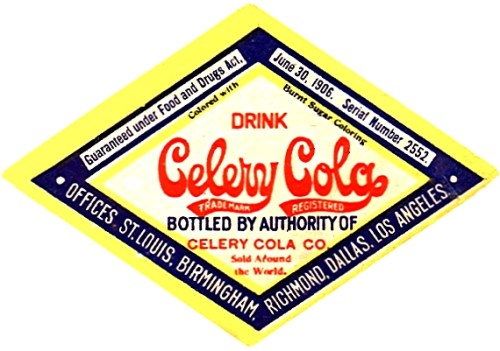
celery-cola_logo_1906

by Paula Bosse

When you think of Dallas and soft drinks, you probably think Dr Pepper. But back in 1909, Dallas was the main office for the Western division for the Birmingham, Alabama fizzy drink Celery Cola (containing, one presumes, delicious celery-flavored syrup). Their offices were in the somewhat low-rent stretch of Exposition while rival Coca Cola was snugly housed at the cushy southeast corner of N. Akard and Ross.

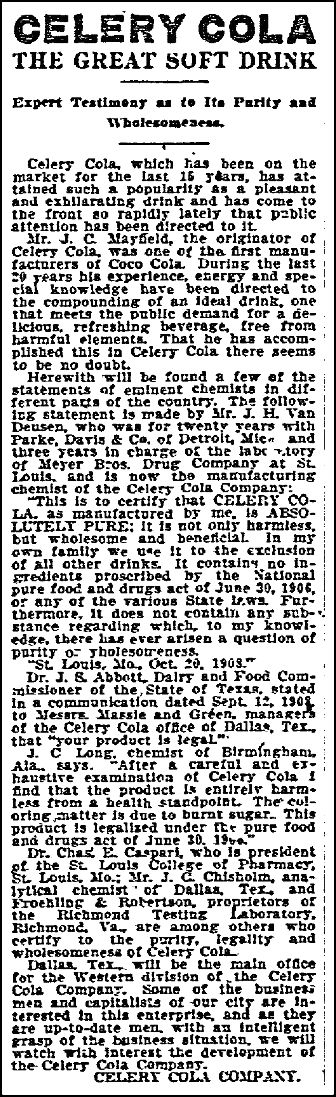
Only a couple of weeks after an official state charter was granted to local aspiring soda tycoons W. A. Massie, E. O. Massie, and J. B. Green to start officially producing the elixir in Dallas, this ad — a bit on the defensive side — appeared in the Dallas Morning News (click to see larger image):

celery-cola-AD_dmn_022809DMN, Feb. 28, 1909

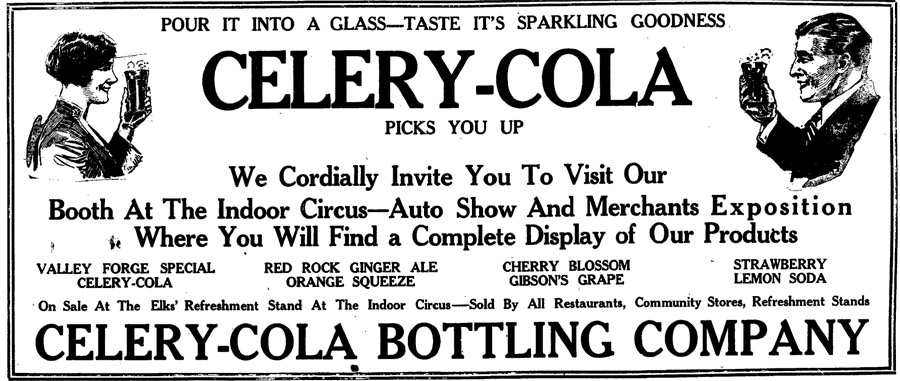
Not so much an ad as testimony. Ads are usually more like this:

celery-cola-ad

As it turns out, Celery Cola ceased production in 1910 after repeated findings of the presence of cocaine and large amounts of caffeine by the Pure Food and Drug Administration. Let’s hope Messrs. Massie, Massie, and Green bounced back from their ill-advised investment. The owner of the Celery Cola Company certainly bounced back — he continued to create soft drinks such as — no kidding — “Koke” and “Dope.” Dallas is better off with Dr Pepper. The only whispered allegation that’s dogged them is prune juice — and that stuff is 100% legal.

Check out the related Flashback Dallas post “‘No Mice, No Flies, No Caffeine, No Cocaine’ — 1911.”

***

Sources & Notes

Top ad from a Celery Cola site here.

Third ad, with the word “its” misspelled (*sigh*) from the comments section of a Shorpy post here.

Best overview on the history of Celery Cola and its creator, James Mayfield, is here.

My favorite part of this story was reading the long list of Dallas-area “illegal” soft drinks (and other oft-tampered-with foodstuffs) in J. S. Abbott’s First Annual Report of the Dairy and Food Commissioner of Texas (Austin, 1908). The soft drink list begins on p. 46 after an interesting prologue here. Celery Cola was not alone! (And, if I’m reading this correctly, Messrs. Massie, Massie, and Green were fully aware of what was going on, having provided the food cops with cocaine-laced samples several months before they bought into the company.)

*

Copyright © 2014 Paula Bosse. All Rights Reserved.

Protected: Never Tell an Irate Irishman That He Can’t Paint a Green Stripe Down Main Street — 1960

This content is password-protected. To view it, please enter the password below.

Olsen-Stelzer Cowboy Boot Saleslady — 1939

Portrait with boots…

by Paula Bosse

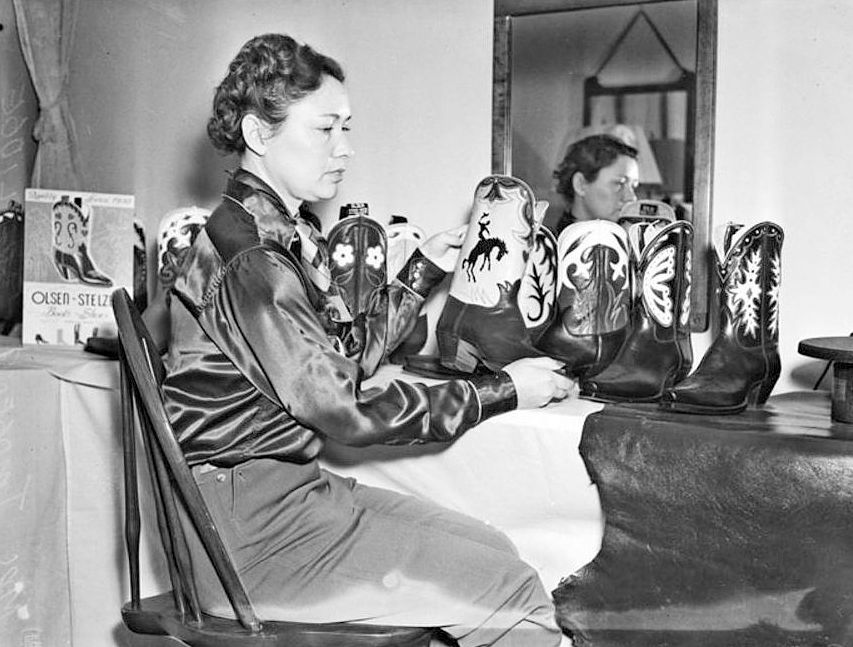
Above, Dallas resident Imogene Cartlidge is seen at a shoe retailers’ convention in San Antonio in 1939. Cartlidge was an employee of the Olsen-Stelzer boot company in Henrietta, Texas, and she was said to be “the only woman boot salesman on record.” I’m a big fan of cowboy boots of this period, and I have to say that I am ashamed that I was unaware of the famous Olsen-Stelzer company, which lasted from 1900 until the 1980s. The company is back in business again, led by Tom Cartlidge, whose parents began selling the boots in 1938 — Imogene is his mother. I wish them all the best of luck, because the world needs as many great-looking cowboy boots as it can get!

olsen-stelzer_dmn_120146

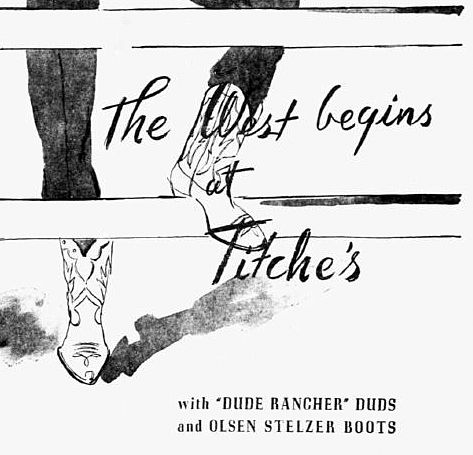
“The West begins at Titche’s”? First I’m hearing of this. Who knew? Nice ad, though.

olsen-stelzer_dmn_120146det

olsen-stelzer_dmn_103055

olsen-stelzer_1941

Best of all is this absolutely fantastic video from 1956 about the company:

olsen-stelzer-logo

olsen-stelzer-box

***

Sources & Notes

Photo of Imogene Cartlidge is from the San Antonio Light Photograph Collection, University of Texas San Antonio Libraries Special Collections, Institute of Texan Cultures.

Titche’s ad from 1946.

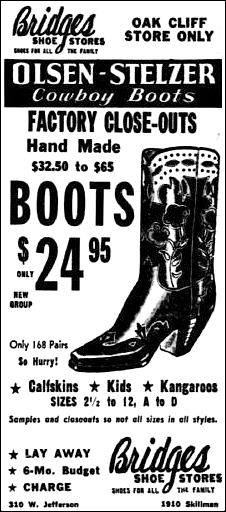
Bridges Shoe Store ad from 1955. (Bridges seems to have been the only place in Dallas where the boots were regularly sold — or at least regularly advertised. And you could get them ONLY IN OAK CLIFF!) (I hear the West begins at Oak Cliff….)

The video can be found on the home page of the Olsen-Stelzer website here.

The last image is the lid of an Olsen-Stelzer boot box, which belongs to my aunt — she keeps Christmas ornaments in it. (Sadly, no sign of the boots!)

The history of the company (and, again, that great video) can be found here.

*

Copyright © 2014 Paula Bosse. All Rights Reserved.

Remember the Alamo! …In Fair Park?

alamo_replica_fair-park_seewatermelonkidpage

by Paula Bosse

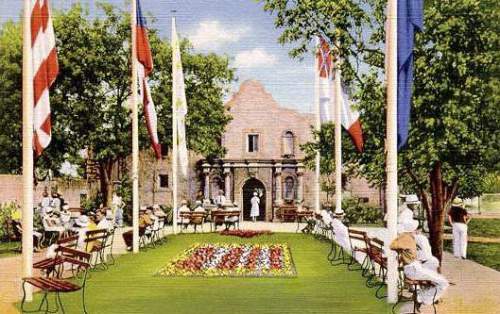
Today, on the anniversary of the fall of the Alamo, I bring you news that Dallas has outdone San Antonio by having hosted two Alamos. TWO! Both in Fair Park. The first one was a gift to the city by G. B. Dealey and the Dallas Morning News — it stood stoically at the entrance to the fairgrounds from 1909 until 1935 — and the second one was a rebuilding of the first which was torn down to make way for the the splendor of the Art Deco Centennial extravaganza and lasted from 1936 until 1951. And here I’d never heard mention of Dallas having had ANY Alamos.

The idea came from Dallas Morning News executive George Bannerman Dealey. He sent architect J. P. Hubbell (of Hubbell & Greene) to San Antonio to meticulously photograph, sketch, and measure the original structure — this included making note of every stain, every crack, every instance of broken plaster, etc. — in order to reproduce an exact replica of the historical landmark (at half the size of the original). The Morning News offered to pay for and build the replica (the cost was estimated at $5,000) and asked only that it be placed in a primo location (at the entrance!), that it be open to the public during the day but be available to the DMN people to use for private/company functions after hours, and that the Park Board maintain the building and its landscaping. The Park Board jumped at the gift, and the news of our very own “little Alamo” was met with giddy anticipation. Even the rival Dallas Times Herald was swept up in the excitement and suggested a “Meet Me at the Alamo at the Dallas State Fair” slogan in an editorial.

San Antonio and the Daughters of the Republic of Texas (who managed and maintained the historic shrine) were not terribly amused by this, but The News (in the expected torrent of its own self-congratulatory publicity about its magnanimous gift “not to Dallas, but to the State”) humbly insisted that the much, much, MUCH smaller Alamo would only drum up steady tourism of people who wanted to see the real thing. San Antonio and the Daughters seemed to get over it eventually. Dealey had made a good point, though, when he said that only a very small percentage of Texans had been able to see the Alamo in person, and this was an excellent way to bring history alive for North Texans.

The replica was dedicated on the opening day of the fair in 1909, and curious crowds lined up to see the startlingly realistic reproduction of the building which Mayor S. J. Hay described as being “sacred to every patriotic citizen of the State.” The brand new Alamo (made to look old and worn and battle-scarred) was a hit. In fact, it seems to  have been a very popular exhibit for the length of its stay — a total of 42 years. Other than being visited by thousands and thousands of fair-goers and families and schoolchildren, it was also used to house soldiers briefly during both World War I and World War II. It was visited by numerous people who claimed to be related to Alamo heroes like Crockett, Bowie, and Travis, and there were even a couple of instances of visits by 100-year-old men who said they had known Crockett and Bowie when they were children.

And, oddly, even Comanche Chief Quanah Parker stopped by to check the place out. I’ll end with his salient observations upon seeing the Alamo replica when visiting Dallas as a guest of the State Fair in 1909:

White men talk a great deal about their history. They don’t all play brave in making it. They don’t all care as much for getting it right as for getting it like they want it. Alamo fight was brave like Indians fight, don’t care for safety and for life. This Alamo house brings back to me thought of the ‘Dobe Walls’ fight a long time ago. It must make Texas people feel good to look at this and think of what it stands for. It was a fine thing for The News to put it here. (DMN, Oct. 27, 1909)

*

Above, opening day crowds. “Scene in front of the Replica of the Alamo Chapel During the Ceremony of Presentation.” Photo by Henry Clogenson. (DMN, Oct. 17, 1909)

Dallas’ second Alamo (which made its debut at the Texas Centennial in 1936) no longer had its primo location at the entrance to Fair Park, but it at least had a bit of room to breathe. As with the first replica, an architect was sent to San Antonio to bring back exact measurements — this time it was the incomparable George Dahl (if you’re not familiar with his work, you need to look him up). And this time, San Antonio and the Daughters of the Republic of Texas were not happy at ALL: there was a sternly worded petition from San Antonio to the governor and threats to legally force a halt to the construction. Guess they got over it. Again.

alamo_art-institute-of-chicago_1936

But eventually, the Alamo fell. It was razed in August of 1951, after years of neglect. Stalwart Texas demolition workers must have blanched a bit at being informed that their job was to destroy the very symbol of Texas heroism and independence.

***

Top postcard from a page on the Watermelon Kid’s great Dallas history site, here.

Photo of the “brand new” Alamo in 1936 from the Ryerson & Burnham Archives, Art Institute of Chicago, here.

*

Copyright © 2014 Paula Bosse. All Rights Reserved.


Atkins’ Rattlesnake Oil — Beware of Fraudulent Imitations!

by Paula Bosse

“From the Aboriginal Indians of this country — the early trappers — and pioneers learned that Rattle Snake Oil was the best remedy for rheumatism, pains, sprains, bruises, etc. Every cabin had its bottle hanging ready, from the rafters. The day will come when every house will have it again.”

That little tidbit appeared under the heading “Folk-Lore” in the October 9, 1888 issue of the Dallas-based Southern Mercury newspaper. As there was no company name or product attached, it appeared to be a mere space-filling “factoid” rather than an advertisement. Conveniently, though, it was just a hop, skip, and a jump across three ink-smeared pages from a large ad for Atkins’ Rattlesnake Oil, an ad that warned the reader to “Beware of Fraudulent Imitations!” before it launched into a long list of testimonials from the once-weak and infirm. The ad ended with “Geo. T. Atkins, Dallas, Texas — For Sale by All Druggists.”
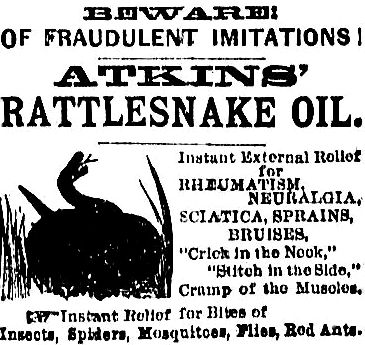
Southern Mercury, Oct. 9, 1888 (detail)

*

George T. Atkins was born in New York in 1837. Educated and having the bearing of a “trained businessman,” he drifted south and for some reason decided to join the Confederate army.

He was described by a fellow brigade member as a dark and handsome “compactly built” snappy dresser who “talked in a louder tone than the others, and [had] a peculiarly non-chalant, devil-may-care manner [that] emphasized his presence.” Atkins became a captain and quartermaster in the Fourth Kentucky Cavalry and though his position did not require participation on the battlefield, he was painted as something of a hot-dogging thrill-seeker: “[T]he gallant captain was frequently found in the ‘thickest of the fray,’ notably in the desperate battle at Saltville, where he recklessly and conspicuously rode up and down the lines, seeming determined to get himself killed.”

After the war, he eventually made his way to Texas with his family, arriving in Dallas in 1876 and settling into a large house at Ross Avenue and Masten Street (now St. Paul). At some point he opened a drugstore on Elm which seems to have been quite a successful enterprise. Perhaps it was his close proximity to drugs and medicinal compounds that prompted Atkins to launch his lengthy (and presumably lucrative) side-business as a snake oil manufacturer and salesman.

As far as I can tell, his “rattle snake oil” ads started around 1888. “Snake oil” has become a synonym for fraudulent wares sold by hucksters who know their products are ineffective but figure they can make a quick buck by grossly exaggerating — if not outright lying about — the magically curative properties of whatever it is they’re selling. As an actual “druggist,” Atkins probably had at least a little credibility compared to the other latter-day medicine-show men flogging their tonics and elixirs out of the back of a wagon before the law ran them out of town.

Southern Mercury, 1890 (det)

In fact, Atkins was, himself, such an expert flogger that his claim in ads that the United States Patent Office had officially ruled that his rattlesnake oil was “The Only True and Genuine Rattlesnake Oil” is automatically suspect, even though the editors of the Dallas Morning News (who, by the way, were no stranger to the popular and socially prominent Atkins, a man with, let’s not forget, a hefty newspaper advertising budget) published in its pages the following blurb (probably supplied by “the plaintiff”):

Dallas Morning News, Dec. 12, 1888

 1888 was a good year, and Atkins was riding a snake-oil wave of good publicity. There were even reports in the local papers that Dallas’ favorite herpetologically-inclined drugstore owner was hustling “live and uninjured rattlesnakes” to interested parties in Paris and London. I don’t know … maybe…. Probably just some more creative publicity.
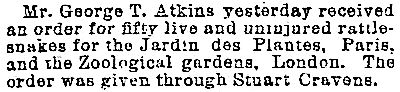
DMN, June 3, 1888

Atkins continued to run his drugstore and sell his snake oil until 1892 when, out-of-the-blue, he was assigned to dig the Texas Trunk Railroad out of receivership. The appointment seemed a little odd, but Atkins was a savvy businessman and a charming and persuasive speaker (he occasionally spoke in front of the Dallas City Council in a manner described as “felicitous and lucid”) — he could easily have back-slapped his way into the job. Despite the fact that he had no background in the railroad business, he seems to have spent several fairly productive years in the position. (His son, by the way, legitimately worked his way up through the ranks of the M-K-T, from lowly freight clerk to powerful executive VP.)

Eventually the railroad job ended and, in the waning years of the nineteenth century, Atkins seemed to be flailing a bit — he set the snake oil aside for a moment and placed an ad in the DMN classifieds soliciting investors to stake a claim in a Klondike gold scheme — at a mere $100 a share!
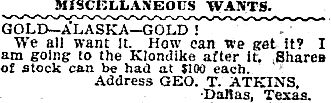
DMN, Aug. 8, 1897

 He continued in the rattlesnake oil biz until at least 1907, but at some point that began to fade away (or his inventory finally ran out), and he and his wife began running a boarding house. By 1918, though, he was tired of being a landlord and, at the age of 80, Atkins was finally ready to retire.

DMN, Oct. 20, 1918

The large 12-room house at Ross and Masten sold after spending a lengthy time on the market, and Atkins and his wife moved to Lemmon Avenue, where, ultimately, he died on August 8, 1920.

DMN, Aug. 9, 1920

 George T. Atkins placed COUNTLESS snake oil ads in newspapers for something like twenty years. Each ad had his name on it. Boldly. Proudly. And there’s nary a mention of the famous Atkins’ Rattle Snake Oil in his obit! That’s a shame, because, to me, that’s the single most interesting thing about the man. He was a career snake oil salesman! He was also one of Dallas’ very first advertising empresarios — an entrepreneur who had a natural flair for the creative hard-sell and knew how to wield it.

“TAKE NO SUBSTITUTE!”

*
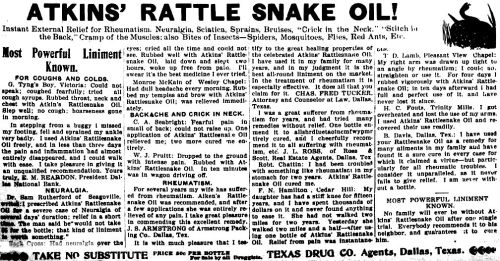
Southern Mercury, Dec. 20, 1900 (click to enlarge)

***

Quotes about Atkins’ time in the Confederate army from Kentucky Cavaliers in Dixie, Reminiscences of a Confederate Cavalryman by George Dallas Mosgrove (Madison: University of Wisconsin Press/Bison Books, 1999 — originally published in 1895); pp. 116-117.

Atkins’ physical examination of his snake oil, published in Chemist and Druggist (1890) can be seen here.

More on the Texas Trunk Railroad here.

*

Copyright © 2014 Paula Bosse. All Rights Reserved.

“Dallas Motor Cycle Cops” — 1910

dallas-police_motorcycles_1910_bReady and on the job…

by Paula Bosse

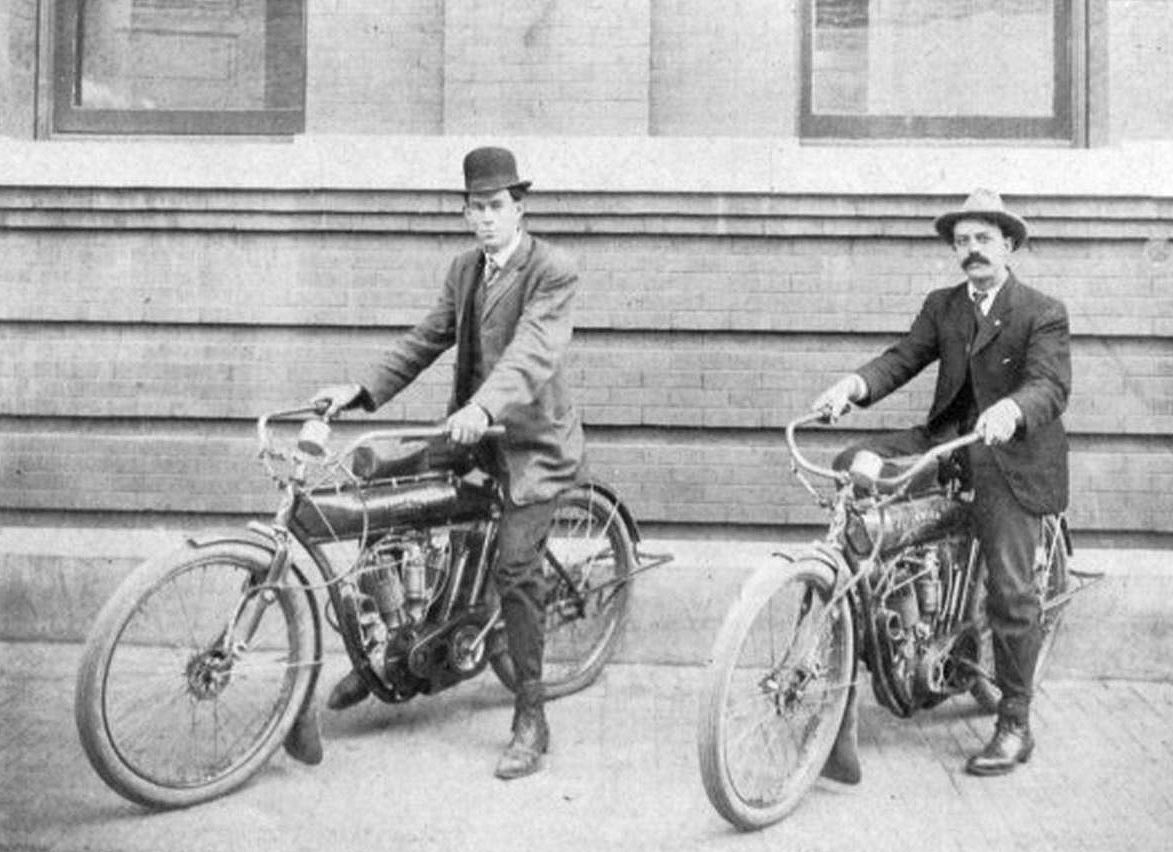
These photos of the Dallas Police Department’s “Motor Cycle Cops” appeared in a police publication from 1910.  We see them astride their machines, — one in a bowler hat — waiting for their call. Above, the “cops” are identified as B. G. Ford and A. W. Schulz; below, T. R. McSwain and S. R. Dean.

dallas-police_motorcycles_1910_a

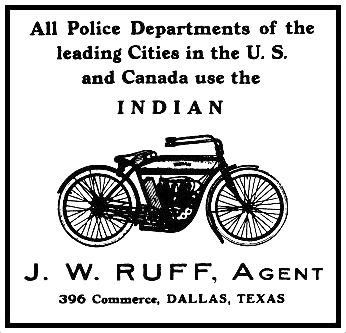
I can’t vouch for the models of the bikes, but this ad for Indian Motorcycles appeared just pages away.

ad-indian-motorcycles_1910

***

Sources & Notes

From a book with almost no publication info; it is presented simply as Dallas Police Department (Dallas, 1910). It’s got great photos and can be found on the Portal to Texas History site, here.

By 1951, the DPD’s allegiance had shifted to Harley-Davidson, as can be seen in the post “The Dallas Police Department & Their Fleet of Harleys — 1951.”

*

Copyright © 2014 Paula Bosse. All Rights Reserved.
From Deep in the Heart of Texas, I Give You Love Field — 1919

Love is in the air

by Paula Bosse

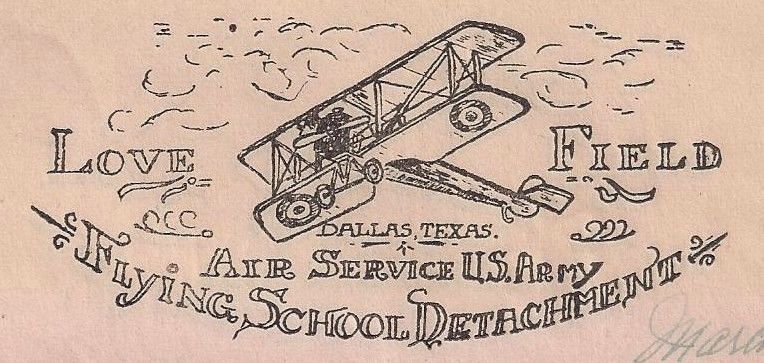
It’s Valentine’s Day — a perfect time to turn to Love Field (…which, like “Lovers Lane,” must sound a little cutesy to outsiders). The above image shows the letterhead of the U.S. Army Air Service Flying School Detachment, a consolidation of World War I squadrons based at Love Field from November 1918 to November 1919.

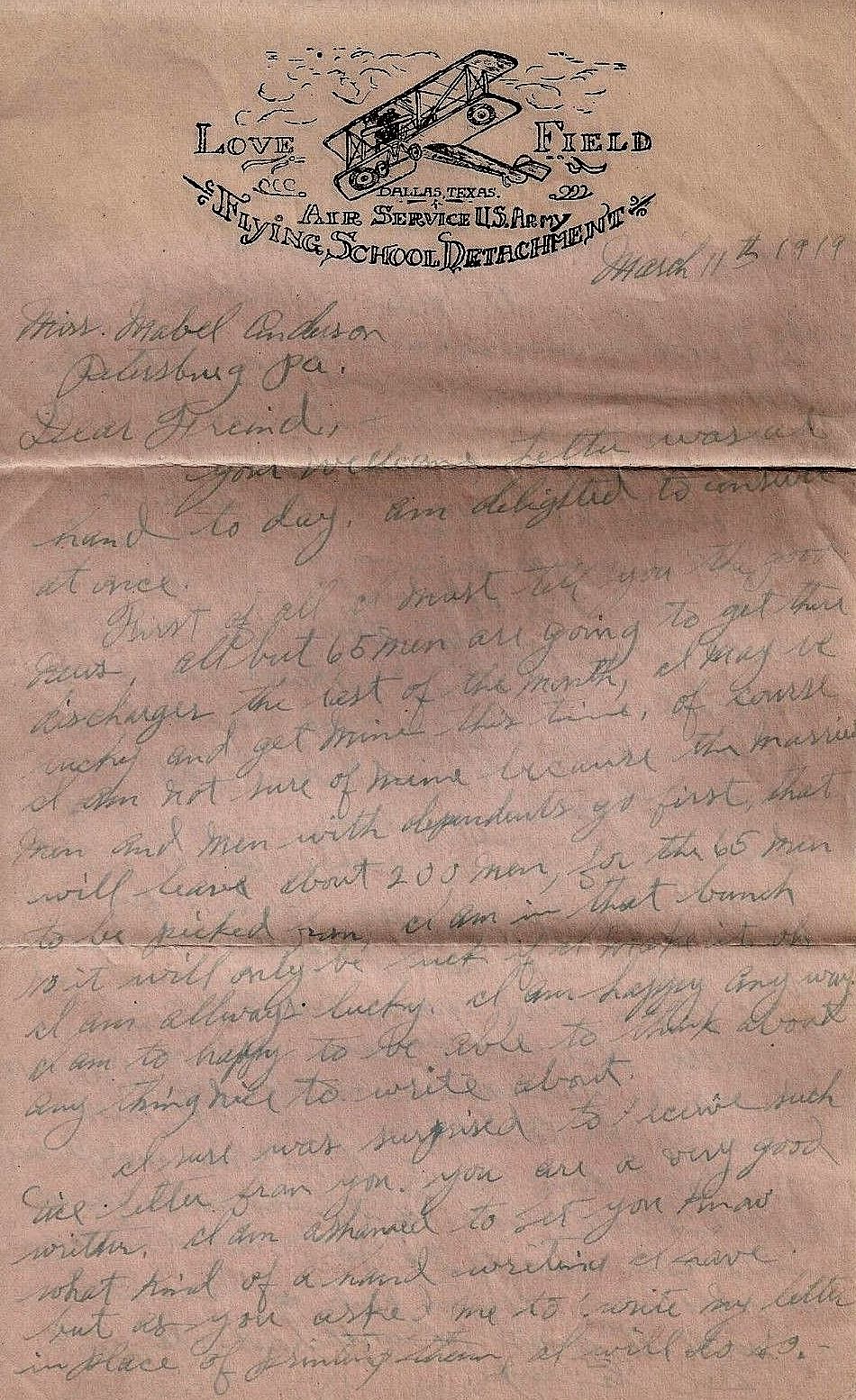
One of the young pilots stationed there wrote a four-page letter on this stationery. The letter, dated March 11, 1919, was addressed to Miss Mabel Anderson in Petersburg, Pennsylvania. They seem to have begun a sort of pen-pal correspondence, and he is certainly very happy to have received a letter from her. (“Your wellcome [sic] letter was at hand today. Am delighted to answer at once.”) He asks if she would send him a photograph and tells her he’d like to meet her. He says that he is hopeful that, the war finally over, he will be discharged at the end of the month — he thinks he will be because, “I am allways [sic] lucky.”

This is an item for sale on eBay, and only the first page is scanned, so the identity of the author of the letter will remain unknown to those of us merely browsing an auction listing, interested but unwilling to cough up the cash to buy it and read any further. I wonder what happened? If he wanted to meet her, then perhaps he, too, was from Pennsylvania — they might have met when he arrived back home. He certainly sounds excited and hopeful and flirtatious, and he should, because not only was he “allways lucky,” but the long war had finally ended and he was headed home with his whole life ahead of him. Where’s Paul Harvey to tell us the rest of the story?

Happy Valentine’s Day!

***

This four-page letter on Love Field letterhead was recently up for auction on eBay, with the following description: “Letter from airman to a young girl asking for her picture and wanting to meet her. Very early US Army Air Service stationery from Love Field in Dallas Texas. Just after the end of WWI. Scarce Item.”

Here is the first page, with a transcription (spelling corrected) below (click to see a larger image).

love-field_letter_1919

Miss Mabel Anderson
Petersburg, Pa.

Dear friend,

Your welcome letter was at hand today. Am delighted to answer at once.

First of all I must tell you the good news. All but 65 men are going to get their discharges the last of the month. I may be lucky and get mine this time. Of course I am not sure of mine because the married men and men with dependents go first. That will leave about 200 men, for the 65 men to be picked from. I am in that bunch, so it will only be luck if I make it ok. I am always lucky. I am happy anyway. I am too happy to be able to think about anything nice to write about.

I sure was surprised to receive such a nice letter from you. You are a very good writer. I am ashamed to let you know what kind of a handwriting I have, but as you asked me to write my letter in place of printing [it], I will do so.

*

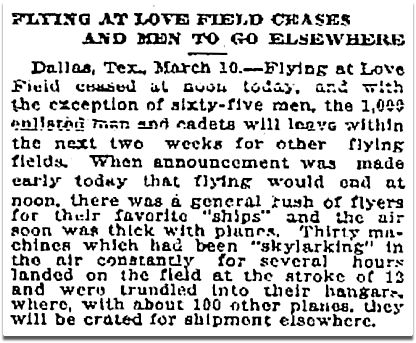
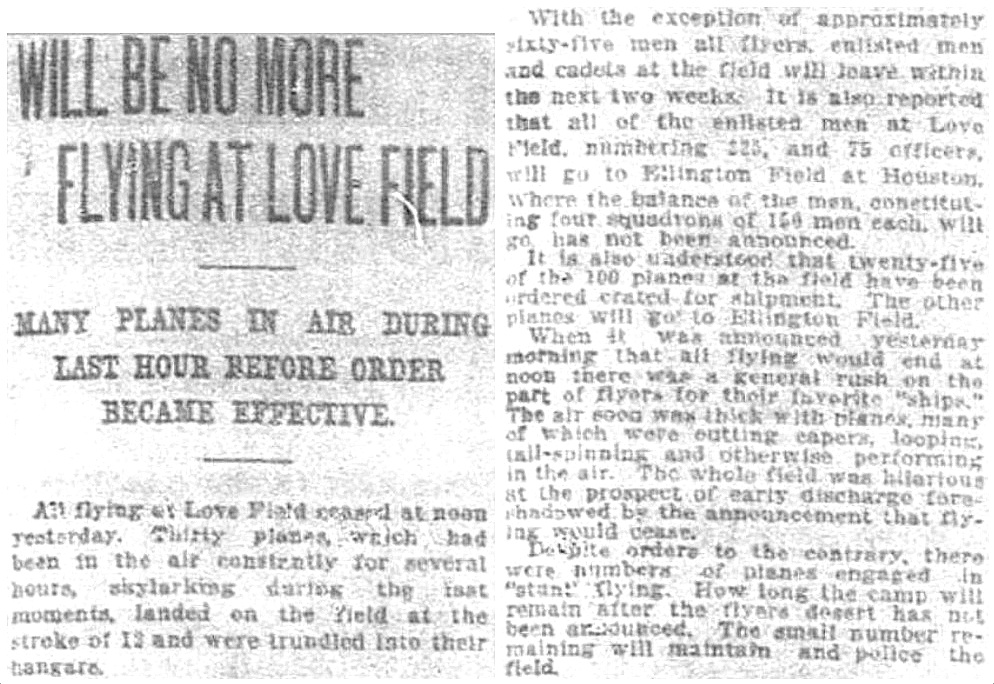
Here are two stories about how the airmen stationed at Love Field responded to the announcement that all flying would cease at noon on March 10, 1919 before demobilization began. It sounds like something from a movie: a sky full of something like 30 airplanes looping and “skylarking,” their pilots celebrating their fast-approaching military discharge by flying their favorite “machines” for the last time.

love-field_galveston-news_031119Galveston News, March 11, 1919

love-field_dmn_031119Dallas Morning News, March 11, 1919 (click for larger image)

*

Copyright © 2014 Paula Bosse. All Rights Reserved.

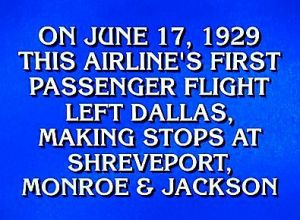
Delta Air Lines’ First Passenger Flight — 1929

by Paula Bosse

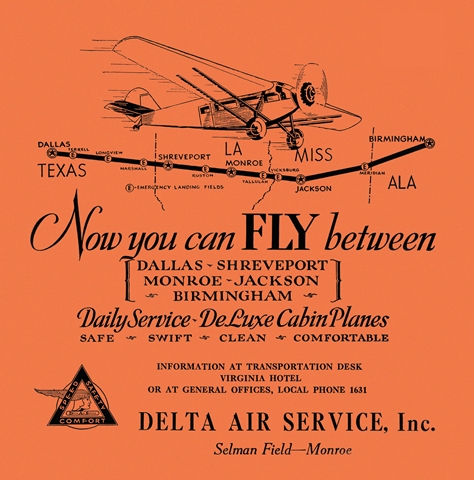
Delta Air Lines has had a longer — and more important — association with Dallas than you might think. On June 17, 1929, Delta made its first-ever passenger flight, from Dallas to Jackson, Mississippi via Shreveport and Monroe, Louisiana. According to the Love Field website, “Early flights operated from a passenger terminal near Bachman Lake, which later served as Southwest Airlines’ first headquarters building.” On that first flight, the five passengers sat in wicker chairs and could roll down windows (!) for needed ventilation. The flight took five hours. One of the first ads, from the Delta Flight Museum page, looked like this:

Delta passenger service ad ca. September 1929.

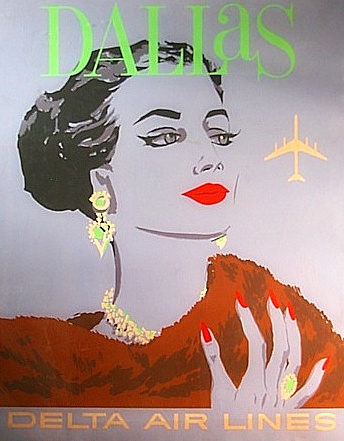
Forty-some-odd years later, the ads — and Dallas — got a bit more sophisticated.

delta_dallas_fur

delta_dallas_fredric-sweney_playing-cardsArtist: Fredric Sweney

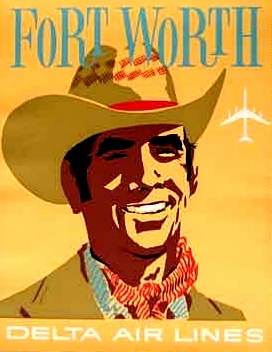
And we can’t leave out Cowtown!

delta_fort-worth

**

UPDATE, June 20, 2017: This almost-three-year-old post got a TON of hits yesterday, and I couldn’t figure out why. Eventually, though, I tracked it down: it had to do with yesterday’s Final Jeopardy question (or is it “answer”?):

delta_jeopardy_061917

Nice to see that Jeopardy is incorporating Dallas history into the show!

***

Top travel poster — showing Fort Worth in the distance, I guess? — by Jack Laycox.

For a really well-researched article by Timothy Harper describing that first flight, click here (the Dallas bit is contained in the last seven paragraphs).

*

Copyright © 2014 Paula Bosse. All Rights Reserved.