Flashback : Dallas

A Miscellany: History, Ads, Pop Culture

Send Your Kids to Prep School “Under the Shadow of SMU” — 1915
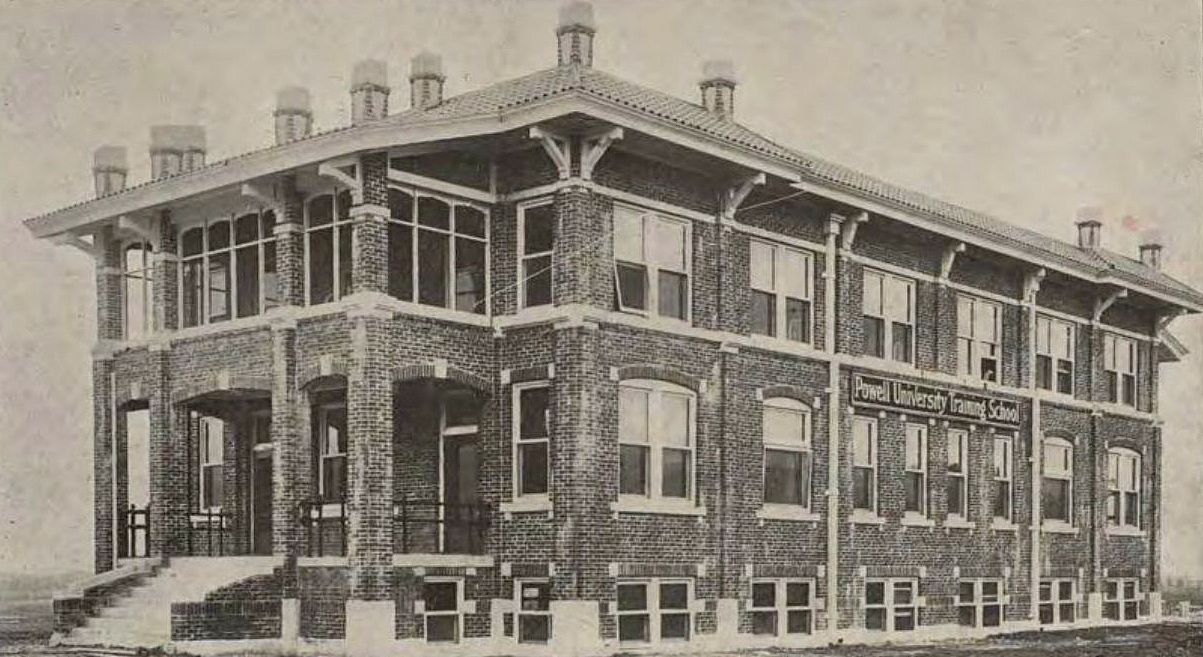
powell-prep_rotunda_1916Powell University Training School, 1915

by Paula Bosse

Nathan Powell (1869-1963) was a former Methodist minister who opened his prep school, Powell University Training School, on thirty acres of open land, just across an unpaved road from SMU (which was still in the very early days of its construction). SMU and the Powell school shared more than just adjacent addresses — which they both rather idealistically touted as being “situated on high ground overlooking the university campus and the city” — they also opened on the same day, September 15, 1915.

The location and the opening date were not a coincidence, as Dr. Powell was one of the Methodist movers and shakers who originally promoted the idea of Dallas as the site for a new Methodist university. The following (perhaps exaggerated) sentence can be found in the (perhaps overly laudatory) profile of Powell in one of those ubiquitous late-19th, early-20th century “mug books,” A History of  Texas and Texans (1916):

Beyond his activities as a minister and teacher, the most notable achievement in the life and career of Doctor Powell lies in the fact that he was the sole originator and promoter of the great Southern Methodist University at Dallas, which began its first year September 15, 1915.

Powell University Training School lasted for only about twelve years, until Powell’s rather sudden retirement in 1927 (the good reverend’s “retirement” might have been precipitated by numerous lawsuits and mounting debt). When the school closed, Dr. Powell and his family moved to Harlingen to — as his obituary states — “help organize the grapefruit growers of the Rio Grande Valley.” He operated a citrus nursery himself for a while until it was destroyed by a 1933 hurricane. Nathan Powell died in Harlingen in 1963 at the age of 94.

It’s always exciting to see old buildings still standing in Dallas, and, happily, this one is still around — and it still looks good. Fittingly, it’s currently home to an early-child development center. Next time you’re near the intersection of Binkley and Hillcrest, go take a look.

*
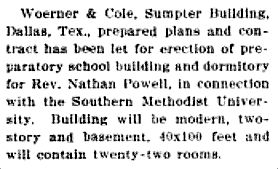
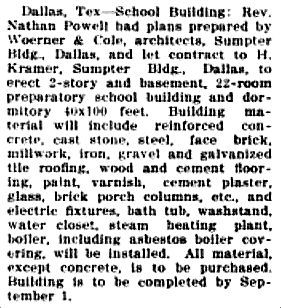
powell_tx-trade-rev-industrial-record_071515a*powell_tx-trade-rev-industrial-record_071515bBoth items from the Texas Trade Review & Industrial Record, July 15, 1915
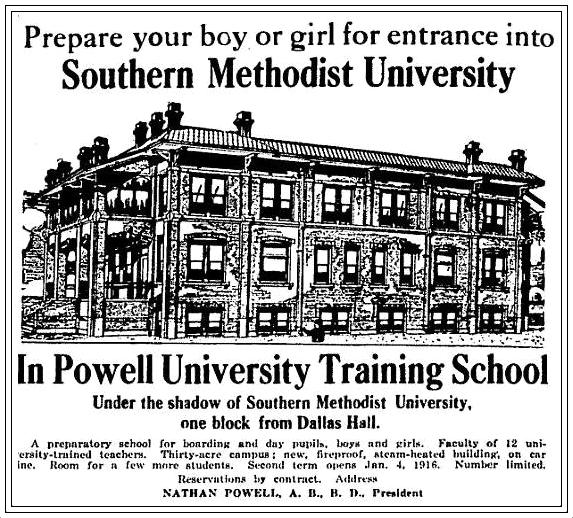
powell_school_ad_smu-times_121815SMU Times, Dec. 18, 1915 (click for larger image)
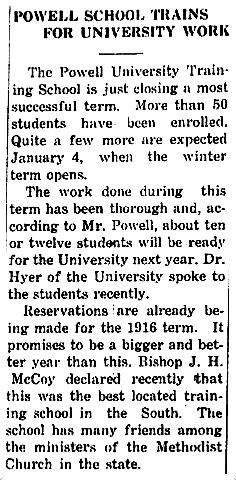
powell_school_smu-times_121815SMU Times, Dec. 18, 1915

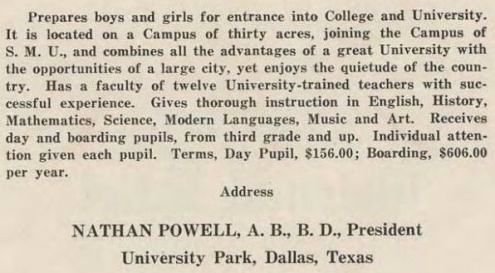
ad-powell-prep_smu-rotunda-19161915 (click to read text)

Below, after the school closed. Looking a little shaggy. I would have guessed the photo was from much earlier, but it’s dated 1931. Complete with horse.
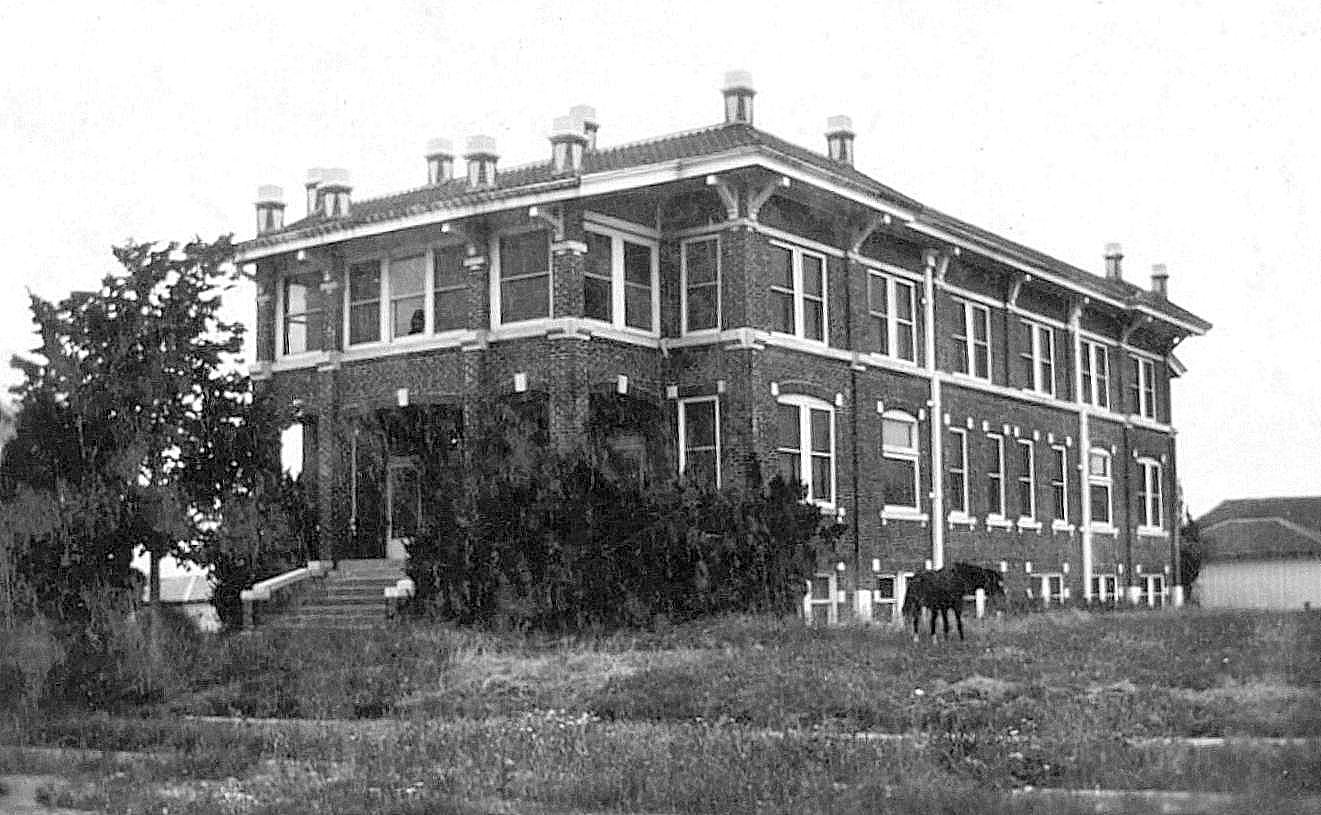
powell-univ-training-school_brown-bk_university-park_19311931, Brown Book, University Park Public Library

***

Sources & Notes

Top image and bottom ad appeared in the very first edition of The Rotunda, SMU’s yearbook for their inaugural year, 1915-16.

More on Rev. Powell’s early life and involvement with the founding of Southern Methodist University can be read in A History of Texas and Texans by Frank W. Johnson (Chicago and New York: American Historical Society, 1916), here.

Information regarding Powell’s retirement in Harlingen is from “The Chronological History of Harlingen” by Norman Rozeff (circa 2009), in a PDF here.

Powell’s obituary can be found in The Dallas Morning News, Nov. 8, 1963: “Dr. Powell Dies; Helped Found SMU.”

Currently occupying 3412 Binkley is The Community School of the Park Cities. According to the history page of their website (here), the building has been operated as a school since at least the 1950s.

I’m not sure what the actual facts are concerning Nathan Powell’s role in the founding of SMU. There are very few results when searching the internet. Most newspaper articles connecting him with the university seem to have been generated by Powell himself. If Powell was as important in the history of SMU as he claimed to be, it’s surprising to see so little information on any connection. Was Powell’s assertion that he was the driving force behind the creation of SMU a blatant lie? Was it merely an exaggeration of the truth? Or was it accurate, but something happened to cause the university to distance itself from him? A collection of papers in the SMU archives (which I have not seen) seems to indicate that there were those in Methodist circles who disputed Powell’s claims, as Elijah L. Shettles took it upon himself to prove that Nathan Powell was the driving force behind the very existence of SMU. An overview of the collection — The Elijah L. Shettles Papers on the Founding of Southern Methodist University — can be found here.

(I’ve found an article from the Fort Worth Star-Telegram in 1910 that had Powell all but saying Fort Worth — not Dallas — would be the best choice for the university’s location. Read that article and see other photos of the school — and also read about the lawsuit against Powell (which had nothing to do with SMU) that took thirteen years to reach trial and ended in quite a hefty judgement, in a PDF here.)

See more of SMU’s first year in previous posts here and here.

*

Copyright © 2014 Paula Bosse. All Rights Reserved.

Up North in Denton: “Famous School and College County”

denton-co-courthouse-1928Denton County Courthouse, 1928 (click for larger image)

by Paula Bosse

Okay, so it’s not Dallas, but who in Big D doesn’t love Little D? Besides, this is just too great a photo to keep to myself.

And in case you need to bone up on your 1928 Denton County stats for “Jeopardy” or something, look no further (click for larger image):

denton-co-courthouse_1928b

“Kindergarten to College Degree —
Board at home and be educated free.”

Free!

*

Might as well see where the photo of the courthouse was taken from: the Wright Opera House (now Recycled Books). Here it is, about 1900:

denton-opera-house_1900_tx-historian_1982The Wright Opera House, built in 1899, shown here in 1900 (click for much larger image)

***

The photo of the courthouse and the ad are both from, where else, the program for the 52nd Annual Convention of the State Firemen’s Association of Texas, held in Denton in June of 1928. If you’re into firefighting ephemera or old Denton photos, you might want to peruse it yourself: click here. (From the collection of the Denton Public Library.)

Photo of the Opera House from the article “Faded Echoes: A History of the Wright Opera House in Denton” by Clare Adkins, featured in the September, 1982 issue of Texas Historian, accessible through the Portal to Texas History, here.

Click pictures for larger images.

*

Copyright © 2014 Paula Bosse. All Rights Reserved.

Interurban vs. Streetcar

interurban-vs-streetcarOh dear…

by Paula Bosse

I’m not sure what’s happened here, but it looks like the interurban has emerged victorious.

***

Sources & Notes

I don’t know the original source of this photo, but I came across it on the Northern Texas Traction History Group on Facebook. The electric-powered interurban car is the big red one on the left; the puny (but cute) electric-powered green streetcar is on the right. The view here is looking north on Record, from just south of Young Street, inside what would one day be called “Communications Center”: the Dallas Morning News Building is on the left, and the not-yet-built WFAA studios will later be to the immediate right (east). The long-gone Hotel Jefferson is north of Ferris Park (the hotel was catty-corner from Union Station, across Houston Street). In the distance you can see the tippy-top of the Old Red Courthouse, just above the green streetcar. Also, those now-gone smokestacks that were such a fixture on the skyline are straight ahead.

*

Copyright © 2014 Paula Bosse. All Rights Reserved.

“Speed With Safety” on the Crimson Limited — 1930

crimson-ltd_interurban_1930

by Paula Bosse

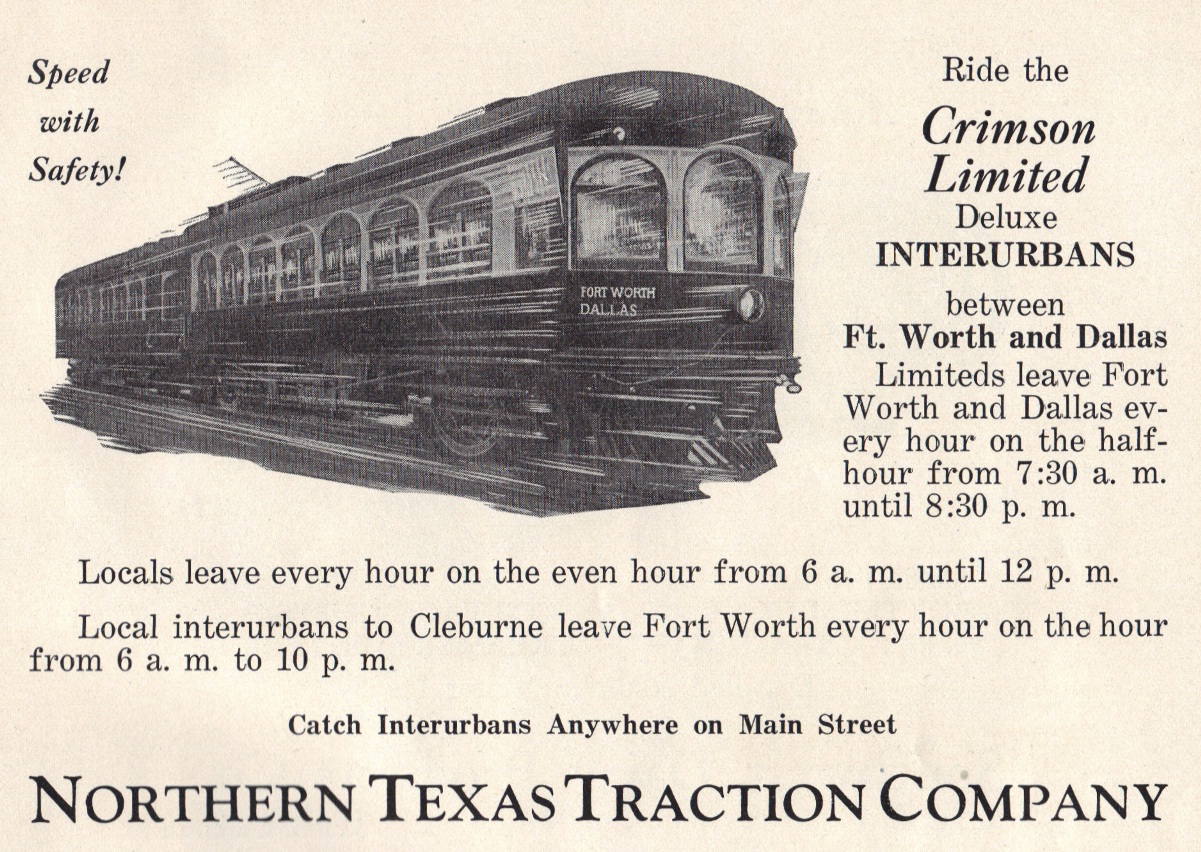
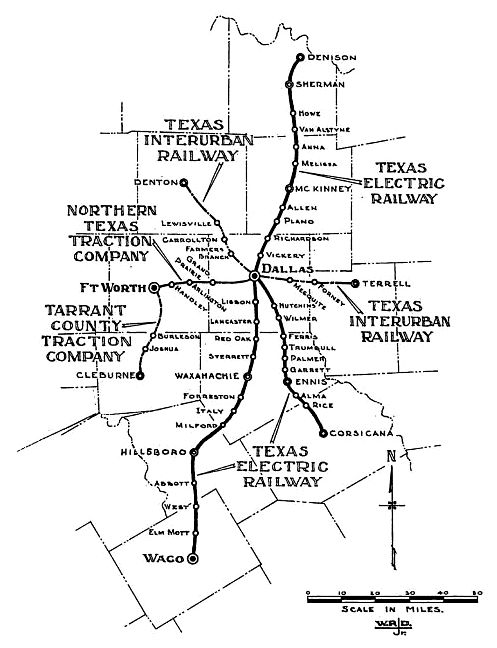
A 1930 ad for the Crimson Limited deluxe interurbans (electrified railway trains) that ran between Dallas and Fort Worth, a couple of years before the company went into receivership, put out of business by the rise of automobile culture. Even though the writing was pretty much on the walls, the Northern Texas Traction Company fought hard to reverse the decline in ridership by introducing these fancy Crimson Limited cars:

The most notable of their moves was the introduction of the Crimson Limited in October of 1924. The Crimson Limited was the name given to the upgraded interurban service to Dallas because the cars were painted bright red. The trailer car saw the most extensive upgrades. The bench seats in the rear half of the car were removed and replaced with wicker chairs. The rear doors were converted to windows giving the car a ‘parlor car’ appearance. Additional upgrades were implemented in 1927. Although the public approved of the new more luxurious trains and more modern streetcars, they continued to abandon mass transit for the automobile. (–North Texas Historic Transportation, Inc.)

Wicker chairs? Pure LUXURY!

interurban-map

***

Sources & Notes

The ad is from an old magazine I can’t cite because it’s stuck in a box in a closet somewhere.

The quote is from a page on the North Texas Historic Transportation site.

For more on this topic, check out the nice, meaty, image-filled post (which includes an ad touting the somewhat vague “Special Conveniences for Ladies”) on the Hometown by Handlebar blog, here. (Hometown by Handlebar is a really great Fort Worth history blog that might prove I was separated at birth from a twin sibling I knew nothing about!)

Not quite sure what an “interurban” is? Fret not. Wikipedia’s here to help, here.

*

Copyright © 2014 Paula Bosse. All Rights Reserved.

Thanks, Ticket Guys!

ticket-logo

by Paula Bosse

Got a flood of Twitter followers from the great mention last Saturday on The Orphanage show. Thank you so much, guys!

A brief snippet — with hosts Danny Balis and Dave Lane, as well as the wonderful Robert Wilonsky of The Dallas Morning News as guest — can be heard here. (Love ya, Robert, but even though I worked at the Preston Royal Borders for several years, I was not actually the General Manager!)

*

Copyright © 2014 Paula Bosse. All Rights Reserved.
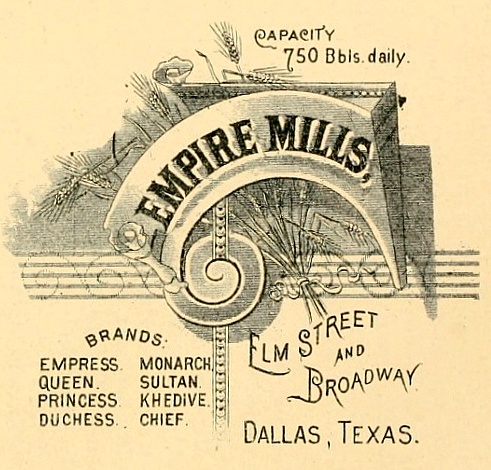
Empire Mills — Grinding Wheat Into Wedding Presents Since the Cleveland Administration

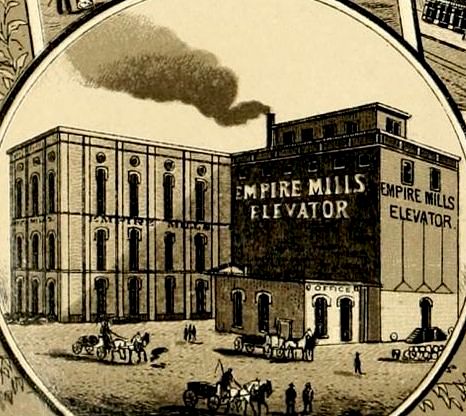
empire-mills_imm-gd_1889aFlour central!

by Paula Bosse

Exciting news hit the pages of The Dallas Herald on March 26, 1885:

A contract was closed last night for the erection of a mammoth 250-barrel, full roller flouring mill with all the latest machinery in this city. The promoters are W.C. Howard, J. Rauch and S.T. Stratton. It will be called the Empire Mills.

The mill opened in September, with the company’s proclamation that their new “roller mills” were “the largest and finest ever erected in the South.” It was located at Elm and Broadway, near the Trinity River. In a newspaper interview, John Neely Bryan’s son described the location of his father’s famous cabin as being “at the top of the hill, about where Empire mills are now located” (Dallas Morning News, Aug. 11, 1889). So, about where Dealey Plaza is today. Wheat was a major crop in North Texas, and the mill was a successful and important addition to the growth of the city.

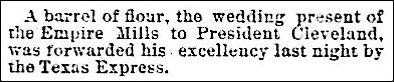
But it wasn’t all crushing and grinding. One must occasionally participate in the world of social niceties. So when the president of the United States is getting married, what better way to commemorate the occasion than by presenting the happy couple with a romantic and self-promoting barrel of flour?

cleveland-flour_dmn_053086DMN, May 30, 1886

cleveland-flour_dmn_070586DMN, July 5, 1886

One wonders what the newlyweds exclaimed as they tore the bow from that barrel? It probably wasn’t, “Oh! Flour! How stupendous!”

empire-mills_clifton-church_1894

empire-mills_souv-gd

empire-mills_imm-gd_1889b

***

Sources & Notes

Top and bottom images from an ad in The Immigrants Guide to Texas (1889).

Photograph by Clifton Church, ca. 1894.

Next to last illustration from Souvenir of Dallas, Texas (c. 1888).

Roller mill? Right this way.

*

Copyright © 2014 Paula Bosse. All Rights Reserved.
Ernie Banks: From Booker T. Washington High School to the Baseball Hall of Fame to the Presidential Medal of Freedom

banks-ernie_jet_110355
Ernie Banks and George Allen, Oct. 1955 (Jet magazine)

by Paula Bosse

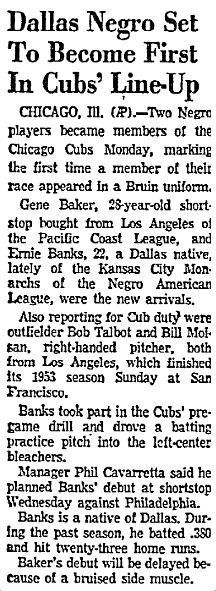
Ernie Banks, the baseball player so indelibly linked with Chicago that he is known as “Mr. Cub,” is a Dallas native whose professional career began when he was spotted by a Negro League scout while playing softball in a park near his high school, Booker T. Washington. He was recruited right away and made his mark almost immediately, and, in 1953, he and Gene Baker became the first African American players signed to the Chicago Cubs.

One of the sport’s most popular players, Banks, who began his career playing shortstop, routinely shattered home run records and was a perennial MVP and All-Star player. Even though his Cubs never made it to the World Series, Banks was a stand-out player, and his election to the Baseball Hall of Fame in 1977 came as no surprise. I have to admit, my knowledge of baseball is scant, but I love this man, and it’s a testament to “Mr. Cub” that he is as famous for his genuine nice-ness as he is for his undisputed skill as a player.

banks_dmn_091553AP, Sept. 15, 1953

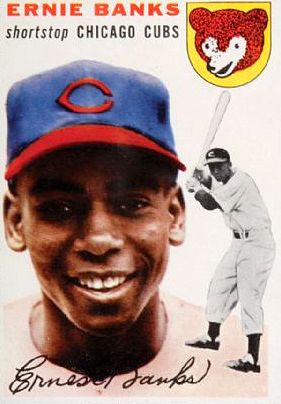
ernie-banks_rookieErnie Banks’ rookie card – Topps, 1954

ernie_banks

*

Oct. 11, 1955 was declared “Ernie Banks Day” in Dallas. Ernie was in town to play an exhibition game between the Major League Negro All Stars and the Negro American League All Stars (Ernie’s major leaguers won, 6-2) — while he was here, he enjoyed the hometown adulation and was lauded with gifts. The photo at the top of this post was from that day, as is the one below, in which he poses with his wife, Mollye Banks.

banks-ernie_wife-mollye-ector-banks_101155_patton-collection_DHSHometown hero, Oct. 11, 1955 (Dallas Historical Society)

***

Sources & Notes

Top photo from Jet magazine, Nov. 3, 1955; a version ran in The Dallas Morning News on Oct. 12, 1955 above the following caption: “Honors came thick and fast for Ernie Banks at Burnett Field Tuesday night. Appearing with a group of barnstorming Major League All Stars, Banks was presented a new Oldsmobile (background), a Texas style hat and scrolls and trophies. With Banks is George Allen, chairman of the citizens’ appreciation committee which presented the automobile. The mayor [R.L. Thornton] proclaimed Oct. 11 Ernie Banks Day in Dallas.”

The photo of Banks and his wife, Mollye Ector Banks, in Dallas is from the John Leslie Patton Jr. Papers, Dallas Historical Society (Object ID V.86.50.902).

Check out these articles from The Dallas Morning News archives:

  • “Banks to Tackle First — Reluctantly” by Bud Shrake (DMN, March 16, 1962) — with a few paragraphs on growing up in Dallas
  • “From Dallas to Cooperstown” by Randy Galloway (DMN, Jan. 20, 1977)

A nice overview of Ernie Banks’ career titled “Nice Guys Don’t Always Finish Last” by Steven Schmich (from his larger article titled “Five Dallas Athletes Who Made a Difference”) can be read in the Spring, 1994 issue of Legacies magazine here. (In fact, the entire issue of this Dallas history journal is devoted to sports and is available to read in its entirety, beginning here.)

Stats? I got yer stats, right here.

In November 2013, Ernie Banks was awarded the Presidential Medal of Freedom. A few short words from him after the ceremony say all that really needs to be said from this wonderful man — watch the short video here.

UPDATE: Sadly, Ernie Banks has died. He died Friday, January 23, 2015. He was 83. The New York Times obituary is here; the Chicago Tribune’s wonderful collection of tributes and photos is here.

*

Copyright © 2014 Paula Bosse. All Rights Reserved.

Skate Date!

skate-date_ebay-smSkating at Fair Park…

by Paula Bosse

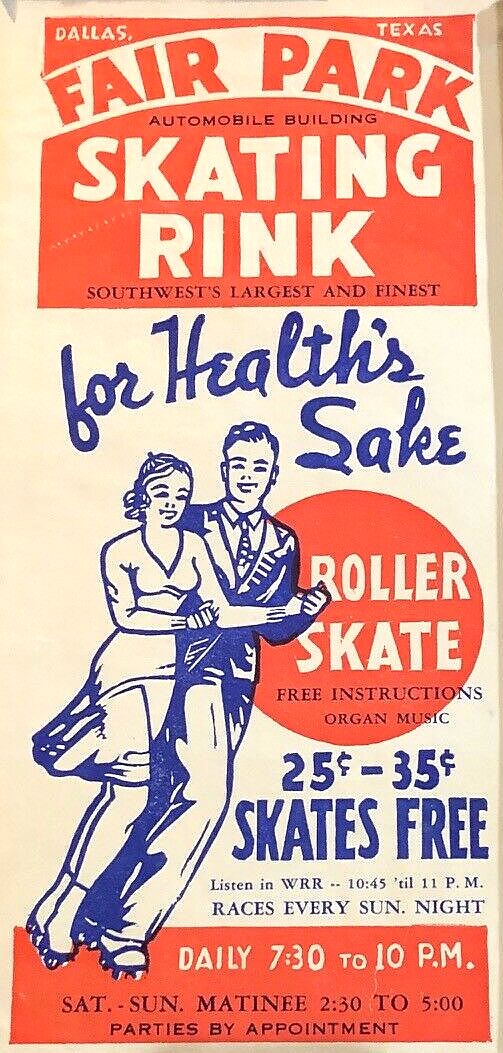
The Fair Grounds Skating Rink opened in the old Machinery Hall in 1906 at the height of the roller skating fad that was sweeping the nation. Over 1,000 people were “on the floor” on opening night, and the rink was an immediate hit with the city’s “roller-maniacs.” Though apparently very popular, it closed rather suddenly in 1907 when it was discovered that the concessionaires were selling more than cold drinks to patrons — they had also been operating a prostitution business right there on the (city-owned) premises.

It wasn’t until 1921 that the rink re-opened (managed by a man who may well have been one of the guys who operated the lucrative illicit side-business back in the aughts). It seems to have closed again for a while and then re-re-opened sometime in the ’30s, a time when business was steady and booming. But, sadly, the building burned down in 1942. BUT, a new, flashier rink was built right away, near (…next to? …in?) the Cotton Bowl (the ad below mentions the Automobile Building), and this one lasted a good long time, until at least 1957.

So, 1906-1957, give or take a few years — not a bad run for roller skating in Fair Park (…unless you count the bleacher bordello and the fiery conflagration). All skate!

fair-park_skating_watermelonkid

fair-park-skating-rink_matchbook_ebay

***

Sources & Notes

Top photo (of an attractive but unidentified couple) from eBay. Click it for a MUCH larger image (and check out the cool Fair Park Skating Rink logo to the right of the man’s head).

Postcard from the Watermelon Kid’s site, here. (It is also larger when clicked!)

Bottom image from eBay.

*

Copyright © 2014 Paula Bosse. All Rights Reserved.

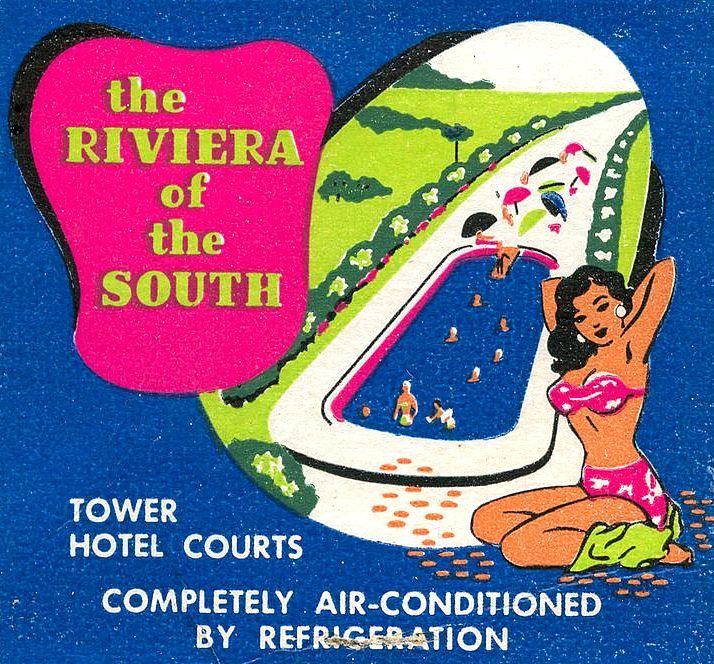
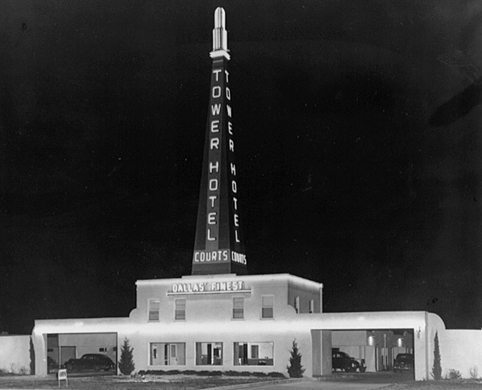
“The Riviera of the South” — On Harry Hines!

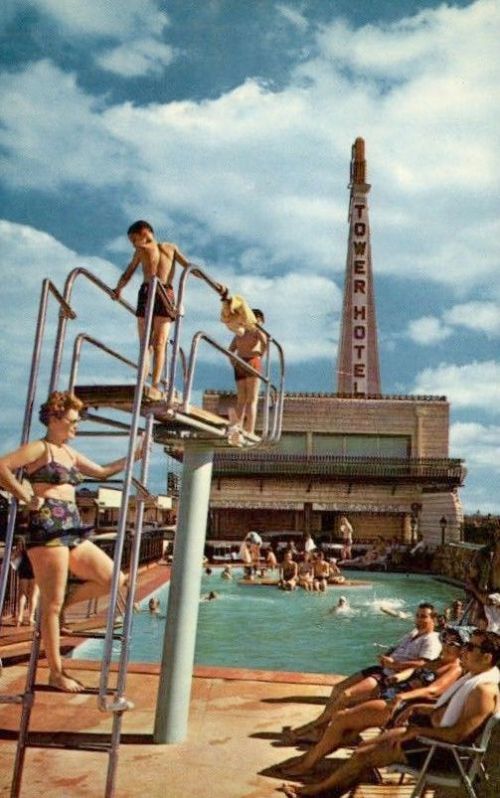
tower-hotel-courts_pool-match_flickr-smThe paradise of Harry Hines awaits…

by Paula Bosse

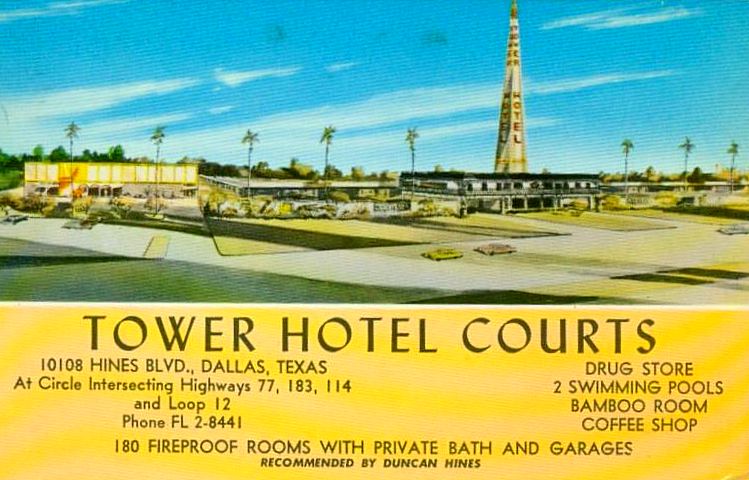
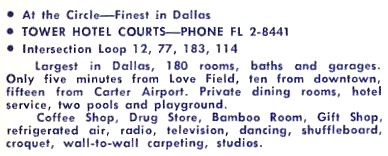
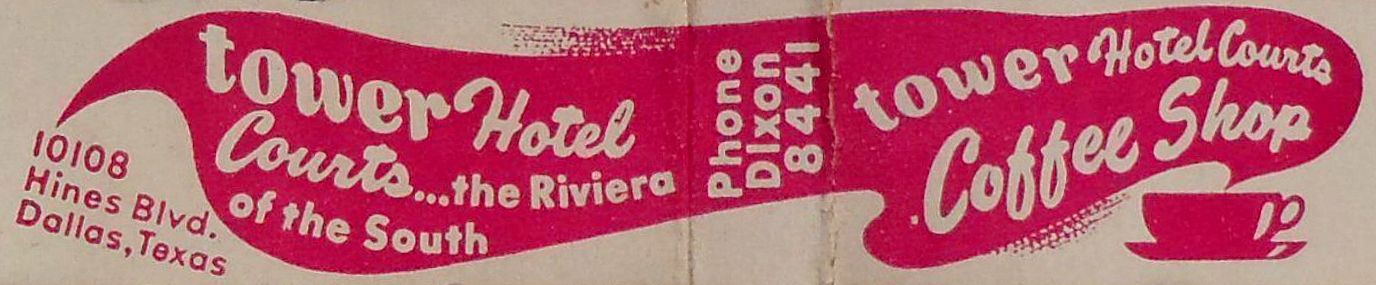
The Tower Hotel Courts opened in the fall of 1946. Their address makes my had spin: at “The Circle” where highways 77, 183, 114, and Loop 12 intersect. “10108 Harry Hines” would have been easier to fit on the stationery, but mention of all those highways just made everything more exciting. (It also gave some indication to prospective guests of what would be awaiting them, such as constant traffic noise and the ever-present whiff of exhaust in the air. “You can’t say we didn’t warn you, madam.”)

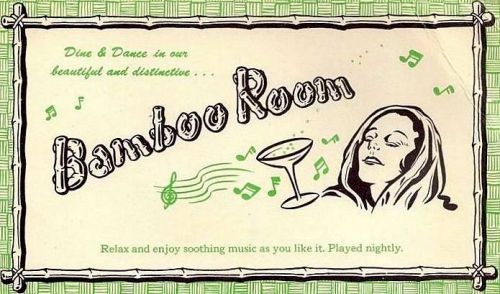
The fancy motel was five speedy minutes away from Love Field, which seems handy, because if you had an hour or seven to kill before your flight, wouldn’t you want to spend it there in the fabulous-looking Bamboo Room? I would! (Even though I’m pretty sure that matchbook cover is a little more glamorous than the actual Bamboo Room.)

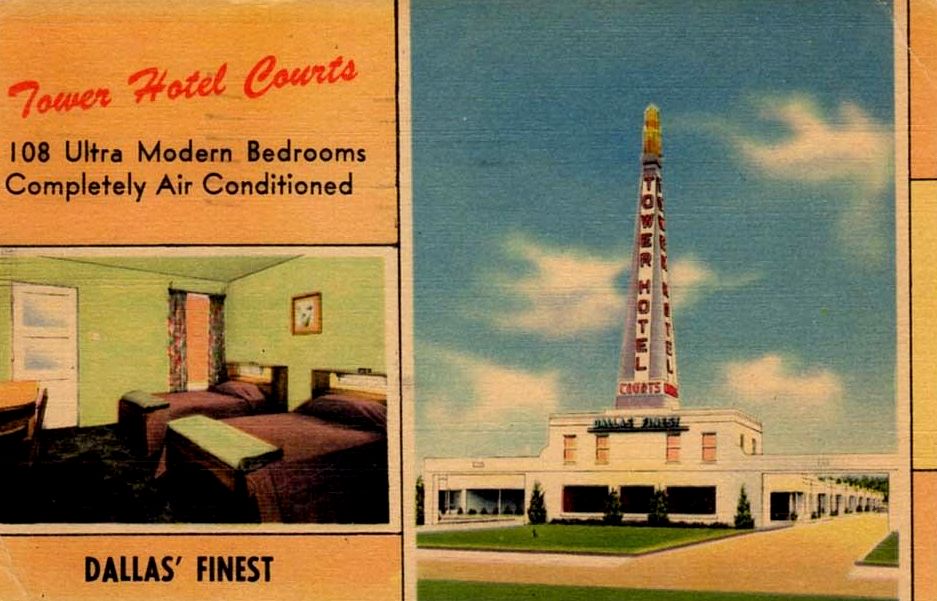
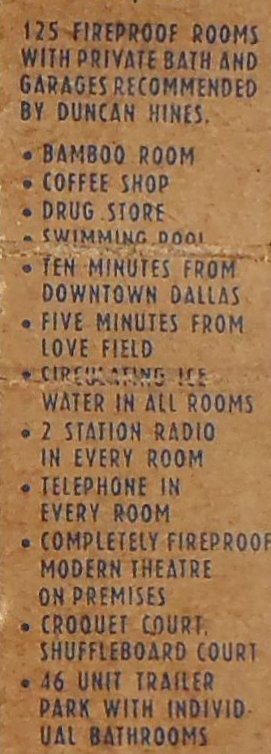
If you were going to stay for a day or two and not just a few drinks, there were all sorts of things waiting for you: two pools (one a very large children’s wading pool), a theater, a croquet court AND a shuffleboard court, “circulating ice water,” and … stand back … a 2-station radio in every room. Somewhere in amongst all of this was a 46-unit trailer park (“with individual bathrooms”).

It’s not hard to see why they called the Tower Hotel Courts The Riviera of the South.”

tower-hotel_bw

tower-hotel-courts_postcard2

tower-hotel-courts_postcardUltra Modern!

tower-hotel-courts_pool-smOwner’s wife and kids?

tower-hotel-courts_pool_back

tower-hotel-courts_riviera

tower-hotel-courts_riviera_inside

tower-court-hotel_bamboo-room_flickr

tower-hotel-courts_pool-match_flickr-sm

***

First and last images from Flickr; Bamboo Room image also from Flickr.

Several of these pictures are larger when clicked.

*

Copyright © 2014 Paula Bosse. All Rights Reserved.

Tietze Park

tietze_1946_c

by Paula Bosse

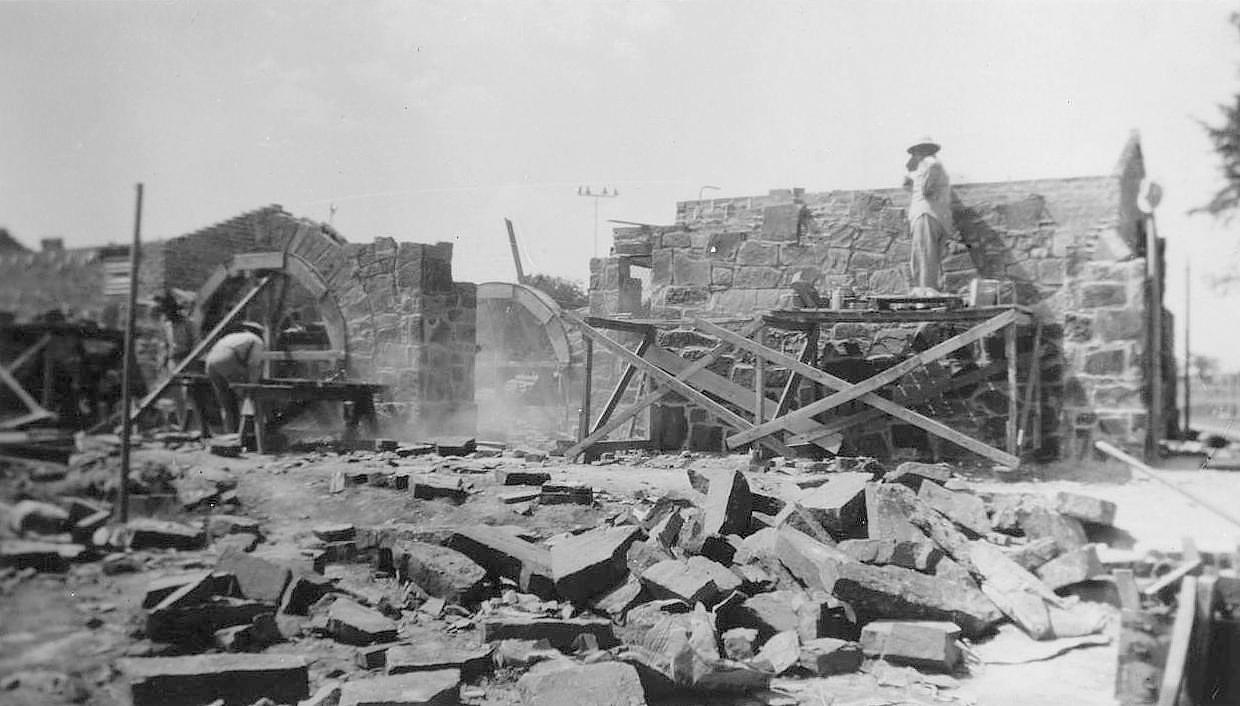
Tietze Park was my neighborhood park growing up — it’s where I learned to swim and got sunburned every summer because I stayed there so long. It straddles 75206 and 75214, in that area that’s not quite Lower Greenville, not quite M Streets, and not quite Lakewood. It’s on Skillman, bordered by Llano and Vanderbilt. You’ve probably seen the famous tree at the Vanderbilt corner. And you’ve probably jokingly referred to it as “Tsetse” Park while suppressing a power-of-suggestion sleeping-sickness-inspired yawn (like right now). It’s a cute little park, with wonderful WPA touches. Here are photos from 1946 of some repair work being done on the stone buildings and construction of a new pool. It looks pretty much the same today.

tietze_1946_b

tietze_1946_a

To see a photo of what the pavilion looks like today, check out a great photo by Sarah Whittaker from CultureMap, here.

***

Photos from the Dallas Municipal Archives, accessed through the Portal to Texas History site.

A history of the park — which started out as “Keith Park” in 1924 but was re-named in 1934 in honor of William R. Tietze, former Parks Department superintendent — can be found on the Friends of Tietze Park Foundation website here.

Here’s a nice drawing of the plan for the park (I came across this somewhere on Facebook, I think, but neglected to make note of the source):

tietze park_plan

A nostalgic look back at the park can be found in the Lakewood Advocate article “Memories of Tietze Park Pool” by Patti Vinson, here.

For a video that captures the laid-back feel of the neighborhood surrounding the park, check out the video of the catchy song “We’ll Go Walkin'” by local band The O’s. It’s great. The first line is “We’ll go walkin’ to Tietze Park.” And then they do. If you’re familiar with the neighborhood, you’ll recognize everything along their walk. And they end it in front of *that tree.* So it’s totally worth it. (The band’s website is here.)

*
Click photos for larger images.

*

Copyright © 2014 Paula Bosse. All Rights Reserved.