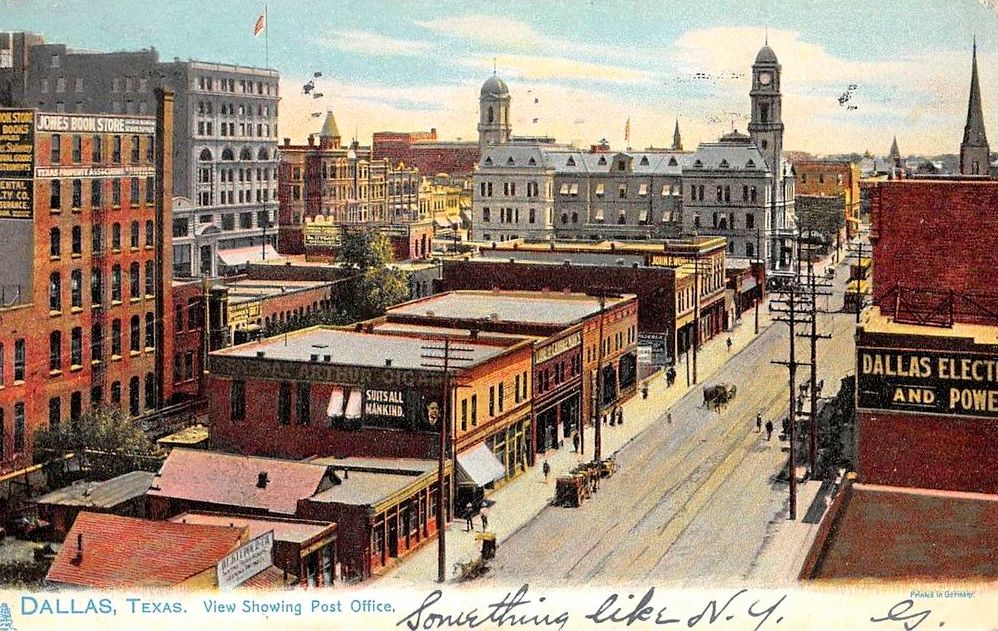
“Something Like N.Y.” — ca. 1904
by Paula Bosse
Eat your heart out, NYC!
***
Sources & Notes
Postcard from “the internet.”
*
Copyright © 2014 Paula Bosse. All Rights Reserved.

by Paula Bosse
Eat your heart out, NYC!
***
Postcard from “the internet.”
*
Copyright © 2014 Paula Bosse. All Rights Reserved.
 The Dallas Athletics, 1908
by Paula Bosse
Soccer — which the local newspapers insisted on calling “soccer football” — was introduced to Dallas as a local organized sport in 1908. The first appearance I can find discussing soccer in Dallas is this article, from the October 18, 1908 issue of The Dallas Morning News:
 (Dallas Morning News, Oct. 18, 1908)
In 1908, Ernest Oates was a 32-year-old Yorkshireman from the north of England who had been in Dallas only a couple of years when, missing the football matches of his youth, he decided to organize a “soccer” team in Dallas. The sport was virtually unknown in Texas, but because Oates undoubtedly knew everyone in the city who had made their way to the United States from England, Scotland, Ireland, and Wales, he had no trouble organizing a team of experienced players. (Oates also helped introduce Dallas to cricket in 1933.)
After reports that the team had begun practicing at the Lake Cliff ballpark, there was news that another team was being formed in Dallas, this one to be coached by an apparently well-known American coach from St. Louis named William “King” Finnegan. This team seems to have had a harder time getting up and running (probably because Oates had snapped up all the good players). Even though they announced that they would be using Gaston Park as their home turf and practice would begin right away, it actually took them months to get a functioning team together.
Also at this time were vague rumblings of a Scotsman in Fort Worth — Duncan J. Livingston(e) — wanting to get a team going in Cowtown, but he was even slower in getting things organized than Finnegan was (Fort Worth wouldn’t have an official team until late 1909). Meanwhile, The Fort Worth Star-Telegram — whether out of jealousy or spite — couldn’t resist tossing sarcastic soccer-related zingers at Dallas’ attempts to popularize the esoteric sport:
 (Fort Worth Star-Telegram, Nov. 17, 1908)
That bon mot was just a warm-up, though, to this offering, which dredged up (as it were) the recent devastating Trinity River flood:
 (FWST, Nov. 20, 1908)
For a while it was looking as if Oates’ “eleven” would have no one to play with. But, unexpectedly, a team appeared — one fielded by The Dallas Morning News, a team that only a few weeks earlier had been the newspaper’s baseball team! The men on the team had never played soccer, but, as a DMN report had it, “they were game.”
(The timing of the sudden appearance of this team seems a little odd. The Morning News had run several articles about the proposed Finnegan team having actually been organized and in possession of a full roster, but then … nothing more was heard of them. You can’t have a competitive spectator sport with only one side. Cue the WTF entrance of the deus ex machina soccer team full of baseball players.)
So there were really only two teams that played all of the soccer matches in that very short inaugural soccer season: the Dallas Athletics, led by Ernest Oates, and the Newspaper Association team, led by A. McKinnon.
The newspapers tried valiantly to drum up excitement among local sports fans, and they ran lengthy explanations of the game’s rules in an attempt to educated their readers, but I’m not sure how successful they were at either attempt. Tellingly, attendance figures were never reported (except to say that British matches in the UK had no problem attracting crowds of 100,000 fans). The two teams played several games, and the Athletics usually won.
After only four games, the two teams announced that they would have a “state championship” match on Christmas Day. They claimed that they were “the only two thoroughly organized soccer football teams in the state of Texas” — who else would they play in a fight for the championship?
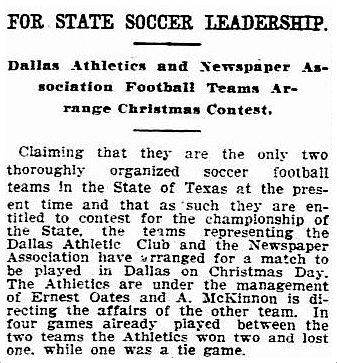 (DMN, Dec. 12, 1908)
So they did. As expected, the Dallas Athletics won, 3-0. The “rugby football” team (which was also known as the Dallas Athletics) won their Christmas Day game as well, a fact that might help explain the cartoon below.
 (DMN, Dec. 27, 1908 — cartoon by Knott)
“King” Finnegan (who, incidentally, had acted as referee for the championship game), disputed the whole “champion” thing, saying that his team, the Dallas Soccers, deserved a chance at the title (even though they had, thus far, played exactly zero games). The Athletics shrugged their shoulders and agreed to the challenge, and on New Year’s Day they trounced the Soccers, 6-0.
And so ended the first soccer season in Dallas. Fort Worth did eventually join the fray the next season, but it wasn’t pretty — they were badly beaten in their first few meetings with the mighty Dallas Athletics. Sorry ’bout that, Fort Worth. Don’t mess with Ernest Oates.
Here’s another photograph of Mr. Oates (front row, center) and the rest of his team. It’s been 106 years since soccer aficionados first started swearing that their sport will catch on in Dallas. And catch on big. And now you know when and where all that talk started: in 1908 with Ernest Oates and his Dallas Athletics.
 The Dallas Athletics, 1909
***
1908 team photo by Clogenson, from The Dallas Morning News, Dec. 25, 1908; 1909 team photo from the DMN, Dec. 5, 1909.
I’ve compiled a PDF containing most of the first few months’ news coverage of this whole new-fangled “soccer football” sport as it appeared in the pages of The Dallas Morning News and The Fort Worth Star-Telegram. I’m not much of a sports fan, but I actually found it very interesting to read chronological, contemporaneous reports of a new sport working its way into the city’s consciousness. I’ve left out the articles that explained AT LENGTH the rules of the game because my eyes (and soul) started glazing over. But the rest of it is here. My favorite headline is from an article about a mismatched game between Dallas and Fort Worth with the Fort Worth headline reading “Visitors Had More Experienced Men and Were in Better Condition” — yep, that’ll do it. There are a bunch of articles, stretching over a bunch of pages, but you might find them entertaining. The PDF can be found here.
**
A photo of Ernest Oates (1875-1945) and his new (first) wife, the former Helen Lindsay in a wedding announcement (click for larger image).
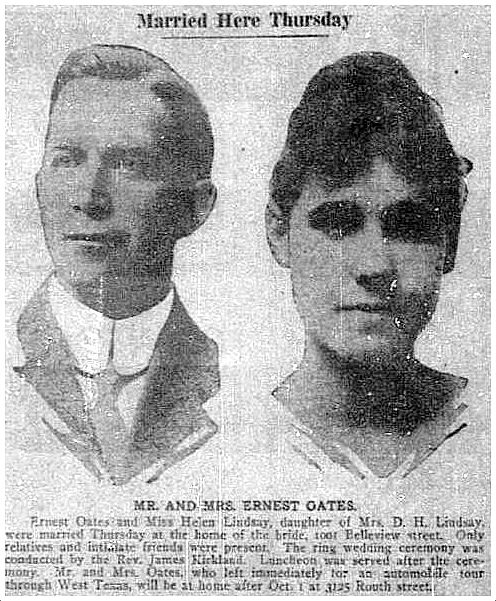 DMN, Sept. 23, 1917

Ernest Oates, 1930s
Oates was a stonemason and owned the Oates Stone Co. on Routh Street (at the MKT railroad). Below is an ad from 1922.
 1922 Dallas directory
*
Copyright © 2014 Paula Bosse. All Rights Reserved.
by Paula Bosse
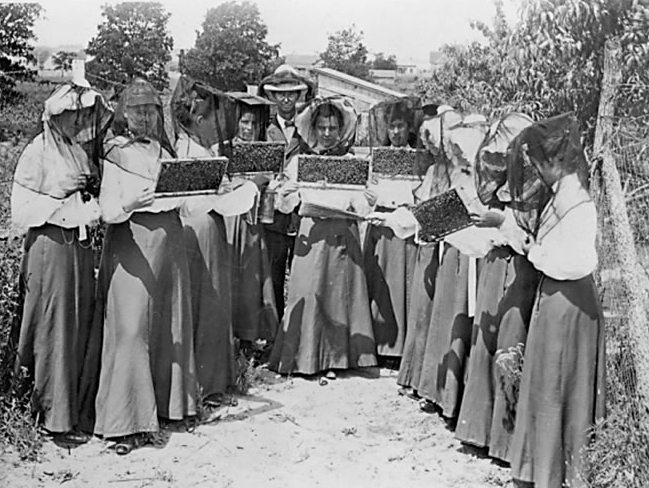
Beekeeping class at the College of Industrial Arts (later Texas Woman’s University) in Denton, around 1905. Pop quiz!
***
Photo from The Woman’s Collection of Texas Woman’s University.
Beekeeping was a popular “hobby” for women at the turn of the century, but for a look at larger-scale Texas honey production at this time, check out the article “The Bee Industry of Texas” from the 1904 edition of the Texas Almanac here.
For information on present-day North Texas beekeeping, the website of the Dallas-based Texas Honeybee Guild is here.
*
Copyright © 2014 Paula Bosse. All Rights Reserved.

You deserve “maximum enjoyment”
by Paula Bosse
Do you dream of a home of your own? Then go and see the beautiful scenic Stevens Park Estates. “The Ideal Place for Your Home.” There you will find the ideal place for your “dream home.” A beautiful 146-acre park — 18 holes of golf — modern fan-shaped lots — broad sweeping boulevards — in fact, everything to make you realize the maximum enjoyment out of your home.
***
Ad from 1930.
History of Oak Cliff’s Stevens Park Estates can be found here and here.
*
Copyright © 2014 Paula Bosse. All Rights Reserved.
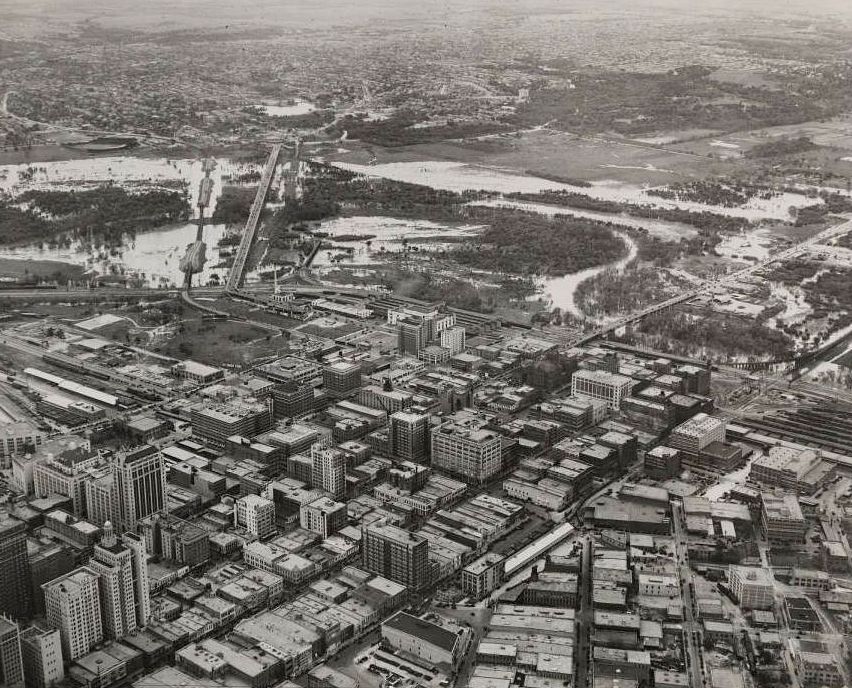 What? You didn’t know the Trinity River was straightened?
by Paula Bosse
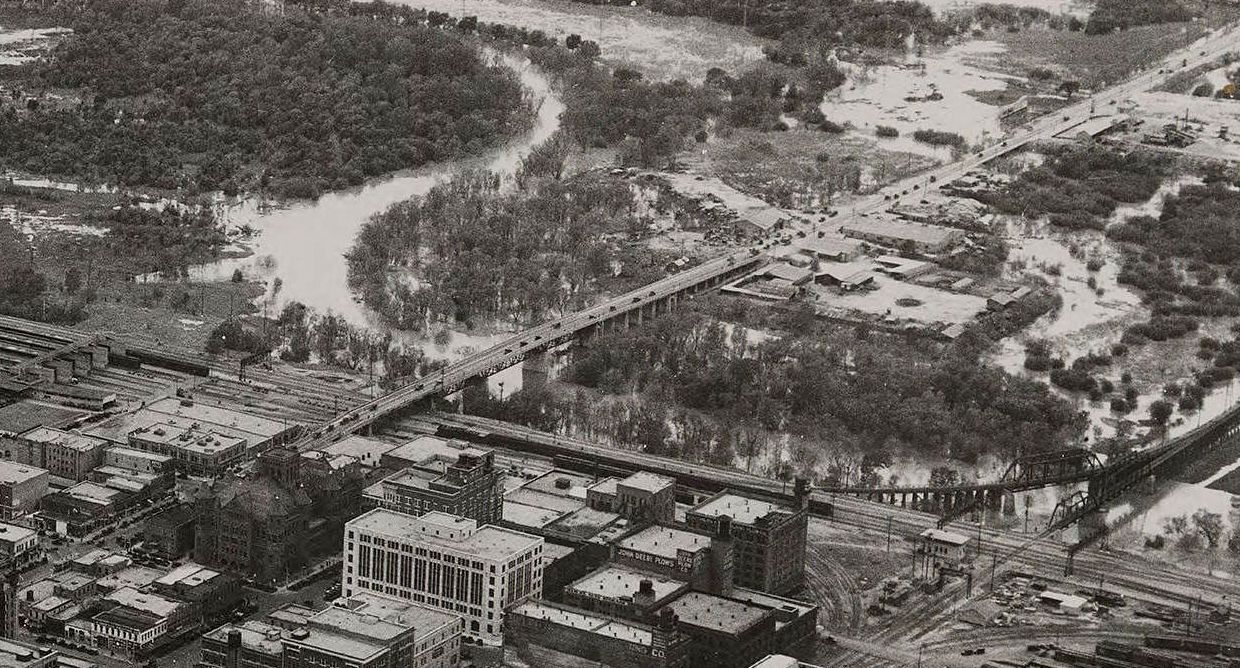
Back before Dallas decided to straighten out the Trinity River and move it a mile or two to the west (in an attempt to prevent future flooding), the river ran only about a block from the Old Red Courthouse. It’s so strange looking at this picture and seeing a river in a place where we’ve never seen it. It’s a shame they moved it (who knew you could “move a river”?), but flooding was a major issue, and, in fact, it looks like there was flooding the day this photo was taken. Below, you can see a magnified view — it looks so different from what we’re used to that it takes a second to get your bearings. Imagine how different Dallas would feel today if the Trinity had been allowed to run its natural course.
***
Photograph by Lloyd M. Long, from the Edwin J. Foscue Map Library, Central University Libraries, Southern Methodist University; it can be seen here (with many of the buildings labeled) and here (without the labeling).
SMU has the photo dated “ca. 1930s or 1940s,” but I think it may be from the late ’20s. I’ve seen non-specific dates of the river’s realignment from the 1920s to the 1930s, but a couple of landmarks in the photo above place it sometime between 1925 (the year the Santa Fe buildings were constructed) and 1933 (the year the Hippodrome Theater — seen here, on Pacific — became the Joy Theater).
UPDATE: The river was straightened in 1928. See fascinating information about the when, where, why, and how of the Trinity River realignment, below in the comments — it was a true feat of modern engineering.
A few Trinity River-related links: the Trinity Commons Foundation site is here; the Trinity River Corridor Project site is here; and an interesting look at plans and proposals for the future of Dallas and the Trinity River can be read on the American Institute of Architects (Dallas) site here.
*
Copyright © 2014 Paula Bosse. All Rights Reserved.
 Dallas Herald, Nov. 26, 1864
by Paula Bosse
No Confederate money, please.
WHEAT
Will be taken in payment for
Subscription to the Dallas Herald, at the rate
of Two bushels for six months, delivered at this office,
or any mill in this vicinity.
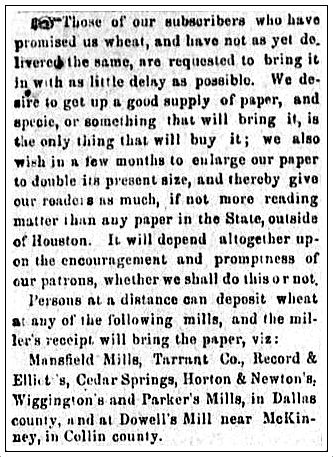 Dallas Herald, Feb. 9, 1865
Those of our subscribers who have promised us wheat, and have not as yet delivered the same, are requested to bring it in with as little delay as possible. We desire to get up a good supply of paper, and specie, or something that will bring it, is the only thing that will buy it; we also wish in a few months to enlarge our paper to double its present size, and thereby give our readers as much, if not more reading matter than any paper in the State, outside of Houston. It will depend altogether upon the encouragement and promptness of our patrons, whether we shall do this or not.
Persons at a distance can deposit wheat at any of the following mills, and the miller’s receipt will bring the paper, viz:
Mansfield Mills, Tarrant Co., Record & Elliott’s, Cedar Springs, Horton & Newton’s, Wiggington’s [sic] and Parker’s Mills in Dallas county, and at Dowell’s Mill near McKinney, in Collin county.
(Note: the Civil War-era Dallas Herald was two pages: front and back of a single sheet.)
 Dallas Herald, May 4, 1865
Wheat will be taken in payment for Subscription to the Dallas Herald, at the rate of Two bushels for six months, delivered at this office, or at any of the following mills, and the miller’s receipt to, viz:
Mansfield Mills, Tarrant County; Record & Elliott, Cedar Springs, Horton & Newton’s, Wigginton’s and Parker’s Mills, in Dallas county, and Dowell’s Mill, near McKinney, Collin county.
***
All of the above from the Dallas Herald collection via UNT’s Portal to Texas History site,
Wikipedia entry on Confederate money here; entry on commodity money here.
*
Copyright © 2014 Paula Bosse. All Rights Reserved.
by Paula Bosse
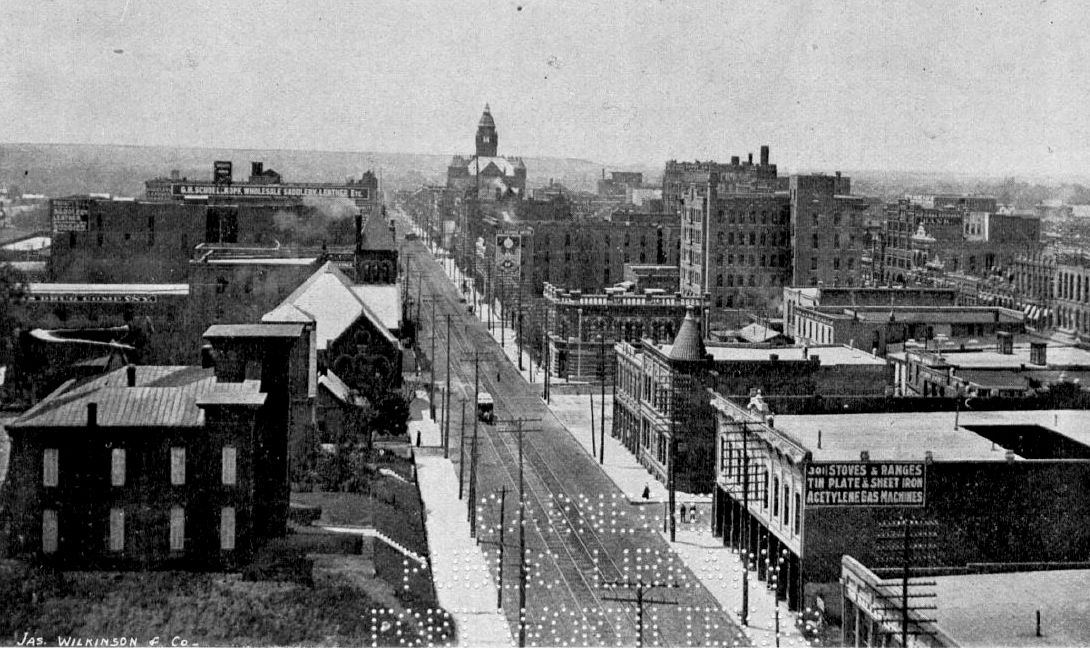
The companion photo from the one I posted yesterday. Both were taken by the same photographer (Jas. Wilkinson) and both appeared in The Bohemian magazine in 1900. It appears that both were probably taken from the top floor or roof of the Oriental Hotel at Commerce & Akard. The building about half-way up in this picture — the one on the right with the conical turret — is the Texas Land & Mortgage Company (seen here), located at Commerce and Field, placing the photographer at Commerce and Akard (the Oriental Hotel).
So it seems likely that the photo from yesterday (seen here) was from the Oriental looking north up Akard.
***
Photograph from The Bohemian magazine (1900) in the collection of the Fort Worth Public Library (which perforated the library’s name into the image).
Click photo for larger image.
*
Copyright © 2014 Paula Bosse. All Rights Reserved.
by Paula Bosse
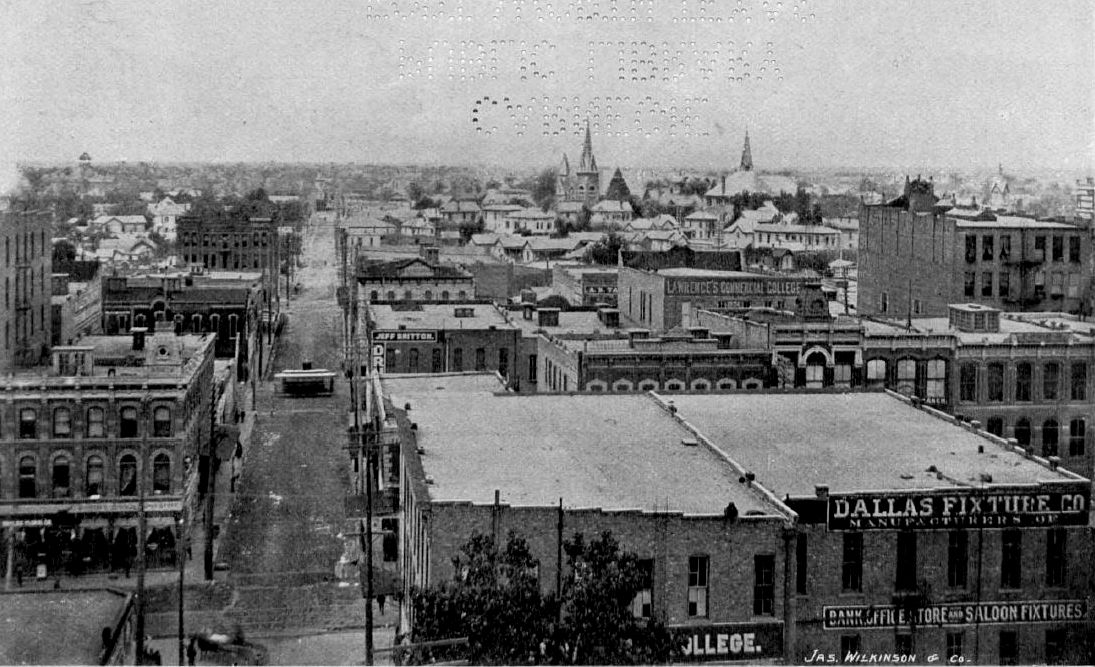
Jeff Britton’s drug store was at the southeast corner of Elm & Akard, so I think this is Elm Street looking east, with the trolley crossing Elm on Akard. I could be wrong! Suggestions welcome!
UPDATE: I WAS wrong! Reader Bob Taylor is correct when he commented that this is a view of Akard Street looking north, most likely taken from an upper floor or the roof of the Oriental Hotel at Akard & Commerce. The church at the top of this photo, in the middle, is First Baptist Church, located at about Patterson and Ervay (a map can be seen in a document I’ve posted here). (A companion photo to the one above shows Commerce looking west, again likely taken from atop the Oriental Hotel — it can be seen here.)
***
Photo from the pages of The Bohemian magazine in the Fort Worth Public Library (the library has perforated its name into the image).
*
Copyright © 2014 Paula Bosse. All Rights Reserved.
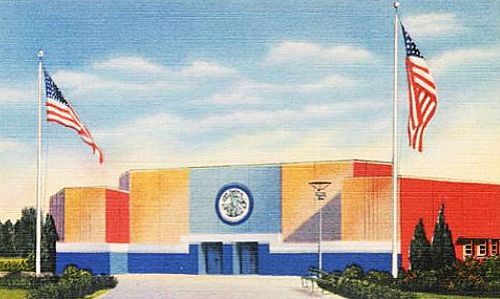 The Hall of Negro Life at the Texas Centennial Exposition, Fair Park
by Paula Bosse
Juneteenth, the anniversary of the date that African American Texans learned they were freed from slavery, was celebrated at the Texas Centennial Exposition with a day of entertainment and exhibits. It was also the day that the Hall of Negro Life — a federally funded exhibition hall acknowledging and honoring the history and accomplishments of African Americans in the United States — was officially dedicated.
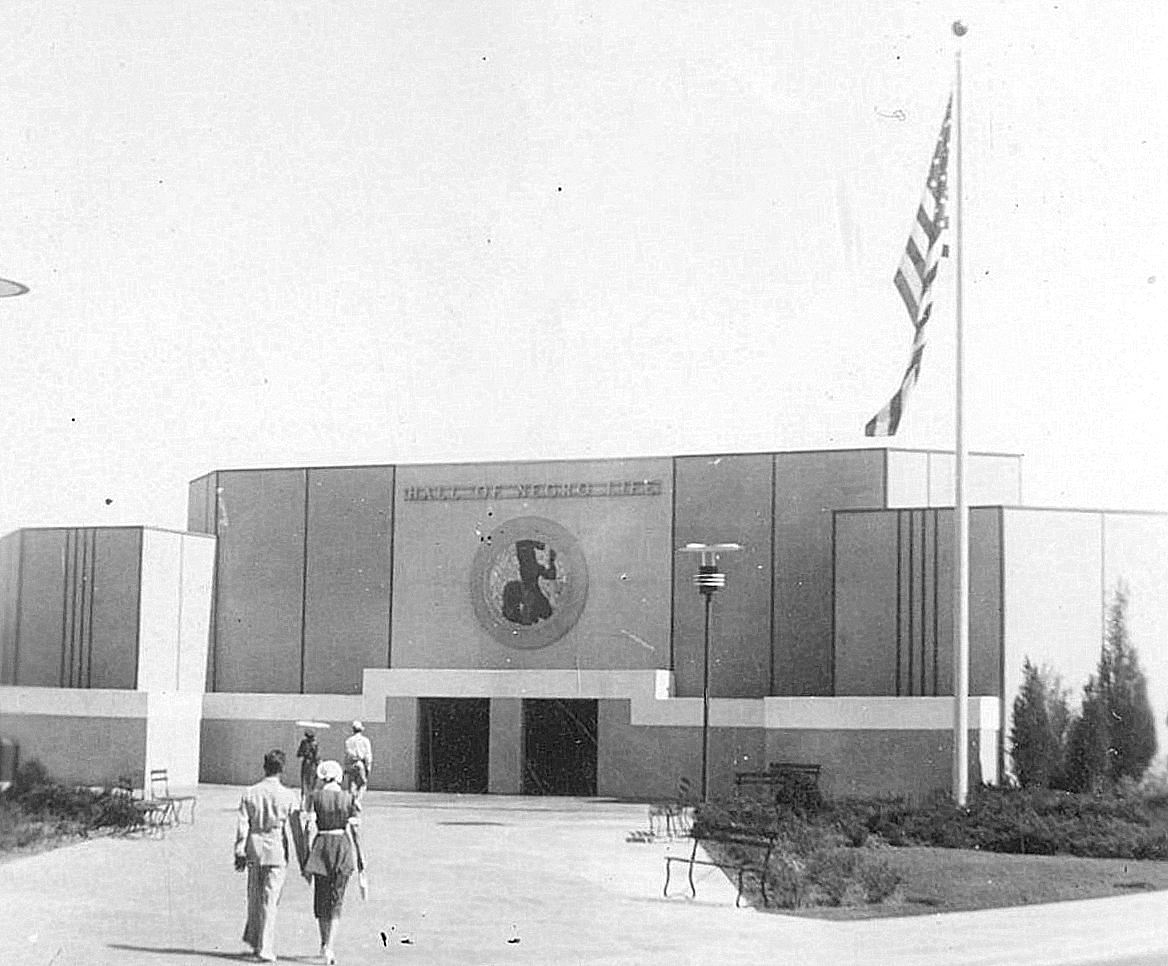
One of the more interesting things I’ve stumbled across is a drawing of the proposed building (published in J. Mason Brewer’s The Negro In Texas History in 1935). I don’t believe I’ve seen this before. It’s interesting to note the changes from original proposal to finished product.

Among the large collection of art by black artists displayed in the Hall of Negro Life were four murals by the artist Aaron Douglas, depicting black history in Texas. Below are the two murals that survive, “Into Bondage” and “Aspiration.” These are incredible murals, and it must have been an emotional experience for those Juneteenth visitors in 1936 to be surrounded by all four powerful pieces in the lobby of a government-backed project that formally recognized the contributions of fellow African Americans.
 “Into Bondage” by Aaron Douglas, 1936 (Corcoran Gallery of Art)
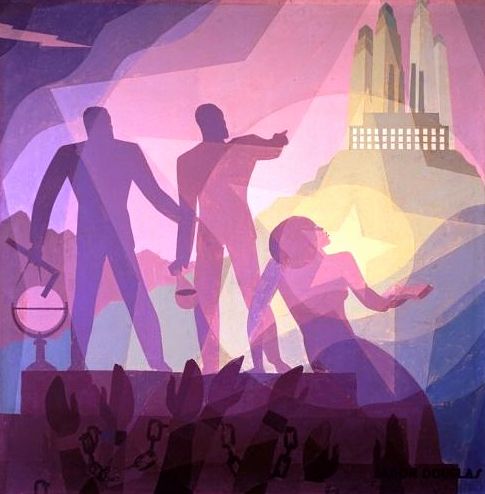 “Aspiration” by Aaron Douglas, 1936 (Fine Arts Museum of San Francisco)
***
Black-and-white photograph of the Hall of Negro Life from the Private Collection of Mary Newton Maxwell, Portal to Texas History, here.
Photo of proposed Hall of Negro Life from An Historical and Pictorial Souvenir of the Negro In Texas History, written by J. Mason Brewer (Dallas: Mathis Publishing Co., 1935).
“Into Bondage” by Aaron Douglas (1936) is from the collection of The Corcoran Gallery of Art.
“Aspiration” by Aaron Douglas (1936) is from the collection of The Fine Arts Museum of San Francisco. (There is an amazing interactive look at this painting here.)
More on the Hall of Negro Life, from the Handbook of Texas, here.
More on the Hall of Negro Life from The Crisis, the magazine of the NAACP, in the July, 1936 article “Negroes and the Texas Centennial” by Jesse O. Thomas, here.
How was this important Juneteenth celebration at the Texas Centennial covered by The Dallas Morning News? Well, the paper actually devoted a lot of space to the day’s events in a fairly lengthy article which appeared on June 20, 1936. I think the DMN editorial board probably thought they were being magnanimous in the amount of coverage given, but, really, the article — though brimming with a certain amount of probably well-intentioned jubilation — is so unremittingly racist that it’s actually shocking to see this sort of thing in print in a major newspaper. I encourage you to check out the article published on June 20, 1936 which carries the laboriously headlined and sub-headlined “Negroes Stage Big Juneteenth at Centennial; Dallas Eats Cold Supper and Cotton Patches Emptied as Thousands Inspect Magic City; Hall Is Dedicated; Dusky Beauties Prance; Cab Calloway Does His Stuff For Truckers.”
*
Copyright © 2014 Paula Bosse. All Rights Reserved.
by Paula Bosse
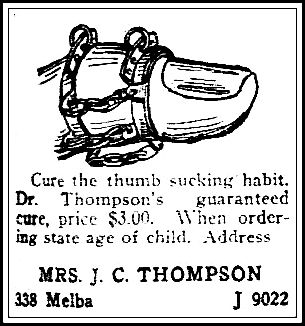
I’m not sure what more I can offer, except to say that in today’s money — with inflation taken into account — that little $3 bondage device for a child’s thumb would run you a cool 40 bucks in 2014. (Updated: in 2024, make that $55!)
I picture Mrs. J. C. Thompson assembling the inventory herself, at the kitchen table in her little frame house on Melba Street in Oak Cliff, the Victrola playing in the other room, having a chirpy one-sided conversation with the imaginary “Dr. Thompson.” I wonder if she sold any?
To quote the Messrs. Python: “Guaranteed to break the ice at parties!”
***
Ad from The Dallas Morning News, Nov. 18, 1923. I’m not sure there was a follow-up.
Whither Mrs. J. C. Thompson, OC entrepreneur?
*
Copyright © 2014 Paula Bosse. All Rights Reserved.
 Flashback : Dallas