Flashback : Dallas

A Miscellany: History, Ads, Pop Culture

Maple North of Wycliff: The Hinterlands — 1900
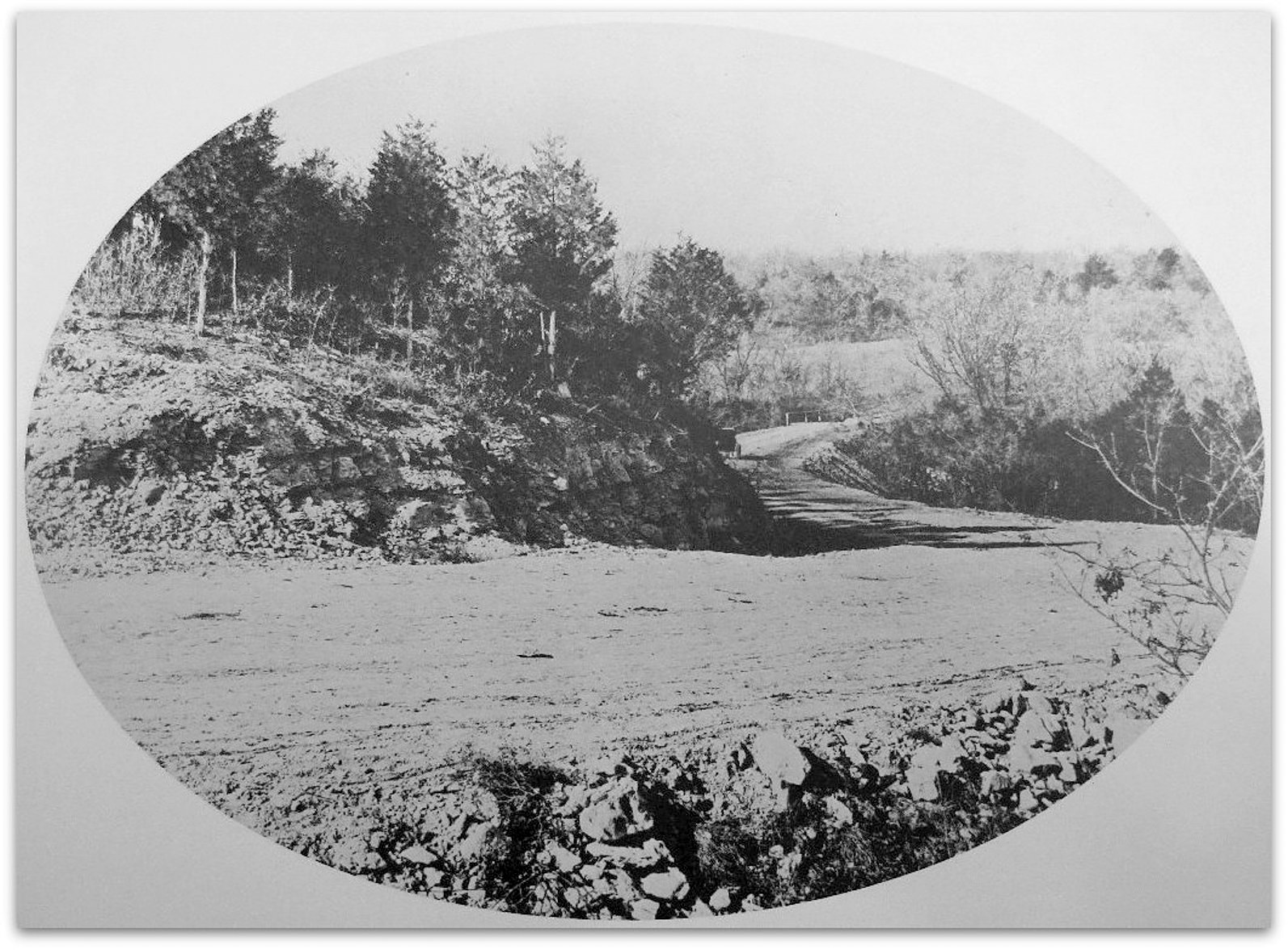
Looks a little different these days… (click for larger image)

by Paula Bosse

Here we see Maple Avenue, somewhere north of the Katy Railroad crossing, circa 1900. A. C. Greene, in his book Dallas, The Deciding Years, estimated it shows Maple “just north of where Wycliff now crosses” (see note at bottom of post wondering if this might instead show Maple just north of the railroad crossing). I have to say, the present-day view of that area has nothing going for it over the one depicted above, except maybe asphalt. …If you like asphalt.

Here’s a detail that shows the little horse and buggy, heading out to the hinterlands. (Click to see a larger image.)

greene_maple-wycliff-ca1900-det

Personally, I’d take the “hinterlands” view to the one we’re subjected to today.

An interesting book about early Dallas history that I would highly recommend is Diaper Days of Dallas, Ted Dealey’s entertaining memories of growing up in Dallas. His family had a house on Maple Avenue at about the turn of the century (his father was George Bannerman Dealey, early founder of The Dallas Morning News), and the Maple-McKinney area was his playground. Here is his description of the city limits at the time this photo was taken:

Dallas, in those early days, consisted of about eight square miles of territory. To the south the city limits ended roughly at Grand Avenue; to the east the city limits ended roughly where Fitzhugh Avenue now runs; to the north it went out Cedar Springs across Maple Avenue to a point where Melrose Hotel stands now. North of this there was practically nothing. On the west the city extended to the Trinity River.

So, at the turn on the century, this wonderful vista was the hinterlands — out in the country and well beyond the city limits.

***

Photo from Dallas, The Deciding Years by A. C. Greene (Austin: Encino Press, 1973), with the caption: “In 1900 Maple Avenue was mainly a rural lane. This photograph was taken just north of where Wycliff now crosses Maple. Courtesy Dallas Public Library.”

Text quoted is from Diaper Days of Dallas by Ted Dealey (Nashville: Abingdon Press, 1966), p. 23.

EDIT: I don’t know if this photo does show Maple around what is now Wycliff. The curve is very similar to the one Maple used to make before it was straightened in 1918 or 1919 — right around the railroad crossing, which also included a bridge across Turtle Creek, as seen in this detail from a 1905 map. Just a thought.
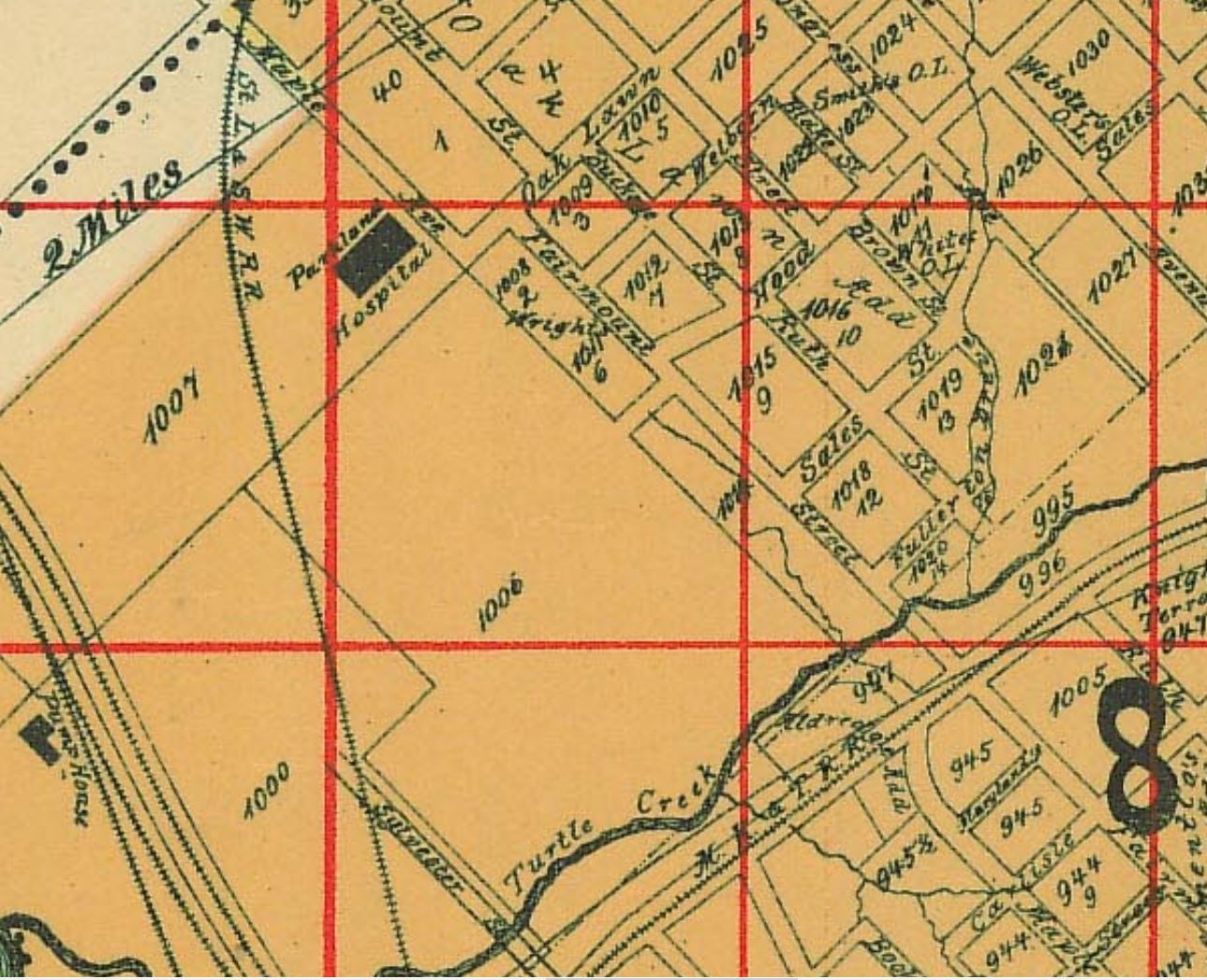
maple-ave_1905-map_portal_det

Click photos for larger images.

*

Copyright © 2014 Paula Bosse. All Rights Reserved.
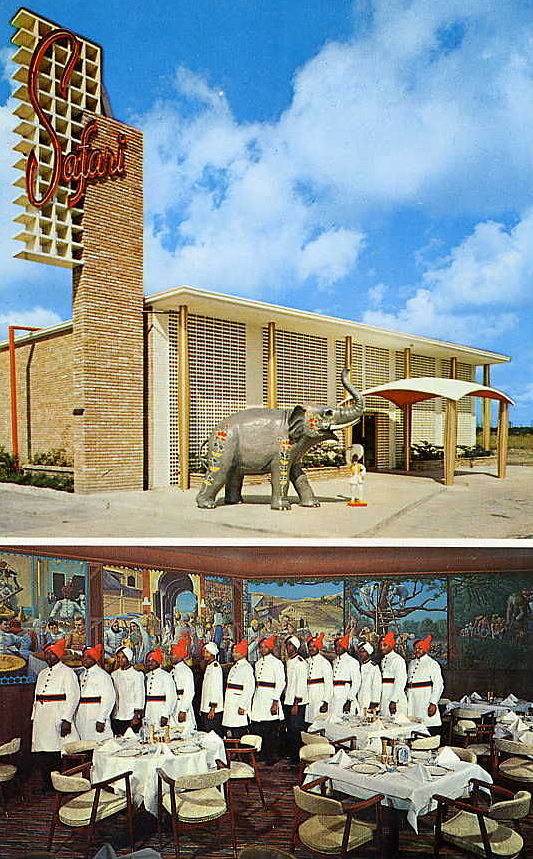
Back When Preston Royal Was “Exotic” and Had Its Very Own Elephant

safari-preston-royal

safari-preston-royal-back

by Paula Bosse

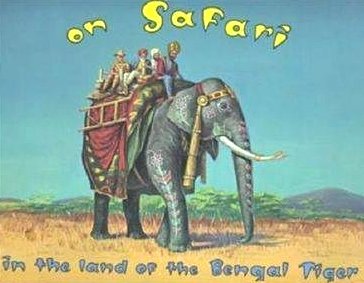
Dallas had a restaurant like this?! Yes, it did. (EDIT: It has been brought to my attention in the comments that the image above shows the *Houston* location. But I have been assured that the Dallas location had its very own elephant standing guard outside — so I will not have to ignominiously change the title of this post!)

The Safari Steak House was in the Preston Royal Shopping Center at the northeast corner of Preston & Royal (in the space now occupied by the venerable Royal China restaurant). The decor shown in the postcard above is something else — someone put their whole heart and soul into that, from the elephant and, um, elephant wrangler (“mahout“?) out front, to the ornate wood carving and the somewhat… busy murals inside. And the uniformed staff is pretty impressive, too.

Here are photos of the DALLAS Safari, taken in 1961 by Squire Haskins (photos from the UTA Libraries, Special Collections — click the links below the photos for full descriptions and large images). (Thanks, Tom Bowen, for sharing these links in the comments.)

safari_squire-haskins_1961_UTA_1via UTA Libraries, Special Collections

safari_squire-haskins_1961_UTA_2via UTA Libraries, Special Collections

Guy T. Jones opened the Safari in mid 1956 (I think the Houston location was opened later — it was open by at least 1959). I could find almost no early advertising for the place — perhaps Jones blew his advertising budget on elephants and murals. At this point, the shopping center was basically still under construction — the eastern-edge building (home of the Safari) opened about a year after the larger northern-edge building. There used to be a gap between the two buildings, which can be seen in the photo immediately above and can (sort of) be seen in the 1955 ad below, which shows a model of what the finished shopping center would look like.

preston-royal-shopping-center_032755-adAd detail, March 1955

In 1974, Royal China (which is a fantastic place, by the way) took over the space.

I really wish I’d seen that elephant, which — according to the comment below — “was highly visible and well lit at night.” I certainly hope so!

*

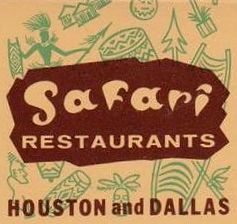
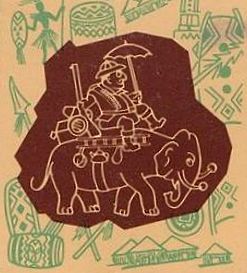
From the cover of the menu:

safari-matchbook-a

safari-matchbook

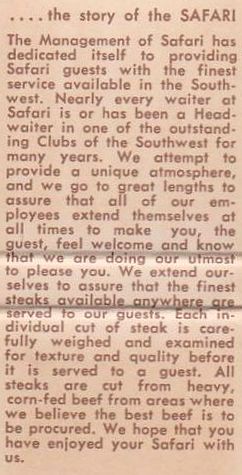
safari-matchbook_story

safari-preston-royal_menu-1969

*

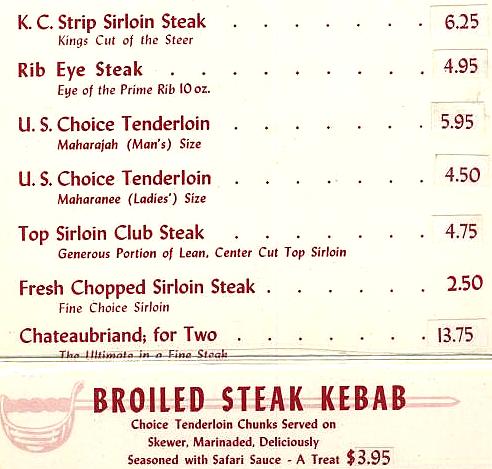
Below, the steak menu. One could choose between the “Maharajah (Man’s) Size” and the “Maharanee (Ladies’) Size.” Or get the kebabs of skewered beef “deliciously seasoned with Safari Sauce — A Treat.”

safari-menu

*

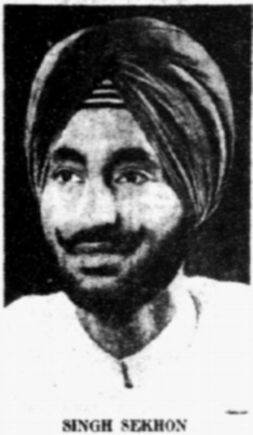
One of the stars of the restaurant was Iqbal “Ike” Singh Sekhon, who started working as the restaurant’s host while studying for his Master’s degree at SMU. He left a few years later to run the fabulous La Tunisia.

safari_dmn_062756-photo

safari-menu-logo

***

Sources & Notes

Edit (Sept. 2022): Wow. This post had a bunch of problems! All I can say is that this was one of my very earliest posts. I was so enamored of that elephant that I made a couple of very glaring errors.

First off, the original title of this post was “Back When Preston Royal Village Was ‘Exotic’ and Had Its Very Own Elephant.” The Safari Steak House was in the Preston Royal Shopping Center, located on the northeast corner of Preston and Royal; the Preston Royal Village shopping center, is on the northwest corner. I’ve (ignominiously) changed the title, but… yikes.

And, as mentioned in the first paragraph, the postcard at the top shows the Houston location, not the Dallas location. Incidentally, the Houston building is still there — it can be seen in a 2011 Google Street View capture here.

The two photos by Squire Haskins (linked below the images) are from the Squire Haskins Photography Inc. Collection, University of Texas at Arlington Libraries, Special Collections (thanks, Tom!). They are dated 1961, one year before a major fire at the restaurant. They reopened the following month, with what sounds like quite an update in decor. I’m not sure when the “gap” between the two shopping center buildings was filled in, but that would have been a good time to expand.

*

Copyright © 2014 Paula Bosse. All Rights Reserved.
The Lighthouse Church That Warned of Sin’s Penalty with a Beam of Blue Mercury Vapor Shot Into the Skies Above Oak Cliff — 1941

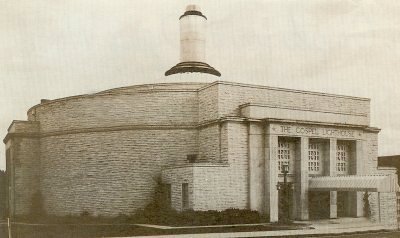
gospel-lighthouse-churchStill standing in Oak Cliff… (click for larger image)

by Paula Bosse

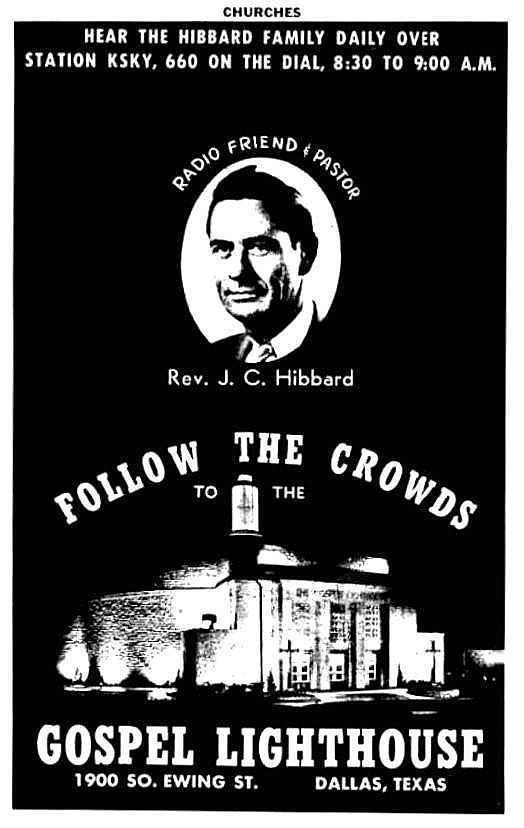
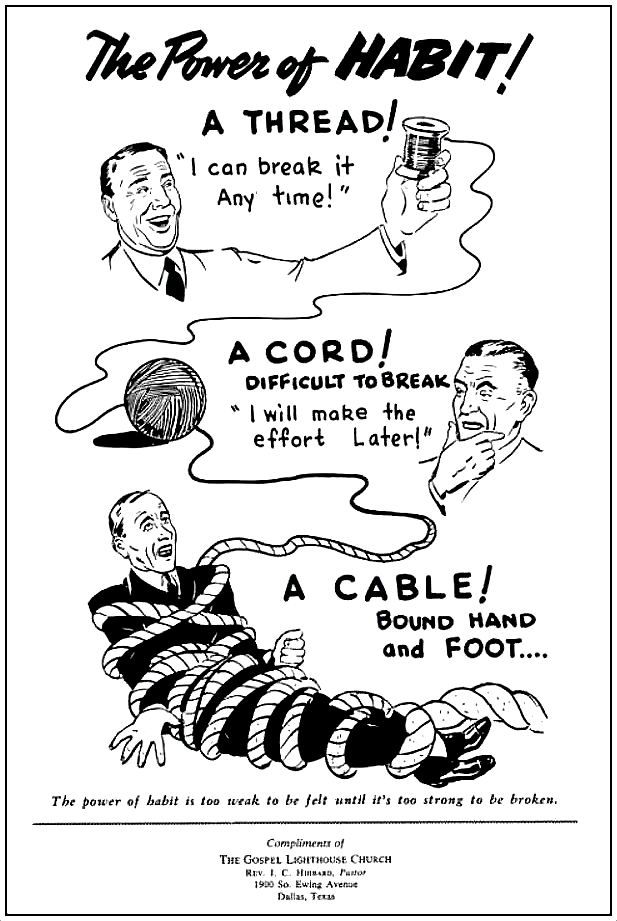
Sometimes an image just grips you. That’s what happened when I saw this postcard featuring The Gospel Lighthouse Church. The building was so odd-looking and cool. Who designed it? Where had it been? And what was that thing on top of it? I did a bit of research on the church and found out that it was organized in Dallas in 1940 by Pentecostal preacher J.C. Hibbard and his wife Nell, who was also a preacher. The two had been preaching at the Oak Cliff Assembly of God Church until J.C.’s divorce from his first wife (and subsequent second marriage to Nell) became such a point of controversy that the two felt compelled to leave (or were asked to leave) the Assemblies of God, and they formed their own church.

And that was the Gospel Lighthouse Church, located in the 1900 block of S. Ewing (at Georgia) in Oak Cliff. While their first church was being built, they held services in a large circus tent in the parking lot. The congregation helped with the physical labor of the construction, and progress on the building continued non-stop, 24 hours a day. In January of 1941, the church was completed, and an article appeared in The Dallas Morning News soon after with the grabber of a headline, “Lighthouse Church Warns Oak Cliff of Sin’s Penalty.” Sadly, the article has no byline, which is a shame, because I’d love to know who wrote the piece, because he or she pulled out all the purple-prose stops. The introduction is fantastically over-the-top:

A towering forty-foot lighthouse 300 miles from the sea was blinking out its warning signals across the dry land of South Ewing Sunday. At the front of a neat new white stone church house at 1914 South Ewing, near Louisiana, the white stone lighthouse reared far above the other buildings. Eventually, its big circular light tower will shoot a bluish mercury-vapor beam through the night to guide shaken mariners adrift on the sea of sin. Its semi-fog horns will broadcast a soft carillon of sacred music. This is the Gospel Lighthouse, built by a preacher with a new idea of church architecture and a dream of a denomination all his own. (DMN, Feb. 10, 1949)

gospel-lighthouse_first

Wow. A “bluish mercury-vapor beam” shooting through the Oak Cliff skies! (The full article is linked below.)

By 1948, J.C. Hibbard had become so popular (largely as a result of his daily radio sermons) that ground was broken on a larger church, designed by J.C. himself. It was right next to the first church. And it was pretty elaborate.

gospel_lighthouse_bw

Yeah, the lighthouse part of it looks a little cheesy, but with a name like “Gospel Lighthouse Church” you kind of have to have it.

*

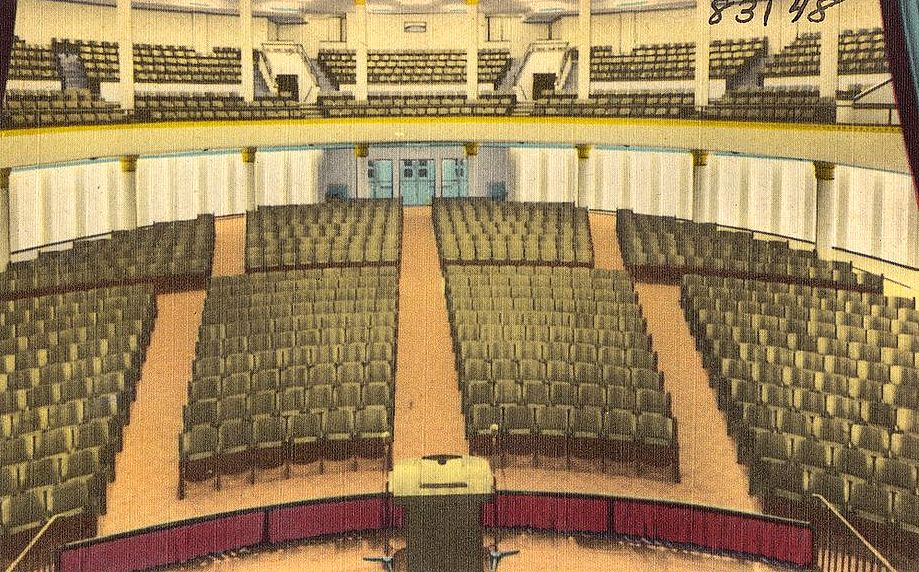
gospel-lighthouse-church_interior

The auditorium and its mezzanine.

*

gospel-lighthouse-nursery

The nursery, with elaborate murals.

*

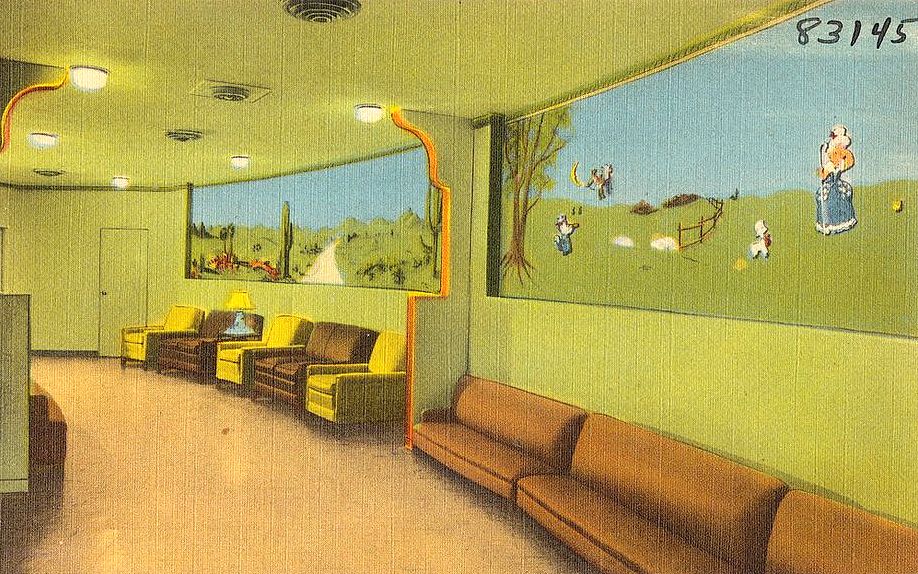
gospel-lighthouse-lounge

The lounge. Like the first church, this one had a nursery with a lounge — a “crying room” for mothers to tend to crying children without having to miss a single moment of the service. The crying was contained behind sound-proof glass while the sermon was piped in through speakers. The church had a lot of other amenities, but these were the only ones I’ve found deemed worthy enough to put on postcards.

*

I wondered if the church still stood, so I drove over to Oak Cliff yesterday and, amazingly, both churches are still there, and they are beautiful! (The original caretaker’s house is still there, too.) I’m not sure what religious group has possession of the buildings at the moment, but they are to be commended for maintaining the structures and the grounds — the 1900 block of S. Ewing really stands out from its fairly ragged surrounding neighborhood. Below are photos I took on April 19, 2014. (Click pictures for larger images.)

gospel-lighthouse_first-church_041914

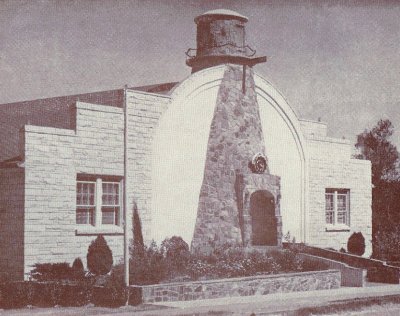
Above, the first church — “a modern concrete and steel building, overlaid with white Austin stone” — which was built with help from the congregation in 1941. The beam of “bluish mercury-vapor” emanated (somehow) from the squat lighthouse above the foyer.

And, below, the later church, next door. I think the “mercury-vapor” was replaced by neon. But I could be wrong. Does either beacon light up anymore?

gospel-lighthouse_041914_sm

Aside from the “lighthouse,” the most distinctive feature of this building is those rounded walls. So beautiful!

gospel-lighthouse_side_041914-sm

The  building is actually pretty impressive to see up close. Next time you’re in the neighborhood, check it out!

***

Sources & Notes

Postcards from the Boston Public Library Tichnor Brothers Postcard Collection on Flickr, here.

Period black-and-white photos are from a page detailing the history of the Gospel Lighthouse Church, here. A biography of Rev. Hibbard from the same site can be found here.

Wander around the block on Google Street View, here.

Stumbled across this ad in the 1957 Dallas directory:

gospel-lighthouse_1957-directory

And I found this ad in, of all places, the 1967 Carter High School yearbook:

gospel-lighthouse_carter-high-school_1967-yrbk

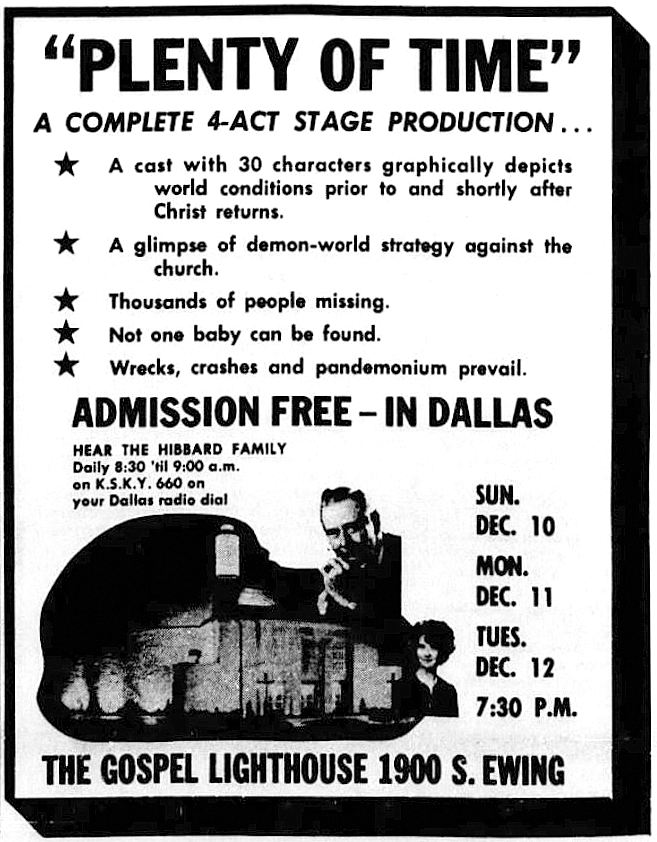
I also found this rather hair-raising ad for a 1967 Christmas-season production — an ad which somehow contains no exclamation marks:

gospel-lighthouse_mckinney-courier-gazette_120867Dec. 8, 1967

*

Copyright © 2014 Paula Bosse. All Rights Reserved.

Babyface Barrow — 1926

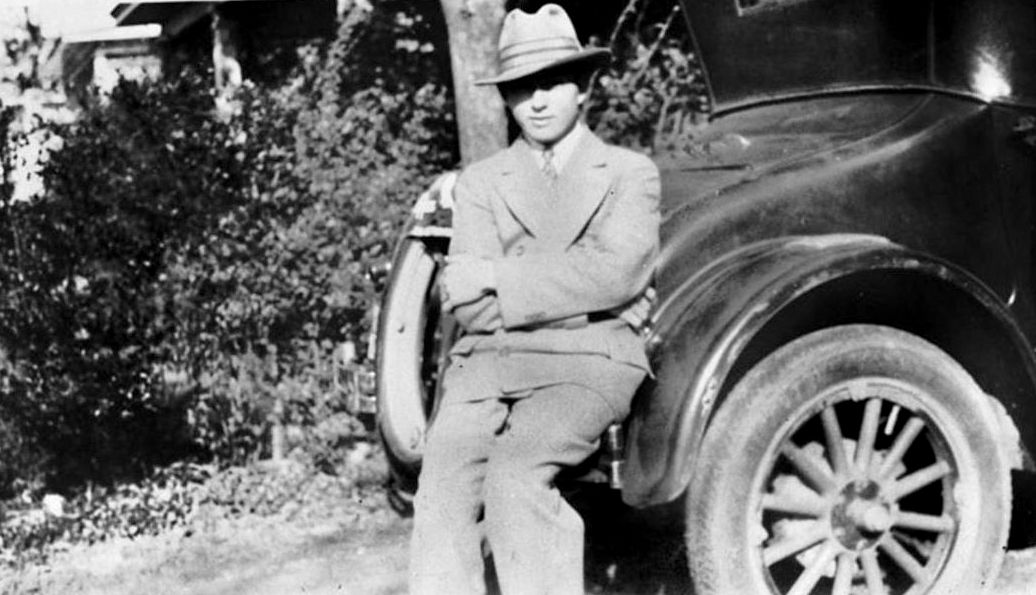
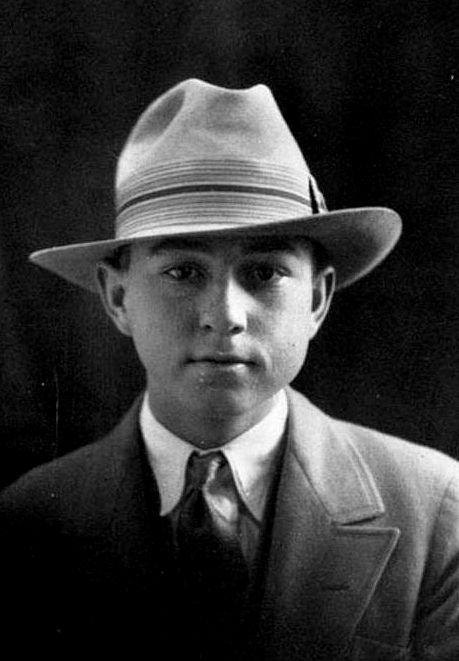
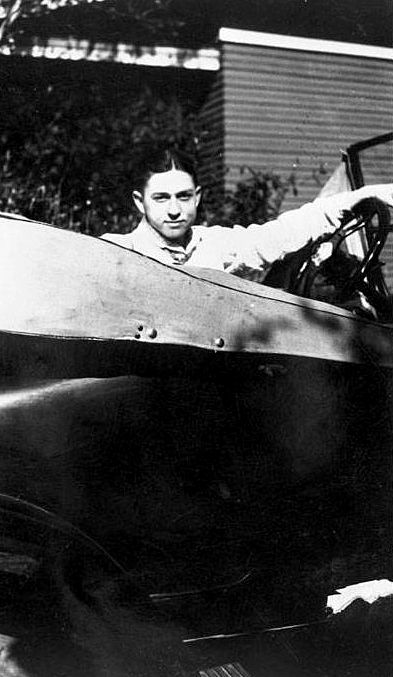
clyde-barrow_with-car_1926_utsa17-year-old Clyde Barrow, 1926

by Paula Bosse

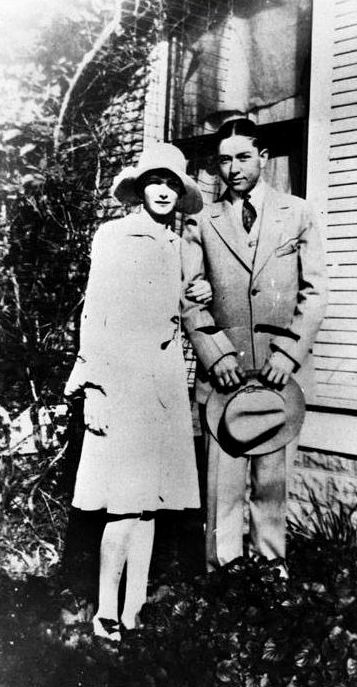
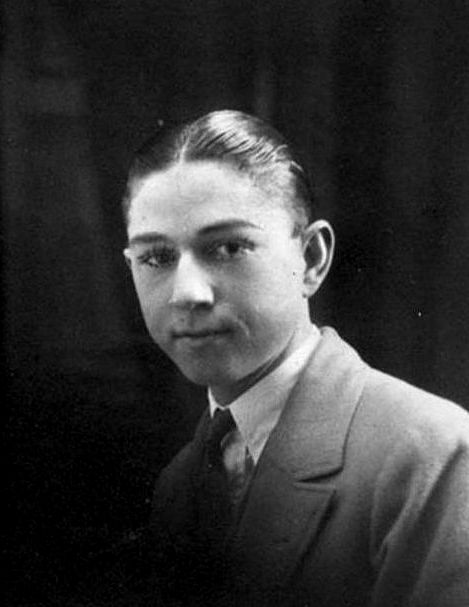
These photos of a 17-year-old Clyde Barrow belonged to one of Clyde’s first girlfriends, Eleanor Williams, a student at Forest Avenue High School in 1926. For all anyone knew, Clyde was just an ordinary kid who liked to dress up and show off his car. (Or “a” car — he was arrested for stealing his first car the same the year this photo was taken — 1926 — so I’m not sure whose car this actually is….)

clyde-barrow_eleanor-williams_1926_utsaEleanor and Clyde (whose unsubtle attempt to appear taller by standing on … something … is unconvincing and a little ridiculous).

clyde-barrow_1926_utsaSuch a babyface. In a few short years, his name and face would be splashed across the country’s newspapers as Bonnie and Clyde’s violent killing spree made him and Bonnie Parker outlaw celebrities.

clyde-barrow_no-hat_1926_utsaHe looks a lot younger than 17 here.

clyde-barrow_car_1926_utsaThe reverse of both this original photo and the top one — the car photos — have a hand-written “1926” on them as well as the film processing stamp “Finished by The National Studio, 1205 1/2 Elm St., Dallas, Texas.”

***

Sources & Notes

Photographs from University of Texas at San Antonio Libraries Special Collections, Copy and Reuse Restrictions Apply. Photos loaned to UTSA by Henry J. Williams, nephew of Eleanor B. Williams. All photos have “1926” on the back.

The Handbook of Texas entry for Clyde Barrow (1909-1934) is here.

Additional photos of Eleanor Williams can be seen on the Bonnie and Clyde “Texas Hideout” site here.

*

Copyright © 2014 Paula Bosse. All Rights Reserved.

Early Dallas Radio & “Verified Reception Stamps”

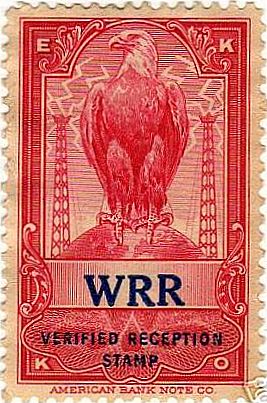
ekko_wrr

by Paula Bosse

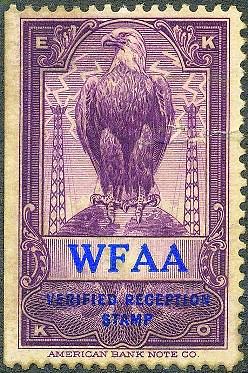
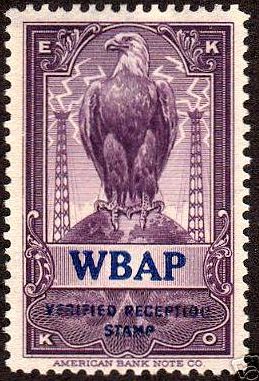
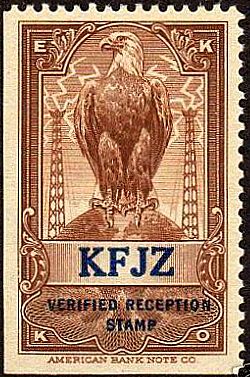
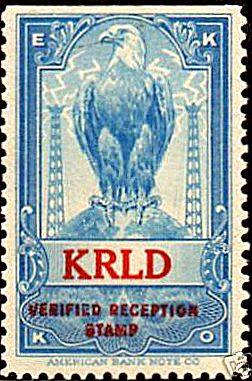
Chances are you’ve never heard of “Verified Reception Stamps” which were issued in the 1920s by a company in Chicago called EKKO. I certainly hadn’t. The stamps (referred to by collectors as “Cinderellas”) were enthusiastically and obsessively collected in the mid-’20s — people were really into it. Basically, it seems to have been a clever form of advertising which banked on both the public’s fascination with early radio and the then-very-popular hobby of stamp collecting.

How did it work? Briefly, the EKKO company printed these stamps for subscriber radio stations around the country (and later for stations in Canada, Mexico, and Cuba). Once the radio stations received them, they issued them to listeners who wrote in to affirm that they had, in fact, picked up their station on the wireless. The listener had to prove it by stating the time he or she had tuned in and then give a short synopsis of the program they had heard. Oh, and they had to enclose a dime. (The dime was probably the most important part of this whole fad — at least for the broadcasters.) In return, the station would check their logs and “verify” that the dime-sender probably DID hear the station, and one of these little stamps would be sent out post haste. The EKKO company also conveniently printed up albums for collectors to paste the stamps into. I’m not sure how one was expected to fill up the book (with pages devoted to each state), since there’s no way you’d be able to pick up the signals of all those stations, but I guess that’s what gets collectors’ blood racing. It’s the thrill of the chase. The verified reception stamp-collecting fad died out as the Depression set in, and it became hard to justify spending one’s precious hard-earned dimes on a frivolous hobby.

*

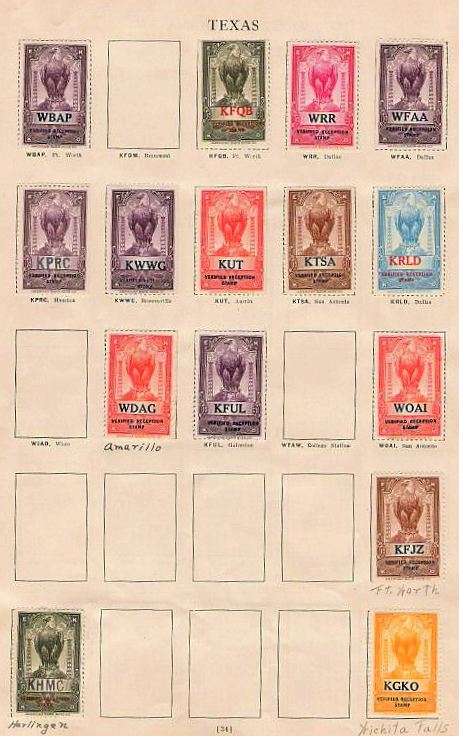
Verified reception stamps were issued by the five main stations in the Dallas-Fort Worth area in the 1920s. WRR, at the top, was the first radio station in Dallas and one of the earliest stations in the country. It began broadcasting as a sort of early police radio in 1920 and received its official broadcasting license in 1922. It remains an oddity in the radio world as it is a commercial radio station that is owned and operated by the City of Dallas.

*

ekko_wfaa

WFAA signed on in 1922 and was part of the nascent Dallas Morning News media empire.

*

ekko_wbap

WBAP, a Fort Worth station, also signed on in 1922. Someone thought it might be cute if “WBAP” stood for “We’ll Be At the Party.” More serious-minded station people went with “We Bring a Program” which, really, isn’t much better.

*

ekko-kfjz

KFJZ (another Fort Worth station) came along in 1923. Its founder sold the station five years later for a good chunk of change and then went to work for WBAP.

*

ekko-krld

KRLD began broadcasting in 1926 and was acquired by The Dallas Times Herald a year later.

*

ekko-texas-stations

A sample page of the “Texas” portion of the official EKKO stamp album.

*

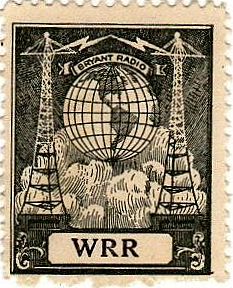
ekko_wrr-globe

The EKKO company had some competition in the PM Bryant Co. Bryant stamps required no “verification” — you just sent them your dime and got a stamp. Their stamps had no eagle, but they DID have transmitter towers and the essential lightning bolts.

*

And now you (and I) know!

***

Sources & Notes

An incredibly comprehensive history of Dallas radio is the DFW Radio Archives site — its main page is here. The pages dealing with the stations broadcasting in DFW in the 1920s are here and here. I highly recommend reading the very interesting account about how WRR evolved from an experimental police communication transmission tool to a full-fledged entertainment station.

*

Copyright © 2014 Paula Bosse. All Rights Reserved.

The Stretch of “Theater Row” They Never Talk About

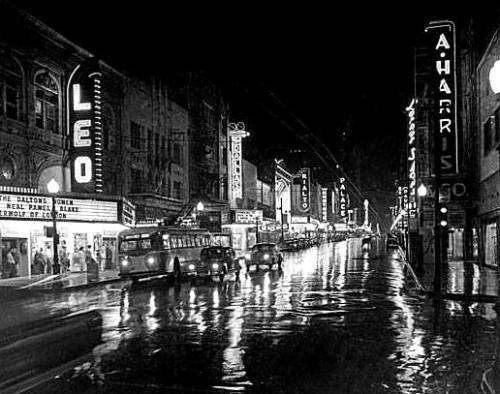
leo-theater
The “other end” of Film Row

by Paula Bosse

It’s April, 1952, and you’ve got a hot date Friday. Movies are good for date night. What to see? Why not catch a bold, frank, and true “adult” double-bill at the Leo? In the early-’50s, the Leo Theater, at 1501 Elm Street, was at the other end of “Theater Row” — on the metaphorical “other side of the tracks” from the classy Majestic and Palace — and it was one of those places that your mother probably wouldn’t approve of.

leo-theater_dmn-0405521952

The ad above shows a typical Leo double-feature: “Pin-Down Girl” (aka “Racket Girls”) from 1951, a searing look at lady wrestlers and prostitution (the trailer below has a moment that’s actually pretty shocking, and you’ll laugh at yourself immediately afterward for having been shocked), and “Honky Tonk Girl” (aka “Hitchhike to Hell”) from 1941 about teenagers and, well, prostitution. There were at least two exploitation movies titled “Honky Tonk Girl,” so I’m not sure which is the correct poster for the particular cinematic treasure on the Leo bill, but I really love the artwork of this one, so in it goes.

honky-tonk-girl_poster

Here’s the trailer for “Pin-Down Girl” (which is handy, because it gives you about all you really need to satisfy a piqued curiosity without wasting a lot of your time):

**∙*

***

Sources & Notes

I don’t have a source for the top photo, but I believe I have seen it attributed to the Dallas Public Library. If this is incorrect, please let me know.

A little background on the Leo Theater (1948-1953), originally the Queen (1913-1948), can be found in the comments section here.

But if you want to know just what was going on in these not-quite-but-fast-approaching seedy Dallas theaters, you owe it to yourself to read a great passage from Troy Sherrod’s Historic Dallas Theatres (Arcadia Press, 2014), here (scroll down to the caption).

*

Copyright © 2014 Paula Bosse. All Rights Reserved.
George Dahl’s Titche-Goettinger Building

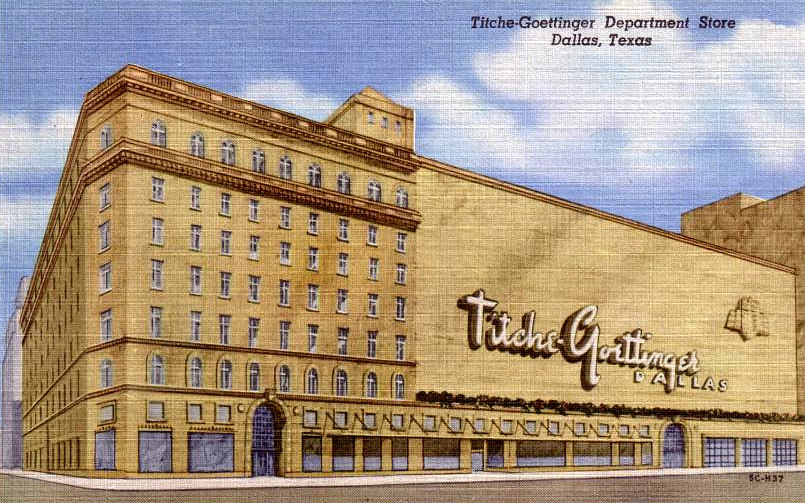
titches

by Paula Bosse

Such a beautiful building! Such a beautiful font!

George Dahl designed the original building (on the left) in the late-1920s, and Thomas, Jameson & Merrill designed the expansion (on the right) in the early ’50s.

titches_new-store_sunset-high-school-yrbk_1929
Ad from the 1929 yearbook of Sunset High School

***

Read about the building here.

Everything you could want to know about Titche-Goettinger/Titche’s is here.

UNT owns the building at 1900 Elm now, and it’s installed windows in that cool solid wall where the store’s name used to be. Check out photos of key renovations and read why they were made here.

More on the Titche’s building (including news on its expansion in 1952 and an architect’s drawing) can be found in the Flashback Dallas post “Main Street — ca. 1942,” here. See the expanded building here.

Click for larger image!

*

Copyright © 2014 Paula Bosse. All Rights Reserved.
Need a Handgun? Head Over to Titche’s! — 1963

titches_gunstitches_guns_dmn_110563c

by Paula Bosse

Titche’s was a nice department store. In 1963 it was a good place to buy a well-tailored suit, shop for fine crystal, and, apparently, get a gun.

***

Sources & Notes

Ad from Nov. 5, 1963.

*

Copyright © 2014 Paula Bosse. All Rights Reserved.
 

Dallas Cowboy — 1945

langley_skyline-horseback_c1945_LOC

by Paula Bose

Big changes comin’, pardner.

***

Photo by William Langley, from the Library of Congress.

Click for larger image.

*

Copyright © 2014 Paula Bosse. All Rights Reserved.
The Margules Family’s Passover Seder

1-passover_djhsClick for larger image (Dallas Jewish Historical Society photo)

by Paula Bosse

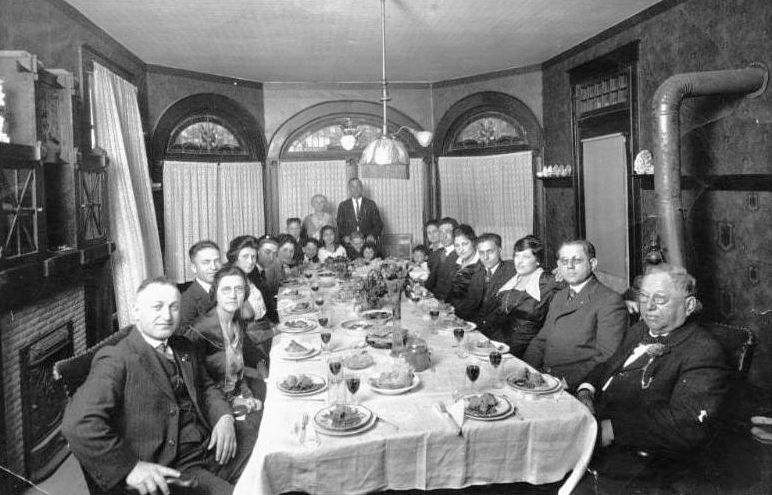
Above, a photograph of Passover seder, probably in the 1920s, taken at the South Dallas home of Sam and Dubbie Margules, with some (or all) of their nine children.

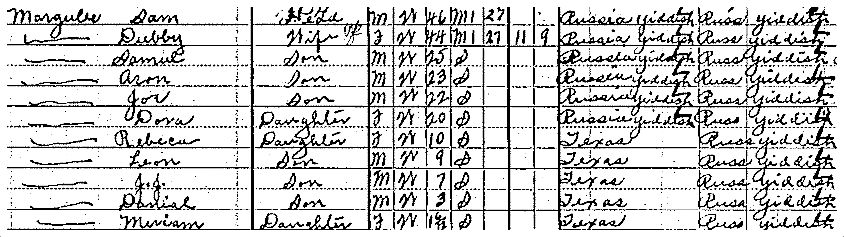
2-margules_census_1910(1910 Census — click for larger image)

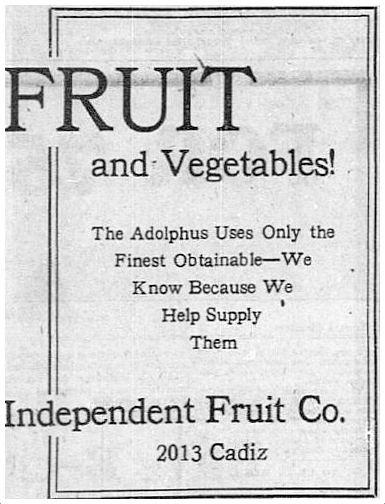
Sam Margules immigrated to the United States from Russia in the late 1880s. By the early 1890s he had made his way to Dallas and had begun working in the wholesale produce business. Once settled and on secure financial footing, he sent for his wife and four children (five more would be born in Dallas). In 1915, Sam established his own business, the Independent Fruit Co.

3-margule_ind-fruit-co_dmn_010116(1916)

4-margules_adolphus_dmn_101224(1924)

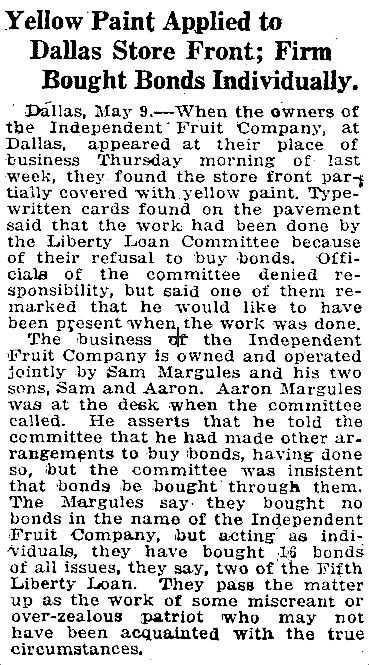
Even thought the Margules family seems to have had a happy and successful life in Dallas, there was one incident that must have been very unsettling for them. In the waning days of World War I, a Chicago trade publication reported an instance of vandalism against the Independent Fruit Co., perpetrated by a thuggish Liberty war bond committee. In what was clearly meant as intimidation, the shakedown “committee” had splashed yellow paint across the Margules storefront in the dead of night, as punishment for what they believed was the family’s refusal to purchase Liberty bonds. These attacks with yellow paint were a common occurrence around the country in those days (as was tarring and feathering!), and they were frequently directed at immigrants, as were nasty accusations that they were “slackers”  (a much-used pejorative at the time meaning “unpatriotic shirker” or even “coward”)

The family seems to have shrugged off the incident, but it must have been a frightening time for them. The Jewish community in Dallas was a large and thriving one, but there was always antisemitism to deal with, and the Ku Klux Klan’s rise to power in the 1920s was particularly difficult for Jews in Dallas. (Click article below to see larger image.)

5-margules_chicago-packer_051019(1919)

Sam Margules died in 1930 at the age of  67, a 40-year resident of Dallas. His wife, Dubbie, died in 1953 at the age of 90, survived by 18 grandchildren and 17 great-grandchildren.

***

Sources & Notes

Photo from the Dallas Jewish Historical Society — the full citation is here.

Ads from The Dallas Morning News.

Article on the yellow paint attack from The Chicago Packer, May 10, 1919.

A passage on other yellow paint attacks on America’s immigrants by Liberty Bond committees can be read here.

A lengthy article on “The Jews Who Built Dallas” by David Ritz  (D Magazine, Nov. 2008) can be read here.

Click top two pictures for larger images.

*

Copyright © 2014 Paula Bosse. All Rights Reserved.