Flashback : Dallas

A Miscellany: History, Ads, Pop Culture

Trini Lopez: Little Mexico’s Greatest Export
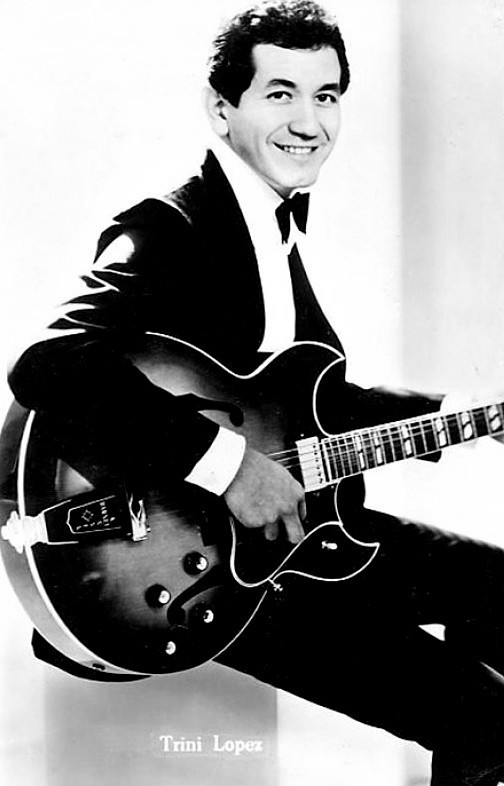
trini-lopez-photo_bw

by Paula Bosse

Trini Lopez has sold millions of records. MILLIONS. He was born in Dallas in 1937 and grew up in the Little Mexico area of town. He started his career when he was a teenager at Crozier Tech High School, singing and playing guitar in a popular combo. He played at dozens of school dances and parties, and, with a steady and faithful following, he was much in demand at countless venues around town, including a regular 2:30-6:30 p.m. Sunday matinee spot at Club Vegas (Oak Lawn & Lemmon), one of the many clubs in the city run by Jack Ruby.

Jack Ruby — the personable Latin from Manhattan, reports surprising success with his Sunday night Fiestas at Club Vegas….

“There is a wide demand for Latin music in Dallas,” said the Oak Lawn impresario…. He is opening at 2:30 p.m. Sundays for matinee dances featuring Trini Lopez and his orchestra. The versatile Lopez combo offers an occasional Yanqui tune in addition to the likes of the “Jack Ruby Mambo.” (Tony Zoppi’s column in The Dallas Morning News, Dec. 19, 1956)

(I really want to hear that “Jack Ruby Mambo”!)

Speaking of the “Latin from Manhattan” (?!):
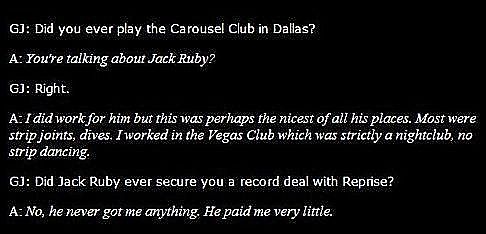
trini-rubyHa! (From Gary James’ really great interview w/ Trini — see link at end.)

He also appeared on local TV, including Channel 8 shows hosted by a pre-Peppermint Jerry Haynes: “Jukebox” and “Top Ten Dancing Party.”
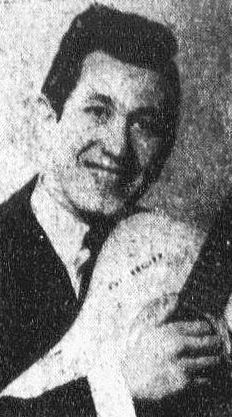
trini-lopez_19581958 publicity photo

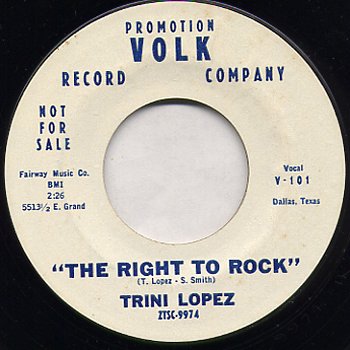
Trini’s first single was “The Right to Rock” — the first song he ever wrote — recorded in 1958 on a small Dallas label called Volk (did anyone else ever record for this label?).
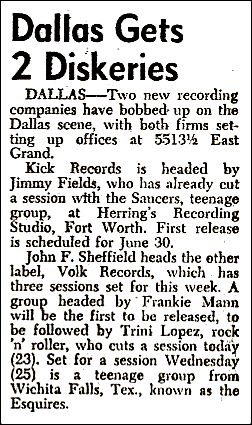
trini_volk_billboard_062358Billboard, June 23, 1958

It’s a great little rockabilly number, but it didn’t really make any waves outside of Dallas (although it’s since found new life in the cult-y world of vintage rockabilly reissues).

volk-label

Trini then recorded a few singles for King, but those went nowhere as well, and Trini and his combo continued to play small clubs in and around DFW, wondering when the big break was going to come.
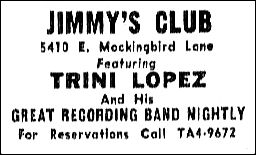
trini-lopez_jimmys-club_dmn_011159Jan., 1959

After a gig in Wichita Falls, Trini met fellow-Texan Buddy Holly who had been impressed by the young singer’s performance and encouraged him to contact his producer, Norman Petty, about recording some tracks at Petty’s studio in New Mexico. Trini jumped at the chance, but, unfortunately, the time in the studio at Clovis turned out to be a career low-point (see below for a link to the Gary James interview in which Trini gives a bitter and scathing account of that whole experience). Trini returned to Dallas and immediately fired his band and started a new one, determined that he would succeed, despite the prevailing (spoken and unspoken) racism he was continuing to run up against in the music business.

A few months after Buddy Holly’s death, the Crickets contacted Trini and asked him to travel to Los Angeles to discuss the possibility of becoming their new lead singer. Trini, seeing this as the big break he’d been waiting for, disbanded the combo and set out to the West Coast alone. The “audition” never really materialized, and Trini was stuck in California with no money and no prospects. He played a few small clubs and then settled into PJ’s for an extended and very successful engagement. It was there, in 1963, that the “big break” finally happened: he was discovered by producer Don Costa, who recommended that Frank Sinatra sign him to Reprise Records. Next thing you know, Trini had recorded his debut album, “Trini Lopez at PJ’s,” and the first single, “If I Had a Hammer,” was a huge smash hit, selling millions of copies and reaching #1 in 38 countries. Trini Lopez became an international star.
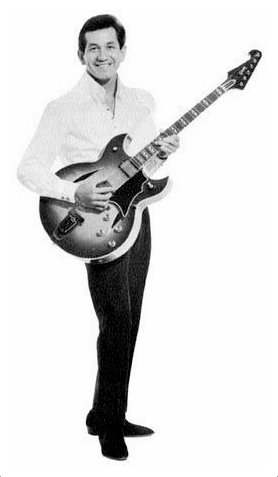
trini-lopez_photo_bw

At the beginning of 1964, he was booked for a series of shows in Paris where he shared the bill with The Beatles, just as they were about to hit big in the US (their Ed Sullivan appearance was less than a month away). Beatlemania was in full force in Europe, but Trini was also getting his share of attention. 
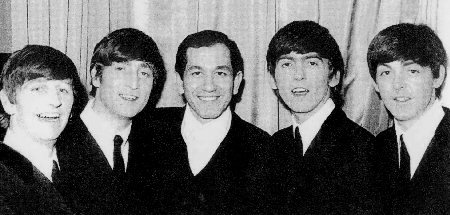
trini-lopez_beatles_1964

And, the rest, as they say, is history.

*

A couple of interesting things, Dallas-wise. My Trini Lopez knowledge is fairly scant, but having read a lot about him over the past couple of days, the one thing that keeps coming back when he talks about the Little Mexico section of town (invariably referred to by him as a “ghetto”) is how violent a place it was. He also recounts the deep and dehumanizing racial prejudice he and other Mexican-Americans experienced living in Dallas. When he left for Los Angeles in 1959/1960, he left for good. He came back regularly to visit his family (I remember having him pointed out to me by my parents in a restaurant once), but I’m not sure he would have ever wanted to live here again.
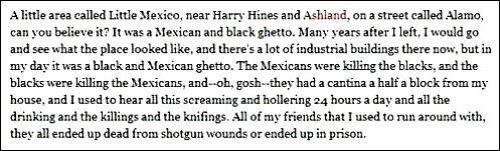
trini-lopez_wilonsky_052906From an interview by Robert Wilonsky (Dallas Observer, May 29, 2006)

*

Below are a few random interviews and tidbits.

Trini developed his own beat, a Tex-Mex style of rock and roll now popularly known as “the Trini beat” and which Trini describes as “American music with a Mexican feeing.” (DMN, July 12, 1964)

And from the same article:

“People in Dallas told me I had the talent but suggested I change my name. I said ‘No.’ I told them Italians had made it as Italians, Jews as Jews, and Negroes as Negroes. I wanted to make it as a Mexican. No one of Mexican-American heritage had made it before in the entertainment world. I wanted to be the first.” (DMN, July 12, 1964)

(According to Trini, the person who suggested he change he name was John F. Sheffield who owned Volk Records. Sheffield was okay with “Trini,” but he insisted the “Lopez” had to go. He suggested “Roper.” Trini refused and threatened to walk. Sheffield relented.)

trini-lopez_earl-wilson_july-1965a(Click for larger image – continues below.)

trini-lopez_earl-wilson_july_1965bEarl Wilson’s syndicated column (July 1965)

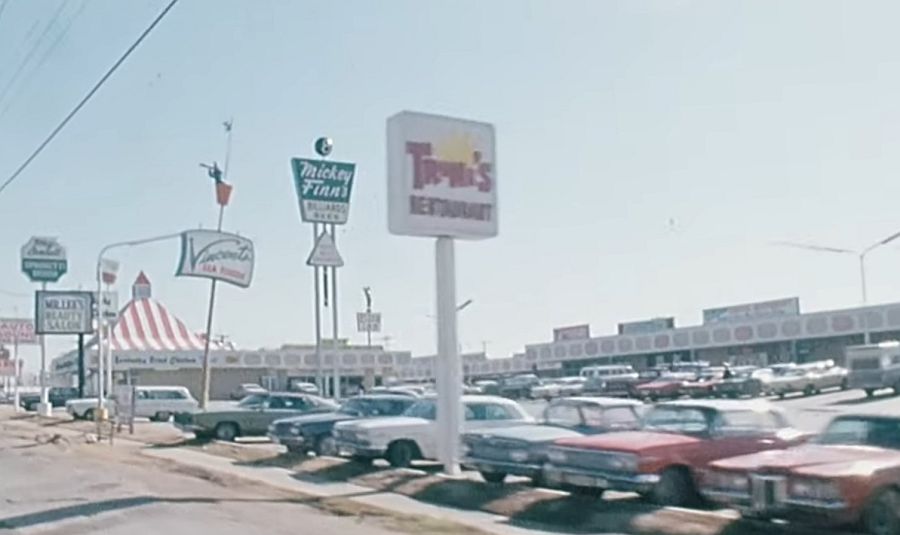
In 1969, Trini Lopez became a restaurateur and opened “Trini’s” at 5412 East Mockingbird, across from the old Dr Pepper plant (click for larger image):
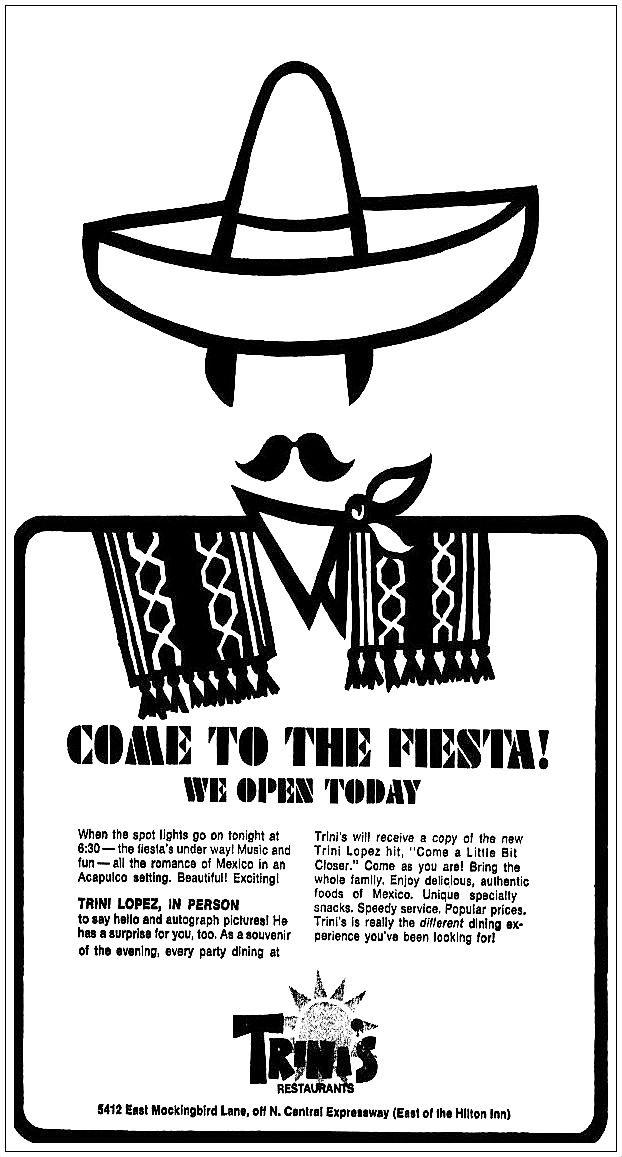
trinis_restaurant_031969
March, 1969

trinis_sightseeing-film_KERA_1970_jones-film_SMU - croppedScreenshot, KERA, 1970 (Jones Film Collection, SMU)

**

UPDATE: Sadly, Trini Lopez died on April 11, 2020 from complications of COVID-19. He was 83. Read his obituary in Variety here

***

Sources & Notes

Full Dallas Observer interview by Robert Wilonsky is here.

There are a lot of garbled accounts of Trini Lopez’s career scattered across the internet. One that seems mostly right is here.

The essential  interview with Trini by Gary James I’ve mentioned a couple of times above, is here. I think the interview is from 2002. His memories of growing up in Dallas are interesting, unvarnished, and well worth reading. He also talks about the racial prejudice he met with when attempting to record with Norman Petty and the resulting mutiny of his band in Clovis which led to their being fired by Trini immediately upon their return to Dallas.

Read Trini’s tribute to his parents — an essay he wrote in the early 1980s — here

Trini Lopez’s official website is here.

Discovering Trini and his music has been surprisingly fun! Thanks, Trini! Check out this great, infectiously joyful performance of “La Bamba” with Jose Feliciano at a music festival in San Antonio in 1974. (Trini was performing “La Bamba” when he was still in Dallas, before Ritchie Valens had a hit with it — when Valens’ version hit the airwaves, Trini was crushed that someone had beaten him to recording it. He may not have recorded it first, but he had the bigger hit with it a few years later.)

*

Copyright © 2014 Paula Bosse. All Rights Reserved.
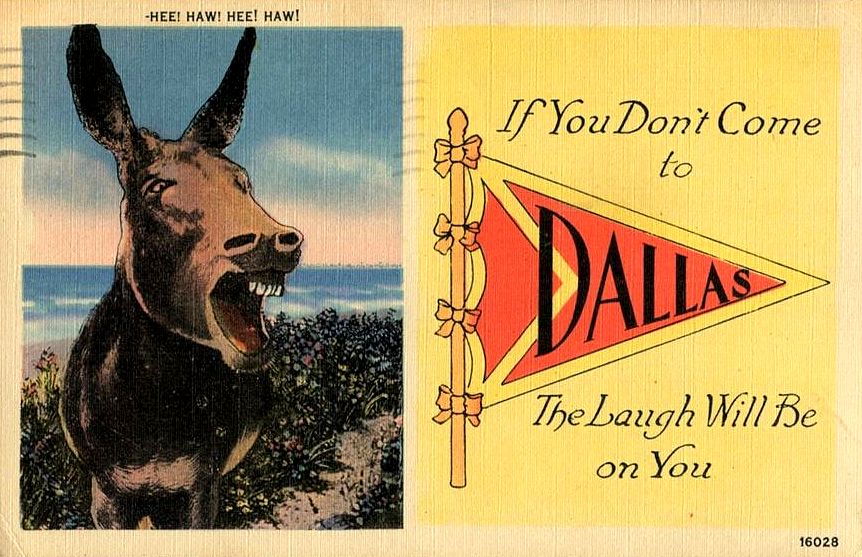
“If You Don’t Come to Dallas, the Laugh Will Be On You!”

dallas_postcard_hee-haw

by Paula Bosse

“Hee! Haw! Hee! Haw!” Sa-LUTE!

***

Click to get the donkey bigger, y’all.

*

Copyright © 2014 Paula Bosse. All Rights Reserved.
The Sexton Foods Building and the Former Life of the School Book Depository

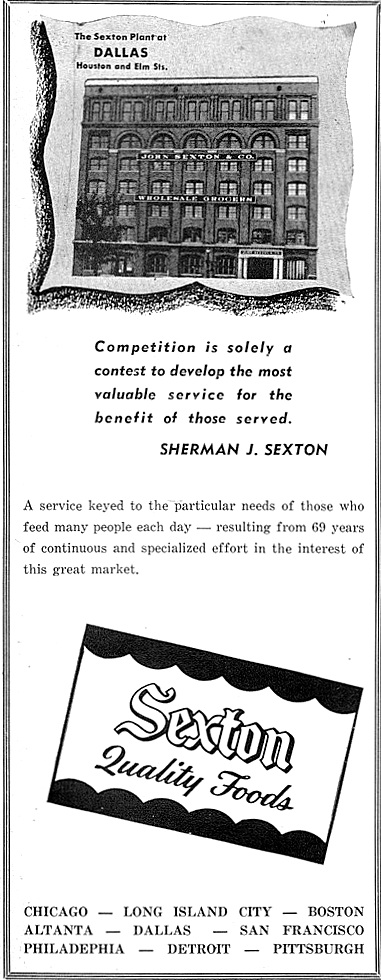
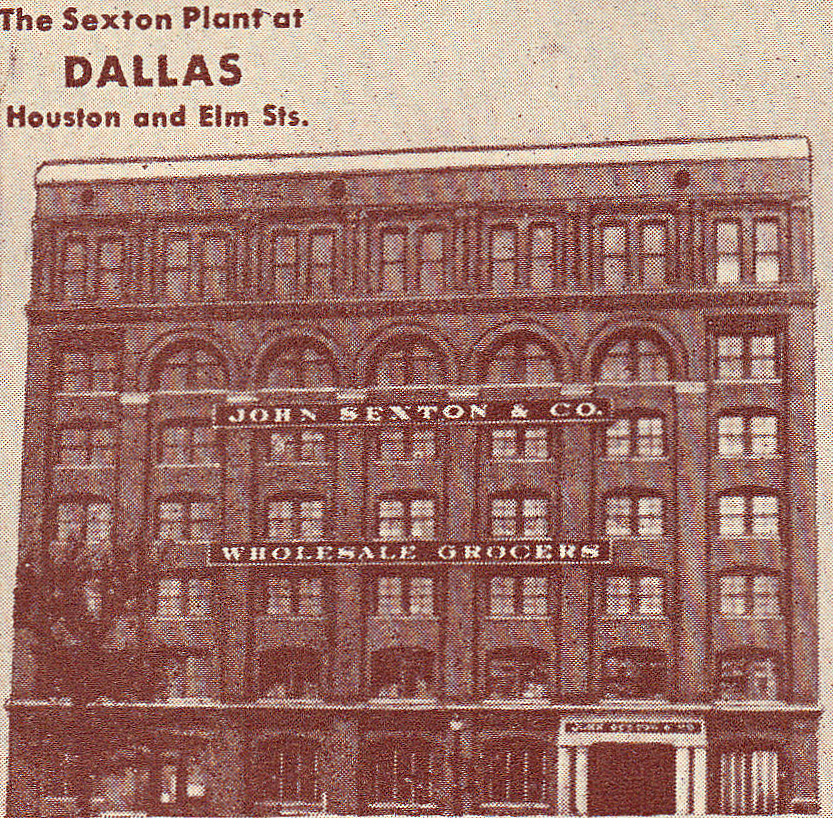
sexton_croppedLook familiar? (click for larger images)

by Paula Bosse

Look familiar? The building above would later become the Texas School Book Depository. But prior to that, the building housed Sexton Foods, a Chicago-based wholesale grocer which occupied the building for twenty years (1941-1961). The building was known commonly in town as “the Sexton building,” even after it was leased to the Texas School Book Depository in 1963, which explains why some people — citizens and police officers alike — were still referring to it by that name on the day of the Kennedy assassination (and this has apparently caused confusion amongst those wading deep into the “assassination literature”). The photo above is cropped from an ad I came across in The Dude Wrangler, a dude ranch quarterly (!), published in Bandera. The ad (which is reproduced in full down the page a bit) is from 1953, but the photo of the building appears to have been taken earlier.

The leasing of the building by D. Harold Byrd to the John Sexton Wholesale Grocery Company of Chicago (initially for only five years) was announced in The Dallas Morning News on Nov. 28, 1940 (“Wholesale Grocery Leases Building at Houston and Elm”). The Sexton Co. was scheduled to move in on Dec. 8 “following a general remodeling which will include installation of elevators, rearranging of partitions and painting.” They remained in the building until 1961.

sexton_19511951

sexton_foods_dallas_19531953

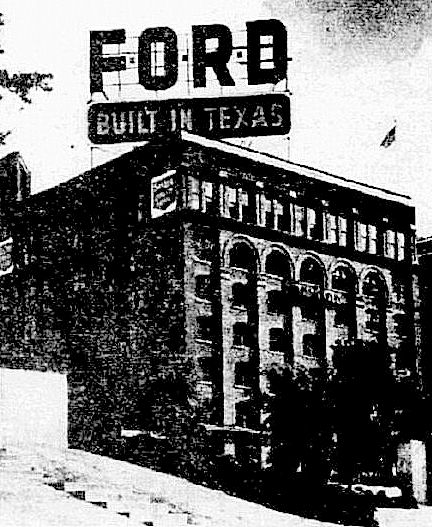
In 1953 (before anyone from Hertz was planning on putting a billboard up there), the Ford people erected a giant neon sign on top of the building to commemorate the 50th anniversary of the founding of the Ford Motor Company. In fact, it was so big that it had half a mile of neon tubing in it and was touted as being the largest animated neon sign in the Southwest. Now there’s a sign that probably caused a few car accidents!

sexton-bldg_ford-sign_1953
1953

*

Before the Sexton company moved in, the building housed the Perfection-Aire air-conditioning  company. Newspaper articles announced the renovation of the building for the A/C people — the company went into receivership a couple of years later.

perfection-aire_dmn_0314371937

*

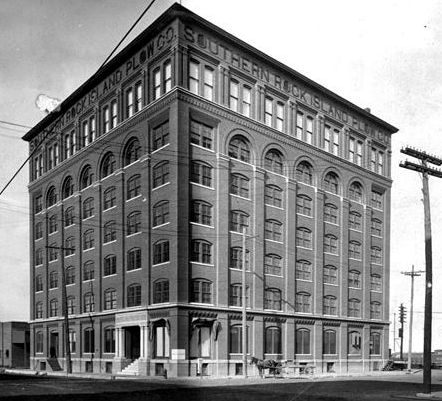
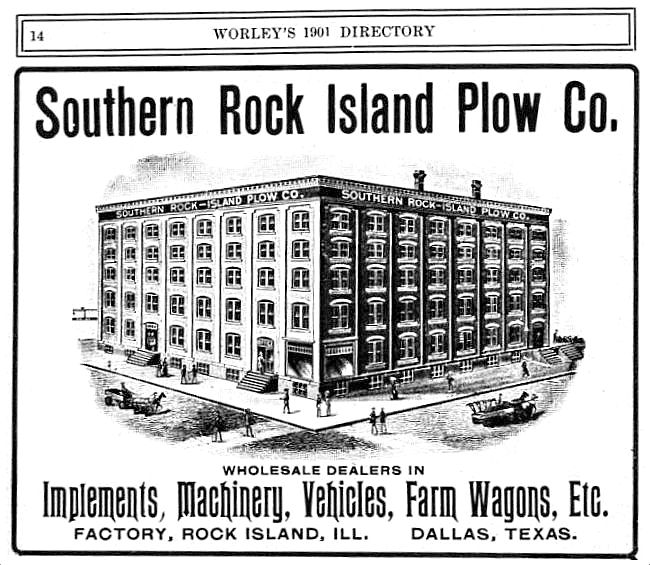
Before that, it was the site of the Southern Rock Island Plow Co., which was the original owner of the property (1894) and which built the building in 1903 after the first building was destroyed in a fire after it was hit by lightning on May 4, 1901.

rock-island-plow_DMN-c1910circa 1910

Above, the Southern Rock Island Plow Co. Building which still stands, famous as the “Texas School Book Depository”; below, the building originally built by the plow company which was destroyed by fire  in May, 1901.

southern-rock-island-plow_1901_pre-current-bldg_1901-directory1901, Dallas city directory

***

Sources & Notes

Sexton Co. ad from a 1953 issue of The Dude Wrangler ; the top image is a detail from that ad.

More on the history of the building as it pertains to the Rock Island Plow Co. is here.

More on the Sexton Foods Co. is here.

More info, specifically on the Texas School Book Depository, is here.

Official site of the current occupant, the Sixth Floor Museum, is here.

*

Copyright © 2014 Paula Bosse. All Rights Reserved.


Downtown Horse-Trading — ca. 1912

by Paula Bosse

This fantastic photo — taken between about 1912 and 1915 — shows a horse-trading day, taking place around S. Houston and Jackson streets.

Chenoweth’s Feed Store and wagon yard at Houston and Commerce was the scene of monthly trades days or First Mondays from the 1880s into the twentieth century. The crowd spilled over into the streets, blocking passage but no one complained. The old red courthouse survived.

***

Photo from the UT Southwestern Library.

Caption by A. C. Greene from his book Dallas, The Deciding Years (Austin: Encino Press, 1973).

Even though it seems very late to see horses in downtown Dallas, this photo appears to have been taken between 1912 and 1915 when Charles B. Tatum owned a saloon at the corner of Commerce and S. Houston (his sign can be seen painted on the wall facing Houston Street at the left). The MKT Building can be seen at the top right of the photo, indicating that this photo was taken west of S. Houston, almost to Jackson (the old county jail would have been behind the photographer. The same view today can be seen here.

The wagon yard Greene mentions can be seen in the 1905 Sanborn map, here.

Click photo for larger image.

*

Copyright © 2014 Paula Bosse. All Rights Reserved.

Nardis of Dallas: The Fashion Connection Between “The Dick Van Dyke Show” and the Kennedy Assassination

by Paula Bosse

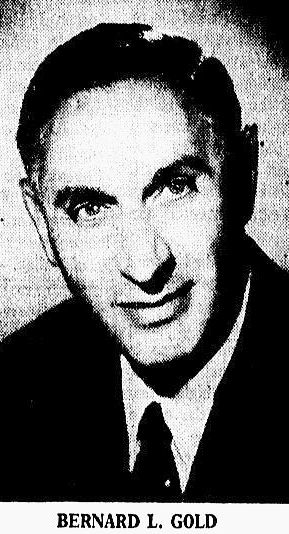
I started watching reruns of The Dick Van Dyke Show on Channel 11 when I was a kid. I still love the show, and I’ve seen every episode countless times. Which is kind of an odd jumping-off point for a post on a Dallas clothing manufacturer, but there you are. The company was Nardis of Dallas, a successful manufacturer of women’s apparel, owned by the Russian-born Bernard “Ben” Gold who arrived here in 1938 from New York City where he had operated a taxi company for many years.

Gold moved to Dallas at the request of his brother who, along with a man named Joe Sidran (“Sidran” spelled backwards is “Nardis”) was an owner in a near-bankrupt dress company. Ben Gold became a part-owner (and later the sole owner) and quickly turned the business around. When he brought in the International Ladies’ Garment Workers’ Union, other Dallas garment manufacturers were shocked (Time magazine used the word “horrified”). He also shook things up by employing African-American workers, the first such company in town to do so. The company eventually grew to become the largest clothing manufacturer in Dallas, with clients around the country and around the world. Nardis was one of the first Dallas clothing companies to have an apparel collection made in a foreign country: his upscale “House of Gold” boutique line specialized in silk, beaded, and sequined dresses and gowns, hand-made in Hong Kong.

Nardis of Dallas was originally located at 409 Browder, with factories at 211 North Austin, the 400 block of S. Poydras (at Wood Street), and, finally, at 1300 Corinth (at Gould St.), where they built their 75,000-square-foot “million-dollar plant” in 1964 (a quick check of Google Maps shows the building still there, but it appears to be vacant). Below are two photos of their S. Poydras location.

nardis_squire-haskins_UTA_wood-and-poydras

Above, Wood Street at the left (Andrew’s Cafe is listed at 1008 Wood St. in the 1960 Dallas directory); below, Nardis garment workers.

AR447-R812

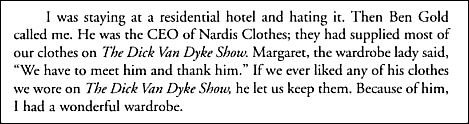
So how does this all connect to The Dick Van Dyke Show? If you’re a fan of the show and a faithful reader of closing credits like I am, you’ve probably seen the “Fashions by Nardis of Dallas” credit at the end of some episodes, right under the Botany 500 credit. And, like me, you might have wondered, “How did THAT happen?” How does an apparel-maker from Dallas network itself into a primo gig supplying fashions to a top Hollywood television show? I have no idea how the initial contact was made, but I DO know that Dick Van Dyke Show star Rose Marie and Nardis owner Ben Gold became very good friends while she was appearing in a production of Bye, Bye Birdie at the Dallas Summer Musicals in 1965. She mentions Gold several times in her autobiography.

Excerpt from “Hold the Roses” by Rose Marie

She spent much of her off-stage time in Dallas with Gold and his wife, and, in fact, when Gold was fatally injured in a traffic accident that summer, Rose Marie (then recently widowed herself) stayed with his wife Tina for several days at Tina’s request.

So, no big Dick Van Dyke Show story, but, as is no doubt known to the hyper-vigilant members of the JFK-assassination community, Nardis of Dallas DOES have an interesting connection to that. In 1941, Abraham Zapruder, who had worked in the garment industry in New York, moved to Dallas and began working for Ben Gold as a Nardis pattern-cutter. His name even appears in a couple of classified ads in The Dallas Morning News.

June 1945

Jan. 1948

While at Nardis — before he left to start his own clothing company — Zapruder worked with a woman named Jeanne LeGon (later Jeanne De Mohrenschildt) who, with her husband George (suspected by some of being a CIA operative), was friends with Lee Harvey Oswald in the early ’60s. Yep. That’s an interesting, head-spinning coincidence.

And I owe all this trivial Nardis-related knowledge to wondering for years about a single card seen in the closing credits of the unquestionably stylish and fashion-forward Dick Van Dyke Show.

nardis-label_ebay

***

Sources & Notes

Fashion photographs from MyVintageVogue.com (1952, 1955, and 1956, respectively). Other Nardis fashion photos from My Vintage Vogue can be found here. (If you’re interested in vintage fashion, fashion photography, and vintage advertising, this is a great website.)

Photos of the Nardis plant at S. Poydras and Wood are by Squire Haskins, from the Squire Haskins Photography Inc. Collection, University of Texas at Arlington Libraries, Special Collections — more info on the exterior shot is here; more on the interior shot here.

Passage about Gold from Rose Marie’s autobiography, Hold the Roses (Lexington: University Press of Kentucky, 2002), p. 192.

Dick Van Dyke Show closing credits card from a 1965 episode.

Nardis of Dallas logo from a clothing tag, found on eBay.

Additional background information on Gold from Time magazine, June 12, 1950.

See another Flashback Dallas post on Nardis — “Nardis Sign-Painters: ‘Everything in Sportswear’ — 1948” — here.

nardis_texas-jewish-post_122354
1954 ad, detail

*

Copyright © 2014 Paula Bosse. All Rights Reserved

Alexandre Hogue’s “Calligraphic Tornado” — 1970

by Paula Bosse

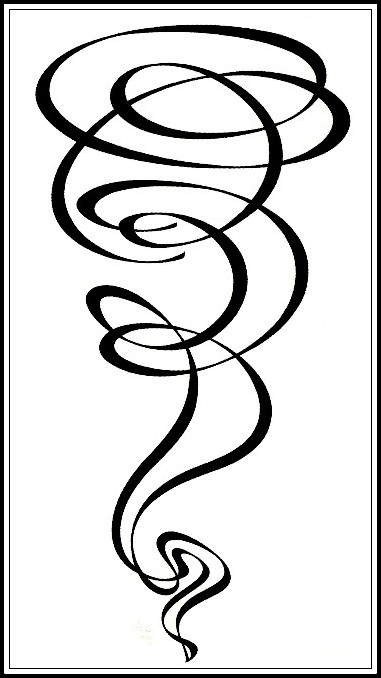
Since the season is upon is, it seems like a good time to post Alexandre Hogue’s wonderful “Calligraphic Tornado” (1970), quite a departure from his more widely known Depression-era landscape paintings. I love this.

***

Sources & Notes

Image and text from Nature’s Forms/Nature’s Forces: The Art of Alexandre Hogue by Lea Rosson DeLong (Norman: University of Oklahoma Press, 1984), p. 168. (This is a great monograph on the Dallas Nine artist, but it appears to be becoming difficult to find at affordable prices. There are a couple that should be scooped up quickly, here. It was issued only in softcover.)

A previous post from me on Hogue (one of my favorite artists) — with another uncharacteristic example of his work — is here.

*

Copyright © 2014 Paula Bosse. All Rights Reserved.

Tornado as Learning Tool — 1957

by Paula Bosse

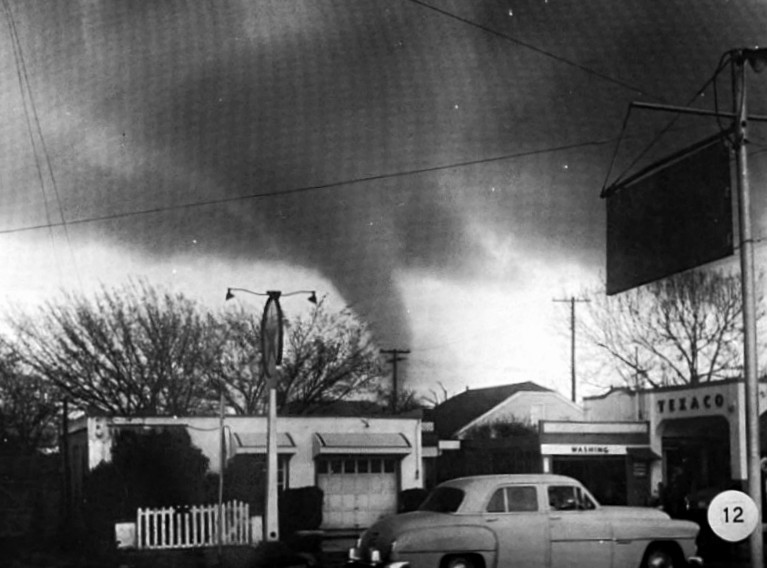
On April 2, 1957, the famous Dallas tornado (tornadoes, actually) ripped across the city. At the time, it was the most photographed tornado in history, and the photographs and film footage taken that day were immensely important in the study of how tornadoes form and behave. The above photo is from a landmark study by the United States Weather Bureau (link to the full report is below).

Above, a photo by Bill Winfrey of the Dallas Morning News, taken from the roof of the News building, looking toward Oak Cliff.

I just stumbled across the odd little film above, produced by the National Assn. of Broadcasters in the late ’50s. If you skip to about the 4:30 mark, you can see a WFAA Channel 8 reporter/cameraman running to his news vehicle, followed by a minute or so of the clearest film footage of the Dallas tornado I can find online.

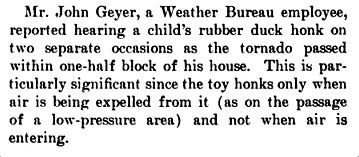
Since the tornado has been written about for years and years and years, there’s nothing I can add, really, except to mark another anniversary. ALTHOUGH, the following paragraph (from the official U.S. Weather Bureau report) has been sorely under-reported: the affect of tornadoes on the behavior of rubber duckies.

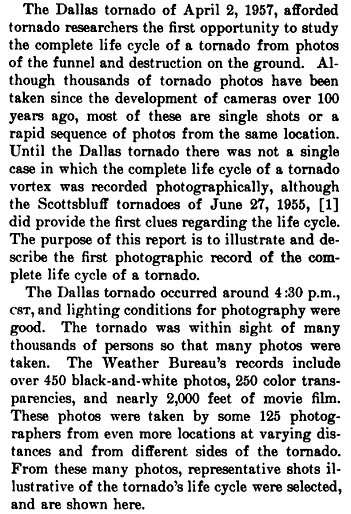
As you can see, that report was thorough! The U.S. Weather Bureau Report that was issued about the Dallas tornado was incredibly important in leading to what we know about tornadoes today. This paragraph introduced their report:

***

Sources & Notes

Top photo and clipped text from “The Tornadoes at Dallas, Tex., April 2, 1957 — Research Paper No. 41” (Washington: U.S. Govt. Printing Office, U.S. Department of Commerce, Weather Bureau, 1960). You can access the entire official report — containing numerous photographs, charts, interviews with Dallasites who witnessed the tornado(es), and results of the Bureau’s research — here. It’s very interesting.

The second photo is from the great Dallas Morning News photo blog, here.

The National Association of Broadcasters’ self-aggrandizing pseudo-PSA film, “A Guest in the House,” can be found here.

And, finally, everything you ever needed to know about the 1957 tornado is here.

*

Copyright © 2014 Paula Bosse. All Rights Reserved.

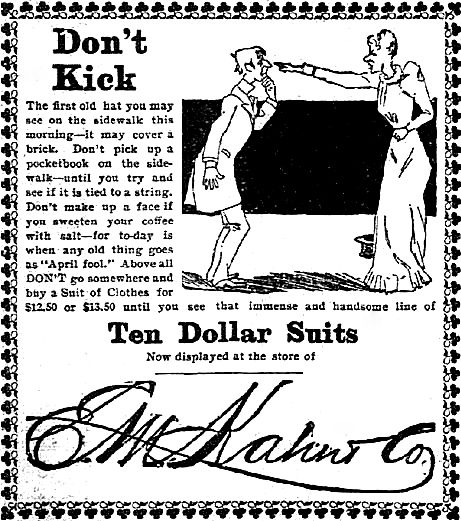
Do Not Become an April Fool: Tips from E. M. Kahn & Co. — 1898

by Paula Bosse

Pranks in 1898 were high-larious.

Do NOT be a fool and pass up that ten-buck suit, man, or you’ll have hell to pay with the missus.

***

Ad appeared in The Dallas Morning News, April 1, 1898.

*

Copyright © 2014 Paula Bosse. All Rights Reserved.

U.S. Revenue Cutter “Carrie Nation” Successfully Navigates the Trinity In Valiant Effort to Keep Dallas Dry! — 1931

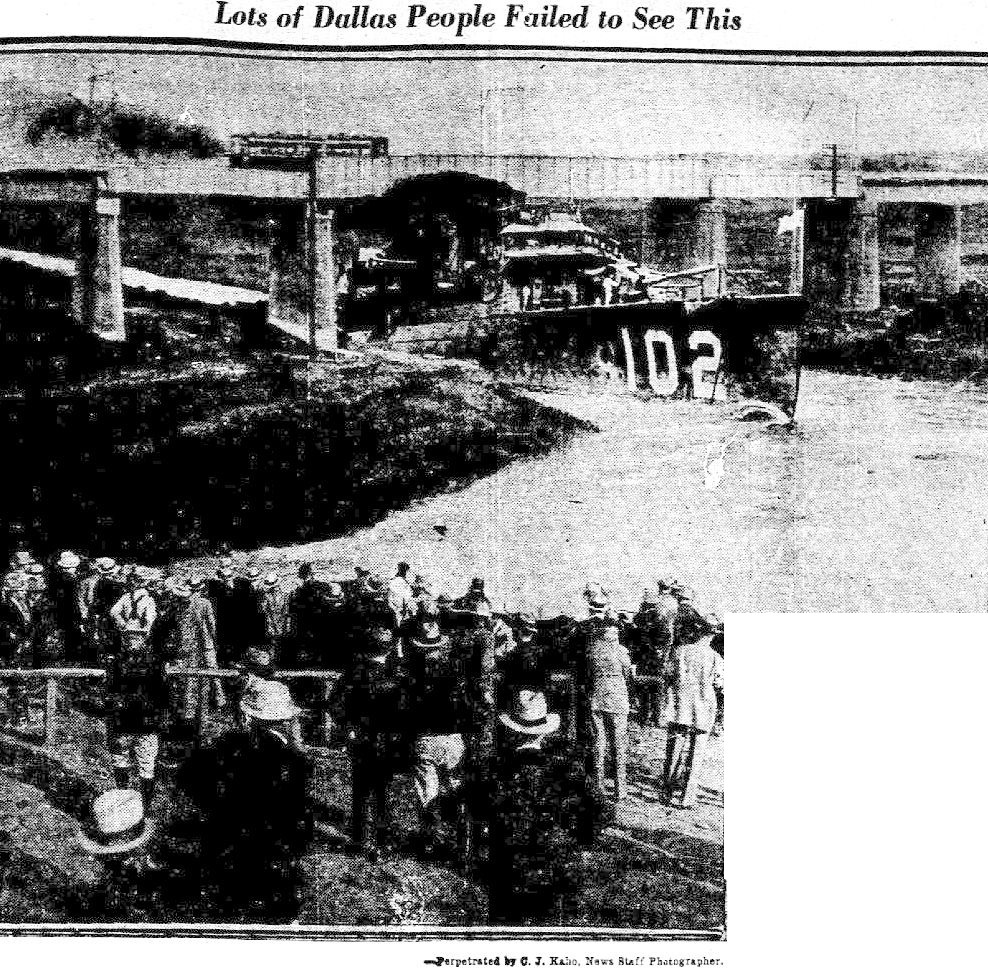
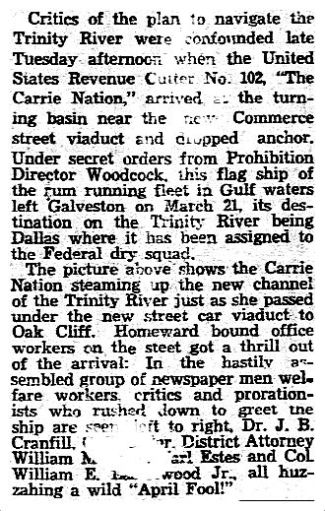
april-fools_dmn_010131_carrie-nation
The ship’s arrival, passing under the streetcar viaduct…

by Paula Bosse

I spent a couple of hours looking through the archives of The Dallas Morning News this morning, hoping to find a nice juicy April Fools’ prank from the past. Everything was fairly run-of-mill. Until I came across this. THIS is great. I don’t know who wrote the story, but there is, at least, acknowledgement for the wonderfully weird photo above — the photo credit reads: “Perpetrated by C. J. Kaho, News Staff Photographer.”

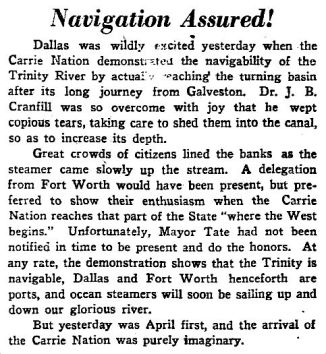
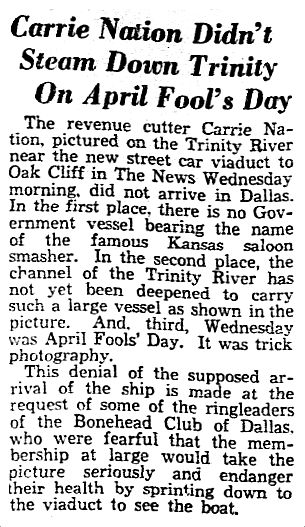
Below is the accompanying story about the United States Revenue Cutter Carrie Nation and the news of its journey up a surprisingly navigable Trinity River in order to anchor itself beneath the Commerce Street viaduct and make sure that the rum-runners in the Gulf don’t gain a foothold in bone-dry Prohibition-era Dallas. The photo and report appeared in the pages of The Dallas Morning News on April 1, 1931, beneath the headline “Lots of Dallas People Failed to See This.”

Unwilling to let such an important story fade away — and with a few more good lines left to get into print — this appeared the next day, on April 2, 1931: “Navigation Assured!”

Then some killjoy editor probably insisted on this, which also appeared on April 2, 1931:

**

Rev. J. B. Cranfill was a Baptist leader and a noted Prohibitionist. I love the line “Dr. J. B. Cranfill was so overcome with joy that he wept copious tears, taking care to shed them into the canal, so as to increase its depth.”

And I laughed out loud at the “where the West begins” dig at Fort Worth.

But, seriously, that photo is great. The little streetcar chugging over the viaduct is just the perfect garnish.

Read about the famed, notorious Bonehead Club of Dallas in a 1991 Texas Monthly article by Helen Thompson, here. Thank you, Boneheads!

*

Copyright © 2014 Paula Bosse. All Rights Reserved.

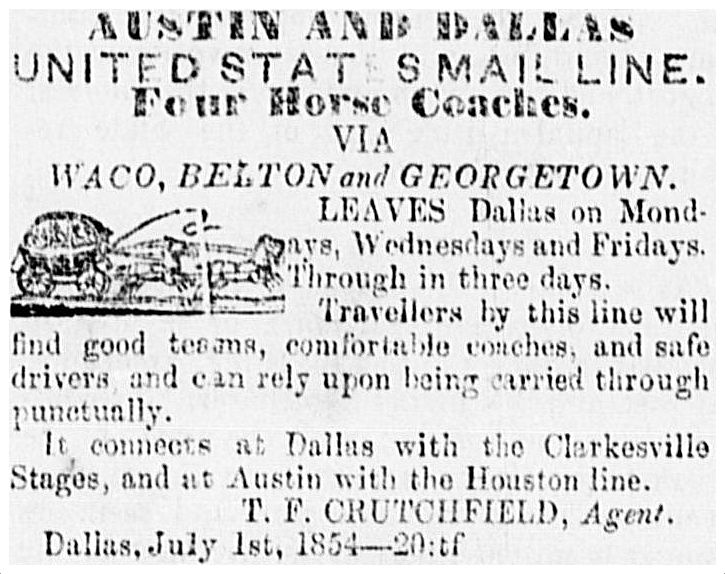
Dallas to Austin by Stagecoach: Only Three Days! (1854)

by Paula Bosse

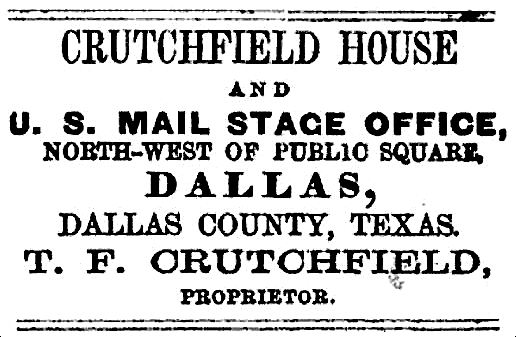
T. F. Crutchfield was a busy man who had his hands in a lot of pies in the very early days of Dallas. I’ll have to get back to him one day. Above, an ad of his, dated 1854, from an 1855 issue of the Dallas Herald. Below, an ad from the 1858 Texas Almanac.

crutchfield_tx-almanac_1858

***

Sources & Notes

An interesting article by Mike Cox on stagecoaching in Texas, from the Texas Almanac, is here.

*

Copyright © 2014 Paula Bosse. All Rights Reserved.