Flashback : Dallas

A Miscellany: History, Ads, Pop Culture

Alexandre Hogue and the Lost “Dead Eye Dick” Bookplate — 1927

hogue_bookplate_1927_full

by Paula Bosse

I am a huge fan of the paintings and prints by the Dallas Nine group, and Alexandre Hogue — one of the members of the group — has always been one of my favorite artists. I stumbled across this early, uncharacteristic work by him last night while looking for something else. I was browsing though a digital bookplate collection (…as one does…), and when I saw the thumbnail image of this western scene, I wondered who had drawn it. The citation had no artist attribution and noted merely that it was produced for the University Club of Dallas. As I have a background in rare books and Texas art, I thought I might know the artist, so I checked the signature. I never expected this drawing to have been done by Alexandre Hogue.

The bookplate was executed by Hogue for the University Club, a group whose well-heeled and literate members met in a tony downtown penthouse. It was done in 1927 when Hogue was working as an art instructor at the Dallas YWCA; his own work had begun to attract positive critical attention, but he had yet to make a big splash. I’ve checked various sources, but I don’t see mention anywhere of Hogue doing this sort of thing. Was he commissioned? Did he do it on spec, hoping to possibly network with influential members and perhaps improve his chances of showing his work there? Whatever his reason, things seem to have paid off, because he was showing his art at the club and participating in group shows there by 1928.

So here it is, art-lovers, a heretofore mostly (if not totally) unknown piece of Alexandre Hogue-iana from 1927 — a little piece of anonymous ephemera which has been stashed away for years in a bookplate collection in Illinois.

hogue_bookplate_1927_det

hogue_bookplate_sig_1927

***

Sources & Notes

This bookplate is from the John Starr Stewart Ex Libris Collection, Rare Book and Manuscript Library, University of Illinois at Urbana-Champaign. It can be seen here.

If you are unfamiliar with Alexandre Hogue’s work, see here for a few examples of his work as well as those of his fellow Dallas Nine artists.

Also, there is a show featuring Hogue’s works currently on at the Dallas Museum of Art. For details see here.

And a short, informative video, presented by Susan Kalil, author of Alexandre Hogue: An American Visionary, can be viewed here.

Another uncharacteristic example of Hogue’s work, is the incredible “Calligraphic Tornado” (1970), which I’ve posted here.

*

Copyright © 2014 Paula Bosse. All Rights Reserved.

Leaving Dallas on the Katy Flyer — ca. 1914

leaving-dallas-katy-flyer1

by Paula Bosse

Who doesn’t love kitschy novelty photos? These “Leaving Dallas on the Katy Flyer” snapshots don’t disappoint with their cartoony backdrops — like something you’d see along a seaside boardwalk.

katy-flyer_three-men_1915_ebay
The people above are not identified, but, below, it’s a bunch of Order of Railroad Telegraphers union bigwigs. They probably had a wild time in Dallas. One or two of them look like they might be nursing a hangover.

And just where was the point of departure from Big D for these Katy Flyer travelers? From the beautiful MKT passenger depot, formerly holding down the rails at Ross and Market.

katy-flyer_MKT_ebay_rppc

***

Sources & Notes

Top “real photo postcard” is from the J. L. Patton Collection, Dallas Historical Society.

Second photo was found on a postcard website.

Third photo is from eBay.

“O.R.T. General Committee” photo from — what else? — an issue of The Railroad Telegrapher (Feb. 1914).

Photo of the Missouri, Kansas & Texas depot is another real photo postcard, found on eBay.

See another Katy Flyer post — “M-K-T Railroad’s ‘Katy Flyer Route’ — 1902” — here.

*

Copyright © 2014 Paula Bosse. All Rights Reserved.


Nicholas J. Clayton’s Neo-Gothic Ursuline Academy

ursuline_postcard-color

by Paula Bosse

Over the years, Dallas has been the site of dozens and dozens of beautiful educational campuses, almost none of which still stand — such as the long-gone Victorian-era Ursuline Academy, at St. Joseph and Live Oak streets (near the current site of the Dallas Theological Seminary). The buildings, which began construction in 1882, were designed by the Catholic church’s favorite architect in Texas, Nicholas J. Clayton of Galveston. Such a beautiful building in Dallas? It must be demolished!

ursuline_first_bldg
Six Ursuline Sisters, sent to Dallas from Galveston, established their academy in 1874 in this poorly insulated four-room building (which remained on the Ursuline grounds until its demolition in 1949). When they opened the school, under tremendous hardship, they had only seven students. But the school grew in size and reputation, and they were an academic fixture in East Dallas for 76 years. In 1950 the Sisters moved to their sprawling North Dallas location in Preston Hollow where it continues to be one of the state’s top girls’ prep schools. After 140 years of educating young women, Ursuline Academy is the oldest continuously operating school in the city of Dallas.

clifton-church_ursuline_1894Construction took a long time. (ca. 1894)

ad-ursuline_souv-gd_1894When Latin cost extra. (1894) (Click for larger image.)

ursuline_1906_largeIt even had a white picket fence. (ca. 1906)

ursuline-flickr1908-ish

ursuline_worleys_1909_det_LARGE1909 city directory

ursuline-academy_tx-mag_1912b1912 (click for large image)

After a year and a half on the market, the land was sold in 1949 for approximately $500,000 to Beard & Stone Electric Company (a company that sold and serviced automotive electric equipment). The property was bounded by Live Oak, Haskell, Bryan, and St. Joseph — acreage that would certainly go for a lot more these days (according to the handy Inflation Calculator, half a million dollars in 1949 would be the equivalent in today’s money of about five million dollars). A small cemetery was on the grounds, in which the academy’s first chaplain and “more than 40 members of the Ursuline order” had been buried. I’m not sure how these things are done, but the cemetery was moved.

ursuline_aerial_cook-colln_degolyer_smu

From a November, 1949 Dallas Morning News article on the vacated buildings’ demolition:

A workman applied a crowbar to a high window casing of the old convent and remarked: “I sure hate to wreck this one. It’s like disposing of an old friend. My father was just a kid when this building was built in 1883.” (DMN, Nov. 13, 1949)

And one of East Dallas’ oldest and most spectacular landmarks was gone forever. Looking at these photographs, it’s hard to believe it ever existed at all.

ursuline_cook-colln_degolyer_smu

*

Where was it? In Old East Dallas, bounded by Live Oak, Haskell, Bryan, and St. Joseph. See the scale of the property in the 1922 Sanborn map, here (once there, click for full-size map). Want to know what the same view as above looks like today? If you must, click here.

ursuline_today_bing-map
Bing Maps

***

Sources & Notes

Photo of the school’s first building is from the Ursuline Academy of Dallas website here. A short description of the early days of hardship faced by the Sisters upon their arrival in Dallas is here.

The photograph, mid-construction, is by Clifton Church, from his book Dallas, Texas Through a Camera (Dallas, 1894).

1894 ad is from The Souvenir Guide of Dallas (Dallas, 1894).

1912 text is from an article by Lewis N. Hale on Texas schools which appeared in Texas Magazine (Houston, 1912).

Aerial photograph from the George W. Cook Dallas/Texas Image Collection, DeGolyer Library, Southern Methodist University, here. Bottom image also from the Cook Collection, here.

Examples of buildings designed by Nicholas J. Clayton can be seen here (be still my heart!).

DMN quote from the article “Crews Begin Wrecking Old Ursuline Academy” by William H. Smith (DMN, Nov. 13, 1949).

Another great photo of the building is in another Flashback Dallas post — “On the Grounds of the Ursuline Academy and Convent” — here.

Many of the images are larger when clicked.

*

Copyright © 2014 Paula Bosse. All Rights Reserved.

Peruna, via Neiman-Marcus, a la Andy Warhol — 1965

n-m_peruna-toy_1965“Great galloping Perunas … it’s a mechanical horse!”

by Paula Bosse

You’re a parent of comfortable financial standing who graduated from SMU. What do you get the future Mustangs in your life? You get them a mechanical Peruna!

*

Great galloping Perunas … it’s a mechanical horse!

The most amazing just-pretend horse in all the world.

He canters, turns left, turns right, all with just a flick of the reins. Peruna’s coat is silky dyed sheepskin as is his flowing all white mane and tail. He sports a cowhide saddle and bridle. Of sturdy stock, polyester and fiberglass built on a steel frame, Peruna holds up to 700 pounds. Stands 39″ high, 35″ long. An import corralled only at N-M. 150.00

Mail orders to Dallas. Add 7.00 shipping charges.

Neiman-Marcus
Dallas • Houston • Fort Worth

***

Sources & Notes

I’ve had this ad for years and have no idea where I found it. I used it back in 2012 in an old advertising blog I had, so I’ll use myself as a source.

In 1965, the price of this SMU-specific toy was $150, the equivalent in 2014 money is about $1,150.

Photos of the original Peruna, the Shetland pony mascot for SMU, can be seen here.

*

Copyright © 2014 Paula Bosse. All Rights Reserved.

Paul Jones Blended Whiskey Ad — 1950

Pairs well with bluebonnets…. (click for larger image)

by Paula Bosse

I’m a sucker for these kinds of state maps. Look at Dallas, home of the State Fair, symbolized by a very large Zeppelin-like, blue-ribbon-bedecked bovine hovering over our fair city. I’m not sure I would have come up with that, but it’s always nice to be remembered and/or stereotyped by the fine folks on Madison Avenue.

*

Copyright © 2014 Paula Bosse. All Rights Reserved.

Garrett Park Aburst in Spring Flowers

by Paula Bosse

Garrett Park (at Munger and Bryan) was established in 1915. The postcard above shows it filled with leafy trees and bursting with brightly colored flowers. There is playground equipment at the left and, in the background, St. Mary’s College. The park is still there — just south of Ross Ave., past the lowest bit of Lowest Greenville — but the George Kessler-designed charm is almost entirely gone. The trees are sparser, and those flower beds? Below, a modern-day aerial view (click pictures to see larger images). Oh, how the mighty have fallen.

garrett-park_google-earth_sept-2017
Google Earth

But back to more luxuriantly landscaped times. Before it became a city park, the land was once part of the sprawling campus of St. Mary’s College, a prestigious boarding school that prepared girls for college, run by the Episcopal Church since the 1880s. The school was on the far, far, FAR eastern edge of Dallas, and in the early days, the isolated area was so dominated by the school that it was referred to by everyone as “College Hill.” Below, a photo of St. Mary’s taken around 1908 — the land which later became Garrett Park was behind the school. (Note the tower of the school below which is seen in the postcard above. Also, note the tower of the next-door St. Matthew’s Cathedral — it is still standing at the corner of Ross and Henderson.)

st-marys-college_c1908St. Mary’s College, circa 1908

In September, 1914, St. Mary’s sold the adjoining five-and-a-half-acre parcel of land to the City of Dallas for $30,000 for use as a park.

garrett-park_dmn_091714_acquisitionDallas Morning News, Sept. 17, 1914

The park was officially named in honor of Bishop Alexander C. Garrett in February of 1915.

Below, a “before” photo showing “Garrett Park at Time of Purchase” (1914):

garrett-park-at-time-of-purchase_ca-1913

And descriptions of the new park from a 1914-1915 Park Board publication:

garrett-park_-park-board-report-1914-1915_portal

garrett-park_-park-board-report-1914-1915_p24_portal
1915

***

Sources & Notes

Top postcard is from the wilds of the internet.

Source of circa-1908 photo of St. Mary’s College is unknown.

Text and “before” photo of Garrett Park is from the Report for the Year 1914-15 of the Park Board of the City of Dallas; a scanned copy is available at the Portal to Texas History, here.

Map of Kessler’s plan of the park is from Jay Firsching’s article in the Spring, 2003 issue of Legacies; the Garrett Park passage begins on p. 12, here.

To get an idea of the size of the St. Mary campus and Garrett Park in 1922, the Sanborn map from that year is here.

See the location of Garrett Park on a current Google map, here.

Click pictures for larger images.

(This post was updated with additional text and new images on March 23, 2018.)

*

Copyright © 2014 Paula Bosse. All Rights Reserved.


Meet Your City of Dallas Flag, 1916-1967

Oh dear, no….

by Paula Bosse

This was the official flag of the City of Dallas, from 1916 to 1967. Um … ick.

The flag of Dallas County, adopted in 1975 and seen below, is actually worse.

dallas-county-flag

***

More Texas flags can be seen here.

*

Copyright © 2014 Paula Bosse. All Rights Reserved.

Sheraton Dallas, Original Version — 1959

Sheraton Hotel front

sheraton_hotel_back

by Paula Bosse

I love this somewhat fauvist depiction of Dallas in 1959 — it’s exactly what I wish the city actually looked like, yellow sky and all. All those clean, sharp lines and wide-open sidewalks! The foreshortening is completely out of whack here, with enormous cars and ant-size people — perhaps it’s a metaphor for the dismissive Texan view on pedestrian transport. (What are the two flags to right of the Texas flag?)

***

My knowledge of certain aspects of Dallas can be surprisingly spotty sometimes. I’ve seen the Sheraton building all my life, but I knew nothing of its history, or its connection to the Southland Life company (both were part of a complex of buildings, which, during construction, was being compared to Rockefeller Center). The inevitable Wikipedia page is here.

What the heck — here’s another angle: the mighty Southland Life building taking center stage this time, with the Sheraton standing in the wings, spear in hand, waiting to go back on.

southland-life_night

*

Copyright © 2014 Paula Bosse. All Rights Reserved.

Celery Cola: “It Picks You Up!” — 1909

celery-cola_logo_1906

by Paula Bosse

When you think of Dallas and soft drinks, you probably think Dr Pepper. But back in 1909, Dallas was the main office for the Western division for the Birmingham, Alabama fizzy drink Celery Cola (containing, one presumes, delicious celery-flavored syrup). Their offices were in the somewhat low-rent stretch of Exposition while rival Coca Cola was snugly housed at the cushy southeast corner of N. Akard and Ross.

Only a couple of weeks after an official state charter was granted to local aspiring soda tycoons W. A. Massie, E. O. Massie, and J. B. Green to start officially producing the elixir in Dallas, this ad — a bit on the defensive side — appeared in the Dallas Morning News (click to see larger image):

celery-cola-AD_dmn_022809DMN, Feb. 28, 1909

Not so much an ad as testimony. Ads are usually more like this:

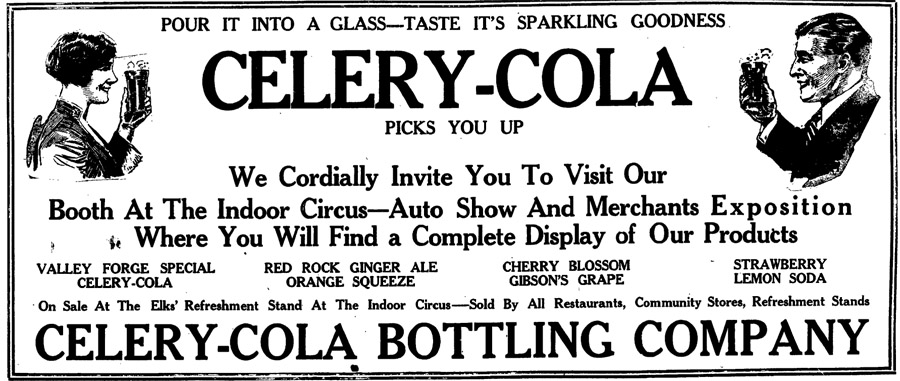
celery-cola-ad

As it turns out, Celery Cola ceased production in 1910 after repeated findings of the presence of cocaine and large amounts of caffeine by the Pure Food and Drug Administration. Let’s hope Messrs. Massie, Massie, and Green bounced back from their ill-advised investment. The owner of the Celery Cola Company certainly bounced back — he continued to create soft drinks such as — no kidding — “Koke” and “Dope.” Dallas is better off with Dr Pepper. The only whispered allegation that’s dogged them is prune juice — and that stuff is 100% legal.

Check out the related Flashback Dallas post “‘No Mice, No Flies, No Caffeine, No Cocaine’ — 1911.”

***

Sources & Notes

Top ad from a Celery Cola site here.

Third ad, with the word “its” misspelled (*sigh*) from the comments section of a Shorpy post here.

Best overview on the history of Celery Cola and its creator, James Mayfield, is here.

My favorite part of this story was reading the long list of Dallas-area “illegal” soft drinks (and other oft-tampered-with foodstuffs) in J. S. Abbott’s First Annual Report of the Dairy and Food Commissioner of Texas (Austin, 1908). The soft drink list begins on p. 46 after an interesting prologue here. Celery Cola was not alone! (And, if I’m reading this correctly, Messrs. Massie, Massie, and Green were fully aware of what was going on, having provided the food cops with cocaine-laced samples several months before they bought into the company.)

*

Copyright © 2014 Paula Bosse. All Rights Reserved.

Dallas Skyline by E. M. “Buck” Schiwetz — 1961

13DPL_schiwetz-drawing.jpg

by Paula Bosse

This drawing reminds me of those wonderful telephone book covers (the ones with all the hidden jokes and intricate details) that I used to pore over as a child. (By the way, when clicked, this image is absolutely HUMONGOUS. )

***

From the booklet Five Years Forward: The Dallas Public Library, 1955-1960 (more of which can be accessed here).

*

Copyright © 2014 Paula Bosse. All Rights Reserved.