Flashback : Dallas

A Miscellany: History, Ads, Pop Culture

George Dahl’s Sleek Downtown Library — 1955

1DPL_cover-sm

by Paula Bosse

This little 31-page booklet was issued to commemorate the fifth anniversary of the Dallas Public Library. The library was built on the site of the old (beautiful!) Carnegie Library and was vacated when the current library (the J. Erik Jonssen Central Library) opened on Young St. in 1982. Unbelievably, the building has remained empty for over 30 years.

This is the only downtown building I have very distinct memories of from childhood. My mother took us to the library often, and I LOVED that place. I loved the building, the space, the books, the adventure of being downtown — I loved everything but that creepy sculpture of the kid standing in the hands that hung on the outside of the building!

This great library was designed by the legendary (and prolific!) Dallas architect, George Dahl. He moved easily from the streamlined grandeur of the Art Deco buildings of Fair Park to the sleek mid-century-modern-cool of this wonderful downtown library.

2DPL_hands-sculpture
I know there are fans of this sculpture (“Youth in the Hands of God” by Marshall Fredericks), but I’m afraid I am not one of them. I loved art as a child (in fact, I can remember checking out framed art reproductions from this very library), but, as I said, even as a kid, I strongly disliked that creepy sculpture. The kid was fine, it was those giant disembodied hands. When the library moved to its current location in 1982, this sculpture was left behind to languish for years inside the empty building. It was eventually sold, and the boy and the hands are now resting comfortably in retirement, somewhere in Michigan.

3DPL_lobbybertoiaThere was a huge controversy about the Harry Bertoia sculptural screen seen above, hanging over the circulation desk. (I LOVED this piece as a kid!) The mayor — R. L. Thornton — HATED it, and the brouhaha-loving newspapers launched themselves into the fray by running apoplectic editorials which, of course, only fanned the flames of outrage. After the “scandal” died down, the art was eventually given the okay to stay, but not before a lot of people made a lot of noise about how the city of Dallas had wasted the $8,500 it had spent on the commission. Unlike the discarded hands sculpture, the screen was moved to the new library, where it remains today.

4DPL_outdoorterrace

5DPL_familylivingThis is how I remember the library. Lots of space, cool furniture, and flooded with light.

6DPL_children

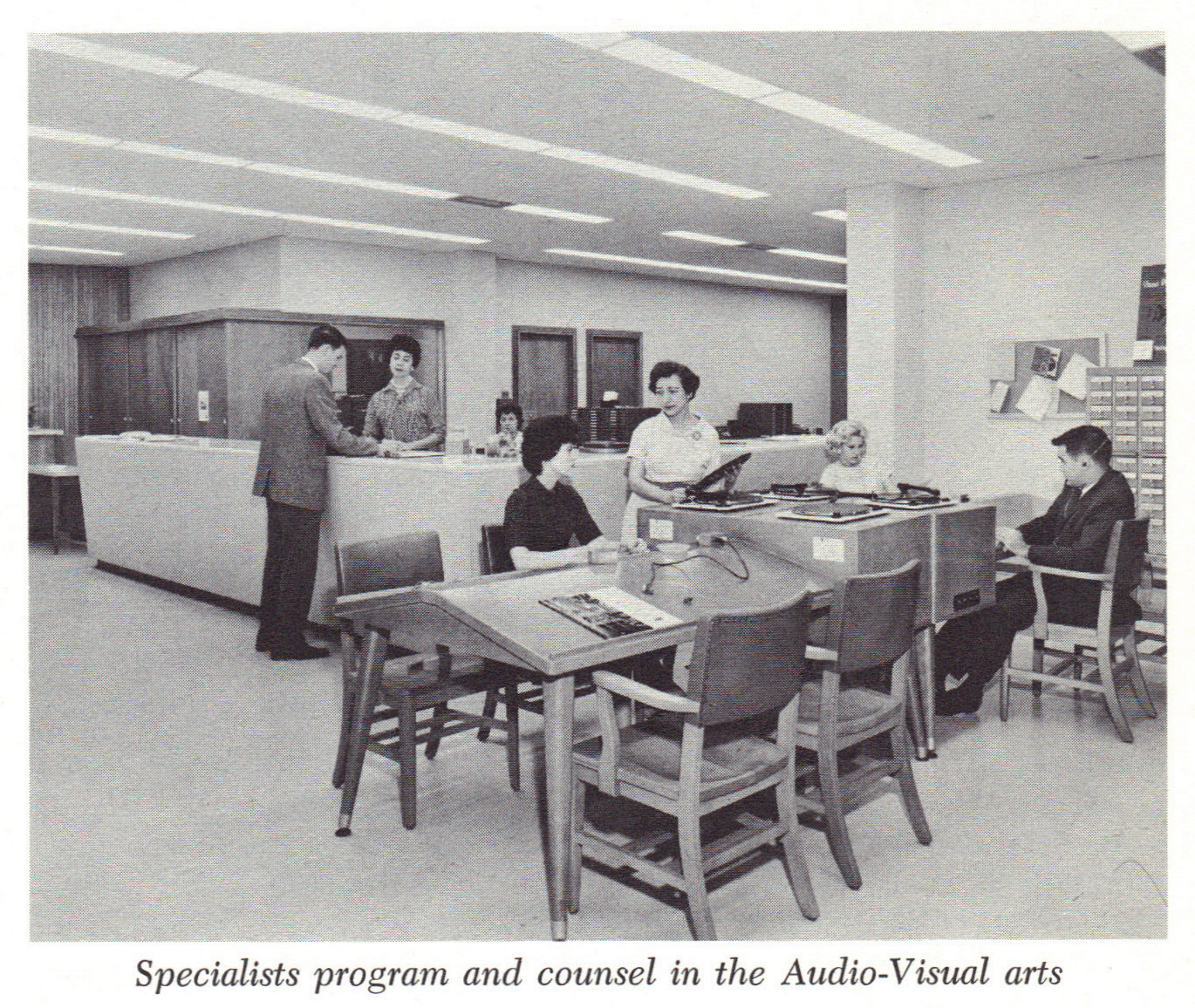
7DPL_av

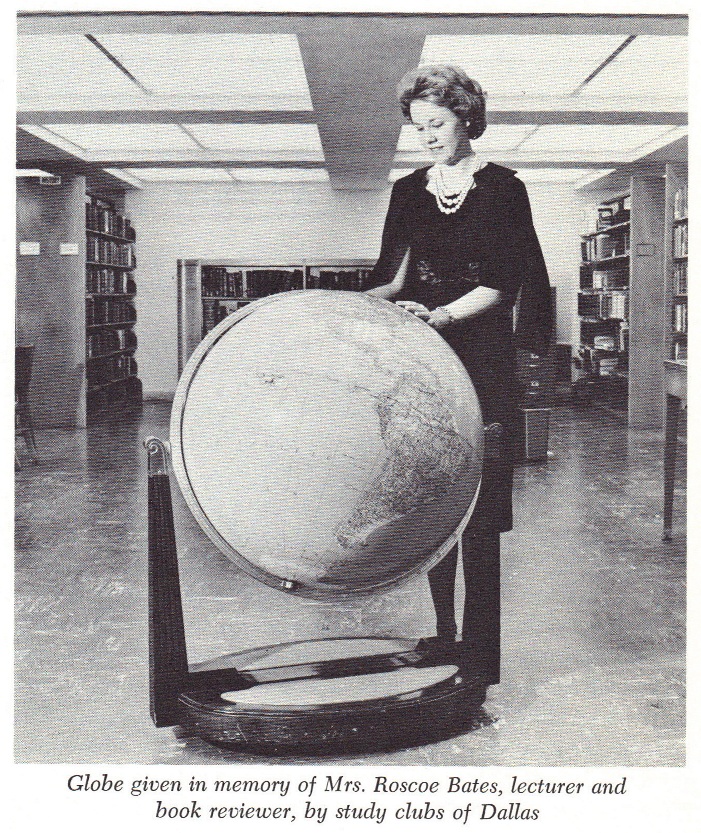
8DPL_globe

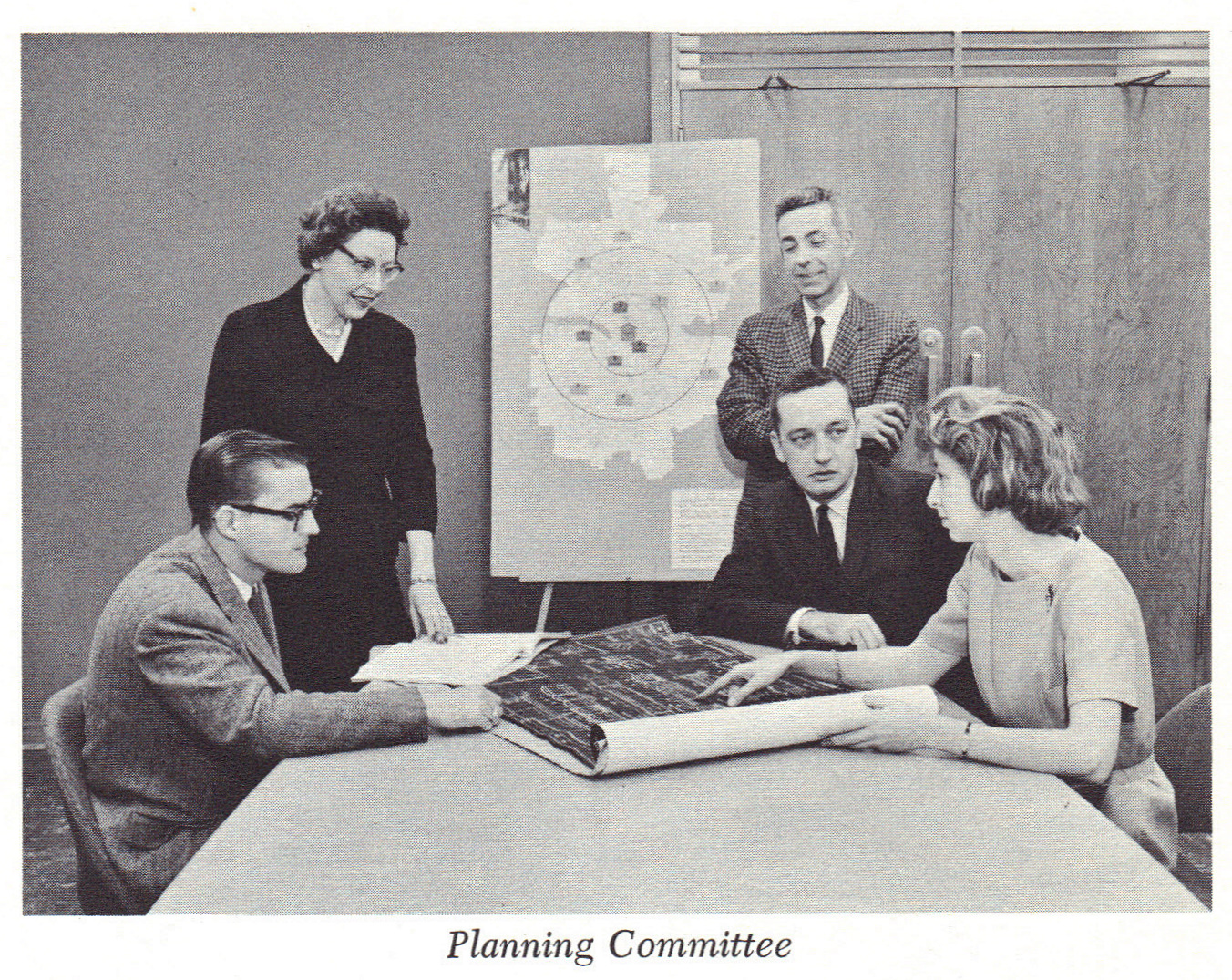
9DPL_planningcomm

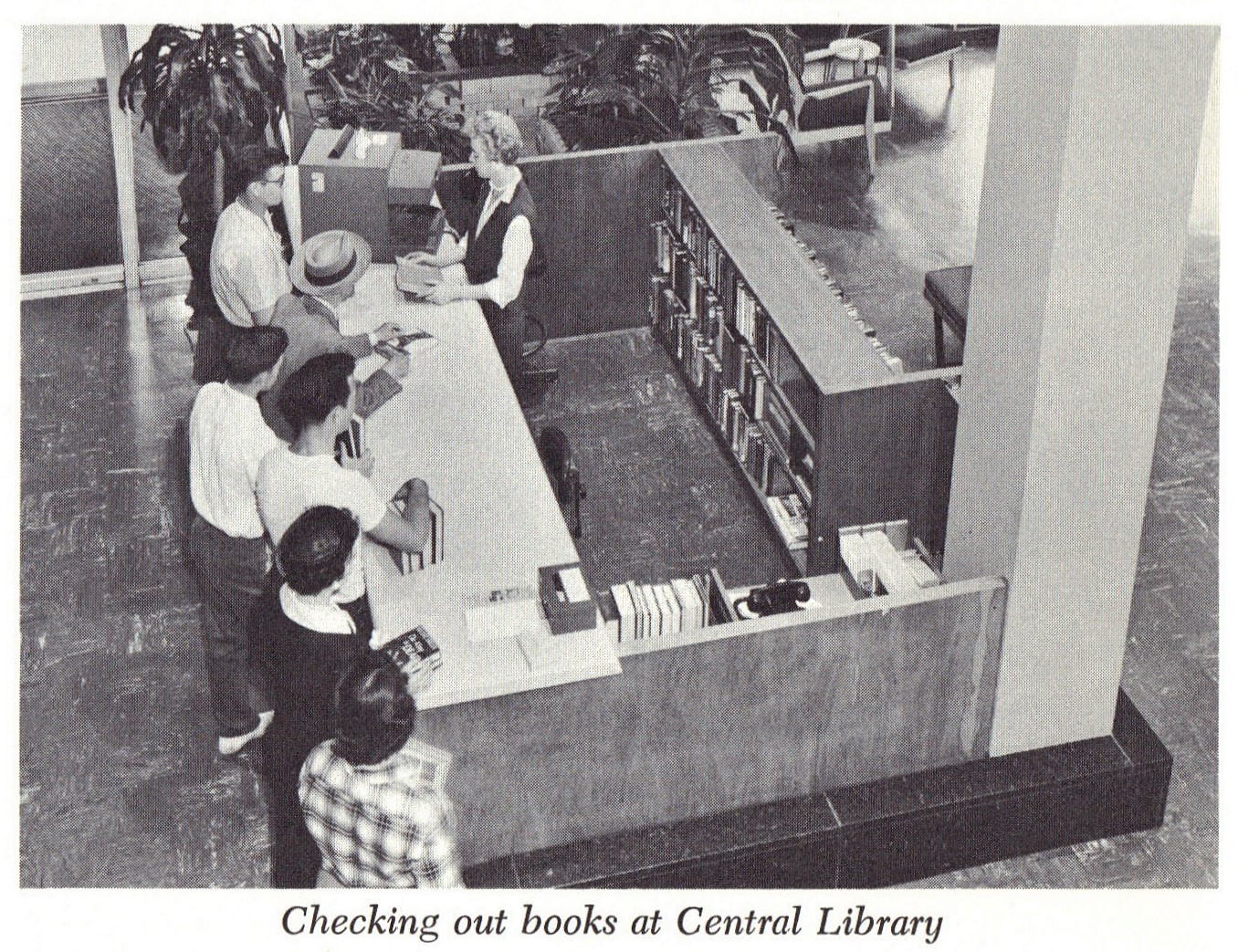
10DPL_checkingoutI LOVE this photo!

11DPL_oaklawnbranch

12DPL_teens

14DPL_schiwetzcropA detail of the front cover artwork, by Texas artist E. M. “Buck” Schiwetz. I love the driver in the cowboy hat (he must have been awfully small or that car must have been awfully big to accommodate that hat). The energetic frisson of downtown Dallas in the Mad Men era is dampened a bit by those damn hands on the building that seemed to follow you everywhere you went!

***

Sources & Notes

All images from the booklet Five Years Forward: The Dallas Public Library, 1955-1960, compiled and written by Lillian Moore Bradshaw and Marvin Stone. Drawings by E. M. (Buck) Schiwetz. Photographs by C. D. Bayne. (Dallas: Carl Hertzog for Friends of the Dallas Public Library, 1961). (Photos from the archives of the Dallas Public Library.)

More on the history and construction of the Old Dallas Central Library (as well as tidbits about the ridiculous controversy regarding the commissioned art) is here.

Even MORE on the artwork scandals (the hands, the hands, the HANDS!) as well as photos of the beautiful Carnegie Library that was razed to build the 1955 library can be found here.

And just because it’s weird, here’s a postcard showing an early, possibly even creepier depiction of the “hands” sculpture (if those are the “hands of God”…). I guess they wanted to get a postcard out before the sculpture was finished and installed.

dallas-public-library_dahl_postcard

I’ve posted one further image from this booklet — a drawing of the 1961 Dallas skyline by E. M. “Buck” Schiwetz  — here.

UPDATE — Dec., 2017: The Dallas Morning News has moved its operations to the long-vacant library, insuring this wonderful building’s continued existence for many more years! More here.

Click pictures for larger images (some are MUCH larger — click twice!).

*

Copyright © 2014 Paula Bosse. All Rights Reserved.


Tipperary Beer from the Dallas Brewery: “Insist Upon Having It”

tipperary-beer1908

By Paula Bosse

I’m pretty sure there’s no real Irish connection here — other than the name — but how could I pass this up on St. Patrick’s Day!

tipperary-beer_dmn_071806atipperary-beer_dmn_071806bDallas Morning News, July 18, 1906

dallas-brewery_tipperary_dmn_090107DMN, Sept. 1, 1907

***

Sources & Notes

Top ad addressing the Elks’ conventioneers who were visiting Dallas in 1908 is from an Elks’ historical site, here.

*

Copyright © 2014 Paula Bosse. All Rights Reserved.

Protected: Never Tell an Irate Irishman That He Can’t Paint a Green Stripe Down Main Street — 1960

This content is password-protected. To view it, please enter the password below.

When Coco Chanel Came to Dallas — 1957

neiman-marcus_coco-chanelStanley Marcus and Coco Chanel

by Paula Bosse

In September of 1957 — way back when that much-missed hyphen was still in “Neiman-Marcus” — Stanley Marcus invited Coco Chanel to Dallas to accept the Neiman Marcus Award for Distinguished Service in the Field of Fashion. Mlle. Chanel had never been to Texas, but her visit here was a meaningful one. Following a 15-year retirement, her re-emergence as a designer in the early 1950s was met with mostly derision by the French press. The American response, on the other hand, was very different. It was because of the enthusiastic reception that her work received from American retailers (such as the even-then legendary Neiman Marcus department store) that she had been able to bounce back and, once again, be considered a force in the fashion world. When she was invited to Dallas to receive the “Oscar” of the fashion industry, Mlle. Chanel was happy to accept.

In the photo above, Coco is seen trying on hats at the downtown Neiman’s store as Mr. Stanley stands by beaming. On her Dallas visit she was also treated to a ranch barbecue (!) where she was photographed watching both a square dance (!!) and a … oh god … Chanel-themed bovine fashion show (!!!). Mlle. Chanel seemed to love the cows-in-ropes-of-pearls runway show, but she was not a fan of the barbecue and beans — she (one hopes discreetly) dumped the contents of her plate onto the ground under the table … right onto the shoes of dining companion Elizabeth Arden (whose shoes may have been ruined, but who had a truly great story to tell for the rest of her life).

From all reports, everyone seemed to enjoy (and no doubt profit) from the successful visit. Karl Lagerfeld, the current creative director of Chanel, recently brought Chanel back to Dallas (both figuratively and literally) with the house’s important Métiers d’Art fashion show which was held at Fair Park in December, 2013. The following day, Lagerfeld was presented with the Neiman Marcus Award for Distinguished Service in the Field of Fashion — just as Coco Chanel had been, 56 years earlier. And the haute-couture circle-pin of life keeps on rolling.

n-m_chanel_ad_dmn_090957

n-m_chanel_telegram

***

Sources & Notes

Top photo by Shel Hershorn for the AP. From the Briscoe Center for American History, University of Texas at Austin.

N-M ad from 1957 (portion of a larger ad).

Chanel’s thank-you telegram to Marcus, from the collection of Stanley Marcus’ Papers at the DeGolyer Library, Central University Libraries, Southern Methodist University.

Entertaining AP article about Chanel and Dallas, then and now (with photos of Stanley Marcus duded-up in an outfit you’d never see an actual cowboy in), can be found here. (Are those butterflies?!)

More photos of Mlle. Chanel in Dallas (along with text of a DMN article on the visit) can be found here.

Even more photos (bovine fashion show…) and a really great post from SMU’s “Off the Shelf” blog is here.

Video of the 2013 Chanel runway extravaganza (Métiers d’Art), held in Fair Park’s hay-stewn Centennial Hall, can be watched here. A shorter video with a few cursory shots of the Dallas skyline and Fair Park can be seen here.

For more on the first French Fortnight, see my post “Neiman-Marcus Brings France to Big D — 1957,” here.

*

Copyright © 2014 Paula Bosse. All Rights Reserved.

Lowest Greenville: “A Small Town of Our Own” — 1925

by Paula Bosse

Anyone who has ever lived in Lower or Lowest Greenville knows that it feels kind of like a small town. Below are the words of a man who thought the same way in 1925.

MOST WONDERFUL OF ALL
But I have witnessed nothing so marvelous as the growth of Dallas since I settled here, Dec. 5, 1921, and built a home at 5615 Sears street. People who stick close to business in the downtown district really do not know what is going on in this teeming city. Our suburban store district, just north of Ross and Greenville avenues, comprises three furniture stores, two hardware stores, four drug stores, six groceries, two dry goods stores, half a dozen filling stations, a Pig Stand or two, a plumbing shop, a fire station, an ice factory, a cleaning and pressing establishment, barber shops, shoemakers’ shops, two gents’ furnishing stores and a Masonic lodge. Practically all these and others, for I am sure I have overlooked some, have been established since I settled in the community four years ago. In fact, we have a small town of our own. But then the modern city of Dallas is made up of a number of such complete units, with one grand central business district, which is thought of and looked upon by outsiders as Dallas.
(Dallas Morning News, March 15, 1925)

These were the words of Dallas resident John T. Hyde. His Lowest Greenville neighborhood was, in 1925, a “suburban” outpost which had experienced unbelievable growth in the early 1920s. Mr. Hyde (who lived right off Greenville — behind where Trader Joe’s is now) would probably be shocked and dismayed by the wild over-indulgences associated with the annual St. Patrick’s Day festivities along his beloved Greenville Avenue. In fact, today’s the day. So, kids, think of Mr. Hyde — an early champion of one of Dallas’ greatest neighborhoods — and please pledge to refrain from puking (…etc.) all over it today. I’m sure he — and the rest of us — would appreciate it.

***

Sources & Notes

Top photo from Mark Doty’s wonderful book Lost Dallas (Charleston: Arcadia Publishing, 2012). Photo from the Texas/Dallas History and Archives Division, Dallas Public Library). Click for larger image.

John T. Hyde’s memories excerpted from the article “Southern Planters Trekked to Texas” by W. S. Adair (DMN, March 15, 1925).

See more photos of Lowest Greenville from this period in the Flashback Dallas post “Bel-Vick’s Anchor: The Angelus Arcade and The Arcadia Theatre — 1920s.”

More Flashback Dallas posts on Lower Greenville/M Streets can be found here.

*

Copyright © 2014 Paula Bosse. All Rights Reserved.

Olsen-Stelzer Cowboy Boot Saleslady — 1939

Portrait with boots…

by Paula Bosse

Above, Dallas resident Imogene Cartlidge is seen at a shoe retailers’ convention in San Antonio in 1939. Cartlidge was an employee of the Olsen-Stelzer boot company in Henrietta, Texas, and she was said to be “the only woman boot salesman on record.” I’m a big fan of cowboy boots of this period, and I have to say that I am ashamed that I was unaware of the famous Olsen-Stelzer company, which lasted from 1900 until the 1980s. The company is back in business again, led by Tom Cartlidge, whose parents began selling the boots in 1938 — Imogene is his mother. I wish them all the best of luck, because the world needs as many great-looking cowboy boots as it can get!

olsen-stelzer_dmn_120146

“The West begins at Titche’s”? First I’m hearing of this. Who knew? Nice ad, though.

olsen-stelzer_dmn_120146det

olsen-stelzer_dmn_103055

olsen-stelzer_1941

Best of all is this absolutely fantastic video from 1956 about the company:

olsen-stelzer-logo

olsen-stelzer-box

***

Sources & Notes

Photo of Imogene Cartlidge is from the San Antonio Light Photograph Collection, University of Texas San Antonio Libraries Special Collections, Institute of Texan Cultures.

Titche’s ad from 1946.

Bridges Shoe Store ad from 1955. (Bridges seems to have been the only place in Dallas where the boots were regularly sold — or at least regularly advertised. And you could get them ONLY IN OAK CLIFF!) (I hear the West begins at Oak Cliff….)

The video can be found on the home page of the Olsen-Stelzer website here.

The last image is the lid of an Olsen-Stelzer boot box, which belongs to my aunt — she keeps Christmas ornaments in it. (Sadly, no sign of the boots!)

The history of the company (and, again, that great video) can be found here.

*

Copyright © 2014 Paula Bosse. All Rights Reserved.

Zion Evangelical Lutheran Church: Germans on Swiss — ca. 1900

by Paula Bosse

The Zion Evangelical Lutheran Church was established in 1879 by German immigrants. In 1899 the congregation moved its church and school to the location seen in the photograph above, at 207 Swiss Avenue (street numbers have changed, but it was in the block between what is now Good-Latimer and Cantegral). The building remained in that location until at least 1921.

***

Photograph from the University of Texas at San Antonio, UTSA Libraries, Digital Collections.

For more on the history of the Zion Evangelical Lutheran Church in Dallas, see here.

*

Copyright © 2014 Paula Bosse. All Rights Reserved.

So This Cowboy Goes Into a Psychiatrist’s Office…

cowboy-therapy-cartoon_sat-evening-post_kaz

by Paula Bosse

Well, bless his heart.

***

Cartoon by Kaz from The Saturday Evening Post.

Munger’s Improved Continental Gin Company

continental-gin_munger-from-natl-reg-appA Dallas landmark… (click for larger image)

by Paula Bosse

The Continental Gin Co. complex of buildings at Elm and Trunk is a Deep Ellum fixture which was successfully petitioned by the city in 1983 to be added to the National Register of Historic Places. No longer a manufacturing hub, it is now home to artists’ studios and residential lofts. The earliest of the buildings still standing were built in 1888 and the latest ones (the ones closer to Elm) were built in 1914. The company was incredibly successful, which was no surprise when one realizes that fully ONE-SIXTH of the world’s cotton grew within a 150-mile radius of Dallas at the time! It’s no wonder that Dallas was a hotbed of cotton gin manufacturing.

continental-gin_munger-drawing_Munger Catalogue and Price List, 1895

Robert S. Munger (yes, that Munger) patented several inventions that improved the cotton ginning process, and in 1888 he built a large manufacturing plant for his Munger Improved Cotton Machine Company. In 1900, after several extremely successful years, his company and several other companies that held important industry patents were absorbed by the Continental Gin Co. of Birmingham, Alabama, and, practically overnight, the Continental Gin Co. became the largest manufacturer of cotton gins in the United States. Munger retained a financial interest in the company, but he left the running of the business to his brother, S.I. Munger. R.S. Munger turned his creative talents to real estate and developed the exclusive Munger Place neighborhood. The Continental Gin Co. closed in 1962.

continental-gin-co_1912The Standard Blue Book of Texas, 1912-1914

A few newspaper items regarding the Munger Improved Cotton Machine Company and the Continental Gin Company.

munger_dal-herald_101387The Dallas Herald, Oct. 13, 1887

munger_merc_053089The Southern Mercury, May 30, 1889

munger_merc_072892The Southern Mercury, July 28, 1892

munger_merc_041393The Southern Mercury, April 13, 1893

continental-gin_dmn_072600Change is imminent. (Dallas Morning News, July 26, 1900)

continental-gin_dmn_042001FIVE HUNDRED TONS! (DMN, Apri 20, 1901)

continental-gin_dmn_032203DMN, March 22, 1903

continental-gin_dmn_082005DMN, Aug. 20, 1905

continental-gin_dmn_060107DMN, June 1, 1907

continental-gin_worleys_1909Worley’s Dallas Directory, 1909

continental-gin_ad_dallas-police_1910Dallas Police, 1910

continental-gin-aerial-natl-reg-appPhotograph that accompanied the application to the National Register of Historic Places regarding the structures under consideration: 3301-3333 Elm St. and 212 & 232 Trunk Ave. (Landis Aerial Photography, 1980)

***

Sources & Notes

Handbook of Texas biography of Robert Sylvester Munger (1854-1923) is here.

The top image (which, by the way, took me FOREVER to find, is labeled as the Munger company, but the expansion would seem to indicate that this is the Continental Gin Company, after 1914. Whatever the case, it’s a great image!

That image and the aerial photograph of 1980 are included in the city’s application to have the complex included in the National Register of Historic Places, submitted in 1983. The detailed application — as a Texas Historical Commission PDF — can be accessed here.

The second image, of the early days of the Munger Improved Cotton Machine Company is from a bookseller’s online listing for Munger’s 13th Annual Catalogue and Price List (1895) — the item may still be available for a mere $435 and can be found here.

See an aerial view of what the area looks like today, via Google, here.

To see an incredible 1914 photograph of the buildings and the residential area to the north, see my post “The Continental Gin Complex — 1914,” here.

More on Robert S. Munger and more early company ads can be found in the post “R. S. Munger’s Cotton Gin Manufactory,” here.

*

Copyright © 2014 Paula Bosse. All Rights Reserved.


Mrs. Turner Attacked Miss Hulsey in the Spoolroom with a Knife

spoolroom_jones-coll_degolyer_smuSpoolroom of the Dallas Cotton Mills…

by Paula Bosse

The spoolroom of the Dallas Cotton Mills was no place for the faint of heart, as this eyeball-popping story from The Dallas Morning News will attest (click for larger image):

dallas-cotton-mills_attack_dmn_051697DMN, May 16, 1897

The story even made it into the pages of The New York Times:

spoolroom-slashing_nyt_051597
NYT, May 15, 1897

(The women apparently survived.)

*

Sources & Notes

Photo (“Spooling Yarn, Dallas Cotton Mills, Dallas, Texas”) is from a stereograph, circa 1905, from the Lawrence T. Jones III Texas Photographs Collection, DeGolyer Library, Central University Libraries, Southern Methodist University; it is accessible here.

The descriptive text from the back of the card:

spoolroom_jones-coll_degolyer_smu_text

*

Copyright © 2014 Paula Bosse. All Rights Reserved.