Flashback : Dallas

A Miscellany: History, Ads, Pop Culture

Cowtown Extra: Fort Worth Zookeeper Ham Hittson and His Forest Park Friends

FW-zoo_hamilton-hittson_fawn_062937_UTAZookeeper Hittson and tiny friend…

by Paula Bosse

Today, Fort Worth. I was looking for photos of the old Forest Park in Oak Cliff (which was renamed Marsalis Park in 1925) and came across photos of the Forest Park Zoo. A search on the internet showed me that there was also a Forest Park Zoo in Fort Worth. I’ve never actually been a big fan of zoos, but I saw the photo above and was won over by its sheer cuteness. So let’s just take a little trip westward and enjoy some photos of cute animals, most of which feature zookeeper Henry Hamilton (“Ham”) Hittson.

Ham Hittson (1912-1966) began working as a zookeeper at the Forest Park Zoo in the early 1930s — if his obituary is correct, he became the zoo’s director in 1933 — at the age of only 21! During World War II he served for two years in the Coast Guard, assigned to work with sentry and attack dogs and with patrol horses. After the war he returned to the zoo (he was the director of the zoo for 21 years) and eventually became the director of the Fort Worth Park Department. His 1966 obituary (he was only 54 when he died) noted that he was instrumental in forming the Fort Worth Zoological Association. And, well, these photos are very sweet.

(All photos are from the University of Texas at Arlington Libraries. Click pictures to see larger images; click the link below each photo for more information.)

*

The photo at the top is my favorite — it shows Hittson with a tiny fawn born the previous day. The photo above and the one below were taken on June 29, 1937.

FW-zoo_hamilton-hittson_fawn_062937-b_UTAMore info here

Below, Hittson with a new baby lion cub named Will (June 29, 1939).

FW-zoo_hamilton-hittson_lion-cub_062939_UTAMore info here

Actor Jimmy Stewart stopped by the zoo on May 22, 1953 to check out the zoo’s new rhinoceros, Marilyn Monroe. F. Kirk Johnson, zoological board president, is at the left and Hittson, then park department director, is at the right.

FW-zoo_jimmy-stewart_052253_UTAMore info here

Back to Ham’s zookeeper days: in the photo below (taken on August 2, 1940), he’s standing with one of the zoo’s top attractions, an elephant named Queen Tut. He’s bidding her farewell as he is about to leave for New York where he will pick up a baby elephant to be her companion. (Hittson and the zoo’s veterinarian brought the one-year-old elephant back with them in a trailer — they must have attracted a lot of stunned looks along the highway as they drove back from New York.)

FW-zoo_hamilton-hittson_elephant_080240_UTAMore info here

The arrival of this new elephant was big news — there were almost daily updates in the pages of the Fort Worth Star-Telegram. In order to buy the elephant, the zoo had had to take out a loan from the bank, and in what was both a speedy way to pay off the debt and a clever way to garner publicity, there followed a successful drive to raise money to pay off the “mortgage”: countless school children happily did their parts by contributing pennies, nickels, and dimes in the fundraising effort and then flocked to the zoo to see the newest member of the zoo family and welcome her to Fort Worth.

And here’s Queen Tut with her new little pal, Penny, on September 10, 1940.

FW-zoo_queen-tut-and-penny_091040_UTAMore info here

Awww.

***

Sources & Notes

There are tons of photos of the Forest Park Zoo in the UTA Libraries Special Collections, here (20 pages’ worth!).

*

Copyright © 2017 Paula Bosse. All Rights Reserved.
The Dallas Clippers: Early Dallas Baseball

baseball_dallas-clippers_cook-coll_degolyer_smu

by Paula Bosse

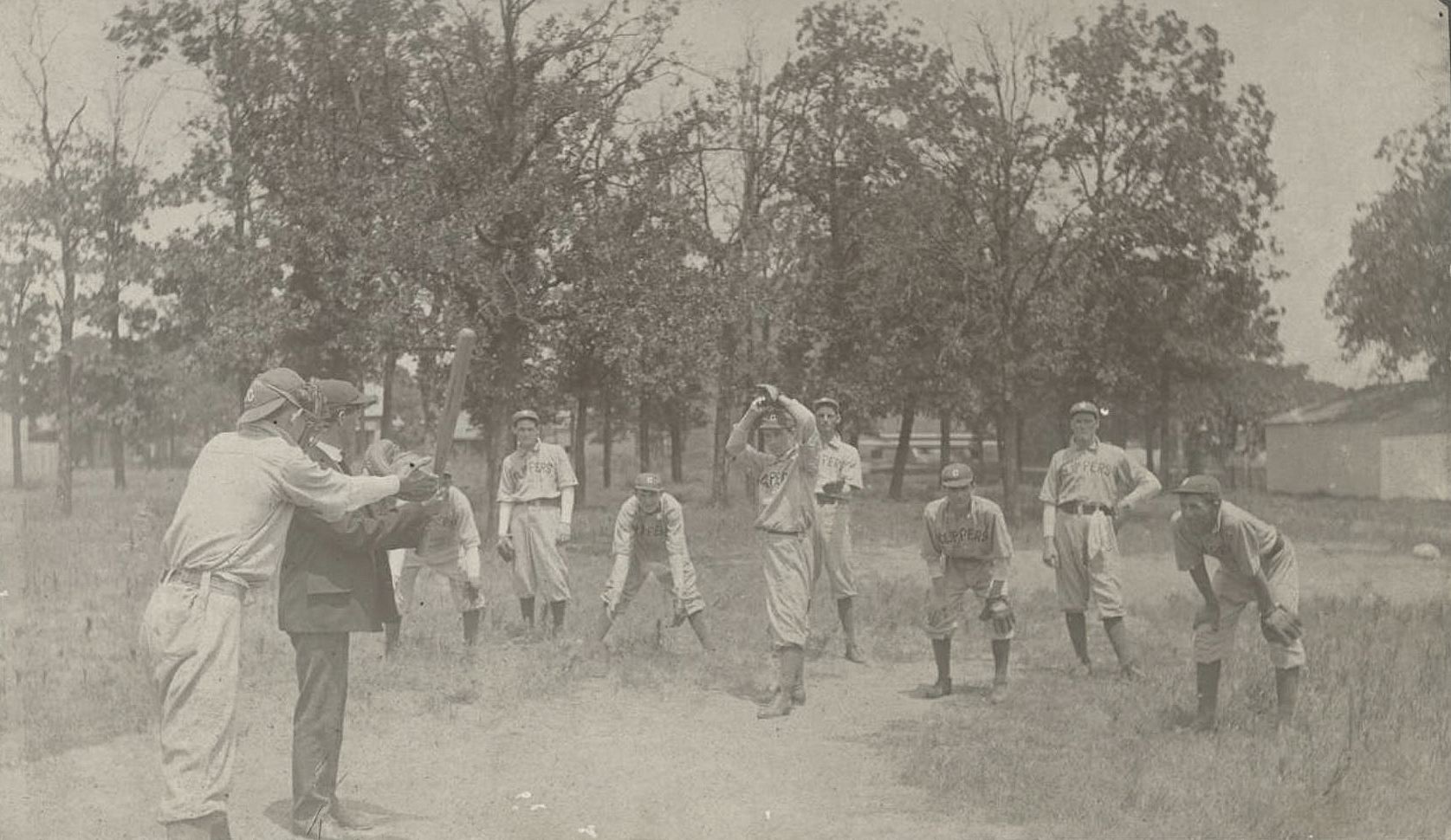
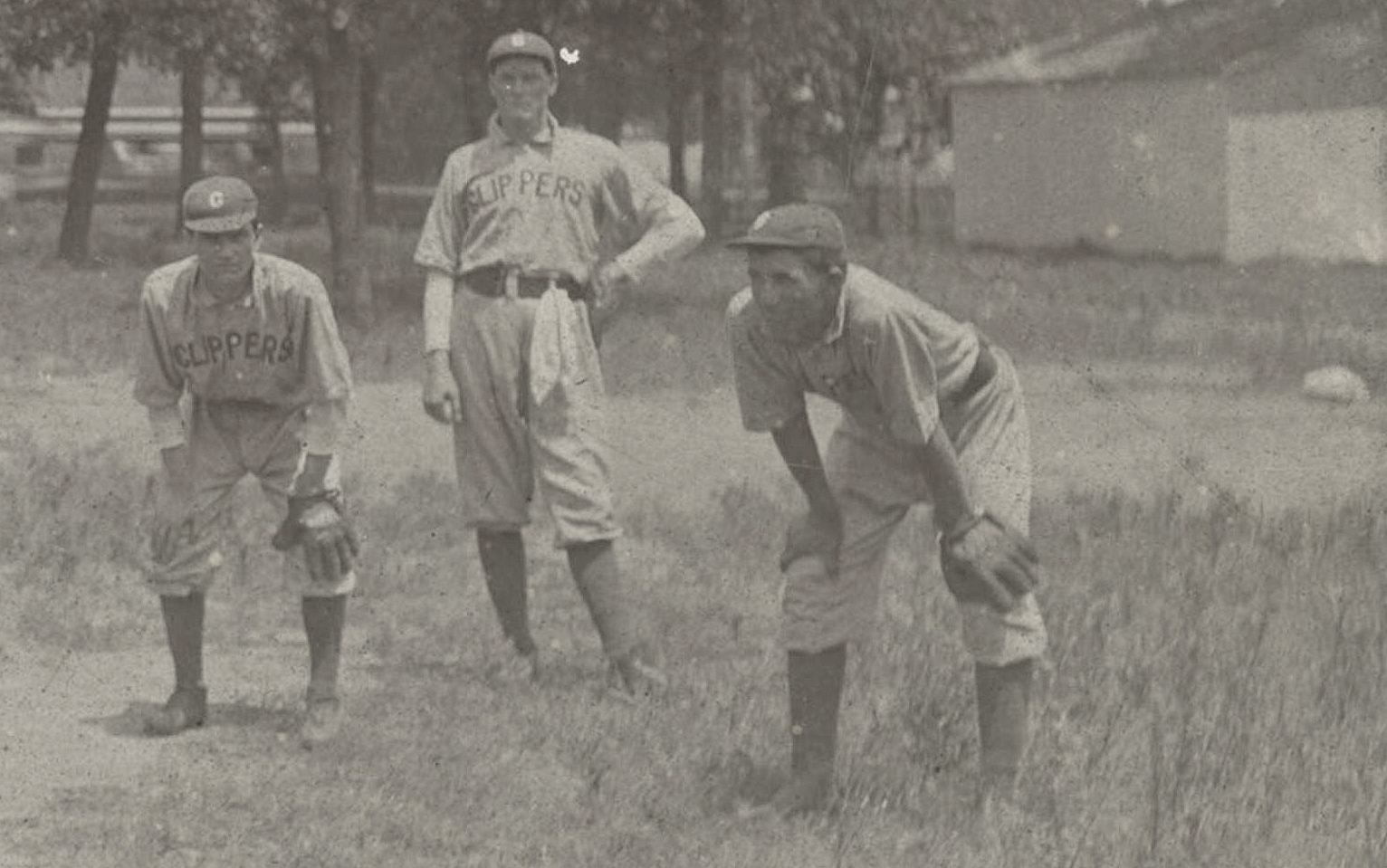
The Dallas Clippers were one of the city’s earliest baseball teams — their games were covered in local papers as early as 1888, and they appear to have played through at least 1905.

I’m not sure what’s going on in this photo. Tryouts? Practice? The stances are interesting — the way they’re holding their gloves (especially the catcher) — the gloves themselves. Cool photo. Here are a few details, a little closer up.

clippers_1

clippers_2

clippers_3

Those gloves are interesting — similar styles can be seen in the Wikipedia entry, here.

clippers_3a

*

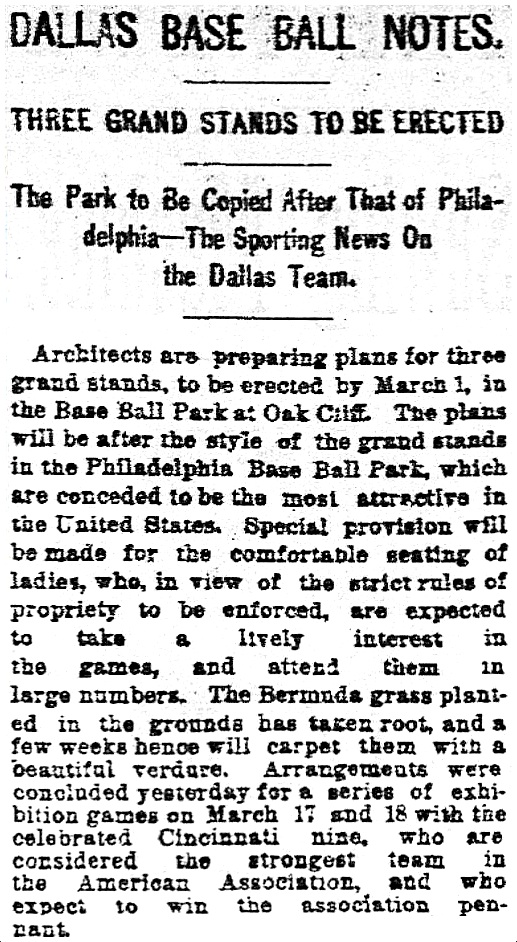
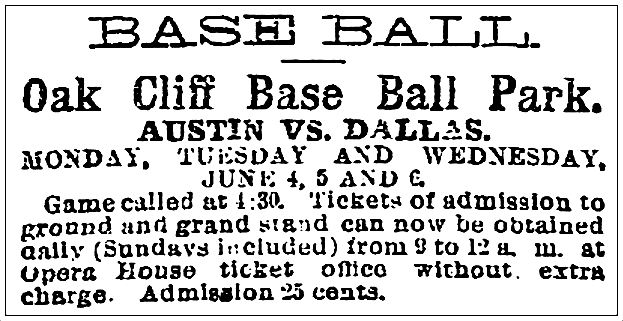
Many early baseball games in Dallas were played at the “base ball park” located in Oak Cliff Park (the park now known as Marsalis Park). A fantastic article on early sports in Dallas (“Gradual Development of the Scope and Popularity of Sports in Texas” — no byline — Dallas Morning News, Oct. 1, 1910) can be read here.)

baseball_oak-cliff-ball-park_dmn_012888
Dallas Morning News, Jan. 28, 1888

baseball_oak-cliff-ball-park_dmn_020388
DMN, Feb. 3, 1888

baseball_oak-cliff-ball-park_dmn_060688
June, 1888

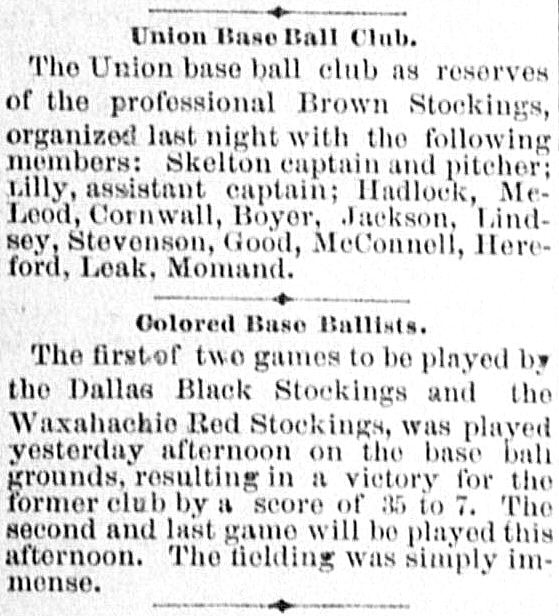
And this interesting little bit of early sports reportage appeared in the pages of the Dallas Herald in 1884, covering both black and white teams:

baseball_dallas-herald_082684
Dallas Herald, Aug. 26, 1884

***

Sources & Notes

Photo “Dallas Clippers Baseball Team” from the George W. Cook Dallas/Texas Image Collection, DeGolyer Library, Central University Libraries, Southern Methodist University; more information on this photo is here.

*

Copyright © 2017 Paula Bosse. All Rights Reserved

The Neiman-Marcus Corporate Flag, Designed by Emilio Pucci — 1966

neiman-marcus-corporate-flag_emilio-pucci_1966_dallas-public-library“Emilio Pucci was our Betsy Ross…”

by Paula Bosse

While looking through the Neiman Marcus Collection at the downtown Dallas Public Library, I stumbled across this perhaps long-forgotten part of Neiman-Marcus history: the “corporate flag” designed by Italian fashion legend Emilio Pucci. The image was featured on a Neiman’s postcard; the text on the back of the card reads:

Flying high over the fashion land of Neiman-Marcus: our new corporate flag, the Lone-Star-and-Stripes. Emilio Pucci was our Betsy Ross.

Betsy Ross and Emilio Pucci mentioned in the same breath! An 18th-century American seamstress who became a patriotic icon, and an Italian fashion designer whose vividly colorful, boldly patterned designs came to symbolize the youth and energy of the 1960s… talk about your strange bedfellows!

The only thing I could find about this unusually colorful flag was a brief mention in a Dallas Morning News fashion article about Neiman’s 28th Neiman-Marcus Exposition Award in early February of 1966. Gay Simpson wrote in The News that the luncheon centerpieces “carried the colors of the new Neiman-Marcus house flag. The flag, designed by Emilio Pucci, Italian couturier, has the colors of a Texas sunset dramatized with the Lone Star and stripes” (DMN, Feb. 9, 1966).

Stanley Marcus wrote in his 1974 memoir Minding the Store that his business relationship with Pucci (“the most copied designer of our time, aside from Chanel”) began in Italy in 1948 when Marcus met with the struggling young designer and placed an order for several of his scarves. Though Neiman-Marcus had not yet expanded beyond their single department store in Dallas, the store’s reputation and influence were certainly known in fashionable circles around the world, and this N-M “stamp of approval” must have been immensely important to Pucci, whose name was not yet known. This friendship and business relationship blossomed into a mutually beneficial and very profitable partnership, and it seems perfectly reasonable that Pucci would design a flag for his friend and early supporter, Stanley Marcus. (Read more of Marcus’ thoughts on Pucci here.)

There you have it. Who knew?

**

As a postscript, any Dallas blog worth its salt cannot let a mention of Emilio Pucci go by without noting his main connection to the city: Pucci will forever be remembered as the man who brought outrageously colorful and super groovy mod designs to the stewardess uniforms of Dallas-based Braniff International Airways (designs so retinally exciting that they make that little Neiman’s flag look a little dowdy in comparison!).

***

Sources & Notes

The image of the corporate flag is from a Neiman’s postcard, which can be found in the extensive (!) Neiman Marcus Collection of the Dallas Public Library (the back of the card can be seen here); it is used with permission. Thanks to the incredibly helpful staff of the Dallas History & Archives division of the downtown Dallas Public Library. (Much thanks, particularly, to Digital Archivist Misty Maberry!)

*

Copyright © 2017 Paula Bosse. All Rights Reserved.


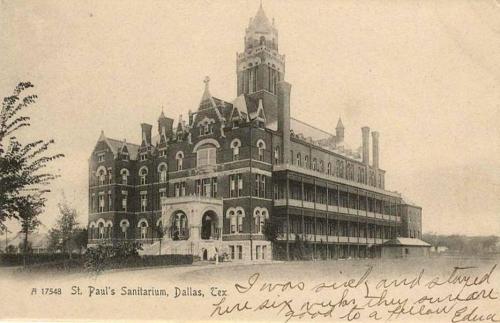
From the Vault: A Tour of St. Paul’s Sanitarium — 1910

st-pauls_flickr_coltera“They sure are good to a fellow…”

by Paula Bosse

A couple of years ago I posted several great photos taken inside St. Paul’s Sanitarium (later St. Paul’s Hospital) by noted Dallas photographer Charles Erwin Arnold. The photos are great. See them in the post “St. Paul’s Sanitarium — 1910,” here.

*

Copyright © 2017 Paula Bosse. All Rights Reserved.

Ewing Avenue, Oak Cliff

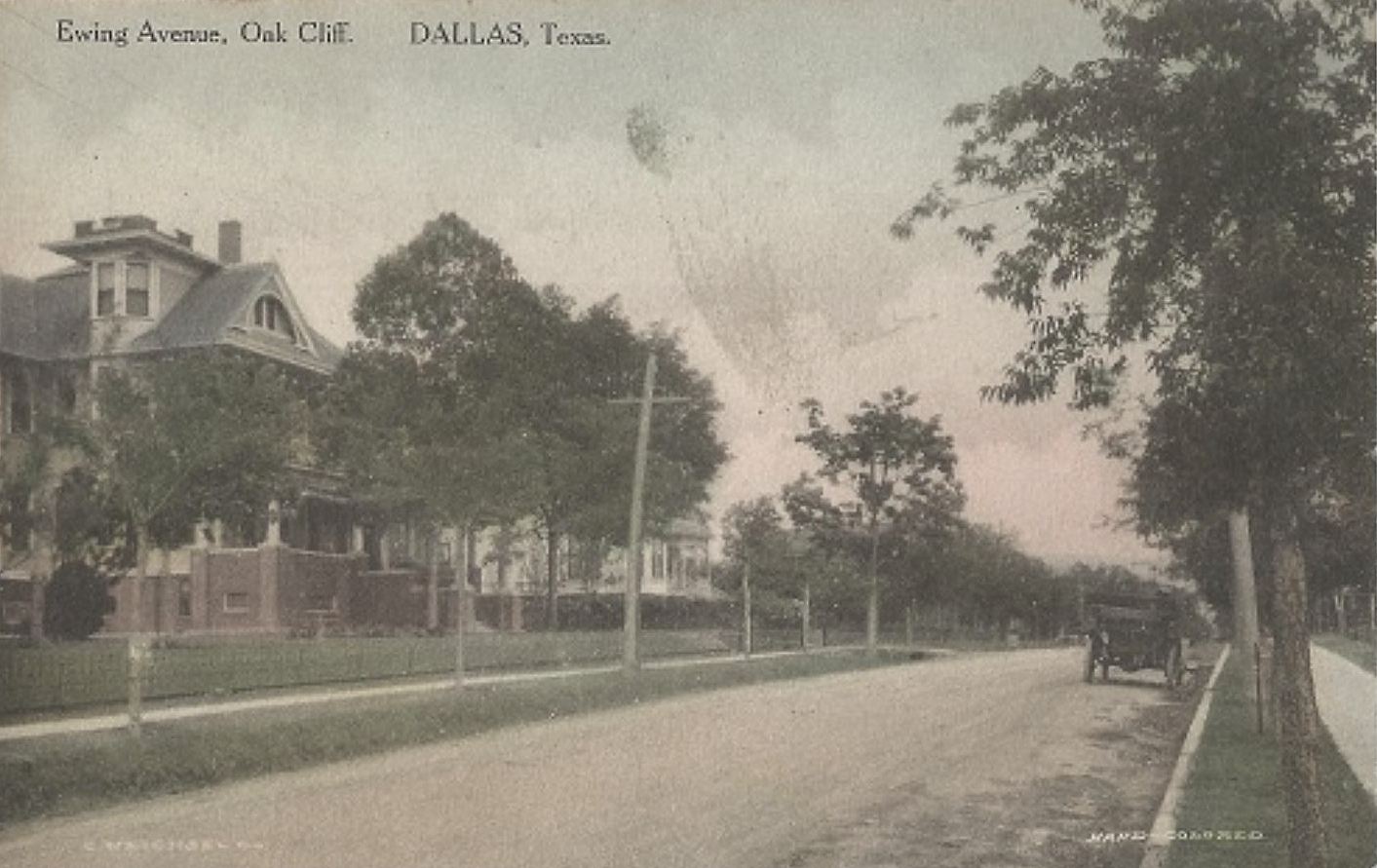
oak-cliff_ewing-avenue_flickr_colteraStately and serene Oak Cliff… (click for larger image)

by Paula Bosse

Another lovely hand-colored postcard from the C. Weichsel Co. — this one shows a sleepy, gauzy-looking Ewing Avenue in Oak Cliff, probably around 1910. According to the 1910 Dallas directory, Ewing Avenue stretched from S. Jefferson (now E. Jefferson) to 18th Street (it may have extended beyond that, but 18th Street was, apparently, the city limits).

If anyone knows the location of this view or the owner of this house, please let me know. I don’t think any part of Ewing — North or South — looks like this anymore!

***

Postcard found on Flickr, posted by Coltera (sorry, did not note the link).

*

Copyright © 2017 Paula Bosse. All Rights Reserved.
The Wide Open Spaces Northeast of Central and Lovers — 1957

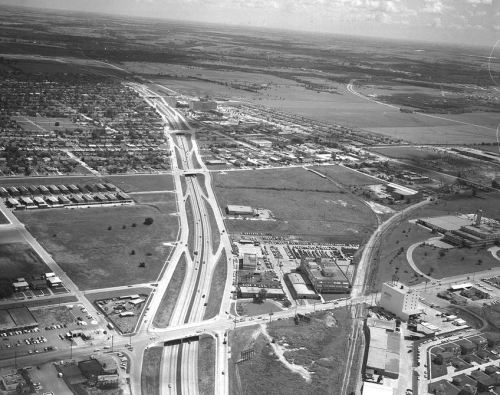
central_north-from-mockingbird_060657_squire-haskins_UTASquire Haskins, UTA Special Collections

by Paula Bosse

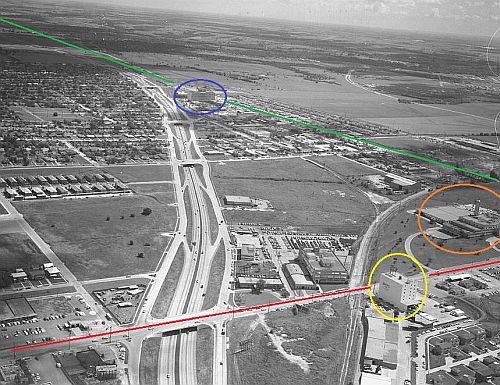
Here’s another great aerial photo by Squire Haskins, taken on June 6, 1957 — sixty years ago. The view is to the north, from a little south of Mockingbird. Mockingbird runs from left to right at the bottom of the photo; at the far right you can see the still much-missed Dr Pepper plant, which stood at the northwest corner of Mockingbird and Greenville Avenue. The only “tall” structure north of Mockingbird is the Meadows Building, at Greenville and Milton, just south of Lovers Lane. North and east of Lovers and Greenville is … pretty much nothing. The old Vickery community was north on Greenville, around what is now Park Lane. To the east? I don’t know … lots of open land and then … Garland? (See a huge image of this photo on the UTA website, here.)

If you need your bearings, here are a few of the landmarks (red, Mockingbird Lane; green, Greenville Ave.; yellow, Bekins Storage, orange, Dr Pepper plant; blue, Meadows Building):

meadows-bldg-from-mockingbird_squire-haskins-june-1957_UTA_annotated

Let’s turn it around and look south, toward downtown, from just north of Lovers Lane, with the Meadows Building in the foreground. Greenville is at the left, Central Expressway at the right. This photo, also by Squire Haskins, was taken on June 20, 1956. (See it on the UTA website, here.)

central_south-from-lovers_062056_squire-haskins_UTA_meadows

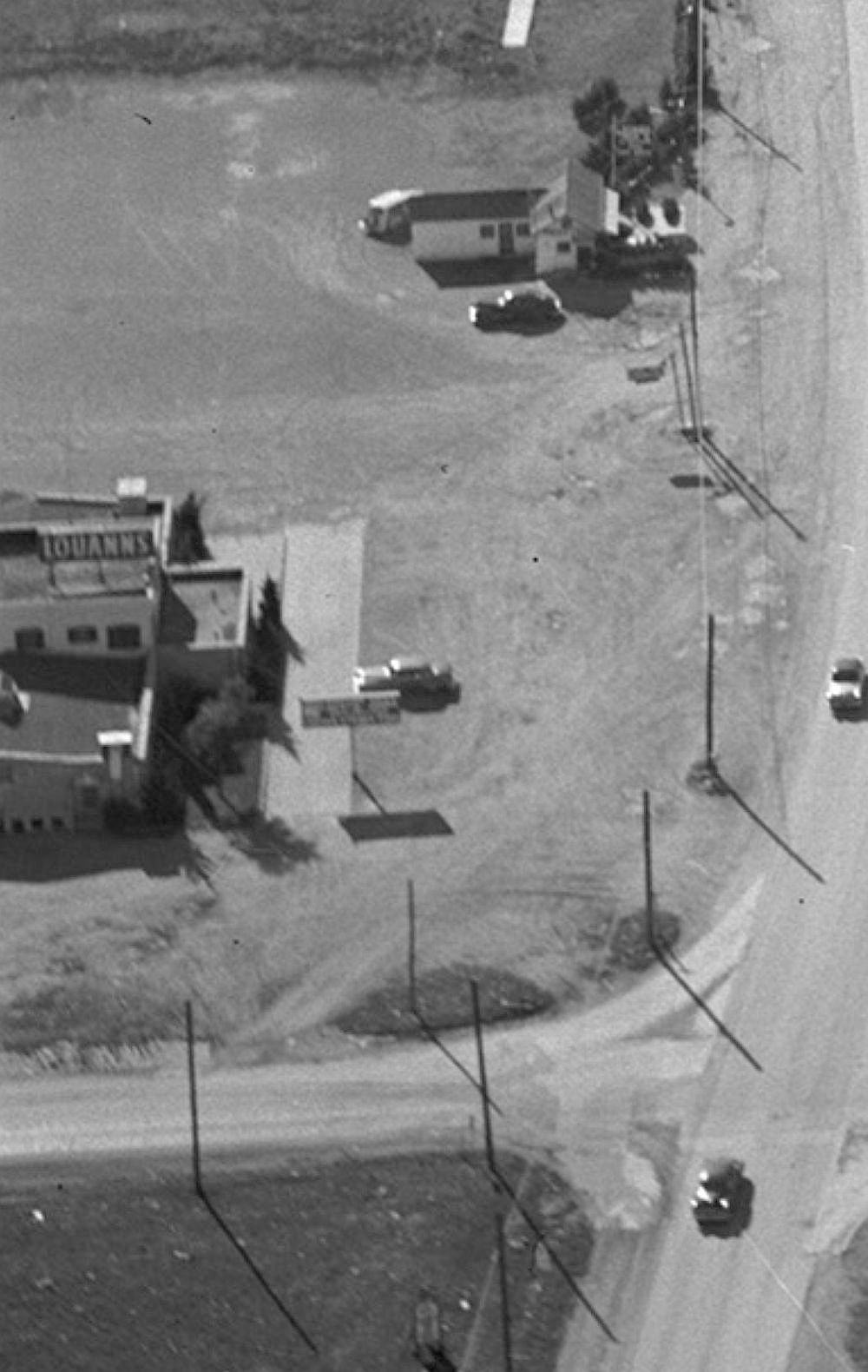
If, like me, you’ve always wondered where the legendary Louanns nightclub was, it was just out of frame at the bottom left of the photo above — at the southeast corner of Lovers and Greenville, where Central Market sits these days. You can see it below, in a detail of another great Squire Haskins photo (click on the thumbnail of the photo on this page to see the full photo — Louanns is at the bottom left) — it was taken on Dec. 4, 1953 and shows the Meadows Building under construction. In this detail you can see a slightly blurry Louanns, with what looks like an unpaved Lovers Lane at the bottom and Greenville Avenue at the right. I’d always  heard that Louanns was way out in the sticks in its heyday in the ’40s and ’50s. And looking at the top photo, I can see how true that was — especially before the arrival of the Meadows Building, which was, I believe, the largest “suburban” office building in Dallas beyond the downtown Central Business District. And for those who went out “parking” along the isolated Lovers Lane back then, you can see how the street got its name.

louanns_squire-haskins_UTA_det

louanns-postcard

Here is a clipping from the 1957 Dallas city directory showing the businesses along East Mockingbird — between Airline, west of Central, and Greenville Avenue.

mockingbird_central-to-greenville_1957-directory
1957 Dallas directory

See the Greenville Avenue businesses from the same 1957 directory here (the directory is scanned in its entirety on the Portal to Texas website here).

Here’s a map showing what this same area looked like a few years earlier, in 1952, when Mustang Airport was still out there (between Lovers and Northwest Highway, and between about where Skillman would later extend to and Abrams). (On the map below, Central Expressway is red, Greenville Avenue is blue, East Mockingbird Lane is purple, and Lovers Lane is green.)

map_north-from-mockingbird_1952-mapsco
1952 Mapsco

***

Sources & Notes

Top two photos by Squire Haskins, from the Squire Haskins Photography, Inc. Collection, UTA Libraries, Special Collections. Additional information on the first one (ID No. 10002957), looking north, is here; additional info on the second one (ID No. 10000568), looking south, is here. (To see HUGE images of both photos, click the thumbnails on these linked pages.)

*

Copyright © 2017 Paula Bosse. All Rights Reserved.

From the Vault: KRLD’s Beautiful Art Deco-Style Transmitter Building — 1939

krld_transmitter_1939

by Paula Bosse

When even industrial buildings were aesthetically pleasing. See the original post — “KRLD’s Beautiful New Transmitter — 1939” — here.

*

Copyright © 2017 Paula Bosse. All Rights Reserved.

Happy Mother’s Day from Mrs. Baird’s Bread — 1949

mothers-day_mrs-bairds_freshie_dmn_050649

by Paula Bosse

Sure hope Mom can handle all that gluten!

Happy Mother’s Day!

***

Sources & Notes

Newspaper ad from 1949. The “Freshie” ad campaign — featuring a Mrs.-Baird’s-Bread-obsessed kid — ran in Texas newspapers from about 1945 to 1953. More of the ads can be seen in the post “The ‘Freshie’ Ads for *-@!!@!* Delicious Mrs. Baird’s Bread — 1945-1953,” here.

*

Copyright © 2017 Paula Bosse. All Rights Reserved.
 

A Bird’s-Eye View of the Central Business District

skyline_aerial_flickr_colteraThe Statler Hilton and the Merc at dusk… (click for larger image)

by Paula Bosse

I’ve recently experienced a long, long involuntary separation from my beloved laptop (the welling anxiety! the withdrawal pangs!), but now it’s back home from the shop, resting comfortably and ready to go back to work.

Here is a “welcome back” shot of the Dallas skyline, with a view to the southwest: the neon begins to come on in the CBD as “magic hour” arrives.

***

Postcard image posted on Flickr by the ever-reliable Christian Spencer Anderson (aka Coltera), here.

*

Copyright © 2017 Paula Bosse. All Rights Reserved.
Roth’s, Fort Worth Avenue

roths_cook-collection_smuSign me up, Mr. Roth…

by Paula Bosse

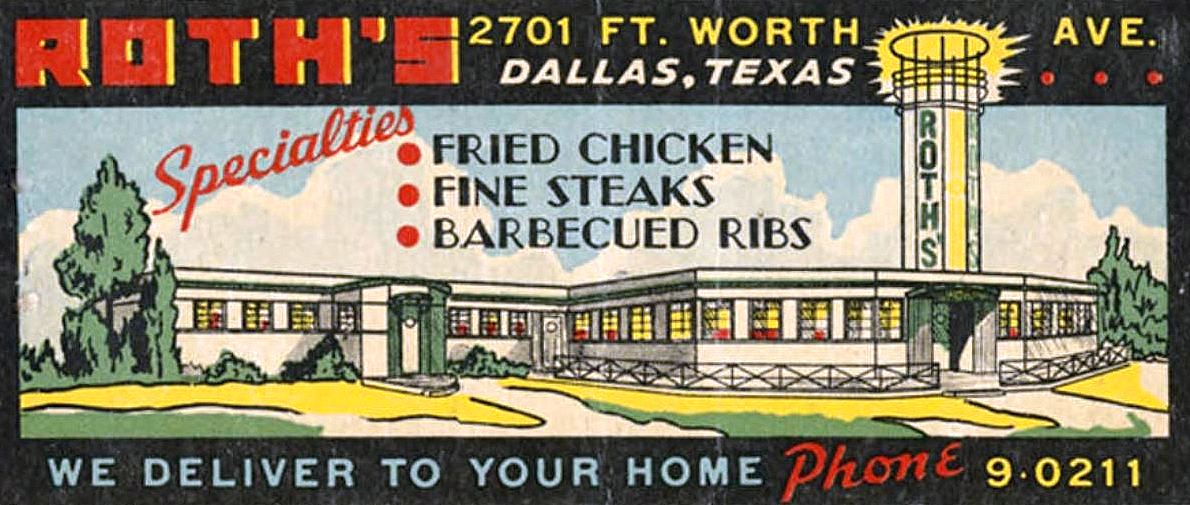
When I see a building like this, I always hope I can find a photo of it somewhere, but all I’ve been able to come up with is this energetic rendering from a 1940s matchbook cover. Roth’s (which was advertised variously as Roth’s Cafe, Roth’s Restaurant, and Roth’s Drive-In) was in Oak Cliff, on Fort Worth Avenue. It opened in about 1940 or ’41 and operated a surprisingly long time — until about 1967. When Roth’s opened, its address was 2701 Fort Worth Avenue, but around 1952 or ’53 the address became 2601. (I think the numbering might have changed rather than the business moving to a new location a block down the street.)

During World War II, Mustang Village — a large housing development originally built for wartime workers (and, later, for returning veterans and their families) — sprang up across Fort Worth Avenue from the restaurant. It was intended to be temporary housing only, but because Dallas suffered such a severe post-war housing shortage, Mustang Village (as well as its sister Oak Cliff “villages” La Reunion and Texan Courts) ended up being occupied into the ’50s. Suddenly there were a lot more people in that part of town, living, working, and, presumably, visiting restaurants.

As the 1960s dawned, Mustang Village was just a memory, and Roth’s new across-the-street neighbor was the enormous, brand new, headline-grabbing Bronco Bowl, which opened to much fanfare in September 1961. I don’t know whether such close proximity to that huge self-contained entertainment complex hurt or helped Roth’s business, but it certainly must have increased traffic along Fort Worth Avenue.

Roth’s continued operations until it closed in 1967, perhaps not so coincidentally, the same year that Oak Cliff’s beloved Sivils closed. Ernest Roth, like J. D. Sivils, most likely threw in the towel when a series of “wet” vs. “dry” votes in Oak Cliff continued to go against frustrated restaurant owners who insisted that their inability to sell beer and wine not only damaged their own businesses but also adversely affected the Oak Cliff economy. The last straw for Sivils and Roth may have been the unsuccessful petition drive in 1966/1967 to force a “beer election” (read about it here in a Morning News article from Aug. 17, 1966).

As far as that super-cool building seen at the top — I don’t know how long it remained standing, but when Roth’s closed, a mobile home dealer set up shop at 2601 Fort Worth Avenue, and mobile homes need a lot of parking space….

The building on the matchbook cover above is, unfortunately, long gone (as is the much-missed Bronco Bowl); the area today is occupied by asphalt, bland strip malls, and soulless corporate “architecture” (see what 2701 Fort Worth Avenue looks like today, here).

*

The man behind Roth’s was Ernest W. Roth, a Hungarian immigrant who had worked for many years as maître-d’ at the Adolphus Hotel’s tony Century Room. He decided to go out on his own, and around 1940, he and his business partner Joseph Weintraub (who was also his brother-in-law) opened the Oak Cliff restaurant which boasted two dining rooms (with a seating capacity of 350, suitable for parties and banquets), fine steaks, and, on the weekends, a live band and dancing. Ernest’s wife, Martha, and their son Milton were also part of the family business. When the restaurant opened, there wasn’t much more out there on the “Fort Worth cut-off,” but the place must have been doing something right, because Roth’s lasted for at least 27 years — an eternity in the restaurant business. It seems to have remained a popular Oak Cliff dining destination until it closed around 1967.

*

The real story, though, is the Roth family, especially Ernest’s mother, Johanna Roth, and even more especially, his older sister, Bertha Weintraub.

Johanna Rose Roth was born in 1863 in Budapest, where her father served as a member of the King’s Guard for Emperor Franz Josef. She and her husband and young children came to the United States about 1906 and, by 1913, eventually made their way to San Antonio. In the ’40s and ’50s she traveled by airplane back and forth between San Antonio and Dallas, visiting her five children and their families — she was known to the airlines as one of their most frequent customers (and one of their oldest). She died in Dallas in 1956 at the age of 92.

Johanna’s daughter Bertha Roth Weintraub had a very interesting life. She too was born in Hungary — in 1890. After her husband Joe’s death in the mid ’40s, a regular at her brother’s restaurant, Abe Weinstein — big-time entertainment promoter and burlesque club empresario — offered Bertha a job as cashier at the Colony Club, his “classy” burlesque nightclub located across from the Adolphus. She accepted and, amazingly, worked there for 28 years, retiring only when the club closed in 1972 — when she was 82 years old! It sounds like she led a full life, which took her from Budapest to New York to San Francisco to San Antonio to Austin and to Dallas; she bluffed her way into a job as a dress designer, ran a boarding house in a house once owned by former Texas governor James Hogg, hobnobbed with Zsa Zsa Gabor and Liberace, was a friend of Candy Barr, and, as a child, was consoled by the queen of Hungary. She died in Dallas in 1997, a week and a half before her 107th birthday. (The story Larry Powell wrote about her in The Dallas Morning News — “Aunt Bertha’s Book Filled With 97 Years of Memories” (DMN, Nov. 17, 1987) — is very entertaining and well worth tracking down in the News archives.)

weintraub-bertha-roth_texas-jewish-post_021590
Bertha Roth Weintraub

I feel certain that the extended Roth family found themselves entertained by quite a few unexpected stories around holiday dinner tables!

***

Sources & Notes

Matchbook cover (top image) is from the George W. Cook Dallas/Texas Image Collection, DeGolyer Library, Central University Libraries, Southern Methodist University; more info is here.

Photo of Bertha Weintraub is from The Texas Jewish Post (Feb. 15, 1990), via the Portal to Texas History, here.

*

Copyright © 2017 Paula Bosse. All Rights Reserved.