Flashback : Dallas

A Miscellany: History, Ads, Pop Culture

Voting Day

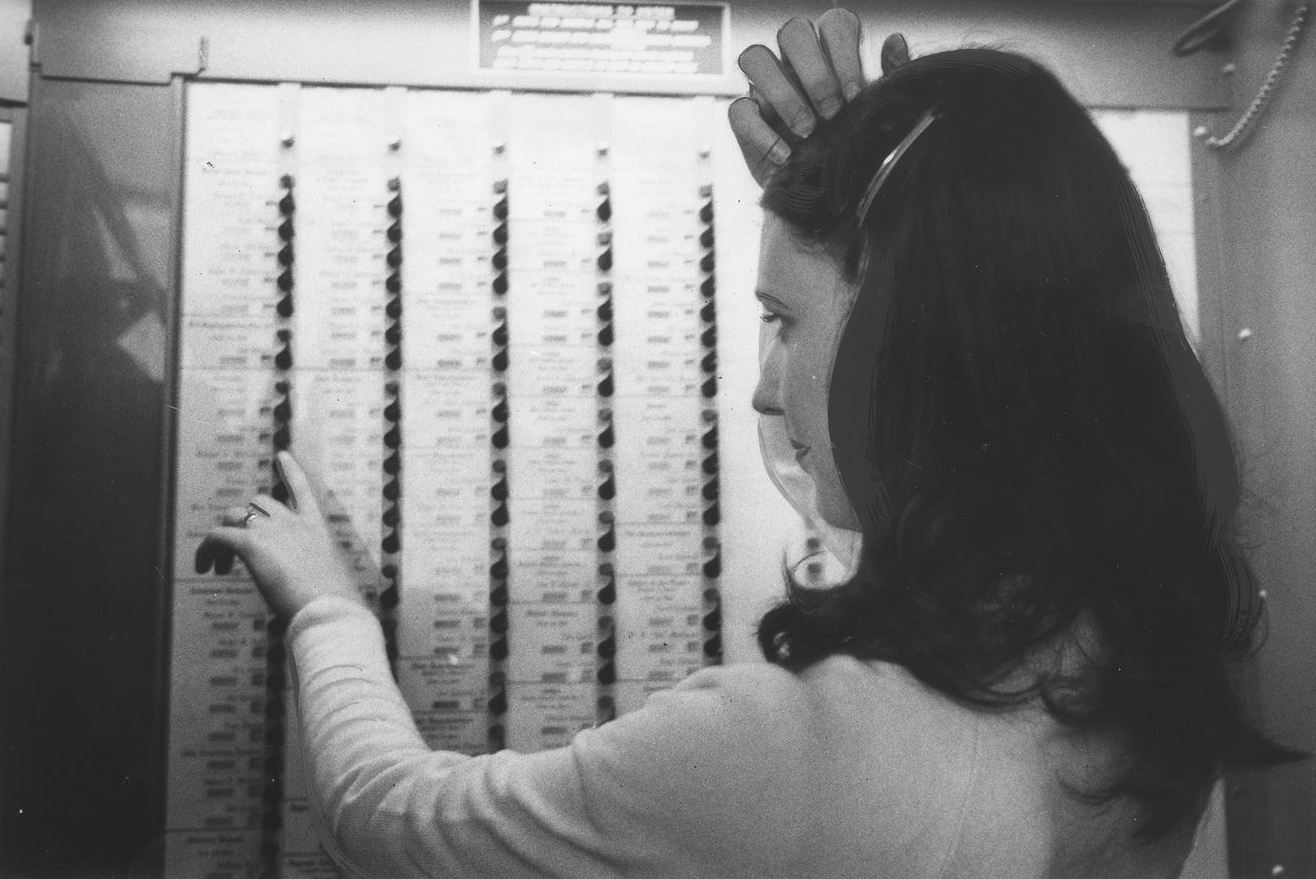
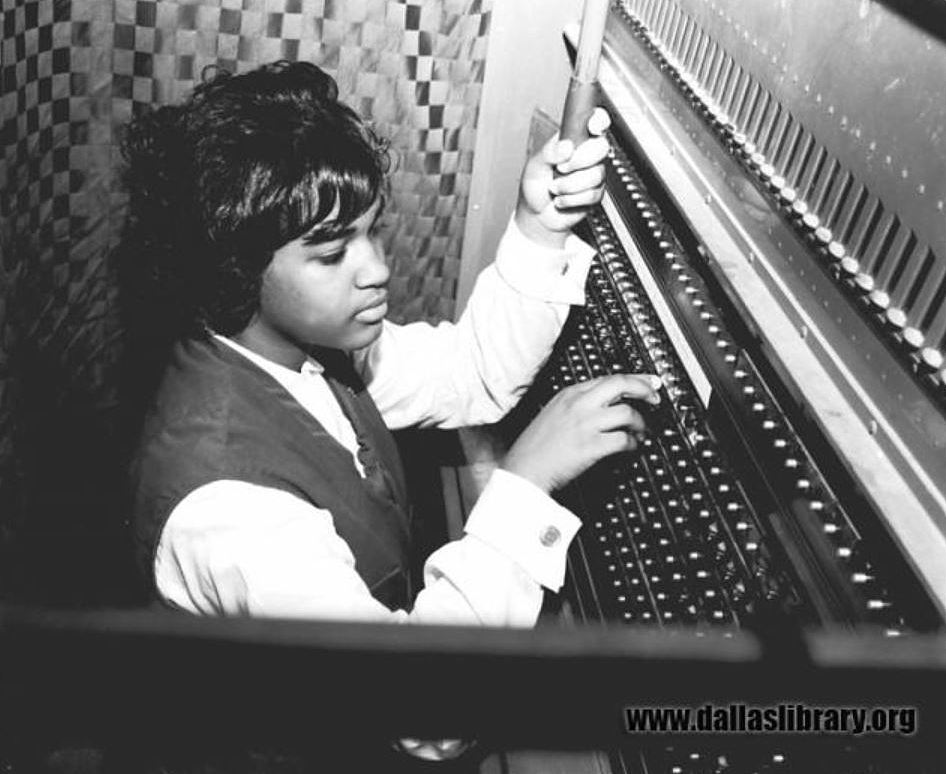
voting-instructions-for-youth_marion-butts_dpl_1965Lever-pulling behind the curtain, 1965 (click for larger image)

by Paula Bosse

It’s here, y’all. Get out and get it done.

voting_uta_no-date

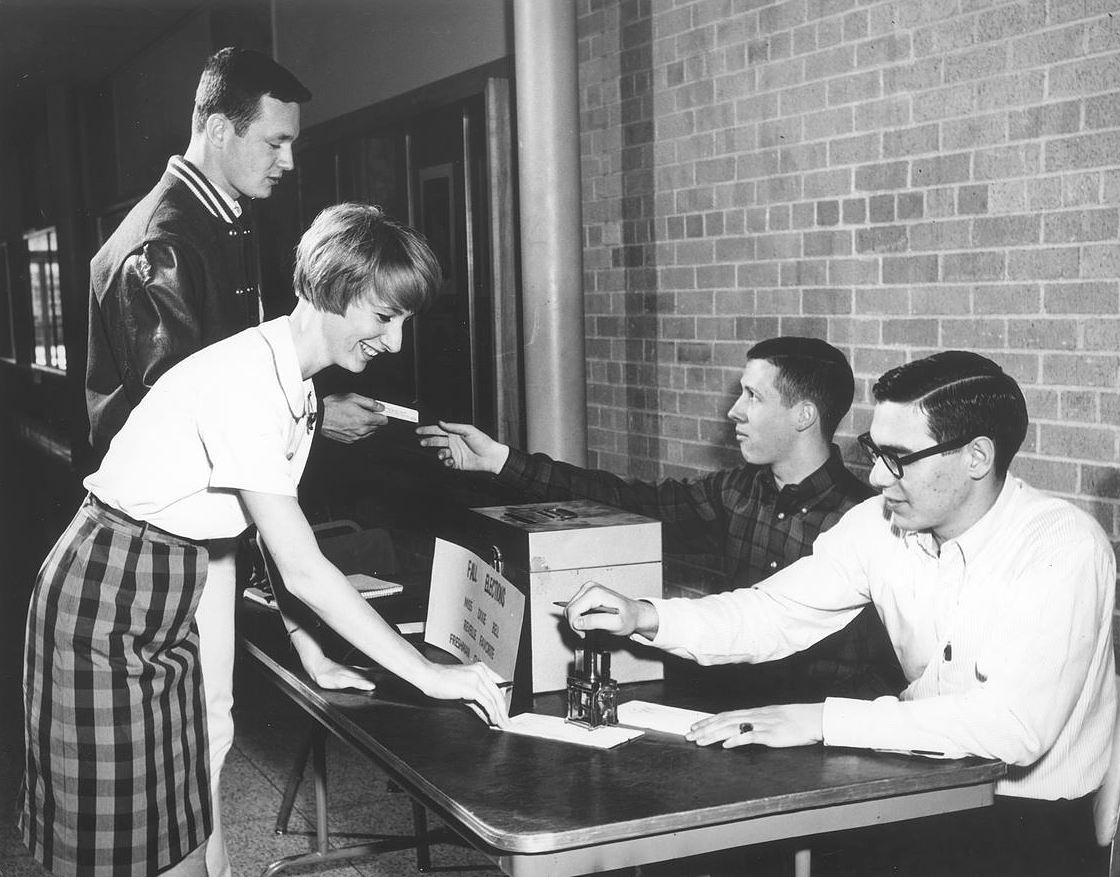
voting_uta_1972

***

Sources & Notes

Top photo from 1965 by Marion Butts, from the Dallas Public Library’s Marion Butts Collection: “Young woman demonstrates the use of a voting machine” — more here (you may have to be logged into to your Dallas Public Library account to reach this page).

Second photo is undated and has no photographer info: “Early voter, Mrs. Gene Savage, looking at long Democratic party ballot,” from UTA Libraries, Special Collections — more info here.

Third photo is from 1972: “Students voting in Fall Elections, University of Texas at Arlington (UTA), 1972,” from UTA Libraries, Special Collections — more info here.

More on Dallas elections can be found in the Flashback Dallas post “How Dallas Used to Get Election Returns,” here.

Click photos to see larger images.

*

Copyright © 2016 Paula Bosse. All Rights Reserved.


How Dallas Used to Get Election Returns

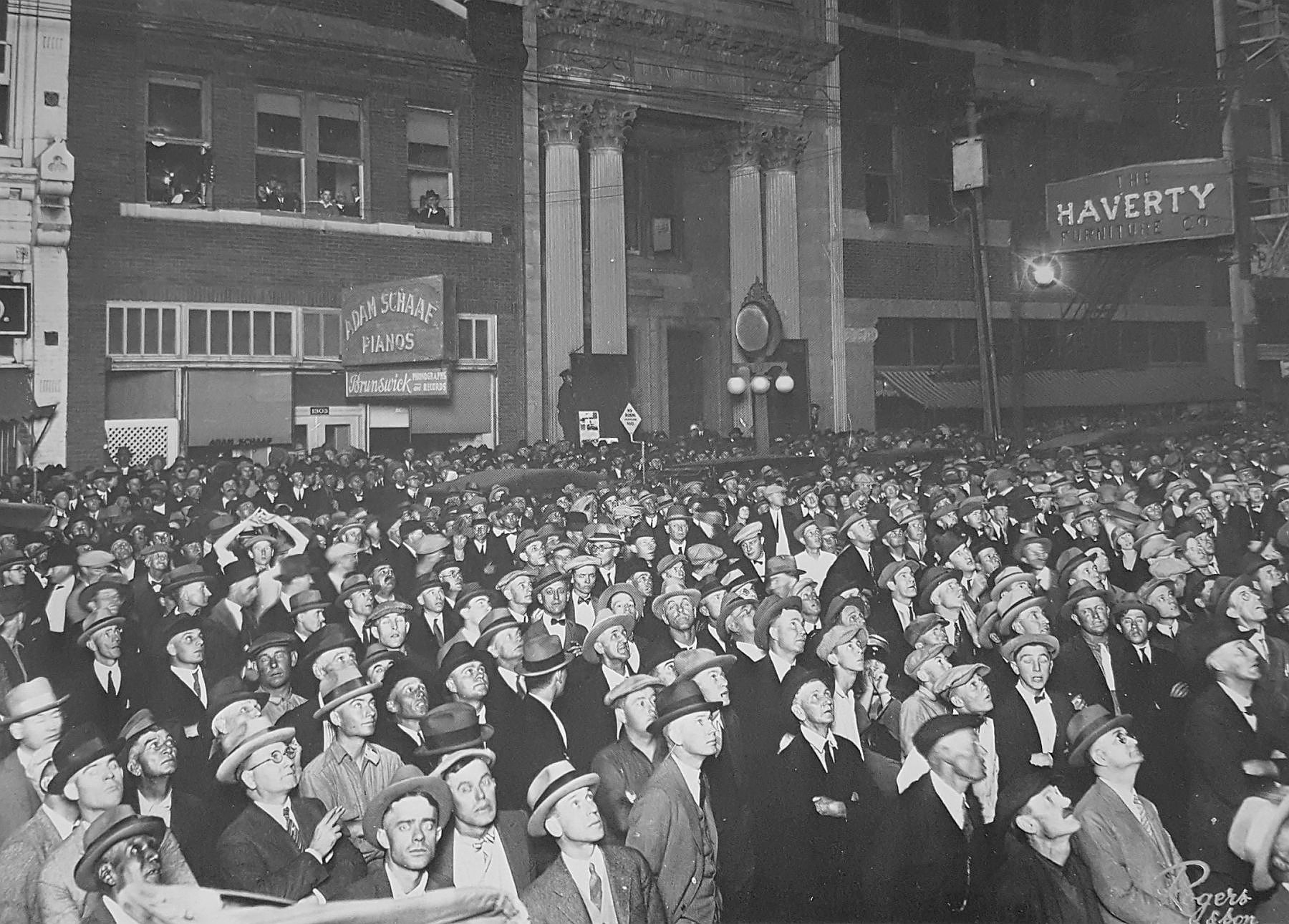
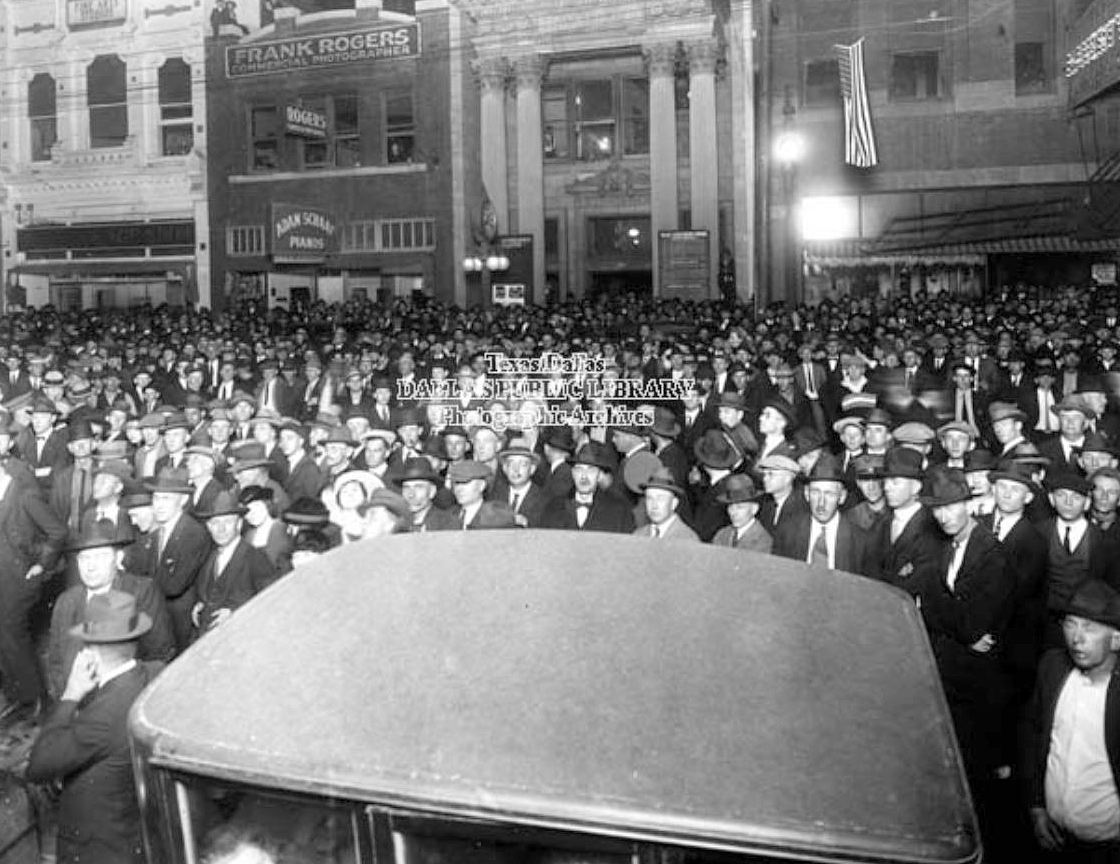
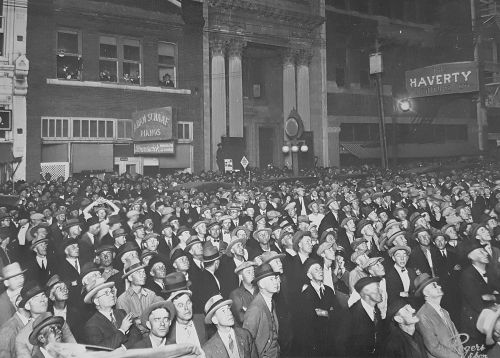
election-returns_1928_frank-rogers_dplA Dallas crowd waits for returns, in the middle of Elm Street…

by Paula Bosse

I think there’s some sort of political thing going on? Like most every other human being in the United States (…and beyond), I’m pretty sick of hearing about politics and politicians. Like nauseous sick. So why not write about elections! Below are some fun facts about how Dallasites used to get their election returns — share them with your fellow voters while standing in line at the polling station. They will think you are either very interesting or very annoying.

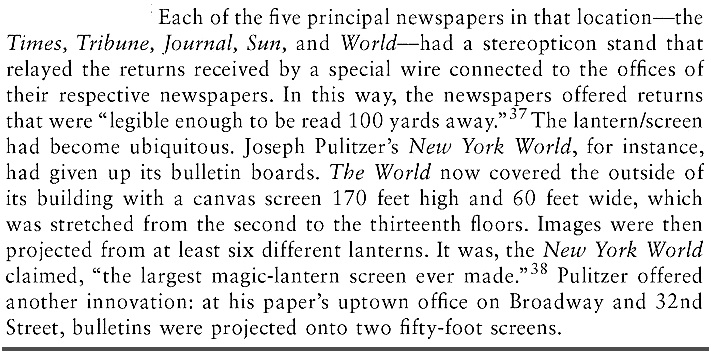
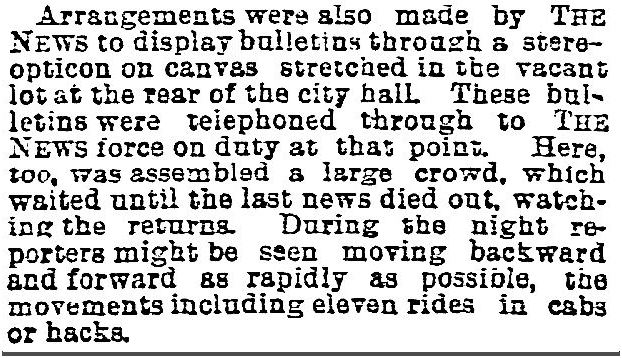
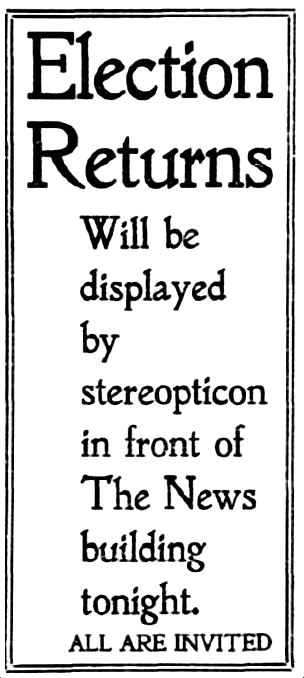
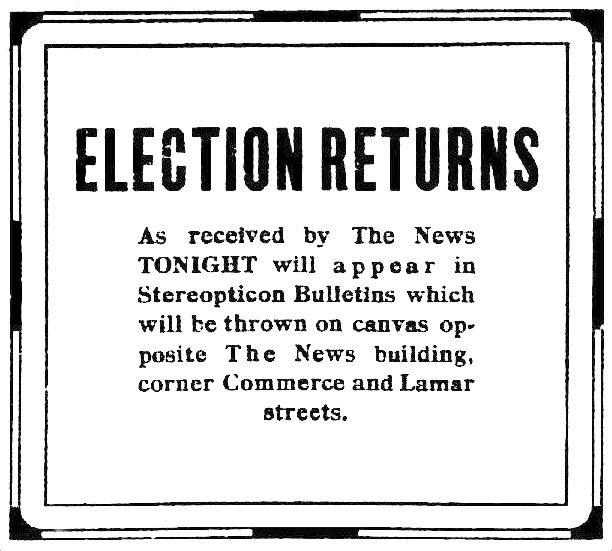
Forget the issues and the personalities, let’s look at election results: how were they passed along to the public in the days before radio and television? Other than newspapers (the primary source of all things informational), there was a time when results were “bulletined” by throwing images onto stretched canvases or even onto the sides of  buildings by a powerful stereopticon or “magic lantern.” These results were continuously updated as manual counts in local races were tabulated; farther-flung races were updated via tallies received by telegraph or telephone. Crowds gathered in front of buildings — usually newspaper offices — to watch the returns. Some accounts have this form of information dissemination beginning in the 1860s (see an illustration from 1872 here), with the practice becoming more widespread by the 1880s and more technologically advanced by the 1890s.

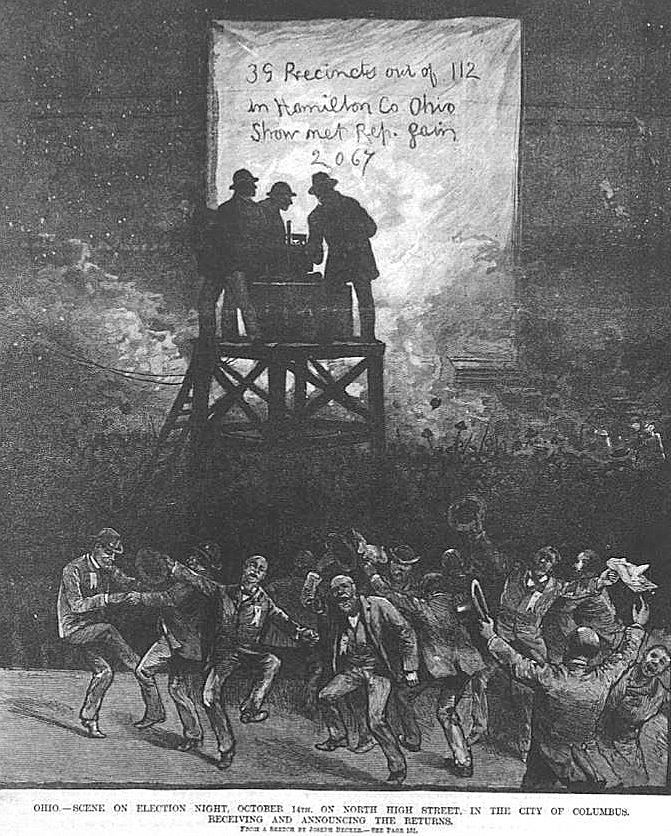
Below, an illustration showing jubilant crowds watching congressional returns in Columbus, Ohio in 1884.
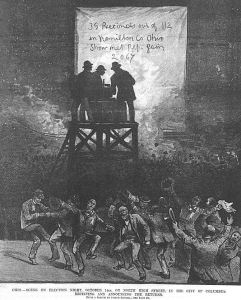
ohio_election-results_1884
Columbus, Ohio, 1884

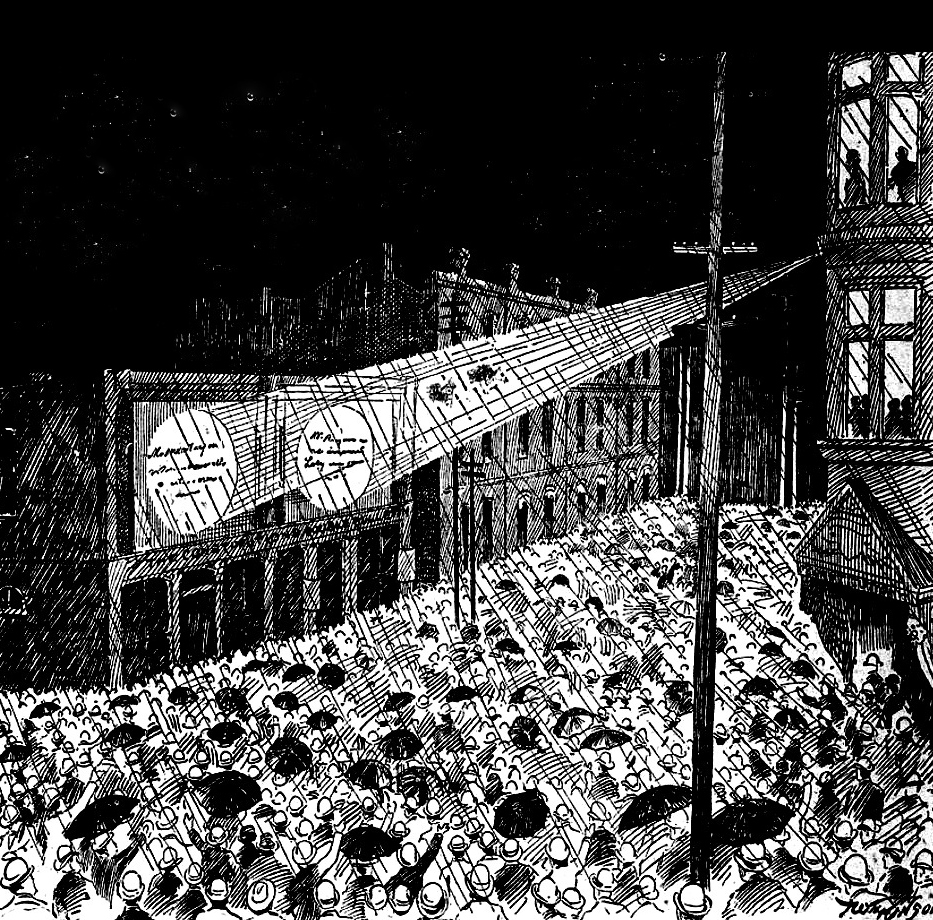
Things had been refined by 1896, as this illustration from the Atlanta Constitution shows. The caption: “Flashing out the returns in front of the Constitution office. Thousands of people gathered in front of the Constitution Building last night and watched the returns come in.” In the rain! That’s dedication.
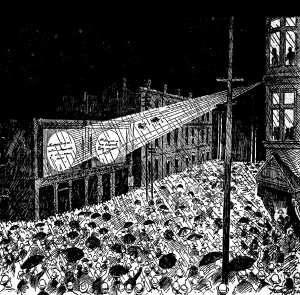
atlanta-1896_twitter
Atlanta, Georgia, 1896

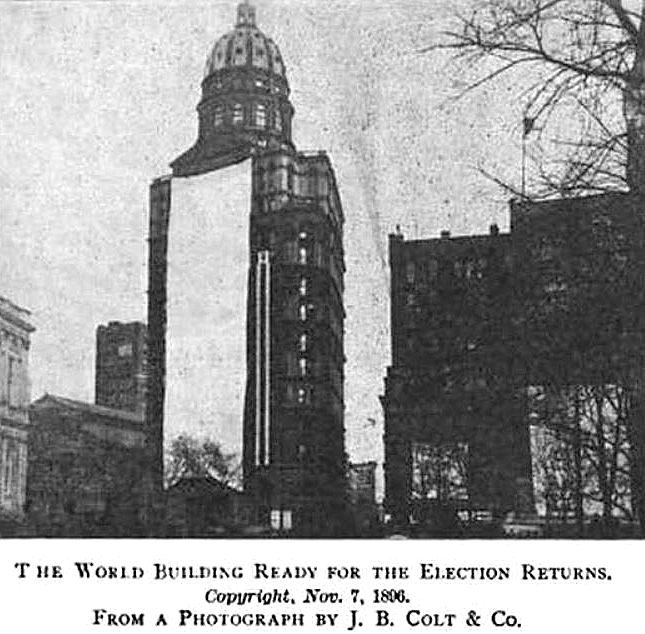
Also in 1896 — things got crazy in New York, with a ridiculously large “screen” hung from a very tall building.
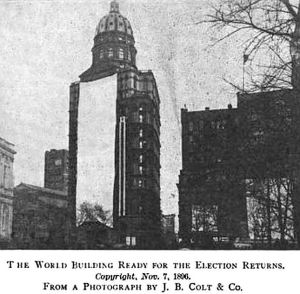
projections_electrical-engineer_mag_111196_photo
NYC, 1896

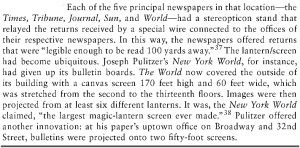
magic-lantern_nyc_films-and-american-presidency
from “Film and the American Presidency”

The first mention I found in The Dallas Morning News about projecting election results before a large crowd was in 1891. Not only did the newspaper have a large bulletin board (maybe like a large chalk board?), they also used the stereopticon. (The full article about the results of the 1891 election can be read here.) (All pictures and clippings are larger when clicked.)
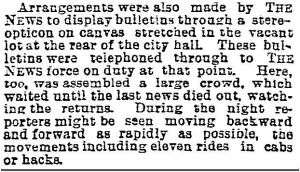
1891_election-returns_dmn_040891
Dallas Morning News, April 8, 1891

The magic lantern was called back into service the next year (read an entertaining DMN article about an 1892 election here in which the crowd huddled in front of the screen watching the returns despite rain and open saloons) — in fact, this “electric bulletin board” was so popular it was used for at least 40 more years.

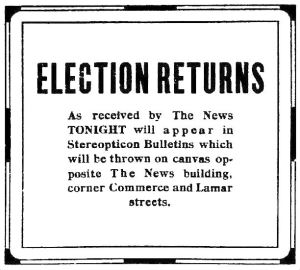
In 1896, interest was really intense — an unbelievable 94% of Dallas’ registered voters had turned out to cast ballots. (It took four days to tally the votes!) A huge crowd gathered around the News building at Commerce and Lamar to watch the bulletins which were “flashed by means of a powerful stereopticon on a large canvas screen stretched across the street” (“Republicans Doubled Votes in ’96” by Sam Acheson, DMN, Jan. 1, 1968).

By 1900 this stereopticon thing was getting to be standard operating procedure.
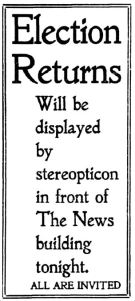
1900_election-result_dmn_110600
DMN, Nov. 6, 1900

1908_election-result_dmn_050208
DMN, May 2, 1908

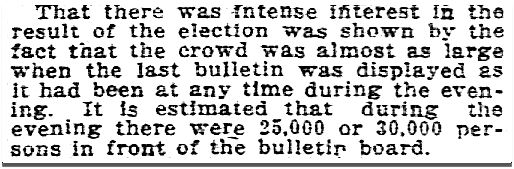
By 1911, “25,000 or 30,000 persons” were showing up to watch the returns.
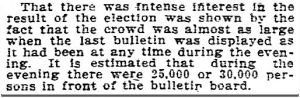
1911_25-or30000-people_dmn_072311
DMN, July 23, 1911

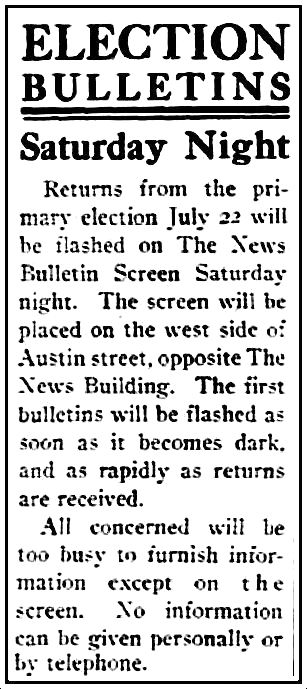
I guess people used to just phone the papers after elections to ask about the results. The News would rather you didn’t, thanks.
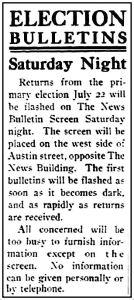
1916_election-result_dmn_072116
DMN, July 21, 1916

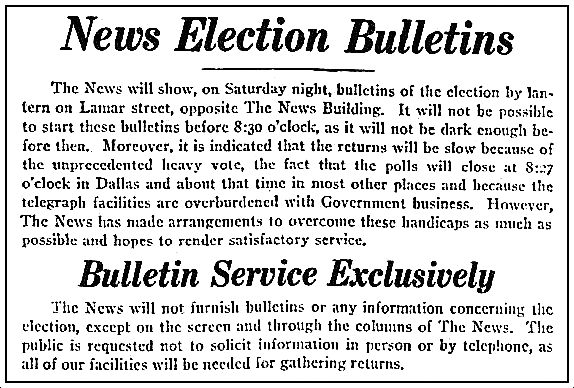
1918 was an interesting year for a few reasons: (1) WWI was underway, (2) the polls opened — for some reason — at 9:27 AM and closed at 8:27 PM (?), and … (3) it was the first election in Dallas in which women were allowed to vote. There was suddenly a huge number of registered voters to have to deal with. Newspaper reports showed registration of women outnumbering men in several precincts. The large number of new voters meant that votes began to be counted “one hour after the polls are opened and will continue until the work is concluded” (DMN, July 19, 1918). Which seems odd. Also, women were encouraged to vote early in the day so as to avoid long lines and men were instructed to watch their behavior if there were women present.
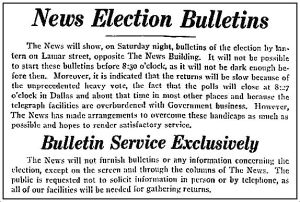
1918_election-result_dmn_072618
DMN, July 26, 1918

It’s surprising that the use of projectors to display election returns was used as late as 1930, well after the advent of radio. Apparently the Texas Election Bureau and Press Association had rules forbidding radio stations from announcing election results over the air until they had been printed in the newspaper — they were, however, allowed to give “relative standings” to their audiences at fifteen-minute intervals (DMN, July 27, 1930).

Seems like the newspapers held all the power (probably not a huge problem for radio stations since most of them were owned by the newspapers, and, of course, no problem at all for the papers who printed oodles of “extra” editions). By 1930, though, crowds had gotten so large downtown that they were diverting people to Fair Park where they could sit and enjoy the cool breezes as they listened to see if their candidates had won or lost. (“Sitting” seems to be the operative word here.) But soon radio would wrest the “instant news bulletin” power away from the newspapers, and these quaint magic lantern watching-parties would be unnecessary. Eventually people wouldn’t know they’d ever even existed.

Fast-forward to today. I can’t even imagine trekking downtown to watch election results come in at a snail’s pace, magic lantern or not. It’s the 21st century, man, and I’ll be plopped in front of my TV, channel-hopping, stress-eating and stress-drinking, and wondering what friendly country I might consider “visiting” for a while.

***

Sources & Notes

Top photo shows crowds of Dallasites watching election returns. This Frank Rogers photo — a Dallas Public Library photo reproduced in A. C. Greene’s book Dallas, The Deciding Years — shows a crowd (which seems to be devoid of women) watching election returns in the 1300 block of Elm Street. Below is another Rogers photo from the DPL, undated, but probably taken in 1922:
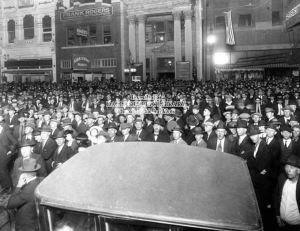
election-returns_elm-street_dpl_frank-rogers

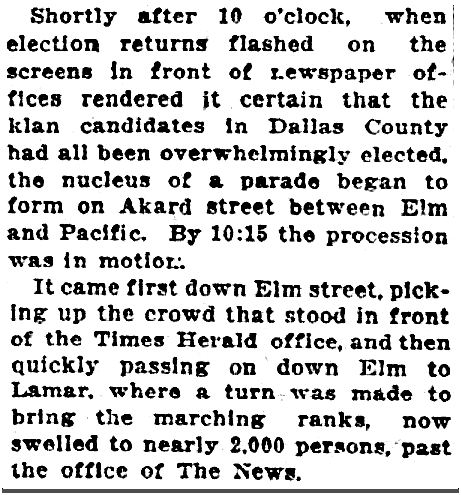
It’s convenient that Rogers was able to include his studio in the background! The photograph is undated, but Frank Rogers and the Adam Schaaf Piano Store shared a building at 1303 Elm only between 1922 and 1923 (the top photo is dated 1928 by the DPL, but neither Rogers nor the piano store were in that location after about 1925). The building to the right is the Dallas Times Herald Building (with the pillars, at 1305 Elm), and it would make sense that the crowd was looking toward the other side of the street as results were being updated and projected from the Times Herald. In fact, this may have been the night that the KKK famously marched through downtown, past the large crowds gathered in front of both the Dallas Times Herald and Dallas Morning News offices, to celebrate that their candidates had won … and had won big.
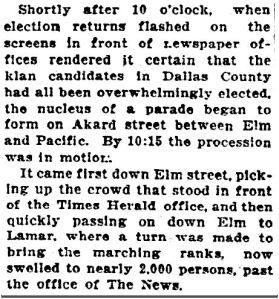
klan-march_dmn_082722
DMN, Aug. 27, 1922

The illustration showing Ohio returns in Columbus being projected on the night of Oct. 14, 1884 is from Frank Leslie’s Weekly (this illustration was featured in the book Politicking and Emergent Media: U.S. Presidential Elections of the 1890s by Charles Musser).

The 1896 illustration is from the Atlanta Constitution, found on Twitter.

The 1896 photograph of the World Building in New York is from the trade journal The Electrical Engineer, Nov. 11, 1896. The paragraph below it is from the book Film and the American Presidency by Jeff Menne and Christian B. Long.

Further reading from the archives of The Dallas Morning News (regarding the July 26, 1930 election):

  • “News and Journal To Give Two Election Count Parties” (DMN, July 25, 1930) — an announcement to voters where they could get the “flashed” returns of the next day’s voting (in front of the News building “as usual,” and at Fair Park “where results will also be thrown on a screen at the moving picture booth near the grand stand”
  • “Fates of Favorites Watched on News and Journal Screens” (DMN, July 27, 1930) — two photos showing crowds at Commerce and Lamar and at Fair Park watching the returns

Click pictures and clippings to see larger images.

*

Copyright © 2016 Paula Bosse. All Rights Reserved.

A Few Photo Additions to Past Posts — #3

union-depot_flickr_coltera

by Paula Bosse

Time once again to add photos I’ve recently come across to previous posts. Stuff’s starting to pile up!

*

Above, a postcard photo of the old Union Depot which once stood on the edge of Deep Ellum, at Pacific and Central. I’m adding it to “The Old Union Depot in East Dallas: 1897-1935.” (Source: Flickr, here.)

*

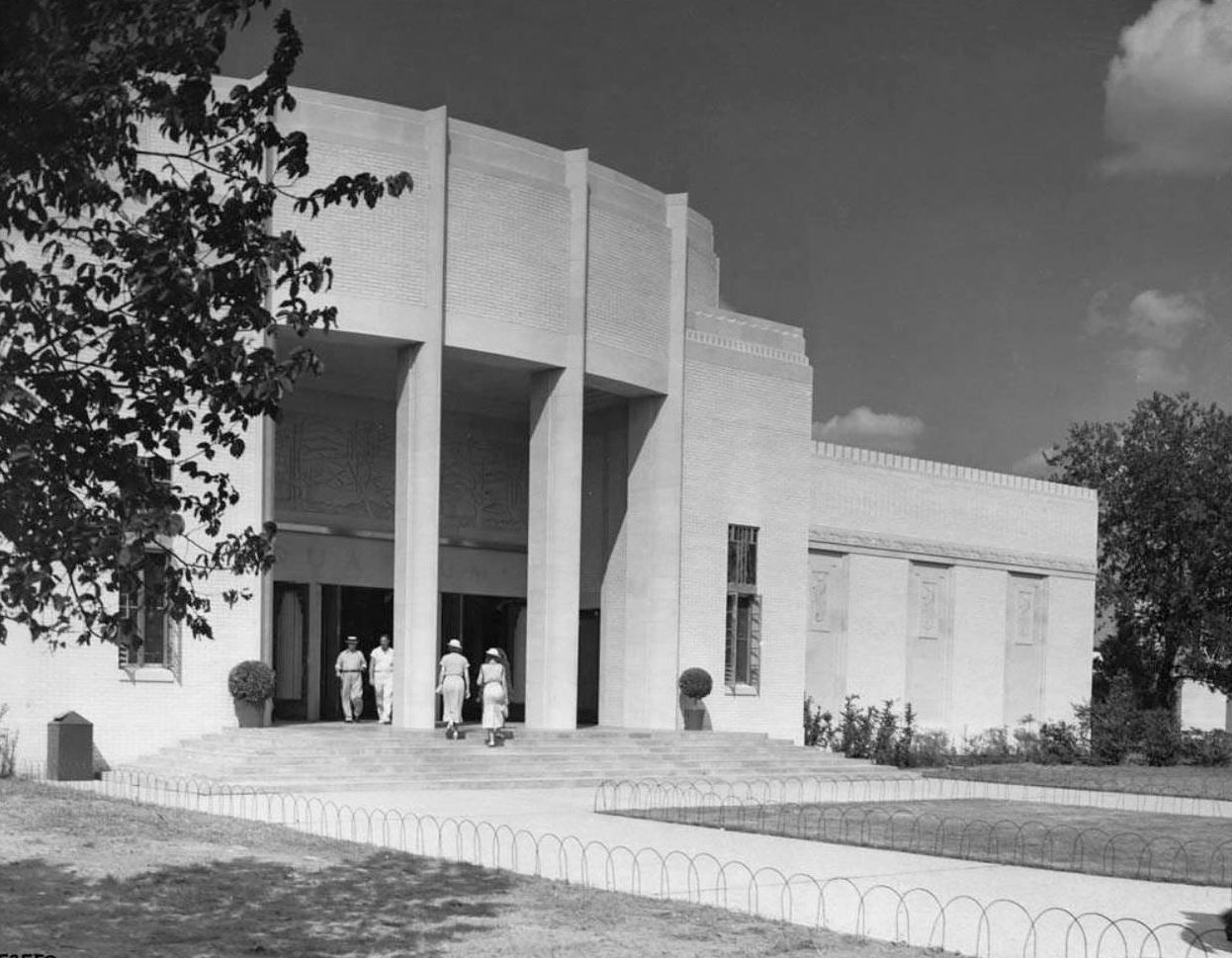
This 1936 photo of the new aquarium at the Texas Centennial has been added to a post I really enjoyed writing, “The Dallas Aquarium: The Building Emblazoned With Seahorses — 1936.” (Source: Ryerson & Burnham Archives, Art Institute of Chicago, here.)

aquarium_art-institute-of-chicago_1936

*

Another Centennial photo is this one, showing the second Alamo replica which stood in Fair Park from 1936 to 1951 (the first one lasted longer, from 1909 to 1935). Personally, I never knew about either replica until I wrote the post “Remember the Alamo! … In Fair Park?” (Source: Ryerson & Burnham Archives, Art Institute of Chicago, here.)

alamo_art-institute-of-chicago_1936

*

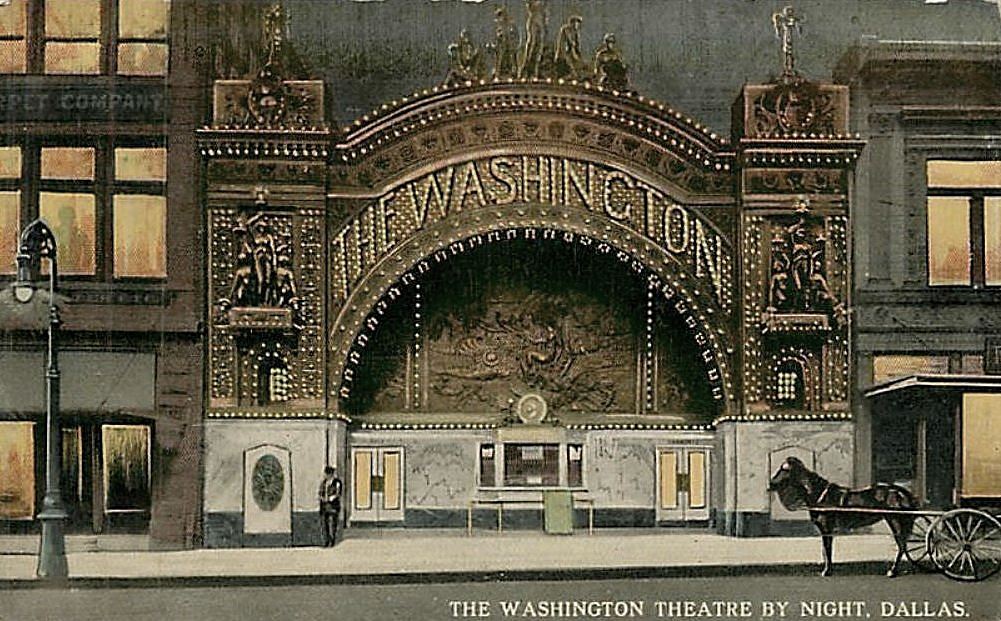
This great postcard of the Washington Theater (“at night”) has been added to “The Washington Theater — Dallas’ First Movie Palace.” (Source: eBay.)

washington-theatre_ebay

*

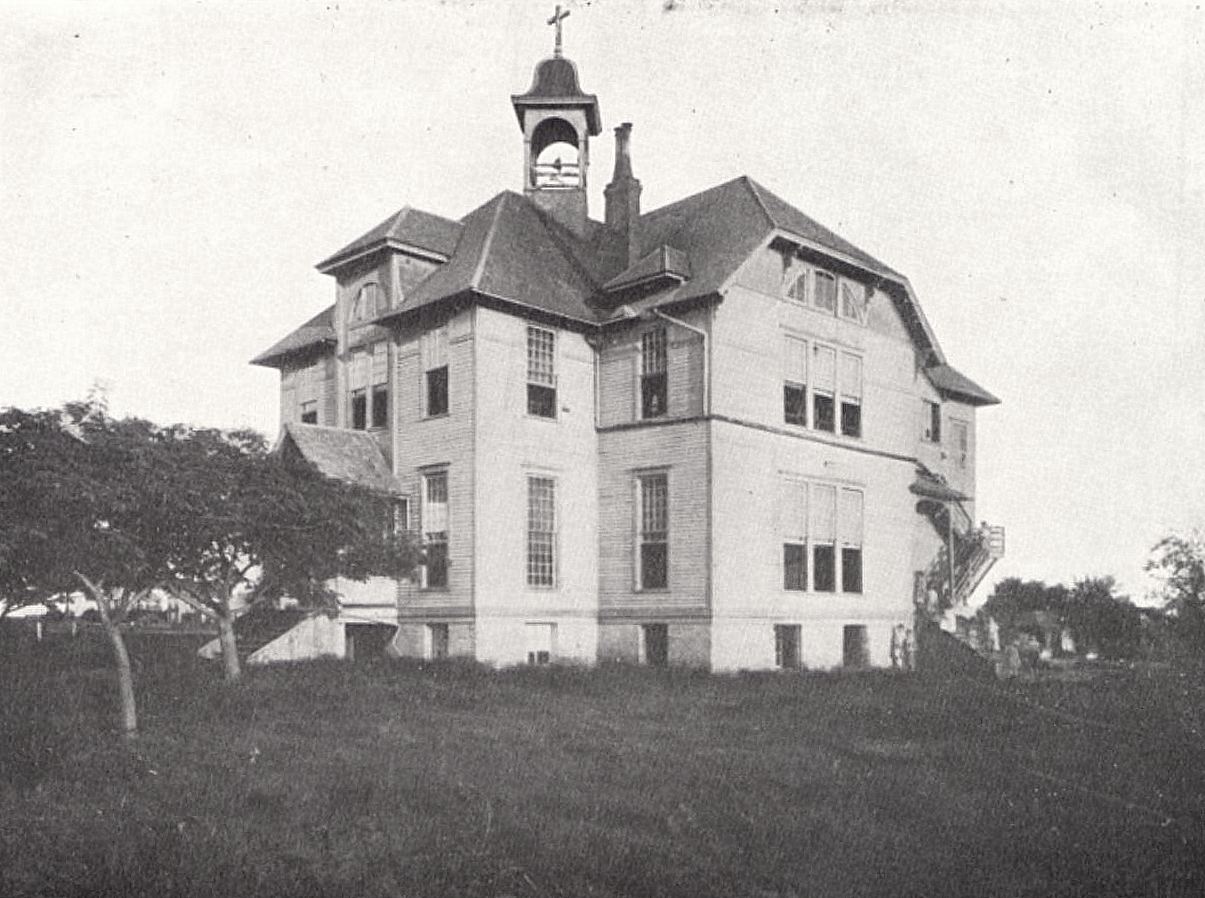
This undated photo of the St. Joseph orphanage in Oak Cliff has been added to “The St. Joseph Orphanage — 1891.” (Source: Catholic Diocese of Dallas.)

st-josephs-orphanage_catholic-charities-of-dallas

*

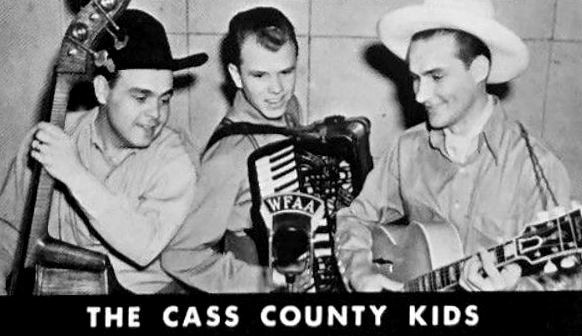
This photo of the Cass County Boys (featuring the ever-fetching Jerry Scoggins on the right) has been added to “Jerry Scoggins, From WFAA Staff Musician to Pop Culture Icon.” Scoggins is the man who sang the Beverly Hillbillies theme song (which might now be stuck in your head for the rest of the day…). (Source: eBay.)

cass-county-kids_wfaa-postcard_det_ebay

*

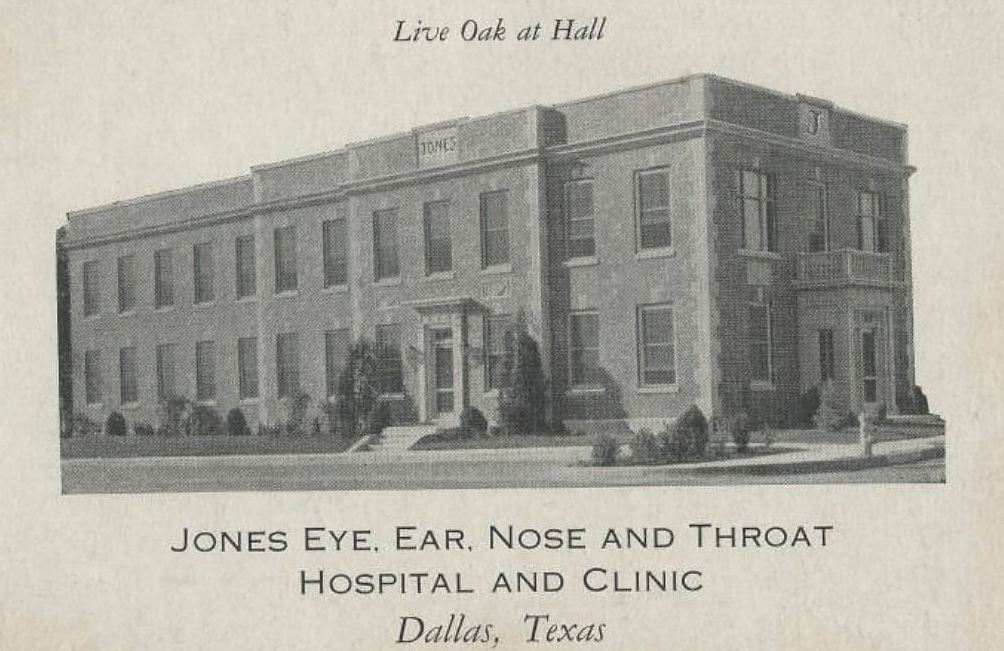
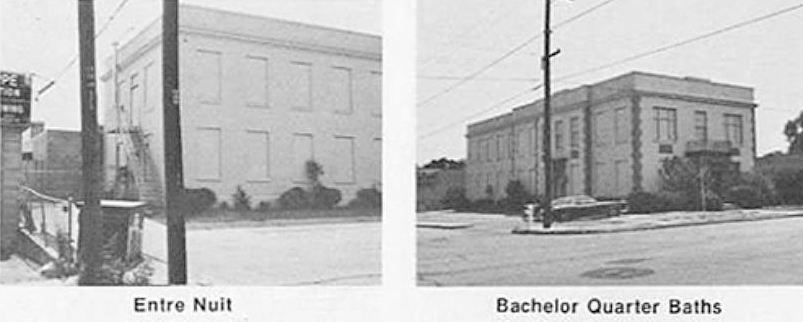
I saw this postcard for the Jones Eye, Ear, Nose and Throat Hospital and Clinic the other day. The only reason this jumped out at me was because I had researched the building a bit when I wrote about gay clubs in the ’70s for CentralTrack.com (Hidden in Plain Sight: A Photo History of Dallas’ Gay Bars of the 1970s”). This non-descript, institutional-looking building started out life in 1928 as a fancy clinic at Live Oak and Hall, then became a gay bathhouse and bar (Bachelors Quarters and Entre Nuit), and it is now home to a CPA firm. (If those walls could talk….) I can’t update the Central Track post, so I thought I’d update it here. (Source: top image from the always amazing “Coltera” on Flickr; bottom photos from a 1975 issue of the gay travel magazine Ciao! More of these photos can be seen at the bottom of the Central Track article linked above.)

jones-clinic_bachelor-quarters_gay-bath-house_flickr_coltera

jones-clinic_gay-bar-bathhouse_1975

*

And, lastly, not a photo update, but I’ve expanded the “All About Me, Me, Me” page, here. I’ve added more words. And a link to me talking with Justin Martin of KERA radio last year.

***

Those pictures are big. Click ’em!

*

Copyright © 2016 Paula Bosse. All Rights Reserved.
 

Next-Door Neighbors: The Palace Theater and Lone Star Seed & Floral — 1926

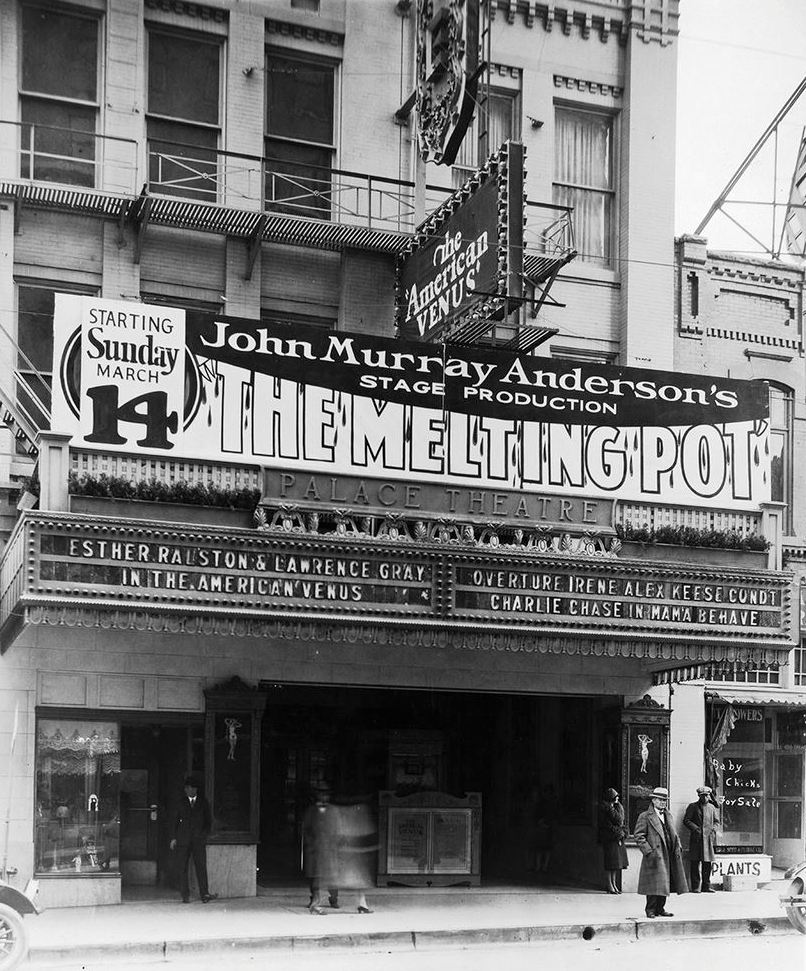
palace-theatre_melting-pot_march-1926_utaElm Street neighbors, March, 1926…. (click for larger image)

by Paula Bosse

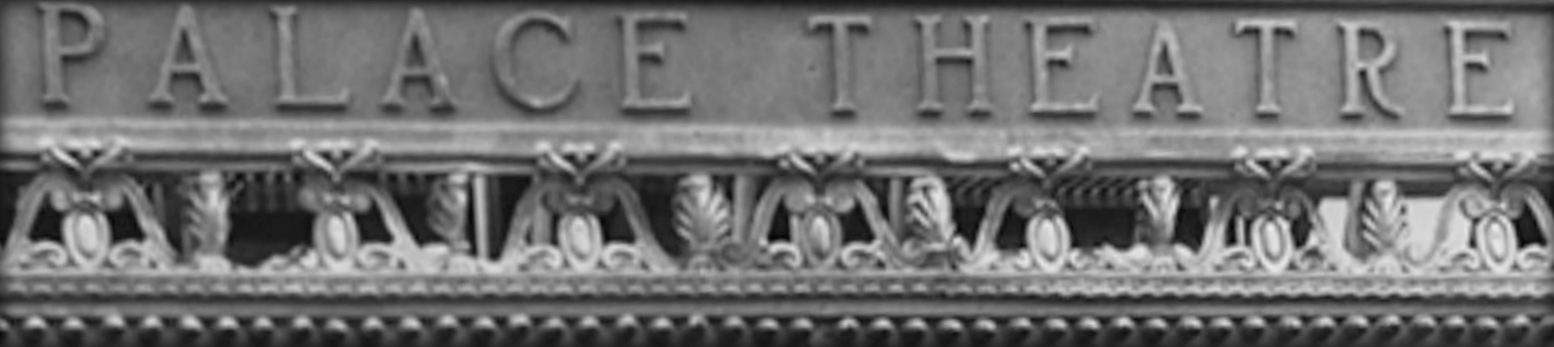
Above, the Palace Theater, one of Dallas’ great moviehouses. It opened in June, 1921, near the northwest corner of Elm and Ervay; this photograph is from March of 1926, three months before the theater’s fifth birthday. It was still a whippersnapper. 

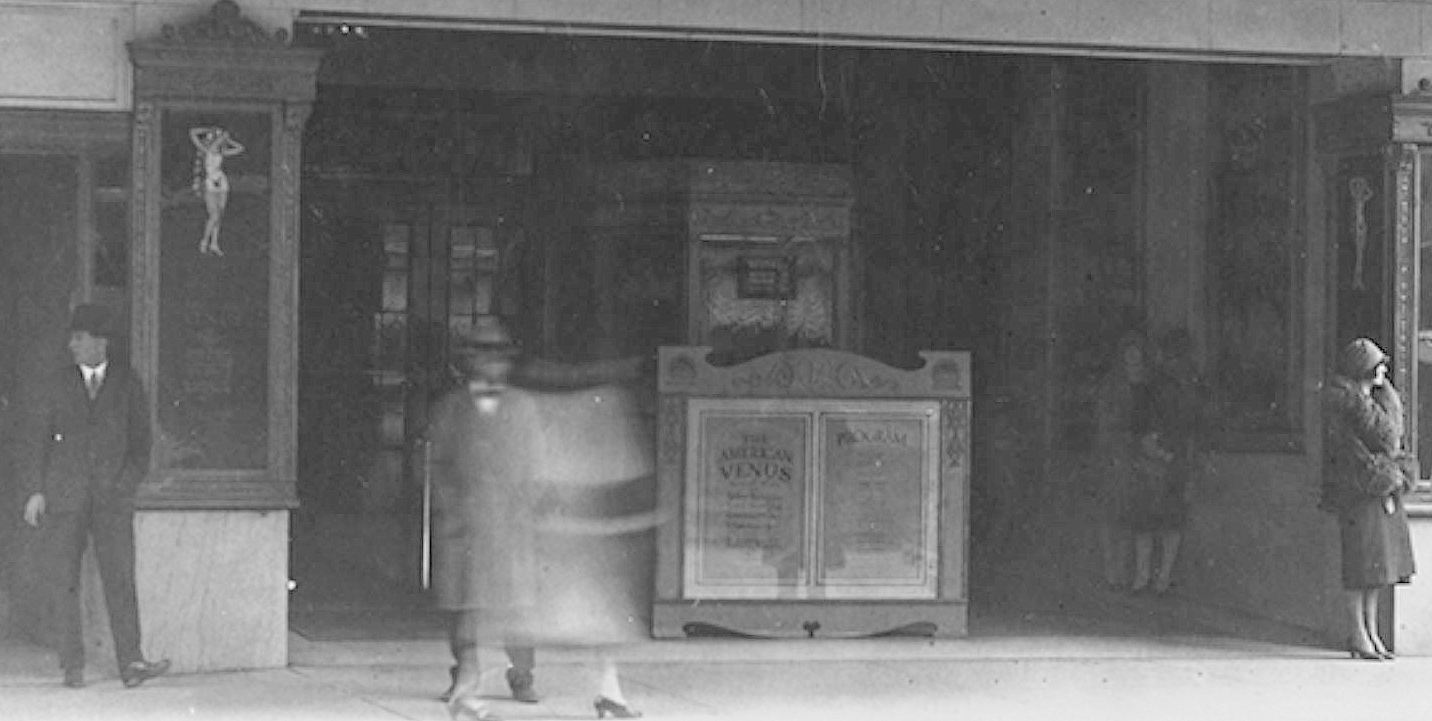
Below, a detail from the photo: by zooming in and tweaking the contrast, the box office is revealed, as are two women chatting in the shadows (all pictures and clippings are larger when clicked).

palace-theatre_melting-pot_march-1926_uta_det2

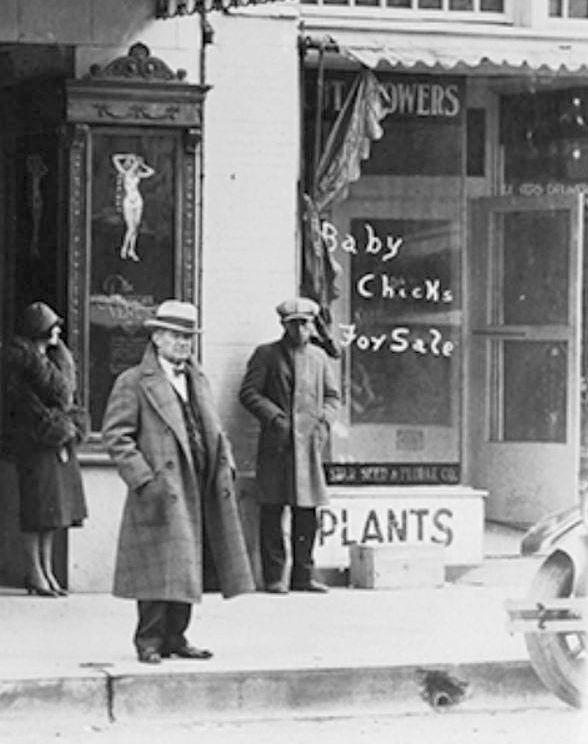
As interesting as old movie theaters are, I was more intrigued by the three people to the right of the theater (who all look like characters from a period melodrama) and by the business next door. I’ll never know who those men were or who that woman was waiting for, but finding out what business was selling baby chicks (…next door to the Palace?) was pretty easy.

palace_lone-star-seed_1926_uta_det

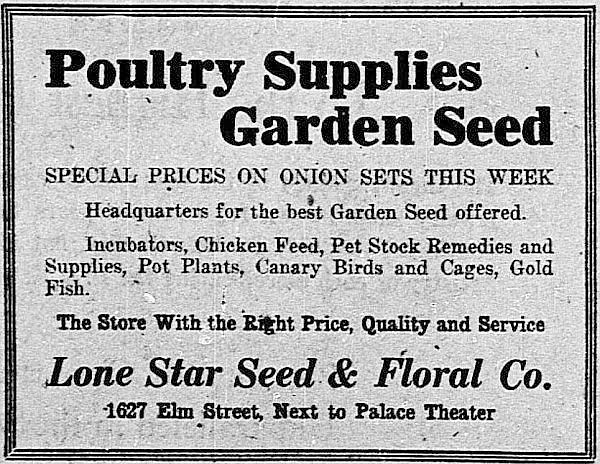
The store was Lone Star Seed & Floral (1627 Elm). They sold seeds and flowers, potted plants, canaries, goldfish, and pet and livestock supplies. They could also help you with all your poultry needs: feed, incubators, medicine, and live chickens. …Right next door to one of the plushest and most luxurious entertainment destinations in Dallas.

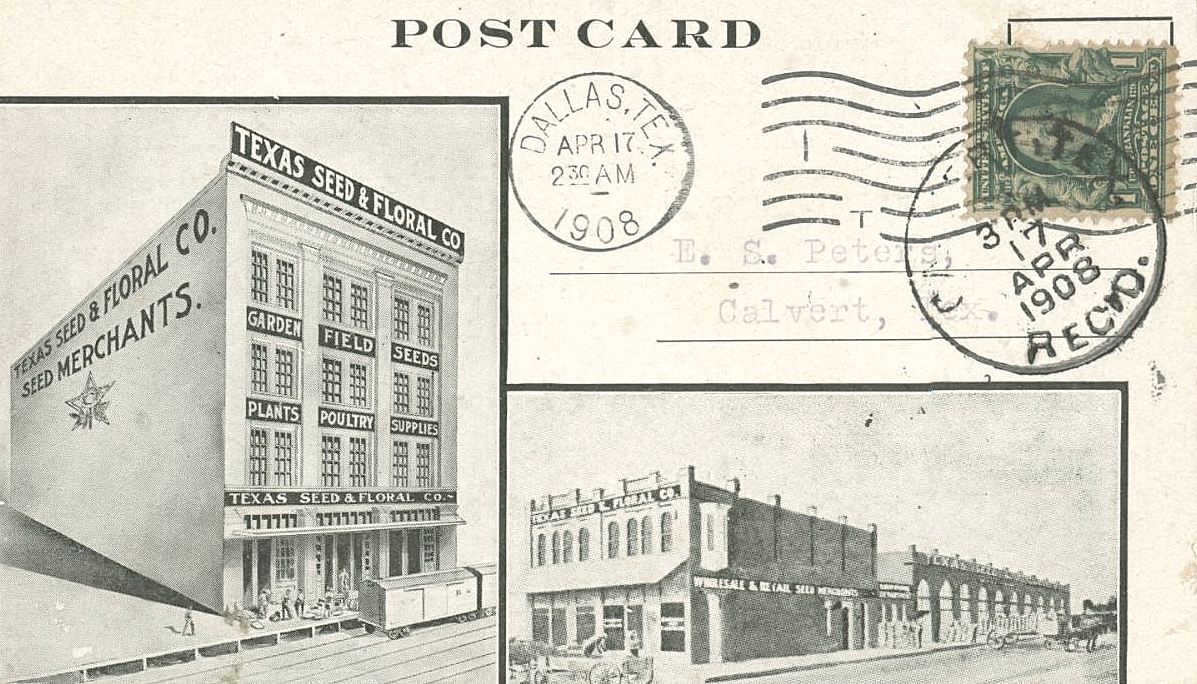
Lone Star Seed & Floral appears to have once been Texas Seed & Floral and had been around since at least 1892. They set up shop at 1627 Elm in 1902 and remained there quite a while until they moved in January, 1927, just a few months after the top photo was taken. Here is a postcard of its earlier incarnation, with photos of the Pacific Avenue location at the left, and the Elm Street location at the lower right (the view is looking north on Ervay; the Palace would later be built immediately west of this  building, to the left of the lower postcard image, just out of frame).

texas-seed-and-floral_1908_portal

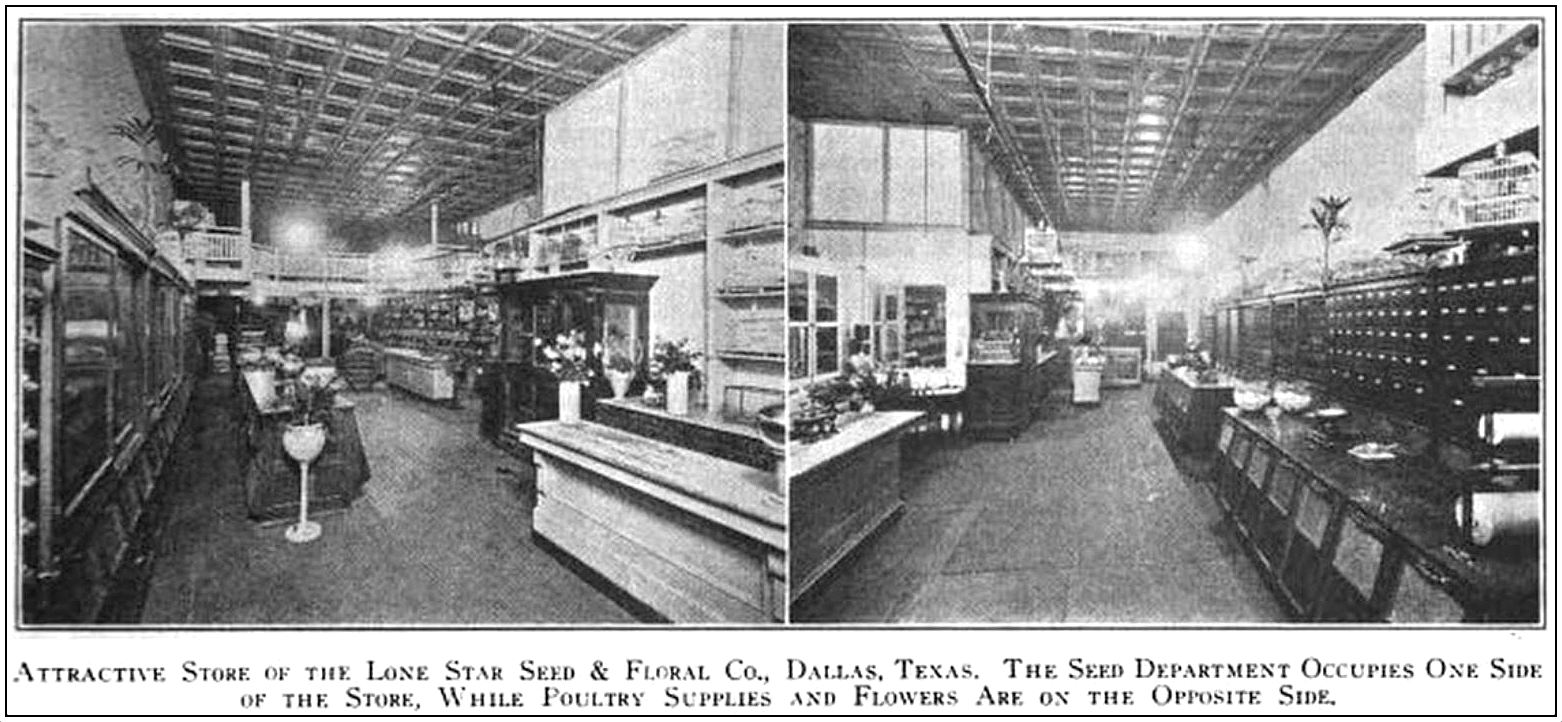
The store looks very clean and extremely well organized. My inexplicable love of things stored in card-catalog-file-like cabinets and fold-out bins tells me I’d probably be stopping in fairly regularly after having seen the latest Buster Keaton film next door.

lone-star-seed_the-seed-world_082020

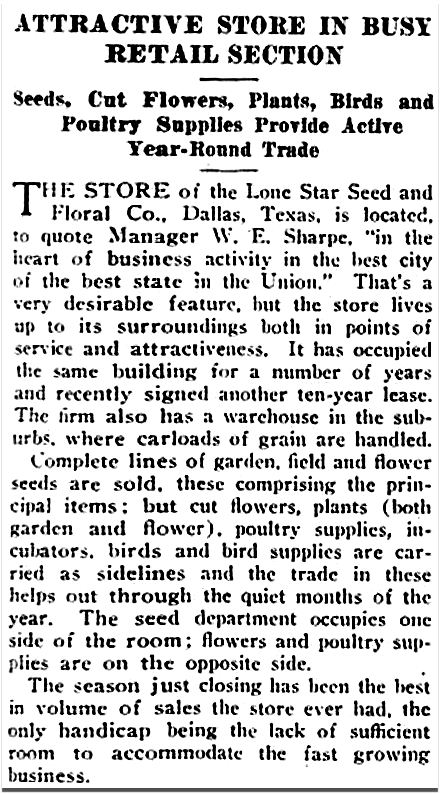
lone-star-seed_the-seed-world_082020_article
Photo and article from, yes, The Seed World, Aug. 20, 1920

lone-star-seed_dmn_022622
Feb., 1922

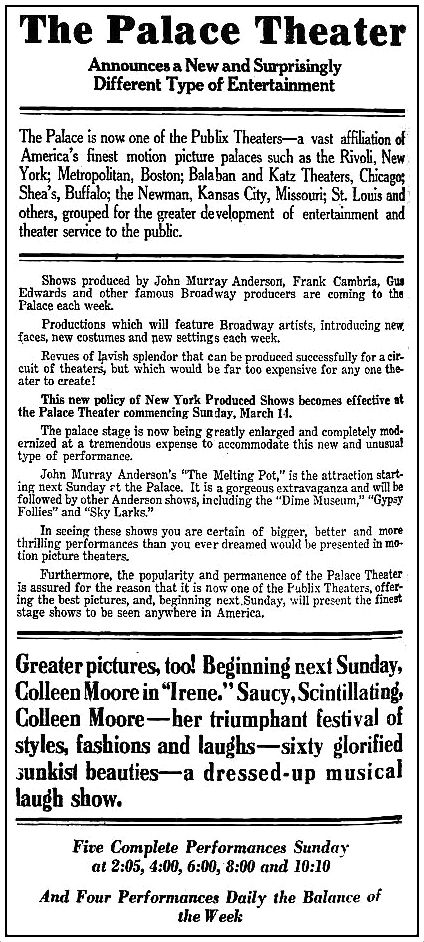
But back to the Palace. The banner is publicizing the imminent arrival of John Murray Anderson’s “The Melting Pot,” a stage production which opened at the Palace on March 14, 1926. The Palace Theater, owned by the Publix chain, was about to embark on “a new and surprisingly different type of entertainment,” which consisted of musical revue roadshows staged in New York under the direction of producer John Murray Anderson. Each production — its performers, costumes, and sets — would be sent into the hinterlands, playing a circuit which included Dallas, the only stop in Texas. There was a new show every week. And if you missed it, you really had no excuse: there were four shows daily (five on Sunday). (Anderson was later asked by Billy Rose to help with producing Fort Worth’s Centennial celebration.) (John Rosenfield’s tepidly positive Dallas Morning News review, “‘Melting Pot’ Is Presented at Palace, Introducing New Style Film Theater Feature,” ran on March 15, 1926.)

palace_dmn_031326_melting-pot-ad
Palace ad, March 13, 1926

*

palace-theatre_1926_uta_det1

***

Sources & Notes

Top photo from the Billy Burke Photograph Collection, UTA Libraries, Special Collections; more info here.

See the same view today via Google Street View here.

The Texas Seed & Floral Co. postcard is from the collection of Dallas Heritage Village, via the Portal to Texas History, here.

The beloved Palace — once an honest-to-God “movie palace” was unceremoniously demolished in 1971. It had stood at Elm and Ervay for 50 years. The north side of that block is now occupied by Thanksgiving Tower. The theater and the seed store were just west of Ervay — Lone Star Seed & Floral was just to the left of where the 7-Eleven is, on the ground floor of 211 N. Ervay, the blue building seen here (the view is northwesterly from the Wilson Building across the street).

See a great photo of Elm Street in the ’20s in the post “Dazzling Neon, Theater Row — 1929” here.

Click pictures and clipping to see larger images.

*

Copyright © 2016 Paula Bosse. All Rights Reserved.


The Katy Building, Commerce Street

m-k-t_katy-bldg_flickr_coltera“The Katy Serves the Southwest…” (click for larger image)
by Paula Bosse

A couple of days ago I posted a photo of an M-K-T train leaving Dallas and, today, coincidentally, I came across a photo of the Katy Building, the railroad’s headquarters, at Commerce and Market. This photo shows Commerce looking west toward the Old Red Courthouse from Austin Street. An interurban car is heading east.

See the same view today, via Google Street View, here.

A photo I really love — which shows a view from about the same time looking east on Commerce — can be seen in a previous post, “Commerce & Record Streets — 1946,” here.

***

Photo from Flickr, here.

*

Copyright © 2016 Paula Bosse. All Rights Reserved.

The M-K-T Pulling Out of Dallas

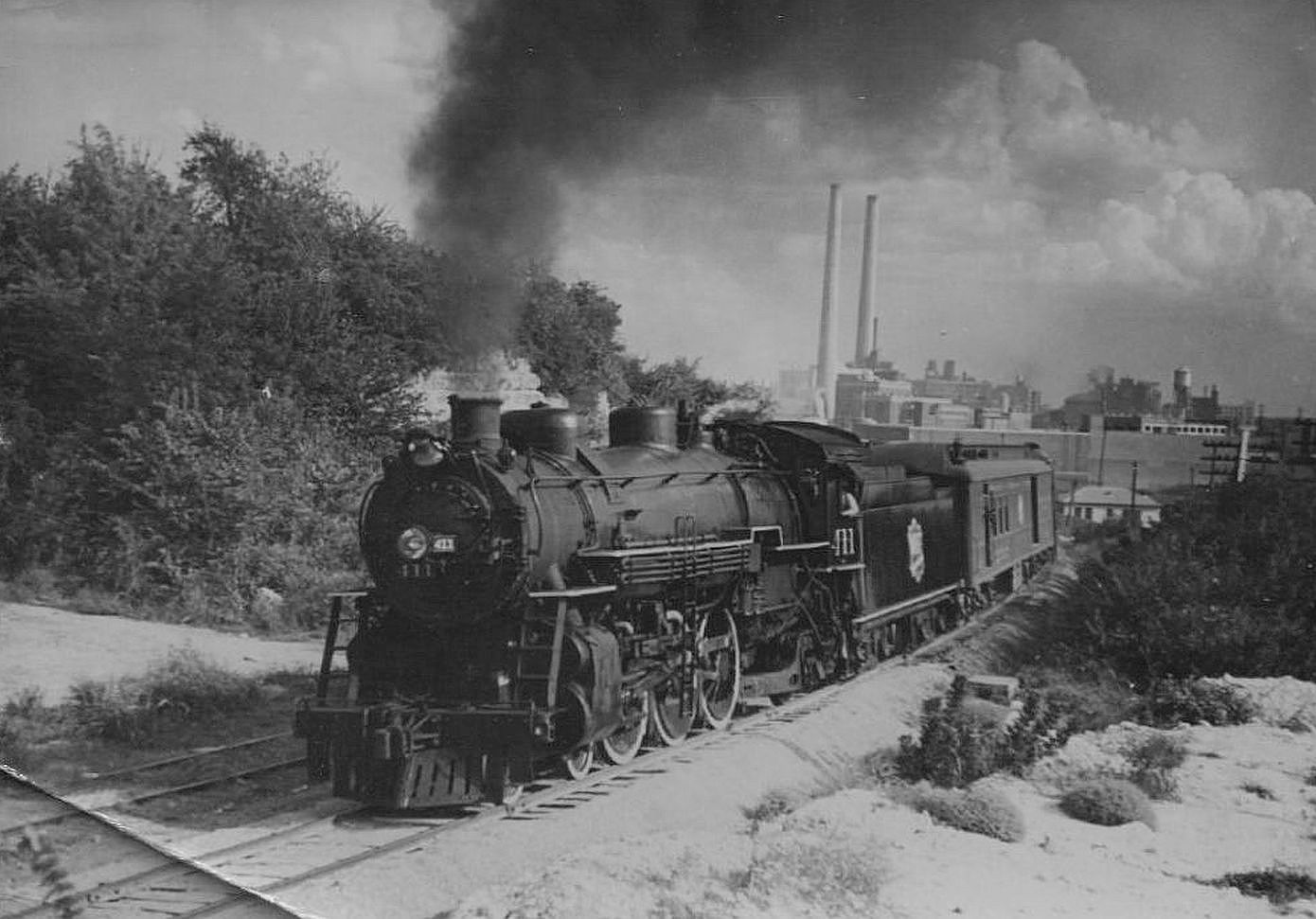
mkt-leaving-dallas_peter-stewart_austin_ebayTrain whistles don’t sound so lonesome in the daytime…

by Paula Bosse

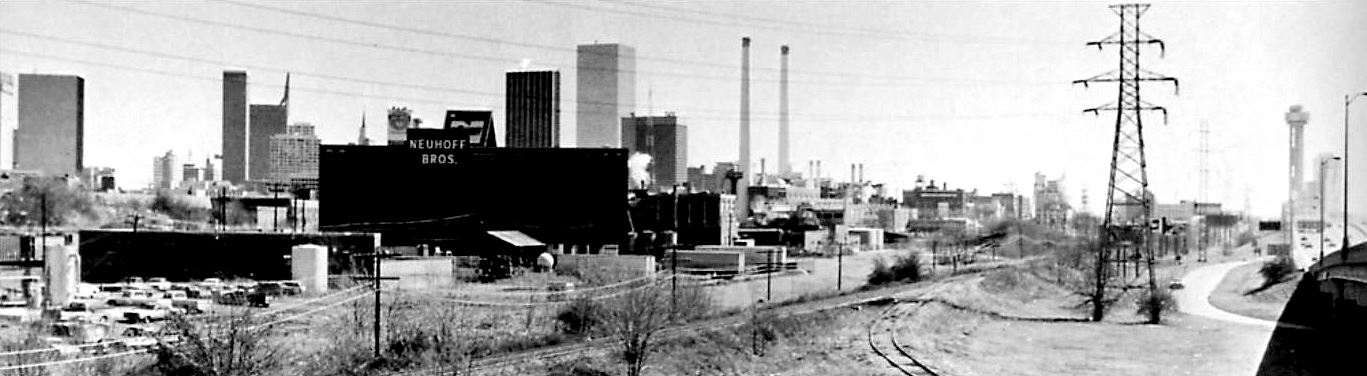
Above, an undated photo I came across on eBay a couple of months ago, showing a Missouri-Kansas-Texas train heading north from the Katy yard at the northwest corner of downtown. In the background are the twin DP&L smokestacks which were iconic landmarks until they were demolished in order to build the American Airlines Center and Victory Park. Below, a later photo taken from about the same location.

neuhoff_dpl_reunion-tower

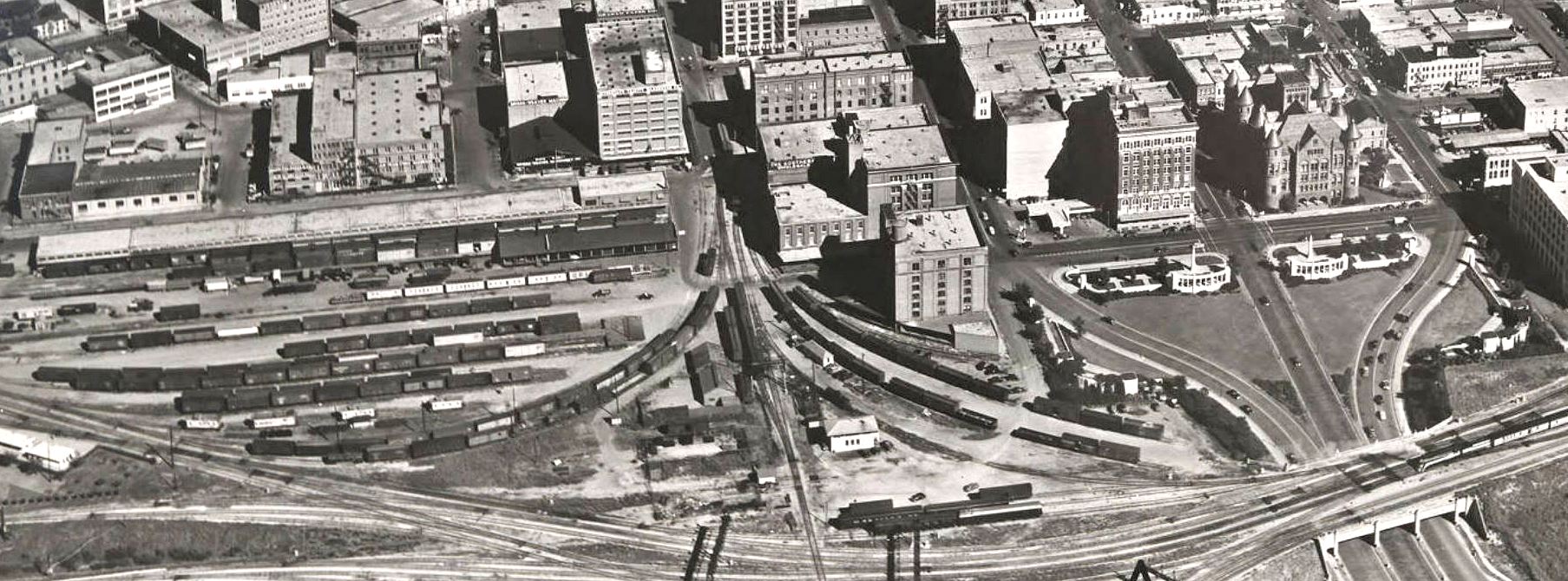
The area between Dealey Plaza and the Neuhoff meat packing plant was crammed with tracks; below is a detail from a mid-1940s aerial photo (click to see a larger image).

aerial_long_foscue-lib_smu_1940s_det

The M-K-T split about where the photo at the top was taken, as can be seen in the Sanborn map below (from 1927) between Turtle Creek and McKinney Avenue. One track headed north, the other cut through Oak Lawn and Highland Park (now the Katy Trail), crossing Mockingbird at the Dr Pepper plant near Central Expressway.

sanborn_vol-2_key_1927

mkt-logo

***

Sources & Notes

Top photo from eBay, with the photographer of this “vintage snapshot” credited as “Peter Stewart, Austin, Texas.” (There is a crease to the lower left corner.) It is undated, but when posted to the Texas Railroad History group on Facebook, commenters suggested mid-to-late-1930s to early ’50s. It’s a bit grainy, but the number on the engine appears to be 411.

The second photo, showing the Neuhoff plant and Reunion Tower, is from the collection of the Dallas Public Library.

The aerial shot is a detail from this photo by Lloyd M. Long, from the Edwin J. Foscue Map Library, Central University Libraries, Southern Methodist University.

The map detail is from the “key” page of the 1927 Sanborn Fire Insurance Map, here. Speaking of Sanborn maps, this one from 1921 shows M-K-T tracks galore behind the DP&L plant.

Click pictures to see larger images.

*

Copyright © 2016 Paula Bosse. All Rights Reserved.


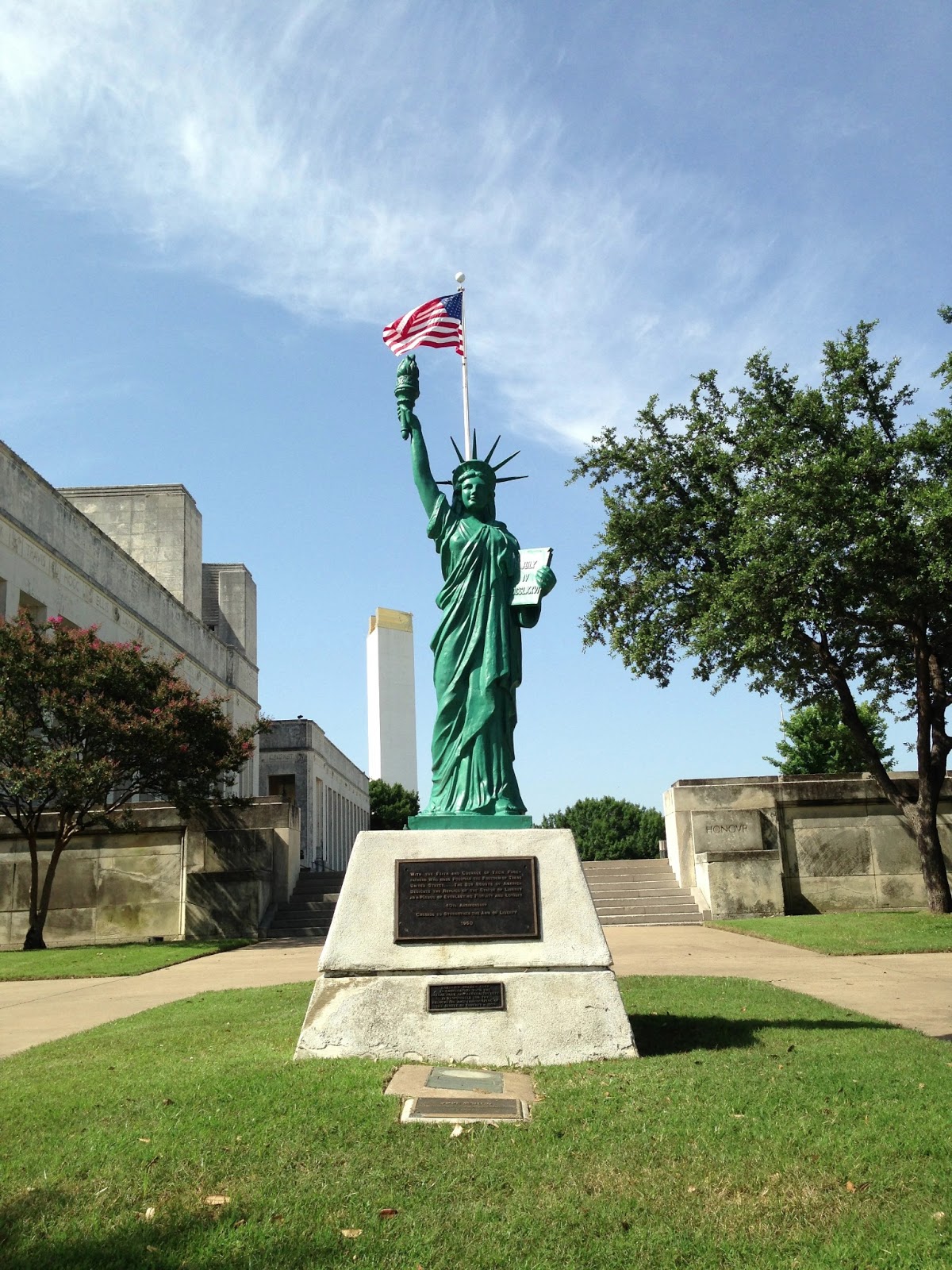
Fair Park’s Statue of Liberty

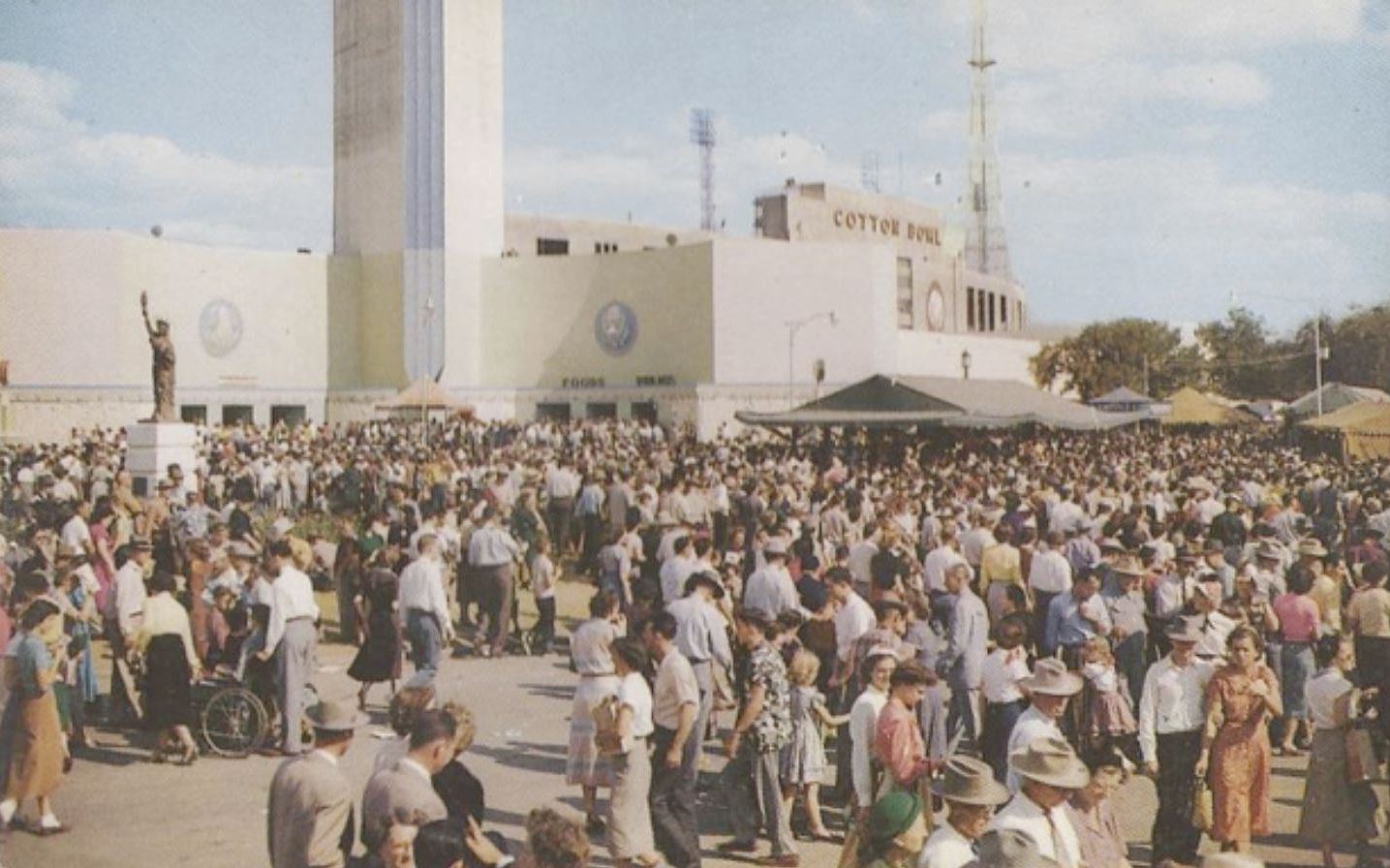
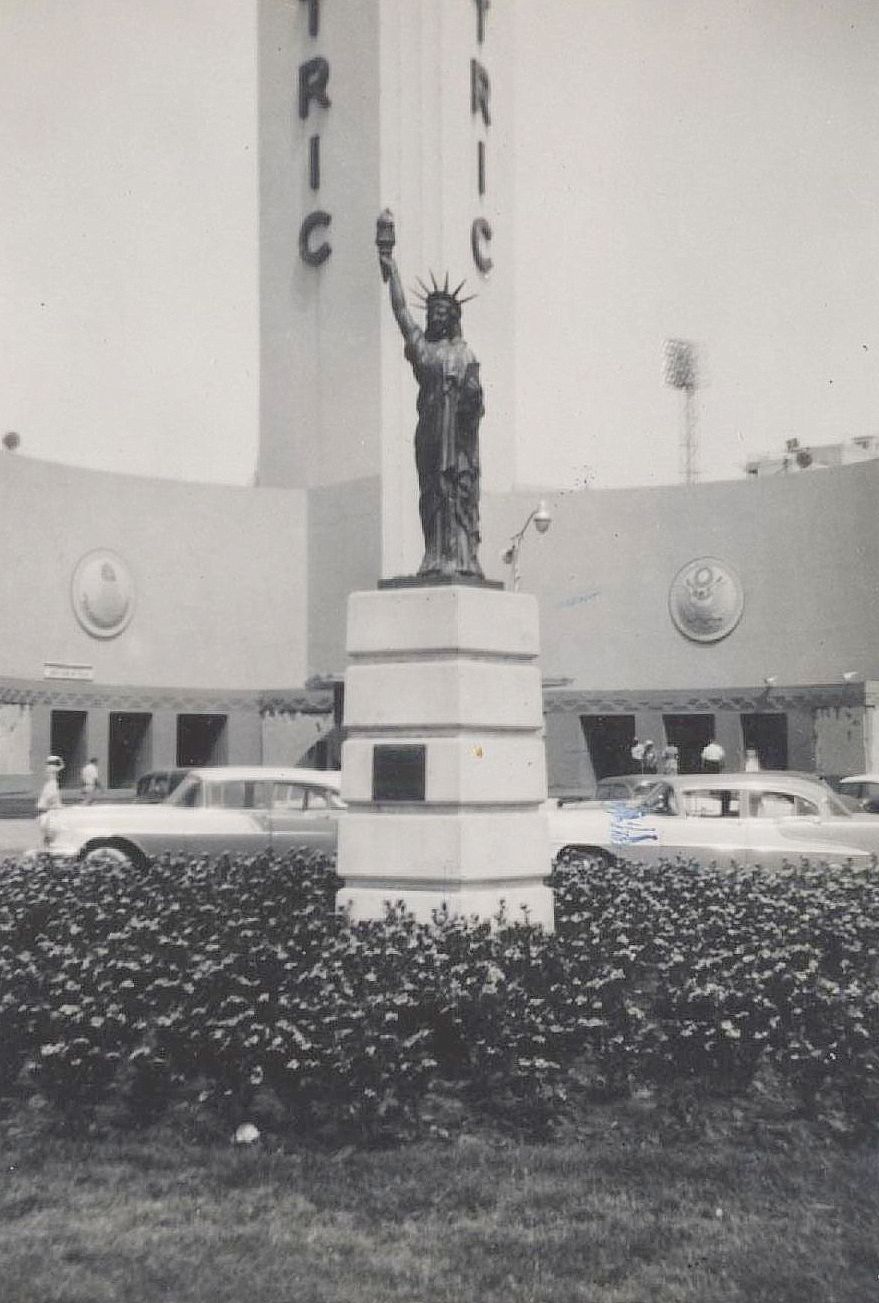
statue-of-liberty_fair-park_flickr_colteraGetting a bit lost in the crowd…

by Paula Bosse

Somehow I missed the fact that October 28th was the 130th anniversary of the dedication of the Statue of Liberty in New York Harbor. And somehow I also forgot that there is a replica of the Statue of Liberty here in Dallas, at Fair Park. It was a gift from the State Fair of Texas to the Boy Scouts and the people of Texas and was dedicated by the Boy Scouts of Circle Ten Council on July 4, 1950. (These miniature replicas of the Statue of Liberty were placed all over the United States in 1950 to commemorate the 40th anniversary of the Boy Scouts of America.)

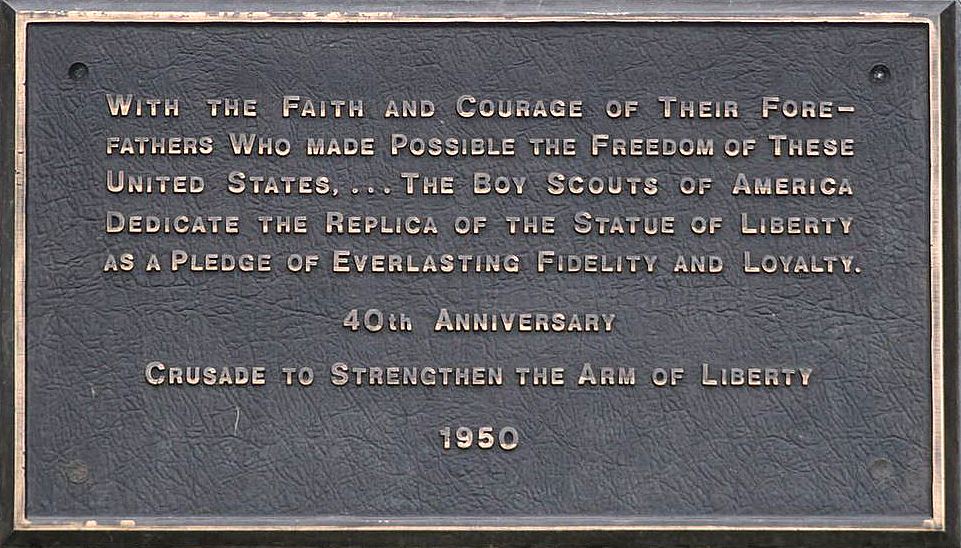
Below, the plaque at the base of the statue which stands near the Hall of State in Fair Park. (Click pictures to see larger images.)

statue-of-liberty_fair-park_plaque_flickr_aringo

Were they sentient, I’m sure Lady Liberty’s numerous miniature offspring would join me in sending belated birthday greetings to their full-size non-replica progenitor.

statue-of-liberty_fair-park_roaming-itinerant-blog
Photo: Adam Cruz/Roaming Itinerant

Here’s another view of Mini Lady Liberty welcoming the huddled masses to the State Fair of Texas in 1956:

fair-park_statue-of-liberty_ebay_stamped-1956

***

Sources & Notes

Photo of the Statue of Liberty replica amidst the crowd outside the Cotton Bowl is from Flickr user Coltera, here.

Photo of the plaque is from Flickr user Aringo, here.

Photo of the replica with the Hall of State in the background is by Adam Cruz, from his blog, The Roaming Itinerant.

1956 photo is from eBay.

A list of the Statue of Liberty replicas in Texas is here.

Perhaps we should send NYC a replica of Big Tex to keep Lady Liberty company. (The Statue of Liberty is kind of like a New York version of Big Tex, right?)

*

Copyright © 2016 Paula Bosse. All Rights Reserved.

The Business District at Night

skyline_night_flickr_coltera

by Paula Bosse

If you squint, the Mercantile Building looks a little Statue-of-Liberty here.

***

Postcard from Flickr.

Click for larger view.

*

Copyright © 2016 Paula Bosse. All Rights Reserved.

50 Years Before Main Street Garden Park

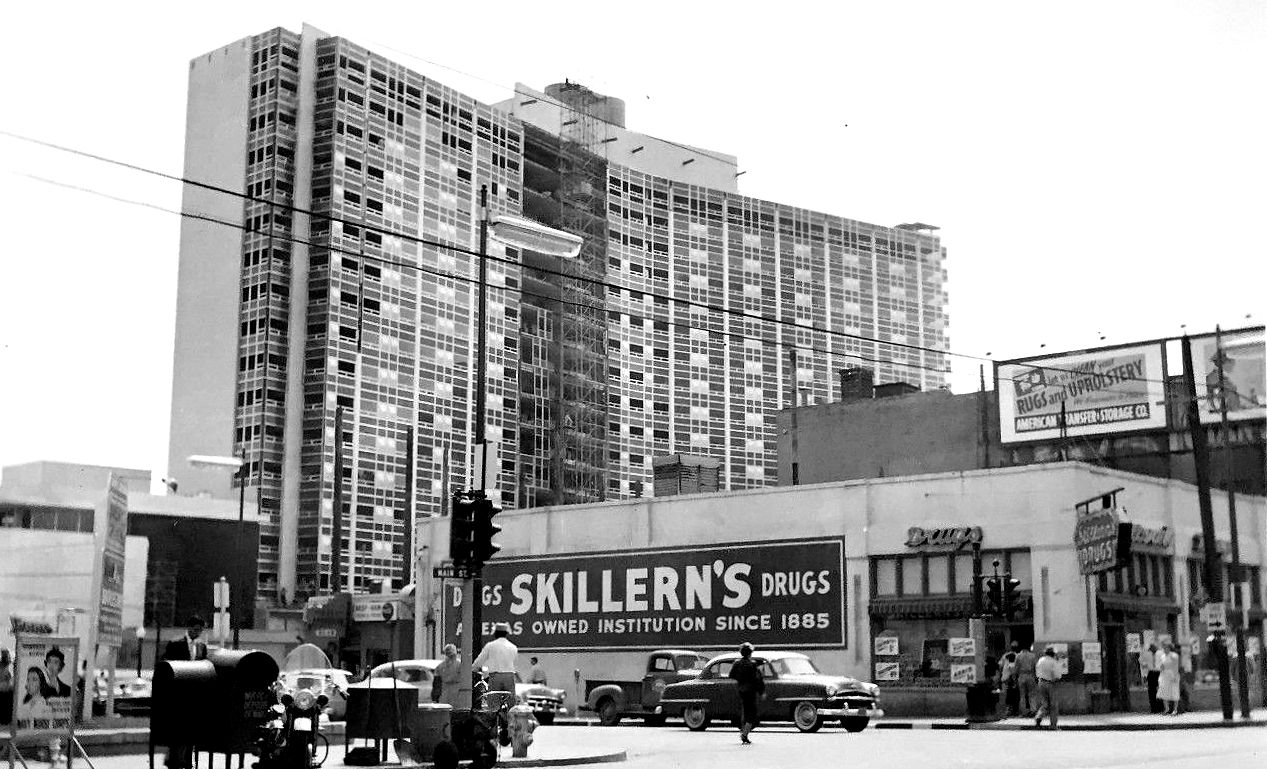
skillerns_statler-hilton_ebayHey, Skillern’s, you’re blocking the view!

by Paula Bosse

This view showing a Skillern’s drugstore at the southwest corner of Main and Harwood was taken as the Statler Hilton was nearing its opening in 1956. The block bounded by Main, Harwood, Commerce, and St. Paul was filled with businesses (…and later a parking garage) (…and way before that, homes) has been cleared and is now the lovely Main Street Garden Park. It’s always nice to have green space downtown, but, for me, the absolute best thing about this open space is that it FINALLY allows the beauty of the old (soon-to-be-new again) Statler Hilton, the old Titche-Goettinger building, and the old Municipal Building to be seen as they should have been seen all along: in full view, from a distance, without anything impeding the view. And now … the 360°-view — especially at night — is spectacular! Below, that same block these days, captured in a fantastic photo by my favorite Dallas photographer, Justin Terveen.

statler-hilton_justin-terveenJustin Terveen

As much as I love the mid-century skyline of this city, I have to say, the 21st-century version of this end of downtown — this square — wins.

***

Sources & Notes

The top photo appeared a couple of months ago on eBay.

The color photo is by Dallas photographer Justin Terveen, used with permission. See more of Justin’s incredible photos here — the one above and many others are available for purchase. I tend to get stuck in the past, but seeing Justin’s photographs of present-day Dallas make me realize how remarkably modern and vibrant the city is right now.

The same view from Main and Harwood, as seen today on Google, is here.

It always felt a little claustrophobic on Main, Harwood, and Commerce — those buildings needed room to breathe. For years, that block in the middle got in the way of fully appreciating Titche’s (this idealized postcard view shows Main Street at the right, St. Paul at the left), the Statler Hilton, and the Municipal Building (this 1920s photo shows people standing on the steps with a former drugstore occupant — Drake’s — across Harwood; Harwood was especially narrow when the building was originally built in 1914, and, as I recall, many were unhappy that such a majestic building was built in a location where it was impossible to fully appreciate its aesthetic qualities, even after the street was widened several years later).

More on Main Street Garden Park is here and here.

*

Copyright © 2016 Paula Bosse. All Rights Reserved.

Looking South from the Hilltop — 1966

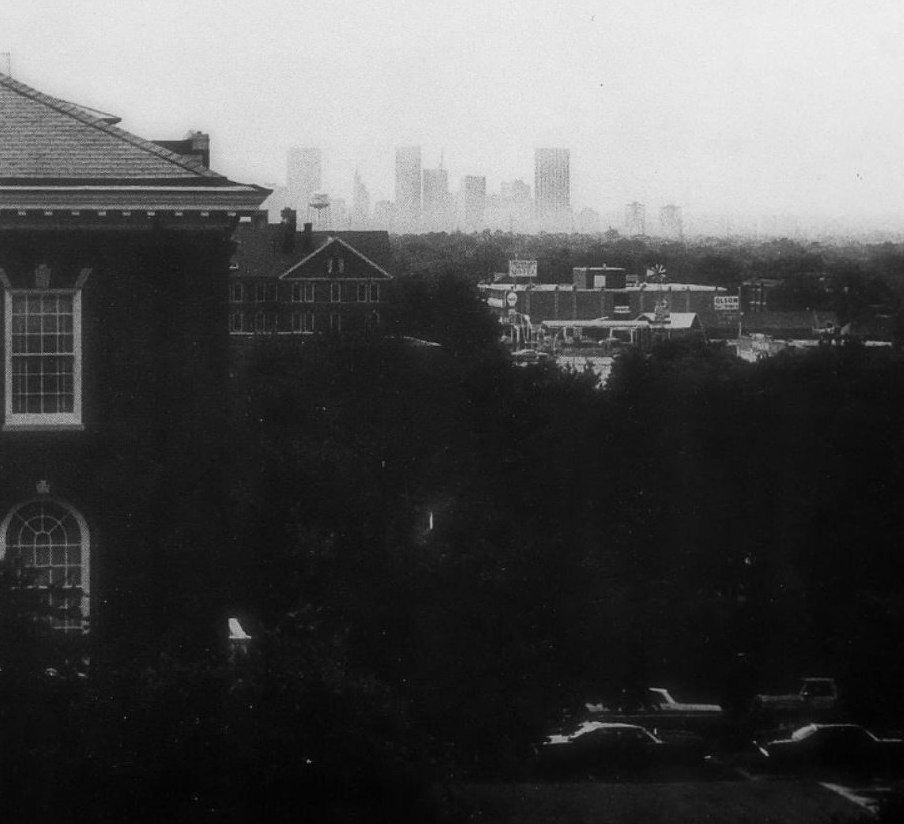
skyline_smu-law-school-yrbk_1966Downtown, as seen from the SMU campus… (click for larger image)

by Paula Bosse

Yeah, the photo is pretty dark, and the image quality leaves something to be desired, but I like this unusual view of a dreamlike downtown skyline, as seen from the SMU campus. Hillcrest Avenue — the SMU drag — can be seen in the upper center; the large building on the west side of Hillcrest is the University House Motel (still standing, but expanded and massively renovated as Hotel Lumen). Right next to the motel is the excessively quaint windmill of the Little Red Barn restaurant.

It all seems very calm.

***

Photo from the 1966 Southern Methodist University Law School yearbook.

*

Copyright © 2016 Paula Bosse. All Rights Reserved.