Flashback : Dallas

A Miscellany: History, Ads, Pop Culture

American Airlines, Planes-a-Plenty — 1951

american-airlines_russell-lee_briscoe-1“Dallas Terminal” / ©Dolph Briscoe Center for American History

by Paula Bosse

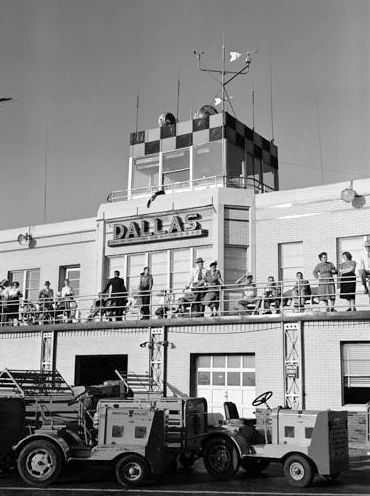
A few photos of Love Field, hangars, and American Airlines airplanes, all taken in 1951 by Russell Lee for a story in Fortune magazine.

american-airlines_briscoe-2

american-airlines_briscoe-3

american-airlines_briscoe-4

american-airlines_briscoe-5

***

Photos ©Dolph Briscoe Center for American History; all photos are by Russell Lee from the collection of his photographs at the University of Texas at Austin. I am unable to post links because I can no  longer find them on the website (!).

This time pictures aren’t larger when clicked. All apologies to fans of the wonderful Russell Lee, for these less-than-crisp images.

*

Copyright © 2015 Paula Bosse. All Rights Reserved.

From the Vault: The Coolest, Strangest Church Design in Dallas

gospel-lighthouse-church

by Paula Bosse

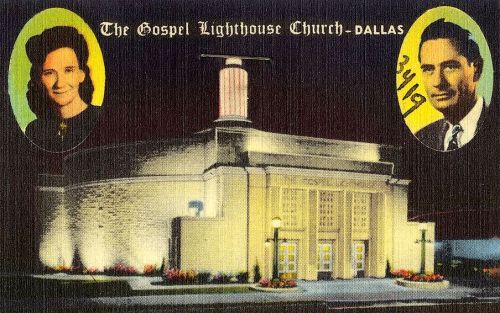
Every once in a while, I notice that an old post is getting a sudden increase in hits. Currently, it’s the one I wrote about J. C. Hibbard’s Gospel Lighthouse Church in Oak Cliff. I’m not sure why so many people are currently flocking to this post from last year (it’s had over a thousand views in the past couple of days), but I’m certainly glad that this architecturally unusual building (which, by the way, still stands) is getting a little attention. It was so cool-looking in old photos that I drove over to Oak Cliff to look at it in person, and I encourage others to do the same!

Read about this church and see several images inside and out, here.

*

Copyright © 2015 Paula Bosse. All Rights Reserved.

Pacific Avenue — 1925

pacific_bryan_looking-east_lost-dallas_dotyThe back side of Elm, looking east…

by Paula Bosse

Elm Street gets all the glory as Theater Row, but what about Pacific? It had those very same theaters. …Sort of. Pacific gets overlooked a lot. When I see photos like this one — which shows Pacific Avenue looking east from Bryan — I always think of it as a photo showing the back side of Elm rather than as a photo showing Pacific. Always a bridesmaid, never the bride.

This photo was taken only a few short years after the Texas & Pacific railroad tracks were removed from Pacific, making it into an automobile and pedestrian thoroughfare only — no more frightening, smoke-belching trains rumbling right down the middle of the street. The city was hoping that Pacific would become a heavily commercial area like Elm, Main, and Commerce, but it never really reached those lofty heights.

I’ve always wondered if the theaters that lined Elm ever considered having entrances/box offices on both Elm and Pacific. I think that they were really only willing to slap a few posters and paint their names on their back, Pacific-facing walls. Elm Street was glitzy and glamorous. Pacific was not. Back in those early days when people were still trying to get used to Pacific Avenue being newly liberated from its railroad tracks, it might have been seen as something of an afterthought — as more of a very wide alley with traffic than as a contender for one of Dallas’ major streets.

But back to the theaters. In the photo above, we see the Old Mill at 1525-27 Elm (where “The Snob” was playing, featuring John Gilbert and Norma Shearer), the Capitol at 1521-23 Elm (which had Alla Nazimova in “The Redeeming Sin”), and the Jefferson Theater at 1517 Elm (featuring Harley Sadler’s repertory company appearing in “Honest Hypocrites and Saintly Sinners” between vaudeville acts). All of these were playing in May, 1925.

It’s interesting that the only business seen here on the south side of Pacific that had an address on both Elm and Pacific was Van Winkle’s Book Store (before it moved a couple of doors up Elm, it was at 1603 Elm/1614 Pacific). Note the sign advising “Free Passage to Elm Street” — several businesses allowed people to cut through their stores to get to the next street over because the blocks were incredibly long and would sometimes have necessitated pedestrians going three blocks out of their way just to get to their destination.

Other notable landmarks in the photo above: the Medical Arts Building (on the left) and the Dallas Athletic Club.

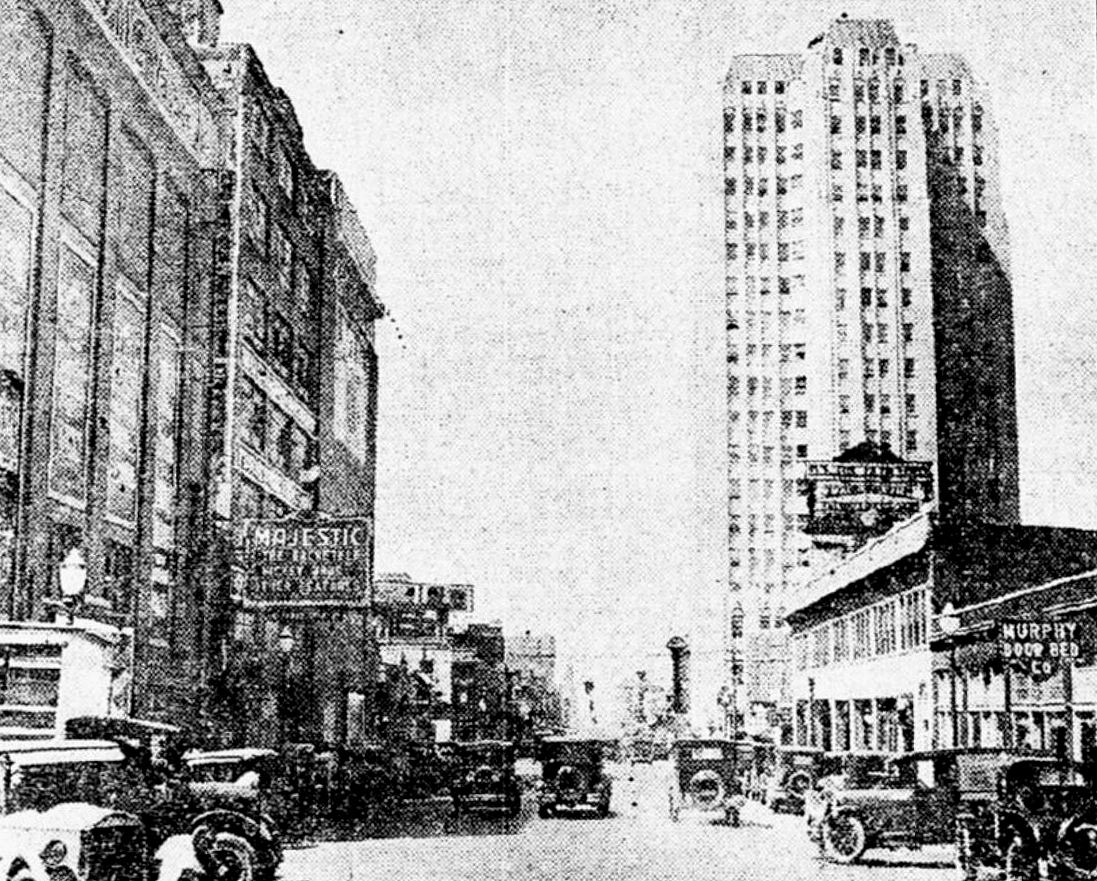
Here’s a view of Pacific from around the same time, looking west, from about Harwood.

pacific-looking-west_dmn_041430
1930

Most interesting detail in this photo? That Murphy Door Bed Co. sign!

***

Sources & Notes

Top photo from Lost Dallas by Mark Doty (Charleston: Arcadia Publishing, 2012).

*

Copyright © 2015 Paula Bosse. All Rights Reserved.

From the Vault: If You’re a Cowboys Fan, Be Thankful It Isn’t 1960

dallas-cowboys-logo_1960Maybe they should have worn those spurs on the field…

by Paula Bosse

That first season … oh dear. My Thanksgiving post from last year contains a few Dallas Cowboys stats that might make you cringe; read it here.

*

Copyright © 2015 Paula Bosse. All Rights Reserved.

From the Vault: Encouraging Dallasites to Celebrate Thanksgiving — 1874

thanksgiving

by Paula Bosse

The celebration of Thanksgiving was a hard, hard sell to the Southern states. Read my previous post about why it wasn’t until Reconstruction that Texans finally decided to participate in the national holiday, here.

Happy Thanksgiving!

*

Copyright © 2015 Paula Bosse. All Rights Reserved.

Turn-of-the-Century Maple Avenue

maple-ave_colteraHope this wasn’t between McKinney & Cedar Springs…

by Paula Bosse

When the fashionable and wealthy began to move their residences north from the downtown area, they built their homes along Maple Avenue, between McKinney and about where the Stoneleigh Hotel now stands. This exclusive neighborhood of imposing houses hit its stride in the first decade of the 20th century.

One of the well-to-do families who lived on Maple at this time was that of G. B. Dealey, founding editor of The Dallas Morning News. His son Ted Dealey wrote at length about all of his boyhood neighbors in his very entertaining book, Diaper Days of Dallas. Rather ominously, though, these amusing and colorful childhood memories end with this paragraph:

I hate to write this paragraph because some people may think I had a pernicious influence on the neighborhood. But there were five men living on Maple between McKinney and Cedar Springs who committed suicide in the 1900s. Not all in one day, or one week, or one month, of course, but over a period of years.

Wow. The distance between McKinney Avenue and Cedar Springs is only two-tenths of a mile!

Beautiful houses, though!

***

Postcard from Flickr, here.

Paragraph from Diaper Days of Dallas by Ted Dealey (Nashville: Abingdon Press, 1966), p. 39.

Click postcard to see larger image.

*

Copyright © 2015 Paula Bosse. All Rights Reserved.

Dealey Plaza and The Triple Underpass Under Construction — 1935

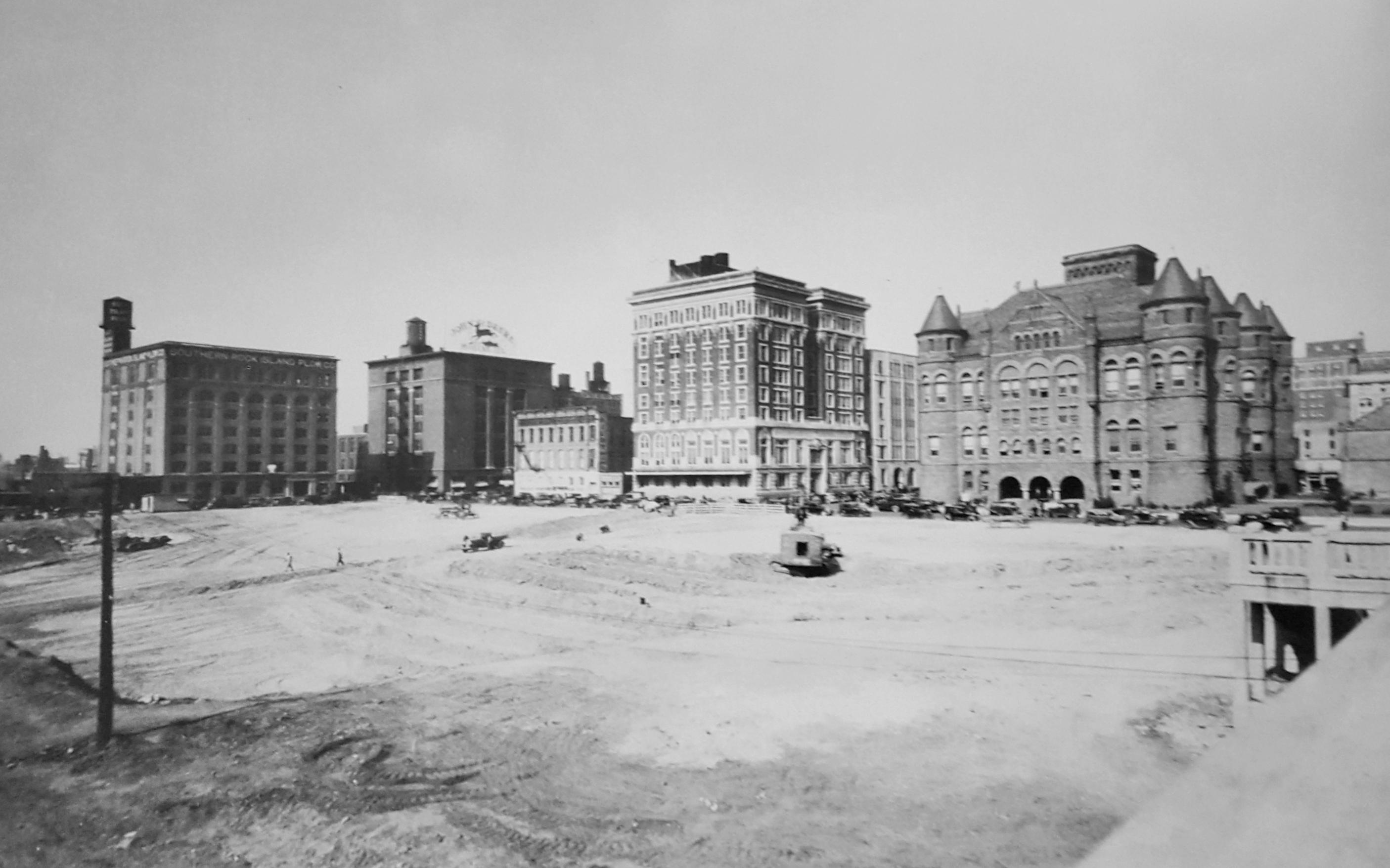
dealey-plaza_triple-underpass-construction_1935_fitzgeraldCleared for construction…

by Paula Bosse

Dealey Plaza and the triple underpass were envisioned as an impressive “Gateway to Dallas” — for visitors arriving from the west, this attractive and welcoming sight would be their first impression of the city. Construction was completed in 1936 as the city was preparing for its mammoth Texas Centennial celebration. Little did anyone know back when these photos were taken in 1935 that “Dealey Plaza” and “Triple Underpass” would one day be place names known around the world and that the not-at-all remarkable Southern Rock Island Plow Co. building seen in both of these photos would become a must-see site for almost every out-of-town visitor to the city.

triple-underpass-under-construction_1935_m-c-toyerTriple Underpass and pedestrian tunnel under construction

***

Sources & Notes

The top photo, showing the cleared land that will become Dealey Plaza is from The Hayes Collection, Dallas Public Library Texas/Dallas History and Archive Division; I found it in the book Dallas Then and Now by Ken Fitzgerald (San Diego: Thunder Bay Press, 2001).

Bottom photo showing the “triple underpass and south pedestrian tunnel under construction” was posted by M. C. Toyer in a very interesting Phorum discussion on this area (with a lot of great photos), here.

Below are related Flashback Dallas posts:

  • More on Dealey Plaza can be found here.
  • More on the Triple Underpass can be found here.
  • More on the John F. Kennedy assassination can be found here.

*

Copyright © 2015 Paula Bosse. All Rights Reserved.

“Fifteen Miles From Dallas” by Jimmie Davis — 1951

jimmie-davisThe former (and future) governor of Louisiana…

by Paula Bosse

Let’s listen to Jimmie Davis — erstwhile country singer and two-time governor of Louisiana — sing a ditty about his gal named Alice (…rhymes with “Dallas”) who lives on Akard Street.

***
Too bad the Decca promotion people misspelled his name in this 1951 ad!

jimmie-davis_15-miles-from-dallas_1951_ebay

***

Jimmie Davis is most famous for his hit song “You Are My Sunshine.” His New York Times obituary is here.

The Singing Governor’s Wikipedia entry is here.

Ad from eBay (click for larger image).

*

Copyright © 2015 Paula Bosse. All Rights Reserved.

Selling Kidd Springs Heights, 1909-1910

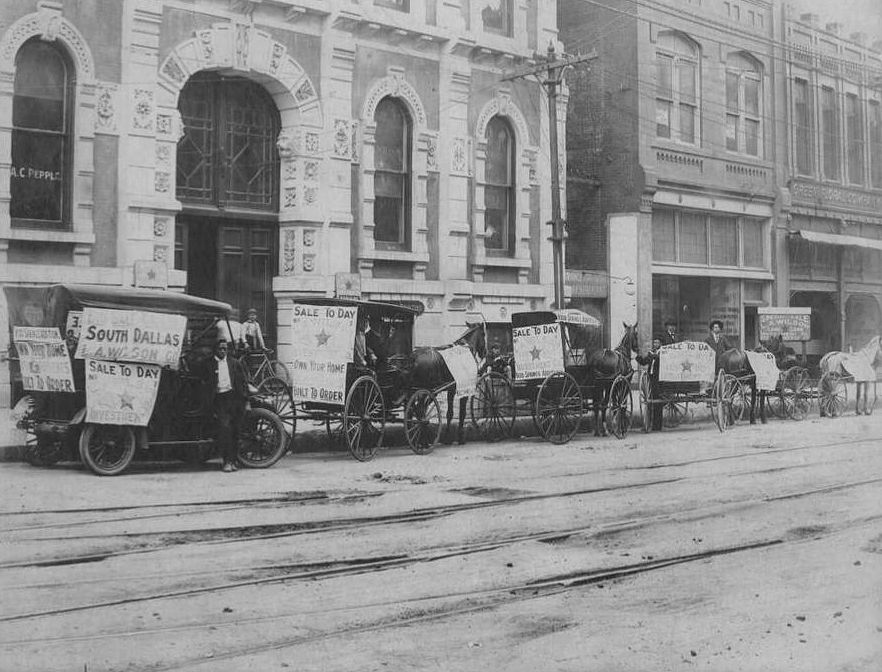
gaston-bldg_1910_cook-degolyerThe L. A. Wilson Co. is having a sale! (photo: SMU)

by Paula Bosse

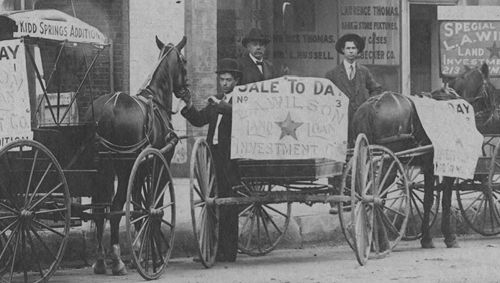
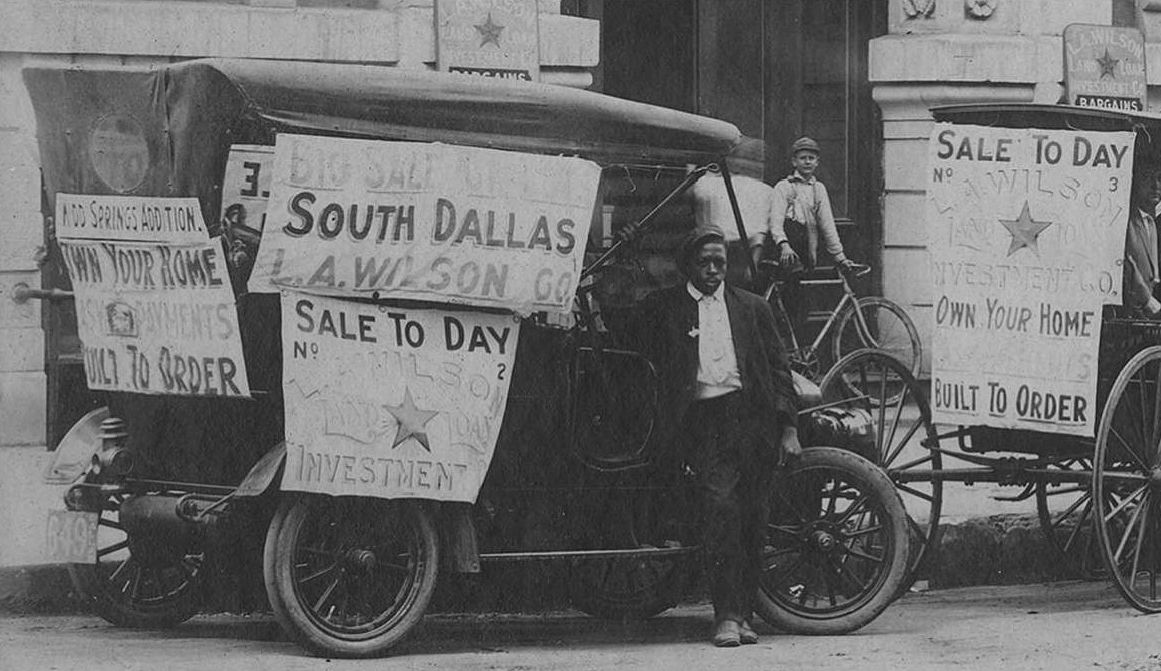
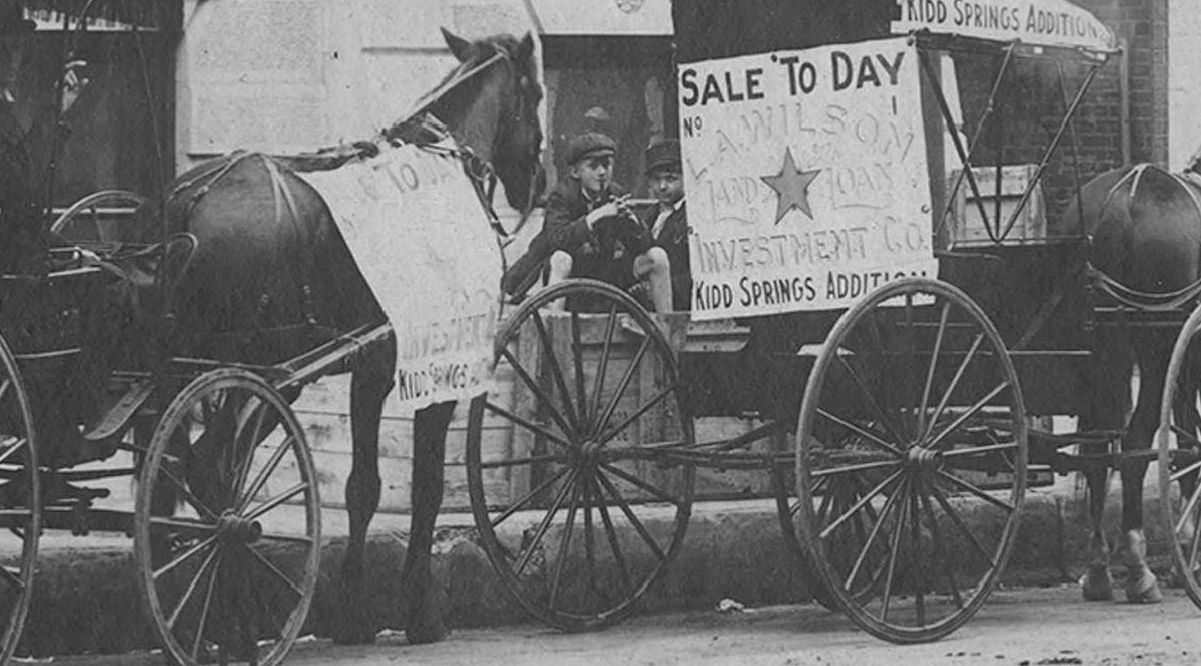
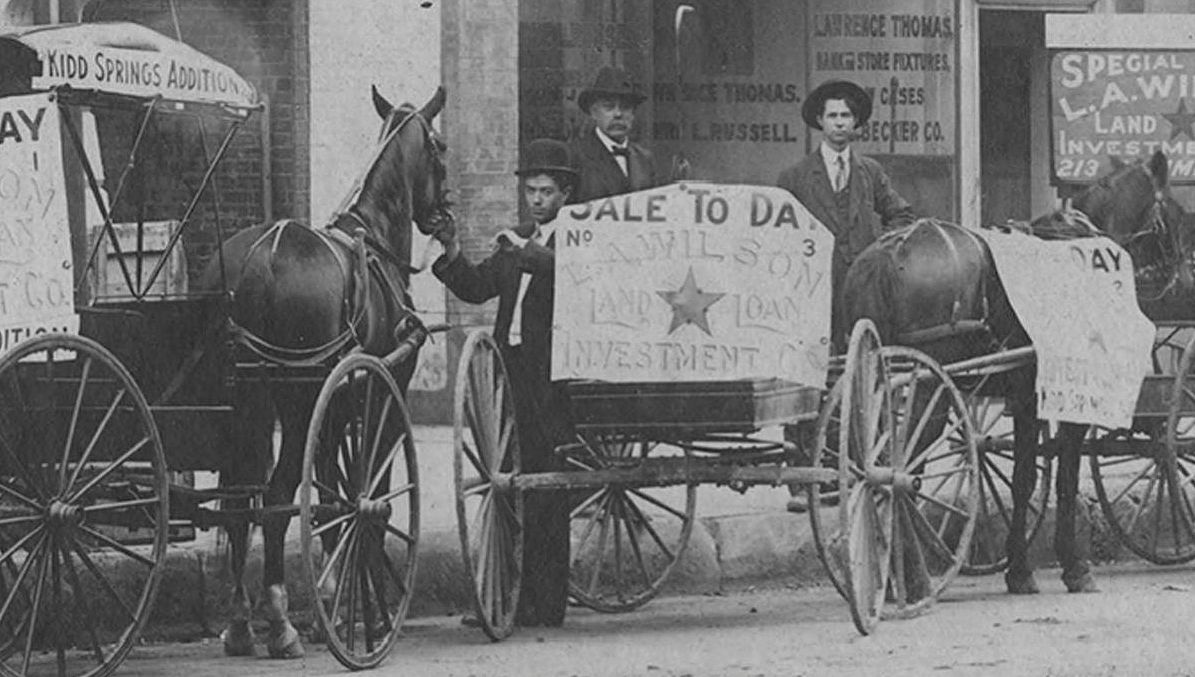
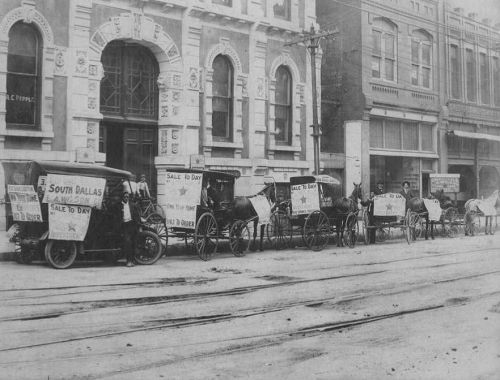
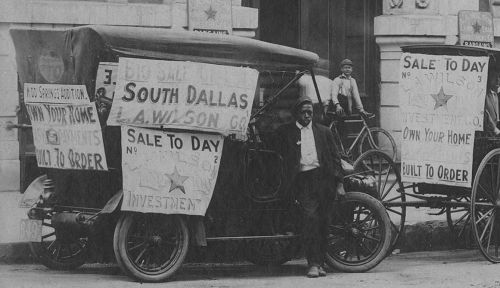
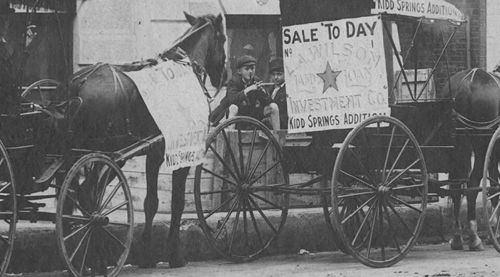
The above photo shows a car-and-buggy convoy belonging to the L. A. Wilson Land, Loan & Investment Company, stretched out in front of the Gaston Building at Commerce and S. Lamar. There’s a “Sale To Day” and they’re really pushing property in the Kidd Springs Addition in Oak Cliff. The date “April 20, 1910” is written on the back of the photo, and if that’s true, the big show here might be rooted more in desperation than in enthusiasm. The Wilson company began selling the 30-or-so lots in the new Kidd Springs Heights neighborhood in July of the previous year. An ad that appeared seven months before this photo was taken announced that there were only ten lots left. It looks like this was an impassioned display to make Kidd Springs seem more exciting and move that remaining property. People love parades.

(This is another great photo to zoom in on to see the details. All images are larger when clicked.)
gaston-bldg_1910_cook-degolyer-det1

gaston-bldg_1910_cook-degolyer-det4

gaston-bldg_1910_cook-degolyer-det5

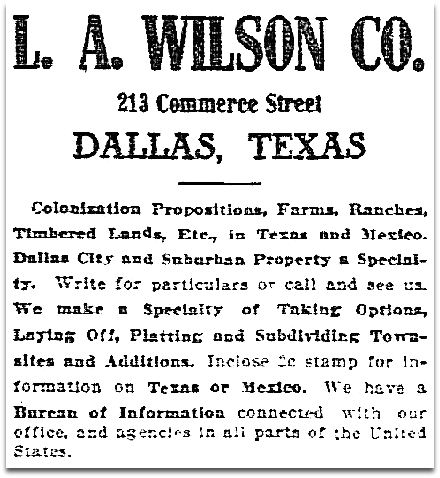
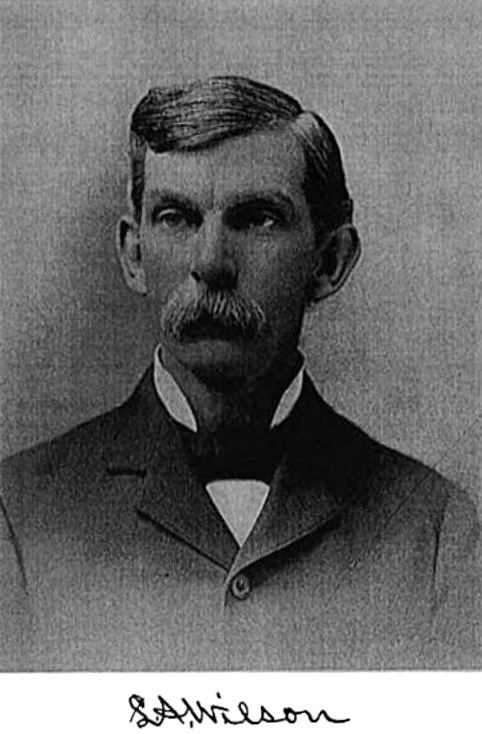
The L. A. Wilson Co. was a fairly large real estate company founded by Missouri-born Lewis A. Wilson (1851-1926); at the time of this photo, the company’s offices were in the Gaston Building at 213 Commerce. (In the photo immediately above, I think the man with the moustache is Mr. Wilson.)
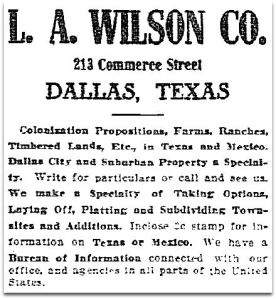
wilson_dmn_070409-detDallas Morning News, July 4, 1909 (ad detail)

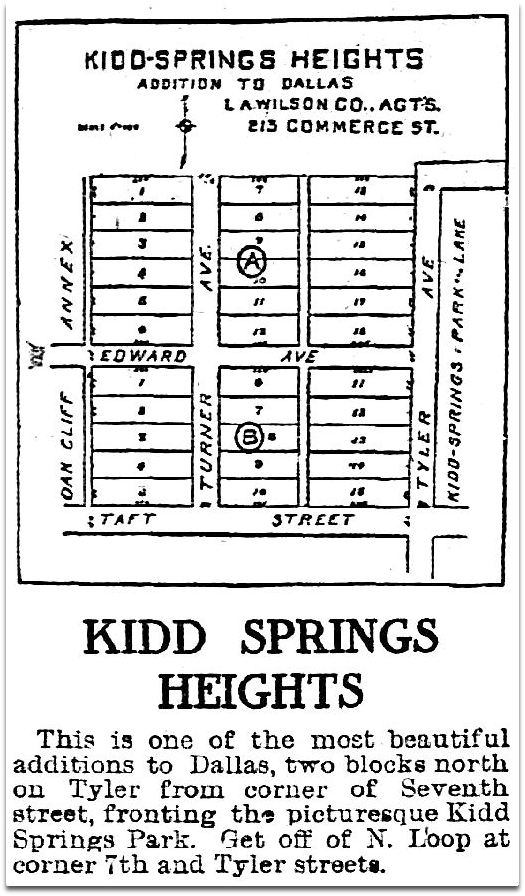
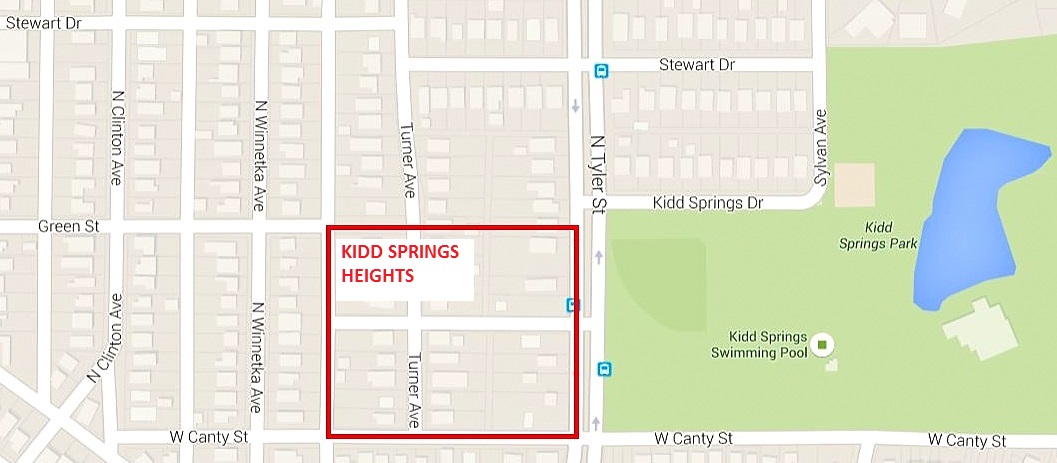
The first ad announcing the sale of lots in the Kidd Springs Heights area of Oak Cliff appeared on July 4, 1909. It included the two blocks north of what is now W. Canty, bounded by Turner Ave. on the west and N. Tyler (and Kidd Springs Park) on the east.
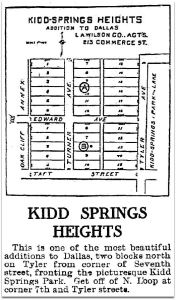
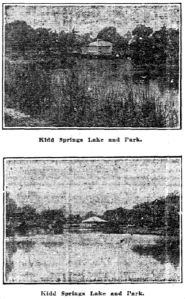
ad-wilson_dmn_070409-text

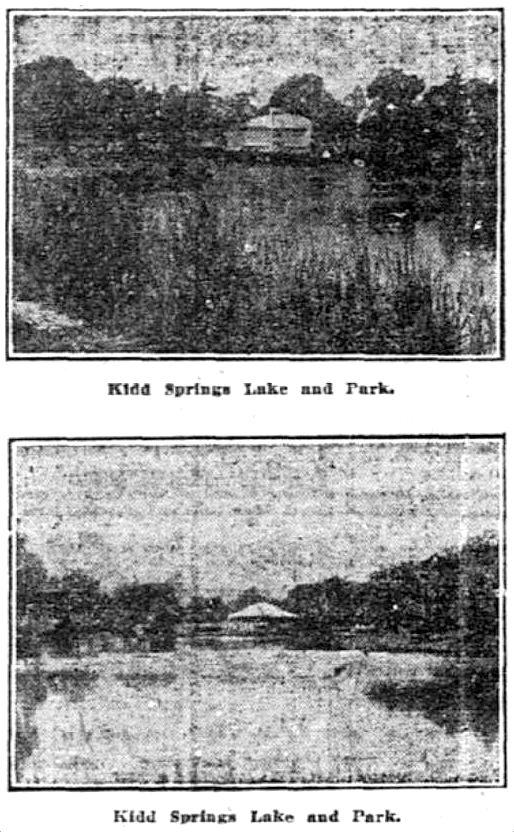
ad-wilson_dmn_070409-photosDMN, July 4, 1909

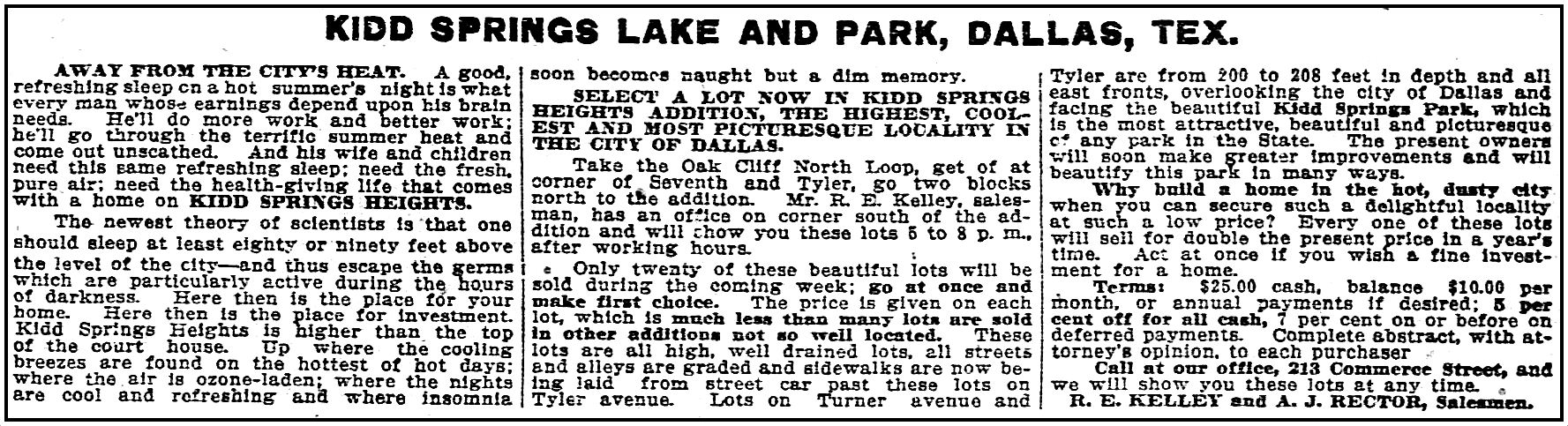
Four weeks later, a huge half-page ad ran in The Dallas Morning News, full of wonderful reasons why life would be better in Kidd Springs Heights:

The newest theory of scientists is that one should sleep at least eighty or ninety feet above the level of the city – and thus escape the germs which are particularly active during the hours of darkness. Here then is the place for your home. Here then is the place for investment. Kidd Springs Heights is higher than the top of the court house. Up where the cooling breezes are found on the hottest of hot days; where the air is ozone-laden; where the nights are cool and refreshing and where insomnia soon becomes naught but a dim memory.

The effusive sales copy is definitely worth a read (click ad below to read the full sales pitch).
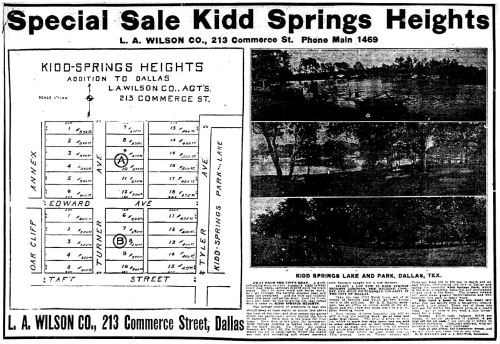
wilson_kidd-springs-heights_dmnn_090109DMN, Aug. 1, 1909

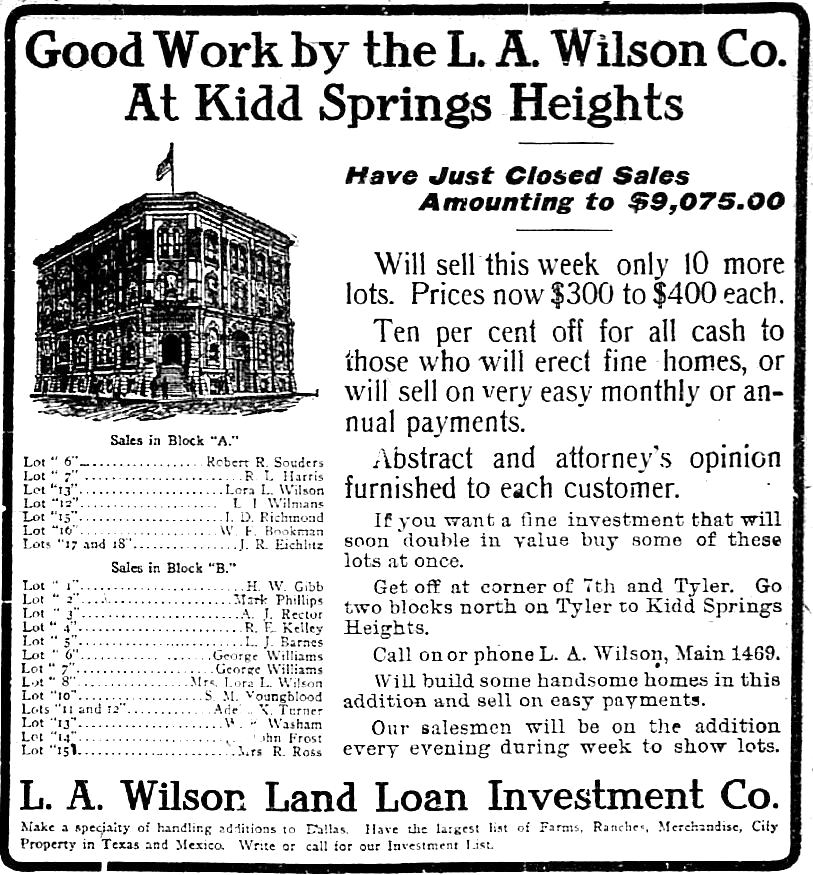
Six weeks later the following self-congratulatory ad appeared. (It’s interesting to note that of the twenty lots sold, two of them had been sold to Mrs. L. A. Wilson, and one each had been sold to the two salesmen. The next year’s telephone directory showed that the Wilsons lived on Live Oak, and the two salesmen lived in boarding houses.)
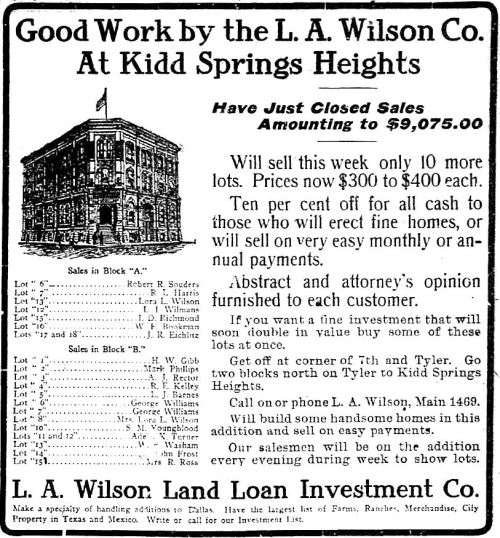
wilson-kidd-springs_dmn_091209DMN, Sept. 12, 1909

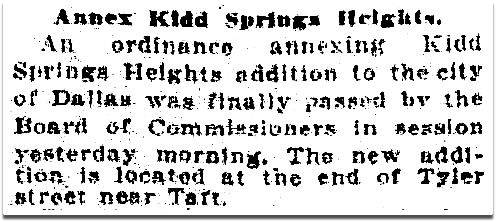
It wasn’t until 1921 that the tiny little Kidd Springs Heights was annexed to the city of Dallas.
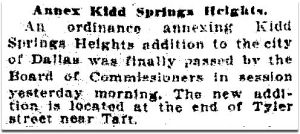
annexed_dmn_051421DMN, May 14, 1921

Things may be different today, but in 1909, these were the boundaries of Kidd Springs Heights.
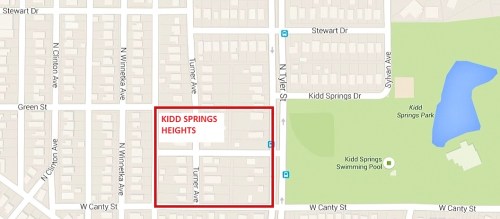
kidd-springs-heights_google_2015

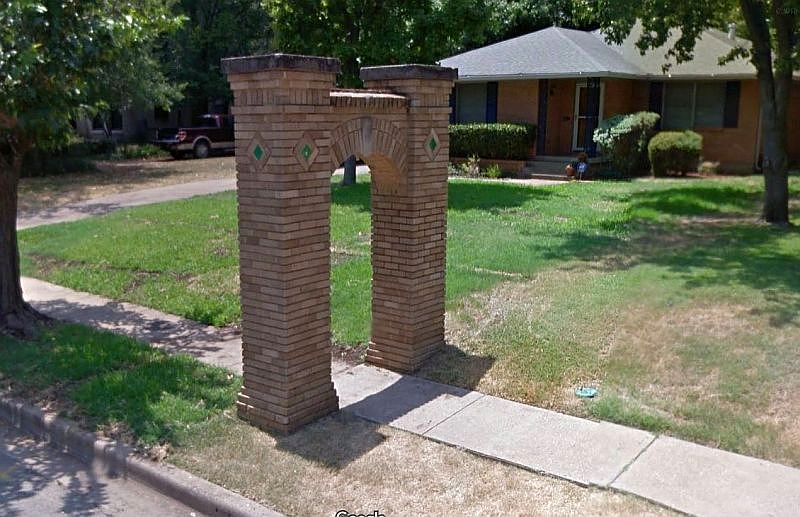
The most interesting odd thing about Kidd Springs Heights? There appear to be two brick archways placed (very awkwardly) across Turner Avenue from one another — each spanning the sidewalk. I can’t find any information about these, but it looks as if they were set right at the northern boundary of the Kidd Springs Heights Addition. Old maps (such as this one from 1919) show no development to the north of this boundary up into at least the ’20s (it doesn’t look as if this addition is even in Oak Cliff proper), so I guess they were there before those sidewalks and served as a welcoming gateway to a new development where germs did not dwell after nightfall.
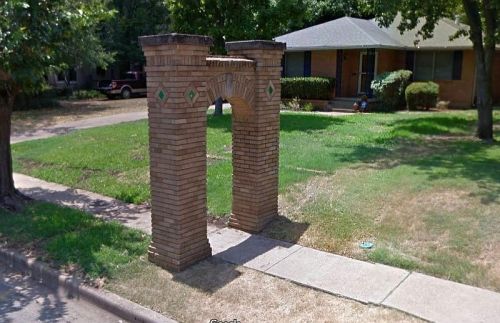
arch_google
900 block of Turner Avenue (Google Street View)

(Check out both of these markers on Google Street View, here. It’s pretty strange-looking.)

If anyone has information on these markers, please pass it along!

***

Sources & Notes

Top photo is titled “L. A. Wilson Land Loan Investment Company, Gaston Building, Commerce Street” — the photographer’s name and the date are written on the back: W. R. Lindsay, April 20, 1910. It is from the George W. Cook Dallas/Texas Image Collection, DeGolyer Library, Central University Libraries, Southern Methodist University, and it can be viewed here. I have adjusted the color.

Lewis A. Wilson’s biography can be read in A History of Greater Dallas and Vicinity (1909), here. His photo:
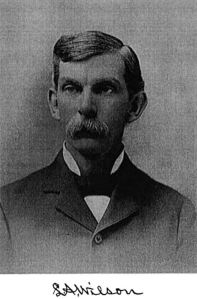
wilson_hist-greater-dallas

The Kidd Springs Wikipedia entry is here.

The Sanborn map from 1922 showing this tiny neighborhood at about the middle of the page on the right can be found here. Note how few lots actually have houses built on them. (Taft is now W. Canty; Edwards is now Everts.)

The Murphy & Bolanz map can be seen here. (If the link doesn’t work, you may need to download the plug-in — information on how to do that is here.)

*

Copyright © 2015 Paula Bosse. All Rights Reserved.

From the Vault: Dallas in 1879 — Not a Good Time to Be Mayor

main-jefferson_1879_greeneView from the courthouse, looking  north

by Paula Bosse

The photo above was taken in 1879 from the top of the courthouse. Inside that very courthouse at this time, bad blood was brewing between the mayor and a lawyer, and three years later, one of them would kill the other in a courtroom. I don’t know why I love this story so much — probably  because of the incredibly gory-but-matter-of-fact newspaper report of the 1882 shooting. Read about the political feud that ultimately erupted in gunfire from the bench — and see this photo really, really big — in my earlier post (updated with a few new links), here.

*

Copyright © 2015 Paula Bosse. All Rights Reserved.