Flashback : Dallas

A Miscellany: History, Ads, Pop Culture

The Beginning of the End for Ross Avenue’s Downtown Mansions — 1925

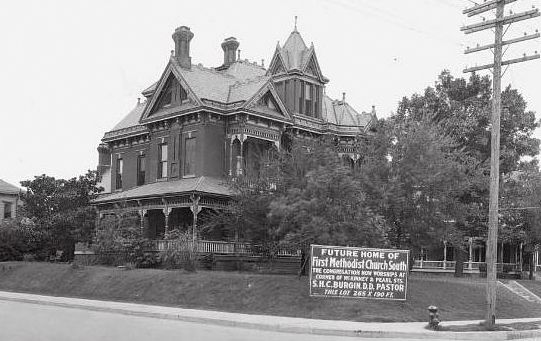
construction_jan-1925Mansions across from First United Methodist Church, Jan. 1925

by Paula Bosse

The First Methodist Episcopal Church, South (now First United Methodist Church of Dallas) was built in 1924 and 1925 at Ross and North Harwood. It was a large undertaking, and its construction meant that three of the four very large houses in the 1900 block of Ross Avenue, between North St. Paul and North Harwood, had to be demolished, including the house built by Mrs. Miranda Morrill in 1886 at the southwest corner of Ross and Harwood.

morrill-house_lost-dallas_doty_dmn

For many years, large houses like this — owned by the city’s wealthiest bankers, industrialists, and real estate men — lined Ross Avenue, just to the north of the central business district. But by the 1920s, more and more non-residential development began to encroach into this part of town.

The photograph at the top is pretty amazing, because it shows some of those grand houses in their last days. The north side of the 1900 block of Ross (the block now occupied by the Dallas Museum of Art) contained four lots. In the 1925 construction photo above, there are three houses and a business.

ross-houses_1925

In the detail above, at the far left we see the home of land baron William Caruth (in the book Dallas Rediscovered, William L. McDonald called this little pied-à-terre his “townhouse”) — for decades it sat at the northeast corner of Ross and St. Paul (which had previously been named Masten). Next to it is something that looks like scaffolding or a tower (what is that? — is it a photographer’s perch to document the construction?). Next to it is another grand house, home of several wealthy occupants over the years. And then … a car dealership and garage. How this happened is a mystery, but this 1921 building — which replaced a beautiful house and which sticks out like a sore thumb — belonged to the Flippen Auto Co., complete with showroom on the ground floor and garage and repair facilities on the second floor — it may have had one of the first car elevators in town.

Next to the Flippen Auto Co. was the grandiose Conway House, with its columns and portico; it was built around 1900 at the northwest corner of Ross and Harwood and was the childhood home of pioneer female fashion illustrator Gordon Conway. In 1921 — after a few years as a music conservatory — it became the home of the Knights of Columbus.

conway-house_ross-harwood_ca1902_mcdonaldConway House, about 1902

And here’s a photo showing both the Flippen Auto Co. and part of the former Conway House.

flippen-auto_park-cities-photohistory_galloway

On the northeast corner of Ross and Harwood, we can see a large house facing Harwood. Forget the house — on that corner was a tiny little gas station. And glory be, I stumbled across a great photo of the Acme Oil & Supply Co. complete with Texaco pump — probably from around 1919 or 1920.

ross-harwood_gas-station_greene

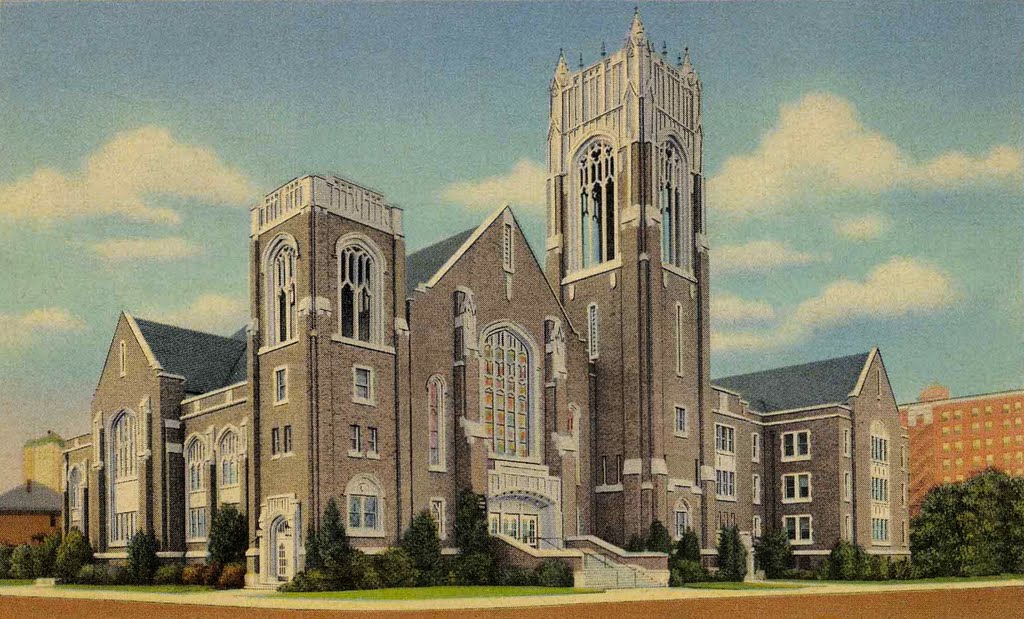
But back to the construction of what is now the First United Methodist Church of Dallas — a lovely building which still stands and faces the Dallas Museum of Art. Here’s a photograph of the construction from May, 1925.

construction_may-1925

And here is the postcard filled with an artist’s conception of people to-ing and fro-ing.

methodist-episcopal-church_ebay

methodist_postcard

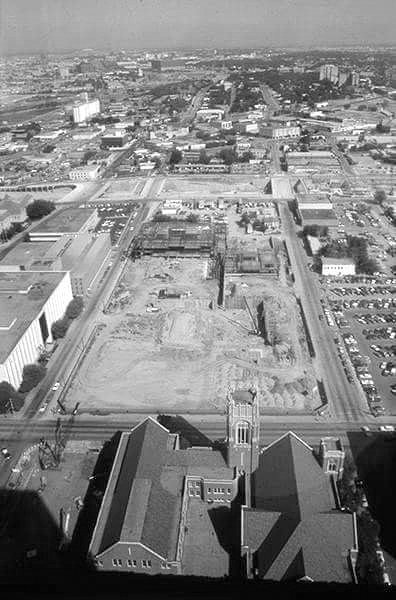
And, finally, an aerial view taken above the church in the early 1980s, looking north, showing the same block once bookended by the Caruth and Conway mansions, now leveled to make way for the Dallas Museum of Art.

dma-under-construction_1984

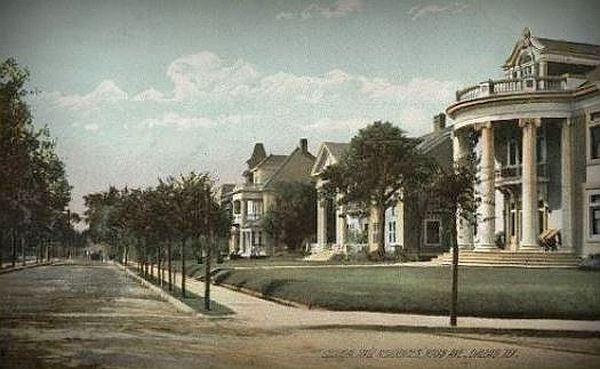
I think I prefer the view from 75 years earlier.

ross-avenue_ca1910

***

Sources & Notes

The two photos taken in 1925 during the construction of the church are from the book Church at the Crossroads, A History of First United Methodist Church, Dallas (Dallas: UMR Communications, 1997); the entire book has been scanned and may be viewed at Archive.org, here (all the photos are at the end).

The photo of the Morrill house is from Mark Doty’s book Lost Dallas (Charleston: Arcadia Publishing, 2012).

Photo of the Conway House is from Dallas Rediscovered by William L. McDonald (Dallas: Dallas Historical Society, 1978).

Photo showing the Flippen Auto Co. and the Conway house from Diane Galloway’s book The Park Cities, A Photohistory.

Photo of the Acme gas station is from Dallas: The Deciding Years by A. C. Greene (Austin: Encino Press, 1973).

The construction of the First Methodist Episcopal Church, South was announced in a Dallas Morning News article on Oct. 5, 1924.

methodist_dmn_100524

All that’s left of those grand homes is the Belo Mansion. It’s something!

Click pictures to see larger images.

*

Copyright © 2015 Paula Bosse. All Rights Reserved.


Six Flags’ Historical Press Bookshop — 1965

six-flags-bookshop

by Paula Bosse

Six Flags Over Texas had a bookstore: the Historical Press Bookshop, located in the “Confederate Section.” Who knew? I was surprised when I ran across this postcard, but I figured it was a place to buy gum, film (remember film?), giant combs emblazoned with the Six Flags logo, and this very postcard. But no. It was a bookstore that sold rare Texana, including historic books, prints, and documents. At Six Flags. …Over Texas. …Land of Pink Things and Log Rides.

The description from the back of the postcard:

six-flags-bookshop_back

The store was ostensibly owned by Six Flags developer Angus Wynne, Jr., but the contents were owned by Ted W. Mayborn, wealthy petroleum trade journal publisher, writer, and Texas history aficionado. In a playful bow to having an antiquarian bookstore inside a theme park (!), he hired female family members to dress up in cowgirl outfits and brandish six-shooters in a bid to “protect” the (probably very expensive) merchandise.

I’m not really sure how this worked — or why anyone would think this was a good idea. Would one find oneself enjoying a day at Six Flags only to stumble across this unexpected cache of rare books and feel compelled to pick up a leather-bound first edition or a fragile broadside? Or would one go to Six Flags expressly to visit the bookstore and browse the stock — despite the fact that it was in an amusement park? Would one have one’s purchase shipped, or would one lug it around the park, through Casa Magnetica, past Skull Island, and into the Spelunker’s Cave?

There has to be a story behind this unusual business endeavor. Did Ted save Angus from choking one time? Did he win the franchise in a poker game?

I’m not sure how long the Historical Press Bookshop lasted. My guess? Longer than it should have.

Weirder than discovering that a bookshop was once part of the Six Flags experience was learning that Mr. Mayborn owned a real bookshop called the Red Barn Bookstore and that my father worked for him for a few months, a time my mother described as being brief but stressful. I think I can understand why.

Click pictures for larger images.

*

Copyright © 2015 Paula Bosse. All Rights Reserved.


Antique Row: The 3300 Block of McKinney Avenue — 1963

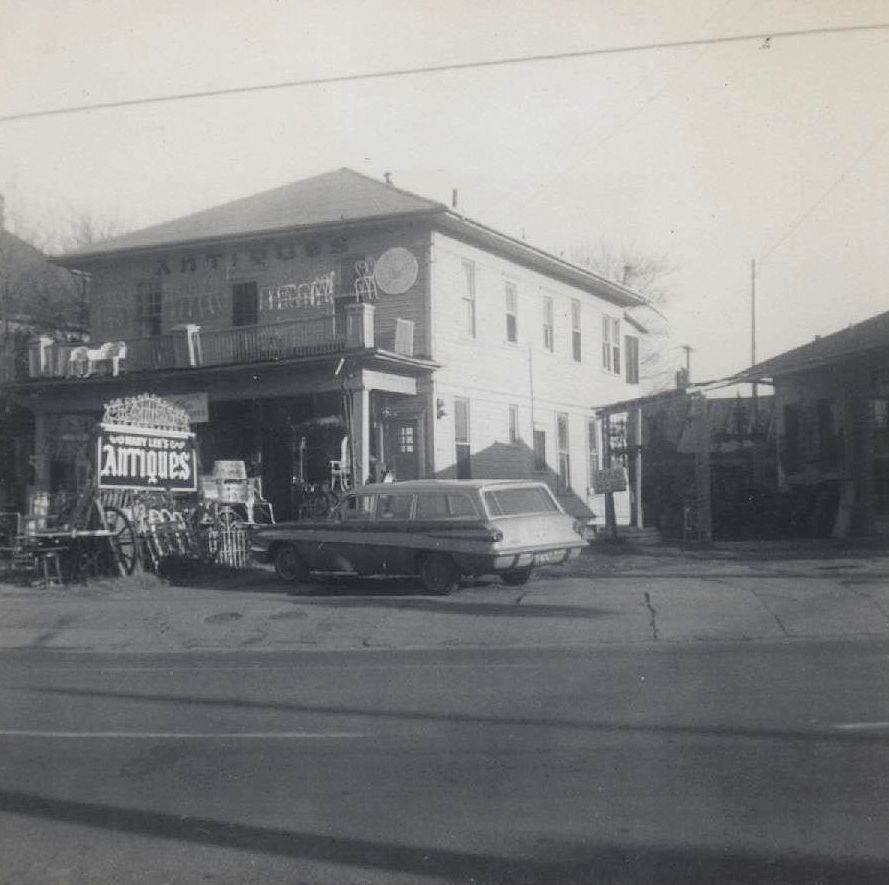
mary-lees-antiques_1963_ebayMary Lee’s Antiques, McKinney & Hall, 1963 (click for larger image)

by Paula Bosse

When I read a Facebook post from Big D History about an eBay collection of 75-or-so photos taken around Dallas in the 1950s and ’60s (links-a-plenty at the bottom of this post), I spent a substantial amount of time browsing though them. They’re just amateur snapshots, oddly framed sometimes and a little muddy, but the person who took them focused on what might seem to most of us as being fairly ordinary (sometimes downright mundane) buildings — and that’s great, because people always take photos of the big, important downtown skyscrapers, but hardly anyone takes a photo of an East Dallas apartment building or a suburban bank.

The two photos I was most excited to see showed buildings I recognized instantly, having seen them practically every day of my childhood, passing them on drives to and from my father’s bookstore. The one at the top of this post is my favorite. I  knew immediately that it was the old antique store at McKinney & Hall — I never knew its name, but I knew that it had been around before I was born and that my mother had bought one of our family’s nicest pieces of furniture there and paid for it in ten-dollar installments.

I now know that the name of the crazy-looking antique shop my  mother bought our hutch from was called Mary Lee’s Antique Center, at 3306 McKinney. It was in business at that location from 1956-ish to the end of 1971. A succession of antique shops moved in when Mary Lee moved out — I never knew the names of any of the businesses in this building, only that they all looked dauntingly FULL (how I managed to never actually go in any of them, I have no idea).

For many years, McKinney Avenue was lined with antique shops, many of which were in very old wood-frame houses which had been converted from homes into businesses.

mckinney-avenue_antique-row_dmn_0901611961

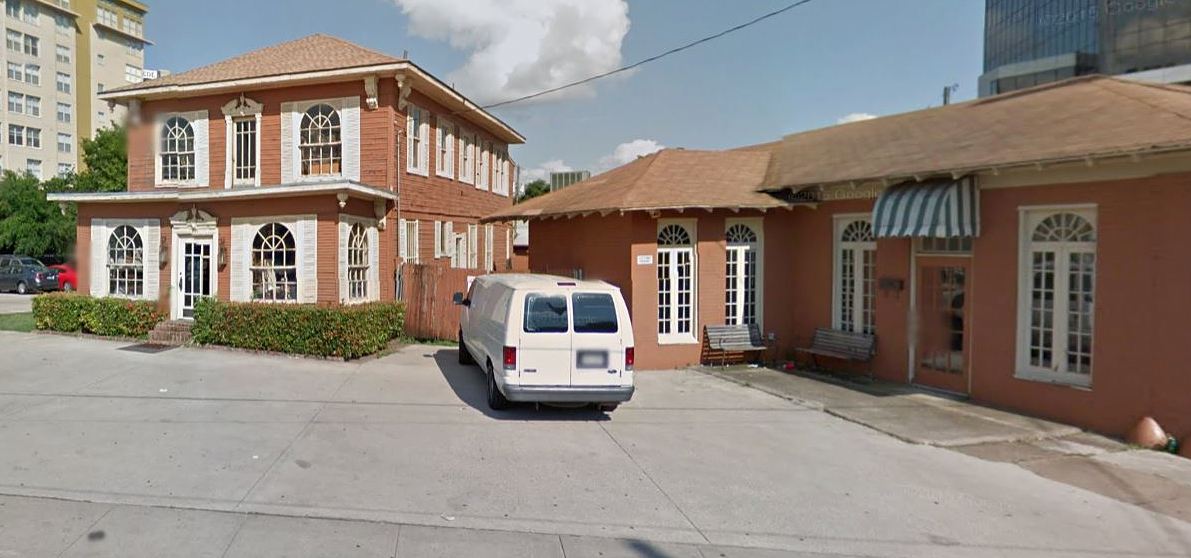
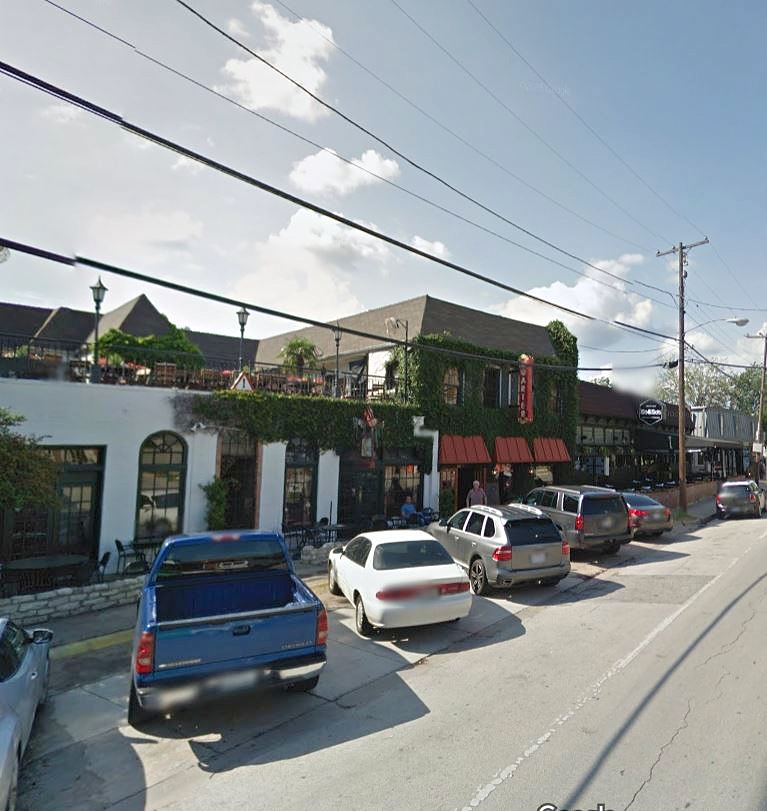
The old two-story house that Mary Lee was in was one of the largest. The house was built sometime before 1909, and, happily, this little remnant of the past is still standing (though with a weirdly updated exterior), next to its smaller companion building. Oddly situated on its lot, it’s been sitting for over a hundred years at the corner of McKinney and North Hall. Today it is the home of a leasing company; it faces Bread Winners and an eclectic-looking block of bars and restaurants.

mckinney-and-hall_google-street-view-2015Google Street View, 2015

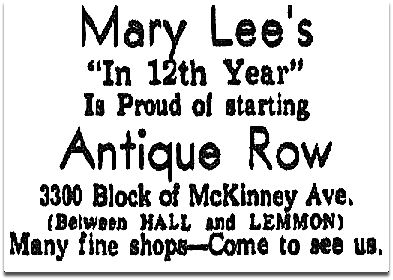
Whether or not it’s true, Mary Lee claimed to have started “Antique Row,” which, in this case, meant the 3300 block of McKinney.

3300-block_dmn_0327681968

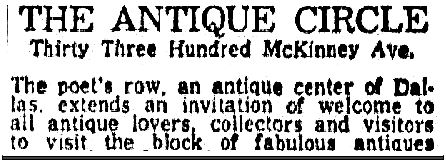
Back in 1959, these dealers were calling themselves “The Antique Circle” and were describing their antique-packed block as “the poet’s row.”

3300-block_dmn_1105591959

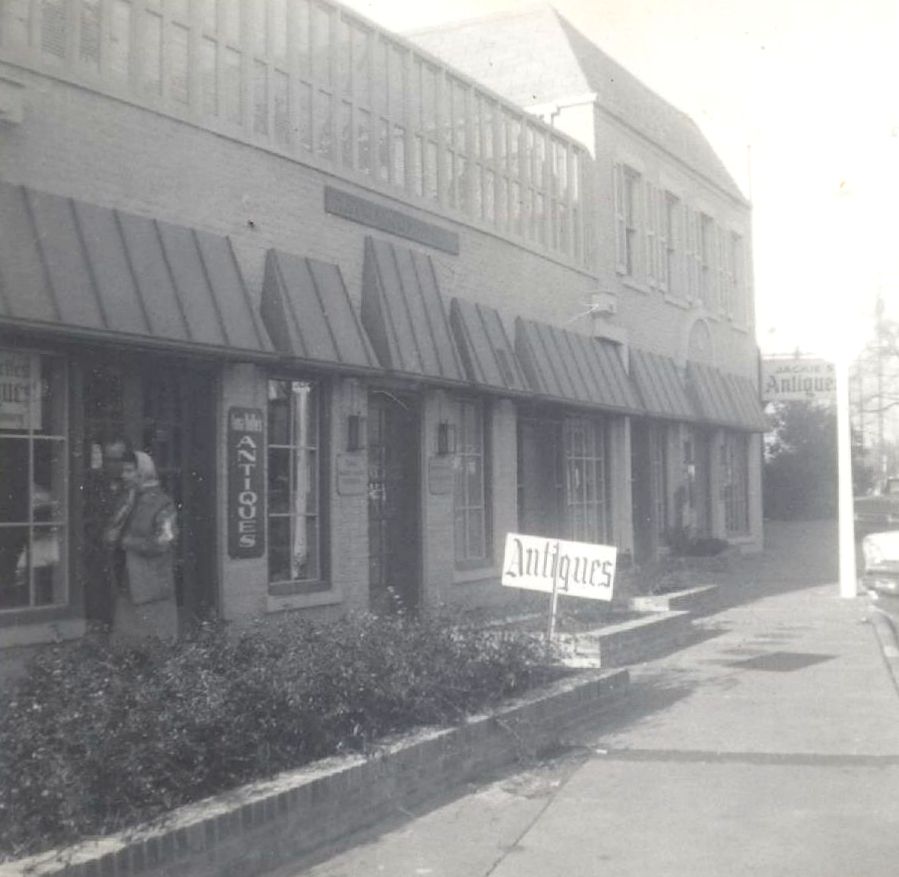
Mary Lee’s — which pretty much sat by itself on the south side of the street — was directly across from a block containing a strip of antique shops. I was glad to see in the same eBay collection a photograph of that north side of the block (probably taken at the same time as the photo at the top of this post).

antique-shops_1963_ebay3300 block of McKinney, north side, 1963 (click for larger image)

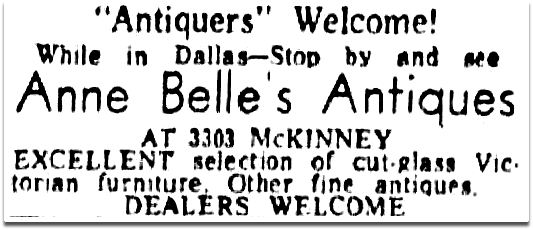
Seen above is part of that block, with Anna Belle’s Antiques (misspelled in the ad below) and Jackie’s Antiques (which was owned by Jackie Woods, a family acquaintance — her father had a clock shop, and my mother thinks that Jackie’s store may have been adjacent to it).

anne-belle_dmn_0401621962

jackies-antiques_dmn_0313611961

The buildings in that block are also still there — they’re  nowhere near as old as the house across the street, but it’s still nice to see some old and quirky structures still standing (and staying occupied) along a rapidly changing McKinney Avenue.

3300-mckinney_googleGoogle Street View, 2015

In the 1980s, the cute little houses which, for decades, had been occupied by a variety of businesses — antique shops, boutiques, clothing stores, salons, etc. — began to disappear from McKinney Avenue. Granted, some had seen better days and were in various states of disrepair, but, personally, I thought they were all charming, and I was sad to see them replaced by buildings conspicuously lacking in character. I had grown up seeing those houses and was especially fascinated by the cigar store Indians that seemed to stand in every yard and on every porch. (It’s pretty weird remembering that there were a LOT of wooden Indians along McKinney Avenue — almost as weird as remembering that there were once yards and porches along McKinney Avenue!)

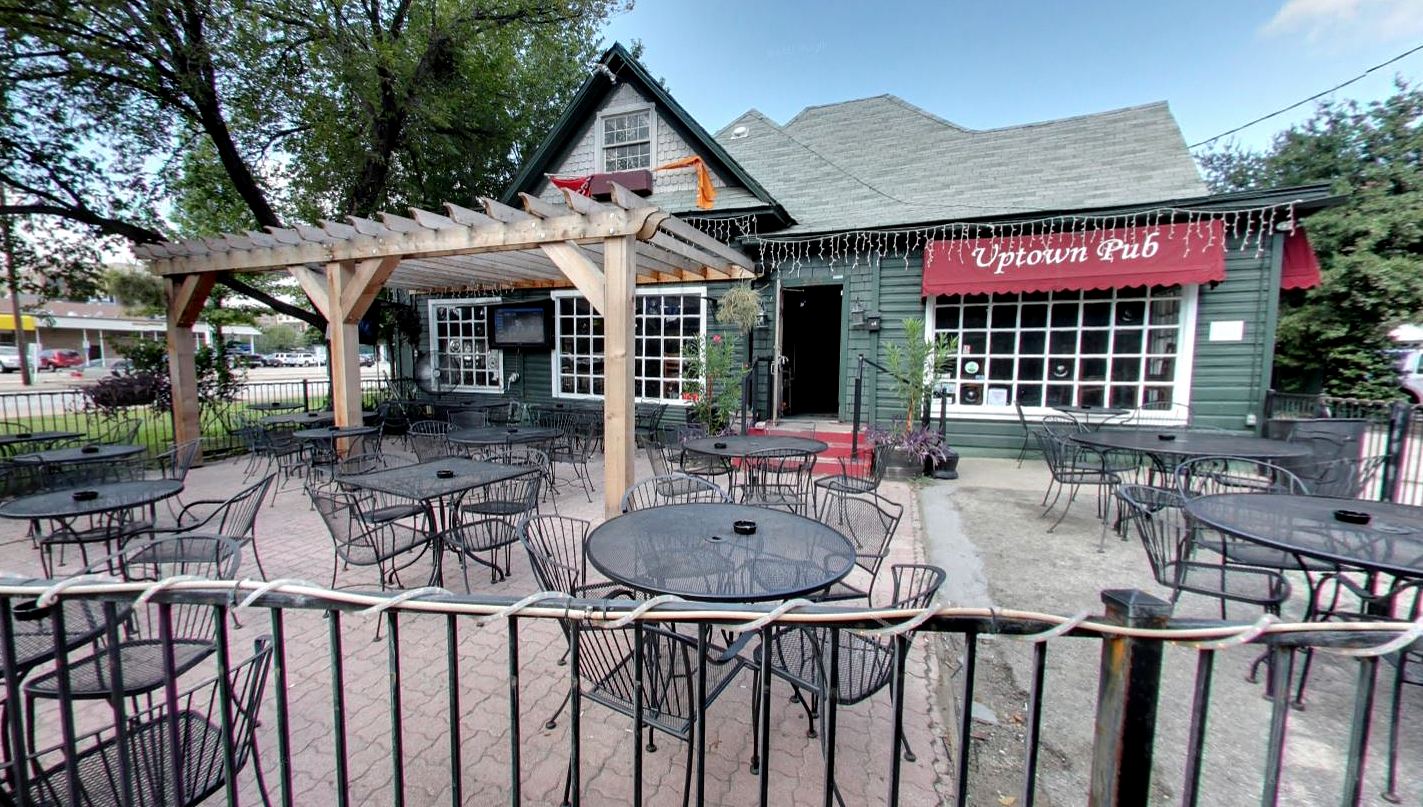
Now, most of those houses are long gone. A handful survive. The one most people might know is the one at 3605 McKinney, at Lemmon Ave. East — I first began lusting after it when it was Jennivine, and it’s nice to see that it’s still around, now as Uptown Pub. From a quick-ish look at its history, it appears to have been built before 1902. I know there are a lot people who love the severely densely-packed 21st-century version of “Uptown,” but wouldn’t that area be a million times nicer if there were still a street full of places like this?

uptown-pub_google-street-view3605 McKinney (Google Street View)

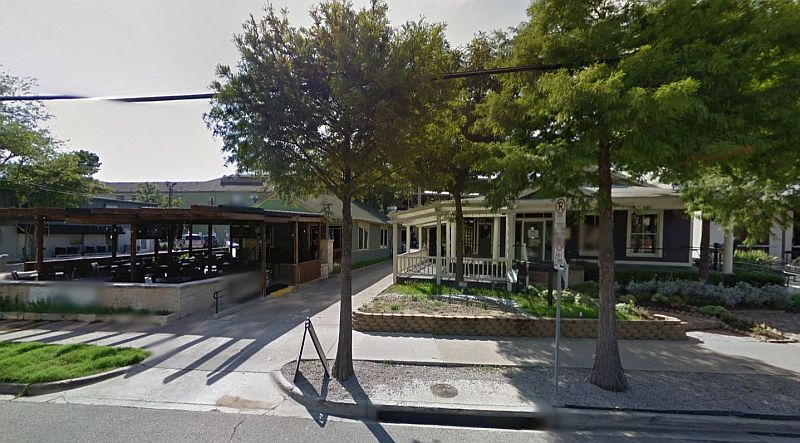
There are also a couple of 100-plus-year-old houses in the 3400 block. Seen below, the one on the left (3403 McKinney, currently occupied by Cliff’s Bar & Grill) appears to have been built in 1897; the very cute house to the right was built before 1909.

3400-block-mckinney_googleGoogle Street View, 2015

Imagine McKinney Avenue lined with these houses — first as homes, later as funky little shops. It wasn’t that long ago, really….

***

Sources & Notes

Both 1963 photos are from eBay, in auctions ending Monday night (Nov. 16, 2015). The top photo showing Mary Lee’s Antiques is here; the one showing Anna Belle’s and Jackie’s antique shops is here. See what the north side of this block looks like today on Google Street View, here; rotate it south and see what Mary Lee’s place looks like these days, and then head one block east to see the two old houses in the 3400  block. Look at what surrounds the wonderful house at McKinney & Lemmon (the old Jennivine), here — rotate the view at your own risk.

The entire eBay collection of Dallas snapshots — being offered in individual auctions which all end over the next couple of days — is here. The descriptions of these photos are written by an eBay seller in Ohio, and now that I’ve seen Big Tex described as “Big Tex Cowboy Man,” I’m all for an official name change. Consider it, SFOT!

I learned about these photos when I saw them mentioned in a Facebook post by the great BigDHistory. Like him on Facebook here, and/or follow him on Twitter @BigDHistory. Thanks, Miles!

For more on McKinney Avenue during this period, read the Dallas Morning News article titled “Poverty, Luxury, Art, Jazz — Changing Scene: The Many Faces of McKinney Ave.” by the always entertaining Helen Bullock (DMN, May 7, 1961).

Click pictures for larger images.

*

Copyright © 2015 Paula Bosse. All Rights Reserved.


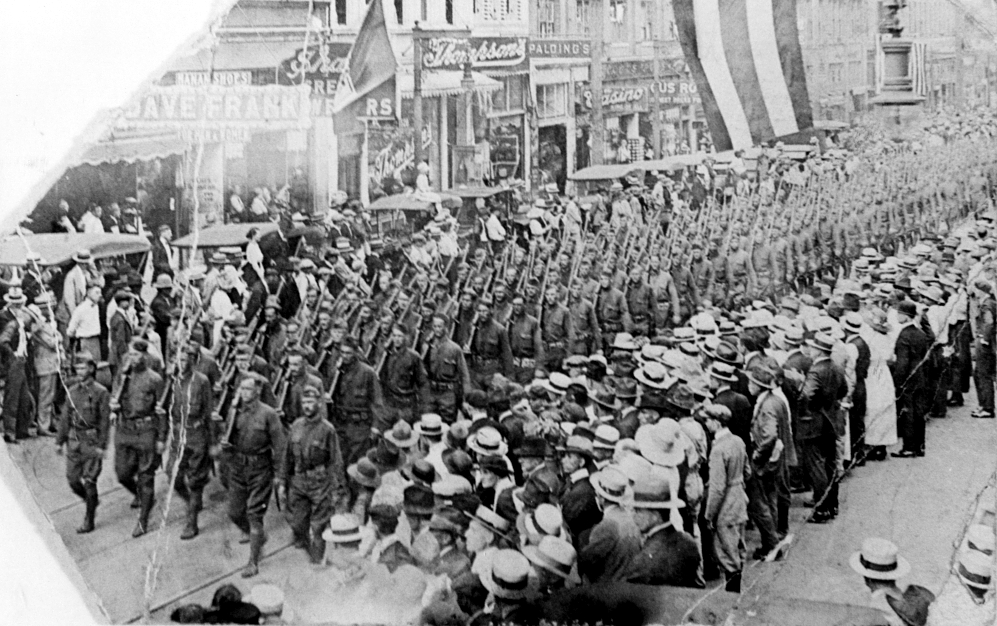
“Tough ‘Ombres on Main Street” — WWI Victory Parade, 1919

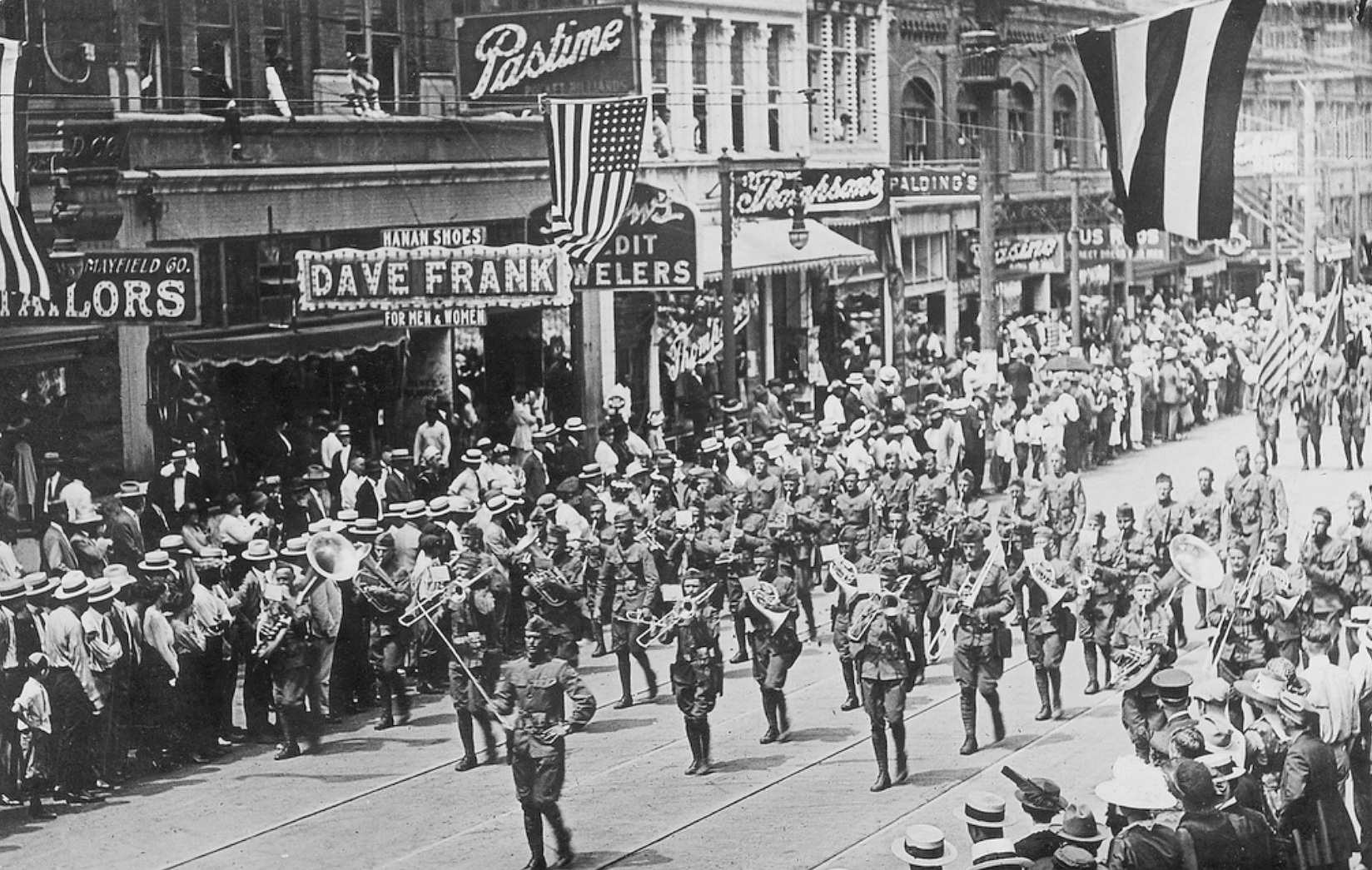
tough-ombres_flickr90th Infantry Division, 1500 block of Main Street (click for larger image)

by Paula Bosse

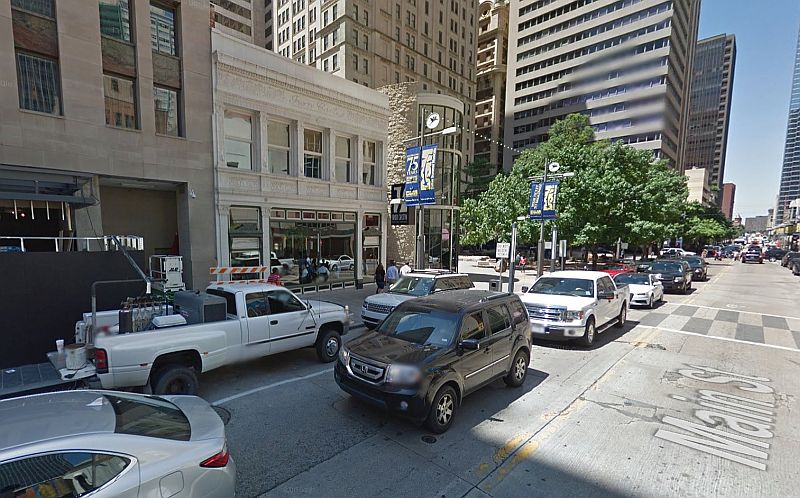
In my previous post “From the Vault: Armistice Day! — 1918” (seen here), commenter “Not Bob” linked to the above photo which was taken from almost the exact same vantage point as the photo I had posted previously. This one is much better! It shows the U.S. Army’s 90th Infantry Division (known as the “Tough ‘Ombres”), just back from Europe, marching past the 1500 block of Main Street, heading east. The white building in the center (“Thompson’s”) appears to be the same building currently occupied by Iron Cactus, at 1520 Main.

Great picture — thanks, Not Bob!

***

Sources & Notes

This photo was posted by Bob Swanson on Flickr, here. The comments are very interesting and explain why this infantry division was marching in various Texas cities.

More on the 90th Division here and here.

My post “Armistice! — 1918” contains another parade photo taken at the same spot, here.

*

Copyright © 2015 Paula Bosse. All Rights Reserved.


From the Vault: Armistice Day! — 1918

wwi_parade_dallasSoldiers returning from war — June, 1919 (click for larger image)

by Paula Bosse

Dallas learned that World War I had ended when they were awakened at 3:00 AM by a siren screeching from the top of the Adolphus Hotel. Read how ecstatic Dallasites celebrated, in my previous post, “Armistice Day! — 1918,” which can be read here.

The photo above shows the 1500 block of Main Street, looking west toward Akard. The building with the Thompson’s sign was at 1520 Main, the address now belonging to Iron Cactus, seen below in the two-story white building. Same building? Looks like it.

1500 -block-main_2015_google-street-viewGoogle Street View

Happy Armistice Day/Veterans Day!

*

Copyright © 2015 Paula Bosse. All Rights Reserved.

When a Virgin Sacrifice at Fair Park Almost Caused an International Incident — 1937

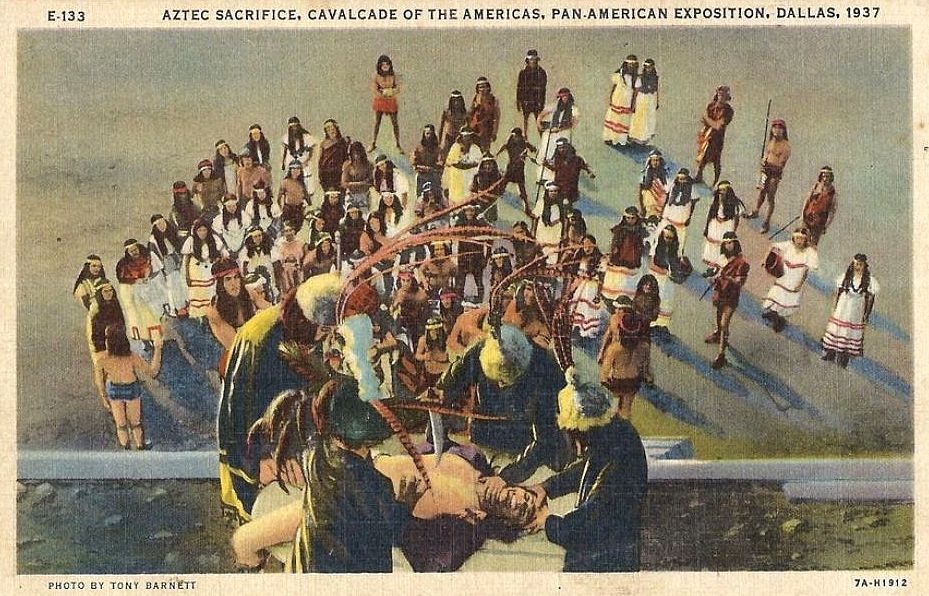
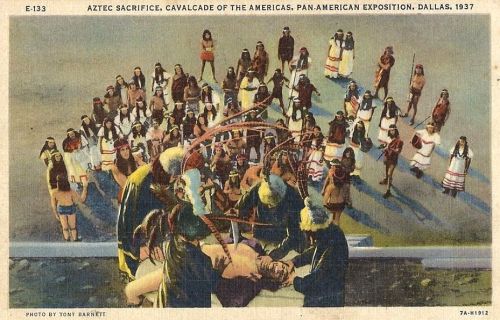
pan-american_aztec-sacrifice_colteraAztec sacrifice with a warrior, not a virgin, on the official postcard

by Paula Bosse

The Greater Texas and Pan-American Exposition at Fair Park was a four-and-a-half-month extravaganza which opened in June, 1937 as a follow-up of sorts to the previous year’s Texas Centennial Celebration. According to promotional material, its goal was to celebrate the Americas and “to promote the feeling of international goodwill between the twenty-one independent nations of the New World.” (It was also hoped that the city could rake in some more Centennial-sized cash.)

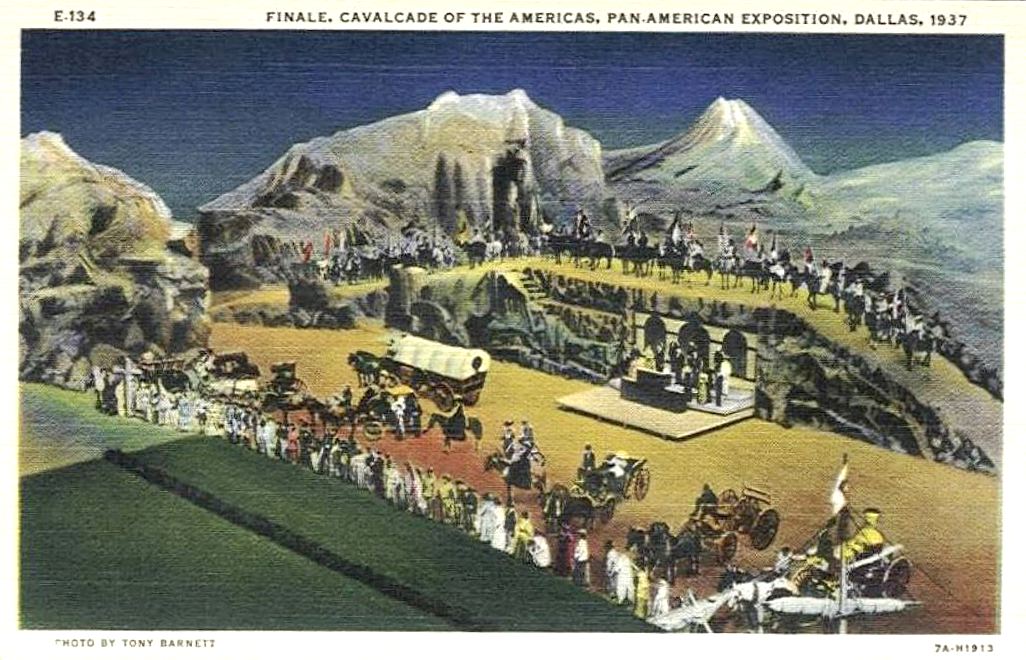
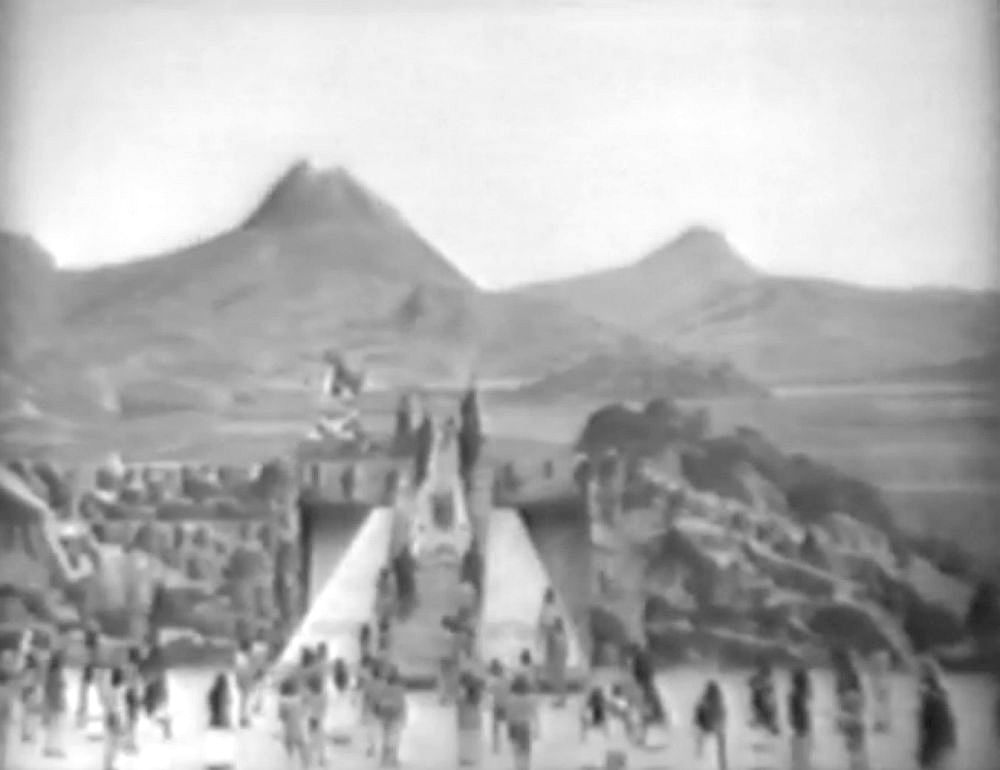
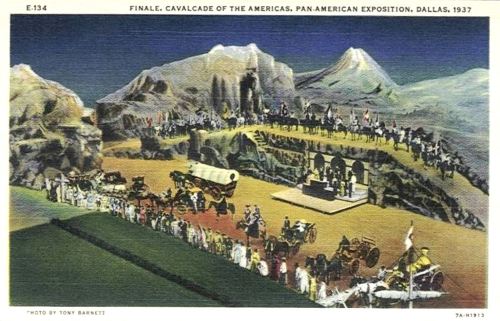
One of the biggest attractions of the Pan-American Expo was a huge production called Cavalcade of the Americas, which presented highlights from the history of Latin America and the United States. There were scenes from ancient Mexico, Columbus’ landing, the Revolutionary War, Stephen F. Austin’s arrival in Texas, the settling of the Old West, etc., right up to FDR’s participation in the Inter-American Peace Conference in Argentina in 1936. Utilizing much of the same infrastructure as the previous year’s Cavalcade of Texas, it was staged outdoors, in the old racetrack, with a 300-foot stage and elaborate scenery depicting an ocean, mountains, and a smoking volcano. Horses, wagons, “ships,” and a cast of hundreds took part in the production.
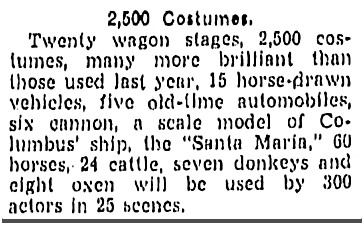
cavalcade-americas_FWST_060637Fort Worth Star-Telegram, June 6, 1937

It was quite elaborate. The postcard view below will give you an an idea of the scale of what was being billed as the world’s biggest stage.(I  believe the whole thing revolved — or at least part of it did — with another stage on the side facing away from the audience; the scenery, cast, and perhaps the donkeys, would change out before revolving to face the audience.)
cavalcade_1937

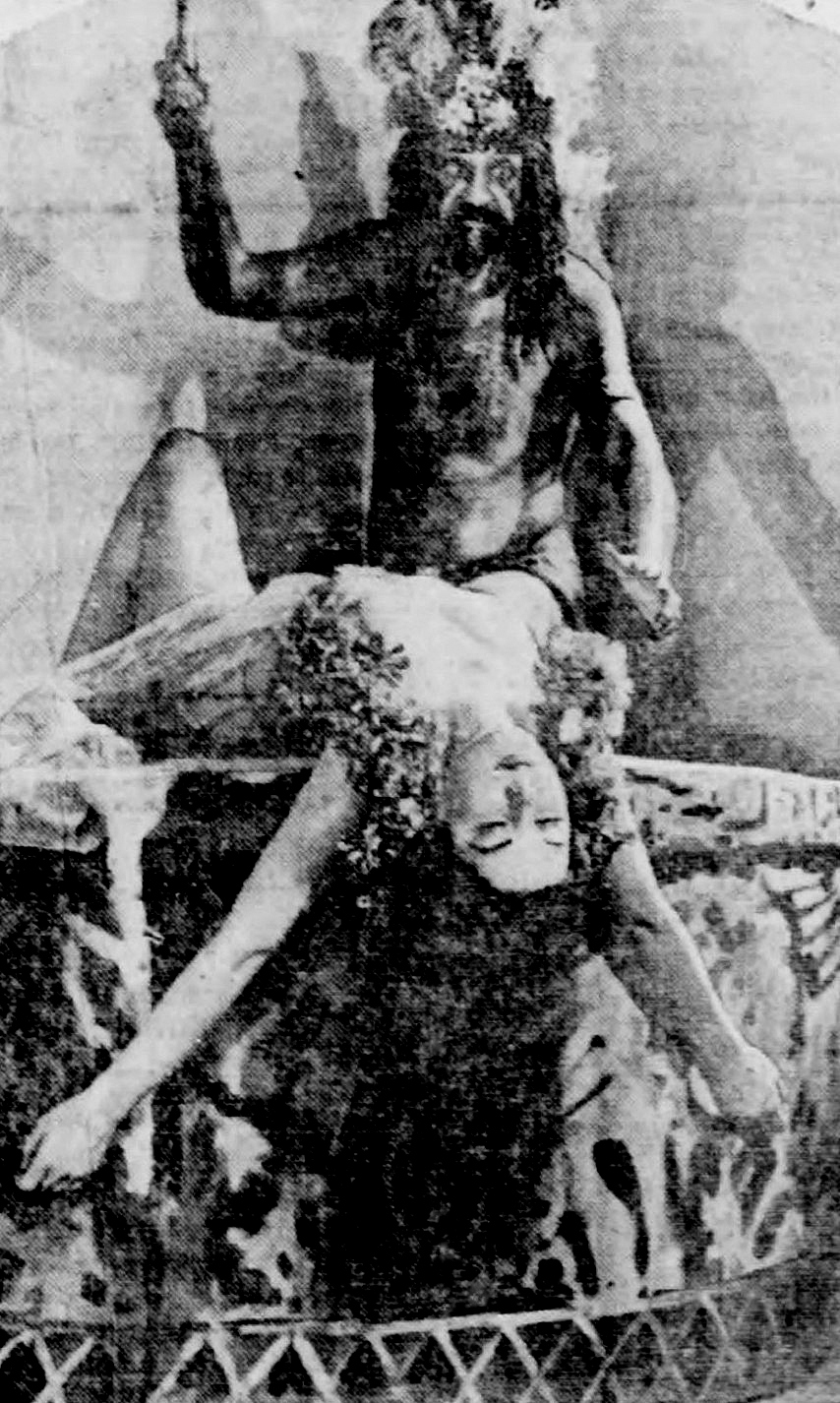
The opening scene featured an Aztec sacrifice and an angry volcano. Start big! This relatively brief portion of the show caused a lot of headaches (and/or much-welcomed publicity) for the producers, State Fair organizers, and, probably, the image-conscious Dallas Chamber of Commerce. But why? As originally written (by the remarkably prolific Jan Isbelle Fortune), the Aztec sequence involved the sacrifice of a struggling young maiden atop a blood-stained pyramid. Two months before the opening of the Expo, a rather sensationalistic photo of this historical reenactment appeared in the pages of newspapers across the country, no doubt resulting in raised eyebrows and whetted appetites. (Click to enlarge!)
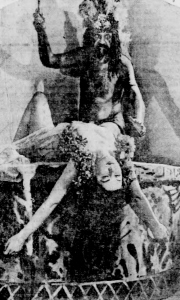
aztec_greencastle-indiana-daily-banner_080437Greencastle (Indiana) Daily Banner, 1937

The star of this scene was 17-year-old Geraldine Robertson, who had been crowned Queen of the Centennial the previous year and who played a multitude of roles in the current production, including Cortés’ “lover and interpreter,” a young woman in a Boston Massacre scene, Martha Washington, and the wife of Jim Bowie. Here she is in real life in 1936, with Jean Harlow platinum-blonde hair, posing for one of a seemingly endless number of publicity photos.
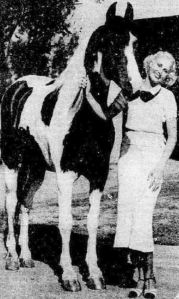
robertson-geraldine_queen-of-centennial_1936Geraldine Robertson, 1936

And the thing that caused so much trouble? Probably not what you would assume.

Before the Exposition opened, the Dallas-based Mexican Consul, Adolfo G. Dominguez, became aware of this casting choice. And that was when the mierda probably first hit the ventilador. Dominguez was adamant that the virgin be replaced with the more historically accurate male warrior. He probably said much the same thing to the Cavalcade producers when confronting them about his concerns before the Expo began as he did when he said this in a Dallas News article on the topic weeks later:

“We Mexicans feel that use of a girl in the role can bring nothing but racial prejudice and misconception of the true meaning of the Aztec human sacrifice as it was performed, not thousands of years ago, as has been wrongly represented, but as late as 1521.” (DMN, July 28, 1937)

The producers acquiesced, and when the Exposition began its run on June 12, 1937, the opening scene of the Cavalcade did, in fact, feature a sacrificial warrior. But on Sunday, July 25, the producer of the extravaganza brought the scantily-clad virgin back and nixed the warrior, hoping the added sex appeal and pizzazz would increase audience numbers. (Interestingly, when the Exposition opened, tickets to Cavalcade of the Americas cost 50⊄ — about $8.00 in today’s money — but on July 18, it was announced that, except for 600 reserved seats, admission to the show would be free. Promoters said this was being offered as a gesture of goodwill to Expo visitors, but one wonders if they weren’t having a hard time filling the 3100-seat grandstand.)

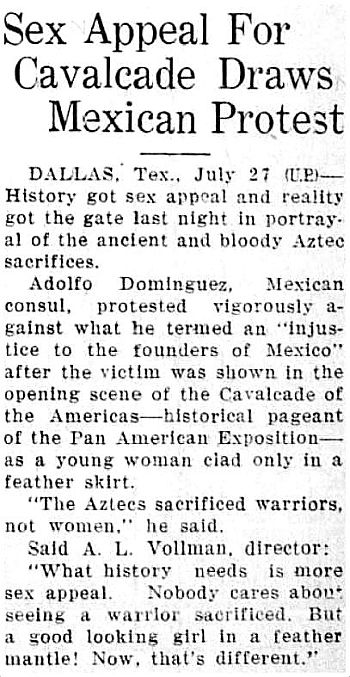
Señor Dominguez was not amused by this sexed-up revamping and protested. A. L. Vollman, the Cavalcade’s producer-director pooh-poohed the diplomat’s protestations and responded in true impresario fashion: “What history needs is more sex appeal.” That didn’t go over particularly well with the consul, who thought he’d already dealt with the problem weeks before. (Click to see larger image.)
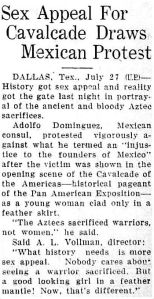
aztec_waxahachie-daily-light_072737Waxahachie Daily Light, July 27, 1937

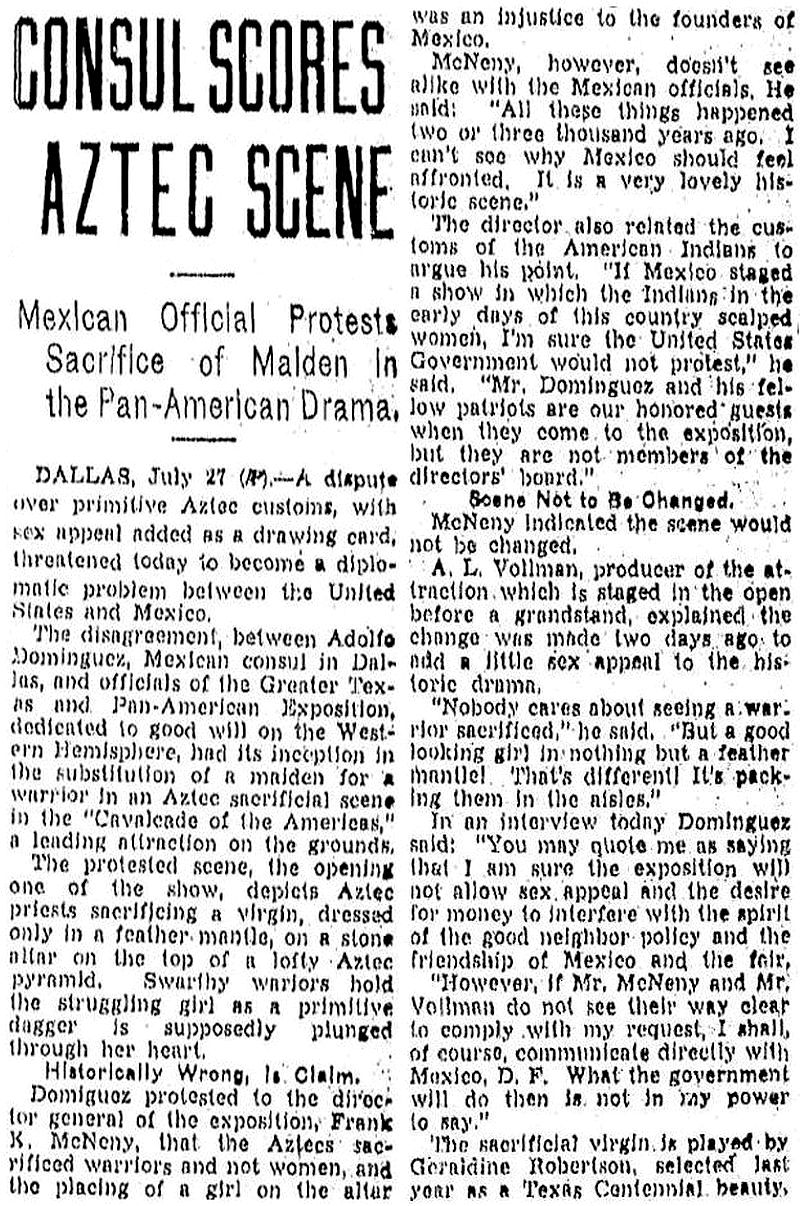
Dominguez complained to Frank K. McNeny, Director General of the Exposition, saying that the scene was historically inaccurate and was an injustice to the founders of Mexico. McNeny disagreed, saying that the scene involving the plunging of a dagger into the breast of a sacrificial virgin was “a very lovely historic scene.” He declined to bring back the warrior, because, as Vollman noted, the revamping had increased attendance: “It’s packing them in the aisles.” An exasperated Dominguez said that if the change from maiden back to warrior was not made, he would take the matter to the Mexican government.
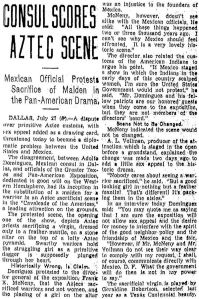
aztec_FWST_072837FWST, July 28, 1937

At this point, a disagreement over the gender of a character in what was, basically, an oversized school history pageant was dangerously close to setting off an international incident. It was also causing embarrassment for local civic leaders who were looking upon the Exposition as a major marketing tool for the city as well as a symbolic display of Pan-American solidarity and goodwill. Can’t we all just get along, amigo?

The refusal of the Cavalcade to UN-revamp the show did not deter the Mexican Consul who, by now, was probably more het-up than ever. Dominguez decided to go over McNeny’s head. He pulled out the written agreement he had made with fair officials back in the spring — which clearly stated that a male warrior and NOT a young woman would feature in the theatrical human sacrifice — and he took it to the top man, State Fair president Fred F. Florence. Florence discussed the matter with his board of directors who voted “to a man” to uphold the original agreement.

The warrior would be reinstated as the writhing victim on the bloody sacrificial stone. The sexy maiden would have to hand over the 30-foot-long robe, which had been made from 9,000 feathers and which had trailed behind her as she was carried up the great pyramid at Tenochtitlán. The actor playing the warrior was probably happy to get back in the spotlight. Geraldine Robertson, the virgin who had trailed that robe, was relegated to a role as a daughter of Montezuma.

Presumably the dagger kept plunging into the flailing warrior’s heart twice nightly for the remainder of the show’s run, and the memory of that short-lived international squabble was quickly forgotten (…until now).

And they all lived happily ever after. / Vieron felices por siempre.
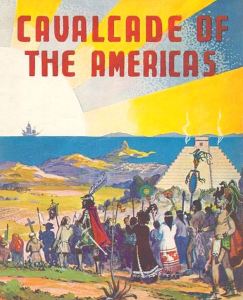
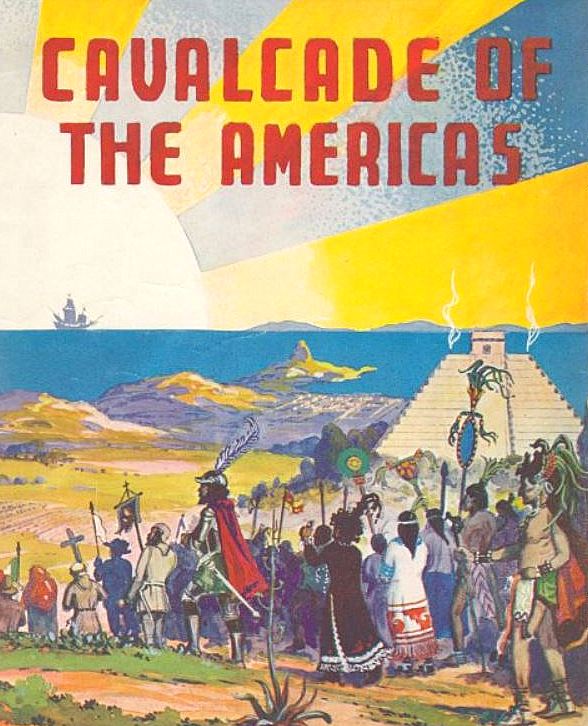
panamerican_cavalcade_watermelon-kid

*

Hey! If you’ve read this far, here’s a little reward. A Universal Newsreel titled “Pan-American Exposition Is Opened For 1937, Dallas, Tex.” — which contains 20 whole seconds of the Aztec (warrior) scene!  — can be viewed on the T.A.M.I. (Texas Archive of the Moving Image) site, HERE. The entire short newsreel is interesting (sadly, it has no sound), but if you want to jump to the sacrifice scene, it begins at the :49 mark. (If you’re watching on your desktop, make sure to click the little square just to the left of the speaker icon beneath the viewing area to watch it full-screen.
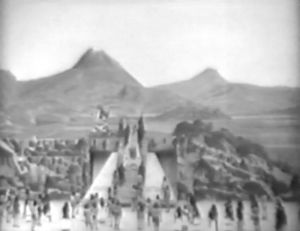
aztec_newsreelSuper-grainy screenshot from the Universal newsreel, 1937

***

Sources & Notes

Postcards of the Pan-American Exposition are from “the internet.”

Color souvenir program image from the Watermelon Kid site; background on the Pan-American Exposition can be found on the same site, here.

All other clippings as noted.

Related Dallas Morning News articles:

  • “As Sacrificial Virgin, Star of Cavalcade Put In Showy Opening Act” (DMN, July 26, 1937)
  • “Cavalcade Dispute Is Won by Consul As Virgin Is Replaced” (DMN, July 28, 1937)

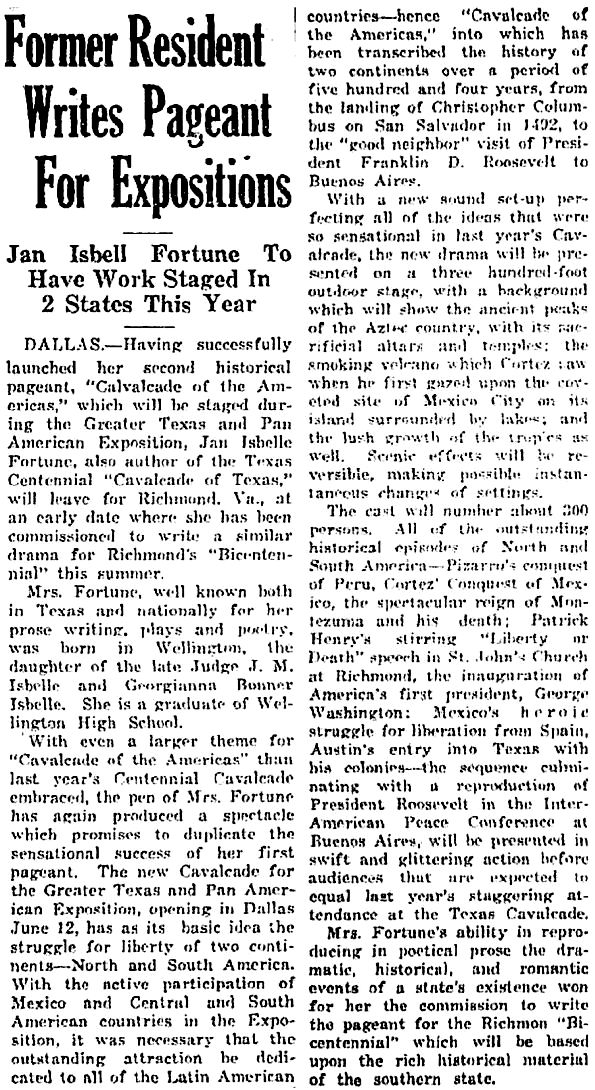
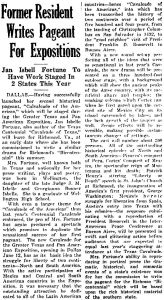
Below, an interview with Jan Fortune on her Cavalcade of the Americas; it appeared in her hometown newspaper, The Wellington (Texas) Leader on March 18, 1937. She also wrote the Centennial’s big production, Cavalcade of Texas, the previous year, in 1936.
jan-isbell-fortune_wellington-tx-leader_031837

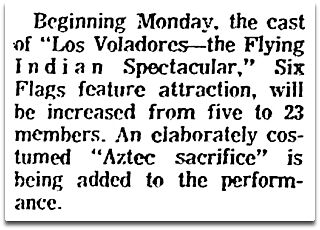
And, speaking of Aztec human sacrifices in DFW (a phrase I don’t believe I’ve ever written…), the following tidbit was contained in an article about Six Flags Over Texas’ 1970 season.
aztec_FWST_052170-six-flagsFWST, May 21, 1970

Promotional material about Los Voladores — a group of aerialists from Mexico — informs us that in their show “a beautiful maiden’s life is given as tribute to Tlaloc, the rain god.” Those beautiful maidens can’t catch a break. Sorry, Adolfo.

*

Copyright © 2015 Paula Bosse. All Rights Reserved.

“A Day at the State Fair of Texas” — A Color Film of the 1941 Fair

title-cardOfficial SFOT-produced movie (via Texas Archive of the Moving Image)

by Paula Bosse

TAMI — Texas Archive of the Moving Image — is a great repository of old films shot in and around Texas. Its site boasts streaming newsreels, PSAs, commercials, home movies, etc. — one of these films is the 11-minute short “A Day at the State Fair,” an “official” film produced by the Jameson Film Co. of Dallas for the State Fair of Texas, directed by Curt Beck and starring two young local actors, Charmayne Smith and Harry Bleeker. The SFOT made these short movies primarily to promote the fair, and they were often shown in theaters around Texas and in neighboring states, sandwiched between other cinematic entertainment. They were also used for educational purposes and were shown to both students and civic groups. This official film was shot at the 1941 state fair for the purpose of promoting the fair the next year, but it may actually never have been shown anywhere, as the 1942 State Fair of Texas was cancelled “due to war.”

I am unable to embed the film here — to view it in its entirety on the TAMI site, click here. (Make sure to click the “full screen” square just to the left of the speaker icon below the frame.)

Below are some (admittedly grainy) screenshots from the film. It’s fun to see these pre-War shots of the fair in color (inconsistent though that color is). Click pictures for larger images.

*

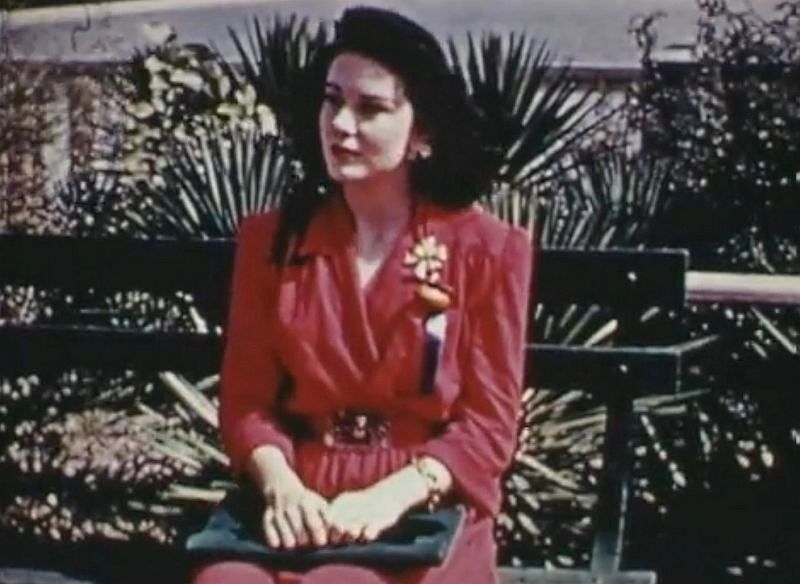
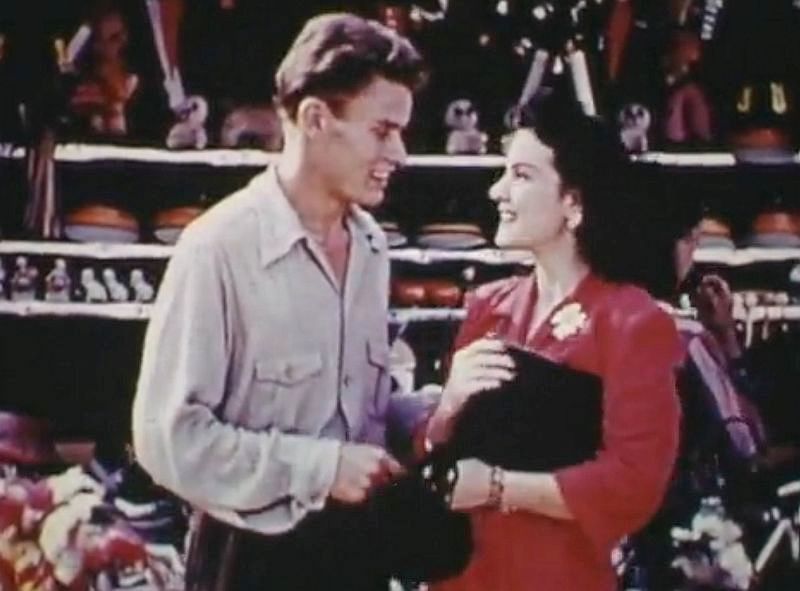
The film follows two young people who meet on a blind date and tour the fair. The young woman was played by Charmayne Smith, a Forest High School graduate who became both Miss Dallas and Miss Texas, and, at the time of this film, was studying acting at the Dallas Little Theater.

charmayne

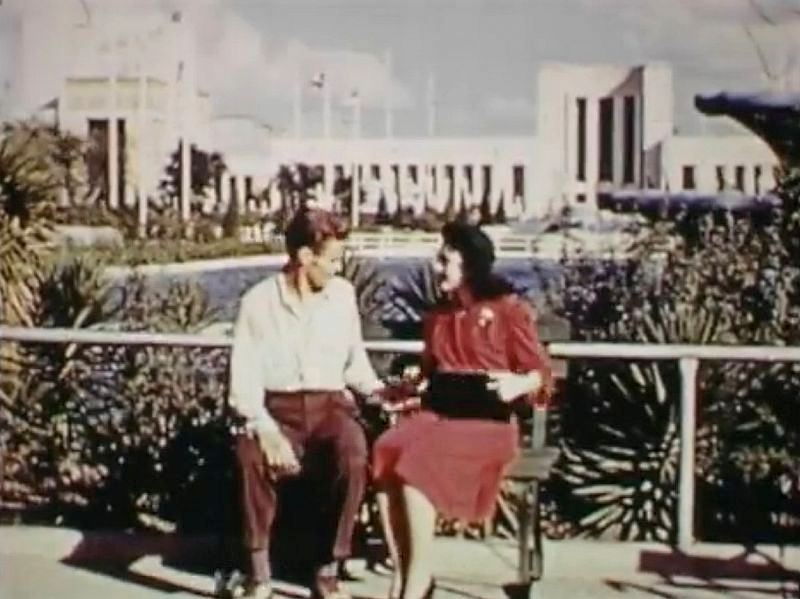
Her date was played by Harry Bleeker, also an actor with the Dallas Little Theater. (I like the peek at Parry Ave. in the background.)

harry-bleeker

They “met cute” at a Fair Park bench.

bench

They went to the Midway.

midway

They looked at rides and made pithy observations.

rocket

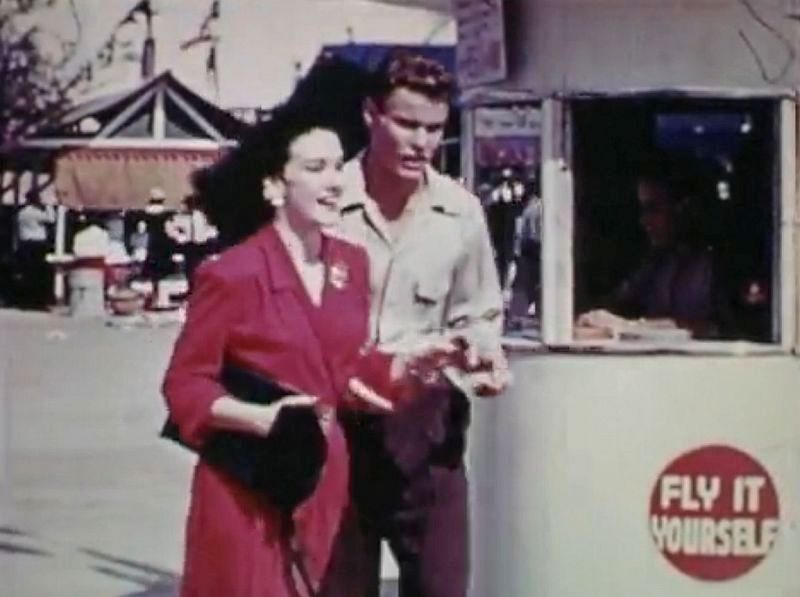
They bought tickets to an “aeroplane” ride, a ride so exciting it made Charmayne go “Whee!”

tickets

They listened to a freak show barker.

freak-show

Which, the closer you got, didn’t look all that freak-filled, unless you count the sight of a sullen girl holding a snake as being terribly “strange and unusual.” (I’m a sucker for sideshow banners, and this was my favorite shot of the film. The man in the crowd who has turned around to face the camera is more unsettling than anything on that stage — including the accordion!)

freak-show_1941-state-fair-of-texas

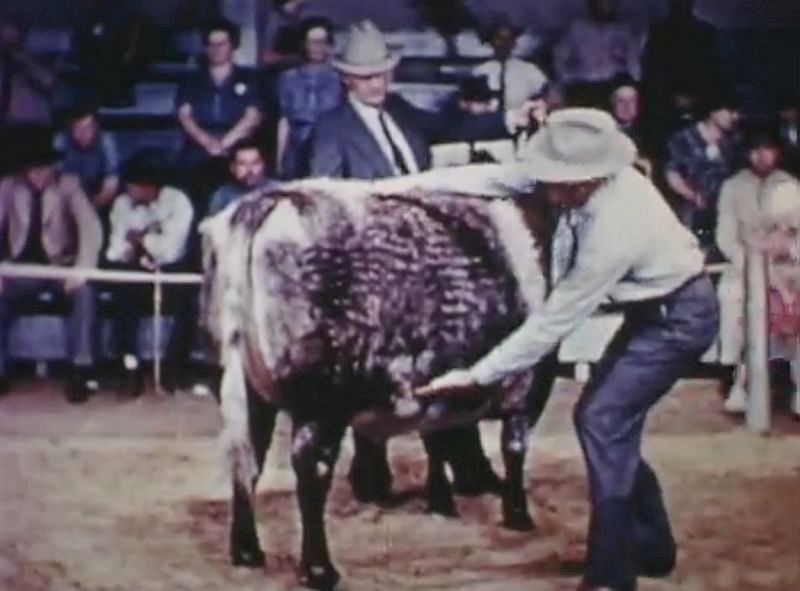
Harry and Charmayne went in and out of buildings, looked at different exhibits, rattled off facts-a-plenty, and extolled the greatness of Texas. And no way were they going to miss the livestock events. A state fair’s gotta have livestock. Like this almost perfectly rectangular Beef Shorthorn.

beef-shorthorn

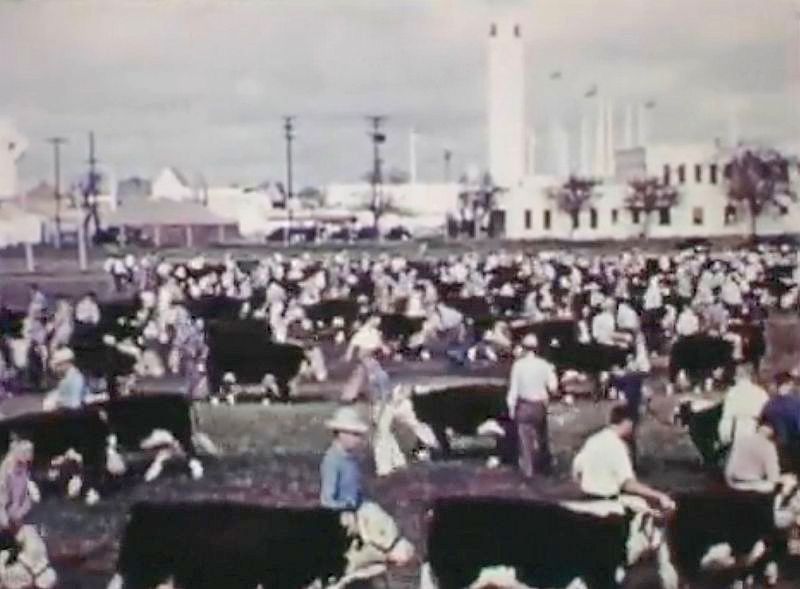
And these parading Herefords.

herefords

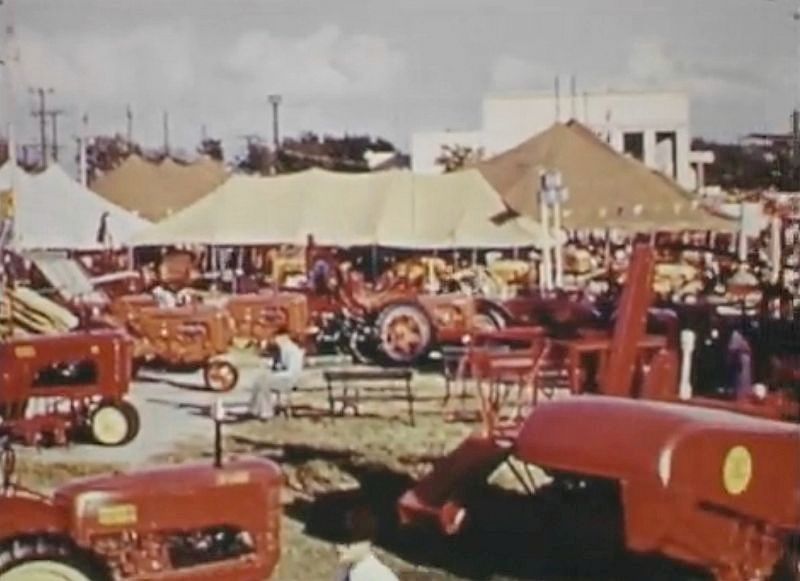
Also seen: tractors, tractors, tractors.

tractors

They took in a “petroleum exhibit” and exclaimed how fabulous it was. (In real life, Charmayne Smith and Harry Bleeker and other Dallas Little Theater actors were part of this exhibit during the 1941 fair.) If only this little car were real and had been seen at the automobile show!

petroleum-exhibit

They moseyed through the Dallas Museum of Fine Arts and viewed the art in the Texas General Exhibition. (Eugene Trentham’s cloud-filled painting, “August Landscape” — winner of the year’s top prize —  can be seen here.)

dmfa

Then, tuckered out, Charmayne tells Harry it’s probably time that she should head home. Harry offers to drive her home and suggests they return that night for more fair fun!

harry-charmayne

They leave, happy, headed for Parry Ave. (and, perhaps, whiskey, across the street).

parry

*

This wasn’t all that Harry and Charmayne saw. There was also a monkey, goats, sheep, horses, the Ice Capades, a beauty contest, jars and jars of preserved fruit, a lady handing out Hi-Ho crackers, the Hall of State, and more. Watch the film. It’s great to see 70-plus-year-old footage of Fair Park — and it’s also nice to hear people talk with Texas accents (something getting rarer every day in Dallas). Again, you can watch the film here.

***

Sources & Notes

The TAMI home page is here; the page featuring this short film is here. Thank you, TAMI, for uploading and sharing this and all the other cool stuff on your site! (The film is currently identified as being made in 1939, but everything points to this being filmed at the 1941 State Fair of Texas.)

These SFOT-produced films were an important promotional tool to entice visitors to the fair. In the months leading up to the opening of the SFOT, these films were shown in hundreds of Texas movie theaters, in theaters in contiguous states, and in thousands of schools throughout the Southwest.

Charmayne Smith (1921-1965) entered and won a lot of beauty contests while in high school and during her time at both the University of Texas and at SMU. An Oct. 12, 1941 captioned photo of Miss Smith mentions that she had been participating in the filming of (color) footage shot around the 1941 SFOT which would be used “for educational and promotion purposes before next year’s exposition.”

I was unable to find anything about Harry Bleeker, other than a mention in a 1941 Dallas Morning News article about the petroleum exhibit seen in the film. Chances are pretty high he served in World War II.

In the film, Charmayne and Harry visit the Third Texas General Exhibition (1941) at the Dallas Museum of Fine Arts. The grand prize in the oil painting division went to Eugene Trentham, a UT art instructor at the time, fresh off a Guggenheim Fellowship.

Click pictures for larger images!

*

Copyright © 2015 Paula Bosse. All Rights Reserved.


Snag Boat Dallas — 1893

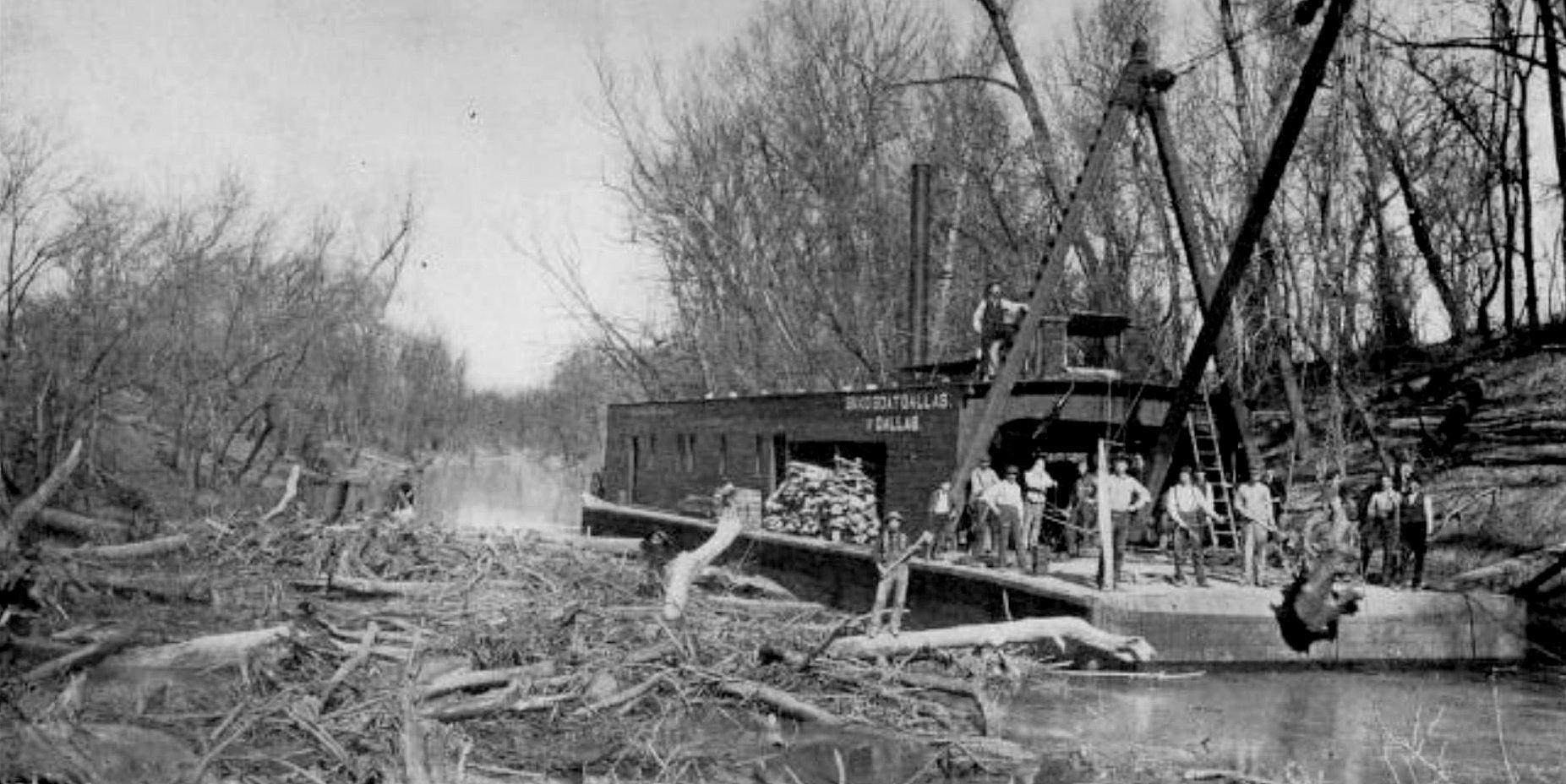
snagboat_dplSnag Boat Dallas of Dallas, Trinity River

by Paula Bosse

“Snagboat.” It’s a great word. And if you’ve taken even a glancing look into the history of the Trinity River, you’ve probably come across it. What is it? According to the Wikipedia entry, it is “a river boat, resembling a barge with superstructure for crew accommodations, and deck-mounted cranes and hoists for removing snags and other obstructions from rivers and other shallow waterways.” If you’re from Dallas, “shallow waterway” will immediately bring to mind our very own Trinity River, which, unless it’s flooding, you probably rarely even think of as being an actual river. But Dallas money-men have tried their damnedest for what seems like EVER to make the Trinity do what they wanted it to do.

In the late 19th century, a group of Dallas businessmen organized the Trinity River Navigation and Improvement Company and began to sink large sums of money into it. The goal was to make the Trinity navigable for large boats between the Gulf of Mexico and Dallas. They knew that if they could open this waterway to vessels carrying all manner of freight that they could make a lot of money. A lot.

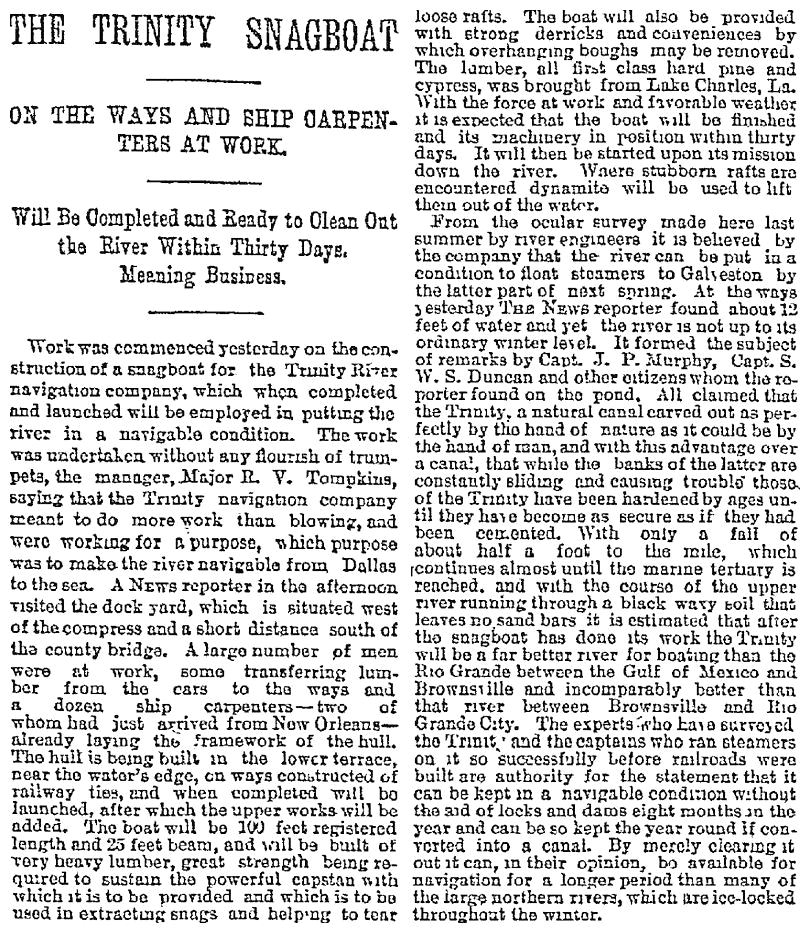
In order to make the Trinity navigable, it first had to be cleared of all sorts of impassable debris in it, on it, over it, and along it. The stretch of the river around the soon-to-be inland port of Dallas was particularly snarled with all sorts of things making passage of large boats through its waters impossible. A snagboat was needed, and construction on the Snag Boat Dallas of Dallas began in November of 1892.

snagboat_dmn_112692Dallas Morning News, Nov. 26, 1892
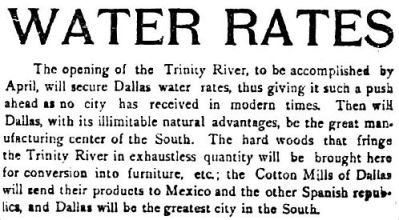
The construction of the boat was followed closely in the Texas papers, and giddy ads/editorials like this one were filling the pages of Dallas newspapers.

ad-water-rates_dmn_011593DMN, Jan. 15, 1893

“Water rates” — charges for freight shipped via boat — were lower than the rates charged by railroads. Were the Trinity able to support freight traffic, this new competition would mean that railroads would lower their rates, and the savings for manufacturers and builders would  be substantial. As a result, manufacturing and building in the city would boom, and before you knew it, Dallas would become “the greatest city on Earth in the South”!

A few days before the official launch of the boat, reporters, businessmen, and the public were invited to a preview. An interesting account in The Galveston Daily News described the boat’s machinery (which included a “liquid battering ram”) and took the reader on a tour of the crew’s quarters (which had separate sleeping and dining areas for black and white crew members, per the “Separate Coach Law” of 1891).

snagboat_galveston-daily-news-021993Galveston Daily News, Feb. 19, 1893

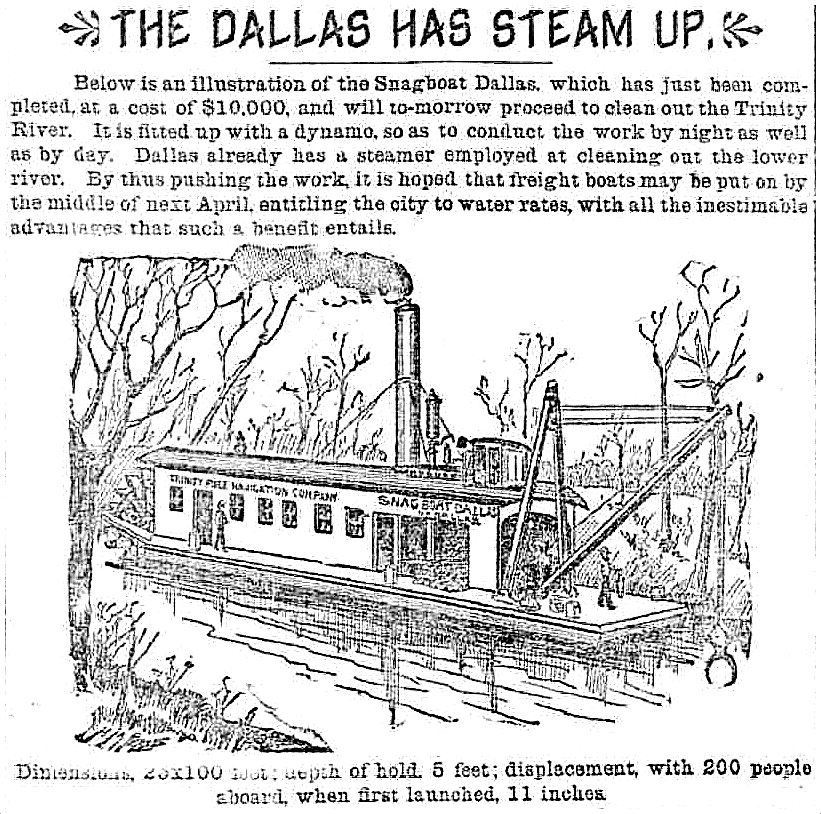
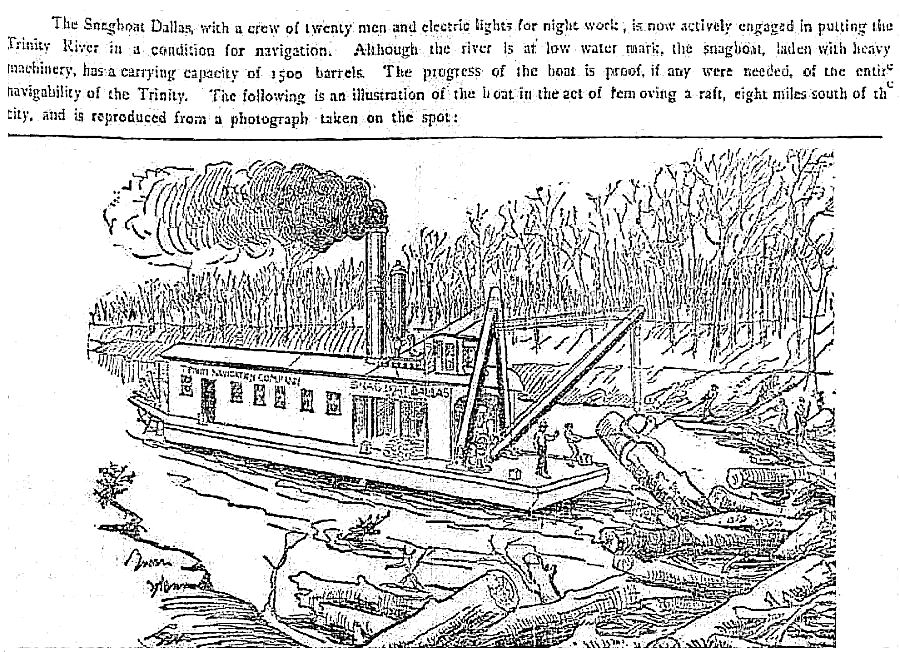
The boat began its snagging work in February, 1893, and, in order to keep readers abreast of all Snag Boat Dallas developments, there were almost daily updates on its progress in the newspapers, and (in lieu of photographs) Dallas Morning News illustrators provided scenes of the boat’s important work.

snagboat_dmn_021293DMN, Feb. 12, 1893

snagboat_dmn_022693DMN, Feb. 26, 1893

The celebrity snagboat succeeded in clearing the debris, and in May, 1893, the steamer H. A. Harvey, Jr. arrived in Dallas, having, yes, navigated the Trinity River from the Gulf, even though it had faced two months’ worth of difficulties along the way (problematic water levels, low bridges which had to be dismantled in order for it to pass under, underwater impediments which had to be dynamited into oblivion, etc.). When it finally pulled into Dallas — accompanied by the hard-working snagboat that had paved its way — the city shut down and had a massive celebration. The Dallas Morning News went so far as to print several of its pages in red ink (!). This proof that the Trinity River was, in fact, navigable, meant that the city was on the cusp on becoming “the greatest city in the South.” The DMN (which was not shy in its almost rabid boosterism of this project) published an editorial for those Dallasites who might “not fully comprehend” the significance of why they were celebrating.

harvey-impact_dmn_052293DMN, May 22, 1893

Dallas would become an important inland port. “It can be done.”

Except that we know that it couldn’t be done. Too many other natural forces were working against the Trinity River entrepreneurs. The Harvey and the snagboat didn’t actually do much after that tumultuous reception in 1893. Sure, they moved some small loads back and forth along the Dallas stretch of the river, but that grand vision of taming the Trinity never came to pass. Even now, more than 120 years later, it still has yet to happen. Dallas has done pretty well without the Trinity River being truly navigable, but people can’t seem to stop trying to somehow monetize it. It’s probably time we just appreciated our little section of the Trinity River for what it is: a little trickle of a river that has (so far) survived everything we’ve tried to do to it in the name of “progress.”

*

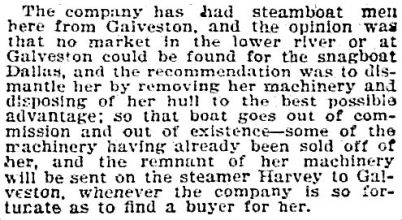
For closure, snagboat fans: the hard-working little Dallas had an ignominious end. It was tied to an old pier and left to rot on the water before it was eventually cannibalized and slowly picked apart. Its end came in January of 1898 when it was finally “broken up.”

rip_dmn_052897DMN, May 28, 1897

RIP, Snag Boat Dallas of Dallas — we hardly knew ye.

*

The Harvey (which quietly left town when it was sold to a Louisiana company in 1898) has gotten the lion’s share of the historical attention, but the snagboat is the one that did all the work. Here are two more photos of the Dallas and its crew taking a break from snagging to pose for posterity.

snagboat_dfwurbanwildlife

The photo below shows just what the crew of the snagboat was up against. The caption was written by C. A. Keating, president of the Trinity River Navigation Company.

snagboat_keating_1890s

snagboat-caption_keating

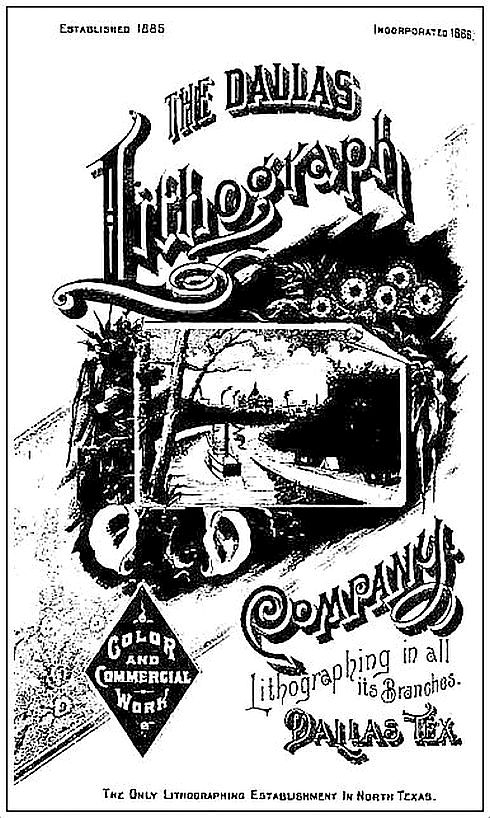
And, finally, what prompted me to find out more about the snagboat in the first place: this ad for the Dallas Lithograph Company from the 1893 city directory. It featured an illustration of a little boat chugging along on the idyllic (and blissfully snag-free) Trinity River, with the Old Red Courthouse in the background and a little tent pitched on the bank. I wasn’t all that familiar with snagboats, but that’s what I thought it looked like. I’m sure it’s supposed to be something grander, but I’ll think of it as a snagboat anyway.

ad-dallas-lithography-co_1893-directory-det

ad-dallas-lithograph-co_1893-dir1893 Dallas directory

***

Sources & Notes

I came across the top photo (which is from the archives of the Dallas Public Library) on the web page for the 99% Invisible podcast, here. I was so enthralled with the pictures on this page that I didn’t even realize until just now that there was a podcast to listen to, called “The Port of Dallas” — about this very topic! Listen to it at the top of the page — it’s very entertaining. I think Julia Barton and I were separated at birth!

There are lots of other photos on that page, including a photo of the H. A. Harvey, Jr. and a photo showing what the Dallas Morning News looked like printed in red.

Second photo of the Snag Boat Dallas is from the DFW Urban Wildlife blog, here. More great photos there!

The final photo of the Dallas and the photo’s caption are from C. A. Keating’s autobiography, Keating and Forbes Families and Reminiscences of C. A. Keating (Dallas: self-published, 1920).

All other clippings, as noted.

To read about how people have tried and tried and tried over the years to make the Trinity River do what they wanted it to do — and failed — read the article “Navigating the Trinity, A Dream That Endured for 130 Years” by Jackie McElhaney (Legacies, Spring 1991), here.

UPDATE: I swear I was completely unaware of Julia Barton’s podcast about the “Port of Dallas” when I wrote this post, but I’m happy to report there is ALSO a video, from a presentation she did at the TEDxSMU talks in October. Watch it here. (Thanks, for alerting me to that this, Julia — my “internet twin”!)

*

Copyright © 2015 Paula Bosse. All Rights Reserved.

From the Vault: The Ladies’ Reading Circle

ladies-reading-circle_negro-leg-brewer_1935The Ladies, circa 1935

by Paula Bosse

I’ve been researching civil rights issues in Dallas, and one name I keep coming across is Miss Callie Hicks (1894-1965), an African-American schoolteacher, civic leader, and officer of the local chapter of the NAACP. She was also a member of the Ladies’ Reading Circle, a Dallas group organized in 1892 by and for literary- and history-minded black women. She can be seen in the circa-1935 photo above, seated, second from the right. I enjoyed learning about this group of women, and the post I wrote, “The Ladies’ Reading Circle: An Influential Women’s Club Organized by Black Teachers in 1892,” can be read here.

I just added a picture of the charming house the group bought in the late-’30s and maintained for many years as a place which provided housing and career training for young women. Unbelievably, this State-Thomas-area house is still standing.

lrc-home_2616-hibernia_google2616 Hibernia (Google Street View)

*

Copyright © 2015 Paula Bosse. All Rights Reserved.


Stacy’s Lounge on The Miracle Mile — 1950

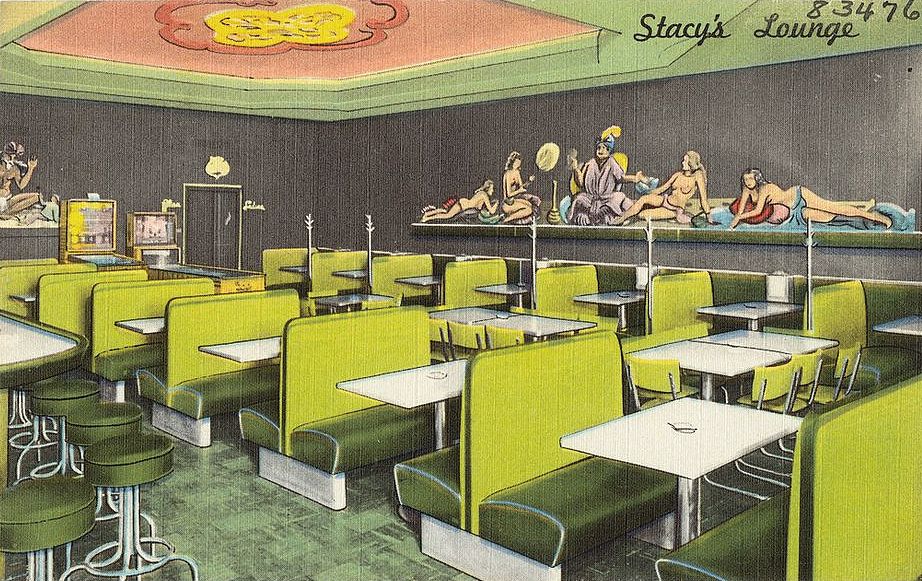
stacys-loungeStacy’s has it all: murals, pinball, ashtrays

by Paula Bosse

Today: a quick look back at a short-lived bar, Stacy’s Lounge, once located along the famed Miracle Mile. Actually, this postcard may be about all that remains from what was, apparently, a fairly short-lived drinking establishment.

stacys-lounge_1951-dirctry1951 Dallas directory

The above line is from the 1951 city directory, but that listing appears to have been published posthumously. By November of 1950, Stacy’s space at 5721 West Lovers Lane had been taken over by another bar called The Magic Lounge (later the Magic Grille/Herb’s Magic Grill).

Stacy — whomever he or she was — was not afraid of color and decor. I mean … for one thing … those murals. The exotic scenes featuring bare-breasted women, men in turbans, and, I think, a cobra are a little unexpected. They’re either great or awful. Patrons in 1950 might have thought they were awful when they walked in, but by closing time, they probably thought they were … slightly less awful. And the colors! They’ve obviously been pumped up for the postcard, but I’m sure the two-toned green vinyl (great booths!) and the pink and yellow molded and recessed ceiling were attention-grabbing. Imagine it crowded, dark, smoky, and loud. I’ve been in old bars that kind of look like this, just grungier, scuffed up, and sagging. This is pretty much what your favorite dive bar looked like when it was new and shiny. (I just realized I’ve never seen a vintage postcard with a pinball machine in it. And a jukebox. And a cartoon Indian fakir. I’ve hit the trifecta!)

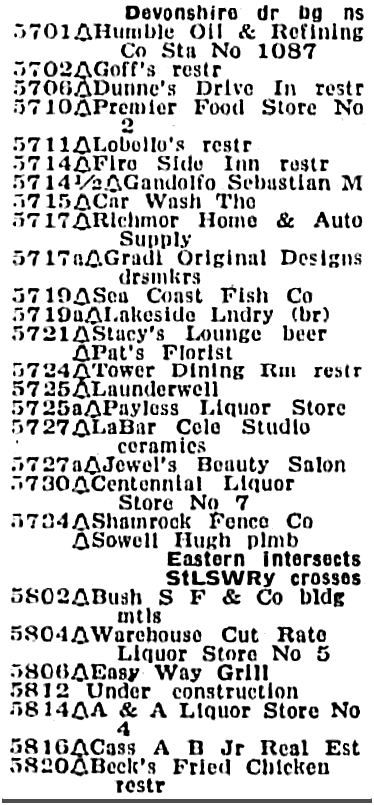
So what other businesses filled that block of Lovers in 1950-51? (Click for larger image.)

stacys-lounge_1951-directory_block1951 city directory

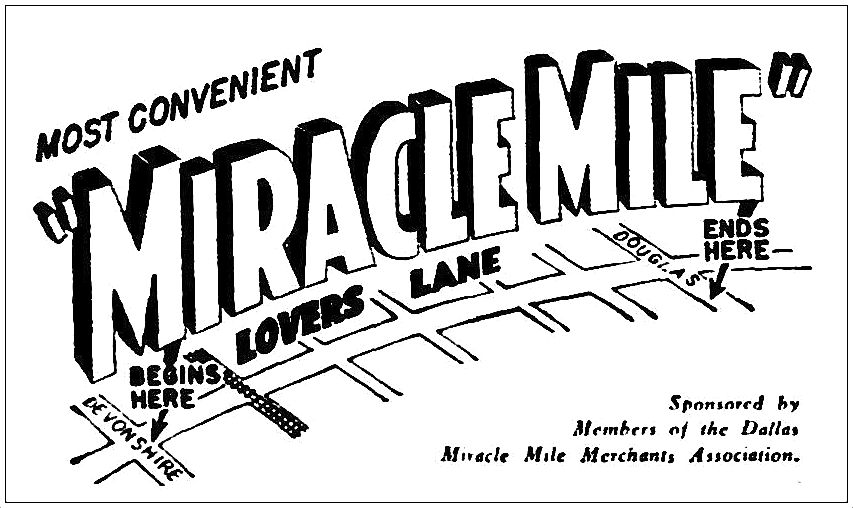
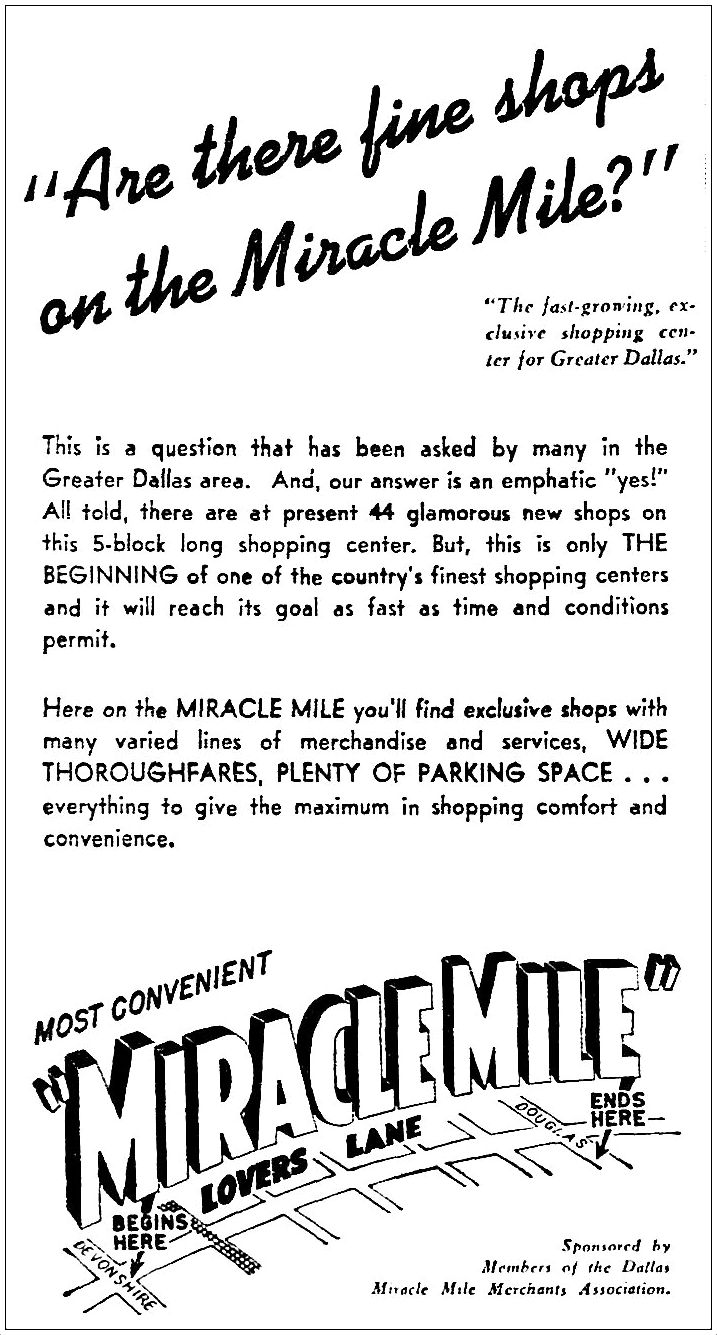
Speaking of The Miracle Mile (you don’t really hear people referring to the Miracle Mile anymore, do you?), when the name of the shopping area debuted in 1947, the official boundaries were Devonshire on the west and Douglas on the east. Some people insist it goes all the way down to the Inwood Theater. This rather adamant Dallas Miracle Mile Merchants Association advertisement illustration would disagree with that notion.

miracle-mile-merchants-assn_ad_april-1947_det

miracle-mile-merchants-assn_ad_april-1947
April, 1947

I’m still not sure why it was called the Miracle Mile, unless it had something to do with the price of real estate. Part of it was in Dallas (the couple of blocks west of what was the St. Louis and Southwestern/Cotton Belt railroad — now the tollway), and part of it was in University Park. (And I suppose still is.) Most of the bars and restaurants were in the Dallas portion, because University Park was dry. Another notable thing about Lovers Lane is that the address numbering is a crazy mess — there’s West Lovers Lane, Lovers Lane, and East Lovers Lane, and every time you pass from one stretch to the next, the abrupt address-changes will make your head spin. (I had no idea it was so crazy until I read Helen Bullock’s very informative and entertaining article about the Miracle Mile in a Sept. 10, 1961 article in The Dallas Morning News, “Walk a Miracle Mile.”)

But back to Stacy — I never actually discovered who Stacy was. Oh well. The particulars of Stacy’s Lounge may be lost to history, but the image of its colorful interior lives on in a 65-year-old garishly-colored postcard.

***

Sources & Notes

Postcard is from the great Boston Public Library Tichnor Brothers Postcard Collection on Flickr, here. I dip into the collection now and again to see what I can find out about those arresting and unreal-looking images — see those past posts here.

Currently at the old Stacy’s Lounge address (though in a newer building) is the Nicholson-Hardie Nursery & Garden Center; the location on a map is here.

You might even say that Stacy’s Lounge has got it going on. Do you have this song going through your head like I do? That’s going to be hard to get out of there.

*

Copyright © 2015 Paula Bosse. All Rights Reserved.