Flashback : Dallas

A Miscellany: History, Ads, Pop Culture

Tag: Dallas TX

Post Office, Sunbonnets — ca. 1890s

post-office_hist-photos-of-dallas

“Little Post Office on the Blackland Prairie” (click for larger image)

by Paula Bosse

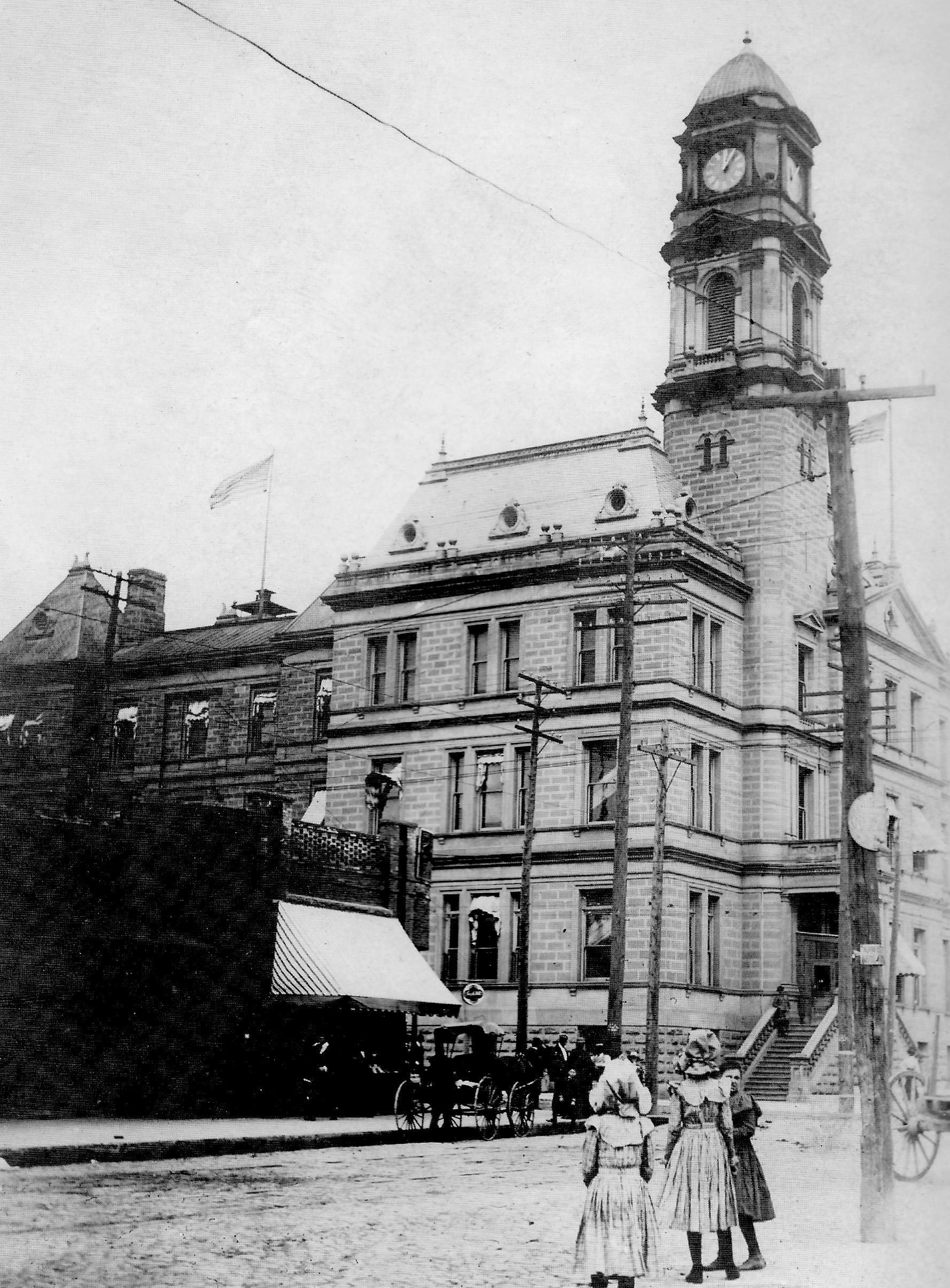
Laura and Mary Ingalls and Nellie Oleson appear to have wandered into Dallas to take a look at the new Post Office clock tower, seen here at Commerce and Ervay, probably in the mid- to late-1890s.

***

Photo from the book Historic Photos of Dallas by Michael V. Hazel (Nashville: Turner Publishing Co., 2006).

For an incredible view of this same spot from 1894, see my previous post “Henry Stark’s ‘Bird’s Eye of Dallas’ — 1895/96” here (click pictures for larger images).

Click picture for very large image!

*

Copyright © 2015 Paula Bosse. All Rights Reserved.

DP&L’s Twin Smokestacks

downtown_color_1939
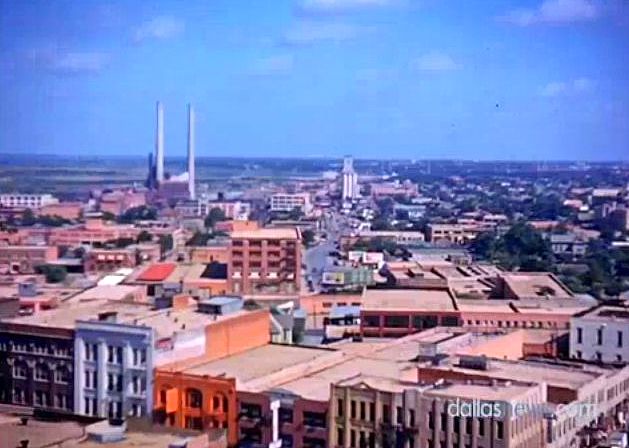
An unusual view of the smokestacks from 1939 — in color!

by Paula Bosse

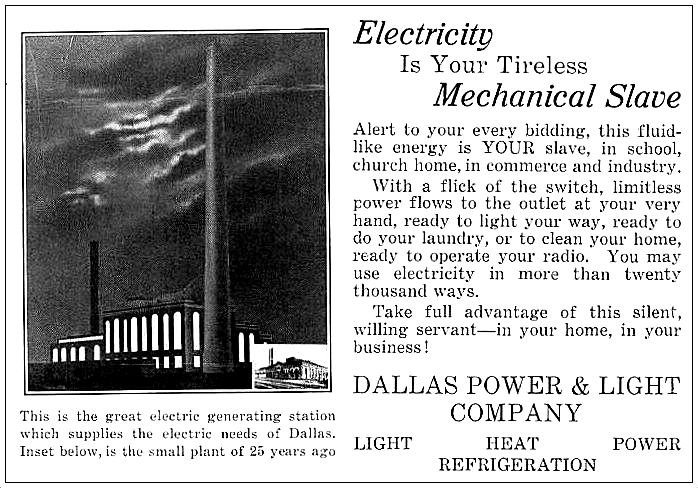
I got to thinking about those two smokestacks that used to be such an important part of the Dallas skyline when I came across this rather forceful 1928 Dallas Power & Light Company ad:

ad-dpl_terrill-yrbk-1928
(click for larger image)

“More than twenty thousand ways” to use electricity, “your tireless mechanical slave”! (To see a larger image of the ad’s illustrated inset, click here.)

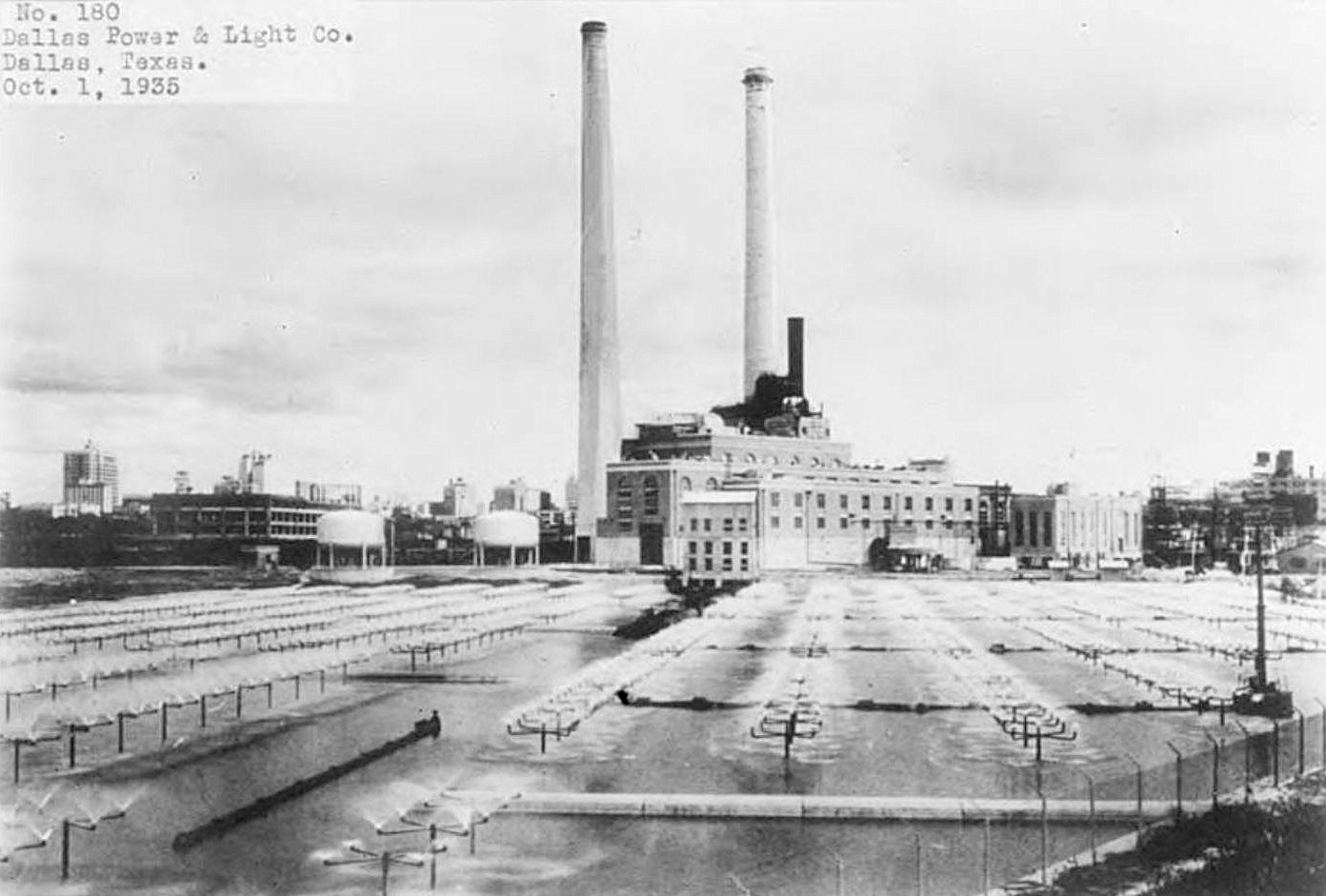
According to The Dallas Morning News, the Dallas Power & Light Company power plant had been in use at the location at “at the foot of Griffin Street … since 1890, with additions in 1905, in 1912 and in 1914. In 1922 work started on the most recent addition, which when completed will cost over $2,000,000, and will provide additional generating capacity of furnishing 20,000 kilowatts” (DMN, Oct. 14, 1923).

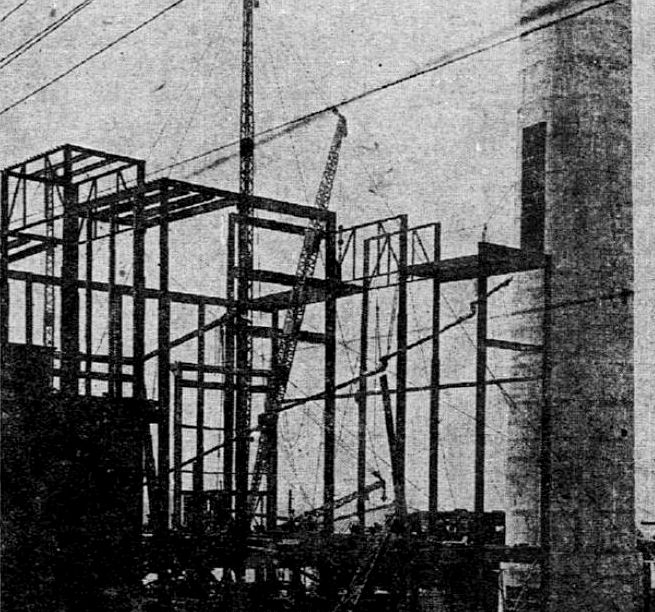
Construction on the new addition — including the first of the two new smokestacks — began in the summer of 1922.

dpl_dmn_FWST_072822Fort Worth Star-Telegram, July 28, 1922

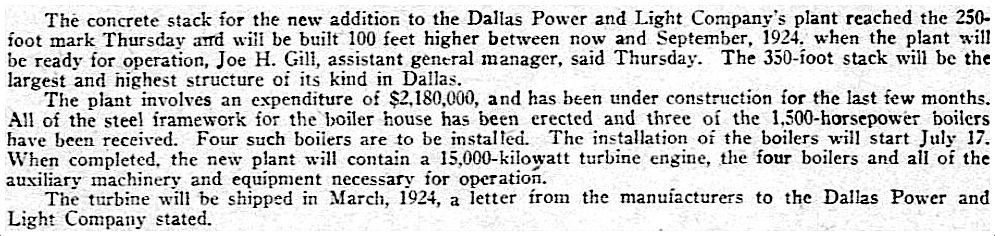
By the summer of 1923 the first smokestack was partially built.

smokestack_dmn_071323smokestack_dmn_071323-captionDMN, July 13, 1923 (click for larger images)

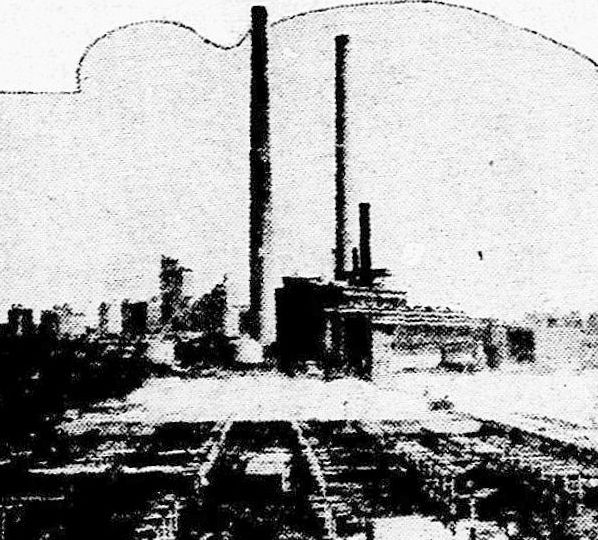
The new addition was completed in 1924 (although improvements and construction were constantly ongoing). The new giant smokestack can be seen in this photo, alongside the old and new parts of the generating plant:

dpl_dmn_101224_photo2DMN, Oct. 12, 1924

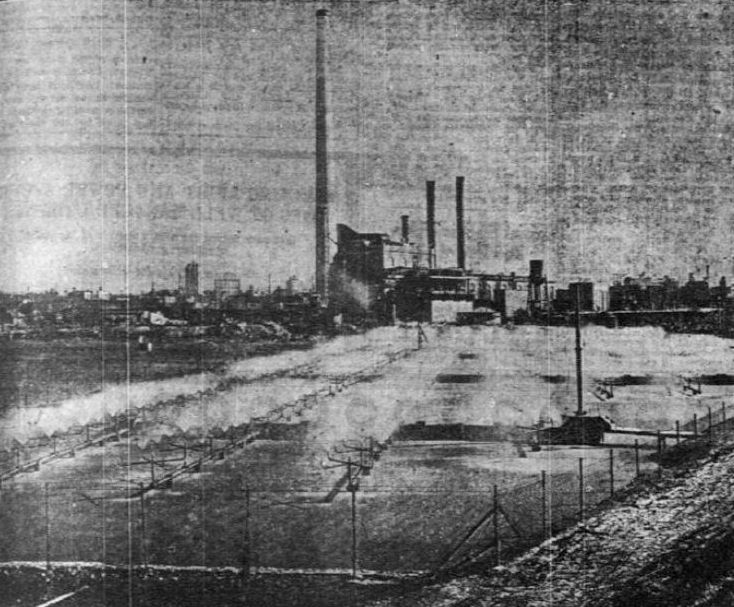
And, another view, this one with the 8-acre “spray pond” in the foreground:

dpl_dmn_101224_photoDMN, Oct. 12, 1924

In 1928 DP&L announced that it needed a further addition:

Another large chimney or smokestack, a new boiler room and other plant enlargements will be required in the North Dallas generation plant to house the new addition. (DMN, Oct. 20, 1928)

And in 1929 … voilà — the second smokestack!

dpl_steamstacks_1929
1929

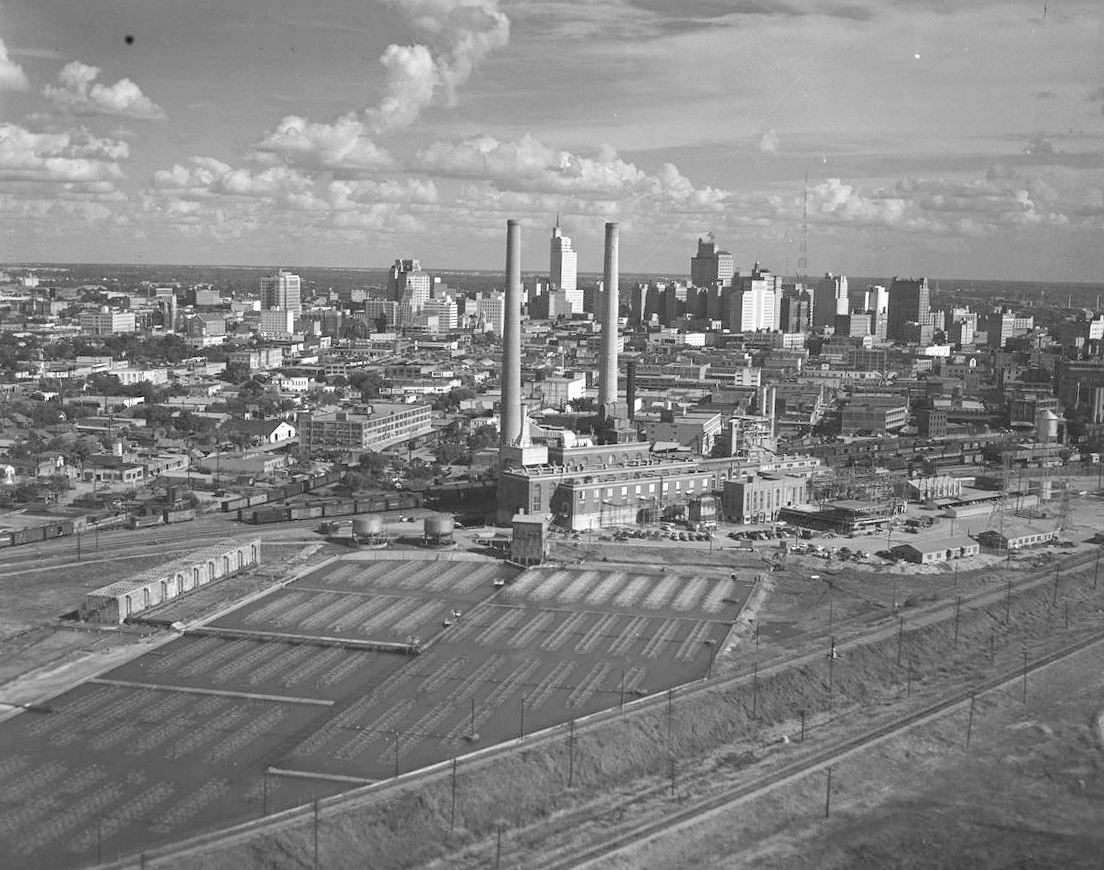
Those two smokestacks (which actually emitted steam rather than smoke) were almost as much a part of the iconic Dallas skyline as Pegasus. You’ll see them in any wide shot of the skyline taken between 1929 and the late 1990s, when the plant was demolished to make way for the American Airlines Center (the design of which actually is reminiscent of the building it replaced). You could see those smokestacks from miles away, and, even though they’ve been gone for more than 15 years, I still expect to see them standing there. RIP, smokestacks!

*

dallas-power-and-light_degolyer-lib_SMU1930s, via DeGolyer Library, Southern Methodist University

langley_skyline-horseback_c1945_LOCPhoto by William Langley, 1945 (with the twin stacks AND Pegasus)

dpl-plant_towers_squire-haskins_UTAvia Squire Haskins Collection, University of Texas at Arlington

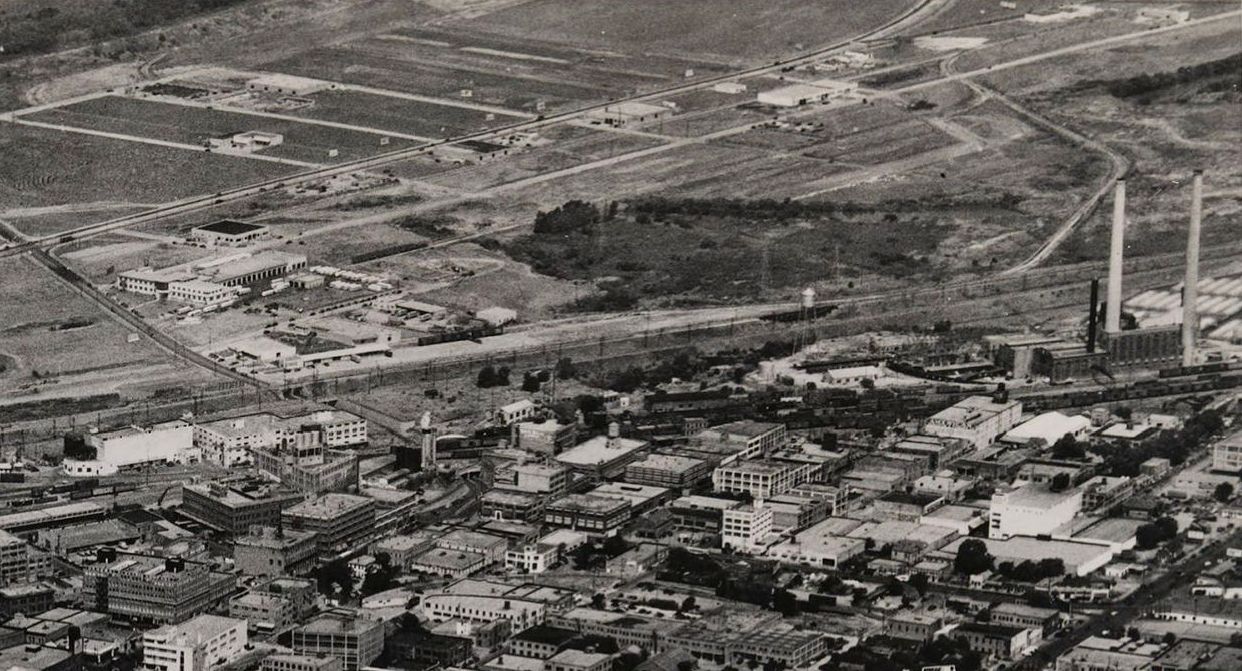
smokestacks_long_foscue_ca1948-detAerial photo by Lloyd M. Long, 1948 (detail)

dpl_steamstacks

***

Sources & Notes

Color image is a screengrab from the short 1939 color film of Dallas which you can watch in full, here.

Ad is from the 1928 Terrillian, the Terrill School yearbook.

William Langley photo of the cowboy on horseback is from the Library of Congress, used previously here.

Lloyd M. Long aerial photo is a detail of a photo cataloged as “Downtown Dallas — looking west,” from the Edwin J. Foscue Map Library, Central University Libraries, Southern Methodist University; the full photo and its details are accessible here.

For an unexpectedly enthusiastic essay about the design and cultural/aesthetic significance of the plant and its smokestacks, architecture critic David Dillon’s “Getting Up a Head of Steam: DP&L’s Power Station, Recalling an Urban Past, Is a Function of Triumph” (Dallas Morning News, Sept. 7, 1983) is well worth searching for in the Dallas Morning News archives. This is the first paragraph:

The Dallas Steam Electric Station on Stemmons is nearly a century old and for most of that time it has been a commanding presence on the downtown skyline, its soaring white smokestacks rivaling anything that modern skyscraper designers have come up with. In Pittsburgh or Detroit such a structure might pass unnoticed but in Dallas, never a factory town, it stands out as a romantic symbol of our earliest industrial aspirations.

(My favorite piece of trivia from Dillon’s article is the revelation that the “tapering white shafts and gold caps [were] touched up every few years by daredevil painters lowered from a helicopter…” (!)).

More about this plant (and how it lives on in the design of the American Airlines Center which now stands on the same land) can be found in the Flashback Dallas post “A New Turbine Power Station for Big D — 1907,” here.

As always, most images are larger when clicked. When in doubt … CLICK!

*

Copyright © 2015 Paula Bosse. All Rights Reserved.


A Distant Dallas Hall on the Horizon — 1914

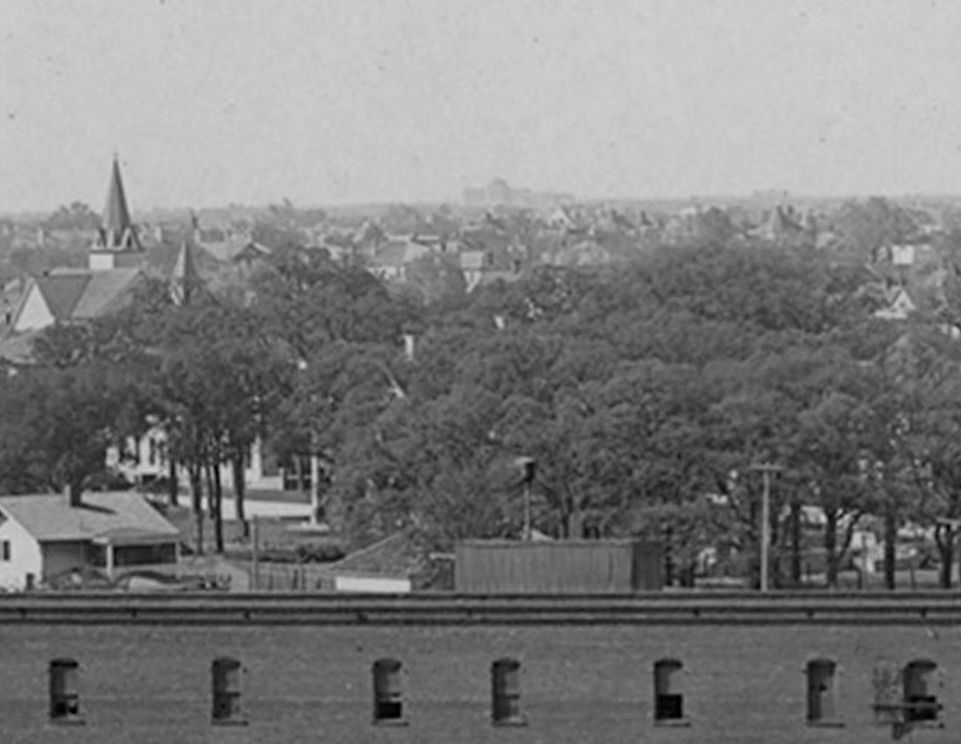
dallas-hall_continental-gin_det_1914A clear line of sight, from Deep Ellum to SMU (click for larger image)

by Paula Bosse

A quick “bonus” post: a detail of an incredible photo of the Continental Gin building which shows a ghostly Dallas Hall looming in the distance. Dallas Hall was the first building on the SMU campus, and in 1914 — a year before classes began — the far off building was way, way out in the country. SMU is a little over 5 miles from Deep Ellum. That’s quite a view.

***

This detail is from a photo featured in a previous Flashback Dallas post, “The Continental Gin Complex — 1914,” which can be seen here. I’ve just added this detail — and two other magnified details showing Baylor Hospital and the old Ursuline campus — to the post.

The original photograph, titled “Continental Gin Company on Elm Street, Facing North” by Charles Erwin Arnold, is from the George W. Cook Dallas/Texas Image Collection housed at the DeGolyer Library, Central University Libraries, Southern Methodist University. The photo and its details can be viewed here. It really is one of my favorite historical Dallas photos ever.

*

Copyright © 2015 Paula Bosse. All Rights Reserved.


“Mobile-Optimized,” Y’all!

howdy_postcard

by Paula Bosse

Howdy! For those of you who visit this blog while on a mobile device … good news! I’ve finally been able to start tweaking it so that reading it on a phone doesn’t cause a dull throbbing pain in your head. Perusing the site should now be a whole lot less annoying. As always, thanks for reading!

*

Copyright © 2015 Paula Bosse. All Rights Reserved.

Barges on the Trinity — 1906

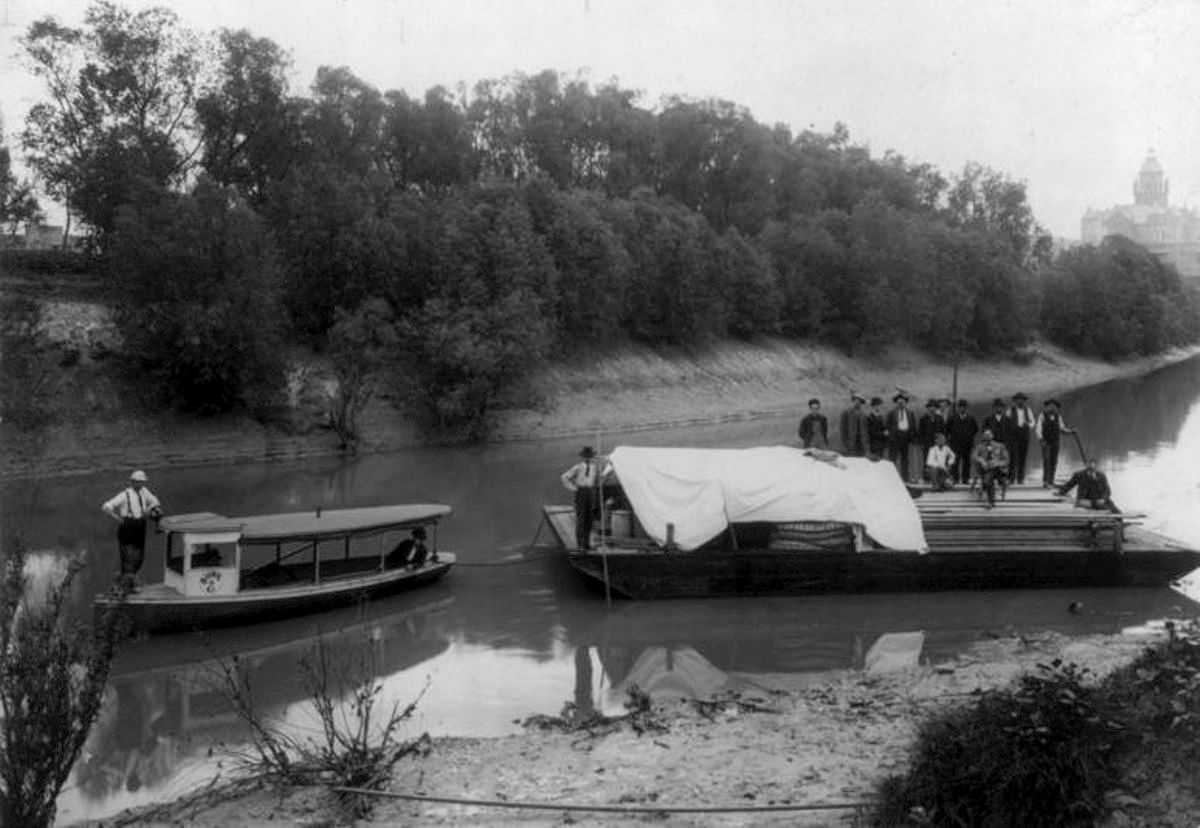
barge_trinity_clogenson_1906-LOC-1A confident crew, a stoic Old Red, and a stubborn river (click for larger image)

by Paula Bosse

“A navigable Trinity.” For over 150 years, people have hoped against hope that the Trinity River might one day be made into a commercial waterway, navigable from the Gulf of Mexico to Dallas. For over a century, federal, state, and local funds were optimistically (misguidedly?) poured into various hopeless plans and projects — but not a one was successful.

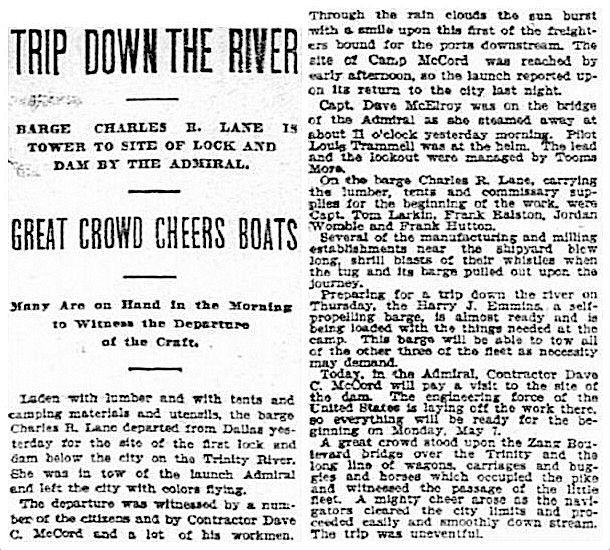
In 1906, construction was to begin on one of these projects — a series of locks and dams downriver of Dallas. Above and below are photographs showing the barge Charles R. Lane loaded with lumber and camp provisions, which were to be towed by the launch Admiral to McCommas Bluff, where the first lock was to be built. The above photo ran in the May 1, 1906 edition of The Dallas Morning News above the following caption:

Contractor’s barge, loaded with supplies, about to depart from Dallas for the site of the first lock and dam down the Trinity River.

Below, the story that accompanied the photo. (Click for larger image.)

barge_trinity_dmn_050106DMN, May 1, 1906

barge_trinity_clogenson_1906-LOC-2Dudes and fat-cats, with dollar signs in their eyes (click for larger image)

Later that month, a barge excursion to the site of the future lock was arranged for interested parties. This “merry crowd” of curious looky-loos was towed down the river to McCommas Bluff where they de-barged to tour the site and have a picnic lunch atop the picturesque bluff. They returned to Dallas happy and excited, convinced that maybe — just maybe — the Trinity would finally be tamed!

barge_trinity_dmn_052806DMN, May 28, 1906 (click for larger image)

Giddy enthusiasm about the project was all over the pages of The Dallas Morning News:

The time for doubter and pessimist has passed, and belief in the certainty of the practical navigation of the Trinity now appears unanimous. (DMN, May 2, 1906)

Well-intentioned though this wishful thinking might have been, “certainty” is probably not a word that should be tossed around so lightly. And certainly not in the case of anything having to do with the Trinity.

I bet that poor river just wishes people would leave it alone.

***

Sources & Notes

Both photographs taken by Henry Clogenson; from the collection of the Library of Congress, here and here.

“Trinity River Navigation Projects” entry from the Handbook of Texas is here.

History and photos of the McCommas Bluff Preserve and Trails area (including an interesting photo of Dam #1 from about 1910) can be found on the Dallas Trinity Trails blog, here.

An essential history of the various failed attempts over the years to open up a navigable Trinity between Dallas and the Gulf of Mexico can be found in “Navigating the Trinity: A Dream That Endured for 130 Years” by Jackie McElhaney; the article from the Spring 1991 issue of Legacies can be read here.

An interesting page from the American Canal Society Canal Index — with an illustration of the location of the locks — can be accessed here.

To watch a soothing video shot in the area of the abandoned Dam #1 at beautiful McCommas Bluff, click here.

A related Flashback Dallas post — “Snag Boat Dallas — 1893” — can be found here.

Click pictures for larger images.

*

Copyright © 2015 Paula Bosse. All Rights Reserved.


The Adolphus & Its Annex

adolphus_lang-witchell_arch-yrbk_1922The Adolphus Hotel and its annex, circa 1922 (click for larger image)

by Paula Bosse

Built in 1912, the ornate and luxurious Barnett, Haynes, and Barnett-designed Adolphus Hotel (which was modeled on/inspired by the Plaza Hotel in New York) quickly became THE hotel in Dallas. It was so successful that in only four years an expansion was already underway. The 12-story “Annex” (seen above, just to the left of the original building) was designed by preeminent Dallas architects Otto Lang and Frank Witchell. The so-called “Junior Adolphus” was built around 1916/17 and added 229 rooms to Dallas’ most glamorous hotel. A third addition (“Adolphus III”) came along in the 1920s.

Below, a few views of the Adolphus complex at different stages of its growth. (Click photos for larger images.)

*

adolphus-construction_dallas-then-and-nowBuilt at the northwest corner of Commerce and Akard streets, the Adolphus Hotel was built on the spot previously occupied by the City Hall. This photo, looking northeast, shows the site’s excavation by Vilbig Brothers Construction.

*

1913-pano-2In this detail from an April 1913 panoramic photograph of the city’s skyline, the Adolphus can be seen just six months after its opening at the end of 1912. (A previous post devoted to the full panoramic photo can be accessed here.) The Oriental Hotel, with its rounded topknot, can be seen across Commerce from its sister hotel (both were built by beer king Adolphus Busch). Seen in the background is the Praetorian Building — once the tallest structure in Dallas (it is the tall building, second from the right).

*

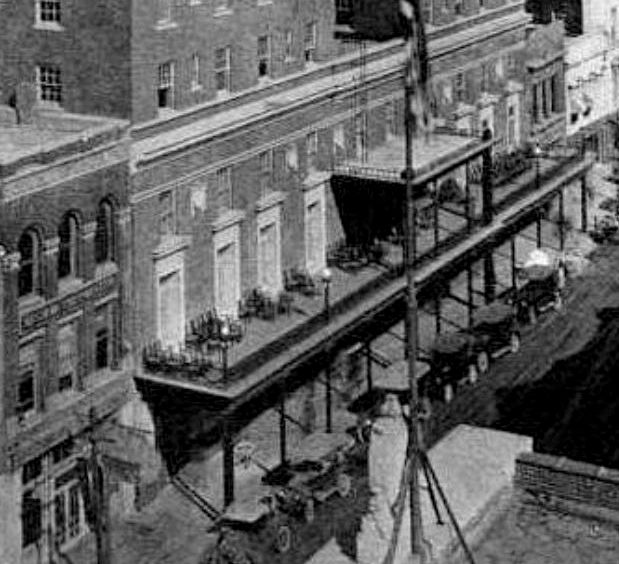
adolphus_lang-witchell_arch-yrbk_1922-detThe the Lang & Witchell-designed annex came along around 1916/17 (see top photo). My favorite detail is what looks like an open-air terrace, with tables and chairs, overlooking Commerce Street.

*

adolphus-annex_dallas-hotelsAnother view, showing the hotel and annex in 1924.

*

adolphus-annex_dallas-hotels-detA closer look shows that the terrace is now enclosed.

*

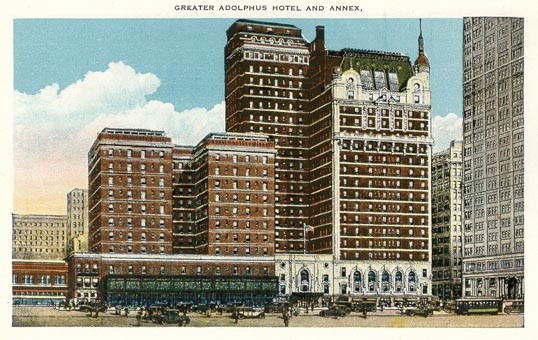
adolphus-hotelA few years later, a further, taller addition was built.

***

Top photo from the 1922 Yearbook of the Dallas Architectural Club.

Photo of the excavation from Dallas Then and Now by Ken Fitzgerald (San Diego: Thunder Bay Press, 2001); photograph from the Texas/Dallas History and Archive Division of the Dallas Public Library. A similar photo can be seen on the fascinating history page of the Vilbig & Associates website, here.

Detail of 1913 panoramic photo from the Jno. J. Johnson photo in the Library of Congress. (For more info, see previous post, “‘New Dallas Skyline’ — 1913,” here.)

Photo of the Adolphus with the Coca Cola sign in the lower left from Historic Dallas Hotels by Sam Childers (Charleston: Arcadia Publishing, 2010). The author’s extremely informative caption can be read here.

See a wonderful pictorial history of the Adolphus Hotel on the Dallas Morning News website here.

The official website for the Adolphus Hotel is here.

Click photos for larger images.

*

Copyright © 2015 Paula Bosse. All Rights Reserved.


Aerial View of the Centennial Fairgrounds — 1936

fair-park_1936_red-oak-kidThe Texas Centennial: a “World’s Fair” for Dallas

by Paula Bosse

This fantastic photo (by one of Dallas’ top aerial photographers, Lloyd M. Long) shows the impressive expanse of Fair Park’s new Art Deco splendor — most of the buildings seen here were built especially for the 1936 Texas Centennial Exposition, and most of those are, thankfully, still standing.

***

Sources & Notes

Lloyd M. Long photo, found on Red Oak Kid’s Flickr stream, here.

To see this photo REALLY big, click here.

*

Copyright © 2015 Paula Bosse. All Rights Reserved.

“New Dallas Skyline” — 1913

1913-pano-3Dallas skyline panorama detail, 1913 (click for larger image)

by Paula Bosse

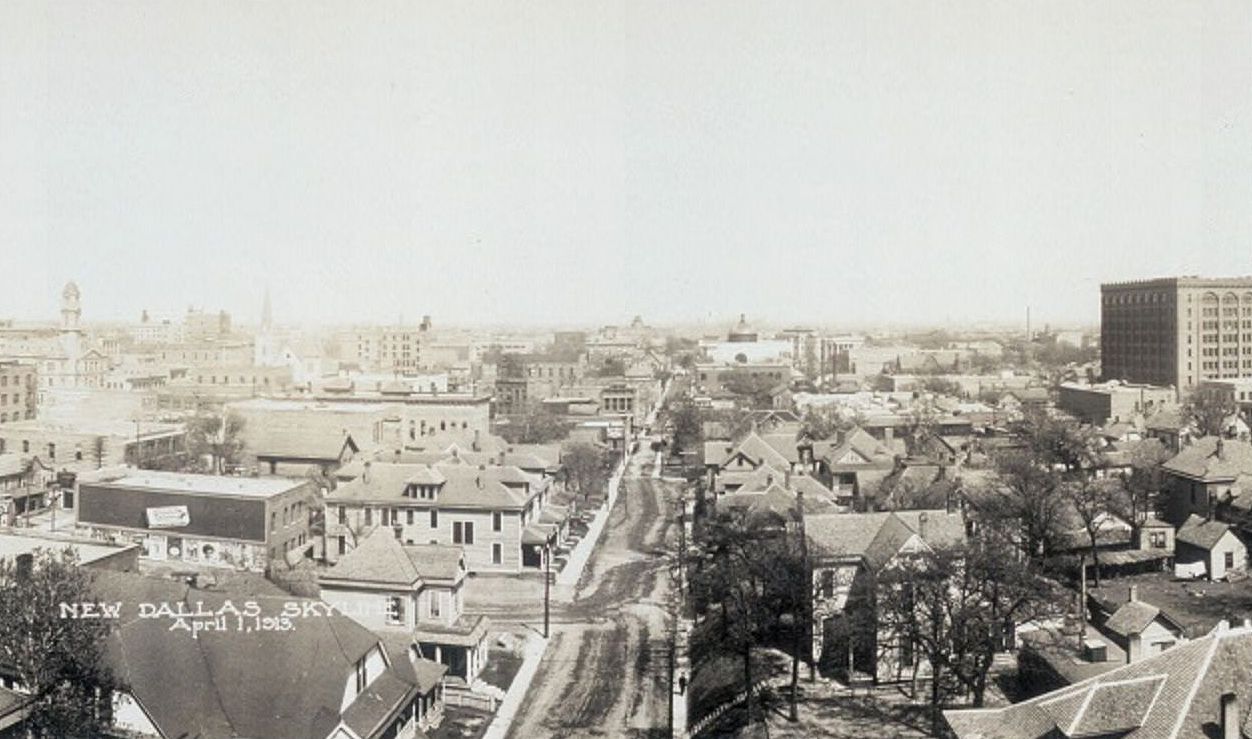
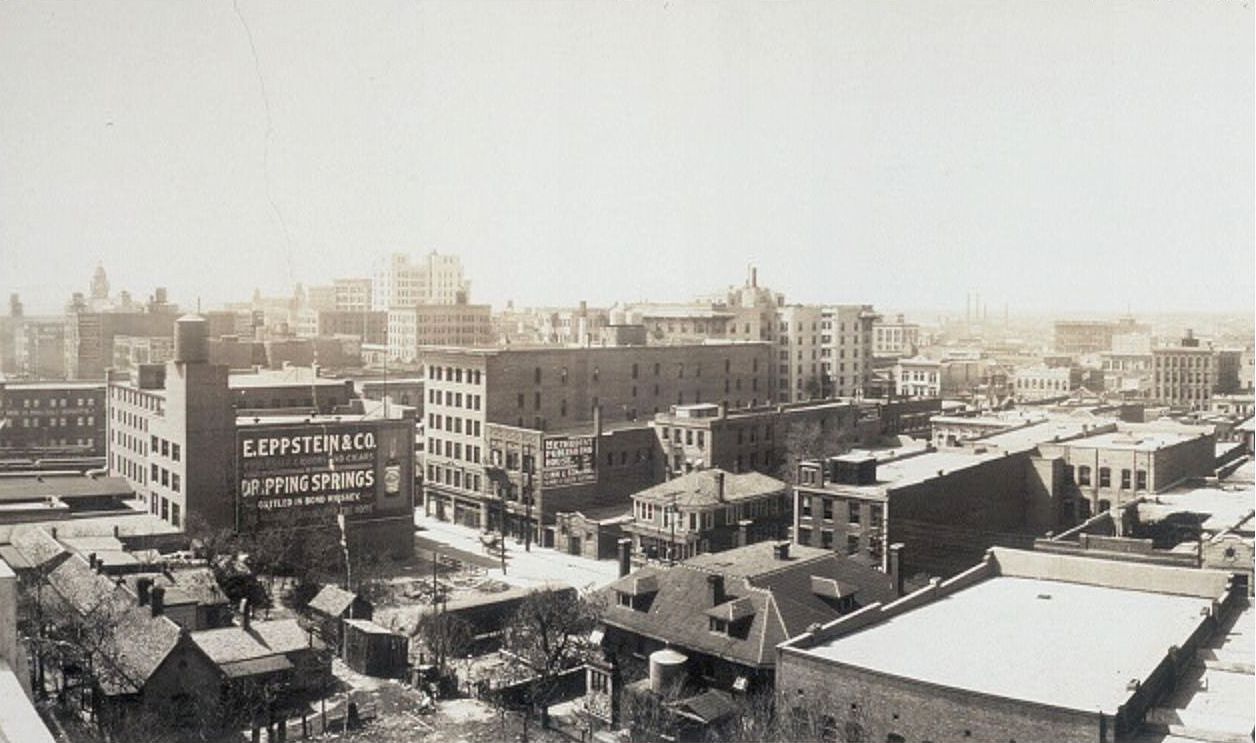
On April 1, 1913, one of Dallas’ most prominent photographers, Jno. J. Johnson, took a wonderful panoramic photo of the Dallas skyline. Dallas was, even then, boasting an impressive skyline. I’ve zoomed in a bit on the photo, breaking it down into four separate images. Johnson’s original photograph, titled “New Dallas Skyline — April 1, 1913,” is below. (Click to enlarge all images.)

dallas-panorama-skyline_april-1913_LOC(Click this photo!)
*

Below, the first portion of the photo.

1913-pano-1E. Eppstein & Co., wholesale distributors of whiskey and cigars, was at 1300-1302 Jackson.

*

1913-pano-2Above, the second portion, showing S. Akard Street, looking north — at the end of the street is the 6-month old Adolphus Hotel (then the tallest building in Dallas), built by beer baron Adolphus Busch, located on Commerce Street, catty-corner from his other hotel, The Oriental (the darker building in the center, with the distinctive top-knot on its northwest corner). The Praetorian Building (on Main) — a previous “tallest building in Dallas” — is the still tall-ish white building, second from the right.

*

The third portion (at the top) shows, I believe, Wood Street, looking east. The Post Office tower on Commerce can be seen at the far left. At the top, to the right of Wood Street (at S. Harwood) is the still-familiar sight of the First Presbyterian Church dome (brand new — the paint inside and out was probably still wet when this photograph was taken); to the right of the dome is the also-still-standing (and beautiful!) Scottish Rite Temple, also brand new.

*

1913-pano-4The final portion shows what I guess would be considered the northern edge of The Cedars? I love old photos that show residences in what we now consider the Central Business District. It’s so weird seeing these houses! The hulking turreted building at the top is Butler Brothers (built in 1910-11) at 500 S. Ervay; it later changed its name to the Merchandise Mart, and it is now undergoing renovation.

***

Panoramic photograph by Jno. J. Johnson, from the Library of Congress, here.

For those who want to play along at home, a 1919 street map of the area can be found at the ever-indispensable Portal to Texas History, here.

Click pictures for much larger images.

*

Copyright © 2015 Paula Bosse. All Rights Reserved.

The Elegant Municipal Building — 1914

ciA very un-Dallas-looking building … and one of its finest

by Paula Bosse

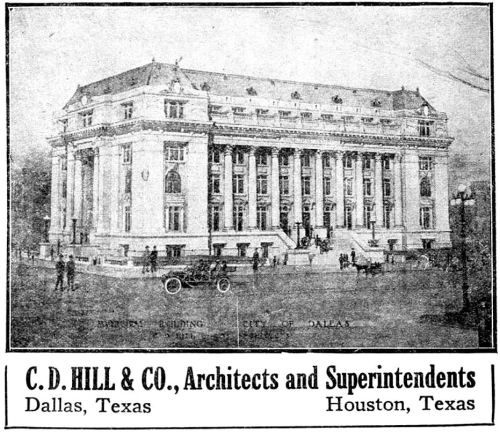
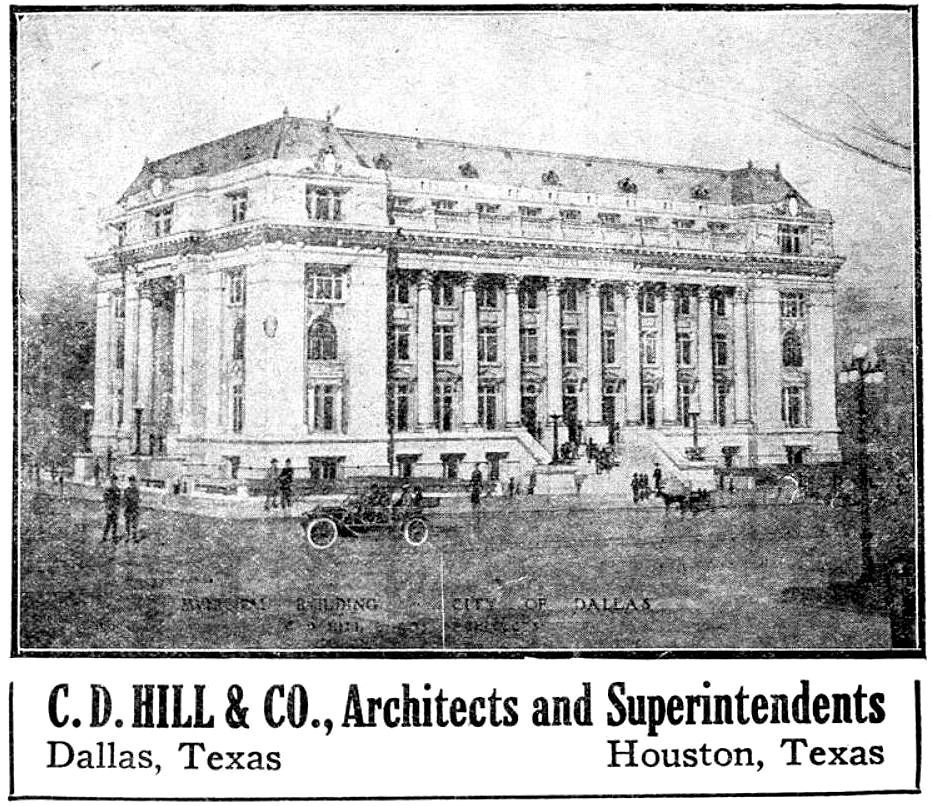
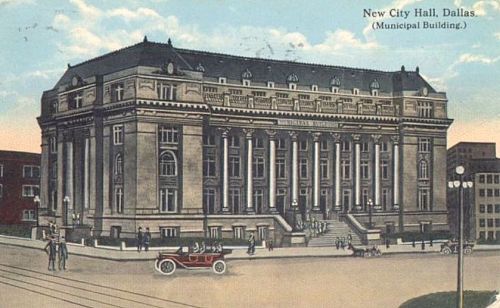
Appearing in the May 7, 1914 issue of Municipal Journal was a short article on Dallas’ then-under-construction Municipal Building and a drawing of what it would look like when completed.
municipal_bldg_watermelon-kid

Dallas Will Have Modern Municipal Building
Dallas, Tex. – The new municipal building of the city of Dallas is nearing completion and will be ready for occupancy in a few months. It will house all of the city departments and in addition will have a modern emergency hospital in the basement and public rest rooms for both men and women. The building is said to be a radical departure in architectural design from the usual type of public buildings in the South; it is constructed along simple but dignified lines. The structure will be of steel construction covered with blue Bedford stone, the five stories, basement and sub-basement will be a home worthy of the city of the hour, as Dallas people like to call their town. Ventilating and heating systems are being installed together with vacuum cleaners. The building, without furnishings, will cost about $550,000. C. D. Hill and Company are the architects. The structure was started by the Fred A. Jones Building Company, which failed just as the steel was up, and it is being finished within the estimates by the city under the supervision of the architects.

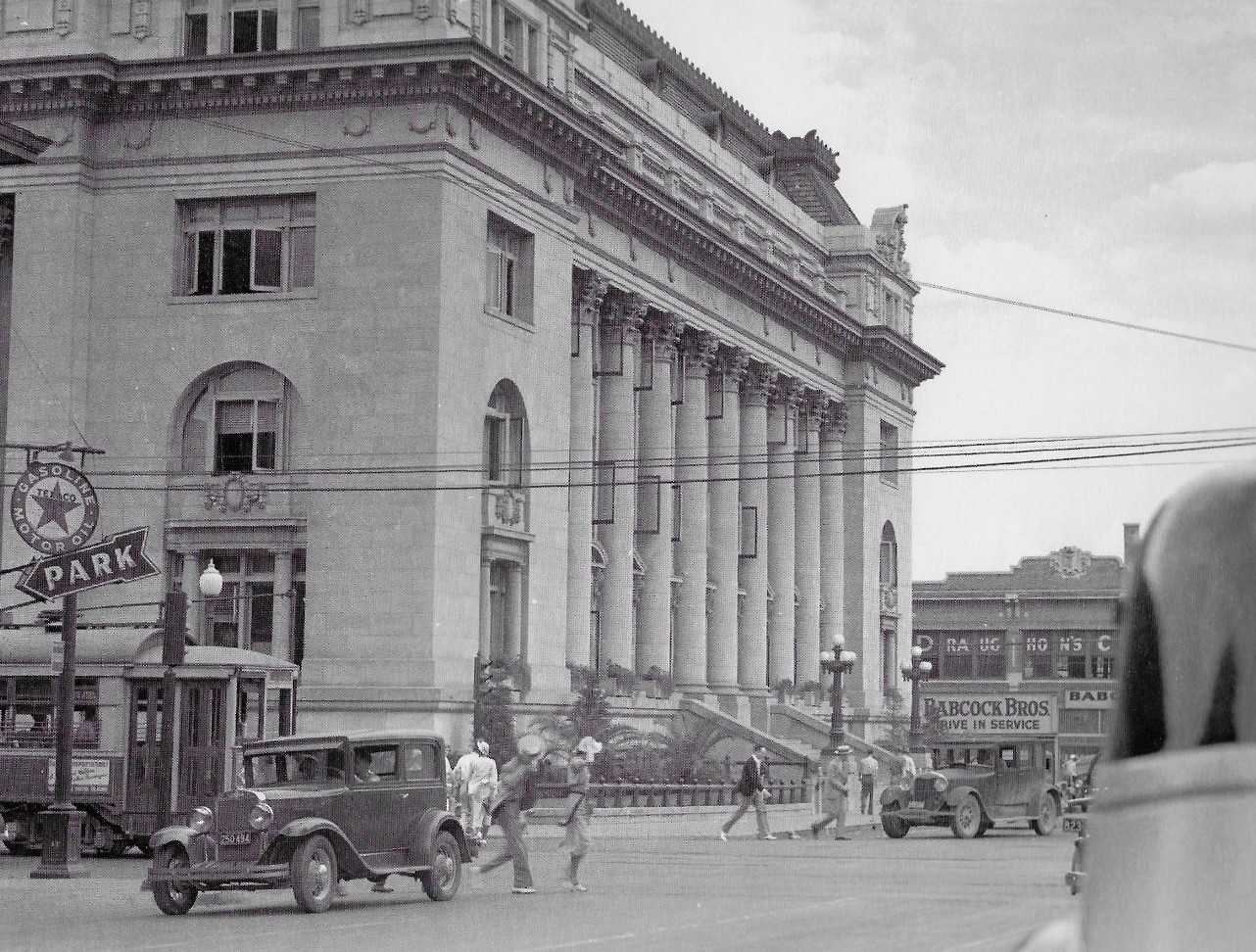
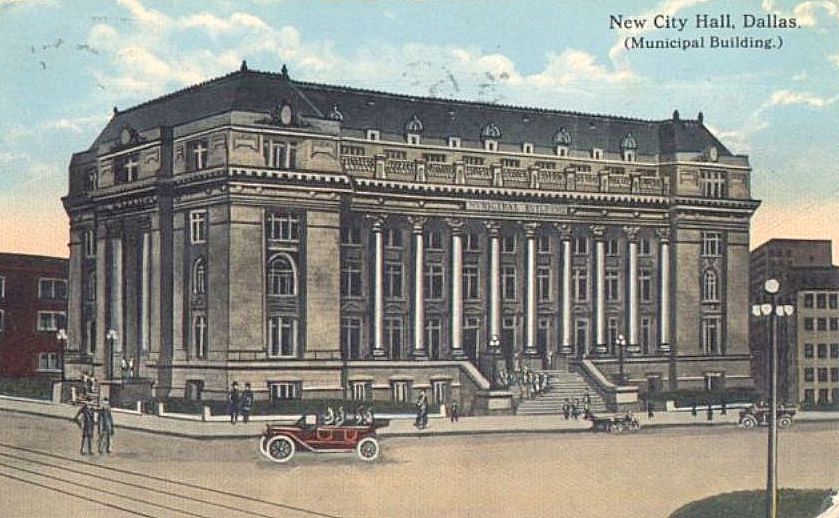
This new City Hall, located at Main, Harwood, and Commerce, was designed by Dallas architect C. D. Hill. Construction began in late 1913 — by January of 1914, its steel frame was in place.
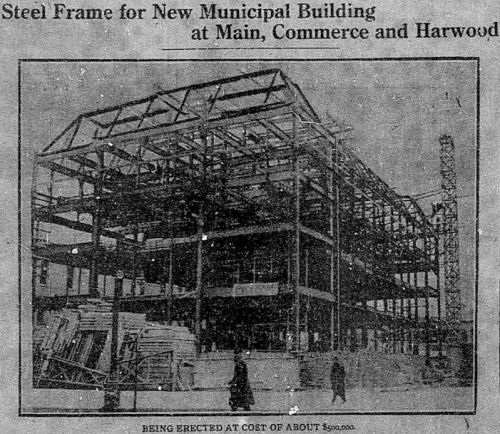
municipal-bldg_dmn_010114Dallas Morning News, Jan. 1, 1914

The cornerstone was laid in a Masonic ceremony on Valentine’s Day, 1914.

municipal- bldg_FWST_021514-cornerstoneFort Worth Star-Telegram, Feb. 15, 1914

As the construction was winding down, workmen complained of an “intolerable” swarm of mosquitoes flying around the site. Apparently an underground spring was flooding the sub-basement and providing palatial digs for endless cycles of constantly-hatching mosquitoes. (I wonder if the basement still floods on occasion?)
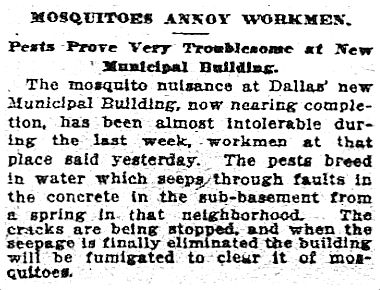
municipal-bldg_dmn_091014-mosquitoesDMN, Sept. 10, 1914

The building was officially opened on October 17, 1914. Here’s a grainy photo that absolutely does not do that beautiful building justice.

municipal-bldg_dmn_101714DMN, Oct. 17, 1914

When the doors were finally opened to the public, it was expected that a few thousand people would show up to tour their new municipal building — in actuality, the much-larger-than-anticipated crowd numbered somewhere between 12,000 and 15,000 curious Dallasites.

municipal-bldg_dmn-101814DMN, Oct. 18, 1914 (click for larger image)

The beautiful exterior was faced with granite and stone, and the interior boasted marble, mosaic tilework, and wood paneling. All of the furniture used in the building was made in Dallas. In addition to the mayor’s office, fire, police, and other municipal departments, the building also housed an emergency hospital, a sub-basement shooting range (!), and, on the 3rd floor, an 1,100-seat auditorium, with a 4th-floor gallery. (The auditorium was designed so that if, in the future, it was determined that it was not needed, it could easily be converted to office space by adding a few columns and beams — a renovation which obviously happened at some point.) Interestingly, the northern half of the top floor was left unfinished as the space was not needed at the time.

ALSO included in the new building’s amenities were much-needed public restrooms (or as they were euphemistically referred to back then, “comfort stations”). A men’s restroom and a women’s restroom (“positively divided with heavy walls”) were located under the Main Street sidewalk, accessible down stairs on either side of the building’s entrance. Up until this point, there was only ONE public “comfort station” in the city (for women and children) — at Fair Park. So for most downtown visitors, this might well have been the most exciting aspect of Dallas’ newest landmark.

The building referred to as both “City Hall” and “the Municipal Building” was considered to be one of the city’s finest and most elegantly imposing. But there are always a few people who just don’t like nice things, and there was a surprising amount of vandalism to the building in its first few weeks.
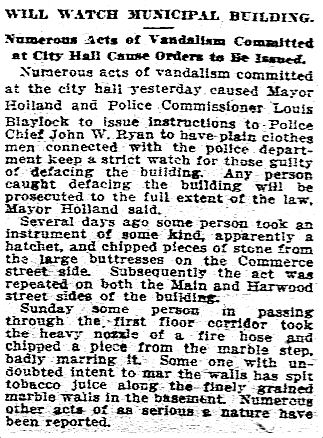
municipal-bldg_dmn_111014-vandalismDMN, Nov. 10, 1914

This is one of the truly great buildings in Dallas, and it just recently celebrated its 100th birthday. It is a Dallas Landmark and a Texas Recorded Historic Landmark. No longer a city property, it is now part of the University of North Texas Dallas College of Law campus (along with the old Titche’s building). UNT is currently working to restore and renovate this beautiful historic building. Thank you, UNT!

*

A few images of the building over the years. Here it is in its pristine early days:
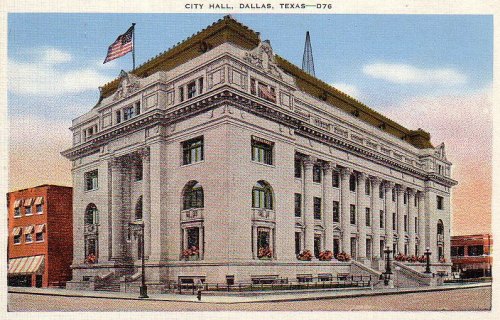
city_hall*

Then there was a weird middle-age-crazy period when someone thought that the addition of awnings would be a good idea (that person was incorrect).

municipal-bldg_color-ebay*

And, today, it’s back to looking distinguished and lovely. Thanks to the wonderful new open park in front of it, it has been given the stately space it deserves — what may be Dallas’ most beautiful building is finally able to be fully admired from a respectful distance.
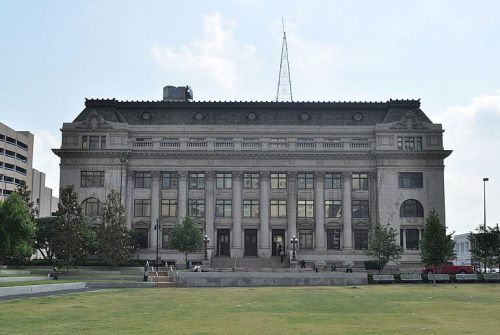
municipal-bldg-today_wikipediaJoe Mabel, Wikipedia

***

Sources & Notes

Top photo from the book Historic Photos of Dallas by Michael V. Hazel (Nashville: Turner Publishing Co., 2006).

Quote from Municipal Journal, Vol. XXXVI, No. 19 — May 7, 1914.

Photo of the old Municipal Building today by Joe Mabel, from Wikipedia. (And, yes, the parking garage of the Dallas Municipal Building is where Ruby shot Oswald.)

Newspaper photos and clippings as noted.

For a detailed description of the architectural details, design elements, and description of office and department locations within the building, see the article “Municipal Building Handsome Structure” (DMN, Oct. 4, 1914), here.

I’d love to know more about the little “aluminum trays, bearing a picture of the building” mentioned as being given away on opening day in an article above. There were FIVE THOUSAND of them given away. Surely there are some still around. Has anyone seen one of the these?
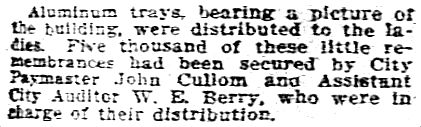
municipal-bldg_dmn_101814_aluminum-traysDMN, Oct. 18, 1914

municipal-bldg_c-d-hill_tx-almanac_19141914 Texas Almanac ad for C. D. Hill & Co.

*

Copyright © 2015 Paula Bosse. All Rights Reserved.

Iola Bridge

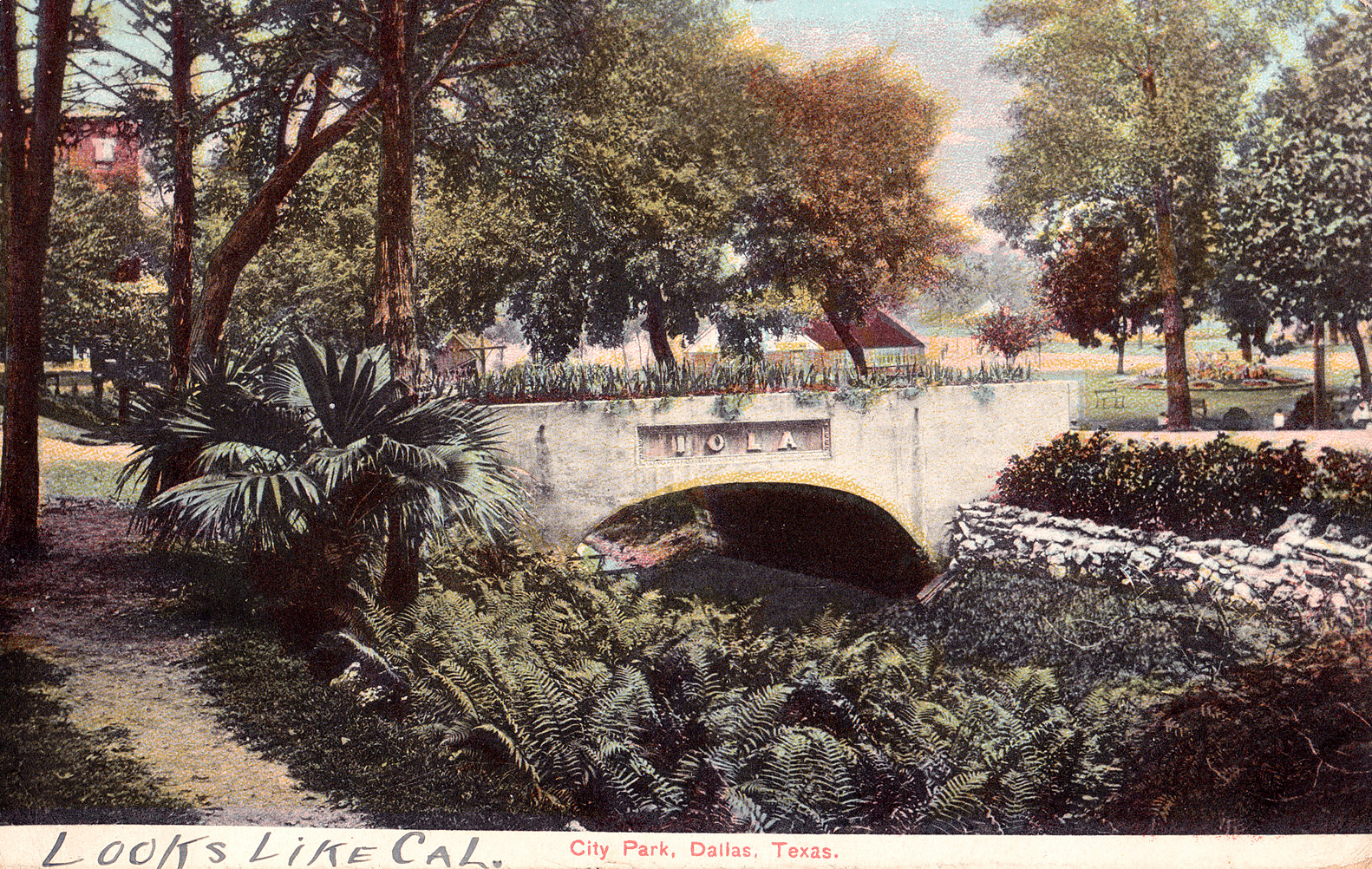
iola-bridge_city-park_ca-1908“Looks like California…” — City Park, ca. 1908

by Paula Bosse

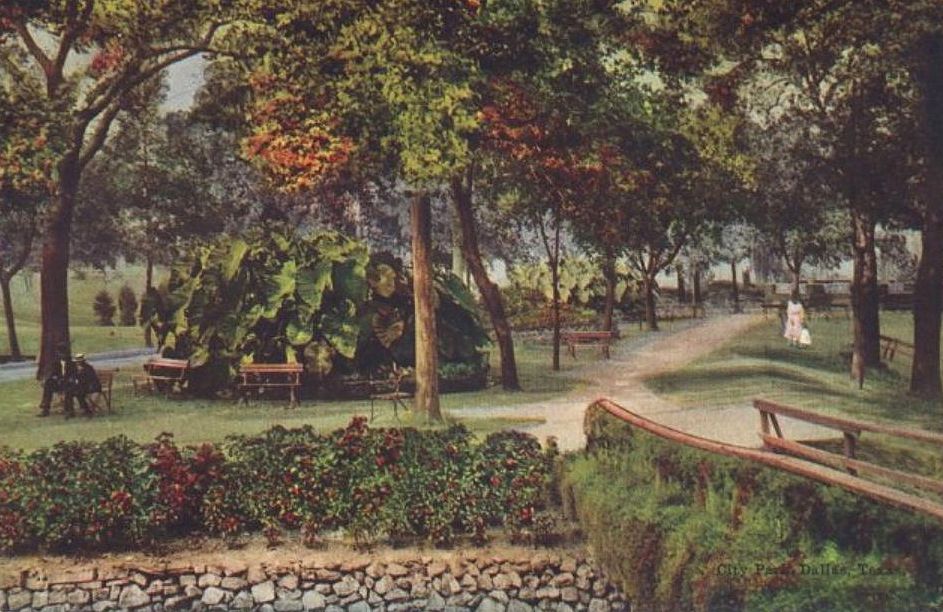
Old postcards of (Old) City Park always seem kind of mysterious to me. I’m fascinated by photos of what was, for many years, Dallas’ only park. It was very big and beautifully landscaped — and it was one of the things about the city that those of earlier generations were most proud of. The postcard views above and below are from the early days of the twentieth century, and, sadly, those views don’t exist anymore — it’s hard to believe they EVER existed here. Even though there’s a hint of what you might see at Reverchon Park, there’s little else about these images that looks like the Dallas of today. What a shame!

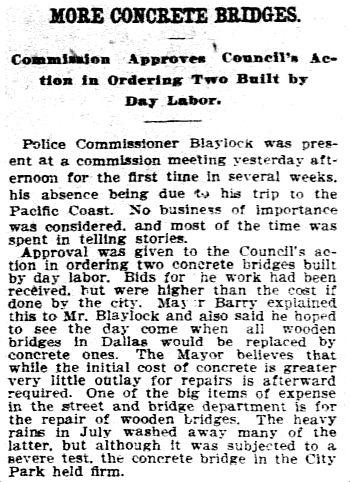
But what’s the story behind the attractive little “Iola” bridge? Built in 1905, it was, apparently, Dallas’ first (or possibly second) concrete bridge. The Iola bridge was far sturdier than the wooden bridges around Dallas, and a concrete bridge also required very little upkeep. In fact, this little bridge “of ornamental design” is actually kind of important — it was often cited by city planners and commissioners when discussing the construction of future bridges around the city.

concrete-bridges_dmn_081005Dallas Morning News, Aug. 10, 1905

It seems wooden bridges were being washed away almost as often as Dallas courthouses were burning down. In a letter that appeared in The News on Feb. 21, 1911, it was noted that, while wooden bridges were “under constant repair,” the concrete Iola bridge “has not required one dollar of outlay […] during its six years of existence.” So … cheaper and sturdier. Bye-bye, wooden bridges!

But “Iola”… where did that name come from? I thought it might have been the name of a wife or mother of a mayor or planner, but I suspect it was merely the name of the company that donated the cement for the bridge’s construction, the Iola Portland Cement Company. The company’s canny “civic donation” ultimately paid off BIG for them in the end. Not only did they supply the cement to build that first very pretty little bridge in a very pretty park, they also, ultimately, got whopping new orders from the city for all those new concrete bridges that began to be built — including, less than ten years later (when the Iola company’s West Dallas plant had been sold to the TEXAS Portland Cement Co.), the Trinity River-spanning Oak Cliff/Houston Street viaduct, which, when it opened in 1912, was the longest concrete bridge in the WORLD! And it all began with that unassuming bridge in scenic City Park, just south of the central business district.

*

iola-bridge_watermelon-kid

iola-bridge_dmn_100921aDMN, 1921

Below, a couple of views showing the charming and rather more rustic wooden bridges in the park.

bridge_city-park_watermelon-kid

wooden-bridges_city-park_watermelon-kid

iola-cement_directory-1905Ad from the 1905 Dallas directory

***

Sources & Notes

Top postcard found somewhere on the internet. All other postcards from The Watermelon Kid — here.

Black and white photo by Victor H. Schoffelmayer appeared in The Dallas Morning News on Oct. 9, 1921; it was one of several photographs of the Iola bridge, taken by members of the Dallas Camera Club.

A Dallas Morning News article from July 14, 1905 detailing the new improvements to City Park (including the concrete bridge) can be read here. (I don’t think the really wonderful-sounding “cascade” was ever built — and that’s a pity, because it sounds like it would have been beautiful!)

*

Copyright © 2015 Paula Bosse. All Rights Reserved.