Flashback : Dallas

A Miscellany: History, Ads, Pop Culture

Tag: Dallas TX

No-Context Channel 8 Screenshots: 1970-1971

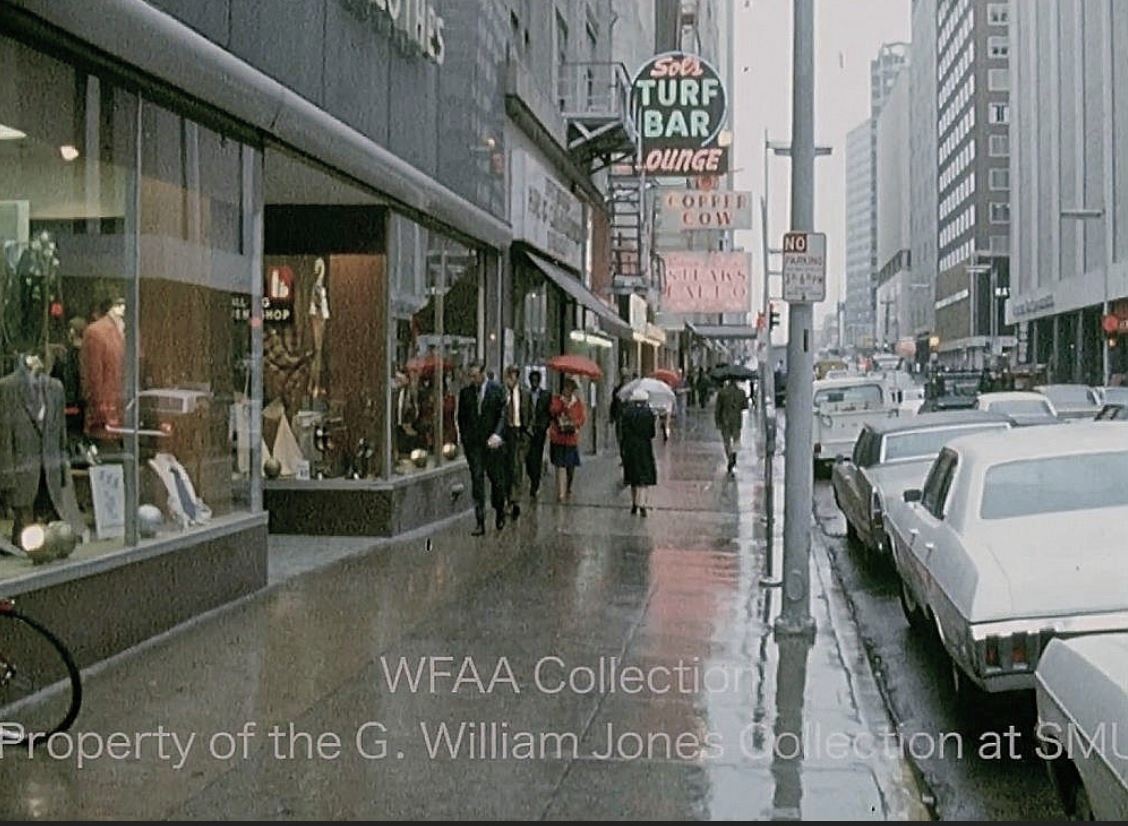
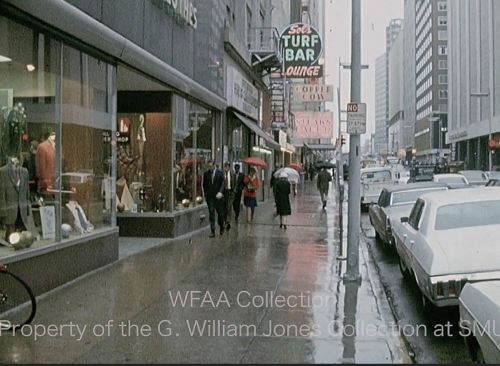
sols-turf-bar_commerce-st_apr-1971_WFAA SMUSlip into Sol’s for a quick one on a rainy afternoon

by Paula Bosse

I’ve mentioned that I have been working in the WFAA Newsfilm Collection, which is part of the G. William Jones Film and Video Collection at SMU’s Hamon Library. It’s a lot of fun going through all this footage (even though I have to grin and bear it a bit through all the sports and Commissioners Court meetings!). I thought I’d compile a bunch of random screenshots I’ve collected over the past few months of images I’ve found interesting. They are all from 1970 and 1971. (The link to the YouTube video the screenshot comes from is at the end of the paragraph. Each of these YouTube videos has a description of what’s going on in the clips — click “Show More” to see the full description.)

*

Above, a rainy day on Commerce Street, looking east toward Ervay. Sol’s Turf Bar (great sign!) is seen at 1515 Commerce, next to The Copper Cow. (Apr. 17, 1971)

*

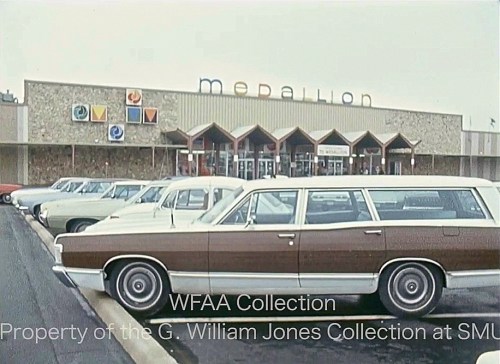
Below, Medallion Center, at Northwest Highway and Abrams. I posted this on the Flashback Dallas Facebook page and on Instagram and was surprised by how enthusiastically people responded to it. I was really happy to see this brief shot show up in news footage. Instant nostalgia. I remember being in that store a LOT. (Dec. 20-21, 1970)

medallion_dec-22-23-1970_WFAA_SMU

*

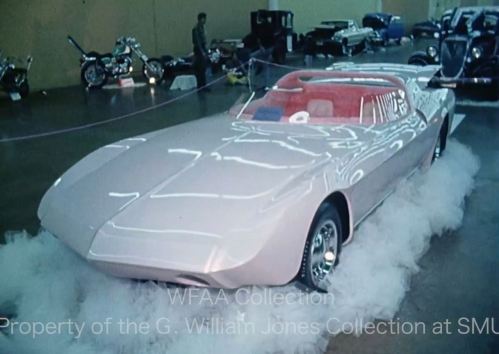
Texas Autorama. Pink car! (I wrote a bit about this fab powderpuff of a car, customized by Arlington’s Bill Meador, here.) A short “curated” clip of cars from this show is here. (The footage is also part of the full collection of that day’s clips here: Jan. 18-19, 1971)

pink-car_TX-autorama_jan-1971_WFAA_SMU

*

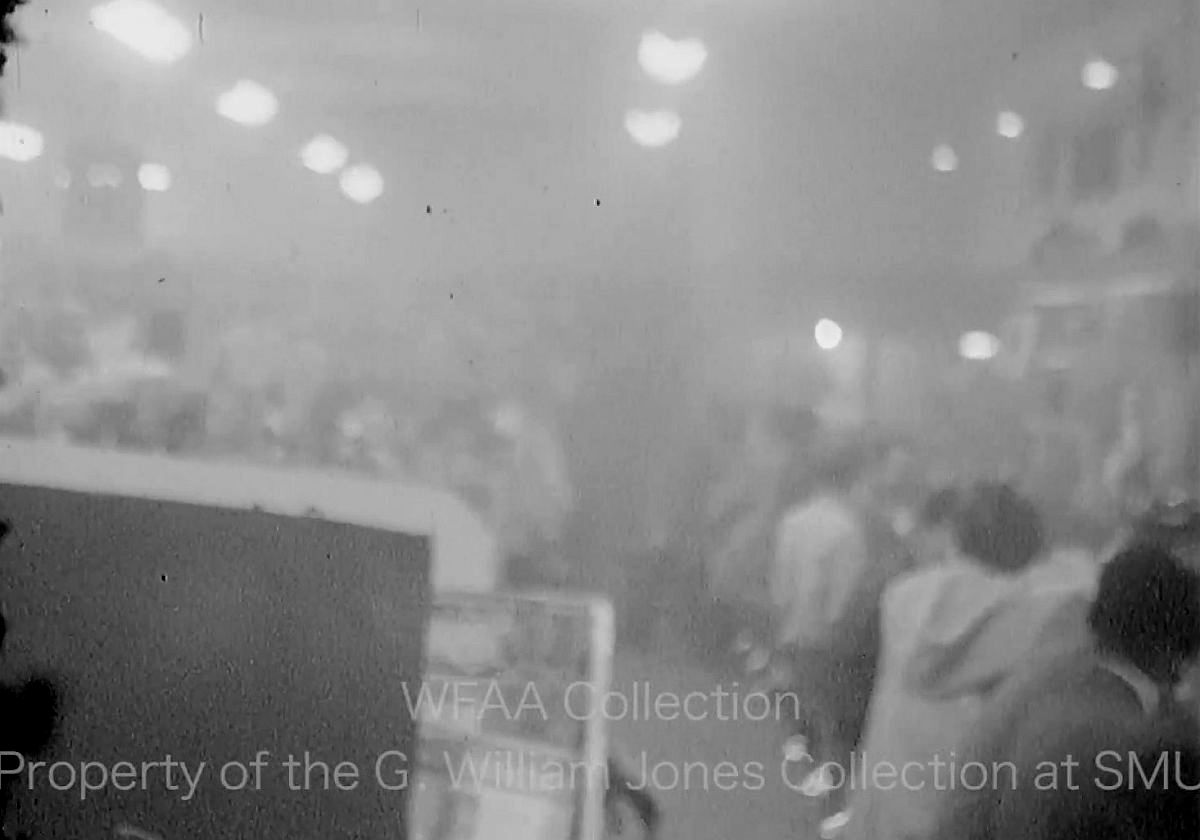
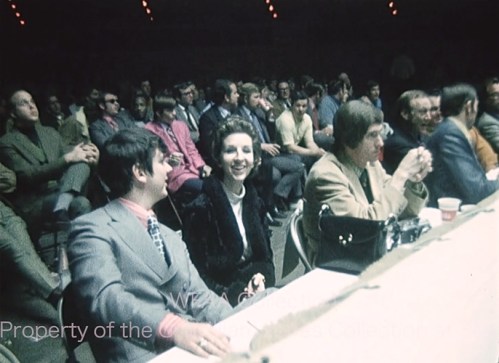
And speaking of pink, while slogging through footage of a boxing match, I really enjoyed this glimpse of the fashionably dressed crowd, especially the guy wearing the pink suit. It takes a secure man to wear a pink suit to a boxing match in Texas. (Feb. 23, 1971)

pink-suit_boxing_feb-23-1971_WFAA_SMU

*

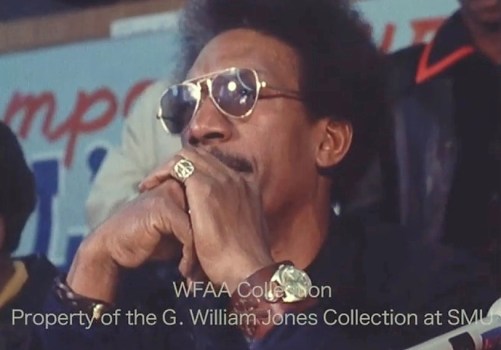
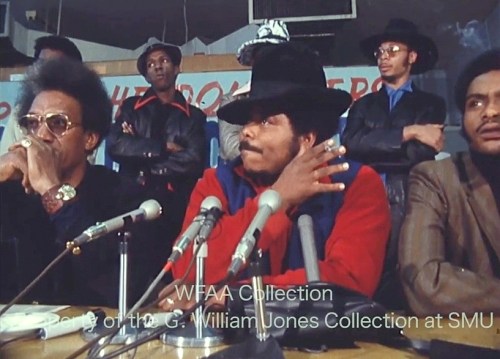
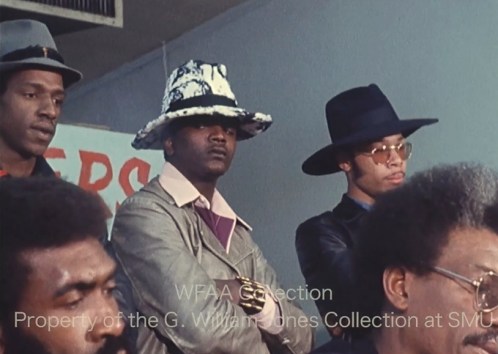
And, on the topic of fashion, there were few other Dallasites who were as strikingly put-together as community activist Al Lipscomb, frequently seen looking cool and wearing shades. Here are a few shots from a 1971 press conference during the time he was running for mayor (Lipscomb was Dallas’ first Black mayoral candidate). Lipscomb lost the mayor’s race in 1971 but later served for several years on the Dallas City Council. (March 3-4, 1971)

panthers-2_lipscomb_WFAA_030371

panthers-1_lipscomb-gaines-johnson_WFAA_030371

panthers-3_WFAA_030371

*

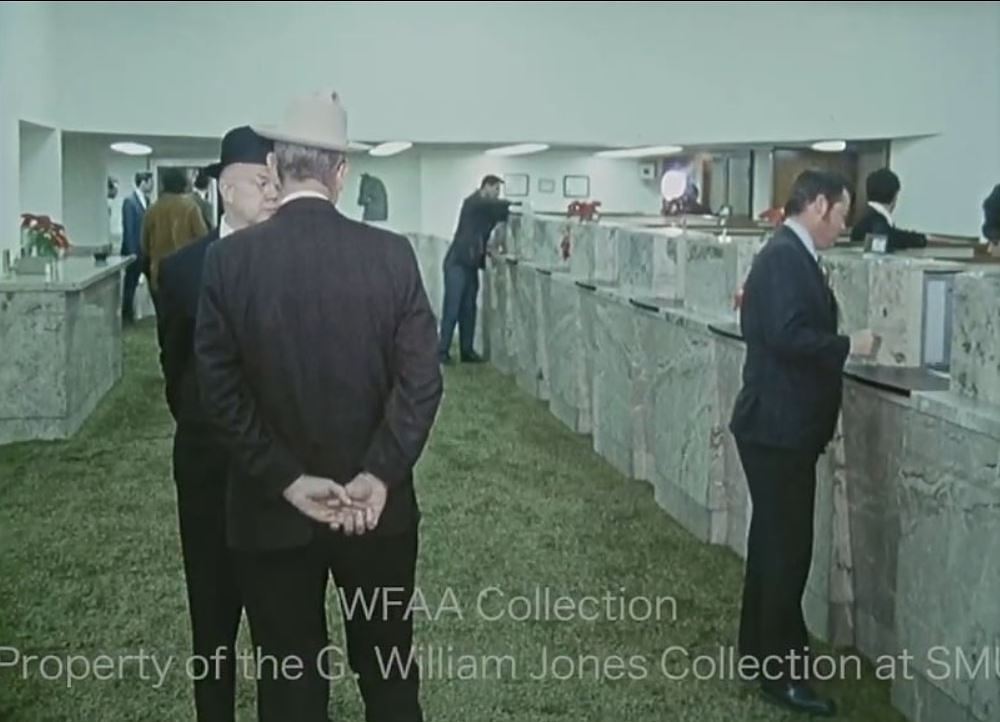
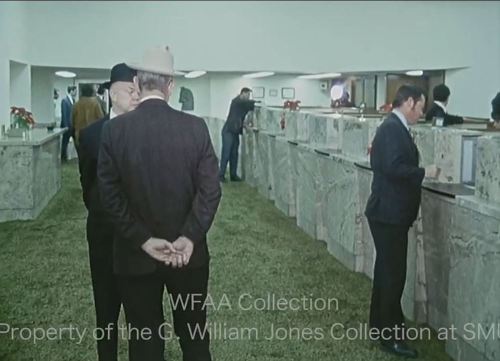
Far beyond what should have been aesthetically acceptable can be seen in this shot of FBI and police investigating a robbery at the downtown Main Street National Bank. As I watched the footage, all I could think about was the WALL-TO-WALL GREEN SHAG CARPETING. …In a bank. Oh dear. The 1970s was not a good decade for interior design. (Dec. 15-16, 1970)

main-st-natl-bank_dec-1970_WFAA_SMU

*

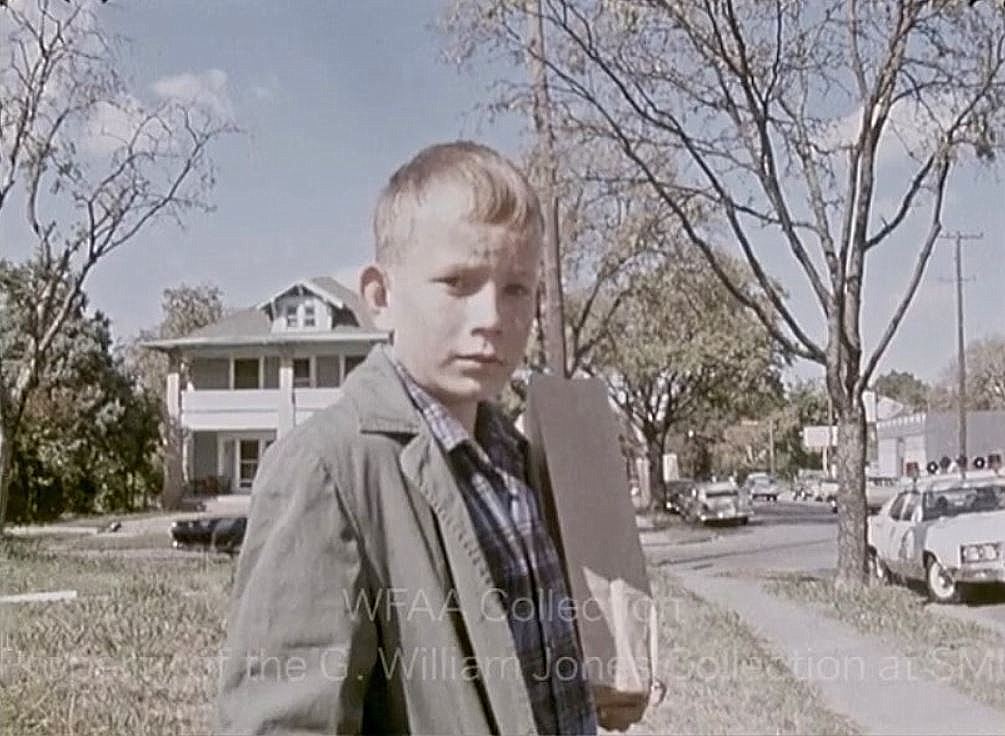
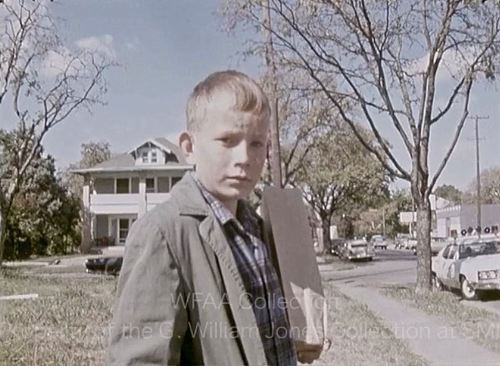
I love this very “400 Blows” shot of a boy at the scene of traffic fatality on Collett near Reiger in Old East Dallas. (Nov. 3, 1970)

boy_collett-nr-reiger_1970_WFAA_SMU

*

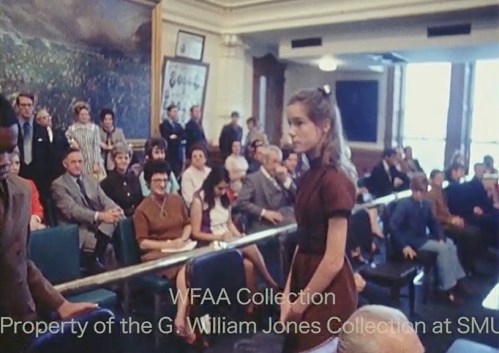
Another child, this is 13-year-old Cecile Richards (daughter of future governor Ann Richards), who had recently moved from Dallas to Austin. She had been named an “honorary girl page,” and in the clip, she is seen being led across the floor of the Texas Senate by State Sen. Mike McKool (her sponsor and a close friend of the Richards family). Cecile was the first girl in the history of the Texas legislature to be named an “honorary” legislative page at a time when all pages were boys. Cecile grew up to be a firebrand of a women’s rights activist, much like her mother. (Jan. 12, 1971)

richards-cecile_jan-1971_WFAA_SMU

*

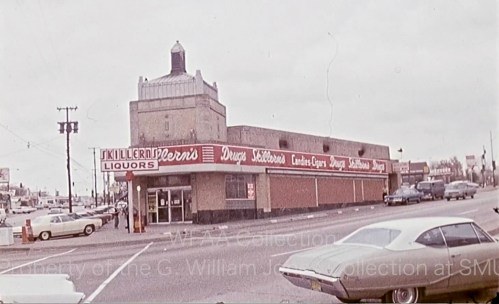
Skillern’s drug store in Lakewood (which I wrote about here). Streets have been rerouted over the years, but this is now near-ish to the site of the Lakewood Whole Foods parking lot. (Nov. 26-28, 1970)

skillerns_lakewood_nov-29-1970

*

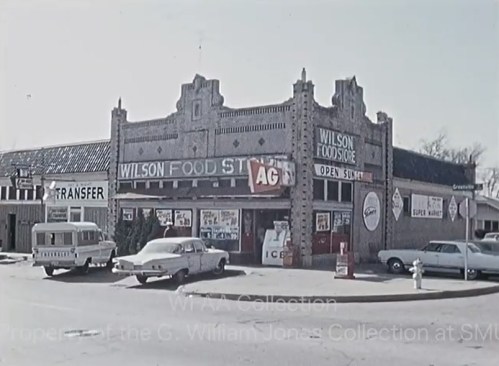
A quick hop over to Lower Greenville, where the Wilson Food Store stood at the corner of Greenville and Goodwin (in the Terilli’s block, seen here several years before the terrible fire hit that block — see a then-and-now comparison here — they did a really good job reconstructing that building). (Dec. 3-4, 1970)

wilson-food-store_lower-greenville_WFAA_SMU

*

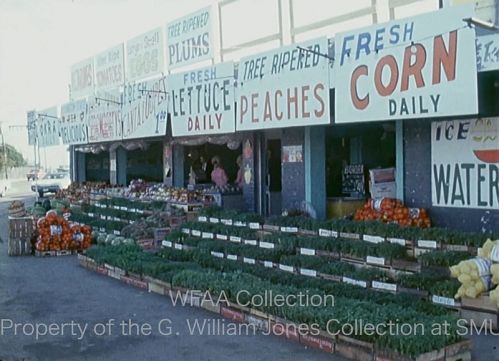
Brock’s produce stand, 2803 S. Lancaster, a former 7-Eleven. (Mar. 10-11, 1971)

brocks_2803-s-lancaster_dallas_WFAA_march-11-1971

*

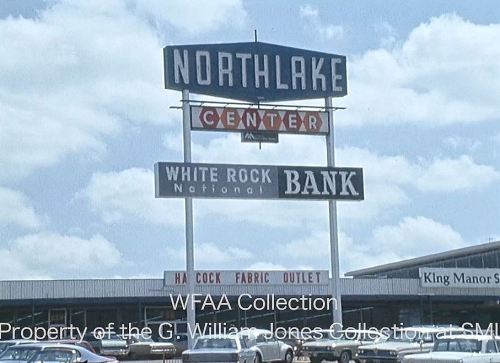
Northlake Center sign, E. Northwest Highway and Ferndale. (Sept. 3-4, 1970)

northlake_center_1970_WFAA_SMU

*

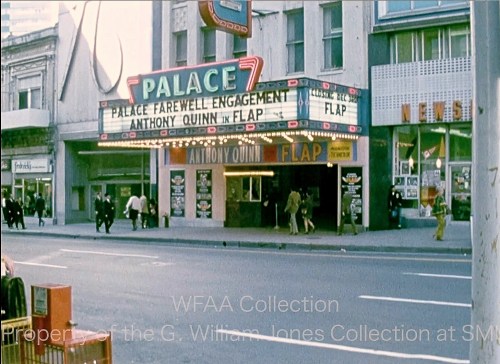
The Palace Theater’s last movie. (Nov. 20-21, 1970)

palace_last-film_nov-1970_WFAA

*

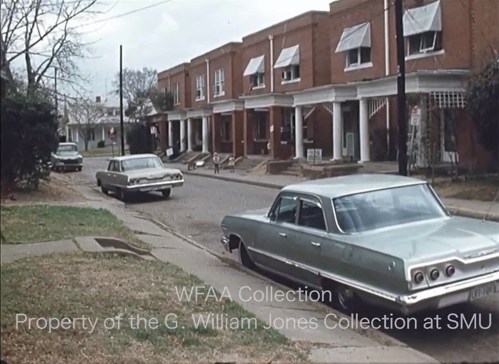
Occasionally on the Flashback Dallas page I will post images of locations I don’t recognize to see if anyone can help — and they usually can. I posted this image of row houses, not even completely sure it showed a place in Dallas. I didn’t really expect anyone to know this, but very, very quickly, Don A. replied that it showed apartments in the 1500 block of Holly, in Old East Dallas (a street I’d never even heard of). Not only did he recognize the location, he actually lived there at one point — it was across the street from his grandparents’ house. And the cars seen in this screenshot belonged to family members! That’s pretty amazing. I found the comments in the Facebook thread very entertaining — you can read them on my public Facebook page here. Thanks, Don! (Mar. 3-4, 1971)

1500-block-holly_old-east-dallas_march-1971

*

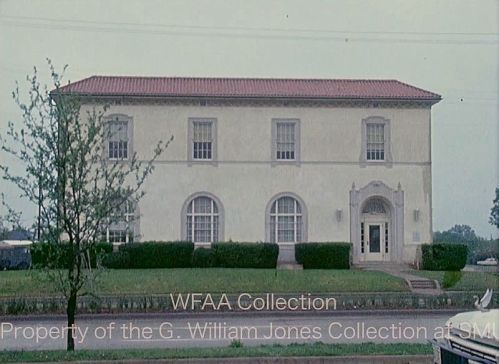
I posted another mystery image just yesterday, and it was identified in minutes by Jim P. This shows the Southwestern Bell Telephone Federal Exchange Office at 2400 S. Westmoreland. Thank you, Jim! (Apr. 18-19, 1971)

swb-federal-exchange-bldg_westmoreland_1971_041871_WFAA

*

This could go on for days. And it DOES! Check out the SMU Jones Film YouTube page. There’s a lot of stuff there, and new stuff is posted daily. I personally have dealt with only about a year and a half of this collection (so far, 1970 and the first few months of 1971). There’s so much that I haven’t seen yet, and I look forward to finding out what’s there (…except for all the sports and Commissioners Court meetings…).

wfaa_skyline_march-1971The WFAA antenna, downtown Dallas, Mar. 1971

***

Souces & Notes

All images are screenshots from footage available on YouTube from the WFAA Newsfilm Collection, G. William Jones Film and Video Collection, Hamon Arts Library, Southern Methodist University. 

sols-turf-bar_commerce-st_apr-1971_WFAA SMU_sm

*

Copyright © 2022 Paula Bosse. All Rights Reserved.
Santa Claus Visits Fair Park — 1969 and 1970

santa_4_WFAA_SMU_122069
The list is ready…

by Paula Bosse

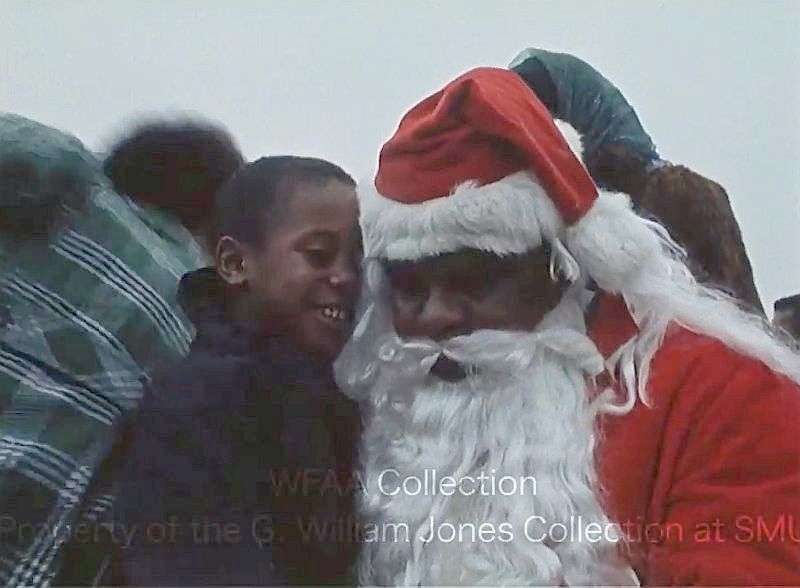
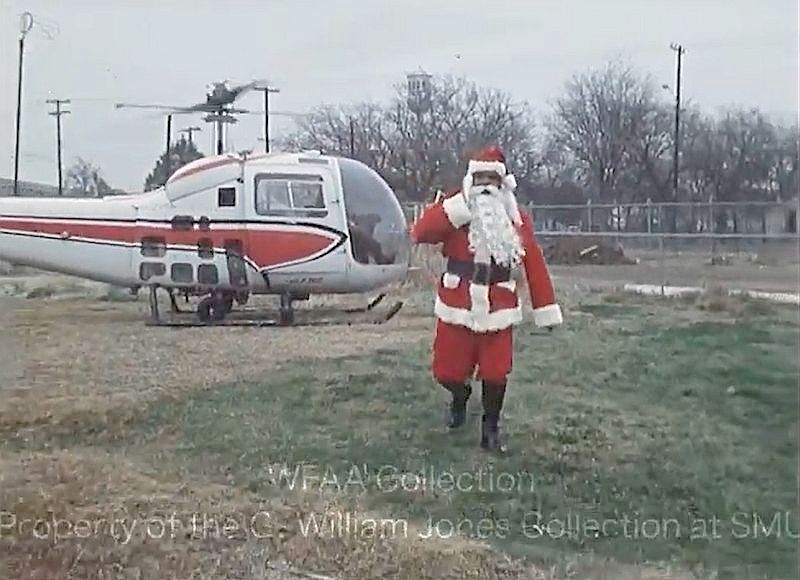
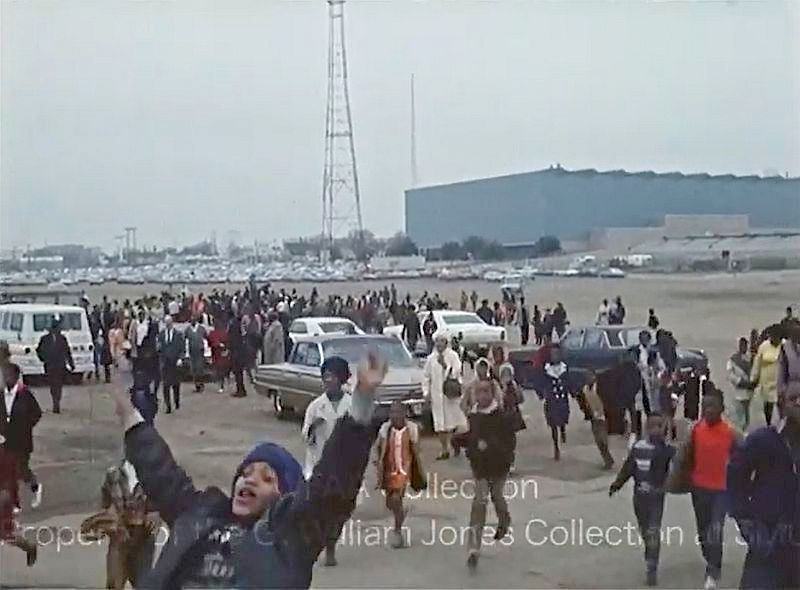
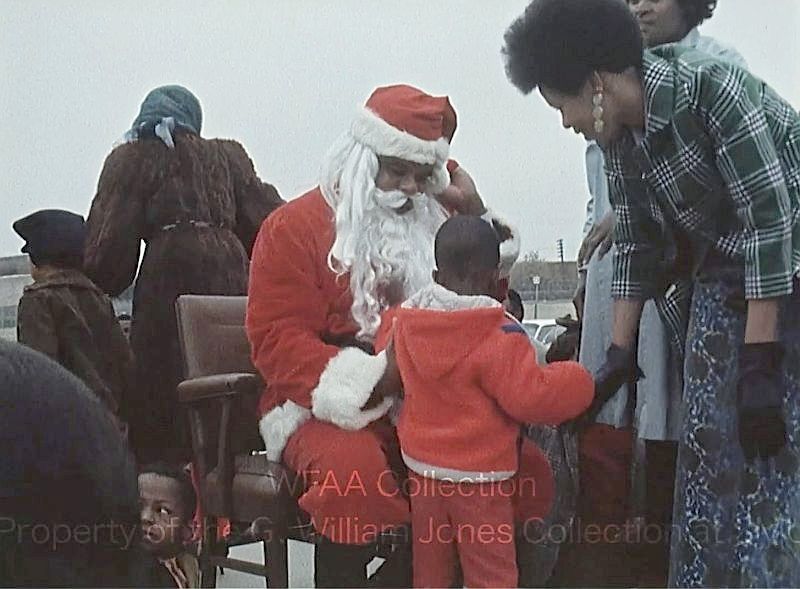
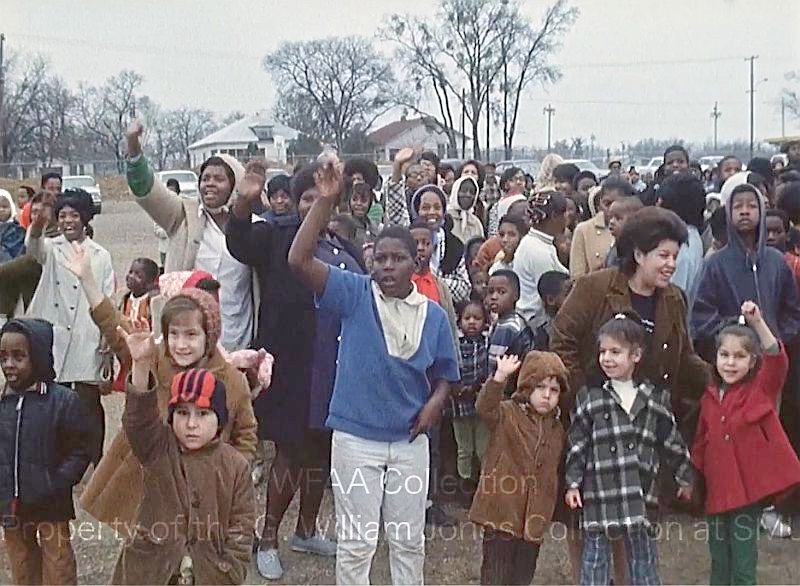
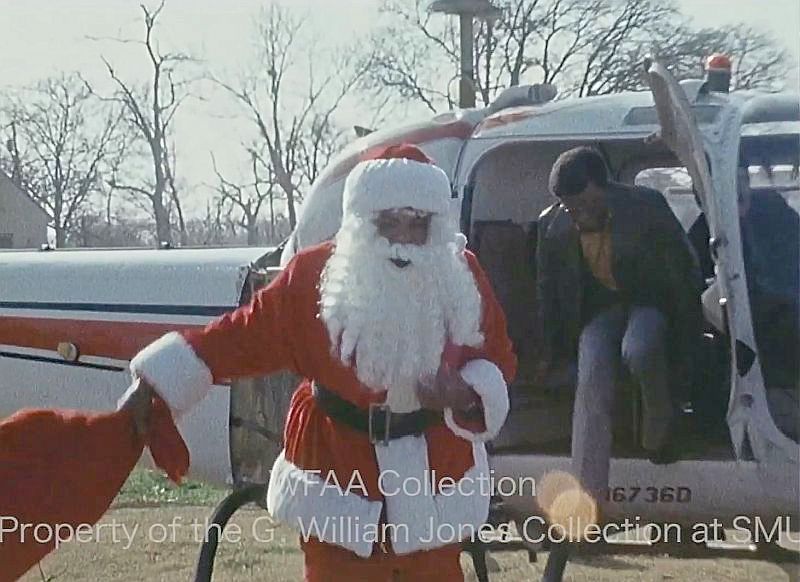
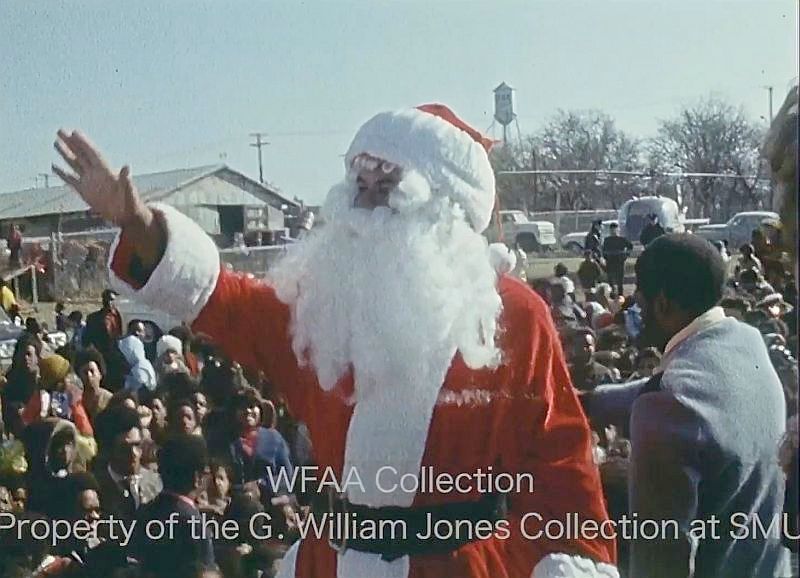
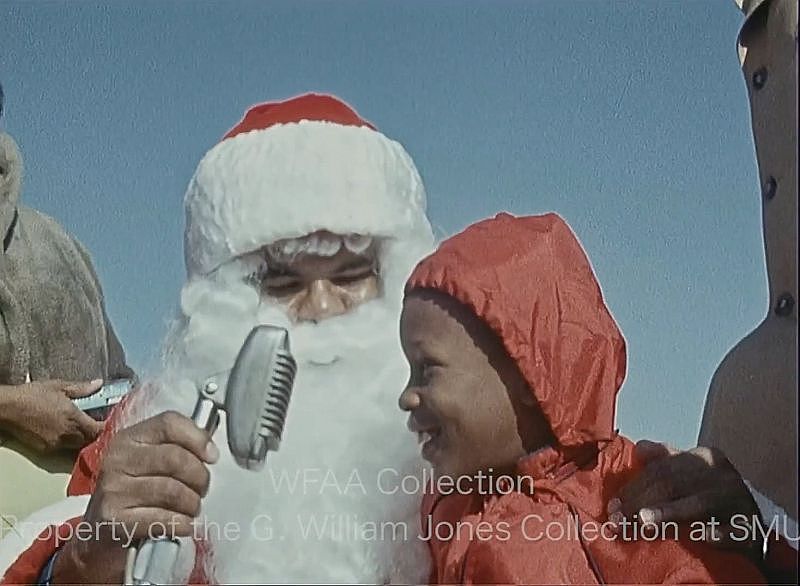
Check out two charming film clips of Santa visiting kids in Fair Park on Dec. 20, 1969 and Dec. 23, 1970 (the links to the clips are below). He arrives, of course, in a helicopter. These events were sponsored by the Negro Chamber of Commerce.

From this clip’s YouTube description:

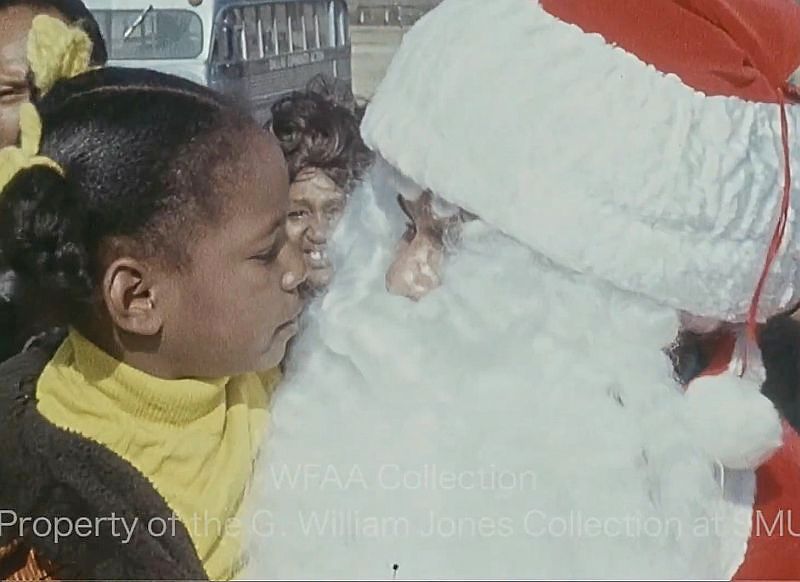
A Black Santa Claus lands via helicopter in Fair Park as a large crowd of predominantly African American children rush to meet him; children are seen on Santa’s lap as parents stand by; a box of wrapped apples is seen. (A “Black Santa” was an unusual sight in the 1960s, and the concept was much in the news in the 1969 Christmas season as the Southern Christian Leadership Conference (SCLC) had issued a demand that department stores in Cincinnati hire African American Santas or face a boycott, and the story was widely covered around the country.) (Silent)

Watch the full 38-second (silent) clip on YouTube here. Below are some screenshots.

santa_2_WFAA_SMU_122069

santa_3_WFAA_SMU_122069

santa_5_WFAA_SMU_122069

santa_6_WFAA_SMU_122069

santa_7_WFAA_SMU_122069

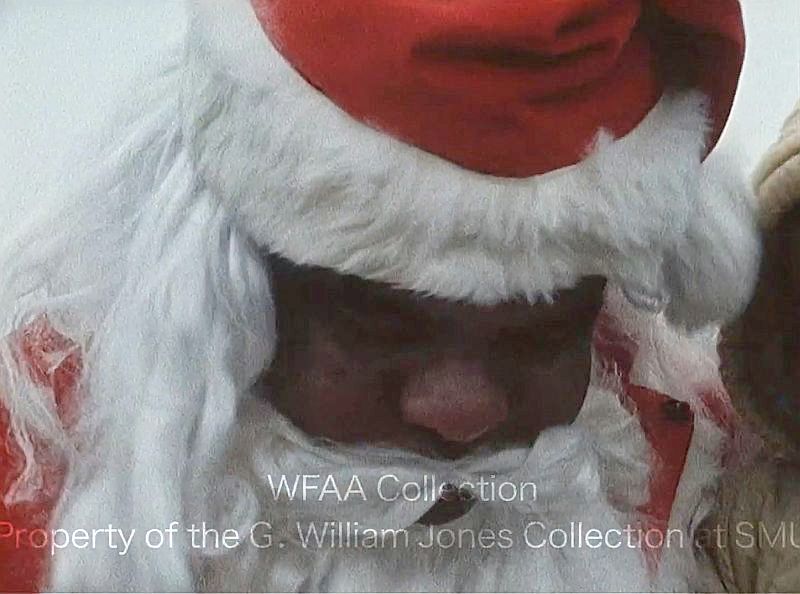
Santa made a return visit the next year — again via chopper — on Dec. 23, 1970. An article appeared in The Dallas Morning News revealing Santa’s helper to be Issac Debois who was quoted as saying with a chuckle, “I’m the only black Santa Claus from the South Pole.” Watch the full 38-second (silent) clip here.

santa-1970_122370_WFAA_SMU_1

santa-1970_122370_WFAA_SMU_2

santa-1970_122370_WFAA_SMU_3

santa-1970_122370_WFAA_SMU_4

Merry Christmas!!

***

Sources & Notes

All images are screenshots from WFAA-Channel 8 news stories — from the WFAA Newsfilm Collection, G. William Jones Collection, Southern Methodist University.

The first clip (from 1969) is contained in the larger video on YouTube here — the specific short clip is here.

The second clip (from 1970) is contained in the larger video on YouTube here — the specific clip is here.

Read the Dallas Morning News story about the second visit in the DMN archives: “Santa Enjoys Happy Visit, With Gifts” (DMN, Dec. 24, 1970).

Find more Flashback Dallas posts on Christmas here and Hanukkah here,

santa_4_WFAA_SMU_122069_sm

*

Copyright © 2022 Paula Bosse. All Rights Reserved.

Triple Underpass — ca. 1936

triple-underpass_ca-1936_us-bureau-public-roadsThe Gateway to Dallas, or the the Gateway to Oak Cliff?

by Paula Bosse

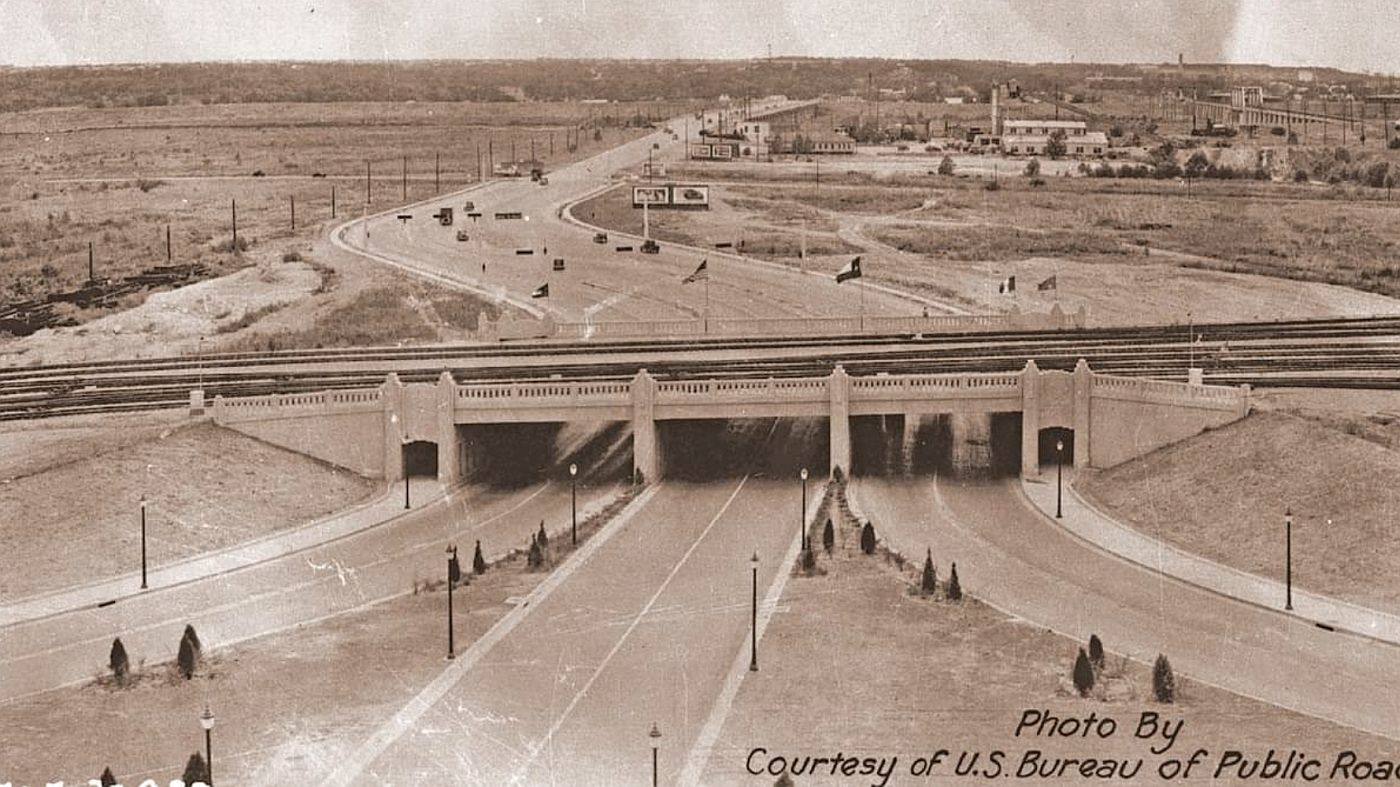
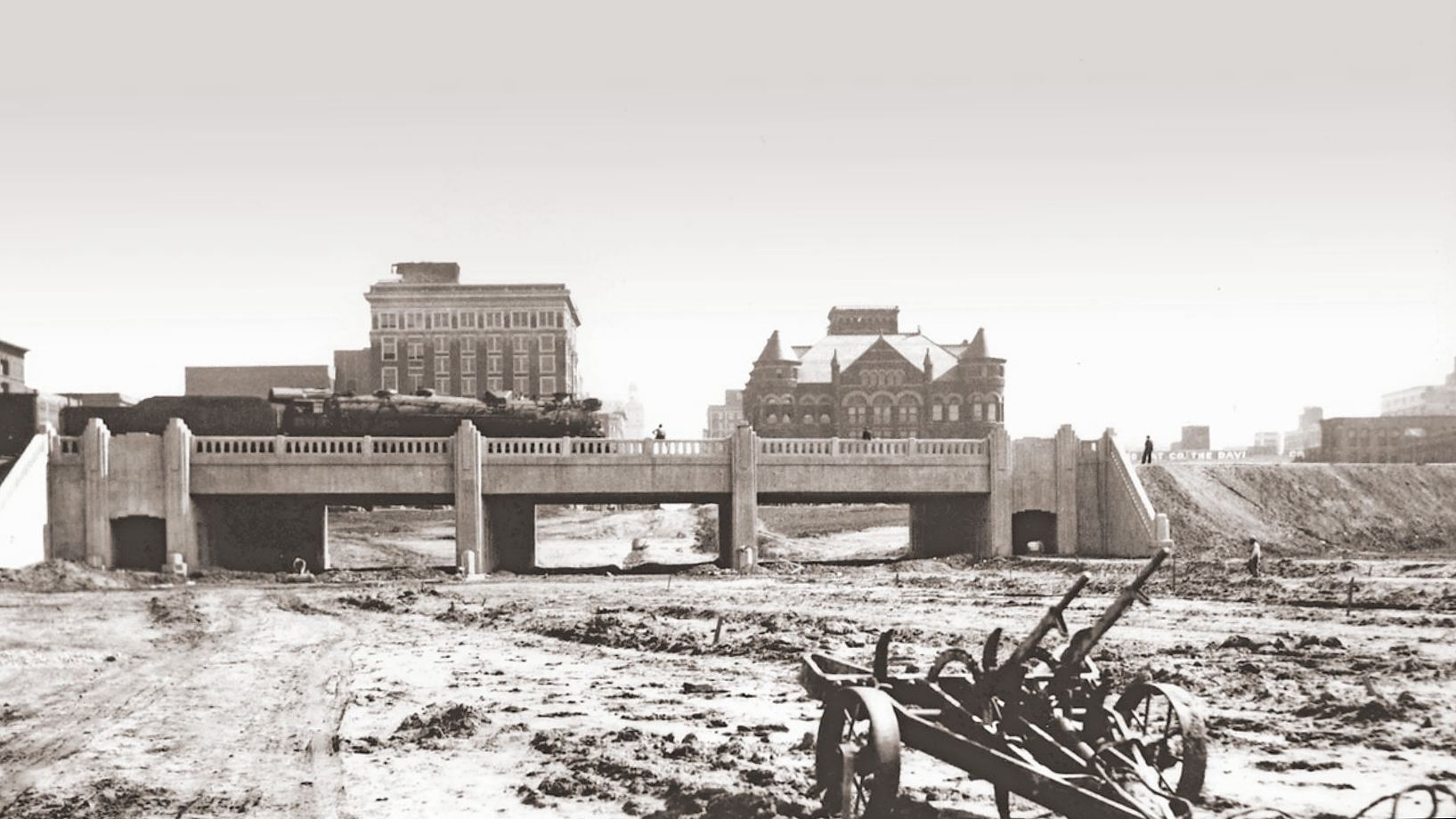
Above, a fantastic photo showing the new Triple Underpass, about 1936, with the view toward Oak Cliff. (Compare this with a similar view, from the 1950s, here.)

Below, a little earlier, with the view to the east, back toward town.

triple-underpass_construction_looking-east_austin-bridge-and-road-co

The triple underpass was built by the Austin Bridge & Road Company between 1934 and 1936, finishing up just in time to welcome the onslaught of visitors to the Texas Centennial Exposition. I encourage you to visit the company’s public Facebook post here, which includes these and other great photos of this Dallas landmark (including a “then and now” comparison and a history of their involvement in the project). Below is an excerpt from that post:

Once called the “Gateway to Dallas,” the triple underpass near Dealey Plaza was built by Austin Bridge Company and Austin Road Company starting in 1934. The underpass, a joint project with the Texas Highway Department and City of Dallas, created access to the western edge of downtown Dallas under the Union Terminal tracks. Contending with up to 80 trains a day complicated the job, requiring close cooperation with the railway companies. The triple underpass was hailed as a modern marvel, built of concrete with square balusters in a handsome art-deco style. It was unveiled with great excitement in 1936, during Texas Centennial celebrations.

***

Sources & Notes

Top image is a U.S. Bureau of Public Roads photo showing the new underpass, looking to the west.

Both photos and the excerpt are from a post on the Austin Bridge & Road Facebook page, which you can find here.

triple-underpass_ca-1936_us-bureau-public-roads_sm

*

Copyright © 2022 Paula Bosse. All Rights Reserved.

Wes Wise, 1929-2022

wise-wes_apr-1971_WFAA_SMUWes Wise and family campaigning for Mayor, April 1971
by Paula Bosse

Wes Wise, former 3-term Dallas mayor (1971-1976), has died. He was 94. Read his obituary in The Dallas Morning News, here. Also, a tribute to Wise from the Dallas Municipal Archives is here.

In the piece linked above, the Dallas Municipal Archives mentions this: “Wise is noted for being the first mayor since the 1930s not endorsed by the Citizens Charter Association.” The CCA was a powerful political organization I’ve only become aware of recently. It wasn’t really until I began working in the WFAA-Channel 8 News archives that I saw Dallas political history up close, and it was full of all these powerful groups I had never heard of which, for decades, could make or break candidates simply by deeming them endorsable. If you were running for mayor or City Council, you really wanted the support of the Citizens Charter Association. And you absolutely wouldn’t have dared poke at them with sharp sticks. …Wes Wise poked at them with sharp sticks.

I’ve been going through old Channel 8 News footage, chronologically, for a while now. I am, at present, making my way through April 1971, when Wise and his opponent — the establishment-backed (i.e. CCA-backed) Avery Mays — were in the midst of a runoff for Dallas mayor. Mays, a businessman and civic leader, was the hand-picked candidate of the Citizens Charter Association and, as such, was expected to win. Wise, a City Councilman and former sportscaster, was the self-assured maverick who loudly proclaimed that he was an independent candidate who would not have accepted CCA backing had it been offered. He was young, good-looking, and — with a background in broadcasting — was comfortable and confident in the limelight.

mays_wise_apr-1971_WFAA_SMU

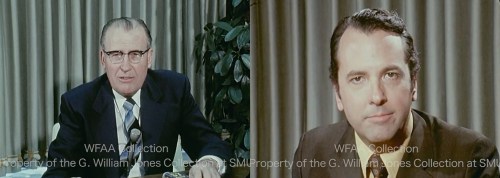
There was a “debate” of sorts between the two on Channel 8, with each man given a minute to make a statement. It’s not on the level of Nixon and JFK, but there is a stark, generational contrast in the two men. I don’t see perspiration on Mays’ upper lip, but I’m getting a rattled, sweaty vibe from him. Wise, on the other hand, is all casual bravado.

Two clips of the candidates during this runoff campaign show the difference in styles of the two men: it’s Old Dallas vs. New Dallas.

  • Watch Avery Mays accuse his opponent Wise of being all talk and no action and being nothing more than a professional “TV and radio talker” (even though Wise had just finished serving a 2-year term on the City Council) — the clip is here.
  • Watch Wes Wise deliver his stinging rebuttal here.

Old Guard vs. New Blood. New Blood won, and Wes Wise led Dallas through the 1970s, a decade of huge change for the city.

***

Sources & Notes

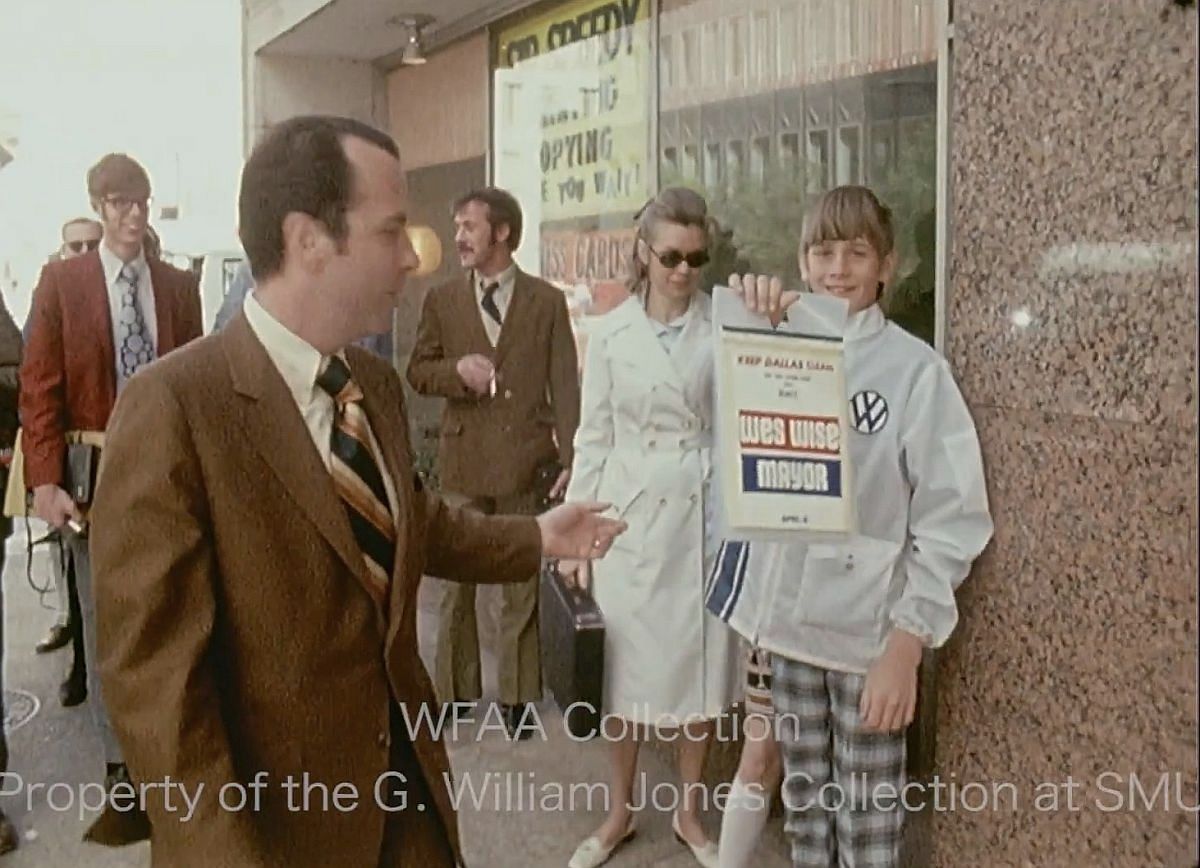
Top image is a screenshot showing Wes Wise campaigning for mayor during the runoff race against Avery Mays on April 8, 1971. Wise is seen with his wife, Sally, and his son, Wyn. The clip is from the WFAA Newsfilm Collection, G. William Jones Collection, Southern Methodist University — it can be viewed on YouTube here (Wise is seen in the segments at 14:20 and 17:21).

An informative mini-biography on Wes Wise can be found here. (It’s interesting to see that, while in the army, Wise was an instructor in psychological warfare, the perfect training for both a broadcaster and a politician!)

More on Wes Wise at Wikipedia, here.

See a shot of Wes Wise in his sports broadcasting days in the Flashback Dallas post “Wes Wise, Dallas Texans, WFAA — 1961.”

wise-wes_apr-1971_WFAA_SMU_sm

*

Copyright © 2022 Paula Bosse. All Rights Reserved.

Stuart Margolin, 1940-2022

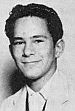
margolin-stuart_hillcrest-high-school_1955Hillcrest High School, 1955

by Paula Bosse

Everyone’s favorite character actor, Stuart Margolin, has died. He grew up in Dallas (Preston Hollow) and went to Hillcrest High School — until he was sent to what sounds like a reform school in another state. A brief look through the Dallas Morning News archives shows that he appeared in local theater productions as a child — he trod the boards in a production of A Midsummer Night’s Dream when he was 10. As a teenager, he was active in the Courtyard Theater in Oak Lawn, a school and theater led by Robert Glenn, who had also mentored other young Dallas actors such as Jayne Mansfield, Brenda Vaccaro, Ann Wedgeworth, and… Candy Barr). When he wasn’t acting — and apparently causing enough mayhem to get sent to reform school — he was a very good, avid junior golfer who competed in many tournaments (he is shown in one very grainy photo as a 13-year-old member of the DAC Country Club team, wearing a jaunty golf cap). There is no further mention of the young Margolin after 1955, when, one assumes, the teenager was shipped off to someplace not as cushy as Preston Hollow. He starts popping up again in newspaper stories in 1967, in the early days of his long and successful career in Hollywood when he was making regular appearances on TV shows such as Love American Style

His most-remembered role is Angel, sidekick to James Garner, in The Rockford Files. People loved this character. HE loved this character. He has said, with great affection, that he based Angel on streetwise guys he grew up with in Dallas. 

In 1979, though an established working actor and director in Hollywood, he moved back to Dallas for a couple of years, working on writing projects and establishing the production company River Entertainment.

margolin-stuart_dmn_022481_river-entertainmentFeb. 1981 (Dallas Morning News)

He tried for several years to establish a theater in the city, saying, “I don’t think there’s a professional theater here that is of a quality that this city deserves, a city that likes to view itself as Dallas does” (“Margolin’s Life Has Many Stages” by Joe Leydon, DMN, Apr. 20, 1980). (He was not a huge fan of the Dallas Theater Center and was especially unhappy that, in 1980, the DTC hadn’t had an Actors Equity contract in 20 years.)

At this time he also recorded a country/blues album, And the Angel Sings, of which he said:

I’m from [Dallas], and my musical influences are from this area. When I grew up in Dallas, I listened to a lot of blues — Muddy Waters, B.B. King, This record was made for the kind of people I grew up with. (The Daily Oklahoman, Apr. 22, 1980)

I just watched him in an old episode of The Mary Tyler Moore Show a couple of days ago and said to myself, “I love this guy.” I was always a fan of Stuart Margolin. RIP.

margolin-stuart

***

Sources & Notes

Top photo from the 1955 Hillcrest High School yearbook, The Panther.

margolin-stuart_hillcrest-high-school_1955_sm

*

Copyright © 2022 Paula Bosse. All Rights Reserved.

New Wheels for Margo Jones — 1955

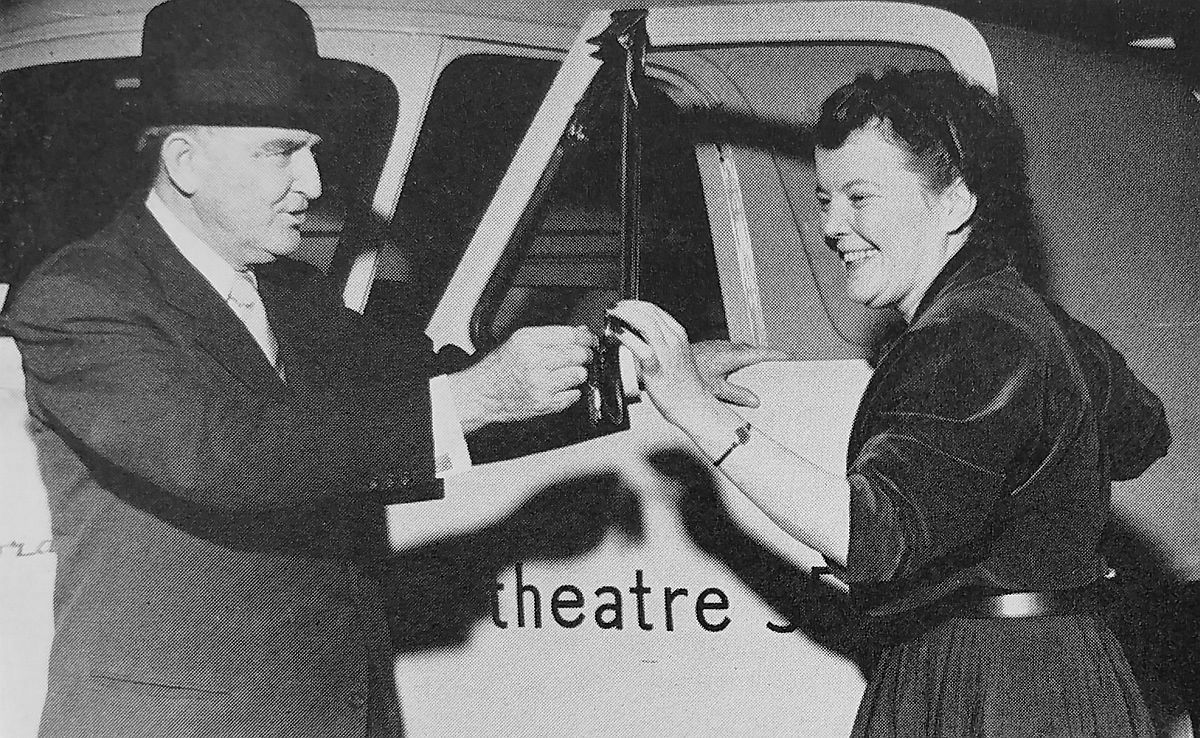
jones-margo_theatre-55_dallas-magazine_apr-1955DeWitt Ray and Margo Jones

by Paula Bosse

The photo above shows Dallas theater legend Margo Jones accepting the keys to a new Ford truck in March 1955. Below, the caption that appeared in the April 1955 issue of Dallas magazine:

GIFT FOR THEATRE ’55: Margo Jones, director of Theatre ’55, is shown as she accepts the keys to a new 1955 panel truck from DeWitt T. Ray, Dallas banker and member of Dallas Theatre ’55 board of trustees. The truck, gift of a group of 18 Dallas businessmen and civic leaders, will be used for transporting set furniture, props and other necessities for the theatre’s productions.

She looks very, very happy!

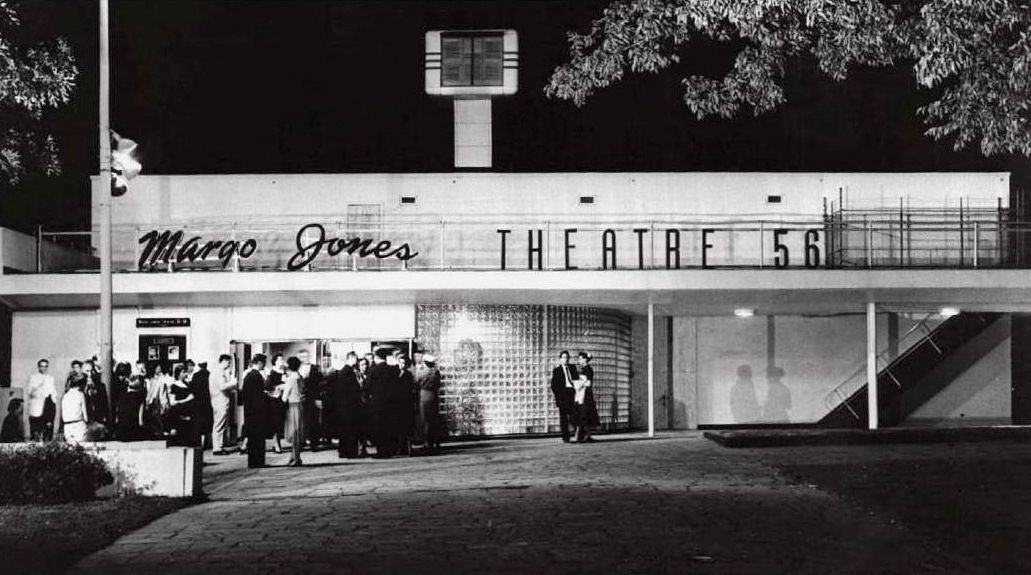
margo-jones_theatre-56_dpl

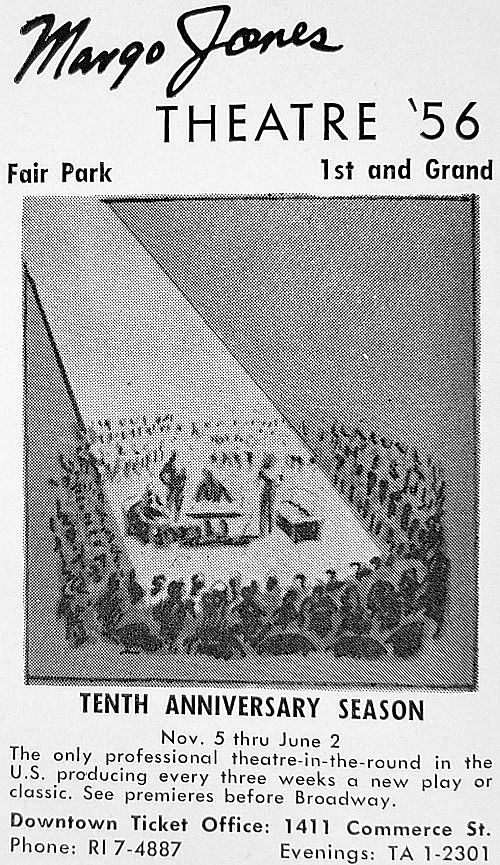
jones-margo_theatre-56_this-month-in-dallas_dec-1956_ad

***

Sources & Notes

Photo is from the April 1955 issue of Dallas, a periodical published by the Dallas Chamber of Commerce.

Photo of the exterior of the theater from the collection of the Dallas Public Library.

Ad from the Dec. 1956 issue of This Month in Dallas.

More on Margo Jones can be found in the following Flashback Dallas posts:

Watch “Sweet Tornado: Margo Jones and the American Theater,” the full documentary on Margo Jones produced by KERA-Channel 13, here.

jones-margo_theatre-55_dallas-magazine_apr-1955_sm

*

Copyright © 2022 Paula Bosse. All Rights Reserved.

1400 Block of Main Street, ca. 1946

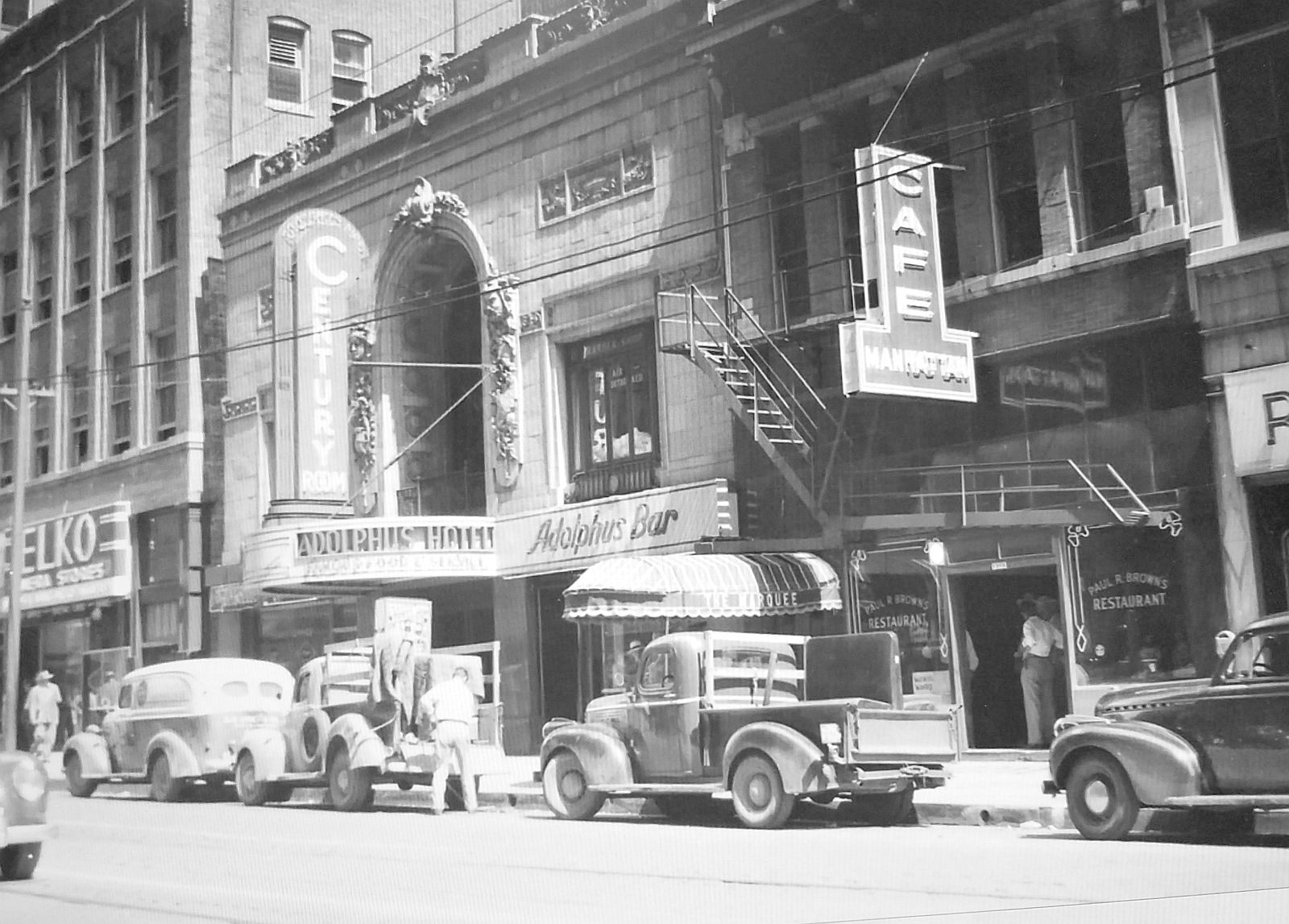
main-street_century-room_ca-1946_bell-collection_DHS_detThe Century Club, the Adolphus Bar, and the Manhattan Cafe await…

by Paula Bosse

A few years ago, I went in to the Dallas Historical Society a few times a week to volunteer. I ended up basically cataloging an entire collection of photos taken by a man named James H. Bell — and I really enjoyed it. Bell wasn’t a professional photographer, he was just a guy who liked to take a lot of photographs. The photos were all taken, as I recall, in 1946 and 1947, when he was apparently visiting Dallas — which I gather was his hometown — on a trip from his new home in California. He took a lot of pictures of places around Dallas that no one really bothered to document: businesses, street life, houses. He was also something of a pinball and jukebox aficionado, because a large number of his photos had coin-operated machines in them. Like a LOT. He also liked buses. And he seemed to always have his camera with him.

The photo above (which, sadly, I’ve had to crop because of image issues) shows the south side of the 1400 block of Main Street. I’ve never seen a photo from this period of the Main Street entrance to the Adolphus Hotel. That cool 1936 deco sign for the Century Room is great (even though it looks a little out of place next to the overly ornate early-20th-century arch next to it). (See the full wonky image — apologies for the low resolution — all my fault — here.)

I can tell you exactly why Bell took this photo: he saw a coin-operated machine being unloaded from a truck (or loaded into a truck). There were others photos in this collection taken in similar circumstances. I don’t know whether he was following jukebox and pinball trucks around town (a very definite possibility…), or whether he just happened upon these coin-op machine deliveries, camera at the ready. Whatever the case, he got a nice action-photo of a jukebox delivery in the wild, while, at the same time, he secured for posterity a nice historical image of everyday life on Main Street. And, we have the added bonus of seeing the long-gone sign for the swanky Century Room nightclub.

This was the Dallas Historical Society description I wrote for the full photo:

Downtown Dallas, 1400 block of Main Street. South side of Main, with Akard intersecting at left. Partial view of the Southwestern Life Building (southeast corner of Main and Akard, with Travis cigar stand at street level); Andrews Building (southwest corner of Main and Akard); C C Liquor Store (1412-B Main); Elko Camera Store (1410 Main); Ragir’s (1412 Main); Adolphus Hotel, rear entrance (with Century Room nightclub sign); Adolphus Bar (1406 Main); the Marquee restaurant (1404 1/2 Main); Paul R. Brown’s Restaurant. Also: a sign for Manhattan Cafe or Cafe Manhattan, pedestrians, 1940s vehicles, workman securing a pinball or other coin-operated machine into back of pickup truck.

*

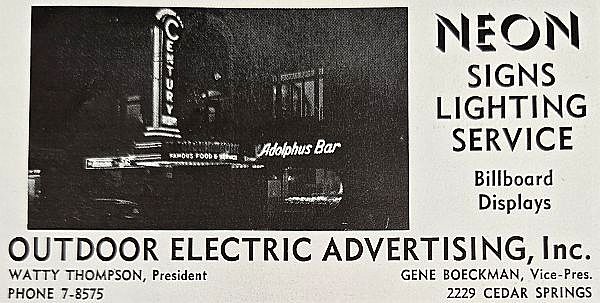
And here’s what it looked like at night:

adolphus_neon_outdoor-electric-advertising_southwest-business_sept-19361936

***

Sources & Notes

This photo was taken by James H. Bell in about 1946, and it is from the James H. Bell Collection at the Dallas Historical Society. The Accession Number is 2017.48, and the Object ID is V.2017.48.531. 

Ad for Outdoor Electric Advertising is from Southwest Business magazine, Sept. 1936, Periodicals Collection, Dallas Public Library.

main-street_century-room_ca-1946_bell-collection_DHS_det_sm

*

Copyright © 2022 Paula Bosse. All Rights Reserved.

Thanks-Giving Square — 1976

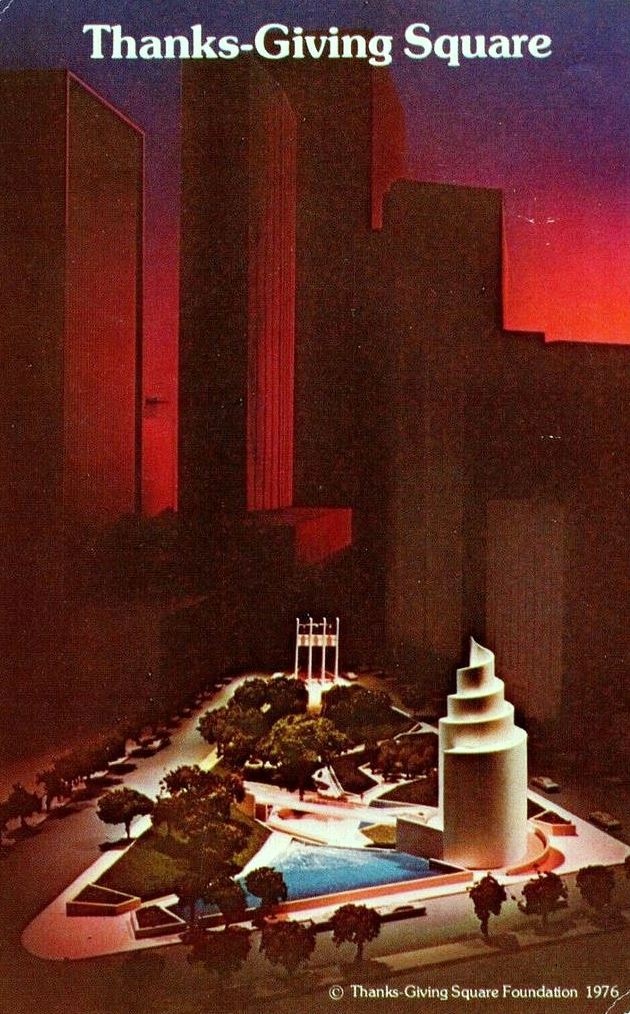
thanks-giving-square_thanksgiving-square_1976_postcard_ebay

by Paula Bosse

Happy Thanksgiving! It seems like a good day to look back at Thanks-Giving Square, the triangular one-acre park in downtown Dallas bounded by Pacific, Bryan, and Ervay. It was originally envisioned in 1961 by Dallas businessman Peter Stewart as a needed quiet refuge and chapel in the middle of a busy city — a calm space set aside for “spiritual gratitude.” It took several years before architect Philip Johnson was brought on to the project in 1971. After more than 15 years from its original conception, its official public dedication was on Nov. 28, 1976, three days after Thanksgiving.

Check out some of the progress reports on the project which appeared over the years on WFAA-Channel 8 News:

Architect Philip Johnson (whose other Dallas projects include the Kennedy Memorial, The Crescent, and the Cathedral of Hope, etc.) talks briefly about Thanks-Giving Square and its underground component, and also shows off a 3-D model (from July 1971):

*

Business owners whose shops were in buildings on the land which was about to be leveled were forced to move out, and many were not happy (from April 1972):

*

Construction is underway (November 1976):

*

And, lastly, Channel 8 weatherman Troy Dungan checks out the progress as the dedication day approaches (November 1976):

*

For a bit of street-level context, here’s a photo showing some of the buildings that were razed (at the right, directly across from the Republic Bank Building) in order to make way for Thanks-Giving Square:

kodachrome_bryan-n-ervay_1954_shorpyvia Shorpy.com

*

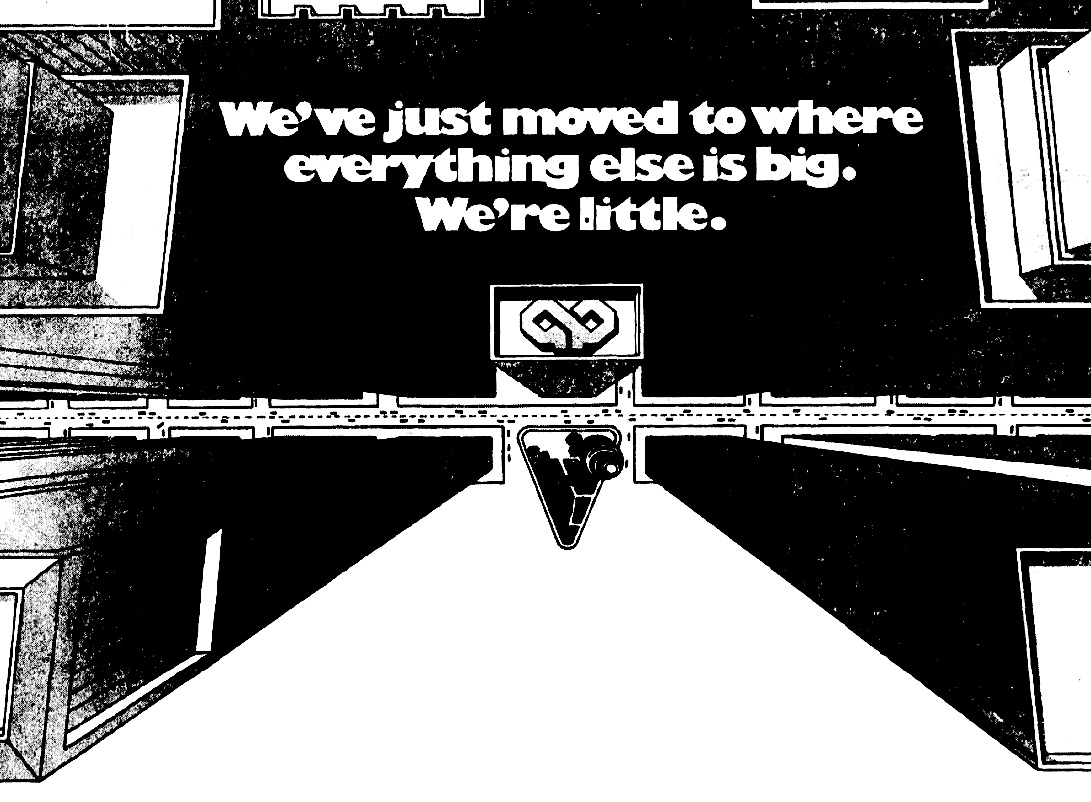
Below is a detail from a newspaper ad for MetroBank which appeared in August, 1976, with a nice little stylized illustration of the triangular TGS and its swirly chapel (click for larger image).

thanks-giving-square_metrobank-ad_det_080276

*

Speaking of the “swirly” design, in a 1982 article about TGS, Dallas Morning News architect deity David Dillon described this structure as “Philip Johnson’s Dairy Queen chapel,” which, presumably, might not have been met with amusement by internationally acclaimed architect Johnson, who probably wouldn’t have appreciated the comparison of his work to an ice cream cone. Interestingly, that description appeared in a 1982 article about Stewart’s dismay that the tall buildings which loomed over TGS (including Thanksgiving Tower) were, basically, blotting out the sun — little TGS was more often in shadow than in sunlight:

Stewart urged the city to pass a sun and shadow ordinance that would preserve the remaining downtown view corridors from high-rise development […] but the [preliminary] ordinance got such a cool reception from downtown developers that it was dropped quickly. (“Computer Study Sheds Light On Thanks-Giving Square Problem” by David Dillon, Dallas Morning News, July 4, 1982)

I bet it got a cool reception!

***

Sources & Notes

Postcard found on eBay.

Videos from SMU’s WFAA News Film Collection, which can be found on the SMU Jones Film Collection YouTube channel.

Thanks to Noah Jeppson for passing along a link to the huge Thanks-Giving Foundation Collection of photos and documents, viewable on the University of North Texas’ Portal to Texas History, here.

Read about the history of Thanks-Giving Square (or as it’s often written, Thanksgiving Square) on Wikipedia, here.

Read the D Magazine article “The Park That Peter Built” (which seems to end abruptly) about the history of Thanks-Giving Square by Jane Sumner from Nov. 1, 1977 here.

thanks-giving-square_thanksgiving-square_1976_postcard_ebay_sm

*

Copyright © 2022 Paula Bosse. All Rights Reserved.

Highland Park High School Rodeo Club — 1973

rodeo_HPHS-yrbk_1973

by Paula Bosse

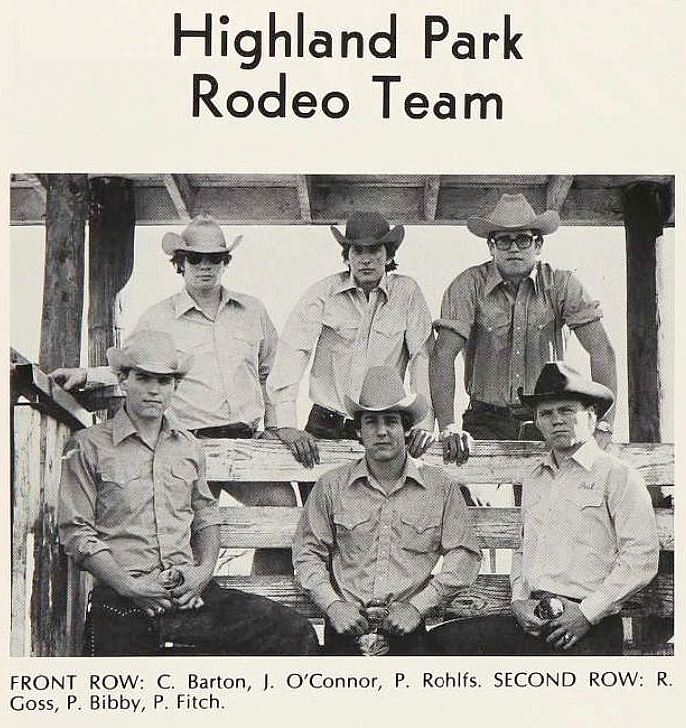
HPHS had a rodeo team? It was apparently a thing, at least in 1973 — they even participated in the Fat Stock Show in Fort Worth.

Seeing as these are Highland Park students, I can only imagine the guys seen above ultimately became partners in a law firm called Barton, O’Connor, Rohlfs, Goss, Bibby & Fitch.

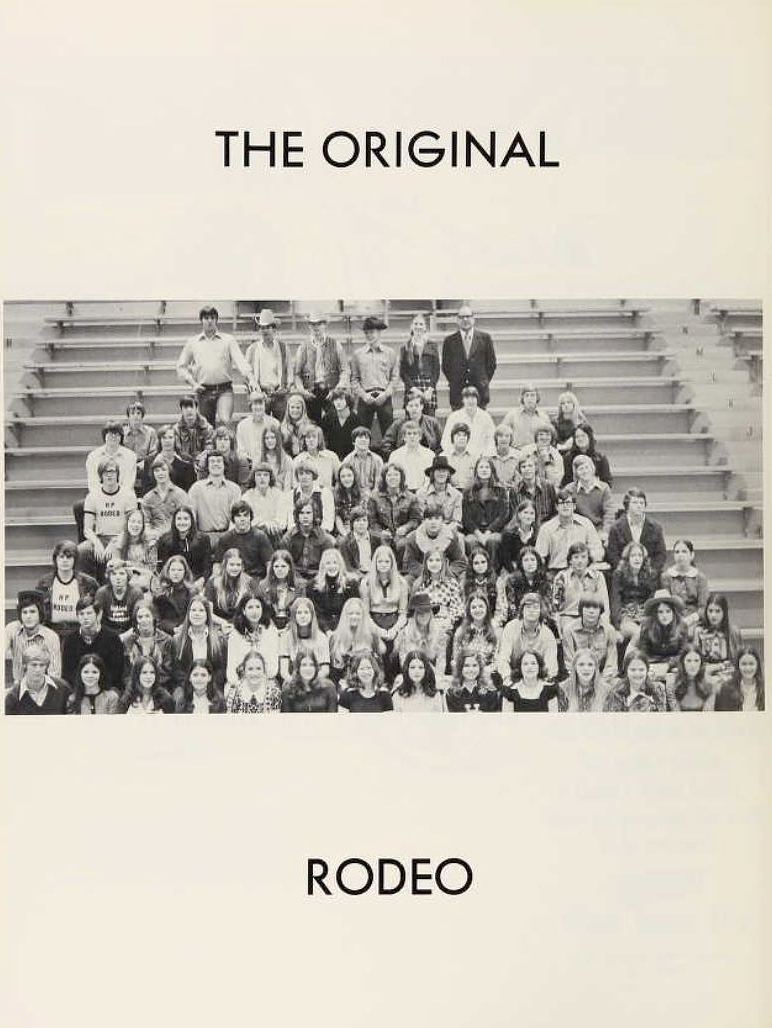
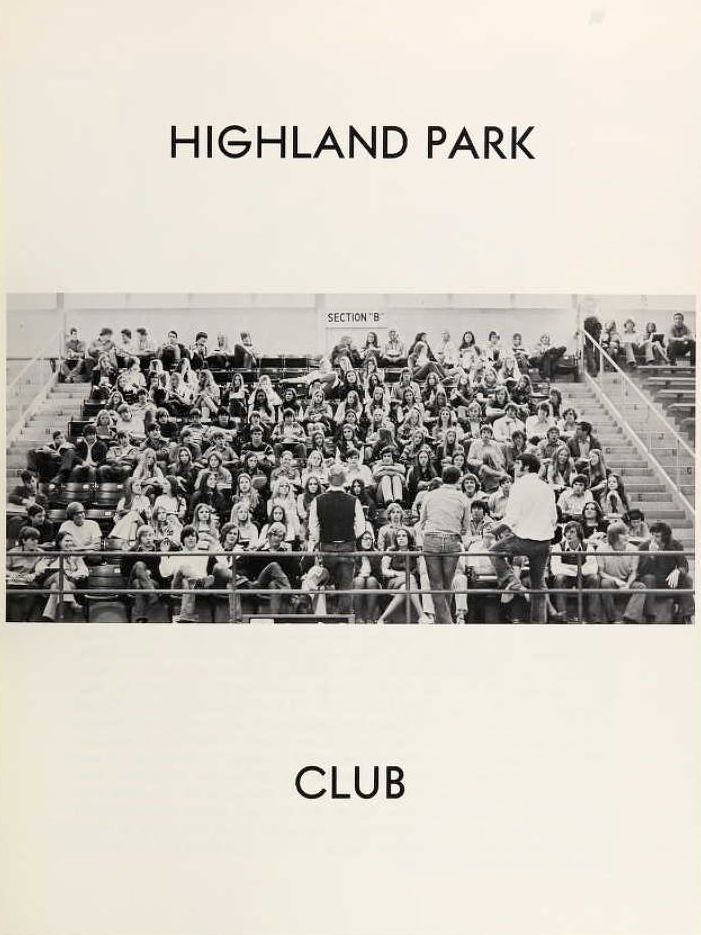
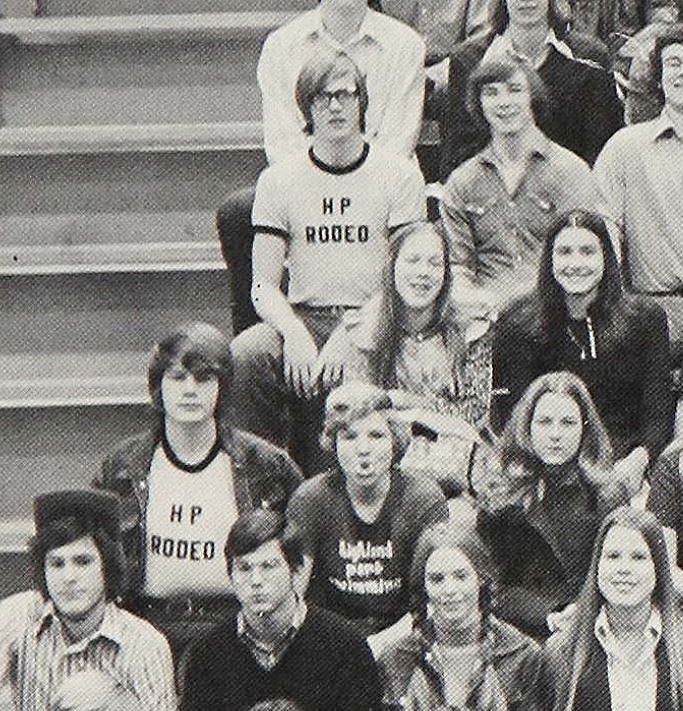
There were other “rodeo” mentions in the yearbook, including this double-page ad which read “The Original Highland Park Rodeo Club.” I mean, kids are wearing t-shirts. I don’t know whether this was an elaborate “ironic” put-on, or whether it was real, but, I have to say, either way, I’m a fan!

rodeo_original-roadeo_HPHS_1973_a

rodeo_original-roadeo_HPHS_1973_b

rodeo_HPHS_1973_det

rodeo_HPHS_1973

***

Sources & Notes

Photos from the 1973 Highland Park High School yearbook, The Highlander.

rodeo_HPHS-yrbk_1973_sm

*

Copyright © 2022 Paula Bosse. All Rights Reserved.

A Few Photo Additions To Past Posts — #18

kodachrome_downtown_ebayBig D Kodachrome

by Paula Bosse

It’s been a while since I’ve done one of these, so why not now? These are things I’ve collected over the past months which I am now adding to old posts in order to keep everything together.

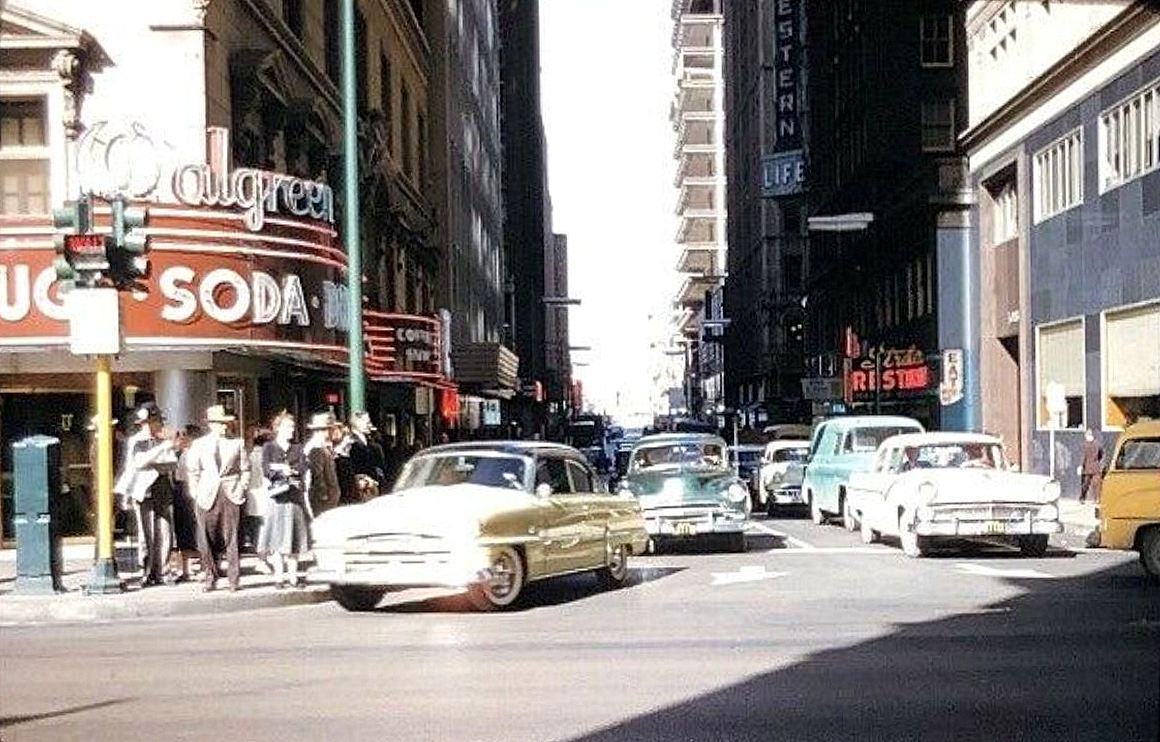
The first is the color photo above, showing the super-fab Walgreens at the corner of Commerce and Akard (see my favorite photo of it in this post), with the view looking north on Akard. I’ve added it to the 2021 post “Downtown Dallas in Color — 1940s & 1950s.” (Source: eBay)

*

I’ve added some text and a couple of photos about Ernest Oates, the Englishman who brought soccer to Dallas, to the 2014 post “The Dallas Athletics, Dallas’ First Soccer Team — 1908.” (Source, 1922 Dallas city directory)

ad-oates-stone-work_1922-directory

*

I’ve added this 1961 ad to the perhaps-too-exhaustingly-exhaustive post from 2018, “Sam Ventura’s Italian Village, Oak Lawn.” (Source: Diane Wisdom Papers, Archives of Women of the Southwest, DeGolyer Library, SMU, here)

italian-village_dallas-entertainment-awards_1961_SMU

*

I try to avoid posting photos with watermarks, but I love this, so I’ve added it to one of my favorite posts, “Ghost Rails of the Belmont Streetcar Line” from 2018. It shows a Belmont car in front of the Palace Theatre at Elm and Ervay. The marquee shows that “New Moon” — starring Jeanette MacDonald and Nelson Eddy — is playing. “New Moon” opened at the Palace on July 4, 1940 and ran for a week. (Source: eBay)

belmont-streetcar_new-moon_1940_palace_ebay

*

Do people still say “funeral parlor”? This ad from 1937 for the Weever Funeral Home has been added to the 2015 post “Not Dead Yet at McKinney & Routh.” The building at 2533 McKinney was built in 1927 and was a strikingly beautiful (and pricey) funeral home — it’s still standing and has been occupied in recent years by a string of Uptown restaurants. This ad proudly notes that “Weever advertises his prices” — he is completely transparent about the fact that the price of a silver-plated casket is gonna set you back $2,250 (the equivalent in today’s money of $45,000). Can’t say you weren’t warned. (Source: 1937 Dallas city directory)

weever-funeral-home_1937-city-directory_ad

*

These two photos have to do with a concrete house built in University Park around 1914 (I was kind of obsessed with it a few years ago). They have been added to the 2018 post “Dallas in ‘The Western Architect,’ 1914: Park Cities Residences” (this is one in a ridiculously crammed-full-of-information 7-part series I wrote about buildings featured in an architectural journal — I  probably learned more about early-20th-century buildings in Dallas from researching and writing those posts than from anything else I’ve done). The first photo (the concrete house, looking a lot less dynamic than when it was brand new) was taken around 1931; the second photo (the Presley Apartments, which replaced the concrete house when it was demolished) is from about 1956. (Source: the “Brown Books” from the University Park Library, which I wrote about here — Dear University Park Library: I can no longer get this incredibly useful site to work!)

6421_preston_concrete-house_brown-bks_university-park_ca-1931

6421-preston_apartments_brown-bk_university-park_1956_former-concrete-house

*

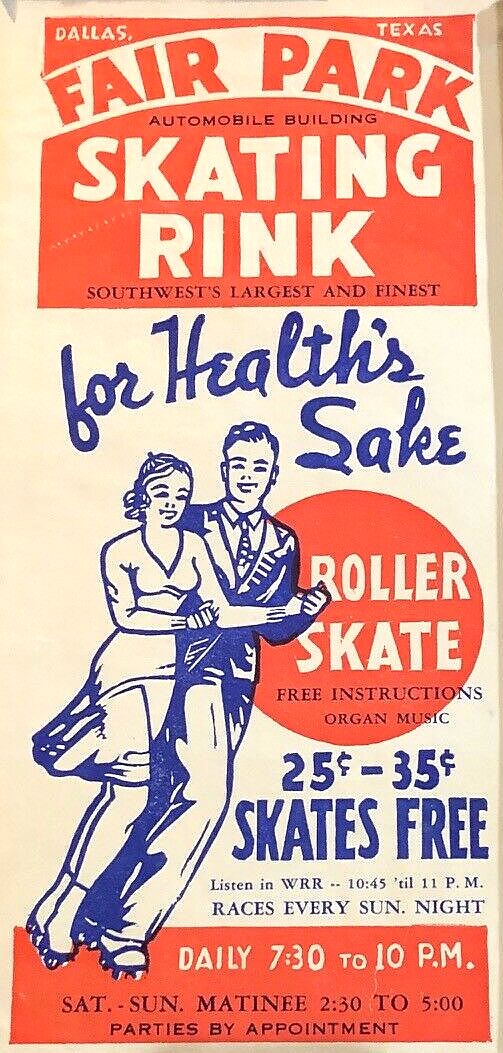
Below, a charming ad for the skating rink at Fair Park. It has been added to the charming 2014 post “Skate Date!” (“charming” if you skim over the prostitution bits). (Source: eBay)

fair-park-skating-rink_matchbook_ebay

*

I’ve added this photo of the construction of the Dallas Athletic Club — taken by Charles Erwin Arnold — to the 2015 post “The Dallas Athletic Club Building, 1925-1981.” Kinda low-res and watermarked, but I don’t think I’ve seen it before, and I really like it. The intersection is Elm and St. Paul, and the view is to the south. (Source: Arnold Photographic Collection, Dallas Historical Society. Want it high-res with no watermark? Hie thee to the DHS and ask for item A.68.28.17.)

dallas-athletic-club_construction_DHS

*

This Mohr Chevrolet ad from 1975 has been added to the 2021 post “Simms Super Service Station, Cedar Springs & Maple — 1930.” (Source: 1975 Dallas city directory)

mohr-chevrolet_1975-directory

*

Lastly, I’ve added a few articles and images to the 2014 post “Roger Corman Does Dallas,” about a painfully groovy, super-low-budget, anti-establishment movie, a few scenes of which were filmed in downtown Dallas and on the SMU campus in 1969. The official movie title is complicated and irritatingly punctuated — let’s just call it “Gas” to make things easier. Here’s one of the things I’ve added to the original post, a 1970 ad from the SMU campus newspaper (click to see a larger image). (Source: SMU Daily Campus, Nov. 4, 1970, Student Newspapers collection, DeGolyer Library, Southern Methodist University)

gassssss_movie_smu-daily-campus_nov-4-1970

*

Until next time….

kodachrome_downtown_ebay_sm

*

Copyright © 2022 Paula Bosse. All Rights Reserved.