Flashback : Dallas

A Miscellany: History, Ads, Pop Culture

Tag: Historic Dallas

Radio Mobile Units — ca. 1940

kfaa_mobile-unit_wfaa-fam-albumWhat? You’ve never heard of KFAA? (click for larger image)

by Paula Bosse

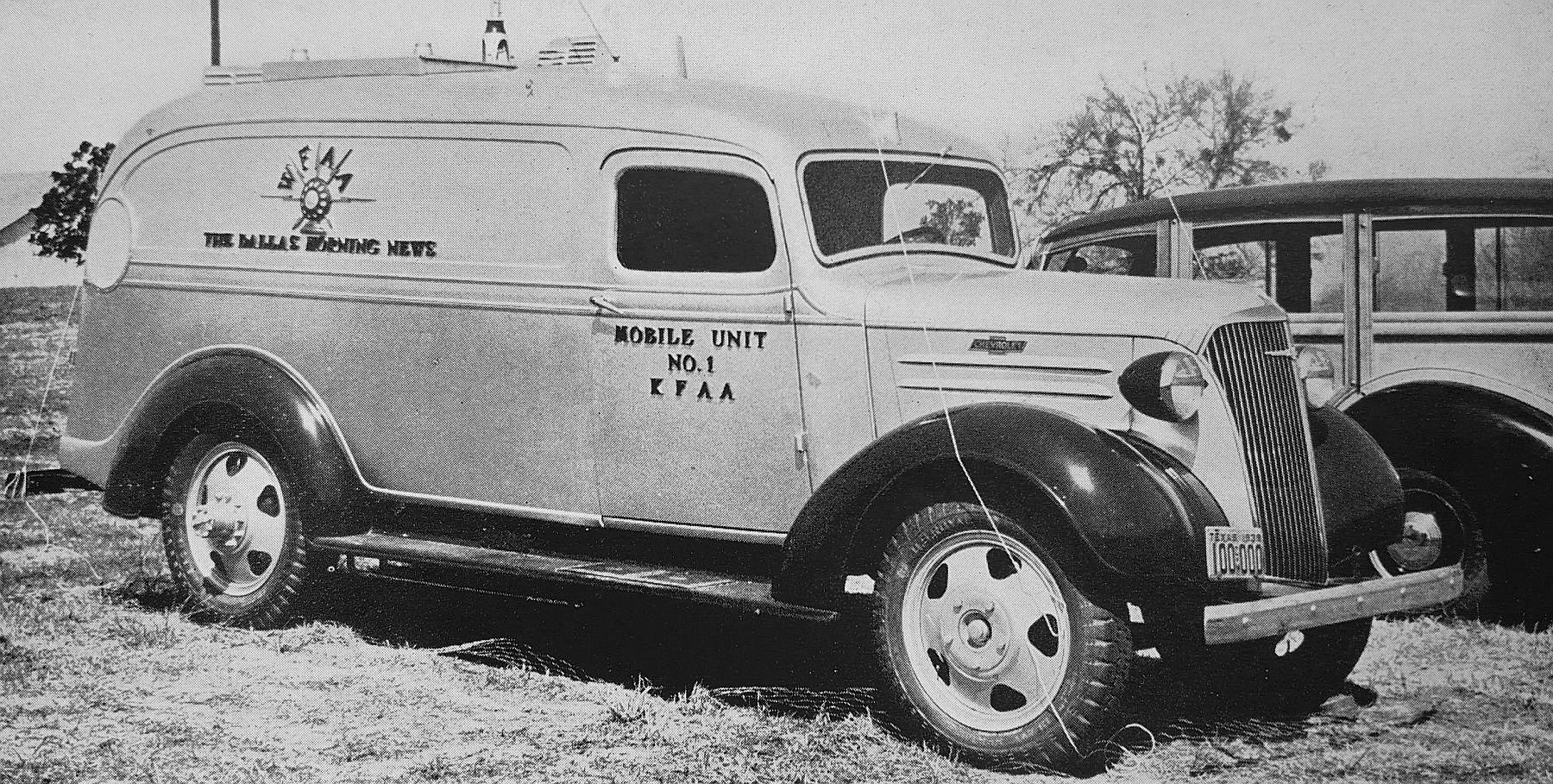
Check out these pre-war mobile units for radio stations WFAA and WBAP. The unit above actually had its own call letters — KFAA — and was licensed as a separate station. (That logo!) The caption, from a 1941 promotional booklet issued by stations WFAA (Dallas), WBAP (Fort Worth), and KGKO (Wichita Falls):

The WFAA Mobile Unit shown here is a complete short wave broadcasting station on wheels. The unit has its own call letters, KFAA, because it is a self-contained and separately licensed station. The amazing array of facilities contained in this one-and-one-half-ton truck includes a transmitter, generator, receiving equipment, public address system and pre–amplifiers. The transmitter tower on top of the truck can be raised to a height of 35 feet, making it possible to pick up the mobile unit’s signals for re-broadcast from a distance of 50 miles.

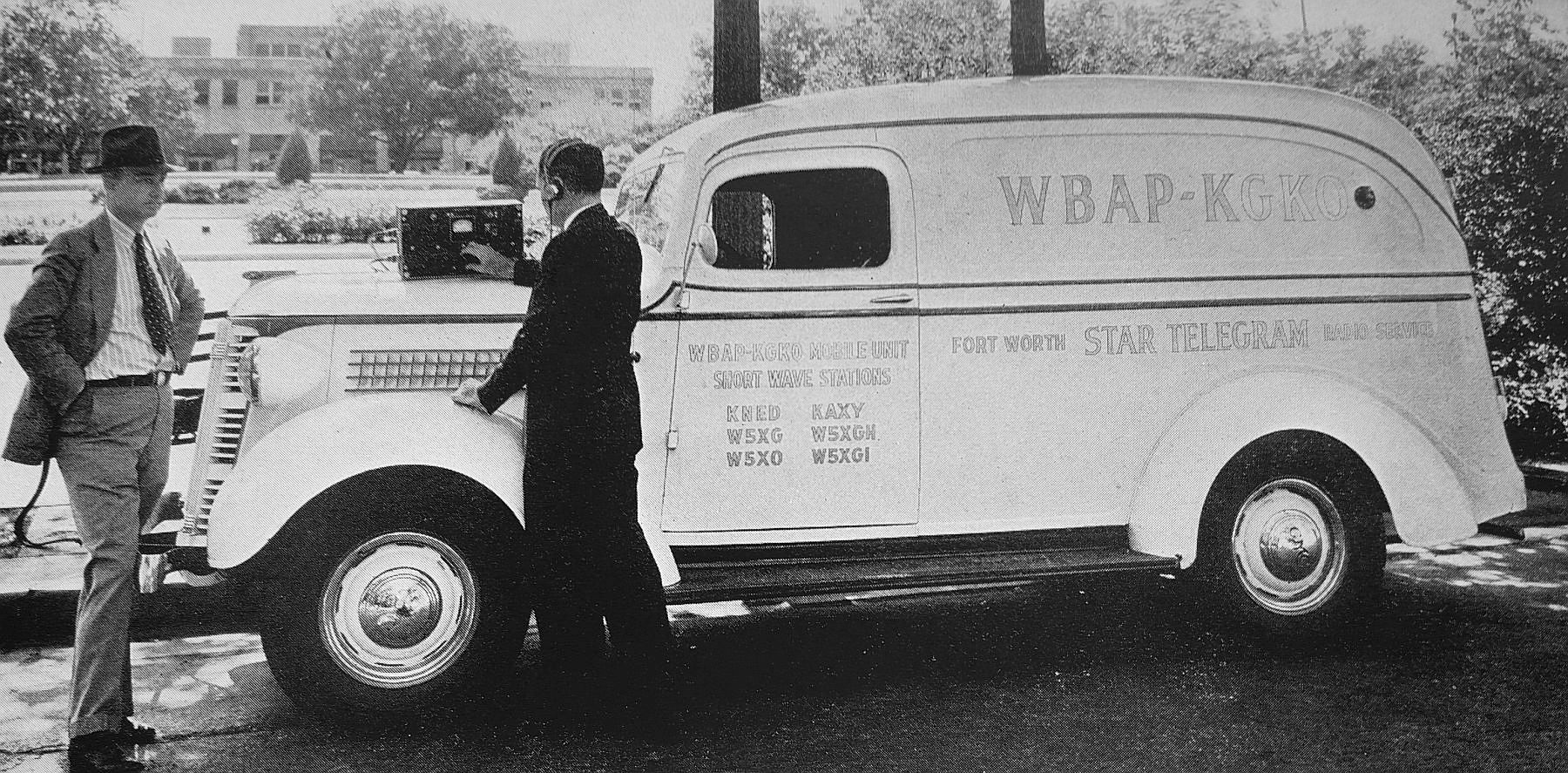
Here’s the WBAP/KGKO unit:

wbap-mobile-unit

Fort Worth Star-Telegram Mobile Radio Unit – with Chief Engineer R. C. “Super” Stinson, left, and A. M. Woodford, production man, handling a remote or “nemo” pickup from Burnett Park, Fort Worth. The WBAP-KGKO Mobile Unit carries six short wave transmitters and receivers besides a power plant capable of generating electricity for a small town of 500 people. This unit “swam” through a recent flood in Brady, Texas, established communication from the stricken area and received the congratulations of the Texas Highway Patrol. It also played a star role in the Amarillo storm.

***

Photos from the booklet WFAA, WBAP, KGKO Combined Family Album (Dallas-Fort Worth, 1941).

Why were arch-rivals WFAA (owned by The Dallas Morning News) and WBAP (owned by The Fort Worth Star-Telegram) co-publishing a promotional booklet? Because they shared the same transmitter and had an extremely odd broadcasting agreement. Read about it in my previous post “WFAA & WBAP’s Unusual Broadcasting Alliance,” here.

Click those photos!

*

Copyright © 2016 Paula Bosse. All Rights Reserved.

The Moskovitz Cafe

moskovitz-cafe_winegarten-schechterA stool is waiting for you… (click for larger image)

by Paula Bosse

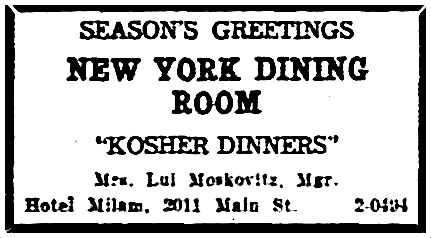
The Moskovitz Cafe was located at 2216 Elm Street, between S. Pearl and what is now Cesar Chavez Blvd., in an area of predominantly Jewish businesses. The restaurant served “Kosher and American cooking” and was owned and run by Lui Moskovitz, a Romanian immigrant, and his Polish-born wife, Eva. Eva, recently widowed, had arrived in Dallas in about 1928 with her three children and seems to have married Lui that same year. They had run another restaurant before the Moskovitz Cafe: the New York Kosher Dining Room on Commerce had been located across from the Adolphus Hotel for several years before it moved to 2011 Main, around the corner from City Hall. After that closed, they ran the Moskovitz Cafe between about 1937 and about 1944.

In 1945 there was no Lui or Eva Moskovitz in the Dallas directory. There was, however, an Eva Haberman — it appears that the Moskovitzes had split, Lui had left town, and Lui’s ex-wife had taken back the name of her late first husband. At this time she must have been about 60 years old, but she worked for the next few years as a department store seamstress and lived with one or more of her three sons from her marriage to Nathan Haberman. She died in April, 1961. Not only is there no trace of Lui after his time in Dallas, there is also no trace of 2216 Elm.

moskovitz_dmn_0101361936 ad

moskovitz-cafe_elm-st_1943-directory
Elm St. businesses, 1943 Dallas directory (click for larger image)

moskovitz_map
Location of Moskovitz Cafe (det. of a 1919 map)

***

Sources & Notes

Photo appeared in the book Deep in the Heart: The Lives & Legends of Texas Jews, A Photographic History by Ruthe Winegarten and Cathy Schechter (Austin: Eakin Press, 1990); from the collection of the Dallas Jewish Historical Society.

I’m not sure who the people in the photo are. When the Moskovitz Cafe opened, Lui would have been in his mid-40s and Eva would have been in her early 50s. UPDATE: Per the comment below (from Eva’s grandson), the woman in the white apron is the proprietress, Eva Moskovitz, and the man at the cash register is her son, Jack Haberman.

More information about Mrs. Eva Haberman can be found in her obituary, published in The News on April 19, 1961.

All images larger when clicked.

*

Copyright © 2016 Paula Bosse. All Rights Reserved.


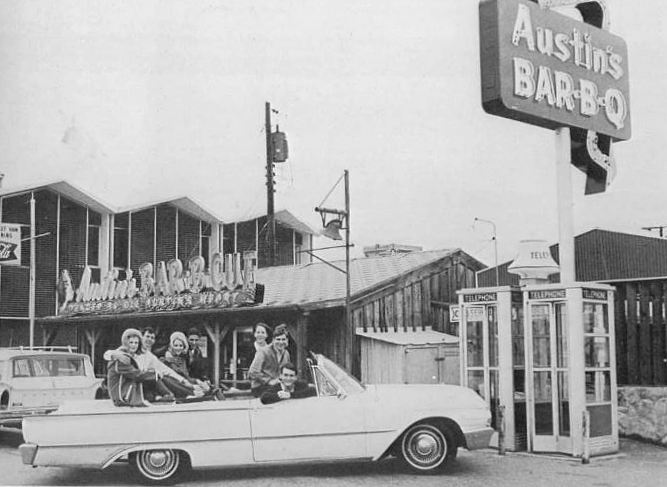
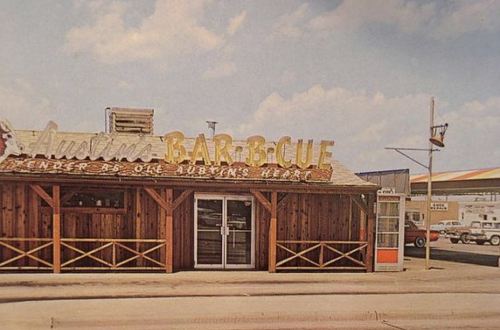
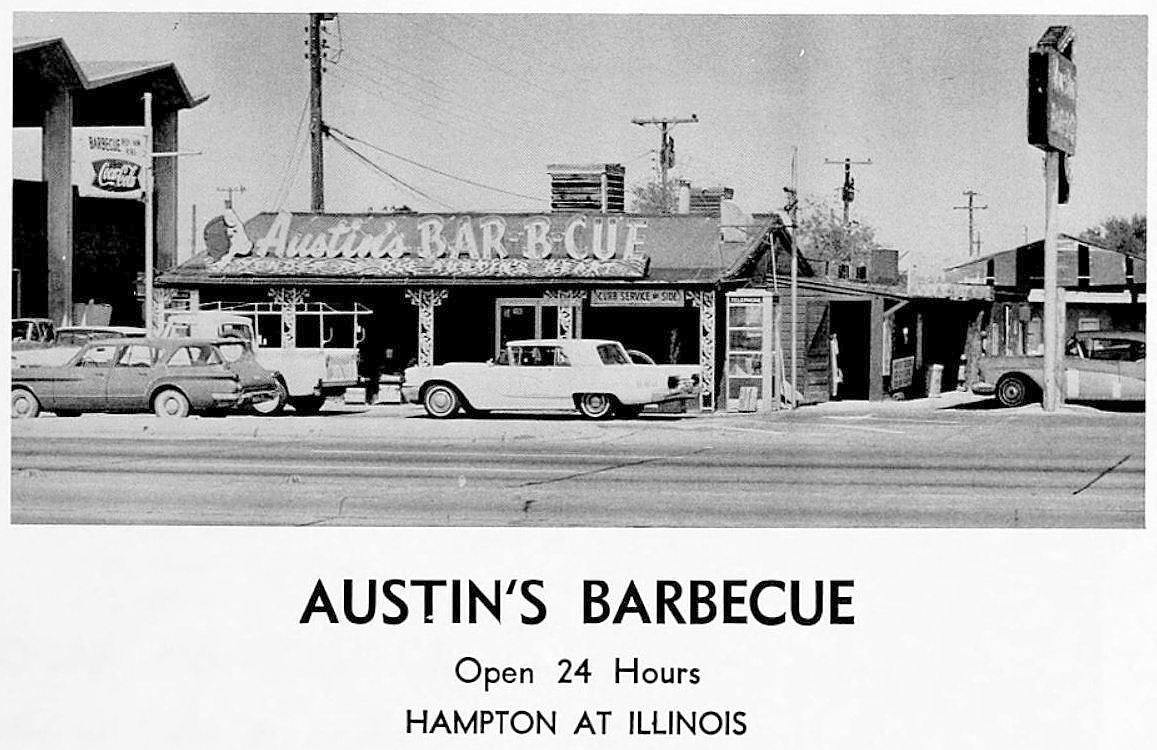
Bull Pen Barbecue/Austin’s Barbecue — 1949-2000

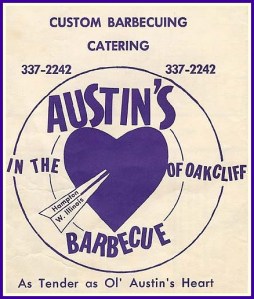
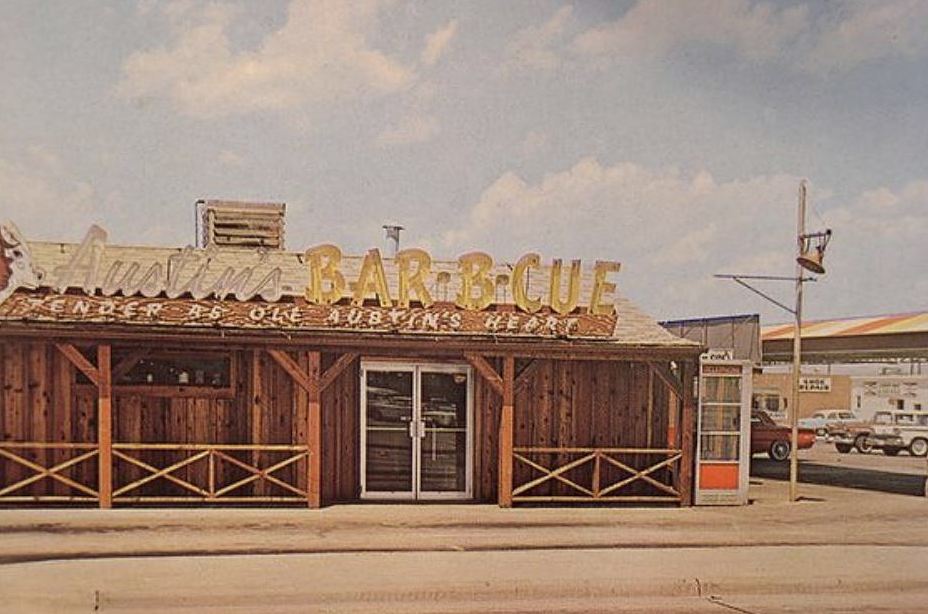
austins-barbecue_postcard_pinterest“As Tender as Ole Austin’s Heart…”

by Paula Bosse

One of my major failings as a Dallasite is that I don’t know Oak Cliff. Like at all. Every time I go over there, I get lost. I can’t remember my family ever going to Oak Cliff when I was a kid, except to visit the zoo. This explains why I had no idea how important a cultural landmark Austin’s Barbecue was when I posted a bunch of Oak Cliff ads the other day. That post has been shared hundreds and hundreds of times now and, inevitably, the only thing people mention — and rhapsodize about — is Austin’s Barbecue. …I had no idea!

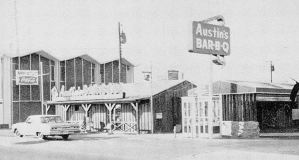
The famed BBQ joint at the northeast corner of Illinois Avenue and Hampton Road opened in 1949 as B & G Barbecue but soon became known as Bull Pen Barbecue, run jointly by owners Bert Bowman and Austin Cook. In 1956 or 1957, another Bull Pen opened in Arlington. After Oak Cliff went dry (a dark day for many Oak Cliffites), Bowman — who firmly believed that BBQ and beer were a match made in heaven — left for Arlington and Cook stayed in Oak Cliff and changed the restaurant’s name to Austin’s Barbecue. (“Bull Pen Barbecue” was still appearing in ads as late as Oct. 1957 — the official name changeover seems to have  happened in 1958.)
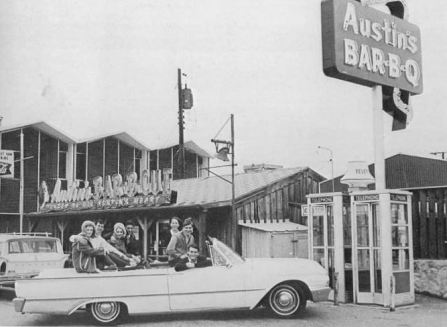
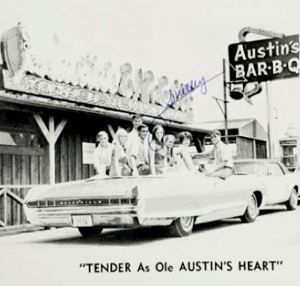
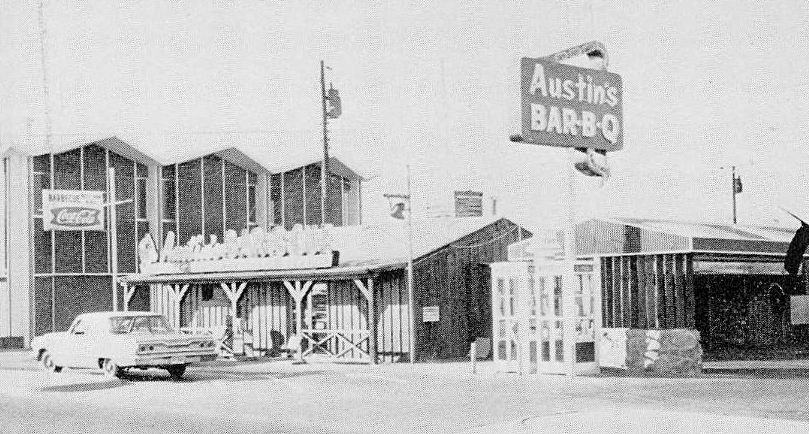
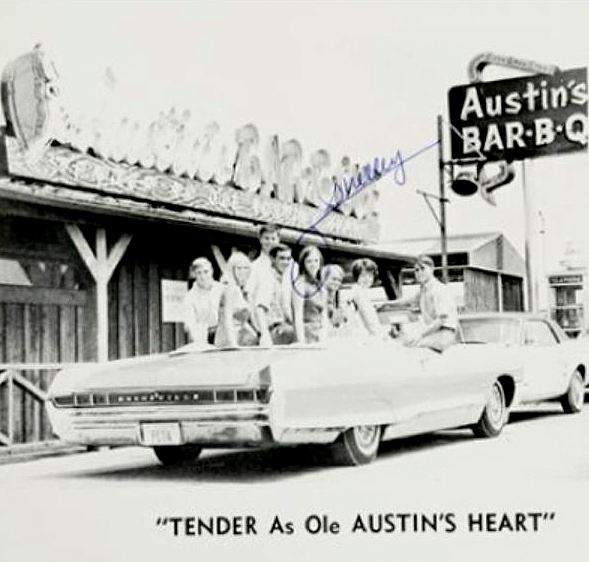
austins-bar-b-q_sunset-high-school_1967-yrbk1967 Sunset High School yearbook

*

The following memory of starting the business was apparently written by Austin Cook in 1990:

Dear Family & Friends,

I will try to tell you a little more about my being in the restaurant business. We borrowed $10,000 and bought out some one and it was B and G Barbecue. You see I always spell out Barbecue because when I went in business they hadn’t started abbreviating it like it is today.

After we had been there awhile we changed the name to The Bull Pen. Our slogan was “Come in and Shoot the Bull with Austin and Bert.” We used that name until they voted beer out of Oak Cliff. That really set us back, but maybe it was the best thing for us. We put another place in Arlington and that place was going pretty good. My partner wanted to get rid of the place in Oak Cliff. I traded him my part of the one in Arlington for his part in the one in Oak Cliff. Everyone said I was crazy.

When we bought that first place it was way out in the country, but they were building a bunch of houses not too far away. There was an airport across the street from the place. They kept talking about building a shopping center where the airport was. I remember the first day we ran a hundred dollars, and I thought we would never make it.

We started making money and we paid that ten thousand dollars back and we drew fifty dollars a week just like I was making in the grocery store. We started out with a barbecue sandwich and a hamburger. Then we started adding different things until we had a menu. We started getting those workers in the houses, and the business took off. We had beer also to go with the barbecue. My mother wasn’t too happy about that, but Dad said if that was the way I wanted to make my living it would be all right. In about a year or two we had a customer make us up a menu and we put in Barbecue plates for one dollar and twenty five cents. When I left they we were getting $4.99 for them. After I left I think they went to over seven dollars.

They always told me that you weren’t a success until you were in debt a hundred thousand dollars, and I went to the bank and borrowed all they would let me have. Then I went to my landlord and sold him the idea that I wanted to improve his property, and he loaned me the balance I needed to remodel, and I built a restaurant that held a hundred and twenty-five. Many times I was almost broke and didn’t know what I was going to do, but something always happened and I came out of it.

*

Both the Bull Pen in Arlington and Austin’s in Oak Cliff were successful and long-lived. Austin Cook retired at the end of 1993, and the business was taken over by his stepson, John Zito who had already been working at the restaurant for several years. Austin’s Barbecue closed in July, 2000, and the building was demolished soon after, replaced with an Eckerd drug store (now a CVS). Bert Bowman (born Glynbert Lee Bowman) died in 1989 at the age of 66; Austin O. Cook died at in 2006 at 86. And now I kind of feel like I know them, and I’m really sorry I never sampled their sandwiches.

*

Below, a Bowman and Cook timeline (most pictures and clippings are larger when clicked).
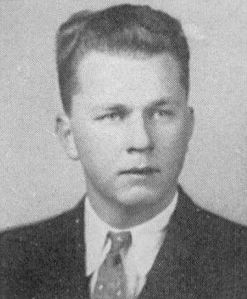
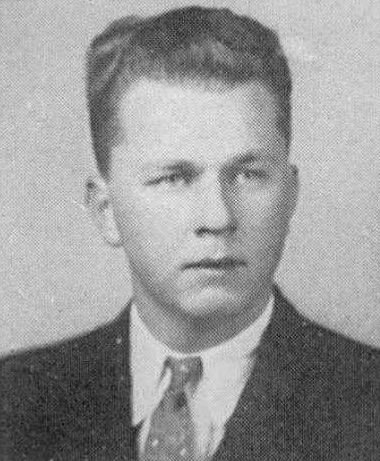
austin-cook_sunset-high-school_1937Austin Cook, Sunset High School, 1937

Before Cook and Bowmen met — probably around 1947 — each had been dabbling in different businesses. In early 1947, Cook leased a Clover Farm Store building at 203 N. Ewing and opened the Libby & Cook grocery with partner Lendal C. Libby.
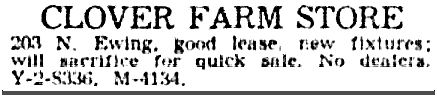
LIBBY-COOK_dmn_021047February, 1947

LIBBY-COOK_1947-directory1947 Dallas directory

Bert Bowman worked there as a meat-cutter.

bowman_1947-directory_GROCERY-w-AUSTIN1947 Dallas directory

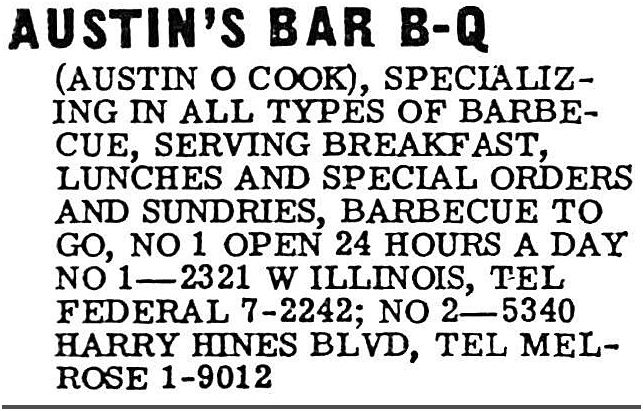
The grocery store was in business at least into 1949, the year that Bowman and Cook decided to ditch the groceries and start their own business at 2321 W. Illinois, in a part of Oak Cliff which was just starting to be developed. Their BBQ place was originally called B & G Barbecue, which — according to Cook’s letter above — was the name of the restaurant he and Bowman bought out. I guess they felt it was easier to keep the name for awhile.

b-and-g-1951-directory1951 Dallas directory

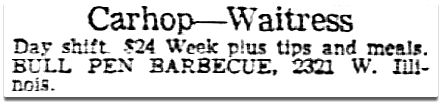
The name “Bull Pen Barbecue” didn’t come until later. In fact, the first appearance of the Bull Pen name associated with this address doesn’t show up in local newspaper archives until a want-ad placed in the summer of 1952.
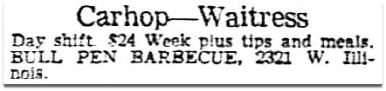
bull-pen_dmn_082652_FIRSTAugust, 1952

A probably related “Bull Pen No. 2” opened in South Dallas in 1953. It appears to have been very short-lived.

bull-pen-no-2_dmn_100853
October, 1953

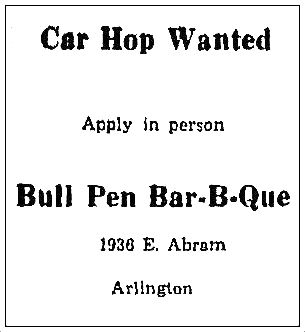
By the fall of 1957, Cook and Bowman had opened another Bull Pen — this one in Arlington, and this one a success.
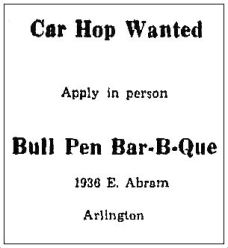
bull-pen_arlington_grand-prairie-daily-news_091557
September, 1957

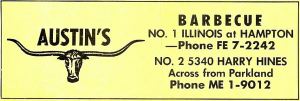
And then Oak Cliff went dry, the worst thing that could happen to a restaurant that sold a lot of beer. Similar businesses which relied heavily on beer sales began to desert Oak Cliff. Bowman did not think their original drive-in could survive, but Cook disagreed. Bowman sold his half-interest in the Oak Cliff location to Cook, and Cook sold his half-interest in the Arlington location to Bowman. Cook changed the name of his now solely-owned restaurant to Austin’s Barbecue, and his success continued, despite the fact that he could no longer sell beer. He was doing well enough that, in 1961, he opened a second location, on Harry Hines across from Parkland Hospital (a location which lasted through 1964).
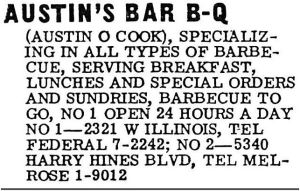
austins-barbecue_1962-directory_two-locations
1962 Dallas directory

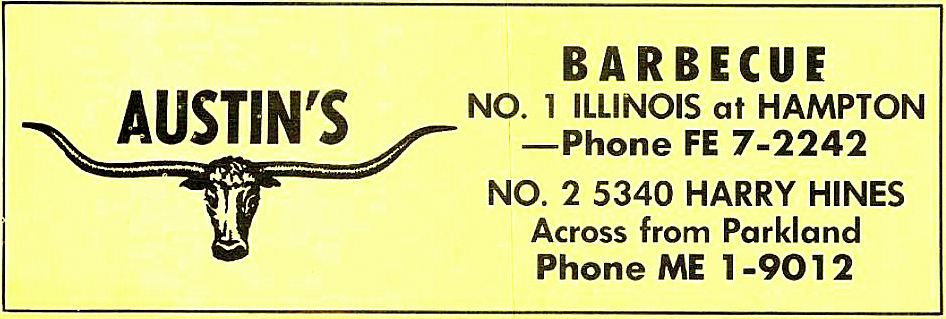
austins-barbecue_1963-directory_two-locations_ad
1963 Dallas directory

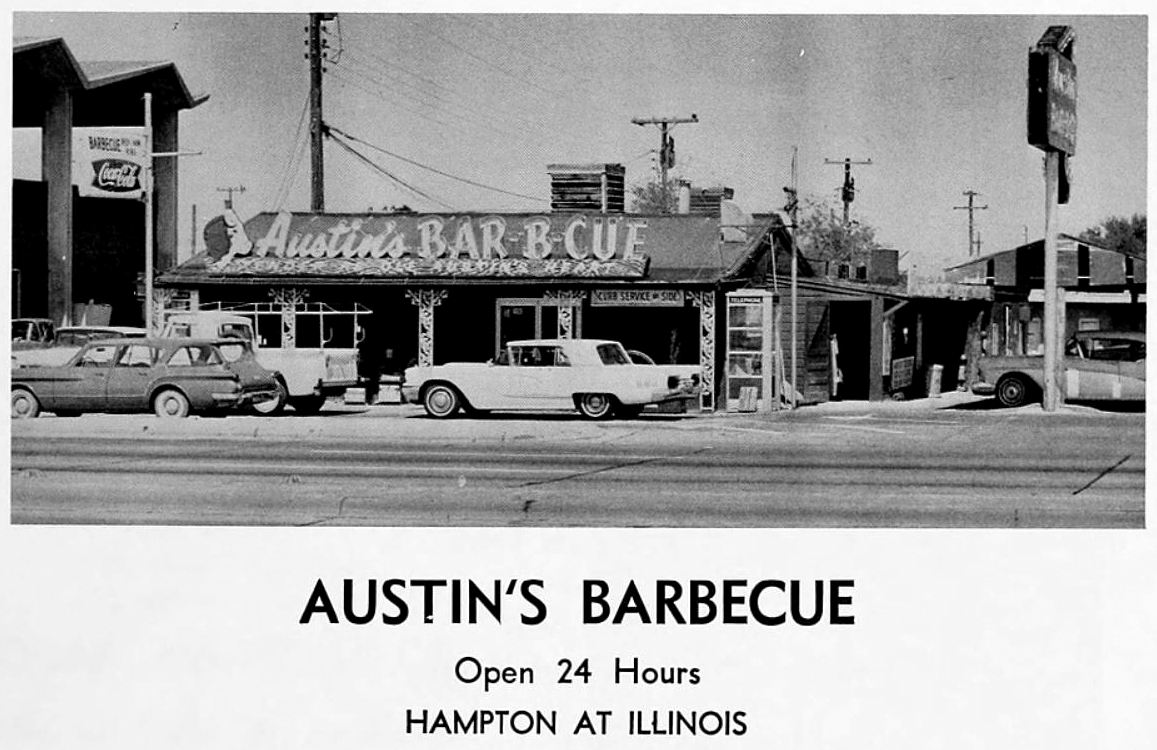
By 1963, Austin’s was a well-established teen hang-out and wisely placed ads in Oak Cliff high school annuals. Apparently everyone went there!
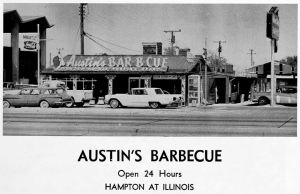
oak-cliff_austins_bar-b-cue_kimball-yrbk_19631963 Kimball High School yearbook

austins-bar-b-q_sunset-high-school_1964-yrbk.det1964 Sunset High School yearbook

austins_car-teens_flickr-coltera
Date and source unknown, via Flickr

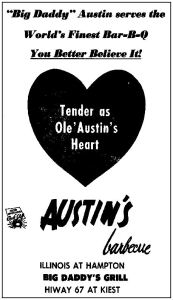
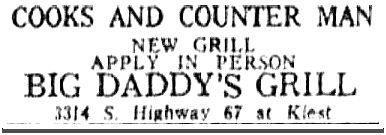
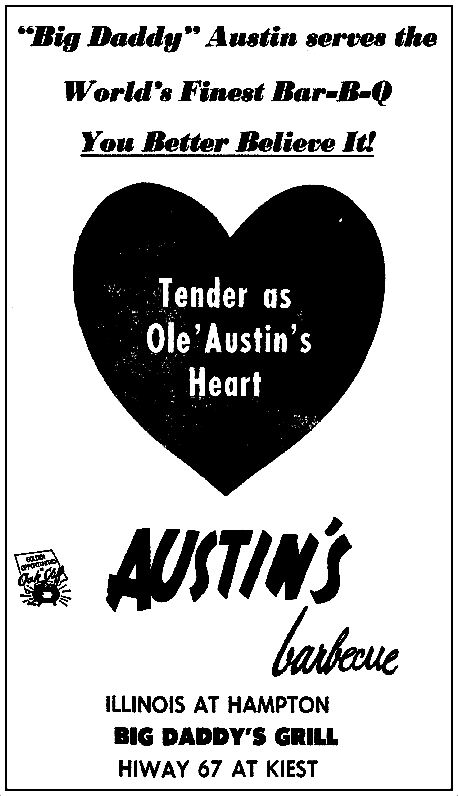
In 1964, Cook — known as “Big Daddy” — opened another restaurant, this one called Big Daddy’s Grill.
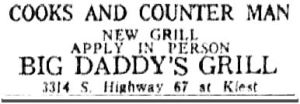
big-daddys_dmn_063064June, 1964

austins-barbecue_dmn_081466-adAugust, 1966

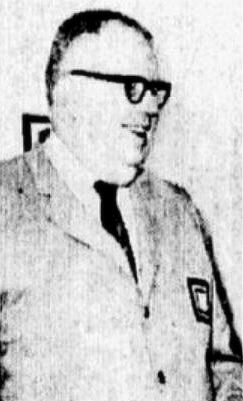
The restaurant was a bona fide Oak Cliff landmark, and Cook was an active participant in community business affairs. Below, a detail of a photo showing Cook as a member of the Oak Cliff Chamber of Commerce.
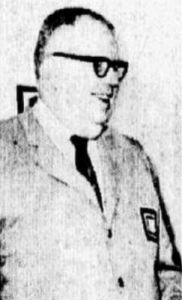
austin-cook_dmn_082568-photo-det
late 1960s

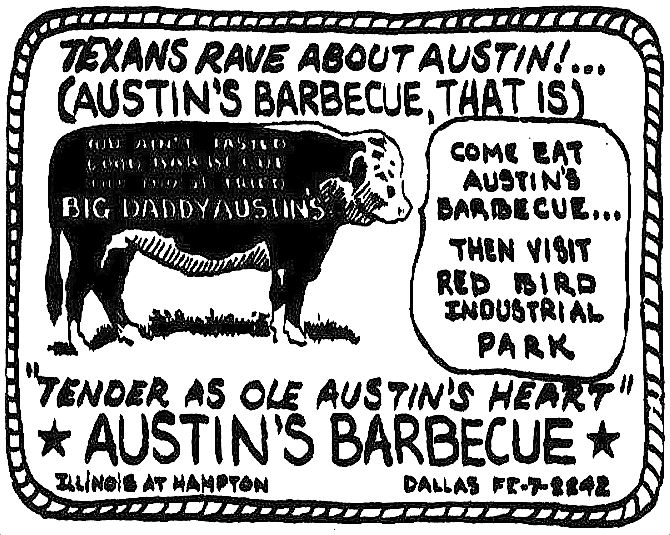
Cook participated in a series of Oak Cliff Chamber of Commerce campaigns and even included oddities like “Come eat Austin’s barbecue… and then visit Red Bird Industrial Park” in his ads. Make a day of it!

austins-barbecue_092968
September, 1968

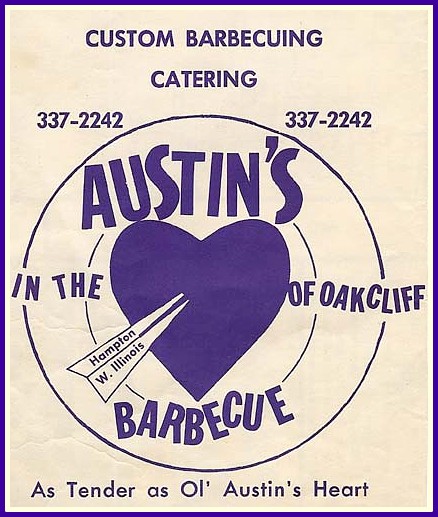
ad_austins-barbecue
via OakCliff.org

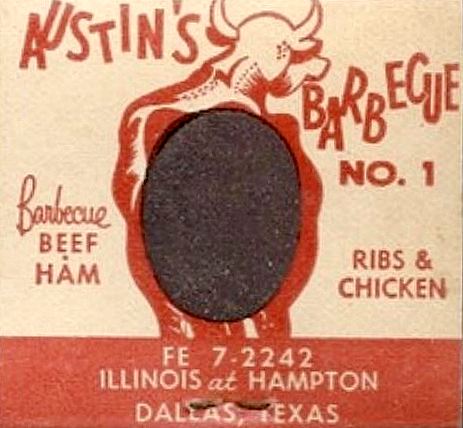
austins_matchbk_flickr_coltera
via Flickr

***

Sources & Notes

Color postcard at the top found on Pinterest, here.

The letter from Austin Cook was quoted on the DHS Phorum, here. More from the Phorum on The Bull Pen/Austin’s is here.

More can be found in the Dallas Morning News archives in the following stories:

  • “Austin’s Bar-B-Q Grows With Oak Cliff” (DMN, Aug. 14, 1966)
  • “Barbecue To Go — Staff, Customers Mourn Closing of Oak Cliff Institution” (DMN, July 13, 2000)
  • “Closed But Not Forgotten — Oak Cliff Eatery Marks Half-Century of Barbecue With Memorable Auction” (DMN, Aug. 27, 2000)
  • “John P. Zito — Operated Oak Cliff Landmark Austin’s Barbecue For 19 Years” by Joe Simnacher (DMN, Oct. 14, 2003)

Read the obituaries of Bert Bowman (1989) and Austin O. Cook (2006) here.

The Oak Cliff Advocate article “A Look Back at Austin’s Barbecue” by Gayla Brooks is here (with tons of memories from readers in the comments).

Not mentioned in this post is the connection of Officer J. D. Tippit (who moonlighted as a keeper of the peace at Austin’s) and other tangential/coincidental associations to the Kennedy assassination. It’s well documented elsewhere. Google is your friend.

*

Copyright © 2016 Paula Bosse. All Rights Reserved.

A Few Ads From the Pages of the 1963 and 1967 Kimball High School Yearbooks

oak-cliff_austins_bar-b-cue_kimball-yrbk_1963_a
BBQ in the OC, 1963

by Paula Bosse

A few random, nostalgic ads from the 1963 and 1967 Kimball High School yearbooks.

**

Above, Austin’s Barbecue.

*

Below, the Wynnewood Pharmacy:

oak-cliff_wynnewood-pharmacy_kimball-yrbk_1963_a1963

*

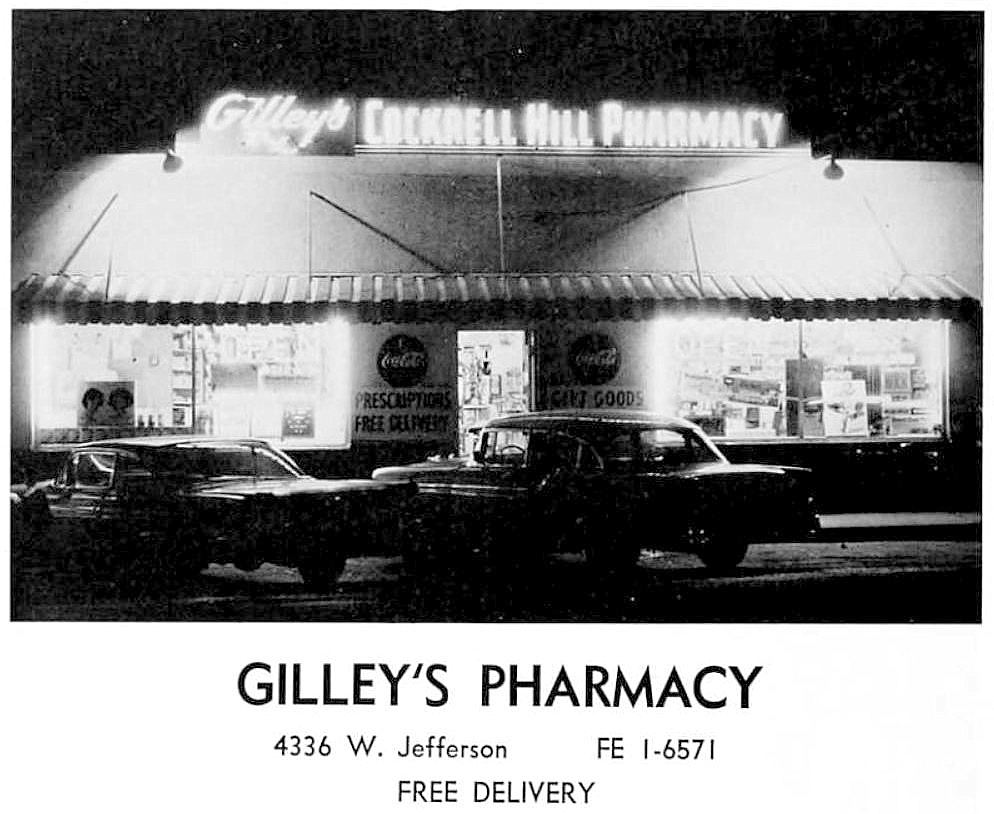
Gilley’s Cockrell Hill Pharmacy:

oak-clliff_gilleys-cockrell-hill-pharmacy_kimball-yrbk_1963_a1963

*

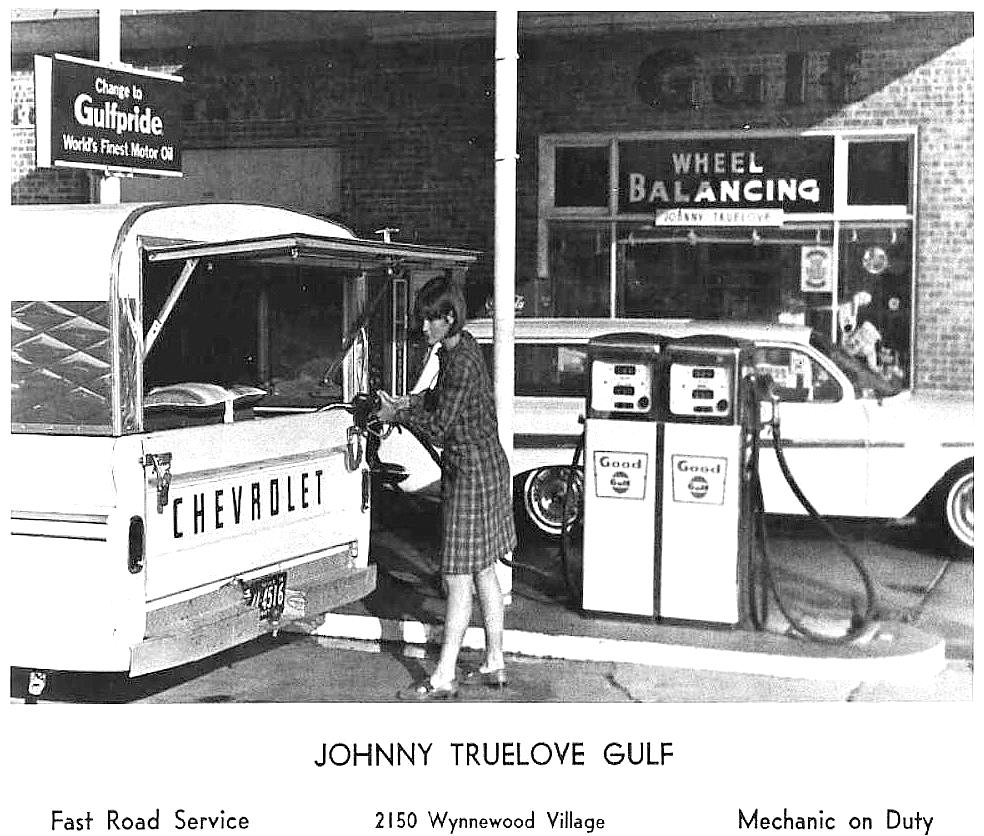
Johnny Truelove Gulf station:

truelove-gulf-station_kimball-yrbk_1963_a1963

truelove-gulf-station_kimball-yrbk_1967_a1967

*

Sammy’s Westcliff (a favorite of Marsha and her Aqua-Netted pals):

sammys_oak-cliff_1967-kimball-yrbk_a1967

*

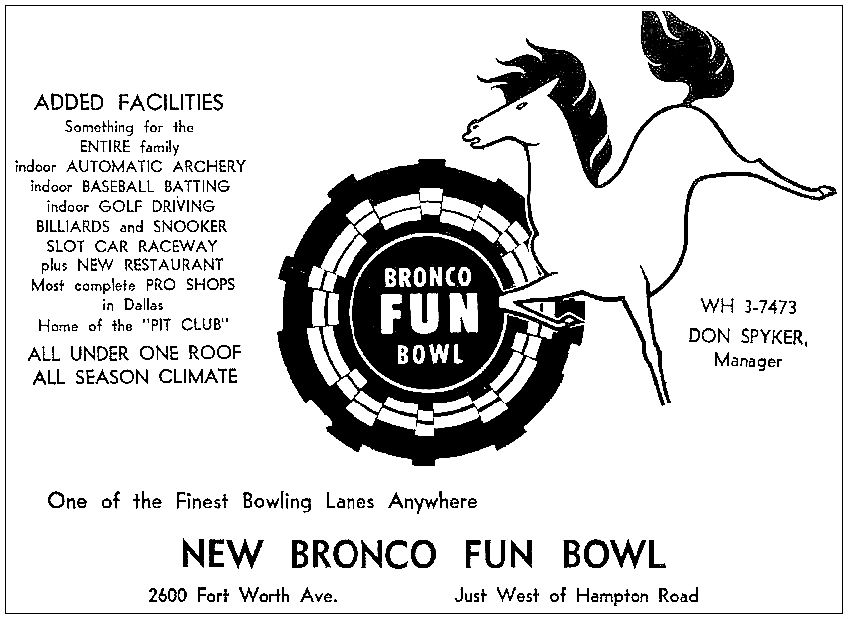
And the late, lamented Bronco Bowl:

ad-bronco-bowl_kimball-yrbk_1967_a1967

*

And for those who want to browse the retail offerings of Wynnewood Village in 1963, here is a handy list (click to see a larger image):

oak-cliff_wynnewood-village_kimball-yrbk_1963_a1963

***

Sources & Notes

All ads from the 1963 and 1967 Kimball High School yearbooks.

More than you’d ever want to know about The Bull Pen/Austin’s Barbecue in my follow-up post, here.

*

Copyright © 2016 Paula Bosse. All Rights Reserved.
West Jefferson in the Truman Years

oak-cliff_w-jefferson_frontier-top-tierW. Jefferson & S. Bishop (click for very large image)

by Paula Bosse

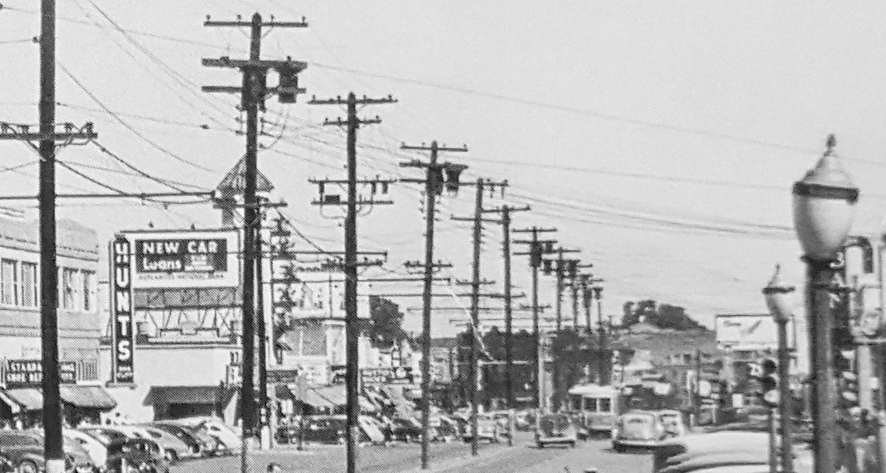
Here we see West Jefferson Blvd. in Oak Cliff, looking east from just west of the intersection with South Bishop. Not being proficient in dating automobiles, I’m unsure of the date, but the Hoffman Optical Co. (seen on the right) did not appear in the 1948 city directory, but was there by 1951. The current view from this intersection can be seen on Google Street View here. Even though the visual blight of those telephone poles is unappealing, I have to say, I prefer the livelier W. Jefferson of 60-something years ago.

If you squint, you can just see the Texas Theatre in the distance on the left — under the pointy roof, behind the “New Car” billboard. Here’s a magnified detail (click to see a larger image) — you can (barely) see “TEXAS” spelled out on the vertical sign.
oak-cliff_w-jefferson_tx-theatre_det

The first thing I noticed in this photo is this odd black vehicle driving away from the photographer — I keep seeing a bulky version of Harold’s customized hearse from the movie Harold and Maude. What is this?

oak-cliff_w-jefferson_vehicle

Here are the businesses that occupied the couple of blocks seen here (from S. Bishop to S. Zang) in 1951:

w-jefferson_1951a          w-jefferson_1951b
1951 city directory (click to read!)

*

Copyright © 2016 Paula Bosse. All Rights Reserved.


Goodbye, Merle

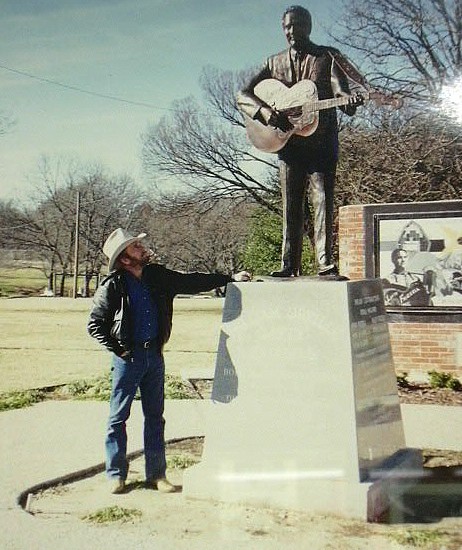
merle_lefty_corsicanaMerle and Lefty, in Corsicana

by Paula Bosse

The great Merle Haggard died today, on his 79th birthday. My earliest music memories are hearing his songs on the radio. Even people who don’t listen to country  music know who Merle Haggard is (and are probably fans).

One of his idols was Lefty Frizzell, the Corsicana-born legend whose first hits were recorded in Dallas. Merle helped raise the funds in the late ’80s and early ’90s for the wonderful statue of Lefty which now stands in Jester Park in Corsicana. The picture above shows Merle visiting the statue. (Whenever I’m in Corsicana, I always drop by Jester Park to spend some time with Lefty.)

As far as Merle and Dallas, the earliest mention I could find was from January, 1965. Country music was covered only sporadically in the pages of The Dallas Morning News back then, but his early-’65 stop at the Sportatorium may have been Merle’s first appearance in Dallas — appropriately enough, it was at the Big D Jamboree. “California country music team” Merle and Bonnie Owens were guest performers, along with Billy Grammer and James O’Gwynn of the Grand Ole Opry, and the regular Jamboree cast of thirty, for the Jan. 30, 1965 Saturday-night Big D Jamboree show.

RIP, Merle. Thanks for everything.

***

The top picture is a photo I took of an original photograph which is hanging in the Lefty Frizzell Museum, which is also in Corsicana’s Jester Park (as part of the Pioneer Village).

Merle’s obituary in Variety — which includes entertaining salty quotes from the man himself — is here.

*

Copyright © 2016 Paula Bosse. All Rights Reserved.


From the Vault: Dallas and the Spanish Influenza

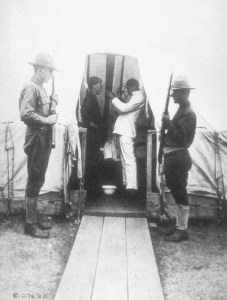
spanish-influenza_love-field_otis-historical-archives_nmhm_110618Throat-spraying at Love Field, 1918

by Paula Bosse

A cold has been dragging me down for the past few days — the perfect excuse to re-run an old post about communicable diseases! I’ve felt pretty bad, but at least it isn’t the Spanish Influenza. Or, for that matter, Ebola. I originally wrote this post (about how the Spanish Influenza had ripped through the city in 1918 and 1919) as a response to the then-current concern that a deadly Ebola pandemic might similarly race around the world, set off by the unexpected cases of the Ebola virus spreading here in Dallas. Thankfully, that didn’t happen.

Read the original post — “When the Spanish Influenza Hit Dallas — 1918” — here.

And, remember: cover your mouth when you cough and don’t spit in the streets, because NOBODY expects the Spanish Influenza!

*

Copyright © 2016 Paula Bosse. All Rights Reserved.

Home Sweet Home at Commerce & Harwood

municipal-bldg_houses_jeppson_flickr“Main Street Garden?”

by Paula Bosse

Quaint homes, mere steps from City Hall. Not sure of the exact date of this photo, but these homes and this service station were at the above location in 1920. Wonder when those homeowners finally decided to sell? Talk about your primo real estate!

Below is a similar photo, but this one shows more of Commerce looking east — I don’t come across a lot of photos of this era showing downtown past what was unofficially thought of as its eastern boundary.

municipal-bldg_cook-coll_degolyer_SMU

***

Sources & Notes

Photo from Noah Jeppson’s Flickr page, here.

Second photo, titled “Dallas City Hall,” is from the George W. Cook Dallas/Texas Image Collection, DeGolyer Library, Central University Libraries, Southern Methodist University; more info on this photo can be found here.

More on the building of the City Hall/Municipal Building in the Flashback Dallas post “The Elegant Municipal Building — 1914,” here.

*

Copyright © 2016 Paula Bosse. All Rights Reserved.

Signage Overload on Main Street — ca. 1925

main-street_east_hilton_ebayI hope the photographer has a red light behind him…

by Paula Bosse

This photo makes me feel anxious. There’s just too much going on here: too many signs, too many overhead wires, too garish a light.

This is the 1800 block of Main Street, looking east. The photographer’s shadow can be seen at the bottom of the photo. A large hotel of some sort (the name of which escapes me at the moment) can be seen in the distance (in the 1900 block) at Harwood.

The businesses in this block, from the 1925 city directory (click for larger image):

1800-block_main_1925-directory

I have no 1926 directory to reference, but the 1927 directory has the building at 1811 Main (occupied in the photo by the Rund-Humphrey Water Heater Co. and the Stevenson Printing Co.) listed as being vacant. And the Hilton opened in 1925, so the photo seems to have been taken in 1925 or 1926.

***

Sources & Notes

Photo from eBay.

See the Hilton (the first one, not the later Statler-Hilton on Commerce) from a different angle in the post “The Hilton Hotel, Main & Harwood,” here.

*

Copyright © 2016 Paula Bosse. All Rights Reserved.

La Reunion: Utopia on the Trinity

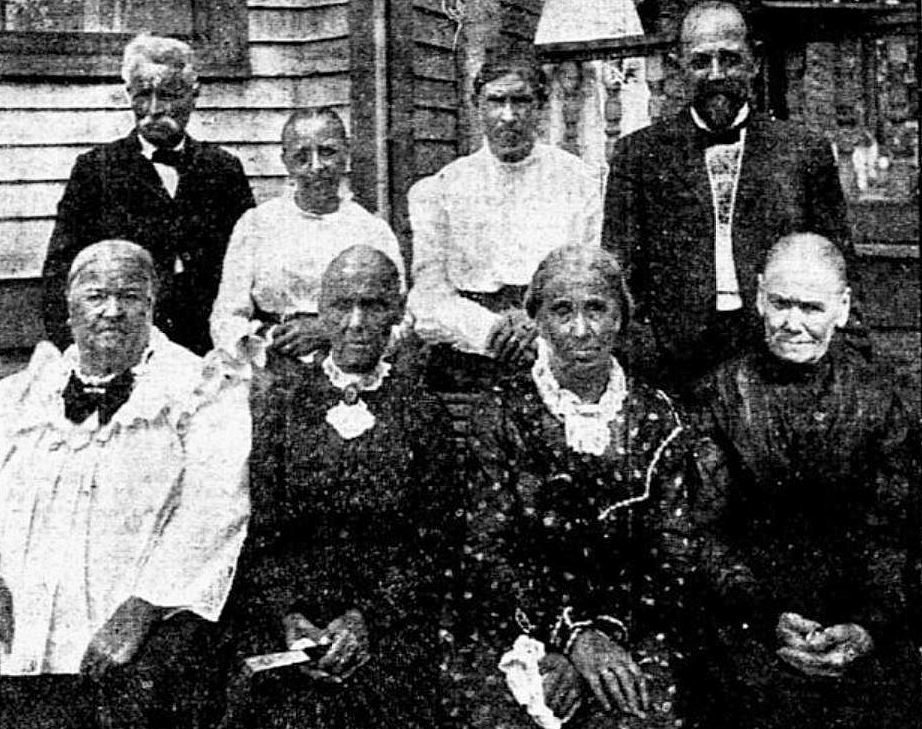
la-reunion_dmn_053106Eight of the original settlers, 1906

by Paula Bosse

I’ve put off writing about the socialist utopian settlement of La Reunion, which sprang up just across the Trinity from Dallas in the mid 1850s, because it’s such a big topic. Luckily, though, the fabulous Julia Barton has put together an entertaining and informative radio presentation on this very topic (see below for details). So I’ll just present a couple of interesting tidbits and leave the heavy lifting to Julia.

But for a totally inadequate one-paragraph summary of La Reunion, it was a colony of generally well-educated (and adventurous) French, Swiss, and Belgian immigrants, some of whom were political refugees from the unrest then spreading across Europe. They were led by Frenchman Victor Prosper Considerant (a follower of the democratic socialist Charles Fourier) — who began his settlement in 1854/1855 on land he had purchased just west of the Trinity River. A socialist commune … in Texas! But it was rough going for the European immigrants, and by 1859 the community had been deemed a failure: too many scholars, not enough farmers, as one colonist put it. Many of the colonists left the area, but several of these immigrants stayed, many becoming successful businessmen and community leaders (one of them, Swiss-born Benjamin Long, even became a two-term mayor of Dallas in the years following the Civil War). They are also credited with bringing a cultural sophistication and world-view to a dusty little town on the Texas frontier which had precious little of either before their arrival. Without the influence of these failed utopians, Dallas would be a much different city than the one we know today.
So here are a few random La Reunion bits and pieces.

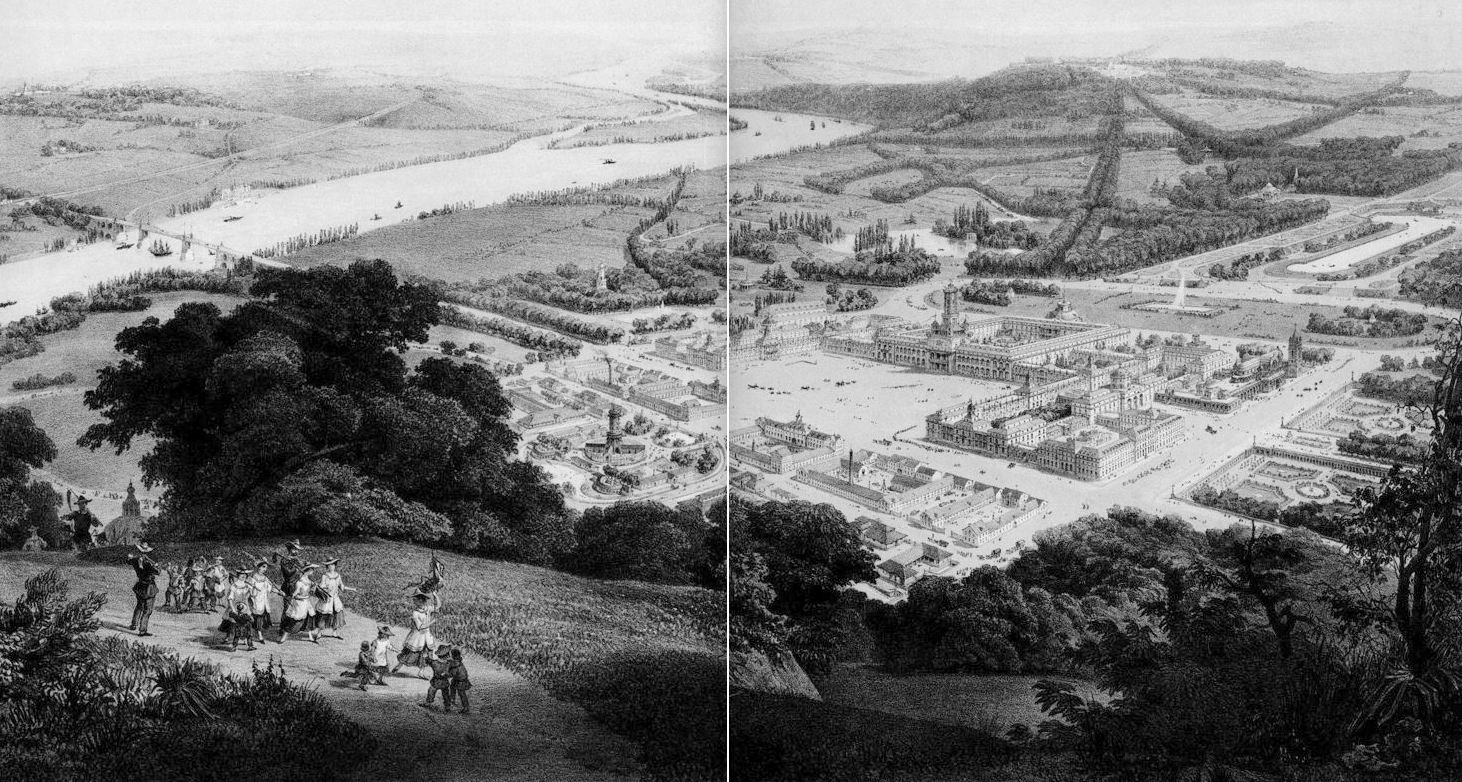
According to an interesting Legacies article by James Pratt, those settlers — while still back in their homelands — might have gotten the idea that this is what their new home in Texas might look like:

idealized_la-reunion_legacies_fall-1989_DHSSee left side REALLY big here; right side here (Dallas Historical Society)

Um, yes.

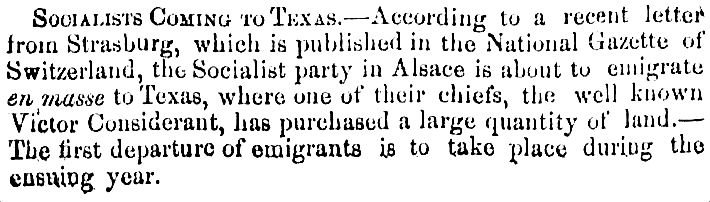
Here’s one of the first mentions of the impending arrival of Considerant’s group (the size of which was almost always exaggerated in early reports). (Click for larger image.)

la-reunion_texas-state-times_austin_021055Texas State Times (Austin), Feb. 10, 1855

*

 It was news even in Virginia:

la-reunion_richomond-dispatch_virginia_050555Richmond Dispatch, May 5, 1855

*

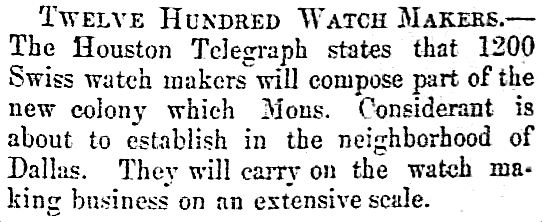
1,200 Swiss watchmakers?!!

la-reunion_texas-state-times_austin_060255Texas State Times (Austin), June 2, 1855

*

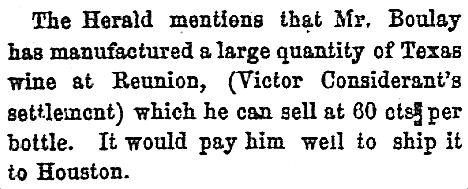
One of the things I learned from Julia Barton’s piece of La Reunion was that some of the settlers brought plants native to their European homes with them — this included grapevines, for making wine.

wine_houston-weekly-telegraph_101259Houston Weekly Telegraph, Oct. 12, 1859

(Read about the surprise M. Boulay left his widow when he died in 1875, here, in an article from The Dallas Weekly Herald, July 24, 1875)

*

On May 30, 1906, a 50th anniversary party was held by a group of the original La Reunion colonists. In the Dallas Morning News story about this event (which you can read here), these men and women were interviewed. My favorite factoid was that these fresh-off-the boat immigrants traveled to Dallas from Galveston or Houston ON FOOT. One woman said she and her fellow group of travelers walked from Houston to Dallas, leaving in late May and arriving on July 4th. Imagine their disappointment after having walked for weeks and weeks in heat they had never before experienced, only to find that their new home was nothing like what they had expected. Several stuck around for the rest of their lives, though. The eight colonists pictured in the photograph above are identified in the caption below it:

SWISS – FRENCH – BELGIAN PIONEERS OF DALLAS

  • Front row, from left to right: Mrs. Barbara Frick, Swiss, 79 years old, in Dallas 51 years
  • Mrs. D. Nussbaumer, Swiss, 73 years old, in Dallas 50 years
  • Mrs. Lucy Vorrin, French, 61 years old, in Dallas 50 years
  • Mrs. C. Remond, French, 67 years old, in Dallas 50 years
  • Second row, from left to right: Charles Capy, French, 75 years old, in Dallas 51 years
  • Mrs. Charles Capy, French, 61 years old, in Dallas 50 years
  • Mrs. C. Vongrinderbeek, Belgian, 60 years old, in Dallas 51 years
  • Adolf Frick, Swiss, 62 years old, in Dallas 51 years (DMN, May 31, 1906 — Photo by Clogenson)

*

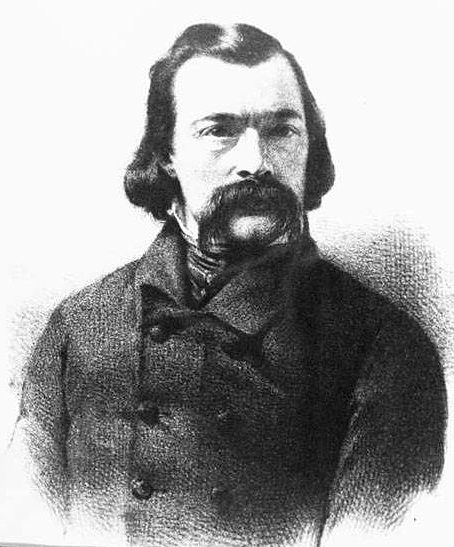
Finally, a photo of Victor Considerant, who left La Reunion when the going got tough, lived in a nice place in San Antonio for a while, then returned to France, where he lived as a teacher and “socialist sage” until his death in 1893 at the age of 85.

victor-considerant_utsaUTSA Libraries, Digital Collections

***

Sources & Notes

I HIGHLY encourage you to listen to the aforementioned radio essay Julia Barton did for Public Radio International: “The Failed Socialist Utopian Dream That Helped Dallas Become a Major City” is here. It is a segment of the PRI podcast The World in Words — it begins at about the 5:30 mark and runs about twenty minutes. I learned stuff!

The highly idealized rendering of a Fourier-inspired phalanstère is from the collection of the Dallas Historical Society and appeared on the front and back covers of the Fall, 1989 issue of Legacies. No other information on the drawing was given. I’m not sure if prospective La Reunion colonists were led to believe this was a depiction of the heaven-on-earth that awaited them in Texas. If so, I bet they were very, very disappointed.

La Reunion links:

  • Handbook of Texas (with details about the philosophical, political, and social aims of the colony)
  • Wikipedia
  • “La Reunion: Adventure in Utopia” from the WPA Guide to Dallas, here
  • “La Reunion” by Ernestine Porcher Sewell, from The Folklore of Texan Cultures (1974), here

Watch Julia Barton’s presentation of “Port of Dallas” — about the misguided hopes to turn the Trinity River into a navigable waterway from Galveston to Dallas — here.

Other Flashback Dallas posts on La Reunion can be found here.

reunion-tower_twitter@ReunionTower on Twitter

*

Copyright © 2016 Paula Bosse. All Rights Reserved.