Flashback : Dallas

A Miscellany: History, Ads, Pop Culture

Category: 1910s

“The Fair Is In the Air — Let’s Go!”

state-fair_1923Look at this 1923 typeface!

by Paula Bosse

Here we are again in the final days of another State Fair of Texas. Why not take a look at a few random images of the fair over the years. (Click pictures for larger images.)

First, from 1900, the entrance to the fairgrounds. (It appears to be the same view as the top postcard seen in a previous post, here, just a few steps inside the archway.)

fairgrounds-main-entrance_bohemian_1900_fwplFort Worth Public Library

*

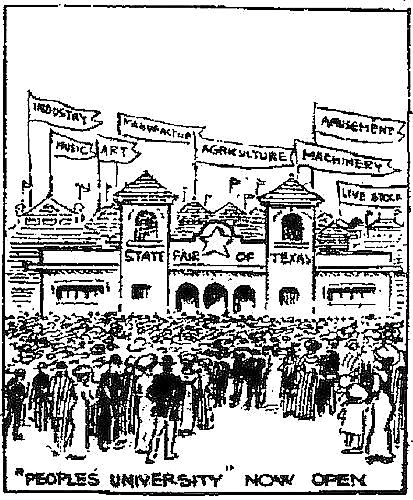
A cartoon from The Dallas Morning News in 1912 — “The People’s University.” Remember, it’s not just about Ferris wheels and candy apples.

state-fair_dmn_102012-cartoonDMN, Oct. 20, 1912

*

1921. Don’t miss The Whip.

state-fair_1921

*

From the Texas Centennial in 1936, a shot of a remarkably spotless Midway. (Am I the only one who would have paid to see the “28-Ft. Monster” do battle with whatever freakish specimens were ensconced within the walls of the Ripley’s Believe It Or Not building?)

tx-centennial-midway_1936_ebay

*

During World War II, no fair was held between 1942 and 1945. “Not until the boys come home, will there be another State Fair of Texas.”

state-fair_wwii_tx-almanac_1945-46

*

By the ’50s, everything was back to normal. Big Tex had arrived, and this ad promises “She’s a LULU in ’52.” Martin & Lewis and whatever a Thrillcade was!

state-fair_dmn_092552_lg

*

And, lastly, an aerial view of the Midway from 1966. Now this IS all Ferris wheels and candy apples. (To watch a short collection of color footage from the damp 1967 SFOT — including a sad, rainy parade downtown — click here.)

state-fair_1966_UNTUniversity of North Texas

***

Sources & Notes

1900 photo of the entrance to the fair is from The Bohemian magazine (1900) in the collection of the Fort Worth Public Library (those perforations in the photo are the FWPL’s).

1921 photo — I’m afraid I have no source on this one.

1936 postcard of the Centennial Midway is from eBay.

Patriotic WWII ad is from the 1945-1946 Texas Almanac.

Photo of the 1966 Midway is from the University of North Texas University Libraries blog, here.

My previous collection of SFOT photos over the decades appeared in the post “So Sorry Bill, But Albert Is Taking Me To The State Fair of Texas,” here.

Other Flashback Dallas posts on the State Fair of Texas are here; posts specifically on the Texas Centennial are here.

Again … some of these pictures are pretty dang big — when in doubt, click ’em!

*

Copyright © 2015 Paula Bosse. All Rights Reserved.


Wading in Turtle Creek, 100 Years Ago

turtle_creek-smu-rotunda-1916_sm

by Paula Bosse

A photograph of children wading in a very different-looking Turtle Creek, taken about 1915, the year Highland Park (pop. 1,100) was incorporated.

***

Sources & Notes

Photo from the 1915-1916 SMU Rotunda yearbook.

Population factoid from Wikipedia.

Click picture for larger image.

*

Copyright © 2015 Paula Bosse. All Rights Reserved.


Young Bucks at the Fair — 1915

state-fair_men-touring-car_1915_degolyerRaring to go…

by Paula Bosse

Some of these guys look like they’d be fun to spend a day with at the fair. …Some of them don’t.

***

Sources & Notes

Real photo postcard titled “Men in a touring car with 1915 State Fair of Texas in Dallas banner” is from the Collection of Texas Postcards, DeGolyer Library, Central University Libraries, Southern Methodist University; it can be accessed here.

*

Copyright © 2015 Paula Bosse. All Rights Reserved.

SMU Turns 100: A Look Back at Its Very First Days — 1915

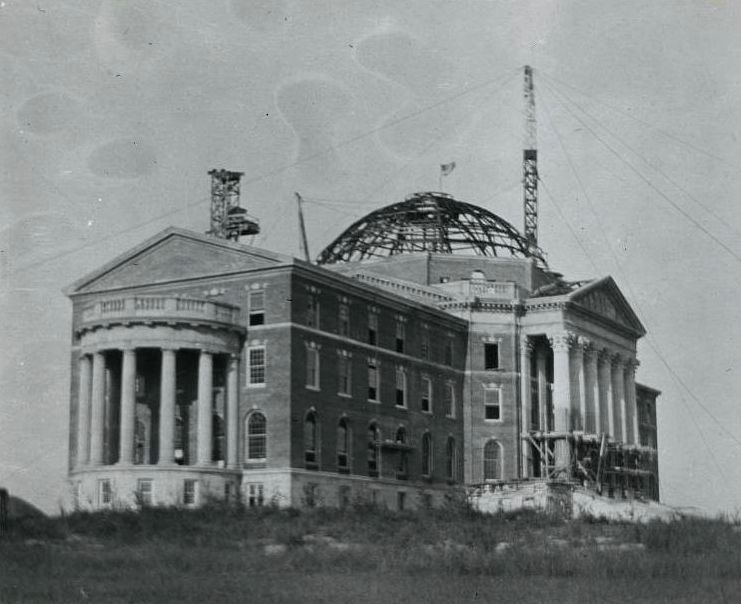
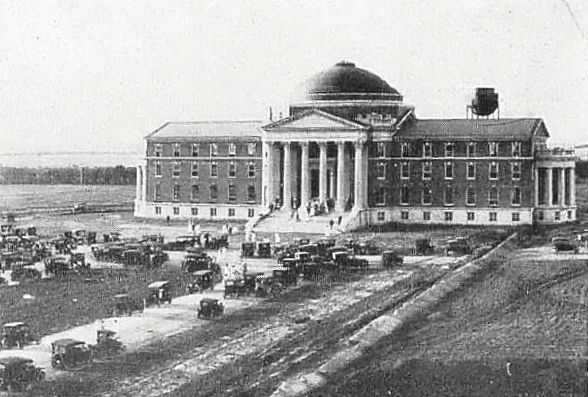
smu_dallas-hall-dome-under-construction_1914Dallas Hall’s dome under construction, 1914 (SMU Archives)

by Paula Bosse

Classes began for the very first time at brand new Southern Methodist University on September 28, 1915 — 100 years ago today! Where HAS the time gone? Below, a few photos from those early days (click pictures for larger images).

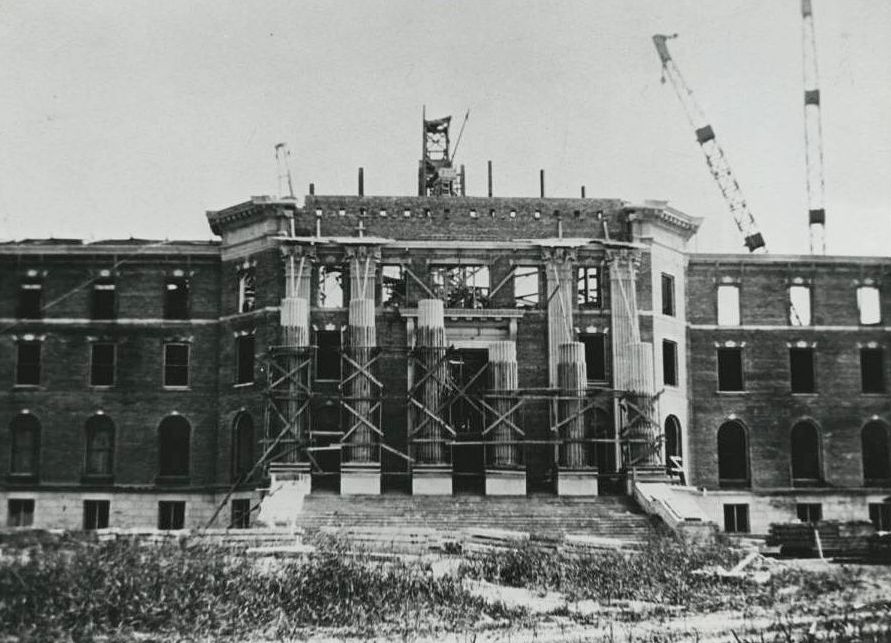
smu_dallas-hall-columns-under-construction_1914_degolyerDallas Hall’s columns going up, 1914, out in the middle of a mostly empty prairie, well beyond the Dallas city limits.

smu_week-before-opening_1935-rotundaVisitors checking out the new campus, a week before its opening.

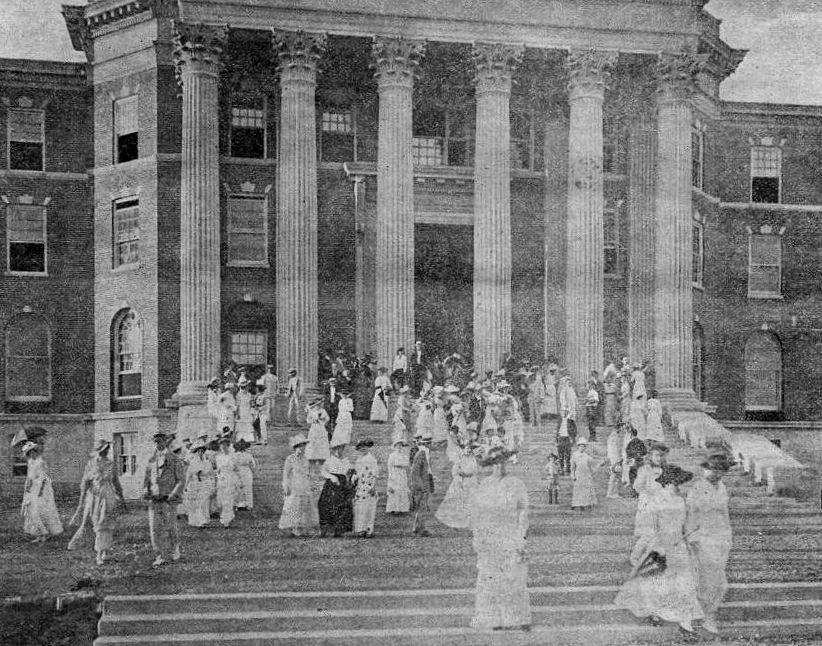
smu_visitors-before-opening_091115Genteel visitors on the steps of Dallas Hall, the only building on campus in which classes were actually held.

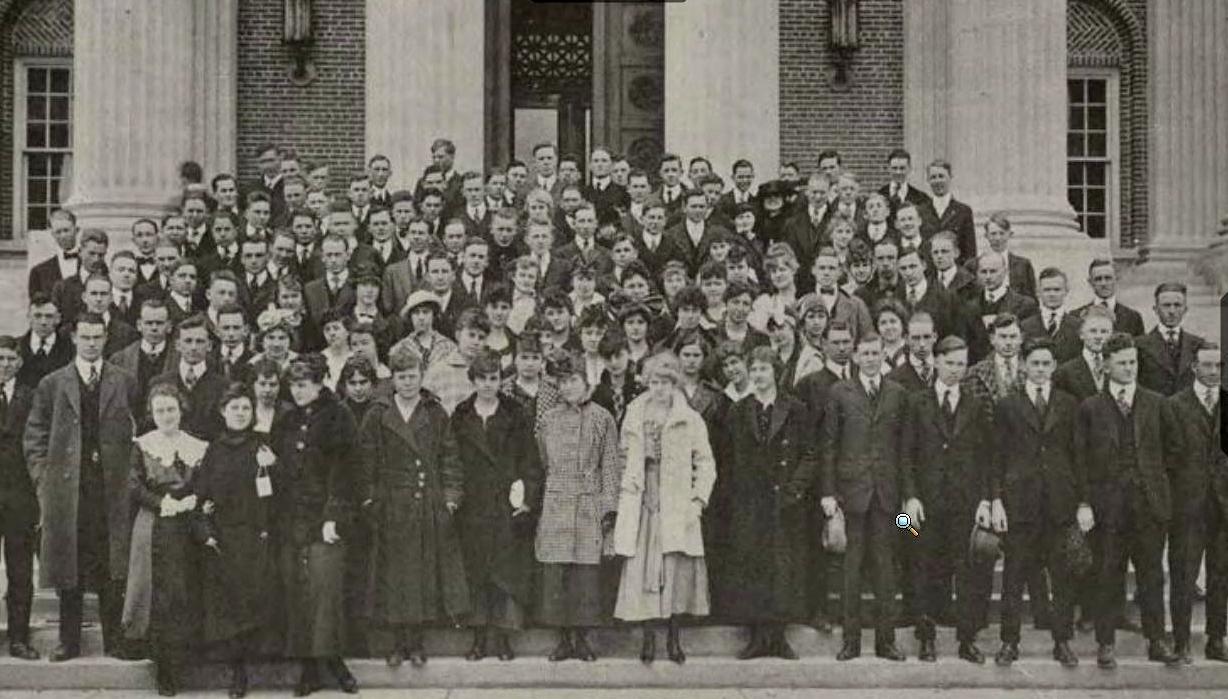
12smu-rotunda-1916_freshman-classSMU’s first freshman class.

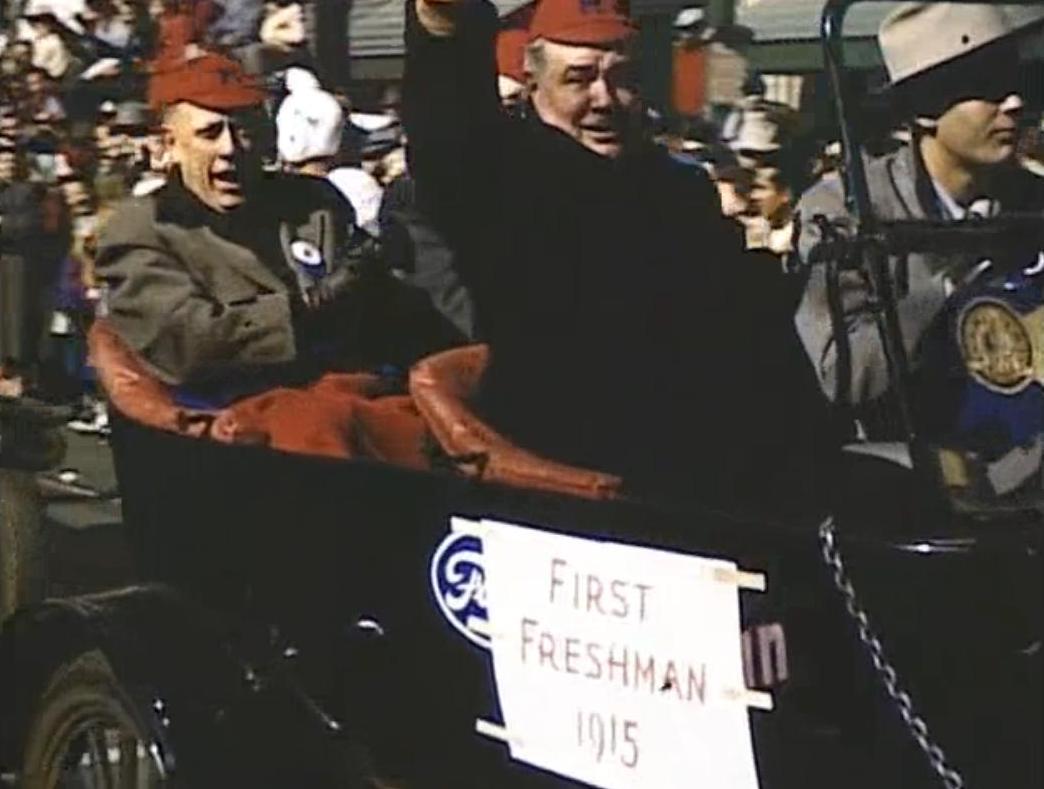
smu_first-freshmen_1950-homecoming-paradeAnd a couple of those freshmen, 35 years later, riding in a car in the 1950 Homecoming Parade downtown.

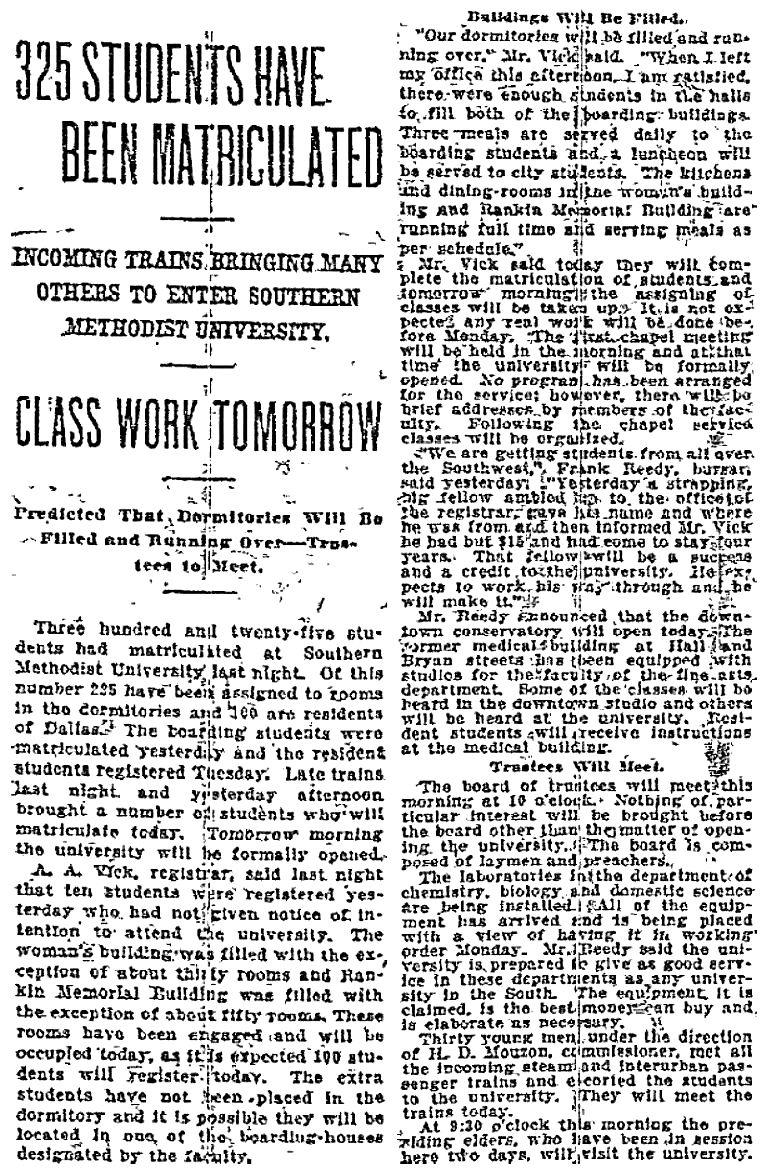
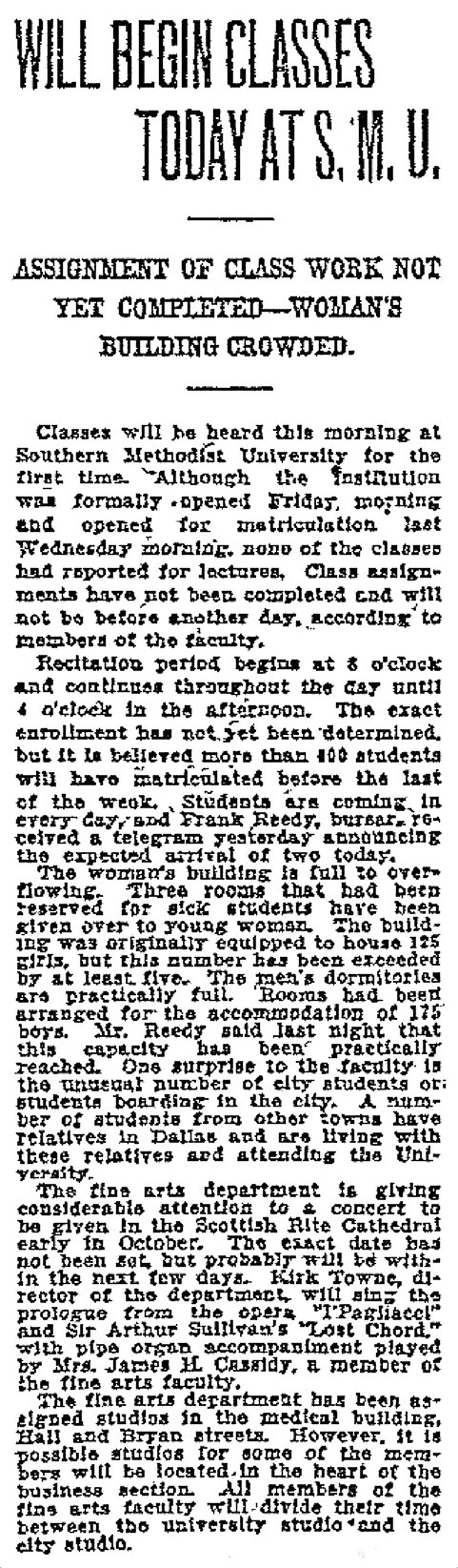
Below are a couple of logistical and progress-report articles from the week when students began arriving for that first year’s classes. Most interesting is that several classes were held off-campus, because of lack of space in an already crowded Dallas Hall. The fine arts department was housed at the “downtown conservatory” which was located in a former medical building at Hall and Bryan streets. The fine arts faculty had studios there and would move between downtown and the SMU campus. (Click articles for larger images.)

smu_first-day_dmn_092315Dallas Morning News, Sept. 23, 1915

smu_first-day-classes_dmn_092815DMN, Sept. 28, 1915

Happy Centennial, SMU!

***

Sources & Notes

The photos of Dallas Hall under construction are from the DeGolyer Library, Central University Libraries, Southern Methodist University. The photo of the dome under construction is here; the photo of the columns going up is here.

The photo of campus visitors and their cars lined up in front of Dallas Hall is from the 1935 edition of the SMU Rotunda yearbook; the caption: “Dallas Hall, a week before opening of SMU.”

The photo of visitors on the steps of Dallas Hall is from Bridwell Library, Special Collections, Perkins School of Theology, Southern Methodist University, and it can be accessed here. The photo was taken on Sept. 11, 1915 and was printed in the Sept. 23, 1915 edition of The Texas Christian Advocate above the caption “[Snapshot] of visitors at entrance to Dallas Hall on occasion of the reception given Saturday the 11th by the citizens of Dallas to the faculty.” (The article and another photo can be seen at the link above.)

The photo of SMU’s first freshman class is from the 1915-16 SMU Rotunda yearbook.

The image of the former SMU freshmen is a screen capture from a home movie of SMU’s 1950 Homecoming Parade which is part of the DeGolyer Library’s collection; the entire 17-minute silent color film can be watched on the SMU Central Libraries site, here. The very entertaining film contains the parade, a tour around campus, an elaborately decorated Fraternity Row, and the football game against Texas A & M at the Cotton Bowl.

These other Flashback Dallas posts related to SMU’s first year may also be of interest:

  • “SMU, ‘The School of the Future’ — 1915-16,” here
  • “SMU’s First Year: The Dinkey, Campus Hijinx, and The Basket Ball — 1915-16,” here
  • “University Park, Academic Metropolis — ca. 1915,” here
  • “Send Your Kids to Prep School ‘Under the Shadow of SMU’ — 1915,” here (Incidentally, the Powell University Training School opened on the same day as SMU as a sort of “sister school” — the building it occupied is still standing, on Binkley, just off Hillcrest — this building celebrates its Centenary, too!)

Click photos and clippings to see larger images.

*

Copyright © 2015 Paula Bosse. All Rights Reserved.


Trinity Heights: The Tallent Furniture Studio and The Sunshine Home

tallents-furniture-store_oak-cliff_tichnorVermont & South Ewing… (click for larger image)

by Paula Bosse

The postcard image above shows a bird’s eye view of a few blocks in the Trinity Heights neighborhood of Oak Cliff, from the late 1940s. As I looked at it, I wondered a) what does this intersection look like now, b) what is that unlabeled building that looks like a jail behind the furniture store, and c) what was Tallent’s Furniture Studio?

Tallent’s Furniture Studio, owned by Raymond E. Tallent, was located at 815 Vermont Avenue.

tallent_dmn_010350-obit-photo

tallents-ad_dmn_081256-det1956

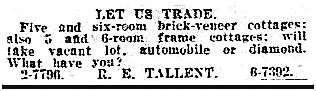
Not only did it house a furniture store, but it also served as an office for Tallent’s real estate business. According to Tallent’s obituary, he came to Dallas in 1920 and started his real estate business five years later. Starting out, he’d’ve been happy to trade you property for diamonds. “What have you?”

tallent_dmn_042928-real-estate-adApril, 1928

The first mention I found for the furniture store is this Christmas ad from 1947.

tallents_ad_121147Dec., 1947

Tallent died in January of 1950 at the age of 53. Both of his businesses continued after his death, and the furniture store was still going in the late 1960s.

So, nothing out of the ordinary — just a small business, like thousands of other small Dallas businesses. Probably the most interesting thing about Tallent was that he had the good taste to have that great promotional postcard made. That strange little building behind the store was a lot more interesting.

*

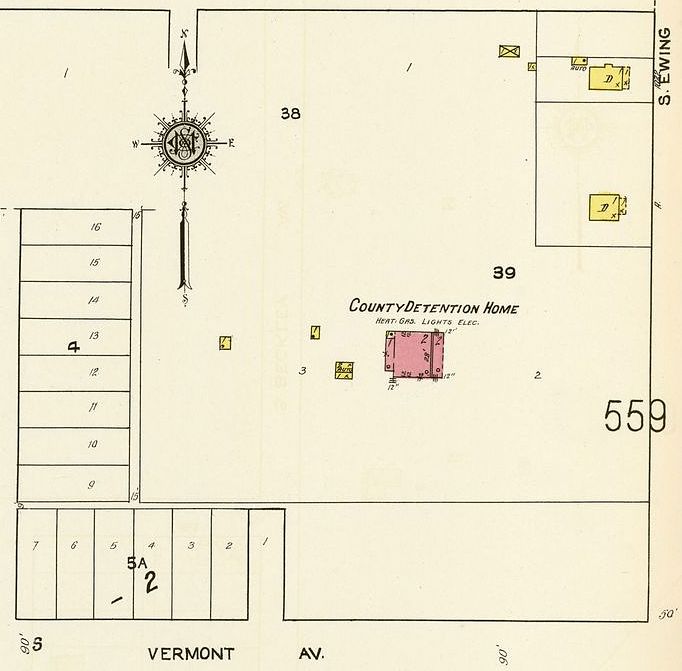
What was that building? The first time it popped up on a Sanborn map was 1922: it was identified as a “County Detention Home” (click for larger image).

detention-home_sanborn_19221922 Sanborn map detail — see full page here

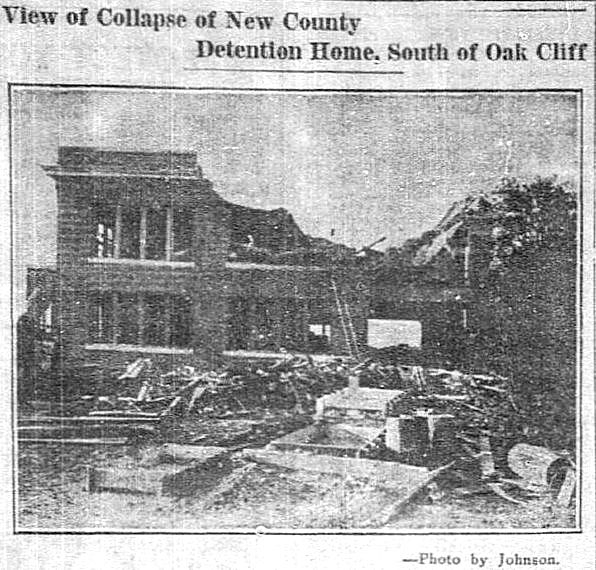
Despite its name, the “detention home” was not a correctional facility for juvenile delinquents, but it was a home for dependent children who had been made wards of Dallas County because of neglect or abandonment or because parents had died or were simply unable to care for them. This detention home was built in 1917 at 1545 South Ewing (“south of Oak Cliff”). During its construction in 1917, its roof collapsed, killing one of the workers.

detention-home-collapse_dmn-041317Dallas Morning News, Apr. 13, 1917

The home was almost immediately overcrowded, and its superintendents were constantly scrambling for an increase in funding. Children, ranging in age from toddlers to teenagers, lived there as long as they needed — some for a few months, some for several years. They attended nearby schools, and even though they were wards of the court and were living in an institution, the people who ran the place tried to make it as home-like as possible. In January, 1934, the name of the county facility was changed to the much more cheerful “Sunshine Home.”

In 1950, the Sunshine Home received $165,000 in bond money for improvements and expansion, adding modern structures to the large campus but still retaining the original two-story red brick building built in 1917.

In 1975, the Dallas County Sunshine Home and the Girls’ Day Center merged, and the former Sunshine Home was renamed Cliff House.

In 2014, the 28,000-square-foot property on just under five acres was put up for sale, and in early 2015 plans for a charter elementary school were approved.

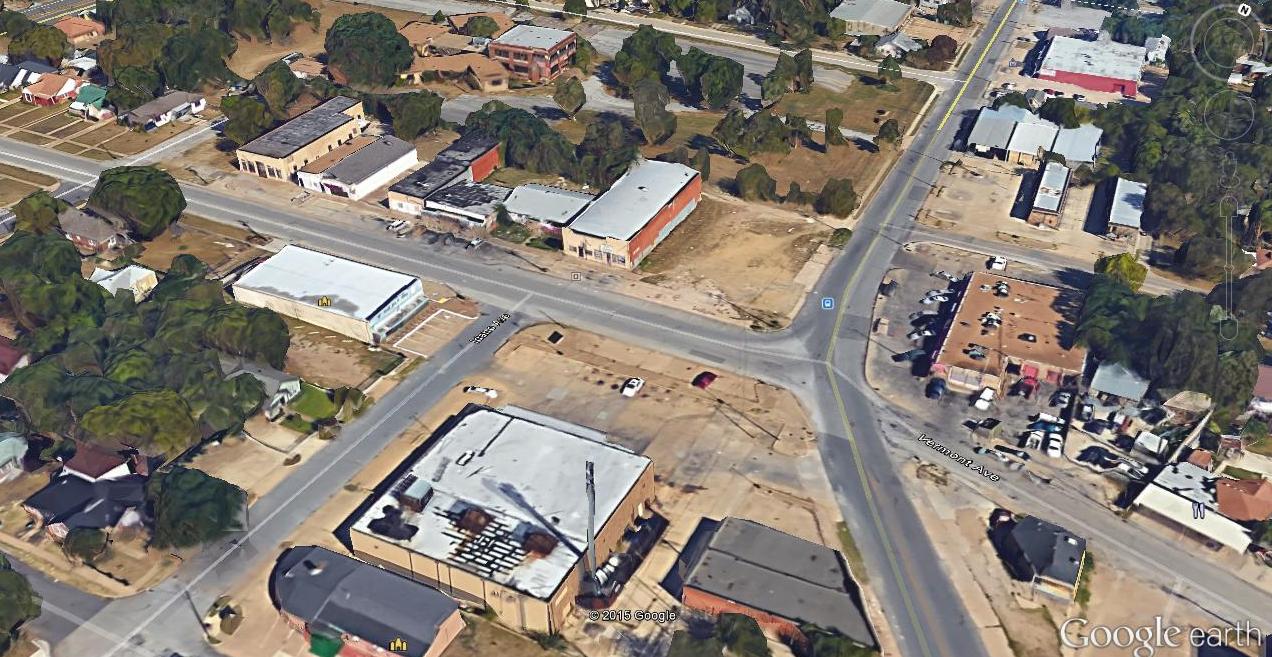
Below, a Google Earth image of the same view as the postcard featuring Tallent’s Furniture Studio, captured before the old Sunshine Home buildings had been demolished (click for larger image).

tallent_birdseye-google-earthGoogle Earth

The view is remarkably similar to the one taken more than 65 years earlier. A little bleaker these days, perhaps, but certainly still recognizable.

***

Sources & Notes

Top postcard is from the Boston Public Library Tichnor Brothers Postcard Collection; it is viewable here.

Information on the plans for the KIPP Truth Academy submitted to the City of Dallas (with interesting illustrations/maps on pages 10 and 11) can be found in a PDF, here.

A recent Google Street View of this block of Vermont Avenue can be seen here. The Tallent furniture store occupied the building to the left of the Vermont Grocery.

The heart-tugging article “For All Loving Care Bestowed, Sunshine Home, Space Small, Needs Much to Cheer Children” (DMN, July 24, 1941) — written by popular Dallas Morning News columnist Paul Crume — describes daily life in the Sunshine Home and can be found in the Dallas Morning News archives.

A then-and-now comparison (click for larger image):

tallent_then-now

*

Copyright © 2015 Paula Bosse. All Rights Reserved.


Brown Cracker Co. Cracker Wrappers

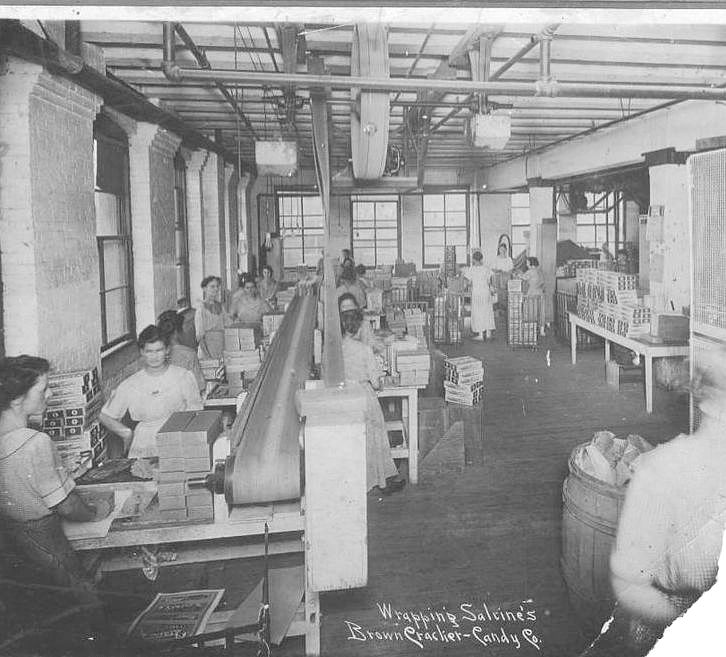
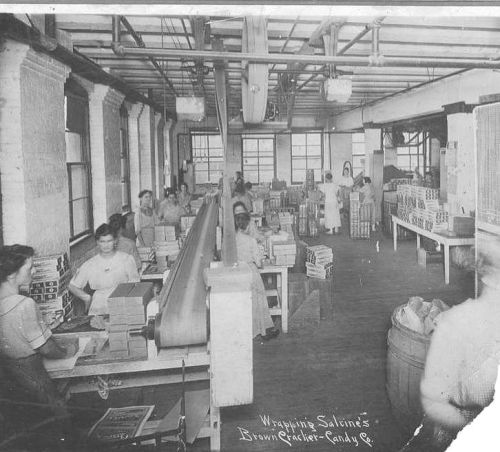
brown-cracker_ca1918_cook_degolyerThe saltine-wrapping room

by Paula Bosse

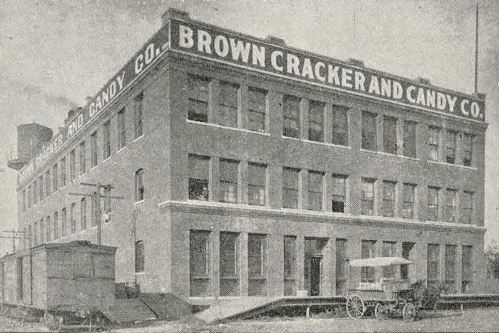
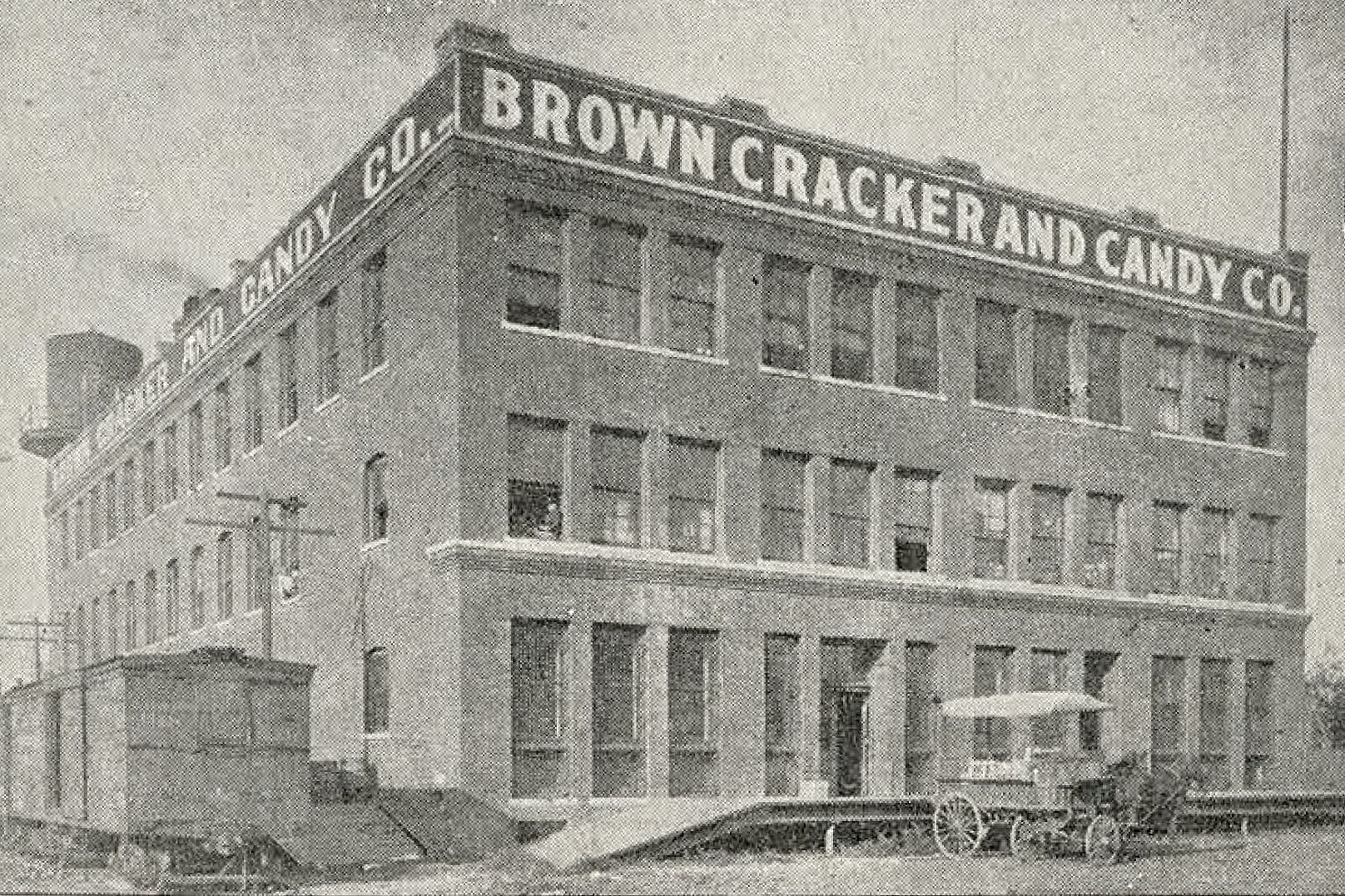
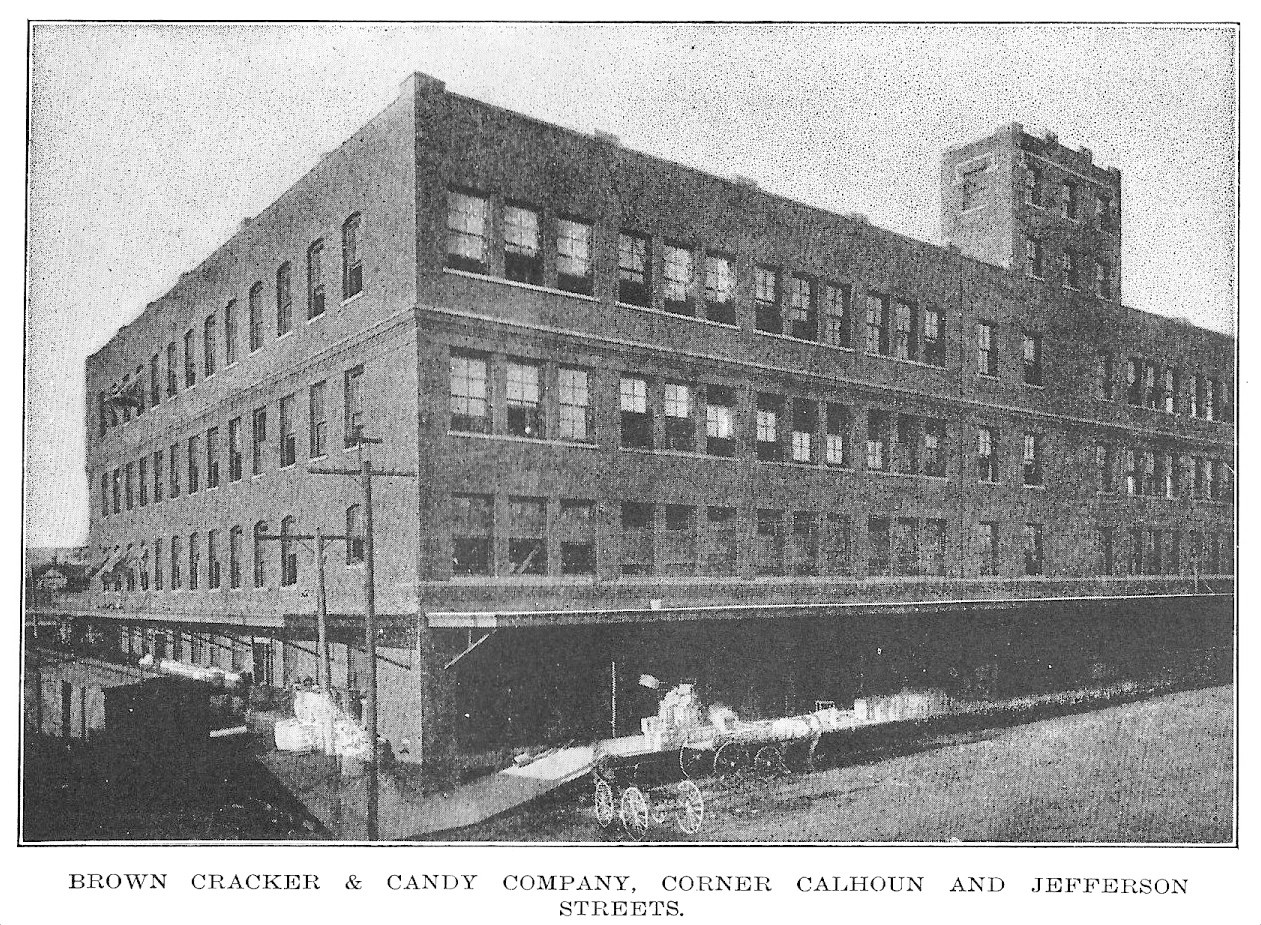
I will stop and look at great length at any photograph containing a conveyor belt. The conveyor belt in this photo belonged to the Brown Cracker and Candy Company, a large and important Dallas manufacturer and employer. The cracker, cake, and candy factory opened in 1903 in a brand new building in the industrial area just south of McKinney Avenue (the part of town that borders downtown, now known as the West End). Best known these days as the West End Marketplace building, the structure still stands and, in fact, has just been purchased and is about to undergo renovation.
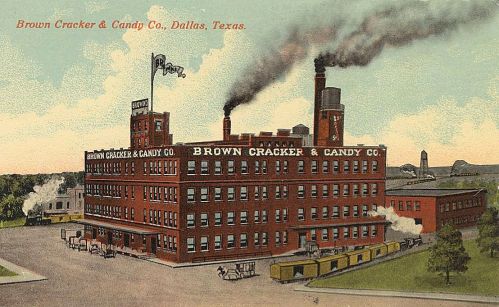
brown-cracker_postcard_cook-degolyerDeGolyer Library, SMU

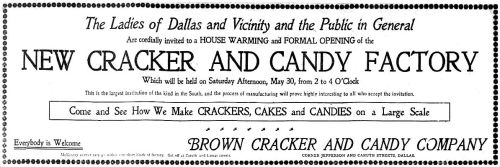
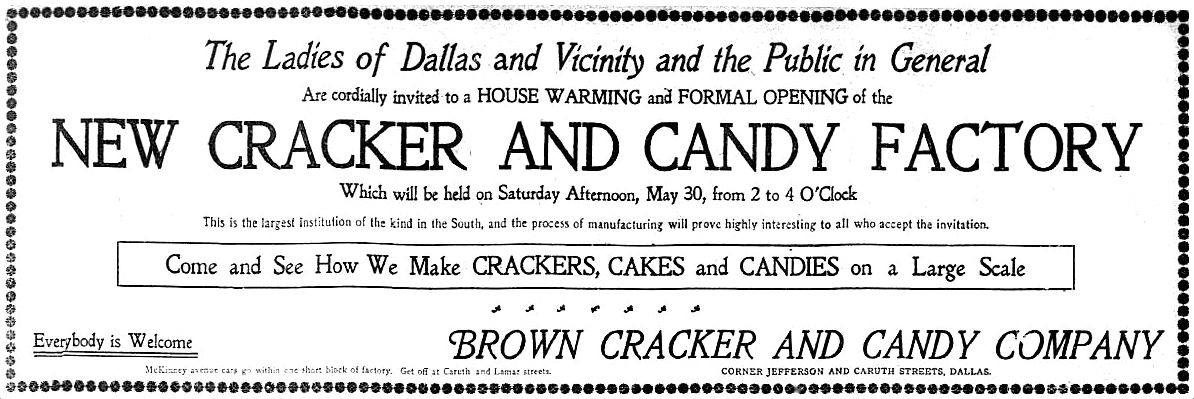
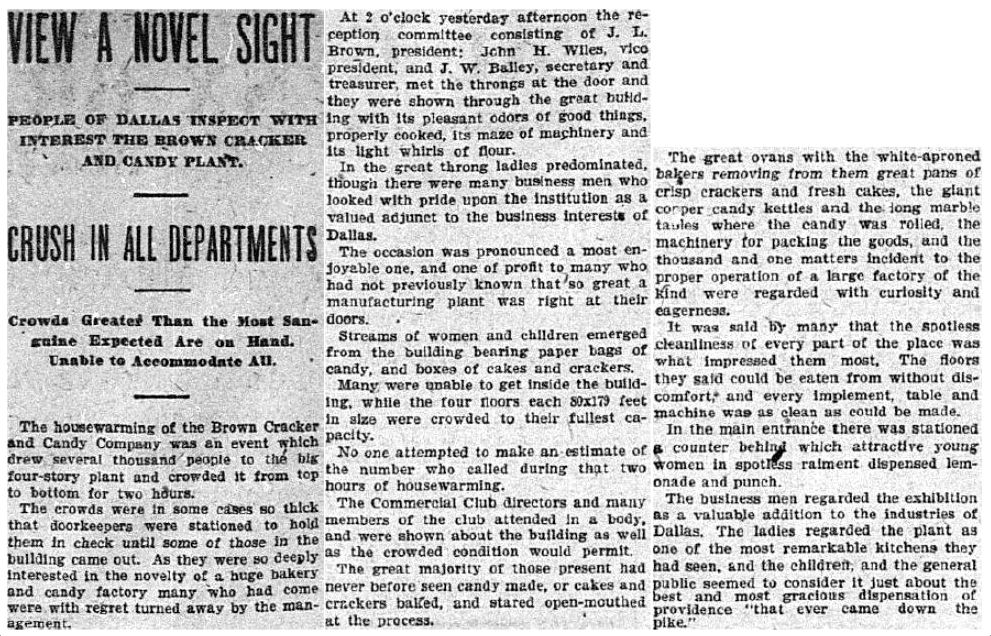
As the new building was nearing completion, the company charter was filed in April 1903, and just a few short weeks later, the factory opened itself up for inspection by the community.
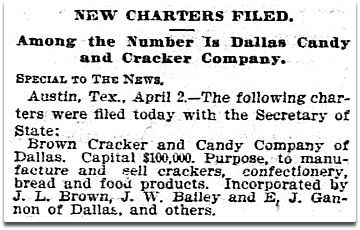
brown-charter_dmn_040303Dallas Morning News, April 3, 1903

brown_opening_dmn_052903
DMN, May 29, 1903 (click for larger image)

The open house was packed — several thousand people (mostly women) showed up to tour the plant, fascinated by the inner workings of the city’s newest business, a manufacturer of crackers and sweet treats. Of particular interest must have been the two giant brick ovens on the the second floor, which used more than one ton of coal daily, and the huge copper kettles used in candy making on the top floor. There were also things like chocolate dipping machines, starch machines (?), and marshmallow heaters (I don’t know what that is, but I want to see one in action — could it have been a “marshmallow beater,” like the one seen here?).
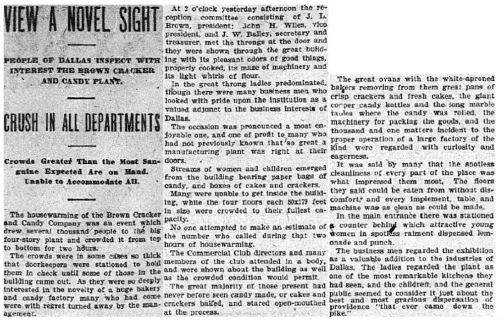
brown-cracker_dmn-053103DMN, May 31, 1903

The main reason to open the factory to the public for inspection — other than as a PR-managed meet-and-greet — was to let the people see for themselves just how CLEAN the place was. This was at a time when unsanitary food handling and manufacturing practices were much in the news (see here) — concerns which ultimately led to the enactment of the Pure Food and Drug Act of 1906 — and the above article stresses that visitors were impressed by the factory’s “spotless cleanliness” (“The floors they said could be eaten from without discomfort…”). In regard to the “cracker wrappers” pictured at the top, the company wanted to make sure everyone knew that their products were wrapped and boxed — gone were the days of shoppers dipping their (probably unclean) hands into the old “cracker barrel” full of loose, stale crackers.

crackers_dmn_040603DMN, April 6, 1903

Let’s take a closer look at the top photo, probably taken around 1920 (click pictures for larger images).
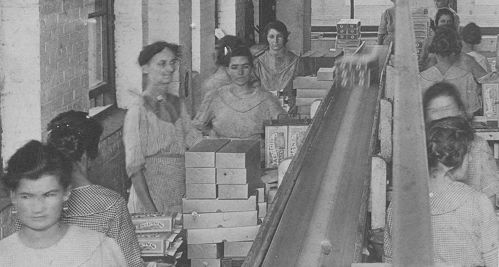
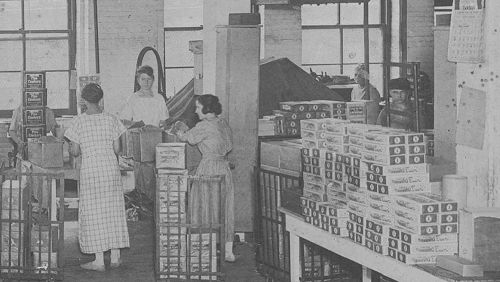
brown-cracker_ca1918_cook_degolyer_det2

brown-cracker_ca1918_cook_degolyer_det1

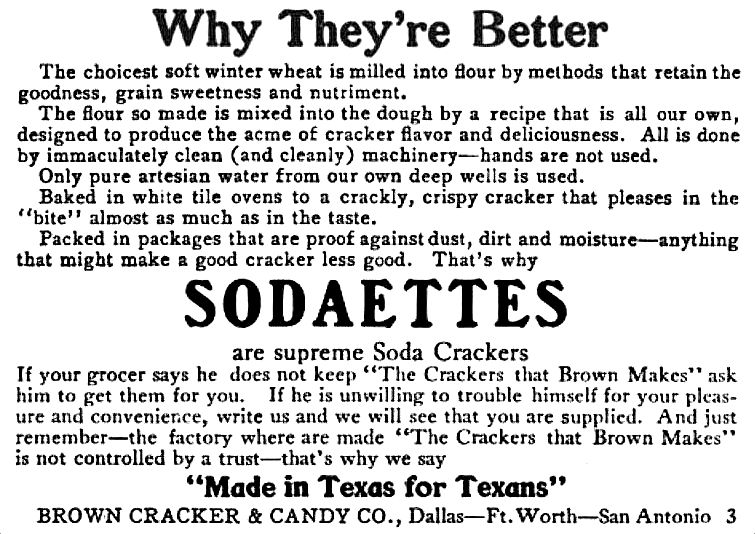
ad-brown_dmn_122003DMN, Dec. 20, 1903

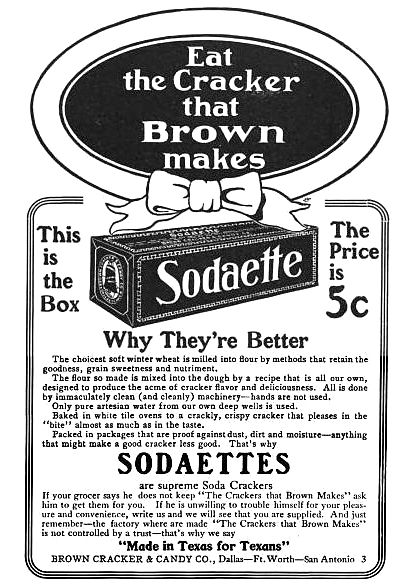
sodaette-crackers(click to read text)

brown-cracker_1922-directory1922 city directory

brown-cracker_come-to-dallas_degolyer_SMU_ca1905ca. 1905

brown-cracker-greater-dallas-illustrated_ca1908ca. 1908

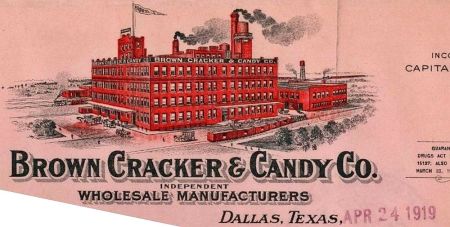
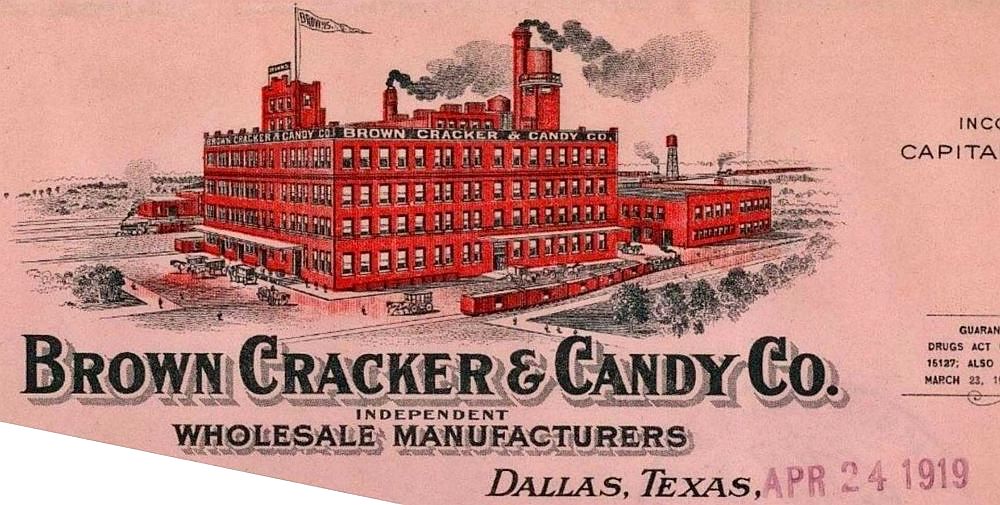
brown-cracker-co-lettrhead_1919_ebay1919 (eBay)

***

Sources & Notes

Top photo, titled “Wrapping Saltines at Brown Cracker and Candy Co.,” is from the George W. Cook Dallas/Texas image collection, DeGolyer Library, Central University Libraries, Southern Methodist University; it can be accessed here.

Written on the back of the photo: “Miss Bessie Manning, 2724 Roadwood [sic] avenue, Dallas, Texas.” Bessie Manning (born Bena Manina in 1899 to Italian immigrants), began working at the Brown Cracker Co. (with a brother and a sister) around 1917 but wasn’t living on Rosewood (later North Harwood) until 1919; she left Brown in 1921 or 1922. She isn’t identified in the photo, but she is, presumably, one of the women on the left; she would have been about 20.

bessie-manning_1920-censusBessie Manning’s occupation, 1920 census

The color postcard showing the Brown Cracker Co. is also from the Cook collection at SMU; it is here.

The Sodaette ad is from Library of Advertising by A. P. Johnson (Chicago: Cree Publishing Co., 1911).

The photo from about 1905 is from the promotional brochure titled “Come To Dallas” (Dallas: Dorsey Printing Co., about 1905), in the collection of the DeGolyer Library, Southern Methodist University; more info is here.

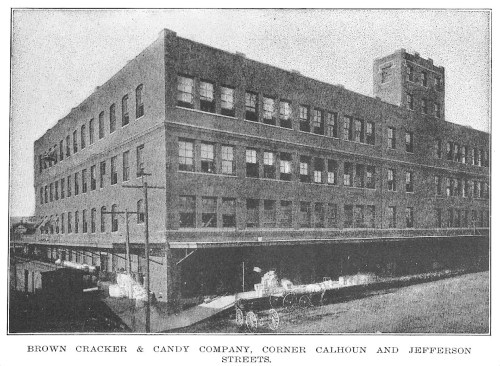
The photo at the bottom is from Greater Dallas Illustrated, The Most Progressive Metropolis in the Southwest (Dallas: The American Illustrating Company, 1908; reprinted by Friends of the Dallas Public Library, 1992). The informative company profile that accompanied the photo can be read in a PDF, here.

All other ads and clippings as noted.

Another very informative article which details the specifics of the building and its machinery — “New Dallas Industry, Brown Cracker and Candy Company About to Begin Operations” (DMN, Apr. 6, 1903) — can be read in a PDF, here.

To see the Brown Cracker Company’s specs on a Sanborn map from 1905, see here; to see where it is on a modern map, see here.

For current info on what’s about to happen to the building (much expanded over the years), see Steve Brown’s Dallas Morning News article, here.

And, yes, a teenaged Clyde Barrow apparently worked there briefly, for a dollar a day.

*

Copyright © 2015 Paula Bosse. All Rights Reserved.

Akard Street Looking South, 1887-2015

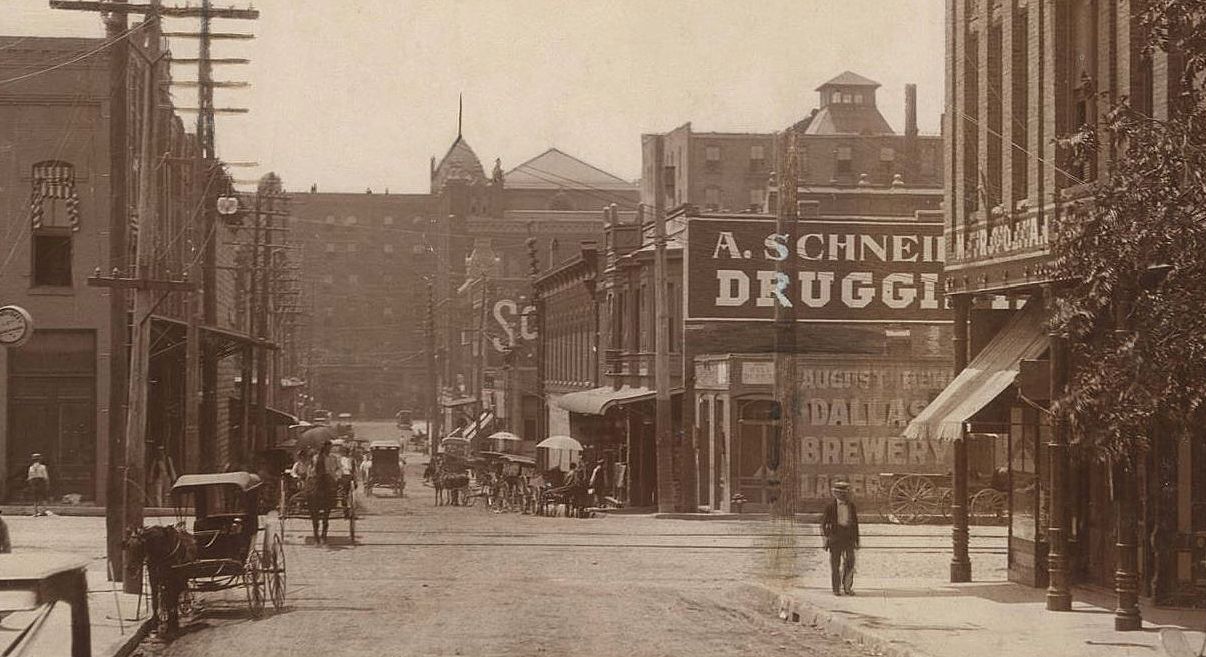
akard_from-pacific_cook_degolyer_smu_ca1898-detAkard Street from Pacific, ca. 1898, via Cook Collection, SMU

by Paula Bosse

I realized the other day that I have an inordinate number of photographs and postcards showing Akard Street looking south — usually taken from Pacific or Elm, so I thought I’d collect them all together. Some of these aren’t dated, so they’re not in strict chronological order, but I’ve made a half-hearted attempt to make sure horse-and-buggy photos are before the men-in-straw-hat-boaters, which are before the women-in-Miss-Crabtree-dresses, which are before the cars-with-rounded-bodies. It might be easiest to just assume they are not in chronological order. (All photos are larger when clicked — a couple are really  big.)

*

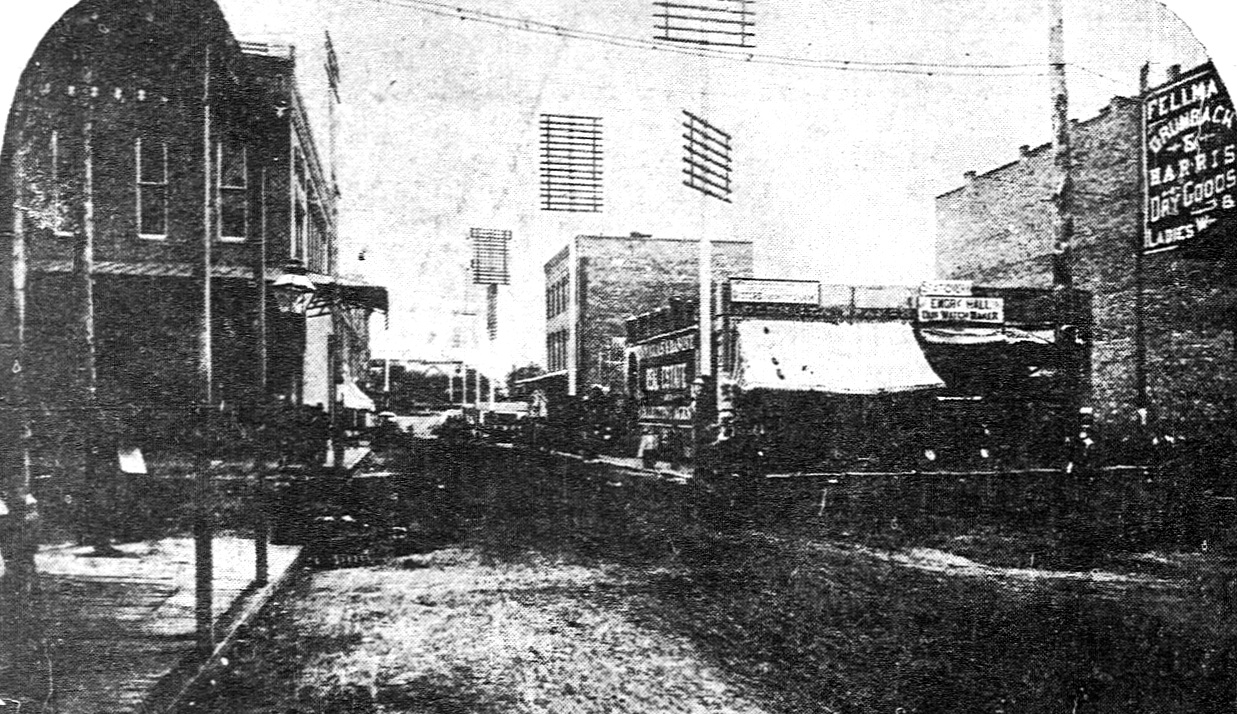
The oldest is from 1887, when North Akard was still called Sycamore Street, and before the Oriental Hotel was built at Commerce and Akard in 1895.

akard_south-from-elm_1887

*

Next up, an incredible photo, taken around 1898, a detail of which appears at the top of this post. The Oriental Hotel can now be seen at the end of Akard, at Commerce, where Akard used to make a dog-leg turn before continuing south, giving the appearance of a dead-end street.

akard_from-pacific_cook_de-golyer_smu-ca1898via George W. Cook Collection, DeGolyer Library, SMU

*

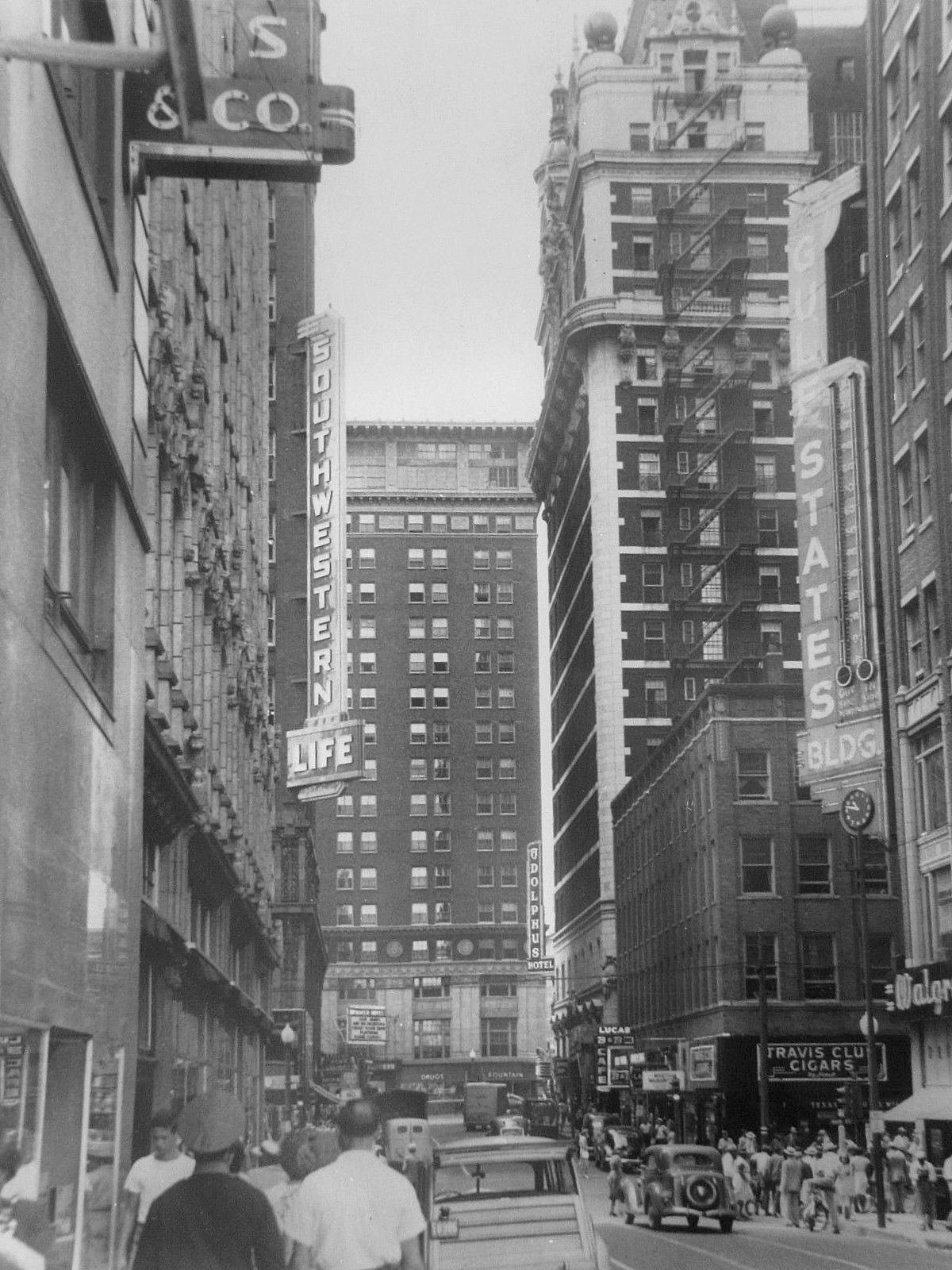
Another, with the Adolphus Hotel (built in 1912) now on the right, across Commerce from the Oriental. The tall building across Akard from the Adolphus is the Southwestern Life Building. The Gentry photography studio was at the southeast corner of Elm and Akard from 1912, which is probably the date of this postcard image. Construction of the Busch Building (now known as the Kirby Building) began in December, 1912.

akard-elm_postcard_ebay_ca-1912via eBay

*

From 1925, with the new Baker Hotel having replaced the Oriental Hotel. This area was now being called “the canyon district” or “the canyon.”

akard_south-from-elm_1925

*

In this great Frank Rogers photo, the canyon walls are getting higher, with the Adolphus Hotel firmly anchoring the Commerce corner across from the Baker.

akard_baker-adolphus_postcard_rogers_ebayvia eBay

*

By the time this photo was taken in about 1936, Pegasus had become a part of the skyline, perched atop the Magnolia Petroleum Building. (Note the Queen Theater at the northeast corner of Elm and Akard.)

akard_pacific_1936_legacies-spring-1989via Legacies History Journal

*

This photo is from the early- or mid-1930s — LOOK AT ALL THOSE PEOPLE.

akard-canyon_municipal-archives_dma-uncratedvia the DMA’s Uncrated blog

*

As opposed to this one, which has NO people in it.

akard-canyon_ebayvia eBay

*

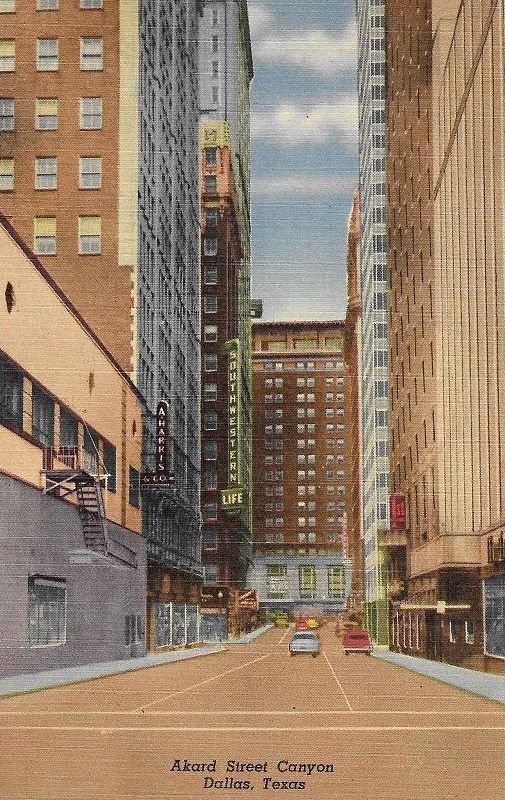
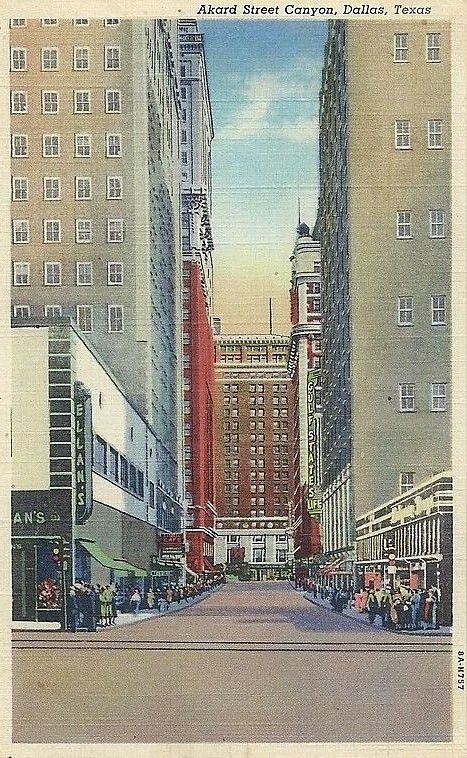
More canyon, this view showing the super-cool art-deco-y building at Elm and Akard with Ellan’s hat shop on the ground floor, late-1930s.

akard-st-canyon_ellans

*

This candid photograph, a little deeper into the canyon, is one of my favorites. (Click to see a gigantic image.)

akard-looking-south_ebayvia eBay

*

From 1951 — a bit grainy, but a slightly closer view of the side of the Queen Theater at the left and the Mayfair department store, built in 1946, at the right:

akard_dpl_1951via Dallas Public Library

*

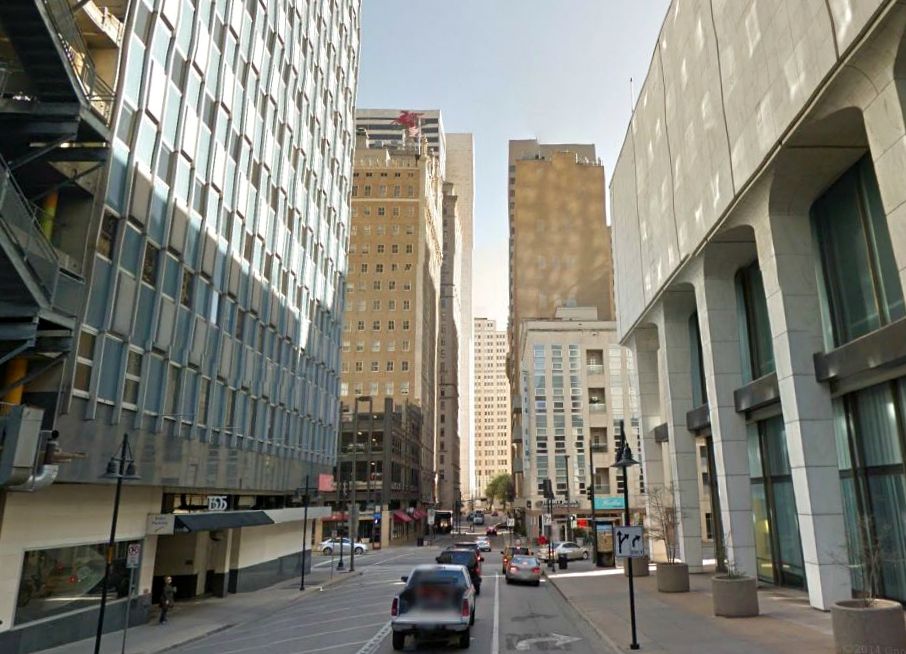
And, finally, today. Pegasus and the Adolphus are still there, but the Baker Hotel was demolished in 1980, replaced by the One AT&T Plaza/Whitacre Tower.

akard-looking-south_google_2015via Google Street View, 2014

***

Sources & Notes

The photo dated by SMU as “circa 1898” is titled “Akard Street from Akard and Pacific Avenue Intersection”; it is from the George W. Cook Dallas/Texas Image Collection, DeGolyer Library, Central University Libraries, Southern Methodist University, and it can be viewed here.

The circa 1936 photo showing Pegasus is from the Spring, 1989 issue of Legacieshere; it is from the Hayes Collection, Texas/Dallas Archives Division, Dallas Public Library, and is attributed to Denny Hayes.

The photo showing “ALL THOSE PEOPLE” is from the Dallas Museum of Art’s Uncrated blog — here — is from the Dallas Municipal Archives. They have the date as “1940,” but Liggett’s Drug Store was gone from Elm and Akard by 1936.

Other sources as noted.

Click pictures for larger images — sometimes MUCH larger images.

*

Copyright © 2015 Paula Bosse. All Rights Reserved.


University Park: The Addition — 1916

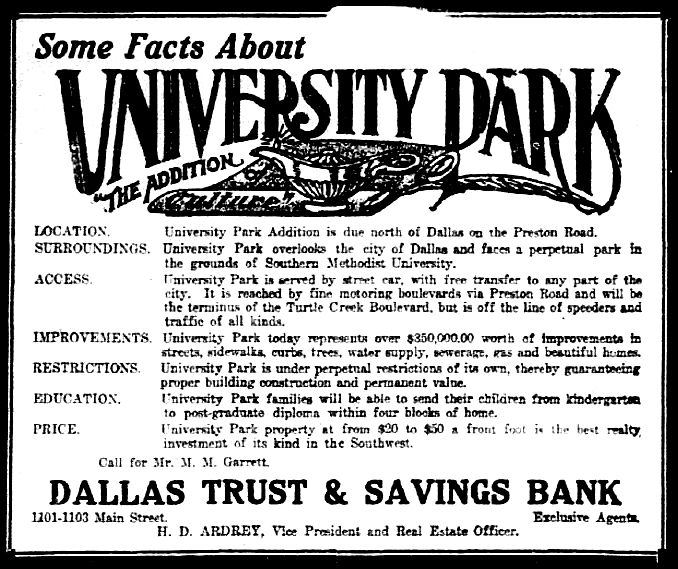
university-park_dmn_0625161916 ad (click for larger, slightly more legible image)

by Paula Bosse

Mr. M. M. Garrett of the Dallas Trust & Savings Bank wants you to know some facts about the University Park Addition:

  • LOCATION. University Park Addition is due north of Dallas on the Preston Road.
  • SURROUNDINGS. University Park overlooks the city of Dallas and faces a perpetual park in the grounds of Southern Methodist University.
  • IMPROVEMENTS. University Park today represents over $350,000.00 worth of improvements in streets, sidewalks, curbs, trees, water supply, sewerage, gas and beautiful homes.
  • RESTRICTIONS. University Park is under perpetual restrictions of its own, thereby guaranteeing proper building construction and permanent value.
  • EDUCATION. University Park families will be able to send their children from kindergarten to post-graduate diploma within four blocks of home.
  • PRICE. University Park property at from $20 to $50 a front foot is the best realty investment of its kind in the Southwest.

Hurry!

*

Copyright © 2015 Paula Bosse. All Rights Reserved.


The Dallas Day Nursery: “Bring On Your Babies” — 1919

dallas-day-nursery_dallas-express_112219“Inmates and their nurse-mother” (click for larger image)

by Paula Bosse

This photo appeared in the pages of The Dallas Express, the main source of news for the city’s black residents. The caption, below (click for larger image).

dallas-day-nursery_dallas-express_112219_captionDallas Express, Nov. 22, 1919

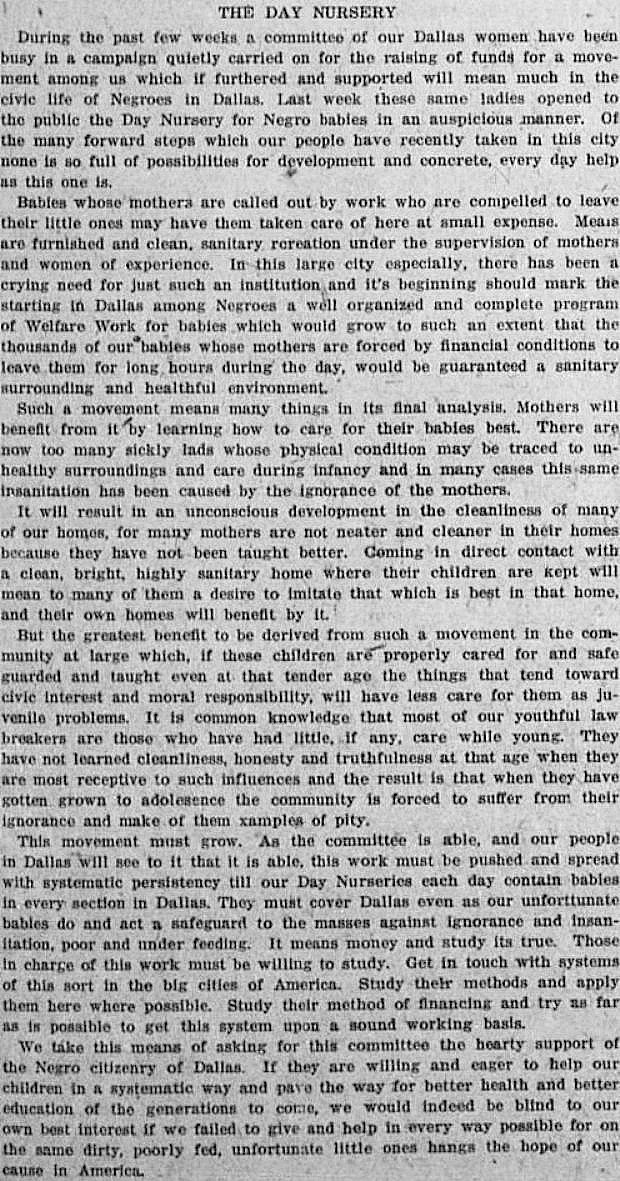
This “day nursery” organized by the Federation of Colored Women’s Clubs, must have been a relief to working women who had young children that needed supervision. At the nominal fee of 10¢ a day (equivalent to about $1.35 today), the community service was affordable to many working families. A few weeks after the above photo appeared in its pages, an editorial appeared in the Express, urging support for the Dallas Day Nursery and explaining why it was important not only to families, but to the greater community.

dallas-day-nursery_dallas-express_121619Dallas Express, Dec. 16, 1919

***

The nursery appears to have been run out of a residence at 2417 Caddo Street, which would now be located in the CityPlace Market parking lot, behind the Office Max.

dallas-day-nursery_googleGoogle Maps

*

Copyright © 2015 Paula Bosse. All Rights Reserved.

Hot Lead: Linotype Machines at The Dallas Morning News — 1914

dmn_linotype_belo-coll_degolyer_1914Etaoin Shrdlu not pictured (click for larger image) SMU photo

by Paula Bosse

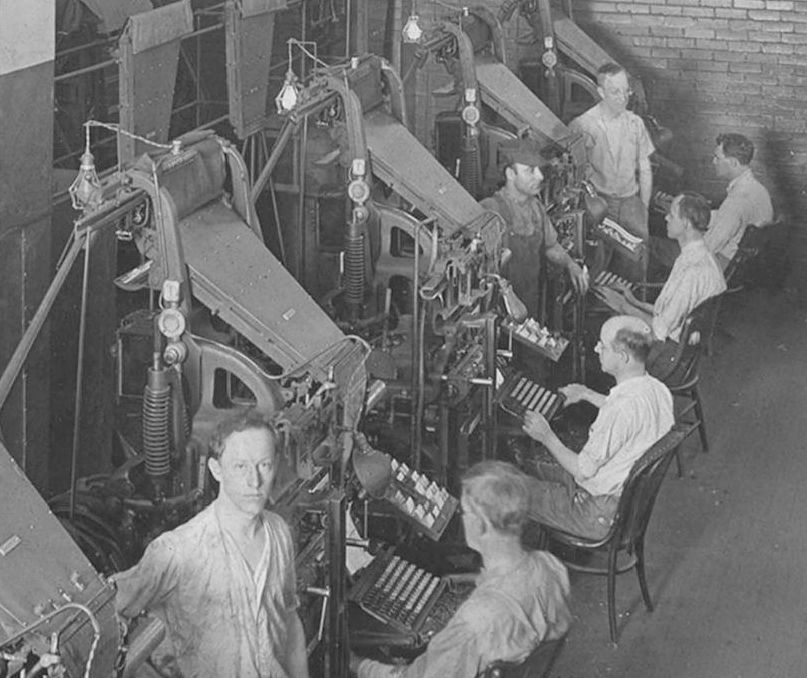
Above, a photograph by Charles E. Arnold showing the Dallas Morning News “machine room” in 1914, in which we see several Linotype machines and their operators. I have no technological aptitude, but, for some reason, I have been fascinated by elaborate machines like these my whole life. Even though computers long ago made these “hot metal” typesetting machines obsolete, it’s still kind of thrilling to see once-revolutionary contraptions in everyday use. I’m sure it was a deafening and monotonous job, but I’d love to have had the chance to operate one of those machines just once and churn out my own slugs of hot type. I love this photo, and it has lots of interesting things to zoom in on (click for larger images).

lino-1

lino-2

lino-3

lino-4

linotype

***

Sources & Notes

This photo is titled “Machine room at opening of Mechanical Building,” taken by Charles Erwin Arnold in 1914; it is from the Belo Records collection, DeGolyer Library, Central University Libraries, Southern Methodist University. I have had to tweak the color, because my image editor tends to turn the warm tones of the original into a harsh yellow — see a scan of the original photograph here.

See additional photos of linotype machines used at The Dallas Morning News, from the Belo/DeGolyer Library collection, here.

I lived in England for a couple of years, and while there, I was given an intensive lesson on the elaborately arcane rules of cricket. I finally understood the game perfectly! …for one day. Today I immersed myself in all-things linotype, and I completely understand how the machines worked. I’ll probably forget this by tomorrow, but today … YES! And it’s absolutely fascinating. You, too, can understand how they worked:

  • The Wikipedia entry is very clearly written — check it out here.
  • An industrial film from 1960 — viewable here — is WONDERFUL. Yes, it’s over 30 minutes long, but if you love stuff like this, the time will fly by! Seriously — it’s incredibly well-done.
  • In a video on YouTube — seen here — you can watch a retired linotype operator type on a (malfunctioning) WWII-era machine. (Imagine how loud an entire room of these machines would be.)

Another look at the linotype at work can be seen in the short film “Farewell, Etaoin Shrdlu,” which documents the last issue of The New York Times using Linotype machines (in 1978) — you can watch it here.

Also worth watching is the recent entertaining documentary “Linotype: The Film” — you can watch a trailer here.

Don’t know the significance of “etaoin shrdlu”? I didn’t either until about an hour ago. Wikipedia to the rescue, here.

A very entertaining article to check out in the Dallas Morning News archives: “‘etaoin shrdlu’ The Mystic Symbol” by George Gee (DMN, April 12, 1925). In it Gee wondered what this exotic and mysterious “etaoin shrdlu” phrase could mean, going so far as to interview local “experts.” He obviously knew the secret, but he never did divulge it to his readers. Very entertaining. (As are the accompanying Jack Patton illustrations.)

All images larger when clicked.

*

Copyright © 2015 Paula Bosse. All Rights Reserved.