Flashback : Dallas

A Miscellany: History, Ads, Pop Culture

Category: 1910s

Dallas in “The Western Architect,” 1914: Businesses

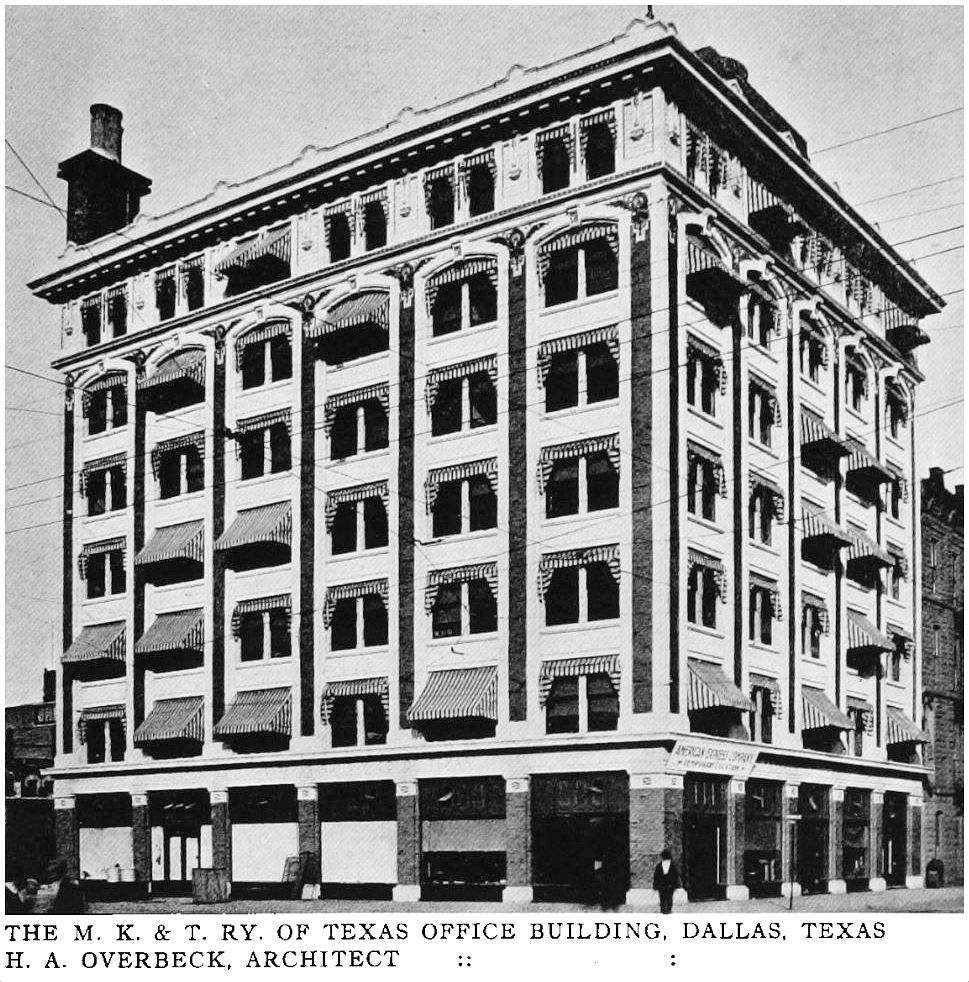
mkt-bldg_western-architect_july-1914

by Paula Bosse

The continuing week-long look (…well, it looks like that’s going to be more like a two- or three-week-long look…) at the Dallas buildings featured in the July, 1914 issue of The Western Architect plods on. Today: business buildings. Nine of these ten buildings are, remarkably, still standing (some are even still recognizable!), and, as seems to be the trend with architecture of this period in Dallas, the powerhouse firm of Otto Lang and Frank Witchell dominates.

*

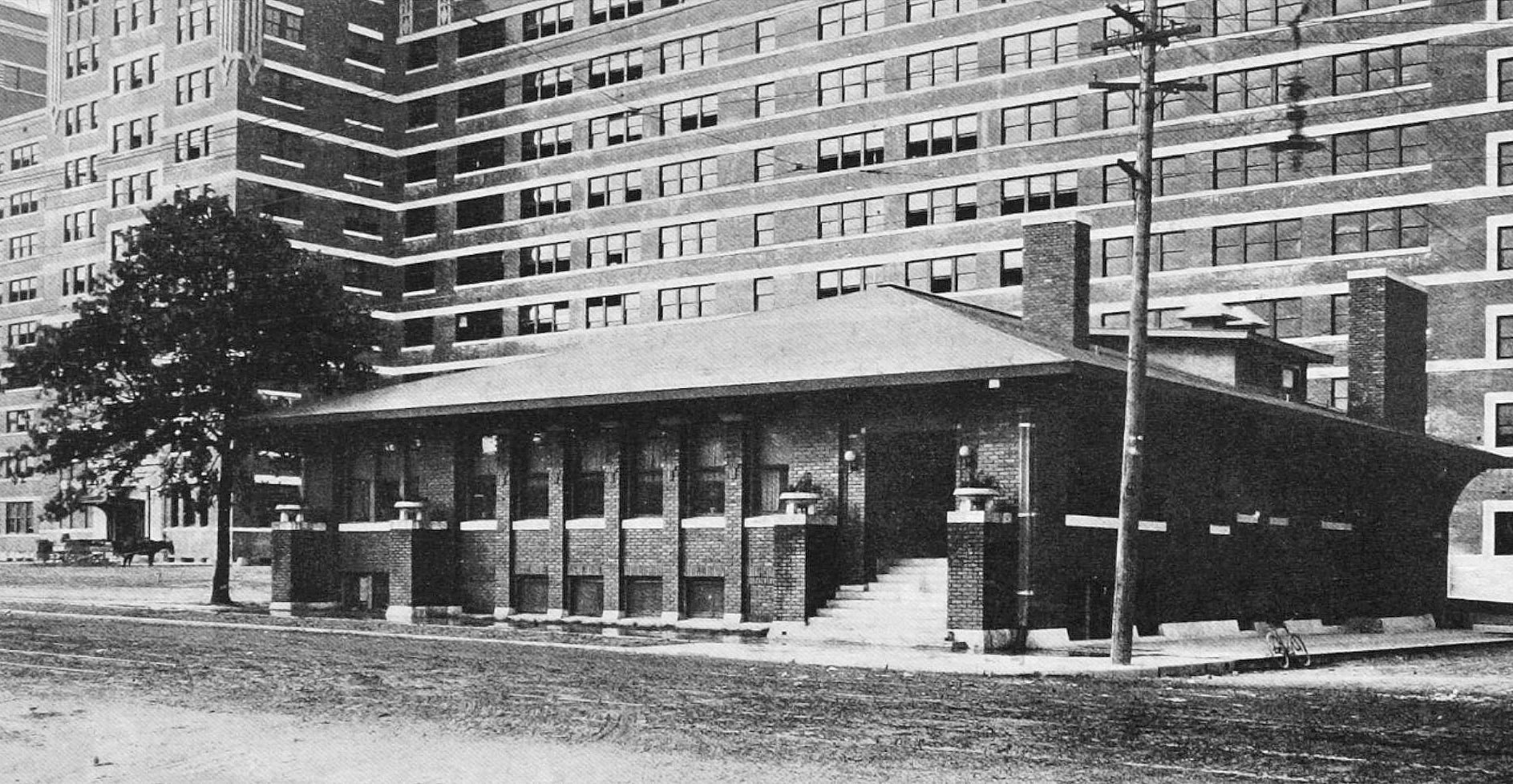
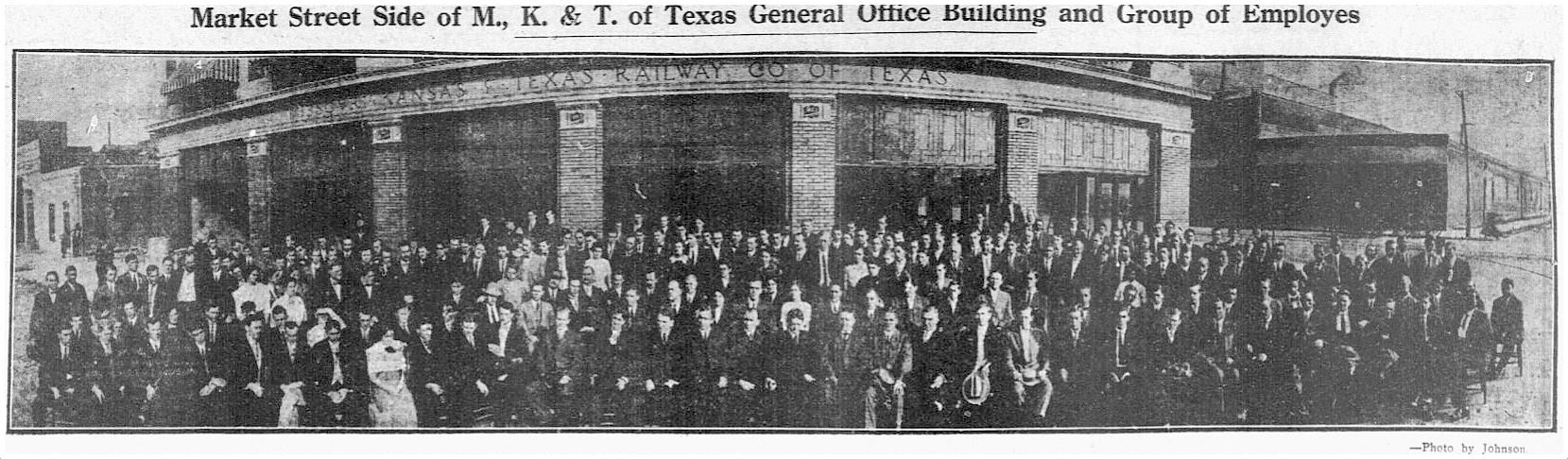
1.  MKT BUILDING / KATY BUILDING, Commerce & Market, designed by architect H. A. Overbeck (who also designed the nearby Criminal Courts Building). This building (seen above) was built in 1912 as the general offices of the Missouri, Kansas & Texas Railway; it has been spiffed up in recent years and is one of my favorite downtown buildings. An article appearing at the time the offices opened described the building as being faced with dark brick (“gun metal shade”) and light colored terracotta. The wide-angle photo below, which shows employees in front of the new building, is interesting because of the buildings seen to the left and right (all images in this post are larger when clicked). (See the building on a 1921 Sanborn map here.)

mkt-bldg_dmn_120112_employees-new-bldgDallas Morning News, Dec. 1, 1912

*

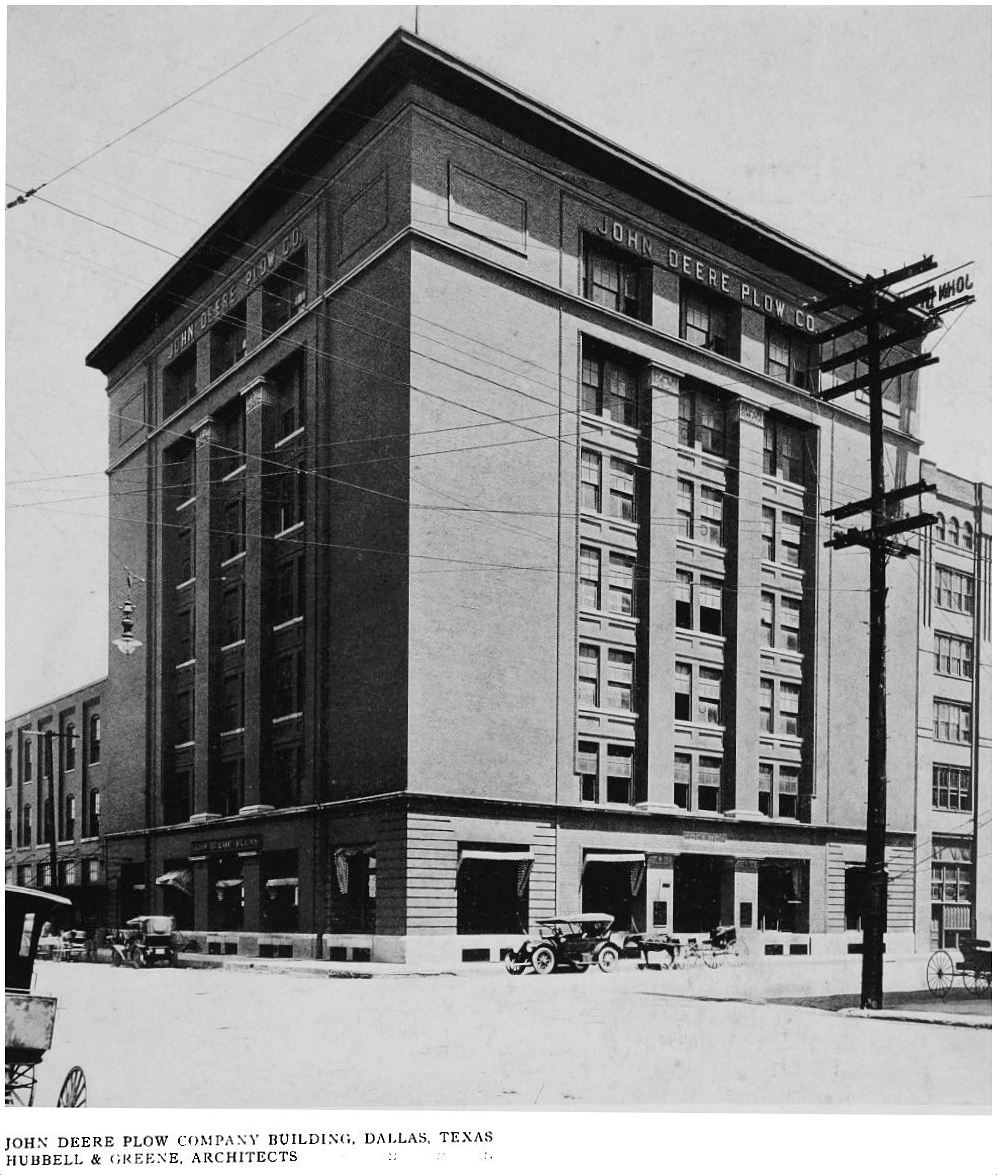
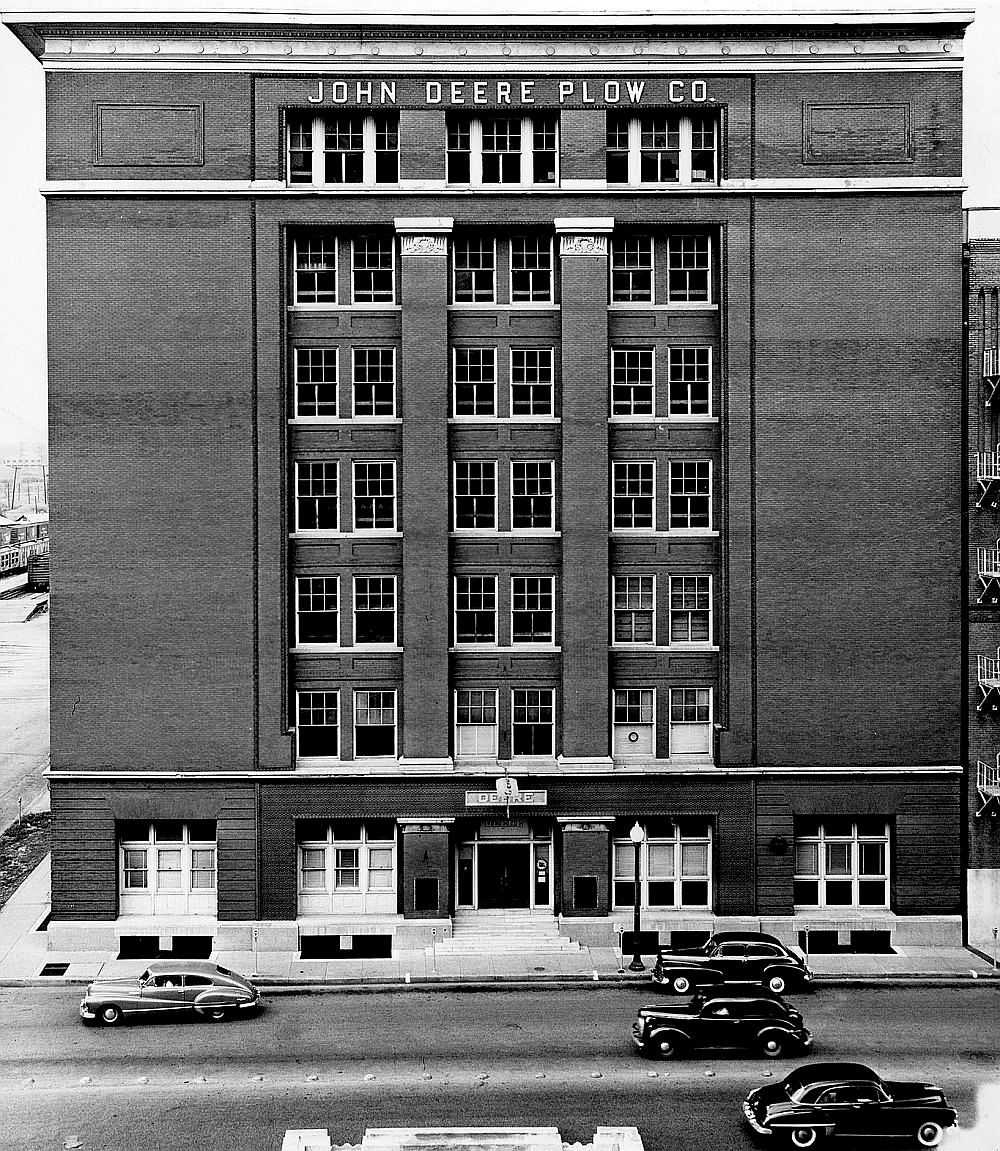
2.  JOHN DEERE BUILDING, 501 Elm Street (northeast corner of Elm & Houston), designed by Hubbell & Greene. This building was built about 1901/1902 for the Kingman Texas Implement Co. (construction permits were issued the same week in 1901 as its also-still-standing-across-the-street-neighbor, the Southern Rock Island Plow Co., better known as the Texas School Book Depository). It is thought to be the earliest example of Sullivan-esque architecture in Dallas. The John Deere Plow Co. moved into the building around 1907 and built the warehouse, which extends back to Pacific. After the Deere Co. moved out, it was the home of apparel manufacturing and wholesaling offices for many years. (See it on a 1921 Sanborn map, here.)
john-deere-bldg_western-architect_july-1914

john-deere-building_flickr_colteraca. 1949, via Flickr

*

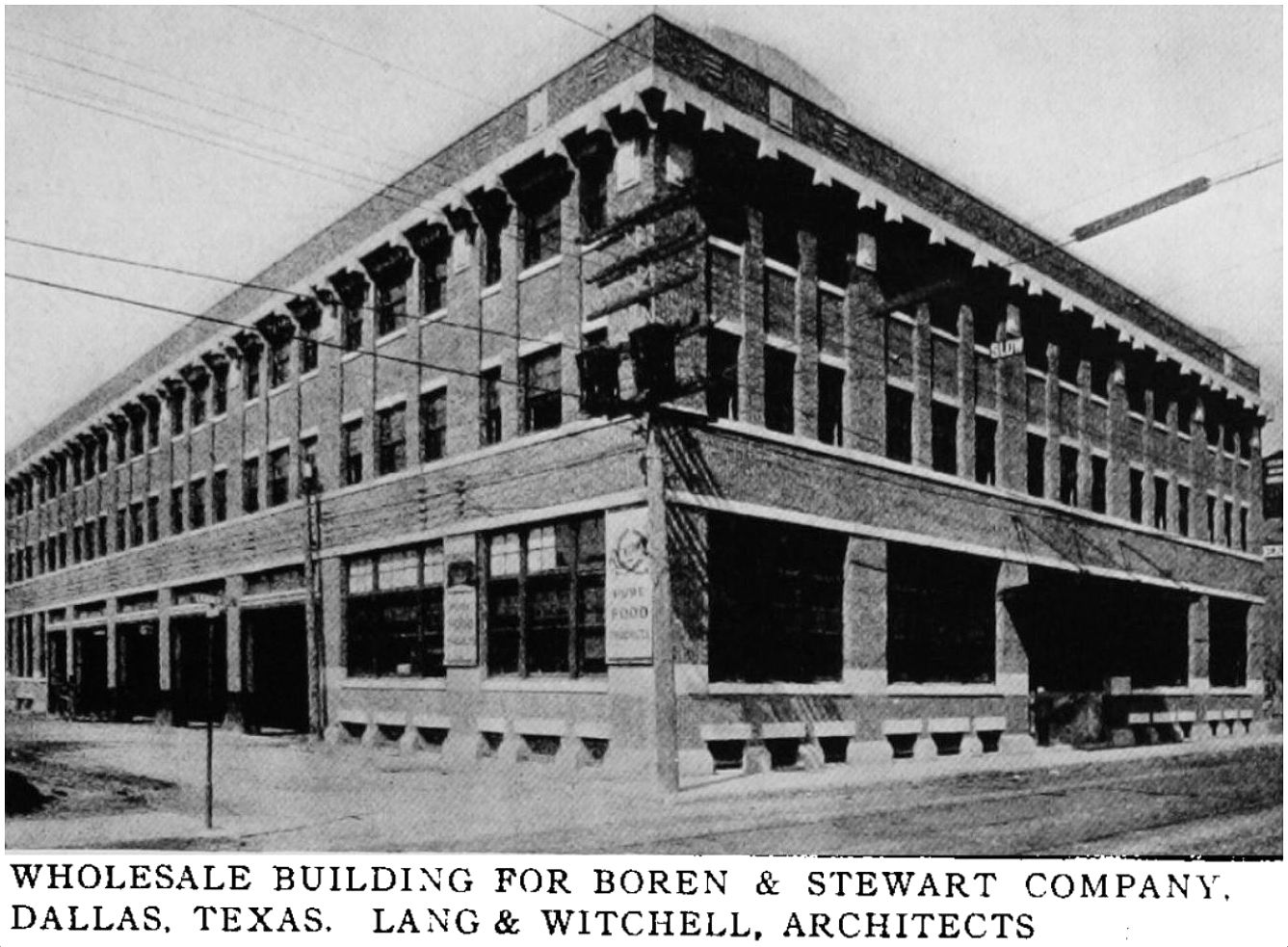
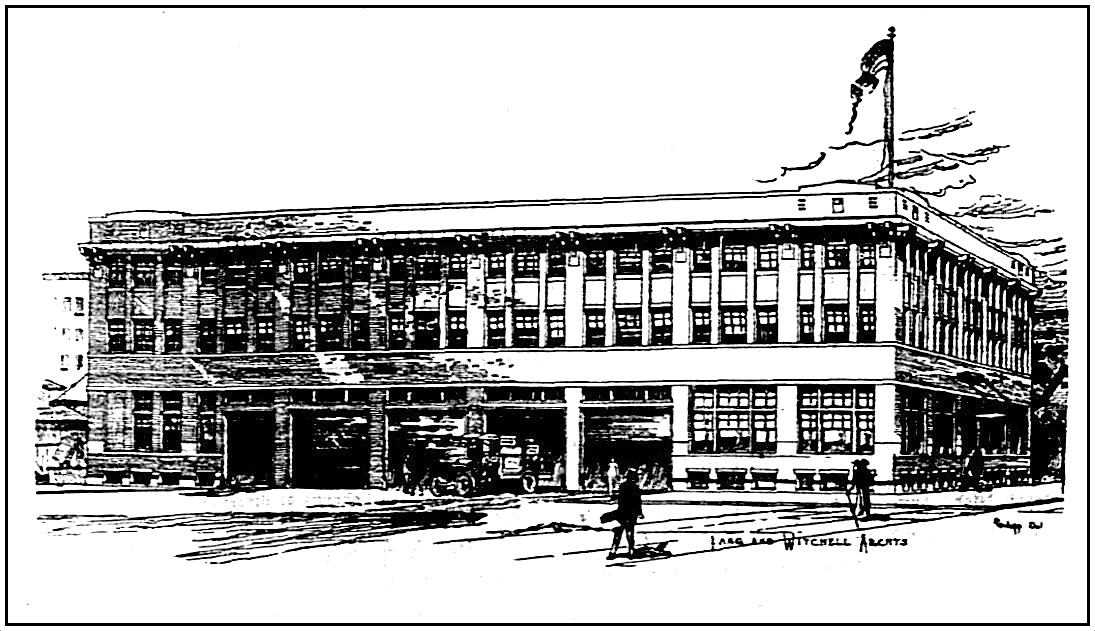
3.  BOREN & STEWART BUILDING, 1801 N. Lamar (at Hord), designed by Lang & Witchell. This attractive building was built in 1913 in what is now the Historic West End District — the building is still standing. Boren-Stewart, billed in ads at this time as “Dallas’ oldest grocery house,” had been established in the late 1880s by Robert H. Stewart and Benjamin N. Boren. At the time of the construction of this new building, its president was R. H. Higginbotham (whose Swiss Ave. house was also featured in The Western Architect); its treasurer was A. W. Cullum, who would go on to form the Tom Thumb grocery store chain. (See it on a 1921 Sanborn map here.)

boren-and-stewart_western-architect_july-1914

boren-stewart_lang-and-witchell-drawing_dmn_083013Lang & Witchell drawing, 1913

*

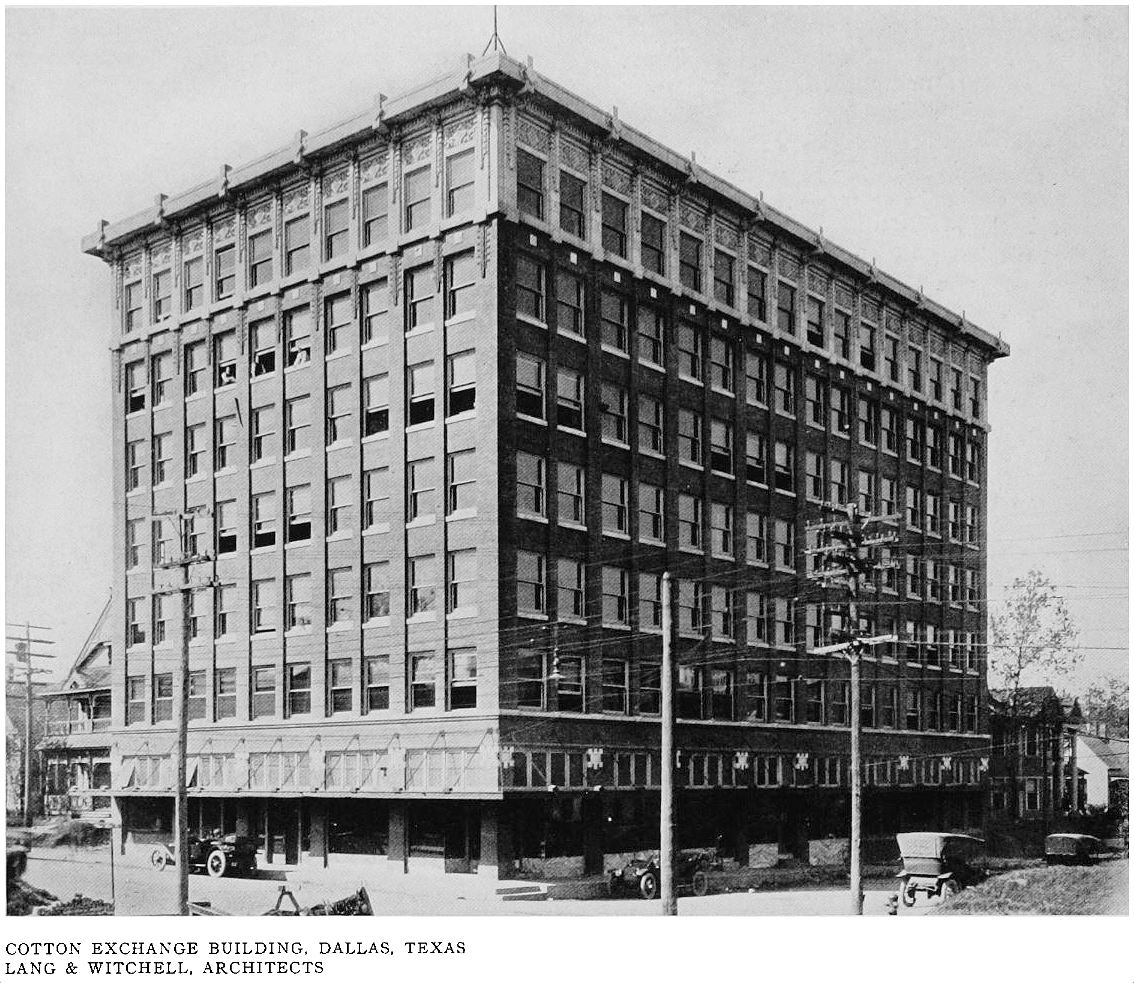
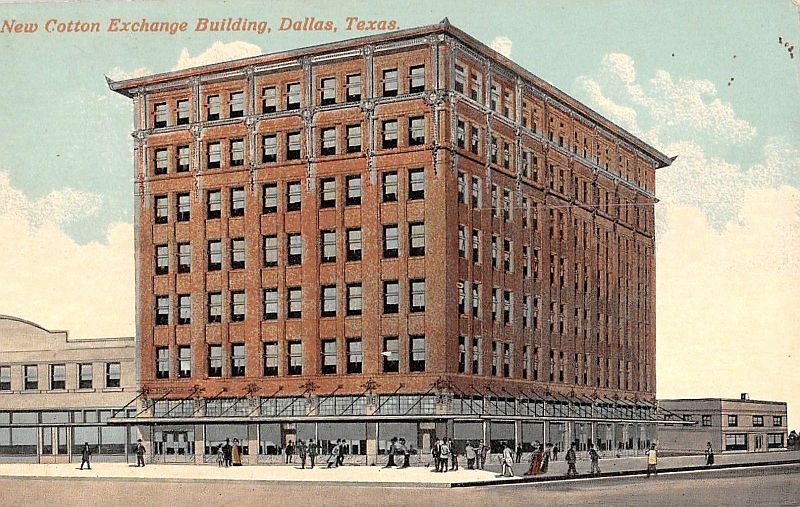
4.  COTTON EXCHANGE BUILDING, 401 S. Akard (southwest corner of S. Akard & Wood), designed by Lang & Witchell. Built in 1911, this was the hub of the cotton market in Dallas, a city which, in a 1912 article in The Dallas Morning News, was described as “the greatest and largest interior cotton market in the world, handling cotton worth $100,000,000 per year” (about 2.7 billion dollars in today’s money!). The Dallas Cotton Exchange was handling up to one-third of the cotton grown in Texas and Oklahoma. This handsome building was vacated by the cotton people in 1926 when their much larger new exchange building went up at St. Paul and San Jacinto. (Read about the Dallas cotton traders unhappiness with not being acknowledged as one of the country’s most important exchanges in a March 20, 1912 article in The Dallas Morning News here.) (See this building on a 1921 Sanborn map here.) This is the only building in this group of ten that is no longer standing — the site is now occupied by a parking lot.

cotton-exchange-bldg_western-architect_july-1914

cotton-exchange-building_postcard_ebay

*

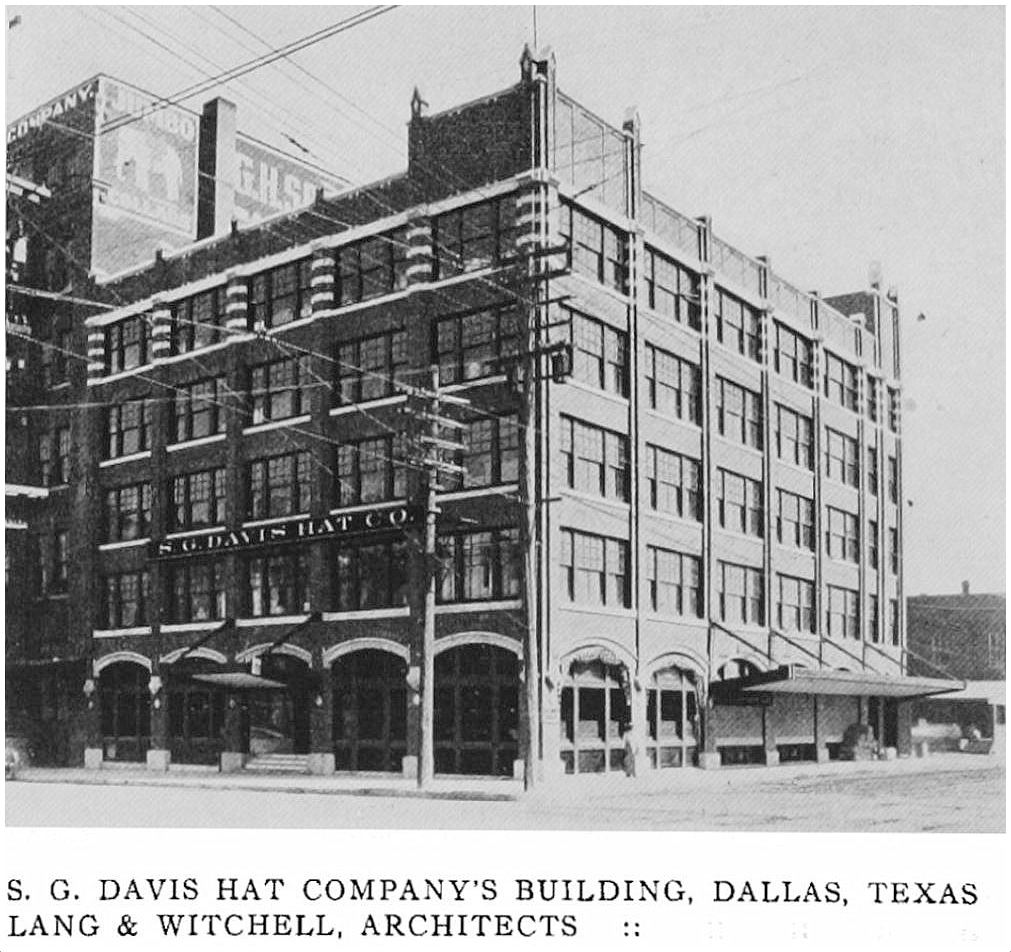
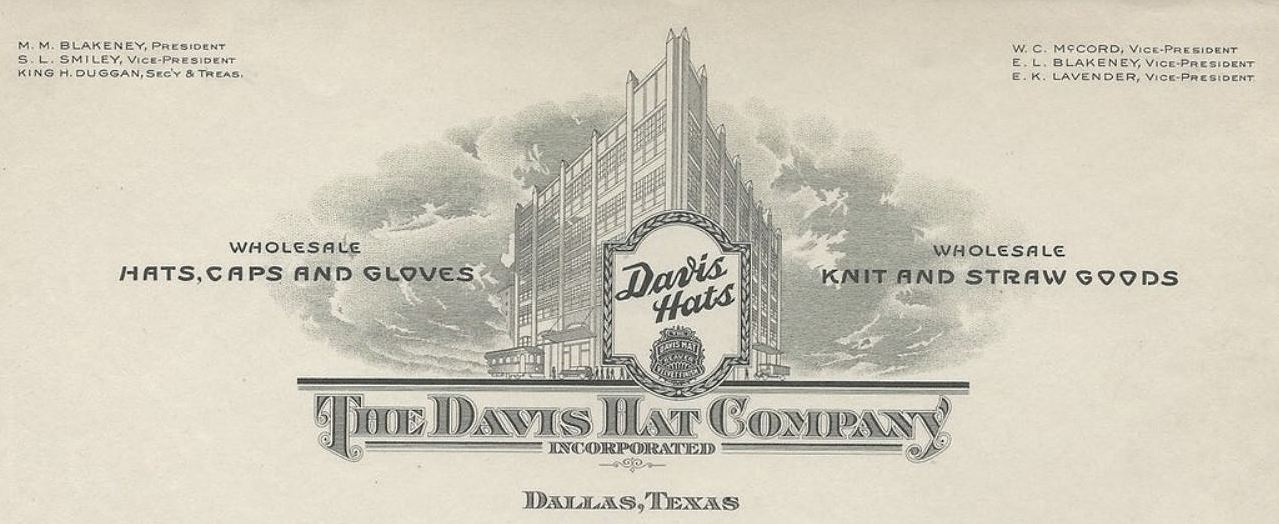
5.  S. G. DAVIS HAT CO. BUILDING, 800 Jackson St. (southeast corner of Jackson and S. Austin), designed by Lang & Witchell. When it was built in 1913 it was advertised as “facing the new Union Depot” (which hadn’t yet been built and was three blocks away). The Davis Hat Company — a manufacturer and wholesaler of men’s hats — was established in Dallas in 1900. This building might be familiar to many people for its “Office Equipment Co. sign painted on the back exterior. (See the location of this building on a 1921 Sanborn map, here.)

davis-hat-co-bldg_western-architect_july-1914

davis-hat-co-building

*

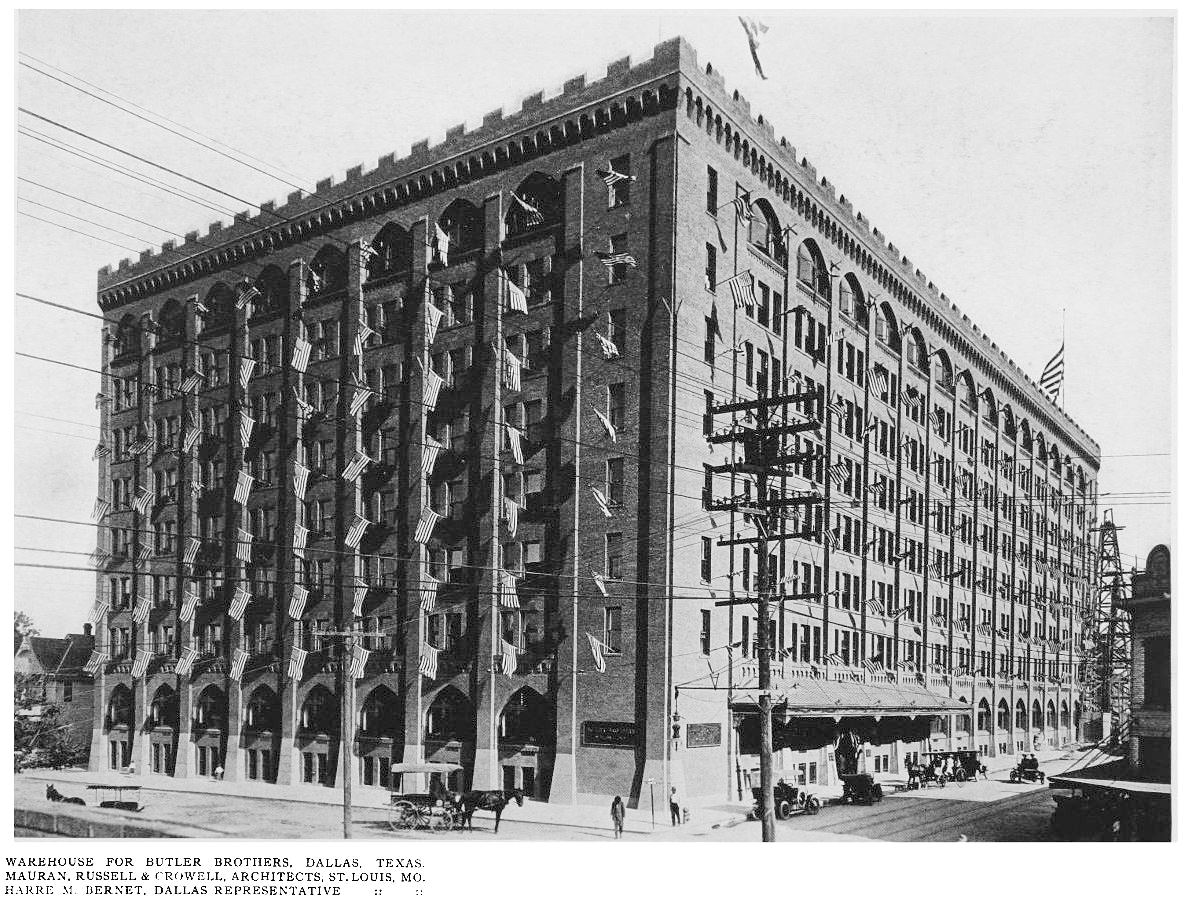
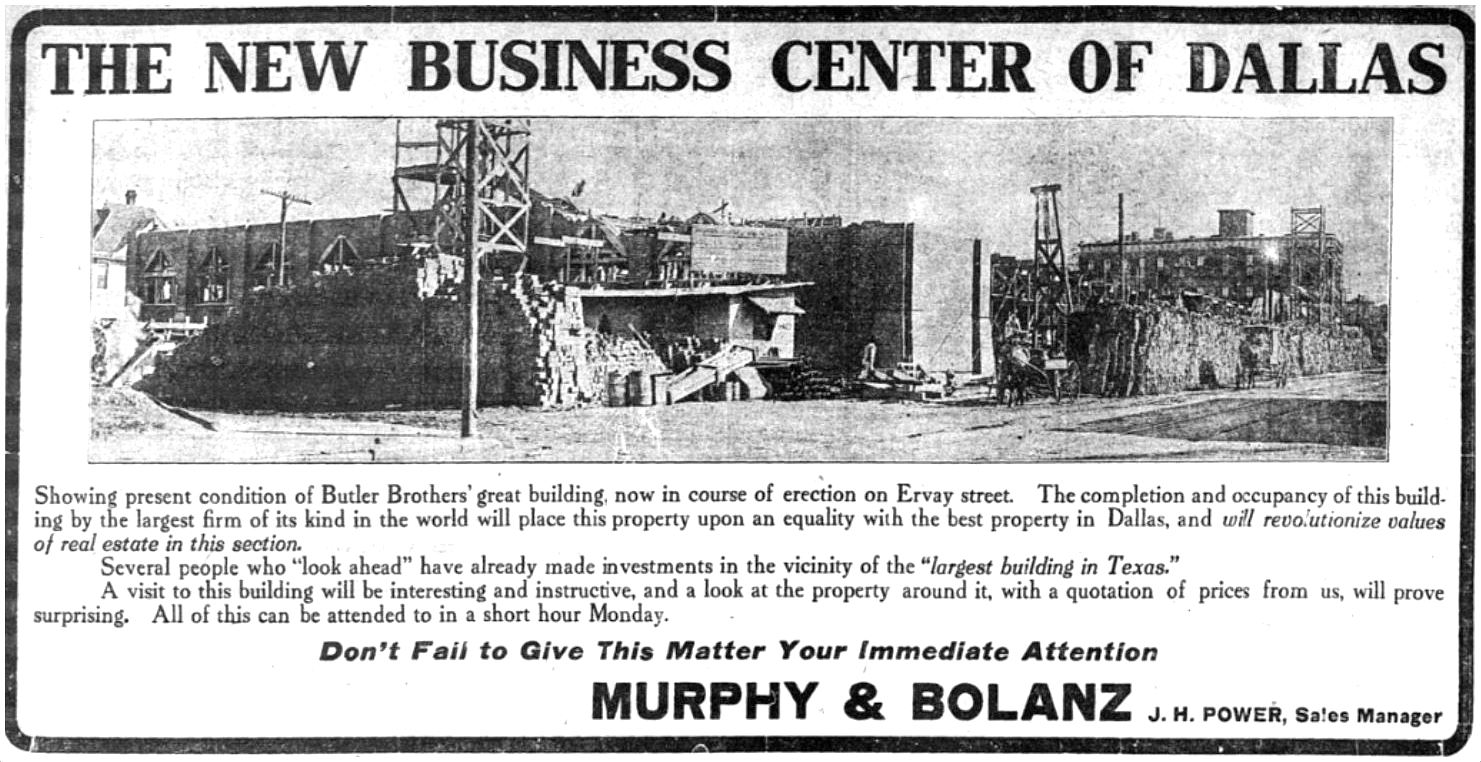
6.  BUTLER BROTHERS, 500 S. Ervay (between Young and Marilla, immediately east of City Hall), designed by Mauran, Russell & Crowell Architects (Harre Bernet, Dallas representative). This massive building (11 acres of floorspace before any additions were made) was one of the branches of the Chicago company which was known at the time as the largest wholesale business in the world. Construction began in 1910 (see a photo of the work in progress, by Vilbig Brothers Construction, here) and, over the years, various additions were made. When Butler Bros. sold the building in 1951, it had grown to 670,000 square feet and soon became home to the newly branded Merchandise Mart. The building still stands (as residences), but it doesn’t look a lot like it did a century ago: it was apparently resurfaced in the 1960s and currently sports a regrettable exterior color, which makes it look a bit like a large Hampton Inn. (See it on a 1921 Sanborn map, here.)
butler-brothers_western-architect_july-1914

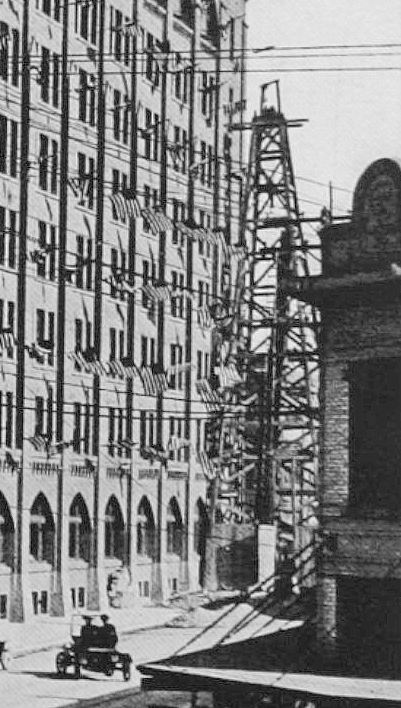
It even had its own artesian “deep well.”

butler-brothers_det_western-architect_july-1914

butler-brothers_ad_110610November, 1910

*

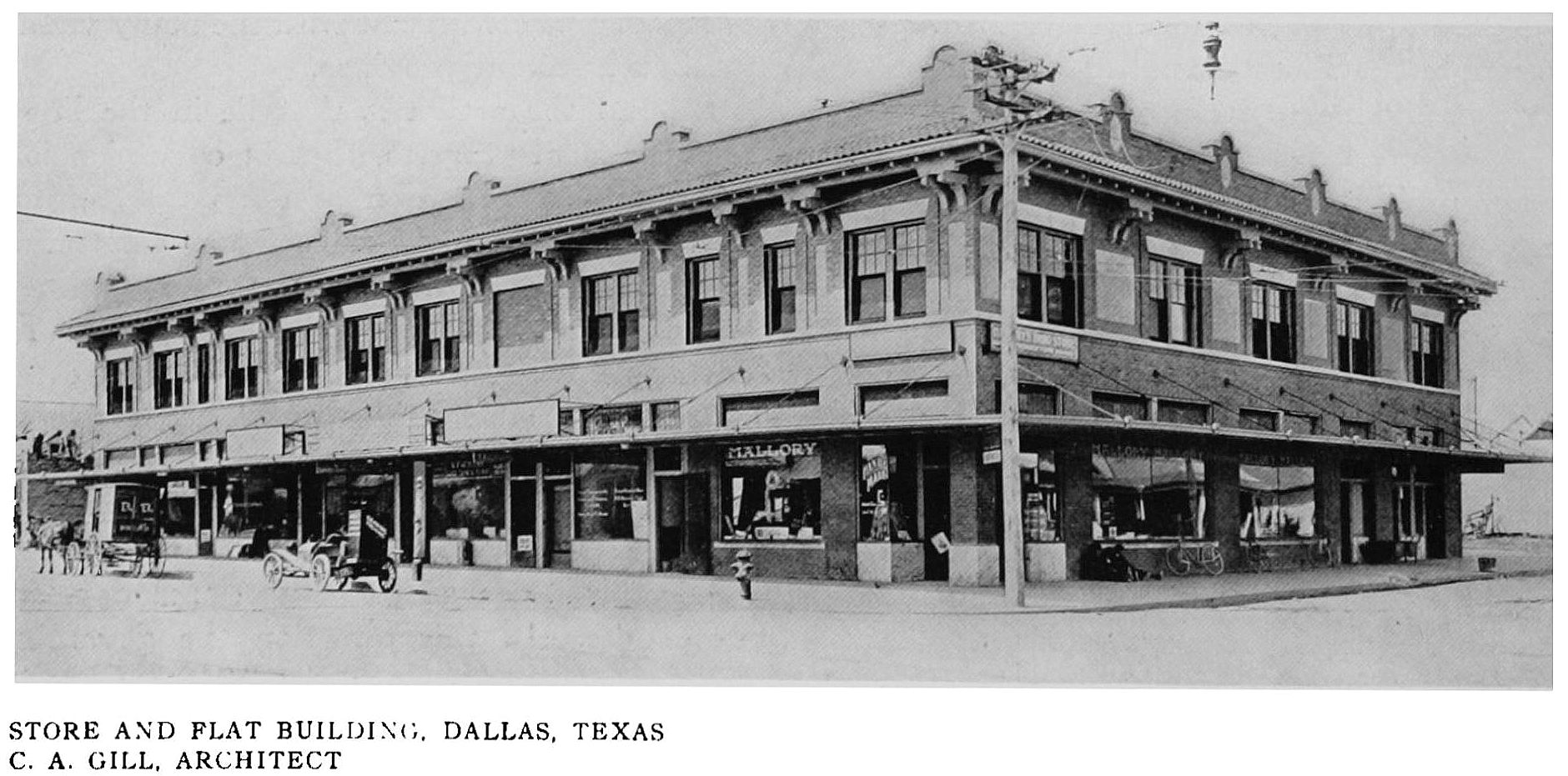
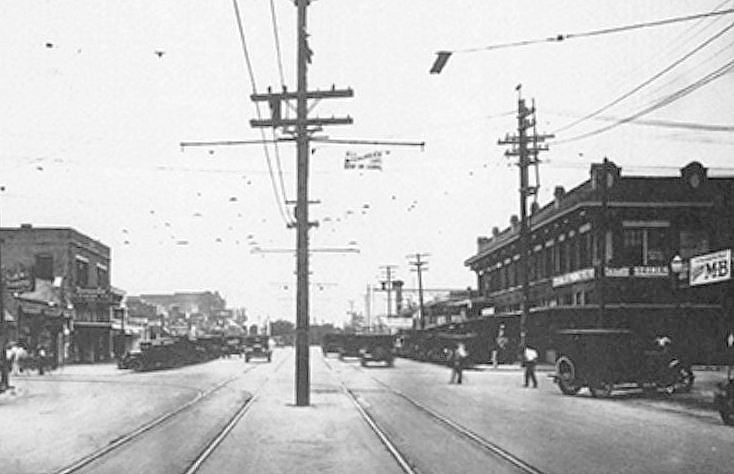
7.  “STORE AND FLAT BUILDING,” northwest corner of West Jefferson & Tyler, designed by C. A. Gill. Luckily I recognized this building — because I love it and have written about it before — because, otherwise, there’s very little to go on to determine its location. It was built in 1911 or 1912 for use as retail establishments on the ground floor and apartments (“flats”) and the occasional doctor’s offices on the second floor. Still looking good in Oak Cliff. (See it on a 1922 Sanborn map, here.)

oak-cliff_mallory-drugstore_western-architect_july-1914

oak-cliff_jefferson-tyler_1929_oak-cliff-advocate_DPL1929 (Dallas Public Library photo, via Oak Cliff Advocate)

*

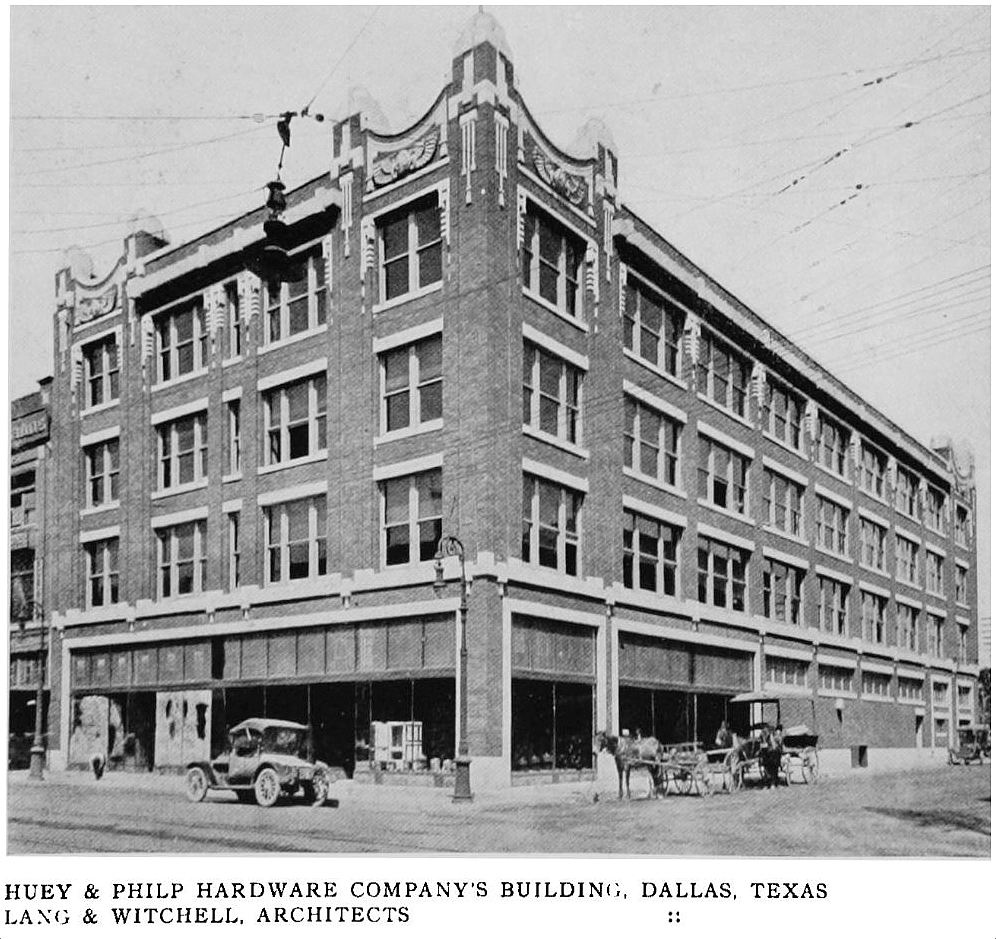
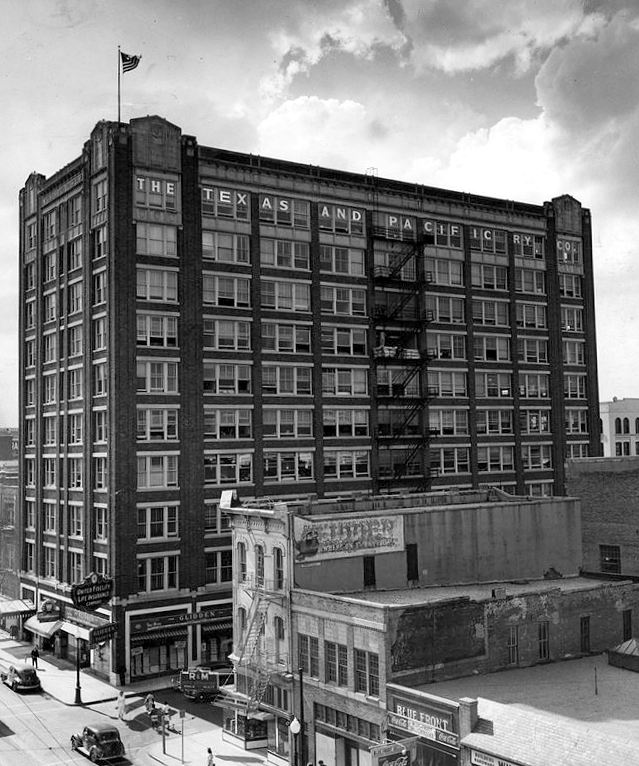
8.  HUEY & PHILP BUILDING, 1025 Elm Street, designed by Lang & Witchell. Built in 1913-1914 for the Huey & Philp hardware company (founded in Dallas in 1872 by Joseph Huey and Simon Philp) — this building is still standing, but you’d probably never ever guess it. First off, it looks nothing like it once did: it’s much taller now and it was one of the many downtown buildings that went through bizarre refacings in the 1950s and ’60s — beautiful buildings were stripped of all their character and uglified, for reasons I can’t fathom. Anyway, the other reason it’s hard to believe this is the same building is that, when it was built, it sat on the northwest corner of Elm and Griffin; now it sits on the northeast corner. How does something like that happen? In the 1960s, Griffin was “realigned” and widened, in order to provide a north-south artery through downtown’s west side — part of this road construction meant that Griffin suddenly cut right through the 1000 block of Elm (it also did away with poor little Poydras Street). The old Griffin can still be seen in the Griffin Plaza walkway (here — with the old Huey & Philp/Texas & Pacific building to the left, now a hotel and looking nothing like the century-old building it is). Crazy. Huey & Philp closed its retail business in 1934 but continued for several decades as wholesalers. (Read more about this building at Noah Jeppson’s Unvisited Dallas site, here. And see a street-level early-1920s photo in the UTA collection here, with the Sanger’s building in the background at the left.) (See it on a 1921 Sanborn map, here.)

huey-and-philp_western-architect_july-1914

huey-philp_unvisited-dallasvia Unvisited Dallas

*

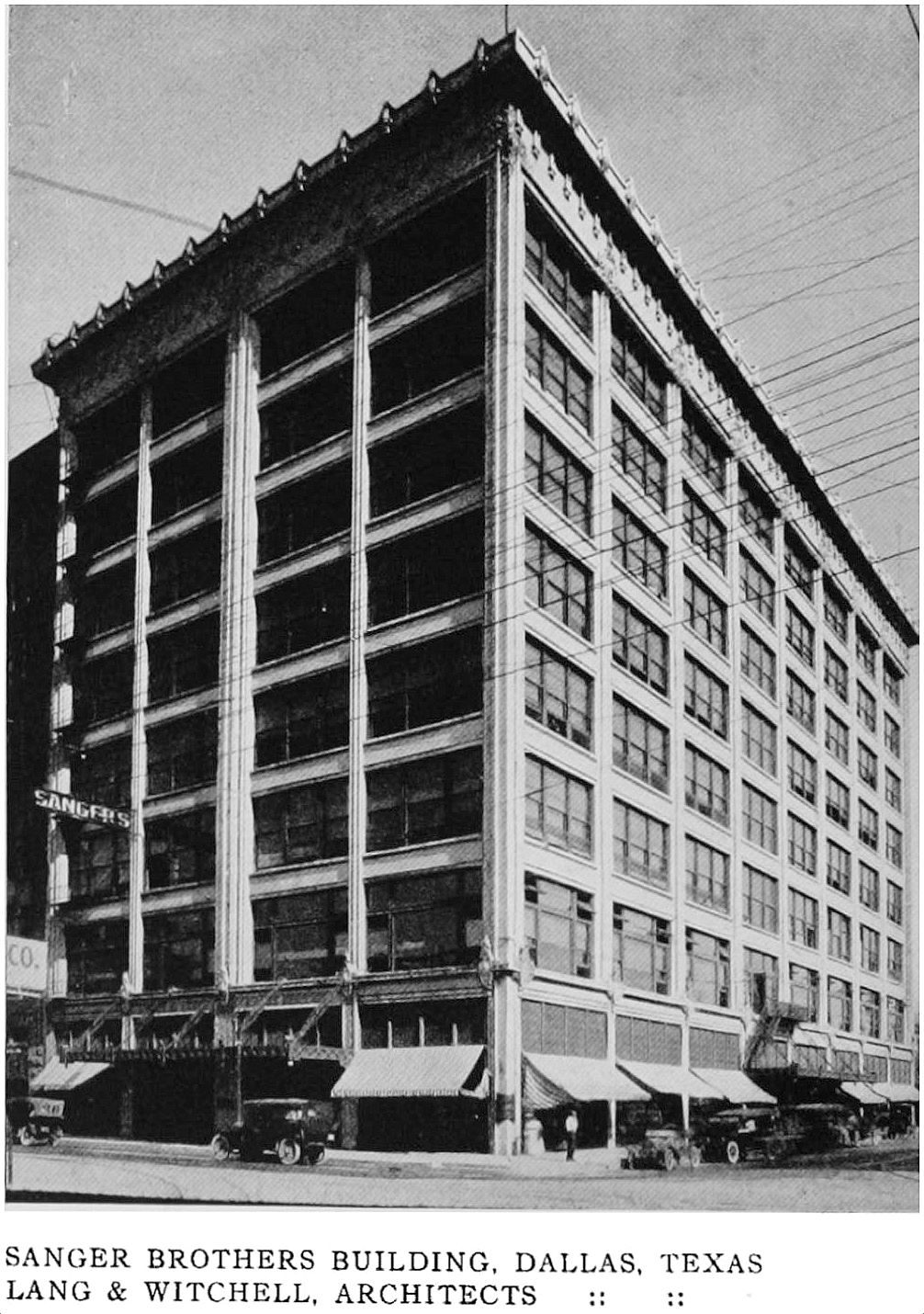
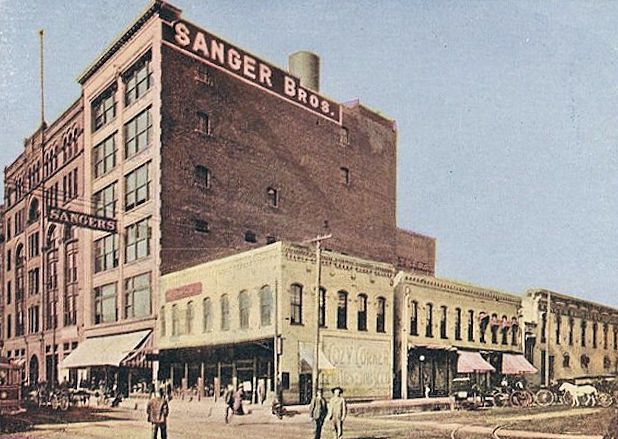
9.  SANGER BROTHERS BUILDING, Main & Lamar, designed by Lang & Witchell. One of the earliest Dallas business institutions (the Sanger brothers arrived in Dallas in the 1870s, at about the same time as Simon Philp), Sanger’s slowly acquired a ton of downtown real estate (for warehouses, etc.), but this building — their retail department store — was their centerpiece, and it grew and grew over the years. The expansion(s) of 1909 and 1910 included the addition of two floors to their already 6-story building, the building of a new 8-story addition which went up at the corner of Main and Lamar, and then when that was completed in 1909, another addition matching the rest of the store was built on the Elm Street side, resulting in a store taking up half a block of prime real estate (they would eventually own the entire block). More than a century later — now as part of El Centro College — the building still looks good. (See it on a 1905 Sanborn map, here, and a 1921 map, here.)

sanger-bros-bldg_western-architect_july-1914

Here’s what it looked like before this flurry of construction began:


sangers-bros-postcard

*

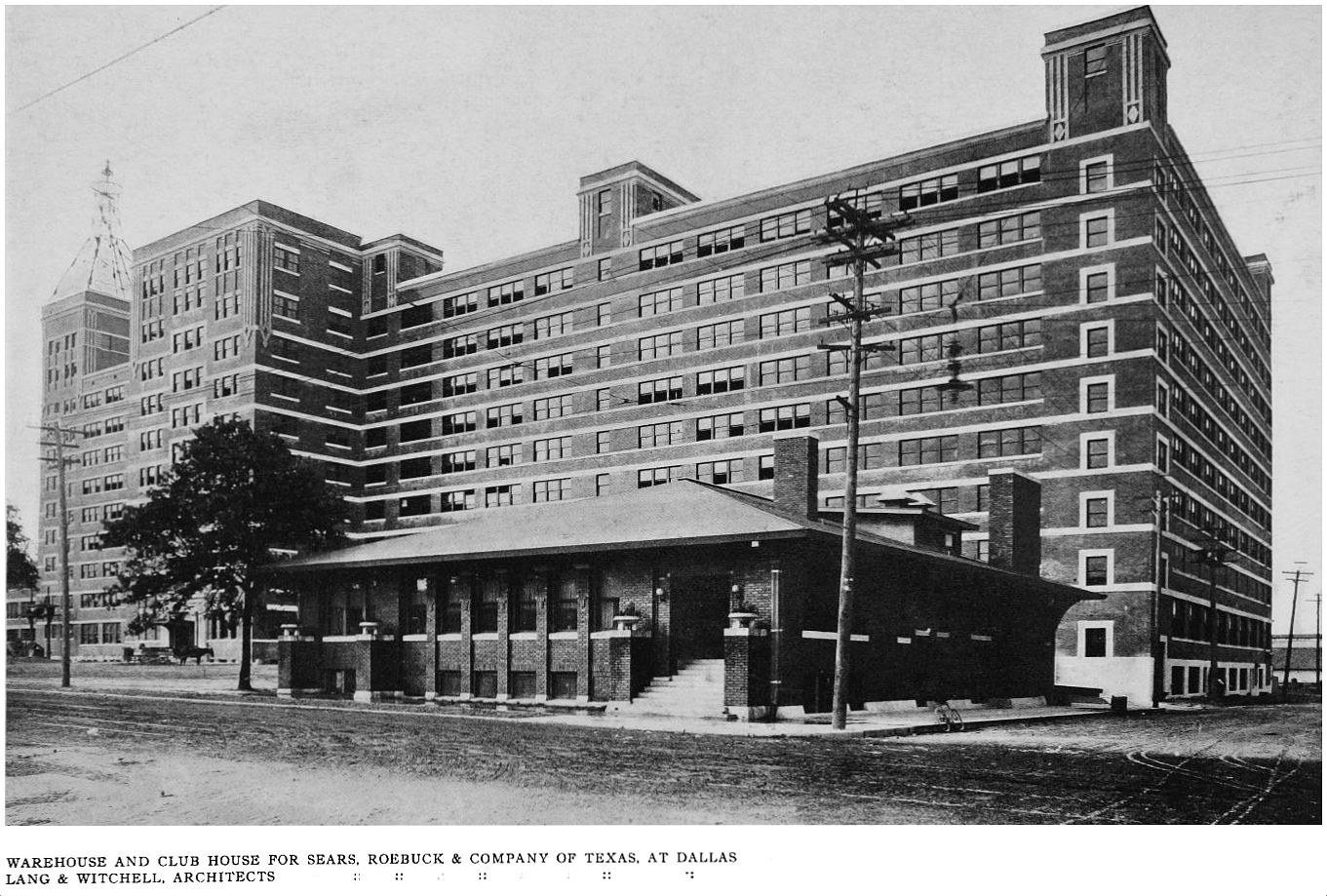
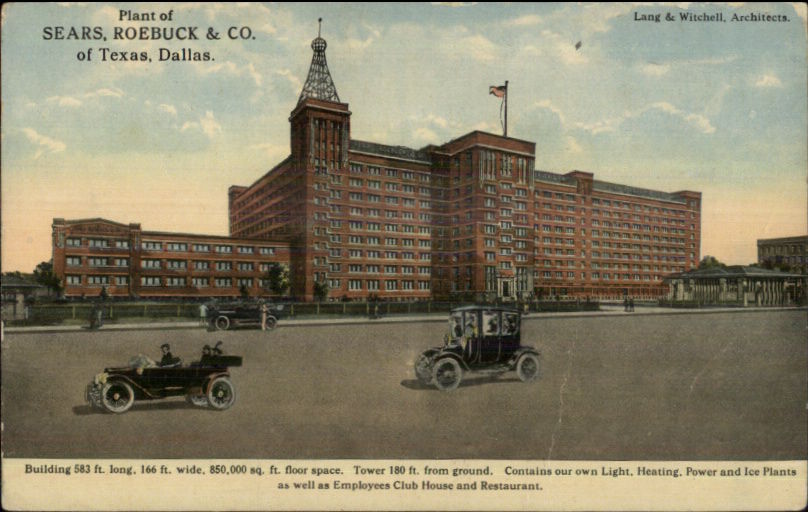
10.  SEARS, ROEBUCK & COMPANY OF TEXAS WAREHOUSE AND CLUB HOUSE, S. Lamar & Belleview, designed by Lang & Witchell. When Sears, Roebuck & Co. decided to open their first branch outside of Chicago, their choice was Dallas. A huge warehouse was built along South Lamar in 1910. Then, in 1912 a second huge warehouse was built. And, in 1913 a third one. This growth was pretty spectacular. All three of these buildings were designed by Lang & Witchell (building 3 is the one seen below). The massive Sears complex is now known as South Side on Lamar, and it’s beautiful. (More on this clubhouse is here.) (See the Sears buildings in a 1921 Sanborn map, here.)

sears-warehouse_western-architect_july-1914

sears-roebuck_postcard_ebay

**

Next: the Adolphus Hotel.

***

Sources & Notes

The Western Architect, A National Journal of Architecture and Allied Arts, Published Monthly, July, 1914. This issue, with text and critical analysis in addition to the large number of photographs, has been scanned in it entirety by the University of Illinois at Urbana-Champaign as part of its Brittle Books Program — it can be accessed in a PDF, here (the Dallas issue begins on page 195 of the PDF). Thank you, UIUC!

In this 7-part series:

*

Copyright © 2018 Paula Bosse. All Rights Reserved.
 

Dallas in “The Western Architect,” 1914: Skyscrapers and Other Sources of Civic Pride

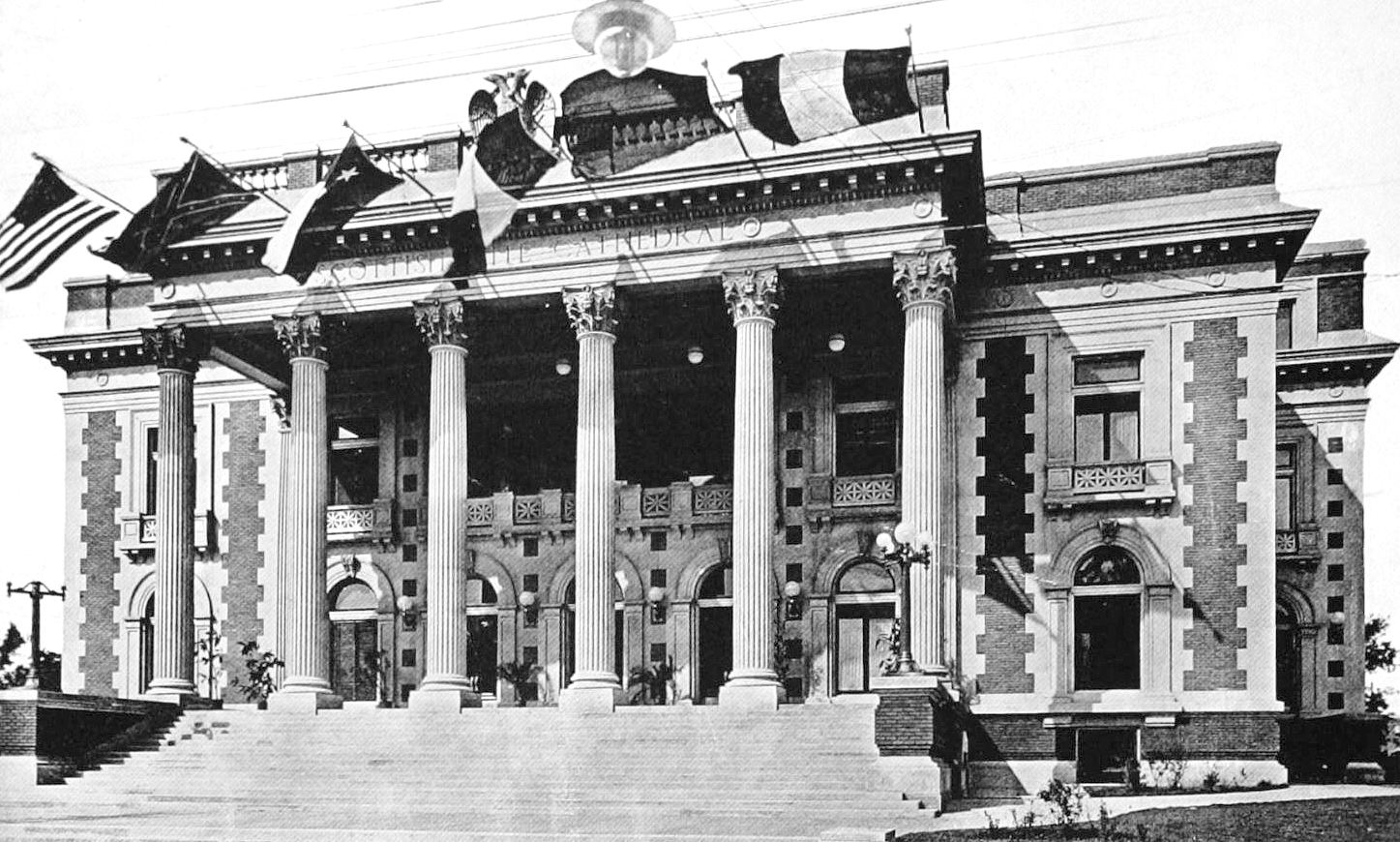
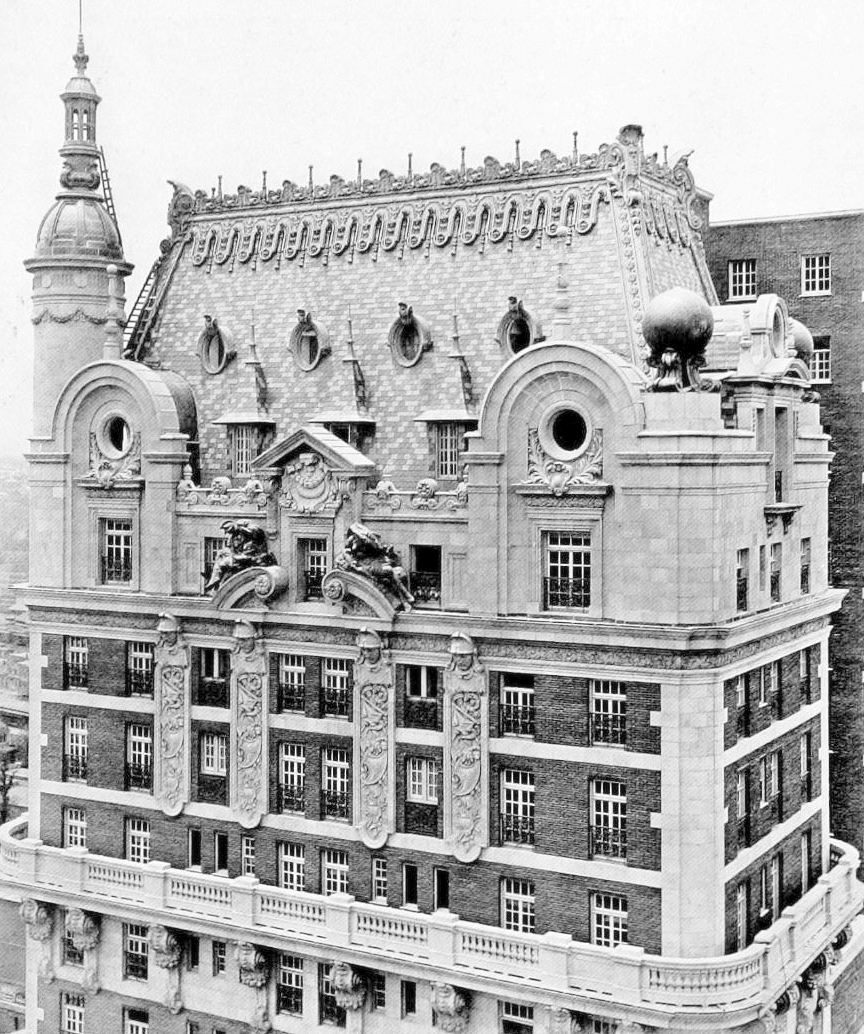
scottish-rite-cathedral_western-architect_july-1914The Scottish Rite Cathedral, Harwood & Young…

by Paula Bosse

This is the third installment of a week-long look at the July, 1914 issue of the The Western Architect, which chronicled the impressive growth of Dallas. Today we look at sources of civic pride: from skyscrapers to the world’s longest concrete viaduct. The black-and-white photos below appeared in The Western Architect — click to see larger images.

*

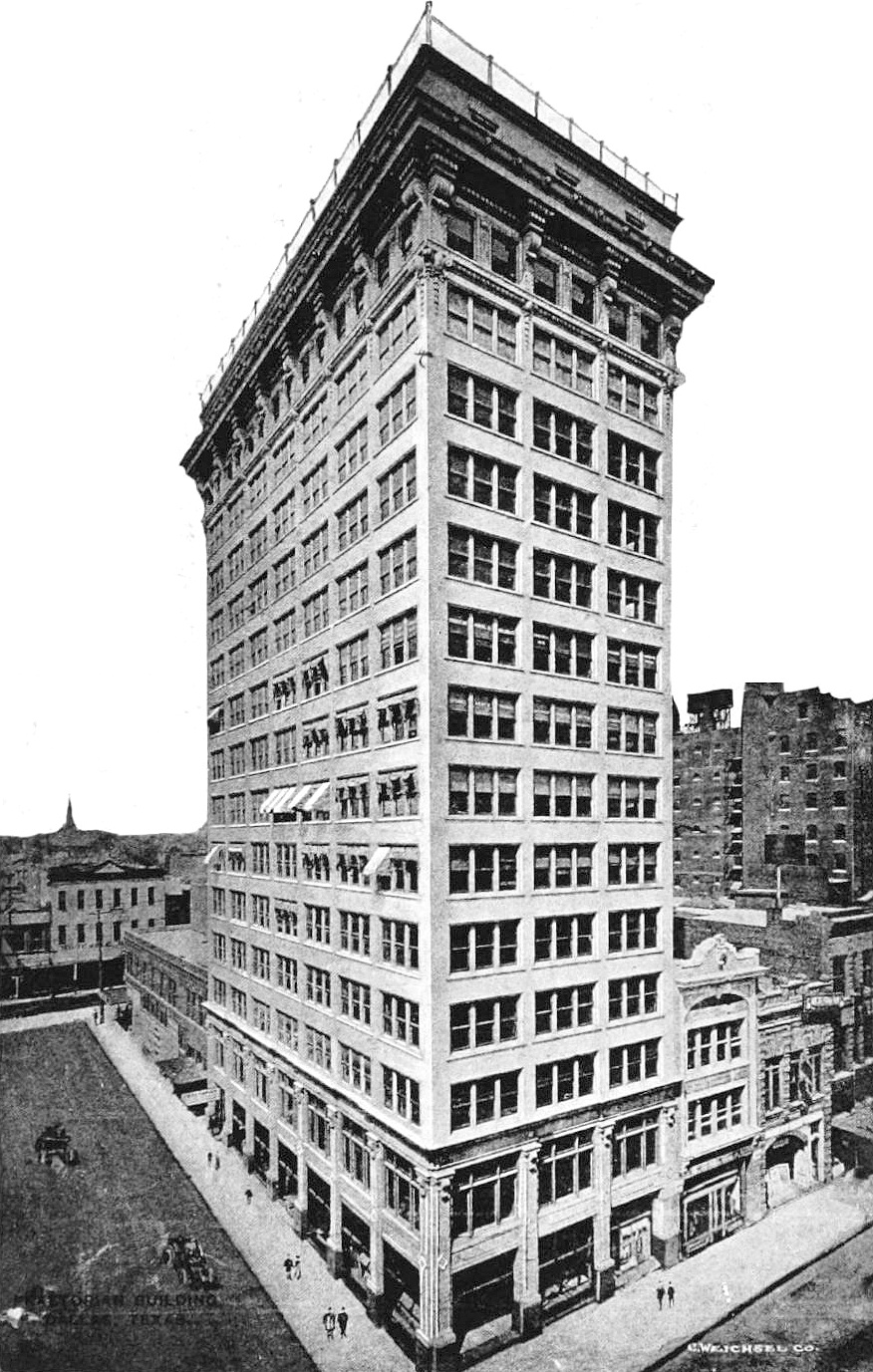
1. THE PRAETORIAN BUILDING, northeast corner of Main and Stone, designed by architect C. W. Bulger & Son. The city’s first true skyscraper — and, upon its completion around 1909, the tallest building in the Southwest. Those awnings halfway up the building are … cute. The building was demolished in 2013 and replaced by a giant eyeball. (More photos of the Praetorian are here.)

praetorian-bldg_western-architect_july-1914_crop

praetorian_empire__main-street_postcard_ebay

*

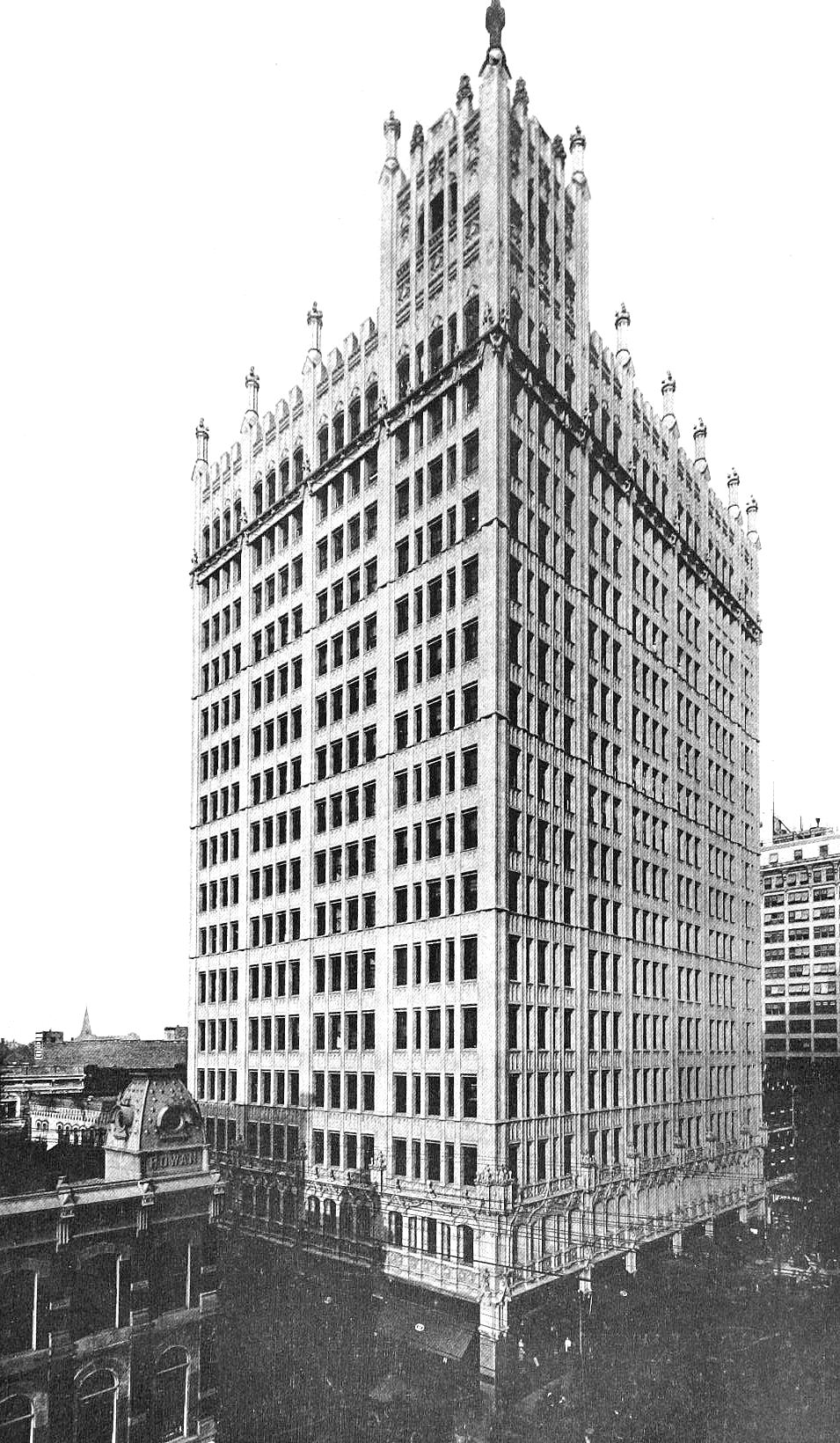
2. THE BUSCH/KIRBY BUILDING, northeast corner of Main and Akard, designed by Barnett, Haynes & Barnett (St. Louis)/Lang & Witchell (Dallas). Built in 1912/1913 by Adolphus Busch, the first five floors were occupied for many years by the A. Harris department store, and the upper floors were leased by various businesses. Buildings change names, and although it was built as the Busch Building, it later became the Great Southern Life Building, and, in 1922, the Kirby Building (when it was purchased by the Kirby Investment Co. of Houston, John H. Kirby, president). The building still stands, as The Kirby apartments.

Fun facts: when work on the construction of the Adolphus Hotel was completed, the crew walked across the street to the new site to start work on the Busch Building. The first 5 floors were built especially for the A. Harris Co., but, sadly, Adolph Harris died before the store opened in November, 1913 (Adolphus Busch also died before tenants moved in). Busch, the German-born beer baron, had planned a rathskeller in the basement — a handy place to sell his beer — apparently there were laws at the time which prohibited the sale of alcoholic beverages below street level … so it became the A. Harris bargain basement instead.

busch-bldg_kirby-bldg_western-architect_july-1914

busch_bldg_postcard

*

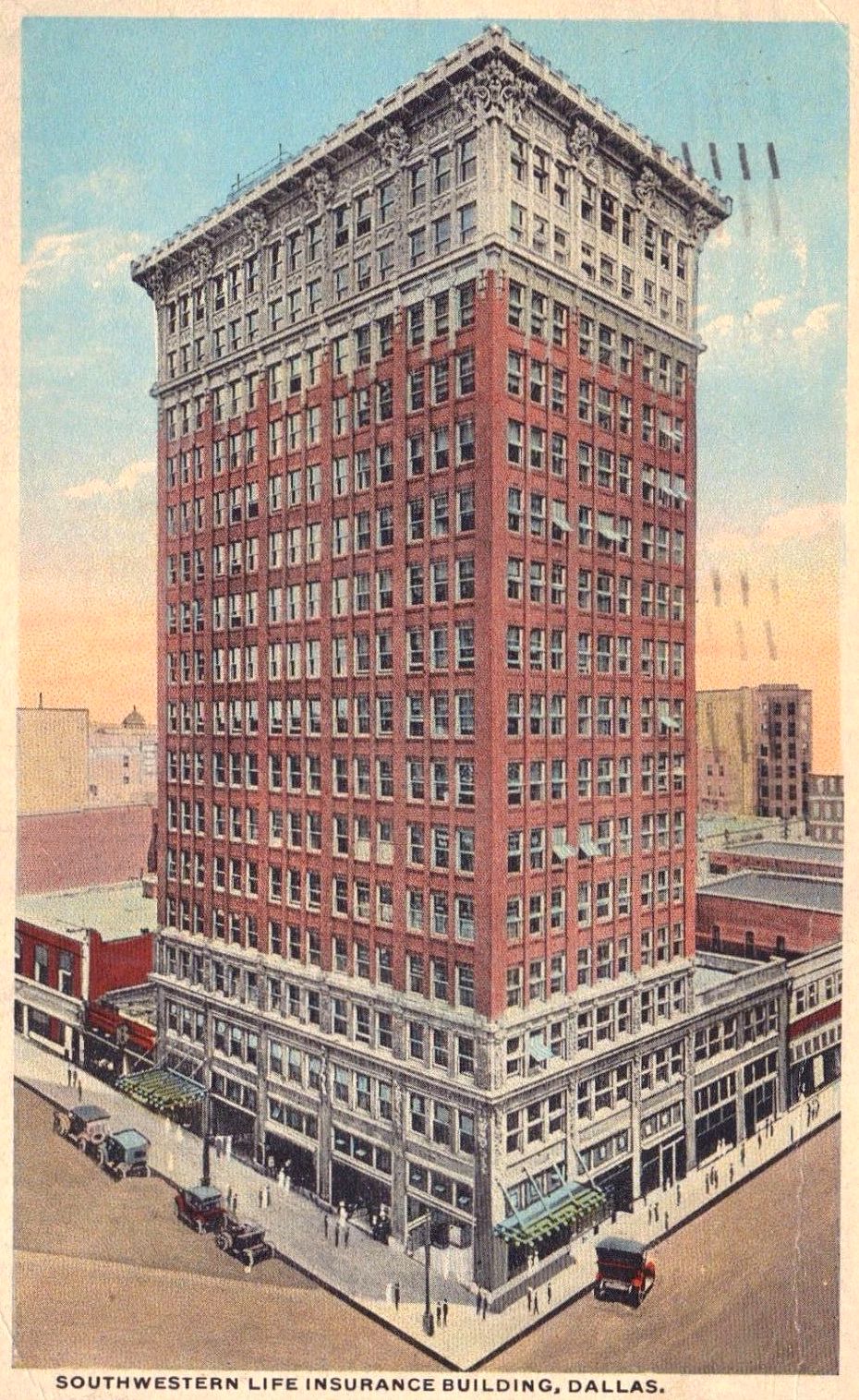
3. SOUTHWESTERN LIFE INSURANCE BUILDING, southeast corner of Main and Akard, designed by Lang & Witchell. Built in 1911/1912, the Southwestern Life Building was described by architect Otto Lang as “dignified but not ostentatious.” In 1965 the building was bought as an investment by Bill Clements (who later became Governor of Texas), but was torn down in 1972, sold, and then paved over to become a parking lot for many years. The site is now occupied by Pegasus Plaza, an attractive greenspace.

southwestern-life-insurance-bldg_western-architect_july-1914

southwestern-life-insuranec-bldg_postcard_ebay

*

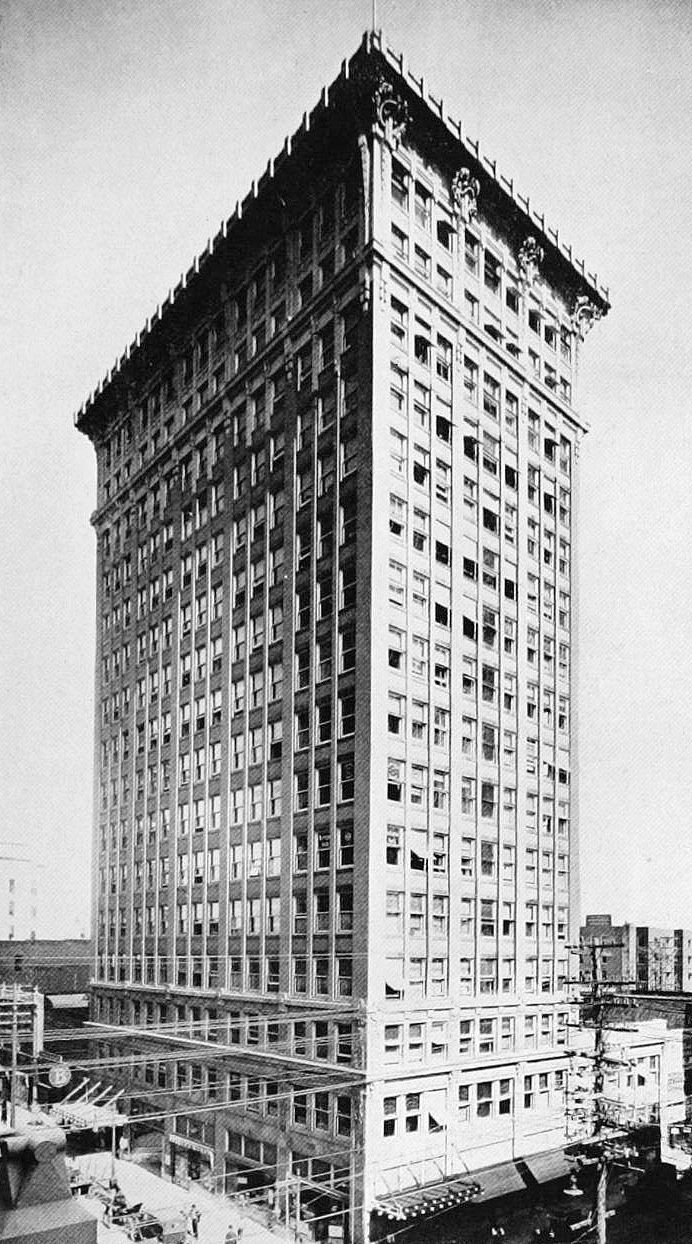
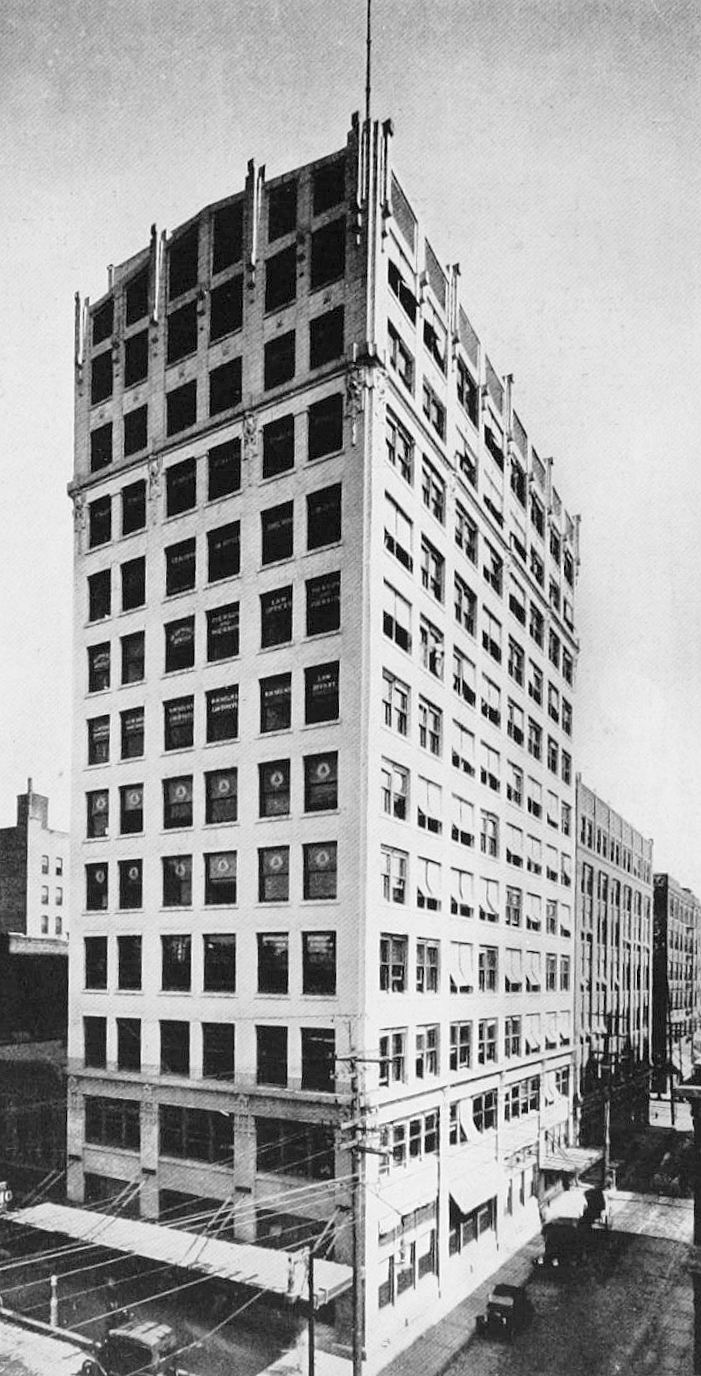
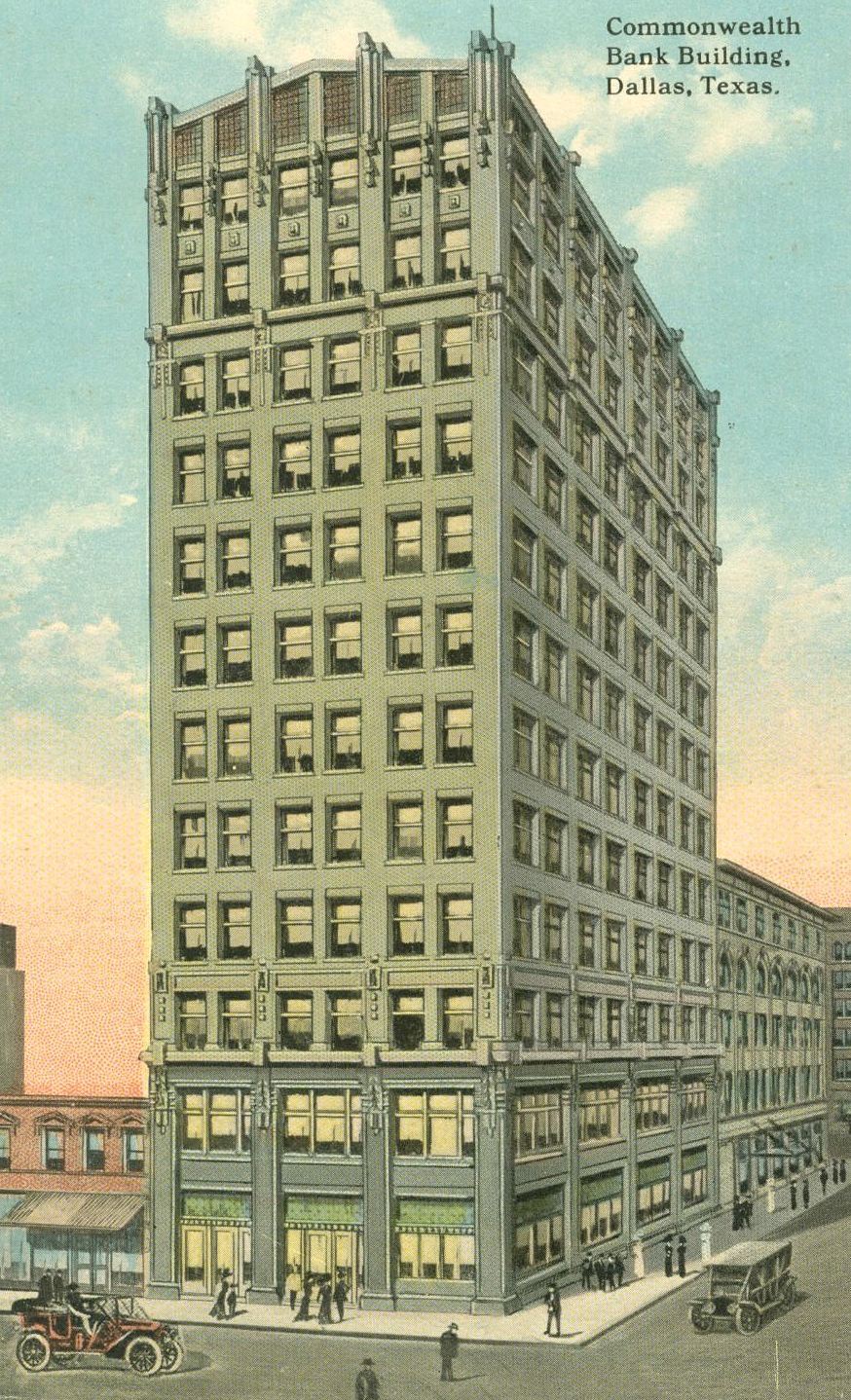
4. COMMONWEALTH NATIONAL BANK BUILDING, 1000 Main Street (southeast corner of Main and Poydras), designed by, yes, Lang & Witchell. Built in 1912, this no-longer-standing building had a dizzying number of names, as the banks it was affiliated with kept reorganizing or merging and changing names. It was known for most of its life as the Fidelity Union Building until the Fidelity Union Life Insurance people moved to their new location at Pacific at Bryan in the early 1950s.

commonwealth-national-bank-bldg_western-architect_july-1914

commonwealth-bank-bldg_portal

*

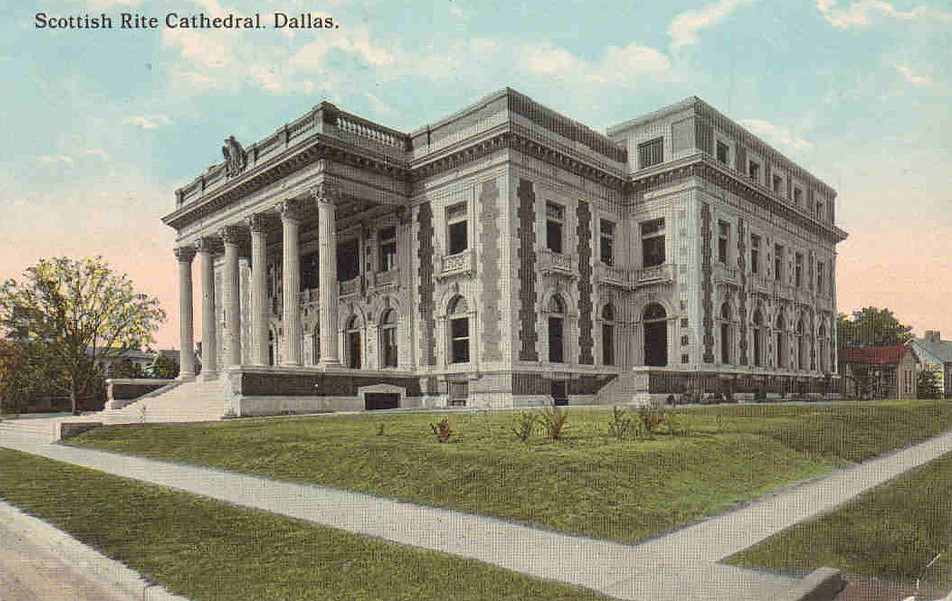
5. SCOTTISH RITE CATHEDRAL, 500 S. Harwood (at Young), Hubbell & Greene, architects. This stunning building was formally dedicated in 1913, almost seven years after its groundbreaking. It is still standing — and is a place I’ve always meant to visit. Money appears to have been no object in the construction and decoration of this grand building, from its hand-fluted columns out front to its sky-blue ceiling with stars painted in gold, its leather inlaid walls and its double-laned bowling alley in its basement. Not only did it have the largest performance stage in Texas, but it also had “easily the largest organ in America [with] 8,000 speaking pipes.” Read the incredible no-detail-too-small description of the building and its appointments by chief architect (and mason) Herbert Miller Greene here.

The photo that appeared in The Western Architect is at the top of this post. Here’s a postcard view that looks like it sat in the middle of a residential neighborhood.

scottish-rite-cathedral

*

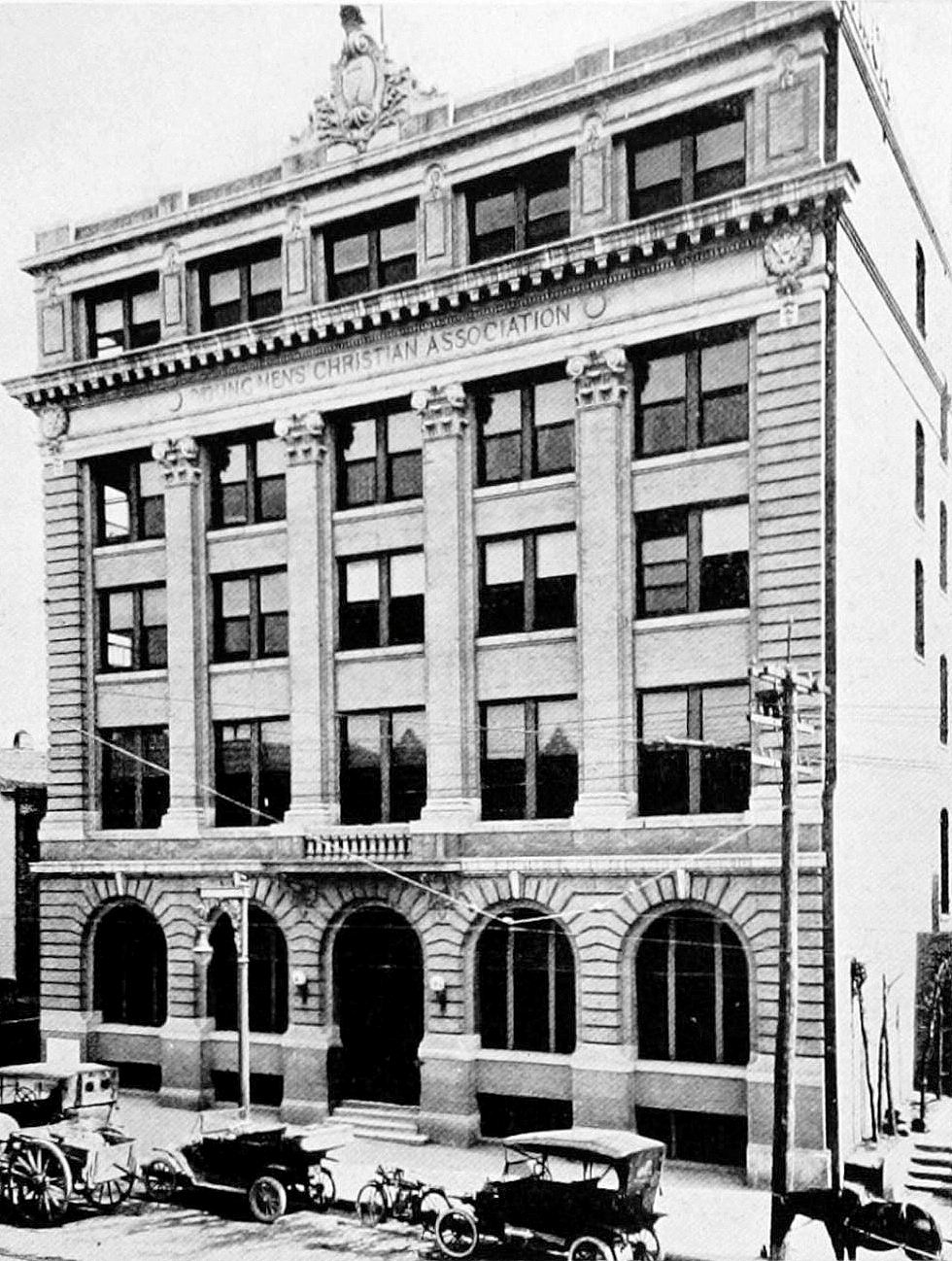
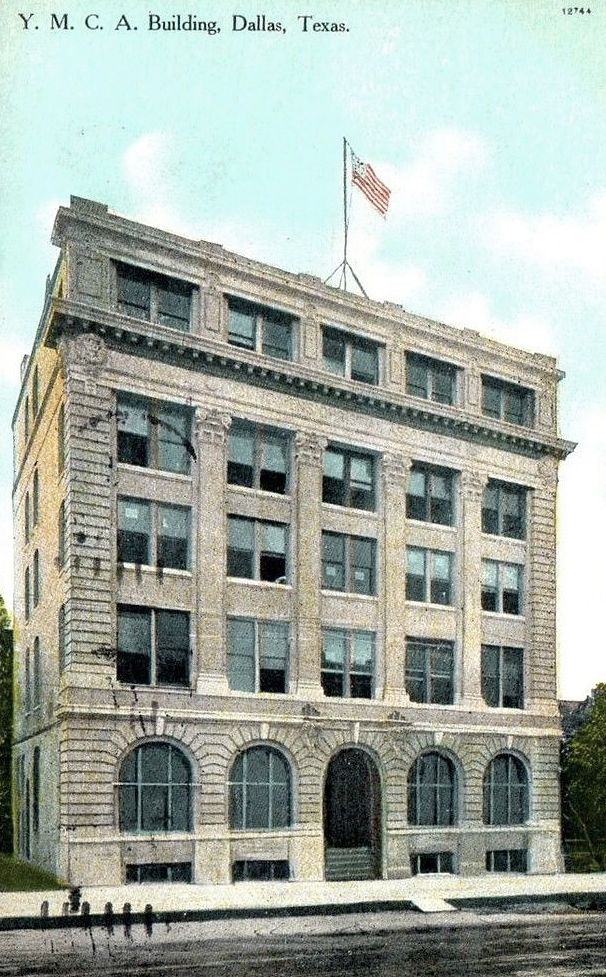
6. YMCA BUILDING, 1910 Commerce Street, near St. Paul, designed by Lang & Witchell. This building was built somewhat sporadically (when money was available) between 1907 and 1909. After the Y moved to larger digs, this building became home to the Savoy Hotel (which I read about several years ago and seem to remember it sounding kind of seedy). It was demolished in 1950 to make way for the much-delayed construction of the Statler-Hilton Hotel.

ymca-bldg_western-architect_july-1914

ymca-building_postcard

*

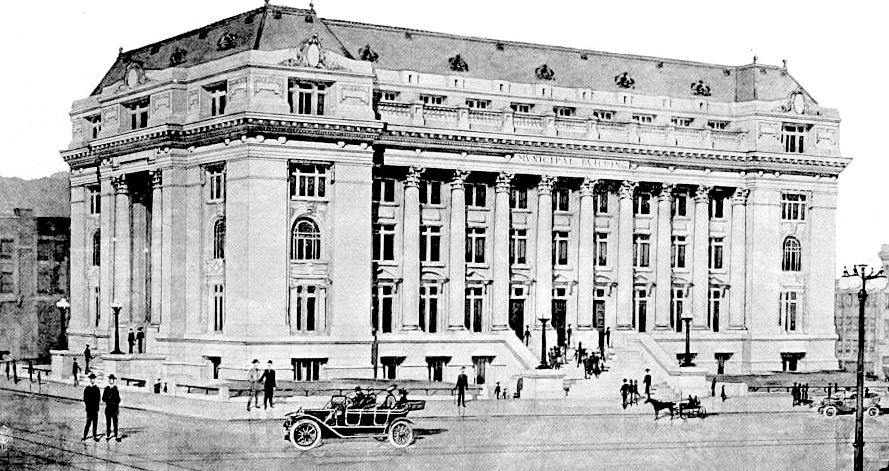
7. MUNICIPAL BUILDING, Main and Harwood, designed by C. D. Hill. I love this building, built in 1913/1914, and I wrote about it here. It is still standing and is currently undergoing a lengthy and loving restoration.

municipal-building_western-architect_july-1914

city_hall

*

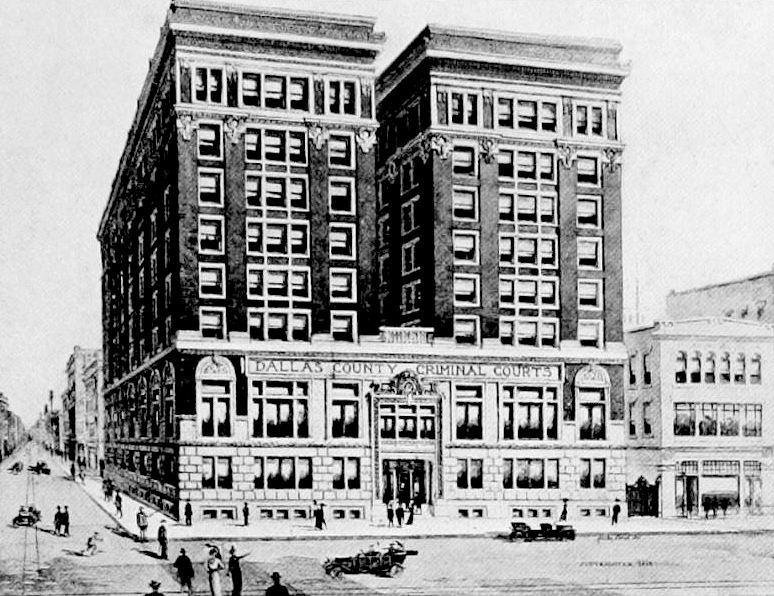
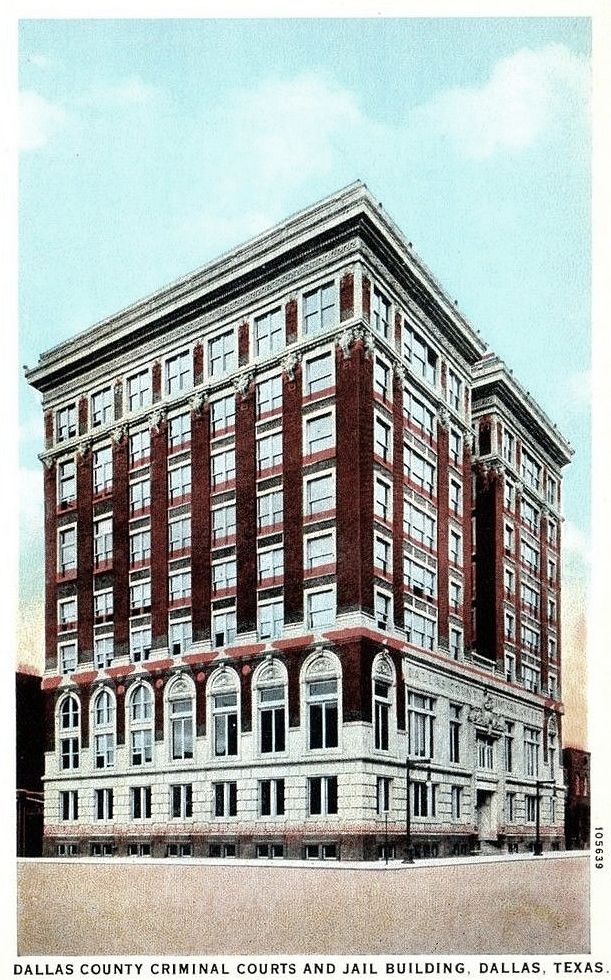
8. DALLAS COUNTY CRIMINAL COURTS AND JAIL BUILDING, Main and Houston, designed by H. A. Overbeck. I’ve also written about this still-standing building, which opened for business in 1915, here.

criminal-courts_jail_western-architect_july-1914

dallas-county-criminal-courts_jail_ebay

*

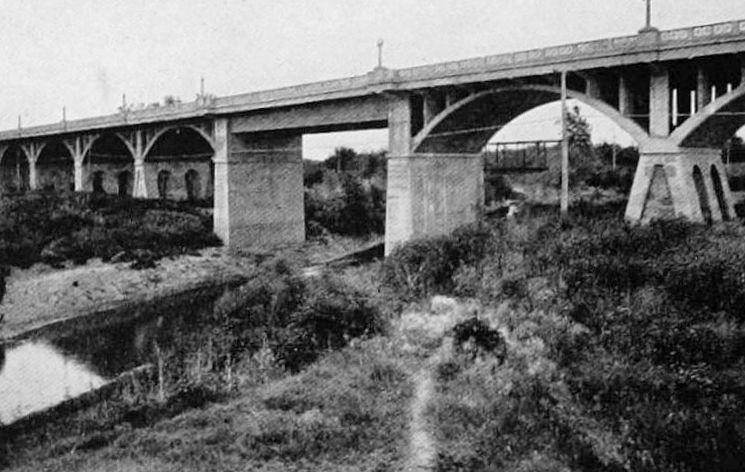
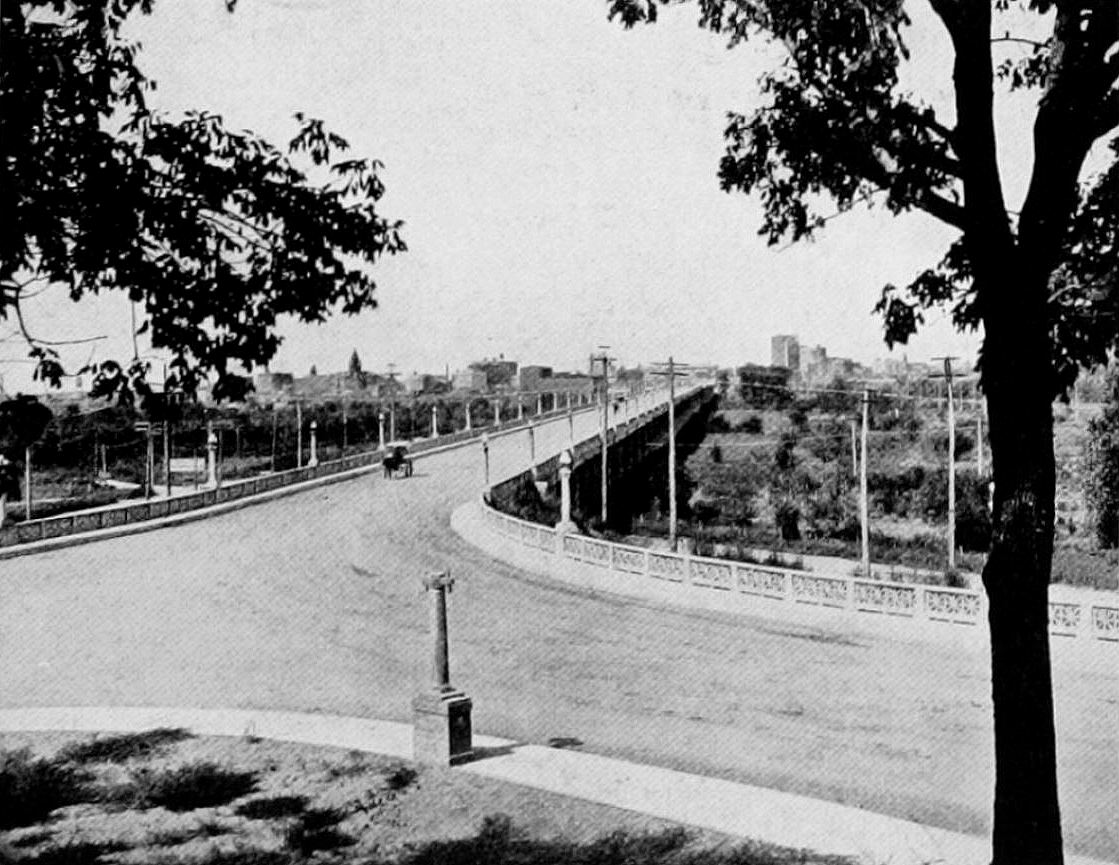
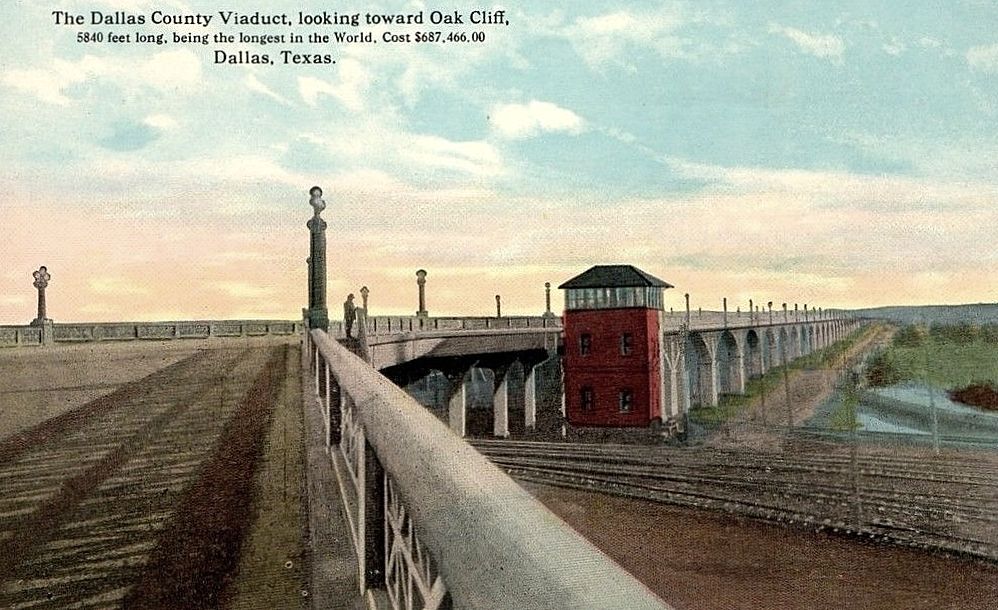
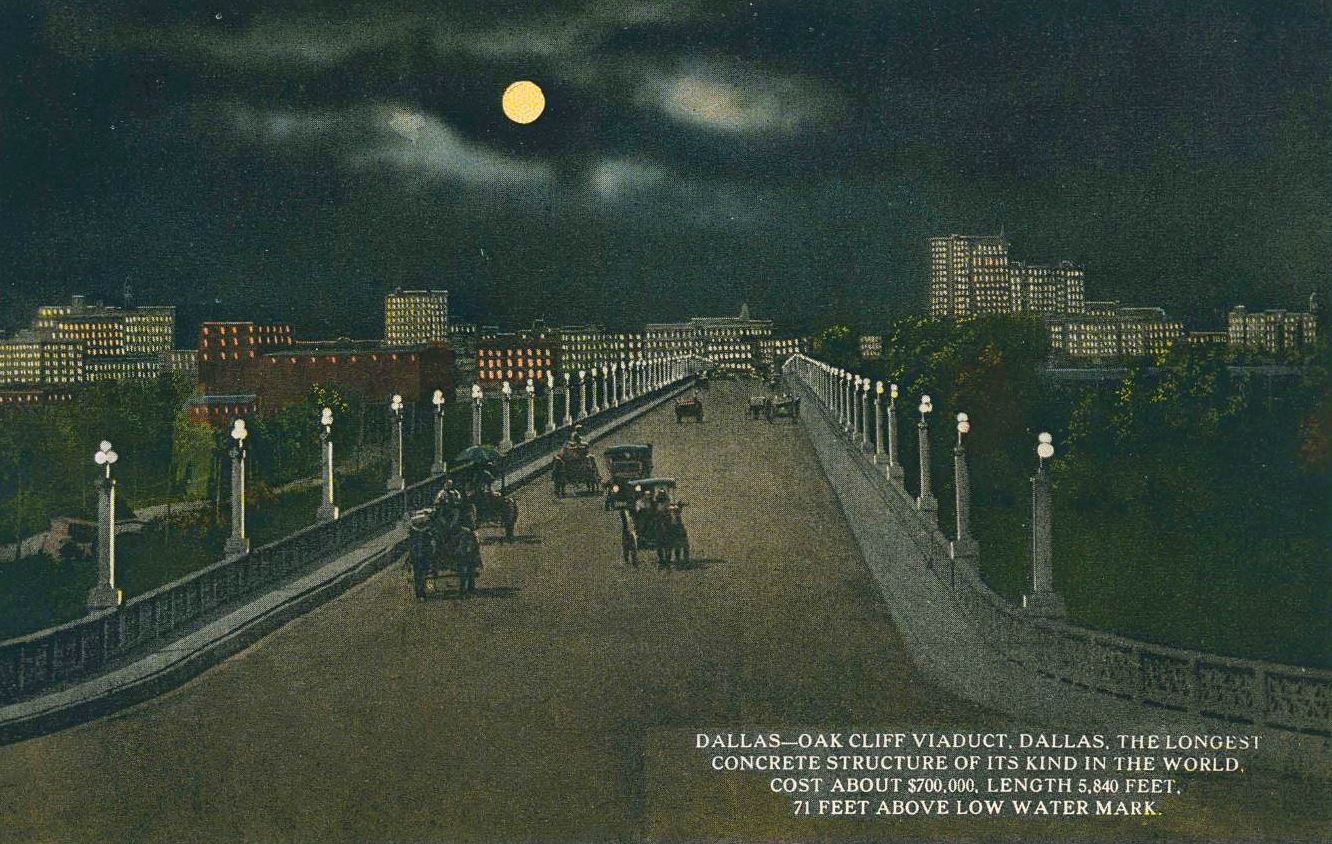
9. OAK CLIFF VIADUCT (HOUSTON STREET VIADUCT), designed by Ira Hedrick (Kansas City). Dallas loves big things, and in 1912, the city really put on the dog in celebrating the opening of the word’s longest concrete bridge. I will write about this in detail one day, if only to go into detail about the good ladies of some organization who convinced the City Fathers to forego the christening of the viaduct with a bottle of champagne and, instead, celebrate by releasing homing pigeons (imported for the occasion from the far reaches of the state) with messages of “Hey, they opened a new bridge in Dallas today!” strapped to them as they were set off on their merry way during the dedication ceremony. Still standing. Still cool-looking.

oak-cliff-viaduct_western-architect_july-1914

trinity-river-viaduct_western-architect_july-1914

oak-cliff-viaduct_postcard_stats_ebay

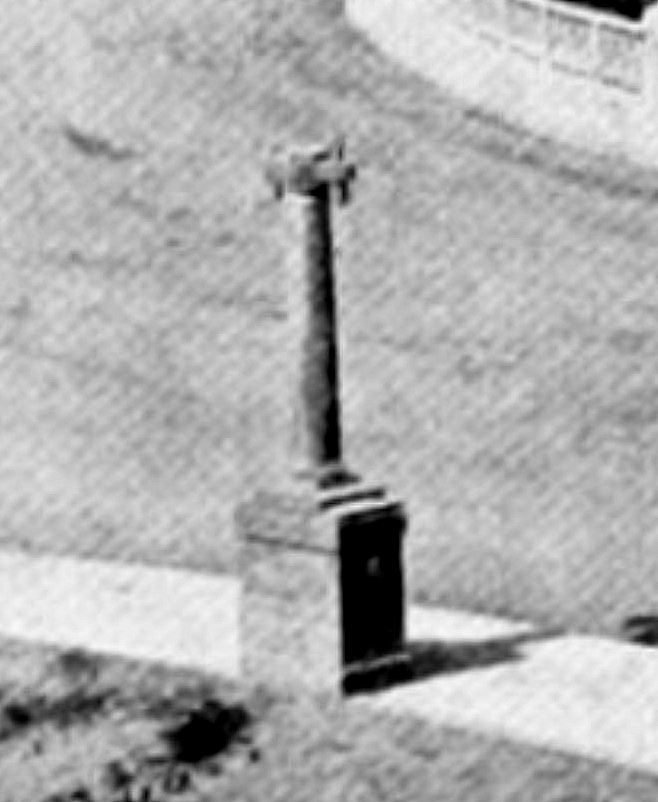
The second black-and-white photo stumped me — what was this:

trinity-river-viaduct_western-architect_july-1914_det

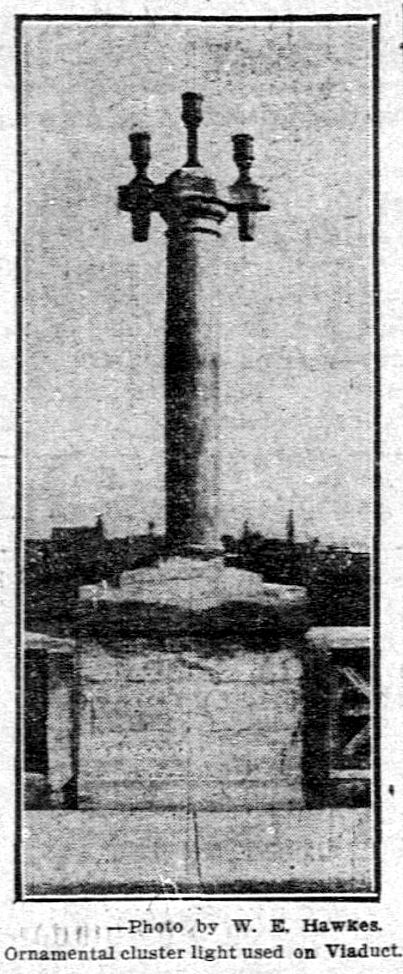
Took a while to figure it out — it was a street light.

oak-cliff-viaduct_lighting_dmn_021112Dallas Morning News, Feb. 11, 1912

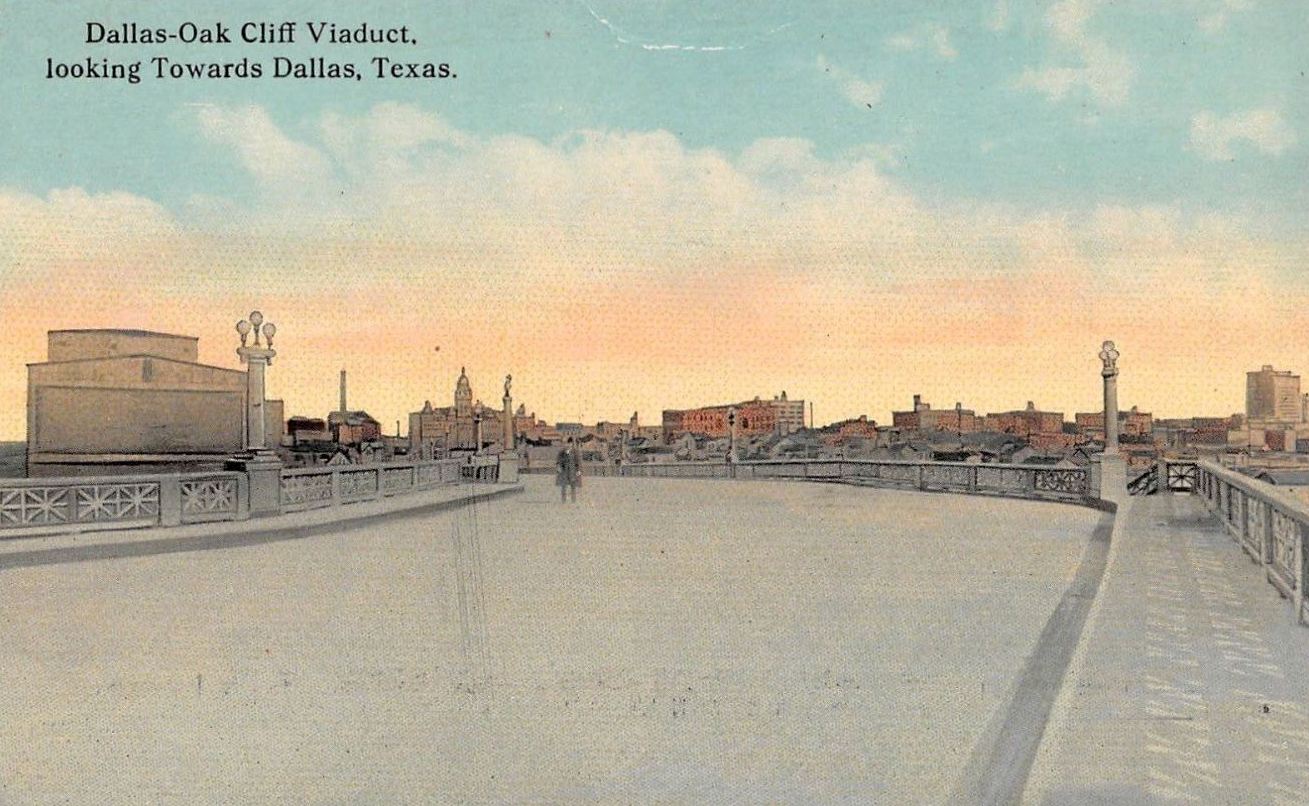
These three-globed ornamental cluster-lights were used along the viaduct and, apparently, on the approach to Oak Cliff. A lighted viaduct was a new thing, and people absolutely loved it. They also loved shooting out the bulbs and globes. You can see what they looked like (…sort of) during the day in this postcard:

oak-cliff-viaduct_postcard_ebay

But more thrillingly, here’s what they looked like at night:

oak-cliff-viaduct_night_postcard

**

Next: business establishments.

***

Sources & Notes

The Western Architect, A National Journal of Architecture and Allied Arts, Published Monthly, July, 1914. This issue, with text and critical analysis in addition to the large number of photographs, has been scanned in it entirety by the University of Illinois at Urbana-Champaign as part of its Brittle Books Program — it can be accessed in a PDF, here (the Dallas issue begins on page 195 of the PDF). Thank you, UIUC!

In this 7-part series:

*

Copyright © 2018 Paula Bosse. All Rights Reserved.

Dallas in “The Western Architect,” 1914: Residences of East Dallas, South Dallas, and More

higginbotham-r-w_house_western-architect_july-1914

by Paula Bosse

This is the second installment of a week-long look at the wonderful photos published in 1914 in the journal The Western Architect. Today’s installment features photos of homes built between 1911 and 1913 in Munger Place and Old East Dallas, South Dallas, Uptown, and Oak Cliff — of the eight homes featured here, six are still standing. (All photos are larger when clicked.)

*

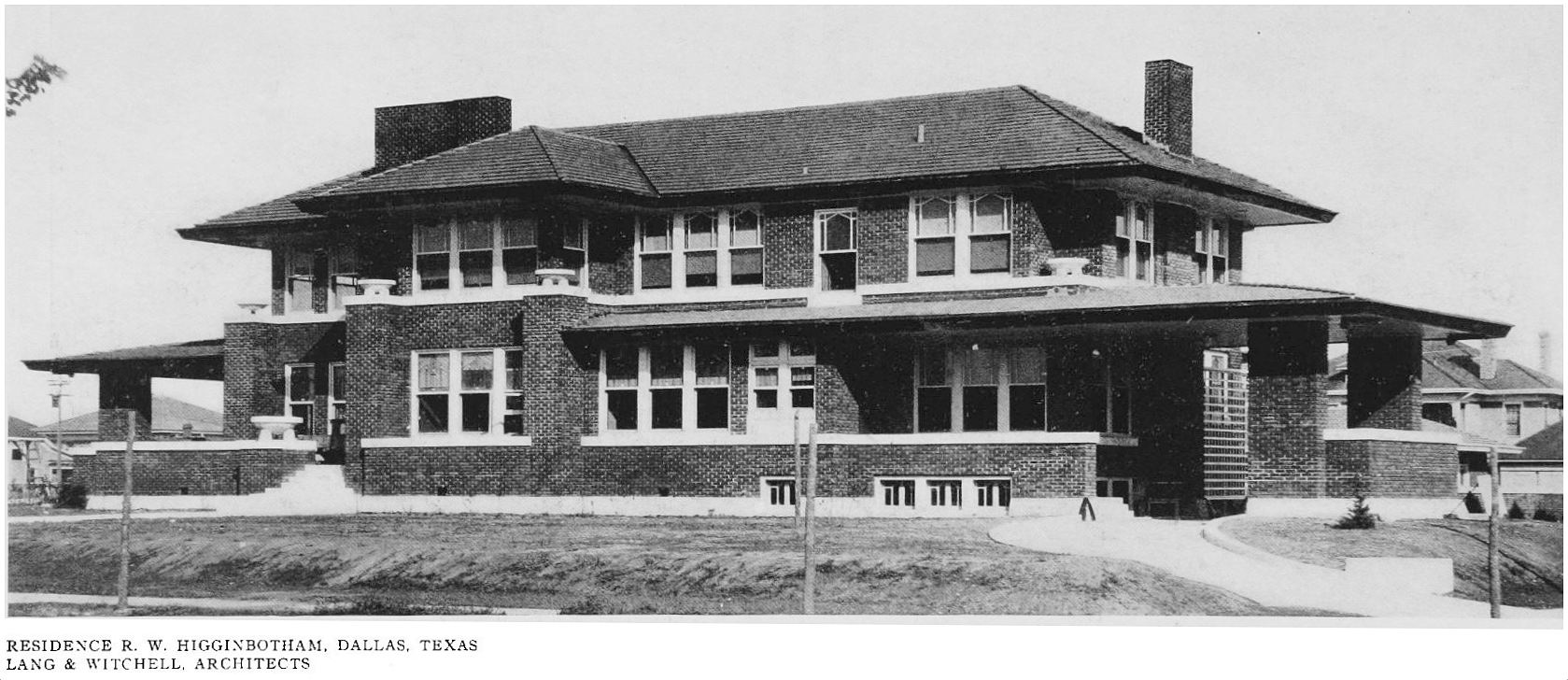
Residence 1: (above) the beautiful sprawling home of businessman RUFUS W. HIGGINBOTHAM (Higginbotham-Bailey, Boren-Stewart, etc.), 5002 SWISS AVENUE, designed by Charles Erwin Barglebaugh, chief designer for Lang & Witchell and a former employee of Frank Lloyd Wright (more on Barglebaugh — who was one of the architects responsible for the Medical Arts Building — can be found here). This beautiful Prairie-style house still stands. (It can be seen on a 1922 Sanborn map here.)

*

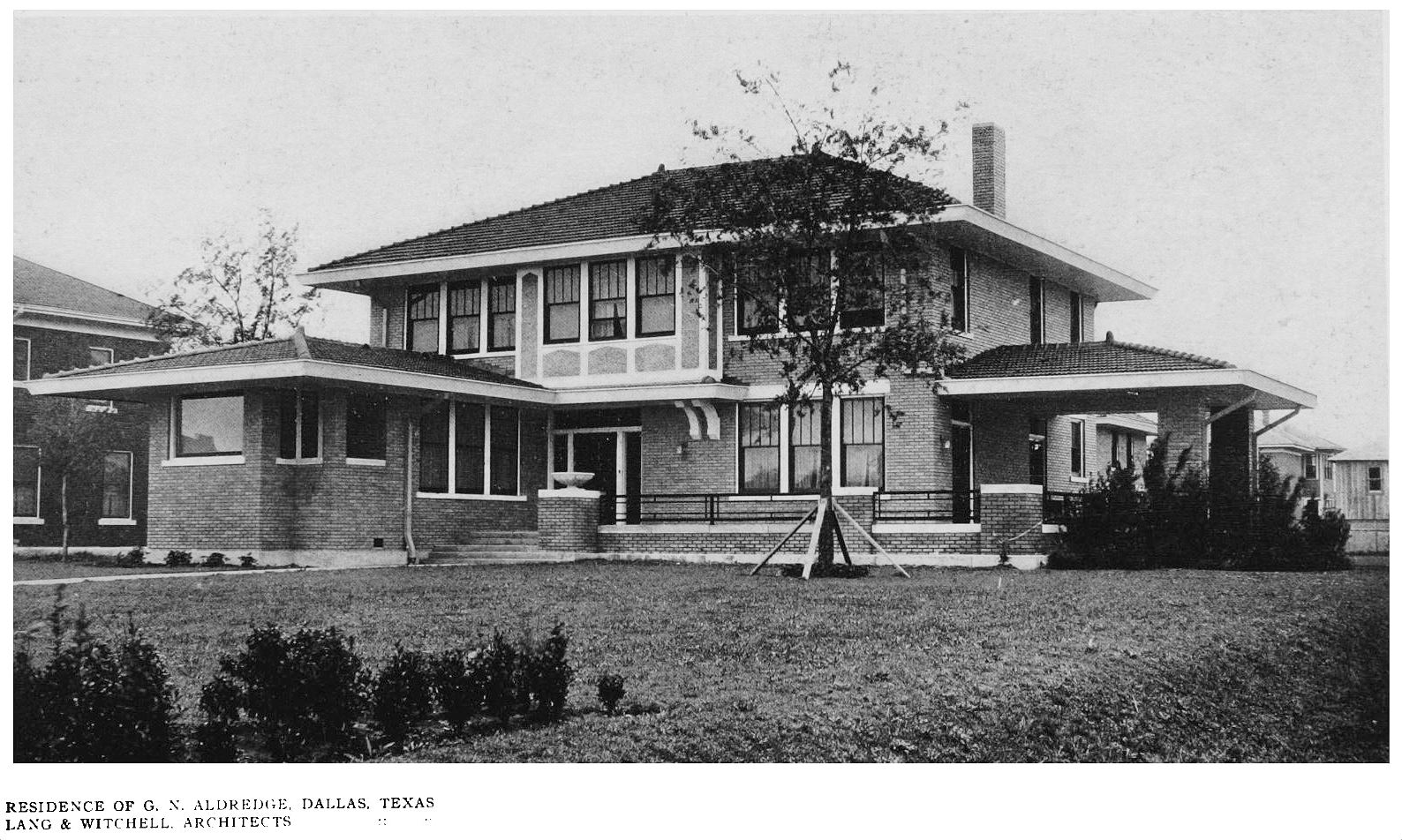
Residence 2: another house from the firm of Lang & Witchell, this one for banker GEORGE N. ALDREDGE, 5125 LIVE OAK (at Munger). (In 1921 the family moved into the former Lewis home at 5500 Swiss — that house is now known as “The Aldredge House.”) This Live Oak house was torn down in 1958 to make way for an apartments. (The surprisingly large lot this house sat on can be seen on a 1922 Sanborn map here.)

aldredge-g-n_house_western-architect_july-1914

*

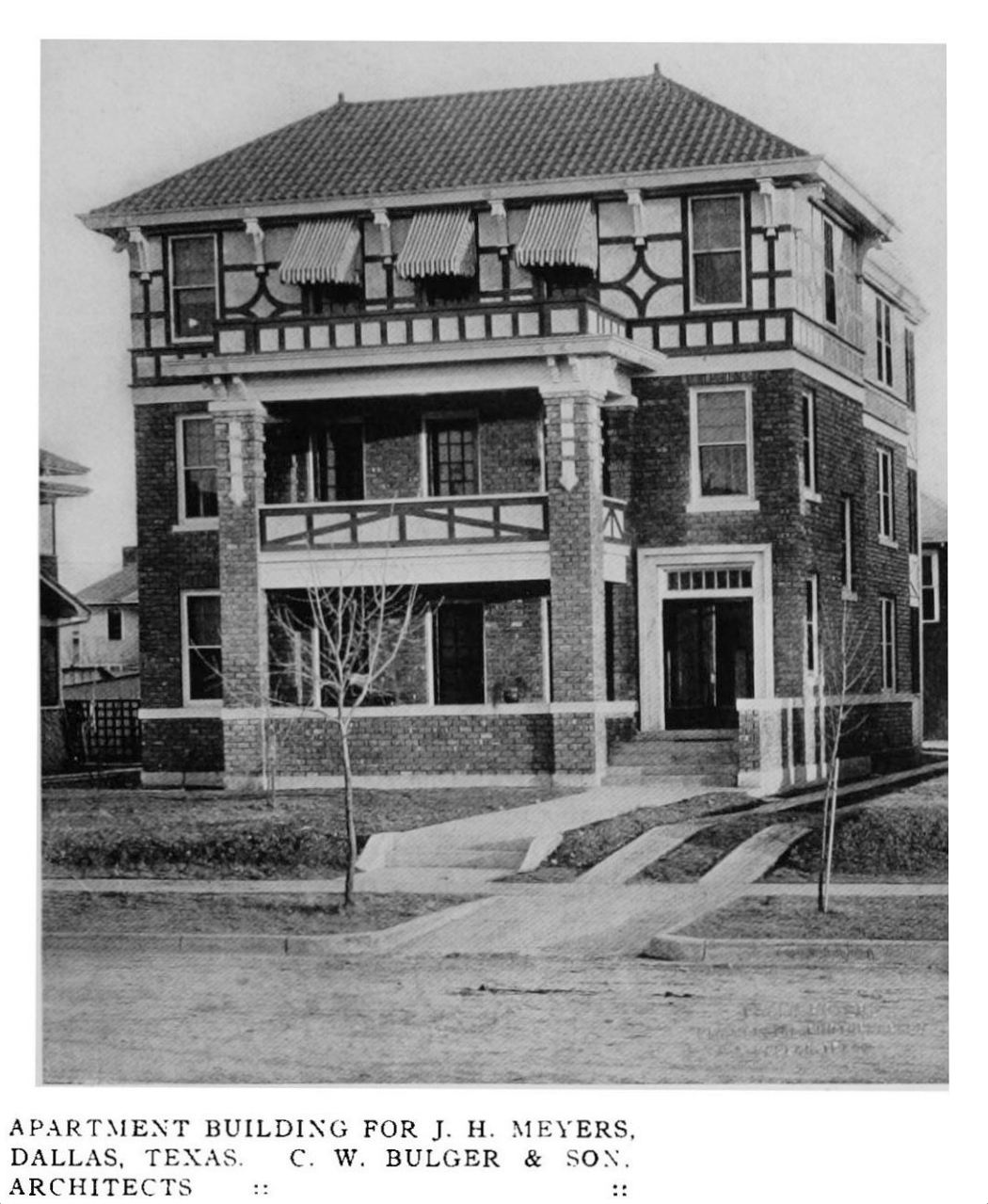
Residence 3: an apartment house built for J. H. MEYERS, 4920 VICTOR (between Fitzhugh and Collett), designed by C. W. Bulger & Son. The elder Bulger designed what was probably the most famous building in the city when this apartment was built — the Praetorian Building, the tallest “skyscraper” in the Southwest. But the key to business success is to diversify, and this nifty apartment house still stands and looks great (I love that those “arrows” on the front are still there). (On the 1922 Sanborn map here.)

meyers-apartment-house_western-architect_july-1914

*

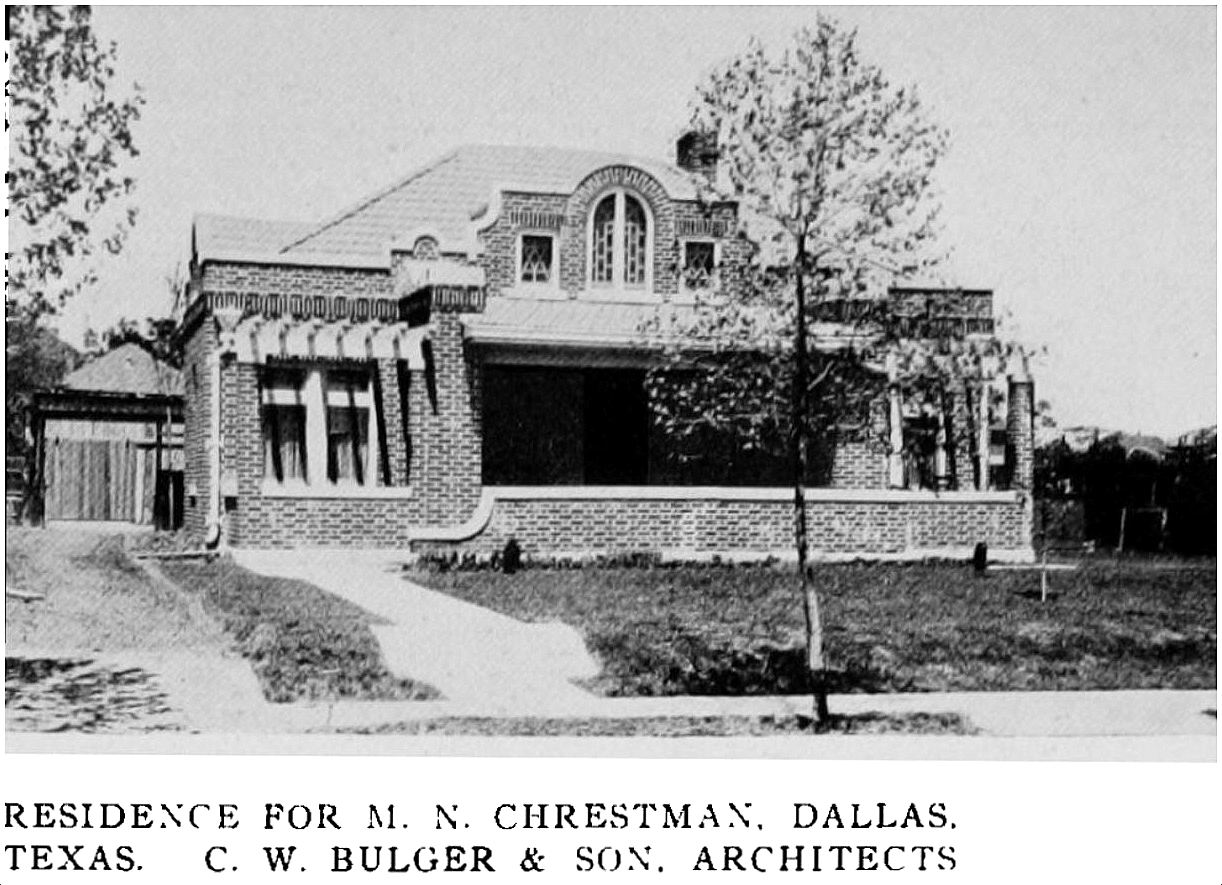
Residence 4: the unusual-looking (in comparison to the others) house belonging to lawyer MARION N. CHRESTMAN, 4525 JUNIUS, also designed by C. W. Bulger & Son. (When I saw it, my first thought was that it was reminiscent of the nearby “Bianchi House” at Reiger and Carroll, which was built at the same time and has been in preservation news in the past couple of years.) This house is still standing and, though renovated, looks pretty spiffy (I don’t want to intrude on anyone’s privacy, but if you Google the address, some MLS listings show photos of the house’s interior). (See it on the 1922 Sanborn map, here — right next to the Haskell Branch creek, the proximity of which no doubt caused problems during heavy rains. And mosquito season.)

chrestman-house_western-architect_july-1914

*

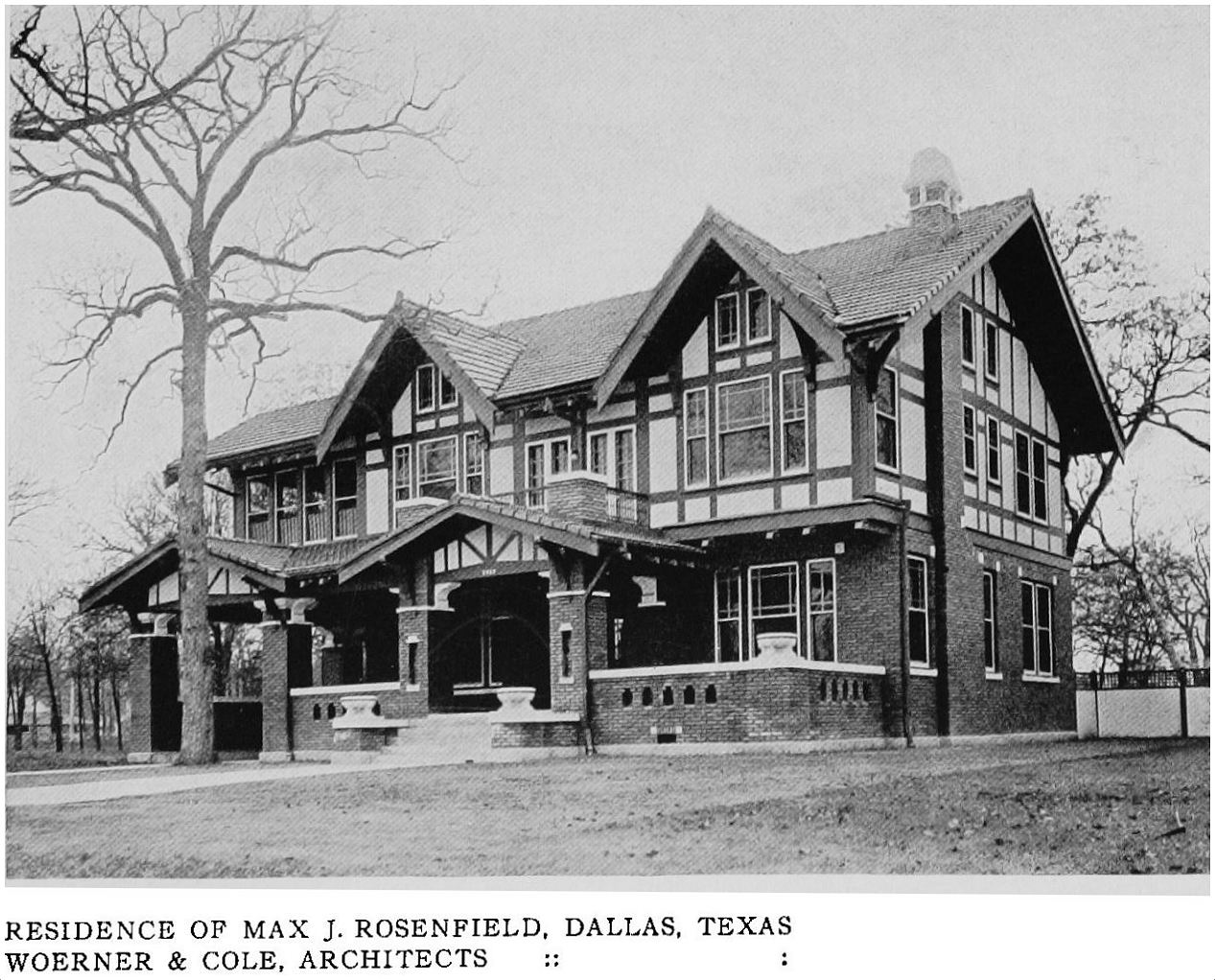
Residence 5: the beautiful home of Sanger Bros. executive MAX J. ROSENFIELD, 2527 SOUTH BOULEVARD, designed by Woerner & Cole. I love this house, and I’m happy to see it’s still standing in the South Boulevard-Park Row Historic District in South Dallas — and it still looks beautiful. (Rosenfield was the man who built the circa-1885 “blue house” in the Cedars which was recently moved to a new location — I wrote about him and that previous house, here.) (See this house — and the one below — on the 1922 Sanborn map here. It’s interesting to note that this map — drawn almost 10 years after the construction of Rosenfield’s house — shows most of the lots on that side of South Blvd. being vacant; the south side of the street, however, is mostly full.)

rosenfield-max-house_western-architect_july-1914

*

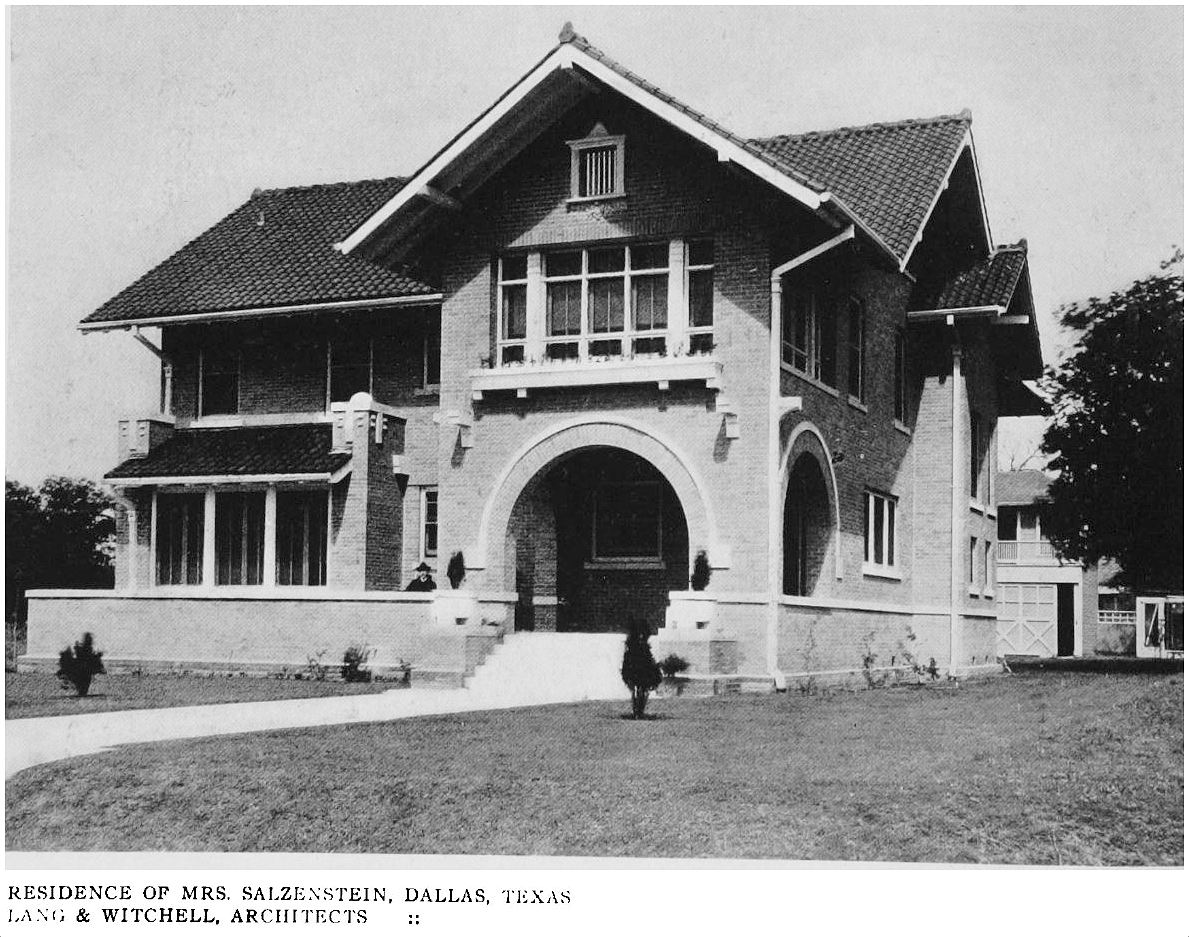
Residence 6: a house with distinctive arches built for MRS. SALLIE SALZENSTEIN (widow of clothing merchant Charles Salzenstein), 2419 SOUTH BOULEVARD, designed by Lane & Witchell. This house — one block from the Rosenfield house — is still standing. (This and the Rosenfield house can both be seen on the 1922 Sanborn map, here.)

salzenstein-house_western-architect_july-1914

*

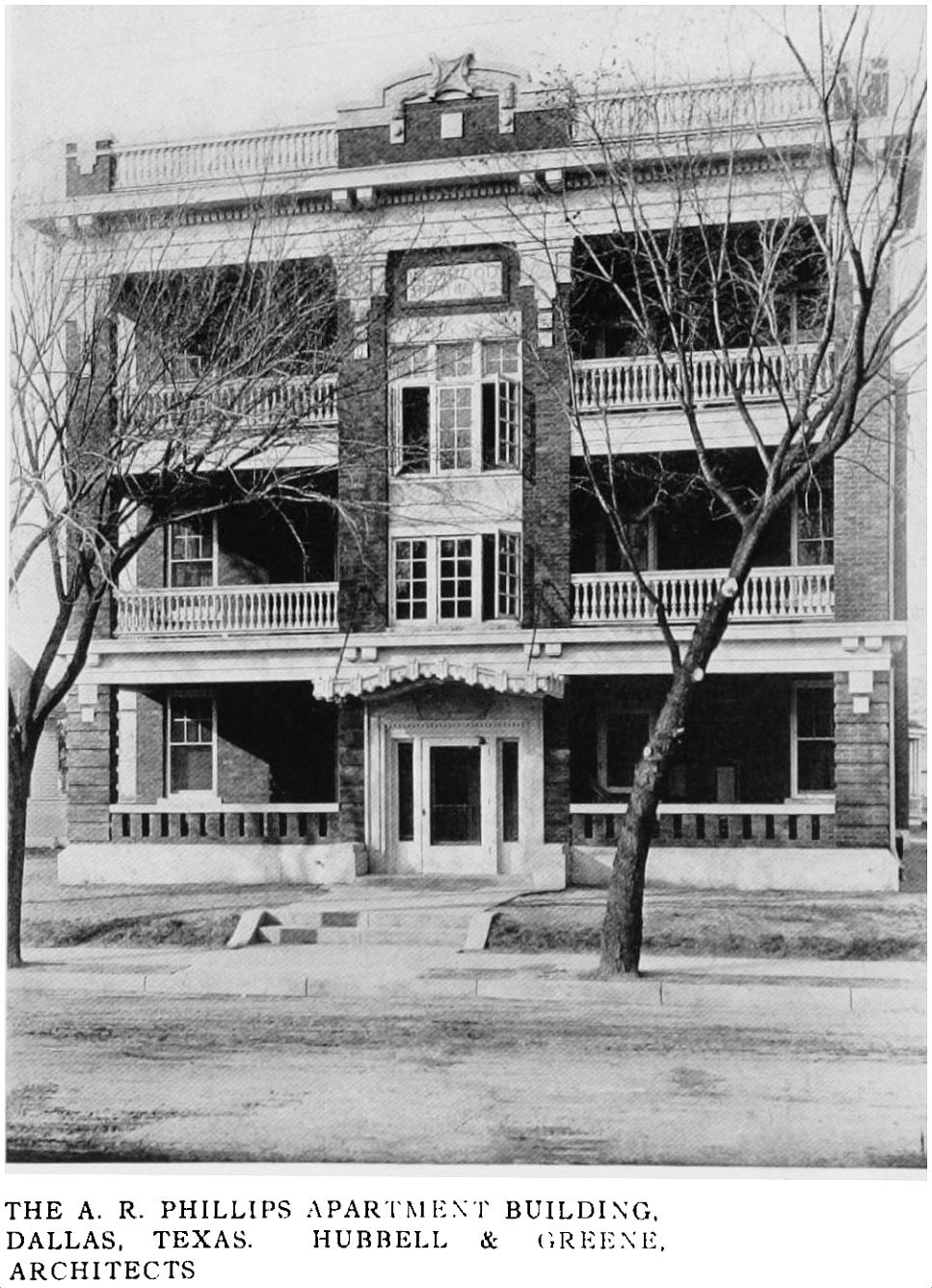
Residence 7: the ELMWOOD APARTMENTS, built by A. R. PHILLIPS, 2707 ROUTH STREET (at Mahon), designed by Hubbell & Greene. No longer an apartment house, the building is still standing in the Uptown area and looks great (see it from a 2011 Google Street View here). (See it on a 1921 Sanborn map, here.)

phillips-apartment-bldg_western-architect_july-1914

*

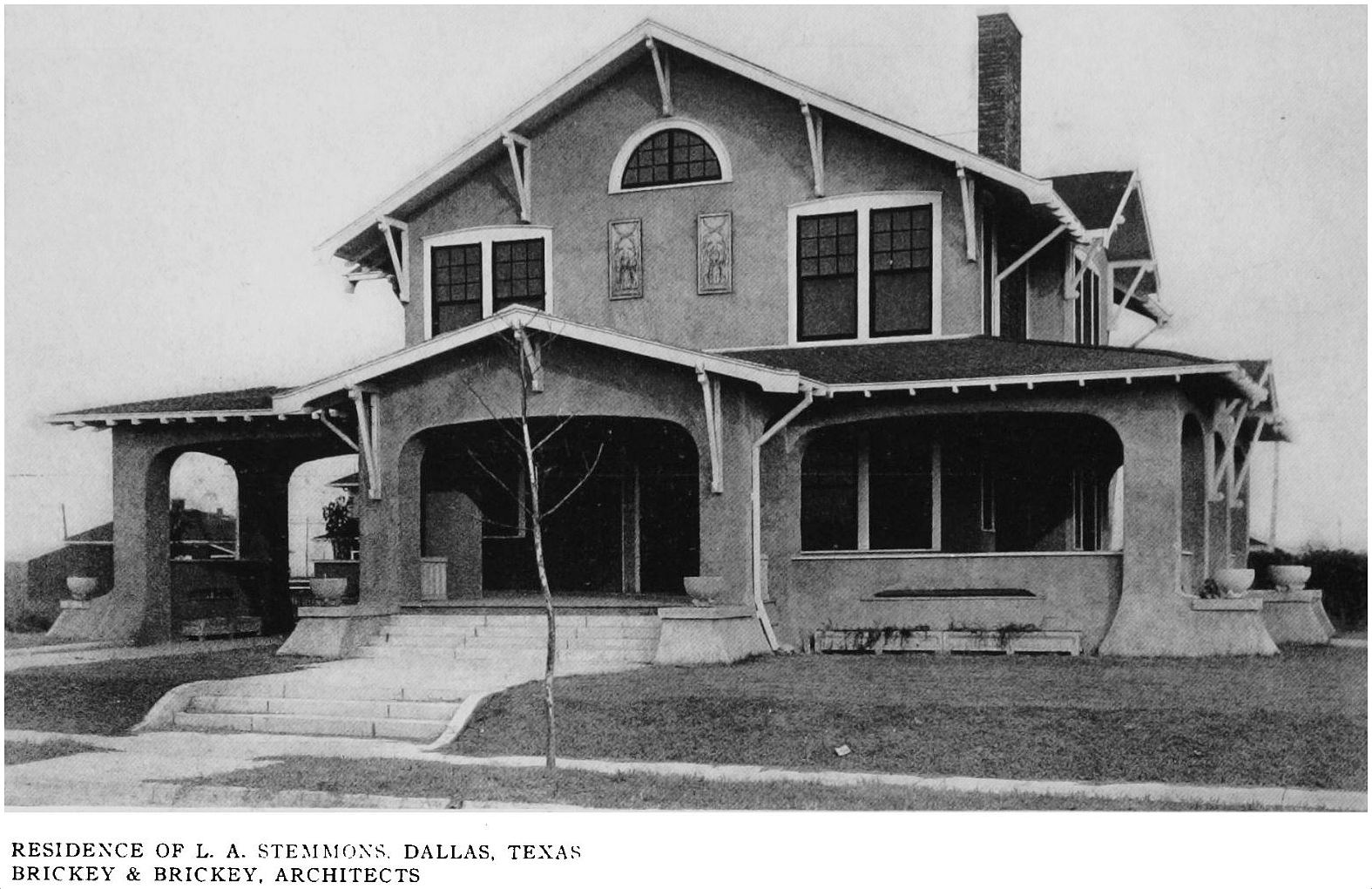
Residence 8: the Oak Cliff home of developer LESLIE A. STEMMONS (yes, that Stemmons), 100 N. ROSEMONT (at Jefferson), designed by Brickey & Brickey. This home is no longer standing (the block is now occupied by the Salvation Army), but while it was it was named an “Example of Civic Attractiveness” in 1913. (See it on a 1922 Sanborn map, here — a large lot north of W. Jefferson, on the left side of the map.)

stemmons-house_western-architect_july-1914

*

Coming next: skyscrapers and civic pride.

***

Sources & Info

The Western Architect, A National Journal of Architecture and Allied Arts, Published Monthly, July, 1914. This issue, with text and critical analysis in addition to the large number of photographs, has been scanned in it entirety by the University of Illinois at Urbana-Champaign as part of its Brittle Books Program — it can be accessed in a PDF, here (the Dallas issue begins on page 195 of the PDF). Thank you, UIUC!

In this 7-part series:

*

Copyright © 2018 Paula Bosse. All Rights Reserved.


Dallas in “The Western Architect,” 1914: Park Cities Residences

edwards-h-l_estate_western-architect_july-1914_highland-park

by Paula Bosse

The magazine/journal The Western Architect devoted an entire issue in 1914 to then-recently completed architectural achievements in Dallas. It’s an incredible collection of photos, most of which I’d never seen. I will be devoting an entire week to these photos.

First up, notable residences, part one. These eight homes were built in Highland Park and University Park, both of which were beyond Dallas’ city limits at the time. All appear to have been built between 1911 and 1913. One is still standing (…possibly). (All photos are larger when clicked.)

*

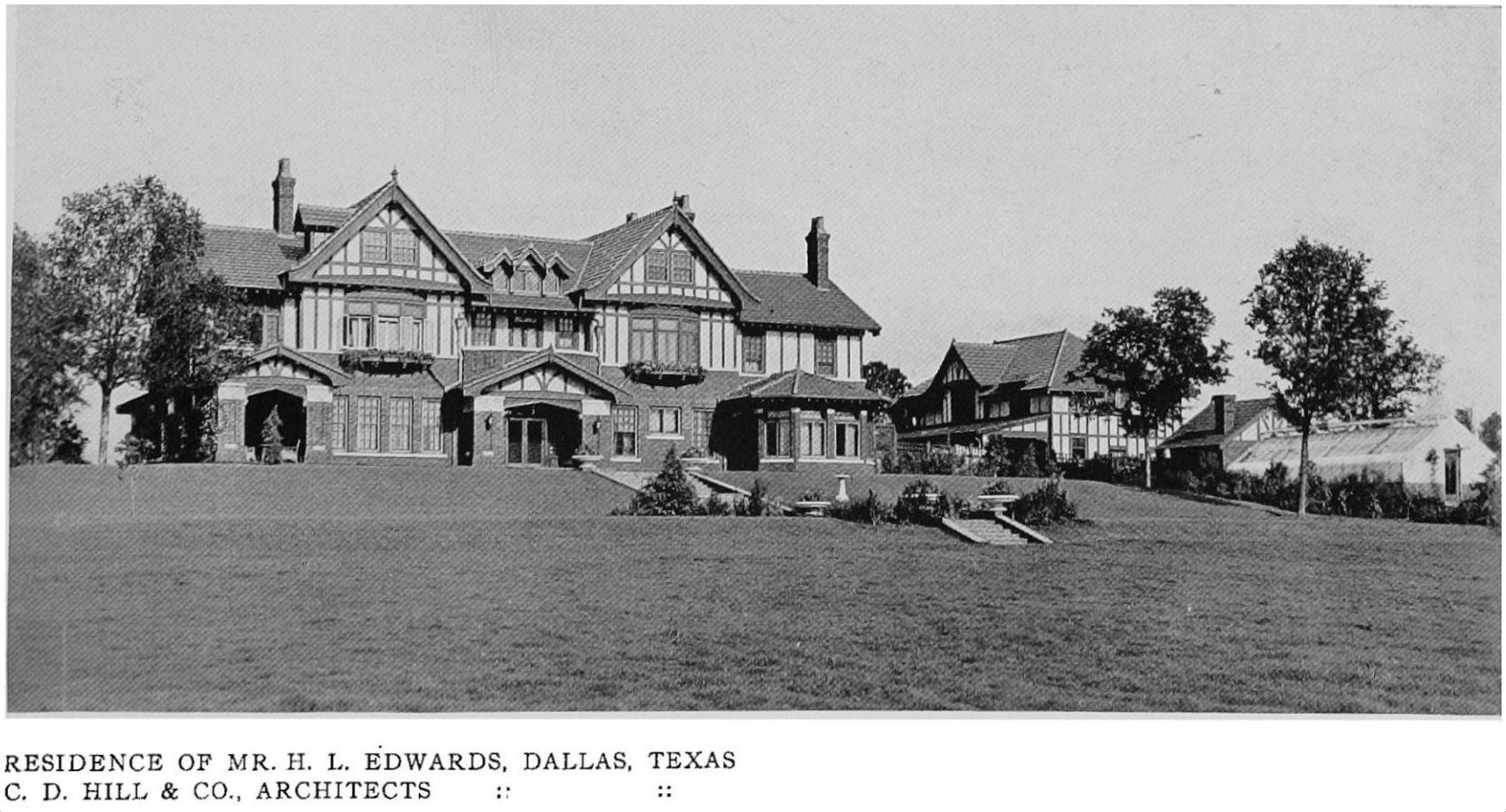
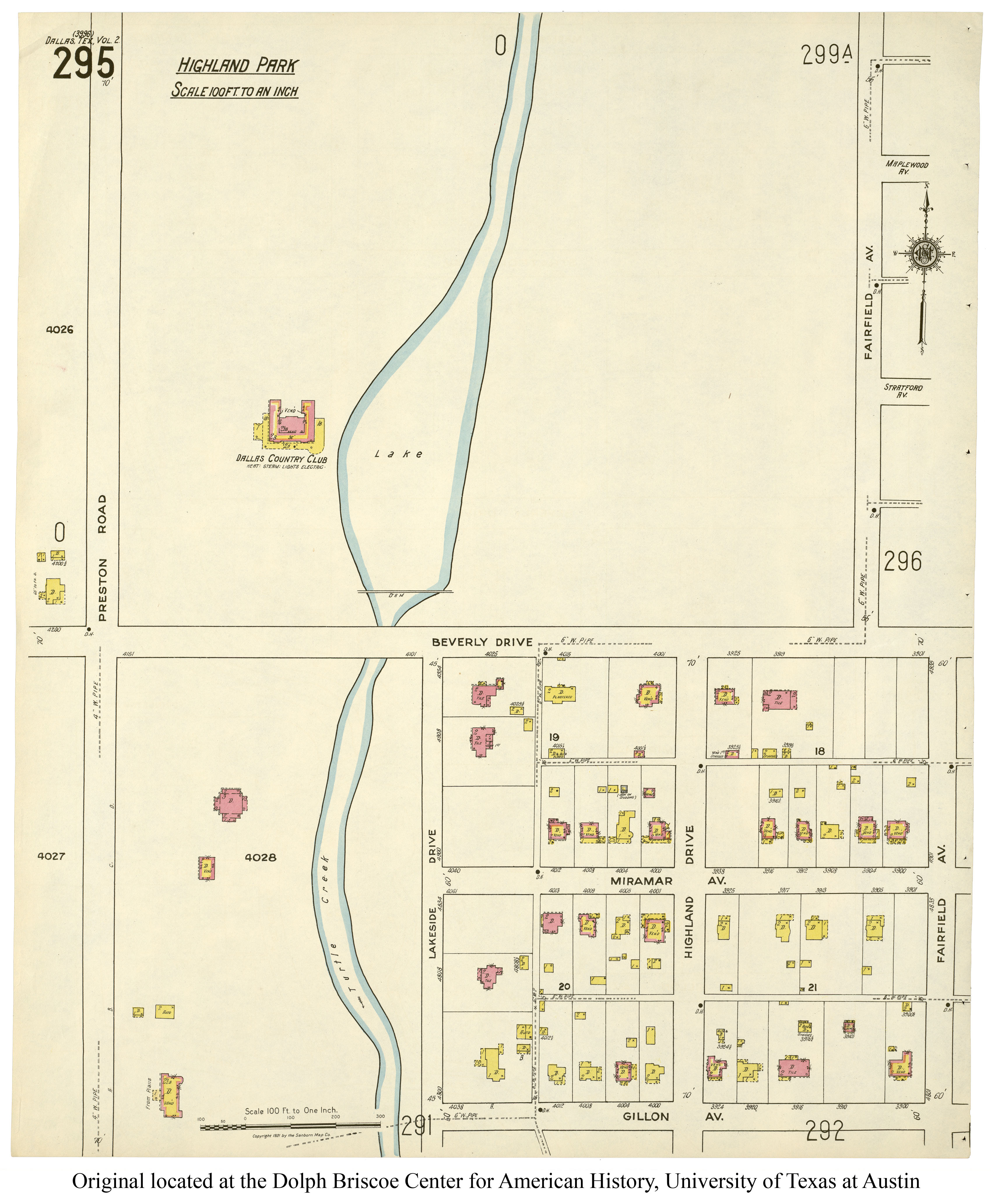
Residence 1: (above) the eye-wateringly beautiful HARRY L. EDWARDS estate, 4500 PRESTON ROAD, designed by architect C. D. Hill & Co., whose stunning Dallas Municipal Building/City Hall was under construction when this issue of The Western Architect was published. Edwards was a Welsh-born cotton tycoon who had been in Dallas since about 1899 and was said to have been the largest cotton buyer in the Southwest. And that was saying a lot — when cotton was king, money was no object, and Edwards spent a lot of money in the construction of his sprawling 6-acre estate. The house was perhaps most famously owned in later years by the late real estate mogul Trammel Crow, who purchased it in the early 1960s. If it looks vaguely familiar, you might have seen news footage of its recent demolition. …Um, yeah. (See the architect’s rendering and description of the not-yet-built “handsome residence” of H. L. Edwards, the “Prince of Cotton,” in a November, 1911 Dallas Morning News blurb, here.) (See this property on a 1921 Sanborn map, here — it is the second property north of Armstrong, just below the Highland Park Pumping Station. Note that these maps were issued a decade or so after most of the homes in this post were built — back then there were considerably fewer homes in Highland Park.)

*

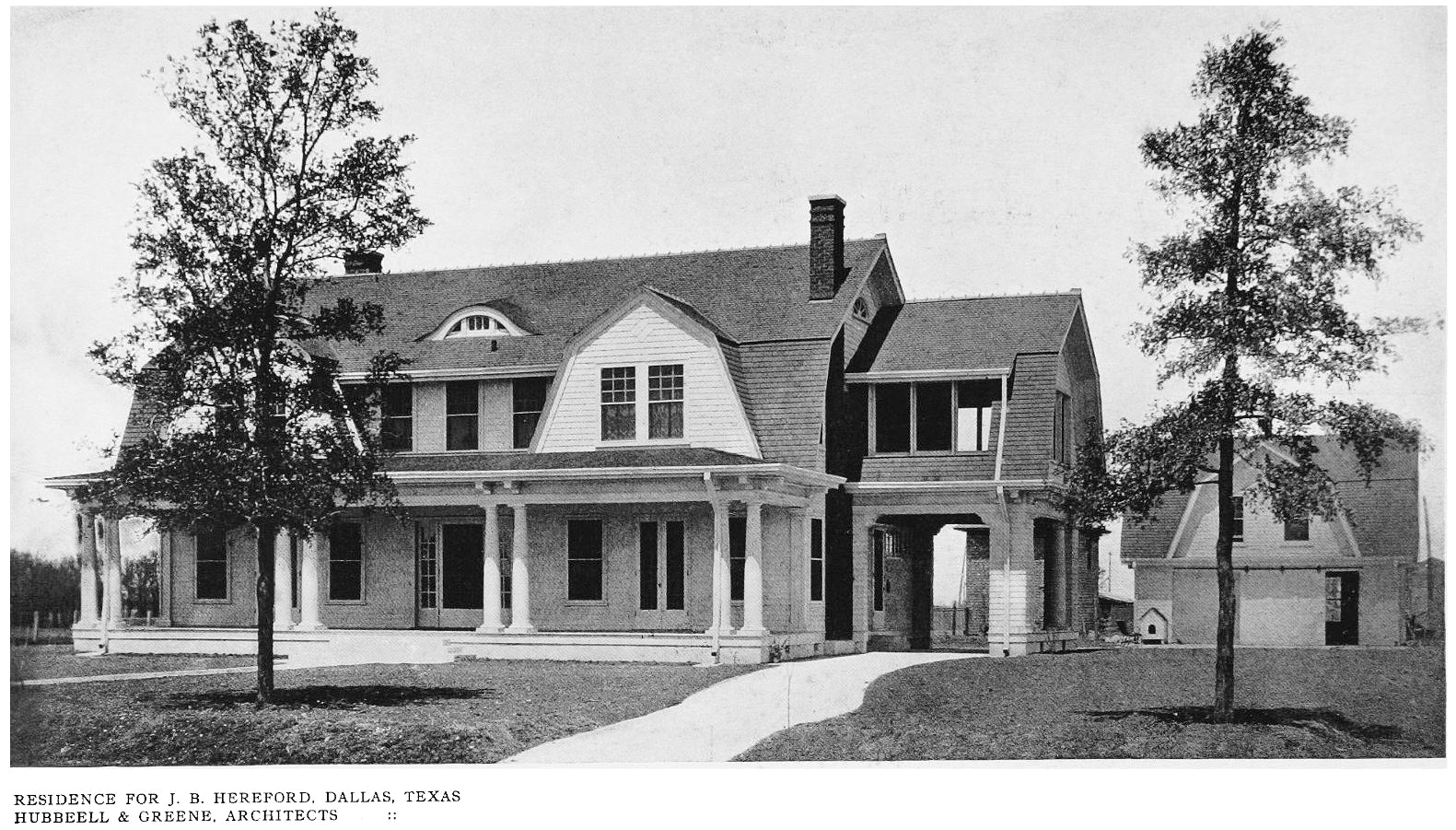
Residence 2: the somewhat less dazzling Highland Park home of JOHN B. HEREFORD, 3832 BEVERLY DRIVE, designed by Hubbell & Greene. Hereford was in insurance, and the house cost $15,000 to build (about $400,000 in today’s money). I’m a fan of what I hope is a doghouse, even though its roofline should really match that of the house and garage. (See it on the 1921 Sanborn map, here.)

hereford-j-b_western_architect_july-1914

*

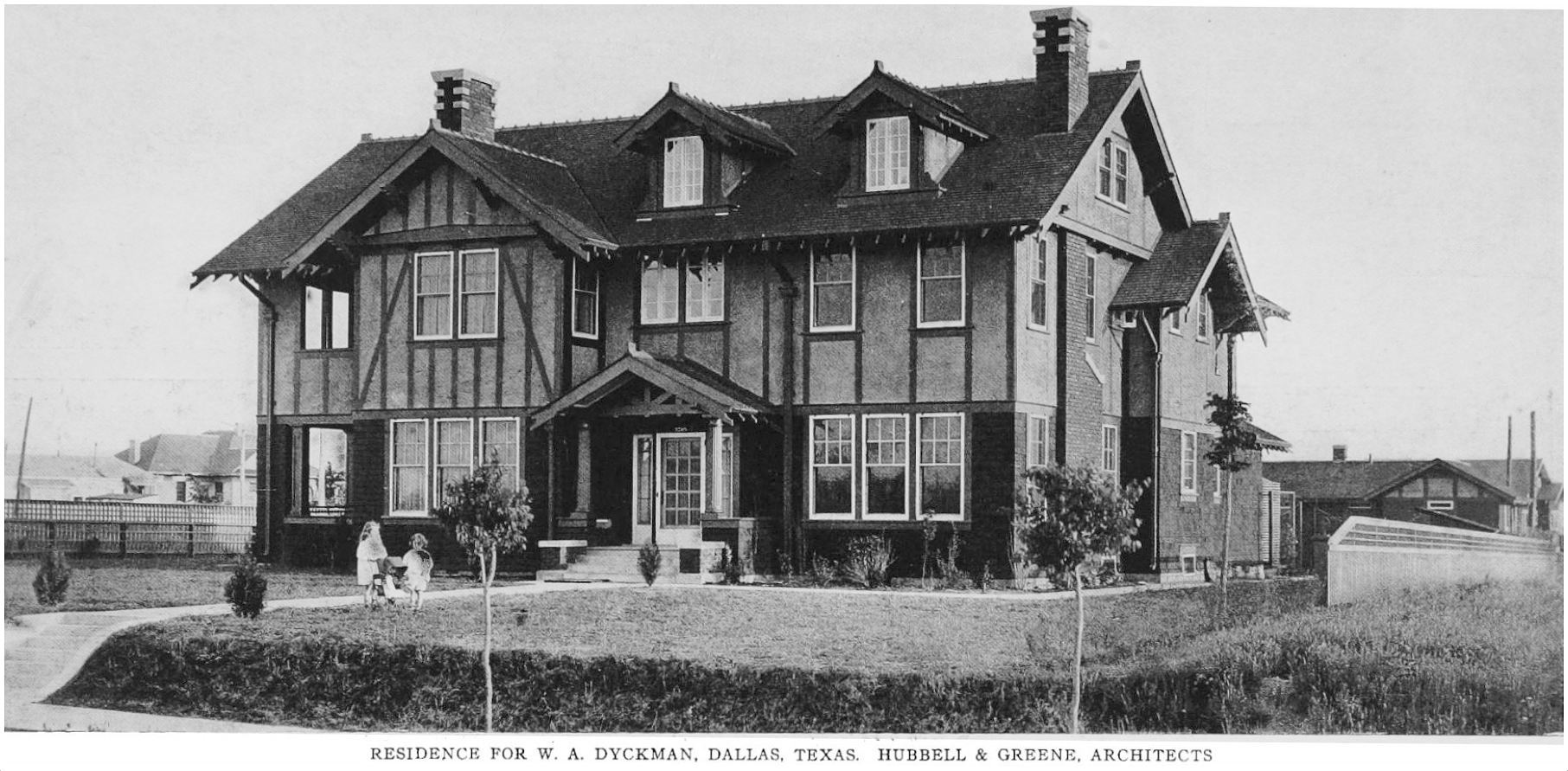
Residence 3: the lovely home of real estate man WILLIAM A. DYCKMAN, 3705 GILLON, also designed by Hubbell & Greene (and also costing $15,000). The children in the yard is a nice touch. Now demolished, it looked like this within living memory. (See it at the top, far right of a 1921 Sanborn map, here.)

dyckman-w-a_house_western-architect_july-1914

*

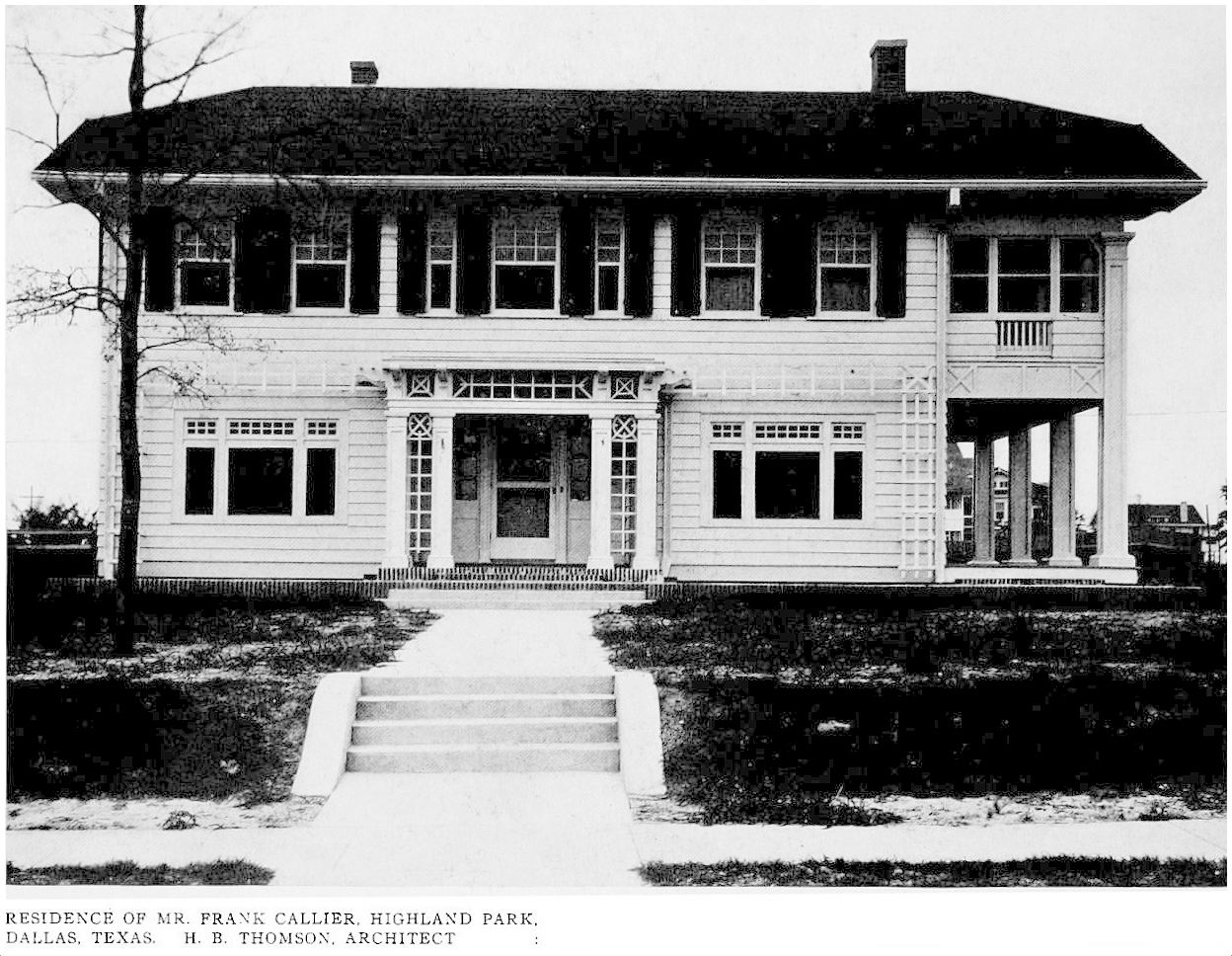
Residence 4: the simple-yet-stately home of FRANK C. CALLIER, JR., 4008 GILLON, designed by H. B. (Hal) Thomson. Callier was the son of the founder of the Trinity Cotton Oil Co. and the brother-in-law of Lena Callier, whose endowment  helped fund what later became the Callier Hearing and Speech Center. This is the only house in this group which may still stand. I’m not sure if the listing is current, but the house shows up on several real estate sites as being for sale as a “tear-down.” (See it on a 1921 Sanborn map, here.)

callier-frank-house_highland-park_western-architect_july-1914

*

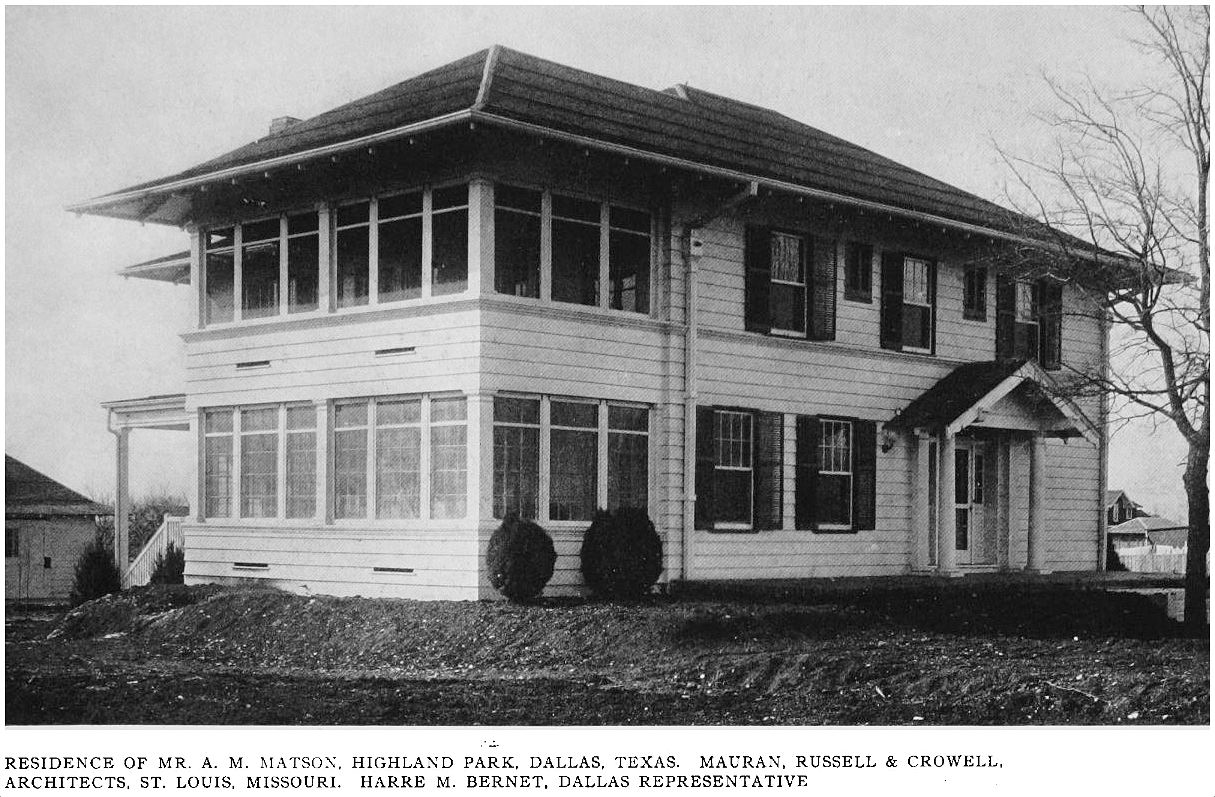
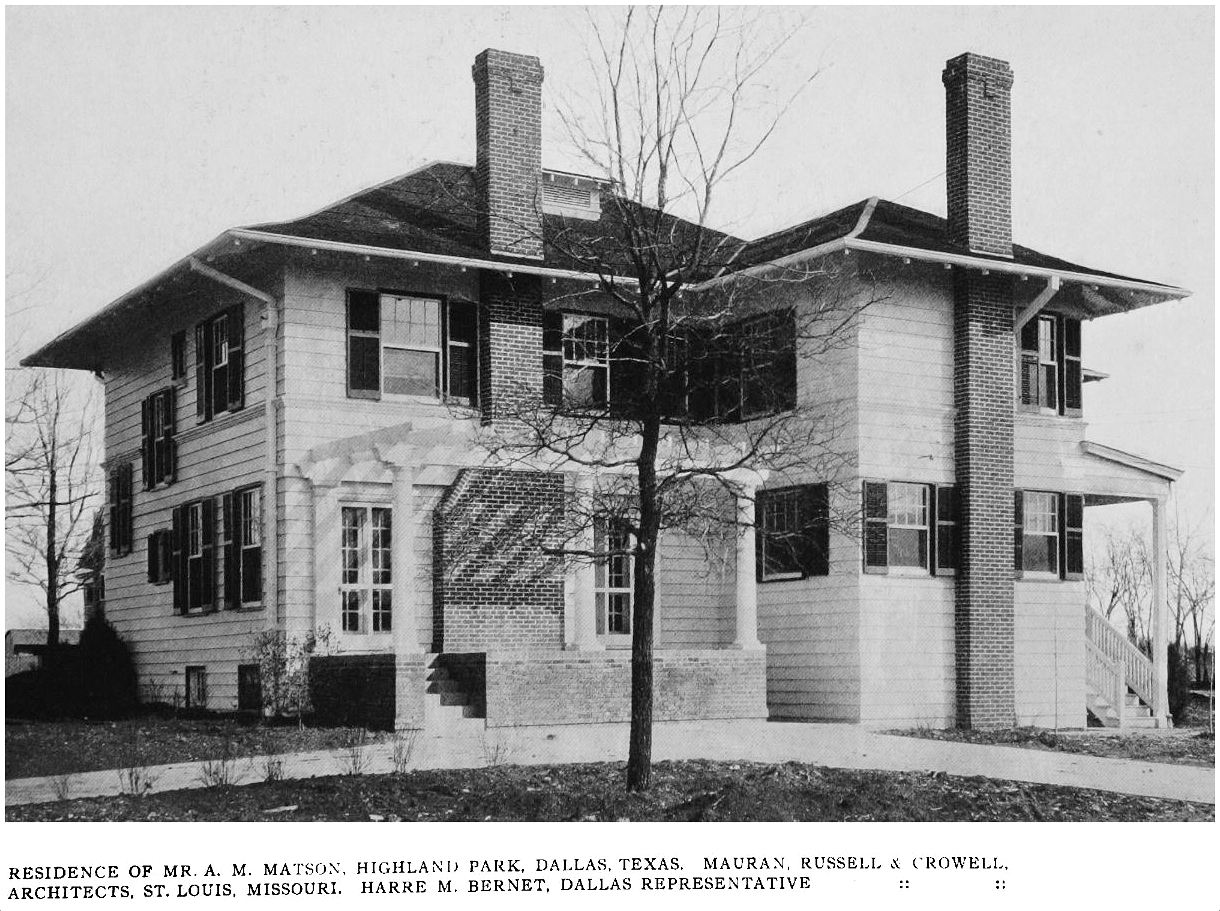
Residence 5: another attractive but minimally adorned house in Highland Park, built for Butler Bros. general manager ANTHONY M. MATSON at 3715 MIRAMAR, designed by Harre M. Bernet. Here we see a view of both the front and the back. (It should be on this 1921 Sanborn map, but I can’t find this address!) (UPDATE: The street numbering appears to have changed at some point — the address of this house in the 1918 Dallas city directory was 3715 Miramar but had changed to 3727 Miramar in the 1919 directory.)

matson-a-m_house_highland-park_western-architect_july-1914_front

matson-a-m_house_highland-park_western-architect_july-1914_back

*

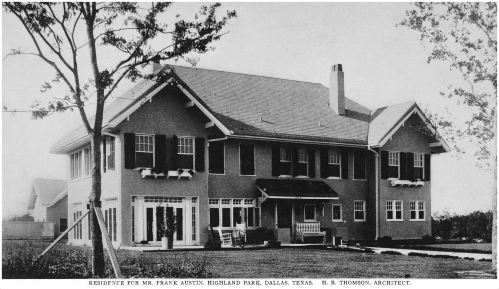
Residence 6: a house designed for bridge-builder FRANK E. AUSTIN, 4015 BEVERLY DRIVE, by architect Hal Thomson. It’s not terribly sexy, but the Dallas News dubbed it an “Example of Civic Attractiveness,” in November, 1913. Seems like the house is in dire need of a veranda (or at least a larger porch) to accommodate all that furniture. (See it on a 1921 Sanborn map, here.)

austin-frank-house_highland-park_western-architect_july-1914

*

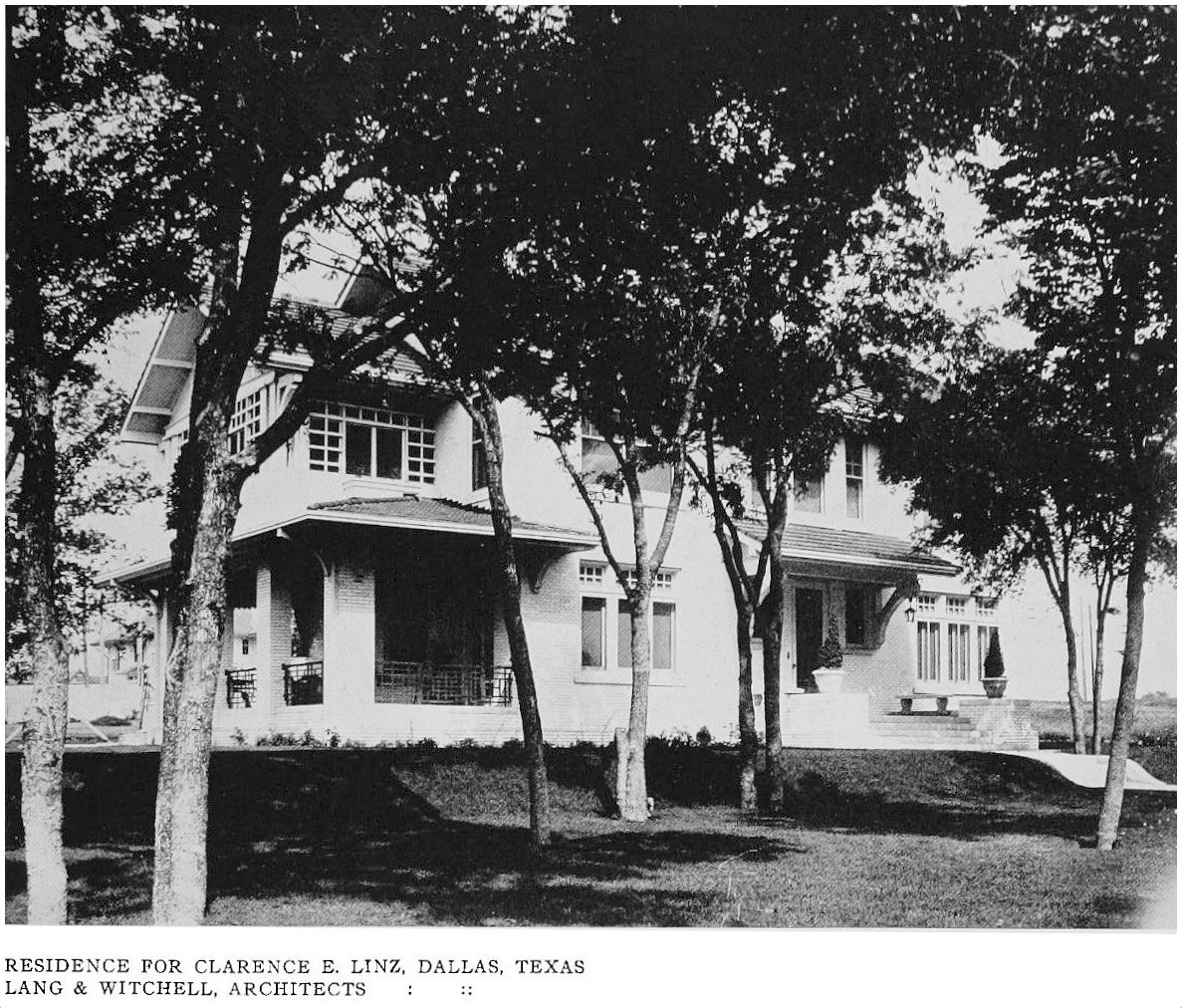
Residence 7: the house of civic and business leader CLARENCE LINZ, 4419 HIGHLAND DRIVE, beautifully designed by Lang & Witchell. This is the house of my dreams. (See it on a 1921 Sanborn map, here.)

linz-clarence-house_western-architect_july-1914

*

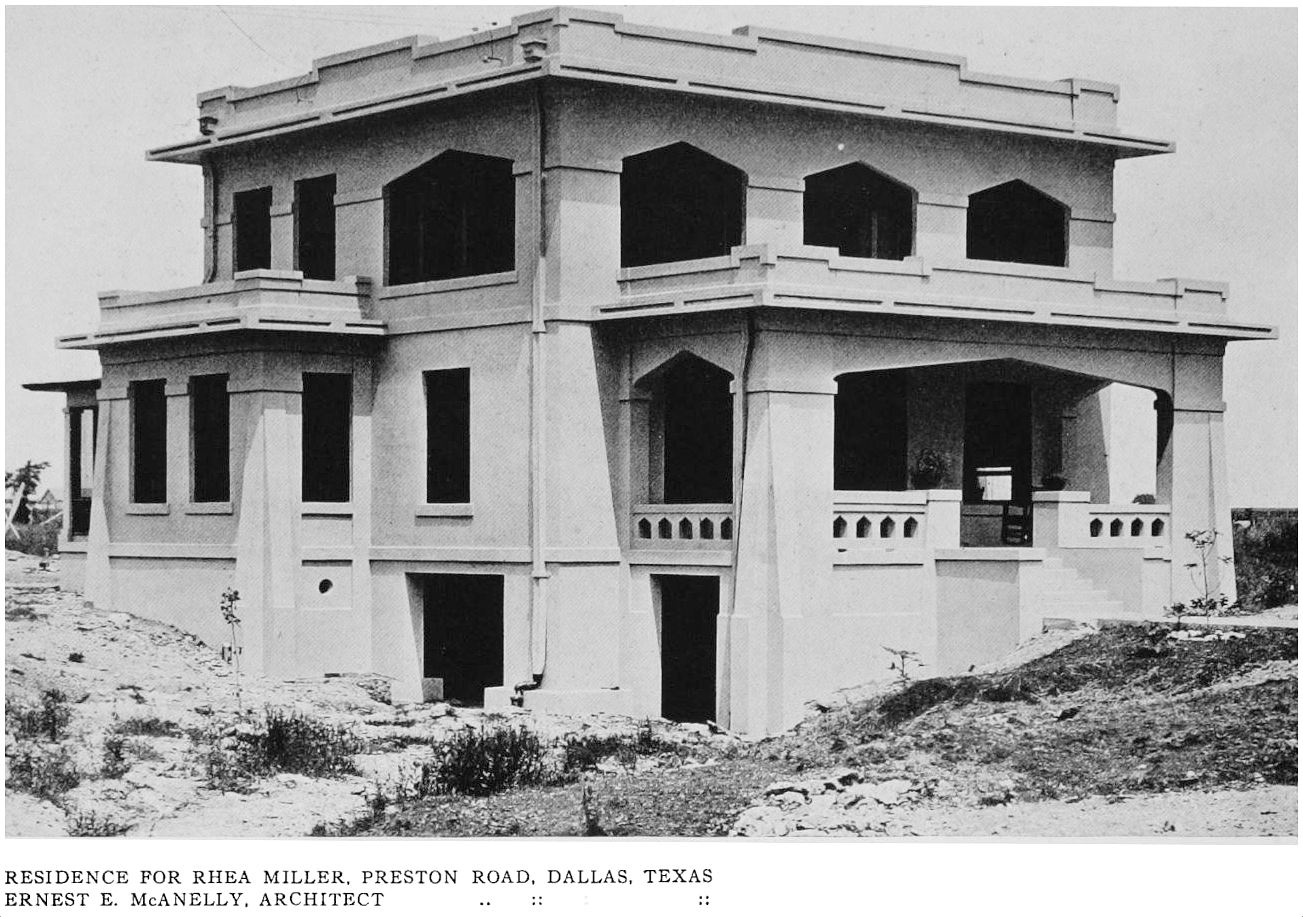
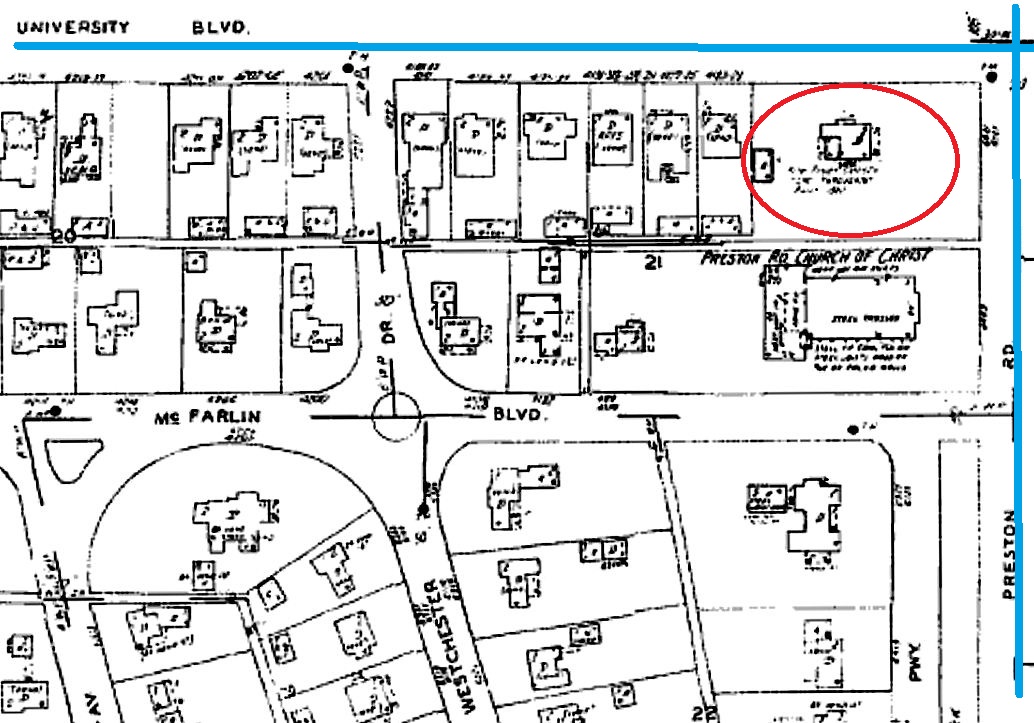
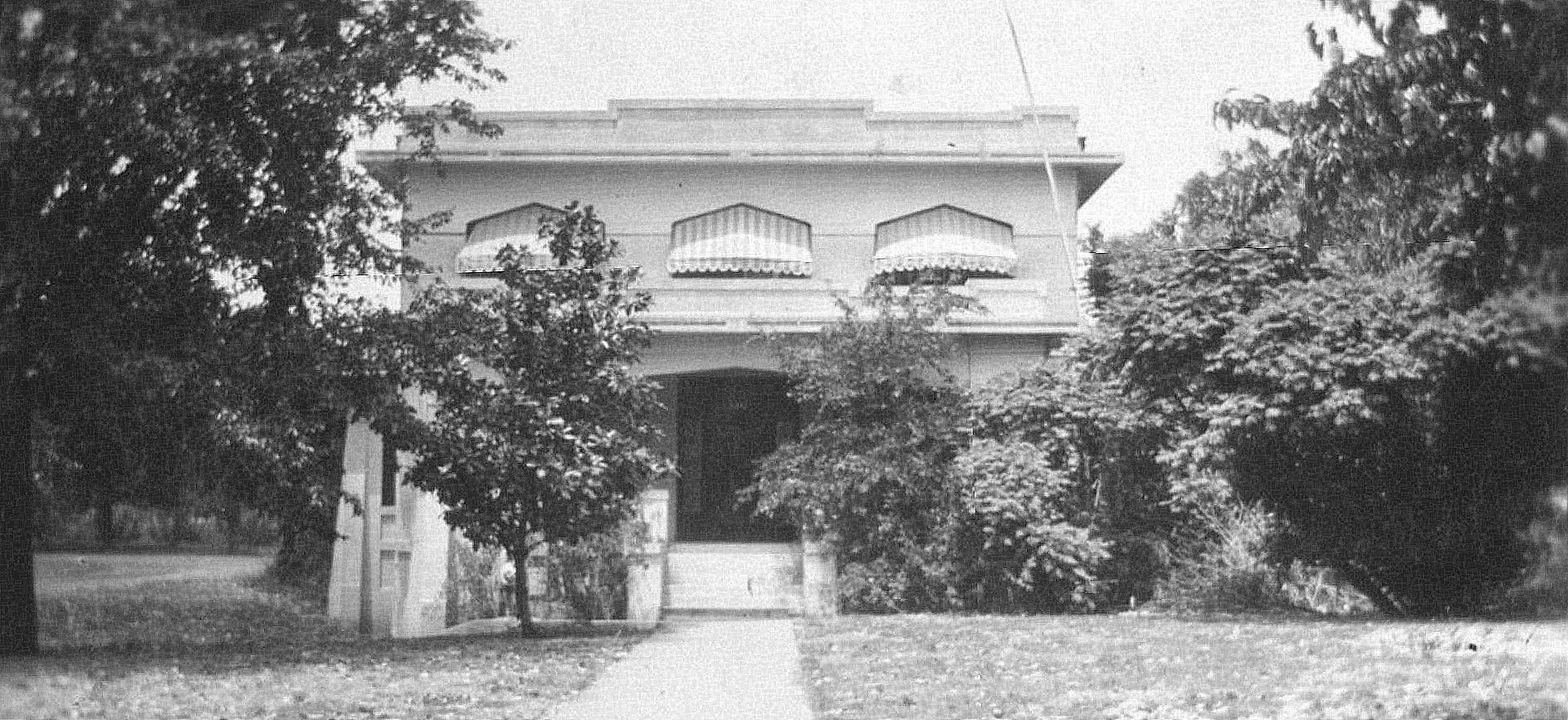
Residence 8: an oddball structure built by gravel man RHEA MILLER in rugged and mostly undeveloped University Park at 6221 PRESTON ROAD (which later became 6421, at the southwest corner of Preston and University), designed by architect Ernest E. McAnelly (Miller’s brother-in-law, who died suddenly in 1916 at the age of 33). It was made of concrete, and it almost seems to have been built to prove to people that, yes, you, too, can have a great big house made out of concrete. Or it might have been a tax write-off, seeing as it was featured in a 1914 ad for the company Miller worked for, the J. Fred Smith Gravel Co., under the caption, “A concrete residence on Preston Road, near Dallas, made from our pit-run gravel. The walls were made of four sacks of cement to one cubic yard of pit-run gravel. The floors are one to five.” The grainy photo from the ad is here. This out-in-the-boonies house didn’t have an actual address for years — it was just simply “Preston Road, south of University.” I have no idea when it was torn down, but that must have taken considerable more effort than the usual residential demolition. A classified ad from 1931 read, “Eight rooms, concrete home, 6221 Preston Road. On bus line. Fireproof.” It’s hulking and, well, hulking, but … it’s kind of interesting. The longer I look at it, the more it grows on me. Not only was this fortress fireproof, but once sequestered inside, you were pretty much safe from enemy attack or almost any natural disaster — except maybe a sinkhole or quicksand. Pit-run gravel never looked so inviting.

miller-rhea-house_preston-road_western-architect_july-1914

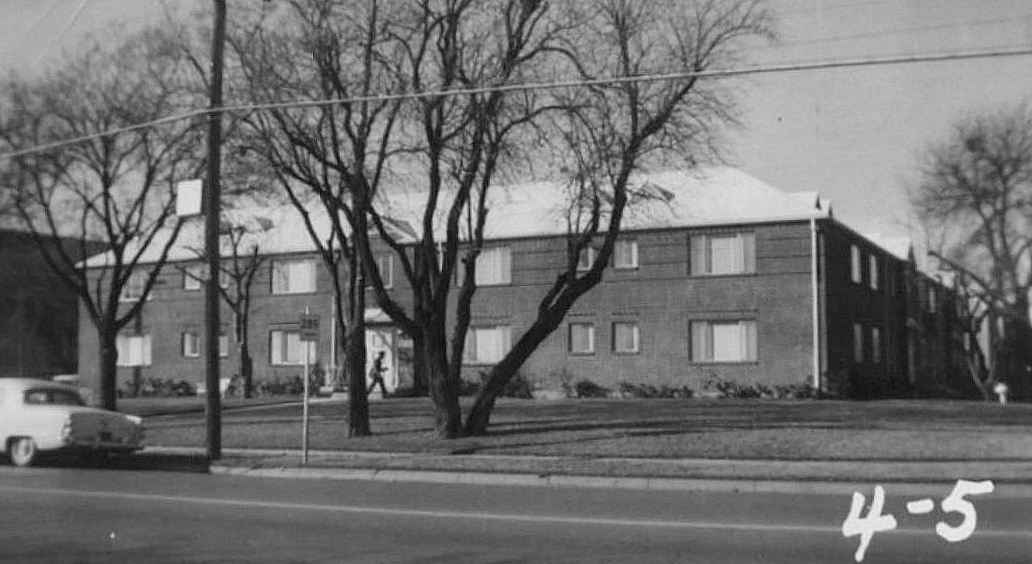
I’m fascinated by the concrete house and have been trying to determine exactly where it was and when it was demolished. For many years its address was 6221 Preston Road, but the address seems to have changed to become 6421 Preston sometime between 1939 and 1941. William H. Lohman owned a house at that address (probably still the same concrete house?) between about 1933 and 1956 when whatever house was there at the time was torn down to build the Presley Apartments (which were themselves torn down in 2007 in order to make way for the next-door Church of Christ expansion). That block of Preston — the southwest corner of Preston and University — is now home to the Preston Road Church of Christ. The only online Sanborn map I’ve been able to find with the house on it is from a 1952 update (Vol. 7, sheet 728), but it is illegible. The house sits on a very large lot. Below is detail of that map (click to see a larger, but still impossible to read, image):

concrete-house_sanborn_1952_vol-7_sheet-728_det

I would love more information about this concrete house!

UPDATE, 11/7/22: I’m adding two photos related to this house. The first is a circa-1931 photo showing the concrete house with some cute little awnings, slowly being enveloped by foliage; the second shows what replaced it — the Presley Apartments, seen in a circa-1956 photo. Both photos are from the “Brown Books” at the University Park Library. (I can’t get links to work, but I wrote about this incredible resource here.)

6421_preston_concrete-house_brown-bks_university-park_ca-1931

6421-preston_apartments_brown-bk_university-park_1956_former-concrete-house

*

Next: eight more fabulous homes, in Munger Place and Old East Dallas, South Dallas, Oak Cliff, and a cool, still-standing apartment house on Routh Street. Amazingly, six out of the eight are still alive and kicking. That post is here.

***

Sources & Notes

The Western Architect, A National Journal of Architecture and Allied Arts, Published Monthly, July, 1914. This issue, with text and critical analysis in addition to the large number of photographs, has been scanned in it entirety by the University of Illinois at Urbana-Champaign as part of its Brittle Books Program — it can be accessed in a PDF, here (the Dallas issue begins on page 195 of the PDF). Thank you, UIUC!

In this 7-part series:

*

Copyright © 2018 Paula Bosse. All Rights Reserved.

Oak Lawn Ice & Fuel Co.

oak-lawn-ice-and-fuel-co_krystal-morrisThe fleet… (click to see larger image) / Photo: Krystal Morris

by Paula Bosse

Above, another great Dallas photo shared by a reader — this one shows the Oak Lawn Ice & Fuel Co., which sold ice to independent dealers and to retail customers. Krystal Morris sent in the family photo — her great-great-grandfather J. F. Finney is standing next to the horse-drawn wagon.

The first mention I found of the Oak Lawn Ice & Fuel Co. was in a notice of “New Texas Charters” in Dec., 1912 (there was a classified ad from Dec., 1909, but that appears to be either another company with the same name or an earlier incarnation of the business seen above). Below, an ad from 1913:

1913_oak-lawn-ice_19131913

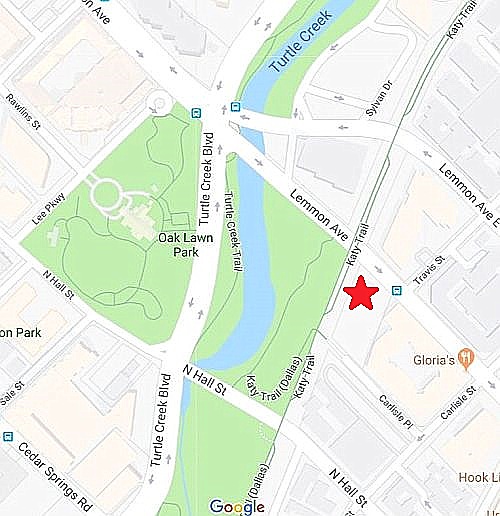
The company was located at 3307 Lemmon Avenue, at the MKT railroad track (now the Katy Trail) — on Lemmon between the railroad tracks and Travis Street (see the location on a map composed of two badly-cobbled-together Sanborn maps from 1921 here). The location is marked on a present-day Google map below (click to see a larger image):

lemmon-and-katy-trail_google-map

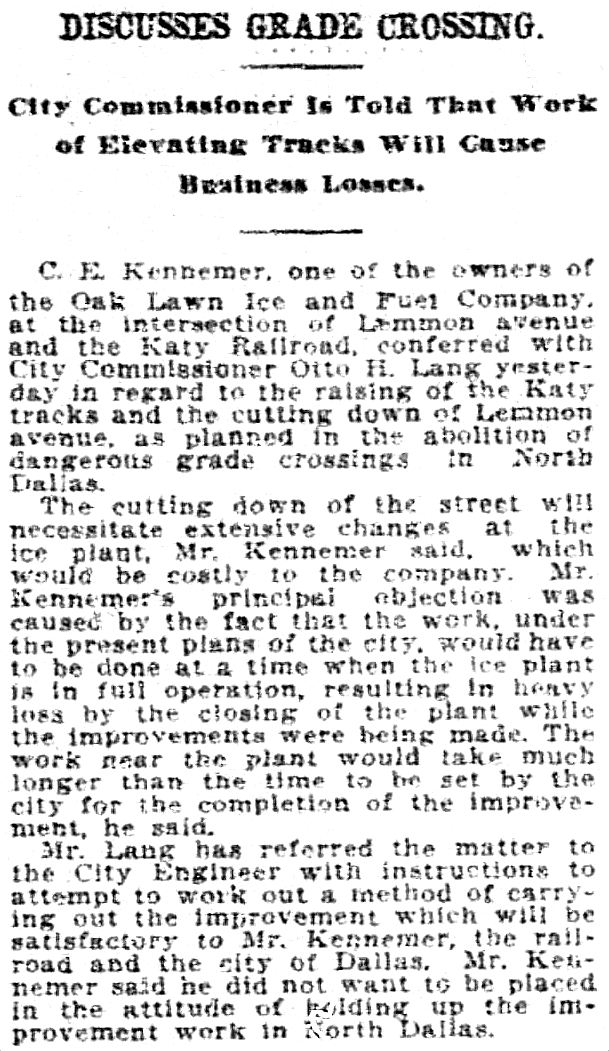
In 1917, the City of Dallas, in partnership with the Missouri, Kansas & Texas Railroad began to eliminate grade crossings in the Oak Lawn area — one of those crossings was at Lemmon Avenue: Lemmon was to be lowered and the MKT tracks were to be raised. Oak Lawn Ice & Fuel Co. General Manager Clarence E. Kennemer (who, along with his brothers, operated something of an ice empire in Texas) was concerned about the negative impact of this construction on his business. (All images are larger when clicked.)

1917_oak-lawn-ice_dmn_013117_katy-crossing     Dallas Morning News, Jan. 31, 1917

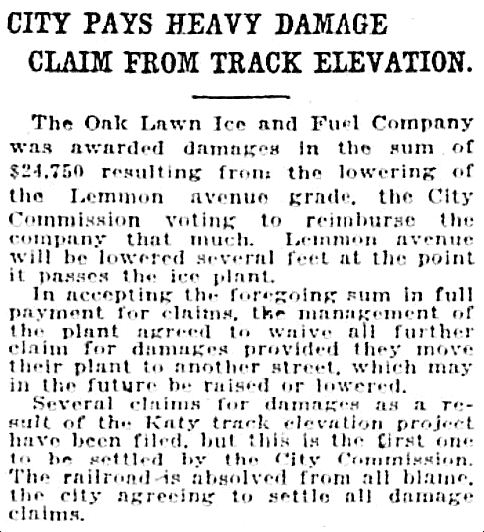
To the surprise of many, the ice company was awarded damages by the city.

1917_oak-lawn-ice_dmn_120617_katy-crossingDMN, Dec. 6, 1917

Things apparently continued fairly well until 1920 when the company began to experience tensions with its residential neighbors. Early in the year, city building inspectors responded to nuisance complaints and ordered the company to move its horse stables as they were too close to adjoining residences (ice delivery even into the 1940s and possibly 1950s was often done via horse-drawn wagons). Later the same year, still-unhappy neighbors filed suit to “force the company to remove its plant from the thickly settled residence district” (DMN, Dec. 1, 1920). The ice company appears to have won the lawsuit, since the company (under various names) was at 3307 Lemmon until at least 1939 or ’40, but these problems might have led them to build a new plant at Cole and what is now Monticello in 1922 (as with the Lemmon location, this new plant was also built alongside the MKT tracks). The mere prospect of this new icehouse was met with loud protests by the new neighborhood — before construction even began — but a judge ruled in favor of the ice people. Construction went ahead, and the plant was a neighborhood fixture for many years. (See the location on a 1921 Sanborn map here; “Gertrude” — near the top edge — was the original name of Monticello Avenue.)

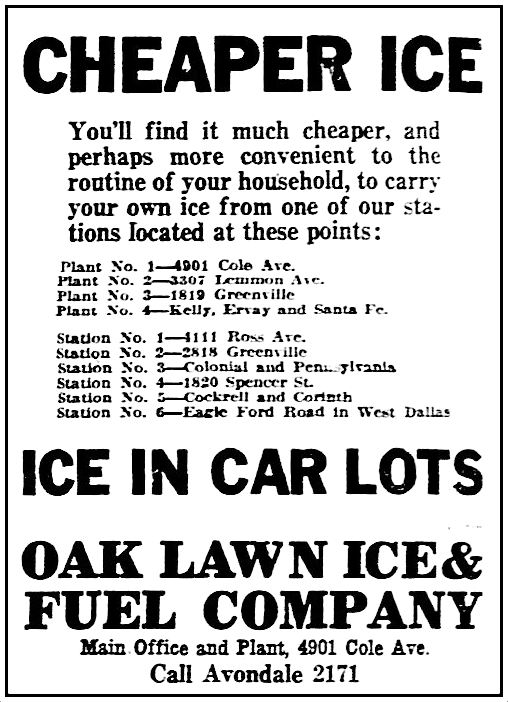
In 1923, ads for the Oak Lawn Ice & Fuel Co. began displaying both addresses: the original location, 3307 Lemmon, was now being referred to as “Plant No. 2,” and the new location, 4901 Cole, was being referred to as the “Main Office/Plant No. 1.”

1923_oak-lawn-ice_1923-directory
1923 Dallas city directory

By 1924 the company expanded as it absorbed other ice companies.

1924_oak-lawn-ice_sept-19241924

By 1925, “Oak Lawn Ice & Fuel Company” had become “American Ice Co.” (another C. E. Kennemer enterprise).

1925_american-ice-co_aug-19251925

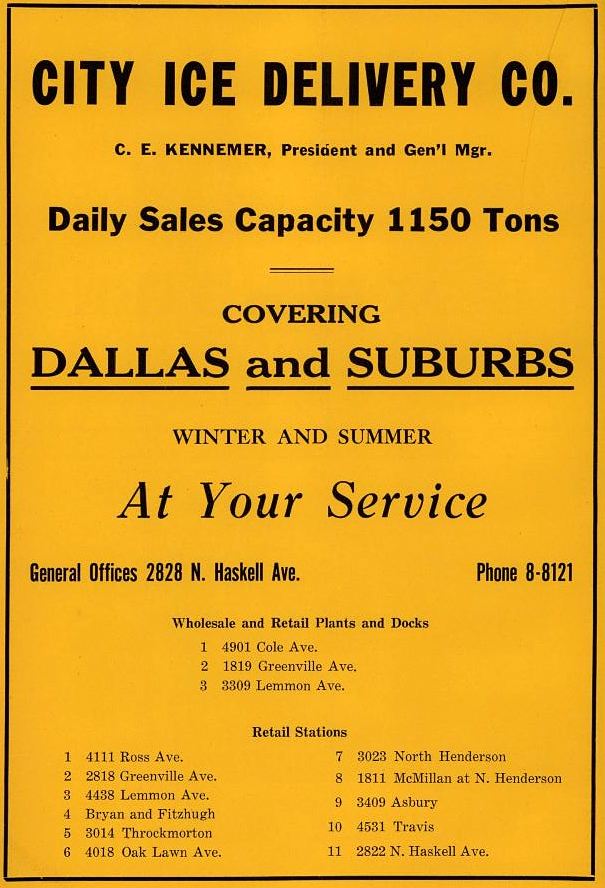
By 1933, American Ice Co. was swallowed up by City Ice Delivery Co.

city-ice-delivery_1934-directory1934 Dallas city directory

In the late 1930s or early 1940s City Ice Delivery Co. was acquired by Southland Ice (the forerunner of the Southland Corp., owners of 7-Eleven convenience stores). The Lemmon Avenue location became a meat-packing plant sometime in the mid-’40s (if neighbors were bent out of shape by an ice company, imagine how they felt about a meat-packing plant!); the Cole location became a 7-Eleven store and later a Southland Corp. division office.

*

But back to Jonathan F. Finney, the man standing next to the ice wagon in the top photo. He came to Dallas from Alabama around 1916 and bought a house at 3001 Carlisle Street, where he lived for most of his life in Dallas. His occupation was “ice dealer,” and he seems to have worked in both the wholesale and retail areas, as a driver, a salesman, and even for a while the owner of his own company. His great-great-granddaughter Krystal Morris (supplier of these wonderful family photos) says she believes he was the manager of the Oak Lawn Ice & Fuel Co. The 1932 directory lists him as foreman of the City Ice Delivery Co., and as he lived at 3001 Carlisle, it seems to make more sense he was working at the Lemmon Ave. location (which was less than half a mile away from his home) rather the Cole Ave. location. The actual address of the photo at the top is unknown, but it may show the Lemmon Ave. location when Finney was working as an independent ice dealer, standing beside his own wagon.

Below, the Finney family around 1920 (J. F., daughters Thelma and Viva Sue, and wife Wenona), and below that, their house at 3001 Carlisle (which was at the corner of Carlisle and Sneed — seen in a 1921 Sanborn map here).

finney-family_krystal-morris-photoFinney family, circa 1920 / Photo: Krystal Morris

finney-home_3001-carlisle_krystal-morris-photo3001 Carlisle, Finney family home / Photo: Krystal Morris

J. F. Finney, born in 1885, died in Dallas in 1962, long after the era of necessary daily ice deliveries to residences and businesses. The occupation listed on his death certificate was “painter” but I have a feeling “once an iceman, always an iceman.”

***

Sources & Notes

All photographs are from the family photos of Krystal Morris and are used with her permission. Thank you, Krystal!

The history of ice delivery is very interesting, especially to those of us who have never lived in a house without an electric refrigerator. Here are links-a-plenty on the subject:

  • “Icehouses — Vintage Spaces with a Cool History” by Randy Mallory (Texas Highways, Aug., 2000) here (additional photos can be found in the scanned issue on the Portal to Texas History site, here)
  • “Keeping Your (Food) Cool: From Ice Harvesting to Electric Refrigeration” by Emma Grahn on the Smithsonian National Museum of American History blog, here
  • “Delivering the Ice: Ice Wagons” — from an online exhibit based on an exhibit that was on display at the Woods Hole Historical Museum in Woods Hole, Massachusetts during the summer of 2015, here
  • “Portals to the Past: Golden Days of Home Delivery (ice, as well as bread, milk, groceries, etc.) by Waco historian Claire Masters, here
  • “The Iceman Cometh” by Dick Sheaff from the Ephemera Society of America blog, here

Here’s a fantastic little clip of a woman ice deliverer manning the tongs (and wearing heels):


*

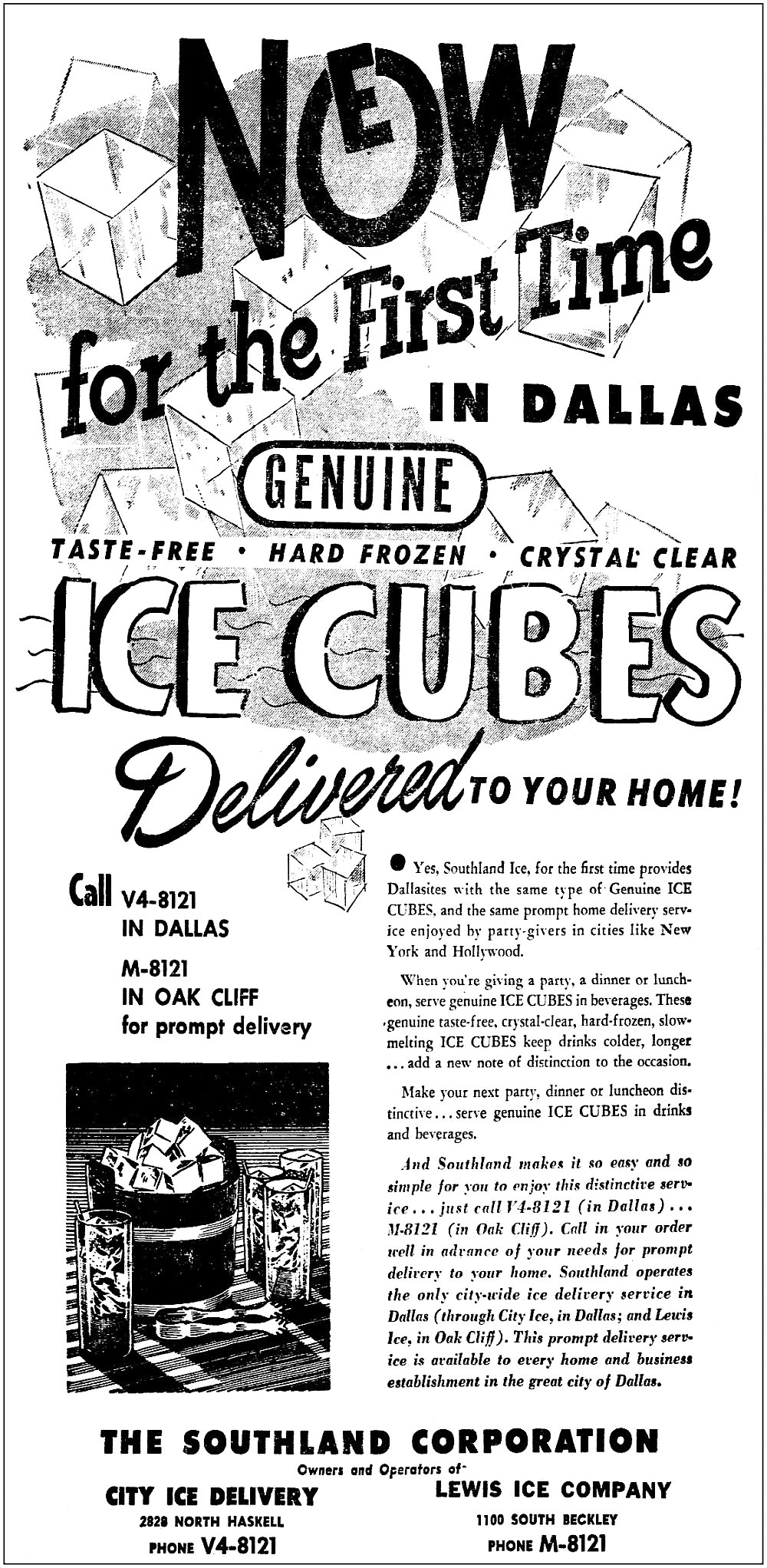
And, lastly, the Southland Corp. to the rescue with an ad from Dec., 1948 with news of the arrival in Dallas of “genuine” ice cubes! “Now for the first time in Dallas: Genuine Taste-Free, Hard Frozen, Crystal Clear Ice Cubes delivered to your home!”

city-ice-delivery_southland-ice_dec-1948
1948

All images are larger when clicked.

*

Copyright © 2018 Paula Bosse. All Rights Reserved.
The Wilson Building, Main and Ervay

wilson-bldg_dallas-illust-hist_payneLooking northwesterly… (click for larger image)

by Paula Bosse

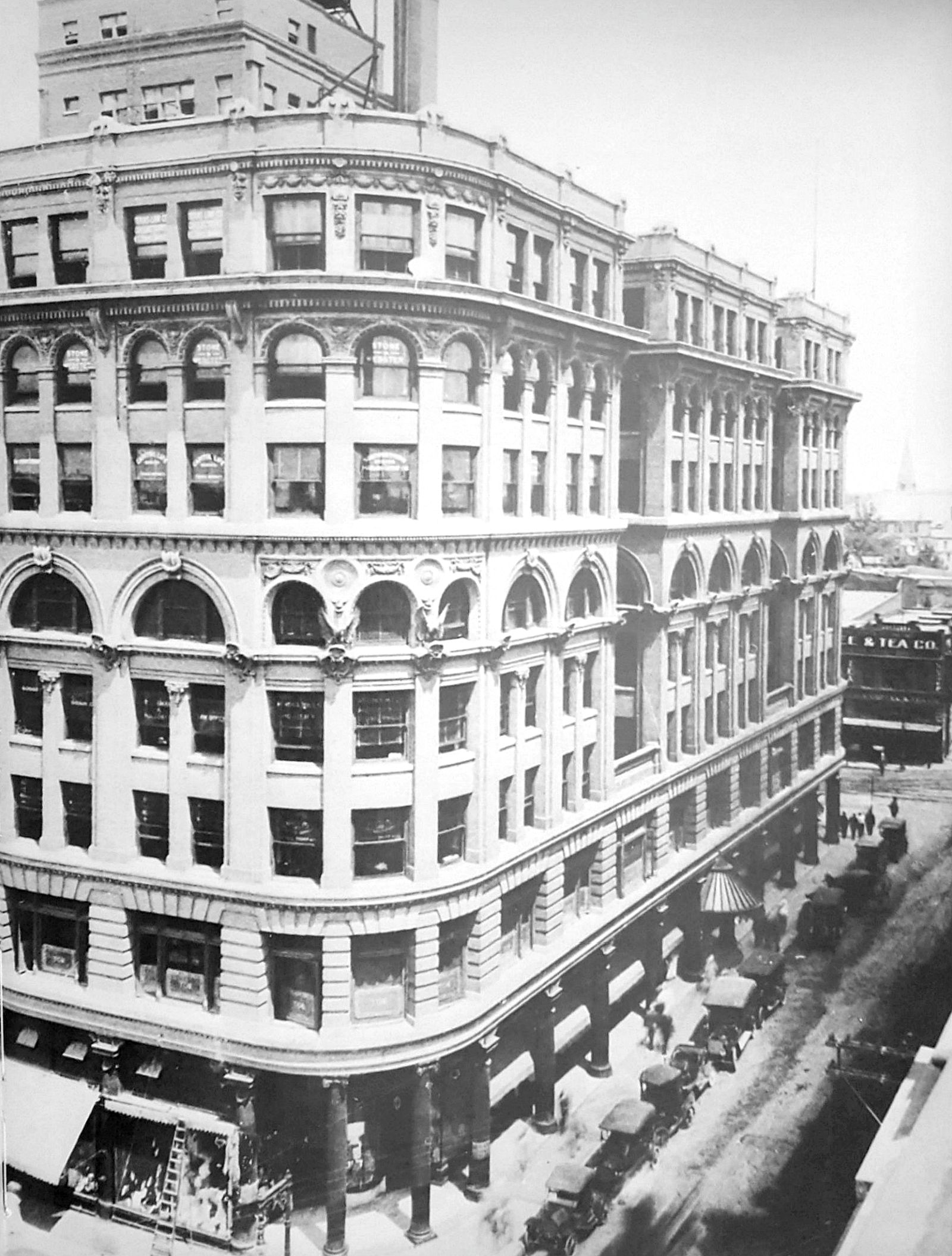
Another photo of the always impressive Wilson Building, this one showing the U. S. Coffee & Tea Co. (at the northwest corner of Elm and Ervay) in the background.

***

Sources & Notes

Photo from Dallas, An Illustrated History by Darwin Payne (Woodland Hills, CA: Windsor Publications, 1982; Sponsored by Dallas Historic Preservation League); original photo source is the Texas/Dallas History and Archives Division of the Dallas Public Library.

*

Copyright © 2018 Paula Bosse. All Rights Reserved

State Fair Coliseum / Centennial Administration Building / Women’s Museum / Women’s Building

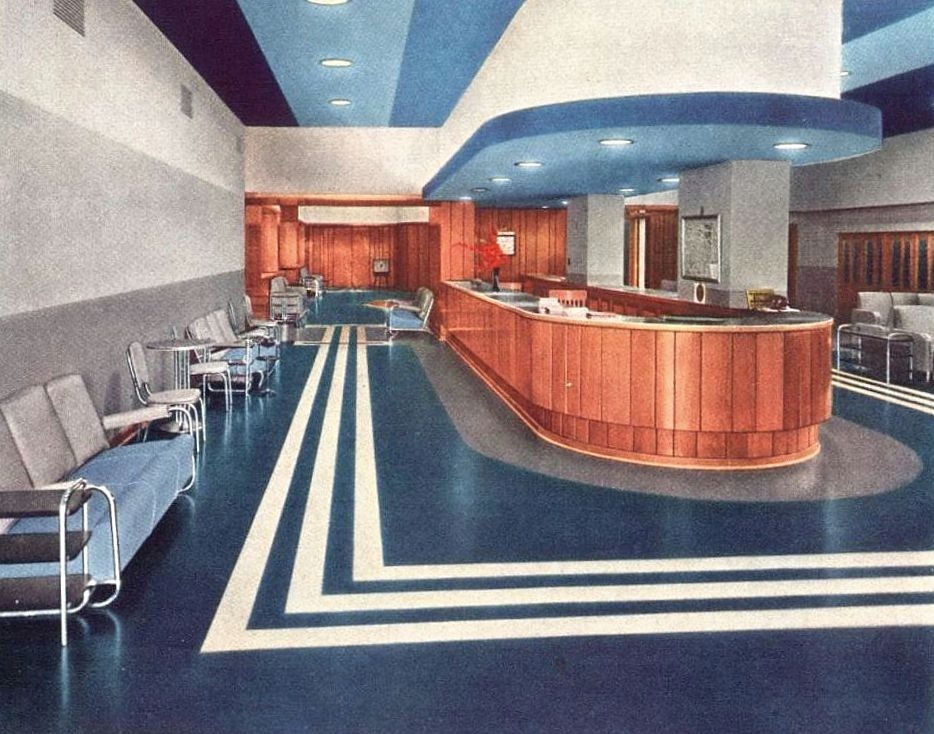
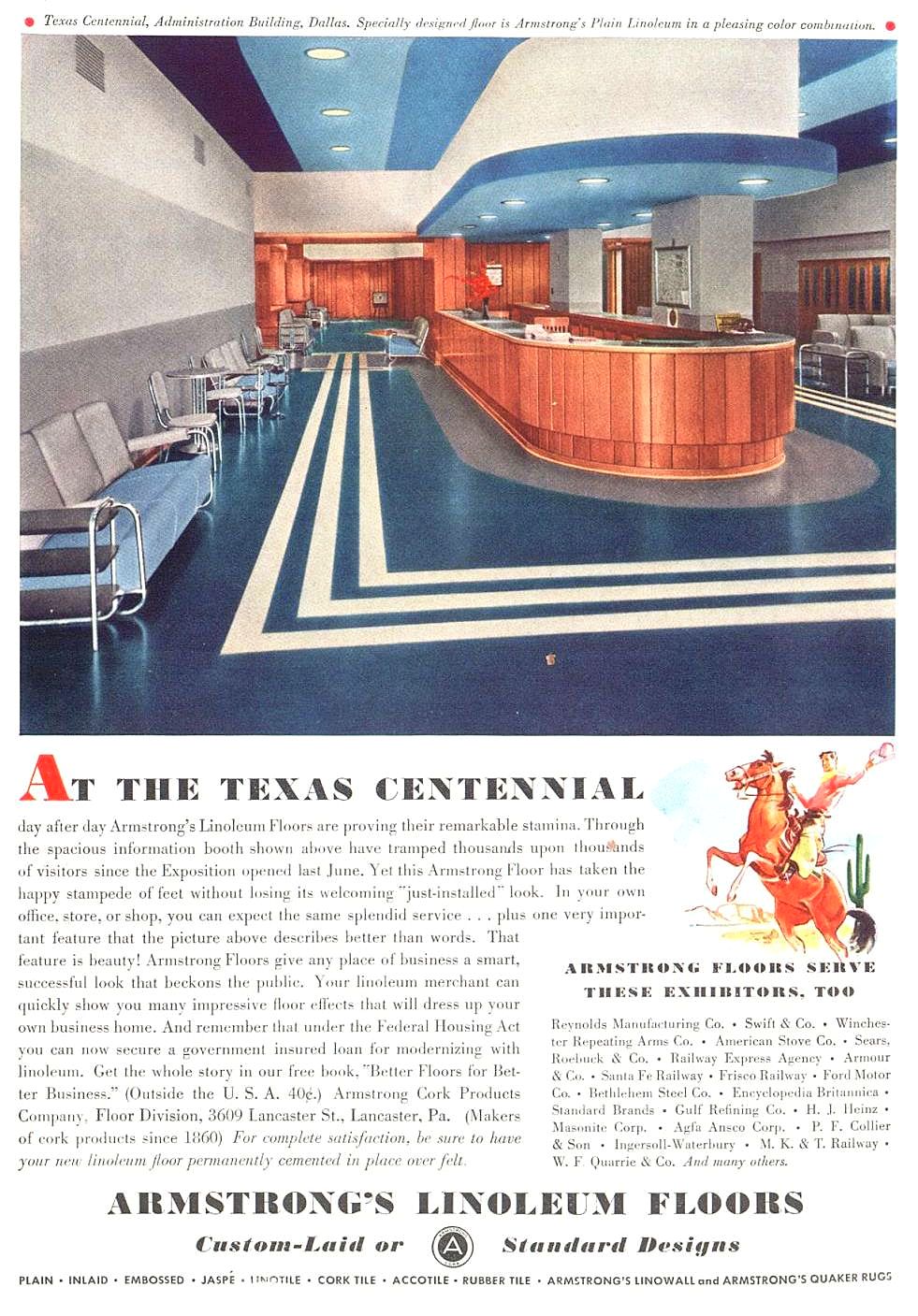
tx-centennial_armstrong-linoleum-ad_1936_detAdministration Building interior, 1936…

by Paula Bosse

Thursday night I attended a very entertaining Dallas Historical Society presentation at the Hall of State in Fair Park: “An Evening With Jim Parsons: Lost Fair Park,” in which the author of Fair Park Deco and DFW Deco talked about many of the buildings constructed for the Texas Centennial Exposition in 1936 which are no longer with us.

One of Jim’s asides was that there are very, very few color photos of the Centennial buildings and murals taken in 1936. If you’ve seen a Centennial view in color, it’s probably a colorized postcard. Kodachrome film was introduced in 1935 and was, sadly, not in wide use by visitors to Fair Park in 1936 (or by the Centennial organization).

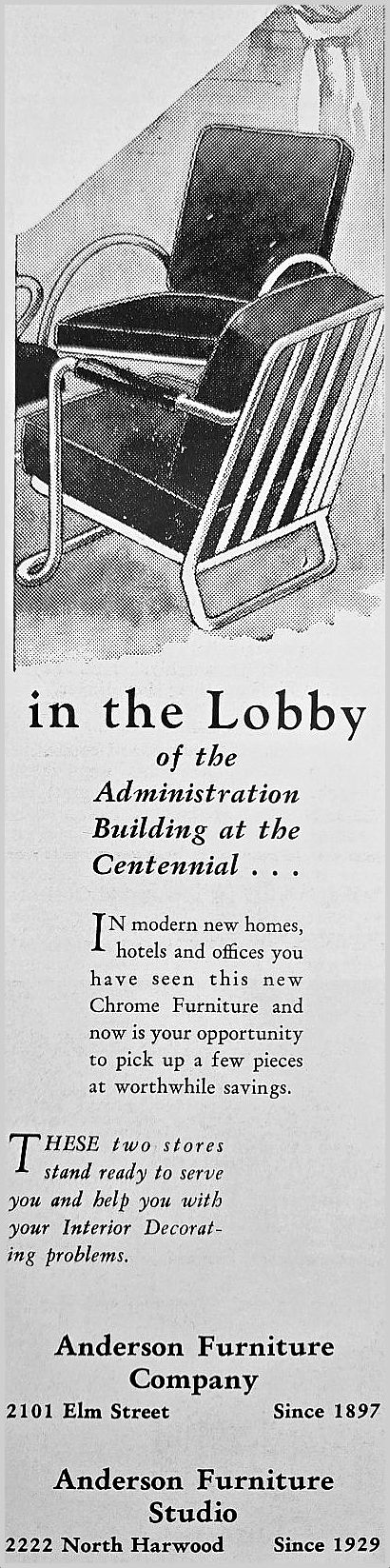
When he said that, though, I remembered an ad I had come across that I thought was pretty cool, simply because it shows the interior of one of the Centennial buildings when it was brand new (…well, it was sort of new — more on that below). The ad is for Armstrong Linoleum and it features a color photo showing one of their custom linoleum floors installed in the Centennial Administration Building, an interior I’d never seen. And it’s in color! (Check out the furniture and the recessed lighting!) Here’s the full ad, which appeared in national magazines in 1936 (click for larger image).

ad- tx-centennial_armstrong-linoleum_19361936 ad

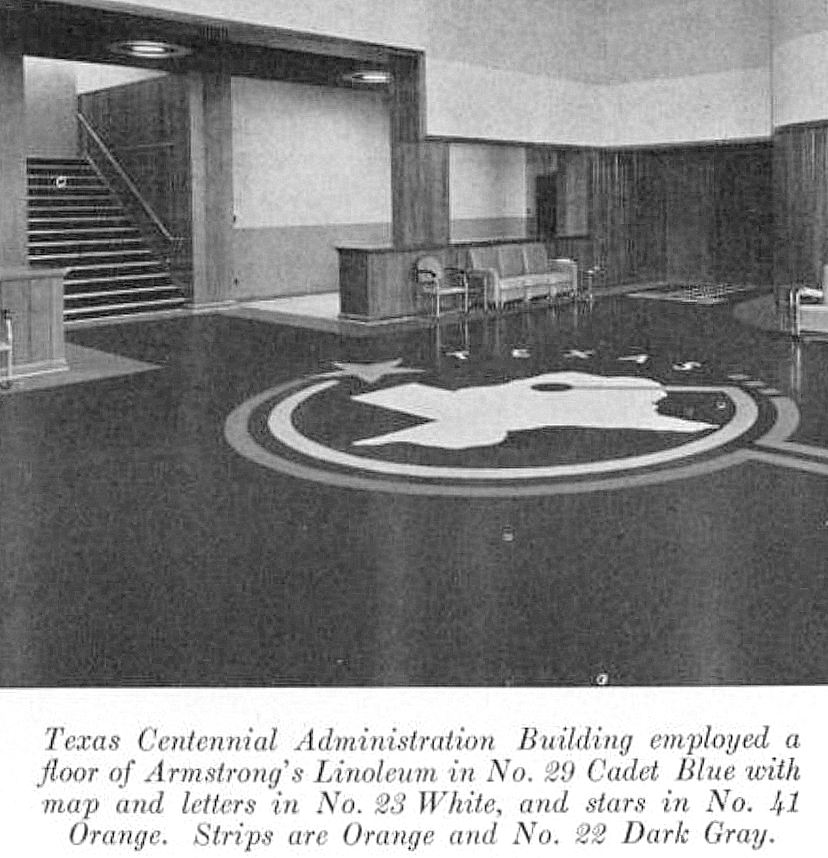
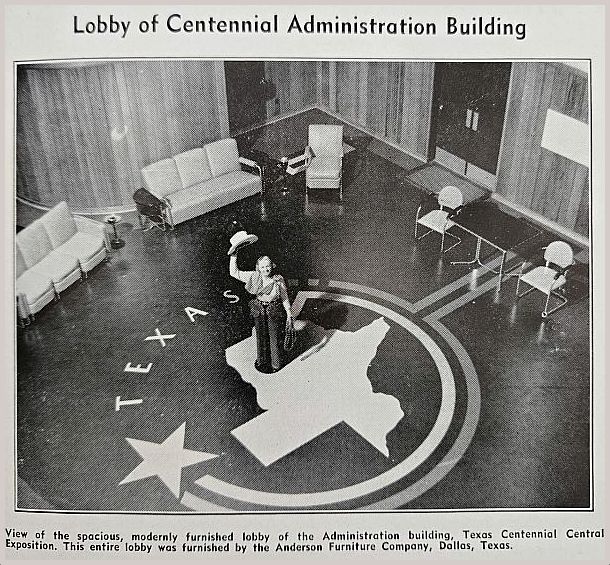
And — hallelujah — I found another photo of the interior — also from the helpful Armstrong people (I don’t know if they had the concession to outfit all the Centennial buildings, but, if so, I’d love to see all of their designs). Unfortunately this one is not in color, but it shows a fantastic Texas-centric custom design, laid down in fabulous linoleum.

tx-centennial_armstrong-linoleum_admin-bldg_texas-floor

And another one:

tx-centennial_administration-bldg-floor_southwest-business-mag_june-1936
Southwest Business, June 1936

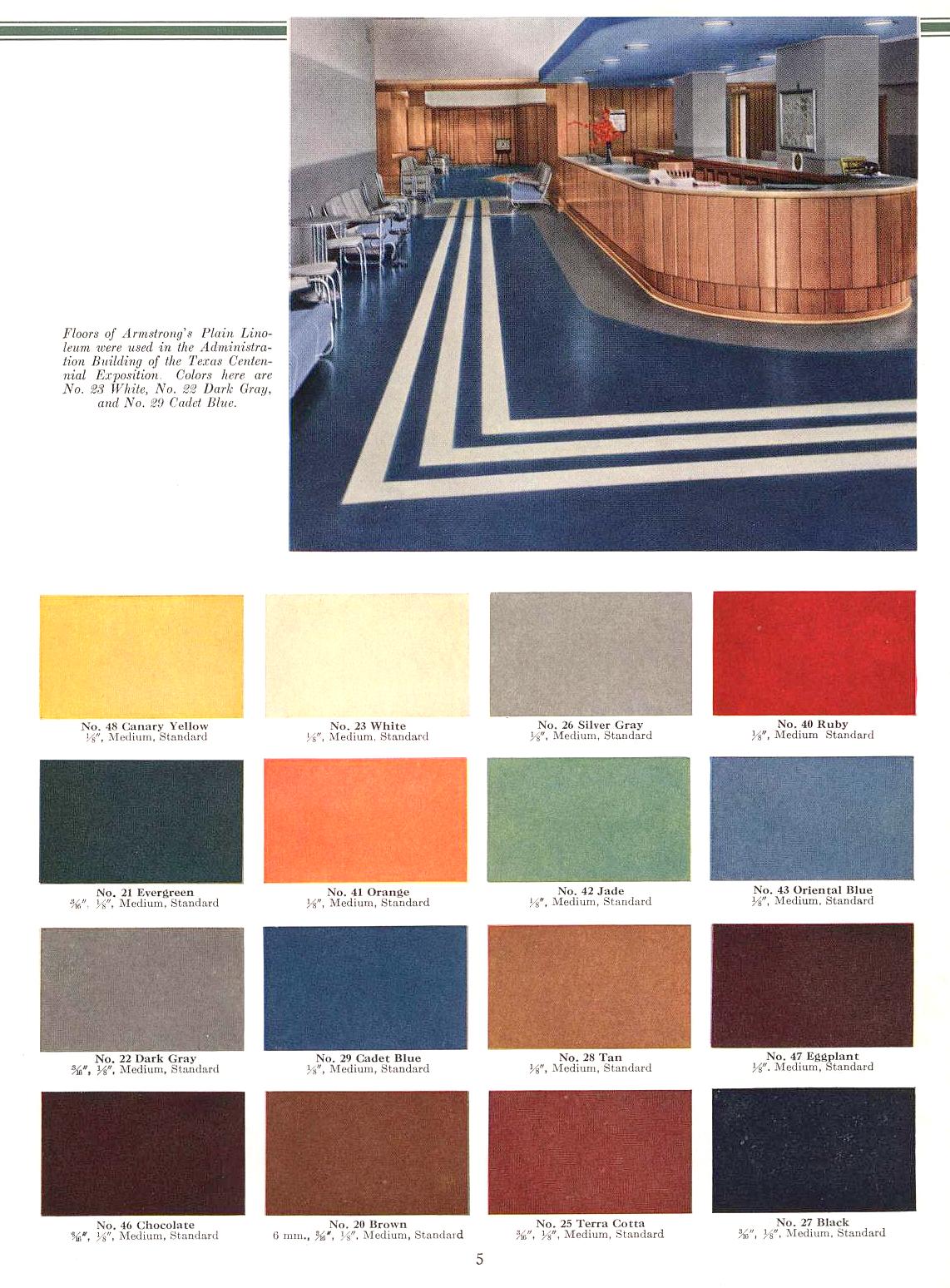
Imagine that floor in Cadet Blue, White, Orange, and Dark Gray. This is from a trade publication called Armstrong’s Floors and Walls for Homes and Public Buildings, published around 1950 (and fully scanned here). A cropped version of the photo of the top is also included here (that floor, by the way, is in White, Dark Gray, and Cadet Blue), with handy swatches (which, reproduced below, lose some accuracy in color).

tx-centennial_armstrong-linoleum_admin-bldg_colors

And just because I found an ad for those cool chairs:

tx-centennial_furniture_southwest-business-mag_oct-1936Southwest Business, Oct. 1936

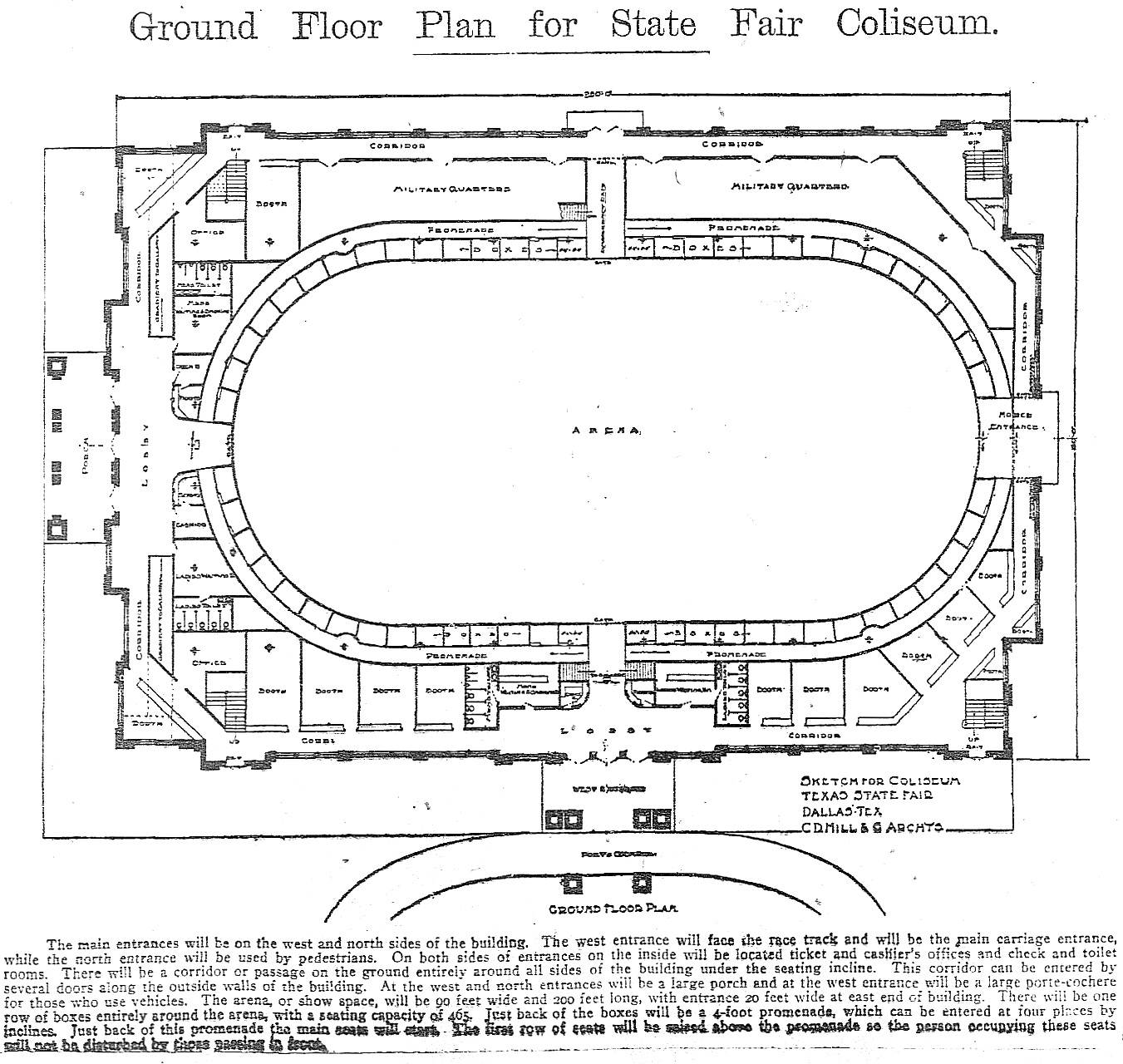
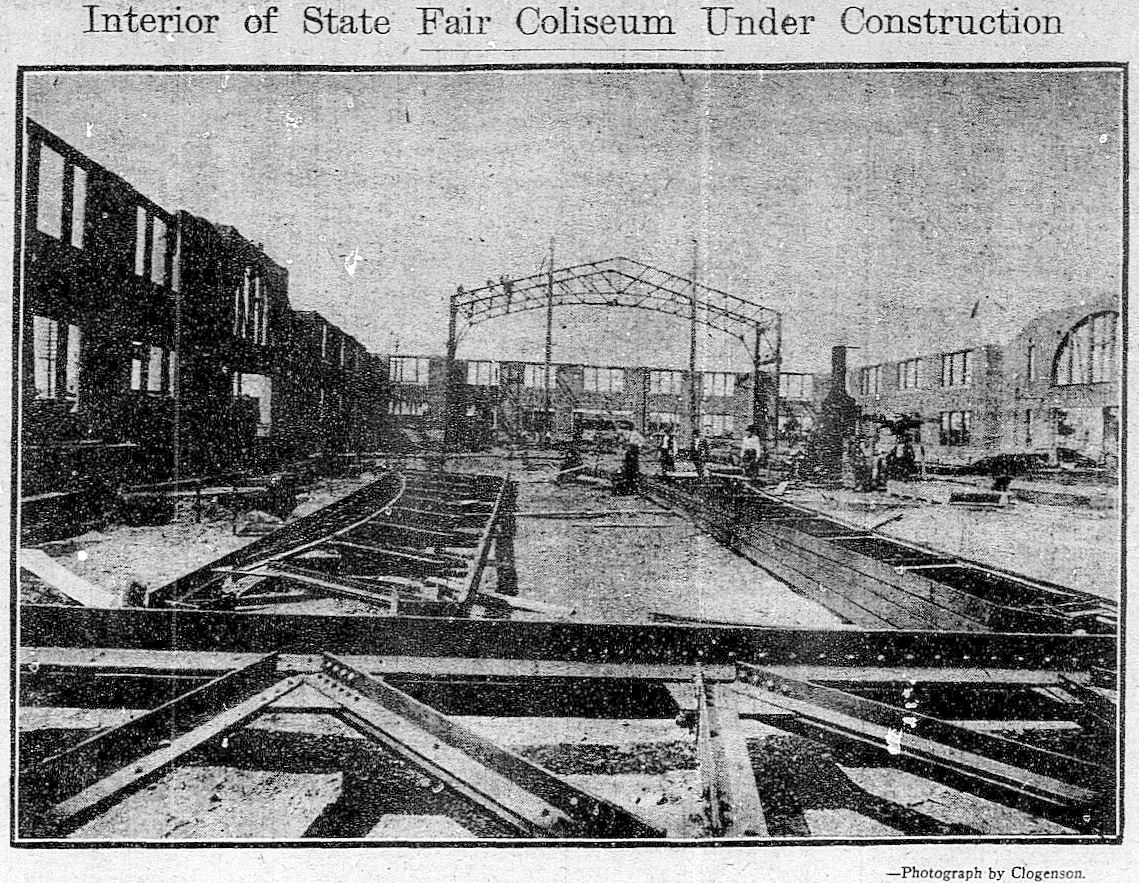
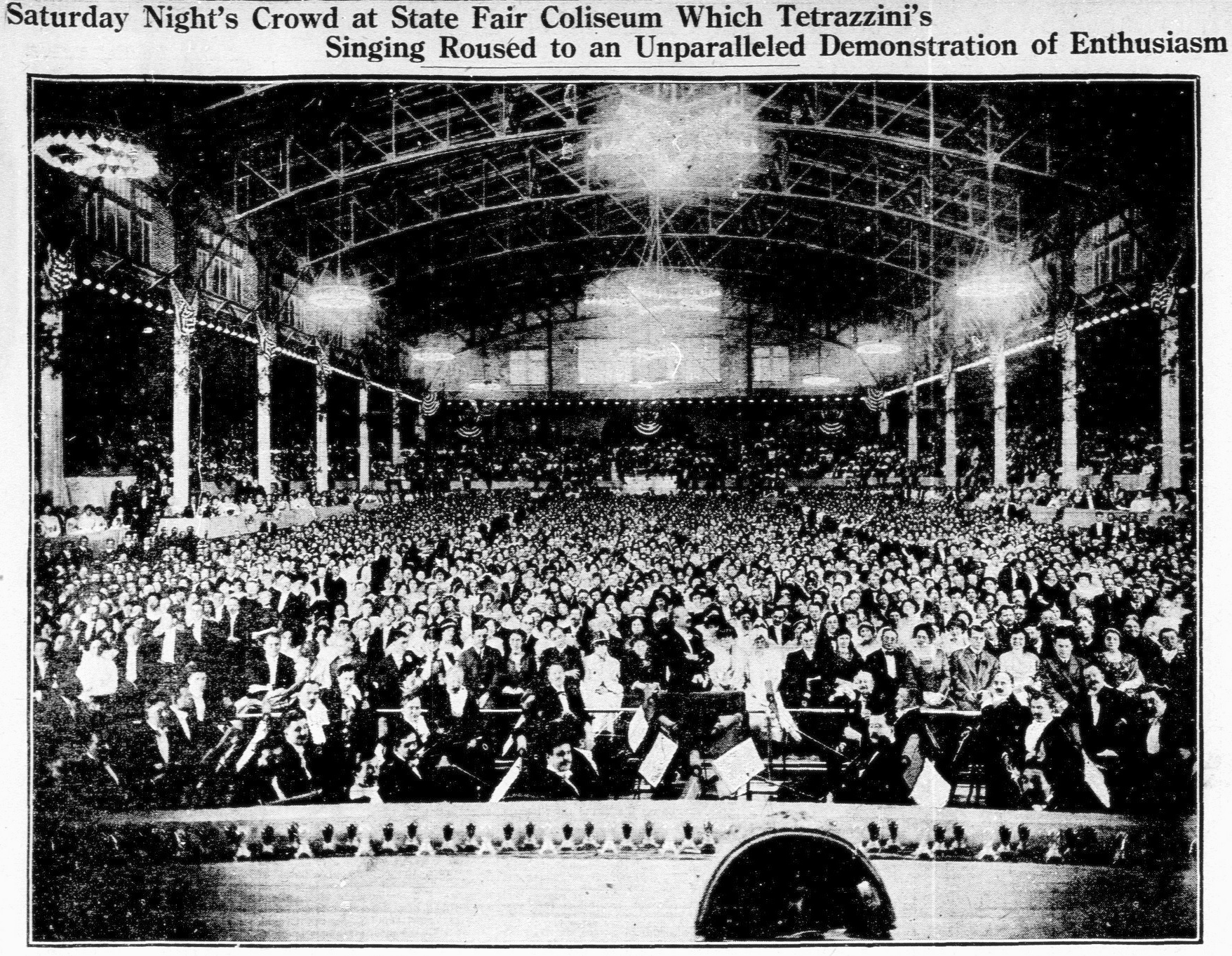
The Centennial Administration Building — which housed the hundreds of office workers and executives behind the running of the Texas Centennial Exposition — was actually the very first Centennial building completed (at the end of December 1935). Most of the Centennial buildings were newly built in 1936, but the Administration Building was actually an old building given a new stucco façade and completely remodeled — it even acquired a second floor inside the huge structure. This building was originally known as the State Fair Coliseum, built in 1910, designed by architect C. D. Hill (who designed many buildings in Dallas, including the still-standing Municipal Building downtown (built in 1914) and the Melrose Hotel (1924).

state-fair-coliseum_dmn_062009_drawingDallas Morning News, June 20, 1909

state-fair-coliseum_dmn_050710_constructionDMN, May 7, 1910

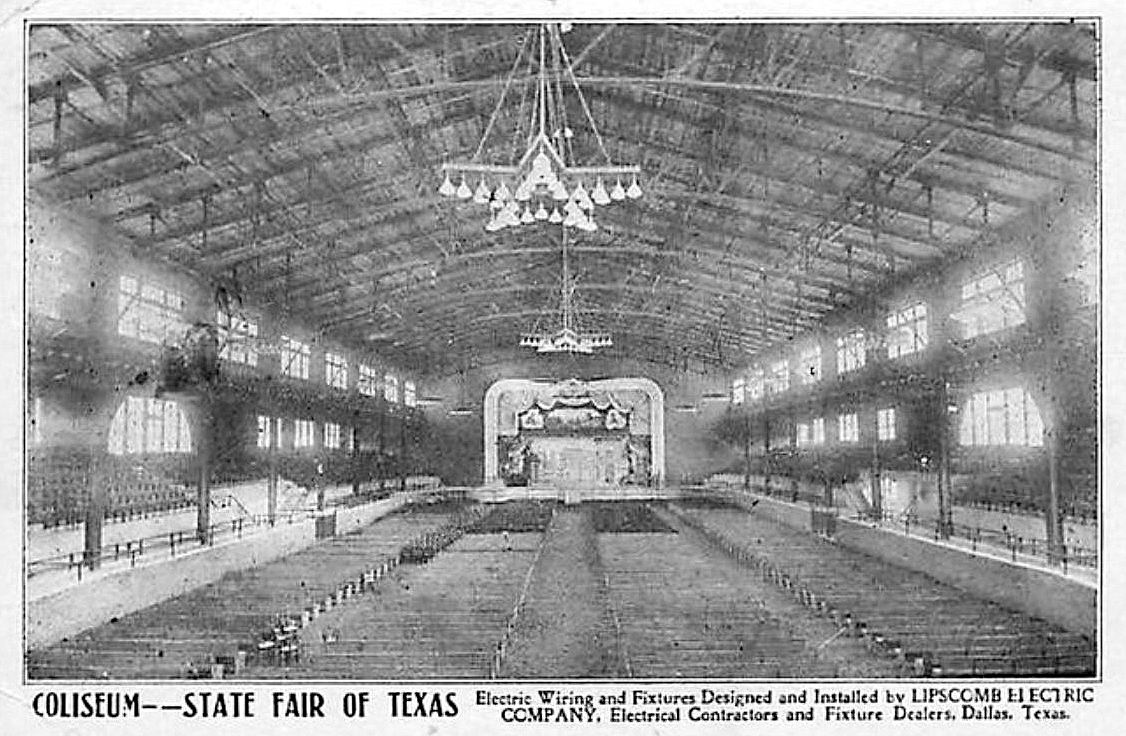
It was BIG. It had a seating capacity of 7,500.

state-fair-coliseum_flickr_coltera

state-fair-coliseum_dmn_030413DMN, March 4, 1913

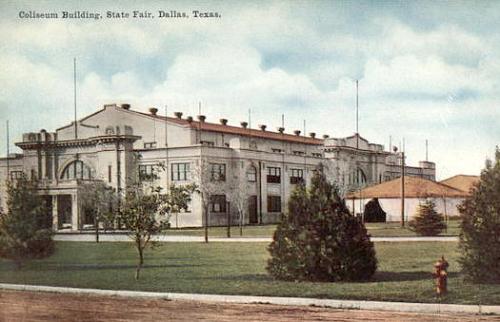
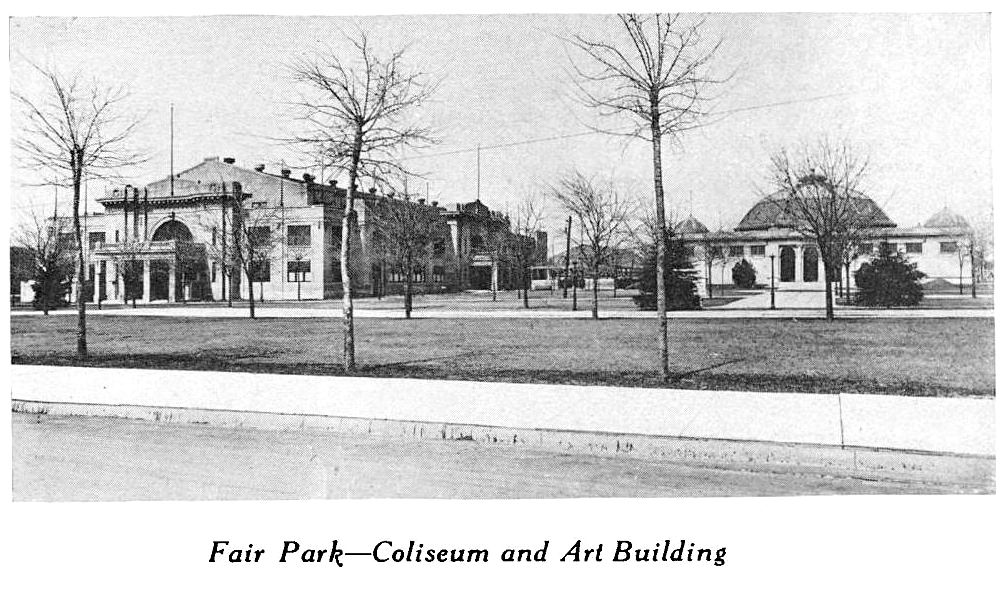
This was the first building you’d see as you entered Fair Park, as it was right inside the front entrance on Parry Avenue (after you entered, the building would be on your left).

Coliseum Building, State Fair Dallas, TX

park-board-bk_fair-park-coliseum_1914

It was the city’s first official municipal auditorium, and it hosted everything from livestock shows, conventions, large civic gatherings, and the occasional opera.

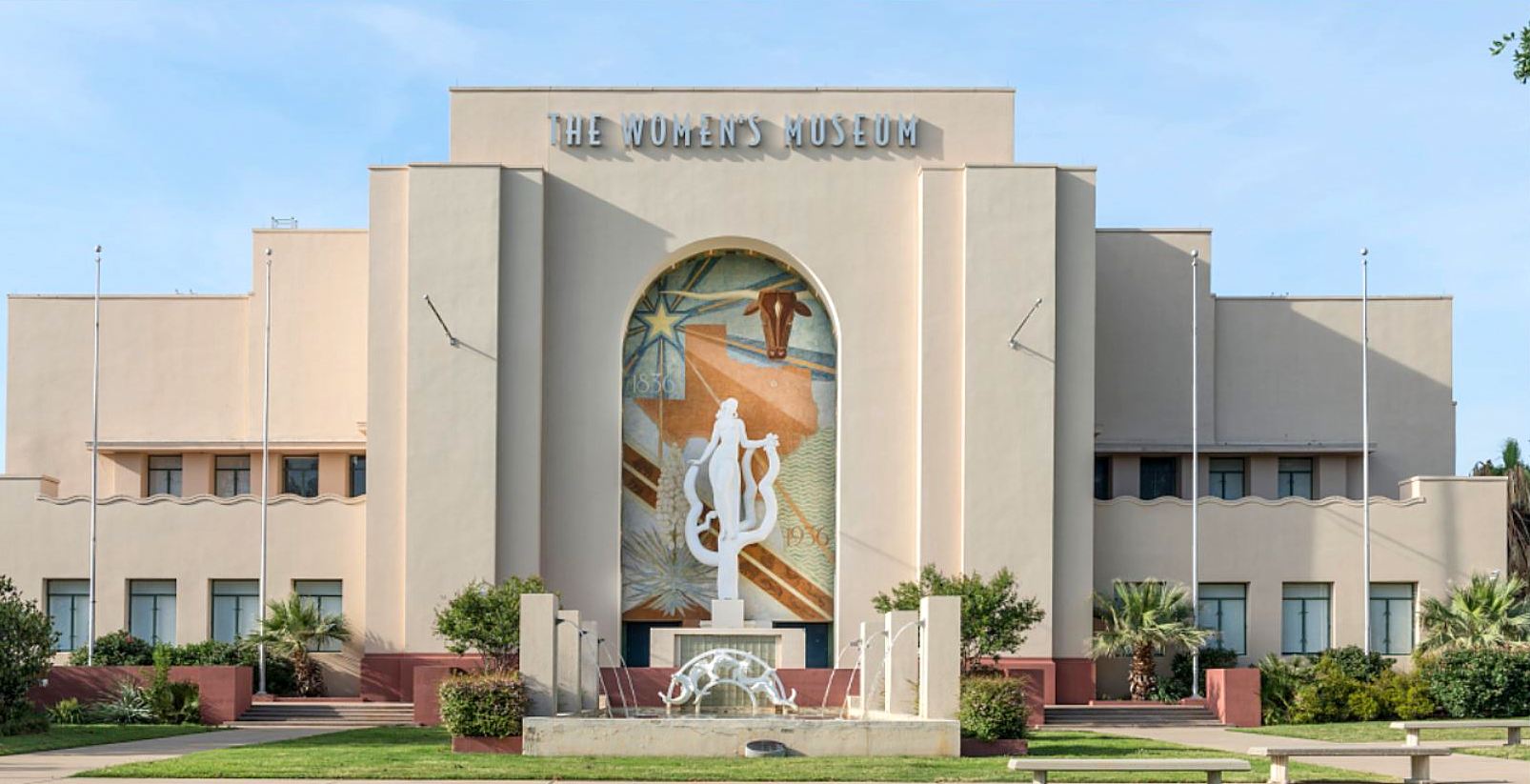
Fast-forward a few decades: in 2000 the building became the home of the Women’s Museum. The museum closed in 2011 and is now called the Women’s Building and is used for special events.

A photo of the building from 2014:

womens-museum_fair-park_2014_carol-highsmith_library-of-congressphoto: Carol Highsmith, Library of Congress

See a Wikimedia photo of this building in 2016 here — click it again (and again) to see it really big, and linger on the mural by Carlo Ciampaglia and the sculpture by Raoul Josset. See interior photos of the space in 2009 during its time as the Women’s Museum here and here. I’m not sure if the exposed brick and steel are from the original 1910 building, but I certainly hope so! And, lastly, exterior photos from 2009 showing the side of the building here, and here

***

Sources & Notes

This building can be seen on this aerial Google view, here. It is currently the Women’s Building, and it is available for special events — more about this building from the Friends of Fair Park, here.

Black-and-white postcard showing the interior of the Coliseum is from Flickr.

Black-and-white photo “Coliseum and Art Building” is from Report for the Year 1914-1915 of the Park Board of the City of Dallas, With a Sketch of the Park System (Dallas: Park Board, 1915), which can be accessed as part of the Dallas Municipal Archives via the Portal to Texas History, here.

And since this whole post was spurred by Jim Parsons’ talk the other night, here’s a link to the book he and David Bush wrote: Fair Park Deco: Art & Architecture of the Texas Centennial Exposition.

*

Copyright © 2018 Paula Bosse. All Rights Reserved.
Ghost Rails of the Belmont Streetcar Line

matilda-richmond_dan-parr-photo_FB-dallas-history-guild_april-2018Matilda & Richmond, April, 2018… (photo: Dan Parr)

by Paula Bosse

I grew up on Ellsworth, between Greenville Avenue and Matilda — just south of Mockingbird, just north of the M Streets. When I was a child, Matilda was only partially paved — in my neighborhood, maybe only from Mockingbird down to Kenwood? Otherwise, it was a dirt street (!) — and this was in the ’70s! Right around Kenwood was a weird mound which might not have looked like much to an adult, but to a child it was pretty strange. I can’t remember if the rails were visible — I’m pretty sure they were.

That line was the Belmont Line, which ended (began?) at Mockingbird (I think there was a later extension of sorts, but I think Mockingbird was the end of the line for streetcar passengers). As a kid, I knew that Matilda had been a long-gone streetcar line, but never having seen a streetcar outside of a movie, I couldn’t really imagine what it must have been like to have streetcars (and an interurban! — more on that below) moving up and down a street which was less than a block from my house.

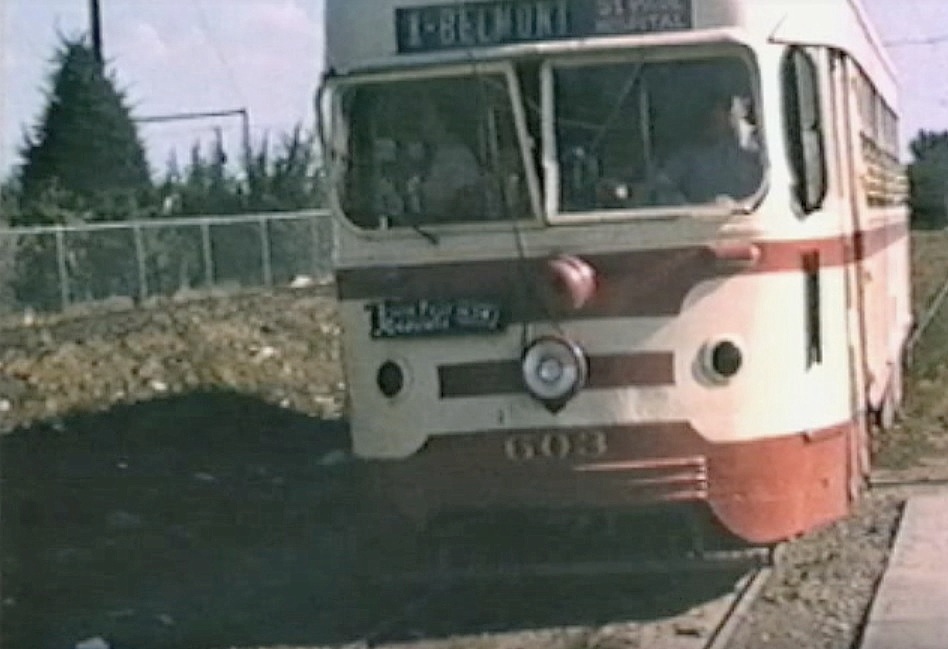
A few years ago I stumbled across the YouTube video below and was surprised to see actual footage of that streetcar rolling up Matilda. The first five minutes of the video contains 16mm footage (both black-and-white and color) shot around Dallas in 1953 and 1954 by Gene Schmidt. It’s GREAT! You’ll see streetcars-galore moving past all sorts of familiar and vaguely familiar sights around the city, from Oak Cliff to downtown to way out to Mockingbird and Matilda. It ends with the Belmont-Seventh car (car 603) pulling to the end of the line — the view is looking south down an unpaved Matilda Street from Mockingbird, with a glimpse of the Stonewall Jackson playing field at the left, on the other side of the fence. (The Matilda footage begins at 4:17.)

*

belmont-line_matilda-from-mockingbird_youtube-cap_ca1954Matilda, south from Mockingbird, ca. 1954 (Gene Schmidt)

Above, a screen capture from the video showing Matilda looking south from just south of Mockingbird. Stonewall Jackson Elementary School is at the left. Today the view looks like this.

*

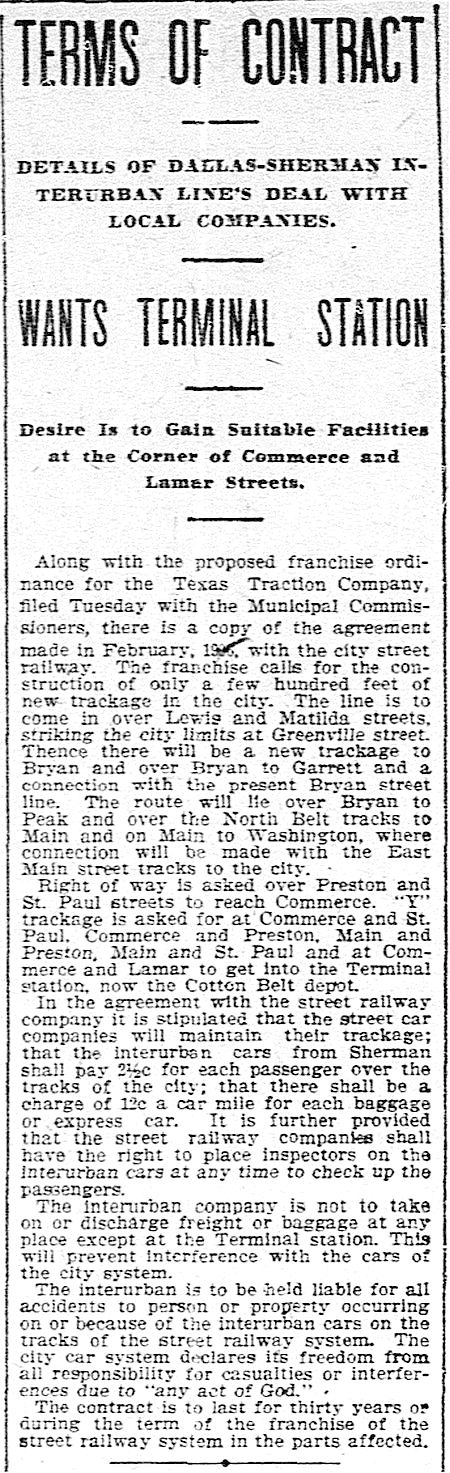
Before the streetcar arrived, Matilda was the artery that led the Texas Traction Company’s Sherman/Denison interurban into Dallas. This electric interurban service from the north, which closely followed the H&TC railroad line, arrived in Dallas in 1908, back when the official entry-point into the Dallas city limits was just off Matilda, near Greenville Avenue and Bryan Street.

1908_interurban_sherman-dallas_dmn_011608
DMN, Jan. 16, 1908 (click to read)

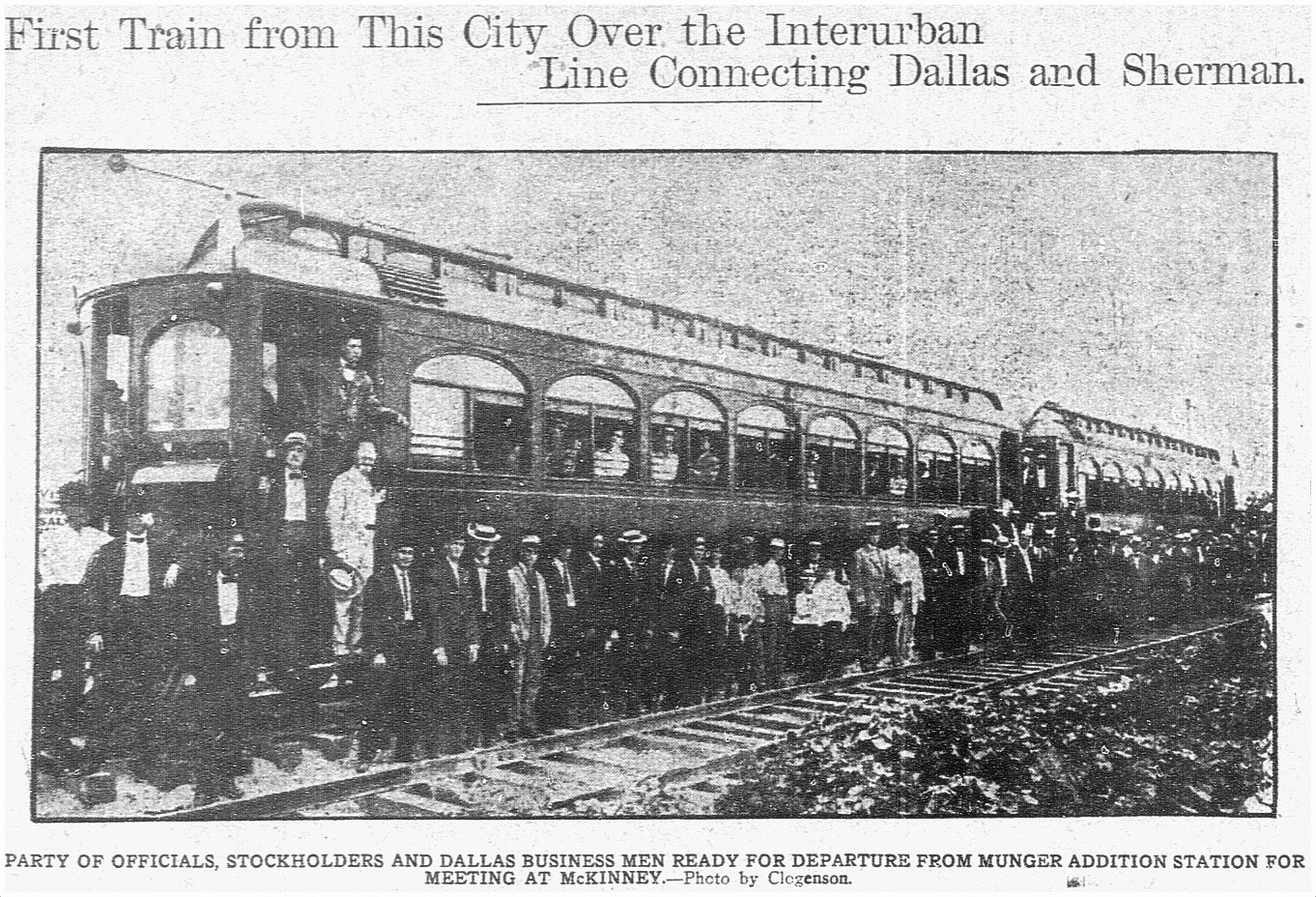
The interurban route connecting Sherman/Denison with Dallas opened on July 1, 1908 and lasted for 40 years, until its final run on December 31, 1948. (Read the Dallas Morning News article on the 1908 inaugural trip for big-wigs, “Many Make Trip Over Interurban,” July 1, 1908, here. Below is the accompanying photo. Image that running up and down Matilda — and, later, along other streets in Dallas — several times a day!)

interurban_sherman-dallas_dmn_070108
DMN, July 1, 1908

Dallas’ ever-increasing population began to move northward and eastward, necessitating public transportation which would connect these developing areas with the rest of the city. One of the early “suburban” lines was the Belmont Line, which branched off the Bryan Street line and served the Belmont Addition and beyond; it opened in 1913, but these early days appear to have been more of a private “dinky” service (see SMU’s dinky car on the beyond-the-city-limits tracks at Hillcrest and McFarlin, here). The Belmont line — as well as the Vickery Place and Mount Auburn lines — became part of the city’s official streetcar system in 1922.

Before the dinky service, riders were able to get on and off the large interurban cars at stops between Mockingbird and the area around Bryan and Greenville Ave. Even though interurbans and streetcars were able to travel on the same rails, it took years for dedicated streetcar tracks to be laid along Matilda.

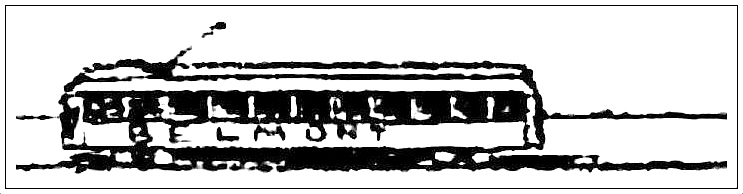
This detail of a real estate ad shows that the Belmont line had reached at least as far as Richmond by 1914 (I felt I had to include this because the finger is pointing at the exact location of the exposed rails in the photo at the top!):

1914_matilda-richmond_lakewood-heights-ad_det_050314
May, 1914 (detail from Lakewood Heights real estate ad — see full ad here)

By 1922 the Belmont line had extended north to Velasco; by 1925 it had gotten to McCommas; by 1936 it had made it up to Penrose; and by 1939 it had finally reached Mockingbird (in time for the opening that year of Stonewall Jackson Elementary School, located at Mockingbird and Matilda).

Dallas streetcars began to be phased out in 1955, and the Belmont line was one of the first to go — its last run was March 6, 1955: “The Belmont-Seventh streetcar line will go out of existence Sunday to be replaced by service with new Diesel buses” (Dallas Morning News, March 6, 1955). The new bus route in the Lower Greenville area would, for the most part, be along Greenville Avenue, one block west of unpaved Matilda Street.

In March, 1955, it was reported that the abandoned Belmont-Seventh streetcar tracks were deeded to the city by the Dallas Railway and Terminal Co., with the understanding that they would eventually be paved over. The tracks were on Matilda, Bryan, Cantegral, Live Oak, St. Paul, King’s Highway, Edgefield, Seventh, Bishop, and Colorado. In April, 1956, it was reported that the City Council had approved the sale of the streetcar viaduct over the Trinity River and the Matilda street right-of-way.

But what about that paving of Matilda? Mrs. K. E. Slaughter had thoughts on the matter in a letter-to-the editor in April, 1955:

Since removal of the Belmont streetcar line in part — Matilda and Bryan streets — would it not be advantageous to develop this section into an important use to the heavy automobile traffic? Matilda now is no more than useless tracks built up between a cow path. (DMN, April 7, 1955)

“Cow path” — ha!

Another annoyed News reader wrote in 1963 — eight years after the tracks had been abandoned — about the useless unpaved thoroughfare:

The abandoned almost-private right of ways, such as Matilda, nearly two miles south from Mockingbird, received by the city in a deal to permit an all-bus operation, have not yet been paved or otherwise improved. (DMN, Oct. 21, 1963)

I’m not sure when that paving finally happened — early ’70s? — I think it must have been done in stages. I don’t remember a time when the stretch between Mockingbird and Kenwood wasn’t paved, but I do remember Matilda being a dirt road south of Kenwood. I don’t have a good recollection of the year, but kids remember all sorts of weird things, and those mysterious mounds were pretty memorable. (UPDATE: See photos of Matilda being paved at Goodwin in 1971 here.) I wish I’d known what an interurban was when I was a child. That would have made my neighborhood seem a whole lot more interesting! Heck, it used to the Gateway to Sherman!

I’ve long despaired of having missed the streetcar age. But it’s nice to know that one ran so close to the house I grew up in.

belmont-line_matilda-mockingbird_youtube-cap_ca1954End of the line, ca. 1954… (Gene Schmidt)

belmont-car_lakewood-heights-ad-det_050314

***

Sources & Notes

Top photo taken by Dan Parr on April 15, 2018; it was originally posted to the Facebook group Dallas History Guild and is used here with permission. (Thanks, Dan!) The photo was taken at Matilda and Richmond, looking south on Matilda. See it on Google Street View, here. (Roadwork along Matilda is awful at the moment, but much-needed. Apparently it is being reduced to three lanes for automobiles with two bike lanes being added — read about it in the Lakewood Advocate, here.)

YouTube video shot by Gene Schmidt in 1953 and 1954; the direct link is here.

Another interesting video on YouTube was made by the City of Allen and contains period footage of the interurban that served North Texas. It’s a breezy 6-and-a-half  minutes, and it includes some cool shots of Dallas.

If you want to see a whole bunch of North Texas interurban photos, check out this great 83-page PDF compiled by DART, “History of the Interurban Railway System and Monroe Shops,” here.

Speaking of DART, they posted a cool 1925 map of streetcar and interurban lines, here — click the map to see a larger image. (In 1925, the Belmont line ended on Matilda at McCommas).

ALSO extremely cool is a Google map showing Dallas’ Historical Streetcar (and Interurban) Lines laid over a present-day Google map, here. Zoom in and out. Very useful!

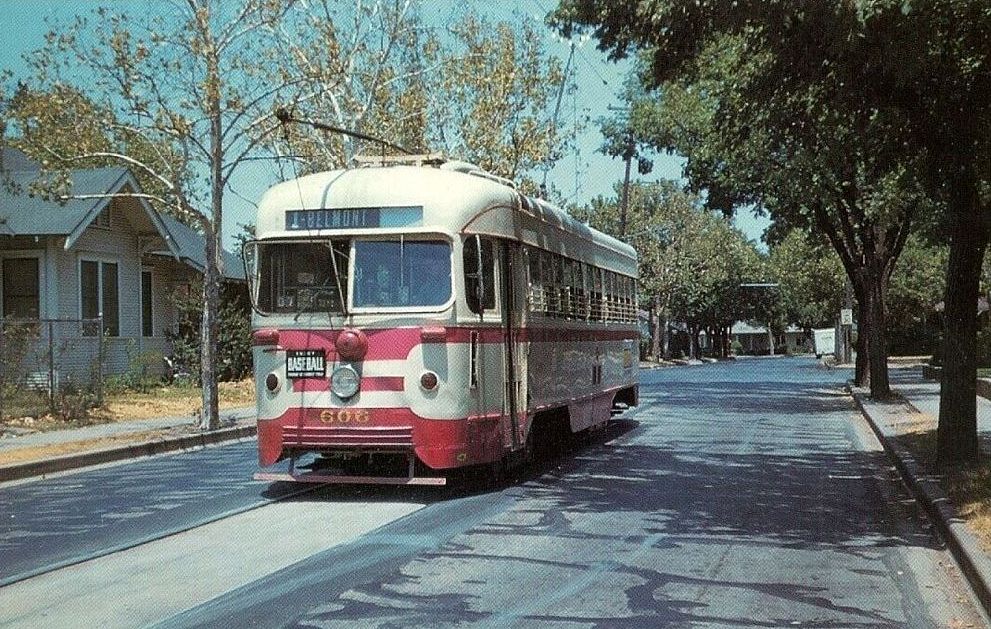
streetcar_belmont_color_ebayeBay

belmont-streetcar_new-moon_1940_palace_ebay1940, eBay

belmont-streetcar_1954_ebay1954, eBay

*

Copyright © 2018 Paula Bosse. All Rights Reserved.
Oakland Cemetery

oakland-cemetery_postcard

by Paula Bosse

A beautiful postcard showing the gates of Oakland Cemetery emblazoned with the name of one of Dallas’ most prominent funeral directors, George W. Loudermilk.

oakland_loudermilk_dmn_060102Dallas Morning News, June 1, 1902

ad-loudermilk-funeral-home_19061906 ad

loudermilk_dmn_071912DMN, July 19, 1912

***

Sources & Notes

More on historic Oakland Cemetery, in South Dallas:

  • Wikipedia, here
  • Dallas Genealogical Society, here
  • Oakland Cemetery website, here
  • A lovely YouTube video filled with photographs of the cemetery and its markers, here

You can explore parts of the cemetery by touring via Google Street View, here.

*

Copyright © 2018 Paula Bosse. All Rights Reserved.
The Adolphus Hotel’s “Coffee Room” — 1919


coffee-room_adolphus_tea-and-coffee-trade-journal_march-1919_photo
Jonesing for some java? Belly on up…

by Paula Bosse

You know who was really, really happy about Prohibition? The coffee, tea, and soft drink industries. In fact, they were absolutely giddy. And, believe it or not, Dallas County prohibited the sale of alcohol even before much of the rest of the country — Dallas became officially “dry” in October 1917.
Have you ever wondered what happened to the nation’s thousands and thousands of bars when it became illegal in the United States to sell alcoholic beverages? What about all the hotel bars? Apparently, many hotels renovated their old bars into something new and novel called a “coffee shop” or a “coffee room.”

The photo above shows what the vested interests of The Tea & Coffee Trade Journal deemed “the coffee room” of the elegant Adolphus Hotel.

coffee-room_adolphus_tea-and-coffee-trade-journal_march-1919Tea & Coffee Trade Journal, March 1919

Yes, there were coffee urns, and coffee was certainly sold there, but it was actually the Adolphus Lunch Room. Though beverages are not mentioned in the menu seen below, it’s interesting to read what dishes were available to the Adolphus visitor in 1919 (of course the really well-heeled guests were not noshing in a lowly — though quite attractive — “lunch room”). The most expensive item on the menu is the Adolphus Special Sunday Chicken Dinner for 90¢ (which the Inflation Calculator tells us is the equivalent of about $13.00 today). (Click to see a larger image.)

adolphus_lunch-room_menu_dec-1919
Dec. 1919

And, yes, I believe that is a spittoon at the register.

**

I wonder if that “coffee room” later became the Adolphus barbershop (seen below)? Or maybe the barbershop became the coffee room?

adolphus-barber-shop_childers_adolphus-archives

***

Sources & Notes

Photo from the article “The Renaissance of Tea and Coffee” from The Tea & Coffee Trade Journal (March 1919). See other photos and read how Prohibition was spurring on this alcohol-free “renaissance” in the article, here.

Photo of the Adolphus barbershop appeared in the book Historic Dallas Hotels by Sam Childers, credited to the Adolphus Archives.

Many, many historical photos of spittoons can be found in this entertaining collection of the once-ubiquitous cuspidor. …Because when else will I be able to link to something like this?

As a sidenote, the Adolphus Hotel was, of course, built by and named for Adolphus Busch, the co-founder of Anheuser-Busch. Mercifully, the beer magnate died pre-Pro — before Prohibition.

*

Copyright © 2018 Paula Bosse. All Rights Reserved.