Flashback : Dallas

A Miscellany: History, Ads, Pop Culture

Category: 1930s

Dealey Plaza and The Triple Underpass Under Construction — 1935

dealey-plaza_triple-underpass-construction_1935_fitzgeraldCleared for construction…

by Paula Bosse

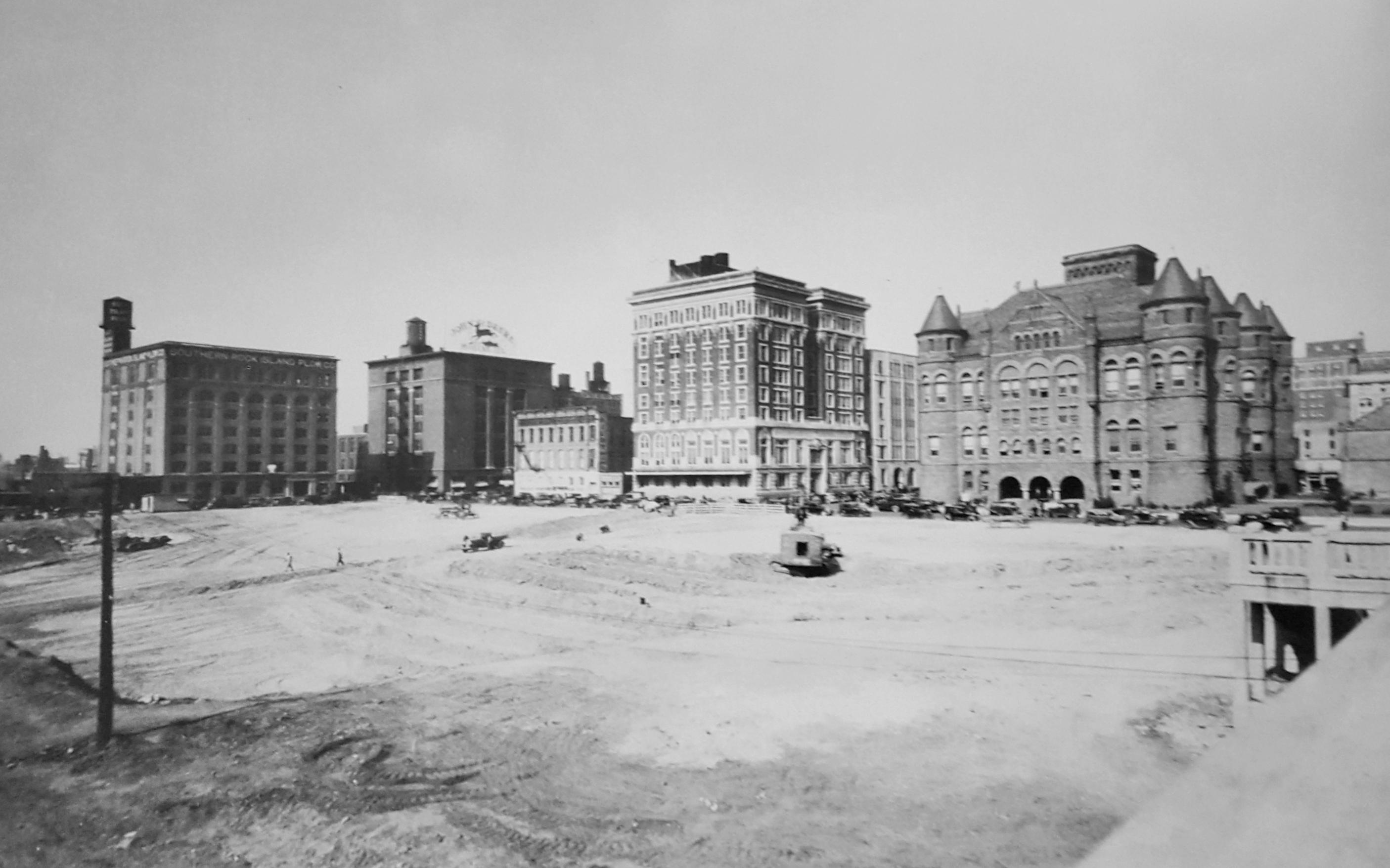
Dealey Plaza and the triple underpass were envisioned as an impressive “Gateway to Dallas” — for visitors arriving from the west, this attractive and welcoming sight would be their first impression of the city. Construction was completed in 1936 as the city was preparing for its mammoth Texas Centennial celebration. Little did anyone know back when these photos were taken in 1935 that “Dealey Plaza” and “Triple Underpass” would one day be place names known around the world and that the not-at-all remarkable Southern Rock Island Plow Co. building seen in both of these photos would become a must-see site for almost every out-of-town visitor to the city.

triple-underpass-under-construction_1935_m-c-toyerTriple Underpass and pedestrian tunnel under construction

***

Sources & Notes

The top photo, showing the cleared land that will become Dealey Plaza is from The Hayes Collection, Dallas Public Library Texas/Dallas History and Archive Division; I found it in the book Dallas Then and Now by Ken Fitzgerald (San Diego: Thunder Bay Press, 2001).

Bottom photo showing the “triple underpass and south pedestrian tunnel under construction” was posted by M. C. Toyer in a very interesting Phorum discussion on this area (with a lot of great photos), here.

Below are related Flashback Dallas posts:

  • More on Dealey Plaza can be found here.
  • More on the Triple Underpass can be found here.
  • More on the John F. Kennedy assassination can be found here.

*

Copyright © 2015 Paula Bosse. All Rights Reserved.

When a Virgin Sacrifice at Fair Park Almost Caused an International Incident — 1937

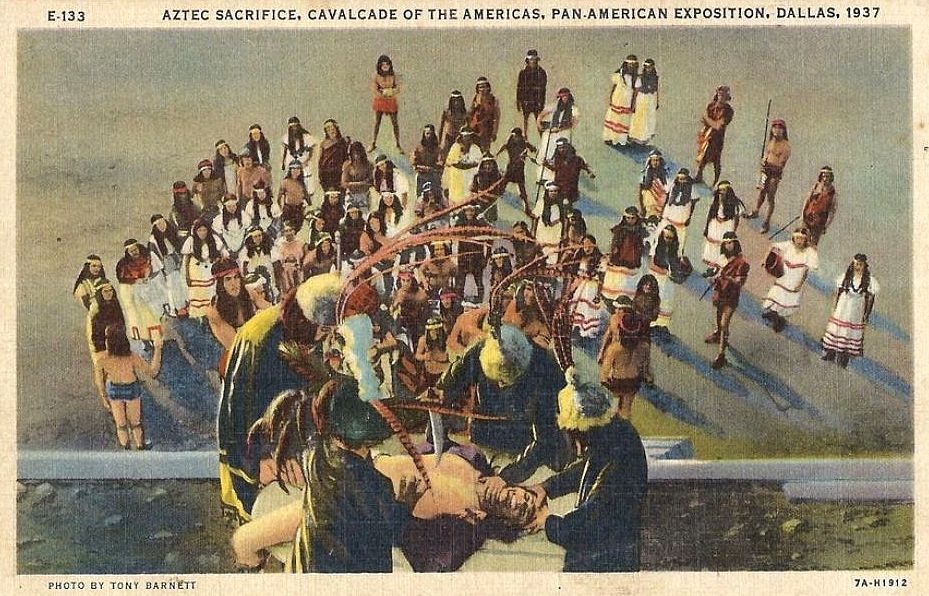
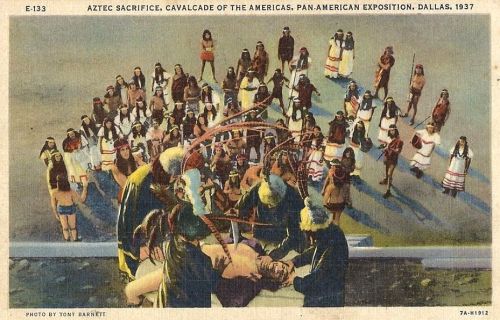
pan-american_aztec-sacrifice_colteraAztec sacrifice with a warrior, not a virgin, on the official postcard

by Paula Bosse

The Greater Texas and Pan-American Exposition at Fair Park was a four-and-a-half-month extravaganza which opened in June, 1937 as a follow-up of sorts to the previous year’s Texas Centennial Celebration. According to promotional material, its goal was to celebrate the Americas and “to promote the feeling of international goodwill between the twenty-one independent nations of the New World.” (It was also hoped that the city could rake in some more Centennial-sized cash.)

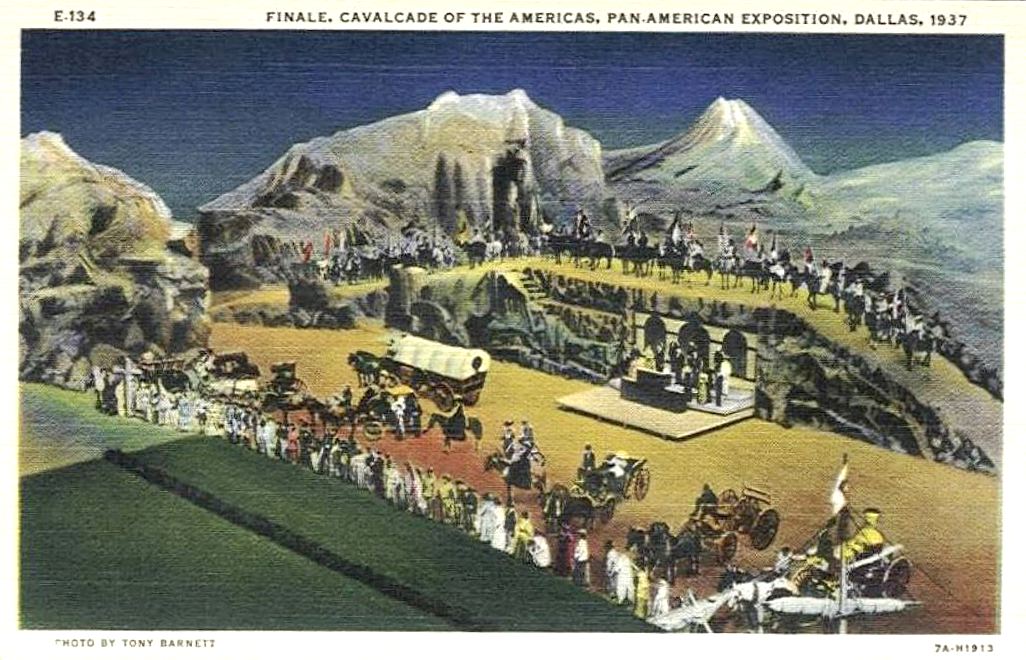
One of the biggest attractions of the Pan-American Expo was a huge production called Cavalcade of the Americas, which presented highlights from the history of Latin America and the United States. There were scenes from ancient Mexico, Columbus’ landing, the Revolutionary War, Stephen F. Austin’s arrival in Texas, the settling of the Old West, etc., right up to FDR’s participation in the Inter-American Peace Conference in Argentina in 1936. Utilizing much of the same infrastructure as the previous year’s Cavalcade of Texas, it was staged outdoors, in the old racetrack, with a 300-foot stage and elaborate scenery depicting an ocean, mountains, and a smoking volcano. Horses, wagons, “ships,” and a cast of hundreds took part in the production.
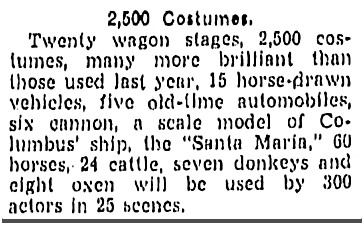
cavalcade-americas_FWST_060637Fort Worth Star-Telegram, June 6, 1937

It was quite elaborate. The postcard view below will give you an an idea of the scale of what was being billed as the world’s biggest stage.(I  believe the whole thing revolved — or at least part of it did — with another stage on the side facing away from the audience; the scenery, cast, and perhaps the donkeys, would change out before revolving to face the audience.)
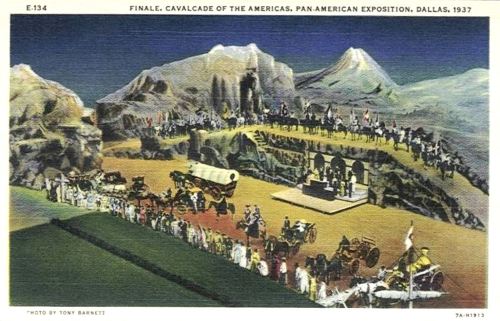
cavalcade_1937

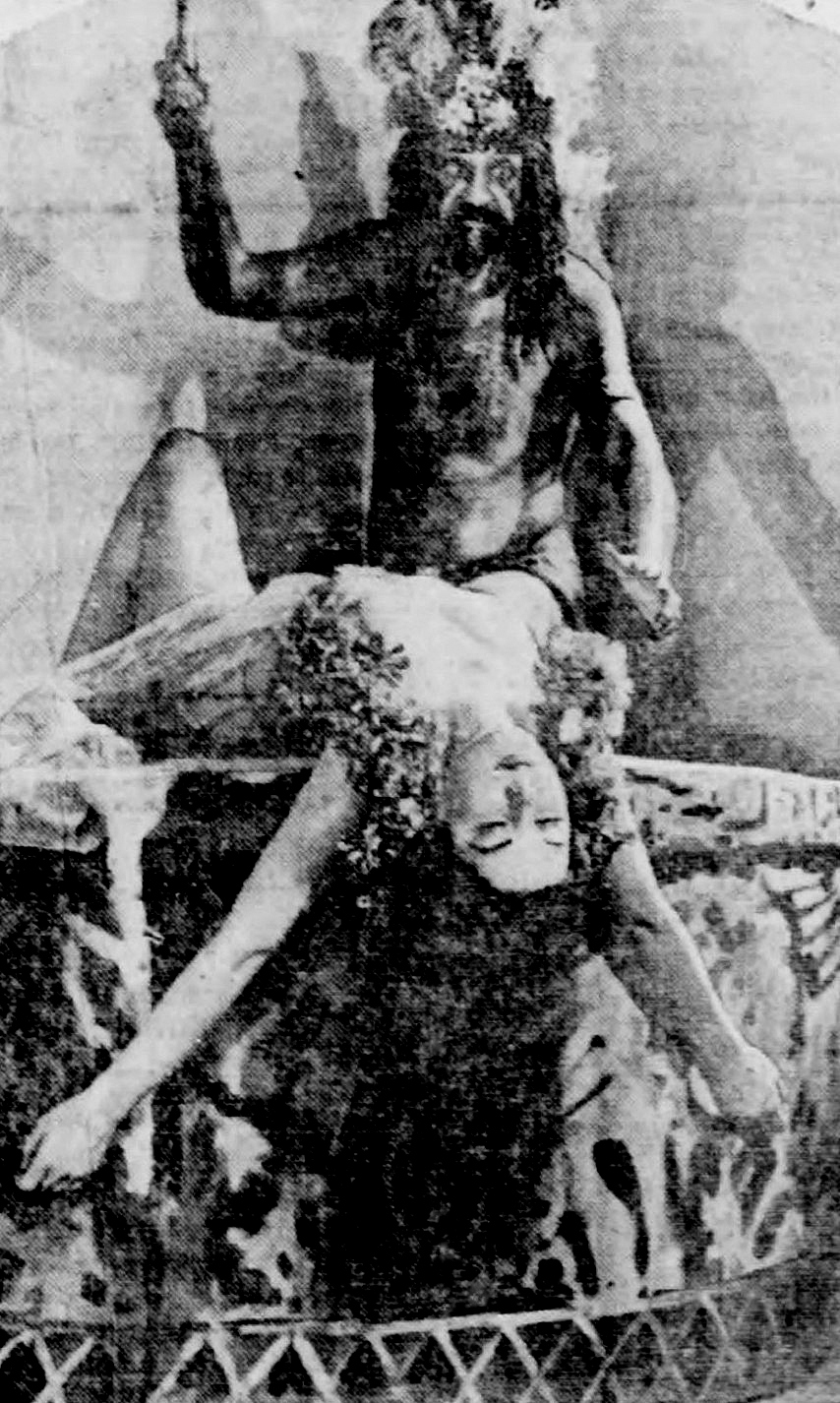
The opening scene featured an Aztec sacrifice and an angry volcano. Start big! This relatively brief portion of the show caused a lot of headaches (and/or much-welcomed publicity) for the producers, State Fair organizers, and, probably, the image-conscious Dallas Chamber of Commerce. But why? As originally written (by the remarkably prolific Jan Isbelle Fortune), the Aztec sequence involved the sacrifice of a struggling young maiden atop a blood-stained pyramid. Two months before the opening of the Expo, a rather sensationalistic photo of this historical reenactment appeared in the pages of newspapers across the country, no doubt resulting in raised eyebrows and whetted appetites. (Click to enlarge!)
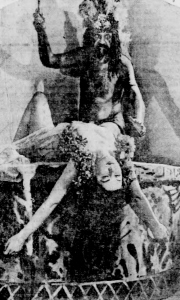
aztec_greencastle-indiana-daily-banner_080437Greencastle (Indiana) Daily Banner, 1937

The star of this scene was 17-year-old Geraldine Robertson, who had been crowned Queen of the Centennial the previous year and who played a multitude of roles in the current production, including Cortés’ “lover and interpreter,” a young woman in a Boston Massacre scene, Martha Washington, and the wife of Jim Bowie. Here she is in real life in 1936, with Jean Harlow platinum-blonde hair, posing for one of a seemingly endless number of publicity photos.
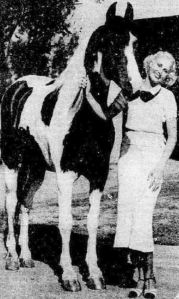
robertson-geraldine_queen-of-centennial_1936Geraldine Robertson, 1936

And the thing that caused so much trouble? Probably not what you would assume.

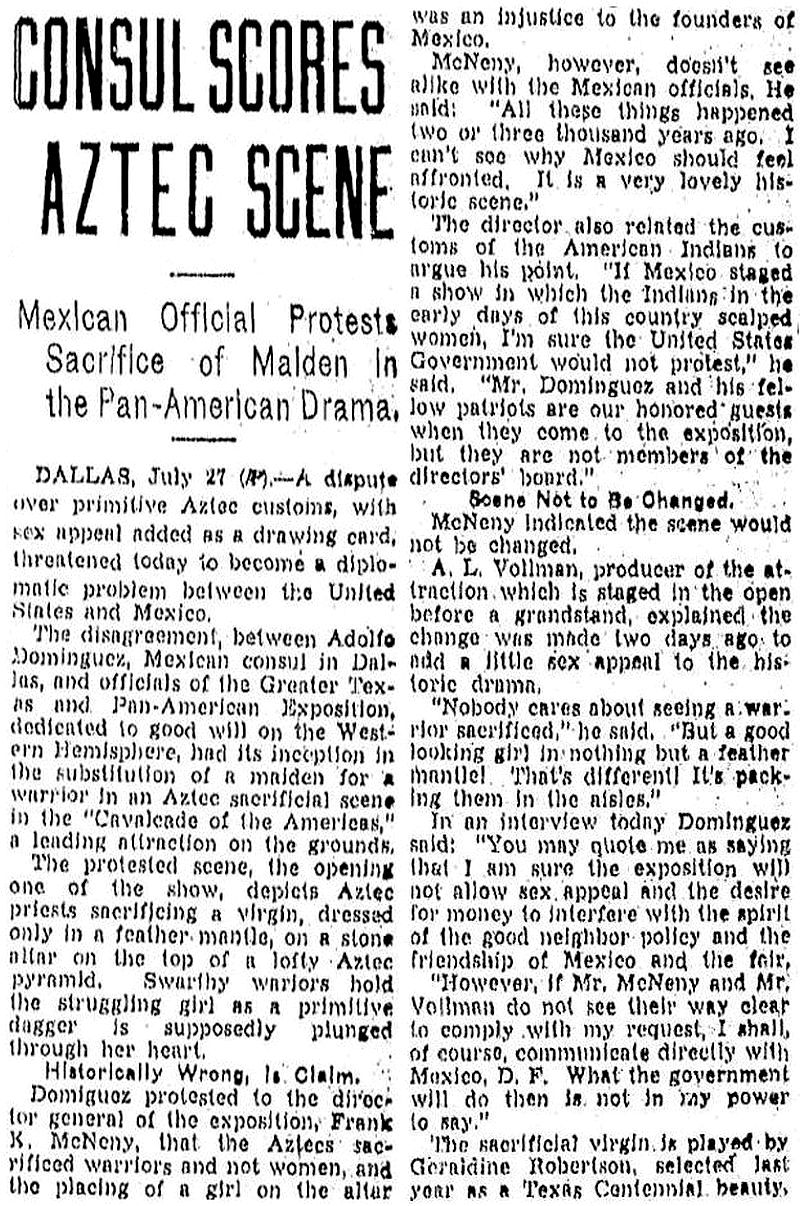
Before the Exposition opened, the Dallas-based Mexican Consul, Adolfo G. Dominguez, became aware of this casting choice. And that was when the mierda probably first hit the ventilador. Dominguez was adamant that the virgin be replaced with the more historically accurate male warrior. He probably said much the same thing to the Cavalcade producers when confronting them about his concerns before the Expo began as he did when he said this in a Dallas News article on the topic weeks later:

“We Mexicans feel that use of a girl in the role can bring nothing but racial prejudice and misconception of the true meaning of the Aztec human sacrifice as it was performed, not thousands of years ago, as has been wrongly represented, but as late as 1521.” (DMN, July 28, 1937)

The producers acquiesced, and when the Exposition began its run on June 12, 1937, the opening scene of the Cavalcade did, in fact, feature a sacrificial warrior. But on Sunday, July 25, the producer of the extravaganza brought the scantily-clad virgin back and nixed the warrior, hoping the added sex appeal and pizzazz would increase audience numbers. (Interestingly, when the Exposition opened, tickets to Cavalcade of the Americas cost 50⊄ — about $8.00 in today’s money — but on July 18, it was announced that, except for 600 reserved seats, admission to the show would be free. Promoters said this was being offered as a gesture of goodwill to Expo visitors, but one wonders if they weren’t having a hard time filling the 3100-seat grandstand.)

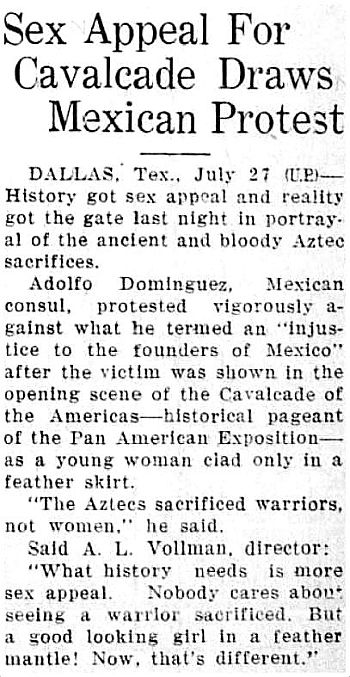
Señor Dominguez was not amused by this sexed-up revamping and protested. A. L. Vollman, the Cavalcade’s producer-director pooh-poohed the diplomat’s protestations and responded in true impresario fashion: “What history needs is more sex appeal.” That didn’t go over particularly well with the consul, who thought he’d already dealt with the problem weeks before. (Click to see larger image.)
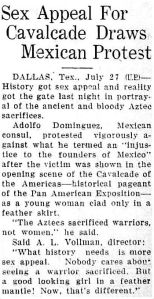
aztec_waxahachie-daily-light_072737Waxahachie Daily Light, July 27, 1937

Dominguez complained to Frank K. McNeny, Director General of the Exposition, saying that the scene was historically inaccurate and was an injustice to the founders of Mexico. McNeny disagreed, saying that the scene involving the plunging of a dagger into the breast of a sacrificial virgin was “a very lovely historic scene.” He declined to bring back the warrior, because, as Vollman noted, the revamping had increased attendance: “It’s packing them in the aisles.” An exasperated Dominguez said that if the change from maiden back to warrior was not made, he would take the matter to the Mexican government.
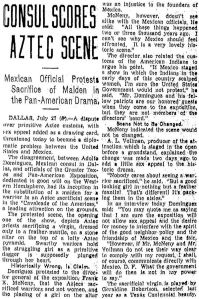
aztec_FWST_072837FWST, July 28, 1937

At this point, a disagreement over the gender of a character in what was, basically, an oversized school history pageant was dangerously close to setting off an international incident. It was also causing embarrassment for local civic leaders who were looking upon the Exposition as a major marketing tool for the city as well as a symbolic display of Pan-American solidarity and goodwill. Can’t we all just get along, amigo?

The refusal of the Cavalcade to UN-revamp the show did not deter the Mexican Consul who, by now, was probably more het-up than ever. Dominguez decided to go over McNeny’s head. He pulled out the written agreement he had made with fair officials back in the spring — which clearly stated that a male warrior and NOT a young woman would feature in the theatrical human sacrifice — and he took it to the top man, State Fair president Fred F. Florence. Florence discussed the matter with his board of directors who voted “to a man” to uphold the original agreement.

The warrior would be reinstated as the writhing victim on the bloody sacrificial stone. The sexy maiden would have to hand over the 30-foot-long robe, which had been made from 9,000 feathers and which had trailed behind her as she was carried up the great pyramid at Tenochtitlán. The actor playing the warrior was probably happy to get back in the spotlight. Geraldine Robertson, the virgin who had trailed that robe, was relegated to a role as a daughter of Montezuma.

Presumably the dagger kept plunging into the flailing warrior’s heart twice nightly for the remainder of the show’s run, and the memory of that short-lived international squabble was quickly forgotten (…until now).

And they all lived happily ever after. / Vieron felices por siempre.
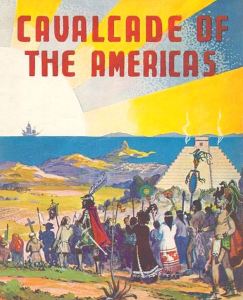
panamerican_cavalcade_watermelon-kid

*

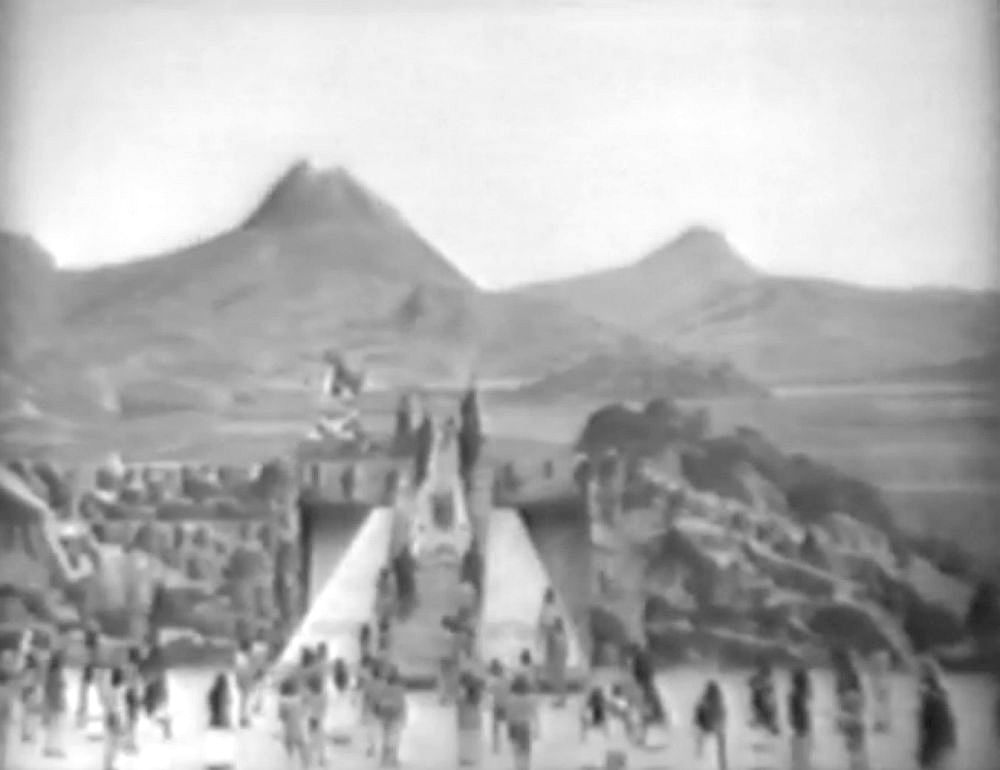
Hey! If you’ve read this far, here’s a little reward. A Universal Newsreel titled “Pan-American Exposition Is Opened For 1937, Dallas, Tex.” — which contains 20 whole seconds of the Aztec (warrior) scene!  — can be viewed on the T.A.M.I. (Texas Archive of the Moving Image) site, HERE. The entire short newsreel is interesting (sadly, it has no sound), but if you want to jump to the sacrifice scene, it begins at the :49 mark. (If you’re watching on your desktop, make sure to click the little square just to the left of the speaker icon beneath the viewing area to watch it full-screen.
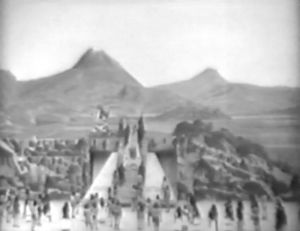
aztec_newsreelSuper-grainy screenshot from the Universal newsreel, 1937

***

Sources & Notes

Postcards of the Pan-American Exposition are from “the internet.”

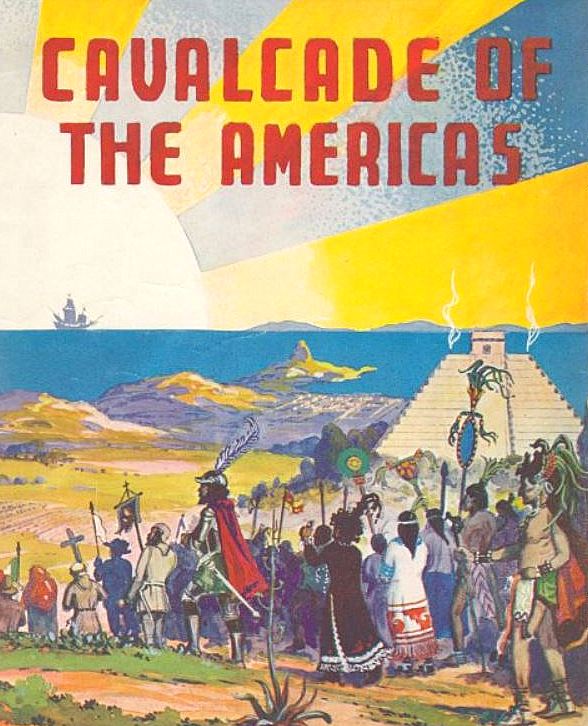
Color souvenir program image from the Watermelon Kid site; background on the Pan-American Exposition can be found on the same site, here.

All other clippings as noted.

Related Dallas Morning News articles:

  • “As Sacrificial Virgin, Star of Cavalcade Put In Showy Opening Act” (DMN, July 26, 1937)
  • “Cavalcade Dispute Is Won by Consul As Virgin Is Replaced” (DMN, July 28, 1937)

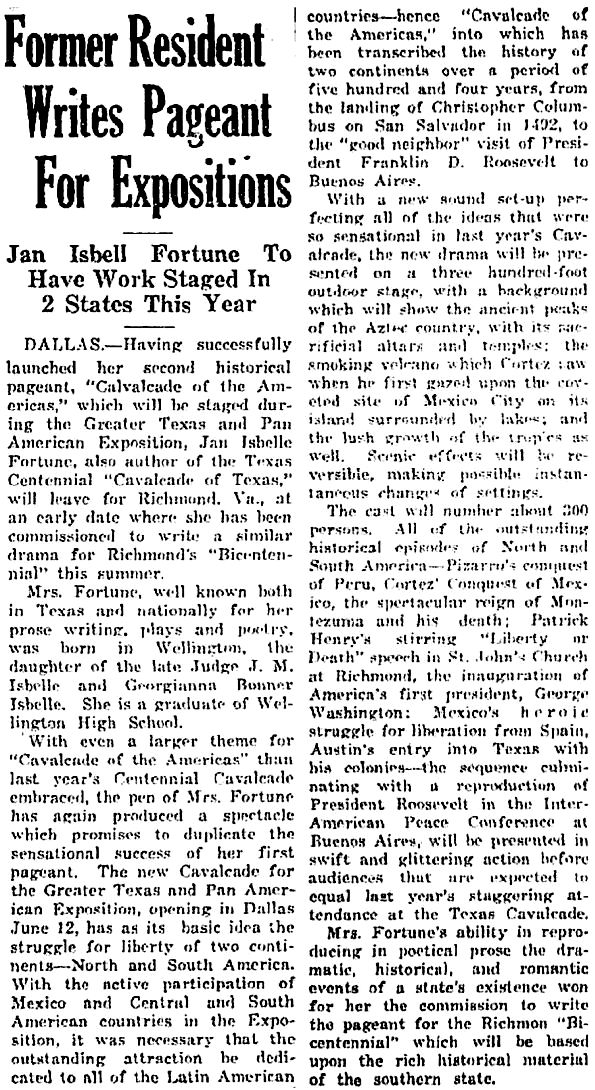
Below, an interview with Jan Fortune on her Cavalcade of the Americas; it appeared in her hometown newspaper, The Wellington (Texas) Leader on March 18, 1937. She also wrote the Centennial’s big production, Cavalcade of Texas, the previous year, in 1936.
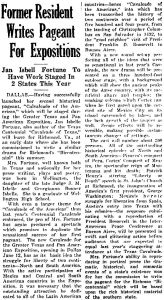
jan-isbell-fortune_wellington-tx-leader_031837

And, speaking of Aztec human sacrifices in DFW (a phrase I don’t believe I’ve ever written…), the following tidbit was contained in an article about Six Flags Over Texas’ 1970 season.
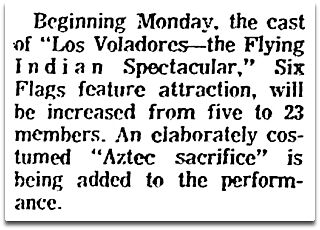
aztec_FWST_052170-six-flagsFWST, May 21, 1970

Promotional material about Los Voladores — a group of aerialists from Mexico — informs us that in their show “a beautiful maiden’s life is given as tribute to Tlaloc, the rain god.” Those beautiful maidens can’t catch a break. Sorry, Adolfo.

*

Copyright © 2015 Paula Bosse. All Rights Reserved.

Views of Dallas by Bruno Lore — 1931

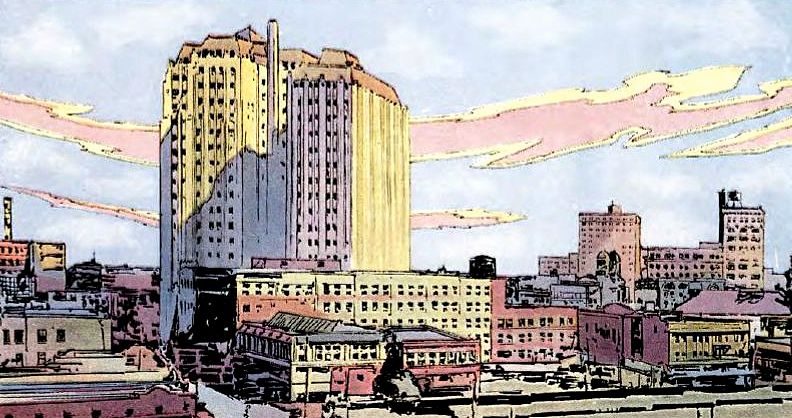
skyline_smu_1931Bruno Lore’s Dallas, in purples and pinks

by Paula Bosse

Bruno J. Lore (1890-1963) was a Fort Worth artist and illustrator who spent much of his career working for the Southwestern Engraving Company. Known as “the dean of Fort Worth commercial artists,” Lore had a long and successful career, counting among his many clients colleges and universities who commissioned him to create artwork for their yearbooks (and, perhaps as a friendly or persuasive perk, he was often asked to pick the campus beauties who would be featured in those same yearbooks). Even though information about Lore is scant, he seems to have had steady yearbook work, with his illustrations appearing in several Southern and Southwestern college annuals, primarily in the 1920s and ’30s. In Dallas, his artwork appeared in editions of SMU’s Rotunda.

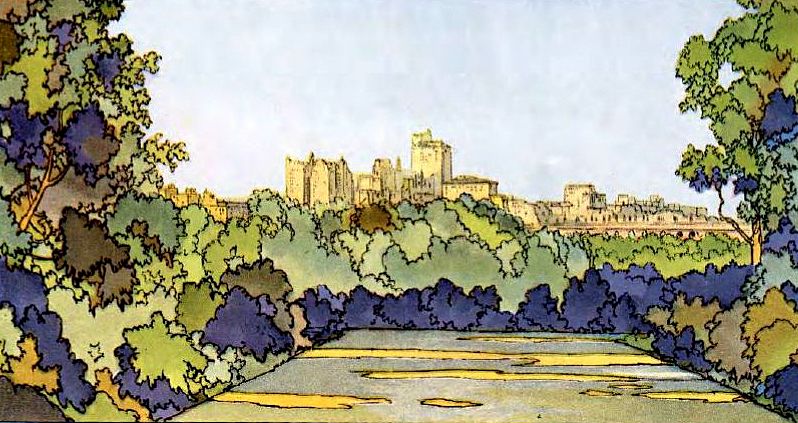
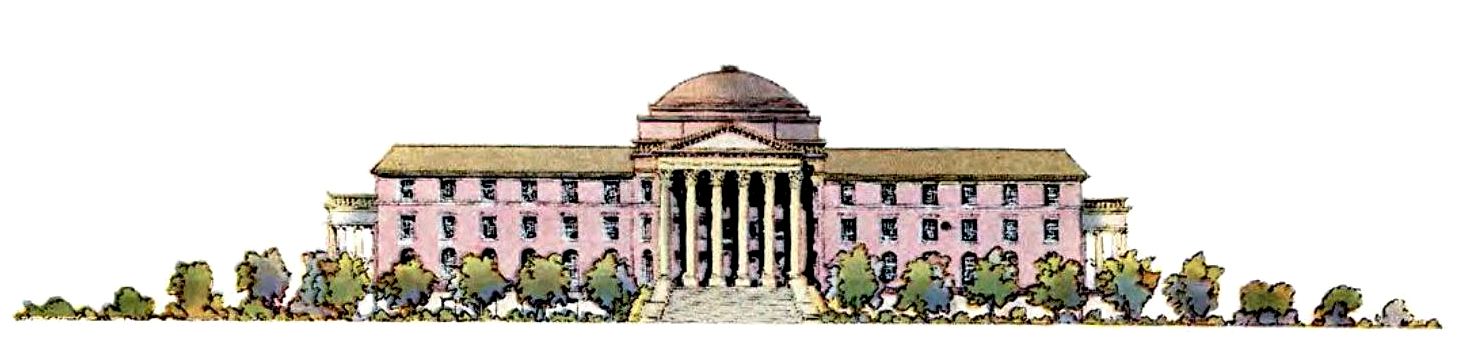
Below are Lore’s vividly colorful views of the SMU campus and the Dallas skyline which appeared in the 1931 Rotunda and provided a lively, modern exuberance to an otherwise fairly standard college yearbook.

rotunda_1931_advertising-header

smu-rotunda_1931-intto

dallas-hall_smu-rotunda-1931

skyline_smu-rotunda-1931

skyline-3_smu-rotunda-1931

skyline-5_smu-rotunda-1931

skyline-2_smu-rotunda-1931

skyline-6_smu-rotunda-1931

skyline-4_smu-rotunda-1931

skyline-8_smu-rotunda-1931

skyline-7_smu-rotunda-1931

saddleburr_smu-rotunda-1931

students_smu-rotunda-1931

smu-1931rotunda_1931_title-page

*

Lore was doing yearbook work (along with his other commissions) into at least the ’40s. His later years seem to have been focused on Western art, and he produced several paintings. He seems to be most fondly remembered by collectors as the artist who was responsible for several decades’ worth of Western-themed cover art for souvenir annuals of the Fort Worth Rodeo and the Southwestern Exposition and Fat Stock Show.

lore_FWST_012173Fort Worth Star-Telegram, Jan. 21, 1973

***

Sources & Notes

All artwork is from the 1931 Rotunda, yearbook of Southern Methodist University. The above illustrations are unattributed, but it seems fairly certain that they are by Bruno J. Lore, who is mentioned in the school’s newspaper, The Daily Campus, as providing the artwork for the 1931 Rotunda. This edition of the yearbook also contains eight somewhat more staid views of campus scenes in pencil or ink and wash which are attributed to Lore. Lore’s yearbook work was apparently done remotely, and he often worked from photographs.

*

Copyright © 2015 Paula Bosse. All Rights Reserved.
“The Fair Is In the Air — Let’s Go!”

state-fair_1923Look at this 1923 typeface!

by Paula Bosse

Here we are again in the final days of another State Fair of Texas. Why not take a look at a few random images of the fair over the years. (Click pictures for larger images.)

First, from 1900, the entrance to the fairgrounds. (It appears to be the same view as the top postcard seen in a previous post, here, just a few steps inside the archway.)

fairgrounds-main-entrance_bohemian_1900_fwplFort Worth Public Library

*

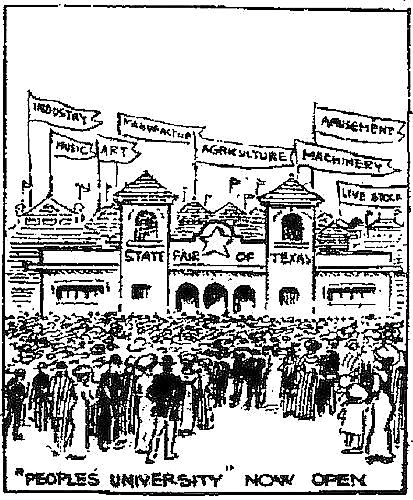
A cartoon from The Dallas Morning News in 1912 — “The People’s University.” Remember, it’s not just about Ferris wheels and candy apples.

state-fair_dmn_102012-cartoonDMN, Oct. 20, 1912

*

1921. Don’t miss The Whip.

state-fair_1921

*

From the Texas Centennial in 1936, a shot of a remarkably spotless Midway. (Am I the only one who would have paid to see the “28-Ft. Monster” do battle with whatever freakish specimens were ensconced within the walls of the Ripley’s Believe It Or Not building?)

tx-centennial-midway_1936_ebay

*

During World War II, no fair was held between 1942 and 1945. “Not until the boys come home, will there be another State Fair of Texas.”

state-fair_wwii_tx-almanac_1945-46

*

By the ’50s, everything was back to normal. Big Tex had arrived, and this ad promises “She’s a LULU in ’52.” Martin & Lewis and whatever a Thrillcade was!

state-fair_dmn_092552_lg

*

And, lastly, an aerial view of the Midway from 1966. Now this IS all Ferris wheels and candy apples. (To watch a short collection of color footage from the damp 1967 SFOT — including a sad, rainy parade downtown — click here.)

state-fair_1966_UNTUniversity of North Texas

***

Sources & Notes

1900 photo of the entrance to the fair is from The Bohemian magazine (1900) in the collection of the Fort Worth Public Library (those perforations in the photo are the FWPL’s).

1921 photo — I’m afraid I have no source on this one.

1936 postcard of the Centennial Midway is from eBay.

Patriotic WWII ad is from the 1945-1946 Texas Almanac.

Photo of the 1966 Midway is from the University of North Texas University Libraries blog, here.

My previous collection of SFOT photos over the decades appeared in the post “So Sorry Bill, But Albert Is Taking Me To The State Fair of Texas,” here.

Other Flashback Dallas posts on the State Fair of Texas are here; posts specifically on the Texas Centennial are here.

Again … some of these pictures are pretty dang big — when in doubt, click ’em!

*

Copyright © 2015 Paula Bosse. All Rights Reserved.


Texas Texas Texas Texas Texas Texas Texas — 1930

woodrow_texas-endpaper_1930-yrbk

by Paula Bosse

Cool endpaper from the 1930 Woodrow Wilson High School yearbook.

I really like this, for a variety of reasons:

  • I have a book background, and I love unusual decorative endpapers and bookplates.
  • I love Texas kitsch (which I’m going to say this is, even if that wasn’t the original intent).
  • I’m a Woodrow alum.

Thank you, anonymous budding (or professional!) typographer!

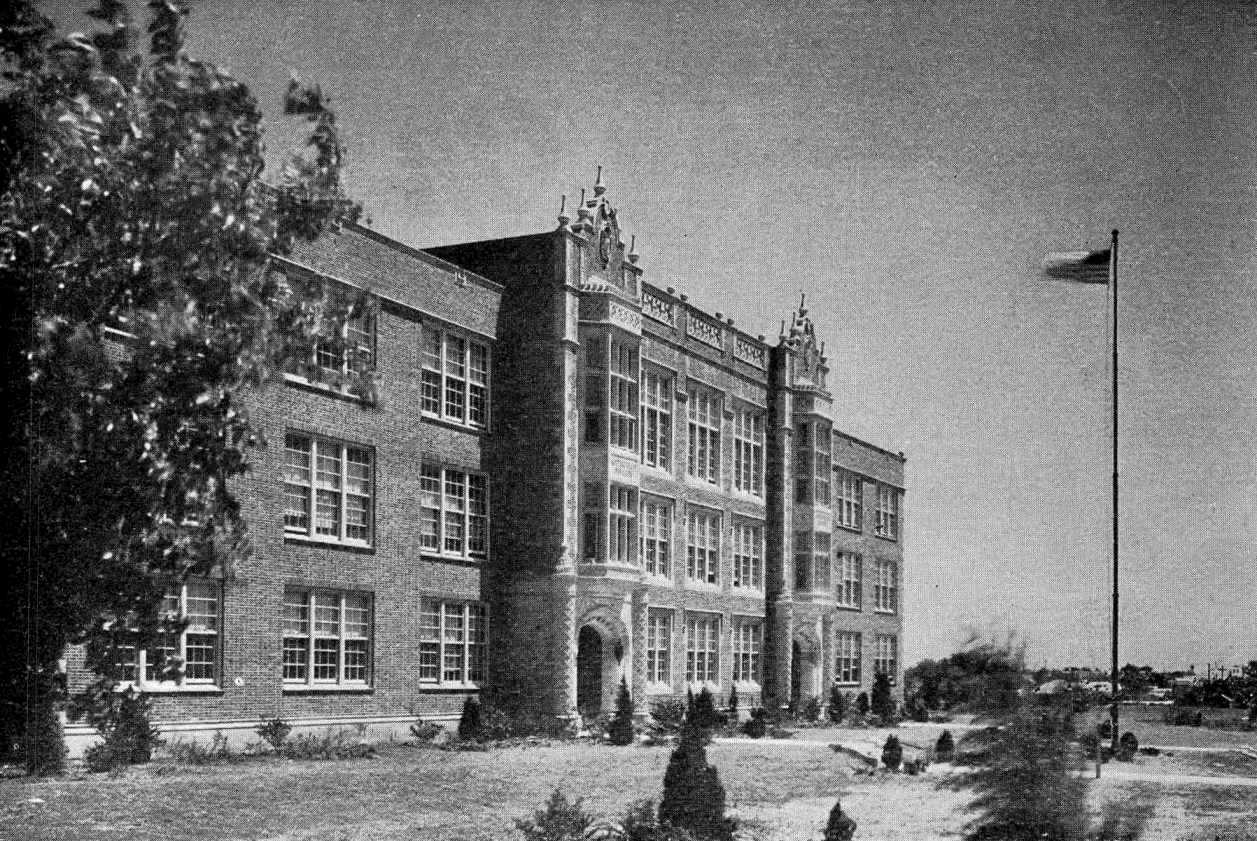
While we’re at it, here’s the rather oddly and unattractively landscaped school in 1930. (All those “Texases” and no Texas flag?!)

woodrow_1930-yrbk

***

Sources & Notes

Both images from the 1930 Woodrow Wilson High School yearbook, The Crusader.

*

Copyright © 2015 Paula Bosse. All Rights Reserved.

The Idle Wild Social Club: Life Magazine Presents Black Debutantes — 1937

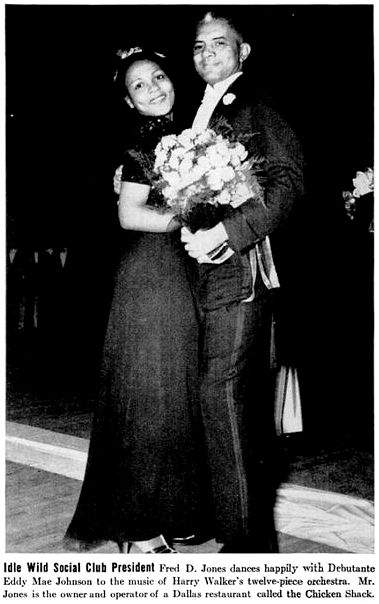
debs_life_120637-detThree of 1937’s debs (click for larger image and caption)

by Paula Bosse

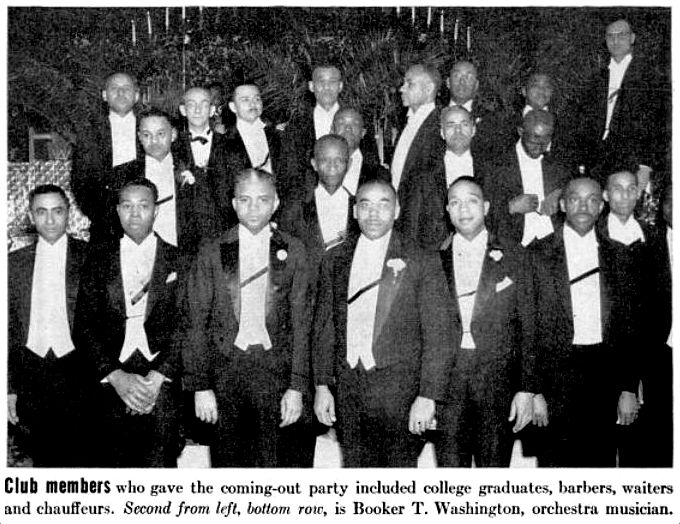
In December of 1937, something appeared in a national mainstream magazine that had probably never appeared before: photographs of a society ball celebrating African-American debutantes. In the December 6, 1937 issue of Life magazine — in the recurring “Life Goes To a Party” pictorial feature — four pages were devoted to coverage of the annual Idle Wild Social Club ball (later Idlewild Social Club, and later Cotillion Idlewild Club — none of which is to be confused with Dallas’ 130-plus-year-old super-exclusive, white Idlewild Club). The letters this unusual pictorial elicited were either congratulatory or, dismayingly, shocked and irate. Although today these photos are nothing unusual, in 1937, to see African-Americans depicted in a magazine such as Life as just normal, everyday Americans, was exceedingly uncommon. To see photos of black high-society must have made people’s heads explode. So kudos to Life for running the only slightly patronizing story and for publishing some wonderful photographs.

life_debs_120637_aLife magazine, Dec. 6, 1937

*

The Idle Wild Social Club was started in Dallas around 1918 by a group of socially well-placed black men — perhaps as a response to the white Idlewild Club. By the early 1920s they, like the white club, were presenting the cream of the crop of their young women to society in debutante balls. The ball covered by Life took place on November 18, 1937. The women making their debuts were:

  • Eddy Mae Johnson
  • Glodine Marion Smith
  • Lorene Marjorie Brown
  • Gladys Lee Carr
  • Gladys Lewis Powell
  • Hattie Ruth Green

life_debs_120637The debs and their escorts (Life, Dec. 6, 1927)

life_debs_120637-club-membersClub members (Life, Dec. 6, 1927)

life_debs_120637-crowd“Social chitchatterers” (Life, Dec. 6, 1927)

life_debs_120637-couple(Life, Dec. 6, 1927)

Read the article and see additional photos featured in this pictorial here.

There was an outcry in response to the article, and some of it was shockingly ugly — read the letters to the editor about the “Negro Ball” that Life published in the next issue, here (use the magnification tool at the top of the page to increase the size of the text).

Here is the more progressive response, from the Jan. 1938 issue of the NAACP’s magazine, The Crisis:

the-crisis-mag_jan-1938

Progress moves at a snail’s pace, but if coverage of a debutante ball can help to move things forward even a step or two … great!

***

All photos from Life magazine, Dec. 6, 1937; the scanned article (and, in fact, the entire scanned issue) is here.

The January, 1938 issue of The Crisis is available online; the page featuring the editorial is here. (This issue also has an interesting article, “Free Negroes In Old Texas” by J. H. Harmon, Jr., here.) The Crisis Wikipedia page is here.

To read coverage of earlier Idle Wild Social Club balls — published in the black-owned Dallas Express — see this from 1922, and this from 1923.

The African-American debutante ball has been called Cotillion Idlewild for many years now; information on their 2014 ball is here. (Again, this is not to be confused with the (white) Idlewild Club, which has been throwing heart-stoppingly elaborate balls in Dallas since the 1880s.)

Apparently there is a history of the club out there — Idle Wild Social Club History (1940) — and, according to WorldCat, appears to be available at nearby libraries.

Personally, I don’t really “get” debutante balls, but growing up in Dallas, I know that they’ve always been big, big, BIG deals. A. C. Greene’s snarky article “Social Climber’s Handbook” (D Magazine, October, 1976), is both amusing and informative; read it here.

*

Copyright © 2015 Paula Bosse. All Rights Reserved.


Ebby Halliday, 1911-2015

ebby_1957_big-d_cowboy-hat_via-candys-dirt
Ebby in Big D, 1957… (photo: Ebby Halliday Realtors)

by Paula Bosse

(Feb. 2019: This post has been expanded since its original publication on Sept. 9, 2015.)

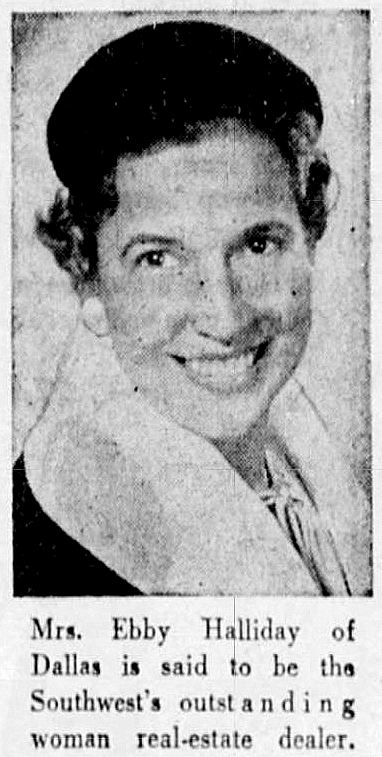
Ebby Halliday — the Dallas realtor known instantly by just her first name — died September 8, 2015 at the age of 104. Ebby was not only stunningly successful in the world of Dallas real estate, she was also something of a pioneer in paving the way for other women to establish and find great success in business. There are several obituaries that will present a more complete overview of her life (see links at the bottom of this post), so I’ll just post a few odds and ends that have caught my attention.

*

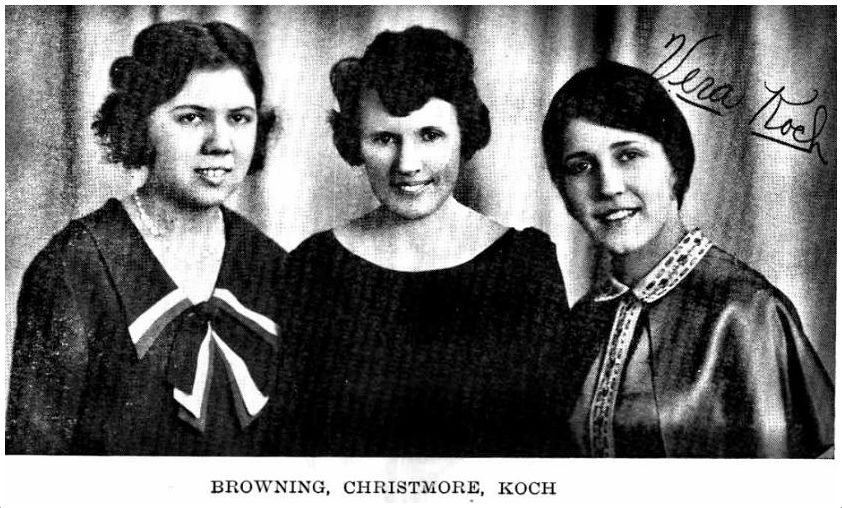
Vera Lucille Koch grew up in Kansas, and according to her 1929 Abilene High School yearbook, she was inordinately active in all sorts of clubs and sports. Here are a couple of photos from that yearbook (most images are larger when clicked); the first one shows her with the debate team.

ebby_debate-club_AHS-1929

And the second one shows her with her “Forensics” teammates (she excelled in reading competitions, although I’m not exactly sure what that means, as most “forensics” events involve debating). Rather amazingly, this scanned yearbook has her signature!

ebby_forensics-team-reading_AHS-1929

These two extra-curricular activities served her well in her later career — she obviously learned a lot about the effectiveness of persuasion at an early age.

After school, she spent several years working in department stores selling women’s fashions (including a stint in Omaha, where a vivacious young Vera can be seen in a  fantastic photo posted by D Magazine here). Ultimately she arrived in glamorous Dallas around 1938, where she began life as a Dallasite managing the women’s hat department at the downtown department store W. A. Green. Most accounts have her entering the real estate business while still selling hats, soon after the war — almost by a fluke. Legend has it that one of her customers mentioned to her husband, famed oilman Clint Murchison, that he might want to utilize Ebby’s sense of style by having her decorate a few of his newly-built houses in Far North Dallas in order to increase sluggish sales; she was apparently so successful at this that she decided to pursue selling houses on her own and eventually established her own realty company.

*

I’ve always wondered about the name “Ebby” — what was it short for? Ebby Halliday is the only Ebby I’ve ever heard of. Turns out that she made the name up, sometime between graduating from high school in Kansas and coming to Dallas. In a 1983 Dallas Morning News interview, she explained how Vera Lucille Koch became “Ebby Halliday”:

“I was selling hats when one of the buyers who I admired a great deal told me I had to get rid of  Vera Lucille. She said it was the silliest name she’d ever heard. I needed something more sophisticated. I thought about it and came up with the name Ebby. That sounded very, to me, like I had a lot of class.” (DMN, Sept. 25, 1983)

The  paragraph ended with two sentences added by the writer of the article:

The name Halliday came from an early first marriage. That husband is now deceased.

The somewhat dismissive tone of those last two lines is interesting, because that husband, Claude W. Halliday — whom she appears to have married in 1947 (although an earlier marriage license for the couple had been issued in 1945 in New York) — is almost non-existent in newspaper searches. C. W. Halliday (1908-1965) was described in a 1957 article about Ebby as being “engaged in an investment and building corporation.” In his 1965 obituary, C. W. was described as “head of C. W. Halliday Realtors and a partner in Ebby Halliday Realtors.” When C. W. died in 1965 — several years he and Ebby had divorced (and the same year Ebby married Maurice Acers) — it was Ebby who acted as informant on his death certificate. Mr. Halliday’s real estate career began about 1946, a year or so before Ebby opened her own retail millinery business. Ebby and C. W.’s marriage lasted for over 12 years, but most traces of him seem to have vanished into the ether.

But back to the name “Ebby.” When the former Vera Lucille Koch arrived in Dallas around 1938 to work at the W. A. Green department store, she was listed in the city directory as “Mrs. Vera Eberhardt.” I’m not sure where the “Mrs.” came from (had she been married before she arrived in Dallas?), but it’s certainly easy to see that “Ebby” probably came from “Eberhardt,” a name which was either a husband’s surname or the name she described as having created for herself because it sounded sophisticated.

eberhardt_vera_ebby_1939-directory1939 Dallas directory

In June, 1940, 29-year-old Ebby married KRLD broadcaster Royce H. Colon. Their marriage lasted only a few years, but it was during this time that the city directory shows her using the name “Ebby” professionally, while still working at Green’s.

colon_ebby_1940
Mrs. Royce Colon, 1940

colon_1941-directory
1941 Dallas directory

colon_1942-43-directory1942-43 Dallas directory

In Mr. Colon’s 1975 obituary it was stated that he had begun his career in real estate (with Majors & Majors Realtors) at a time which would have coincided with the years he and Ebby were married. This is to take nothing away from Ebby’s incredible accomplishments, but if that were the case, it seems that she might have had some (at least rudimentary) background in real estate before Clint Murchison asked her to spiffy-up some new houses he was having trouble unloading. It’s possible she may have entered her new profession with more in her quiver than simply a flair for interior decoration. Ambition may have seemed unladylike and immodest for a “career gal” in the 1940s, even for someone as independent and focused as Ebby. I wonder if her “origin story” might have been softened a bit to play down her ambition? Whatever the case, it didn’t take Ebby long to make her mark on the world of Dallas real estate, and, in so doing, establishing for herself a national reputation as both a top realtor as well as a major inspiration and mentor for women in business. 

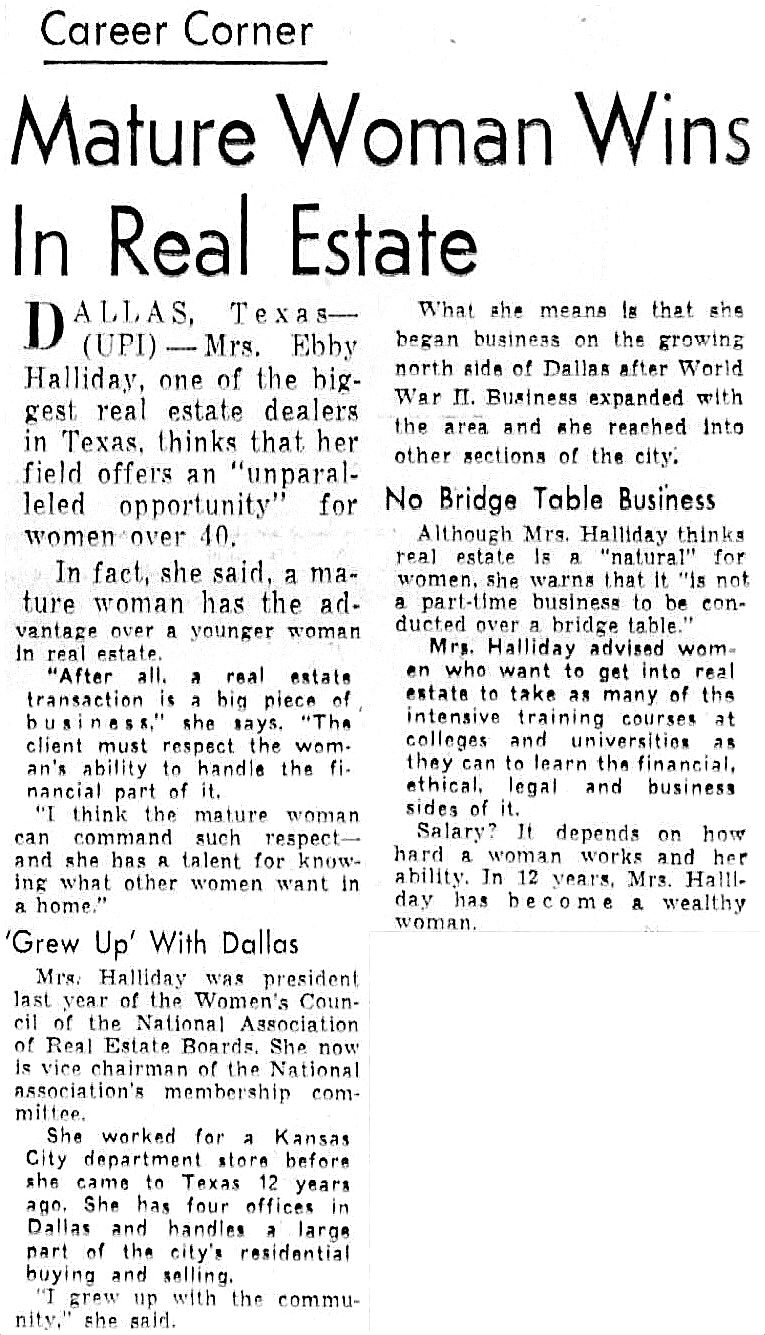
Below is the type of article about Ebby Halliday’s accomplishments which ran constantly throughout her career. (Most images in this post are larger when clicked.)

ebby-halliday_tennessean_090758_upi-wire-story
The Tennessean, Nashville, TN, Sept. 7, 1958

*

But back to that hat shop.

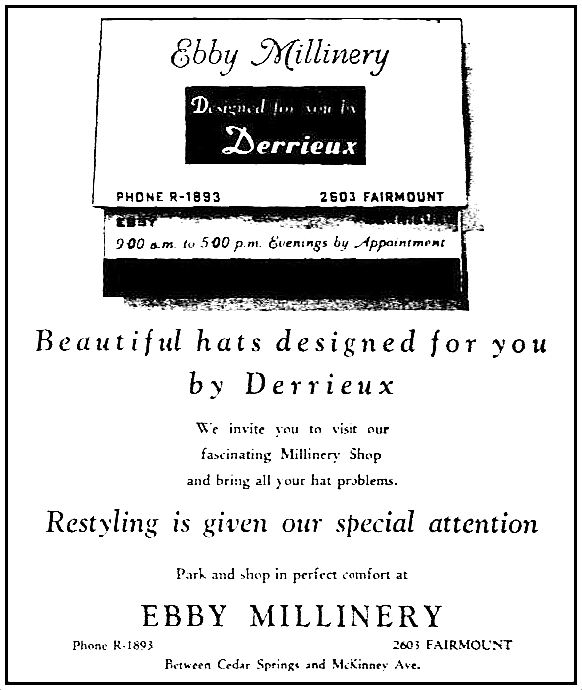
The first mentions I found for the shop Ebby Millinery (one of several boutique shops which operated in the still-beautiful old home at 2603 Fairmount), were in August, 1947 — an article in The Dallas Morning News described the shop as having “opened recently.” Ebby (who had recently become Mrs. C. W. Halliday) opened the shop in partnership with Dallas hat designer Annabelle Derrieux Bradley.

ebby-millinery_081047
Aug. 10, 1947

The shop’s bold decoration sounds … bold:

…Ebby Millinery’s French Room is decorated with bottle green walls and carpets and accented with striped drapes of deep shocking pink and chartreuse. The designing room has a touch of the Victorian with frilly white curtains and oversized wallpaper roses against a bottle-green background. (DMN, Aug. 20, 1947)

ebby-millinery_102647
Oct. 26, 1947

When Ebby decided to pursue her new real estate business full-time, Derrieux and her husband took over the shop and eventually renamed it Derrieux Hats.

*

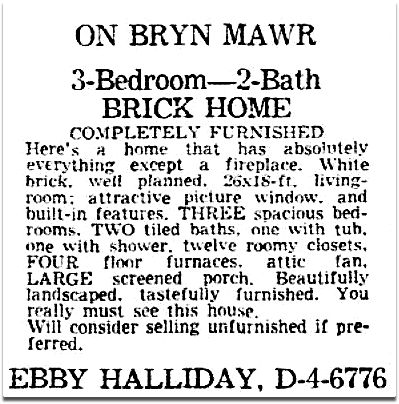
The first real estate ad I could find that featured Ebby’s name is this one, from 1948:

ebby_dmn_080548DMN, Aug. 5, 1948

And she was off like a rocket.

**

Below are a few photos of Ebby I’ve come across which I particularly like.

ebby_1956_charm_via-candys-dirt1956, Charm magazine (“the magazine for women who work”) (via Candy’s Dirt)

*

ebby-halliday_louisville-KY-courier-journal_092257Louisville (KY) Courier-Journal, Sept. 22, 1957

*

ebby-halliday_austin-statesman_012566
Austin Statesman, Jan. 25, 1966

*

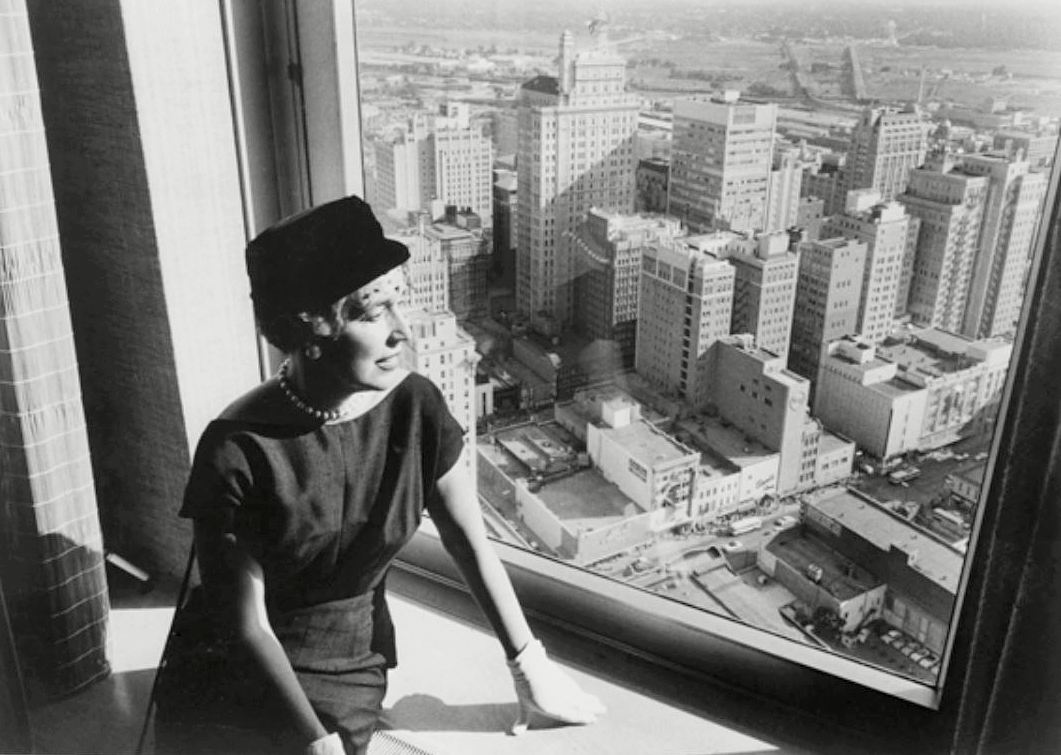
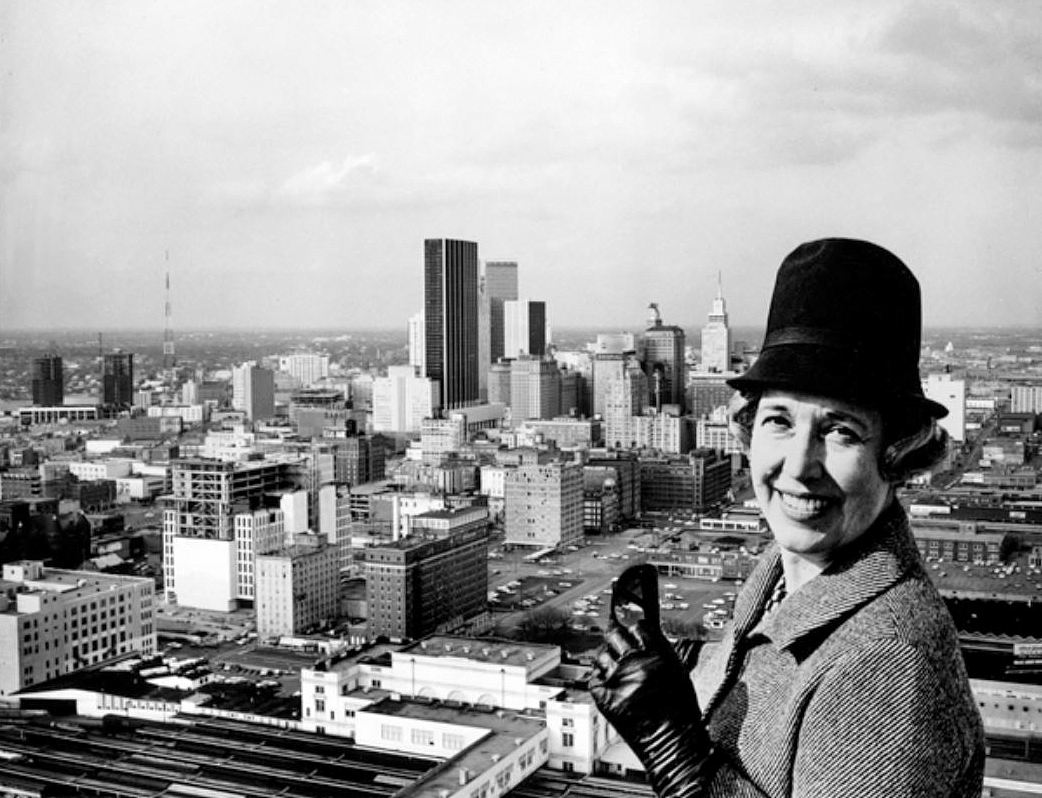
ebby_dallas-skyline1966 (via Candy’s Dirt)

This photo is interesting because a version of it appears in the May 15, 1966 edition of the Sydney Morning Herald under the headline “The Texas Millionairess” with one slight difference: instead of posing above the Dallas skyline, she is shown posing above the Sydney skyline while on a trip to Australia.

*

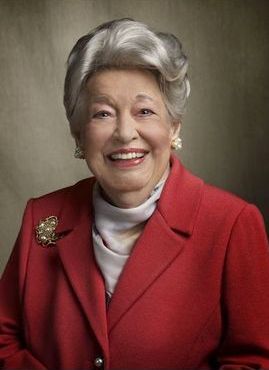
And here she is in later days: the undisputed grand dame of Dallas real estate. RIP, Ebby.

ebby_wfaa

***

Sources & Notes

Top photo is one of three in this post which appeared in a Candy’s Dirt slideshow here (slideshow photos are from the archives of Ebby Halliday Realtors — there are tons of great photos there!).

Highschool photos of Vera Koch are from the 1929 yearbook of Abilene (Kansas) High School.

Ebby Halliday Acers died Tuesday, Sept. 8, 2015. A few of the online obituaries/tributes in the local media:

  • Dallas Morning News, here
  • Dallas Business Journal, here
  • D Magazine, here
  • Ebby Halliday Realtors website, here

A great article on a typical day at work for the 96-year-old Halliday (!) appeared in D Magazine in July, 2007; read Candace Carlisle’s article “Ebby Halliday: The Woman Who (Still) Sells Dallas,” here.

*

Copyright © 2015 Paula Bosse. All Rights Reserved.


Fly United to Chicago in Only Eight Hours!

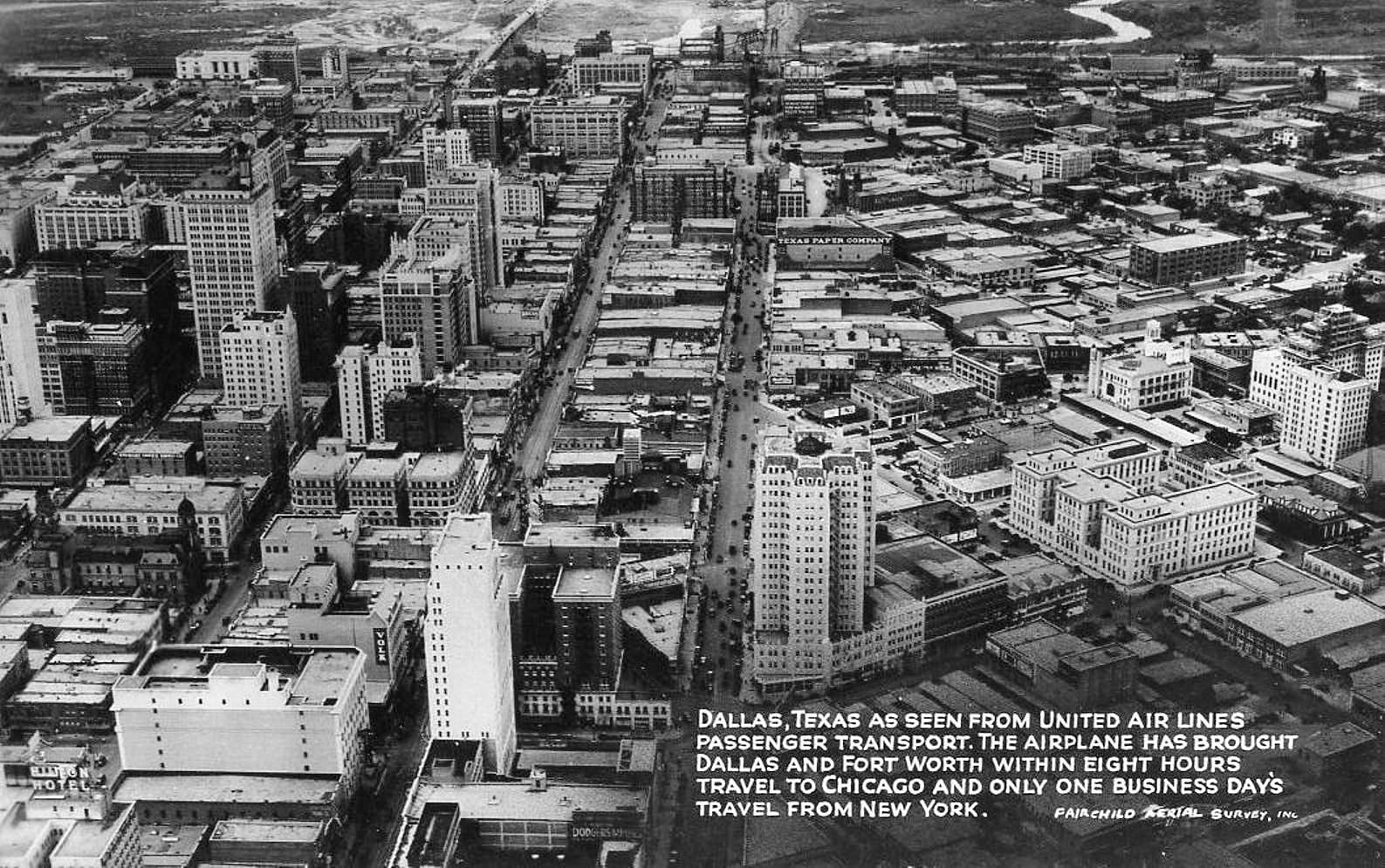
aeiral_united-air-lines_fairchild_ebay_rppcHow many buildings can you identify? (click for larger image)

by Paula Bosse

Dallas, Texas as seen from United Air Lines passenger transport. The airplane has brought Dallas and Forth Worth within eight hours travel to Chicago and only one business day’s travel from New York.

Back when it took all day to fly to New York from Dallas.

This is another great aerial photo by the Fairchild Aerial Survey company, probably taken by Lloyd M. Long. Date-wise? Late-1920s? Before the Trinity was straightened (beginning in 1928), with land being cleared in the area that would become Dealey Plaza? 1928-ish? Or could it have been the very early 1930s? The United Air Lines promotional postcard was issued around 1932 or 1933.

It wasn’t until 1933 that United introduced its new Boeing “twin motor airline transports” and boasted that they would finally “bring the city within eleven and a half hours of New York City” (Dallas Morning News, Aug, 16, 1933).

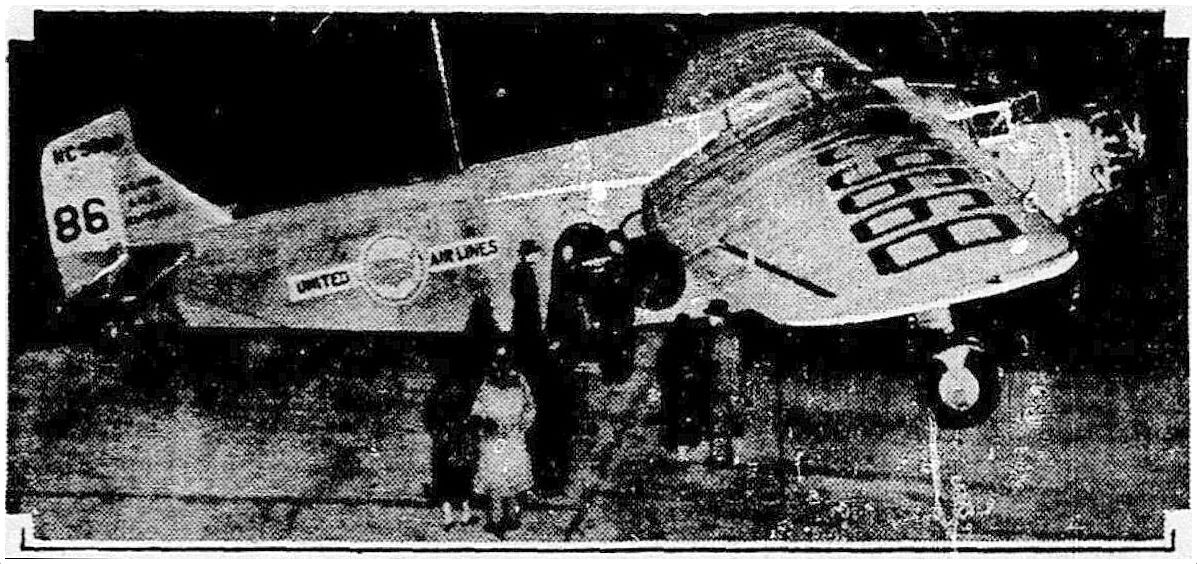
Below is a photo from a Dallas newspaper ad showing one of United’s planes from the earlier, more carefree days of 1932, when passengers were still trudging through the skies at a more leisurely pace.

united-air-lines_ad-det_dmn_110432United Air Lines ad, detail, 1932

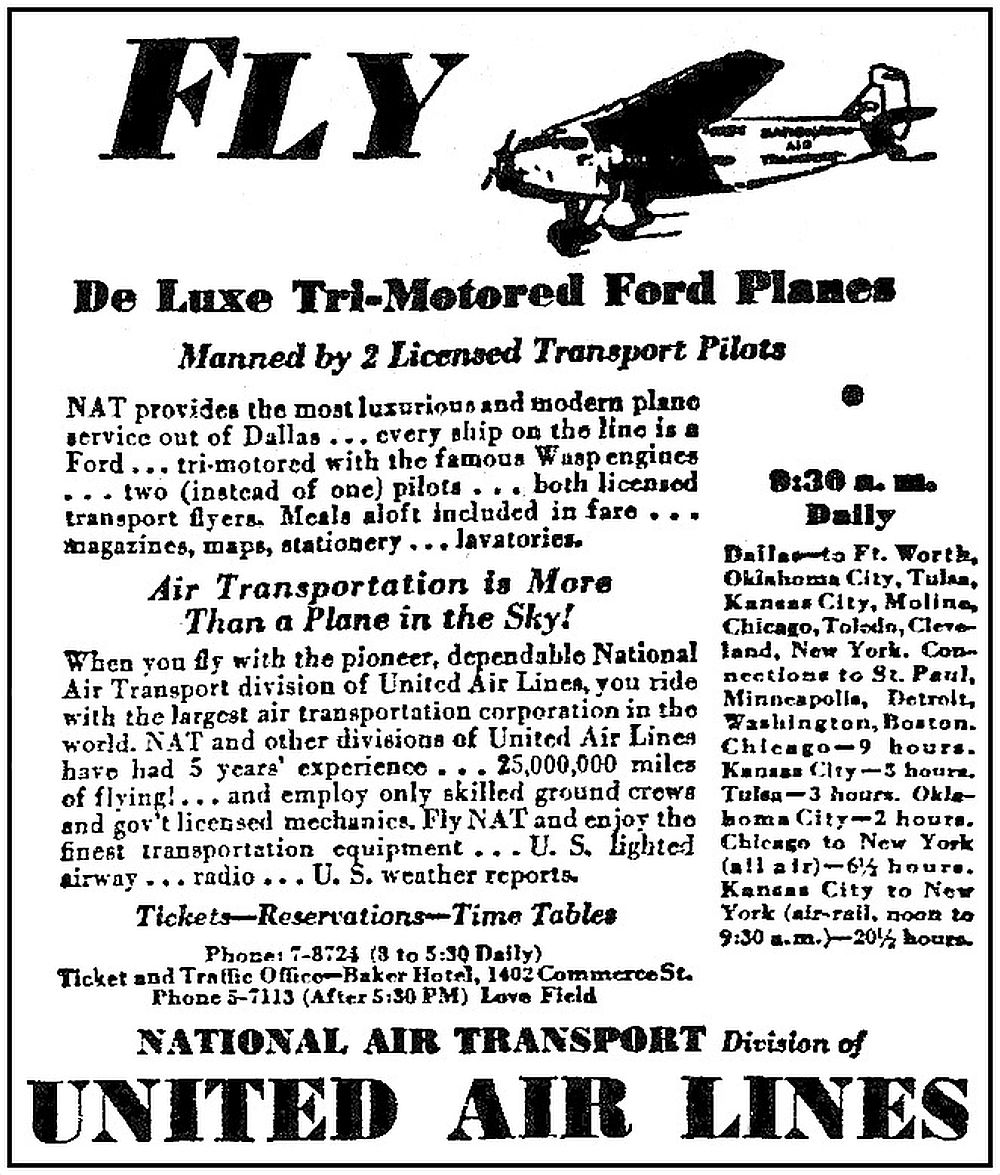
And an even earlier ad, from 1931, when a flight from Love Field to Chicago was nine hours long (today a direct flight from Love Field to Chicago takes about two hours and fifteen minutes). And if you wanted to continue to NYC, you had to board another plane and fly from Chicago to New York, adding another six and a half hours!

united-air-lines_dallas-to-nyc_1931
1931 ad

FLY

De Luxe Tri-Motored Ford Planes Manned by 2 Licensed Transport Pilots
 
NAT provides the most luxurious and modern plane service out of Dallas … every ship on the line is a Ford … tri-motored with the famous Wasp engines … two (instead of one) pilots … both licensed transport flyers. Meals aloft included in fare … magazines, maps, stationery … lavatories. 

Air Transportation is More Than a Plane in the Sky! 

When you fly with the pioneer, dependable National Air Transport division of United Air Lines, you ride with the largest air transportation corporation in the world. NAT and other divisions of United Air Lines have had 5 years’ experience … 25,000,000 miles of flying! … and employ only skilled ground crews and gov’t licensed mechanics. Fly NAT and enjoy the finest transportation equipment … U.S. lighted airway … radio … U.S. weather reports.

*

In an interesting side-note, the first pilot to fly a mail plane between Kansas City and Dallas (on May 12, 1926) was Richard Dobie, brother of Texas literary legend, J. Frank Dobie. In 1926 he flew a Curtiss Carrier Pigeon; in 1933, he’d worked his way up to the speedy and powerful Boeing. He flew for United for several years.

***

Sources & Notes

Top image is a promotional postcard, found on eBay.

Read more about the tri-motor airplane (manufactured by the Ford Motor Company and affectionately known as the “Tin Goose”) in the article “Ford’s Tri-Motor” by Edward J. Vinarcik (Advanced Materials and Processes, Oct. 2003) here.

All images larger when clicked.

*

Copyright © 2015 Paula Bosse. All Rights Reserved.


The Giant Cash Register at the Texas Centennial — 1936

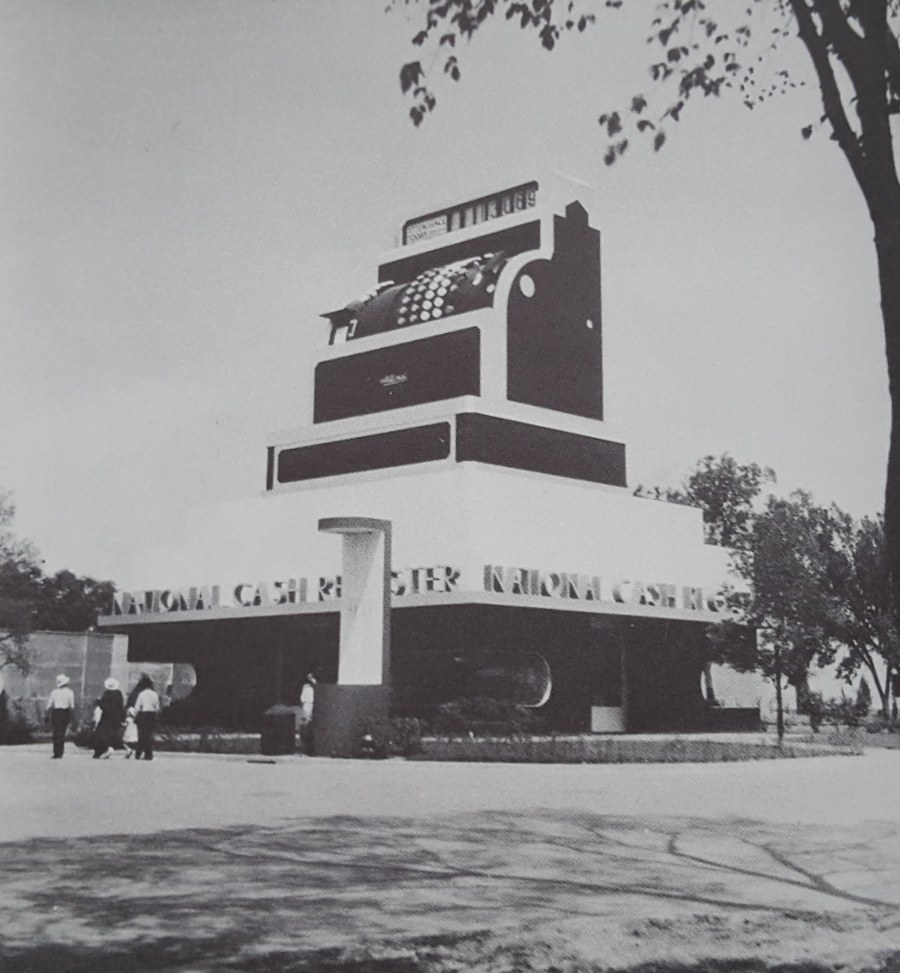
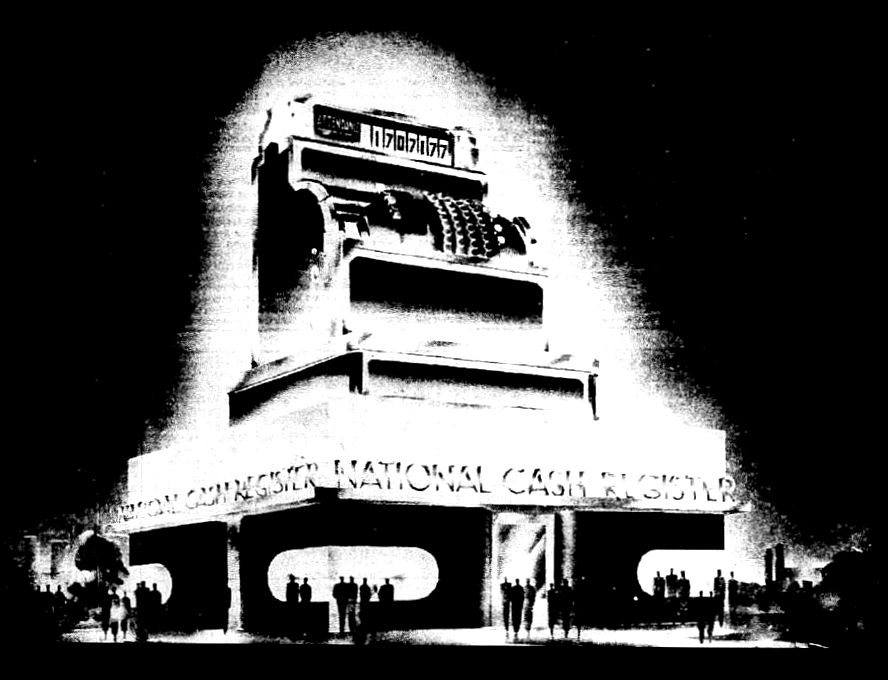
cash-register_ncr_tx-centennial_ragsdaleBefore Big Tex we had Big Till (click for larger image)

by Paula Bosse

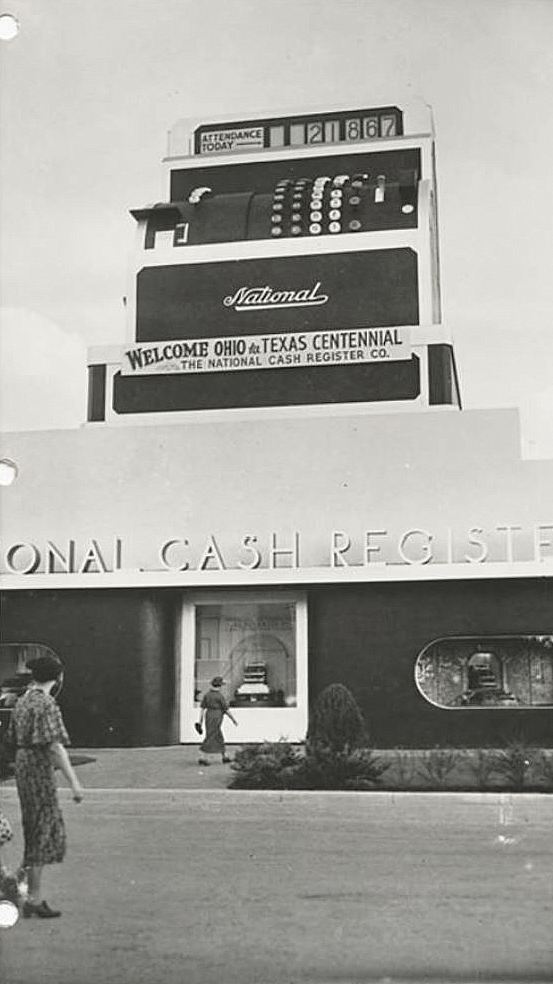
What’s not to love about a 65-foot-tall cash register? And how appropriate that this larger-than-life attraction was featured at the bigger-than-big Texas Centennial Exposition at Fair Park in 1936. This building, shaped like a very large National Cash Register (made under the auspices of noted designer Walter Dorwin Teague), served two purposes: its interior was an exhibit space to show off the company’s line of cash registers, and its exterior served as a giant tally board which was updated hourly to display the number of Centennial visitors. A similar giant cash register had been a popular feature at the Chicago World’s Fair in 1933/34, and it was decided to commission one for the Texas Centennial (another one would show up at the New York World’s Fair in 1939).

At the risk of turning into a blog-realized Monty Python sketch (“This is Uncle Ted at the front of the house. This is Uncle Ted at the back of the house. And this is Uncle Ted at the side of the house….”), let’s take a look at this great big cash register from several slightly different angles.

**

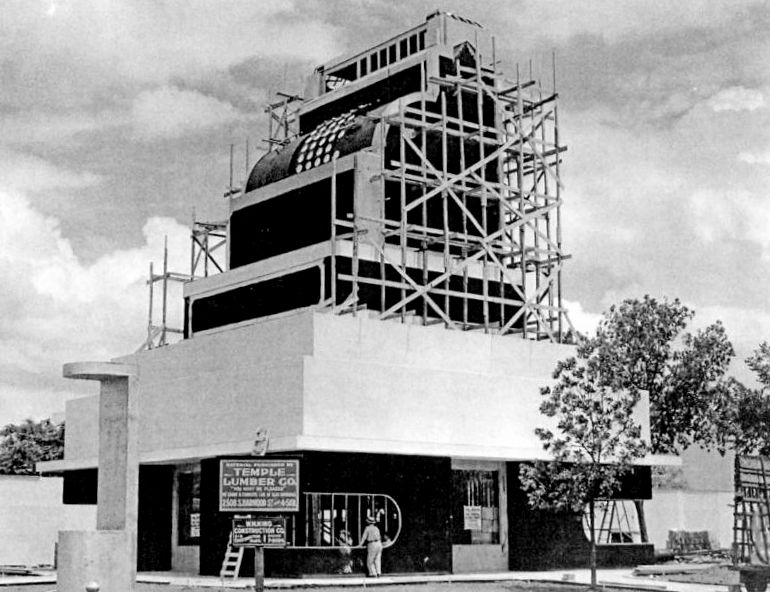
Here it is under construction.

ncr_fair-park_willis-winters_sfot-archives

*

Here it is glowing in an ad with a tantalizingly dynamic illustration (click to see the illustration larger).

ncr_dmn_060736-adJune, 1936

That text?

Towering in the air the height of a six-story building, this is the largest National Cash Register the world has ever seen.

In giant figures at the top of the register Centennial attendance is recorded.

Look for this outstanding feature of the Texas Centennial. See the electrical recording device accumulating the total of all attendance as the turn-stiles click, at each gate.

The huge figures at the top of the giant register tell the whole story of the Centennial attendance. A modern National Cash Register in your store will give you the whole story of what is happening in your business.

*

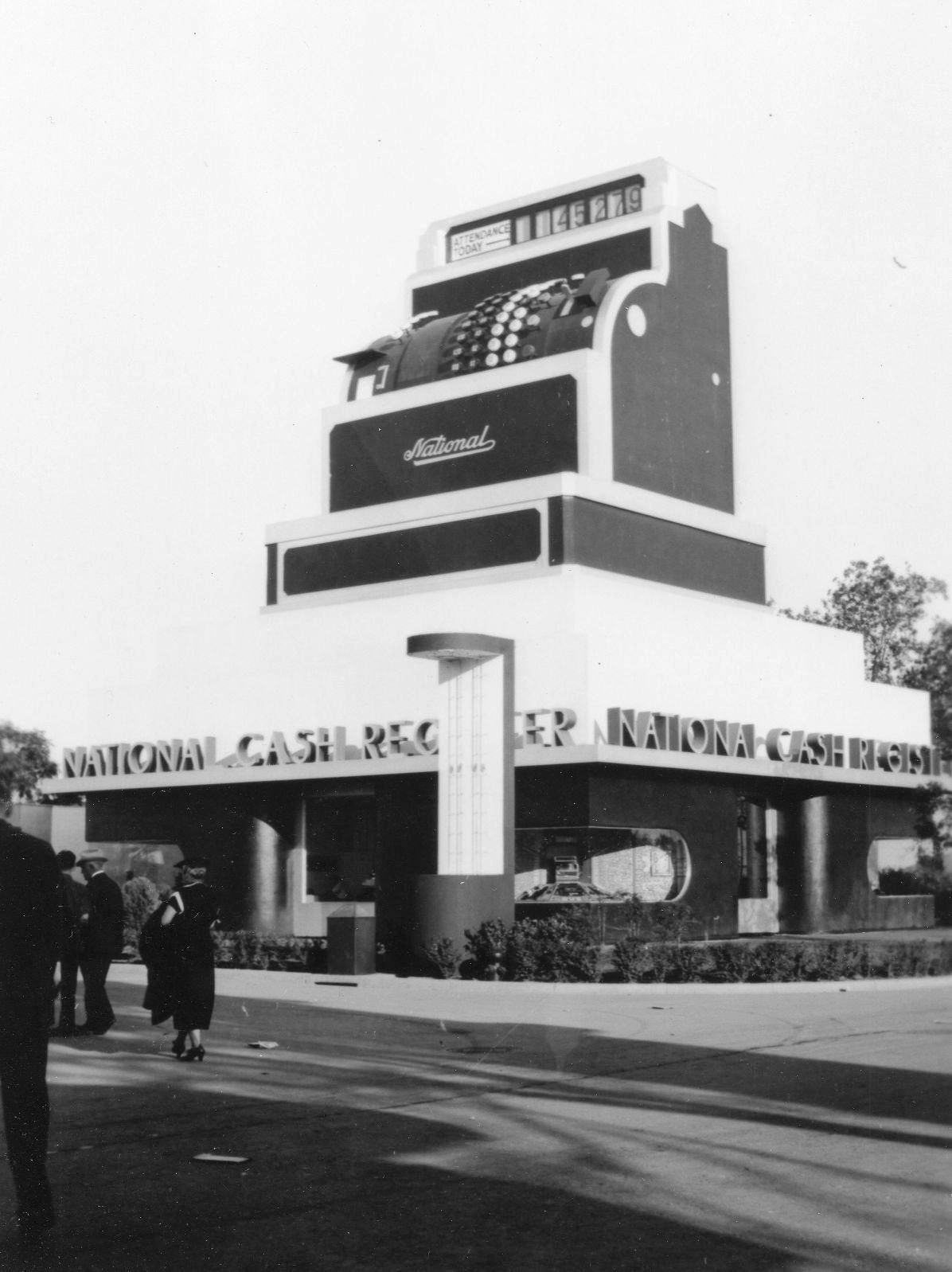
Here it is in a photo that, admittedly, looks a lot like the top photo — but take a closer look — those shrubs have gotten shrubbier.

cash-register_tx-centennial

*

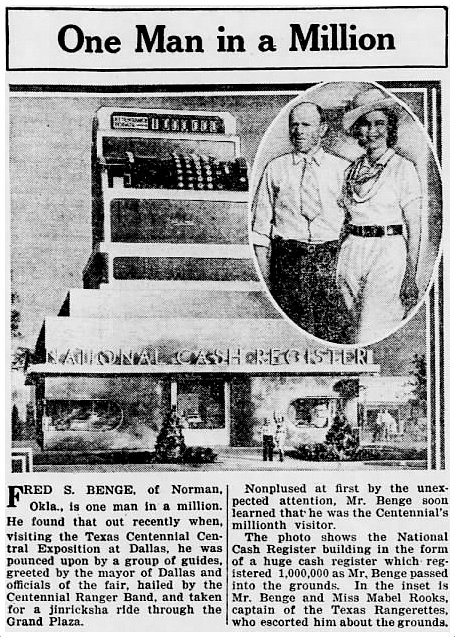
And here it is towering over Mr. Fred S. Benge of Norman, Oklahoma, the Centennial’s millionth visitor. According to the report below, when Mr. Benge passed through the gates into Fair Park on June 25, 1936 (less than three weeks after the opening of the Exposition), the giant cash register numbers flipped over to “1,000,000” and the poor man was “pounced upon” by Centennial officials eager to make a spectacle of the momentous occasion. (In this photo, and two others I’ve seen, Mr. Benge does not look particularly amused at the situation.)

ncr_greenfield-indiana-daily-reporter_080636The Greenfield (Indiana) Daily Reporter, Aug. 6,, 1936

UPDATE: Another photo of a somewhat stoic-looking Benge is here. An entertaining article about Mr. Benge’s big day is here. I sure hope Fred didn’t mind being described as a short and bald-headed jobless mechanic.

*

And here’s the “official photo,” which is a little bland and dowdy, but at least you can see what it looked like head-on.

ncr_tx-centennial

*

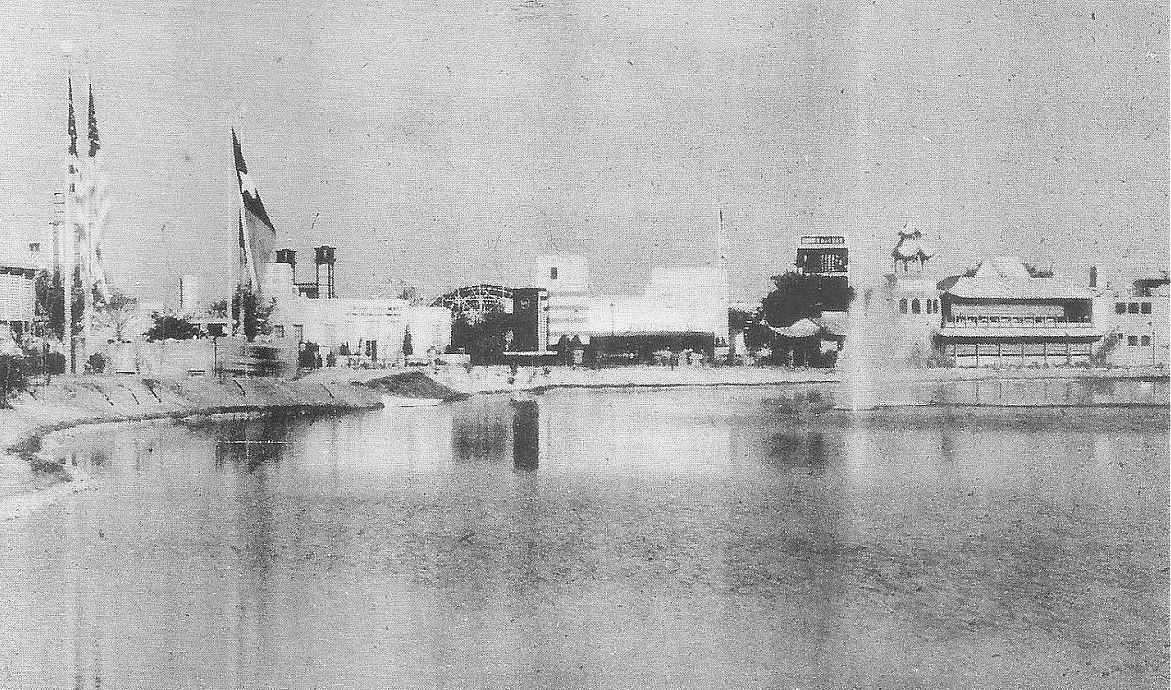
And here it is, as seen from the other side of the lagoon.

tx-centennial_lagoon_cash-register_1936

*

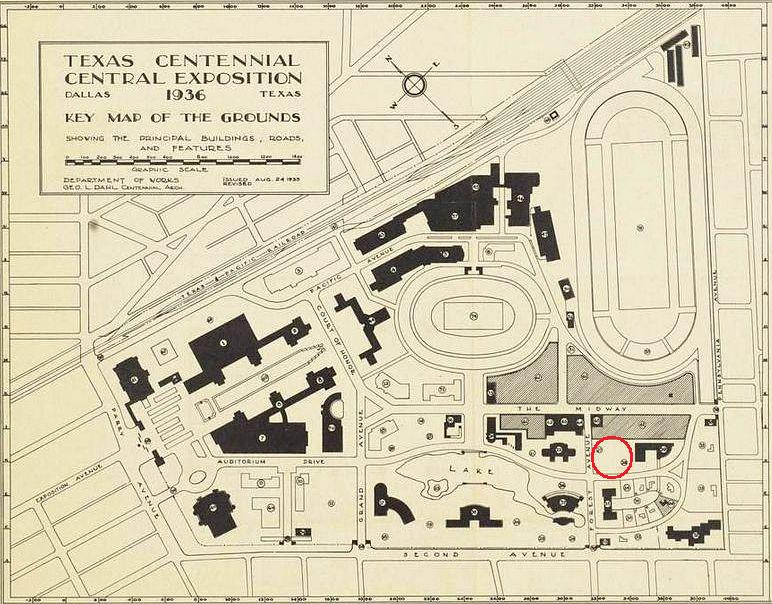
Where exactly was this “six-story cash register” located? I believe it was at San Jacinto/1st Avenue & Forest Avenue (now MLK). I think it might have been one of the two unnamed attractions I’ve circled on the “Key Map of the Grounds.” (See the full unmarked map, from the University of Texas at Arlington, via the Portal to Texas History, here.)

tx-centennial-map_ut-arlington_via-portal

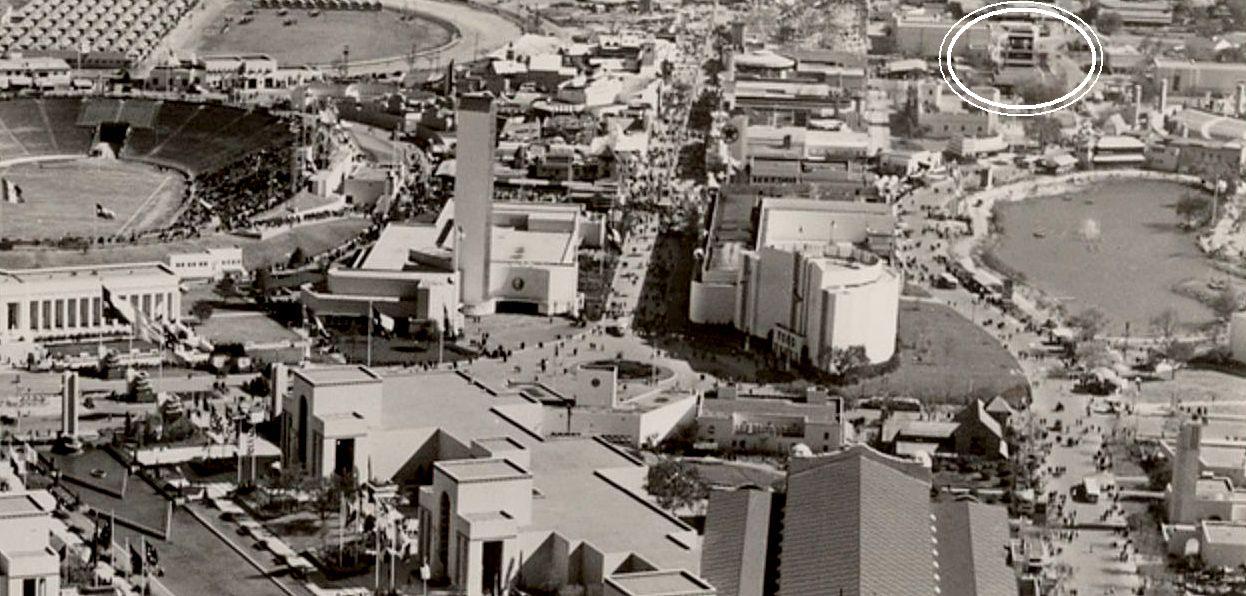
You can see it in a detail from a photo of the Centennial fairgrounds I posted previously (see that post here) — the cash register is circled at the top right.

ncr_centennial-photo-det(click for larger image)

I’ll just keep adding new photos as I come across them. Below are two photos from the George W. Cook Dallas/Texas Image Collection, DeGolyer Library, SMU (info is here and here). One of them shows a family standing in front of it — since Big Tex hadn’t arrived on the scene yet, this was as good a giant “thing” to stand in front of as anything!

tx-centennial_ncr_cook-coll_smu     cash-register_cook-collection_SMU_rau-family_1936

***

Sources & Notes

Top photo is from The Year America Discovered Texas: Centennial ’36 by Kenneth B. Ragsdale (College Station: Texas A&M University Press, 1987); the photograph is from the collection of Texas author Elithe Hamilton Kirkland (Love Is a Wild Assault) who worked as the director of school publicity for the Centennial.

The State Fair of Texas Archives photo of the cash register under construction is from Fair Park by Willis Cecil Winters (Charleston, SC: Arcadia Publishing, 2010). Another photo of the NCR register can be seen in Winters’ book here — in the bottom photo, it is the dark square in the background, left of center — you can see how it towered over everything around it.

The “shrubbier” photo is in the collection of the Dallas Historical Society, but I found it here, not identified as being the one at the Texas Centennial (if you click the picture in this interesting article, it will be super-super-gigantic).

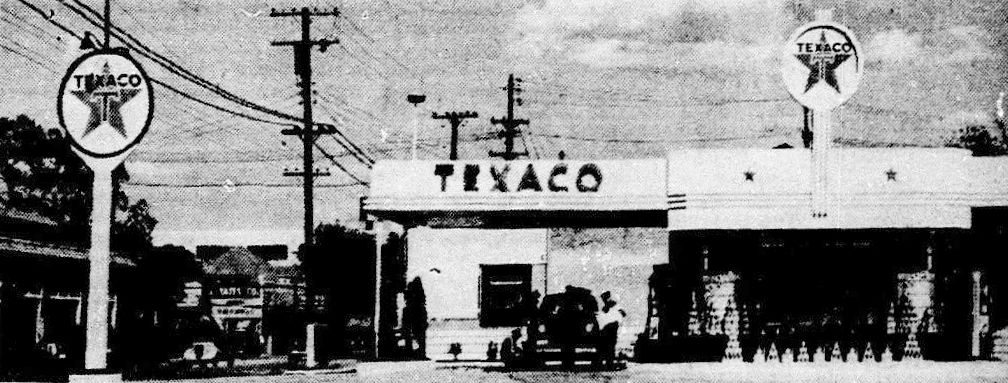
Walter Dorwin Teague (1883-1960) was the man who not only designed the National Cash Register exhibit building, he also designed other Centennial-related attractions, including the Ford Building and the nearby cool-looking new-concept moderne Texaco station (at Commerce & Exposition). Read about  him here.

texaco-station_dmn_080936_designed-teague_centennial_commerce-exposition1936

There were hopes that the Texas Centennial Exposition would attract in excess of ten million visitors over its six-month run, but the final numbers were just under six-and-a-half million. Pity. We had that great big tally machine sitting there and everything. Waiting.

Most pictures larger when clicked.

*

Copyright © 2015 Paula Bosse. All Rights Reserved.

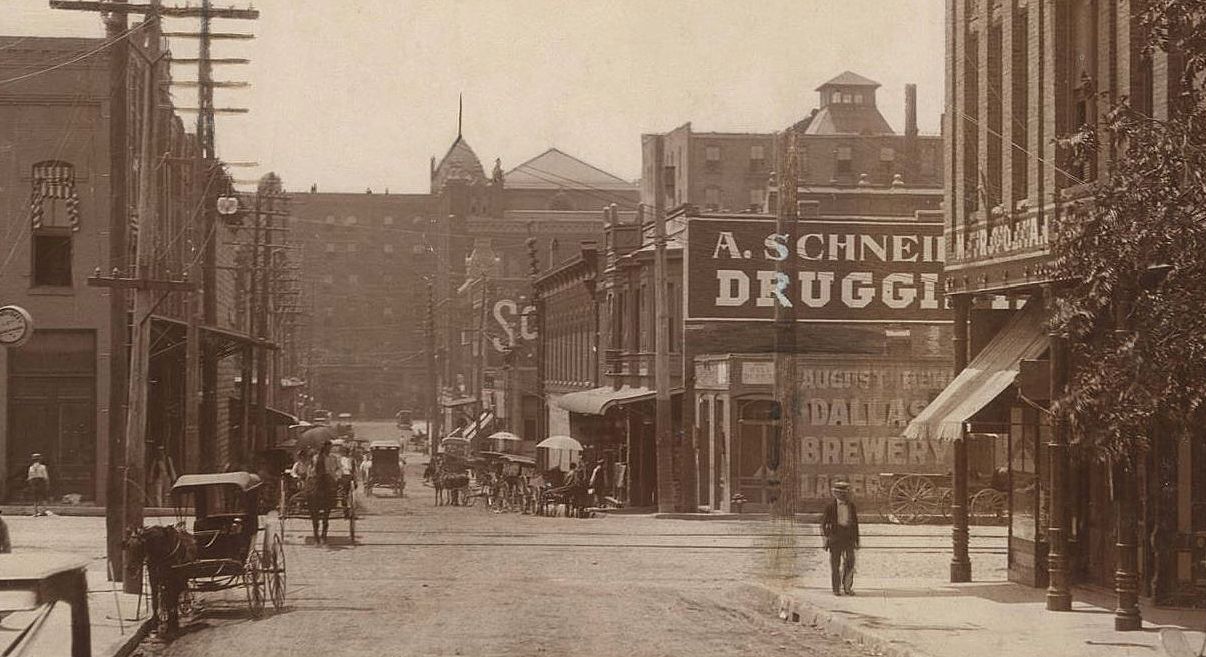
Akard Street Looking South, 1887-2015

akard_from-pacific_cook_degolyer_smu_ca1898-detAkard Street from Pacific, ca. 1898, via Cook Collection, SMU

by Paula Bosse

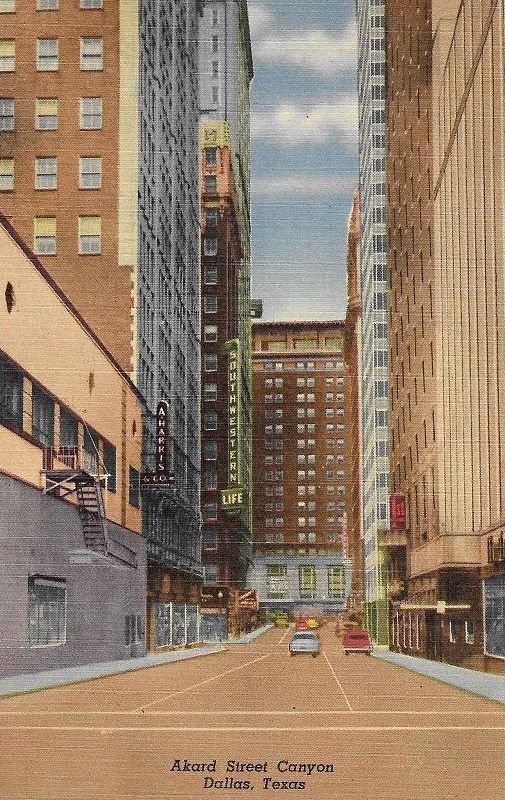
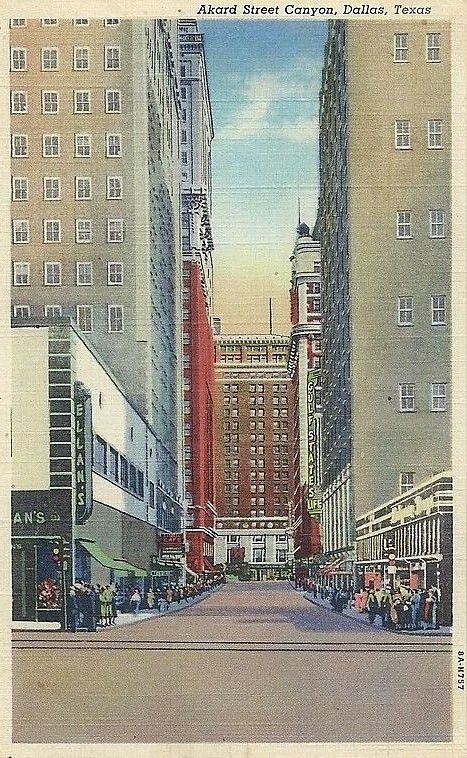
I realized the other day that I have an inordinate number of photographs and postcards showing Akard Street looking south — usually taken from Pacific or Elm, so I thought I’d collect them all together. Some of these aren’t dated, so they’re not in strict chronological order, but I’ve made a half-hearted attempt to make sure horse-and-buggy photos are before the men-in-straw-hat-boaters, which are before the women-in-Miss-Crabtree-dresses, which are before the cars-with-rounded-bodies. It might be easiest to just assume they are not in chronological order. (All photos are larger when clicked — a couple are really  big.)

*

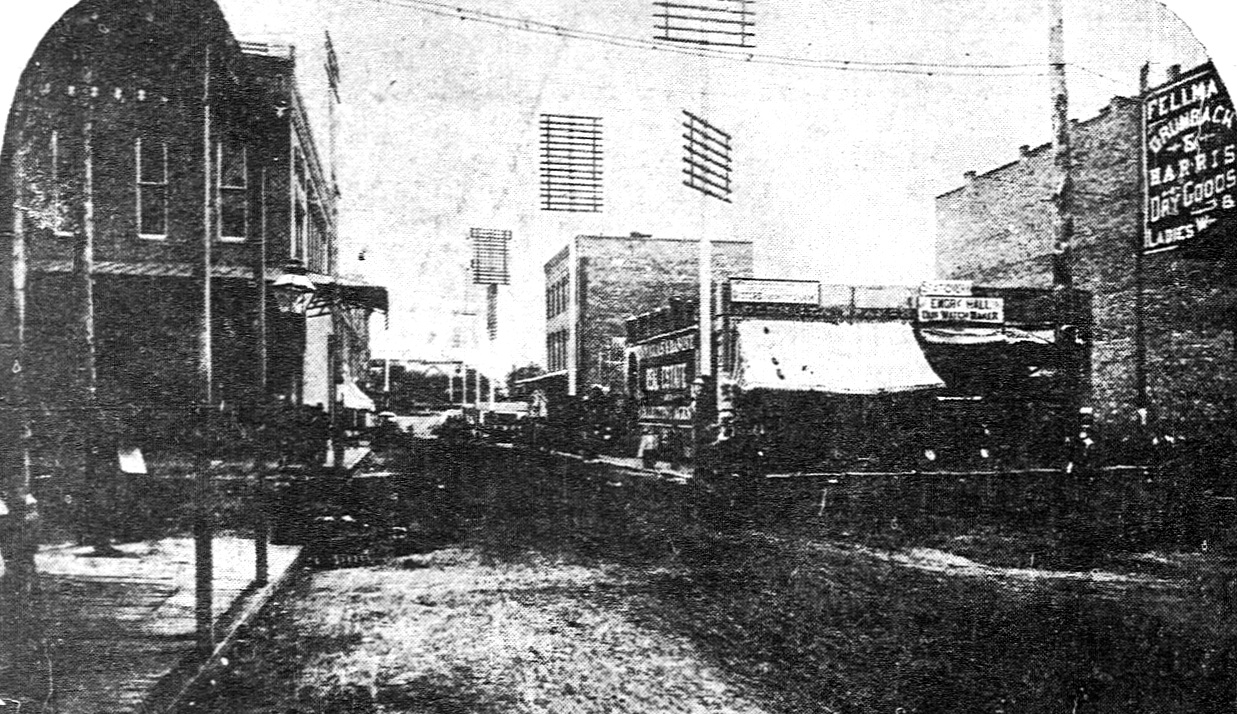
The oldest is from 1887, when North Akard was still called Sycamore Street, and before the Oriental Hotel was built at Commerce and Akard in 1895.

akard_south-from-elm_1887

*

Next up, an incredible photo, taken around 1898, a detail of which appears at the top of this post. The Oriental Hotel can now be seen at the end of Akard, at Commerce, where Akard used to make a dog-leg turn before continuing south, giving the appearance of a dead-end street.

akard_from-pacific_cook_de-golyer_smu-ca1898via George W. Cook Collection, DeGolyer Library, SMU

*

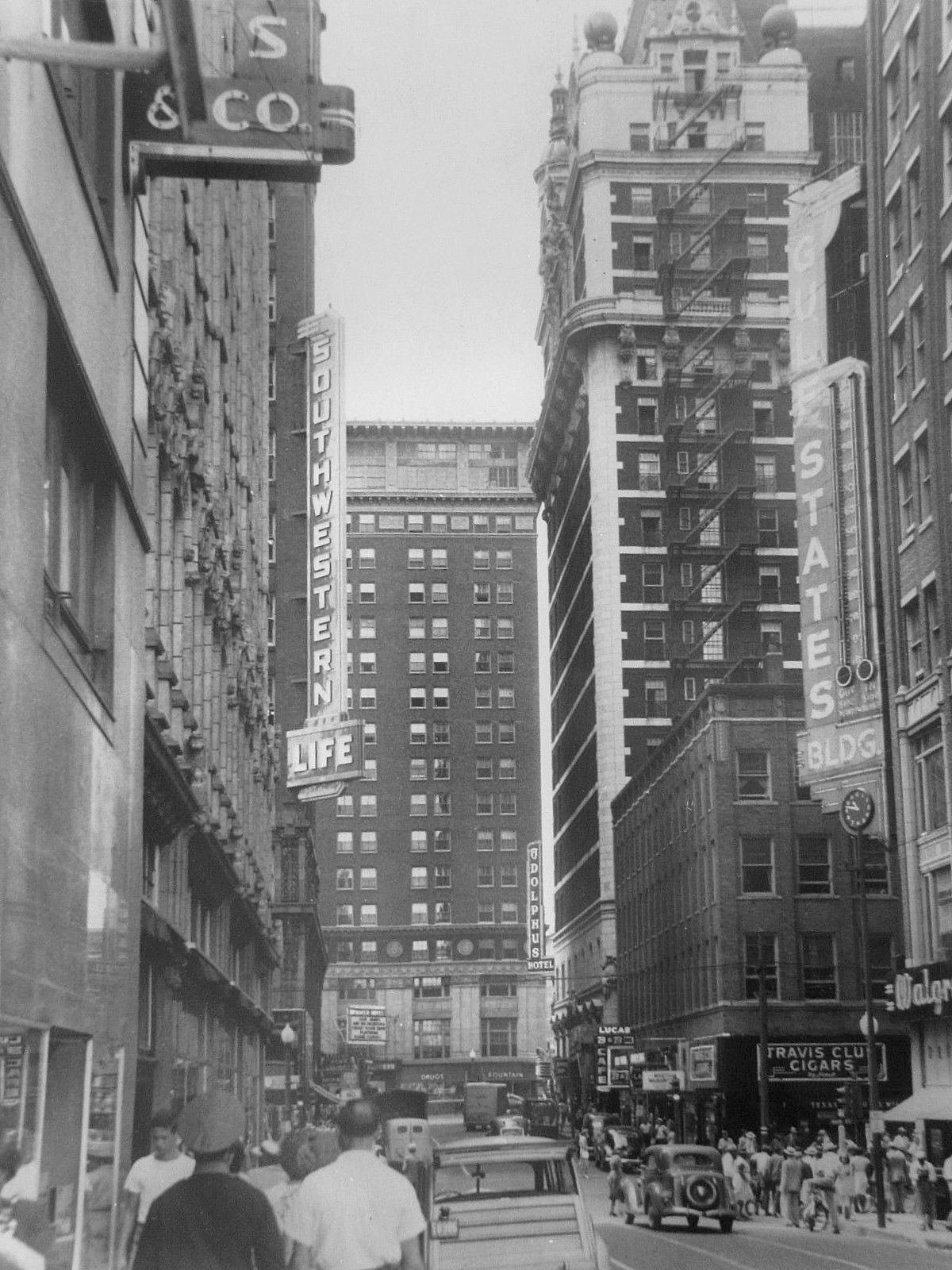
Another, with the Adolphus Hotel (built in 1912) now on the right, across Commerce from the Oriental. The tall building across Akard from the Adolphus is the Southwestern Life Building. The Gentry photography studio was at the southeast corner of Elm and Akard from 1912, which is probably the date of this postcard image. Construction of the Busch Building (now known as the Kirby Building) began in December, 1912.

akard-elm_postcard_ebay_ca-1912via eBay

*

From 1925, with the new Baker Hotel having replaced the Oriental Hotel. This area was now being called “the canyon district” or “the canyon.”

akard_south-from-elm_1925

*

In this great Frank Rogers photo, the canyon walls are getting higher, with the Adolphus Hotel firmly anchoring the Commerce corner across from the Baker.

akard_baker-adolphus_postcard_rogers_ebayvia eBay

*

By the time this photo was taken in about 1936, Pegasus had become a part of the skyline, perched atop the Magnolia Petroleum Building. (Note the Queen Theater at the northeast corner of Elm and Akard.)

akard_pacific_1936_legacies-spring-1989via Legacies History Journal

*

This photo is from the early- or mid-1930s — LOOK AT ALL THOSE PEOPLE.

akard-canyon_municipal-archives_dma-uncratedvia the DMA’s Uncrated blog

*

As opposed to this one, which has NO people in it.

akard-canyon_ebayvia eBay

*

More canyon, this view showing the super-cool art-deco-y building at Elm and Akard with Ellan’s hat shop on the ground floor, late-1930s.

akard-st-canyon_ellans

*

This candid photograph, a little deeper into the canyon, is one of my favorites. (Click to see a gigantic image.)

akard-looking-south_ebayvia eBay

*

From 1951 — a bit grainy, but a slightly closer view of the side of the Queen Theater at the left and the Mayfair department store, built in 1946, at the right:

akard_dpl_1951via Dallas Public Library

*

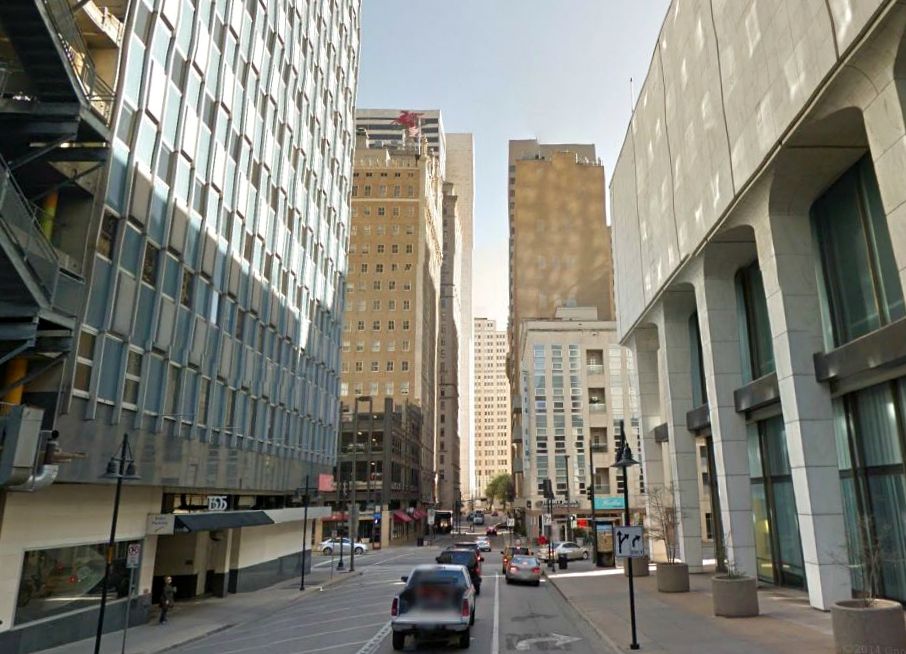
And, finally, today. Pegasus and the Adolphus are still there, but the Baker Hotel was demolished in 1980, replaced by the One AT&T Plaza/Whitacre Tower.

akard-looking-south_google_2015via Google Street View, 2014

***

Sources & Notes

The photo dated by SMU as “circa 1898” is titled “Akard Street from Akard and Pacific Avenue Intersection”; it is from the George W. Cook Dallas/Texas Image Collection, DeGolyer Library, Central University Libraries, Southern Methodist University, and it can be viewed here.

The circa 1936 photo showing Pegasus is from the Spring, 1989 issue of Legacieshere; it is from the Hayes Collection, Texas/Dallas Archives Division, Dallas Public Library, and is attributed to Denny Hayes.

The photo showing “ALL THOSE PEOPLE” is from the Dallas Museum of Art’s Uncrated blog — here — is from the Dallas Municipal Archives. They have the date as “1940,” but Liggett’s Drug Store was gone from Elm and Akard by 1936.

Other sources as noted.

Click pictures for larger images — sometimes MUCH larger images.

*

Copyright © 2015 Paula Bosse. All Rights Reserved.