Flashback : Dallas

A Miscellany: History, Ads, Pop Culture

Category: 1930s

Liquor Doctors Prescribe “Beer by the Case — All You Want”

liquor-doctors_neon-sign_dmn-video_1939

by Paula Bosse

If you have an interest in the Dallas of yesterday, you’ve probably seen the great color film footage shot in downtown in 1939, presented to us by Robert Wilonsky of The Dallas Morning News (link below). One of my favorite things from that wonderful footage is a neon sign for a business called Liquor Doctors, with “Good & Bad Liquors” below it. That would be good enough on its own, but it’s even better as seen in the film, because the “Good” and the “Bad” flash back and forth. Great.

Liquor Doctors (what a great name) seems to have started in late 1937 and eventually had at least three locations: 509 Jackson St., Commerce & Houston, and Cedar Springs & Harwood. Info is limited on these stores — I found a classified ad looking for “salesladies” for the Jackson St. store (“must be over 21”) and a report of a hold-up at the Commerce St. location (the manager was forced, at gun point, to turn over $41.86 from the cash register). Not that interesting. Until I found this tidbit from the great-granddaughter of the owner, describing the utterly ridiculous (and thoroughly entertaining) operating procedure of the Cedar Springs location in the June 2010 issue of Texas Monthly (see link at bottom of post):

Later he opened another Liquor Doctors on Cedar Springs that offered curbside service. The employees, dressed as doctors and nurses, would stroll out to the cars and dispense “medicine” six days a week.

Depending on your threshold for silliness, this is either clever or hokey. (I vote “clever.”)

For some reason the owner changed the name of the business (but why?!), and the next incarnation was simply his name, “Bob Ablin” (where, thankfully, you could still get “good and bad liquors”). I think he might have sold the liquor businesses and opened a soda fountain on Cedar Springs, a venture that lasted until January of 1948.

Below is an ad placed during a WWII whiskey shortage. There was a strict limit of one bottle per person. But beer? Until the cows came home. Bob sounds like a fun guy.

liquor-doctors_dmn_011244

***

Sources & Notes

Screen capture of the Liquor Doctors flashing neon sign from the really wonderful 1939 film footage purchased from Ebay by Robert Wilonsky (of The Dallas Morning News) and several others who joined together to share a cool slice of the city’s history with us. Watch the video and read Wilonsky’s Dallas Morning News article from April 23, 2014, here.

Quote about the Cedar Springs costumed curb service from the essay “Old Testament” — about growing up Jewish in Dallas — by Megan Giller-Dupe, Bob’s great-granddaughter. You can find the essay in Texas Monthly (June 2010), here. It includes a nice photo of Bob.

*

Copyright © 2014 Paula Bosse. All Rights Reserved.
Babyface Barrow — 1926

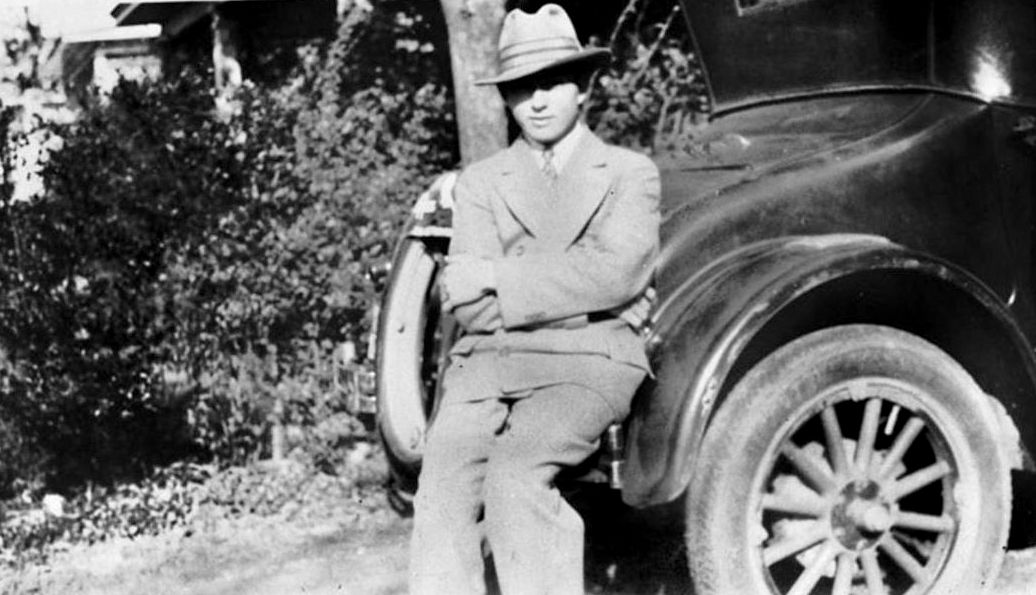
clyde-barrow_with-car_1926_utsa17-year-old Clyde Barrow, 1926

by Paula Bosse

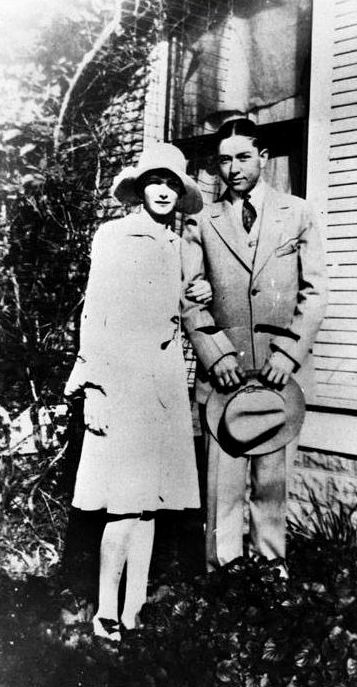
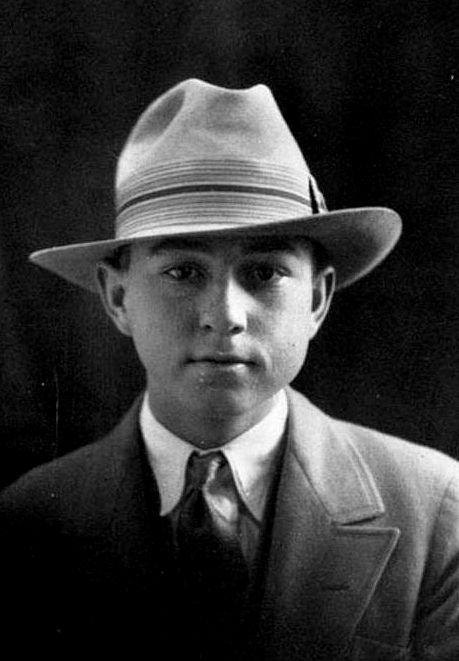
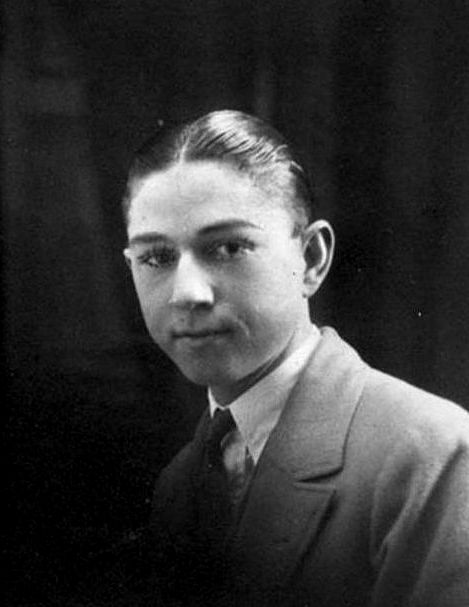
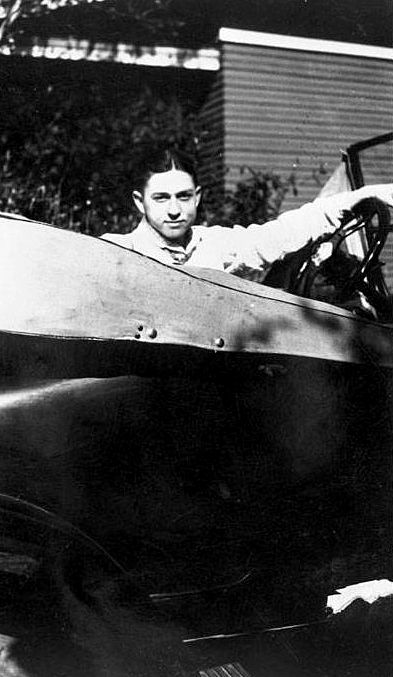
These photos of a 17-year-old Clyde Barrow belonged to one of Clyde’s first girlfriends, Eleanor Williams, a student at Forest Avenue High School in 1926. For all anyone knew, Clyde was just an ordinary kid who liked to dress up and show off his car. (Or “a” car — he was arrested for stealing his first car the same the year this photo was taken — 1926 — so I’m not sure whose car this actually is….)

clyde-barrow_eleanor-williams_1926_utsaEleanor and Clyde (whose unsubtle attempt to appear taller by standing on … something … is unconvincing and a little ridiculous).

clyde-barrow_1926_utsaSuch a babyface. In a few short years, his name and face would be splashed across the country’s newspapers as Bonnie and Clyde’s violent killing spree made him and Bonnie Parker outlaw celebrities.

clyde-barrow_no-hat_1926_utsaHe looks a lot younger than 17 here.

clyde-barrow_car_1926_utsaThe reverse of both this original photo and the top one — the car photos — have a hand-written “1926” on them as well as the film processing stamp “Finished by The National Studio, 1205 1/2 Elm St., Dallas, Texas.”

***

Sources & Notes

Photographs from University of Texas at San Antonio Libraries Special Collections, Copy and Reuse Restrictions Apply. Photos loaned to UTSA by Henry J. Williams, nephew of Eleanor B. Williams. All photos have “1926” on the back.

The Handbook of Texas entry for Clyde Barrow (1909-1934) is here.

Additional photos of Eleanor Williams can be seen on the Bonnie and Clyde “Texas Hideout” site here.

*

Copyright © 2014 Paula Bosse. All Rights Reserved.
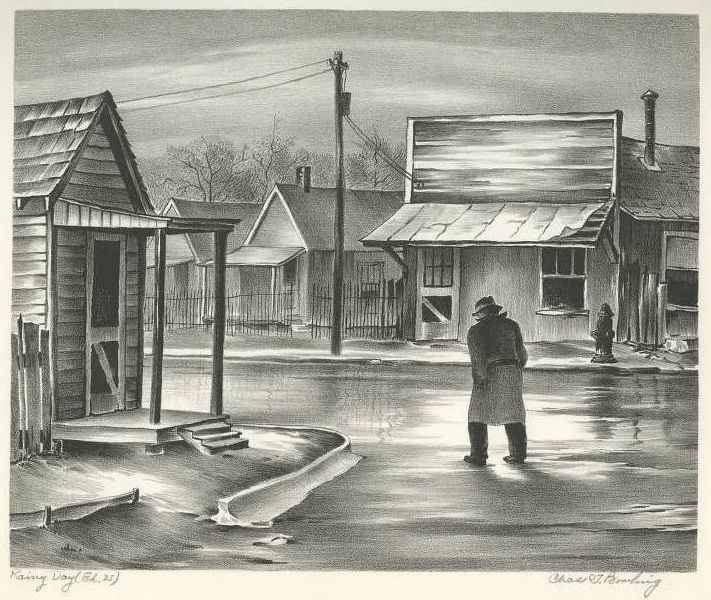
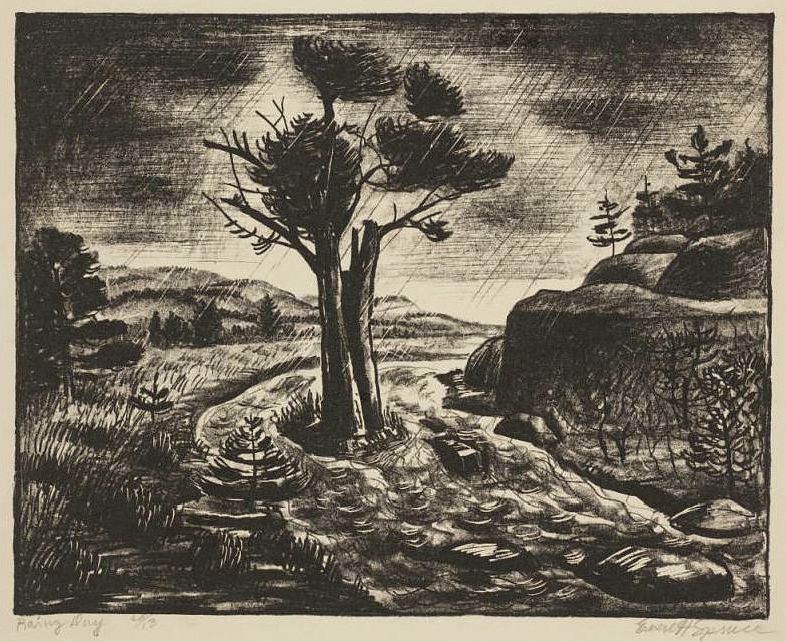
“Rainy Day” and “Rainy Day” on a Rainy Day

bowling_rainy-day_smu

spruce-everett_rainy-day_1944

by Paula Bosse

Two works by local artists closely connected with (if not actually IN) the influential Dallas Nine group of painters and printmakers. Both works are titled “Rainy Day.”

The top print is a lithograph by Charles T. Bowling (1891-1985) and is undated. (From the Bywaters Special Collections, Hamon Arts Library, Southern Methodist University.)

The second print, also a lithograph, is by Everett F. Spruce (1908-2002), dated 1944. (From the collection of the Dallas Museum of Art, a gift of A. H. Belo Corporation and The Dallas Morning News, via the Central University Libraries of SMU.)

Stay dry!

Click pictures for larger images.

*

Copyright © 2014 Paula Bosse. All Rights Reserved.
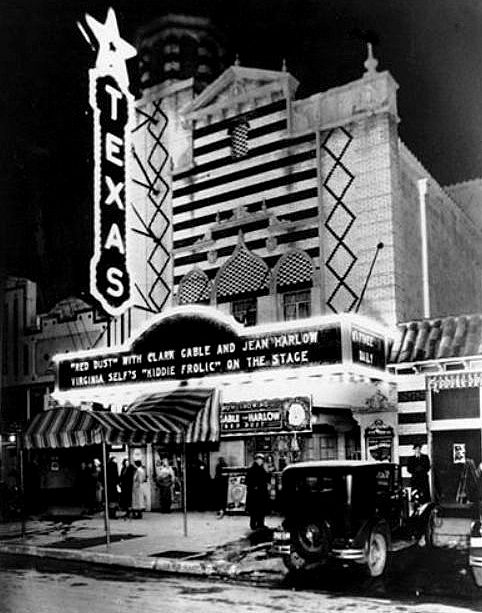
The Texas Theatre — 1932

texas-theater_1932The “Texas”

by Paula Bosse

West Jefferson Blvd, 1932. All that’s missing from this photo is Edward G. Robinson and an arsenal of tommy-guns. This is the only theater in the world whose marquee showing the 1963 double feature of “Cry of Battle”/”War Is Hell” has become a part of history (the Texas Theatre, is of course, where Lee Harvey Oswald was captured on the afternoon of November 22,  1963). When the movie theater opened in 1931 — in the time of Prohibition and running boards —  it was a much more elegant-looking picture palace. Had he not been in the Big House at the time, John Dillinger might have seen this very same Gable and Harlow movie at the Biograph (or what I call “Chicago’s Texas Theatre”). He probably wouldn’t have been sitting through something called “Kiddie Frolics,” featuring Oak Cliff’s own Virginia Self, a teenage dancer … frolicking.

***

After several changes in ownership and a few awkward renovations, the Texas Theatre seems to be back on track these days. The history page of their website is here (with interesting factoids such as: it opened on San Jacinto Day, it was the first theater in Dallas with air-conditioning, and it was briefly owned by Howard Hughes).

For photos of the theater’s interior, published in 1932 in the trade journal Motion Picture Herald, see my post “The Texas Theatre and Its Venetian-Inspired Decor,” here.

*

Copyright © 2014 Paula Bosse. All Rights Reserved.
 

The Katy Komet — 1933

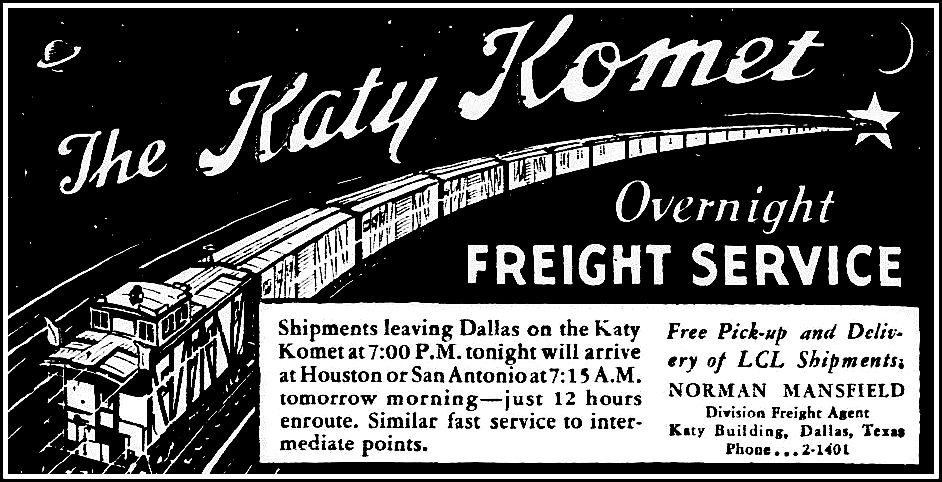
ad-katy-komet_dmn_031733

by Paula Bosse

What a great ad! Next stop, Venus!

***

This Katy Komet overnight freight service ad appeared in the The Dallas Morning News on March 17, 1933.

Click for bigger, BETTER image!

*

Copyright © 2014 Paula Bosse. All Rights Reserved.
U.S. Revenue Cutter “Carrie Nation” Successfully Navigates the Trinity In Valiant Effort to Keep Dallas Dry! — 1931

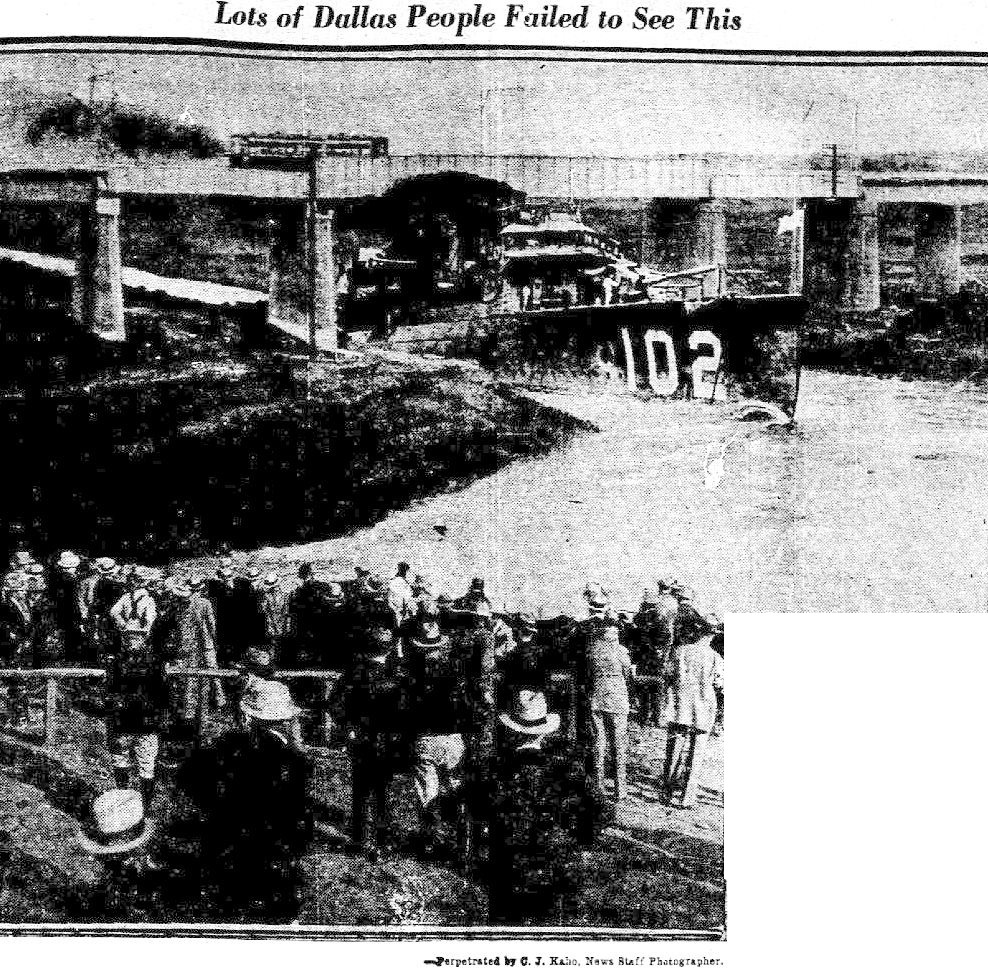
april-fools_dmn_010131_carrie-nation
The ship’s arrival, passing under the streetcar viaduct…

by Paula Bosse

I spent a couple of hours looking through the archives of The Dallas Morning News this morning, hoping to find a nice juicy April Fools’ prank from the past. Everything was fairly run-of-mill. Until I came across this. THIS is great. I don’t know who wrote the story, but there is, at least, acknowledgement for the wonderfully weird photo above — the photo credit reads: “Perpetrated by C. J. Kaho, News Staff Photographer.”

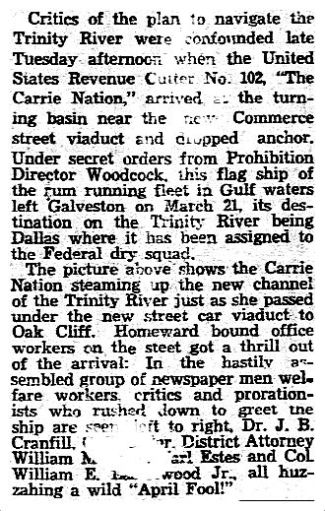
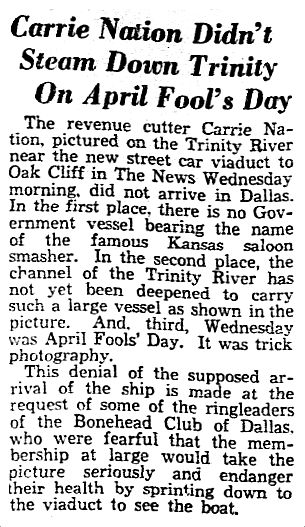
Below is the accompanying story about the United States Revenue Cutter Carrie Nation and the news of its journey up a surprisingly navigable Trinity River in order to anchor itself beneath the Commerce Street viaduct and make sure that the rum-runners in the Gulf don’t gain a foothold in bone-dry Prohibition-era Dallas. The photo and report appeared in the pages of The Dallas Morning News on April 1, 1931, beneath the headline “Lots of Dallas People Failed to See This.”

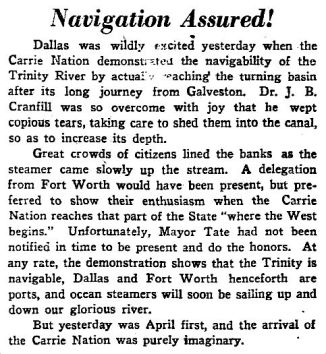
Unwilling to let such an important story fade away — and with a few more good lines left to get into print — this appeared the next day, on April 2, 1931: “Navigation Assured!”

Then some killjoy editor probably insisted on this, which also appeared on April 2, 1931:

**

Rev. J. B. Cranfill was a Baptist leader and a noted Prohibitionist. I love the line “Dr. J. B. Cranfill was so overcome with joy that he wept copious tears, taking care to shed them into the canal, so as to increase its depth.”

And I laughed out loud at the “where the West begins” dig at Fort Worth.

But, seriously, that photo is great. The little streetcar chugging over the viaduct is just the perfect garnish.

Read about the famed, notorious Bonehead Club of Dallas in a 1991 Texas Monthly article by Helen Thompson, here. Thank you, Boneheads!

*

Copyright © 2014 Paula Bosse. All Rights Reserved.
Lincoln High School — 1939

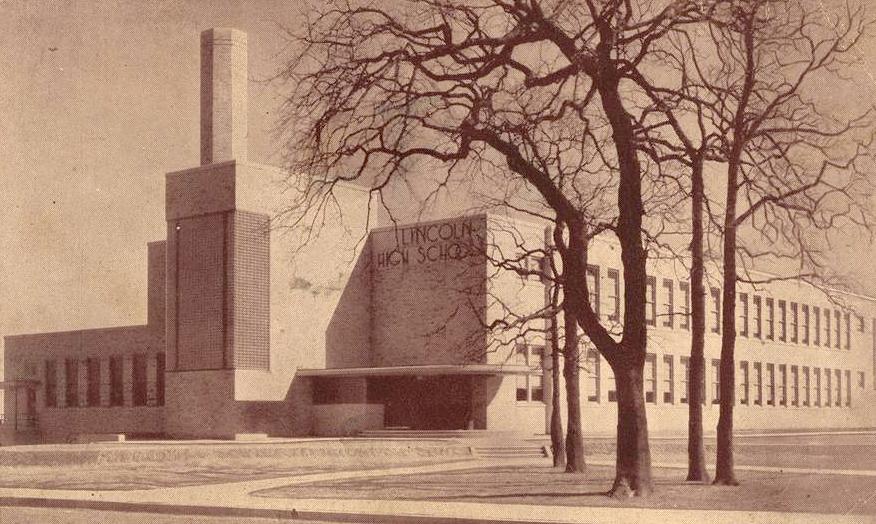
lincoln-high-school_1939The cool deco design of Lincoln High School… (click for larger image)

by Paula Bosse

When it opened on eleven acres in South Dallas in January, 1939, Lincoln High School was one of the largest high schools in Dallas, and one of the largest African-American high schools in the entire South. Shockingly, in 1939 it was one of only TWO (!) high school for black students in Dallas. As one would expect, its opening was greeted with great enthusiasm, and students rushed to enroll, pushing its capacity to a maximum. At its height, it had over 3,000 students. The building was designed by architect Walter C. Sharp, who designed many schools in and around Dallas, and with those clean lines and glass bricks, it’s pretty cool.

***

Photo from the J. L. Patton Collection, Dallas Historical Society.

For more on the background of Lincoln High School, see the info from the “Open Plaques” project here.

Click photo for larger image.

*

Copyright © 2014 Paula Bosse. All Rights Reserved.
Joe Yee Cafe: The Best Chop Suey in Town

joe-yee-cafe-extChop suey *and* famous chicken house…

by Paula Bosse

I came across the above image and was enthralled. I’ve never heard of the Joe Yee Cafe, but this (granted) idealized picture is wonderful. The postcards above and below were from the early 1950s, and if you are familiar with the generally run-down neighborhood around Columbia and Fitzhugh these days, you may well shed a tear that something this charming and picturesque has been gone for many, many years.

joe-yee-cafe-interior

I love the surprising color scheme of the restaurant’s interior — those fabulous purples and greens! (The colors are a bit unexpected because they so loudly clash with the bold tomato red of the exterior.)

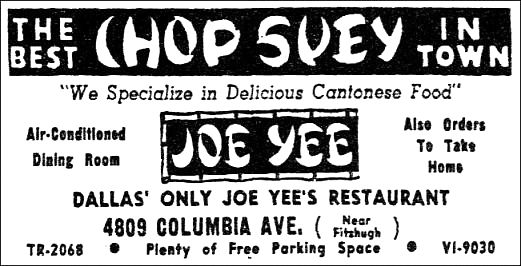
I did a little research to see what I could find out about Joe Yee’s Chinese restaurant. Seems that Mr. Yee’s cafe was in business by the 1930s, downtown, on Main Street near Field. It advertised steadily over the years, and its ads proudly proclaimed that the restaurant served “the best Chinese food you ever tasted” and was “completely air-conditioned.” Several newspaper accounts (particularly the society columns) mentioned it as a popular place for young people to grab a bite before and after dances at nearby downtown hotels. Business must have been pretty good for the place to have lasted so long at such a primo location. The cafe moved to the Columbia Street location in 1950 where it remained in business until at least late 1956 when a major fire struck.

joe-yee-cafe_matchbk

1938-joe-yee_dmn_1125381938

1943-joe-yee_dmn_0812431943

1953-joe-yee_dmn_0830531953

***

Sources & Notes

Top two early-’50s postcards are from the great Boston Public Library Tichnor Brothers Postcard Collection on Flickr, here.

In old photos of downtown Dallas one often sees “Chop Suey” signs along the streets. I’d love to know more about these restaurants in general, and about Chinese and Chinese-Americans in Dallas in the first half of the 20th century, if anyone can point me to a good source.

If background on Chop Suey is needed, might I point you to to the Wikipedia entry here, or the Snopes entry here.

*

Copyright © 2014 Paula Bosse. All Rights Reserved.
 

O, Fritatos, We Hardly Knew Ye — 1936

fritos_potato-chips_kaleta“Another Load of Pampered Potatoes”

by Paula Bosse

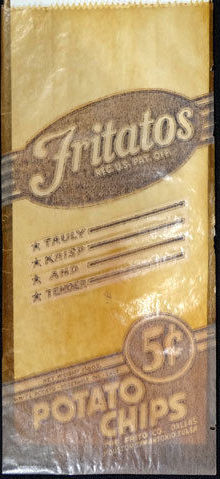
Hey! Did you know that the Frito Company also made potato chips for a while? They were called “Fritatos” and they were introduced in 1935. Here’s one of their snazzy-looking trucks making a much-appreciated snack delivery to Fair Park during the Centennial Exposition in 1936.

***

Sources & Notes

Photo of the “pampered potatoes” truck from Kaleta Doolin’s wonderful book about the family business, Fritos Pie: Stories, Recipes, and More (College Station: Texas A & M University Press, 2011).

*

Copyright © 2014 Paula Bosse. All Rights Reserved.

Olsen-Stelzer Cowboy Boot Saleslady — 1939

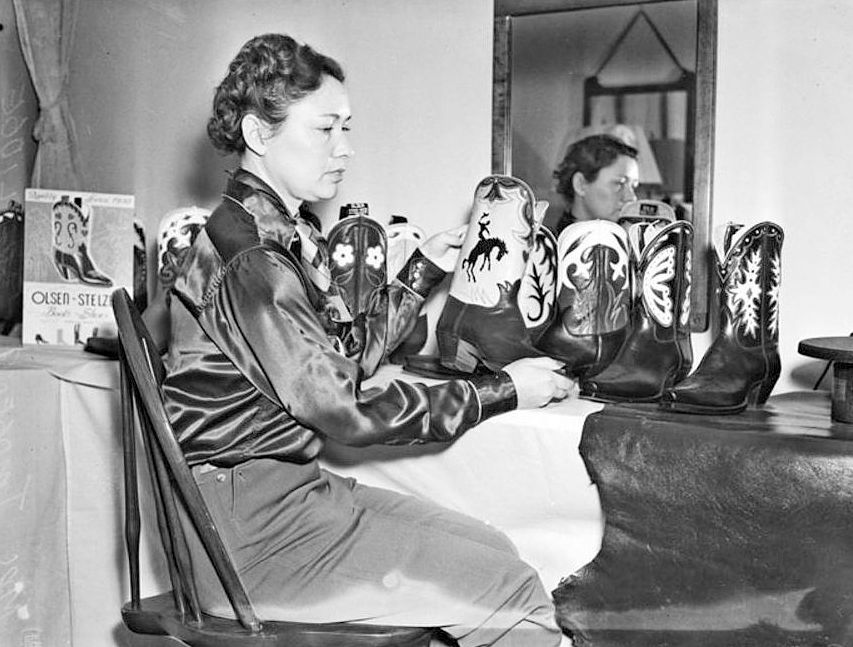
Portrait with boots…

by Paula Bosse

Above, Dallas resident Imogene Cartlidge is seen at a shoe retailers’ convention in San Antonio in 1939. Cartlidge was an employee of the Olsen-Stelzer boot company in Henrietta, Texas, and she was said to be “the only woman boot salesman on record.” I’m a big fan of cowboy boots of this period, and I have to say that I am ashamed that I was unaware of the famous Olsen-Stelzer company, which lasted from 1900 until the 1980s. The company is back in business again, led by Tom Cartlidge, whose parents began selling the boots in 1938 — Imogene is his mother. I wish them all the best of luck, because the world needs as many great-looking cowboy boots as it can get!

olsen-stelzer_dmn_120146

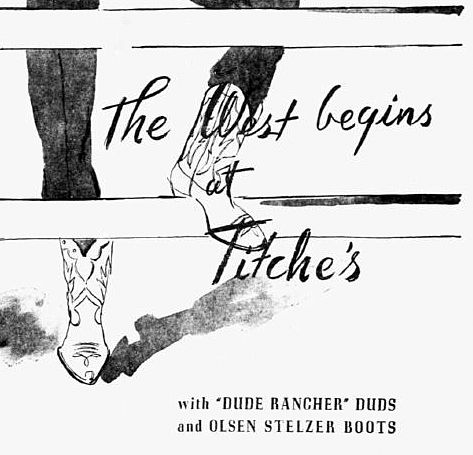
“The West begins at Titche’s”? First I’m hearing of this. Who knew? Nice ad, though.

olsen-stelzer_dmn_120146det

olsen-stelzer_dmn_103055

olsen-stelzer_1941

Best of all is this absolutely fantastic video from 1956 about the company:

olsen-stelzer-logo

olsen-stelzer-box

***

Sources & Notes

Photo of Imogene Cartlidge is from the San Antonio Light Photograph Collection, University of Texas San Antonio Libraries Special Collections, Institute of Texan Cultures.

Titche’s ad from 1946.

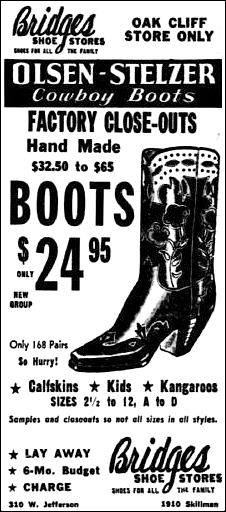
Bridges Shoe Store ad from 1955. (Bridges seems to have been the only place in Dallas where the boots were regularly sold — or at least regularly advertised. And you could get them ONLY IN OAK CLIFF!) (I hear the West begins at Oak Cliff….)

The video can be found on the home page of the Olsen-Stelzer website here.

The last image is the lid of an Olsen-Stelzer boot box, which belongs to my aunt — she keeps Christmas ornaments in it. (Sadly, no sign of the boots!)

The history of the company (and, again, that great video) can be found here.

*

Copyright © 2014 Paula Bosse. All Rights Reserved.