Flashback : Dallas

A Miscellany: History, Ads, Pop Culture

Category: 1940s

The Moskovitz Cafe

moskovitz-cafe_winegarten-schechterA stool is waiting for you… (click for larger image)

by Paula Bosse

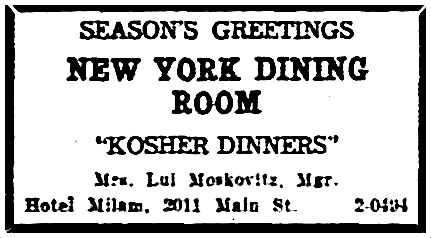
The Moskovitz Cafe was located at 2216 Elm Street, between S. Pearl and what is now Cesar Chavez Blvd., in an area of predominantly Jewish businesses. The restaurant served “Kosher and American cooking” and was owned and run by Lui Moskovitz, a Romanian immigrant, and his Polish-born wife, Eva. Eva, recently widowed, had arrived in Dallas in about 1928 with her three children and seems to have married Lui that same year. They had run another restaurant before the Moskovitz Cafe: the New York Kosher Dining Room on Commerce had been located across from the Adolphus Hotel for several years before it moved to 2011 Main, around the corner from City Hall. After that closed, they ran the Moskovitz Cafe between about 1937 and about 1944.

In 1945 there was no Lui or Eva Moskovitz in the Dallas directory. There was, however, an Eva Haberman — it appears that the Moskovitzes had split, Lui had left town, and Lui’s ex-wife had taken back the name of her late first husband. At this time she must have been about 60 years old, but she worked for the next few years as a department store seamstress and lived with one or more of her three sons from her marriage to Nathan Haberman. She died in April, 1961. Not only is there no trace of Lui after his time in Dallas, there is also no trace of 2216 Elm.

moskovitz_dmn_0101361936 ad

moskovitz-cafe_elm-st_1943-directory
Elm St. businesses, 1943 Dallas directory (click for larger image)

moskovitz_map
Location of Moskovitz Cafe (det. of a 1919 map)

***

Sources & Notes

Photo appeared in the book Deep in the Heart: The Lives & Legends of Texas Jews, A Photographic History by Ruthe Winegarten and Cathy Schechter (Austin: Eakin Press, 1990); from the collection of the Dallas Jewish Historical Society.

I’m not sure who the people in the photo are. When the Moskovitz Cafe opened, Lui would have been in his mid-40s and Eva would have been in her early 50s. UPDATE: Per the comment below (from Eva’s grandson), the woman in the white apron is the proprietress, Eva Moskovitz, and the man at the cash register is her son, Jack Haberman.

More information about Mrs. Eva Haberman can be found in her obituary, published in The News on April 19, 1961.

All images larger when clicked.

*

Copyright © 2016 Paula Bosse. All Rights Reserved.


West Jefferson in the Truman Years

oak-cliff_w-jefferson_frontier-top-tierW. Jefferson & S. Bishop (click for very large image)

by Paula Bosse

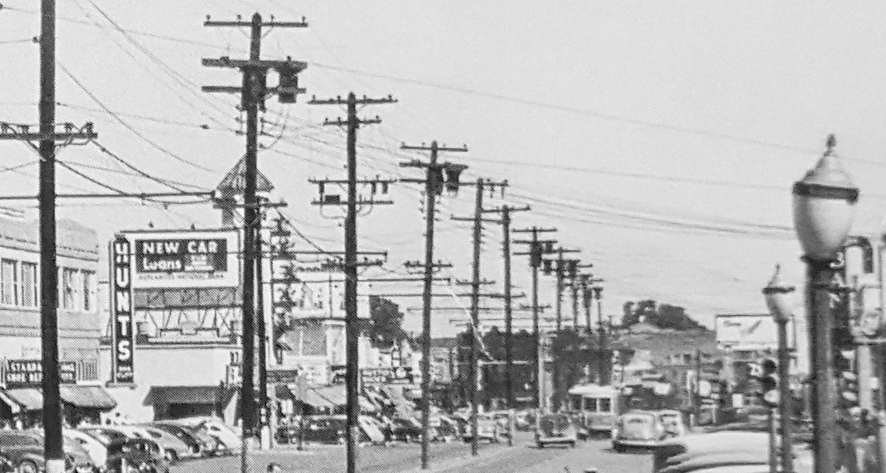
Here we see West Jefferson Blvd. in Oak Cliff, looking east from just west of the intersection with South Bishop. Not being proficient in dating automobiles, I’m unsure of the date, but the Hoffman Optical Co. (seen on the right) did not appear in the 1948 city directory, but was there by 1951. The current view from this intersection can be seen on Google Street View here. Even though the visual blight of those telephone poles is unappealing, I have to say, I prefer the livelier W. Jefferson of 60-something years ago.

If you squint, you can just see the Texas Theatre in the distance on the left — under the pointy roof, behind the “New Car” billboard. Here’s a magnified detail (click to see a larger image) — you can (barely) see “TEXAS” spelled out on the vertical sign.

oak-cliff_w-jefferson_tx-theatre_det

The first thing I noticed in this photo is this odd black vehicle driving away from the photographer — I keep seeing a bulky version of Harold’s customized hearse from the movie Harold and Maude. What is this?

oak-cliff_w-jefferson_vehicle

Here are the businesses that occupied the couple of blocks seen here (from S. Bishop to S. Zang) in 1951:

w-jefferson_1951a          w-jefferson_1951b
1951 city directory (click to read!)

*

Copyright © 2016 Paula Bosse. All Rights Reserved.


Tennessee Williams in Dallas

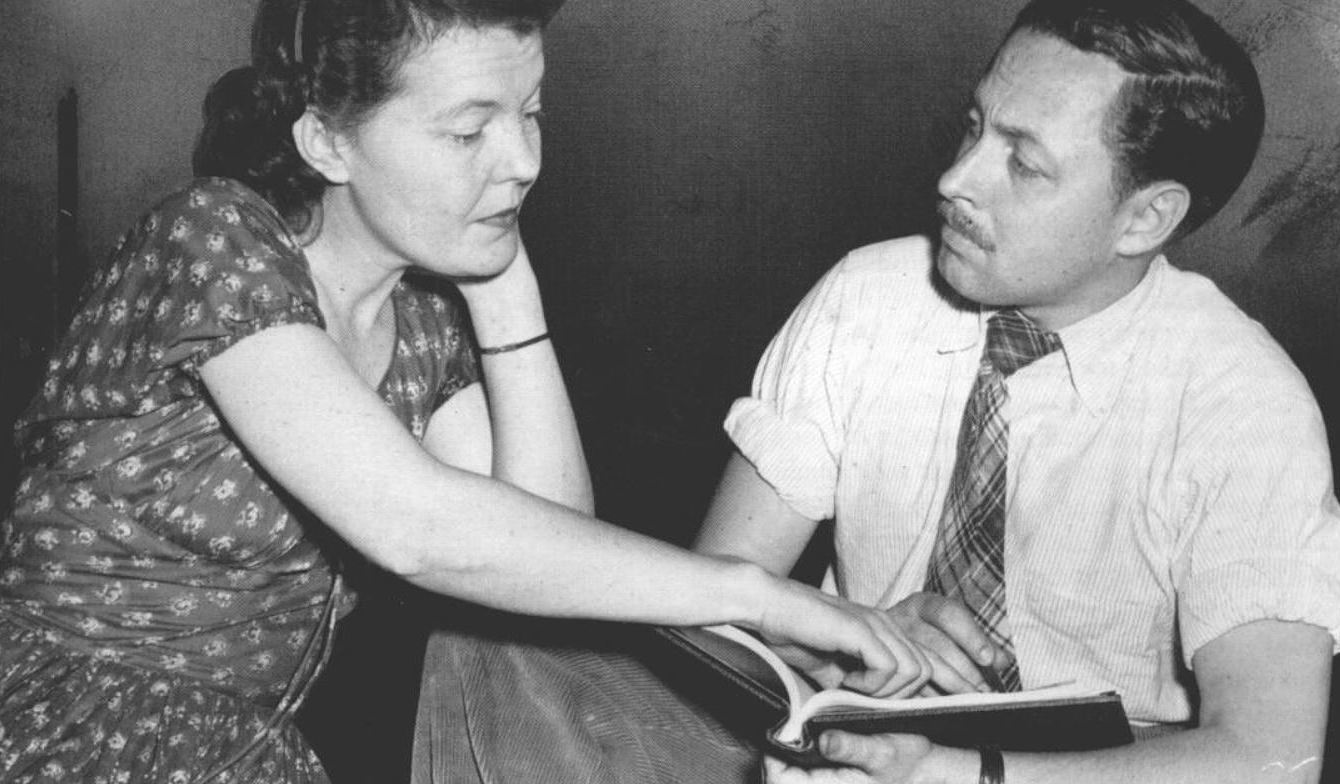
tennessee-williams_margo-jones_legacies_spring-2007Tennessee Williams with Margo Jones, 1948

by Paula Bosse

Today is Tennessee Williams’ birthday — he was born March 26, 1911. Thanks to his personal friendship and professional relationship with energetic Dallas theater pioneer Margo Jones (to whom he gave the nickname “The Texas Tornado”), playwright Tennessee Williams was a fairly frequent visitor to Dallas in the 1940s in the early years of his celebrity. Margo was a very early supporter of Williams, and their friendship led to her co-directing The Glass Menagerie on Broadway and her directing and producing the world premiere of his play Summer and Smoke at her Theater ’47 in Fair Park (a production which she took to Broadway the following year).

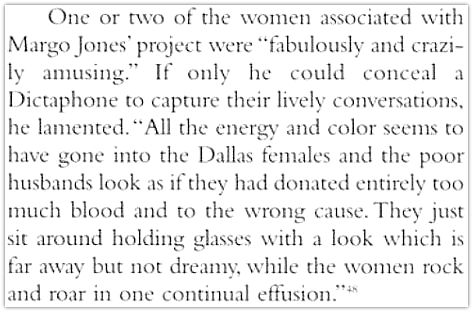
Dallas historian Darwin Payne wrote an interesting profile of Williams’ time in Dallas in the Spring 2007 issue of Legacies (read it here — it  begins at the bottom of the page). My favorite quote in the article is about Dallas women, from a letter Tennessee wrote to New York theater director and producer Guthrie McClintic on June 1, 1945:

tennessee-williams_legacies_spring-2007_darwin-payne_1945-quote

***

Sources & Notes

A comprehensive chronology of the friendship and professional partnership of Tennessee Williams and Margo Jones can be found in the article “An Alignment of Stars: Tennessee Williams, William Inge, and Margo Jones’s ‘Theatre ’47′” by Ralph F. Voss, here.

My previous post concerning Margo Jones’ early demise — “Margo Jones & Jim Beck: Both Legends in Their Fields, Both Victims of Carbon Tetrachloride” — is here.

*

Copyright © 2016 Paula Bosse. All Rights Reserved.


Commerce & Record Streets — 1946

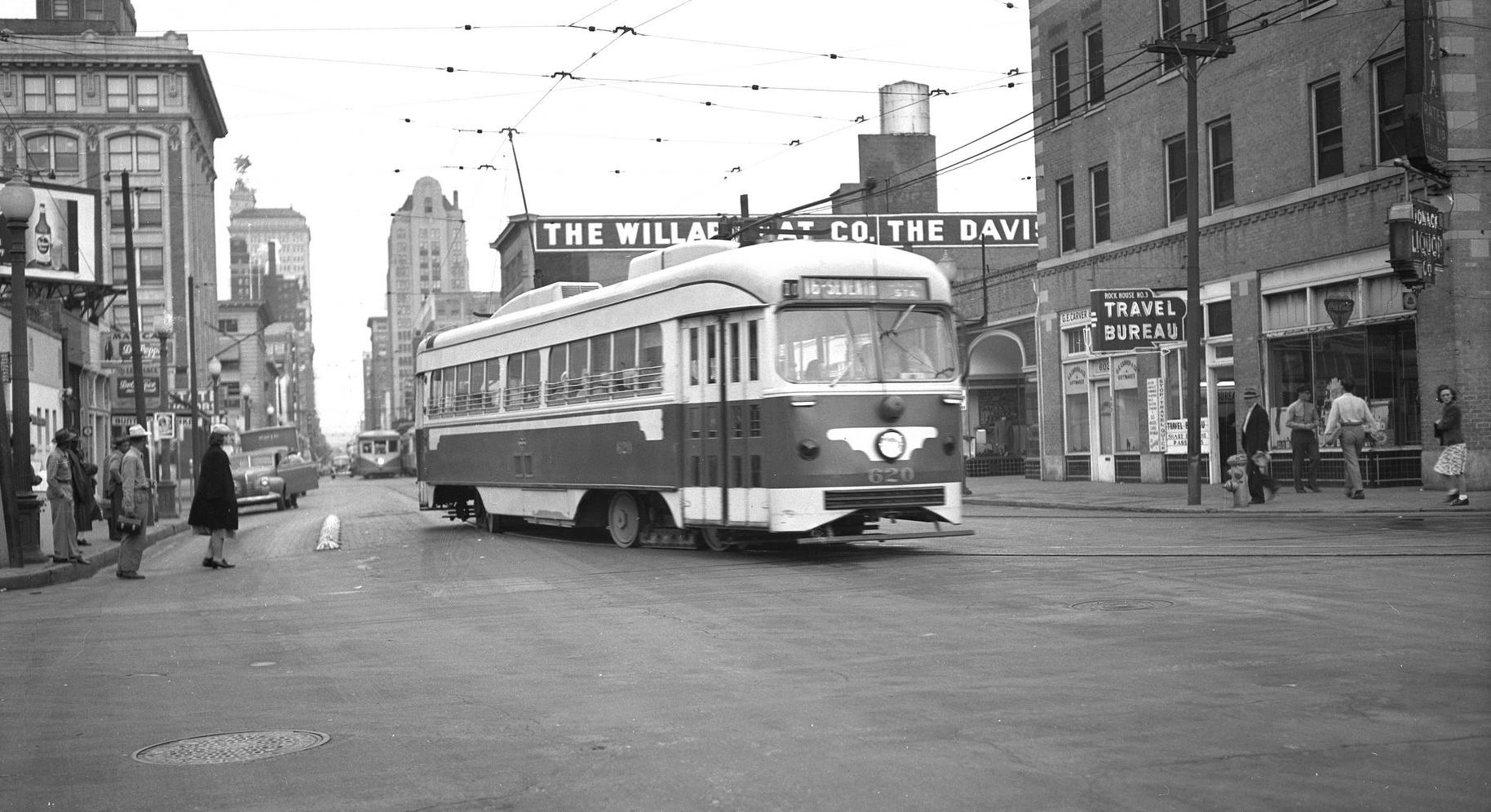
streetcar_commerce-record_051046_ceraCommerce St. looking east from Record (click for huge image)

by Paula Bosse

If it’s a photo of downtown in the ’40s, with people on the streets, retail storefronts, and streetcars, I’m going to love looking at it. Like this one. A lot of people might be hard-pressed to identify the location of this photograph, even if they were standing in the exact spot the photographer stood in. If you look at today’s view from the same vantage point (here), just about everything in the immediate foreground (west of the Pegasus-topped Magnolia Building) is gone — except for, most notably, the beautiful MKT Building at Commerce and Market, one of my favorite downtown buildings.

This is the intersection of Commerce and Record streets, when Record still extended from Elm to Jackson; the Old Red Courthouse was behind the photographer, to the left. Today, the Kennedy Memorial is at the left where the people are waiting for a streetcar; the George Allen Courts Building is across the street — at the right, in the block with the travel bureau; and the block containing the Willard and Davis Hat building — across Commerce from the Katy Building — is now a parking lot.

As with every photograph like this I see, I wish I could step into it and walk around the downtown Dallas of 1946. Maybe pop into Ma’s Cafe for a Dr Pepper before I hop on a streetcar and just ride around on it all day until someone kicks me off.

*

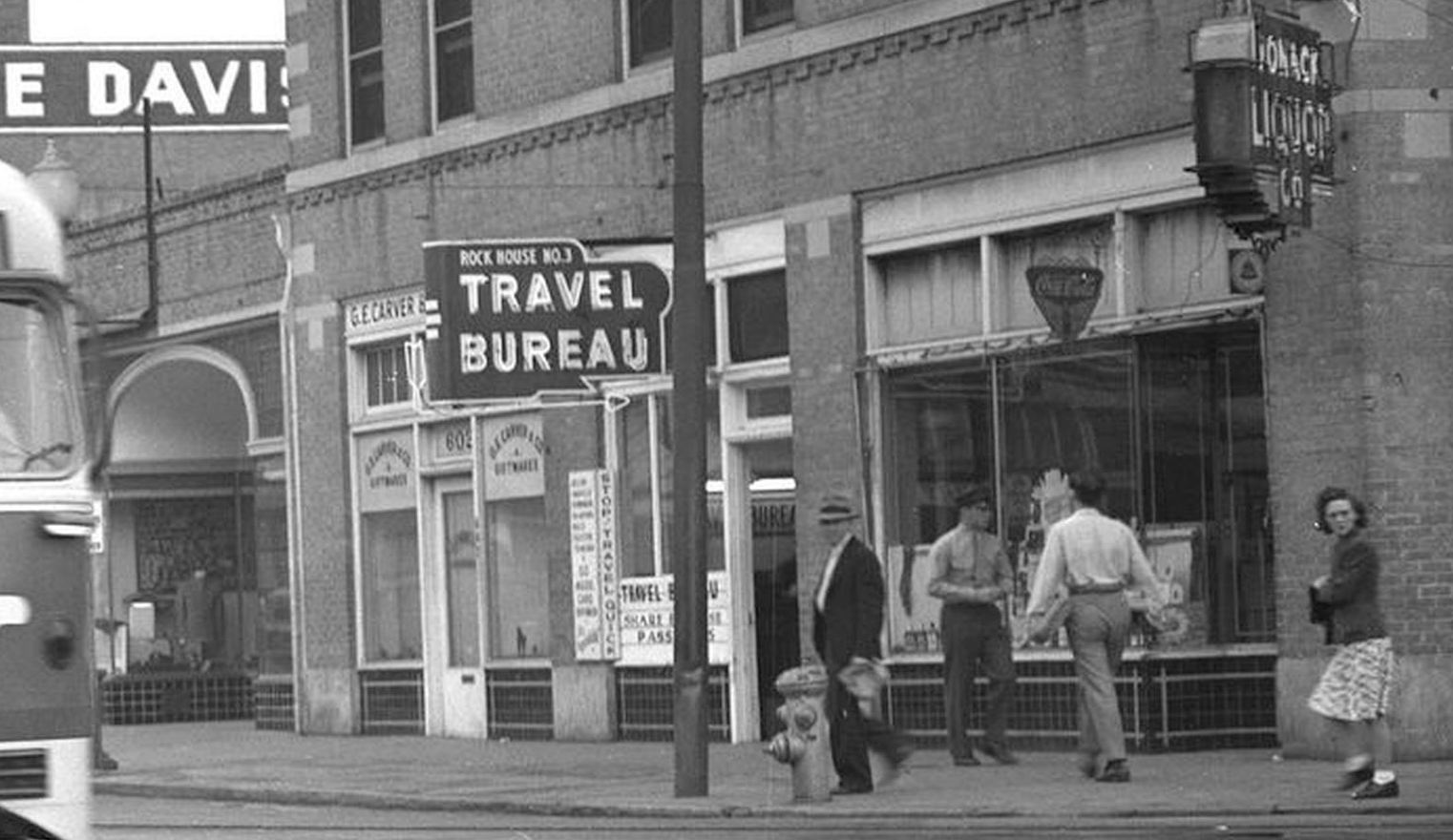
Below are a couple of magnified details (both are much larger when clicked).

streetcar_commerce-record_051046_cera-det1

streetcar_commerce-record_051046_cera-det2

Below is a listing of the businesses in this 600 block of Commerce, between Record Street and the MKT Building.

600-block-commerce_1945-directory1945 Dallas directory

(The tall building on the right with the travel bureau on the ground floor is the Plaza Hotel at 202-204 Record Street. The Yonack Liquor Store on the corner is at 200 Record, with entrances on both Commerce and Record.) 

Here’s a detail of a photo taken about the same time, showing an aerial view of Commerce Street.

aerial_commerce-st_1940s_foscue-lib_smuFoscue Map Library/SMU

***

Top photograph was taken on May 10, 1946 by Richard H. Young; it can be viewed on the CERA (Central Electric Railfans’ Association) website, here. (If you’re interested in Dallas streetcars, this page has some GREAT photographs!)

The caption of the photo from the above website: “May 10, 1946 — New Dallas Railway & Terminal Co. double-end PCC car 620, at speed, southbound, turning into Record St. from Commerce St. (Ervay-7th Line).”

The aerial photo was taken by Lloyd M. Long in the 1940s and is titled “Downtown Dallas looking east (unlabeled); it is from the Edwin J. Foscue Map Library, Central University Libraries, Southern Methodist University. This is only a small portion of the full photograph — the full photo is here.

Since there is an exact date for this photo, here is a large Skillern’s ad from that day’s newspaper. Coincidentally, there was a  Skillern drugstore on the northeast corner of Commerce and Record — it is in this photo, behind the lamppost at the bottom left. Let’s see what was on sale May 10, 1946. (I would kill for a set of those Pyrex bowls!)

skillerns-ad_dmn_051046

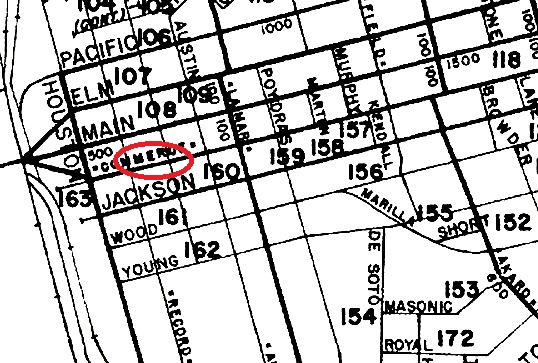
And, lastly, who doesn’t love a map?

map_commerce-and-record_1952-mapsco 1952 Mapsco

Everything is bigger when clicked!

*

Copyright © 2016 Paula Bosse. All Rights Reserved.


Photo-Pac: The First Disposable Camera — 1948

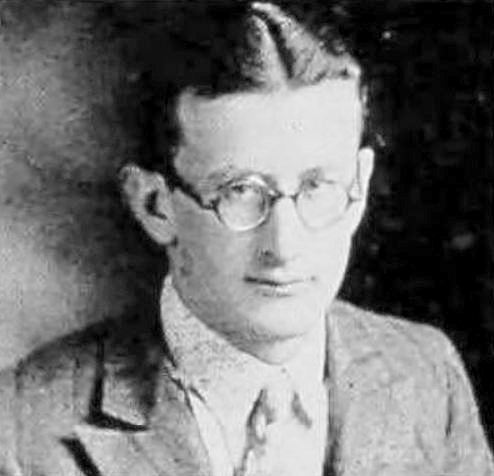
weir_mechanix-illus_1949_smA. D. Weir and his invention, 1949

by Paula Bosse

Alfred D. Weir (1909-1996) was the son of A. F. Weir, the successful retail furniture merchant who founded Weir Furniture in 1922. The younger Weir graduated from SMU in 1933 with a degree in mechanical engineering and started his career, fresh out of college, at Dallas’ Ford assembly plant. During World War II, he was the chief industrial engineer at North American Aviation and was later employed by Fairchild Engine and Aircraft, Ford’s aircraft division in Kansas City, Texas Instruments, and Bell Helicopter.

After the war and before his time in Kansas City, Weir took time out from his engineering career to try his hand as an entrepreneur: he invented, patented, and manufactured the Photo-Pac, a single-use camera made of inexpensive fiber board and pre-loaded with 35mm film (loaded by blind employees in total darkness). The user would buy one of these cameras at a drug store, department store, or gas station for $1.29, take eight photographs, and then write his or her name on the side of the camera and drop the whole thing — with the film still inside the camera — in a mail box. Photos would be processed in Dallas, and prints and negatives would be returned to the customer in a couple of days. The camera would not be returned.

photo-pac_san-bernardino-county-sun_040250-photoSan Bernardino County Sun, April 2, 1950

photo-pac_arlington-heights-illinois-herald_122349-photoArlington Heights (Illinois) Herald, Dec. 23, 1949

It appears to have made its debut at the 1948 State Fair of Texas at an introductory price of only 98¢ (click for larger image).

photo-pac_billboard_100948Billboard, Oct. 9, 1948

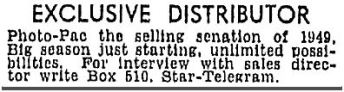
Manufacture and distribution of the camera began in earnest in May, 1949. And then … ads for the camera were everywhere! (The home-grown invention appeared in a hometown newspaper advertorial on May 1, here.) Weir and his small team managed to get the camera in retail locations all over the country. He was also worked hard to line up distributors. Ads such as this one were placed in several U.S. newspapers:

photo-pac_FWST_061649Fort Worth Star-Telegram, June 16, 1949

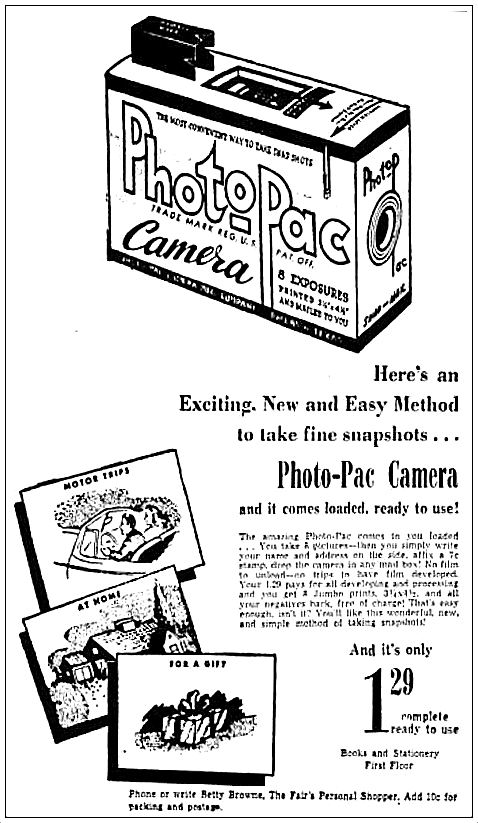
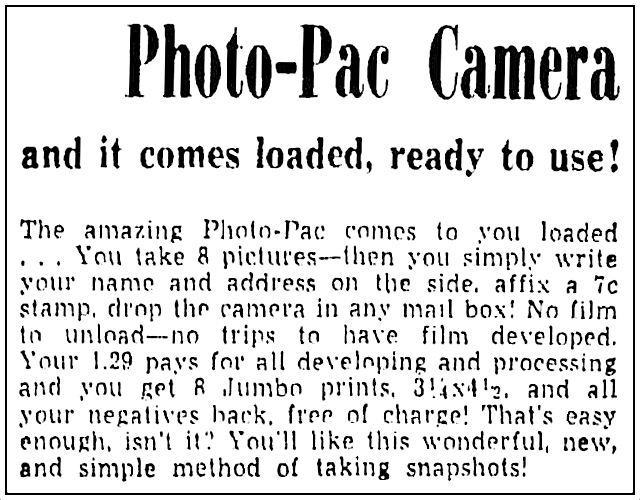
It seems to have been very popular — both as a novelty impulse buy and as a useful product for people who either did not own cameras or who did not want to take their family cameras on trips. Here’s a typical ad (see text below):

photo-pac_FWST_111649_fair-dept-store-ad

photo-pac_FWST_111649_fair-dept-store-ad_detFWST, Nov. 16, 1949 — from ad for Fort Worth’s Fair Department Store

The camera won a “prize gadget” award from Mechanix Illustrated (click to see very large image).

photo-pac_mechanix-illus_sept-1949Mechanix Illustrated, Sept. 1949

By the summer of 1950, the number of exposures went from eight to twelve, and the price increased to $1.49. It seemed that the business was growing, but by the fall of 1950, Photo-Pac seems to have reached the end of the road. Court dockets showed a couple of lawsuits filed against the company. Newspaper ads showed stock of the cameras being deep-discounted to as low as 50¢ apiece. The next year, 1951, saw Weir returning to his engineering career — he accepted a position with Ford in Kansas City and apparently left his business dreams behind. It was a great idea, but, for whatever reason, it never fully caught on.

36 long years after A. D. Weir’s Dallas company folded, Fuji introduced their very popular disposable camera; Kodak followed with theirs in 1987. Those things were everywhere — everyone’s had one of them at one time or another. I bet A. D. Weir was miffed.

fuji_FWST_070286FWST, July 2, 1986

*

weir_smu_rotunda_1930A. D. Weir, SMU Rotunda, 1930

weir_smu_rotunda_1933Weir, SMU Rotunda, 1933

weir_dmn_032253-photo1953

***

Sources & Notes

Top photo is an inset from the Mechanix Illustrated “prize gadget” page, from the blog Modern Mechanix, here.

Weir’s patent can be found on Google here. To view Google Patent Image separately (and really big), click image below.

weir_patent

There seems to be some debate about whether Weir’s Photo-Pac was actually the first single-use disposable camera — if it isn’t strictly the first, it seems to have been the one that made the most headway into the American marketplace. A great article on the topic can be found on the Disposable America website here.

Wikipedia’s “disposable camera” page is here.

A. D. Weir’s father, Alfred Folsom (A. F.) Weir opened Weir Furniture at 2550 Elm Street in 1922; in 1934 the company was incorporated to include his wife and son. A. F. Weir sold the Dallas company to his brother Earl (who had owned furniture stores in Fort Worth and Arlington) in the 1940s — that business closed sometime between 1945 and 1948. In 1948, Earl’s son John Ray Weir opened Weir’s Furniture Village on Knox Street, a business still going strong today.

Most images are magically larger when clicked!

*

Copyright © 2016 Paula Bosse. All Rights Reserved.

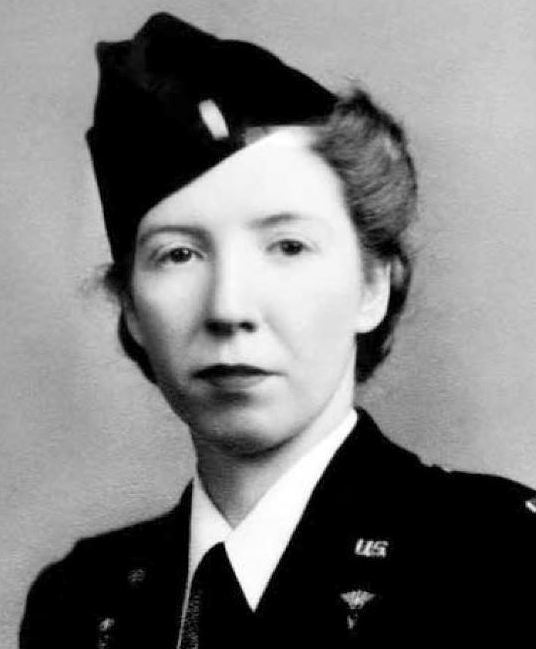
Lt. Mary L. Roberts, The “Angel of Anzio” — The First Woman Awarded the Silver Star

silver-star_feb-22-1945Roberts (left) and two fellow Army Nurse Corps nurses receiving the Silver Star

by Paula Bosse

The opening paragraph from a chapter in Tom Brokaw’s book The Greatest Generation:

There are so many impressive numbers connected to World War II that it’s difficult for one or two to catch your eye. Here are a few that caught me by surprise: more than sixty thousand women served in the Army Nurse Corps. Sixteen died as a result of enemy action. Sixty-seven nurses were taken prisoner of war. More than sixteen hundred were decorated for bravery under fire or for meritorious service.

The chapter is titled “Mary Louise Roberts Wilson,” a profile of Mary L. Roberts, a Methodist Hospital nurse who enlisted in the Army Nurse Corps in 1942. She served with the 56th Evacuation Hospital Unit alongside many other medical professionals from Dallas (the unit — sometimes called the “Baylor Unit” — was organized by the Baylor University College of Medicine in Dallas). She knew she would be serving overseas in field hospitals in combat zones.

As far as seeing action, the worst of the worst for the 56th was on February 10, 1944 when their hospital tents on the Anzio beachhead in Italy were attacked by German long-range artillery shells for a full thirty minutes. Several operations were underway during the attack, and Roberts, the chief nurse of the operating tent, managed to keep a calm head and help to maintain as much order as possible.

“I wanted to jump under the operating table, but first we had to lower litter cases to the floor. Pieces of steel already were ripping through tents. There were four litters. I saw a patient on the operating table had his helmet near him so I put it over his head to give him that much protection.” (Mary L. Roberts, Dallas Morning News, Feb 23, 1944)

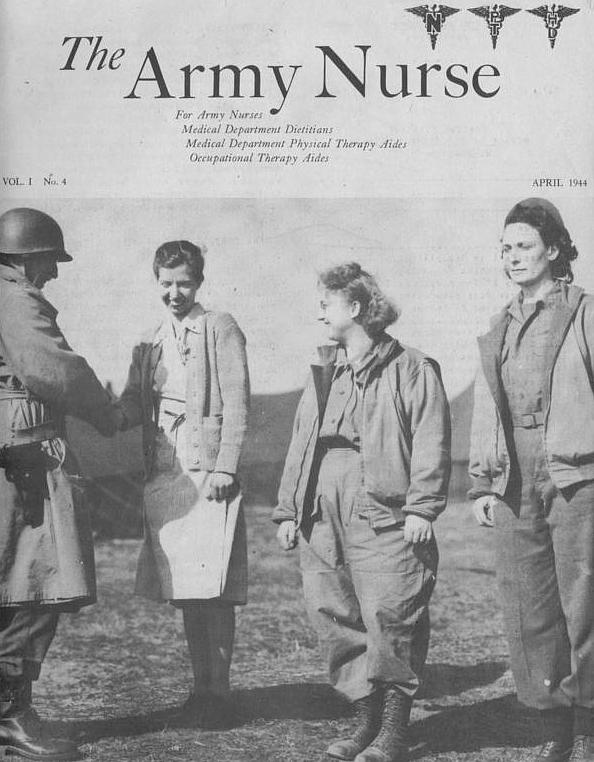
When the shelling ended, two enlisted men in the operating tent had been wounded, and elsewhere in the field hospital, two nurses had been killed and several other personnel wounded. As a result of their exceptional bravery, outstanding leadership, and “gallantry in action,” Roberts and two other nurses, 2nd Lt. Rita Virginia Rourke and 2nd Lt. Elaine Arletta Roe were awarded the Silver Star. No women had ever received the medal. As 1st Lt. Roberts had seniority, she was the first woman in history to be decorated for heroism in action.

Maj. General John P. Lucas surprised her and the other two nurses on Feb. 22, 1944 with an informal presentation of the medals at the same Anzio hospital that had been shelled only twelve days earlier. After the brief pinning ceremony, the nurses immediately returned to their duties, all feeling they were accepting acknowledgement for their team, not for themselves alone. Roberts spent 29 months overseas, and tended to more than 73,000 patients.

After the war, when Lufkin-native Mary Roberts returned home, she worked for almost 30 years as a nurse at a VA hospital in Dallas, and, rather late in life, she married fellow veteran Willie Ray Wilson. Mrs. Wilson died in 2001 at the age of 87. She was buried with full military honors.

roberts_texas-women-first_mcleroy_UTA1944 (Fort Worth Star-Telegram Archives, UTA)

roberts_dmn_022344-photo1944

roberts-cover_army-nurse_april-1944Presentation of the Silver Star at Anzio

roberts_obit-photoMary Roberts Wilson (1914-2001)

***

Sources & Notes

Top photo and first quote from The Greatest Generation by Tom Brokaw (New York: Random House, 1998).

For an exceedingly detailed history of the 56th Evacuation Hospital Unit, with several photographs, see here.

Articles on Mary Roberts from The Dallas Morning News archives:

  • “Baylor Unit In Action” (DMN, Aug. 26, 1942): photo of unit, including Roberts, working around an operating table
  • “Dallas Nurse, Two Others Win Medals” (DMN, Feb. 23, 1944): “The award, denoting exceptional bravery went to Lt. Mary L. (Pinky) Roberts, 1205 North Bishop, Dallas, Texas, chief nurse in an operating room hit by shell fragments.”
  • “Nurses of Dallas Unit Serving at Anzio Doing Jobs Cheerfully Despite Many Hardships” by Wick Fowler (DMN, March 31, 1944)
  • “Ends Military Career: WWII Recalled By Heroic Nurse” (DMN, July 26, 1964): photo and interview with Mary Roberts Wilson on her retirement from the U. S. Army Reserve
  • “Happiness Is Being Part of a Team” by Jane Ulrich Smith (DMN, May 16, 1972), photo and interview, on her retirement from the Veterans Administration Hospital
  • “Compassion Revisited: Nurse Reunites With GI She Treated For Serious Injuries In WWII” (DMN, Nov. 4, 1999): a reunion with former patient Dewey Ellard of Mobile, Alabama, brought together by Tom Brokaw
  • “Distinguished Career In Medicine Followed — WWII Gallantry — VA Hospital Honors Longtime Nurse — Who Won Silver Star in ’44” (DMN, Nov. 6, 2001): interview with the then-87-year-old Mrs. Wilson, published two-and-a-half weeks before her death
  • “Mary Wilson, ‘Angel of Anzio,’ Dies at 87 — WWII Nurse Known For Kindness Was Decorated For Bravery Under Fire” (DMN, Nov. 24, 2001)

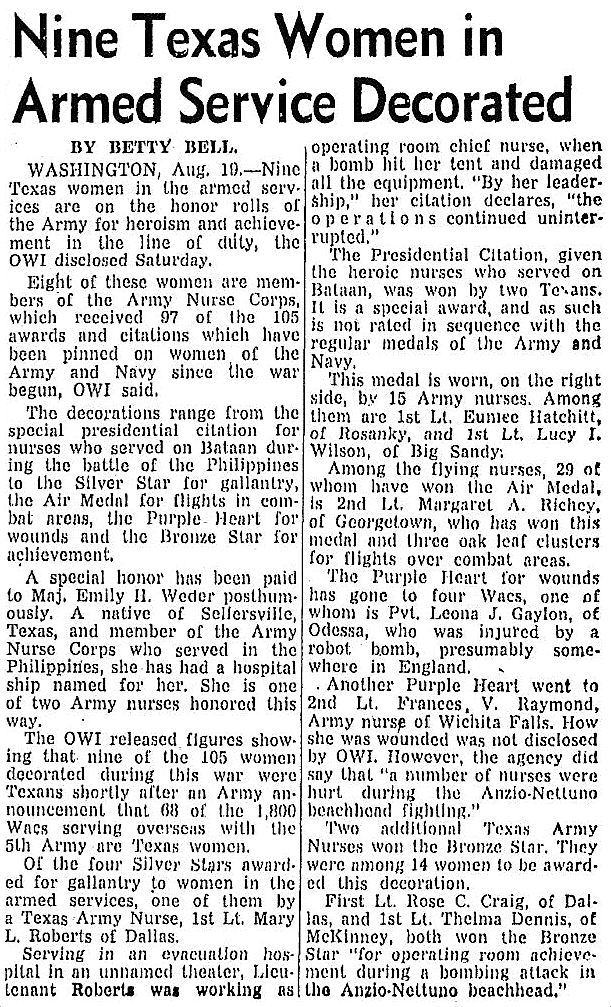
Other women who were honored in 1944 for heroism and achievement in the line of duty:

women_ww2_medals_FWST_082044Fort Worth Star-Telegram, Aug. 20, 1944

Click pictures and articles for larger images.

*

Copyright © 2016 Paula Bosse. All Rights Reserved.


Meet Me In Front of The Rialto — 1945

rialto_MPH_072845“A great big howl of a hit!” (click for larger image)

by Paula Bosse

This photo shows the front of the Rialto theater, once located at Elm and Stone. I love the unavoidable promotion for the Jack Benny movie “The Horn Blows at Midnight,” but I love all that street life even more. And by the way, “Help Keep Dallas Clean”!

***

Photo from the July 28, 1945 issue of Motion Picture Herald.

My favorite young movie-crazy Dallas diarist, Muriel Windham, would absolutely have walked past this (she probably didn’t see it, though, because she wasn’t a big fan of Jack Benny). (For the record, I LOVE Jack Benny!)

Click photo for gigantic image.

*

Copyright © 2016 Paula Bosse. All Rights Reserved.

The Lakewood Theater — 1944

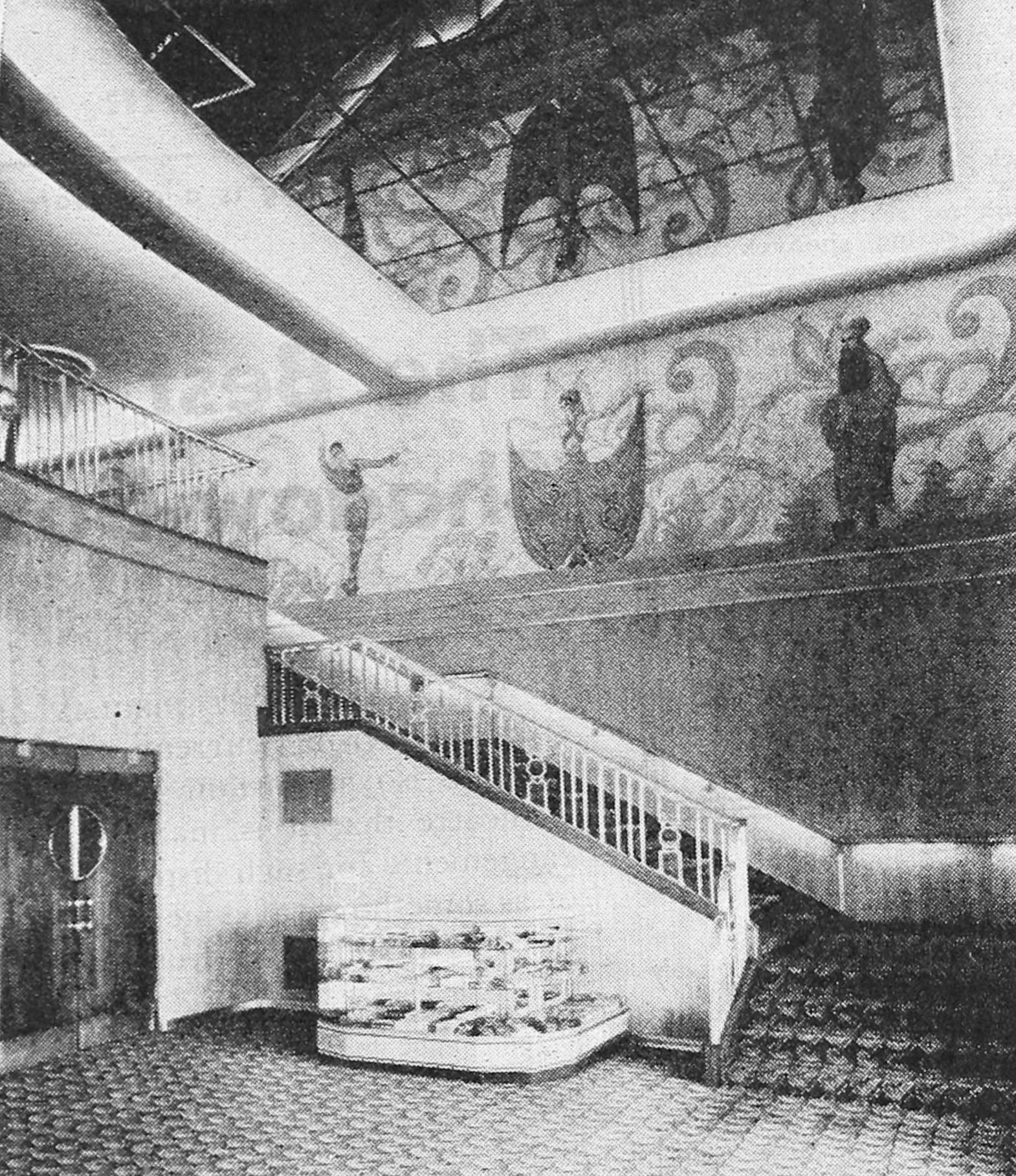
lakewood-theater_ad_inset_1944A well-lit staircase to the balcony (click for giant image)

by Paula Bosse

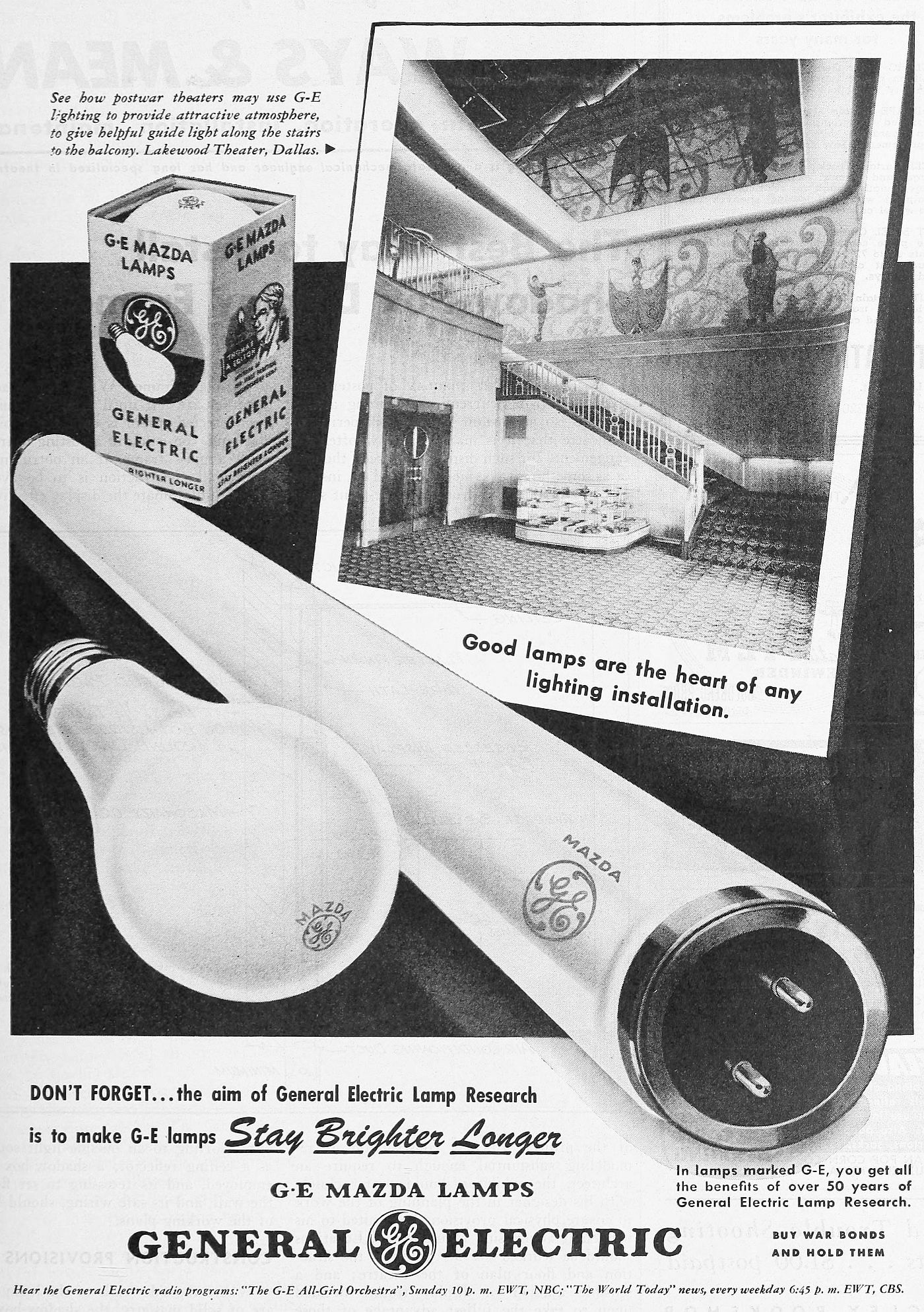
Occasionally one stumbles across a national advertisement featuring someone or something familiar to local audiences which elicits an involuntary exclamation like, “Hey! I know that guy!” I had a response kind of like that when I saw this General Electric light bulb ad featuring a photograph of the interior of the Lakewood Theater (showing a few figures from the mural by Woodrow boy Perry Nichols).

“See how postwar theaters may use G-E lighting to provide attractive atmosphere, to give helpful guide light along the stairs to the balcony.”

lakewood-theater_ad_MPH_072244_med

Yes, the Lakewood certainly did have an “attractive atmosphere.”

***

Sources & Notes

Ad for G-E Mazda lamps appeared in the July 22, 1944 issue of Motion Picture Herald. Click the above ad to see it much larger. To see it REALLY big, click here. (Apologies for the bleed-through of the ad on the other side of the page. If you’re a Photoshop wizard who can remove the offending ghost letters plastered across Nichols’ whimsical mural, I’d love a cleaned-up version.)

I have no idea what’s going on with the beleaguered Lakewood Theater these days, but if you’d like to see those murals in color, see the photos in the Lakewood Advocate, here.

*

Copyright © 2016 Paula Bosse. All Rights Reserved.

Yehudi Menuhin and Antal Dorati: A Collaborative Friendship

menuhin-dorati_texas-week-mag_012547_sm
“Best friends” Menuhin and Dorati in Dallas, Jan. 1947

by Paula Bosse

When Antal Dorati was appointed conductor of the Dallas Symphony Orchestra in 1945, Dallas suddenly began to see a lot of violinist Yehudi Menuhin.

In a 1954 article about Yehudi Menuhin’s close ties to Dallas, John Rosenfield — the influential arts editor of The Dallas Morning News — wrote that when Menuhin was in town for a performance for the Civic Music Association in 1945, he was “casually asked” (probably by Rosenfield himself) what he thought of Antal Dorati as a possible conductor for the then-long-dormant Dallas Symphony Orchestra.

“He’s my best friend … he’s wonderful … he’s great,” said Yehudi, who was promptly carried around town to talk to businessmen again interested in re-forming the orchestra. (DMN, Sept. 5, 1954)

A short while later, Dorati was hired as musical director of the “new” Dallas Symphony Orchestra, and, as a result, best friend Yehudi was in and out of town frequently during Dorati’s four seasons in Dallas. Not only did he perform frequently as a soloist with the DSO, but it was not unheard of for Yehudi to sometimes drop by and sit in with the orchestra during rehearsals. Menuhin often stayed with Dorati when touring the central United States or based himself at the Melrose Hotel, which he used as a sort of mid-continent pied-à-terre.

One of the great passions the two men shared was a love for the music of Hungarian composer Bela Bartok. Dorati, born in Budapest, studied piano under Bartok and was a champion of his work throughout his career. Menuhin had performed Bartok’s Violin Concerto to great acclaim, and near the end of Bartok’s life, after the two men had met and bonded, Menuhin commissioned him to compose a sonata for violin.

Dorati and Menuhin often collaborated on performances featuring Bartok’s works, and when it was known that Dorati was all-but-signed to be the new DSO conductor, there was much speculation that Bartok himself might come to Dallas, but Bartok’s death in September, 1945 put an end to those hopes.

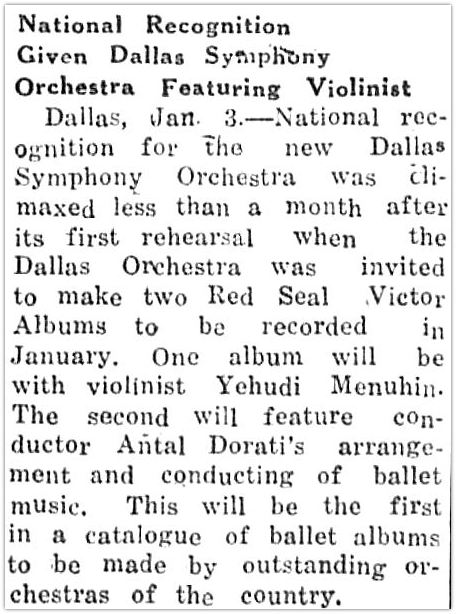
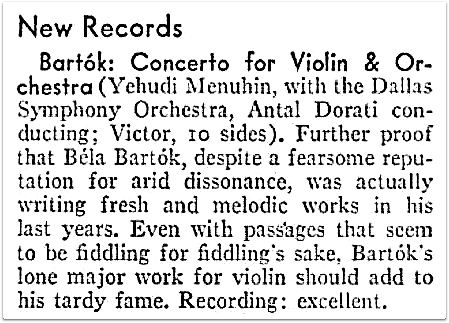
The first RCA Victor Red Seal recordings of Dorati’s Dallas Symphony Orchestra took place in January, 1946. One of the recordings featured Menuhin performing Bartok’s Concerto for Violin and Orchestra.

dorati-menuhin_denison-press_010446Denison Press, Jan. 4, 1946

Below, the first movement of the recording.


*
The second movement is here; the third movement is here.

The recording was well-received.

dorati-menuhin_time_061647_reviewTime  magazine, June 16, 1947

dorati-menuhin_time_061647RCA Victor ad, 1947

Of perhaps greater note, was the fact that Yehudi Menuhin conducted for the very first time in Dallas — the first orchestra he ever waved a baton at was the Dallas Symphony Orchestra, in 1946. No doubt because of their great friendship, Dorati coached the 30-year-old Menuhin on the finer points of conducting when the violin virtuoso expressed interest in learning what things were like on the other side of the podium. Menuhin first conducted the DSO on April 6 1946, for an invited audience.

menuhin_conductor_dso_santa-cruz-CA-sentinel_040746Santa Cruz (CA) Sentinel, Apr. 7, 1946

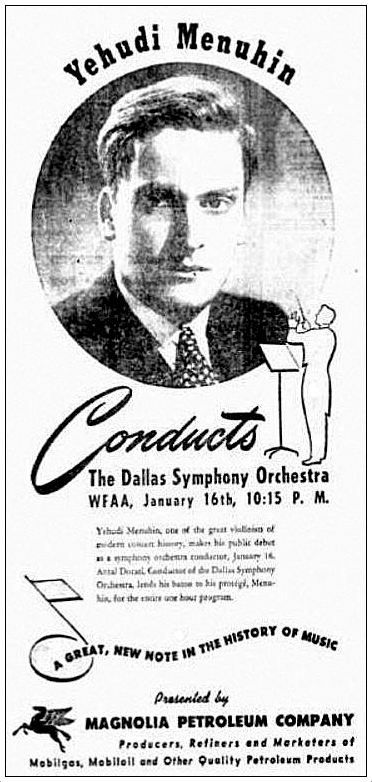
He was ready to go “public” on January 16, 1947, conducting the DSO for one of its regularly scheduled national broadcasts originating from WFAA.

menuhin_conductor_dso_dmn_011247Jan. 11, 1947

The text from the ad:

Yehudi Menuhin, one of the great violinists of modern concert history, makes his public debut as a symphony orchestra conductor, January 16. Antal Dorati, Conductor of the Dallas Symphony Orchestra, lends his baton to his protégé, Menuhin, for the entire one hour program.

Protégé!

Even though Menuhin insisted at the time that this brief foray into the world of conducting was fleeting and not a signal of any sort of career change, Yehudi Menuhin did go on later to direct many of the world’s great orchestras.

**

The friendship between Dorati and Menuhin lasted (from what I can tell) until Dorati’s death in 1988 (the decade-younger Menuhin died in 1999). They were personal friends and like-minded professional equals.

Between Menuhin and Antal Dorati, the Dallas Symphony Orchestra conductor, exists a friendship and a mutuality of musical aspiration that has resulted in outstanding musical collaborations. (John Rosenfield, DMN, Jan. 15, 1947)

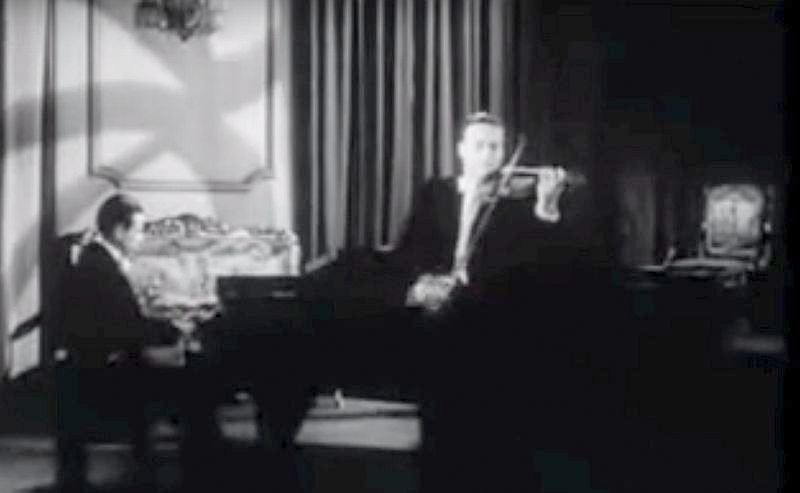
Below, the only film I’ve been able to find of the two men together, filmed in 1947 during the time when Dorati was engaged in Dallas (although this was not DSO-related and was filmed in Los Angeles). The piece being performed is Brahms’ Hungarian Dance No. 4; Dorati accompanies Menuhin on piano (you finally see him near the end!).

 *

menuhin-dorati_brahms_hungarian-danceDorati, Menuhin, 1947 (fuzzy screenshot)

dorati_menuhinYounger… (via Tutti Magazine)

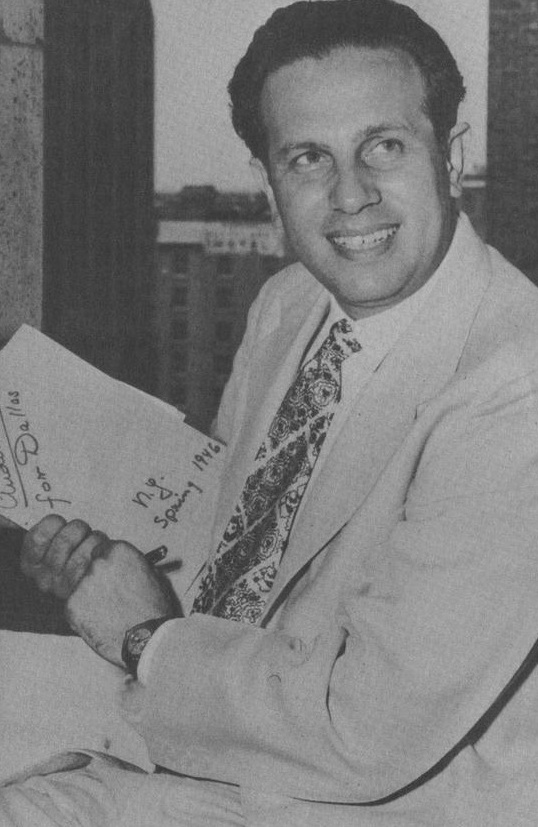
dorati_menuhin_photoOlder…

***

Sources & Notes

Top photo of Menuhin and Dorati in preparation for Menuhin’s public debut as a conductor is from Texas Week magazine (Jan. 25, 1947), here.

The YouTube video of Brahms’ Hungarian Dance No. 4 was filmed at the Charlie Chaplin studios in Hollywood in the fall of 1947 (according to consumer reviews here).

Links-a-lot:

  • Yehudi Menuhin Wikipedia entry is here. His obituary is here.
  • Antal Dorati Wikipedia entry is here.
  • Bela Bartok Wikipedia entry is here.

More on Dorati can be found in my post “Antal Dorati, The Conductor Who Revived The Dallas Symphony Orchestra — 1945-1949,” here.

Click pictures and clippings for larger images.

*

Copyright © 2016 Paula Bosse. All Rights Reserved.

Antal Dorati, The Conductor Who Revived the Dallas Symphony Orchestra — 1945-1949

dorati-dso_texas-week-mag_081746-photo-sm
Antal Dorati, 1946 — on top of the world

 by Paula Bosse

The news this week that the Dallas Symphony Orchestra’s musical director, Jaap van Zweden, was leaving town to pursue a glitzier gig was seen as an inevitable move to many of his disappointed fans. The DSO has been something of a springboard for conductors working their way up the conductor career ladder. Another celebrated conductor who spent a few years in Big D before rising to the heights of international acclaim was Hungarian-born Antal Dorati (1906-1988).

Dallas had classical music concerts in the 19th century, but the roots of what we now know as the Dallas Symphony Orchestra reach back to about 1900, under the direction of Hans Kreissig, who had settled in Dallas in 1887.

kreissig_dmn_011387Dallas Morning News, Jan. 13, 1897

For various reasons (lack of community interest, lack of financial support, etc.), some of these early seasons were truncated or suspended — there was a gap of several years after Kreissig’s tenure, for instance, and there were no performances during most of 1936 and 1937 because of activities surrounding the Texas Centennial and renovations to the Music Hall (the DSO performed at the Music Hall in Fair Park). The most noteworthy suspension of performances was during World War II when the symphony was “temporarily dissolved”: not only was the financial state of the organization not good at this time, but the war itself had depleted the ranks of the performers — the DSO shut down completely in 1942 because conductor Jacques Singer and several of his musicians had enlisted or were drafted. John Rosenfield, the arts editor of The Dallas Morning News and an ardent classical music lover, wrote often during this time how the loss of the DSO was a crushing cultural blow to the city.

When the war ended, Dallas’ music-lovers (and musicians) clamored for the return of the DSO. A search began for a conductor who was not only a superior musical director but who would also be able to build an orchestra from scratch; they found that man in 39-year-old Antal Dorati, a former student of Zoltan Kodaly and Bela Bartok who had made a name for himself as a musical director for ballet companies such as the Ballet Russe de Monte Carlo and the Ballet Theater — his DSO appointment was announced in the fall of 1945.

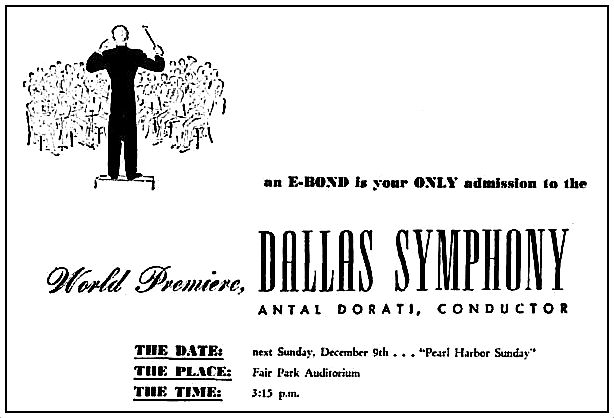
Somehow, in only two months, Dorati managed to put an orchestra together, prepare the season’s schedule, rehearse the musicians, and present the first performance of the “reborn” Dallas Symphony Orchestra on December 9, 1945.

ad_dso_dmn_120545-detDMN, Dec. 5, 1945

The response to that first concert was rapturous:

The crowd was somewhat stunned by the excellence of the ensemble that will bear Dallas’ name. To many, grown realistic or cynical in the years’ cultural struggles, the new orchestra was an unbelievably precious gift. Nothing so fine was expected by even the optimists. And it belonged to them with the promise that it would stay for all the time they could foresee. (John Rosenfield review, “Capacity Audience Thrills To Reborn Dallas Symphony, DMN, Dec. 10, 1945) 

During the intermission of this debut performance, Dorati was interviewed on the radio and had nice things to say about Dallas:

I fell in love with Dallas not last September when I was engaged but as far back as 1937. When I visited here year after year with the Ballet Theater. I said to myself that if I ever withdrew from the ballet and became a resident conductor for an American symphony, I would like it to be the Dallas Symphony Orchestra.” (DMN, Dec. 10, 1945)

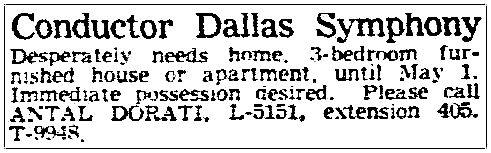
One little thing the Maestro was unable to accomplish, though, was to find a place for his family to live. The severe lack of postwar housing affected even the wealthy cultural elite!

dorati_classified-ad_dmn_121345
Dec. 13, 1945

And, with that, the DSO was back. It toured. A LOT. And made recordings. And appeared on national radio broadcasts. With Dorati at the helm, the Dallas Symphony Orchestra was making a name for itself and garnering a very positive national reputation.

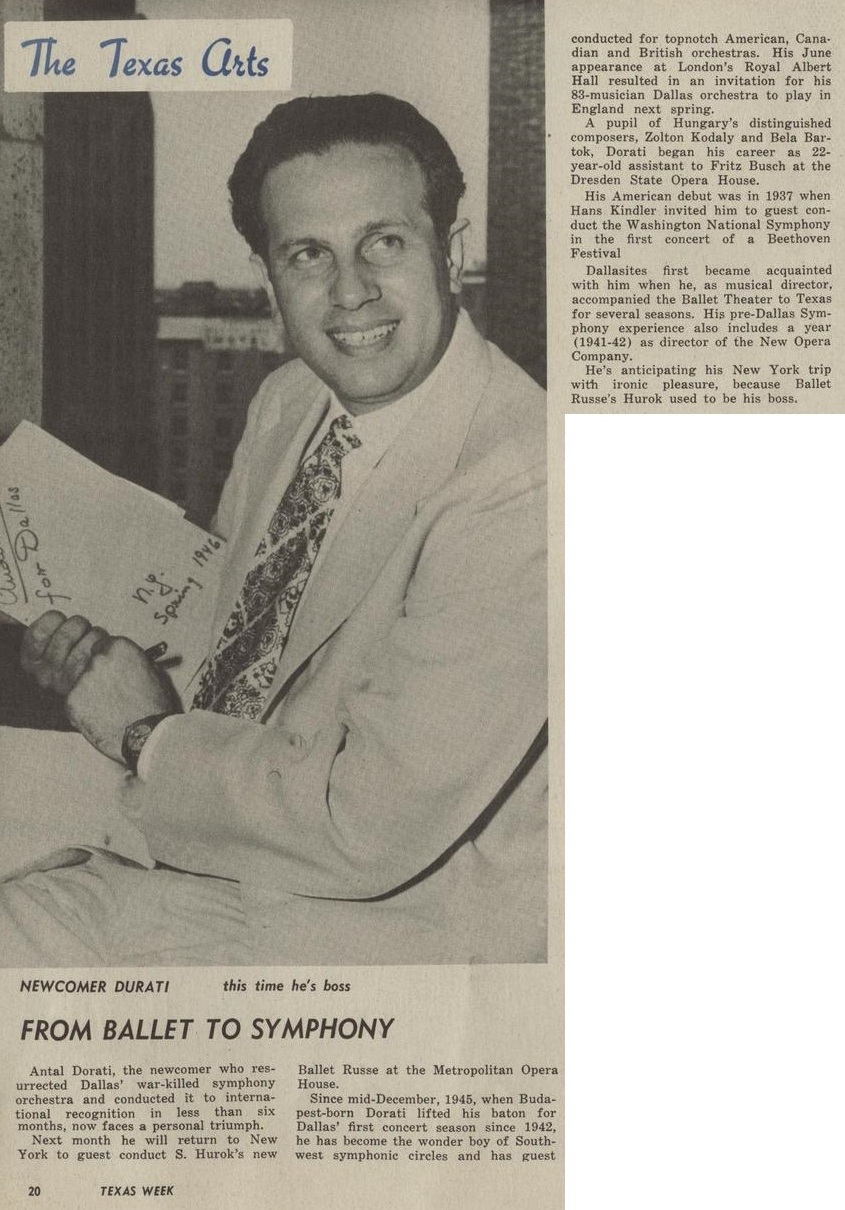
A typical article about the young, photogenic Dorati went something like the one below, in which Dorati was described as “the wonderboy of Southwest symphonic circles.”

dorati_dso_texas-week-mag_081746Texas Week, Aug. 17, 1946

After a fairly short but incredibly productive time in Dallas, Antal Dorati accepted the position of conductor of the Minneapolis Symphony Orchestra in January 1949. His successor, Walter Hendl (a startlingly “honest” obituary of the controversial Hendl appeared in the London Telegraph here), was appointed a few short weeks later, and Dorati’s final concert was April 3, 1949.

dorati_farewell_dmn_040349April 3, 1949

John Rosenfield’s melancholy review/farewell appeared the next day in The Dallas Morning News, and one imagines it tooks weeks for his tears to dry.

The spectacularly successful musical director and conductor, whose 4-season regime ended with an emotion-laden farewell concert, modestly disclaimed the founder’s role in Dallas Symphony history. The 1945-49 period was one of high-intentioned and nobly-adventurous endeavor….” (John Rosenfield, DMN, April 4, 1949)

And with that, the Maestro headed to Minneapolis, having built the post-war Dallas Symphony Orchestra into a nationally respected organization.

**
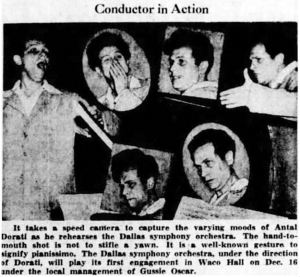
dorati_waco-news-tribune_120646
Waco News Tribune, Dec. 6, 1946

dorati_waco-news-tribune_121346Waco News Tribune, Dec. 13, 1946

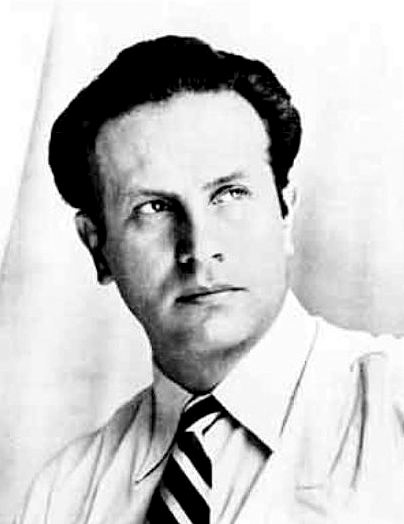
dorati

dso_dmn_010449

***

Sources & Notes

Top photo and article from the Aug. 17, 1946 issue of Texas Week, the short-lived magazine that was sort of a Texas version of Life, via the Portal to Texas History, here. Text may have been written by Paul Crume.

Linksapalooza:

  • The Dallas Symphony Orchestra Wikipedia entry is here; the official DSO site is here; the Handbook of Texas entry is here.
  • The Antal Dorati Wikipedia entry is here; his official site is here.

Listen to pianist William Kapell perform Prokofiev’s Piano Concerto No. 3 in C major, Op. 26 with the Dallas Symphony Orchestra under the direction of Antal Dorati (recorded at the Fair Park Auditorium the same week he made his “Adios, Dallas!” announcement in Jan., 1949), here.

More on Dorati and his close friend Yehudi Menuhin in my post “Yehudi Menuhin and Antal Dorati: A Collaborative Friendship,” here.

And, yes, the correct spelling should be “Antal Doráti.”

*

Copyright © 2016 Paula Bosse. All Rights Reserved.