Flashback : Dallas

A Miscellany: History, Ads, Pop Culture

Category: 1940s

Wanted in Dallas: Refugee Children — 1940
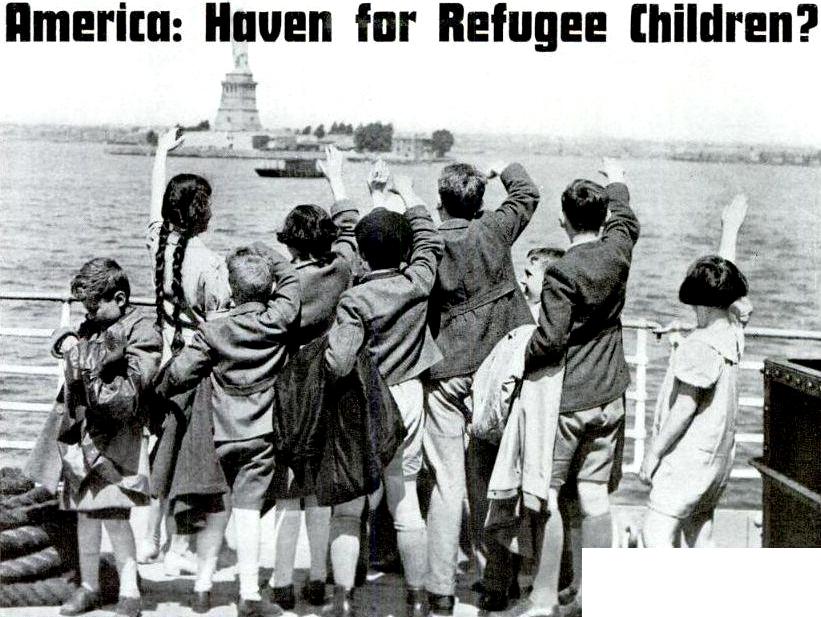
refugee-children_rotarian_feb-1940

by Paula Bosse

In the summer of 1940, a group called The Children’s Evacuation Committee of Texas was organized to bring child refugees to Dallas, even if it meant sending a ship across the Atlantic Ocean to get them. Its chairman was local businessman George Edgley, a transplanted Briton who owned a music shop and performed around town as an actor and musician.

The group was formed in response to the heavily publicized plight of English children living under the constant threat of attack during World War II. The situation was of great international concern, and plans were drawn up to evacuate the children to safety. The United States had agencies working to bring some of the children to America, and communities around the country were organizing at a grassroots level.

George Edgley took up the cause in Dallas and was the driving force behind The Children’s Evacuation Committee of Texas. He worked day and night to sign up potential foster families, worked with American and British politicians and humanitarian relief agencies, and traveled to Washington, DC to petition for special immigration allowances. He even pleaded with Congress to authorize a special ship to carry children from the UK to the Texas Gulf.

Some Dallasites were adamant that only British children would be considered. One Briton living in Dallas made the following statement at an early meeting:

It’s the Anglo-Saxon race against the world, […] and we want Anglo-Saxon children brought over here  — not material for fifth columnists. We want English-speaking children. (Dallas Morning News, June 27, 1940)

Edgley disagreed vehemently, insisting that a humanitarian project such as the one under consideration should not be limited to British children.

Numerous Dallas families signed up to offer their homes to refugee children. Many were willing to take any child that needed a temporary home, and most were prepared to adopt the child should his or her parents be killed in the war. There was, though, this unsettling read-between-the-lines sentence in one of the reports in The Dallas Morning News:

A few stipulated that the children should be free of hereditary defects, should be from good families and of certain nationalities or have eyes or hair of certain color. (DMN, July 21, 1940)

A big supporter of this effort was Miss Ela Hockaday, who worked to get her school’s alumnae and patrons to offer their homes to the displaced children. She herself had adopted the children of British novelist Vera Brittain for the duration of the war.

After weeks of determined effort, though, the inability to find a way to safely transport children en masse from the UK became an insurmountable roadblock. The bureaucracy and logistics proved to be too big a hurdle. Edgley turned his attention to working one-on-one with Dallas families who agreed to be responsible for paying the transportation costs of a child and providing for all of his or her needs until the war’s end. It would cost a local family a substantial $188 to assure a child’s privately-arranged temporary adoption (equivalent in today’s money to just over $2,200).

I’m not sure how many children found shelter from the war in Dallas, but the tireless efforts of George Edgley on their behalf are to be admired.

***

Sources & Notes

Top photo and headline “America: Haven for Refugee Children?” from the February, 1940 issue of The Rotarian. You can read the magazine’s take on the issue here.

If you would like more information on George Edgley’s campaign to relocate refugee children from war-torn England, please contact me.

The Life magazine story “U.S. Opens Its Homes and Heart to Refugee Children of England” (July 22, 1940), can be found here.

Some background on the evacuation of British children during World War II can be found here and here.

*

Copyright © 2014 Paula Bosse. All Rights Reserved.
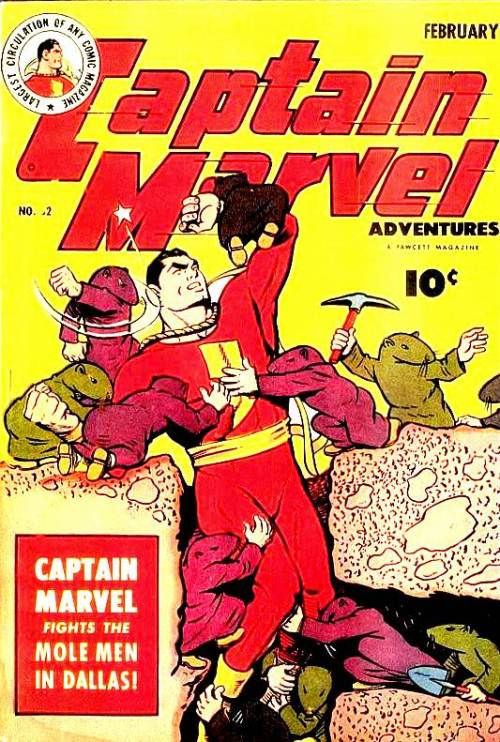
 

Captain Marvel Fights the Mole Men in Dallas! — 1944

captain-marvel-fights-mole-men-dallas_1944sm

by Paula Bosse

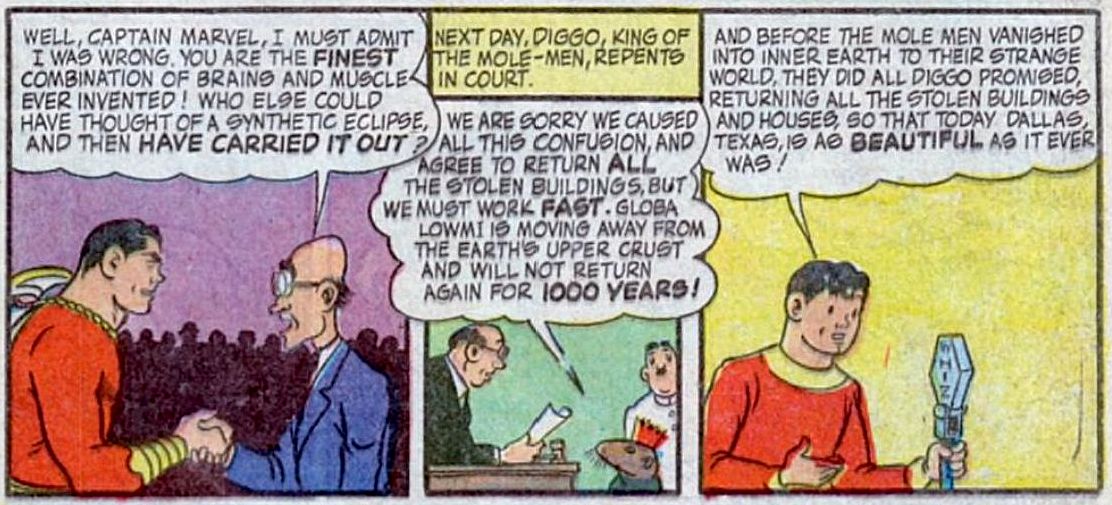
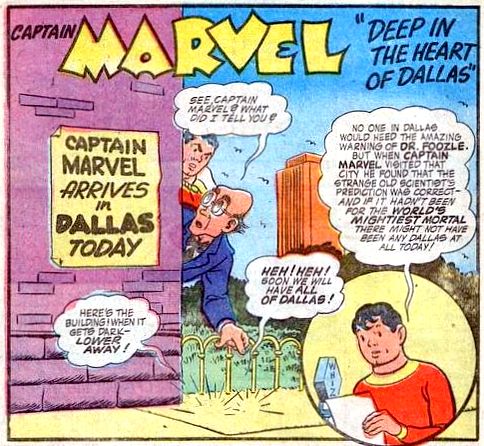
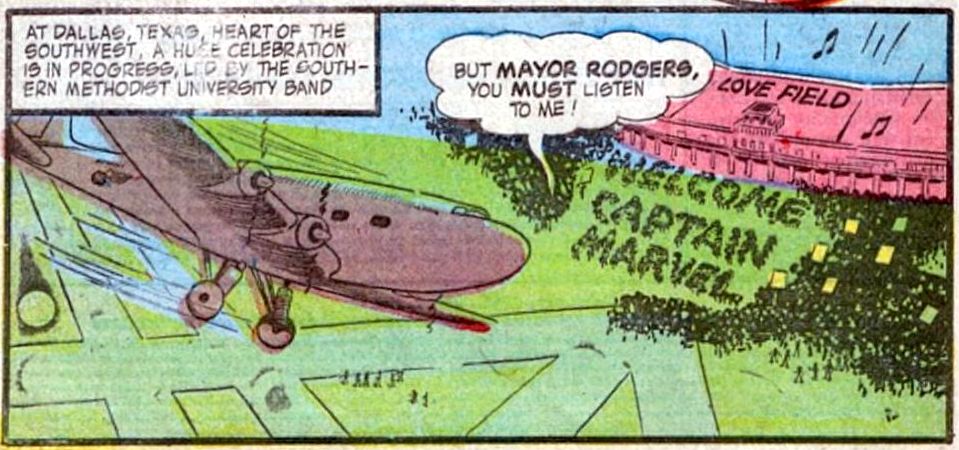
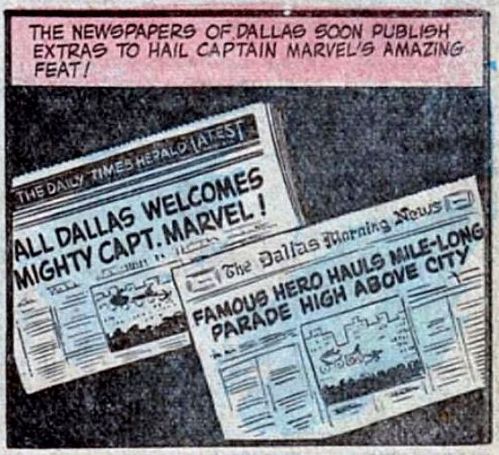
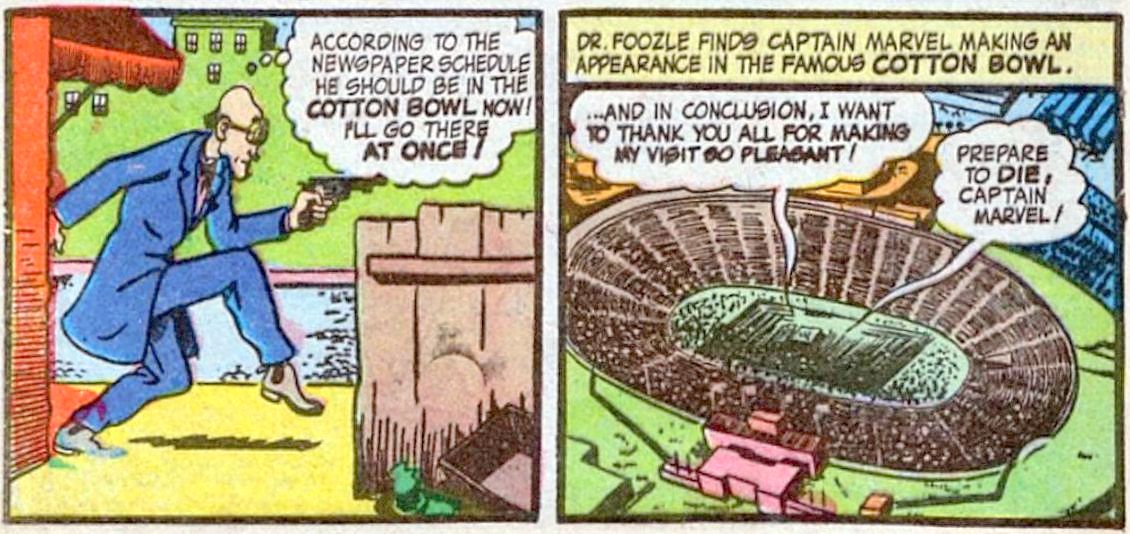
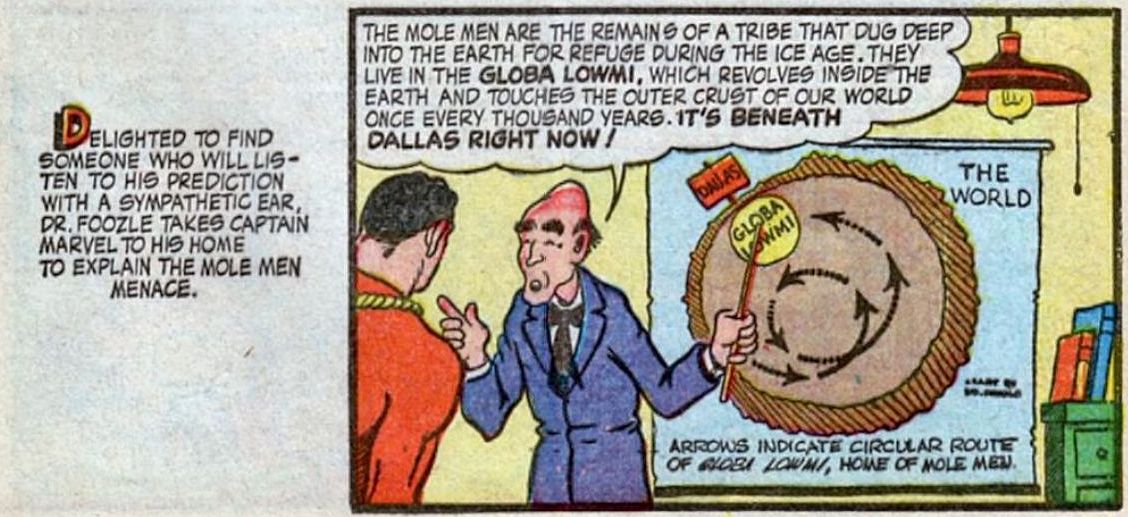
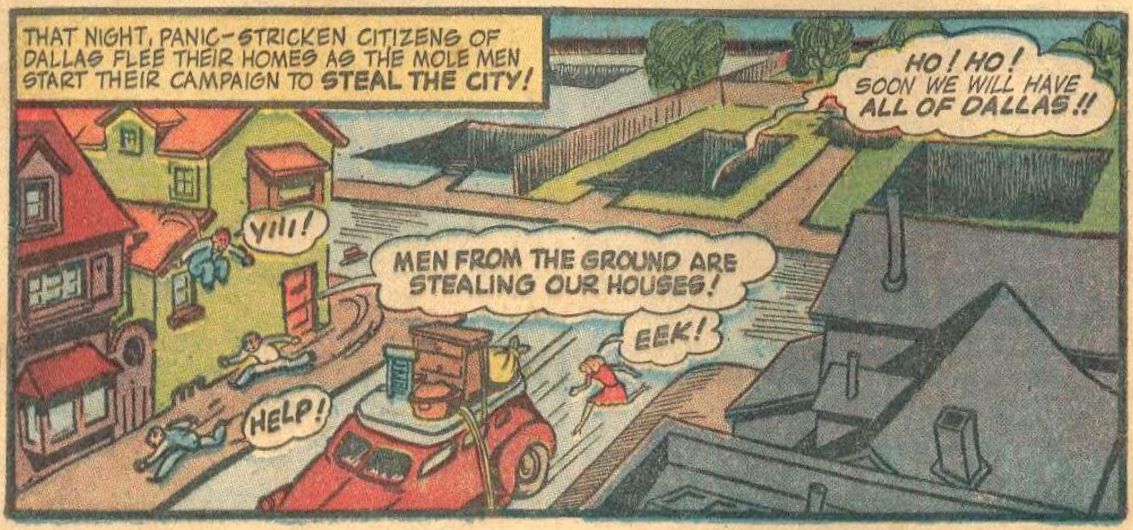
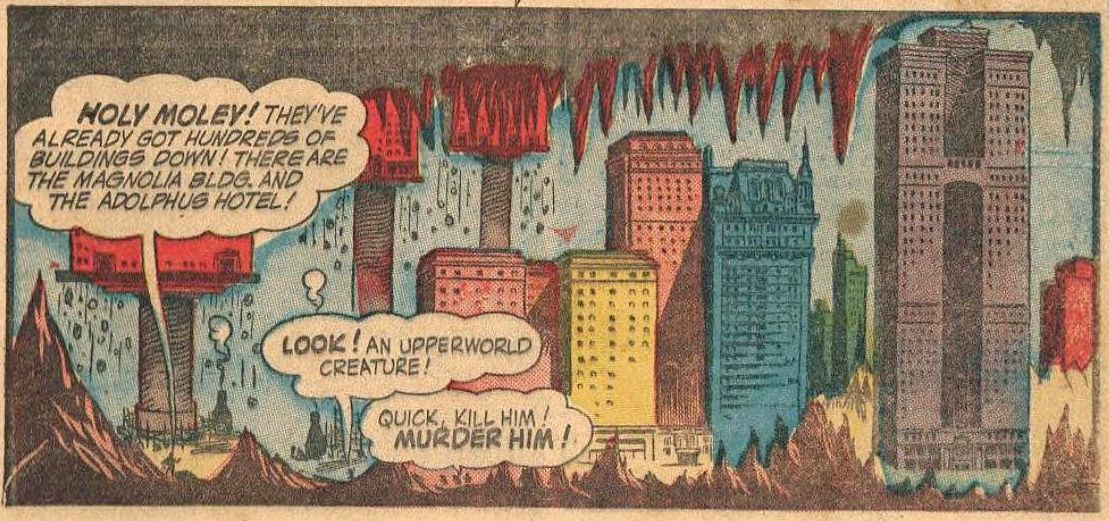
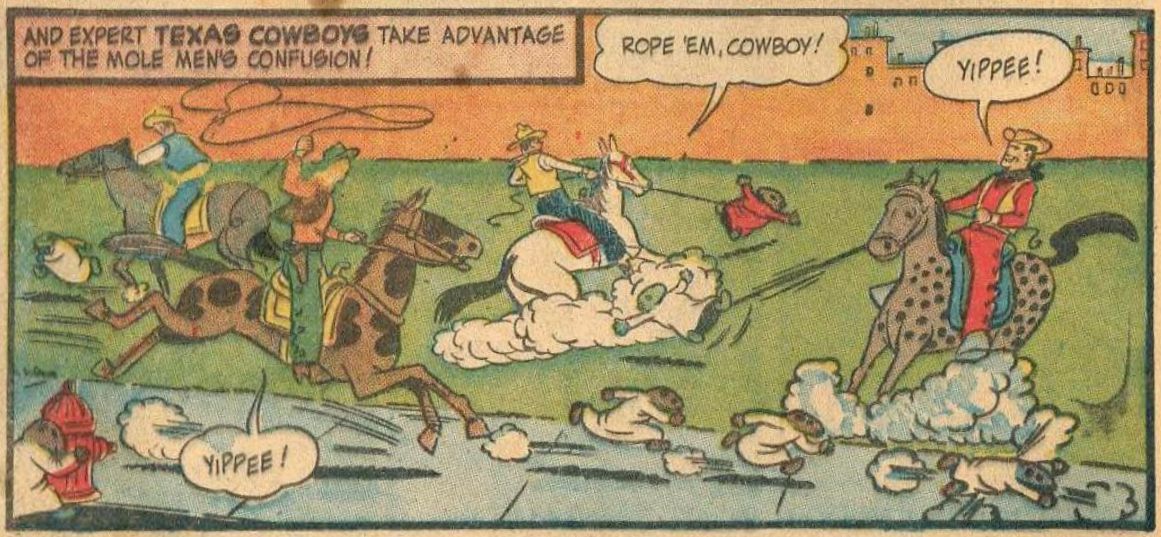
In 1944 Captain Marvel came to Dallas. He had brushes with the SMU marching band, Love Field, Mayor Woodall Rodgers, Fair Park, the Cotton Bowl, a sunken Adolphus, Ted Dealey, and a bunch of “expert lariat throwers.” And he saved us from the Mole Men (and their “mole-kids”). People, you have NO idea…. A few of the highlights below (click for larger images). (To go directly to the entire scanned comic book, click here.)

1capt-marvel_intro

2capt-marvel_smu_love-field

3capt-marvel_dth-dmn

4capt-marvel_cotton-bowl

5capt-marvel_globa-lowmi

6capt-marvel_panic

7capt-marvel_magnolia-adolphus

8capt-marvel_expert-cowboys

9capt-marvel_finale

Holy Moley! That was close! Thank you, Captain Marvel! SHAZAM!

***

To read the entire adventure “Deep in the Heart of Dallas” — in fact, to read the entire comic book (which also includes a trip to Greenpoint, Brooklyn…), check out the whole thing here. Enjoy! (And sorry about the spoilers!)

Some panels are larger when clicked.

*

Copyright © 2014 Paula Bosse. All Rights Reserved.
Summers and Lagoons — 1940s

dmfa_color

by Paula Bosse

The old Dallas Museum of Fine Arts at Fair Park. Just across the lagoon.

And a streamlined rendering which could be found on DMFA letterhead and publications for many years:

dmfa_logo_1944

*

Copyright © 2014 Paula Bosse. All Rights Reserved.
Michael G. Owen, Jr. — Dallas Sculptor of Lead Belly

leadbelly_three-views_paul-l_yelp

by Paula Bosse

Above, three views of “Leadbelly,” the sculpted head of the blues legend, by Michael G. Owen, Jr., 1943.

Michael Owen (profiled here previously as the 15-year-old soap-sculptor who made headlines at the 1930 State Fair of Texas), was the youngest member of the group of artists loosely affiliated with the Dallas Nine group who were making a name for themselves in the 1930s and ’40s. He studied life drawing as a student of Olin Travis and painting as a student of Jerry Bywaters, but he was most proficient as a sculptor. He is best known for his award-winning 1943 bust of bluesman Lead Belly, a piece in the permanent collection of the Dallas Museum of Art (which can be seen in a 1951 DMFA catalog here).

In a 1950 letter to the (then-) Dallas Museum of Fine Arts, Owen recounted how Lead Belly sat for him in New York and sang “Goodnight Irene” as Owen worked on a clay model. Owen was living in Greenbelt, Maryland at the time, and Louisiana-born Lead Belly was living in New York City, but I’d like to think that the two men reminisced about their formative days in Dallas where Owen was a much-talked-about young artist and Lead Belly performed on the streets of Deep Ellum with Blind Lemon Jefferson.

I noticed in the newspaper article that the stone was called black Belgian marble. Actually it isn’t so exotic. It was quarried not far from Charlottesville, Virginia, and is called Black Serpentine. It was the first time I have ever heard of the stuff being black. If you’ll notice it seems quite a bit more crystalline than marble.

The way I happened to do the head went like this. A young fellow I had known in Dallas by the name of Ralph Knight had gone to New York a year or so after I went to Washington. He was interested in folk music and became acquainted with Leadbelly. It was at Ralph’s instigation that I did the head — he got me the stone, sent pictures (I first roughed out the head in clay at home in Greenbelt) and then arranged the sitting at his apartment in New York. Leadbelly sat for me one afternoon and I finished the clay model at that time. From that I worked out the stone cutting, only being able to work on it in my spare time. All in all it was about a full month’s work, I guess. During the time he was “sitting” for me (playing his guitar and singing) he played “Goodnight Irene,” but at that time the folk music devotees did not consider the tune “true folk music.” Still it pleased me when it became a popular song. It’s too bad Leadbelly couldn’t have lived to see himself gain such popularity. (Mike Owen in 1950, from a letter excerpted in the book Lone Star Regionalism, The Dallas Nine and Their Circle)

Sadly, Mike Owen’s career stalled soon after this 1940s artistic high point. He eventually settled in Oregon, where he was sidelined by multiple sclerosis. He died in 1976 at the age of 60.

owen-michael_1930s
Mike Owen in his early 20s

I’m not sure how often the piece is displayed at the Dallas Museum of Art, but it’s a wonderful work of art. When I saw it a couple of years ago, I just stood and stared at it for ages. It’s really fantastic. And it’s fitting that it resides here in Dallas where Michael Owen was once a part of a group of Texas artists whose influence continues to be felt today.

It also seems fitting to throw in this classic from Mr. Ledbetter, who, like Mike Owen, spent time honing his craft in Dallas:

lead-belly-wikipedia

***

Sources & Notes

“Leadbelly” sculpture by Michael G. Owen, Jr. is in the collection of the Dallas Museum of Art.

Photo of the artwork is by Paul L. as posted on Yelp.

Photo of Lead Belly from Wikipedia.

Quote from Mike Owen’s letter to the DMFA (April 11, 1950) can be found in the superb book Lone Star Regionalism, The Dallas Nine and Their Circle, 1928-1945 by Rick Stewart (Austin: Texas Monthly Press, Dallas Museum of Art, 1985) — the best book on Dallas art of this period.

Read the Handbook of Texas entry about Huddie Ledbetter (aka Lead Belly/Leadbelly) here.

Other Flashback Dallas posts on Owen:

  • Young Mr. Owen’s star-turn as the teenager who carved the WFAA transmitter plant from 8,400 pounds of Ivory Soap is here.
  • Owen’s monument to SMU Mustangs’ mascot Peruna, commissioned in 1937, is here.

UPDATE: Read about a recently discovered large painting by Owen up for auction in Dallas in 2019 here.

*

Copyright © 2014 Paula Bosse. All Rights Reserved.
 

WFAA & WBAP’s Unusual Broadcasting Alliance

wfaa_wbap_transmitter_1941-sm

by Paula Bosse

wfaa-wbap_transmitter_1941

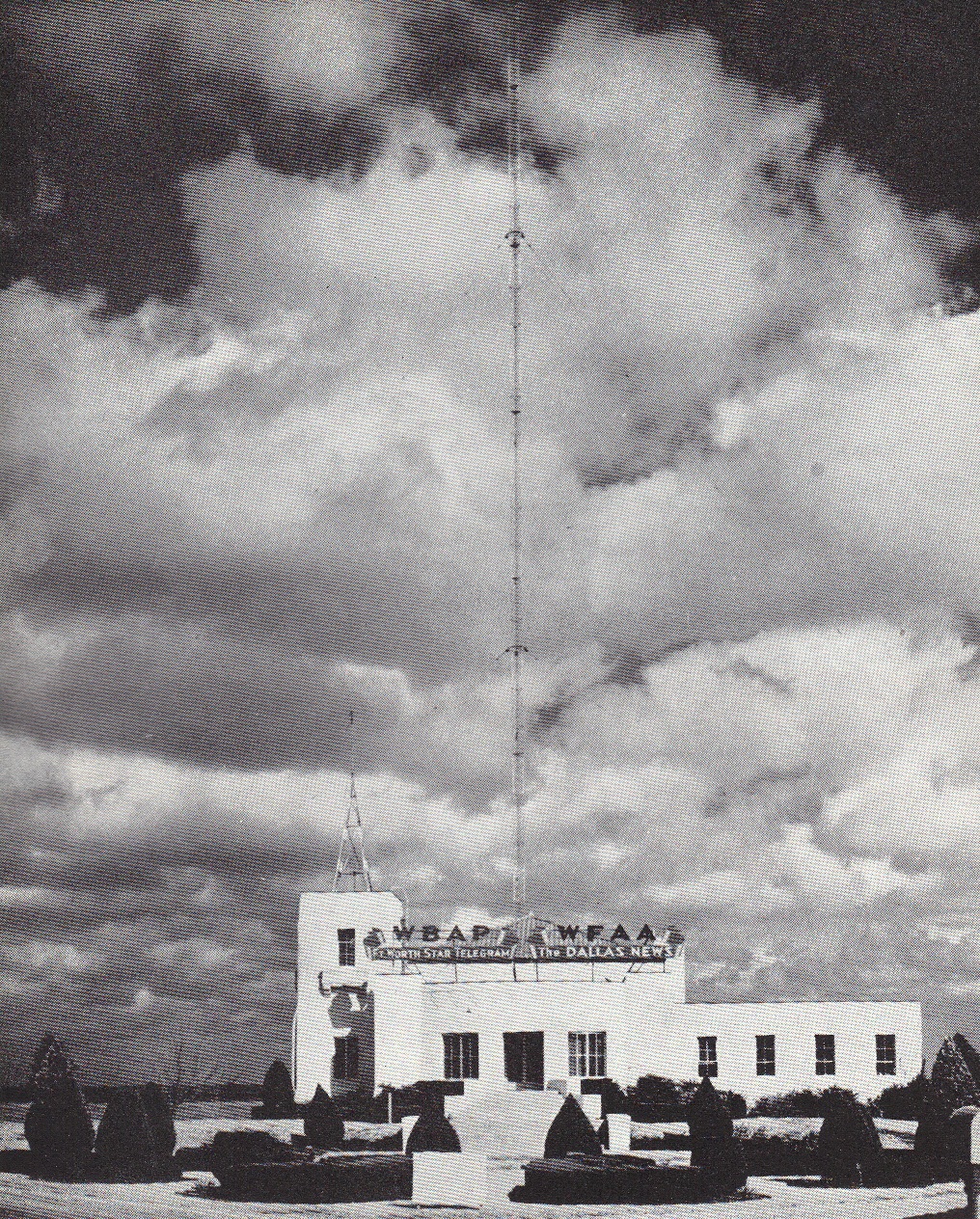
I looked at this photograph and thought, “That’s odd. Two competing radio stations from two competing newspapers from two competing cities used the same radio transmitter. How did that happen?” And then I read about the extremely unusual time-sharing arrangement that WFAA (which was owned by The Dallas Morning News) and WBAP (which was owned by The Fort Worth Star-Telegram) maintained for 41 years.

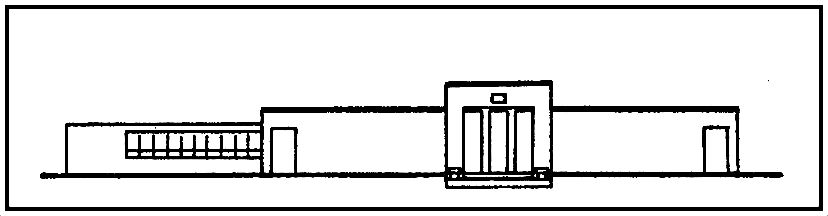
I’ll link to a story that fully explains this extraordinary arrangement, but, briefly, WFAA and WBAP both broadcast on two frequencies, trading off throughout the day. A typical schedule looked like this:

wfaa-wbap_schedule

The two frequencies were 570 and 800 (later 820) kilohertz on the AM band. When WFAA was broadcasting on 570, WBAP was broadcasting on 820. On the agreed-upon time, the stations would switch over to the other frequency. Back and forth. Over and over and over. All day long. They were independent stations with independent programming, network affiliations, on-air talent, and advertising departments. And this went on for FORTY-ONE YEARS! Until 1970! How had I never heard of this?

Apparently it wasn’t all that big a deal to the stations or the listeners. Things were getting a little strained by 1969, though, when WBAP went whole-hog into playing country music (and eventually became one of the most successful country stations in the United States). It was time to go their own ways. The split was amicable, and both stations felt that the unusual partnership had worked well for all concerned.

So why did this happen in the first place? Because of the 820 frequency. 820 was a clear channel frequency, which meant that the station that owned it could broadcast at an incredible 50,000 watts — enough to be heard all over the Western hemisphere; 570 boasted a measly 5,000 watts, and, as someone said, “people might hear you in Sherman … but maybe not.” Neither WFAA or WBAP wanted to give up the clear channel powerhouse, which is why their piggy-backing partnership lasted as long as it did. But, ultimately, WBAP got 820 and was a major broadcasting force to be reckoned with. WFAA radio got the short end of the stick and sputtered along at 570 on the AM dial for a few lackluster years but never recovered from losing its half-share of 820 AM. In the WFAA-WBAP showdown: Fort Worth 1, Dallas 0.

*

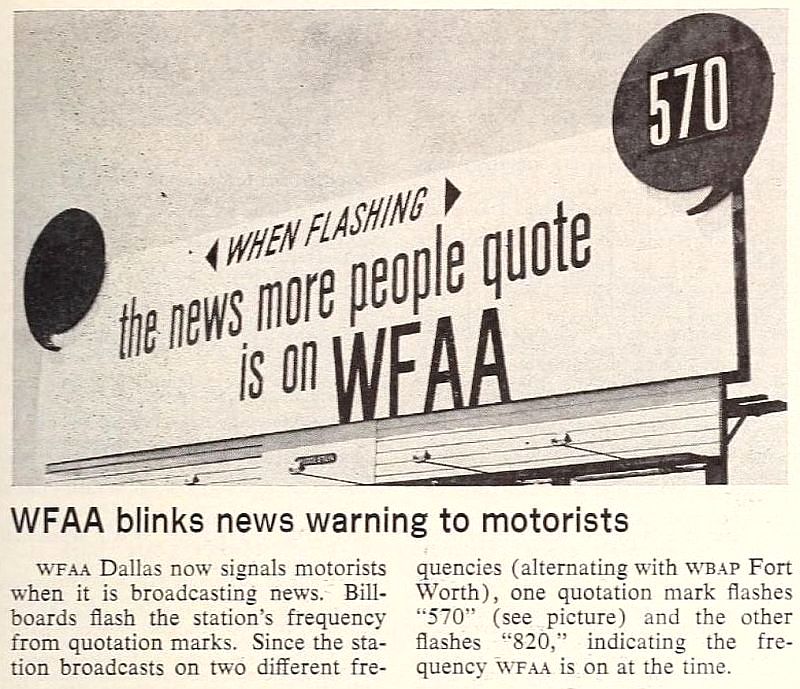
Look at this crazy billboard from 1963 — it flashed which frequency WFAA was currently broadcasting on.

WFAA-WBAP_broadcasting_042263Broadcasting, April 22, 1963

***

Sources & Notes

Photo of the transmitter building from WFAA, WBAP, KGKO Combined Family Album (Dallas-Fort Worth, 1941). Yes, there was actually a THIRD station involved in all of this for a while — KGKO out of Wichita Falls! Here’s an ad from the 1941-42 Texas Almanac, via the Portal to Texas History (click to see a larger image):

wfaa_kgko_tx-almanac_1941-42_portal

Sample schedule is from the definitive article on this bizarre broadcasting alliance: “You Have Half a Station, We Have Half a Station” — How WFAA in Dallas and WBAP in Fort Worth Shared Radio Frequencies for Four Decades by John Mark Dempsey, from the Spring, 1999 issue of Legacies magazine, which can and SHOULD be read, here.

For another photo of this transmitter building, see a previous post here.

*

Copyright © 2014 Paula Bosse. All Rights Reserved.
 

When the Flying Red Horse Could Be Seen From Miles Away

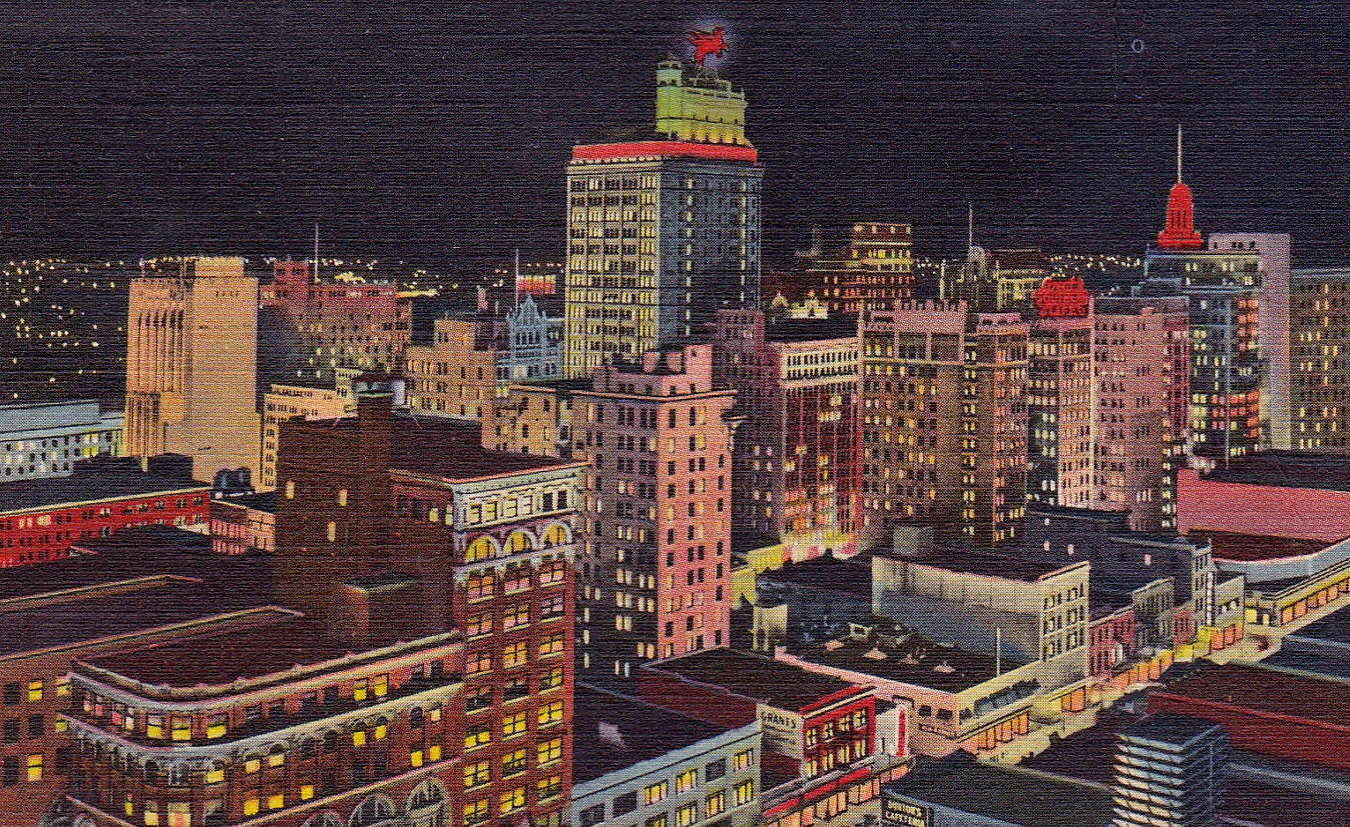
birdseye_night_early1940sThe symbol of Dallas…

by Paula Bosse

One of my favorite views of the skyline — back when Pegasus had no competition.

***

Sources & Notes

Original photograph by Lloyd M. Long, from postcard “Night Scene, Heart of Dallas, Texas” (D-43).

*

Copyright © 2014 Paula Bosse. All Rights Reserved.
Irby-Mayes Ad With a Cameo by the Merc — 1948

ad-irby-mayes_merc_dmn_040148Landmark alert!

by Paula Bosse

An ad with the famous local building making a cameo.

It’s called PLATEAU
…the wonder fabric by Pacific Mills
that’s so perfect for our Texas weather. Suits of
[redacted??] look like regular weight worsted
…yet can be worn most every month of the year.
A new shipment exclusive at Irby-Mayes.

I love this 1948 ad. Irby-Mayes was located — where else? — in the Mercantile Bank Building!

*

Copyright © 2014 Paula Bosse. All Rights Reserved.
Swooning Over Love Field — 1940

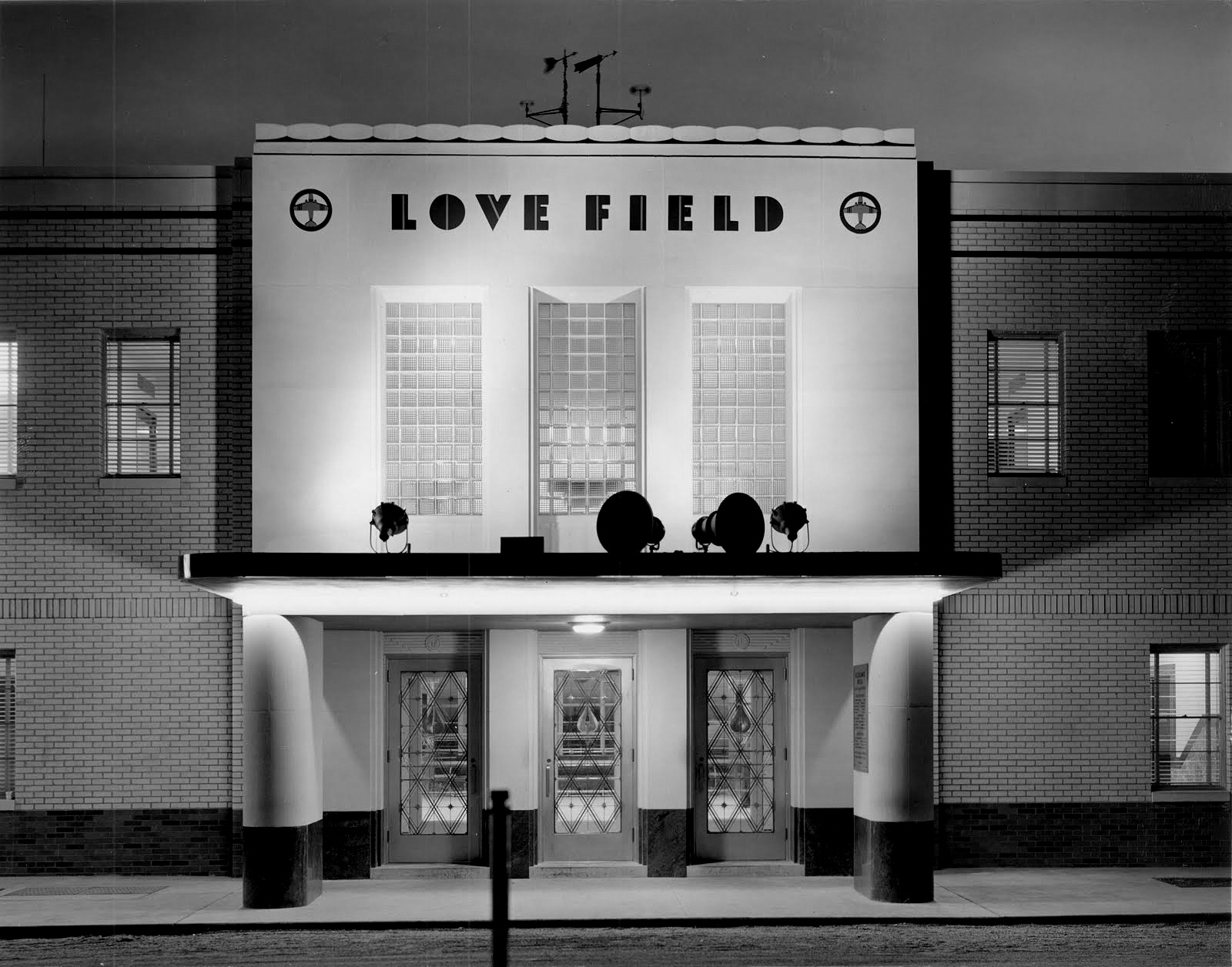
love-field_1940Art Deco Love Field!

by Paula Bosse

I’m a huge-fan of the modern 1950s-era Love Field (the one with the Mockingbird Lane entrance), but even that can’t trump this fantastic building! Designed by architect Thomas D. Broad, the new Love Field administration building and terminal — which faced Lemmon Avenue — was unveiled on October 6, 1940, to rapturous acclaim. The night view above is pretty breathtaking. Forget the airfield. For me, it’s all about this entrance. Those windows. And those doors. And that font! And those little airplane pictographs!

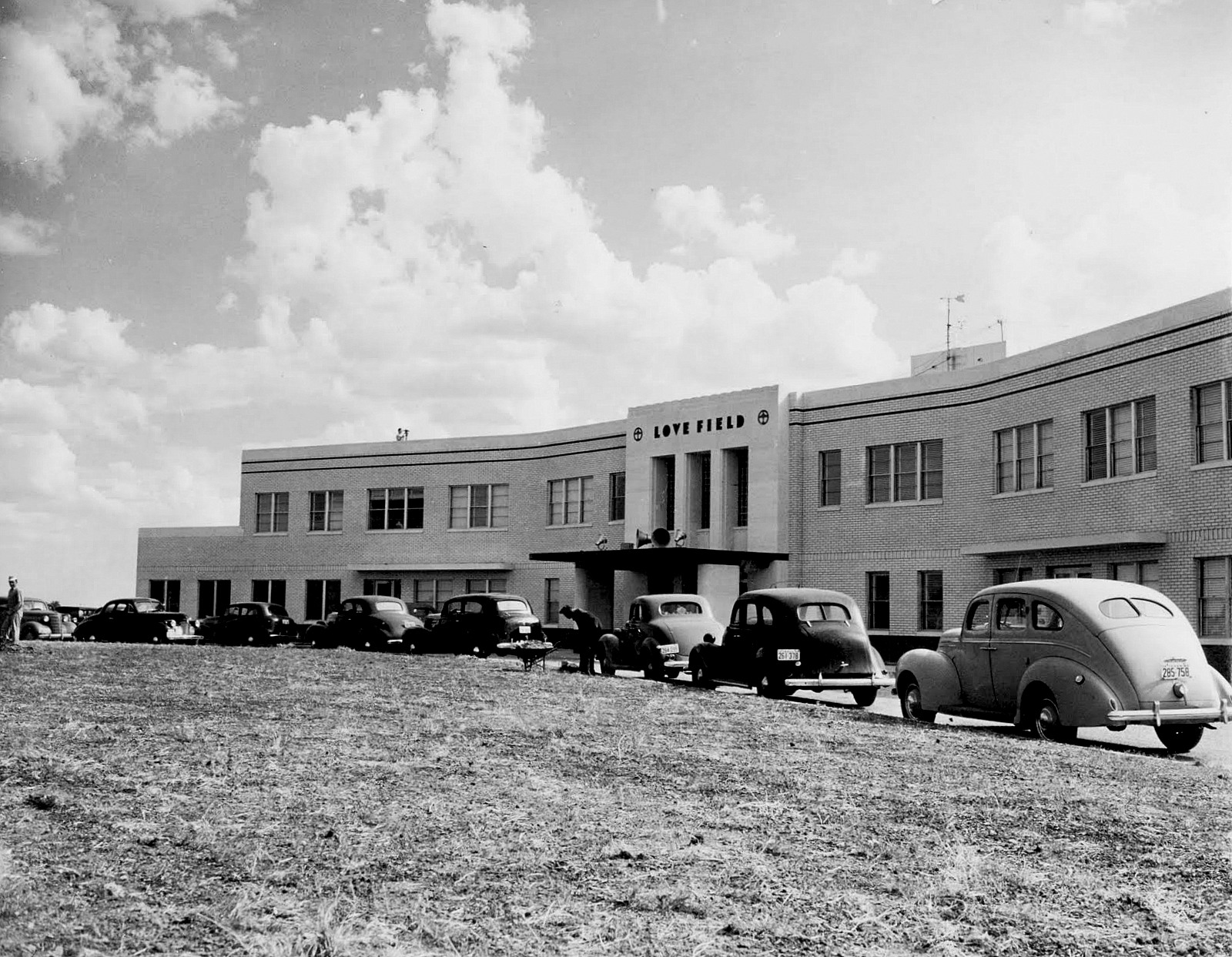
love-field_terminal_1940It wasn’t bad in the daytime, either — just nowhere near as dramatic. And in dire need of landscaping.

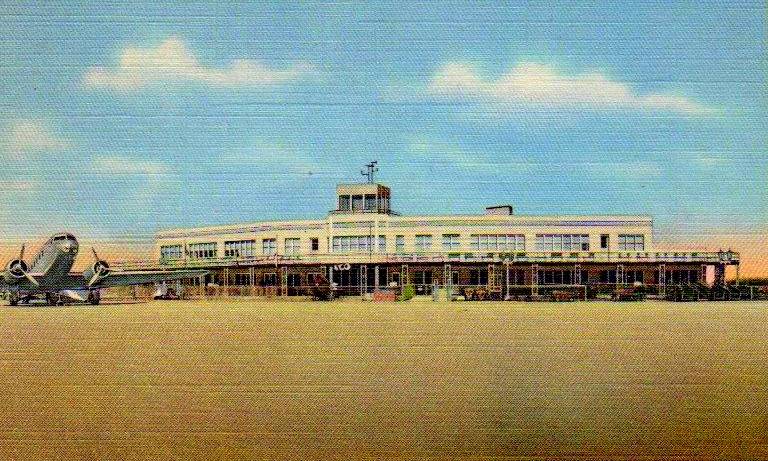
love-field_ca1940_frontAnd here it is from the field side. Still swoon-worthy. The back of this postcard reads:

LOVE FIELD — NEW $225,000 ADMINISTRATION BUILDING
One of America’s finest air terminals which takes care of more airline passengers, more air mail and more air express in ratio to population than any other airport in the country.

**

What happened to this beautiful building? I searched through the Dallas Morning News archives until I felt I had to throw in the towel, never finding a definitive answer. But here’s what I did find. When the brand-spanking-new terminal (the one we know today) opened in 1958, the 1940 terminal was vacated. A better word might be “abandoned.” Most assumed the building would be razed very soon after. But I got as far as September of 1964, and the old terminal was still standing. And it wasn’t pretty. This excerpt from a Dallas Morning News article is painful to read:

…The old terminal building cowers in desolation…. Virtually every window has been smashed, carpeting the deserted terminal with a dangerous floor of broken glass. Loose wires stick out here and there, and blinds hang in twisted postures from broken cords. The building’s big sign DALLLAS is missing its D. (DMN, July 2, 1961)

(And even more thoroughly painful is the article in the Dallas News archives by Kent Biffle, “Ghosts Wait by Runway” — DMN, Feb. 2, 1961.)

Apparently, the old building had to remain standing until a “much-debated” new multi-million-dollar runway was agreed upon.

The point at which I threw in the towel in my quest to discover when the old terminal building had been demolished was a DMN photo from September 25, 1964, with the caption “$4,000,000-Plus Runway Progress. The 8,800-foot parallel runway at Dallas Love Field, left center, is two-thirds completed and should be ready for use next spring.” I am assured the photo has a hard-to-see old terminal still decaying in it. I assume they razed that sucker pretty soon afterward. …Possibly.

***

Sources & Notes

Top two photos are from the Love Field Collection, Dallas History and Archives, Dallas Public Library; accession numbers are PA83-13-8 for the swoony one at the top, and PA83-13-4 for the daylight exterior photo. I originally found these in the post “The New Love Field” by Jacob Haynes, here.

Click pictures for larger images — the first two are HUGE!

*

Copyright © 2014 Paula Bosse. All Rights Reserved.
World War II “Victory Huts” at Parkland

parkland-victory-huts_c1945-utswPhoto: UT Southwestern Library

by Paula Bosse

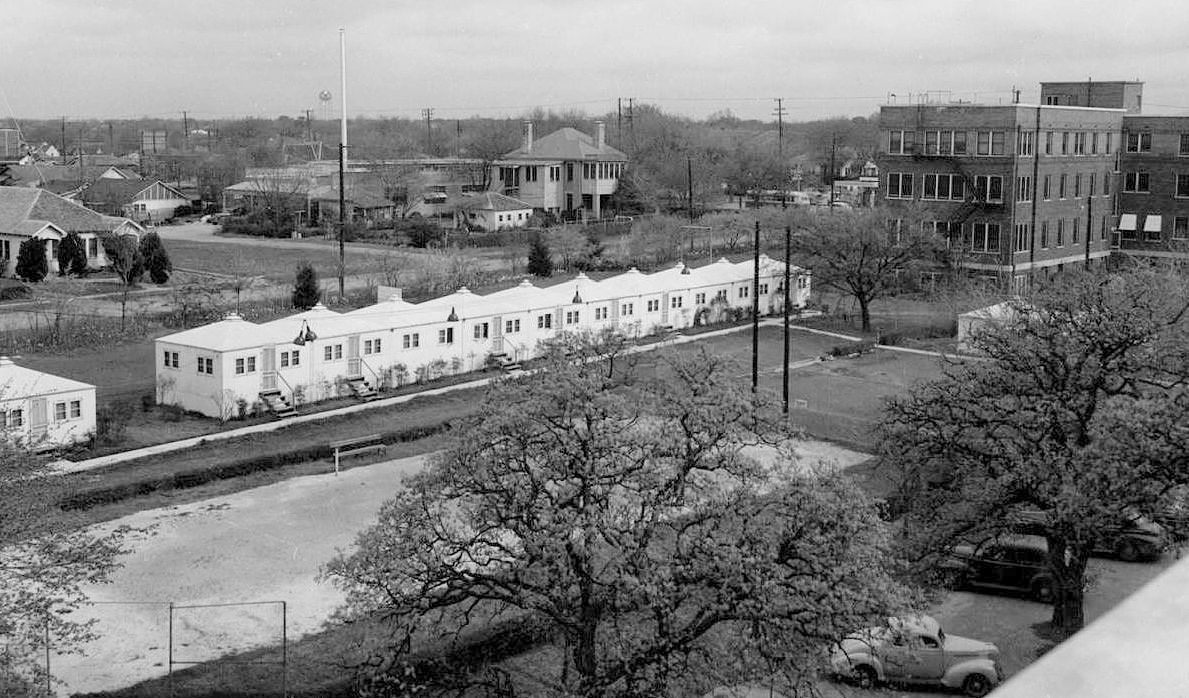
Above are a row of “Victory Huts,” behind the old Parkland Hospital at Maple & Oak Lawn, circa 1945. The description of the photo from the UTSW Library:

“Victory Huts” were prefabricated buildings developed during World War II as a method of providing quick housing for soldiers. The white “Victory Huts” behind the Parkland Nurses’ Home are believed to have been used first as housing for recovering servicemen during World War II, then after the war as housing for nursing students.

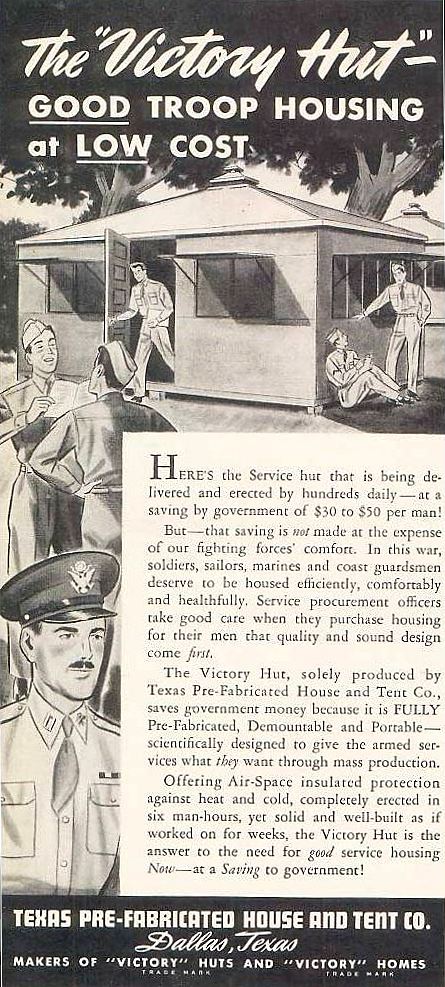
Victory Huts were the brainchild of builder H. F. Pettigrew and wealthy Dallas businessman Winfield Morten. Read about the beginnings of their wildly popular prefab buildings here.

Below, an ad from the Dallas company that manufactured them, Texas Pre-Fabricated House and Tent Co.:

victory-huts_texas-historical-commission_flickr

And, after the war, just add some curtains, a few plants, and a white picket fence.

texas-pre-fabricated-housing-co_southwestern-medical-college_1944-yrbk-ad

***

Sources & Notes

Top photo and quote are from the Parkland Hospital Collection at the UT Southwestern Library, accessible here.

First advertisement from the Flickr stream of the Texas Historical Commission, here. Second ad from the 1944 Southwestern Medical College yearbook.

Victory Huts were widely used during World War II, as cheap housing for military personnel, military families, and as housing in internment camps. See the huts as they were used for Japanese/enemy alien internment camps in Texas, at Camp Kenedy, at Crystal City, and at Dodd Field/Fort Sam Houston.

*

Copyright © 2014 Paula Bosse. All Rights Reserved.
The Texas Fire Extinguisher Co. and Hitler — 1942

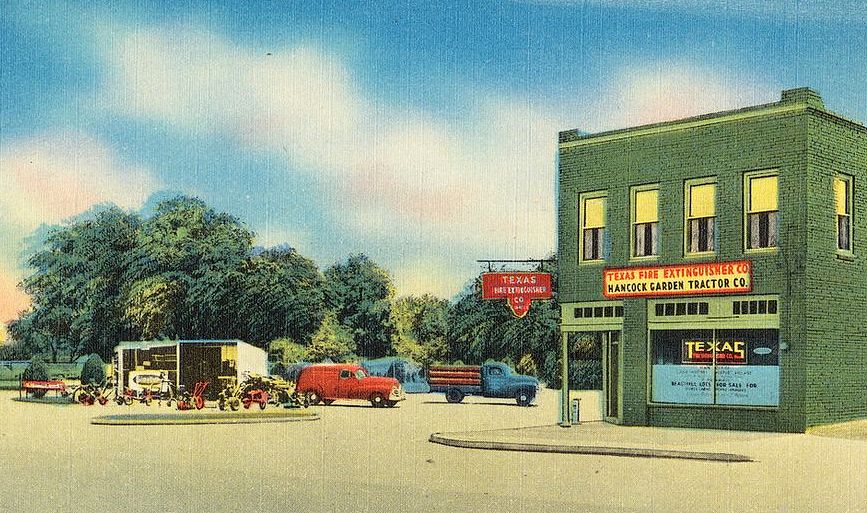
tx-fire-extinguisher-coTexas Fire Extinguisher Co., across from Fair Park

by Paula Bosse

For a place that sells fire extinguishers and tractor equipment, this is a wonderfully comforting image. Hardly even looks like Dallas. The Texas Fire Extinguisher Company — operated for several decades by the Hancock family — was located at the corner of Parry and Second Avenue, across from Fair Park. While checking to see the exact address of this business (which, by the way, was 929 Second Ave.), I came across a 1942 article mentioning it and Hitler.

According to a Dallas Morning News blurblet, the Hancock company owner had placed a want-ad for a painter and paperhanger and received an odd response on a postcard:

Gentlemen: I wish to apply for the job as a paperhanger. Am hunting bears at present, but am about out of ammunition. Anyway, I am a better paperhanger than I am a bear hunter. –Adolph Hitler, Berlin, Germany. (P.S. Please rush answer as this job is playing out and may have to move soon.)

Humor doesn’t always translate successfully across the generations. But, hey, that was weird.

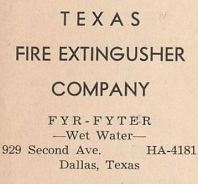
texas-fire-extinguisher-co_texas-fireman_june-1951_portal1951 ad, “Fyr-Fyter, Wet Water”

***

Sources & Notes

Postcard (cropped) from the Boston Public Library Tichnor Brothers Postcard Collection on Flickr, here.

Quote from Dallas Morning News article “Reply to Want Ad Indicates Hitler Wants a New Job” (DMN, Nov. 6, 1942).

Ad from Texas Fireman magazine, June 1951, via Portal to Texas History.

*

Copyright © 2014 Paula Bosse. All Rights Reserved.