Flashback : Dallas

A Miscellany: History, Ads, Pop Culture

Category: 1950s

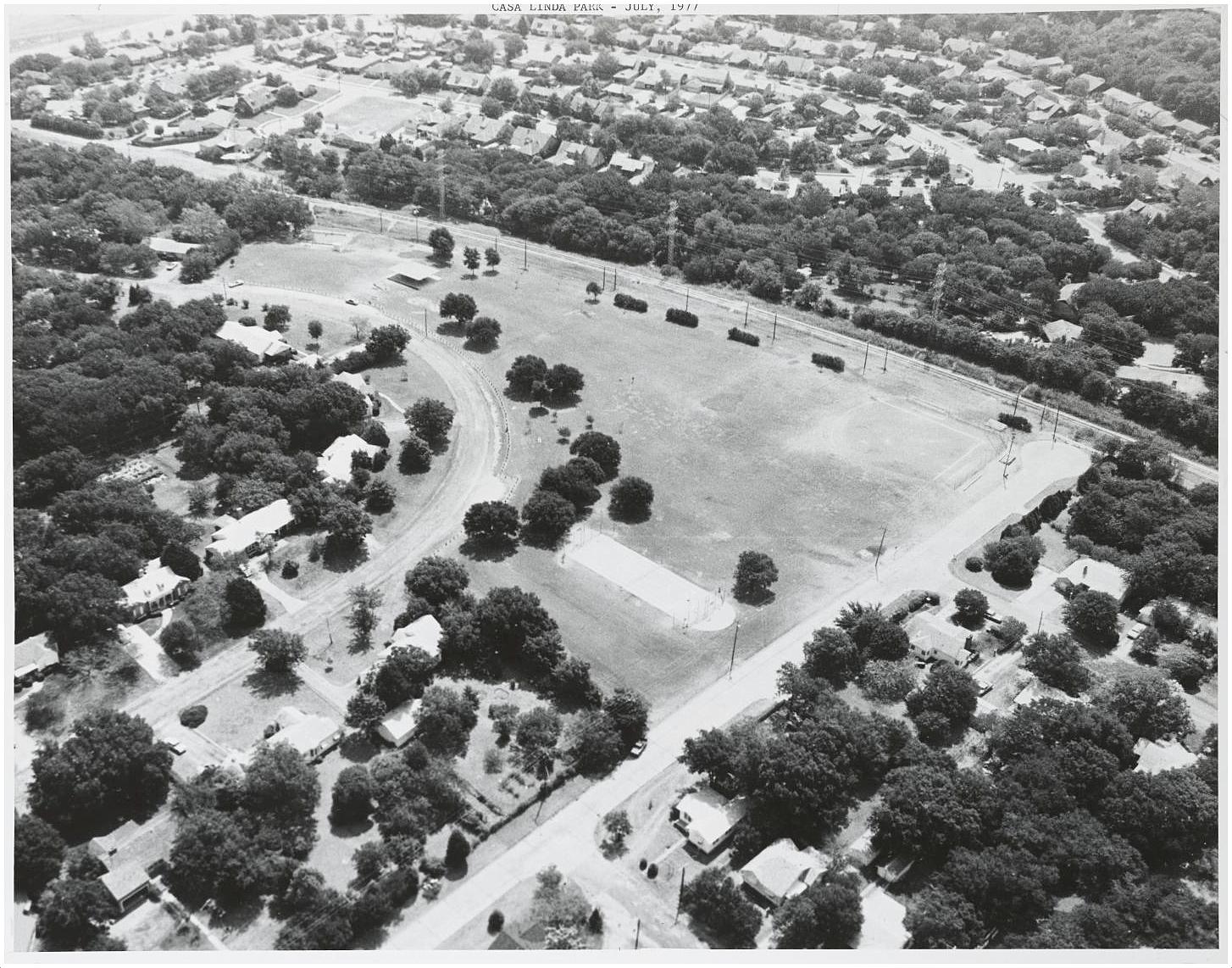
Casa Linda Park — 1947-1977

casa-linda_aerial_baseball-diamond_squire-haskins_072047_dallas-municipal-archives_portalThe idyllic Casa Linda countryside, 1947…

by Paula Bosse

Here are several aerial photographs, taken over a 30-year span, showing Casa Linda Park, located east of White Rock Lake — most (if not all) were taken by noted Dallas photographer Squire Haskins. When the little 6.3-acre park opened in 1947, it was described by The Dallas Morning News as “rustic and picturesque” (DMN, Aug. 19, 1947), a description which could be used for the whole Casa Linda area which was being developed at the time by Carl Brown.

The land for Casa Linda Park was purchased by the City of Dallas in March, 1947, and it is bounded by Old Gate Lane on the southwest, the curving San Saba Drive on the north, and what used to be the Santa Fe Railway railroad tracks on the southeast, between White Rock Lake and Buckner Blvd. I’m not exactly sure where Little Forest Hills ends and Casa Linda begins, but both neighborhoods could claim this cute little park as their own, I suppose.

These aerial photos are from the Dallas Municipal Archives, via the Portal to Texas History (links can be found at the bottom of this post). All photos are larger when clicked. See your house?

At the top, the earliest photo of the park in this collection, taken in July, 1947 by Squire Haskins.

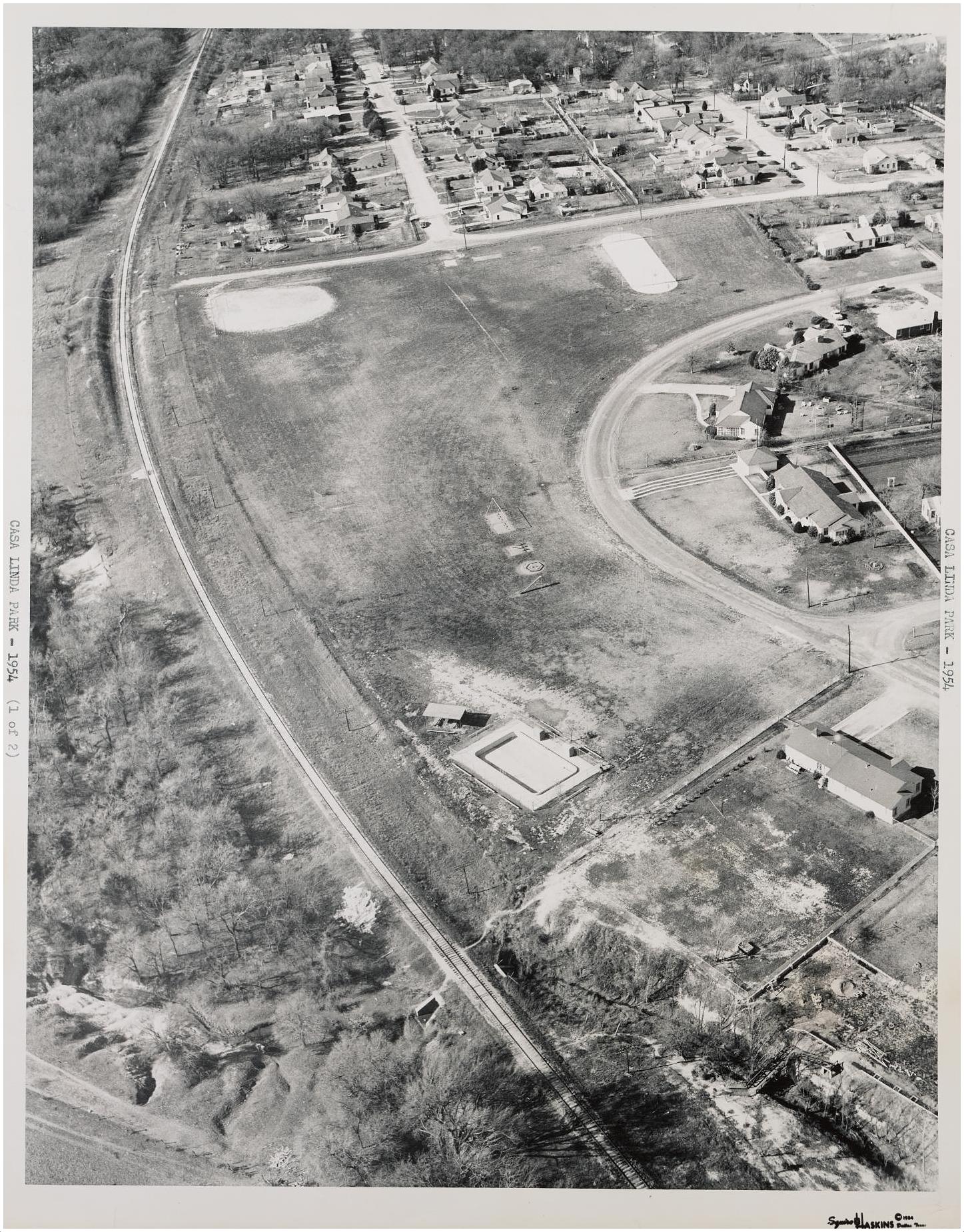
Below, the second Haskins photo, from 1954:

casa-linda_aerial_baseball-diamond_squire-haskins_1954_dallas-municipal-archives_portal

Below, another Haskins photo, from January, 1966:

casa-linda-park_aerial_baseball-diamond_squire-haskins_jan-1966_dallas-municipal-archives_portal

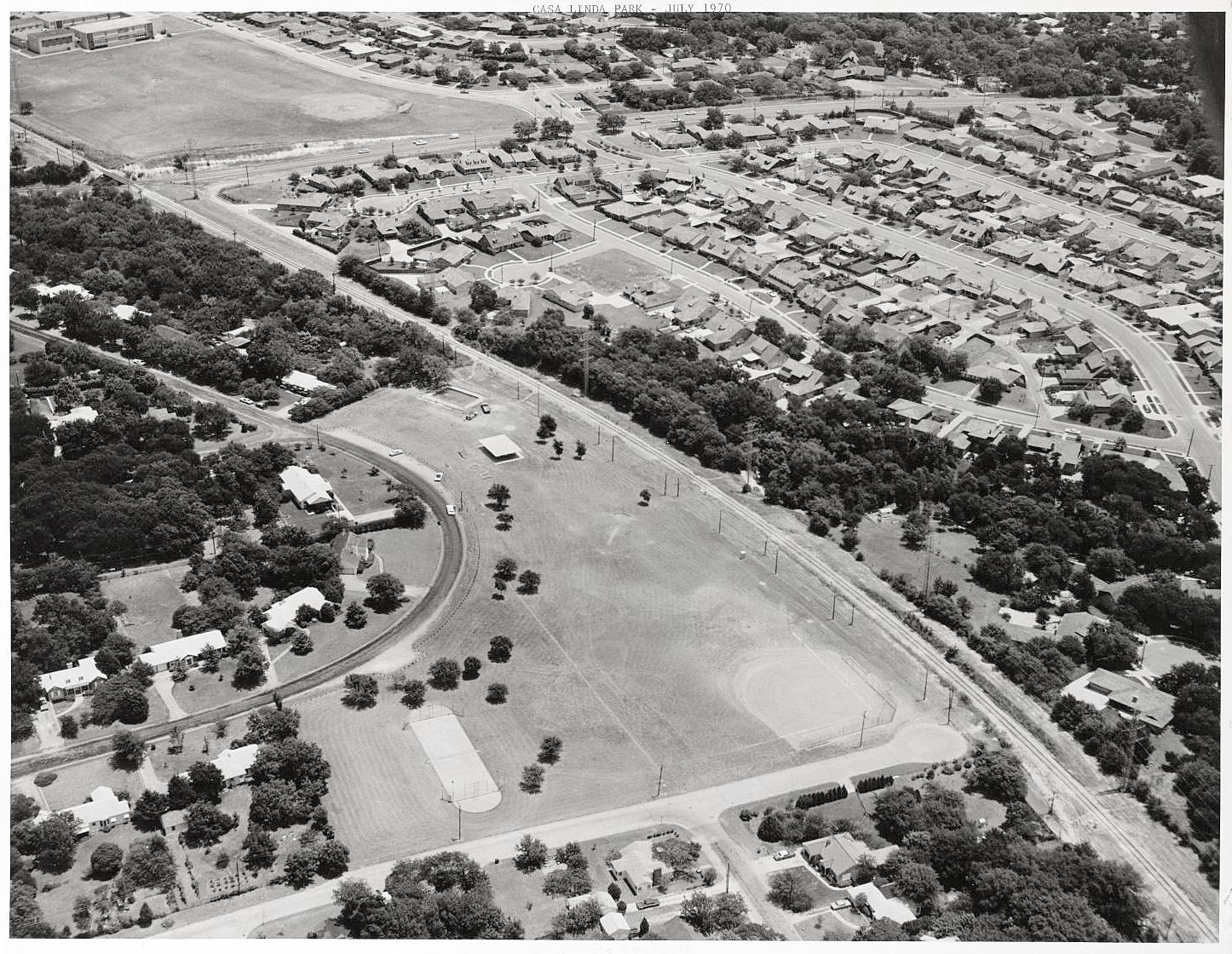
Another Haskins photo, from July, 1970:

casa-linda_aerial_baseball-diamond_squire-haskins_july-1970_dallas-municipal-archives_portal

And lastly, a photo by an unidentified photographer, from July, 1977 — 30 years to the month after the photo at the top was taken:

casa-linda-park_aerial_july-1977_dallas-municipal-archives_portal

*

An aerial Google view of the park today can be seen here.

***

Sources & Notes

These photos are from the Dallas Municipal Archives, and are included in the collection “Dallas Parks Aerial Photographs” provided to UNT’s Portal to Texas History site; all photos above can be found here.

See aerials of nearby Casa View Park — taken by Squire Haskins between 1954 and 1974 — in the Flashback Dallas post “Casa View Elementary/Casa View Park — 1954-1974,” here.

*

Copyright © 2018 Paula Bosse. All Rights Reserved.

“Dallas Is a Major Target Area!” — Know Where Your Nearest Fallout Shelter Is

passport-to-survival_nov-1958_art

by Paula Bosse

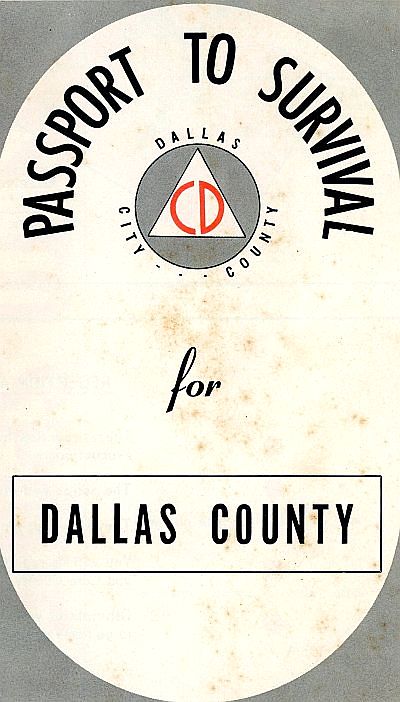
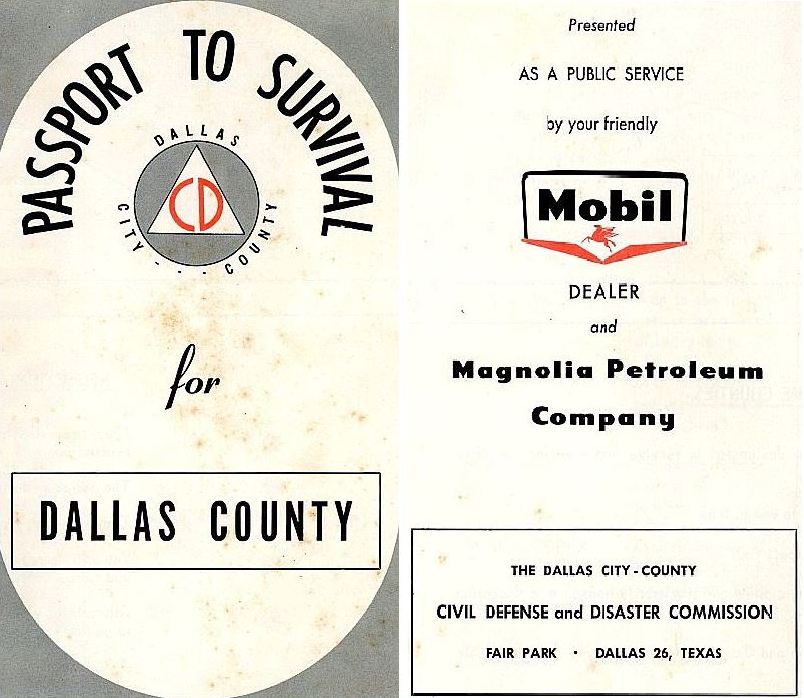
During the Cold War, the fear of nuclear attack was very real in the United States, reaching its peak of anxiety in the late 1950s and early 1960s. In 1958, the Dallas City-County Civil Defense Commission published a free informational pamphlet titled Passport to Survival, which contained evacuation maps for Dallas County, preparation tips, an emergency supply checklist, etc. Though the information contained in this publication could be applied to any disaster or emergency (nuclear-based or otherwise), it was printed a time when visions of Soviet atomic bombs were dancing in the heads of many concerned Americans. And this mild-mannered-looking pamphlet made sure you, Mr. and Mrs. Dallas County, knew that it was talking about a potential direct strike by nuclear missiles: “DALLAS IS A MAJOR TARGET AREA!” (See images from this pamphlet at the end of this post.)

civil-defense_passport-to-survival_front-cover

The arrival of Passport to Survival (“presented as a public service by your friendly Mobil dealer and Magnolia Petroleum Company”) was heralded by a newspaper ad in November, 1958 (its eye-catching “DISASTER CAN HIT DALLAS!” artwork is seen above). (The full ad — with an exhortative letter by Commission chairman John W. Mayo, addressed to the people of Dallas — can be seen here.) I’m not sure how much “survival” there would be in case of a nuclear attack, but, like a good Boy Scout, one should at least be prepared.

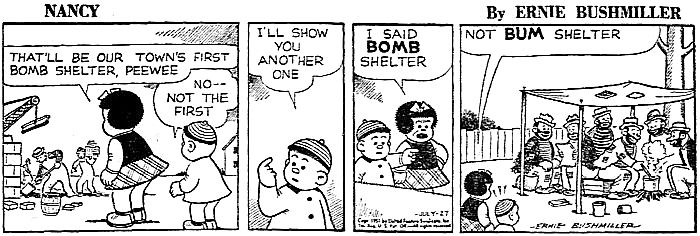
Backyard bomb shelters were necessary in Britain during World War II and saved countless lives during the almost nightly German air raids (I wrote about these shelters on another blog, here), but it was a new concept to post-war America. It wasn’t long, though, before bomb shelters became all the rage in the early ’50s as the Cold War heated up. If it’s becoming a common reference-point on the country’s funny-pages, it’s hit mainstream acceptance.

bomb-shelter_nancy-comic_072751“Nancy” by Ernie Bushmiller, July 27, 1951

I’m not sure how many people were building these shelters, but they were certainly talking about them. When Highland Park Village announced their new underground parking garage in 1953, owners Flippen-Prather made sure to note that the two subterranean parking levels (the lowest of which was 20 feet below street level) would not only accommodate 300 vehicles, but, if needed, it could serve as a bomb shelter for 3,500 very well-dressed Park Cities residents seeking refuge.

But what really caused the mania for nuclear fallout shelters to reach its zenith was the Bay of Pigs Invasion in April of 1961. In May, 1961, ground was broken for construction of the $180,000 Civil Defense Emergency Operating Center at Fair Park (the first such center in Texas), adjacent to the Health and Science Museum. The underground bunker was to serve as a government operating and communications center for Dallas County in the event of a nuclear attack or natural disaster. It would house about 30 people (which would include the mayor and other city officials) and would be stocked with provisions for 14 days. It had its own water supply, electric generators, radios, and telephones. It was built to withstand a 20-megaton nuclear blast three miles away (i.e. downtown, where, presumably, the mayor and other city officials would be working when the 20-megaton bomb lit up Big D). When not in use as a shelter, it was to be maintained by the Health and Science Museum staff, and operated as a center for survival training. For many years it was open to the public, seven days a week. (It’s worth noting that the Civil Defense headquarters in Dallas was also located in Fair Park, at the building housing radio station WRR.)

The man behind the everything-you-need-to-know-about-Civil-Defense website CivilDefenseMuseum.com did a really interesting video walk-through of the surprisingly large decommissioned (if that’s the correct word to use here) Fair Park shelter in 2013:

*

1961 was THE year if you wanted to get into the bomb-shelter business. There was even a three-day “Fallout Survival Show” at Market Hall. You couldn’t open the pages of a magazine or newspaper without seeing ads for personal bomb shelters.

Some of the ads were kind of cozy:

fallout-shelter-ad_sept-1961Sept., 1961

Some were not:

scot_fallout-shelter-ad_sept-1961Sept., 1961

Again, not all that many people were actually building them, but everyone was certainly talking about them. But in just a few short months … no one cared anymore. The ads disappeared. A lot of people who had been trying to sell them went broke. Those who survived (as it were) repurposed their products as “storm shelters” — turns out tornadoes were more of a pressing threat to Dallasites than Russian A-bombs.

Public shelters, however, didn’t disappear. In September, 1962, the very first public fallout shelter in Dallas was officially designated: the Southland Life Insurance Building could accommodate a staggering 30,000 people in the event of disaster. (The plan for this shelter was actually announced in 1954, and the Southland Center opened in 1959, but the official designation was not made until 1962.)

In 1966, Dallas had more than 300 official shelters, able to house 971,000 people:

…323 buildings in the city have been approved as shelters. The owners and managers of 204 of them have entered into agreements with the federal government and with the city to permit their use in emergencies as public shelters…. Shelters in Dallas can house 971,000 persons. Many of the buildings are permanently stocked with water, food supplies and medical supplies sufficient to sustain about 300,000 people for approximately two weeks. (“Maps at Fire Stations To Pinpoint Shelters,” Dallas Morning News, March 9, 1966)

Some of the permanent provisions kept in these places were water, food, “fortified crackers,” hard candy, bandages, iodine, and Geiger counters.

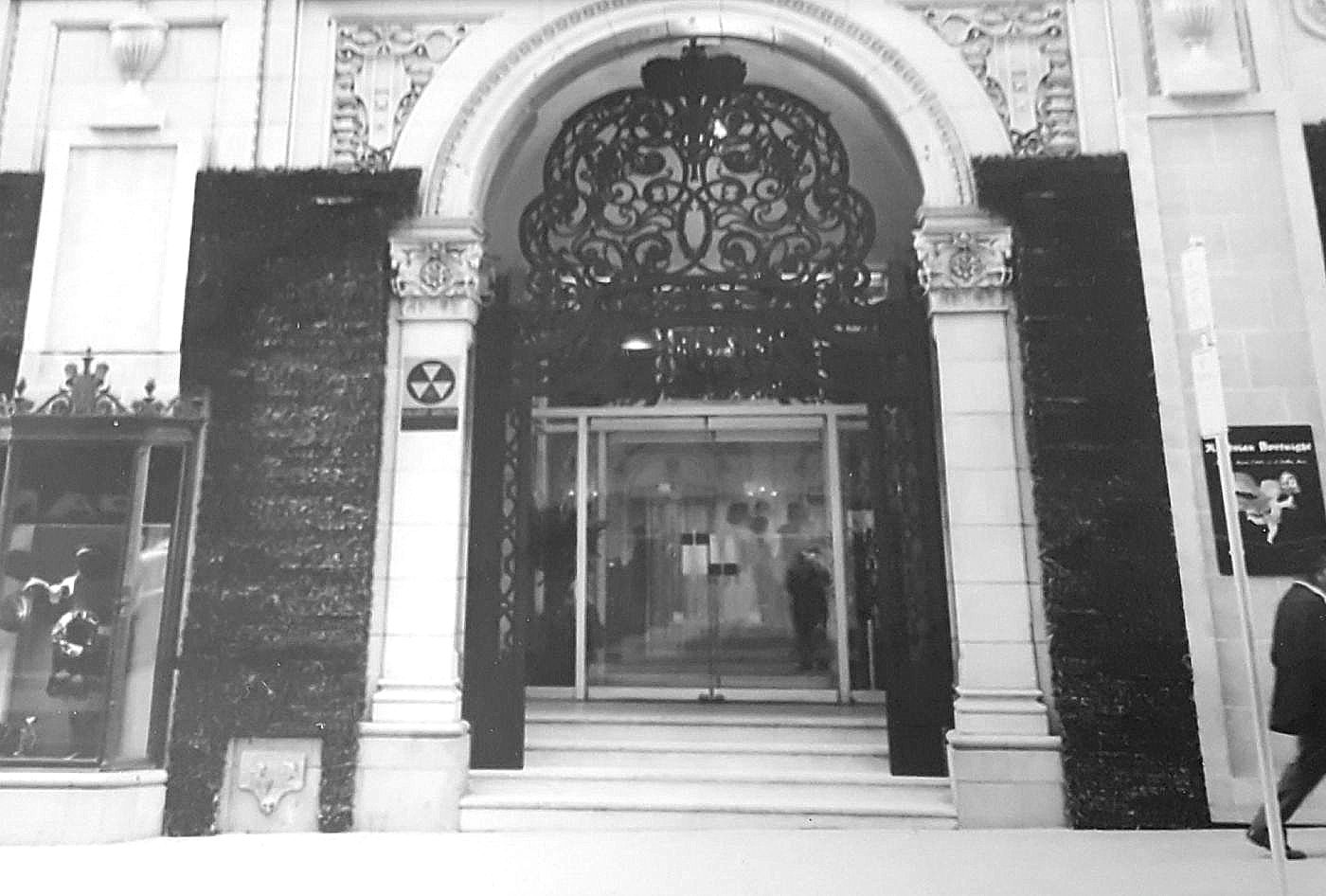
As one might expect, many of the city’s fallout shelters were in downtown buildings, their exteriors adorned with official Civil Defense signage. My favorite? Neiman-Marcus, of course, seen below in 1965, decorated for the Austrian Fortnight.

civil-defense_NM-austrian-fortnight_1965_degolyer_SMU_cropNeiman-Marcus, the most elegant bomb shelter in town…

If I were able to choose where to huddle during a nuclear attack, I think I’d choose Neiman’s. I’m sure Mr. Stanley made sure his basement was comfortable, tasteful, and well-appointed. …And one would have to expect he wouldn’t have had his guests living off hard candy and fortified crackers.

**

Below are images from the 1958 publication Passport to Survival (thanks to Jeff Hanning for his original scans, which precipitated this post) — all images are larger when clicked.

passport-to-survival_1958_covers

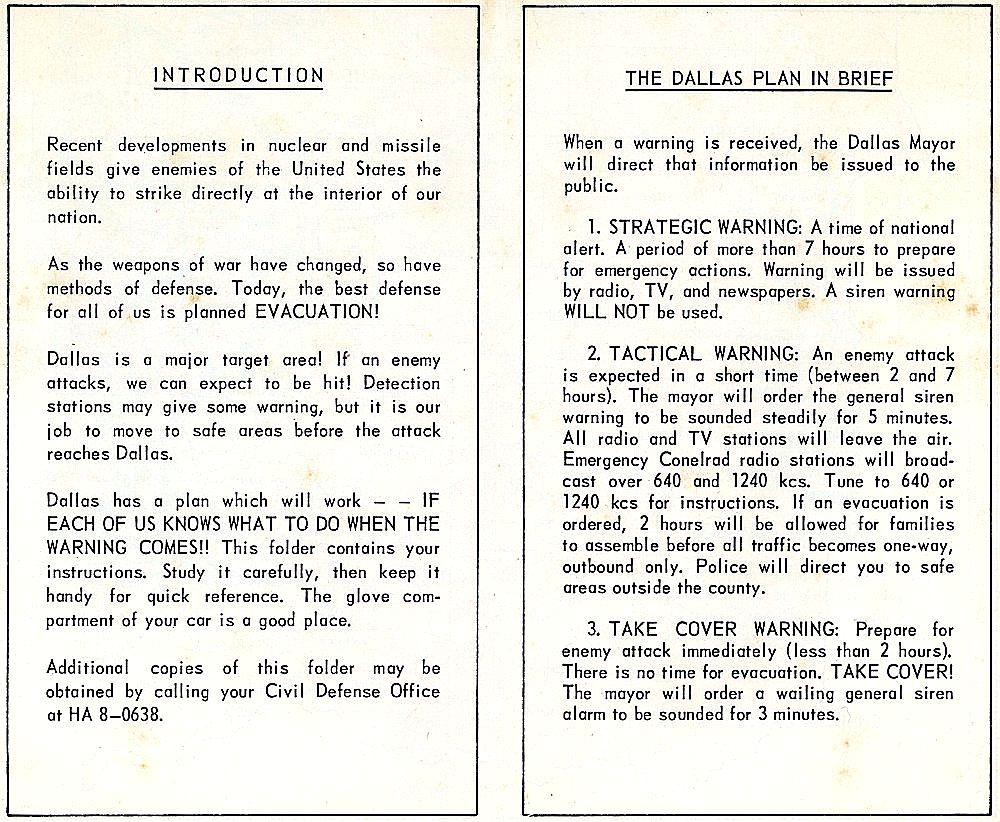
“Introduction” / “The Dallas Plan in Brief” (more information of CONELRAD is in this YouTube video):

civil-defense_passport-to-survival_intro

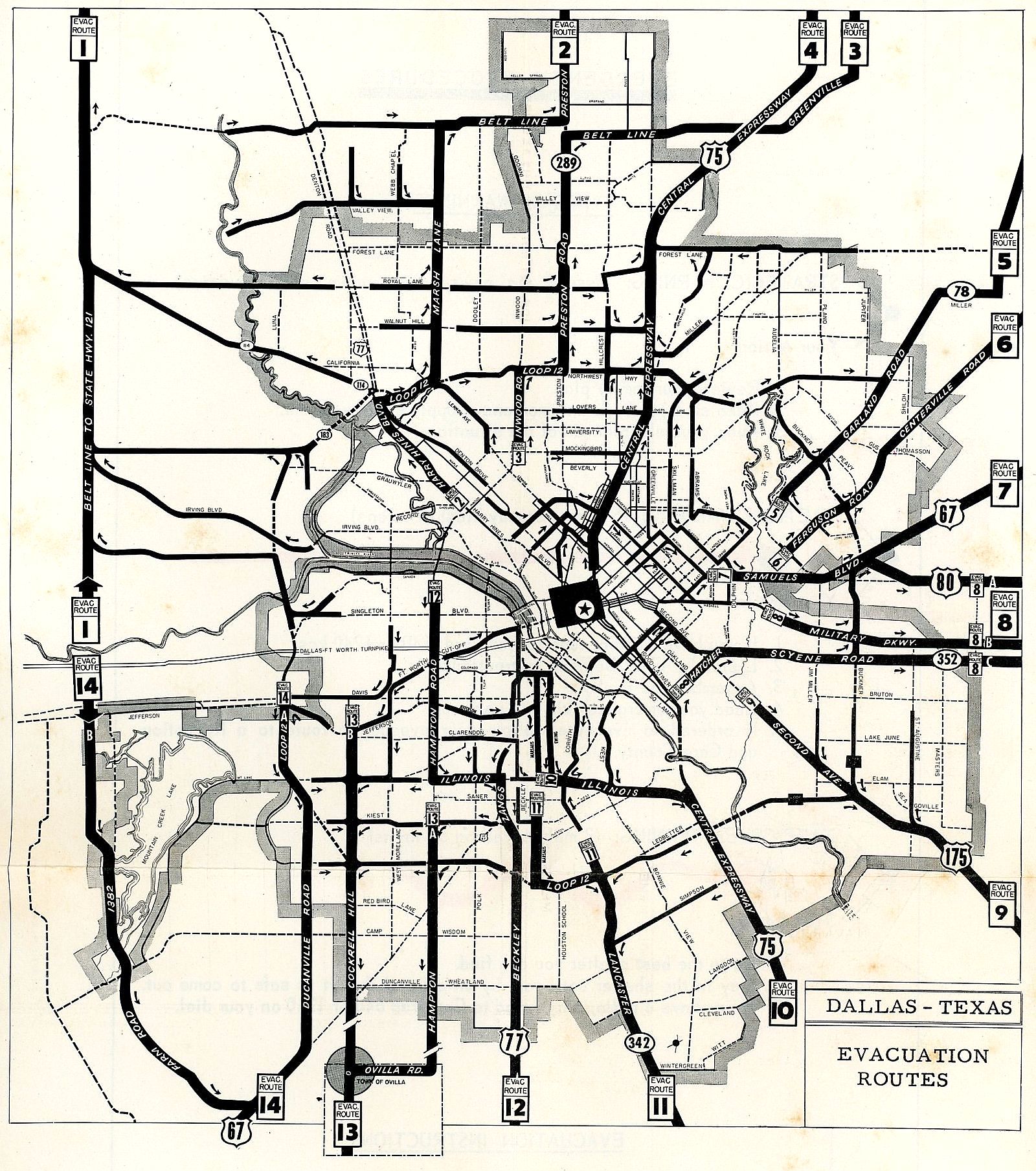
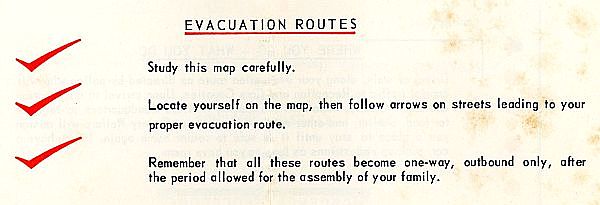
“Evacuation Routes.” (This plan did not sit well with the citizens of Grand Prairie as they were not included in the evacuation plans of either Dallas County or Tarrant County — this seems to have been a particularly odd oversight, seeing as Grand Prairie was a military aviation hub — home to Hensley Field and Chance Vought — and a likely target if DFW were attacked. As an editorial in the Grand Prairie Daily News-Texan stated somewhat bitterly: “Dallas seems to have it all sewed up.”) (Also interesting in these evacuation plans was that the county was divided into four divisions, the boundaries of which corresponded to school districts: District I covered the Dallas Independent School District, Division III covered the Highland Park Independent School District, District IV covered the “Negro Unit,” and District II covered every other school district in Dallas County not covered in the other divisions.)


civil-defense_passport-to-survival_evacuation-routes-map


civil-defense_passport-to-survival_evacuation-routes

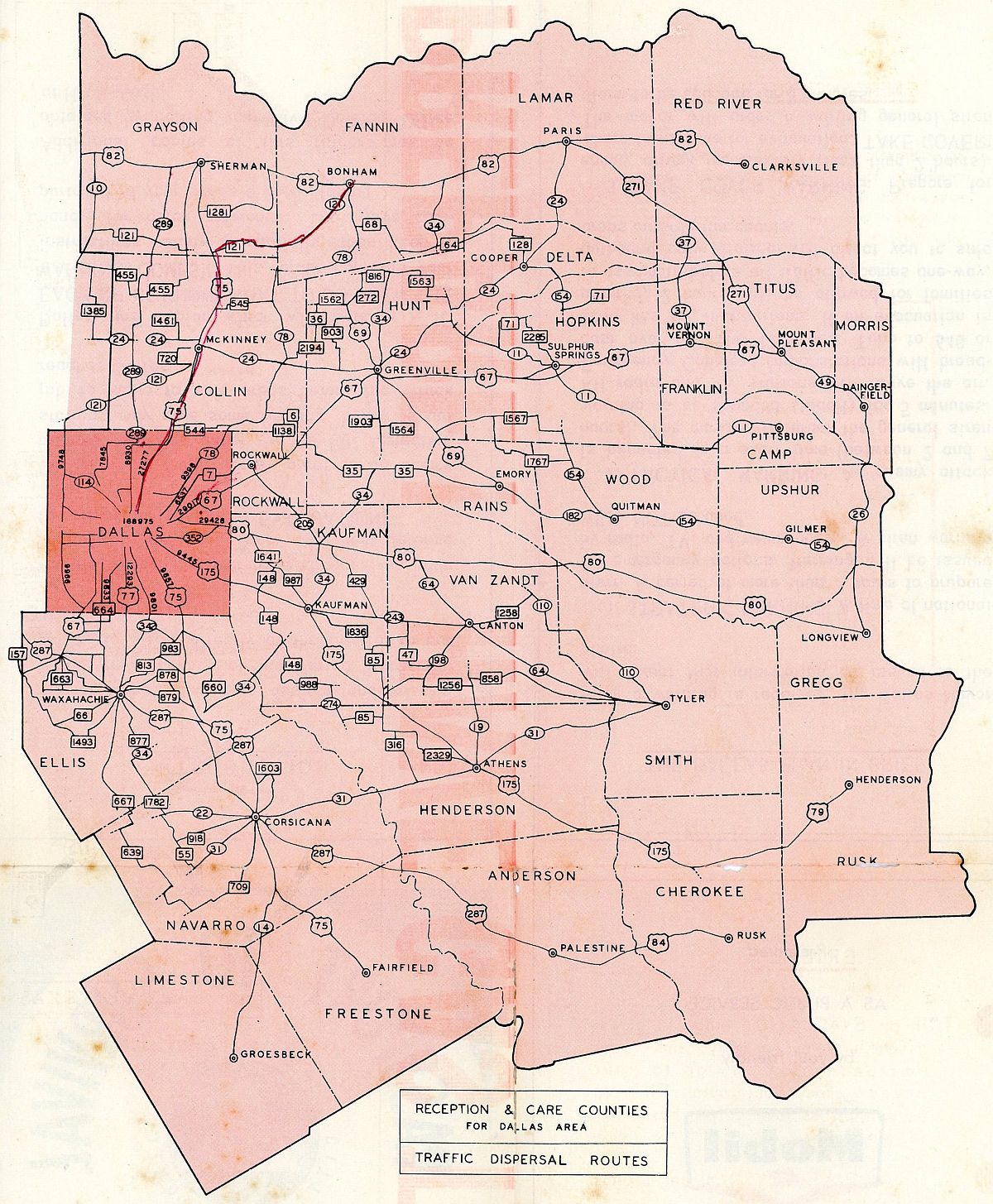
“Reception & Care Counties For Dallas Area Traffic Dispersal Routes” (the person who owned this pamphlet was planning to hightail it to Bonham):


civil-defense_passport-to-survival_traffic-dispersal_map


civil-defense_passport-to-survival_reception-and-care-counties

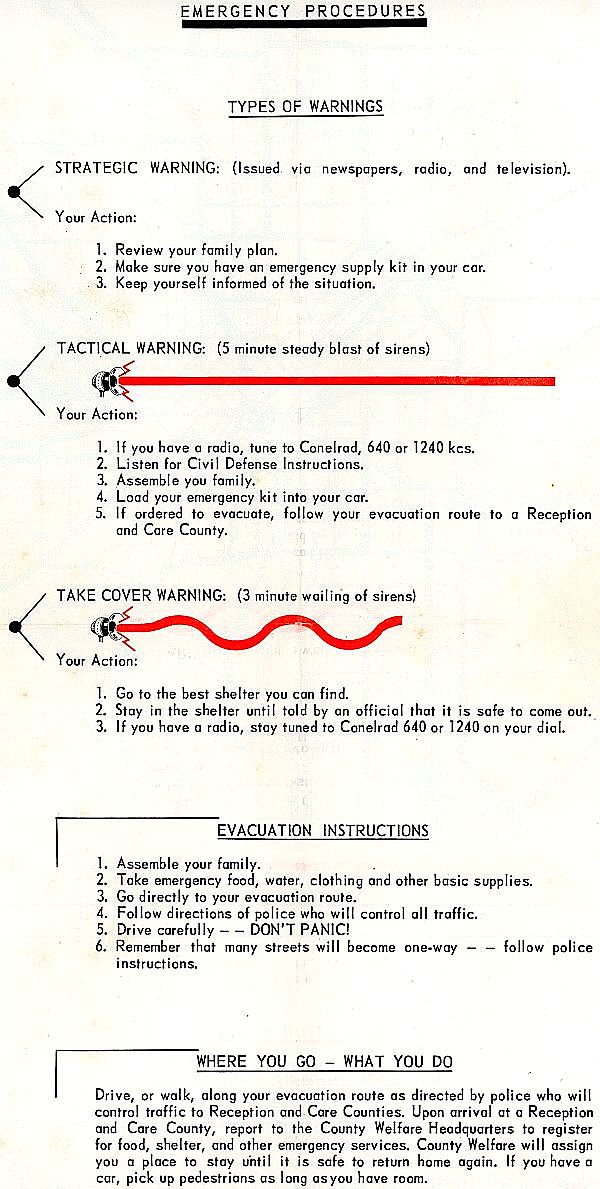
“Emergency Procedures”:

civil-defense_passport-to-survival_warnings

“Emergency Supply Kit” (do NOT forget the can opener!) / “Taking Cover”:


civil-defense_passport-to-survival_preparation

***

Sources & Notes

Thanks again to Jeff Hanning for sending me scans of his Passport to Survival, Dallas County pamphlet.

The photo of Neiman-Marcus is from the DeGolyer Library at SMU. The above image is a really bad photo I took as a reference photo for a project I was working on at SMU last year. The actual photograph in the DeGolyer collection is, of course, much better! Apologies to the DeGolyer Library! I would link to the photo in SMU’s online database, but a scan of that particular photo is not available.

As mentioned above, if you’re interested in Civil Defense in Dallas, the CivilDefenseMuseum.com site is where you need to be. There’s TONS of stuff there. In addition to the great video walk-though of the old Fair Park shelter, there are also several pages of photos here (click through all the pages by following the links at the bottom of each page).

More on the history of United States Civil Defense, here.

And two stories from the Lakewood Advocate on Dallas’ Civil Defense shelters and preparedness can be found here and here.

A related Flashback Dallas post: “A-Bomb in Akard Street! — 1950,” with an eerie illustration of a smoldering downtown Dallas.

*

Copyright © 2018 Paula Bosse. All Rights Reserved.

Sam Ventura’s Italian Village, Oak Lawn

italian-village_photo-holder_PEB

by Paula Bosse

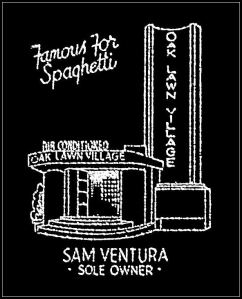
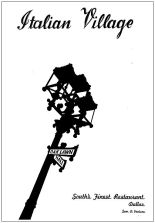
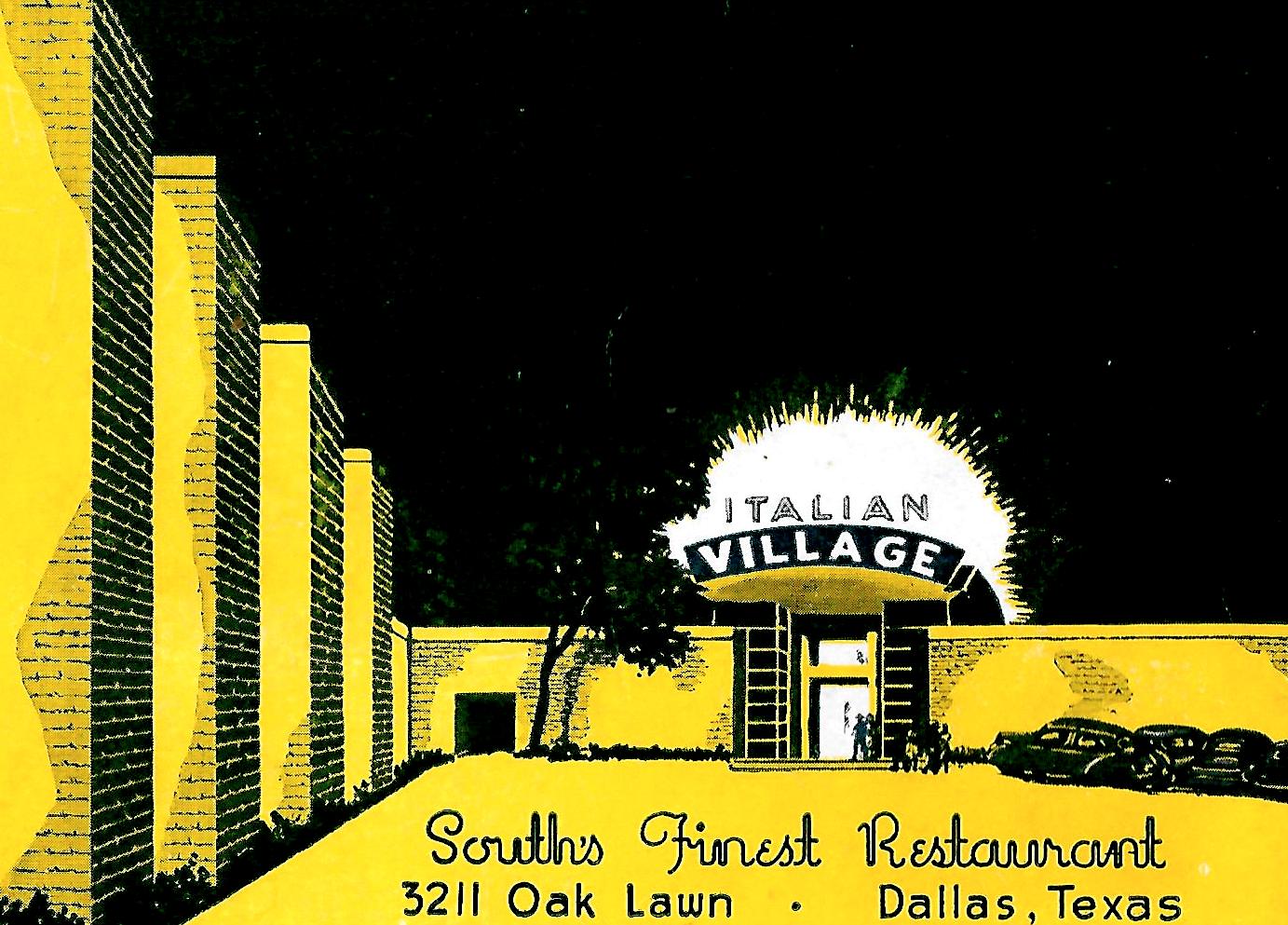
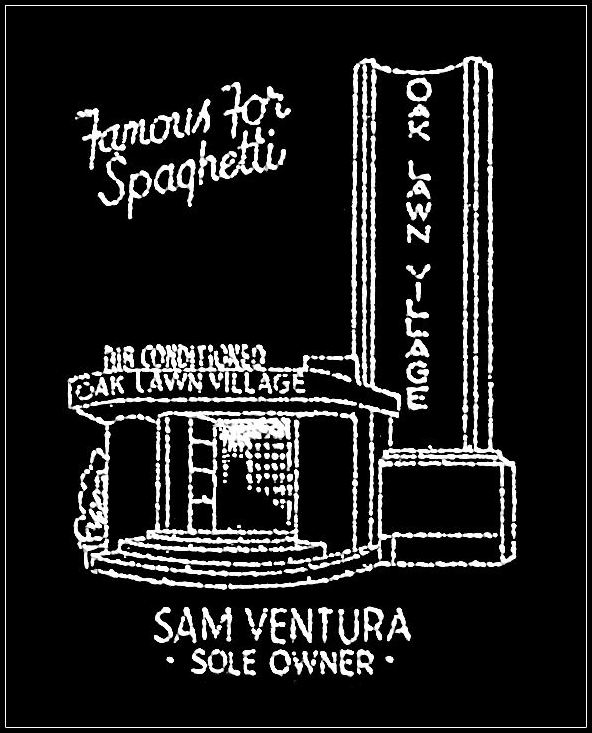
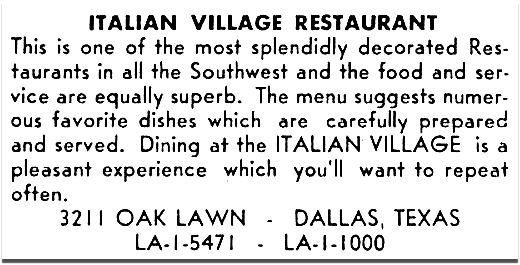
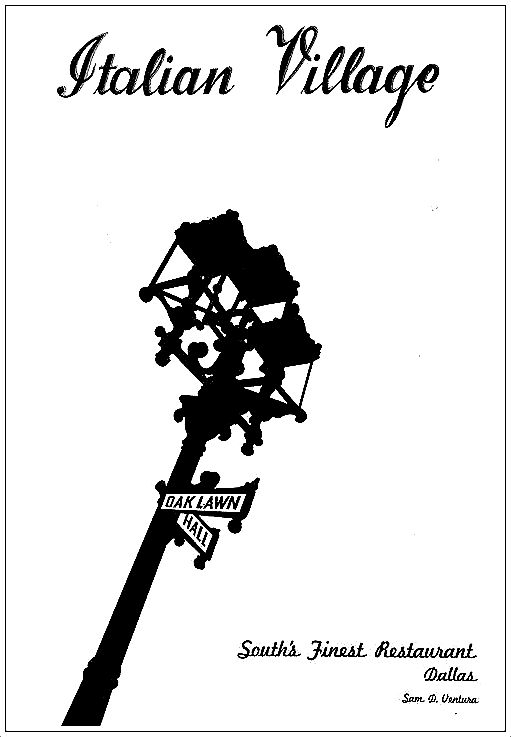
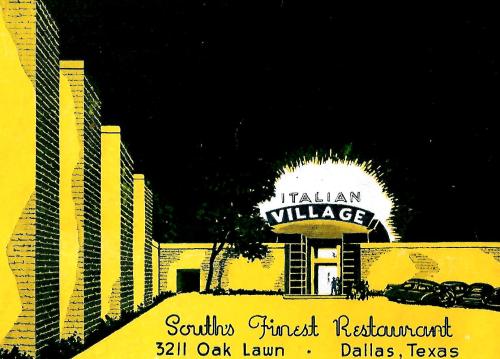
In amongst photos and belongings of my mother’s aunt, I recently came across this wonderful graphic of Oak Lawn’s Italian Village (3211 Oak Lawn, at Hall). It was on the cover of one of those cardboard photo holders which contained photos of diners and club-goers captured by photographers wanting to memorialize celebrants’ special occasions — they would take your photo and you would later purchase prints, which would be tucked inside the souvenir folder. (I don’t recognize any of the people in the photo which was  inside — the photo is here.)

The Italian Village complex (which contained all its various tangential enterprises over he years) was an Oak Lawn fixture for over 45 years — it was apparently still around during my lifetime, but I have no memory of ever seeing it. But by the time I would have been aware of it, things had begun to get a little weird and its profile had definitely dipped. (More on that later.)

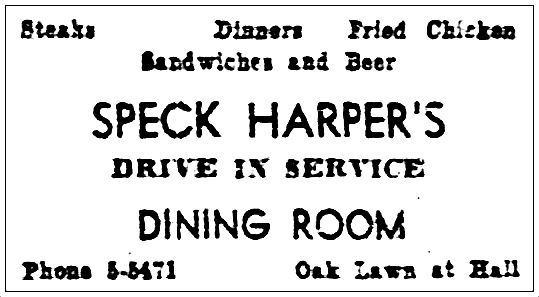
Italian Village began its life in 1934 when Sam Ventura (1907-1997) bought a popular drive-in restaurant in Oak Lawn from a man named Levi F. “Speck” Harper. In Ventura’s obituary in The Dallas Morning News, his wife said: “He bought it from a man named Speck Harper who told him, ‘Give me $250 and my hat, and you’ll never see me again.’ Sam had to go and borrow the money.” (DMN, June 1, 1997) ($250 in today’s money would be about $4,700.)
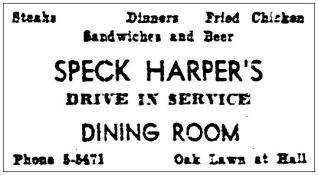
speck-harper_july-1934July, 1934

Not only did $250 start Ventura on a very successful career as a restaurateur, it also assured him ownership of what would quickly become a primo piece of real estate. (Ventura dabbled in real estate and, in 1937, along with fellow restaurant man Sam Lobello, he purchased land at Preston Road and Northwest Highway which would one day become Preston Center.) (It might be worth noting here that Sam Ventura was not affiliated with the very popular Sammy’s restaurants, run by Dallas’ Messina family.)
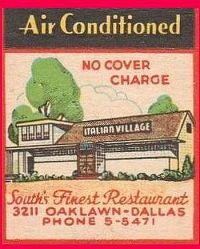
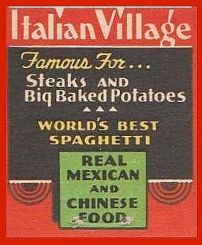
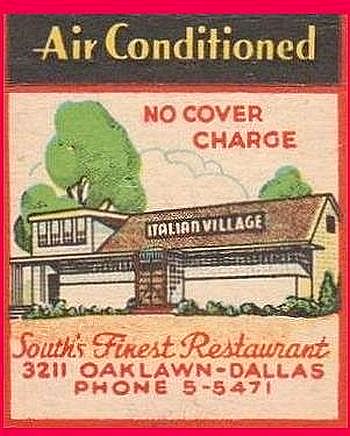
italian-village_matchbook_front_ebay        italian-village_matchbook_back_ebay
Matchbook, via eBay

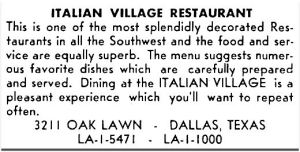
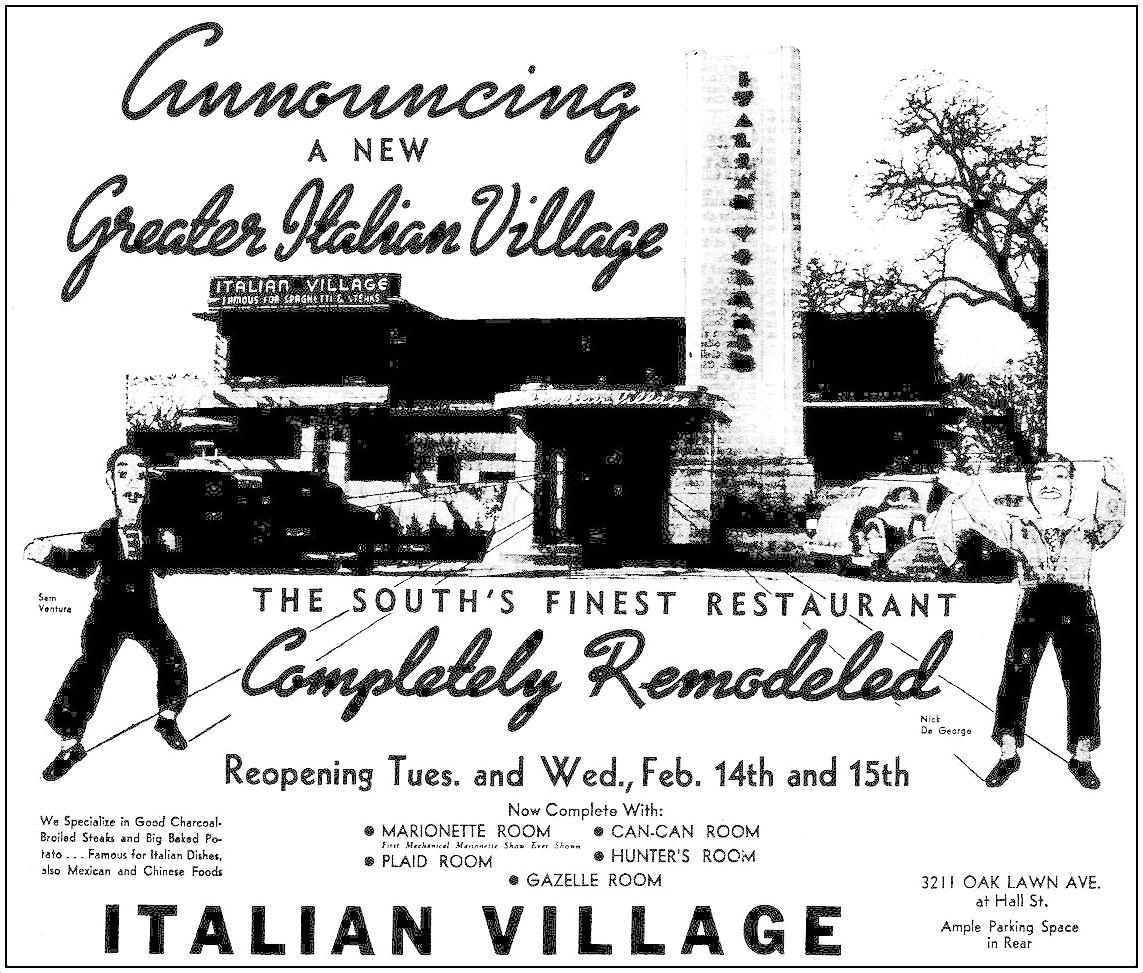
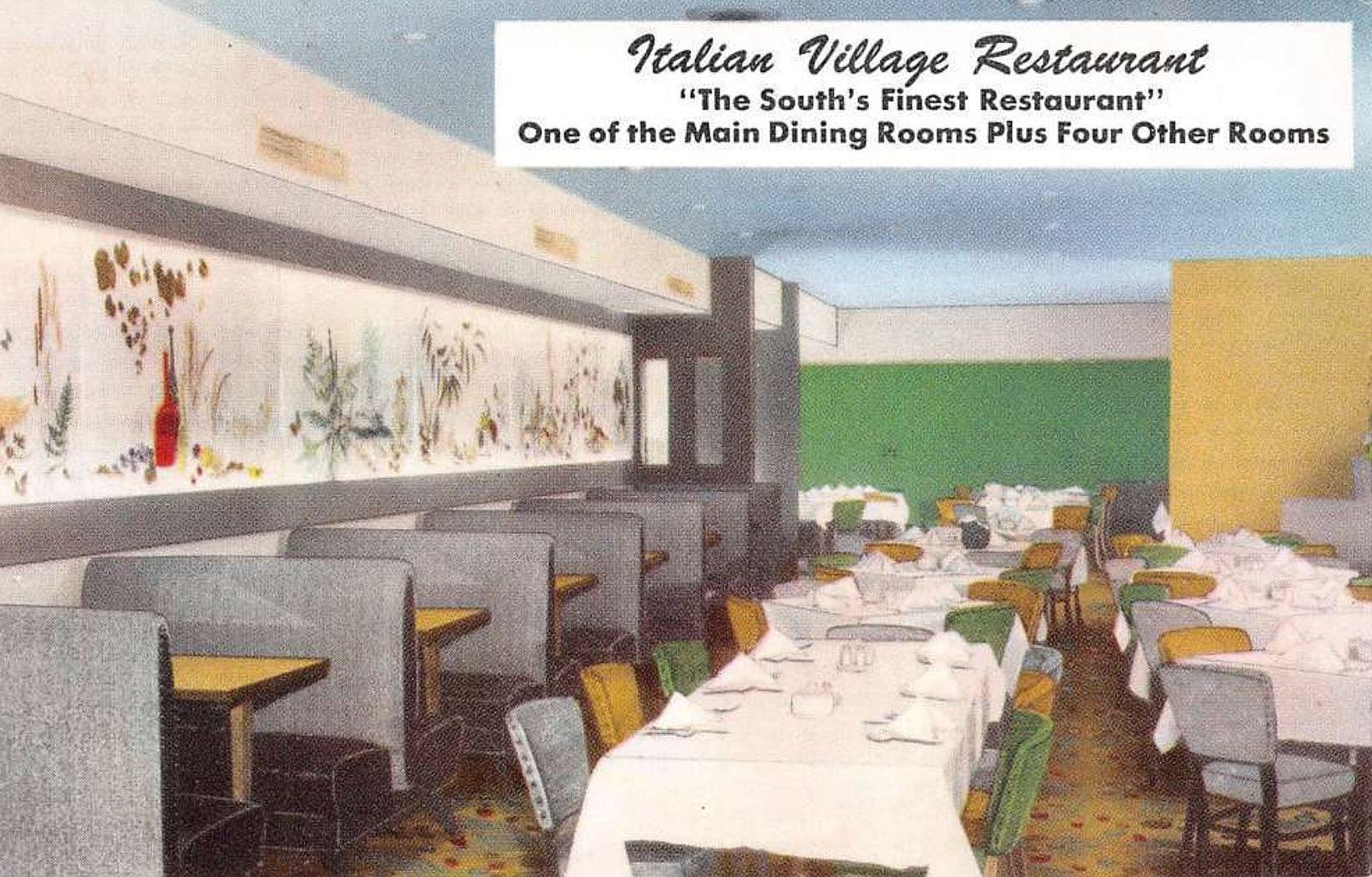
Italian Village — a restaurant which operated for many years as a private club in order to sell liquor — was originally co-owned by brothers-in-law Sam Ventura and Nick DeGeorge (DeGeorge was later married to Ventura’s sister Lucille). By the time the ad below appeared in 1939, the place had been newly remodeled and was on its ninth (!) expansion. There were lots of new “rooms”: the Can-Can Room, the Plaid Room, the Hunter’s Room, the Gazelle Room, and the Marionette Room, the latter of which featured entertainment in the form of a marionette show with puppets made in likenesses of the owners. (All images are larger when clicked.)
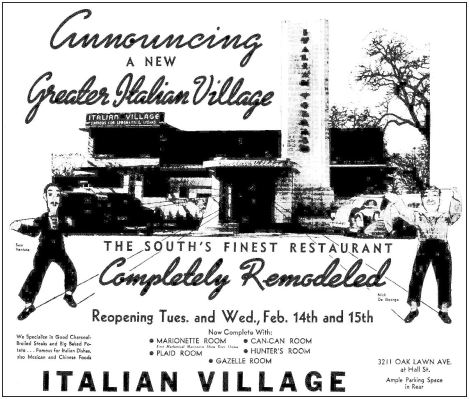
1939_italian-village_feb-1939Feb., 1939

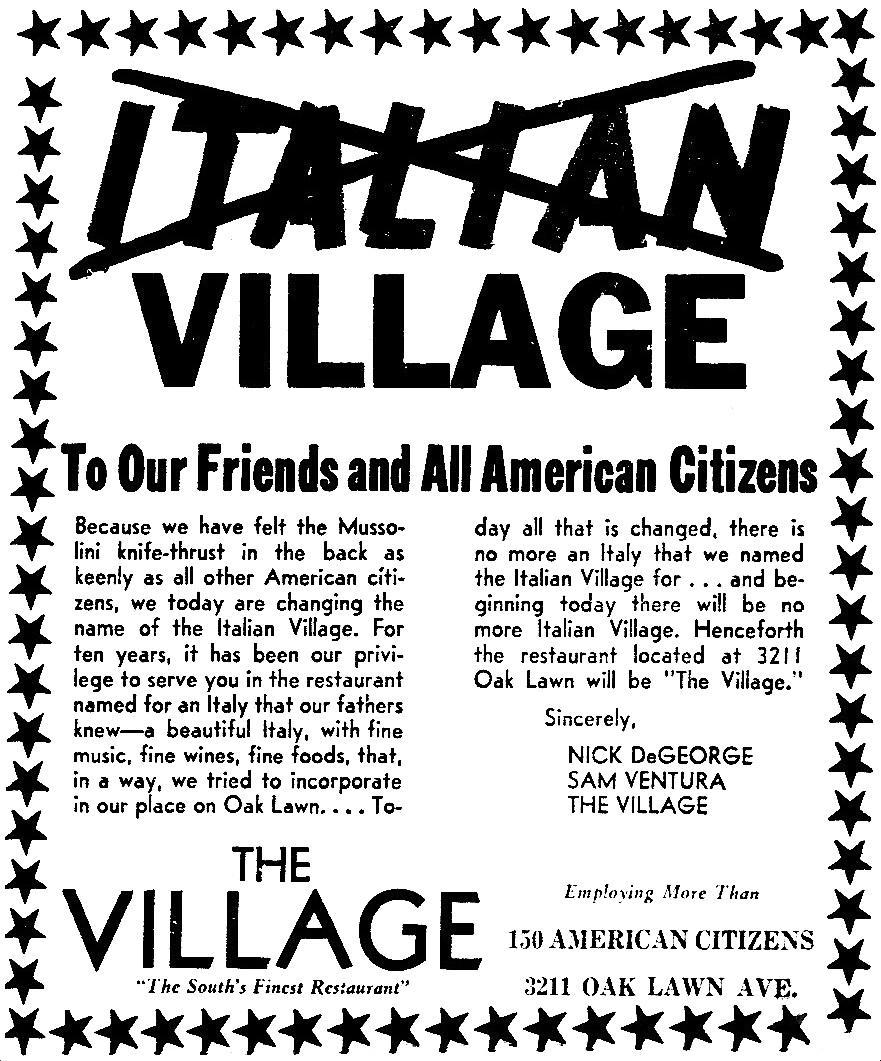
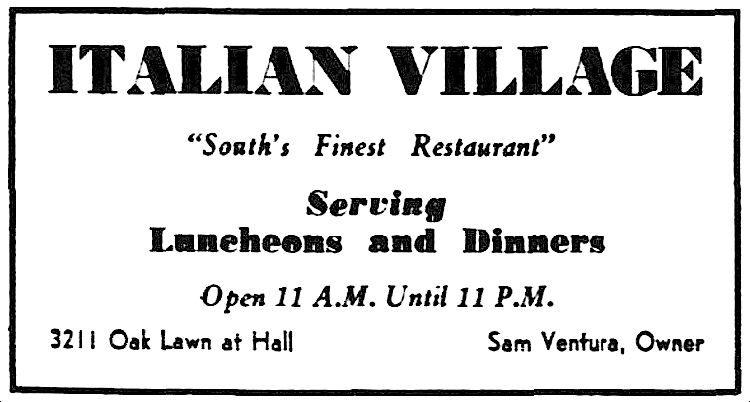
In June, 1940, Italy entered the War in Europe as a member of the Axis forces. As a result, Ventura and DeGeorge immediately asserted their patriotism and their American-ness (both were born in the United States to Italian immigrants) by changing the name of their restaurant: arrivederci, Italian Village, hello, Oak Lawn Village. The owners placed an ad in Dallas newspapers explaining their decision (see ad below) — this made news across the country, garnering both positive national publicity as well as fervent local support.
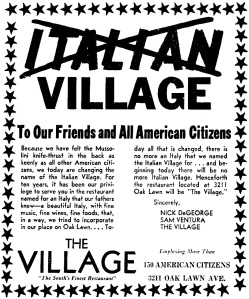
italian-village_ad_june-1940
June, 1940

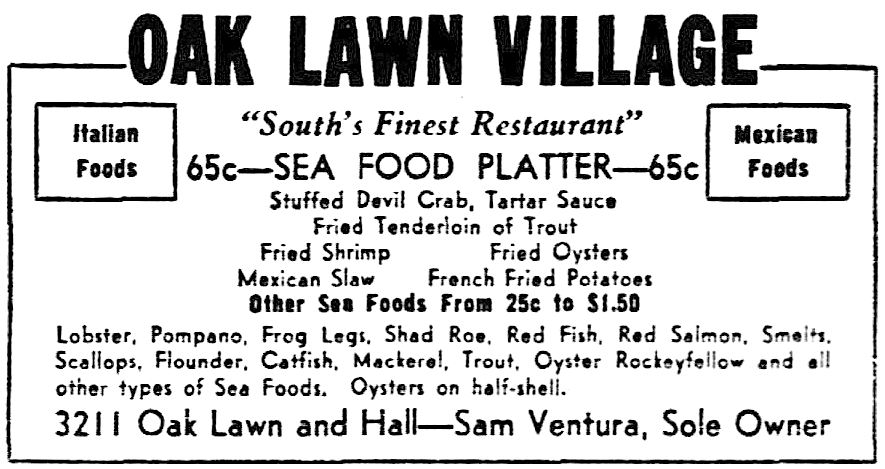
Not only did the restaurant’s name change in 1940, so did its ownership. Nick DeGeorge and his wife (the sister of Sam Ventura) embarked on a very lengthy, very bitter divorce (newspapers reported that Nick and Lucille were each on their fourth marriages). The result of this marital split spilled over and also caused a business split: Ventura became the sole owner of Italian Oak Lawn Village, and DeGeorge left to start his own (very successful) restaurant career (DeGeorge’s, Town & Country, etc.). Sam announced that he was “sole owner” in a September, 1940 ad. (I hope Nick at least got custody of his mini-me marionette….)
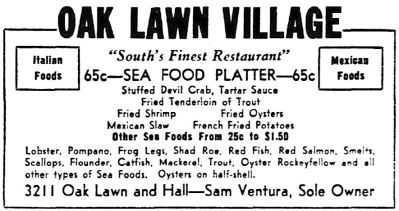
1940_oak-lawn-village-ad_sept-1950Sept., 1940

oak-lawn-village_matchbook_flickr-coltera
Oak Lawn Village matchbook cover, via Flickr

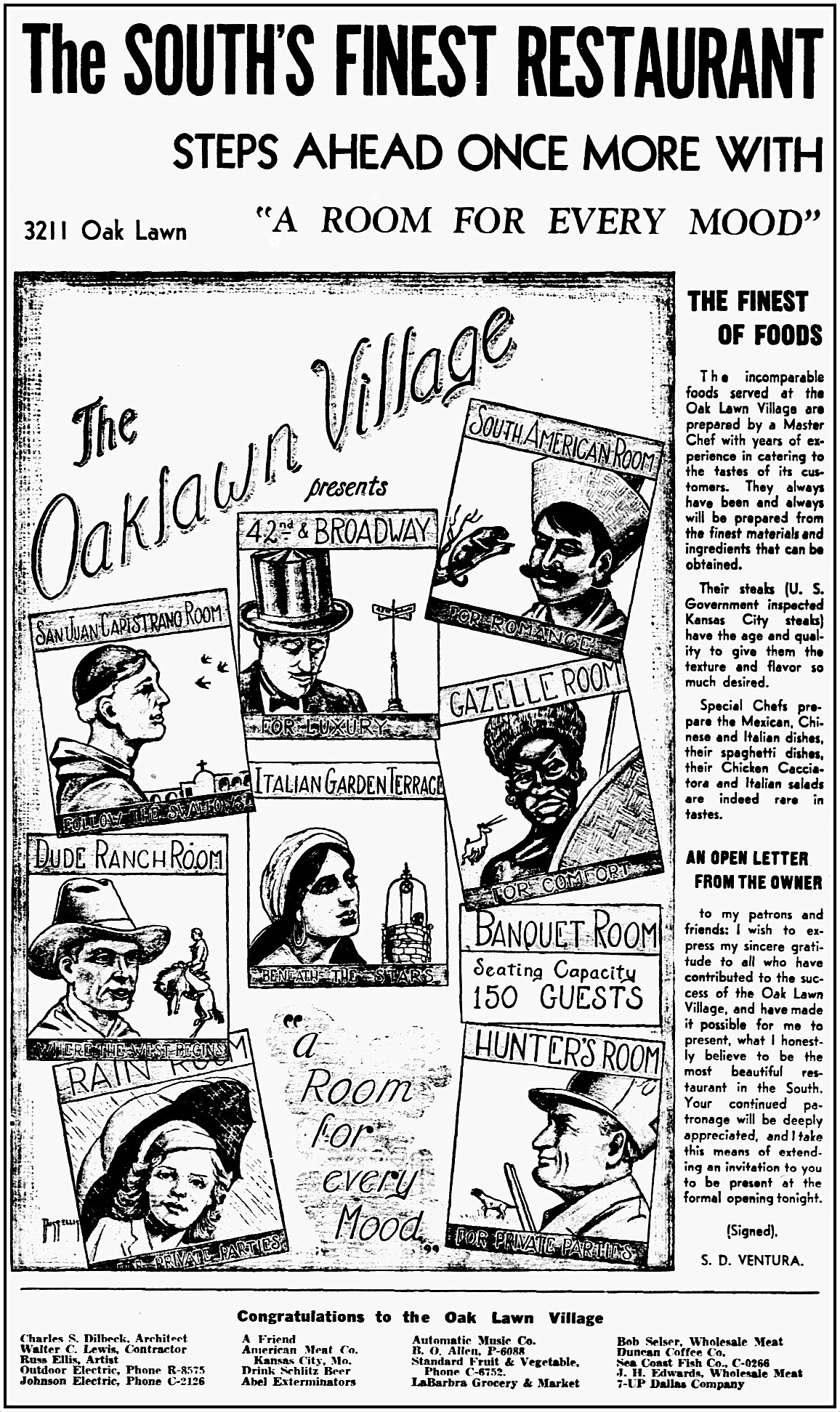
In June, 1941 yet another remodeling/expansion was announced, with architectural design by longtime friend of Ventura and DeGeorge, Charles Dilbeck, and murals by Russ Ellis. In addition to the Gazelle Room (“for comfort”) and the Hunter’s Room (“for private parties”), there was now the San Juan Capistrano Room (“follow the swallows”), the 42nd & Broadway Room (“for luxury”), the South American Room (“for romance”), the Dude Ranch Room (“where the west begins”), the Rain Room (“for private parties”), the Banquet Room (“seating capacity 150 guests”), and an outdoor Italian Garden Terrace (“beneath the stars”).
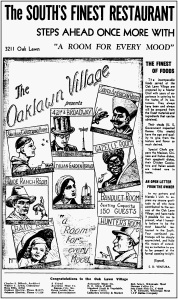
1941_oak-lawn-village_dmn_june-41June, 1941

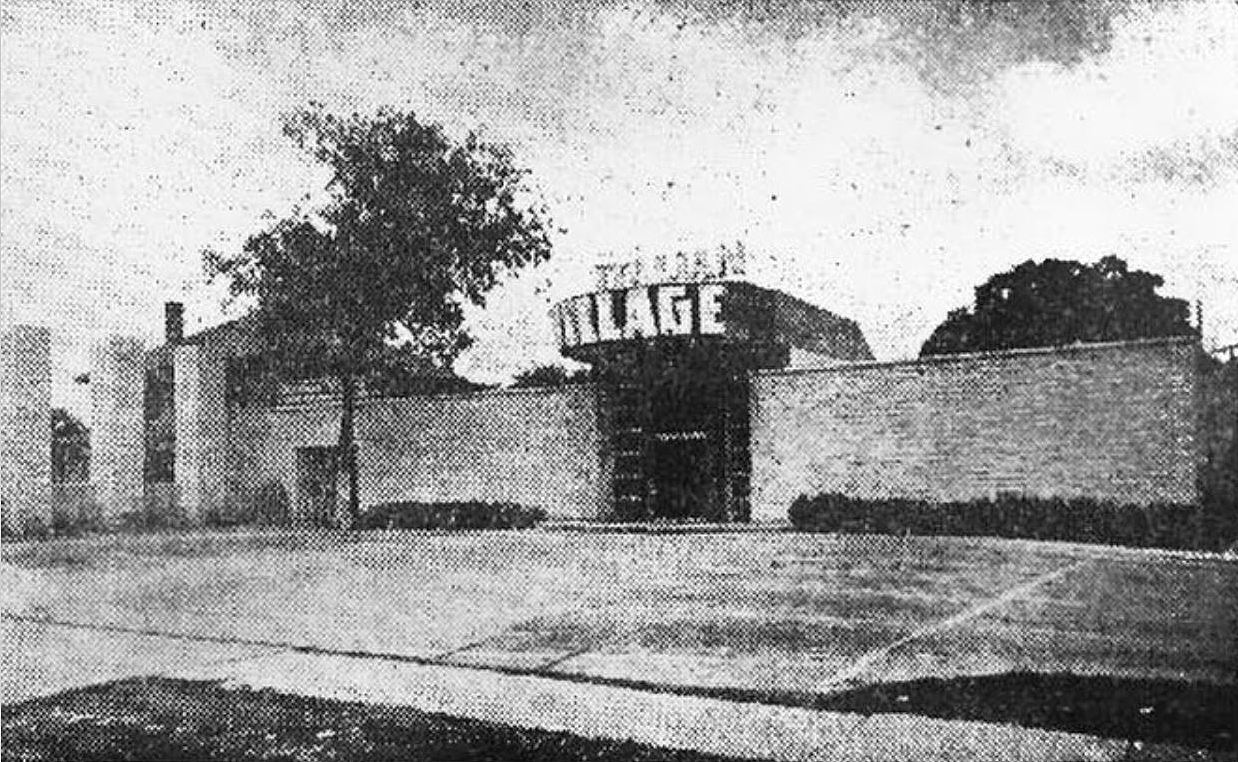
That $20,000 remodel (which would have been equivalent to about $350,000 in today’s money) went up in smoke — literally — in April, 1944, when the restaurant was “virtually destroyed” by fire. Ventura said he would rebuild when war-time government regulations would permit him to do so. At the end of the year he announced that he would build a new restaurant, of shell stone and marble construction, lit in front by decorative tower lights. The new place was built and in full swing — and back with its original name — in the summer of 1945.
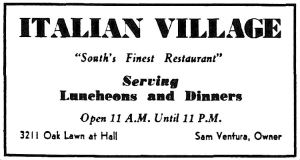
1945_italian-village_aug-1945Aug., 1945

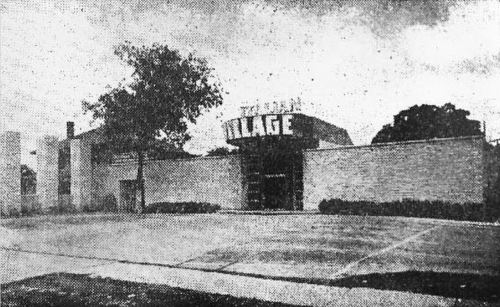
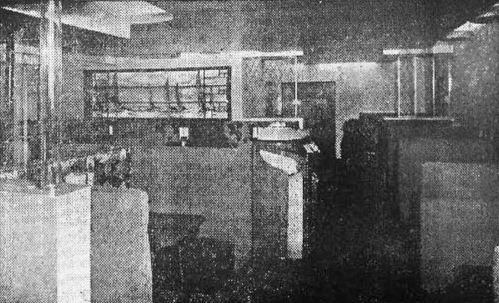
An ad for Dallas’ S. H. Lynch & Co.’s Seeburg Scientific Sound Distribution system appeared in the Aug. 10, 1946 issue of Billboard magazine, showing photos of Sam Ventura, the exterior of the new building, and an interior shot showing a Seeburg jukebox. (See full ad here.)
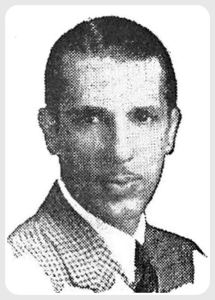
1946_italian-village_billboard_081046_ad-det-1Sam D. Ventura, 1946 (ad detail, Billboard magazine)
1946_italian-village_billboard_081046_ad-det-2

1946_italian-village_billboard_081046_ad-det-3Italian Village exterior and interior, 1946 (ad detail, Billboard magazine)
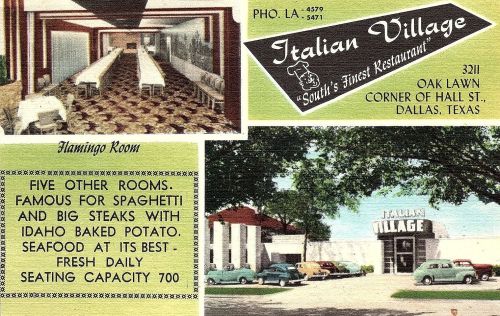
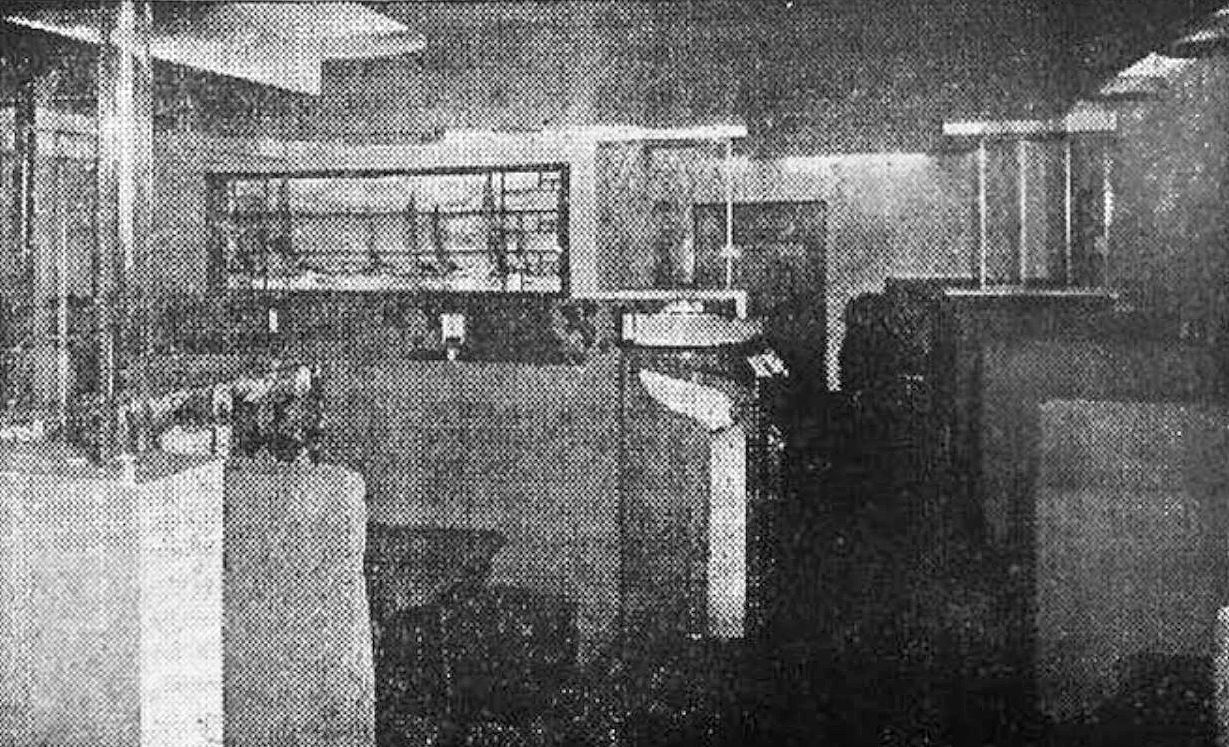
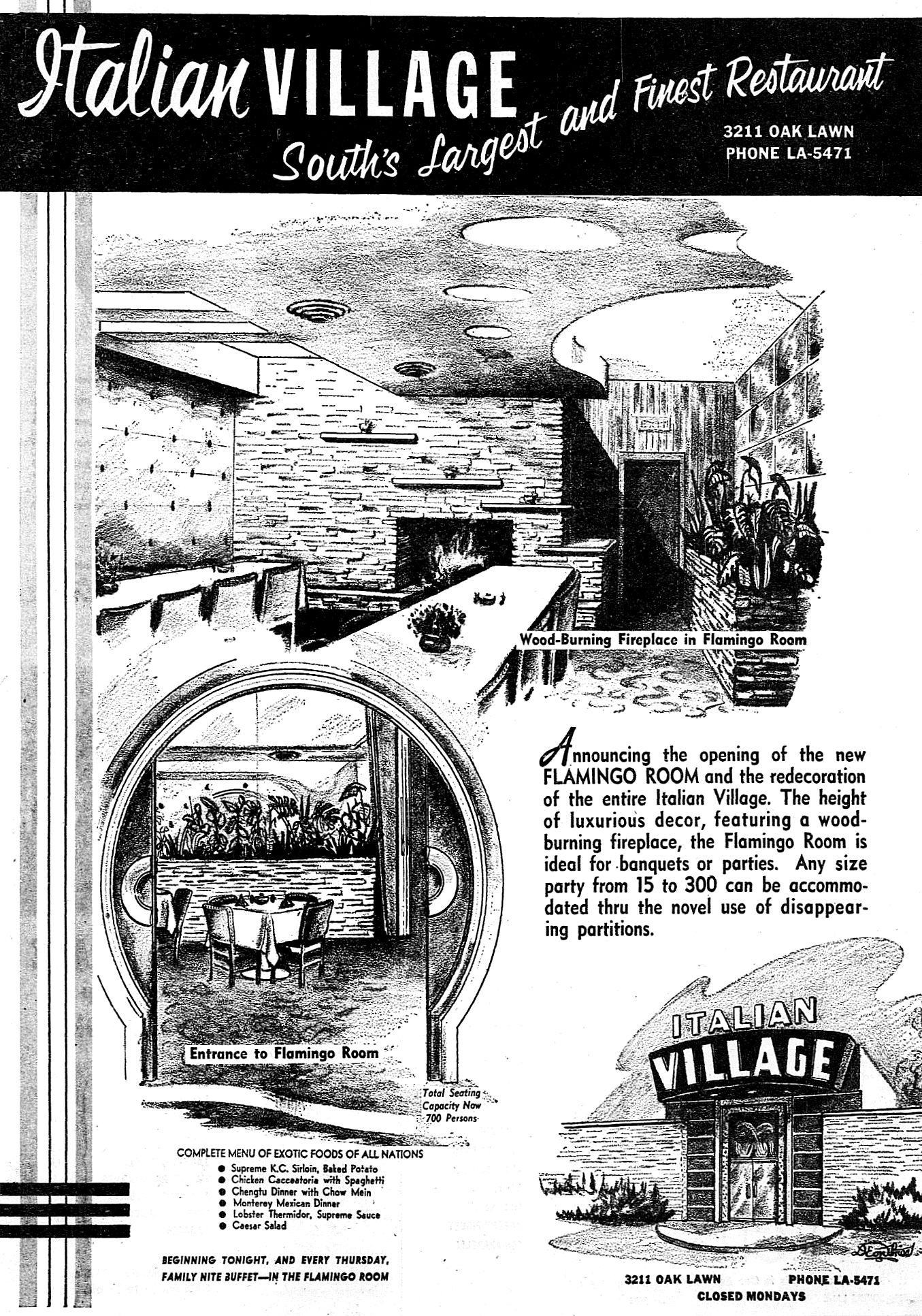
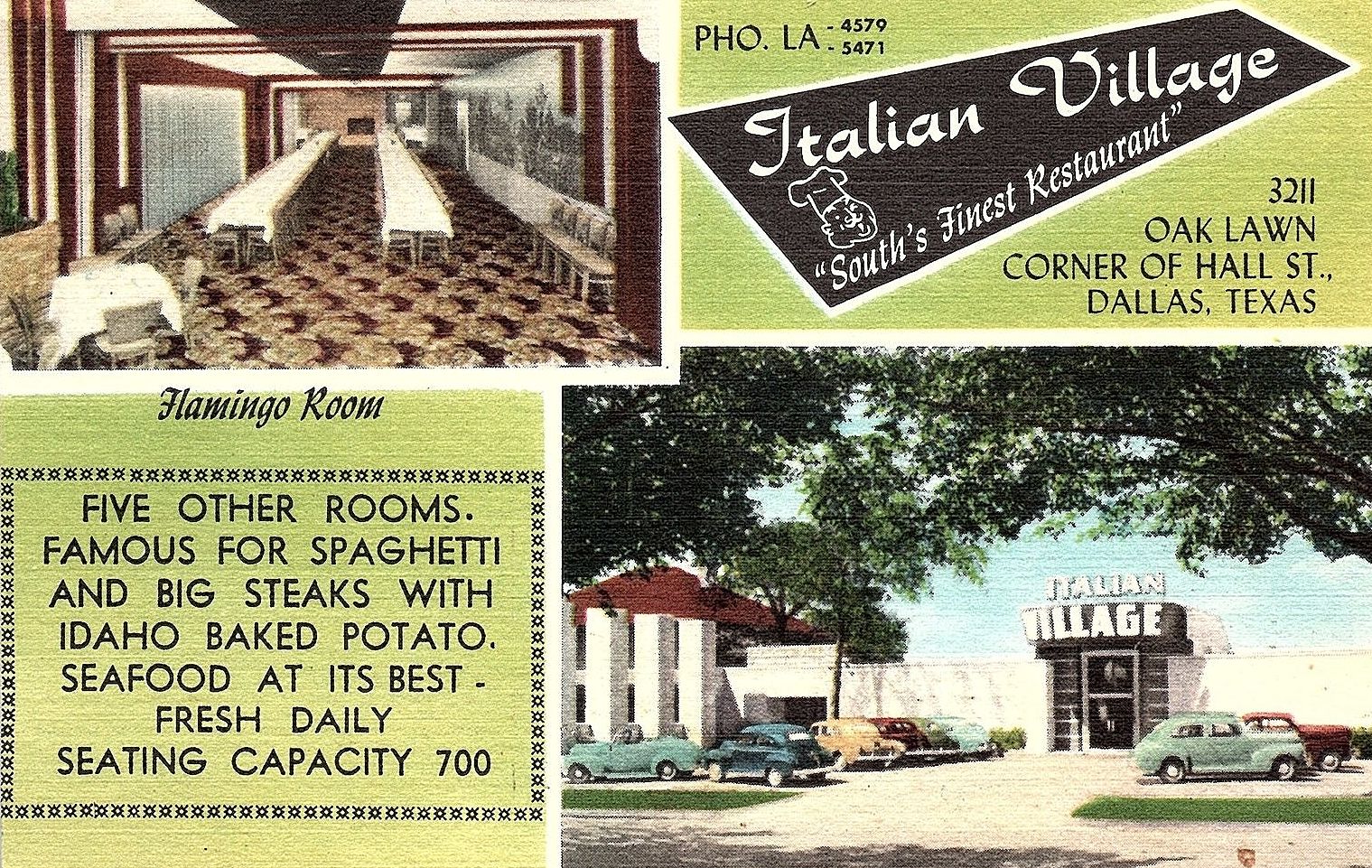
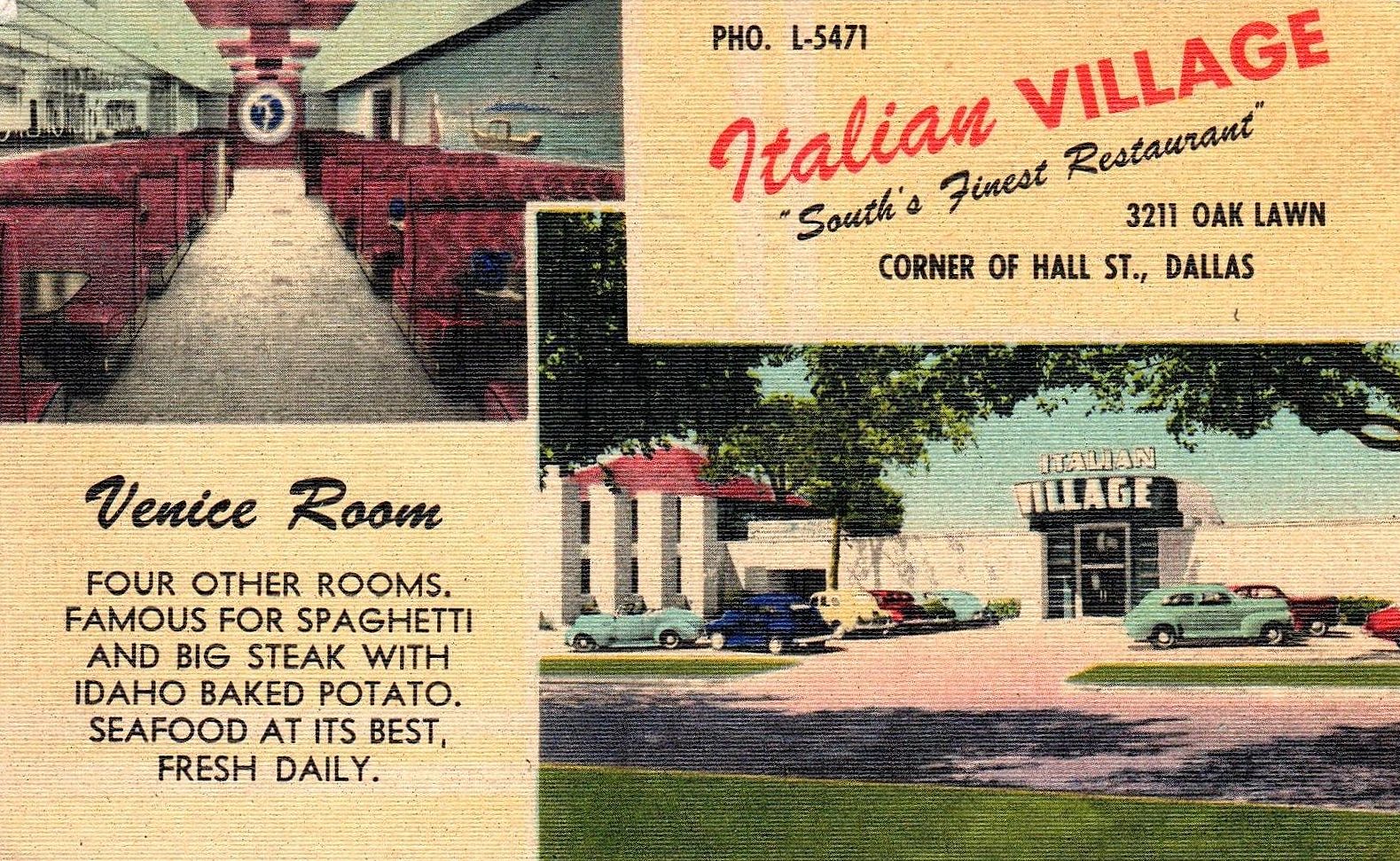
In January, 1951 another remodeling (to the tune of $75,000!) introduced the 300-seat Flamingo Room, which meant the entire Italian Village now had a seating capacity of more than 700 (Ventura had said that the original post-Speck’s restaurant seated only 40 or 50 people). The “modernistic styling” was the work of architect J. N. McCammon.
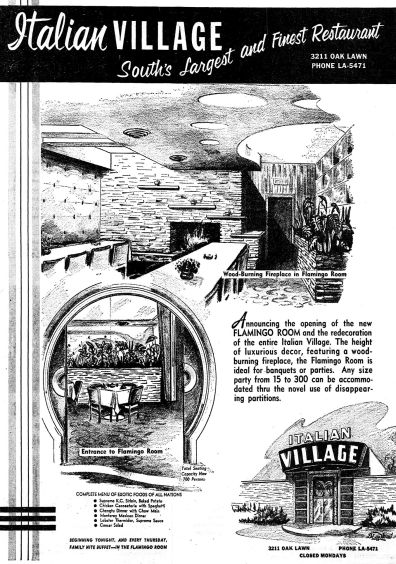
1951_italian-village_flamingo-room_jan-1951Jan., 1951

italian-village_postcard_flamingo-room_ebay

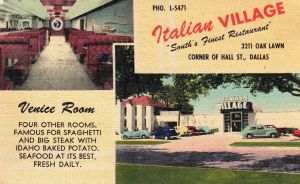
italian-village_postcard_yellow_ebay

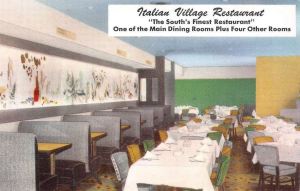
italian-village_postcard_interior_ebay

italian-village_postcard_interior_caption_ebay

italian-village_menu_ebay_1     italian-village_menu_ebay_4
Front and back of 1955 menu, via eBay

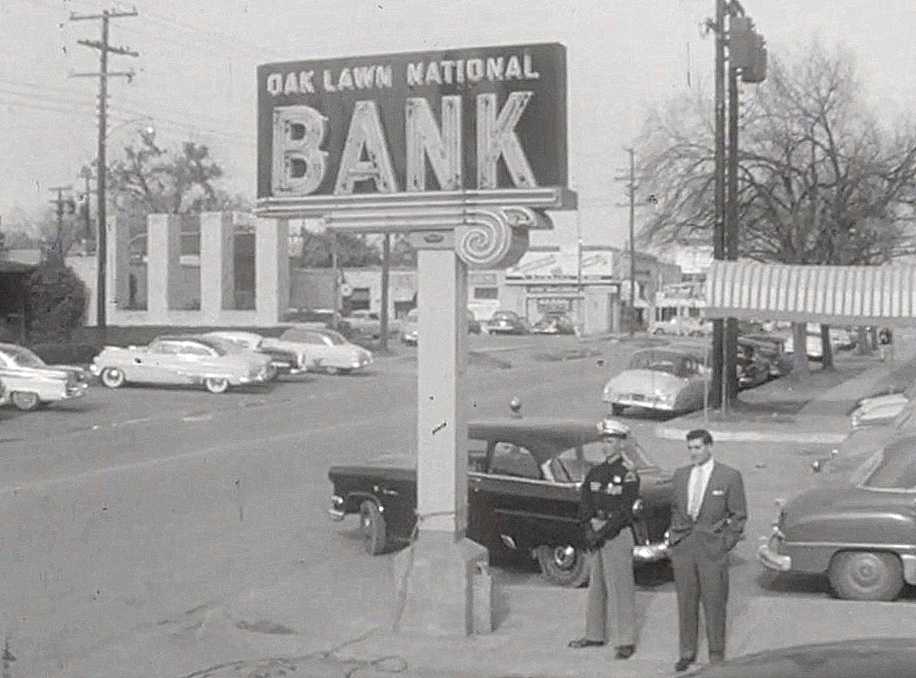
Below, a shot of the Italian Villa’s four odd brick structures seen from across the street (in a screen capture from unrelated January 1955 news footage).
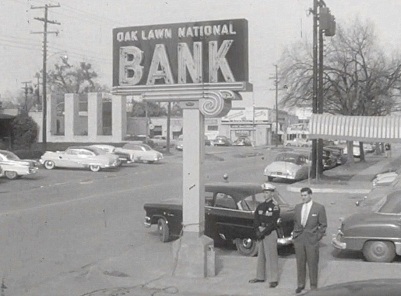
italian-village_oak-lawn-natl-bank_wbap-news_012355-portalKXAS-NBC 5 News Collection, UNT

Further changes came to 3211 Oak Lawn in the fall of 1954 with the arrival of the Village Club, which featured live entertainment (including a rotating piano) and shared a kitchen with Italian Village. It was also a “private locker club” with personal liquor lockers available to members to keep their bottles in at a time when it was not legal for restaurants in Dallas to sell liquor-by-the-drink — “set-ups” were sold and the demon alcohol was poured from the member’s stash (or, more likely, from the communal stash).

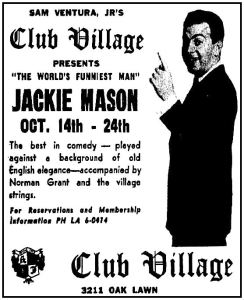
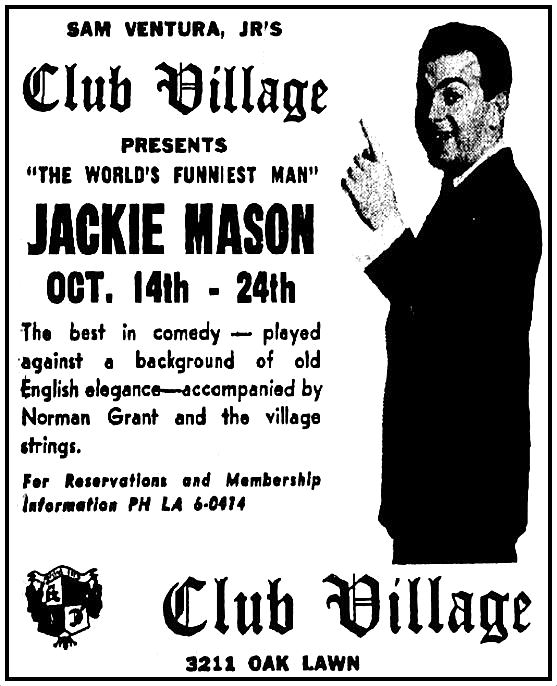
In 1961 there was yet another remodel, which enlarged the club — now called Club Village — and shrank the restaurant. The swanky new club was designed by Charles Dilbeck and had a sort of Olde English theme (and, for some reason, featured a waterfall, a glass cage behind the bar containing live monkeys, and two live flamingos named Lancelot and Guenevere).
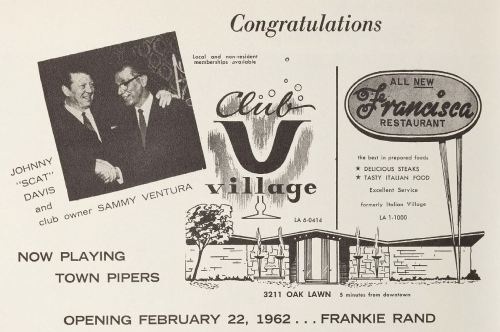
italian-village_dallas-entertainment-awards_1961_SMUvia DeGolyer Library, SMU

1965_club-village_oct-1965Oct., 1965

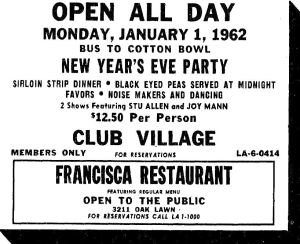
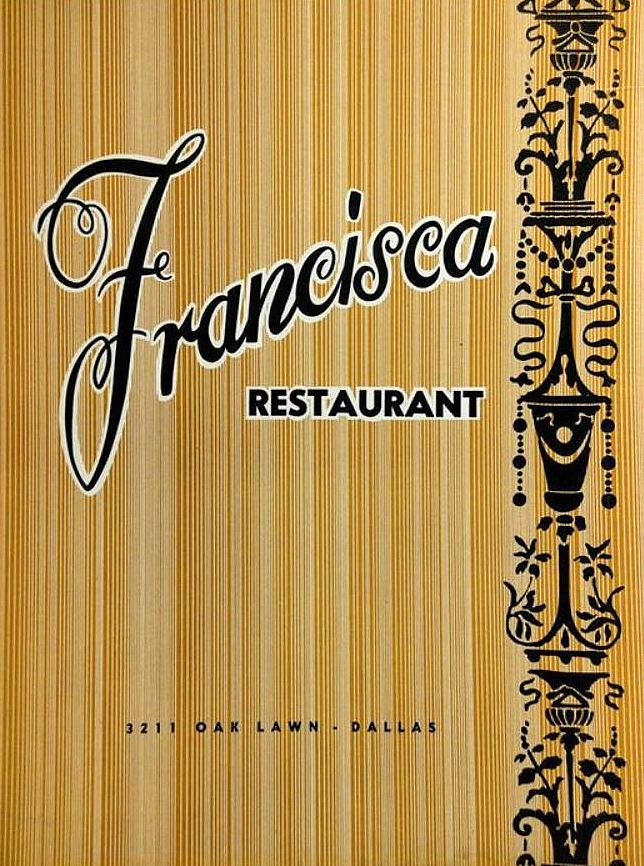
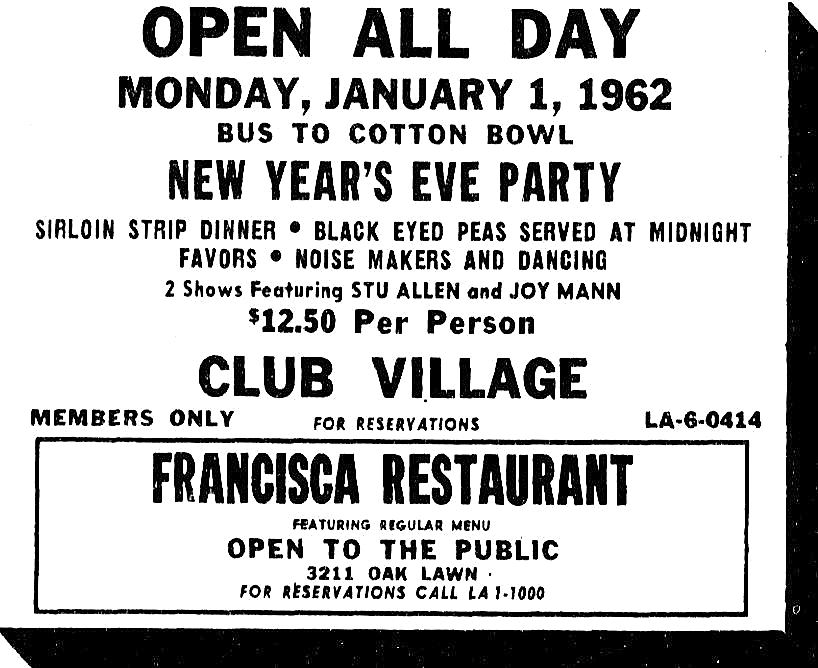
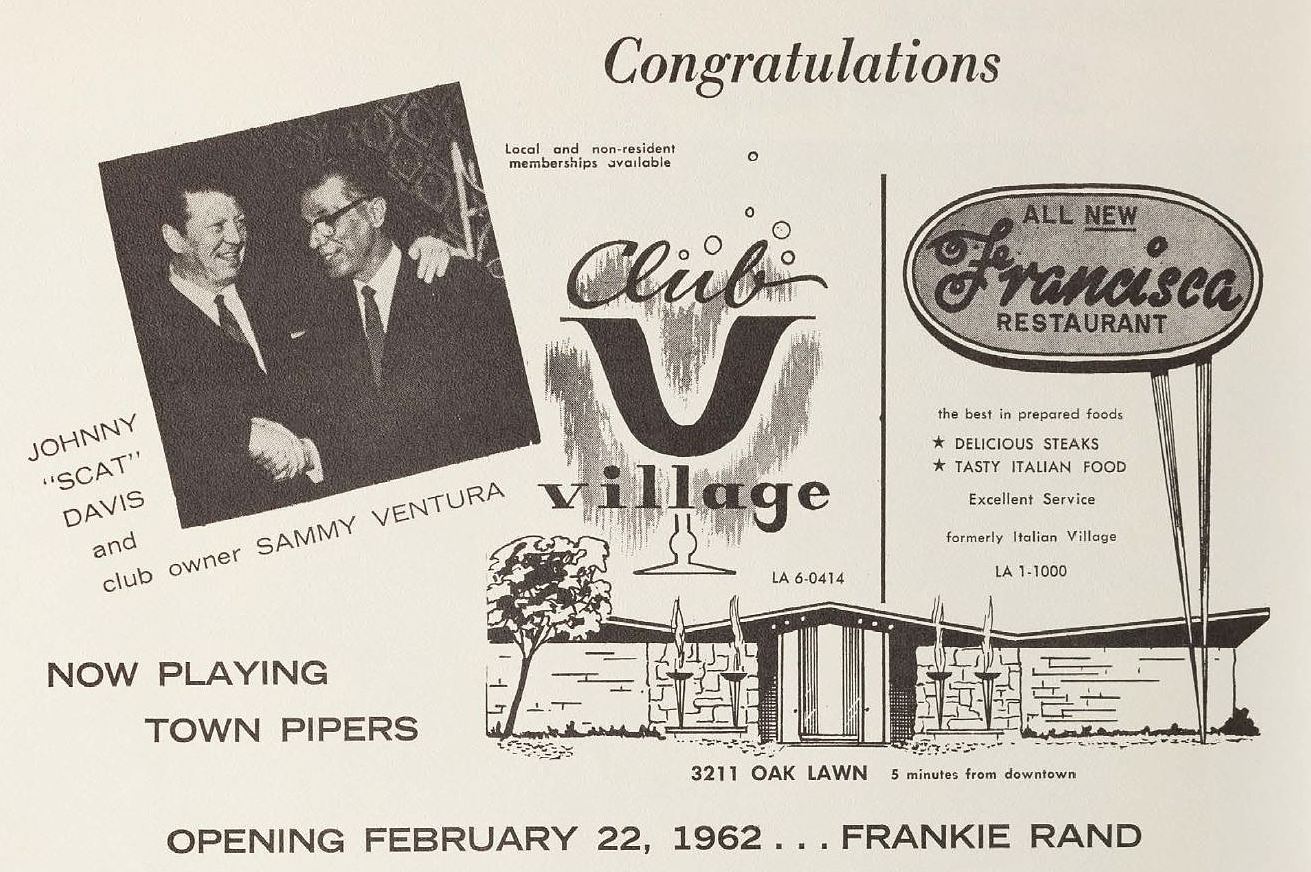
Around this time the (apparently short-lived) Francisca Restaurant appeared.
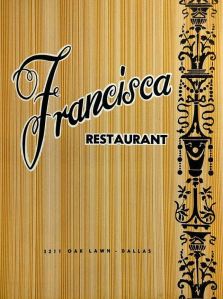
francisca-restaurant_menu_1961_ebayvia eBay

club-village_francisca_new-years-eve_dec-1961New Year’s Eve, Dec., 1961

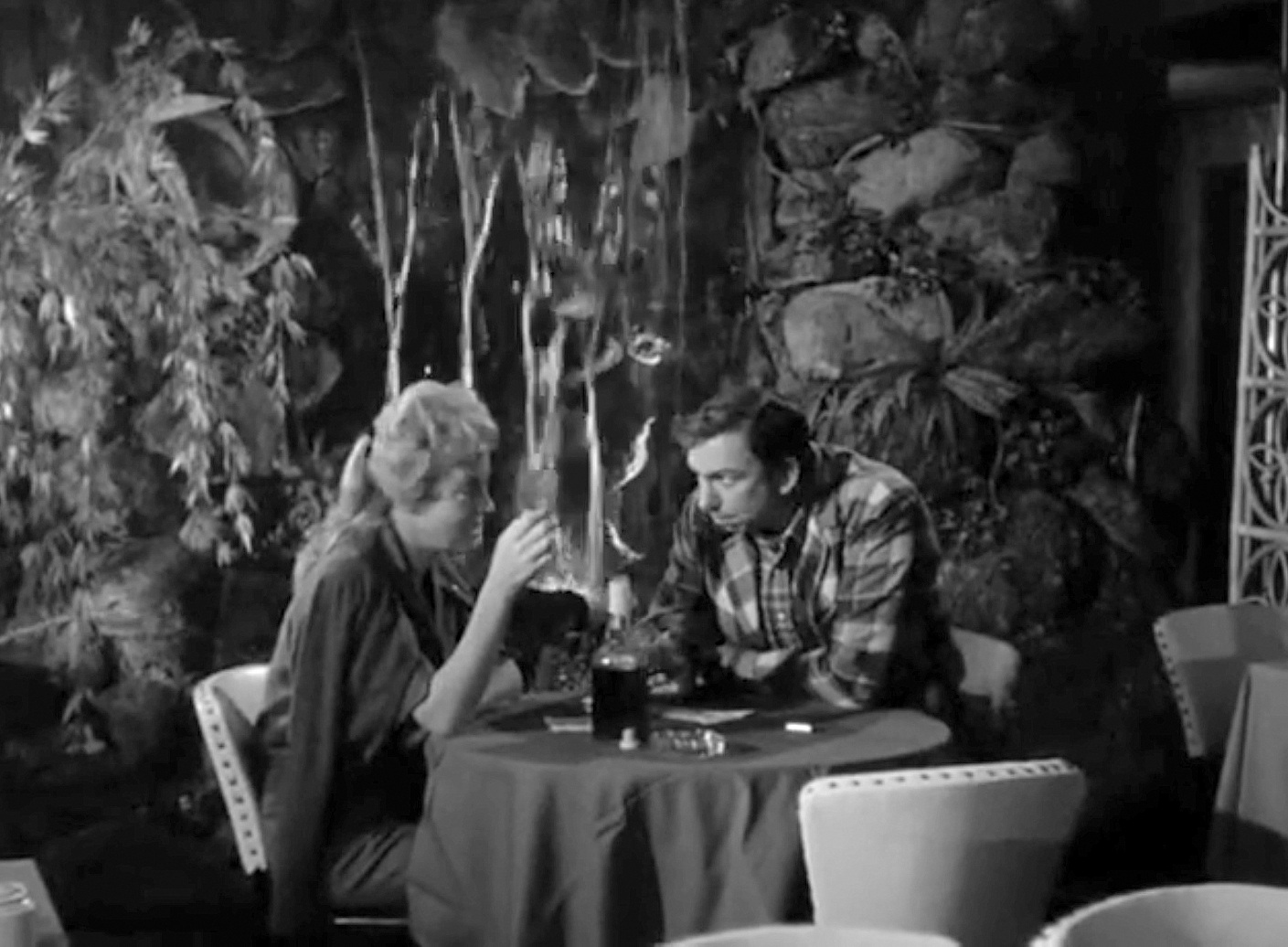
1961 also marked the club’s debut on national television, appearing in scenes of the hit show Route 66, which were filmed in November. Below is a screen-capture from the episode “A Long Piece of Mischief,” with the waterfall in the background. (The entire episode, shot around the Mesquite Rodeo, can be watched on YouTube here — the two Club Village scenes begin at the 26:42 and 38:15 marks.)
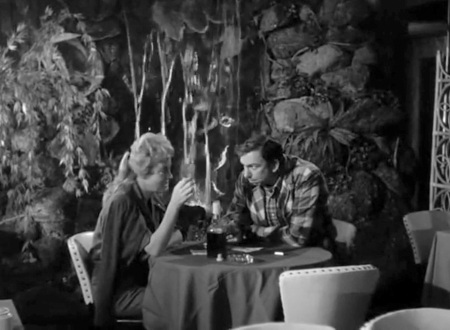
1961_club-village_route-66Route 66 (screen capture) — Nov., 1961

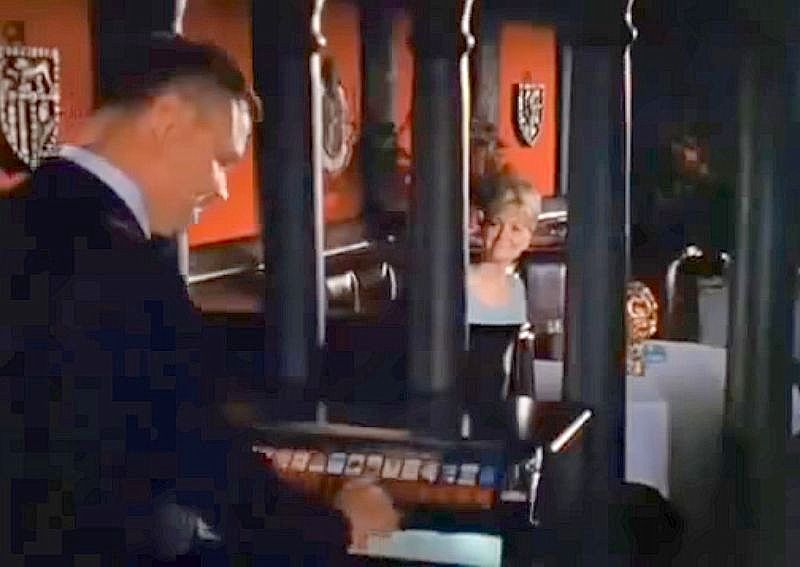
In late 1966, Dallas filmmaker Larry Buchanan shot his cult classic Mars Needs Women in various locations all over town. I’m pretty sure one of the very first scenes was shot inside the club, after yet another remodel. (Incidentally, see what the lively neon-ified corner of Oak Lawn and Lemmon, a couple of blocks away, looked like in Buchanan’s film, here.)
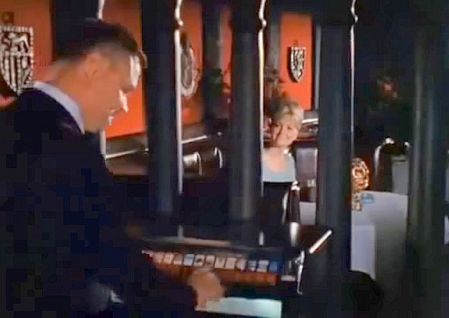
1966_club-village_mars-needs-women
Mars Needs Women (screen capture) — 1966

In August, 1964 a new club opened: Gringos (sometimes spelled Gringo’s). This public club, featuring mostly rock bands, was the brainchild of Sam Ventura, Jr. (who said in an interview that he had rather brazenly sprung the whole thing as a big surprise on his father, who had been out of town on a lengthy vacation — luckily, the club was a hit and Sam, Sr. was pleased). Club Village continued as a private club, but from newspaper accounts it seems that the new discotheque displaced the Italian Village and/or Francisca restaurant completely. So now on one side you had the long-running “sophisticated” private club, and on the other side, the “new concept in continuous entertainment,” with its Mexican-themed decor and Watusi-dancing waitresses (“Las Mata-Dollies…”), which catered to a younger set. The Fort Worth Star-Telegram described Gringos thusly:

Newest “port of call” for Dallas revelers on the bistro beat is the just-opened and lavishly-done Gringos Club on Oak Lawn Ave. near the Melrose Hotel and in the location formerly occupied by the Italian Village Restaurant and Village Club. Open to the public, this night time Camelot with Mexican decor features, among other flings, Jesse (brother of Trini) Lopez and his handful of musical consorts on the bandstand and a covey of revealing young handmaidens called “Las Matta-Dollies” [sic], sort of Spanish-type Playboy Bunnies who are worthy of your scrutiny. (Chris Hobson, FWST, Aug. 27, 1964)
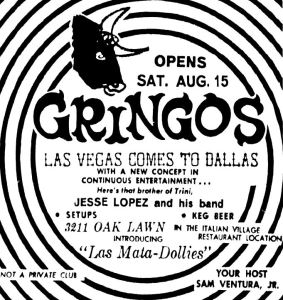
1964_gringos_aug-1964Aug., 1964

In May, 1967, Sam Ventura, Jr. (“Sammy,” who had taken over the family business when Sam, Sr. retired in 1966) declared that Gringos was dead: “There will be absolutely no rock-and-roll in this room anymore. It’s dead. Our whole concept [now] is for sophistication, for adult entertainment” (DMN, May 24, 1967). So adios, Gringos, hello an even bigger Club Village. (In 1968 a club described as a “new” Gringos  opened a block away, at 3118 Oak Lawn — it’s unclear whether this was affiliated in any way with the Ventura family.)

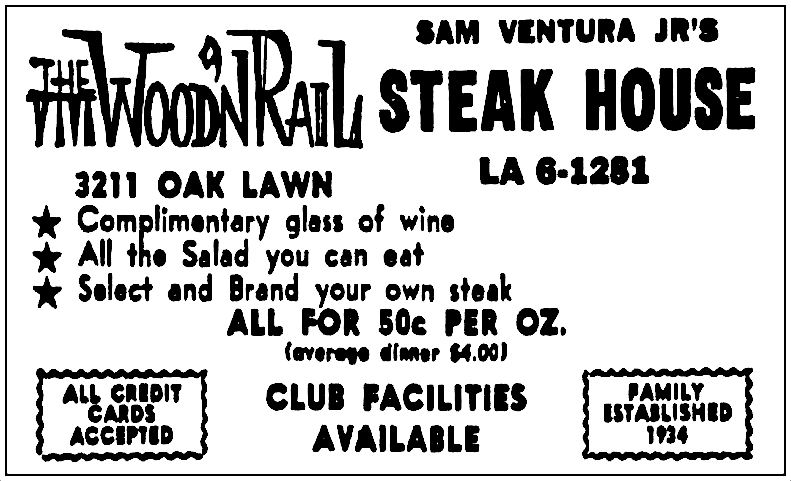
In June, 1968, the never-ending improvements, remodelings, and reconfigurings of 3211 Oak Lawn continued with Sammy’s announcement of a new (public) restaurant, the Wood ‘N Rail. This steakhouse featured a revolving “ice bar” (the old revolving piano bar, repurposed), which contained a display of raw meat — from this, customers would choose whichever cut of beef called to them, and before the meat was escorted into the kitchen, the patron would sear his or her initials into it with a “red-hot branding iron.” The restaurant’s slogan was “Personalized Beef.” The unstoppable Club Village continued as a private club and restaurant in the adjoining complex.
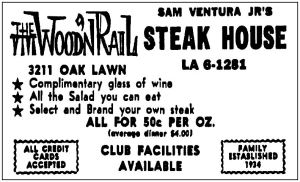
1968_wood-n-rail_oct-1968Oct., 1968

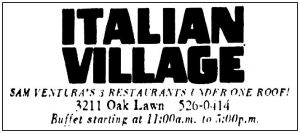
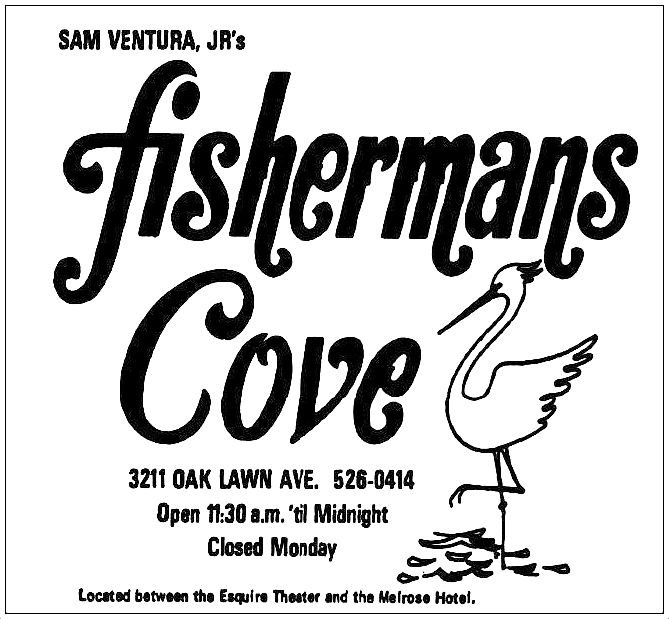
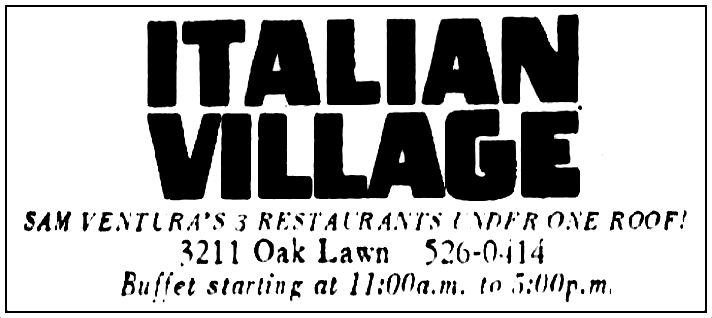
1971 began with a fire. The (once) unstoppable Club Village was destroyed. The adjacent Wood ‘N Rail emerged unscathed. So, yes, more remodeling! By 1972, 3211 Oak Lawn boasted three (three!) restaurants at one address: the continuing Wood ‘N Rail (steakhouse), Fisherman’s Cove (seafood), and — hey! — the return of Italian Village. As the ads said: “3 RESTAURANTS UNDER ONE ROOF!”
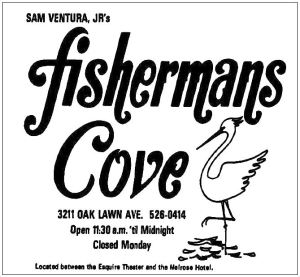
1972_fishermans-cove_march-1972March, 1972

1972_three-restaurants_may-1972May, 1972

Also big news in 1971: it finally became legal to order liquor and mixed drinks in bars and restaurants — the whole “private club-membership” thing in order to get around liquor laws was mostly a thing of the past (unless you lived in a dry area of the city…).

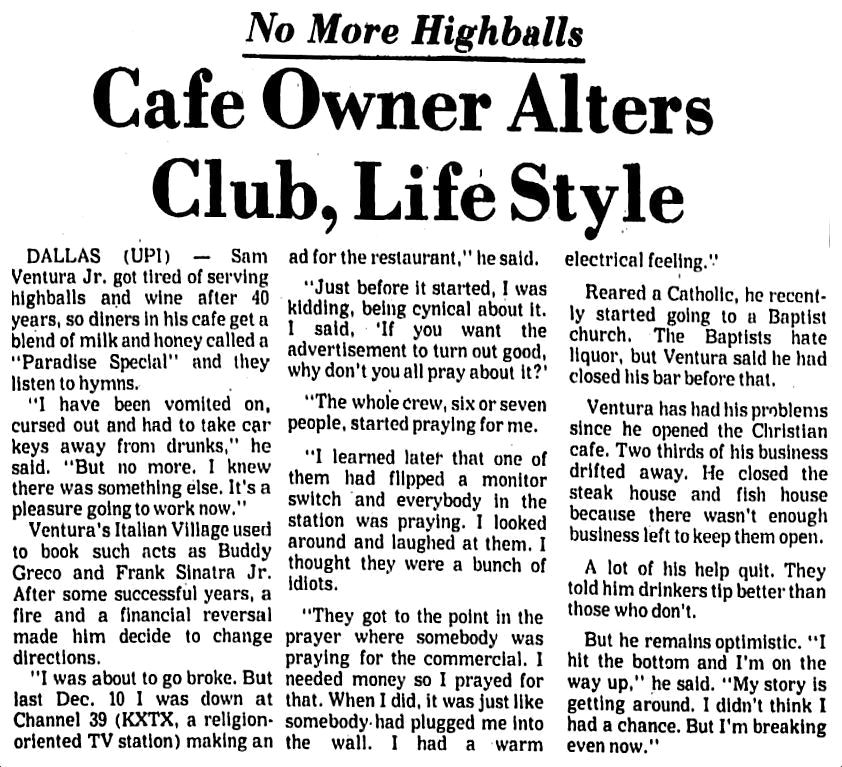
Then, in 1974, things really changed. After a “profound religious conversion,” Sammy Ventura stopped all sales of alcohol and told the TABC he didn’t need or want that ol’ liquor license. This made news around the country.
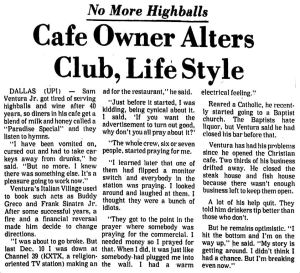
1974_kings-village_panama-city-FL-news-herald_081274UPI wire story, Panama City [FL] News Herald, Aug, 1974

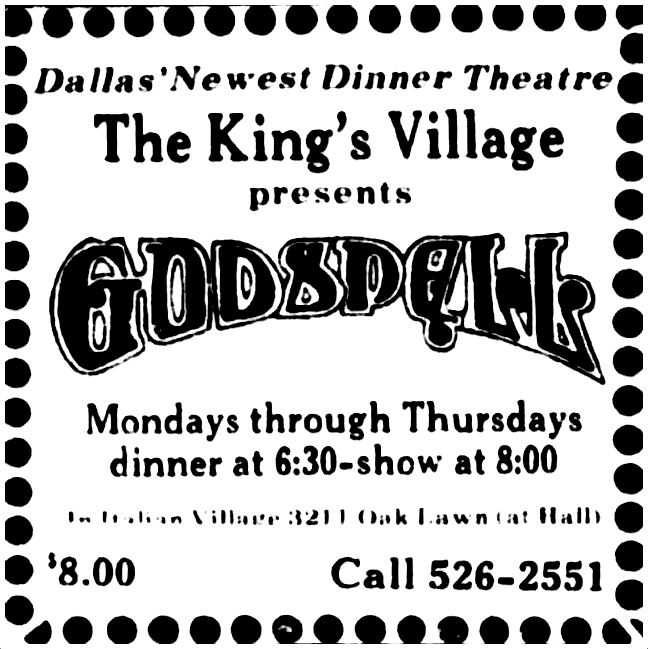
Unsurprisingly, business plummeted. Two of the three restaurants closed. Italian Village continued to limp along, even weathering the introduction of the King’s Village, “Dallas’ first Christian dinner theater.”
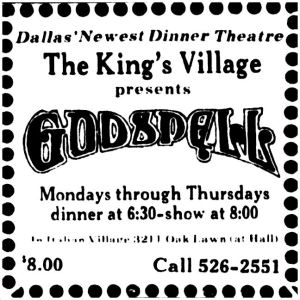
1976_kings-village_june-1976June, 1976

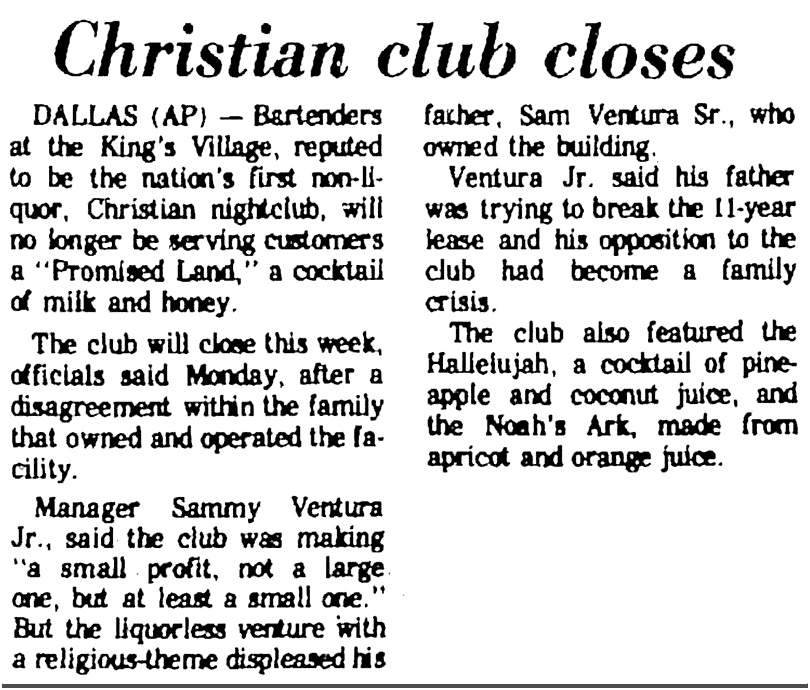
This change in direction of the the 40-plus-year-old family business caused a huge rift between Sammy and his father. Sam, Sr. put his foot down, and The King’s Village (“the nation’s first non-liquor, Christian nightclub”) closed in June, 1977.
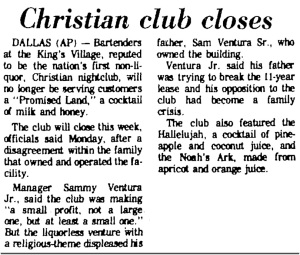
1977_kings-village_pampa-daily-news_062177
AP wire story, Pampa Daily News, June 21, 1977

Oak Lawn’s decades-old Italian Village was no more (although Sammy appears to have opened his own Italian Village restaurant in Richardson’s Spanish Village for a while). The last mention I found of Italian Village was in Feb., 1979:

After 45 years, the Italian Village restaurant has changed to another venture, the Crazy Crab. Sam Ventura opened the Italian Village in 1934 and the last event before the changeover was a surprise birthday party honoring Sam. (DMN, Feb. 23, 1979)

It’s a shame Italian Village’s last incarnation was a mere shadow of its former go-go glory, but it’s almost unbelievable that a restaurant in Dallas was in business for 45 years. Sam Ventura’s $250 gamble in 1934 paid off very, very well.

***

Sources & Notes

Top image is the front cover of a cardstock photo-holder (with linked photo by the Gilbert Studios, 4121 Gaston); collection of Paula Bosse.

All clippings and images are larger when clicked.

*

Copyright © 2018 Paula Bosse. All Rights Reserved.

The Last Traces of Vickery Park Are Now Definitely Gone

vickery-park_demo_062118_d_PEBThe last vestige of a one-time summer destination…

by Paula Bosse

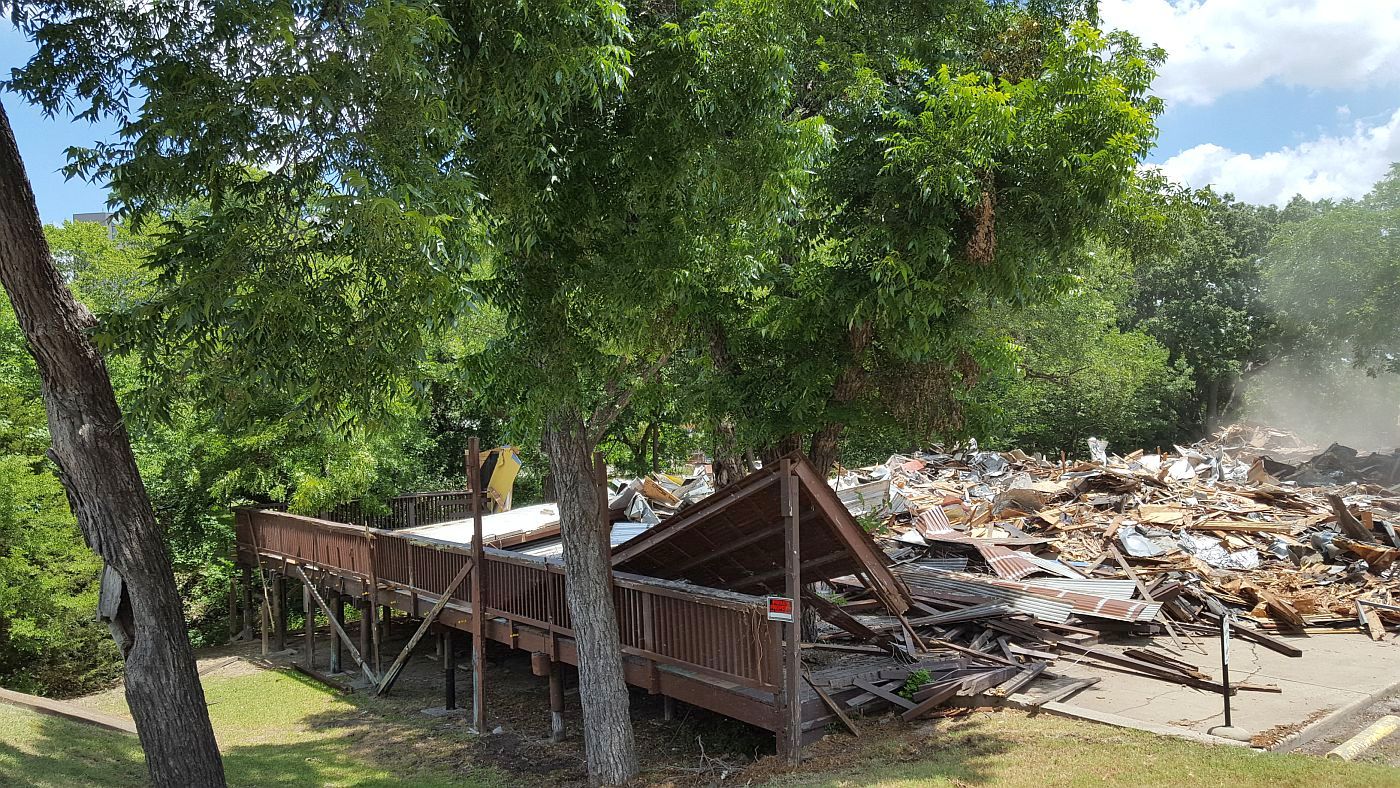
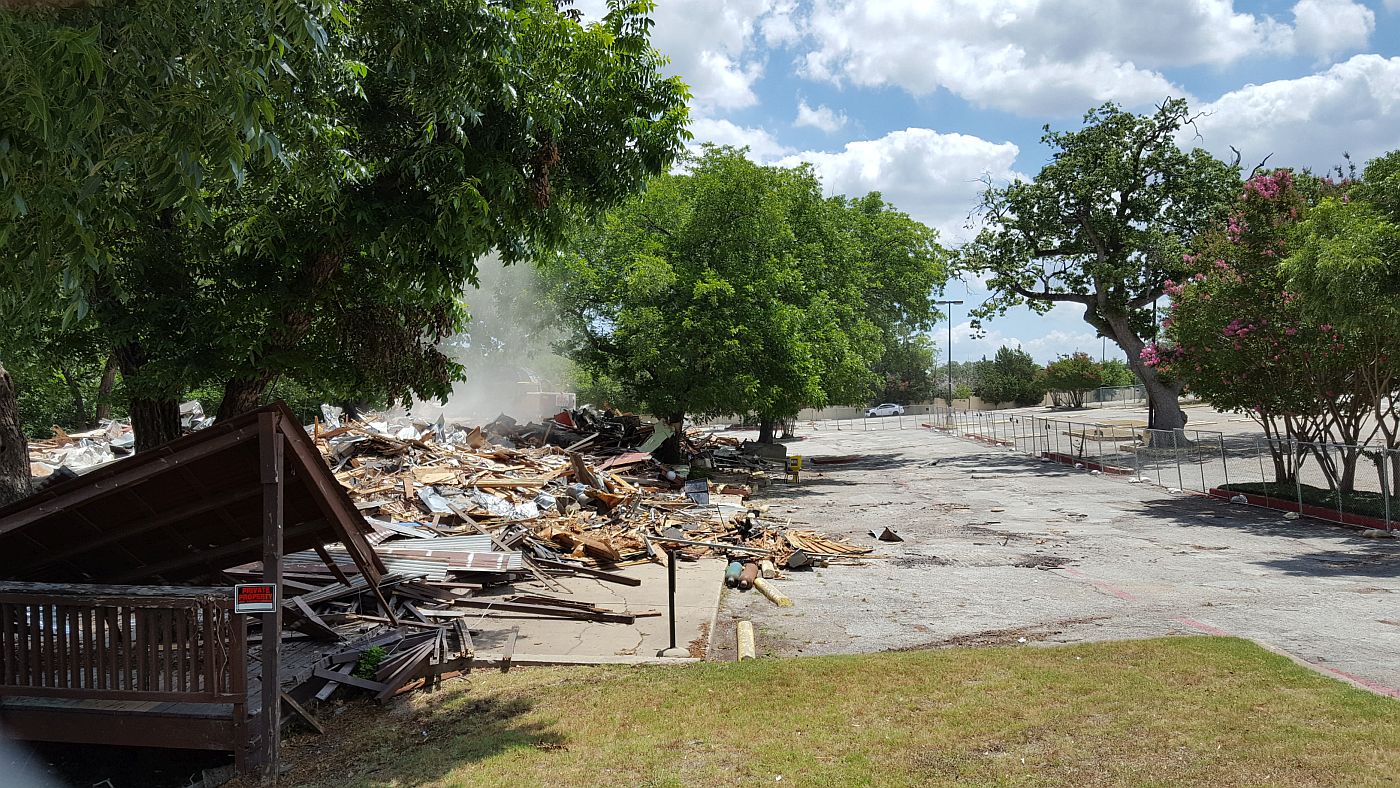
Driving along Greenville Avenue this morning, I noticed a pile of rubble where Vickery Park once stood (just south of Walnut Hill, across from Presbyterian Hospital). It seemed sadly ironic that the land which was once occupied by a fondly-remembered swimming pool and picnic area was heaped with demolished buildings on the first day of summer.

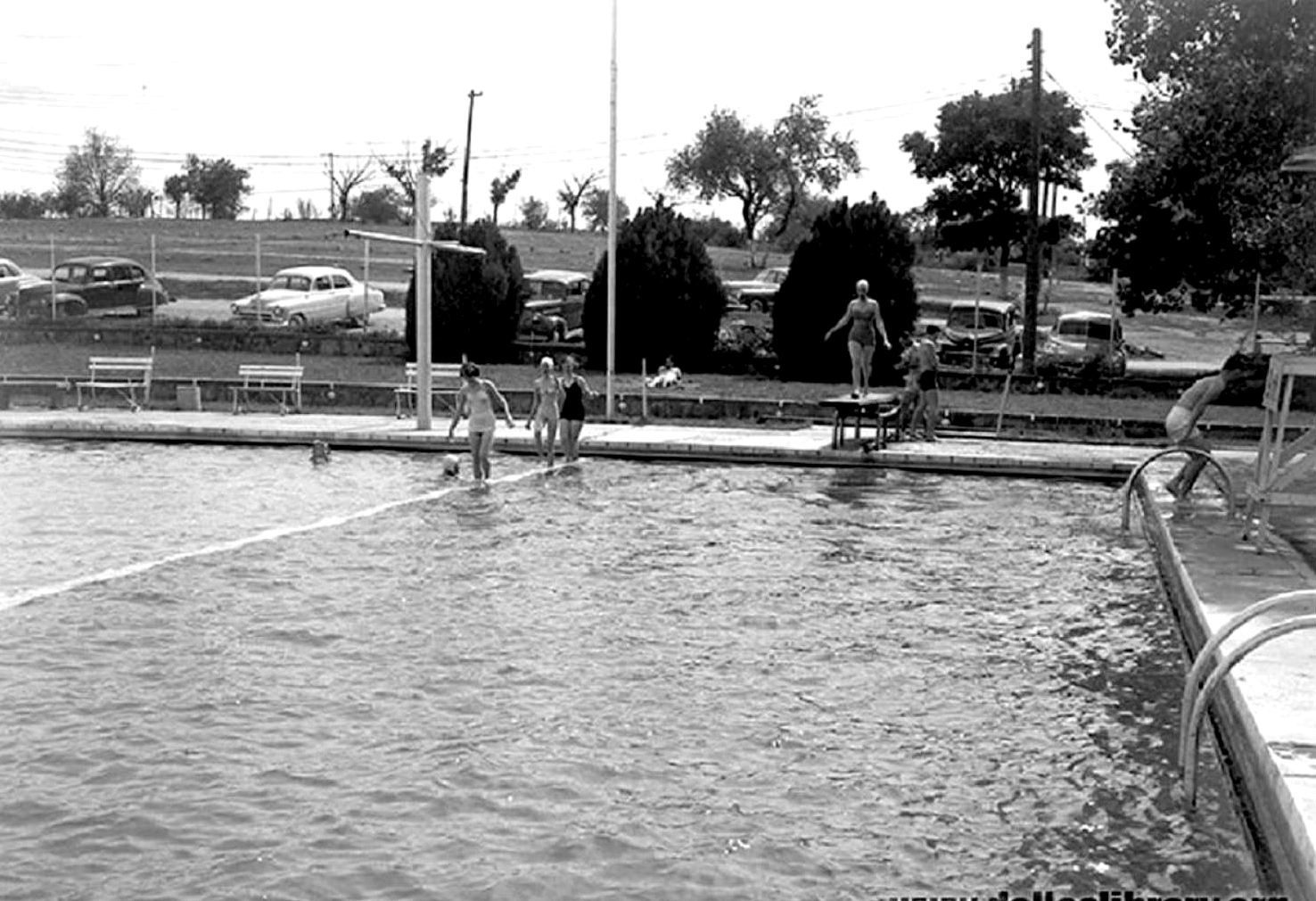
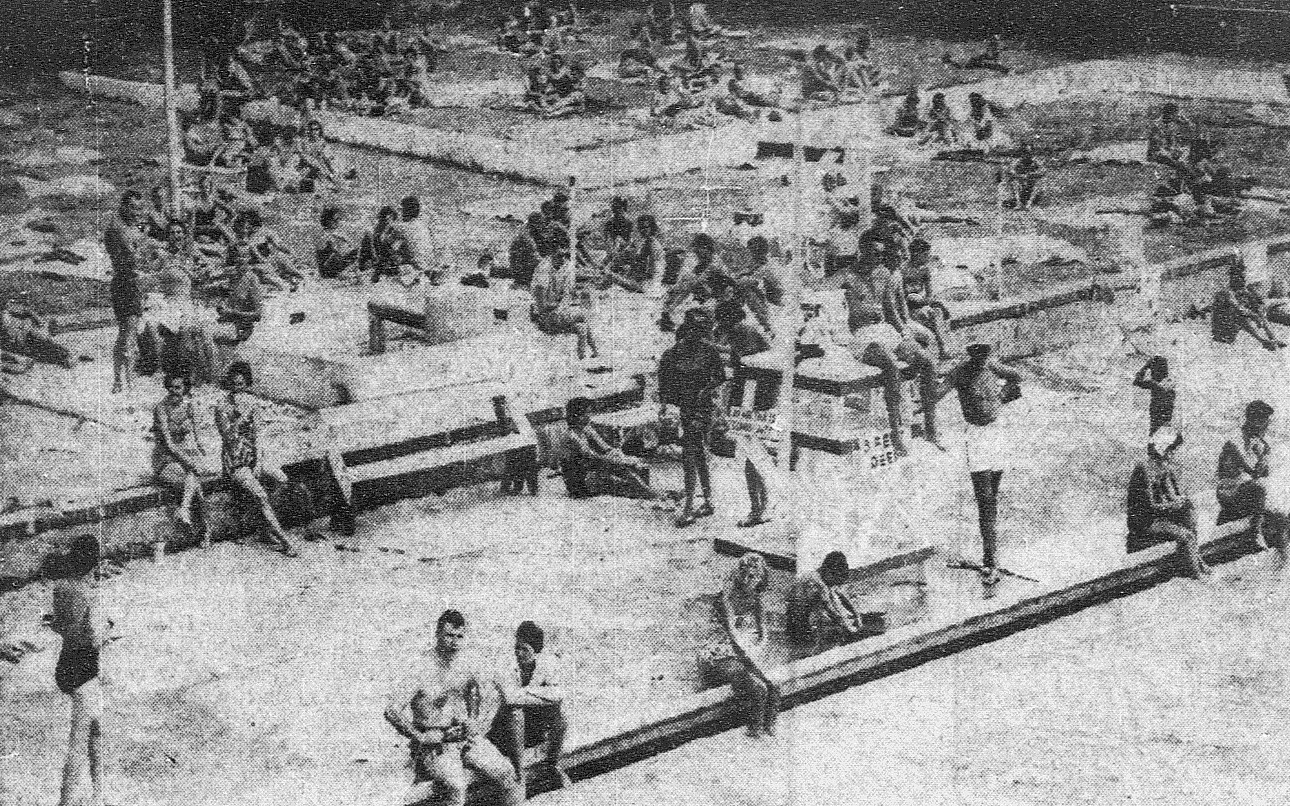
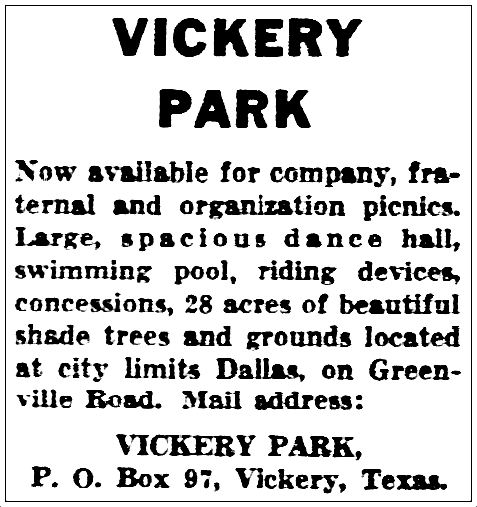
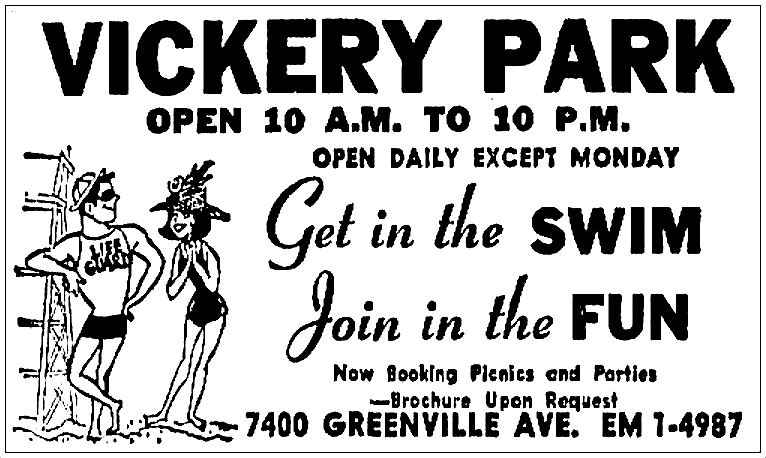
I never saw the huge swimming pool myself, but from everything I’ve read about it over the years, it seems to have been very, very popular with generations of Dallasites. It was built in the then-rural community of Vickery as far back as the 1930s (well before Vickery was annexed by the city of Dallas), and it was still open at least through the ’60s.

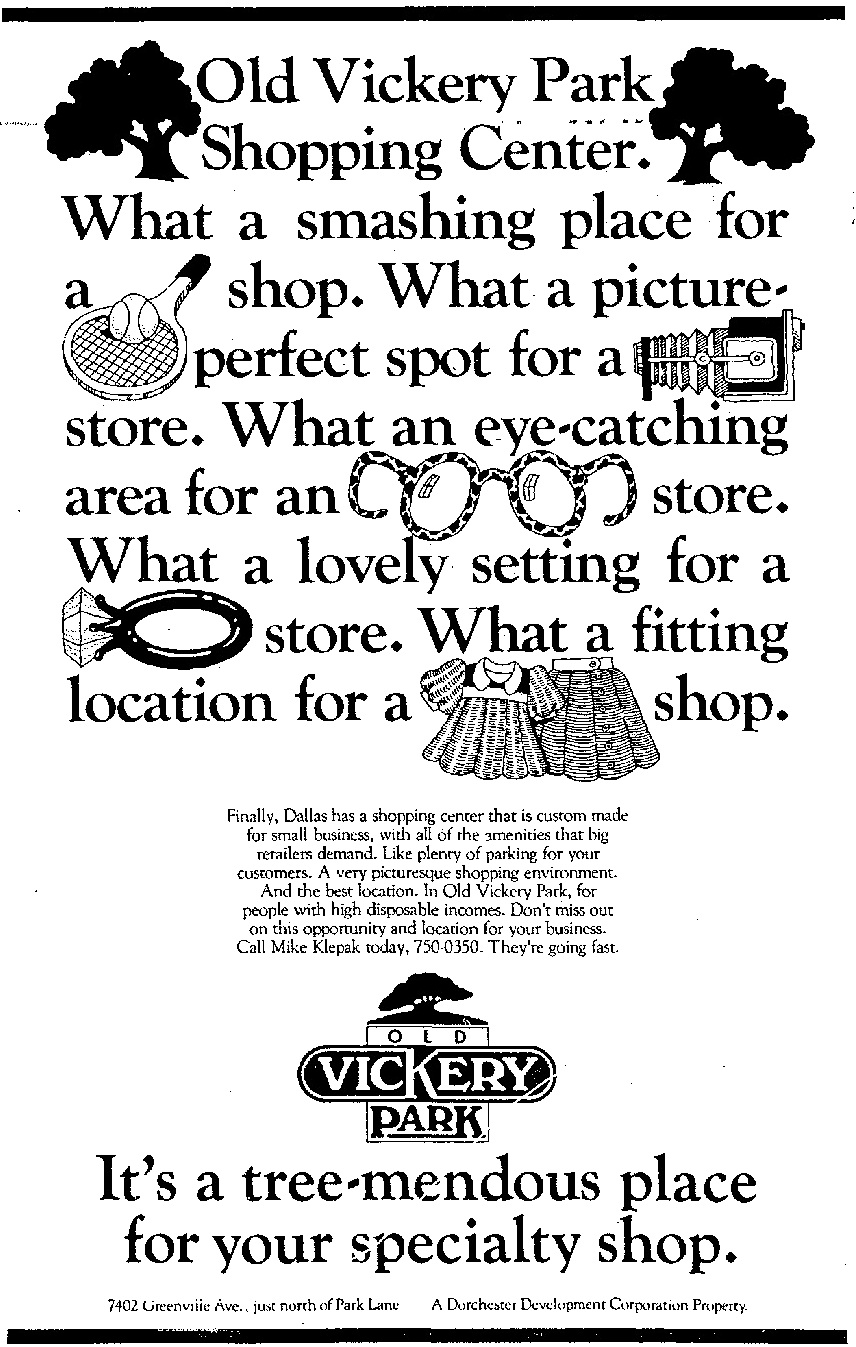
The pool and amusement park were long gone when the (now-demolished) small shopping and restaurant area was built in the mid-1970s on a very pretty wooded site alongside White Rock Creek. Initially, the developer envisioned lots of quaint little boutiques and cafes (similar to those found in the Quadrangle) dotting the banks of White Rock Creek, creating Dallas’ version of San Antonio’s River Walk. …No one has ever accused real estate developers of dreaming small.

It’s sad to see this anachronistic, funky little area go away. My vague memories of childhood games of miniature golf in the ’70s are about to get vaguer.

vickery-park_demo_062118_a_PEB

*

vickery-park_demo_062118_b_PEB

I’ve never known exactly where the pool was, but I think it might have been at the back right of the photo above, just off Pineland.

vickery-park-pool_dpl_pinterest

vickery-park-swimming-pool_1950s

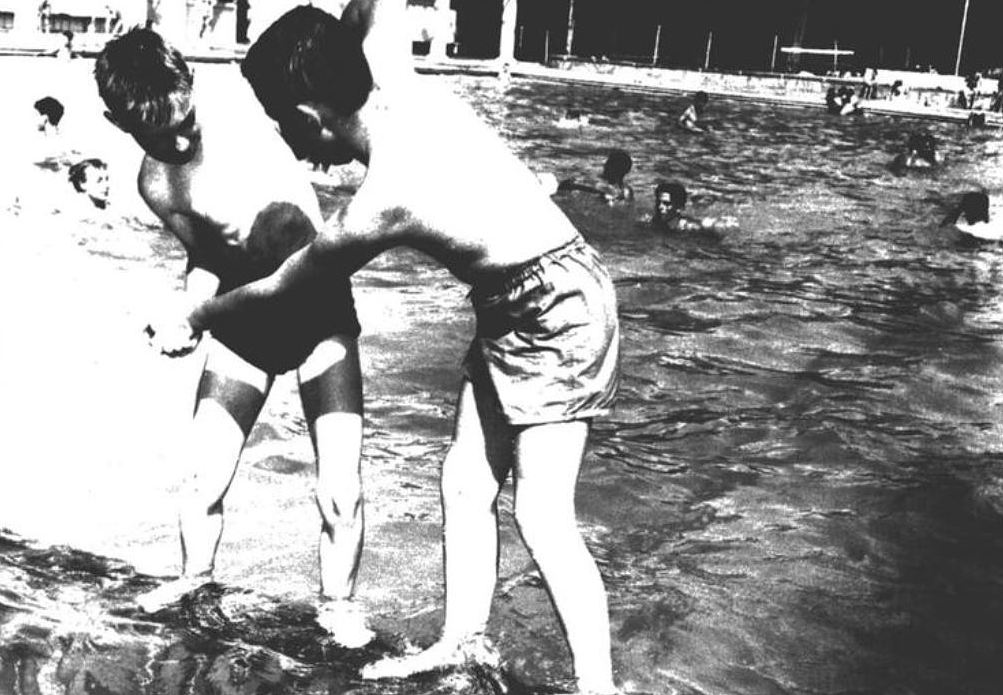
vickery-park-swimming-pool_legacies_fall-2002

vickery-park-pool_19461946

swim_vickery-park_19651965

1978_vickery-park_sept-1978Sept., 1978

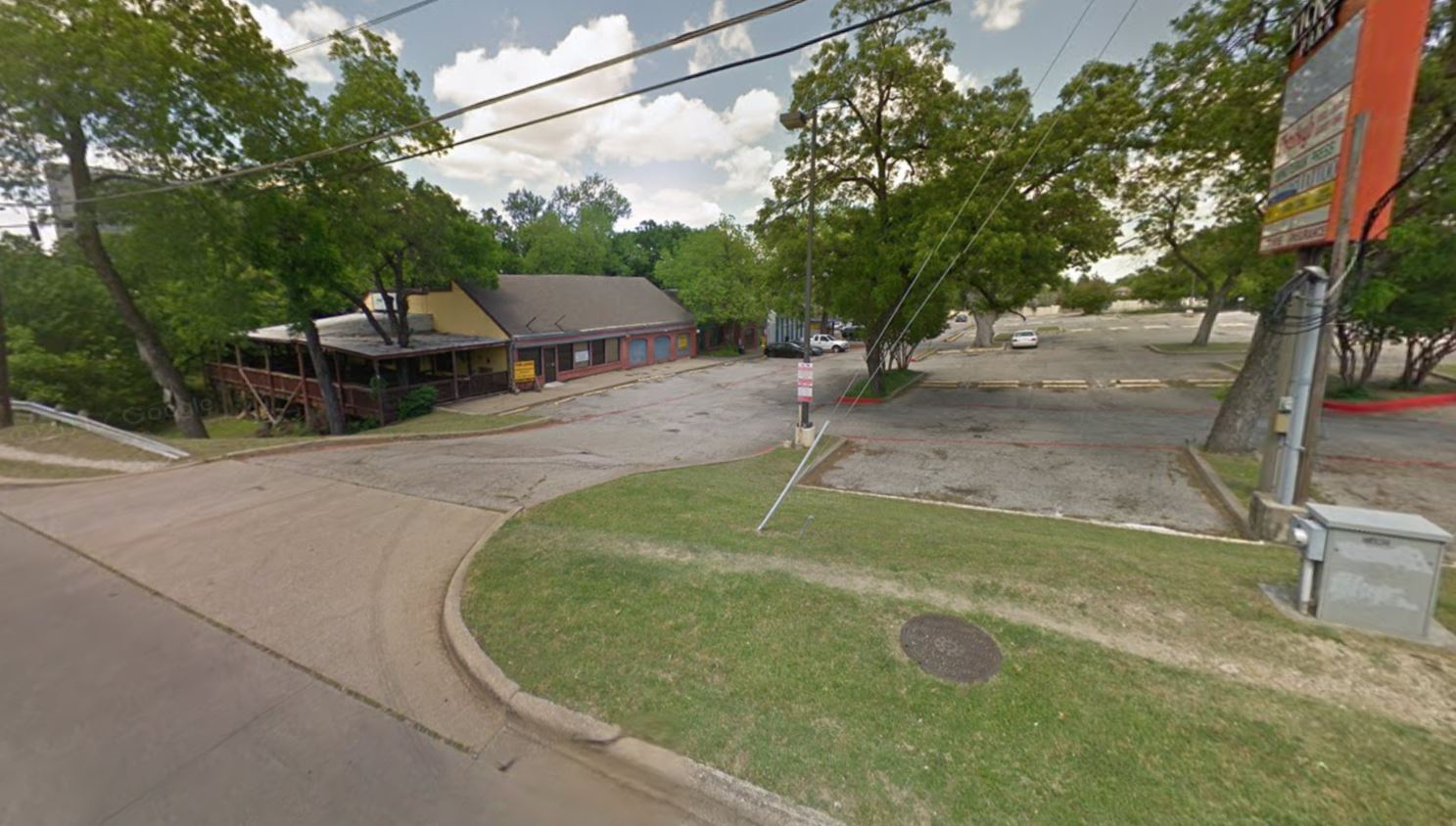
vickery_google_may-2017Google Street View

Above is a Google Street View from May, 2017. If you’d like to take a little virtual “drive” through the parking lot, hie yourself over to Google, here.

*

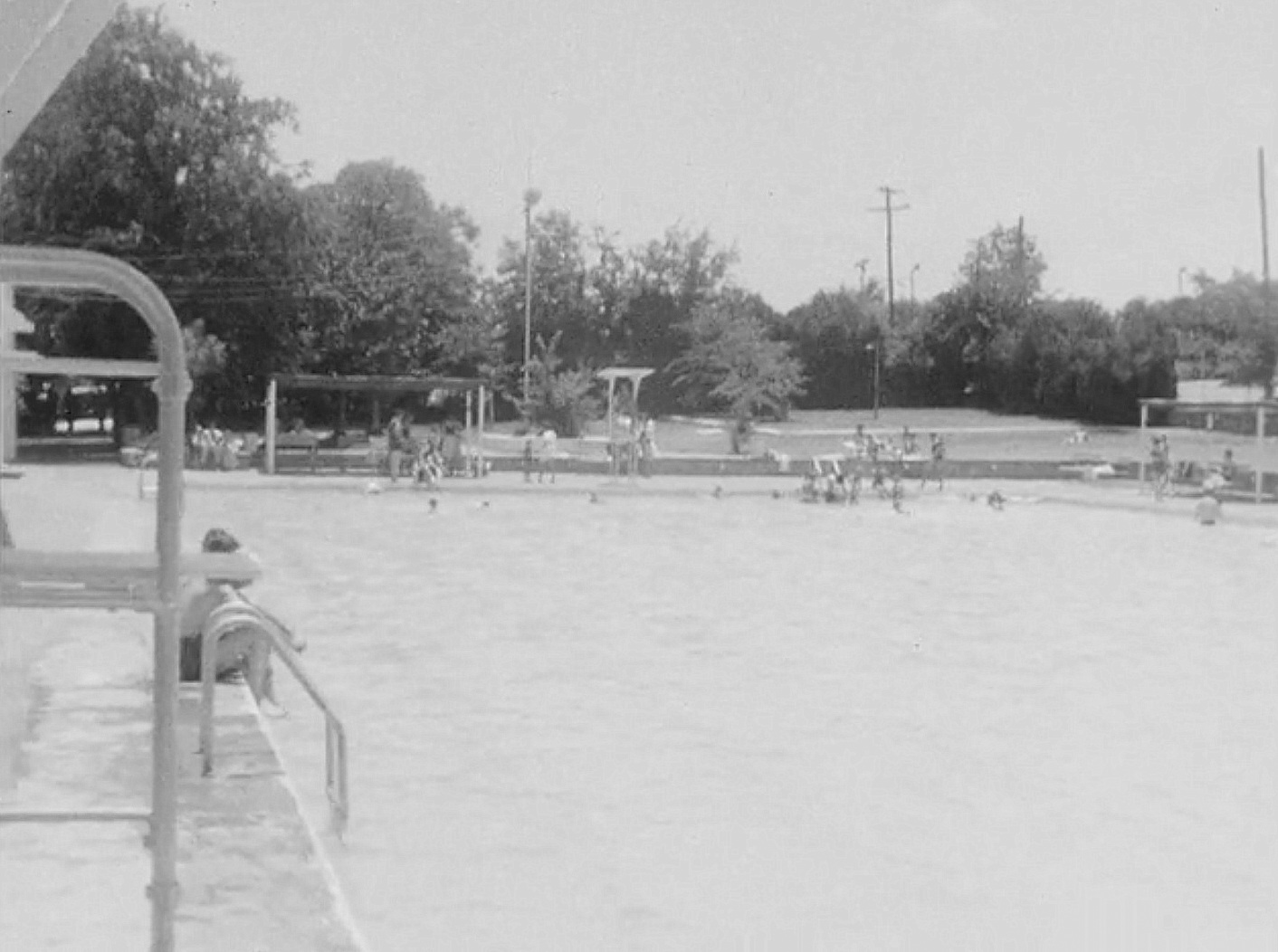
Here are two pieces of film footage showing the pool. The first one is from June, 1964 and is (silent) news footage shown on WBAP Channel 5. It’s a little unsettling, as it shows a boy being rushed off by ambulance after an accident, but it does have some interesting shots of the pool and the park, which I’ve certainly never seen before. I am unable to embed the video, but you can watch it here. (The script for the story is here.) (Footage is from the WBAP-TV News collection, UNT Libraries Special Collections.) Here is a screen capture:

vickery-pool_WBAP_portal_062364

The second is undated, but the clips are from home movies.

***

Sources & Notes

Rubble photos taken by me on June 21, 2018 — construction was underway. And it was extremely HOT.

The first historic photo appears to be a Dallas Public Library photo, with most of the watermark cropped off. I found it on Pinterest, here.

The third photo, showing two boys, was found in the Fall 2002 issue of Legacies.

There are memories-galore of Vickery here.

A couple of interesting tidbits:

  • The Vickery pool was used as an officers’ recreation club during World War II by the Fifth Ferrying Group; an aquatic meet was held there in June, 1945 which featured a variety of exhibitions, including a water ballet performed by “half a dozen mermaids from University Park.”
  • In the early 1970s, Vickery Park (…not to be confused with Vickery Place…) was owned by the Seventh Day Adventist Church. They reopened the park as a “family recreation center” — unlike the earlier days, alcohol was no longer sold. They sold the land to developers around 1974 or 1975; in the summer of 1975, the recreation center was bulldozed and the pool was paved over (and became a parking lot).

Articles on the disappearing community of Vickery can be found in the archives of The Dallas Morning News:

  • “Progress Overtakes Old Vickery” by Rena Pederson, with photos by Eli Grothe (DMN, August 3, 1975)
  • “Store Provides Feed For Thought On Town’s Past” (Vickery Feed Store) by Steve Kenny (DMN, Nov. 18, 1979)

*

Copyright © 2018 Paula Bosse. All Rights Reserved.

Ghost Rails of the Belmont Streetcar Line

matilda-richmond_dan-parr-photo_FB-dallas-history-guild_april-2018Matilda & Richmond, April, 2018… (photo: Dan Parr)
by Paula Bosse

I grew up on Ellsworth, between Greenville Avenue and Matilda — just south of Mockingbird, just north of the M Streets. When I was a child, Matilda was only partially paved — in my neighborhood, maybe only from Mockingbird down to Kenwood? Otherwise, it was a dirt street (!) — and this was in the ’70s! Right around Kenwood was a weird mound which might not have looked like much to an adult, but to a child it was pretty strange. I can’t remember if the rails were visible — I’m pretty sure they were.

That line was the Belmont Line, which ended (began?) at Mockingbird (I think there was a later extension of sorts, but I think Mockingbird was the end of the line for streetcar passengers). As a kid, I knew that Matilda had been a long-gone streetcar line, but never having seen a streetcar outside of a movie, I couldn’t really imagine what it must have been like to have streetcars (and an interurban! — more on that below) moving up and down a street which was less than a block from my house.

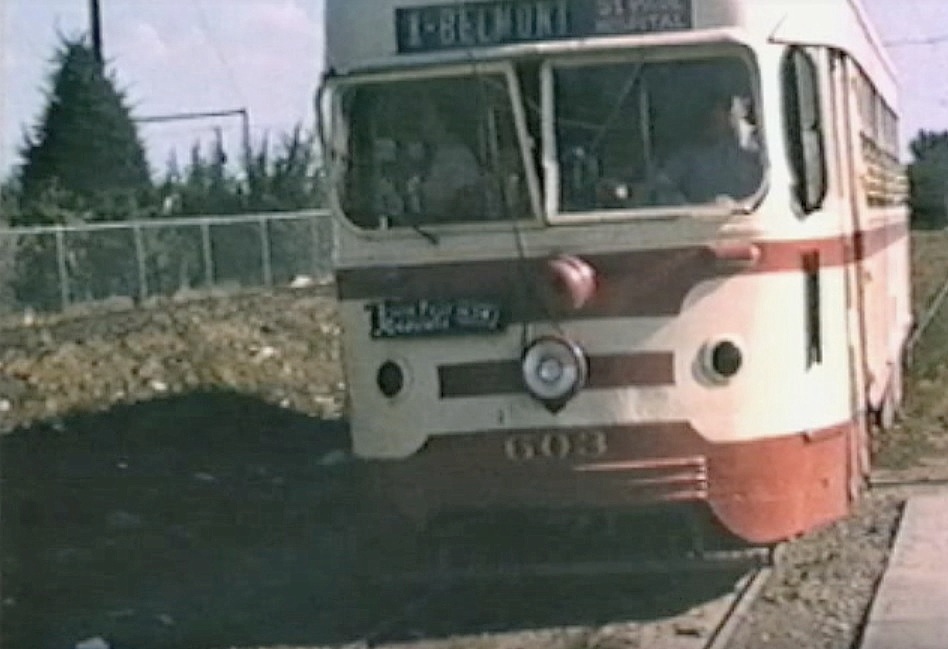
A few years ago I stumbled across the YouTube video below and was surprised to see actual footage of that streetcar rolling up Matilda. The first five minutes of the video contains 16mm footage (both black-and-white and color) shot around Dallas in 1953 and 1954 by Gene Schmidt. It’s GREAT! You’ll see streetcars-galore moving past all sorts of familiar and vaguely familiar sights around the city, from Oak Cliff to downtown to way out to Mockingbird and Matilda. It ends with the Belmont-Seventh car (car 603) pulling to the end of the line — the view is looking south down an unpaved Matilda Street from Mockingbird, with a glimpse of the Stonewall Jackson playing field at the left, on the other side of the fence. (The Matilda footage begins at 4:17.)

*

belmont-line_matilda-from-mockingbird_youtube-cap_ca1954Matilda, south from Mockingbird, ca. 1954 (Gene Schmidt)

Above, a screen capture from the video showing Matilda looking south from just south of Mockingbird. Stonewall Jackson Elementary School is at the left. Today the view looks like this.

*

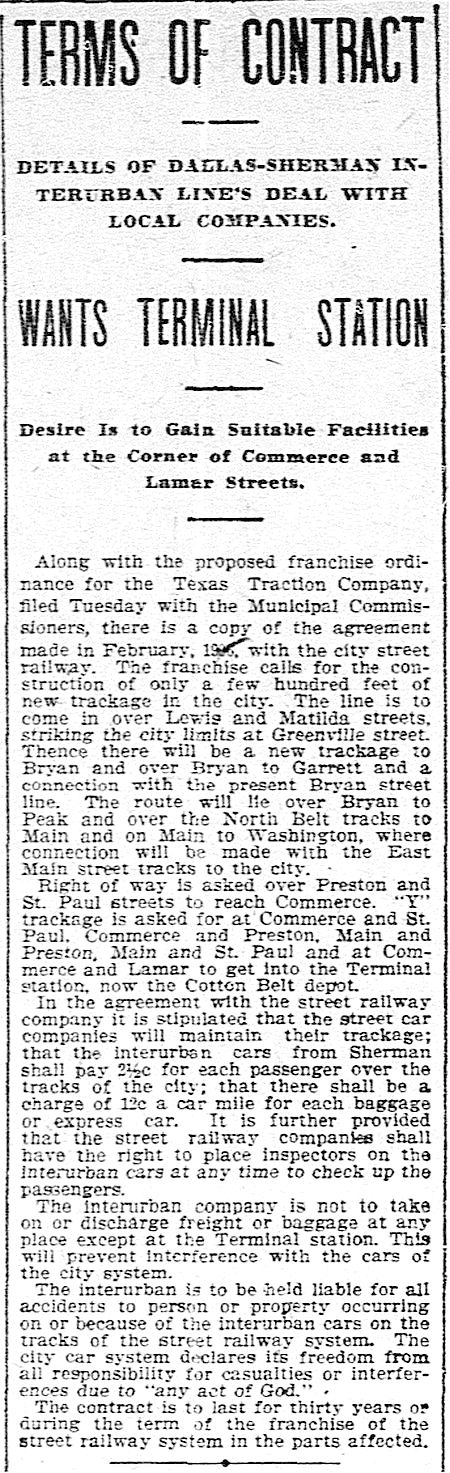
Before the streetcar arrived, Matilda was the artery that led the Texas Traction Company’s Sherman/Denison interurban into Dallas. This electric interurban service from the north, which closely followed the H&TC railroad line, arrived in Dallas in 1908, back when the official entry-point into the Dallas city limits was just off Matilda, near Greenville Avenue and Bryan Street.

1908_interurban_sherman-dallas_dmn_011608
DMN, Jan. 16, 1908 (click to read)

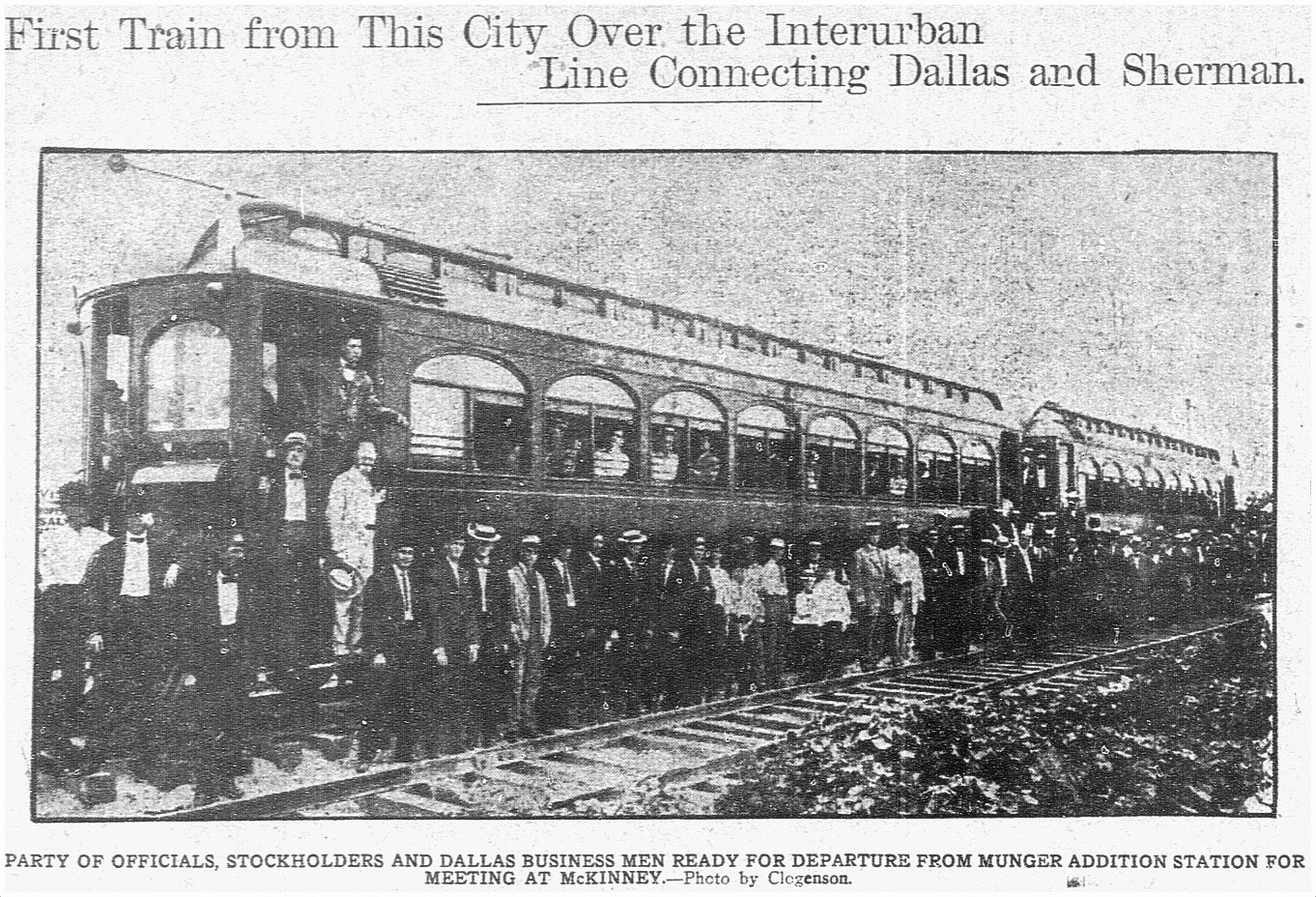
The interurban route connecting Sherman/Denison with Dallas opened on July 1, 1908 and lasted for 40 years, until its final run on December 31, 1948. (Read the Dallas Morning News article on the 1908 inaugural trip for big-wigs, “Many Make Trip Over Interurban,” July 1, 1908, here. Below is the accompanying photo. Image that running up and down Matilda — and, later, along other streets in Dallas — several times a day!)

interurban_sherman-dallas_dmn_070108
DMN, July 1, 1908

Dallas’ ever-increasing population began to move northward and eastward, necessitating public transportation which would connect these developing areas with the rest of the city. One of the early “suburban” lines was the Belmont Line, which branched off the Bryan Street line and served the Belmont Addition and beyond; it opened in 1913, but these early days appear to have been more of a private “dinky” service (see SMU’s dinky car on the beyond-the-city-limits tracks at Hillcrest and McFarlin, here). The Belmont line — as well as the Vickery Place and Mount Auburn lines — became part of the city’s official streetcar system in 1922.

Before the dinky service, riders were able to get on and off the large interurban cars at stops between Mockingbird and the area around Bryan and Greenville Ave. Even though interurbans and streetcars were able to travel on the same rails, it took years for dedicated streetcar tracks to be laid along Matilda.

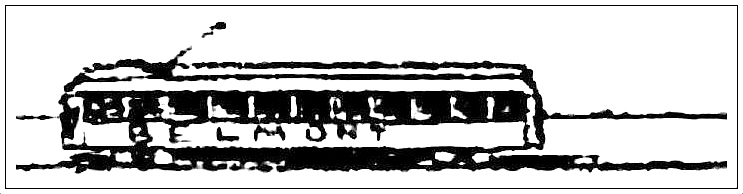
This detail of a real estate ad shows that the Belmont line had reached at least as far as Richmond by 1914 (I felt I had to include this because the finger is pointing at the exact location of the exposed rails in the photo at the top!):

1914_matilda-richmond_lakewood-heights-ad_det_050314
May, 1914 (detail from Lakewood Heights real estate ad — see full ad here)

By 1922 the Belmont line had extended north to Velasco; by 1925 it had gotten to McCommas; by 1936 it had made it up to Penrose; and by 1939 it had finally reached Mockingbird (in time for the opening that year of Stonewall Jackson Elementary School, located at Mockingbird and Matilda).

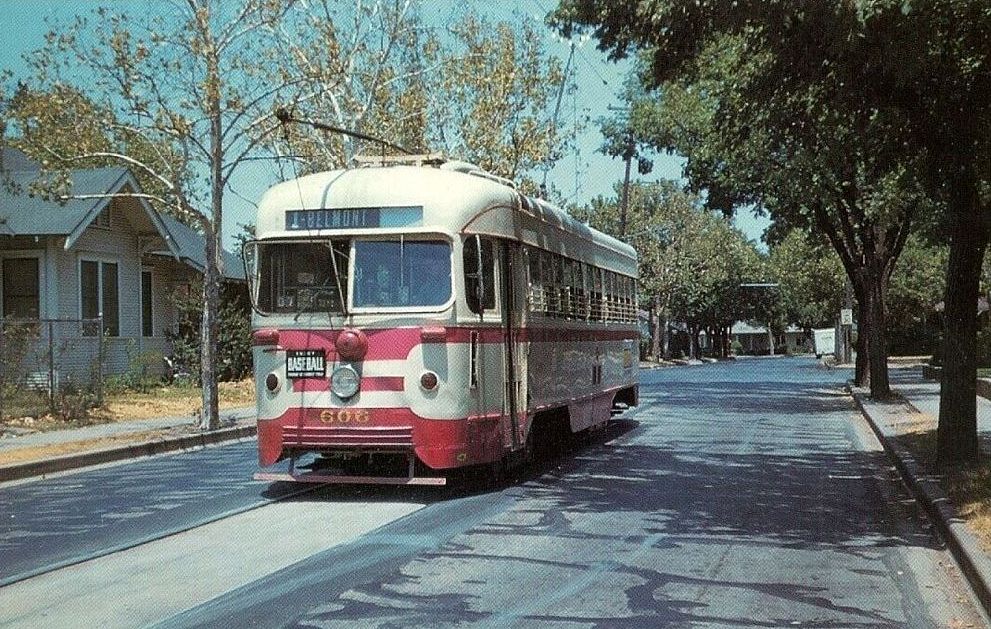
Dallas streetcars began to be phased out in 1955, and the Belmont line was one of the first to go — its last run was March 6, 1955: “The Belmont-Seventh streetcar line will go out of existence Sunday to be replaced by service with new Diesel buses” (Dallas Morning News, March 6, 1955). The new bus route in the Lower Greenville area would, for the most part, be along Greenville Avenue, one block west of unpaved Matilda Street.

In March, 1955, it was reported that the abandoned Belmont-Seventh streetcar tracks were deeded to the city by the Dallas Railway and Terminal Co., with the understanding that they would eventually be paved over. The tracks were on Matilda, Bryan, Cantegral, Live Oak, St. Paul, King’s Highway, Edgefield, Seventh, Bishop, and Colorado. In April, 1956, it was reported that the City Council had approved the sale of the streetcar viaduct over the Trinity River and the Matilda street right-of-way.

But what about that paving of Matilda? Mrs. K. E. Slaughter had thoughts on the matter in a letter-to-the editor in April, 1955:

Since removal of the Belmont streetcar line in part — Matilda and Bryan streets — would it not be advantageous to develop this section into an important use to the heavy automobile traffic? Matilda now is no more than useless tracks built up between a cow path. (DMN, April 7, 1955)

“Cow path” — ha!

Another annoyed News reader wrote in 1963 — eight years after the tracks had been abandoned — about the useless unpaved thoroughfare:

The abandoned almost-private right of ways, such as Matilda, nearly two miles south from Mockingbird, received by the city in a deal to permit an all-bus operation, have not yet been paved or otherwise improved. (DMN, Oct. 21, 1963)

I’m not sure when that paving finally happened — early ’70s? — I think it must have been done in stages. I don’t remember a time when the stretch between Mockingbird and Kenwood wasn’t paved, but I do remember Matilda being a dirt road south of Kenwood. I don’t have a good recollection of the year, but kids remember all sorts of weird things, and those mysterious mounds were pretty memorable. (UPDATE: See photos of Matilda being paved at Goodwin in 1971 here.) I wish I’d known what an interurban was when I was a child. That would have made my neighborhood seem a whole lot more interesting! Heck, it used to the Gateway to Sherman!

I’ve long despaired of having missed the streetcar age. But it’s nice to know that one ran so close to the house I grew up in.

belmont-line_matilda-mockingbird_youtube-cap_ca1954End of the line, ca. 1954… (Gene Schmidt)

belmont-car_lakewood-heights-ad-det_050314

***

Sources & Notes

Top photo taken by Dan Parr on April 15, 2018; it was originally posted to the Facebook group Dallas History Guild and is used here with permission. (Thanks, Dan!) The photo was taken at Matilda and Richmond, looking south on Matilda. See it on Google Street View, here. (Roadwork along Matilda is awful at the moment, but much-needed. Apparently it is being reduced to three lanes for automobiles with two bike lanes being added — read about it in the Lakewood Advocate, here.)

YouTube video shot by Gene Schmidt in 1953 and 1954; the direct link is here.

Another interesting video on YouTube was made by the City of Allen and contains period footage of the interurban that served North Texas. It’s a breezy 6-and-a-half  minutes, and it includes some cool shots of Dallas.

If you want to see a whole bunch of North Texas interurban photos, check out this great 83-page PDF compiled by DART, “History of the Interurban Railway System and Monroe Shops,” here.

Speaking of DART, they posted a cool 1925 map of streetcar and interurban lines, here — click the map to see a larger image. (In 1925, the Belmont line ended on Matilda at McCommas).

ALSO extremely cool is a Google map showing Dallas’ Historical Streetcar (and Interurban) Lines laid over a present-day Google map, here. Zoom in and out. Very useful!

streetcar_belmont_color_ebayeBay

belmont-streetcar_new-moon_1940_palace_ebay1940, eBay

belmont-streetcar_1954_ebay1954, eBay

*

Copyright © 2018 Paula Bosse. All Rights Reserved.

900 Block of Main, North Side — 1952

AR447-B1201Main Street, 1952… (Squire Haskins Collection, UTA)

by Paula Bosse

This 1952 photo by Squire Haskins shows the north side of Main Street, taken at the intersection with Poydras, looking west to the old Dallas County jail and criminal courts building seen at the far left. The Sanger’s building stands just west of Lamar, and across Lamar is the 900 block of Main, with the legendary E. M. Kahn men’s clothing store (one of Dallas’ first important retail stores, founded in 1872), the Maurice Hotel (in the old North Texas Building, built in 1888/1889), and the large Bogan’s grocery store at the northwest corner of Main and Poydras. The old jail and the Records Building (way in the distance) and the Sanger’s building are all that remain. See how this view looks today, here.

There is a flyer for “Porgy and Bess” on the lamppost in front of the Bogan market. “Porgy and Bess” opened the State Fair Summer Musicals series at the State Fair Auditorium (Music Hall) in June, 1952 (see an ad here).

But what about the south side of the 900 block of Main Street? Thankfully, photographer Squire Haskins  not only took the photo above, he also turned to face the other side of the street and snapped companion photos. I posted two of his photos of the south side of Main in a previous post, here. Here’s one of those photos, with Poydras at the left and Lamar on the right:

main-poydras_squire-haskins_uta

A listing of the businesses from the 1953 city directory — there’s a little bit of everything (click to see larger image):

900-block-main_1953-directory

***

Sources & Notes

Both photos by Squire Haskins, both from the Squire Haskins Photography, Inc. Collection, University of Texas at Arlington. More info on the top photo can be found here; more on the second photo, here.

More on the south side of Main Street can be found in the Flashback Dallas post “900 Block of Main Street, South Side — 1950s,” here.

All images larger when clicked.

*

Copyright © 2018 Paula Bosse. All Rights Reserved.

McKinney & Haskell, Circle “T” Frozen Foods, and VWs in Dallas

mckinney-and-haskell_NDHS_ebayFender-bender in front of NDHS… (click for larger image)

by Paula Bosse

Odd stuff shows up on eBay. This photo shows a damaged Circle T Brand frozen-food Volkswagen delivery van at the intersection of McKinney Avenue and North Haskell (with North Dallas High School making a partial cameo in the background). The view today? See it here.

Circle T was one of the many brainchilds of the Southland Corp.’s Thompson family: it manufactured and distributed frozen foods (initially meats and Mexican food) which were sold in the company’s 7-Eleven stores. The company began in 1954 and was located just a couple of blocks from this photo, at Haskell and Central. (In 1954 they announced one of their first specialty products: frozen queso. I’ve never even considered that frozen queso would exist, but 60-some-odd years ago it was flying off shelves at the neighborhood 7-Eleven.)

The Southland Corp. sold off Circle T in 1966.

Below, an ad for Circle T’s frozen steaks, from 1954 (click ad to see larger image).

cicle-t_FWST_062054June, 1954

circle-t-logo_1954

And because I’m nothing if not pedantic, here’s an ad for VW trucks and vans, from 1961 (which appears to be the date on the van’s license plate in the photo):

volkswagen_ad_fen-1961Feb., 1961

And speaking of Volkswagens, the first Dallas car dealer to import Volkswagens appears to be Clarence Talley — the first ads are from 1954. While I was searching for the link to the eBay listing of the above photo (which I could not find…), I serendipitously stumbled across this 1950s photo of Clarence Talley on N. Pearl, with appearances by the Medical Arts Building and the Republic Bank Building. Thank you, eBay.

talley-volkswagen_ebay

***

Sources & Notes

Photos from eBay: could not find the link to the first one, but the second one sold a couple of months ago, and the archived listing is here.

*

Copyright © 2018 Paula Bosse. All Rights Reserved.

Fred Caropresi’s Mid-Century-Modern Illustrations for SMU’s 1951 Yearbook

smu_1951-yrbk_people-places_caropresiLife on the SMU quad, 1951… (click to see larger image)

by Paula Bosse

I’m not sure why I happened across the artwork of Fred Caropresi (1921-1985), but I must have been looking for something in the 1951 SMU yearbook, The Rotunda — Caropresi’s work is all over it! Caropresi (or as he was known to fellow students, “Freddy”) had attended SMU in the 1940s, before and after World War II. His degree was in mechanical engineering, but after the war, he returned to study art as a grad student and eventually opened his own advertising firm in Pittsburgh, Pennsylvania.

Below are some examples of his work from the 1951 SMU annual — his drawings are reminiscent of the silkscreen process with their off-kilter, off-register areas of flat vibrant color. This type of 1950s “mid-century modern” commercial art is definitely one of my personal favorites. 

Here they are (click pictures to see larger images).

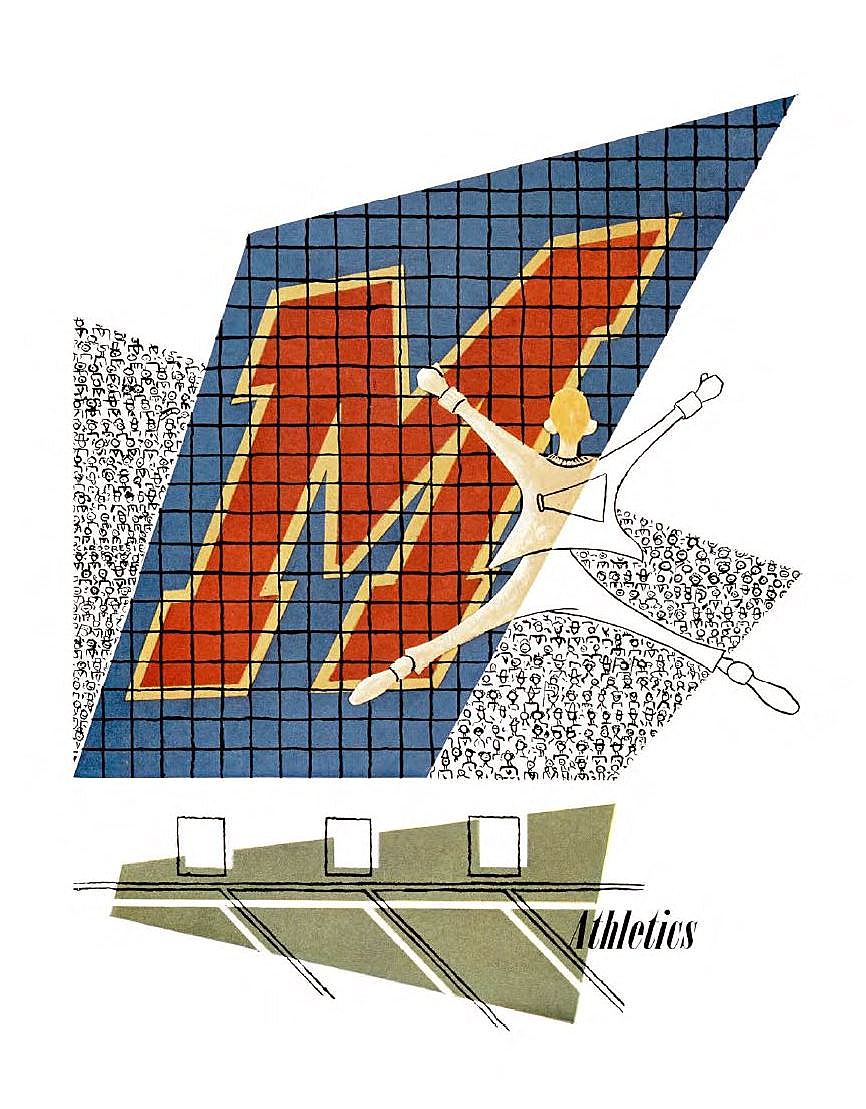
Peppy Mustangs:

smu_1951-yrbk_athletics_caropresi

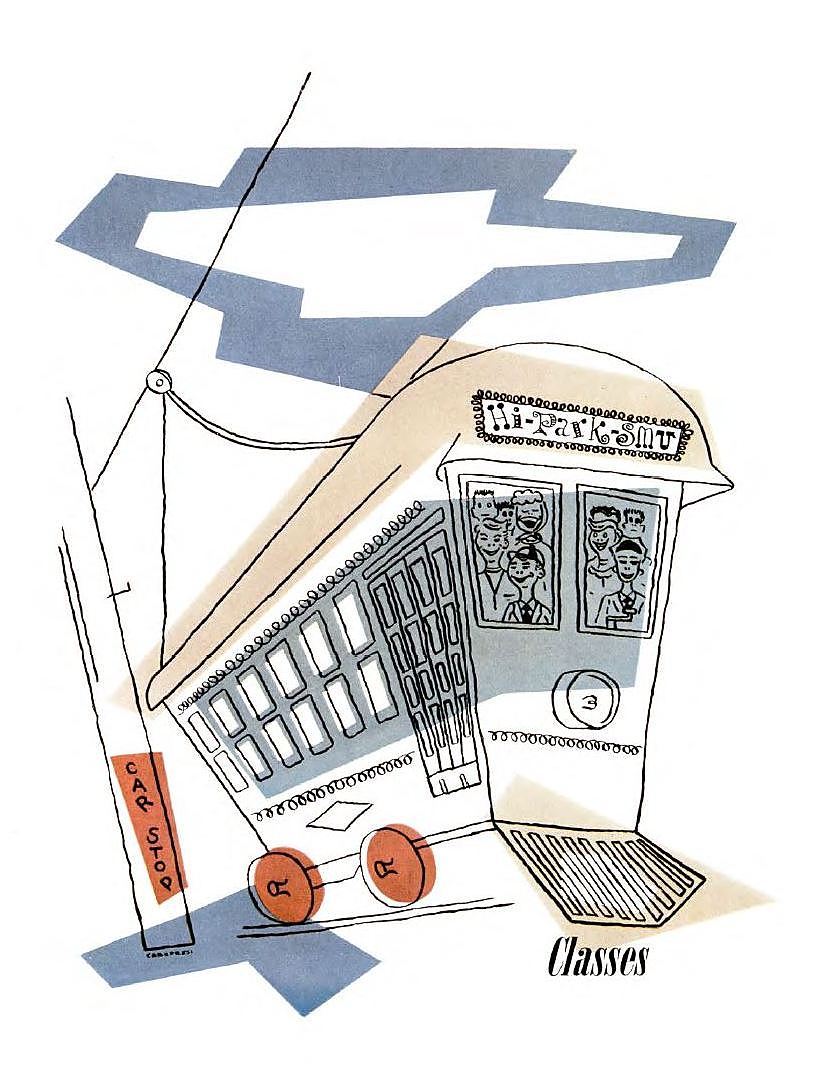
The packed “Hi-Park SMU” streetcar (which ran along Hillcrest  — see a photo here):

smu_1951-yrbk_classes_caropresi

Bulletin board — pipes and the Arden Club:

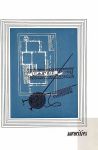
smu_1951-yrbk_activities_caropresi

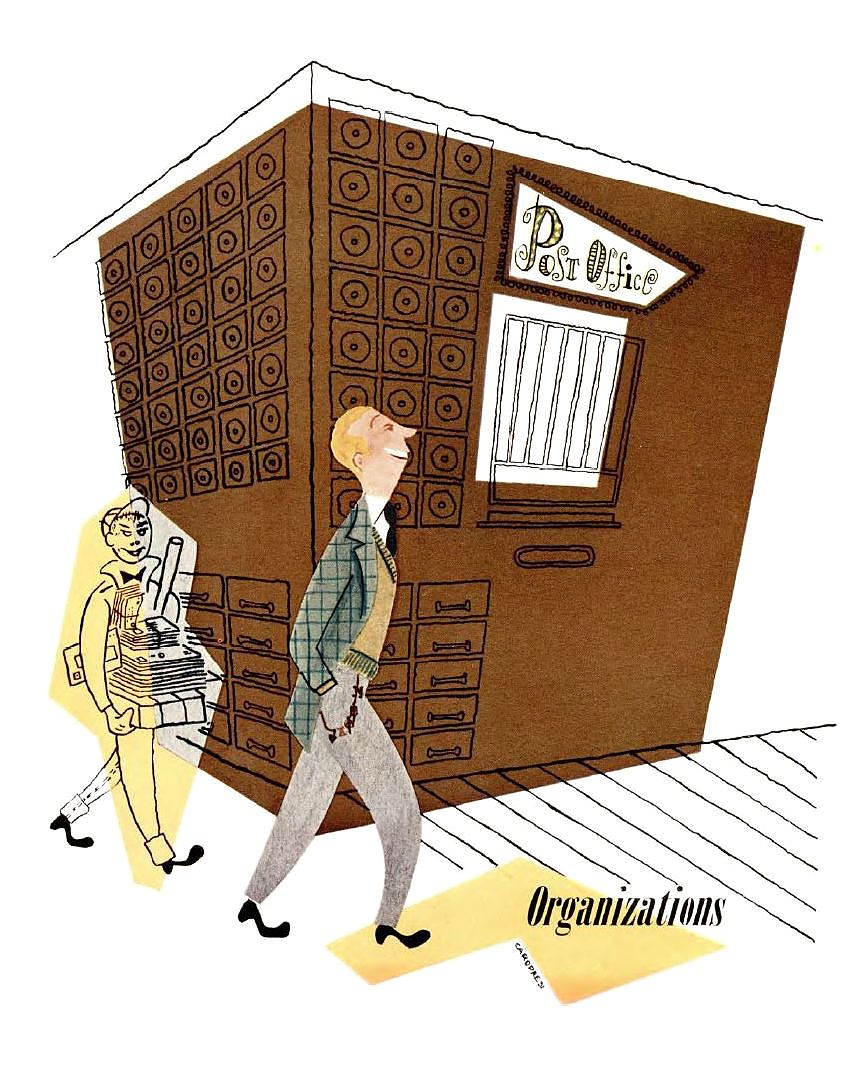
Post office (this is great — I’d love to see a photo of the real thing:

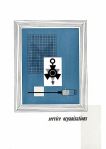
smu_1951-yrbk_organizations_caropresi

Relaxing with a drink and TV:

smu_1951-yrbk_personalities_caropresi

Cokes al fresco and another college boy smoking a pipe:

smu_1951-yrbk_pictorial_caropresi

The drawings below — also from the 1951 Rotunda — show a completely different style. The first one (“Beauties”) is fantastic. (Click a thumbnail image to open a slideshow.)

Like I said, Caropresi’s work was ALL OVER the 1951 Rotunda!

varsity-fight-song_smu-yrbk_1951

*

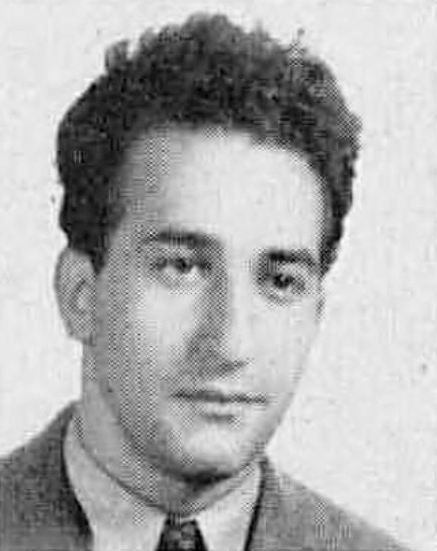
New York native Frederick V. Caropresi (1921-1985) grew up in the Bronx with his parents (his father, a pharmacist, had immigrated from Italy), his grandmother, and his older brother Gregory. For some reason both Fred and Greg decided to attend SMU in Dallas. Fred originally studied mechanical engineering, receiving his degree in 1944. He returned to Dallas after his service in the navy during World War II, and took post-graduate art courses. He was busy around Dallas as a both a fine artist (his first one-man show was in 1952) and as a very busy commercial artist, working in local theater, industrial design, and advertising. He was an active president of the Dallas Print Society in the early 1950s, at the same time he was designing college yearbooks. He left Dallas in the 1950s and settled in a suburb of Pittsburgh where he established his own advertising agency. I hope he continued his own art, because I’m a fan.

caropresi_fred_smu-1942Fred Caropresi, 1942, SMU yearbook photo

He is represented in the collection of the Dallas Museum of Art with this silkscreen/serigraph, a view of Reims Cathedral from about 1948.

caropresi-frederick_reims-cathedral_DMA_1948
Dallas Museum of Art

Fred Caropresi died in in 1985 in North Hills, Pennsylvania.

caropresi_news-record_north-hills-pennsylvania_040285_OBIT
North Hills (PA) News Record, April 2, 1985

Thank you, Fred.

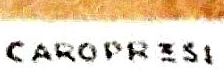
caropresi-sig_1951

***

Sources & Notes

All artwork by Frederick V. Caropresi from the 1951 edition of SMU’s yearbook, The Rotunda, is from the Southern Methodist University Yearbooks collection, DeGolyer Library, Central University Libraries, SMU; all editions are fully downloadable in PDFs, here.

caropresi_1951-rotunda

The silkscreen print “Reims Cathedral” (23/30, signed “F. V. Caropresi”) is from the collection of the Dallas Museum of Art; a Dallas Art Association purchase, it was accessioned in 1948.

All images are larger when clicked.

*

Copyright © 2018 Paula Bosse. All Rights Reserved.


NAACP Southwest Conference in Dallas — 1950

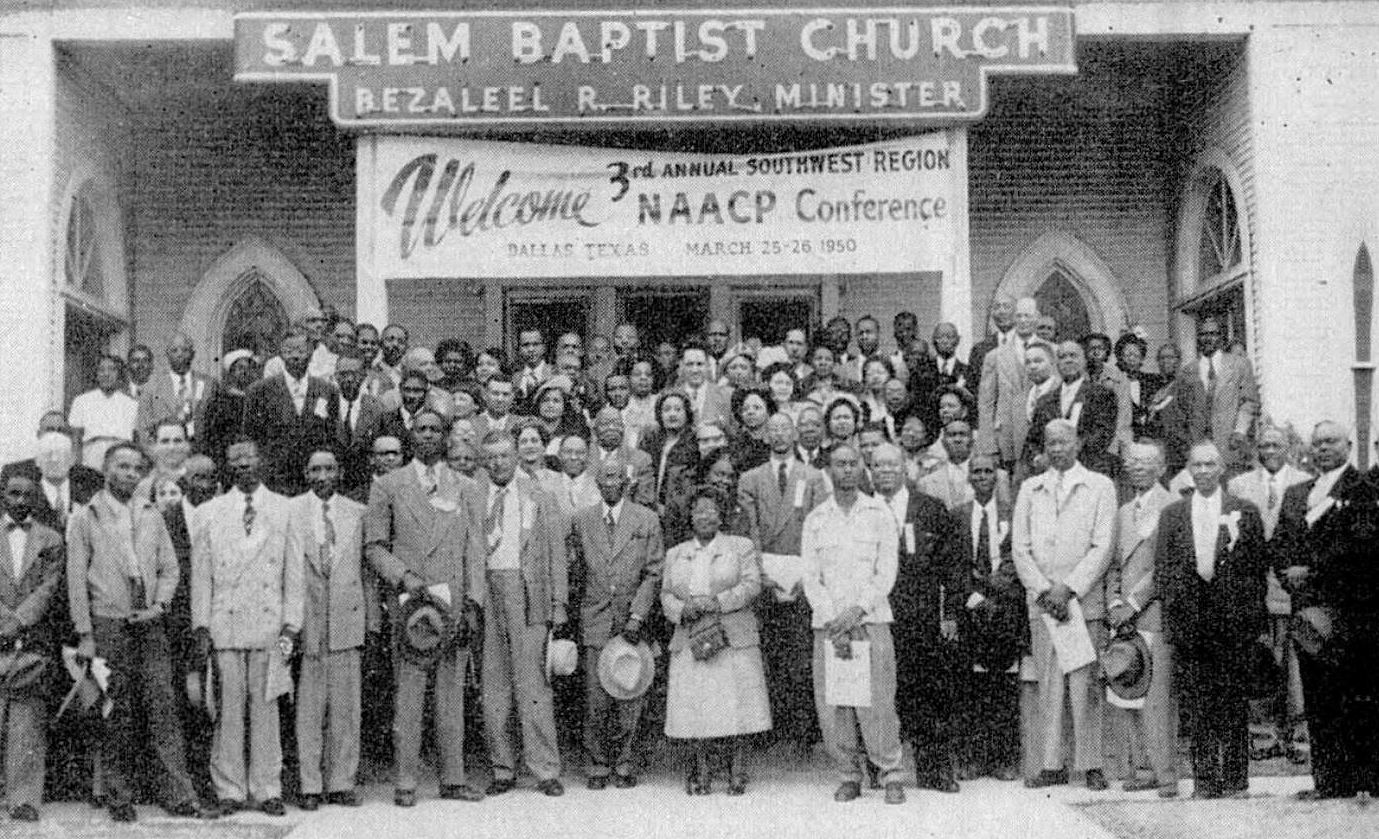
NAACP-conference_the-crisi_june-1950Top delegates of the NAACP regional conference in Dallas, 1950

by Paula Bosse

The third annual NAACP Southwest Region Conference was held in Dallas, March 24-26, 1950. Above we see the top delegates (out of about 200 attendees), standing in front of the Salem Baptist Church, then located at 710 Bourbon in South Dallas. One of their main objectives was to increase NAACP membership in order to more effectively tackle issues of civil rights and social injustice.

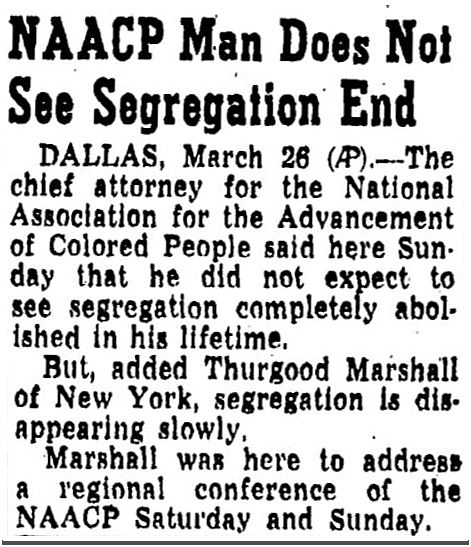
The conference’s main speaker was special counsel to the NAACP, Thurgood Marshall. During the conference, he stated that, although there was slow and steady progress being made by African-Americans in American society, he did not expect to see racial segregation abolished in his lifetime. 17 years after this statement, Thurgood Marshall was appointed by President Lyndon Johnson to serve as a justice on the United States Supreme Court.

NAACP_thurgood-marshall_FWST_032750Fort Worth Star-Telegram, March 27, 1950

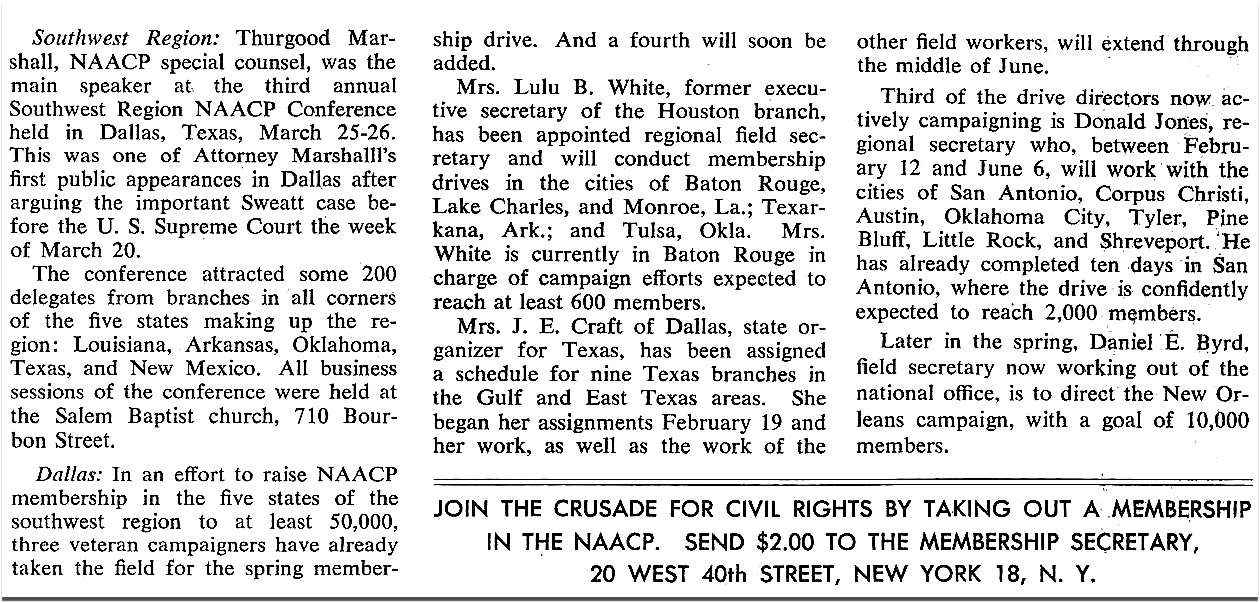
Below, the review of the conference that appeared in the April, 1950 issue of the NAACP magazine, The Crisis (click to see larger image).

NAACP-SW-conference_the-crisi_april-1950The Crisis, April, 1950

***

Sources & Notes

Top photo from the June, 1950 issue of The Crisis, the magazine published by the NAACP. Many decades’ worth of scanned issues of the magazine are viewable via Google Books, here.

The Salem Baptist Church was, at the time of the photo above, located at 710 Bourbon in South Dallas. According to the church’s website, the church moved from that location in the early 1960s when the site was one of many purchased by the Texas Highway Department to be demolished for highway construction.

Click photo and news clippings for larger images.

*

Copyright © 2018 Paula Bosse. All Rights Reserved.

The Texas Instruments Semiconductor Crystal Christmas Tree

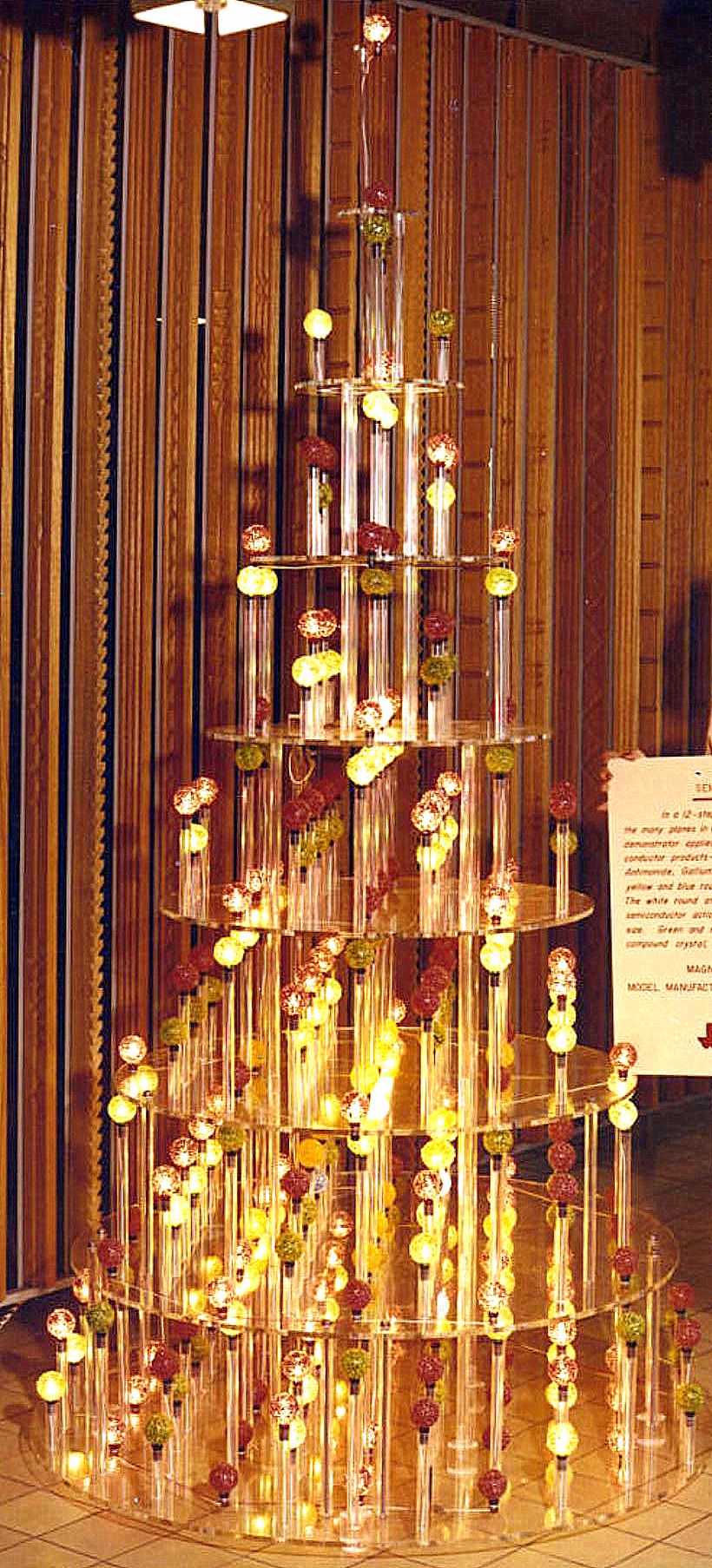
xmas-tree_texas-instruments-records_degolyer-lib_smu_ca-1959-smThe semiconductor tree… (click to see a larger image)

by Paula Bosse

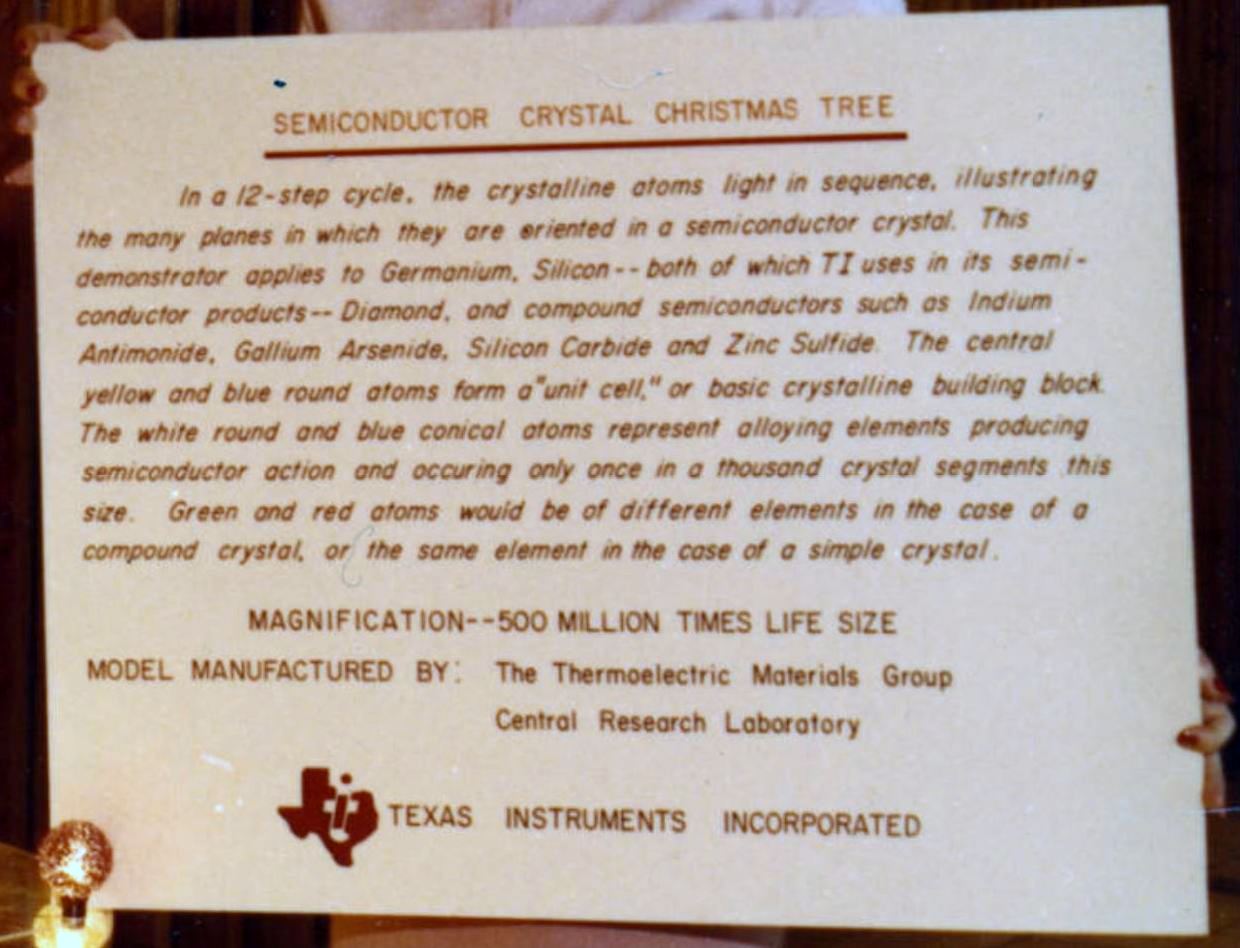
Here’s something you don’t see every day: a Christmas tree made from models of semiconductor crystals. I can’t even begin to understand this, so I’ll hand it over to the “explanation” seen on the card in the photo and pretend to nod knowingly. (Click picture to see larger image; transcription is below.)

xmas-tree_texas-instruments-records_degolyer-lib_smu_ca-1959_descr

SEMICONDUCTOR CRYSTAL CHRISTMAS TREE

In a 12-step cycle, the crystalline atoms light in sequence, illustrating the many planes in which they are oriented in a semiconductor crystal.

This demonstrator applies to Germanium, Silicon – both of which TI uses in its semiconductor products – Diamond, and compound semiconductors such as Indium Antimonide, Gallium Arsenide, Silicon Carbide and Zinc Sulfide.

The central yellow and blue round atoms form a “unit cell,” or basic crystalline building block.

The white round and blue conical atoms represent alloying elements producing semiconductor action and occurring only once in a thousand crystal segments this size.

Green and red atoms would be of different elements in the case of a compound crystal, or the same element in the case of a simple crystal.

MAGNIFICATION – 500 MILLION TIMES LIFE SIZE

Model manufactured by: The Thermoelectric Materials Group, Central Research Laboratory

TEXAS INSTRUMENTS INCORPORATED

*

So … yeah. Merry Christmas from the fine folks at TI’s Thermoelectric Materials Group!

***

Sources & Notes

This circa-1959 photo — titled “Semiconductor Christmas Tree” — is from the RG-06 Semiconductor Group, Texas Instruments records, DeGolyer Library, Central University Libraries, Southern Methodist University; more info on this photo can be found on the SMU site, here.

Speaking of germanium (…there’s a phrase I’ve never used before…), SMU also has another TI photo showing a close-up of “a germanium crystal being pulled (grown) out of a crucible of molten germanium material” here. In fact, SMU’s DeGolyer Library has a whole slew of material in their Texas Instruments records — browse through the collection here.

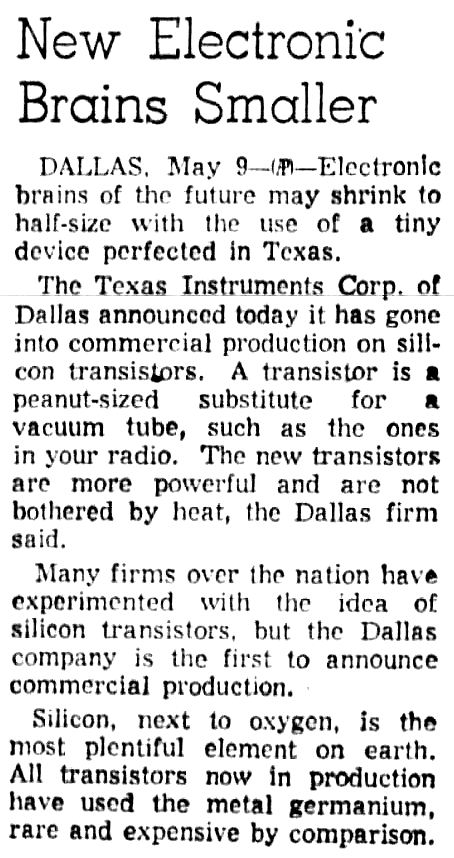
Semiconductors, single-crystal germanium, silicon, and transistors … the world owes Dallas’ Texas Instruments a huge “thank you” for their cannot-be-overstated contribution to the development of the technology that, dare I say, changed life on earth.

texas-instruments_AP_051054AP wire story, May 10, 1954 (click for larger image)

One of the inventors of “single-crystal germanium” was Dr. Gordon K. Teal (1907-2003), a Dallas native whom Texas Instruments snapped up from his previous employer, Bell Laboratories. Read more about Dr. Teal’s remarkable career in an Engineering and Technology History Wiki, here, and in a portrait (literal and figurative) from Baylor University (his alma mater), here.

More about the importance and applications of “single-crystal germanium” in the new Transistor Age can be found in an interview with Dr. Teal in the Dallas Morning News article “Mighty Transistor: Dr. Gordon Teal ‘Grows’ A Gadget” by Robert Miller (DMN, Feb. 8, 1953).

*

Copyright © 2017 Paula Bosse. All Rights Reserved.