Flashback : Dallas

A Miscellany: History, Ads, Pop Culture

Category: 1960s

“The Walls Are Rising” — SEEN!
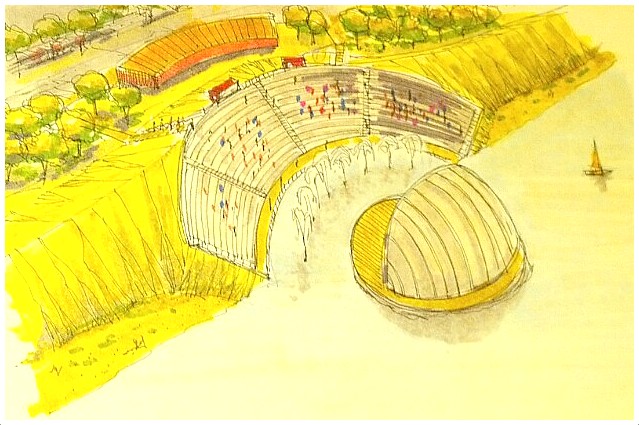
trinity-amphitheater-bandshell_aia-dallas_1960sA 1960s vision for development of the Trinity (AIA Dallas)

by Paula Bosse

The AIA Dallas screening last night of “The Walls Are Rising,” a 1967 film made by the AIA about Dallas’ somewhat chaotic urban planning, was a huge success! Not only were there upwards of 250 people in attendance at the Sixth Floor Museum to view the film and listen to a panel discussion afterwards, but, for me, it was something of a surreal experience to have a large group of people discussing a film I had researched and researched but had been unable to find any trace of after 1972. I contacted the Dallas Chapter of the American Institute of Architects with my “re-discovery,” and they enthusiastically set out to find it.

Thanks to AIA Dallas’ Anna Procter, the film was found and digitized. Other related archival materials were also found, including a wonderful series of drawings, one of which (above) shows one of the many grand and occasionally outrageous visions for a new Trinity River Town Lake: an amphitheater facing a bandshell set IN the water, replete with the ubiquitous sailboat that always seems to accompany renderings of just about every view of Trinity development I’ve ever seen. I would love to see this series of drawings collected in a book. I would buy it.

It was a great event, and it was so nice (and, again … surreal) to meet so many people who told me they enjoyed the blog. Thank you! (And, guy-who-told-me-about-losing-an-hour-of-time-at-work-reading-the-blog … thanks — but get back to work!)

I loved the film. It was weird and kooky and definitely of its time. It’s interesting to see how the city has improved in the past 40-something years, but it’s also frustrating to see how LITTLE it’s changed.

The film will be available in the near future for online viewing, which is great, because not only will more people be able to see it, but also because we’ll all be able to pause it to look more closely at some of the many, many photos used in the film. UPDATE: Watch the film online, here.

Thanks to AIA Dallas/Dallas Center for Architecture, panelists Howard Parker, Larry Good, and Jack Gosnell, moderator Robert Wilonsky, and the Sixth Floor Museum for an entertaining night. And thanks to everyone who attended!

***

Sources & Notes

A few of the reviews/recaps of last night’s film and discussion:

Previously:

*

Copyright © 2015 Paula Bosse. All Rights Reserved.


Dallas’ “Courthouse Complex”

courthouse-complex_tinkle_key-to-dallas_1965-drawingEarly-’60s vision of the “courthouse complex”

by Paula Bosse

Let’s all be thankful that the Old Red Courthouse is still with us, because there was serious talk in the ’50s and ’60s of razing it to make way for a more modern downtown and a more efficient use of space. Lon Tinkle wrote the following in the mid-’60s:

courthouse-complex_tinkle_key-to-dallas_1965Excerpt from Lon Tinkle’s “The Key to Dallas” (1965)

Tinkle’s next paragraph: “It is not that Dallas doesn’t care. It does. But it has to grow into this experience of great cities, and it will.”

*

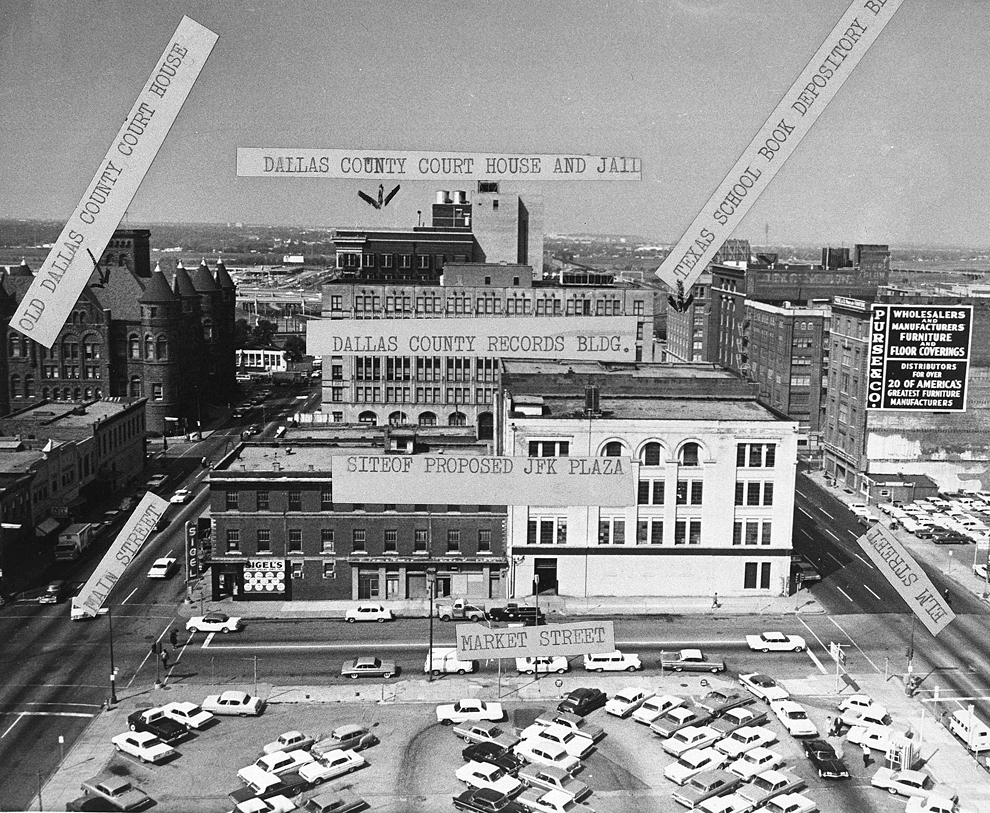
Here’s what the eastern boundary of the “courthouse complex” looked like in 1964. (Incidentally, the first Kennedy memorial site was chosen in April, 1964, and it was to be in the block immediately to the east of the Records Building, the one seen in the center of this photo. Sometime in the next few months, the location was changed to the block immediately east of the Old Red Courthouse.)

Ferd Kaufman, AP

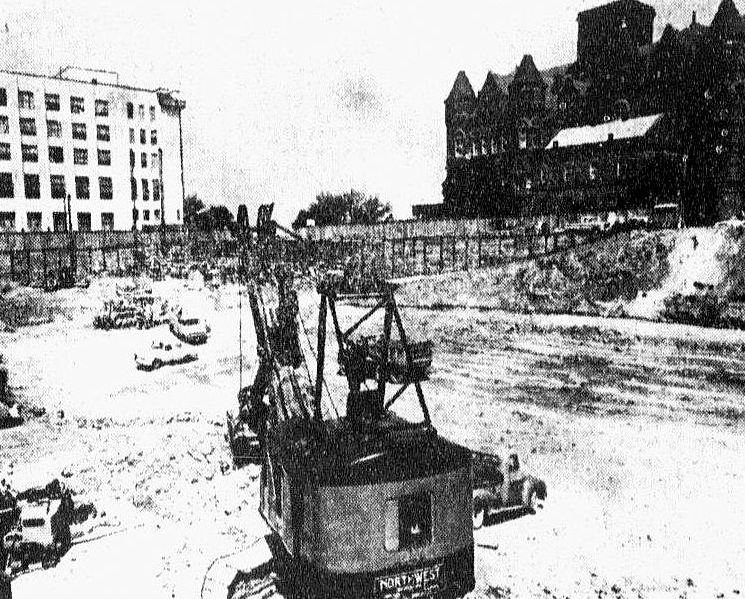
Here’s what the southern boundary looked like when construction of the new Dallas County Courthouse began in the spring of 1963:

courthouse-construction_early-1963

And here’s the “complex” today.

courthouse-complex_google

Old Red isn’t going anywhere!

**

UPDATE: After posting this on the Flashback Dallas Facebook page, a person commented about having worked across the street during the new courthouse’s construction.

On the night of June 19, 1964, a massive fire broke out on the upper floors of the new courts building, which was then under construction. There were 130 firefighters and more than 30 pieces of equipment on the scene according to newspaper accounts. The commenter wrote the following, in clipped sentences, telegram-style:

“I started to work 1963 at Terminal Annex. The Court House under construction, razed by fire shortly thereafter, heat from fire made us work away from windows. There was no thought of leaving building as mail had to make connections to railroads.”

First thing: Wow. The postal creed in action. Wonder if the workers got hazard pay? Or at least a W.C. Fields “hearty handclasp.”

Secondly: I had never seen the phrase “razed by fire” before. It’s not really accurate here, because only the upper floors were destroyed, but the cinematic quality of the phrase is pretty cool. I’ll have to file the phrase away to be used as the title for my memoirs, even if it doesn’t really apply to anything I’ve ever done or experienced. Can’t sacrifice a good title.

Thirdly: I continue to realize just how exceedingly dull my life is.

***

Sources &  Notes

Top image and text is from Lon Tinkle’s wonderful The Key to Dallas (Philadelphia/New York: J. B. Lippincott Co., 1965), an extremely informative book for young people. The drawing is by Dallas artist Bud Biggs (his signature is seen in the reproduction of this drawing in the Aug. 1961 issue of Dallas magazine).

Labeled image of the area in question, looking west, is an Associated Press photo by Ferd Kaufman, taken in 1964. I used this previously in the post “Where To Put That Kennedy Memorial? — 1964.”

Aerial view is a current one, from Google Maps.

*

Copyright © 2015 Paula Bosse. All Rights Reserved.

“The Walls Are Rising” — FOUND!

walls_FilmGRAPHIC_AIAAIA Dallas

by Paula Bosse

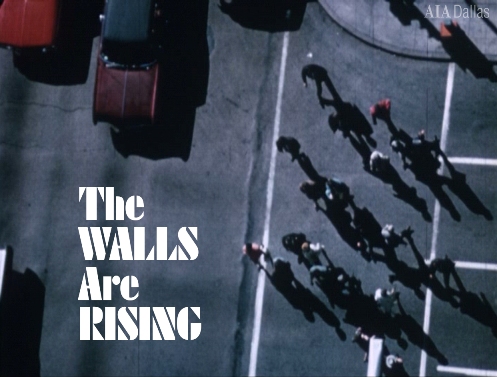
Last month I wrote about “The Walls Are Rising,” a film about the city’s desperate need to address shortcomings in its planning and development if it wanted to avoid an urban crisis which some felt was fast-approaching. The film had been produced by the Dallas chapter of the AIA (American Institute of Architects) in 1966/67, and it was shown to numerous civic and professional organizations. When I read that the film began with an assault of images and sounds followed by an ominous and stern voice saying, “We are living in an accident,” I knew I had to see it. Also, as the film touched on many of the same city planning issues we are still debating almost 50 years later, I knew that it would have a certain amount of news value. If *I* wanted to see it, I felt sure others would, too.

I stumbled across mention of the film in early November of last year and researched it as much as I could using various online sites and databases, but I could find nothing about it after its initial barnstorming tour through the Dallas civic club scene between 1967 and 1972. I contacted the Dallas Municipal Archives and the Dallas/Texas history department of the Dallas Public Library, but neither had any info. I contacted AIA Dallas/Dallas Center for Architecture, and they weren’t familiar with the project either, but Jan Blackmon (Executive Director of AIA Dallas/DCFA) and Greg Brown (DCFA Programs Director) were both extremely enthusiastic and set out to find it.

And now they’ve found it. To be more precise, it was AIA’s Anna Procter who tracked down a copy of the film. Her dogged detective work resulted in not only finding a copy of “The Walls Are Rising” (still on a reel), but also finding other archival material concerning AIA concerns regarding the city’s urban planning and development issues of the late-’60s — a little treasure trove of cool stuff.

The film has been digitized, and it will be screened by AIA Dallas on Jan. 19, 2015. If you’d like to attend the screening and panel discussion, information for the event is here. (If you can’t make it, don’t worry — there are plans to upload the film for online viewing in the near future.)

An enthusiastic article about the film by Robert Wilonsky of The Dallas Morning News (who will also be moderating the panel on Jan. 19), can be found here.

Sometimes spending my days wandering through virtual archives and blowing virtual dust off virtual files pays off. I look forward to seeing “The Walls Are Rising,” and I’m so happy to have played a part in the unearthing of a forgotten part of Dallas’ history!

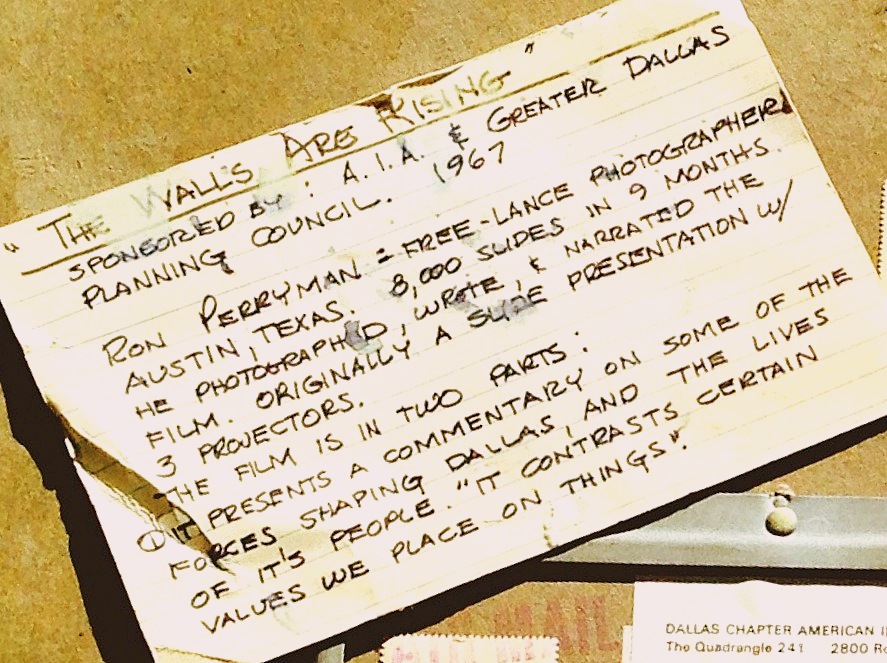
walls_film_reel_AIAAIA Dallas

walls_film_reel_AIA-det

(The fact that it contains over 8,000 slides and was originally presented with THREE projectors — guaranteeing maximum visual assault — is just fantastically crazy. With the ominous tone, the use of Wagner’s “Flight of the Valkyries,” and what sounds like an experimental use of sound and quick-cutting images, all I can think of is a Dallas version of the sublime “Manchild in Beantown,” the “art” film Diane makes for Woody’s parents — and the funniest thing that “Cheers” ever did — which can be viewed here.)

***

Sources & Notes

Images used with permission of AIA Dallas.

My original post, “Urban Crisis — 1967,” is here.

*

Copyright © 2015 Paula Bosse. All Rights Reserved.
 

Old Red Goes Hollywood (sort of…) — 1964

buchanan_trial-oswald_1964Old Red’s star turn in The Trial of Lee Harvey Oswald (click for larger image)

by Paula Bosse

An interesting (if a bit fuzzy) screenshot of the Old Red Courthouse from one of Larry Buchanan’s Dallas-made films, “The Trial of Lee Harvey Oswald” (1964), about what might have happened had LHO lived to face trial. As with most of Buchanan’s extremely low-budget films, it drags and has clunky acting (…I have to admit that I didn’t watch the whole thing), but it’s interesting to fast-forward through to see the bits shot out on the streets of downtown. I really like this view of the courthouse. It seems familiar and unfamiliar at the same time.

***

Yes, you can watch the whole film on YouTube — free! Mosey on over here. The movie’s tagline: “Not a Newsreel … A Full-Length Motion Picture Filmed Secretly in Dallas.” Uh-huh. And as far as the movie having been “suppressed” (as is mentioned at the  beginning of the film) … well, let’s just say Larry worked in advertising for many years and knew a thing or two about marketing.

For other posts I’ve written about Larry Buchanan (I kind of feel I know him now — he would have been a lot of fun to shoot a movie with!), click here.

*

Copyright © 2014 Paula Bosse. All Rights Reserved.
Urban Crisis: “The Walls Are Rising” — 1967

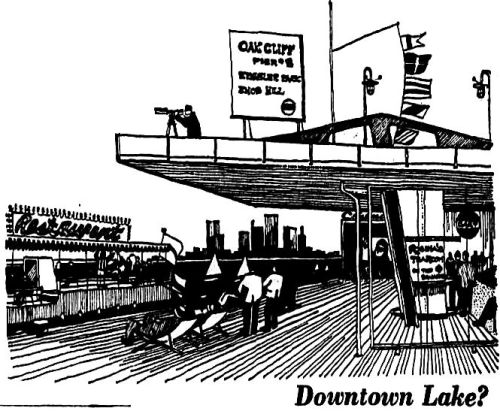
walls_lake_1967
Oak Cliff Pier? Just one part of Dallas’ urban future as envisioned in 1967…

by Paula Bosse

In 1967, the Dallas chapter of the American Institute of Architects unveiled a project it had been working on under the sponsorship of the Greater Dallas Planning Council for over a year — a 40-minute color slide presentation with recorded narration called “The Walls are Rising,” directed by writer-photographer Ron Perryman of Austin. Enslie “Bud” Oglesby — one of Dallas’ top architects and the chairman of the committee behind the project — said of the film:

I saw here an opportunity to demonstrate the problems which poor planning bring and the results that can come from a sound, unified planning program…. (Fort Worth Star-Telegram, June 18, 1967)

The rather more urgent tone of the brochure that accompanied the film was a bit more dire:

We cannot afford to lose any more time in developing a coordinated plan to make Dallas a more beautiful and effective city, for all around us the walls are rising, the city is being built… We are designing by default instead of summoning our vitality, wealth resources, talents and human vision to create a design plan that will give Dallas quality and character all its own.

The goal of the project was to create awareness among city officials, planners, and designers (as well as among the public) of the immediate need to address the conscious physical design of the city in order to improve its future “livability.” The argument was that the city of Dallas was, in 1967, an unplanned and uncoordinated chaotic urban environment dominated by (and practically strangled by) the automobile; it was overwhelmed by traffic, noise, and visual clutter, and it lacked much-needed green spaces and personal “refuges.”

It was stressed that the film was not a plan, per se, but was, instead, an outline of suggestions that the AIA and the Greater Dallas Planning Council were proffering for discussion (and, one assumes, hoping would be implemented). Among their suggestions were the following (some of which have been adopted, but many of which have been “on the table” for decades now and which Dallas leaders continue to debate):

  • A 6-mile hike-and-bike trail from Turtle Creek to Reverchon Park
  • A rapid transit system (the report stressed that it would be urgently needed by 1980)
  • The creation of downtown parks
  • The development of downtown apartment housing
  • A centralized transportation hub (bus, rail, air)
  • The reduction in noise, visual clutter, and traffic
  • More “sensitive” freeway planning, which should be designed (or re-designed) for the driver and not for the automobile
  • More awareness of the pedestrian in designing downtown and neighborhood streets, especially in regard to safety and accessibility
  • Development of, yes, the Trinity River and its levees, including a downtown lake and sailboat-dotted marina, with apartments and a variety of entertainment and shopping venues lining the “shore”
  • And, most unexpectedly, a “scenic link” which would connect Fair Park to the Dallas Zoo, incorporating a sort of shuttle service between the two locations (and across the Trinity) via an elevated gondola ride (!)

As fun and fanciful as fresh ideas on getting to Oak Cliff are, the film seems to have been more of a warning of what the city’s future might be if it continued down its then-current path of … having basically no plan at all. The film started off by assaulting the viewer’s senses with several minutes of “blaring, cacophonous music” and a rush of chaotic images — and opened with the ominous words, “We are living in an accident.” The League of Women Voters issued a report in 1968 called “Crisis: The Condition of the American City” in which they described “The Walls Are Rising” as “a horror film.”

What sounds a bit like a sophisticated A/V presentation was screened for dozens and dozens and dozens of groups in the Dallas area between 1967 and about 1972: it was shown to various Chambers of Commerce, Rotary, Kiwanis, and Lions clubs, women’s groups, church groups, business groups, arts organizations, and on and on and on. The film would usually be introduced by an architect who would also lead a discussion and answer questions afterward. If you were a member of a civic or professional group in the late ’60s, chances are pretty good you saw “The Walls Are Rising.”

Which is why it’s so surprising that all traces of the film seem to have vanished in the intervening years. I contacted the Dallas Municipal Archives, the Texas/Dallas History & Archives Division of the Dallas Public Library, AIA Dallas, and Dallas Center for Architecture. Everyone was very helpful, but … nothing. Designs for Dallas and the later Goals for Dallas are better known projects, but it seems that there would be something connected with this film lying around somewhere. I’d love to see it. It sounds like it would be entertaining and informative … and depressing. We’ve come so far. …We haven’t come far at all.

**

walls_FWST_061867Fort Worth Star-Telegram, June 18, 1967 (click for larger image)

***

Sources & Notes

“The Walls Are Rising” was introduced to the Dallas public in Dorothie Erwin’s article, “A Design for Dallas Proposed,” which ran in the Feb. 12, 1967 edition of The Dallas Morning News. Additional descriptions of the film can be found in the article “A Courageous Look at Today’s City” by Larry Howell (DMN, May 3, 1968).

*

UPDATE: Jan. 9, 2015 — Great news! AIA Dallas has found the film and has scheduled a screening!

  • To read my follow-up post “‘The Walls Are Rising’ — FOUND!” click here.
  • To read Robert Wilonsky’s Dallas Morning News article on the newly-found film, click here.
  • For info on the AIA Dallas screening, click here.

UPDATE: Jan. 20, 2015 — The public screening and panel discussion at the Sixth Floor Museum was great! Read about it here.

UPDATE: May, 22, 2015 — AIA Dallas has digitized and uploaded the film to Vimeo. Watch the complete film here.

*

Copyright © 2014 Paula Bosse. All Rights Reserved.


Mercantile National Bank Ad — 1960

merc_ad_1960-det

by Paula Bosse

I love you, Merc! Why aren’t you in EVERY Dallas ad?

ad-mercanitle_city-directory-1960(click for larger image)

***

Ad from the 1960 city directory. I don’t know who did the artwork for this ad, but I love it.

*

Copyright © 2014 Paula Bosse. All Rights Reserved.

The Dallas Cowboys’ Horrible Inaugural Year — 1960

dallas-cowboys-logo_1960

by Paula Bosse

Thanksgiving means different things to different people. For some it’s about spending time with family, for some it’s about ingesting an unimaginable amount of good food, and for others it’s all about watching the Cowboys game.

Here’s a look back at the inaugural season of the Dallas Cowboys, 1960:

  • Head coach: Tom Landry.
  • Home field: Cotton Bowl.
  • Results: 0 wins, 11 losses, 1 tie.
  • They were ranked last in the Western Conference.
  • They had the worst record of any team in the NFL that season.

The team got better, but as far as the Cowboys, there was absolutely nothing for Dallas to be thankful for that year — except that they’d never have to re-live Season 1 again.

***

Yep, Wikipedia. Read it and weep, sports fans.

*

Copyright © 2014 Paula Bosse. All Rights Reserved.

David Wade, Gourmet: Have Ascot, Will Travel

david-wade_dining-with_cover

by Paula Bosse

A few years ago, when I was a bookseller, I posted the following on a personal blog — it turned out to be the most commented-on and most clicked-on post I’d ever written. I wrote it a bit snarky, but I was amazed by the response it elicited: people (both in Texas and beyond) apparently have a strong affection for — and a seemingly deeply personal attachment to — local TV gourmand David Wade. Here’s what I wrote.

*

I just received an order for a David Wade cookbook I’ve had listed for four years:

DAVID WADE’S KITCHEN CLASSICS (Dallas: David Wade Industries, 1969). 300pp. Photographs, index. The ascot-clad TV gourmet presents recipes as well as photos of himself with celebrities such as Mickey Mantle (page 99, opposite the recipe for Crabmeat Tetrazzini). A couple of small splotches to fore-edge; one rubbed spot on cover. No dust jacket. Inscribed by Wade. $12.50

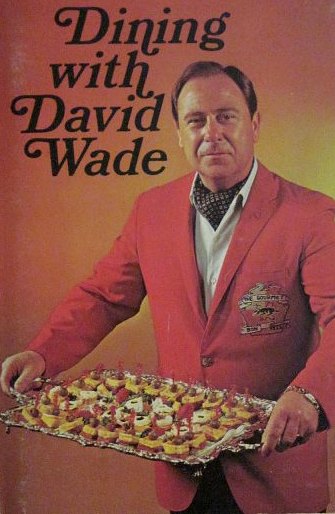
I don’t know if people outside of Texas (and maybe outside of Dallas) would be familiar with David Wade, described, tellingly, not as a “chef” but as a “food demonstrator.” He had a local TV show that must have started in the ’50s or ’60s, but I saw him in the ’70s and into the ’80s. And, yes, he DID wear an ascot, and a blazer, as seen above, from the front cover of another cookbook from the David Wade oeuvre.

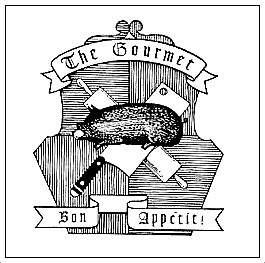
He had a catchy theme song (which compared him to Rembrandt and Edison) and he had his very own coat of arms, which I have vivid, rather frightening memories of from my childhood (I always imagined that poor pig being whacked over the head with the rolling pin and then hacked apart by the cleaver — Bon Appetit, little piggie!):

david-wade-show_logo

I was just a kid, but I remember cringing a bit at his deep-voiced cheesiness. I don’t actually remember much about the food or the actual program, but I can still hear that unnaturally calm, deep voice oozing around inside my head. But what did I know? He was an incredibly popular local TV personality. Yeah, he might have used an over-abundance of big words (…words like “over-abundance”), but, to be fair, he also had a folksy charm and was pleasantly inoffensive.

I’m not sure the same can be said for his food, however. Here are a few of the recipes which some lucky lady in South Carolina who bought the cookbook might be whipping up in a few days:

  • Squash Loaf
  • Citrus Surprise Steak
  • Liver Yucatan (featuring grated American cheese (can you actually grate American cheese?), macaroni, canned mushrooms, and sugar)
  • Baked Stuffed Fish with Pecan Grape Sauce
  • Deep Sea Loaf (made with canned tuna, gelatin, sweet pickle juice, avocado, and three tablespoons of sugar … among other equally distressing ingredients)
  • Salmon & Green Olive Casserole (with cream and “salmon liquid” straight from the can)
  • Apple & Banana Soup (these are the ingredients: chicken stock, apple, banana, potato, onion, cream, curry powder, chives)
  • Kidney Bean Tuna Salad
  • Meat Loaf Pizza
  • Pineapple Mint Cake
  • Quick Clove Jelly Cake
  • Sahib Eight Boy Chicken Curry (…I have no idea…)
  • Yam Peanut Puffs

Bon Appetit!

*

After I wrote that post, I was inundated by people looking for information on where to find all sorts of much-loved David Wade recipes (especially his famed “Turkey in a Sack”) and where they could find his apparently quite popular Worcestershire Powder. There were also many, many comments from people who just wanted to share personal memories of David Wade, invariably describing him as a warm and gracious, down-to-earth, gentle man. “Classy, but not pretentious.”

Wade began his TV career in Dallas at WFAA in 1949, hosting a 15-minute show about dogs (?!) called “Canine Comments” — it became so popular that it was syndicated around the country. He won awards for that show. It was VERY popular. In 1952, Wade was also appearing on WFAA radio as “The Hymn Singer,” singing religious songs and talking about each song’s history and composer. Along the line he made the switch to food.

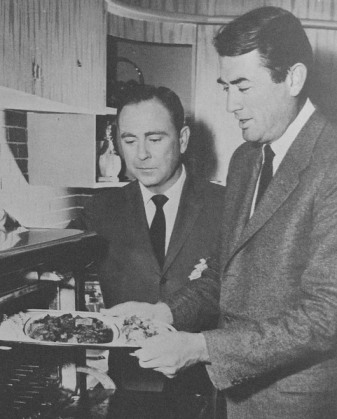
He was “demonstrating” food preparation at personal appearances and on local television by 1957, and in the early 1960s he became a nationally known figure when he commuted to New York from Dallas to tape regular spots for a show called “Flair” in which he frequently appeared with celebrities, guiding them through the preparation of a dish.

david-wade-gregory-peckWith Gregory Peck, 1960s

Eventually, his Dallas-based TV shows were syndicated all over the U.S., and he was so popular locally that he decided to run for mayor in 1971 (he lost to Wes Wise). He continued in his role as a cooking instructor and media figure until his retirement.

David Wade, a much-beloved man who lived and worked in Dallas for the bulk of his career — died in Tyler in March of 2001 at the age of 77. He had been a fixture on Texas television and had published numerous cookbooks. And in between rhapsodizing on good food and wine, he even taught untold thousands how to cook fish in the dishwasher and how to roast a turkey in a paper sack.

***

Sources & Notes

David Wade’s obituary is here.

A warm and fuzzy nostalgic look back at Wade can be read at CraveDFW, here; a super-snarky (and kind of amusing) LA Weekly post critiquing Wade’s recipes can be read here.

Regarding Wade’s run for Mayor of Dallas, check out the Dallas Morning News interview with him conducted by Carolyn Barta, in which he expounds on his vision for the future of Dallas, in the article “Wade Feels Need to Communicate” (March 21, 1971).

Next: The little-known devastating and traumatic childhood event that resulted in David Wade becoming an orphan at the age of 5. Read “David Wade: Overcoming Childhood Trauma” here.

*

Copyright © 2014 Paula Bosse. All Rights Reserved.

JFK Aftermath: Chaos at the City Desk — 1963

JFK_DTH_newsroom2_portal_b
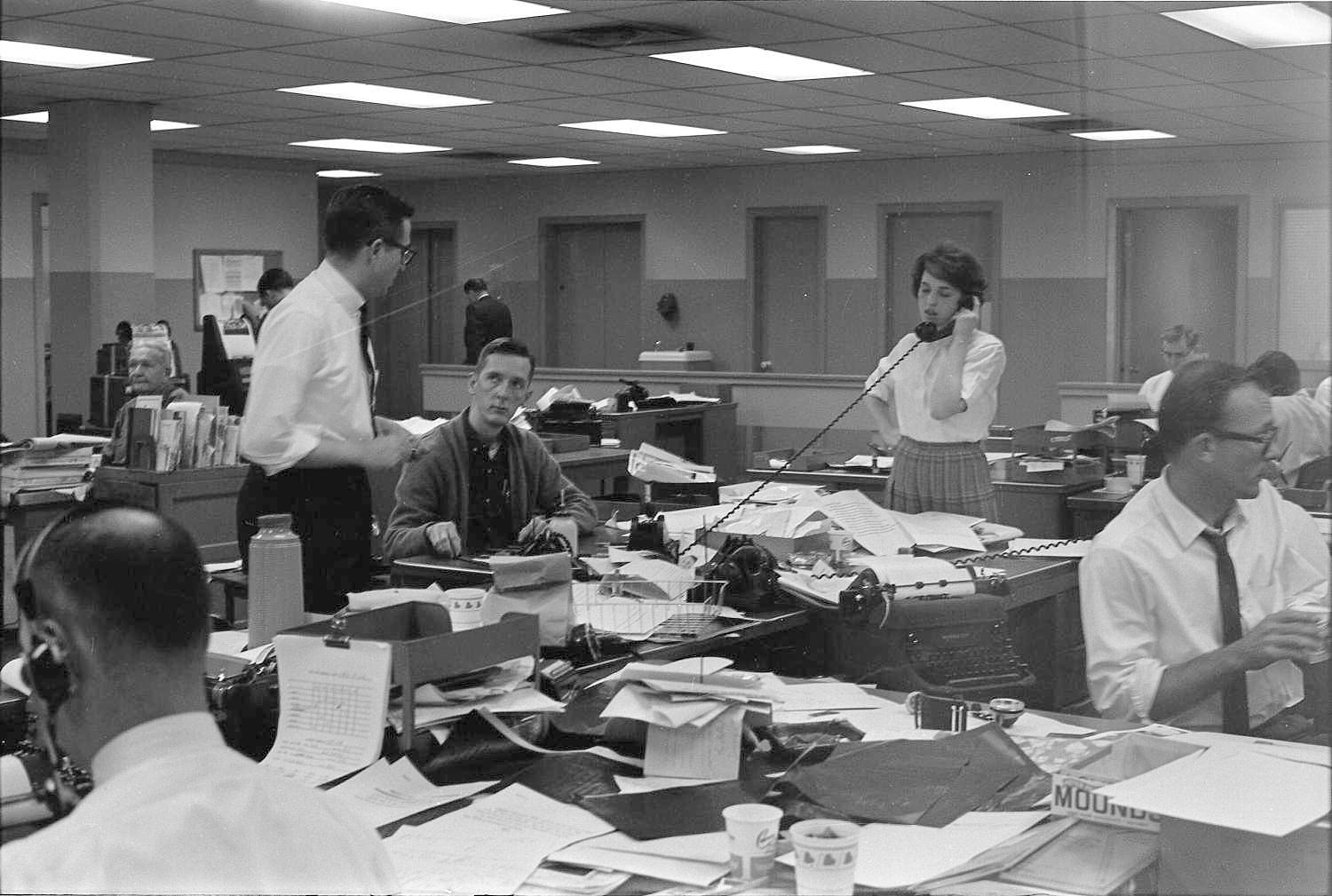
It was all-hands-on-deck for a shocked and solemn Times Herald staff, 11/22/63.

by Paula Bosse

Photos of Dallas Times Herald reporters in the newsroom on November 22, 1963, scrambling for information after the assassination of President John F. Kennedy, the biggest news story of their careers — the biggest news story in the history of Dallas.

JFK_DTH_newsroom3_portal_b

JFK_DTH_newsroom1_portal_b

***

Sources & Notes

Photos (by an unidentified DTH staff photographer) are from the Sixth Floor Museum’s Dallas Times Herald Collection, accessible through the Portal to Texas History. Other photos of no doubt shocked reporters in the DTH newsroom who were probably running completely on instinct and adrenaline that day are here (click thumbnails for larger images).

Identification of DTH reporters and other staff pictured above is welcomed.

*

Copyright © 2014 Paula Bosse. All Rights Reserved.

JFK’s “Last Hour In Dallas” — 1963

JFK_poster

by Paula Bosse

How is a city supposed to respond when it is suddenly plunged into the international spotlight? Does it grieve and try to forget, or does it grieve and capitalize? Dallas has had over 50 years to deal with/come to terms with the assassination of President Kennedy, but sometimes it seems as if the City of Dallas is still shell-shocked and isn’t quite sure how to acknowledge it on an official level. Let’s face it, Dallas is known to the rest of the world for one thing: the Kennedy assassination (and perhaps the TV show, and maybe the Cowboys). Yes, we have the justly-renowned Sixth Floor Museum, but it took 26 years to open it!

The cottage industry that sprang up in the wake of the Kennedy assassination has been big business for decades, some of it generated by people who live in Dallas, but most of it by people who have probably never even been to Texas. Since 1963, the “assassination literature” (…and, yes, it’s called that) has mushroomed, with local contributions coming from Dallasites whose brush with the President before, during, or after the events of November 22, 1963 have probably been pored over by numerous people either trying to understand why what happened happened or by people searching for hidden conspiracy clues to explain what really happened.

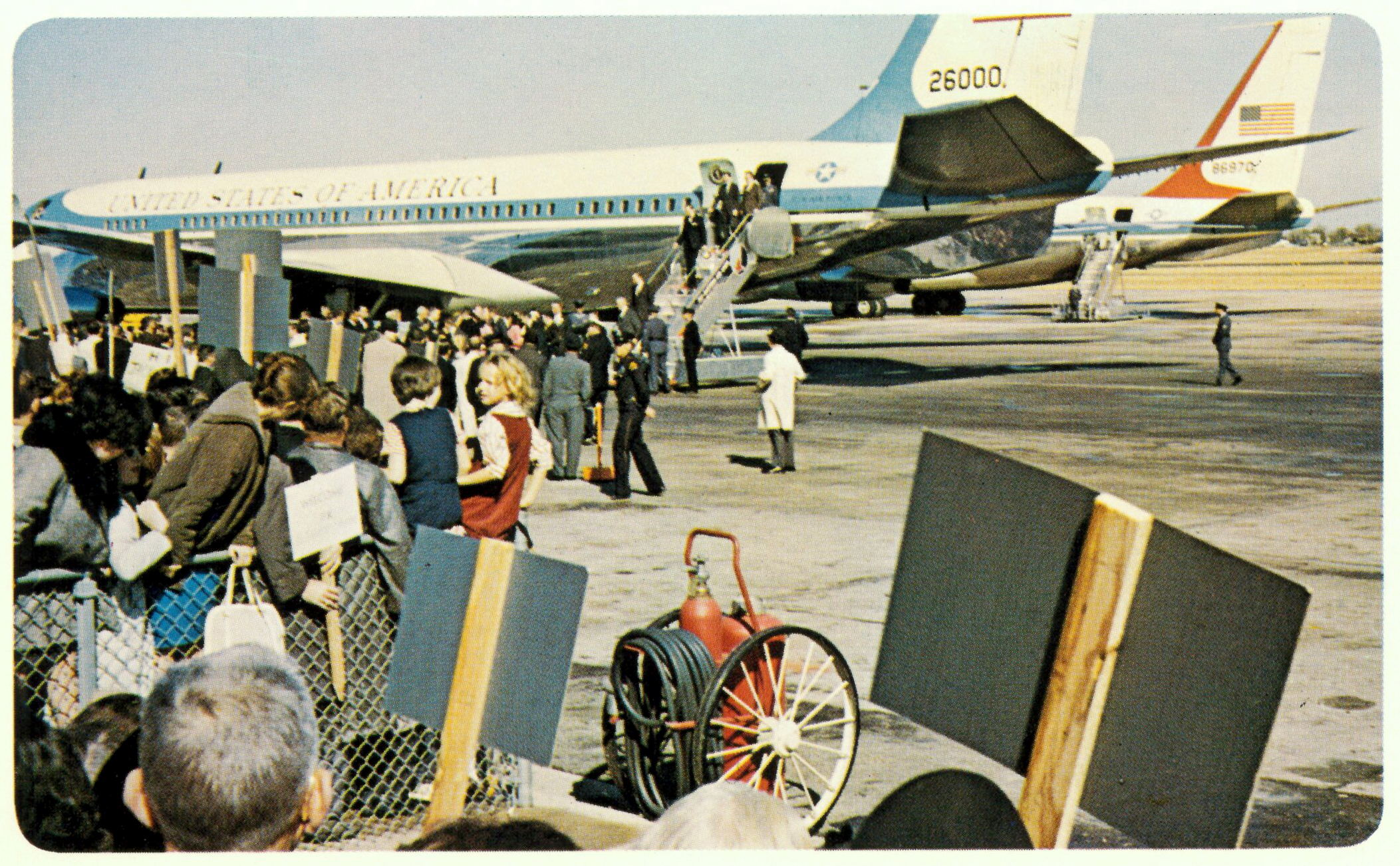
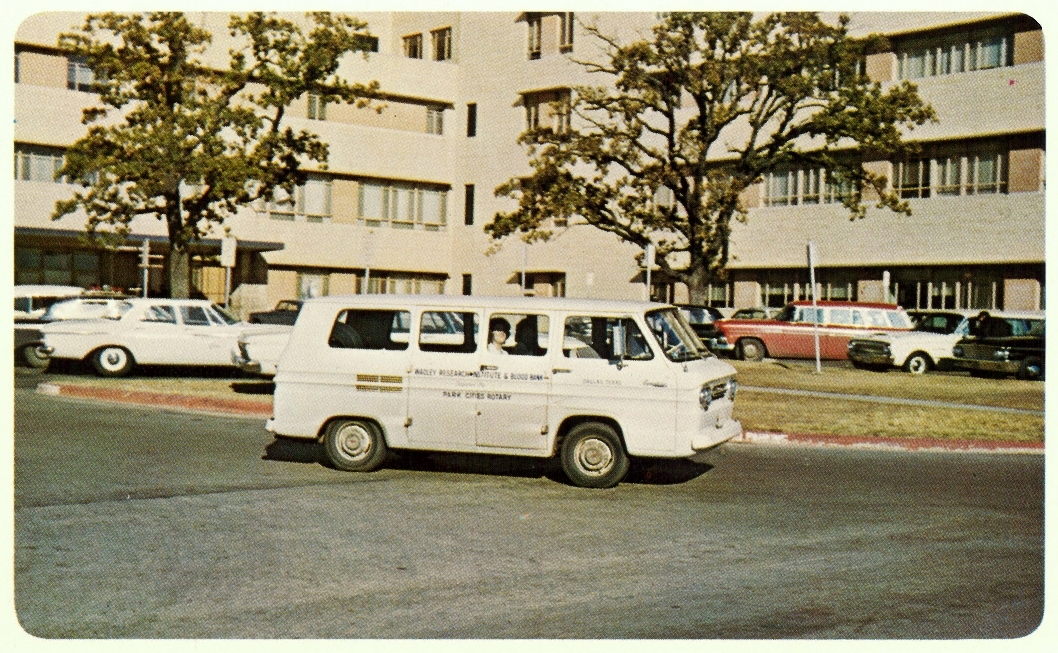
One local resident who added to the assassination literature was John E. Miller who took photos of the arrival of President and Mrs. Kennedy at Love Field and then apparently hot-footed it over to Parkland when the news of the shooting broke. These photos were issued as postcards in 1964 in a packet of 12. (Click pictures for larger images.)

JFK_envelope_frontAbove, the front of the envelope containing the cards; on the back: “A Real Picture Treat For Years To Come.”

JFK_card_01From the back of the card: “No. 1, Arrival of President’s Escort Plane at Love Field, Dallas, Texas.”

JFK_card_02“No. 2, Presidential and Escort Planes at Dallas’ Love Field landed shortly after this picture was taken.”

JFK_card_03“No. 3, President John F. Kennedy and party leaving airplane at Love Field. (Mrs. Kennedy — pink hat.)”

(UPDATE: The two little girls in the photos above and below are most likely Carolyn Jacquess, in blue, and Debby Massie, in red. Their little group arrived at the airport before the president’s plane arrived, walked through the terminal and out onto the tarmac, right to where the plane taxied up to the small crowd of about 100 people. Just like that. There was no special invitation, and, other than the chain-link fence, no real security.)

JFK_card_04“No. 4, President John F. Kennedy and Party in foreground at Dallas’ Love Field.”

JFK_card_05“No. 5, Vice-President Johnson, Governor Connally, Mrs. Kennedy (pink hat), other members of party at Dallas Love Field.”

JFK_card_06“No. 6, Vice-President Johnson, Governor Connally, Presidential Party and Newspaper Men, Love Field, Dallas.”

JFK_card_07“No. 7, Forming of Presidential Parade, Love Field, Dallas.”

JFK_card_08“No. 8, After Assassination, TV Unit arrives at Parkland Hospital in Dallas.”

JFK_card_09“No. 9, Blood Bank Unit at Parkland Hospital on fatal day. Dallas, Texas.”

JFK_card_10“No. 10, Hearse carrying President John F. Kennedy’s body and Mrs. Kennedy from Parkland Hospital back to airplane at Love Field, Dallas.”

JFK_card_11“No. 11, Presidential plane awaiting President Kennedy’s body, Vice-President Johnson and Mrs. Kennedy, for return to Washington, D.C. (Note Presidential seal.)”

JFK_card_12“No. 12, Texas School Book Depository building from which authorities believe fatal shots were fired. (Note second window down on right corner of building.)”

***

Photos and captions © John E. Miller 1964, 3500 W. Davis, Dallas, Texas 75211. (Mr. Miller was a Dallas businessman who sold motor homes and trailers in Oak Cliff between 1945 and 1976. A photo of Mr. Miller is here).

Many thanks to “amyfromdallas” for scanning and contributing the images in this post. Thanks, Amy!

For other Flashback Dallas JFK-related posts, see here.

Click pictures for larger images.

*

Copyright © 2014 Paula Bosse. All Rights Reserved.