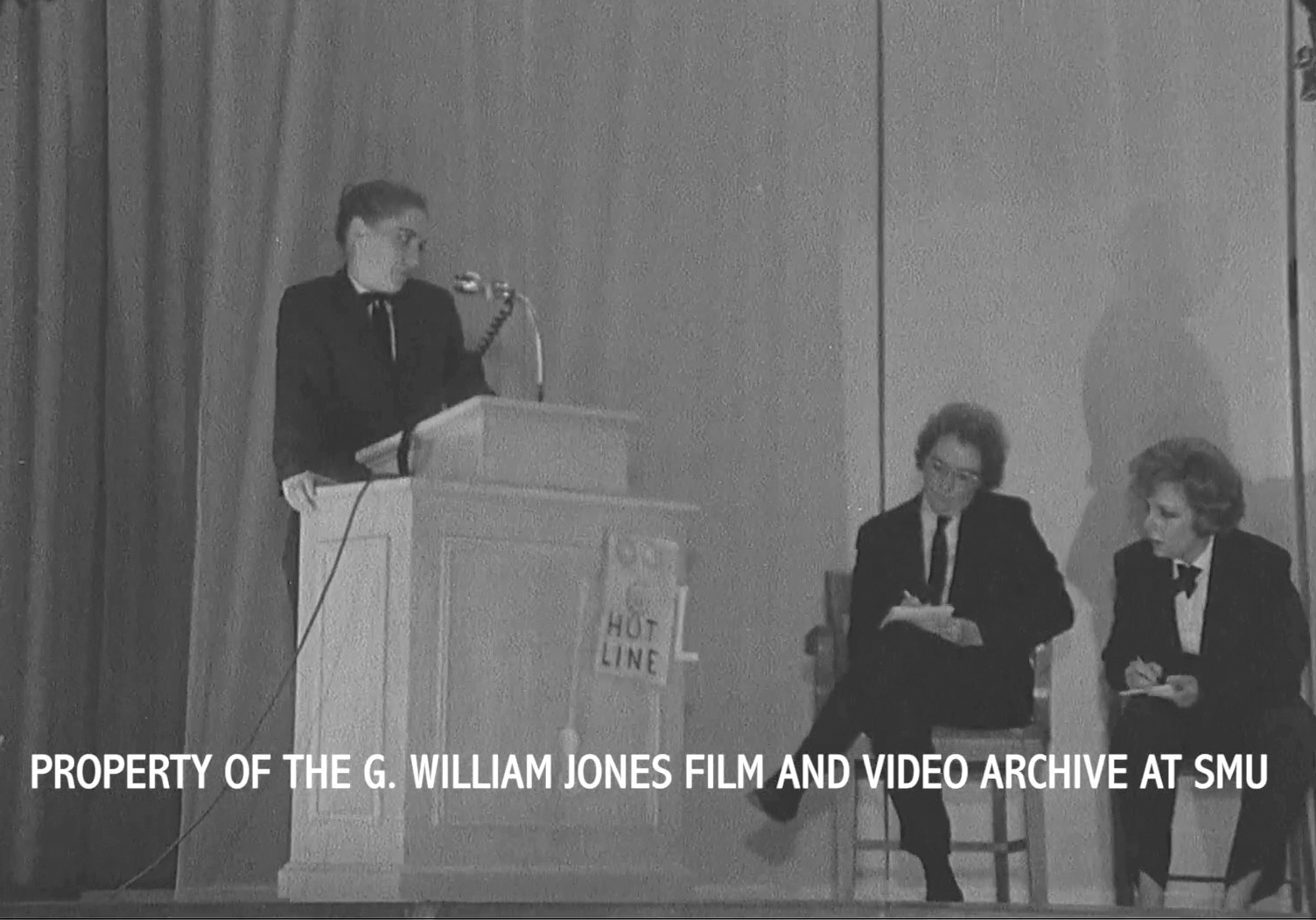
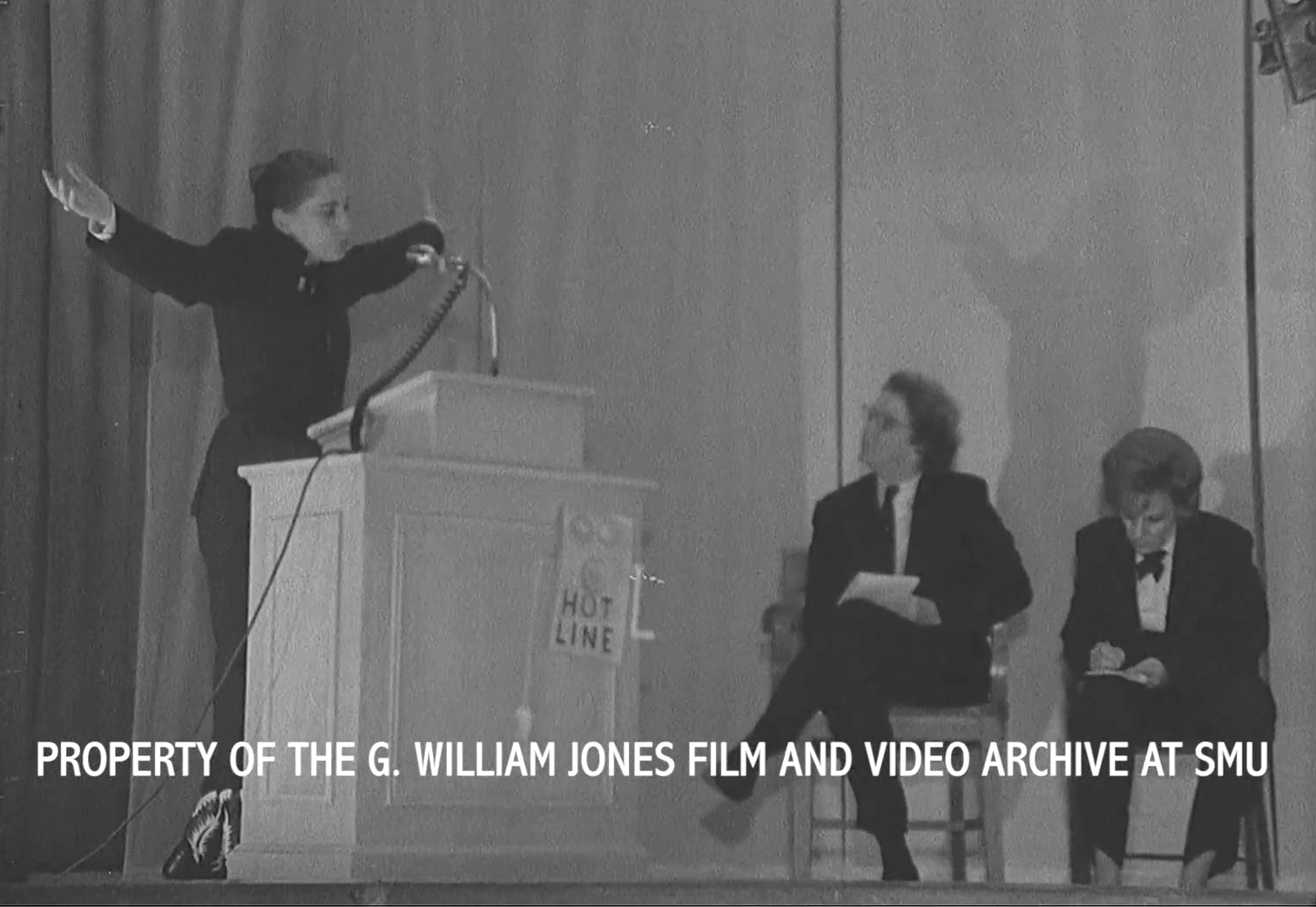
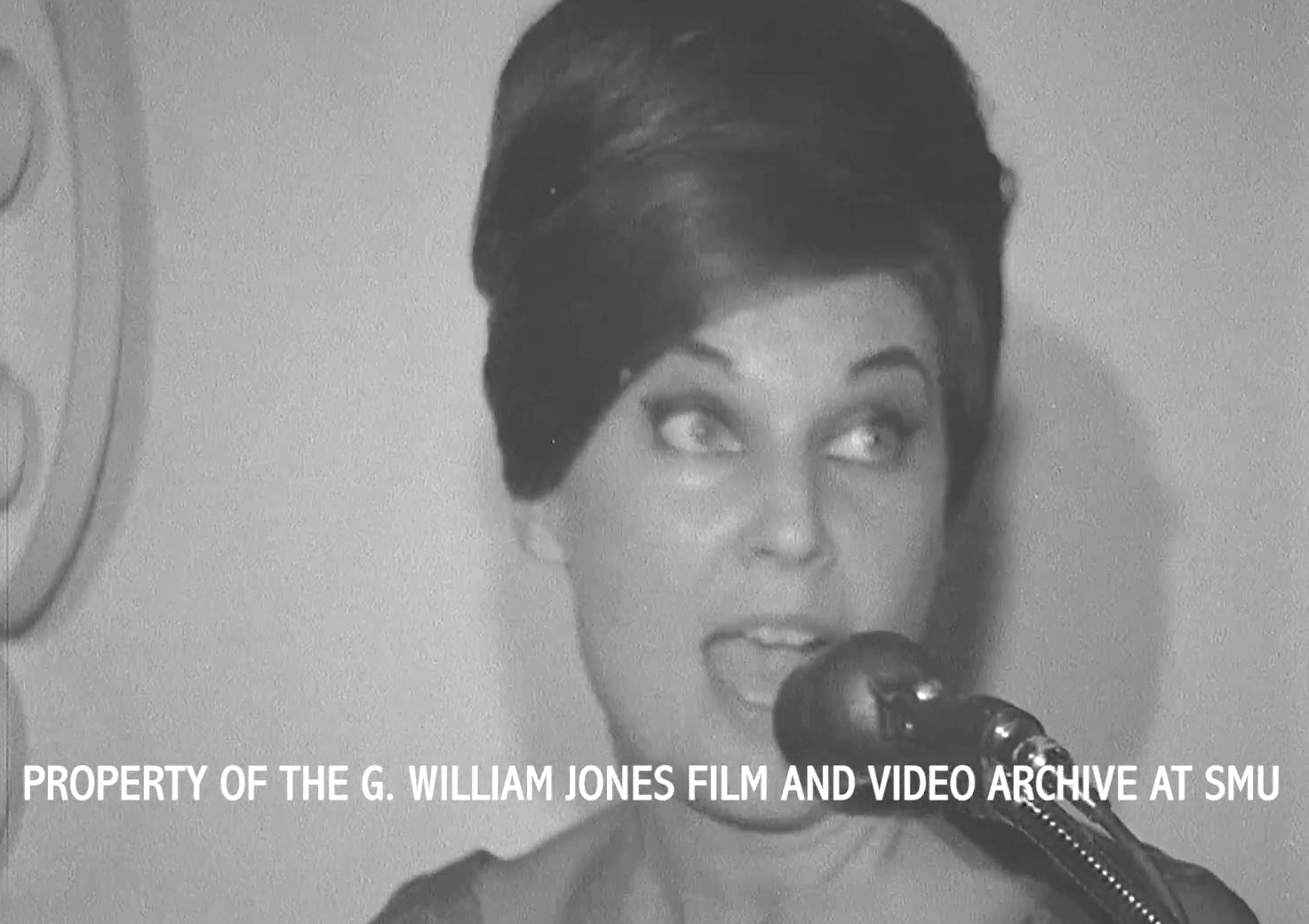
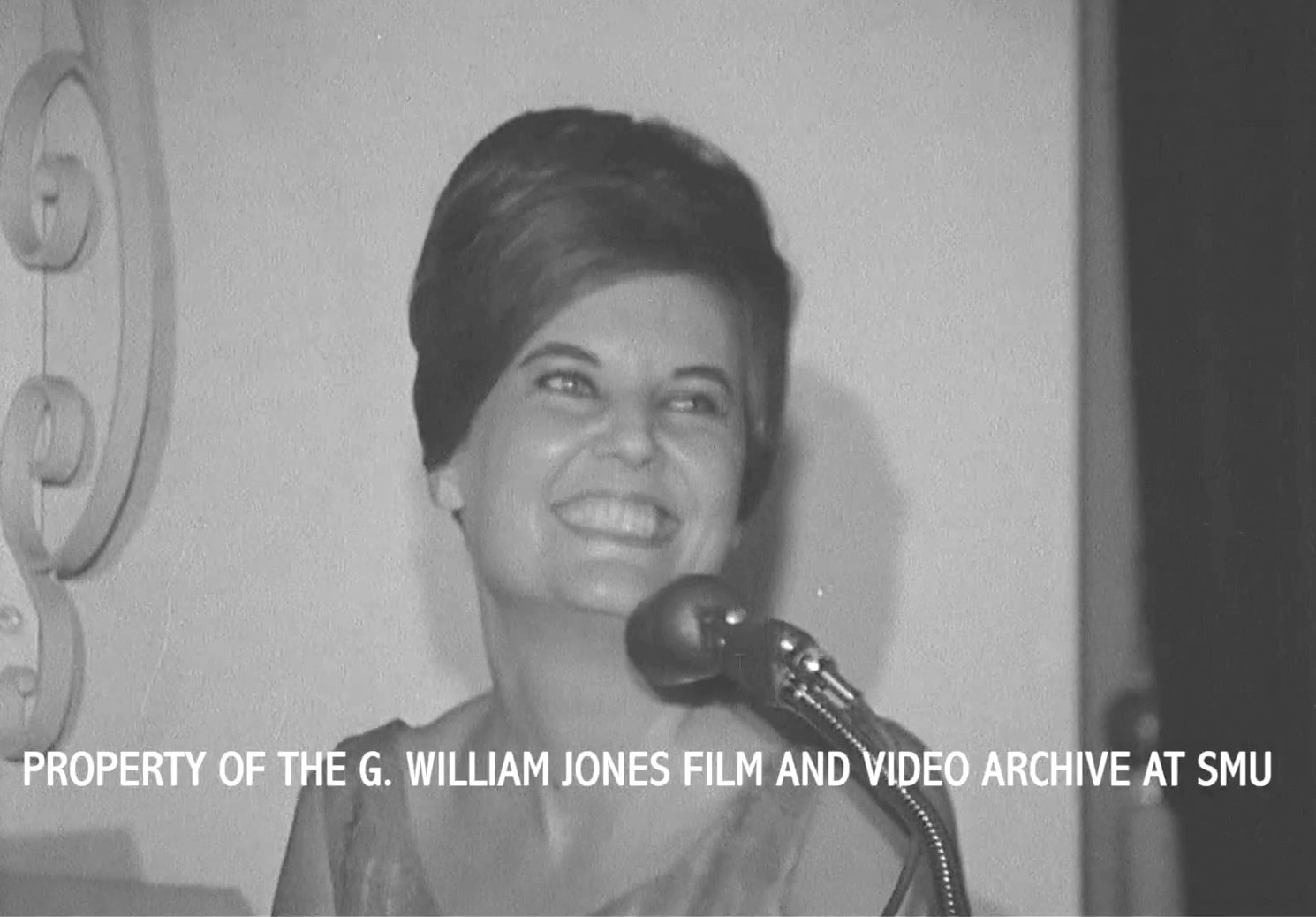
Flashback : Dallas

A Miscellany: History, Ads, Pop Culture

Category: 1960s

The Legendary Christmas Cards of Ann Richards and Betty McKool
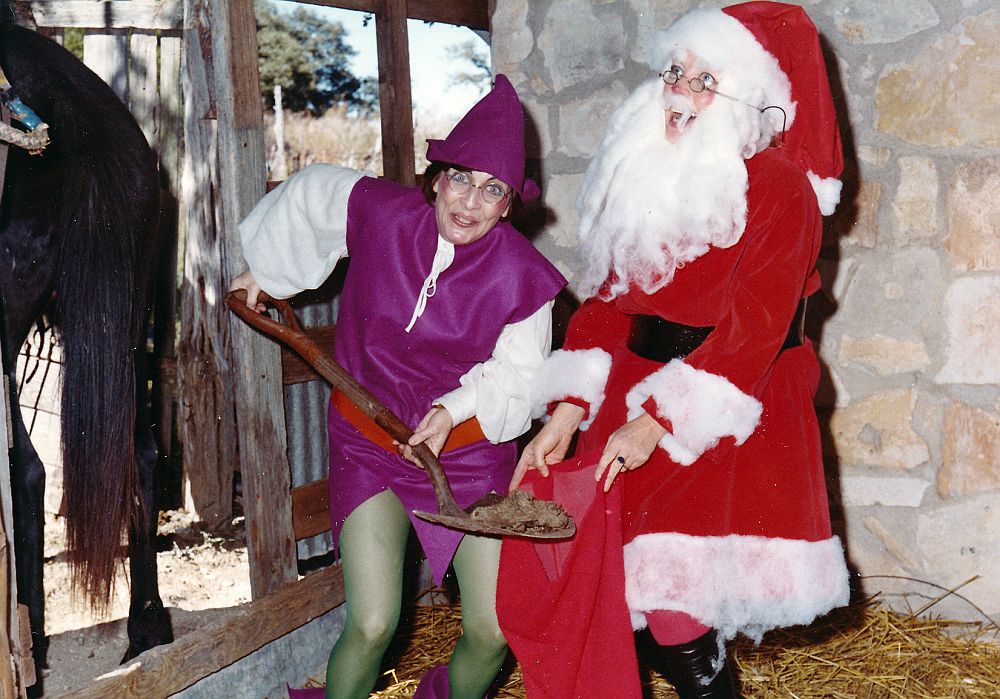
xmas_ann-richards_betty-mckool_1973_detFrom the personal collection of Mike McKool Jr., used with permission

by Paula Bosse

Ann Richards and Betty McKool were close friends in Dallas in the 1960s, sharing an offbeat sense of humor and a dedication to Democratic-party politics. They were founders of the North Dallas Democratic Women’s Club which was widely known for its revue of political humor and song parodies called “Political Paranoia” which Ann and Betty both performed in, wowing audiences with their larger-than-life charisma.

In the late ’60s, Ann and Betty — who loved dressing in ridiculous costumes and cracking each other up — began to issue satirical Christmas cards which featured photographs of themselves in outrageous situations accompanied by pithy captions and greetings, usually referencing a political hot-topic of the past year. The cards were sent out unsigned, and, as Ann Richards wrote in her autobiography Straight from Heart, not everyone knew who had sent them.

We mailed these to a lot of people, maybe a hundred, and we didn’t sign them. And we had such a good time thinking about people getting this weird card and trying to figure out who it could possibly be from, thinking maybe it was their wives’ relatives. Oh, we laughed about that. And we kept thinking of some guy opening it and drawling, “Mildred come here, look at this card we got in the mail.” No more than half our friends recognized us, maybe not that many.

Ann and Betty enjoyed doing the first card so much that they did it every year — it became something of an institution, and people on the Christmas card list waited expectantly each Christmas to get the latest crazy card. It was definitely a high point of the holiday season and the most anticipated Christmas card of the year. I certainly remember hearing about them throughout my childhood, as my parents were lucky enough to be on The List.

**

In her autobiography, Ann wrote that “our Christmas photo album lasted nine years” which is incorrect. After I wrote the post “‘Political Paranoia’ and the North Dallas Democratic Women’s Club, feat. Future Governor Ann Richards,” (which contains the newly unearthed film of “Political Paranoia II” from 1964 in which both Ann and Betty have standout performances), I received an email from Vicki Byers who is the Executive Assistant to Mike McKool Jr. (Betty’s son). That email contained scans of 12 of the Christmas cards from Mr. McKool’s personal collection! Wow! And he has allowed me to share these cards which have attained something of an almost mythic status — followers and fans of Gov. Richards have read about them, but not a lot of them have actually ever seen them. So thank you, Vicki, and thank you, Mike, for allowing access to this little treasure trove!

**

I’m not sure on the exact chronology of these cards. In her book, Ann writes about the “Temperance” card as being the first one that she and Betty did, but Mr. McKool has that card as being from 1976. It’s parodying a 1964 quote from Barry Goldwater, so it seems more likely to have been issued in the ’60s than in the ’70s — possibly in 1968. The cards were issued as late as 1983, and at some point the cards became posters. Ann moved from Dallas to Austin in 1969 or 1970, so she and Betty would have had to meet up during the year to plan and pose for their annual Christmas card, and from all accounts, the two women truly enjoyed creating the irreverent cards as much as people enjoyed receiving them. Here they are (all images are larger when clicked).

*

1969: “Merry Christmas… From the Silent Majority”
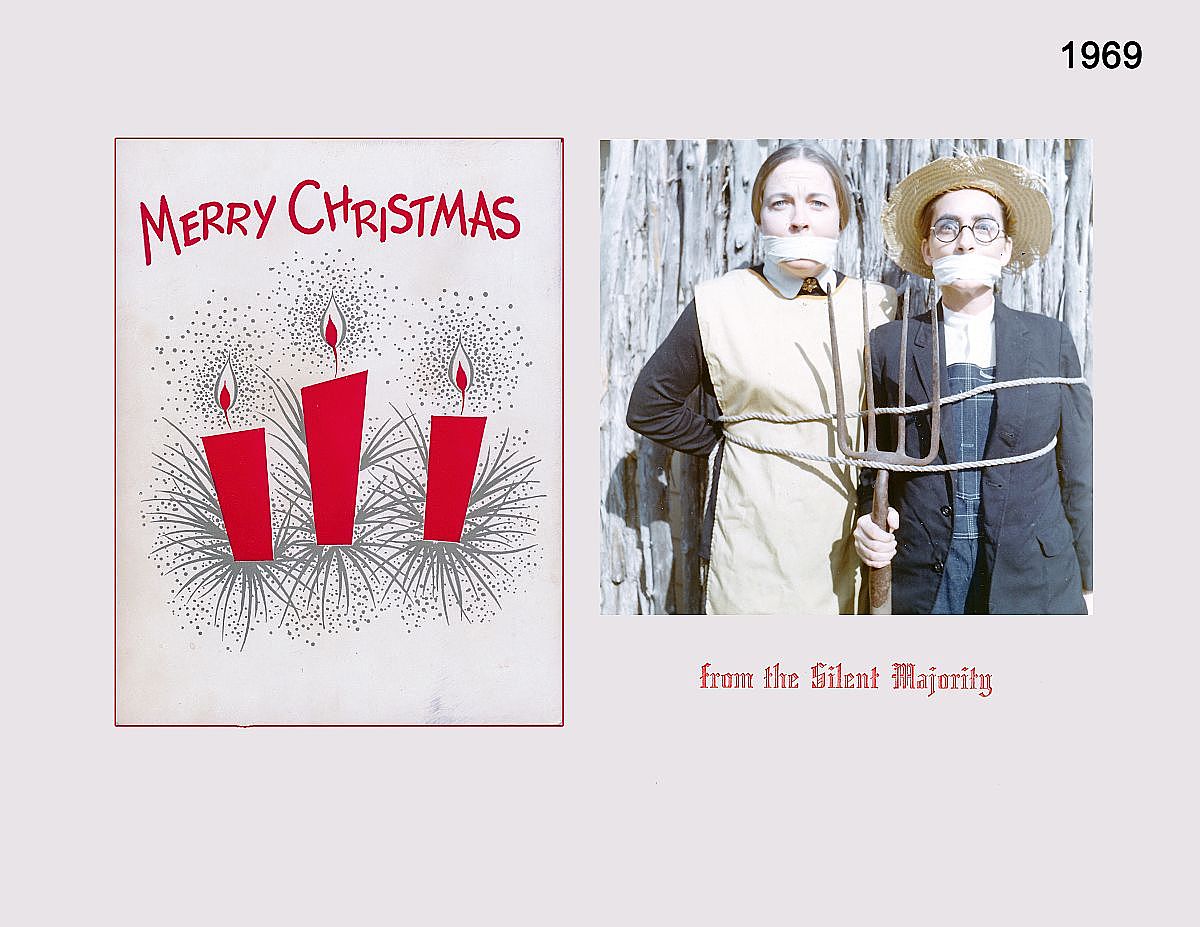
xmas_ann-richards_betty-mckool_1969

*

1970: “Wishing You Season’s Greetings from the Valley Forge Chapter of Women’s Liberation and a Gay Holiday… From the Boys in the Band”
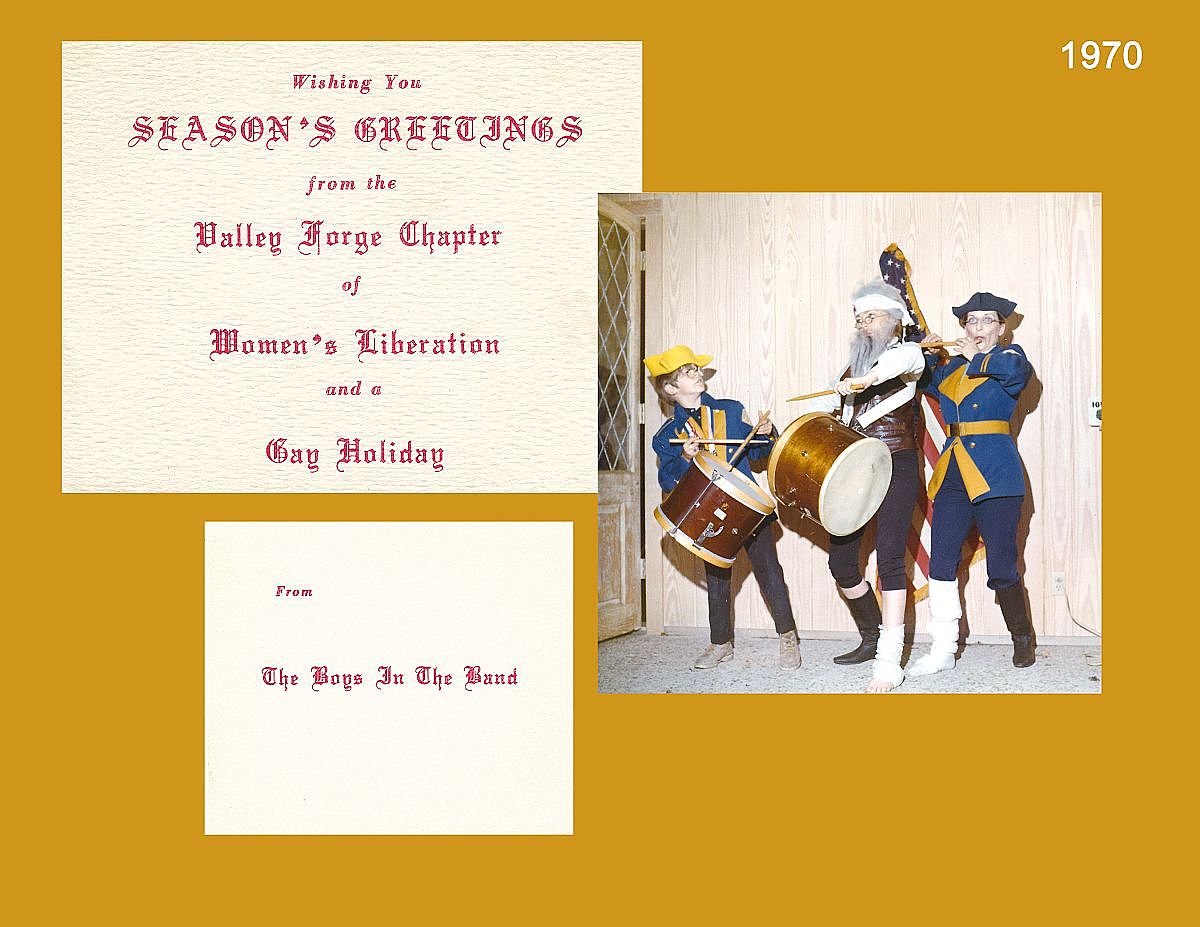
xmas_ann-richards_betty-mckool_1970

*

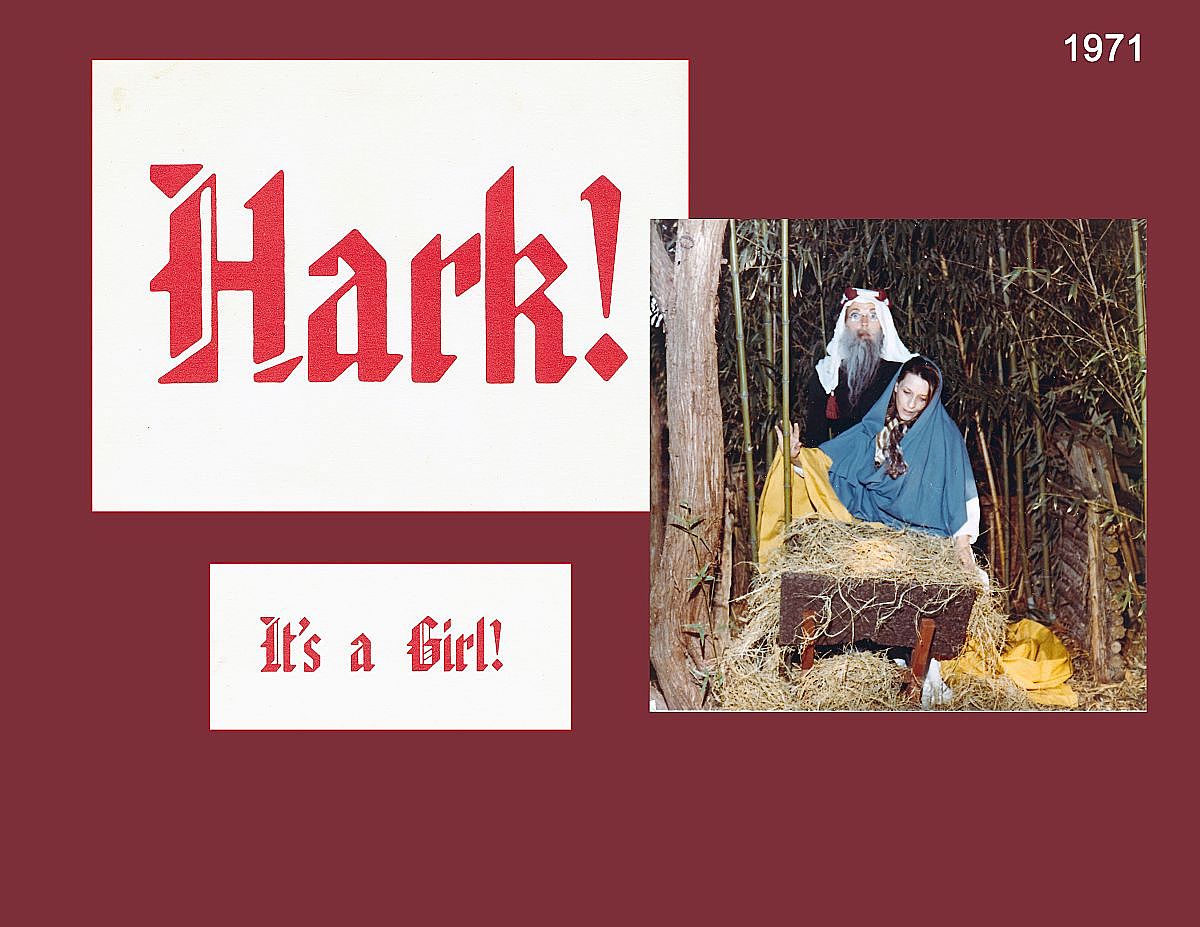
1971: “Hark!… It’s a Girl!”

xmas_ann-richards_betty-mckool_1971

*

1972: “Adoremus (Let Us Adore Him)… Four More Years”
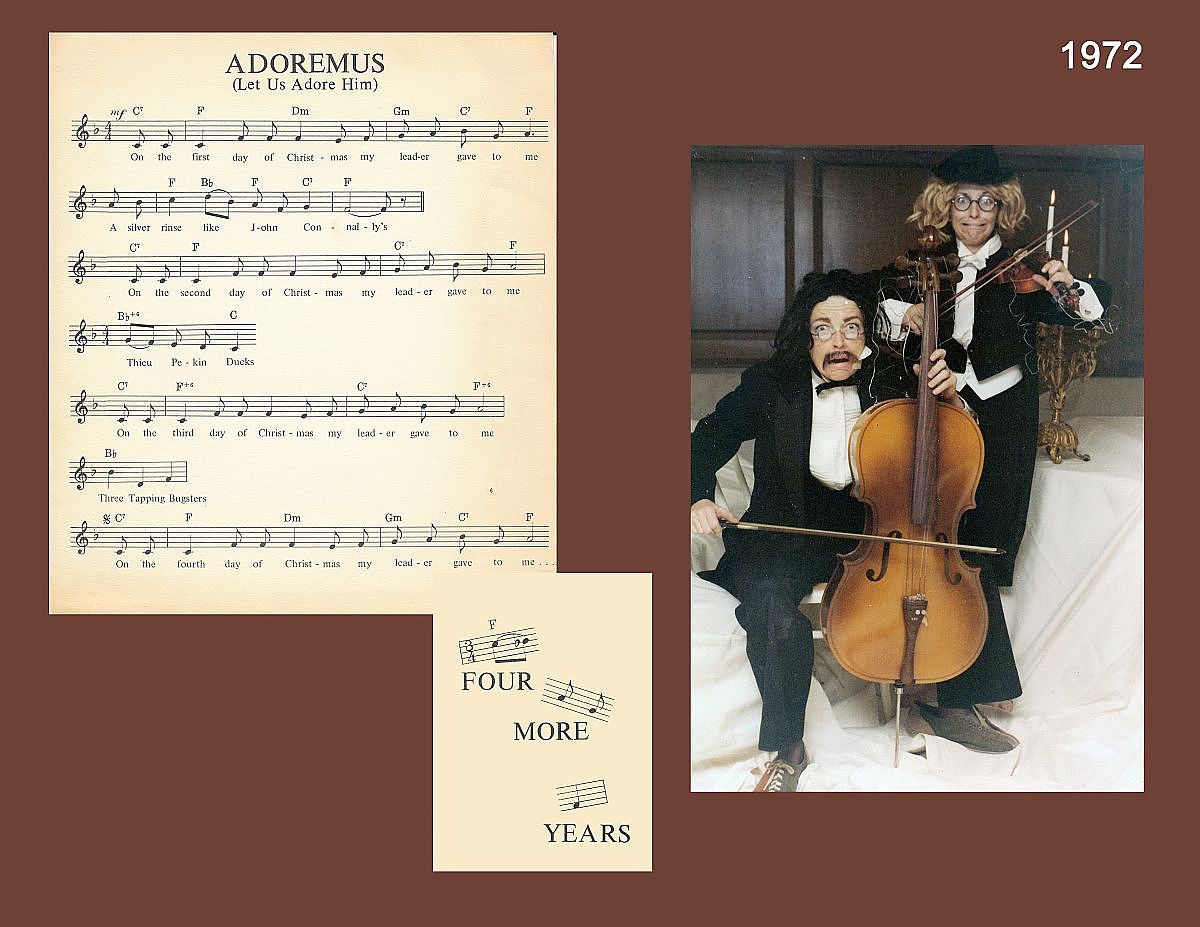
xmas_ann-richards_betty-mckool_1972

*

1973: “Let Me Make This Perfectly Clear… — You’re getting the same thing for Christmas that you’ve been getting all year!”
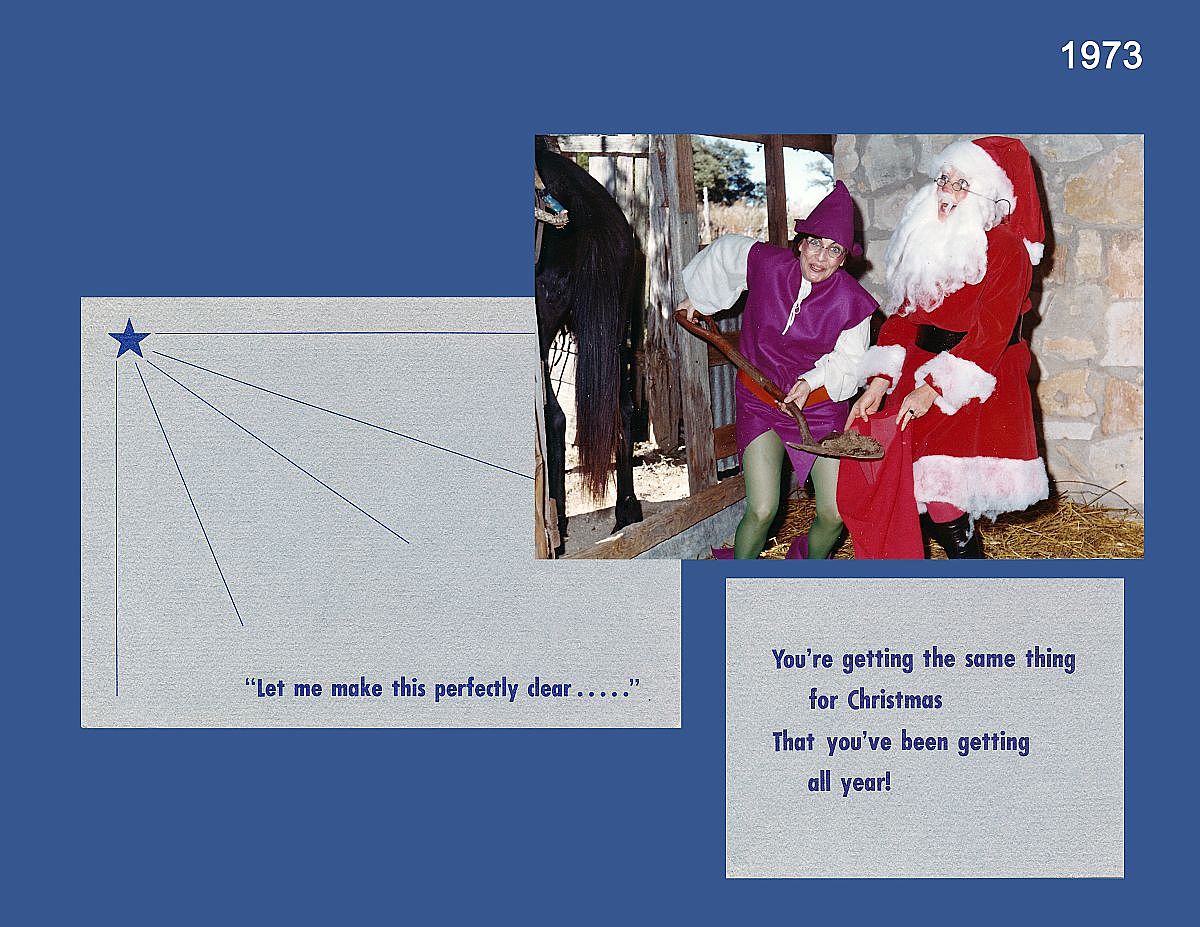
xmas_ann-richards_betty-mckool_1973

*

1974: “And it came to pass… — Wisepersons????”
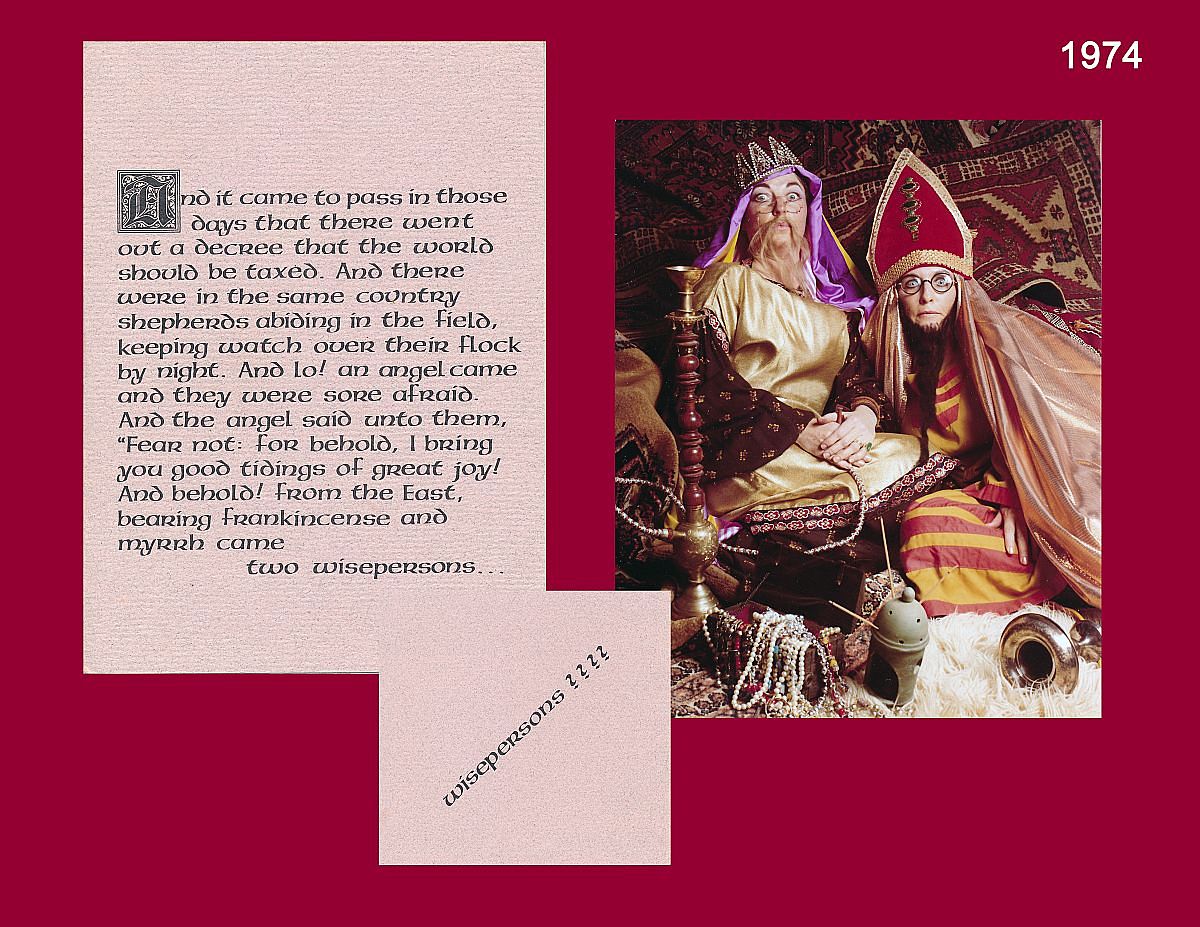
xmas_ann-richards_betty-mckool_1974

*

1976 [?]: “From Our House To Your House — A Very Merry Christmas and a Happy New Year… Extremism in the pursuit of a Merry Christmas is no sin.” (In her autobiography, Ann describes this “Temperance” card as being the first one she and Betty made — it’s possible this might be from 1968.)
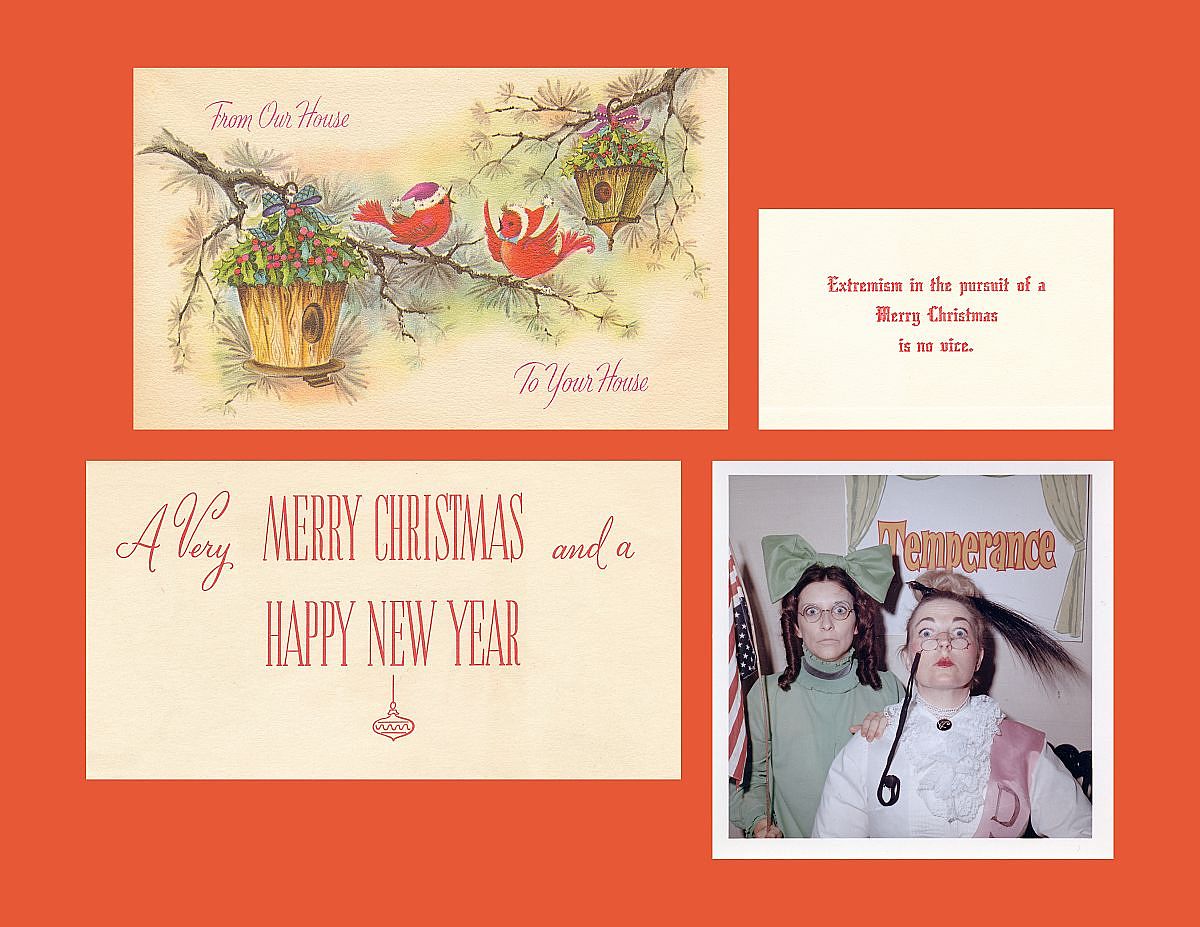
xmas_ann-richards_betty-mckool_1976

*

1977: ‘Twas the night before Christmas…When what to my wondering eyes should appear but… Bella Abzug!”
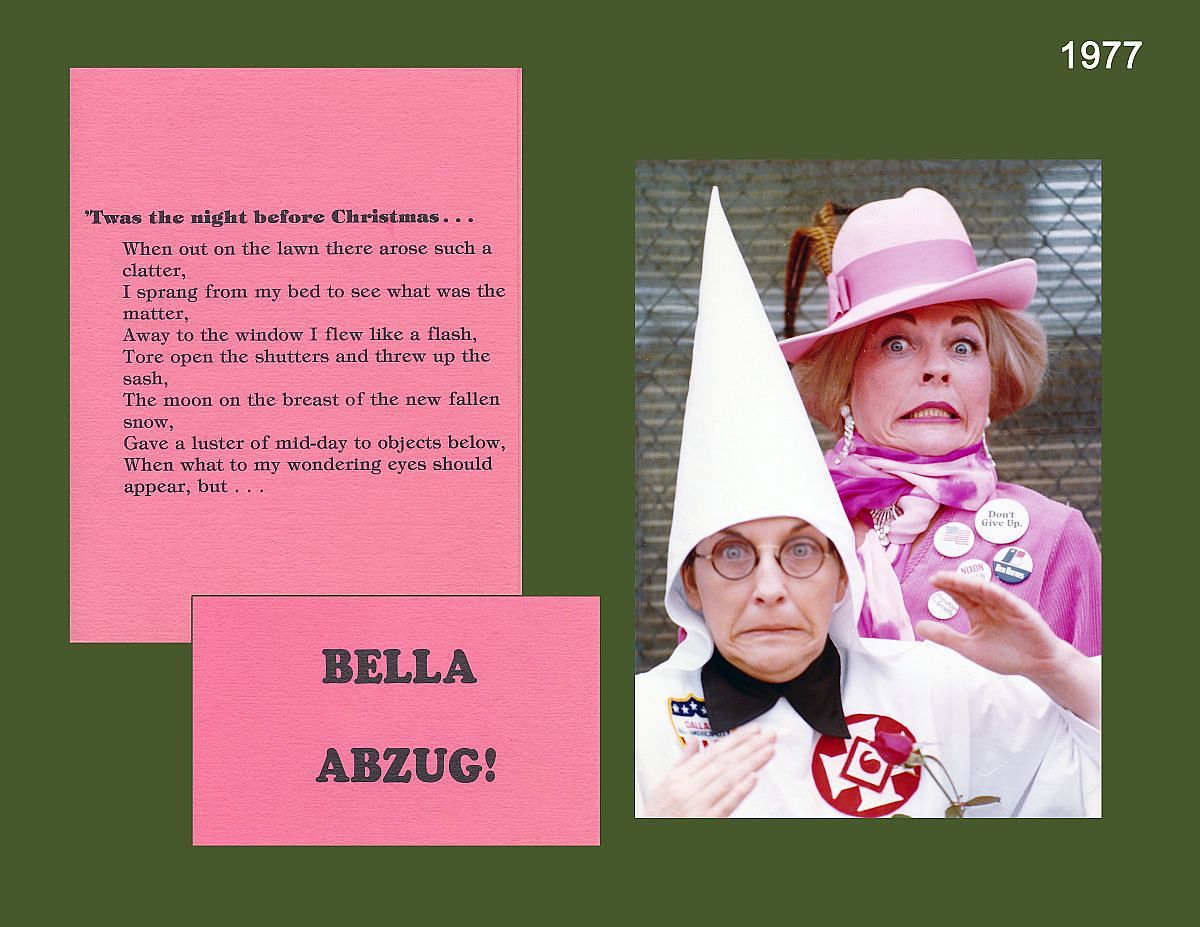
xmas_ann-richards_betty-mckool_1977

*

1978: “Good grief! …WHO CAN WE TURN TO FOR HELP?”
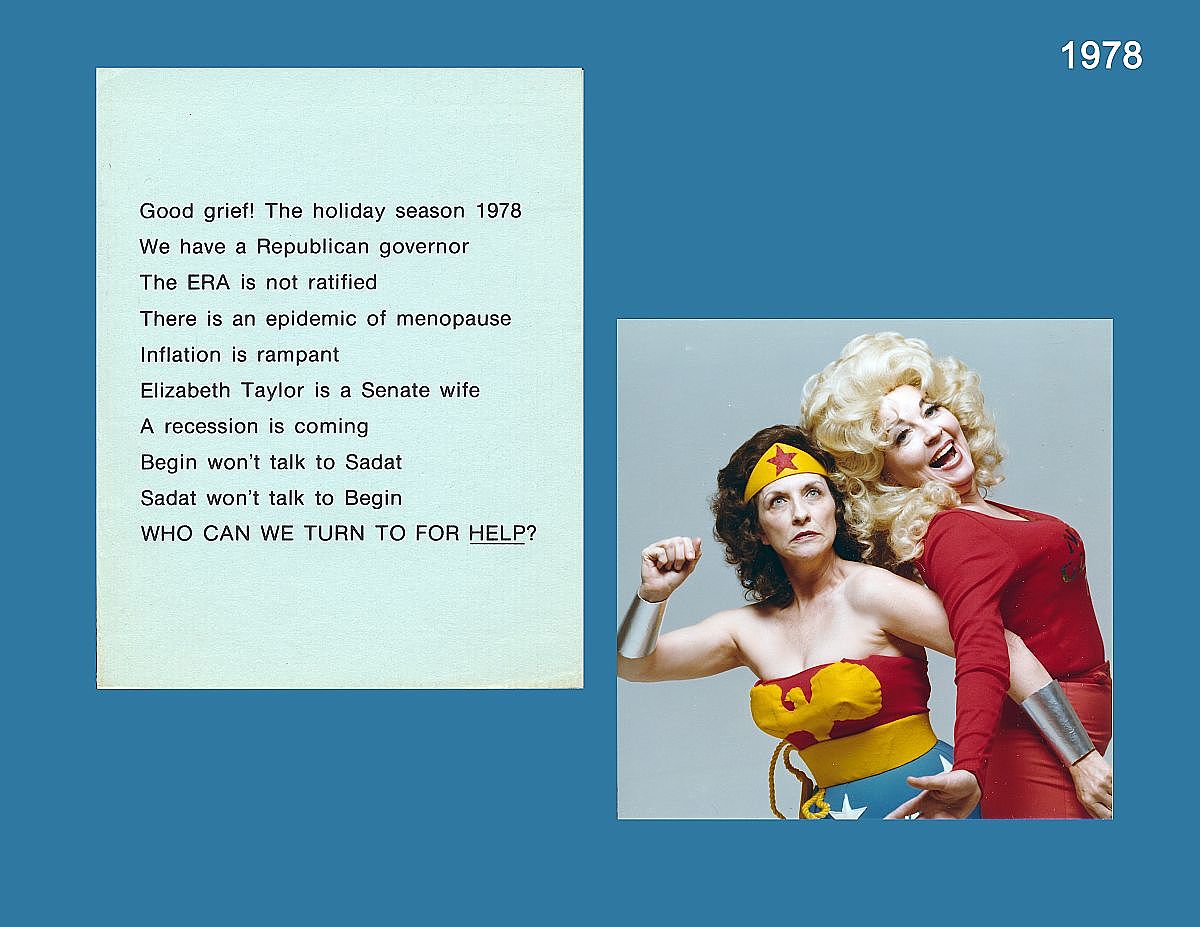
xmas_ann-richards_betty-mckool_1978

*

1979: “The honour of your presence is requested for Christmas Luncheon at The Governor’s Mansion”
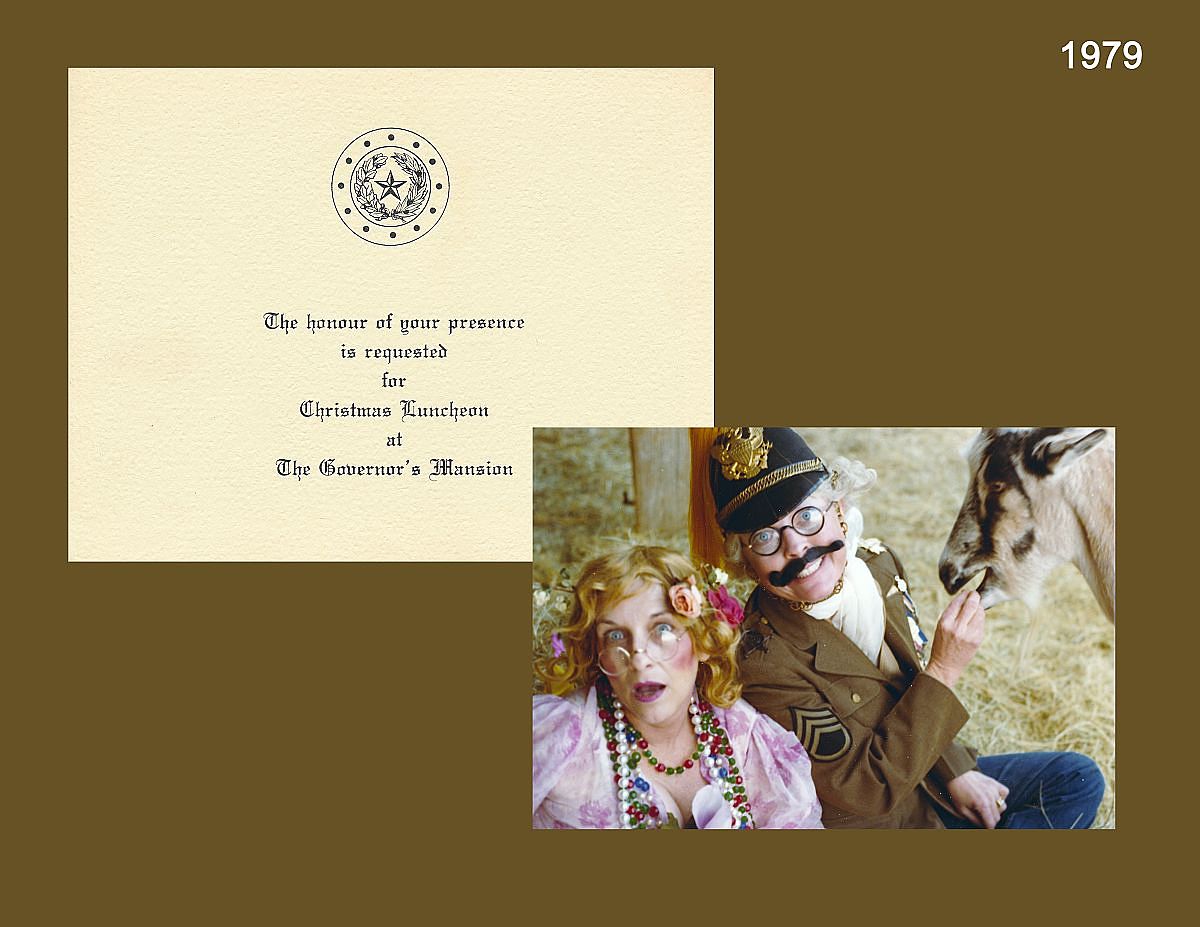
xmas_ann-richards_betty-mckool_1979

*

1980: “The White House Cookbook — Nancy Reagan’s All American Turkey”
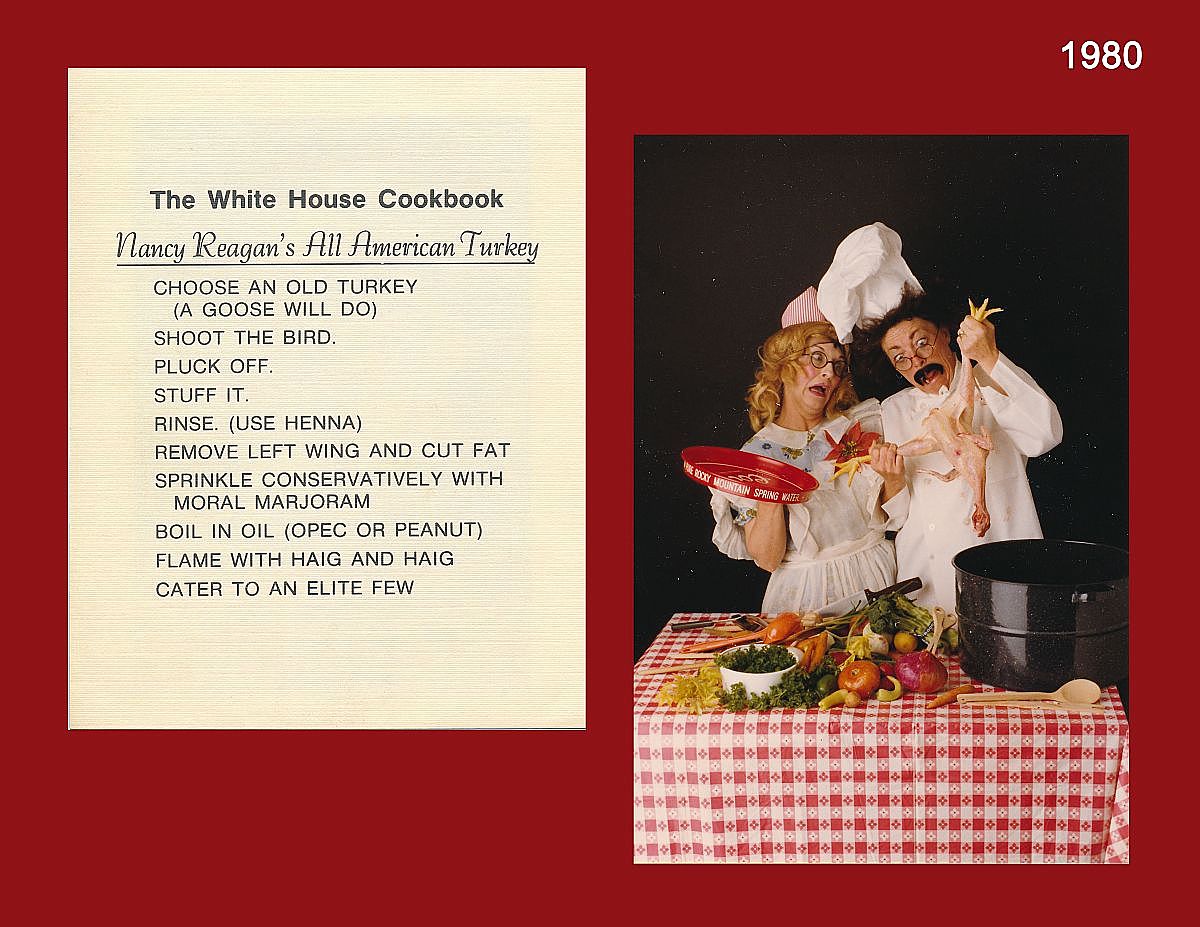
xmas_ann-richards_betty-mckool_1980

*

1981 [No image available, but in a mention in the Austin American-Statesman, Ann and Betty are described as being “dressed as old hoboes, looking aghast” in a “poster-sized card,” commenting on the theory of trickle-down economics]: “Behold, I Bring You Tidings of Great Joy… In other words, the rich get richer and we get trickled down on!”

*

1982: “The good new is We Won! — The bad news is… You got to dance with them that brung ya!”
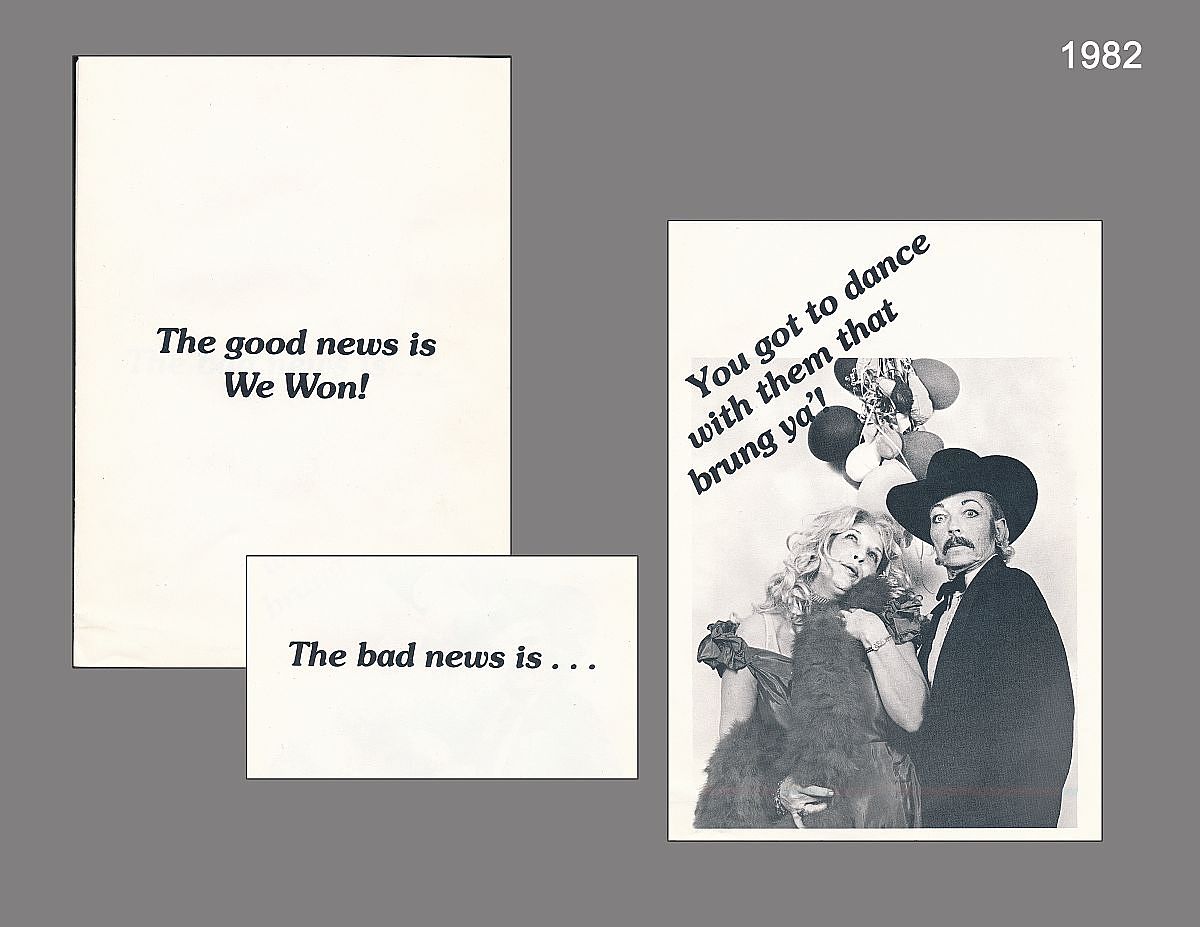
xmas_ann-richards_betty-mckool_1982

*

1983: “Dear Ronnie: I would have put the gender gap in your stocking but it was too big. Love, Mrs. Claus” (issued as a poster; from the collection of Frances Murrah, Betty’s sister)

xmas_ann-richards_betty-mckool_1983_nutcrackers_frances-murrah-collection_poster

*

There was also a card about which Ann wrote this: “Another year we donned cowboy hats and glittering western wear, and sent ‘Greetings from the Rhinestone Cow Chips.'” The Glen Campbell song “Rhinestone Cowboy” came out in 1975. The photo below appeared in Jan Reid’s book Let the People In: The Life and Times of Ann Richards, and I suspect it might have been sent out as the 1975 card.

xmas_ann-richards_betty-mckool_nd_ca-1975

*

And one other card was described by Ann in her book: “One of my favorites was when we hung a bunch of stuffed deer heads, like you see on the wall of a lodge, and cut holes where we could stick our heads through and put on these antlers. And the message was, ‘If you think I’m gonna pull that damned old sleigh one more year….'” (Could this perhaps have been issued in 1976?)

*

So that’s at least 16 Christmas cards (a few were posters) sent out by Ann Richards and Betty McKool. And people are still talking about them! (I would love to be able to add other Ann-and-Betty cards to this post — if you have scans of any of the missing cards/posters, or any additional information, please let me know!)

**

Dorothy Ann Willis Richards was born in McLennan County in 1933 and grew up in Waco. Here is a lovely photo of her from 1950, from the “Favorites” section of the Waco High School yearbook. She was in the class play and was a debate champion. She lived in Dallas for several years where she was very active in Democratic politics as an activist and volunteer; after moving to Austin she entered politics as an elected official and ultimately became Governor of Texas in 1991. She died in 2006.
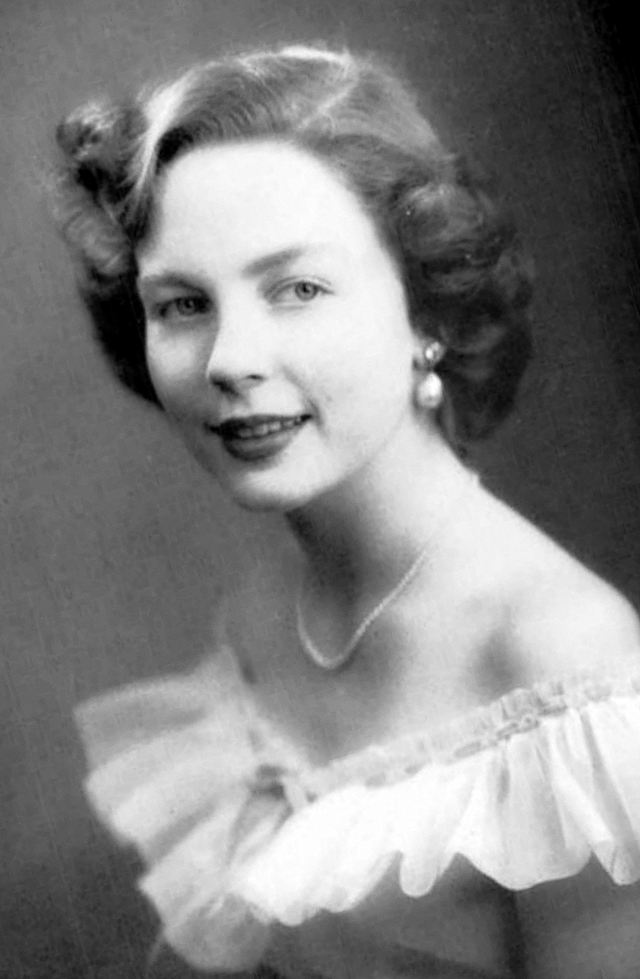
richards-ann_waco-high-school_1950_favoritesAnn, Waco High School, 1950

political-paranoia-2_1964_jones-collection_SMU_lbj_ann-richards-3
Ann as LBJ, “Political Paranoia,” Dallas, 1964

Elizabeth Ann “Betty” Raney McKool was born in Dallas in 1929. She attended Crozier Tech High School (below is a class photo from the 1946 yearbook) where she was a cheerleader. She married Mike McKool when she was only 16, and the two were extremely well known in political circles. Mike McKool, an attorney, served as a State Senator in Austin and was a Democratic Party leader in Dallas. Betty died in 2018 (read her obituary here). There is a fantastic interview with her from a 1971 “Legislative Wives” series in the Austin American-Statesman here.
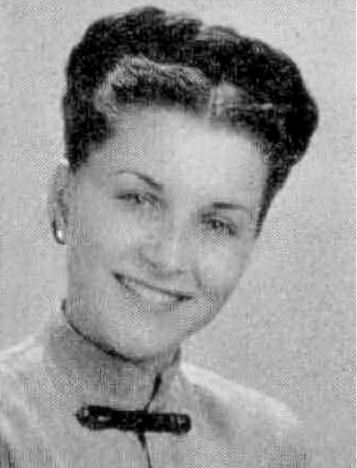
mckool-betty-raney_crozier-tech_1946Betty, Crozier Tech, 1946

political-paranoia-2_1964_jones-collection_SMU_rockefeller-2
Betty as Nelson Rockefeller, “Political Paranoia,” Dallas, 1964

*

On behalf of Ann Richards and Betty McKool, I wish you all a (bemused and slightly aghast) very Merry Christmas!

***

Sources & Notes

Thanks to Mike McKool Jr. and Vicki Byers for sending me the color images; these Christmas cards are from Mr. McKool’s personal collection, and I am grateful for his permission to share them here.

Also, many thanks to the family of Betty’s sister Frances Murrah, who allowed me to share the “Nutcracker” poster from 1983; Frances worked with Senator Lloyd Bentsen in Washington, DC for several years.

Quoted passages are from Chapter 7 of the book Straight from the Heart, My Life in Politics & Other Places by Ann Richards (Simon & Schuster, 1989). You can read these pages on Google Books here.

Screenshots are from the 1964 film “Political Paranoia II” from the G. William Jones Film and Video Archive, Hamon Library, Southern Methodist University; this film may be viewed on YouTube in its entirety here.

xmas_ann-richards_betty-mckool_1973_det_sm

*

Copyright © 2019 Paula Bosse. All Rights Reserved.
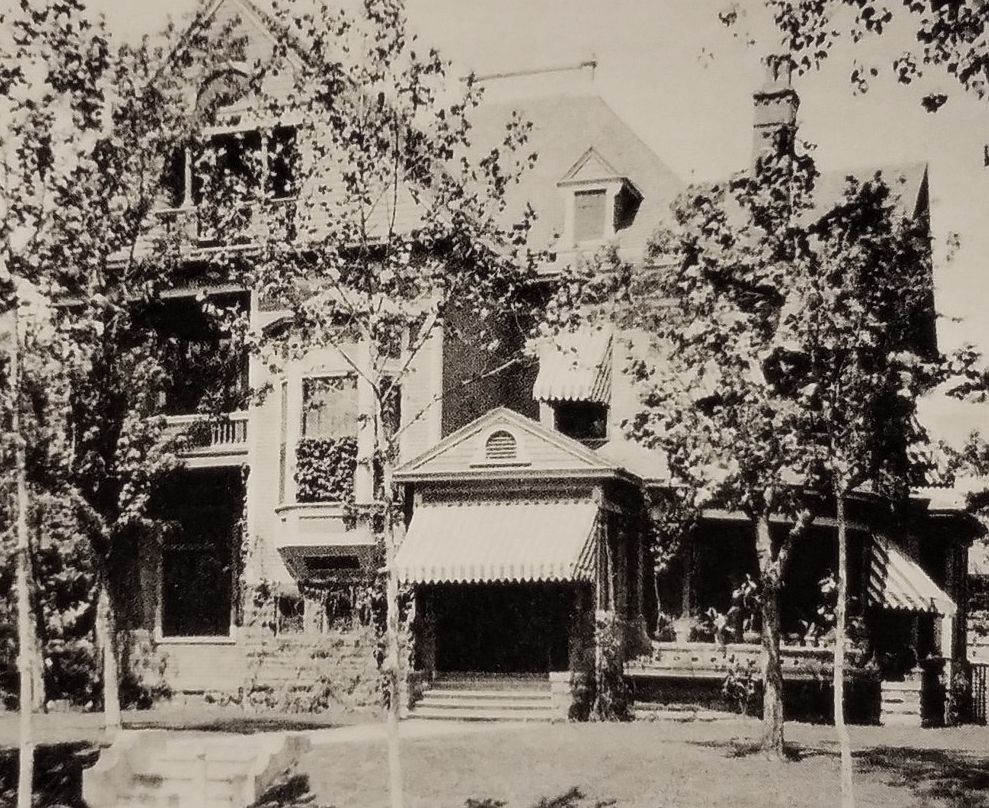
 

The Murphy House — Maple Avenue

murphy-house_ca-1910_dallas-rediscovered-DHS
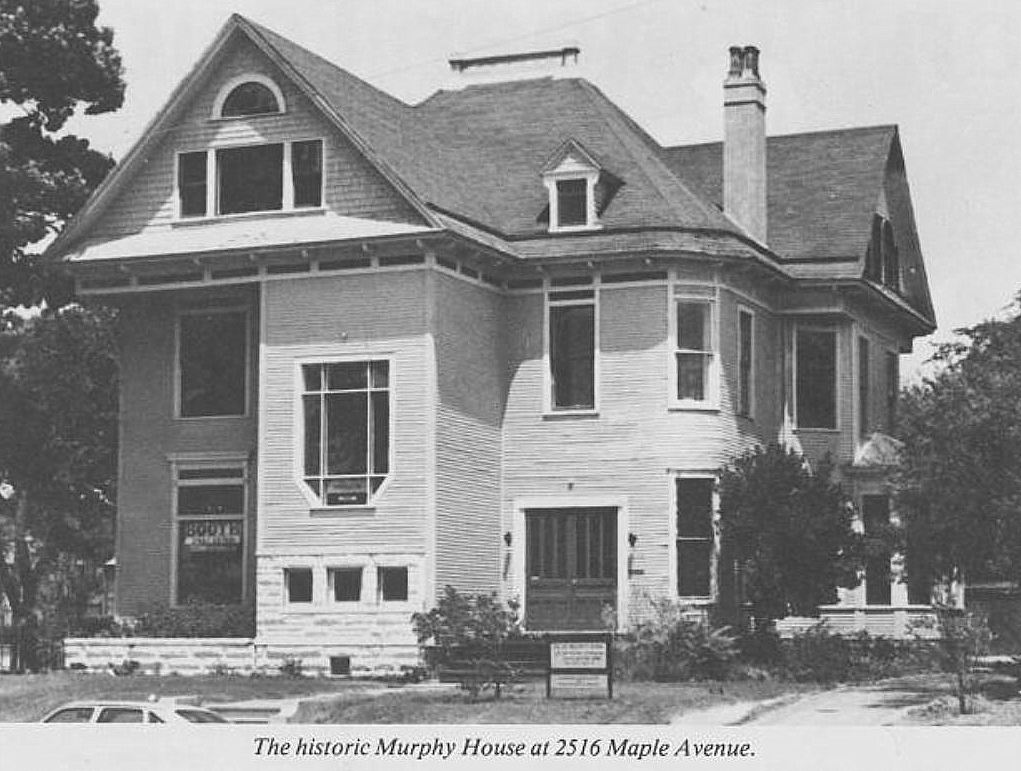
154 Maple Avenue (2516 Maple Avenue), circa 1910

by Paula Bosse

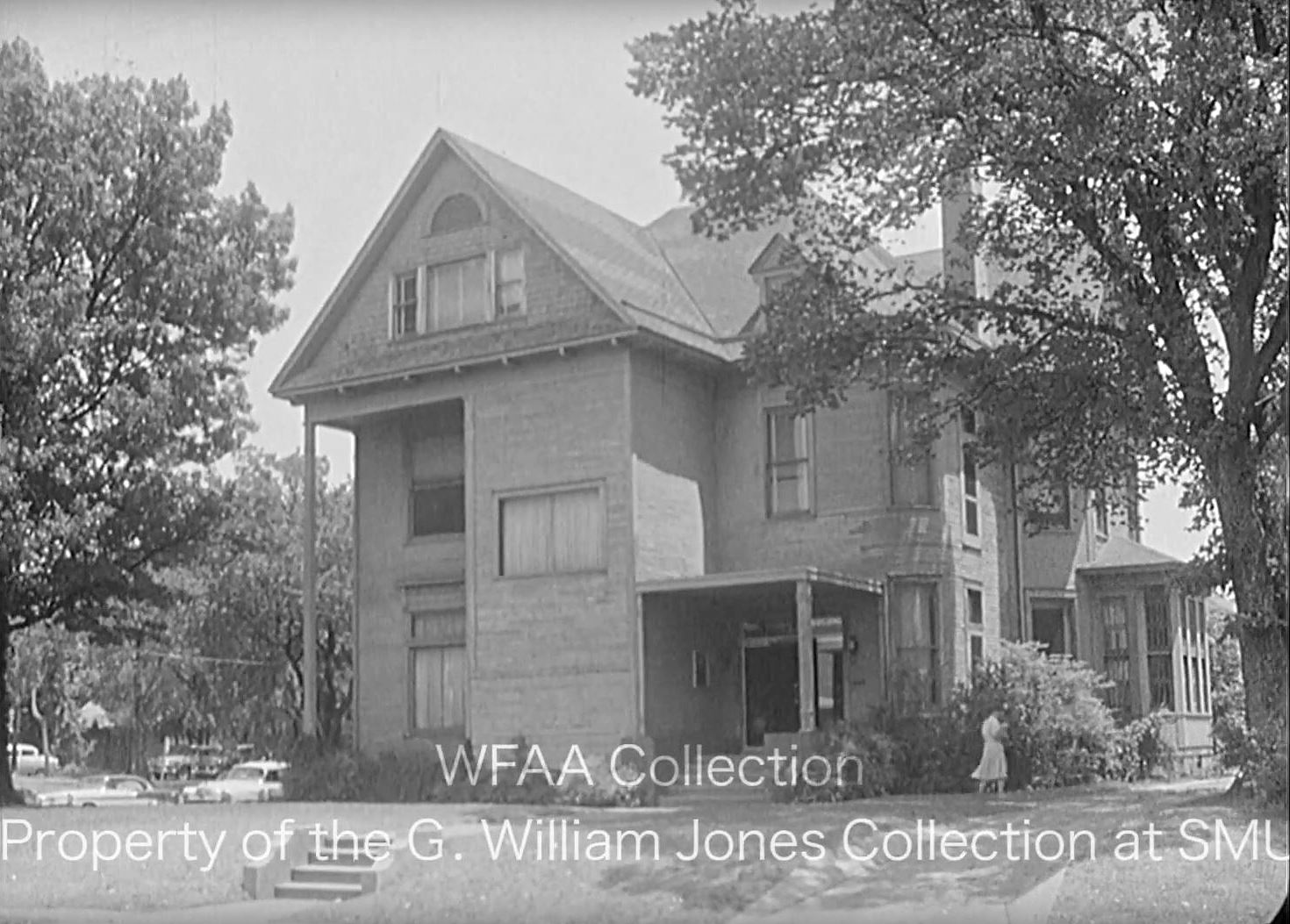
I posted a screenshot of a “mystery house” (here) to see if anyone could figure out where it was — and a few people identified it! The screenshot was from a June, 1960 WFAA Channel 8 news piece on an embezzlement case against the owner of the insurance business that was then occupying the old house — it was the home of the State National Life Insurance Company at 2516 Maple Avenue. And I don’t know what happened with its “remodeling” along the way, but… yikes. Someone did an unbelievably bad job!

According to a 1947 Dallas Morning News article (see “Sources & Notes” at bottom of page), the house was built in 1897. The address then was 154 Maple Avenue, back when Maple Avenue was lined with very nice homes, occupied by well-to-do families who would later move to Highland Park. You can see the house at the corner of Maple and Mahon (which for a while was called Martin) on the 1899 Sanborn map here, the 1905 map here, and the 1921 map here

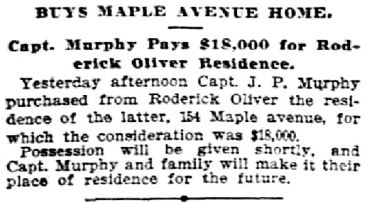
I’m not sure who built it, but in 1901 it was occupied by banker Roderick Oliver who sold it to Capt. John P. Murphy in 1906 for $18,000 — or $500,000 in today’s money. Murphy was the legendary pioneer real estate man of Dallas. He started his real estate company in 1874 and was joined by partner Charles F. Bolanz in 1884 — Murphy & Bolanz was the premier real estate company in the city for decades. 

murphy-house_dmn_051806Dallas Morning News, May 18, 1906

The house stayed in the Murphy family for many years. In 1947 the house was elaborately restored by three women (two of whom were Murphy’s daughters) who opened it as The Laurels, an elegant location for weddings and receptions. The house had been slated for sale and demolition, but the women thought that the old house would serve brides well, as “the highlight of any young girl’s life is her marriage, and few places in Dallas offer a suitable environment for such an occasion,” said one of the women (DMN, Oct. 5, 1947). The Laurels appears to have been in business only through the end of 1948 — about a year; a classified ad shows that it had become a boarding house “for young working people” soon after.

It seems to have been sold in the 1950s when it became home to various businesses. After the embezzlement interlude, it was, among other things, a theme club called The Haunted House in the 1960s, community radio station KCHU in the ’70s, and an antique shop in the ’80s.

Below is how it looked in June of 1960 as it was passing into receivership. A news story described it thusly: “…a big house that is a study in contradictions. Outside, flat green paint peels and cracks, gentility sliding headlong toward an ‘arty’ disrespectability” (“Old House on Maple Services Insurance Empire,” Dallas Morning News, June 9, 1960). It looked pretty sad.

mystery-house-1960
1960, G. William Jones Collection, SMU

In the mid-’70s, it became the headquarters of community radio station KCHU (90.0 FM). (Watch Channel 13 story on KCHU on YouTube here.)

kchu_murphy-house_KERA_dec-1975_screenshot1975, G. William Jones Collection, SMU

kchu-sign_kera_dec-1975_SMU

It was spiffed up a bit in the early ’80s for the antique shop, Booth Galleries, but it still looked weird, like someone had sheared off the sides of the house, removing any and all character.

murphy-house_2515-maple_historic-dallas-mag_fall-1980_portal_photo
1980, Historic Dallas, via Portal to Texas History

Then — saints preserve us! — the gods smiled down and Claire Heymann bought the decrepit old house (which was waiting for its all-but-inevitable date with the wrecking ball) and worked absolute miracles to transform the house into the stunningly beautiful Hotel St. Germain, located across from the Crescent. This is one instance where a restoration/renovation actually improves on the original! I’ve loved this redone building — Dallas’ first bed and breakfast inn — since it first appeared in 1991. Long may it stand. Thank you, Claire!

hotel-st-germain_google_2017
2018, Google Street View

hotel-st-germain_google-street-view_2019
2019, Google Street View

***

Sources & Notes

Top photo showing the home of John P. Murphy, circa 1910, is from Dallas Rediscovered by William McDonald, with photo credited to the Dallas Historical Society.

The Dallas Morning News article “Early Dallas Home Restored for Weddings” (DMN, Oct. 5, 1947) states that the house was built in 1897. “The Laurels” was opened by Murphy’s daughters Mrs. Louise Boyce Sanford and Mrs. Eugene P. Locke in partnership with Mrs. Dorothy Doran Walker.

murphy-house_ca-1910_dallas-rediscovered-DHS_sm

*

Copyright © 2019 Paula Bosse. All Rights Reserved.
Mystery House

mystery-house-1960

by Paula Bosse

I’m doing some work on the G. William Jones Collection’s WFAA-Ch. 8 News archive at SMU. Yesterday this image of an old house popped up in a news story, and I had to look it up, because I thought I should know what it was — or at least where it was. Turns out I was pretty familiar with the building, but I would not have guessed it from this screenshot. Click to see a larger image.

I’ve never done a quiz before, but why not? Sadly there are no prizes, it’s just for fun.

Can anyone identify this building?

Clue #1: The image above shows it in 1960.

Clue #2: It is still standing.

***

Sources & Info

Screenshot from the WFAA Newsfilm collection in the G. William Jones archive at SMU’s Hamon Library. Old WFAA clips are being uploaded constantly (and I mean CONSTANTLY!) on the Jones Film YouTube channel here. (The clip including this image has not been uploaded yet.)

*

Copyright © 2019 Paula Bosse. All Rights Reserved.

“Political Paranoia” and the North Dallas Democratic Women’s Club, feat. Future Governor Ann Richards

political-paranoia-2_1964_jones-collection_SMU_cast

by Paula Bosse

Ann Richards drove my carpool. She and my mother swapped out driving kids to the First Unitarian Church Cooperative Preschool on Preston and Normandy in University Park. I’m not sure anyone in either family was an actual member of the church, but that preschool was one of the only co-ops in Dallas (it might have been the first), and it was a magnet for the more progressive parents in the city. The Unitarian Church was also a major gathering place in the 1960s and 1970s for those involved in women’s issues, liberal activism, and Democratic politics, including my mother and the future governor of Texas, Ann Richards. I remember hearing about Ann (she was always referred to as just “Ann”) throughout my entire childhood. My parents weren’t close friends with the slightly older Richardses, but my mother was a keen admirer of Ann and my father described her as “the funniest woman I’ve ever known.” I remember their home on Lovers Lane which always seemed to be crammed full of kids.

When Ann Richards lived in Dallas she was a self-described “housewife,” who, when she wasn’t busy raising her four children, was volunteering for Democratic candidates and causes. She was an active member of the North Dallas Democratic Women’s Club, a group which, in 1963, gained instant attention for the fundraiser show they wrote and performed called “Political Paranoia,” a satirical revue of politics, complete with sharp satire, broad comedy, song parodies, and ridiculous wigs and costumes. The show was such a huge success that follow-up standing-room-only shows were performed in 1964, 1965, 1966, and 1968. The shows were written and directed by Carolyn Choate, Ruthe Winegarten, and Ann Richards, and the cast consisted of the members of the NDDW. Ann’s portrayal of LBJ seems to have made lasting impressions on those who saw it.

I have recently begun working on a project for the G. William Jones Film and Video Archive at SMU, and a reel of 16mm black-and-white film — with sound! — was discovered in the vault recently with no identifying information. Nothing. Nobody knows where it came from or how it ended up at SMU. But there it was: a lightly edited filmed document of the second installment of “Political Paranoia,” presented by the North Dallas Democratic Women in the auditorium of Hillcrest High School on May 16, 1964. I was sure Ann Richards would be in there somewhere — and she was! I was pretty excited by this “discovery” because this show has become something of a legendary touchstone in local Democratic politics. As far as I know, there is no other film footage of any of these shows. Not only that, this may well be the earliest footage of Ann Richards, the woman who would go on to become the governor of Texas (1991-1995) and one of the most celebrated women in politics and Texas culture. This is an amazing heretofore unknown historical document.

The show is full of smart sarcasm and “hey-kids-let’s-put-on-a-show” enthusiasm. The humor is more amusing than cutting, and these Democratic women were certainly not afraid of making fun of members of their own party. A lot of the hot topics of the day addressed in this show are lost to the mists of time, but that doesn’t take away from its entertainment value. This was a time when women had very little voice, impact, or power in politics, and the women here have firmly taken control of the reins and perform with an exuberance that crackles. 

The 34-minute film — complete with odd jumps and abrupt cuts — has been uploaded by SMU in its entirety here:

*

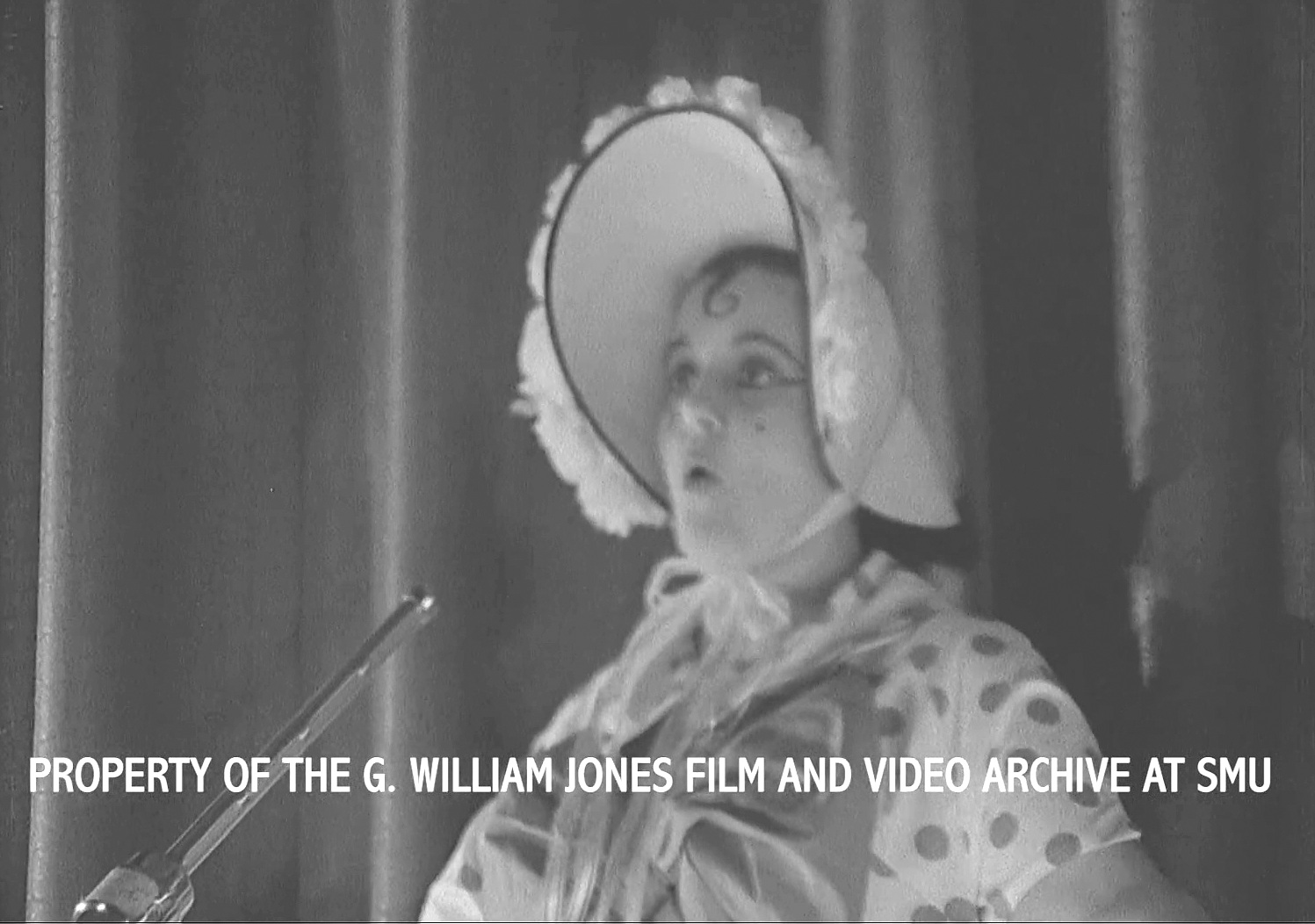
Here are a bunch of screenshots. I don’t know who all of the performers are — I would love feedback and corrections from the public. At the bottom is a list of names of women who were involved with the NDDW, but as they were invariably identified as “Mrs. Husband’s Name,” I have no idea what most of their first names are! I am especially interested in identifying Ruthe Winegarten, one of the prime movers behind these shows (and also a Texas and women’s historian of note).

First, 30-year-old Ann Richards (or as she was identified in newspaper accounts, “Mrs. David Richards”) appearing as Gordon McLendon, Dallas media magnate, owner of KLIF, and one-time wannabe politician — “The Old Scotchman.” That voice is unmistakable.

political-paranoia-2_1964_jones-collection_SMU_mclendon_ann-richards-1

political-paranoia-2_1964_jones-collection_SMU_mclendon_ann-richards-2

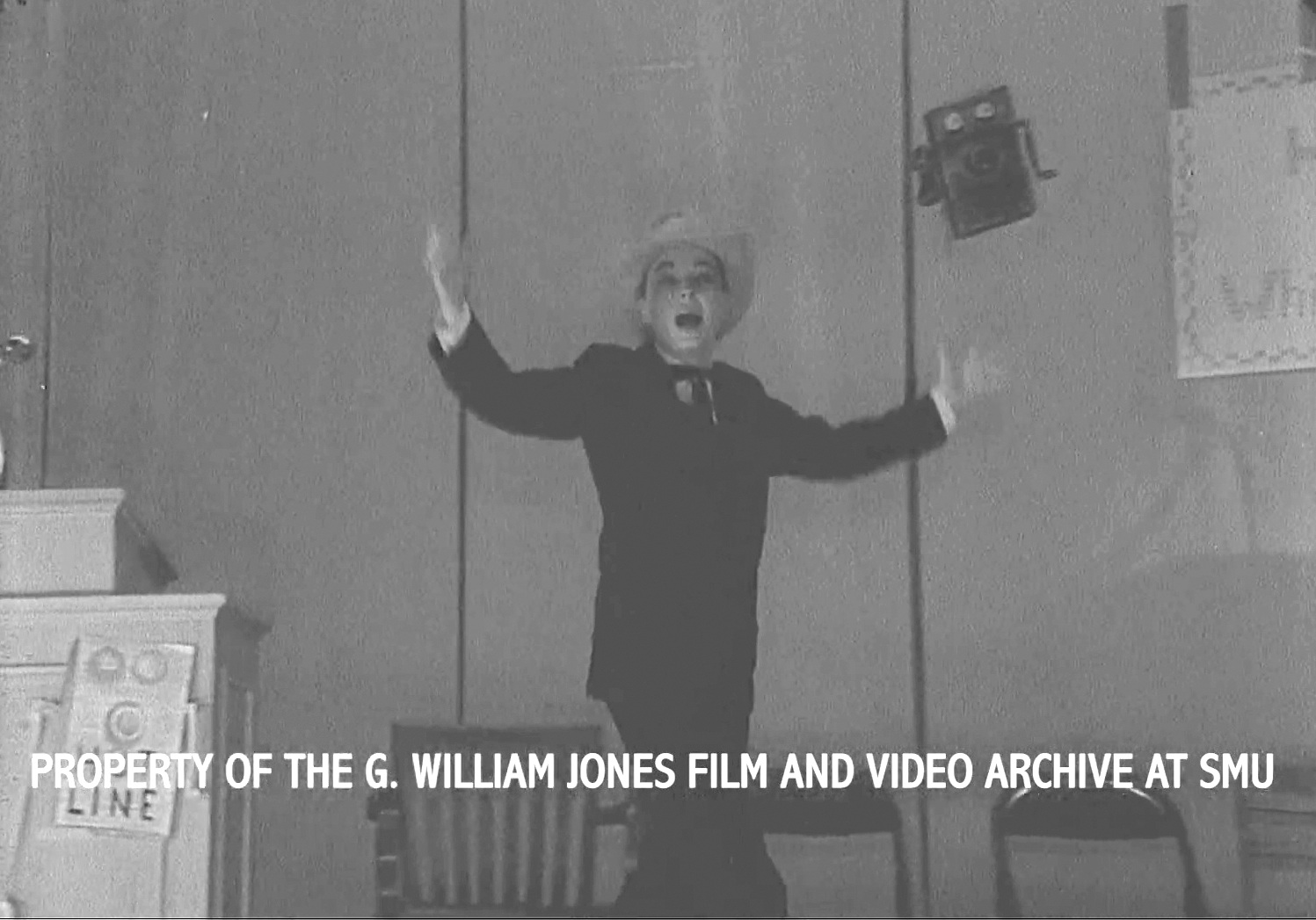
And here she is as LBJ:

political-paranoia-2_1964_jones-collection_SMU_lbj_ann-richards-1

political-paranoia-2_1964_jones-collection_SMU_lbj_ann-richards-2

political-paranoia-2_1964_jones-collection_SMU_lbj_ann-richards-3

political-paranoia-2_1964_jones-collection_SMU_lbj_ann-richards-4

political-paranoia-2_1964_jones-collection_SMU_lbj_ann-richards-5

political-paranoia-2_1964_jones-collection_SMU_lbj_ann-richards-6
Carolyn Choate, one of the writers and directors of “Political Paranoia,” wrote the music and performed many of the song parodies (she was also a contributor to the annual Dallas Press Club Gridiron Show).

political-paranoia-2_1964_jones-collection_SMU_carolyn-choate-1

political-paranoia-2_1964_jones-collection_SMU_carolyn-choate-2

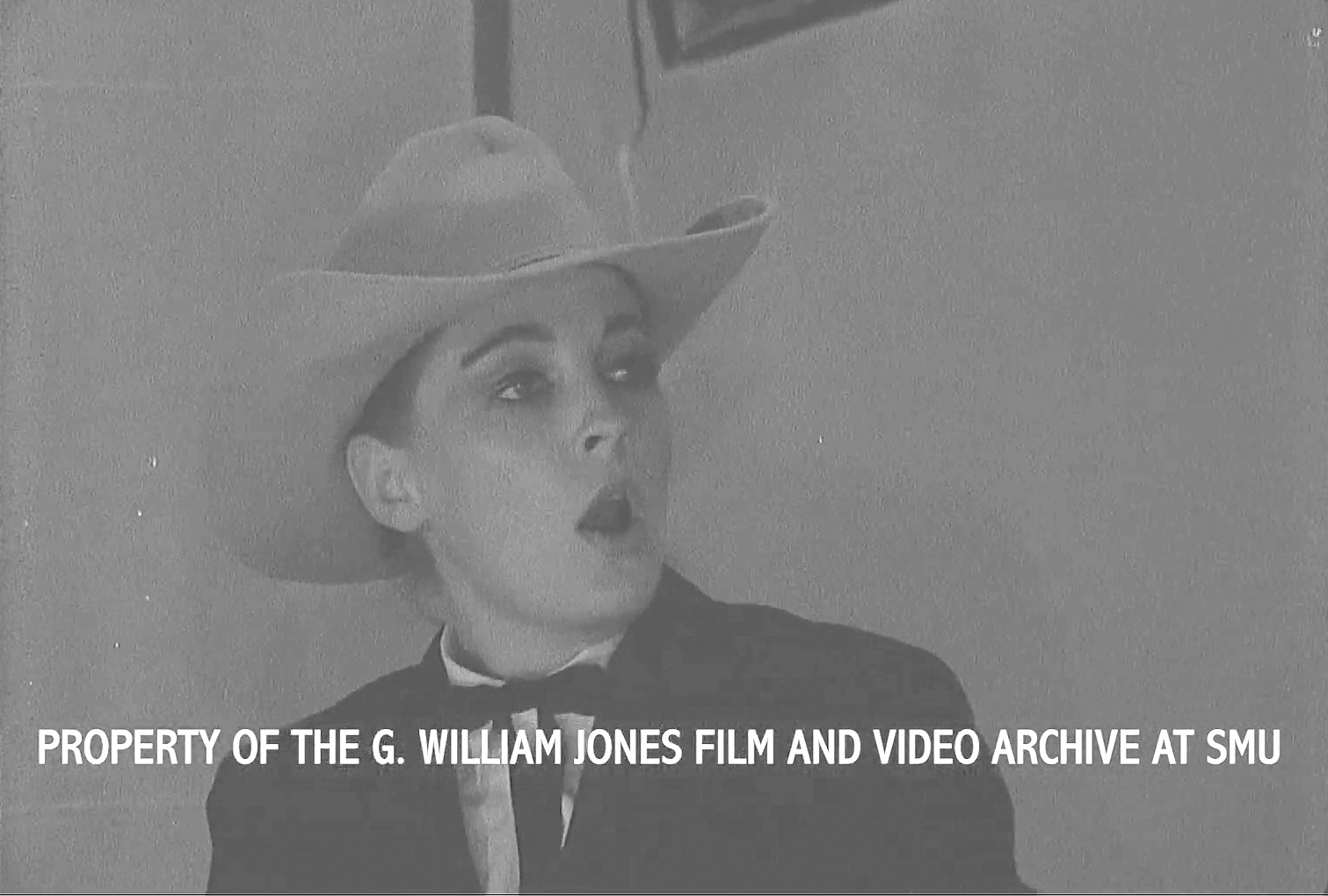
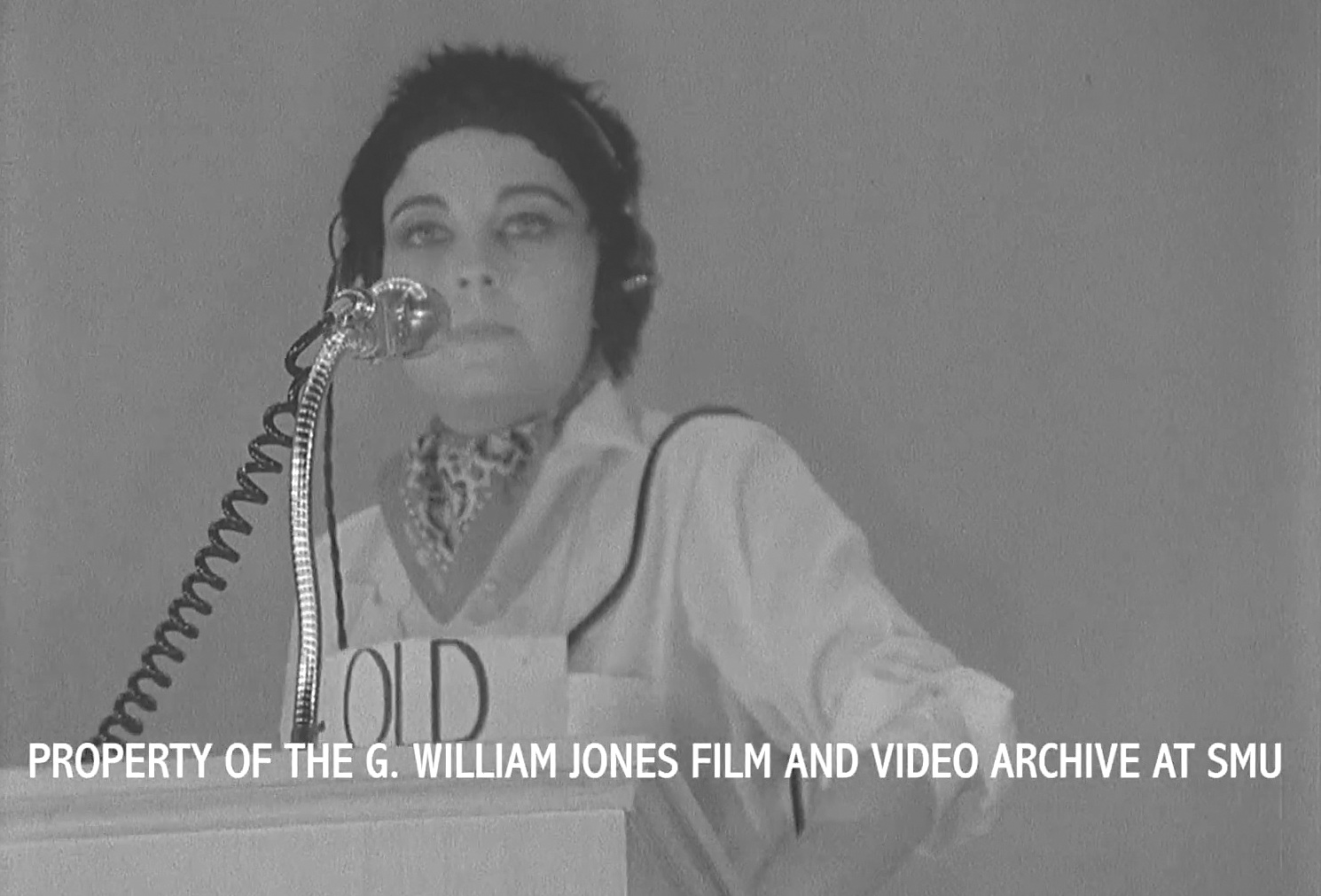
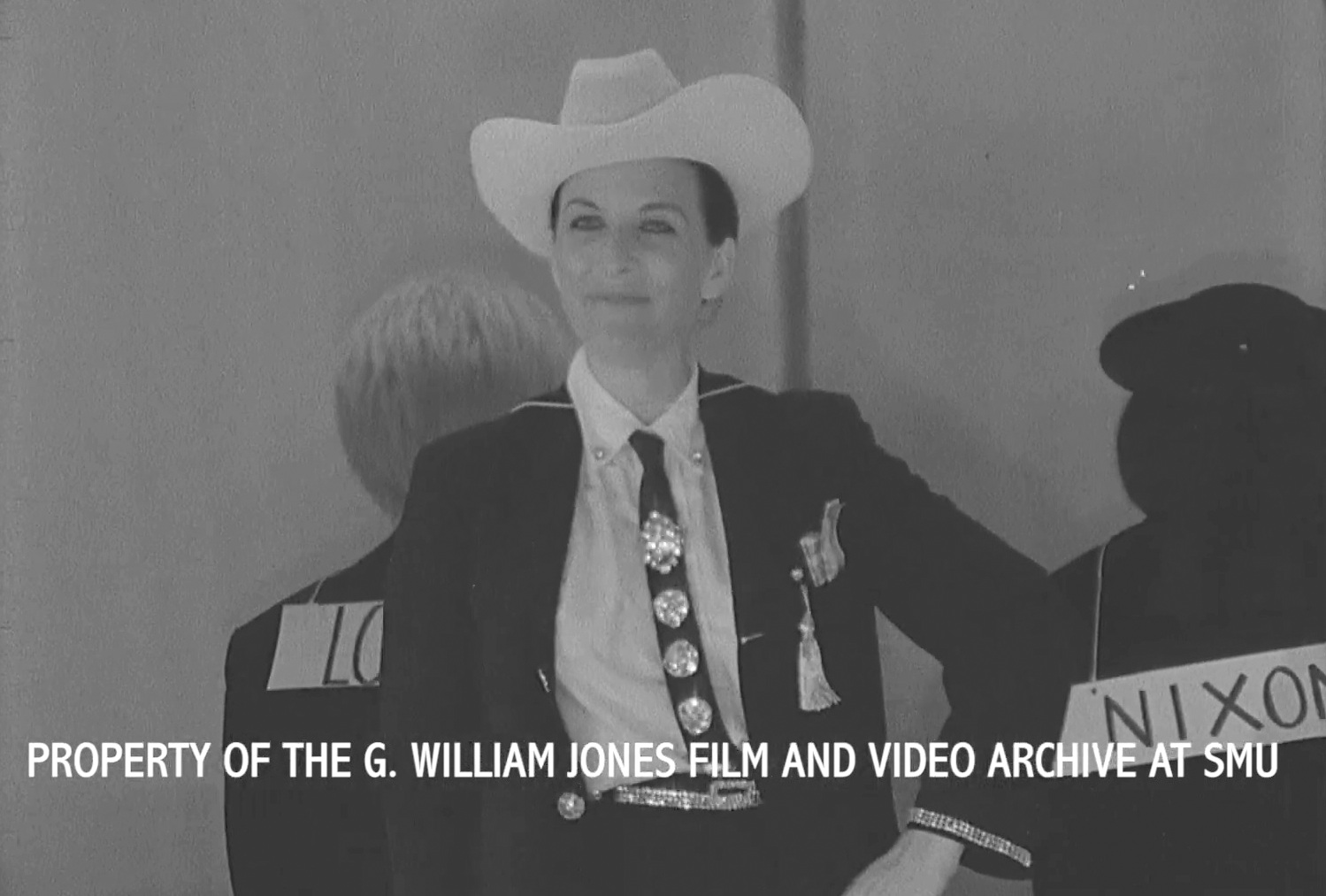
I was really interested to see Betty McKool, Ann’s longtime friend with whom she issued a famous series of annual jokey Christmas cards (which I wrote about in the post “The Legendary Christmas Cards of Ann Richards and Betty McKool”) — and here she is as Nelson Rockefeller at the 1964 Republican National Convention in what I thought was a really great, incredibly confident performance.

political-paranoia-2_1964_jones-collection_SMU_rockefeller-1

political-paranoia-2_1964_jones-collection_SMU_rockefeller-2

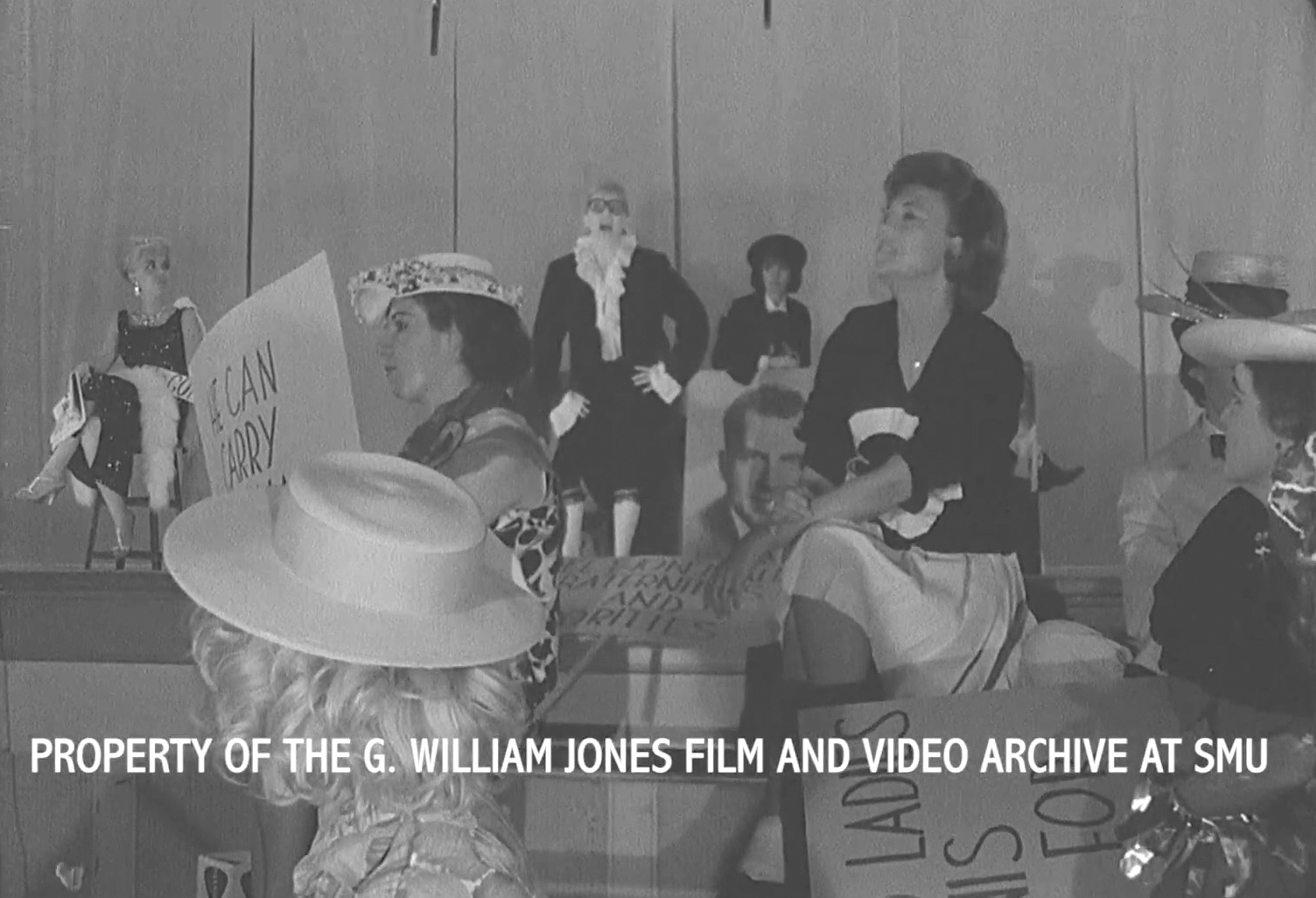
I’m not sure who the blonde with the glasses and ruffled shirt is, but she gives a spirited performance as Barry Goldwater at the Republican Convention. (Mrs. Ray Pearce portrayed Goldwater in the first “Political Paranoia,” so perhaps this is her revisiting the role.)

political-paranoia-2_1964_jones-collection_SMU_convention

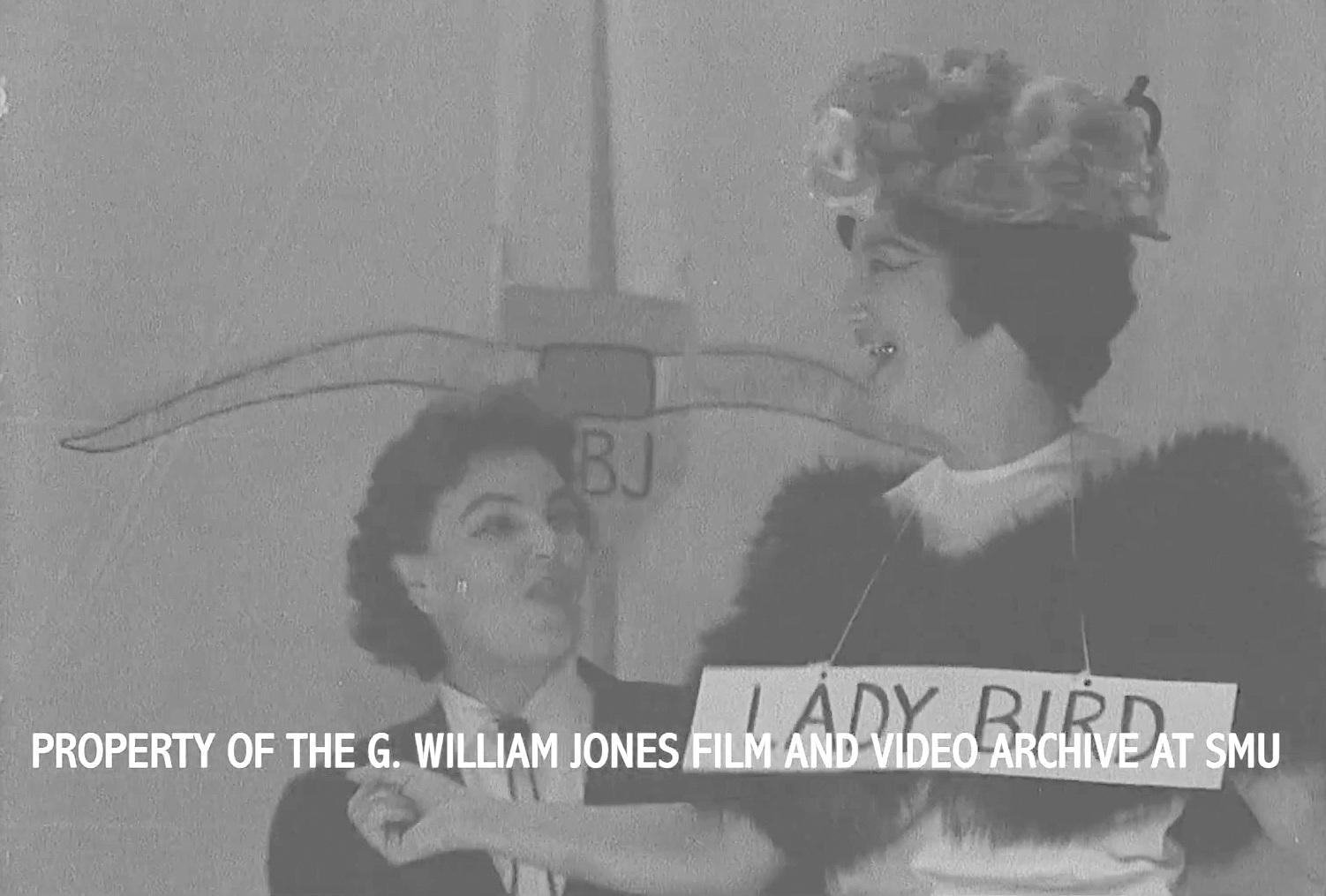
My preschool teacher (and, I believe, the founder of the Unitarian co-op school), Millie Seltzer, is seen below as Lady Bird Johnson. (There’s also a photo of her and Ann as Lady Bird and Lyndon from 1965’s “Political Paranoia III,” which is posted on the blog of Millie’s daughter’s here.)

political-paranoia-2_1964_jones-collection_SMU_lady-bird

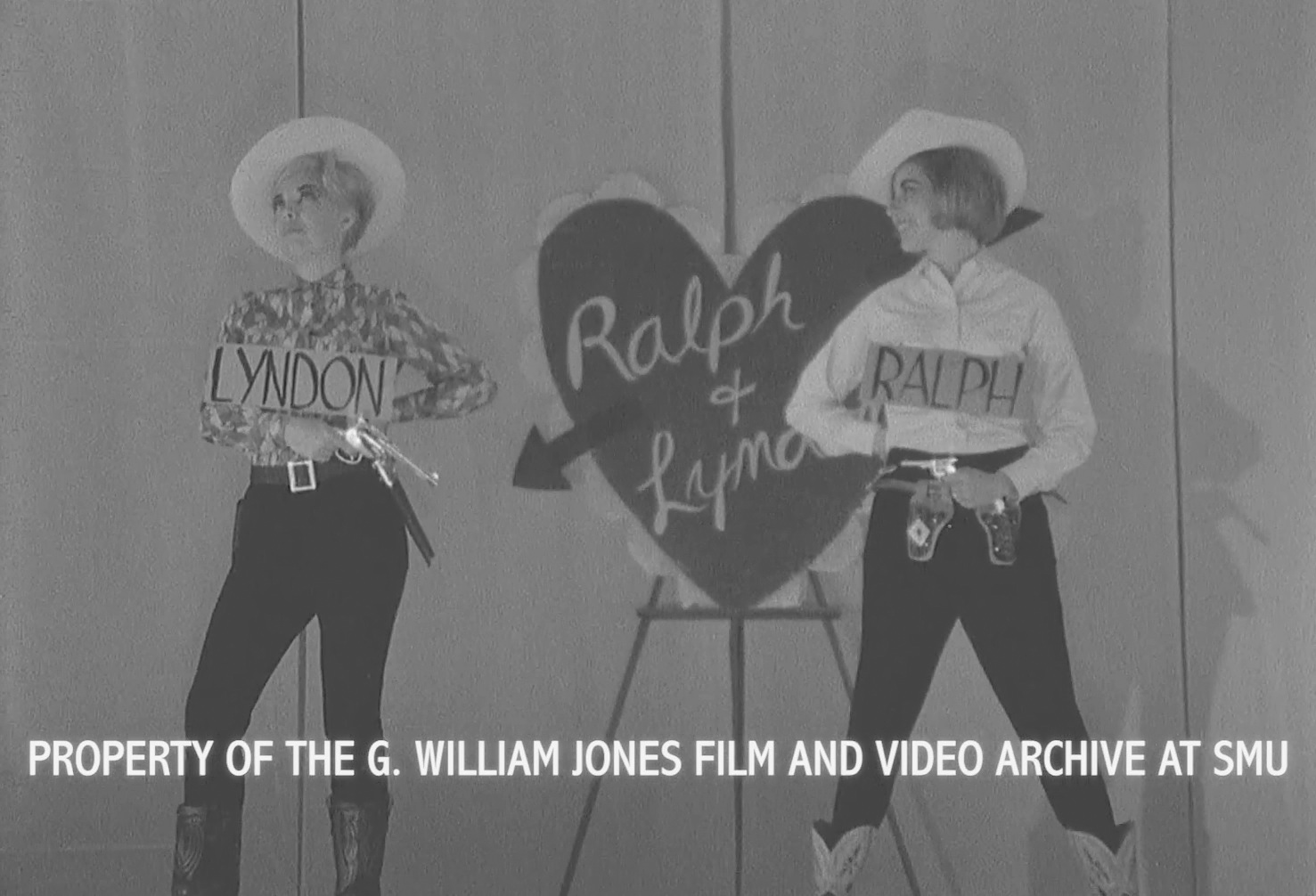
Speaking of Lady Bird, here’s Lyndon and Ralph Yarborough (I’m not sure who these women are, but “Lyndon” might be Mary Vogel).

political-paranoia-2_1964_jones-collection_SMU_ralph-lyndon

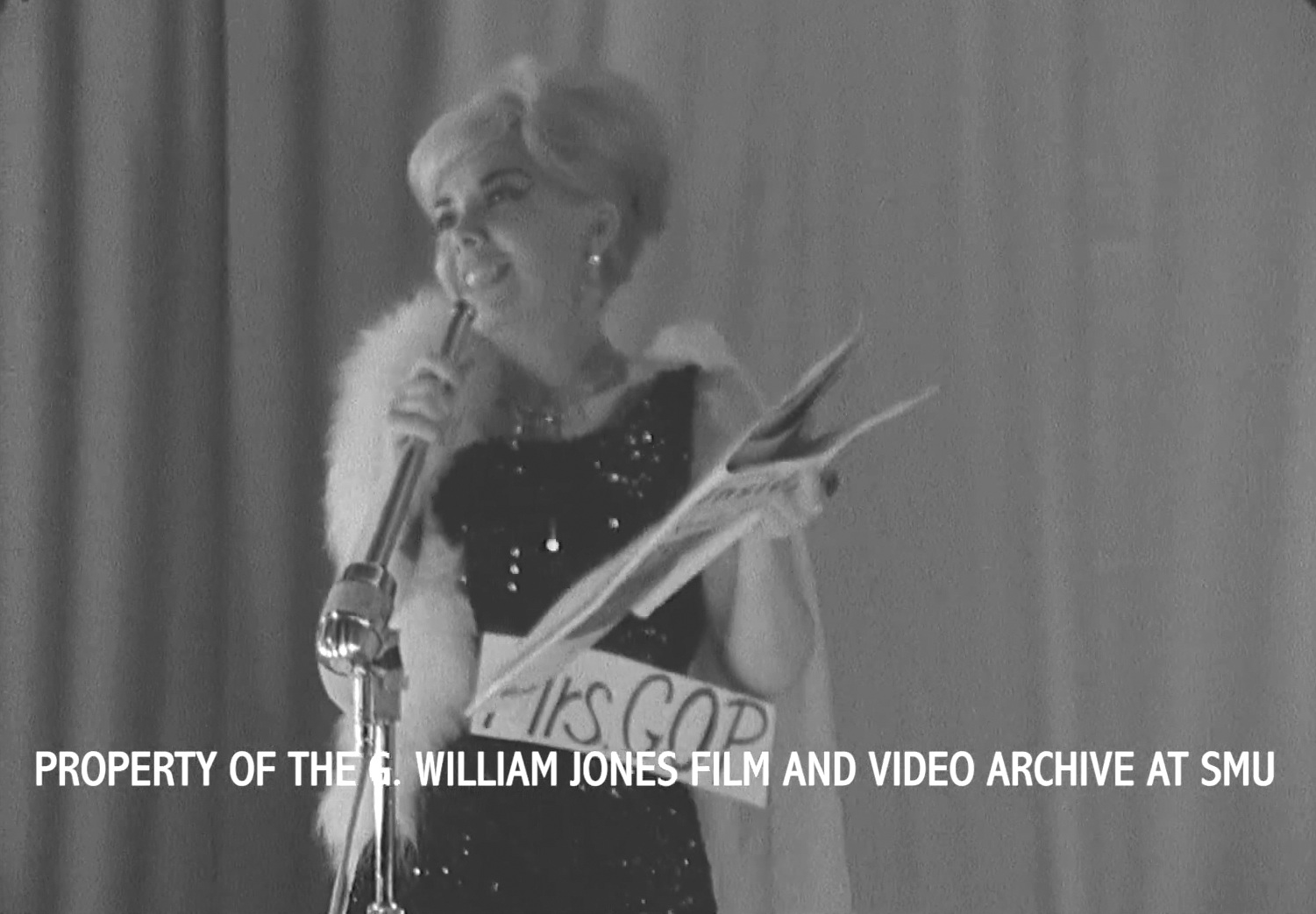
Possibly Mary Vogel again as “Mrs. GOP.”

political-paranoia-2_1964_jones-collection_SMU_mrs-gop

An unknown performer singing about John Connally.

political-paranoia-2_1964_jones-collection_SMU_family-connally

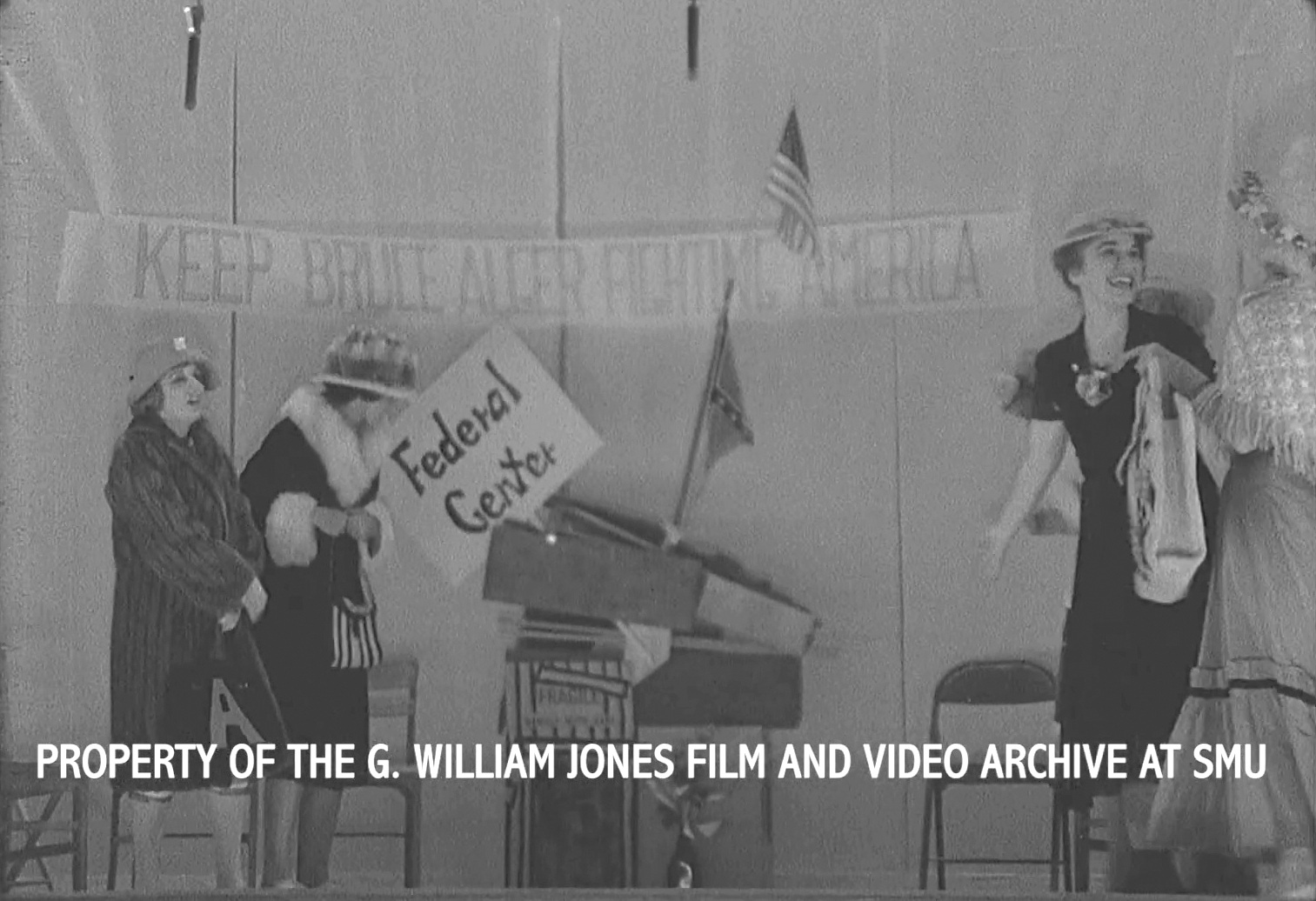
More unknown performers in “I Dreamed I Dedicated a Federal Center in 1994….”

political-paranoia-2_1964_jones-collection_SMU_fed-ctr

…dedicated by Republican congressman Bruce Alger.

political-paranoia-2_1964_jones-collection_SMU_fed-ctr-2

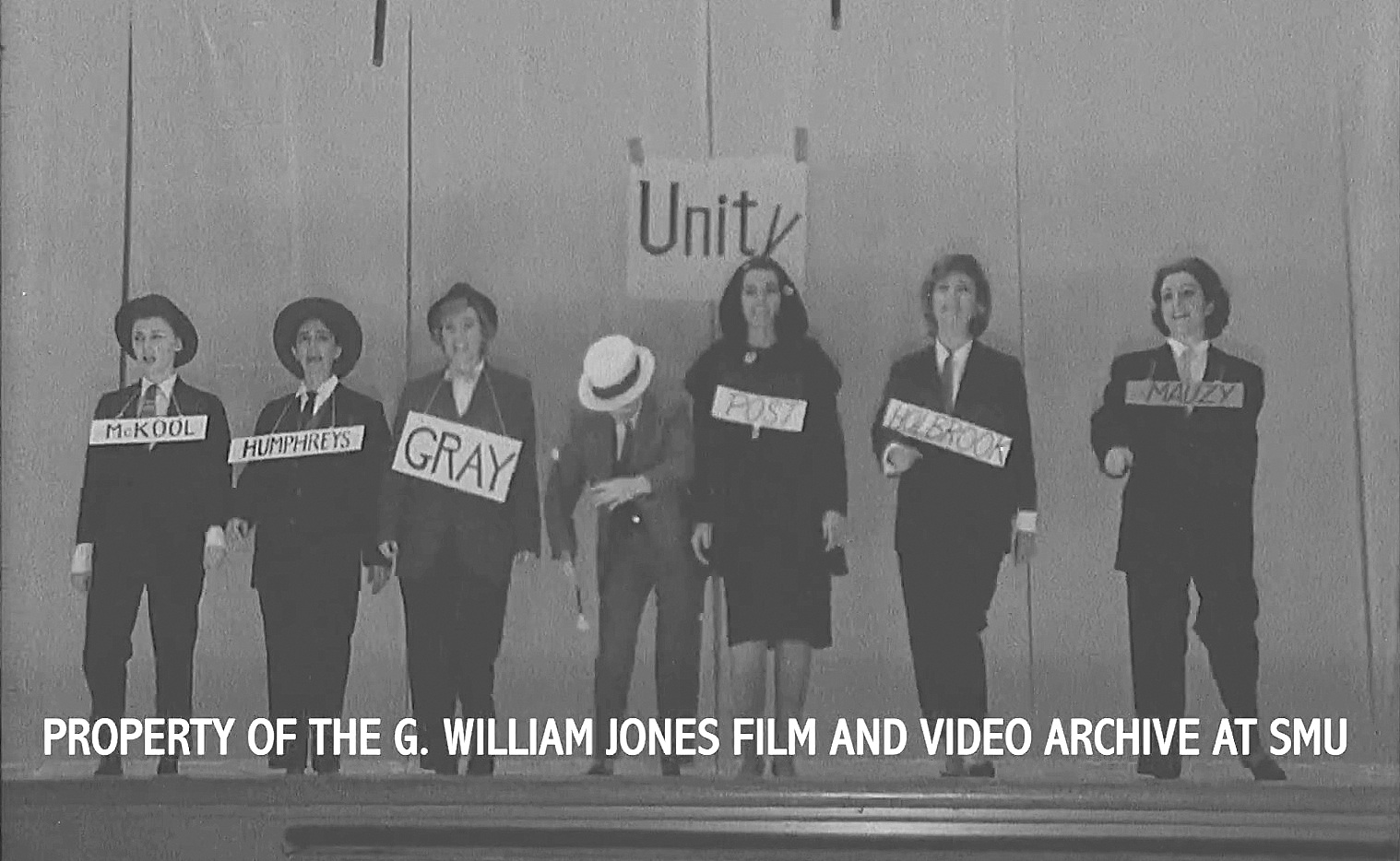
Again, possibly Betty McKool in the straw hat in the center (with someone else playing her husband, Mike McKool).

political-paranoia-2_1964_jones-collection_SMU_unity

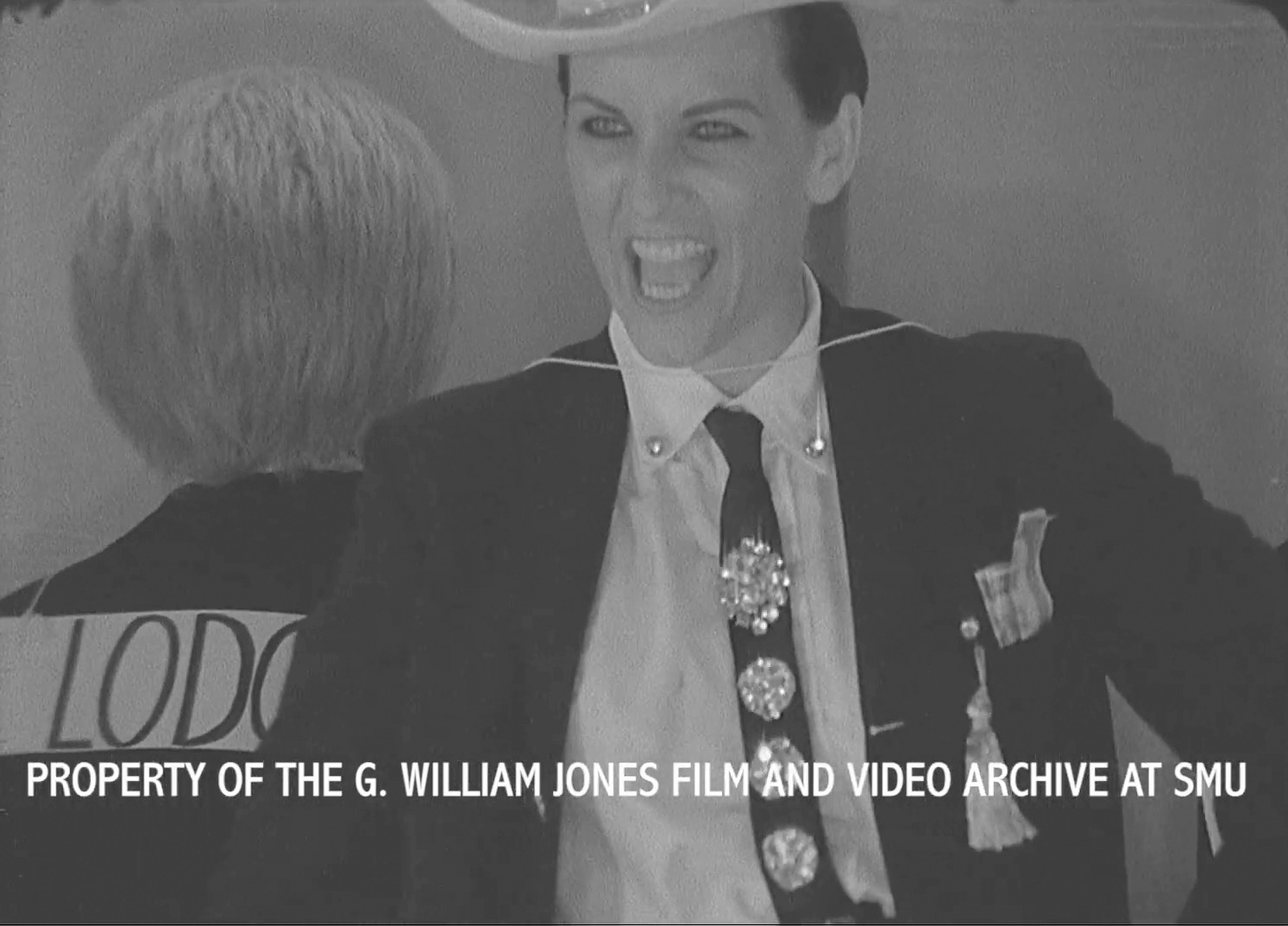
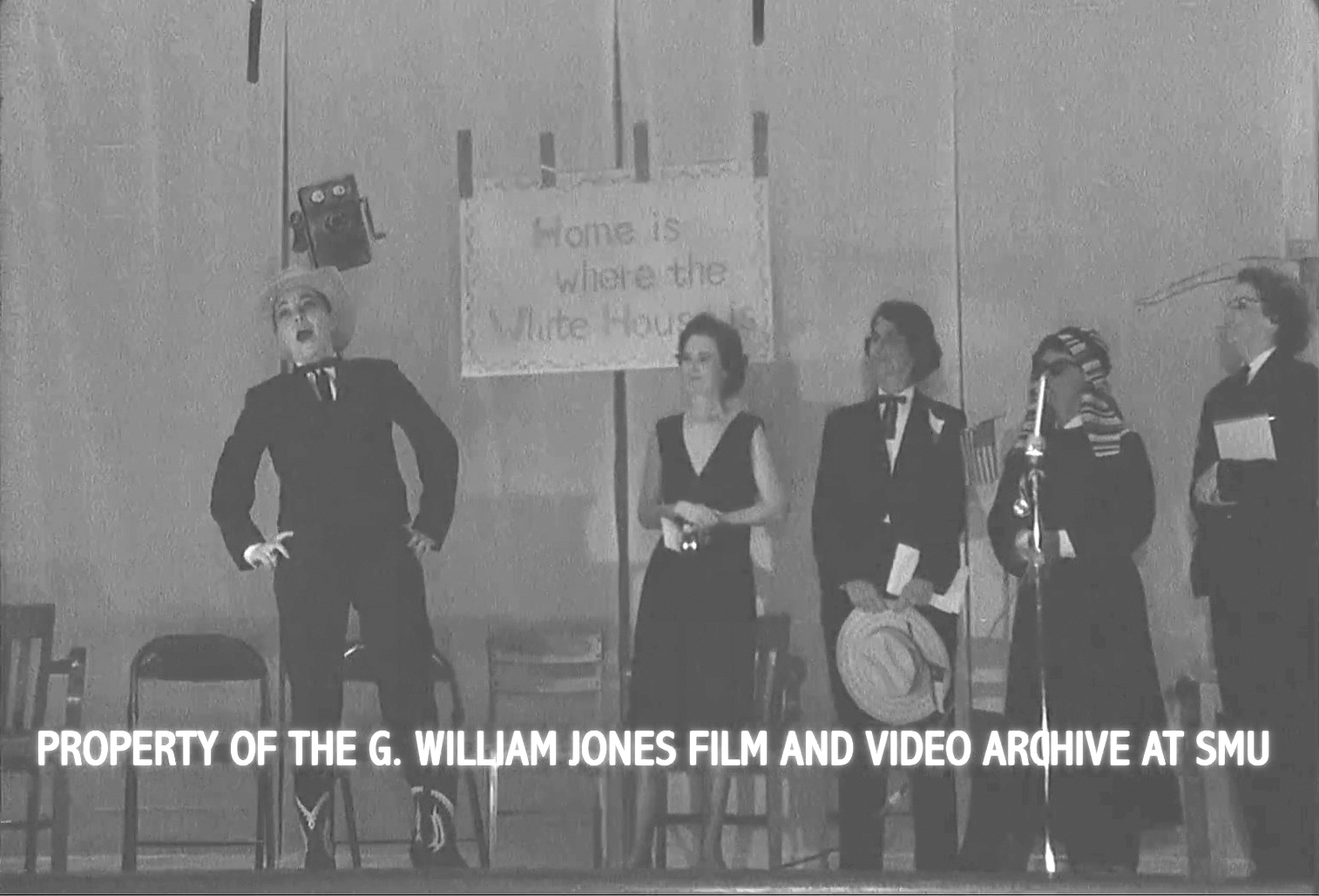
The cast, with leggy Joyce Schiff at the microphone (and Ann Richards behind her to the left, holding the cowboy hat).

political-paranoia-2_1964_jones-collection_SMU_cast

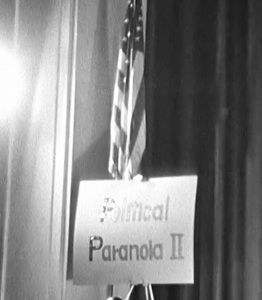
political-paranoia-2_1964_jones-collection_SMU_sign-flag

*

“Political Paranoia II”
May 16, 1964
Hillcrest High School auditorium

“Poop and patter from the Pedernales to the Potomac…”
“The most talked-about show from Euless to Balch Springs…”

$1.50 for Democrats
$7.67 for independents
$25.00 for Republicans

**

Below is a list of women who were members of the North Dallas Democratic Women who were known to have participated in the 1963 and/or 1964 productions of “Political Paranoia,” either on stage or behind the scenes. If you recognize any of these women in the SMU film footage, please make note of a time-marker and let me know where you see them and I will update the info.

Written and directed by:
Mrs. Alvin Winegarten (RUTHE WINEGARTEN)
Mrs. David Richards (ANN RICHARDS)
Mrs. Jim Choate (CAROLYN CHOATE)

Mrs. Mike McKool (BETTY McKOOL)
Mrs. Holbrook Seltzer (MILLIE SELTZER)
Mrs. Harry Weisbrod (BEA WEISBROD)
Mrs. Herbert Schiff Jr. (JOYCE SCHIFF)
Mrs. Philip Vogel (MARY VOGEL)
Mrs. Frederick Sparks (MERLENE SPARKS)
Mrs. Sam Whitten (VIRGINIA WHITTEN)
Mrs. Harry Hoffman
Mrs. Thomas L. Ford
Mrs. Harold Polunsky
Mrs. Kenneth Parker
Mrs. Charles Webster
Mrs. J. T. Mullenix
Mrs. Forrest West
Mrs. C. A. Hurst
Mrs. Jack Cohan
Mrs. Donald Fielding
Mrs. Don Kise
Mrs. Stanley Kaufman
Mrs. Richard Sandow
Mrs. Irwin Kaim
Mrs. James Taylor
Mrs. Ray Pearce
Mrs. Daniel Rosenthal
Mrs. Oscar M. Wilson Jr.
Mrs. Earl Granberry
Mrs. Jerome Meltzer 

***

Sources & Notes

Screenshots are from “Political Paranoia II,” a filmed chronicle of the 1964 political revue written and performed by the North Dallas Democratic Women’s Club at Hillcrest High School on May 16, 1964; the origins of the film are unknown, but this copy is held by the G. William Jones Film and Video Archive, Hamon Library, Southern Methodist University. All thanks to Jeremy Spracklen and Scott Martin of the Jones Archive. The direct YouTube link is here.

Thanks also to Margaret Werry and Jean Ball for their help in identifying participants and for taking the time to share their memories of Dallas’ political past.

A good account of Ann Richards’ time in Dallas can be found in her autobiography, Straight from the Heart, My Life in Politics & Other Places (Simon & Schuster, 1989).

political-paranoia-2_1964_jones-collection_SMU_cast_sm

*

Copyright © 2019 Paula Bosse. All Rights Reserved.


First Presbyterian Church — 1960

first-presbyterian-church_downtown_squire-haskins_UTA_022960

by Paula Bosse

Above is another wonderful photo by Dallas photographer Squire Haskins. It captures an interesting view of the First Presbyterian Church in downtown Dallas (Harwood and Wood streets), with background cameos by bits of the Statler Hilton, the Lone Star Gas Building, whatever the building is next to the Lone Star Gas Building, and the Southland Life Building.

I’m not sure why Haskins took this particular photo (on February 29, 1960), which seems to focus on the church’s parking lot, but a few days after this photo was taken the church celebrated the 47th anniversary of the move from their previous location at the northeast corner of Main and Harwood by recreating the two-block march which the 1,000-member-strong congregation took back in 1913 from the old church to the brand new one. The recreated march included participation of 88 church members who had made the original march in 1913. The first services were held in the new church on March 2, 1913.

And it still looks beautiful.

*

Below, the previous home of the First Presbyterian Church, built in the 1880s, at the  northeast corner of Main and Harwood.

first-presbyterian-church_LOC
via the Library of Congress

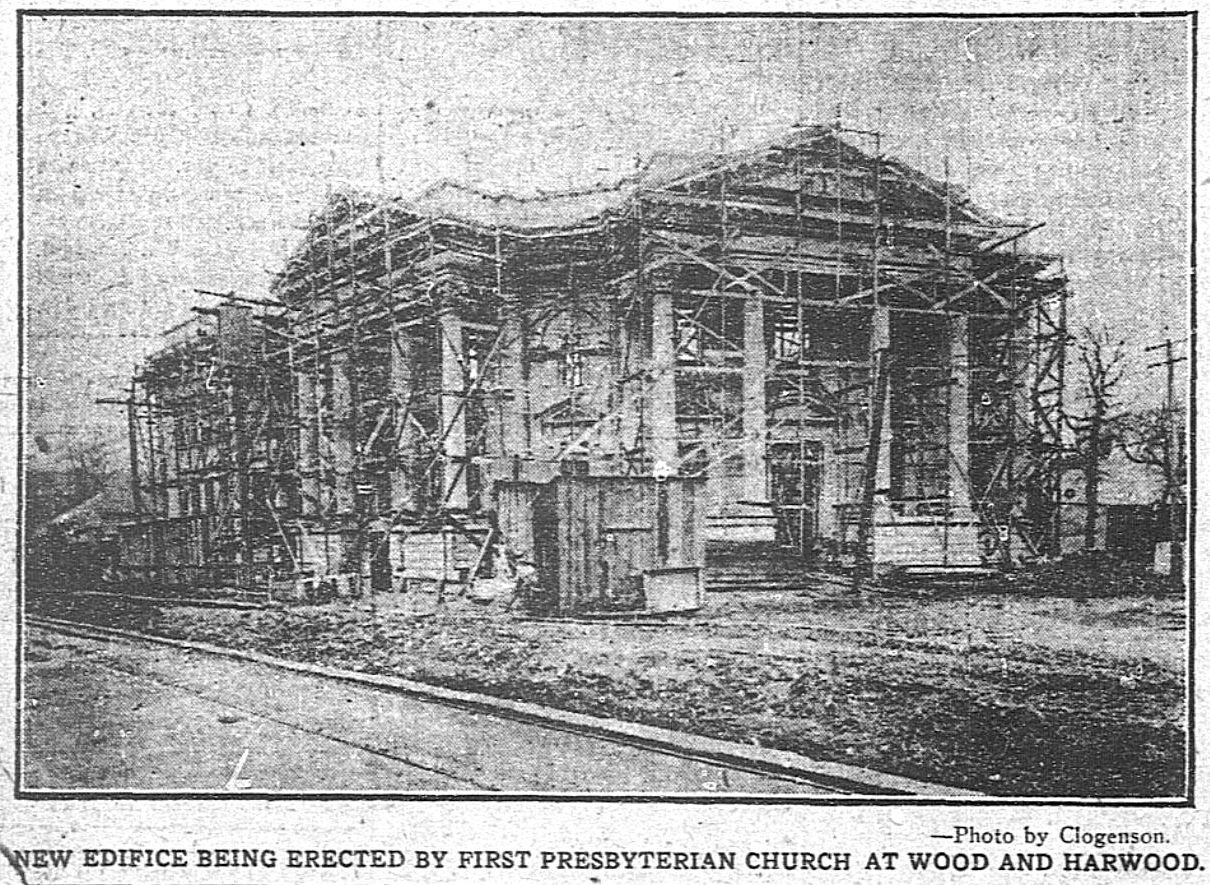
The dome-less new church in December, 1911 (construction of the copper dome was “almost complete” in March, 1912):

presbyterian_first-presbyterian-church_under-construction_dmn_123111_clogensonDallas Morning News, Dec. 31, 1911

Completed, and wowing them on picture-postcard stands.

‏first-presbyterian-church_ca-1916

***

Sources & Notes

Top photo — “First Presbyterian Church, downtown Dallas, Texas” — by Squire Haskins, taken on Feb. 29, 1960; it is from the Squire Haskins Photography, Inc. collection, University of Texas at Arlington Libraries, Special Collections, UTA. More info on this photo (and a larger image) is here.

Read an exhaustive account of the new church’s design features in the Dallas Morning News article “First Presbyterian Church Completed” (DMN, March 2, 1913), here.

Read a history of the First Presbyterian Church in Dallas, from 1856 to 1913, in an article which is dominated by a photo of the Main and Harwood building and titled “Will Be Abandoned As Church Property After Sunday Services” (DMN, Feb. 21, 1913), here.

Two more very early photos of the First Presbyterian Church can be found in the Flashback Dallas post “Dallas in “The Western Architect,” 1914: City Buildings and Churches” (scroll down to #6).

first-presbyterian-church_downtown_squire-haskins_UTA_022960_sm

*

Copyright © 2019 Paula Bosse. All Rights Reserved.


Super-Cool Roger Miller in Dallas — 1960s

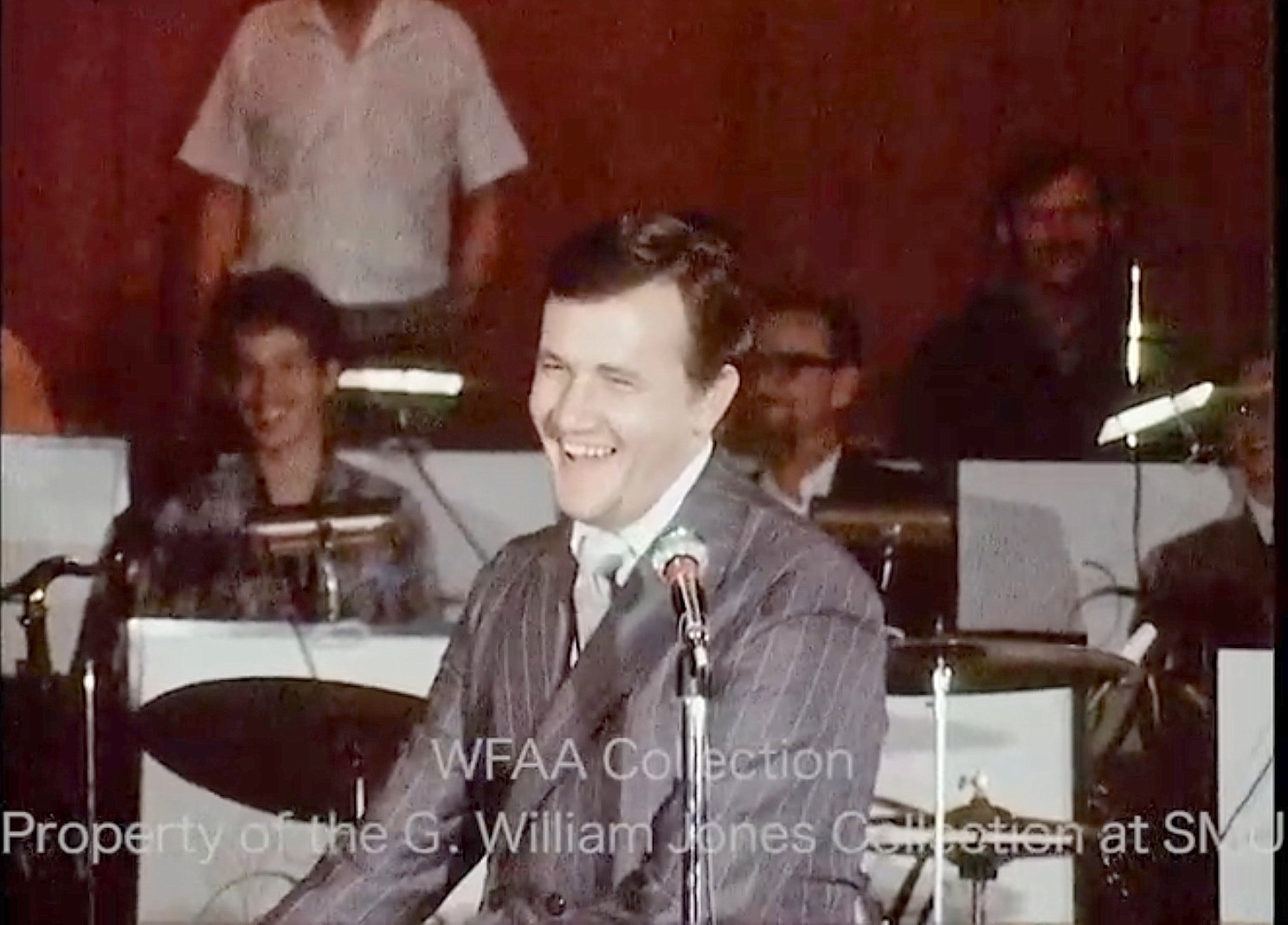
roger-miller_venetian-room_oct-1969_wfaa_jones-film_SMURoger Miller on the Venetian Room stage, October, 1969

by Paula Bosse

Who doesn’t love Roger Miller? He was always one of the most effortlessly “cool” entertainers, celebrated as much for his songwriting and singing as he was for his humor and storytelling.

Roger Miller was born in Fort Worth in 1936 but spent most of his childhood in Oklahoma following the death of his father. He launched an entertainment career after a stint in the U.S. Army came to an end. (See an extensive timeline at Wikipedia, here.)

After years of struggling, he finally hit the big-time in 1964 with the hit “Dang Me” and, a few months later, with his biggest hit, the classic “King of the Road.” He won a huge number of Grammys (11 in 1964 and 1965 alone) and was a bona fide star who had incredible crossover appeal for fans of both country music and traditional popular music.

*

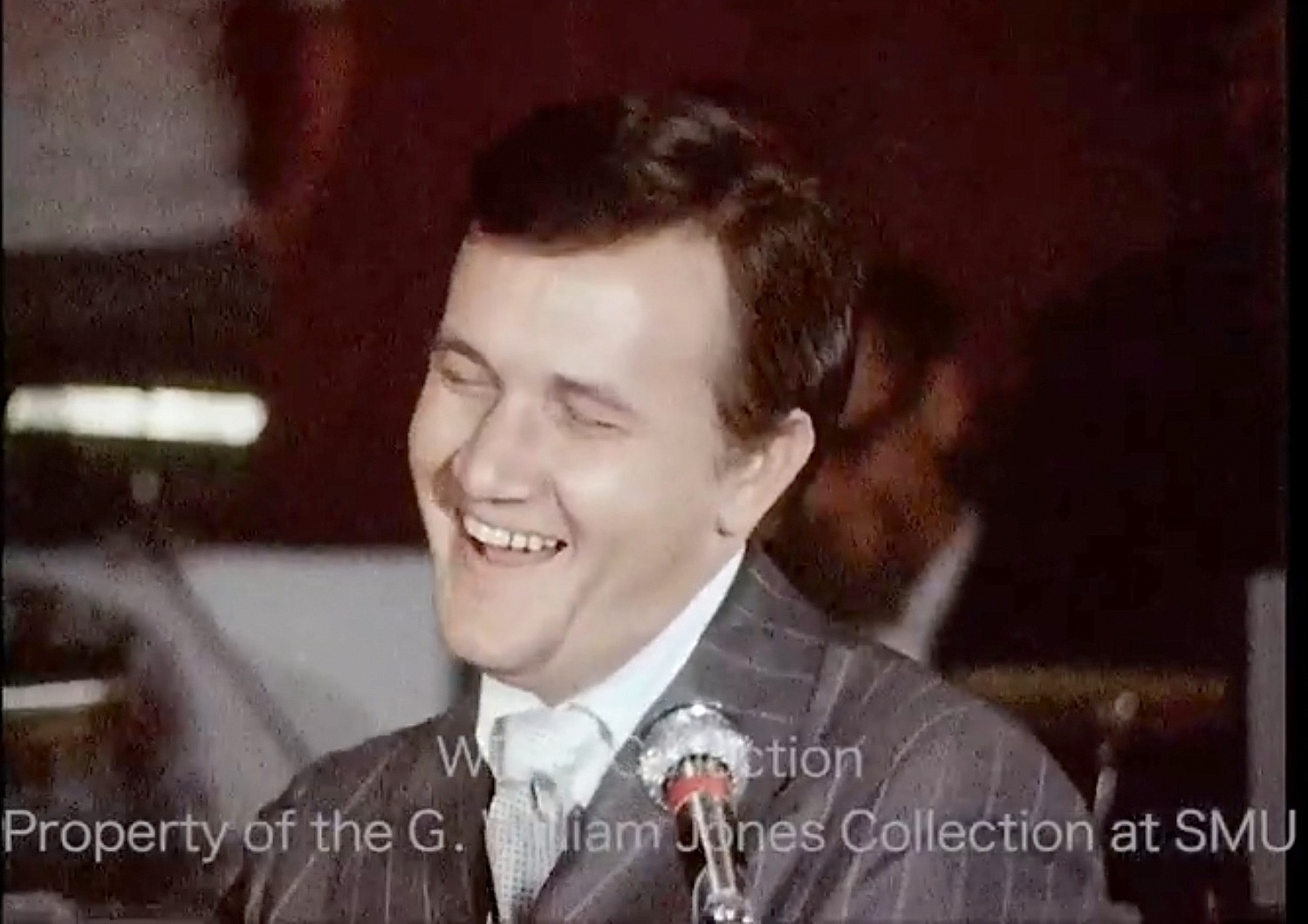
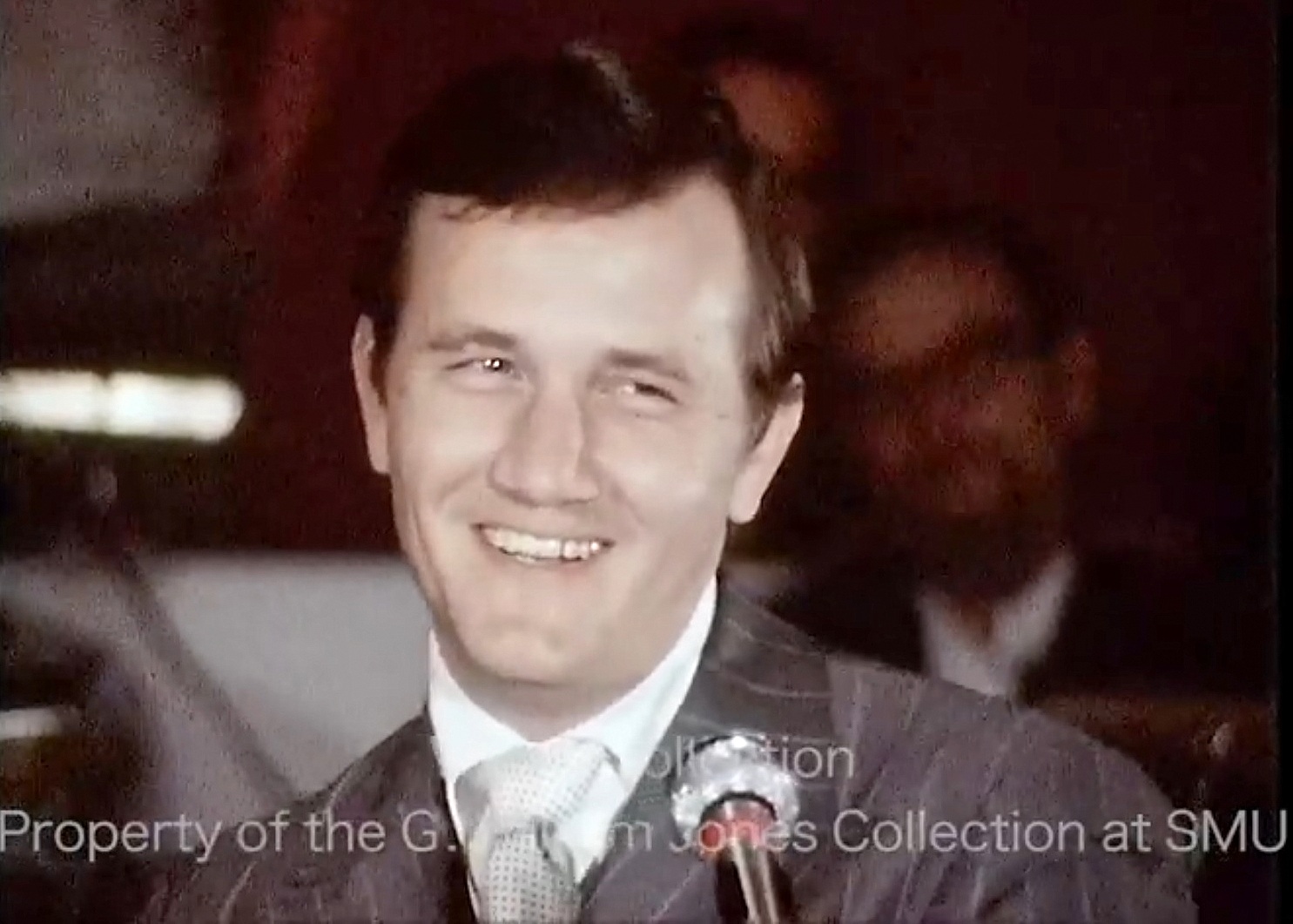
When he came to Dallas in October, 1969 it was for a 3-week run at the Fairmont Hotel’s swanky Venetian Room, and he apparently packed them in every night. Below is a snippet of an interview with WFAA-Channel 8 News in which Roger answers the burning question of whether he was “serious” when he wrote his hit novelty song “You Can’t Rollerskate In a Buffalo Herd” (listen to the song here). His quipped response (which cracked up the Jerry Gray Orchestra behind him) probably didn’t make it to the local airwaves in 1969:


roger-miller_venetian-room_oct-1969_wfaa_jones-film_SMU_a

roger-miller_venetian-room_oct-1969_wfaa_jones-film_SMU_b

(As an interesting sidelight, in an interview with Philip Wuntch of The Dallas Morning News (Oct. 19, 1969), Miller said that he and his wife had been in Texas for a few days prior to his Venetian Room engagement looking at houses in both Dallas (his mother was then residing in Fort Worth) and San Antonio (his wife’s hometown). Nothing apparently came of this, but it certainly would have been nice to have been able to claim Roger Miller as a Dallas resident!)

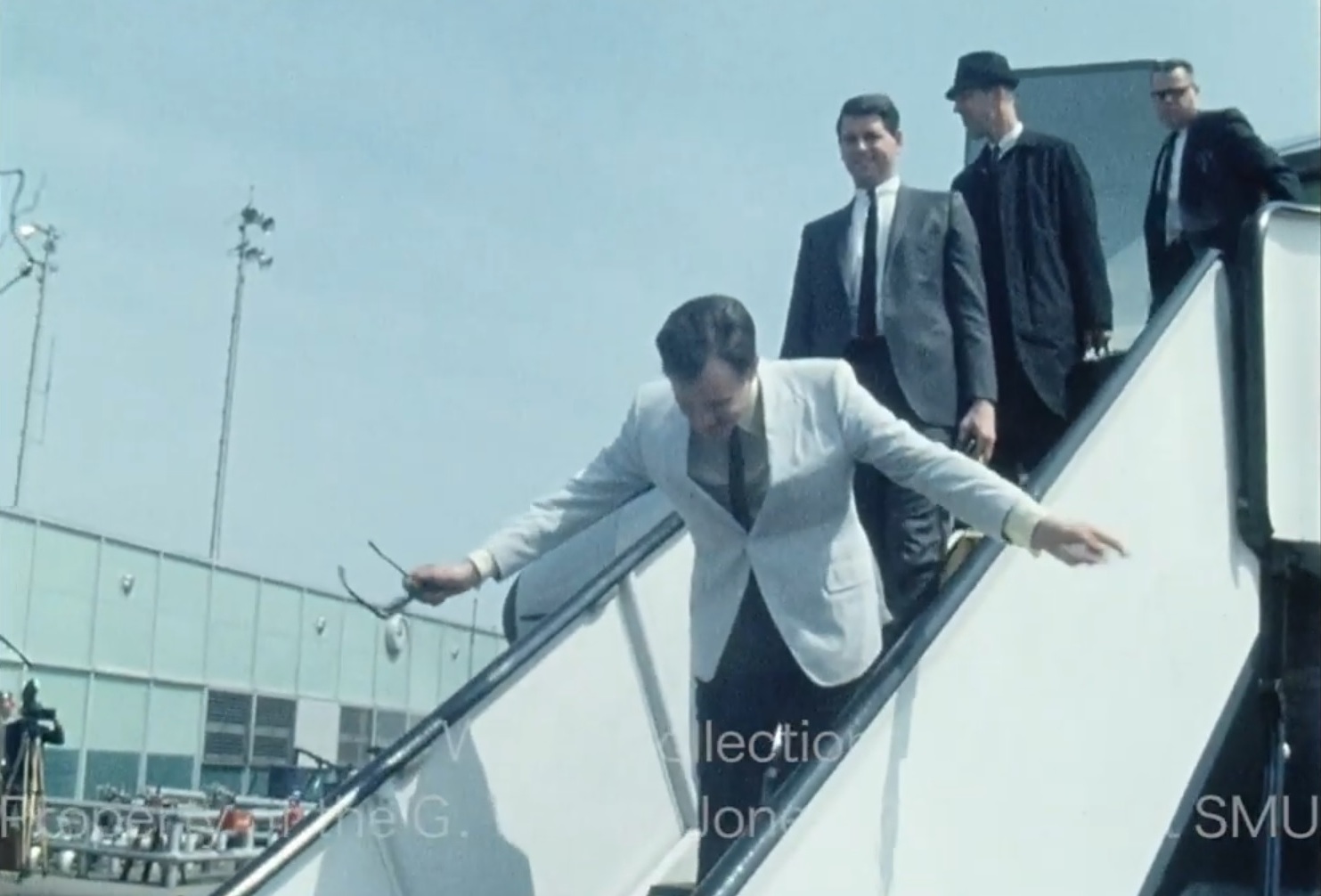
He was in town a couple of years earlier, in 1967, and sat down for a Channel 8 interview which was a bit more sedate — it took place in the American Airlines “Celebrity Room” at Love Field as he was passing through Dallas on his way to San Antonio with his wife and young son, Dean Miller:


roger-miller_venetian-room_march-1967_wfaa_jones-film_SMU

On this trip, newspapers reported that he was shuttled about in private Lear Jets and Rolls Royces — a big change from his early days when he picked cotton, hitchhiked, slept in cars, and stole milk off front porches.

Roger Miller died in 1992 at the age of 56 from complications of lung cancer.

*

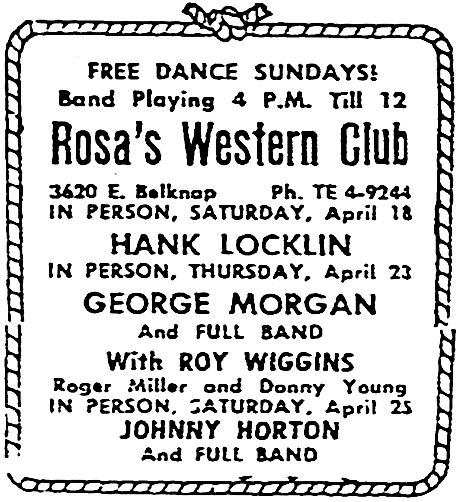
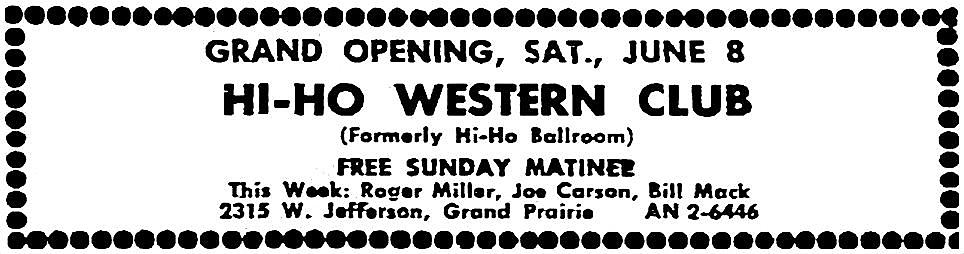
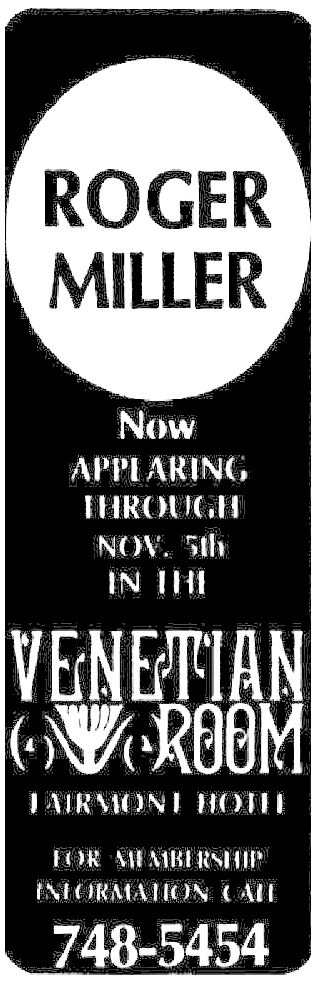
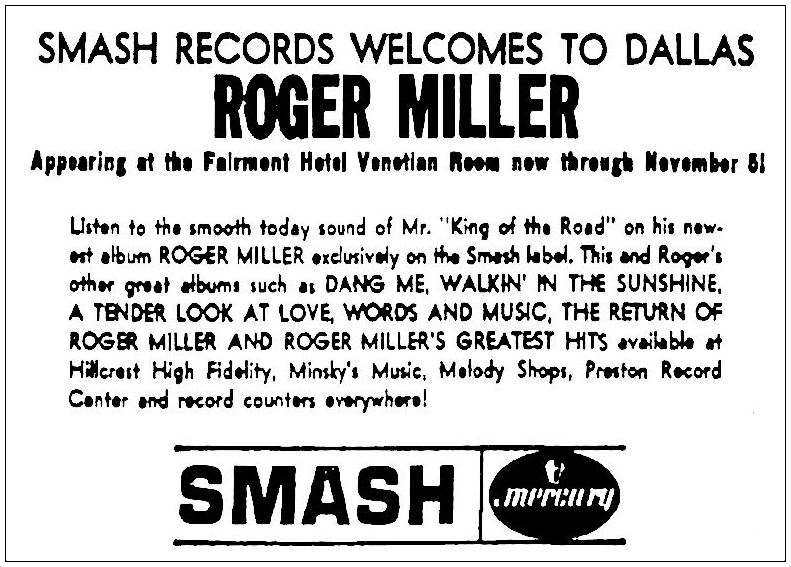
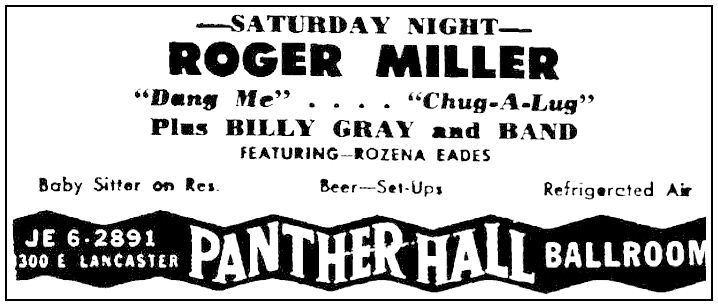
Below are a few ads from Roger Miller’s DFW appearances. He played large venues like the Big D Jamboree in Dallas and Panther Hall and Northside Coliseum in Fort Worth, but he also played a lot of little clubs as he worked his way up to becoming a major recording artist and television personality.

miller-roger_FWST_041259_rosas-western-clubRosa’s Western Club, Fort Worth with Donny Young (aka Johnny Paycheck), April 12, 1959

miller-roger_060863_hi-ho-western-club_grand-prairieHi-Ho Western Club, Grand Prairie, TX, June 8, 1963

miller-roger_FWST_081364_panther-hallPanther Hall, Aug. 13, 1964

miller-roger_101669_fairmont-hotelVenetian Room, Dallas, Oct. 16, 1969

miller-roger_101769_fairmont-hotel_smash-recordsSmash Records ad, Oct. 17, 1969

***

Sources & Notes

Film footage of Roger Miller in Dallas (on YouTube here and here) is from the WFAA Collection, G. William Jones Collection, Hamon Arts Library, Southern Methodist University.

The official Roger Miller website is here.

roger-miller_venetian-room_oct-1969_wfaa_jones-film_SMU_sm

*

Copyright © 2019 Paula Bosse. All Rights Reserved.

State Fair of Texas, Miscellaneous Tidbits from Its History

state-fair-of-texas_pennant_ebay_crop

by Paula Bosse

The State Fair of Texas is, once again, in full swing. Here are a few random SFOT images and ads from the past.

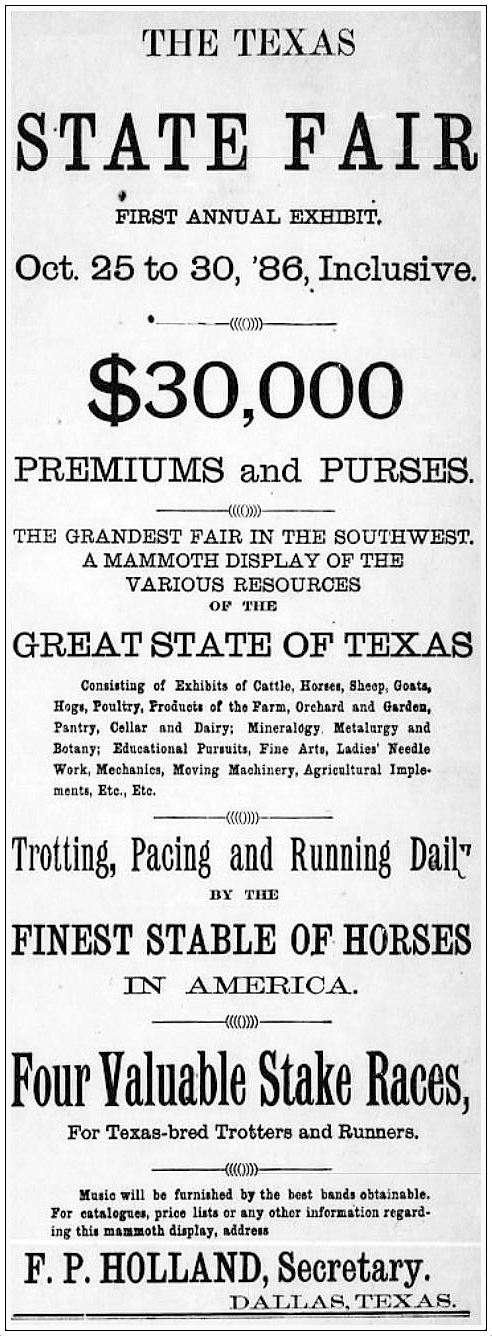
First up, an ad for the very first state fair in Dallas, in 1886. Almost unbelievably, this “Dallas State Fair” (held on 80 acres of land now known as Fair Park) was one of two competing state fairs held in the city that year — the other one was the “Texas State Fair,” which was held about three miles northeast of the courthouse on a 100-acre site roughly about where Cole Park is near present-day North Dallas High School. The two state fairs ran concurrently, and both were smash hits. The “Dallas State Fair and Exposition” eventually became the State Fair of Texas in 1904. Below are the ads for those competing two fairs. (Click to see a larger image.)

state-fair_first_dallas-herald_100986
The East Dallas fair, Dallas Herald, Oct. 9, 1886

texas-state-fair_fairland_dallas-herald_102086
The North Dallas fair, Dallas Herald, Oct. 20, 1886

*

One of the original buildings built for the 1886 Dallas State Fair was the massive Exposition Building, designed by architect James Flanders. On a site devoted to the career of Flanders, the architect recalled this project many years later: “The progress of the work on the structure was watched by most people with a degree of curiosity far more intense than is excited by the loftiest skyscraper in these days when people have no time to wonder. Such an apparition on the bald prairie attracted crowds of the curious from far and near on Sundays.”

state-fair_exposition-bldg_ca-1890s

Above, the huge Exposition Hall, enlarged from its initial design, which, in 1886 was reported to contain 92,000 square feet of unrivaled exhibition space. Unfortunately, the wooden buildings seen above burned to the ground in the early hours of July 20, 1902. The blaze was so intense that “the whole of the city was lit up with the brilliancy of the sunrise” and that “flames rose to such great height that they were seen as far west as Fort Worth, where it was thought the whole city of Dallas was burning” (Dallas Morning News, July 21, 1902). More on this building can be found on the Watermelon Kid site, here.

Below, the Exposition Building can be seen from the fairgrounds racetrack in a photo published in 1900 in an issue of The Bohemian magazine (via the Fort Worth Public Library).

fairgrounds_racetrack_bohemian_1900_fwpl

*

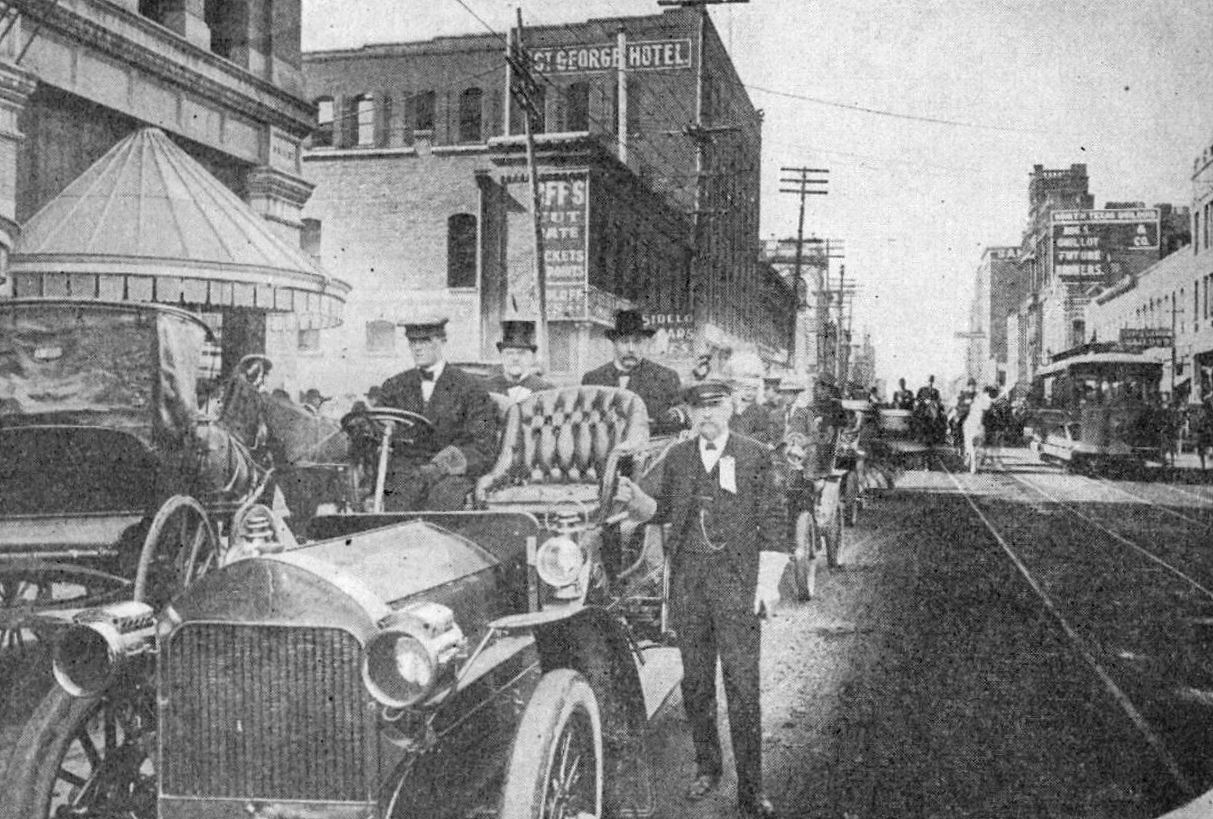
A moment from the opening day parade festivities of the 1903 fair is captured in the photo below, with the following caption from the 1941-42 edition of the Texas Almanac: “Gov. S. W. T. Lanham (in rear seat of pioneer horseless carriage) in opening day parade for 1903 State Fair of Texas formed on Main Street. Fair President C. A. Keating was seated beside him, and Secretary John G. Hunter of Board of Trade is seen standing beside the gasoline buggy.”

state-fair_opening-day_1903_tx-almanac_1941-42_portal
Main Street, looking west, via Portal to Texas History

*

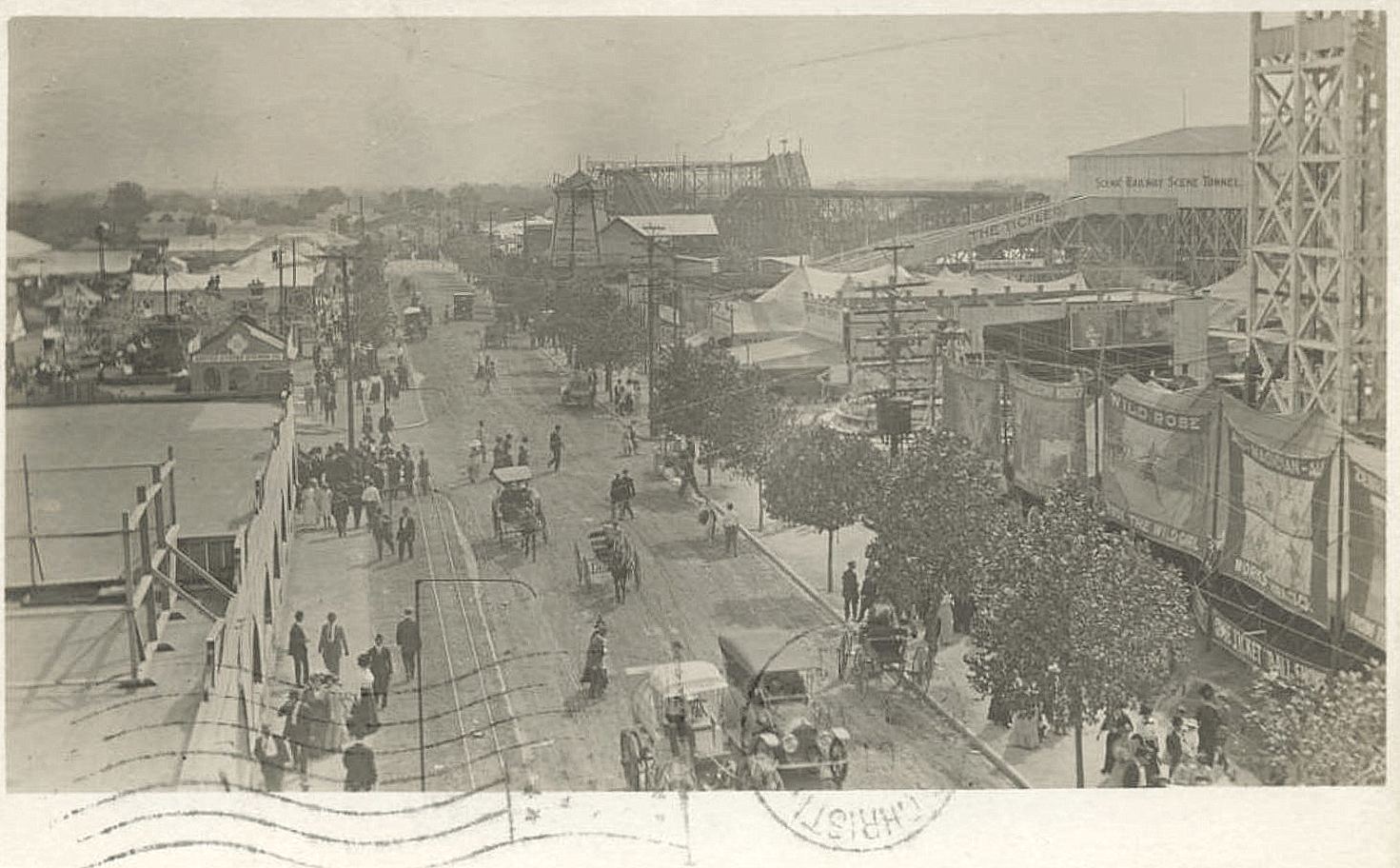
Here is a 1911 view of the state fair midway taken by John R. Minor, Jr. in a real-photo postcard. (More on Mr. Minor is here; more images of the Shoot the Chutes water ride can be found here.)

state-fair_street-scene_john-minor_1911_cook-colln_degolyer
via George W. Cook Collection, DeGolyer Library, SMU

*

From the 1920s, an ad for Clayco Red Ball gasoline (“It’s RED in color”). I’m always a sucker for ads containing photos or drawings of Dallas landmarks, and here we see the entrance to Fair Park. (Why was the gas red? Why not? It was the brainchild of Dallas advertising man Wilson W. Crook, Sr. who needed a way to make this Oklahoma gas different. He remembered that during his WWI days in France that higher quality airplane fuel was colored red to distinguish it from regular gasoline. When the gas was introduced to Dallas in August, 1924, he devised a promotion that gave away 5 gallons of this gas to every red-headed person who showed up at participating service stations.)

ad-red-ball-gas_state-fair_dmn_101224-det

ad-red-ball-gas_state-fair_dmn_101224Clayco Red Ball ad, Oct. 1924

*

If we’re talking about the State Fair of Texas and we’ve come to the 1930s, there’s a pretty good chance there’s going to be a photo from the Texas Centennial. And, looky here: a nice shot of concessionaires waiting for thirsty patrons at the Centennial Exposition in 1936. A couple of nickels could get you a Coke and a phone call.

sfot_concessionaires_coke_unt_portal_1936via Portal to Texas History

*

During World War II the State Fair was on hiatus. Here’s an ad from the 1941-42 Texas Almanac pre-closure, with a nice pencil sketch of the Esplanade and Hall of State:

state-fair_tx-almanac_1941-42

state-fair_tx-almanac_1941-42_det

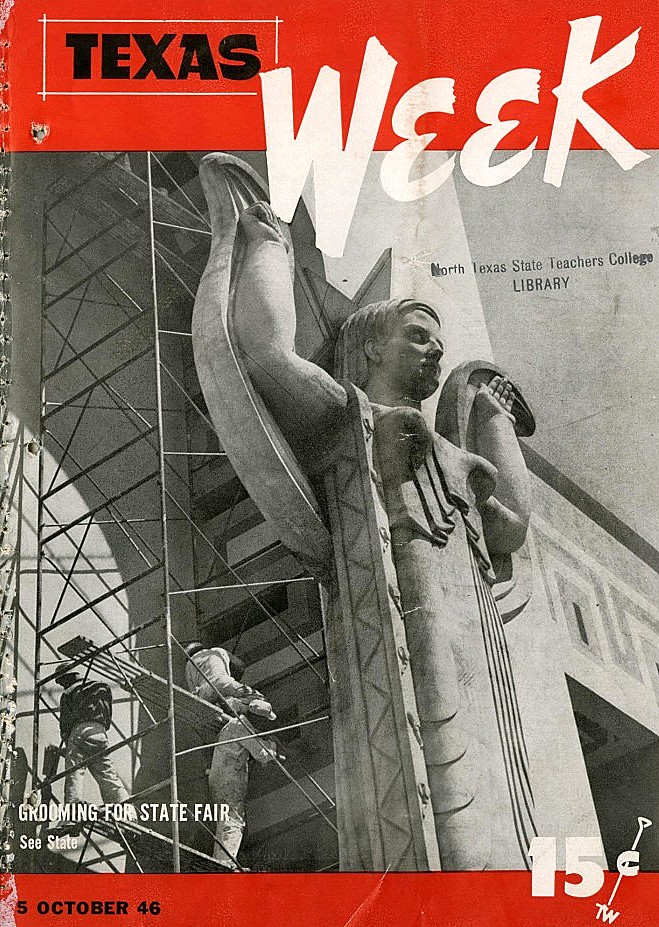
And a 1946 magazine cover story on the imminent reopening of the fair:

state-fair_texas-week-mag_100446_portal_cover
via Portal to Texas History

*

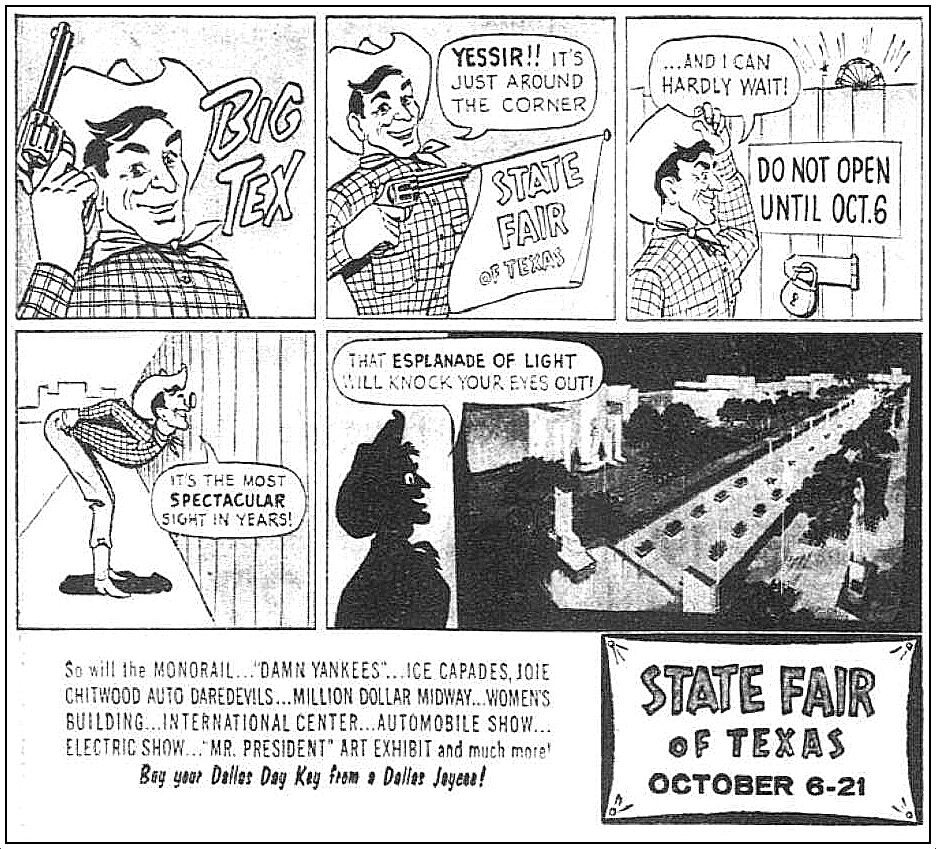
In 1956 Big Tex warned/assured you that the Esplanade lights would “knock your eyes out.”

state-fair_big-tex-ad_092456

*

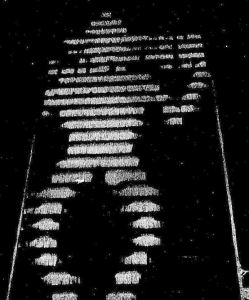
Speaking of Big Tex and lights knocking your eyes out, in the 1960s Big Tex was memorialized on the side of a downtown building, like a giant bow-legged Lite-Brite.

sfot_big-tex_illuminated_1960s

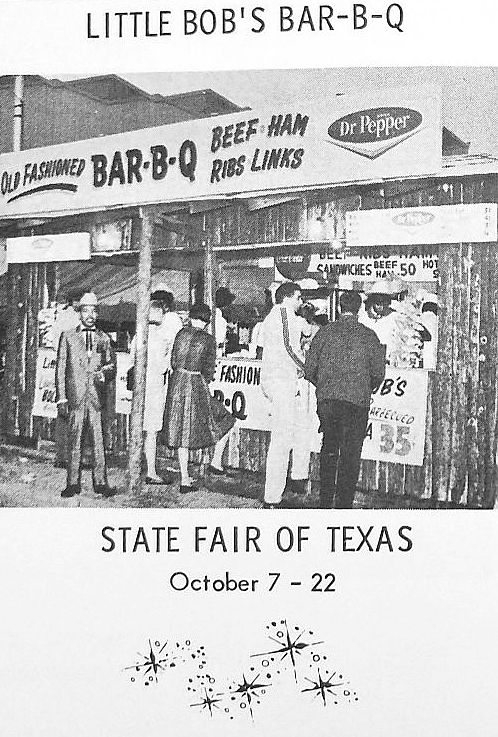
Back at Fair Park, Huey P. Nash was supplying fair throngs with barbecue from his Little Bob’s Bar-B-Q stand. In 1964, Nash was the first African-American vendor to be granted a food concession at the State Fair. Little Bob’s (which I believe is still in business) was, at the time of this 1967 ad, located in South Dallas at 4203 S. Oakland (now Malcom X), at the corner of Pine. (Ad is from the 1967 Souvenir Program of the 74th Annual Session of the Missionary Baptist General Convention of Texas; more photos from this publication can be seen here.)

sfot_little-bobs-bbq_baptist-convention-program_1967_photo

sfot_little-bobs-bbq_baptist-convention-program_oct-1967

The 1960s also gave us the Swiss Skyride, which replaced the Monorail (which, when it was introduced in 1956, was the first commercially operated monorail in the United States). The Swiss Skyride was erected in Fair Park in August, 1964, and the 6-minute ride debuted a few months later at the 1964 State Fair of Texas.

state-fair_swiss-sky-ride_tinkle-key-to-dallas_1965_replaced-monorail_
via Lon Tinkle’s children’s book Key to Dallas (1965)

sfot_swiss-skyride_FWST_101864

sfot_swiss-skyride_FWST_100964

*

state-fair-of-texas_pennant_ebay_crop_sm

*

Copyright © 2019 Paula Bosse. All Rights Reserved.

Gloria Vanderbilt’s 4 Husbands… and Their Dallas Connections

cooper-wyatt_gloria-vanderbilt_1970_w-magMr. & Mrs. Wyatt Cooper, 2 months after their royal reign in Dallas

by Paula Bosse

Gloria Vanderbilt died June 17, 2019 at the age of 95. Despite being the subject of one of the most headline-grabbing child-custody trials in 20th-century history, “poor little rich girl” Gloria Vanderbilt grew up to live what appears to have been a full and mostly happy life. There were several Dallas connections in her life, especially regarding each of the four men she married.

One of Gloria’s aunts (her mother’s sister-in-law, or, more confusingly, the ex-wife of Gloria’s mother’s brother) was Ivor O’Connor Morgan, something of a bon vivant socialite who lived primarily in Europe but kept Dallas as her residence of record. She was born in Dallas, the eldest daughter of prominent banker J. C. O’Connor and niece of Mayor J. Waddy Tate. She testified in Gloria’s custody trial in support of Gloria’s mother (who ultimately lost custody).

And now to Gloria’s husbands.

1. PASQUALE (“PAT”) DiCICCO was Gloria’s first husband. He was a Hollywood agent and the ex-husband of film star Thelma Todd (who died under mysterious circumstances, with many wondering if Pat might have been involved in what many suspected had been a murder). They married in 1941 when Gloria was only 17 (Pat was 32). Gloria described the marriage as an unhappy and abusive one. They divorced in 1945. 

di-cicco_dec-1941_APDiCicco and Gloria in 1941

Their honeymoon road trip brought them to Dallas for a day where they took a breather from their motoring to be entertained at a luncheon held in their honor in the Mural Room of the Baker Hotel.

In 1947 — a couple of years after their divorce — DiCicco moved to Dallas to assume a vice-president position with the Dallas-based Robb & Rowley theater chain. He appears to have returned to Hollywood at the beginning of 1949.

*

2. LEOPOLD STOKOWKSI, the noted classical music conductor, was Gloria’s second husband. They married one day after her divorce with DiCicco was finalized; Gloria was 21, Stokowski was 63. They were married for 10 years and had two sons.

stokowski_vanderbilt_1950_pinterestThe Stokowskis, with their first son, 1950, via Pinterest

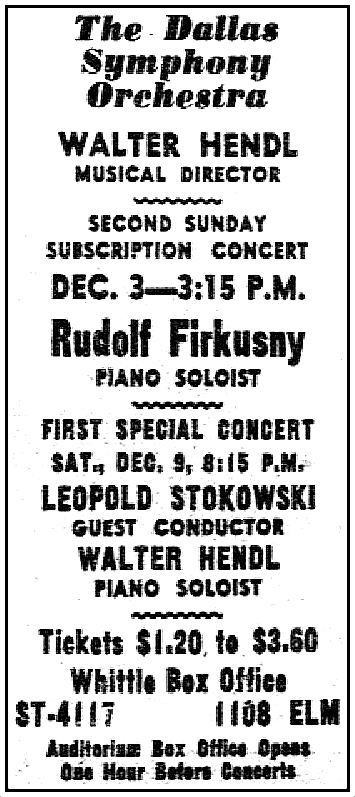
In December, 1950 (about the time of the photo above), Leopold Stokowski appeared in Dallas as a guest conductor with the Dallas Symphony Orchestra. He and Gloria drove up from Houston and spent their time here at the Stoneleigh Hotel. Stokowski had been invited by DSO conductor Walter Hendl, with whom he had worked at the New York Philharmonic Symphony.

stokowski_DSO_dec-1950
Dec., 1950

*

3. SIDNEY LUMET, the TV and movie director, was husband #3. They married in 1956 and divorced seven years later. He was known for critically acclaimed films such as 12 Angry Men, Dog Day Afternoon, Network, and Serpico.

lumet-sidney_vanderbilt_wedding_w-mag Mr. and Mrs. Lumet, 1956

Sidney Lumet’s father, Baruch Lumet, was a Warsaw-born actor who started in Yiddish theater. Somehow he ended up in Dallas, where he founded an acting school and was the director of the Dallas Institute of Performing Arts, whose home-base was the Knox Street Theatre. Baruch plied his craft in Big D for about ten years, beginning in 1952. Among his students was then-Dallas resident Vera Jane Palmer, better known as Hollywood glam-star Jayne Mansfield, and the fabulous actor Rip Torn, who married Dallas actress Ann Wedgeworth in 1955.

lumet-baruch_apr-1960_ad1960

Speaking of the theater world, it’s interesting to note that while Gloria was married to Sidney Lumet, she had written a play (untitled) which had been sent by her agent to Paul Baker at the Dallas Theater Center for consideration. The play was described as “a dance drama, written partly in poetic style” (Dallas Morning News, Sept. 24, 1959).

*

4. WYATT COOPER was Gloria’s last husband; they were married from 1963 until his death in 1988, and together they had two sons, one of whom is journalist Anderson Cooper. From most accounts, the years with Cooper were among her happiest.

gloria-vanderbilt_wyatt-cooper_wikipedia_ebay-photo_101170The Coopers, dressed in matching Adolfo, 1970, via WikiMedia

In 1970, it was announced that Neiman-Marcus’ annual extravagant Fortnight festivities would celebrate the culture and commerce of Australia, but at the last minute, the country pulled out, leaving Neiman’s in the lurch. It was too late to get another country on board, but the show must go on – and Stanley Marcus made the executive decision to feature a fictional country: “Ruritania.”

n-m-fortnight_ruritania_1970_postcard

The store created the country’s history, designed its money and postage stamps, and even commissioned a national anthem. There was even a king and queen of the principality: King Rudolph and Queen Flavia, embodied by the striking couple of Wyatt Cooper and Gloria Vanderbilt, who presided over a grand ball in formal wear designed by Gloria’s favorite designer, Adolfo. The photo at the top of this post (and directly below) was taken in December 1970, just a few weeks after the Neiman’s Fortnight — the Coopers were attending the high-society Winter Ball at the Plaza Hotel in New York, with Gloria in another Adolfo creation. It gives you an idea of the royal costumes they wore in Dallas as the faux monarchs of Ruritania. It also shows what a game, happy couple they were and why Stanley Marcus chose them to be the king and queen of his mythical kingdom .

cooper-wyatt_gloria-vanderbilt_1970_w-mag_sm

*

RIP, Gloria. We should all be lucky enough to have a life as full as yours.

***

Sources & Notes

Top photo of Gloria Vanderbilt and husband Wyatt Cooper shows the couple in December, 1970, attending the Imperial Russia-themed Winter Ball in New York City, with Gloria in a costume designed by Adolfo; that photo (as well as the photo of her and Sidney Lumet on their wedding day) appeared in a well-worth-clicking-through W magazine slideshow.

*

Copyright © 2019 Paula Bosse. All Rights Reserved.

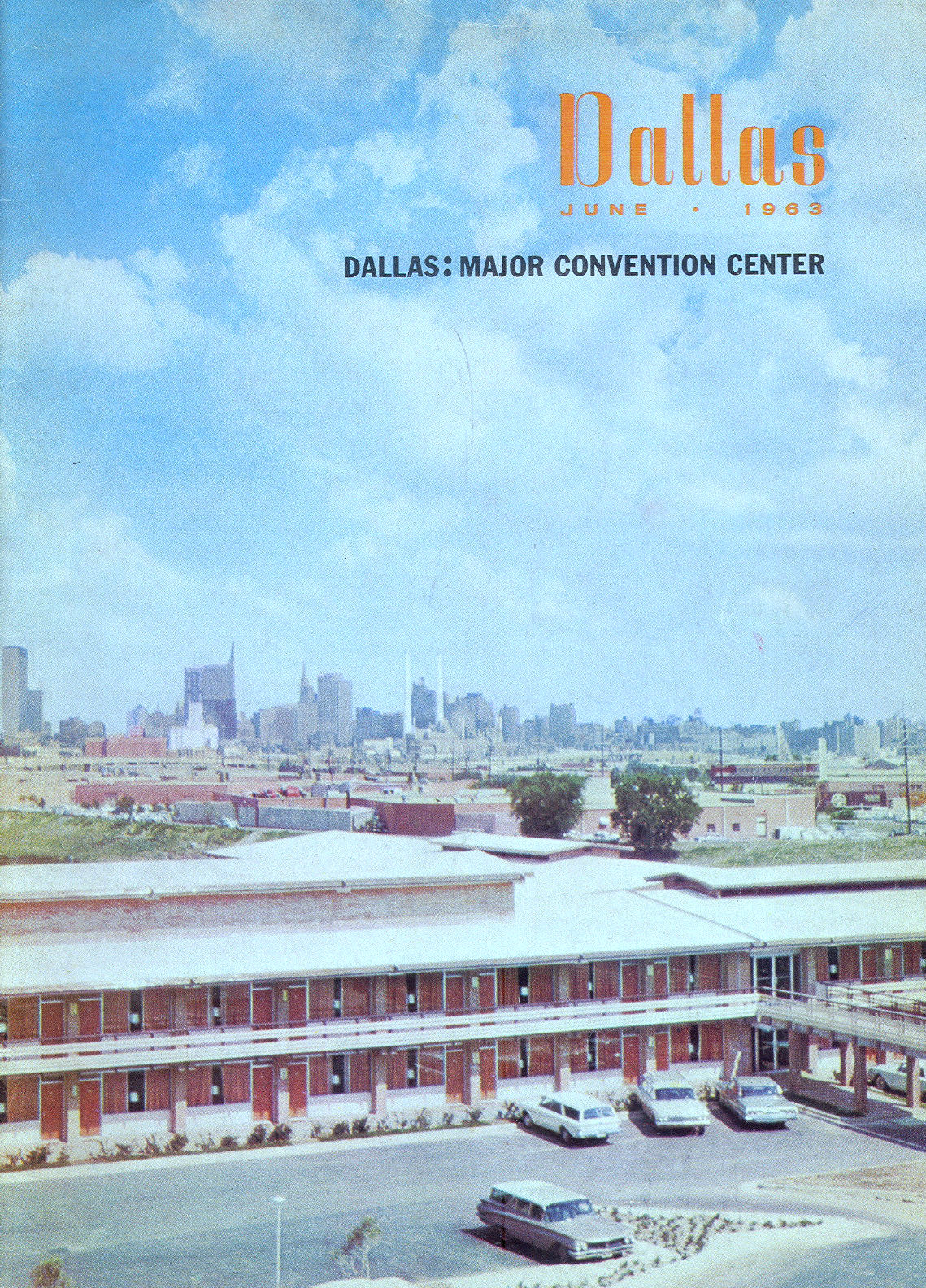
Dallas: Major Convention Center — 1963

dallas-major-convention-center_june-1963_ebayCity of dreams, city of motels… (click for larger image)

by Paula Bosse

Here’s an interesting shot of the downtown skyline: from an unidentified motel (possibly along Harry Hines?).

This cover of a 1963 Dallas Chamber of Commerce magazine carries the headline “Dallas: Major Convention Center” — that year Dallas was named the #3 convention center (Chicago and New York held the top two spots) in a survey conducted by the trade publication World Convention Dates based upon the number of conventions booked — Dallas had 405 conventions booked, as of July, 1963. The previous year Dallas was ranked #9, so that’s quite an improvement. The GOP was even considering the city as the site of their 1964 Republican National Convention (which, considering the events of November, 1963, is an odd thing to contemplate).

Why was Big D so popular? An advertorial in The Dallas Morning News listed a few reasons:

…clear, dry weather; cosmopolitan atmosphere; numerous modern and attractive hotels and motels – with more being built every day; a marketplace with wares from over the nation and world; fun things to do and see including cultural, sports and theatrical offerings; a world-wide shopping center; easy accessibility via gleaming highways, freeways and an airport which ranks 10th in the nation. (DMN, Oct. 6, 1963)

So… pretty much the same things you hear today (except our highways might not be quite so gleaming — but our (new) airport ranks a lot higher than #10). All these years later, Dallas remains near the top of the convention-attracting cities in the United States. (I have a feeling the motel seen in the photo above did not have such a rosy future….)

***

Sources & Notes

Image shows the cover of the June, 1963 issue of Dallas, the magazine of the Dallas Chamber of Commerce; found in an old eBay listing. (If anyone has any old copies of this magazine they would like to divest themselves of — or loan out for a short time — please contact me at the email address in the About/Contact tab at the top of this page.)

*

Copyright © 2019 Paula Bosse. All Rights Reserved.

The Zodiac Room

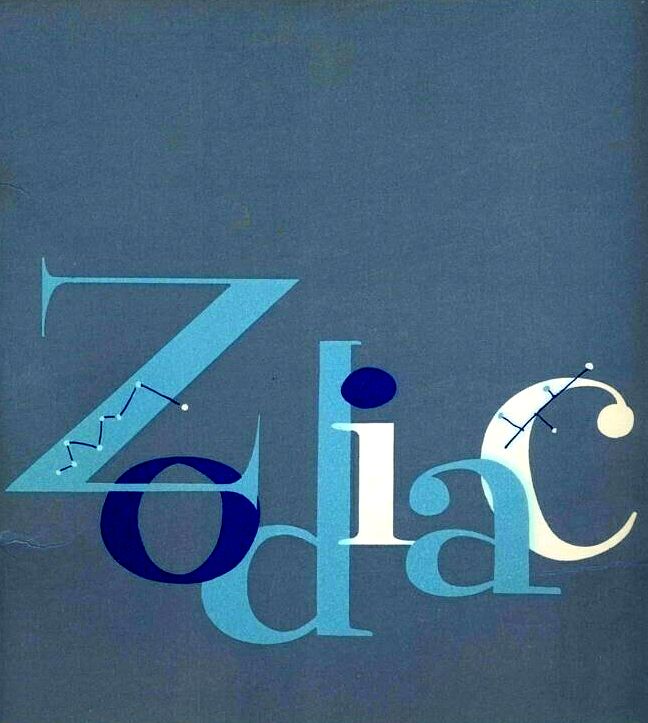
zodiac-room_ebay_menu_cover

by Paula Bosse

The tastefully swanky Zodiac Room opened at the downtown Neiman-Marcus store on April 27, 1953. (Interestingly, there was an earlier — and presumably unrelated — Zodiac Room, in the Jefferson Hotel, from at least 1950 to 1952.)

The Zodiac, a fashionable restaurant and tearoom featuring select foods, will open Monday on the sixth floor of Neiman-Marcus Company’s downtown store. Designed by Eleanor LeMaire of New York, the restaurant’s décor will suggest the roof of the world with signs of the Zodiac represented in both the main dining area and the terrace. (The Dallas Morning News, April 26, 1953)

Stanley Marcus wanted a restaurant in the store in which customers could take a break from shopping by having lunch or afternoon tea on-site, without having to leave the premises. Customers could continue to “shop” while dining as models walked around modeling fashions from the store’s inventory.

“[W]e installed a large restaurant, the Zodiac Room, to attract more people to the downtown area and as a service to those customers from out of town who were spending the day in the store.” (Stanley Marcus, in his book Minding the Store)

Below are a few ads from the Zodiac’s first week (click to see larger images).

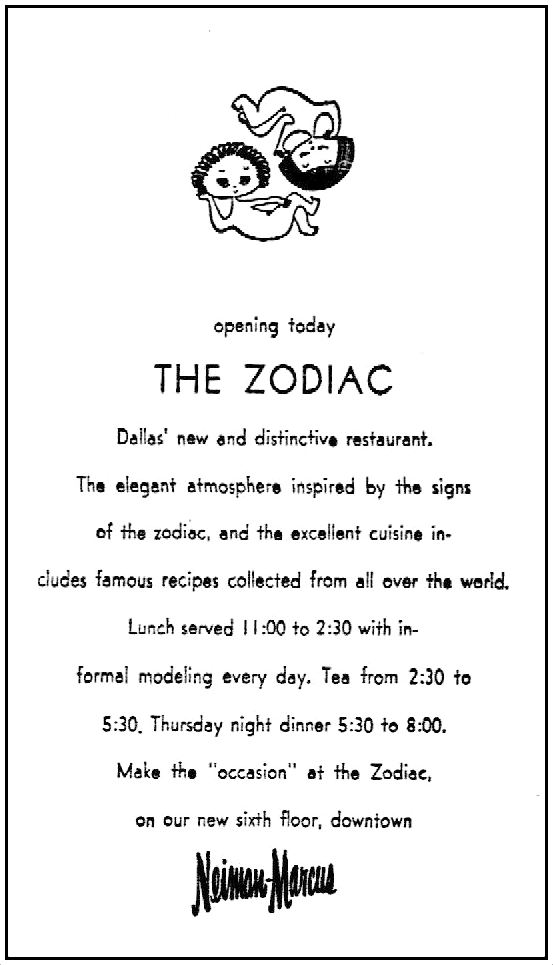
zodiac_opening-ad_042653
April 26, 1953

COME AND SEE DALLAS’ NEW AND DISTINCTIVE RESTAURANT — THE ZODIAC.

Just completed on our new sixth floor, the Zodiac Restaurant is another step in our downtown expansion program to bring to Dallas the most luxurious and elegant store in America.

The star studded atmosphere of the Zodiac will give you an out of this world feeling. The walls are a wonderful cerulean blue, the carpet’s deep enough for snowshoes and an Italian tile pool sprouts water lilies for the occasion. Informal modeling every day at luncheon.

Plan to have lunch with us this week and bring your guests. We think you’ll be enchanted with the atmosphere as well as the excellent cuisine. Luncheon 11:00 to 2:30, tea 2:30 to 5:00, dinner Thursday night 5:00 to 8:00. NEIMAN-MARCUS

zodiac_opening-today-ad_042753
April 27, 1953

zodiac-room_042853-ad_opening
April 28, 1953 (N-M ad, detail)

You could even get a Zodiac-inspired hair-do, the Zodiac Cut: “Sophisticated, spherical — without a hint of a part.”

zodiac-cut_nm-ad_042953April 29, 1953

Other than the fact that this elegant dining space was part of the world-famous Neiman-Marcus department store, its main draw was its food. According to Stanley Marcus, in his book Minding the Store, the Zodiac struggled for the first year or two and didn’t find its footing until he hired the now-legendary Helen Corbitt as the restaurant’s director. He wrote the following in a guest column in The Dallas Morning News in 1979:

“A landmark in the culinary history of Dallas was the arrival of Helen Corbitt, who made a monumental contribution to improvement of food and service standards in the community. The Neiman-Marcus Zodiac Room became famous under her direction.” (Stanley Marcus, DMN, April 12, 1979)

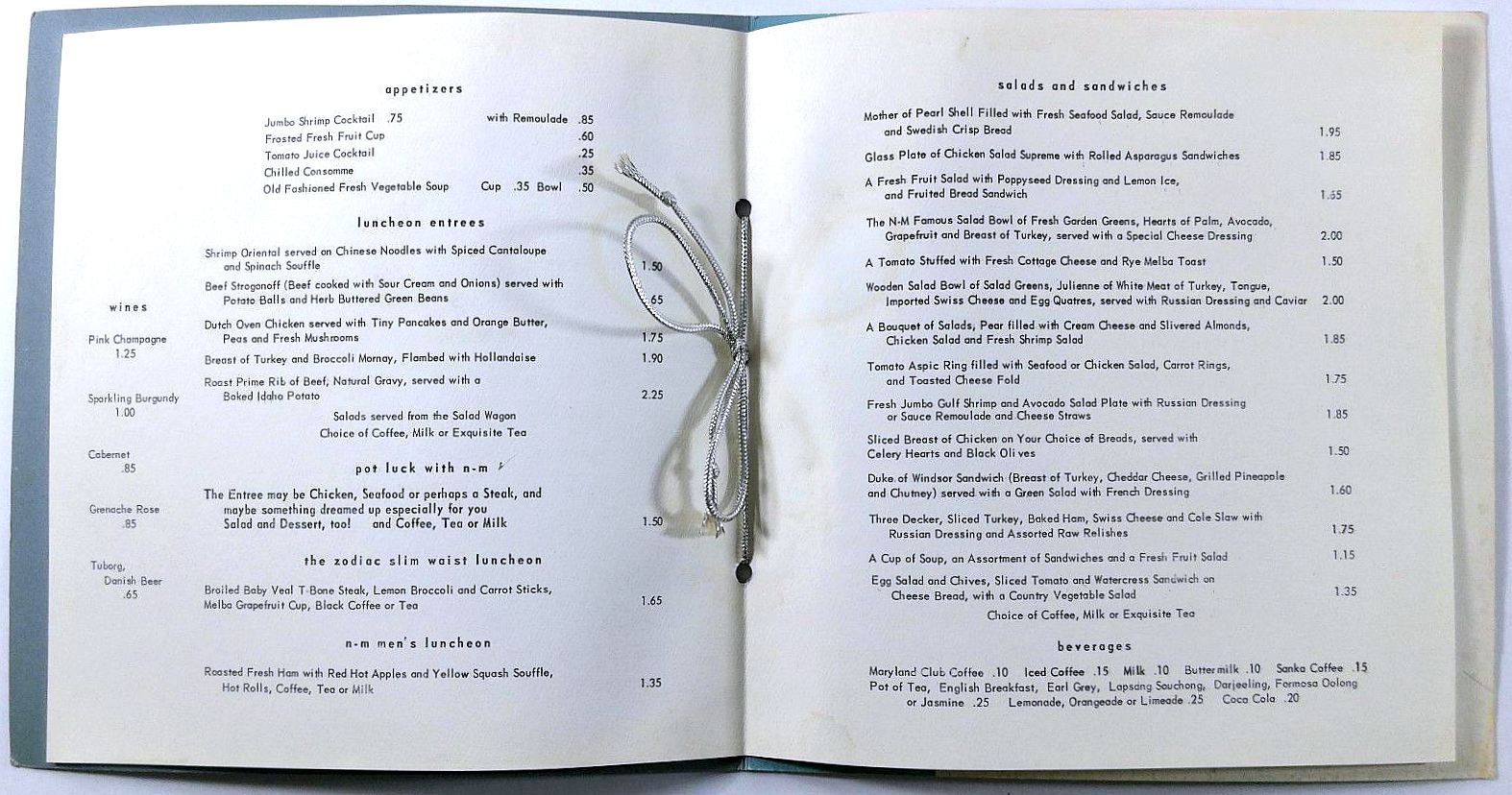
Below is an example of the fare favored by the Ladies Who Lunch (and the occasional Men Who Lunch), seen in a menu from 1956. (The most expensive item on the menu was the Roast Prime Rib of Beef, which came with a Baked Idaho Potato, a salad from the “Salad Wagon,” and a choice of coffee, milk, or “exquisite tea” — the price was $2.25, which in today’s money was a shockingly affordable $21.00.)

zodiac-1956-menu_inside_ebay

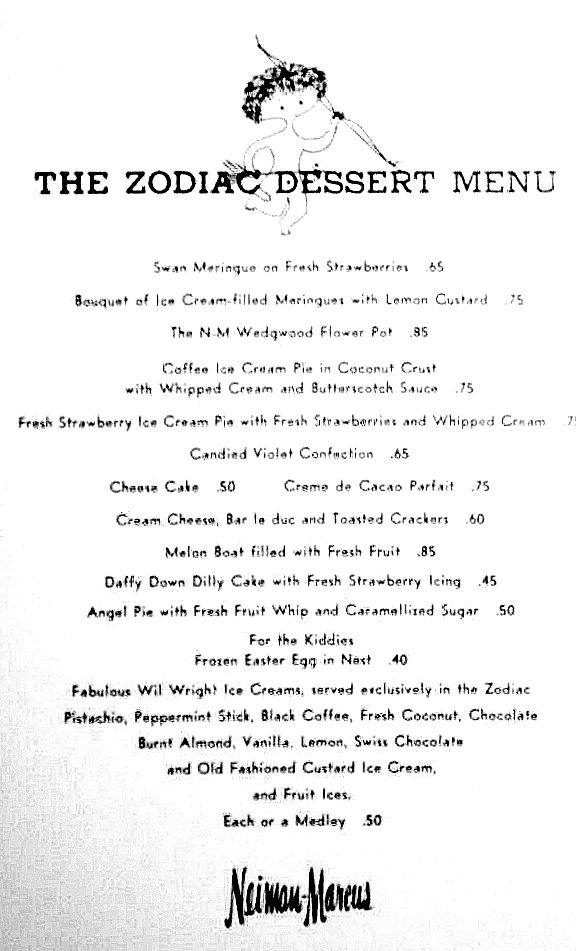
A dessert menu (a bit hard to read, I’m afraid) is below:

zodiac-menu-2_ebay_dessert-menu

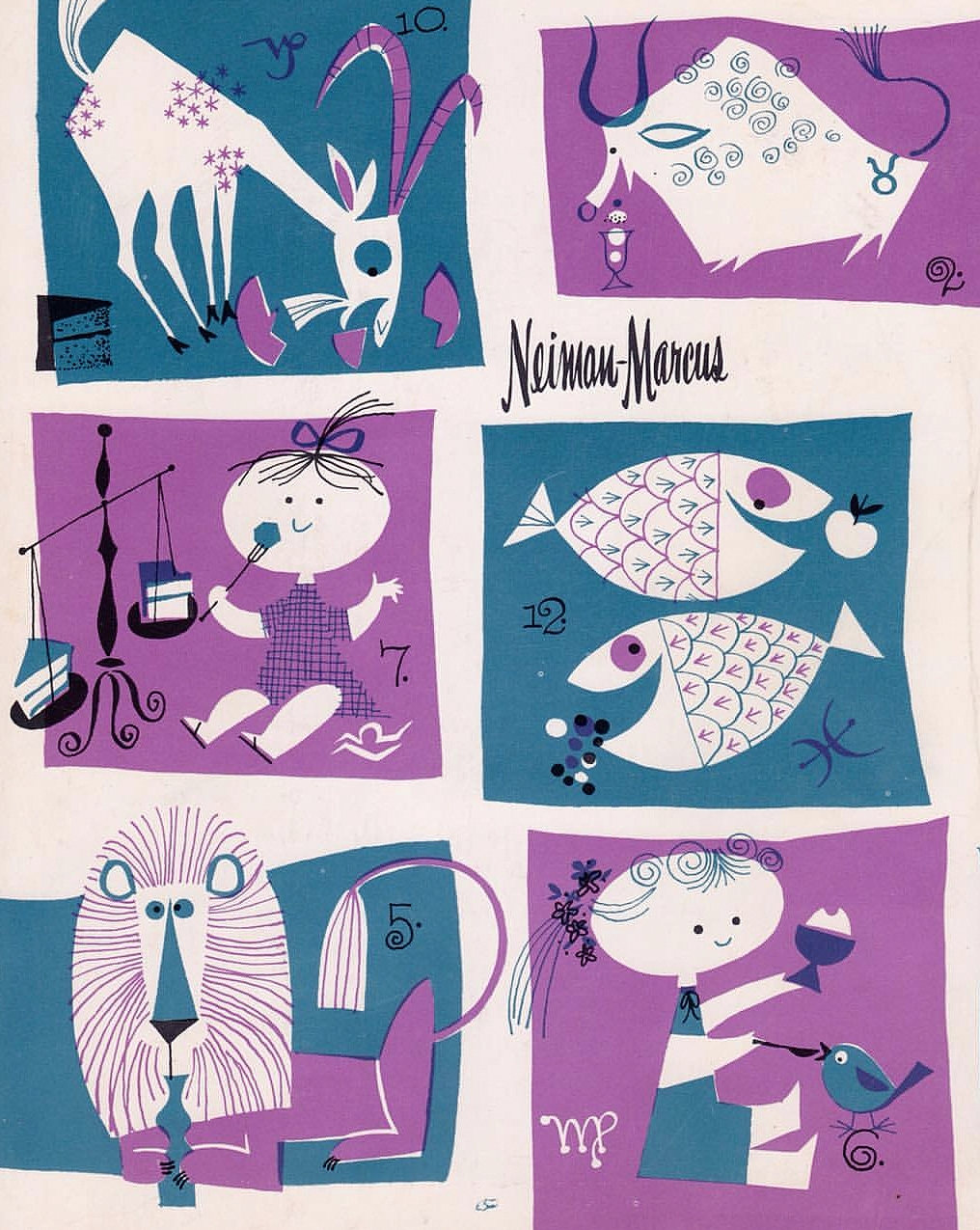
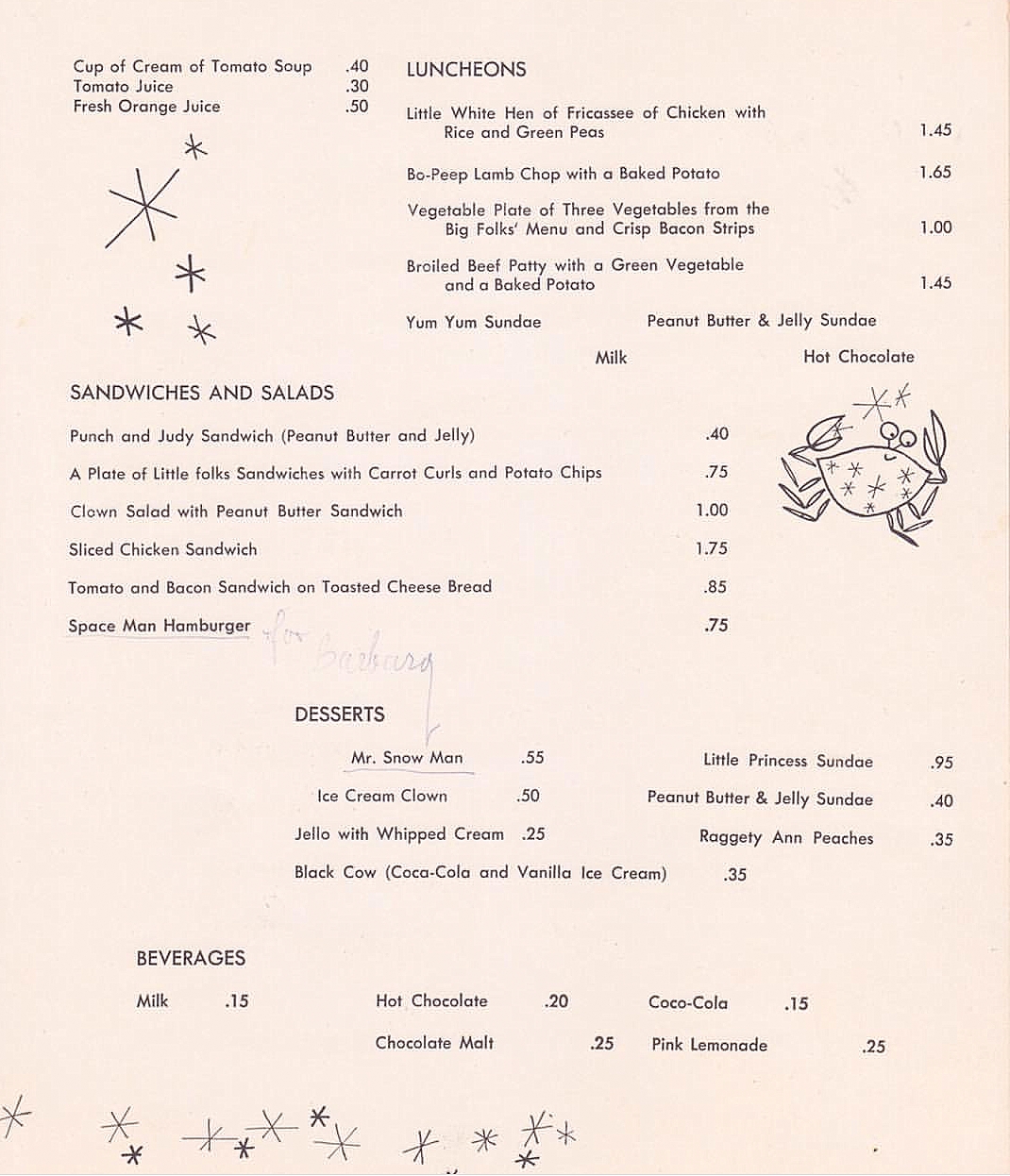
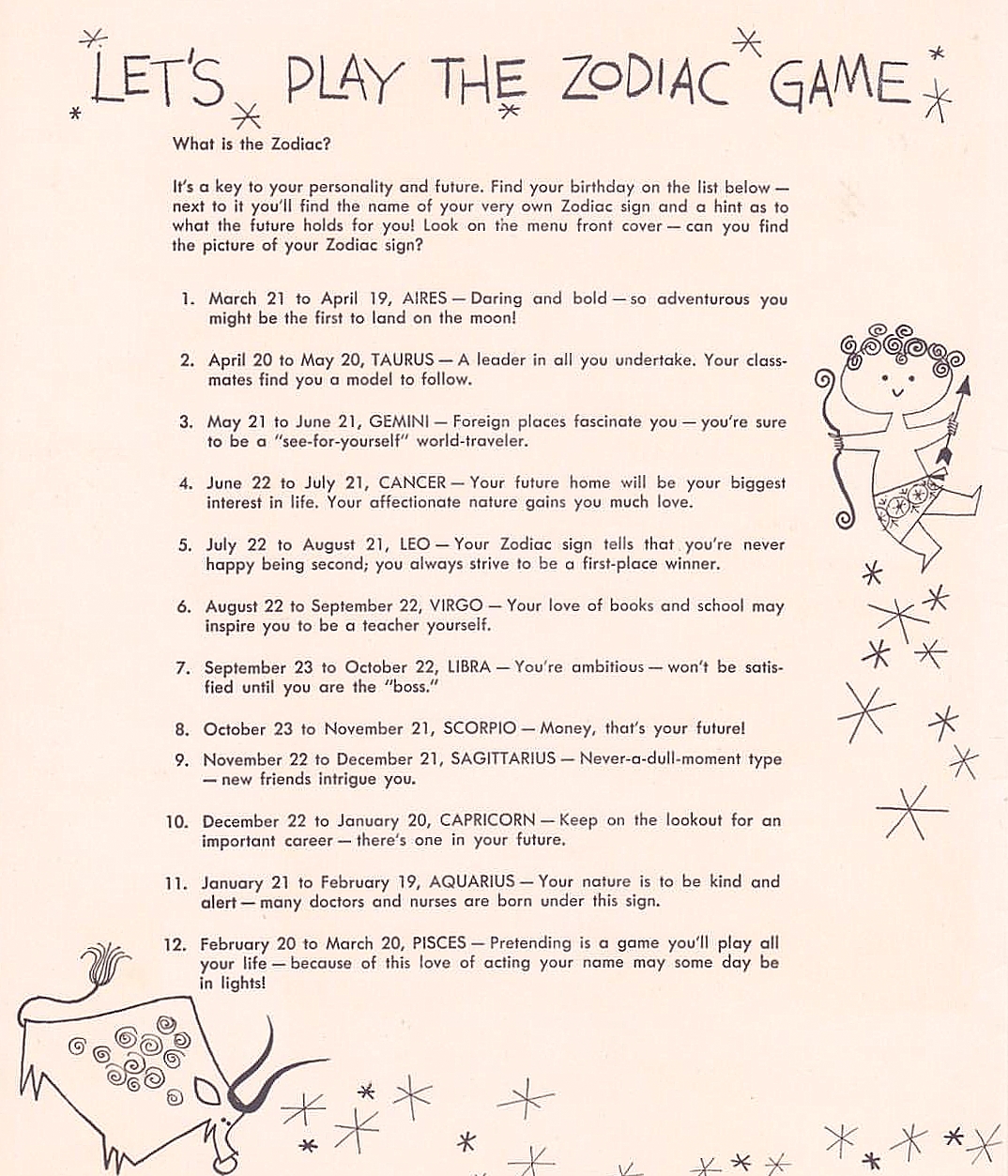
There was also a children’s menu, which was so charmingly designed by Neiman’s gift-wrap designer, Alma Shon, that I don’t blame a customer for having spirited away a copy of the menu as a holiday-time souvenir of what was no doubt a very special occasion (the date penciled at the top is Dec. 23, 1966). (More information about Ms. Shon is in the “Sources & Notes” section at the bottom of this post.) Below, the front and back of the children’s menu, illustrated with the signs of the zodiac:

zodiac-room_childrens-menu_instagram_front

zodiac-room_childrens-menu_instagram_back

Inside, meal options for well-appointed kiddies and a “Zodiac game” to keep them occupied.

zodiac-room_childrens-menu_instagram_food

zodiac-room_childrens-menu_instagram_zodiac-game

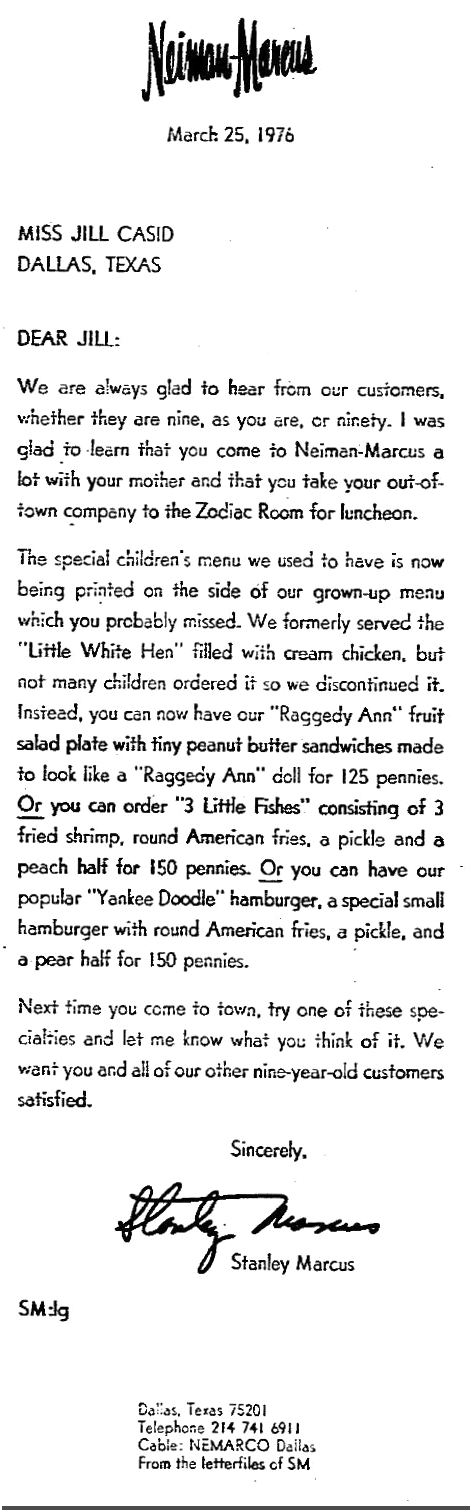
A few years later, this Stanley Marcus-penned letter appeared as a 1976 N-M ad — it was a personal reply to a nine-year-old Zodiac patron who had apparently written to Neiman’s inquiring about the children’s menu, which she was distressed to see had disappeared on her last visit:

zodiac-room_051776_ad-det_childrens-menu
May 17, 1976

zodiac-room_postcard_flickr

Lastly, a memory of the downtown Zodiac, from the Department Store Museum website:

The downtown Dallas store was in its entirety a magic store. Every step and turn off the escalators to the top floor was amazing. The Zodiac room with its floor-to-ceiling diaphanous curtains that filtered the bright Texas sky made for a dreamlike atmosphere along with the slender long-legged models in evening gowns and furs and the Andre Previn-inspired piano player. The popovers with strawberry and cinnamon butter weren’t bad either. Thank you, Dallas and Neiman-Marcus, for such a rich time in my life.

And it’s still going strong.

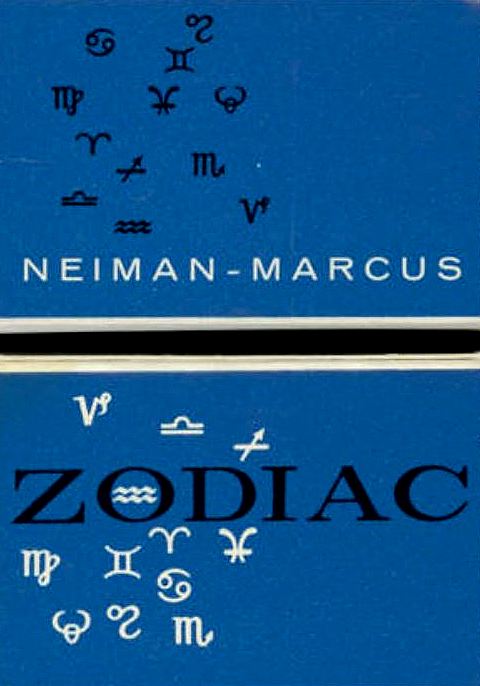
zodiac_matchbox_cook-collection_degolyer-library_SMU

***

Sources & Notes

Top image and other (non-children’s) menu images from eBay.

The four images of the Zodiac Room children’s menu are the reason I decided to do this post. My whimsy-threshold is pretty low, but I love the utterly charming drawings which grace the front and back covers. I saw them posted on the Instagram account @reflectionofaman (a cool account — here, for the desktop site — which features the photographs of Stanley Marcus, curated by his granddaughter, photographer Allison V. Smith); it had been shared there by Babs Bern (@mullett7665.manor). The menu’s artist — Alma Shon — was identified by her daughter Kate Heyhoe (@StarkRavingCat) in the comments. According to a 1953 Dallas Morning News profile, Shon was born in California in the early 1920s to Korean refugees who had fled Korea in 1905 during the Russo-Japanese War. She grew up in Los Angeles but made her way to Dallas by at least 1948; she began working for Neiman Marcus in 1948 or 1949. She was in charge of Neiman’s giftwrap design, but also designed other merchandising elements — she was with the store for several decades. More on Ms. Shon (including a photo of her from the ’50s) can be found in a post by her daughter Kate, here.

Color postcard of the Zodiac Room was found on Flickr, here. I used this same card in a previous Flashback Dallas post, “Luncheon at The Zodiac Room, Darling.”

Image of the  blue matchbox at the bottom is from the George W. Cook Dallas/Texas Image Collection, DeGolyer Library, SMU Libraries; more info is here.

More on Helen Corbitt can be found in articles in Texas Monthly and in Legacies; a couple of her recipes — including her famous Poppy-Seed Dressing — can be found here.

*

Copyright © 2019 Paula Bosse. All Rights Reserved.