Flashback : Dallas

A Miscellany: History, Ads, Pop Culture

Category: Advertisements

The Ray Hubbard Estate, Lakewood

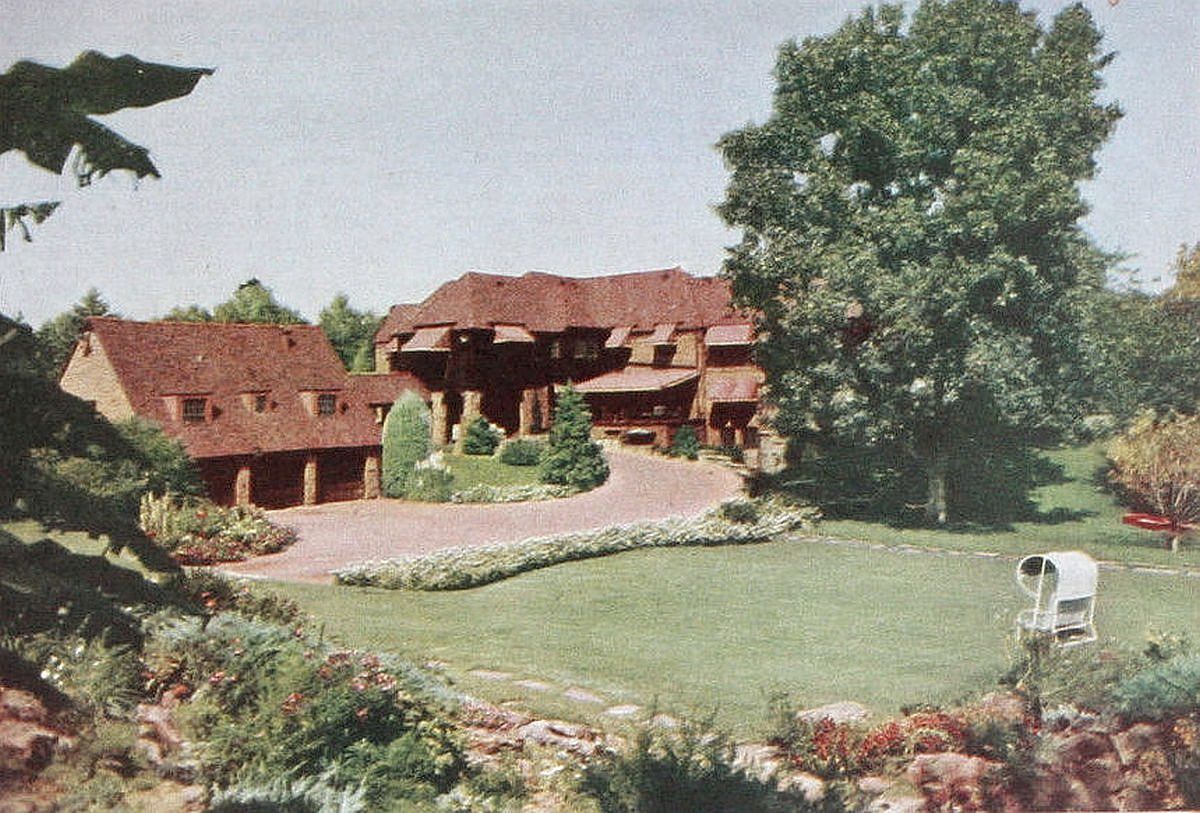
ad-evervess_mrs-ray-hubbard_1948_detA country estate in the heart of Lakewood, 1948… (click for larger image)

by Paula Bosse

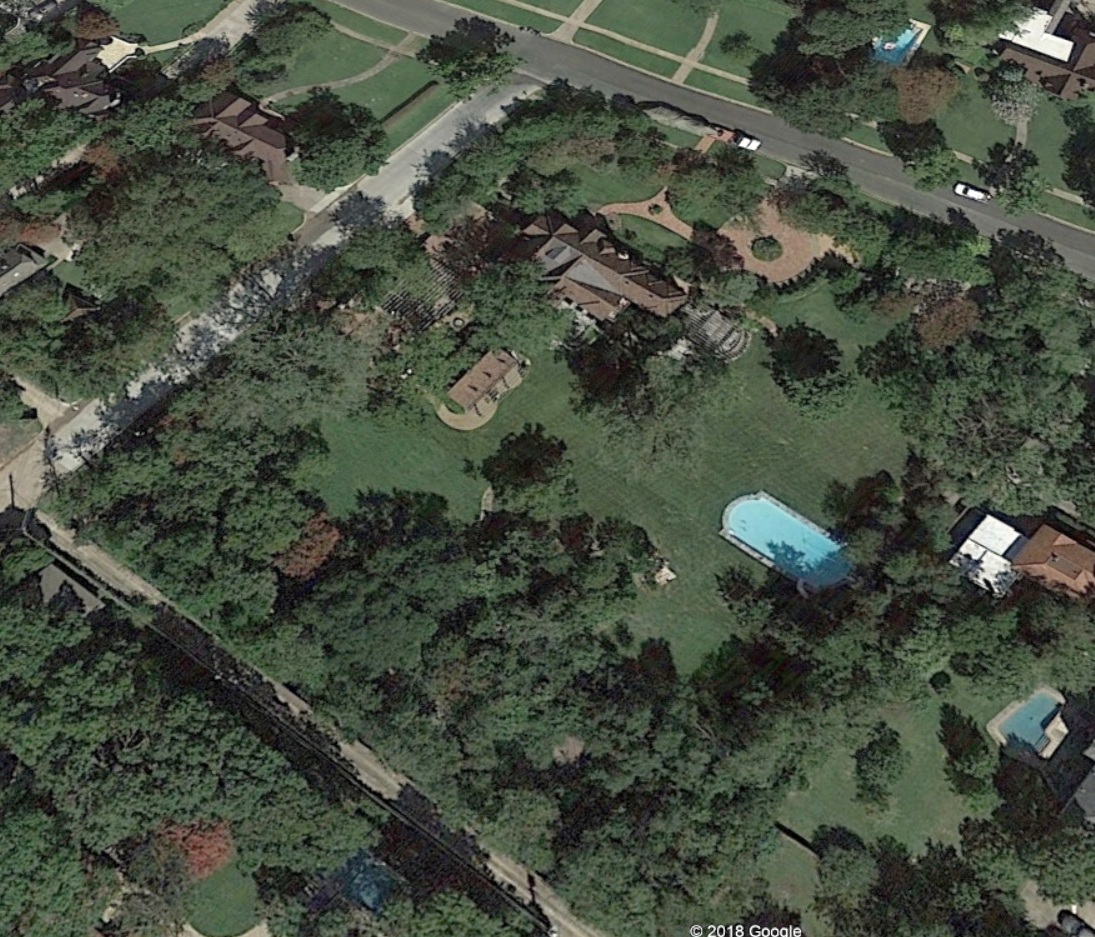
Lakewood has a lot of beautiful homes — large and small — but the (very large) Raymond E. Hubbard estate at the corner of Lakewood Boulevard and Brendenwood Drive is quite the show-stopper. Built in 1934, the two-and-a-half-acre property is about a mile from White Rock Lake and was known for years for its spectacular landscaping and gardens, much of which was the personal handiwork of owner Ray Hubbard (1893-1970). Hubbard amassed his wealth as an independent oilman during the boom years, but he was known in his later life for his lengthy tenure as president of the Dallas Park Board.

From a 1938 Dallas Morning News article:

Mr. Hubbard is that phenomenon known as a natural tiller of the soil. In the short space of two years he has taken a barren hill and transformed it into a blaze of beauty in the form of a rock garden he designed himself. In the symphony of color, he has even had the subtlety to plant a few onions because there is a blue-green cast to the leaves of the onion that is found in no other plant. Carnations, pansies and pinks mingle in profusion as well as a thousand other oddities you have never seen the likes of  before. (“Edens in Preview,” DMN, April 10, 1938)

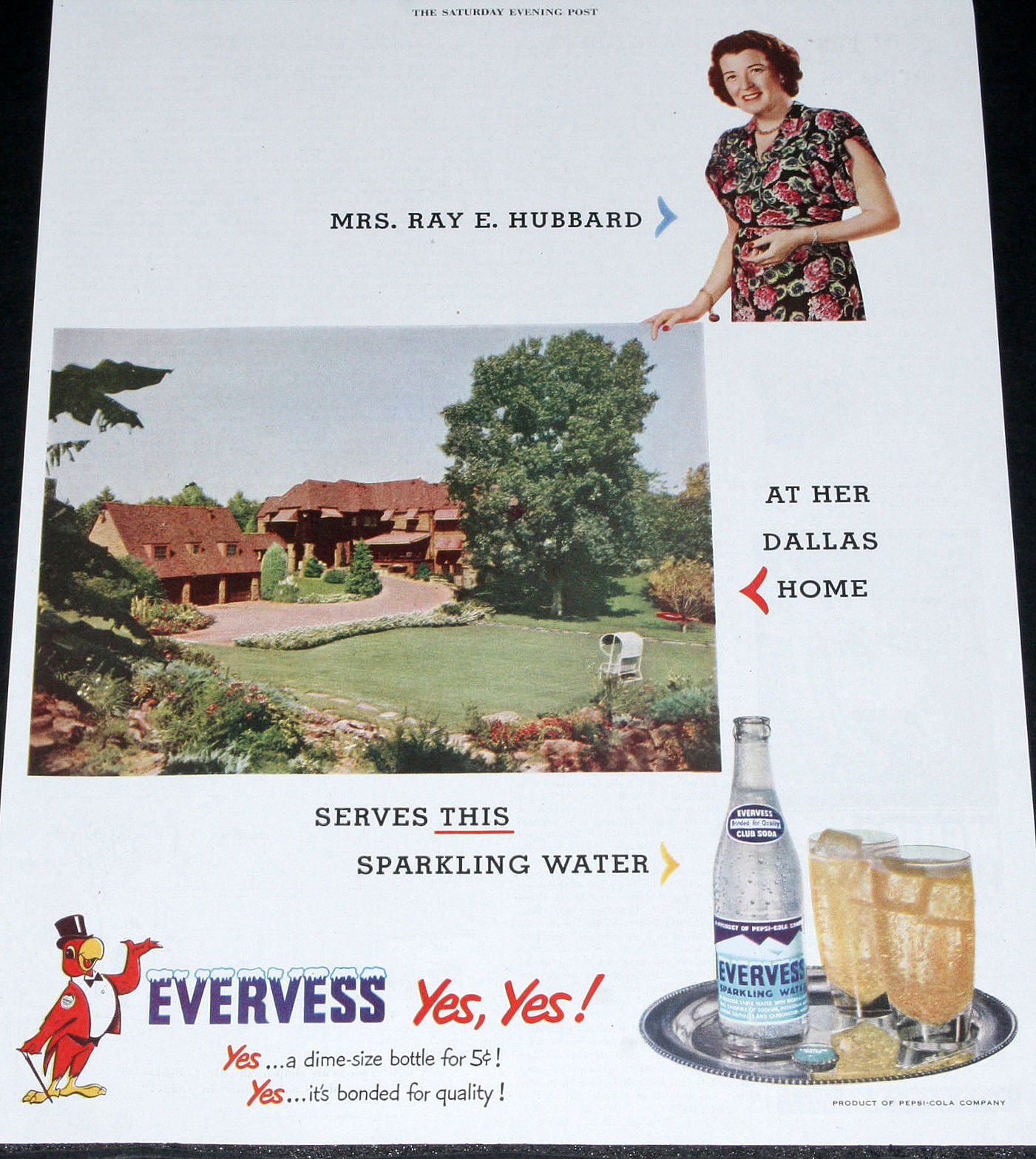
In 1948, his wife, Janet Hubbard, was seen in an ad for Evervess Sparkling Water, with photos of both Mrs. Hubbard and a view of the impressive “backyard” of their Lakewood home. (Click ad to see larger image.)

ad-evervess_mrs-ray-hubbard_1948Saturday Evening Post, 1948

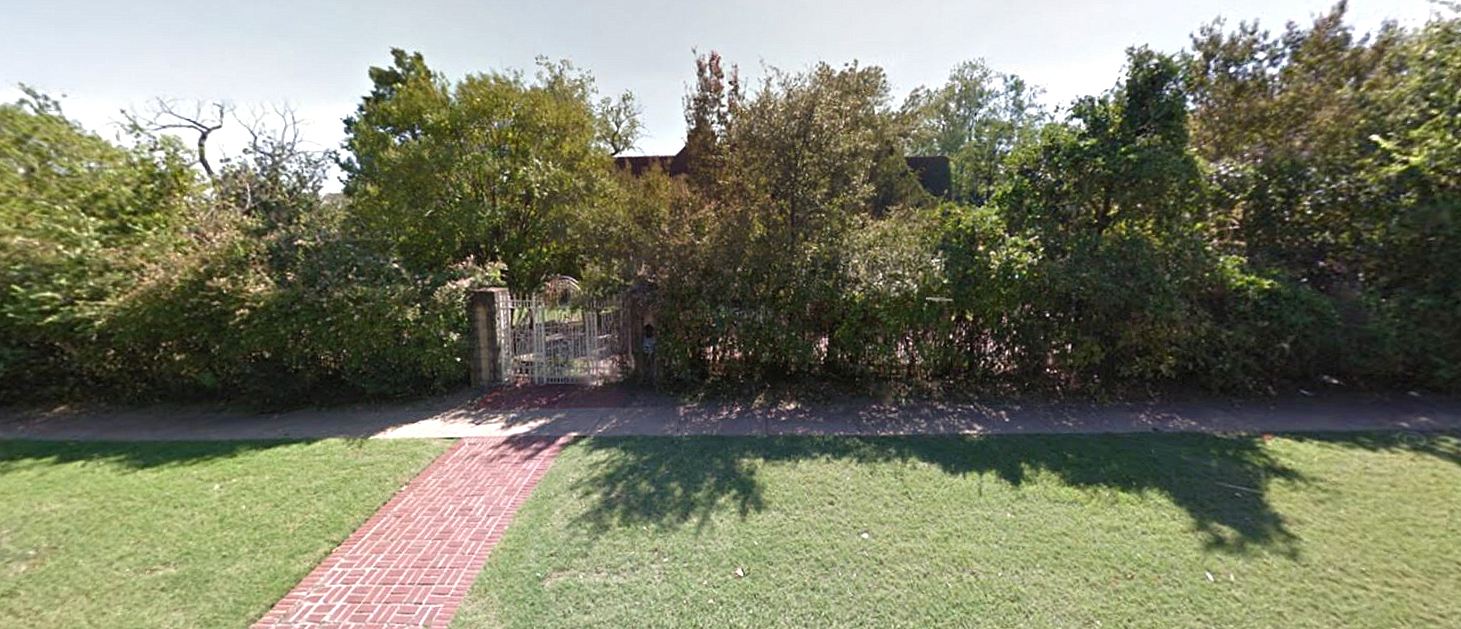
I came across this ad a few years ago but had no idea where the house was located or who Ray Hubbard was, other than the probable namesake of the lake which bears his name (the Rockwall-Forney reservoir was named Lake Ray Hubbard in January, 1967, in honor of Hubbard’s devotion to civic affairs and his decades-long service to Dallas parks). I was surprised to learn that this was the somewhat mysterious and foreboding-looking house I’d passed years ago, looking run-down and deserted, surrounded by overgrown shrubs and bushes. The 2012 Google Street View looked like this:

hubbard-house_google-street-view_oct-2012Google Street View, Oct. 2017

Back then the overgrown approach to the house looked like this, and was probably something of a thorn in the side of the Lakewood Boulevard residents.

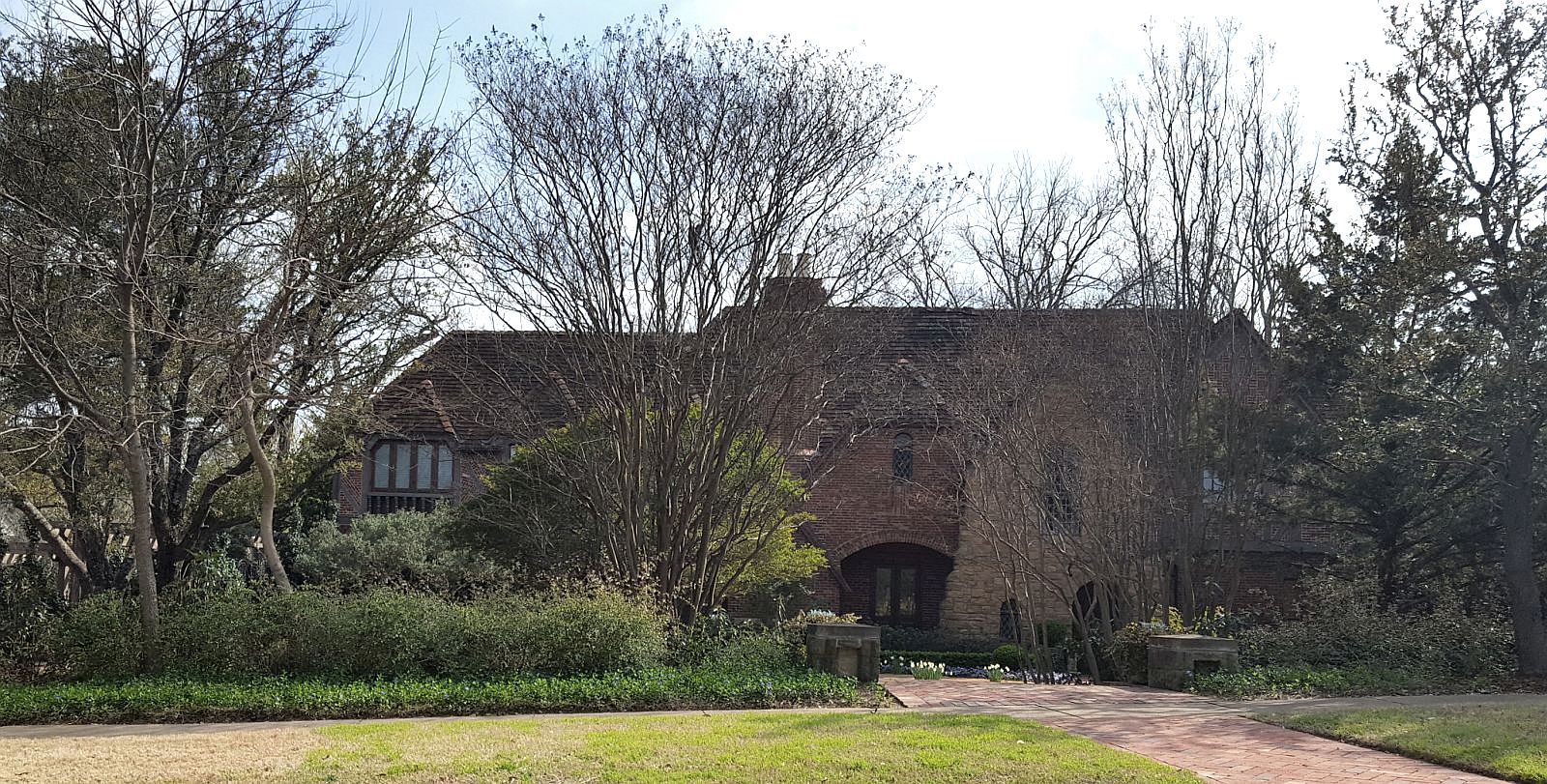
Since Google Street View was so out-of-date, I decided to drive by the house today to see what it looked like in 2018. It’s beautiful!

hubbard-house_lakewood-blvd_031519_PBphoto: Paula Bosse

The reason for the transformation? The property was bought and restored by Hunter Hunt (grandson of one-time richest man in the world — and White Rock Lake resident — H. L. Hunt) and his wife, Stephanie Hunt. And they did a wonderful job! If I had some, I’d raise a toast to the couple with an ice-cold glass of Evervess Sparkling Water!

ray-hubbard-estate_google-earth_2017
Google Earth, 2017

*

hubbard_ray-e-hubbard_find-a-grave

Even though I now know who Ray Hubbard was, I’ll probably still find myself unintentionally (and, okay, sometimes intentionally) calling the lake named after him “Lake Ray Wylie Hubbard” (another former Dallas resident of note, but we’ll leave that for another time…).

***

Sources & Notes

Ad found on eBay. This image is from an item offered several years ago, but as luck would have it, another seller has it for sale right now, here. Perhaps if you’re friends with Hunter and Stephanie Hunt, this would make a nice stocking stuffer. (This Evervess advertisement seems to have been part of a 1948 ad campaign featuring society women, their homes, and their favorite sparkling water: another ad, featuring Mrs. Homer Lange and her Chicago home, can be seen here.)

Photo of Ray E. Hubbard is from Find-a-Grave; read a biographical sketch about Mr. Hubbard’s life on the site, here. Not included in this information was that during Hubbard’s 27 years heading the Park Board (1943-1970), the Dallas park system expanded from 4,400 acres to more than 15,000 acres, and the number of parks increased from 54 to 150.

Read about Stephanie and Hunter Hunt and their Hunt Institute at SMU, here.

If anyone knows the original architect of the Hubbard house, please let me know!

For more on Lakewood Boulevard, I really enjoyed the 1992 Lakewood Advocate article “Lakewood Boulevard’s First Resident Looks Back On the Area’s Development; Mrs. Barnett’s Late Husband, Marshall, Built the First House on Lakewood Boulevard in the 1920s,” here.

See a 1932 view of the 7100 block of Lakewood Blvd. (with White Rock Lake at the end of the street), here; this photo was taken two years before the construction of the Hubbards’ house, which would  be built three blocks to the west (Dines and Kraft photo from the Flashback Dallas post “‘Reminiscences: A Glimpse of Old East Dallas,'” here).

*

Copyright © 2018 Paula Bosse. All Rights Reserved.
Munger Place, The Early Days: 1905-1909

munger-place-bk_ca-1905_degolyer-lib_SMU_construction_1Munger Place, the beginning…

by Paula Bosse

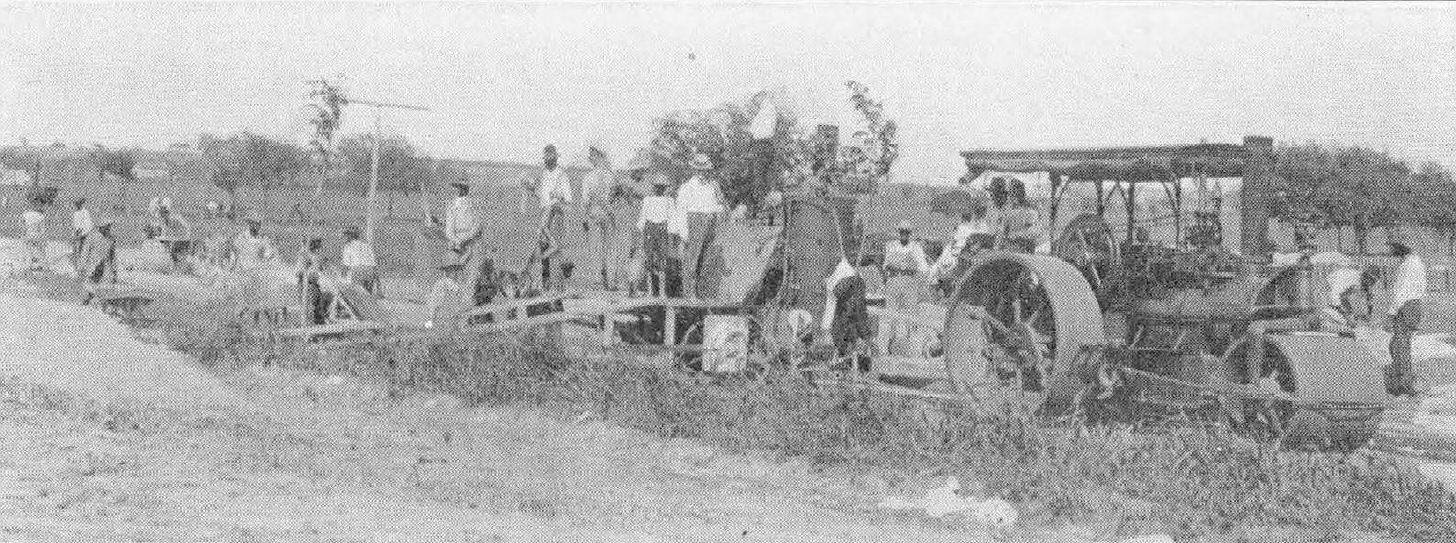
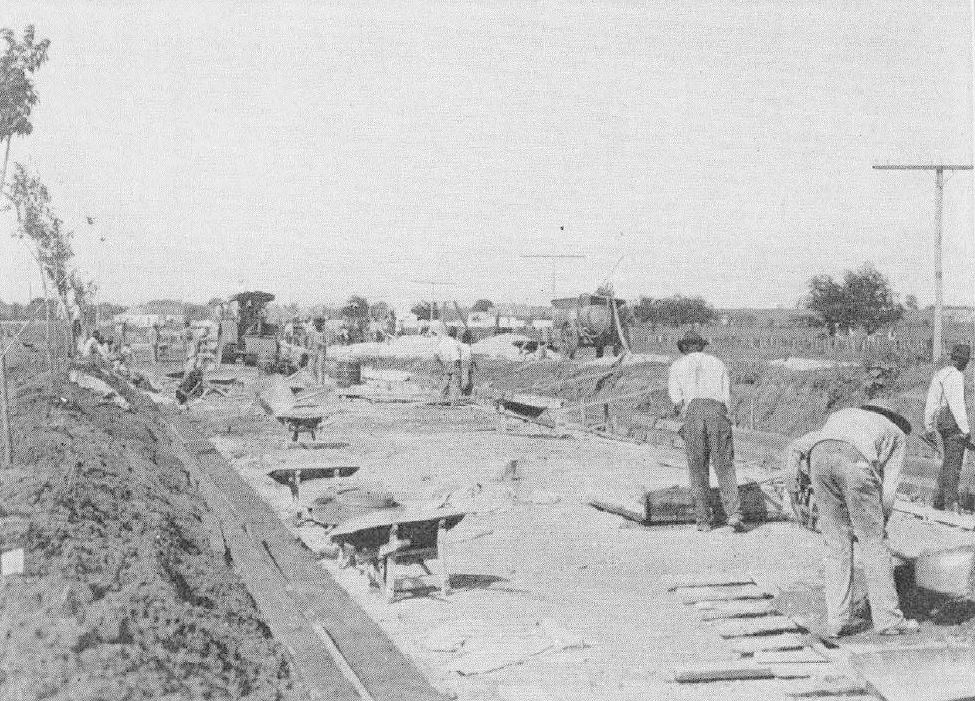
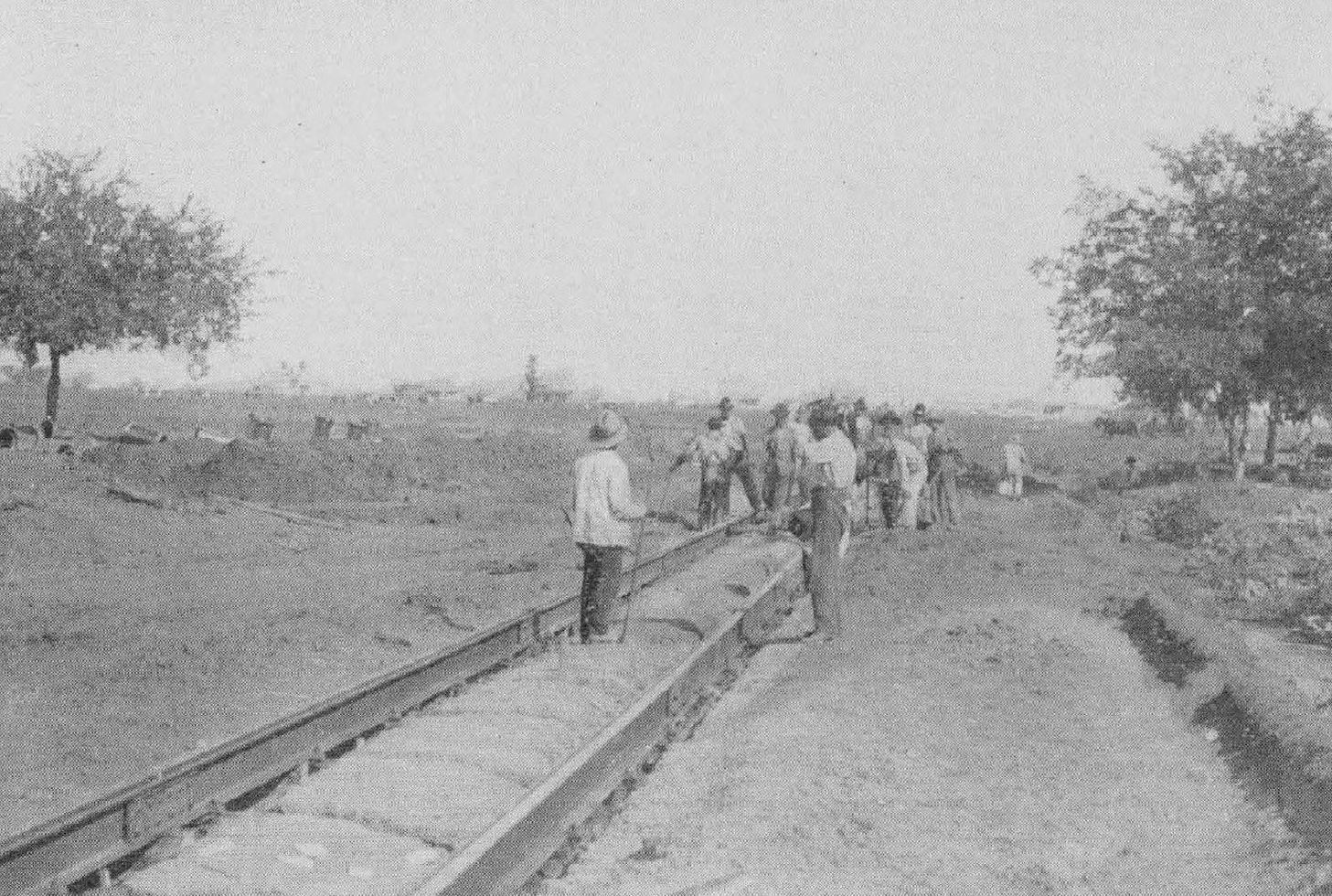
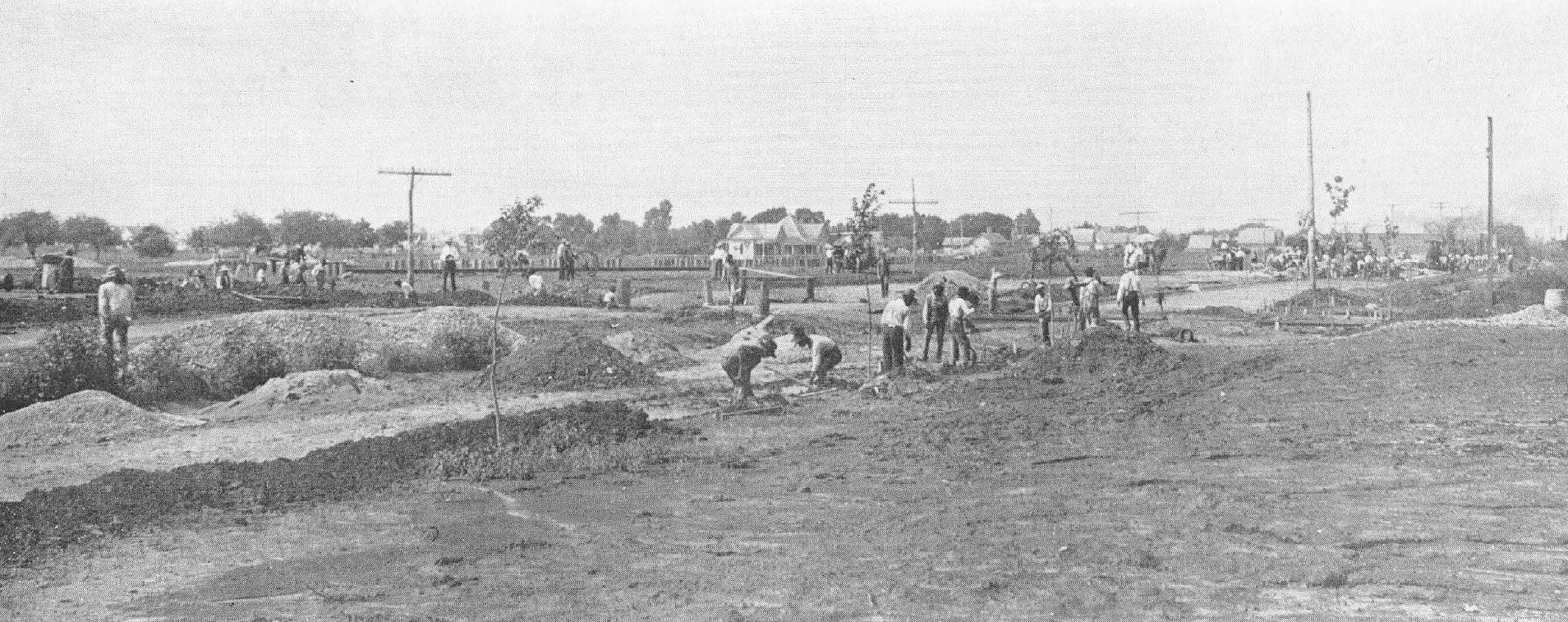
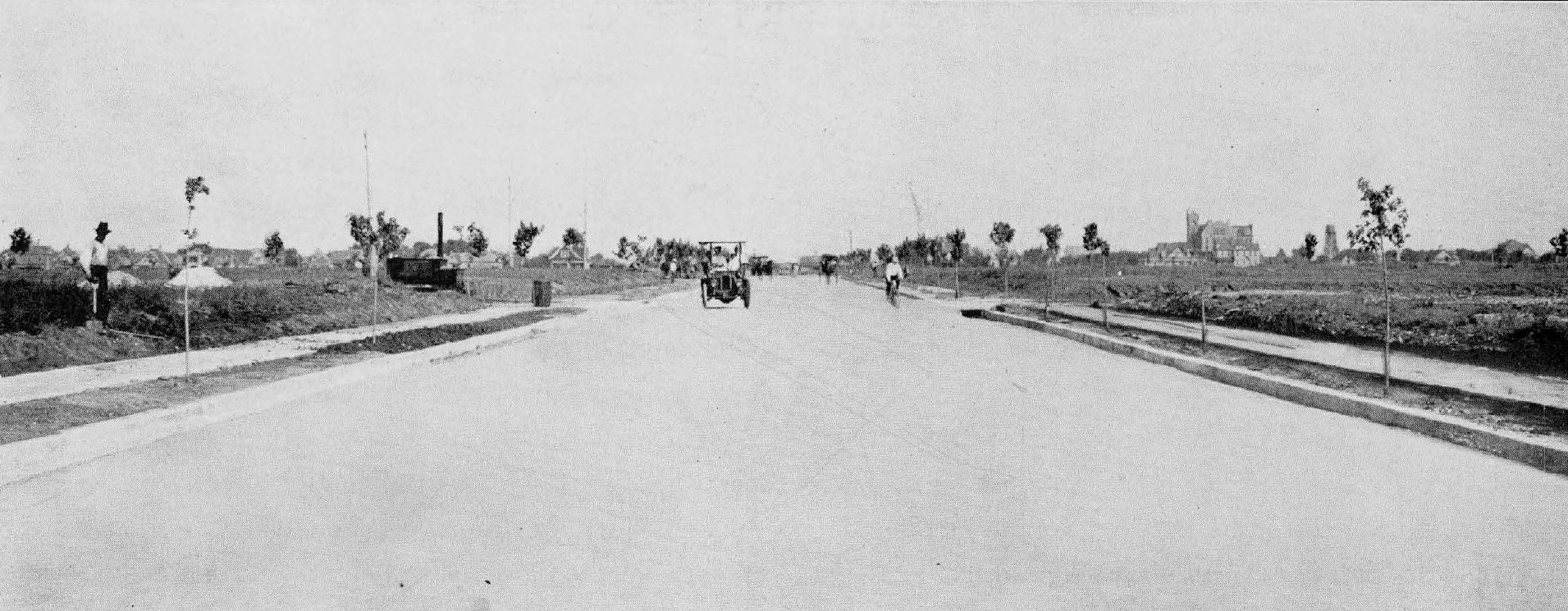
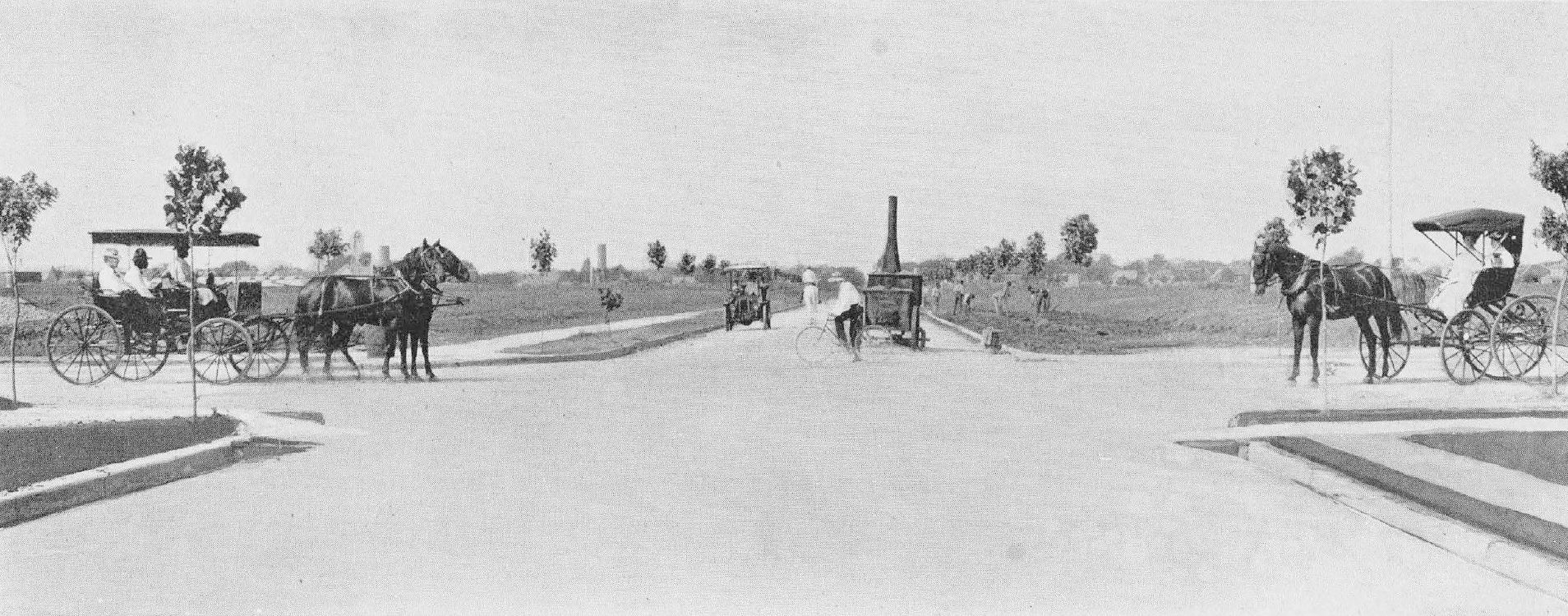
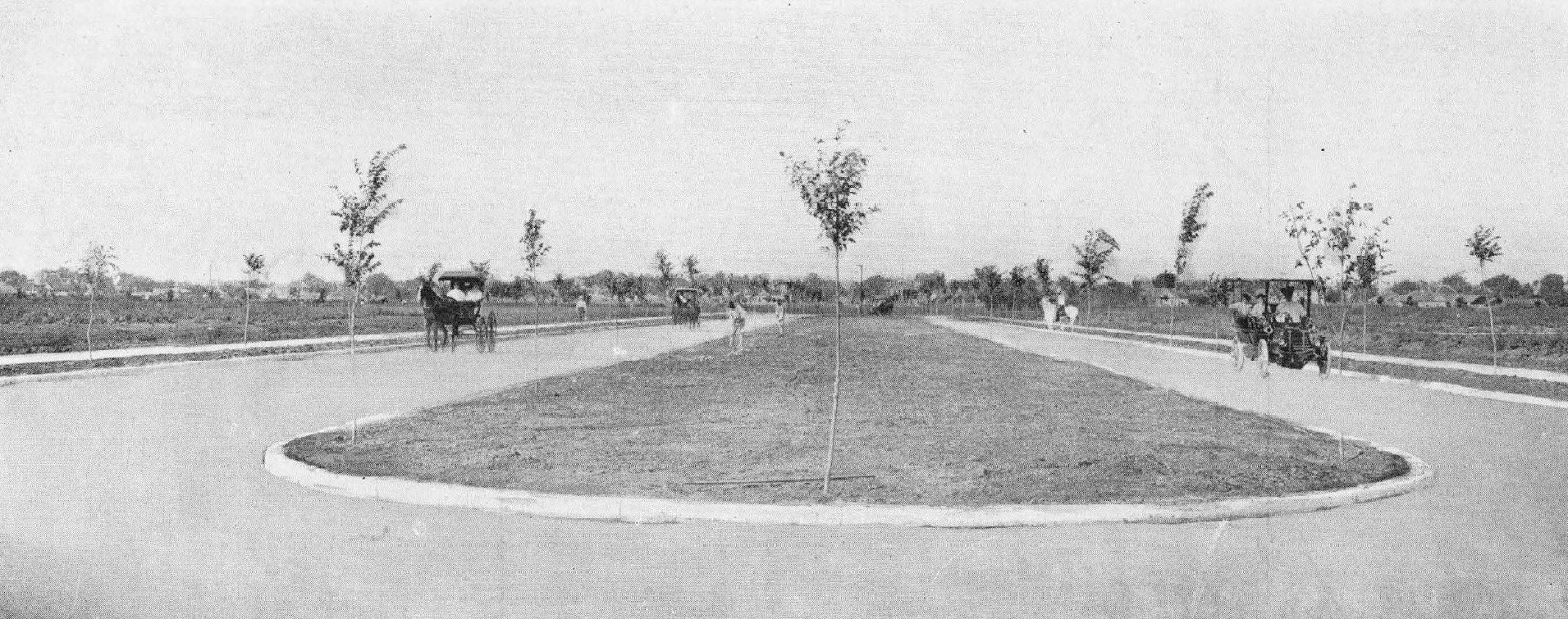
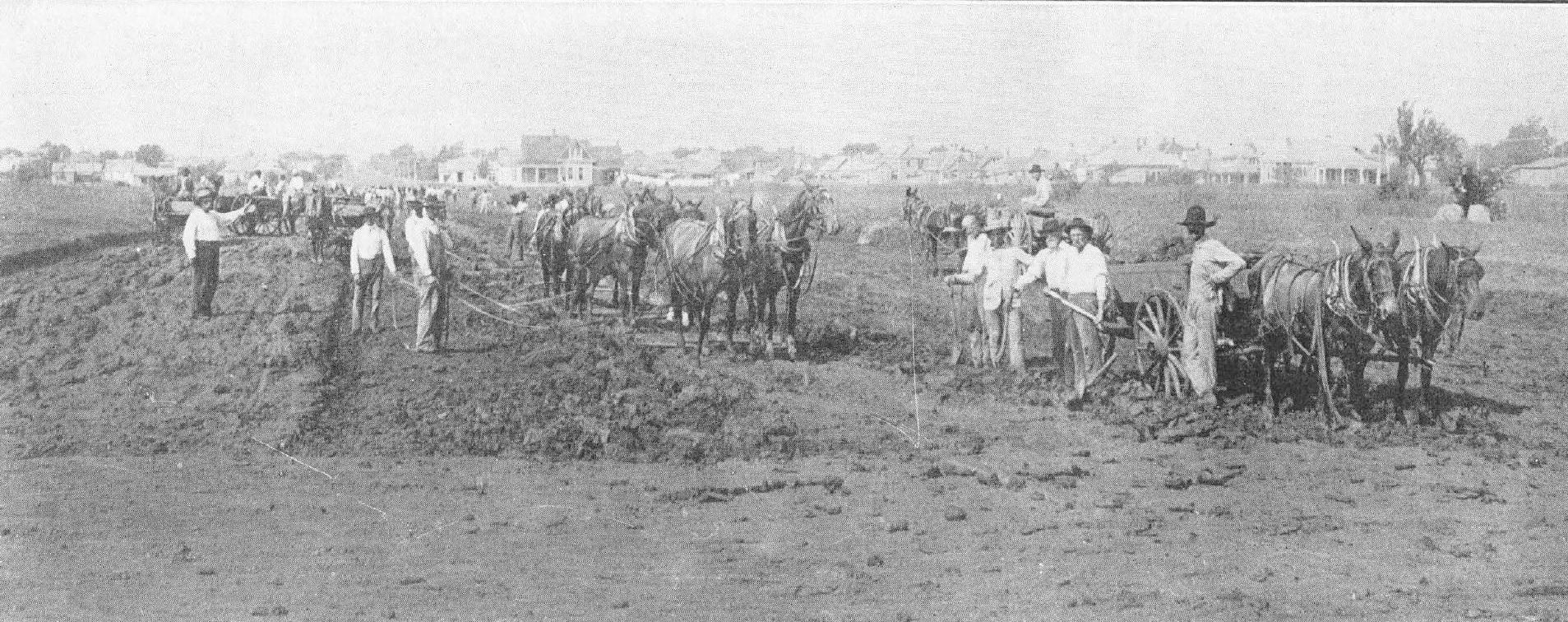
Here are a few photos from a great item found in the collection of SMU’s DeGolyer Library: a promotional booklet on the wonders to be found at the new East Dallas development called Munger Place. The photos show the construction of what would become one of the most exclusive neighborhoods in Dallas, developed by Robert S. Munger (of Continental Gin Co. fame) and his son C. H. Munger. (His son’s first name was “Collett” — as in “Collett Avenue,” which I had always thought was named after one of the elder Munger’s daughters. But it turns out that “Collett” was the maiden name of C. H.’s mother. I’ve only ever heard the street name pronounced like the woman’s name “Colette,” but I have a feeling it might have originally been pronounced as rhyming with “wallet.”) (UPDATE: According to a Munger relative, the street name *should* actually be pronounced to rhyme with “wallet.”)

munger-place-bk_ca-1905_degolyer-lib_SMU_cover

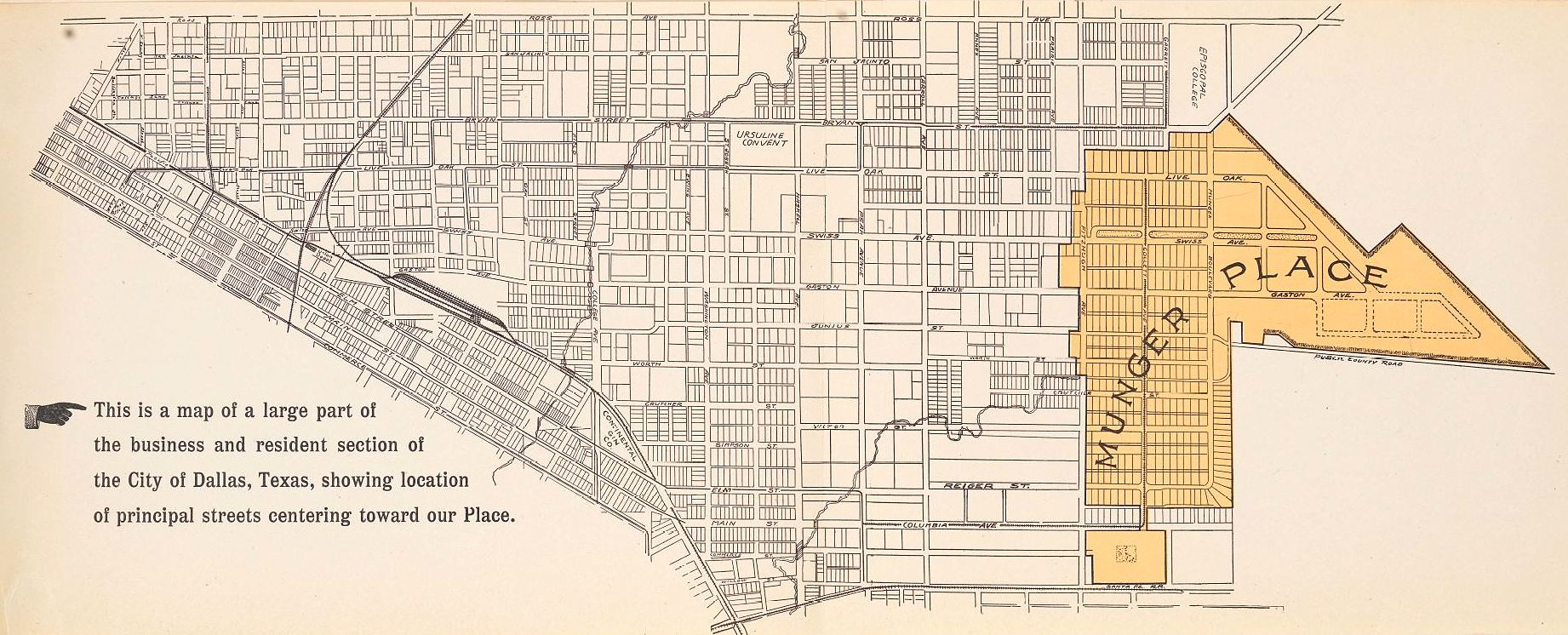
Location, location, location. Not quite within the city limits at this time, but close. (All images are larger when clicked.)

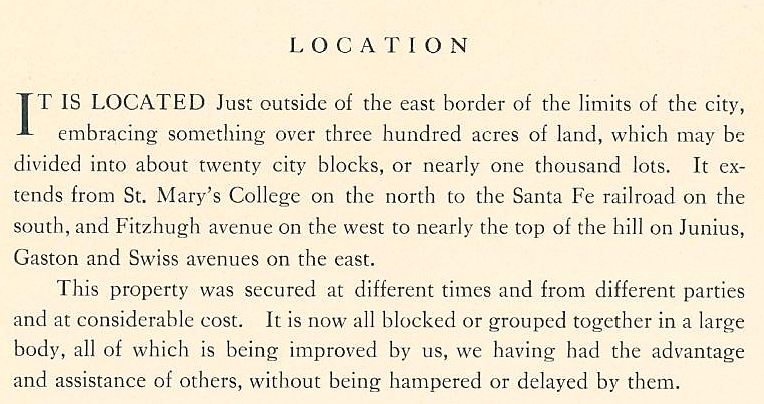
munger-place-bk_ca-1905_degolyer-lib_SMU_location

*

munger-place-bk_ca-1905_degolyer-lib_SMU_construction_2Caption: “At work.”

*

munger-place-bk_ca-1905_degolyer-lib_SMU_pavingPaving.

*

munger-place-bk_ca-1905_degolyer-lib_SMU_street-railway-constructionCaption: “Building street railroad.” (This appears to be Collett Avenue.)

*

munger-place-bk_ca-1905_degolyer-lib_SMU_collett-and-juniusCaption: “At work at intersection of Collett Avenue and Junius Street.”

*

munger-place-bk_ca-1905_degolyer-lib_SMU_collett-and-junius_2Caption: “Collett Avenue, looking toward St. Mary’s from Junius Street.”

*

munger-place-bk_ca-1905_degolyer-lib_SMU_gaston-and-collettCaption: “Gaston Avenue — looking toward the city at intersection of Collett Avenue.” (Today this intersection looks like this.)

*

munger-place-bk_ca-1905_degolyer-lib_SMU_swiss-avenueCaption: “Swiss Avenue — this was a corn field, with barb wire fences and hedges, about a year ago.”

*

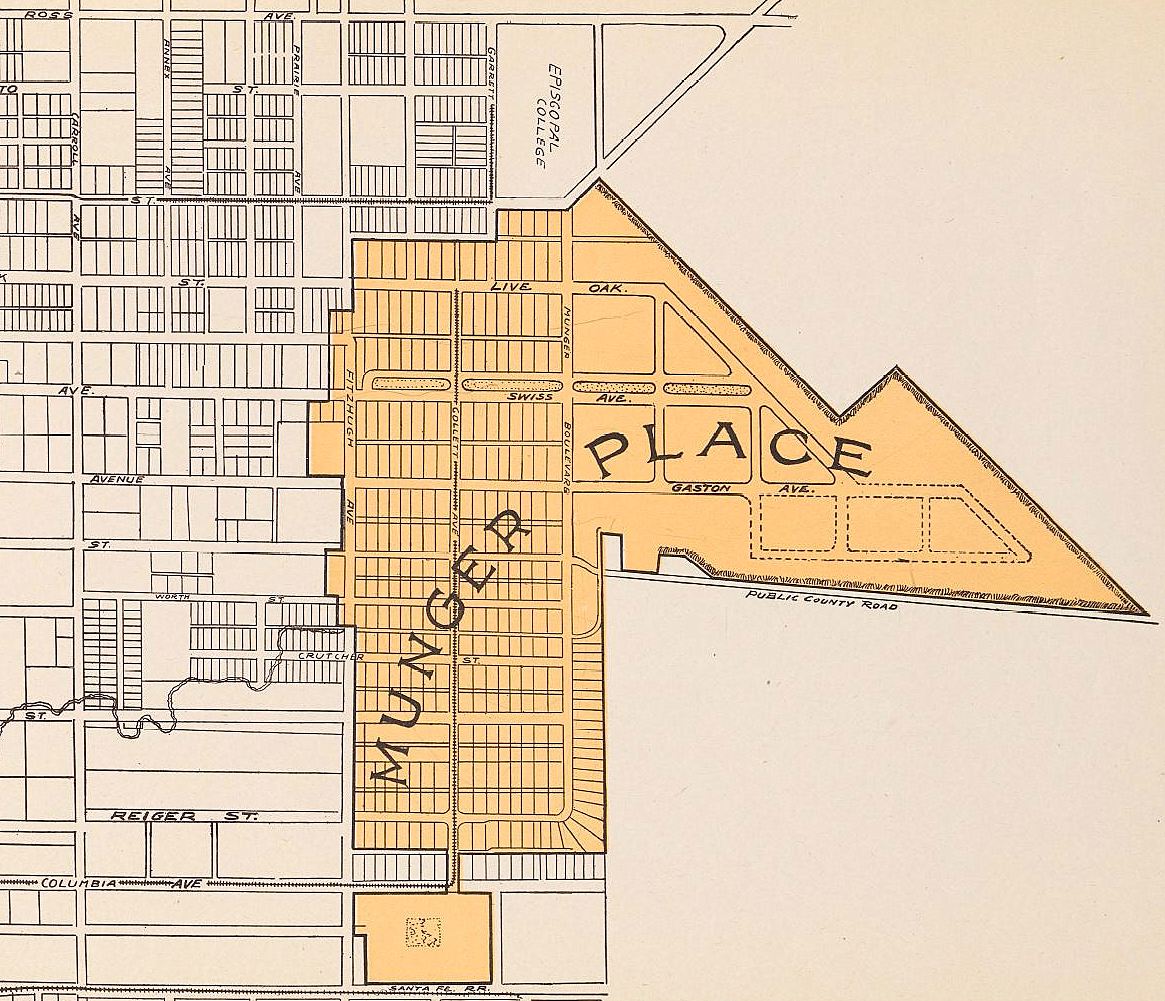
munger-place-bk_ca-1905_degolyer-lib_SMU_map

Map of Dallas, circa 1905, with Munger Place highlighted.

munger-place-bk_ca-1905_degolyer-lib_SMU_map-det

*

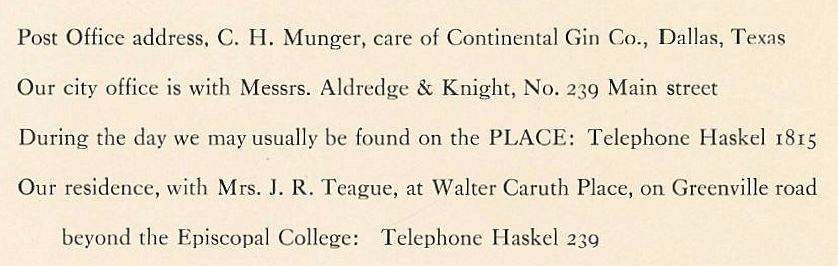
Think you might want to live in “The Place”? Here’s who you need to contact (interesting that the Walter Caruth house is mentioned here…):

munger-place-bk_ca-1905_degolyer-lib_SMU_developer

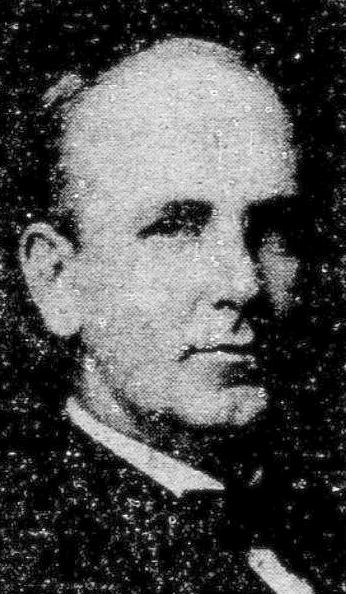
Collett Henry Munger — who lived in Munger Place, at 5400 Swiss — died from a heart attack at the young age of 48.

munger-collett_photo
C. H. Munger (1879-1928)

*

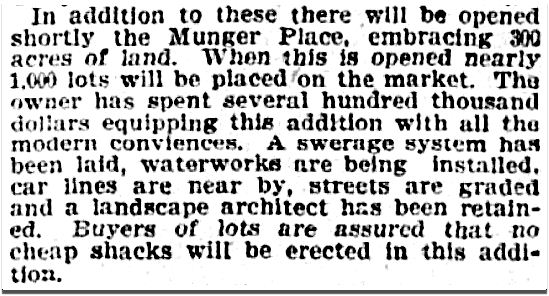
The earliest mention of “Munger Place” I found in The Dallas Morning News was this classified from May 21, 1905:

munger-place_dmn_052105_early-mentionMay 21, 1905

Work was well underway by 1906:

munger-place_dmn_090106DMN, Sept. 1, 1906

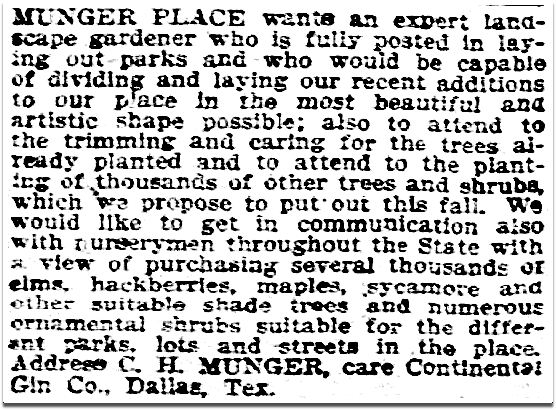
A call for “an expert landscape gardener” went out that same year:

munger-place_dmn_101406_landscaperOct. 14, 1906

Not yet ready for lots to go on sale, the public was invited to head to East Dallas to take a look at the progress (“bring your friends and visitors to the Fair”).

munger-place_dmn_102106Oct. 21, 1906

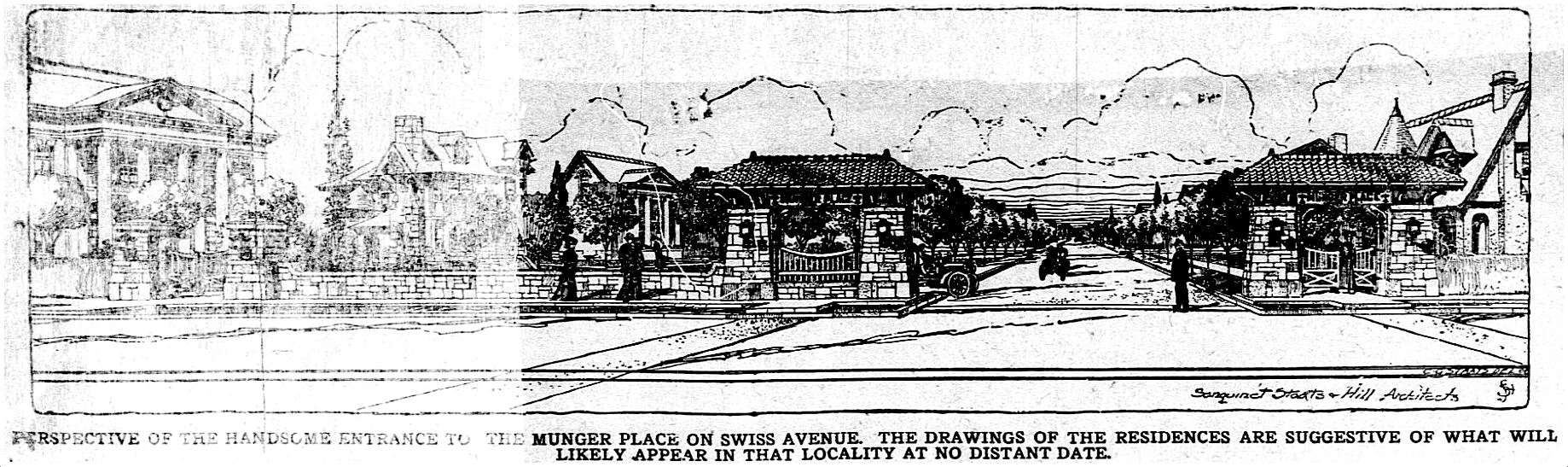
This rendering of the Swiss Avenue entrance was, interestingly, prepared by the architectural firm of Sanguinet, Staats & Hill, who designed several Munger Place residences (including Collett Munger’s).

munger-place_dmn_010107_renderingDMN, Jan. 1, 1907

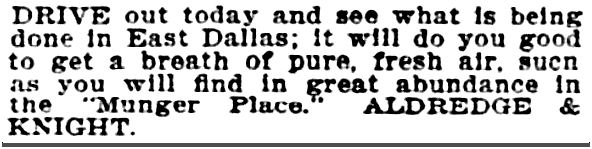
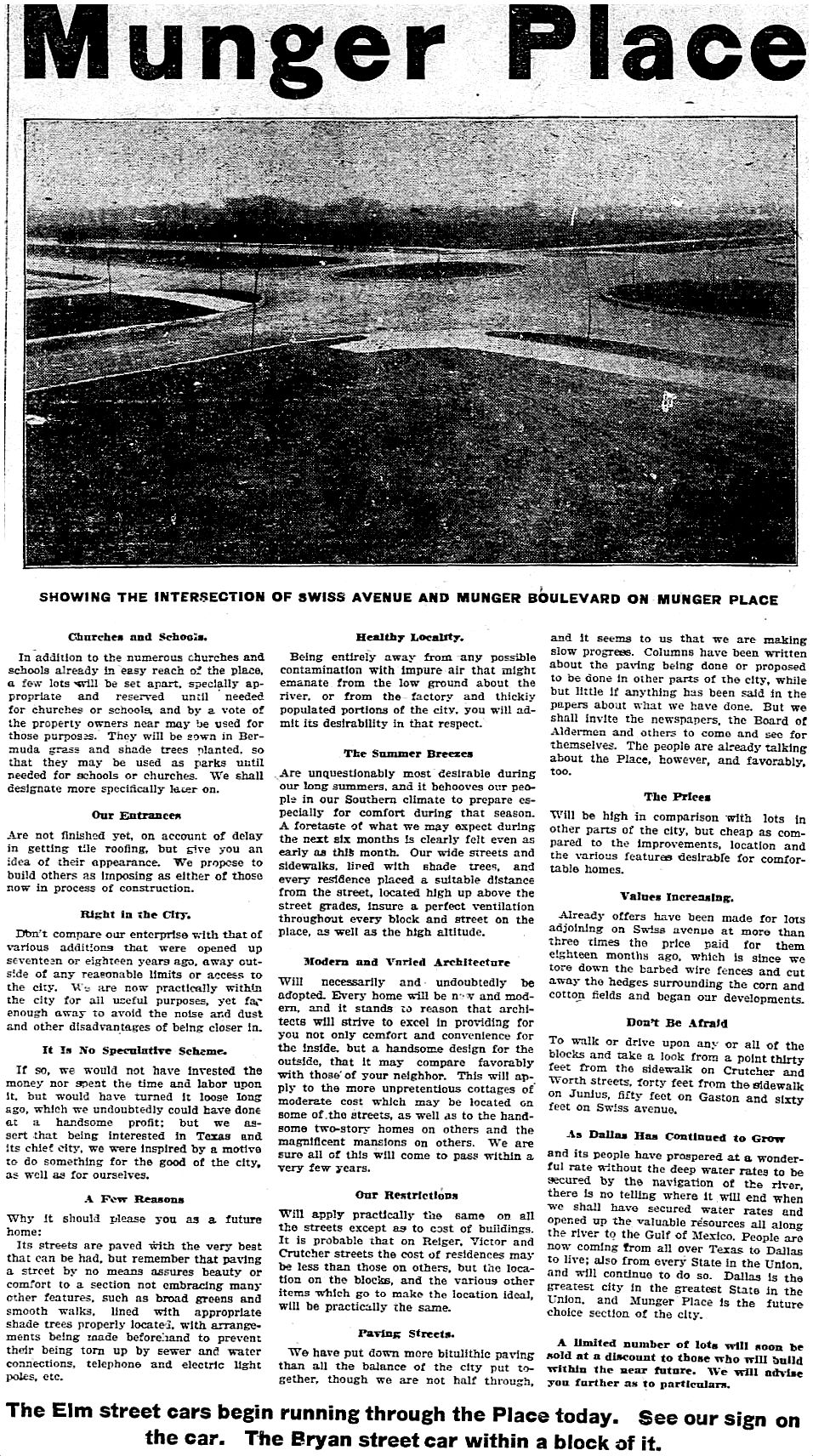
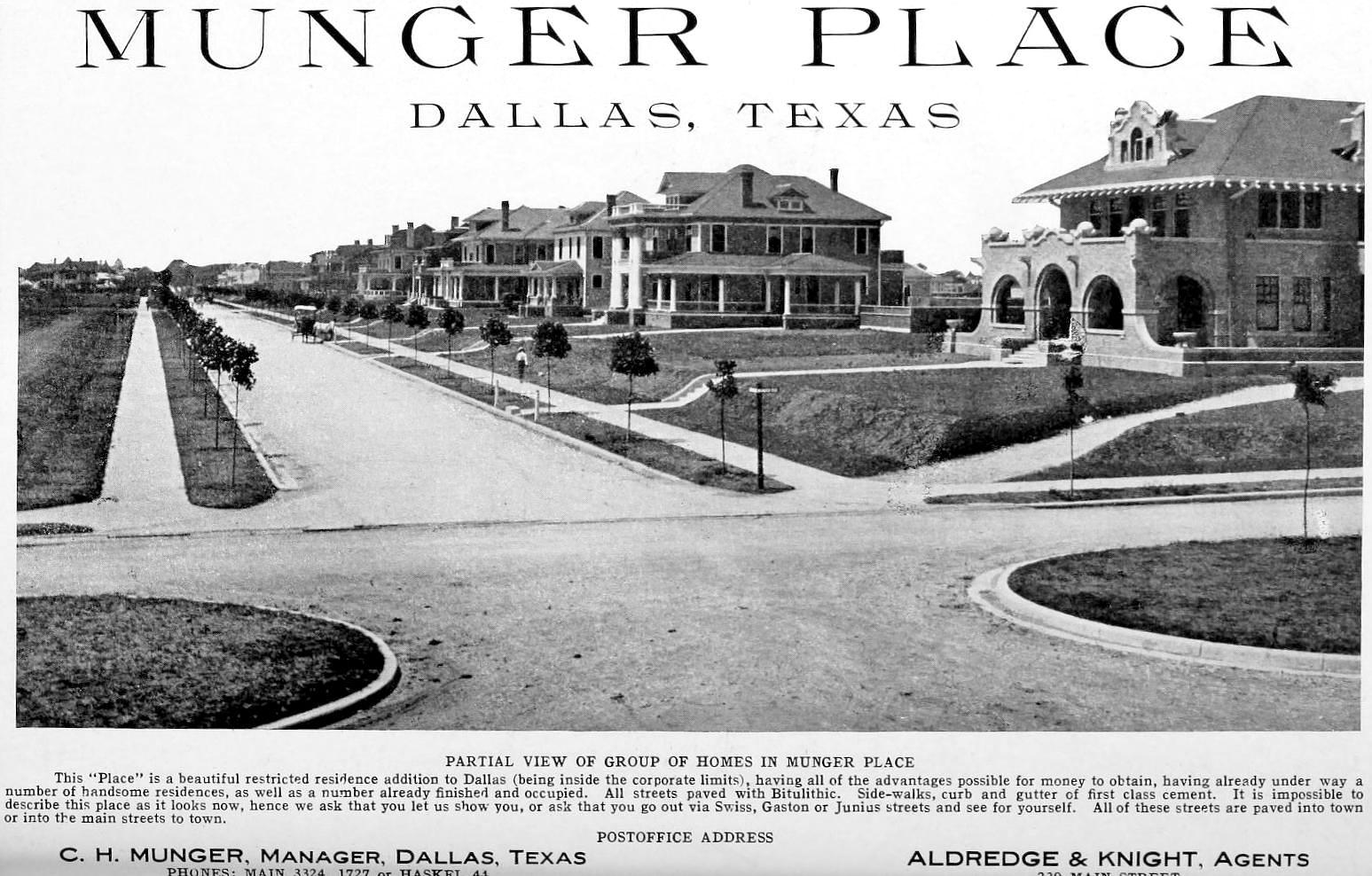
A sort of “teaser” ad (with a great photo of the intersection of Swiss and Munger) appeared in March, 1907:

munger-place_dmn_032407_ad_photoMarch 24, 1907

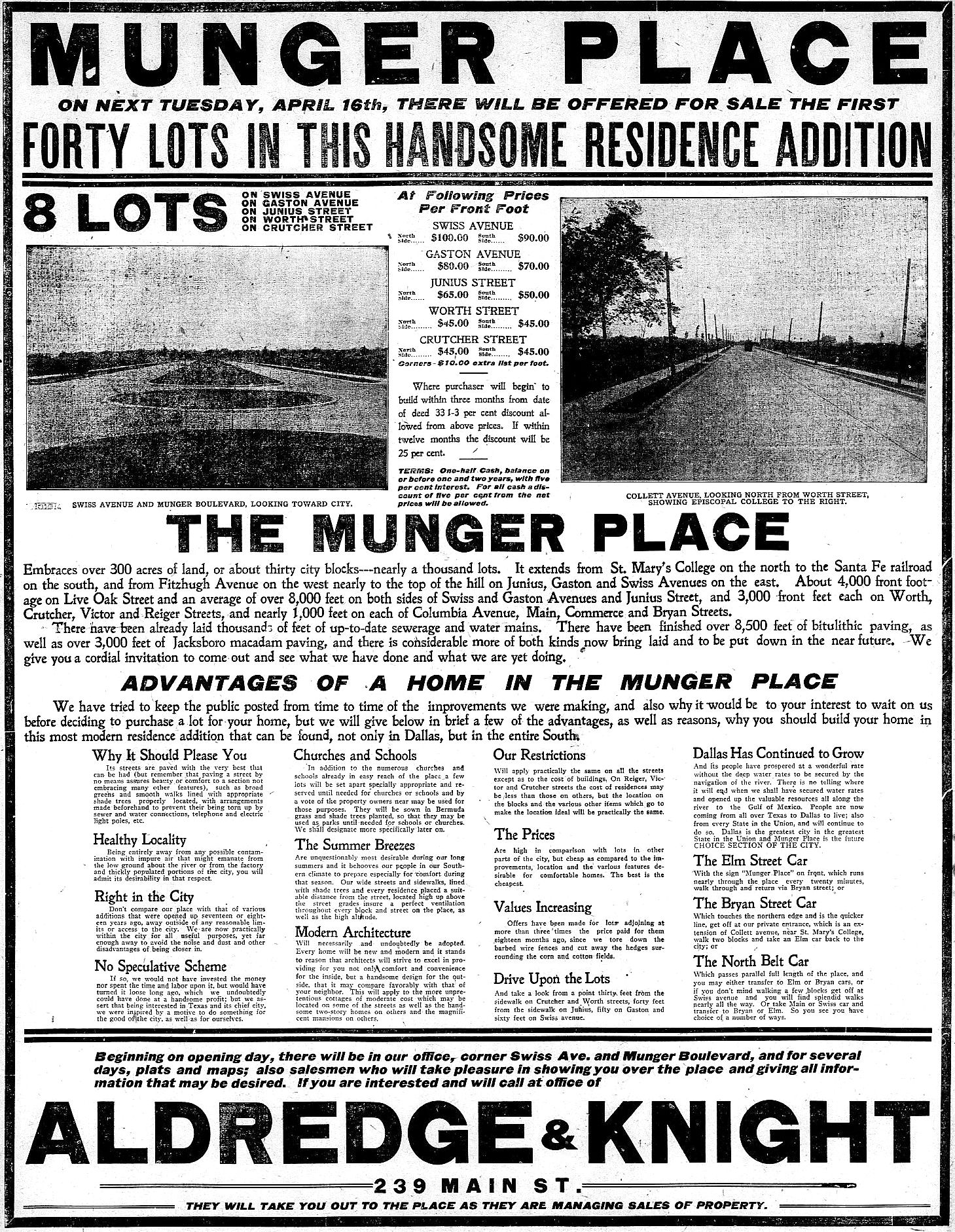
In April, 1907, it was announced that finally lots would be available for purchase (but only 40…), with big discounts for those who promised to build immediately.

munger-place_dmn_041407_adApril 14, 1907

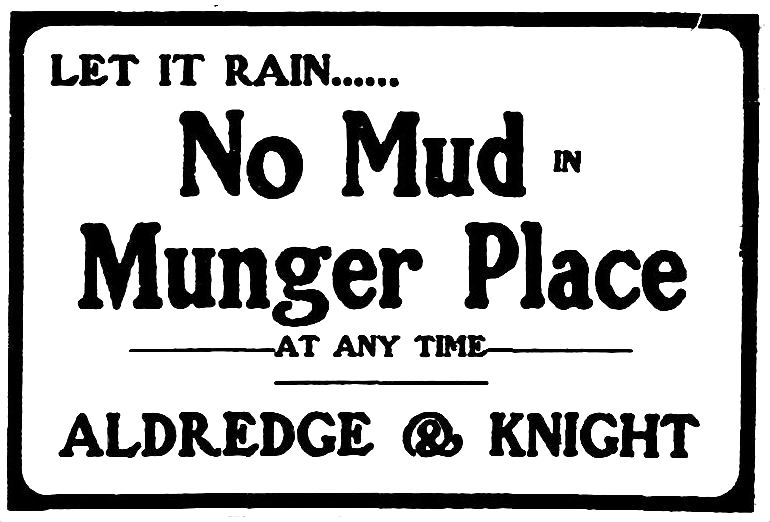
“Let it rain…. NO MUD IN MUNGER PLACE at any time.” Apparently a big selling point in 1907!

munger-place_dmn_050307_no-mudMay 3, 1907

By 1909 things were really starting to come together for what quickly became one of the most exclusive (and highly restricted…) neighborhoods in the entire city.

munger-place_worleys-1909-directoryWorley’s Dallas directory, 1909 ad

***

Sources & Notes

Photos of Munger Place under construction, map, and text on yellow background are from the promotional booklet “Munger Place: Dallas, Texas,” from the collection of the DeGolyer Library, Central University Libraries, Southern Methodist University; the entire booklet has been scanned by SMU and is available for free download here.

The last image is an ad from the 1909 Worley’s Dallas directory.

Read “Munger Place: Report of Nomination for Landmark Designation as a City Historic District” prepared by the City of Dallas Department of Urban Planning (1980), here.

More on Munger Place and the Munger family can be found is these Flashback Dallas posts:

  • “Munger Place — 1908,” here
  • “Munger’s Improved Continental Gin Company,” here

All images are larger when clicked.

*

Copyright © 2018 Paula Bosse. All Rights Reserved.
McKinney & Haskell, Circle “T” Frozen Foods, and VWs in Dallas

mckinney-and-haskell_NDHS_ebayFender-bender in front of NDHS… (click for larger image)

by Paula Bosse

Odd stuff shows up on eBay. This photo shows a damaged Circle T Brand frozen-food Volkswagen delivery van at the intersection of McKinney Avenue and North Haskell (with North Dallas High School making a partial cameo in the background). The view today? See it here.

Circle T was one of the many brainchilds of the Southland Corp.’s Thompson family: it manufactured and distributed frozen foods (initially meats and Mexican food) which were sold in the company’s 7-Eleven stores. The company began in 1954 and was located just a couple of blocks from this photo, at Haskell and Central. (In 1954 they announced one of their first specialty products: frozen queso. I’ve never even considered that frozen queso would exist, but 60-some-odd years ago it was flying off shelves at the neighborhood 7-Eleven.)

The Southland Corp. sold off Circle T in 1966.

Below, an ad for Circle T’s frozen steaks, from 1954 (click ad to see larger image).

cicle-t_FWST_062054June, 1954

circle-t-logo_1954

And because I’m nothing if not pedantic, here’s an ad for VW trucks and vans, from 1961 (which appears to be the date on the van’s license plate in the photo):

volkswagen_ad_fen-1961Feb., 1961

And speaking of Volkswagens, the first Dallas car dealer to import Volkswagens appears to be Clarence Talley — the first ads are from 1954. While I was searching for the link to the eBay listing of the above photo (which I could not find…), I serendipitously stumbled across this 1950s photo of Clarence Talley on N. Pearl, with appearances by the Medical Arts Building and the Republic Bank Building. Thank you, eBay.

talley-volkswagen_ebay

***

Sources & Notes

Photos from eBay: could not find the link to the first one, but the second one sold a couple of months ago, and the archived listing is here.

*

Copyright © 2018 Paula Bosse. All Rights Reserved.
Main Street Looking East — 1920s

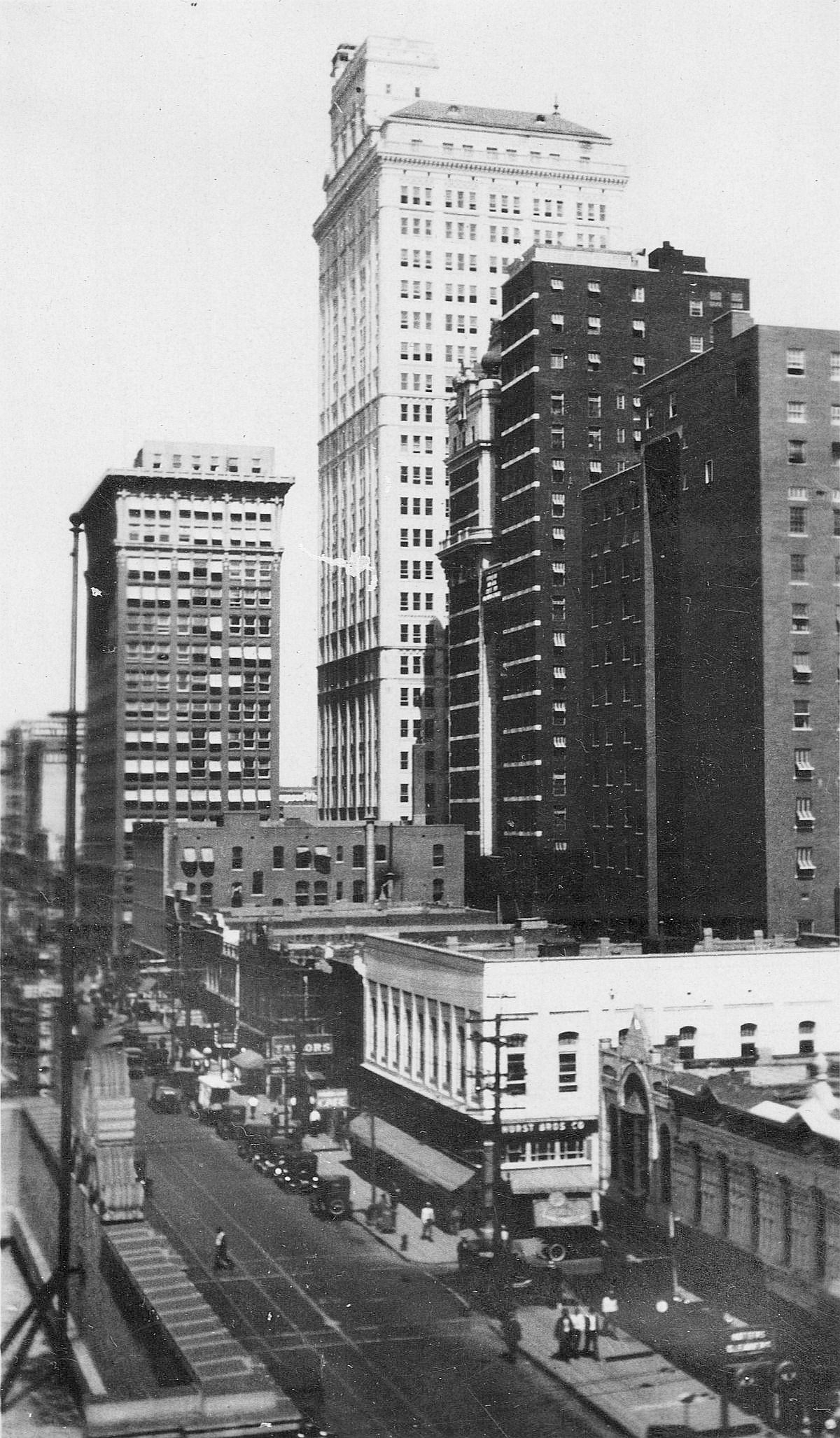
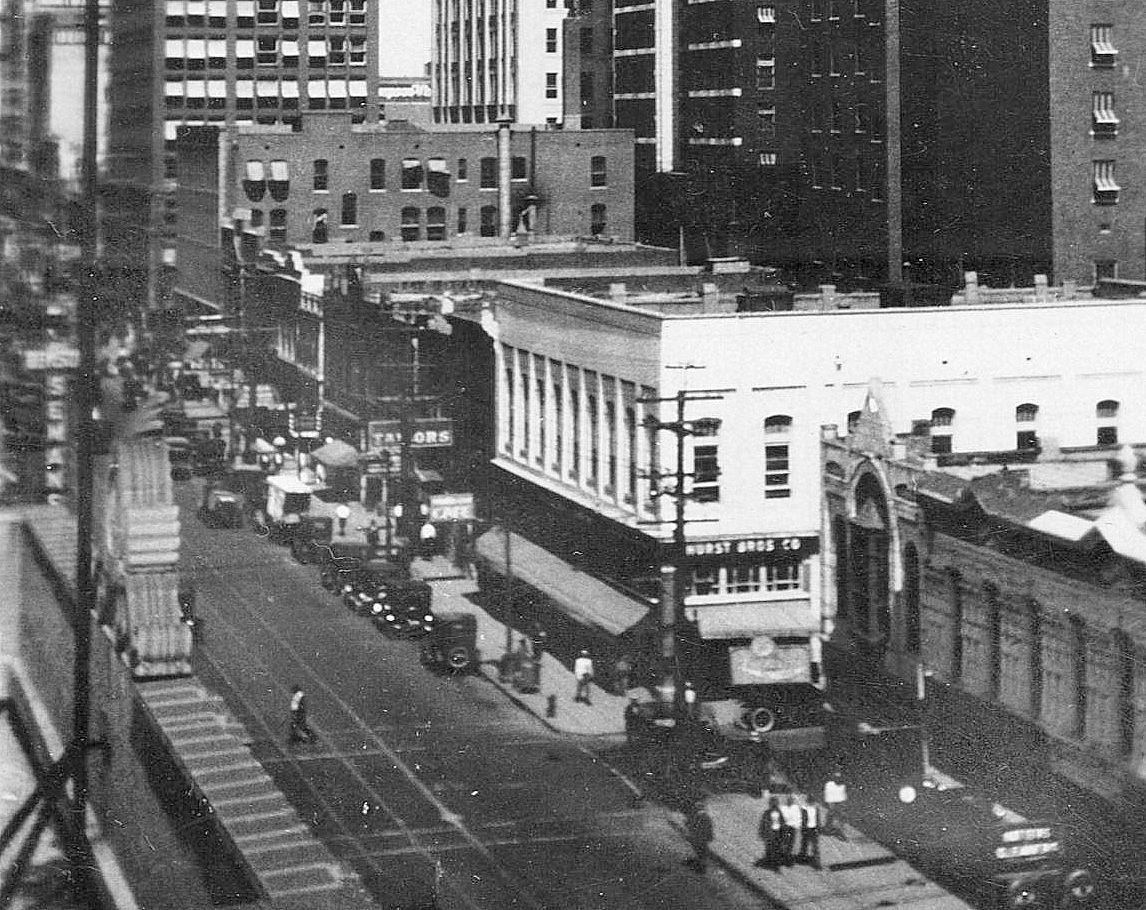
main-street_east_ca-1925_erik-swansonEast from the 1200 block of Main (photo courtesy Erik Swanson)

by Paula Bosse

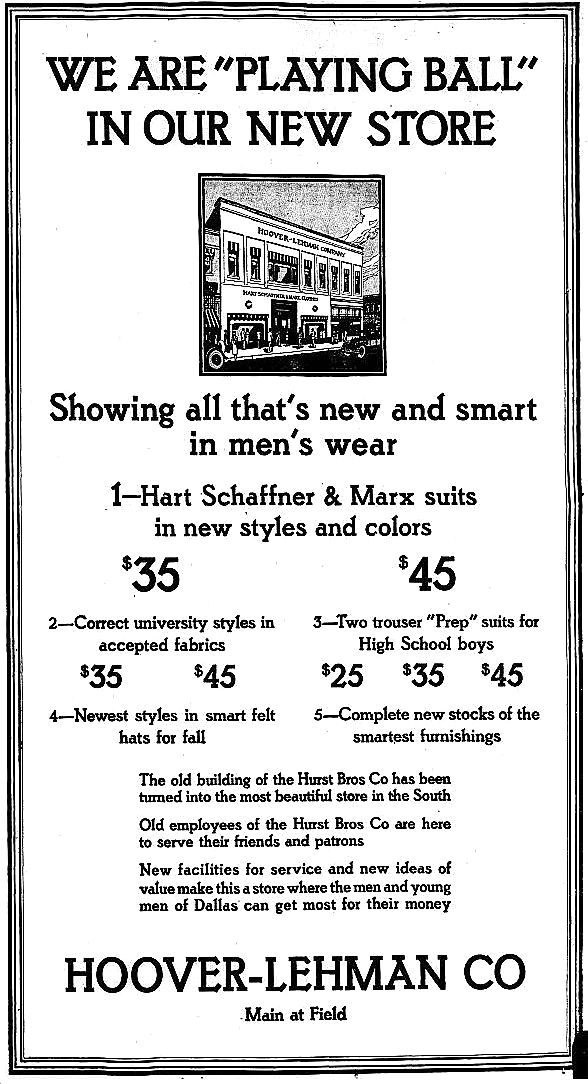
This great photo (sent in by reader Erik Swanson) shows Main Street around 1925. The white building seen in the lower right is Hurst Bros., a men’s clothing shop, which was at the southeast corner of Main and Field (1300-1304 Main). It was a little confusing to me at first because it looks like there is a street behind it (to the south), which would have been Commerce, but then the Magnolia Building and the Adolphus would all be out of place. But what appears to be a street was just a wide alleyway/passage (seen on the 1921 Sanborn map here — Main east of Akard can be seen on the Sanborn map here).

The very tall building is the Magnolia, at Commerce and Akard (it opened in 1922 — Pegasus wasn’t added until 1934); to the right, across Akard, is the Adolphus Hotel and the Adolphus Annex. The tall building to the left of the Magnolia is the Southwestern Life Building (southeast corner Main and Akard, demolished in 1972, now a small open plaza area). The 4-story building at the southwest corner of Main and Akard is the Andrews Building. The white building in the center is Hurst Bros. (southeast corner Main and Field), and across Main can be seen the sign for the men’s clothing shop Benson-Semans.

Hurst Bros. was gone by 1929 when it became Hoover-Lehman, another clothing store, and Benson-Semans appears to have vacated that space around 1926, helping to date the photo between 1922 and 1926.

*

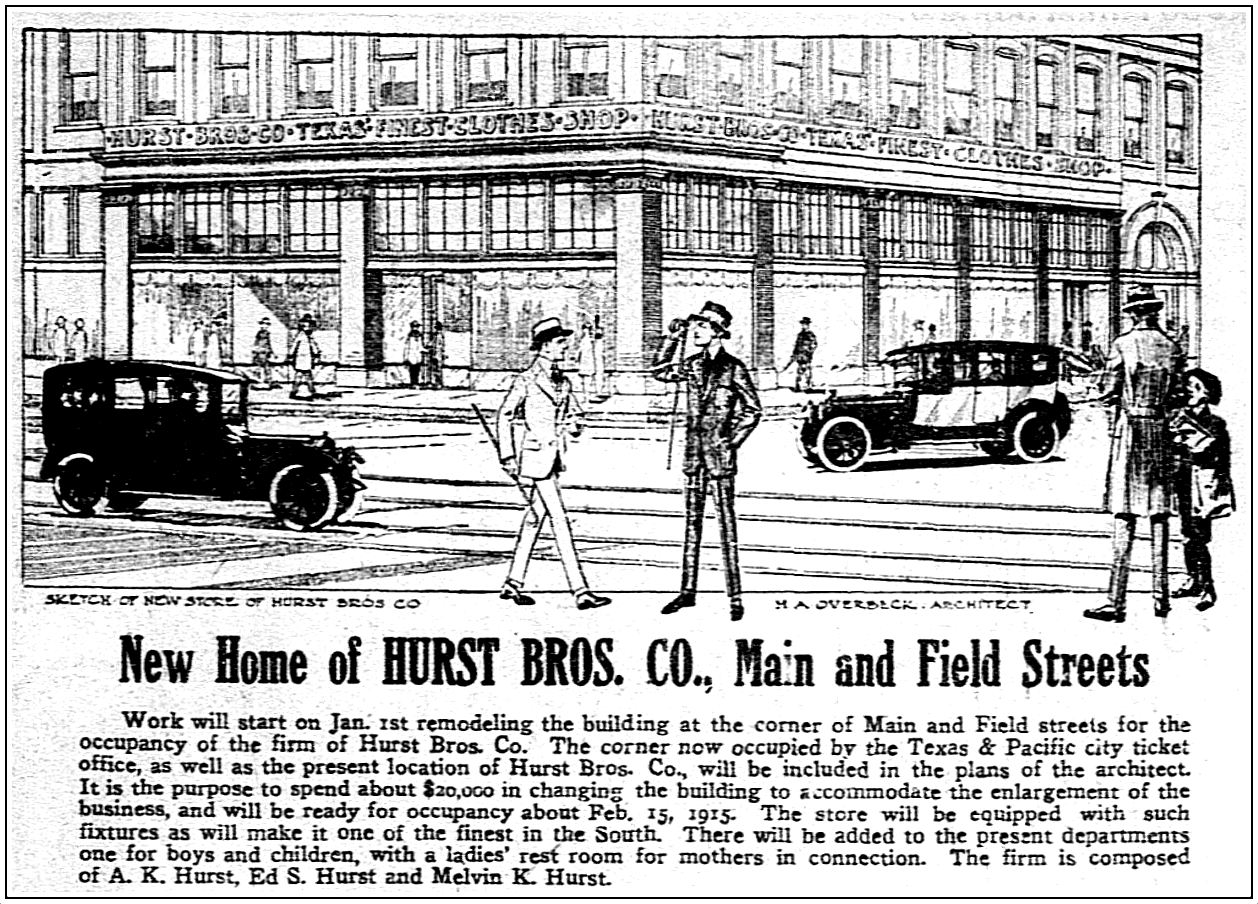
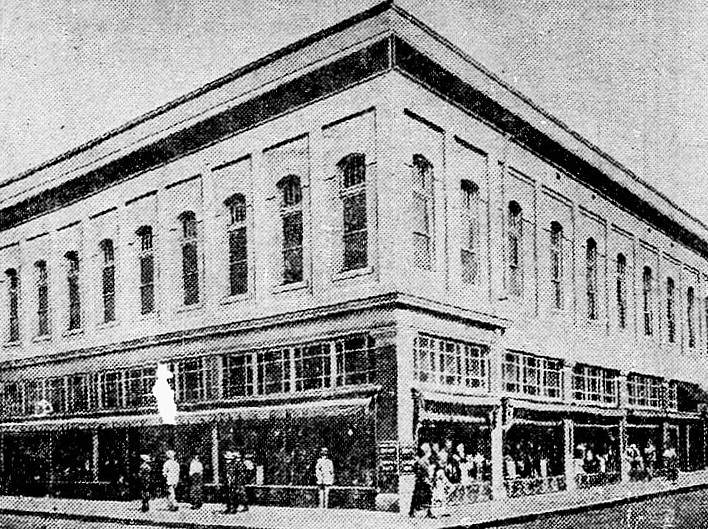
The Hurst brothers, Melvin K. Hurst and Edgar S. Hurst (along with their father, Alfred K. Hurst) began their men’s clothing business around 1912 and moved into the building seen in this photo in 1915 (it was renovated by prominent Dallas architect H. A. Overbeck, whose still-standing courts building and jail was built at about the same time). The business was dissolved in 1929, and its stock, fixtures, and lease were acquired by a longtime employee who, with a partner, remodeled the store and reopened it as the Hoover-Lehman Co. (A present-day Google Street View of this southeast corner of Main and Field can be seen here.)

main-street_east_ca-1925_hurst-bros-det_erik-swansonDetail from top photo, ca. 1925 (click for larger image)

hurst-bros_dmn_112214_adAd from Nov., 1914

hurst-bros_1920sLate 1920s

hurst-bros_hoover-lehman_091329Sept., 1929

***

Sources & Notes

Top photo sent in by Erik Swanson, used by permission. The photo may have been taken by his grandfather, F. V. Swanson, an optometrist (see the post “Thompson & Swanson: ‘The Oldest Exclusive Optical House in Dallas,” here). Thanks for the great photo, Erik! (Update: Sadly, local music favorite Erik Swanson died on Feb. 16, 2021 at the age of 57 — he had been suffering from ALS. RIP, Erik. And thanks for the great music.)

All images are larger when clicked.

*

Copyright © 2018 Paula Bosse. All Rights Reserved.
Thompson & Swanson: “The Oldest Exclusive Optical House In Dallas”

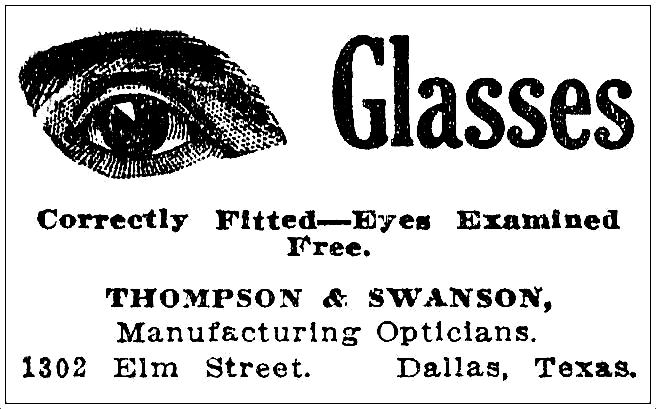
thompson-swanson_1914-ad_erik-swansonDon’t blink… (1914 ad, courtesy Erik Swanson)

by Paula Bosse

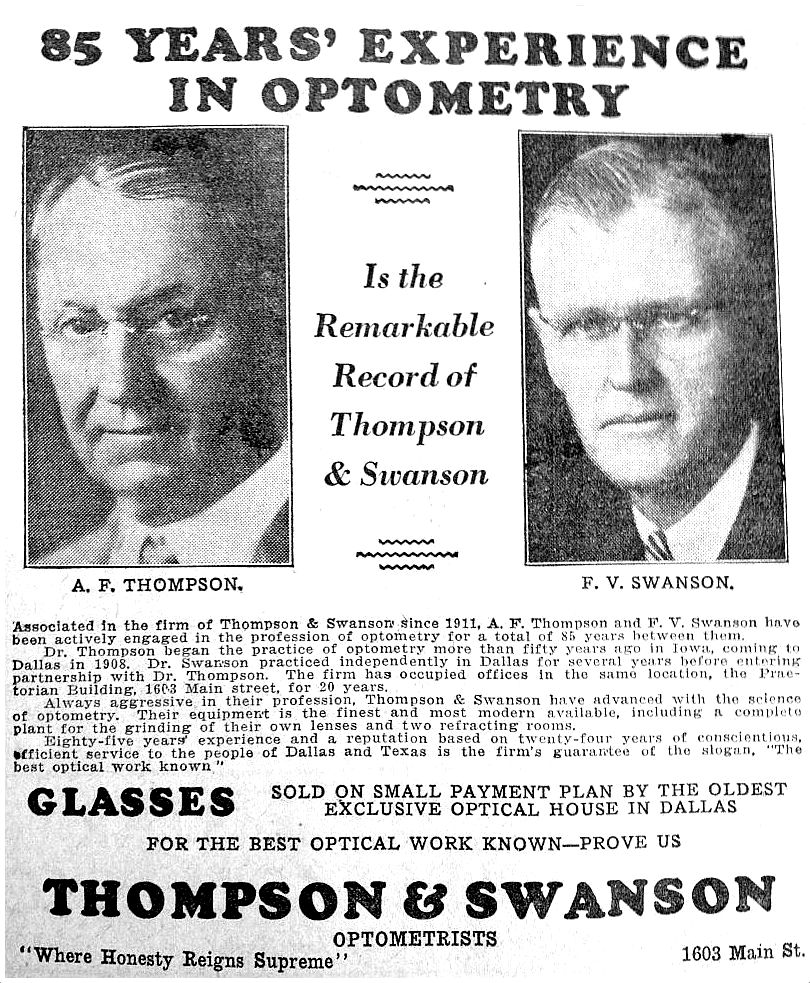
Dr. Alfred F. Thompson (1862-1942) and Dr. Frank V. Swanson (1885-1949) opened their “manufacturing opticians” practice, Thompson & Swanson, in 1911. In addition to examining and treating patients, they also ground lenses and manufactured their own glasses, something which I gather was somewhat unusual in 1911 for such a small practice.

They first set up shop on Elm Street, and their ads — generally eyeball-themed — were always attention-grabbers: not only did they stare at you from newspaper pages, they also seemed to follow you around the room.

thompson-swanson_1911-ad1911 ad

They soon moved to the Sumpter Building, in late 1912 (ad at top), directly across from the brand new Praetorian Building. By February of 1916 they’d hit the big-time and were actually in the Praetorian Building, Dallas’ tallest building and its most impressive address. Not only were they in the building, they were at street-level, which guaranteed that practically everyone who spent time downtown was familiar with Thompson & Swanson, if only because they passed the Praetorian Building. The ad below, featuring the building, is fantastic, in a weird-fraternal-order kind of way. (The ad at the top is also kind of weird — you can practically hear the spooky theremin.) (Click ads to see larger images.)

thompson-swanson_1923-ad_erik-swanson1923 ad (courtesy Erik Swanson)

Thompson & Swanson’s business history:

thompson-and-swanson_erik-swanson(courtesy Erik Swanson)

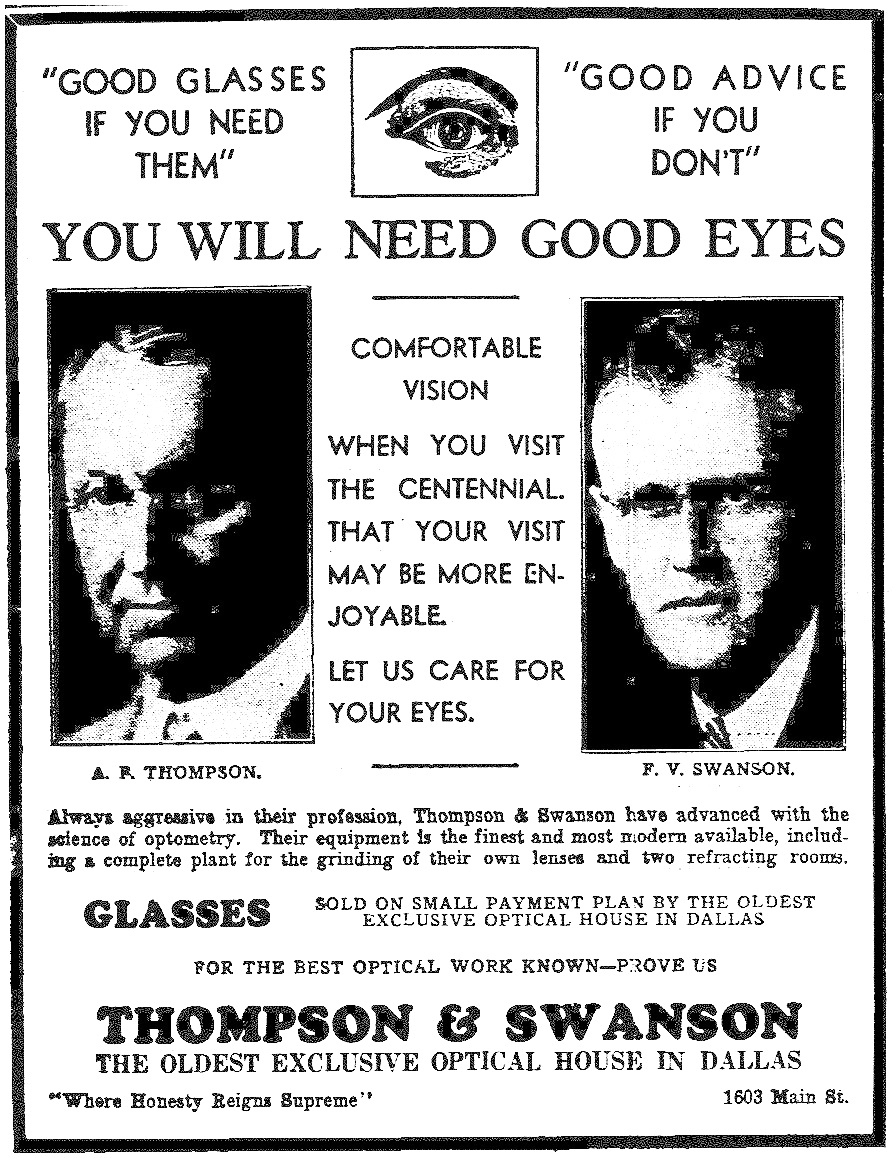
Similar ad, but aimed at the Texas Centennial visitor. “Good glasses if you need them, good advice if you don’t.”

thompson-swanson_june-1936June, 1936

The successful partnership of Thompson and Swanson lasted into the early 1940s. After Dr. Thompson’s death in 1942, Dr. Swanson continued at the same address as “Swanson & Son,” a practice with his son, Dr. F. V. Swanson, Jr.

***

Sources & Notes

The top ad, the ad with the Praetorian Building, and the “85 Years’ Experience in Optometry” ads were very kindly sent to me by Erik Swanson (grandson of Dr. Swanson); they are used with permission. I love old ads, especially ones that feature Dallas buildings. Regarding the location of his grandfather’s business in the Praetorian Building, Erik wrote: “Little did he know there would one day be a giant eyeball at the location where he had his optician shop.” Ha! Now when I see that giant eyeball I’ll think of Thompson & Swanson (and hear that spooky theremin).

I was doubly happy to exchange emails with Erik because I’ve been a fan of his Western Swing bands for many years. His current band is Shoot Low Sheriff (listen to them here), but I first became a fan when I heard his former band, Cowboys & Indians. Thanks for the ads, Erik!

UPDATE: Sadly, Erik Swanson died on Feb. 16, 2021 at the age of 57. He had been suffering from ALS. RIP, Erik. Thank you for the hours of entertainment your music provided me and thousands of others.

*

Copyright © 2018 Paula Bosse. All Rights Reserved.
The United States Coffee & Tea Co. — 1911

us-coffee-tea_1911_ad_photoCoffee, coffee, everywhere, at Elm & Akard… (click for larger image)

by Paula Bosse

Above, a photo from a 1911 ad for the United States Coffee and Tea Company, importers and roasters. The text of the ad:

The above photograph shows a recent importation of the finest green coffees grown. Weight 40.000 pounds — just forty days supply.

A tril will convince you that our fresh Coffees are superior — Five delivery wagons covering the entire city each day insures prompt service.

UNITED STATES COFFEE AND TEA COMPANY

Corner Elm and Akard Streets   –   Phone Main 703

The company seems to have been founded about 1908 by George W. Wilson and a very young Henry Seeligson. (Click article to see a larger image.)

us-coffee-tea_greater-dallas-illus-1908
Greater Dallas Illustrated, 1908

According to a 1912 ad (which rather breathlessly promised: “WE ROAST COFFEE EVERY MINUTE OF THE DAY”), the company was the “largest retail dealers in Coffee, Tea, Spices and Butter in the Southwest.”

us_coffe-tea_may-1912
1912

The photo at the top shows their building at the northeast corner of Elm and Akard; a few years later they moved down Elm to the northwest corner of Elm and Ervay, just a couple of doors east of the Palace Theater (you can see part of their building behind a photo of the Wilson Building here) — this location was once threatened by a fire which broke out in the bakery owned by Frank A. Carreud:

us-coffee-tea_dmn_070322_fire
Dallas Morning News, July 3, 1922

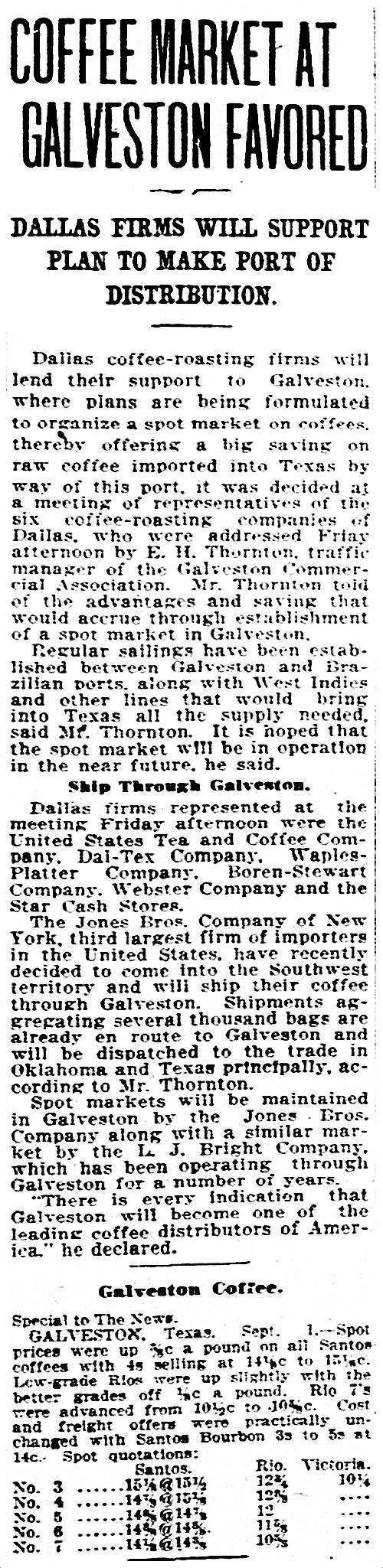
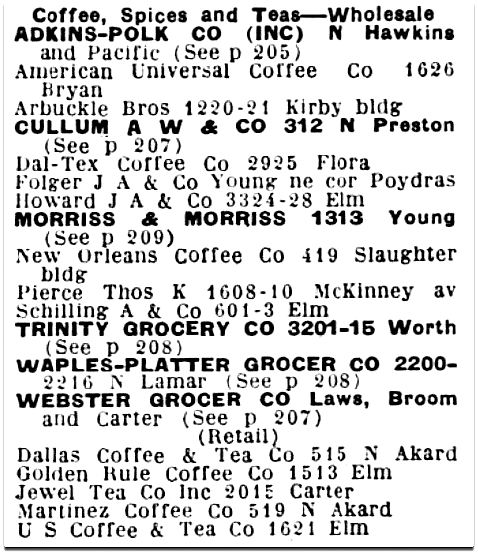
There was a surprising amount of coffee-roasting going on in Dallas in the early decades of the twentieth century. In 1922 the big boys were trying to organize a coffee spot market in Galveston, port to Brazilian coffee and West Indies spices.

us-coffee-tea_dmn_090222
DMN, Sept. 2, 1922

coffee-merchants_1922-directory
1922 Dallas directory

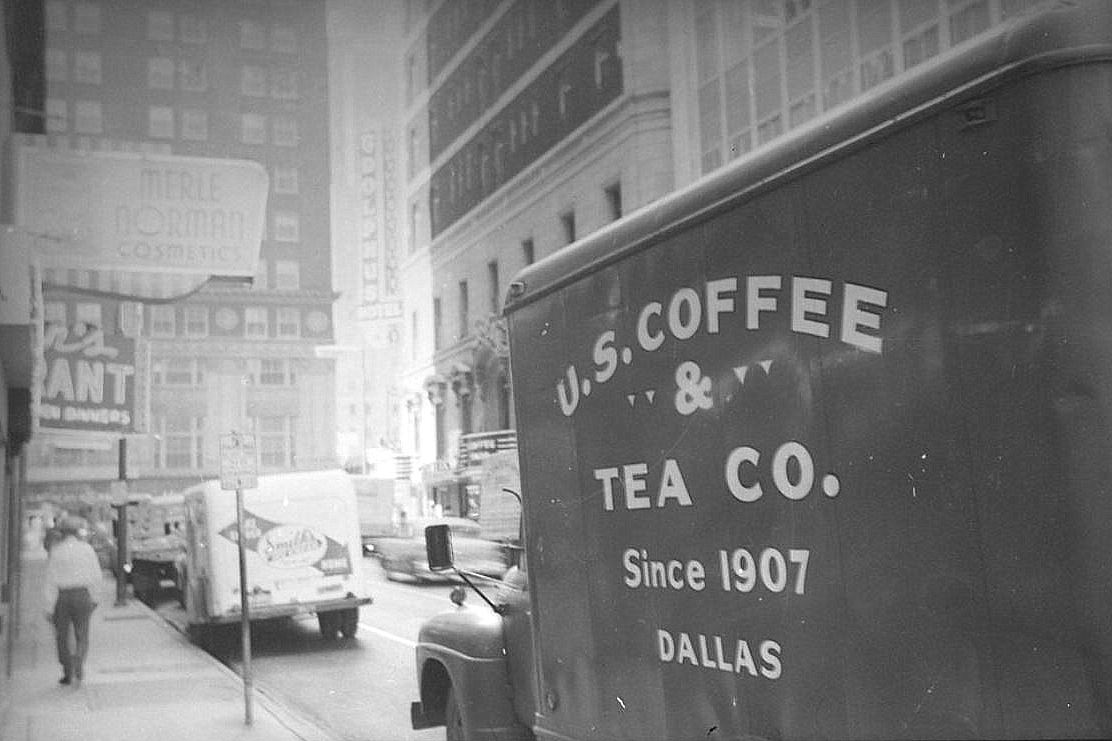
The company was bought by H. L. Hunt’s HLH Parade Co. in 1961; Hunt sold it to the Texas Wholesale Grocery Corp. in 1963 when it appears to have ceased operations under the U. S. Coffee and Tea name. Here’s a photo of a company van sometime before then:

u-s-coffee_city-of-dallas-historic-preservation_flickr

And now I have an intense desire for a cup of coffee.

***

Sources & Notes

Top photo from an ad which appeared in a Terrell School yearbook.

Bottom photo from the City of Dallas Historic Preservation Flickr collection, here — the undated photo was taken by the city’s staff photographer.

Sources of other images/clippings as noted.

*

Copyright © 2018 Paula Bosse. All Rights Reserved.

Orphaned Factoids: Year-End Grab Bag, 2017

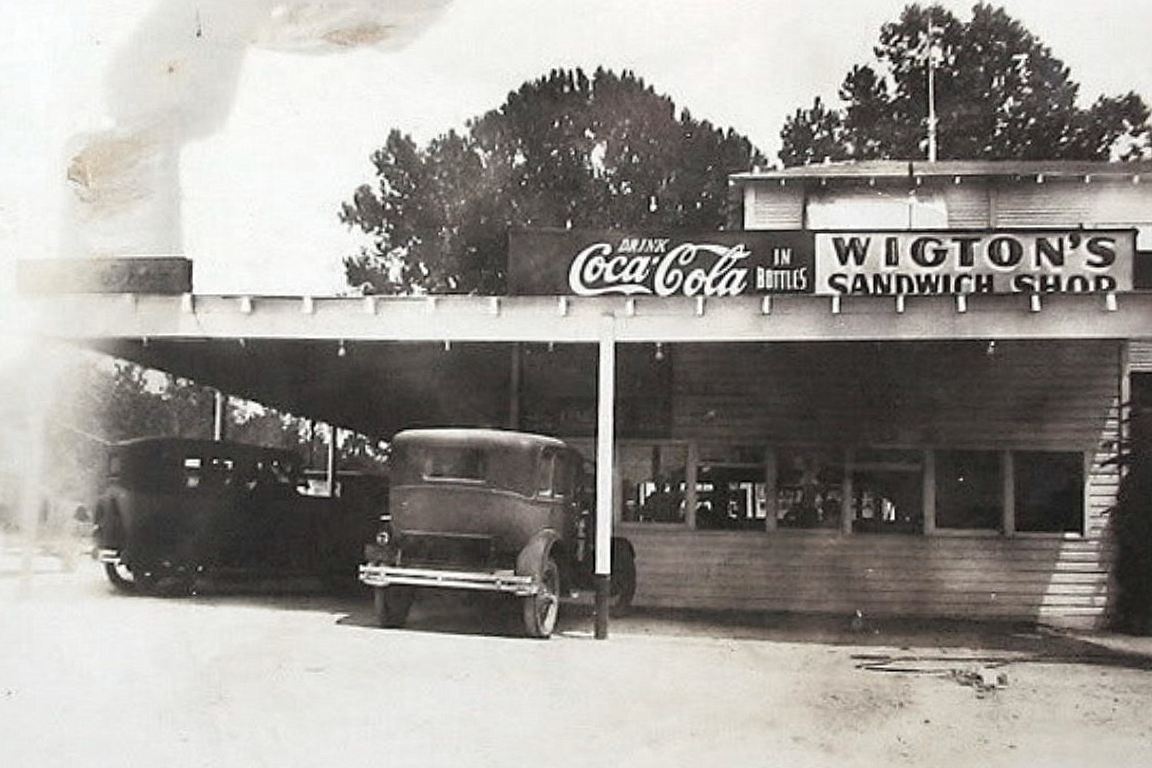
wigtons-sandwich-shop_flickr_colteraWith a name like “Wigton’s…”

by Paula Bosse

Time for another year-end collection of miscellaneous bits and pieces that don’t really belong anywhere, so I’m compiling them here in a weird collection of stuff. Enjoy! (Most clippings and photos are larger when clicked.)

*

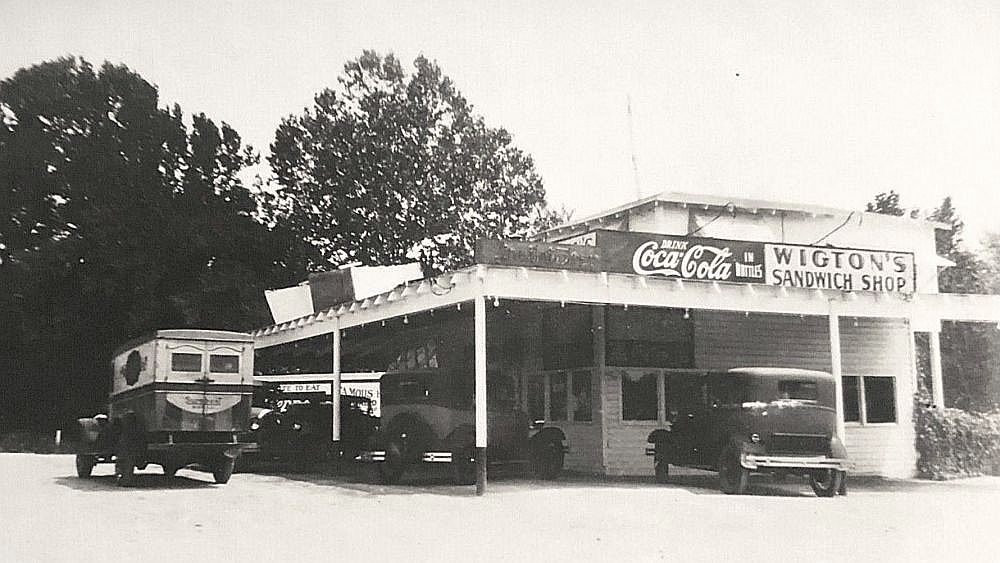
Above, Wigton’s Sandwich Shop, owned by Charles J. Wigton. It looks like it was located near the dreaded East Grand-Gaston-Garland Road intersection. I found one listing in the 1932 city directory for this little “soft drink stand” which also served as the residence of Mr. and Mrs. C. J. Wigton. The address was simply “south side of Gaston Ave., 3 lots east of East Grand Ave.” (Found on Flickr.) And somehow there’s a second photo of this place out there — the one below was found on eBay.

wigtons-sandwich-shop_white-e-grand-and-gaston_ca-1930_ebay

*

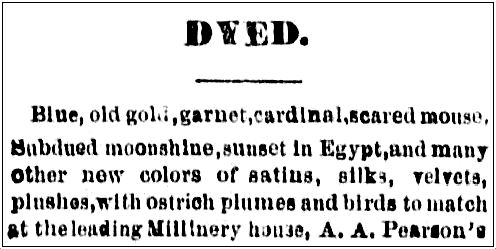
colors_ad_dallas-herald_112580Dallas Herald, 1880

You know, you just don’t see colors like “scared mouse,” “subdued moonshine,” and “sunset in Egypt” anymore. Pity. (Ad for A. A. Pearson’s millinery house.)

*

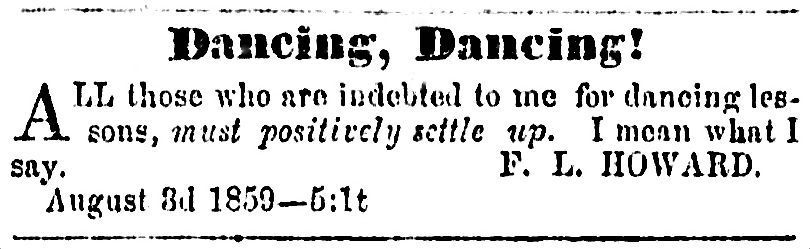
dancing_dallas-herald_1859Dallas Herald, 1859

“All those who are indebted to me for dancing lessons, MUST POSITIVELY SETTLE UP. I mean what I say.” Do not mess with dancemaster Howard. (I’m actually a little shocked someone was offering dancing lessons in Dallas, which, in 1859, was podunker than podunk.)

*

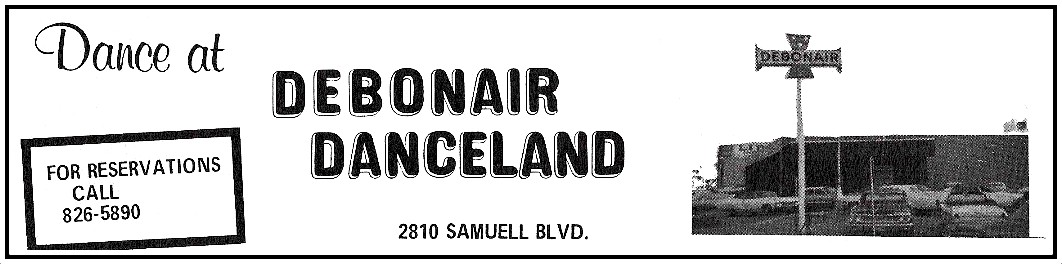
ad-debonair-danceland_ca19691969 Dallas directory

This is the only photo I’ve been able to find of Debonair Danceland (what a great, great name for a club). Depending on whether you were a regular, the adjectives generally used to describe the legendary dancehall are either “notorious” or “beloved.” It opened in 1967 and closed in 1995. As Bill Minutaglio wrote in The Dallas Morning News, it was “one of Dallas’ last rough-hewn links to the brawny honky-tonk highway” (DMN, July 25, 1995). It certainly had a colorful life. For starters there was a “suspicious” double bombing that ripped the place apart in 1968 (I don’t know if the photo in the ad above shows the place pre- or post-blast). There was a lot of … um … “activity” that went on at Debonair Danceland over the years which kept police-beat reporters busy. It was also apparently quite popular with bored housewives who tippled away their afternoons. (See a not-very-clear-but-at-least-larger grainy image of the photo in the ad here.)

*

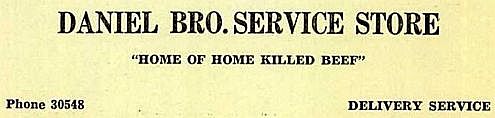
ad-home-killed-beef_hillcrest-yrbk_19401940 Hillcrest High School yearbook

“Home-killed beef” is the best-killed beef.

*

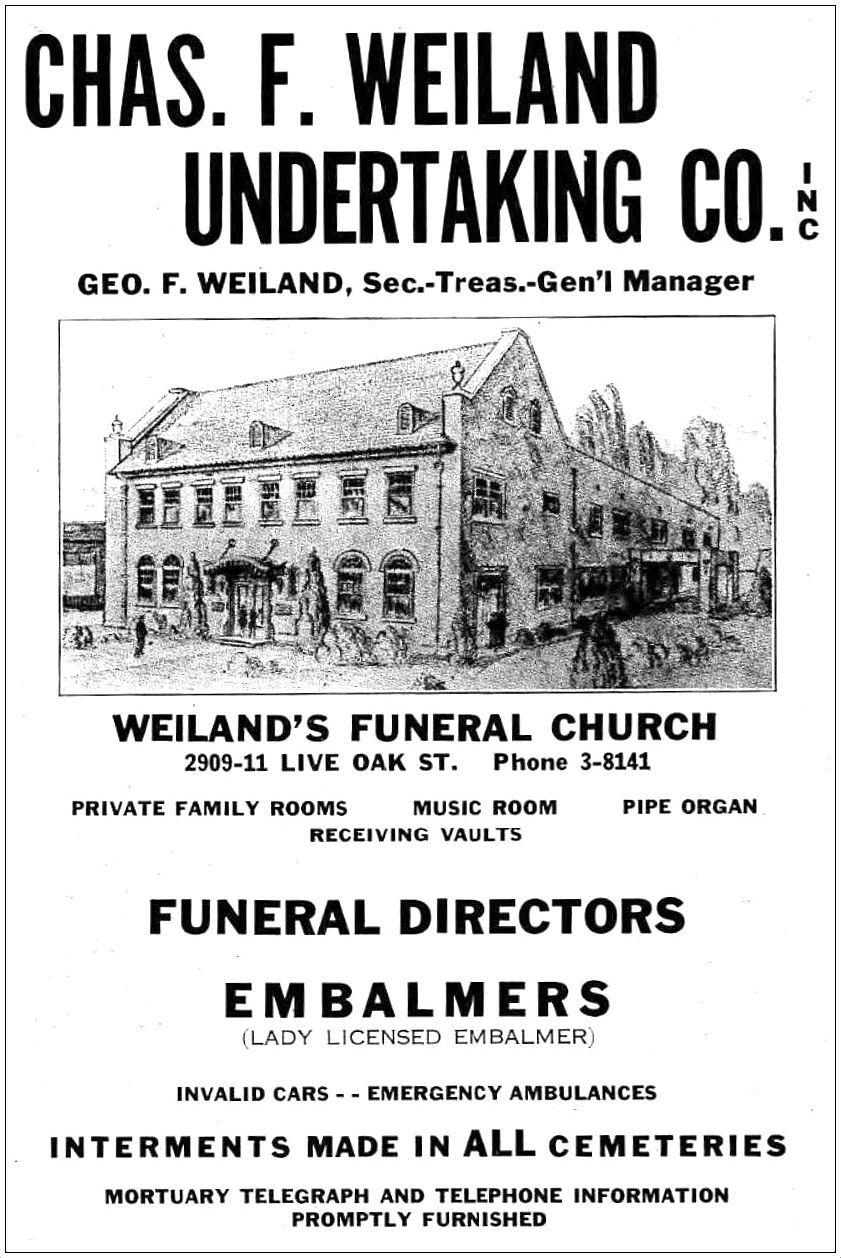
weiland-funeral_1930-directory1930 Dallas directory

weiland_19291929

weiland_lady-embalmer_19411941

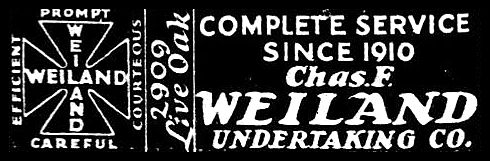
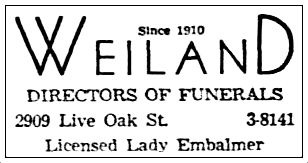
The Chas. F. Weiland Undertaking Co. was one of the city’s top funeral homes. They really promoted the fact that they had a “licensed lady embalmer” — I suppose some people preferred to have their mothers and other dearly beloveds tended to by a woman.

*

headcheese-poisoning_galveston-news_011994Galveston News, 1894

Beware the head cheese. …Always.

*

vegetarian_dallas-herald_050274Dallas Herald, 1874

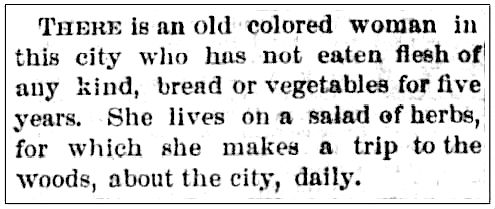
Maybe even go cold turkey and completely ditch the head cheese for a diet consisting solely of “a salad of herbs.”

*

paper_houston-telegraph_121056Houston Telegraph, 1856

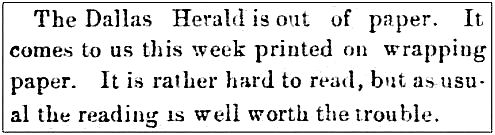
“The Dallas Herald is out of paper. It comes to us this week printed on wrapping paper. It is rather hard to read….”

*

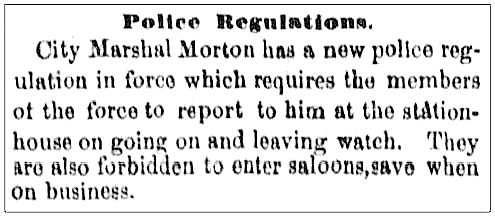
police_dallas-herald_dallas-herald_050980Dallas Herald, 1880

I’m sure there is an interesting and most likely embarrassing story behind the implementation of this new police regulation.

*

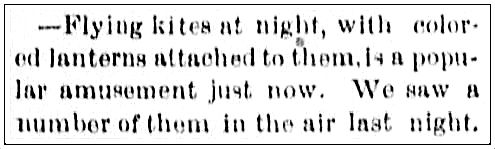
kites-at-night_dallas-herald_072577Dallas Herald, 1877

This sounds wonderful.

*

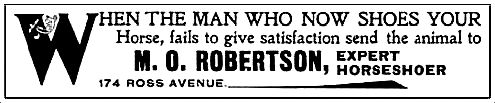
ad-robertson-horseshoer_1900-directory1900 Dallas directory

Go to the M. O. Robertson, the expert horseshoer who will not fail to give satisfaction. Because all those others? They’re gonna fail. Not “if” but “when.”

*

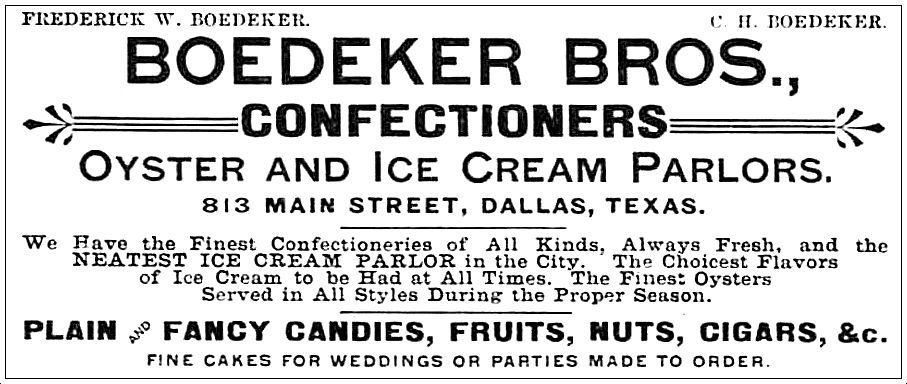
ad-boedecker-bros_oysters-ice-cream_city-directory_18901890 Dallas directory

The sensation generated by seeing an ad with the words “oyster” and “ice cream” next to each other — cheek-by-jowl, as it were — is not a pleasant one.

*

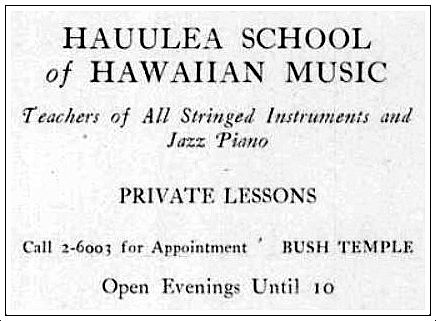
ad-hawaiian-music_bryan-street-high-school_1927-yrbk1927

Who knew? Ukulele-mania was alive and well in Big D in the ’20s.

*

sanger-bros_first-fashion-illus-in-ads-1881_centennial-ad-det_19721972 ad (detail)

A little tidbit on the history of commercial fashion illustration in Dallas, from a Sanger’s ad celebrating the company’s Centennial.

*

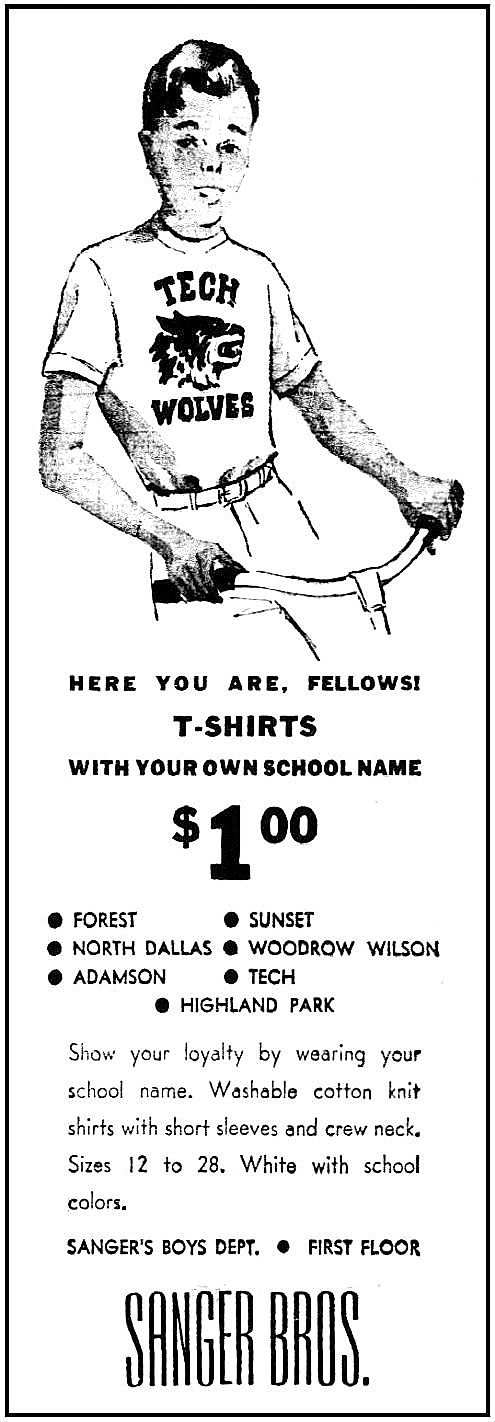
ad-sangers_high-schools_dmn_1008481948

Another Sanger’s ad. This one with a, let’s say “more populist” example of the store’s fashion-illustration chops.

*

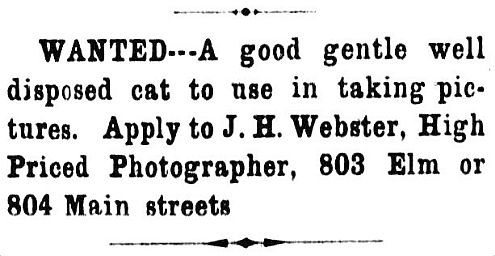
cat-wanted_dallas-herald_112387Dallas Herald, 1887

“WANTED—A good gentle well disposed cat to use in taking pictures. Apply to J. H. Webster, High Priced Photographer, 803 Elm or 804 Main streets.”

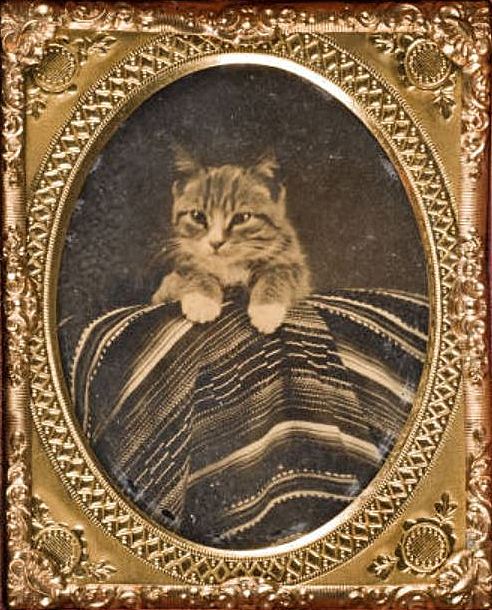
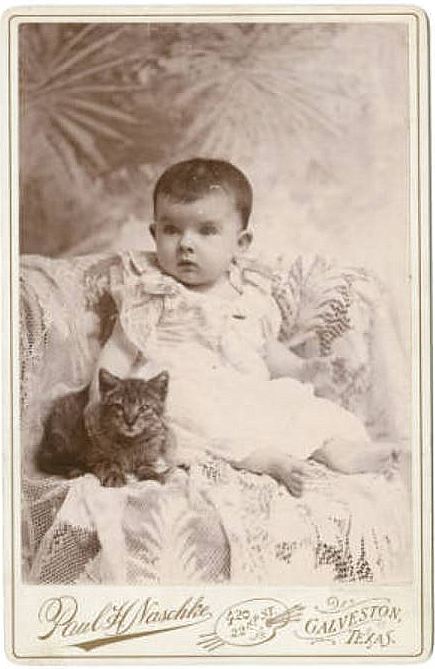
Okay, I’m a sucker. I love cats, and I love self-proclaimed “high-priced photographers.” Ergo, I must love this ad. I do. Seems like a good time to share a couple of 19th-century photographs of cats. 

cat_jones-coll_degolyer1860s, via SMU

cat_baby_degolyer1890s, via SMU

***

Sources & Notes

Dallas Herald clippings are from the Texas Digital Newspaper collection provided by UNT to the Portal to Texas History; you can peruse many scanned issues of The Dallas Herald (not to be confused with the later Dallas Times Herald) here.

“Cat Posed with Mexican Serape” is a cased ambrotype from the Lawrence T. Jones III Texas Photographs collection, DeGolyer Library, Central University Libraries, Southern Methodist University; more details on this photo can be found here. The article “Everyone Loves the Cat!” can be read on the SMU CUL blog “Off the Shelf,” here.

“Baby Seated with Cat” is also from the Lawrence T. Jones III Texas Photographs collection, DeGolyer Library, SMU; more info on the photo is here.

Want more? See other “Orphaned Factoid” lists here.

Most images are larger when clicked. Click away!

*

Copyright © 2017 Paula Bosse. All Rights Reserved.
From El Chico and the Cuellar Family: Feliz Navidad!

xmas_el-chico_cook-collection_degolyer_SMU

by Paula Bosse

…y Prospero Año Nuevo!

xmas_el-chico_cook-collection_degolyer_SMU_2

***

Sources & Notes

Images from a matchbook cover in the George W. Cook Dallas/Texas Image Collection, DeGolyer Library, Central University Libraries, Southern Methodist University; more on the item can be found on the SMU site here.

A couple of super-folksy El Chico commercials can be watched here.

*

Copyright © 2017 Paula Bosse. All Rights Reserved.
 

Highland Park Village From Above

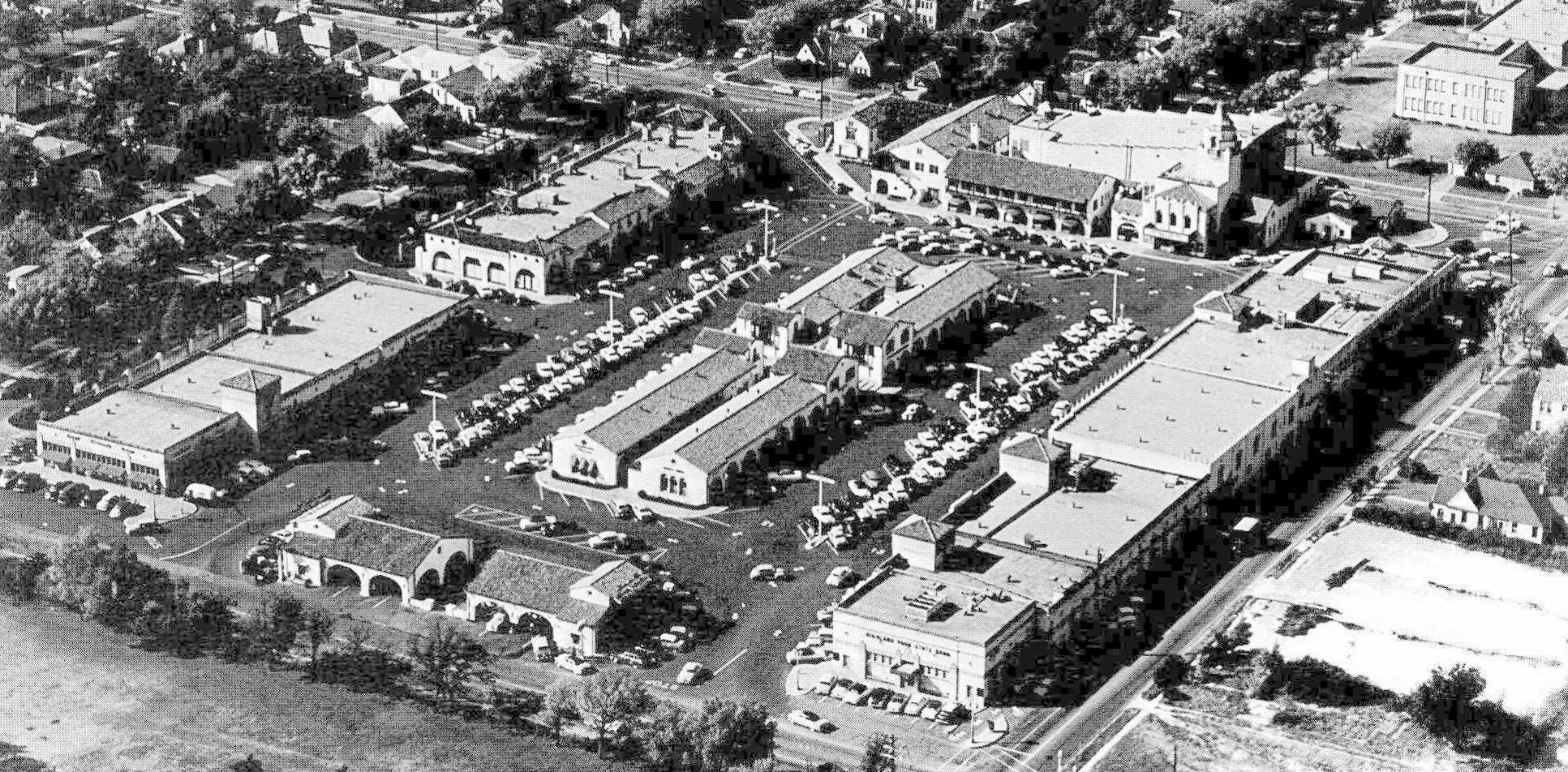
h-p-village_HPHS_1966_ad-detPlenty of parking, above & below ground… (click for larger image)

by Paula Bosse

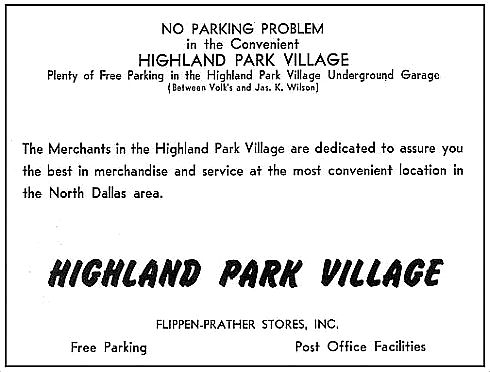
This bird’s-eye view of Highland Park Village is from an ad placed in the Highland Park High School yearbook by Flippen-Prather, who really wanted to stress how there was NO PARKING PROBLEM at this convenient “North Dallas” location, above ground and below ground. Don’t worry, Flippen-Prather had you covered.

h-p-village_HPHS_1966_text1966 ad

Fifty years on from this ad, Highland Park Village is physically still recognizable, just expanded. The tenants, however, are now much more chi-chi.

hp-village_google-2017Google, 2017

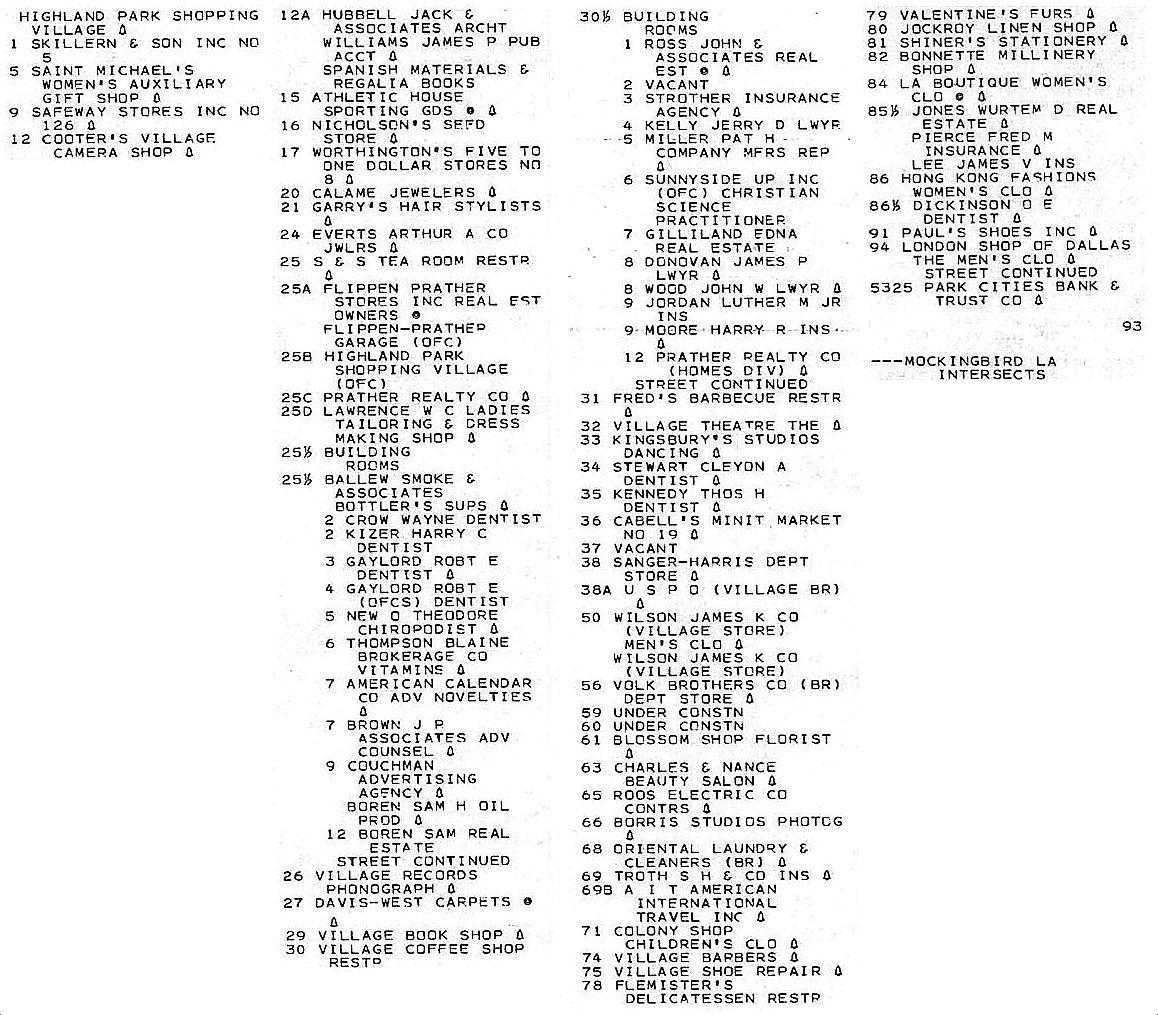
I’m not sure when the top photo was taken, but it appeared in the 1966 Highland Park High School yearbook. Here are the tenants of Highland Park Village in 1966 (click to see a larger image).

hp-village_1966-directory

***

Sources & Notes

Ad for Highland Park Village/Flippen-Prather Stores, Inc. appeared in the 1966 Highland Park High School yearbook.

Color image from Google.

Listing of Highland Park Village businesses is from Polk’s Greater Dallas City Directory, 1966.

All images larger when clicked.

*

Copyright © 2017 Paula Bosse. All Rights Reserved.
“Mr. Wiggly Worm Does Much More Than Wiggle”
mr-peppermint_sponsor-mag_112061-det

by Paula Bosse

My first crush was on Mr. Peppermint, and I really, really, really loved Mr. Wiggly Worm.

This is a rather unfortunate depiction of my childhood TV pal, but how can you not love a smiling wiggly worm with a mailbox?

mr-peppermint_sponsor-mag_112061_mr-wiggly-worm_det

mr-peppermint_sponsor-mag_021163_text

WFAA understood the appeal of Mr. W. W. They even built a whole broadcasting-trade-magazine ad around him. (Click to see it larger.)

mr-peppermint_sponsor-mag_021163Sponsor, Feb. 11, 1963

Here he is again:

mr-peppermint_sponsor-mag_112061
Sponsor, Nov. 20, 1961

Mr. W. W. stayed at home for this one, but here we see Mr. Peppermint out mingling with his adoring public.

mr-peppermint_broadcasting-mag_061063
Broadcasting, June 10, 1963

And, look, “Communications Center” — bet you haven’t heard that in a while!

communications-center_sponsor-mag_112061_det1961

***

Sources & Notes

These Mr. Peppermint advertisements were part of a series of WFAA-Channel 8 ads which ran for several years in television trade magazines.

Click pictures to see larger images.

*

Copyright © 2017 Paula Bosse. All Rights Reserved.