Flashback : Dallas

A Miscellany: History, Ads, Pop Culture

Category: Advertisements

Random Still-Standing Buildings Featured in Ads From 1929
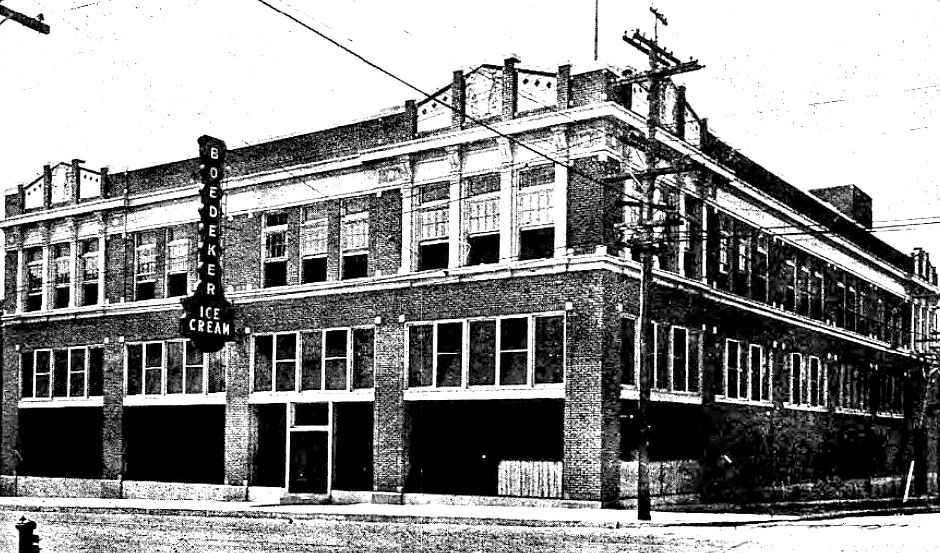
ad-boedeker-ice-cream_1929-directoryS. Ervay & Griffin — still there! (click to see larger image of building)

by Paula Bosse

I’ve always had a fascination for old advertisements. Ads for local products and businesses are particularly interesting and can be quite informative — especially those that feature photographs of the businesses being advertised. I always get an exciting little jolt when I see a still-standing building that I recognize in a 50-, 60-, or 70-year-old ad. Below are a few ads from 1929 — 86 years ago! — featuring buildings that have somehow survived the wrecking ball. Not all of them are architecturally interesting, but they’ve all seen a lot more than you and I have. Click the ads below to see larger images of the buildings.

*

Above, the Boedeker Ice Cream plant — the “finest in the South,” located at S. Ervay & Griffin (1201 S. Ervay). The company was founded in 1887 by German Frederick Boedeker, the first ice cream manufacturer in Dallas. This building was built, I believe, around 1921. I’m not sure what’s in there these days (if anything), but here  is it today, via Google Street View:
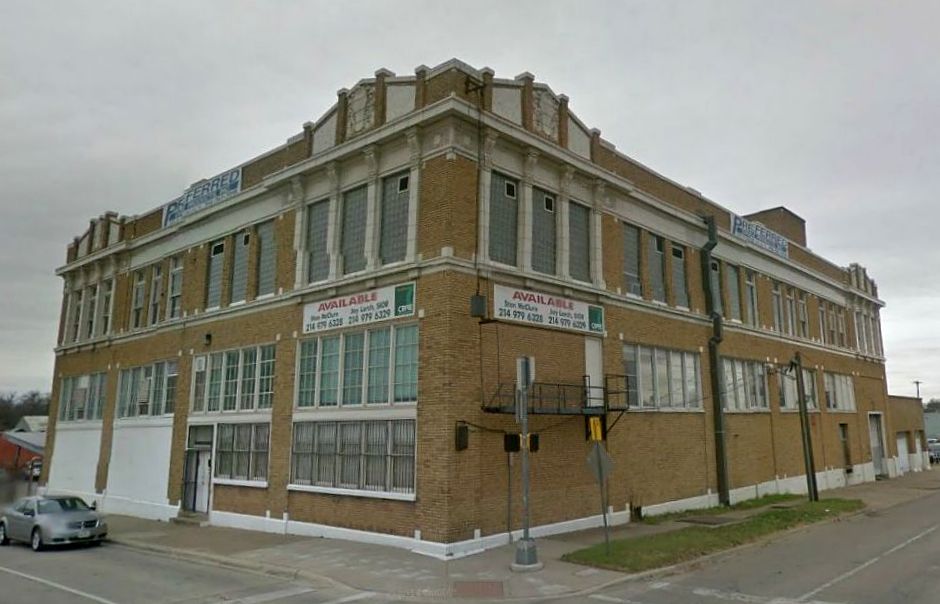
ad-boedeker-ice-cream_now_google

UPDATE: Apparently there are plans afoot — read about them here.

*

Next, the Dallas Tent & Awning Company at 3401 Commerce.
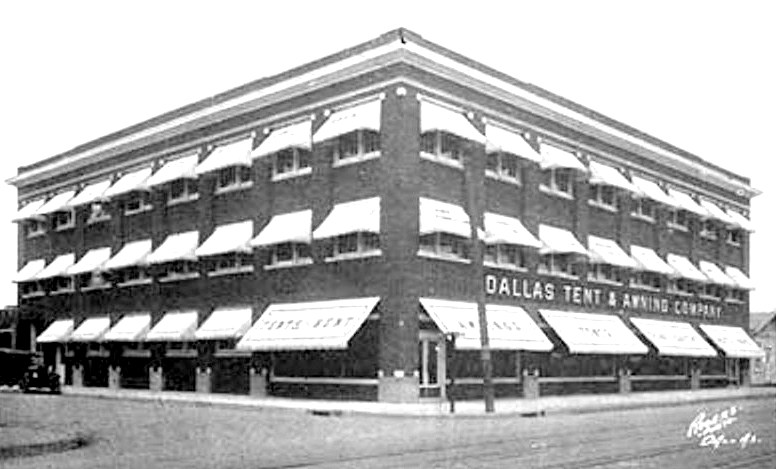
ad-dallas-tent-awning_directory_1929(click to see larger image of building)

This very successful company moved several times to larger and larger spaces, until they decided to build their own showroom and manufacturing plant in 1921. A 1922 Chamber of Commerce ad described the building as “a three-story modern building, 100 feet square with a warehouse in the rear which covers 40,000 square feet, Commerce and Race streets.” They manufactured tents, awnings, automobile tops, tire covers, and seat covers.

Here it is today, the cool-looking Murray Lofts, between Deep Ellum and Exposition Park:
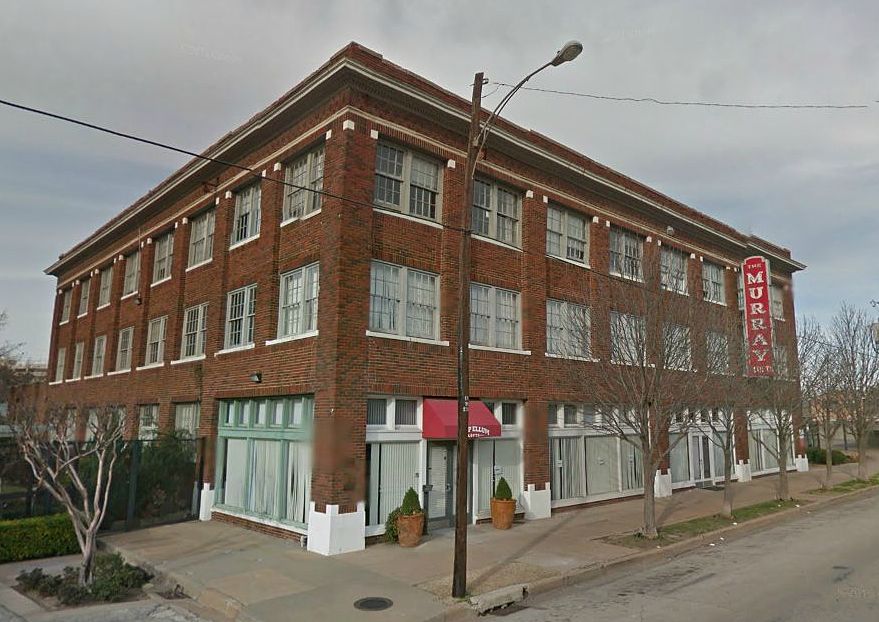
murraylofts

(I’m not sure if the house in this ad was in Dallas, but I hope so! What a beautiful house! A larger image is here.)

*

Next, the Dallas Show Case & Mfg. Co. at 329-337 Exposition.
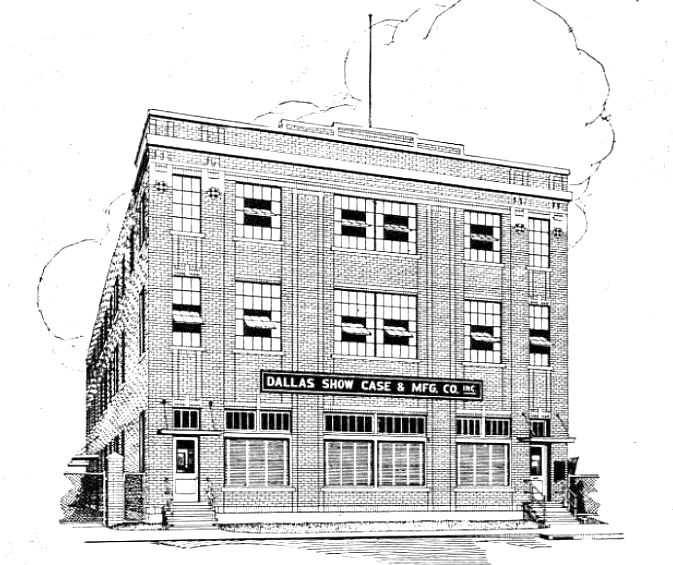
ad-dallas-show-case_directory_1929(click to see larger image of building)

According to a 1962 interview with Otto Coerver — the son of the company’s founder — the factory was built in 1920 just blocks from Fair Park — a location so far “out in the country” that there was no city electric service. Since its founding in 1880, the company had manufactured “bank, office and store fixtures, showcases, hardwood floors and special household and church furniture.” The building still stands, but I’m not sure who occupies it these days.
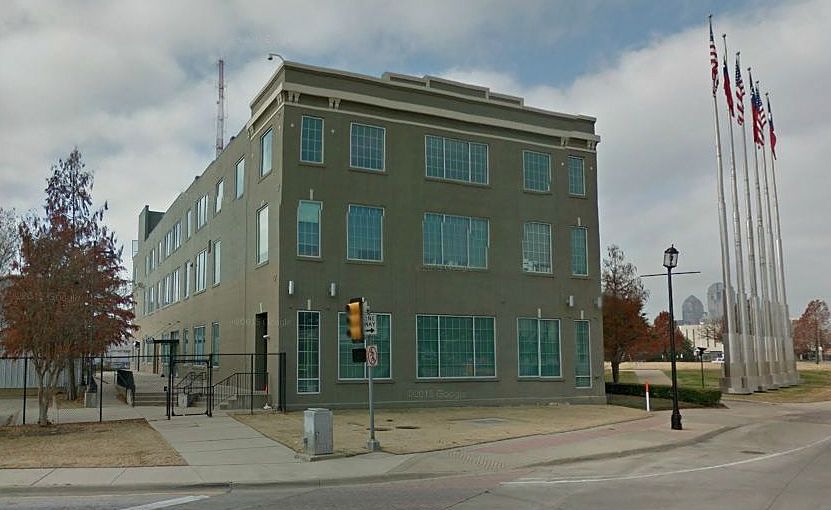
ad-dallas-show-case_now_google

*

And, lastly, the Columbia Fence & Wire Co. at 3120 Grand Avenue.
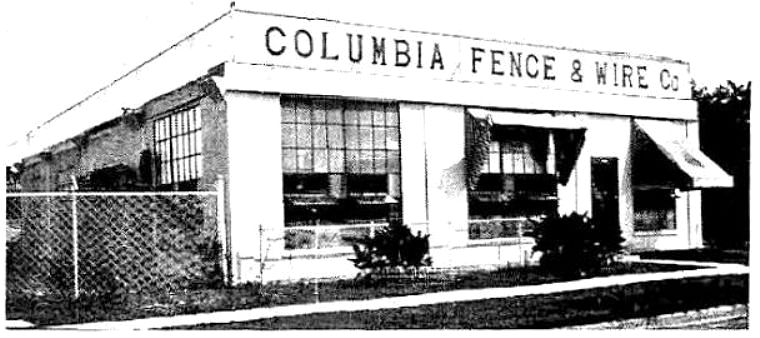
ad-columbia-fence-wire_directory-1929sm(click to see larger image of building)

Though it’s been there since at least 1922, this building is one that I have to admit I probably wouldn’t shed a tear over were it to be demolished. Still, it’s been around a lot longer than I have, and I have to admire the fact that it’s managed to hang on for so many years.  After the Columbia Fence & Wire Co. moved on, the building was occupied by a succession of light industrial businesses. In the 1970s it must have gone through quite a renovation, because it became home to a string of discos, including the short-lived Lucifer’s (owned by Dallas Cowboy Harvey Martin), the Plush Pup, and Papa Do Run Run. Below, the current Google street view (the sign above the vacant building says “S. Dallas Cafe”):
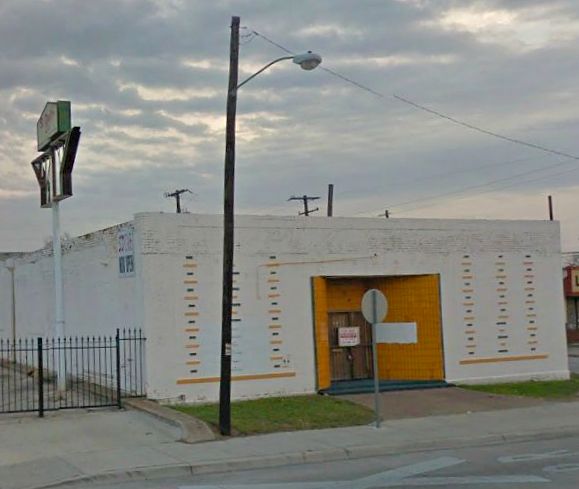
ad-columbia-fence-wire_now_google

 ***

Sources & Notes

All ads from the 1929 city directory. (Apologies for the muddy images. Whenever I post these directory ads, they look great before they’re posted, then something happens during the uploading process, and … argh.)

Present-day images from Google Street View.

A continuation — “MORE Random Still-Standing Buildings Featured in Ads From 1929” — can be found here.

*

Copyright © 2015 Paula Bosse. All Rights Reserved.

The Interurban Parlor Car: Perusing the News in Comfy Chairs

interurban-interior_tx-historian_jan81(Click for larger image)

by Paula Bosse

The height of comfort!

You know this photo was taken for promotional purposes, because none of the men has a reeking cigar clenched between his teeth.

***

Texas Electric Railway Interurban ad reprinted in Texas Historian, Jan. 1981.

Interurbans were great. I wish we still had them. Read about what they were, here.

*

Copyright © 2015 Paula Bosse. All Rights Reserved.
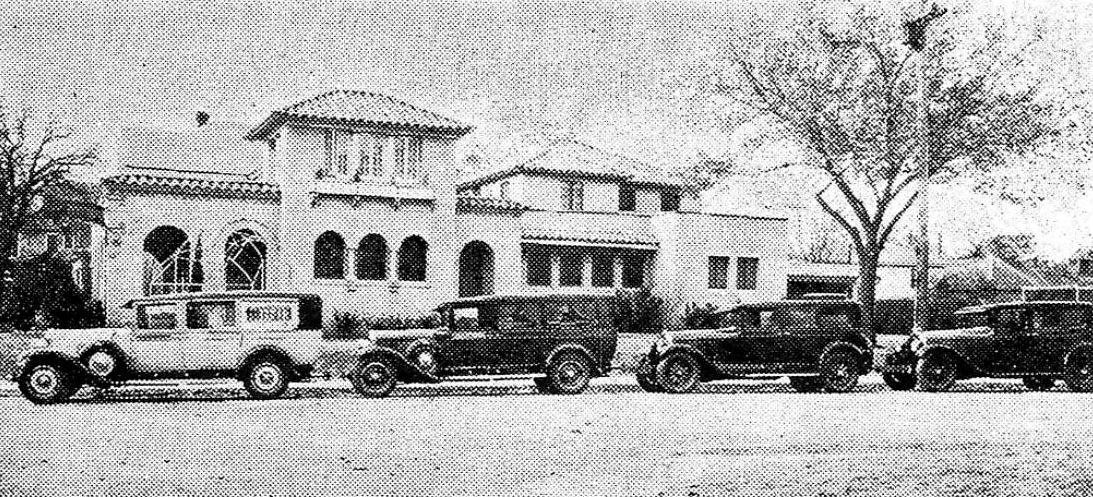
Not Dead Yet at McKinney & Routh

ad-funeral-home_mckinney-routh_directory-1929-detA fleet of Cadillacs in front of 2533 McKinney Ave.

by Paula Bosse

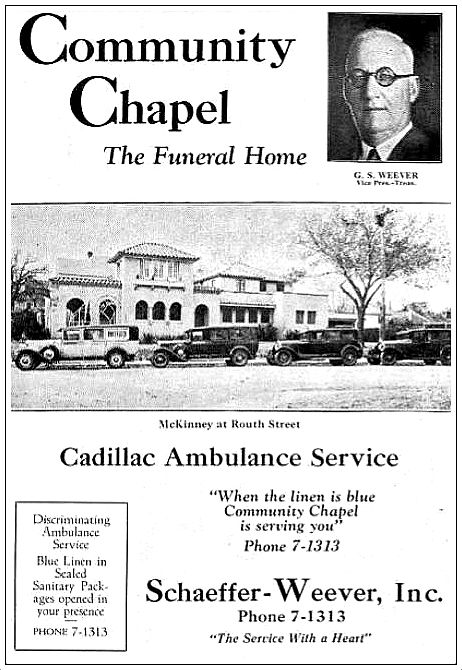
The photo above shows a truly beautiful, Spanish-style building that was built in 1927 at the northwest corner of McKinney Avenue and Routh Street. The view shows the Routh Street side. The person who took this photograph would have been standing across the street on the property of the dearly-departed McKinney Avenue Baptist Church (most recently transformed into the Hard Rock Cafe). You might be surprised to learn that the building in this photo still stands, and it’s mostly recognizable almost 90 years later.

The Community Chapel Funeral Home (yes, a funeral home!) was designed by noted architect Clarence C. Bulger (whose father, C. W. Bulger, designed, among other things, the Praetorian Building downtown AND the just-mentioned McKinney Avenue Baptist Church which was right across the street).

ad-funeral-home_mckinney-routh_directory-1929City directory, 1929

In addition to the funeral home portion (reception area, business office, show rooms, “operating room” (!), chapel with seating for 100, and the euphemistically named “slumber room”), the building also contained a residence for the chief mortician and his embalmer wife, an apartment for the ambulance/hearse drivers, and a “pavilion for recreation of employees.” The building and its beautifully-appointed interior cost in excess of $100,000 (which the Inflation Calculator estimates is the equivalent of more than $13 million today!).

Also, an “oxygen plant” was somewhere on the grounds. I’ve never heard of an oxygen plant, but they seem to be a mortuary thing. Let’s hope recently-bereaved smokers were kept at a safe distance from all that highly flammable oxygen, because the company had a bunch of promotional matchbooks printed up, and I can only imagine they were readily available in tastefully-arranged candy dishes of every room of the establishment. And in those days, one didn’t necessarily step outside to smoke one’s anxiety away.

weever-funeral-home_fkickr1

weever-funeral-home_fkickr2

weever-funeral-home_1937-city-directory_ad1937 Dallas directory

The funeral home at 2533 McKinney Avenue lasted almost thirty years. Sometime in the mid-’50s it was renovated into office and retail space (classified ads mentioned 2-, 3-, and 4-office suites). That lovely interior must have been hacked up pretty bad. An early tenant was the Bankers Securities Corporation, shown below in a newspaper ad from 1956 (someone made some poor choices on that renovation of the exterior). (This view shows an entrance from McKinney rather than Routh.)

bankers-securities_dmn_012256-photoAd detail, Jan., 1956

For the next 40-odd years, 2533 McKinney Avenue was home to a variety of insurance agents, a fur salon, several companies that advertised in the classifieds for vague “salesmen” positions (one company did specify that it was looking for encyclopedia salesmen in 1963), art galleries, architect/design businesses, offices of “El Sol de Texas” (“the only Spanish-language newspaper in North Texas”), and antique shops.

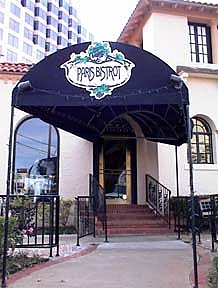
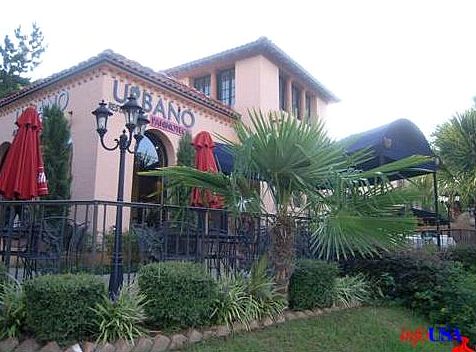
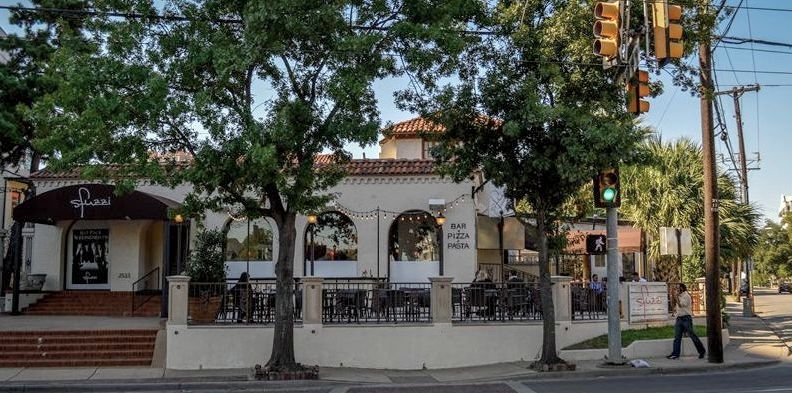
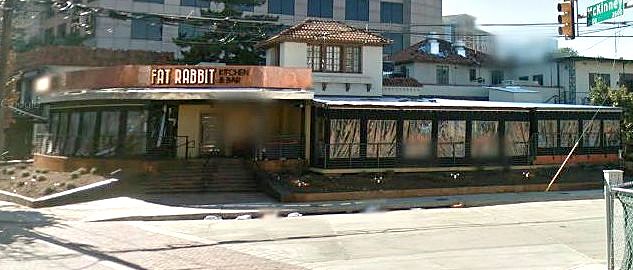
It all turned around, though, when the long-suffering building was re-renovated and became a restaurant space. Since at least 1999 when Uptown began to explode, it’s been home to bistros, cafes, and upscale eateries. The photos below show some of the restaurants that have set up shop there, and if you know what you’re looking at, the place really does look very similar to C. C. Bulger’s design from almost 90 years ago.

*

paris-bistrot_2001Le Paris Bistrot opened in 1999. The owner changed the name to Figaro Cafe in 2004 when the U.S. was going through an anti-French phase.

urbano_city-dataUrbano Paninoteca opened in 2007. Something called Split Peas Soup Cafe opened in 2009.

sfuzzi_scrumpliciousfood_sm

sfuzzi_yelpThen Sfuzzi opened with a big splash in 2010. (It had been a McKinney Avenue staple in the 1980s and ’90s, closed, and came back in 2010.) The first photo shows the Routh Street entrance, the second photo shows the McKinney entrance.

fat-rabbit_googleAnd now it’s the Fat Rabbit, which opened earlier this year. Let’s hope they get some landscaping in there STAT! (UPDATE: Fat Rabbit is now an ex-rabbit, and after spending some time of his own in the “slumber room,” he has joined the choir invisible. Next!)

And let’s hope that those tiled roofs and stuccoed walls remain a distinctive part of its future. I love the fact that it still looks a lot like it once did. And I actually like the fact that restaurants have been operating out of an old funeral home for over 15 years. Restaurateurs might be hesitant to publicize the building’s past (although I’m pretty sure most of them have been completely unaware of what the place used to be), but modern-day Harolds and Maudes might be giddy at the prospect of an unusual dining option and move this place right to the top of their date-night list. 

***

Sources & Notes

Top photo is a detail of the ad that appeared in the 1929 Dallas city directory. It shows four Cadillacs — a hearse, 5- and 7- passenger sedans, and an ambulance (“purchased from the Prather Cadillac Company”).

Matchbook artwork from Flickr, here.

The first Sfuzzi photo is from the food blog Scrumplicious Food, here. A GIGANTIC version of the photo can be seen here — you can look at all the details. Second photo of Sfuzzi from Yelp.

Fat Rabbit image from Google street view.

Sources of all other clippings and photos as noted.

Some images larger when clicked.

*

Copyright © 2015 Paula Bosse. All Rights Reserved.
Texas Independence Day: The Most Patriotic Bank Ad EVER — 1921

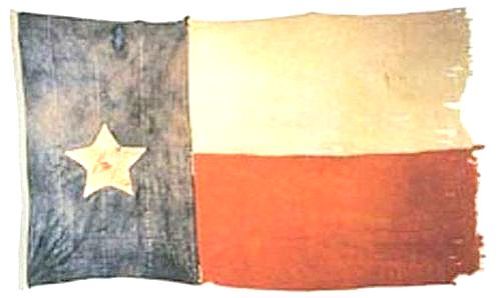
tx-flag

by Paula Bosse

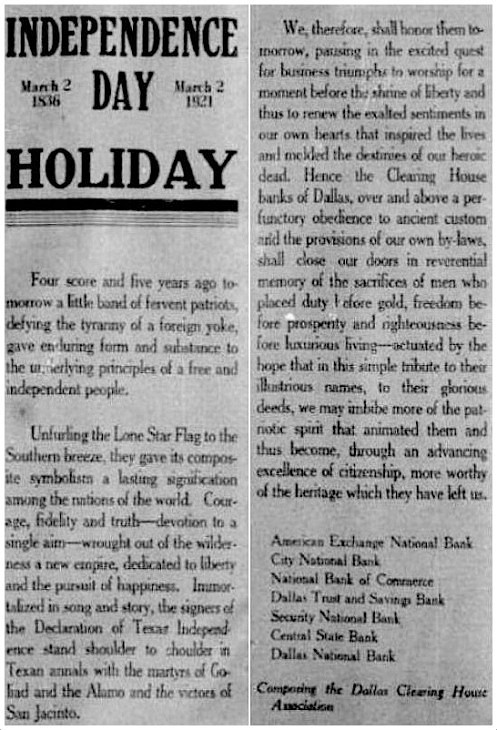
Today is the anniversary of Texas Independence. Below, you will find the most heart-swellingly patriotic bank ad ever penned. Before you plunge in, you might want to get a hanky. (Transcription below.)

tx-independence_ad_dmn_030121Dallas Morning News, March 1, 1921

Four score and five years ago tomorrow a little band of fervent patriots, defying the tyranny of a foreign yoke, gave enduring form and substance to the underlying principles of a free and independent people.

Unfurling the Lone Star Flag to the Southern breeze, they gave its composite symbolism a lasting signification among the nations of the world. Courage, fidelity and truth — devotion to a single aim — wrought out of the wilderness a new empire, dedicated to liberty and the pursuit of happiness. Immortalized in song and story, the signers of the Declaration of Texas Independence stand shoulder to shoulder in Texan annals with the martyrs of Goliad and the Alamo and the victors of San Jacinto.

We, therefore, shall honor them tomorrow, pausing in the excited quest for business triumphs to worship for a moment before the shrine of liberty and thus to renew the exalted sentiments in our own hearts that inspired the lives and melded the destinies of our heroic dead. Hence the Clearing House banks of Dallas, over and above a perfunctory obedience to ancient custom and the provisions of our own by-laws, shall close our doors in reverential memory of the sacrifices of men who placed duty before gold, freedom before prosperity and righteousness before luxurious living — actuated by the hope that in this simple tribute to their illustrious names, to their glorious deeds, we may imbibe more of the patriotic spirit that animated them and thus become, through an advancing excellence of citizenship, more worthy of the heritage which they have left us.

American Exchange National Bank
City National Bank
National Bank of Commerce
Dallas Trust and Savings Bank
Security National Bank
Central State Bank
Dallas National Bank

Composing the Dallas Clearing House Association

*

Remember the Alamo! And remember the men who placed “righteousness before luxurious living”! (Even though that last part’s not exactly a sentiment that Dallas is typically known for….)

*

Copyright © 2015 Paula Bosse. All Rights Reserved.

Roseland — 1916

roseland_terrill-yrbk_1916The Roseland Theater, 1613 Main St. (click for larger image)

by Paula Bosse

Despite its grainy quality, I really like this photo. It shows people walking past the Roseland Theater at 1613 Main Street, a theater I’d never heard of. I couldn’t find out much about it other than that it doesn’t seem to have lasted very long (from at least 1914 until at least 1916). It was owned/managed by P. G. Cameron, who ran several theaters and was in the general “amusements” business around town (he had run the Fair Grounds Skating Rink back in the aughts for a short while, until the place was shut down because of the discovery of a prostitution operation being conducted there … on city-owned property).

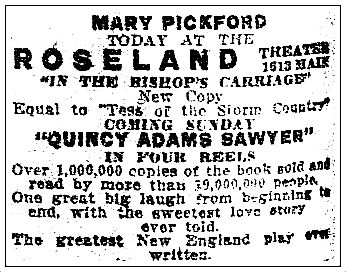
roseland_dmn_050914Dallas Morning News, May 9, 1914

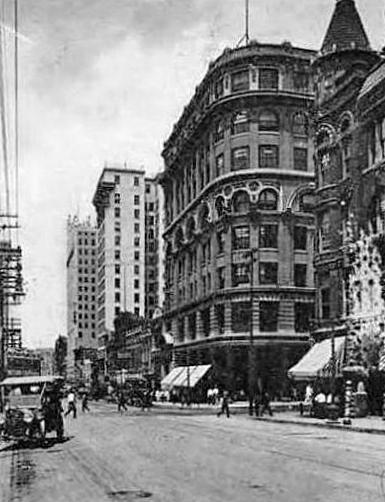
In 1916, the north side of Main Street contained three theaters: the Nickelodeon (1607 Main), the Roseland (1613 Main), and the Best (1615 Main). This is the much-beleaguered (and now mostly demolished) block of Main, which in 1916 was anchored by the dazzling Praetorian and Wilson buildings. The Roseland occupied part of what was once the Everts Jewelers building. Below, another view of this block in 1916, with the theater(s) on the right, about halfway between the tall white Praetorian Building and the stately rounded Wilson Building.

main-st_1916_smu-rotunda_sm Another grainy photo, Main looking west

I like this Roseland photo because it’s a candid shot taken by a teenager on the sidewalk of a lively downtown Dallas who had happened upon his teacher away from school. And the sign is cool. Too bad it’s so hard to see.

roseland_terrill-yrbk_1916_det

***

Sources & Notes

Photo from the 1916 Terrillian, the Terrill School yearbook. (The caption for the photo of one of the school’s teachers: “Passing by or coming out, Mr. F.?”)

Photo of Main Street, looking west, from the 1916 Rotunda, the yearbook of SMU.

See what the 1600 block of Main looked like in 1909, here. Much of the block has been demolished.

See the 1921 Sanborn map showing this block, here.

Below, a recent (2015) Google Street View of the building that housed the Roseland: the really lovely shorter white building. This building may already have been razed. What a shame. (UPDATE — 2018: Yep, demolished.) The current view (as I assume this block is ever-changing) can be seen on Google Street View here.

roseland_google2015, not long for this world….

*

Copyright © 2015 Paula Bosse. All Rights Reserved.


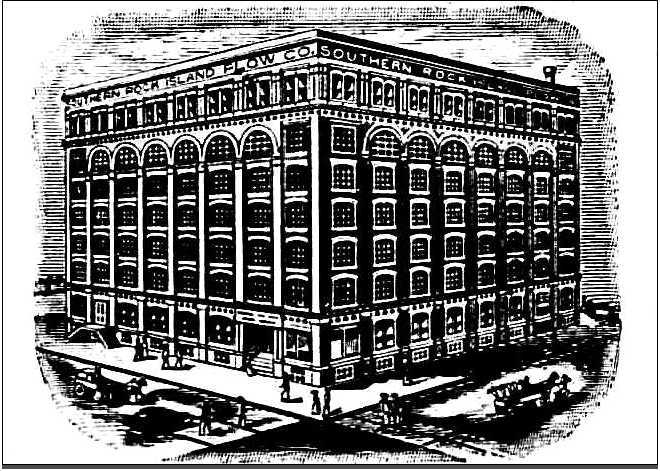
The Southern Rock Island Plow Company

southern-rock-island-plow_city-directory_1908-det_smFrom plow company to Dallas’ most famous building (click to enlarge)

by Paula Bosse

Behold, the Southern Rock Island Plow Company building. Looks familiar? Perhaps “Texas School Book Depository” is an easier hook to hang your hat on. When Dallas seemed to be farm implement-central, there were numerous plow companies in business here. This is the second Southern Rock Island Plow Co. building — the first one (built in the same location around 1898) burned down when it was struck by lighting. The building that still stands was built in 1903, and it is, without question, the most famous building in Dallas.And it’s probably not that far behind the Alamo.

southern-rock-island-plow_city-directory-19081908

southern-rock-island-plow_bldg-code_19141914

***

Sources & Notes

Ad from the 1908 city directory.

Photo from the Building, Plumbing, Gas & Electrical Laws of the City of Dallas (1914).

More on the history of the Dallas branch of the Southern Rock Island Plow Co. can be found here.

For more about what’s going on with the building these days, see the Dallas Morning News article “Dallas County May Move Offices Out of Historic School Book Depository” by Matthew Watkins, here.

For more on the various incarnations of the building (which, by the way, is officially called the County Administration Building and which now houses county offices as well as the Sixth Floor Museum), see my previous post, “The Sexton Foods Building and the Former Life of the School Book Depository,” here.

*

Copyright © 2015 Paula Bosse. All Rights Reserved.


Luncheon at The Zodiac Room, Darling

zodiac-room_smFood, fashion, & the unmistakable whiff of Old Money (click for larger image)

by Paula Bosse

Two cool and sophisticated postcards from the cool and sophisticated Neiman-Marcus (although it’s debatable whether the truly cool and sophisticated N-M shopper would, in fact, mail anyone something as bourgeois as a postcard of a department store, Neiman-Marcus or not). Perhaps these were done up for the sizable tourist trade. I love these cards. Commercial art of this period is wonderful.

The description on the back reads: “One of the great dining spots of the Southwest … N-M’s famed ZODIAC ROOM. The superlative food specialties of Director Helen Corbitt and her staff are enjoyed during modeling of fashions a la Neiman-Marcus at luncheon and dinner. Also, tea served daily.”

Below, the Carriage Entrance:

neimans_postcard_c1950s-carriage-entrance-sm(click for larger image)

The description: “‘The Carriage Entrance’ — famous passageway into one of the world’s great specialty stores.”

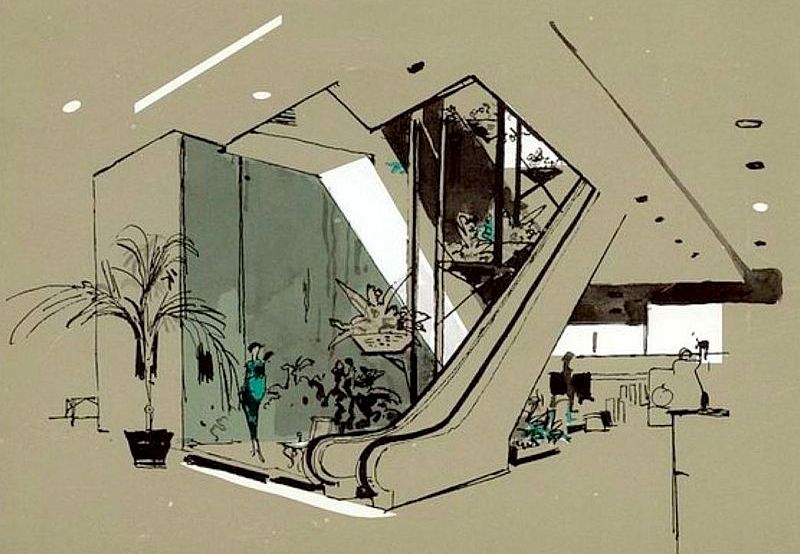
And another (I’d love to see the whole series of these postcards.) Sadly, no description on this one, featuring a fashionable escalator.

n-m_escalator_pinterest

I fear I shall never reach the level of swan-like sophistication needed to become an habitué of The Zodiac Room. Tant pis.

***

I have no idea where these postcards came from. I’m not sure of the date, either, but … “1950s”? Maybe very early 1960s? Let’s go with “Mid-Century” — everyone loves that! Whenever this was, this was a period when fashion was chic and fabulous. As was Neiman-Marcus. (I still miss that hypen!)

Need to make a reservation at The Zodiac? Info is here.

*

Copyright © 2015 Paula Bosse. All Rights Reserved.

The Marietta Mask

marietta-mask_doak_boys-life_oct55SMU football star Doak Walker in an ad from Boys’ Life, Oct. 1955

by Paula Bosse

Dr. Thomas M. Marietta (1910-1995), a Dallas dentist, devised a startlingly new invention in 1947: a specially-made facemask. Initially, the mask was created to protect the face of a Dallas hockey player who had recently sustained a broken nose and would have been unable to play without a mask for fear of further injury. Marietta’s creation was a success — not only did the player get back on the ice, but tentative inquiries from other sports teams began to trickle in. But what changed everything were the masks he made for TCU’s star quarterback Lindy Berry, who had suffered a broken jaw, and Texas A&M’s fullback Bob Smith, who had a badly broken nose. Without the odd-looking masks that protected their entire faces, they would not have been able to play out the seasons. The masks were an unqualified success, and the doc went commercial.

marietta-face-mask_marion-OH-star_112251_wireDr. Marietta (Marion Ohio Star, Nov. 22, 1951 — full article is here)

In 1951, football players did not generally wear facemasks. It was commonplace for players to rack up a dizzyingly large number of injuries such as broken and dislocated jaws and noses, knocked-out teeth, facial lacerations, major bruising, concussions, etc. An article appeared in The Dallas Morning News on Aug. 31, 1951 describing what this whole facemask thing was about and how the Texas Aggies were about to try a revolutionary experiment by equipping “possibly half of the A&M team” with Dr. Marietta’s newfangled masks. Coach Ray George approved a trial test of the masks, saying that his primary concerns were reduction of facial injuries, elimination of head injuries, and improvement of athletic performance. A&M’s trainer, Bill Dayton, predicted that the wearing of facemasks would become universal among players in the coming years.

Many head injuries happen as the result of a player ducking his head. We believe that by the use of this face gear we can eliminate head ducking, and our players will see where they are going. When they watch their opponents, they are able, by reflective action, to keep their heads out of the way. (A&M trainer Bill Dayton, DMN, Aug. 31, 1951)

The various incarnations of the Marietta Mask over the next couple of decades were used in various sports by children, by college athletes, and by professionals. Dr. Marietta patented several designs for masks and helmets and had a lucrative manufacturing business for many years. In 1977 the business was sold, and the Marietta Corp. became Maxpro, a respected name in helmets.

Football and hockey will always be extremely physical sports with the very real possibility of injury, and though there’s need for further improvement, Dr. Marietta’s invention helped lower the danger-level quite a bit. Thanks to a mild-mannered dentist from Dallas, a lot of athletes over the years managed to avoid all sorts of nasty head and facial injuries. Thanks, doc.

*

marietta-mask_corbis_oct1954Oct. 1954 (©Bettmann/CORBIS)

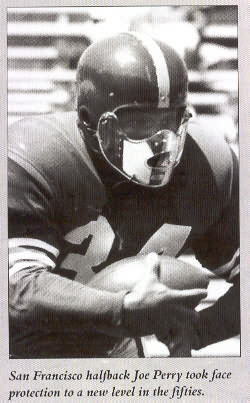
marietta_joe-perry

marietta-mask_envelope

***

Sources & Notes

Photo ©Bettmann/CORBIS; the original caption: “An outer-space look is given by this all-plastic mask lined with foam rubber. It was designed by Dr. M. T. Marietta, a Dallas, Texas dentist.”

Joe Perry photo from HelmetHut. To see some pretty wacky versions of early masks from a Marietta catalog, see images from HelmetHut.com, here.

Read the following newspaper articles:

  • “Mask Maker: Dentist Helped Wolves Win Title (Abilene Reporter-News, Nov. 29, 1950) — regarding the Colorado City (TX) Wolves and their injured player, Gerald Brasuell, the team’s tackle who wore Dr. Marietta’s mask and was able to play despite having a triple-fracture to his jaw, here
  • “Broken Jaw Protection: Doctor’s Face Mask Enables Injured Gridders To Play” (Marion, Ohio Star, Nov. 22, 1951), here

To see several of Marietta’s patents (including abstracts and drawings), see them on Google Patents, here.

And to read an interesting and entertaining history of the football facemask (and I say that as someone who isn’t really a sports person), check out Paul Lukas’ GREAT piece “The Rich History of Helmets,” here. (If nothing else, it’s worth it to see the cool-but-kind-of-weird-and-scary, crudely-fashioned, one-of-a-kind facemask made out of barbed wire wrapped in electrical tape!)

And because a day without Wikipedia is like a day without sunshine, the facemask/face mask wiki is here.

*

Copyright © 2015 Paula Bosse. All Rights Reserved.

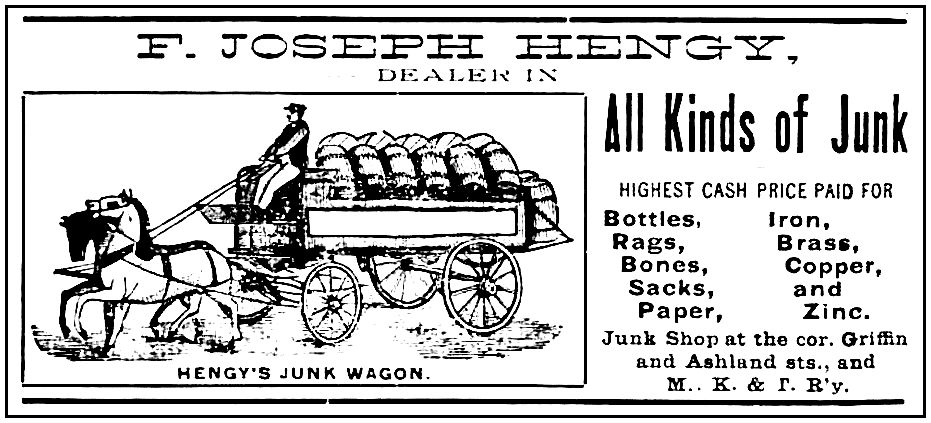
F. J. Hengy: Junk Merchant, Litigant

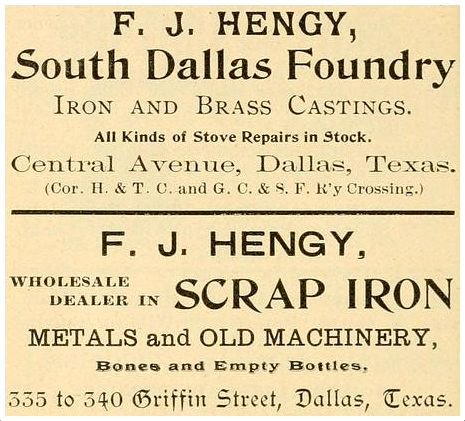
ad-hengy-junk_city-directory_1890-sm“All Kinds of Junk” — 1890 ad

by Paula Bosse

Frank Joseph Hengy was born in Germany in 1850. He immigrated to the United States in 1873, and in about 1880 he made his way to Dallas with a wife and children and established himself as a prosperous buyer and seller of scrap metal and other assorted “junk.” He also owned and operated a foundry, producing amongst other things, sash weights. In the 1894 city directory, there were exactly two “junk dealers” listed, which is surprising, seeing as Dallas was a sizable place in 1894 — there must have been a lot of bottles, rags, bones, sacks, paper, iron, brass, copper, and zinc lying around all over the place, just waiting to be hauled away.

hengy_souv-gd_1984Souvenir Guide to Dallas, 1894

F. J. “Joe” Hengy’s junkyard (and adjacent residence) was at Griffin and Ashland, right next to the M K T Railway tracks. He advertised in the newspapers constantly and was apparently THE man to sell your junk to. His name even made its way into the minutes of an 1899 city council meeting, when, during the discussion on how the city was going to pay for the shipping of a Spanish cannon that had been captured in Cuba and had been given to the city as a war trophy, a councilman asked sarcastically, “What will Hengy give for it?” (Dallas Morning News, Aug. 5, 1899).

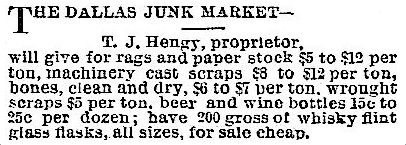
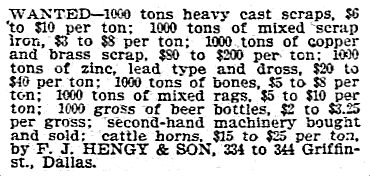
But, seriously, got junk? Call Hengy. Got tons of it? By god, he wants it. A couple of examples of the endless ads placed over the years — two ads, 12 years apart (the 1887 one getting his first initial wrong).

1887_hengy_dmn_082487DMN, Aug. 24, 1887

1899_hengy_dmn_102299DMN, Oct. 22, 1899

In the mid-1890s, Joe took his son Louis on as a partner, which, in retrospect, was probably not a good idea, because it wasn’t long before Joe found himself in the middle of years and years of lawsuits: father against son, son against father, father and associates against son, son and associates against father, etc. Not only was he constantly being sued by his son, he was also sued for divorce … twice … by the same woman. He turned around and sued her for custody of their youngest children (and won). She sued him for the business when he was threatening to sell it and retire. He sued her back for something or other. And on and on and on.

Not only was Joe spending all his non-junk-hauling time traipsing about courthouses, but he also found the time to suffer the occasional partial destruction of buildings on his property — twice by fire and once by the massive flood of 1908. The fires were suspicious (the flood was not).

Then there was the time he was charged with the crime of mailing an obscene letter (I’m gonna go out on a limb and guess that it was probably a letter sent to his wife — or maybe ex-wife by that point — who was in the midst of suing him and their son). Even though this was a potentially serious federal offense, he was ordered to pay only a small fine for “misuse of the mails.” He was also charged at one point with “receiving and concealing stolen property,” but I’m not sure that got past a grand jury investigation, and one might wonder if there wasn’t some sort of “set-up” by aggrieved relatives involved. It was something new anyway. Probably broke up the monotony a little bit.

But the thing that seems to have been Hengy’s biggest headache and was probably the root of most of the lawsuits filed BY him and AGAINST him concerned property he owned which had been condemned in the name of eminent domain by the M K T Railway. The condemnation was disputed, the appraisal of land value was disputed, the question of which Hengy actually owned the land was disputed, etc.

By the end of 1913, Joe Hengy had been engaged in at least 10 years of wall-to-wall litigation. He moved to Idaho at some point, remarried, started another business, and, finally, died there in 1930. Let’s hope his later years were lawsuit-free.

*

hengy_map_ca1900

Hengy’s business and residence (which was, surprisingly, right next door to his litigious son) was at 2317 Griffin, very close to the present-day site of the Perot Museum. (Full map circa 1900, here.) (Click for larger image.)

*

Lastly, two odd, interesting tidbits.

Joe Hengy took time out from junk and courtrooms to invent new and improved … suspenders! I’m not sure exactly what was so revolutionary about them, but a patent was granted in 1912 — you can read the abstract here, and see them in all their suspendery glory here. (With so much foundry and scrap metal know-how, you’d think he’d go in a more … I don’t know … anvil direction or something.)

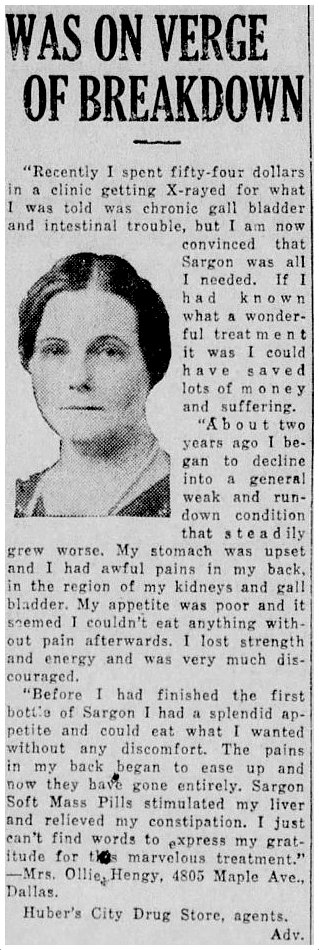
And, then there’s this — a kind of sad ad for a tonic called “Sargon” with a testimonial from Mrs. Ollie Hengy, the no doubt long-suffering wife of perennial plaintiff/defendant Louis Hengy. “Was On Verge of Breakdown.” I don’t doubt it! (Incidentally, Ollie and Louis divorced the same year this advertisement appeared in Texas newspapers. Maybe that stuff did work.)

ollie-hengy_vernon-daily-record_0906291929

***

Sources & Notes

Top ad from Dallas’ 1890 city directory.

Sargon ad appeared in The Vernon Daily Record, Sept. 6, 1929. More on the quack tonic Sargon here.

Sources for other clippings and images as noted.

Lastly, an interesting article that answers the questions “Why was the scrap metal game profitable?” and “Just where did all that metal GO, anyway?” can be found in the article “Many Uses for Junk: How Wornout and Discarded Metal is Utilized,” originally published in The Brooklyn Citizen in 1899; it can be read here. I’m nothing if not exhaustive.

*

Copyright © 2015 Paula Bosse. All Rights Reserved.

Munger Place — 1908

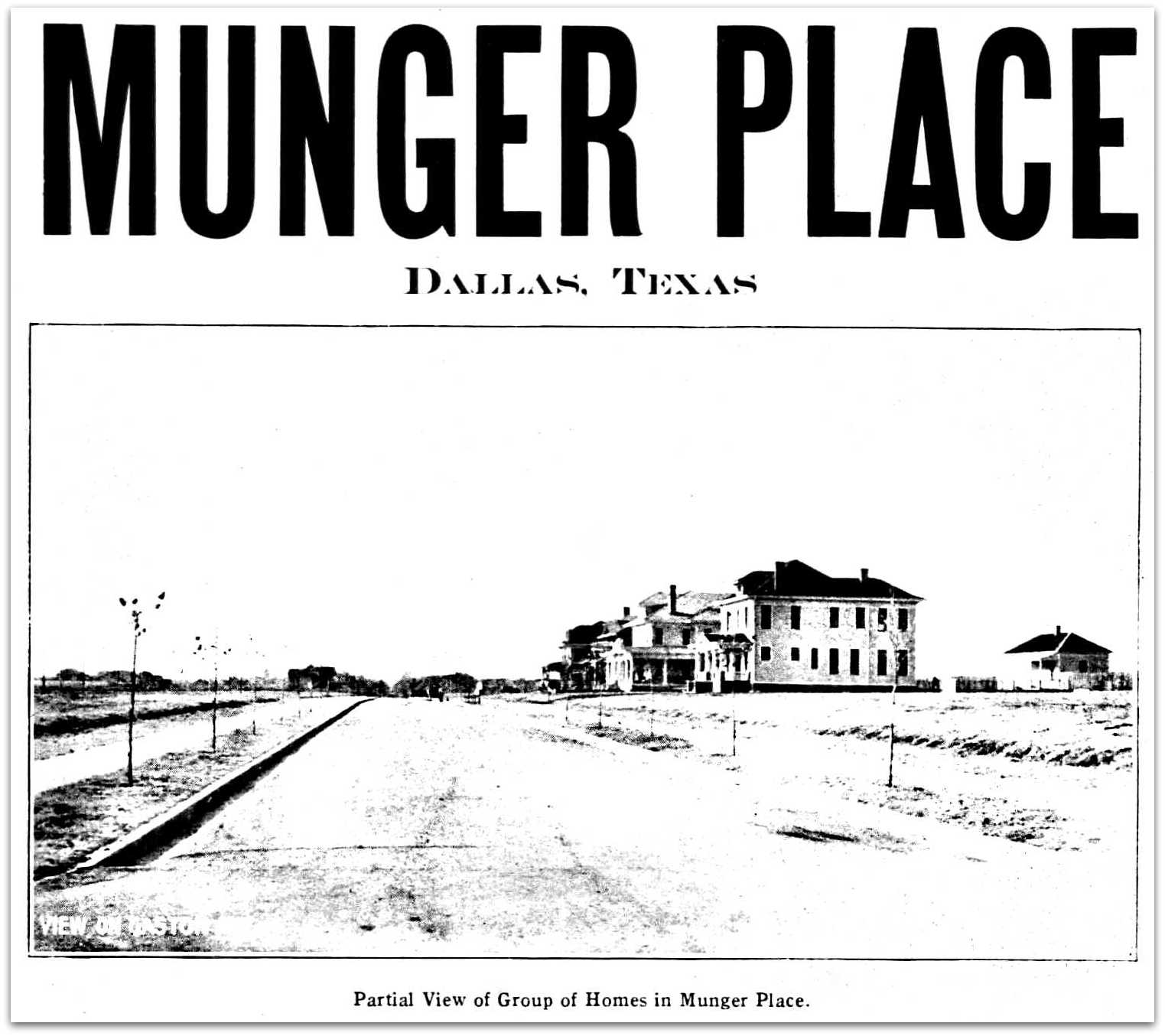
munger-place_city-directory_1908-detGaston Avenue in its salad days… (click for much larger image)

by Paula Bosse

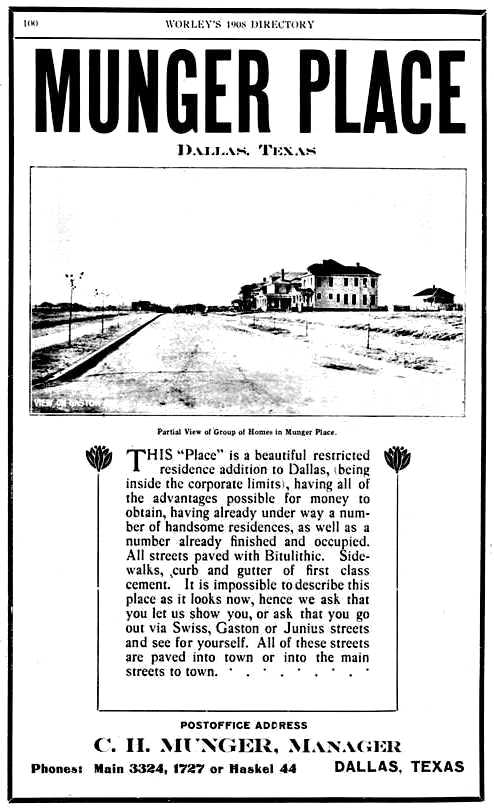
This ‘Place’ is a beautiful restricted residence addition to Dallas (being inside the corporate limits), having all of the advantages possible for money to obtain, having already under way a number of handsome residences, as well as a number already finished and occupied. All streets paved with Bitulithic. Sidewalks, curb and gutter of first class cement. It is impossible to describe this place as it looks now, hence we ask that you let us show you, or ask that you go out via Swiss, Gaston or Junius streets and see for yourself. All of these streets are paved into town or into the main streets to town.

It would have taken a great deal of creative vision to imagine what a beautiful neighborhood the one shown in that bleak photo would one day become. (Does anyone know where on Gaston this photo was taken? Are any of these houses still standing?)

munger-place_city-directory-1908

***

Ad from the 1908 city directory.

Info on the Munger Place Historic District on Wikipedia, here, and at MungerPlace.com, here.

Click top image for a much larger image.

*

Copyright © 2015 Paula Bosse. All Rights Reserved.