Flashback : Dallas

A Miscellany: History, Ads, Pop Culture

Category: Advertisements

Olsen-Stelzer Cowboy Boot Saleslady — 1939

Portrait with boots…

by Paula Bosse

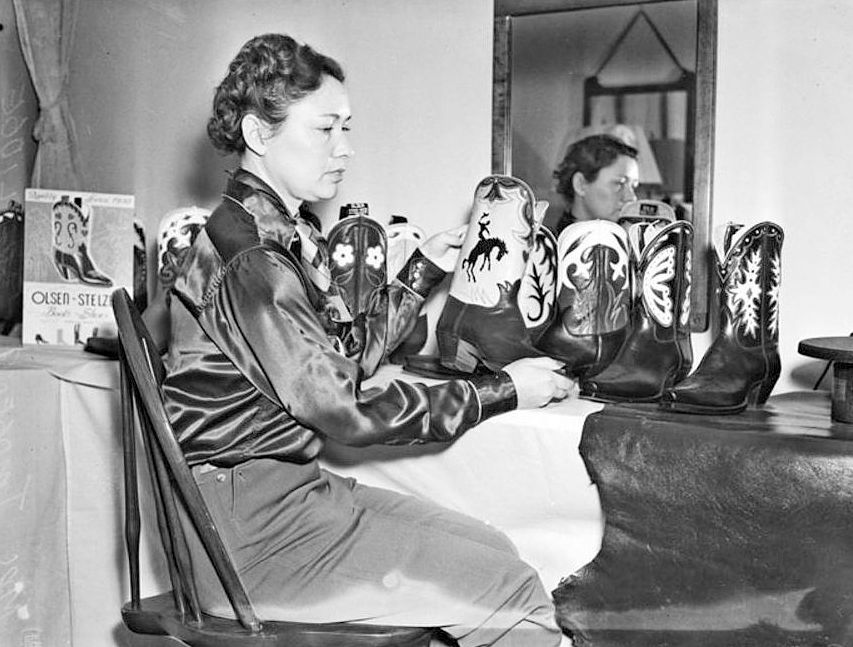
Above, Dallas resident Imogene Cartlidge is seen at a shoe retailers’ convention in San Antonio in 1939. Cartlidge was an employee of the Olsen-Stelzer boot company in Henrietta, Texas, and she was said to be “the only woman boot salesman on record.” I’m a big fan of cowboy boots of this period, and I have to say that I am ashamed that I was unaware of the famous Olsen-Stelzer company, which lasted from 1900 until the 1980s. The company is back in business again, led by Tom Cartlidge, whose parents began selling the boots in 1938 — Imogene is his mother. I wish them all the best of luck, because the world needs as many great-looking cowboy boots as it can get!

olsen-stelzer_dmn_120146

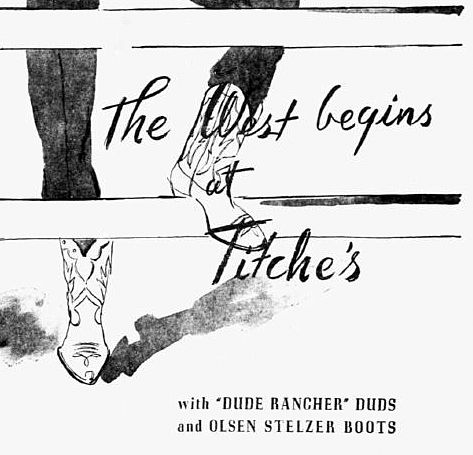
“The West begins at Titche’s”? First I’m hearing of this. Who knew? Nice ad, though.

olsen-stelzer_dmn_120146det

olsen-stelzer_dmn_103055

olsen-stelzer_1941

Best of all is this absolutely fantastic video from 1956 about the company:

olsen-stelzer-logo

olsen-stelzer-box

***

Sources & Notes

Photo of Imogene Cartlidge is from the San Antonio Light Photograph Collection, University of Texas San Antonio Libraries Special Collections, Institute of Texan Cultures.

Titche’s ad from 1946.

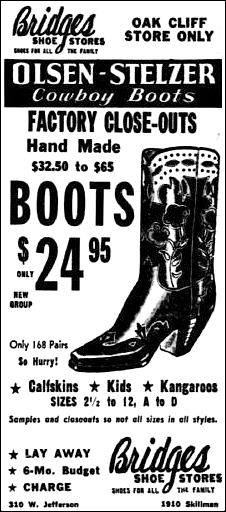
Bridges Shoe Store ad from 1955. (Bridges seems to have been the only place in Dallas where the boots were regularly sold — or at least regularly advertised. And you could get them ONLY IN OAK CLIFF!) (I hear the West begins at Oak Cliff….)

The video can be found on the home page of the Olsen-Stelzer website here.

The last image is the lid of an Olsen-Stelzer boot box, which belongs to my aunt — she keeps Christmas ornaments in it. (Sadly, no sign of the boots!)

The history of the company (and, again, that great video) can be found here.

*

Copyright © 2014 Paula Bosse. All Rights Reserved.

Munger’s Improved Continental Gin Company

continental-gin_munger-from-natl-reg-appA Dallas landmark… (click for larger image)

by Paula Bosse

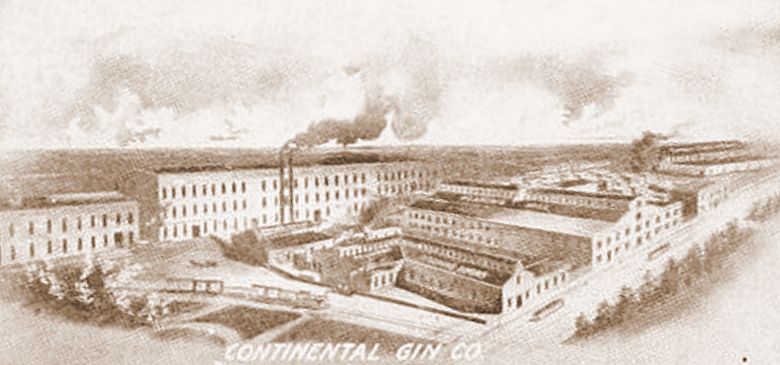
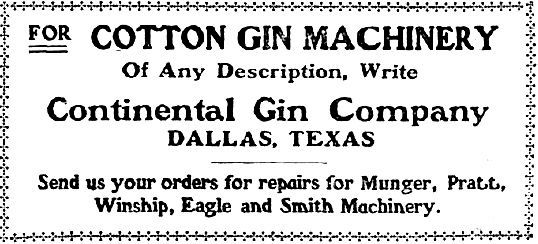
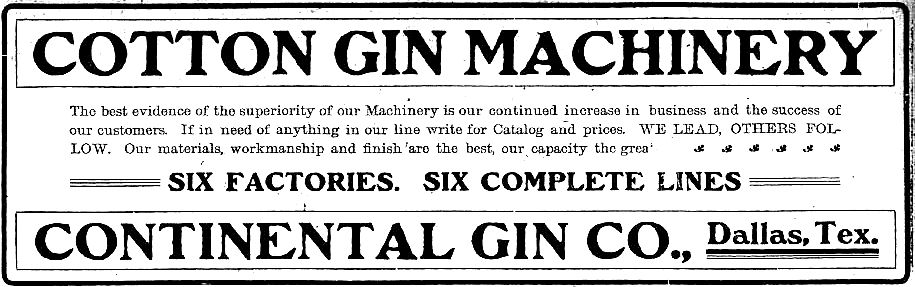
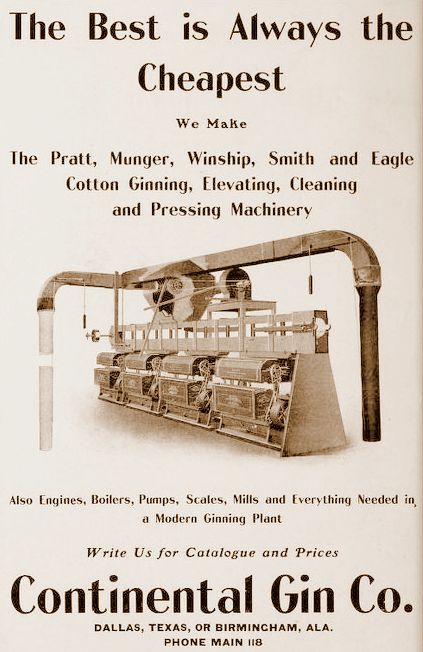
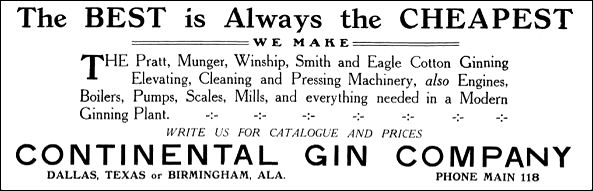
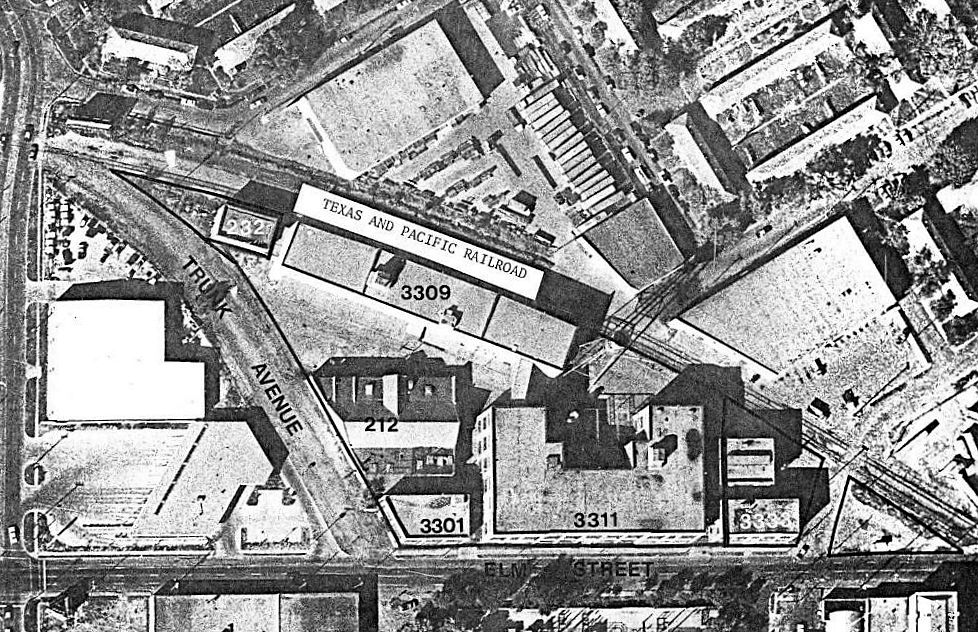
The Continental Gin Co. complex of buildings at Elm and Trunk is a Deep Ellum fixture which was successfully petitioned by the city in 1983 to be added to the National Register of Historic Places. No longer a manufacturing hub, it is now home to artists’ studios and residential lofts. The earliest of the buildings still standing were built in 1888 and the latest ones (the ones closer to Elm) were built in 1914. The company was incredibly successful, which was no surprise when one realizes that fully ONE-SIXTH of the world’s cotton grew within a 150-mile radius of Dallas at the time! It’s no wonder that Dallas was a hotbed of cotton gin manufacturing.

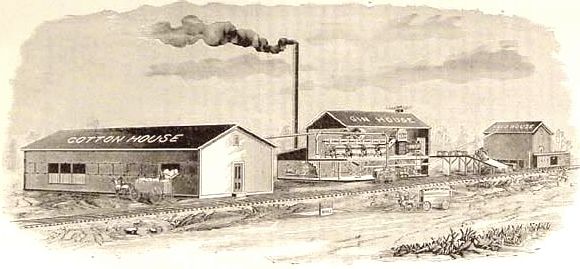
continental-gin_munger-drawing_Munger Catalogue and Price List, 1895

Robert S. Munger (yes, that Munger) patented several inventions that improved the cotton ginning process, and in 1888 he built a large manufacturing plant for his Munger Improved Cotton Machine Company. In 1900, after several extremely successful years, his company and several other companies that held important industry patents were absorbed by the Continental Gin Co. of Birmingham, Alabama, and, practically overnight, the Continental Gin Co. became the largest manufacturer of cotton gins in the United States. Munger retained a financial interest in the company, but he left the running of the business to his brother, S.I. Munger. R.S. Munger turned his creative talents to real estate and developed the exclusive Munger Place neighborhood. The Continental Gin Co. closed in 1962.

continental-gin-co_1912The Standard Blue Book of Texas, 1912-1914

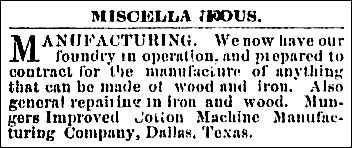
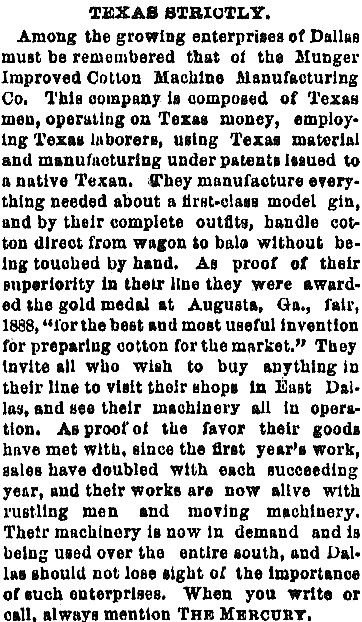
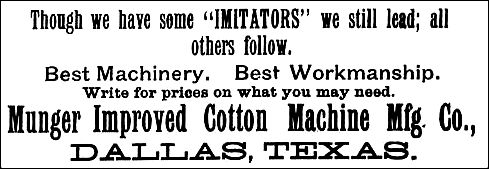
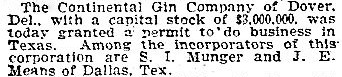
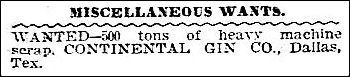
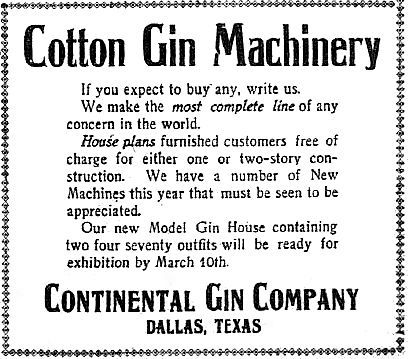
A few newspaper items regarding the Munger Improved Cotton Machine Company and the Continental Gin Company.

munger_dal-herald_101387The Dallas Herald, Oct. 13, 1887

munger_merc_053089The Southern Mercury, May 30, 1889

munger_merc_072892The Southern Mercury, July 28, 1892

munger_merc_041393The Southern Mercury, April 13, 1893

continental-gin_dmn_072600Change is imminent. (Dallas Morning News, July 26, 1900)

continental-gin_dmn_042001FIVE HUNDRED TONS! (DMN, Apri 20, 1901)

continental-gin_dmn_032203DMN, March 22, 1903

continental-gin_dmn_082005DMN, Aug. 20, 1905

continental-gin_dmn_060107DMN, June 1, 1907

continental-gin_worleys_1909Worley’s Dallas Directory, 1909

continental-gin_ad_dallas-police_1910Dallas Police, 1910

continental-gin-aerial-natl-reg-appPhotograph that accompanied the application to the National Register of Historic Places regarding the structures under consideration: 3301-3333 Elm St. and 212 & 232 Trunk Ave. (Landis Aerial Photography, 1980)

***

Sources & Notes

Handbook of Texas biography of Robert Sylvester Munger (1854-1923) is here.

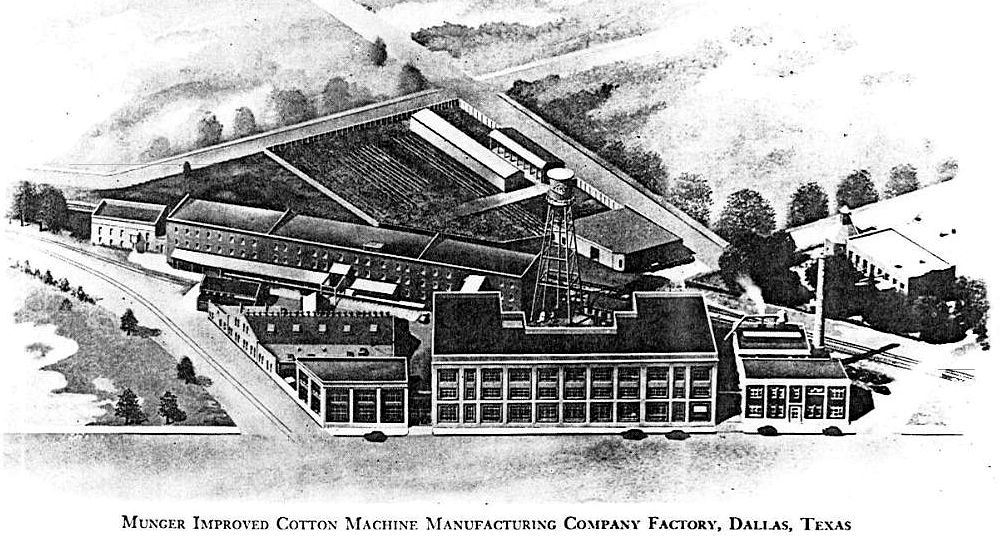
The top image (which, by the way, took me FOREVER to find, is labeled as the Munger company, but the expansion would seem to indicate that this is the Continental Gin Company, after 1914. Whatever the case, it’s a great image!

That image and the aerial photograph of 1980 are included in the city’s application to have the complex included in the National Register of Historic Places, submitted in 1983. The detailed application — as a Texas Historical Commission PDF — can be accessed here.

The second image, of the early days of the Munger Improved Cotton Machine Company is from a bookseller’s online listing for Munger’s 13th Annual Catalogue and Price List (1895) — the item may still be available for a mere $435 and can be found here.

See an aerial view of what the area looks like today, via Google, here.

To see an incredible 1914 photograph of the buildings and the residential area to the north, see my post “The Continental Gin Complex — 1914,” here.

More on Robert S. Munger and more early company ads can be found in the post “R. S. Munger’s Cotton Gin Manufactory,” here.

*

Copyright © 2014 Paula Bosse. All Rights Reserved.


My Birthdays at Kirby’s: Filet Mignon for Everyone!

kirbys-birthday

by Paula Bosse

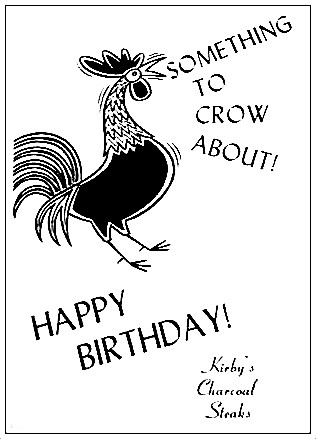
I grew up in the Lower Greenville area, and since we had a nice steakhouse just a couple of blocks away, that’s where we always went for family birthdays and special occasions: Kirby’s. I had forgotten about the birthday cards they sent out until my mother came across one in a recent move which was addressed to “Miss Paula Bosse.” Other than receiving actual mail, the thing that made these cards really exciting for a child was the inclusion of a dime. I always thought of it as a little birthday treat, but my mother suggested it was more of a subtle reminder to the parents to spend that dime on a call for reservations.

I loved that place. It was very dark. My brother and I always had the same thing: a non-alcoholic, super-sweet Shirley Temple from the bar, a salad with big chunks of roquefort in the salad dressing, a baked potato, and, oh my god, a filet mignon. I was mesmerized by the bacon wrapped around the steak. And the little wooden marker that showed how the meat was cooked. It was a nice, friendly neighborhood steakhouse. It was loud and happy. You could hear the steaks sizzling on the grill. It was always a treat to go to Kirby’s. And the place smelled GREAT! Even out on the sidewalk.

I was sad when they tore the building down, and even though there is now a chain of restaurants with the name “Kirby’s” — they even built a new one a couple of blocks down from the original location — there’s no way it could ever be the same.

Looking around for the history of the original “Kirby’s Charcoal Steaks,” I was surprised to discover that the man who owned Kirby’s — B. J. Kirby — was the son of the man who founded the Pig Stand chain of drive-ins. The Pig Stand started in Dallas, and it was the first drive-in restaurant EVER. They had the first carhops. The first onion rings. The first Texas toast. The Kirby’s steakhouse location — 3715 Greenville — had actually been a Pig Stand! B. J. Kirby had grown up working at his father’s restaurants, and when his father died, he sold all the Pig Stands except for the Greenville Avenue location (i.e. Pig Stand No. 4). In 1954 he turned the pig-sandwich-serving drive-in into a nice sit-down steakhouse which remained popular until the restaurant closed in 1987 when Mr. Kirby retired.

Watch Ch. 5 news footage of B. J. Kirby and the auction of the restaurant fixtures at UNT’s Portal to Texas History site, here.

kirbys_ch-5_closing_screencap_portal

I could really go for a bacon-wrapped filet mignon right about now. And one of those Shirley Temples would even hit the spot.

kirbys_1958

kirbys_color

kirbys_1951

***

Sources & Notes

“Something to Crow About!” card from the author’s collection.

Color photo of the Kirby’s sign is a screenshot from the Channel 5 news coverage of the auction of the Kirby’s fixtures, which aired April 14, 1987, viewable here; from the KXAS-NBC 5 News Collection, UNT Libraries, via the Portal to Texas History.

First ad from 1958; bottom ad from 1951.

Watch the 14-minute documentary “Carhops,” in which B. J. Kirby remembers life working as a kid for his father, here (also interviewed are other drive-in Dallas icons, J. D. Sivils and Jack Keller).

An entertaining history of the Pig Stand No. 4 and its transformation into Kirby’s Charcoal Steaks can be found here.

*

Copyright © 2014 Paula Bosse. All Rights Reserved.

Mme. Koneman, High-Class Milliner

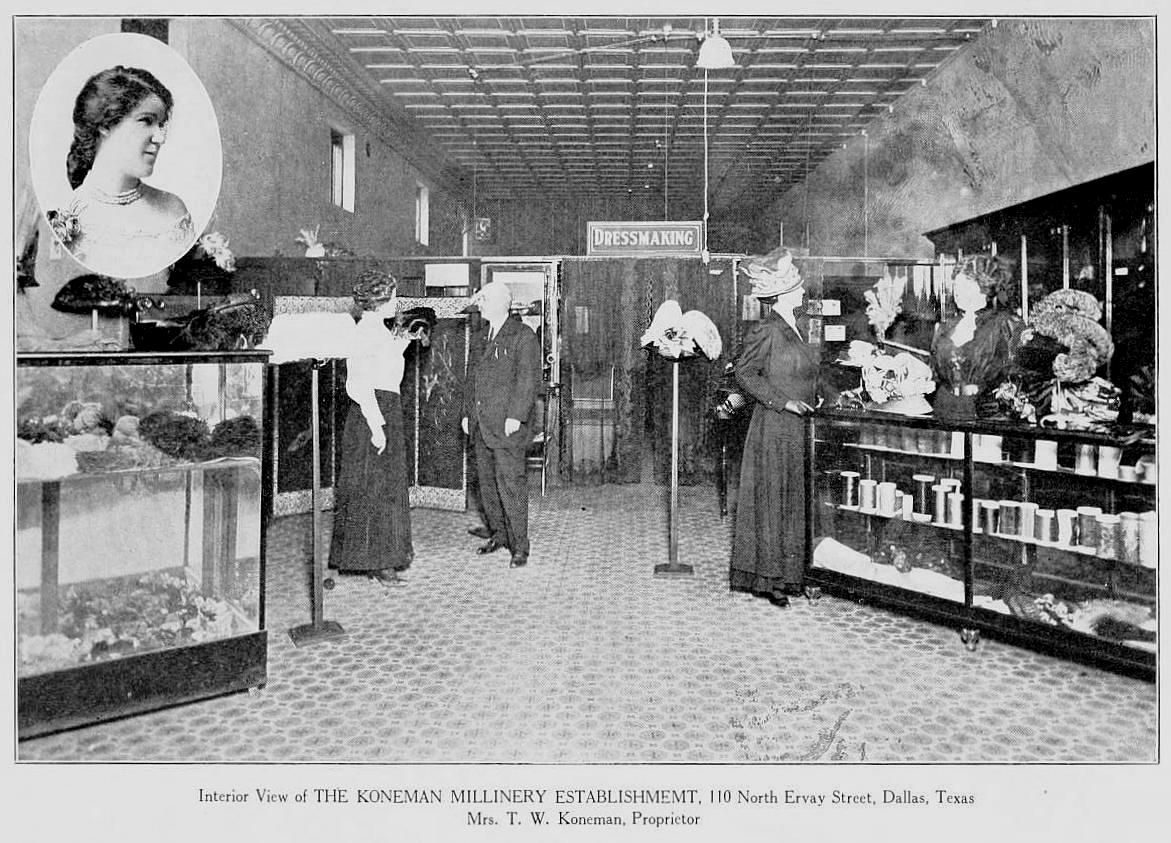
Madame Koneman’s fashion emporium, 1912 (click for larger image)

by Paula Bosse

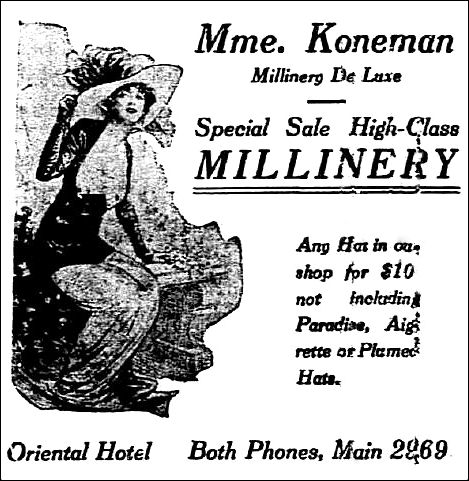
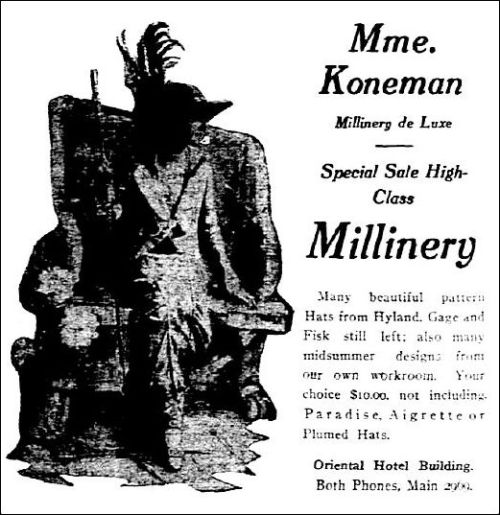
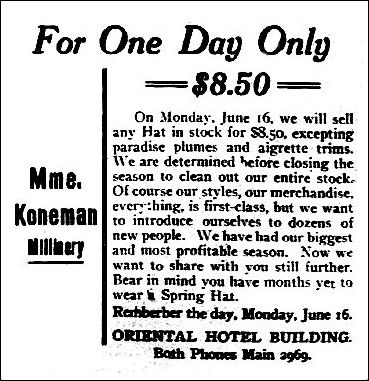
Behold, the Koneman Millinery Establishment, which actually looks a little plain for a millinery shop housed in the ornate Oriental Hotel building. When I see old ads or photos like this, I always wonder about the people pictured in them. I’m assuming that the woman in the oval inset at the left was the proprietess, “Mme. Koneman.” So who WAS she, this woman who had a “high-class” business that catered to a “high-class” clientele? I poked around a little and found these ads from 1913.

koneman-millinery_dmn_060113

koneman-millinery_dmn_060813

koneman-millinery_dmn_061413

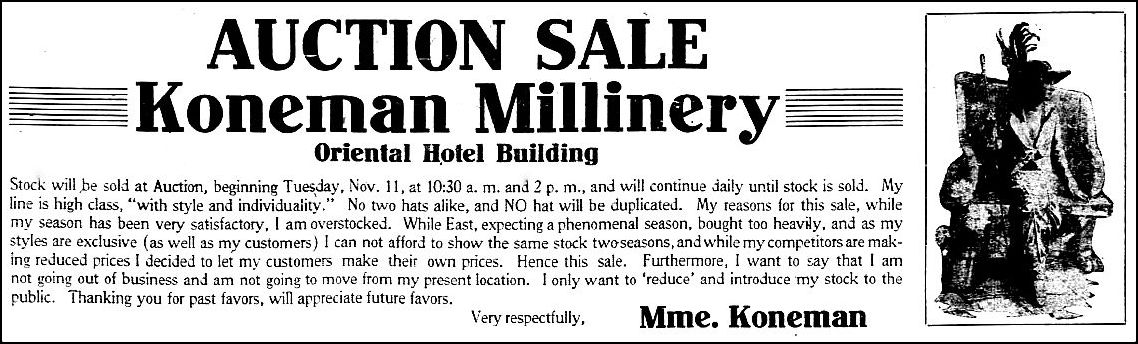
koneman-millinery_dmn_110913(click for larger image)

Ooh. Those last few sentences of the above ad seem a little defensive, as if she’s addressing nasty gossip. “Furthermore, I want to say that I am not going out of business.” When you see a sentence like that — in an advertisement — that sends up some furiously waving red flags. And … just one month after that ad, this miniscule tidbit in teeny-tiny letters appeared in the paper at the end of 1913:

Dallas Morning News, Dec. 21, 1913

Oh dear. D-I-V-O-R-C-E. And, guess what? There were no more ads for the millinery shop.

But, alarmingly, THIS appeared on the wire services on February 17, 1917:

Fort Worth Star-Telegram, Feb. 17, 1917

Oh DEAR! Shot by a widower with two children, who tried to kill both her and himself after he flew into a jealous rage in a New Orleans hotel lobby. Working with feathers and plumes and felt and velvet (probably) does not prepare one for being shot at!

Ten days after being shot, it was reported that the 36-year old Mrs. Koneman (whose first name was either “Matilda” or “Mathilda”) was released from the hospital in New Orleans. The jealous suitor, 40-year old Edgar J. Hargrave (or “Hargrove”), remained in the hospital, slowly recovering (but with a bullet still lodged in his head!). “Policemen expect to arrest Hargrave on a charge of shooting with intent to murder as soon as he is able to leave the institution.” He was an “oil salesman” from Houston.

One week later, Hargrave/Hargrove was released from the hospital and was transferred to Parish Prison where he awaited arraignment on attempted murder. Meanwhile, Matilda/Mathilda, a material witness in the case, had been arrested when the D.A. heard she was about to leave town. Out on a $650 bond, she was ordered to stay in the city until the arraignment.

On March 16, one month after being shot in the lobby of the Grunewald Hotel, Mrs. Koneman was in court recounting her near-death experience, and I’m sure the people back in Dallas were eating up every last morsel in the scandalous testimony about the spurned lover who tried to kill the divorcée who used to sell them great big hats with aigrette plumes in that bleakly unadorned hat shop over on Ervay!

koneman-testifies_dmn_031617-smDMN, March 16, 1917 (click for larger image)

(UPDATE: A reader kindly forwarded me a more detailed account of the shooting incident between the spurner and the spurnee, in a longer article from the New Orleans Times-Picayune (Feb. 17, 1917). Click here to read the article, with a blurry photo of Hargrave.)

And then — rather anticlimactically — the trail ran cold. What was the verdict? What happened to Edgar? Whither Mme. Koneman? Mrs. Koneman was reported to be living in Galveston at the time of the shooting, but by the summer of 1922 she was back in Dallas, checked into the Southland Hotel. The last shred of info I found about her was this classified ad from June, 1922, which raises even more questions.

DMN, June 15, 1922

I’m not really sure what this was all about, but it’s safe to say there would have been very few lags in the conversation between Dallas and California!

***

Top ad from The Standard Blue Book of Dallas, 1912-1914 (Dallas: A. J. Peeler & Co.).

“Dallas Woman Shot” article from the Fort Worth Star-Telegram, Feb. 17, 1917. This was a wire service story that was printed around the country, but, oddly enough, the news doesn’t seem to have made its way into the DMN until ten days after the shooting!

All other ads and articles from the Dallas Morning News. The Koneman Millinery ads were from 1913.

*

Copyright © 2014 Paula Bosse. All Rights Reserved.

The Store That Doak Built

doak-walker-sport-center

by Paula Bosse

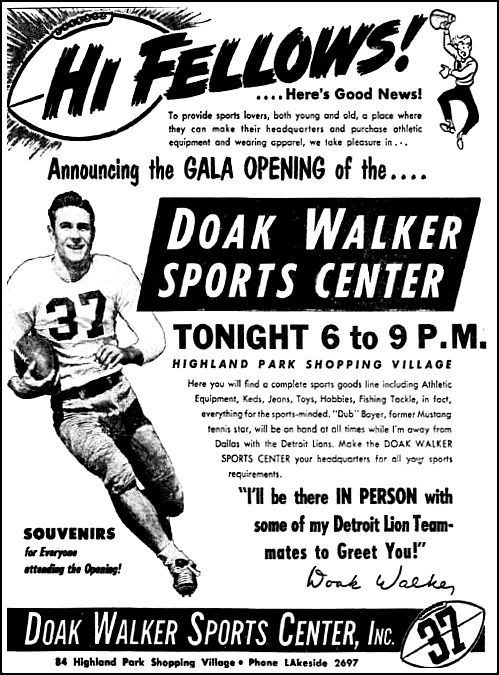
Doak Walker, the Heisman-winning superstar football player for SMU from 1945 to 1949, was, for a good forty-odd years, a partner in a successful sporting goods business that bore his name: the Doak Walker Sports Center. When it opened in Highland Park Village on August 23, 1951, the 24-year old — then playing pro ball with the Detroit Lions — was a bona fide celebrity, both locally and nationally. Predictably, the grand opening drew large crowds of sports fans eager to see their homegrown hero and check out the new place in town to get tennis balls and baseball bats (and, who knows, there might even have been some who showed up to see those unnamed Lions teammates the ads said he’d bring with him). The promise of “souvenirs for everyone!” was merely icing on the cake.

At the same time that the Sports Center was opening, Doak’s name was also on a Gulf station that he and former Mustangs teammate Raleigh Blakely owned on Hillcrest across from the SMU campus. And while both of those business concerns were chugging along, he was also appearing in local and national ads for everything from chewing gum to Vitalis (with a name like “Doak” you’re going to have instant name recognition). Oh, and he was also playing football. Doak Walker was a force to be reckoned with — on the field, on Madison Avenue, and in the dang Park Cities.

*

doak-walker_sports-ctr_opening_dmn_082351

***

Postcard of Doak Walker Sports Center from the Boston Public Library Tichnor Brothers Postcard Collection on Flickr, here.

Life magazine from Sept. 27, 1948. The cover story on Doak Walker and the SMU team can be accessed here.

Signed issued of Sport magazine is currently available for sale here.

Triangle Motors ad from a 1951 program for an SMU-Rice game at the Cotton Bowl.

Doak Walker bio on the Pro Football Hall of Fame website is here.

*

Copyright © 2014 Paula Bosse. All Rights Reserved.

Mr. Blandings Builds His Dream House … In Preston Hollow — 1948

blandings_preston-hollow_dallas_dream-houseThe Blandings Dream House in Preston Hollow… (click for larger image)

by Paula Bosse

I watch a lot of old movies, and one of my favorites has always been Mr. Blandings Builds His Dream House, the 1948 comedy about the trials and tribulations of home renovation and construction starring Cary Grant, Myrna Loy, and Melvyn Douglas. It wasn’t until fairly recently that I learned there had been a nationwide promotion in which replicas of the “dream house” were built in cities around the country. And, to my surprise, one of those houses was built in Dallas! To be exact, in Preston Hollow. To be precise, at 5423 Walnut Hill Lane (the northwest corner of Walnut Hill and Hollow Way). Sadly, when I went looking for it last week, I found an empty lot. (Figures.) The photo above shows the house in September, 1948 when it (and, not so coincidentally, the movie) opened to the public.

Ahead of the movie’s release, Selznick Studios approached local builders around the country and provided them with architectural plans, asking that they build houses as near to the specifications of the movie house as conditions would permit. The studio contracted Dallas builder A. Pollard Simons and supervising architect Lucien O’Brien to work on the Dallas dream house, seen below in a rendering (all images are larger when clicked).

blandings_a-pollard-simons_rendering

Simons greatly increased the size of the original two-story, three-bedroom house quite a bit (of course he did!), and he allowed the Junior League to raise money by selling 25-cent tickets to curious dream-house-wanters clamoring to wander through the house and gawk at its plush interior and its state-of-the art appliances. Afterwards, Simons put the completely furnished house on the market (in some cities the houses were put up as raffle prizes), and life, presumably, returned to normal for all concerned.

It was a clever way to promote the movie, and, as most of the contractors rushed to boast of their participation by taking out large ads (likely bought in conjunction with studio money), it was also an advertising bonanza for local newspapers. In amongst such ads I discovered that the company owned by my mother’s uncle and my grandfather — Fred Werry Electric Co. — did all the electrical work for the house!

Below are some of those ads that appeared at the time — and, trust me, this was just the tip of the iceberg. The ads were non-stop. This was a huge campaign, going far beyond traditional Hollywood promotion — and it certainly paid off. I’m fairly certain that most Dallasites who read the paper during that time were aware of the house (and the movie), even if they had absolutely no interest in houses (or movies). It was that that unavoidable. (Scroll to the bottom of this post to listen to a FABULOUS commercial-slash-PSA made by actor Melvyn Douglas at a local radio station during a trip to Dallas to tour the Preston Hollow house.)

There were other Texas “Dream Houses” built in Fort Worth (still standing, see link at bottom of page), Austin, Houston, and Amarillo. I only wish Dallas still had its “Dream House,” but I fear a tasteful-but-puny, little ol’ 3,000-square-foot house would not meet today’s definition of a “dream house” in ultra-swanky Preston Hollow.

*

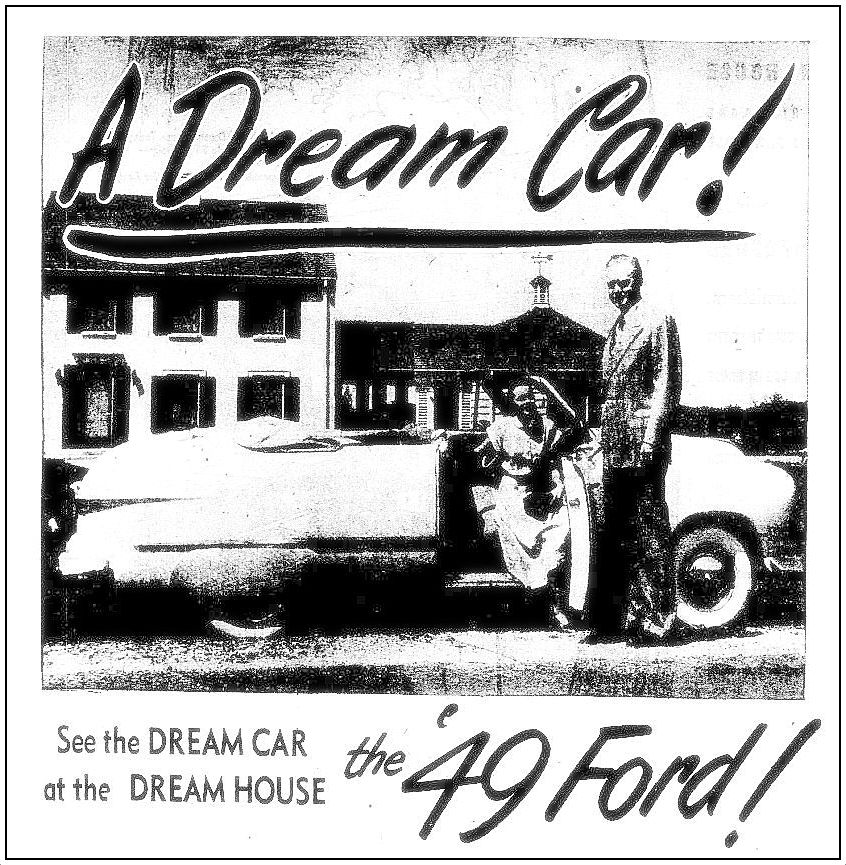
ad-blandings_dallas-ford-dealers_sept-1948The Ford people got into the advertising. This appears to be have been taken in front of the Dallas house.

ad-blandings_werry-electric_sept-1948My great-uncle and grandfather! I can now claim my six degrees of separation (LESS!) from Cary, Myrna, and Melvyn.

ad-blandings_langs_sept-1948Kitchen porn from Lang’s.

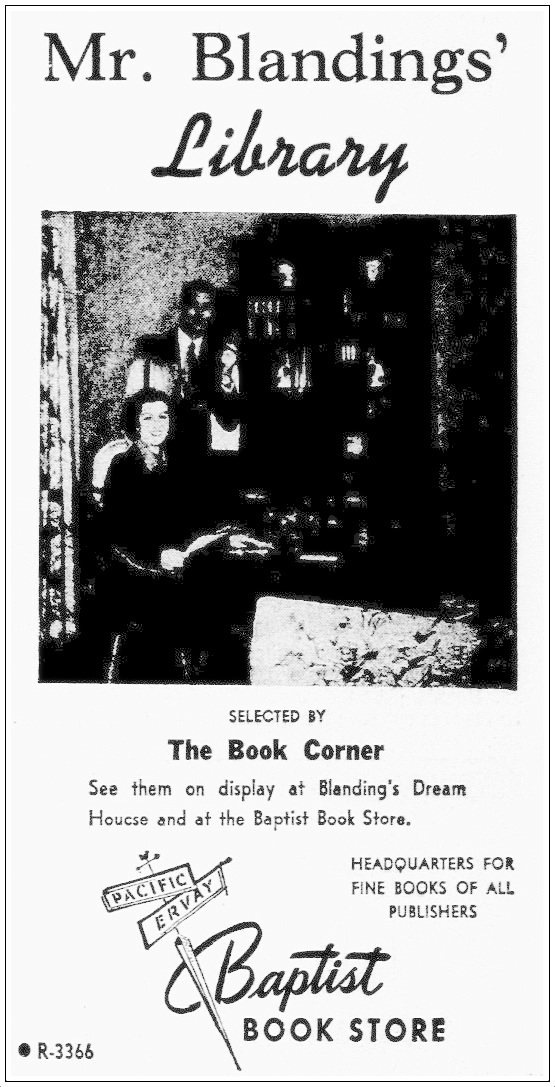
ad-blandings_baptist-book-store_sept-1948The Baptist Book Store stocked the shelves of the Blandings library!

I really like the Wyatt’s Cafeteria ad below, which begins with an itinerary. “Program for today: go to church, eat at Wyatt’s, drive out to see the Mr. Blandings’ ‘Dream House’ in Preston Hollow.” This cafeteria ad sneaked in a mention of the Wyatt’s grocery stores by informing the reader that they had supplied the food for the Dream House’s refrigerator and pantry shelves. But this was my favorite part: “When Mr. Blandings takes his family out for a delicious meal you may rest assured that he will take them to a Wyatt’s De Luxe Cafeteria where each may choose the foods of his own liking from Wyatt’s tremendous varieties. Mr. Blandings won’t mind paying the bill because Wyatt’s prices are really modest.” If Cary Grant was going to be dining at a Dallas cafeteria, I only hope he was choking down large slabs of Wham.

ad-blandings_wyatts_sept-1948

*

The original “dream house” from Mr. Blandings Builds His Dream House — cute, but much smaller than its Dallas counterpart.

***

Sources & Notes

All ads relating to the Dallas Dream House appeared throughout September, 1948.

A nice look at the still-standing Fort Worth Dream House can be found in “Standing at the Corner of Hollywood and Cowtown,” here.

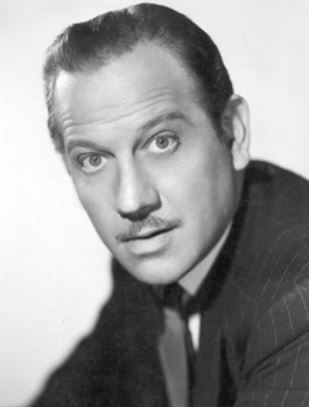
A short radio promo about the Preston Hollow Dream House was recorded on Aug. 10, 1948 by the wonderful Melvyn Douglas, one of the stars of the film (who, by the way, went on to win an Oscar for his role as the family patriarch in the brilliant — and iconically Texan — film Hud in 1963). It was recorded when he visited Dallas in August, 1948 at station KIXL (in which he was an investor), and it can be heard here. (By permission of the great Dallas DJ and broadcasting archivist, George Gimarc.) I LOVE THIS! Thank you, George!

melvyn-douglas

UPDATE: I wrote this post in 2014, and at the time I could find no information about this Dallas Blandings house outside contemporary newspaper archives. Which is the only reason I took some small amount of credit for the house showing up in a Preston Hollow-centric mural in 2015 at the then-new Trader Joe’s at Walnut Hill and Central. I took the photo below in 2015, but, sadly, this tribute to Mr. Blandings and his Dallas dream house is no more. Last time I stopped in, it had been painted over. But here it lives on!

blandings_trader-joes-walnut-hill_PEB_2015Trader Joe’s, Walnut Hill, Dallas (photo by Paula Bosse, 2015)

*

Copyright © 2014 Paula Bosse. All Rights Reserved.

Southwestern Bell Telephone Goings-On, Circa 1928

by Paula Bosse

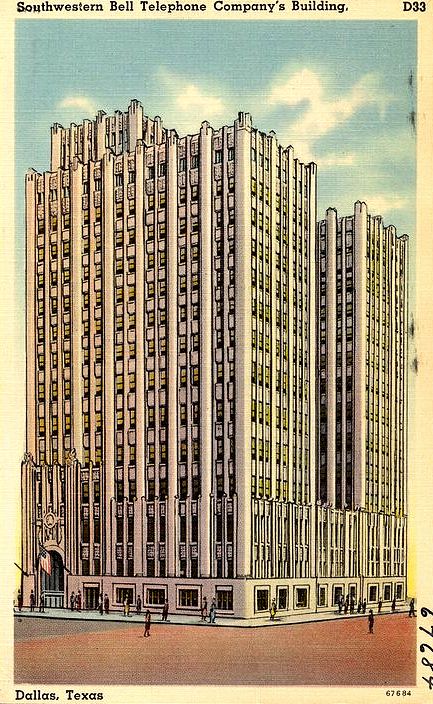
The beautiful Southwestern Bell Telephone Company building, designed by Lang & Witchell in 1929.

From the book Dallas Landmarks:

Dallas’ first telephone exchange opened on June 1, 1881, with 40 subscribers. There were several competing telephone companies before 1925 when Southwestern Bell became the sole provider. The number of telephones in used quickly soared from 30,000 in 1922 to 200,000 in 1949.

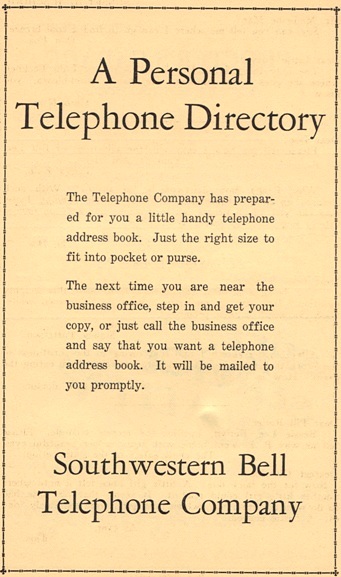
The relatively few telephone subscribers at the time the building was going up might explain this folksy little notice about a “personal telephone directory” that the fine folks at Southwestern Bell have been working on night and day, just for you. Next time you’re in the neighborhood, why don’t you just drop right on in and pick one up? Set a spell. Take your shoes off. Y’hear?

***

Sources & Notes

Postcard from the Boston Public Library Tichnor Brothers Postcard Collection on Flickr, here.

Quote from the book Dallas Landmarks, by Preservation Dallas and Dallas Heritage Village (Charleston: Arcadia Publishing, 2008). p. 31.

Quaint little ol’ phone book ad, from, of all places, the Nov. 1928 issue of “The Stampede,” the school magazine published by and for the students of Sunset High School in Oak Cliff.

*

Copyright © 2014 Paula Bosse. All Rights Reserved.


Dallas Steam Mills at the Cedar Spring — 1855

by Paula Bosse

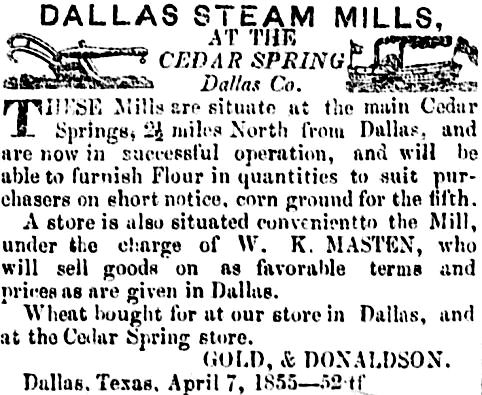
DALLAS STEAM MILLS, at The Cedar Spring, Dallas Co.

These Mills are situate at the main Cedar Springs, 2 1/2 miles North from Dallas, and are now in successful operation, and will be able to furnish Flour in quantities to suit purchasers on short notice, corn ground for the fifth. A store is also situated convenient to the Mill, under the charge of W. K. MASTEN, who will sell goods on as favorable terms prices as are given in Dallas. Wheat bought for our store in Dallas, and at the Cedar Spring store.

–GOLD, & DONALDSON. Dallas, Texas , April 7, 1855

*

In 1843, a trading post was established just outside the city of Dallas at the new settlement of Cedar Springs. There were few settlers at the time, so items traded were pretty much limited to only the essentials (groceries, ammo, buffalo hides). By 1850, though, sexier luxury goods like “hoopskirts, silk stockings, bridal bouquets, Bibles, accordions, Mustang liniment, snake-root and castor oil were listed in the inventory of a deceased merchant. This advance in merchandising may be attributed to the establishment by that time of a gristmill to which farmers from many miles around brought their grain. Naturally they visited the stores to trade” (WPA Dallas Guide and History). The Dallas Steam Mills was one of the first commercial mills in “the Cedar Spring,” and as it was affiliated with successful early Dallas retailers Gold and Donaldson, it must have also been one of the most profitable.

The community grew quickly. Until 1850. That was when Dallas County residents went to the polls and voted on which of the local communities would be the county seat. The choices were: the city of Dallas, Cedar Springs, and the ever-popular Hord’s Ridge. Cedar Springs came in dead last. The agony of defeat must have hit hard — the loss seems to have dampened civic enthusiasm and contributed to stagnant growth. It wasn’t until the turn of the century that the area — by then called Oak Lawn — had rebounded with a boom in population. By the 1940s, though, the area had been officially annexed by the city of Dallas. Oak Lawn (né Cedar Springs) had, at least, managed to hold onto a shred of independence a few decades longer than its former opponent had — Hord’s Ridge had changed its name to Oak Cliff, but it, too, had been swallowed up by the voracious, mammoth city surrounding it. No hard feelings, guys. You can run but you can’t hide. Resistance has always been futile. We’re all just one big happy kudzu-like sprawling sprawl now.

*

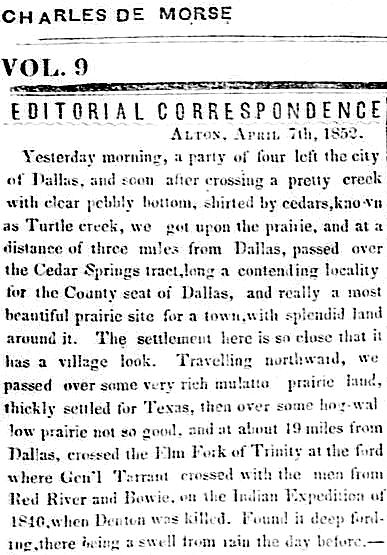
Below is an interesting account of traveling through Cedar Springs in 1852.

***

Dallas Steam Mills ad from the Dallas Herald, 1855.

Quote mentioning accordions and hoopskirts from The WPA Dallas Guide and History (Dallas Public Library Texas Center for the Book, University of North Texas Press, 1992). p.124

The account of passing though Cedar Springs, by Charles DeMorse, is the lead story in the July 17, 1852 issue of Clarksville’s Northern Standard newspaper; it can be found here  on UNT’s invaluable Portal to Texas History site; from the collection of the Dolph Briscoe Center for American History.

A biography of Charles DeMorse, writer and editor of Clarksville’s Northern Standard can be found here.

The Handbook of Texas History entry for Cedar Springs is here.

*

Copyright © 2014 Paula Bosse. All Rights Reserved.

Not Every ‘Good Luck Trailer Park’ Story Has a Happy Ending — 1964

chimp_fwst_012864Fort Worth Star-Telegram, Jan. 28, 1964

by Paula Bosse

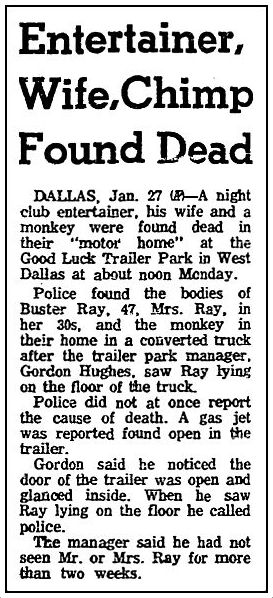
“Entertainer, Wife, Chimp Found Dead.” THAT is a headline.

Had I not known that the (ironically named) Good Luck Trailer Park on W. Commerce had been a favorite with visiting circus folk, I might have been a little more surprised by the weird circumstances reported in this article. As it was, I was only mildly surprised.

(I kind of think the chimp did it….)

***

Sources & Notes

Hats off to the Fort Worth Star-Telegram‘s headline writer. The story ran in the Star-Telegram on Jan. 28, 1964.

The victims — Harold Allen Ray and his wife Nadine (and unnamed monkey) — were later determined to have died of accidental carbon monoxide poisoning.

“Buster Raye” (stage name of Harold Ray) had been a comedian and master of ceremonies who seems to have played a lot of burlesque joints/strip clubs as the between-stripper entertainment. He was billed as “The Mighty Mite of Mirth.” In a Feb. 24, 1948 review of his act, The Bryan Eagle wrote:

Buster Raye, diminutive master of ceremonies, stole the show with a clever line of chatter punctuated with juggling, acrobatics, songs, imitations. His jokes were well handled with none of the vulgarity common to many floor shows.

I’m not sure where the monkey fits in.

buster-raye_corpus_042948Corpus Christi Caller-Times, April 29, 1948

*

Copyright © 2014 Paula Bosse. All Rights Reserved.


Atkins’ Rattlesnake Oil — Beware of Fraudulent Imitations!

by Paula Bosse

“From the Aboriginal Indians of this country — the early trappers — and pioneers learned that Rattle Snake Oil was the best remedy for rheumatism, pains, sprains, bruises, etc. Every cabin had its bottle hanging ready, from the rafters. The day will come when every house will have it again.”

That little tidbit appeared under the heading “Folk-Lore” in the October 9, 1888 issue of the Dallas-based Southern Mercury newspaper. As there was no company name or product attached, it appeared to be a mere space-filling “factoid” rather than an advertisement. Conveniently, though, it was just a hop, skip, and a jump across three ink-smeared pages from a large ad for Atkins’ Rattlesnake Oil, an ad that warned the reader to “Beware of Fraudulent Imitations!” before it launched into a long list of testimonials from the once-weak and infirm. The ad ended with “Geo. T. Atkins, Dallas, Texas — For Sale by All Druggists.”
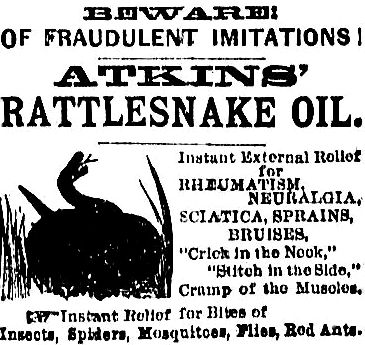
Southern Mercury, Oct. 9, 1888 (detail)

*

George T. Atkins was born in New York in 1837. Educated and having the bearing of a “trained businessman,” he drifted south and for some reason decided to join the Confederate army.

He was described by a fellow brigade member as a dark and handsome “compactly built” snappy dresser who “talked in a louder tone than the others, and [had] a peculiarly non-chalant, devil-may-care manner [that] emphasized his presence.” Atkins became a captain and quartermaster in the Fourth Kentucky Cavalry and though his position did not require participation on the battlefield, he was painted as something of a hot-dogging thrill-seeker: “[T]he gallant captain was frequently found in the ‘thickest of the fray,’ notably in the desperate battle at Saltville, where he recklessly and conspicuously rode up and down the lines, seeming determined to get himself killed.”

After the war, he eventually made his way to Texas with his family, arriving in Dallas in 1876 and settling into a large house at Ross Avenue and Masten Street (now St. Paul). At some point he opened a drugstore on Elm which seems to have been quite a successful enterprise. Perhaps it was his close proximity to drugs and medicinal compounds that prompted Atkins to launch his lengthy (and presumably lucrative) side-business as a snake oil manufacturer and salesman.

As far as I can tell, his “rattle snake oil” ads started around 1888. “Snake oil” has become a synonym for fraudulent wares sold by hucksters who know their products are ineffective but figure they can make a quick buck by grossly exaggerating — if not outright lying about — the magically curative properties of whatever it is they’re selling. As an actual “druggist,” Atkins probably had at least a little credibility compared to the other latter-day medicine-show men flogging their tonics and elixirs out of the back of a wagon before the law ran them out of town.

Southern Mercury, 1890 (det)

In fact, Atkins was, himself, such an expert flogger that his claim in ads that the United States Patent Office had officially ruled that his rattlesnake oil was “The Only True and Genuine Rattlesnake Oil” is automatically suspect, even though the editors of the Dallas Morning News (who, by the way, were no stranger to the popular and socially prominent Atkins, a man with, let’s not forget, a hefty newspaper advertising budget) published in its pages the following blurb (probably supplied by “the plaintiff”):

Dallas Morning News, Dec. 12, 1888

 1888 was a good year, and Atkins was riding a snake-oil wave of good publicity. There were even reports in the local papers that Dallas’ favorite herpetologically-inclined drugstore owner was hustling “live and uninjured rattlesnakes” to interested parties in Paris and London. I don’t know … maybe…. Probably just some more creative publicity.
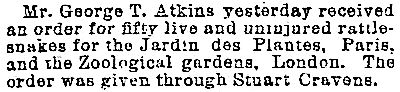
DMN, June 3, 1888

Atkins continued to run his drugstore and sell his snake oil until 1892 when, out-of-the-blue, he was assigned to dig the Texas Trunk Railroad out of receivership. The appointment seemed a little odd, but Atkins was a savvy businessman and a charming and persuasive speaker (he occasionally spoke in front of the Dallas City Council in a manner described as “felicitous and lucid”) — he could easily have back-slapped his way into the job. Despite the fact that he had no background in the railroad business, he seems to have spent several fairly productive years in the position. (His son, by the way, legitimately worked his way up through the ranks of the M-K-T, from lowly freight clerk to powerful executive VP.)

Eventually the railroad job ended and, in the waning years of the nineteenth century, Atkins seemed to be flailing a bit — he set the snake oil aside for a moment and placed an ad in the DMN classifieds soliciting investors to stake a claim in a Klondike gold scheme — at a mere $100 a share!
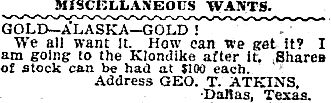
DMN, Aug. 8, 1897

 He continued in the rattlesnake oil biz until at least 1907, but at some point that began to fade away (or his inventory finally ran out), and he and his wife began running a boarding house. By 1918, though, he was tired of being a landlord and, at the age of 80, Atkins was finally ready to retire.

DMN, Oct. 20, 1918

The large 12-room house at Ross and Masten sold after spending a lengthy time on the market, and Atkins and his wife moved to Lemmon Avenue, where, ultimately, he died on August 8, 1920.

DMN, Aug. 9, 1920

 George T. Atkins placed COUNTLESS snake oil ads in newspapers for something like twenty years. Each ad had his name on it. Boldly. Proudly. And there’s nary a mention of the famous Atkins’ Rattle Snake Oil in his obit! That’s a shame, because, to me, that’s the single most interesting thing about the man. He was a career snake oil salesman! He was also one of Dallas’ very first advertising empresarios — an entrepreneur who had a natural flair for the creative hard-sell and knew how to wield it.

“TAKE NO SUBSTITUTE!”

*
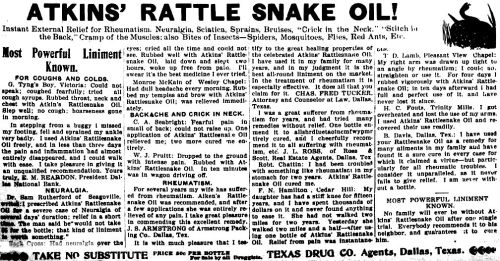
Southern Mercury, Dec. 20, 1900 (click to enlarge)

***

Quotes about Atkins’ time in the Confederate army from Kentucky Cavaliers in Dixie, Reminiscences of a Confederate Cavalryman by George Dallas Mosgrove (Madison: University of Wisconsin Press/Bison Books, 1999 — originally published in 1895); pp. 116-117.

Atkins’ physical examination of his snake oil, published in Chemist and Druggist (1890) can be seen here.

More on the Texas Trunk Railroad here.

*

Copyright © 2014 Paula Bosse. All Rights Reserved.