Flashback : Dallas

A Miscellany: History, Ads, Pop Culture

Category: African American Dallas

Refusing to Give Up One’s Seat Might Set Off a Melee — 1919

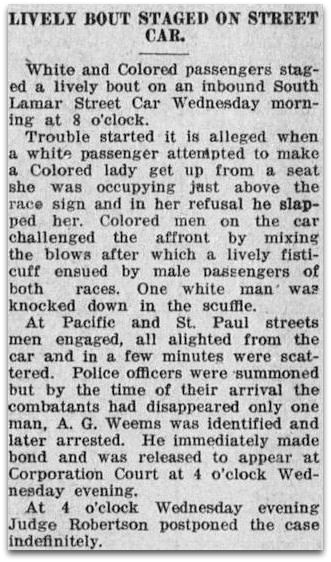
streetcar-fight_dal-express_100419The Dallas Express, Oct. 4, 1919

by Paula Bosse

On this, the anniversary of Civil Rights icon Rosa Parks‘ act of defiance in refusing to give up her seat on a bus to a white passenger in Alabama in 1955, it’s interesting to note a couple of accounts of similar incidents in Dallas, but 36 years earlier. And more violent.

The article above — which appeared in The Dallas Express, a weekly newspaper printed by and for Dallas’ black community — describes a melee (or “riot” as The Dallas Morning News called it) that occurred when an unnamed black woman refused to give up her seat (which was in the part of the streetcar reserved for white passengers) when a white man demanded that she move. When she steadfastly refused, he slapped her (!), and that set off a wild fight between black and white male passengers … on a moving streetcar! When the car stopped, everyone spilled out into the street and scattered. Only one person was arrested, Mr. A. G. Weems, a black businessman and former school teacher who was active in the black community and later represented African-American interests and residents as a member of the Negro Chamber of Commerce.

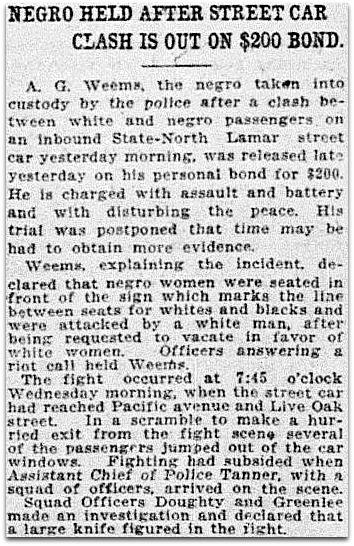
The Dallas Morning News also carried a report of the incident:

streetcar-fight_dmn_092519Dallas Morning News, Sept. 25, 1919

It sounds as if Weems could have gotten away, had he wanted, but perhaps he was making a statement.

In the previous months of 1919, there were several similar incidents reported in the pages of The Dallas Express. Sometimes altercations were a result of black passengers sitting in “whites-only” sections of streetcars, but sometimes trouble arose when the white section was full, and white passengers sat in the seats designated for black passengers:

streetcar-fight_dal-express_071219Dallas Express, July 12, 1919 (click for larger image)

There was also an incident that had occurred in February of that year in Birmingham, Alabama in which a white conductor was shot (and presumably killed) after he threatened to slap a black woman in a dispute over the fare. A black vigilante had appeared out of nowhere, shot the man, and disappeared into the night.

The antagonism, disgust, and violence caused by this “peculiar law of the Southland” continued until 1956 when the Supreme Court finally banned segregation on public transportation.

*

Copyright © 2014 Paula Bosse. All Rights Reserved.

Waiting For a Streetcar on a Sunny Winter Day in Oak Cliff — 1946

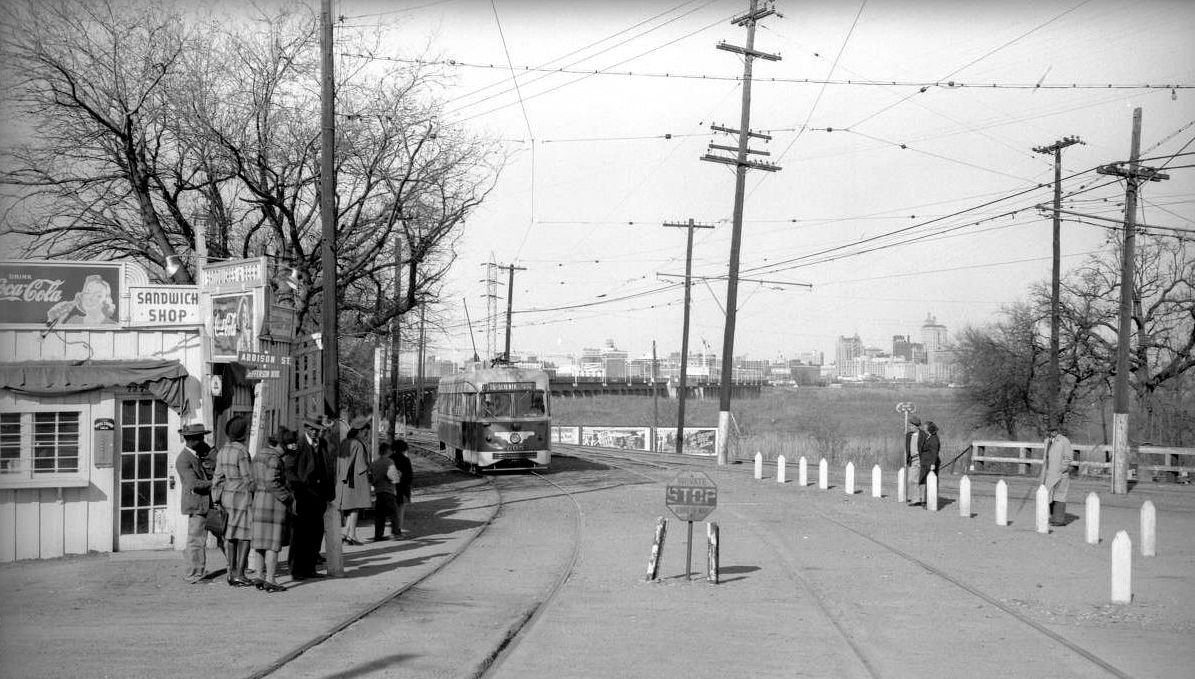
jefferson-addison_denver-pub-lib_1946Addison St. & Jefferson Blvd. in Oak Cliff — Feb., 1946 (click for larger image)

by Paula Bosse

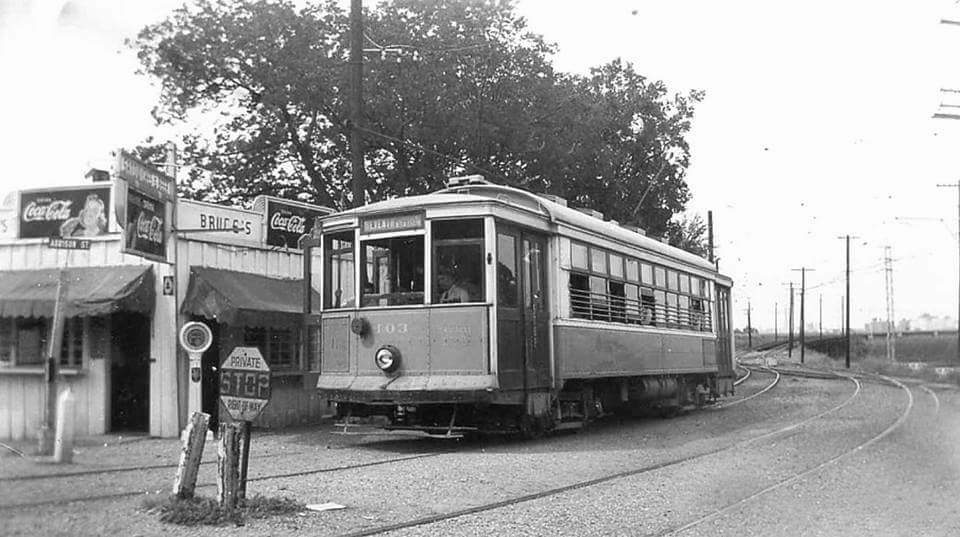
I love streetcars, photos from the 1940s, fashions of the ’40s, and views of the Dallas skyline. And here are all of these things, in one great, GREAT photograph. We see people waiting for the streetcar on a sunny Saturday in February, 1946 — in Oak Cliff, at E. Jefferson Blvd. and Addison St. The people at the left (outside Helen’s Sandwich Shop) are about to catch the car that has just crossed the Trinity River and head into Oak Cliff; the people on the right are waiting to go to Dallas. The Oak Farms Dairy is just out of frame at the top left, and Burnett Field is just out of frame at the bottom right. The Dallas skyline looms across the Trinity.

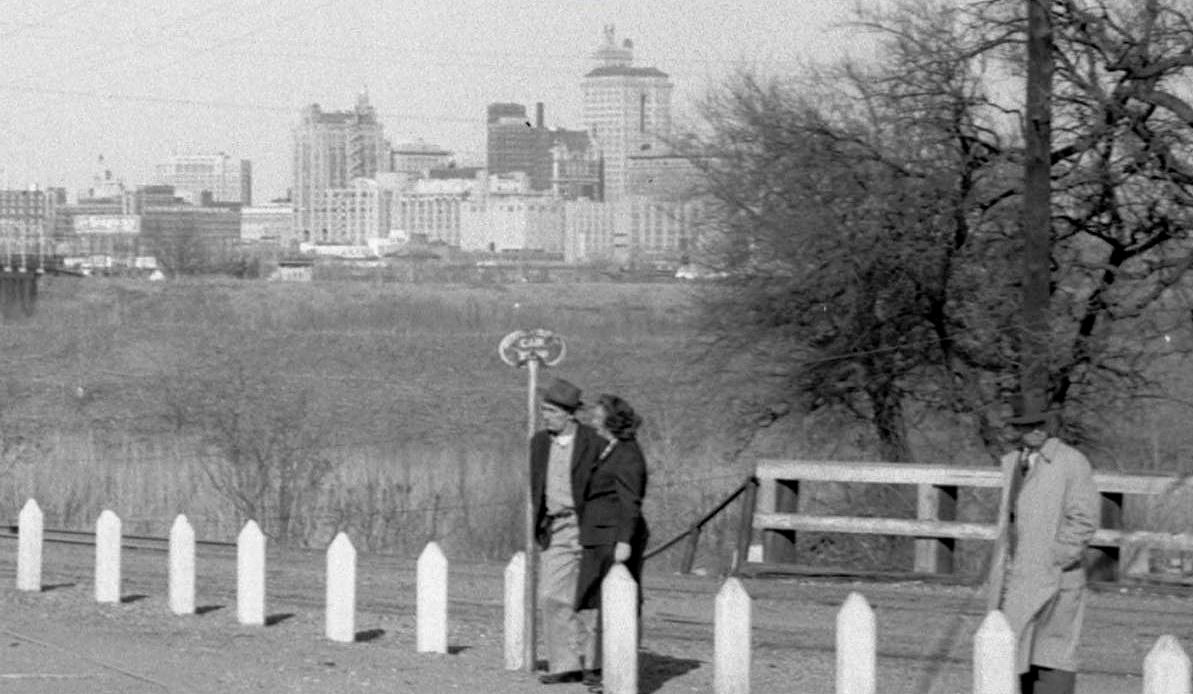
Below, I’ve zoomed-in a bit and cropped this fantastic photograph into two images to show, a bit more intimately, details of an ordinary moment in an ordinary day of ordinary people. What once was such a commonplace scene — people waiting for a streetcar or interurban — now seems completely out of the ordinary and quaintly nostalgic. (Nostalgic on its surface, anyway — not shown is the interior of the car which had specific black-only and white-only seating areas for passengers.) (As always, click for larger images.)

jefferson-addison-det1

jefferson-addison-det2

***

Photo by Robert W. Richardson, taken on February 2, 1946. From the Western History/Genealogy Dept., Denver Public Library, viewable here. More on rail enthusiast, writer, photographer, and preservationist Bob Richardson, here.

The same stop can be seen in this undated photo (source and photographer unknown):

oak-cliff-streetcar-stop_addison-jefferson

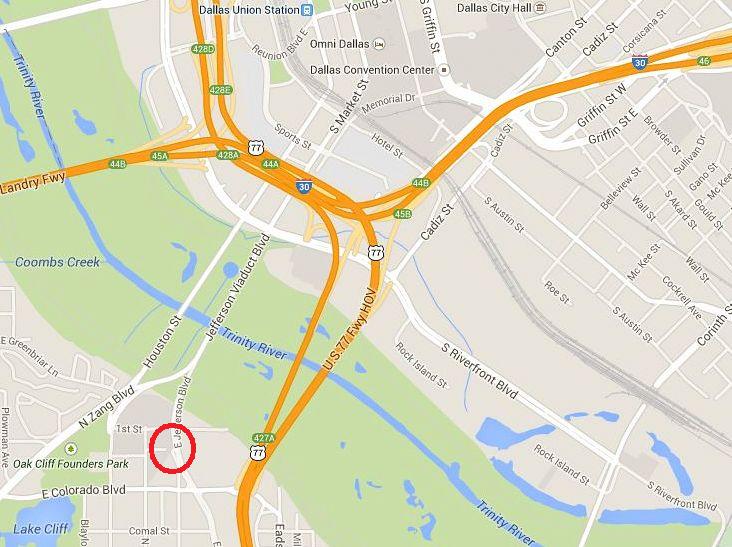
Streetcars ran back and forth across the Trinity River on a special trestle just south of the Oak Cliff Viaduct/Houston Street Viaduct. It had been in use since 1887 (through various renovations) and was demolished in the early 1970s to build the present-day Jefferson Street Viaduct.

To see a photo by the same photographer showing a streetcar actually on the trestle over the Trinity, see the post “Crossing the Trinity River Viaduct — 1946,” here.

Streetcar enthusiasts are incredibly, well, enthusiastic, and they keep precise track of where cars operated over their life spans. The car from the photo — Dallas Railway & Terminal Co. car #605 — was a PCC streetcar, built by the Pullman-Standard company in 1945; it was sold to the MTA in 1958 and was in operation in Boston for many years. See cool photos of the very same streetcar in operation over the years in both Dallas and Boston, here (scroll down to “605”). To see what the retired car looked like in 2002 — a bit worse for wear — click here.

A distinctly less-wonderful view from roughly the same location, seen today, is here.

map_jefferson-addison_googleGoogle

Click pictures for larger images.

*

 Copyright © 2014 Paula Bosse. All Rights Reserved.

Dallas High School Football, 1909-Style

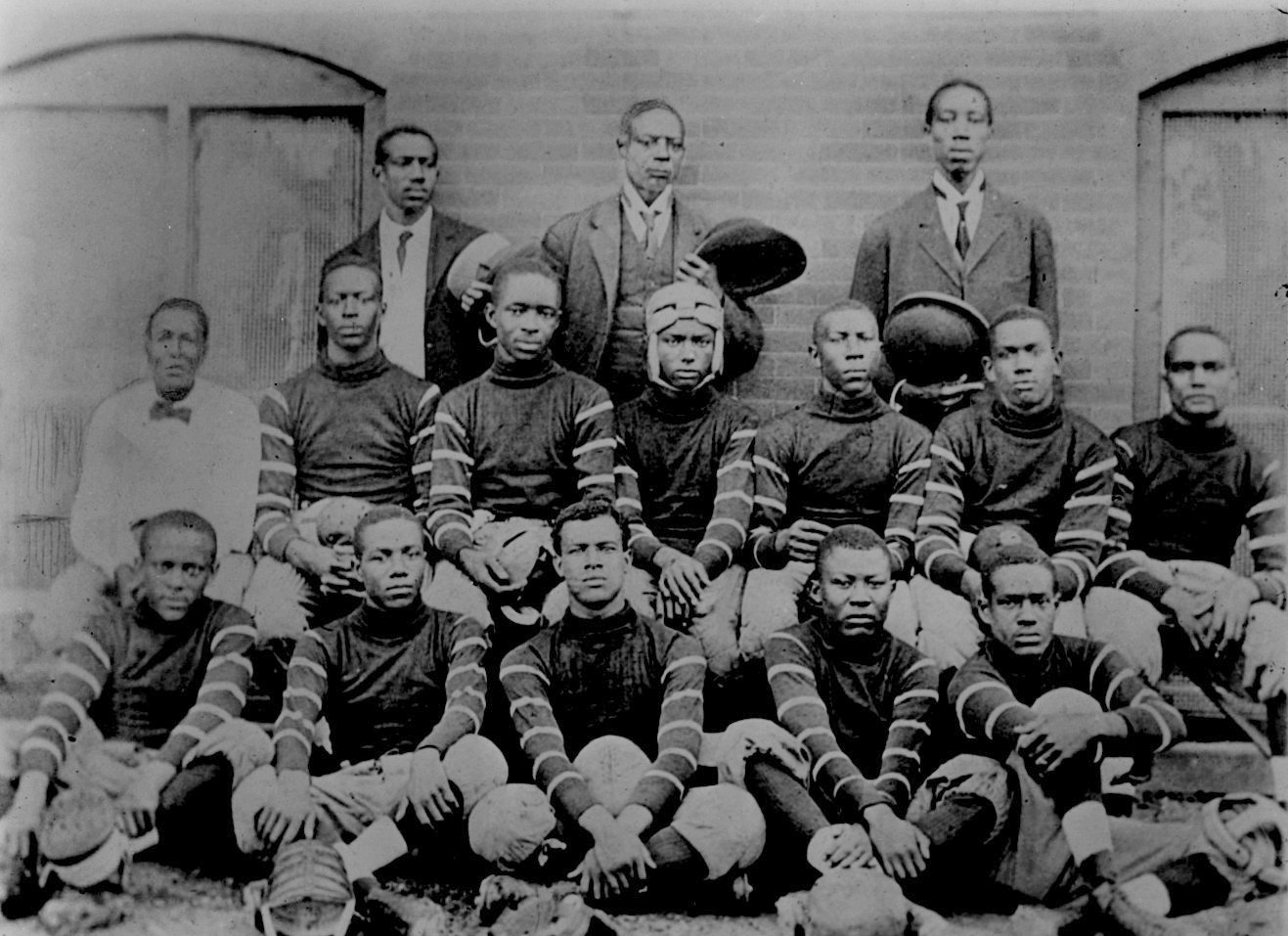
football-team-1909Game faces ON… (click for larger image)

by Paula Bosse

Great Dallas Historical Society photo described only as “a high school football team,” from 1909. The team most likely represented the “Colored High School” located at Hall and Cochran, the only high school in Dallas at the time for African-American students (it eventually merged with and relocated to the nearby Booker T. Washington High School in the early 1920s where, incredibly, it remained the city’s only high school for black students until Lincoln High School opened in South Dallas in 1939).

As everything was segregated at the time, including schools and sports, the number of black high school football teams they could play was severely limited — in-town opponents were non-existent. In fact, a 1909 blurb in The Dallas Morning News announced that “[t]he football team of the Dallas Colored High School will play the Wylie University team from Marshall at Gaston Park” (DMN, Nov. 12, 1909). They were playing college teams. From 150 miles away. At least they were the home team.

***

Photo from the J. L. Patton Collection, Dallas Historical Society.

Click picture for larger image.

*

Copyright © 2014 Paula Bosse. All Rights Reserved.

Exline Park Swimming Pool — 1950s

exline-pool_hickman_1957_briscoe-ctr

by Paula Bosse

Summer’s running out, kids.

Plan your waning pool-time opportunities accordingly.

exline_hickman_1955

***

Photos by R. C. Hickman, taken at Exline Park swimming pool; top photo taken on Aug. 6, 1957, bottom photo on July 27, 1955. Both photos © R. C. Hickman/Dolph Briscoe Center for American History.

*

Copyright © 2014 Paula Bosse. All Rights Reserved.

Ernie Banks: From Booker T. Washington High School to the Baseball Hall of Fame to the Presidential Medal of Freedom

banks-ernie_jet_110355
Ernie Banks and George Allen, Oct. 1955 (Jet magazine)

by Paula Bosse

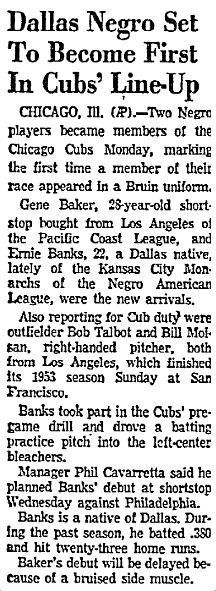
Ernie Banks, the baseball player so indelibly linked with Chicago that he is known as “Mr. Cub,” is a Dallas native whose professional career began when he was spotted by a Negro League scout while playing softball in a park near his high school, Booker T. Washington. He was recruited right away and made his mark almost immediately, and, in 1953, he and Gene Baker became the first African American players signed to the Chicago Cubs.

One of the sport’s most popular players, Banks, who began his career playing shortstop, routinely shattered home run records and was a perennial MVP and All-Star player. Even though his Cubs never made it to the World Series, Banks was a stand-out player, and his election to the Baseball Hall of Fame in 1977 came as no surprise. I have to admit, my knowledge of baseball is scant, but I love this man, and it’s a testament to “Mr. Cub” that he is as famous for his genuine nice-ness as he is for his undisputed skill as a player.

banks_dmn_091553AP, Sept. 15, 1953

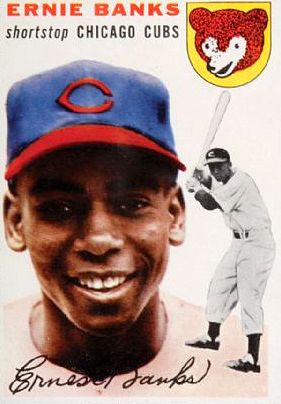
ernie-banks_rookieErnie Banks’ rookie card – Topps, 1954

ernie_banks

*

Oct. 11, 1955 was declared “Ernie Banks Day” in Dallas. Ernie was in town to play an exhibition game between the Major League Negro All Stars and the Negro American League All Stars (Ernie’s major leaguers won, 6-2) — while he was here, he enjoyed the hometown adulation and was lauded with gifts. The photo at the top of this post was from that day, as is the one below, in which he poses with his wife, Mollye Banks.

banks-ernie_wife-mollye-ector-banks_101155_patton-collection_DHSHometown hero, Oct. 11, 1955 (Dallas Historical Society)

***

Sources & Notes

Top photo from Jet magazine, Nov. 3, 1955; a version ran in The Dallas Morning News on Oct. 12, 1955 above the following caption: “Honors came thick and fast for Ernie Banks at Burnett Field Tuesday night. Appearing with a group of barnstorming Major League All Stars, Banks was presented a new Oldsmobile (background), a Texas style hat and scrolls and trophies. With Banks is George Allen, chairman of the citizens’ appreciation committee which presented the automobile. The mayor [R.L. Thornton] proclaimed Oct. 11 Ernie Banks Day in Dallas.”

The photo of Banks and his wife, Mollye Ector Banks, in Dallas is from the John Leslie Patton Jr. Papers, Dallas Historical Society (Object ID V.86.50.902).

Check out these articles from The Dallas Morning News archives:

  • “Banks to Tackle First — Reluctantly” by Bud Shrake (DMN, March 16, 1962) — with a few paragraphs on growing up in Dallas
  • “From Dallas to Cooperstown” by Randy Galloway (DMN, Jan. 20, 1977)

A nice overview of Ernie Banks’ career titled “Nice Guys Don’t Always Finish Last” by Steven Schmich (from his larger article titled “Five Dallas Athletes Who Made a Difference”) can be read in the Spring, 1994 issue of Legacies magazine here. (In fact, the entire issue of this Dallas history journal is devoted to sports and is available to read in its entirety, beginning here.)

Stats? I got yer stats, right here.

In November 2013, Ernie Banks was awarded the Presidential Medal of Freedom. A few short words from him after the ceremony say all that really needs to be said from this wonderful man — watch the short video here.

UPDATE: Sadly, Ernie Banks has died. He died Friday, January 23, 2015. He was 83. The New York Times obituary is here; the Chicago Tribune’s wonderful collection of tributes and photos is here.

*

Copyright © 2014 Paula Bosse. All Rights Reserved.

Michael G. Owen, Jr. — Dallas Sculptor of Lead Belly

leadbelly_three-views_paul-l_yelp

by Paula Bosse

Above, three views of “Leadbelly,” the sculpted head of the blues legend, by Michael G. Owen, Jr., 1943.

Michael Owen (profiled here previously as the 15-year-old soap-sculptor who made headlines at the 1930 State Fair of Texas), was the youngest member of the group of artists loosely affiliated with the Dallas Nine group who were making a name for themselves in the 1930s and ’40s. He studied life drawing as a student of Olin Travis and painting as a student of Jerry Bywaters, but he was most proficient as a sculptor. He is best known for his award-winning 1943 bust of bluesman Lead Belly, a piece in the permanent collection of the Dallas Museum of Art (which can be seen in a 1951 DMFA catalog here).

In a 1950 letter to the (then-) Dallas Museum of Fine Arts, Owen recounted how Lead Belly sat for him in New York and sang “Goodnight Irene” as Owen worked on a clay model. Owen was living in Greenbelt, Maryland at the time, and Louisiana-born Lead Belly was living in New York City, but I’d like to think that the two men reminisced about their formative days in Dallas where Owen was a much-talked-about young artist and Lead Belly performed on the streets of Deep Ellum with Blind Lemon Jefferson.

I noticed in the newspaper article that the stone was called black Belgian marble. Actually it isn’t so exotic. It was quarried not far from Charlottesville, Virginia, and is called Black Serpentine. It was the first time I have ever heard of the stuff being black. If you’ll notice it seems quite a bit more crystalline than marble.

The way I happened to do the head went like this. A young fellow I had known in Dallas by the name of Ralph Knight had gone to New York a year or so after I went to Washington. He was interested in folk music and became acquainted with Leadbelly. It was at Ralph’s instigation that I did the head — he got me the stone, sent pictures (I first roughed out the head in clay at home in Greenbelt) and then arranged the sitting at his apartment in New York. Leadbelly sat for me one afternoon and I finished the clay model at that time. From that I worked out the stone cutting, only being able to work on it in my spare time. All in all it was about a full month’s work, I guess. During the time he was “sitting” for me (playing his guitar and singing) he played “Goodnight Irene,” but at that time the folk music devotees did not consider the tune “true folk music.” Still it pleased me when it became a popular song. It’s too bad Leadbelly couldn’t have lived to see himself gain such popularity. (Mike Owen in 1950, from a letter excerpted in the book Lone Star Regionalism, The Dallas Nine and Their Circle)

Sadly, Mike Owen’s career stalled soon after this 1940s artistic high point. He eventually settled in Oregon, where he was sidelined by multiple sclerosis. He died in 1976 at the age of 60.

owen-michael_1930s
Mike Owen in his early 20s

I’m not sure how often the piece is displayed at the Dallas Museum of Art, but it’s a wonderful work of art. When I saw it a couple of years ago, I just stood and stared at it for ages. It’s really fantastic. And it’s fitting that it resides here in Dallas where Michael Owen was once a part of a group of Texas artists whose influence continues to be felt today.

It also seems fitting to throw in this classic from Mr. Ledbetter, who, like Mike Owen, spent time honing his craft in Dallas:

lead-belly-wikipedia

***

Sources & Notes

“Leadbelly” sculpture by Michael G. Owen, Jr. is in the collection of the Dallas Museum of Art.

Photo of the artwork is by Paul L. as posted on Yelp.

Photo of Lead Belly from Wikipedia.

Quote from Mike Owen’s letter to the DMFA (April 11, 1950) can be found in the superb book Lone Star Regionalism, The Dallas Nine and Their Circle, 1928-1945 by Rick Stewart (Austin: Texas Monthly Press, Dallas Museum of Art, 1985) — the best book on Dallas art of this period.

Read the Handbook of Texas entry about Huddie Ledbetter (aka Lead Belly/Leadbelly) here.

Other Flashback Dallas posts on Owen:

  • Young Mr. Owen’s star-turn as the teenager who carved the WFAA transmitter plant from 8,400 pounds of Ivory Soap is here.
  • Owen’s monument to SMU Mustangs’ mascot Peruna, commissioned in 1937, is here.

UPDATE: Read about a recently discovered large painting by Owen up for auction in Dallas in 2019 here.

*

Copyright © 2014 Paula Bosse. All Rights Reserved.


Juneteenth at the Texas Centennial — 1936

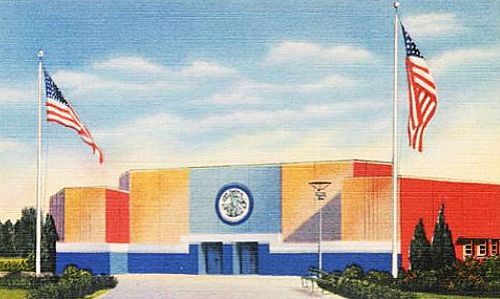
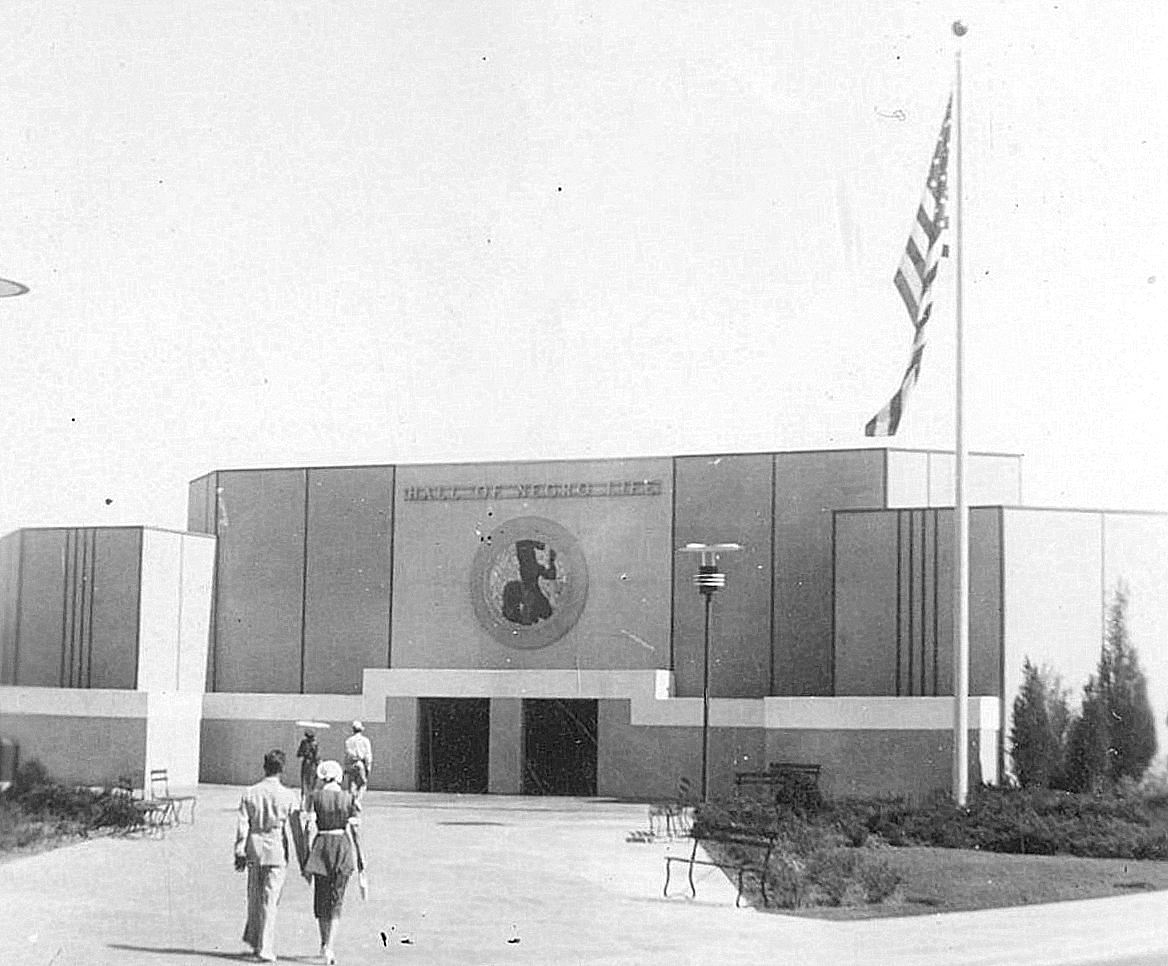
hall-of-negro-life_centennialThe Hall of Negro Life at the Texas Centennial Exposition, Fair Park

by Paula Bosse

Juneteenth, the anniversary of the date that African American Texans learned they were freed from slavery, was celebrated at the Texas Centennial Exposition with a day of entertainment and exhibits. It was also the day that the Hall of Negro Life — a federally funded exhibition hall acknowledging and honoring the history and accomplishments of African Americans in the United States — was officially dedicated.

tx-centennial_hall-of-negro-life_portal

One of the more interesting things I’ve stumbled across is a drawing of the proposed building (published in J. Mason Brewer’s The Negro In Texas History in 1935). I don’t believe I’ve seen this before. It’s interesting to note the changes from original proposal to finished product.

hall-of-negro-life_proposed_the-negro-in-texas-history_1935

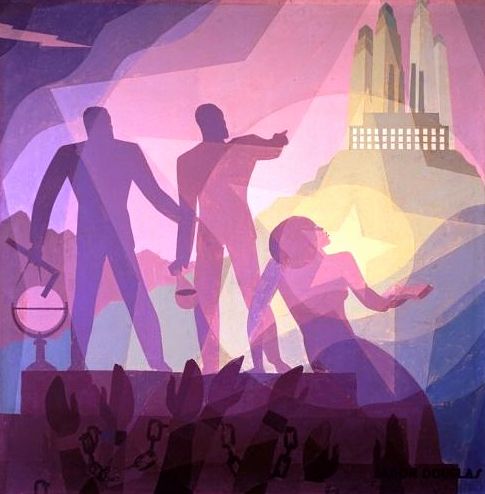
Among the large collection of art by black artists displayed in the Hall of Negro Life were four murals by the artist Aaron Douglas, depicting black history in Texas. Below are the two murals that survive, “Into Bondage” and “Aspiration.” These are incredible murals, and it must have been an emotional experience for those Juneteenth visitors in 1936 to be surrounded by all four powerful pieces in the lobby of a government-backed project that formally recognized the contributions of fellow African Americans.

aaron-douglas_into-bondage_1936_corcoran“Into Bondage” by Aaron Douglas, 1936 (Corcoran Gallery of Art)

aaron-douglas_aspiration_1936“Aspiration” by Aaron Douglas, 1936 (Fine Arts Museum of San Francisco)

***

Sources & Notes

Black-and-white photograph of the Hall of Negro Life from the Private Collection of Mary Newton Maxwell, Portal to Texas History, here.

Photo of proposed Hall of Negro Life from An Historical and Pictorial Souvenir of the Negro In Texas History, written by J. Mason Brewer (Dallas: Mathis Publishing Co., 1935).

“Into Bondage” by Aaron Douglas (1936) is from the collection of The Corcoran Gallery of Art.

“Aspiration” by Aaron Douglas (1936) is from the collection of The Fine Arts Museum of San Francisco. (There is an amazing interactive look at this painting here.)

More on the Hall of Negro Life, from the Handbook of Texas, here.

More on the Hall of Negro Life from The Crisis, the magazine of the NAACP, in the July, 1936 article “Negroes and the Texas Centennial” by Jesse O. Thomas, here.

How was this important Juneteenth celebration at the Texas Centennial covered by The Dallas Morning News? Well, the paper actually devoted a lot of space to the day’s events in a fairly lengthy article which appeared on June 20, 1936. I think the DMN editorial board probably thought they were being magnanimous in the amount of coverage given, but, really, the article — though brimming with a certain amount of probably well-intentioned jubilation — is so unremittingly racist that it’s actually shocking to see this sort of thing in print in a major newspaper. I encourage you to check out the article published on June 20, 1936 which carries the laboriously headlined and sub-headlined “Negroes Stage Big Juneteenth at Centennial; Dallas Eats Cold Supper and Cotton Patches Emptied as Thousands Inspect Magic City; Hall Is Dedicated; Dusky Beauties Prance; Cab Calloway Does His Stuff For Truckers.”

*

Copyright © 2014 Paula Bosse. All Rights Reserved.

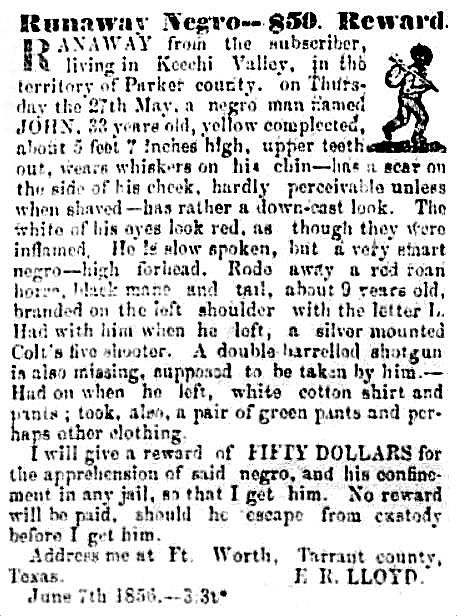
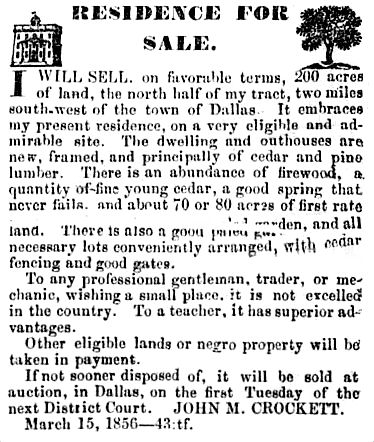
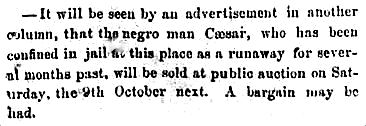
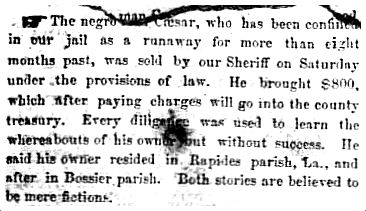
Ads for Slaves Lost, Found, and For Sale in the Pages of The Dallas Herald

runaway_negro_dallas-herald-1856Dallas Herald, June 7, 1856

by Paula Bosse

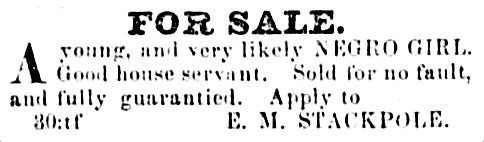
When one is browsing through Texas newspapers from the 1850s and 1860s, one shouldn’t be surprised to see things like this. But that doesn’t make them any less shocking. Black men and women were not regarded as people, but as property — in all of these “ads” you could easily substitute “horse” for “negro.” I think I always wanted to believe that slavery wasn’t much of an issue in Dallas — but it was. The name of one man, E. M. Stackpole, a successful shopkeeper, kept coming up a lot in these advertisements. In addition to the general merchandise of his store, he seemed to do a pretty brisk trade in buying, selling, hiring (more like leasing from other slave-owners), and hiring out slaves. One of his ads is below. (By the way, the word “likely” was a common adjective for slaves; it meant, basically, “worthy of purchase.”)

trade_for_negro_dallas-herald_1856March 15, 1856

negro-auction_dallas-herald_091558Sept. 15, 1858

negro-auction_dallas-herald_102058Oct. 20, 1858

negro_for_sale_dallas-herald_18611861

***

Sources & Notes

All advertisements from The Dallas Herald, via UNT’s Portal to Texas History site.

My lack of knowledge about slavery in Texas is appalling. The Wikipedia entry provides a good overview; read it here.

*

Copyright © 2014 Paula Bosse. All Rights Reserved.

Plow vs Skyscraper

mydans_lucius-washington_smithsonian_1939(click for super-gigantic image)

by Paula Bosse

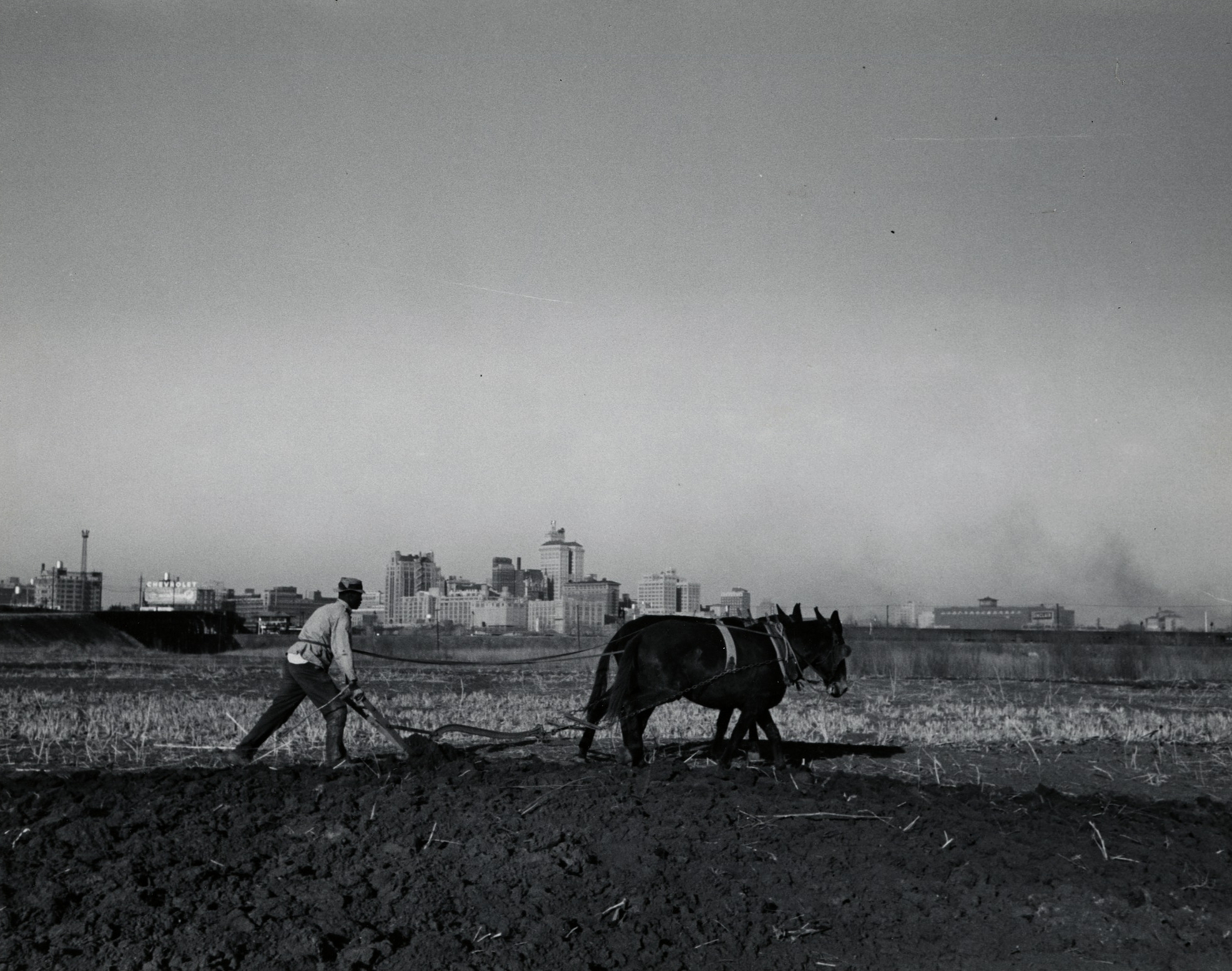
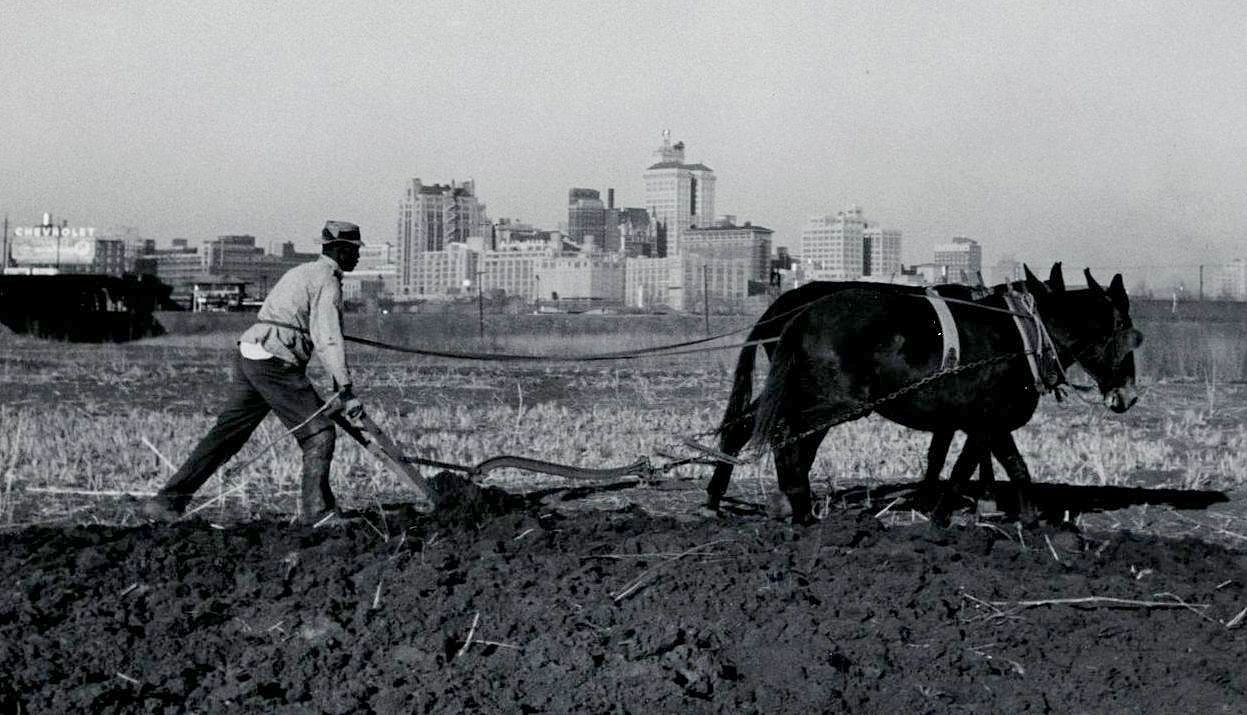
Here’s an unexpected view of the Dallas skyline, by legendary Life magazine photographer Carl Mydans. The photograph — titled “Lucius Washington and Two Mules Plow the Fields Before the Dallas Skyline” — is from the collection of the Smithsonian Institution, with catalog description here. Though the Smithsonian lists this photo as being from 1939, it’s possible that it was taken a year earlier, as The Dallas Morning News reported on April 2, 1938 that Mydans was in town shooting the Dallas skyline. A major article on Texas appeared in Life magazine a year later, in the April 10, 1939 issue, featuring a different, very large photo of the Dallas skyline by Mydans, which can be seen here.

Below, an enlarged detail, lightened a bit.

mydans_lucius-washington_smithsonian_1939-det

***

More on Mydans from the Duke University collection here, with examples of his FSA, Life magazine, and WWII reportage here.

Wikipedia article on Mydans here.

Click photos for much larger images.

*

Copyright © 2014 Paula Bosse. All Rights Reserved.

The Ladies’ Reading Circle: An Influential Women’s Club Organized by Black Teachers in 1892

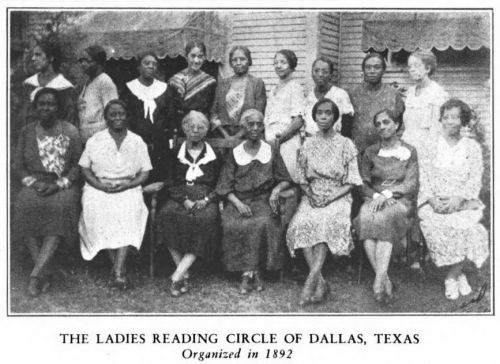
ladies-reading-circle_negro-leg-brewer_1935The Ladies (click for larger image)

by Paula Bosse

When one thinks of “ladies’ clubs” of the past, one probably tends to think of groups of largely well-to-do women in fashionable dresses, gloves, and smart hats who gathered for quaint meetings in one another’s homes to discuss vaguely literary or cultural topics, sip tea, chit-chat, and gossip. Often they would plan projects and events which would aid pet community or charitable causes. There were clubs of varying degrees of serious-mindedness, but, for the most part, club meetings were mostly an excuse for women to socialize. 100 years ago, these women rarely worked outside the home, and these groups offered an important social and cultural outlet for well-educated women of means. White women. Women of color were not part of that particular club world. They had to create clubs for themselves. And they did.

In 1892, eight African-American teachers in Dallas organized their own club, the Ladies’ Reading Circle, and while it, too, was an important social outlet for the women, the focus of the group tended to be more serious, with reading lists comprised primarily of political, historical, and critical texts.

The members of the Ladies’ Reading Circle (a group that lasted at least until the 1950s) were, for the most part, middle-class black women who set an agenda for the club of education, self-improvement, and social responsibility. Like most women’s clubs of the time, each meeting of the LRC was held in a different member’s home and usually ended with a “dainty” luncheon and light musical fare, courtesy of the Victrola or player piano; but what set the LRC apart from most of the other women’s clubs of the day was the choice of reading material — from books on world history and international politics, to texts on current affairs and social criticism. (Several surprising examples appear below.)

Not only did the women gather weekly to discuss current and cultural affairs, they also worked to improve their community by tackling important social issues and by inspiring and encouraging young women (and men) who looked to them as civic leaders. Noted black historian J. Mason Brewer dedicated his 1935 book Negro Legislators of Texas to the women of the Ladies’ Reading Circle. The photograph above is from Brewer’s book, as is the following dedication:

lrc_negro-leg-brewer_1935-dedication

Included were the names of the members, several of whom had organized the club in 1892:

lrc_members_brewer

One of the LRC’s concerns was establishing a home which, like the white community’s YWCA, offered housing and career training for young women. The charming frame house the club bought for this purpose in 1938 (and which is described in the Jan. 10, 1952 News article “Ladies Reading Circle Seeks $7,500 for Expanding Home”) still stands at 2616 Hibernia in the State-Thomas area

lrc-home_2616-hibernia_google2616 Hibernia (Google Street view, 2014)

But the group was organized primarily as a “reading circle,” and the minutes of three randomly chosen meetings show the sort of topics they were interested in exploring. The following three articles are from the post-WWI-era, and all appeared in The Dallas Express, a newspaper for the city’s black community.

lrc_dallas-express_040320April 3, 1920

lrc_dallas-express_041020April 10, 1920

lrc_dallas-express_102023October 20, 1923

My favorite juxtaposition of content on the pages of The Dallas Express was the article below which reported on a white politician’s promise that he would fight to keep “illiterate Negro women” from voting — just a column or two away was one of those eye-popping summaries of the latest meeting of the Ladies’ Reading Circle. My guess is that the black educators who comprised the Ladies’ Reading Circle were probably far more knowledgeable about world events than he was.

negro-womans-suffrage_dallas-express_052220May 22, 1920

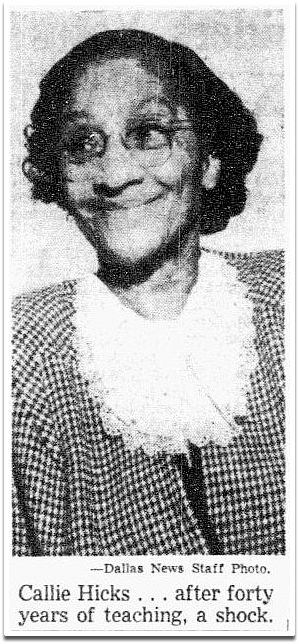
In reading the limited amount of information I could find on the LRC, I repeatedly came across the name of one of the earliest members, Callie Hicks (she is in the 1935 photo at the top, seated, second from the right). She was a dedicated teacher as well as a respected civic leader who worked for several causes and was an executive of the Dallas branch of the NAACP. A Dallas News article about Miss Hicks appeared in Feb., 1950 when she was named “Woman of the Year” by one of the largest African American women’s organizations in Dallas County (“Honor Caps 40 Years of Helpful Teaching,” DMN, Feb. 10, 1950). Miss Hicks died in May, 1965.
callie-hicks_dmn-021950-photo1950

It’s a shame that the Ladies’ Reading Circle is not better known in Dallas today. I have to admit that I had never heard of the group until I stumbled across that 1935 club photo. Their tireless work to improve the intellectual lives of themselves and others no doubt influenced the generations that followed.

***

Sources & Notes

Top photograph, dedication, and member list, from Negro Legislators of Texas and Their Descendants; A History of the Negro in Texas Politics from Reconstruction to Disenfranchisement by J. Mason Brewer (Dallas: Mathis Publishing Co., 1935).

Minutes from the Ladies’ Reading Circle meetings all printed in The Dallas Express.

Relevant material on the LRC and other historic African-American women’s clubs can be read in Women and the Creation of Urban Life, Dallas, Texas, 1843-1920 by Elizabeth York Enstam (College Station: Texas A & M University Press, 1998), here.

The Handbook of Texas entry for one of the founding members of the Ladies’ Reading Circle, Julia Caldwell Frazier, can be found here.

*

Copyright © 2014 Paula Bosse. All Rights Reserved