Flashback : Dallas

A Miscellany: History, Ads, Pop Culture

Category: Architecture/Significant Bldgs.

The Elm Street Cave — 1967

elm-st-cracks_flickr_red-oak-kid_smThe Elm St. Cave – tourist attraction…

by Paula Bosse

In the wee hours of the morning of Jan. 11, 1967, a giant hole opened up on the south side of Elm Street — 200 yards long, 20 feet wide, and 15 feet deep — running roughly the entire length of the block between Griffin and Field. It was assumed that there was some connection between the cave-in and the adjacent construction of One Main Place. During the ensuing investigation into a cause, the consultations with geologists, the lawsuits, the repairs, the backfilling, etc., this very busy stretch of Elm was closed for an incredible seven months (!). Most of that time it was a gaping hole.

The hole was a major headache to city leaders and to downtown developers (…and to motorists), but it became an ongoing joke to everybody else. The “Elm Street Cave” and “Elm Street Cavern” were referenced everywhere for most of 1967. San Francisco had “The Summer of Love” that year, Dallas had “The Elm Street Cave-In.” It was the butt of endless jokes in local, out-of-town, and even out-of-state newspapers. A band sprang up calling themselves The Elm Street Cave-Ins.
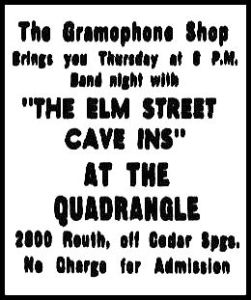
cave-ins-band_dmn_062867June 28, 1967

A group of local lawyers known as The Skid Row Bar Association proclaimed to the press that it was “the last remaining scenic wonder in Dallas.” Curious tourists were drawn to the hole like camera-laden moths to a flame. “Talk about your ‘Deep Elm’!” became a punchline much bandied about by people who didn’t understand that something like that is moderately amusing once or twice, but that it tends to lose its sharpness after it’s repeated ten or fifteen times. And, bizarrely, it even found its way into an oddly defensive Sears ad (click to see a larger image).

ad_sears_dmn_070667-det_sm1967 Sears ad, detail

The hole was eventually filled in, and, in August — after months of jokes and inconvenience — the street was finally re-opened. Life returned to a pre-cave-in normalcy. The reason for the collapse was determined to be shifting rock formations below street level. One report said that workmen had “uncovered a huge crevice in the limestone beneath the street measuring 30 feet deep. They filled the crevice with concrete and tied together the broken sections of rock.” I’m not sure how comfortable I’d feel about a giant building sitting on shifting shale-covered limestone,* but apparently everything’s been fine ever since, and everyone — the engineers, the geologists, the One Main Place developers and tenants — lived happily ever after.

***

Sources & Notes

Associated Press photo of the lovely Judy Thedford and her fashionably large hair posing rather incongruously beside a car bumper appeared in newspapers across the country on Feb. 12, 1967. This scan is from the Red Oak Kid’s Flickr page, here.

The weird “Let’s quit apologizing! Dallas is worth seeing!” ad comes from a larger Sears advertisement that appeared in July 1967.

Related Dallas Morning News articles:

  • “Strip of Elm Collapses; Experts Remain Baffled” by Carolyn Barta (DMN, Jan. 12, 1967)
  • “Cracks on Elm Street Not Funny to City Hall” by Kent Biffle (DMN, Feb. 12, 1967)

*For people who (unlike myself) know something about geology, an article written in 1965 about the special problems regarding the One Main Place excavation and construction (“How to Support Skyscrapers” by Martin Casey — DMN, Nov. 28, 1965) might be interesting. There is much mention of Austin Chalk Limestone and Eagle Ford Shale, which made the One Main Place project quite troublesome to engineers. 

*

Copyright © 2014 Paula Bosse. All Rights Reserved.

McFarlin Auditorium, Following Morning Chapel — 1927

mcfarlin-auditorium_1927McFarlin Auditorium, post-Chapel, 1927 (click for larger image)

by Paula Bosse

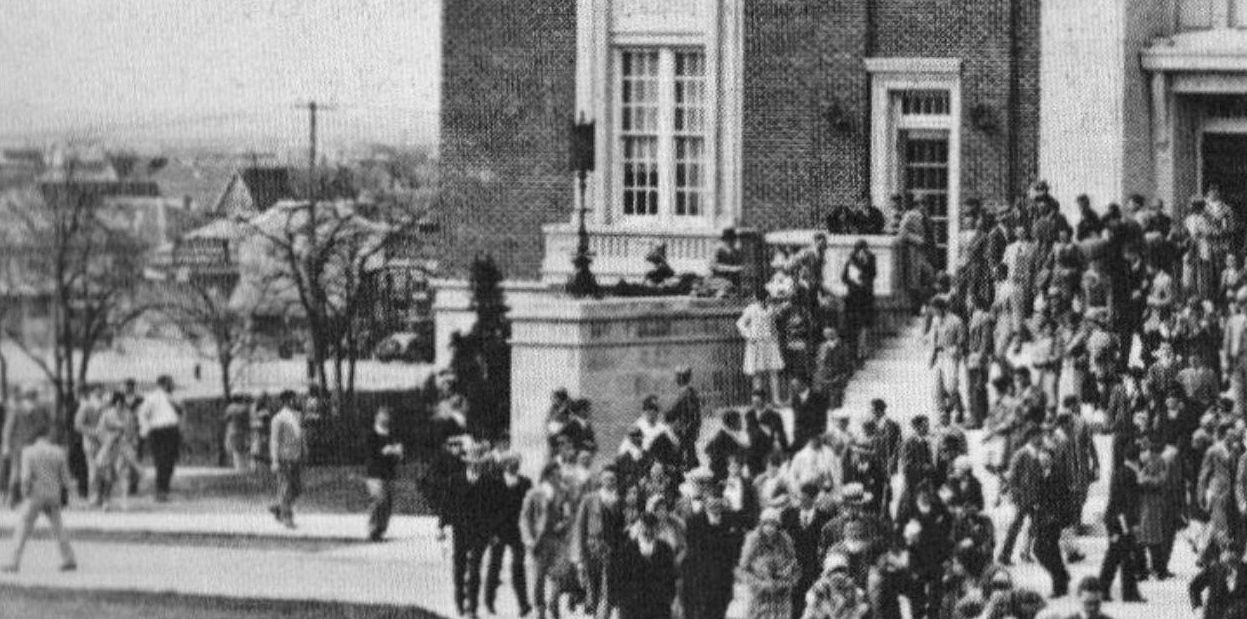
Another in the series of wonderful postcards celebrating the history of the Park Cities, this one shows McFarlin Auditorium in 1927, then only two years old. From the back of the card:

This is a 1927 photograph taken following morning Chapel in McFarlin Auditorium. The building is located at McFarlin Blvd. and Hillcrest on the Southern Methodist University campus. At that time, Chapel attendance was mandatory for SMU students. Dr. R. E. Dickenson was Chaplain and conducted the daily chapel services, and Dr. Charles C. Selecman was the President of the University.

Below are a couple of details of the photo which show, in the background, interesting (if fuzzy) views of houses and other structures along (and beyond) Hillcrest.

mcfarlin_det1

mcfarlin_det2

***

Postcard is from the Park Cities Bank “Heritage Series” issued in the 1970s. Photo credit line on the postcard reads “Donated by Stanley Patterson.” Thanks to the Lone Star Library Annex Facebook group for use of the image.

Click pictures for larger images.

*

Copyright © 2014 Paula Bosse. All Rights Reserved.
The Roller Coaster on the Prairie — 1894

state-fair-grounds_souv-dallas_1894Texas State Fair & Dallas Exposition Fair Grounds, circa 1888

by Paula Bosse

Above, a wonderful view of the “State Fair Grounds and Dallas Exposition” from an 1894 advertisement. The Little Roller Coaster on the Prairie!

If you want to see this very large (and, trust me, you DO), click here (and then click again). It’s like wandering through those old phone book covers, but without the jokes and the dinosaurs.

*

UPDATE: The artwork was used in a previous ad that appeared in The Dallas Morning News in 1888, with the following text:

The coming Fair and Exposition will, beyond a doubt, excel in point of attractiveness, numbers and variety of exhibits any heretofore held.

The County Exhibit Department promises to be the most attractive feature, one never before attempted by any State. Over forty counties up to date have secured space, and more still to enter. The exhibits these counties will present will be something that will astonish visitors.

Every variety of attractions has been provided for, and the musical treat we have in store for visitors will be presided over by the world renowned Cornetist , Prof. A. Liberati.

The purses offered in the Race Department cover $20,000, and will be competed for by the best racers in the land. The management of this department propose to give during the Fair and Exposition the finest races ever given in the South.

We desire to call the attention of counties to the fact that now is the time to get up their exhibits, when grain, fruits, etc. are ripening, and not wait until it is too late.

Space in the County Exhibit Department is free, and no county of our State can afford to be not represented. There will be more people here than ever before, and we want them all to see the varied resources of our great State.

To exhibitors in general we can promise them the finest opportunity ever offered to make displays from which will return good results, and to visitors we can assure them of the grandest entertainment ever given in the Southwest.

dallas-fair_dmn_090588

*

The scene above looks idyllic (to me, anyway), but here is a description of what the land was like before anything was built on it, from a Dallas Morning News history of the SFOT (Oct. 2, 1960):

An 80-acre tract approximately in the center of the present-day State Fair Park was chosen as the site for the Fair. The location was termed by some to be “the worst kind of hog wallow,” and the question most frequently asked was “How are you going to hold a fair in all that mud?”

*

The Dallas State Fair and Exposition (which became the State Fair of Texas) was chartered in 1886, and unless that artist’s rendering is highly romanticized (which it probably is), it looks like the hog wallow was but a faint memory by the time that roller coaster was plopped down on top it.

***

Sources & Notes

Artwork by the Dallas Engraving and Manufacturing Company. Top ad appeared in the Souvenir Guide of Dallas (1894); bottom ad appeared in The Dallas Morning News, Sept. 5, 1888.

*

Copyright © 2014 Paula Bosse. All Rights Reserved.

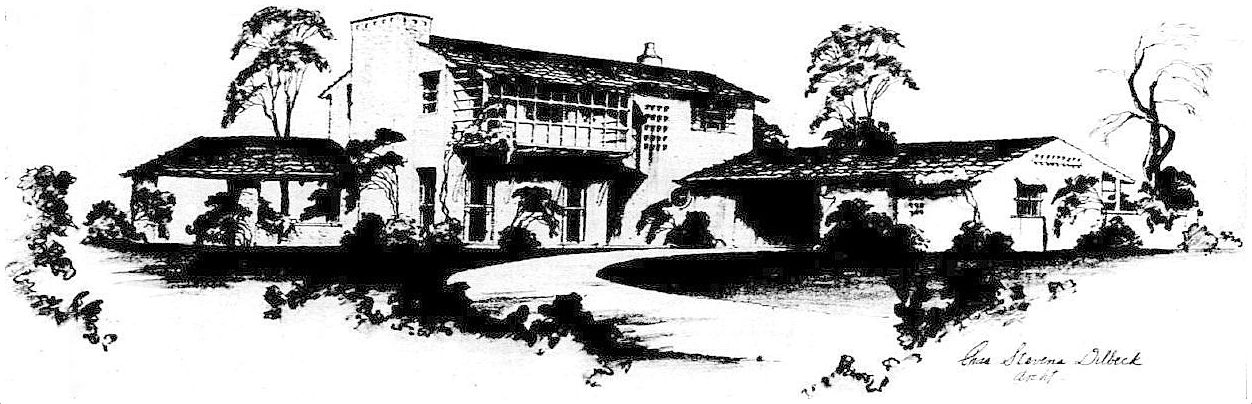
Preston Elms: Your Country Estate Awaits — 1935

preston-elms_dilbeck_dmn_100135Preston Elms home designed by Charles Dilbeck, 1935

by Paula Bosse

This beautiful home, designed by the wonderful architect Charles Stevens Dilbeck, was featured in an ad touting an exclusive new “country estate” development called Preston Elms, located at Preston Road and Walnut Hill Lane. From the text of the ad:

The home pictured above will be erected immediately in a new tract set aside for a Demonstration Home. It will have three bedrooms, large dining room and living room. Terrace porch on south and east will be 32 feet long and can be reached from dining room, living room or hall. Two baths — most modern type! Extraordinary hardware! …

The backyard will be walled in assuring privacy to servants and parked automobiles. …

All the details of the house and location have been studied and planned for months. …

The Better Homes of America are gradually drifting away from the urban abode of restricted activity to the freedom, comfort, seclusion and the individuality of the COUNTRY ESTATE.

*

A later ad would include this grabber of a line: “In the heart of Preston Road District, All City Conveniences, Minus City Taxes.”

*

Tracts ranging from one-half to two acres would start at $1,700. The house pictured above would cost $12,500. (I would kill for that house, but I fear it has long since been torn down as being too teensy for the neighborhood.)

“Preston Elms” (along with Preston Downs, Preston Hollow, Preston Highlands, Preston Heights, Inwood Road Addition, Sunnybrook, and El Parado) were the subdivisions in the so-called “Preston Road District,” an area of some 1,200 acres north of Northwest Highway. When this area was being developed (by savvy speculator Ira P. DeLoache), it was not within the Dallas city limits. In 1939, after a failed attempt at some sort of merging with University Park, the residents voted to incorporate, and the somewhat sparsely-populated area became the “city” of Preston Hollow. With a mayor and everything.

But back to that house. God, I love that house. As I said, I bet that sucker was elbowed out long ago. If it’s still there, I’d love to know.

A photo of the man responsible for developing most of the Preston Road District, Ira P. DeLoache, namesake of one of the area’s streets.

deloache_legacies_fall-2002

***

Sources & Notes

The Dilbeck drawing at the top is from a half-page real estate ad, here.

Photo of Ira P. DeLoache from the Fall, 2002 issue of Legacies.

Examples of Dilbeck’s beautiful houses (several of which are in Preston Hollow) can be seen here.

Background on Preston Hollow and its road to incorporation can be read about in the Dallas Morning News article “Preston Road Incorporation Plan Climaxes Weeds to Orchids Development,” (DMN, Sept. 24, 1939).

For an aerial view of what would become Preston Hollow, check out a mostly empty 1930 vista (from SMU’s Edwin J. Foscue Library), here. Development, here we come!

*

Copyright © 2014 Paula Bosse. All Rights Reserved.

Snapshots of the Fair, 1936-1940

tx-centennial_strolling_fwplCentennial Exposition, 1936 — photo by Lewis D. Fox (click for larger image)

by Paula Bosse

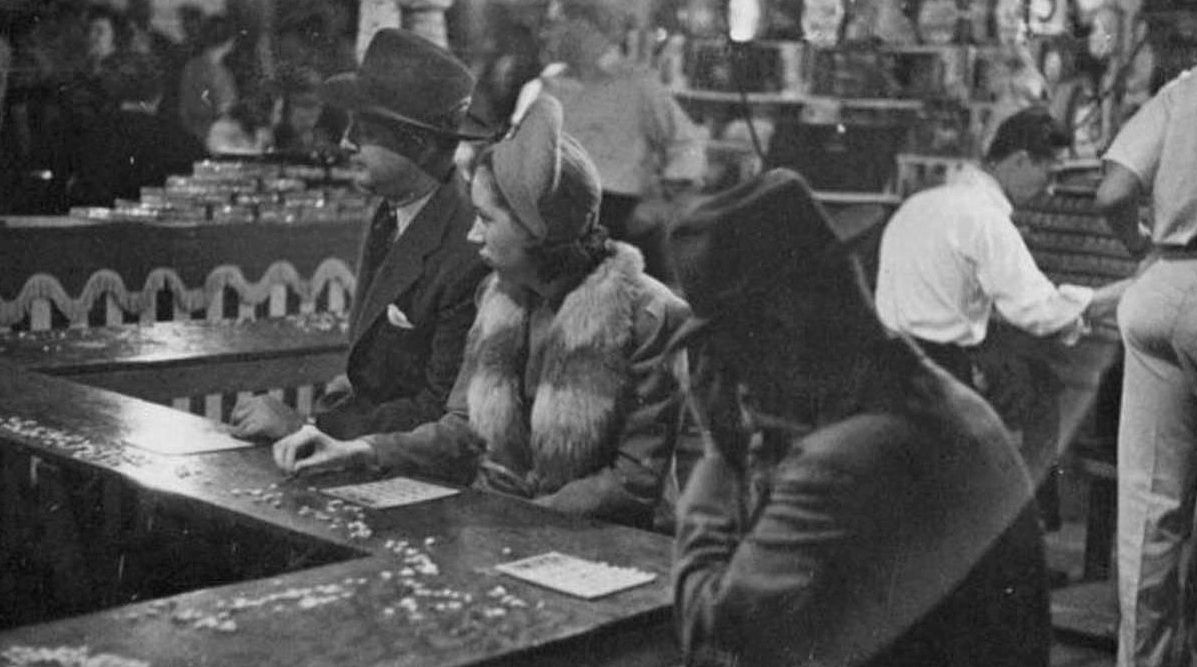
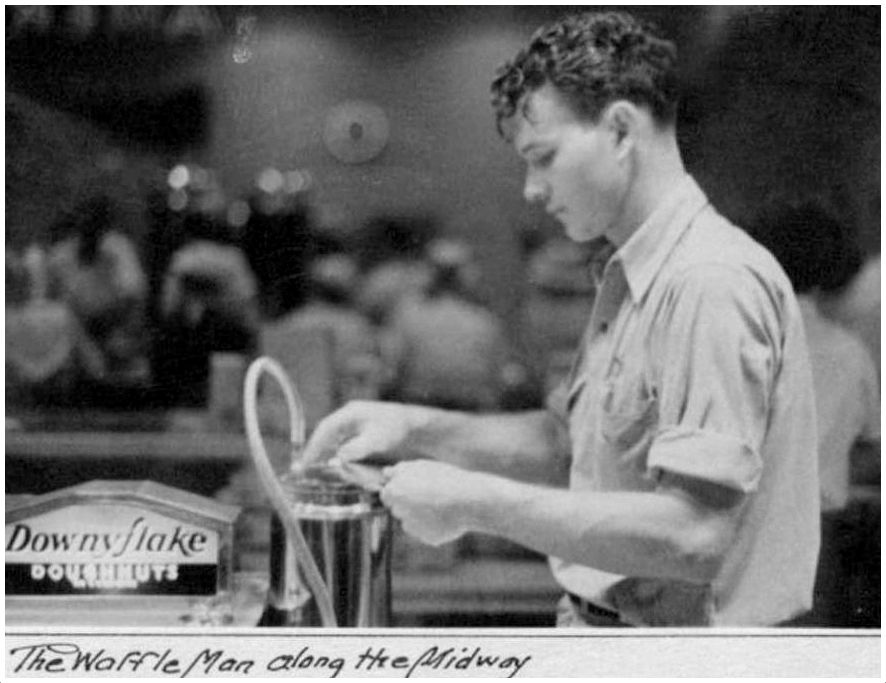
An amateur photographer named Lewis D. Fox took a lot of photos at the State Fair of Texas — from the Texas Centennial in 1936 through 1940. The Centennial photos are particularly interesting, because they show what the “Exposition” was like to the average visitor — there was more going on than just the spectacular extravaganza we usually see — there are also shots of people doing un-spectacular things like just walking around or enjoying a quiet, late-afternoon cup of coffee. There are also photos of the people who do the heavy-lifting at a state fair — the men and women who work the Midway shows and the concession stands (a link to a larger collection of Mr. Fox’s State Fair photos — almost a hundred snapshots — is below).

Enjoy this look at a time when going to the fair meant dressing up and, apparently, often leaving the children at home! (Click photos to see larger images.)

tx-centennial_spirit-of-centennial_fwpl

state-fair_texas-state-bldg_fwpl

state-fair_circus_c1939_fwpl

state-fair_grandstand_fwpl

tx-centennial_swing-revue_fwpl

state-fair_beanery_fwpl

state-fair-midway_fwpl

tx-centennial_cashier_fwpl

tx-centennial_side-view_fwpl

tx-centennial-midway_waffle-man_fwpl

***

Sources & Notes

All photos taken by Lewis D. Fox, from the Fox Photograph Collection in the Fort Worth Public Library Archives, courtesy of the Genealogy, History and Archives Unit, Fort Worth Public Library. Mr. Fox took a lot of snapshots at the fair — see  more here.

On a personal note, I’m mesmerized by “The Waffle Man.” He looks just like a young Lefty Frizzell! Lefty was from nearby Corsicana and he spent a lot of time in Dallas, but he wasn’t born until 1928, so it can’t be him — but check out this photo of Lefty as a teenager and see the remarkable resemblance! Not only did the (no doubt syrup-scented) young man above look like one of my favorite singers, but he also had ready access to waffles. What’s not to love? Oh, Waffle Man….

All images larger when clicked.

*

Copyright © 2014 Paula Bosse. All Rights Reserved.


The Dallas Morning News Building, Inside and Out — ca. 1900

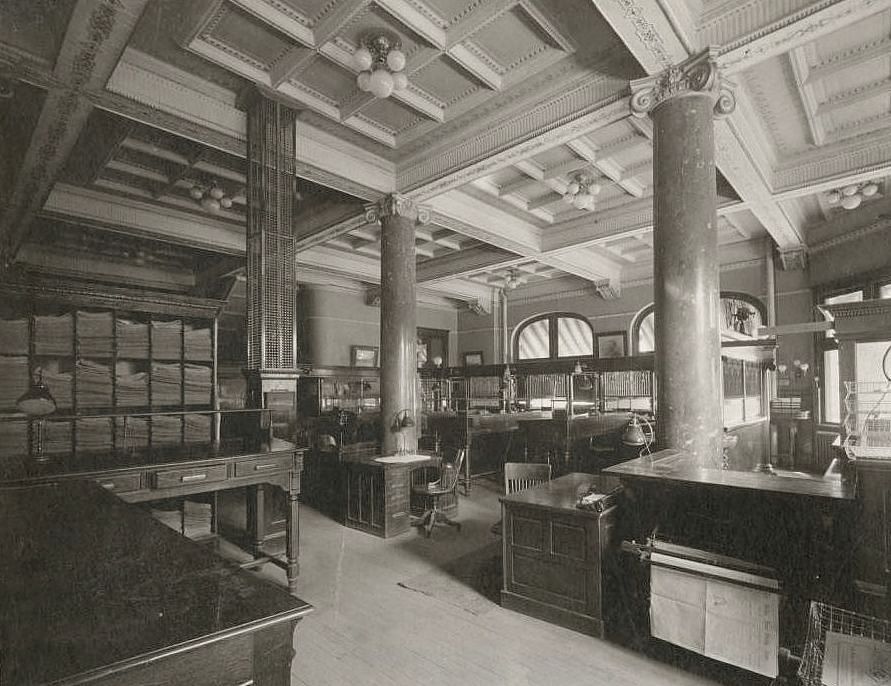
dmn_newsroom_c1903_degolyer_smuTurn-of-the-century DMN newsroom (click for larger image)

by Paula Bosse

Above: the empty (and almost sterile) “newsroom” of The Dallas Morning News, around 1903. There’s either a big fire somewhere, or news has taken the day off.

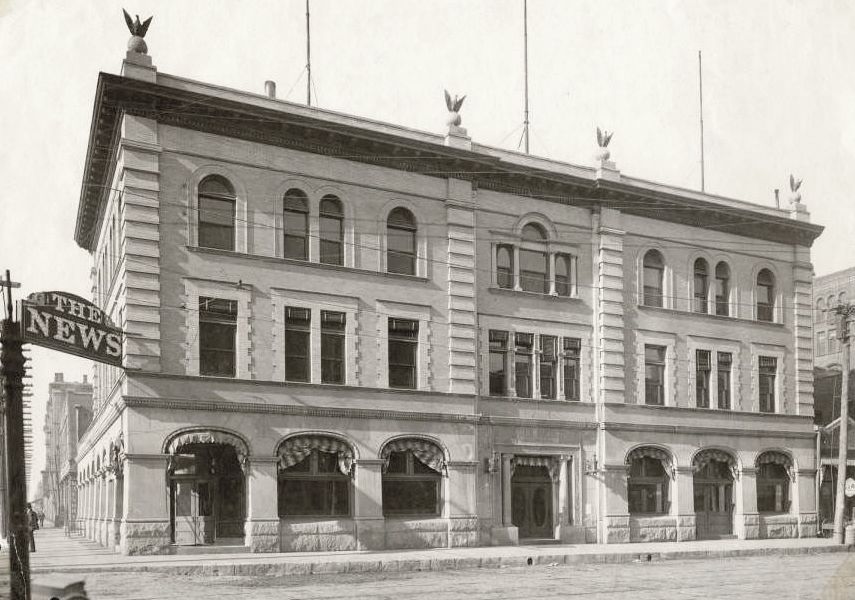
Below: the new Morning News building, about 1900. Located at the northwest corner of Commerce and Lamar, this is the Lamar side.

dmn_lamar-side_c1900_degolyer_smu

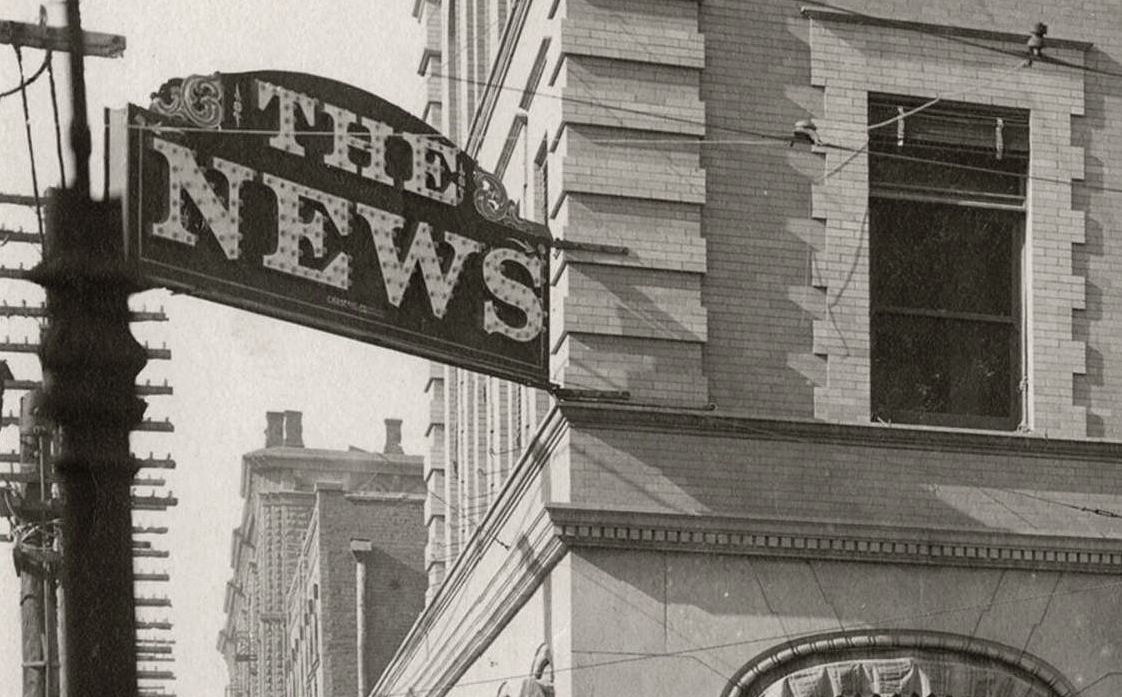
And the somewhat show-bizzy sign, studded with bulbs — one hopes it flashed at night.

dmn_lamar-side_c1900_degolyer-det1

***

Photo of the Dallas Morning News newsroom, circa 1903-1905, from the Belo Records collection, DeGolyer Library, Central University Libraries, Southern Methodist University; more info here.

Photo of the Dallas Morning News building (slightly cropped), circa 1900-1901, from the Belo Records collection, DeGolyer Library, Central University Libraries, Southern Methodist University. Original photo, along with additional information, can be found here.

See the other photos of the building from 1900 in these other posts:

  • “Loitering In Front of the Dallas Morning News Building — ca. 1900,” here
  • “Lively Street Life Outside the Dallas Morning News Building — ca. 1900,” here

All images larger when clicked.

*

Copyright © 2014 Paula Bosse. All Rights Reserved.
“Life” at the State Fair of Texas — 1951

fair-park-midway_life_1951On top of the world, 1951

by Paula Bosse

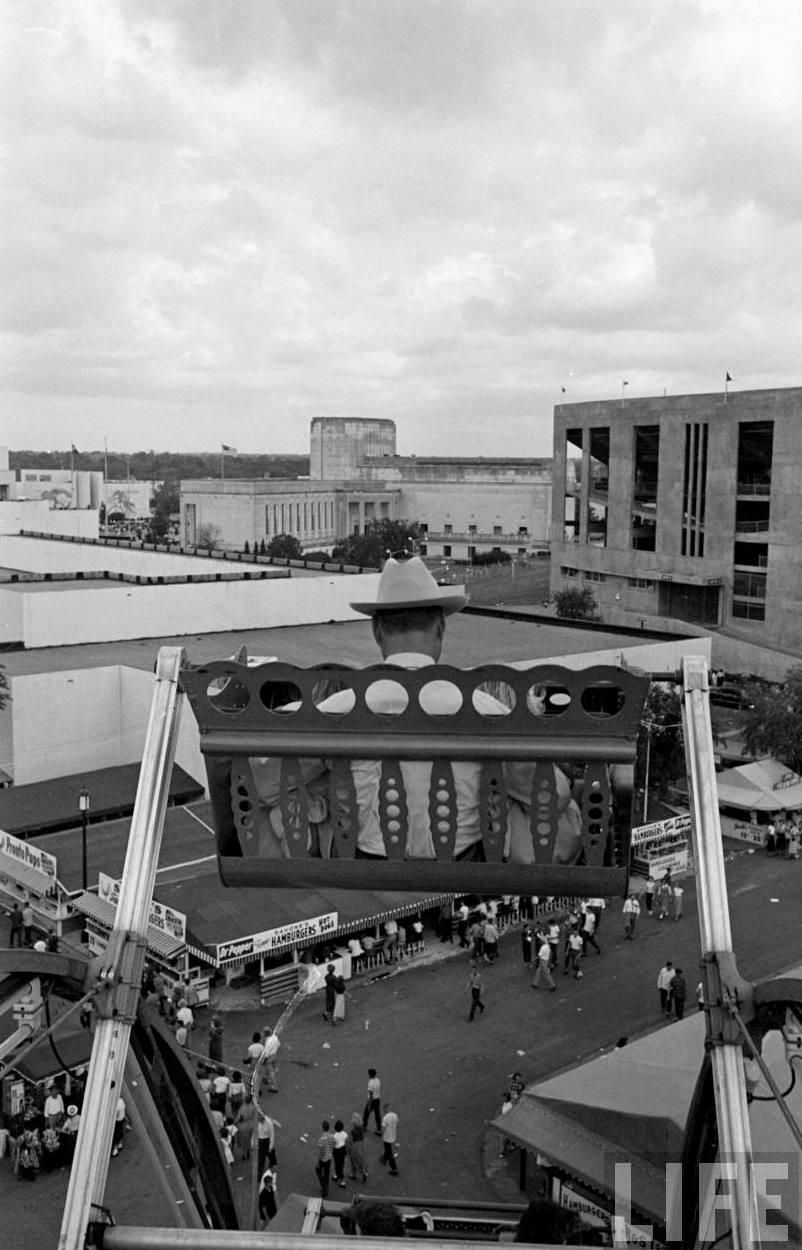
A Life magazine photographer moseyed down to Dallas in 1951 and captured a couple of cool shots of the State Fair. The photo above (so sweet, and one of my favorite Midway shots ever) was captioned:

In Dallas a rancher takes the kids for a ride in a 92-foot-high double Ferris wheel.

The photo below shows a tractor-pulled tram (fare: 15 cents) as it wheels past the Hall of State, full of well-dressed men and women. (That kid in the boots, cowboy hat, and letterman jacket … had I been around in 1951, I would have had a big ol’ crush on him.)

Click both of these wonderful photos to see larger images. You can practically smell the Brylcreem and cotton candy.

fair-park_tour_life_1951Life magazine, 1951

***

Sources & Notes

Both photos taken at the 1951 State Fair of Texas for Life magazine by an uncredited photographer. The top photo (cropped differently) ran in the Oct. 22, 1951 issue of Life as part of a feature titled “It’s a Bumper Year For Fairs” — it was the only photo that appeared in the magazine shot at the Texas fair. The bottom photo did not run in the magazine.

*

Copyright © 2014 Paula Bosse. All Rights Reserved.

1611 Main Street — Another One Bites the Dust

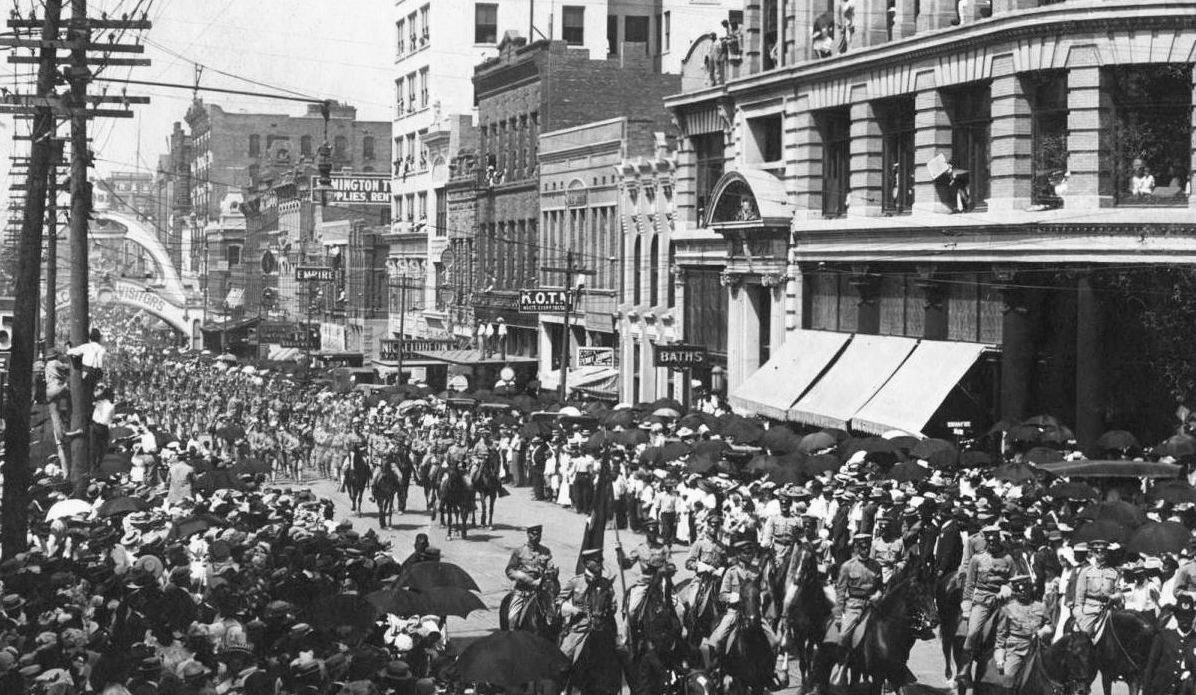
1611-main_clogenson_1909_degolyer_detThe 1600 block of Main St. in 1909, from Ervay

by Paula Bosse

Yesterday (Sept. 21, 2014), a 129-year-old building — one of the oldest buildings still standing downtown — built in 1885! — was demolished. Today it’s a pile of rubble. Yeah, I don’t understand it, either. Dallas has a real problem with preserving its history. In the 1909 photo above, it is the one at the right, behind the three men in white shirts who are standing above the crowd. And now it’s gone. And so is the Praetorian, the tall white building on the corner of Main and Stone. Maybe someone should make sure the Wilson Building has armed guards on 24-hour wrecking-ball watch.

***

Sources & Notes

Photo is a detail from “Parade Day, Military Tournament, Dallas, Texas” by Clogenson (1909), from the collection of the DeGolyer Library, Central University Libraries, Southern Methodist University. It can be viewed here.

The original photograph is the subject of a previous post, “Parade Day — 1909” which can be viewed here.

“A Wrecking Ball Erased 129 Years of History Along Main Street in Downtown Dallas Sunday” by Robert Wilonsky (DMN, Sept. 21, 2014) — an article on the surprise demolition of 1611 Main Street (which, until 1911, was actually 369-371 Main Street) — can be read in the Dallas Morning News archives.

*

Copyright © 2014 Paula Bosse. All Rights Reserved.

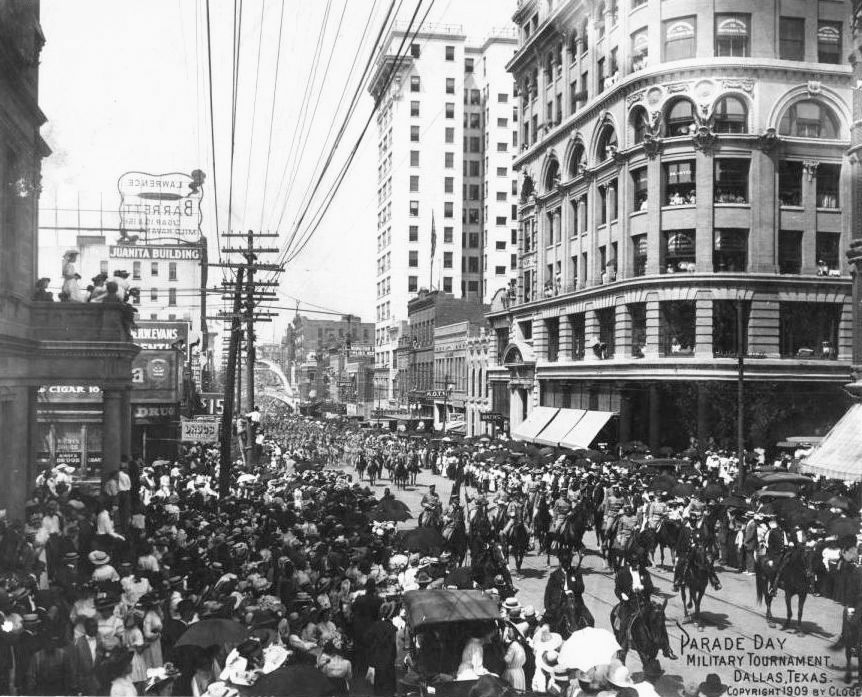
Parade Day — 1909

parade-day_1909_clogenson_degolyerMain Street looking west from Ervay, 1909

by Paula Bosse

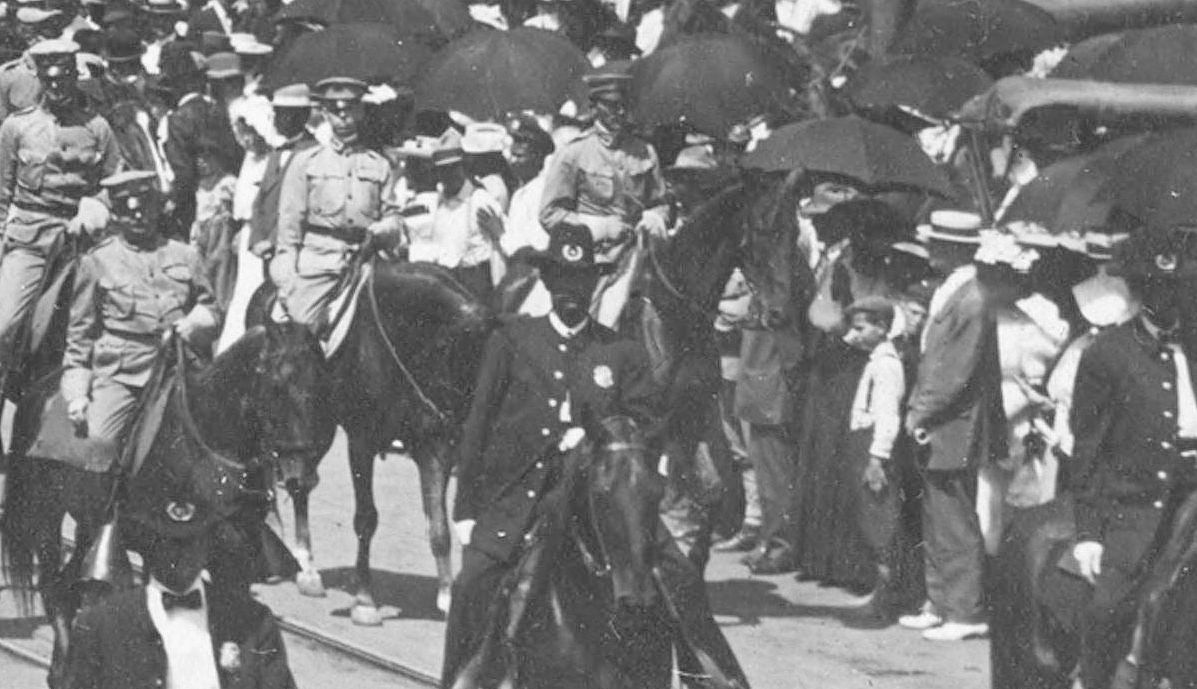
Sun-bronzed, khaki-clad soldiers representing the three important branches of the army, paraded through the city evoking the admiration of 60,000 persons who lined the streets all the way from Fair Park to the end of the downtown business district. (Fort Worth Star-Telegram, Aug. 24, 1909)

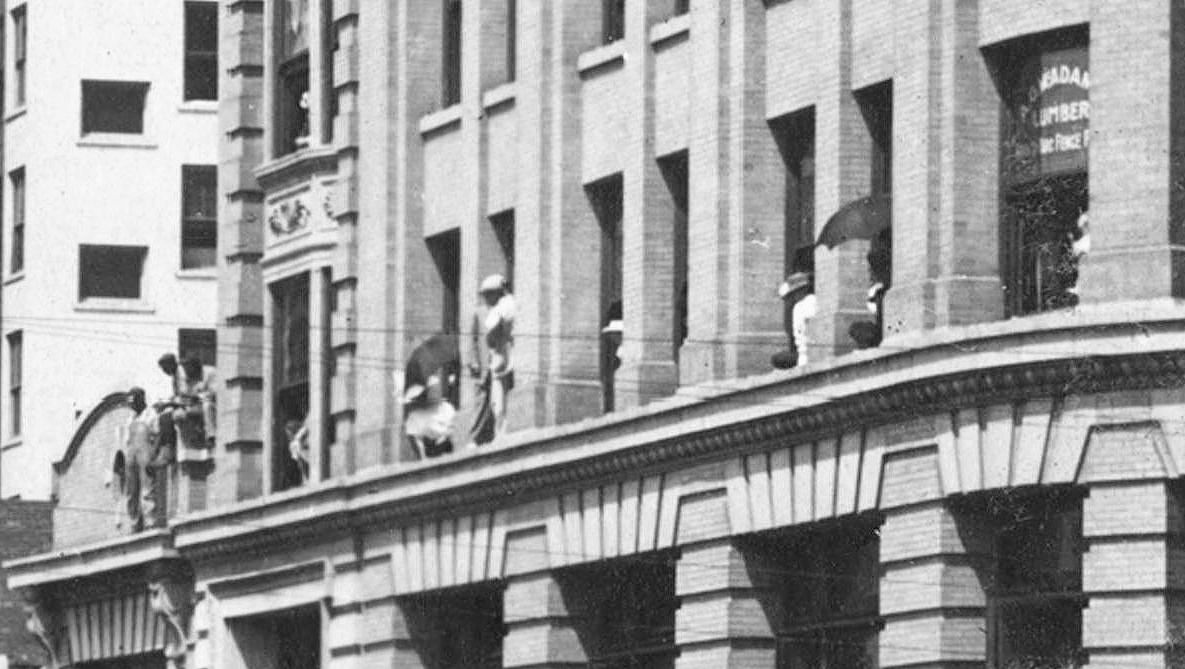
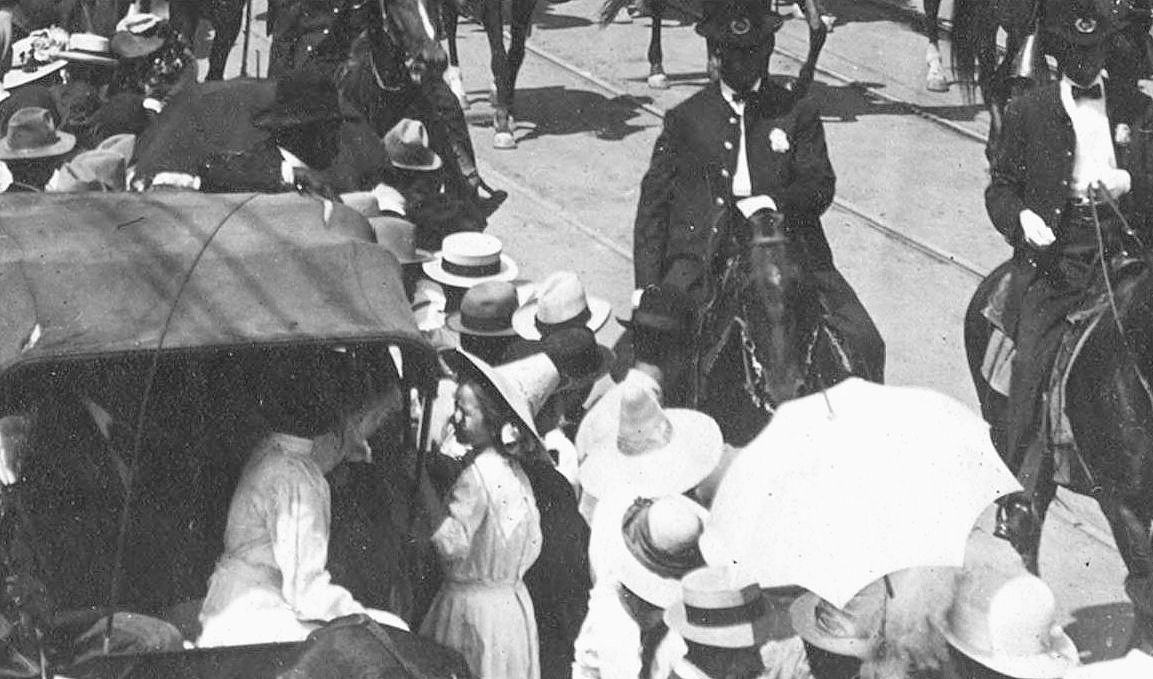
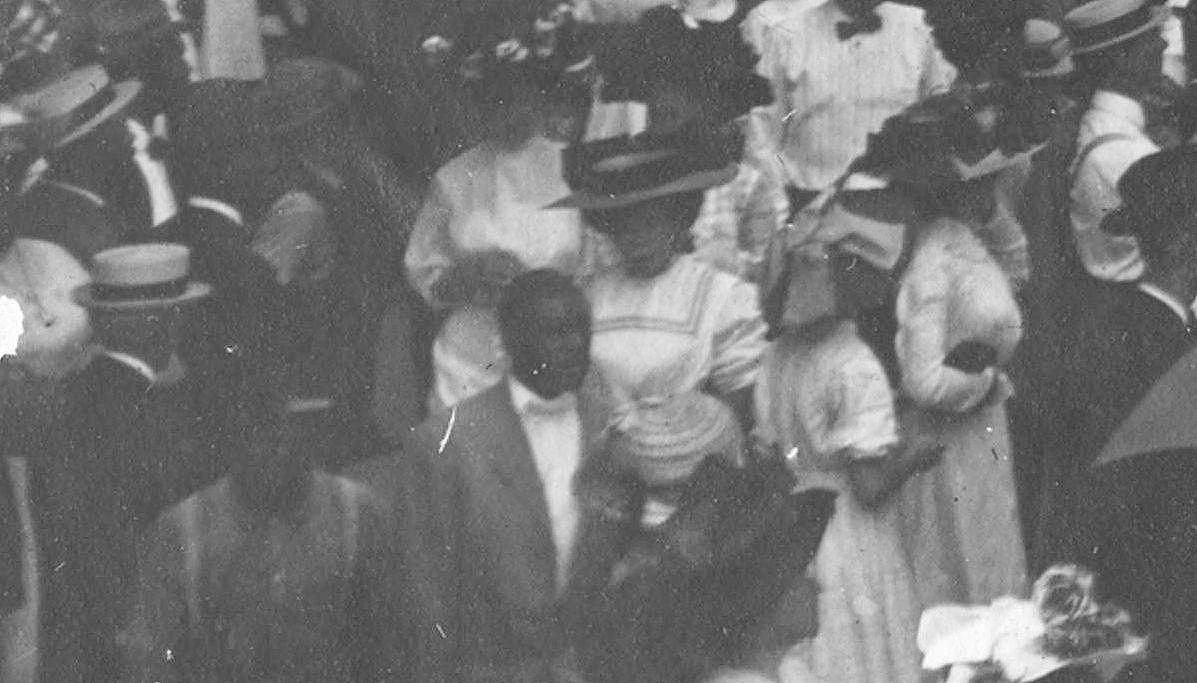
This is a GREAT photograph, looking west on Main Street from Ervay, with the Wilson Building in the foreground at the right, and, a few doors down, the tall white Praetorian Building at Stone Street. With so much going on in this photo, it’s a great opportunity to zoom in on the crowd and look a little more closely at the details. (All photos are much larger when clicked.)

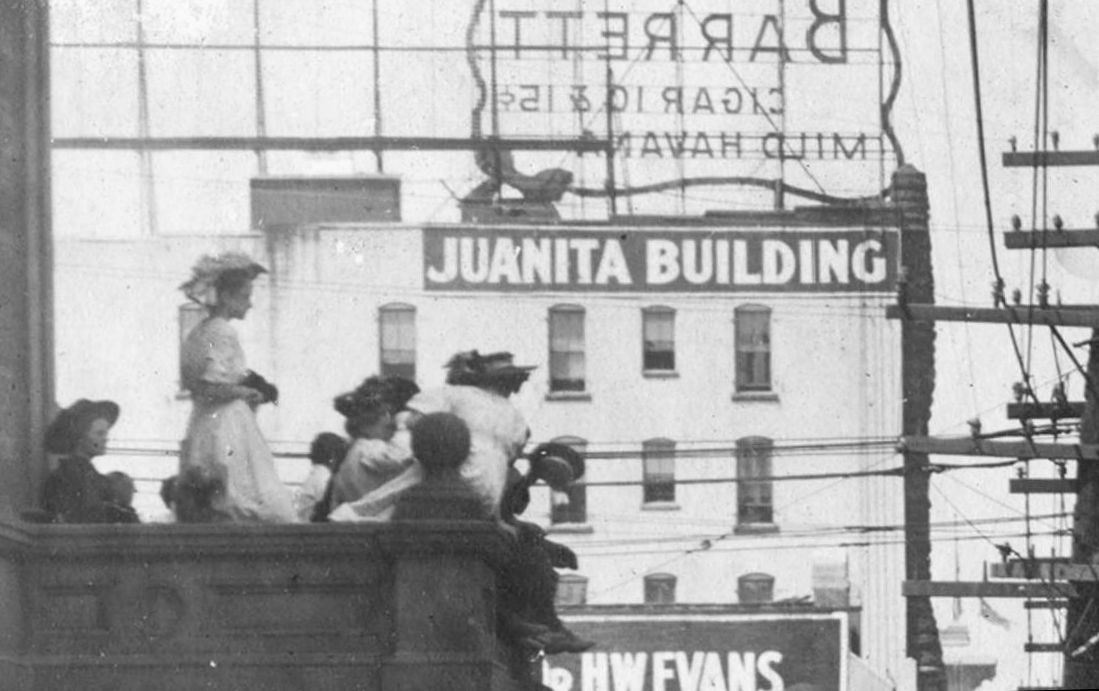
parade-day_1909_det1My favorite “vignette” from this photograph, with the Juanita Building in the background.

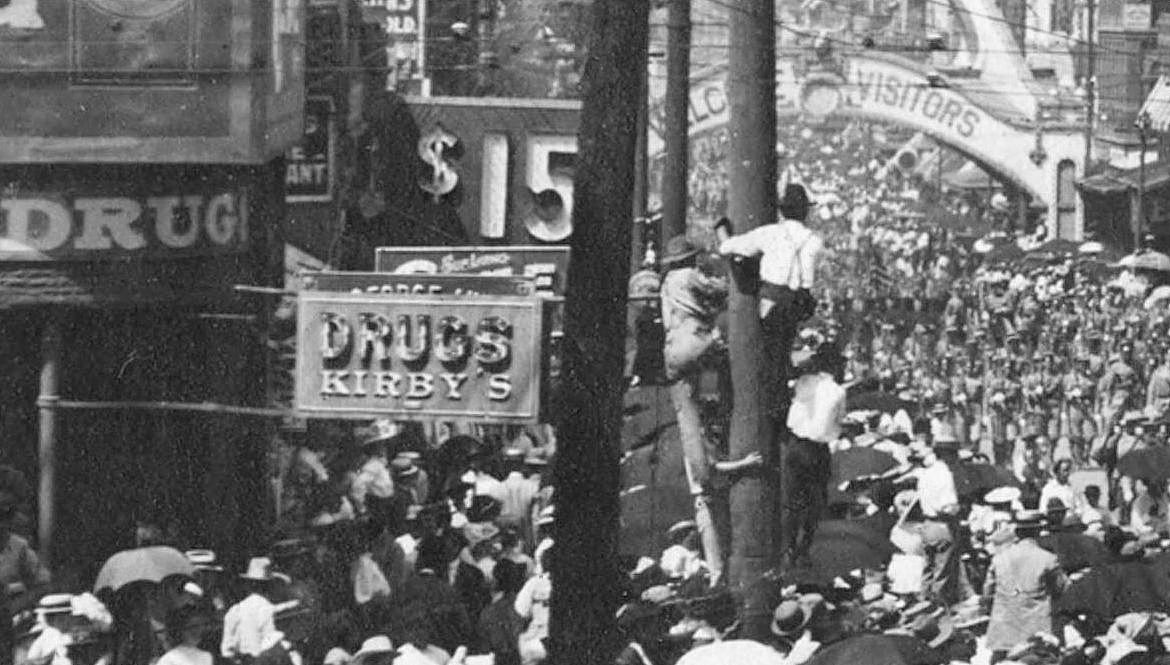
parade-day_1909_det2Dedicated parade-watchers. The Elk’s Arch welcoming visitors spans Main Street, a holdover from the 1908 Elk’s convention.

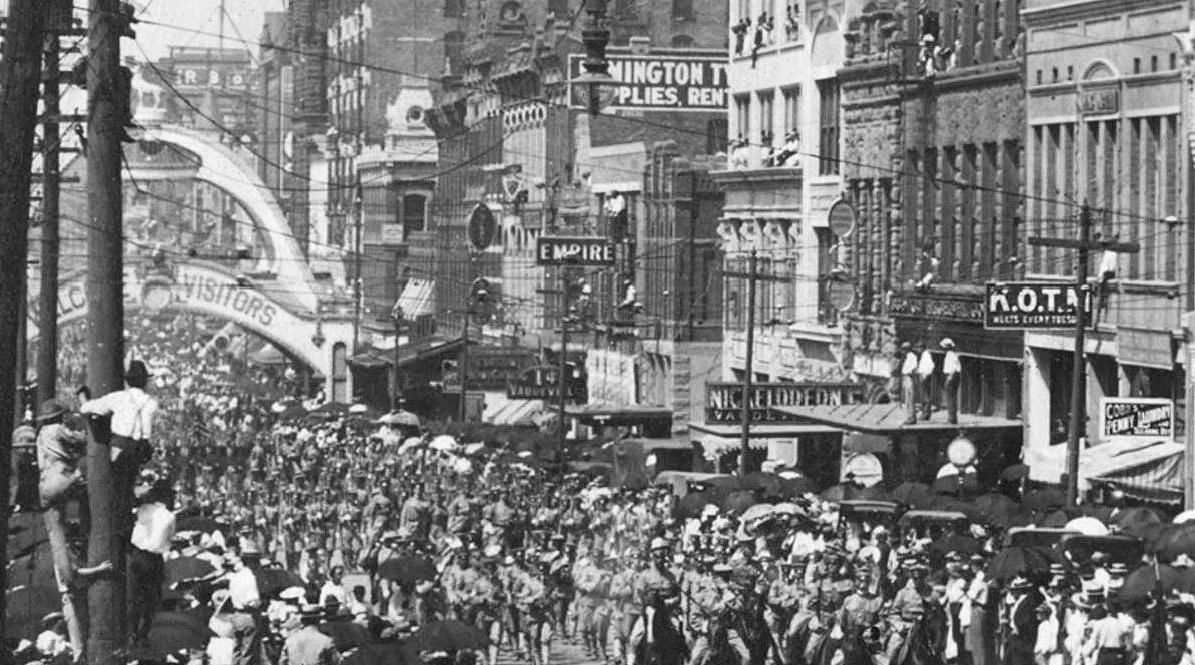
parade-day_1909_det3The dark-colored three-story building behind the three men in white shirts standing above the crowd (1611 Main) was demolished yesterday, Sept. 21, 2014. (A better view of the full building can be seen in the post “1611 Main Street — Another One Bites the Dust,” here.)

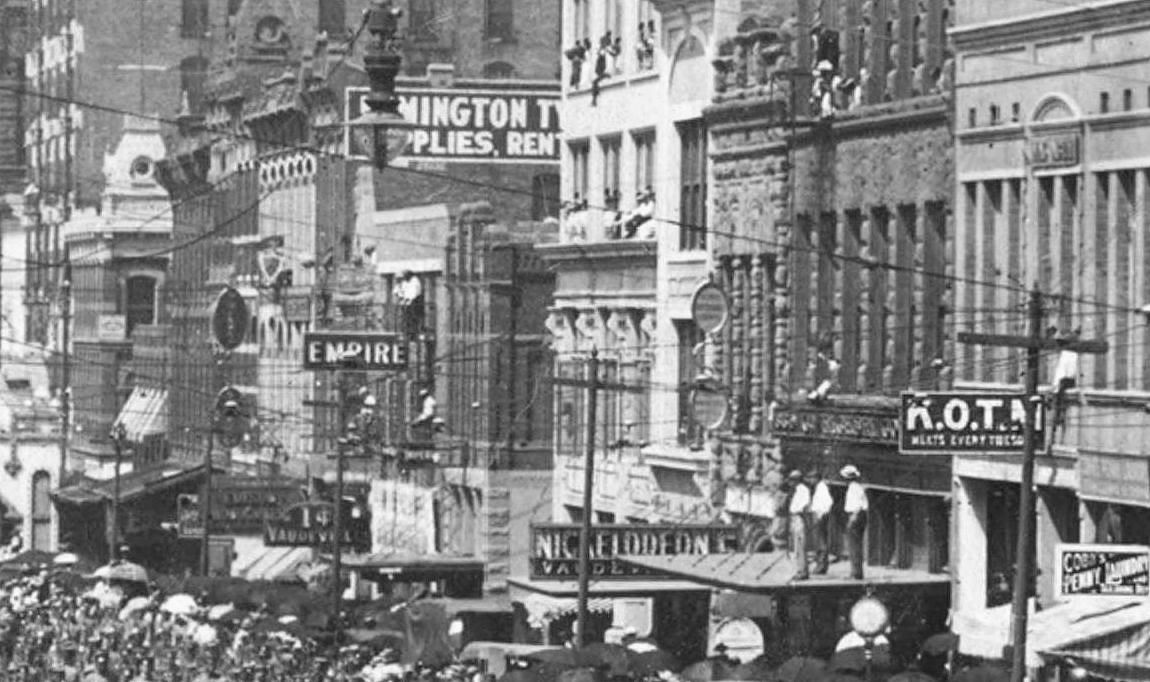
parade-day_1909_det4Note the vaudeville theaters.

parade-day_1909_det4aWorkers in the Wilson Building with a pretty great, unobstructed view.

parade-day_1909_det5When this photo was taken, Labor Day was fast approaching — that guy had two more weeks to wear those shoes.

parade-day_1909_det6Watching from shaded splendor.

parade-day_1909_det7Big hats, cinched waists, and African American bystanders.

***

Sources & Notes

Original photo by Clogenson, titled “Parade Day, Military Tournament, Dallas, Texas,” taken August 24, 1909; in the collection of the DeGolyer Library, Central University Libraries, Southern Methodist University. The photo can be viewed here.

Newspaper articles describing exactly who was involved in the parade and why it was happening can be read in the easily digestible report from the Fort Worth Star-Telegram, here, and the drier, more comprehensive report from The Dallas Morning News, here (each opens as a PDF). (This photo accompanied the DMN article.)

See other photos I’ve zoomed in on, here.

*

Copyright © 2014 Paula Bosse. All Rights Reserved.

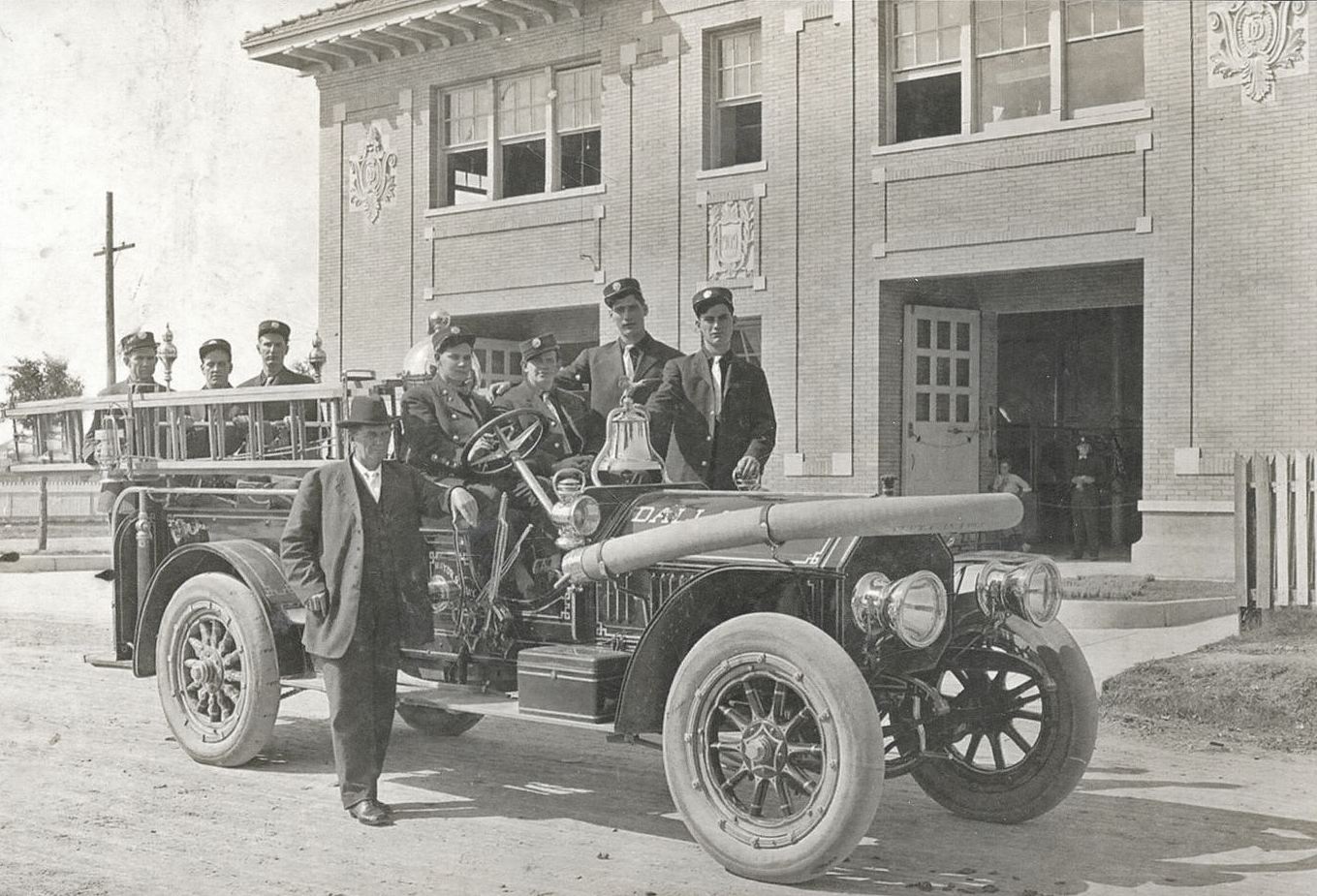
No. 4 Hook and Ladder Company, Oak Lawn — 1909

fire-dept_no-4-hook-company_ebay
Oak Lawn Fire Station

by Paula Bosse

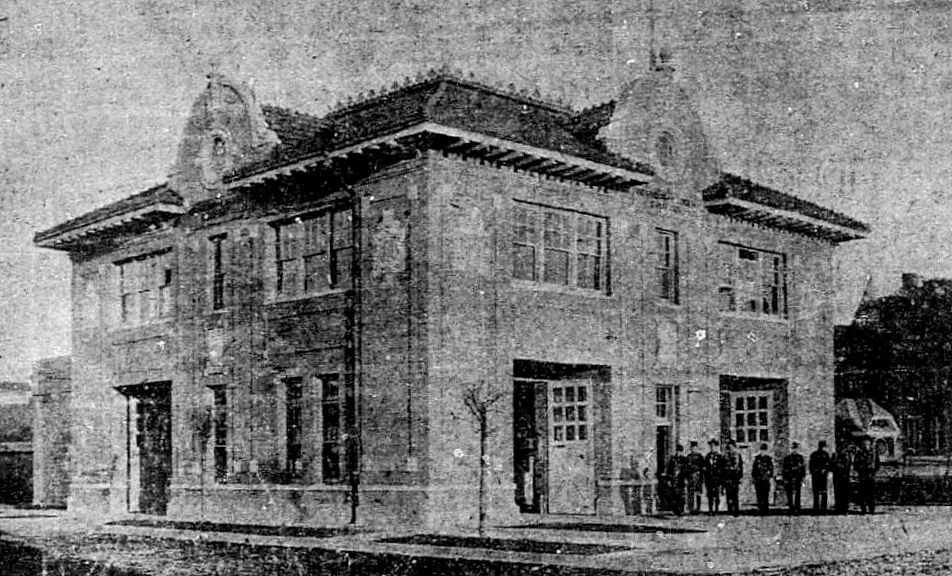
The photograph below appeared in The Dallas Morning News on December 5, 1909 under the headline, “Fire Station Lately Erected in the Oak Lawn District.”

fire-station_oak-lawn_clogenson_dmn_120509

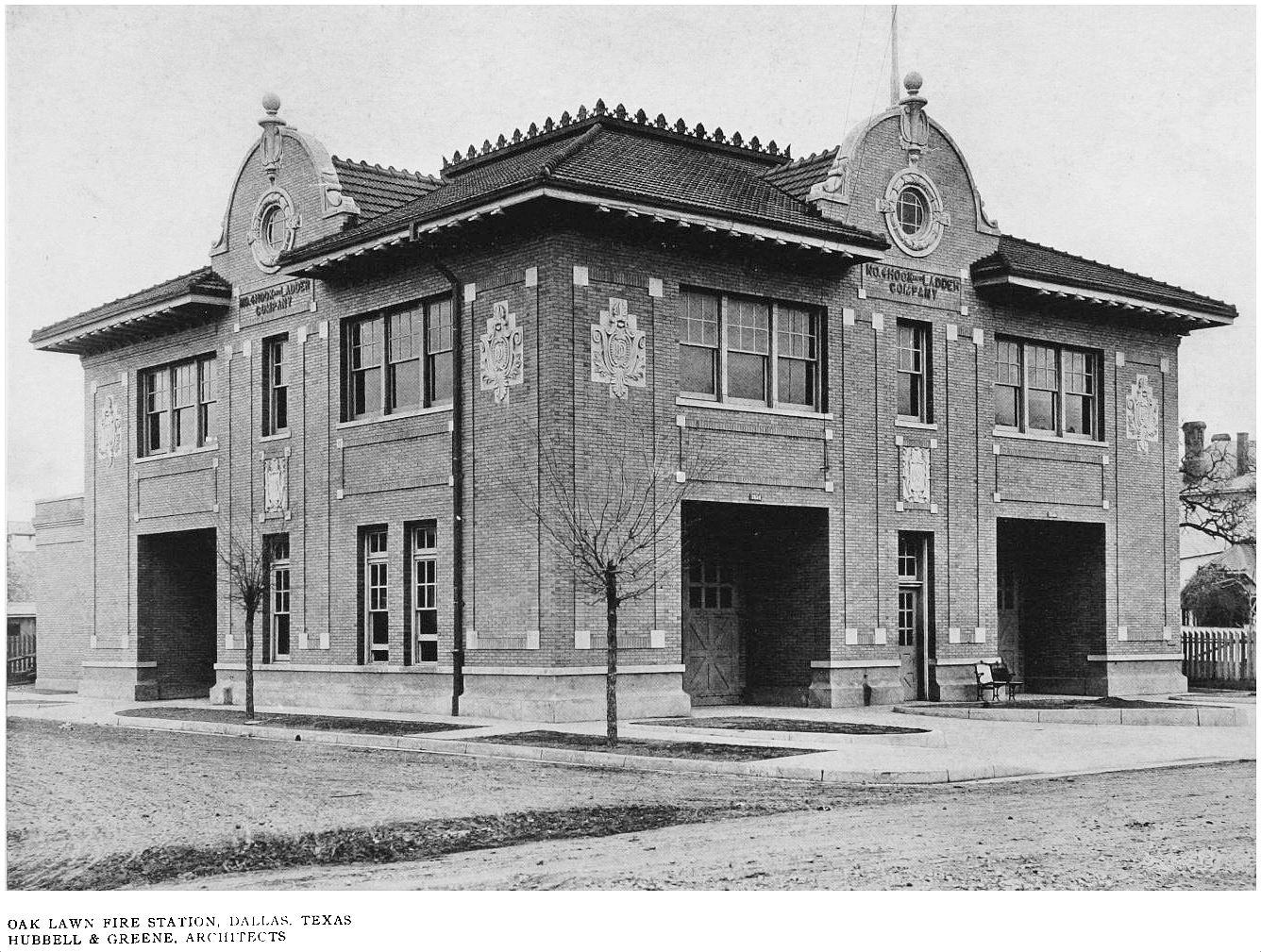
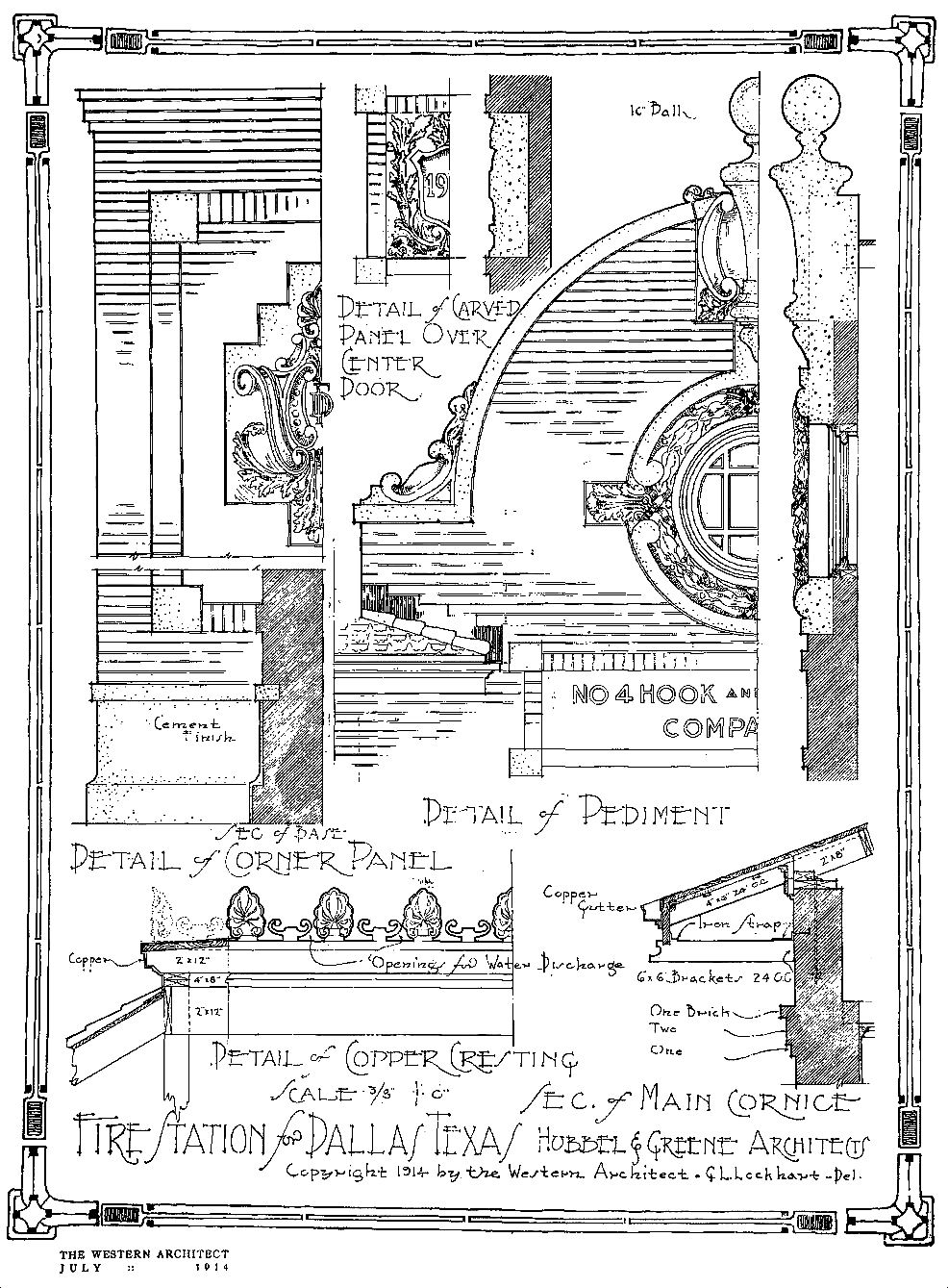
“Hook & Ladder Company No. 4” (now known as the more prosaic “Station No. 11”), was designed by noted architects Hubbell & Greene. It was built at Cedar Springs Road and Reagan Street in 1909 as the first “suburban” fire station in Dallas. Still a working firehouse, the Mission Revival building is a designated historic landmark and is listed in the National Register of Historic Places.

firehouse-oak-lawn_google

*

Below, a photo and architectural plan which appeared in the 1914 “Western Architect” journal (more about this here):

firehouse_oak-lawn_western-architect_july-1914

firehouse_oak-lawn_western-architect_july-1914_architectural-details_2

*

Another photo of the historic firehouse, from a 1931 publication, captioned “No. 11 Engine Co., Cedar Springs & Reagan”:

cedar-springs_fire-station_fire-dept-bk_1931_portal

***

Sources & Notes

Top photo found on eBay.

1909 Dallas Morning News photograph by Clogenson.

Color image of the station as it looks today from Google Street View.

Final photograph is from The Man in the Leather Helmet: A Souvenir Booklet of The Dallas Fire Department (1931), via the Portal to Texas History.

For more on the history of this historic fire station, see the page devoted to it on the Dallas Fire Rescue Department website, here. Also, see the City of Dallas Landmark Structures and Sites page here.

*

Copyright © 2014 Paula Bosse. All Rights Reserved.