Flashback : Dallas

A Miscellany: History, Ads, Pop Culture

Category: WFAA

Jimi Hendrix in Dallas, 4/20/69

jimi_WFAA_042069_SMU_aDoug, Mitch, Noel, and Jimi

by Paula Bosse

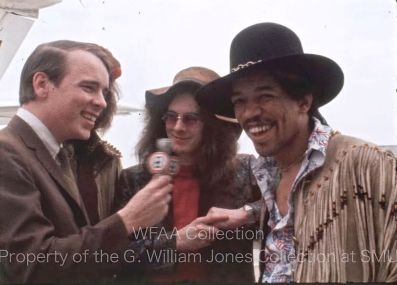
Today is 4/20 Day. An alternate (or parallel) way to celebrate the already alternative “holiday” is to mark the anniversary of one of Jimi Hendrix’s best interviews, on the Love Field tarmac on April 20, 1969, given to Dallas reporter Doug Terry (still a college student when he was at WFAA-Channel 8). The band was in Dallas for a show at Memorial Auditorium. It’s just a fantastic, laid-back, cool interview.

I had tried contacting Doug several years ago to let him know this clip was racking up the hits on YouTube, in case he wasn’t aware it was there, but I didn’t hear back from him until this week! He had seen the post I had written about this interview and wrote a bit about that momentous occasion in the email. He also adds some interesting behind-the-scenes tidbits I always find interesting (the following is used with Doug’s permission):

I was still a college student most of the time I worked at WFAA. I handed in my resignation after covering the north Texas pop festival in that same year. [Watch one of Doug’s reports from the Texas International Pop Festival here.] Your comment about being in a large city and its advantages was something that I did not fully grasp until years later. The access was wonderful, I saw Hendrix at least three times, on one occasion being in the dressing room with a camera when he warmed up for a show (that footage is nowhere to be found).

There are two aspects to mention about that interview. First, I was a weekend reporter and late night news anchor at Ch. 8 and I assigned myself to go interview him. In those days, one could call up the airlines when a notable person was coming in and they would give the flight number and arrival time. Amazing. Most of the people at the station at that time probably had no idea who Jimi was and wouldn’t have cared if they did know.

The other interesting point is the work of the photographer. Ordinarily, we did over the shoulder interviews, the camera to the back and side of the reporter. The fact that this was shot from the side made all the difference. As a shooter, he was not otherwise outstanding but this interview would be much less interesting if it had been shot in the traditional line-up sort of way. The two bandmates goofing around was distracting but great.

Thank you so much for getting in touch, Doug!

My original 2017 post about this interview (with the film clip of Jimi, Mitch Mitchell, and Noel Redding at Love Field) — which includes additional info about Jimi’s other performances in Dallas — is here: “Jimi Hendrix, Glen Campbell, Tiny Tim — In Dallas (…Separately), 1969.”

jimi_WFAA_042069_SMU_b

***

Sources & Notes

Screenshots from the WFAA Collection, G. WIlliam Jones Film and Video Collection, Hamon Arts Library, SMU.

Excerpt from Doug Terry’s email to me (April 16, 2024), used with permission.

jimi_WFAA_042069_SMU_a

*

Copyright © 2024 Paula Bosse. All Rights Reserved.

Some-Context Channel 8 Screenshots: 1971

lady mailman june 1971 WFAAWFAA Collection/Jones Film Collection/SMU

by Paula Bosse

I have been working as part of a 3-person team (led by Jeremy Spracklen and Scott Martin) on the WFAA archive of news film, housed in the G. William Jones Film and Video Collection at the Hamon Arts Library at SMU. I have been working on 1970 and 1971, going through daily footage shot for Channel 8 News. I get a bit bogged down by all the sports and car crashes, but at this point, I am so all-consumed by these two specific years that I feel I would do well on Jeopardy if the categories were things like “Minor League DFW Hockey Teams of the Early ’70s,” “Internecine Squabbles of the Dallas City Council, the Dallas School Board, and the Dallas County Commissioners Court,” and “So What’s the Deal with the Sharpstown Scandal?” My 2023 has been spent immersed in 1971, where the chaos of the implementation of court-ordered school busing, the huge securities fraud scandal that involved some very powerful Texas politicians (Sharpstown), and the battle between Craig Morton and Roger Staubach to become the Cowboys’ #1 quarterback were some of the stories that dominated the headlines. And, lordy, there were some pretty exotic hairstyles, fashions, and interior design trends hammering away relentlessly throughout this post-hippie (it might really still have been current-hippie), pre-disco period.

Here are a few of my favorite moments from this 1971 DFW-centric news footage from the WFAA archives. Links to the pertinent clips on YouTube are included at the end of the descriptions. These clips are rarely the full reports that would have been seen on the nightly news — they are often just silent footage or B-roll, without any identification of people or clues as to where they were filmed or even why they were newsworthy. It’s (mostly) a lot of fun to dig through and watch the unfolding of history from more than 50 years in the future.

**

Above, from JUNE 1971

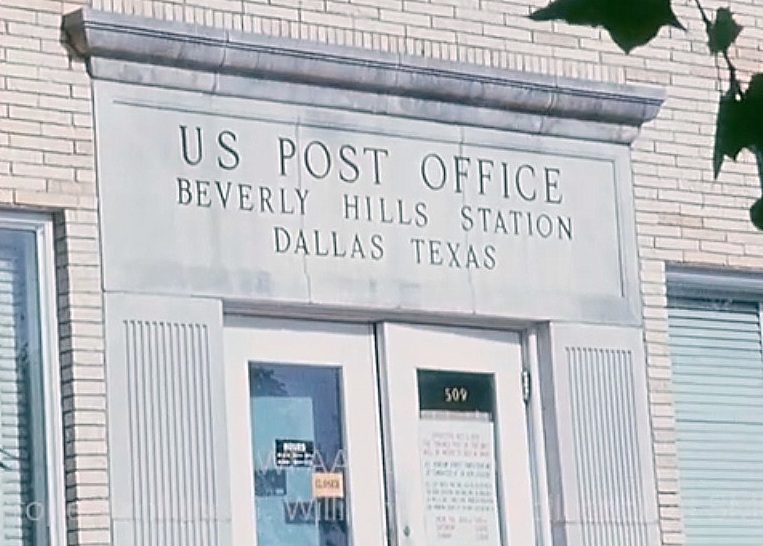
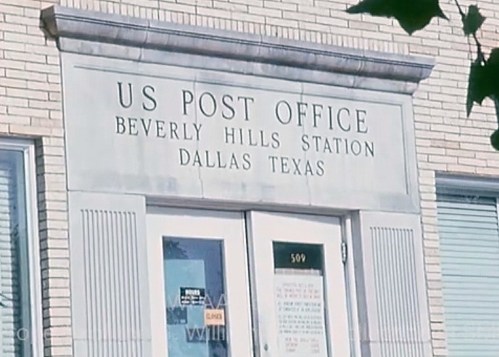
One of my favorite human-interest stories from the past year (meaning 1971!) was the profile of one of the few “lady mailmen” in Dallas at the time. She’s utterly, utterly charming, has a supportive and interesting husband and family, and loves her job. The Channel 8 cameraman shows her as she sorts her mail in the Beverly Hills Station post office in Oak Cliff and follows her as she walks along her route on West Davis. The only problem with this 7 minutes of interesting footage is that the woman is never identified. I dove in, really wanting to identify her. I thought I had cracked the mystery of her identity, only to find myself at a dead end again. If only her children could see this wonderful profile of their mother. If you know who this woman is, please let me know, and we’ll add her name to the YouTube description and try to track down any family members. I would LOVE her children to be able to see this.

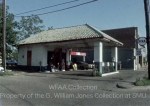
The “lady mailman” is interviewed here (this first bit is in three short segments, totaling 4 minutes); a later clip shows her on her route, here (about 3 minutes). The old post office building still stands at 509 N. Barnett.
lady mailman june 1971 WFAA_beverly hills post office

*

JANUARY 1971

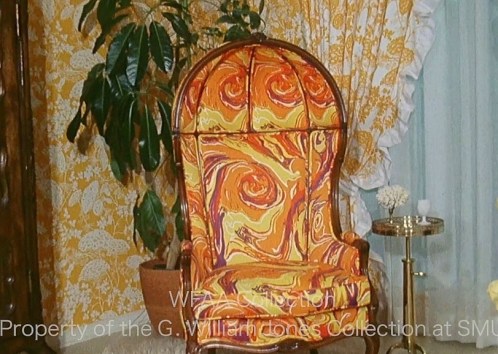
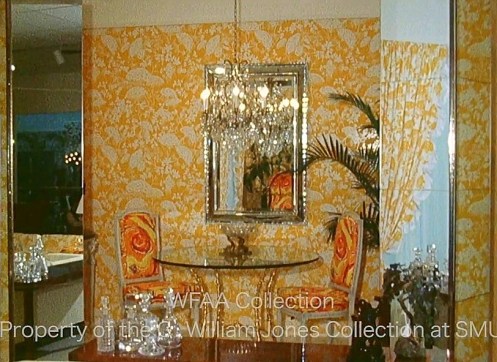
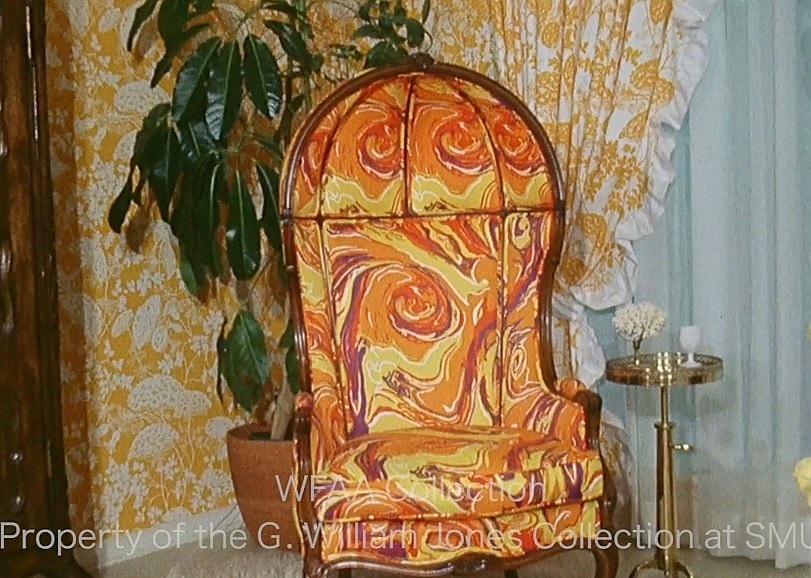
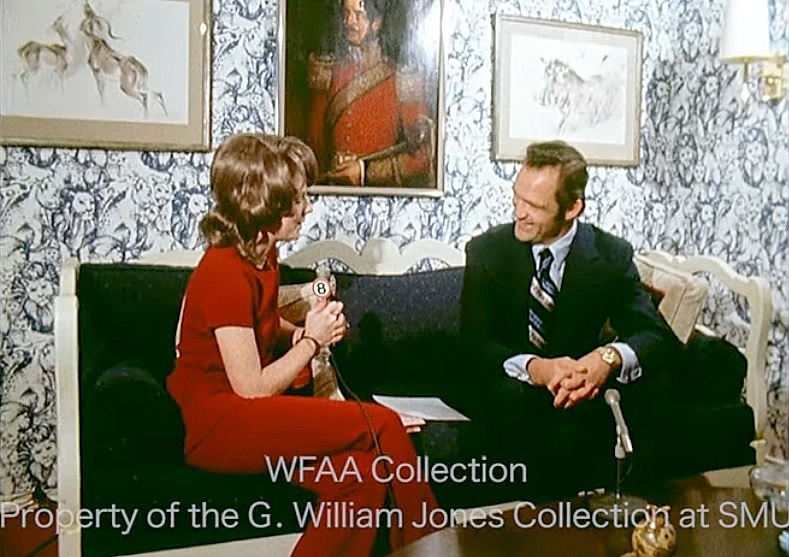
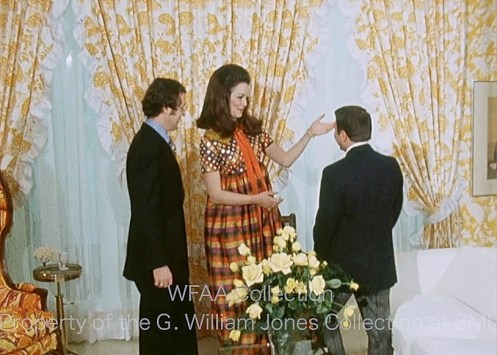
So, yeah, fashion and interior design trends were pretty… in-your-face in 1971. In the three screenshots below, you’ll see some retina-abusing images of with-it decor. The first features the always beautiful Phyllis George, the Denton native who was in the midst of her Miss America reign. In this clip, she has come back home to DFW for an appearance at an event in which a room designed with her in mind is unveiled (by decorators C. John Megna and William Farrington). She is wearing a dress designed by Carlo Bitetto specifically for her to wear IN THAT ROOM (!). You don’t often see sparkles and plaid cheek-by-jowl.

The clip with the super-color-saturated room and its battling patterns is here.
phyllis-george-room_jan-1971_c

phyllis-george-room_jan-1971_b

phyllis-george-room_jan-1971_a

*

FEBRUARY 25, 1971

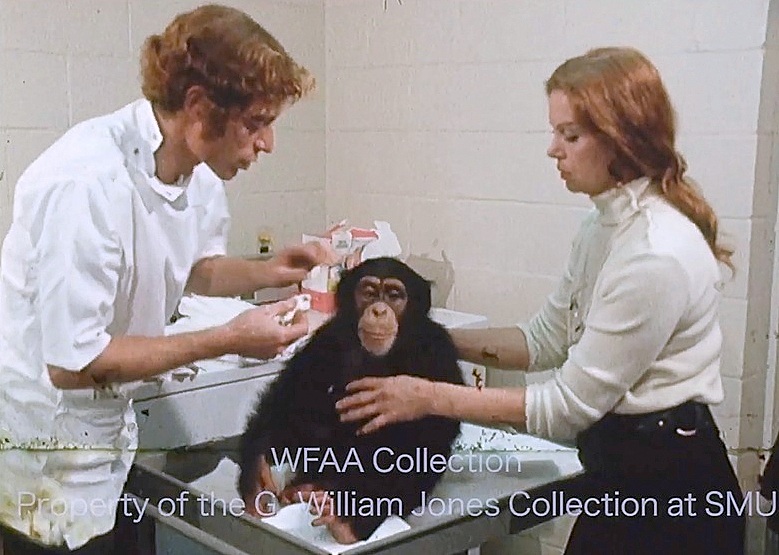
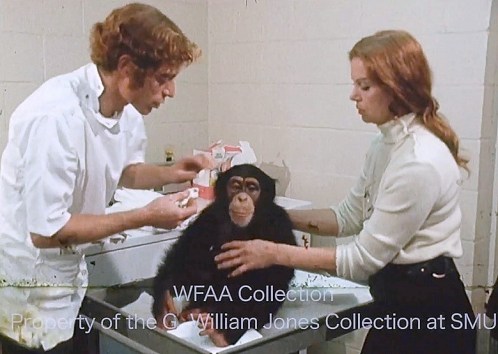
Before Lion Country Safari, Mesquite had World of Animals, a drive-thru safari park. World of Animals had a wild-animal veterinarian who visited regularly from California: Dr. Martin Dinnes. Below, Dinnes is seen providing dental care to popular attraction Harold the Chimp. This is not really something I expected to see, but there you are. (Dinnes was later engaged to actress and wildlife preservation activist Tippi Hedren for several years.)

The clips of Dinnes being interviewed and preparing Harold for a tooth extraction (and I grimaced a bit, because the camera keeps rolling during the procedure, so be warned!) are here and here. (The last clip has a shot of Harold’s hand, which, understandably, appears to be gripping the chair.) That is one well-behaved, chill chimp!
dinnes-martin_harold-chimp_022571_WFAA

*

MAY 18, 1971

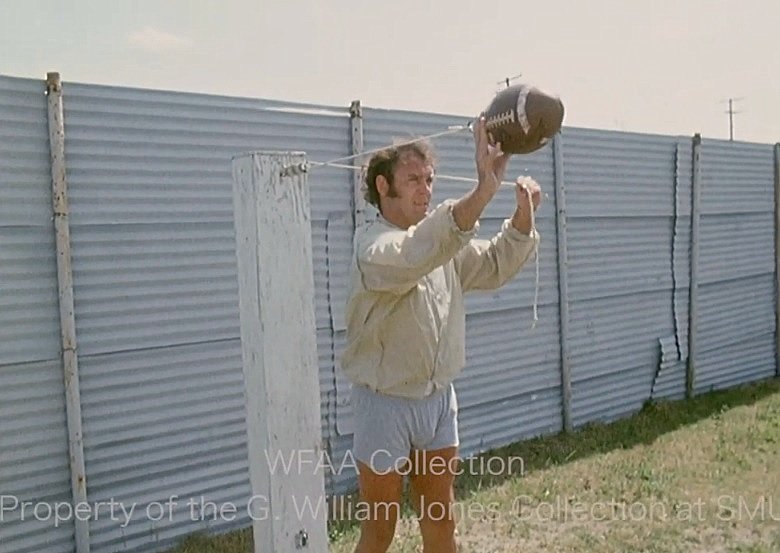
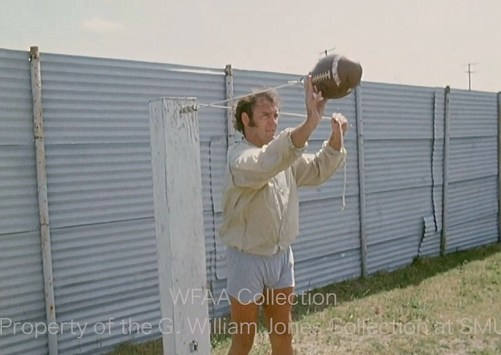
In 1971, there was an ongoing battle between old quarterback Craig Morton and NKOTB Roger Staubach over who would be named the team’s official starting QB. Coach Tom Landry worked for months with a two-quarterback system, alternating them from game to game — he was fine with this, but everyone else hated it. Below are screenshots of Morton and Staubach at the Cowboys practice field. I know virtually nothing about sports training, but this, um, extremely low-tech gadget struck me as weird. And funny. I mean, okay, it was 1971, but surely there was something more technologically advanced than this? It’s a football on a string, tied to a post. And maybe there’s a spring or something in there. This must have been effective. Rog looks like he’s straining. I don’t know. But I love it.

See Craig in an interview with Verne Lundquist from May 18, 1971 about his elbow and shoulder injuries here, and then using the football-on-a-string thing (and then training with Staubach) here; and see Roger interviewed on the same day about really, really wanting to be the starting QB here, and then he hits the string thing here before working out with Morton in what must have been a fairly tense period of both of their careers.
morton-string_WFAA_may-18-1971

staubach-string_WFAA_may-1971

*

JUNE 1971

Medical examiners used to be on the news a lot. One who popped up frequently was Tarrant County M.E. Dr. Feliks Gwozdz. I was amused more than I should have been when I saw the skull-and-crossbones coffee mug on his desk. I hope it said “World’s Greatest Coroner!” on the back.

The silent footage of Dr. Gwozdz at his desk is here.

skull-crossbones_feliks-gwozdz_june-1971

*

JULY 14, 1971

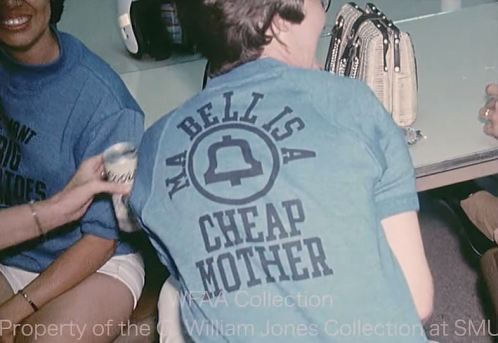
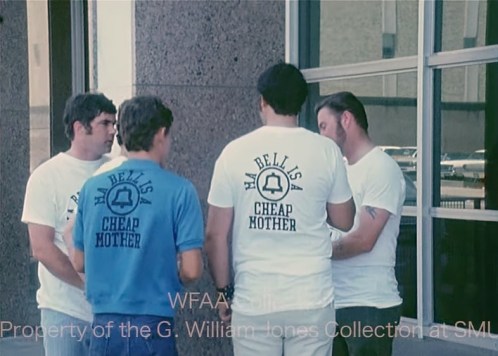
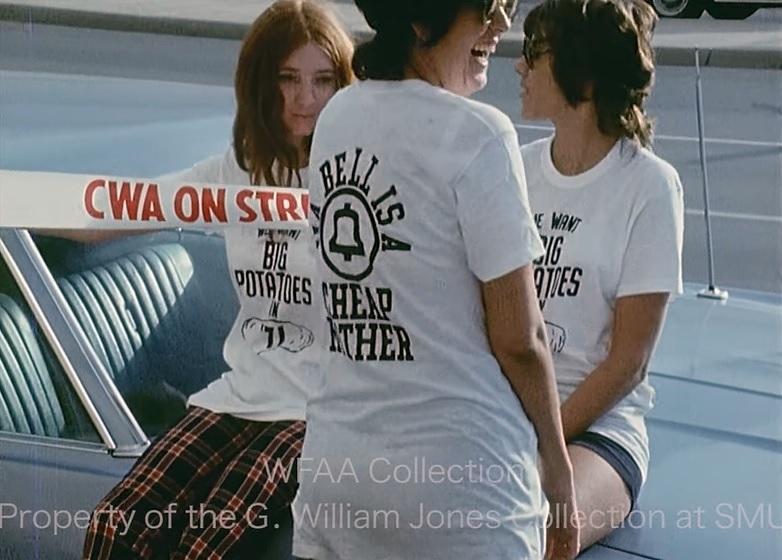
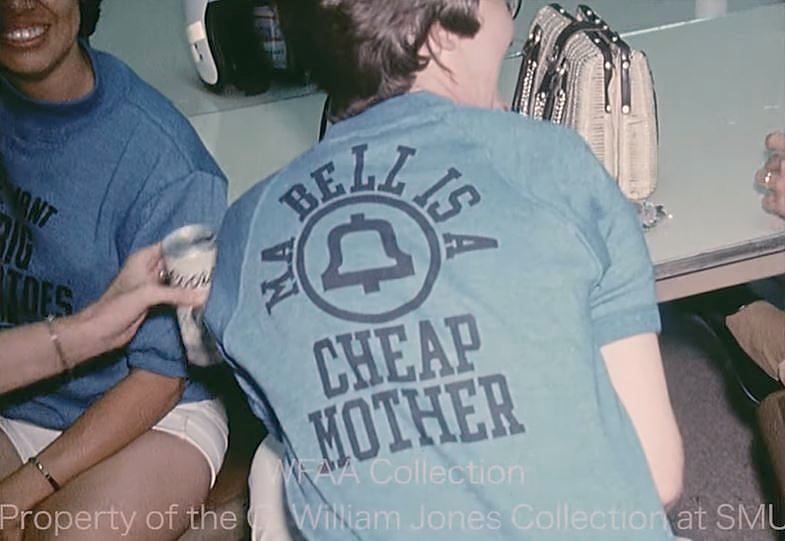
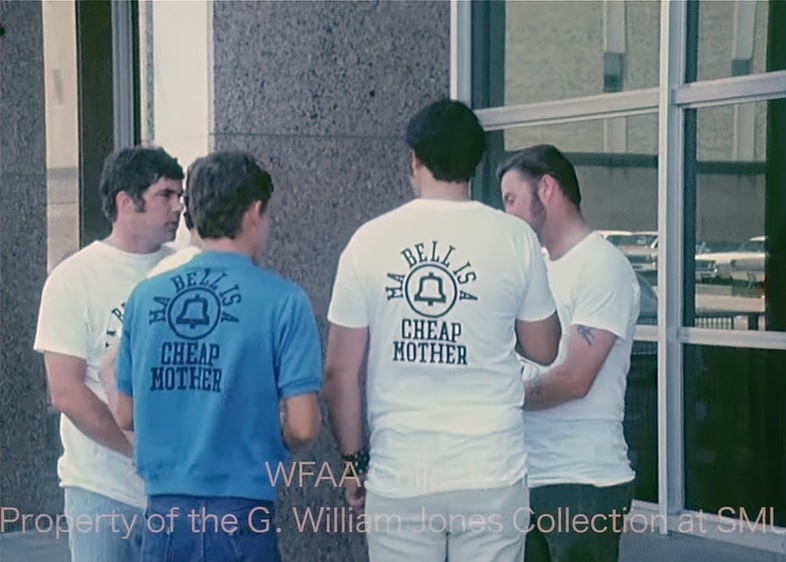
Back in 1971 there was what seemed like the threat of a union strike every 10 minutes. I enjoyed the footage of a bunch of Southwestern Bell employees who look like they were probably a lot of fun to hang out with. Their t-shirts read “Ma Bell Is a Cheap Mother,” which is just great.

Strike footage is here (about 2½ minutes) and here.

SWB-strike_july-14-1971_big potatoes

SWB-strike_july-14-1971_ma bell is a cheap mother

SWB-strike_july-14-1971_WFAA

*

JULY 1971

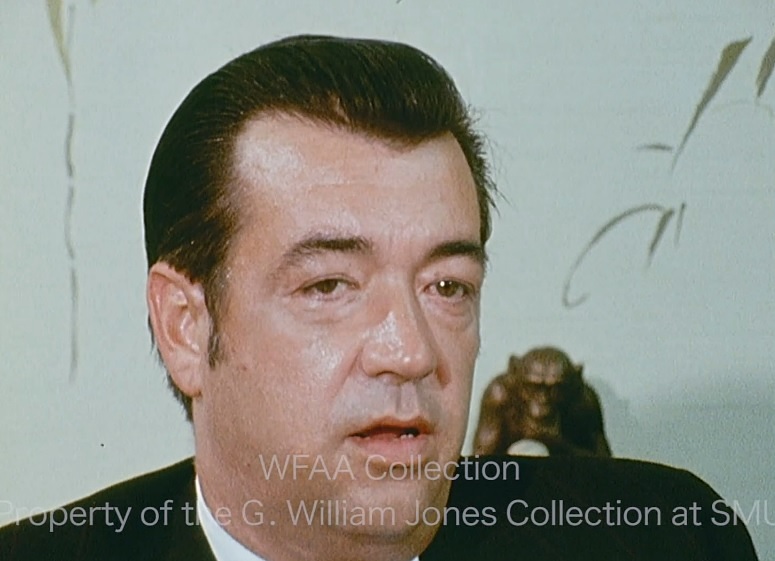
One of the top stories of 1971 was the endless furor set off by court-mandated school busing in attempts to desegregate schools. It was a mess. The man seen below is attorney Bill Brice, a leader of one of the many anti-busing groups. …Surely the cameraman noticed the monkey.

Man with monkey can be seen here.

anti-busing_bill-brice_monkey_WFAA_july-8-9-1971

*

AUGUST 29, 1971

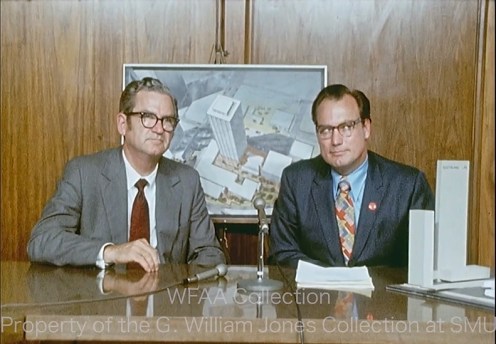
When the Dallas School Board and Supt. Nolan Estes weren’t pulling their hair out over desegregation, they tackled other issues. One of which was so overshadowed by anti-busing demonstrations that it barely got any play, but I find it really interesting. It concerned Crozier Tech High School downtown. At the end of the 1970-71 school year, the landmark school was closed, and there was lots of discussion on what the DISD should do with the building/land, which they owned (2218 Bryan). This press conference was supposed to be about Estes’ vision of a 40-story school-office complex, which he suggested be built on the land — the first 10 floors would be for school use, and the top 30 floors would be leased to businesses as office space, with leases, theoretically, paying for construction and maintenance of the building. The building was never built (and thankfully, old Tech still stands). School board president John Plath Green and Supt. Estes sit in front of an architectural drawing of the envisioned DISD skyscraper. Too bad no one wanted to talk about it.

Footage from the press conference where reporters only want to ask about busing, is here.
super-school_DISD_crozier-tech_DMN_082971_WFAA_SMU

*

SEPTEMBER 23, 1971

The Sharpstown Scandal was a bigger story than busing, but, even though political scandals are juicy, it just didn’t get everyday people mobilizing, marching in the streets, and shouting each other down in public forums the way busing did. But it was a massive story, and several political careers bit the dust because of it. The sprawling and confusing securities-fraud scandal mostly involved drab politicians and business executives. But one part of it involved, bizarrely, six celebrated — if not beloved — NASA astronauts and an insurance company pension fund.

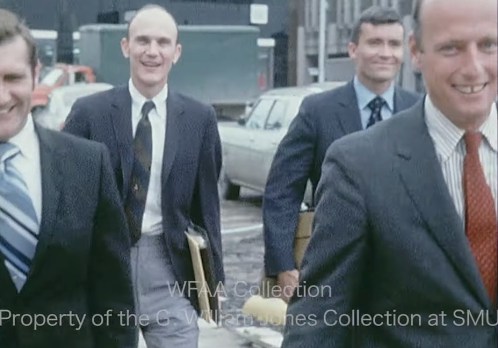
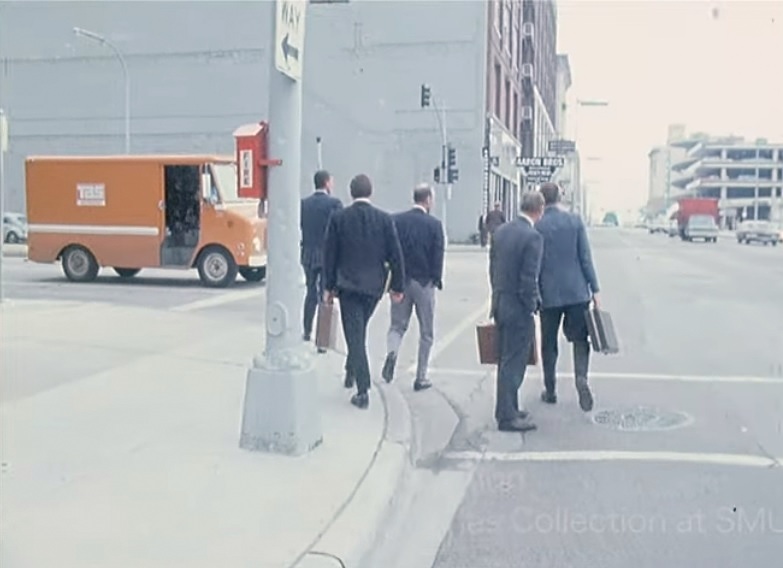
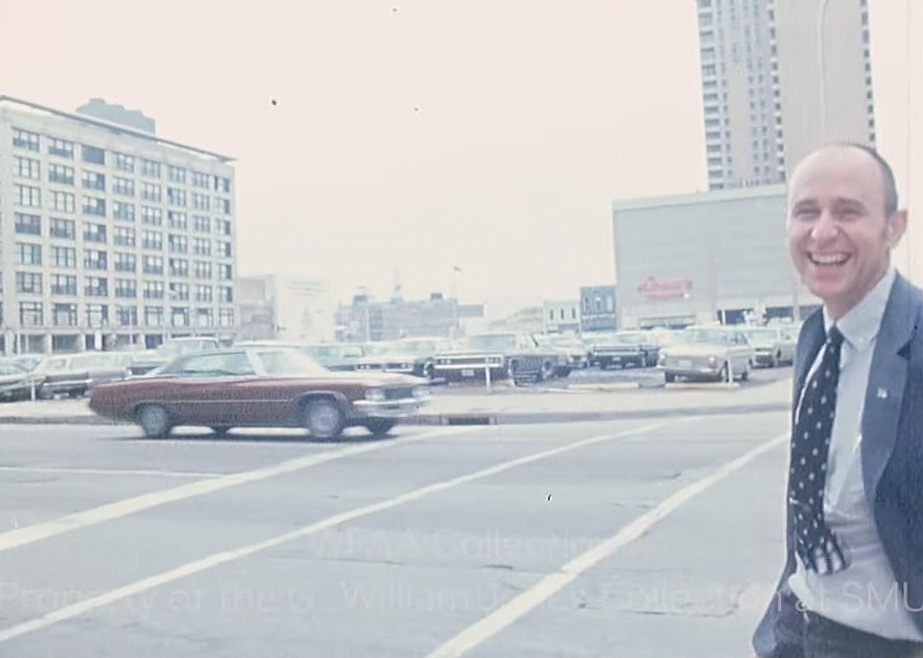
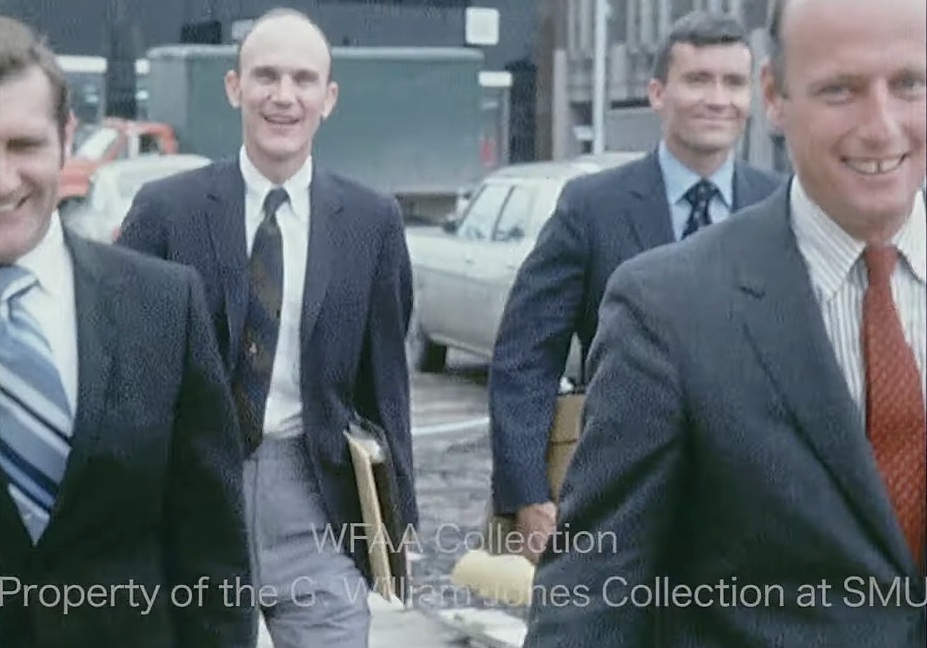
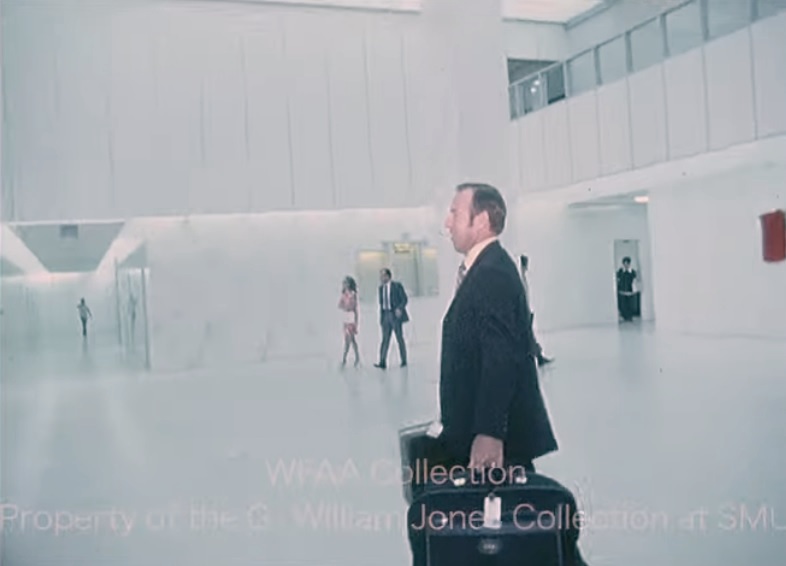
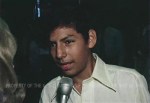
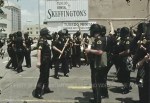
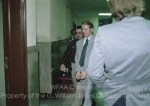
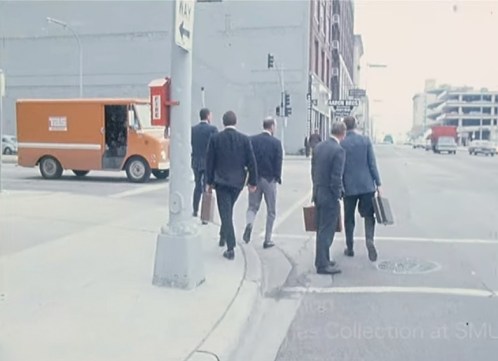
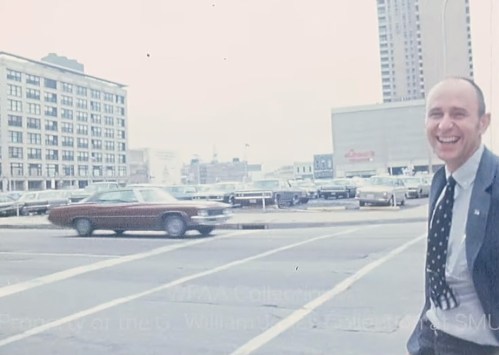
In this Channel 8 footage, you can see something you don’t see every day: five NASA astronauts walking together down the street (a sixth one was nearby, on his own). James Lovell, Pete Conrad, Fred Haise, Ken Mattingly, Richard Gordon, and Alan Bean were in Dallas on Sept. 23, 1971 to testify as witnesses before a federal grand jury that was investigating the activities surrounding the Sharpstown Scandal. These are screenshots of the five (minus Lovell), carrying briefcases through grubby downtown Dallas, and of Lovell on his own, exiting the Federal Court House. When I first watched this footage, it just seemed really odd: five internationally (galactically!) famous astronauts — heroes! — walking together down the street, without any kind of security or entourage. If you were a NASA freak (and there were a lot back then, at the height of the Apollo-Gemini programs) and you just happened to have walked past this group, your head would have exploded.

See Lovell exiting the sterile- and dystopian-looking courthouse on his own (that woman he holds the door open for has no idea who he is), and the others walking somewhat playfully down the street here (I love this footage!); a confusing wrap-up of the day’s events is here.
astronauts_WFAA_SMU_sept-23-1971

astronauts_WFAA_SMU_sept-23-1971_1

astronauts_WFAA_SMU_sept-23-1971_2

astronauts_WFAA_SMU_sept-23-1971_c

*

OCTOBER 14, 1971

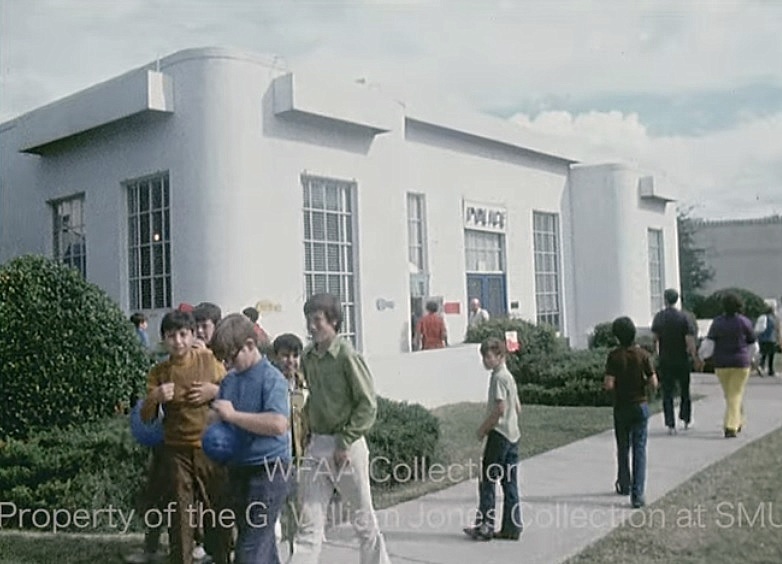
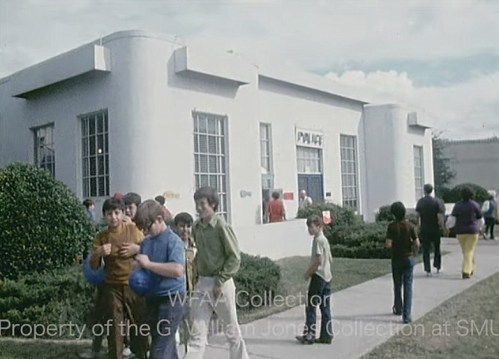
In footage from the State Fair of Texas, I was really taken by this building, which I swore I had never seen. It was the home of the “lost children” center during the fair, in the Dallas police HQ in Fair Park. It looks different to me now, but it’s still there, near the Aquarium. It looked better in 1971!

Lots of footage of crying children and harried parents, here and here.
fair-park_sfot_lost-kids_101471_WFAA_SMU

*

OCTOBER 1971

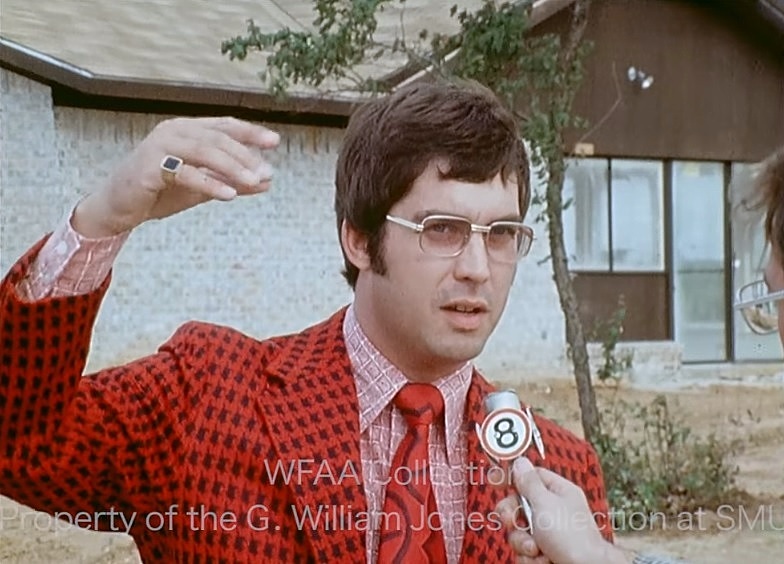
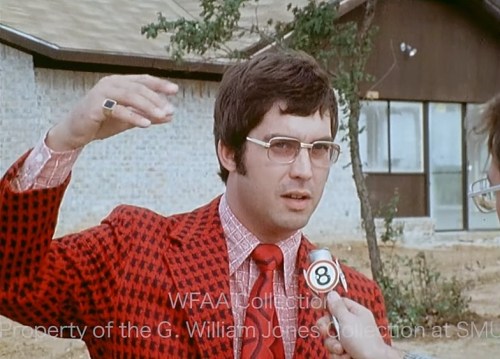
This young dandy is named John Ott (I’m not 100% sure about the spelling). He was a real estate developer in Euless. He couldn’t have been more on top of the 1971 fashion wave. Represent, Euless!

It’s a story about replanting trees (with, admittedly, interesting footage of trees being uprooted and replanted). Here and here.
developer_john-ott_euless_oct-29-30-1971_WFAA_SMU

*

OCTOBER 31, 1971

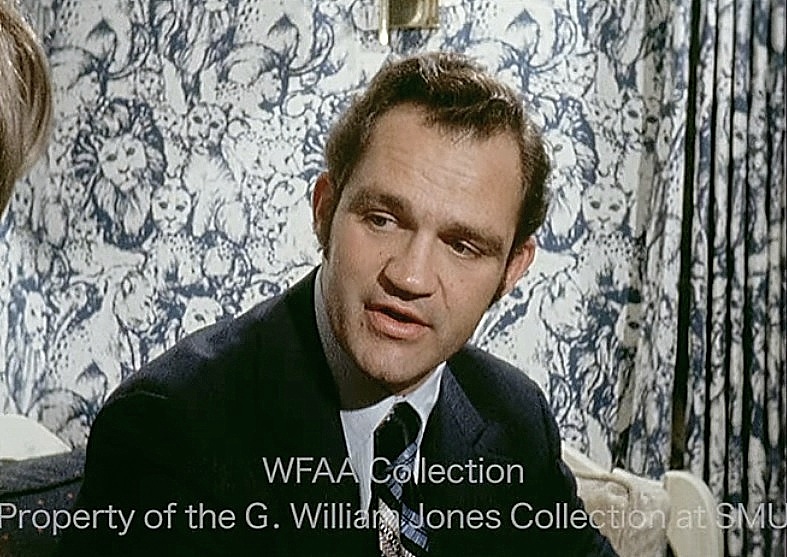
In the screenshots below, Channel 8 reporter Judi Hanna (who had recently debuted an unfortunate hairdo) interviews Dallas City Councilman Garry Weber about City Council things. I don’t know where this was filmed, but I only hope it wasn’t his home. It’s hard to focus on what anyone is saying, because of the tidal wave of stuff coming at you. (Ironically, he was being interviewed about sponsoring a change to the city charter in order to crack down on the “visual pollution” of unenforced sign ordinances.) I was so overwhelmed by this vista, that I somehow assumed I was seeing cupid-studded wallpaper. But no. Check out the second screenshot, which also includes a peek at the room’s drapes. I can’t tell where the wallpaper ends and the drapes begin.

Appropriately shown on Halloween night, clips from this report are here (followed by footage of signs-galore along Lemmon Avenue) and here.

weber-garry_WFAA_SMU_oct-31-1971_wide

weber-garry_WFAA_SMU_oct-31-1971_drapes

*

OCTOBER 1971

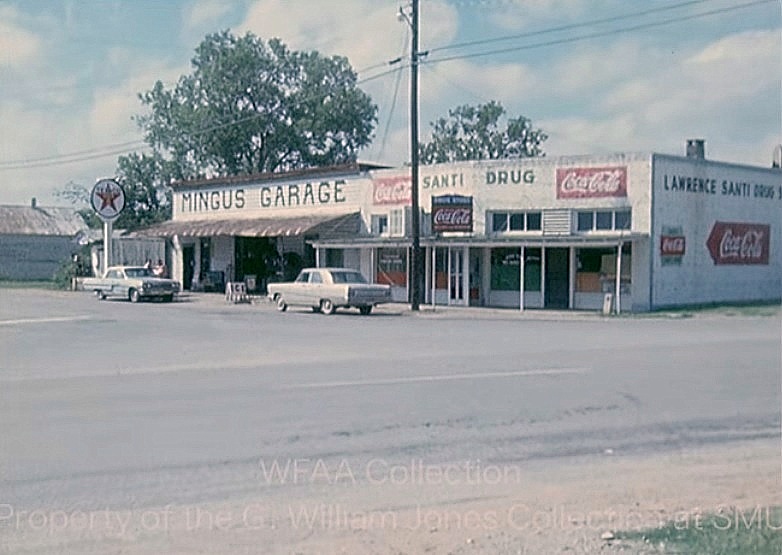
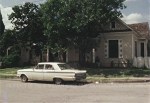
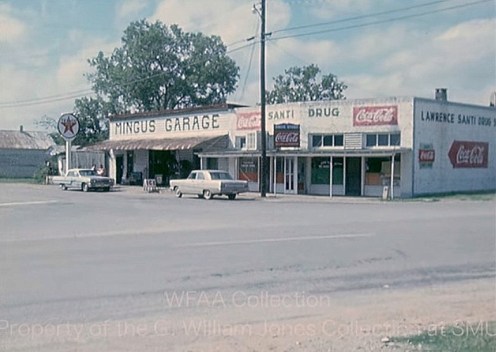
Lastly, a shot of Mingus, Texas, a small West Texas town near Thurber. I just love this image. I think I found the location — here’s what it looks like now.

Why was the tiny town of MIngus being featured on a Dallas news report? The Greater Mingus-Thurber Metropolitan Area was in the news because it was the location of a commune of the controversial Children of God (i.e. “cult”). Actually, the “Children” were in the process of being evicted by the landowner, who, interestingly, was a TV preacher in Los Angeles (I guess even TV evangelists have a breaking point). Members of this group splintered, and a few moved to Big D for a while, where they continued to be newsworthy until they moved elsewhere.

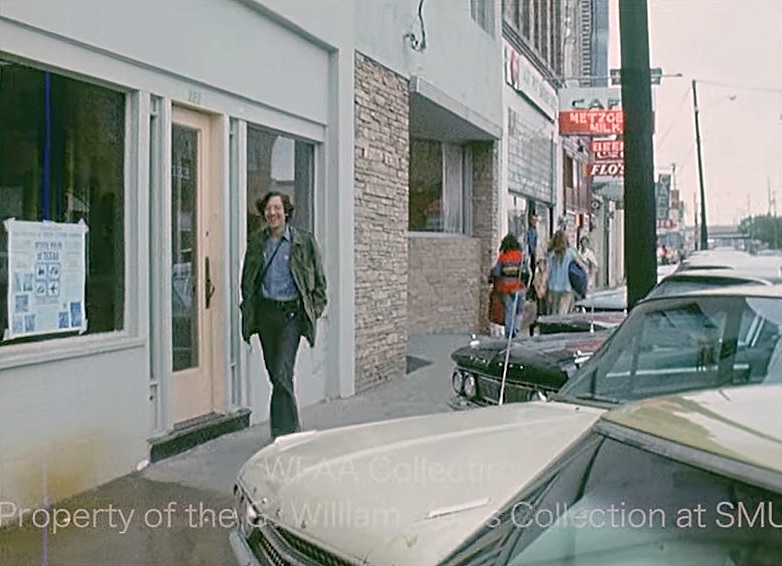
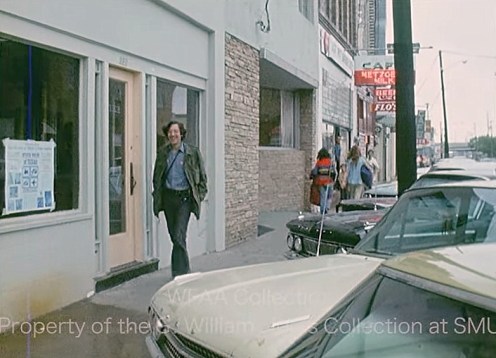
The shot of Mingus is from one of the many clips contained in this Oct. 7 package, here (it is specifically at the 1:08 mark). Below that is a shot from a week later, after some of the self-described “Jesus Freaks” had landed in Dallas — a group member is seen walking through Exposition Park to their new HQ, at 639½ Exposition — it and other CoG footage from Oct. 14, 1971 is here (this specific shot is seen at the 17:18 mark). (If you are considering a documentary on the Children of God, there’s lots of footage for you in the WFAA archives at SMU.)
mingus_WFAA_SMU_100771

children-of-god_expo-park_WFAA_SMU_oct-14-1971

*

AUGUST 1971

This is a bonus.

As I worked my way through 1971, there was one truly amazing story. It involved the kidnapping of a toddler in Fort Worth. On Aug. 25, 1971, 21-month-old Melissa Suzanne Highsmith disappeared. Her 22-year-old mother, Alta, had hired a new babysitter, who was supposed to watch her for the day while Alta was at work. The babysitter picked Melissa up in the morning as planned, but she never returned the child. The babysitter and Melissa disappeared without a trace. There were no leads in the case for years. …And YEARS.

In 2022, the Highsmith family learned of an online DNA match, which would indicate they had found Melissa. Eventually, it was determined that a 50-something-year-old woman named “Melanie” was actually the long-missing Melissa. The woman who kidnapped her raised her as her own daughter, and Melissa never suspected she wasn’t the woman’s child (although she says she never felt really “connected” to her).

Melissa (she now uses “Melissa” again) was reunited with her family at the end of 2022. One report I read said that she grew up only 10 minutes from the Fort Worth apartment her mother lived in. Despite the Highsmith family’s 51 years of loss, grief, worry, and suffering, there has ultimately been a happy ending!

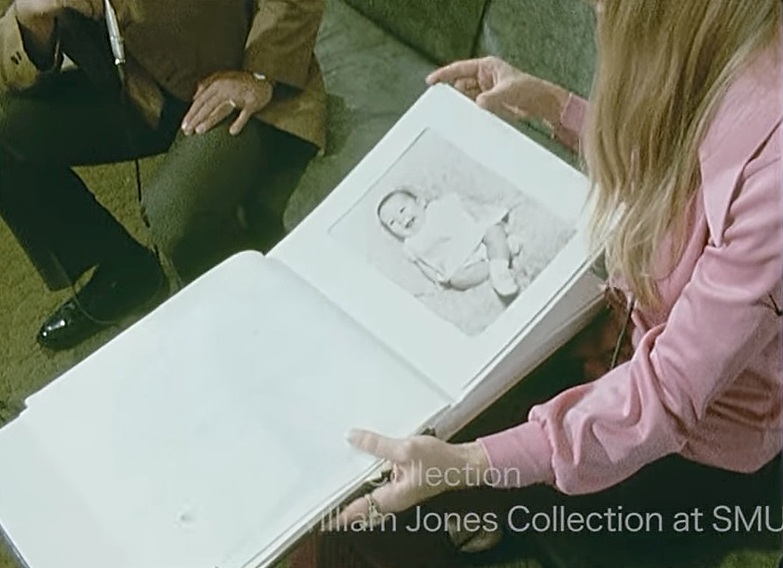
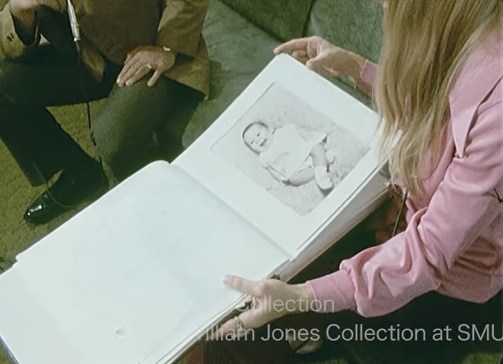
In the screenshot below from an Aug. 26, 1971 Channel 8 story, Alta Highsmith shows a photo of her missing daughter to the camera. The report is here.
kidnapping_highsmith_WFAA_SMU_aug-26-1971

**

If you managed to get all the way through this, you deserve an award! This might be the longest thing I’ve written all year! I’m more than ready for my 1971 Jeopardy challenge (Dallas edition)!

***

Sources & Notes

All screenshots are from news film in the WFAA Collection, held by the G. William Jones Film & Video Collection, Hamon Arts Library, SMU. Clips are posted regularly from this Channel 8 collection on YouTube, here.

My previous collection of WFAA screenshots can be found in the post “No-Context Channel 8 Screenshots: 1970-1971.”

lady mailman june 1971 WFAA_sm

*

Copyright © 2023 Paula Bosse. All Rights Reserved.

Uncle Scooter Reads the Funnies: 1940-41

radio_uncle-scooter_wfaa-wbap-kgko-combined-family-album_1941Little Man and Uncle Scooter…

by Paula Bosse

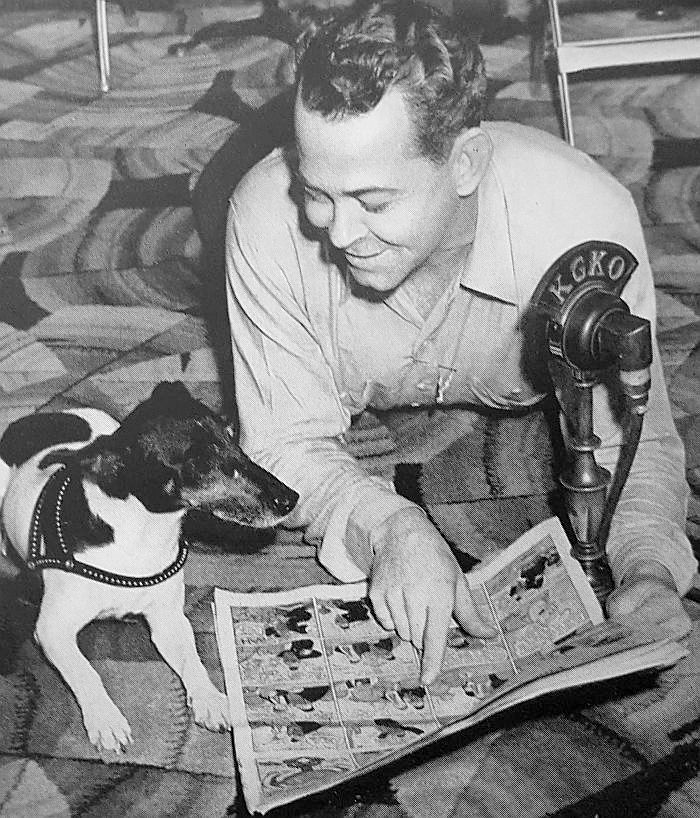
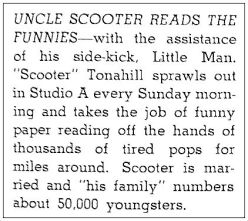
Several years ago, I was flipping through a promotional booklet for radio stations WFAA, WBAP, and KGKO, and I came across the photo above. I think about this photo a lot. It shows radio personality “Uncle Scooter” lying on the floor next to a KGKO microphone, reading the comics over the air to a vast audience of children and pointing out something pertinent to his trusty companion, a fox terrier named Little Man. I love this photograph. It makes me smile every time I see it. Wouldn’t it be great if this was how he actually conducted his broadcasts — on the floor with his doggie next to him? Here’s the caption:

uncle-scooter_dog_wfaa-wbap-kgko-combined-family-album_1941_caption

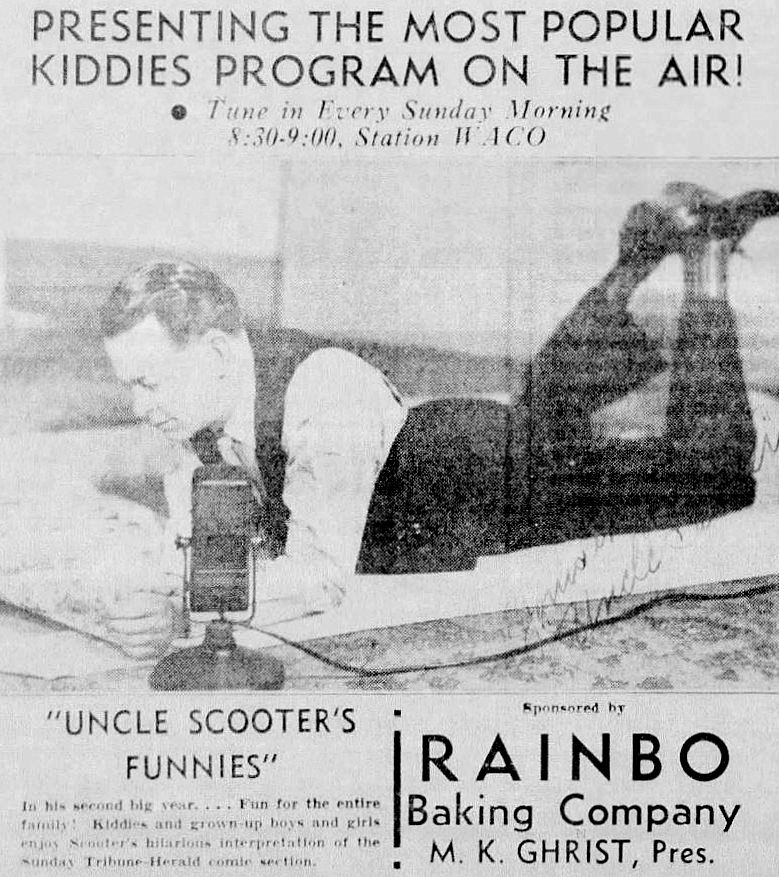
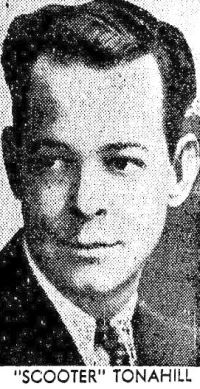
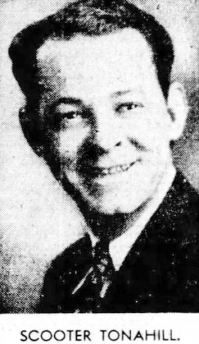
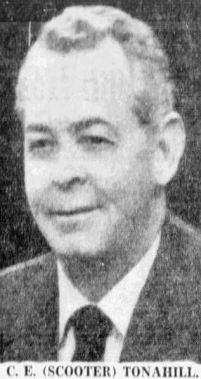
Clarence E. Tonahill (1904-1954) — known to everyone as “Scooter” — appears to have begun his radio career in Waco at the appropriately named station WACO. He then worked at KGKB in Tyler, then returned for a few years to WACO, and then to KTSA in San Antonio. Like most people in broadcasting in those days, he did a little bit of everything: he was an announcer, a newsreader, a sportscaster, and an entertainer. One of his most popular shows was just him reading the Sunday comics over the air for children. Below, a WACO ad from 1937 showing Uncle Scooter, again, lying on the studio floor (no dog, though).

uncle-scooter_waco-tribune-herald_010337Waco Tribune-Herald, Jan. 3, 1937

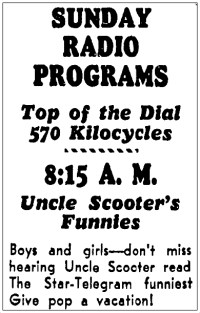
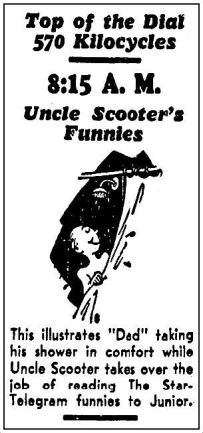
Around September 1939, he moved to Fort Worth to begin a busy stint at KGKO, a DFW station co-owned by The Dallas Morning News and The Fort Worth Star-Telegram (this was part of the very unusual WFAA-WBAP radio broadcasting partnership). He started as an “announcer” (which might well have included cleaning up the studio!), but he quickly graduated to doing a lot of sports-announcing and color commentary (football and boxing), man-on-the-street interviews, and personal appearances. He also hosted several shows, including a weekday morning show called “Sunrise Frolic.” But Sundays… Sunday mornings were set aside for his funnies-reading.

1940_radio_uncle-scooter_FWST_090840Fort Worth Star-Telegram, Sept. 1940

1940_radio_uncle-scooter_FWST_091540FWST, Sept. 1940

1941_radio_uncle-scooter_FWST_031641FWST, March 1941

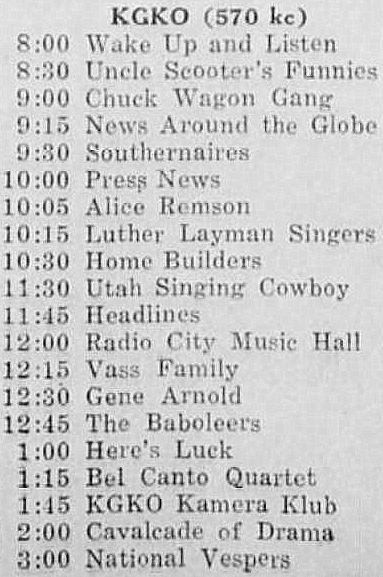
The Sunday lineup on KGKO, before and after the funnies:

1940_radio_uncle-scooter_bryan-tx-eagle_121440Bryan Eagle, Dec. 1940

I see listings for the show in 1940 and 1941 — and then, briefly, in 1947. His obituary says that Tonahill retired from his career as a broadcasting personality in 1946 and opened his own business in Fort Worth, Scooter’s Radio Supply (a supplier of broadcasting equipment to stations around the country).

He must have been a bright, friendly voice on the radio. I’d love to know the role Little Man played (Little Man was Scooter’s real-life pet and was described in a magazine profile as Scooter’s “favorite hobby”). I have fond (if somewhat vague) memories from my childhood of Bill Kelley reading the comics on The Children’s Hour on Channel 5 — but I can say without hesitation that things on The Children’s Hour would have been a whole lot more interesting if he’d just had a cute little dog with him!

1940_scooter-tonahill_FWST_042040_kgko-ad_det_photo1940_scooter-tonahill_FWST_100940_kgko-ad_det_photo1940

1954_tonahill-clarence-e_FWST_072654_obit_photo1954

kgko_19391939

***

Sources & Notes

Top photo from “WFAA, WBAP, KGKO Combined Family Album” (Dallas-Fort Worth, 1941).

radio_uncle-scooter_wfaa-wbap-kgko-combined-family-album_1941_sm

*

Copyright © 2023 Paula Bosse. All Rights Reserved.

Wes Wise, Dallas Texans, WFAA — 1961

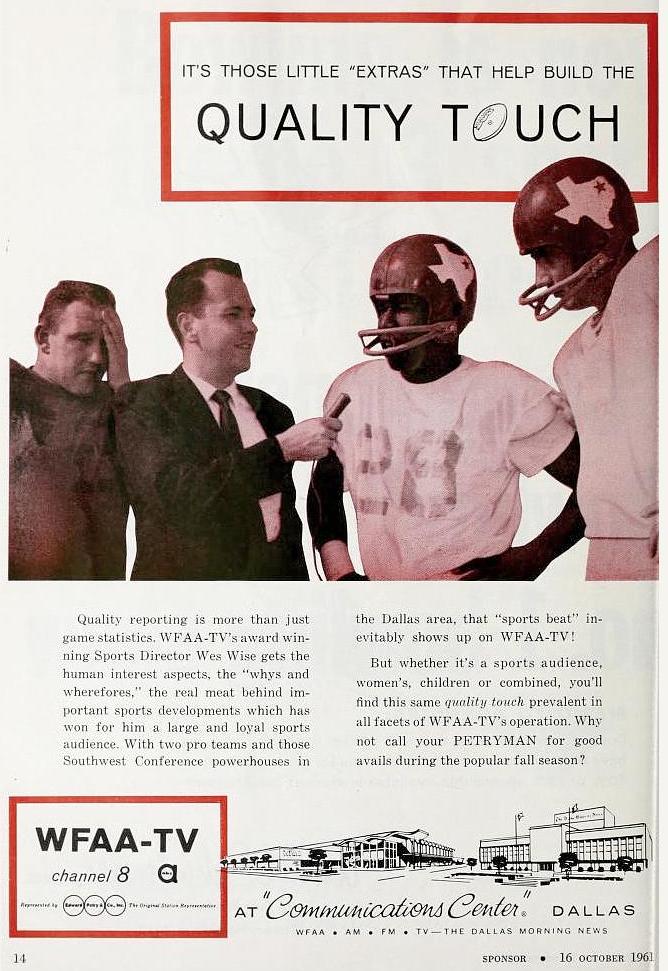
wfaa_sports_sponsor-mag_101661_detA future mayor interviewing future Kansas City Chiefs 

by Paula Bosse

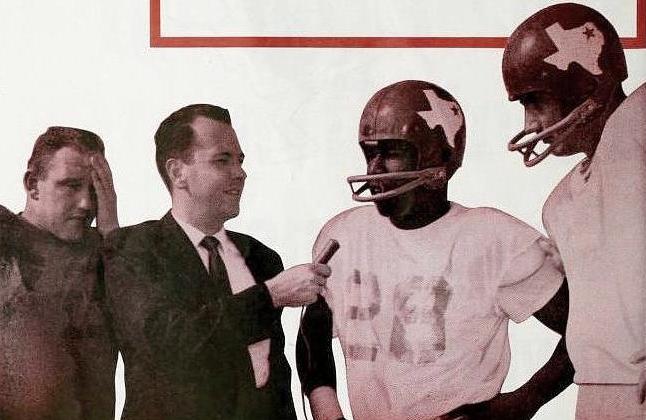
The photo above shows future Dallas mayor Wes Wise in 1961 (when he was sports director for WFAA-Channel 8) interviewing players of the Dallas Texans. Wes Wise served as Mayor of Dallas for three terms, from 1971 to 1976. The (second iteration of the) Dallas Texans played in the AFL from 1960 to 1962 until owner Lamar Hunt relocated them to Kansas City where they became the Kansas City Chiefs. (Read about the first, sad, Dallas Texans in the post “The 1952 Dallas Texans: Definitely NOT America’s Team.”)

Below is the full ad. (Click for larger image.)

wfaa_sports_sponsor-mag_101661

***

Sources & Notes

Ad from Sponsor, “the weekly magazine Radio/TV advertisers use” (Oct. 16, 1961).

wfaa_sports_sponsor-mag_101661_det_sm

*

Copyright © 2021 Paula Bosse. All Rights Reserved.

The JFK Assassination and Television Firsts — 1963

JFK_ruby-oswald_broadcasting-mag_120263_nbc-screenshot
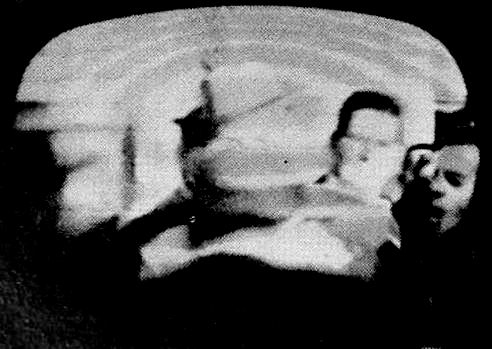
Ruby shooting Oswald on live TV

by Paula Bosse

The assassination of President John F. Kennedy was not only one of the most sobering moments in American history, it was also a turning point for broadcast journalism, particularly in the way television covers breaking news.

The Kennedy assassination and the later captured-live-on-television shooting of Lee Harvey Oswald by Jack Ruby put broadcast journalists to the test as never before. News coverage was a solid days-long block — with NBC devoting almost 72 straight hours to the assassination and its aftermath. The immediacy of live television and the ability to learn of breaking-at-this-minute news was something that had never been experienced by Americans before — and something which pushed radio and television news reporting to new heights. It was reported that CBS alone used 80 newsmen to cover the story. The Nielsen ratings estimated that an unbelievable 93% of American households with televisions were tuned in to watch live coverage of the President’s funeral procession.

Perhaps the grisliest “first” of this new era of TV news was that millions of Americans watched a murder happen live as they watched from their living rooms: when Jack Ruby lunged from the phalanx of reporters gathered in the parking lot beneath the Municipal Building to shoot Lee Harvey Oswald as he was walking to an armored vehicle to be transported to the county jail, millions witnessed the shooting as it happened, stunned. NBC was the lone network to have broadcast live coverage of this unforgettable moment of 20th-century American history. The other networks followed soon after with recorded footage, but NBC got the scoop.

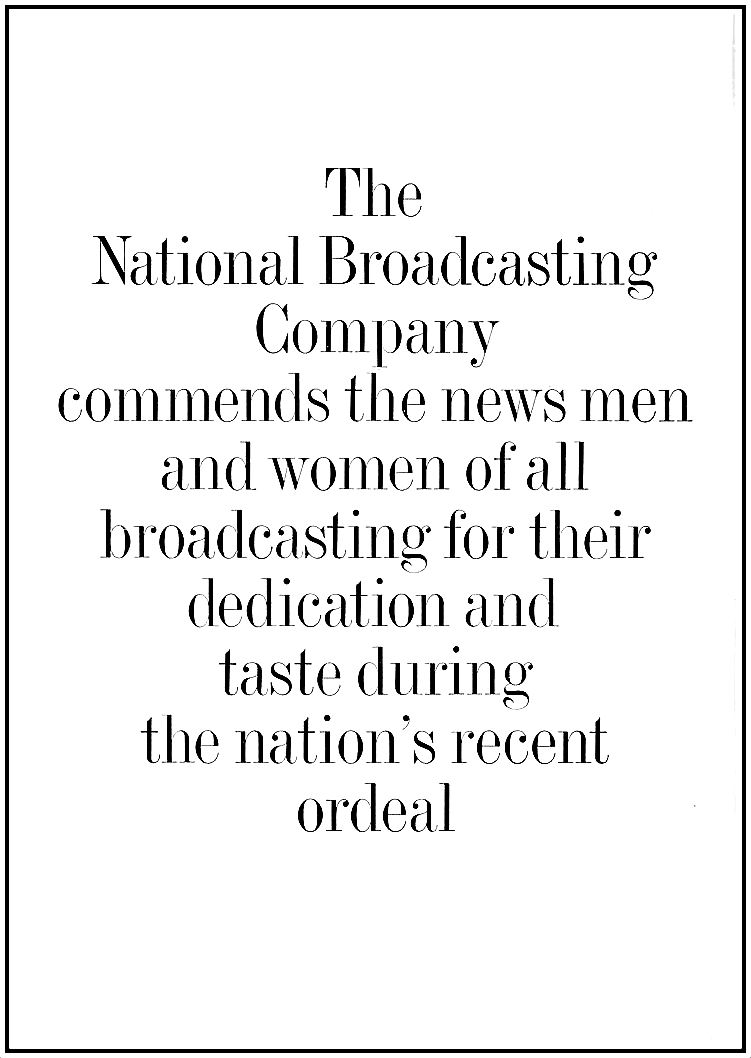
ad-jfk-assassination-NBC_broadcasting-mag_120263NBC ad in Broadcasting magazine, Dec. 2, 1963

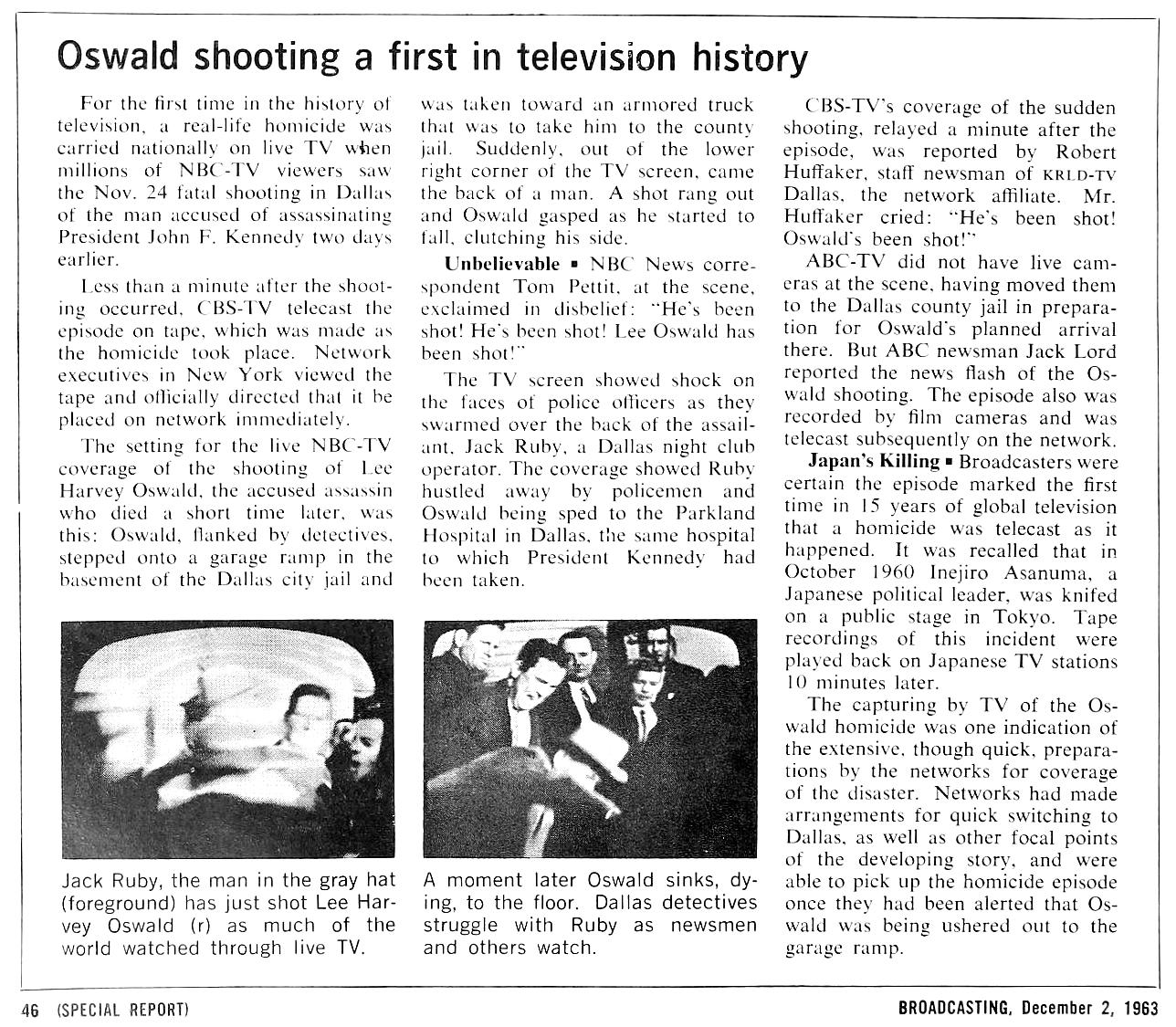
Broadcasting — an industry trade magazine — devoted an entire 25-page “Special Report” on how television had covered — and shaped — JFK’s presidency and his assassination. Below is the article which specifically focused on the wall-to-wall broadcast news coverage, post-Nov. 22.

OSWALD SHOOTING A FIRST IN TELEVISION HISTORY

For the first time in the history of television, a real-life homicide was carried nationally on live TV when millions of NBC-TV viewers saw the Nov. 24 fatal shooting in Dallas of the man accused of assassinating President John F. Kennedy two days earlier.

Less than a minute after the shooting occurred, CBS-TV telecast the episode on tape, which was made as the homicide took place. Network executives in New York viewed the tape and officially directed that it be placed on network immediately.

The setting for the live NBC-TV coverage of the shooting of Lee Harvey Oswald, the accused assassin who died a short time later, was this: Oswald, flanked by detectives, stepped onto a garage ramp in the basement of the Dallas city jail and was taken toward an armored truck that was to take him to the county jail. Suddenly, out of the lower right corner of the TV screen, came the back of a man. A shot rang out and Oswald gasped as he started to fall, clutching his side.

UNBELIEVABLE

NBC News correspondent Tom Pettit, at the scene, exclaimed in disbelief: “He’s been shot! He’s been shot! Lee Oswald has been shot!”

The TV screen showed shock on the faces of police officers as they swarmed over the back of the assailant, Jack Ruby, a Dallas night club operator. The coverage showed Ruby hustled away by policemen and Oswald being sped to the Parkland Hospital in Dallas, the same hospital to which President Kennedy had been taken.

CBS-TV’s coverage of the sudden shooting, relayed a minute after the episode, was reported by Robert Huffaker, staff newsman of KRLD-TV Dallas, the network affiliate. Mr. Huffaker cried: “He’s been shot! Oswald’s been shot!”

ABC-TV did not have live cameras at the scene, having moved them to the Dallas county jail in preparation for Oswald’s planned arrival there. But ABC newsman Jack Lord reported the news flash of the Oswald shooting. The episode also was recorded by film cameras and was telecast subsequently on the network.

JAPAN’S KILLING

Broadcasters were certain the episode marked the first time in 15 years of global television that a homicide was telecast as it happened. It was recalled that in October 1960 Inejiro Asanuma, a Japanese political leader, was knifed on a public stage in Tokyo. Tape recordings of this incident were played back on Japanese TV stations 10 minutes later.

The capturing by TV of the Oswald homicide was one indication of the extensive, though quick, preparations by the networks for coverage of the disaster. Networks had made arrangements for quick switching to Dallas, as well as other focal points of the developing story, and were able to pick up the homicide episode once they had been alerted that Oswald was being ushered out to the garage ramp. (Broadcasting magazine, Dec 2, 1963)


JFK_ruby-oswald_broadcasting-mag_120263
Broadcasting, Dec. 2, 1963 (click to see larger image)

*

NBC was the only network to carry Ruby’s shooting of Oswald on live TV. The footage — as it was aired — can be watched in the video below (the Dallas footage begins at about the 5:00 mark).


*

KRLD, the local CBS affiliate, captured the shooting live, but it was not broadcast live. Here is the KRLD footage, helmed by Bob Huffaker (the shooting takes place near the 13:00 mark).


*

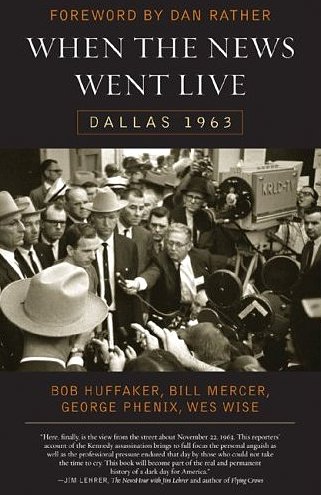
In 2007, Bob Huffaker, Bill Mercer, Wes Wise, and George Phenix — reporters for CBS-affiliate KRLD-TV news — recalled the blur of days on the beat following the assassination in their book When the News Went Live: Dallas 1963. Watch a panel discussion on those days, below, recorded at the Sixth Floor Museum in 2008. (I found Wise’s recollections, beginning at the 39:00 mark to be most interesting.) (RIP, Bob Huffaker, who died June 25, 2018.)

when-the-news-went-live_cover

*

ABC came in late, with reports from affiliate WFAA-Ch. 8 (about the 7:20 mark), but their coverage was certainly no less exciting — in fact, this might be my favorite reporting by local broadcast journalists that day.


*

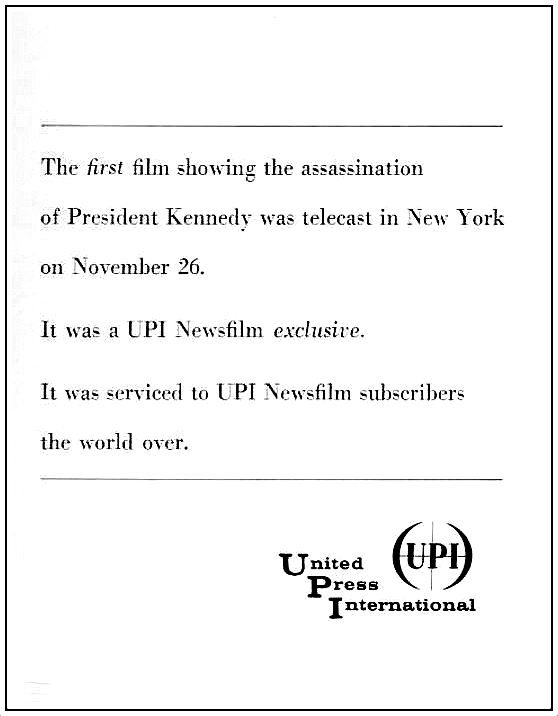
Another “first” in these days immediately following that awful day in Dallas was the very first showing of 8mm home-movie footage showing the assassination of the president. The film was shot by Dallasite Marie Muchmore, who reportedly sold the footage — sight unseen (it hadn’t even been developed) — to UPI for $1,000 (roughly about $8,000 in today’s money); the film was then shown on WNEW-TV in New York on Nov. 26. (The short footage, restored in recent years, can be watched on the Associated Press Archive site, here.)

ad-jfk-assassination-film_UPI_broadcasting-mag_120263
Broadcasting, Dec. 2, 1963

***

Sources & Notes

A “Special Report” on the broadcast coverage of the Kennedy assassination and the shooting of Oswald by Ruby appeared in the Dec. 2, 1963 trade magazine Broadcasting; the issue may be read in its entirety here (pp. 36-61); the photo at the top of this post (showing Jack Ruby shooting Lee Harvey Oswald) is from that issue.

More Flashback Dallas posts on the Kennedy assassination can be found here.

*

Copyright © 2018 Paula Bosse. All Rights Reserved.


Santos Rodriguez, 1960-1973

david-and-santos-rodriguez_austin-american-statesmanDavid and Santos Rodriguez (via Austin American-Statesman)

by Paula Bosse

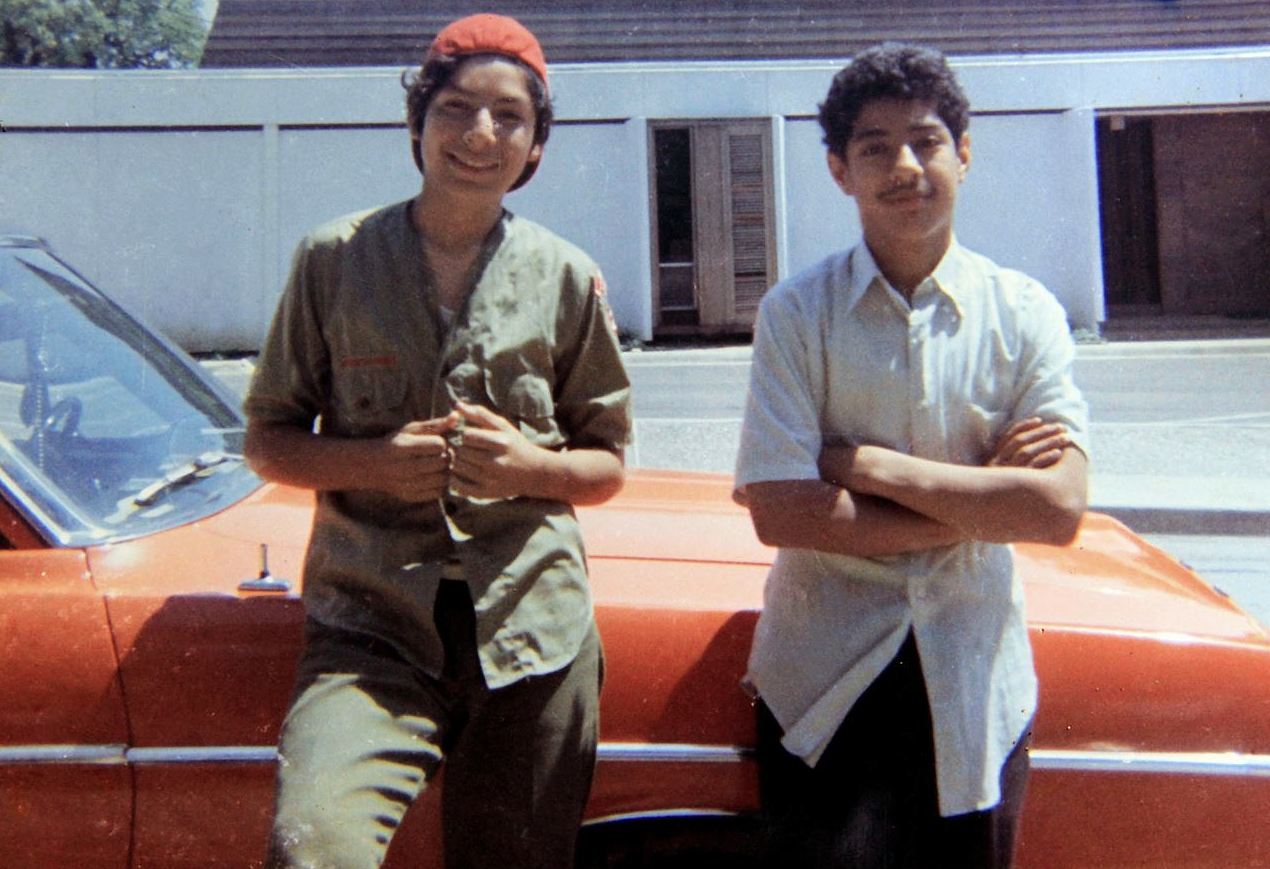
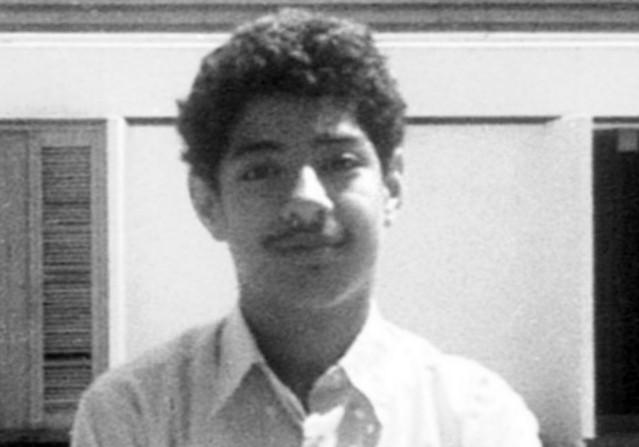
Today is the anniversary of the tragic shooting of Santos Rodriguez, the 12-year-old boy who, on July 24, 1973, was shot in the head by a policeman as he and his 13-year-old brother David sat handcuffed in a police car. It shocked the city of Dallas in 1973, and it is still shocking today.

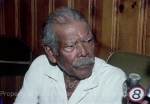
Santos and David had been awakened and rousted out of bed by Officers Darrell L. Cain and his partner Roy R. Arnold who were investigating a late-night burglary at a nearby gas station where money had been stolen from a cigarette machine — the boys matched a witness’ vague description. The boys said they had nothing to do with the burglary but were taken from their home as their foster-grandfather (an elderly man who spoke no English) watched, helpless, as they were handcuffed and placed in a squad car.

The boys were driven back to the scene of the burglary — a Fina station at Cedar Springs and Bookhout. Santos was in the front passenger seat, and Cain sat behind him in the backseat, next to David. Cain insisted the two boys were guilty and, in an attempt to coerce a confession, held his .357 magnum revolver to Santos’ head. He clicked the gun, as if playing Russian Roulette, telling Santos that the next time he might not be so lucky. The boys continued to insist they were innocent. And then, suddenly, Cain’s gun went off. Santos died instantly. Stunned, Cain said that it had been an accident. He and Arnold got out of the car, leaving 13-year-old David, still handcuffed, in the backseat of the police car — for anywhere from 10 minutes to half an hour — alone with his brother’s bloody body. (It was determined through fingerprint evidence that Santos and David did not break into the gas station that night.)

More in-depth articles about this horrible case can be found elsewhere, but, briefly, Cain (who had previously been involved in the fatal shooting of a teenaged African American young man named Michael Morehead) was charged with committing “murder with malice” and was found guilty. He was sentenced to 5 years in prison but ended up serving only two and a half years in Huntsville.

The killing of Santos Rodriguez sparked outrage from all corners of the city, but particularly in the Mexican American community. All sorts of people — from ordinary citizens to militant Brown Berets — organized and protested, persistently demanding civil rights, social justice, and police reform. If anything positive resulted from this tragic event, perhaps it was a newly energized Hispanic community.

**

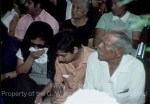
I am ashamed to say that I was not aware of what had happened to Santos Rodriguez until I began to write about Dallas history a few years ago. This was an important turning point in the history of Dallas — for many reasons (namely in the Chicano movement, race relations, the fight for social justice, and an examination of Dallas Police Department procedure). Over the past week I’ve read a lot of the local coverage of the events of this case, and I’ve watched a lot of interviews of people who were involved, but perhaps the most immediate way I’ve experienced the events and emotions swirling about this case has been to watch television news footage shot as the story was unfolding. Thanks to the incredibly rich collection of TV news footage in the possession of the G. William Jones Film & Video Collection at SMU, I’ve been able to do that.

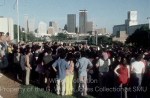
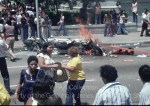
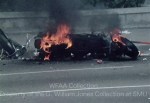
Below is footage shot by KDFW Channel 4, which has, most likely, not been seen since 1973. Some of it appeared in news reports, and some is just background B-roll footage shot to be edited into news pieces which would eventually air on the nightly news. The finished stories that aired do not (as far as I know) survive, but we have this footage. It’s choppy and chaotic and darts from one thing to the next, which is how a red-hot news story develops. Of particular interest is the short interview with 13-year-old David at 9:16 and the violent aftermath of what began as a peaceful march through downtown at 19:54.

A more comprehensive collection of the events — from just hours after the shooting to the conviction of Darrell Cain — can be found in this lengthy compilation of WFAA Channel 8 news footage. This and the Channel 4 footage are essential sources.

*

santos-rodriguez-cropped_smuSantos Rodriguez (Nov. 7, 1960 – July 24, 1973)

***

Sources & Notes

Top photo is a family photo, from the Austin American-Statesman article “Is It Time for Dallas to Honor Santos Rodriguez?” by Gissela Santacruz, here.

My sincerest thanks to Jeremy Spracklen at SMU for alerting me to these two collections of important historical news footage from KDFW-TV/Ch. 4 and WFAA-TV/Ch. 8, both of which are held by the G. William Jones Film & Video Collection, Hamon Library, Southern Methodist University. (All screenshots are from these two videos.)

An excerpt from the 1982 KERA-produced documentary “Pride and Anger: A Mexican American Perspective of Dallas and Fort Worth” (the Santos Rodriguez case is discussed) is on YouTube here.

“Civil Rights in Black & Brown” is a fantastic oral history project by TCU. I watched several of the interviews focusing on Santos Rodriguez, but I was particularly taken with the oral history of Frances Rizo — her 2015 interview is in two parts, here and here.

More on the events surrounding the killing of Santos Rodriguez can be found at the Handbook of Texas History site, here.

My continuation of this story can be found at the Flashback Dallas post “Santos Rodriguez: The March of Justice” — 1973,” here.

*

Copyright © 2018 Paula Bosse. All Rights Reserved.

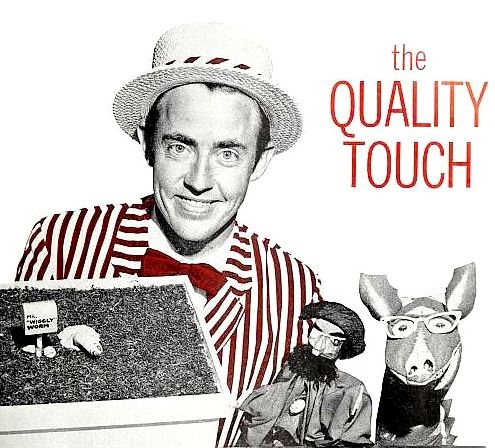
“Mr. Wiggly Worm Does Much More Than Wiggle”

mr-peppermint_sponsor-mag_112061-det

by Paula Bosse

My first crush was on Mr. Peppermint, and I really, really, really loved Mr. Wiggly Worm.

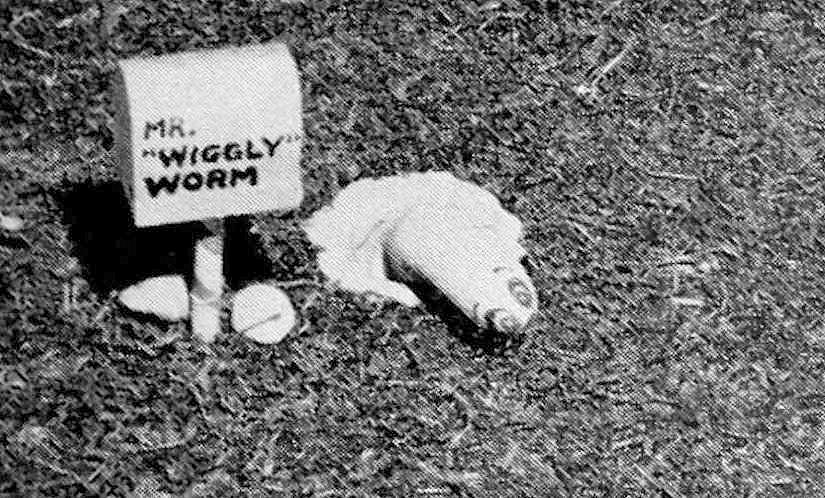
This is a rather unfortunate depiction of my childhood TV pal, but how can you not love a smiling wiggly worm with a mailbox?

mr-peppermint_sponsor-mag_112061_mr-wiggly-worm_det

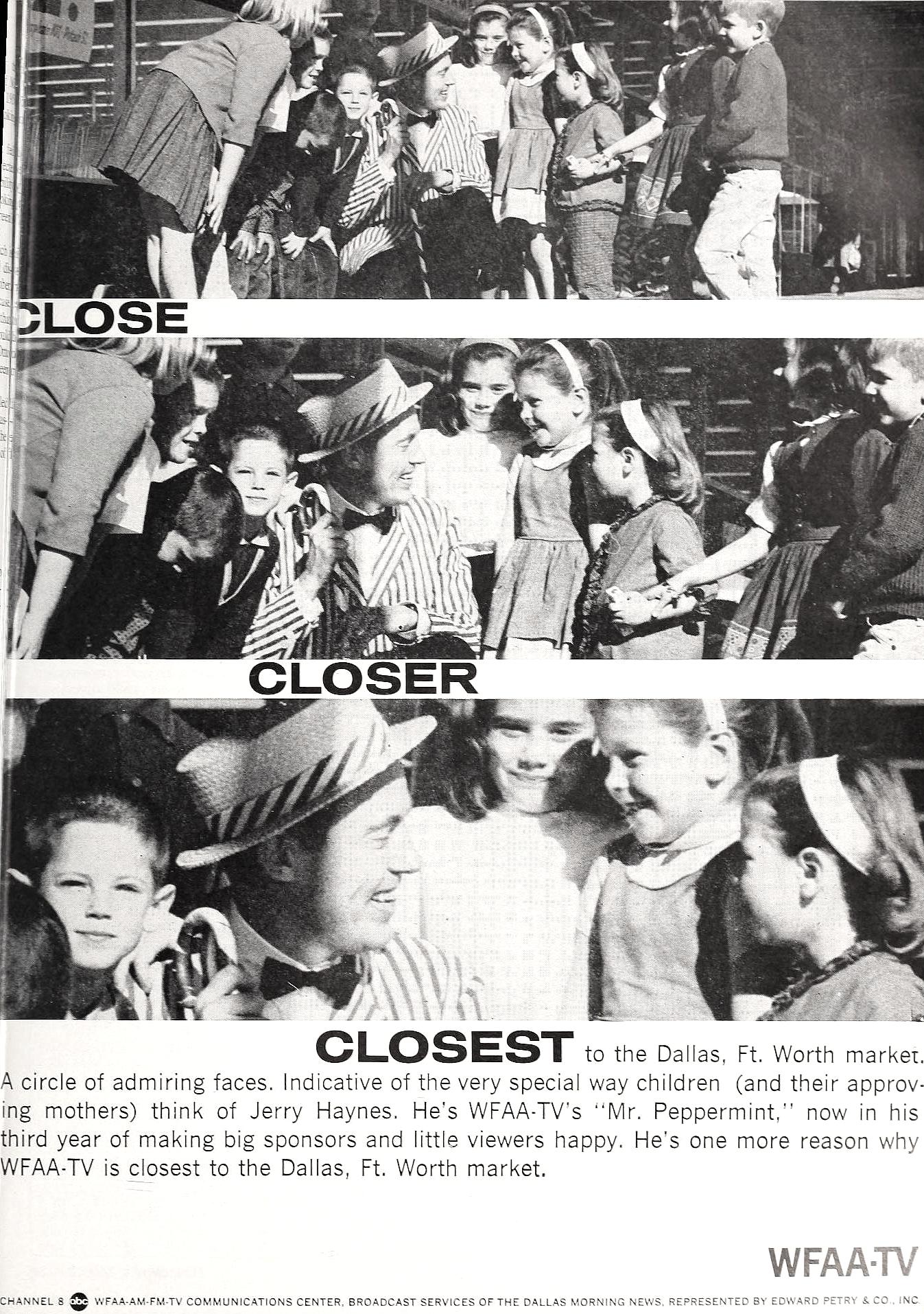
mr-peppermint_sponsor-mag_021163_text

WFAA understood the appeal of Mr. W. W. They even built a whole broadcasting-trade-magazine ad around him. (Click to see it larger.)

mr-peppermint_sponsor-mag_021163Sponsor, Feb. 11, 1963

Here he is again:

mr-peppermint_sponsor-mag_112061
Sponsor, Nov. 20, 1961

Mr. W. W. stayed at home for this one, but here we see Mr. Peppermint out mingling with his adoring public.

mr-peppermint_broadcasting-mag_061063
Broadcasting, June 10, 1963

And, look, “Communications Center” — bet you haven’t heard that in a while!

communications-center_sponsor-mag_112061_det1961

***

Sources & Notes

These Mr. Peppermint advertisements were part of a series of WFAA-Channel 8 ads which ran for several years in television trade magazines.

Click pictures to see larger images.

*

Copyright © 2017 Paula Bosse. All Rights Reserved.

Halloween Party? Don’t Forget the Dr Pepper! — 1947

dr-pepper_halloween_1947_flickr“‘Twill add zest to your buffet foods…”

by Paula Bosse

(While searching for a Halloween advertisement, I unexpectedly came across reports of a federal grand jury case brought against Dallas-based Dr Pepper for violating strict wartime sugar-rationing. Scroll down to read about the legal case.)

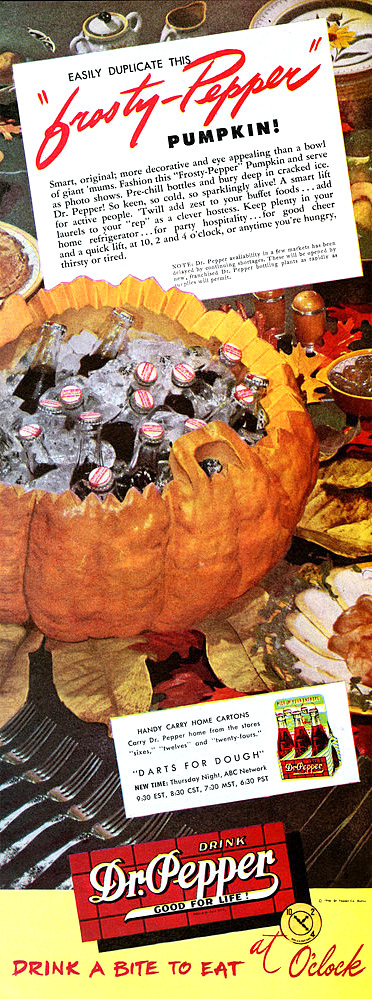
Happy Halloween! Might I propose an eye-catching party suggestion? The “Frosty-Pepper Pumpkin”! Hollow out a pumpkin, fill it with cracked ice, and load it up with bottles of Dr Pepper. Voilà!

The text of the ad, from the fall of 1947:

EASILY DUPLICATE THIS “frosty-Pepper” PUMPKIN!

Smart, original; more decorative and eye appealing than a bowl of giant ‘mums. Fashion this “Frosty-Pepper” Pumpkin and serve as photo shows. Pre-chill bottles and bury deep in cracked ice. Dr. Pepper! So keen, so cold, so sparklingly alive! A smart lift for active people. ‘Twill add zest to your buffet foods … add laurels to your “rep” as a clever hostess. Keep plenty in your home refrigerator … for party hospitality … for good cheer and a quick lift, at 10, 2 and 4 o’clock, or anytime you’re hungry, thirsty or tired. 

NOTE: Dr Pepper availability in a few markets has been delayed by continuing shortages. These will be opened by new, franchised Dr. Pepper bottling plants as rapidly as supplies will permit.

HANDY CARRY HOME CARTONS
Carry Dr Pepper home from the stores 
“sixes,” “twelves” and “twenty-fours.”
 
“DARTS FOR DOUGH”
NEW TIME: Thursday Night, ABC Network
9:30 EST, 8:30 CST, 7:30 MST, 6:30 PST

Drink Dr. Pepper
GOOD FOR LIFE!

DRINK A BITE TO EAT at 10, 2 and 4 o’clock

***

Sources & Notes

Ad found on Flickr, here.

“Darts for Dough”? I had to look that up. It was a radio game show involving quizzes and dart-throwing, created by Orval Anderson and Bert Mitchell at WFAA radio. It debuted in the summer of 1943 as a strictly local program, but it’s popularity was such that it moved to Hollywood in August, 1944 and — still run by the WFAA creators — it began to be broadcast “coast to coast” for several years, moving to television by 1950. It was originally developed in Dallas as a sponsorship vehicle for Dallas-based Dr Pepper and was frequently advertised as “Darts for Dough — The Dr Pepper Show.”

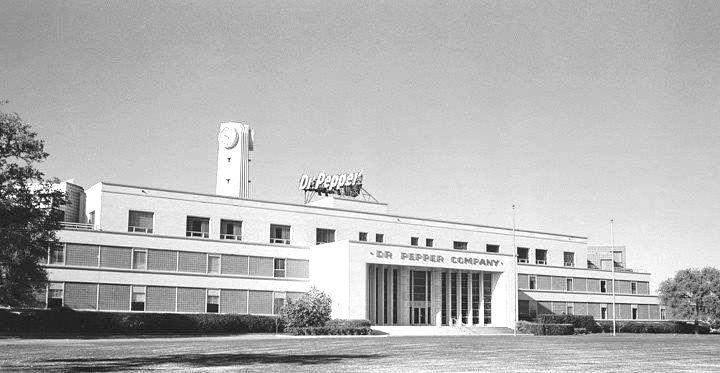
1947 was a big year for Dr Pepper — that was the year their beautiful (and sorely missed) plant opened at Mockingbird and Greenville.

dr-pepper-plant_pinterest

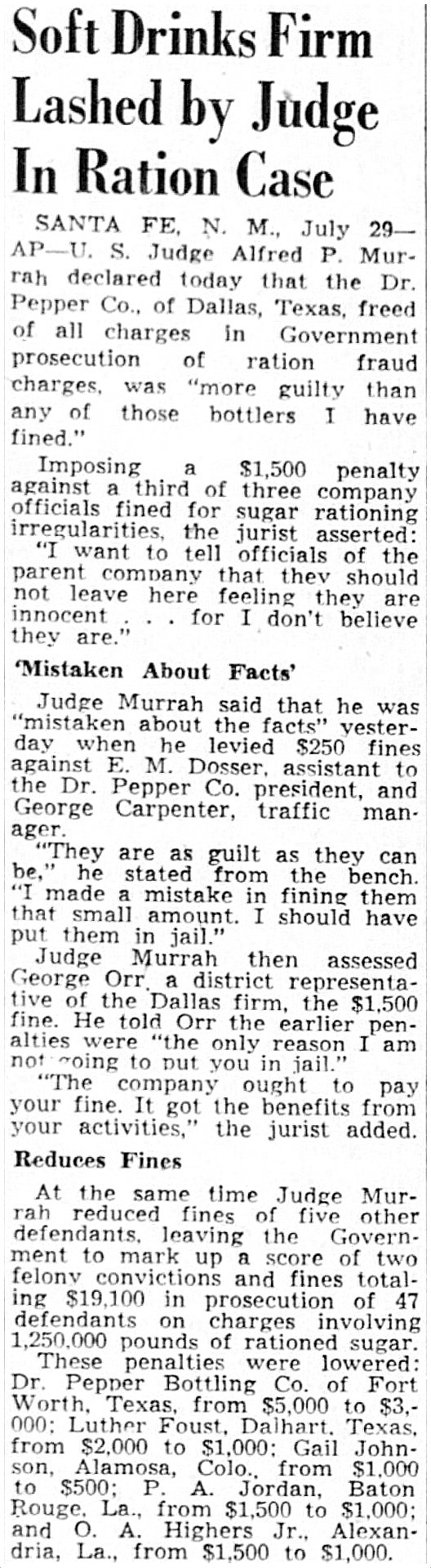
1947 was also a noteworthy year for the company, because of a large federal grand jury indictment which charged several corporations and individuals — including Dr Pepper and some of its bottlers and employees — with sugar-rationing violations (these “irregularities” appear to have begun in the last months of World War II, when wartime food rationing was still serious business). Black-market sugar! A district representative of Dr Pepper was assessed a small fine, but charges of conspiring to violate sugar-rationing regulations which were brought against the DP parent-company were ultimately dismissed, a ruling which angered Federal Judge Alfred P. Murrah, who seems to have been extremely unhappy about the dismissals, as can be read in his blistering statement below.

dr-pepper_sugar-rationing-case_waco-news-tribune_073047
AP story, via Waco News-Tribune, July 30, 1947

Two of the individuals charged in the case — New Mexico residents — received prison sentences in what was described as “the largest black market sugar operation on record,” involving over a million pounds of sugar.

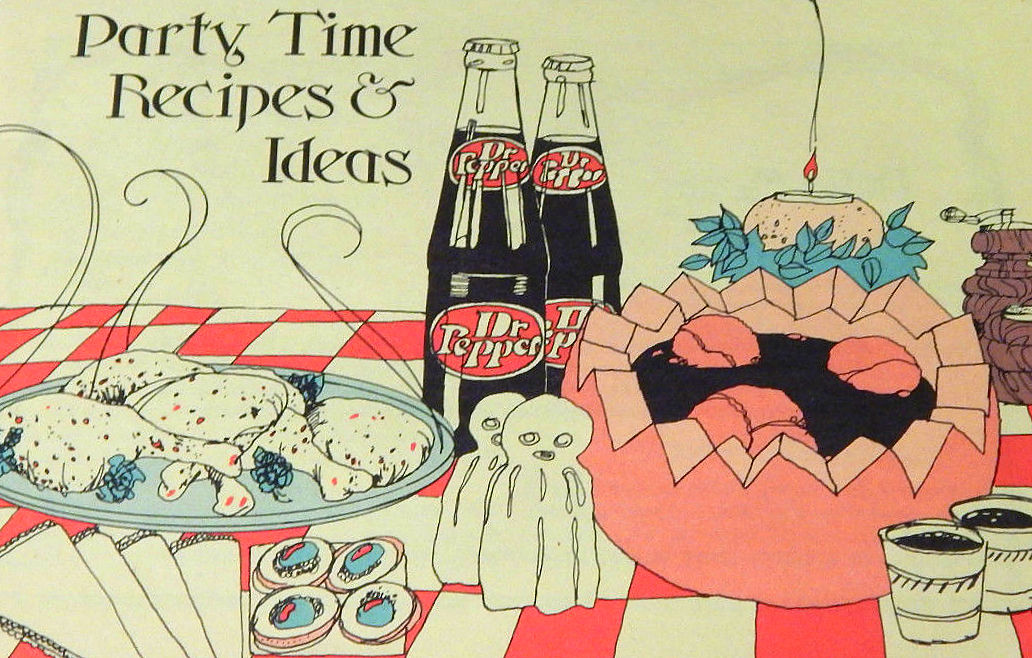
This “Happy Halloween!” post took a bit of an unexpected dark detour. Let’s cleanse our palate with something happier: another party idea with Dr Pepper and a hollowed-out pumpkin (found on eBay).

halloween_dr-pepper_booklet_ebay

More Halloween posts from Flashback Dallas can be found here.

*

Copyright © 2017 Paula Bosse. All Rights Reserved.


Film Footage: “The State Fair of Texas in the 1960s”

sfot_1960s_jones-collection_smu_men-in-suits_ice-creamEveryone likes ice cream…. (G. William Jones Collection, SMU)
by Paula Bosse

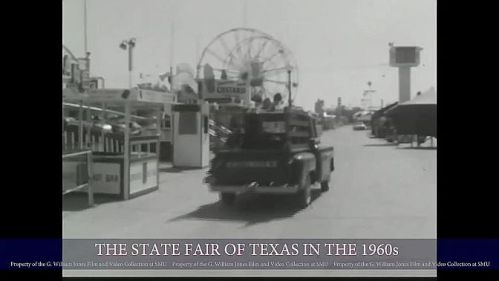
Thanks to Twitter, I discovered this cool video of film clips of the State Fair of Texas, shot throughout the 1960s, courtesy of SMU’s WFAA Newsfilm Collection/G. William Jones Film and Video Collection, put together by Moving Image Curator Jeremy Spracklen. There are 15 or so clips, some in black and white, some in color, some silent, some with sound. This compilation runs about 24 minutes. Watch it. You’ll enjoy it — especially the montage of fair food at the end! (Make sure you watch in fullscreen.)

*

Here are a few screengrabs I took, to give you an idea of the content (images are much cleaner in the video!).

Getting ready for the fair.

sfot_1960s_jones-collection_smu_midway

Fair Park entrance.

sfot_1960s_jones-collection_smu_entrance

Crowd, baby, binoculars.

sfot_1960s_jones-collection_smu_crowd

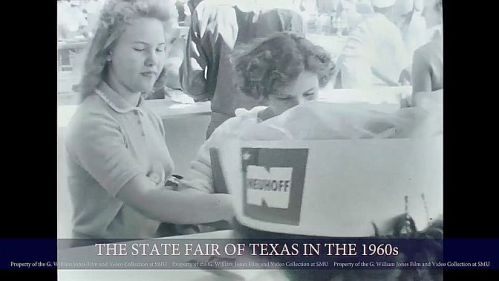
Neuhoff hot dog stand.

sfot_1960s_jones-collection_smu_neuhoff-hot-dogs

The monorail (with a cameo by Big Tex).

sfot_1960s_jones-collection_smu_monorail_big-tex

I don’ t know who this guy is, but he’s in several shots and I love him! Here he is losing out to the woman who correctly guessed his weight.

sfot_1960s_jones-collection_smu_guess-your-weight

Kids eating … Pink Things! “Made famous at Six Flags.”

sfot_1960s_jones-collection_smu_kids_pink-thing

Aqua Net and Moët. (I have to say, I’ve never seen champagne at the fair, but perhaps those are circles I don’t travel in.)

sfot_1960s_jones-collection_smu_aqua-net-and-moet

Everyone needs a corny dog fix.

sfot_1960s_jones-collection_smu_corny-dog_girl

Everyone.

sfot_1960s_jones-collection_smu_corny-dog

Have a groovy time at this year’s State Fair of Texas!

sfot_1960s_jones-collection_smu_groovy-poster

***

Sources & Notes

Film clips from Southern Methodist University’s WFAA Newsfilm Collection/G. William Jones Film and Video Collection; the video has been edited by SMU’s Moving Image Curator, Jeremy Spracklen. The direct link to the video on Vimeo is here.

*

Copyright © 2017 Paula Bosse. All Rights Reserved.

The WFAA Studios, Designed by George Dahl, Rendered by Ed Bearden — 1961

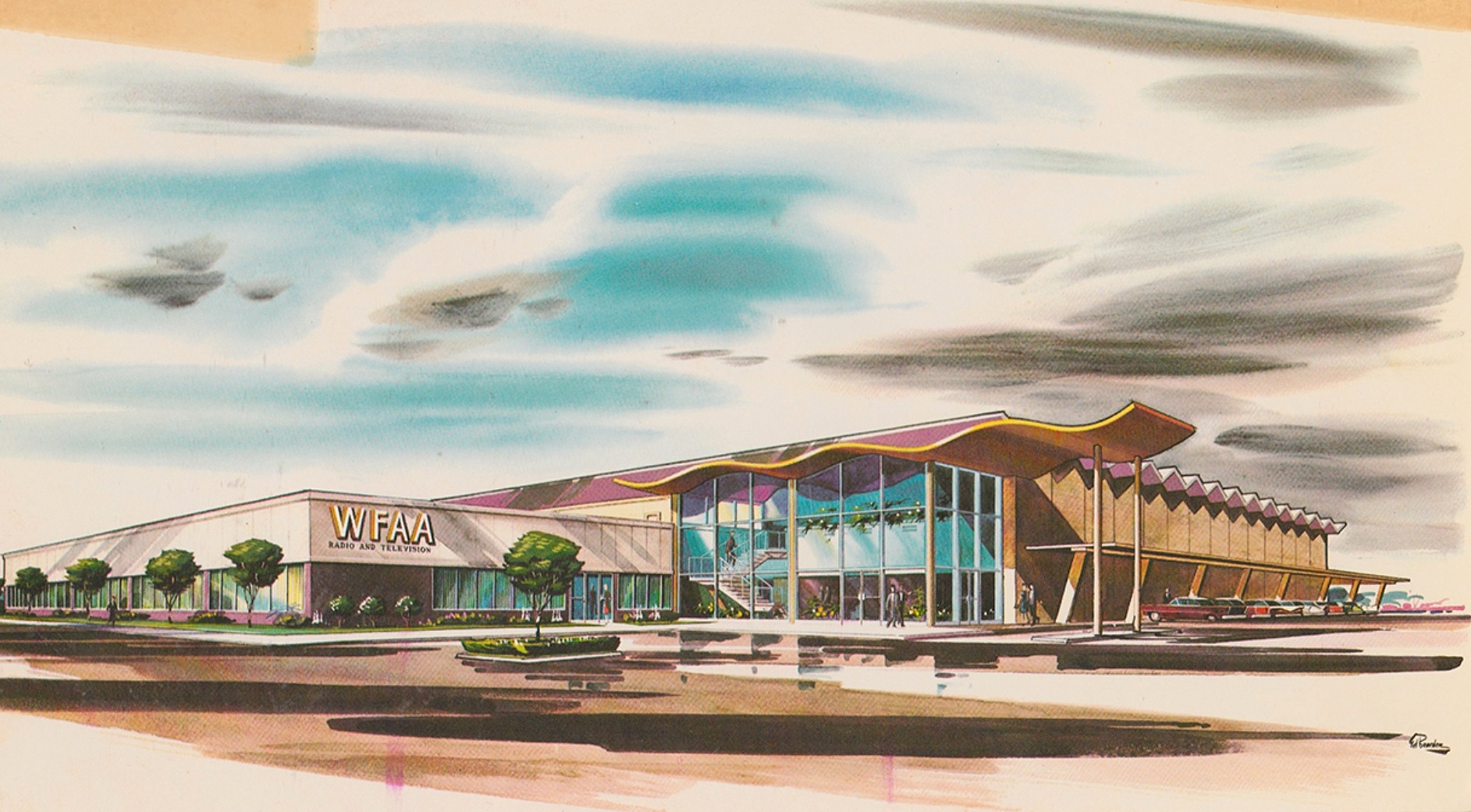
wfaa_george-dahl_ed-bearden_postcard“Communications Center”

by Paula Bosse

Above, the WFAA studios, seen in a wonderful painting by Dallas artist Ed Bearden. The image is from a postcard touting the brand new ultra-modern building designed by one of Dallas’ top architects, the prolific George L. Dahl. The building still stands at Young and Record streets, next to the home of its then-sister-company, The Dallas Morning News (appropriately, the News building was also designed by Dahl … as was the soon-to-be HQ of The News, the old Dallas Public Library at Commerce and Harwood).

The super-cool mid-century “WFAA AM-FM-TV broadcasting plant” was completed in 1961. It opened to much fanfare in April of that year, with star-studded festivities featuring personal appearances by a host of ABC stars such as Connie Stevens, Johnny Crawford, and Nick Adams. If catching a glimpse of “Cricket” or the Rifleman’s son didn’t wow you, the public was also invited to tour the building and gawk at its state-of-the-art radio and television studios. This large 68,000-square-foot building allowed WFAA radio and WFAA-TV to be housed under the same roof. Before this, the AM and FM radio stations were broadcasting from studios atop the Santa Fe Building, and Channel 8 was broadcasting from their television studios on Harry Hines, at Wolf (studios which they sold to KERA at the end of 1959).

Aside from the innovative “folded-plate” concrete roof, one of the first things I noticed about this building was the staircase behind a “wall” of plate glass — I was instantly reminded of the staircase from the old Rogers Electric building (now Steinway Hall) on the Central Expressway service road at McCommas — all it needed was a gigantic ficus tree. (Unsurprisingly, that building — built in 1959 — was also designed by the very, very busy George Dahl.)

Cool building, cool architectural design, cool artistic rendering.

**

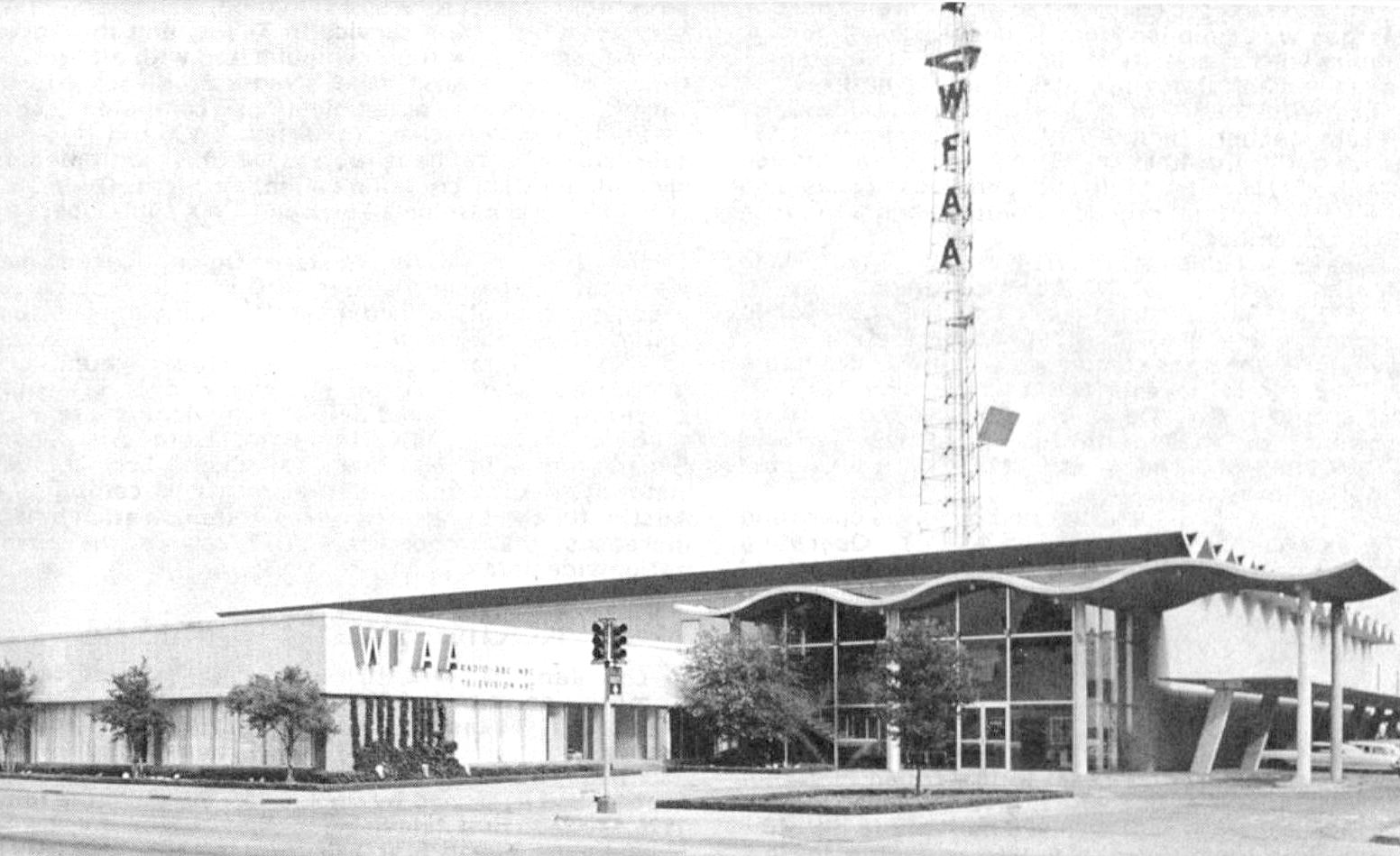
Below is an early pre-construction rendering of the WFAA building, from 1959.

wfaa_bw_rendering_1959

*

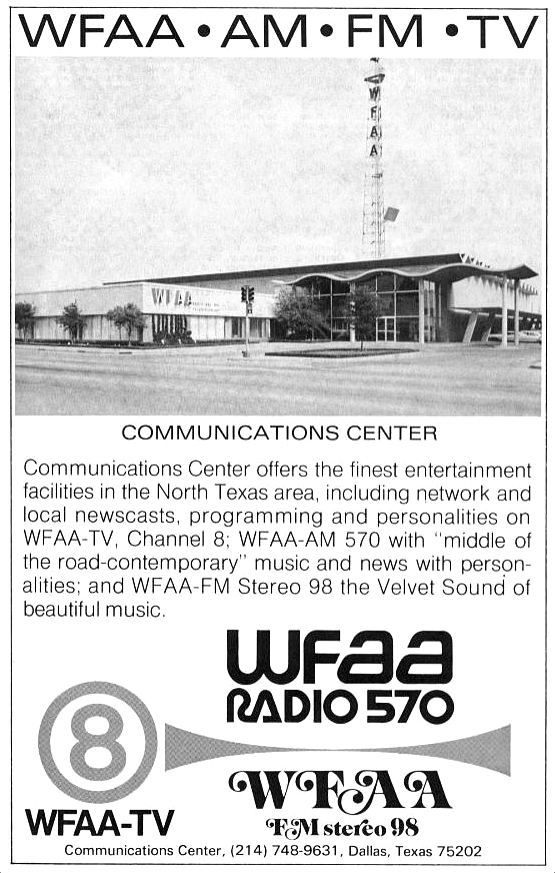
And a photo from the early 1970s.

wfaa_texas-almanac_1974-75

*

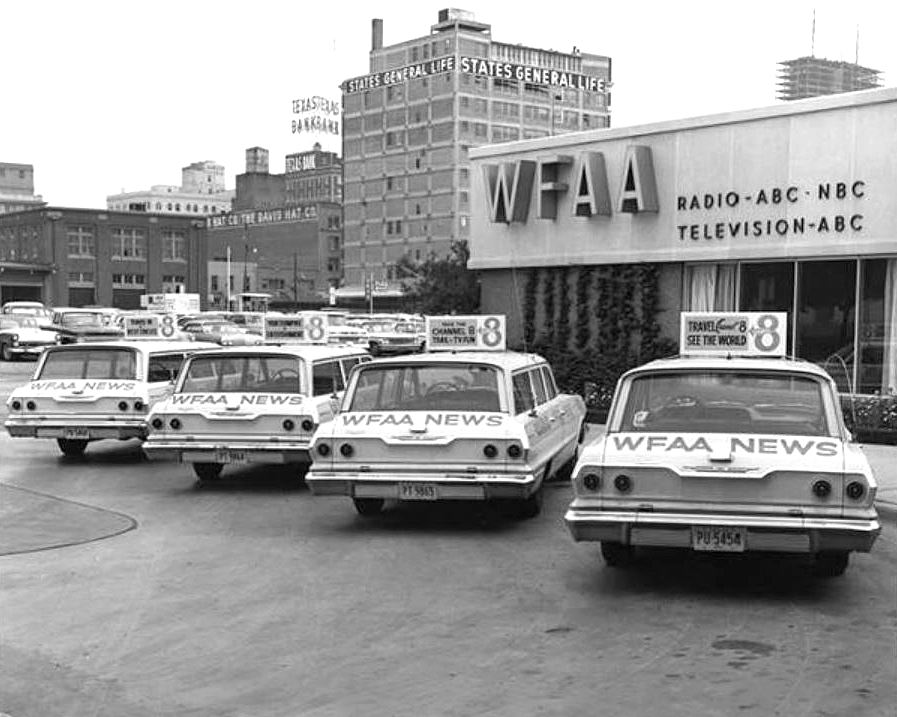
And here’s a view taken from the side of the building in 1963, looking toward Young Street.

wfaa_news-vehicles_belo-records_degolyer_smu_1963

*

The early-’70s photo above was taken from this ad from the 1974-75 Texas Almanac. Ah, “Communications Center.” (I have to say, I’ve never heard of “WFAA-FM Stereo 98” nor their slogan “The Velvet Sound of Beautiful Music.” In fact, by the time this edition of the Almanac was published, WFAA-FM no longer existed — it had changed both its name — to KZEW — and its format — to rock.)

wfaa_texas-almanac_1974-75_portal

***

Sources & Notes

Color postcard found on the entertaining blog Texas Pop Culture; see the post — which includes scans of the reverse side of the card — here.

Bearden’s signature is a bit hard to make out — the slightly distorted magnified signature can be seen here.

The more I see of Ed Bearden’s work, the more I like it. See his Dallas skyline from 1958 here; see his Dallas skyline from 1959 here.

Photo of the Channel 8 news vehicles is from the Belo Records collection, DeGolyer Library, Central University Libraries, Southern Methodist University; more info on this photo is here.

More on architect George L. Dahl can be found at the Handbook of Texas, here, and at Wikipedia, here.

Read more about the history of FM radio in Dallas — including histories of WFAA-FM and KZEW — at the indispensable website of local broadcasting history — DFW Retroplex, here.

*

Copyright © 2017 Paula Bosse. All Rights Reserved.