Flashback : Dallas

A Miscellany: History, Ads, Pop Culture

Category: Dallas Skyline

“A City Built On the Solid Rock of Service” — 1927

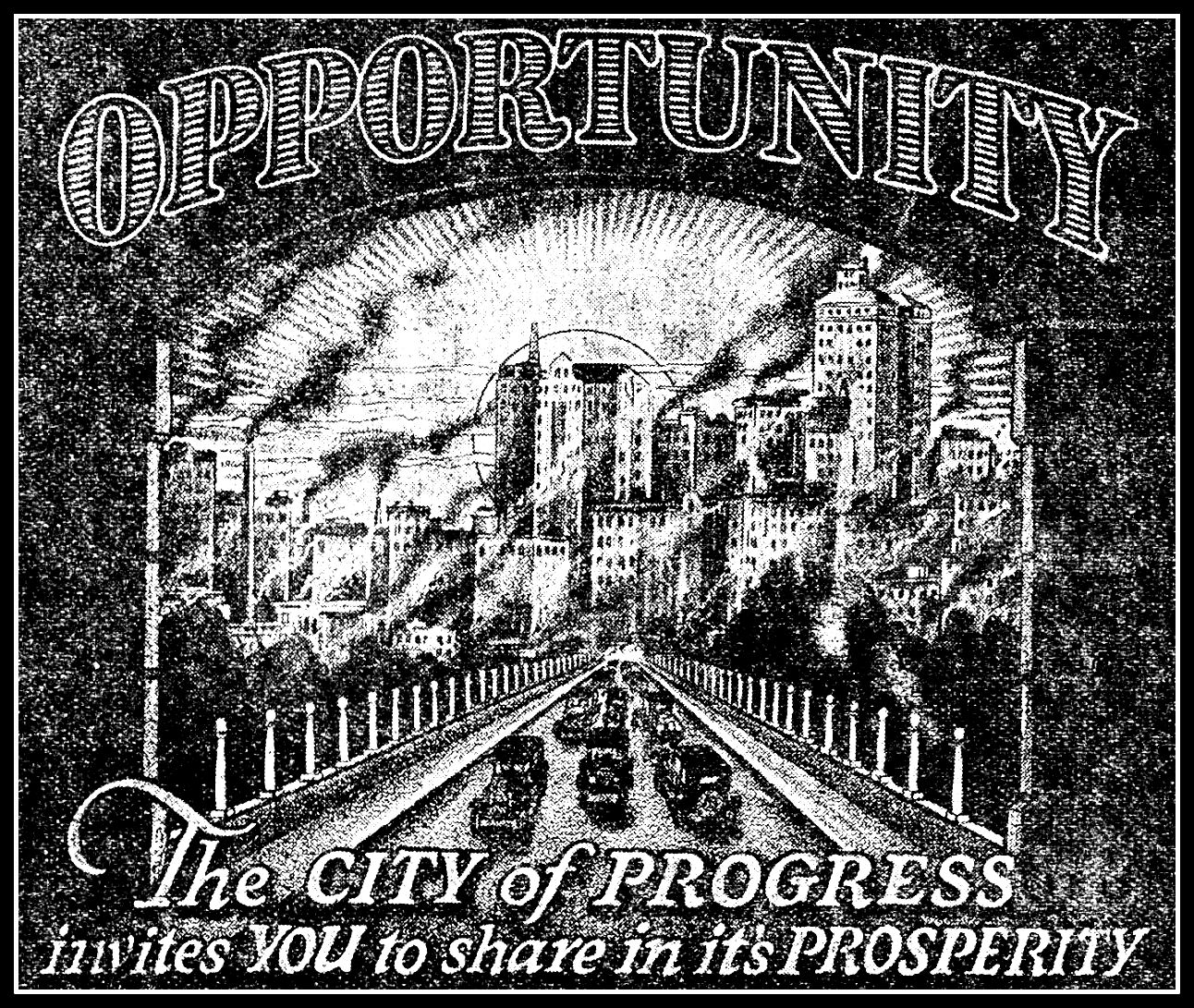
ad-dallas-chamber-of-commerce_tx-almanac_1927-det“Opportunity!”

by Paula Bosse

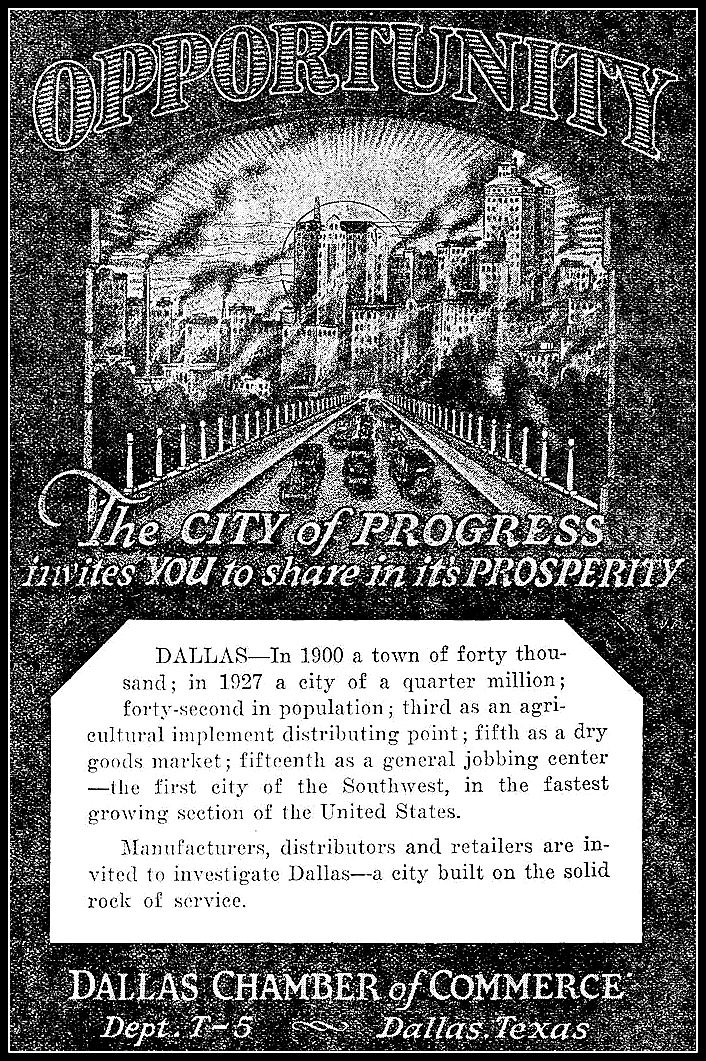
Below, a 1927 Dallas Chamber of Commerce ad with some interesting statistics.

ad-dallas-chamber-of-commerce_tx-almanac_1927

*

OPPORTUNITY

The CITY OF PROGRESS invites YOU to share in its PROSPERITY.

DALLAS–in 1900 a town of forty-thousand; in 1927 a city of a quarter million; forty-second in population; third as an agricultural implement distributing point; fifth as a dry goods market; fifteenth as a general jobbing center–the first city of the Southwest, in the fastest growing section of the United States.

Manufacturers, distributors and retailers are invited to investigate Dallas–a city built on the solid rock of service.

*

Pretty impressive. And the illustration of a dynamic city on the other side of that viaduct is all but throbbing with energy.

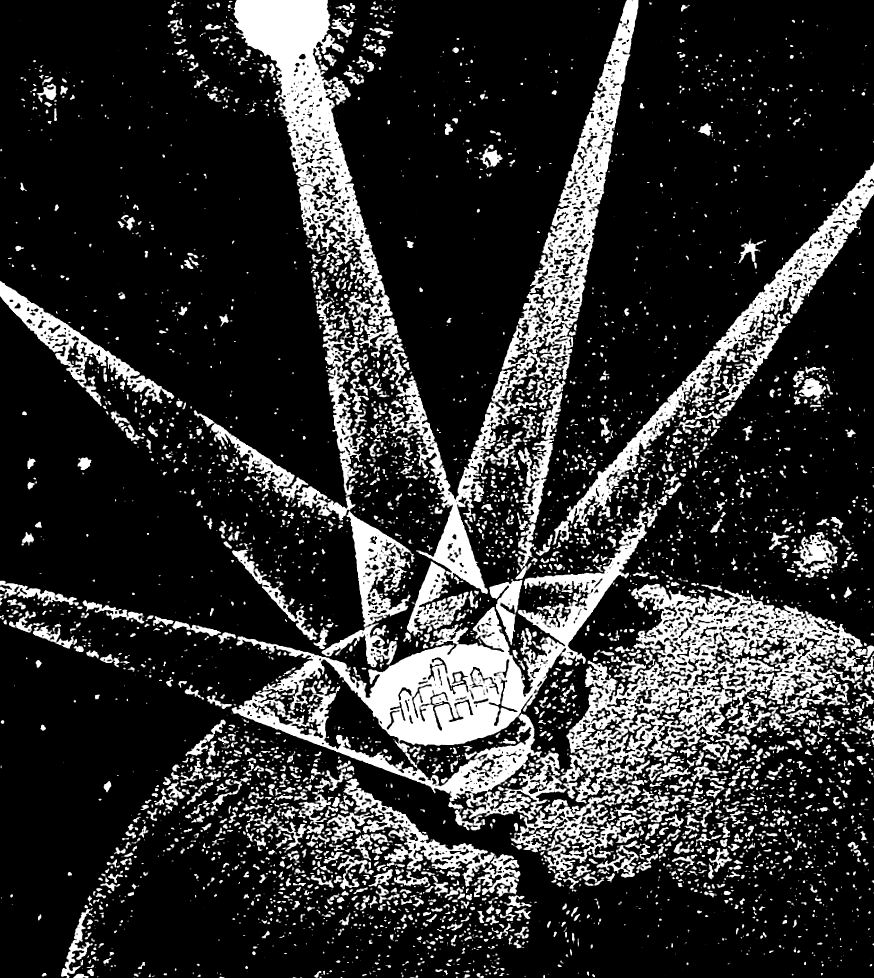
The illustration from a 1929 Chamber of Commerce ad is even less modest: it shows Dallas as the center of the universe, center stage on Planet Earth, lit up by the sun and the giant Klieg lights of space.

ad-dallas-chamber-of-commerce_tx-almanac_1929-det

I kind of think Dallas has pretty much always seen itself like this.

***

Sources & Notes

Ads from the 1927 and 1929 editions of The Texas Almanac and State Industrial Guide.

*

Copyright © 2015 Paula Bosse. All Rights Reserved.

The Dallas Skyline, Vibrant & Sophisticated — 1960

skyline_drawing_ca-1960If only…

by Paula Bosse

This is a fantastic interpretation of the Dallas skyline, circa 1960. A little artistic license and … voilà! … Dallas has never looked New Yorkier. In a good way!

Thank you, anonymous commercial artist! This is the cool, sophisticated version of Dallas I’ve always wanted to live in!

*

Copyright © 2015 Paula Bosse. All Rights Reserved.


Fly United to Chicago in Only Eight Hours!

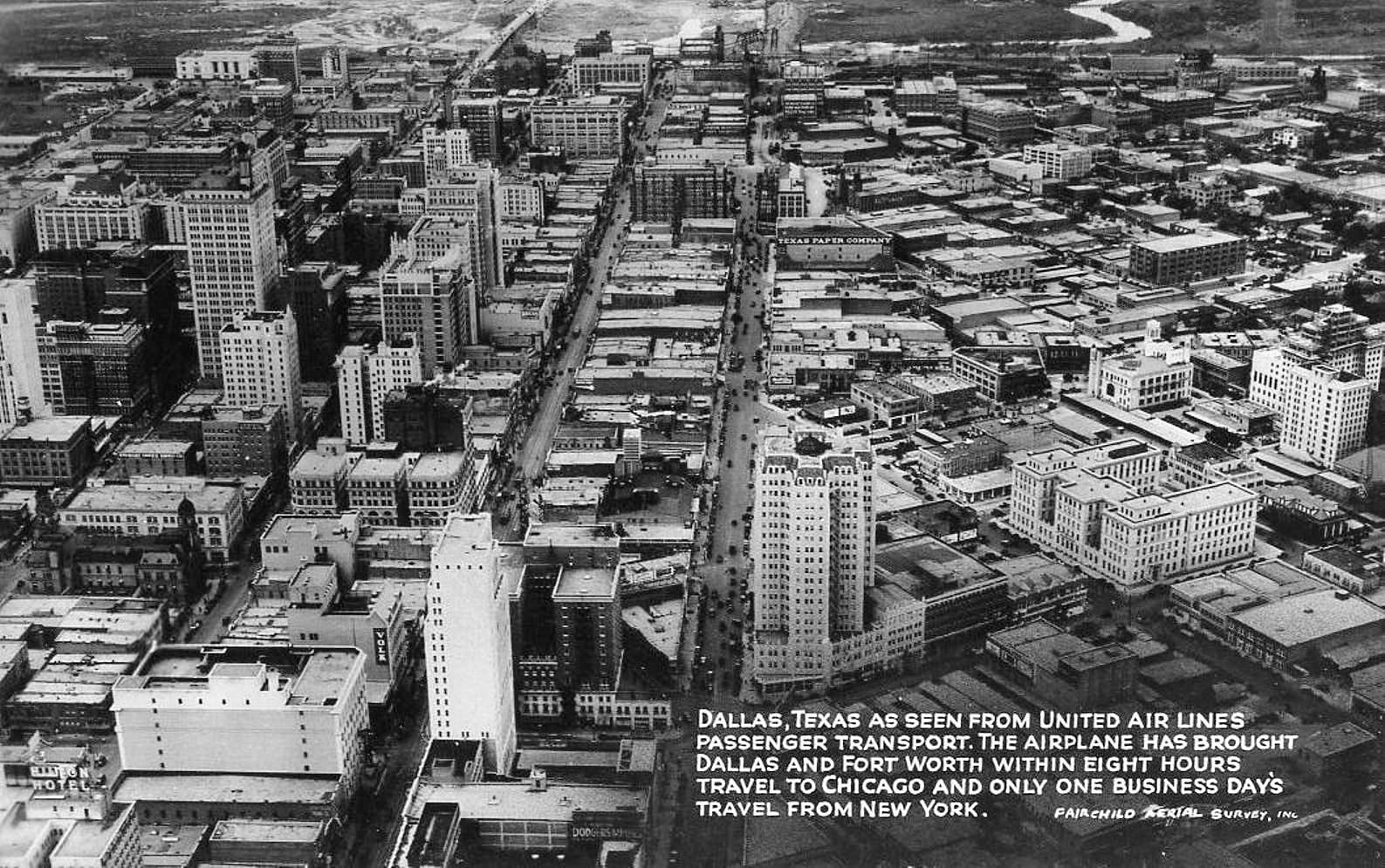
aeiral_united-air-lines_fairchild_ebay_rppcHow many buildings can you identify? (click for larger image)

by Paula Bosse

Dallas, Texas as seen from United Air Lines passenger transport. The airplane has brought Dallas and Forth Worth within eight hours travel to Chicago and only one business day’s travel from New York.

Back when it took all day to fly to New York from Dallas.

This is another great aerial photo by the Fairchild Aerial Survey company, probably taken by Lloyd M. Long. Date-wise? Late-1920s? Before the Trinity was straightened (beginning in 1928), with land being cleared in the area that would become Dealey Plaza? 1928-ish? Or could it have been the very early 1930s? The United Air Lines promotional postcard was issued around 1932 or 1933.

It wasn’t until 1933 that United introduced its new Boeing “twin motor airline transports” and boasted that they would finally “bring the city within eleven and a half hours of New York City” (Dallas Morning News, Aug, 16, 1933).

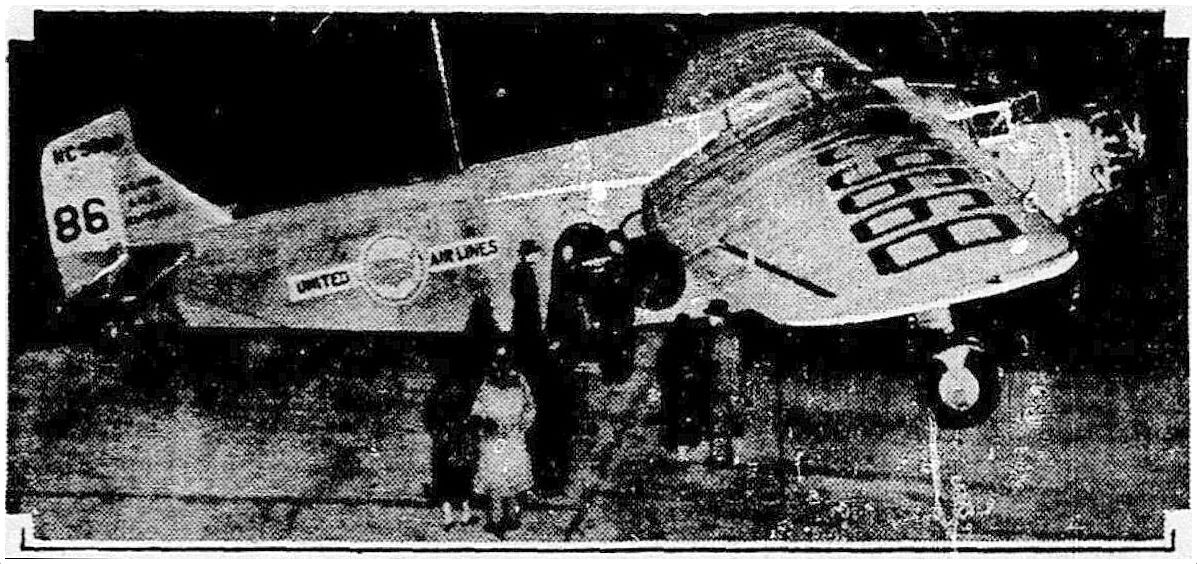
Below is a photo from a Dallas newspaper ad showing one of United’s planes from the earlier, more carefree days of 1932, when passengers were still trudging through the skies at a more leisurely pace.

united-air-lines_ad-det_dmn_110432United Air Lines ad, detail, 1932

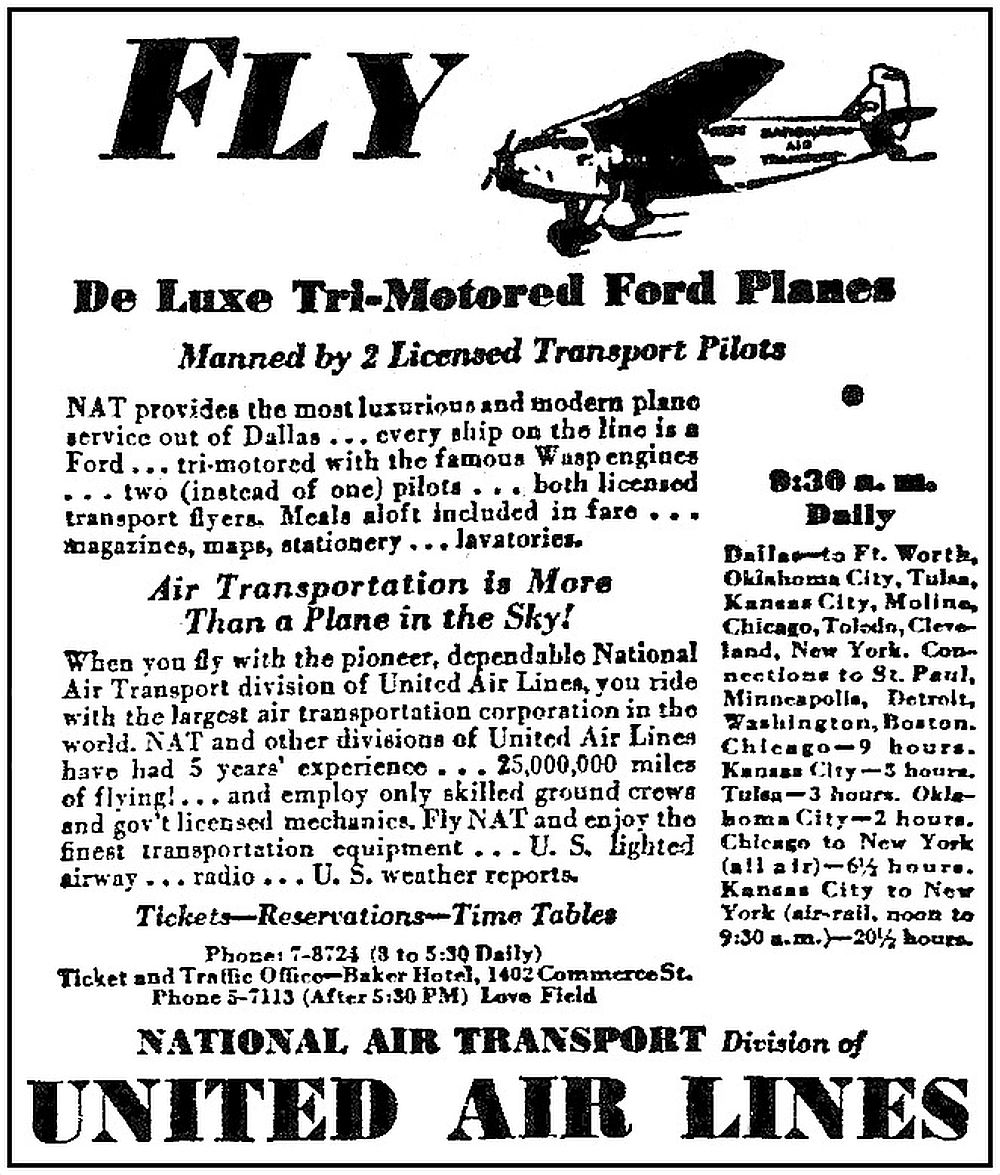
And an even earlier ad, from 1931, when a flight from Love Field to Chicago was nine hours long (today a direct flight from Love Field to Chicago takes about two hours and fifteen minutes). And if you wanted to continue to NYC, you had to board another plane and fly from Chicago to New York, adding another six and a half hours!

united-air-lines_dallas-to-nyc_1931
1931 ad

FLY

De Luxe Tri-Motored Ford Planes Manned by 2 Licensed Transport Pilots
 
NAT provides the most luxurious and modern plane service out of Dallas … every ship on the line is a Ford … tri-motored with the famous Wasp engines … two (instead of one) pilots … both licensed transport flyers. Meals aloft included in fare … magazines, maps, stationery … lavatories. 

Air Transportation is More Than a Plane in the Sky! 

When you fly with the pioneer, dependable National Air Transport division of United Air Lines, you ride with the largest air transportation corporation in the world. NAT and other divisions of United Air Lines have had 5 years’ experience … 25,000,000 miles of flying! … and employ only skilled ground crews and gov’t licensed mechanics. Fly NAT and enjoy the finest transportation equipment … U.S. lighted airway … radio … U.S. weather reports.

*

In an interesting side-note, the first pilot to fly a mail plane between Kansas City and Dallas (on May 12, 1926) was Richard Dobie, brother of Texas literary legend, J. Frank Dobie. In 1926 he flew a Curtiss Carrier Pigeon; in 1933, he’d worked his way up to the speedy and powerful Boeing. He flew for United for several years.

***

Sources & Notes

Top image is a promotional postcard, found on eBay.

Read more about the tri-motor airplane (manufactured by the Ford Motor Company and affectionately known as the “Tin Goose”) in the article “Ford’s Tri-Motor” by Edward J. Vinarcik (Advanced Materials and Processes, Oct. 2003) here.

All images larger when clicked.

*

Copyright © 2015 Paula Bosse. All Rights Reserved.


Santa Fe Railroad Ads: “Main Line to Progress” — 1955

ad-magnolia-petroleum-welcoming-new-santa-fe-line_dmn_120455-det_smMagnolia Petroleum Co. ad (detail), 1955

by Paula Bosse

In the previous post, “White Rock Station,” I wrote about the opening of a new passenger depot that had been built to serve suburban travelers along the new stretch of Santa Fe track laid between Dallas and Denton in 1955, opening up direct through-travel to Chicago. This was big news, and as was the charming custom back then, when a new business endeavor opened or expanded, other businesses (often direct competitors) placed ads in the local papers to welcome them and wish them well.

Here are a few of the ads that appeared in December, 1955 to promote/congratulate the new line. I’ve chosen these details of ads because they feature illustrations of the city’s skyline — I always love to see the Dallas skyline in ads, but I particularly like the style of commercial art from this period.

At the top is a detail from an ad placed by the Magnolia Petroleum Company, with the tag-line “Main Line to Progress.”

Next, a cool detail from a Hutchings-Sealy National Bank of Galveston advertisement.

ad-hutchings-sealy_santa-fe_dmn_120455-det

And, lastly, a detail from a large double-page Santa Fe Railroad ad.

ad-santa-fe_dmn_120455_det-skyline

***

Sources & Notes

The previous Flashback Dallas post on this new Santa Fe line and its two new depots in Dallas and Denton can be found here.

*

Copyright © 2015 Paula Bosse. All Rights Reserved.

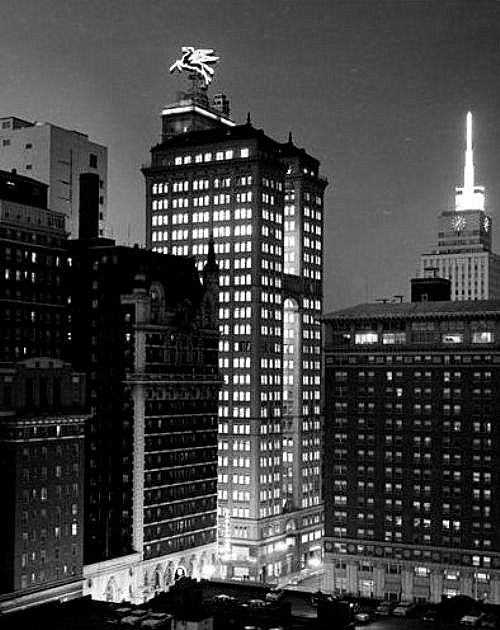
The Magnolia Building at Night

magnolia-bldg_night_briscoe-ctr©ExxonMobil

by Paula Bosse

Dallas noir.

***

Undated photo, from the ExxonMobil Historical Collection, Dolph Briscoe Center for American History; viewable here.

*

Copyright © 2015 Paula Bosse. All Rights Reserved.


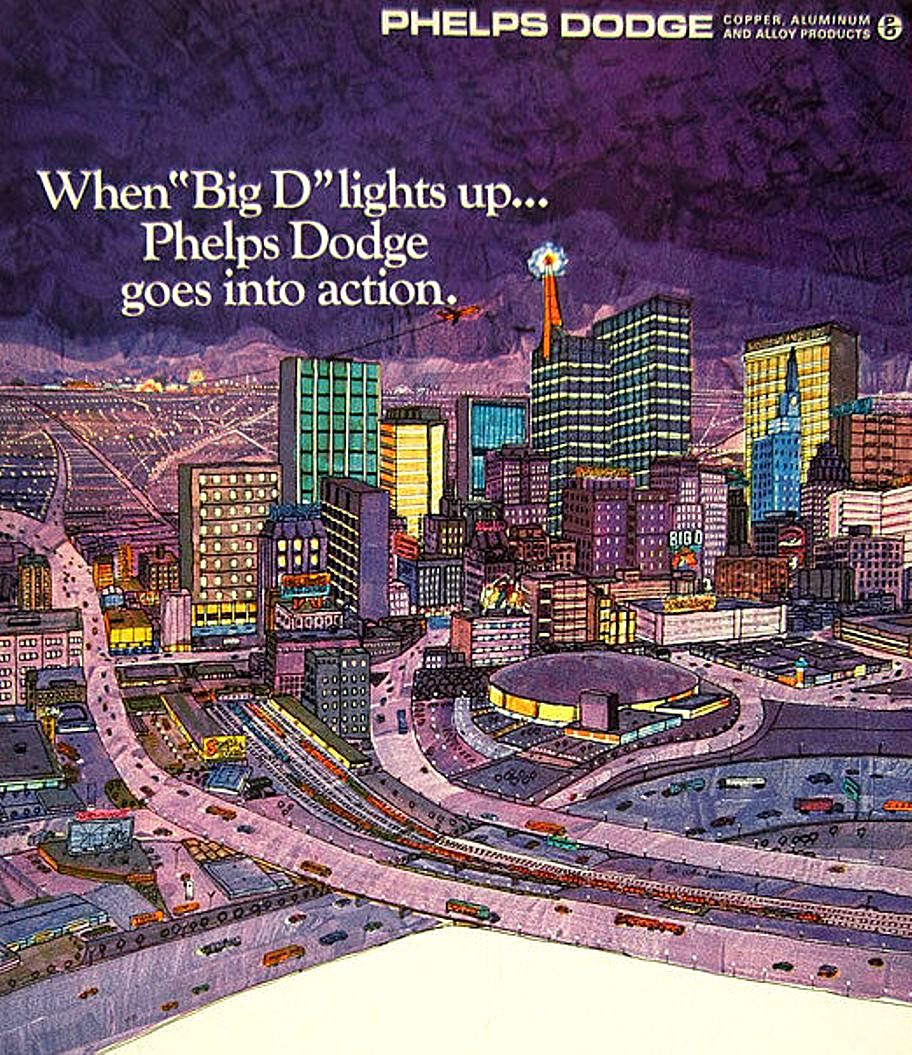
“When ‘Big D’ Lights Up” — Phelps Dodge Ad (1969)

ad-phelps-dodge_1969_ebayCopper, aluminum, and alloys … EVERYWHERE!

by Paula Bosse

One doesn’t expect a cute, quirky drawing of Dallas to appear in an advertisement for an international mining company that excavates and manufactures “copper, aluminum, and alloy products.” But here you are, a 1969 Phelps Dodge ad featuring the Dallas skyline. It’s a bit reminiscent of both the delightful telephone book cover art of Karl Hoefle and the distinctive naive “matchstick men” art of L. S. Lowry. The ad copy is a lot less whimsical:

Dallas … a busy, prospering commercial center and Showplace of the Southwest. A bright, shining ever-changing city where the new is commonplace.

Look behind the splendor and the bright lights and you’ll see that Dallas is also a Phelps Dodge city. Our condenser tubes are used at the generating plants of the Dallas Power and Light Company. Our 135-kv transmission cables and other high-voltage power cables distribute power throughout the city … and the transformers, coils and motors wound with our magnet wire make things happen … from the flashing signs downtown, to factories along the river … to homes, stores, and offices everywhere.

Go north on Stemmons Freeway or west to Fort Worth on the Turnpike, or south on I-45 and Phelps Dodge buried lighting cables, telephone or coaxial CATV cables are following alongside. You’ll also find our building wire and aluminum conduit … our plumbing, gas and refrigeration copper tubing at work everywhere. Many new buildings, like the Statler Hilton Hotel, use PD building wire and copper tubing exclusively.

We specialize in conductors of electricity, liquids, gases and heat made of copper, aluminum and alloys. Look closely, and you’ll find Phelps Dodge products at work everywhere.

***

Sources & Notes

Ad found on eBay.

See the artwork from this same ad — only in black and white — here. Zoom in and look at the details. No Karl Hoefle, but still pretty cool.

ad-phelps-dodge_1969_bw_small

Interested in knowing more about Phelps Dodge? Wikipedia to the rescue, here.

The drawing is by commercial artist Lee Albertson, who, apparently, did a whole series of these ads, each featuring a different “copper, aluminum and alloy product”-enriched city, a few of which can be seen here.


*

Copyright © 2015 Paula Bosse. All Rights Reserved.

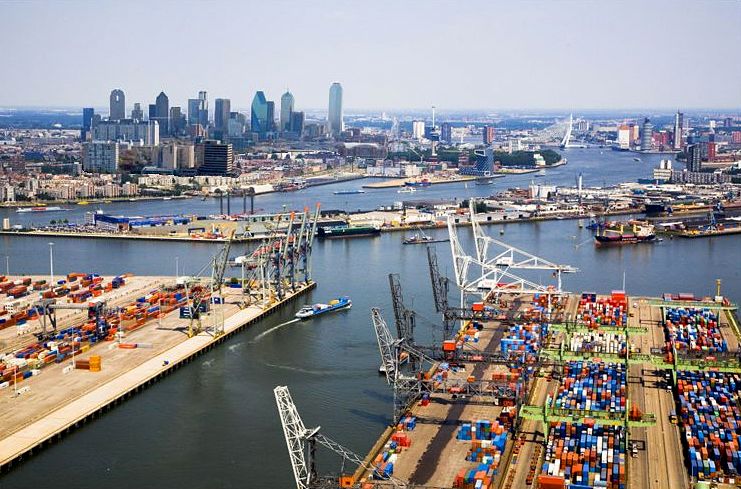
Dallas Imagined As an Inland Port

dallas-imagined-as-inland-port_reddit

by Paula Bosse

Okay, this will be my last Trinity River post for a while. This is what some clever person imagined Dallas would look like today as an inland port had anyone ever managed to make the Trinity a navigable commercial waterway between DFW and the Gulf. So there you go!

***

This image was linked to a Reddit post linking to a Flashback Dallas Trinity River post. I have no idea who created this, but the image link is here. If anyone knows the source, I’d love to credit the person responsible.

*

Copyright © 2015 Paula Bosse. All Rights Reserved.


Dallas: “Interesting To Visit, But No San Antonio” — 1950

skyline_no-san-antonio_ebayDallas: one of many Alamo-free Texas cities…

by Paula Bosse

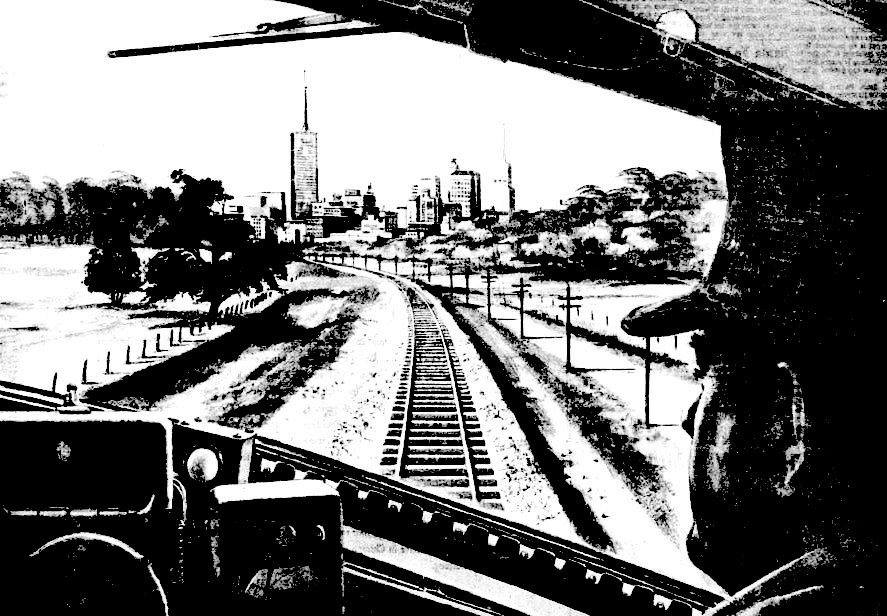
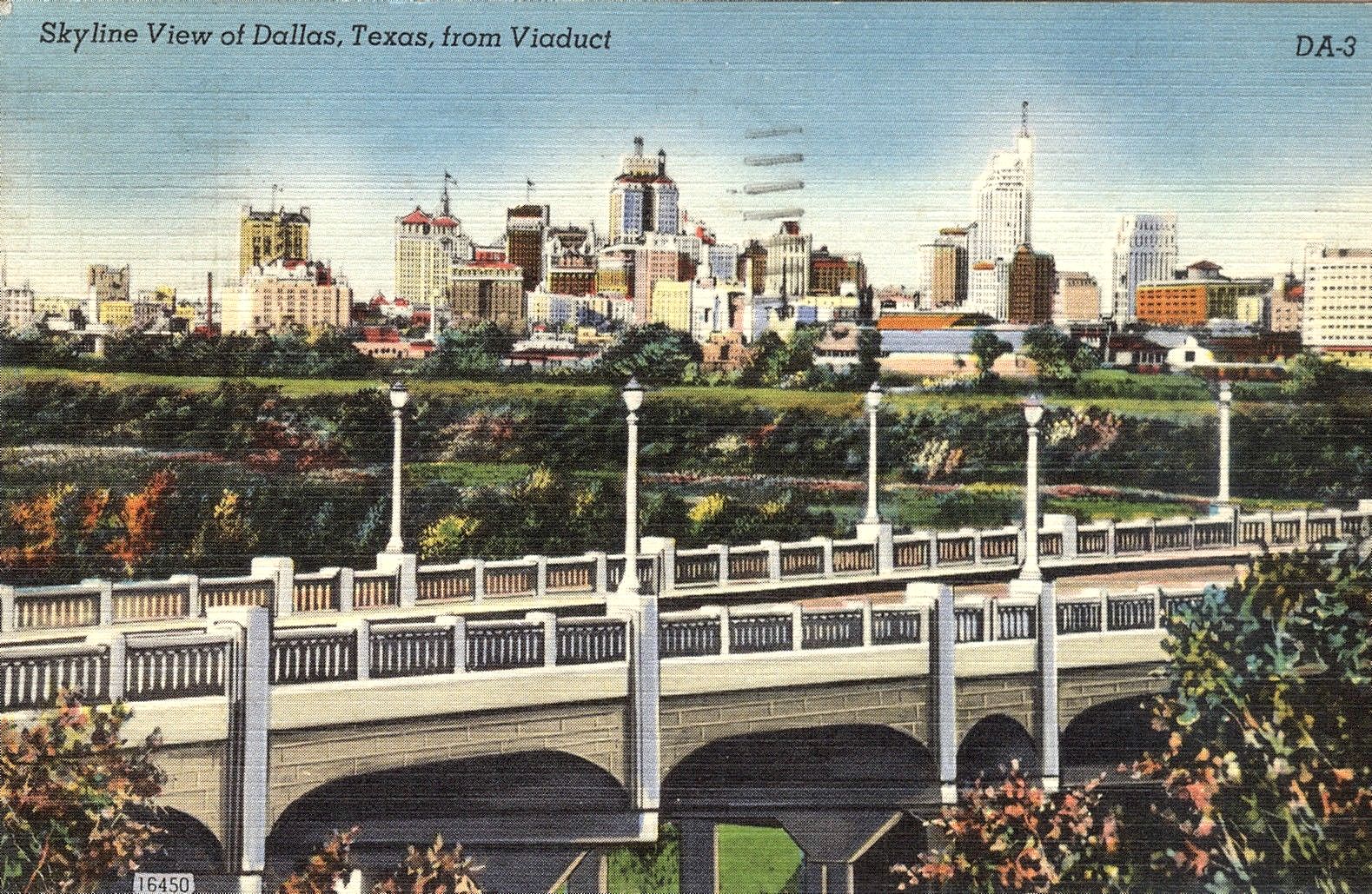
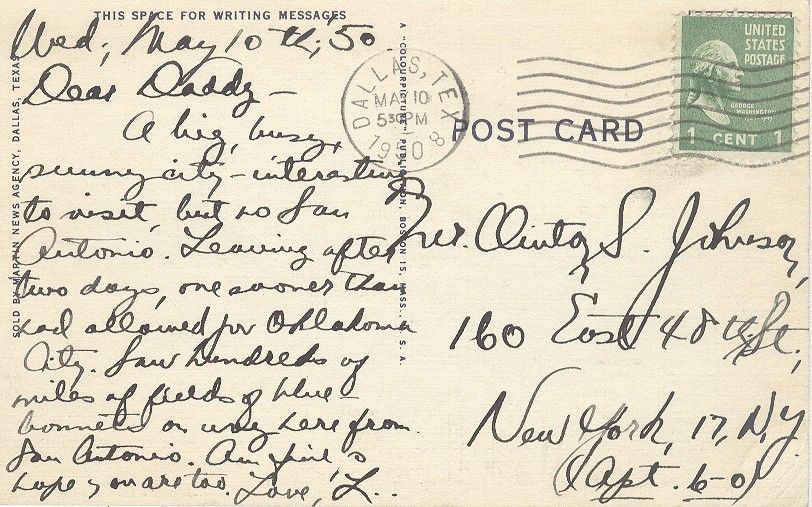
In May of 1950, Clinton S. Johnson of New York City received a postcard from his child who was traveling across Texas. The postcard, showing a “Skyline View of Dallas, Texas, from Viaduct,” said:

Wed. May 10, ’50

Dear Daddy —
A big, busy, sunny city — interesting to visit, but no San Antonio. Leaving after two days, one sooner than had allowed for Oklahoma City. Saw hundreds of miles of fields of bluebonnets on way here from San Antonio. Am fine, hope you are too.
Love, L.

skyline_no-san-antonio_ebay-verso

“Big, busy, sunny, and interesting” — “but no San Antonio.” …I accept that. Who doesn’t love San Antonio? But San Antonio never had a skyline view like that.

***

Sources & Notes

Postcard from eBay.

*

Copyright © 2015 Paula Bosse. All Rights Reserved.

DP&L’s Twin Smokestacks

downtown_color_1939
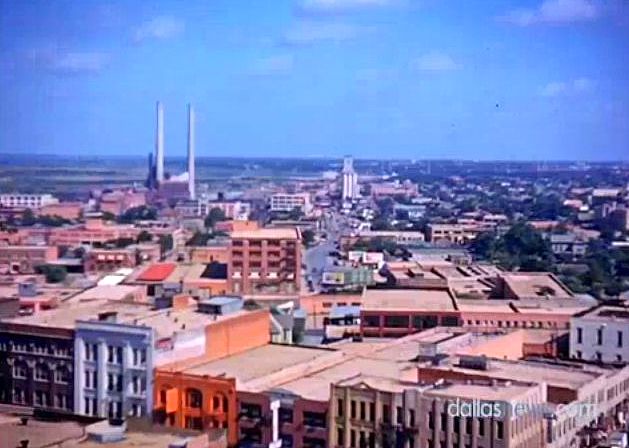
An unusual view of the smokestacks from 1939 — in color!

by Paula Bosse

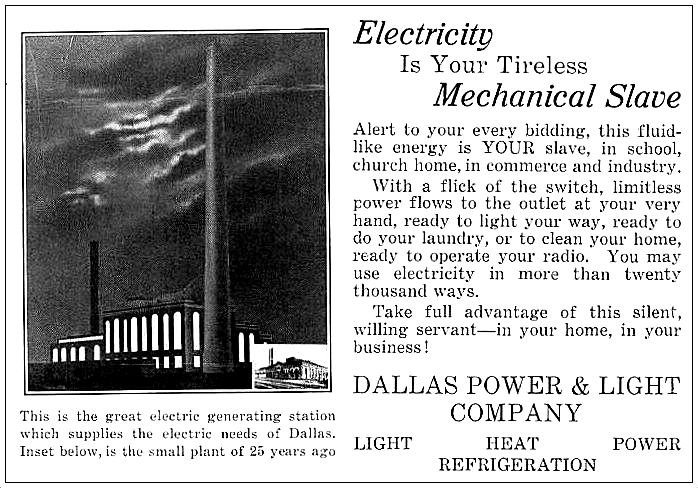
I got to thinking about those two smokestacks that used to be such an important part of the Dallas skyline when I came across this rather forceful 1928 Dallas Power & Light Company ad:

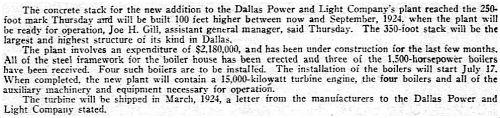
ad-dpl_terrill-yrbk-1928
(click for larger image)

“More than twenty thousand ways” to use electricity, “your tireless mechanical slave”! (To see a larger image of the ad’s illustrated inset, click here.)

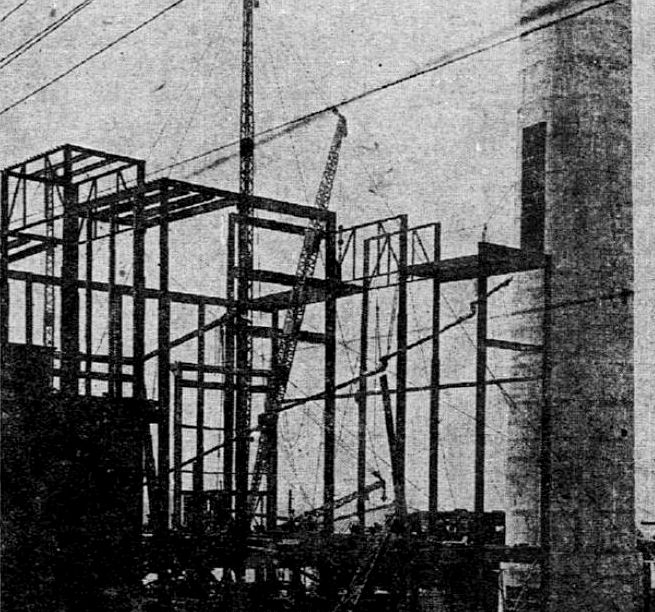
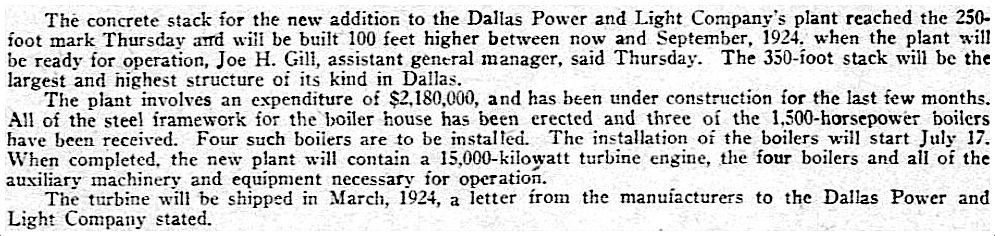
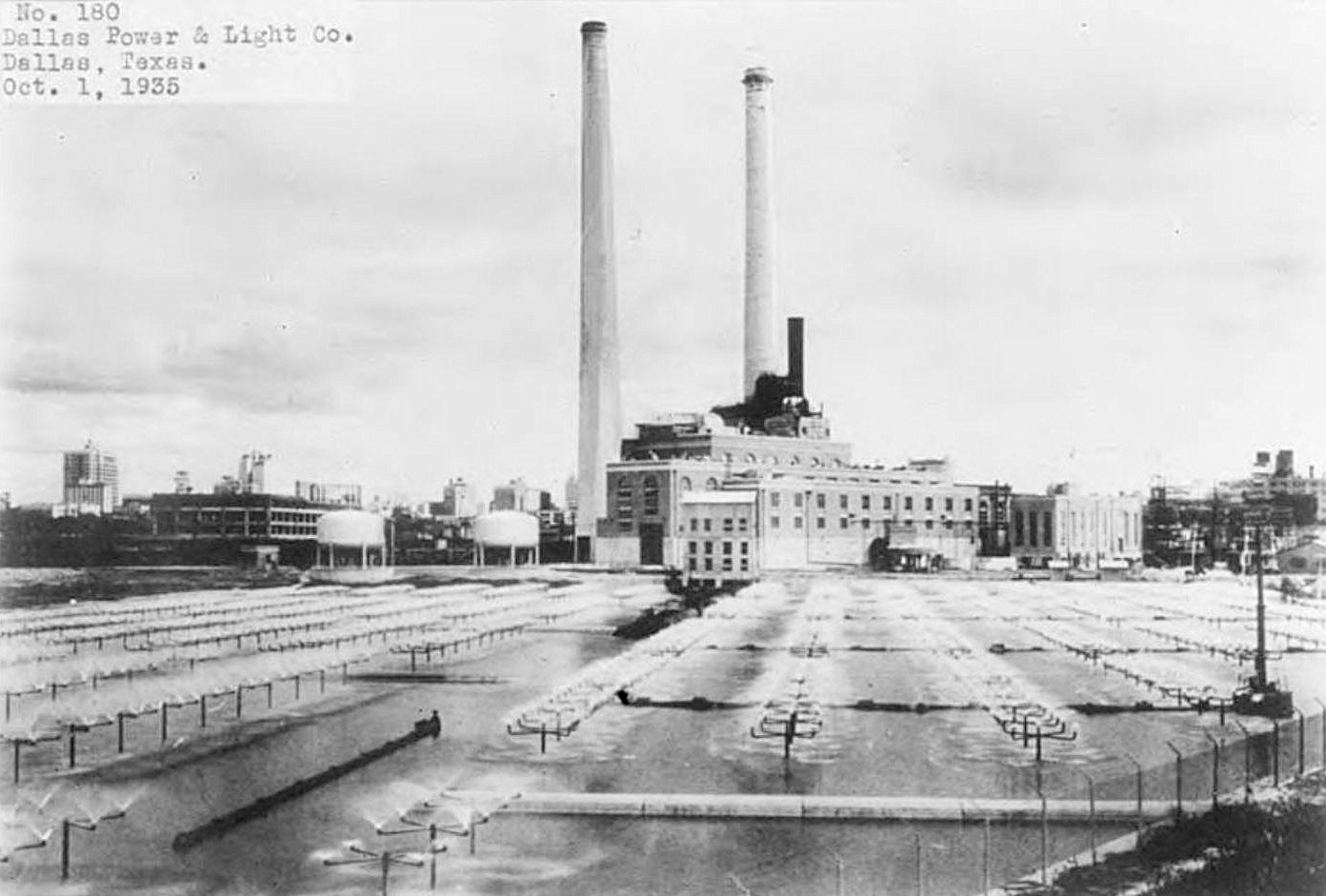
According to The Dallas Morning News, the Dallas Power & Light Company power plant had been in use at the location at “at the foot of Griffin Street … since 1890, with additions in 1905, in 1912 and in 1914. In 1922 work started on the most recent addition, which when completed will cost over $2,000,000, and will provide additional generating capacity of furnishing 20,000 kilowatts” (DMN, Oct. 14, 1923).

Construction on the new addition — including the first of the two new smokestacks — began in the summer of 1922.

dpl_dmn_FWST_072822Fort Worth Star-Telegram, July 28, 1922

By the summer of 1923 the first smokestack was partially built.
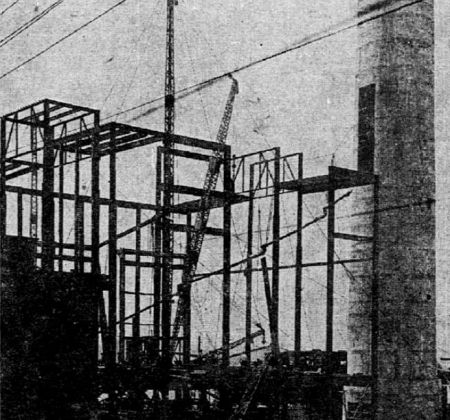
smokestack_dmn_071323smokestack_dmn_071323-captionDMN, July 13, 1923 (click for larger images)

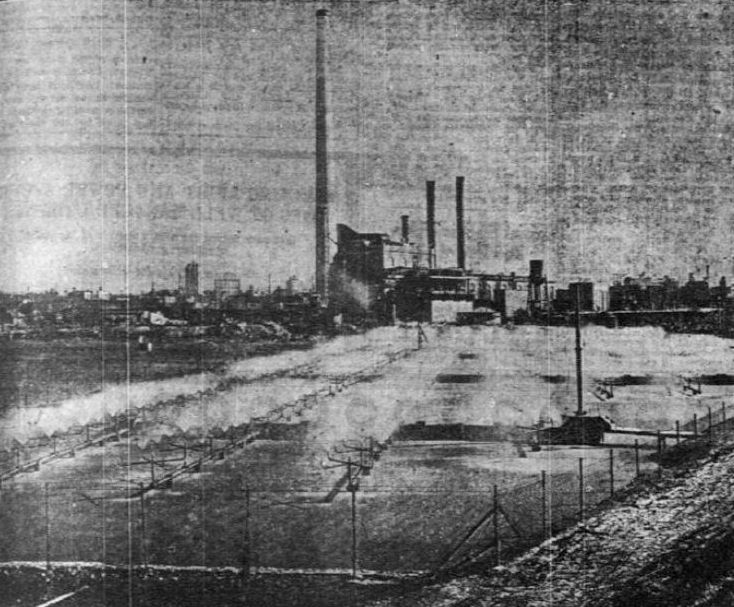
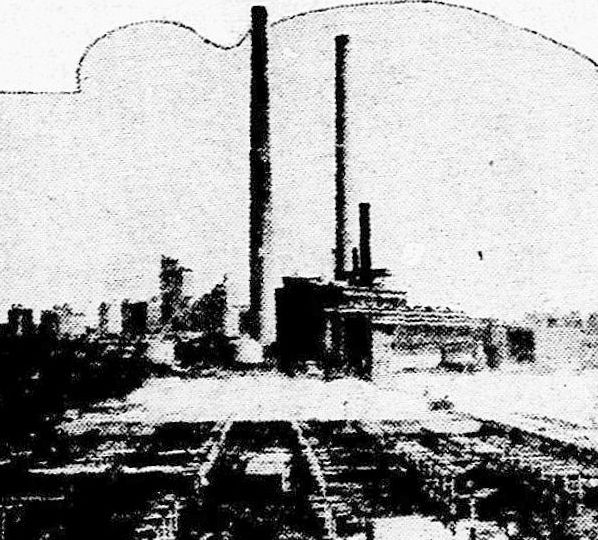
The new addition was completed in 1924 (although improvements and construction were constantly ongoing). The new giant smokestack can be seen in this photo, alongside the old and new parts of the generating plant:

dpl_dmn_101224_photo2DMN, Oct. 12, 1924

And, another view, this one with the 8-acre “spray pond” in the foreground:
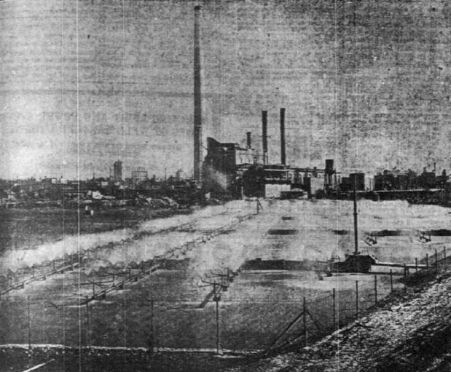
dpl_dmn_101224_photoDMN, Oct. 12, 1924

In 1928 DP&L announced that it needed a further addition:

Another large chimney or smokestack, a new boiler room and other plant enlargements will be required in the North Dallas generation plant to house the new addition. (DMN, Oct. 20, 1928)

And in 1929 … voilà — the second smokestack!
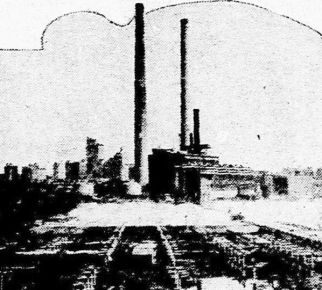
dpl_steamstacks_1929
1929

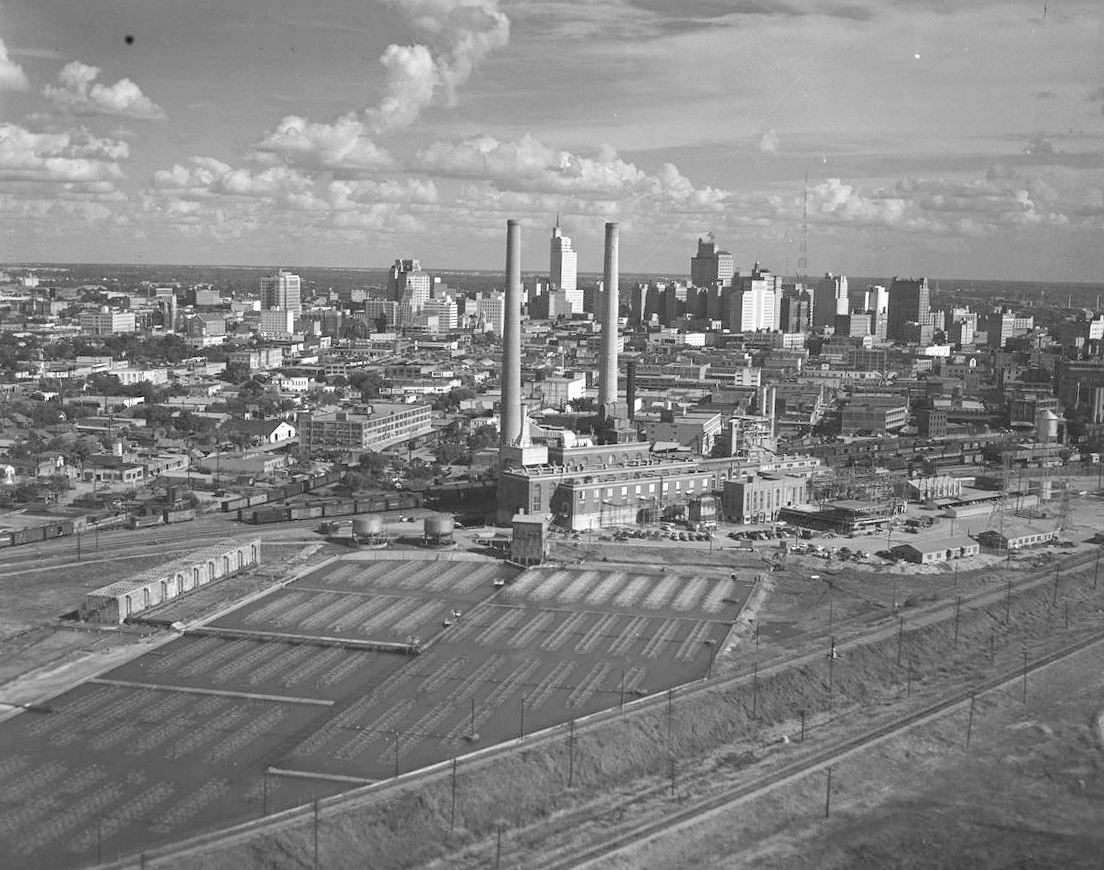
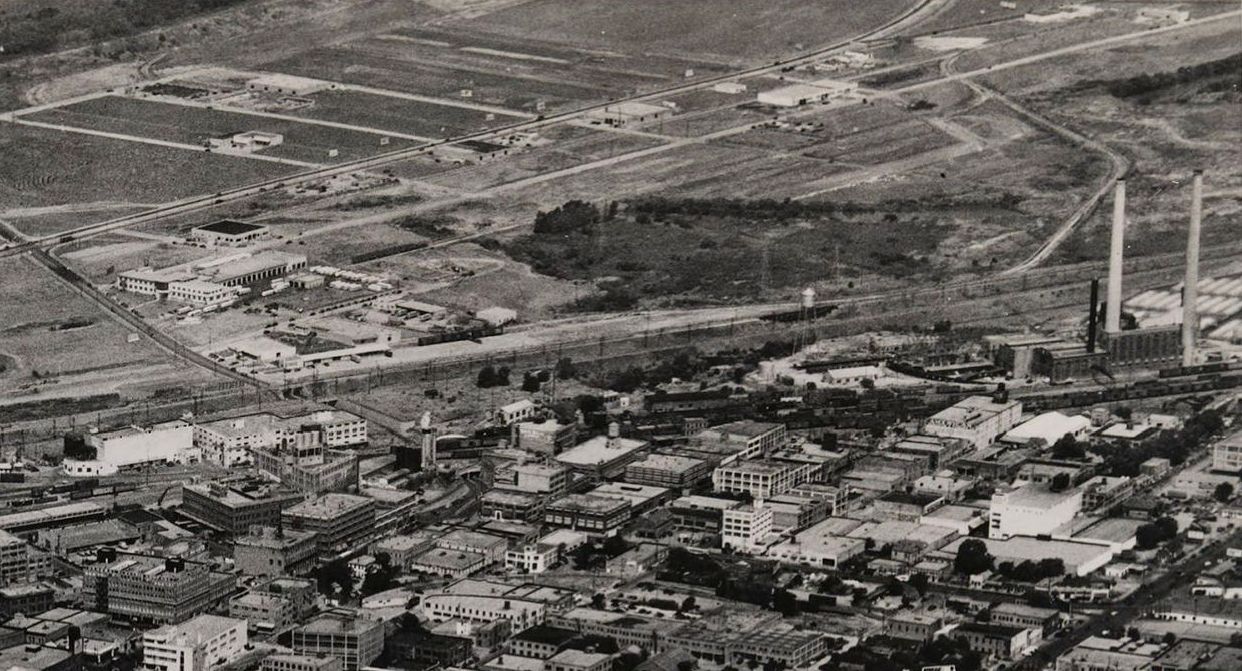
Those two smokestacks (which actually emitted steam rather than smoke) were almost as much a part of the iconic Dallas skyline as Pegasus. You’ll see them in any wide shot of the skyline taken between 1929 and the late 1990s, when the plant was demolished to make way for the American Airlines Center (the design of which actually is reminiscent of the building it replaced). You could see those smokestacks from miles away, and, even though they’ve been gone for more than 15 years, I still expect to see them standing there. RIP, smokestacks!

*

dallas-power-and-light_degolyer-lib_SMU1930s, via DeGolyer Library, Southern Methodist University
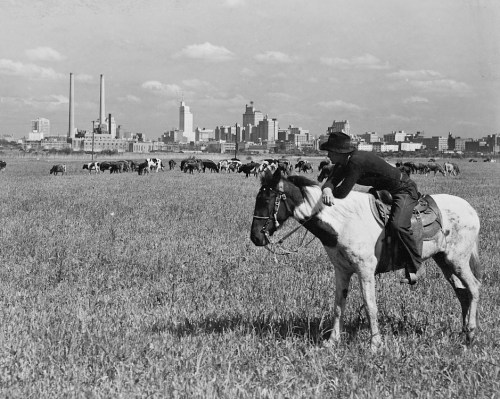
langley_skyline-horseback_c1945_LOCPhoto by William Langley, 1945 (with the twin stacks AND Pegasus)
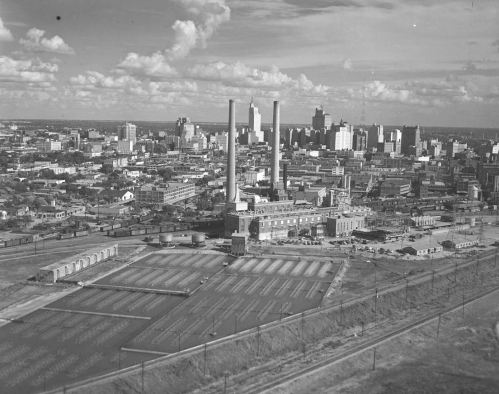
dpl-plant_towers_squire-haskins_UTAvia Squire Haskins Collection, University of Texas at Arlington

smokestacks_long_foscue_ca1948-detAerial photo by Lloyd M. Long, 1948 (detail)

dpl_steamstacks

***

Sources & Notes

Color image is a screengrab from the short 1939 color film of Dallas which you can watch in full, here.

Ad is from the 1928 Terrillian, the Terrill School yearbook.

William Langley photo of the cowboy on horseback is from the Library of Congress, used previously here.

Lloyd M. Long aerial photo is a detail of a photo cataloged as “Downtown Dallas — looking west,” from the Edwin J. Foscue Map Library, Central University Libraries, Southern Methodist University; the full photo and its details are accessible here.

For an unexpectedly enthusiastic essay about the design and cultural/aesthetic significance of the plant and its smokestacks, architecture critic David Dillon’s “Getting Up a Head of Steam: DP&L’s Power Station, Recalling an Urban Past, Is a Function of Triumph” (Dallas Morning News, Sept. 7, 1983) is well worth searching for in the Dallas Morning News archives. This is the first paragraph:

The Dallas Steam Electric Station on Stemmons is nearly a century old and for most of that time it has been a commanding presence on the downtown skyline, its soaring white smokestacks rivaling anything that modern skyscraper designers have come up with. In Pittsburgh or Detroit such a structure might pass unnoticed but in Dallas, never a factory town, it stands out as a romantic symbol of our earliest industrial aspirations.

(My favorite piece of trivia from Dillon’s article is the revelation that the “tapering white shafts and gold caps [were] touched up every few years by daredevil painters lowered from a helicopter…” (!)).

More about this plant (and how it lives on in the design of the American Airlines Center which now stands on the same land) can be found in the Flashback Dallas post “A New Turbine Power Station for Big D — 1907,” here.

As always, most images are larger when clicked. When in doubt … CLICK!

*

Copyright © 2015 Paula Bosse. All Rights Reserved.


“New Dallas Skyline” — 1913

1913-pano-3Dallas skyline panorama detail, 1913 (click for larger image)

by Paula Bosse

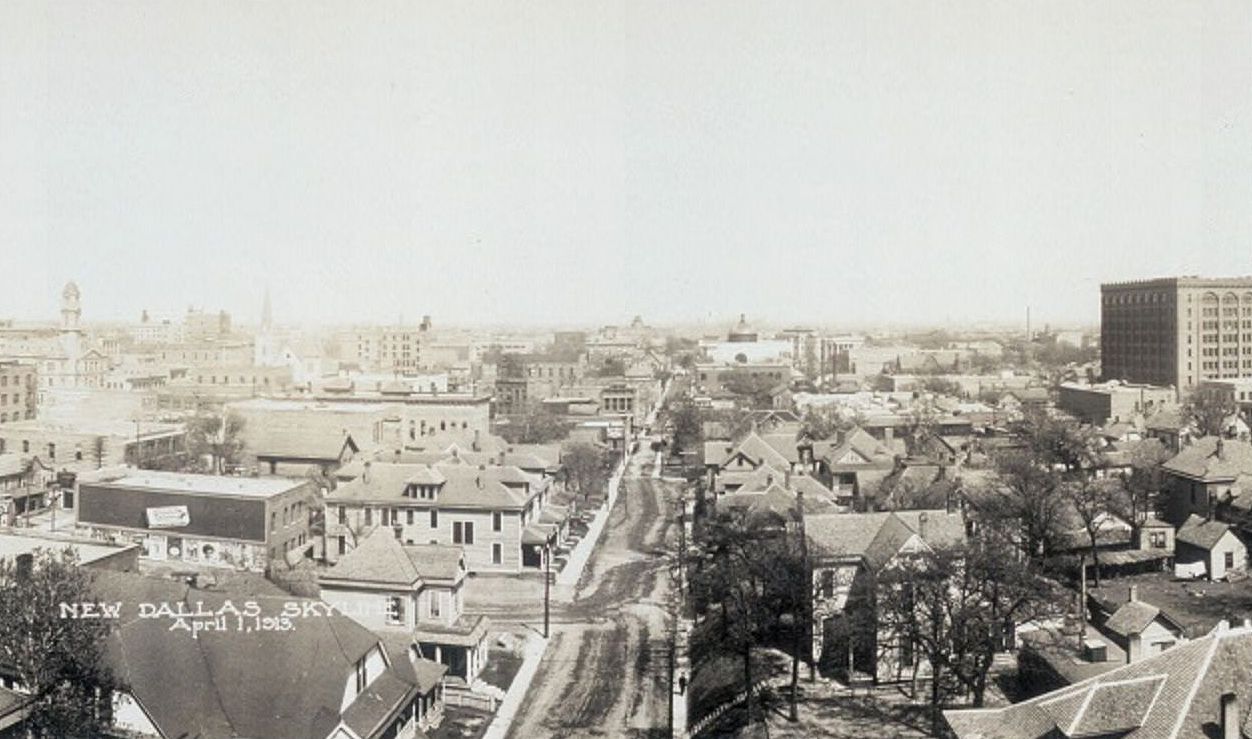
On April 1, 1913, one of Dallas’ most prominent photographers, Jno. J. Johnson, took a wonderful panoramic photo of the Dallas skyline. Dallas was, even then, boasting an impressive skyline. I’ve zoomed in a bit on the photo, breaking it down into four separate images. Johnson’s original photograph, titled “New Dallas Skyline — April 1, 1913,” is below. (Click to enlarge all images.)

dallas-panorama-skyline_april-1913_LOC(Click this photo!)
*

Below, the first portion of the photo.

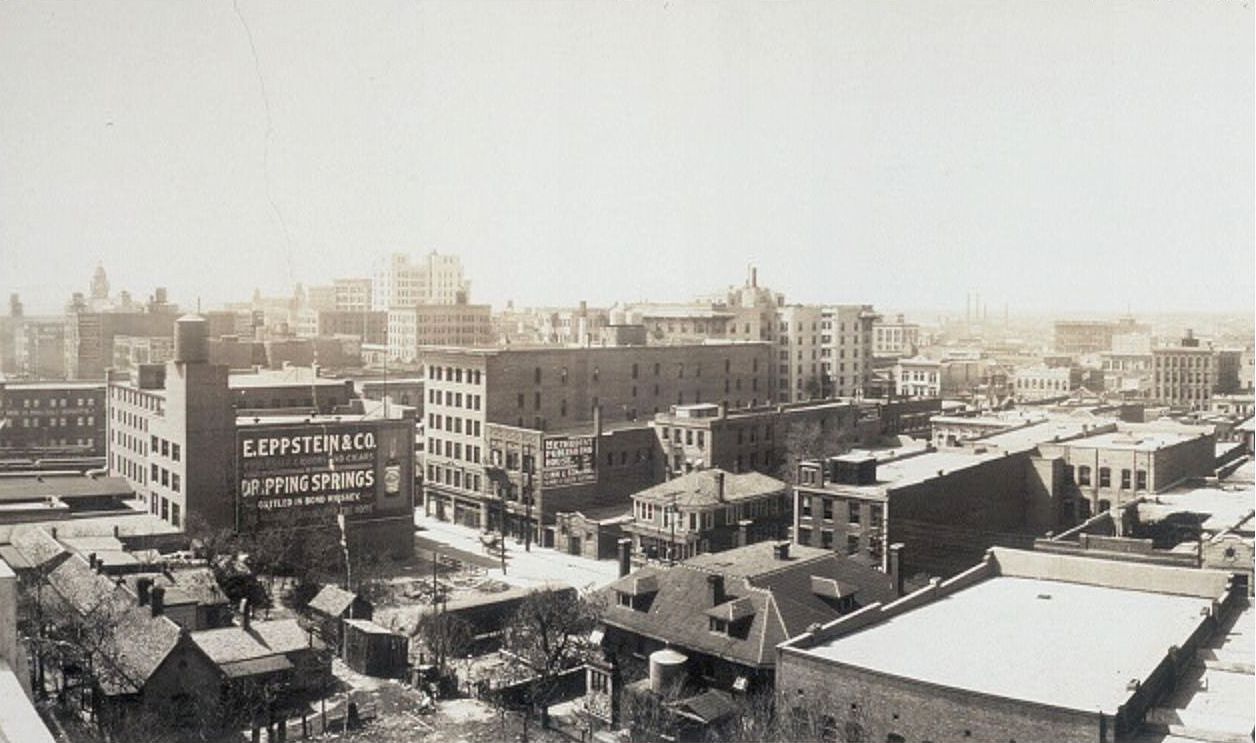
1913-pano-1E. Eppstein & Co., wholesale distributors of whiskey and cigars, was at 1300-1302 Jackson.

*

1913-pano-2Above, the second portion, showing S. Akard Street, looking north — at the end of the street is the 6-month old Adolphus Hotel (then the tallest building in Dallas), built by beer baron Adolphus Busch, located on Commerce Street, catty-corner from his other hotel, The Oriental (the darker building in the center, with the distinctive top-knot on its northwest corner). The Praetorian Building (on Main) — a previous “tallest building in Dallas” — is the still tall-ish white building, second from the right.

*

The third portion (at the top) shows, I believe, Wood Street, looking east. The Post Office tower on Commerce can be seen at the far left. At the top, to the right of Wood Street (at S. Harwood) is the still-familiar sight of the First Presbyterian Church dome (brand new — the paint inside and out was probably still wet when this photograph was taken); to the right of the dome is the also-still-standing (and beautiful!) Scottish Rite Temple, also brand new.

*

1913-pano-4The final portion shows what I guess would be considered the northern edge of The Cedars? I love old photos that show residences in what we now consider the Central Business District. It’s so weird seeing these houses! The hulking turreted building at the top is Butler Brothers (built in 1910-11) at 500 S. Ervay; it later changed its name to the Merchandise Mart, and it is now undergoing renovation.

***

Panoramic photograph by Jno. J. Johnson, from the Library of Congress, here.

For those who want to play along at home, a 1919 street map of the area can be found at the ever-indispensable Portal to Texas History, here.

Click pictures for much larger images.

*

Copyright © 2015 Paula Bosse. All Rights Reserved.