Flashback : Dallas

A Miscellany: History, Ads, Pop Culture

Category: Fashion

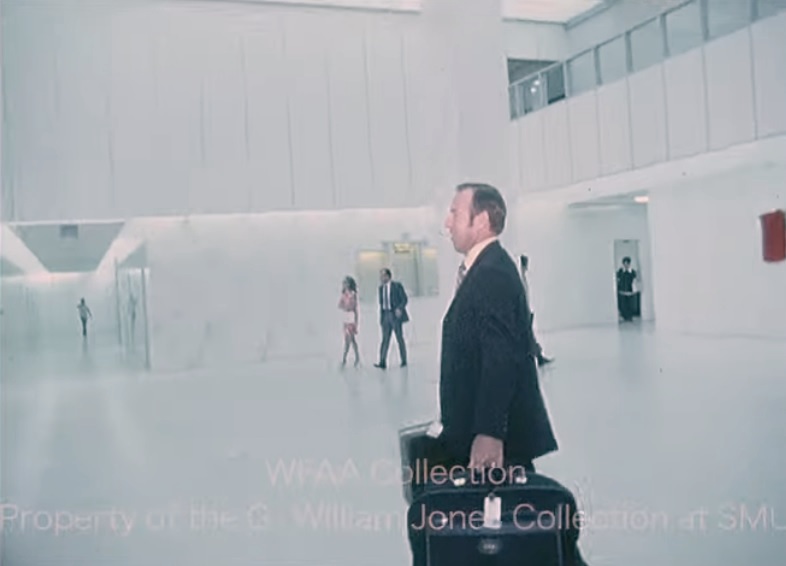
Some-Context Channel 8 Screenshots: 1971

lady mailman june 1971 WFAAWFAA Collection/Jones Film Collection/SMU

by Paula Bosse

I have been working as part of a 3-person team (led by Jeremy Spracklen and Scott Martin) on the WFAA archive of news film, housed in the G. William Jones Film and Video Collection at the Hamon Arts Library at SMU. I have been working on 1970 and 1971, going through daily footage shot for Channel 8 News. I get a bit bogged down by all the sports and car crashes, but at this point, I am so all-consumed by these two specific years that I feel I would do well on Jeopardy if the categories were things like “Minor League DFW Hockey Teams of the Early ’70s,” “Internecine Squabbles of the Dallas City Council, the Dallas School Board, and the Dallas County Commissioners Court,” and “So What’s the Deal with the Sharpstown Scandal?” My 2023 has been spent immersed in 1971, where the chaos of the implementation of court-ordered school busing, the huge securities fraud scandal that involved some very powerful Texas politicians (Sharpstown), and the battle between Craig Morton and Roger Staubach to become the Cowboys’ #1 quarterback were some of the stories that dominated the headlines. And, lordy, there were some pretty exotic hairstyles, fashions, and interior design trends hammering away relentlessly throughout this post-hippie (it might really still have been current-hippie), pre-disco period.

Here are a few of my favorite moments from this 1971 DFW-centric news footage from the WFAA archives. Links to the pertinent clips on YouTube are included at the end of the descriptions. These clips are rarely the full reports that would have been seen on the nightly news — they are often just silent footage or B-roll, without any identification of people or clues as to where they were filmed or even why they were newsworthy. It’s (mostly) a lot of fun to dig through and watch the unfolding of history from more than 50 years in the future.

**

Above, from JUNE 1971

One of my favorite human-interest stories from the past year (meaning 1971!) was the profile of one of the few “lady mailmen” in Dallas at the time. She’s utterly, utterly charming, has a supportive and interesting husband and family, and loves her job. The Channel 8 cameraman shows her as she sorts her mail in the Beverly Hills Station post office in Oak Cliff and follows her as she walks along her route on West Davis. The only problem with this 7 minutes of interesting footage is that the woman is never identified. I dove in, really wanting to identify her. I thought I had cracked the mystery of her identity, only to find myself at a dead end again. If only her children could see this wonderful profile of their mother. If you know who this woman is, please let me know, and we’ll add her name to the YouTube description and try to track down any family members. I would LOVE her children to be able to see this.

The “lady mailman” is interviewed here (this first bit is in three short segments, totaling 4 minutes); a later clip shows her on her route, here (about 3 minutes). The old post office building still stands at 509 N. Barnett.
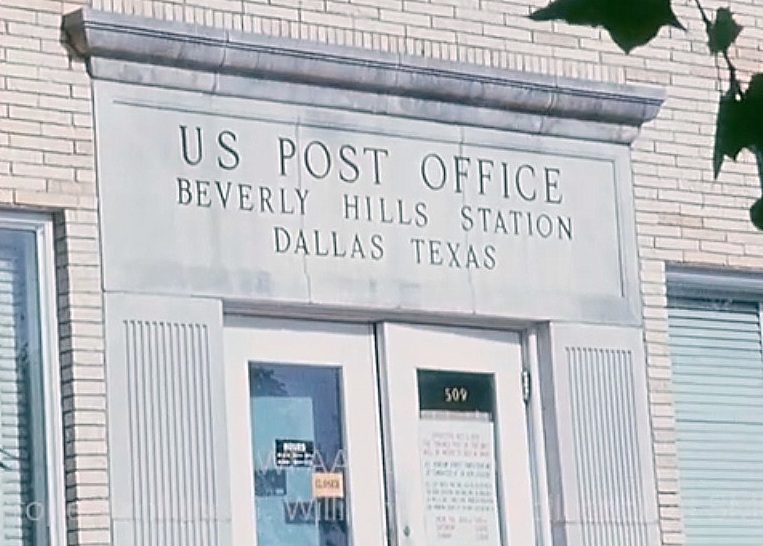
lady mailman june 1971 WFAA_beverly hills post office

*

JANUARY 1971

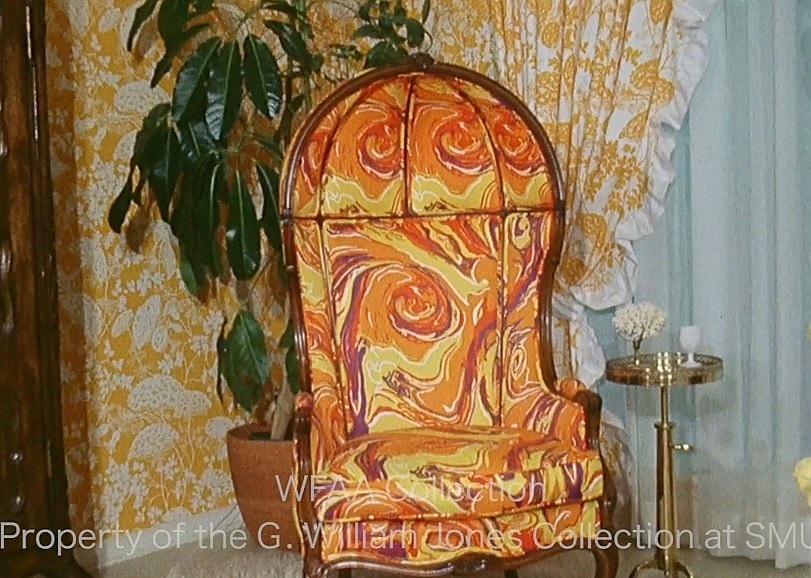
So, yeah, fashion and interior design trends were pretty… in-your-face in 1971. In the three screenshots below, you’ll see some retina-abusing images of with-it decor. The first features the always beautiful Phyllis George, the Denton native who was in the midst of her Miss America reign. In this clip, she has come back home to DFW for an appearance at an event in which a room designed with her in mind is unveiled (by decorators C. John Megna and William Farrington). She is wearing a dress designed by Carlo Bitetto specifically for her to wear IN THAT ROOM (!). You don’t often see sparkles and plaid cheek-by-jowl.

The clip with the super-color-saturated room and its battling patterns is here.

phyllis-george-room_jan-1971_c

phyllis-george-room_jan-1971_b

phyllis-george-room_jan-1971_a

*

FEBRUARY 25, 1971

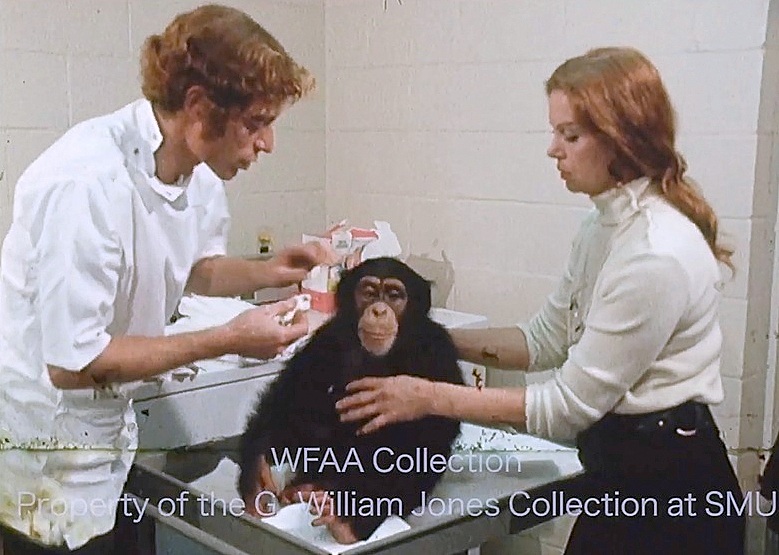
Before Lion Country Safari, Mesquite had World of Animals, a drive-thru safari park. World of Animals had a wild-animal veterinarian who visited regularly from California: Dr. Martin Dinnes. Below, Dinnes is seen providing dental care to popular attraction Harold the Chimp. This is not really something I expected to see, but there you are. (Dinnes was later engaged to actress and wildlife preservation activist Tippi Hedren for several years.)

The clips of Dinnes being interviewed and preparing Harold for a tooth extraction (and I grimaced a bit, because the camera keeps rolling during the procedure, so be warned!) are here and here. (The last clip has a shot of Harold’s hand, which, understandably, appears to be gripping the chair.) That is one well-behaved, chill chimp!
dinnes-martin_harold-chimp_022571_WFAA

*

MAY 18, 1971

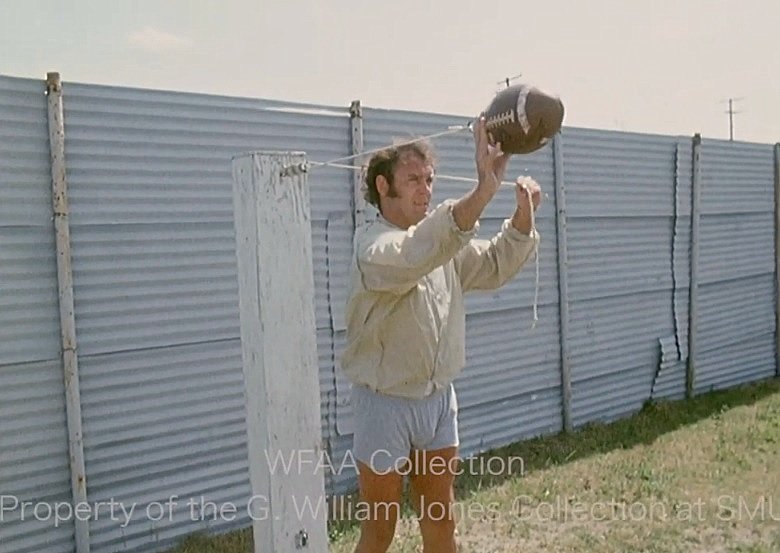
In 1971, there was an ongoing battle between old quarterback Craig Morton and NKOTB Roger Staubach over who would be named the team’s official starting QB. Coach Tom Landry worked for months with a two-quarterback system, alternating them from game to game — he was fine with this, but everyone else hated it. Below are screenshots of Morton and Staubach at the Cowboys practice field. I know virtually nothing about sports training, but this, um, extremely low-tech gadget struck me as weird. And funny. I mean, okay, it was 1971, but surely there was something more technologically advanced than this? It’s a football on a string, tied to a post. And maybe there’s a spring or something in there. This must have been effective. Rog looks like he’s straining. I don’t know. But I love it.

See Craig in an interview with Verne Lundquist from May 18, 1971 about his elbow and shoulder injuries here, and then using the football-on-a-string thing (and then training with Staubach) here; and see Roger interviewed on the same day about really, really wanting to be the starting QB here, and then he hits the string thing here before working out with Morton in what must have been a fairly tense period of both of their careers.
morton-string_WFAA_may-18-1971

staubach-string_WFAA_may-1971

*

JUNE 1971

Medical examiners used to be on the news a lot. One who popped up frequently was Tarrant County M.E. Dr. Feliks Gwozdz. I was amused more than I should have been when I saw the skull-and-crossbones coffee mug on his desk. I hope it said “World’s Greatest Coroner!” on the back.

The silent footage of Dr. Gwozdz at his desk is here.

skull-crossbones_feliks-gwozdz_june-1971

*

JULY 14, 1971

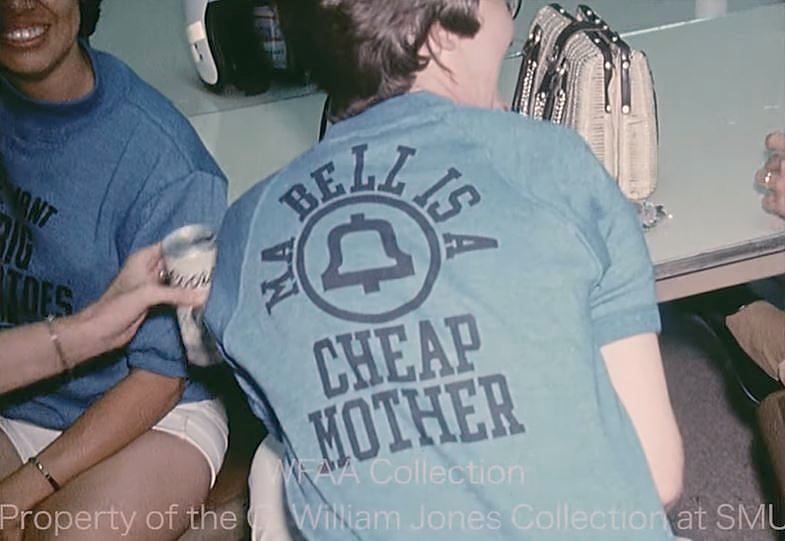
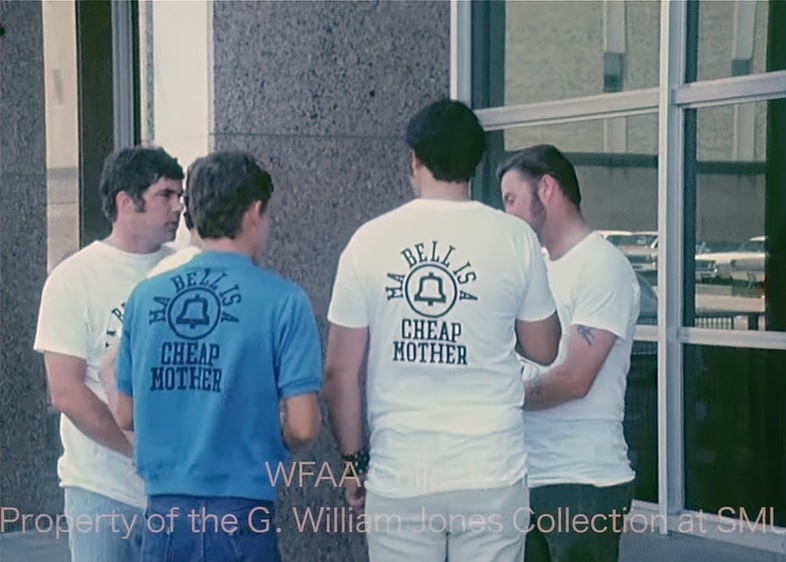
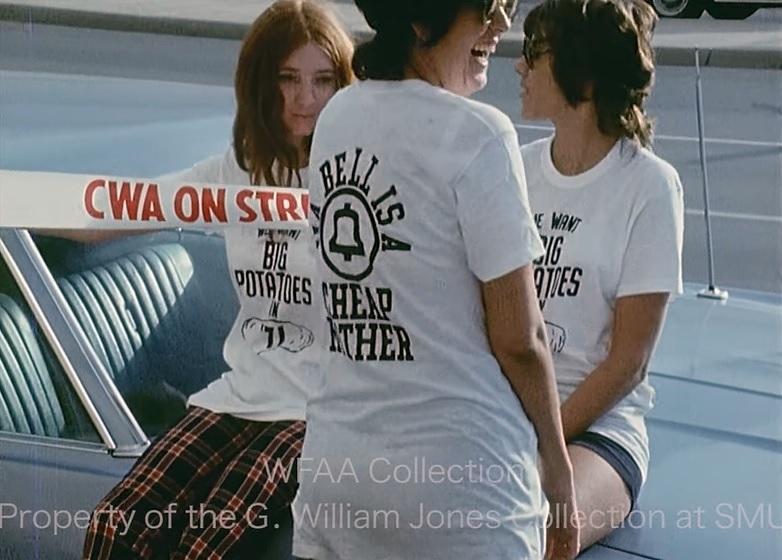
Back in 1971 there was what seemed like the threat of a union strike every 10 minutes. I enjoyed the footage of a bunch of Southwestern Bell employees who look like they were probably a lot of fun to hang out with. Their t-shirts read “Ma Bell Is a Cheap Mother,” which is just great.

Strike footage is here (about 2½ minutes) and here.
SWB-strike_july-14-1971_big potatoes

SWB-strike_july-14-1971_ma bell is a cheap mother

SWB-strike_july-14-1971_WFAA

*

JULY 1971

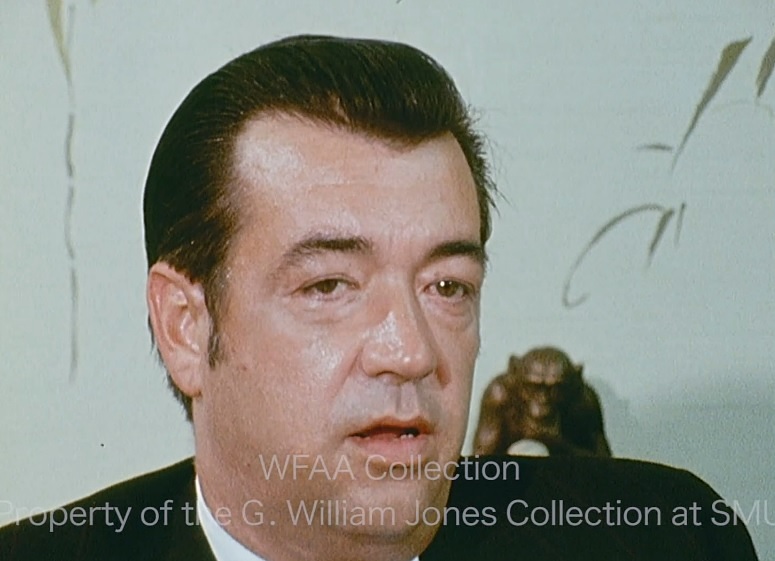
One of the top stories of 1971 was the endless furor set off by court-mandated school busing in attempts to desegregate schools. It was a mess. The man seen below is attorney Bill Brice, a leader of one of the many anti-busing groups. …Surely the cameraman noticed the monkey.

Man with monkey can be seen here.
anti-busing_bill-brice_monkey_WFAA_july-8-9-1971

*

AUGUST 29, 1971

When the Dallas School Board and Supt. Nolan Estes weren’t pulling their hair out over desegregation, they tackled other issues. One of which was so overshadowed by anti-busing demonstrations that it barely got any play, but I find it really interesting. It concerned Crozier Tech High School downtown. At the end of the 1970-71 school year, the landmark school was closed, and there was lots of discussion on what the DISD should do with the building/land, which they owned (2218 Bryan). This press conference was supposed to be about Estes’ vision of a 40-story school-office complex, which he suggested be built on the land — the first 10 floors would be for school use, and the top 30 floors would be leased to businesses as office space, with leases, theoretically, paying for construction and maintenance of the building. The building was never built (and thankfully, old Tech still stands). School board president John Plath Green and Supt. Estes sit in front of an architectural drawing of the envisioned DISD skyscraper. Too bad no one wanted to talk about it.

Footage from the press conference where reporters only want to ask about busing, is here.

super-school_DISD_crozier-tech_DMN_082971_WFAA_SMU

*

SEPTEMBER 23, 1971

The Sharpstown Scandal was a bigger story than busing, but, even though political scandals are juicy, it just didn’t get everyday people mobilizing, marching in the streets, and shouting each other down in public forums the way busing did. But it was a massive story, and several political careers bit the dust because of it. The sprawling and confusing securities-fraud scandal mostly involved drab politicians and business executives. But one part of it involved, bizarrely, six celebrated — if not beloved — NASA astronauts and an insurance company pension fund.

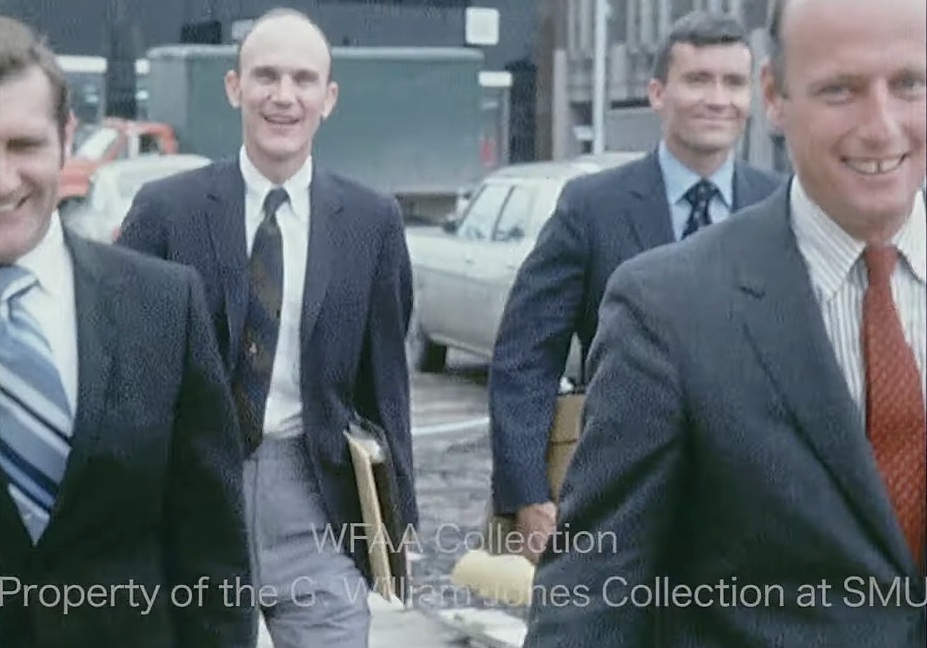
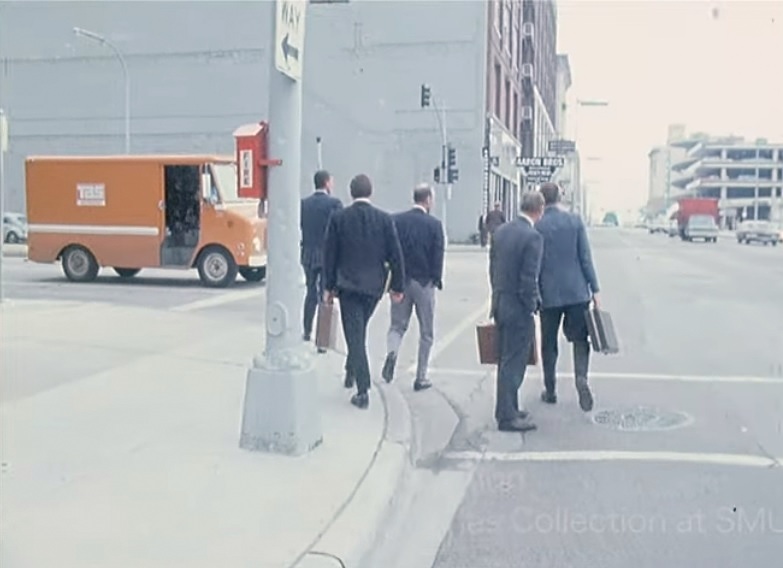
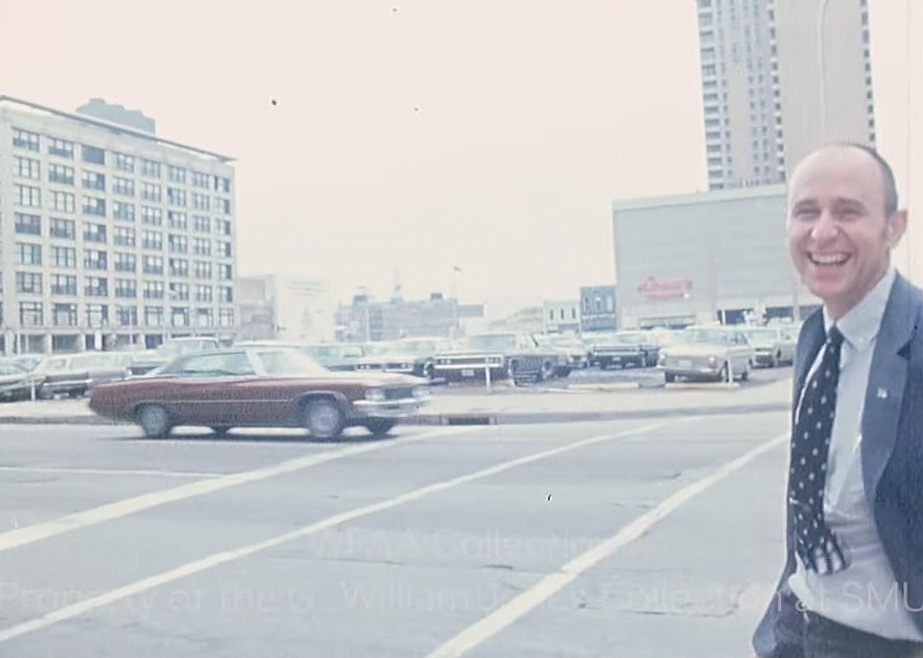
In this Channel 8 footage, you can see something you don’t see every day: five NASA astronauts walking together down the street (a sixth one was nearby, on his own). James Lovell, Pete Conrad, Fred Haise, Ken Mattingly, Richard Gordon, and Alan Bean were in Dallas on Sept. 23, 1971 to testify as witnesses before a federal grand jury that was investigating the activities surrounding the Sharpstown Scandal. These are screenshots of the five (minus Lovell), carrying briefcases through grubby downtown Dallas, and of Lovell on his own, exiting the Federal Court House. When I first watched this footage, it just seemed really odd: five internationally (galactically!) famous astronauts — heroes! — walking together down the street, without any kind of security or entourage. If you were a NASA freak (and there were a lot back then, at the height of the Apollo-Gemini programs) and you just happened to have walked past this group, your head would have exploded.

See Lovell exiting the sterile- and dystopian-looking courthouse on his own (that woman he holds the door open for has no idea who he is), and the others walking somewhat playfully down the street here (I love this footage!); a confusing wrap-up of the day’s events is here.
astronauts_WFAA_SMU_sept-23-1971

astronauts_WFAA_SMU_sept-23-1971_1

astronauts_WFAA_SMU_sept-23-1971_2

astronauts_WFAA_SMU_sept-23-1971_c

*

OCTOBER 14, 1971

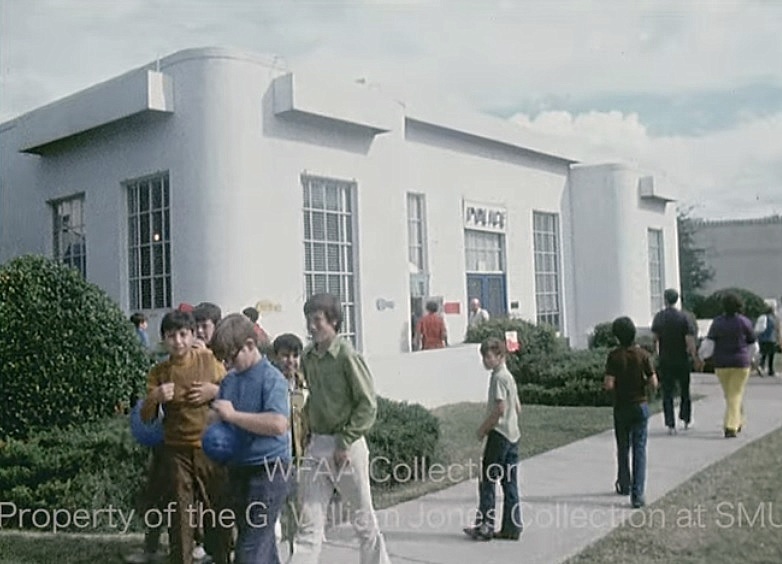
In footage from the State Fair of Texas, I was really taken by this building, which I swore I had never seen. It was the home of the “lost children” center during the fair, in the Dallas police HQ in Fair Park. It looks different to me now, but it’s still there, near the Aquarium. It looked better in 1971!

Lots of footage of crying children and harried parents, here and here.
fair-park_sfot_lost-kids_101471_WFAA_SMU

*

OCTOBER 1971

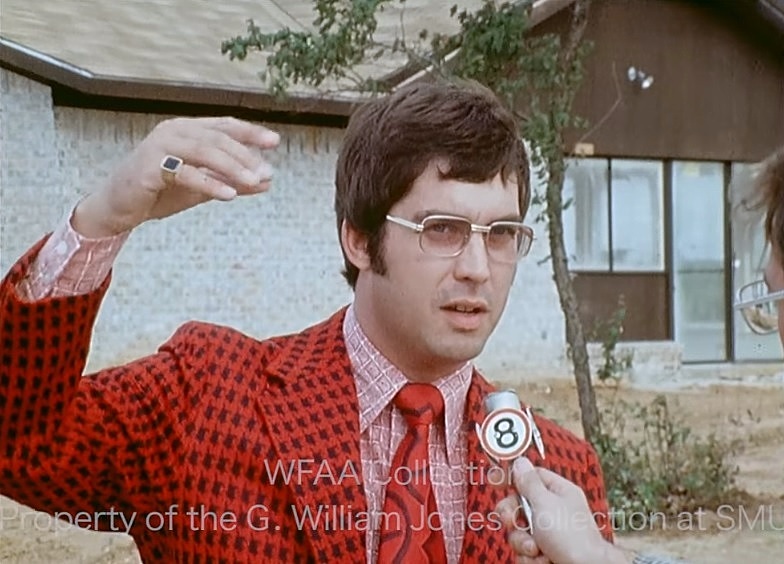
This young dandy is named John Ott (I’m not 100% sure about the spelling). He was a real estate developer in Euless. He couldn’t have been more on top of the 1971 fashion wave. Represent, Euless!

It’s a story about replanting trees (with, admittedly, interesting footage of trees being uprooted and replanted). Here and here.
developer_john-ott_euless_oct-29-30-1971_WFAA_SMU

*

OCTOBER 31, 1971

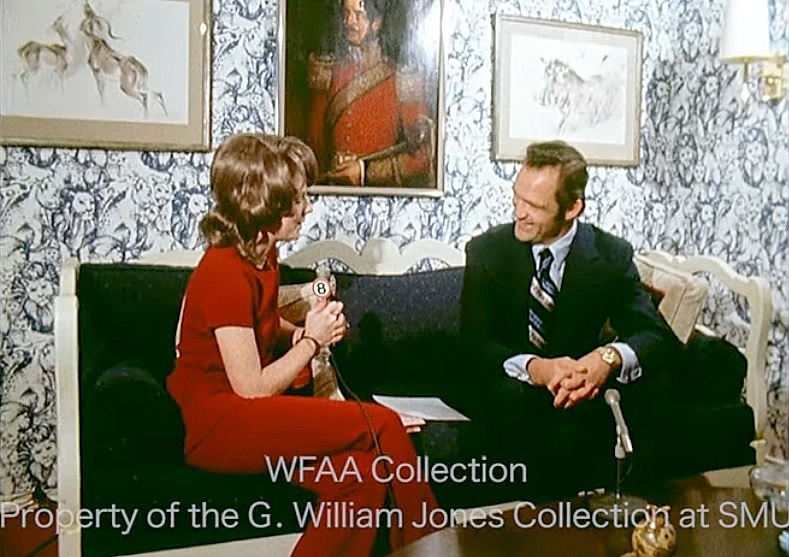
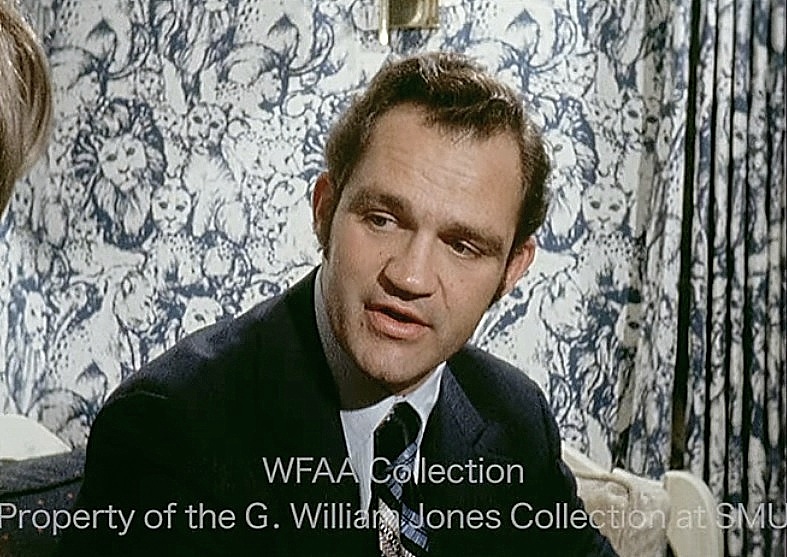
In the screenshots below, Channel 8 reporter Judi Hanna (who had recently debuted an unfortunate hairdo) interviews Dallas City Councilman Garry Weber about City Council things. I don’t know where this was filmed, but I only hope it wasn’t his home. It’s hard to focus on what anyone is saying, because of the tidal wave of stuff coming at you. (Ironically, he was being interviewed about sponsoring a change to the city charter in order to crack down on the “visual pollution” of unenforced sign ordinances.) I was so overwhelmed by this vista, that I somehow assumed I was seeing cupid-studded wallpaper. But no. Check out the second screenshot, which also includes a peek at the room’s drapes. I can’t tell where the wallpaper ends and the drapes begin.

Appropriately shown on Halloween night, clips from this report are here (followed by footage of signs-galore along Lemmon Avenue) and here.
weber-garry_WFAA_SMU_oct-31-1971_wide

weber-garry_WFAA_SMU_oct-31-1971_drapes

*

OCTOBER 1971

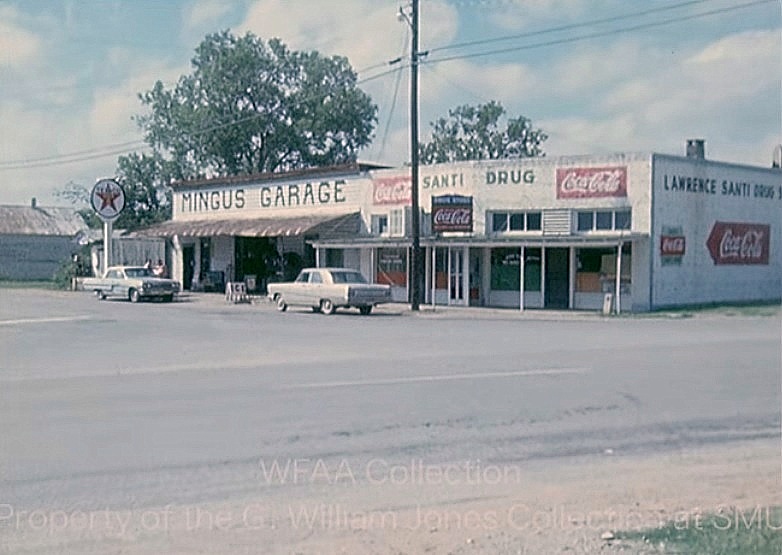
Lastly, a shot of Mingus, Texas, a small West Texas town near Thurber. I just love this image. I think I found the location — here’s what it looks like now.

Why was the tiny town of MIngus being featured on a Dallas news report? The Greater Mingus-Thurber Metropolitan Area was in the news because it was the location of a commune of the controversial Children of God (i.e. “cult”). Actually, the “Children” were in the process of being evicted by the landowner, who, interestingly, was a TV preacher in Los Angeles (I guess even TV evangelists have a breaking point). Members of this group splintered, and a few moved to Big D for a while, where they continued to be newsworthy until they moved elsewhere.

The shot of Mingus is from one of the many clips contained in this Oct. 7 package, here (it is specifically at the 1:08 mark). Below that is a shot from a week later, after some of the self-described “Jesus Freaks” had landed in Dallas — a group member is seen walking through Exposition Park to their new HQ, at 639½ Exposition — it and other CoG footage from Oct. 14, 1971 is here (this specific shot is seen at the 17:18 mark). (If you are considering a documentary on the Children of God, there’s lots of footage for you in the WFAA archives at SMU.)
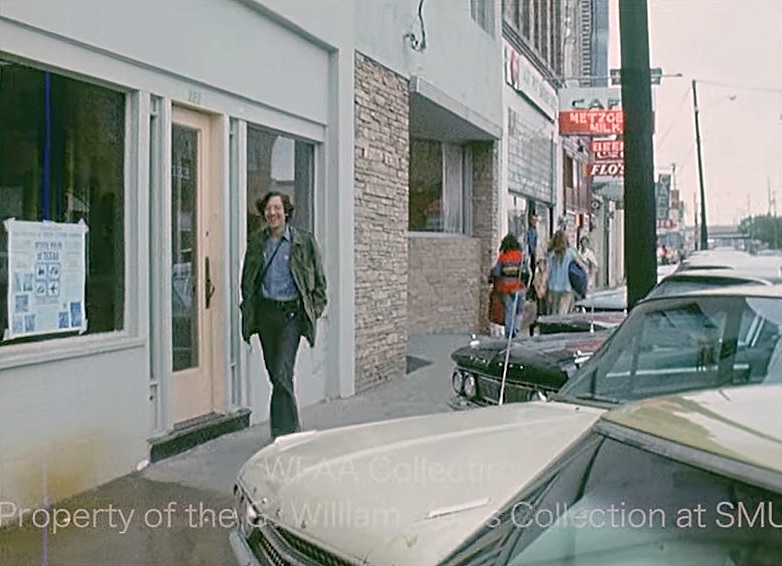
mingus_WFAA_SMU_100771

children-of-god_expo-park_WFAA_SMU_oct-14-1971

*

AUGUST 1971

This is a bonus.

As I worked my way through 1971, there was one truly amazing story. It involved the kidnapping of a toddler in Fort Worth. On Aug. 25, 1971, 21-month-old Melissa Suzanne Highsmith disappeared. Her 22-year-old mother, Alta, had hired a new babysitter, who was supposed to watch her for the day while Alta was at work. The babysitter picked Melissa up in the morning as planned, but she never returned the child. The babysitter and Melissa disappeared without a trace. There were no leads in the case for years. …And YEARS.

In 2022, the Highsmith family learned of an online DNA match, which would indicate they had found Melissa. Eventually, it was determined that a 50-something-year-old woman named “Melanie” was actually the long-missing Melissa. The woman who kidnapped her raised her as her own daughter, and Melissa never suspected she wasn’t the woman’s child (although she says she never felt really “connected” to her).

Melissa (she now uses “Melissa” again) was reunited with her family at the end of 2022. One report I read said that she grew up only 10 minutes from the Fort Worth apartment her mother lived in. Despite the Highsmith family’s 51 years of loss, grief, worry, and suffering, there has ultimately been a happy ending!

In the screenshot below from an Aug. 26, 1971 Channel 8 story, Alta Highsmith shows a photo of her missing daughter to the camera. The report is here.
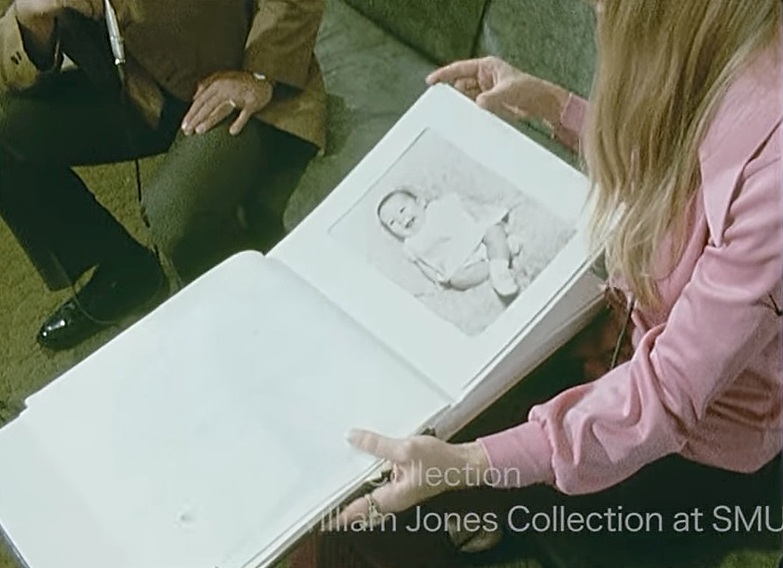
kidnapping_highsmith_WFAA_SMU_aug-26-1971

**

If you managed to get all the way through this, you deserve an award! This might be the longest thing I’ve written all year! I’m more than ready for my 1971 Jeopardy challenge (Dallas edition)!

***

Sources & Notes

All screenshots are from news film in the WFAA Collection, held by the G. William Jones Film & Video Collection, Hamon Arts Library, SMU. Clips are posted regularly from this Channel 8 collection on YouTube, here.

My previous collection of WFAA screenshots can be found in the post “No-Context Channel 8 Screenshots: 1970-1971.”

lady mailman june 1971 WFAA_sm

*

Copyright © 2023 Paula Bosse. All Rights Reserved.

“A Man’s Shop With a Texas Man’s Viewpoint” — 1945

irby-thompson_western-wear_tx-country-day-school-yrbk-1945

by Paula Bosse

Back when men wore Western pearl-snap shirts embroidered with cardinals, leaves, and acorns — and, if this ad is anything to go by, they wore them proudly and unironically.

Frankly, I’d like to see a return to this style.

*

“Wherever Texas men gather to relax and play
you’ll see fine sports clothes by Irby-Thompson.”

Western Suit: $115 (equivalent in today’s money to about $1,660)
Sport Coat: $45 (today, $650)
Slacks: $20 (today, $290)
Tie & Handkerchief: $5 (today, $73)

***

Sources & Notes

Ad found in the pages of the 1945 Texas Country Day School yearbook. 

Irby-Thompson (housed in the Mercantile Building), was opened in 1944 by Collis P. Irby and J. S. Thompson; in 1948 Irby and his former store manager, Count Mayes, bought out Thompson and became Irby-Mayes.

Related: see the Flashback Dallas post “Irby-Mayes Ad With a Cameo by the Merc — 1948.”

irby-thompson_western-wear_tx-country-day-school-yrbk-1945_sm

*

Copyright © 2020 Paula Bosse. All Rights Reserved.
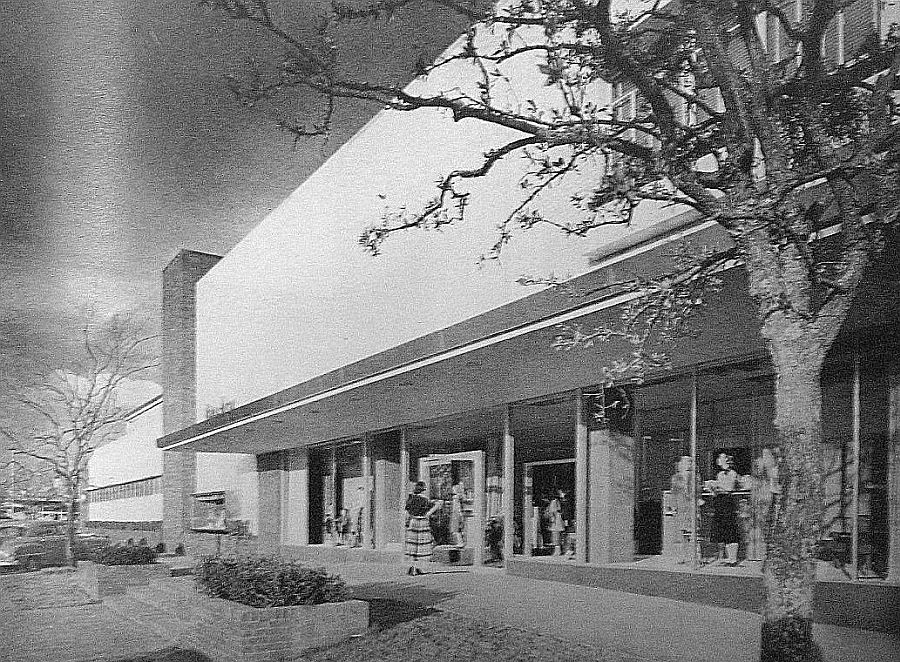
Neiman’s First Suburban Store: Preston Road — 1951-1965

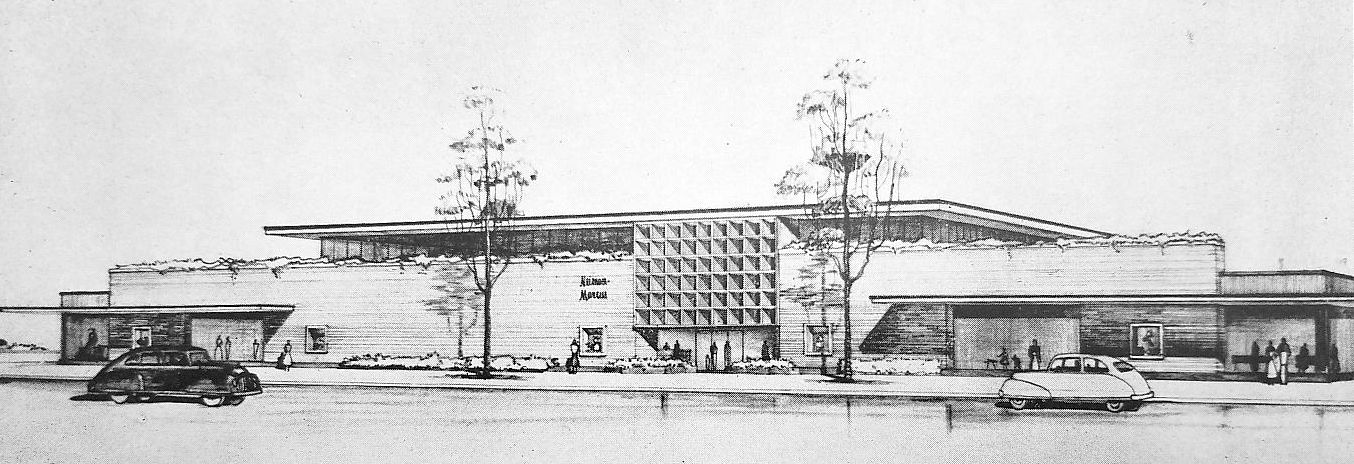
neiman-marcus_preston-road_dallas-mag_feb-1949Original design by DeWitt & Swank, 1949 (click for larger image)

by Paula Bosse

In January, 1949, Neiman-Marcus announced they would soon begin construction of their very first “branch” store. It was to be built in the new “Varsity Village” shopping area on Preston Road, just south of Northwest Highway (on the east side of Preston, facing Preston Center). This store was referred to in early articles as their “town and country store.” The downtown store was running out of room (in fact the expansion and renovation of their downtown store was announced at the same time as this new “suburban” store) — and the new store was to provide 30,000 square feet of primo retail space.

The original idea for the store’s design is seen in the drawing above, which was accompanied by this caption in a Chamber of Commerce publication:

New suburban shop of Neiman-Marcus Company (pictured above in drawing by Roscoe DeWitt and Arch Swank, architects for the building) is scheduled for construction this year in Varsity Village on a plot 30,000 square feet facing Preston Road and extending from Wentwood to Villanova Drives. The store will conform to the general architectural plan of Varsity Village and will represent a total investment of about $1,500,000. (“Dallas” magazine, Feb. 1949)

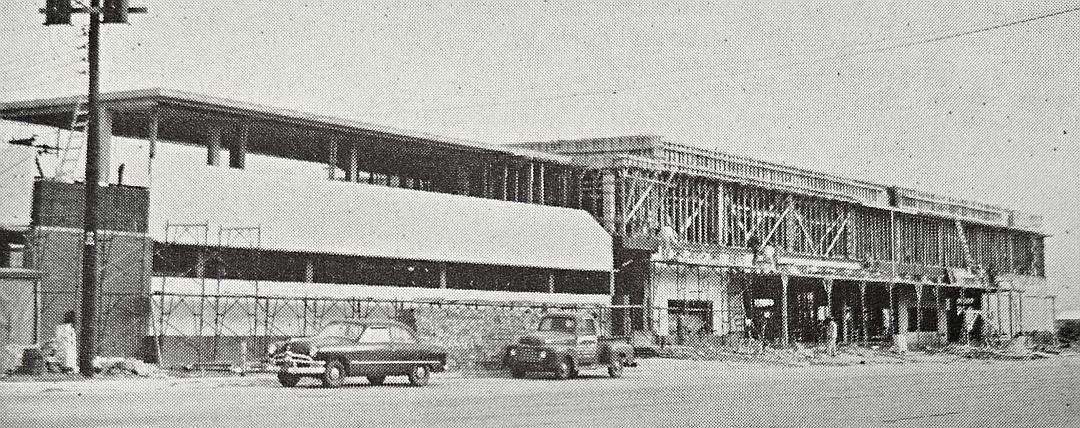
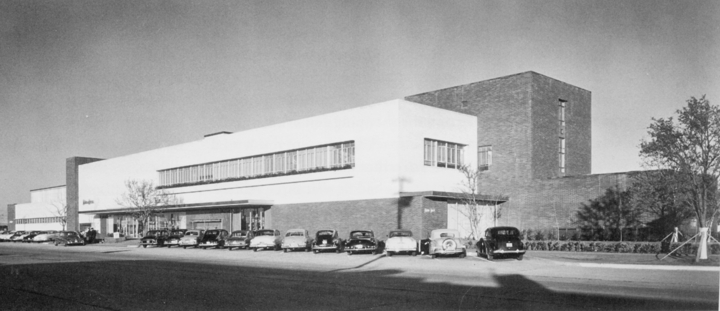
I LOVE that drawing! Unfortunately, things changed between the time that DeWitt and Swank offered that initial drawing and the almost three years that passed before the store was actually completed. The store was expanded to two floors (with mezzanine and basement), and… I don’t know — it just lost all of its supercool sleekness. It went from mid-century-modern fabulousness to big boring blocks. I’m sure the interior was still fantastic (designed by Eleanor Le Maire), but that exterior is uncharacteristically (for Neiman’s) blah.

Under construction:

n-m_preston-center_construction_dallas-mag_feb-1951_DPLDallas magazine, Feb. 1951

Constructed:

n-m_preston-center_1951_departmentstoremuseum
1951, via thedepartmentstoremuseum.org

*

But back to the decor. This store was aimed at suburban families — the shoppers were primarily stylish mothers with kids, so there was a lot of thought put into making the store appealing to children. The basement — which was home to the toy and nursery department — sounds pretty great, complete with a Willy Wonka-esque attraction: at the entrance was an enchanted forest mural and a giant cage filled with toy animals, and “in the toy shop there is a magic tree — one with a built-in dispenser that pours out an endless supply of orangeade” (Dallas Morning News, Oct. 14, 1951).

The store was designed in a Southwestern color palette, featured a glass mosaic, lots of Kachina dolls, a glass-walled landscaped patio, a specially commissioned Alexander Calder mobile, and it was an immediate hit. The denizens of the Park Cities and Preston Hollow would still have to make the trek downtown if they wanted a gown for that do at the country club, but for casual clothing for mom and a large selection of clothing for children and teens, the “town and country store” was perfect. And nearby.

It lasted until NorthPark opened in 1965. Realizing the Preston Road store would be unable to expand, Neiman’s decided to close the 14-year-old store and move into Raymond Nasher’s striking new NorthPark Center.

*

n-m_preston_dallas-history-guild
via Dallas History Guild Facebook page

*

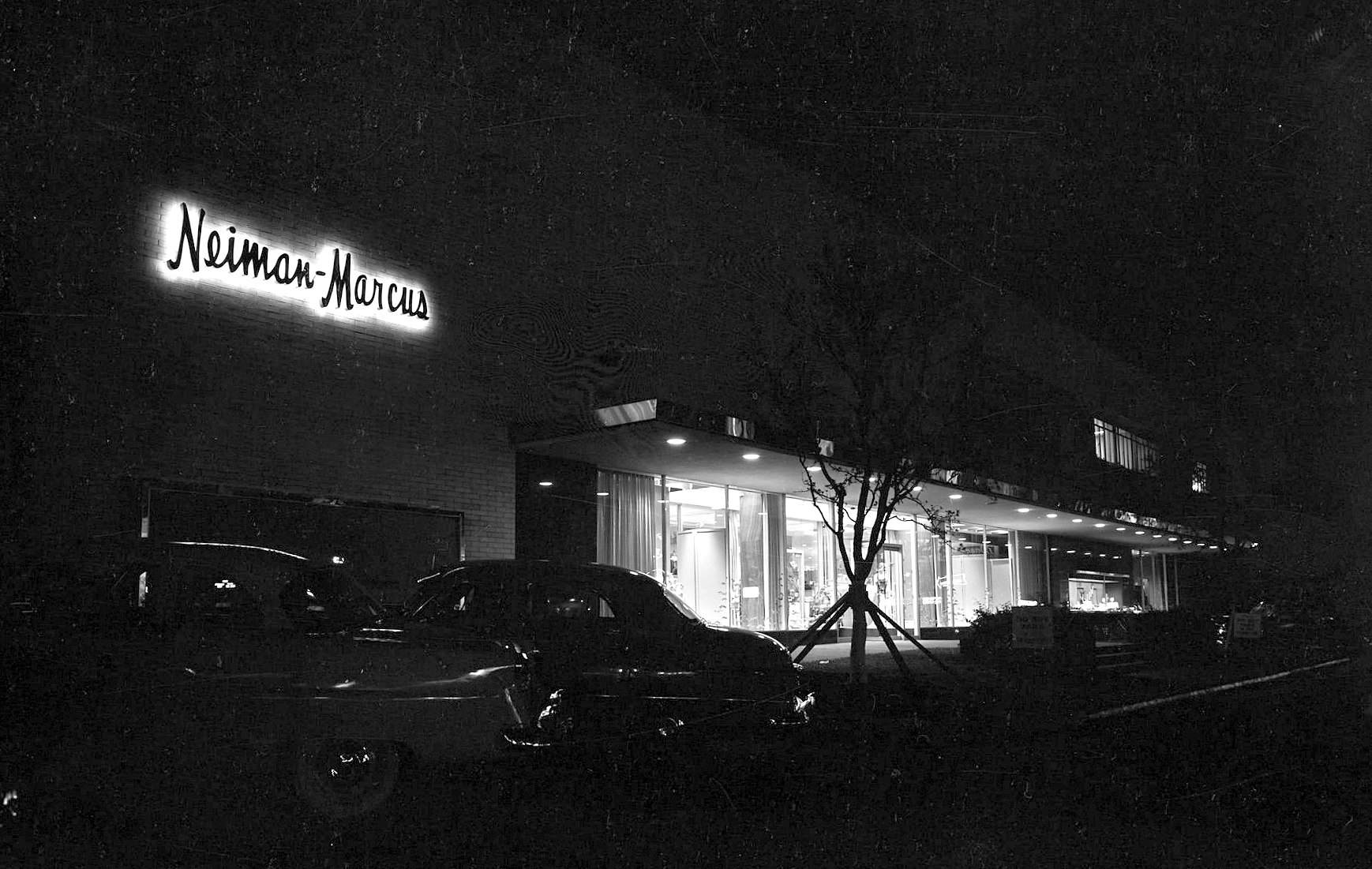
Below, two night-time photos by Squire Haskins, taken on May 23, 1952:

n-m_preston_night_squire-haskins_UTA_1952_bvia UTA Libraries

n-m_preston_night_squire-haskins_UTA_1952_avia UTA Libraries

*

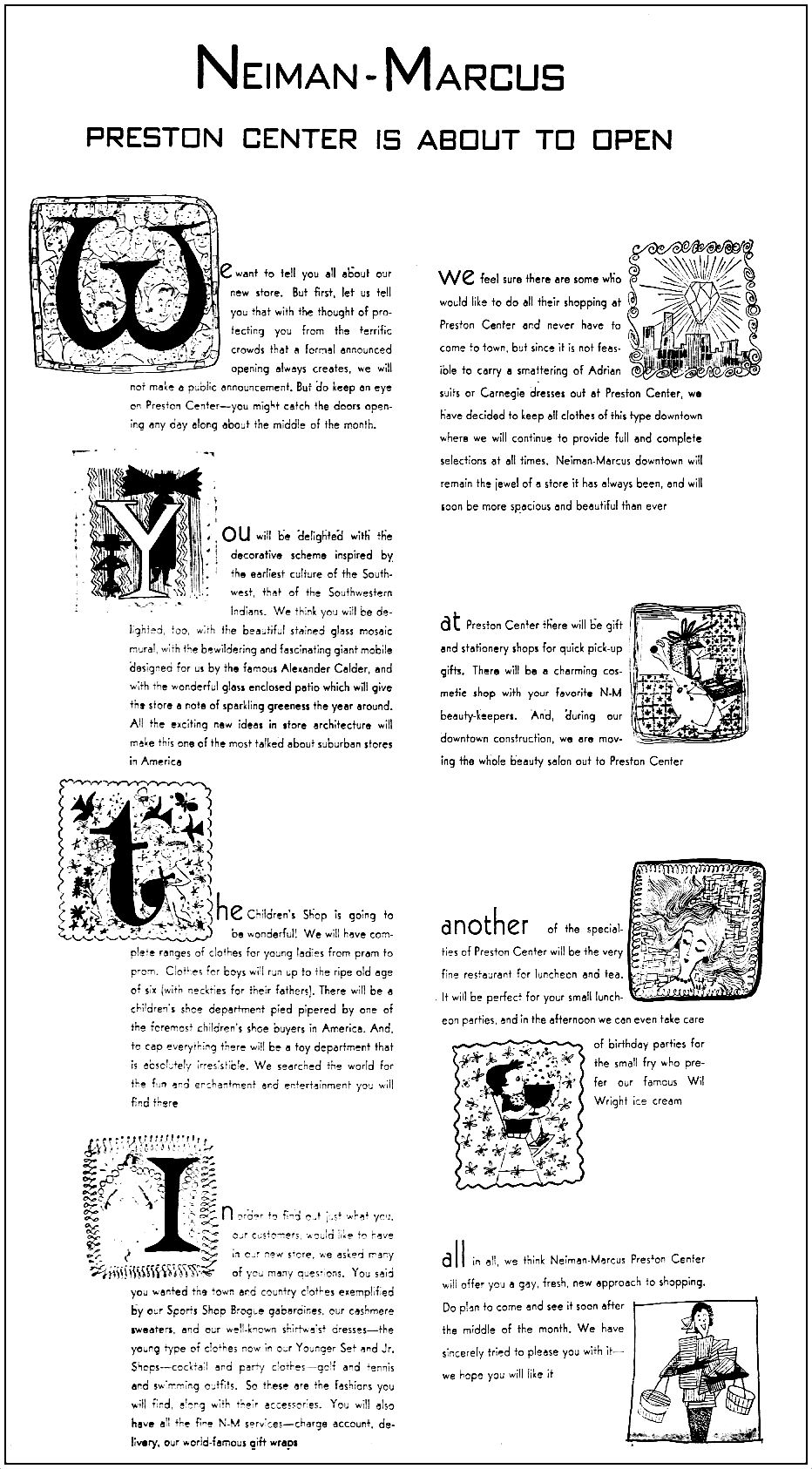
Instead of placing a “Grand Opening” announcement, Neiman’s teased the public with a “we’ll be opening soon-ish” announcement (in fact, the store opened exactly one week after the appearance of this ad). This ad describes that the new location will be more geared to families — to children (“from pram to prom”), adult casualwear, and gift items. With a restaurant and salon. The more typical Neiman’s couture lines and more expensive items would be available only “in town.” (Click ad to see a larger image.)

n-m_preston_100851_adOct. 8, 1951 ad

In the “Wales” column — a regular feature of N-M ads, with chatty text written by Warren Leslie (“Wa” from “Warren” and “les” from Leslie), a Neiman-Marcus executive and spokesperson and, later, author of the controversial book Dallas Public and Private) — the store’s opening is discussed, including the unexpected appearance of John Wayne (in town for the “Movietime in Texas, USA,” a promotional Hollywood caravan tour through Texas, packed with movie stars (watch cool footage here). Too bad about that orangeade, kids.

n-m_preston_102351_ad-detAd detail, Oct. 23, 1951

*

One of the features of the new store was a specially commissioned mobile by artist Alexander Calder which hung above the stairway (a bit difficult to see in the photo below, but it’s there!). This was the first permanent installation of one of Calder’s kinetic sculptures in Dallas. (The three photos below are by Denny Hayes.) The staircase was used for fashion shows (watch Channel 5 news footage from a swimsuit fashion show from April 25, 1958 here, via the UNT’s Portal to Texas History site — according to the news script, the last suit was priced at a whopping $500, which in today’s money, would be about $4,500). (UPDATE: Perhaps because of its current financial situation, Neiman’s decided to sell the Alexander Calder mobile, titled “Mariposa” — it was auctioned by Sotheby’s on Dec. 8, 2020 and sold for $18.2 million, far surpassing its high estimate of $8 million — more info and several photos of the sculpture can be found on the Sotheby’s site here.)

n-m_preston_PA76-1-5388.1_hayes-collection-1954_DPL
Dallas Public Library (PA76-1/5388.1)  

Those floor-to-ceiling windows and sheer draperies are wonderful.

n-m_preston_PA76-1-5388.5_hayes-collection-1951_DPL
Dallas Public Library (PA76-1/5388.5)

n-m_preston_PA76-1-5388.2_hayes-collection_DPLDallas Public Library (PA76-1/5388.2)

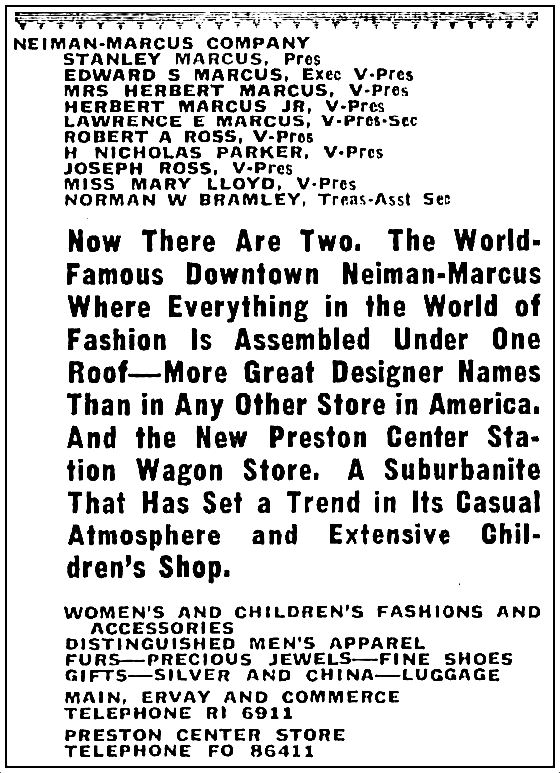
The listing in the 1953 directory described the Preston store as “the New Preston Center Station Wagon Store.” That’s right, the “station-wagon store.”

n-m_preston_1953-dallas-directory1953 Dallas directory

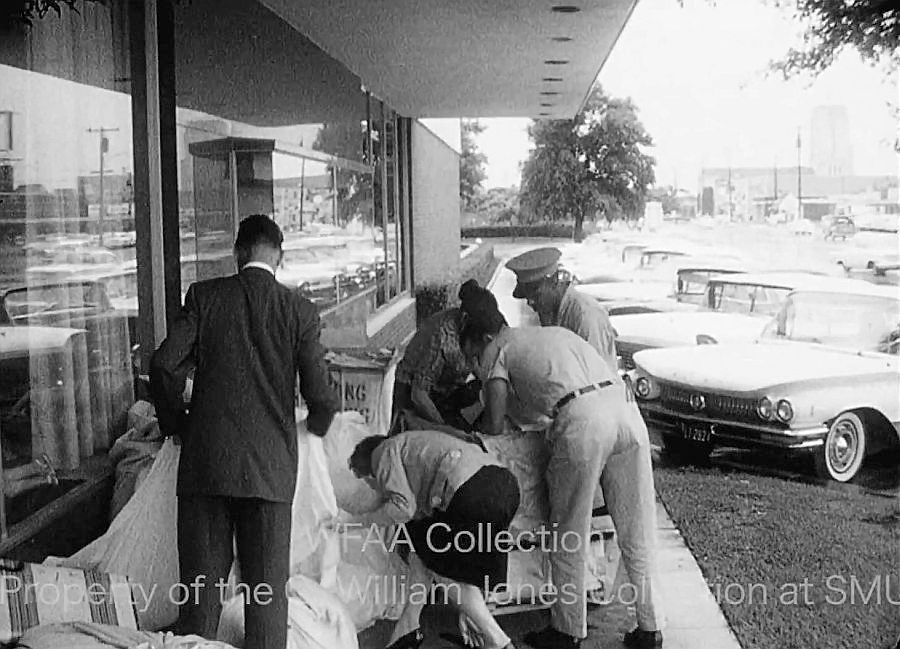
In May, 1960 there was a relief drive throughout Dallas to send much-needed supplies to Chile, which had recently experienced almost simultaneous devastating earthquakes, volcanic eruptions, tidal waves, and avalanches. Neiman’s coordinated with several agencies and the State Department to rush food and clothing to Chile. The view in the screenshot below shows Preston Road looking south (watch the 1-minute Channel 8 news footage, via SMU, here).

n-m_preston_SMU_053060_preston-road

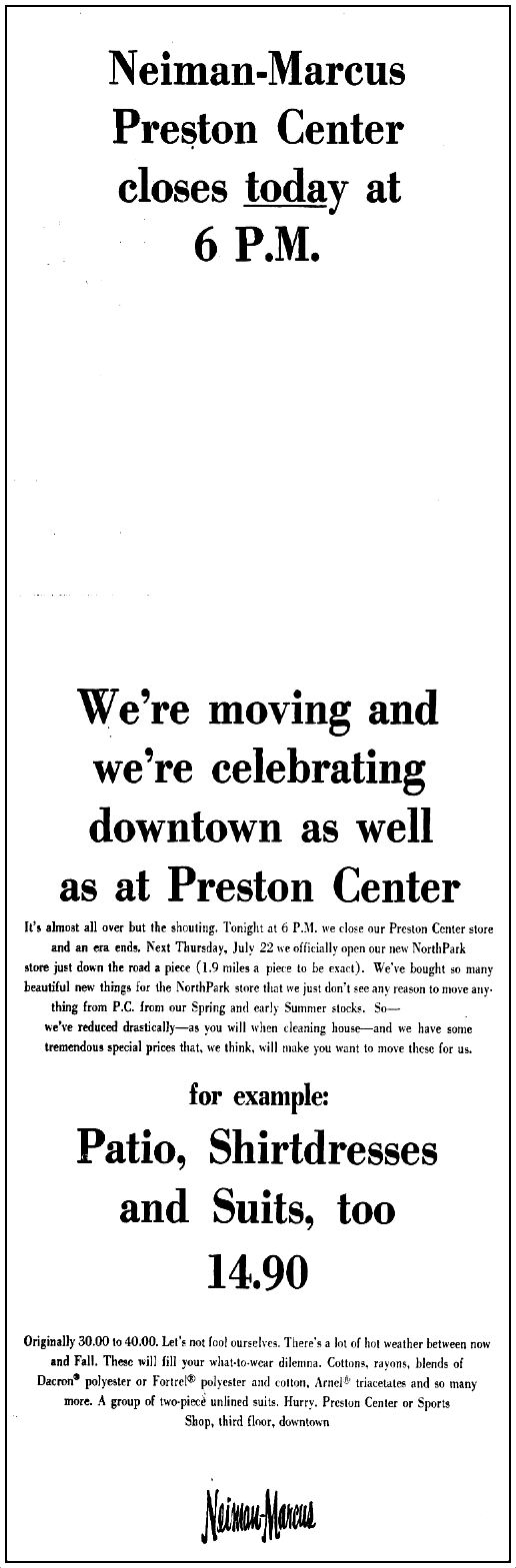
After 14 years, the Preston location closed up shop in July 1965. This coincided with the opening of the much larger Neiman’s store in NorthPark. Bye-bye, “suburbia”!

n-m_071565_preston-closingJuly 15, 1965 ad

The Preston Road building still stands, but it’s not very interesting looking these days. I think I’d prefer the “blah” look from 1951.

n-m_preston_bldg_google-street-view_2017Google Street View, 2017

***

Sources & Notes

Top image appeared in the Feb. 1949 issue of “Dallas,” a monthly magazine published by the Dallas Chamber of Commerce.

Photos by Squire Haskins are from the Squire Haskins Photography, Inc. Collection, University of Texas at Arlington Libraries, Special Collections.

Interior photos by Denny Hayes are from the Hayes Collection, Dallas History and Archives, Dallas Public Library.

Image of the 1960 Chilean American Red Cross relief drive is a screenshot from the WFAA Newsfilm Collection, G. William Jones Archive, Hamon Arts Library, Southern Methodist University.

neiman-marcus_preston-road_dallas-mag_feb-1949_sm

*

Copyright © 2020 Paula Bosse. All Rights Reserved.

The Zodiac Room

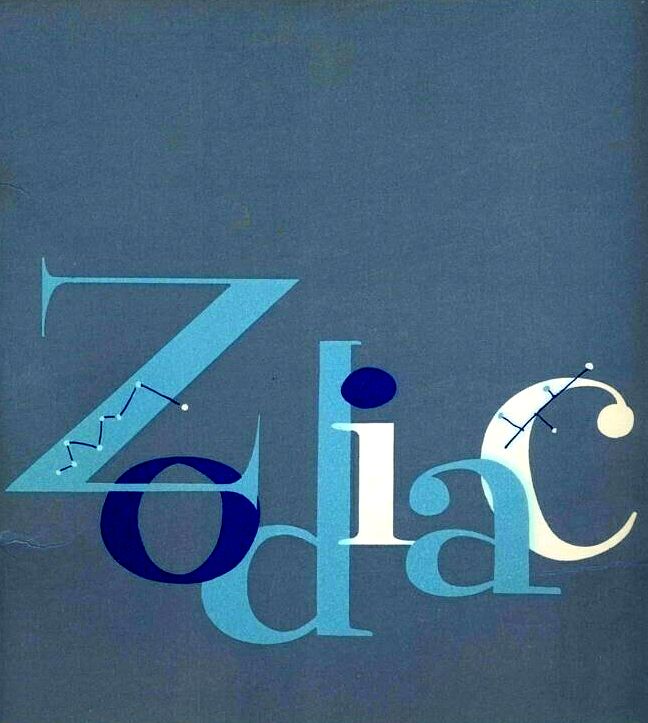
zodiac-room_ebay_menu_cover

by Paula Bosse

The tastefully swanky Zodiac Room opened at the downtown Neiman-Marcus store on April 27, 1953. (Interestingly, there was an earlier — and presumably unrelated — Zodiac Room, in the Jefferson Hotel, from at least 1950 to 1952.)

The Zodiac, a fashionable restaurant and tearoom featuring select foods, will open Monday on the sixth floor of Neiman-Marcus Company’s downtown store. Designed by Eleanor LeMaire of New York, the restaurant’s décor will suggest the roof of the world with signs of the Zodiac represented in both the main dining area and the terrace. (The Dallas Morning News, April 26, 1953)

Stanley Marcus wanted a restaurant in the store in which customers could take a break from shopping by having lunch or afternoon tea on-site, without having to leave the premises. Customers could continue to “shop” while dining as models walked around modeling fashions from the store’s inventory.

“[W]e installed a large restaurant, the Zodiac Room, to attract more people to the downtown area and as a service to those customers from out of town who were spending the day in the store.” (Stanley Marcus, in his book Minding the Store)

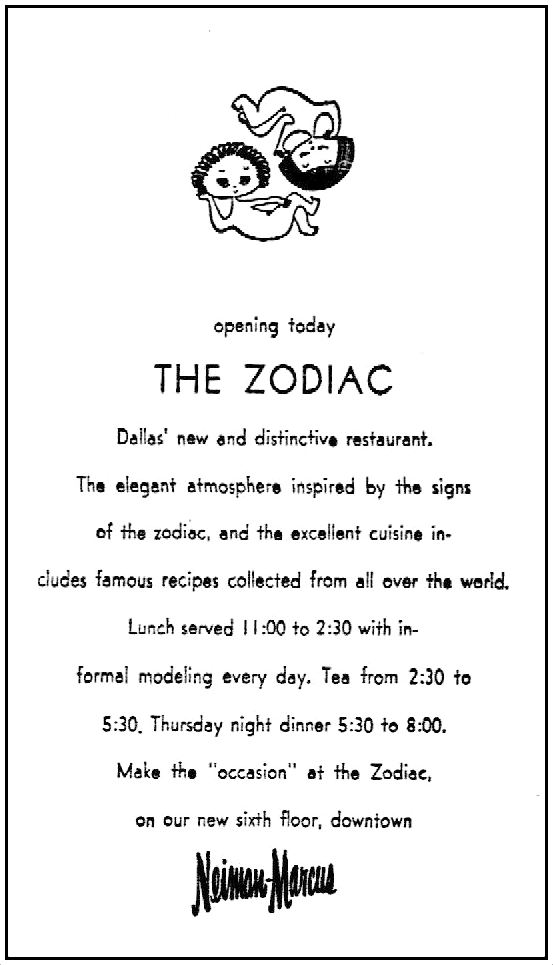
Below are a few ads from the Zodiac’s first week (click to see larger images).

zodiac_opening-ad_042653
April 26, 1953

COME AND SEE DALLAS’ NEW AND DISTINCTIVE RESTAURANT — THE ZODIAC.

Just completed on our new sixth floor, the Zodiac Restaurant is another step in our downtown expansion program to bring to Dallas the most luxurious and elegant store in America.

The star studded atmosphere of the Zodiac will give you an out of this world feeling. The walls are a wonderful cerulean blue, the carpet’s deep enough for snowshoes and an Italian tile pool sprouts water lilies for the occasion. Informal modeling every day at luncheon.

Plan to have lunch with us this week and bring your guests. We think you’ll be enchanted with the atmosphere as well as the excellent cuisine. Luncheon 11:00 to 2:30, tea 2:30 to 5:00, dinner Thursday night 5:00 to 8:00. NEIMAN-MARCUS

zodiac_opening-today-ad_042753
April 27, 1953

zodiac-room_042853-ad_opening
April 28, 1953 (N-M ad, detail)

You could even get a Zodiac-inspired hair-do, the Zodiac Cut: “Sophisticated, spherical — without a hint of a part.”

zodiac-cut_nm-ad_042953April 29, 1953

Other than the fact that this elegant dining space was part of the world-famous Neiman-Marcus department store, its main draw was its food. According to Stanley Marcus, in his book Minding the Store, the Zodiac struggled for the first year or two and didn’t find its footing until he hired the now-legendary Helen Corbitt as the restaurant’s director. He wrote the following in a guest column in The Dallas Morning News in 1979:

“A landmark in the culinary history of Dallas was the arrival of Helen Corbitt, who made a monumental contribution to improvement of food and service standards in the community. The Neiman-Marcus Zodiac Room became famous under her direction.” (Stanley Marcus, DMN, April 12, 1979)

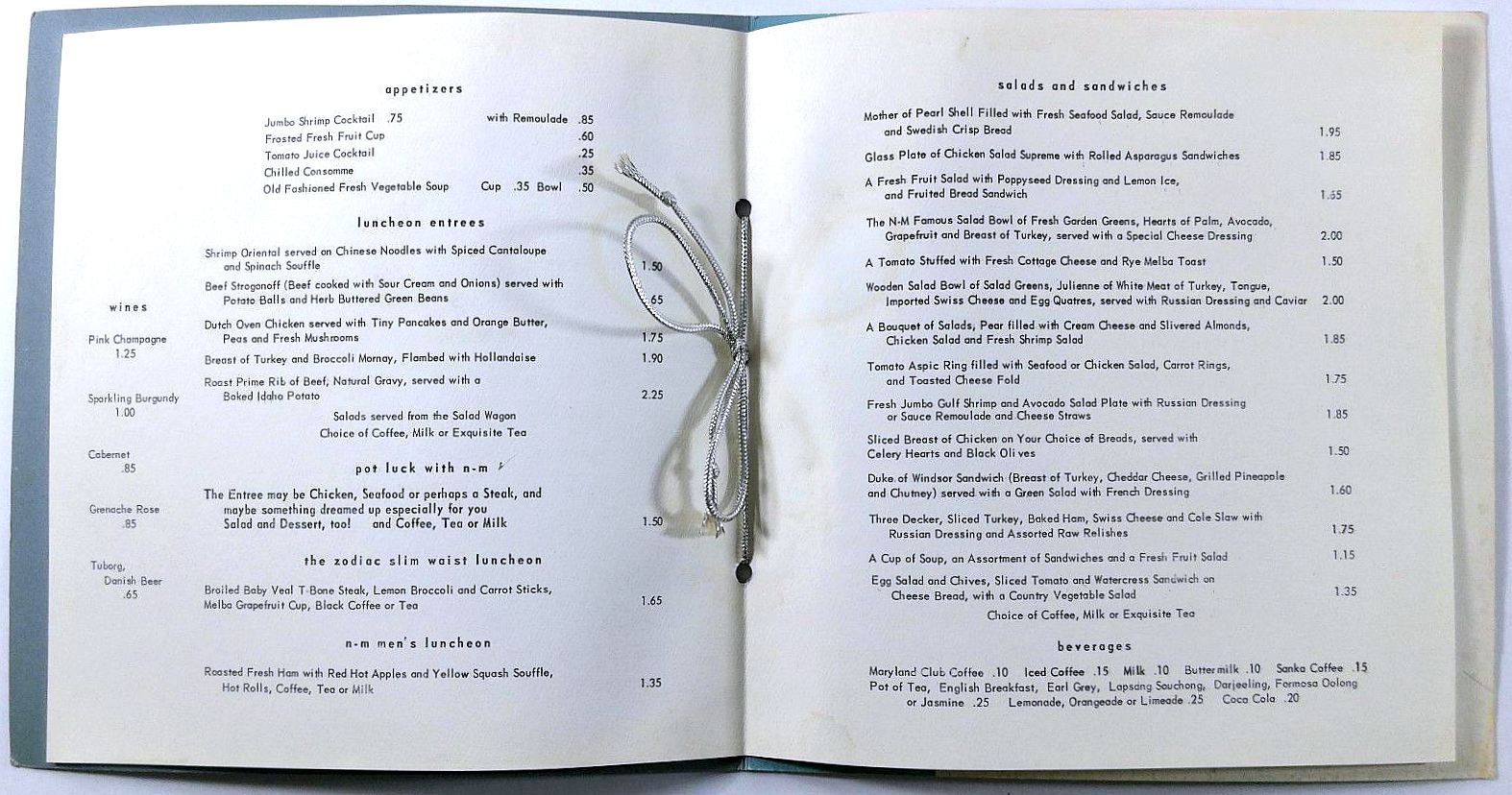
Below is an example of the fare favored by the Ladies Who Lunch (and the occasional Men Who Lunch), seen in a menu from 1956. (The most expensive item on the menu was the Roast Prime Rib of Beef, which came with a Baked Idaho Potato, a salad from the “Salad Wagon,” and a choice of coffee, milk, or “exquisite tea” — the price was $2.25, which in today’s money was a shockingly affordable $21.00.)

zodiac-1956-menu_inside_ebay

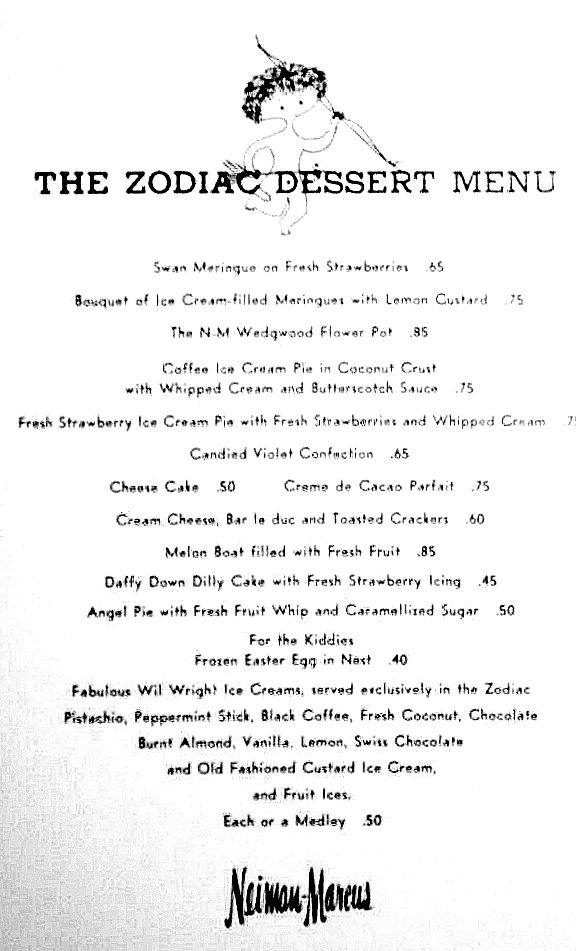
A dessert menu (a bit hard to read, I’m afraid) is below:

zodiac-menu-2_ebay_dessert-menu

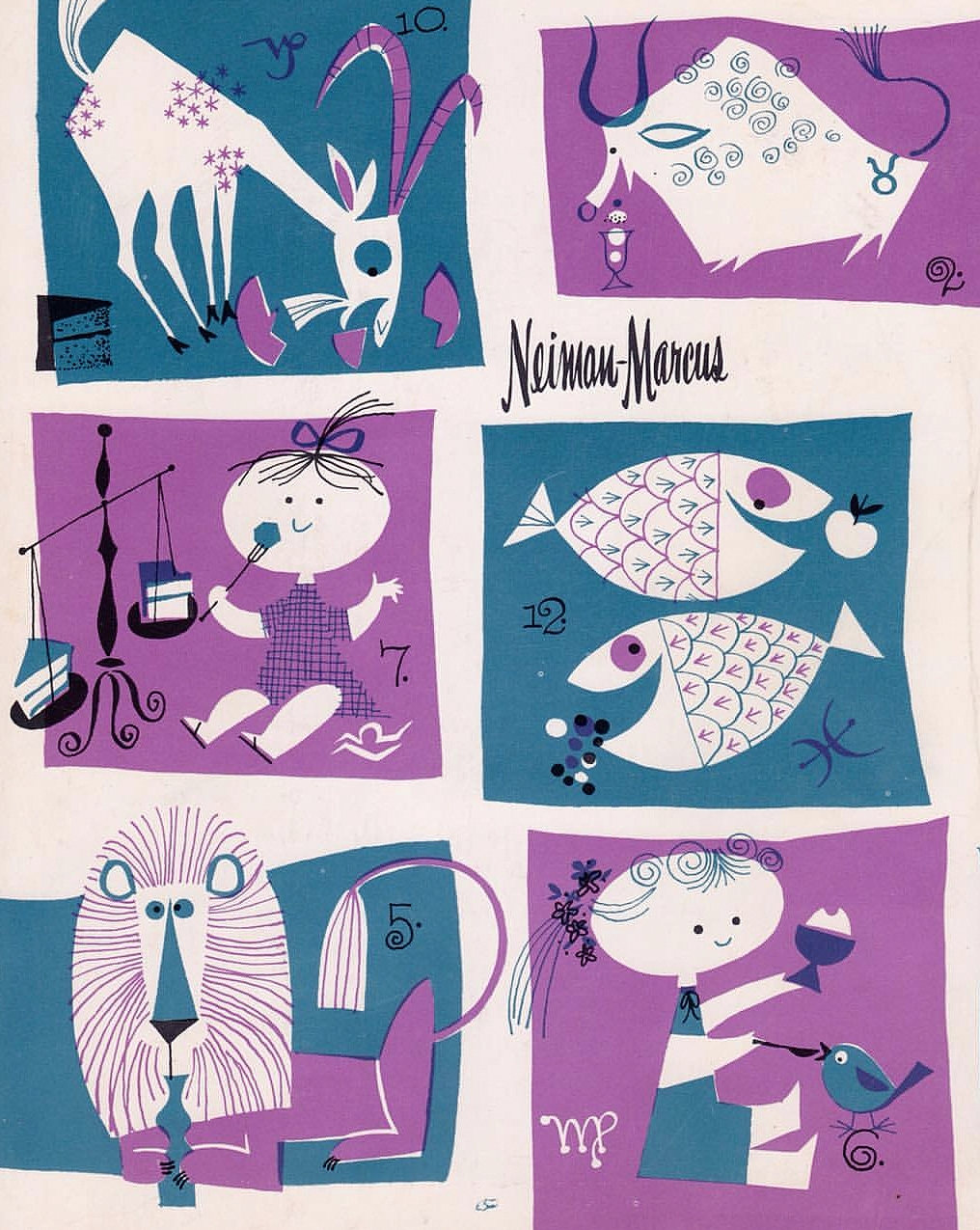
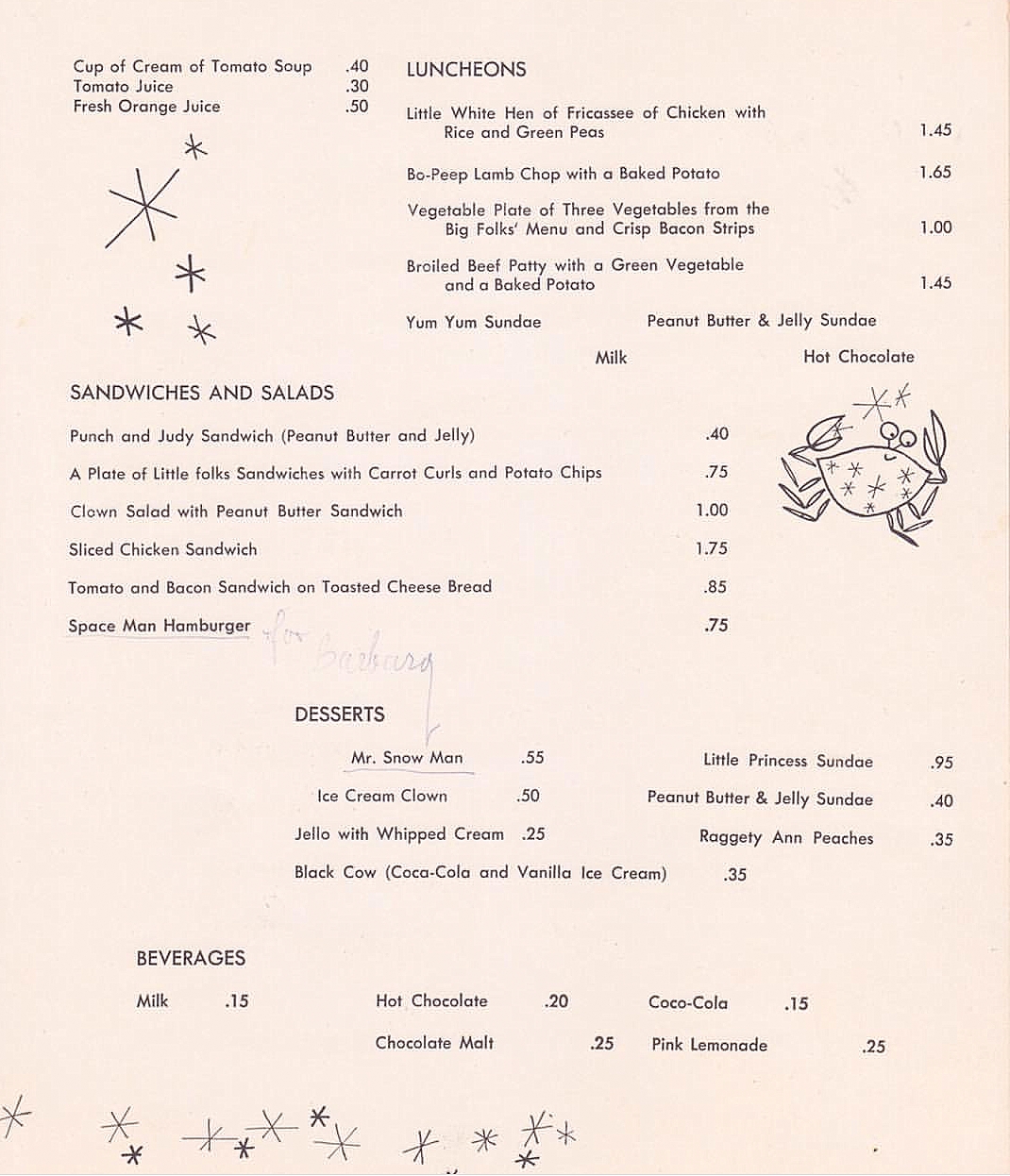
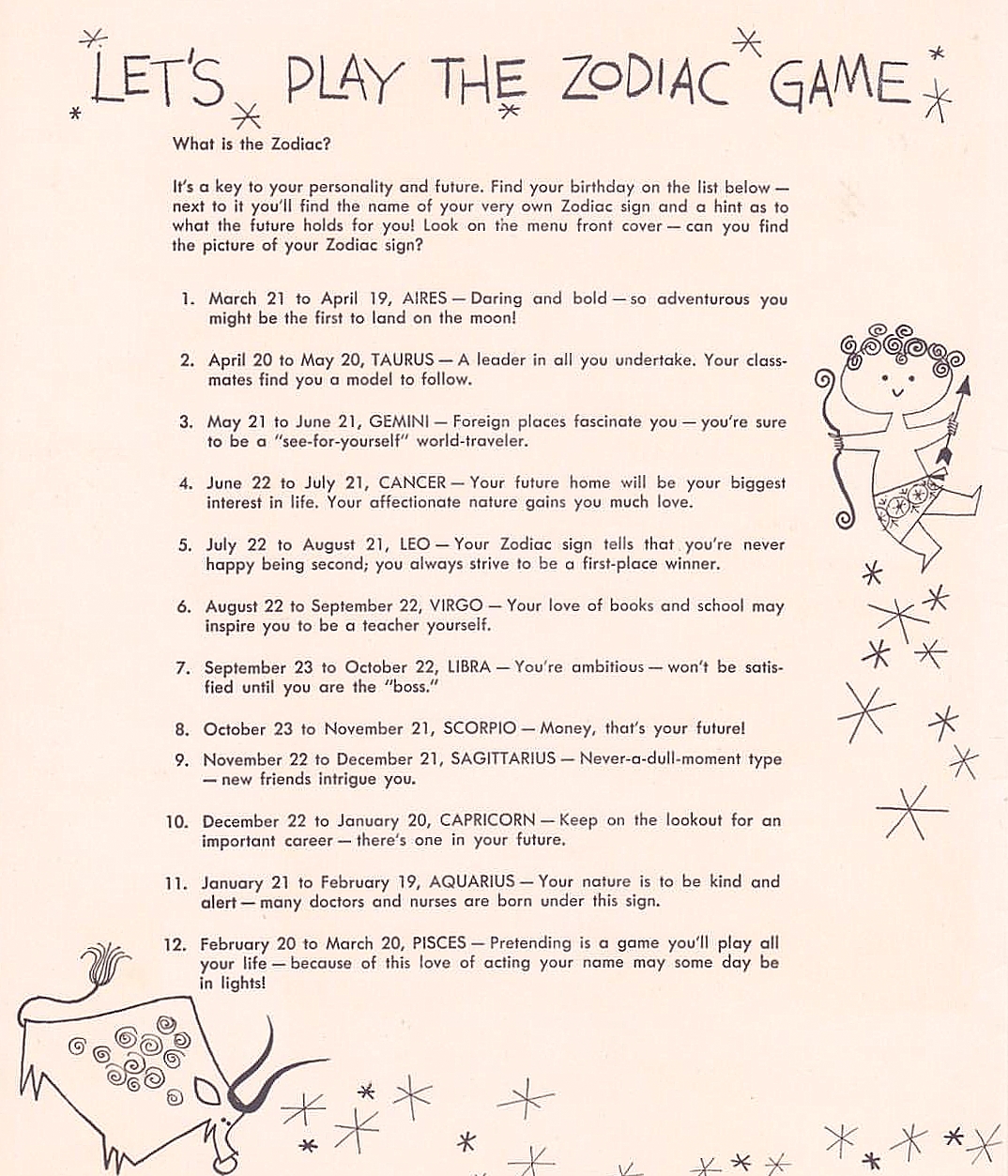
There was also a children’s menu, which was so charmingly designed by Neiman’s gift-wrap designer, Alma Shon, that I don’t blame a customer for having spirited away a copy of the menu as a holiday-time souvenir of what was no doubt a very special occasion (the date penciled at the top is Dec. 23, 1966). (More information about Ms. Shon is in the “Sources & Notes” section at the bottom of this post.) Below, the front and back of the children’s menu, illustrated with the signs of the zodiac:

zodiac-room_childrens-menu_instagram_front

zodiac-room_childrens-menu_instagram_back

Inside, meal options for well-appointed kiddies and a “Zodiac game” to keep them occupied.

zodiac-room_childrens-menu_instagram_food

zodiac-room_childrens-menu_instagram_zodiac-game

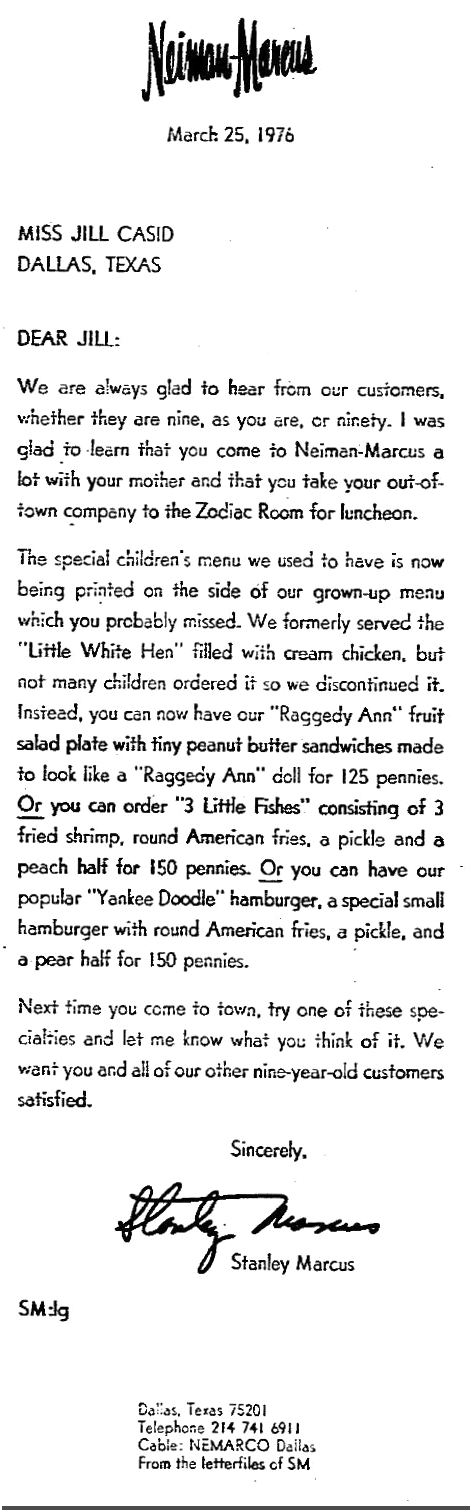
A few years later, this Stanley Marcus-penned letter appeared as a 1976 N-M ad — it was a personal reply to a nine-year-old Zodiac patron who had apparently written to Neiman’s inquiring about the children’s menu, which she was distressed to see had disappeared on her last visit:

zodiac-room_051776_ad-det_childrens-menu
May 17, 1976

zodiac-room_postcard_flickr

Lastly, a memory of the downtown Zodiac, from the Department Store Museum website:

The downtown Dallas store was in its entirety a magic store. Every step and turn off the escalators to the top floor was amazing. The Zodiac room with its floor-to-ceiling diaphanous curtains that filtered the bright Texas sky made for a dreamlike atmosphere along with the slender long-legged models in evening gowns and furs and the Andre Previn-inspired piano player. The popovers with strawberry and cinnamon butter weren’t bad either. Thank you, Dallas and Neiman-Marcus, for such a rich time in my life.

And it’s still going strong.

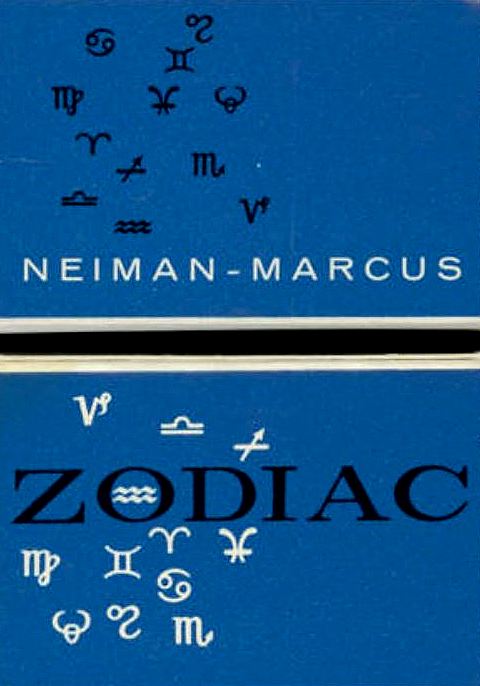
zodiac_matchbox_cook-collection_degolyer-library_SMU

***

Sources & Notes

Top image and other (non-children’s) menu images from eBay.

The four images of the Zodiac Room children’s menu are the reason I decided to do this post. My whimsy-threshold is pretty low, but I love the utterly charming drawings which grace the front and back covers. I saw them posted on the Instagram account @reflectionofaman (a cool account — here, for the desktop site — which features the photographs of Stanley Marcus, curated by his granddaughter, photographer Allison V. Smith); it had been shared there by Babs Bern (@mullett7665.manor). The menu’s artist — Alma Shon — was identified by her daughter Kate Heyhoe (@StarkRavingCat) in the comments. According to a 1953 Dallas Morning News profile, Shon was born in California in the early 1920s to Korean refugees who had fled Korea in 1905 during the Russo-Japanese War. She grew up in Los Angeles but made her way to Dallas by at least 1948; she began working for Neiman Marcus in 1948 or 1949. She was in charge of Neiman’s giftwrap design, but also designed other merchandising elements — she was with the store for several decades. More on Ms. Shon (including a photo of her from the ’50s) can be found in a post by her daughter Kate, here.

Color postcard of the Zodiac Room was found on Flickr, here. I used this same card in a previous Flashback Dallas post, “Luncheon at The Zodiac Room, Darling.”

Image of the  blue matchbox at the bottom is from the George W. Cook Dallas/Texas Image Collection, DeGolyer Library, SMU Libraries; more info is here.

More on Helen Corbitt can be found in articles in Texas Monthly and in Legacies; a couple of her recipes — including her famous Poppy-Seed Dressing — can be found here.

*

Copyright © 2019 Paula Bosse. All Rights Reserved.
Titche-Goettinger, Fashions for the Chic Dallas Woman — 1940s

titches_newton-elkin-shoes_1944_my-vintage-vogue

by Paula Bosse

Just a few 1940s ads for fashions available at Titche-Goettinger, one of many of Dallas’ nicer department stores which made the city a fashion meccas for the chic Texas woman.

Above, a 1944 ad featuring the latest in shoes from Newton Elkin (“two new shoe shades: Tanbark — Cedar Green”): “the sling-back pump with perforated Cleopatra vamp” and “Vicki in brown lizard” (which I sincerely hope someone uses as a song title).

Below, a newspaper ad from 1945 featuring other Newton Elkin shoes, these dressier, with fancy paillettes (sparkly decorations). Perfect to wear with the matching black silk turban. (Click to see a larger image.)

titche-goettinger_nov-19451945

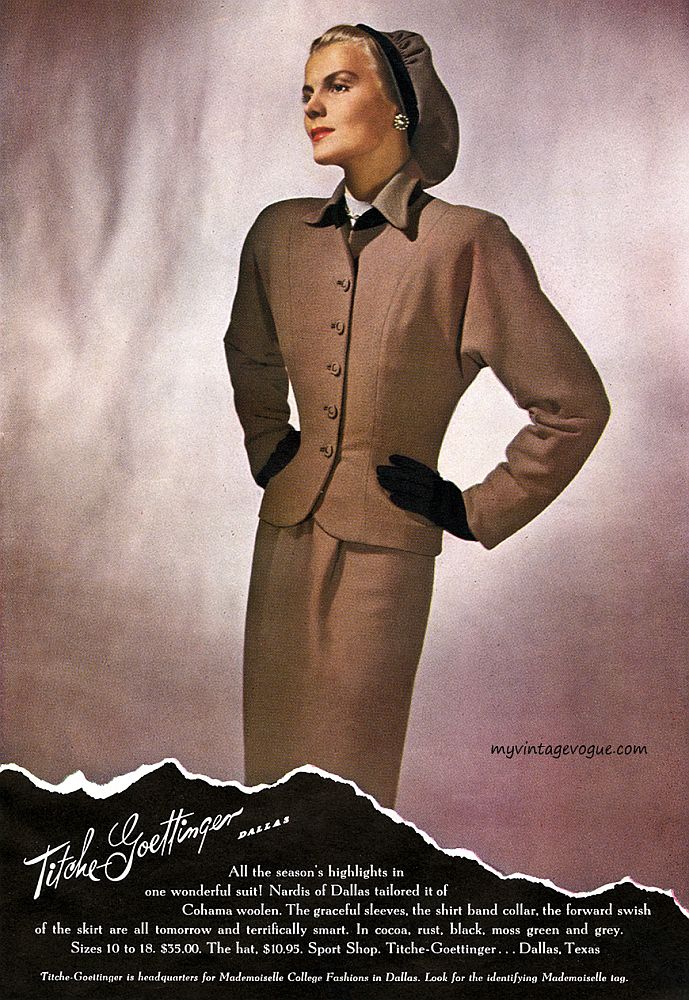
A “Nardis of Dallas” wool suit from 1945, “tomorrow and terrifically smart… in cocoa, rust, black, moss green, and grey.”

titches_nardis-of-dallas_suit_1945_my-vintage-vogue1945

Another “Nardis of Dallas” suit from 1945, this one in “superlative” gabardine: “a suit you’ll wear from swivel chair to swizzle stick… platinum, aqua, lime, red, brown.” Sold separately: a matching hat and slacks (!). “Men prefer it.”

titches_nardis-of-dallas_1945_my-vintage-vogue1945

Speaking of hats: “Sally Victor creates the ‘Big and Little Filly’ for Titche-Goettinger.” …There’s a lot going on up there. (1947)

titche-goettinger_1947_ebay_hats1947

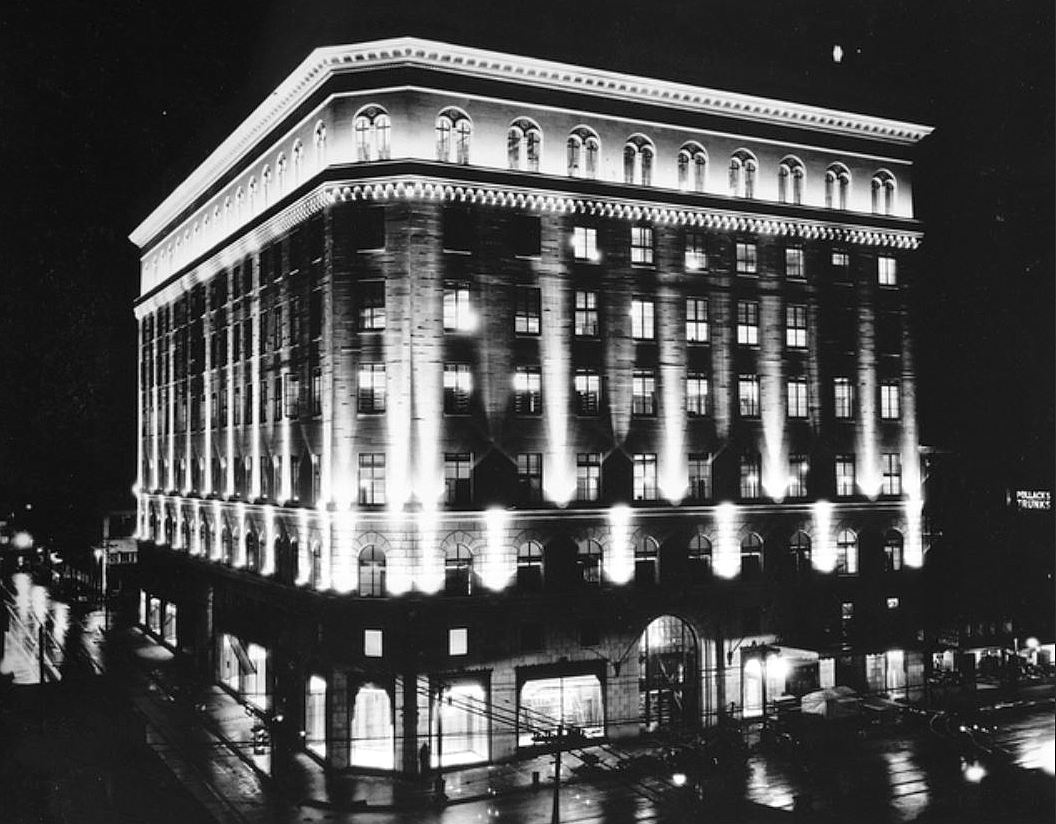
The still-standing Titche’s building at Main and St. Paul was designed by George Dahl in 1929 and was expanded in the 1950s. The women buying these clothes in the 1940s would have shopped at the smaller — though still elegant — store, which looked like this:

titches_unvisited-dallas_jeppsonNoah Jeppson/Unvisited Dallas

When shopping was more sophisticated.

titches-logo_1945

***

Sources & Notes

All color ads from the FABULOUS website My Vintage Vogue, here, here, and here.

Sally Victor ad found on eBay, here.

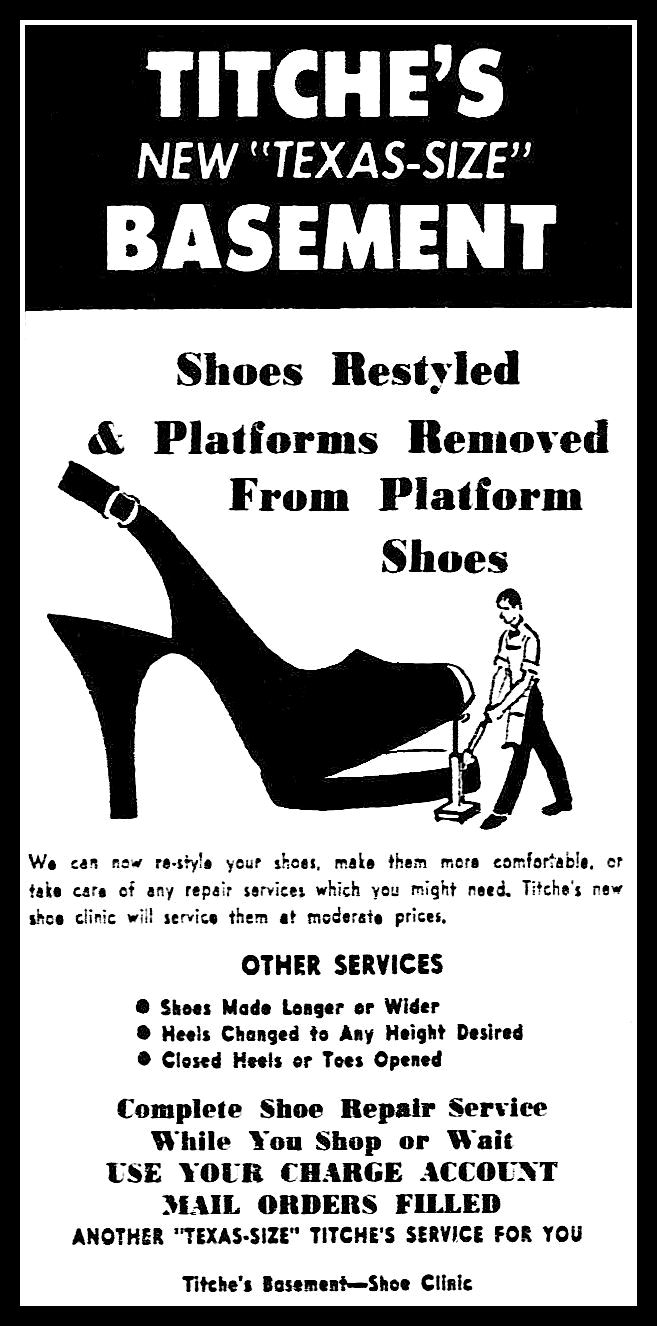
This doesn’t really fit into the 1940s, but I’ve had this 1955 ad for the Titche’s Shoe Clinic kicking around for a few years — this seems like a good place to slip it in. Platforms removed! Open toes closed! Closed toes opened! Pop down to the basement for all your shoe repair and restyling needs.

ad-titches_shoe-clinic_19551955

Check out other Flashback Dallas posts on Titche’s, here.

Flashback Dallas posts on Nardis of Dallas can be found here and here.

All images are larger when clicked.

*

Copyright © 2018 Paula Bosse. All Rights Reserved.
Neiman-Marcus Welcomes You to the Fair with Jeweled Mementos and Picasso Paintings — 1948

n-m_picasso_1948_fair_jewelryN-M’s 1948 “mementos of Texas…” (click for larger image)

by Paula Bosse

For many who come to Dallas from all across the state to visit the State Fair of Texas, a trip downtown to see the legendary Neiman Marcus department store is a must-see item on the itinerary. This was perhaps more the case years ago when the store was still owned by members of the Marcus family who were eager boosters of the annual event and placed several ads each year which graciously welcomed State Fair visitors to the city. For many years Neiman’s offered “souvenirs” for the tourists, ranging from relatively inexpensive Texas-centric knick-knacks to very expensive Texas-centric knick-knacks.

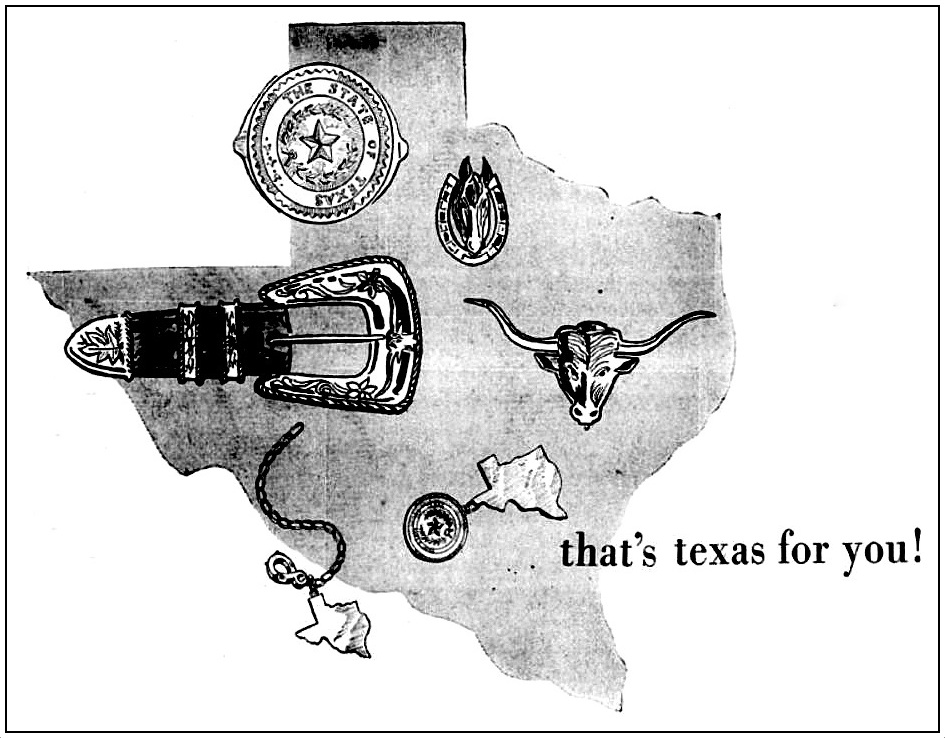
The 1948 N-M offerings can be seen below in an ad that boasts “A 14K gold welcome to Dallas and the State Fair!” (Click the ad below to see a larger image — to see an image of the ad copy alone, click here.)

ad-neiman-marcus_state-fair_1948_full

Here are the trinkets which no doubt wowed them back home in the nicer neighborhoods of Houston and Midland. (I’ve included ball-park prices in today’s money– according to the whiz-bangy Inflation Calculator — in parentheses.)

  • Texas Seal containing circular knife and file: $55 (about $550 in today’s money)
  • Gold belt buckle, made to order: $325 ($3,300)
  • Hand-tooled belt: $5 ($50)
  • Scarf clip, horse with ruby eyes and ruby studded collar: $500 ($5,100)
  • Hand-carved scarf pin, gold steer head with ruby eyes: $500 ($5,100)
  • Pocket key chain with Texas charm: $45 ($450)
  • Texas chain and Texas seal cuff links: $80 ($800)

For the cheap monogrammed hats, giant sunglasses, and salt water taffy, you’d have to head to Fair Park.

Another attraction at Neiman’s during the 1948 State Fair of Texas was an art exhibit: the first showing in Texas of original works by Pablo Picasso. The exclusive show was specifically scheduled to coincide with the State Fair and was prominently displayed on the 4th Floor of the store, in the Decorative Galleries. Twelve canvases — some never before seen in the United States — were “secured directly from Picasso’s studio at Antibes in Southern France,” via Samuel M. Kootz, Picasso’s rep in the U.S. Think about that for a second: in 1948 Pablo Picasso was the world’s most famous living artist, and there was an exhibit of his recent works — some never before seen in the United States — in a department store. In Texas. That was, as they say, a pretty good “get” for the soon-to-be President of the company, Stanley Marcus.

The Picasso exhibit was an early example of Neiman-Marcus’ dedication to bringing international arts and culture to Dallas — an idea which later manifested itself in the store’s Fortnight celebrations (which also ran to coincide with the State Fair in order to maximize publicity, foot traffic, and sales).

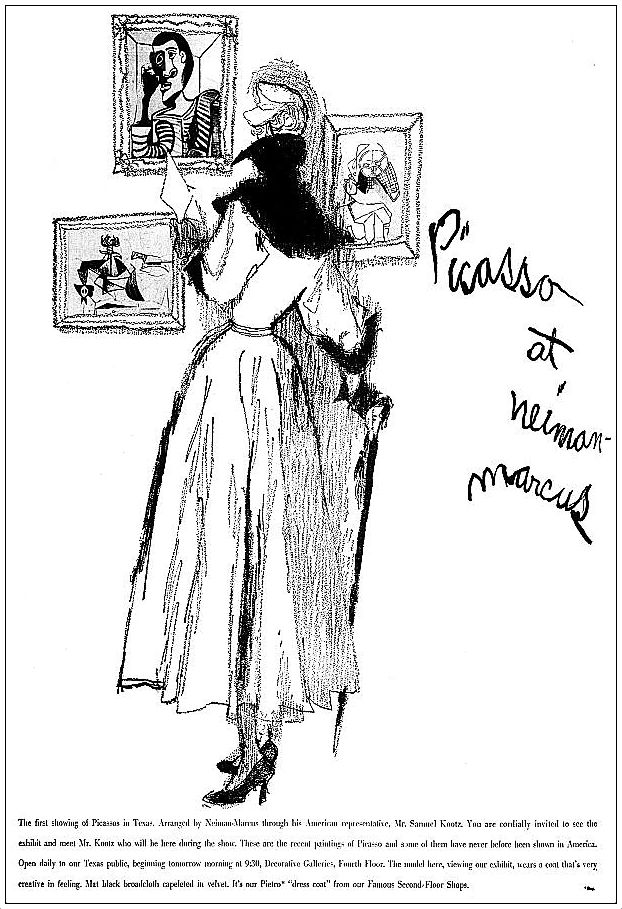
Stanley Marcus was an experienced buyer of art, and his relationship with Mr. Kootz was obviously warm — how else might one explain the inclusion of redrawn Picasso paintings (all of which appeared in the N-M show) in a store advertisement? Pretty ballsy. (Click ad below to see a larger image — the text alone can be seen larger here.)

picasso_n-m_1948

For those who might be interested, these are the first Picasso paintings ever publicly shown in Texas:

  • “Seated Woman” (1929)
  • “Sailor” (1943)
  • “Still Life with Mirror” (1943)
  • “Head” (1944)
  • “Still Life with Skull and Pitcher” (1945)
  • “Cock and Knife” (1947)
  • “Woman” (1947)
  • “Still Life with Coffee Pot” (1947)
  • “Owl and Arrow” (1947)
  • “Concierge’s Daughter with Doll” (1947)
  • “Blue Owl” (1947)
  • “The Glass” (1947)

Another art-world highlight in Dallas during the 1948 State Fair of Texas was the showing of Salvador Dali’s painting “Spain” at the Dallas Museum of Fine Arts in Fair Park (from the collection of Edward James, loaned by the Museum of Modern Art in New York). A Dallas Morning News headline — “Fair Interest to Divide Over Picasso and Dali” — seemed to imply that culturally-inclined Dallasites and/or fair-goers would have to choose one over the other in the battle of which famous Spanish artist-celebrity was most worthy of their attention: “Team Pablo” vs. “Team Salvador.” In regard to Dallas and its (somewhat late-blooming) openness to modern art, the first sentence of the article is interesting:

The simultaneous presence in Dallas during the period of the State Fair of Texas of original works by two of the world’s best-known living artists underscores heavily the swift progress toward cultural maturity in local thinking and planning. (Rual Askew, DMN, Oct. 3, 1948)

“Cultural maturity” and planning — both were in evidence in Dallas in the fall of 1948.

Thousands of Texans had their very first in-the-flesh glimpse of a Picasso canvas or a Dali painting in Dallas during the 1948 State Fair of Texas — either at a tony department store that sold $500 gold-and-ruby scarf pin “souvenirs,” or amongst the hot-dog-eating and roller-coaster-riding hoi polloi in Fair Park. That’s a pretty good reach for fine art.

It’s not all about the automobile shows!

***

Sources & Notes

Ads from October, 1948.

Click pictures to see larger images.

*

Copyright © 2017 Paula Bosse. All Rights Reserved.


The Square Dancing Craze in Big D — Late 1940s

calamity-jane_premiere_-sam-bass_majestic-theatre_july-1949Hoedown at the Majestic, 1949…

by Paula Bosse

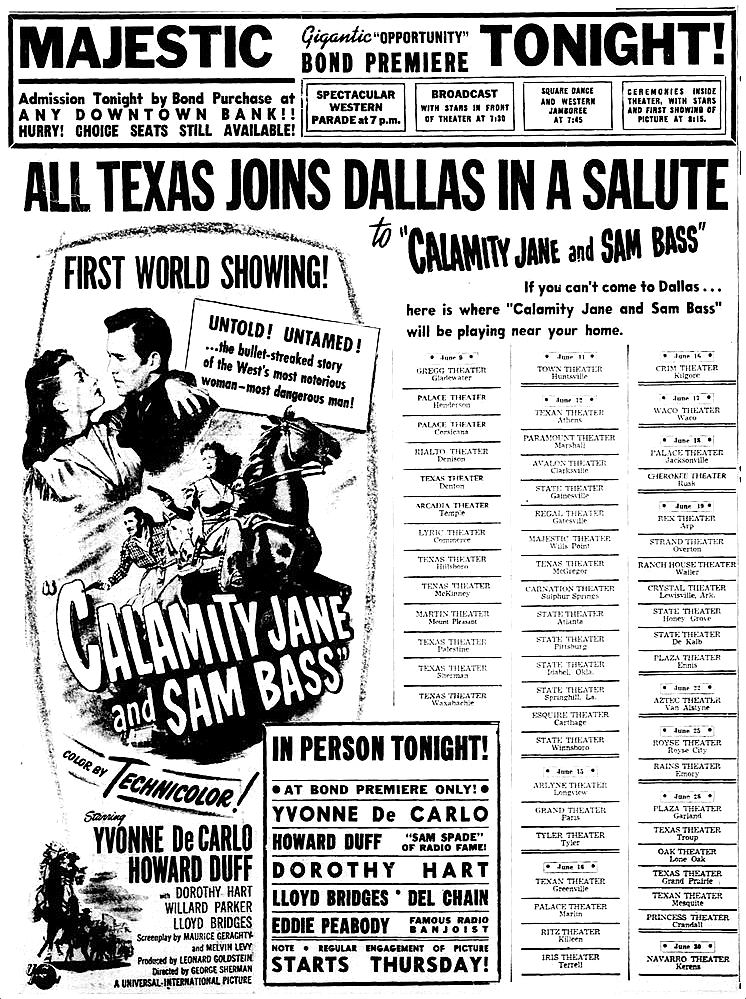
The photo above appeared in a show-biz trade publication showing part of the festivities which swirled around the world premiere of the movie “Calamity Jane and Sam Bass” starring Yvonne DeCarlo and Howard Duff at the Majestic Theatre on June 8, 1949. Several of the film’s stars made personal appearances and were made honorary deputies by Sheriff Bill Decker, sworn in by Judge Lew Sterrett (yes, Lily Munster was an honorary Dallas deputy sheriff!). There was a parade, a live show performed by the actors on the Majestic’s stage before the movie, a block party, and square dancing in Elm Street, with music provided by the Big D Jamboree band.

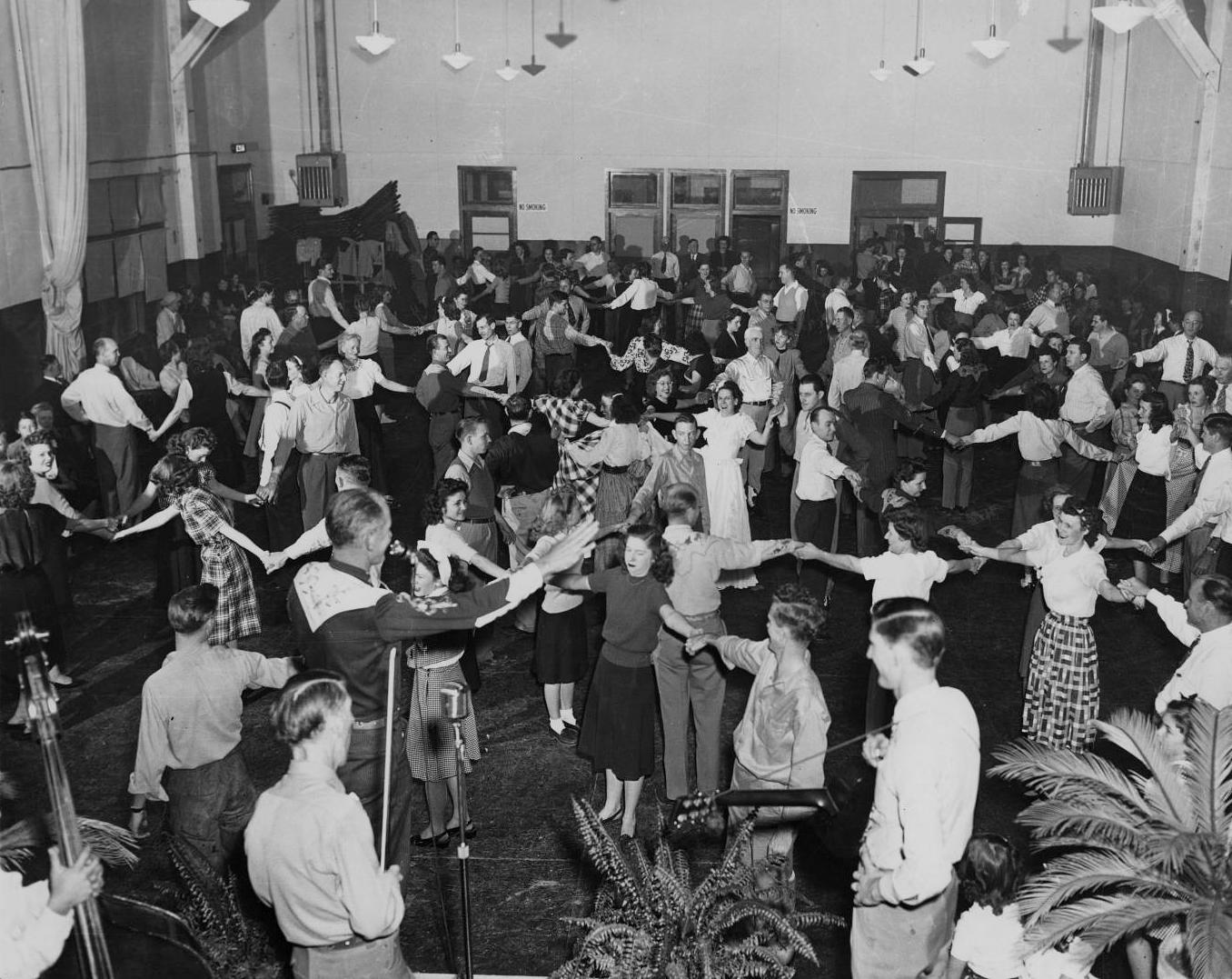
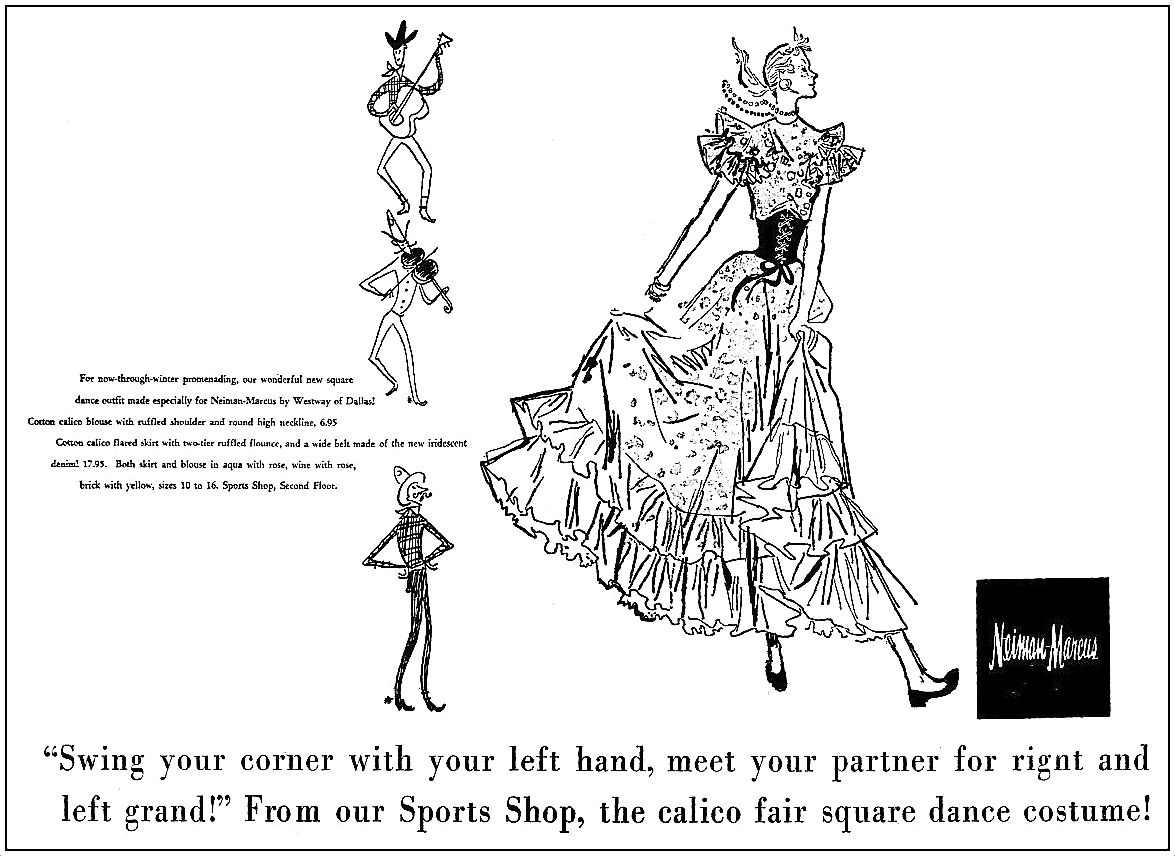
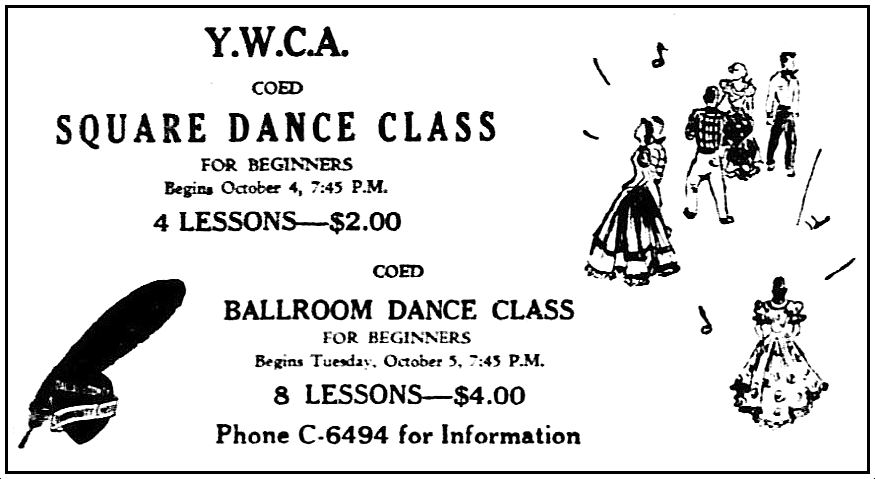
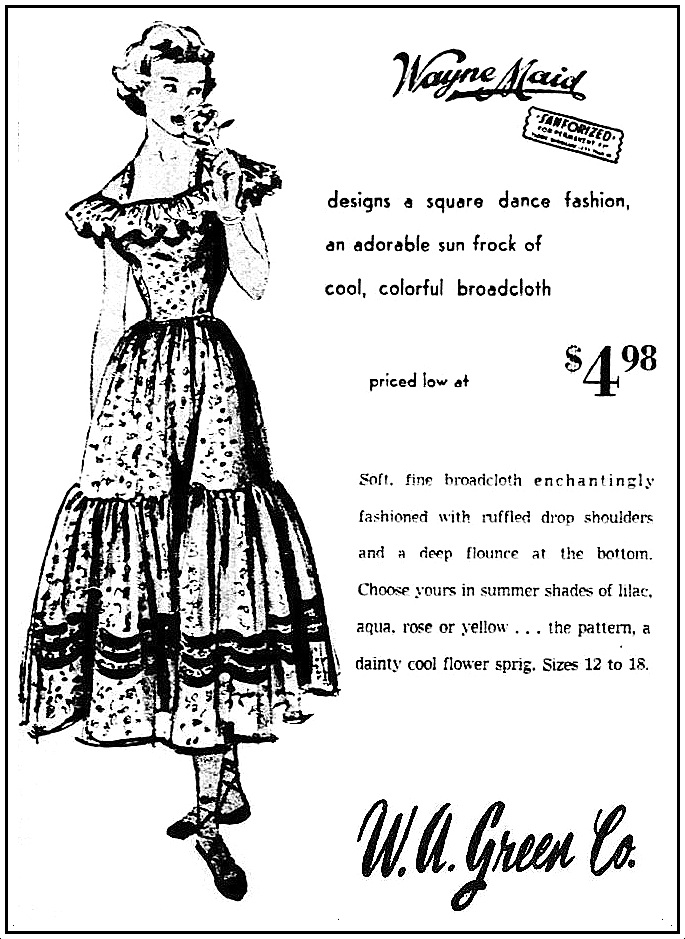
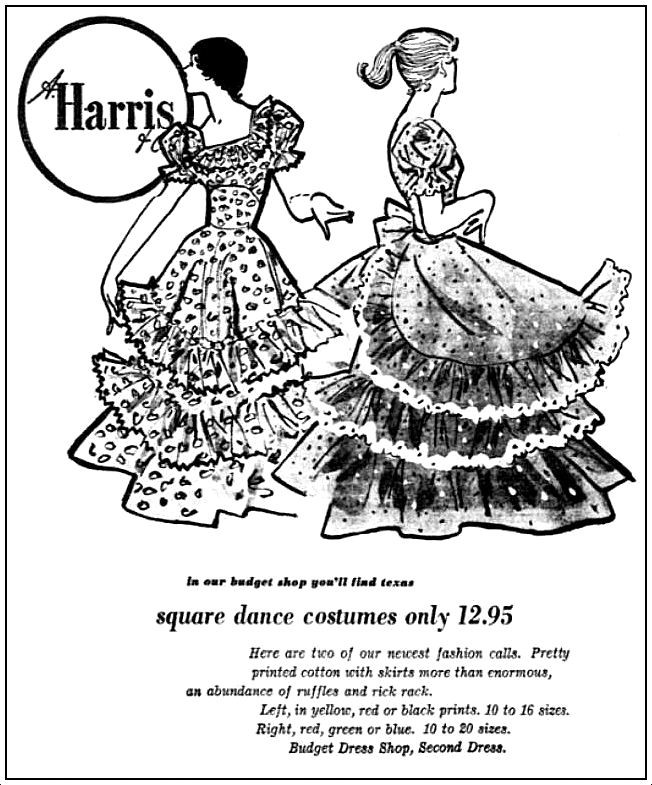
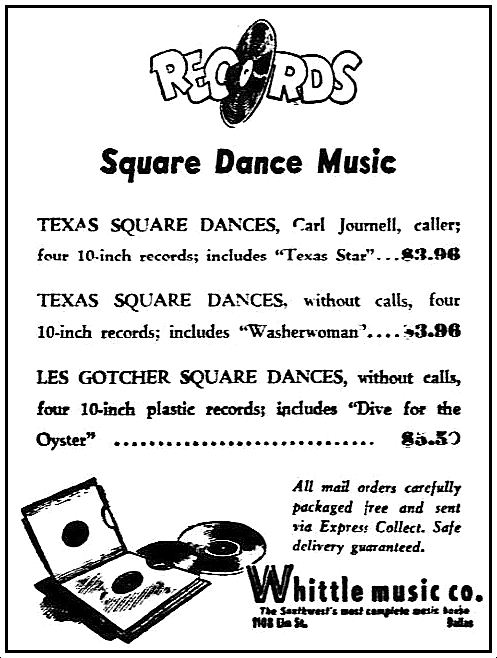
In 1949, as unlikely as it seems, square dancing was a HUGE fad which swept the country (or at least the Southwest). The peak years of the retro craze were probably 1948 to 1950, and its impact was pretty big locally, not only on the dance floor, but also in the fashion pages. When you see every major Dallas department store — even Neiman’s — selling calico and gingham square dance fashions … well, it’s big.

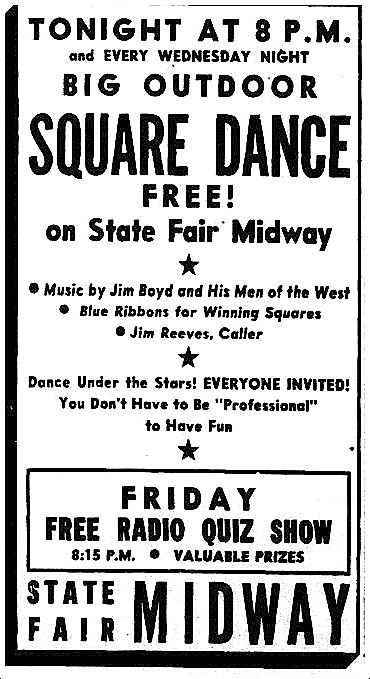
Not only were there lessons available everywhere, but there were clubs and weekly events all over town — every Wednesday in the summer of 1949, there was a big outdoor square dance held at the Fair Park Midway, with music courtesy of local celeb Jim Boyd.

I’m not sure when it stopped (…I’m assuming it has…), but for decades, a lot of us participated in square dancing as part of gym class in elementary school. This interesting throw-back take on physical fitness seems to have begun around 1950 or ’51. Not everyone was thrilled about this odd-but-charming grade-school rite of passage — some ultra-conservative communities complained, but the wholesome and old-timey dancing won out and became a standard part of Texas schools’ physical education curriculum.  Forget young people’s cotillions — most Texas children had their first experience dancing with a partner to the strain of a cowboy fiddle and a voice telling us to “allemande left” and “do-si-do.” And I’m sure we’re all better for it.

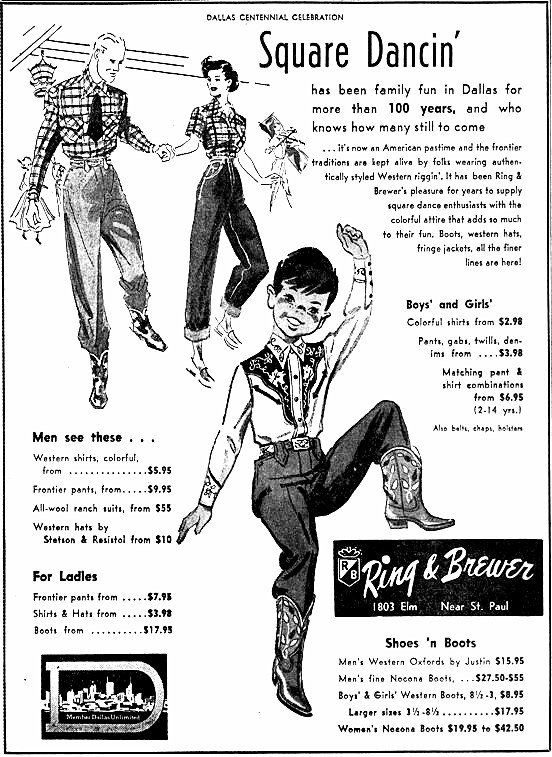
Here are a bunch of ads and things (click pictures to see larger images):

square-dance_la-reunion-place_squire-haskins_dallas-municipal-archivesSquare dance at La Reunion Place (Dallas Municipal Archives)

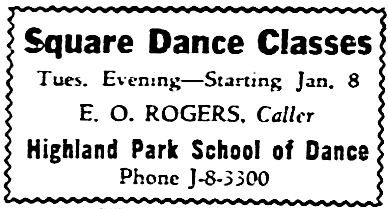
square-dance_jan-1946_highland-park
1946

square-dance_may-1947_a-harris
1947

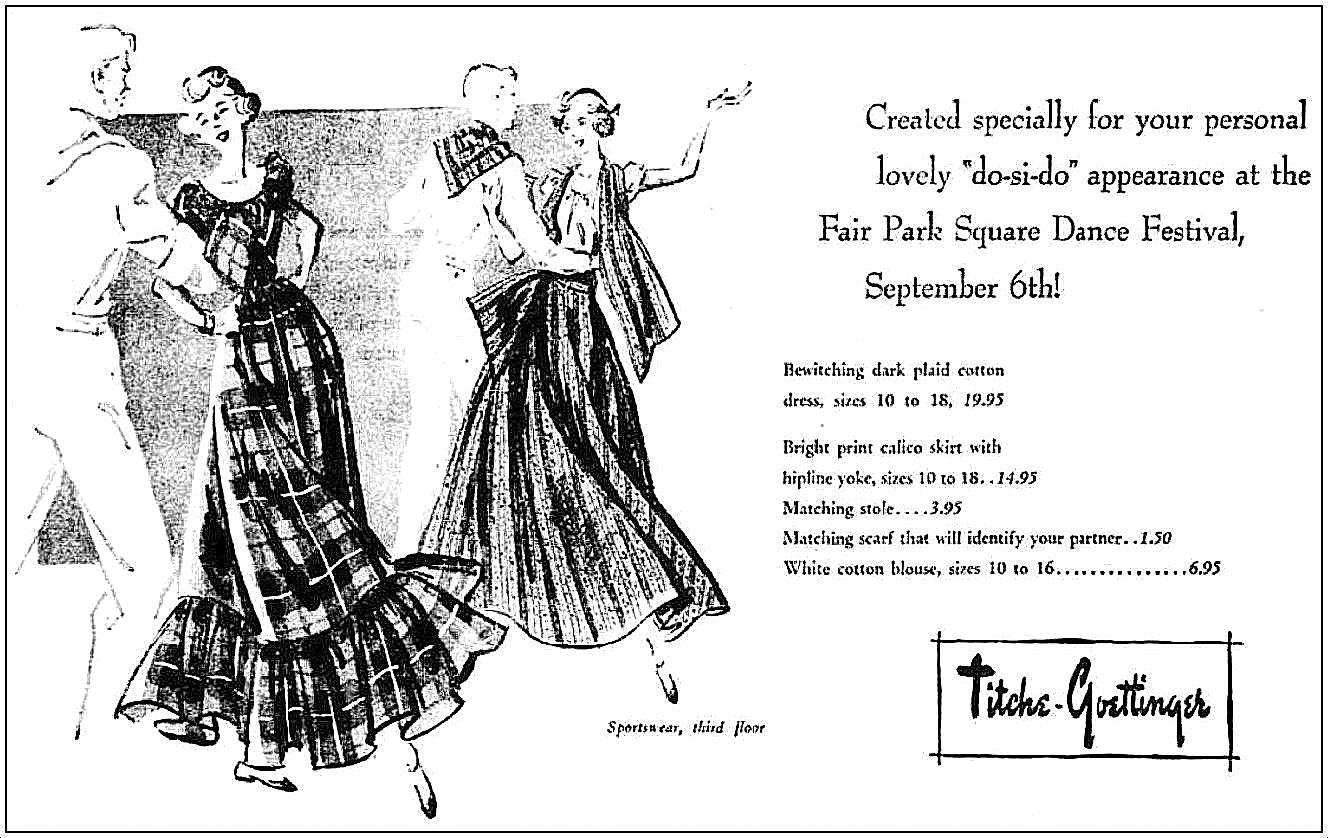
square-dance_aug-1948_titches
1948

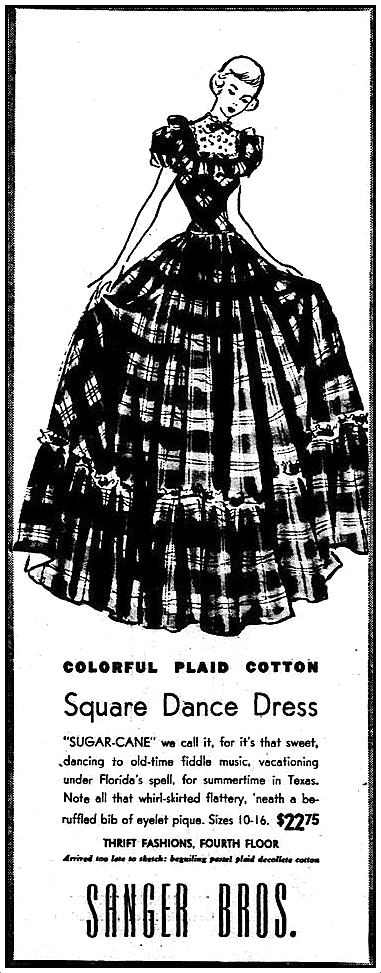
square-dance_jan-1948_sanger-bros1948

square-dance_oct-1948_neiman-marcus
1948

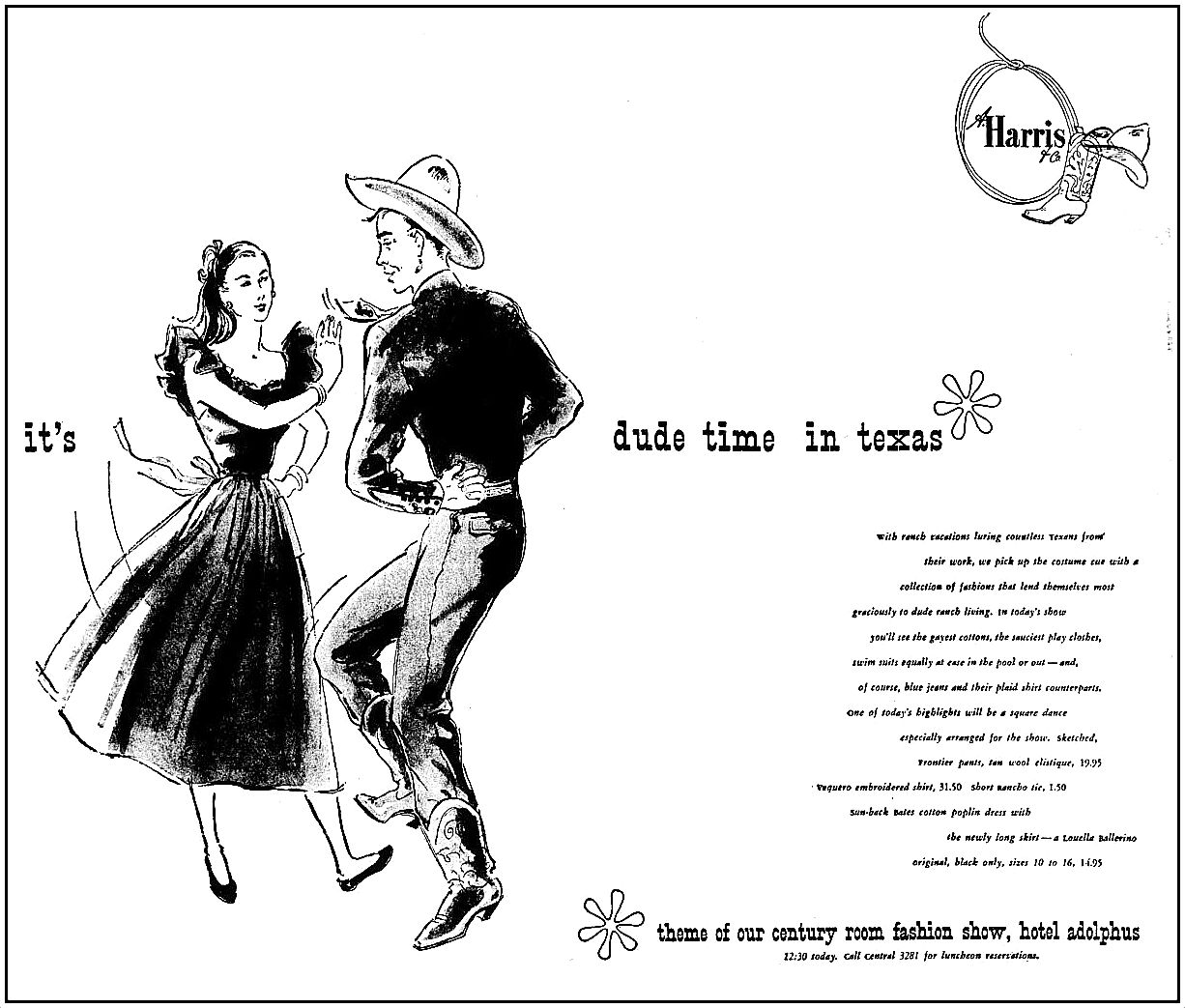
square-dance_april-1948_a-harris
1948

square-dance_oct-1948
1948

square-dance_dec-1950_e-m-kahn
1949

square-dance_june-1949_w-a-green
1949

square-dance_may-1949_fair-park-midway
1949

square-dance_nov-1949_a-harris
1949

square-dance_march-1949_whittles
1949

square-dance_oct-1949_a-harris
1949

square-dancing_promenaders_smu_1951-yrbk1951

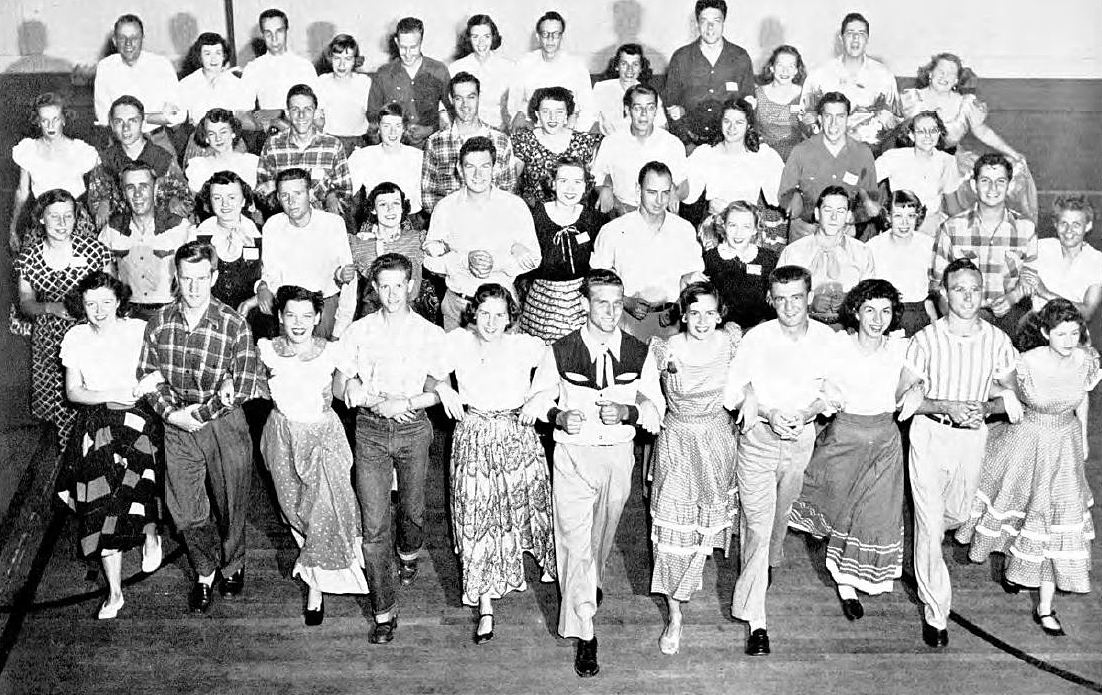
Above, a photo of the Promenaders, a group of SMU students whose purpose is described in the 1951 yearbook as being “to promote the appreciation of square and folk dancing on this campus.” (Think you recognize any of those faces? See who’s in the photo here.)

dallas_ringandbrewer_1956
1956

***

Sources & Notes

Premiere of “Calamity Jane and Sam Bass” was held at the Majestic Theatre on June 8, 1949, and it seems to have been a pretty big deal. There was newsreel footage filmed that night — wonder if it’s floating around anywhere?

square-dance_calamity-jane_majestic_june-1949

Photo of the square dance taken at La Reunion Place is by Squire Haskins and is from the Dallas Municipal Archives; is can be seen on UNT’s Portal to Texas History site, here.

Photo of the SMU Promenaders square- and folk-dancing group is from the 1951 Rotunda, the yearbook of Southern Methodist University.

Jim Boyd was a country-western singer who appeared in a few Hollywood films and was a Dallas disc jockey for many years. He also appeared around town often as a performer and personality. Dallas filmmaker Hugh V. Jamieson, Jr. and director Milton M. Agins made a short film called “Saturday Night Square Dance” (made in either 1949 or 1950); it features Boyd and his Men of the West band, plus square dance groups Silver Spur Square Set and Thompson Square Dance Club. I can find nothing on the two groups, but it seems likely that this film was made in Dallas. The quality of the film uploaded to YouTube is not very good, but, who knows — you might see your parents or grandparents in there if they were big square dancers! You can watch it here.

All images larger when clicked.

*

Copyright © 2017 Paula Bosse. All Rights Reserved.


The Neiman-Marcus Corporate Flag, Designed by Emilio Pucci — 1966

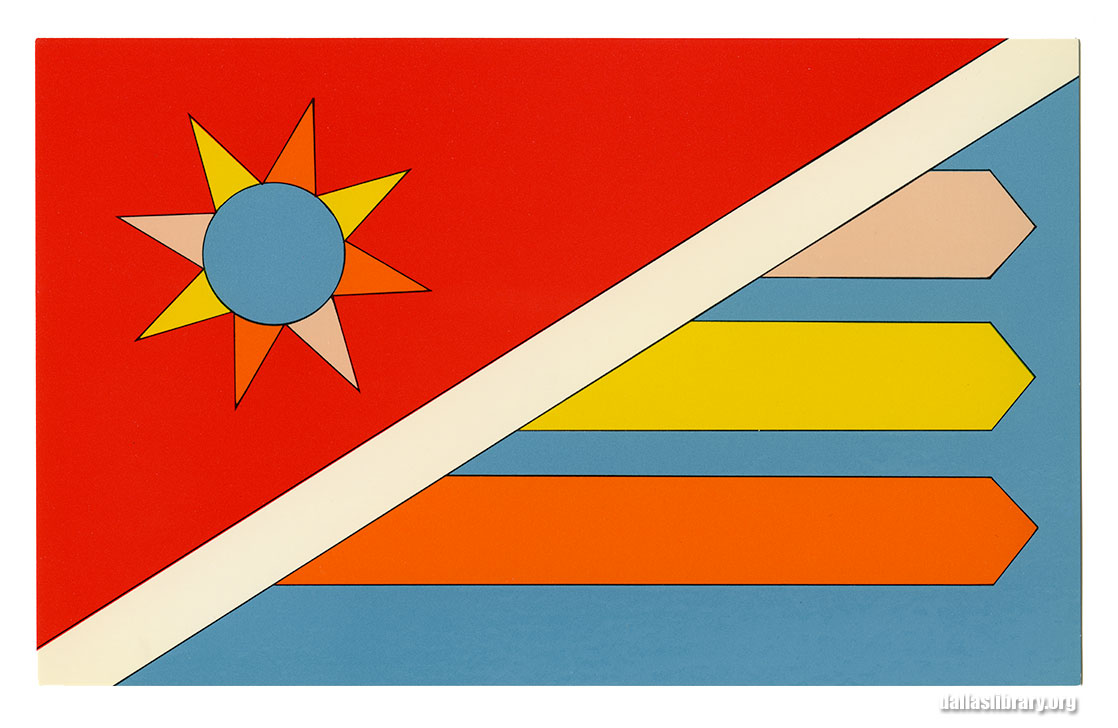
neiman-marcus-corporate-flag_emilio-pucci_1966_dallas-public-library“Emilio Pucci was our Betsy Ross…”

by Paula Bosse

While looking through the Neiman Marcus Collection at the downtown Dallas Public Library, I stumbled across this perhaps long-forgotten part of Neiman-Marcus history: the “corporate flag” designed by Italian fashion legend Emilio Pucci. The image was featured on a Neiman’s postcard; the text on the back of the card reads:

Flying high over the fashion land of Neiman-Marcus: our new corporate flag, the Lone-Star-and-Stripes. Emilio Pucci was our Betsy Ross.

Betsy Ross and Emilio Pucci mentioned in the same breath! An 18th-century American seamstress who became a patriotic icon, and an Italian fashion designer whose vividly colorful, boldly patterned designs came to symbolize the youth and energy of the 1960s… talk about your strange bedfellows!

The only thing I could find about this unusually colorful flag was a brief mention in a Dallas Morning News fashion article about Neiman’s 28th Neiman-Marcus Exposition Award in early February of 1966. Gay Simpson wrote in The News that the luncheon centerpieces “carried the colors of the new Neiman-Marcus house flag. The flag, designed by Emilio Pucci, Italian couturier, has the colors of a Texas sunset dramatized with the Lone Star and stripes” (DMN, Feb. 9, 1966).

Stanley Marcus wrote in his 1974 memoir Minding the Store that his business relationship with Pucci (“the most copied designer of our time, aside from Chanel”) began in Italy in 1948 when Marcus met with the struggling young designer and placed an order for several of his scarves. Though Neiman-Marcus had not yet expanded beyond their single department store in Dallas, the store’s reputation and influence were certainly known in fashionable circles around the world, and this N-M “stamp of approval” must have been immensely important to Pucci, whose name was not yet known. This friendship and business relationship blossomed into a mutually beneficial and very profitable partnership, and it seems perfectly reasonable that Pucci would design a flag for his friend and early supporter, Stanley Marcus. (Read more of Marcus’ thoughts on Pucci here.)

There you have it. Who knew?

**

As a postscript, any Dallas blog worth its salt cannot let a mention of Emilio Pucci go by without noting his main connection to the city: Pucci will forever be remembered as the man who brought outrageously colorful and super groovy mod designs to the stewardess uniforms of Dallas-based Braniff International Airways (designs so retinally exciting that they make that little Neiman’s flag look a little dowdy in comparison!).

***

Sources & Notes

The image of the corporate flag is from a Neiman’s postcard, which can be found in the extensive (!) Neiman Marcus Collection of the Dallas Public Library (the back of the card can be seen here); it is used with permission. Thanks to the incredibly helpful staff of the Dallas History & Archives division of the downtown Dallas Public Library. (Much thanks, particularly, to Digital Archivist Misty Maberry!)

*

Copyright © 2017 Paula Bosse. All Rights Reserved.
 

The Neiman-Marcus Shoe Salon — 1965

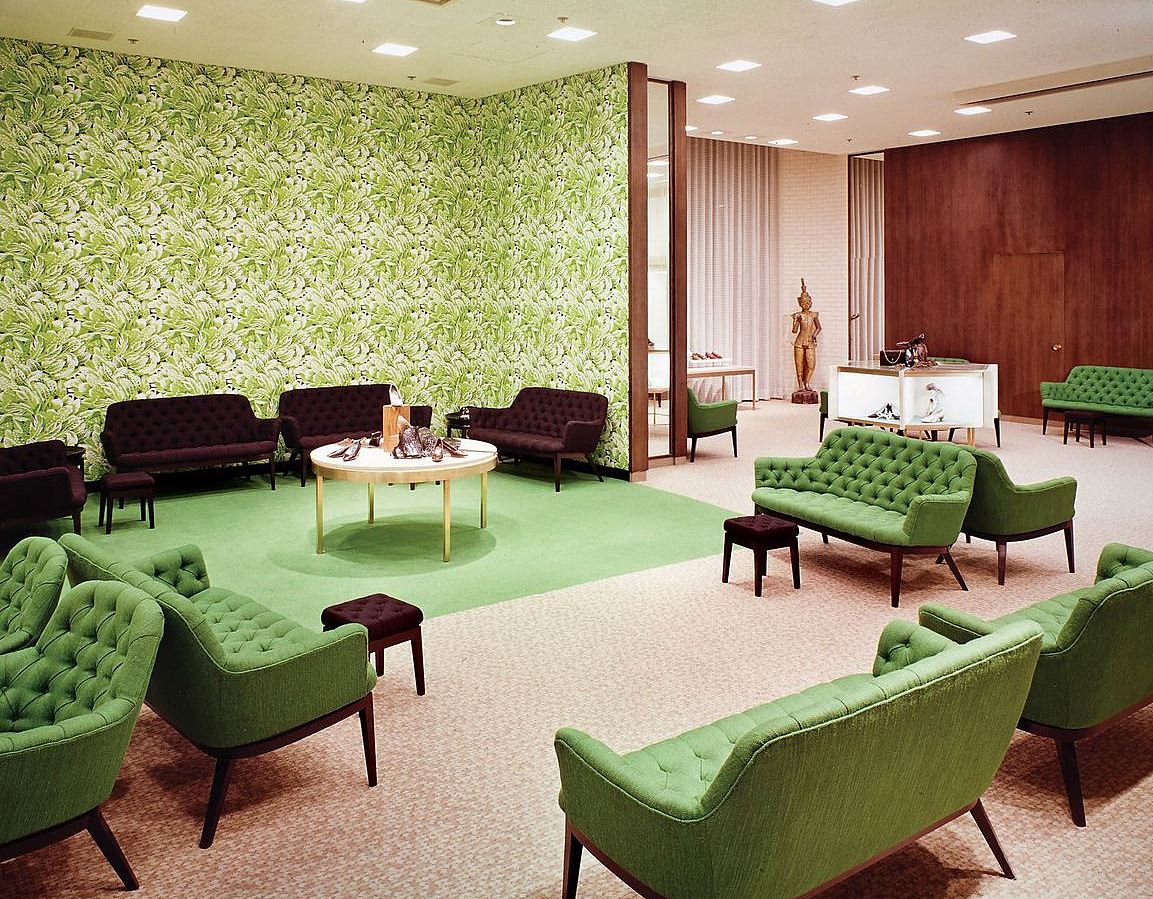
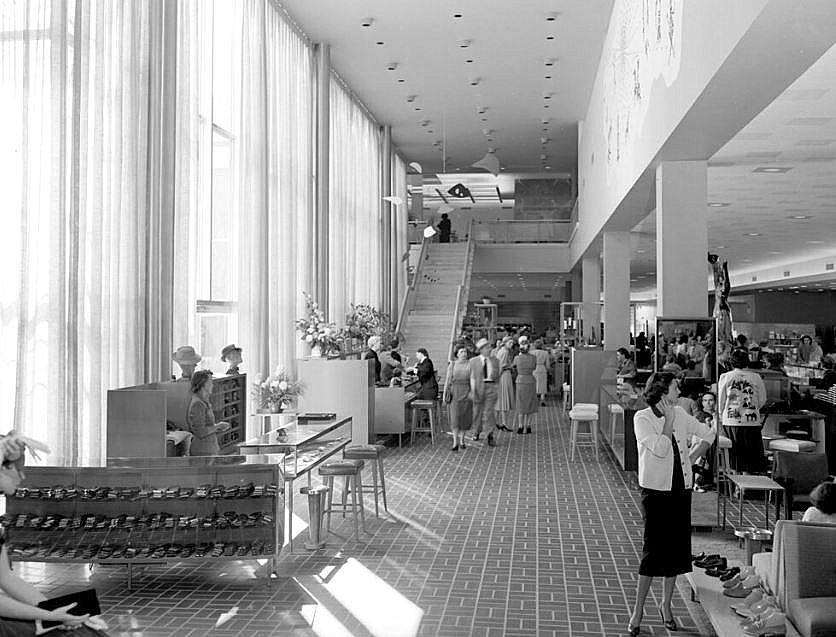
n-m_shoe-salon_1965_nyt-magazine_dec-2016Behold, the shoe salon…

by Paula Bosse

Look at this.

LOOK. AT. THIS.

***

Sources & Notes

1965 photo by Ezra Stoller. It appeared in the December 1, 2016 New York Times magazine as part of a slideshow, here; it was a companion to a short article about Stanley Marcus by James McAuley, here.

I never thought of myself as a fan of lime green upholstery until I saw that salon furniture. The wallpaper is a bit … busy (in a tasteful, sophisticated way…), but that furniture is, as they say, to die for. (And the door that disappears into the wall is a nice touch.)

*

Copyright © 2017 Paula Bosse. All Rights Reserved.

Thanksgiving, 1891: The First Turkey-Day Football Game in Dallas

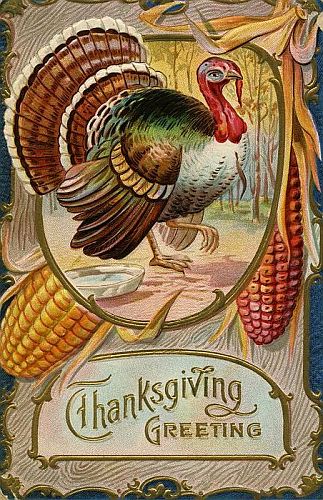
thanksgiving-card_pinterest_sm

by Paula Bosse

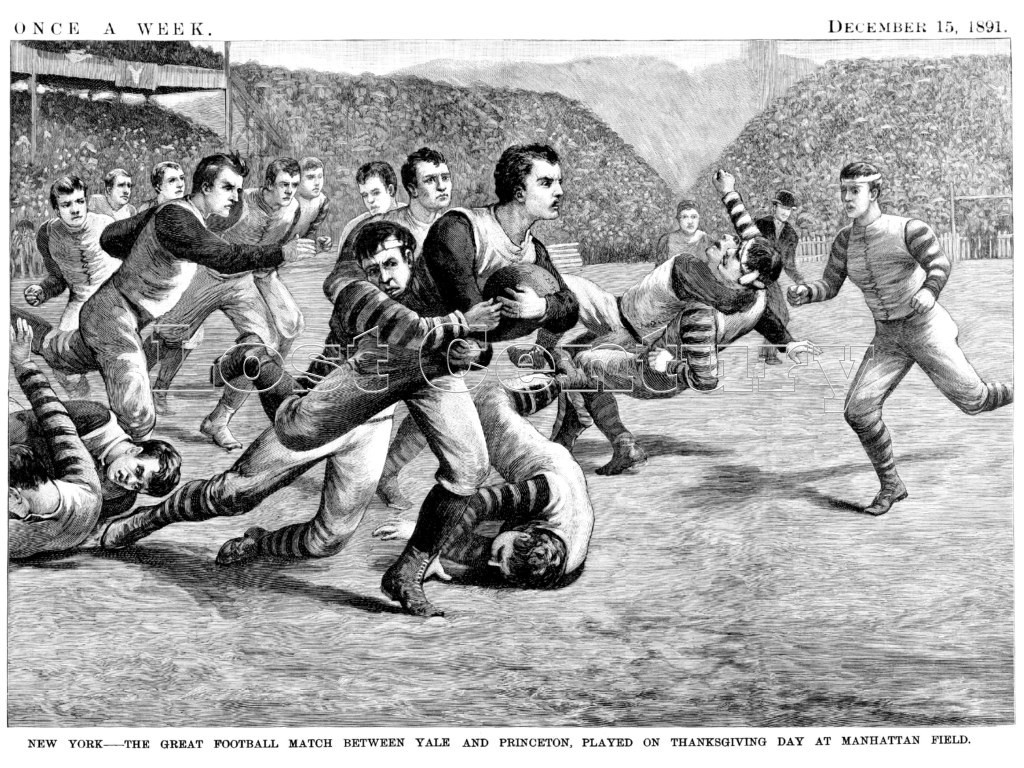
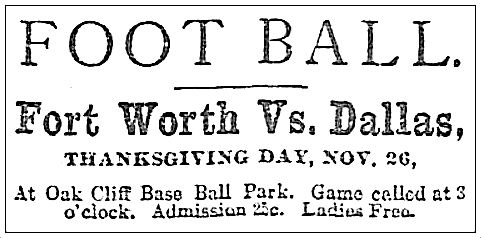
Thanksgiving is a holiday known for eating until you’re full as a tick and football — the highlight for many is the traditional Dallas Cowboys game. But when was the very first Thanksgiving Day football game played in Dallas? 125 years ago — in 1891. It was played on November 26, 1891 in Oak Cliff (…which wasn’t strictly part of Dallas at the time, but… yeah, 1891). The game was between teams from Dallas and Fort Worth, teams which had been organized only a few months previously. The sport of “rugby football” had been gaining popularity around the United States, particularly as a college sport. One of the biggest games of the young sport was the university game played on Thanksgiving Day. In 1891, the Yale-Princeton Thanksgiving game was played in New York before thousands and thousands of spectators. Yale won that year, 19-0 (see the exciting illustration below in which helmets for players are non-existent, but a man who appears to be the referee is wearing a stylish bowler hat). (Click for larger image.)

thanksgiving__football_yale-princeton_1891_lost-century

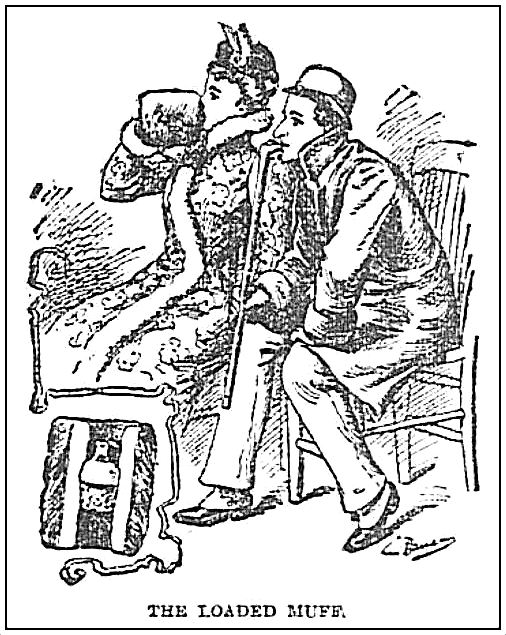
This Ivy League game was almost more of a society event than a sporting event. To get a feel for the atmosphere of these university games, read this really great contemporary article — “The Man of Fashion, We Observe Thanksgiving Day with Great Eclat” by Albert Edward Tyrrell — on the fashions and behavior of these generally well-heeled crowds (it also contains an interesting look at how Thanksgiving was celebrated in 1891, by the swells as well as the non-swells). My favorite piece of minutiae was that young ladies were not above sneaking flasks of liquor into games, hidden in their fashionable hand-warmers. I give you “the loaded muff”:

football_thanksgiving_loaded-muff_dmn112291

But I digress. However much those early Texas football enthusiasts might have hoped for similar large, flask-sipping crowds, the first Thanksgiving football game held in Dallas (and possibly in Texas) attracted a smaller crowd of hundreds rather than thousands (including “about 100 ladies”). Though the crowd was miniscule compared to the one up in New York that day, it did not lack in boisterousness and excited appreciation.

thanksgiving_football_dmn_112591_ad
Dallas Morning News, Nov. 25, 1891

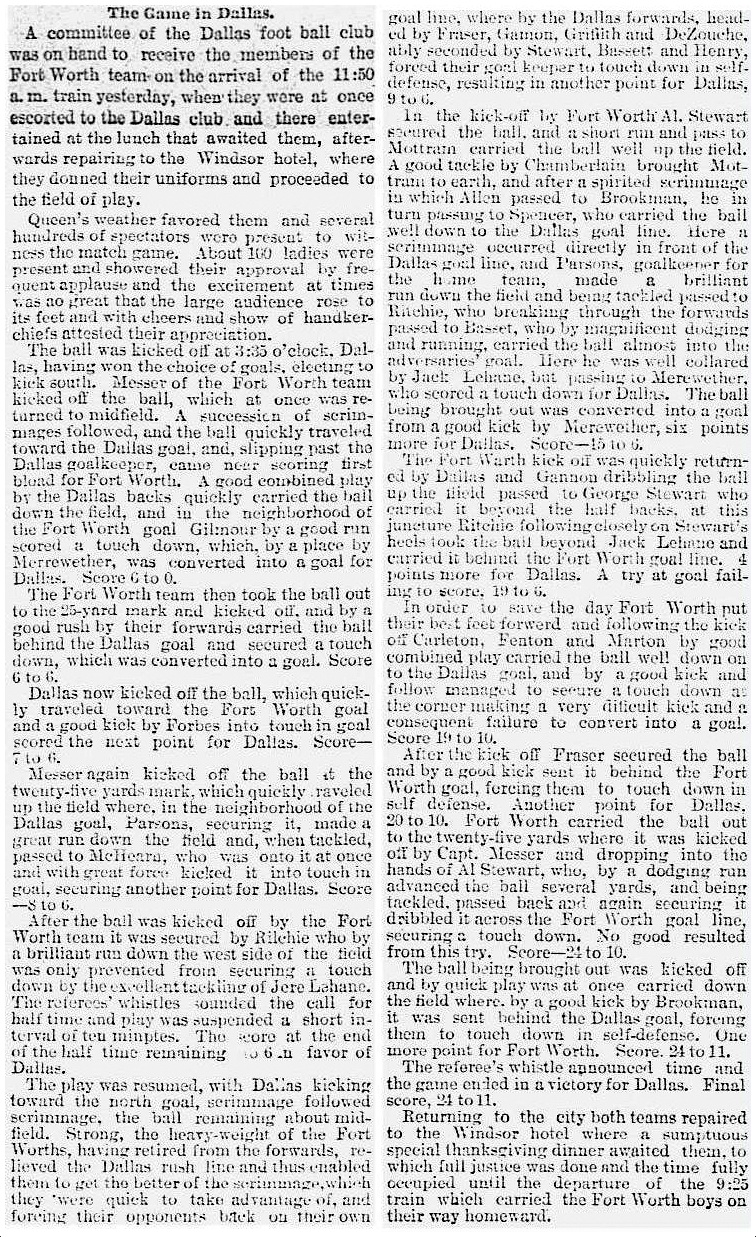
Dallas and Fort Worth had met twice before their matchup in Oak Cliff — both times with Dallas emerging victorious, and … not to be too anti-climactic, but the big inaugural Thanksgiving Day game on November 26, 1891 resulted in another Dallas win (24-11). (This shouldn’t be too surprising, seeing as the overwhelming majority of the players on the Dallas team of 15 grew up playing rugby in rugby-playing countries: 7 were British and 5 were Canadian —  only 3 were native-born Americans. Still. Whatever it takes.) (The dullish play-by-play of the game can be read  below.)

So what else was going on in Dallas in the Thanksgiving season of 1891? Here are a few morsels.

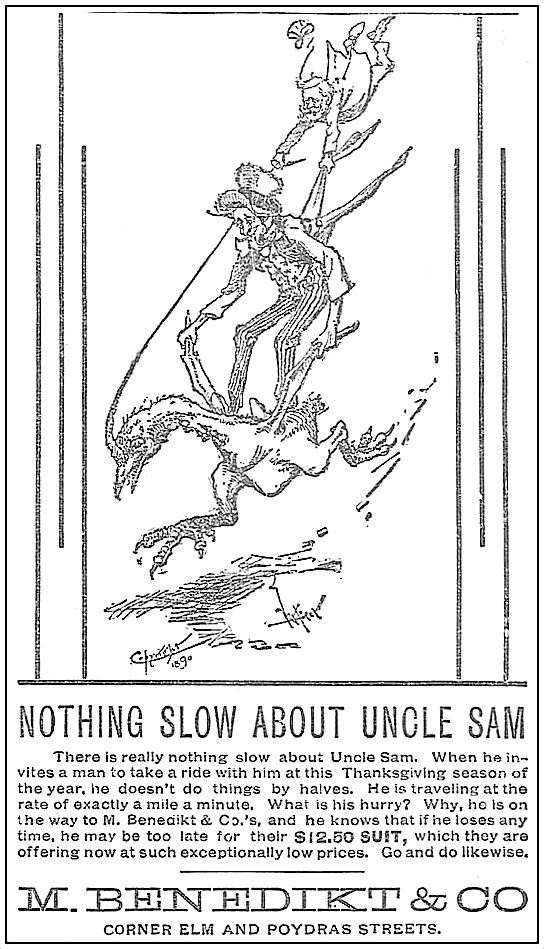
Men might have contemplated getting a new $12.50 suit from M. Benedikt & Co. (a suit which would cost about $335.00 today) — especially after seeing this eye-catching Uncle-Sam-riding-a-(scrawny)-turkey ad. (Click pictures to see larger images.)

ad-thanksgiving_benedikt_dmn_112191
DMN, Nov. 21, 1891

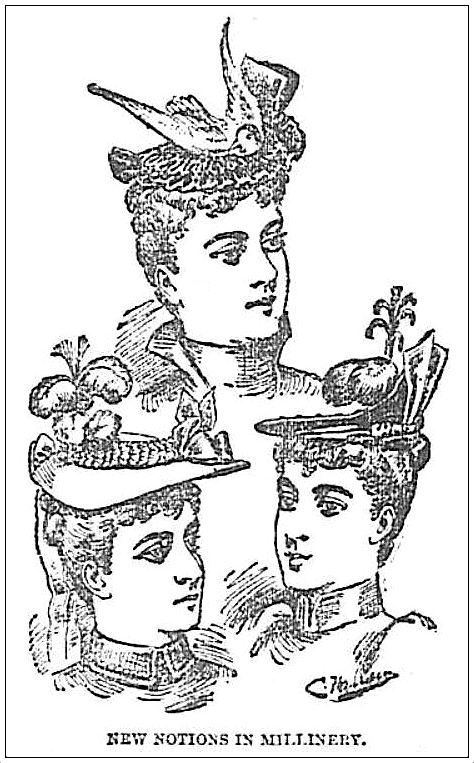
Ladies were kept up-to-date on the millinery, dress, and hairstyle fashions of the season by reading newspaper articles such as “What Is Really Worn, The Fashions That Find Favor at Thanksgiving” (which can be read here).

thanksgiving_milinery_dmn_112291
DMN, Nov. 22, 1891

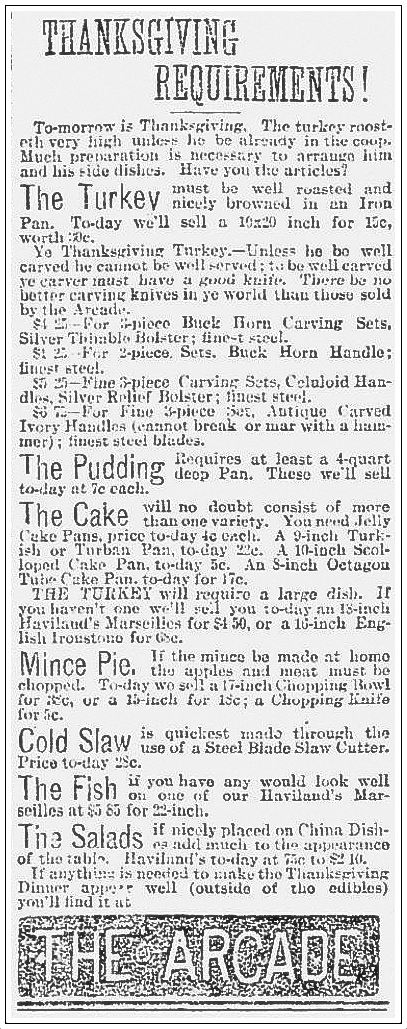
And stores that sold cookware, bakeware, and china took out ads to inform Dallasites that they really needed some new items in order to properly prepare for the big day — one’s guests shouldn’t be forced to be served a feast from tacky serving dishes or eat from chipped plates.

ad-thanksgiving_dmn_112591
DMN, Nov. 25, 1891

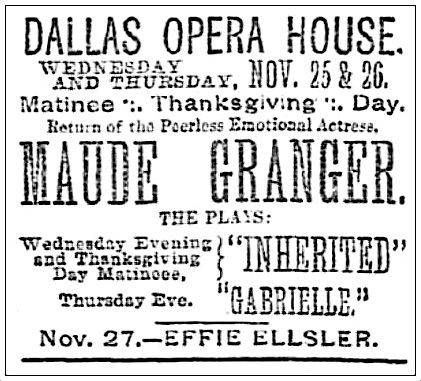
If one wasn’t spending Thanksgiving Day attending one of the city’s many church services, feeding the children at the Buckner Orphans Home, feeding one’s guests and one’s family, visiting friends, or trekking over to Oak Cliff to see that football game, he or she might have considered attending a matinee at the Dallas Opera House — Maude Granger (“The Peerless Emotional Actress”) was back in town and raring to emote.

thanksgiving_theater_dmn_112491
DMN, Nov. 24, 1891

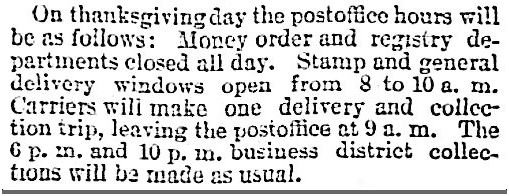
Almost everyone had the day off from work, but, oddly enough, most postal workers had to work at least part of the day. Neither rain nor sleet nor tender turkey breasts and cranberry sauce stayed those couriers from the swift completion of their appointed rounds, I guess.

thanksgiving_post-office_dmn_112591
DMN, Nov. 25, 1891

At least no one was dreading/eagerly anticipating Black Friday back in ’91.

**

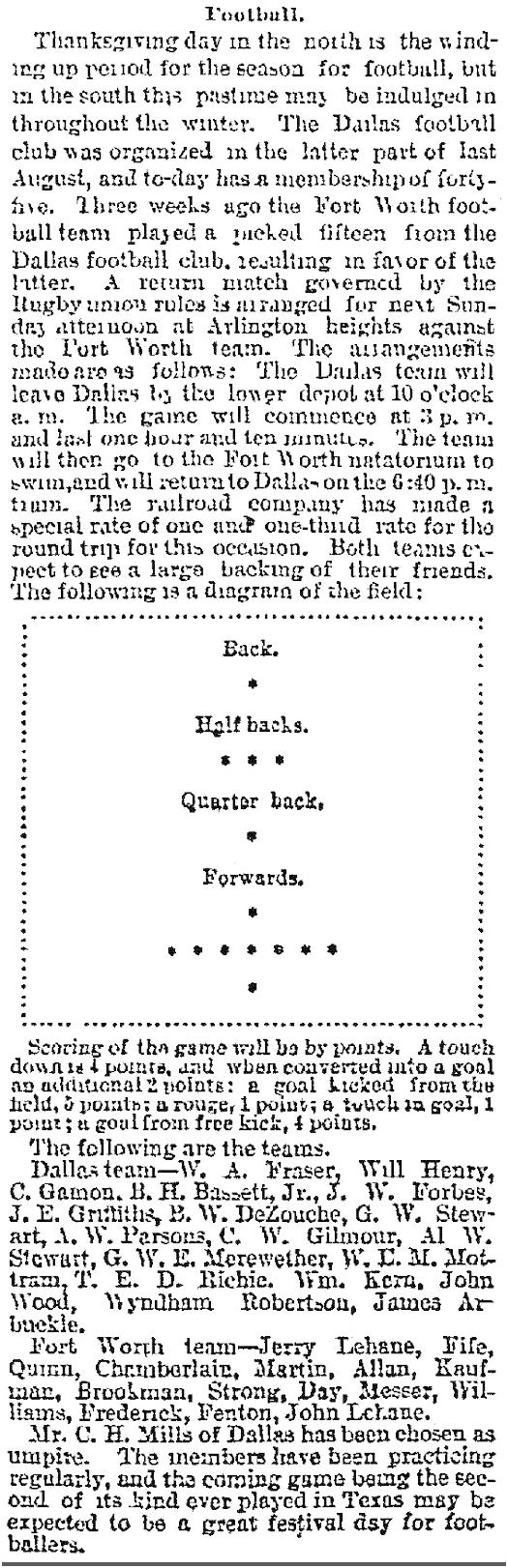
Back to football. First, a friendly D-FW practice run before the Big Game.

thanksgiving_football_dmn_111491
DMN, Nov. 14, 1891

The pre-game article.

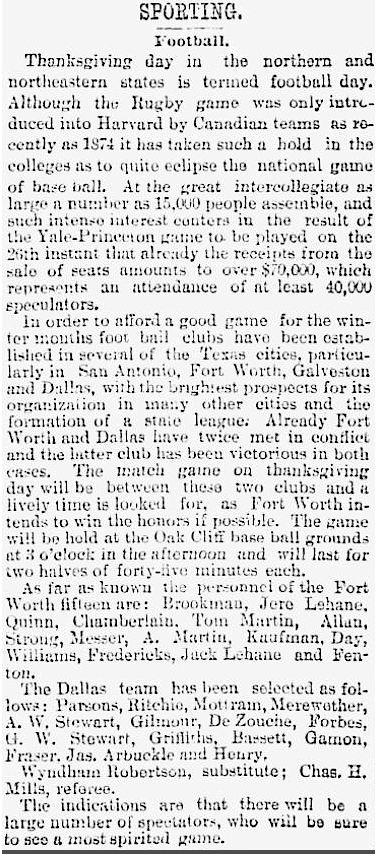
thanksgiving_football_dmn_112591
DMN, Nov. 25, 1891

The post-game article.

thanksgiving_football_dallas-fw_dmn_112791_highlights
DMN, Nov. 27, 1891

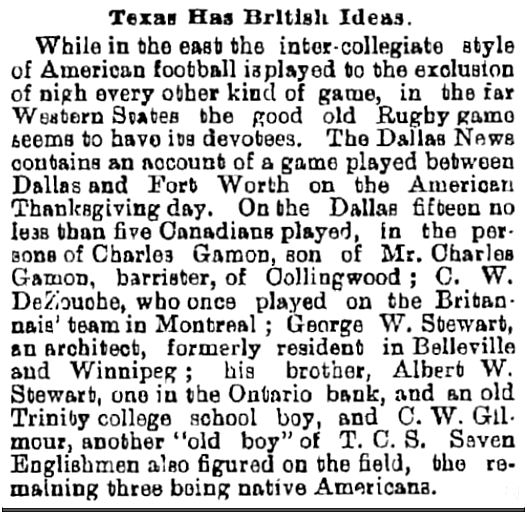
And an article from a proud Canadian newspaper, boasting of the number of Queen Victoria’s faithful subjects playing for the Dallas team.

thanksgiving__football_manitoba-free-press_121191
The Manitoba Free Press, Dec. 11, 1891

***

Sources & Notes

Thanksgiving card found on Pinterest.

Illustration of the 1891 Yale-Princeton game is from the Lost Century of Sports website, here. (I’m not really a sports fan, but if I were, this website of 19th-century sports might be one of my favorites!)

For more on how Thanksgiving finally came to be celebrated in Texas in 1874 (it took a long time for the Southern states to agree to celebrate what many thought was a “Yankee abolitionist holiday”), see my post “Encouraging Dallasites to Observe Thanksgiving — 1874,” here.

Happy Thanksgiving!

Most pictures and clippings larger when clicked.

*

Copyright © 2016 Paula Bosse. All Rights Reserved.