Flashback : Dallas

A Miscellany: History, Ads, Pop Culture

Category: Food

Luncheon at The Zodiac Room, Darling

zodiac-room_smFood, fashion, & the unmistakable whiff of Old Money (click for larger image)

by Paula Bosse

Two cool and sophisticated postcards from the cool and sophisticated Neiman-Marcus (although it’s debatable whether the truly cool and sophisticated N-M shopper would, in fact, mail anyone something as bourgeois as a postcard of a department store, Neiman-Marcus or not). Perhaps these were done up for the sizable tourist trade. I love these cards. Commercial art of this period is wonderful.

The description on the back reads: “One of the great dining spots of the Southwest … N-M’s famed ZODIAC ROOM. The superlative food specialties of Director Helen Corbitt and her staff are enjoyed during modeling of fashions a la Neiman-Marcus at luncheon and dinner. Also, tea served daily.”

Below, the Carriage Entrance:

neimans_postcard_c1950s-carriage-entrance-sm(click for larger image)

The description: “‘The Carriage Entrance’ — famous passageway into one of the world’s great specialty stores.”

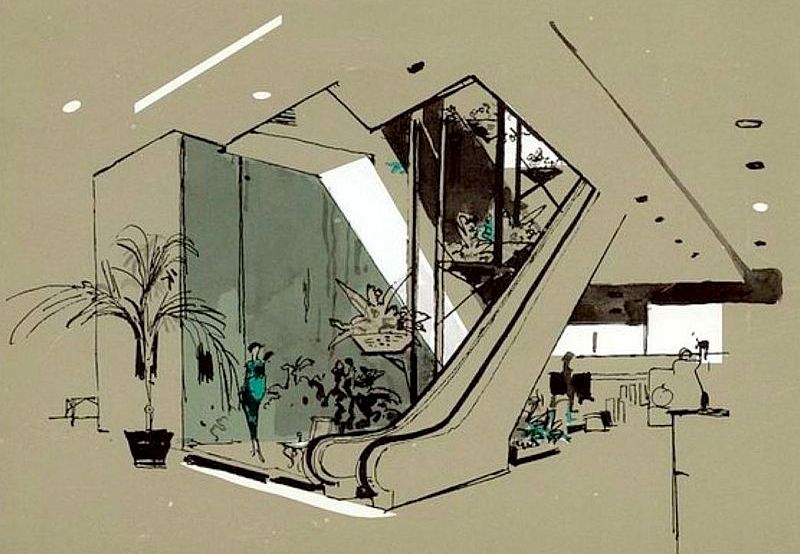
And another (I’d love to see the whole series of these postcards.) Sadly, no description on this one, featuring a fashionable escalator.

n-m_escalator_pinterest

I fear I shall never reach the level of swan-like sophistication needed to become an habitué of The Zodiac Room. Tant pis.

***

I have no idea where these postcards came from. I’m not sure of the date, either, but … “1950s”? Maybe very early 1960s? Let’s go with “Mid-Century” — everyone loves that! Whenever this was, this was a period when fashion was chic and fabulous. As was Neiman-Marcus. (I still miss that hypen!)

Need to make a reservation at The Zodiac? Info is here.

*

Copyright © 2015 Paula Bosse. All Rights Reserved.

David Wade, Gourmet: Have Ascot, Will Travel

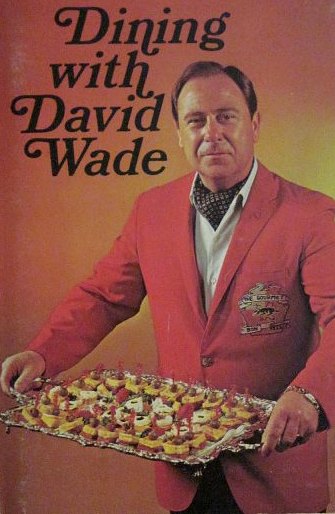
david-wade_dining-with_cover

by Paula Bosse

A few years ago, when I was a bookseller, I posted the following on a personal blog — it turned out to be the most commented-on and most clicked-on post I’d ever written. I wrote it a bit snarky, but I was amazed by the response it elicited: people (both in Texas and beyond) apparently have a strong affection for — and a seemingly deeply personal attachment to — local TV gourmand David Wade. Here’s what I wrote.

*

I just received an order for a David Wade cookbook I’ve had listed for four years:

DAVID WADE’S KITCHEN CLASSICS (Dallas: David Wade Industries, 1969). 300pp. Photographs, index. The ascot-clad TV gourmet presents recipes as well as photos of himself with celebrities such as Mickey Mantle (page 99, opposite the recipe for Crabmeat Tetrazzini). A couple of small splotches to fore-edge; one rubbed spot on cover. No dust jacket. Inscribed by Wade. $12.50

I don’t know if people outside of Texas (and maybe outside of Dallas) would be familiar with David Wade, described, tellingly, not as a “chef” but as a “food demonstrator.” He had a local TV show that must have started in the ’50s or ’60s, but I saw him in the ’70s and into the ’80s. And, yes, he DID wear an ascot, and a blazer, as seen above, from the front cover of another cookbook from the David Wade oeuvre.

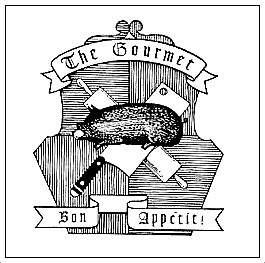
He had a catchy theme song (which compared him to Rembrandt and Edison) and he had his very own coat of arms, which I have vivid, rather frightening memories of from my childhood (I always imagined that poor pig being whacked over the head with the rolling pin and then hacked apart by the cleaver — Bon Appetit, little piggie!):

david-wade-show_logo

I was just a kid, but I remember cringing a bit at his deep-voiced cheesiness. I don’t actually remember much about the food or the actual program, but I can still hear that unnaturally calm, deep voice oozing around inside my head. But what did I know? He was an incredibly popular local TV personality. Yeah, he might have used an over-abundance of big words (…words like “over-abundance”), but, to be fair, he also had a folksy charm and was pleasantly inoffensive.

I’m not sure the same can be said for his food, however. Here are a few of the recipes which some lucky lady in South Carolina who bought the cookbook might be whipping up in a few days:

  • Squash Loaf
  • Citrus Surprise Steak
  • Liver Yucatan (featuring grated American cheese (can you actually grate American cheese?), macaroni, canned mushrooms, and sugar)
  • Baked Stuffed Fish with Pecan Grape Sauce
  • Deep Sea Loaf (made with canned tuna, gelatin, sweet pickle juice, avocado, and three tablespoons of sugar … among other equally distressing ingredients)
  • Salmon & Green Olive Casserole (with cream and “salmon liquid” straight from the can)
  • Apple & Banana Soup (these are the ingredients: chicken stock, apple, banana, potato, onion, cream, curry powder, chives)
  • Kidney Bean Tuna Salad
  • Meat Loaf Pizza
  • Pineapple Mint Cake
  • Quick Clove Jelly Cake
  • Sahib Eight Boy Chicken Curry (…I have no idea…)
  • Yam Peanut Puffs

Bon Appetit!

*

After I wrote that post, I was inundated by people looking for information on where to find all sorts of much-loved David Wade recipes (especially his famed “Turkey in a Sack”) and where they could find his apparently quite popular Worcestershire Powder. There were also many, many comments from people who just wanted to share personal memories of David Wade, invariably describing him as a warm and gracious, down-to-earth, gentle man. “Classy, but not pretentious.”

Wade began his TV career in Dallas at WFAA in 1949, hosting a 15-minute show about dogs (?!) called “Canine Comments” — it became so popular that it was syndicated around the country. He won awards for that show. It was VERY popular. In 1952, Wade was also appearing on WFAA radio as “The Hymn Singer,” singing religious songs and talking about each song’s history and composer. Along the line he made the switch to food.

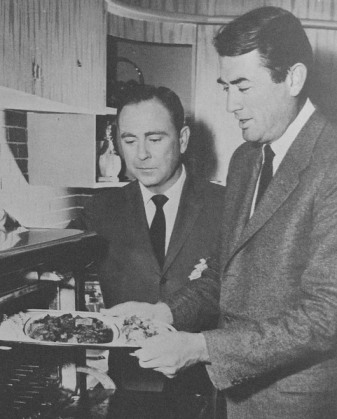
He was “demonstrating” food preparation at personal appearances and on local television by 1957, and in the early 1960s he became a nationally known figure when he commuted to New York from Dallas to tape regular spots for a show called “Flair” in which he frequently appeared with celebrities, guiding them through the preparation of a dish.

david-wade-gregory-peckWith Gregory Peck, 1960s

Eventually, his Dallas-based TV shows were syndicated all over the U.S., and he was so popular locally that he decided to run for mayor in 1971 (he lost to Wes Wise). He continued in his role as a cooking instructor and media figure until his retirement.

David Wade, a much-beloved man who lived and worked in Dallas for the bulk of his career — died in Tyler in March of 2001 at the age of 77. He had been a fixture on Texas television and had published numerous cookbooks. And in between rhapsodizing on good food and wine, he even taught untold thousands how to cook fish in the dishwasher and how to roast a turkey in a paper sack.

***

Sources & Notes

David Wade’s obituary is here.

A warm and fuzzy nostalgic look back at Wade can be read at CraveDFW, here; a super-snarky (and kind of amusing) LA Weekly post critiquing Wade’s recipes can be read here.

Regarding Wade’s run for Mayor of Dallas, check out the Dallas Morning News interview with him conducted by Carolyn Barta, in which he expounds on his vision for the future of Dallas, in the article “Wade Feels Need to Communicate” (March 21, 1971).

Next: The little-known devastating and traumatic childhood event that resulted in David Wade becoming an orphan at the age of 5. Read “David Wade: Overcoming Childhood Trauma” here.

*

Copyright © 2014 Paula Bosse. All Rights Reserved.

Snapshots of the Fair, 1936-1940

tx-centennial_strolling_fwplCentennial Exposition, 1936 — photo by Lewis D. Fox (click for larger image)

by Paula Bosse

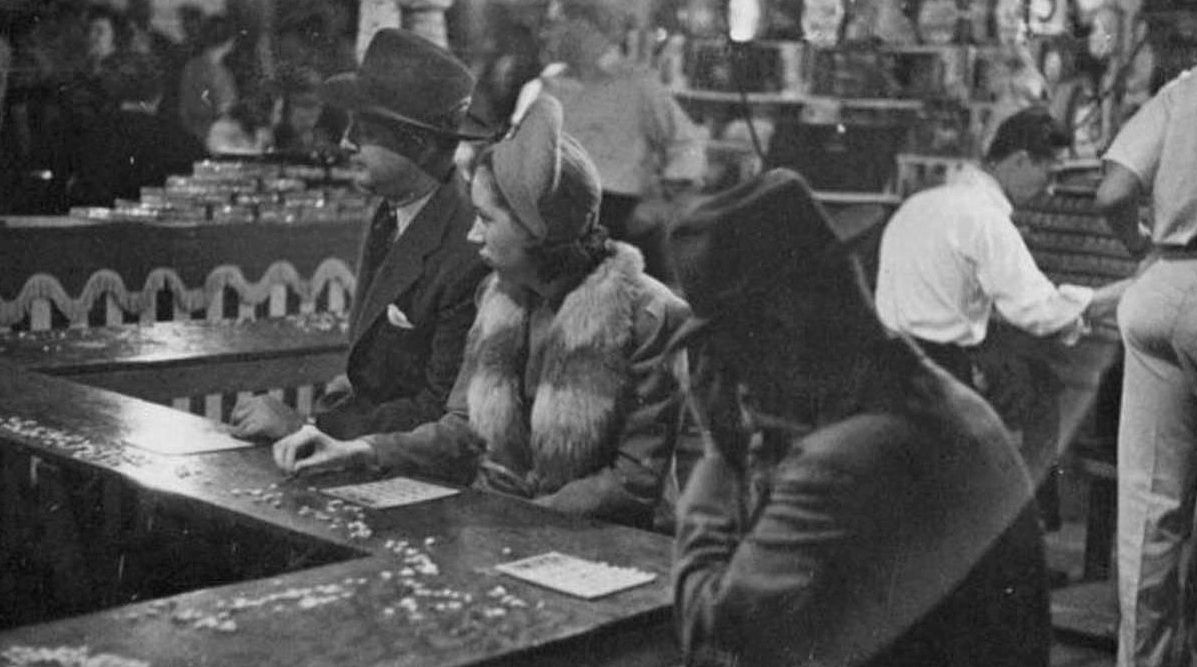
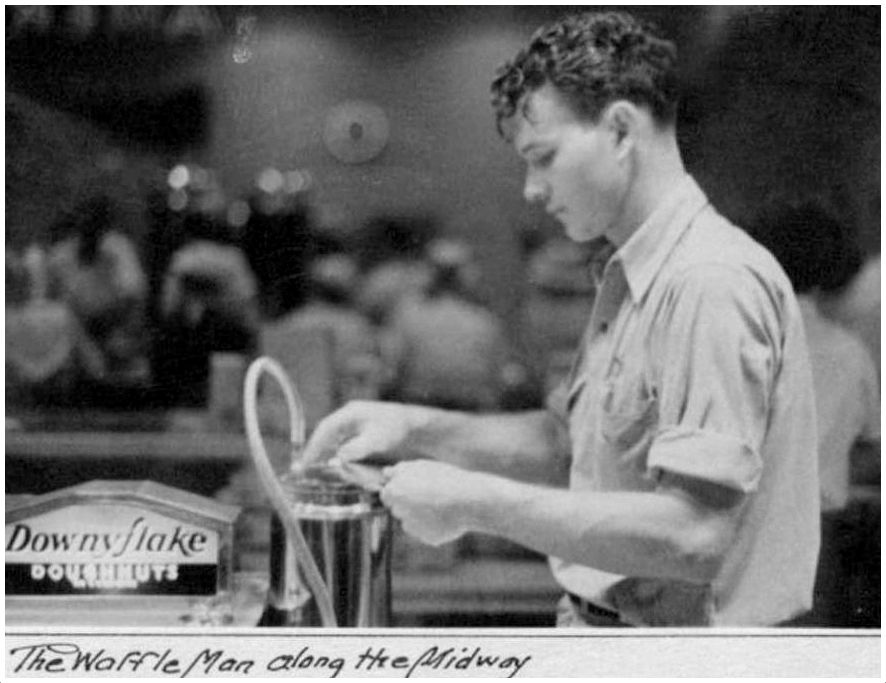
An amateur photographer named Lewis D. Fox took a lot of photos at the State Fair of Texas — from the Texas Centennial in 1936 through 1940. The Centennial photos are particularly interesting, because they show what the “Exposition” was like to the average visitor — there was more going on than just the spectacular extravaganza we usually see — there are also shots of people doing un-spectacular things like just walking around or enjoying a quiet, late-afternoon cup of coffee. There are also photos of the people who do the heavy-lifting at a state fair — the men and women who work the Midway shows and the concession stands (a link to a larger collection of Mr. Fox’s State Fair photos — almost a hundred snapshots — is below).

Enjoy this look at a time when going to the fair meant dressing up and, apparently, often leaving the children at home! (Click photos to see larger images.)

tx-centennial_spirit-of-centennial_fwpl

state-fair_texas-state-bldg_fwpl

state-fair_circus_c1939_fwpl

state-fair_grandstand_fwpl

tx-centennial_swing-revue_fwpl

state-fair_beanery_fwpl

state-fair-midway_fwpl

tx-centennial_cashier_fwpl

tx-centennial_side-view_fwpl

tx-centennial-midway_waffle-man_fwpl

***

Sources & Notes

All photos taken by Lewis D. Fox, from the Fox Photograph Collection in the Fort Worth Public Library Archives, courtesy of the Genealogy, History and Archives Unit, Fort Worth Public Library. Mr. Fox took a lot of snapshots at the fair — see  more here.

On a personal note, I’m mesmerized by “The Waffle Man.” He looks just like a young Lefty Frizzell! Lefty was from nearby Corsicana and he spent a lot of time in Dallas, but he wasn’t born until 1928, so it can’t be him — but check out this photo of Lefty as a teenager and see the remarkable resemblance! Not only did the (no doubt syrup-scented) young man above look like one of my favorite singers, but he also had ready access to waffles. What’s not to love? Oh, Waffle Man….

All images larger when clicked.

*

Copyright © 2014 Paula Bosse. All Rights Reserved.


Dallas Steam Coffee & Spice Mills — 1880s

babcock-foot-brown_imm-gd_1889

by Paula Bosse

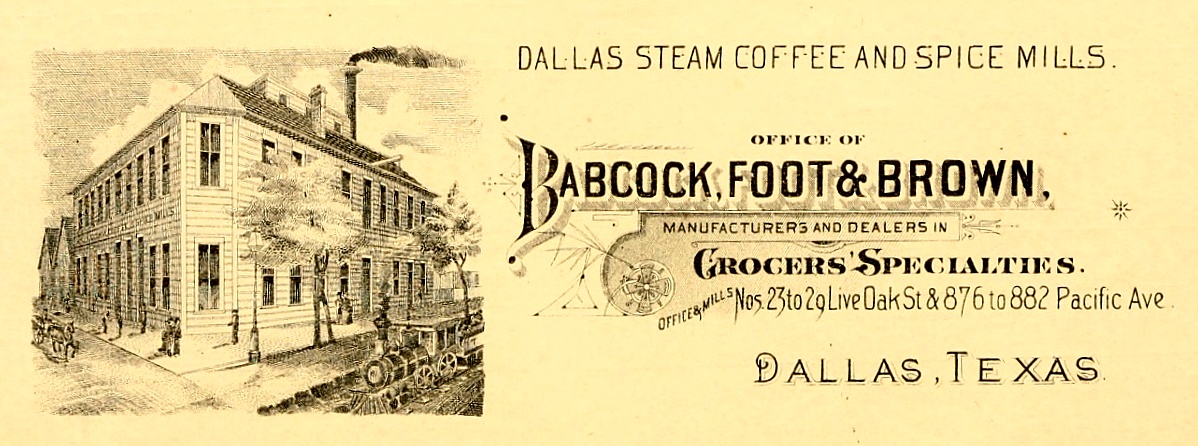
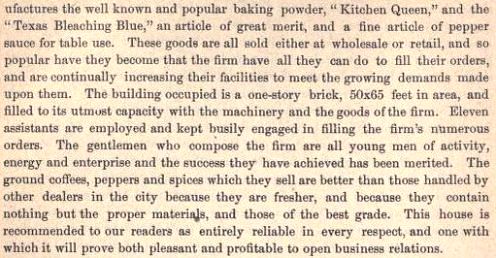
It’s 1880-something. You’re in Dallas. You need a pound of coffee. Some ground mustard seed. Maybe some “Texas Bleaching Blue.” Where, oh where, do you turn?

babcock-foot_1884ababcock-foot_1884b

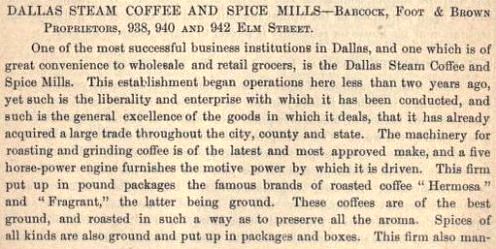
Messrs. Babcock, Foot & Brown will be happy to supply you with everything you need. And that five-horsepower engine? Top-of-the-line!

***

Sources & Notes

Ad from The Immigrant’s Guide to Texas, 1889. Click for larger image.

Description of the business from The Historical and Descriptive Review of the Industries of Dallas, 1884-85.

*

Copyright © 2014 Paula Bosse. All Rights Reserved.

Six Flags-Inspired Recipes for the (Gluten-Tolerant) Superfan — 1966

six-flags-ckbk_USA

by Paula Bosse

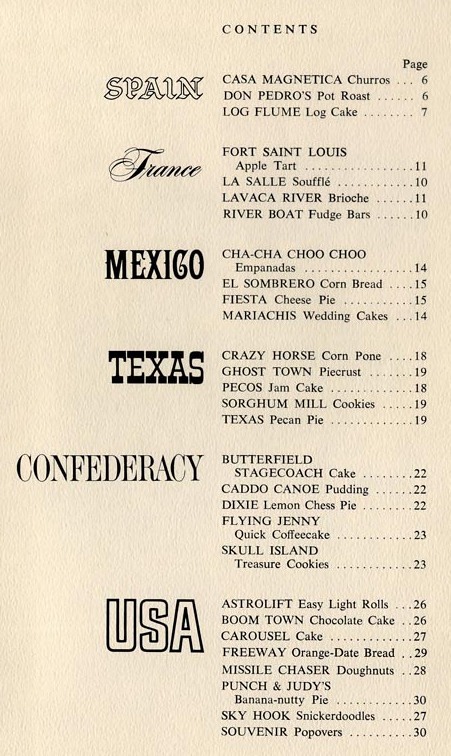
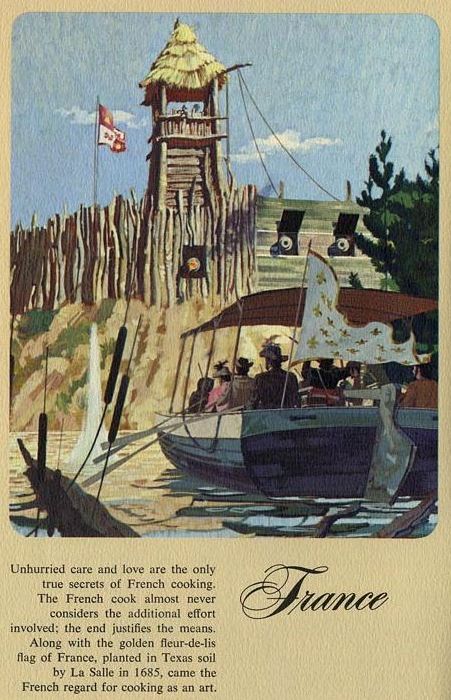
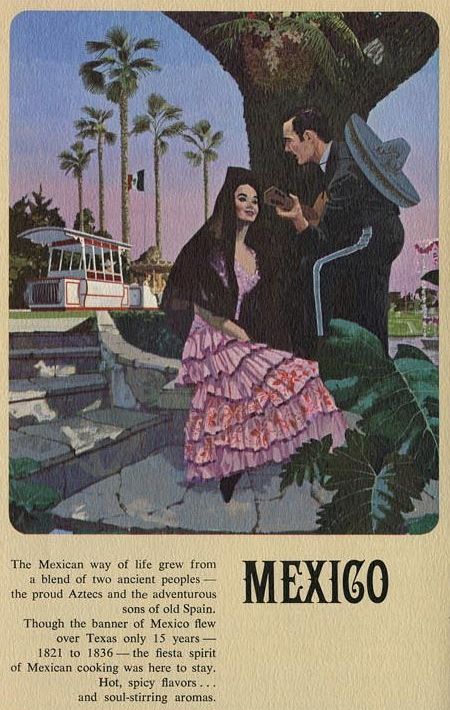
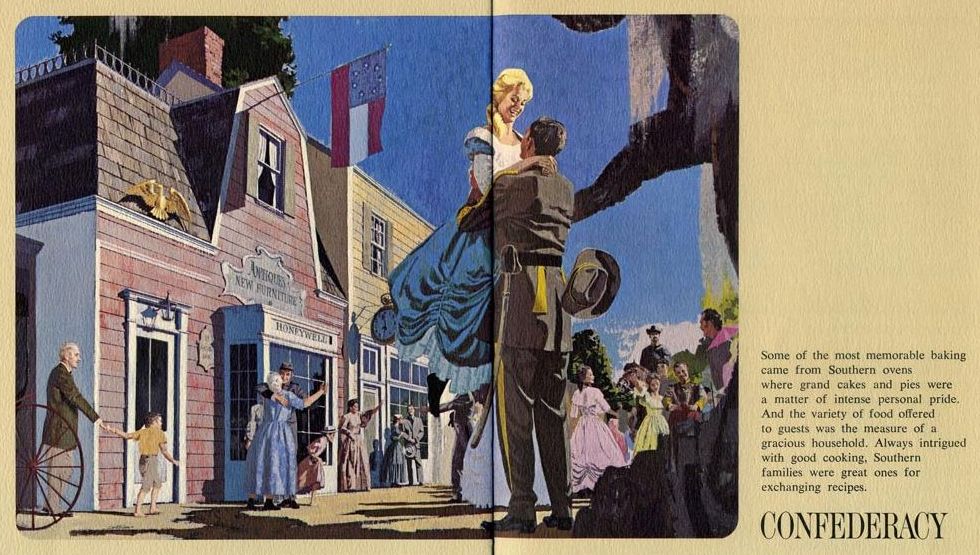
Did you know there was a Six Flages-themed cookbook? Well, there was! Issued in 1966 by the Gladiola Flour company (every recipe — rather unsurprisingly — contains flour), the Six Flags aficionado was presented with dishes such as “Casa Magnetica Churros,” “Log Flume Log Cake,” “Skull Island Treasure Cookies,” and “Sky Hook Snickerdoodles.” From the introduction:

“Names of the recipes have been inspired by attractions and rides at Six Flags Over Texas, the exciting adventureland located midway between Dallas and Fort Worth. Look to the Six Flags Over Texas Cookbook when you want something different — a dish your guests will remember.”

That “Log Flume Log Cake”? Mosey on over here and whip one up this weekend for your gluten-tolerant friends and family.

six-flags-ckbk_cover_1966-sm

six-flags-ckbk_contents

six-flags-ckbk_spain

six-flags-ckbk_france

six-flags-ckbk_mexico

six-flags-ckbk_texas

six-flags-ckbk_confederacy

***

All images from The Six Flags Over Texas Cookbook by Gladiola (Sherman: Fant Milling Co., 1966). These images (and the entire cookbook) from Ken Collier’s great Six Flags Over Texas collection. The cookbook can be viewed here; and check out his other Six Flags pages here.

For other Flashback Dallas posts on the early days of Six Flags Over Texas, see here.

Click oblong pictures for larger images.

*

Copyright © 2014 Paula Bosse. All Rights Reserved.

The Britling Cafeteria Serves Those Who Serve Themselves

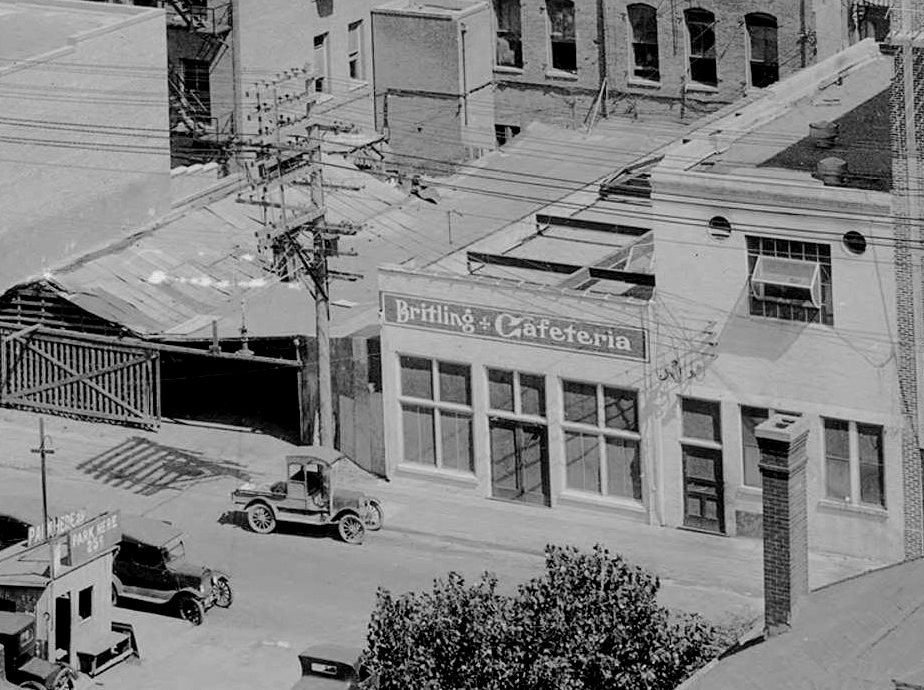
britling-cafeteria_rear-entrance_degolyerBritling Cafeteria’s rear entrance on Jackson St., 1920s

by Paula Bosse

A few weeks ago, I was zooming in on a view of the Dallas skyline when I saw an interesting restaurant sign: the Britling Cafeteria. After a little research, I learned that Britling Cafeterias are something of a cultural institution in Birmingham and Memphis (Elvis’ mother worked the coffee urn station in Memphis, and if that isn’t the sign of a Southern institution, I don’t know what is). Here in Texas, though … I’d never heard of it. It claimed to be the first cafeteria chain in the South, having begun in Birmingham in 1917 (and named for a character in, of all things, an H. G. Wells story). When the Dallas location opened at the end of 1922, it was only the sixth restaurant in the chain, joining others in Birmingham, Atlanta, and Memphis.

The Britling Cafeteria was at 1316 Commerce (“Right in the Heart of Things”), between Field and Akard. There were two entrances, one on Commerce and one on Jackson (seen in the photo above). It sounds pretty nice for a cafeteria — it was lavishly decorated in black and gold, lined with mirrors, filled with flowers, and it had a mezzanine and a raised platform for a live orchestra to provide background music. It had a seating capacity of 450, with an expected daily capacity of 3,000. We’re not talkin’ Luby’s here. Quick “Southern home-cooking” had arrived in Dallas, and it seems to have remained an active advertiser until the ads suddenly stopped in 1926. I hope Dallas enjoyed it while it had it.

Below is the interior of the Atlanta location, from about the same time as the Dallas location. Cafeterias were a whole lot nicer back then.

britling_atlanta

The first non-institutional cafeteria I can find mentioned in The Dallas Morning News was the one in the basement of the Praetorian Building (“Cleanliness, courteous, tipless”) in 1912, but the cafeteria “concept” must have still been fairly new to Dallas as the Britling advertisements that appeared in the week before the grand opening felt it necessary to explain how the system worked. “You’ll wait on yourself — and do it gladly.”

britling_dmn_112722abritling_dmn_112722b1922 (click to read)

But first, stop by for a “Day of Courtesy” preview — flowers for the ladies!

britling_open_dmn_1127221922

britling-cafeteria_forest-ave-high-school-yrbk_19231923

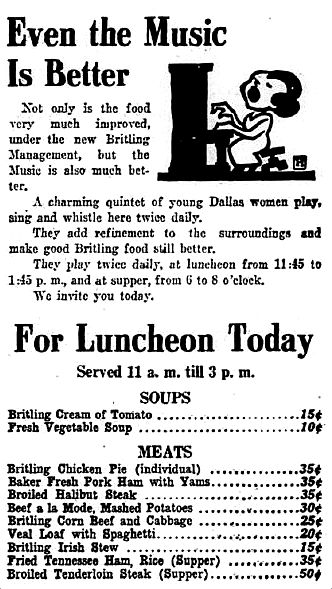
Below, a sample of some of the Southern home-cooking on the menu as well as the warning that there WILL be live music as “a charming quintet of young Dallas women play, sing and whistle (!) here twice daily.”

britling_dmn_030926abritling_dmn_030926b1926

britling_logo_dmn-112722

***

Sources & Notes

Photo is a detail from a larger view of the city from the DeGolyer Library, Southern Methodist University, seen in an earlier post here. The block in which the cafeteria was located is now 2 AT&T Plaza.

Postcard of the interior of the Atlanta Britling Cafeteria from somewhere on the internet.

More can be found in the DMN article “Britling Cafeteria Will Open” (Nov. 26, 1922), with details on the chain and specifics on the Dallas location, here.

Great short history on the cafeteria that every self-respecting citizen of Alabama and Tennessee is apparently familiar with can be found here.

An amusing first-hand account of a Texan (J. J. Taylor) visiting a newfangled cafeteria in San Francisco appeared in The Dallas Morning News on Aug. 25, 1912 and can be read here.

*

Copyright © 2014 Paula Bosse. All Rights Reserved.

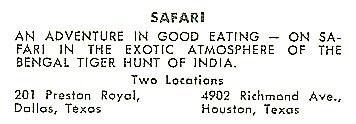
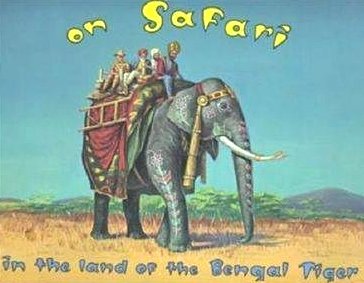
Back When Preston Royal Was “Exotic” and Had Its Very Own Elephant

safari-preston-royal

safari-preston-royal-back

by Paula Bosse

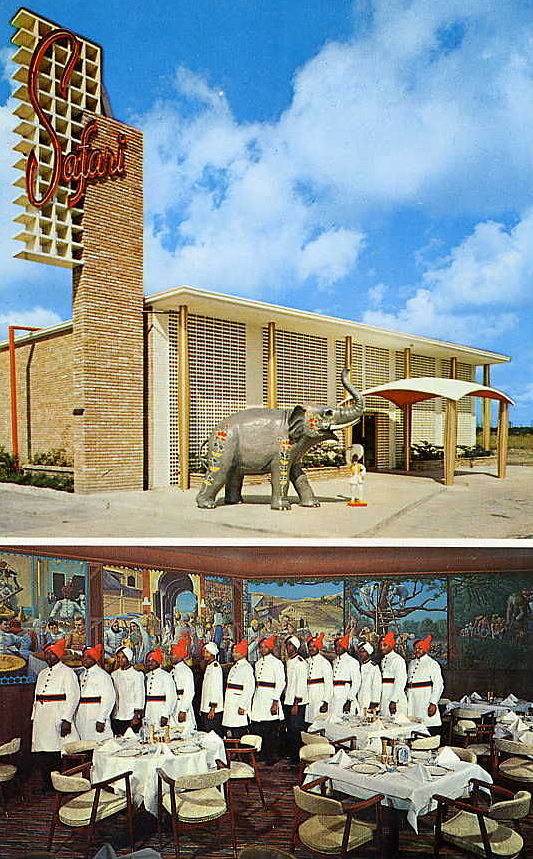
Dallas had a restaurant like this?! Yes, it did. (EDIT: It has been brought to my attention in the comments that the image above shows the *Houston* location. But I have been assured that the Dallas location had its very own elephant standing guard outside — so I will not have to ignominiously change the title of this post!)

The Safari Steak House was in the Preston Royal Shopping Center at the northeast corner of Preston & Royal (in the space now occupied by the venerable Royal China restaurant). The decor shown in the postcard above is something else — someone put their whole heart and soul into that, from the elephant and, um, elephant wrangler (“mahout“?) out front, to the ornate wood carving and the somewhat… busy murals inside. And the uniformed staff is pretty impressive, too.

Here are photos of the DALLAS Safari, taken in 1961 by Squire Haskins (photos from the UTA Libraries, Special Collections — click the links below the photos for full descriptions and large images). (Thanks, Tom Bowen, for sharing these links in the comments.)

safari_squire-haskins_1961_UTA_1via UTA Libraries, Special Collections

safari_squire-haskins_1961_UTA_2via UTA Libraries, Special Collections

Guy T. Jones opened the Safari in mid 1956 (I think the Houston location was opened later — it was open by at least 1959). I could find almost no early advertising for the place — perhaps Jones blew his advertising budget on elephants and murals. At this point, the shopping center was basically still under construction — the eastern-edge building (home of the Safari) opened about a year after the larger northern-edge building. There used to be a gap between the two buildings, which can be seen in the photo immediately above and can (sort of) be seen in the 1955 ad below, which shows a model of what the finished shopping center would look like.

preston-royal-shopping-center_032755-adAd detail, March 1955

In 1974, Royal China (which is a fantastic place, by the way) took over the space.

I really wish I’d seen that elephant, which — according to the comment below — “was highly visible and well lit at night.” I certainly hope so!

*

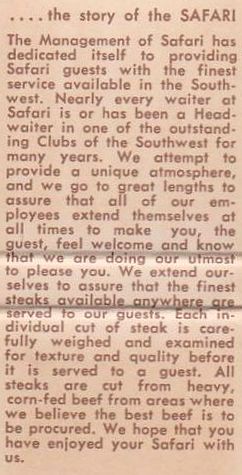
From the cover of the menu:

safari-matchbook-a

safari-matchbook

safari-matchbook_story

safari-preston-royal_menu-1969

*

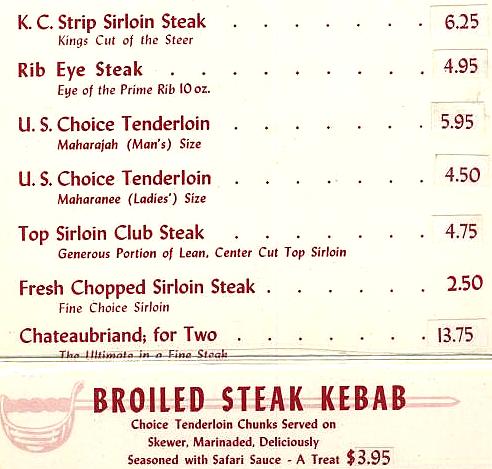
Below, the steak menu. One could choose between the “Maharajah (Man’s) Size” and the “Maharanee (Ladies’) Size.” Or get the kebabs of skewered beef “deliciously seasoned with Safari Sauce — A Treat.”

safari-menu

*

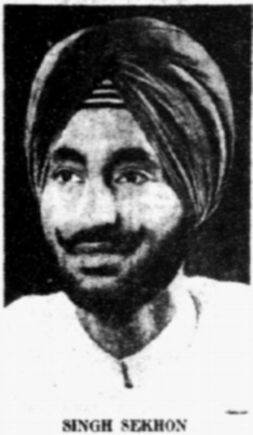
One of the stars of the restaurant was Iqbal “Ike” Singh Sekhon, who started working as the restaurant’s host while studying for his Master’s degree at SMU. He left a few years later to run the fabulous La Tunisia.

safari_dmn_062756-photo

safari-menu-logo

***

Sources & Notes

Edit (Sept. 2022): Wow. This post had a bunch of problems! All I can say is that this was one of my very earliest posts. I was so enamored of that elephant that I made a couple of very glaring errors.

First off, the original title of this post was “Back When Preston Royal Village Was ‘Exotic’ and Had Its Very Own Elephant.” The Safari Steak House was in the Preston Royal Shopping Center, located on the northeast corner of Preston and Royal; the Preston Royal Village shopping center, is on the northwest corner. I’ve (ignominiously) changed the title, but… yikes.

And, as mentioned in the first paragraph, the postcard at the top shows the Houston location, not the Dallas location. Incidentally, the Houston building is still there — it can be seen in a 2011 Google Street View capture here.

The two photos by Squire Haskins (linked below the images) are from the Squire Haskins Photography Inc. Collection, University of Texas at Arlington Libraries, Special Collections (thanks, Tom!). They are dated 1961, one year before a major fire at the restaurant. They reopened the following month, with what sounds like quite an update in decor. I’m not sure when the “gap” between the two shopping center buildings was filled in, but that would have been a good time to expand.

*

Copyright © 2014 Paula Bosse. All Rights Reserved.

O, Fritatos, We Hardly Knew Ye — 1936

fritos_potato-chips_kaleta“Another Load of Pampered Potatoes”

by Paula Bosse

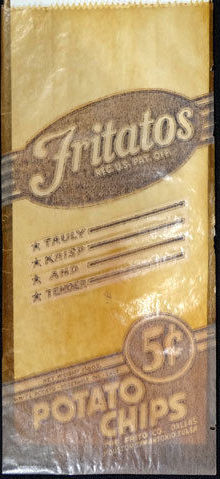
Hey! Did you know that the Frito Company also made potato chips for a while? They were called “Fritatos” and they were introduced in 1935. Here’s one of their snazzy-looking trucks making a much-appreciated snack delivery to Fair Park during the Centennial Exposition in 1936.

***

Sources & Notes

Photo of the “pampered potatoes” truck from Kaleta Doolin’s wonderful book about the family business, Fritos Pie: Stories, Recipes, and More (College Station: Texas A & M University Press, 2011).

*

Copyright © 2014 Paula Bosse. All Rights Reserved.

3800 Main: Fritos Central — 1947

by Paula Bosse

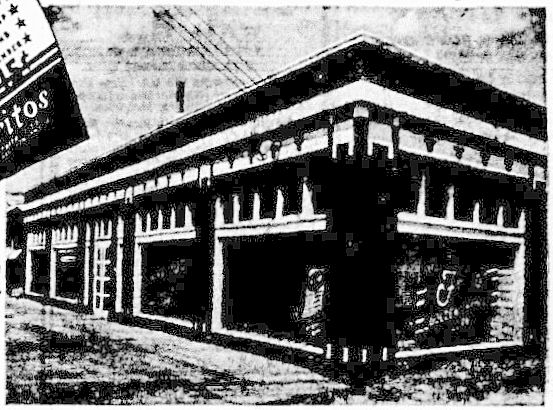
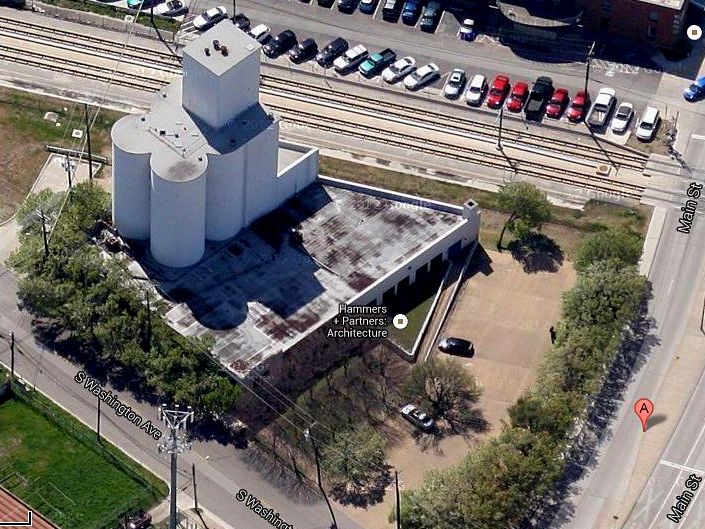
Last week I came across the above photo of old cars parked in front of a Fritos building of some sort, and I wondered where it had been. After a little bit of digging, I found out that it was near Fair Park — in the 3800 block of Main, between Washington and Exposition, on land right next to the railroad tracks. The building in the foreground appears to be gone  now, but I recognized the white, rounded towers behind it — I never knew what that building was, but I now know that it is the Frito company’s former grain elevator. And it’s still standing. Which I’m thankful for (and a bit surprised by) since it’s always been one of my favorite buildings in the area.

The Frito company (now Frito-Lay) has had its headquarters in the Dallas area since 1933. In the ’40s, its corporate offices were on Cedar Springs and its manufacturing plant was over near Fair Park, on Main Street. By 1947, the ever-expanding company had grown so much and had become so successful that it spent half a million dollars to build a whopping new grain elevator. The Dallas Morning News was there for a sneak-peek:

The extra-tough volcanic stones in the adjacent factory Monday will begin grinding corn supplied from a spanking new, ten-story white building just off the 3800 block of Main Street. […] The tall square gleaming structure is a $515,000 thoroughly modern elevator. […] Air-conditioned and equipped with the latest design apparatus, the elevator has storage capacity for 90,000 bushels of corn. It will supply the grain to the company’s factories in Dallas, San Antonio, Houston, Denver, Tulsa, and two plants in Los Angeles.

The new Frito elevator, weather proofed on the outside and weather controlled inside, was designed by Eugene Davis, architect. Huge grain cleaners which remove all chaff and foreign matter by shaking and air blast, occupy the second floor. Spray machinery gives the grain a thorough treatment to prevent infestation — the ‘buga-boo’ of grain products manufacturers. (DMN, Aug. 10, 1947, “Corn: $515,000 Elevator Latest Chapter in Corn-Chip Saga”)

Fifty-one boxcar loads of “select corn” — sans chaff and infestation — could be stored in that gleaming state-of-the-art grain elevator, designed by Eugene Davis (who a few years earlier, had designed another building for the Frito people, a small building at Wall and Corinth which housed the Pork Skin Chip Company).

In 1947, 3800 Main appears to have been something of a corn-chip Hyannisport — a self-contained compound in which all aspects of chip-production were seen to. As Kaleta Doolin (daughter of company founder C. E. Doolin) wrote in her book Fritos Pie:

Mr. Davis was the architect of all the various parts of the Frito plant in Dallas. The plant included the company’s grain elevator, where all the corn was stored; the machine shop (which my uncle Earl was in charge of); the food processing area; and the shipping warehouse, all built by Mr. Davis in 1947.

But that building in the top photo… that one had been there for years. 3800 Main Street had been the home of two or three car dealerships in the decades before Frito moved in. In 1929, as this photo shows, it was the location of the long-lived Ford dealership, Lamberth Motor Company.

lamberth-ford_1929

And here’s the same building in 1947, Frito-ized.

And the side of the building, taken from across the railroad tracks, then and now.

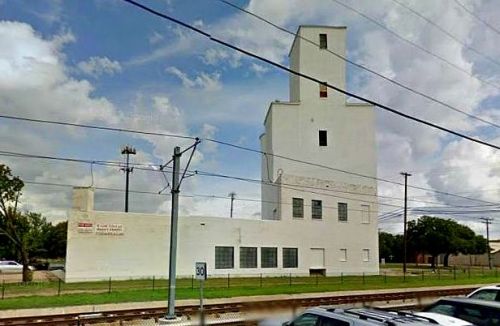
Another old building survives! What a relief that Dallas doesn’t tear down EVERY cool old building!

***

Sources & Notes

Can’t find a source for the top photo. It looks as if someone took a photo of a framed picture which is probably hanging on the wall of a person who feels a great kinship to old Dallas. Or to Fritos. Or to snacks.

Quote about the various parts of the plant is from Fritos Pie: Stories, Recipes, and More by Kaleta Doolin (College Station: Texas A & M University Press, 2011), p. 45.

The two 1947 photos of the Frito building are insets from a series of logrolling ads in which Frito thanks Texas Bank & Trust for all the money they’ve helped Frito make, and Texas Bank & Trust thanks Frito for all the money they’ve helped Texas Bank & Trust make. The take-away? There sure is a lot of money to be made in fried food.

The bottom two photos are from Google maps: the first looking toward the old granary from the railroad tracks, and the second looking down from the unblinking Google eyeball in the sky.

Lastly, a current photo of the building, now renovated and occupied by Hammers + Partners Architecture (whose daily business affairs are probably always accompanied by the faint smell of fried corn wafting past), can be seen here. (What must that building look like inside?!)

Click pictures for larger images.

*

Copyright © 2014 Paula Bosse. All Rights Reserved.


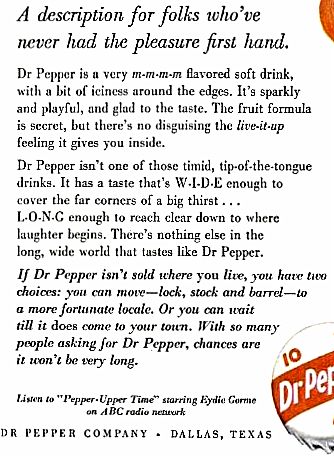
Dr Pepper: “Sparkly, Playful” — 1959

dr-pepper-1959

by Paula Bosse

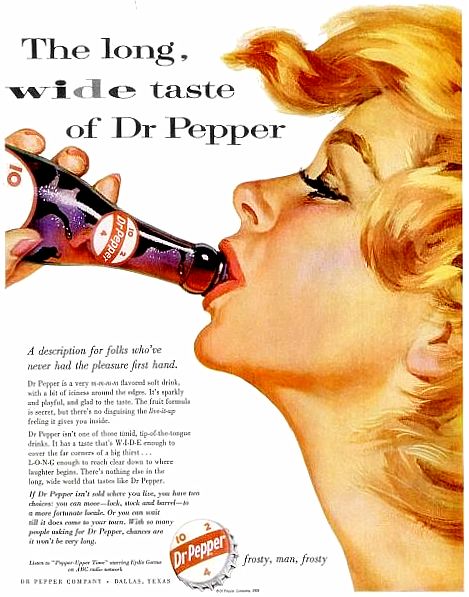
An early national advertisement for a product on its way to becoming more than just a regional soft drink. I grew up right down the street from the Dr Pepper plant. And, yes, I am still pissed.

And here, a bit larger, the wordy and intensely caffeinated copy that seems to have been written by a Madison Avenue flat-earther:

*

Copyright © 2014 Paula Bosse. All Rights Reserved.