Flashback : Dallas

A Miscellany: History, Ads, Pop Culture

Category: Entertainment

When a Ten-Spot Could Get a Family of Four Into Six Flags — 1962

ad-six-flags_dmn_042362

by Paula Bosse

Six Flags Over Texas is about to open up again. In 1962 — the theme park’s second year — the admission price for one adult was $2.75 (approximately $22.00 in today’s money), and the price for children under 12 was $2.25 (approximately $18.00 in today’s money). A family of two adults and two children would pay $10.00 for admission — that would be a little under $80.00 in 2016 money, which was still a lot back then, until you compare it to today’s Six Flags ticket prices: $250 for a family of four (as long as both of those children are under 48″ tall). (Pink Things not included.) And you probably won’t even see a dad wearing a suit and tie and a porkpie hat. And you certainly won’t get to see ANY of this! I think you got a lot more bang for your buck 50 years ago.

***

Never leave home without the Inflation Calculator.

*

Copyright © 2016 Paula Bosse. All Rights Reserved.


Meet Me In Front of The Rialto — 1945

rialto_MPH_072845“A great big howl of a hit!” (click for larger image)

by Paula Bosse

This photo shows the front of the Rialto theater, once located at Elm and Stone. I love the unavoidable promotion for the Jack Benny movie “The Horn Blows at Midnight,” but I love all that street life even more. And by the way, “Help Keep Dallas Clean”!

***

Photo from the July 28, 1945 issue of Motion Picture Herald.

My favorite young movie-crazy Dallas diarist, Muriel Windham, would absolutely have walked past this (she probably didn’t see it, though, because she wasn’t a big fan of Jack Benny). (For the record, I LOVE Jack Benny!)

Click photo for gigantic image.

*

Copyright © 2016 Paula Bosse. All Rights Reserved.

The Lakewood Theater — 1944

lakewood-theater_ad_inset_1944A well-lit staircase to the balcony (click for giant image)

by Paula Bosse

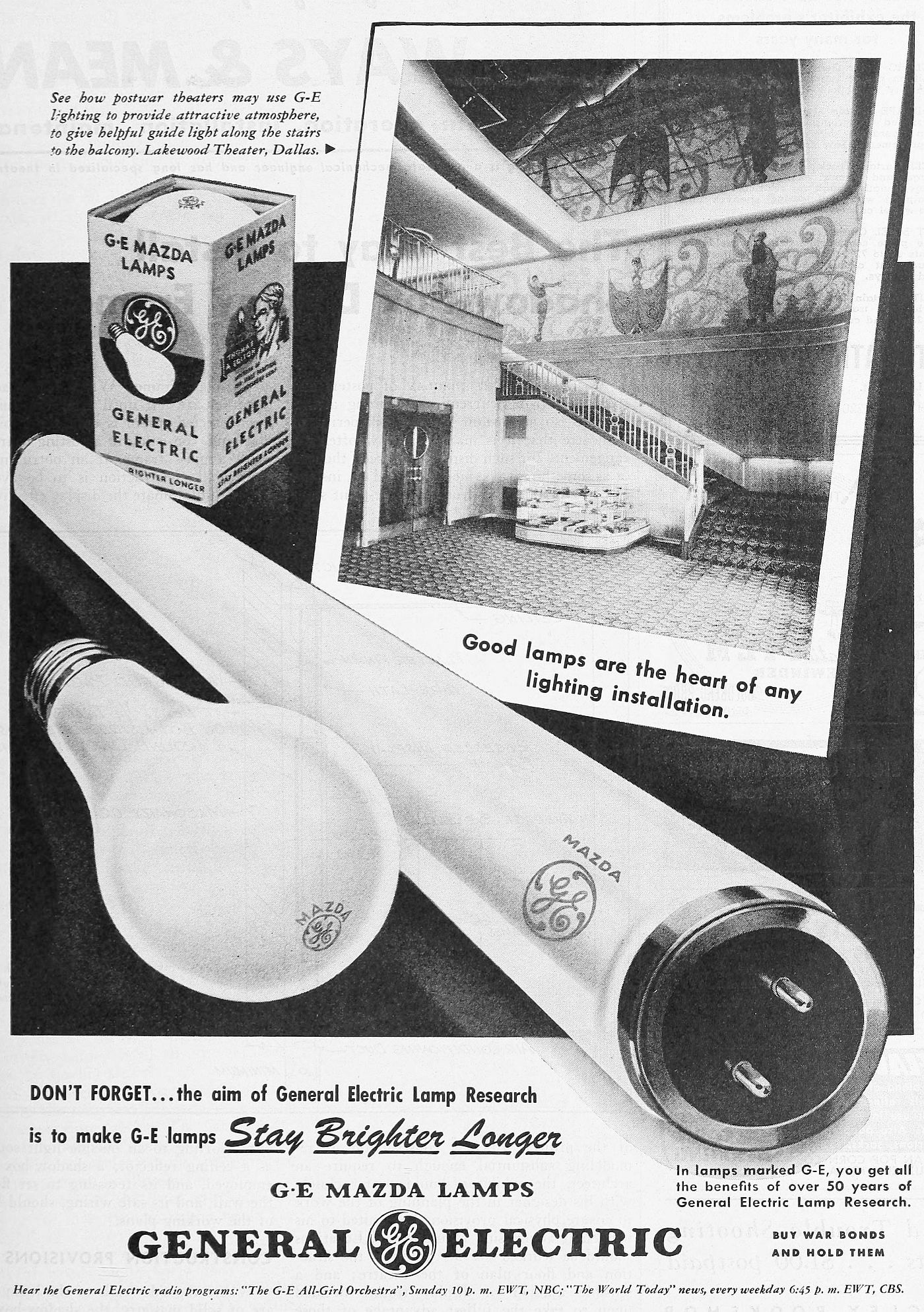
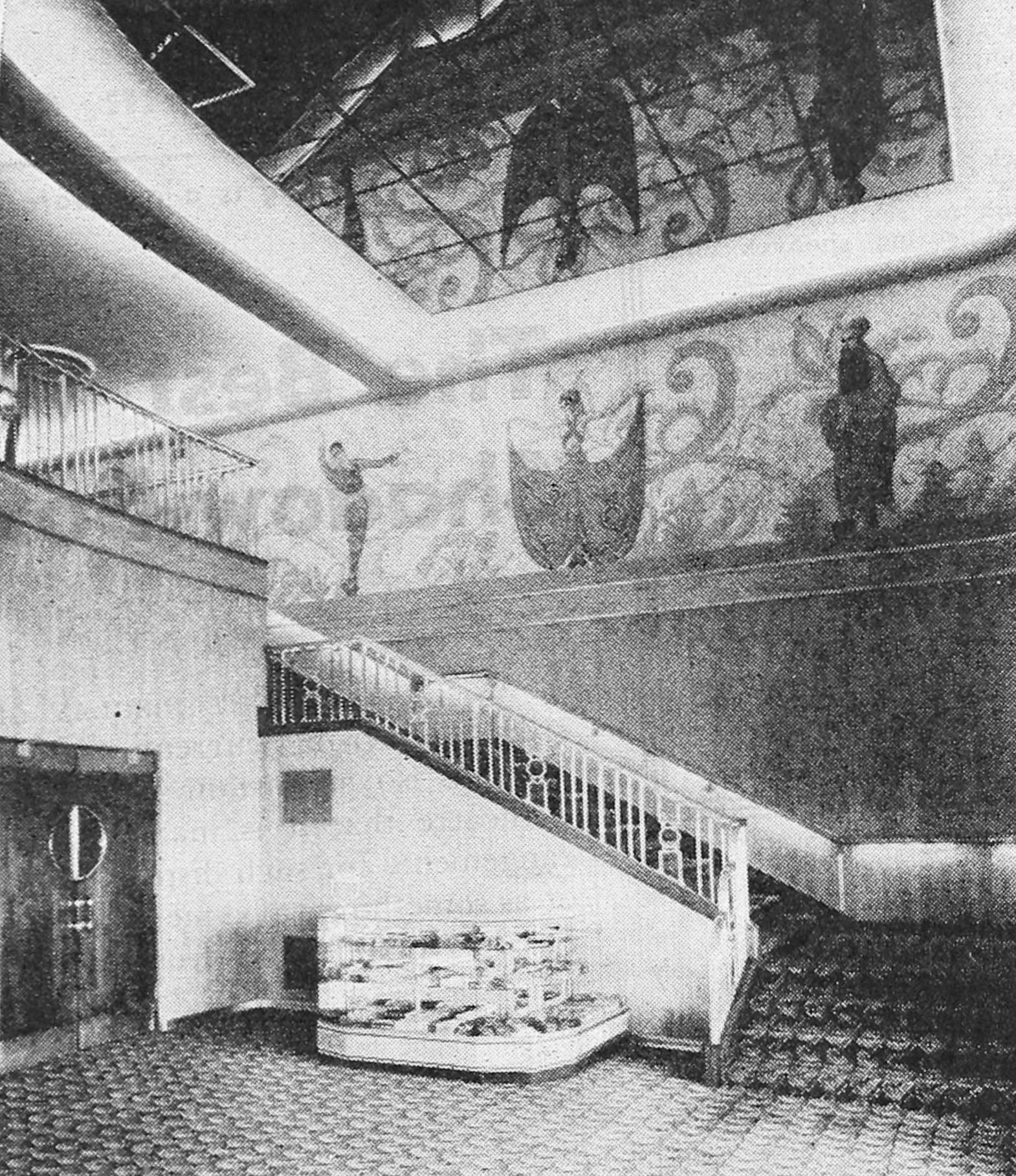
Occasionally one stumbles across a national advertisement featuring someone or something familiar to local audiences which elicits an involuntary exclamation like, “Hey! I know that guy!” I had a response kind of like that when I saw this General Electric light bulb ad featuring a photograph of the interior of the Lakewood Theater (showing a few figures from the mural by Woodrow boy Perry Nichols).

“See how postwar theaters may use G-E lighting to provide attractive atmosphere, to give helpful guide light along the stairs to the balcony.”

lakewood-theater_ad_MPH_072244_med

Yes, the Lakewood certainly did have an “attractive atmosphere.”

***

Sources & Notes

Ad for G-E Mazda lamps appeared in the July 22, 1944 issue of Motion Picture Herald. Click the above ad to see it much larger. To see it REALLY big, click here. (Apologies for the bleed-through of the ad on the other side of the page. If you’re a Photoshop wizard who can remove the offending ghost letters plastered across Nichols’ whimsical mural, I’d love a cleaned-up version.)

I have no idea what’s going on with the beleaguered Lakewood Theater these days, but if you’d like to see those murals in color, see the photos in the Lakewood Advocate, here.

*

Copyright © 2016 Paula Bosse. All Rights Reserved.

Yehudi Menuhin and Antal Dorati: A Collaborative Friendship

menuhin-dorati_texas-week-mag_012547_sm
“Best friends” Menuhin and Dorati in Dallas, Jan. 1947

by Paula Bosse

When Antal Dorati was appointed conductor of the Dallas Symphony Orchestra in 1945, Dallas suddenly began to see a lot of violinist Yehudi Menuhin.

In a 1954 article about Yehudi Menuhin’s close ties to Dallas, John Rosenfield — the influential arts editor of The Dallas Morning News — wrote that when Menuhin was in town for a performance for the Civic Music Association in 1945, he was “casually asked” (probably by Rosenfield himself) what he thought of Antal Dorati as a possible conductor for the then-long-dormant Dallas Symphony Orchestra.

“He’s my best friend … he’s wonderful … he’s great,” said Yehudi, who was promptly carried around town to talk to businessmen again interested in re-forming the orchestra. (DMN, Sept. 5, 1954)

A short while later, Dorati was hired as musical director of the “new” Dallas Symphony Orchestra, and, as a result, best friend Yehudi was in and out of town frequently during Dorati’s four seasons in Dallas. Not only did he perform frequently as a soloist with the DSO, but it was not unheard of for Yehudi to sometimes drop by and sit in with the orchestra during rehearsals. Menuhin often stayed with Dorati when touring the central United States or based himself at the Melrose Hotel, which he used as a sort of mid-continent pied-à-terre.

One of the great passions the two men shared was a love for the music of Hungarian composer Bela Bartok. Dorati, born in Budapest, studied piano under Bartok and was a champion of his work throughout his career. Menuhin had performed Bartok’s Violin Concerto to great acclaim, and near the end of Bartok’s life, after the two men had met and bonded, Menuhin commissioned him to compose a sonata for violin.

Dorati and Menuhin often collaborated on performances featuring Bartok’s works, and when it was known that Dorati was all-but-signed to be the new DSO conductor, there was much speculation that Bartok himself might come to Dallas, but Bartok’s death in September, 1945 put an end to those hopes.

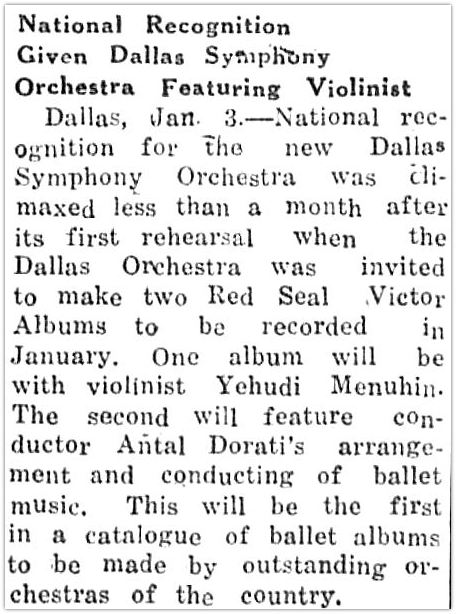
The first RCA Victor Red Seal recordings of Dorati’s Dallas Symphony Orchestra took place in January, 1946. One of the recordings featured Menuhin performing Bartok’s Concerto for Violin and Orchestra.

dorati-menuhin_denison-press_010446Denison Press, Jan. 4, 1946

Below, the first movement of the recording.


*
The second movement is here; the third movement is here.

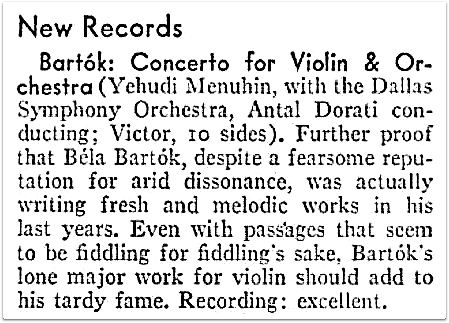
The recording was well-received.

dorati-menuhin_time_061647_reviewTime  magazine, June 16, 1947

dorati-menuhin_time_061647RCA Victor ad, 1947

Of perhaps greater note, was the fact that Yehudi Menuhin conducted for the very first time in Dallas — the first orchestra he ever waved a baton at was the Dallas Symphony Orchestra, in 1946. No doubt because of their great friendship, Dorati coached the 30-year-old Menuhin on the finer points of conducting when the violin virtuoso expressed interest in learning what things were like on the other side of the podium. Menuhin first conducted the DSO on April 6 1946, for an invited audience.

menuhin_conductor_dso_santa-cruz-CA-sentinel_040746Santa Cruz (CA) Sentinel, Apr. 7, 1946

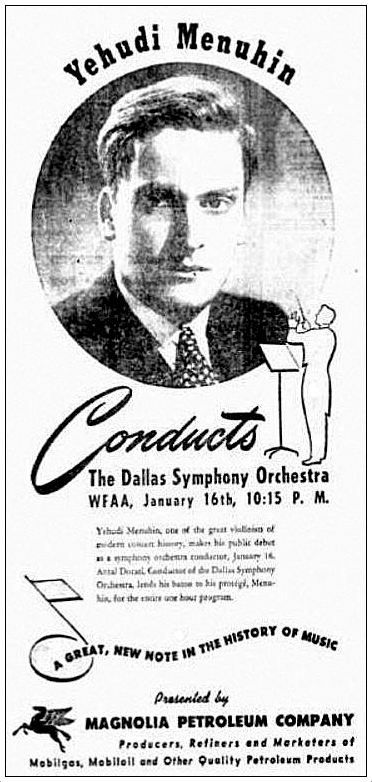
He was ready to go “public” on January 16, 1947, conducting the DSO for one of its regularly scheduled national broadcasts originating from WFAA.

menuhin_conductor_dso_dmn_011247Jan. 11, 1947

The text from the ad:

Yehudi Menuhin, one of the great violinists of modern concert history, makes his public debut as a symphony orchestra conductor, January 16. Antal Dorati, Conductor of the Dallas Symphony Orchestra, lends his baton to his protégé, Menuhin, for the entire one hour program.

Protégé!

Even though Menuhin insisted at the time that this brief foray into the world of conducting was fleeting and not a signal of any sort of career change, Yehudi Menuhin did go on later to direct many of the world’s great orchestras.

**

The friendship between Dorati and Menuhin lasted (from what I can tell) until Dorati’s death in 1988 (the decade-younger Menuhin died in 1999). They were personal friends and like-minded professional equals.

Between Menuhin and Antal Dorati, the Dallas Symphony Orchestra conductor, exists a friendship and a mutuality of musical aspiration that has resulted in outstanding musical collaborations. (John Rosenfield, DMN, Jan. 15, 1947)

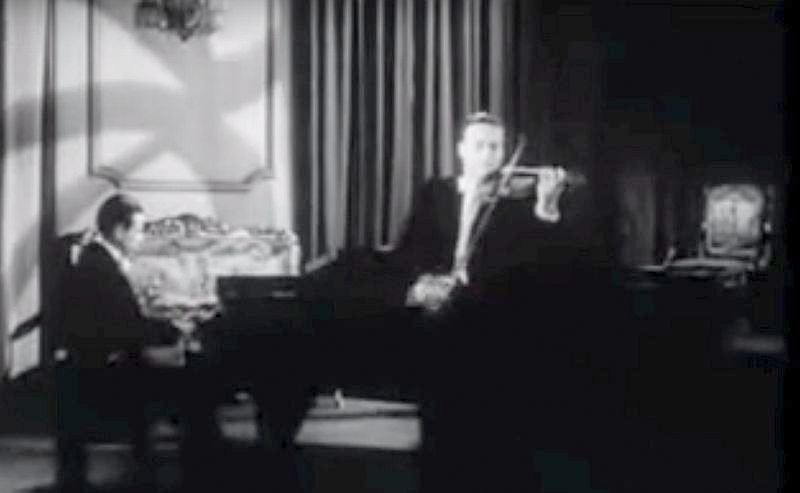
Below, the only film I’ve been able to find of the two men together, filmed in 1947 during the time when Dorati was engaged in Dallas (although this was not DSO-related and was filmed in Los Angeles). The piece being performed is Brahms’ Hungarian Dance No. 4; Dorati accompanies Menuhin on piano (you finally see him near the end!).

 *

menuhin-dorati_brahms_hungarian-danceDorati, Menuhin, 1947 (fuzzy screenshot)

dorati_menuhinYounger… (via Tutti Magazine)

dorati_menuhin_photoOlder…

***

Sources & Notes

Top photo of Menuhin and Dorati in preparation for Menuhin’s public debut as a conductor is from Texas Week magazine (Jan. 25, 1947), here.

The YouTube video of Brahms’ Hungarian Dance No. 4 was filmed at the Charlie Chaplin studios in Hollywood in the fall of 1947 (according to consumer reviews here).

Links-a-lot:

  • Yehudi Menuhin Wikipedia entry is here. His obituary is here.
  • Antal Dorati Wikipedia entry is here.
  • Bela Bartok Wikipedia entry is here.

More on Dorati can be found in my post “Antal Dorati, The Conductor Who Revived The Dallas Symphony Orchestra — 1945-1949,” here.

Click pictures and clippings for larger images.

*

Copyright © 2016 Paula Bosse. All Rights Reserved.

Antal Dorati, The Conductor Who Revived the Dallas Symphony Orchestra — 1945-1949

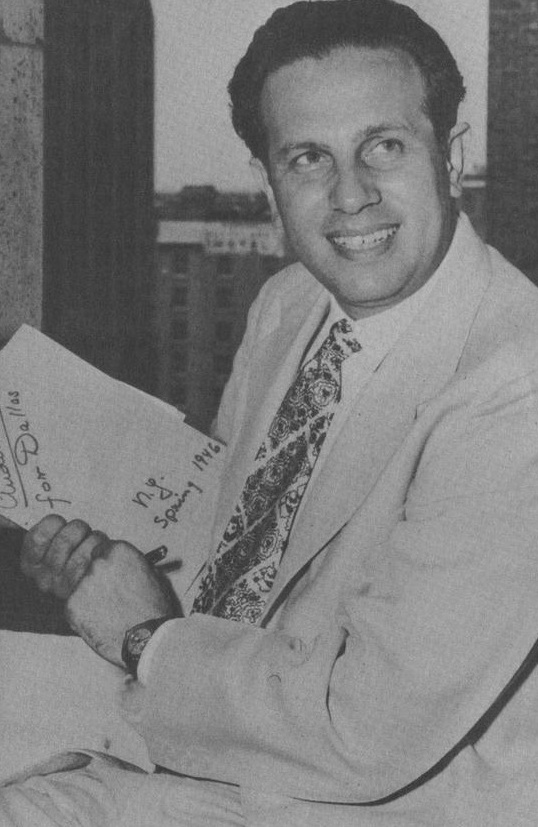
dorati-dso_texas-week-mag_081746-photo-sm
Antal Dorati, 1946 — on top of the world

 by Paula Bosse

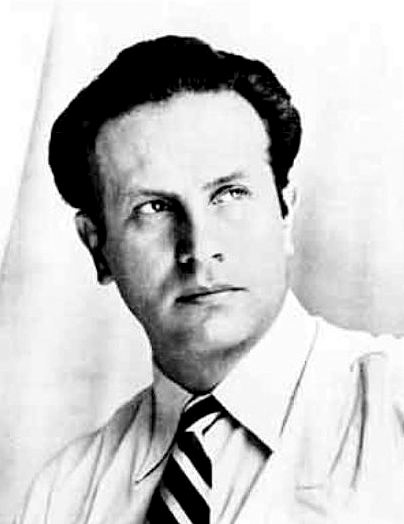
The news this week that the Dallas Symphony Orchestra’s musical director, Jaap van Zweden, was leaving town to pursue a glitzier gig was seen as an inevitable move to many of his disappointed fans. The DSO has been something of a springboard for conductors working their way up the conductor career ladder. Another celebrated conductor who spent a few years in Big D before rising to the heights of international acclaim was Hungarian-born Antal Dorati (1906-1988).

Dallas had classical music concerts in the 19th century, but the roots of what we now know as the Dallas Symphony Orchestra reach back to about 1900, under the direction of Hans Kreissig, who had settled in Dallas in 1887.

kreissig_dmn_011387Dallas Morning News, Jan. 13, 1897

For various reasons (lack of community interest, lack of financial support, etc.), some of these early seasons were truncated or suspended — there was a gap of several years after Kreissig’s tenure, for instance, and there were no performances during most of 1936 and 1937 because of activities surrounding the Texas Centennial and renovations to the Music Hall (the DSO performed at the Music Hall in Fair Park). The most noteworthy suspension of performances was during World War II when the symphony was “temporarily dissolved”: not only was the financial state of the organization not good at this time, but the war itself had depleted the ranks of the performers — the DSO shut down completely in 1942 because conductor Jacques Singer and several of his musicians had enlisted or were drafted. John Rosenfield, the arts editor of The Dallas Morning News and an ardent classical music lover, wrote often during this time how the loss of the DSO was a crushing cultural blow to the city.

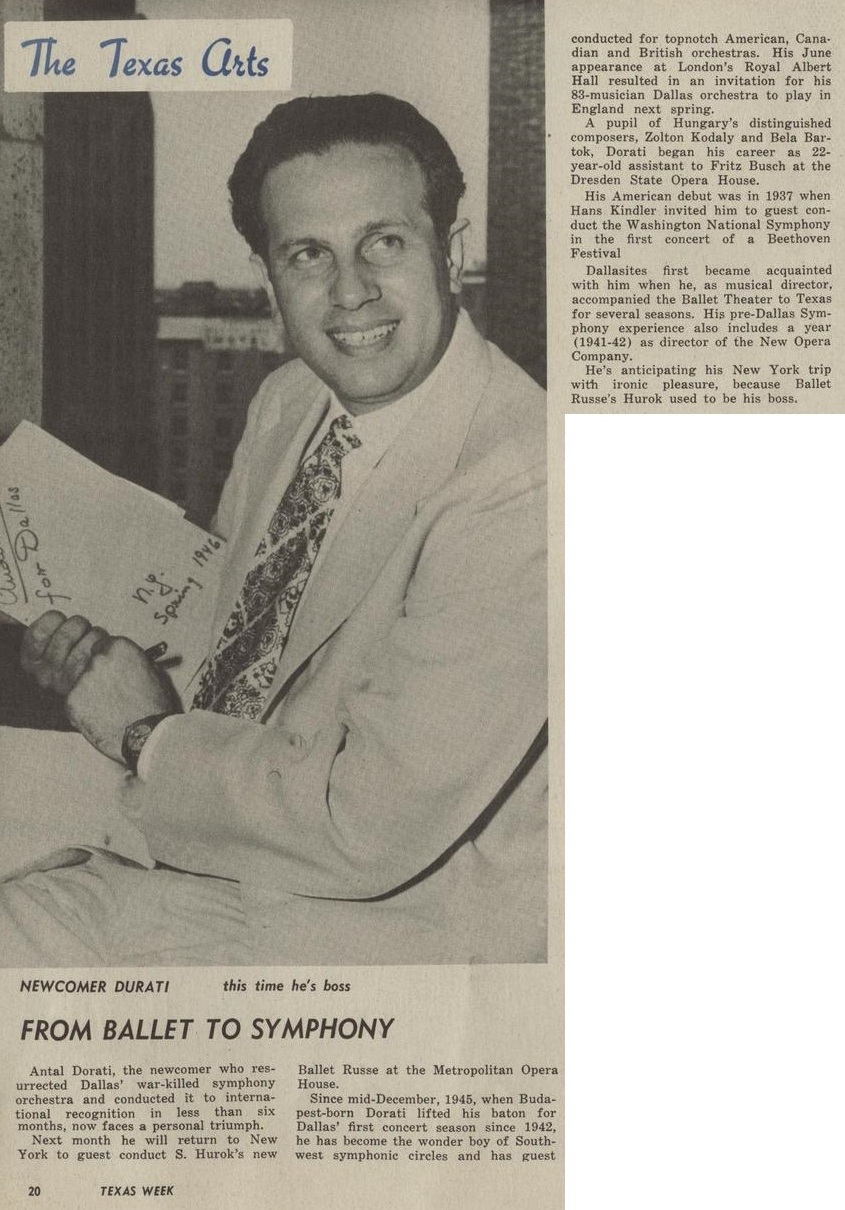
When the war ended, Dallas’ music-lovers (and musicians) clamored for the return of the DSO. A search began for a conductor who was not only a superior musical director but who would also be able to build an orchestra from scratch; they found that man in 39-year-old Antal Dorati, a former student of Zoltan Kodaly and Bela Bartok who had made a name for himself as a musical director for ballet companies such as the Ballet Russe de Monte Carlo and the Ballet Theater — his DSO appointment was announced in the fall of 1945.

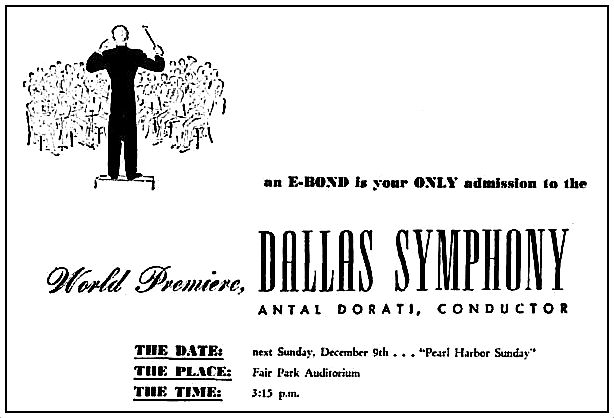
Somehow, in only two months, Dorati managed to put an orchestra together, prepare the season’s schedule, rehearse the musicians, and present the first performance of the “reborn” Dallas Symphony Orchestra on December 9, 1945.

ad_dso_dmn_120545-detDMN, Dec. 5, 1945

The response to that first concert was rapturous:

The crowd was somewhat stunned by the excellence of the ensemble that will bear Dallas’ name. To many, grown realistic or cynical in the years’ cultural struggles, the new orchestra was an unbelievably precious gift. Nothing so fine was expected by even the optimists. And it belonged to them with the promise that it would stay for all the time they could foresee. (John Rosenfield review, “Capacity Audience Thrills To Reborn Dallas Symphony, DMN, Dec. 10, 1945) 

During the intermission of this debut performance, Dorati was interviewed on the radio and had nice things to say about Dallas:

I fell in love with Dallas not last September when I was engaged but as far back as 1937. When I visited here year after year with the Ballet Theater. I said to myself that if I ever withdrew from the ballet and became a resident conductor for an American symphony, I would like it to be the Dallas Symphony Orchestra.” (DMN, Dec. 10, 1945)

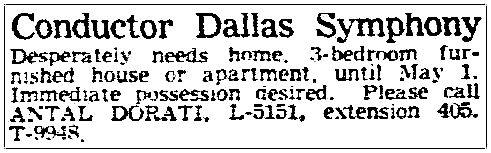
One little thing the Maestro was unable to accomplish, though, was to find a place for his family to live. The severe lack of postwar housing affected even the wealthy cultural elite!

dorati_classified-ad_dmn_121345
Dec. 13, 1945

And, with that, the DSO was back. It toured. A LOT. And made recordings. And appeared on national radio broadcasts. With Dorati at the helm, the Dallas Symphony Orchestra was making a name for itself and garnering a very positive national reputation.

A typical article about the young, photogenic Dorati went something like the one below, in which Dorati was described as “the wonderboy of Southwest symphonic circles.”

dorati_dso_texas-week-mag_081746Texas Week, Aug. 17, 1946

After a fairly short but incredibly productive time in Dallas, Antal Dorati accepted the position of conductor of the Minneapolis Symphony Orchestra in January 1949. His successor, Walter Hendl (a startlingly “honest” obituary of the controversial Hendl appeared in the London Telegraph here), was appointed a few short weeks later, and Dorati’s final concert was April 3, 1949.

dorati_farewell_dmn_040349April 3, 1949

John Rosenfield’s melancholy review/farewell appeared the next day in The Dallas Morning News, and one imagines it tooks weeks for his tears to dry.

The spectacularly successful musical director and conductor, whose 4-season regime ended with an emotion-laden farewell concert, modestly disclaimed the founder’s role in Dallas Symphony history. The 1945-49 period was one of high-intentioned and nobly-adventurous endeavor….” (John Rosenfield, DMN, April 4, 1949)

And with that, the Maestro headed to Minneapolis, having built the post-war Dallas Symphony Orchestra into a nationally respected organization.

**
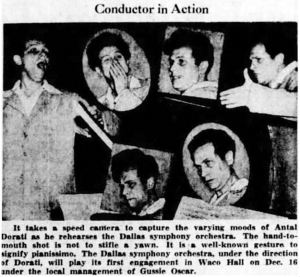
dorati_waco-news-tribune_120646
Waco News Tribune, Dec. 6, 1946

dorati_waco-news-tribune_121346Waco News Tribune, Dec. 13, 1946

dorati

dso_dmn_010449

***

Sources & Notes

Top photo and article from the Aug. 17, 1946 issue of Texas Week, the short-lived magazine that was sort of a Texas version of Life, via the Portal to Texas History, here. Text may have been written by Paul Crume.

Linksapalooza:

  • The Dallas Symphony Orchestra Wikipedia entry is here; the official DSO site is here; the Handbook of Texas entry is here.
  • The Antal Dorati Wikipedia entry is here; his official site is here.

Listen to pianist William Kapell perform Prokofiev’s Piano Concerto No. 3 in C major, Op. 26 with the Dallas Symphony Orchestra under the direction of Antal Dorati (recorded at the Fair Park Auditorium the same week he made his “Adios, Dallas!” announcement in Jan., 1949), here.

More on Dorati and his close friend Yehudi Menuhin in my post “Yehudi Menuhin and Antal Dorati: A Collaborative Friendship,” here.

And, yes, the correct spelling should be “Antal Doráti.”

*

Copyright © 2016 Paula Bosse. All Rights Reserved.

The Washington Theater — Dallas’ First Movie Palace

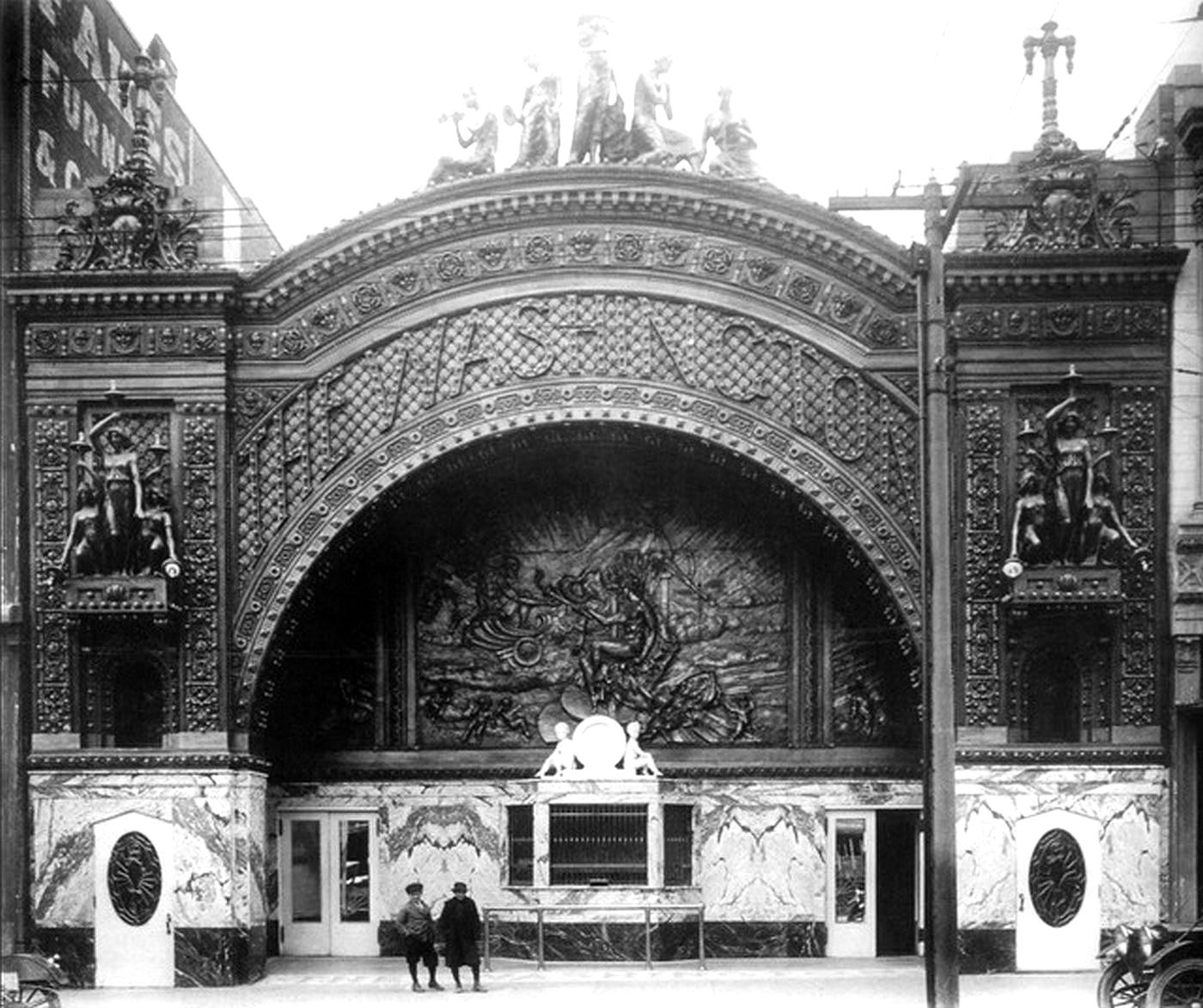
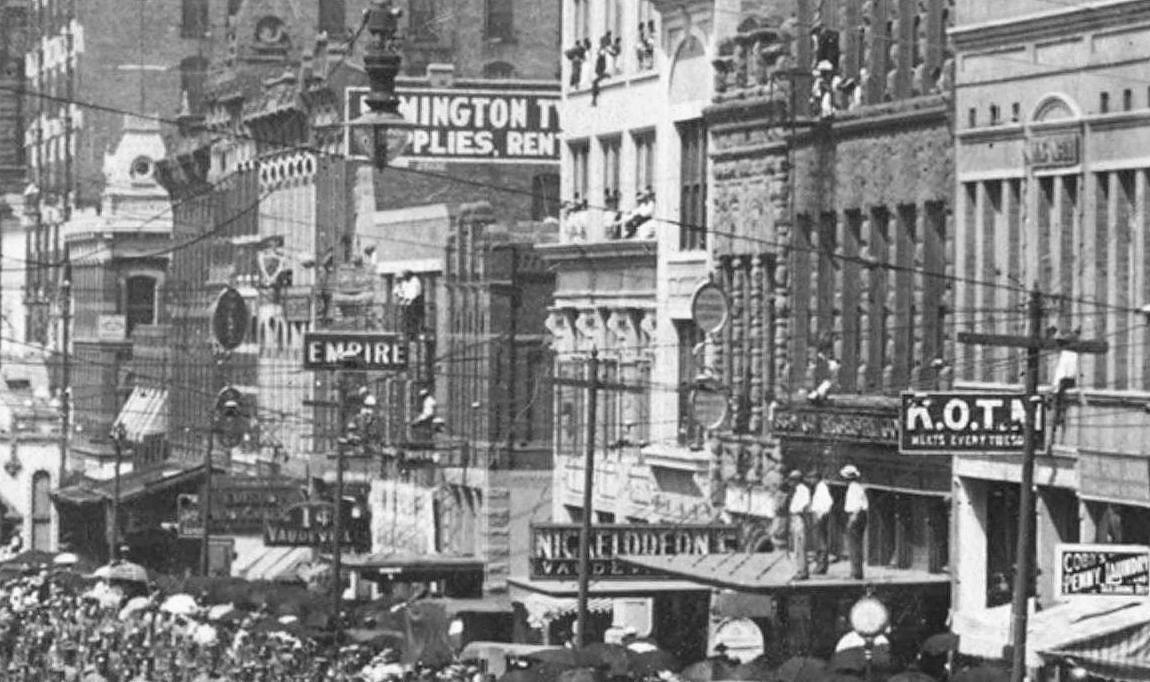
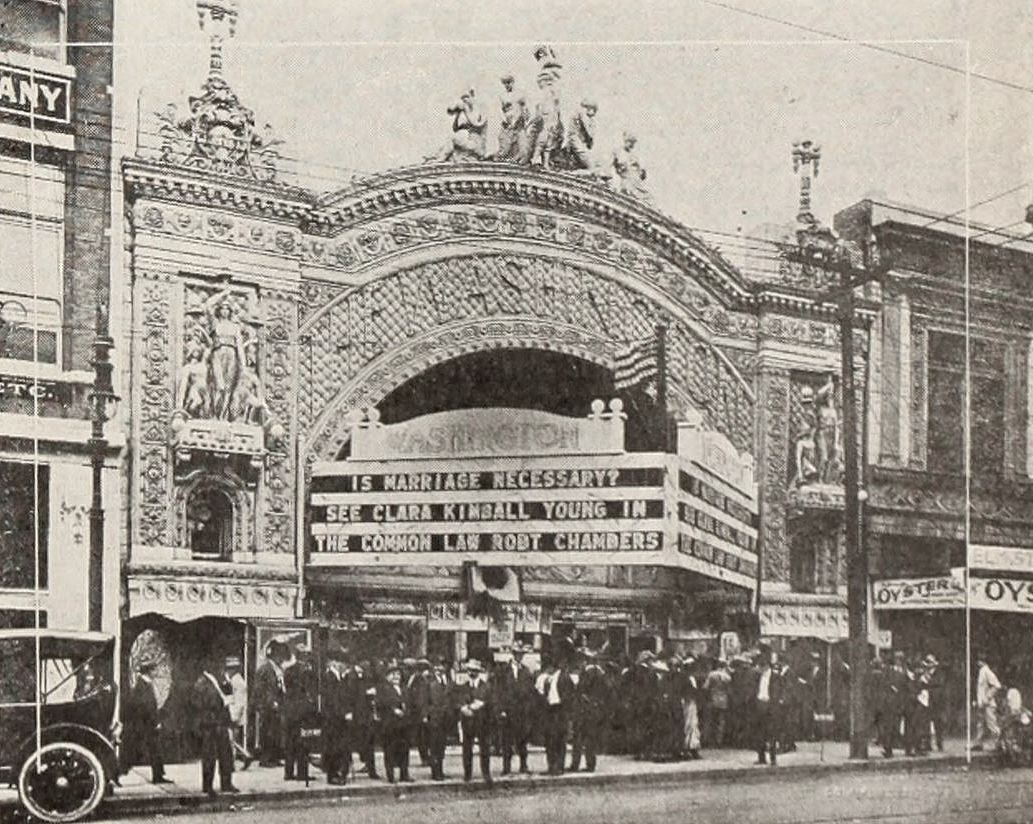
washington-theatre_cinema-treasures_lgThe Washington, 1615 Elm

by Paula Bosse

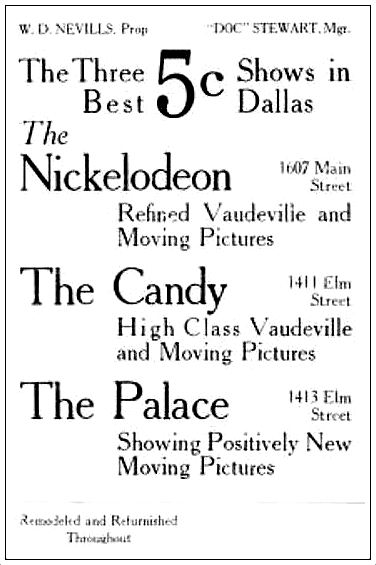
The outrageously ornate Washington Theater was built in 1912 by W. D. Nevills (1872-1945), a man who had been running cheap little store-front nickelodeons in Dallas for several years. Three of his most popular were The Nickelodeon, The Candy, and The Palace (not to be confused with any later theaters in Dallas called the “Palace”).

nevills_standard-blue-book-of-tx_1912-14Standard Blue Book of Texas, 1912-1914

His Nickelodeon on Main Street can be seen in the lower center of this detail from a larger 1909 parade photo.

parade-day_1909_det41

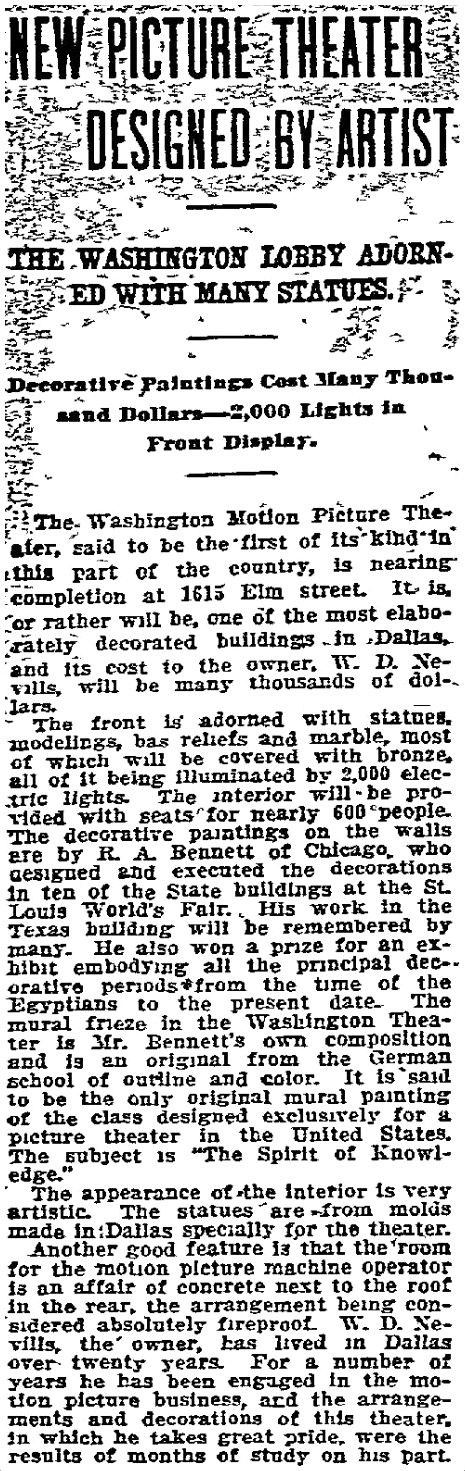
Nevills must have raked in a lot of nickels, because when his Washington Theater opened at 1615 Elm Street, it was the most spectacular motion picture “photoplay house” in Dallas. Nevills spared no expense for the theater’s furnishings and facade.

washington-theater_dmn_111712Dallas Morning News, Nov. 17, 1912 (click to read)

What might seem a little gaudy now, was probably still gaudy back then, but it was a fresh, NEW gaudy! And 600 Dallasites could all watch a movie at the same time. 600! Unheard of!

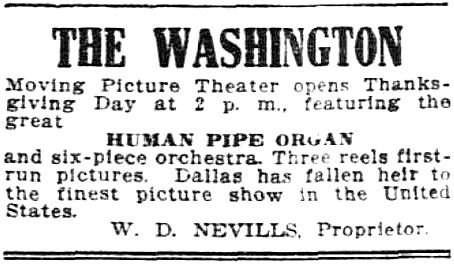
The Washington opened on Thanksgiving Day, 1912. Complete with “Human Pipe Organ.”

washington-theater_dmn_112712DMN, Nov. 27, 1912

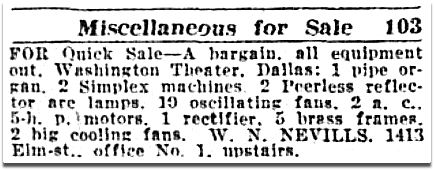
The Washington was the king of the roost for only a short while, though — until young whippersnappers like the Queen began to steal its thunder. 600 seats? Pfft! It was a thousand or nothing now. The theater began to lose its luster and look more old and hulking than young and exciting, and after riding out its very long lease, the Washington Theater closed on July 1, 1927.

This little classified showed up a couple of weeks later, and it must have been a melancholy Nevills who had to write it up.

washington-theater_dmn_071327DMN, July 13, 1927

The theater continued to be used for a while — mostly for evangelical meetings or events. I’m not sure exactly when the building was demolished, but a report of the building’s being sold and plans for its razing appeared in The Dallas Morning News in October, 1927.

*

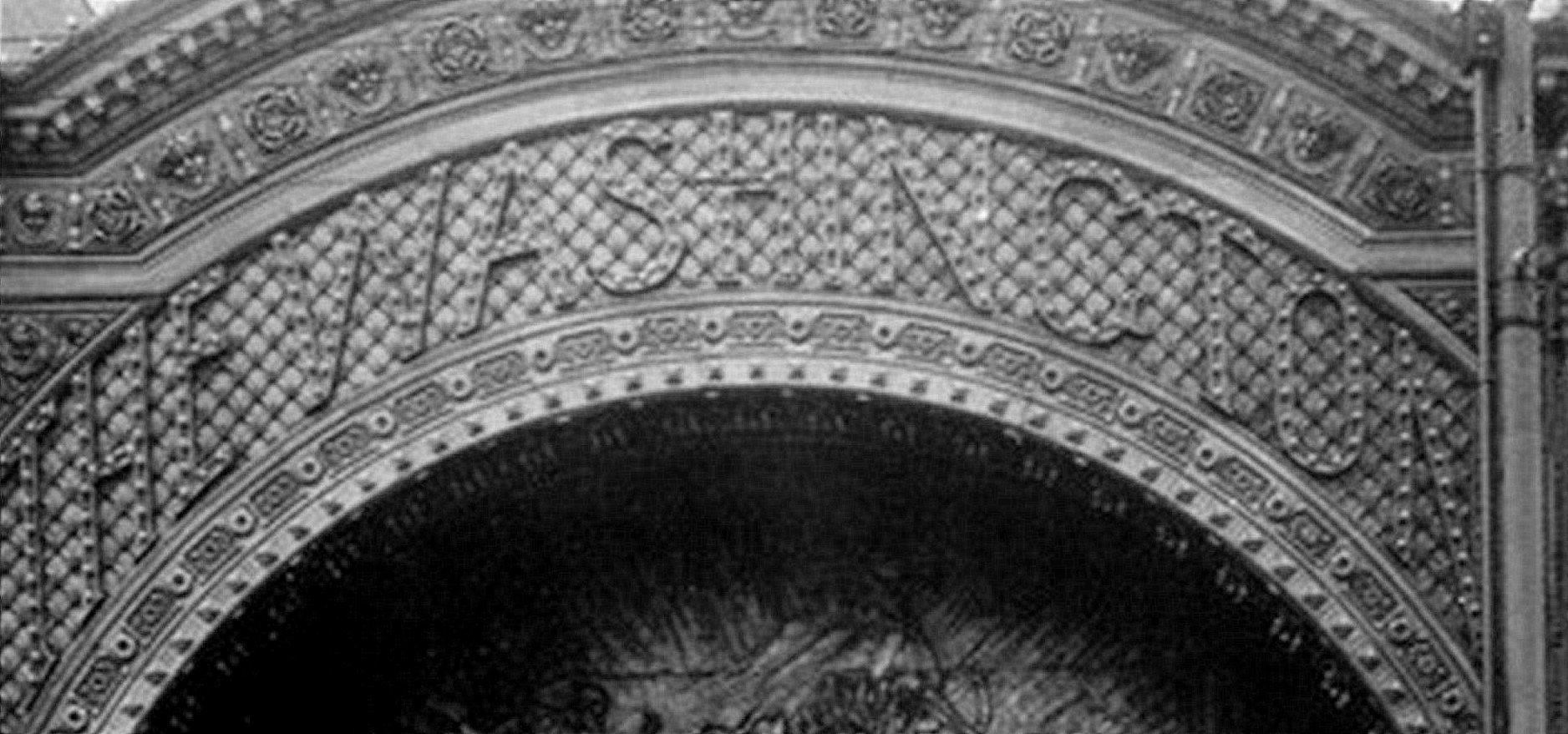
Let’s look at a couple of details from that top photo. The Washington was built without a marquee, but the outside of the building was studded with an eyeball-popping TWO THOUSAND LIGHTS! Imagine what that must have looked like — in 1912! Here’s an extreme close-up of the theater’s facade — look at all those bulbs!

washington-theatre_cinema-treasures_det1

And, below (was one of these men W. D. Nevills?):

washington-theatre_cinema-treasures_det2

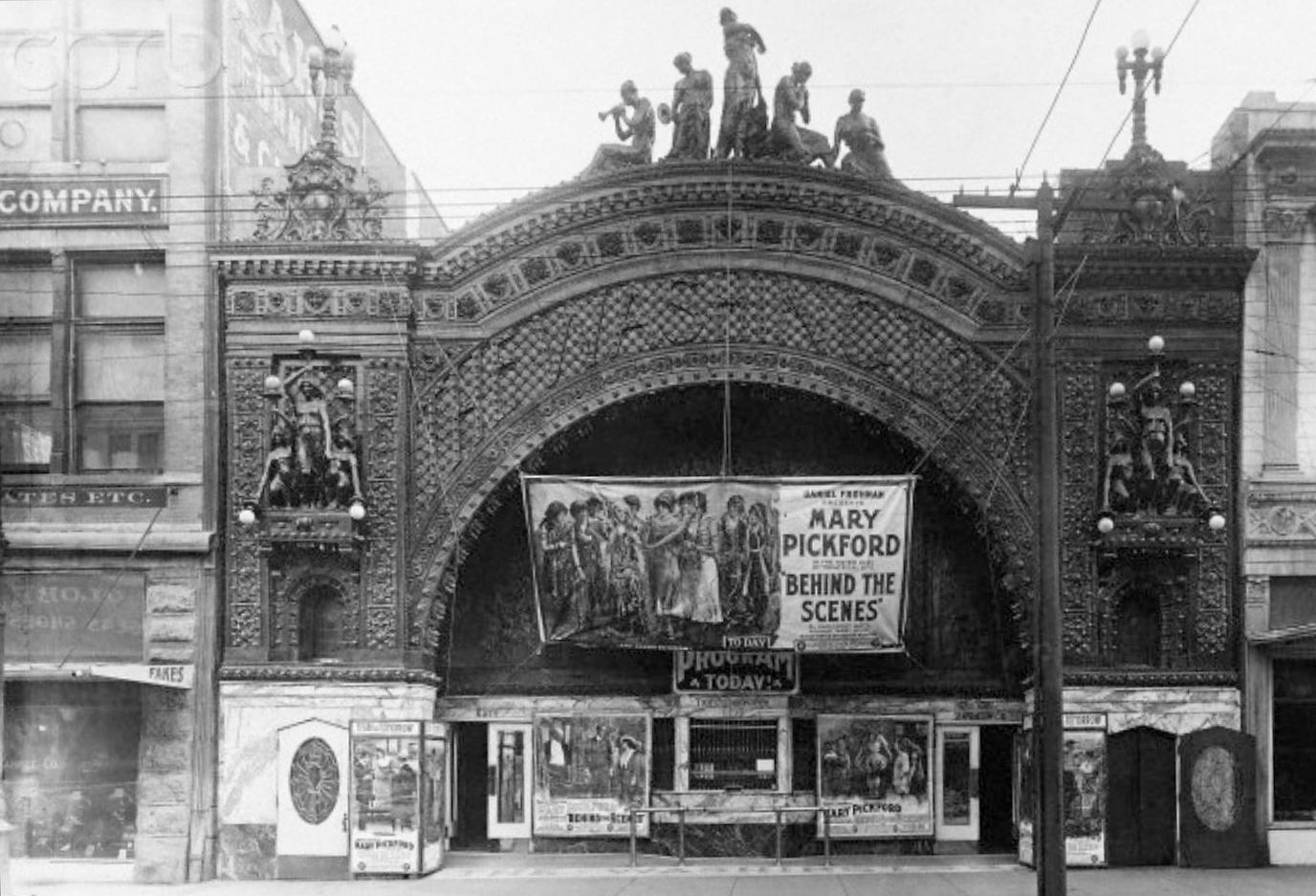
Another shot, this one showing how one worked without a typical illuminated marquee — you just string a banner up (the needle is hitting a solid “8.5” on the visual clutter scale here):

washington-theatre_corbis_19141914 via CorbisImages

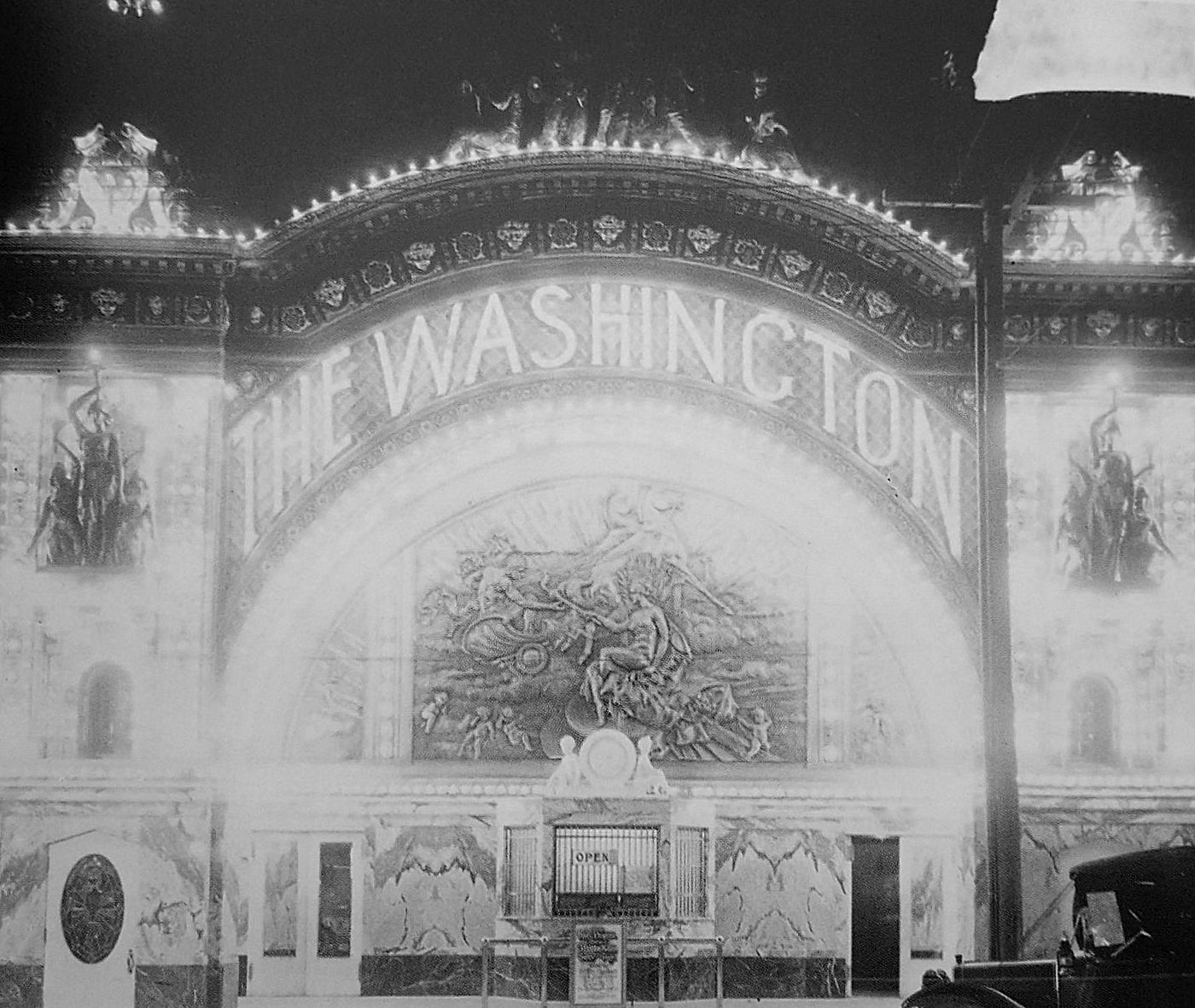
Here it is, ablaze at night:

washington-theater_night_dallas-rediscovered_DHS

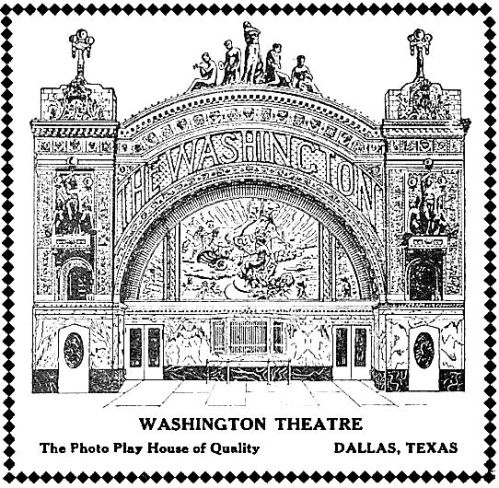
In an ad from 1914:

theater_washington_bldg-code_1914

Photo from October 1916:

theaters_washington-theatre_exhibitors-herald-and-motography_june-1919_photo-from-oct-1916

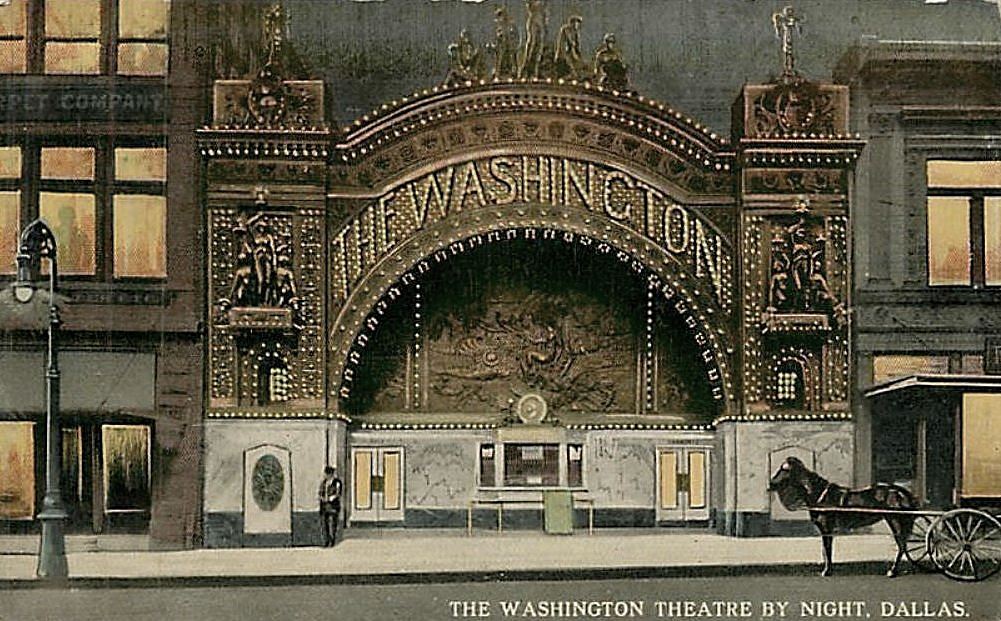
And in “color” from a picture postcard:

washington-theatre_ebay

***

Sources & Notes

Top photo from Cinema Treasures; to read a history of the Washington Theater from Cinema Treasures (and to see another photo), see here. (Photo’s original source appears to be the Dallas Historical Society.)

The photo of the theater with the Mary Pickford banner is ©Schenectady Museum; Hall of Electrical History Foundation/CORBIS; more info is here. (The movie “Behind the Scenes” was released in 1914.)

Photo of the theater at night is from Dallas Rediscovered by William L. McDonald — source: Dallas Historical Society archives.

The ad is from the 1914 Dallas Building Code.

Photo with the marquee showing “The Common Law” is from Oct. 1916, but the photo didn’t appear in the trade magazine Theatre Exhibitors Herald and Motography until June 1919.

The color postcard is from eBay.

Read about the closing of the Washington in an article available in the Dallas Morning News archives: “Washington Theater, Earliest Dallas ‘Movie Palace,’ Shows Last Close-Up After 15 Years” (DMN, July 4, 1927).

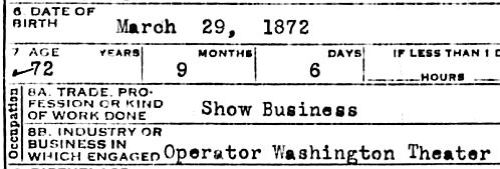
The Washington Theater must have been W. D. Nevills greatest achievement. It’s interesting to note that “Operator Washington Theater” appears on his death certificate. Nevills died in 1945, eighteen years after the theater closed.

nevills_death-certificate_010545_det

For other Flashback Dallas posts on this era of movie theaters, see the following:

  • “Three of Dallas’ Earliest ‘Photoplay Houses’ — 1906-1913,” here
  • “Movie Houses Serving Black Dallas — 1919-1922,” here

*

Copyright © 2016 Paula Bosse. All Rights Reserved.

The Texas Theatre and Its Venetian-Inspired Decor

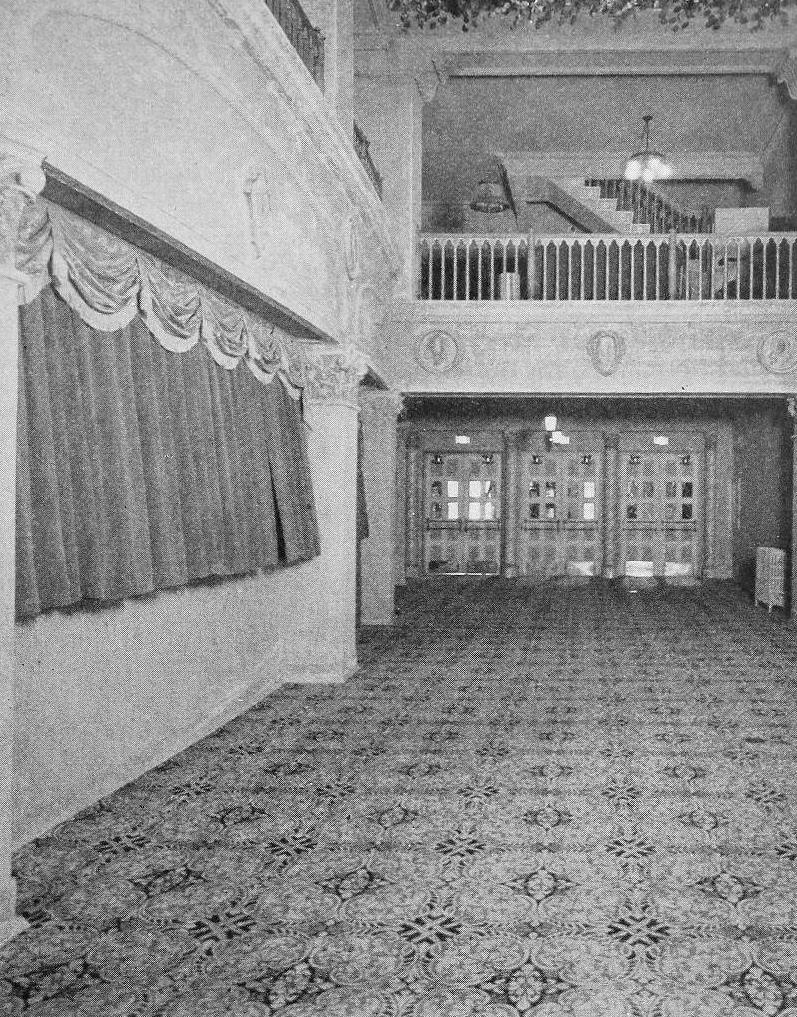
texas-theatre_motion-picture-herald_070232_det1A little bit of Venice in the O.C. (note organ at edge of stage)

by Paula Bosse

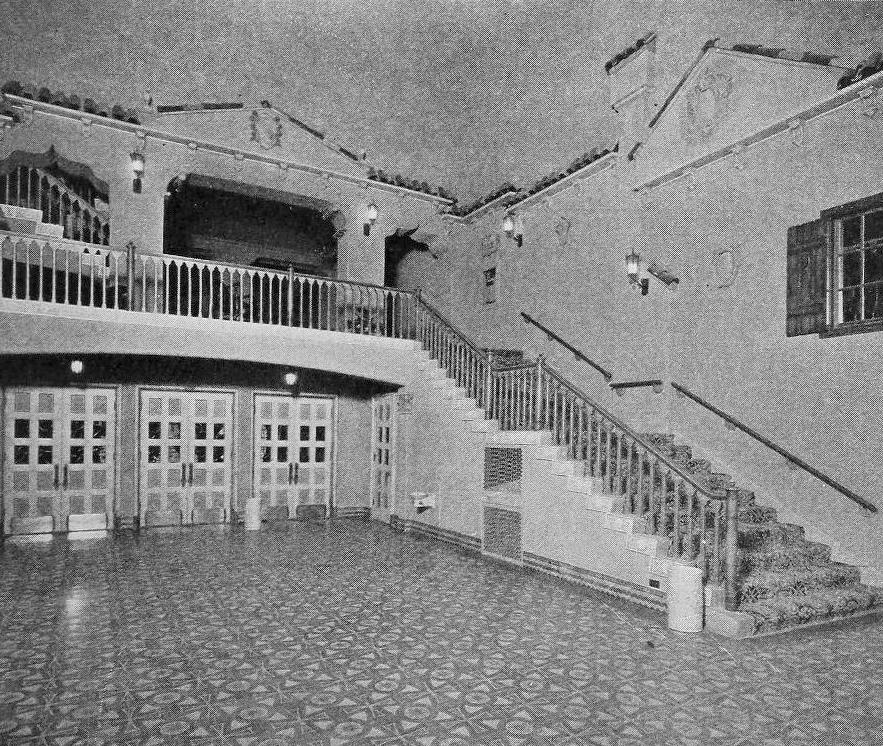
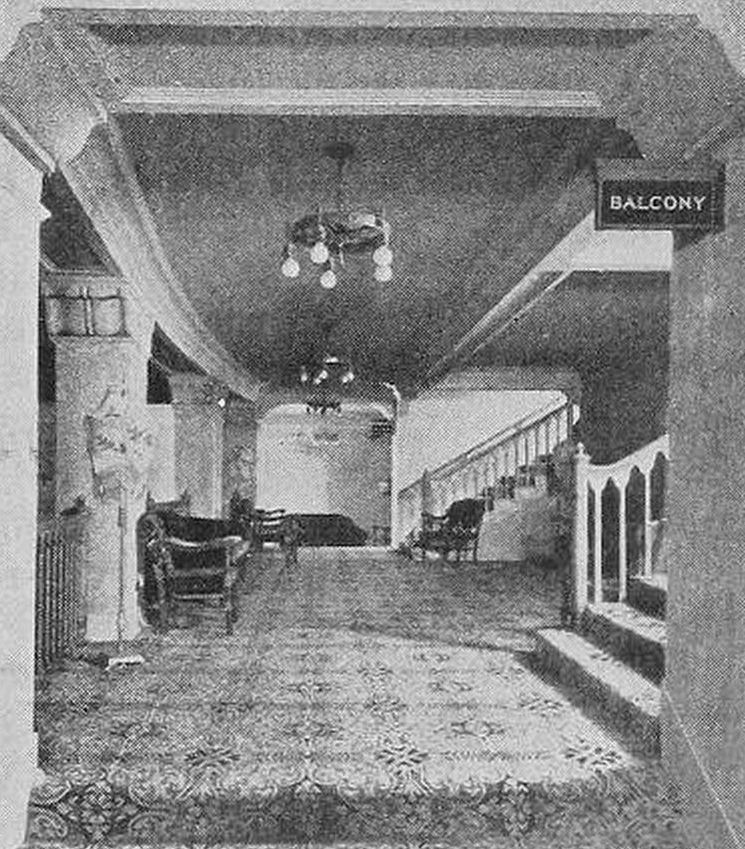
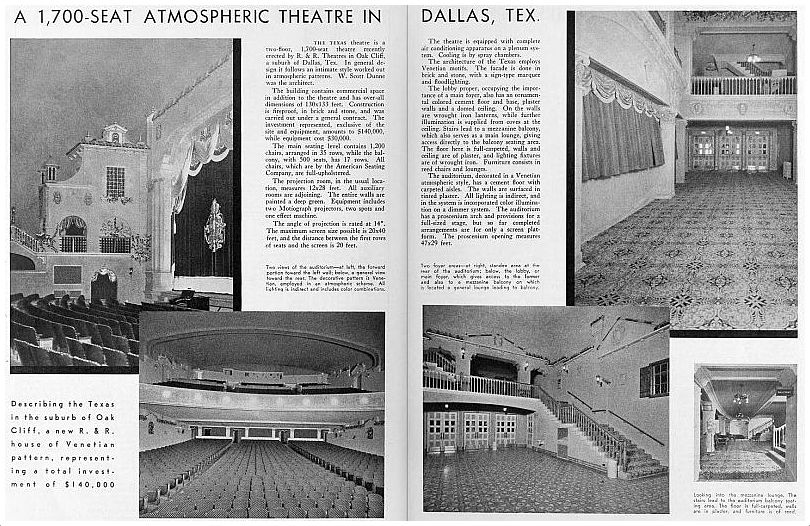
The Texas Theatre in Oak Cliff  — which opened in April, 1931 — was the first movie theater in Dallas built expressly to show movies with sound. It was also the largest “suburban” theater in the Dallas area — only downtown’s first-run Majestic and Palace theaters were larger. Below are photos of the theater’s “Venetian-style” interior, from the trade journal Motion Picture Herald.

texas-theatre_motion-picture-herald_070232_det2

texas-theatre_motion-picture-herald_070232_det3

texas-theatre_motion-picture-herald_070232_det4

texas-theatre_motion-picture-herald_070232_det5

***

Sources & Notes

Photos from Motion Picture Herald, July 2, 1932. For the full article, see the very large scan of page 1 here, and page 2 here.

texas-theatre_motion-picture-herald_070232

The Texas Theatre is still alive — its website’s history page is here.

My previous post, “The Texas Theatre — 1932” (which shows the theater’s exterior at the time this article was published), is here.

*

Copyright © 2016 Paula Bosse. All Rights Reserved.

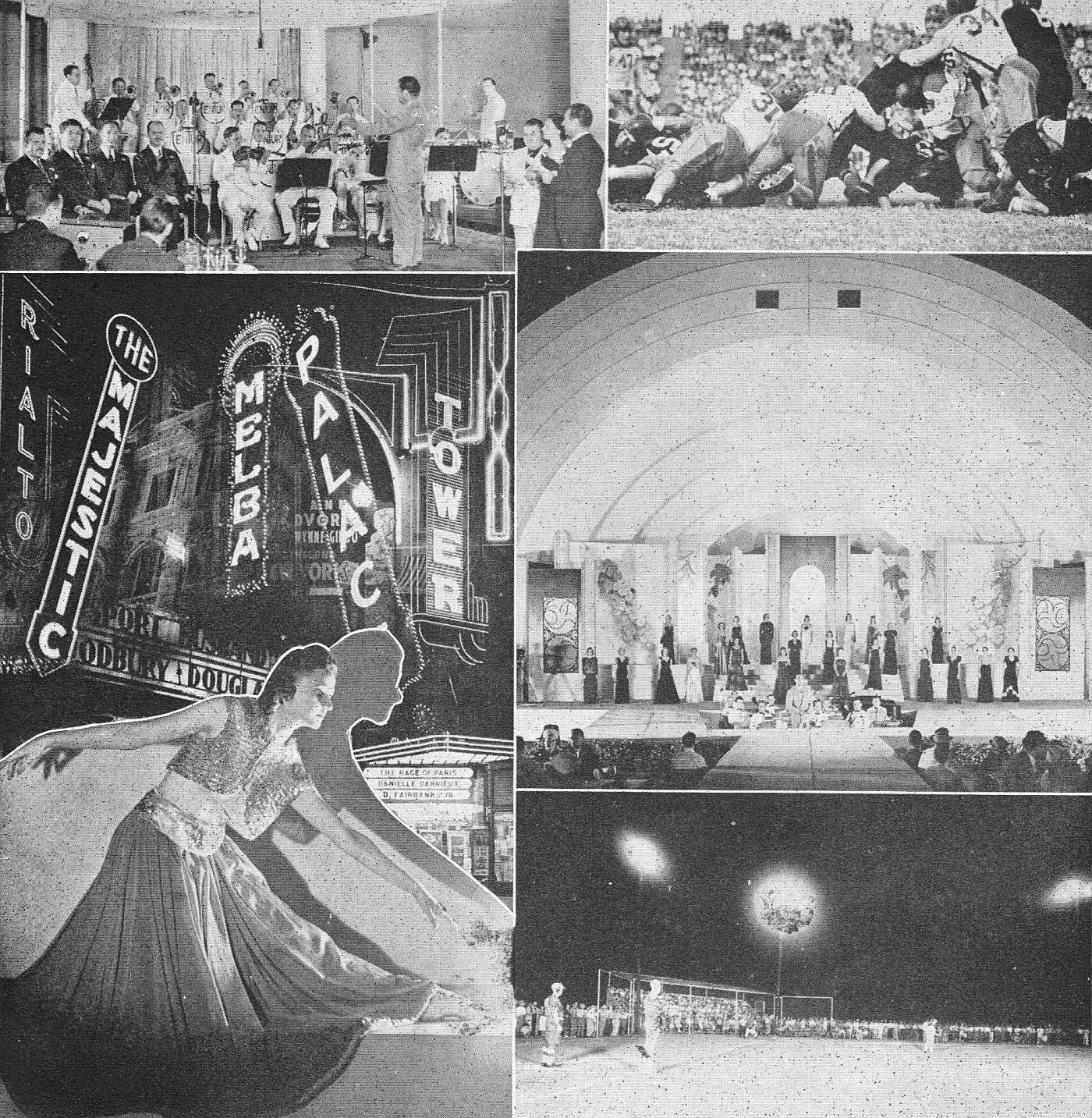
Dallas: “Amusement Capital of the Southwest” — 1946

entertainment_so-this-is-dallas_ca-1946-photos_smSomething for everybody! (click for larger image)

by Paula Bosse

Post-war Dallas had it all, man: our unparalleled night life included swanky hotel nightclubs where the beautiful people sipped champagne and danced to the music of tuxedoed big bands, “quieter but none-the-less entertaining taverns on the outskirts of the city” where the less beautiful people drank beer and danced to the non-stop music coming from jukeboxes, “unusual” restaurants (“where there is no music to dull the solid enjoyment of well-seasoned viands served with sparkling wines of appropriate vintage”), theatrical presentations, movies, movies, movies, and outdoor sports and recreation, including baseball at Rebel Stadium. Something for everybody!

entertainment_so-this-is-dallas_ca-1946-text(click for larger image)

***

Photo collage and text from “So This Is Dallas,” edited by Mrs. E. F. Anderson (Dallas: The Welcome Wagon, ca. 1946); photographs by Parker-Griffith.

*

Copyright © 2016 Paula Bosse. All Rights Reserved.
Protected: David Bowie, Dallas Convention Center — 1978

This content is password-protected. To view it, please enter the password below.

The First Woman to Swim the Channel Helped Search the Trinity for Drowned Victims — 1927

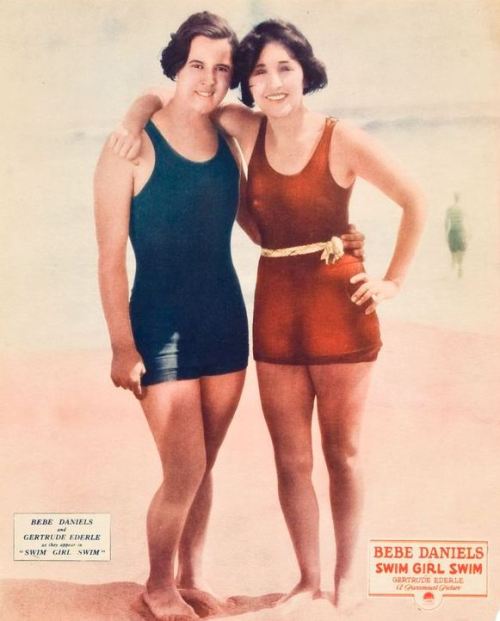
swim-girl-swim_haGertrude Ederle (l) with co-star, Dallas native Bebe Daniels / via HA.com
by Paula Bosse

In 1926, Gertrude Ederle, a 19-year-old American, became the first woman to swim the English Channel — her time of 14 hours and 39 minutes was the fastest time ever. She became an instant international celebrity. When she returned to New York, she was given the very first ticker-tape parade, and over two million people turned out to see her.

After this momentous achievement, Ederle turned for a while to entertainment. She made a cameo appearance in a (now lost) silent film called Swim, Girl, Swim (which, incidentally, starred two Dallas natives, Bebe Daniels and James Hall), and she also toured for a while with a vaudeville company.

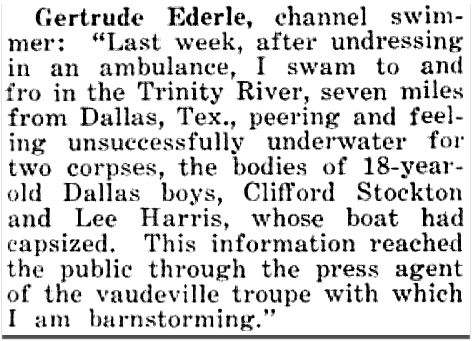
It was during one of these tours in April, 1927 that she arrived in Dallas, just as torrential rains began to fall. There was severe flooding along the West Fork of the Trinity, especially in the area of Record Crossing. The boat in which two young men were riding had capsized and they had been caught in the undertow and drowned. There had  been an unsuccessful search for their bodies, and I’m not sure who came up with the idea of contacting Miss Ederle, but someone did. Why NOT call in the world’s most famous swimmer to see if she could lend a hand while authorities dragged the river? Miss Ederle did, in fact, join in the underwater search, but the bodies were not found. I bet she never forgot that Dallas stop!

The news was reported in Time magazine:

trinity_bodies_time-mag_041827Time, April 18, 1927

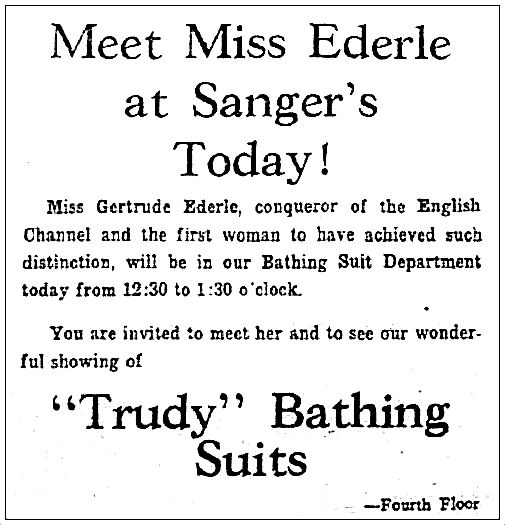
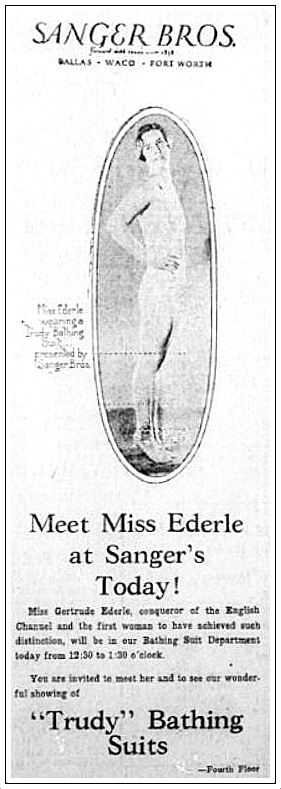
While in town, Trudy also squeezed in a personal appearance at Sanger Bros., hawking what looks to be her own line of swimsuits.

ederle_sangers_dmn_041427-det

ederle_sangers_dmn_041427Apr. 14, 1927

***

Sources & Notes

More on the Trinity River search can be found in The Dallas Morning News article “River Claims Two Victims; Gertrude Ederle Makes Vain Attempt to Recover Bodies” (DMN, April 5, 1927).

Newsreel footage of Gertrude Ederle can be seen here.

Photos of Ederle in action are here.

Ederle’s Wikipedia entry is here.

*

Copyright © 2016 Paula Bosse. All Rights Reserved.