Flashback : Dallas

A Miscellany: History, Ads, Pop Culture

Category: Leisure

“Texas Excitement” — Six Flags Over Texas by Rail

six-flags-over-texas_three-rides_postcard_ken-collierCount ’em…

by Paula Bosse

There’s a lot going on in this postcard! The description, from the back of the card:

TEXAS EXCITEMENT
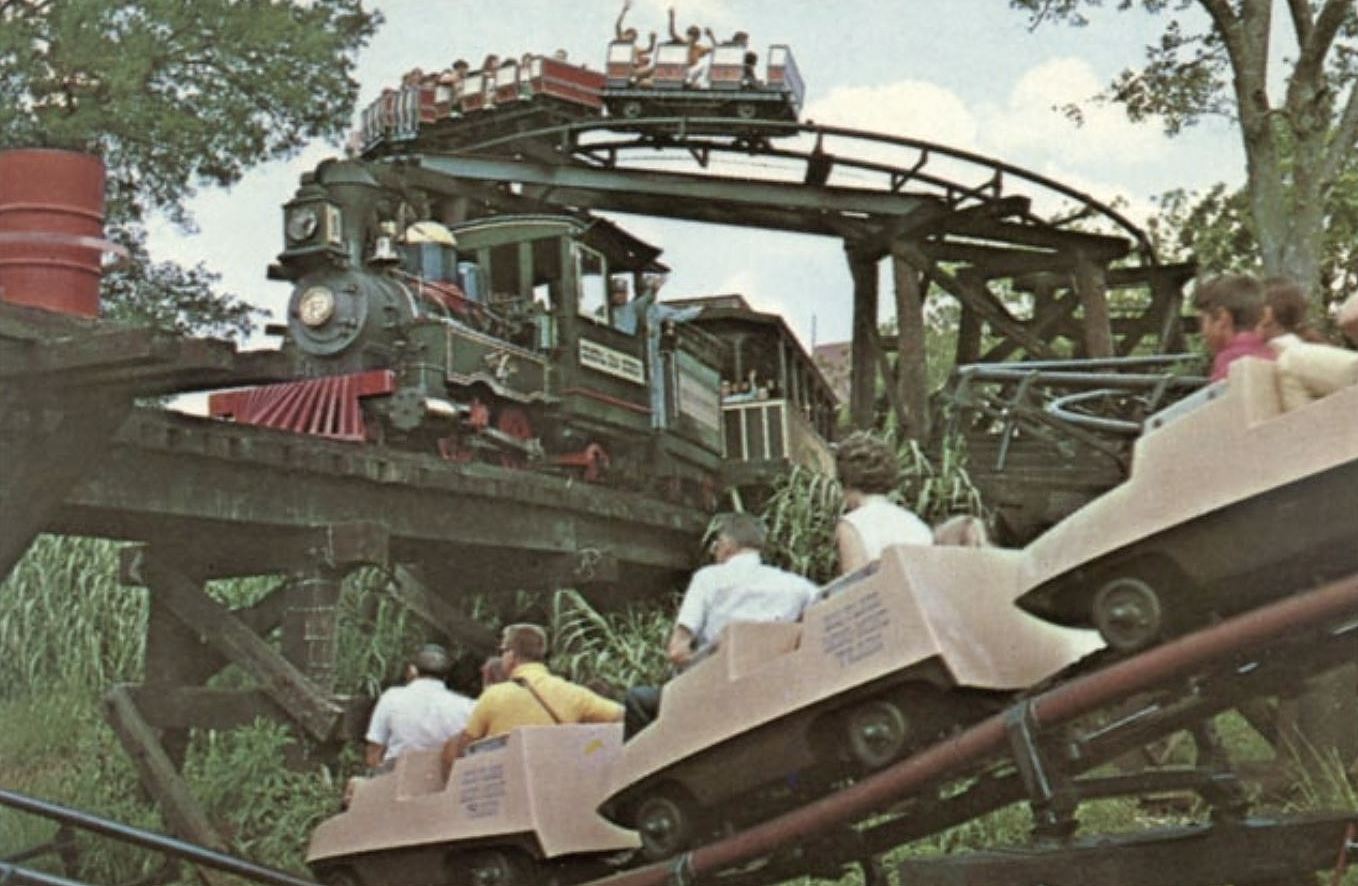
Three of the most popular rides at SIX FLAGS Over Texas are shown in action. At top is the Runaway Mine Train which annually carries more than 2½ million riders. At center an authentic 1898 steam engine carries passengers over a narrow gauge track which encircles the huge theme park. And, in the foreground is the SIX FLAGS Mini Mine Train, designed for the younger set.

***

Sources & Notes

This 1970s-era postcard is from Ken Collier’s fantastic Six Flags Over Texas site, here.

*

Copyright © 2019 Paula Bosse. All Rights Reserved.
“I’m No Angel” Packing Them In at The Majestic — 1933

majestic-theatre_im-no-angel_elm-street_1933_portal

by Paula Bosse

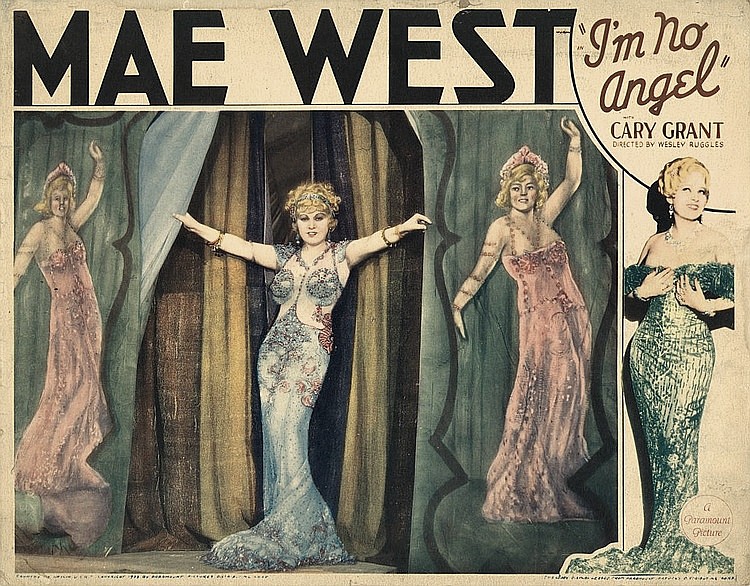
Mae West was hot in 1933. Dallas moviegoers lined up on Elm Street to see her in “I’m No Angel” at the Majestic Theater. On a Monday afternoon!

mae-west_im-no-angel_1933
via IMDb

***

Sources & Notes

Photo from the Spotlight on North Texas collection, UNT Media Library, Portal to Texas History; more info can be found here.

(Check out the brick paving on Elm Street!)

*

Copyright © 2019 Paula Bosse. All Rights Reserved.


Super-Cool Roger Miller in Dallas — 1960s

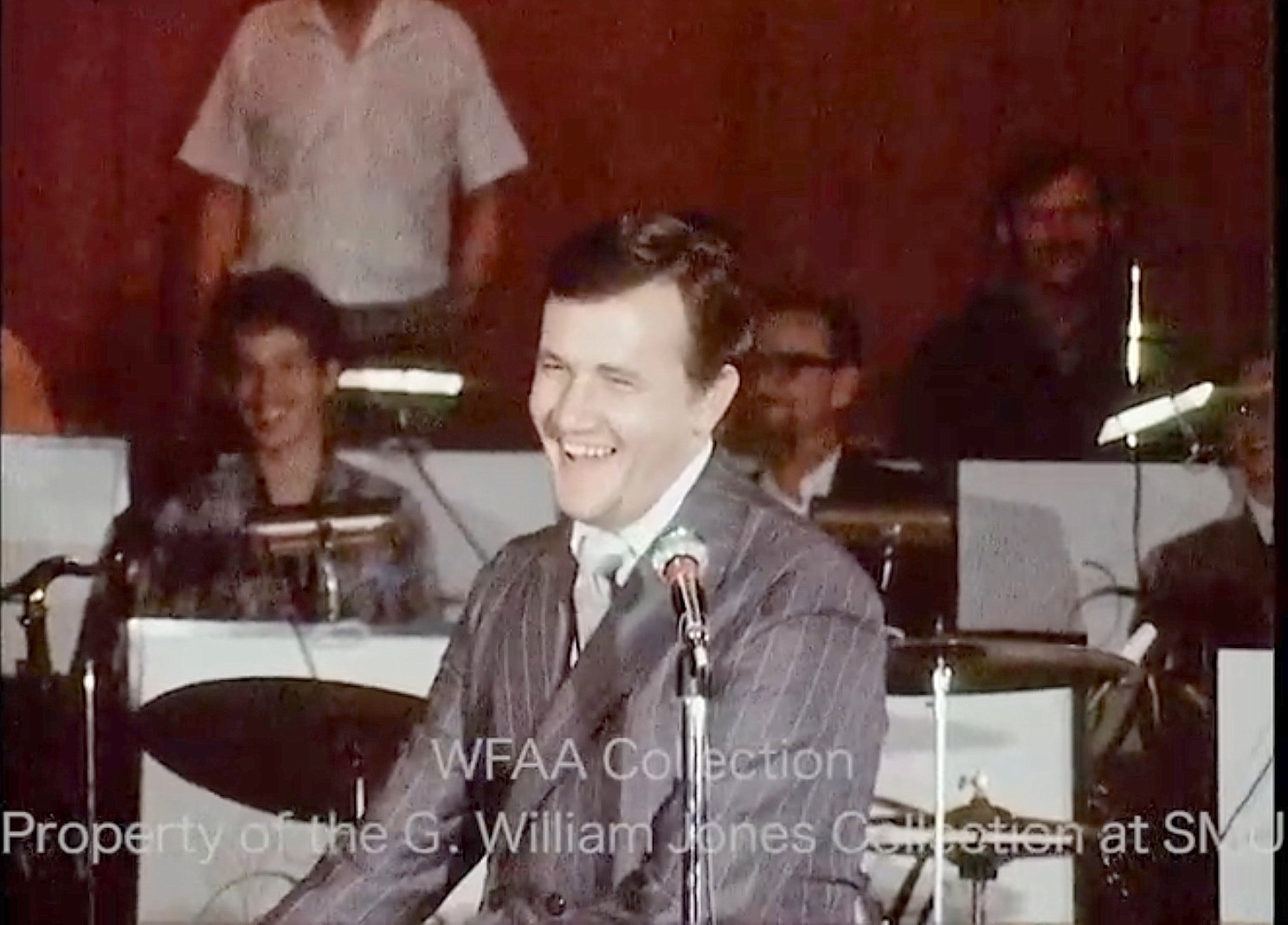
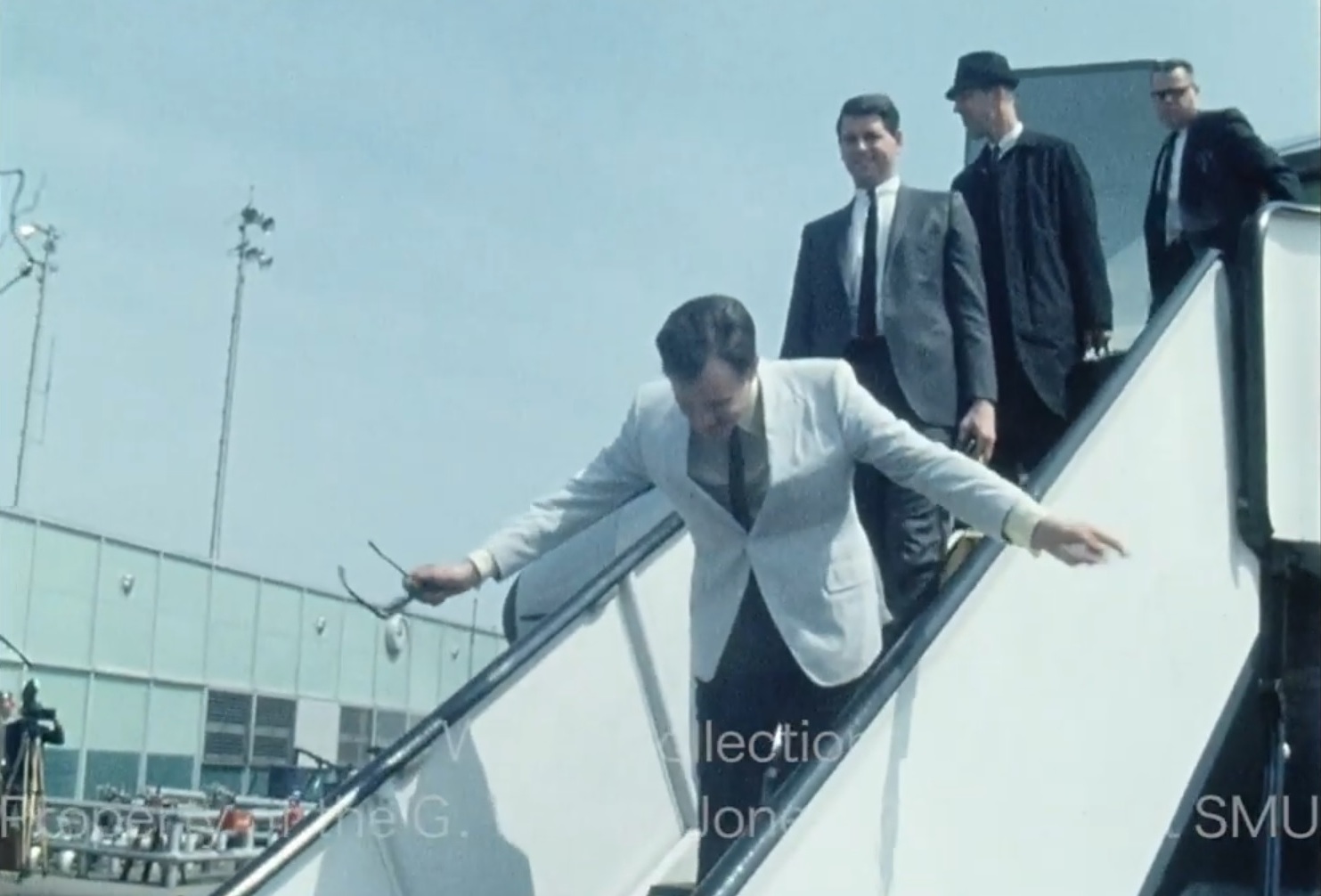
roger-miller_venetian-room_oct-1969_wfaa_jones-film_SMURoger Miller on the Venetian Room stage, October, 1969

by Paula Bosse

Who doesn’t love Roger Miller? He was always one of the most effortlessly “cool” entertainers, celebrated as much for his songwriting and singing as he was for his humor and storytelling.

Roger Miller was born in Fort Worth in 1936 but spent most of his childhood in Oklahoma following the death of his father. He launched an entertainment career after a stint in the U.S. Army came to an end. (See an extensive timeline at Wikipedia, here.)

After years of struggling, he finally hit the big-time in 1964 with the hit “Dang Me” and, a few months later, with his biggest hit, the classic “King of the Road.” He won a huge number of Grammys (11 in 1964 and 1965 alone) and was a bona fide star who had incredible crossover appeal for fans of both country music and traditional popular music.

*

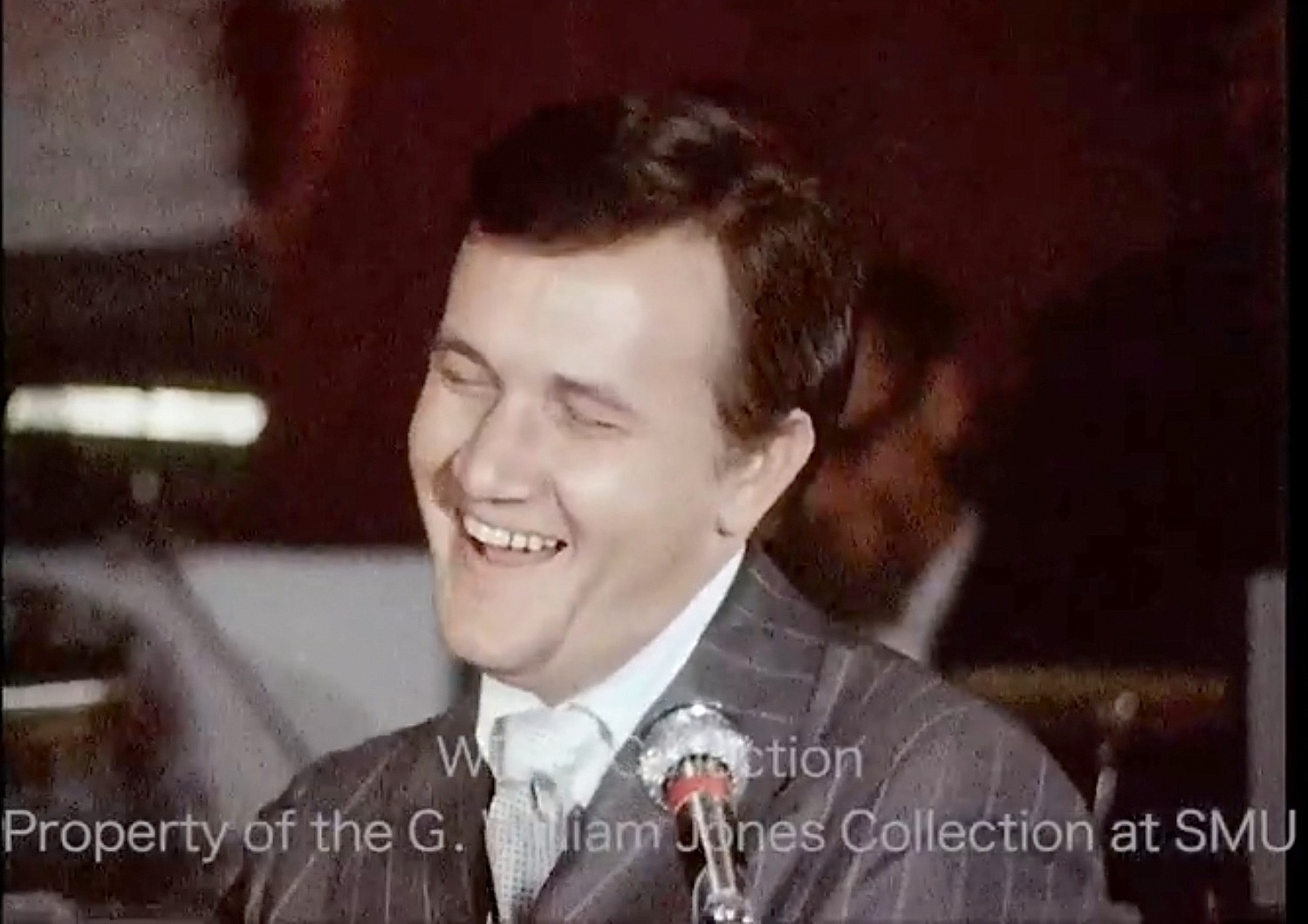
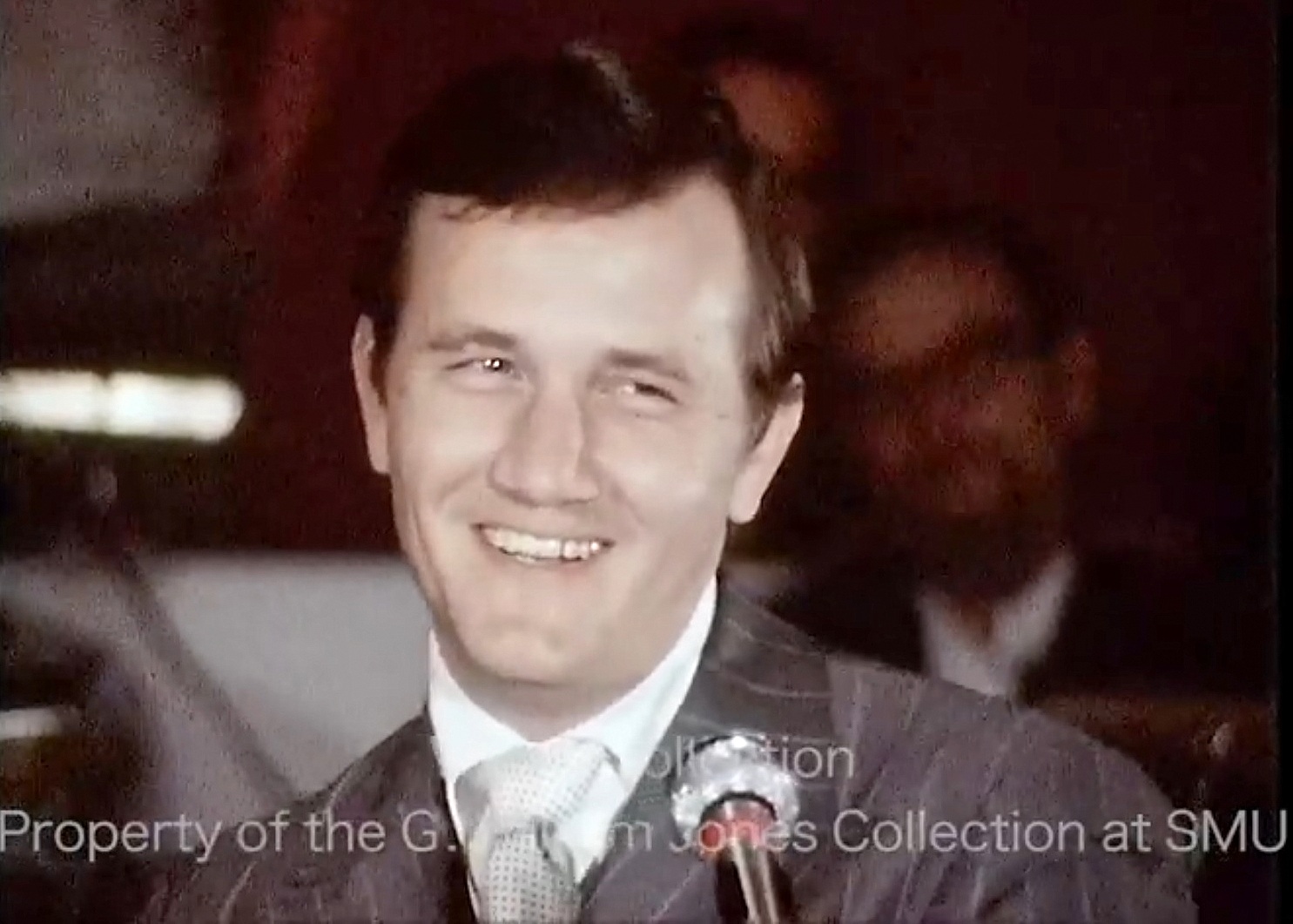
When he came to Dallas in October, 1969 it was for a 3-week run at the Fairmont Hotel’s swanky Venetian Room, and he apparently packed them in every night. Below is a snippet of an interview with WFAA-Channel 8 News in which Roger answers the burning question of whether he was “serious” when he wrote his hit novelty song “You Can’t Rollerskate In a Buffalo Herd” (listen to the song here). His quipped response (which cracked up the Jerry Gray Orchestra behind him) probably didn’t make it to the local airwaves in 1969:


roger-miller_venetian-room_oct-1969_wfaa_jones-film_SMU_a

roger-miller_venetian-room_oct-1969_wfaa_jones-film_SMU_b

(As an interesting sidelight, in an interview with Philip Wuntch of The Dallas Morning News (Oct. 19, 1969), Miller said that he and his wife had been in Texas for a few days prior to his Venetian Room engagement looking at houses in both Dallas (his mother was then residing in Fort Worth) and San Antonio (his wife’s hometown). Nothing apparently came of this, but it certainly would have been nice to have been able to claim Roger Miller as a Dallas resident!)

He was in town a couple of years earlier, in 1967, and sat down for a Channel 8 interview which was a bit more sedate — it took place in the American Airlines “Celebrity Room” at Love Field as he was passing through Dallas on his way to San Antonio with his wife and young son, Dean Miller:


roger-miller_venetian-room_march-1967_wfaa_jones-film_SMU

On this trip, newspapers reported that he was shuttled about in private Lear Jets and Rolls Royces — a big change from his early days when he picked cotton, hitchhiked, slept in cars, and stole milk off front porches.

Roger Miller died in 1992 at the age of 56 from complications of lung cancer.

*

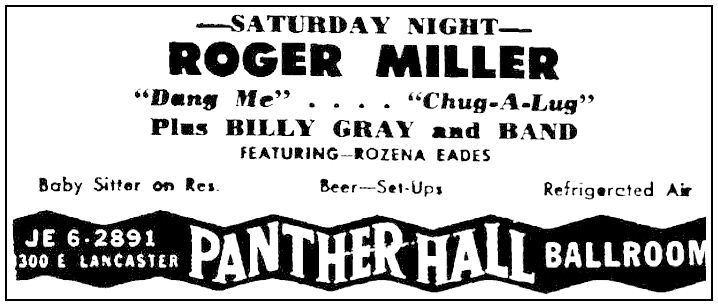
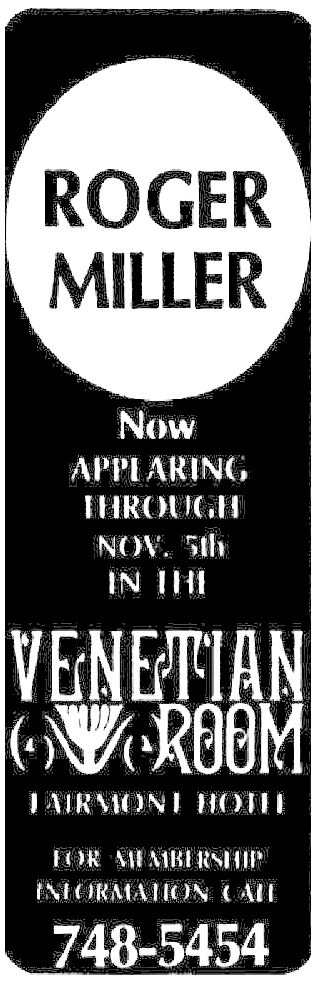
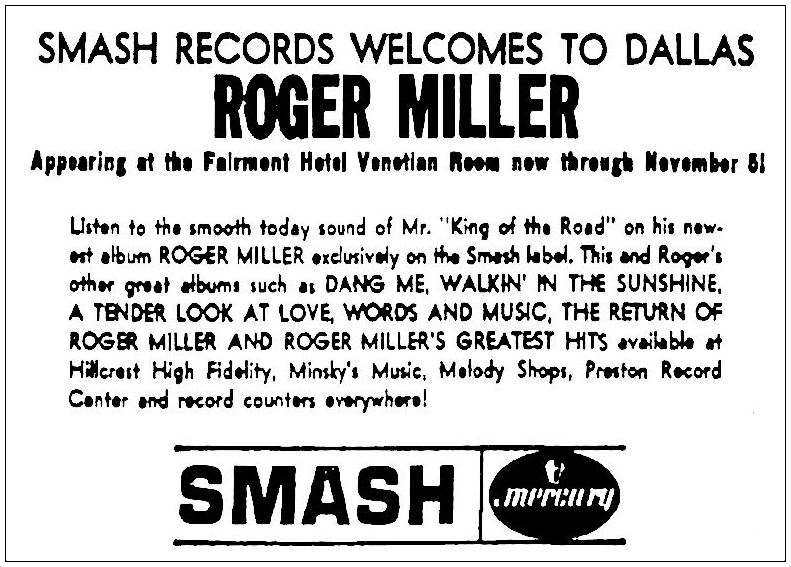
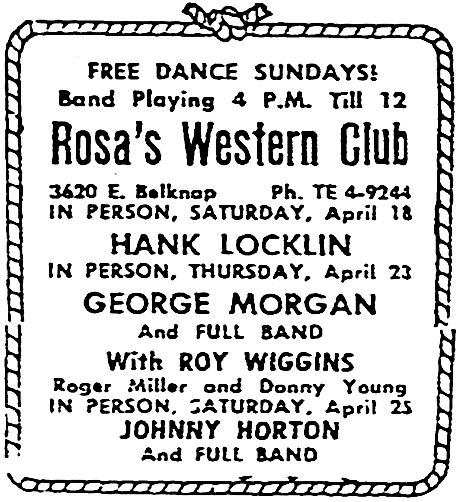
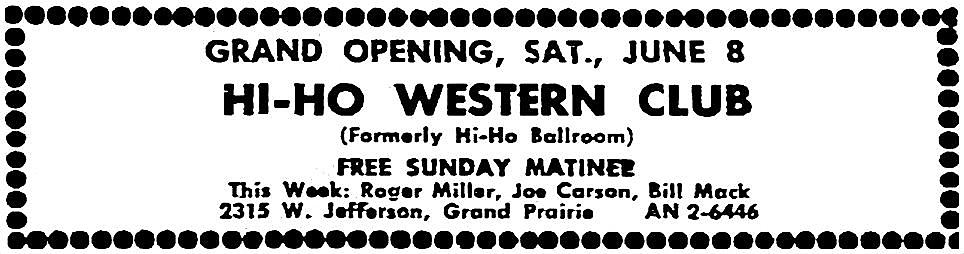
Below are a few ads from Roger Miller’s DFW appearances. He played large venues like the Big D Jamboree in Dallas and Panther Hall and Northside Coliseum in Fort Worth, but he also played a lot of little clubs as he worked his way up to becoming a major recording artist and television personality.

miller-roger_FWST_041259_rosas-western-clubRosa’s Western Club, Fort Worth with Donny Young (aka Johnny Paycheck), April 12, 1959

miller-roger_060863_hi-ho-western-club_grand-prairieHi-Ho Western Club, Grand Prairie, TX, June 8, 1963

miller-roger_FWST_081364_panther-hallPanther Hall, Aug. 13, 1964

miller-roger_101669_fairmont-hotelVenetian Room, Dallas, Oct. 16, 1969

miller-roger_101769_fairmont-hotel_smash-recordsSmash Records ad, Oct. 17, 1969

***

Sources & Notes

Film footage of Roger Miller in Dallas (on YouTube here and here) is from the WFAA Collection, G. William Jones Collection, Hamon Arts Library, Southern Methodist University.

The official Roger Miller website is here.

roger-miller_venetian-room_oct-1969_wfaa_jones-film_SMU_sm

*

Copyright © 2019 Paula Bosse. All Rights Reserved.
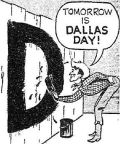
“Dallas Day” at the State Fair of Texas

state-fair_dallas-day_100956
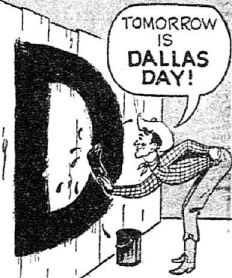
Hey, Big D — don’t forget “Dallas Day”!

by Paula Bosse

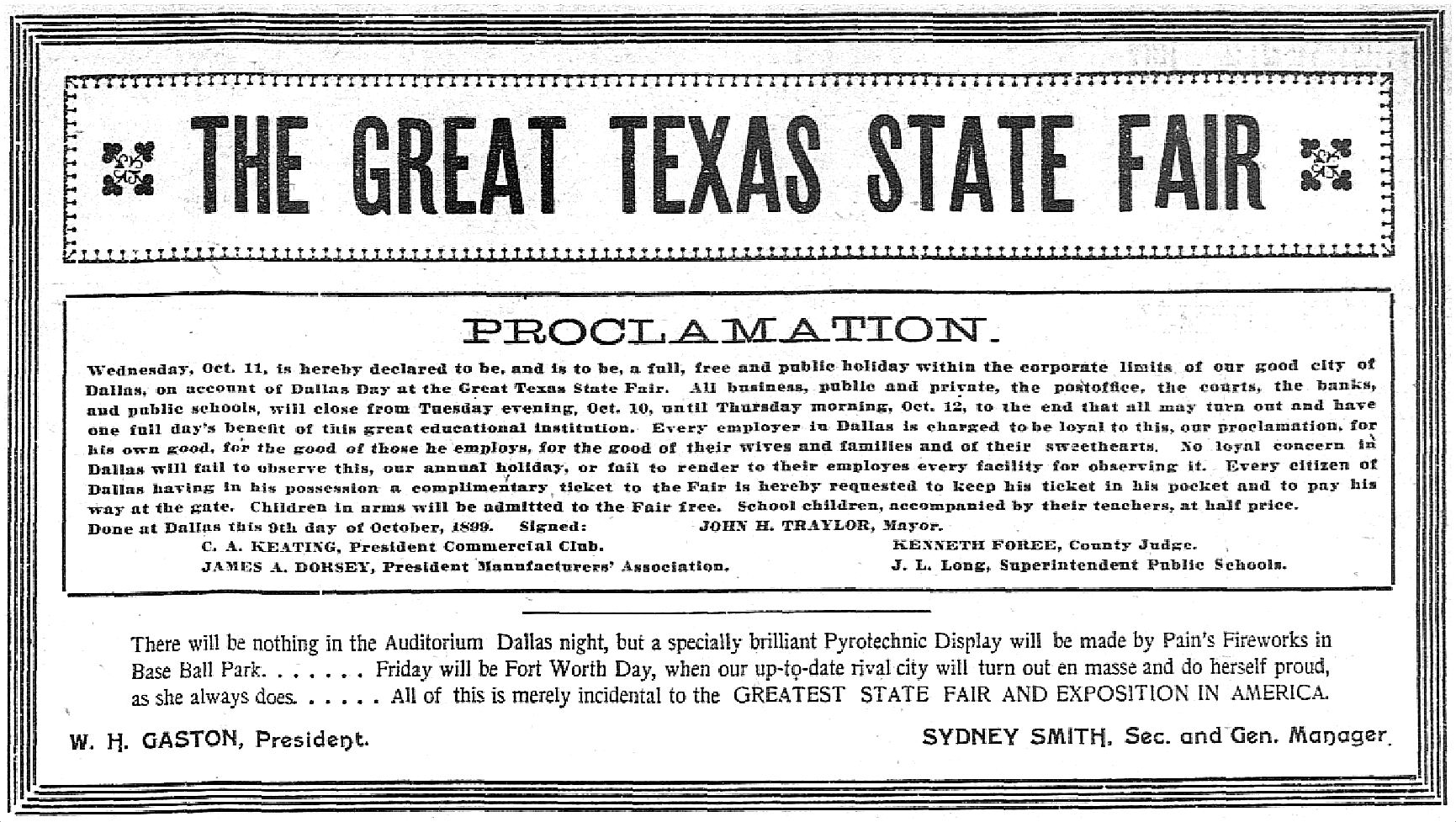
“Dallas Day” used to be an important day at the State Fair of Texas. Like really important. Like national-holiday-important. Below is a typical mayoral proclamation announcing the sweeping closures of public and private businesses and institutions on “Dallas Day,” from 1899 (click to see a larger image; transcription follows):

1899_dallas-day_sfot_dmn_101099Dallas Morning News, Oct. 10, 1899

THE GREAT TEXAS STATE FAIR

PROCLAMATION

Wednesday, Oct. 11, is hereby declared to be, and is to be, a full, free and public holiday within the corporate limits of our good city of Dallas, on account of Dallas Day at the Great Texas State Fair.

All business, public and private, the postoffice, the courts, the banks, and public schools, will close from Tuesday evening, Oct. 10, until Thursday morning, Oct. 12, to the end that all may turn out and have one full day’s benefit of this great educational institution.

Every employer in Dallas is charged to be loyal to this, our proclamation, for his own good, for the good of those he employs, for the good of their wives and families and of their sweethearts.

No loyal concern in Dallas will fail to observe this, our annual holiday, or fail to render to their employes every facility for observing it.

Every citizen of Dallas having in his possession a complimentary ticket to the Fair is hereby requested to keep his ticket in his pocket and to pay his way at the gate. Children in arms will be admitted to the Fair free. School children, accompanied by their teachers, at half price.

Done at Dallas this 9th day of October, 1899.

Signed:
John H. Traylor, Mayor

*

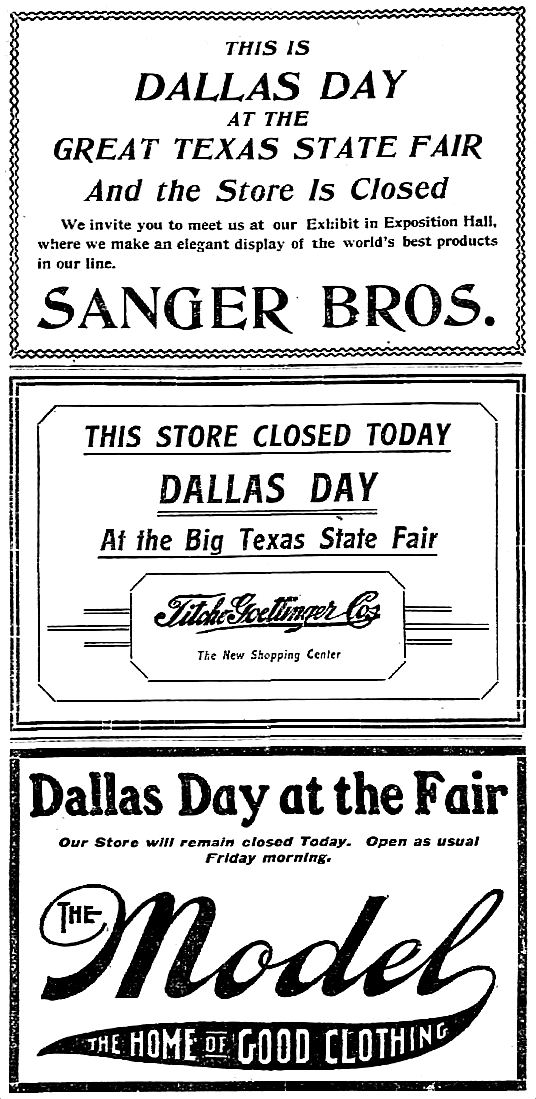
For decades, it was expected that most Dallas businesses and government offices would close on “Dallas Day.” The central business district must have been a ghost town. Woe be to anyone needing a new frock, a replacement gasket, a bank draft, or even a postage stamp on “Dallas Day.” The city had bigger fish they wanted its citizens to fry.

1906_dallas-day_sfot_dmn_101806Oct. 18, 1906

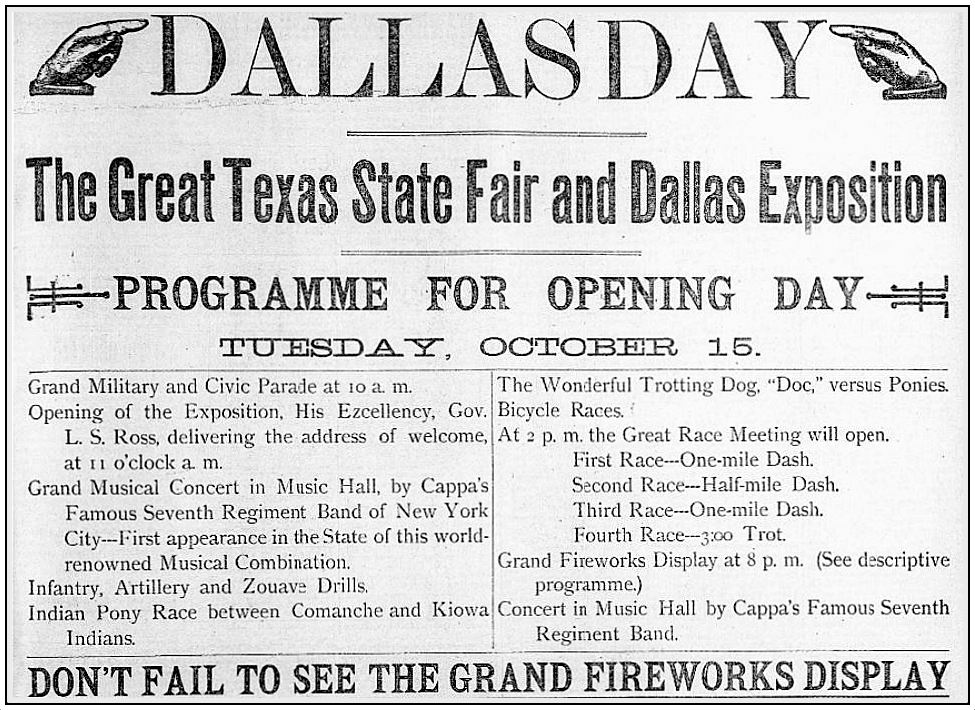
Here’s an early “Dallas Day” ad from 1889 with pointing fingers:

1889_dallas-day_sfot_dmn_101489Oct. 14, 1889

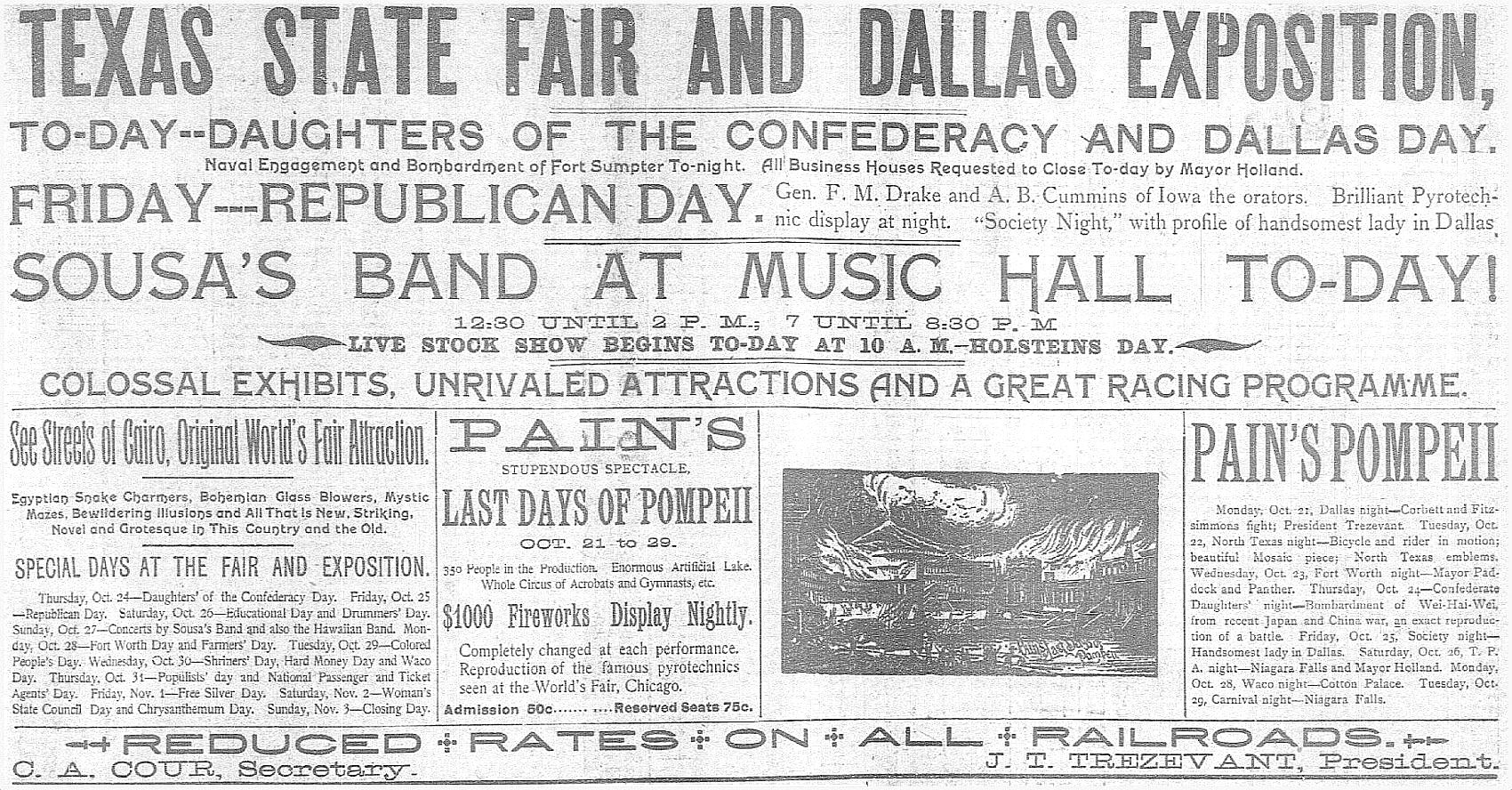
The State Fair of Texas was (and continues to be) so filled with other ubiquitous “days” (such as old favorites “Hard Money Day” and “Chrysanthemum Day,” as seen in the ad below from 1895) that if Dallas weren’t Dallas, “Dallas Day” might run the risk of getting lost in the jam-packed fair schedule.

1895_dallas-day_sfot_dmn_102495Oct. 24, 1895

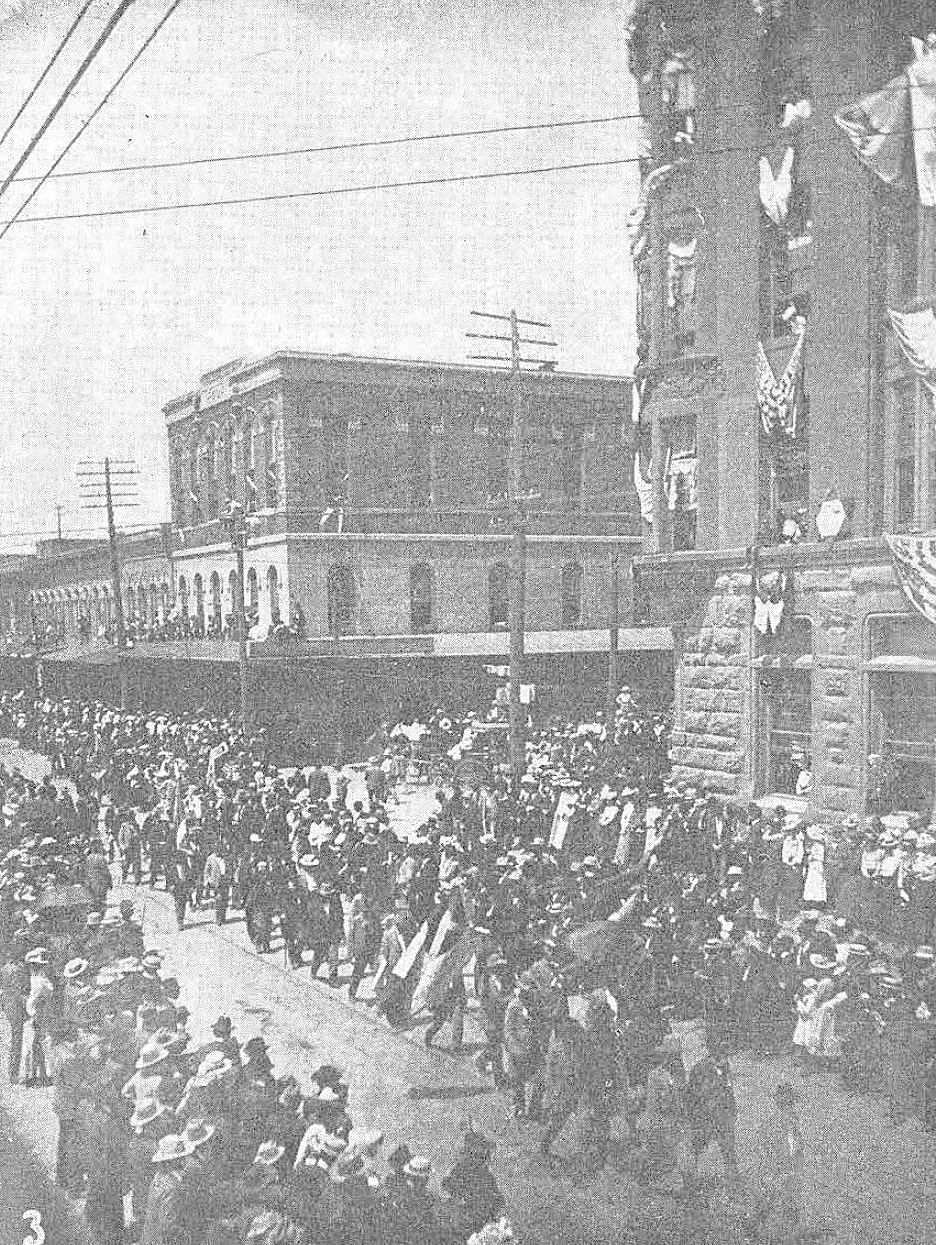
There were, of course, “Dallas Day” parades:

parade_state-fair_dallas-day_come-to-dallas_degolyer_SMU_ca1905ca. 1905, via DeGolyer Library, SMU

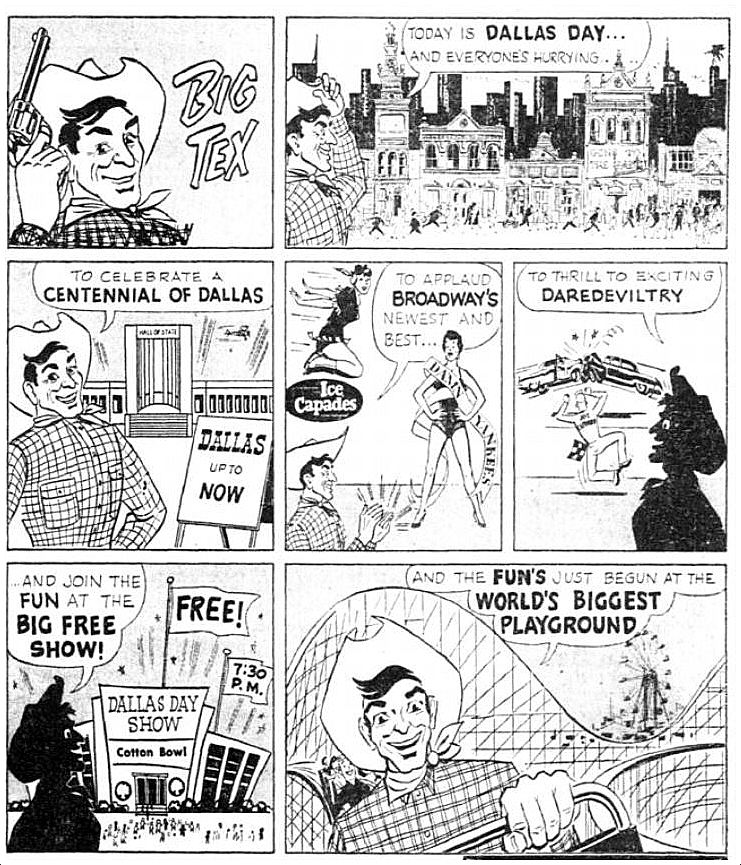
“Dallas Day” may still be a thing, for all I know (I guess I think of “Dallas Day” as the day Dallas’ elementary school kids get off to go to the fair, a tradition I hope never dies), but it had lost a lot of steam after those early days. Some businesses continued to close or shorten their hours to let employees enjoy the fair, but the era of a city shutting down so that everyone could flock to the State Fair began to fade after those early decades of the 20th century. But imagine how exciting that must have been, with all of Dallas descending on Fair Park en masse.

state-fair_dallas-day_101056Oct. 10, 1956

*

state-fair_dallas-day_100956_det_sm

*

Copyright © 2019 Paula Bosse. All Rights Reserved.
State Fair of Texas, Miscellaneous Tidbits from Its History

state-fair-of-texas_pennant_ebay_crop

by Paula Bosse

The State Fair of Texas is, once again, in full swing. Here are a few random SFOT images and ads from the past.

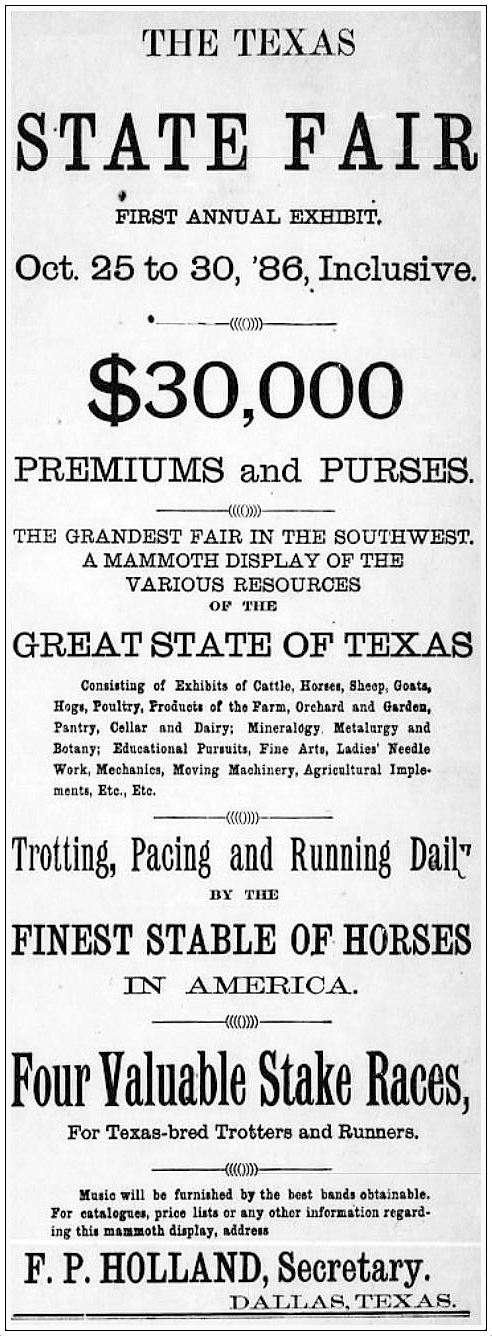
First up, an ad for the very first state fair in Dallas, in 1886. Almost unbelievably, this “Dallas State Fair” (held on 80 acres of land now known as Fair Park) was one of two competing state fairs held in the city that year — the other one was the “Texas State Fair,” which was held about three miles northeast of the courthouse on a 100-acre site roughly about where Cole Park is near present-day North Dallas High School. The two state fairs ran concurrently, and both were smash hits. The “Dallas State Fair and Exposition” eventually became the State Fair of Texas in 1904. Below are the ads for those competing two fairs. (Click to see a larger image.)

state-fair_first_dallas-herald_100986
The East Dallas fair, Dallas Herald, Oct. 9, 1886

texas-state-fair_fairland_dallas-herald_102086
The North Dallas fair, Dallas Herald, Oct. 20, 1886

*

One of the original buildings built for the 1886 Dallas State Fair was the massive Exposition Building, designed by architect James Flanders. On a site devoted to the career of Flanders, the architect recalled this project many years later: “The progress of the work on the structure was watched by most people with a degree of curiosity far more intense than is excited by the loftiest skyscraper in these days when people have no time to wonder. Such an apparition on the bald prairie attracted crowds of the curious from far and near on Sundays.”

state-fair_exposition-bldg_ca-1890s

Above, the huge Exposition Hall, enlarged from its initial design, which, in 1886 was reported to contain 92,000 square feet of unrivaled exhibition space. Unfortunately, the wooden buildings seen above burned to the ground in the early hours of July 20, 1902. The blaze was so intense that “the whole of the city was lit up with the brilliancy of the sunrise” and that “flames rose to such great height that they were seen as far west as Fort Worth, where it was thought the whole city of Dallas was burning” (Dallas Morning News, July 21, 1902). More on this building can be found on the Watermelon Kid site, here.

Below, the Exposition Building can be seen from the fairgrounds racetrack in a photo published in 1900 in an issue of The Bohemian magazine (via the Fort Worth Public Library).

fairgrounds_racetrack_bohemian_1900_fwpl

*

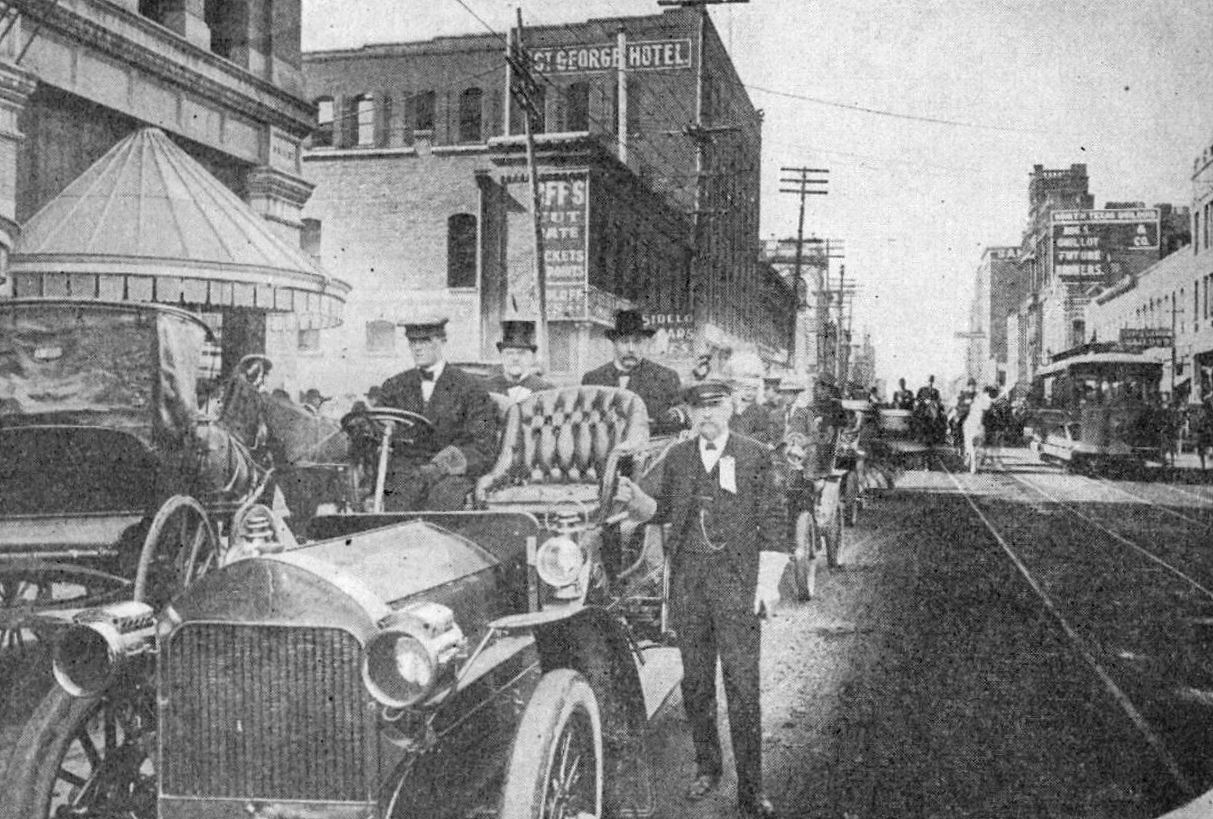
A moment from the opening day parade festivities of the 1903 fair is captured in the photo below, with the following caption from the 1941-42 edition of the Texas Almanac: “Gov. S. W. T. Lanham (in rear seat of pioneer horseless carriage) in opening day parade for 1903 State Fair of Texas formed on Main Street. Fair President C. A. Keating was seated beside him, and Secretary John G. Hunter of Board of Trade is seen standing beside the gasoline buggy.”

state-fair_opening-day_1903_tx-almanac_1941-42_portal
Main Street, looking west, via Portal to Texas History

*

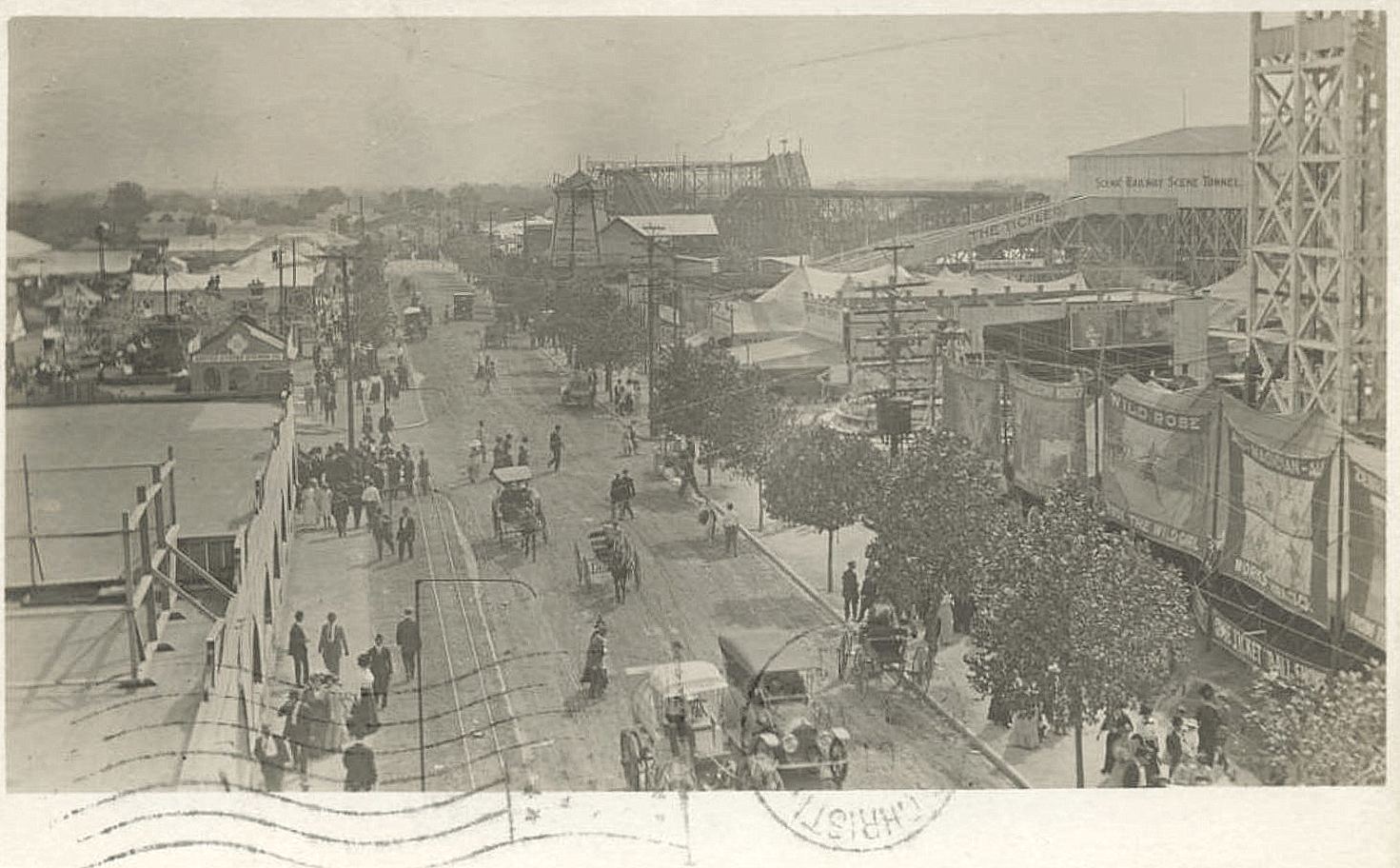
Here is a 1911 view of the state fair midway taken by John R. Minor, Jr. in a real-photo postcard. (More on Mr. Minor is here; more images of the Shoot the Chutes water ride can be found here.)

state-fair_street-scene_john-minor_1911_cook-colln_degolyer
via George W. Cook Collection, DeGolyer Library, SMU

*

From the 1920s, an ad for Clayco Red Ball gasoline (“It’s RED in color”). I’m always a sucker for ads containing photos or drawings of Dallas landmarks, and here we see the entrance to Fair Park. (Why was the gas red? Why not? It was the brainchild of Dallas advertising man Wilson W. Crook, Sr. who needed a way to make this Oklahoma gas different. He remembered that during his WWI days in France that higher quality airplane fuel was colored red to distinguish it from regular gasoline. When the gas was introduced to Dallas in August, 1924, he devised a promotion that gave away 5 gallons of this gas to every red-headed person who showed up at participating service stations.)

ad-red-ball-gas_state-fair_dmn_101224-det

ad-red-ball-gas_state-fair_dmn_101224Clayco Red Ball ad, Oct. 1924

*

If we’re talking about the State Fair of Texas and we’ve come to the 1930s, there’s a pretty good chance there’s going to be a photo from the Texas Centennial. And, looky here: a nice shot of concessionaires waiting for thirsty patrons at the Centennial Exposition in 1936. A couple of nickels could get you a Coke and a phone call.

sfot_concessionaires_coke_unt_portal_1936via Portal to Texas History

*

During World War II the State Fair was on hiatus. Here’s an ad from the 1941-42 Texas Almanac pre-closure, with a nice pencil sketch of the Esplanade and Hall of State:

state-fair_tx-almanac_1941-42

state-fair_tx-almanac_1941-42_det

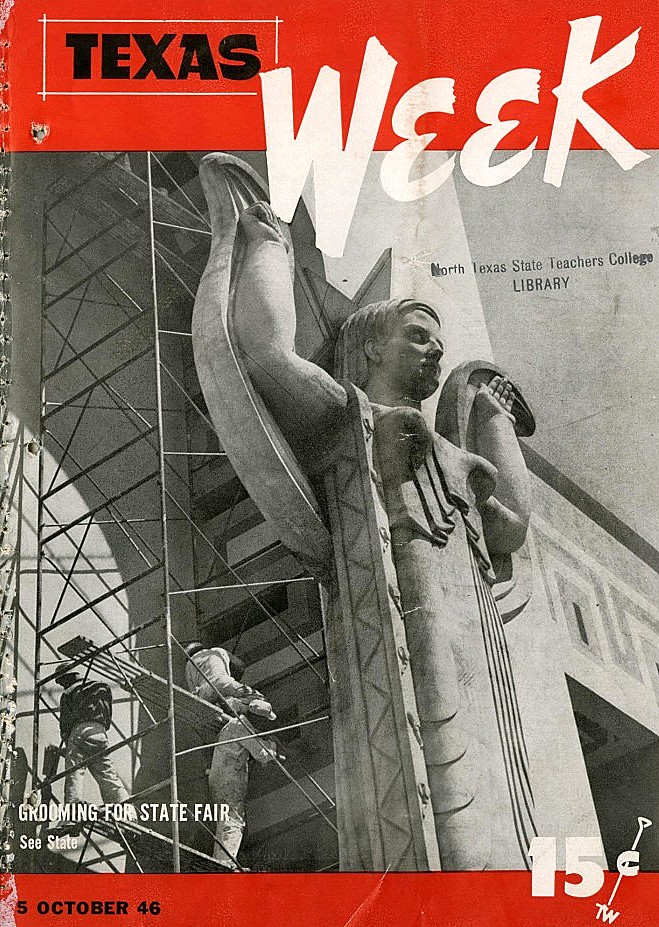
And a 1946 magazine cover story on the imminent reopening of the fair:

state-fair_texas-week-mag_100446_portal_cover
via Portal to Texas History

*

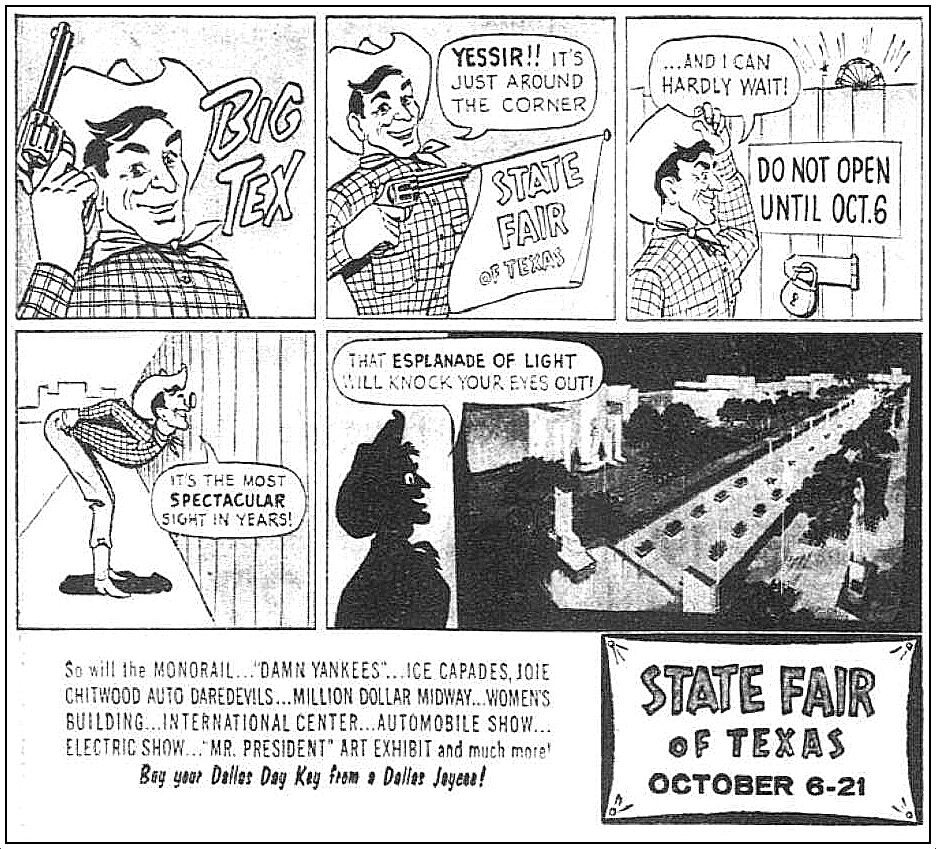
In 1956 Big Tex warned/assured you that the Esplanade lights would “knock your eyes out.”

state-fair_big-tex-ad_092456

*

Speaking of Big Tex and lights knocking your eyes out, in the 1960s Big Tex was memorialized on the side of a downtown building, like a giant bow-legged Lite-Brite.

sfot_big-tex_illuminated_1960s

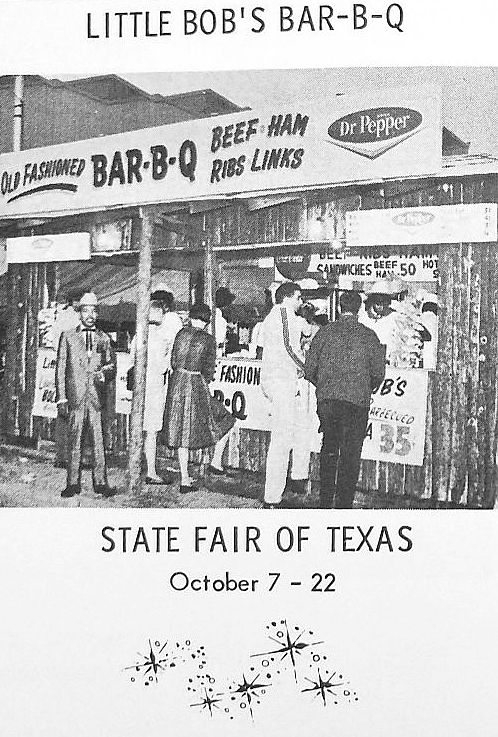
Back at Fair Park, Huey P. Nash was supplying fair throngs with barbecue from his Little Bob’s Bar-B-Q stand. In 1964, Nash was the first African-American vendor to be granted a food concession at the State Fair. Little Bob’s (which I believe is still in business) was, at the time of this 1967 ad, located in South Dallas at 4203 S. Oakland (now Malcom X), at the corner of Pine. (Ad is from the 1967 Souvenir Program of the 74th Annual Session of the Missionary Baptist General Convention of Texas; more photos from this publication can be seen here.)

sfot_little-bobs-bbq_baptist-convention-program_1967_photo

sfot_little-bobs-bbq_baptist-convention-program_oct-1967

The 1960s also gave us the Swiss Skyride, which replaced the Monorail (which, when it was introduced in 1956, was the first commercially operated monorail in the United States). The Swiss Skyride was erected in Fair Park in August, 1964, and the 6-minute ride debuted a few months later at the 1964 State Fair of Texas.

state-fair_swiss-sky-ride_tinkle-key-to-dallas_1965_replaced-monorail_
via Lon Tinkle’s children’s book Key to Dallas (1965)

sfot_swiss-skyride_FWST_101864

sfot_swiss-skyride_FWST_100964

*

state-fair-of-texas_pennant_ebay_crop_sm

*

Copyright © 2019 Paula Bosse. All Rights Reserved.
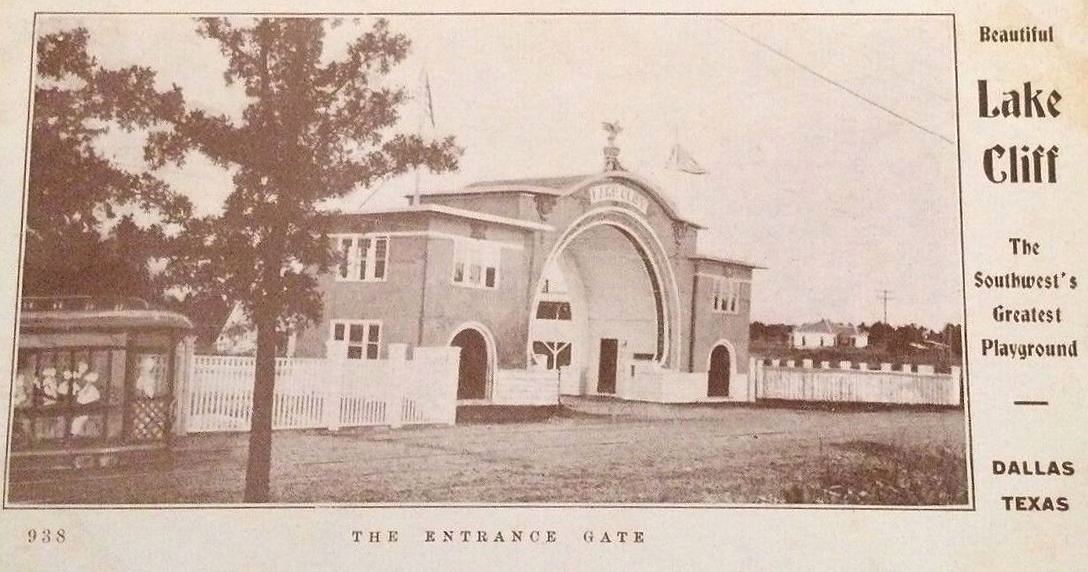
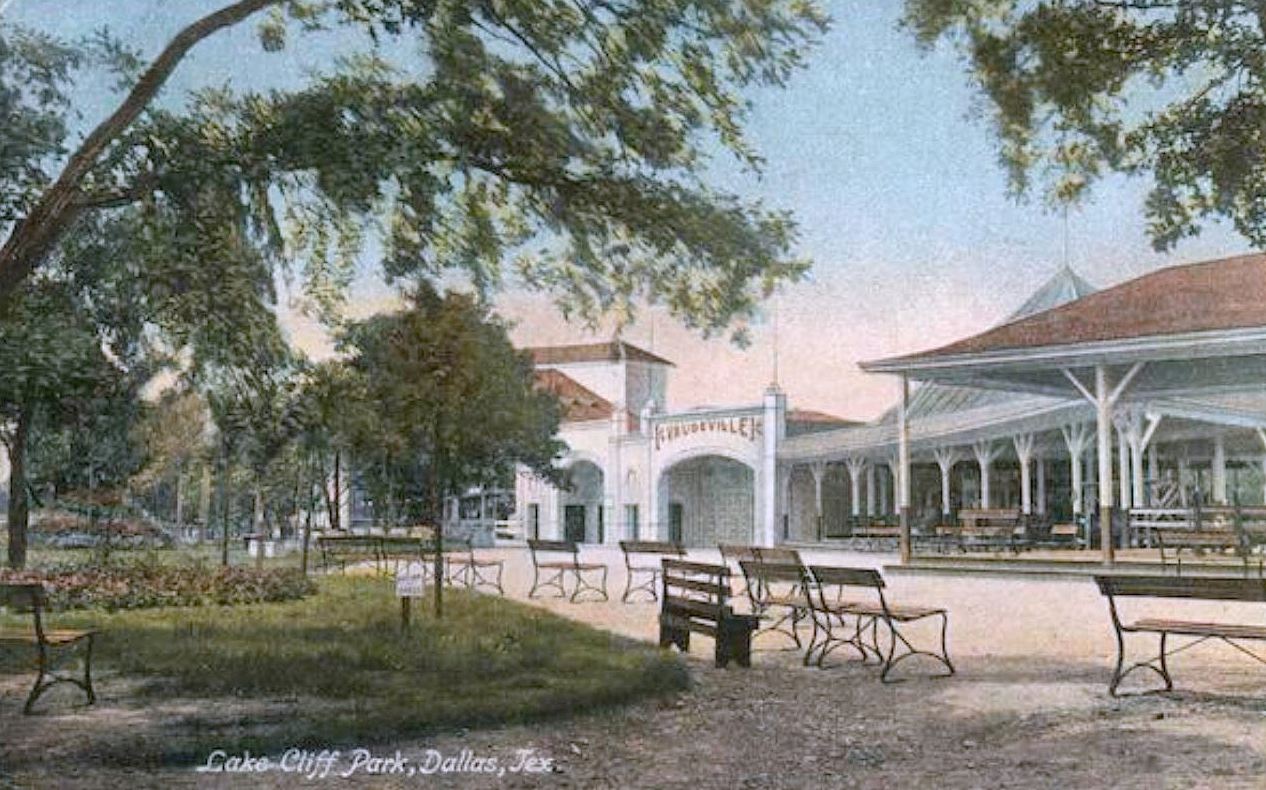
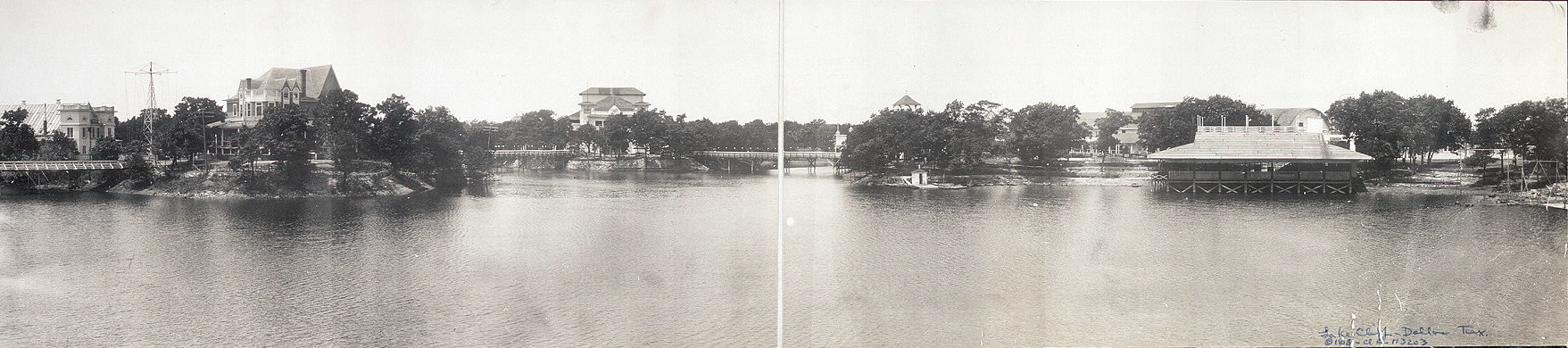
Beautiful Lake Cliff — ca. 1906

lake-cliff_cook-colln_degolyer_smu

by Paula Bosse

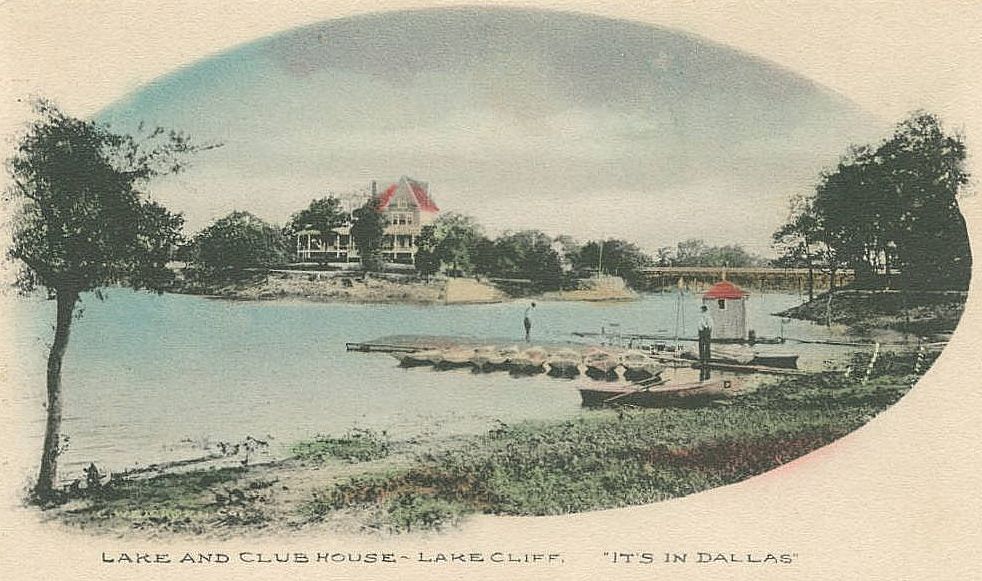
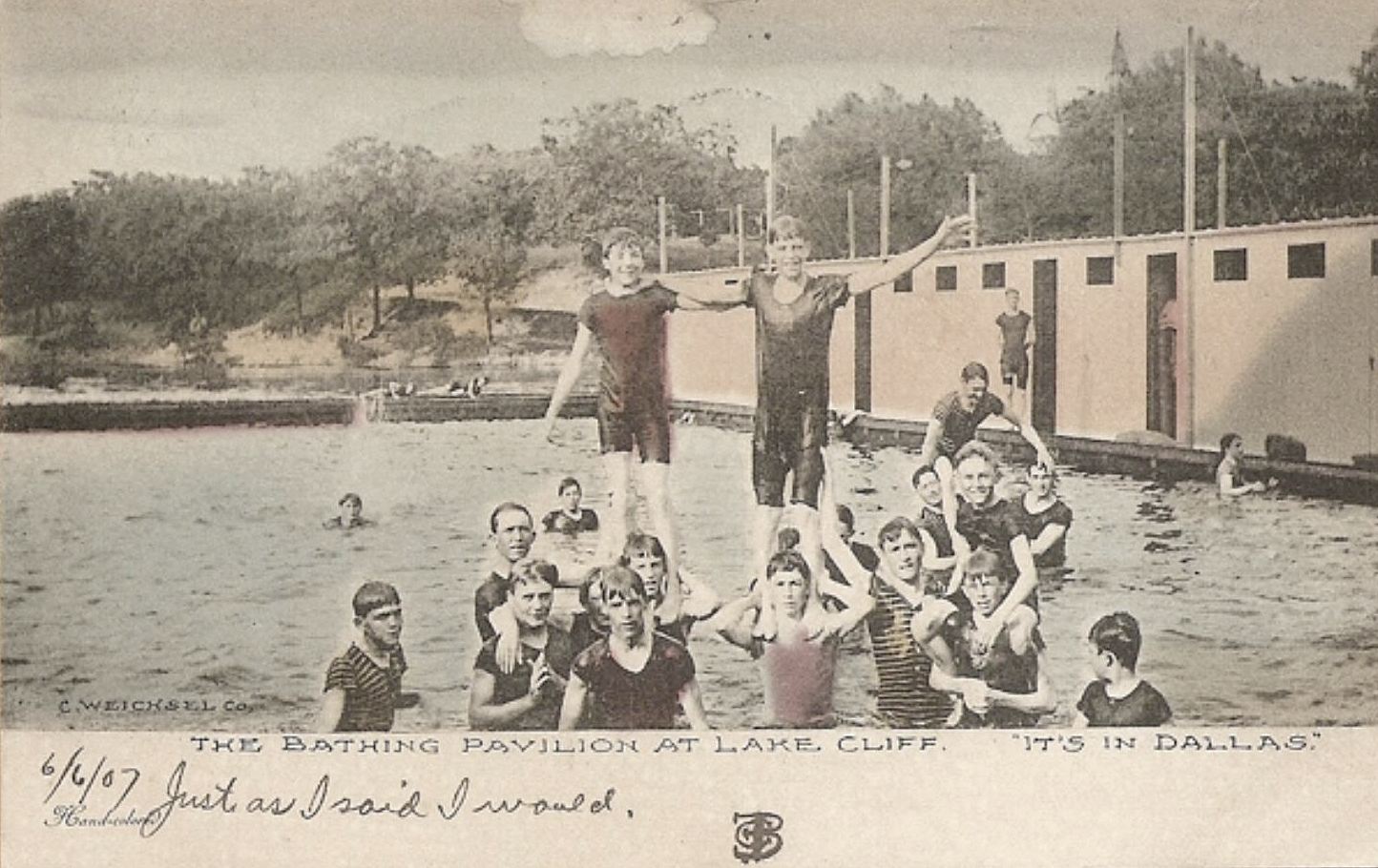
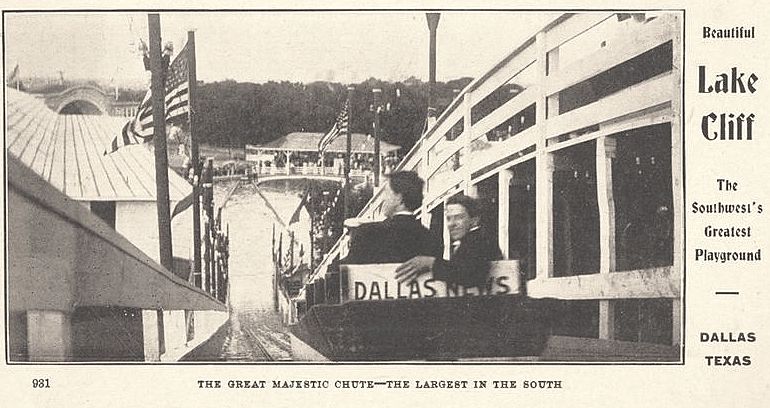
Enjoy these images of Lake Cliff, which, 100 years ago, was “the greatest amusement park in the Southwest.” The slogan “It’s in Dallas” should really have read “It’s in Oak Cliff” — and back then Oak Cliff had everything!

  • Mystic River
  • Shoot-the-Chutes (read this!)
  • Open-Air Circus
  • Roller Coaster
  • Casino
  • Natatorium
  • Carousel
  • Tennis Courts
  • Restaurant
  • Baseball Grounds
  • Skating Rink
  • Trolley Cars
  • Penny Vaudeville
  • Casino Band and Orchestra
  • Circle Swing
  • Japanese Village
  • Boating
  • Swimming
  • Ferris Wheel

Whew.

Below, some wonderful postcards and photos. (Click to see larger images.)

The first one shows the cafe and the “circle swing” (see a swing in action here).

lake-cliff_swing-ride_postcard_ebay

lake-cliff_c1910_postcard_degolyervia DeGolyer Library, Southern Methodist University

lake-cliff-bathing_1910s_postcard_degolyervia DeGolyer Library, SMU

swim_lake-cliff-pool_ca-1907_flickr_coltera

lake-cliff_flickr_coltera

lake-cliff_postcard

lake-cliff_shoot-the-chutes_1908

shoot-the-chute_lake-cliff_ebay

skating-rink_lake-cliff_cook-colln_degolyer_1via Cook Collection, DeGolyer Library, SMU

lake-cliff_sunday-afternoon-concert_1906_portal

lake-cliff_club-house-cafe_postcard_ebay

lake-cliff_postcard_weichsel_ebay

lake-cliff_entrance_postcard_ca-1905_ebay

lake-cliff-park_benches_ebay

lake-cliff-park_rose-garden

lake-cliff-pavilion_oak-cliff-high-school-yrbk_1925Oak Cliff High School yearbook, 1925

lake-cliff_clogenson_1908_LOCPhoto by Clogenson, ca. 1908, via Library of Congress

lake-cliff_1906_portal_attractions-1

lake-cliff_1906_portal_attractions-2From 1906 promotional brochure, via Portal to Texas History

Jump forward to the 1940s — when it was more of a big pool, without all the flash and filigree:

swim_lake-cliff-pool_1947_flickr_coltera

Take a look at it now in this stunningly beautiful drone video by Matthew Armstrong:

*

***

Sources & Notes

Top image is from a postcard in the George W. Cook Collection at SMU’s DeGolyer Library, here.

Most other uncredited images were found around the internet, several from Coltera’s Flickr stream.

More on Lake Cliff can be found in this article by Rachel Stone from the Oak Cliff Advocate (be sure to click the link to see the full 1906 promotional brochure on “the Southwest’s greatest playground” (it’s “Clean, Cool, Delightful”)).

lake-cliff_cook-colln_degolyer_smu_sm

*

Copyright © 2019 Paula Bosse. All Rights Reserved.
Rip Torn and Ann Wedgeworth’s Dallas Wedding — 1955

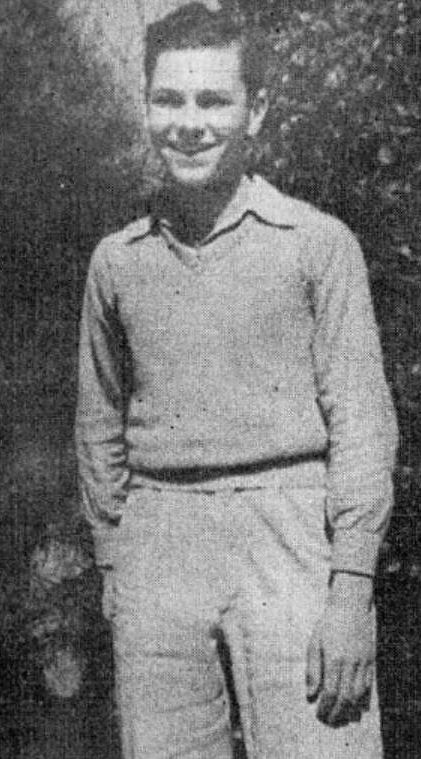
1948_torn-rip_taylor-high-school_1948-yrbk_senior-photo
E. R. “Rip” Torn, the pride of Taylor High School

by Paula Bosse

One of my favorite actors — Rip Torn — has died. My favorite performance of his was as Larry Sanders’ producer, Artie, on The Larry Sanders Show. He was PERFECT in that role. And I loved a little-seen movie he did in the ’70s called Payday in which he played a hard-living country-music singer (watch the trailer here; the full movie is currently on YouTube). But, really, I liked him in everything I saw him in.

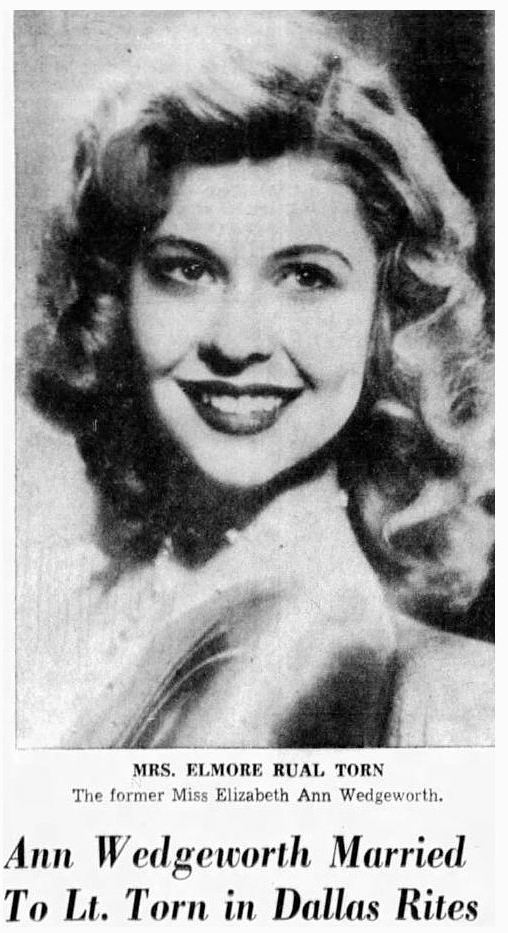
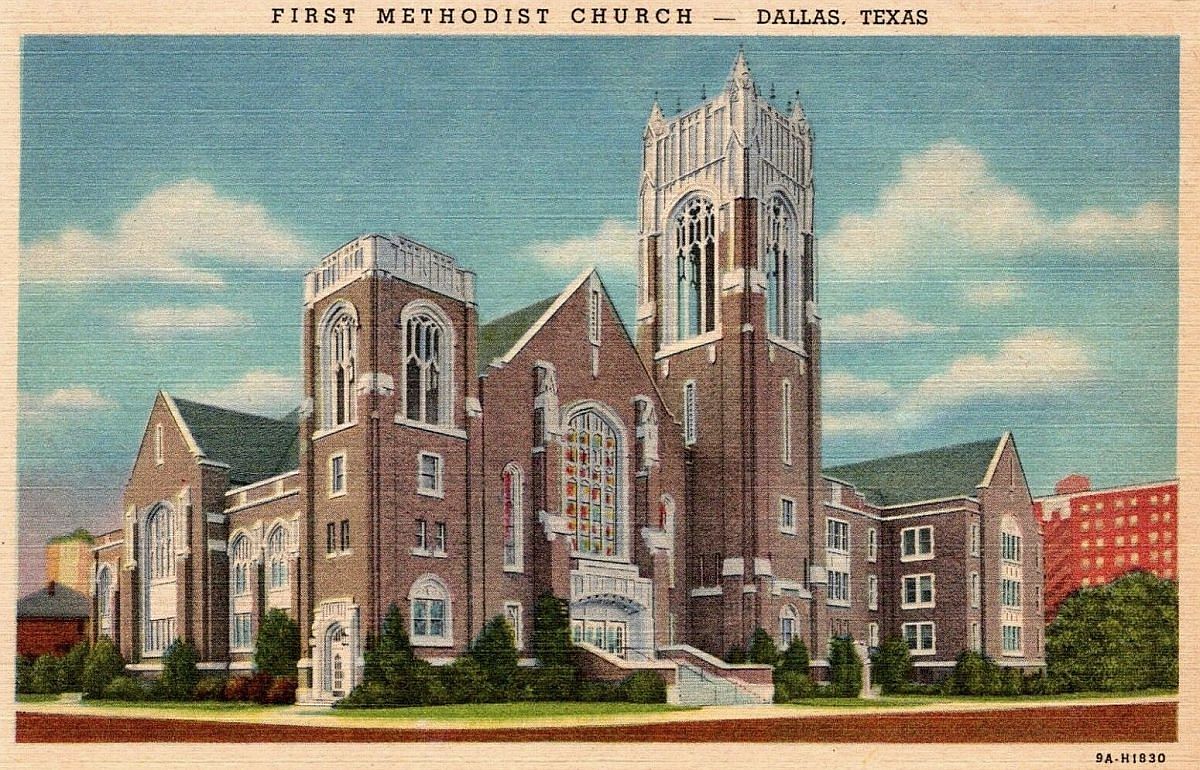
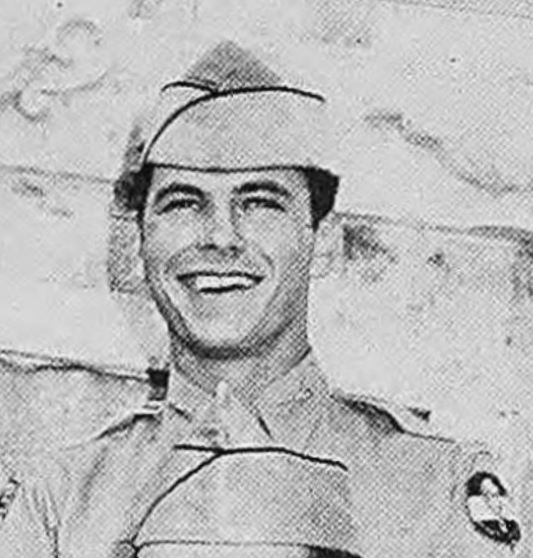
A couple of years ago I wrote about Dallas-reared actress Ann Wedgeworth and was surprised to discover that she had been married to fellow Texan Rip Torn (born Elmore Rual Torn) and their wedding had been in Dallas. They had probably met in Austin in 1952 or 1953 when both were members of the University of Texas Curtain Club acting group. They were married in downtown Dallas on Saturday, January 15, 1955 at First Methodist Church on Ross and Harwood, with Rev. Calvin W. Froehner officiating. The 20-year-old bride wore rose-hued lace and satin; the 23-year-old groom probably wore a military uniform as he was then serving in the U.S. Army Military Police.

torn-rip_ann-wedgeworth_wedding_austin-american_012555
Austin American, Jan. 25, 1955

torn-rip_ann-wedgeworth_wedding_taylor-daily-press_012355
Taylor (TX) Daily Press, Jan. 23, 1955

methodist_first-methodist-church_ebay

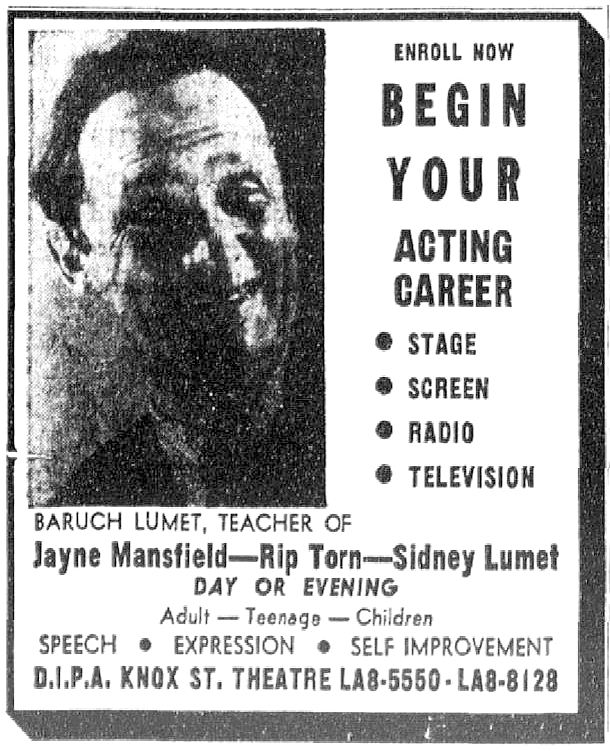
At some point — probably around the time of his marriage — Rip (and possibly Ann) took acting lessons at the Dallas Institute of Performing Arts on Knox Street. D.I.P.A. was run by Baruch Lumet (father of Hollywood director Sidney Lumet).

torn-rip_lumet-acting-school-ad_061558
1958

Rip (who was called “Skip” as a child, which is nowhere near as good as “Rip”) moved to New York later in 1955 when Rip’s army hitch was finished, and both began working in New York theater fairly soon after their arrival. They had a daughter Danae and were married until their divorce in 1961.

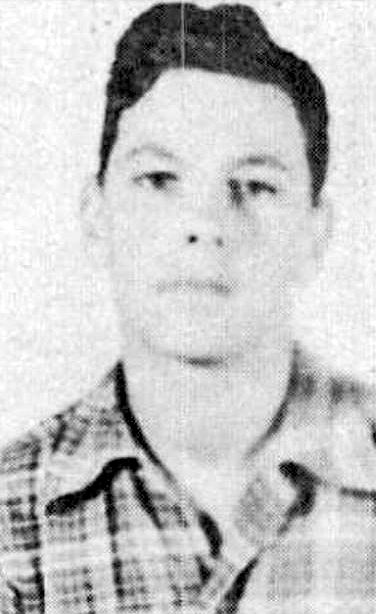
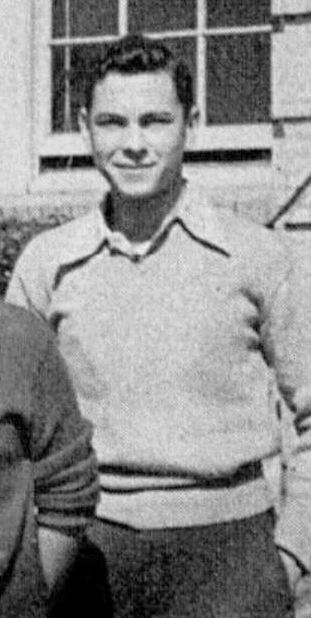
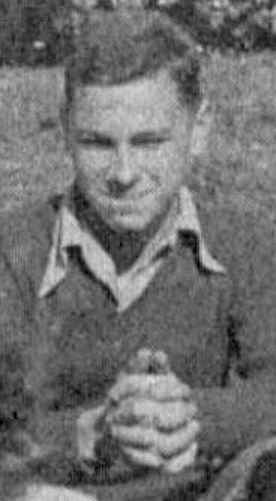
Below are a few photos of Rip Torn from high school and college yearbooks. (Most images are larger when clicked.)

1946_torn-rip_longview-high-school_1946-yrbk_sophomore-photo
1946, Longview (TX) High School, sophomore

1947_torn-rip_longview-high-school_1947-yrbk_junior-photo
1947, Longview High School, junior

1947_torn-rip_longview-high-school_1947-chemistry-club-president
1947, Longview High School, Chemistry Club president

1947_torn-rip_longview-high-school_1947-school-paper-sports-editor
1947, Longview High School, sports editor of the school paper

1947_torn-rip_longview-high-school_1947-yrbk_junior-class-treasurer
1947, Longview High School, Junior Class treasurer

1948_torn-rip_taylor-high-school_1948-yrbk_senior-photo
1948, Taylor (TX) High School, senior

1948_torn-rip_taylor-high-school_1948-yrbk_annual-business-mgr
1948, Taylor High School, yearbook staff, business manager

1950_rip-torn_tx-a-and-m_soph_class-officer
1950, Texas A & M, Sophomore Class parliamentarian

1951_torn-rip_radio-guild_UT_1951-yrbk
1951, University of Texas, junior, Radio Guild

1952_torn-rip_UT_yrbk_1952_sigma-chi
1952, University of Texas, senior, Sigma Chi fraternity

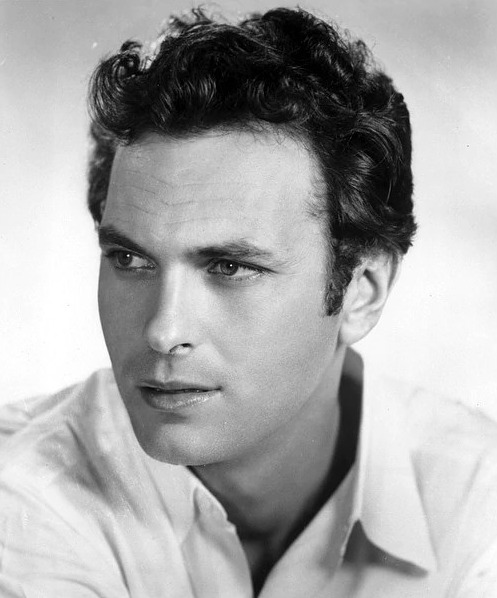
rip-torn_glamor-shot
Hollywood glamour shot

RIP, Rip (1931-2019).

***

Sources & Notes

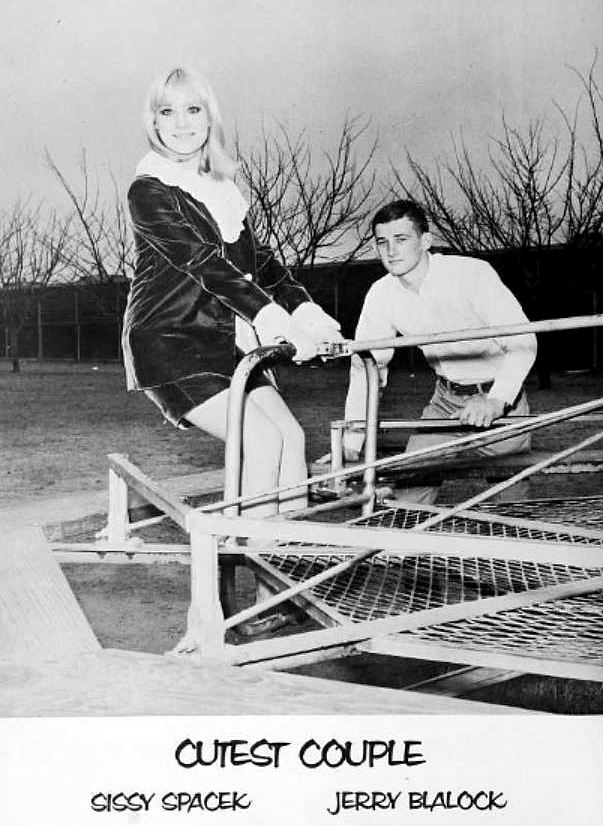
Rip Torn had a famous first-cousin, Sissy Spacek — Rip’s mother and Sissy’s father were brother and sister. I checked the Quitman High School yearbook (Sissy’s alma mater) and found her mod and groovy 1968 senior photos. Here’s one, showing her as a class favorite, voted “Cutest Couple” with Jerry Blalock. (And, yes, that really is her.)

spacek-sissy_quitman-high-school_senior-photo_1968_cutest-couple

And, since I’m on a roll, here’s a photo of Rip Torn’s mother, Thelma Spacek, when she was a student at Southwestern College (Georgetown, TX) in 1927. Rip had that same profile.

torn-rip_mother_thelma-spacek_southwestern-univ_georgetown_1927

*

1948_torn-rip_taylor-high-school_1948-yrbk_senior-photo_sm
RIP

*

Copyright © 2019 Paula Bosse. All Rights Reserved.
 

The Wilson Building and the *New* Wilson Building — 1911

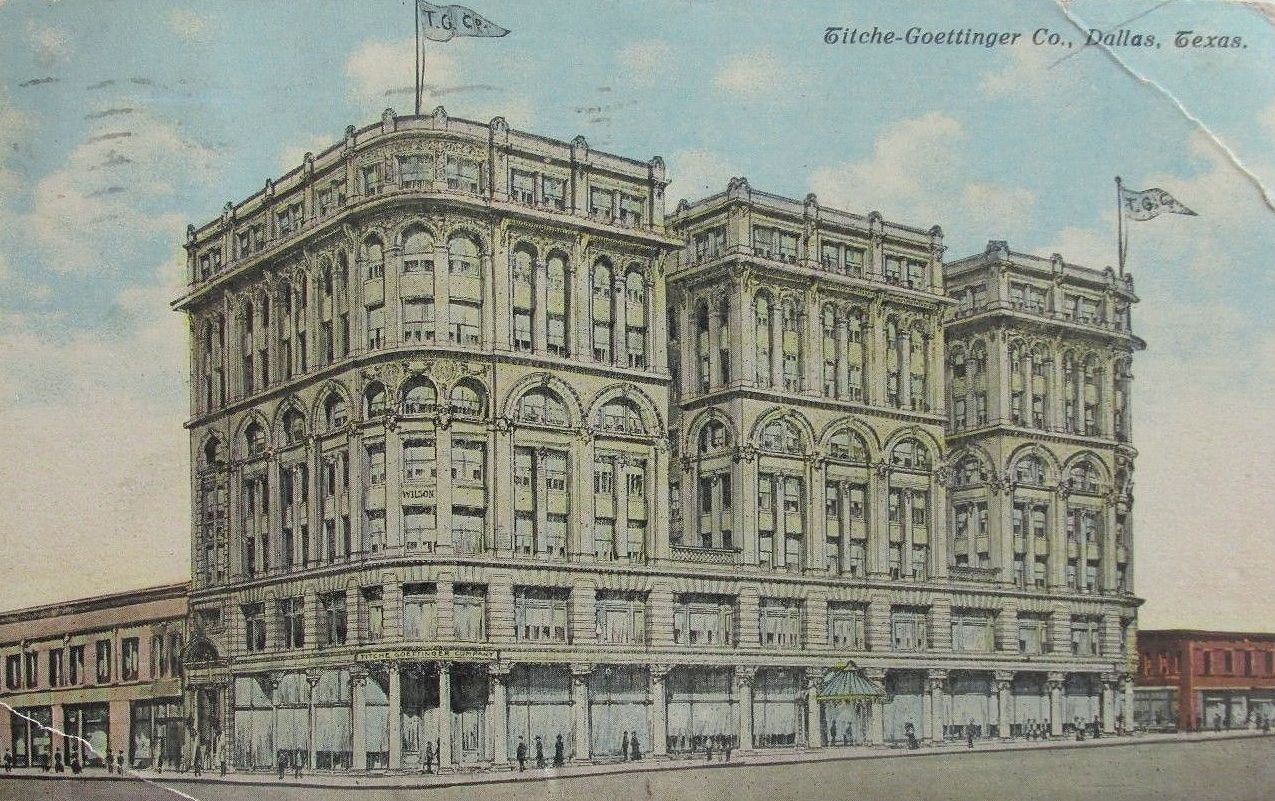
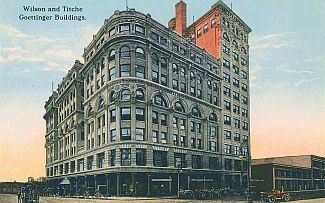
wilson-bldg_titches_postcard
Elm and Ervay… (click for larger image)

by Paula Bosse

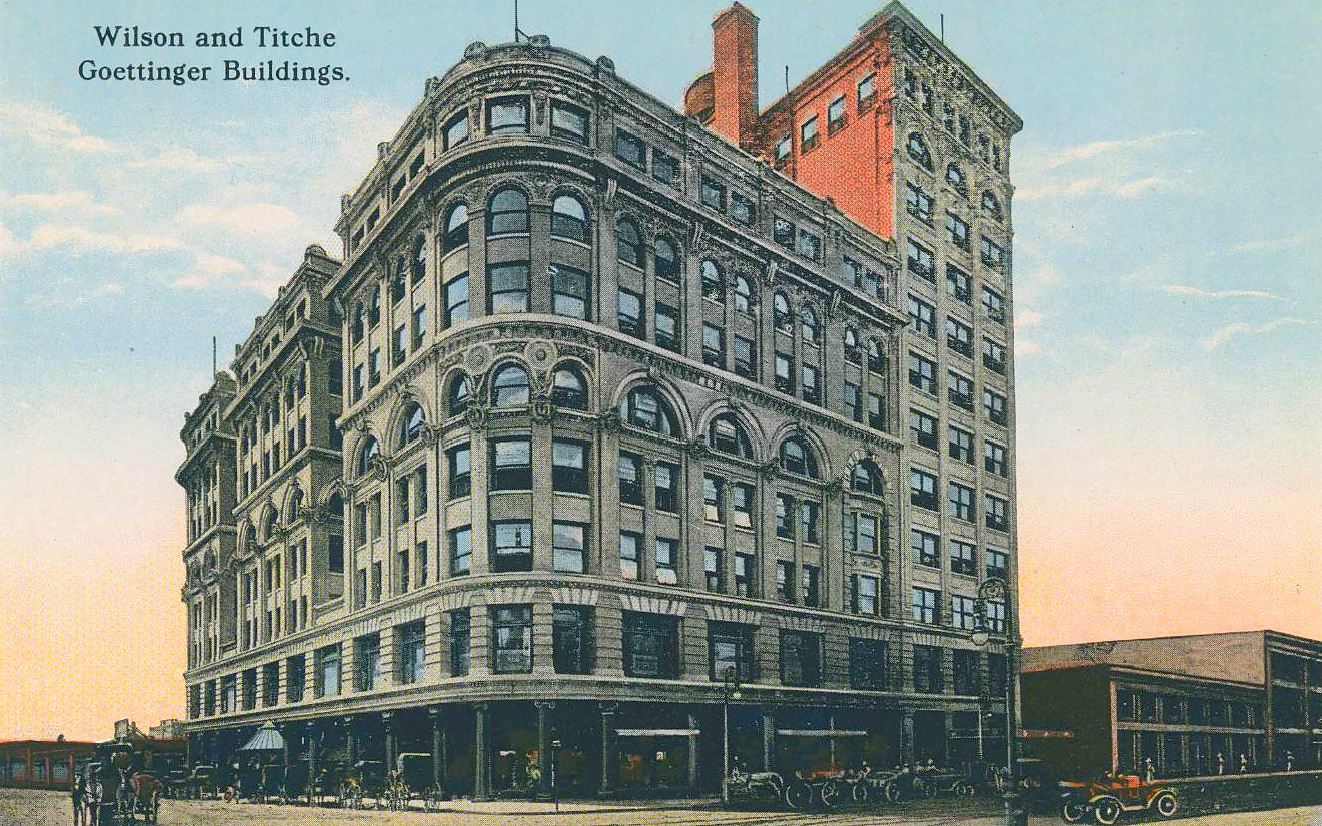
This beautiful postcard shows the original eight-story Wilson Building, built by J B. Wilson in 1902-1904, and its twelve-story companion, which was known as both the “New Wilson Building” and the “Titche-Goettinger Annex” when it was built in 1911. Remarkably, both buildings are still standing at Main-Ervay-Elm. (The view above is looking southwest, with Ervay at the left, and Elm at the right. See this view today on Google Street View here.)

The original building — surely one of Dallas’ most beautiful landmarks — was the home of the Titche-Goettinger department store (which occupied the first two floors and the basement) as well as an important downtown office building. Until seeing this postcard, I had no idea there was a porte-cochère facing Ervay (it can be seen above at the left, under the parasol-like canopy).

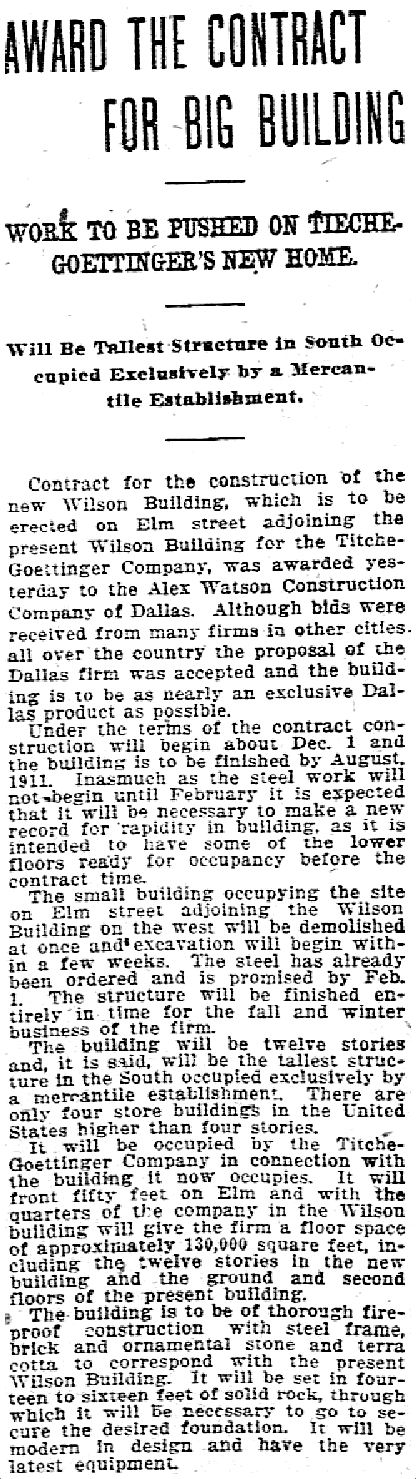
By 1910 Titche’s was so successful that it needed to expand, and it was decided that a new “skyscraper” would be built right next door — the department store would continue to occupy its space in the “old” Wilson Building but would also take over the new building (occupying all twelve floors!). According to The Dallas Morning News, the new building would be “the tallest structure in the South occupied exclusively by a mercantile establishment. There are only four store buildings in the United States higher than four stories” (DMN, Nov. 13, 1910).

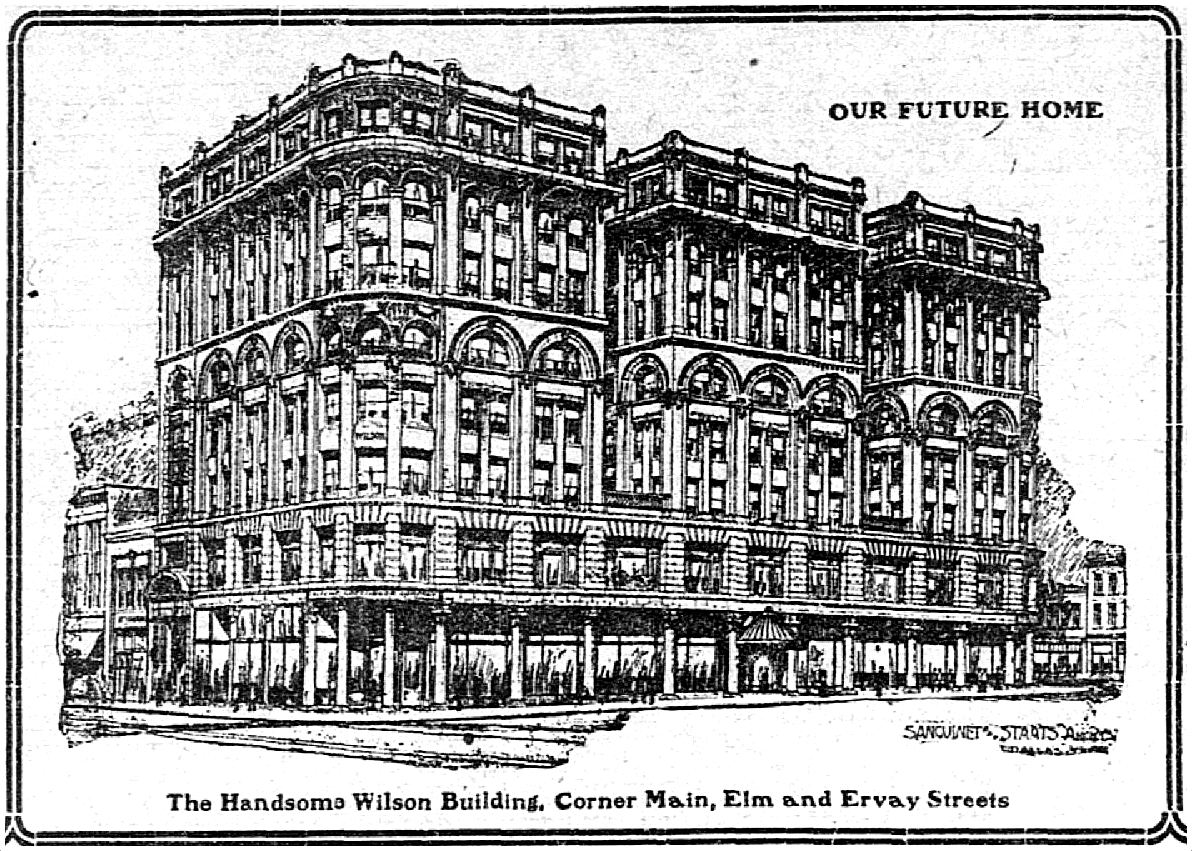
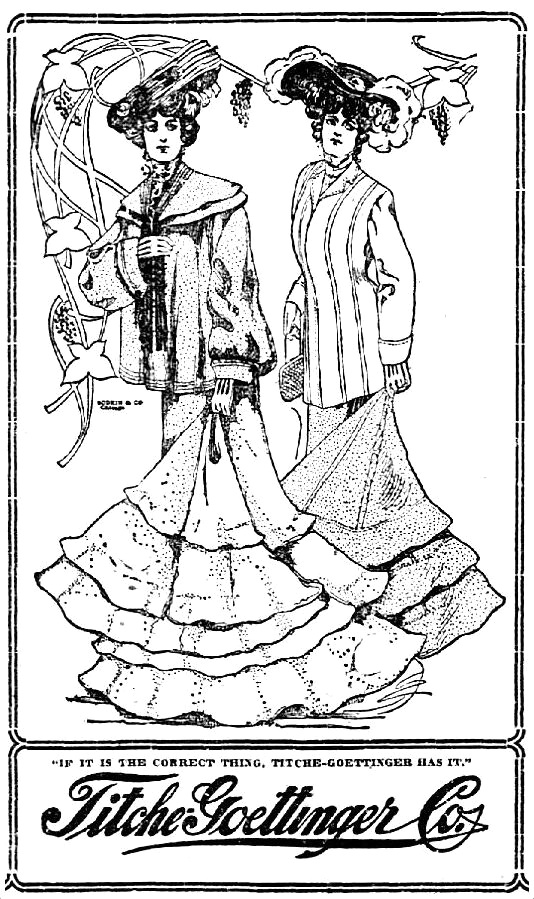
Below are a couple of details from a “coming soon” ad from Titche-Goettinger in September, 1903, showing a drawing of the building (still under construction) from the Fort Worth architectural firm Sanguinet & Staats. (All images are larger when clicked.)

wilson-bldg_titches_092703_coming-soon_ad-det_1DMN, Sept. 27, 1903

wilson-bldg_titches_092703_coming-soon_ad-det_2DMN, Sept. 27, 1903

titche-goettinger_wilson-bldg_postcard_postmarked-1912

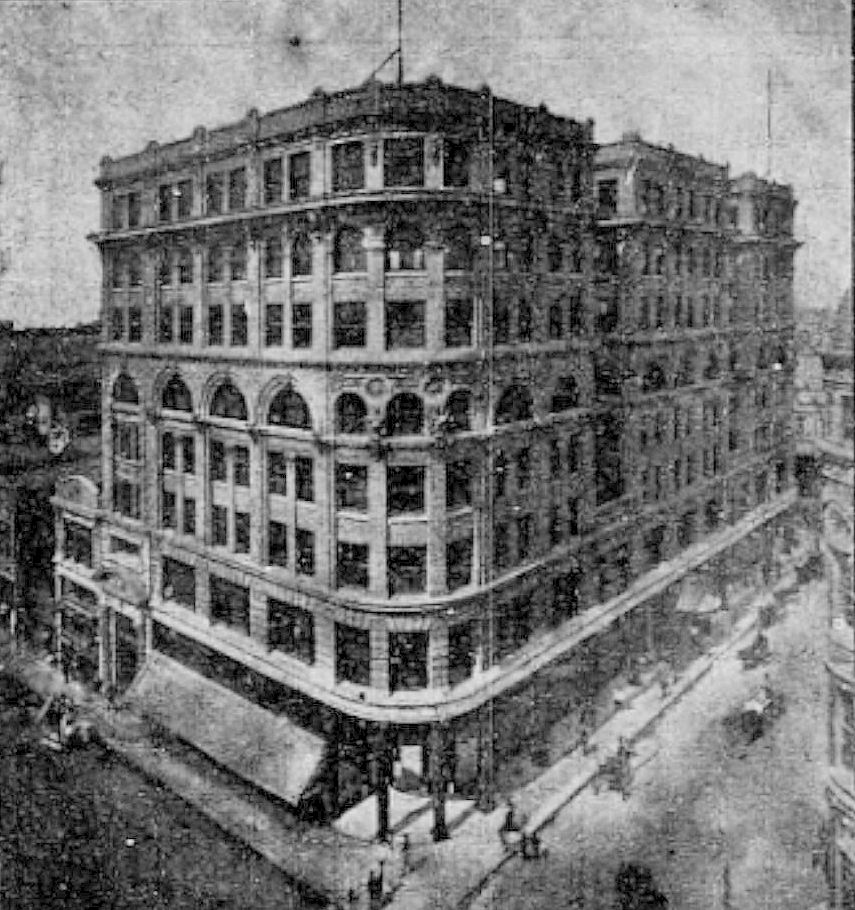
The two photos and article below ran in The Dallas Morning News on March 13, 1904 under the headline “Completion of the Great Eight-Story Wilson Building in Dallas.” The caption of the photo immediately below read “This view was taken from the postoffice, and is the first to show the entire Ervay street front.”

wilson-bldg_dmn_031304_newly-completed_clogenson

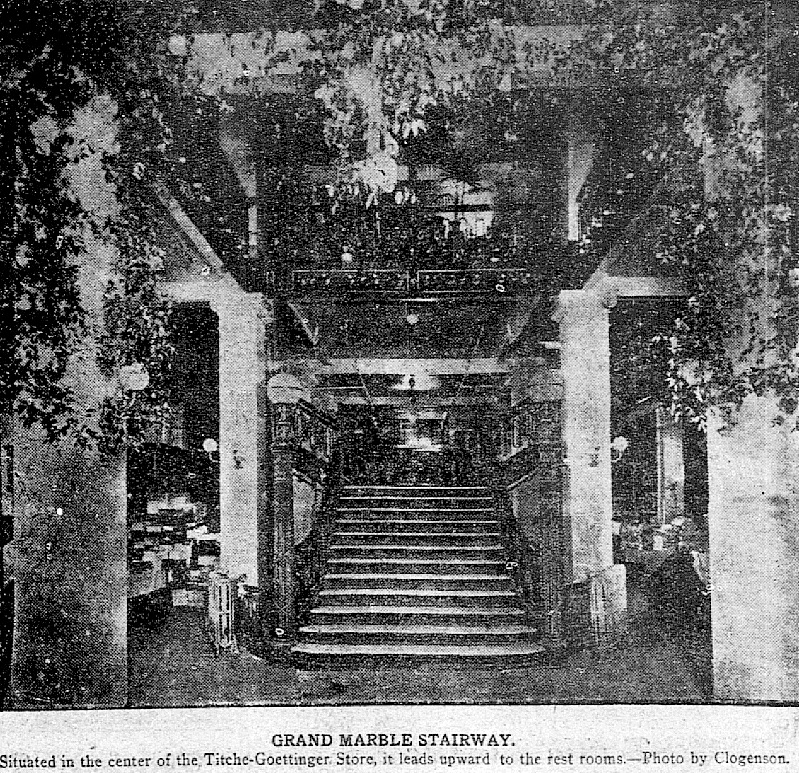
Although the quality of the image below isn’t great, it’s interesting to see this “grand marble stairway,” a feature which was removed in 1911 while the new “annex” was under construction, in order to give Titche’s even more room. The grand staircase was replaced by elevators. (The “rest rooms” referred to in the caption were more “lounge” than bathroom — a place where ladies could sit, relax, and even jot off a few letters as they recovered from their bout of intense shopping.)

wilson-bldg_dmn_031304_grand-stairway_clogenson

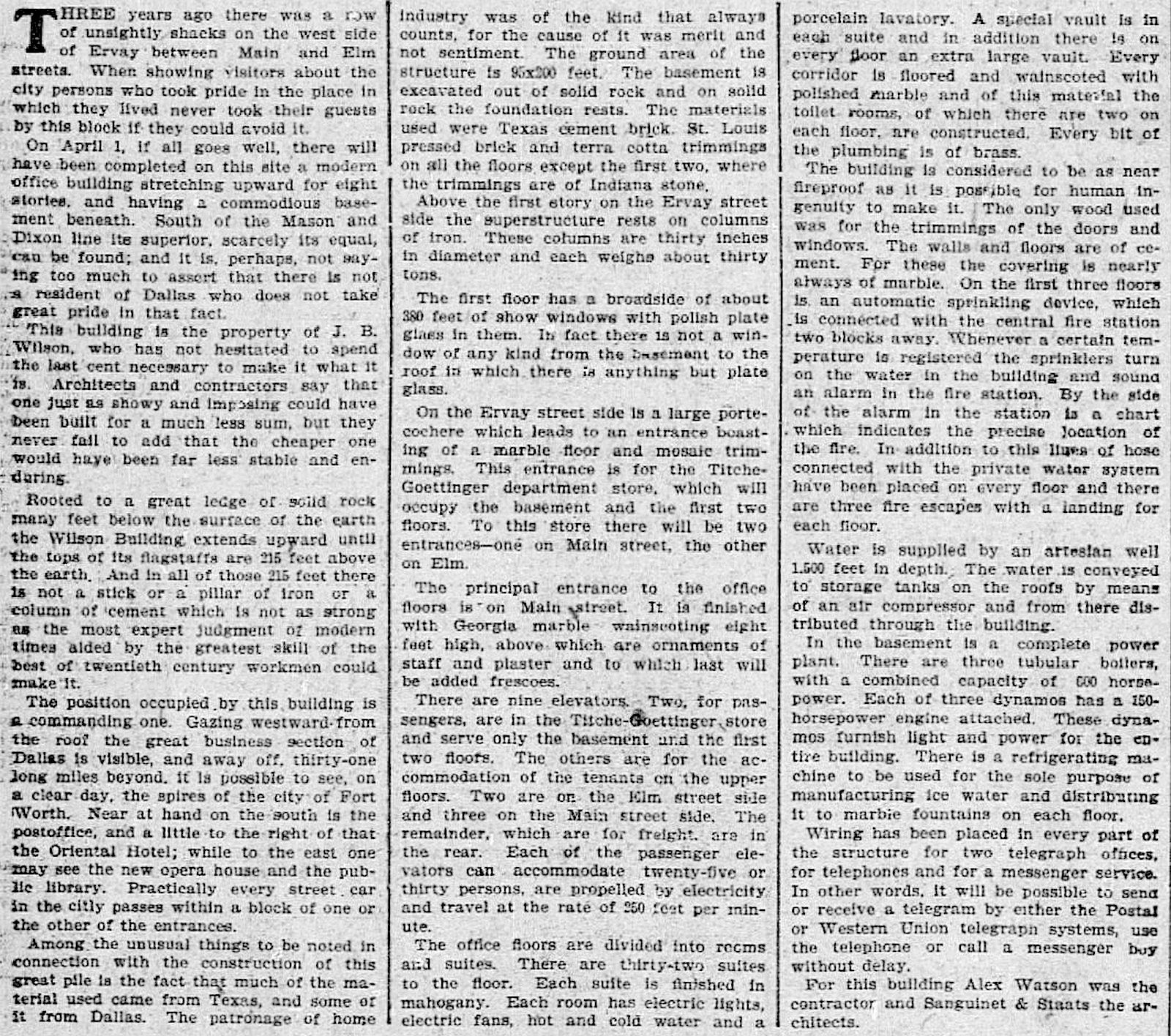
The accompanying article (click to read):

wilson-bldg_dmn_031304_completed_textDMN, March 13, 1904

Jump forward six years to the announcement of the “new” Wilson Building:

wilson-bldg_expansion_dmn_111310DMN, Nov. 13, 1910

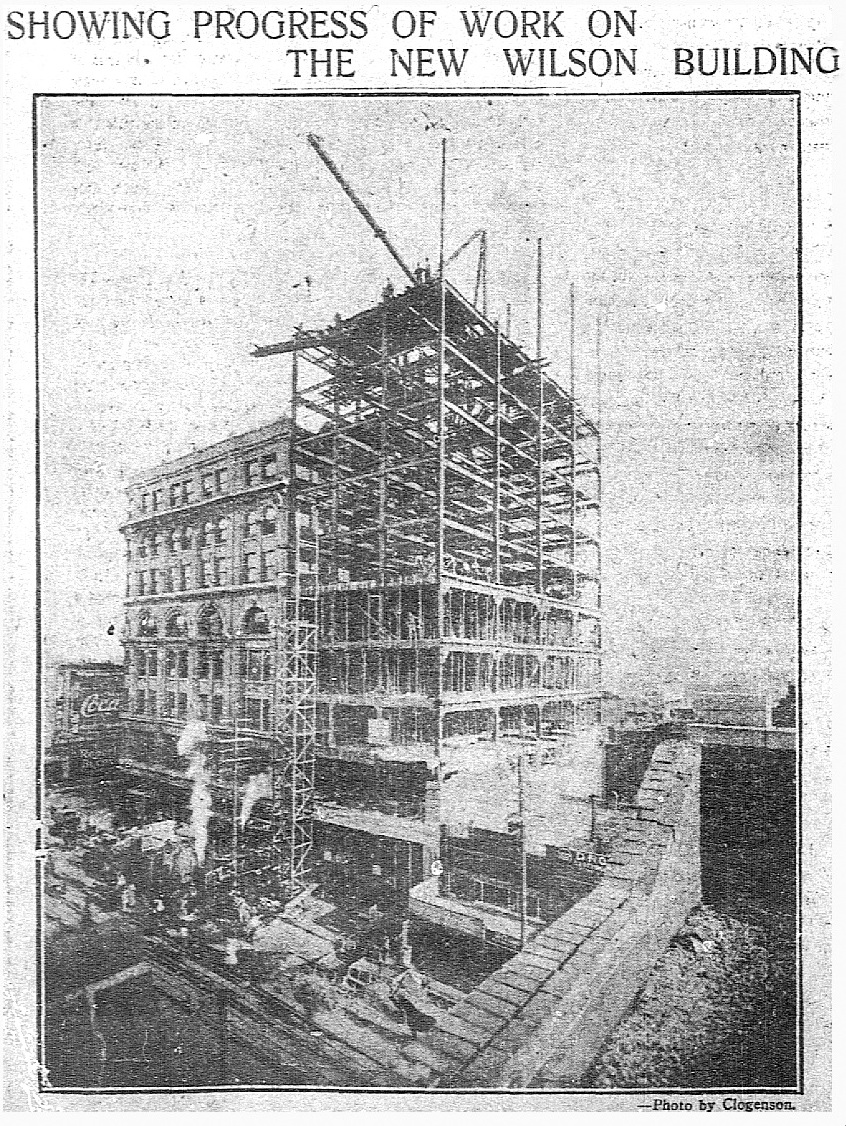
Here it is under construction:

wilson-bldg_expansion_dmn_032811_clogensonDMN, March 28, 1911

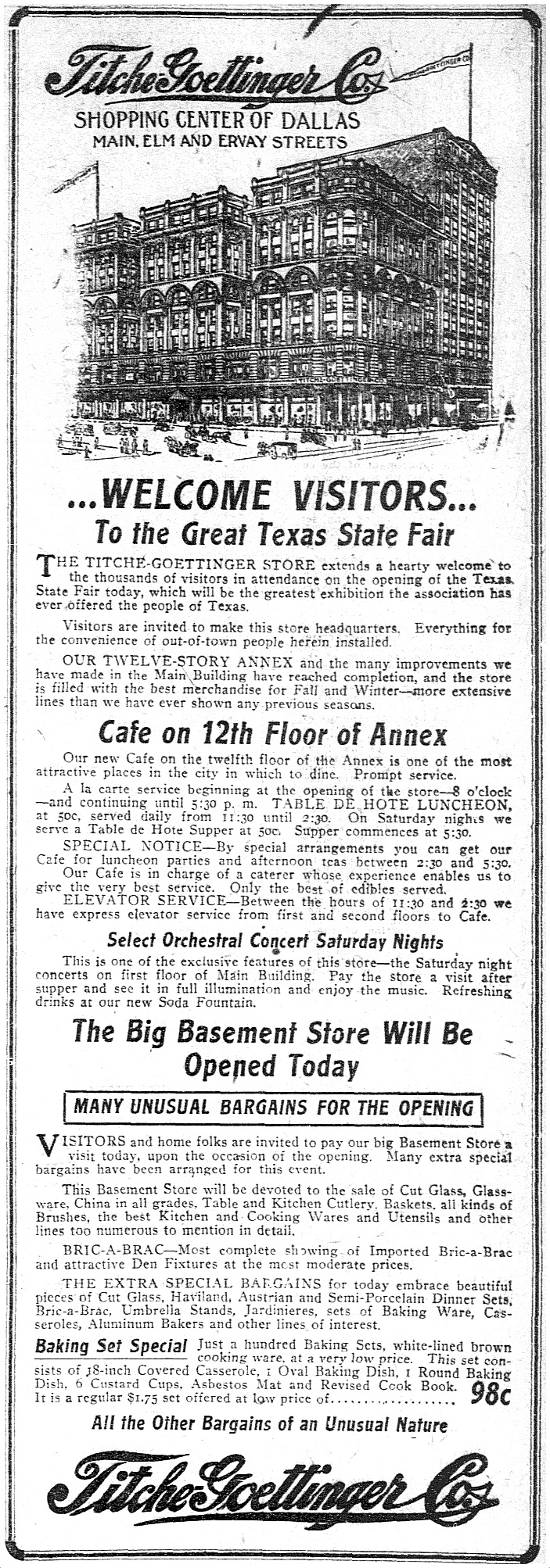
They rushed to be ready to open in time to dazzle State Fair of Texas visitors — and they made it:

wilson-bldg_titche-annex_101411DMN, Oct. 14, 1911

And, below, the completed building, in a photo looking east on Elm (this photo shows one of the brand new street lights written about in the post “The Grand Elm Street Illumination — 1911”). (See this view today on Google Street View, here.)

wilson-bldg_expansion_dmn_121611_clogensonDMN, Dec. 16, 1911

*

wilson-bldg_titches_postcard_sm

***

Sources & Notes

See photos of the original building under construction in the Flashback Dallas post “The Wilson Building Under Construction — 1902.”

I love looking at Sanborn maps. See what was going on at Main-Ervay-Elm in 1899 (before any Wilson buildings), in 1905 (one year after the arrival of the first one), and in 1921 (ten years after the annex went up).

*

Copyright © 2019 Paula Bosse. All Rights Reserved.
Theaters at 1517 Elm: The Garden, The Jefferson, The Pantages, The Ritz, and The Mirror — 1912-1941

garden-theatre_ca-1912_ebayThe Garden Theatre, ca. 1912

by Paula Bosse

The photo above shows the Garden Theatre, located at 1517 Elm, on the north side of the street, between Akard and Stone Street. It was opened in the fall of 1912 by partners W. J. Brown and R. J. (Ray) Stinnett (who also operated the Cycle Park Theatre at Fair Park). The Garden was a vaudeville stop for touring companies.

1912_garden-theatre_variety_sept-1912Variety, Sept. 1912

It was one of many local theaters which simulcast World Series baseball games via telegraph updates, in the days before radio and TV (I wrote more about this fascinating subject here).

1912_garden-theatre_101612Oct. 16, 1912

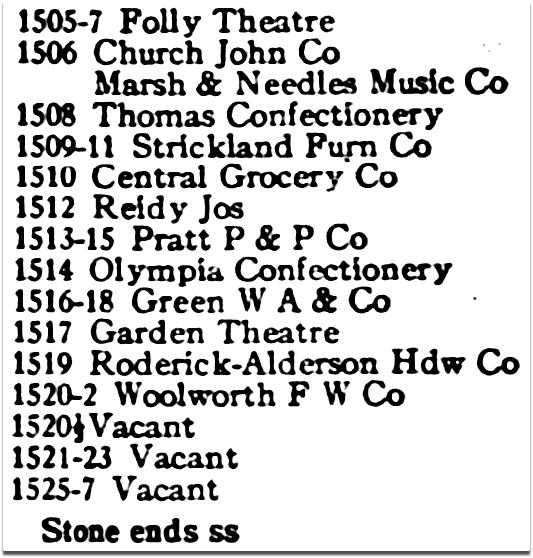
As seen in the top photo, the Garden Theatre sat between the Pratt Paint & Paper Co. and the Roderick-Alderson Hardware Co.

garden-theatre_1913-directory_1517-elm1913 Dallas city directory

The photo at the top was found on eBay, with the seller-provided date of 1912. Zooming in, one can see a placard in front of the theater advertising the appearance of the Hendrix Belle Isle Musical Comedy Company (misspelled on the sign as “Henndrix”) — for many years this troupe toured with a production called “The School-Master”/”School Days,” the very production seen here on offer to audiences at the Garden. (Read a review of a 1912 Coffeyville, Kansas performance of the troupe’s bread-and-butter act here.)

garden-theatre_ebay_det

In April, 1913 Brown and Stinnett split, with Brown taking the Cycle Park action and Stinnett keeping the Garden (and a handful of other theaters).

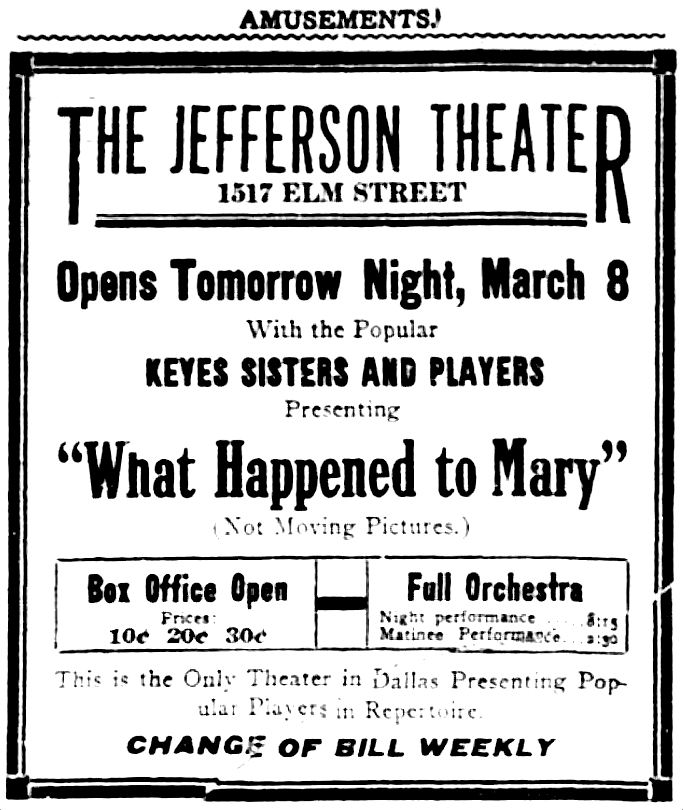
On March 8, 1915 the theater changed its name and reopened as the Jefferson Theater. As the ad below stated, “This is the only theater in Dallas presenting popular players in repertoire […] Not moving pictures.”

1915_jeffersosn-theater-opens_dmn_030715March 7, 1915

I’m not sure where the “Jefferson” name came from, but….

jefferson-theater_061115June 11, 1915

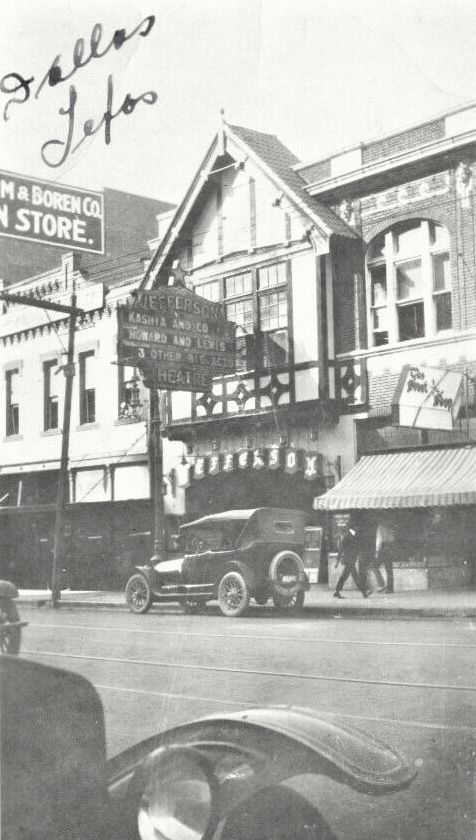
The photo below shows the Jefferson with an unusual olde-English-style half-timbered facade — I doubt that lasted long. The photo is undated, but the marquee advertises vaudeville mainstays Kasmir & Co. (Sophie Kasmir — or Sophia Kasmir — was a prima donna of note) and comedians Howard & Lewis.

theater_jefferson-theater_RPPC_ebayeBay

There were a few back-and-forths as far as operators and leases of the Jefferson, but in 1923, Ray Stinnett “sold” (or probably more accurately sub-leased) the theater in order to concentrate on his other (bigger! better! brighter!) venture, the next-door Capitol Theater, but he reacquired it in 1925 and renamed it the Pantages. (This has caused confusion, with some thinking it had become the Pantages earlier — the confusion is understandable, as the Jefferson was affiliated with the Pantages vaudeville circuit between 1917 and 1920, and during that time the word “Pantages” appeared prominently on the theater’s marquee, but it was still the Jefferson. See a photo from May, 1925, showing the Jefferson from the Pacific side here, after it had become a Loew’s-affiliated theater.)

The Jefferson became the Pantages Theater on December 27, 1925, when Stinnett opened the newly remodeled venue which offered vaudeville stage acts as well as motion pictures. (All images are larger when clicked.)

pantages-opening_122725Dec. 27, 1925

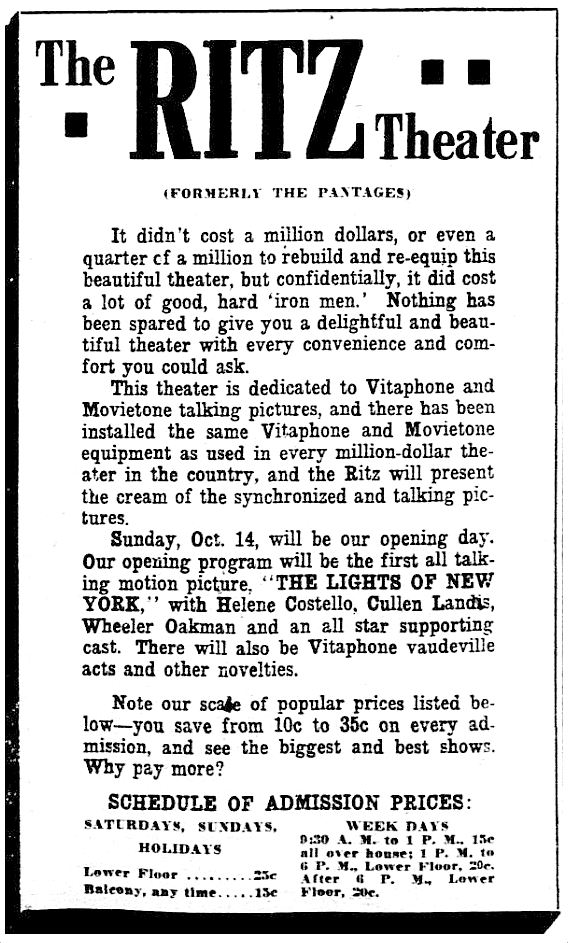
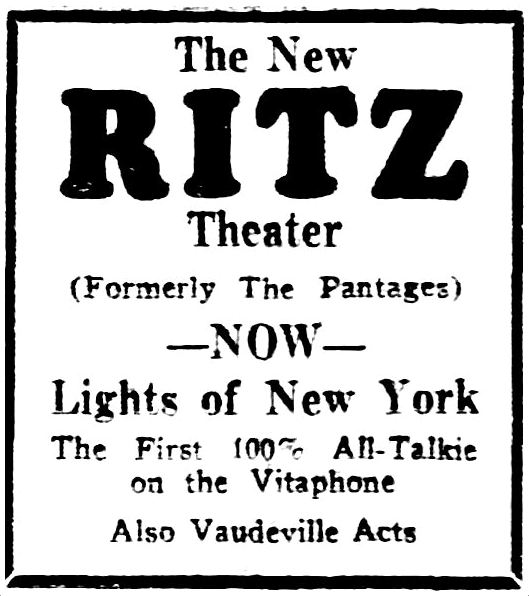
That incarnation didn’t last too long. Goodbye, Pantages, hello, Ritz. The Ritz Theater opened on October 14, 1928, operated by the R & R (Robb & Rowley) chain but leased from Stinnett. The first film shown was “The Lights of New York,” the first all-talking feature-length movie.

1928_ritz_101028Oct. 10, 1928

1928_ritz_101328
Oct. 13, 1928

1928_ritz_101528Oct. 15, 1928

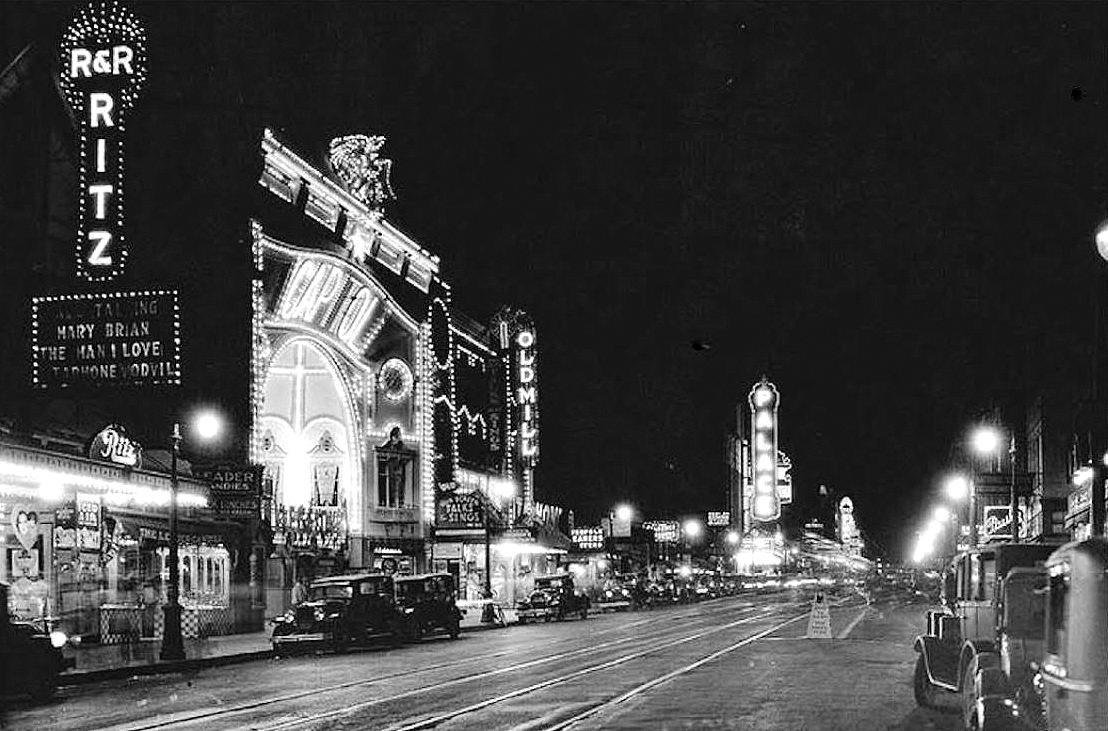
Below, a 1929 photo showing the 1500 and 1600 blocks of Elm Street, the heart of Theater Row: seen here are the Ritz, Capitol, Old Mill, and Palace theaters (the regal Queen was a few doors west of the Ritz, at the corner of Elm and Akard).

ritz_capitol_old-mill_palace_photo_sherrodphoto from “Historic Dallas Theatres” by D. Troy Sherrod

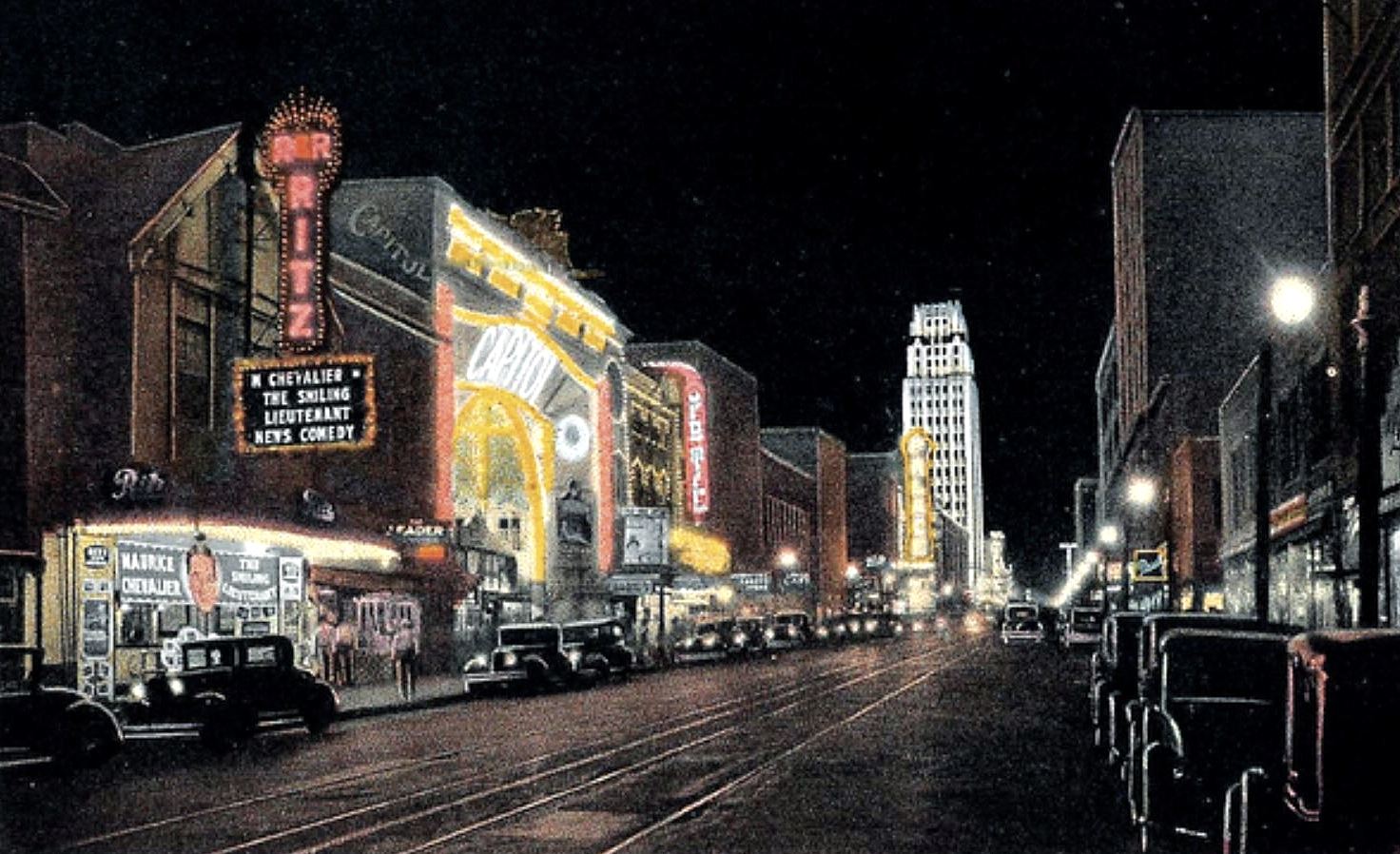
A postcard showing the Ritz (and neighbors) a couple of years later, in 1931:

ritz_capitol_old-mill_palace_postcard_cinematreasures

But the Ritz didn’t last all that long either — a little over three years.

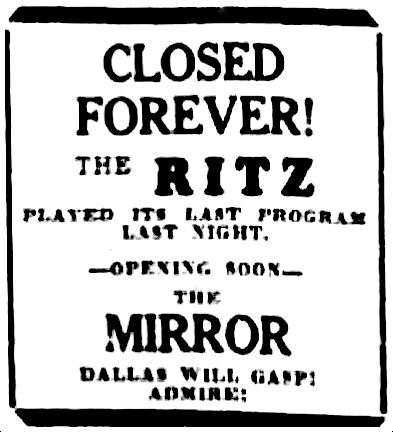
1931_ritz-mirror_120831Dec. 8, 1931

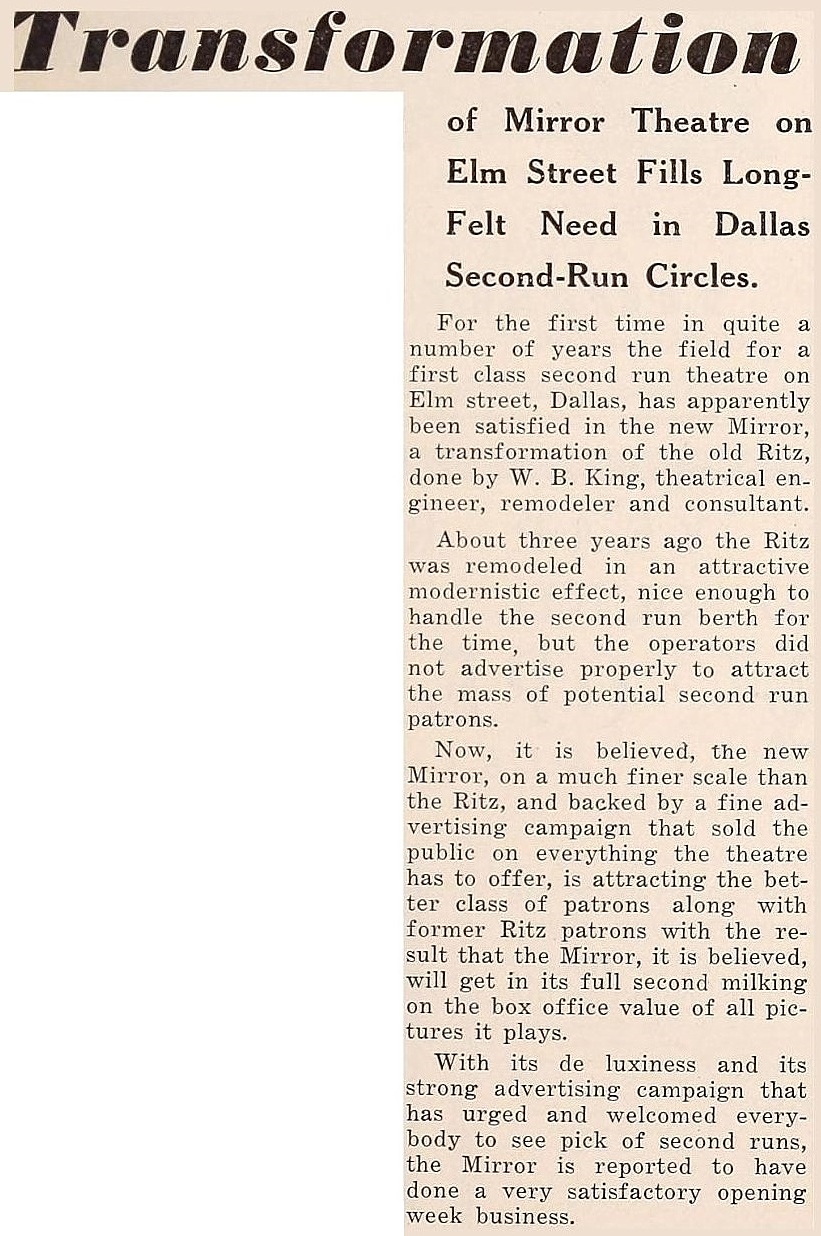
In 1931 the theater was acquired by the Hughes-Franklin company (as in Howard Hughes, the super-rich Texan who had an obsession with Hollywood). The plan was to renovate the building and rename it the Mirror, “a duplicate, in so far as possible, of the famous Mirror Theater of Hollywood. A feature will be the extensive use of mirrors in the lobby and foyer” (Dallas Morning News, Nov. 29, 1931).

mirror_motion-picture-times_122931Motion Picture Times, Dec. 29, 1931

The Mirror Theater opened at 1517 Elm on Christmas Day, 1931.

1931_mirror_122531
Dec. 25, 1931

Theater Row, 1936:

theater-row_mirror_march-1936

More Elm Street:

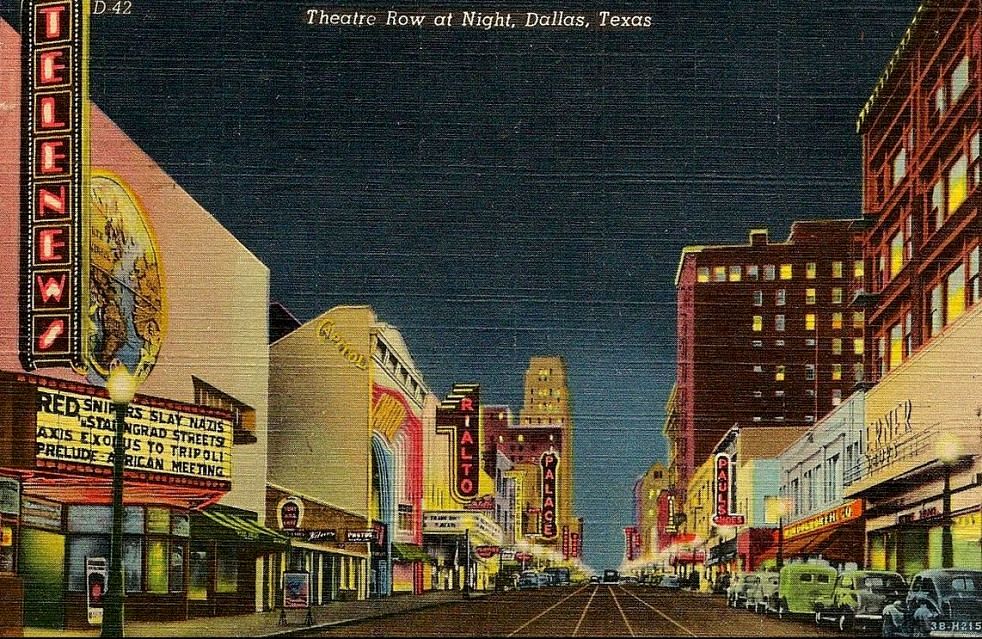
mirror-capitol-rialto-palace-melba-majestic_theater_row_night_big

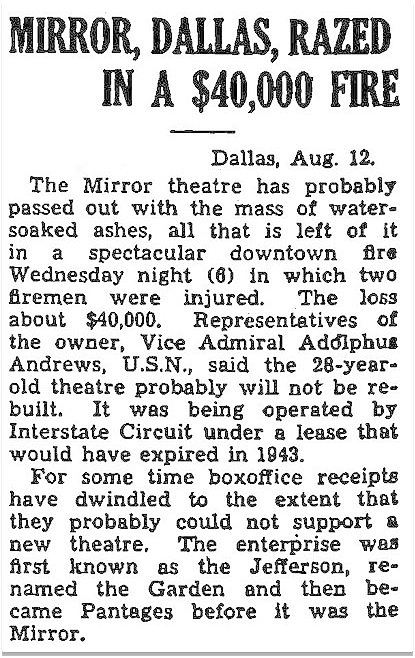
The Mirror chugged on for several years as a second-run house, apparently less and less profitable as the years passed. On August 4, 1941 the theater burned down in an early-morning fire. The property owner, Vice Admiral Adolphus Andrews, decided against rebuilding.

mirror-fire_variety_081341Variety, Aug. 13, 1941

Here’s the same view as seen above, only now the space next to the Capitol is a nondescript one-story retail building. (The Telenews, a theater showing newsreels, opened in November 1941.)

telenews_missing-mirror-post-fire_capitol_postcard

Below, a photo from around 1942, the first time in 30 years without a theater at 1517 Elm Street.

theater-row_by-george-mcafee_degolyer_SMUphoto via the DeGolyer Library, SMU

***

Sources & Notes

Top photo of the Garden Theatre is from an old eBay listing.

More Flashback Dallas posts on Dallas theaters can be found here.

*

Copyright © 2019 Paula Bosse. All Rights Reserved.
The Aldredge Book Store — 2909 Maple Avenue

abs_2909-maple-ave_erik-bosse
The last location of The Aldredge Book Store, next to the Stoneleigh Hotel

by Paula Bosse

Today is the birthday of my late father, Dick Bosse. For most of the life of The Aldredge Book Store, he either managed it or, later, owned it. The store’s first location was in an old Victorian house at 2800 McKinney Avenue, at Worthington (a photo showing the house with weirdly overgrown vegetation is here), the second location was at 2506 Cedar Springs, near Fairmount, and the final location was the one seen above, at 2909 Maple Avenue, right next door to the Stoneleigh Hotel. My brother, Erik, took the photo, sometime in the 1980s, I think. The Stoneleigh is the building partially seen at the right. The bookstore occupied the building’s lower floor, and the top floor was occupied by the engineering business of the owner, Ed Wilson.

We closed the store in the early 2000s, a few years after my father’s death. Erik and his friend Pete removed the letters spelling out the store’s name which were bolted to the brick exterior over the entrance. I came across them a few years ago and laid them out in my driveway (in a much jauntier arrangement than was seen on Maple).

abs_sign-letters_paula-bosse

As far as I can gather, the two-story building was built about 1930 and was originally a duplex — a classified ad shows that the lower floor (where the bookstore was) was a 6-room apartment with 3 bedrooms and a tile bath. Sometime in the late ’30s, building owner Glen Shumaker opened up the Dallas Music Center, where students (children and adults) took music lessons; a sort of “music business school” was also offered as part of the curriculum. That business seems to have been around at least into the early 1950s.

dallas-music-center_0527471947 ad

dallas-music-center_0124481948 ad

It was later the home of several businesses, including sales offices and an advertising company, a farming trade magazine, a correspondence school, and the Dallas Diabetes Association. I’m not sure when the bookstore moved in — maybe 1979 or 1980.

Sadly, the building was demolished in the early-to-mid-2000s and is currently a driveway/parking area for the Stoneleigh Hotel. It still surprises me to not see the old building when I drive by.

dick-bosse_aldredge-book-store
Dick Bosse

***

Sources & Notes

Photograph of The Aldredge Book Store by Erik Bosse; photo of the ABS letters by Paula Bosse.

Other Flashback Dallas posts on The Aldredge Book Store can be found here.

*

Copyright © 2019 Paula Bosse. All Rights Reserved.