Flashback : Dallas

A Miscellany: History, Ads, Pop Culture

Category: Leisure

Jimi Hendrix, Glen Campbell, Tiny Tim — In Dallas (…Separately), 1969

jimi_WFAA_042069_SMU_cThe Jimi Hendrix Experience, Love Field, 4/20/69 (Jones Film Collection, SMU)

by Paula Bosse

One of the advantages of living in a major American city is that all the biggest entertainers visit at one time or another. Let’s take three of the biggest entertainers of 1969: Jimi Hendrix, Glen Campbell, and Tiny Tim. All were huge, and all came to Dallas. And, luckily for us, they were captured on film in interviews by reporters from WFAA-Channel 8. 

For me, without question, the most exciting interview was the one with Jimi Hendrix, who, standing on the tarmac of Love Field with bandmates Mitch Mitchell and Noel Redding on April 20, 1969 (yes, 4/20…), gives a great, relaxed interview to a very lucky Channel 8 reporter, Doug Terry. (I love the look on Terry’s face throughout the interview.) Watch it here:


A few screenshots (click to see slideshow):

April 20, 1969, WFAA-Ch. 8 News (Jones Film Collection, SMU)

4/20/24 UPDATE: After several years of trying to contact the reporter, Doug Terry, I finally heard from him! Here are a few paragraphs from his email to me (used with his permission), with some interesting tidbits about how some of these interviews were conducted:

I was still a college student most of the time I worked at WFAA. I handed in my resignation after covering the north Texas pop festival in that same year. [Watch one of Doug’s Texas International Pop Festival reports from Lewisville here.] Your comment about being in a large city and its advantages was something that I did not fully grasp until years later. The access was wonderful, I saw Hendrix at least three times, on one occasion being in the dressing room with a camera when he warmed up for a show (that footage is nowhere to be found).

There are two aspects to mention about that interview. First, I was a weekend reporter and late night news anchor at Ch. 8 and I assigned myself to go interview him. In those days, one could call up the airlines when a notable person was coming in and they would give the flight number and arrival time. Amazing. Most of the people at the station at that time probably had no idea who Jimi was and wouldn’t have cared if they did know.

The other interesting point is the work of the photographer. Ordinarily, we did over the shoulder interviews, the camera to the back and side of the reporter. The fact that this was shot from the side made all the difference. As a shooter, he was not otherwise outstanding but this interview would be much less interesting if it had been shot in the traditional line-up sort of way. The two bandmates goofing around was distracting but great.

Thank you, Doug! I love this interview — I’m so glad you assigned yourself to the duty!

*

Jimi Hendrix appeared at least 4 times in Dallas:

  • Feb. 16, 1968: Fair Park Music Hall
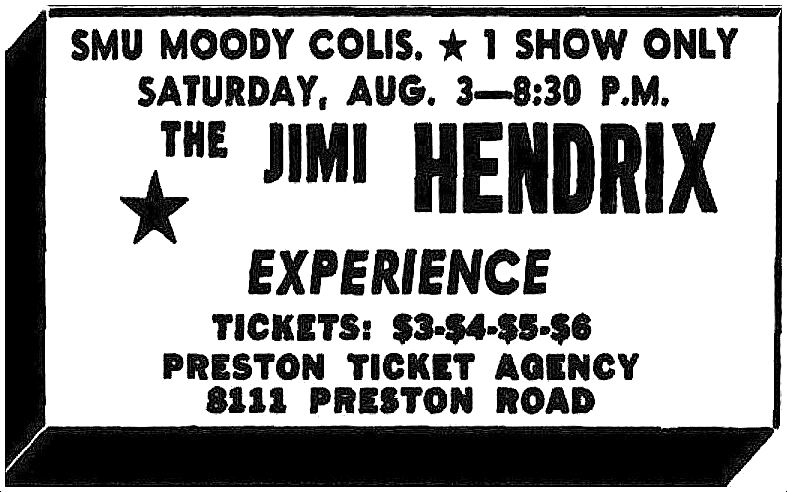
  • Aug. 3, 1968: Moody Coliseum, SMU
  • April 20, 1969: Memorial Auditorium (where he was headed after the Ch. 8 interview)
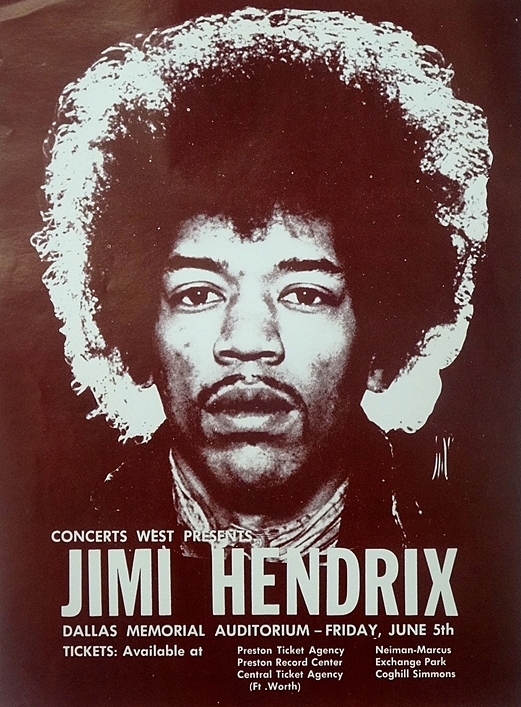
  • June 5, 1970: Memorial Auditorium

hendrix_dmn_072868
July 28, 1968

Two surprising errors (grammatical and factual) appear in a Neiman-Marcus tie-in ad (of sorts) which states that Jimi would be at Memorial Auditorium, rather than Moody Coliseum. Despite the error, it’s cool that Neiman’s was expanding its cultural horizons to include someone like Jimi Hendrix in one of its ads (which was featuring teen fashions, but still). N-M has always had its finger on the pulse of current fashions — and Jimi Hendrix was certainly fashionable.

hendrix_dmn_073168_n-m-ad_det
July 31, 1968 (ad detail)

hendrix_dmn_042069
April 20, 1969

hendrix-poster_june-5-1970_memorial-auditorium
June 5, 1970 — poster via

**

Glen Campbell was in town for several days in June, 1969. He arrived at Love Field on June 15 and was met by a “high-spirited throng” of teenage admirers. He was here to promote the release of the movie True Grit (in which he appeared with John Wayne), as well as to perform at Memorial Auditorium on June 19, 1969.
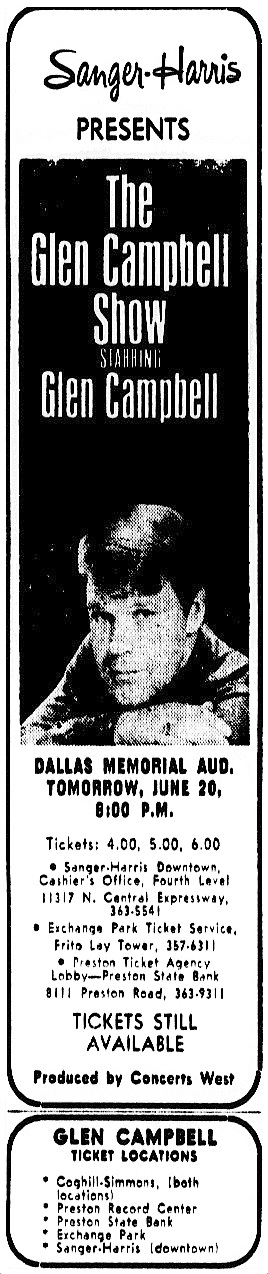
glen-campbell_dmn_061969
June 19, 1969

He was actually in Dallas the previous year, in March, 1968, to perform at the State Fair Music Hall with Bobbie Gentry. An interview with the pair begins at 3:57:

**

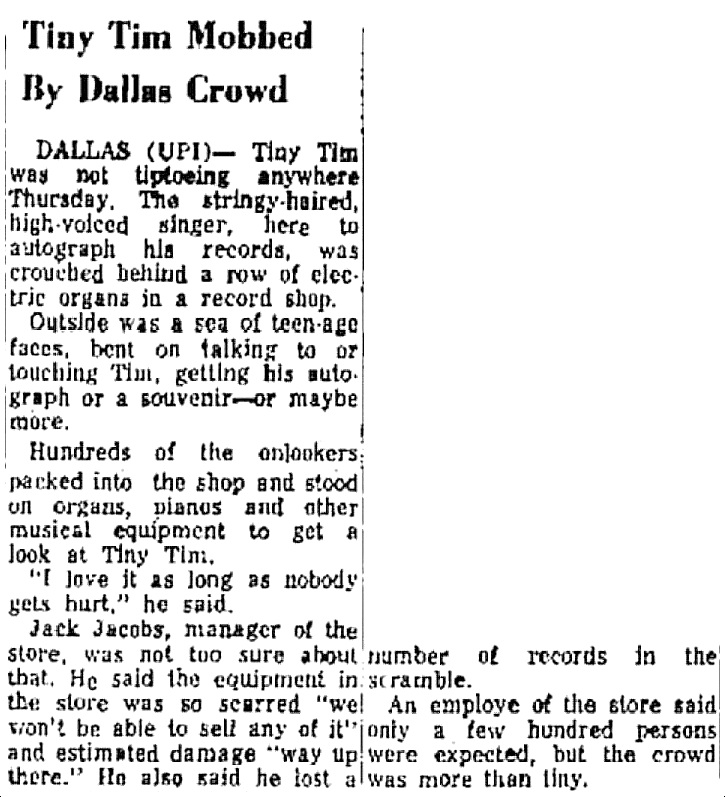
And Tiny Tim was in Dallas on June 17, 1969 to appear at a book-signing at the downtown Sanger-Harris department store. The signing was a bit more sedate than his previous visit to Dallas when he caused something of a riot on January 23, 1969 while making an appearance at the Melody Shop in NorthPark. I’m not sure what sort of crowd the Melody Shop thought they’d get for their little “autograph party,” but it’s safe to say they did not expect 5,000 over-excited teenagers. The news report the next day was peppered with words like “pandemonium,” “swarm,” “mob scene,” and “human wall.” (Read about that bizarre event here). His drawing power continued the next year when Tiny made his Dallas performing debut at … of all places … Abe Weinstein’s Colony Club, one of the city’s top “burlesque” houses. He was booked for an incredible 9-night run (!) in September, 1970. It was a major success. Dallas apparently loved Tiny Tim. And, of course, years later, Bucks Burnett’s Edstock and Burnett’s tiny Tiny Tim museum continued the Big D/Tiny Tim lovefest.
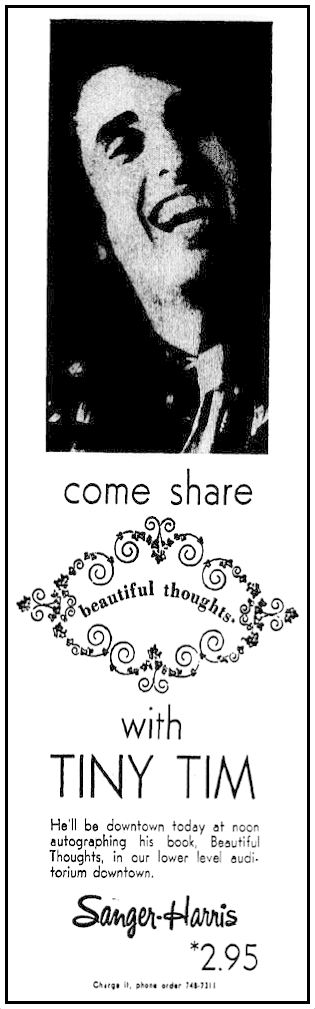
tiny-tim_dmn_061769_book-signing
June 17, 1969

tiny-ch-8_1
WFAA-Ch. 8 interview (screenshot)

***

Sources & Notes

Video is from the WFAA Newsfilm  Collection, held at the Hamon Arts Library, Southern Methodist University; screenshots are from those clips. Any requests to license these clips (or any of the other thousands at SMU!) should be directed to curator Jeremy Spracklen.

4/20/24 UPDATE: Passages from former Channel 8 reporter Doug Terry are from an email to me on April 16, 2024, reprinted with his permission.

Hit the Dallas Morning News archives to find a little pre-Music Hall interview with Jimi Hendrix conducted by “YouthBeat Editor” Marge Pettyjohn: “A Real Experience” (DMN, Feb. 25, 1968). Her interview with Tiny Tim (“Magical Mystery Tour: On Meeting Tiny Tim,” DMN, Jan. 25, 1969) is also worth checking out, as is the Jean Kelly article “5,000 Kids Mob Tiny Tim” (DMN, Jan. 24, 1969).

While you’re in the archives, look for the interview with Glen Campbell at Love Field amidst the frenzied teenage girls: “High-Spirited Throng — Fans Mob Glen Campbell at Airport” by Maryln Schwartz (DMN, June 17, 1969).

*

Copyright © 2017 Paula Bosse. All Rights Reserved.
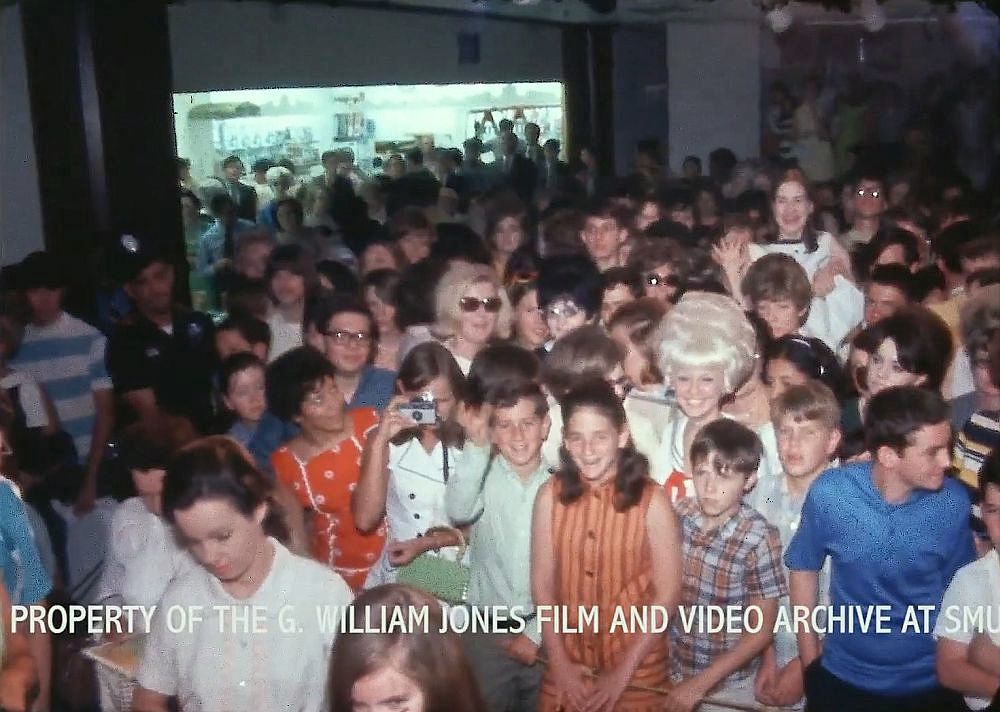
Tiny Tim Mobbed at the Melody Shop — 1969

tiny-tim-appearance_dallas_WFAA_SMU_june-1969
Dallas teens loved Tiny Tim… (Sanger-Harris book-signing, June 1969) 

by Paula Bosse

Tiny Tim — one of the most … unusual performers of the 1960s — was a hit with teenagers when he made his first appearance in Dallas at the Melody Shop in NorthPark mall on January 23, 1969. What had been expected to be a nice little autograph party which might attract a small number of fans and curiosity-seekers turned into something altogether unexpected.

tiny-tim_melody-shop_1969

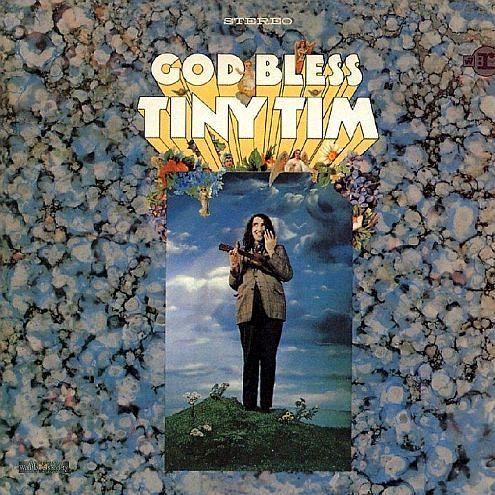
Tiny Tim (…”Tiny”? “Tim”? “Mr. Tim?”…) had the unlikeliest of hits during the hippie-era: “Tiptoe Through the Tulips,” a lilting little ukulele-accompanied song which had originally been a hit in 1929. Tiny Tim’s first few appearances on U.S. television must have caused a lot of heads to be scratched and/or jaws to be dropped. He was just kind of … weird. But gentle, and he seemed to be a genuinely nice fellow who just happened to have a penchant for songs from the megaphone-era of popular music. If you’ve never seen footage of a Tiny Tim performance, search for a clip of him on the Tonight show around 1968.

tiny-tim_god-bless_cover

So anyway, Tiny was booked to do a little autograph party at the Melody Shop in NorthPark mall. I’m not sure what sort of crowd they thought they’d get, but it’s safe to say they did not expect 5,000 teenagers. The news report the next day was peppered with words like “pandemonium,” “swarm,” “mob scene,” and “human wall.” Who knew a 36-year-old man who strummed a ukulele and sang songs from the Victrola-age in a nasal falsetto would whip up that much enthusiasm amongst Texas teenagers?

My favorite description of the “riot” was this one:

Inside, a disheveled Tiny Tim was crouched on the floor behind a row of electric organs….. “Pretend he’s not in the store,” directed a manager. Tiny Tim, his shirttail out and his orange, green and brown tie twisted to the side, huddled alone on the floor. (“5,000 Kids Mob Tiny Tim,” Dallas Morning News, Jan. 24, 1969)

The story was even picked up by wire services. (Click article below to see a larger image.)

tiny-tim_amarillo-globe-times_012469
Amarillo Globe Times, Jan. 24, 1969

Tiny was back in Dallas a few months later, this time to do a book-signing at the downtown Sanger-Harris. (Yes! He wrote a book!)

tiny-tim_dmn_061769_book-signing
June 17, 1969

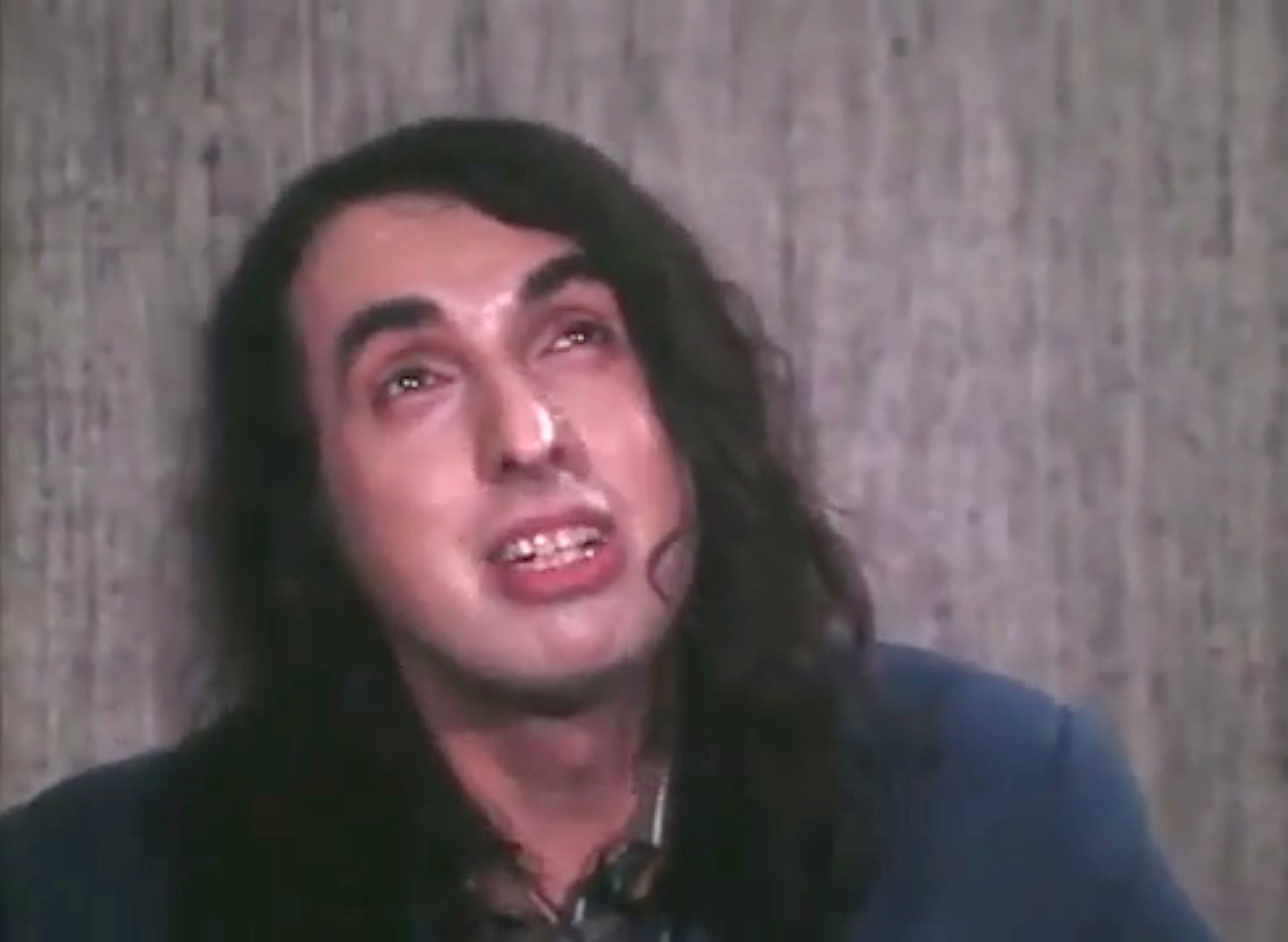
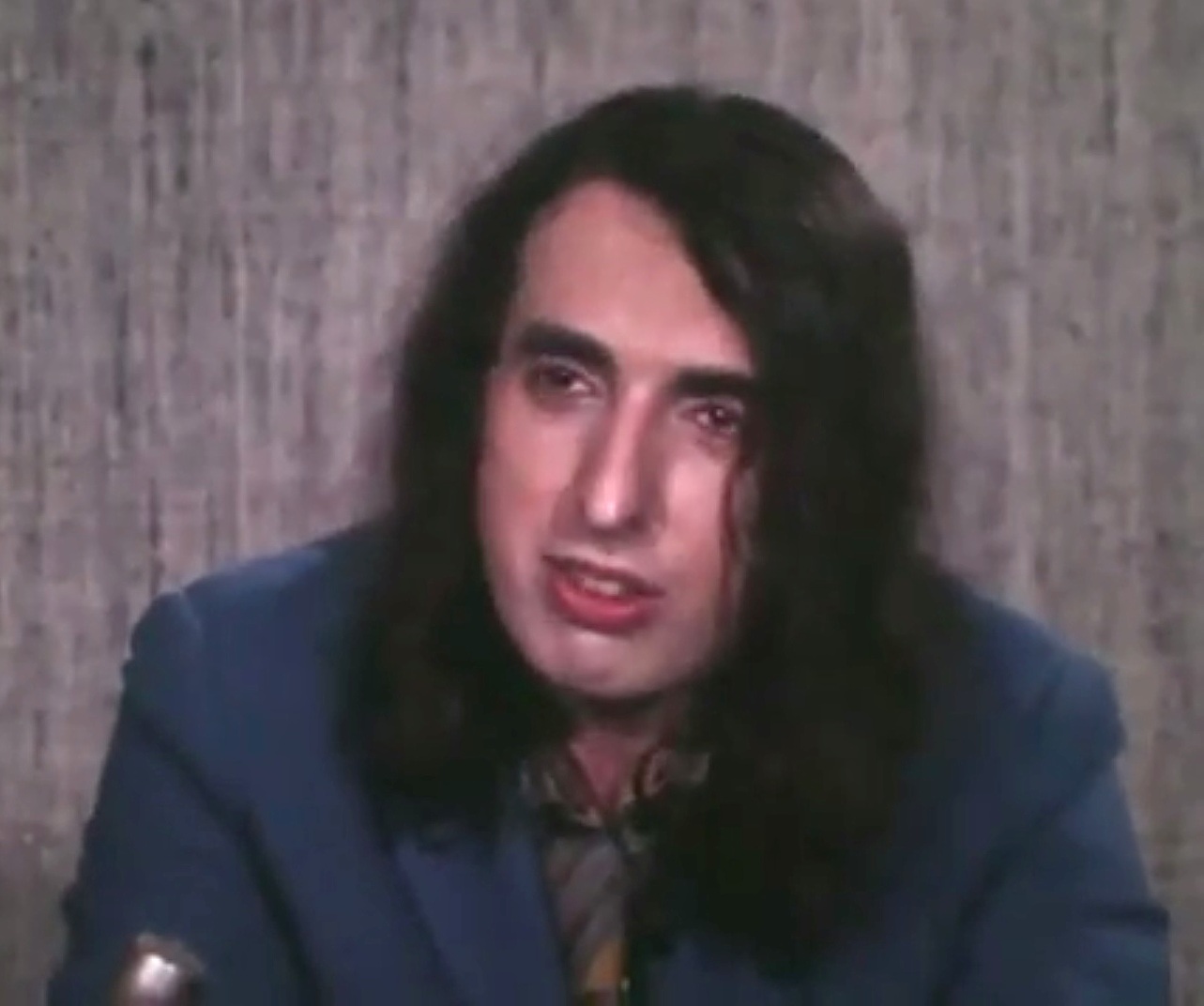
No riot was reported this visit, but Sanger’s still packed by fans who wanted a book signed by Mr. Tim (who signed with a pink quill pen). While in town, he give a little interview and an impromptu performance at a press conference (am I the only person who sees shades of Jeffrey Tambor here?):

*

tiny_ch-8_3  tiny_ch8_2  tiny-ch-8_1

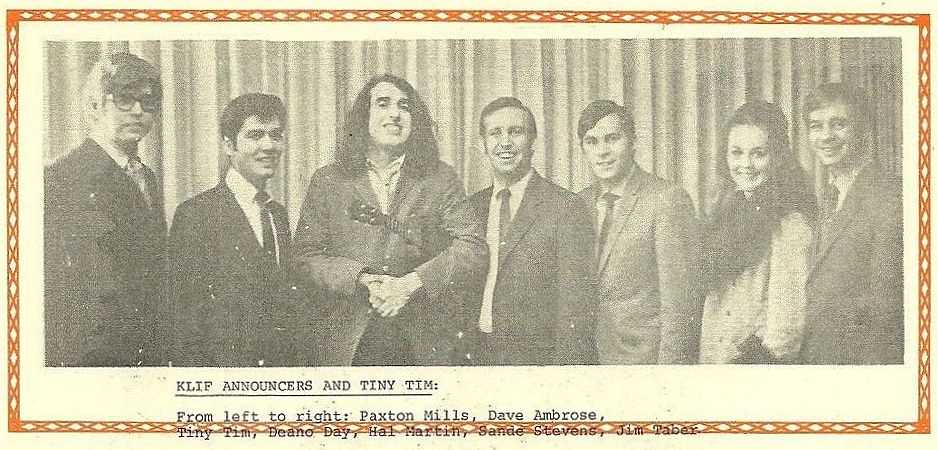
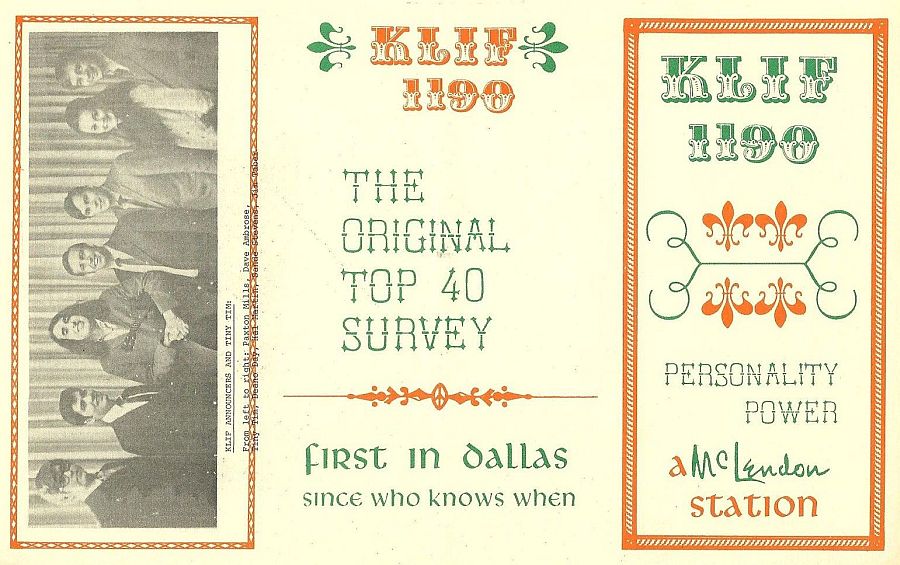
Also in 1969, he took time out to pose with KLIF on-air talent Paxton Mills, Dave Ambrose, Deano Day, Hal Martin, Sande Stevens (not sure if she worked for KLIF), and Jim Taber, seen below.

klif_tiny-tim_1969_ebay_photo-det

klif_tiny-tim_1969_ebay

But wait, there’s more… he was back in Dallas in September, 1970 for a NINE-DAY engagement (two shows nightly) at Abe Weinstein’s famed downtown burlesque house. (I don’t know if the strippers took the time off while Tiny was in residence or if they might have entertained between his sets.) Here’s a clip from a press conference during that visit:

And, why not, here’s an early publicity photo of Herbert Khaury, the man who would one day become famous as the singer Bing Crosby once described as having (I paraphrase) a vibrato big enough to throw a Labrador through.

tiny-tim_headshot

***

Sources & Notes

The 1969 Chanel 8 video is from the WFAA Newsfilm Collection held by the Hamon Arts Library, Southern Methodist University; it is posted on YouTube here (the first image and the three color photos of Tiny Tim are screenshots I captured from the video); the 1970 footage is from the same source and can be found on YouTube here.

KLIF promotional material found on eBay several months ago. The back of the card lists the KLIF’s top 40 of the week, here.

Glamour shot of Mr. Khaury found somewhere on the internet.

Tiny Tim Wikipedia entry is here.

One would be remiss in not mentioning Tiny Tim’s other ties to Dallas, namely his association with Bucks Burnett’s Edstock and Burnett’s tiny Tiny Tim museum from the 1990s. I’d link to articles in the Dallas Observer, but every time I go to the DO site my computer freezes. I encourage you to seek out these articles yourself.

More on Tiny’s January, 1969 visit to Dallas can be found in these Dallas Morning News articles:

  • “5,000 Kids Mob Tiny Tim” by Jean Kelly, with photo (DMN, Jan. 24, 1969)
  • “Magical Mystery Tour: On Meeting Tiny Tim” by Marge Pettyjohn, “YouthBeat” editor, with photo (DMN, Jan. 25, 1969)

*

Copyright © 2017 Paula Bosse. All Rights Reserved.

At the Palace: The Streets of Sin and The Mikado of Jazz — 1928

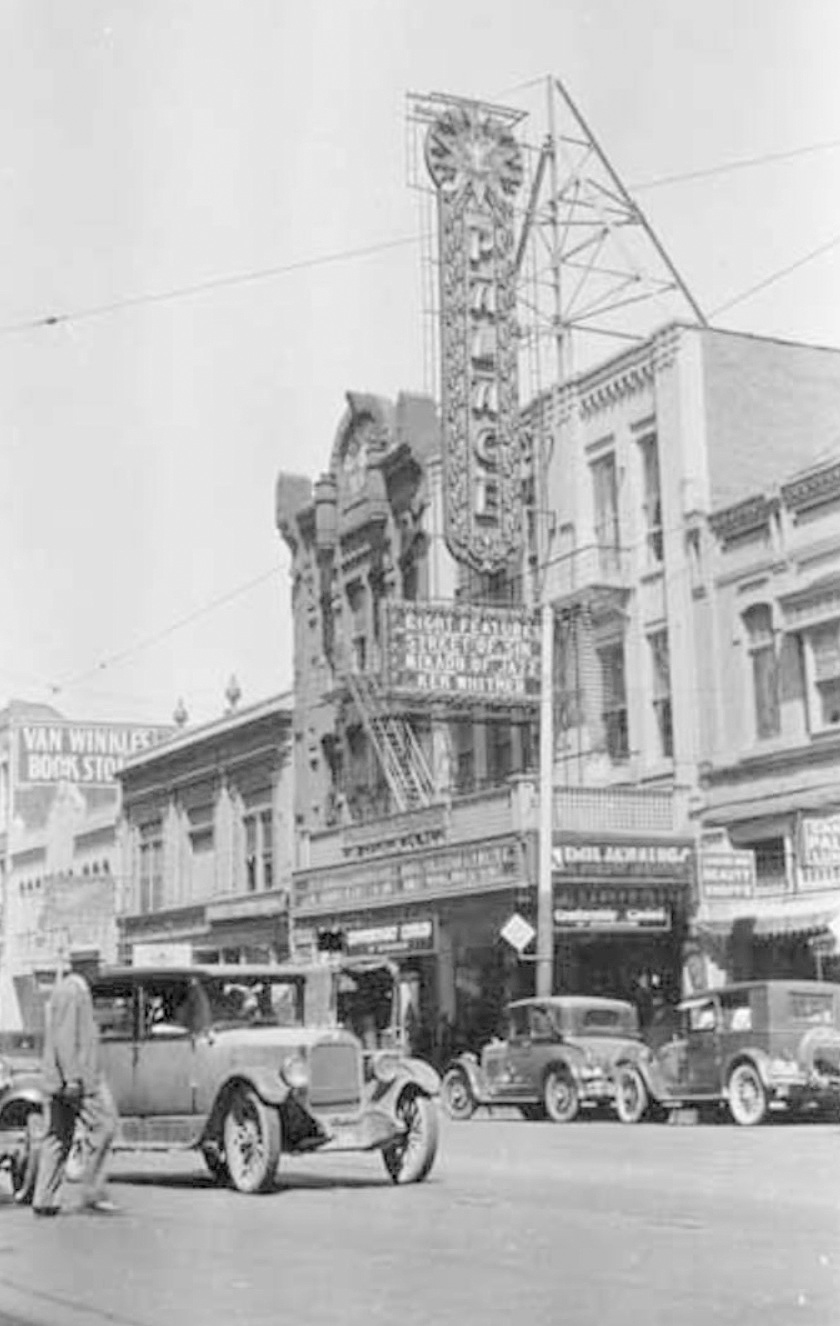
palace-theater_052628_univ-of-washington-librariesElm & Ervay, 89 years ago… (click for larger image)

by Paula Bosse

The photograph above is not the greatest quality, but it’s a photo I’ve never seen before. It shows the Palace Theatre in the 1600 block of Elm Street, just west of Ervay, with the well-known (and very large) Van Winkle’s Book Store in the background. One of the things that makes this photo so interesting is seeing the cumbersome support tower on top of the building holding up the ornate Palace sign. See what a slightly different Palace sign looked like the next year, lit up in neon, here.

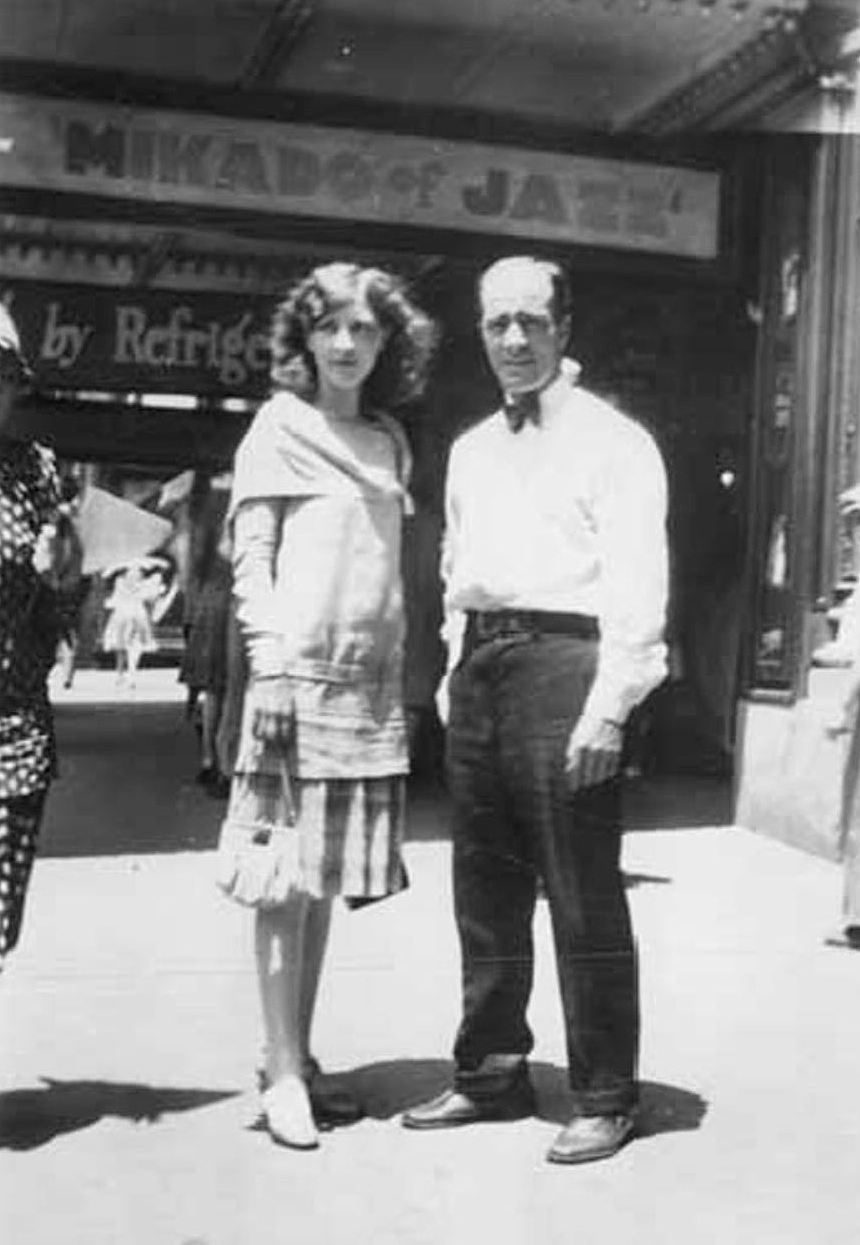
The photo above was an amateur snapshot, taken to document the tour of the traveling live stage revue The Mikado of Jazz which played the Palace in late May of 1928. The photo below — which shows the revue’s stage manager and his wife standing on the sidewalk in front of the Palace — was taken at the same time.

palace-theater_052628_univ-of-washington-libraries_sidewalk

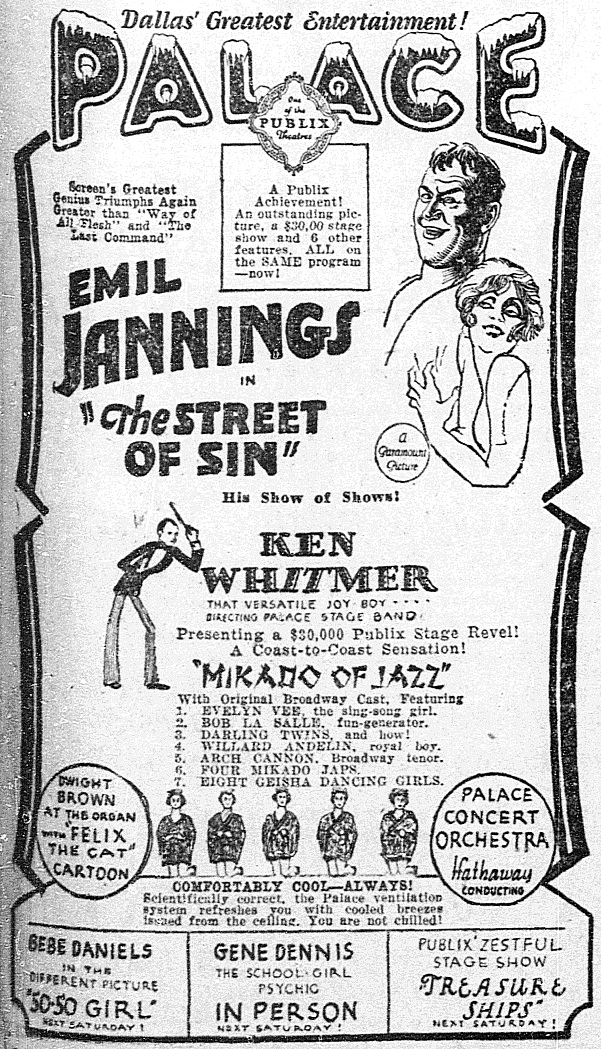
Part of a sign visible behind them was probably advertising that the theater was “cooled by refrigerated air.” The ad at the bottom of this post includes this informative little tidbit:

COMFORTABLY COOL — ALWAYS!

Scientifically correct the Palace ventilation system refreshes you with cooled breezes issued from the ceiling. You are not chilled!

What was The Mikado of Jazz? It appears to have been a jazzed-up version of The Mikado — making Gilbert & Sullivan relevant to 1920s’ audiences — like Hamilton for the Jazz Age (“This is said to be the first time that any comic opera has been syncopated and presented with a stage band.”Dallas Morning News blurb, May 20, 1928)

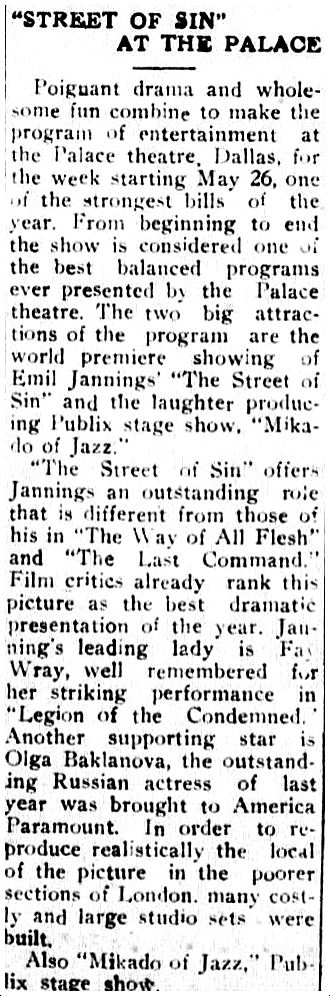
Also on the bill was the “world premiere” (?) of the film The Street of Sin, starring Emil Jannings and Fay Wray, a live stage orchestra, an organ player, and a Felix the Cat cartoon.

mikado-of-jazz_texas-mesquiter_052528
Texas Mesquiter (Mesquite), May 25, 1928

All at the Palace — “Dallas’ Greatest Entertainment!” Enjoyed at a comfortable temperature.

palace_mikado-of-jazz_dmn_052728
May 27, 1928

***

Sources & Notes

Photographs (taken in May, 1928) are from the Rene Irene Grage Photograph and Ephemera Collection, 1921-1930s, University of Washington Libraries, Special Collections: more information on the first photo (the view of the theater from across the street) is here; more info on the second photo is here.

For other posts that show the Palace in this era, see these posts:

  • “Next-Door Neighbors: The Palace Theater and Lone Star Seed & Floral — 1926,” here 
  • “Dazzling Neon, Theater Row — 1929,” here

Click photos and clippings to see larger images.

*

Copyright © 2017 Paula Bosse. All Rights Reserved.
Shopping at Sears in Casa View

sears_casa-view_ext_squire-haskins_utaAppliance central… (click for larger image)

by Paula Bosse

I’m not in the Casa View area very often, but I was driving through last week and noted that a lot of the elements of the shopping center looked as if they were original to the buildings — specifically the little metal doo-dads along the top of the canopies over the sidewalks. I came across the photo above tonight and was happy to see those little doo-dads back when they were relatively new. The shopping center is a little confusing to me, but I think this is what that building pictured above looks like these days. (Why, why, WHY did someone think this “remodel” of the buildings was a good idea! Slapping on a new facade and removing the decorative metal doo-dads was an unfortunate decision.)

The Sears store pictured above is actually the second Sears in Casa View. The first store opened in October, 1956  at 2211 Gus Thomasson (here’s what the location of the first store looks like now — metalwork still there but that cool brick exterior has been painted over). It was Dallas’ fifth Sears store and opened in the still-under-development Casa View neighborhood. It wasn’t a full department store — its merchandise was limited mostly to appliances and automotive products. It was also a place to pick up catalog orders. (Click photos and ads to see larger images.)

ad-sears_casa-view_dmn_102556
Oct. 25, 1956

Apparently the store was so successful that in March, 1964, a brand new Sears opened up in a five-times-larger location (2310 Gus Thomasson) across the street — the photo at the top of this post was probably taken when it was in its first months.

sears_new-location_casa-view_dmn_031264-detMarch 12, 1964

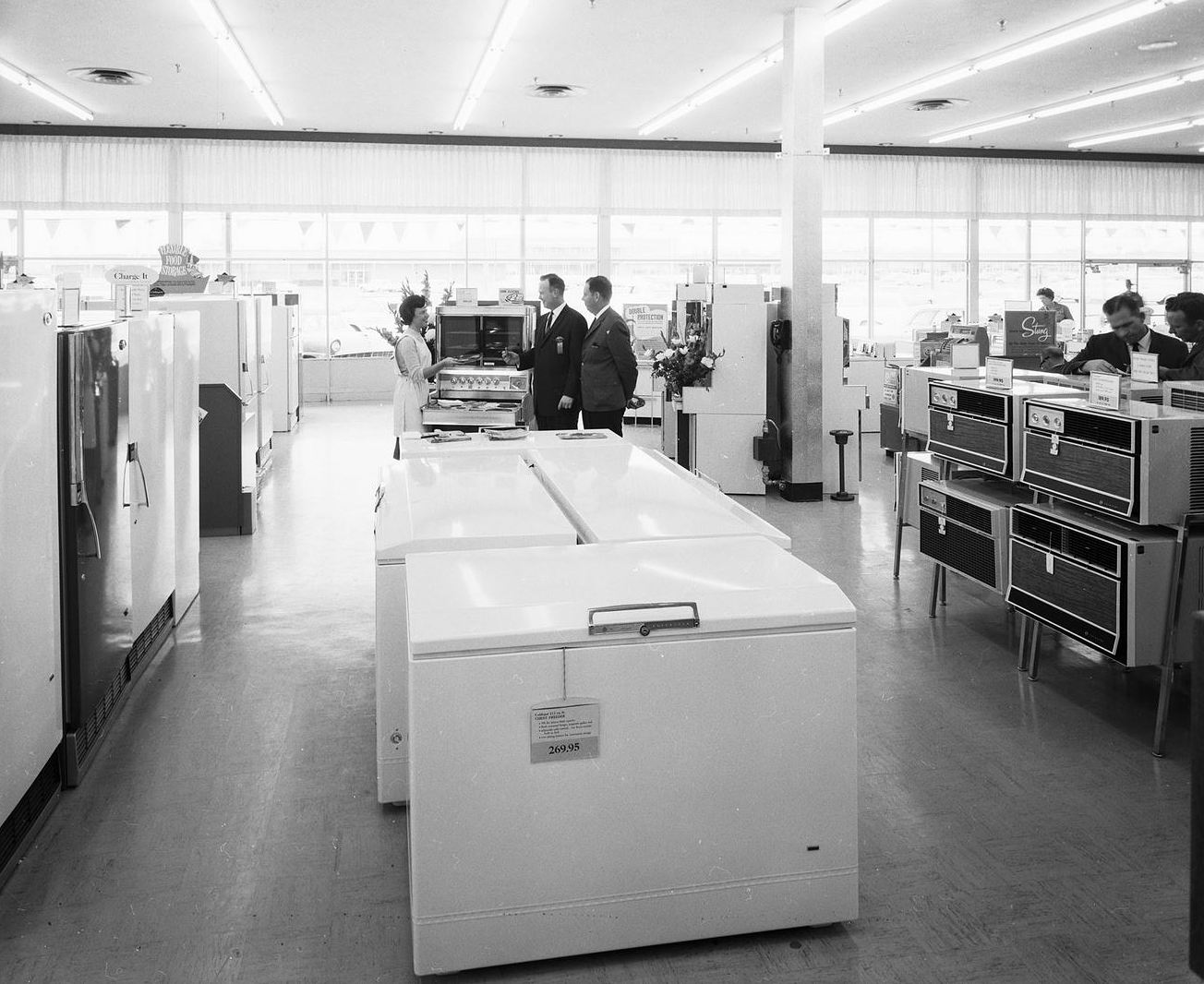
Its interior — seen below in all its pristine, blinding whiteness — is fantastic. (Is that woman in the apron serving cookies she’s just baked?)

sears_casa-view_int_squire-haskins_uta

*

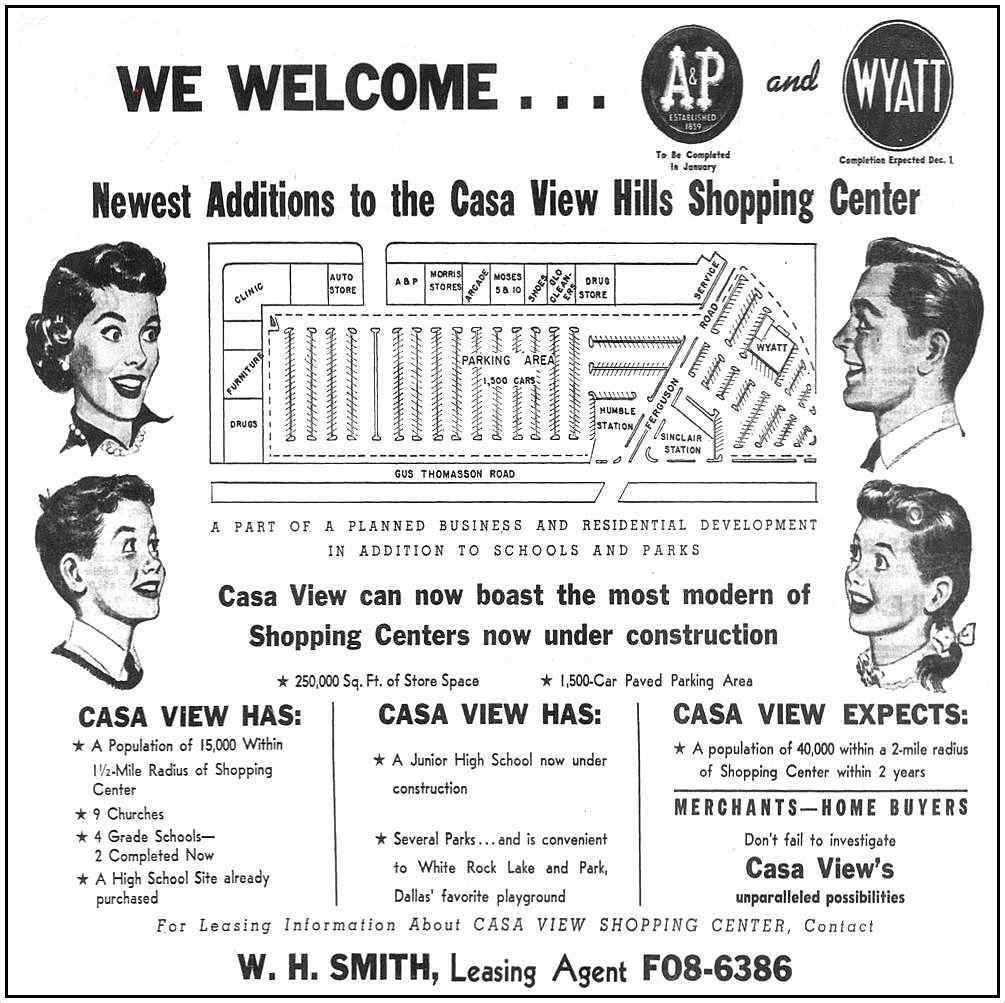
The reason I was confused by the shopping area is that it was built in phases. The first part was built in 1953 and was originally known as Casa View Hills Shopping Center. (Click the ad below to see a larger image.)

casa-view-shopping-center_dmn_100453
Oct. 4, 1953

But then the ownership changed hands in early 1955, and it was renamed Casa View *Village* and reopened in April under the new name.

In the meantime (I might have this chronology a bit out of whack), Casa View Center had been built in 1954, diagonally across the street. And then in 1955, construction began on an expanded Casa View Village. (This might have been its second expansion. Casa View was hopping in the mid-’50s!) And Sears had had stores in both Casa View Village and Casa View Center. It’s all kinda confusing.

The Casa View Shopping Center (I don’t know what its official name is these days, but I’m going with this) is looking a little ragged these days, but it still has a quirky charm, and I’m happy to see it still chugging along after 60 years.

***

Sources & Notes

Photos by Squire Haskins from the Squire Haskins Photography, Inc. Collection, UTA Libraries Special Collections. More info on the top photo showing the exterior of the Sears building can be found here; more info on the interior photo is here. (Click on the thumbnails on the UTA pages to see very large images.)

The Casa View Wikipedia page is here.

D Magazine has a “Dallas Neighborhood Guide” to Casa View here.

Dallas Morning News articles:

  • “Name Changed” (from Casa View Hills Shopping Center to Casa View Village) (DMN, March 13, 1955)
  • “Avery Mays Announces New Shopping Center” (expanded Casa View Village, with aerial photo) (DMN, Nov. 10, 1955)
  • “New Sears Opening in Casa View” (DMN, Oct. 11, 1956)

Other businesses once located in these shopping centers can be found in the post “Bryan Adams High School: Yearbook Ads from 1961 and 1962,” here.

Photos and clippings are larger when clicked.

*

Copyright © 2017 Paula Bosse. All Rights Reserved.
 

The Stage Door Restaurant: Elm Street’s “Home of Lox and Bagels” — 1965-1968

stage-door_youtube_1966A Reuben sandwich sings to me, like a siren to a sailor…

by Paula Bosse

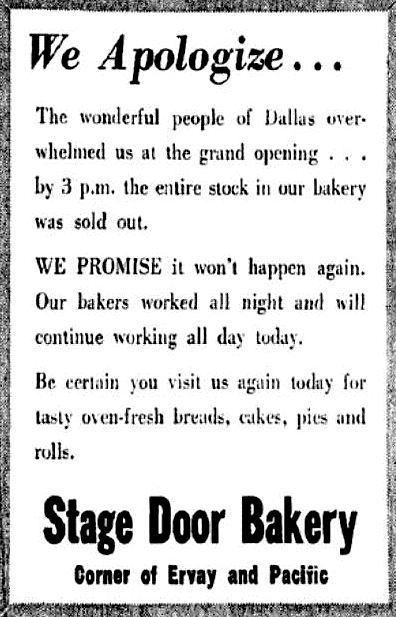
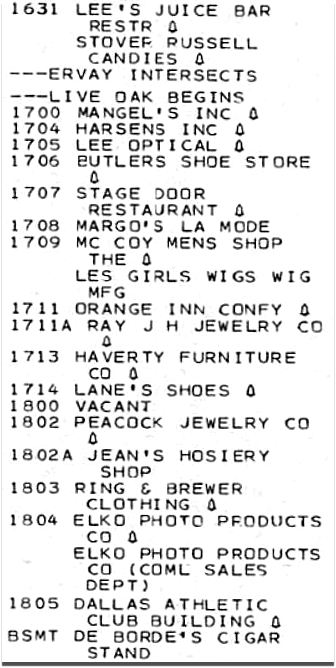
Why does Dallas have so few delis? Here’s one that seemed to be pretty popular in the 1960s: the Stage Door Restaurant and Delicatessen (and bakery), located at 1707 Elm, between the Palace Theater and the Dallas Athletic Club. It opened in June 1965 and lasted until the end of 1968 (when it was replaced by a restaurant called King Beef). I doubt there was any connection with the famous Stage Deli in New York, but manager Milton Stackel certainly had kosher cred of his own, having worked for twenty years at Grossinger’s, the legendary Jewish resort in the Catskill Mountains. I’m not sure how he found himself operating an eatery in downtown Dallas, Texas, but I’m glad he was here.

To any Milton Stackel-like entrepreneurs out there reading this:

DALLAS NEEDS DELIS!!


Authentic Jewish delicatessens!

Please!

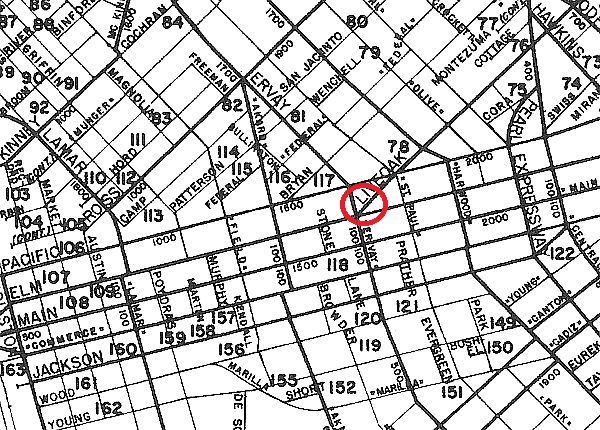
The apparently quite popular eatery was located at/near the old five-point Elm-Ervay-Live Oak intersection (seen here a dozen years earlier — the Stage Door would later be between Lee Optical and Haverty’s). There were two dining areas, one of which was The Playbill Dining Room which served an “international-type cuisine in a Gay Nineties atmosphere.” There was also a thriving take-out deli and the nearby bakery. And now? Come on, Dallas restaurateurs! Get to work!

*

stage-door-bakery_dmn_060465
June 1965

stage-door-restaurant_texas-jewish-post_122365_portal
Texas Jewish Post, Dec. 23, 1965

This ad shows the bakery entrance next door.

stage-door-bakery_dmn_112465
Nov. 1965

stage-door_dmn_112564

stage-door-restaurant_texas-jewish-post_122365_portal-det
Texas Jewish Post ad detail, Dec. 23, 1965

stage-door_1707-elm_1952-mapsco
1952 Mapsco

stage-door_1966-directory
1966 Dallas directory

1700-block-elm_1966-directory
Elm Street, 1966 Dallas directory

***

Sources & Notes

Top image is a screengrab from a YouTube video, here, containing footage shot downtown by Lawrence W. Haas on Memorial Day, 1966.

Read more about the opening of the new business (and see a photo of the interior) in the Dallas Morning News article “Stage Door Restaurant Makes Debut in Dallas” (DMN, June 3, 1965).

*

Copyright © 2017 Paula Bosse. All Rights Reserved.
When the Circus Came to Town — 1886

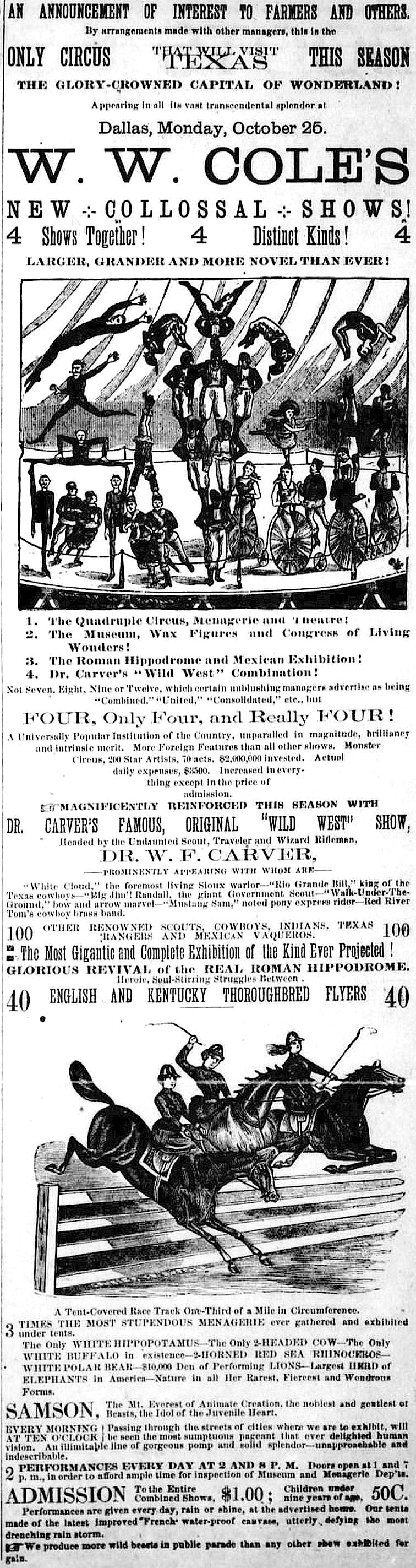
cole-circus_dallas-herald_101586-detI’m exhausted just looking at this…. (click for larger image)

by Paula Bosse

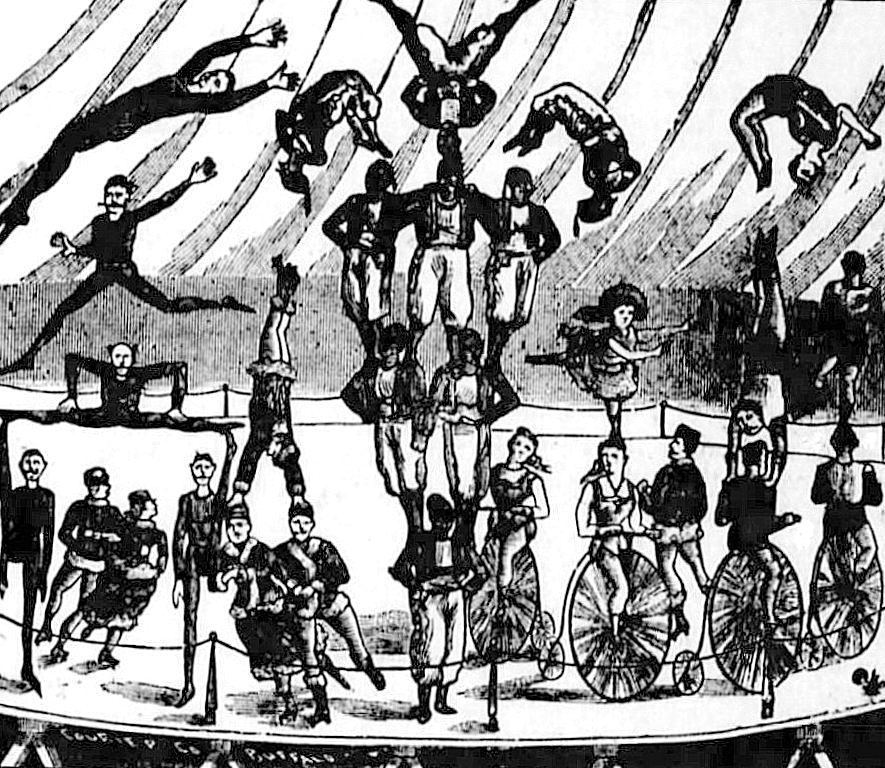
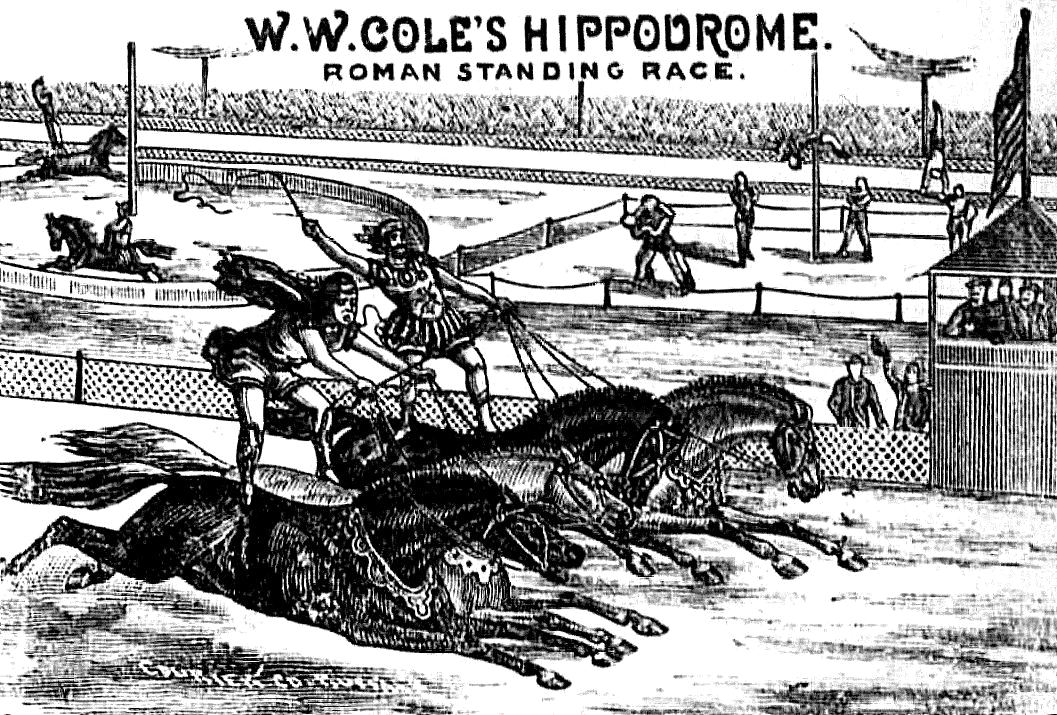
W. W. Cole brought his unbelievably jam-packed circus to Dallas at the end of October, 1886. That would have been big news all on its own, but also going on at the exact same time were two fairs. TWO! (This was when Dallas had competing state fairs battling each other across town.) I’m not sure how people handled all that entertainment. Circus attendance alone was reported at more than 16,000 for the Dallas engagement. That’s a lot.

One thing the Cole organization knew about was the power of adjectives. I can’t even begin to take apart this ad, so run your eyeballs over the intense, pop-eyed text and imagine what frontier Dallasites thought. Sit back and enjoy the “vast transcendental splendor” that was W. W. Cole’s extravaganza. (Click to see a larger image.)

ad_cole-circus_dallas-herald_101586Dallas Herald, Oct. 15, 1886

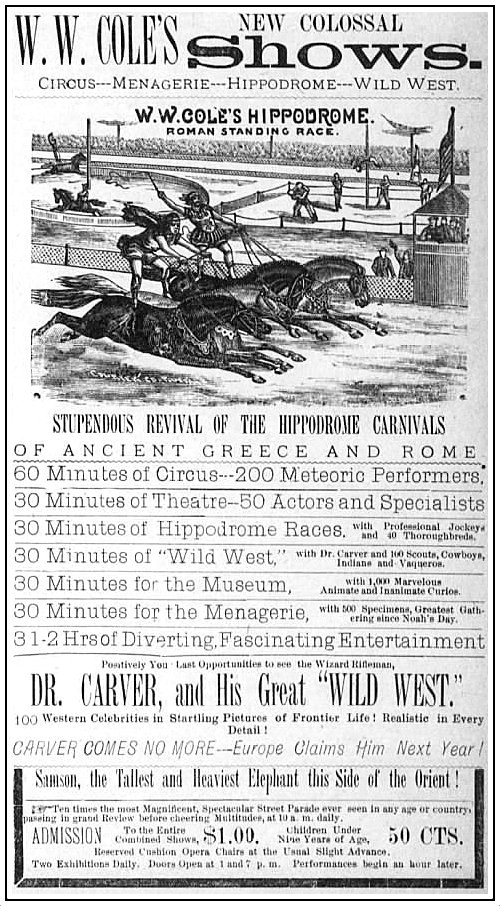
The circus appeared in Austin a few days later. This ad is also great.

cole-circus_austin-weekly-statesman_101486
Austin Weekly Statesman, Oct. 14, 1886

coles-circus_dmn_102486
Dallas Morning News, Oct. 24, 1886

circus_fairs_dallas-herald_102586
Dallas Herald, Oct. 25, 1886

The review:

coles-circus_dmn_102686
DMN, Oct. 26, 1886

Not everyone was impressed:

circus_dallas-herald_102686
Dallas Herald, Oct. 26, 1886

And then there was this weird little story. (I think the ending was tacked on by the writer as a joke. …I think.)

circus_somnambulist_dallas-herald_102686
Dallas Herald, Oct. 26, 1886

After all that excitement, it was probably a relief when the circus left town!

coles-circus-in-austin_dmn_110186DMN, Nov. 1, 1886

cole-circus_austin-weekly-statesman_101486_det

***

Sources & Notes

W. W. Cole’s Circus lasted forever — up until, apparently, last year! More here.

I’m never sure how much weight to give to the estimates of the Inflation Calculator, but when you plug the numbers into it, a dollar ticket for adults and a fifty-cent ticket for children would today equal somewhere in the neighborhood of twenty-five and thirteen bucks, respectively. That can’t be right, can it? You can’t argue that there was a lot going on in those French waterproof tents, but I can’t imagine people forking over that much when penny-candy was considered extravagant! But apparently 16,000 people happily forked! (W. W. Cole died a very, very, very wealthy man: when he shuffled off his moral coil in 1915, he left an estate of more than five million dollars — or, per the Inflation Calculator, more than 120 million dollars in today’s money.)

Click clippings to see larger images.

*

Copyright © 2017 Paula Bosse. All Rights Reserved.
 

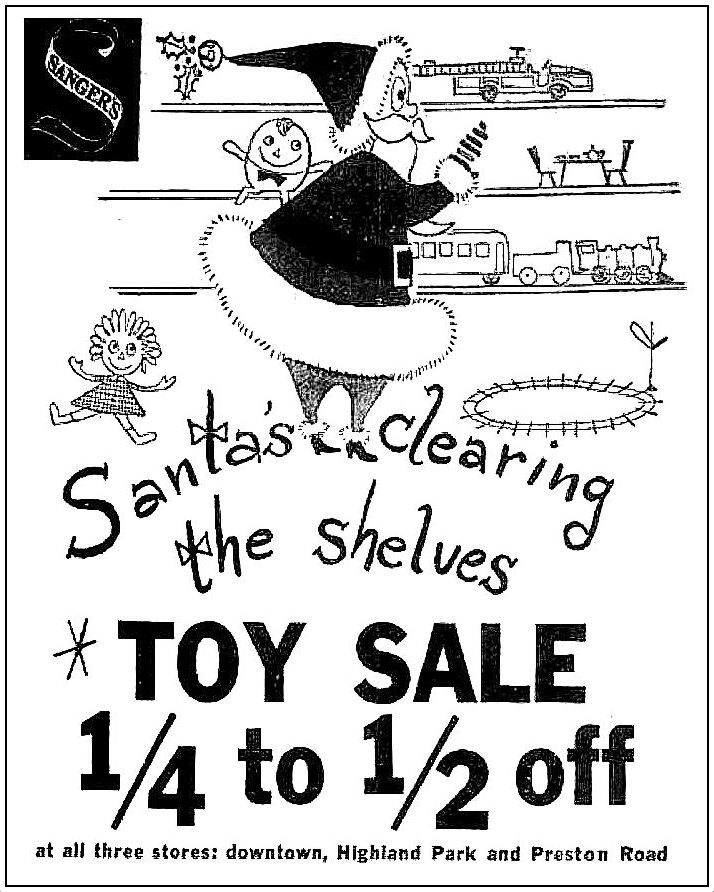
Christmas Toy Sale at Sanger’s! — 1955

xmas_sangers_dmn_122255aBargains ahead: Santa’s clearing the shelves…

by Paula Bosse

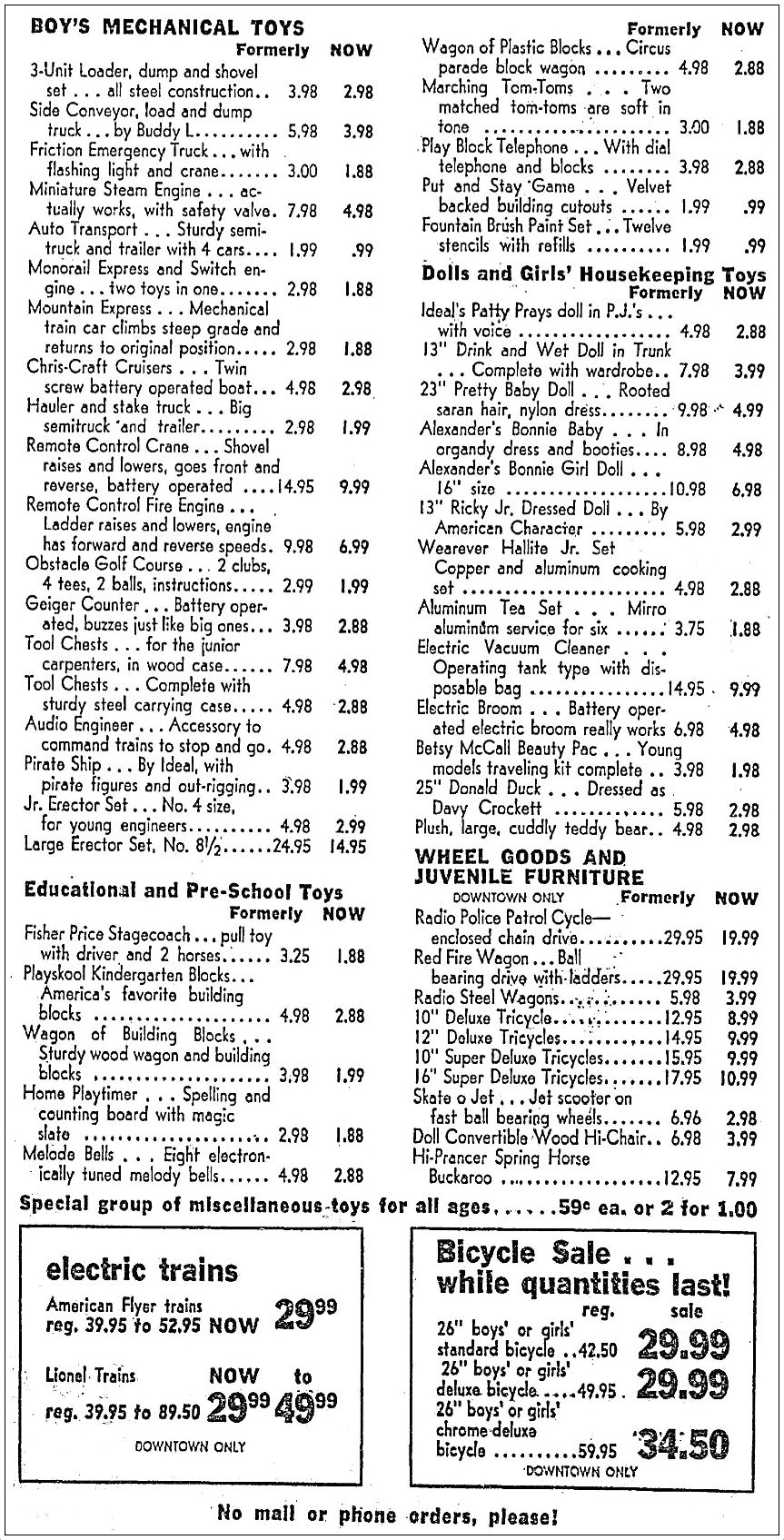
Look at all the toys that were on sale in the final days before Christmas — “at all three [Sanger’s] stores: downtown, Highland Park and Preston Road.” Need a “Ricky, Jr. doll”? A kiddie Geiger counter? A two-foot-tall Donald Duck toy dressed as Davy Crockett? Look no further — Sanger’s has it. (Click ad to see a larger image and take a walk down Childhood Toy Memory Lane.)

xmas_sangers_dmn_122255b

*

Copyright © 2016 Paula Bosse. All Rights Reserved.
 

Merry Christmas from the Priscilla Art Club — 1968

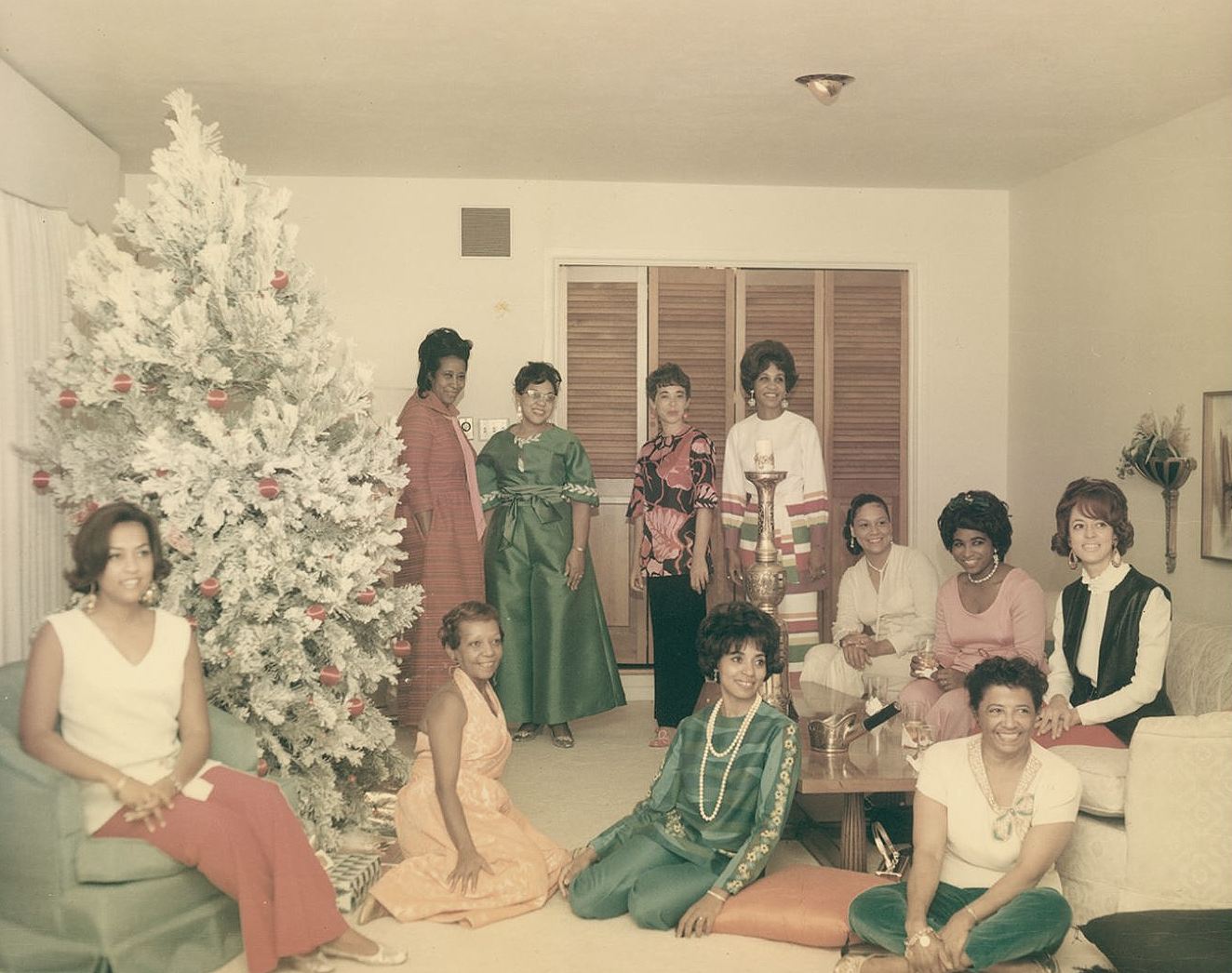
xmas_priscilla-art-club_123168_uta“Say ‘fondue’!”

by Paula Bosse

These women look like they’ve stepped out of a catalog — perfectly dressed, perfectly coiffed, perfectly posed. They are members of the Priscilla Art Club, the oldest African-American women’s club in Dallas. The club was formed in 1911, and I think it may still be active — the most recent news I could find of the club was from 2012, when the “centennial legacy quilt,” made by members to celebrate the club’s 100th anniversary, was displayed at the African American Museum. Below, a little history of the club from the press release announcing the exhibit in February, 2012.

THE PRISCILLA ART CLUB CELEBRATES BLACK HISTORY MONTH

In honor of Black History Month, the Priscilla Art Club, the oldest African American women’s organization in Dallas County, will host a display of its centennial legacy quilt made by its members […] at the African American Museum of Life and Culture, Dallas Fair Park.

“The idea of a custom designed legacy quilt started out as a novel idea from our Systems Committee in recognition of our 100th anniversary. The twenty-two club members quickly became engaged in seeing it to fruition and we are happy to honor the beauty, the inspiration and the legacy of our Club” said Shirley Porter Ware, Club President.

The Priscilla Art Club, organized in 1911 as a club for young matrons, was organized under the encouragement and direction of Mrs. Mattie Mansfield Chalmers. The organization’s purposes were to establish and maintain the aesthetic, promote congenial companionship and foster all social and community interests that pertain to the general uplift. The Club was named for Priscilla, a New Testament woman of extraordinary culture and the wife of Aquila, a Jewish tentmaker.

Since its auspicious beginning, the Club has invited into its membership many of Dallas’ most distinguished homemakers. These members have exhibited an interest or are talented in arts and crafts.

Besides being homemakers and mothers, the members have been and some still are principals, school administrators, teachers, business owners, social workers, church leaders and servant volunteers in the local community.

Throughout the century of service and sisterhood, recorded in The Priscilla’s prolific history include mention of service rendered in support of the World War I efforts by rolling bandages that were sent overseas to the field hospitals in France. For several years, the Priscillas decorated the shotgun house, located in Old City Park, in observance of the holiday season. In more recent years, the members have decorated t-shirts and jackets made from sweat shirts to give to men and women in local assisted living facilities. Club members have made crocheted skull caps in a variety of vivid colors and patterns and donated to cancer patients actively engaged in treatment regimens.

Regardless of change, the Priscilla Art Club’s concern for its artistic endeavors and for civic and social uplift will continue with deepening interest and commitment as the tradition of the founders’ legacy is carried forward.

I hope the club is still around. This year marks its 105th anniversary.

***

Sources & Notes

Photo was taken on December 31, 1968; from the Culmer Family Papers, UTA Libraries, Special Collections, accessible here.

The 2012 press release was posted on the Facebook page of the Dallas Fort Worth Association of Black Journalists, here.

More on the history of the club can be found in the Dallas Morning News article “Reception to Honor Art Club’s 65th Year” by Julia Scott Reed (DMN, April 2, 1976).

The most in-depth history of the club that I could find online can be found in the guide to the Culmer Family Papers at UTA, here (scroll down to the paragraph that begins “The Priscilla Art Club was one of the most prestigious, if not elitist clubs for African American women in Dallas….

*

Copyright © 2016 Paula Bosse. All Rights Reserved.
Albert Einstein “Threw the Switch” in New Jersey to Open the Pan-American Exposition in Dallas — 1937

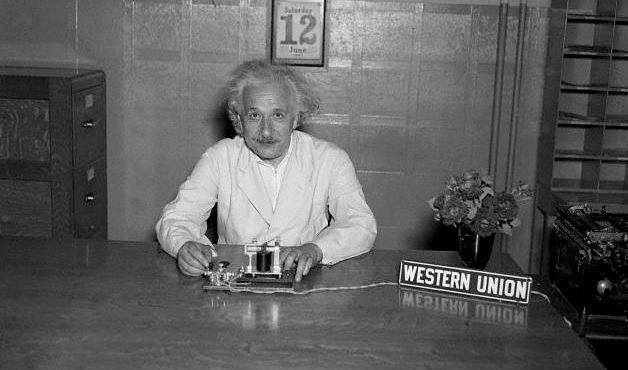
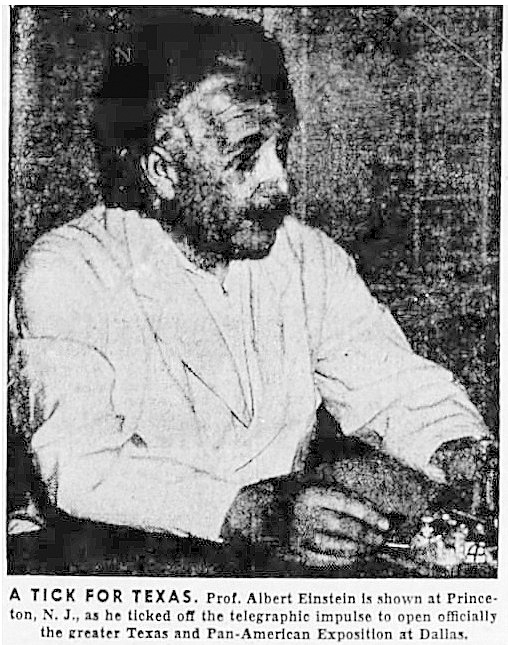
pan-american-expo_einstein_061237Einstein at the switch, June 12, 1937…

by Paula Bosse

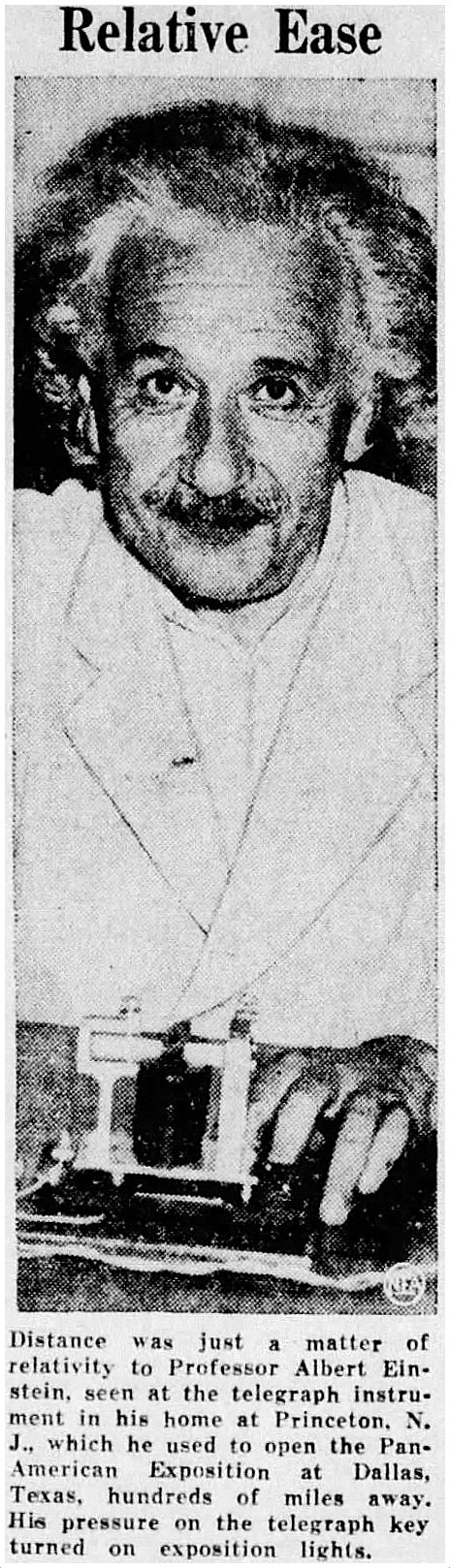
Who knew? Albert Einstein, the world’s most famous physicist, helped open the Greater Texas and Pan-American Exposition. The exposition was held at Fair Park for 20 weeks, from June 12, 1937 to October 31, 1937, as a follow-up of sorts to the Texas Centennial (the city had built all those new buildings — might as well get their money’s worth!). I’m not quite sure how Einstein got roped into this, but looking at the photo above, he seemed pretty happy about what was, basically, a long-distance ribbon-cutting. Via telegraph.

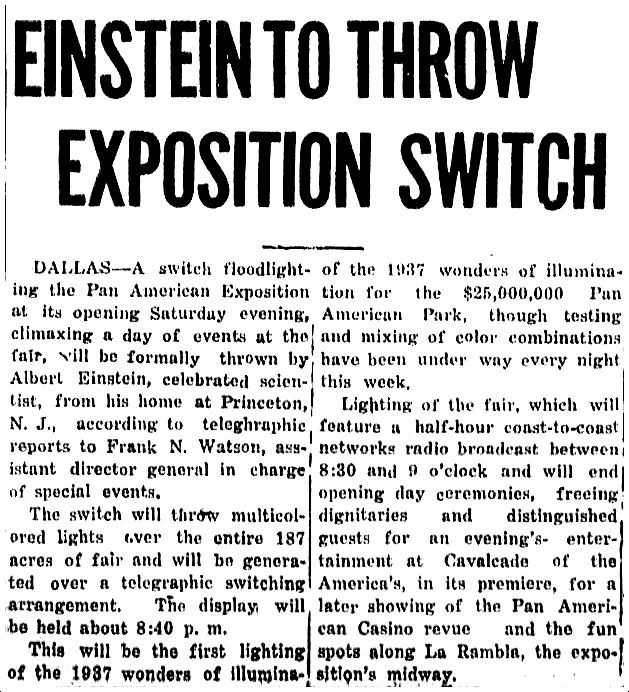
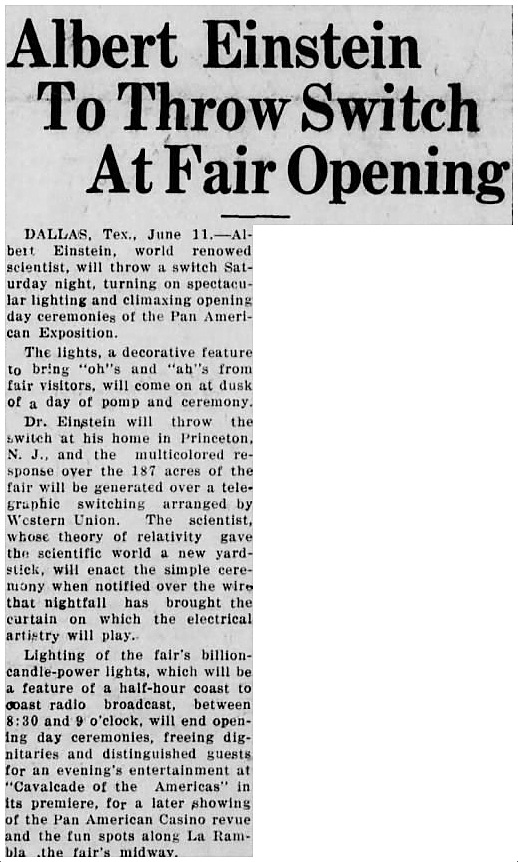
The plan was for Professor Einstein to officially open the Pan-American Exposition by “throwing the switch” which would turn on massive displays of lights around Fair Park. He would do this from Princeton, New Jersey, where he lived, by closing a telegraph circuit which would put the whole thing in motion. Newspaper reports varied on where exactly Herr Einstein was tapping his telegraph key — it was either the study in his home, in his office, in a Princeton University administration building, or in the Princeton offices of Western Union (the latter of which was mentioned in only one report I found, but it seems most likely).

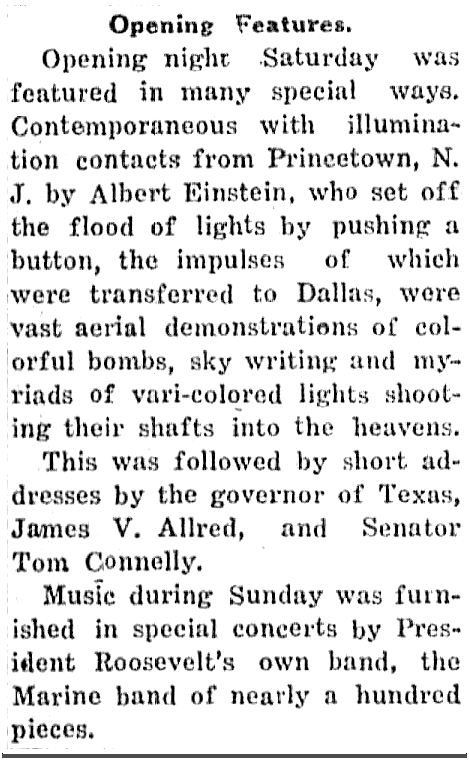
Einstein was a bona fide celebrity, and this was national news — newspapers around the country ran stories about it, and the ceremony was carried live on coast-to-coast radio. Almost every report suggested that Einstein’s pressing of the key in New Jersey would be the trigger that lit up the park in Texas, 1,500 miles away — which was partly correct. According to The Dallas Morning News:

Lights on the grounds will be turned on officially at 8:40 p.m. when Dr. Albert Einstein, exponent of the theory of relativity, presses a key in his Princeton home to fire an army field gun. With the detonation of the shell, switches will be thrown to release the flood of colored lights throughout the grounds. (DMN, June 10, 1937)

So on June 12, 1937 he pressed a telegraph key somewhere in Princeton, NJ, an alert was instantly wired to Dallas, an army field gun (in some reports a “cannon”) was fired, and that blast was the cue for electricians positioned around the park to throw switches to illuminate the spectacular displays of colored lights.

The Western Union tie-in gimmick was a success. Newspaper reports might have been a little purple in their descriptions, but from all accounts, those lights going on all at once was a pretty spectacular sight.

Dr. Albert Einstein, celebrated scientist, threw a switch that flashed a million lights over the 187-acre exposition park. The flash came at 8:40 o’clock and instantly the huge park became a city of a million wonders. Flags from a thousand staffs proclaimed their nationality [and] bands played the national airs of the nations of the Western Hemisphere as lusty cheers roared with thunderous approval. The Greater Texas and Pan-American Exposition was formally opened. It is on its way. (Abilene (TX) Reporter News, June 13, 1937)

The Dallas News describes the crowd as stunned into silence:

The waiting participants in the ceremonies at Dallas heard the results [of Einstein’s telegraph signal] when a cannon boomed. Electricians at switches around the grounds swung the blades into their niches and the flood of light awoke the colors of the rainbow to dance over the 187-acre park. Its breath taken by the spectacle, the crowd stood silent for a moment, and then broke into a cheer. (“Pan-American Fair Gets Off to Gay Start” by Robert Lunsford, DMN, June 13, 1937)

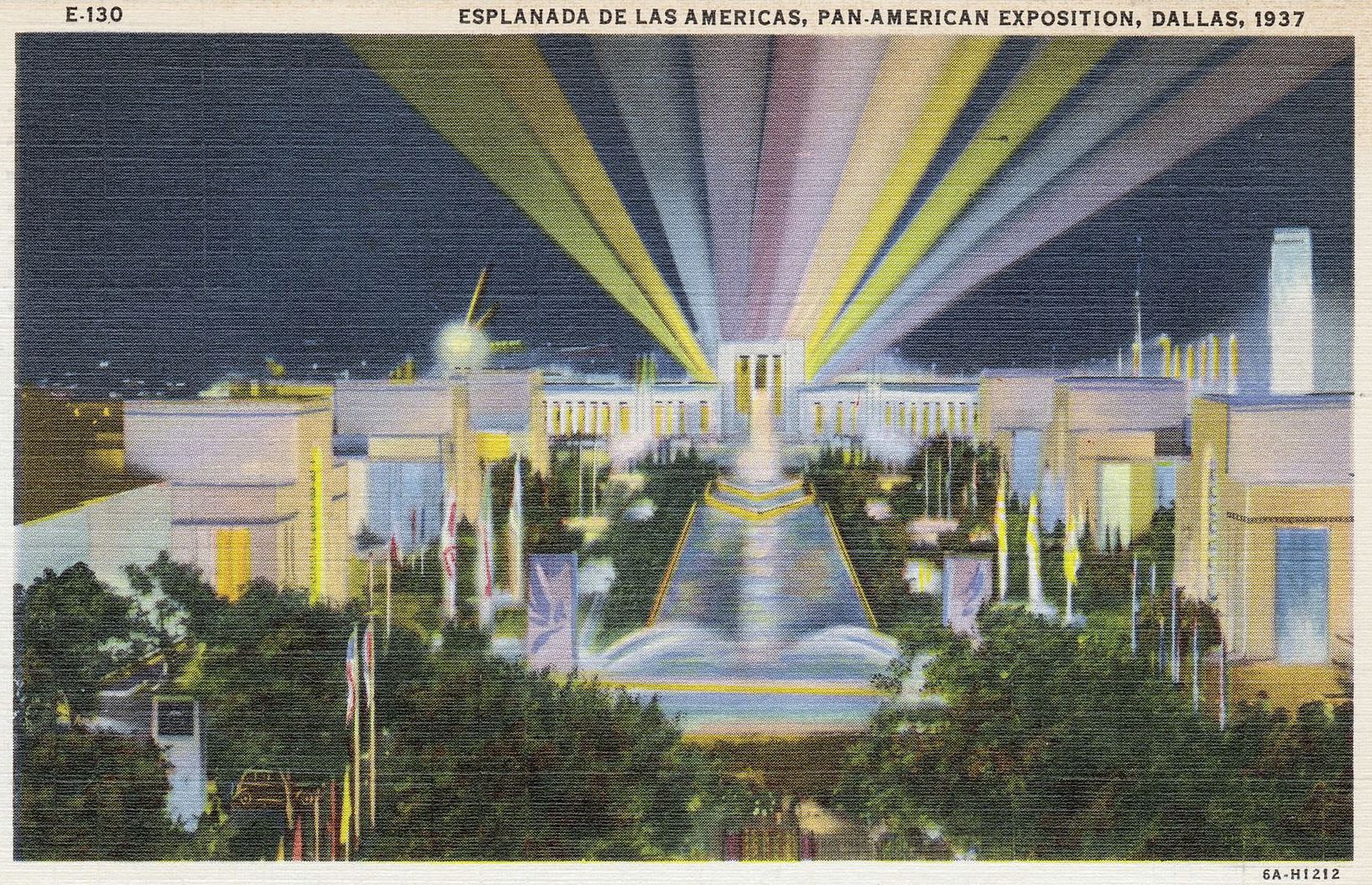
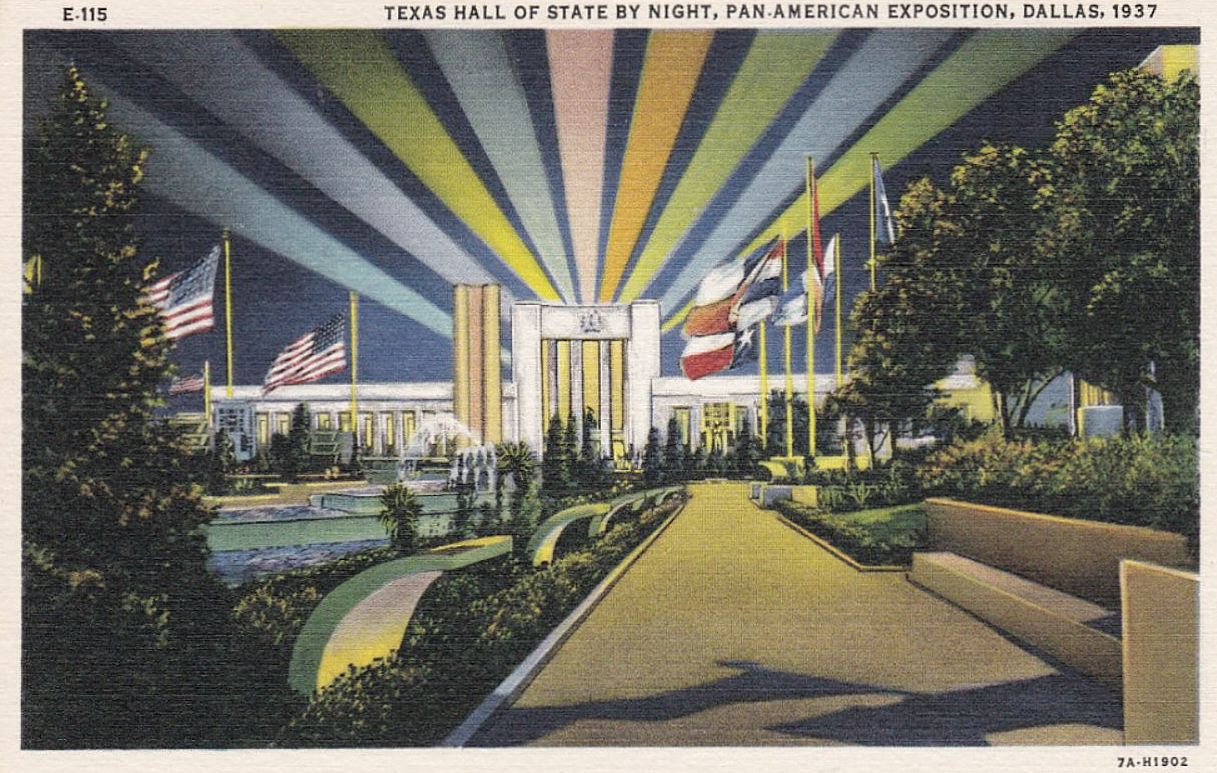
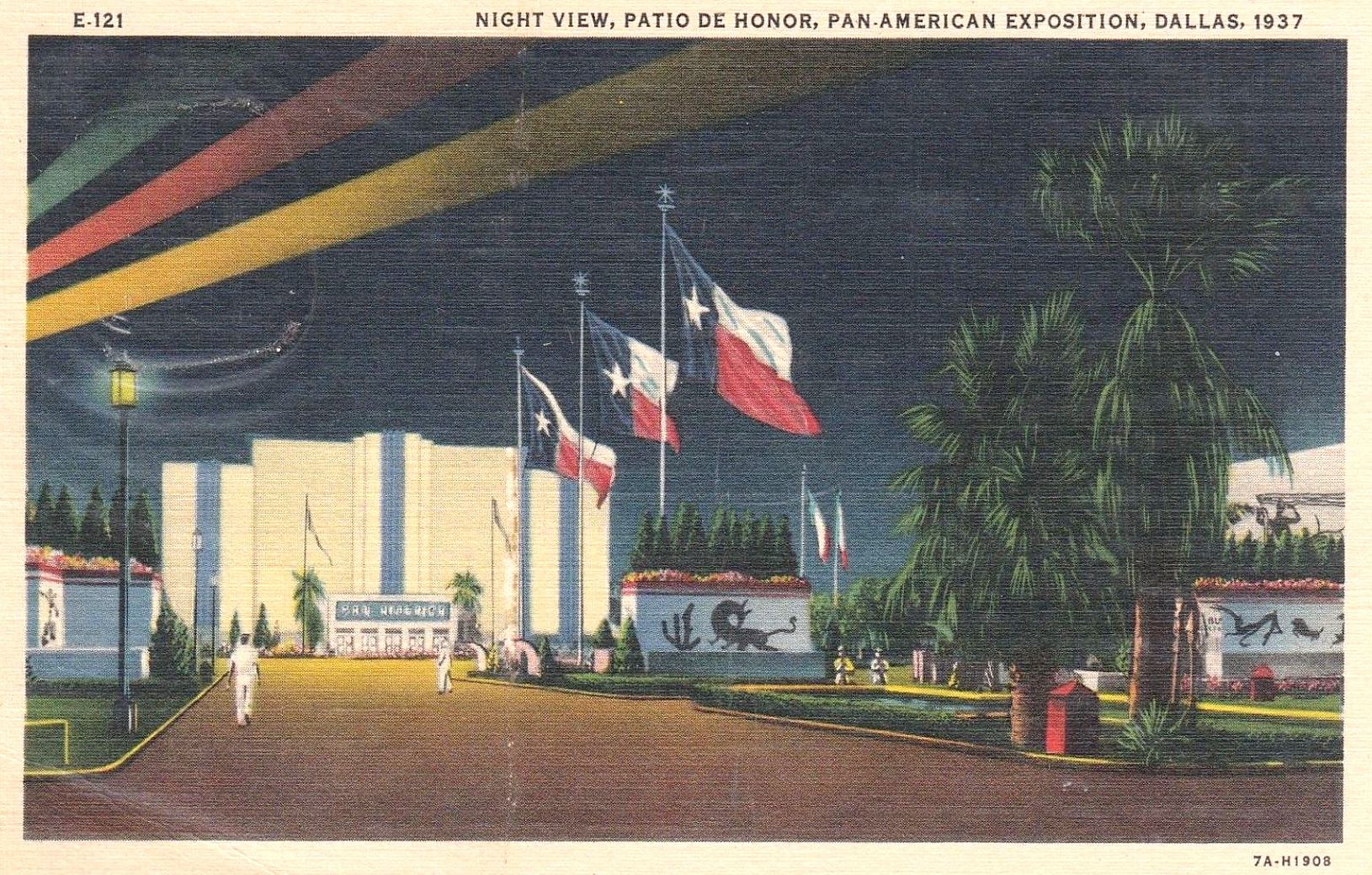
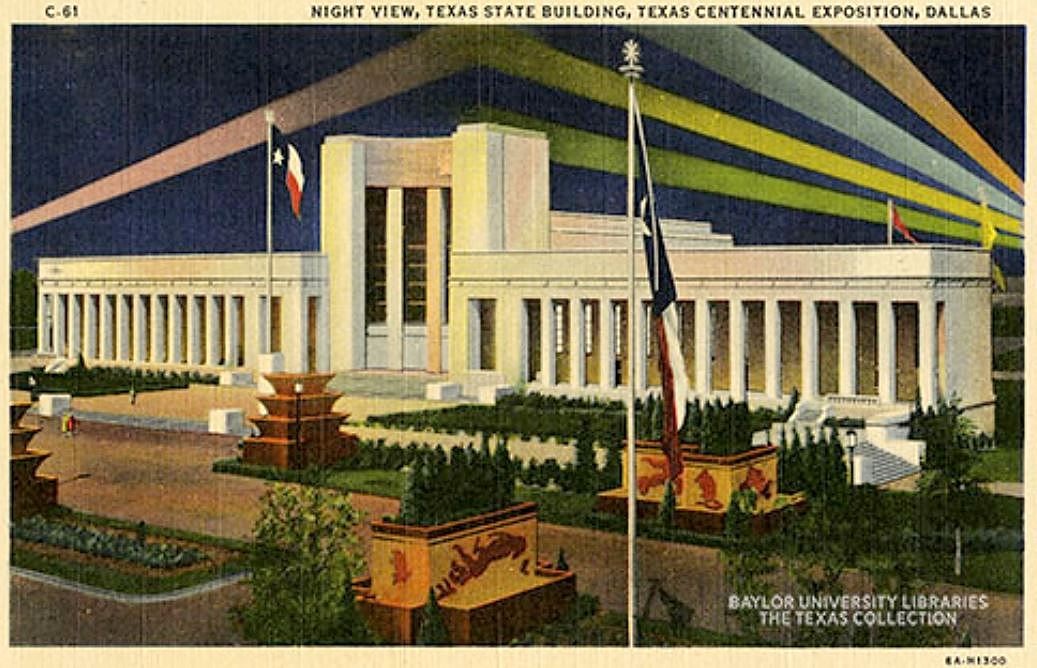
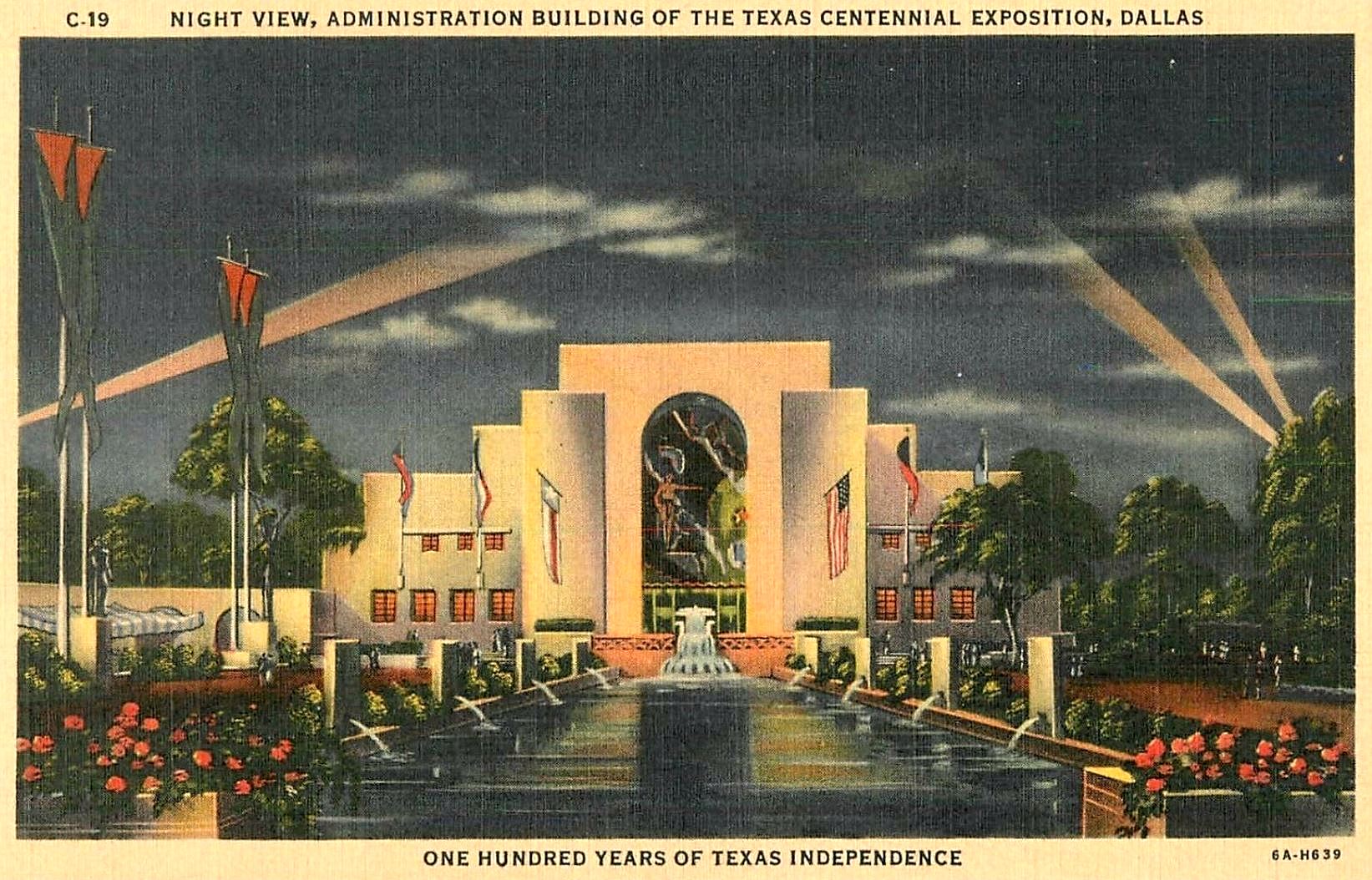
Many of the lighting designs and displays had been used the previous year during the Centennial, but, as with much of the attractions and appointments throughout the park, they were improved and spectacularized for the Pan-American Expo. And people loved what they saw.

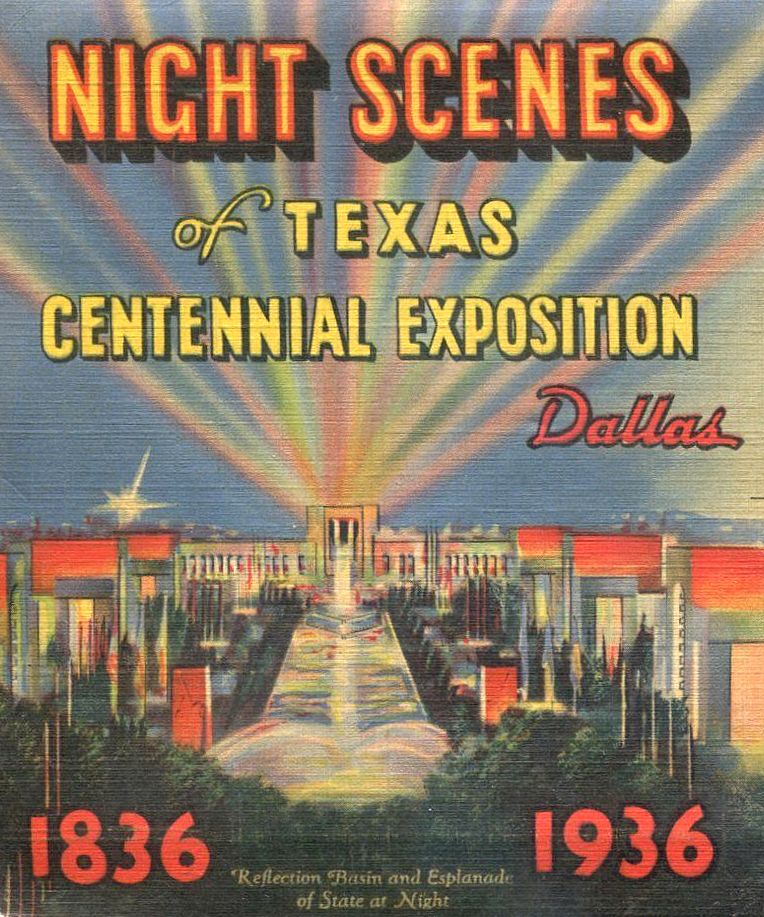
Despite the multi-million dollar structures, air conditioning demos, works of art and other newfangled additions to the space, when people left the Centennial Exposition one thing was on everyone’s tongues, according to historical pollsters: the lights.

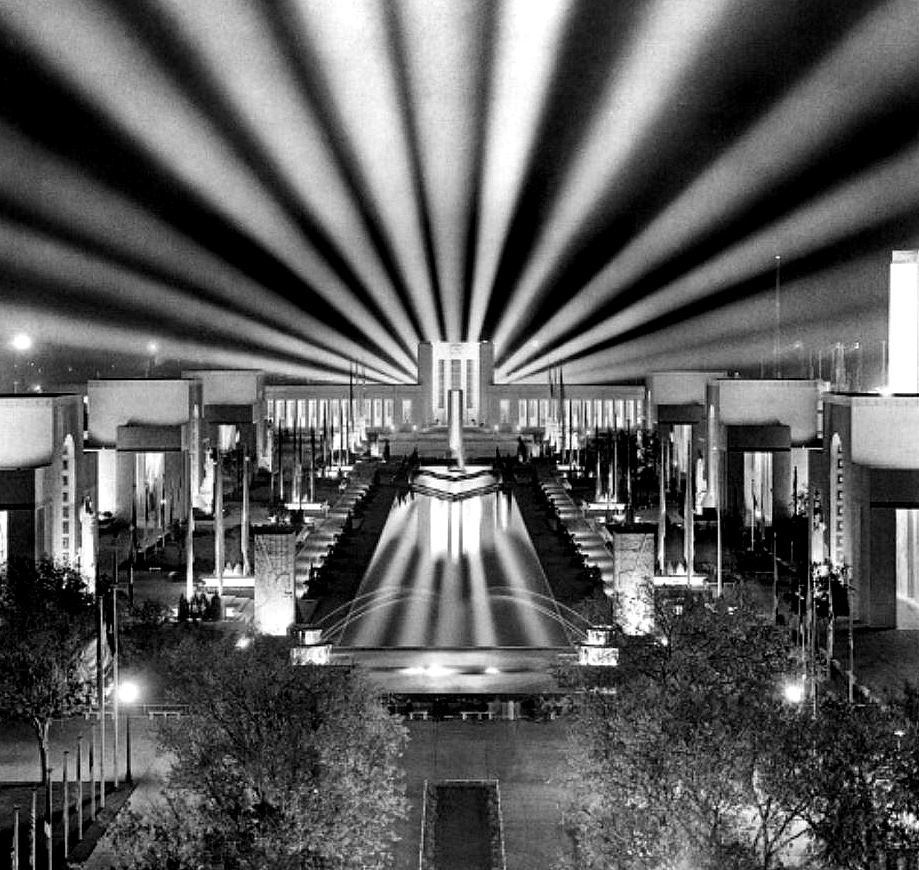
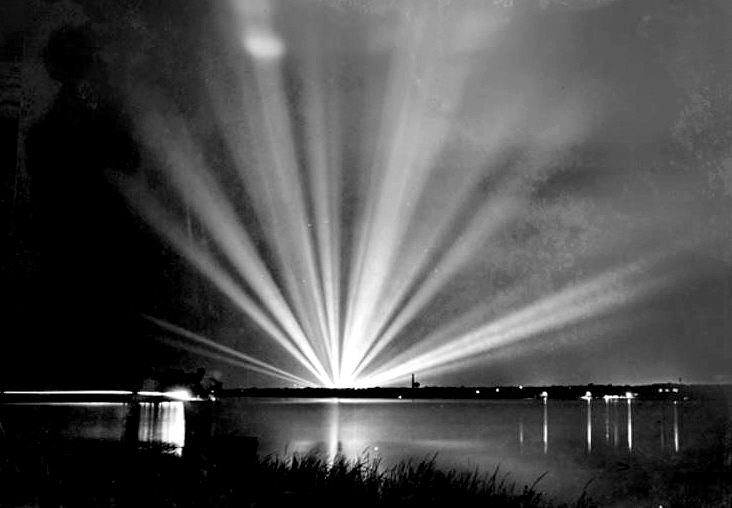
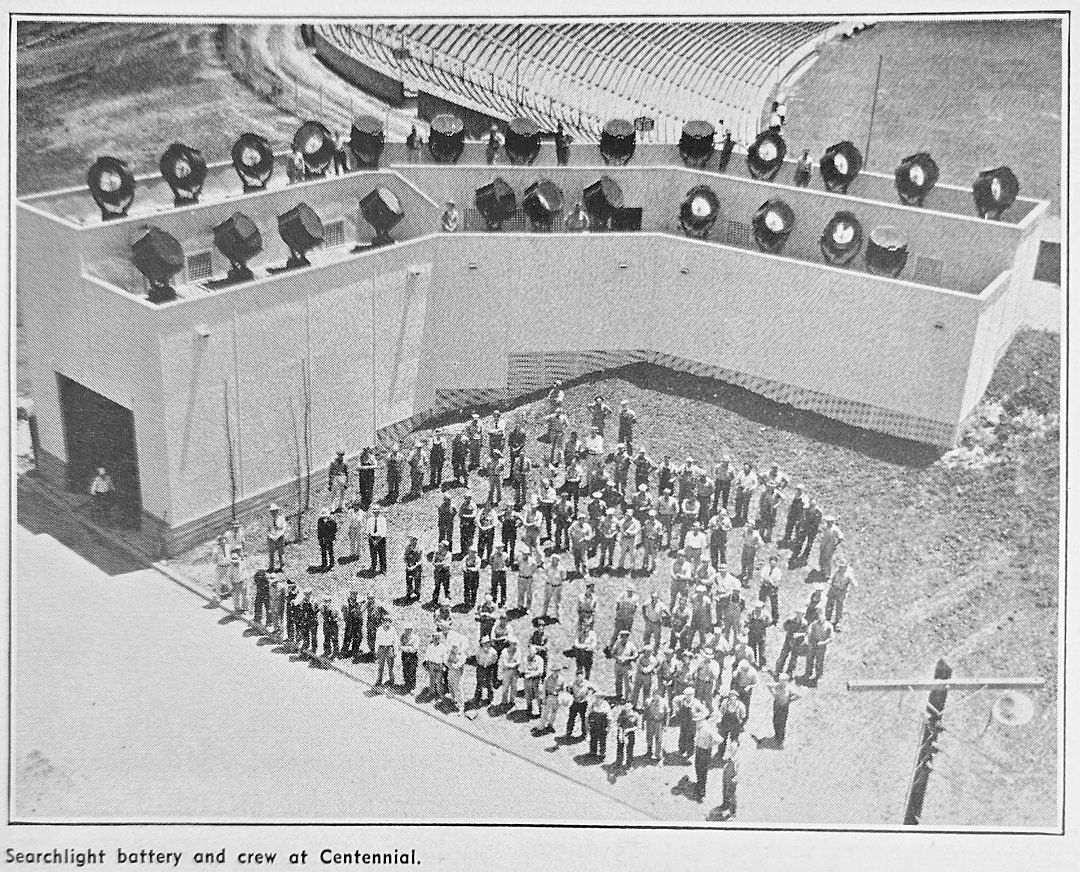
Positioned behind the Hall of State were 24 searchlights scaffolding into a crowned fan shape. “They all moved and were different colors,” says [Jim] Parsons [co-author of the book Fair Park Deco]. “It sounds gaudy, but people loved it.” The lights, he goes on to tell, were visible up to 20 miles away.

Considering most of the people who were visiting the fairgrounds were coming from rural farming communities with no electricity, the inspiring nature of those far-reaching beams makes a lot of sense. (Dallas Observer, Nov. 7, 2012)

Thanks for doing your part for Dallas history, Prof. Einstein!

pan-american-expo_esplanade_postcard

pan-american-expo_hall-of-state_postcard

pan-american-expo_patio-de-honor_ebay

Below, photos from the Texas Centennial, 1936. The multicolored lights could be seen from miles away — here’s what they looked like from downtown and from White Rock Lake.

centennial_pan-american_lights

skyline_downtown-to-fair-park_1936_GE-colln_museum-of-innovation-and-science

fair-park-lights_white-rock-lake

tx-centennial_night-scene_espalanade_hall-of-state_lights_ebay

tx-centennial_night_hall-of-state_lights_flickr_baylorvia Baylor University Flickr stream

tx-centennial_night_administration-bldg_lights_ebay

*

A look behind the scenes: “The general lighting effect is a battery of twenty-four 36-inch searchlights as powerful as the giants that flash from the dreadnoughts of Uncle Sam’s navy. Each searchlight will produce 60 million candlepower. Combined, the battery has a total candlepower of 1.5 billion. A 350,000-watt power generator will produce this colossal quantity of ‘juice.’” And the accompanying photo of the searchlight battery crew manning the candlepower:

tx-centennial_lights_southwest-business-mag_june-1936_photoSouthwest Business, June 1936

**

(All pictures and clippings are larger when clicked.)

einstein_pan-am-expo_denison-press_060937
Denison Press, June 9, 1937

*

einstein_pan-am-expo_waxahachie-daily-light_061137
Waxahachie Daily Light, June 11, 1937

*

einstein_pan-am-expo_denison-press_061437
Denison Press, June 14, 1937

*

einstein_pan-am-expo_medford-oregon-mail-tribune_062337
Medford (Oregon) Mail Tribune, June 23, 1937

*

einstein_pan-am-expo_vernon-daily-record_062437
Vernon Daily Record, June 24, 1937

*

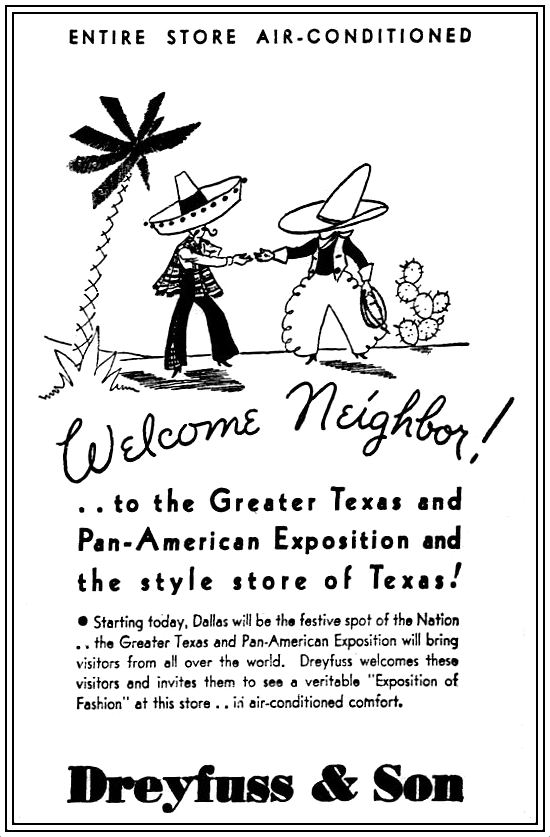
pan-american-expo_drefuss-ad_dmn_061237
1937

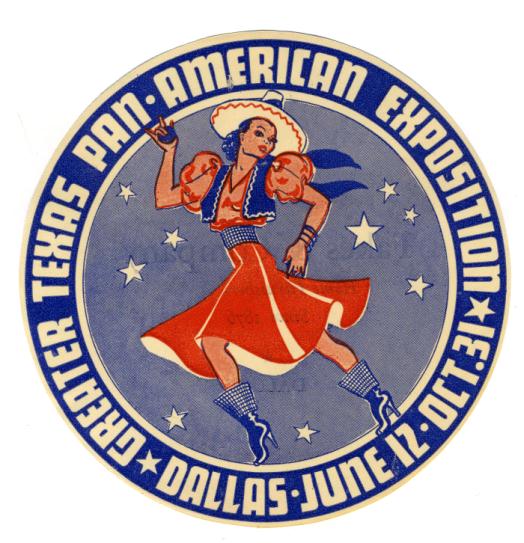
pan-american-expo_sticker_1937_cowgirl

***

Sources & Notes

Top photo from the old Corbis site.

Black-and-white photos from the Centennial seen from Fair Park and White Rock Lake are from the Texas/Dallas History and Archives Division of the Dallas Public Library; the photo of the lights seen from downtown Dallas (titled “New skyline at night from Dallas, Texas”) is from the GE Photo Collection, Museum of Innovation and Science (more info on that photo is here).

Sources of other images and clippings cited, if known.

More on the Pan-American Exposition from Wikipedia, here, and from the fantastic Watermelon Kid site of all-things-Fair-Park, here.

*

Copyright © 2016 Paula Bosse. All Rights Reserved.

What’s Playing at the Palace? — 1950s

elm-street_ten-commandments_1957_flickr_coltera.JPGFilm Row: Elm & Ervay, looking west… (click for large image)

by Paula Bosse

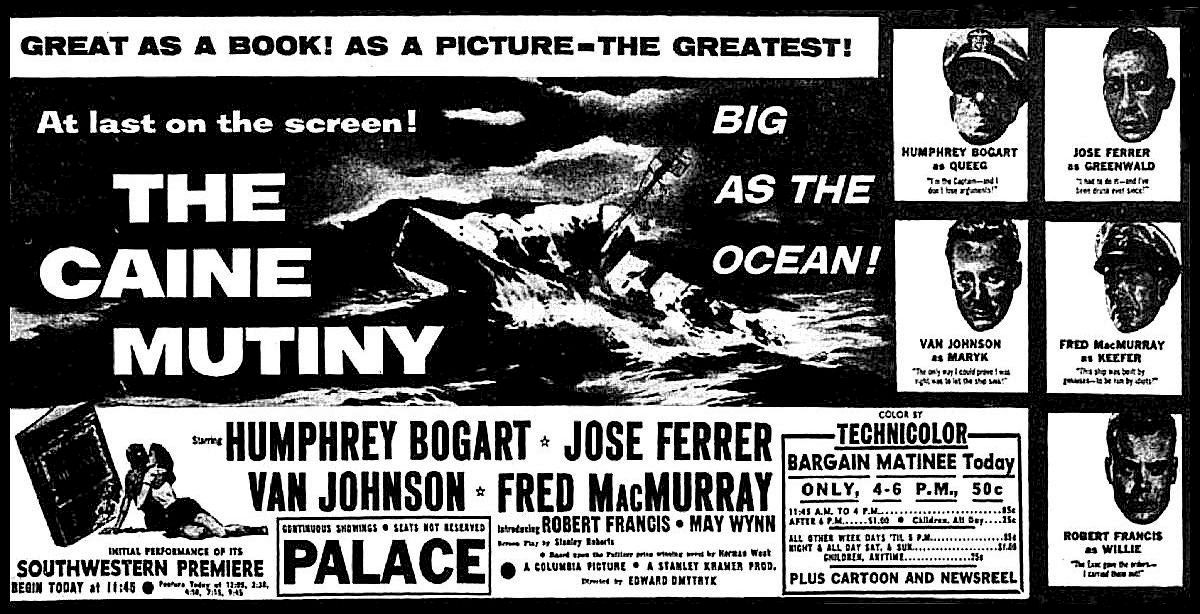
In the 1950s, the two prestige movie theaters in Dallas were the Majestic and the Palace, mainstays of “Theater Row” and just a few blocks apart on Elm Street. The Palace Theater (at Elm and Ervay, across from the Wilson Building) is seen in the two postcards featured here. The one above shows Elm Street looking west. “The Ten Commandments” is playing, placing the date that photo was taken sometime between February and May, 1957. The postcard below shows an eastward-looking view with “The Caine Mutiny” on the marquee, dating that photo to the latter half of July, 1954.

elm-street_looking_east_palace_night_flickr_coltera

“The Ten Commandments” was a huge, huge hit and ran for 11 weeks — no movie had ever run that long in the history of Dallas theaters (it had beat out the then-champ, “Sergeant York,” which had had a seven-week run at the Majestic in 1941).

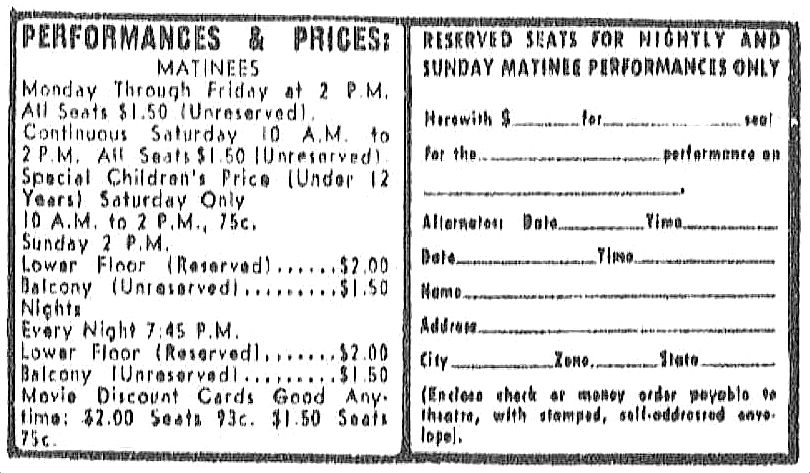
It was also one of the longest movies to ever play in Dallas. We’re talking a running time of almost 4 hours (with an intermission), something which not only tested the endurance of audiences but also severely limited the number of showings per day. It was an “event” picture, and, accordingly, prices were higher and reserved seats were offered.
ten-commandments_palace_dmn_021457_ad_det_reserved-seatsFeb., 1957

The number of people in Dallas who saw that movie at the Palace is staggering: over 100,000! Even after its run at the Palace ended, it continued to draw crowds when it moved down the street to the Tower.

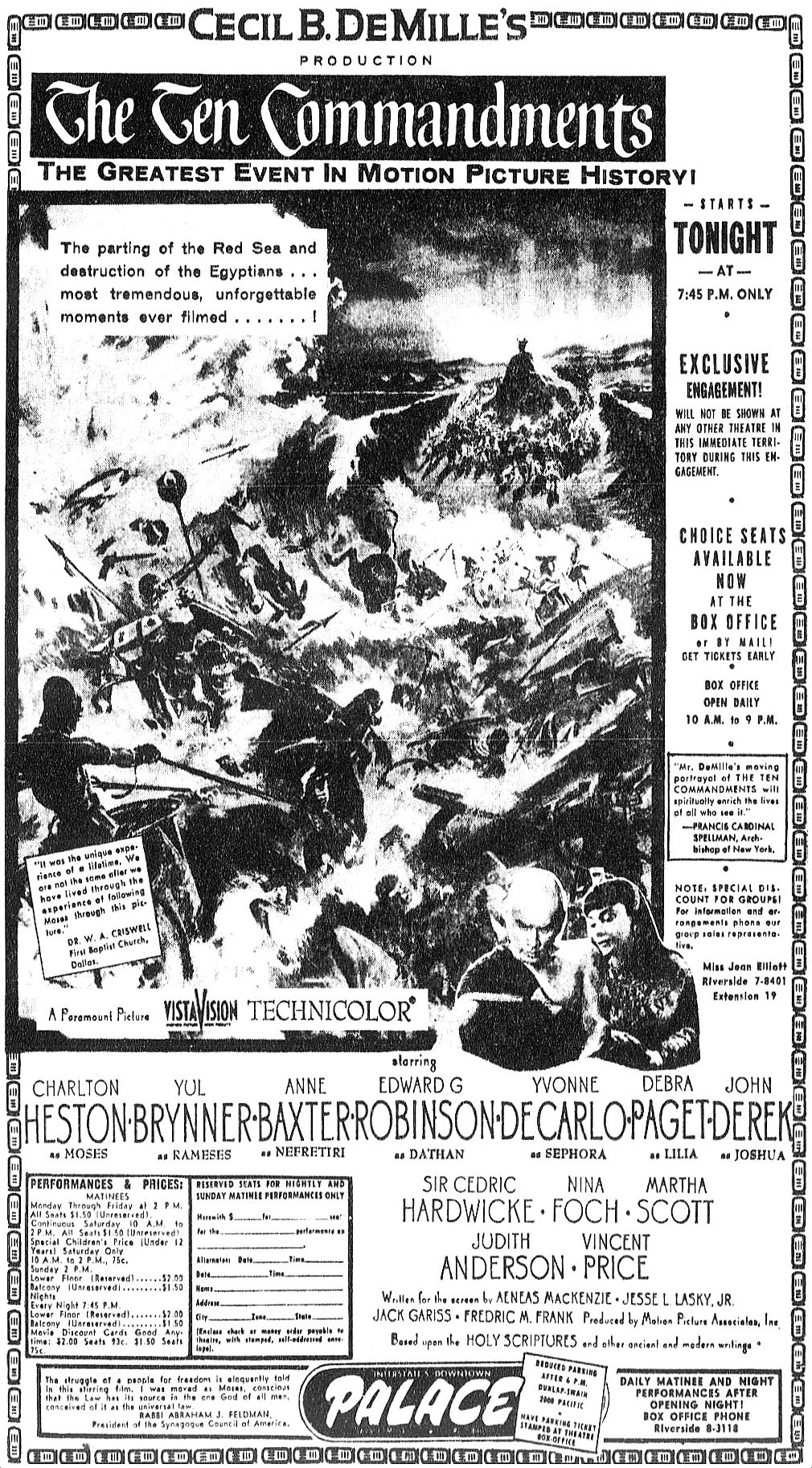
The opening-day ad for the movie:

ten-commandments_palace_dmn_021457_ad
Feb. 14, 1957

There were a couple of things I found interesting about this ad. One was that it had a blurb by First Baptist Church of Dallas’ chief Baptist,  W. A. Criswell.
ten-commandments_palace_dmn_021457_ad_det_criswell

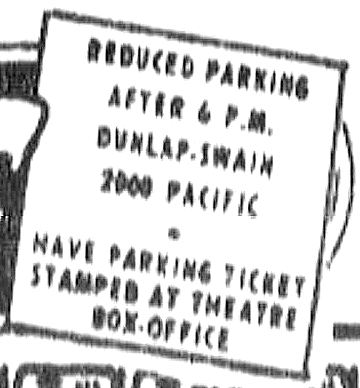
The second was that patrons could park behind the theater — on Pacific — at the Dunlap-Swain station. (Parking downtown for large crowds in those days must have been challenging —  not everyone took streetcars or, later, buses.)

ten-commandments_palace_dmn_021457_ad_det_parking

*

caine-mutiny_palace_dmn_071654_opening-nightJuly, 1954

***

Sources & Notes

Both postcards found on Flickr, posted by the unstoppable Coltera: the top one here, the bottom one here.

“The Ten Commandments” ran at the Palace Theater from Feb. 14, 1957 to May 2, 1957. The film that followed was “Boy On a Dolphin,” which featured the debut of super-sexy Sophia Loren in a U.S. movie. …Which is an interesting counterpoint.

“The Caine Mutiny” ran from July 16, 1954 to July 29, 1954.

A previous post about the Palace — “Next-Door Neighbors: The Palace Theater and Lone Star Seed & Floral — 1926” — can be found here.

Click pictures and clippings to see larger images.

*

Copyright © 2016 Paula Bosse. All Rights Reserved.