Flashback : Dallas

A Miscellany: History, Ads, Pop Culture

Category: Leisure

“The Fair Is In the Air — Let’s Go!”

state-fair_1923Look at this 1923 typeface!

by Paula Bosse

Here we are again in the final days of another State Fair of Texas. Why not take a look at a few random images of the fair over the years. (Click pictures for larger images.)

First, from 1900, the entrance to the fairgrounds. (It appears to be the same view as the top postcard seen in a previous post, here, just a few steps inside the archway.)

fairgrounds-main-entrance_bohemian_1900_fwplFort Worth Public Library

*

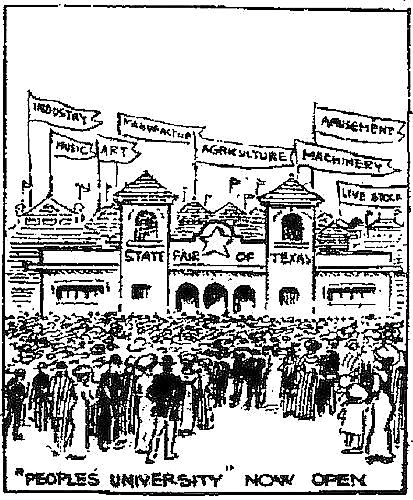
A cartoon from The Dallas Morning News in 1912 — “The People’s University.” Remember, it’s not just about Ferris wheels and candy apples.

state-fair_dmn_102012-cartoonDMN, Oct. 20, 1912

*

1921. Don’t miss The Whip.

state-fair_1921

*

From the Texas Centennial in 1936, a shot of a remarkably spotless Midway. (Am I the only one who would have paid to see the “28-Ft. Monster” do battle with whatever freakish specimens were ensconced within the walls of the Ripley’s Believe It Or Not building?)

tx-centennial-midway_1936_ebay

*

During World War II, no fair was held between 1942 and 1945. “Not until the boys come home, will there be another State Fair of Texas.”

state-fair_wwii_tx-almanac_1945-46

*

By the ’50s, everything was back to normal. Big Tex had arrived, and this ad promises “She’s a LULU in ’52.” Martin & Lewis and whatever a Thrillcade was!

state-fair_dmn_092552_lg

*

And, lastly, an aerial view of the Midway from 1966. Now this IS all Ferris wheels and candy apples. (To watch a short collection of color footage from the damp 1967 SFOT — including a sad, rainy parade downtown — click here.)

state-fair_1966_UNTUniversity of North Texas

***

Sources & Notes

1900 photo of the entrance to the fair is from The Bohemian magazine (1900) in the collection of the Fort Worth Public Library (those perforations in the photo are the FWPL’s).

1921 photo — I’m afraid I have no source on this one.

1936 postcard of the Centennial Midway is from eBay.

Patriotic WWII ad is from the 1945-1946 Texas Almanac.

Photo of the 1966 Midway is from the University of North Texas University Libraries blog, here.

My previous collection of SFOT photos over the decades appeared in the post “So Sorry Bill, But Albert Is Taking Me To The State Fair of Texas,” here.

Other Flashback Dallas posts on the State Fair of Texas are here; posts specifically on the Texas Centennial are here.

Again … some of these pictures are pretty dang big — when in doubt, click ’em!

*

Copyright © 2015 Paula Bosse. All Rights Reserved.


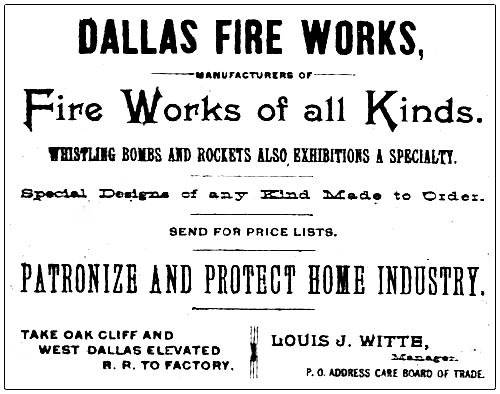
Dallas Fire Works Ad — 1891

ad-dallas-fireworks_1891-directory

by Paula Bosse

Even in the 1890s, Oak Cliff was encouraging people to buy local.

DALLAS FIRE WORKS
Manufacturer of
Fire Works of All Kinds.
Whistling Bombs and Rockets Also Exhibitions A Specialty.
Special Designs of any Kind Made to Order.
Send For Price Lists.
PATRONIZE AND PROTECT HOME INDUSTRY.
Take Oak Cliff and West Dallas Elevated R.R. to Factory.

Louis J. Witte, Manager.
P.O. Address Care Board of Trade.

Do NOT go to Fort Worth for your fireworks!

***

Ad from the 1891 city directory.

*

Copyright © 2015 Paula Bosse. All Rights Reserved.

Take a Spin In “The Rotor” at The State Fair of Texas

state-fair-midway_ebayAnother beautiful day at the fair!

by Paula Bosse

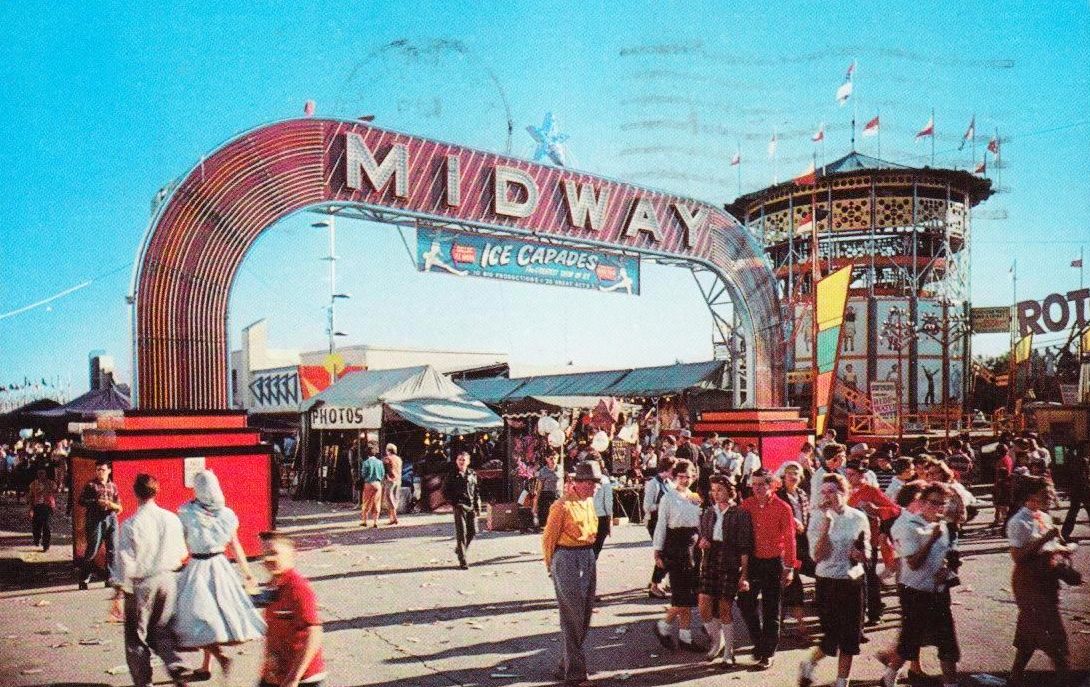
Students’ Day at the Fair? There are a lot of unaccompanied kids in that photo eating food on sticks.

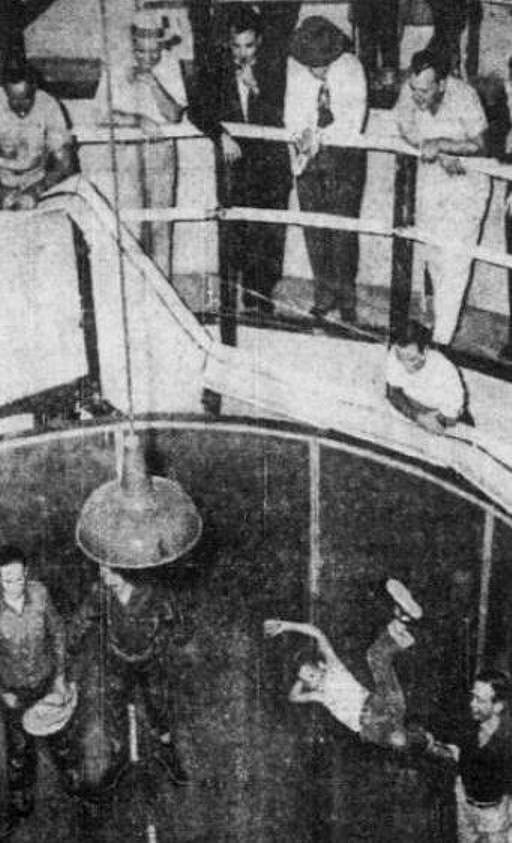
I could be wrong, but I think the round structure to the right of the entrance is The Rotor (part of the sign is visible at the far right). The Rotor resembled a large barrel inside. You’d stand with your back to the curved wall, and then the walls would begin spinning around. Eventually the spinning got faster and you’d be pinned against the wall with centrifugal force as the floor dropped out. …Which could be a big mistake after too many corny dogs and cotton candy.

The Rotor debuted at the State Fair in 1952, imported from England. The British company would be sued later that year by the man who invented the ride, Ernst Hoffmeister. Hoffmeister sued several people who were operating similar rides internationally, but all was resolved by the following year, and the Rotor ride was an extremely popular fixture of the State Fair of Texas midway for many years.

 Below, the ride in action.

rotor_1953

***

Sources & Notes

Postcard from eBay.

For more on this, head to the Dallas Morning News archives and read an interview with the men who brought the Rotor to the State Fair of Texas in the article “‘Bloody Sensation’ — Britons to Supply Ride on State Fair Midway” by Frank X. Tolbert (DMN, Sept. 25, 1952).

*

Copyright © 2015 Paula Bosse. All Rights Reserved


Young Bucks at the Fair — 1915

state-fair_men-touring-car_1915_degolyerRaring to go…

by Paula Bosse

Some of these guys look like they’d be fun to spend a day with at the fair. …Some of them don’t.

***

Sources & Notes

Real photo postcard titled “Men in a touring car with 1915 State Fair of Texas in Dallas banner” is from the Collection of Texas Postcards, DeGolyer Library, Central University Libraries, Southern Methodist University; it can be accessed here.

*

Copyright © 2015 Paula Bosse. All Rights Reserved.

Cadillac + Neiman-Marcus = “Practical” — 1956

ad-cadillac_neiman-marcus_1956Gowns and storefront by N-M, bumpers by Cadillac

by Paula Bosse

One need not be “prominent” to own a Cadillac or to shop at Neiman’s (… but it certainly helps).

***

Sources & Notes

Thanks to reader Kevin Smith for sending this to me!

Click ad to read text and to see those N-M gowns practically life-size.

*

Copyright © 2015 Paula Bosse. All Rights Reserved.

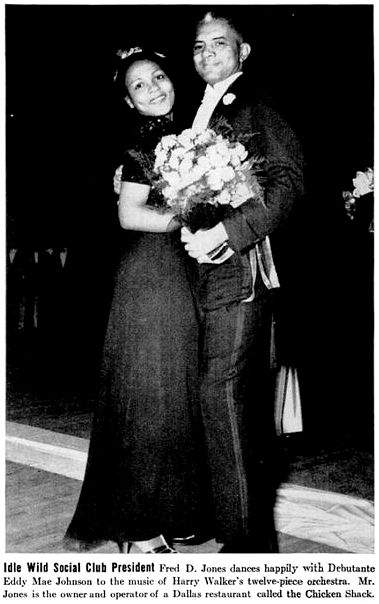
The Idle Wild Social Club: Life Magazine Presents Black Debutantes — 1937

debs_life_120637-detThree of 1937’s debs (click for larger image and caption)

by Paula Bosse

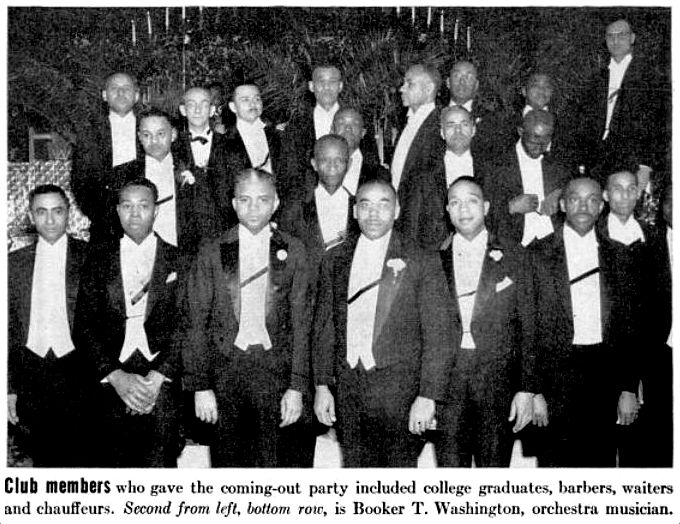
In December of 1937, something appeared in a national mainstream magazine that had probably never appeared before: photographs of a society ball celebrating African-American debutantes. In the December 6, 1937 issue of Life magazine — in the recurring “Life Goes To a Party” pictorial feature — four pages were devoted to coverage of the annual Idle Wild Social Club ball (later Idlewild Social Club, and later Cotillion Idlewild Club — none of which is to be confused with Dallas’ 130-plus-year-old super-exclusive, white Idlewild Club). The letters this unusual pictorial elicited were either congratulatory or, dismayingly, shocked and irate. Although today these photos are nothing unusual, in 1937, to see African-Americans depicted in a magazine such as Life as just normal, everyday Americans, was exceedingly uncommon. To see photos of black high-society must have made people’s heads explode. So kudos to Life for running the only slightly patronizing story and for publishing some wonderful photographs.

life_debs_120637_aLife magazine, Dec. 6, 1937

*

The Idle Wild Social Club was started in Dallas around 1918 by a group of socially well-placed black men — perhaps as a response to the white Idlewild Club. By the early 1920s they, like the white club, were presenting the cream of the crop of their young women to society in debutante balls. The ball covered by Life took place on November 18, 1937. The women making their debuts were:

  • Eddy Mae Johnson
  • Glodine Marion Smith
  • Lorene Marjorie Brown
  • Gladys Lee Carr
  • Gladys Lewis Powell
  • Hattie Ruth Green

life_debs_120637The debs and their escorts (Life, Dec. 6, 1927)

life_debs_120637-club-membersClub members (Life, Dec. 6, 1927)

life_debs_120637-crowd“Social chitchatterers” (Life, Dec. 6, 1927)

life_debs_120637-couple(Life, Dec. 6, 1927)

Read the article and see additional photos featured in this pictorial here.

There was an outcry in response to the article, and some of it was shockingly ugly — read the letters to the editor about the “Negro Ball” that Life published in the next issue, here (use the magnification tool at the top of the page to increase the size of the text).

Here is the more progressive response, from the Jan. 1938 issue of the NAACP’s magazine, The Crisis:

the-crisis-mag_jan-1938

Progress moves at a snail’s pace, but if coverage of a debutante ball can help to move things forward even a step or two … great!

***

All photos from Life magazine, Dec. 6, 1937; the scanned article (and, in fact, the entire scanned issue) is here.

The January, 1938 issue of The Crisis is available online; the page featuring the editorial is here. (This issue also has an interesting article, “Free Negroes In Old Texas” by J. H. Harmon, Jr., here.) The Crisis Wikipedia page is here.

To read coverage of earlier Idle Wild Social Club balls — published in the black-owned Dallas Express — see this from 1922, and this from 1923.

The African-American debutante ball has been called Cotillion Idlewild for many years now; information on their 2014 ball is here. (Again, this is not to be confused with the (white) Idlewild Club, which has been throwing heart-stoppingly elaborate balls in Dallas since the 1880s.)

Apparently there is a history of the club out there — Idle Wild Social Club History (1940) — and, according to WorldCat, appears to be available at nearby libraries.

Personally, I don’t really “get” debutante balls, but growing up in Dallas, I know that they’ve always been big, big, BIG deals. A. C. Greene’s snarky article “Social Climber’s Handbook” (D Magazine, October, 1976), is both amusing and informative; read it here.

*

Copyright © 2015 Paula Bosse. All Rights Reserved.


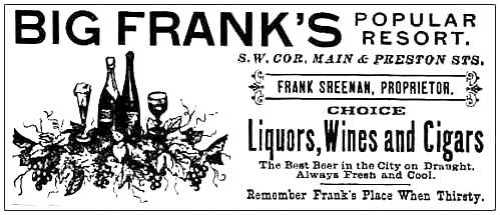
Thirsty For Something Stronger Than a Sarsaparilla? — 1890

ad-saloons_city-directory_1890-det“Remember Frank’s Place When Thirsty”

by Paula Bosse

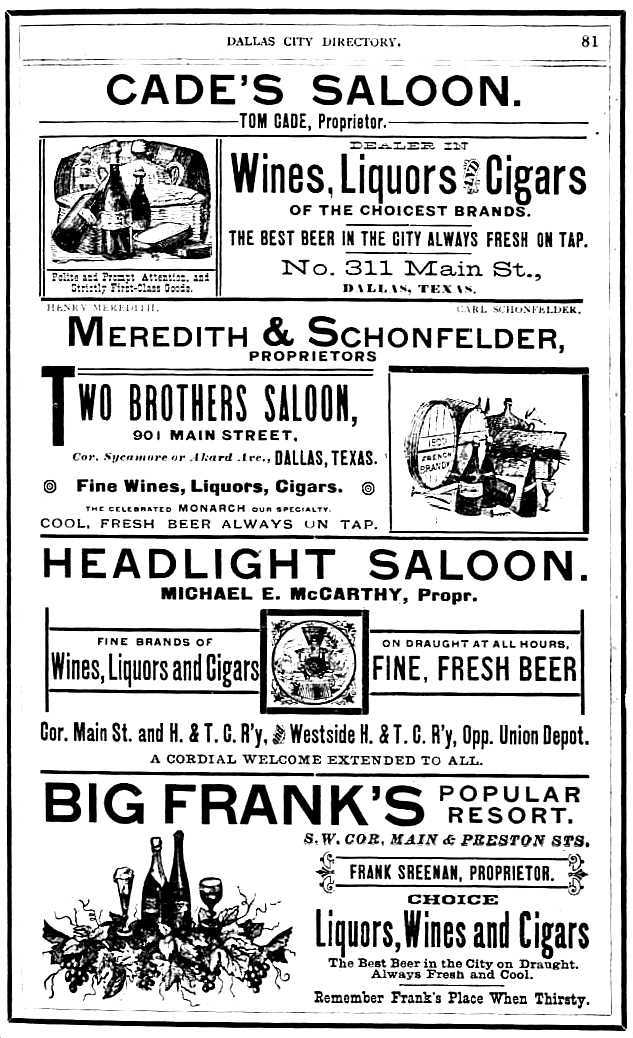
According to the 1890 city directory, Dallas had roughly 145 saloons. That seems like a lot when the city’s population was only 38,000. That would be one bar for every 262 people — and this is before you take out all the residents who wouldn’t have been allowed in saloons, like African Americans, Hispanics, women, children, etc. (and I’m sure there MUST have been a few adult white men who didn’t drink…). And there were probably a lot more than 145 bars — this doesn’t include private clubs or “unlicensed” holes in the wall (I’m not sure how heavily enforced “licensing” was back then). So it could have been more like one bar for every 50 imbibing Dallasites. Call me crazy, but this seems like a disproportionate ratio of bars to customers. But depending where you fall on the how-many-bars-is-too-many spectrum, it might have been just the perfect number. It fact it might have been a veritable paradise.

ad-saloons_city-directory_1890(click me!)

Here are a few of the “popular resorts” of the day into which a white man could mosey and slake his big Texas thirst.

  • Meisterhans’ Garden
  • Mayer’s Garden
  • Glen Lea
  • Planters House
  • Pat’s Place
  • Frank’s Place
  • Ord’s Place
  • Two Johns
  • Two Brothers
  • Louis
  • Bohny’s Hall
  • New Idea
  • U Bet
  • Walhalla
  • Coney Island
  • Butchers’ and Drovers’
  • Q. T.
  • Eureka
  • Gem
  • The Wonder
  • Sample Room
  • Monarch
  • Casino
  • Little Casino
  • Red Front
  • Blue Front
  • Blue Corner
  • Buck Horn Corner
  • Sharp Corner
  • Mikado
  • Apollo Hall
  • Mammoth Cave
  • Headlight
  • Green Tree
  • Live Oak
  • Moss Rose
  • Sunny South
  • White House
  • Cabinet
  • Senate
  • Postoffice
  • Board of Trade
  • First and Last Chance
  • Turf
  • Black Elephant
  • Jockey
  • Union Depot
  • 9-45
  • Dallas Club
  • Wichita Exchange
  • City Hall Exchange
  • Ross’ Exchange
  • Mechanics’ Exchange

That’s a whole lot of places to get drunk in.

***

Sources & Notes

Saloon ad from the 1899/1890 edition of Morrison & Fourmy’s Dallas City Directory.

See the complete list of saloons, with addresses and proprietors’ names, here.

Street names and addresses have changed over the years. Plot the location of your favorite bar by referring to an 1890s map, here.

In the nineteenth century, the word “resort” often denoted places a bit more unsavory than, say, Puerto Vallarta. A list of similar establishments might include “tippling houses, gaming houses, bawdy houses, billiard saloons, lager beer saloons, and other places of public resort” (source here).

I’m wondering if “respectable” women were allowed as customers in the larger beer gardens in Dallas at this time? If anyone has info on this, I’d love to know.

Was drunkenness a goldmine-like source of city revenue? Oh yeah. See my previous post “Police Blotter — 1880s,” here. Building a greater Dallas, five bucks at a time.

*

Copyright © 2015 Paula Bosse. All Rights Reserved.

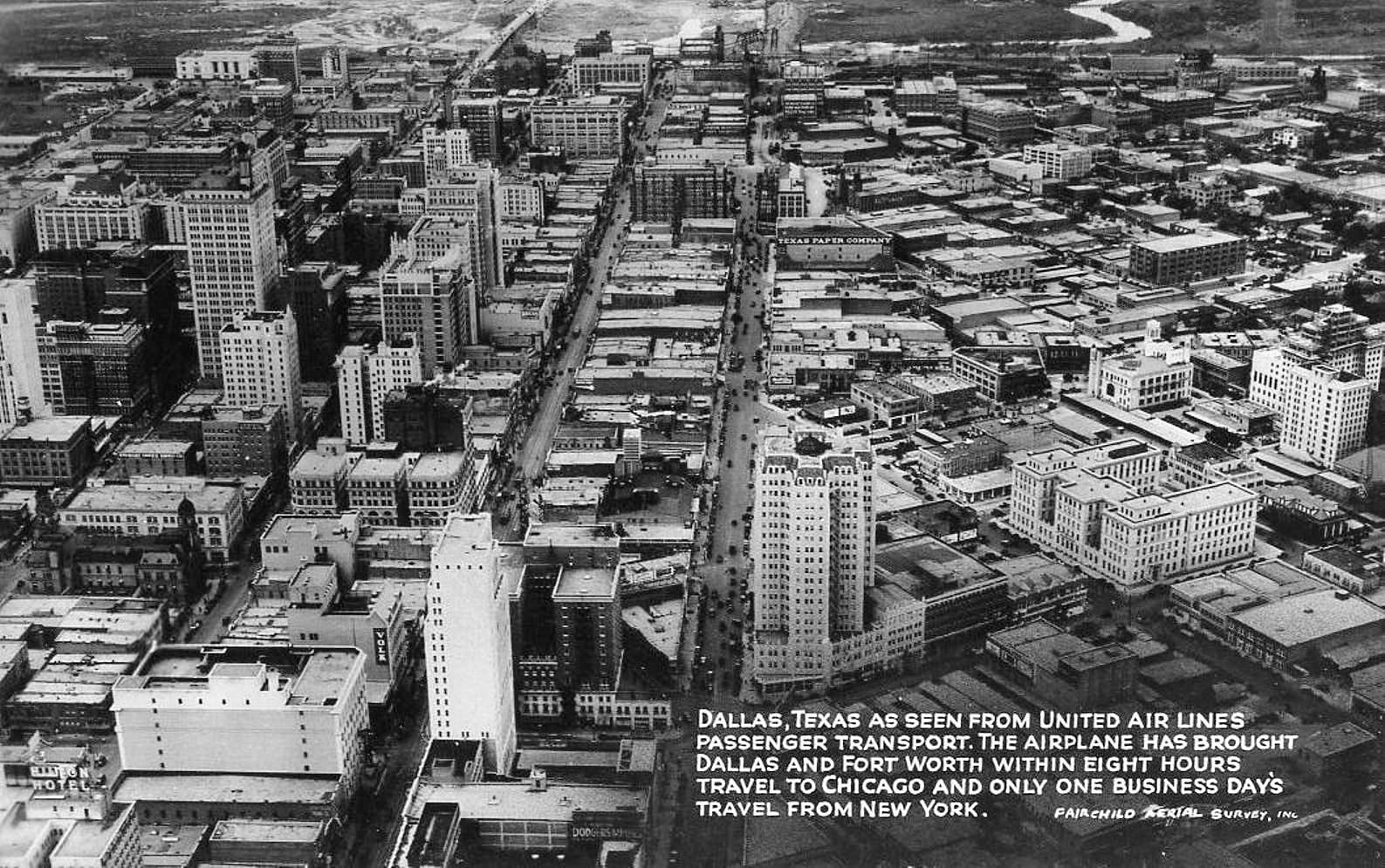
Fly United to Chicago in Only Eight Hours!

aeiral_united-air-lines_fairchild_ebay_rppcHow many buildings can you identify? (click for larger image)

by Paula Bosse

Dallas, Texas as seen from United Air Lines passenger transport. The airplane has brought Dallas and Forth Worth within eight hours travel to Chicago and only one business day’s travel from New York.

Back when it took all day to fly to New York from Dallas.

This is another great aerial photo by the Fairchild Aerial Survey company, probably taken by Lloyd M. Long. Date-wise? Late-1920s? Before the Trinity was straightened (beginning in 1928), with land being cleared in the area that would become Dealey Plaza? 1928-ish? Or could it have been the very early 1930s? The United Air Lines promotional postcard was issued around 1932 or 1933.

It wasn’t until 1933 that United introduced its new Boeing “twin motor airline transports” and boasted that they would finally “bring the city within eleven and a half hours of New York City” (Dallas Morning News, Aug, 16, 1933).

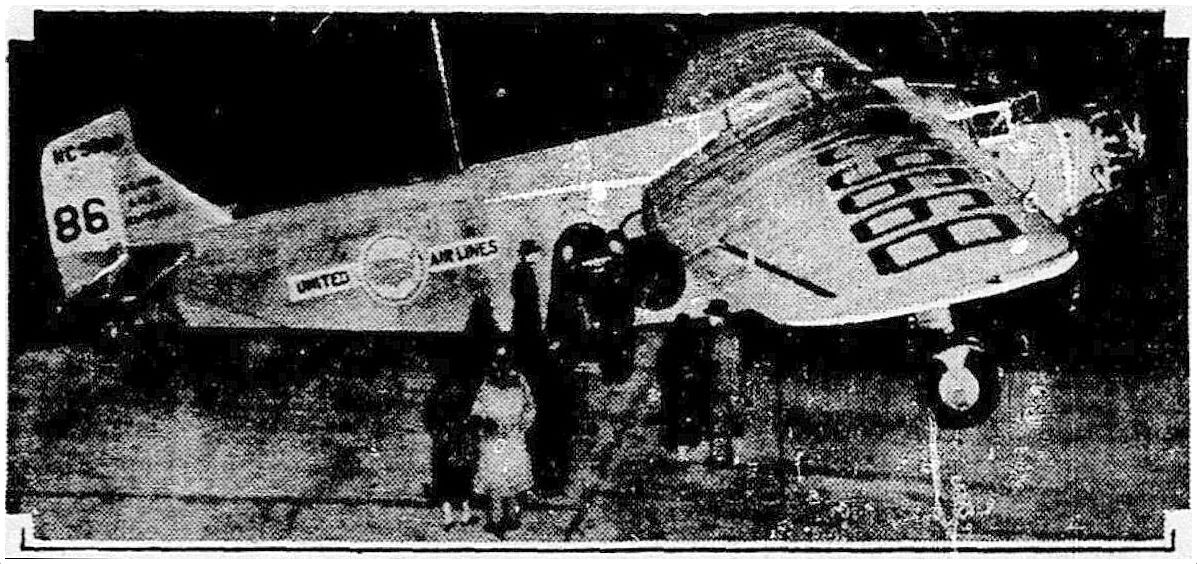
Below is a photo from a Dallas newspaper ad showing one of United’s planes from the earlier, more carefree days of 1932, when passengers were still trudging through the skies at a more leisurely pace.

united-air-lines_ad-det_dmn_110432United Air Lines ad, detail, 1932

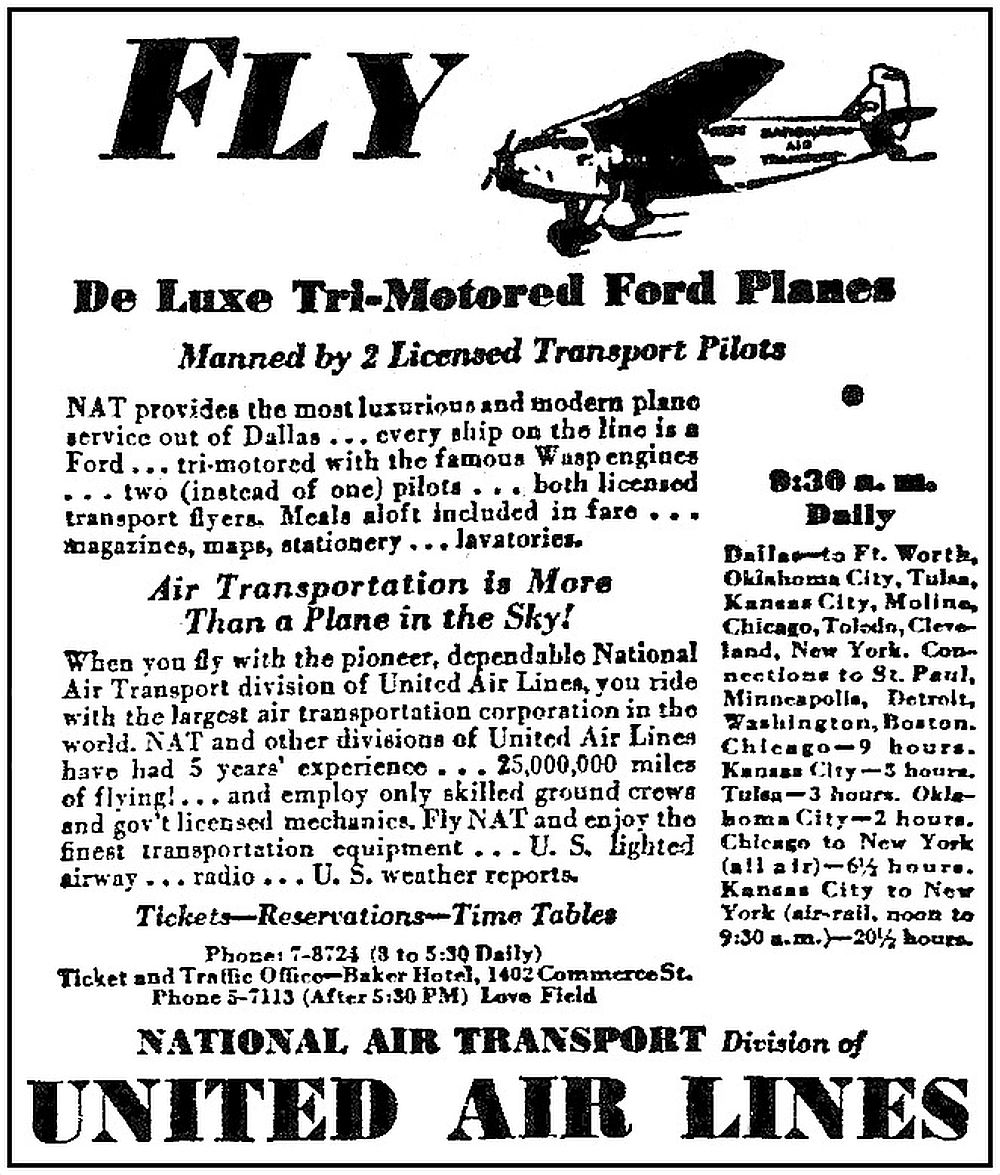
And an even earlier ad, from 1931, when a flight from Love Field to Chicago was nine hours long (today a direct flight from Love Field to Chicago takes about two hours and fifteen minutes). And if you wanted to continue to NYC, you had to board another plane and fly from Chicago to New York, adding another six and a half hours!

united-air-lines_dallas-to-nyc_1931
1931 ad

FLY

De Luxe Tri-Motored Ford Planes Manned by 2 Licensed Transport Pilots
 
NAT provides the most luxurious and modern plane service out of Dallas … every ship on the line is a Ford … tri-motored with the famous Wasp engines … two (instead of one) pilots … both licensed transport flyers. Meals aloft included in fare … magazines, maps, stationery … lavatories. 

Air Transportation is More Than a Plane in the Sky! 

When you fly with the pioneer, dependable National Air Transport division of United Air Lines, you ride with the largest air transportation corporation in the world. NAT and other divisions of United Air Lines have had 5 years’ experience … 25,000,000 miles of flying! … and employ only skilled ground crews and gov’t licensed mechanics. Fly NAT and enjoy the finest transportation equipment … U.S. lighted airway … radio … U.S. weather reports.

*

In an interesting side-note, the first pilot to fly a mail plane between Kansas City and Dallas (on May 12, 1926) was Richard Dobie, brother of Texas literary legend, J. Frank Dobie. In 1926 he flew a Curtiss Carrier Pigeon; in 1933, he’d worked his way up to the speedy and powerful Boeing. He flew for United for several years.

***

Sources & Notes

Top image is a promotional postcard, found on eBay.

Read more about the tri-motor airplane (manufactured by the Ford Motor Company and affectionately known as the “Tin Goose”) in the article “Ford’s Tri-Motor” by Edward J. Vinarcik (Advanced Materials and Processes, Oct. 2003) here.

All images larger when clicked.

*

Copyright © 2015 Paula Bosse. All Rights Reserved.


The Caveteria: “Marvelous Food at Moderate Prices”


caveteria_ebay
The finest in downtown basement dining (click for larger image)

by Paula Bosse

How could you NOT want to dine in a restaurant called a “Caveteria”? It was a cafeteria in the basement — the cave — of the swanky Baker Hotel, and it looks like it was a nice cheap place to grab a quick lunch downtown in the 1920s and 1930s.

caveteria_baker-hotel_postcard_ebay

*

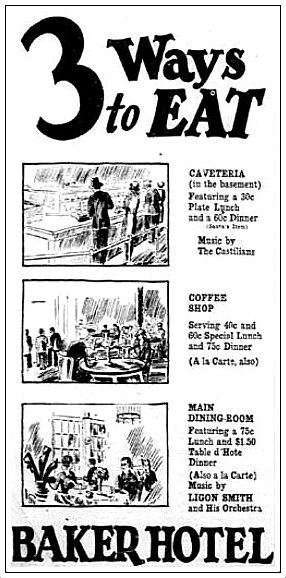
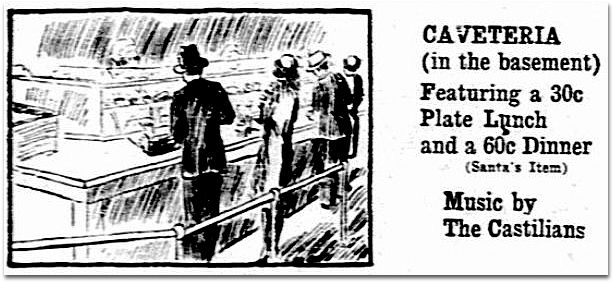
The Baker Hotel had “3 ways to eat”: one could eat cheap in the basement Caveteria (where, according to the Inflation Calculator, a 30-cent lunch in 1927 was the equivalent of about four bucks today), eat sort of cheap in the probably street-level coffee shop (lunch was about $6.75 there), and eat not cheap in the main hotel dining room (where lunch was over $10.00). (There was also the Peacock Terrace night club, well beyond reach of basement-dwelling diners.)

caveteria_dmn_120427

caveteria_dmn_120427-det1927

*

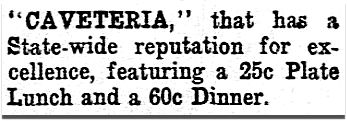
The price actually went down to a quarter by 1931 and had a “State-wide reputation for excellence.”

caveteria_dmn_020131DMN, Feb. 1, 1931

*

A year later the price was holding at 25 cents and it seems like a pretty good deal.

caveteria_dmn_021532DMN, Feb. 15, 1932

*

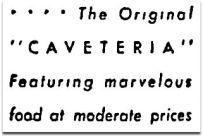
“The Original ‘Caveteria'” — accept no imitations! At least one other hotel in the Baker chain — the Gunter, in San Antonio — had a “Caveteria,” but apparently Dallas’ was first. In fact, the word and the hotel made their way into H. L. Mencken’s The American Language, Supplement One (see here).

caveteria_corsicana-daily-sun_031632Corsicana Daily Sun, Mar. 16, 1932

*

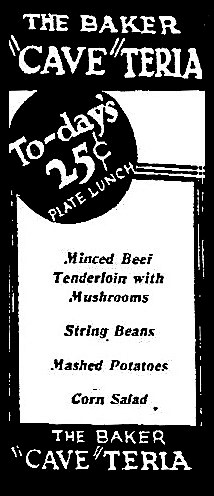
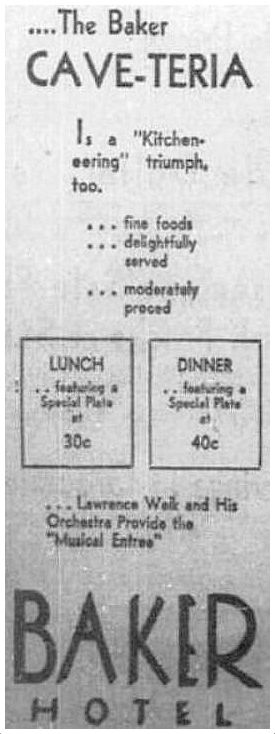
Oh yeah — live bands played while you ate your hearty meal of minced beef tenderloin. Even Lawrence Welk settled in for a stint as the “musical entree” in 1934.

caveteria_dmn_022234-lawrence-welkFeb., 1934

*

In 1942, the space once occupied by the Caveteria was turned over to the USO:

The Baker Hotel has provided the USO with what used to be the Caveteria in the basement of the hotel. It will be known as USO Club in the Cave. The entrance will be through the Akard Street entrance of the hotel.  (Dallas Morning News, Jan. 27, 1942)

*

And there it is — another place I wish I’d been able to visit.

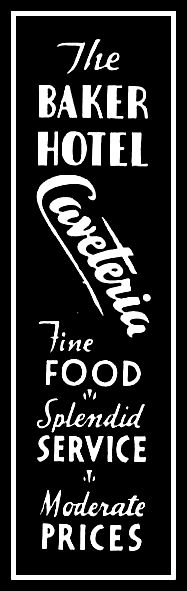
“Fine food. Splendid Service. Moderate prices.”

ad-baker-hotel-caveteria

***

Sources & Notes

Color postcards found on eBay.

The Baker Hotel opened in 1925 at Commerce & Akard on the site where the Oriental Hotel had previously stood, catty-corner from the Adolphus.

*

Copyright © 2015 Paula Bosse. All Rights Reserved.


Movie Houses Serving Black Dallas — 1919-1922

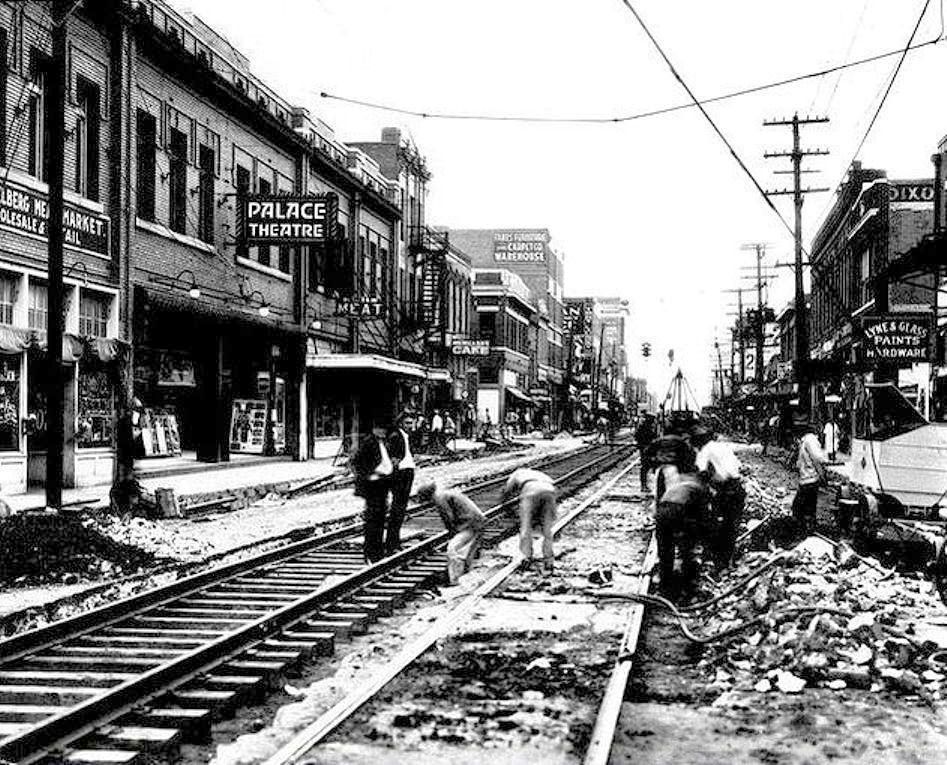
palace-theatre_elm-st_1922-dplThe Palace Theatre, Elm St., Deep Ellum, 1922 (click for larger image)

by Paula Bosse

In 1920, movie theaters — like most places in Dallas at the time — were segregated. If black customers were allowed at all in the downtown white vaudeville and movie houses, they had separate entrances and restricted seating areas (generally in the balcony). But Dallas’ African-American community had their own popular theaters, run by enterprising and energetic men who endlessly promoted their jam-packed and constantly-changing bills.

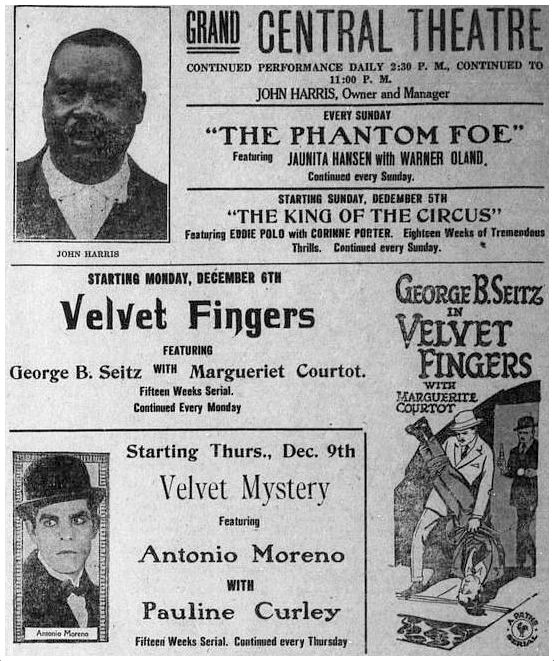
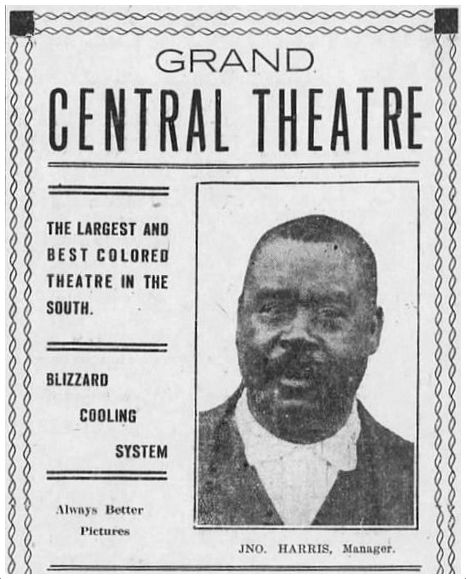
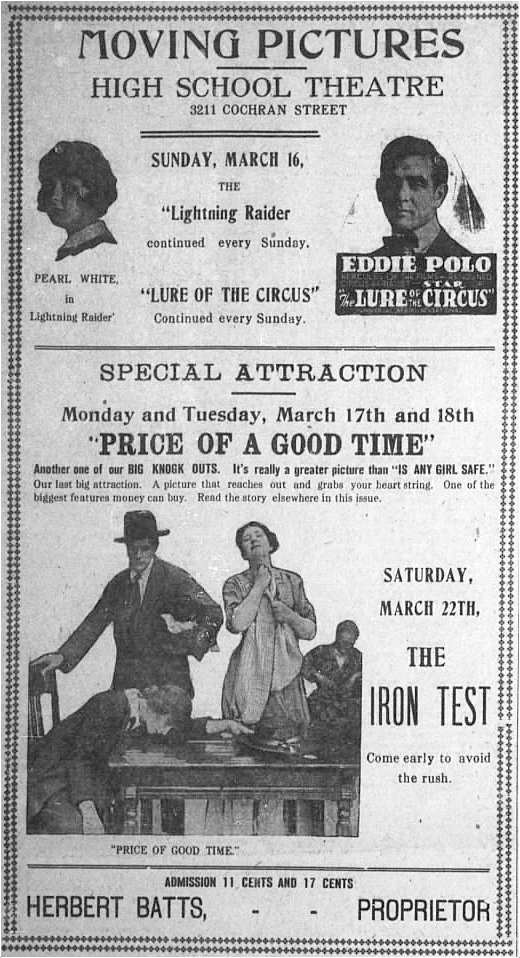
Judging by the amount of ad space purchased in the black-owned and operated Dallas Express, there were four main movie theaters catering to black Dallasites around 1920: the Grand Central Theatre, run by John Harris, the Mammoth Theatre, run by Joe Trammell, the Palace Theatre, run initially by Felix Moore, and the High School Theatre, run by Herbert Batts; the first three of these houses were in Deep Ellum, the last one was in what was then called “North Dallas.’ The theaters played both “white” films and films with “all-Colored casts.” The advertising for these theaters is great — far more ad space was available in the tiny Express to publicize the movies, the popular but now-forgotten Silent Film stars of the era, and the proprietors themselves than was available to the theaters on the other end of Elm Street in the much larger, white-owned News, Journal, or Times Herald. Sometimes it’s good being the big fish in the little pond — absolutely everybody knows who you are.

*

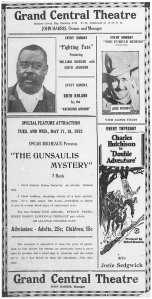
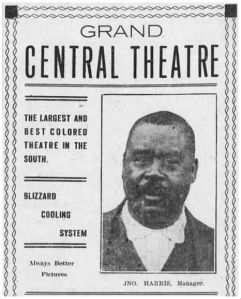
The Grand Central Theatre was at 405-407 N. Central Ave. (which later became Central Expressway), between Swiss and Live Oak on the outer northern edge of Deep Ellum. John Harris, the owner, put himself in practically all of his ads. He included this autobiographical sketch in one of them:
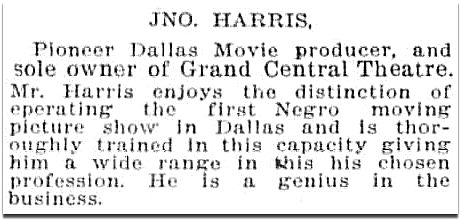
micheaux-grand_dallas-express_052821-detDallas Express, May 28, 1921

I’m not sure if he operated “the first Negro moving picture show in Dallas,” but I wouldn’t doubt it — the man was a dynamo who possessed not only a bold self-confidence, but he also seems to have had an unlimited promotional budget. UPDATE: The first appearance of a theatrical enterprise by John Harris shows up in the 1913 city directory (directories generally collected their information the previous year, so he was probably in business in 1912). Harris is listed under the “Amusements” section at the same address as the Grand Central Theatre, a name which came later. The same 1913 directory also lists the Star Theatre, which later became the Palace (see below). These are the only two theatres designated as “colored.” It’s unclear whether the theaters hosted live performances or showed movies. Or both.

The Grand Central advertised relentlessly. (Click ads to see larger images.)

grand-central-theatre_dal-express_120420Dec. 4, 1920

grand-central-theatre_dal-express_051421May 14, 1921

grand-central-theatre_dallas-express_080621Aug. 6, 1921

Below, an ad showing one of the offerings to be a Ben Roy Motion Picture Corp. movie called “My Baby” which was “made in Dallas, featuring William Lee and All Colored Cast.”
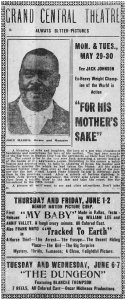
grand-central-theater_dal-express_052722May 27, 1922

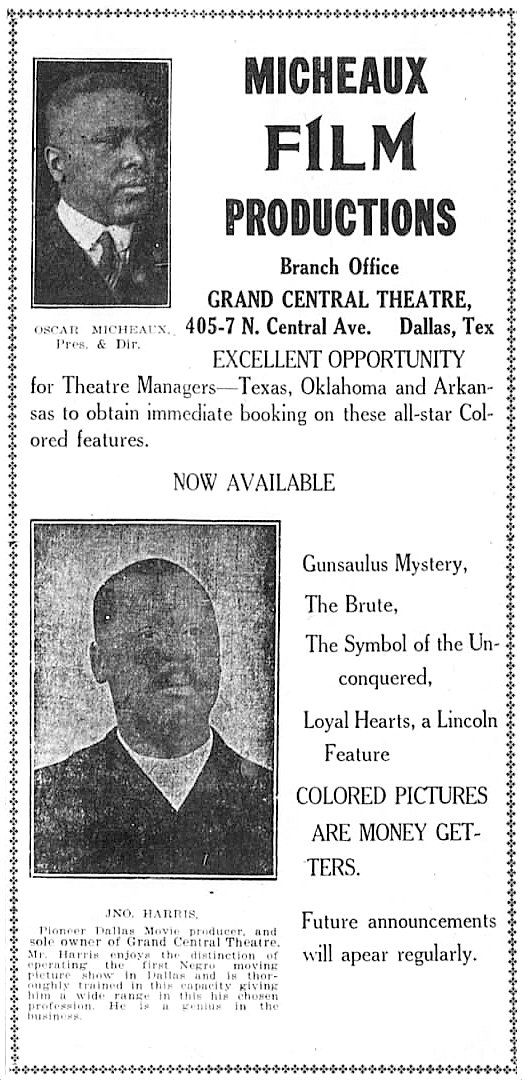
Harris was connected with the legendary black filmmaker Oscar Micheaux. Not only did he regularly run his films, but he also seems to have been working as a booker, promoter, and distributor of Micheaux’s films and ran the Micheaux Film Productions branch office out of the Grand Central. “Colored Pictures are Money-Getters.”
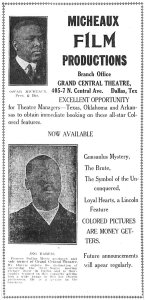
micheaux_dallas-express_051421May 14, 1921

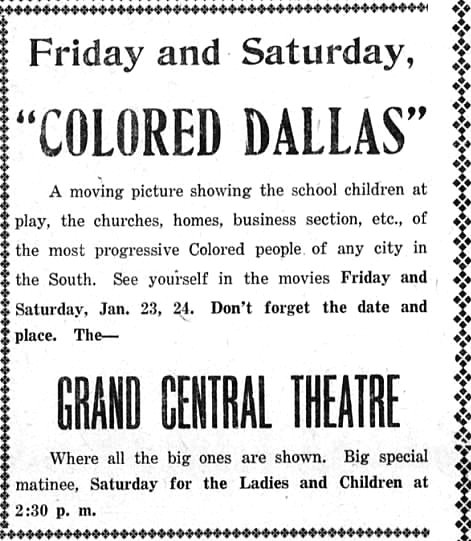
One ad that caught my attention was this one, for a locally-shot film called “Colored Dallas.” I really, REALLY want to see this, but the possibility of an extremely minor, 95-year-old silent film having survived into the 21st century is slim.

colored-dallas_dallas-express_012420Jan. 24, 1920

*

The Mammoth Theatre was located at 2401 Elm Street, between Central and Hawkins. It opened in late 1919 — the run-up to the opening was publicized in this Dallas Express item.
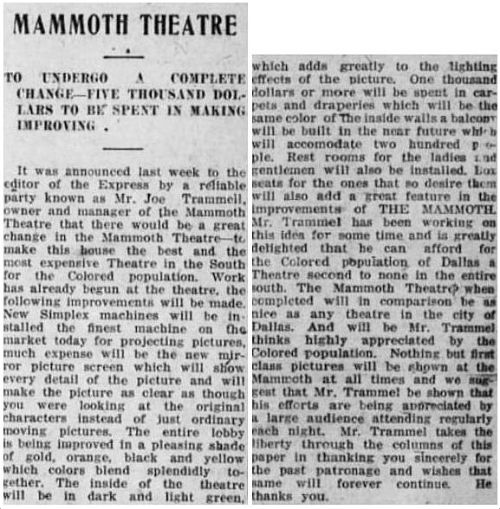
mammoth_dallas-express_112219Nov. 22, 1919

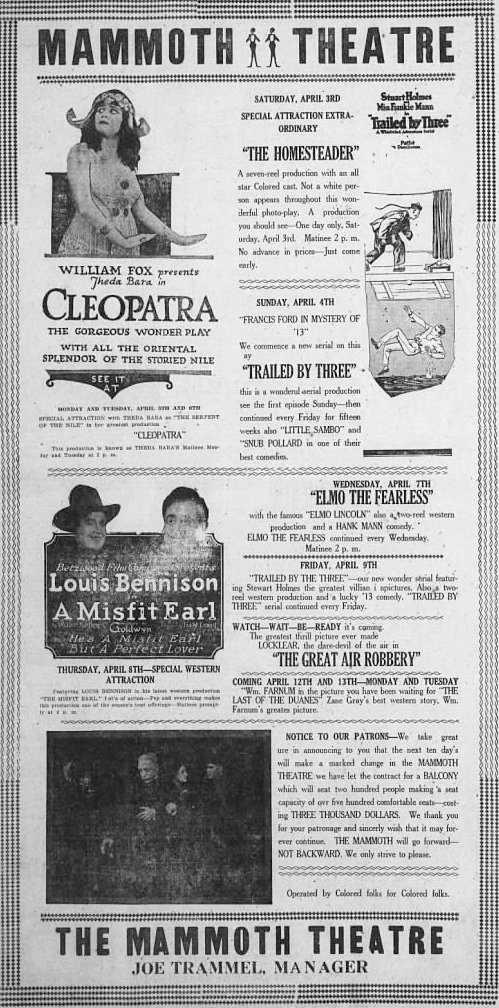
The Mammoth might not have advertised quite as much as the Grand Central did, but it frequently took out splashy full-page ads. Full-page! I bet that royally irked John Harris. Below, a Mammoth ad from 1920.
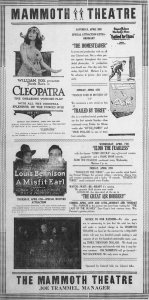
mammoth_dallas-express_040320April 3, 1920

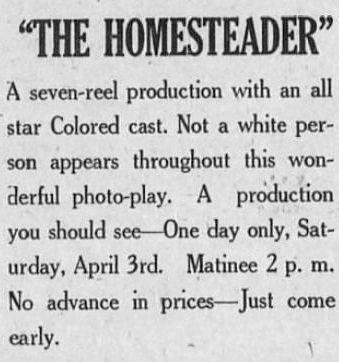
Two details from the above ad:
mammoth_dallas-express_040320-det-2

mammoth_dallas-express_040320-det
“Operated by Colored folks for Colored Folks.”

The owner, Joe Trammell, seems to have had an inexhaustible source of money for advertising — those frequent full-pagers (unusual for the time) must have cost a pretty penny. I couldn’t find much information about any of these men, but I stumbled across this photo of Trammell, tacked on to one of his … um … mammoth ads.

mammoth_joe-trammell_dallas-express_021221Feb. 12, 1921

*

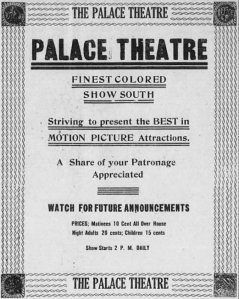
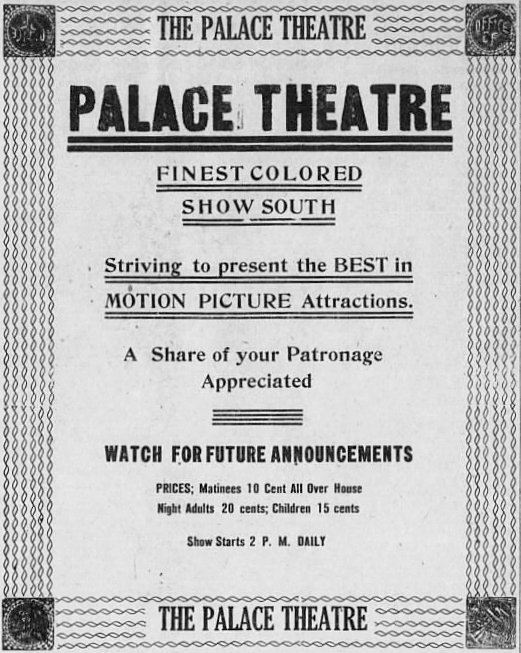
The Palace Theatre, seen in the photo at the top, was at 2407 Elm Street, just a couple of doors down from the Mammoth. (This Palace is not to be confused with the “white” Palace Theatre, the stalwart of Theater Row at the other end of Elm.) It opened in 1920 in the remodeled space formerly occupied by the Star Theatre,
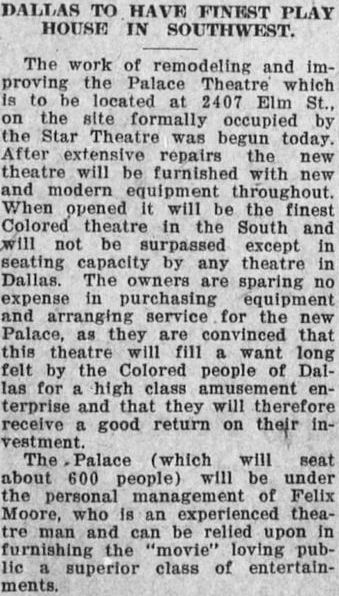
palace_dallas-express_030620March 6, 1920

palace_dallas-express_050820May 8, 1920

*

Lastly, moving up to North Dallas, we find the High School Theatre, located at 3211 Cochran, between Central and N. Hall Street. The reason for its name was its close proximity to the Colored High School (the only high school for African-American students at the time — it would soon merge with and relocate to the new Booker T. Washington High School a short distance away). The following businesses were in this same block: the High School Cold Drink Stand, the High School Cafe, the High School Shine Parlor, and the High School Tailor Shop. Location, location, location.
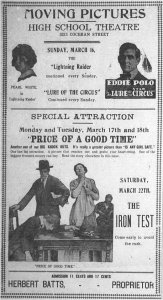
high-school-theater_dallas-express_031519March 15, 1919

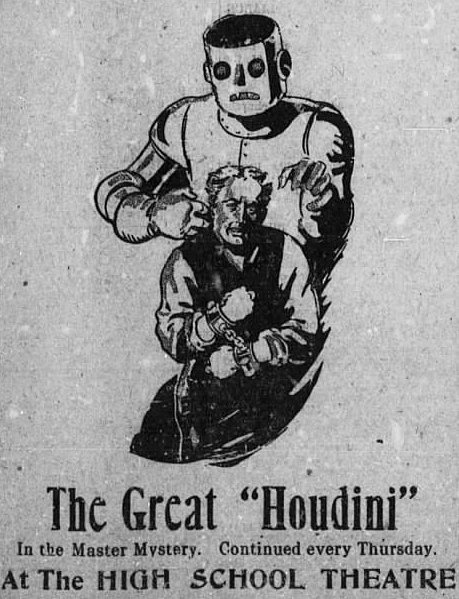
My favorite High School Theatre ad is this one, touting a serial called “The Master Mystery” starring Houdini … one of the screen’s first appearances of a robot! (Check out a scene featuring both Houdini and the robot/automaton, here.)
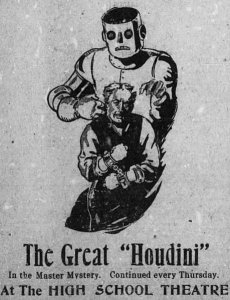
houdini_dallas-express_031519March 15, 1919

*

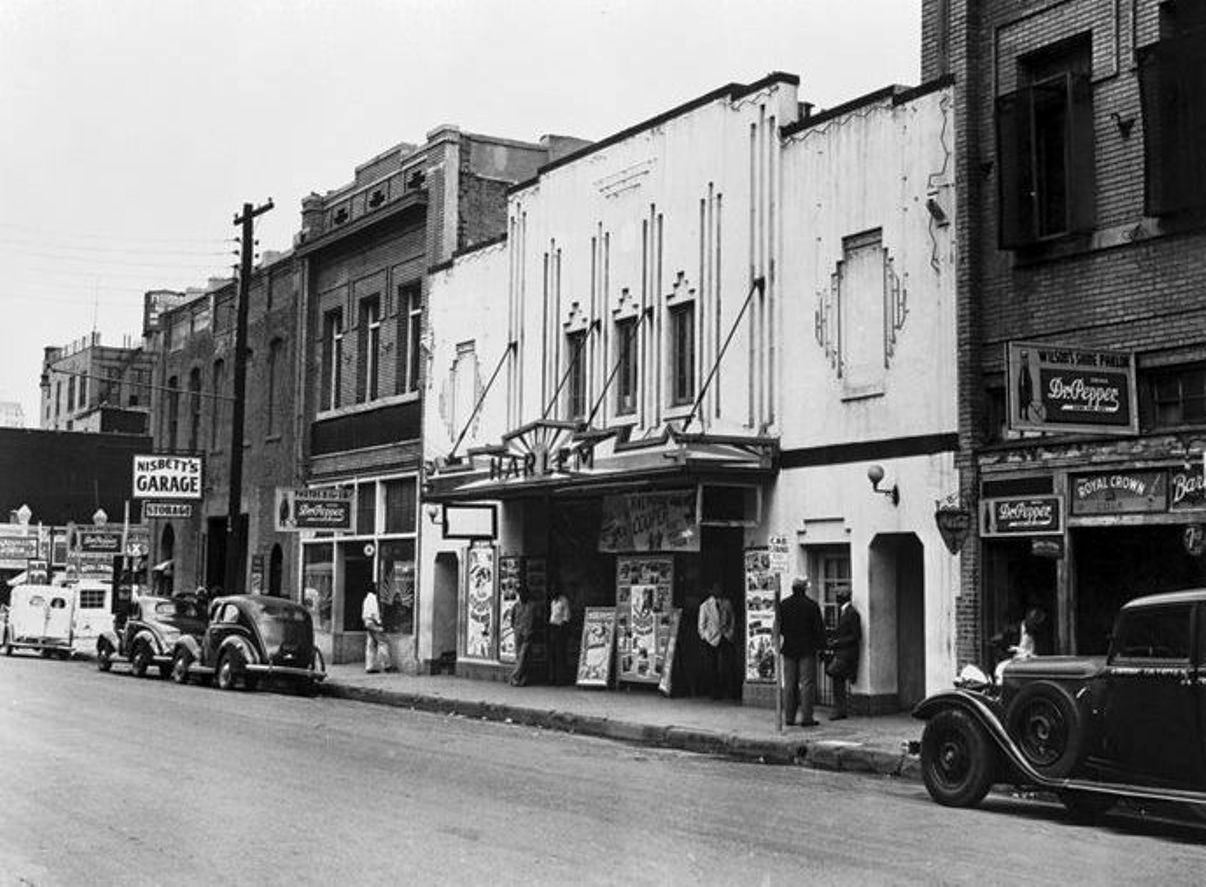
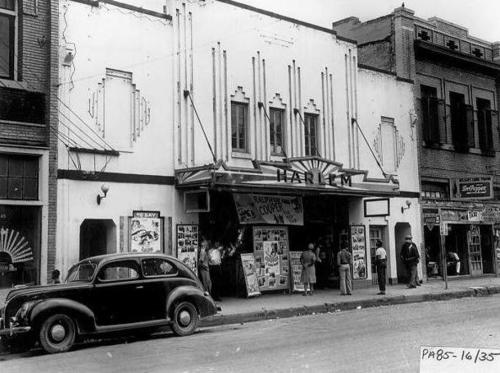
The only one of these theaters still in business in 1930 was the Palace. by 1937, the Palace had become the Harlem Theatre.
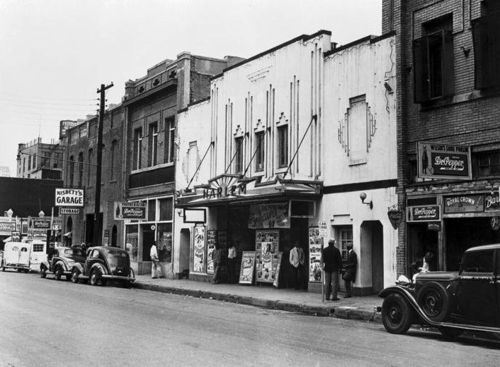
harlem-theatre_deep-ellum

harlem-theatre_dpl

***

Sources & Notes

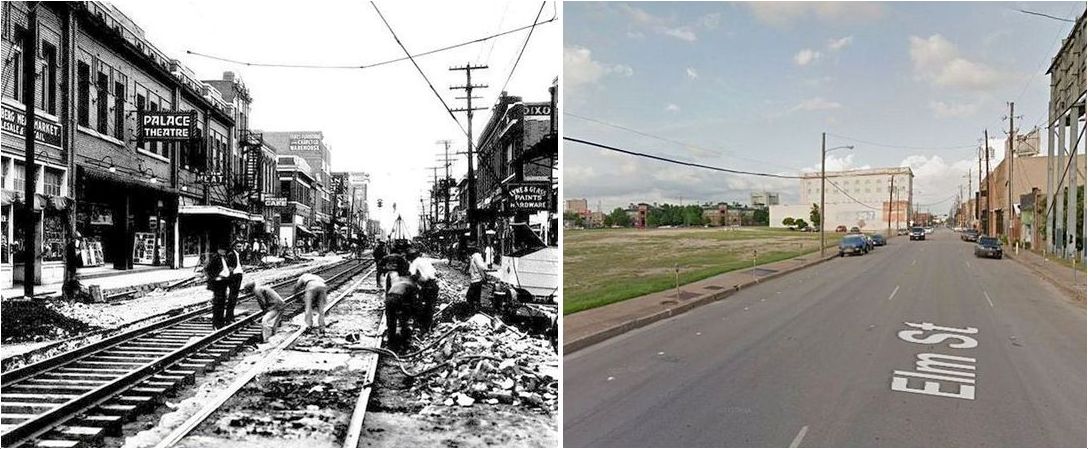
Top photo showing Elm Street and the Palace Theatre and the bottom two photos showing the Harlem Theatre are from the Texas/Dallas History & Archives Division, Dallas Public Library. The upsetting view of what that stretch of Elm looks like now can be seen on Google Street View, here. Below, side-by-side, 1922 and 2015 — Elm St. looking east to Deep Ellum, the Knights of Pythias temple in both images down the street on the left. Look what we’ve lost.

elm-looking-east_1922-2015

All ads and clippings from The Dallas Express, as noted. A few years’ worth of this important newspaper, which served Dallas’ African-American community, can be accessed here.

More on Oscar Micheaux, here.

Another Flashback Dallas post on a theater serving the black community is “Oak Cliff’s Star Theatre — 1945-1959.”

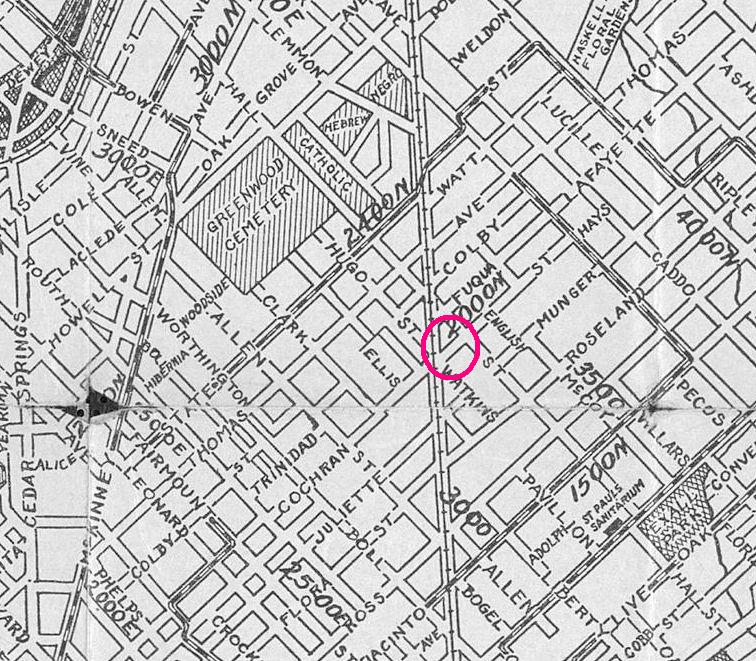
A 1919 map from UNT’s Portal to Texas History shows the location of the Grand Central Theatre (red square), the Mammoth (blue), and the Palace (yellow).

black-cinemas_ca1920_deep-ellum

The High School Theatre — up in “North Dallas” (adjacent to present-day Uptown) — is seen on a different portion of the same map, below.
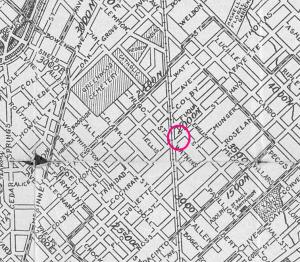
black-cinemas_ca1920_north-dallas

Most images are larger when clicked.

*

Copyright © 2015 Paula Bosse. All Rights Reserved.