Flashback : Dallas

A Miscellany: History, Ads, Pop Culture

Category: Leisure

Earl’s Continental Buffet Has Got it ALL — 1947

earls-continental-buffet_shuffleboard_dmn_1947

by Paula Bosse

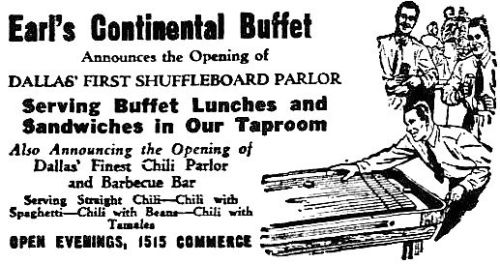
Earl’s Continental Buffet Announces the Opening of
Dallas’ First Shuffleboard Parlor
Serving Buffet Lunches and Sandwiches in Our Taproom
Also Announcing the Opening of
Dallas’ Finest Chili Parlor and Barbecue Bar
Serving Straight Chili — Chili with Spaghetti –
Chili with Beans — Chili with Tamales
Open Evenings, 1515 Commerce

This place has EVERYTHING!

*

Copyright © 2014 Paula Bosse. All Rights Reserved.

KRLD’s Beautiful New Transmitter — 1939

krld_transmitter_1939

by Paula Bosse

RADIO STATION KRLD
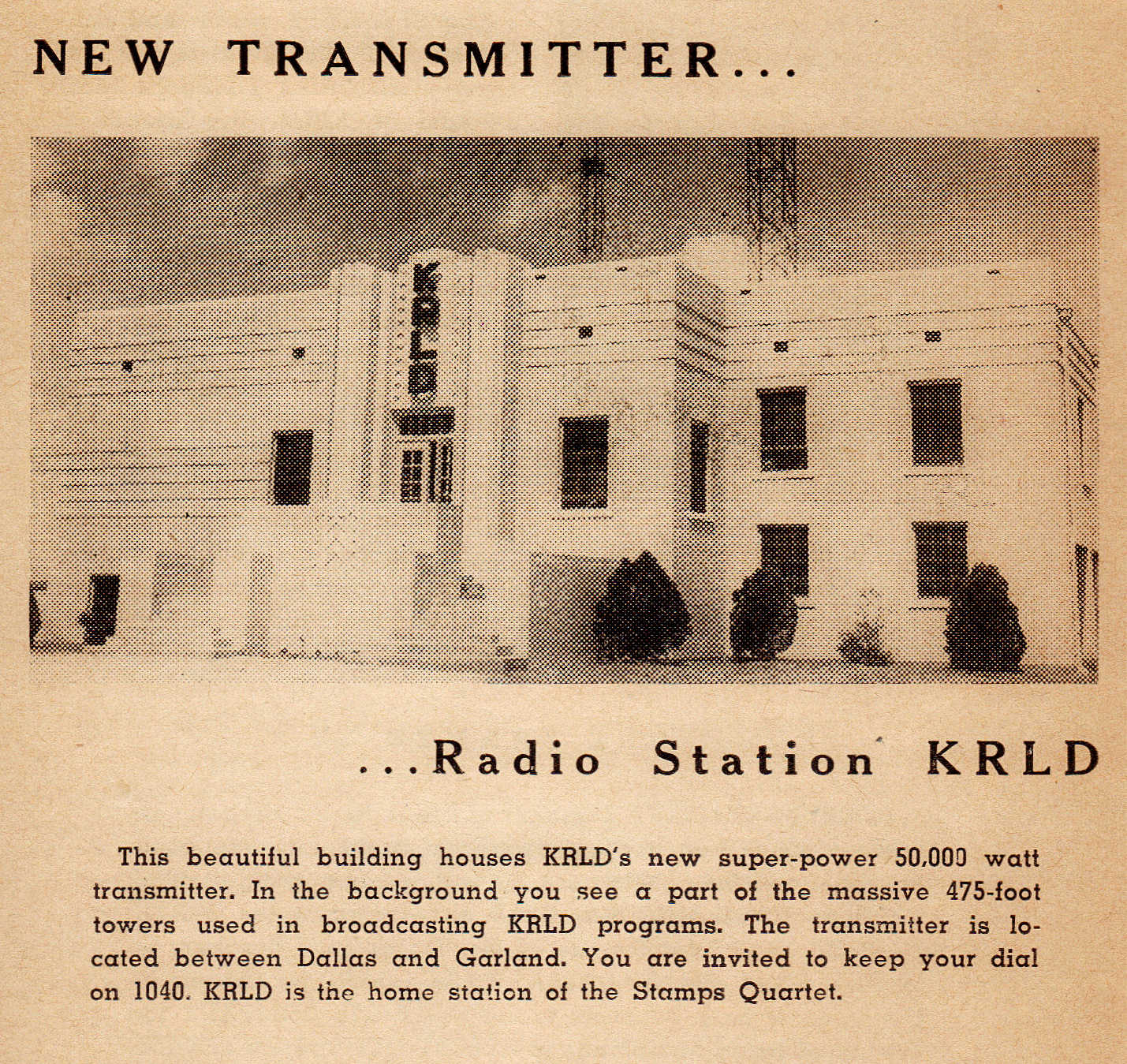
This beautiful building houses KRLD’s new super-power 50,000 watt transmitter. In the background you see a part of the massive 475-foot towers used in broadcasting KRLD programs. The transmitter is located between Dallas and Garland. You are invited to keep your dial on 1040. KRLD is the home station of the Stamps Quartet.

Such a beautiful art deco building! And, I believe, it’s still in use. My favorite aside about the early days of KRLD was that when it began broadcasting — from a small room in the Adolphus Hotel in 1926 — the station was on the air for only six hours a day, “except on Wednesdays when the station closed down to make repairs and recharge the batteries.” Also, according to the KRLD website, the station was “the first radio station in the world to sell commercials.” Of course it was — leave it to Dallas to invent the radio ad.

***

For a history of KRLD and a photo of what the transmitter looks like today, see here.

For an aerial view of the transmitter in 1949, see here (from the Edwin J. Foscue Map Library, Central University Libraries, Southern Methodist University).

Photo from Souvenir Album, 2nd Annual All-Night Broadcast, KRLD–Dallas: July 1-2, 1939 (Dallas, Stamps-Baxter Music & Ptg. Co., Dallas, 1939). This was a souvenir program of a gospel extravaganza held at the Cotton Bowl, with the Stamps Quartet as headliners, broadcast live on KRLD. The frenzied text describes the sudden downpour that threatened the show and the ensuing mad scramble to figure out what to do, with repeated, panicky refrains of “THE SHOW MUST GO ON!” (…The show went on.) (Click picture for much larger image.)

*

Copyright © 2014 Paula Bosse. All Rights Reserved.

J. Delgado’s Medicinal Bowl of Red — 1893

delgado_chile_parlor_dth_1893

LADIES’ and GENTS’ CHILE PARLOR — 318 Main

I beg to call the attention of the public to the medicinal qualities of J. Delgado’s celebrated Chile con Carne. I can safely recommend it as a preventative of chills and fever, and sure cure for fresh colds. Chile is not only a wholesome food but is a blood purifier. Prepared for family orders. J. DELGADO, 318 Main.

*

Chili-barking, nineteenth-century-style. From an 1893 issue of the Dallas Times Herald, which, at that time, appears to have been in need of a more careful typesetter.

*

Copyright © 2014 Paula Bosse. All Rights Reserved.

Roscoe-Land: Roscoe White’s Corral & Easy Way

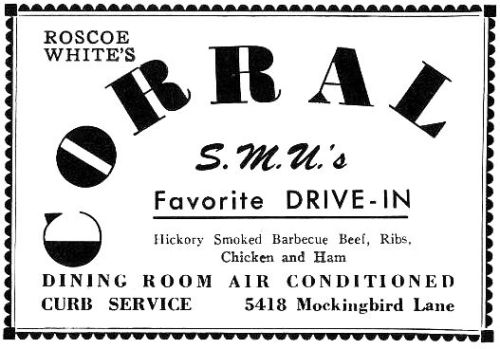
roscoe-whites-corral_1951

by Paula Bosse

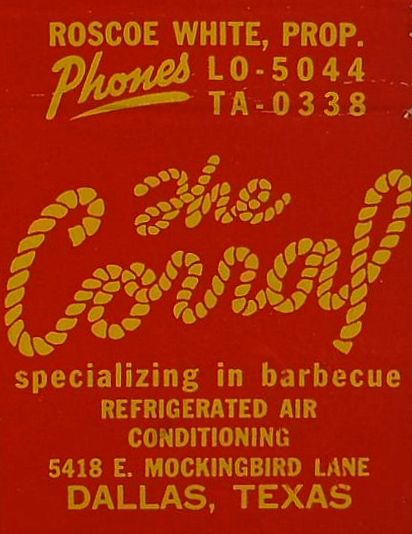
My family had two favorite neighborhood restaurants: Kirby’s Charcoal Steakhouse on Lower Greenville for birthdays and special occasions, and Roscoe White’s Corral on Mockingbird for every other occasion. Conveniently, both were only a short walk from our house. When I came across this ad, I was surprised to see that the Corral had started out as a drive-in, with car-hops. My memories of the place are from the 1970s after it had been rebuilt. in the same block, in a new-ish shopping strip (about where Premiere Video is now), facing the old Dr Pepper plant. It had a diner-like, fairly utilitarian decor, with a slightly fancier banquet room at the back. There was an attached (very dark) bar with a separate entrance. I remember the gleaming cigarette machine. Roscoe must have loved the place, because he was there all the time.

My mother and I always had the chicken-fried steak and a salad with blue cheese dressing. My father and brother tended to go for the still-bubbling cheese enchiladas on a hot metal dish, swimming in a healthy amount of grease (my father’s favorite part). I swear we always had the same waitress — I can’t remember her name, but it was one of those perfect names for a waitress. “Maxine” maybe? (I think my parents had both been customers since their days at SMU in the ’50s, and for all I know, she had been there back then and had been serving them for over twenty years.)

When the Corral closed in the late-’70s or early-’80s, my family was distraught. Loyal patrons that we were, we began making the trek through the Park Cities to Roscoe’s other restaurant, The Easy Way, over on Lovers Lane, by the toll road — the atmosphere was different (it was darker, for one thing), but the food was EXACTLY THE SAME! And, as I recall, even our regular waitress was there — she had also made the move across town. It was almost as if nothing had changed. …Almost.

I loved the Corral My family had so many nice times there. And I miss it. I especially miss that wonderful chicken-fried steak, the yardstick by which I continue to judge all others.

Roscoe White died in 1995 and was remembered in D Magazine:

He moved around, but Roscoe White always had a place for Dallas to eat. He opened his first restaurant in 1939, the Kings Way Grill on Knox and Travis streets. It had an upstairs casino, and the beer was stored in the icehouse next door. Later he opened the Corral on Mockingbird Lane, a drive-in that became a haven for SMU law students. White also owned the Easy Way Grill on Lovers Lane and then Roscoe’s Easy Way on Lemmon Avenue. He died of a stroke at 88.

Thanks for all the great meals, Roscoe!
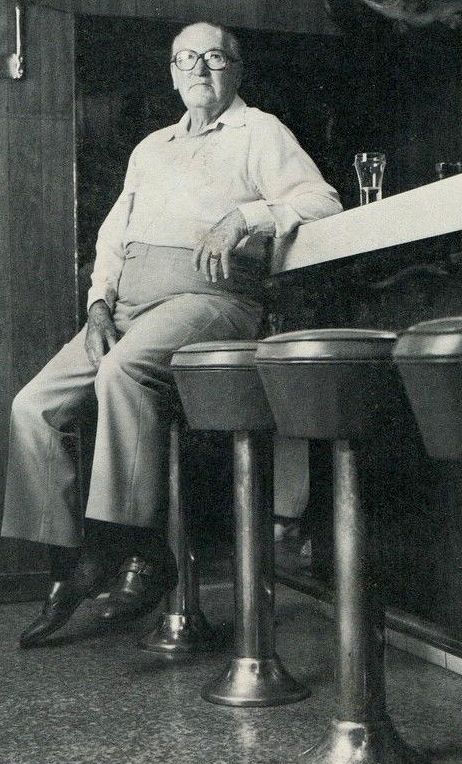
roscoe-white_d-mag_oct-1985Roscoe White at the Easy Way (D Magazine, Oct. 1985)

*
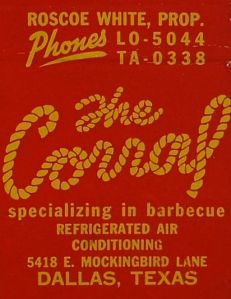
roscoe-whites-corral_matchbook_flickr

roscoe-whites-corral_dmn_120747

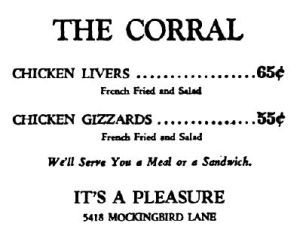
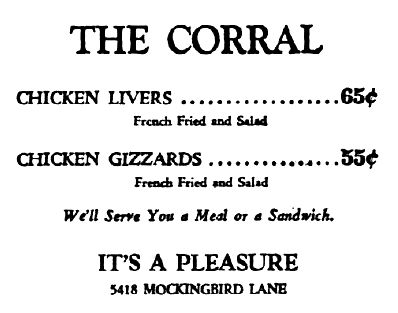
An early ad from 1947. Fried chicken gizzards, only 55 cents — “It’s a Pleasure”!

*
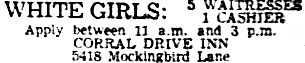
rosecoe-whites_corral_carhop_ad_dmn_091448

roscoe-whites-corral_lady-cashier_dmn_091948

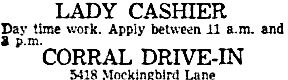
A couple of help-wanted ads for waitresses and a “lady cashier” (Dallas Morning News, 1948). I can only hope that Roscoe’s car-hops were referred to as “White Girls.”

*
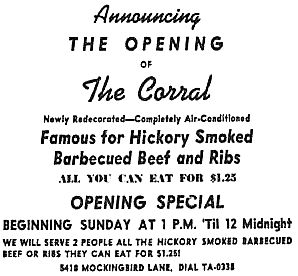
roscoe-whites-corral_reopening_dmn_100850

There had been a fire in the summer of 1950 that caused $4,500 worth of damage, the reason, I’m assuming, for the redecoration and re-opening. I’m not sure when the Corral moved into the location I was familiar with, but by mid-1969, ads were appearing with the new address of 5422 Mockingbird.

*
roscoe-whites-easy-way_matchbook_flickr

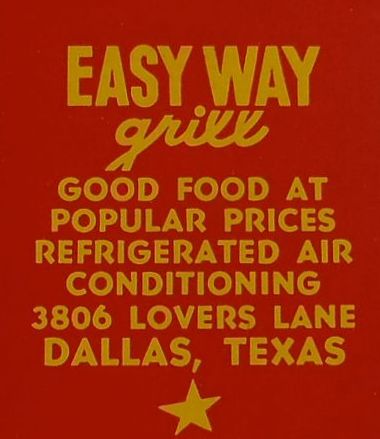
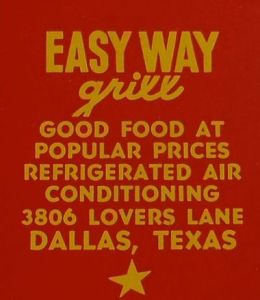
A matchbook from the Easy Way Grill, sadly, with the wrong address on it! The Easy Way was at 5806 Lovers Lane, part of the Miracle Mile, where Dr. Delphinium is now.

*
roscoe-whites-easyway_1951

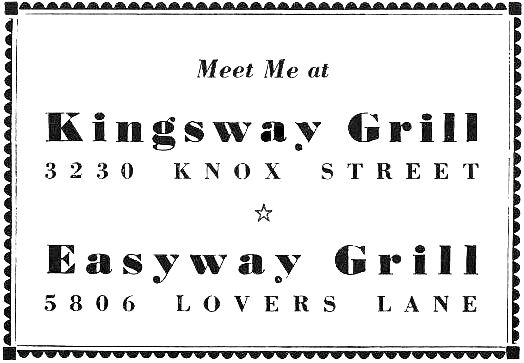
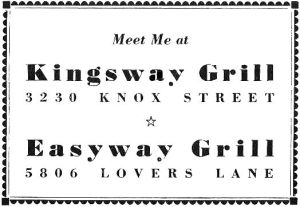
A 1951 ad for the Kings Way Grill and Easy Way Grill.

***

The top ad touting “SMU’s Favorite Drive-In” is from a 1951 SMU-Rice football game souvenir program.

A fond farewell to the Easy Way — “It’s Hard To Say Goodbye to The Easy Way Cafe” — from D Magazine is here. (Above photo of Roscoe accompanied the print article.)

Red matchbook covers from Flickr.

*

Copyright © 2014 Paula Bosse. All Rights Reserved.

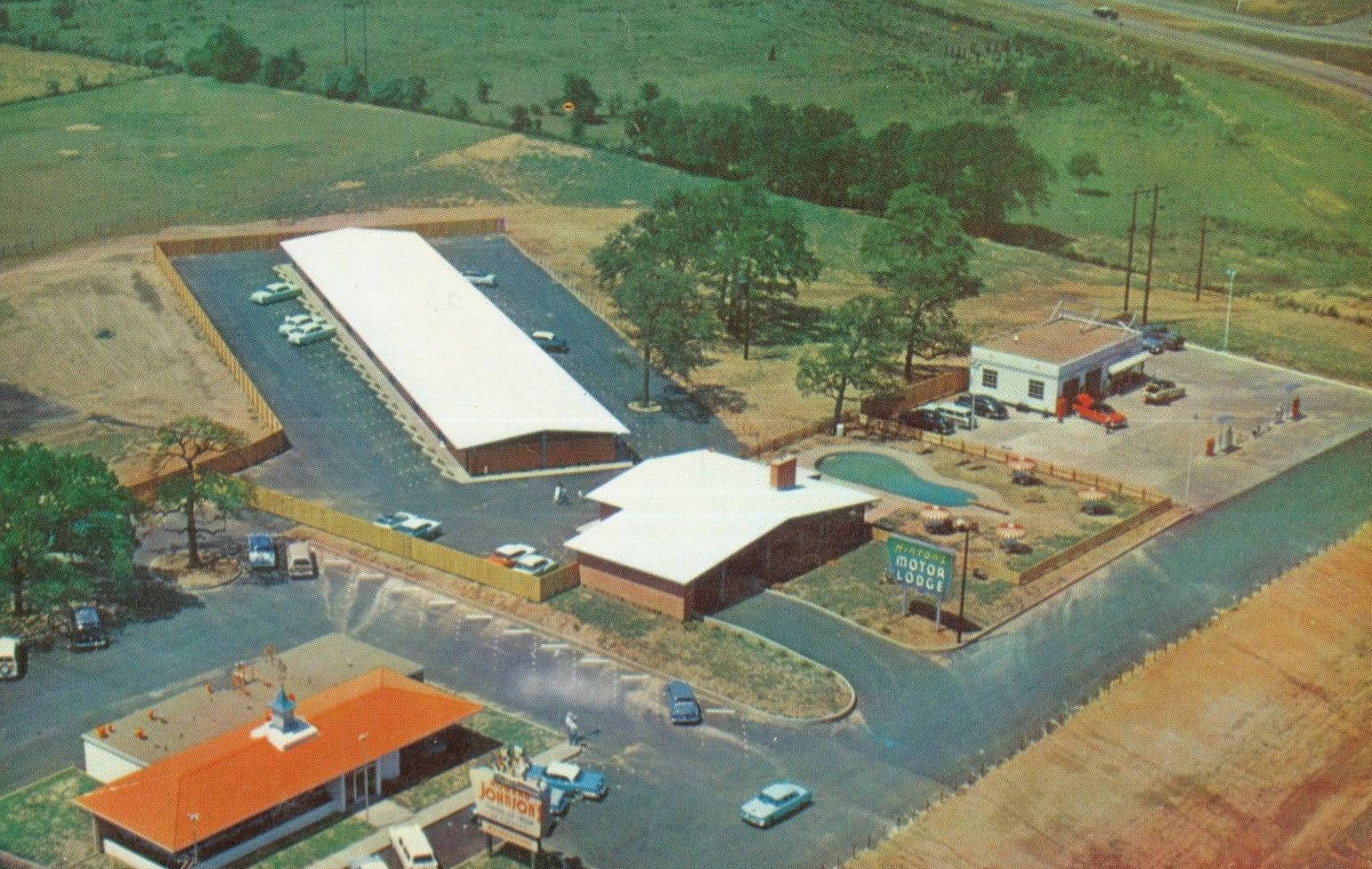
Ted Hinton’s Motor Lodge — From Bonnie & Clyde to Motel Heliport

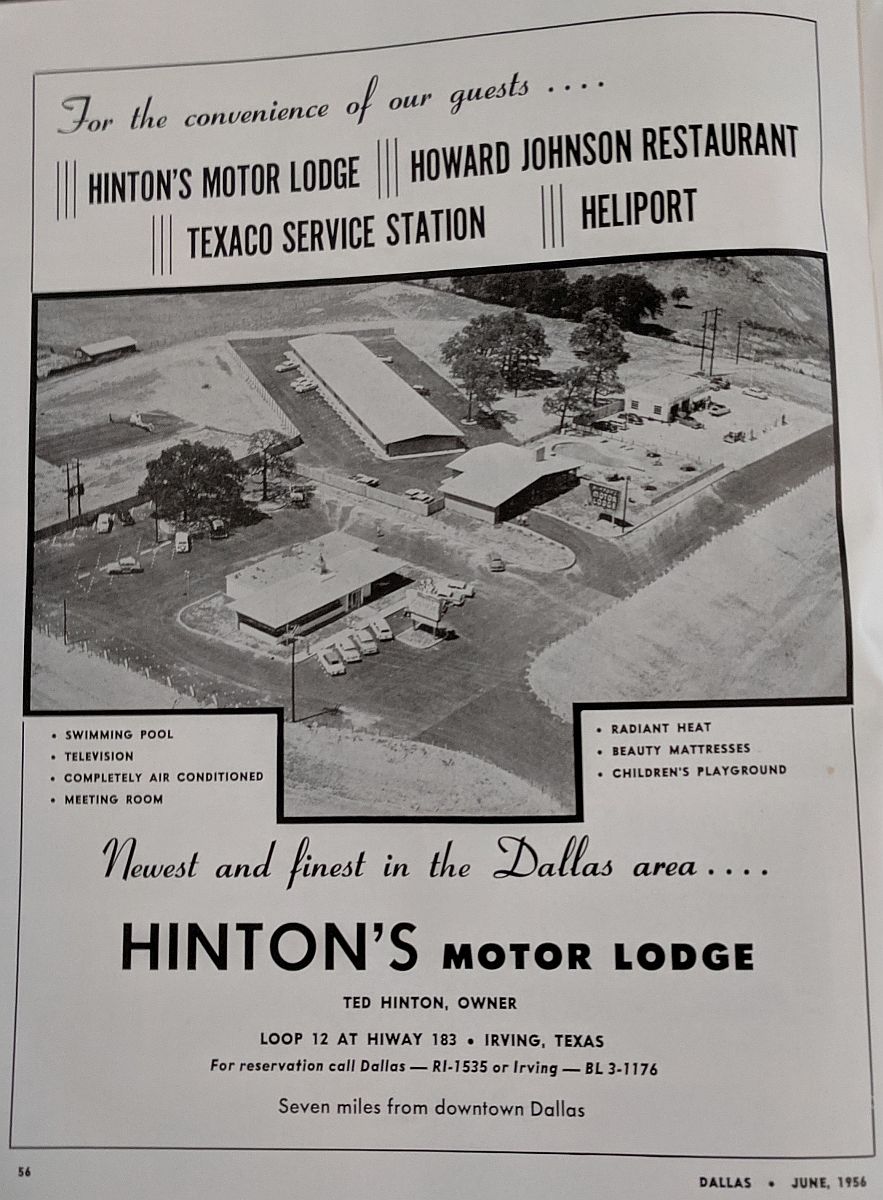
hintons-motor-lodge_front“7 miles from Downtown Dallas” — choppers welcome

by Paula Bosse

What does a man who ambushed and killed Bonnie and Clyde do once he’s retired from law enforcement? He opens a motor lodge, of course!

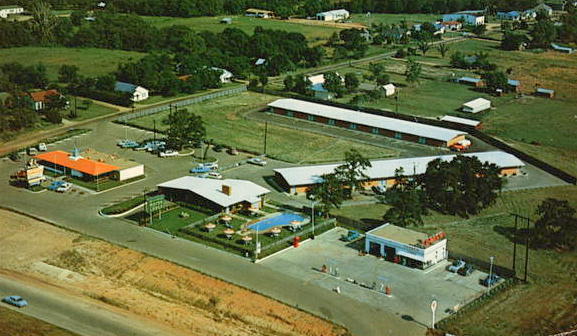
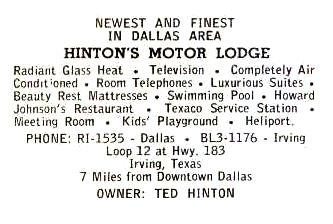
I was initially drawn to this image because of an unexplained lifelong fascination with Howard Johnson’s restaurants (I think I was only ever in one — the one on Mockingbird at Central, where my father introduced me to the inexplicable root beer float). But the interesting thing about this postcard is not the HoJo’s, it’s the motel next door, Hinton’s Motor Lodge, an establishment that was in business from 1955 to 1970, in Irving, very near to where Texas Stadium would be built in 1971 (Loop 12 at Hwy. 183). Why would a motor lodge be interesting? Because the owner was Ted Hinton (1904-1977), the former Dallas County Deputy Sheriff who was one of the six men who tracked down, ambushed, and killed Bonnie and Clyde in 1934. (Hinton was recruited for the posse because he would be able to identify both of them: he had known Clyde Barrow growing up, and he had apparently had a crush on Bonnie Parker in the days when she was working as a waitress and he was working for the post office.)

After killing two of the most notorious celebrity outlaws of all-time, it must have been hard to know where to turn next. He retired from the Dallas County Sheriff’s Department in 1941 and, as he was a pilot, he trained flyers for the US Army Air Corps during WWII. The fact that Hinton was a pilot MUST explain the inclusion of a “heliport” (!) in the list of motel amenities, alongside Beauty Rest mattresses, a swimming pool, and a playground for the kids.

I’m sure that, on occasion, Hinton ate next door at Howard Johnson’s. But I bet none of the other patrons had any idea that the guy sipping coffee in the next booth was one of the men who gunned down Bonnie and Clyde in a hail of gunfire that even Sam Peckinpah might have considered “a bit much.”

Aerial View of Hinton's Motor Lodge Dallas

hintons-motor-lodge_back

ad-hinton-motor-lodge_dallas-mag-june-1956_reddit“Dallas” magazine, June 1954 (via Reddit)

***

Sources & Notes

An interesting short video about Ted Hinton’s connections to Bonnie and Clyde in his youth is recounted here by Hinton’s son “Boots.”

And a newsreel featuring film footage of the aftermath of the ambush — and apparently shot by Hinton himself with a 16mm movie camera loaned to him by a Dallas Times Herald photographer — can be seen here.

*

Copyright © 2014 Paula Bosse. All Rights Reserved.
WFAA Transmitter Plant — 1937

wfaa_transmitter_1937

by Paula Bosse

Visitors are always welcome at the WFAA Superpower transmitter plant pictured opposite. Drive North on Akard Street until you reach State Highway 40; turn right on 40 and drive to State Highway 114 (the Northwest Highway); turn left on 114 and it will take you directly to the plant … a 30-minute drive from downtown Dallas.

So, apparently somewhere near Grapevine, where DFW Airport now sprawls. Such a cool-looking art deco building, out in the middle of nowhere. An entertaining and informative history of WFAA radio (with the incredible 50,000-watt signal that could be heard in California!) can be found here.

A 1939 aerial photo of the transmitter can be seen here.

***

Sources & Notes

Photo from the WFAA Radio Album of 1937.

For another photo of this transmitter building and the story of “WFAA & WBAP’s Unusual Broadcasting Alliance,” see a later post here.

*

Copyright © 2014 Paula Bosse. All Rights Reserved.
Ruetta Day Blinks, Hostess of “The House of Happiness” (WFAA, 1937)

wfaa_margaret_day_1937

by Paula Bosse

RUETTA DAY BLINKS. On the air she’s Margaret Day, and you’ll recognize her as the charming hostess at The House of Happiness, who acts as general counsellor to the housewives of the Southwest. Years of experience as a home economist, teacher, author, and radio lecturer qualify her admirably for her post.

I’m sure Ruetta was a lovely person, but that photograph does not really scream “charming hostess.” A more flattering photo, in which Mrs. Blinks is shown with a slight Mona Lisa smile, was printed the previous year in the Dallas Morning News:

wfaa_ruetta_blinks_dmn_1936

The House of Happiness seems to have premiered on WFAA radio in the spring of 1936 and was broadcast on Monday, Wednesday, Friday, and Saturday mornings at 10:45. “Margaret Day” would address homemaking concerns of her listeners, including topics such as “Stream-lined Living–the Objective of the Modern Homemaker,” “Better Home Gardens,” “Home Management Declares an Exact Management,” and “Safeguarding Health in the Home.” …I’m guessing the shows were a little dry.

***

Top photo from the WFAA Radio Album of 1937. (Click picture for larger image.)

*

Copyright © 2014 Paula Bosse. All Rights Reserved.

“Meet Me in Dallas” by Jack Gardner (1915)

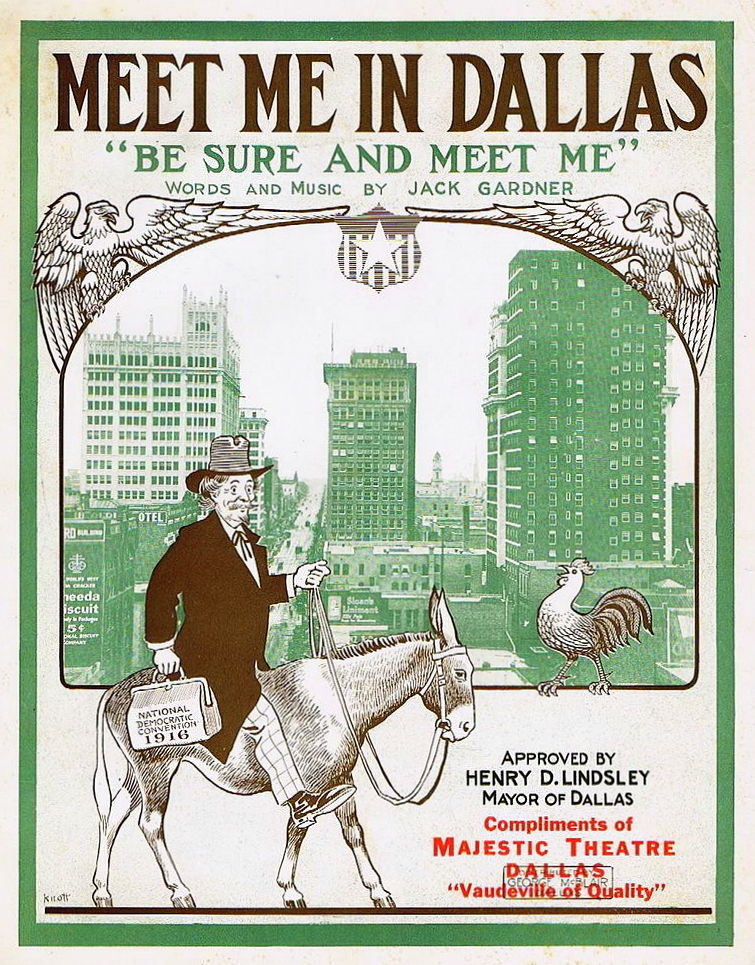
meet-me-in-dallas_sheet_music_1915“Be sure and meet me…”

by Paula Bosse

“Tell your friends
You’ll meet them in Dallas,
In the town
Where there is no malice.”

Yes, those immortal lyrics are by Jack Gardner, a musician, bandleader, and an “entertainment manager” at the tony Adolphus Hotel. For some reason, he was chosen as the man to write a persuasive ditty which (it was hoped) would sweep the country and lure the 1916 Democratic National Convention to Dallas. Sadly, the song did not set the world (nor Democratic loins) on fire, and (spoiler!) St. Louis got the convention.

As we see above, the mayor-approved city-jingle was issued with sheet music cover art by Dallas Morning News cartoonist John Knott and a great background photo of downtown, with the Adolphus and Busch Building (now the Kirby Building) featured prominently.

If you’d like to wallow in the vamp-y march that IS “Meet Me in Dallas,” the sheet music has been scanned in its entirety by Baylor University here. You can play it and sing it in the privacy of your own home!

If you would like to read about how the Texas Democratic Party was hoping to snag the national convention with this song, you can read about it in this article by Paula Lupkin that appeared in the Fall 2012 issue of Legacies.

And, lastly, a little check-in with Jack, to see what he was doing years later in 1938. This blurblet from St. Petersburg’s Evening Independent has him in Florida, working as a traveling musician with his dance band, settling into a one-week gig at the Detroit Hotel. Not only has he persuaded the anonymous reporter that his name is “synonymous with good dance music in the Southwest,” but he still seems to be resting on his long-faded “Meet Me in Dallas” not-quite-brush-with-the-big-time laurels.

meet_me_in_dallas_gardner_interview_1938

gardner-jack_adolphus_crop

***

Sources & Notes

Top image from the Frances G. Spencer Collection of American Popular Sheet Music at Baylor University, here. (Click picture for larger image.)

Photo of Jack Gardner and His Orchestra is from the wilds of the internet.

I’m sure Mr. Gardner’s ditty was the bee’s knees, but it’s not to be confused with the wonderfully seedy 1969 country song of the same name by the fabulous Jeannie C. Riley (read about that song here).

*

Copyright © 2014 Paula Bosse. All Rights Reserved.
Highland Park Shopping Village

hp-village_postcard

by Paula Bosse

Highland Park — the ritzier of the two “Park Cities” — is home to the exclusive Highland Park Shopping Village, which began construction in 1930 and is one of the chi-chi-est of chi-chi shopping areas in the country. And it’s beautiful. I still can’t believe I spent numerous nights there, watching midnight showings of The Rocky Horror Picture Show. They let the less-monied freakier Dallasites in on weekends after the sun went down.

***

Sources & Notes

Check out the Village’s eye-popping history timeline here. It’s pretty funny to think there used to be a DIME STORE there!

*

Copyright © 2014 Paula Bosse. All Rights Reserved.
Dallas’ Film Row — 1918

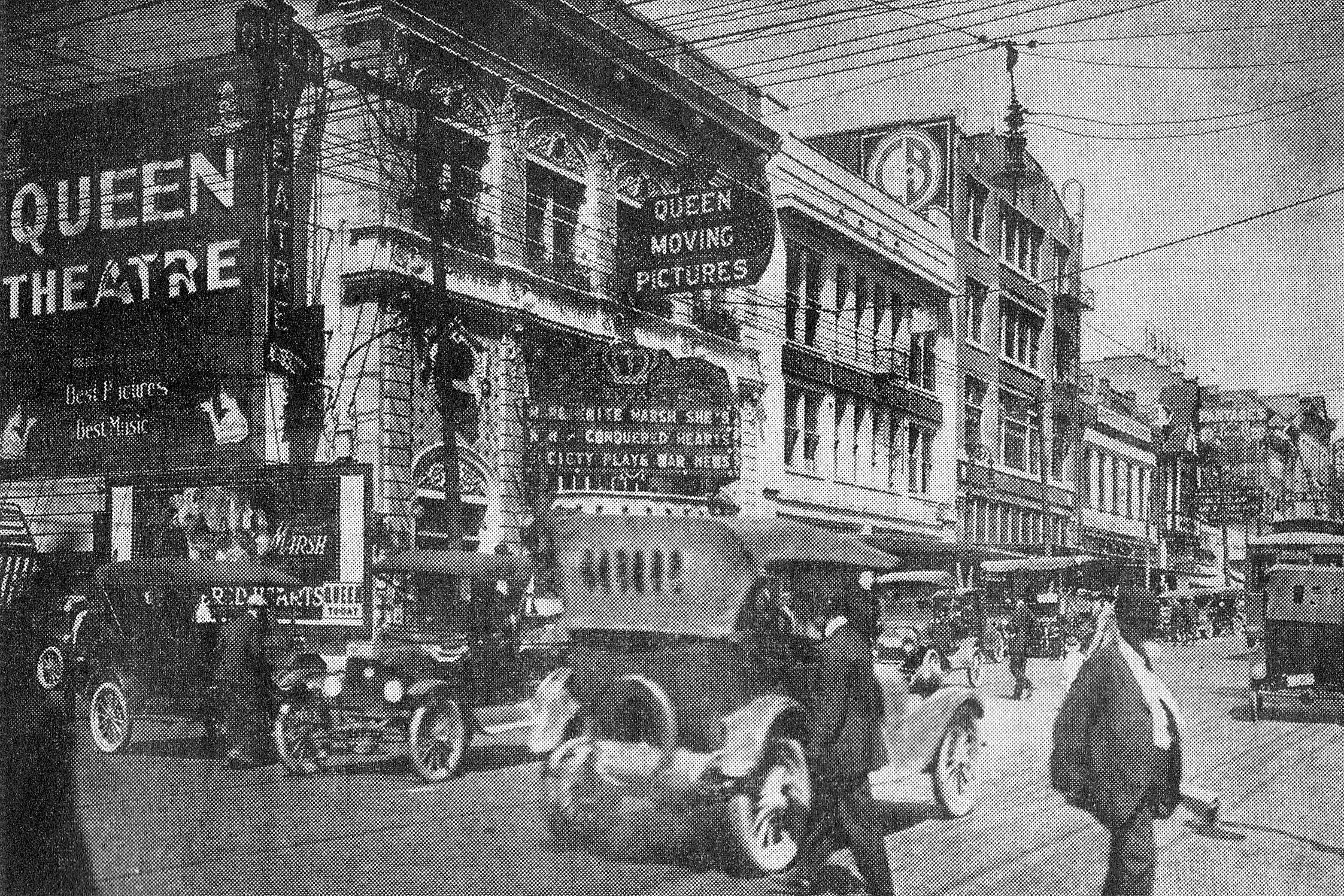
dallas_movie-palaces_1918Looking east from Elm and Akard… (click for larger image)

by Paula Bosse

A 1918 photograph of Elm Street taken at the corner of Akard, looking east, showing the old Queen Theater (later the Leo; torn down to build the Dallas Federal Savings and Loan Building), the Jefferson Theater, and the Old Mill Theater.

*

Copyright © 2014 Paula Bosse. All Rights Reserved.