Flashback : Dallas

A Miscellany: History, Ads, Pop Culture

Category: Sports

Babe Didrikson, Oak Cliff Typist

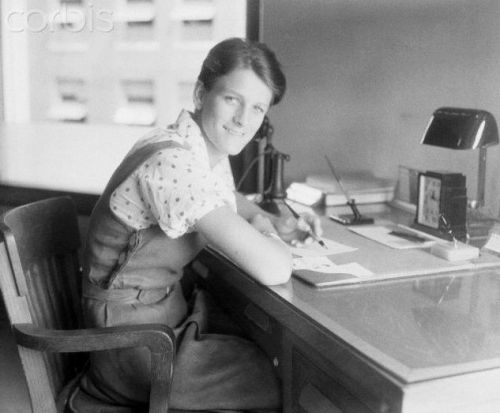
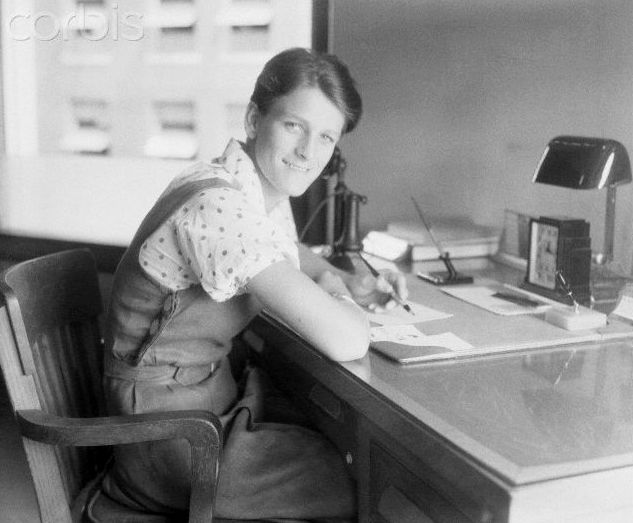
babe-corbis_102132Babe Didrikson at a desk she was probably pretty unfamiliar with, 1932

by Paula Bosse

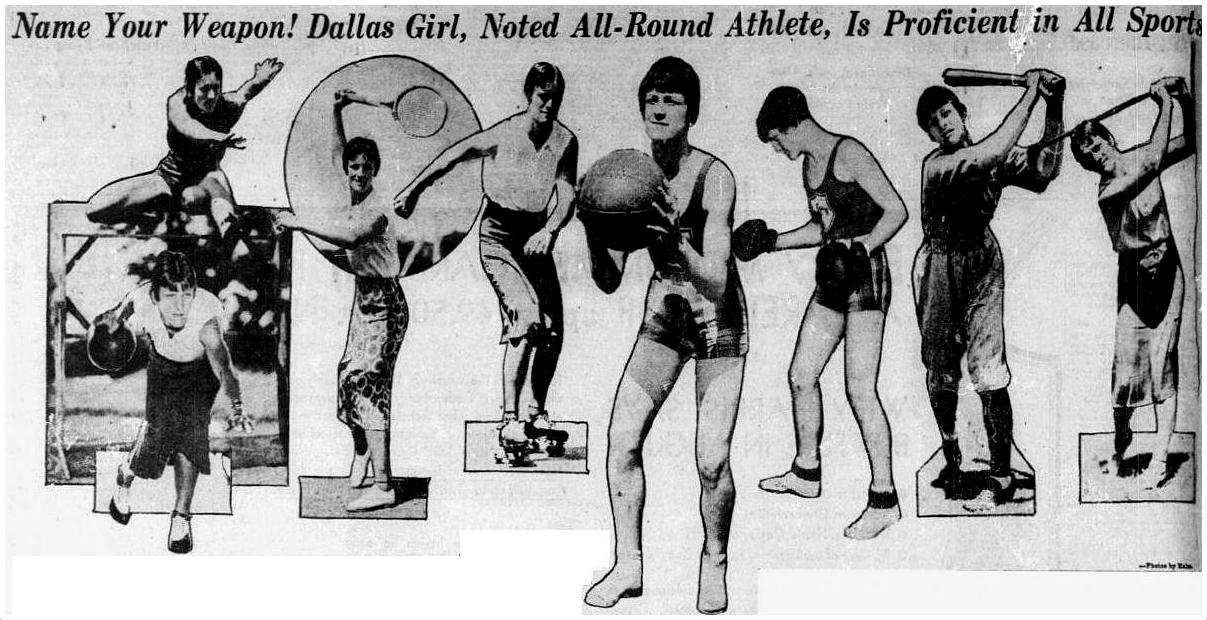
Mildred “Babe” Didrikson has been called the greatest athlete of the 20th century — male or female. She was an All-American basketball player, she set a number of world records in a wide variety of track and field events (she was so good at all of the individual sports that she was entered at least once as an entire TEAM — a team of one!), she won two gold medals and one silver (which should have been three gold medals…) at the 1932 Olympics, and she was, perhaps most famously, a champion golfer who was a founder of the LPGA. She was also highly proficient in softball, bowling, diving, swimming, roller skating, and tennis, and she dabbled in hockey, skeet-shooting, billiards, and even football. There was no sport she didn’t try — and even if she had never tried it before, she was probably pretty good at it. And she spent an important period of her life in Dallas.

babe_dmn_0802311931

Babe Didrikson was born in Port Arthur, Texas in 1911 and grew up in nearby Beaumont. She excelled in sports in school, especially basketball. In the late-’20s, a man named Col. M. J. McCombs, who was the head of the women’s athletic program for an insurance company, saw Babe in action and recruited her to play for his company’s basketball team in Dallas. She was offered a job to do vague secretarial work for the Employers’ Casualty Company (which had offices in the old Interurban Building downtown), with the understanding that she was really being taken on in order to play on the company team. With the blessing of her Norwegian immigrant parents, she interrupted her high school education in Beaumont to accept the $75-a-month job and was moved into a Haines Avenue rooming house in Oak Cliff.

Babe soon became the star of the Golden Cyclones, her company’s championship-winning team which participated in an “industrial” league governed by the national Amateur Athletic Union (the AAU). In the off-season she was introduced to track and field events by McCombs, and she quickly mastered them all.

babe_emp-cas-coFlying the company colors

She soon began breaking world records. Watch her compete at an AAU meet at SMU in July 1930, where one of the records she broke was for the javelin throw, here.

didrikson-babe_070730_track-meet_SMU_javelin_critical-past_screenshot-cropJuly 1930, Dallas

Before she knew it, it was the summer of 1932, and the Olympics were being held in Los Angeles — the 21-year old won three medals, emerged as the star of the games (she was frequently referred to as “the wonder girl from Dallas”) and began her climb up the ladder of celebrity.

After the Olympics, the city of Dallas gave her a victory homecoming, with a parade, a luncheon, and various presentations, all covered widely in the local press. The Dallas Morning News described it as “a demonstration the magnitude of which has never before been accorded a son or daughter of this city” (DMN, Aug. 12, 1932), bigger even, they said, than the reception that had greeted Charles Lindbergh on his Dallas visit.

U625776INPBabe’s post-Olympics parade through downtown Dallas — Aug. 11, 1932

After the celebrations had settled down, Babe Didrikson, sports superstar, was back at “work” — at least long enough to have photographs of her taken at the most uncluttered desk imaginable. (Though to be fair, Babe did claim to have been a typing champion in high school. Even if that were true — and she was known to be something of an exaggerator — it’s still almost impossible to imagine this world champion athlete typing up an afternoon’s dictation on insurance matters.)

babe_insuranceEmployers’ Casualty Co.’s casual employee — Oct. 21, 1932

Babe eventually turned pro, left Dallas, married wrestler George Zaharias, and became an incredibly successful golfer. She died from cancer in 1956 at the early age of 45, but her legacy lives on as one of the greatest and most versatile athletes of all time (…who, for a few short years, also happened to do a bit of light secretarial work for an insurance company in Dallas).

**

Below are a few of my favorite random Babe-related tidbits.

babe_hat_dmn_0712321932

Babe was often ridiculed by male sportswriters for her bearing and physique, which they thought were not feminine enough for their tastes. This criticism — ridiculous though it was — must have stung, because she occasionally made efforts to placate them, some of which seemed very awkward, such as this. The caption of the above photo: “Mildred (Babe) Didrikson (left) and her chaperon, Mrs. Henry Wood, are pictured above as they appeared Monday afternoon just before boarding a train for Chicago, Ill. for the national AAU track and field championships in which Babe […] hopes to carry off high honors and win a berth on the American Olympic team. This is the first picture ever taken of Babe with a hat on. She has never worn one before.”

*
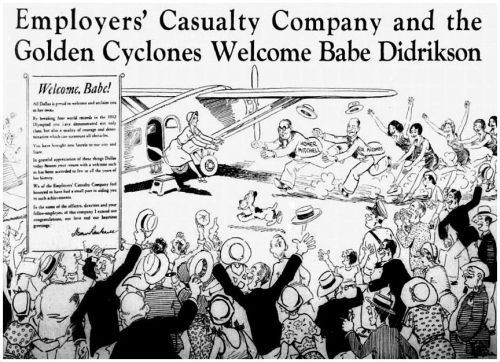
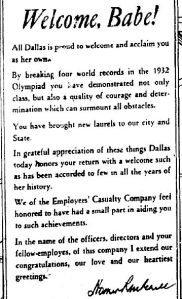
babe_insurance_ad_dmn_081132Aug. 11, 1932

babe_insurance_ad_dmn_081132-detAug. 11, 1932 — ad inset

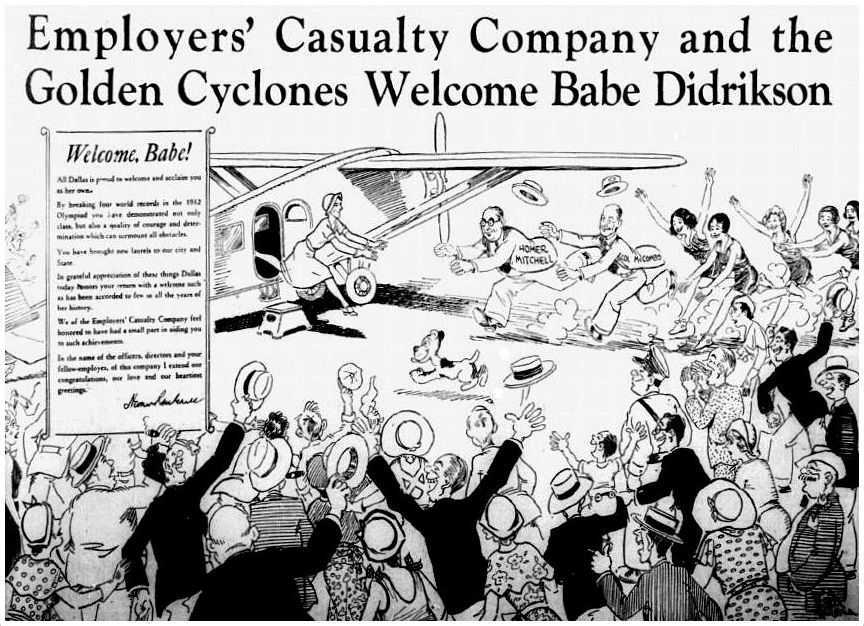
Above, an ad taken out by the Dallas company Babe worked for, welcoming her back home from her Olympic triumph. Drawing by Jack Patton. (Even though Babe had buckled to pressure with the whole hat thing, I can’t quite picture her wearing gloves.)

*

babe-and-babe_081247

Babe and the other Babe, August 12, 1947. I love this photo.

*

babe_vanity-fair_1933

Fantastic photo of Babe in her prime by Lusha Nelson, from the January, 1933 issue of Vanity Fair.

*

babe

***

Sources & Notes

The two photos of Babe Didrikson at her desk, the photo of the parade in Dallas, and the photo with Babe Ruth are from the huge selection of photographs of Babe at CorbisImages. See a lot of photos of her throughout her career, here. The photos of her training and in action are exhilarating, but it’s nice seeing her looking so happy and relaxed in her later golfing days. She definitely smiled a lot more after she started making more than the measly $75 a month she was making in Dallas.

An interesting article from 1975 about Babe in which former co-workers and teammates from Employers Casualty remembered their time with her can be found in the Dallas News archives: “Friends Recall Babe’s Prowess” by Temple Pouncey (DMN, Oct. 26, 1975).

For more on Babe’s time in Dallas and Oak Cliff, she writes about it in her autobiography, This Life I’ve Led (1955), here. (The entire book can be read for free at the link.) Also, check out this article by Gayla Brooks that appeared in the Oak Cliff Advocate.

A really well done, comprehensive overview of Babe Didrikson Zaharias’ career (with lots of great photos), can be found at Pop History Dig, here.

One of my favorite weird Babe things is the record she made with her “golf protege” Betty Dodd. Betty sings (not very well) and is accompanied by Babe on harmonica, an instrument she loved all of her life and which she taught herself to play as a child. The song — and a bit of backstory on Babe and Betty’s relationship — is here (click the arrow at the left of the strip beneath the record label to hear the song “I Felt a Little Teardrop”). Babe’s solo starts at about the 1:06 mark.

And, lastly, newsreel footage of Babe over the years, from the early track meets and the Olympics, to her later career as a golf superstar can be watched here and here.

*

Copyright © 2014 Paula Bosse. All Rights Reserved.

Simulcasting the World Series In Dallas In the Days Before Radio, Via Telegraph

world-series_dmn_100422-smThe later version, for radio listeners, 1922…

by Paula Bosse

It’s 1912. You’re a huge baseball fan, and the World Series is about to begin — New York vs. Boston! But you live in Dallas, a million miles away from the action. You can’t wait for the results in the paper the next day because you’re an impatient S.O.B., and radio won’t be introduced for another ten years. Do you panic? No! Because you live in a big city with a taste for new technology, and the Dallas Opera House is going to present a sort of early simulcast of the games on a “mammoth automatic score board.” Your sports prayers have been answered!

1912_world-series_dmn_100612DMN, Oct. 6, 1912

You lean back in your comfy theater seat and smoke your smokes in plush and civilized surroundings as each play is sent by telegraph to Dallas from the ballpark back East where the game is being played RIGHT NOW, hundreds of miles away. The telegraph operator in Dallas will relay the play-by-play information to personnel in the theater who will somehow do something to some sort of “automatic electric board.” And, according to promoters of these “reproductions” of baseball games, you’ll feel like you’re right there in the thick of the action. You’ll “see” the game played before your eyes!

I’ve read several articles about these boards and these reproductions, but I can’t for the life of me figure out how it worked. I assume there was a large traditional scoreboard on stage that lit up, keeping track of the score, runs, outs, etc. But apparently there’s more, and I just can’t picture it. Here’s a somewhat confusing description of what happened during these productions:

WORLD SERIES WILL BE SHOWN AT THE OLD MILL

Manager Buddy Stewart of the Old Mill Theater announced that he secured the New Wonder Marvel Baseball Player Board to reproduce the World Series baseball games. This board is declared the greatest board ever invented for reproducing baseball games. It is not a mechanical board and no mechanical devices are used, and very little electrical appliances are necessary. The games are reproduced by a crew of six experienced baseball players who are carefully rehearsed and each has a part or position to play. No other board is so complete as this. The board does not require sign cards to denote players as in other boards. You see the ball going and do not have to look in any other direction to see what it means.

Spectators will see each play reproduced in less than two minutes after it is made on the playing fields of the World Series as the board is connected with a direct wire to the baseball field, and as fast as the telegraph operator receives the play it is reproduced with as much realism as on the field. The players are seen to run bases, the ball is seen bouncing or soaring to the infield or outfield, and anyone who is familiar with baseball will know just exactly what is happening on the field by the plays made on the board with very little left for imagination.

Every hit, run, error, strike or ball, the number of strikeouts, or balls made by pitchers, or the number of hits, runs or errors made by the players is always prominently shown on the board which makes it [un]necessary for individual scoring during the progress of the game. (DMN, Oct. 3, 1920)

Doesn’t really help much. It sounds as if people are on the stage acting out each play. That would be weird. These “reproductions” of World Series games were quite popular in Texas (and probably elsewhere) for at least 15 years. If anyone reading this has a photo or diagram of one of these vaunted Marvel scoreboards, I’d love to see it!

*

An earlier description of the 1912 Opera House reproduction sounds more like an audience watching a baseball game on a giant Lite-Brite “score board.”

1912_world-series_dmn_100812DMN, Oct. 8, 1912

The trick to keeping the telegraph operators calm and on-their-toes during a lengthy baseball game? Make sure they have no interest in the game.

1915_world-series_FWST_101415Fort Worth Star-Telegram, Oct. 14, 1915

Fort Worth was also getting in on the action. And they had celebrities — people like Clarence (Big Boy) Kraft and Ziggy Sears (who I’m going to assume have something to do with baseball). I’m not sure what these celebrities were doing exactly, but whatever it was, they were there doing it.

1921_marvel-score-board_FWST_100221FWST, Oct. 2, 1921

These theater programs weren’t for everyone, though. If you couldn’t take the time out of a busy work day to swan over to a theater to leisurely witness one of the early “reproductions” (or if the admission price was too steep for your budget), you could always ring up the operator to have her tell you the current score:

automatic_dmn_101112-world-series
DMN, Oct. 11, 1912

These things seemed to be a popular annual event, but in 1922, something more technologically advanced than the Marvel board appeared on the scene: radio! WFAA and WBAP began broadcasting in 1922, and, suddenly, following sports became a whole lot easier. In something of a transitional technology, there was the outdoor board as described below. The games were not only broadcast live on WFAA, but The Dallas Morning News (WFAA’s parent company) also erected one of those old-fangled “electric boards” out on the street so that passersby could keep up with the scores. (Portable transistor radios were decades and decades away.)

1923_world-series_dmn_101023DMN, Oct. 10, 1923

It was surprising to see that the “Marvel score boards” were still being used as late as 1926 (Yankees vs. Cardinals, at the Capitol Theater). Every baseball fan worth his salt should have had his own radio by then so he could listen to the World Series in the comfort of his own home and curse and cheer as loudly as the vicissitudes of the game demanded. Eat my dust, Marvel board! Radio changed everything, and radio was here to stay.

*

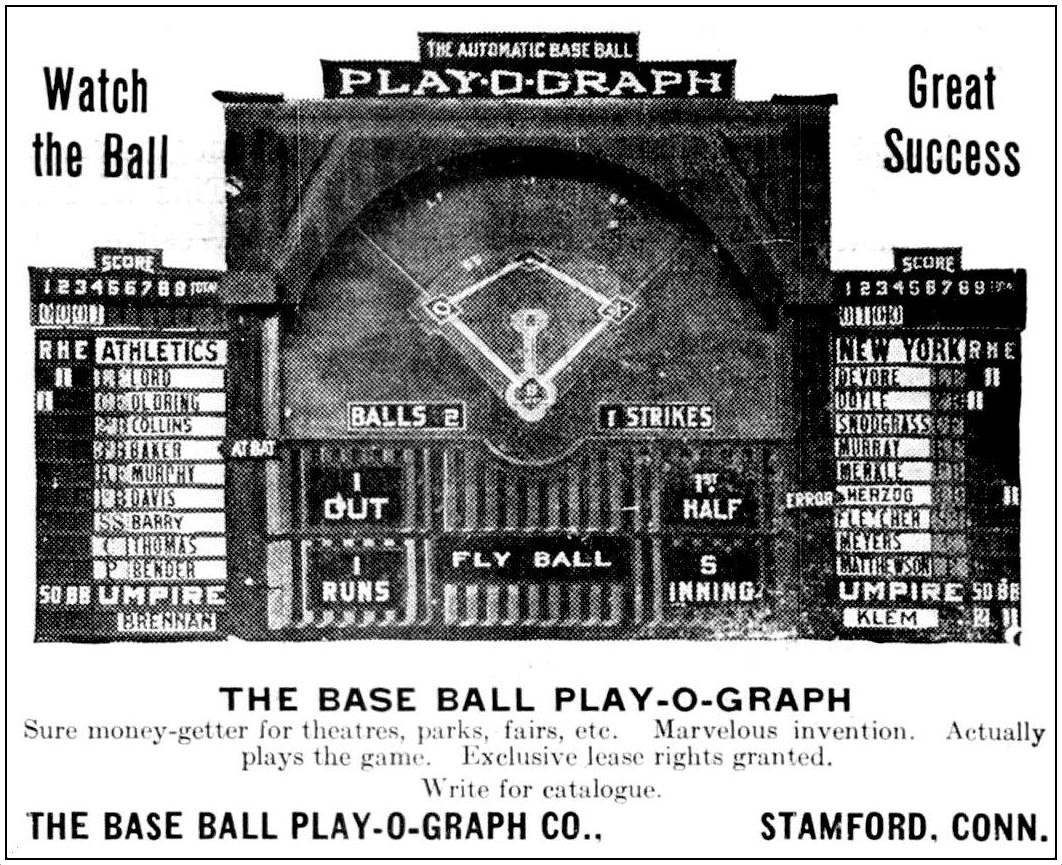
UPDATE: Thanks to Kevin’s link in the comments below, I can share this GREAT article from Uni-Watch.com about another of these boards called the Play-o-Graph: “Photography of Playography by Paul Lukas — it answers all my questions, and it even has photos (and links to photos) of crowds watching the boards. He also links to a 1912 article, “The Automatic Baseball Playograph”  by J. Hunt, in the Yale Scientific Monthly which describes how the board works and has this photo:

play-o-graph_yale-scientific-monthly_1912The “Play-o-Graph,” 1912 (click for larger image)

And, for completists, here’s an ad for the Play-O-Graph, from 1913:

baseball-simulation_play-o-graph_billboard_032213Billboard, Mar. 22, 1913

Makes a bit more sense now! Thanks, Kevin!

***

Sources & Notes

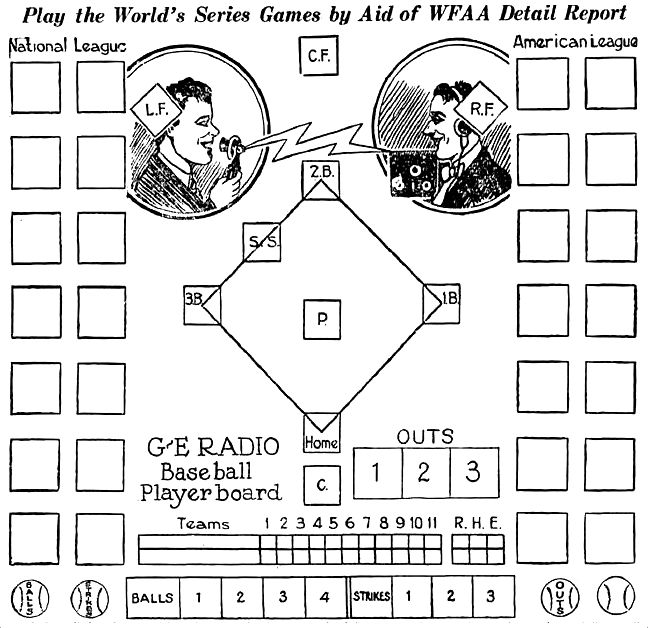
The top image is the “G.E. Radio Baseball Player Board” — a sort of home version of the big scoreboards used in theaters, printed for WFAA listeners in The Dallas Morning News on Oct. 4, 1922. The instructions are in a PDF, here. And feel free to print one out and use it while you watch the Series this year. Still works in the 21st century!

For an article on listener response to the successful first broadcast of the World Series by WFAA radio (listeners picked up the signal in England!), see the DMN article from Oct. 6, 1922 in a PDF, here.

And because they have such great names, you might want to know who Clarence “Big Boy” Kraft and Ziggy Sears were. If you’ve read this far, you owe it to yourself. “Big Boy,” here; Ziggy, here.

*

Copyright © 2014 Paula Bosse. All Rights Reserved.
Dallas High School Football, 1909-Style

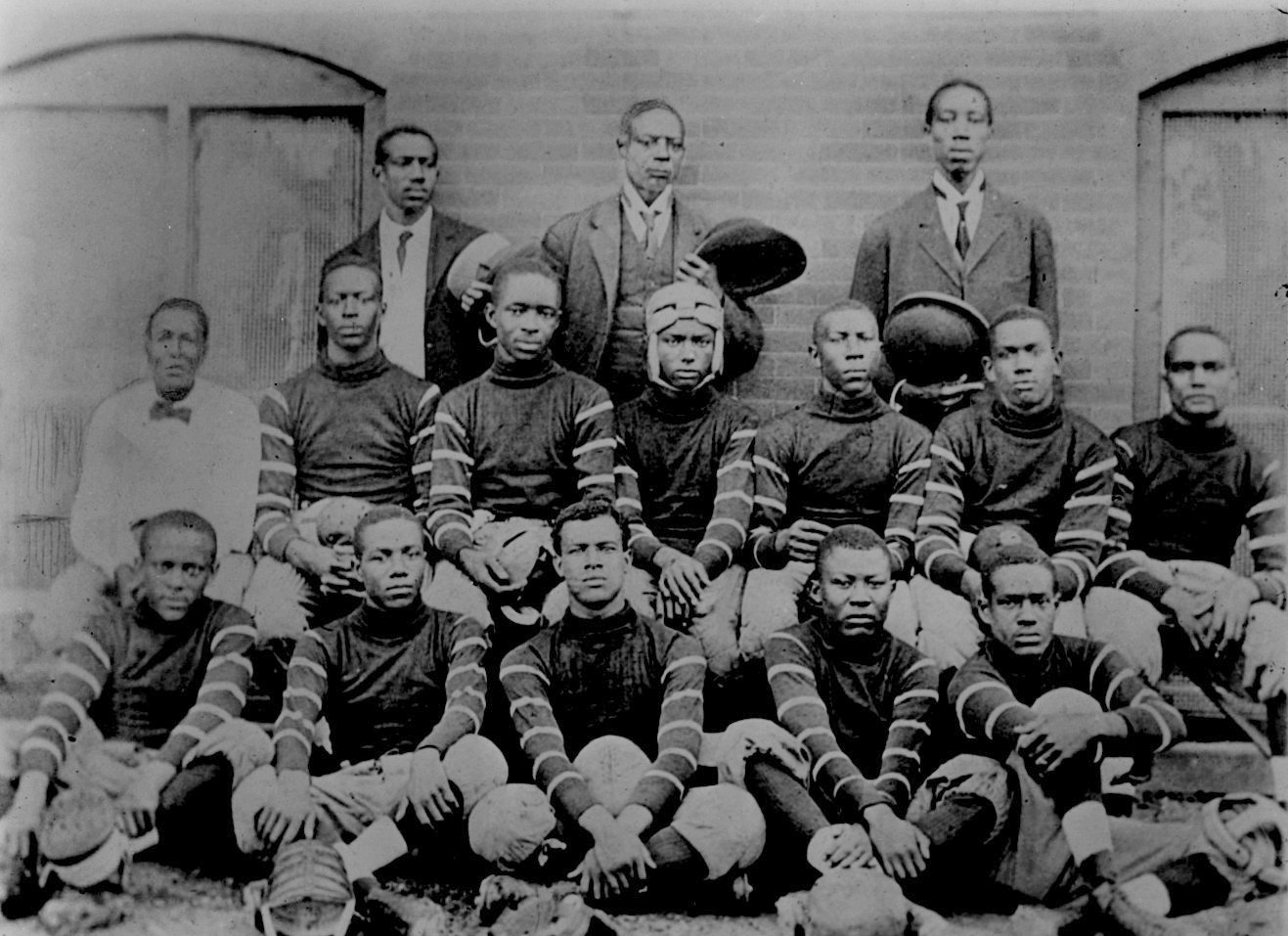
football-team-1909Game faces ON… (click for larger image)

by Paula Bosse

Great Dallas Historical Society photo described only as “a high school football team,” from 1909. The team most likely represented the “Colored High School” located at Hall and Cochran, the only high school in Dallas at the time for African-American students (it eventually merged with and relocated to the nearby Booker T. Washington High School in the early 1920s where, incredibly, it remained the city’s only high school for black students until Lincoln High School opened in South Dallas in 1939).

As everything was segregated at the time, including schools and sports, the number of black high school football teams they could play was severely limited — in-town opponents were non-existent. In fact, a 1909 blurb in The Dallas Morning News announced that “[t]he football team of the Dallas Colored High School will play the Wylie University team from Marshall at Gaston Park” (DMN, Nov. 12, 1909). They were playing college teams. From 150 miles away. At least they were the home team.

***

Photo from the J. L. Patton Collection, Dallas Historical Society.

Click picture for larger image.

*

Copyright © 2014 Paula Bosse. All Rights Reserved.
The First Texas-OU Game in Dallas — 1912

tx-players_dmn_101912bWatch out, Oklahoma: giant Texas linemen await…

 by Paula Bosse

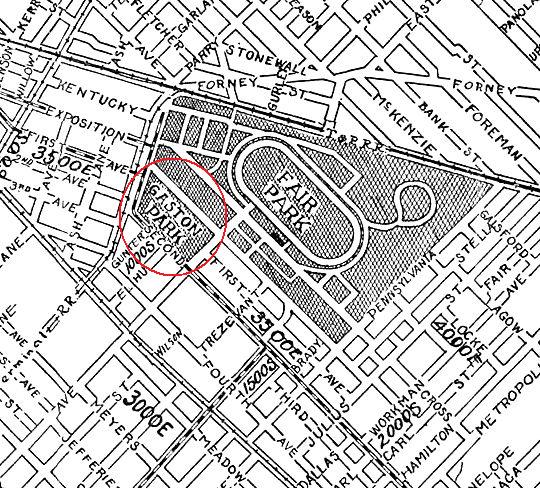
The Texas-OU game is a football tradition, held annually in the Cotton Bowl during the State Fair of Texas. The first game of the so-called “Red River Rivalry/Showdown/Shootout” was held in Dallas (aka “neutral ground”) in 1912. As the Cotton Bowl hadn’t been built yet, the game was held at Gaston Park, a sporting field with a large grandstand where Dallas teams played baseball, football, and, yes, even soccer. It was located at Parry & Exposition, in the spot where the State Fair Auditorium (now known as the Music Hall) was built in the 1920s.

Since my grasp of sports is tentative, I’m not going to go into any particulars of the actual game (which — spoiler! — Oklahoma won, 21-6); instead, I thought I’d mention a few of the incidental things leading up to the game that I found interesting. (For those who are interested in the particulars of the game, fret not — there is a link at the bottom of the post.)

So here are a few of the things that I found amusing or entertaining:

  • The 1912 football season began with new rules: downs were increased from 3 to 4; touchdowns were now 6 points instead of 5; the playing field was reduced from 110 yards to 100; the onside kick was abolished; a touchdown was permitted when caught over the goal line; the ball was kicked off from the 40-yard line instead of midfield; the intermission between quarters was reduced from 2 minutes to 1.
  • Fort Worth felt slighted that they had missed out on hosting the game (“it might just as well have been played in Fort Worth,” the Fort Worth Star-Telegram groused). Local Fort Worth-friendly UT alumni swore to try “strenuously” to get the game for Cowtown the following year, because, damn it, “next year is Fort Worth’s turn” (FWST, Oct. 15, 1912). (Sorry ’bout that, FW….)
  • The Sooners’ coach, 37-year old Bennie Owen (whom I gather is something of an OU legend), had only one arm, the result of a hunting accident. The Dallas Morning News wrote that Owen was “one of the most able [coaches] in the country. He is disabled to some extent by having but one arm, but evidenced by his success during the past season, this does not trouble him to any great extent” (DMN, Oct. 6, 1912).
  • The Longhorns’ coach, Dave Allerdice, was only 25 years old. He had been hired to fill the spot left vacant in the wake of the death of UT’s previous coach who had died rather exotically as the result of “a fall out of the window of his bedroom” (DMN, Oct. 10, 1912).
  • Both Allerdice and Owen had been coached as students by the same man, Coach Yost, at Michigan.
  • The Gaston Park crowd was estimated at over 6,000. The crowds going to the game and to the fair were so great that the streetcars and Interurbans were jam-packed. In fact, both teams had difficulty making it to the game on time because they couldn’t find transportation to get there, and the game had to be started late to allow for the players to arrive and warm up.
  • Oklahoma dominated the game, and the Sooners won, 21-6.

And so began the annual Texas-OU tradition in Dallas.

*

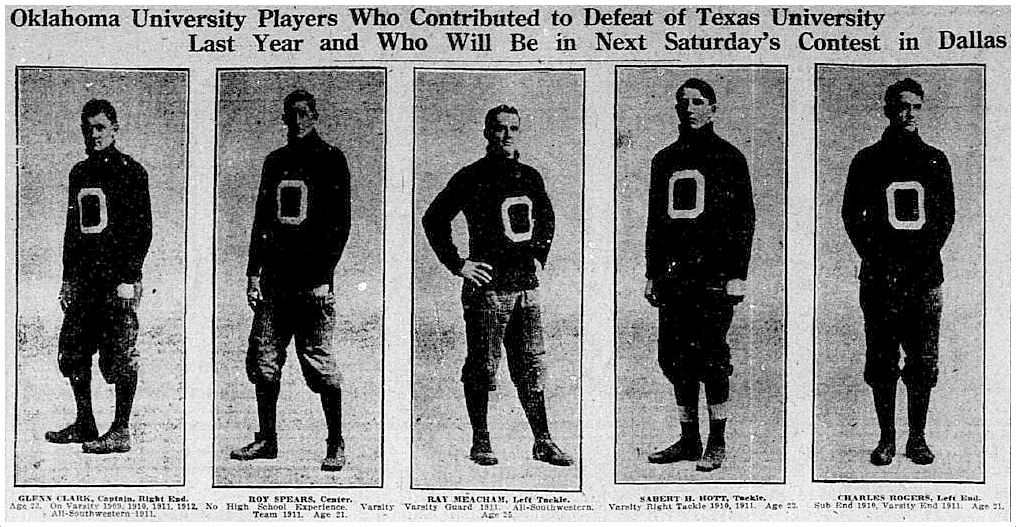
Below, Sooner boys: 0-0-0-0-0.

sooners_1912_dmn_101812DMN, Oct. 18, 1912

*

Grainy, off-kilter image of the crowd-frilled grandstand at Gaston Park.

tx-ou_crowd_dmn_102012DMN, Oct. 20, 1912

*

It’s a bit hard to see anything in these 100-plus-year-old photos, but here are a couple of “action photographs” of the game.

tx-ou_game-photos_dmn-102012DMN, Oct. 20, 1912

*

Gaston Park? Here’s where it was (a lot of street-renaming has gone on since this map was drawn in 1919).

gaston-park_fair-park_ca-1919

***

Sources & Notes

All photos from The Dallas Morning News.

1919 map (detail) from the Portal to Texas History, here.

For slightly better photos of Gaston Park (in 1908), see a previous post, here.

Wikipedia roundup:

  • Gaston Park, here.
  • Bennie Owen, here.
  • Dave Allerdice, here.
  • “Red River Showdown” (which I’ve never actually heard anyone other than TV commentators and promoters say to describe what everyone I know calls the “Texas-OU game”), here.
  • Defenestration, here.

The Dallas Morning News and The Fort Worth Star-Telegram are filled with numerous contemporaneous articles about this game. If you have a handy-dandy Dallas Public Library card (free!), you can pore over these articles to your heart’s content. To read what was printed the day of the game (Oct. 19, 1912), click  here. To read about the results and the game coverage, click here.

Click pictures for larger images. They will still be muddy and grainy, but, by God, they’ll be bigger.

*

Copyright © 2014 Paula Bosse. All Rights Reserved.
“Jim Nasium” Can Teach You a Thing Or Two About Baseball Heckling — 1908

baseball-hecklers_dmn_050308Cartoon by “Jim Nasium” — 1908 (click for larger image, you sap-head)

by Paula Bosse

If you were a die-hard baseball fan in 1908, you were no doubt familiar with many of the jeers featured in the cartoon above by one Mr. “Jim Nasium,” a sportswriter and cartoonist who was given almost half a page of primo newsprint each Sunday in many newspapers around the country. Feel free to incorporate some of these exhortations into your next enthusiastic visit to the ballpark. ANY ballpark. Those kids can take it….

**

Below, a few images of the Dallas baseball scene from around the time that Mr. Nasium’s column on “roasting” appeared in the pages of The Dallas Morning News. (As always, click for large images.)

dallas-giants_cook-colln_degolyer_smu
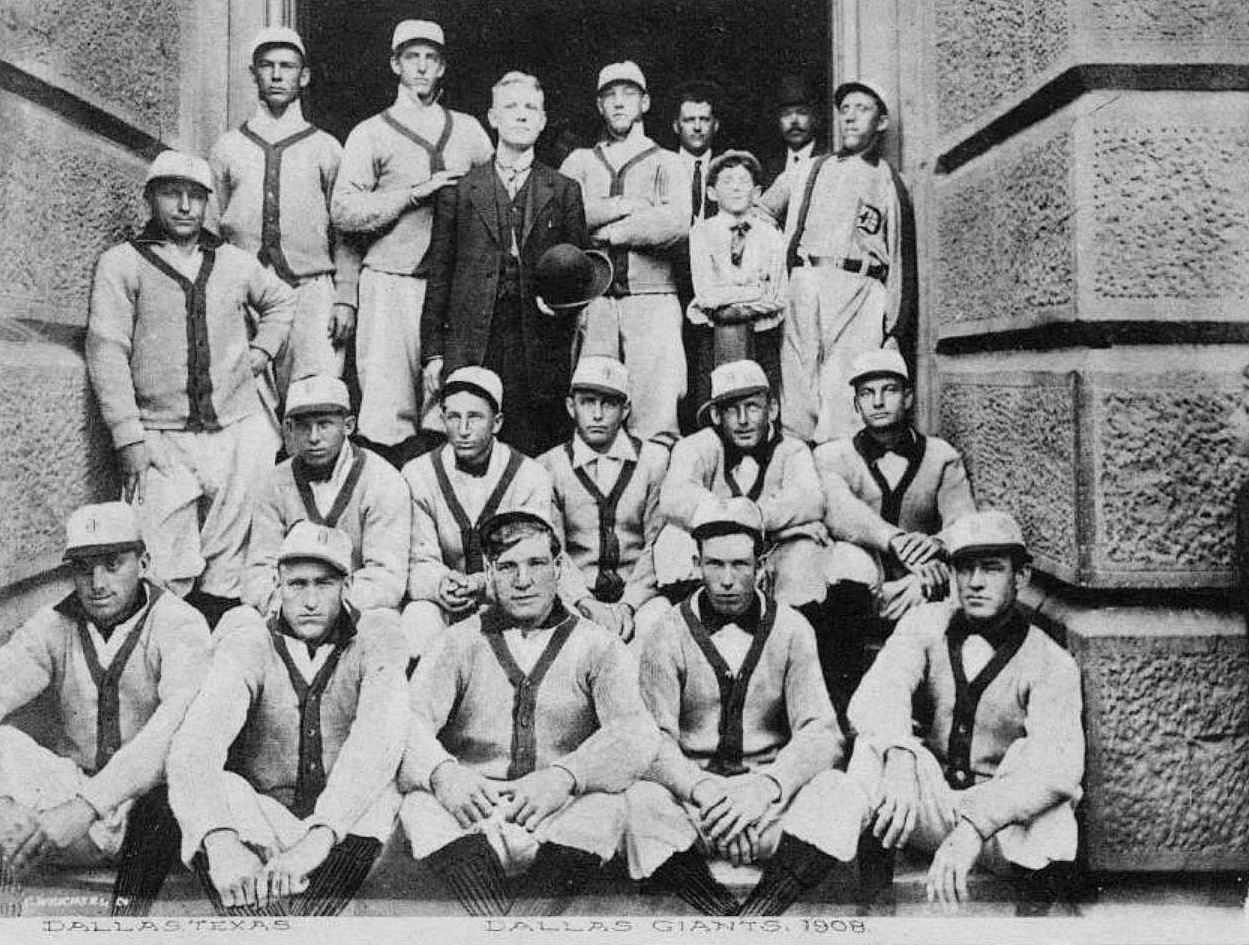
The Dallas Giants, 1908

Above, the 1908 Dallas Giants team. Bottom row–Slattery, Fletcher, Kerns, Tullos, Maloney. Middle row–Maag, Hole, Moore, Whittaker, Cooper, Loudell. Top row–Burnett, Peters, Hay, Storch, Miller.

*

baseball_gaston-park_dmn_050508

Here’s where they played that week, Gaston Park. Mayor Hay threw out the first ball. Below, where the cat-calls would come from. “What’re you tryin’ to bunt for, you sap-head!”

baseball_gaston-park_grandstand_dmn_050508DMN, May 5, 1908

*

baseball-ad_dmn_050608DMN, May 6, 1908

***

Sources & Notes

The cartoons of “Jim Nasium” appeared in The Dallas Morning News alongside his weekly column, “Conversations With an Old Sport,” a humorous syndicated series by Edgar F. Wolfe, who would later go on to edit Sporting Life. Here is an excerpt from that week’s column about the bad sportsmanlike conduct of jeering spectators in grandstands, complete with wonderful slang you’ve probably never encountered before (click to read):

jim-nasium_dmn_050308-excerptDMN, May 3, 1908

This full “Conversations With an Old Sport” column can be read in a PDF here. (You’re going to have to click that “plus” symbol at the top many, many times in order to magnify the text enough to read it!)

Photo of the Dallas Giants from the George W. Cook Dallas/Texas Image Collection, DeGolyer Library, Southern Methodist University; it can be accessed here. It appeared in the pages of The Dallas Morning News on May 6, 1908, crediting photo to Clogenson.

A few more (grainy) photos of Gaston Park — site of the first Texas-OU game held in Dallas in 1912 — can be seen in another Flashback Dallas post, here.

*

Copyright © 2014 Paula Bosse. All Rights Reserved.

Ernie Banks: From Booker T. Washington High School to the Baseball Hall of Fame to the Presidential Medal of Freedom

banks-ernie_jet_110355
Ernie Banks and George Allen, Oct. 1955 (Jet magazine)

by Paula Bosse

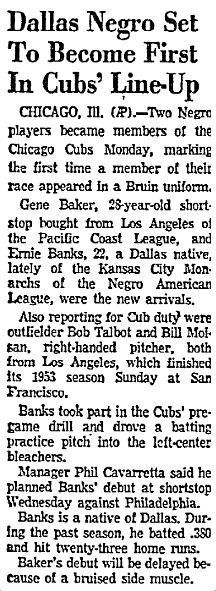
Ernie Banks, the baseball player so indelibly linked with Chicago that he is known as “Mr. Cub,” is a Dallas native whose professional career began when he was spotted by a Negro League scout while playing softball in a park near his high school, Booker T. Washington. He was recruited right away and made his mark almost immediately, and, in 1953, he and Gene Baker became the first African American players signed to the Chicago Cubs.

One of the sport’s most popular players, Banks, who began his career playing shortstop, routinely shattered home run records and was a perennial MVP and All-Star player. Even though his Cubs never made it to the World Series, Banks was a stand-out player, and his election to the Baseball Hall of Fame in 1977 came as no surprise. I have to admit, my knowledge of baseball is scant, but I love this man, and it’s a testament to “Mr. Cub” that he is as famous for his genuine nice-ness as he is for his undisputed skill as a player.

banks_dmn_091553AP, Sept. 15, 1953

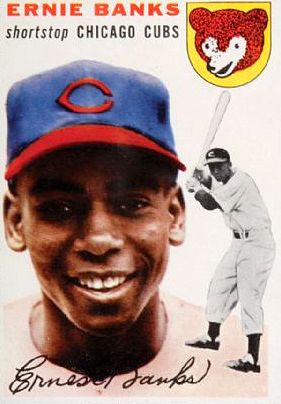
ernie-banks_rookieErnie Banks’ rookie card – Topps, 1954

ernie_banks

*

Oct. 11, 1955 was declared “Ernie Banks Day” in Dallas. Ernie was in town to play an exhibition game between the Major League Negro All Stars and the Negro American League All Stars (Ernie’s major leaguers won, 6-2) — while he was here, he enjoyed the hometown adulation and was lauded with gifts. The photo at the top of this post was from that day, as is the one below, in which he poses with his wife, Mollye Banks.

banks-ernie_wife-mollye-ector-banks_101155_patton-collection_DHSHometown hero, Oct. 11, 1955 (Dallas Historical Society)

***

Sources & Notes

Top photo from Jet magazine, Nov. 3, 1955; a version ran in The Dallas Morning News on Oct. 12, 1955 above the following caption: “Honors came thick and fast for Ernie Banks at Burnett Field Tuesday night. Appearing with a group of barnstorming Major League All Stars, Banks was presented a new Oldsmobile (background), a Texas style hat and scrolls and trophies. With Banks is George Allen, chairman of the citizens’ appreciation committee which presented the automobile. The mayor [R.L. Thornton] proclaimed Oct. 11 Ernie Banks Day in Dallas.”

The photo of Banks and his wife, Mollye Ector Banks, in Dallas is from the John Leslie Patton Jr. Papers, Dallas Historical Society (Object ID V.86.50.902).

Check out these articles from The Dallas Morning News archives:

  • “Banks to Tackle First — Reluctantly” by Bud Shrake (DMN, March 16, 1962) — with a few paragraphs on growing up in Dallas
  • “From Dallas to Cooperstown” by Randy Galloway (DMN, Jan. 20, 1977)

A nice overview of Ernie Banks’ career titled “Nice Guys Don’t Always Finish Last” by Steven Schmich (from his larger article titled “Five Dallas Athletes Who Made a Difference”) can be read in the Spring, 1994 issue of Legacies magazine here. (In fact, the entire issue of this Dallas history journal is devoted to sports and is available to read in its entirety, beginning here.)

Stats? I got yer stats, right here.

In November 2013, Ernie Banks was awarded the Presidential Medal of Freedom. A few short words from him after the ceremony say all that really needs to be said from this wonderful man — watch the short video here.

UPDATE: Sadly, Ernie Banks has died. He died Friday, January 23, 2015. He was 83. The New York Times obituary is here; the Chicago Tribune’s wonderful collection of tributes and photos is here.

*

Copyright © 2014 Paula Bosse. All Rights Reserved.
Anyone For Bowling? — 1908

bowling_women_dmn_051008-lg

by Paula Bosse

“WOMEN BOWLERS MAKE GOOD SCORES”
Teams contesting on the alleys of the Dallas Turnverein.

Sports and corsets just don’t seem like a good combo.

Now I know what a turnverein is.

***

Photo by Clogenson, from The Dallas Morning News, May 10, 1908.

Click photo for larger image.

*

Copyright © 2014 Paula Bosse. All Rights Reserved.

The Dallas Athletics, Dallas’ First Soccer Team — 1908

soccer_dallas-athletics_dmn_122508-PHOTOThe Dallas Athletics, 1908

by Paula Bosse

Soccer — which the local newspapers insisted on calling “soccer football” — was introduced to Dallas as a local organized sport in 1908. The first appearance I can find discussing soccer in Dallas is this article, from the October 18, 1908 issue of The Dallas Morning News:

soccer_dmn_101808(Dallas Morning News, Oct. 18, 1908)

In 1908, Ernest Oates was a 32-year-old Yorkshireman from the north of England who had been in Dallas only a couple of years when, missing the football matches of his youth, he decided to organize a “soccer” team in Dallas. The sport was virtually unknown in Texas, but because Oates undoubtedly knew everyone in the city who had made their way to the United States from England, Scotland, Ireland, and Wales, he had no trouble organizing a team of experienced players. (Oates also helped introduce Dallas to cricket in 1933.)

After reports that the team had begun practicing at the Lake Cliff ballpark, there was news that another team was being formed in Dallas, this one to be coached by an apparently well-known American coach from St. Louis named William “King” Finnegan. This team seems to have had a harder time getting up and running (probably because Oates had snapped up all the good players). Even though they announced that they would be using Gaston Park as their home turf and practice would begin right away, it actually took them months to get a functioning team together.

Also at this time were vague rumblings of a Scotsman in Fort Worth — Duncan J. Livingston(e) — wanting to get a team going in Cowtown, but he was even slower in getting things organized than Finnegan was (Fort Worth wouldn’t have an official team until late 1909). Meanwhile, The Fort Worth Star-Telegram — whether out of jealousy or spite — couldn’t resist tossing sarcastic soccer-related zingers at Dallas’ attempts to popularize the esoteric sport:

soccer_fwst_111708_SARCASM(Fort Worth Star-Telegram, Nov. 17, 1908)

That bon mot was just a warm-up, though, to this offering, which dredged up (as it were) the recent devastating Trinity River flood:

soccer_fwst_112008(FWST, Nov. 20, 1908)

For a while it was looking as if Oates’ “eleven” would have no one to play with. But, unexpectedly, a team appeared —  one fielded by The Dallas Morning News, a team that only a few weeks earlier had been the newspaper’s baseball team! The men on the team had never played soccer, but, as a DMN report had it, “they were game.”

(The timing of the sudden appearance of this team seems a little odd. The Morning News had run several articles about the proposed Finnegan team having actually been organized and in possession of a full roster, but then … nothing more was heard of them. You can’t have a competitive spectator sport with only one side. Cue the WTF entrance of the deus ex machina soccer team full of baseball players.)

So there were really only two teams that played all of the soccer matches in that very short inaugural soccer season: the Dallas Athletics, led by Ernest Oates, and the Newspaper Association team, led by A. McKinnon.

The newspapers tried valiantly to drum up excitement among local sports fans, and they ran lengthy explanations of the game’s rules in an attempt to educated their readers, but I’m not sure how successful they were at either attempt. Tellingly, attendance figures were never reported (except to say that British matches in the UK had no problem attracting crowds of 100,000 fans). The two teams played several games, and the Athletics usually won.

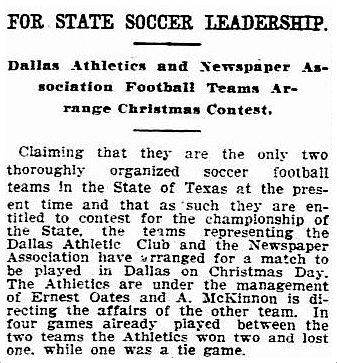
After only four games, the two teams announced that they would have a “state championship” match on Christmas Day. They claimed that they were “the only two thoroughly organized soccer football teams in the state of Texas” — who else would they play in a fight for the championship?

soccer_dmn_121208-state-champ(DMN, Dec. 12, 1908)

So they did. As expected, the Dallas Athletics won, 3-0. The “rugby football” team (which was also known as the Dallas Athletics) won their Christmas Day game as well, a fact that might help explain the cartoon below.

soccer_dmn_122708_CARTOON-KNOTT(DMN, Dec. 27, 1908 — cartoon by Knott)

“King” Finnegan (who, incidentally, had acted as referee for the championship game), disputed the whole “champion” thing, saying that his team, the Dallas Soccers, deserved a chance at the title (even though they had, thus far, played exactly zero games). The Athletics shrugged their shoulders and agreed to the challenge, and on New Year’s Day they trounced the Soccers, 6-0.

And so ended the first soccer season in Dallas. Fort Worth did eventually join the fray the next season, but it wasn’t pretty — they were badly beaten in their first few meetings with the mighty Dallas Athletics. Sorry ’bout that, Fort Worth. Don’t mess with Ernest Oates.

Here’s another photograph of Mr. Oates (front row, center) and the rest of his team. It’s been 106 years since soccer aficionados first started swearing that their sport will catch on in Dallas. And catch on big. And now you know when and where all that talk started: in 1908 with Ernest Oates and his Dallas Athletics.

dallas-athletics_dmn_120509-PHOTOThe Dallas Athletics, 1909

***

Sources & Notes

1908 team photo by Clogenson, from The Dallas Morning News, Dec. 25, 1908; 1909 team photo from the DMN, Dec. 5, 1909.

I’ve compiled a PDF containing most of the first few months’ news coverage of this whole new-fangled “soccer football” sport as it appeared in the pages of The Dallas Morning News and The Fort Worth Star-Telegram. I’m not much of a sports fan, but I actually found it very interesting to read chronological, contemporaneous reports of a new sport working its way into the city’s consciousness. I’ve left out the articles that explained AT LENGTH the rules of the game because my eyes (and soul) started glazing over. But the rest of it is here. My favorite headline is from an article about a mismatched game between Dallas and Fort Worth with the Fort Worth headline reading “Visitors Had More Experienced Men and Were in Better Condition” — yep, that’ll do it. There are a bunch of articles, stretching over a bunch of pages, but you might find them entertaining. The PDF can be found here.

**

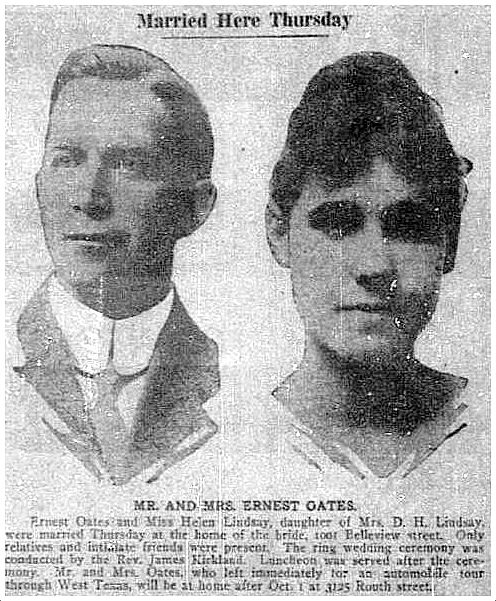
A photo of Ernest Oates (1875-1945) and his new (first) wife, the former Helen Lindsay in a wedding announcement (click for larger image).

soccer_dmn_092317-oatesDMN, Sept. 23, 1917

oates-ernest_ca-1930
Ernest Oates, 1930s

Oates was a stonemason and owned the Oates Stone Co. on Routh Street (at the MKT railroad). Below is an ad from 1922.

ad-oates-stone-work_1922-directory1922 Dallas directory

*

Copyright © 2014 Paula Bosse. All Rights Reserved.

Reverchon Park, Site of a Hovel Town Once Known as “Woodchuck Hill”

reverchon_park_baseballAnyone for a little sport? Or a spell-checker?

by Paula Bosse

Before it became one of Dallas’ nicest parks, Reverchon (named for the French botanist Julien Reverchon who arrived in Dallas to join the La Réunion settlement) began life as a 36-acre plot of land called “Turtle Creek Park.” But before that, it was an open-air slum known as “Woodchuck Hill” — an eyesore of an area filled with tents and hovels where families lived in deplorable conditions. It was a pretty dangerous place — the only thing the violent “Squattertown” had going for it was that it was practically next door to Parkland Hospital at Maple and Oak Lawn. The injured and dying didn’t have far to go for medical attention. Or to breathe their last breaths. News reports such as the one below — from 1911 — were, sadly, fairly common (click for larger image):

woodchuck-hill_dmn_081711
Dallas Morning News, Aug. 17, 1911

In October, 1914 it was announced that the city had purchased this tract of land from the heirs of the pioneer Cole family in order to establish what would become Reverchon Park.

reverchon-park_dmn_101914
DMN, Oct. 19, 1914

A few months after the purchase of the land, the squatters were told to vacate the city’s new park property, and what had been a miserable slum was cleared away and transformed into one of the city’s prettiest “pleasure grounds.”

woodchuck-hill_dmn_031215
DMN, March 12, 1915

*

The following is from the Dallas Park Board’s 1915 report:

Pending suggestions for a more suitable one, Turtle Creek Park has been temporarily adopted as the name for this property. At the time of its purchase it corresponded in a measure to the slum districts of the great cities. It was known as “Woodchuck Hill,” and its inhabitants constituted a novel settlement for the city. They resided in make-shift houses and hovels built by the occupants who paid a small stipend each month in the shape of ground rent. The moral conditions of these people was bad, and they caused much concern to the Social Welfare Workers in particular.

In addition to an athletic field, this park is adaptable for an elaborate botanical garden. Being situated at the western base of the Turtle Creek Boulevard, which extends the entire length of the property, it will one day constitute one of the chief attractions of the city for visitors. It adjoins the water works property, comprising a total of 103 acres of city property, a large portion of which has already been beautified. The grounds surrounding the pumping station and the water purification plant have been laid out in lawns and flower beds. Near the center of this park and at the base of the hills on its northern boundaries is located Raccoon Springs. The springs flow a large volume of water to year round, and provide shady nooks with delightful surroundings.

*

Hovels below, in the “before” picture.

reverchon-park_before-1915

reverchon-park-1915

Turtle Creek Park
Located on Maple Avenue.
Area, 36 acres.
Acquired, 1915.
Cost of land, $40,000.

reverchon-plat_kessler_1915

***

Sources & Notes

Top postcard (with “Reverchon” misspelled — understandably so…), from somewhere in the wilds of the internet.

Quoted text and other images from Report for the Year 1914-1915 of the Park Board of the City of Dallas, With a Sketch of the Park System (Dallas: Park Board, 1915), which can be accessed as part of the Dallas Municipal Archives, here.

For more on the Dallas Parks System, the definitive source may well be Historic Dallas Parks by John Slate (Charleston: Arcadia Publishing, 2010); more info here.

Friends of Reverchon Park website here.

*

Copyright © 2014 Paula Bosse. All Rights Reserved.
Minor League Ball: The Dallas Rangers — 1958-1964

dallas-rangers_1959_ebay

by Paula Bosse

Now there’s a baseball pennant.

“YES WE ARE AAA.” (Apparently triple-A ball had different cleat allowances back in 1959.)

My knowledge of baseball? Pretty limited. I knew that Dallas had professional teams leading up to the Texas Rangers, but that’s about it. Here is a 1958 team photo of the Dallas Rangers, a minor league team that lasted from 1958-1964, known for a couple of those years as the Dallas-Fort Worth Rangers. (This team, by the way, has no historical connection with the present-day Texas Rangers.) They played at Burnett Field. Again, I know precious little about this sort of thing, but, from what I can gather after a hasty skimming, they weren’t very good. The faltering franchise moved to Vancouver in 1965. To Canada! I like this photo. From a purely Americana perspective, the best sports team photos are always, for me, those of  baseball teams.

baseball-dallas-rangers_burnett-field_1958(Click for larger image. Won’t be any sharper, but it’ll be slightly bigger.)

baseball-texas-league_burnett-field_1957

dallas-rangers_dmn-blog-det_102512

***

Sources & Notes

Since I don’t know what I’m talking about, there will be a lot of links.

Top photo of 1959 pennant is from Ebay — which, as of THIS MINUTE, is currently available for purcha$e, here.

The 1958 team photo and 1959 program — I’m not sure where I found them months ago, but I think it might have been here. (As I’m looking at the page right now, all the photos are inactive — but the site may just have exceeded its monthly bandwidth. Lots of good info on the teams that played at Burnett Field, though.)

Bottom image of pennants from a Dallas Morning News blog post by Robert Wilonsky.

Dallas Rangers Wikipedia page here.

Info on Burnett Field here.

And, for those who are really into this sort of thing, the team stats for that 1958 team pictured above can be pored over here.

*

Copyright © 2014 Paula Bosse. All Rights Reserved.