A few years ago, when writing about one of the many attempts in the never-ending saga of trying to make the Trinity River a navigable waterway, I stumbled across the 99% Invisible podcast website where I discovered Julia Barton and her long audio piece on the very same topic. I was surprised — and excited — to find someone with a similar background to mine tackling Dallas’ history and looking at it from a thoroughly 21st-century perspective. I felt she and I had been separated at birth, and I enthusiastically contacted her via Twitter. Since then we’ve met a couple of times, chatted back and forth online, and, this year, she asked if I would help with research for a radio piece about Dallas she was preparing for BBC Radio. Of course I would!
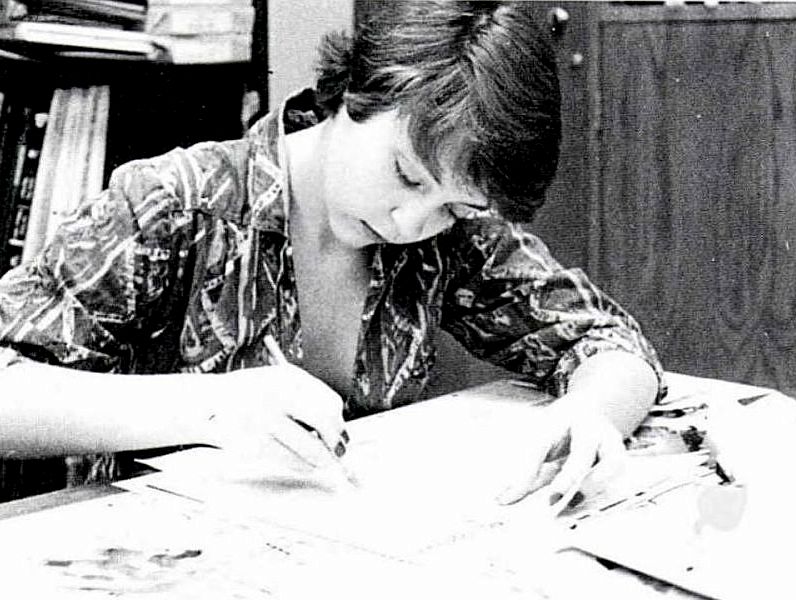
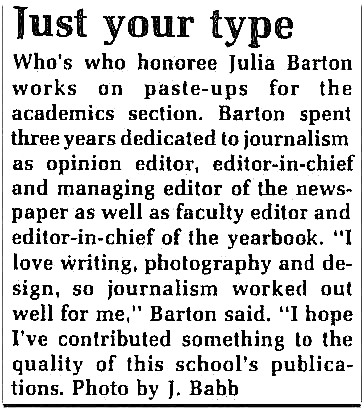
Julia Barton is a radio and podcast editor and has worked extensively in public radio; she is currently working on Malcolm Gladwell’s hugely successful Revisionist History podcast. She also presents stories, some of which are about Dallas, a city she seems to have a lingering fascination with, even though she hasn’t lived here in decades. Though born in Minnesota, Julia spent most of her childhood in Dallas, growing up in the Little Forest Hills area, attending Alex Sanger Elementary, Gaston Middle School, and Skyline High School (Class of ’87) where she appears to have been an overachieving student journalist. She lives in New York City now, where she puts those journalism tools to good use.
Julia Barton, 1987 Skyline High School yearbook
The first tidbit I heard about Julia’s story for the BBC involved another former Dallas resident, Dennis Rodman (of basketball and North Korea diplomacy fame), who grew up in both South Dallas and South Oak Cliff and attended Sunset High School for a couple of years before transferring to South Oak Cliff High School, where he graduated in 1979.
Senior photo, South Oak Cliff High School, 1979
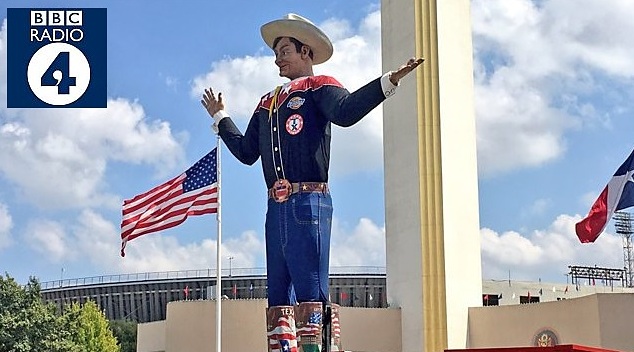
I’m not sure about the chronology of the piecing-together of the various aspects of Dallas history which comprise the finished half-hour BBC program, but an important kernel was Rodman’s childhood memory of hiking for miles with friends through underground sewage tunnels to Fair Park in order to get into the State Fair of Texas without the burden of paying — they just popped up a manhole cover when they’d reached their destination and … voilà! — they were inside Fair Park. He wrote about this in his autobiography Bad As I Wanna Be, and you can read this passage here (if bad language offends you, buckle up). I really love Rodman’s story about these tunnels — so much so that after Julia shared it with me, it got to the point where I was asking everyone I ran into if they’d ever heard about what I assumed was an apocryphal story. But the tunnel-to-Fair-Park-legend was true. And that weird kernel snowballed into a half-hour personal narrative about Dallas, race, inequality, education, school desegregation, and, yes, Big Tex. History isn’t always pretty, but let’s hope we can learn from past mistakes.
“Big Tex” was presented by Julia Barton for the UK’s BBC Radio 4. It features Julia’s classmates Sam Franklin (Class of ’86) and Nikki Benson (Class of ’87), her former teacher at Skyline Leonard Davis (an all-around great guy and fellow Dallas Historical Society volunteer — hi, Leonard!), as well as former teenage tunneller Melvin Qualls, local historian Donald Payton, and sixth graders from Julia’s alma mater, Alex Sanger Elementary School. It is a Falling Tree production, produced by Hannah Dean and Alan Hall. The link to the audio — and background on the production — is here. (Top photo is from the BBC page.)
Jim Schutze of the Dallas Observer wrote a great piece on this radio program (“Before Desegregation, Black Kids Had a Secret Tunnel Into the State Fair. Truth!”) — read it here (it includes a few production photos taken as Julia researched the story in Dallas).
Julia Barton’s website is here; a collection of her stories for Public Radio International (PRI) is here.
Two of Julia’s Dallas narratives:
“Port of Dallas” — history of the attempt to navigate (and monetize) the Trinity River: as an audio-only podcast, and as a video presentation done as a TEDx Talk at SMU
“The Failed Socialist Utopian Dream That Helped Dallas Become a Major City” — a look at the La Réunion community of the 1850s, from the PRI “World in Words” podcast (starts at about the 5:30 mark)
Thanks for asking me to help with research, Julia — I particularly enjoyed fact-checking the question “was-Mussolini-*really*-invited-to-the-Texas-Centennial?” (He was!)
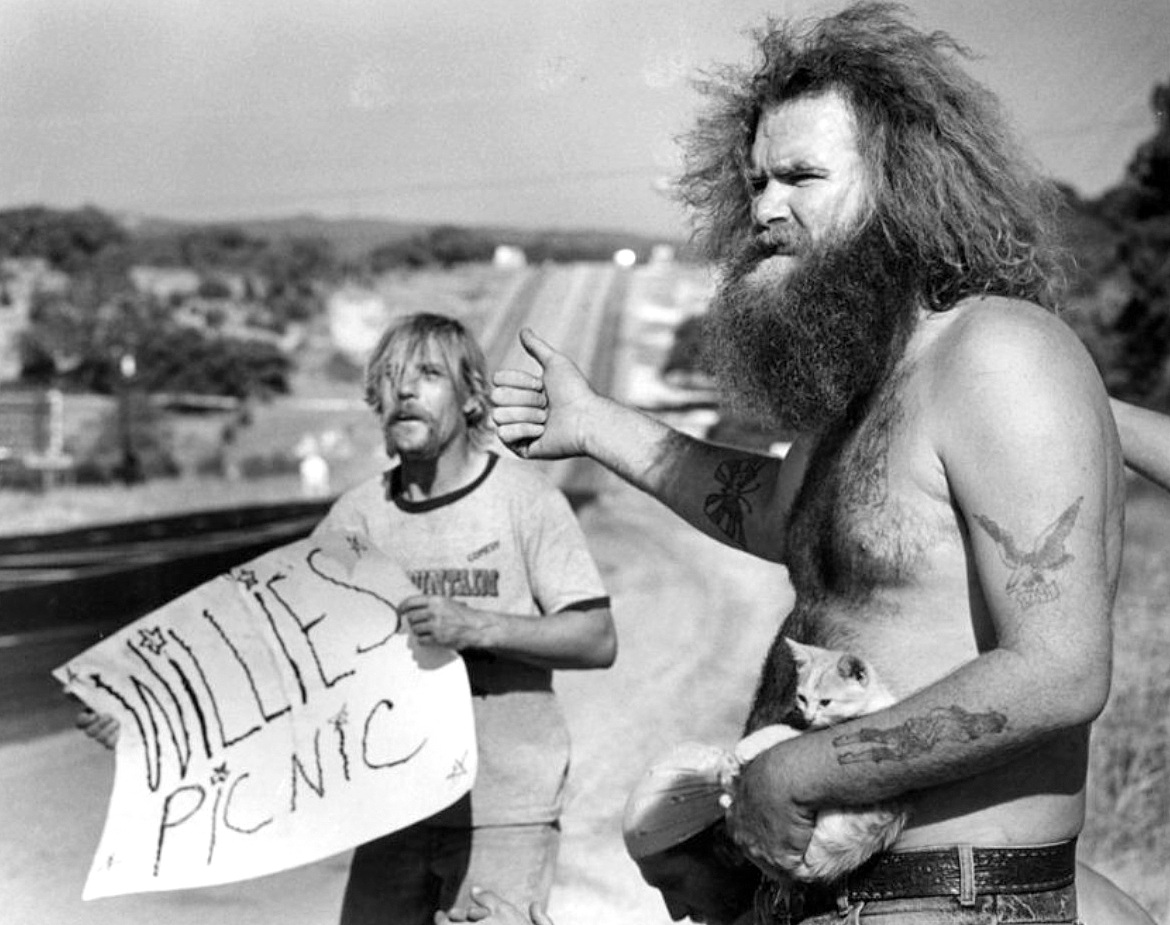
“All’s we need is a ride, man…” (photo: Austin American-Statesman)
by Paula Bosse
Today is July 4th, 2018 — the 45th anniversary of the first Willie Nelson 4th of July Picnic. The photo above — taken by Austin photographer Stanley Farrar — ran in The Austin American-Statesman in 1980 and shows hitchhikers (including a bare-chested Jerry Rundell and his go-with-the-flow cat “Precious”) thumbing it on Highway 71, hoping for a ride to that year’s picnic at Willie’s Pedernales Country Club, near Austin.
Take a look at the full illustrated program for the second Picnic, which was held at the Texas World Speedway in College Station, July 4-6, 1974, in a PDF, here. The huge line-up included Dallas natives Michael Murphey, B. W. Stevenson, Ray Wylie Hubbard (all three of whom attended Adamson High School in Oak Cliff), and singer-turned-DJ-turned-singer, Johnny Dallas (aka Groovey Joe Poovey). To make this a somewhat Dallas-y, I’ve pulled out a few of the local ads (click ’em to see larger images).
KZEW — from the Zoo’s “Progressive Country” years?
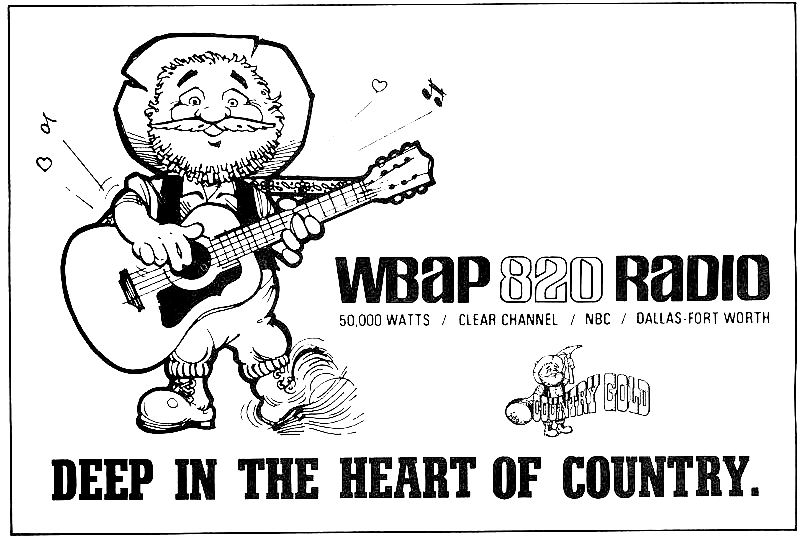
WBAP — how much Ray Wylie Hubbard was WBAP playing?
Speaking of Ray Wylie Hubbard:
Mother Blues had a one-buck cover charge, and Gertie’s was rocking until 5 a.m.
Lyon’s Pub, 5535 Yale Street.
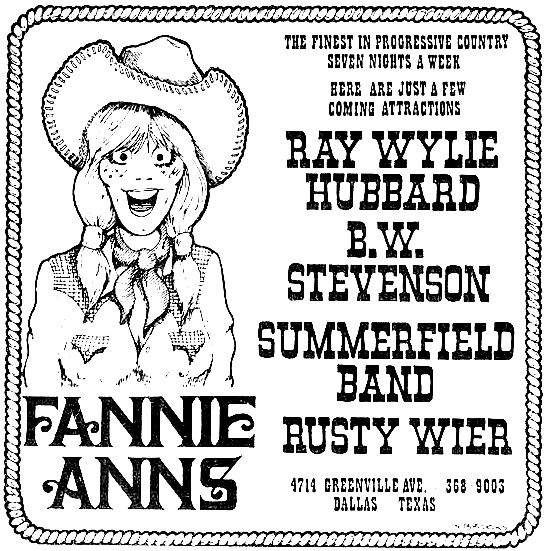
Fannie Ann’s, 4714 Greenville Avenue, the lower part of Upper Greenville.
The Lone Star Opry House, 1011 S. Industrial, at Cadiz (formerly the Aragon Ballroom). Willie appeared during its first week in business.
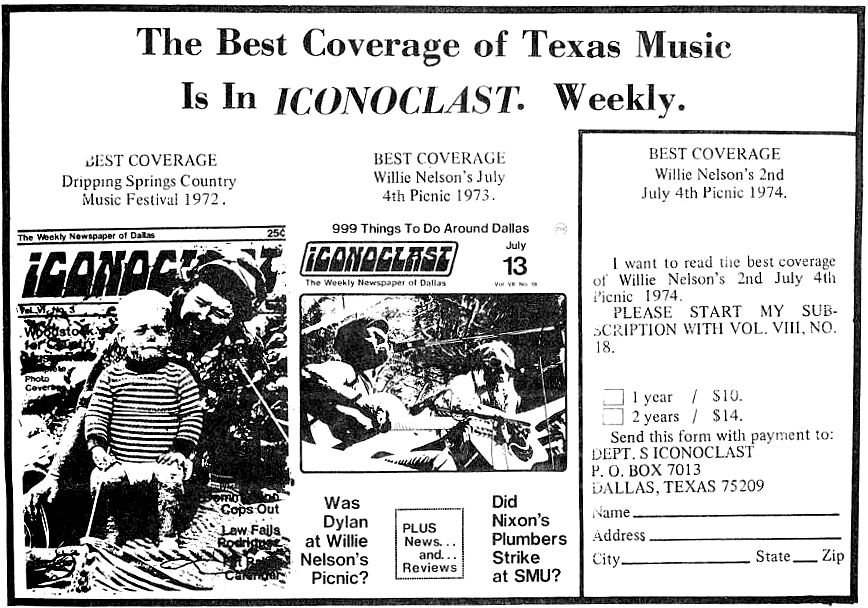
The Iconoclast, Dallas’ underground newspaper, which began as Stoney Burns’ Dallas Notes.
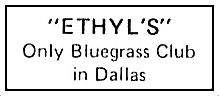
Ethyl’s (“Only Bluegrass Club in Dallas”), 3605 McKinney Avenue.
***
Sources & Notes
Top photo from The Austin American-Statesman (July 4, 1980); photo taken by photographer Stanley Farrar. See many more photos of Willie Nelson 4th of July Picnics in an American-Statesman slideshow, here.
I wonder if Willie’s picnics have their own Wikipedia page? Of COURSE they do! Have at it.
I’ve written about it before, but, hey, it’s the 4th of July, so here’s Willie’s very … um, unusual ode to Dallas:
I’ve written about the interesting old WFAA Channel 8 news footage which was either never aired or was aired decades ago and hasn’t been seen since (such as newly discovered Jack Ruby footage and a fantastic short interview with Jimi Hendrix at Love Field), which is part of an ongoing digitization project by SMU’s Hamon Arts Library as part of the G. William Jones Film and Video Collection. There are so many (SO MANY!) quirky clips that are being uploaded to the web almost daily that it’s easy to miss the super-quirky.
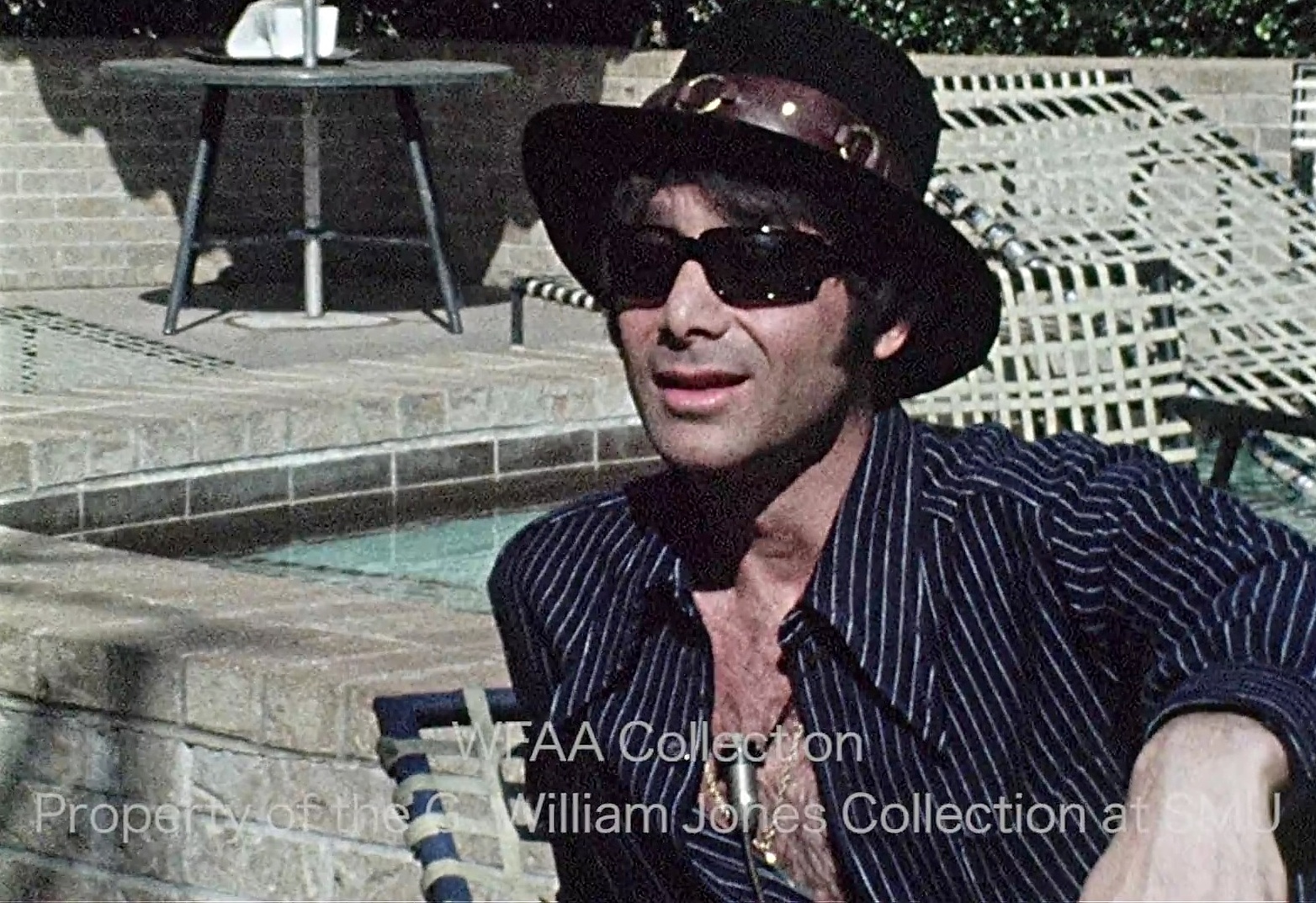
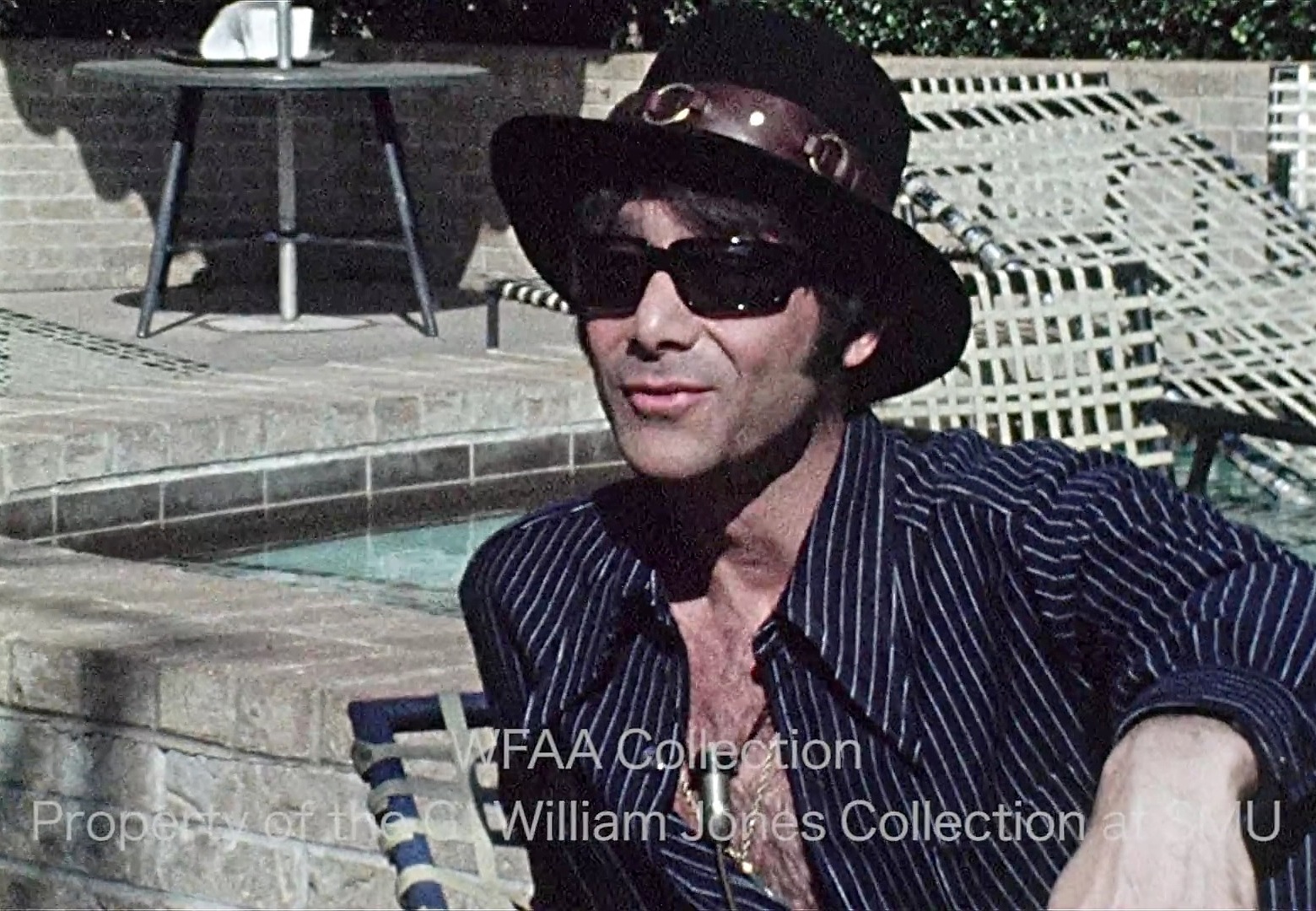
A week and a half ago the clip below was posted online, featuring an unidentified man who was much groovier-looking than one would normally have seen on the nightly Channel 8 newscast — he said that someone had shot at him from a car, just before dawn, near the Hilton Inn at Mockingbird and Central. He seemed pretty sure they were associates of Frank Sinatra, who was not at all happy that our mystery man had been fraternizing with his daughter, the singer Nancy Sinatra. Take a look at this short (1:43) footage from May, 1970.
*
Okay, that was weird. “I’ve been shot at *many* times — for one reason or another….” Add in an unexpected mention of Mrs. Baird’s bakery and, yeah, weird.
Who was that guy? The only information the SMU digitizers had on the out-of-context snippet was that it was filmed on May 21, 1970. It was obvious the guy was not local and, with that voice (and apparent ready access to Nancy Sinatra), he was most likely in the entertainment business. I could find no mention of this incident in The Dallas Morning News archives — I tried using every conceivable keyword I could think of. Nothing. So I checked Newspapers.com and found an AP story about this which had run all over the country — just not in the city where the incident had occurred.
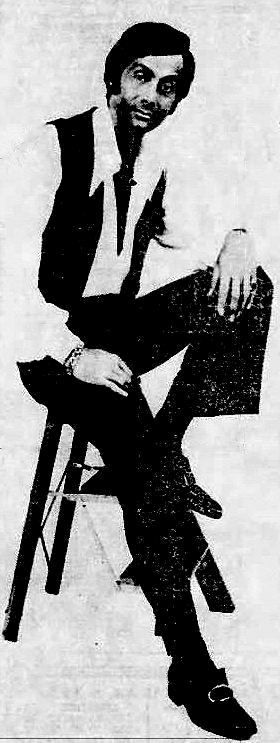
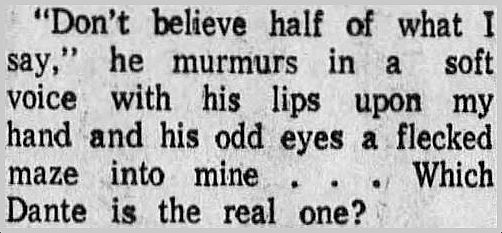
The guy is Ronald Dante, who has gone by a variety of aliases but is generally known as “Dr. Dante,” the stage name he used for decades as a successful nightclub hypnotist. (According to a 1985 Dallas Morning News profile, he had legally changed his name from Ronald Hugh Pellar to “Dr. Dante” — with “Doctor” being his legal first name.) (This may not be true.) (Most of what Dr. Dante has said is not true.) At the time of the shooting described in the video above, he was performing at The Losers Club at 5438 E. Mockingbird, about 2 blocks from his hotel, the Hilton Inn.
To describe Ron Dante (who was born in Chicago on Feb. 5, 1930) (and is not to be confused with the Ron Dante who was the lead singer of The Archies) as “colorful” is an understatement. His extraordinarily … um … extreme life as a performer, con-man, fraudster, schemer, opportunist, convicted felon, etc., is too much to cover here, but there is a fantastic 2006 profile of him from the San Diego Union-Tribunehere (seriously, READ THIS! — the part about him being orphaned in Kuala Lumpur when his family was attacked by Malaysian insurgents is great — in actuality, U.S. Census records from 1930 and 1940 show that he grew up in a nice Chicago neighborhood with his very-much-alive parents and brother).
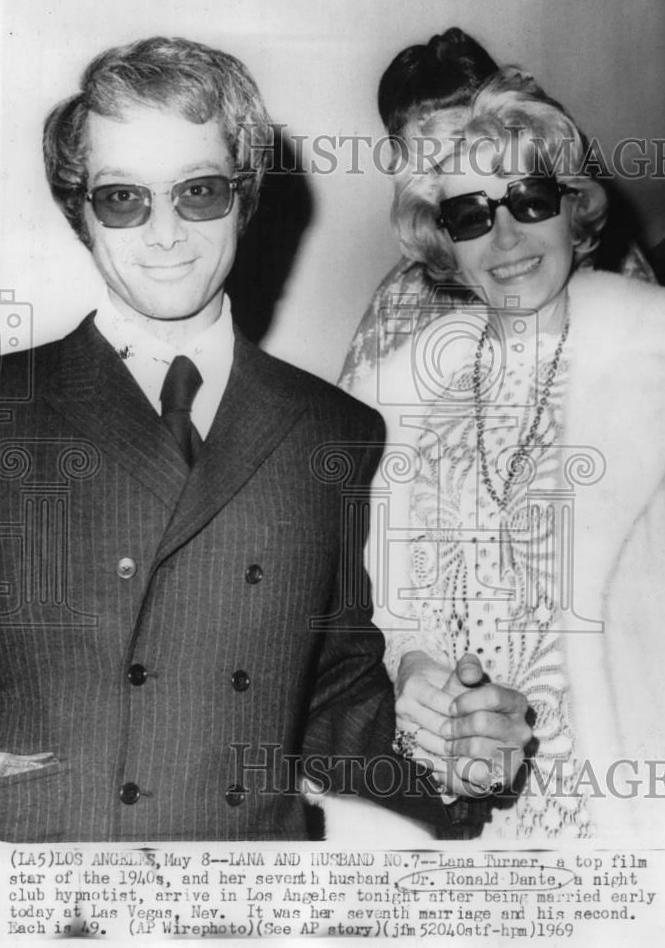
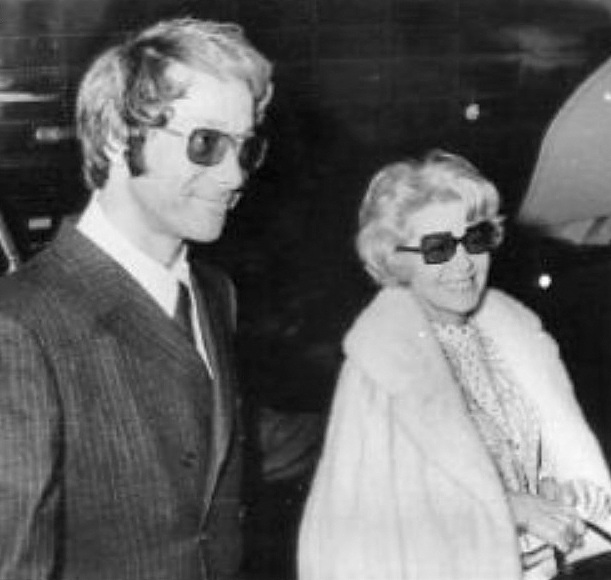
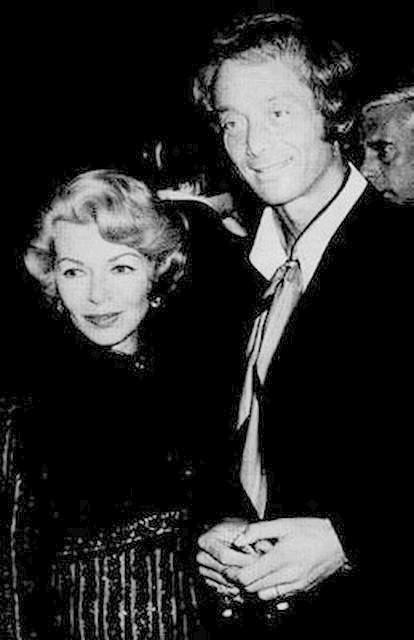
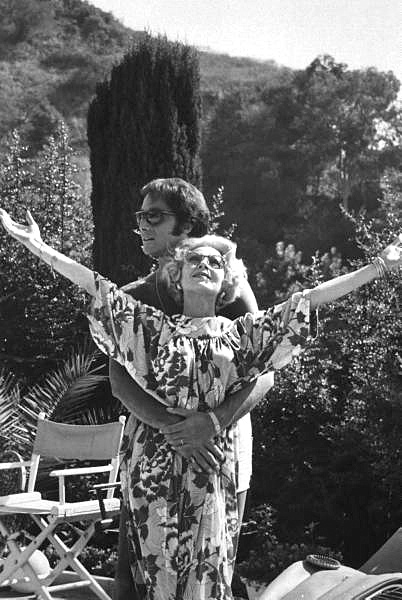
But back to Dallas in May, 1970. Dante was, at the time, the estranged husband of Hollywood icon Lana Turner. They had married in May, 1969; it was Lana’s seventh (and final) marriage. In news reports of the nuptials, Dante was reported to be the same age as his new bride, but he was actually almost 10 years younger. (In the Channel 8 video above he is 40.) Below are some photos of the happy couple before Lana began to realize what she’d gotten herself into.
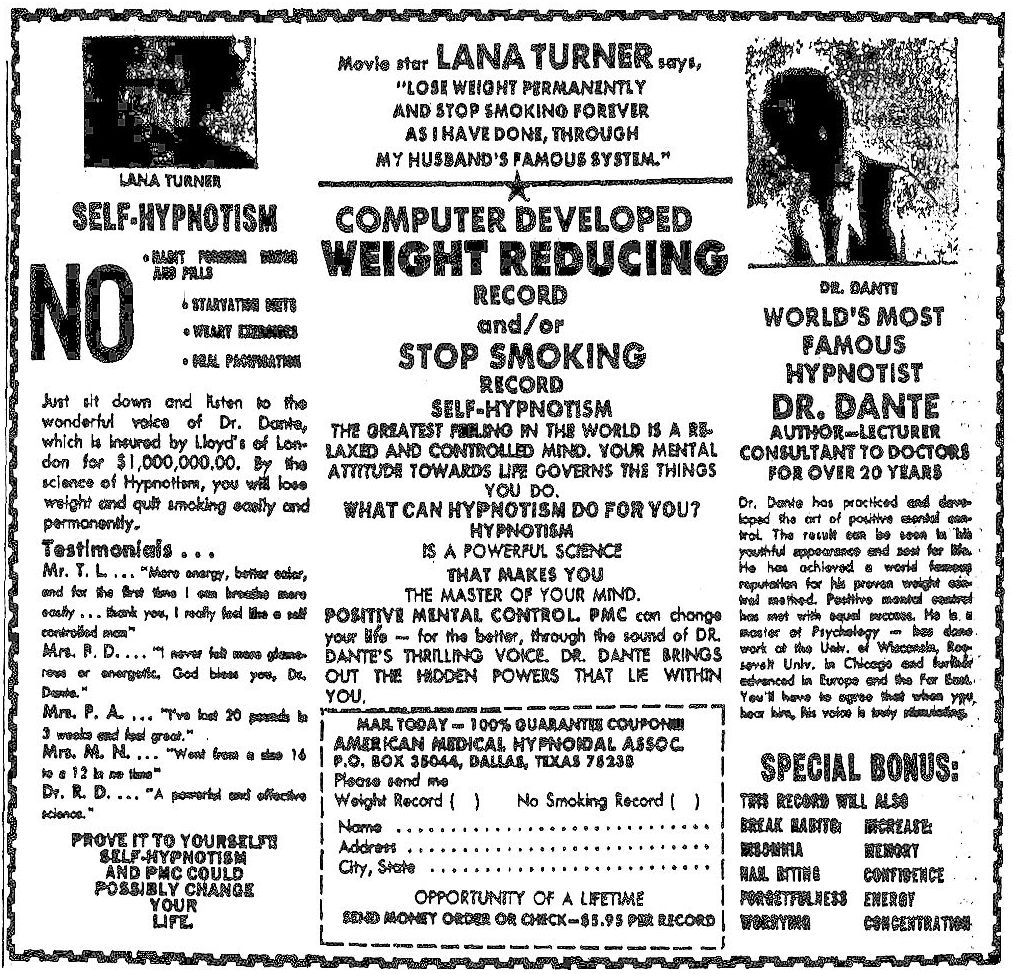
Their marriage hit the skids within 6 months, with Turner accusing Dante of misappropriating $35,000 of her money and, later, disappearing with many of her jewels, worth $100,000; on Nov. 14, 1969, Dante (not Lana!) filed for divorce on grounds of “extreme mental cruelty.” Two days later, the ad below touting a “computer-developed” self-hypnosis recording by Dante appeared in a Dallas paper, complete with a suspect thumbs-up testimonial attributed to estranged and recently-bilked Lana Turner (also worth a raised eyebrow was the inclusion of the even more suspect “American Medical Hypnoidal Assoc.” office which resided in a Dallas post office box) (click to see larger image):
Nov. 16, 1969
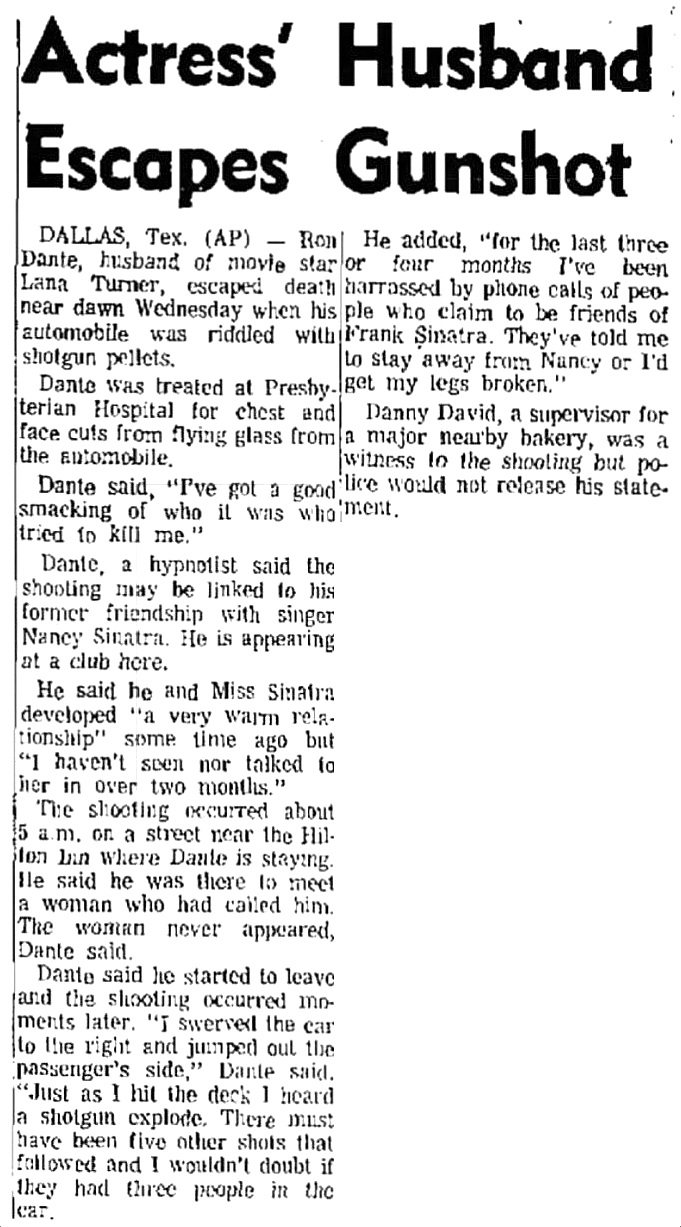
Six months later, Dante was in Dallas, claiming to have been shot at by men sent by Frank Sinatra to warn him to stop seeing his daughter Nancy. (A similar “being shot at” scenario was reported by Dante in Los Angeles in June, 1969 — photo here — Sinatra was not implicated by Dante in that shooting, but Lana Turner wondered about it in her 1982 autobiography: “Shortly after our wedding he was shot at, or so he said, in an underground garage, by a gunman wearing an Australian bush hat. It got a lot of attention in the papers — maybe that was what he wanted.”) One might reasonably wonder whether Dante was lying about the shooting in Dallas, but there seems to have been a witness: a Mrs. Baird’s employee, David Davis (whose name was misspelled in wire reports). Here’s the Associated Press report of the incident:
AP wire story, May 21, 1970 (click to read)
Other reports noted that “a spokesman for Miss Sinatra said she did not know [Dante]” or had even ever heard of him; a spokesman for Miss Turner said they had been separated for several months and “she doesn’t even know where he is.” (It should be noted that Frank Sinatra had had a very steamy affair with Lana Turner in the 1940s — a tidbit which just adds all sorts of weird tangents to this story.)
I never saw a follow-up, but whether the story was true or not, it was pretty ballsy to accuse Frank Sinatra (a man of known “connections”) of being behind something like this. Someone should crack open this cold case!
“Groovy hypnotist,” Reno Gazette-Journal, Aug. 7, 1970
*
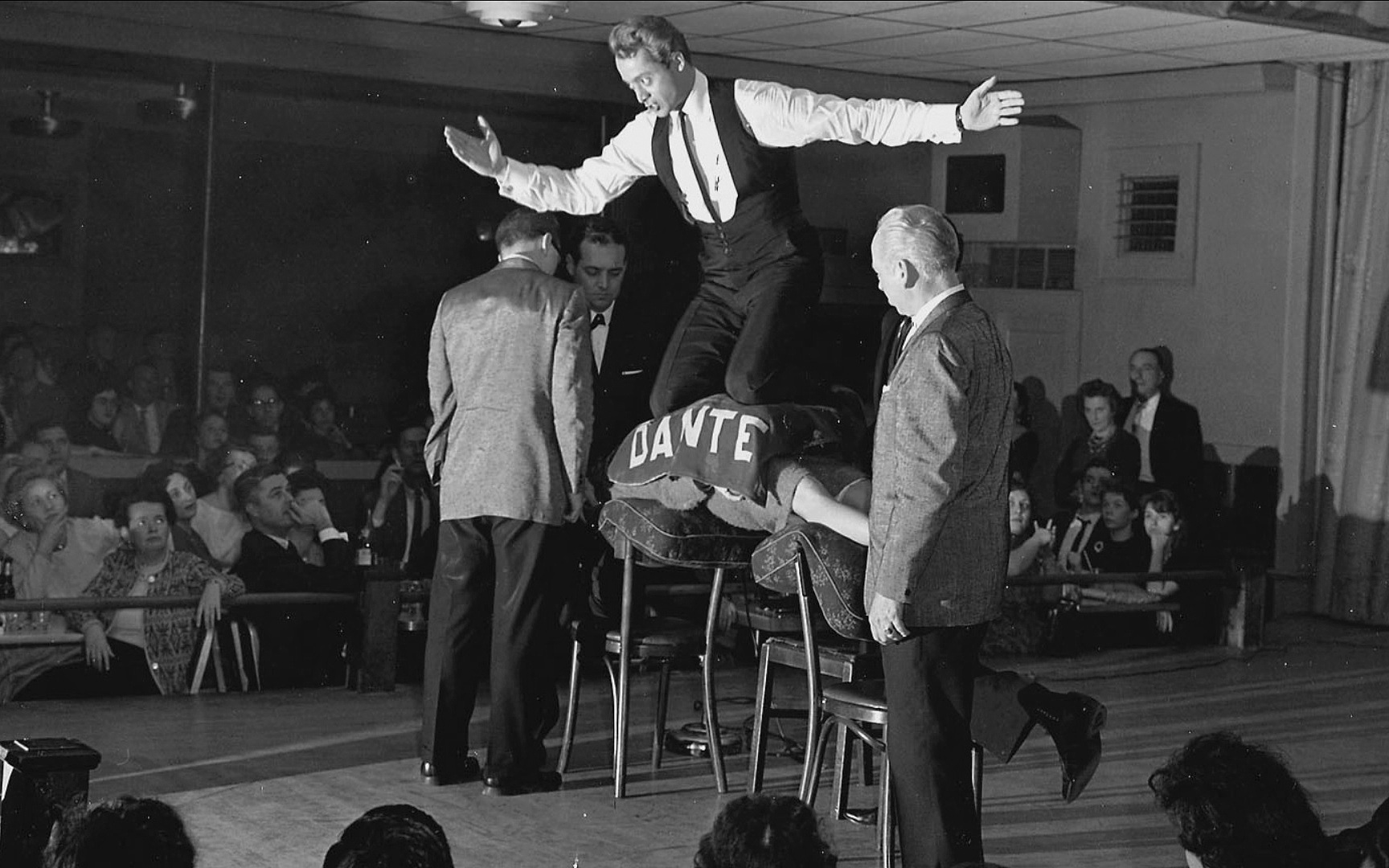
Ronald Dante’s first appearance in Dallas was at the Adolphus Hotel’s tony Century Room in January, 1963, back when he was known simply as “Dante.” Tony Zoppi, who covered the city’s nightclub scene for The News, wrote, “The handsome showman entertained his Century Room crowd with one of the most amazing hypnotic acts in the business” (DMN, Jan. 3, 1963). Back then his act looked something like this:
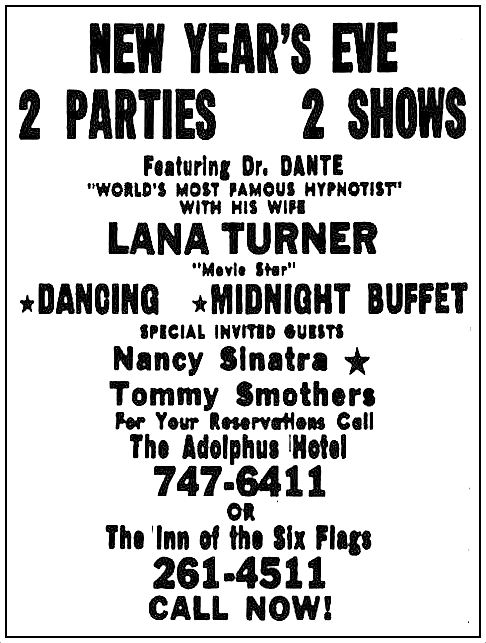
An interesting New Year’s Eve engagement at the Adolphus’ Rose Room was announced in The News in December, 1970 (same year as the shooting…):
The Adolphus Hotel has lined up a star-studded evening for its New Year’s Eve celebration, including hypnotist Dr. Ronald Dante, reportedly to be accompanied by his wife, actress Lana Turner. (DMN, Dec. 17, 1970)
An appearance by Lana Turner seems … unlikely. Others rumored to be appearing on the star-studded bill? Actor Ralph Bellamy, comedian Tommy Smothers, and … singer Nancy Sinatra. Unsurprisingly, none of the special guests showed up.
Dec. 20, 1970
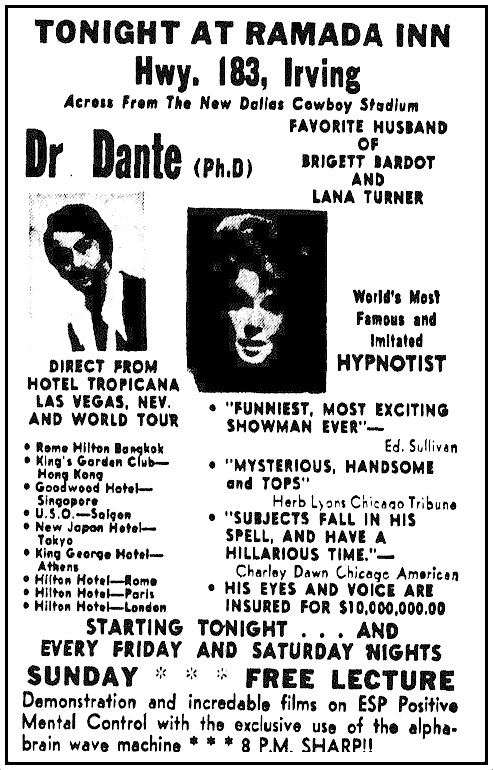
A couple of weeks after the New Year’s Eve engagement, an ad appeared in the paper filled with SO MUCH odd stuff in it: after a “world tour” which had him playing at swanky venues in Rome, Paris, London, Athens, Japan, and Bangkok, the next stop by Dr. Dante (“Ph.D.”) was none other than the somewhat less exotic Ramada Inn in the somewhat less exotic Irving, Texas; he billed himself as the “favorite husband” of both Lana Turner and “Brigett” [sic] Bardot (to whom he had never been married); and his eyes and voice were said to have been insured for 10 million dollars. Etc. In general, statements made by Dr. Dante were more likely than not to be absolutely untrue … untrue but usually pretty entertaining.
Jan. 15, 1971
A year later, Lana Turner and Ron Dante were divorced — the judge ruled that Dante had defrauded Turner, dissolved the marriage, and “postponed indefinitely a ruling on community property.” That was soon followed by a string of weirdness including the bizarre case of Dante’s being charged with soliciting an undercover cop to kill a rival stage hypnotist (!), creating a “school” to teach aspiring cosmeticians to administer permanent makeup (via tattoos), suing Johnny Carson for one billion dollars (“billion” with a “b”), and running an extremely lucrative diploma mill. (And that’s just the tip of the iceberg.) There were convictions and there was prison time.
Ron Dante appears to have died in 2013. (I believe nothing at this point.) A short documentary about him, “Mr. Hypnotism,” was shown at SXSW in 2009 (watch it here). It’s entertaining, but he really deserves a much longer documentary — and I really hope someone is working on a book. (PLEASE let someone be working on a book!)
In a lengthy Dallas Morning News profile/exposé of Dante (“Dr. Dante’s Traveling Hypnotherapy Show,” Feb. 24, 1985), reporter Glenna Whitley wrote:
Whatever else Dante is, he is likable. Even the most outrageous statements seem strangely plausible when coming from his lips. That may be the secret to his success, says [District Attorney] Gary Kniep, who was alternately amused and exasperated during Dante’s attempted-murder trial.
“Yeah, I kind of like him,” Kniep says. “He’s got some sort of magnetism that gets people into his confidence.” (DMN, Feb. 24, 1985)
I can see that.
*
This was Dante’s closing statement to Muncie, Indiana reporter Betty Harris after a 1970 interview absolutely LOADED with whoppers. Can’t say she wasn’t warned!
Muncie Evening Press, Oct. 23, 1970
***
Sources & Notes
Screen captures at top and bottom are from the digitized WFAA Channel 8 News film footage from May 21, 1970; the video is from the WFAA Newsfilm Collection, held at the Hamon Arts Library, Southern Methodist University. The direct link to the Ron Dante clip on YouTube is here. Follow the WFAA clips as they are added by SMU digitizers to YouTube here, and on Facebook here. (Thanks for your tireless dedication, Jeremy and Scott!)
Photos of Lana Turner and Ron Dante are from Pinterest and eBay.
The photo of Dante performing in a nightclub was found on a page about Lana Turner on the University of Alabama site, here.
I HIGHLY recommend listening to Jennifer Sharpe’s 6-minute 2007 NPR story on Dr. Dante (“Lana Turner’s Ex Maintains Dreams of Grandeur”), here (click the “play” button in the blue circle at the top of the page). The short film “Mr. Hypnotism” was made by her and Austin-based director Bradley Beesley — the full film is here, the trailer is here.
The WFAA Telefilm Collection — part of the G. William Jones Film and Video Collection, housed at the Hamon Library at Southern Methodist University — is an incredible assemblage of film footage shot by WFAA cameramen, some of which was never included in Channel 8’s televised news stories; a lot of it is silent, filmed mostly as B-roll material. It’s a fascinating historical treasure trove of local and national (and international) events filmed between 1960 and 1978. Jeremy Spracklen — the collection’s Moving Image Curator — and his assistant, Scott Martin, regularly post entertaining short clips from this vast resource to social media.
Which brings us to the clip posted yesterday — Dec. 6, 2017 — which featured footage of a 1960 parade held in downtown Dallas at Christmastime, with shots of festively decorated Main Street and Elm Street, including nice views of the old Palace Theater. Watch it here on Vimeo.
The clip was posted last night on the Jones Collection’s Facebook page — before I watched it, I read the comment by Bert Harris: “Did you notice Jack Ruby combing his hair right toward the end of the clip?? Wild!!“
What?!
Yes, at the very end of the short clip you see Jack Ruby (!) standing in a crowd of people in front of the W. A. Green department store combing his hair and adjusting his famous fedora. It’s very short, but it’s unmistakably Jack Ruby. You never know who’s going to pop up in these snippets of everyday life in Dallas, captured decades ago by WFAA cameramen! So now SMU has a few frames of what has just become historic film footage — footage which has probably been unseen for 57 years — there’s a good chance this never even aired and was merely B-roll footage. I never imagined it would be an exciting event to watch Jack Ruby comb his hair.
I contacted curator Jeremy Spracklen at SMU, and he was pretty excited about the discovery. He even cut a brand new clip this afternoon, isolating the Ruby footage and slowing it down considerably. It’s COOL. Here it is:
Below are some screen captures. I’ve had to lighten them a bit — click pictures to see larger images. Ruby and a friend are in the center of the first frames, then as the clip ends, he’s in the lower left corner.
Who is the guy with Ruby, and what is he holding in his hand? UPDATE: My first thought was that it might be Ruby’s roommate George Senator (from all accounts a good-natured guy who was perpetually out of work and out of cash — Ruby often helped him out, including inviting him to stay for a while at his apartment in early 1962). I didn’t really think he looked like the scarce few photos of him I’d found, but others in the comments below seem to think it might be him. He’s holding a Minox “spy” camera, which was an expensive tiny camera which had been sold for years in several stores in Dallas (and which was offered used in classified ads in The News in 1960 for $75 — about $125 today). By the man’s look of utter fascination with it, it appears that it probably belonged to Ruby. The man can be seen looking through it in the longer clip at the :50 mark. (See one of the first Minox ads found in a Dallas paper — sold by Linz Jewelers in 1951 — here, and in the year of this footage, in 1960, in a Neiman-Marcus ad, here, priced at $139.50, about $1,200 today.)
***
Sources & Notes
The clip is compiled from WFAA news footage shot on November 26, 1960; it is from the WFAA Newsfilm Collection, held at the Hamon Arts Library, Southern Methodist University. The original clip (1:22) showing a holiday parade in downtown Dallas can be watched on Vimeo here; the slowed-down clip showing only the Jack Ruby footage can be watched on Vimeo here.
According to coverage of the event in the Dallas Times Herald (“Mile of Dimes Parade Lures Great and Small,” Nov. 27, 1960), the parade was the “Mile of Dimes” parade sponsored by the Dallas Junior Chamber of Commerce and the Salvation Army. It took place on Saturday, Nov. 26, 1960. In addition to the parade, there was a “show” staged on Elm and Ervay which had bands performing on the back of a flatbed truck. Two of the acts performing that day were the Joe Johnson combo and singer Jewel Brown — both of whom were mainstays in Ruby’s clubs: at the time of the parade, Johnson’s band was booked into a long run at the Vegas Club/Club Vegas in Oak Lawn, and Brown was appearing seven nights a week (!) at the Sovereign Club on Commerce Street (which Ruby would later rename “the Carousel Club” around March, 1961). So that explains why he was there, nonchalantly combing his hair on the street as his “employees” perform in front of him.
Footage of the musical performers begins at the 1:00 mark in the longer clip. Houston-born Jewel Brown can be seen at 1:07. She was pretty much a smash in Dallas, getting loads of good press; she later hit it big appearing with Louis Armstrong in Las Vegas — you can watch a fantastic clip of her singing here. Read a March, 1967 interview with her in which she discusses her working relationship with Ruby here.
Ruby was standing outside the W. A. Green department store at 1616 Elm Street, which was next door to the Wilson Building; the Palace Theater was directly across the street.
1961 Dallas directory
In addition to the musical performers mentioned above, other celebrities appearing in the parade footage that day were actresses/sexpots Sheree North and Lynne Forrester, who were appearing in Clare Boothe Luce’s play “The Women” at Casa Manana (:34), and orchestra leader Freddy Martin, who was appearing at the Statler’s Empire Room (:45). According to the Times Herald article, one celeb who was also there that day was recent Olympian Cassius Clay (later known as Muhammad Ali), fresh from his gold-medal performance at the Olympics. Though wearinghis U.S. Olympic team jacket, the 18-year-old future-legend somehow went unnoticed in the crowd which was apparently quite wrapped up in the musical offerings that day.
Here is a photo of George Senator, possibly the man standing next to Ruby. This photo was taken on Nov. 24, 1963 at the Dallas Police Station; it is from the Fort Worth Star-Telegram Collection, University of Texas at Arlington Libraries, UTA — more info is here (I have cropped and flipped this detail). Another photo of Senator from the same night can be seen on the Portal to Texas History site, here.
And these two Associated Press photos were taken on March 9, 1964, showing Senator at the Jack Ruby trial.
*
I’ve mentioned the WFAA Newsfilm Collection several times — it is an amazing collection of WFAA-Channel 8’s archival news footage, out-takes, and B-roll material. Curator Jeremy Spracklen has been uploading bite-size segments to Twitter and Facebook — it’s a lot of cool stuff you’re probably not going to be able to find anywhere else. They’re very entertaining. Follow them on social media!
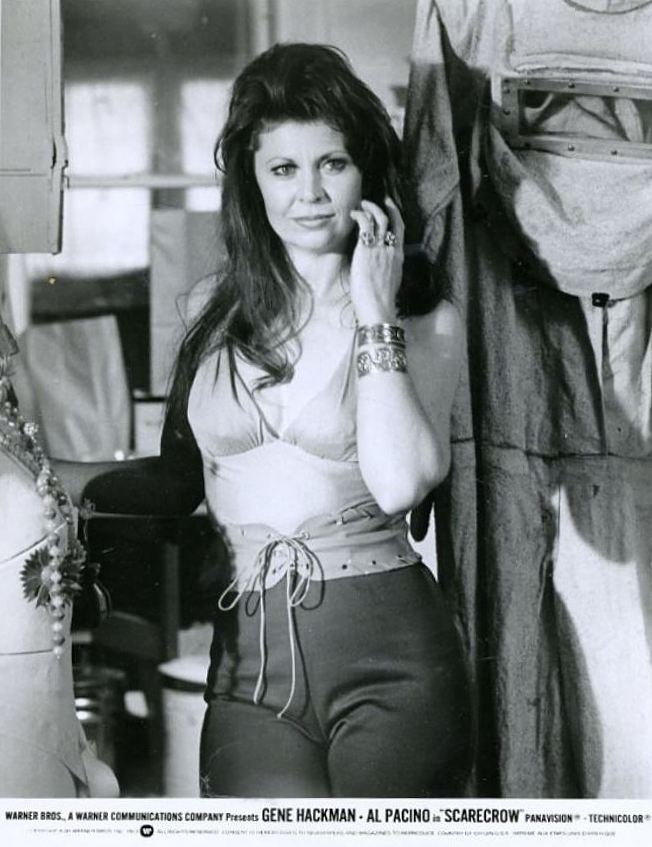
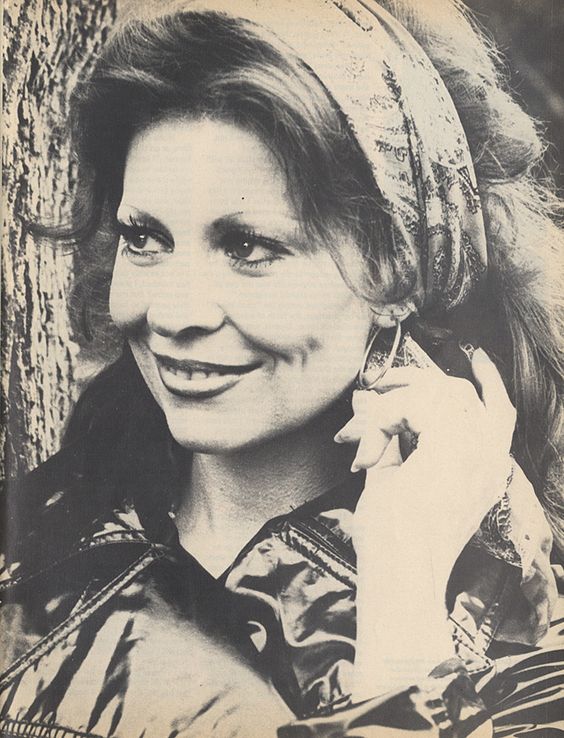
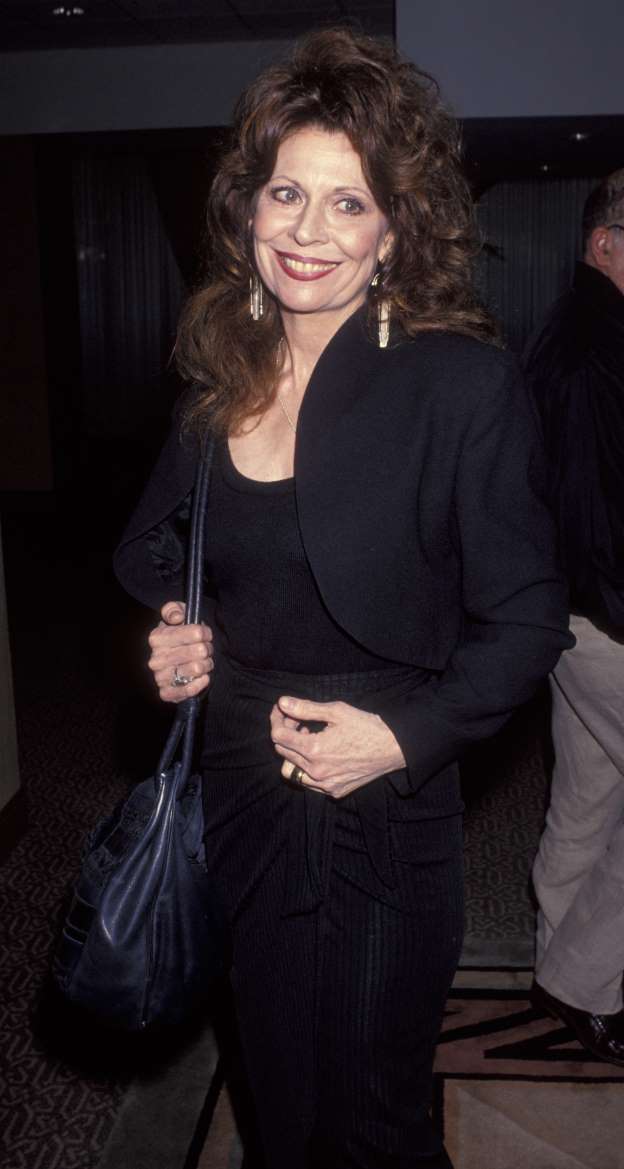
The actress Ann Wedgeworth has died. If you don’t know her by her name, you probably know her by her face, or, even more likely, by her voice. I’m always impressed when actors are able to retain their natural accents without having to homogenize them to meet Hollywood standards, and Wedgeworth’s Texas accent was pretty thick. I would bet hard cash she reminds you of someone you know or someone in your own family.
Even though she had worked as an actor since she was a teenager — in school productions, small regional theaters, off-Broadway, Broadway, TV, soap operas, and movies — it was probably her short-lived role as Lana on Three’s Company which brought her to the attention of the widest audience.
Elizabeth Ann Wedgeworth was born in 1934 in Taylor County and spent her early years in Snyder and Perryton, Texas, where her father had been the superintendent of schools (her mother died when she was 2); she arrived in Dallas around 1946 when she was about 12 years old. Her father worked in conjunction with SMU and the Veteran’s Administration for a time before becoming a longtime employee of the City of Dallas; her stepmother was a student counselor at Highland Park Junior High School.
She attended high school in Highland Park, graduating from HPHS in 1950 (the same year as her school friend, Jayne Mansfield). She began her acting career when she was a teenager, racking up quite a lot of experience in Dallas theater productions and in a Colorado stock company. She focused on acting during college, which included both SMU and the University of Texas — she probably met her future husband Rip Torn in Austin, where he was a fellow actor who had been active in the UT theater program (and who was, incidentally, the cousin of future actress Sissy Spacek). The couple was married in Dallas in 1955, at the First Methodist Church (which I wrote about here). They lived in Killeen briefly until Torn’s military stint at Ford Hood was up, then they headed to New York City, where the couple began to find acting work fairly quickly. The two had one daughter and divorced in 1961; she remarried and had another daughter. (More about Ann Wedgeworth can be read in the Wikipedia entry here.)
Ann worked a lot, and, as I said, I’m pretty sure you’ve seen her in something. Though known mostly for her work in TV and movies, she won a Tony Award in 1978 for her role in Neil Simon’s Broadway play Chapter Two. Her breathlessly exuberant (and charmingly ditzy) acceptance speech is amusing (I am such a sucker for that accent!):
* Ann Wedgeworth died on November 16, 2017; she was 83 years old.
*
Highland Park High School sophomore, 1948
HPHS junior, 1949
HPHS senior, 1950
SMU freshman, 1951
SMU sophomore, 1952
Appearing on national radio with Hume Cronyn, 1952
Ann Wedgeworth’s obituary in The Washington Post can be found here.
School photos are from Highland Park High School and Southern Methodist University yearbooks.
The photo of 18-year-old Ann with Hume Cronyn appeared in the SMU Campus newspaper on March 5, 1952. (I believe Ann came in second in the competition.)
The wedding announcement of Ann and Rip Torn appeared in the Longview Daily News on Feb. 6, 1955. (Rip Torn was born Elmore Rual Torn, Jr. — as a kid he was actually known as “Skip” Torn. …Doesn’t have quite the same ring to it….)
Most photos and clippings are larger when clicked.
Our Lady of Good Counsel, 1944… (click for larger image)
by Paula Bosse
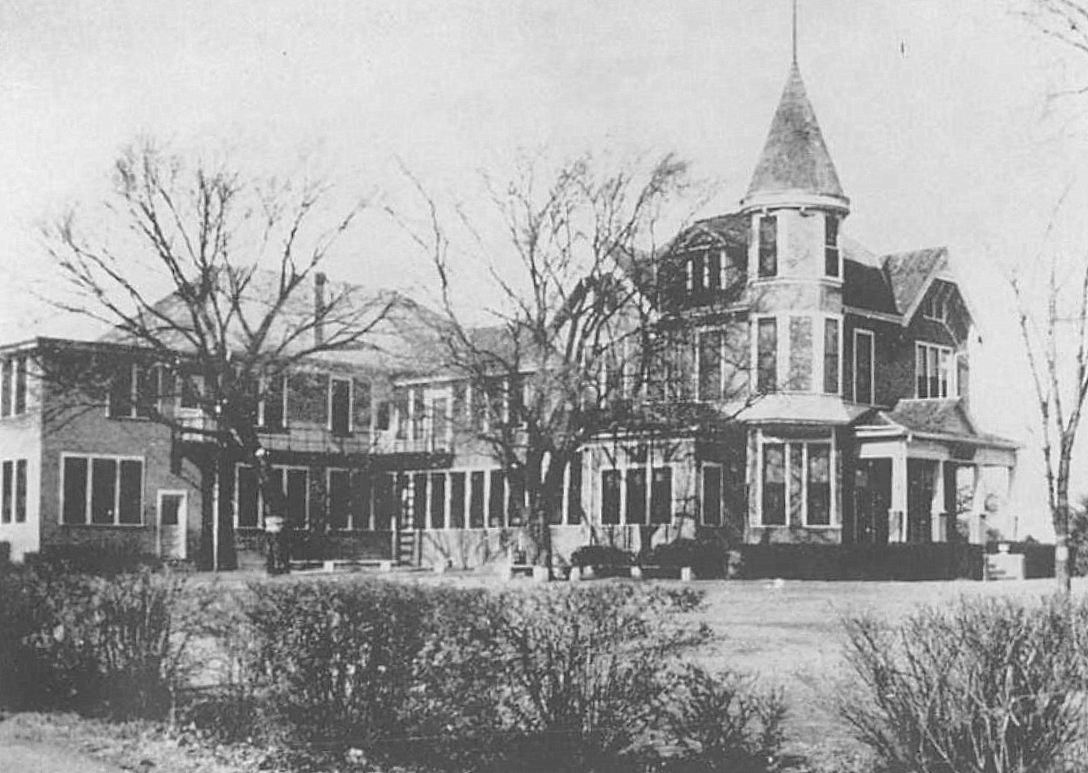
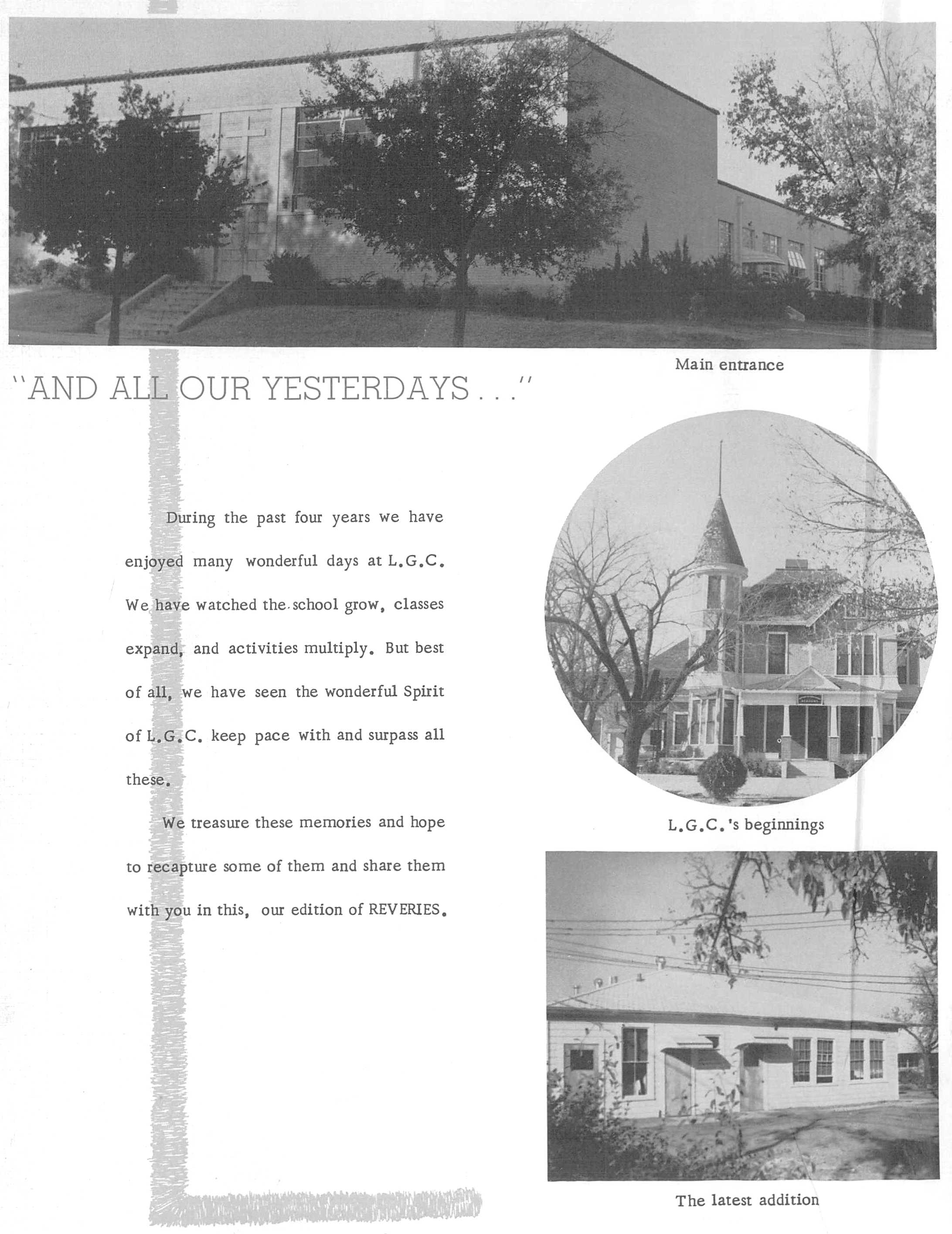
Talking to my aunt today reminded me that she briefly attended Our Lady of Good Counsel, the all-girls Catholic high school in Oak Cliff next to the Church of the Blessed Sacrament, at the northwest corner of North Marsalis (originally named Grand Avenue) and 9th Street. I’m still not sure why she went there (our family isn’t Catholic), but she seems to have enjoyed her time there for a year or two before she transferred to Crozier Tech.
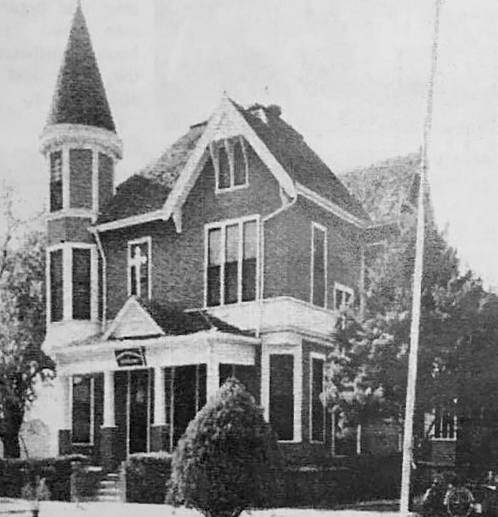
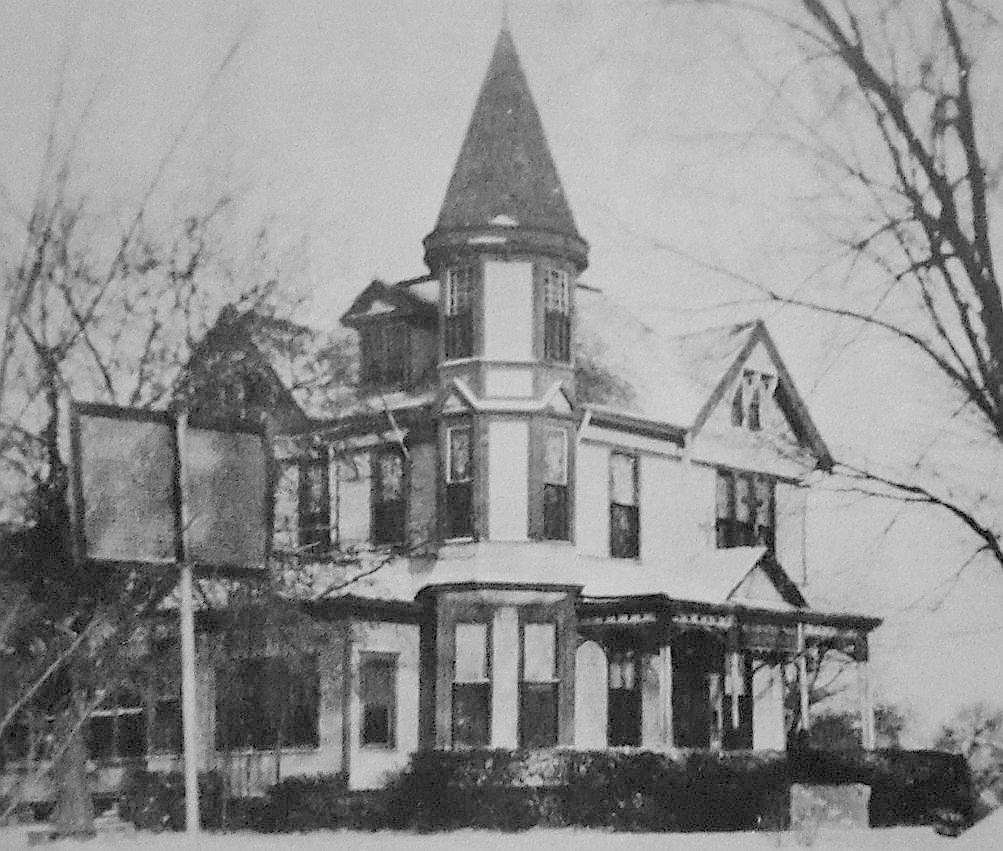
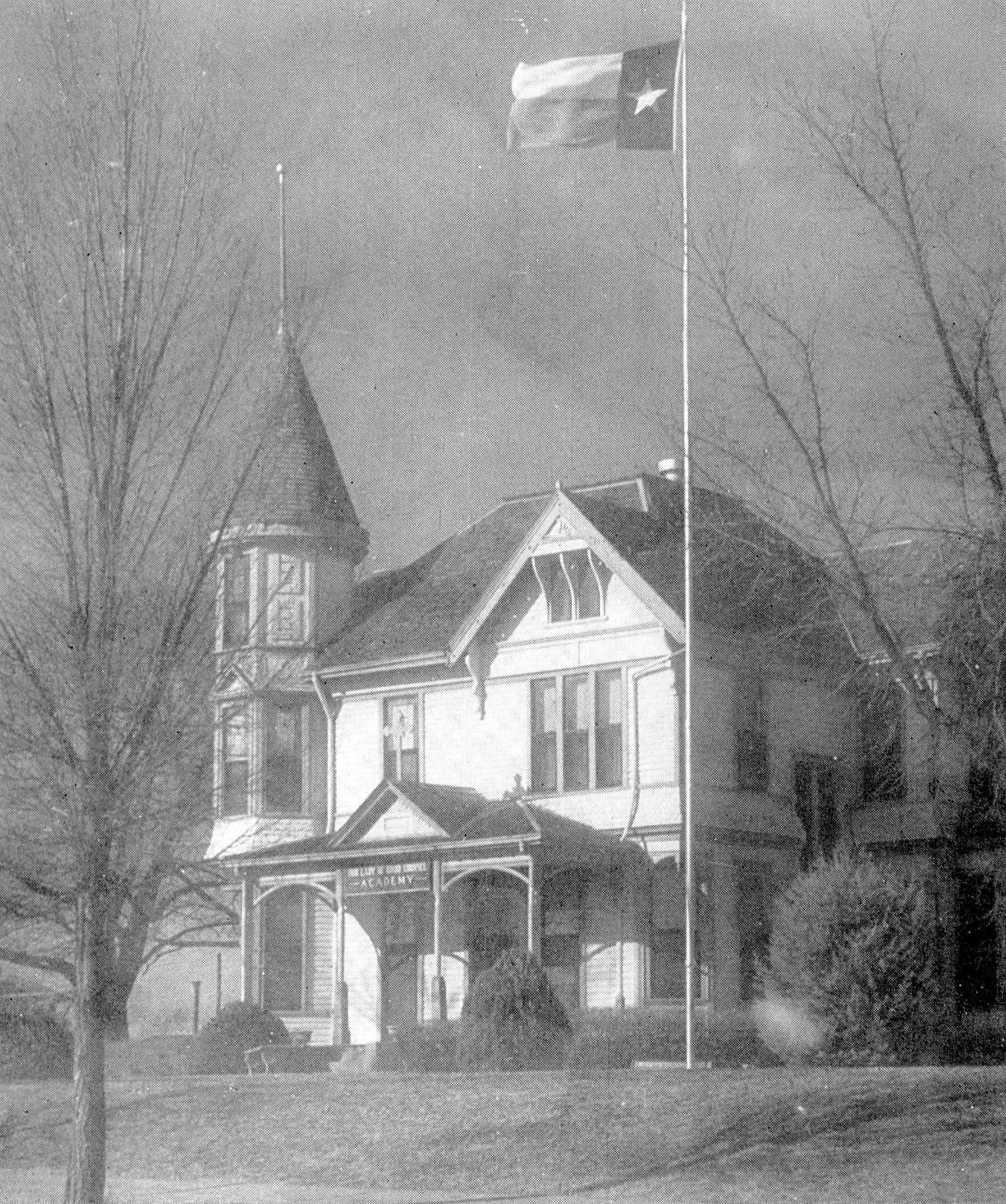
The school building was the former palatial home of wealthy businessman James T. Dargan, a one-time partner of Thomas L. Marsalis. The house was built about 1888, and according to Dallas Rediscovered author William L. McDonald, it was designed by the Dallas architectural firm of Stewart and Fuller.
1889 Dallas directory
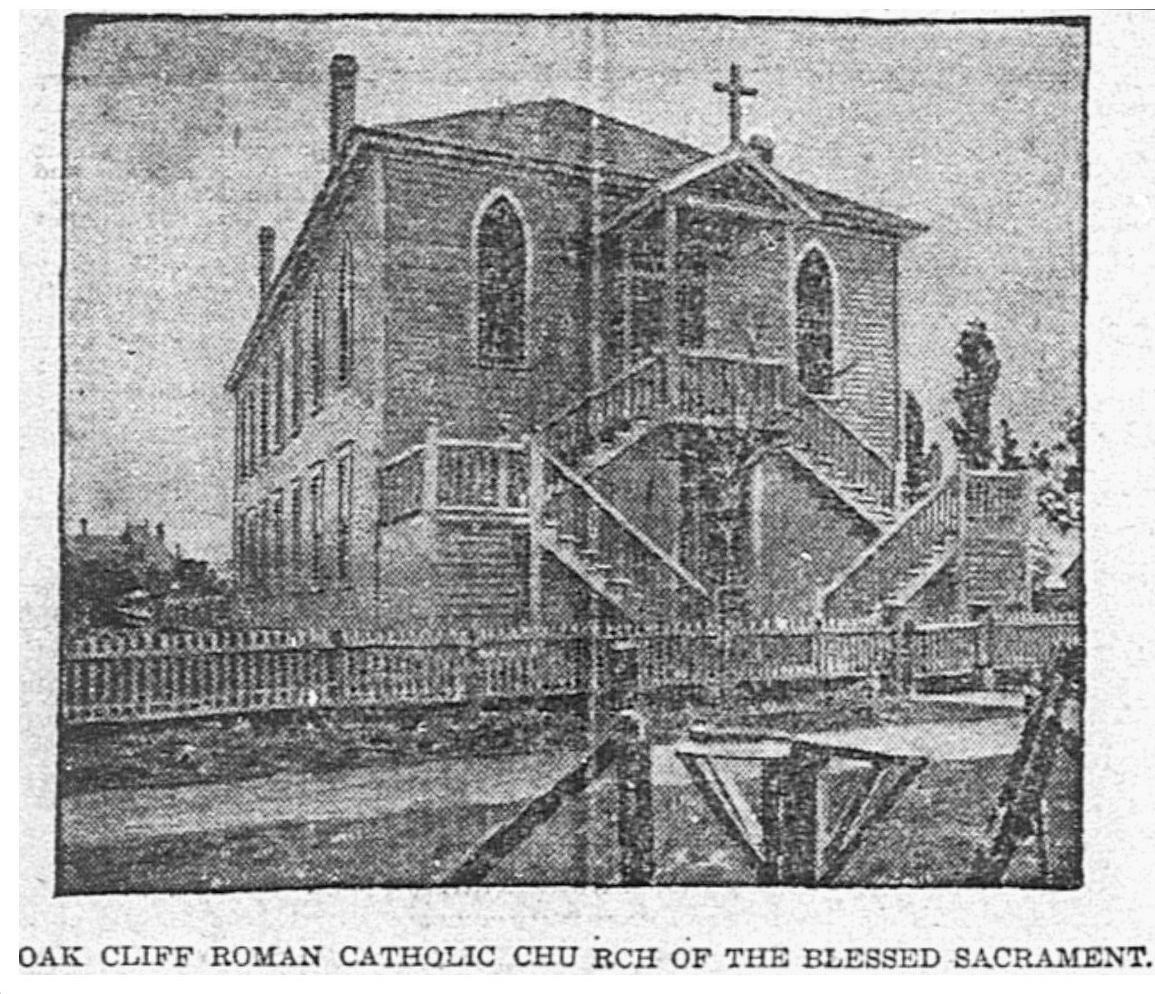
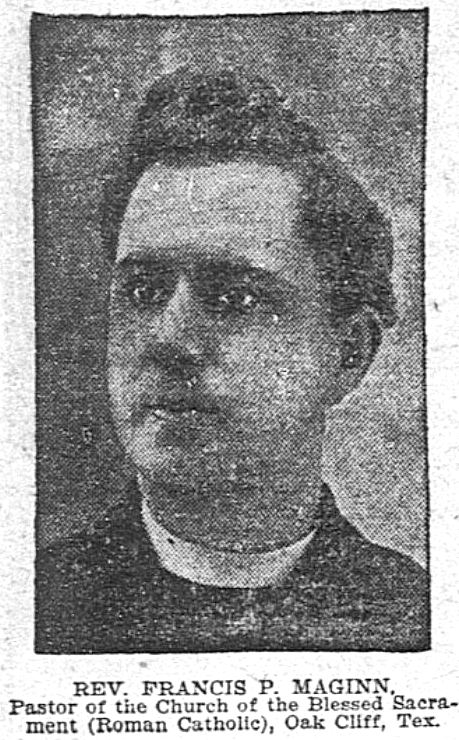
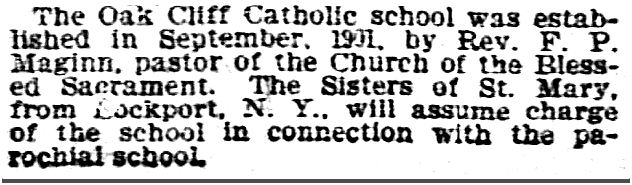
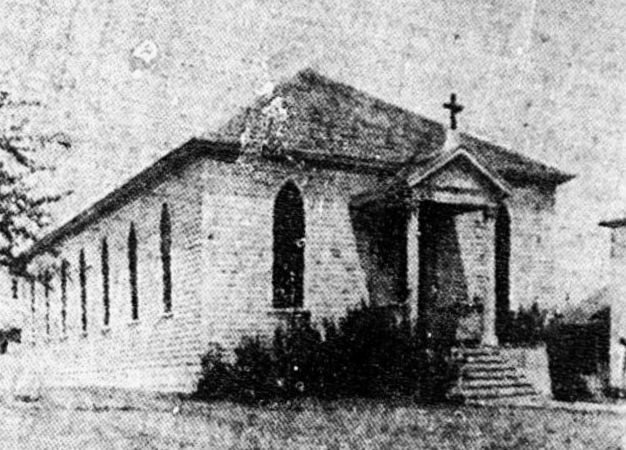
The church was holding services in Oak Cliff as early as 1901, and an affiliated school was established by Rev. Francis P. Maginn in September of that year. It appears that the Dargan house was acquired in 1902, the same year that the (new?) church building was dedicated in ceremonies officiated by Bishop E. J. Dunne.
Below, the new church can be seen in a photo which appeared in The Dallas Morning News on the day of its dedication in June, 1902 (all images are larger when clicked):
DMN, June 15, 1902
The neighboring school can be seen in these two early photos:
Our Lady of Good Counsel, ca. 1902
Our Lady of Good Counsel, ca. 1905
The school’s founder, Rev. F. P. Maginn:
DMN, June 15, 1902
DMN, April 23, 1902
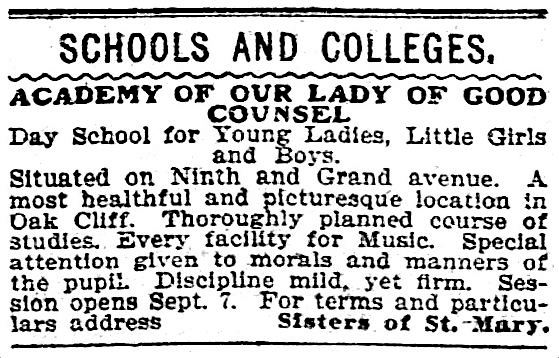
And an early ad for the school, from 1903 (“Discipline mild, yet firm”):
1903
Here it is in 1942:
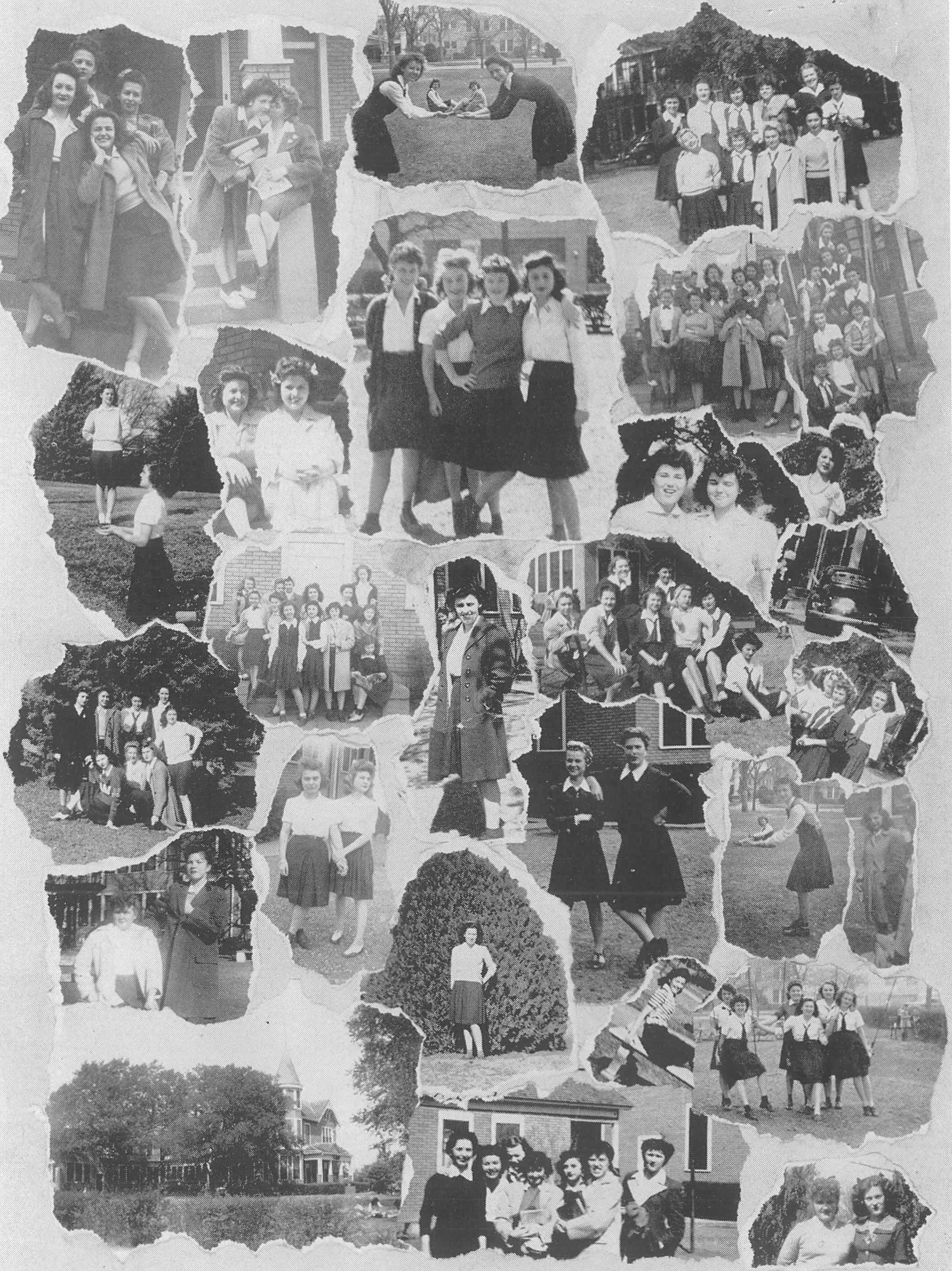
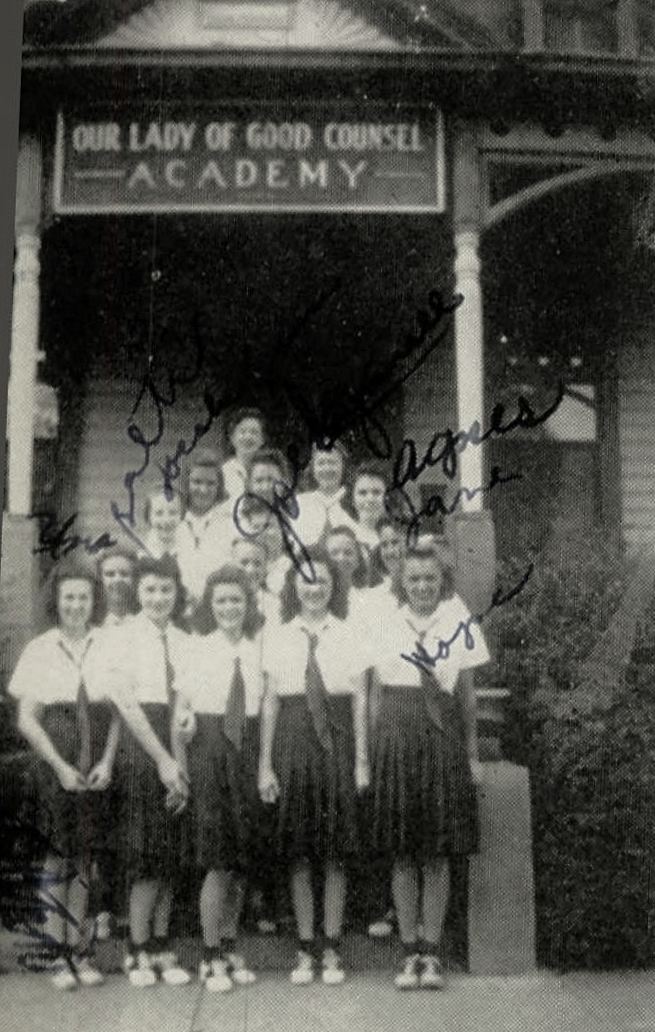
And here are some of the LGC high school students from 1944, looking bobby-soxer-y (with another view of the augmented house in the lower left corner):
The newest additions to the building can be seen in the 1959 yearbook:
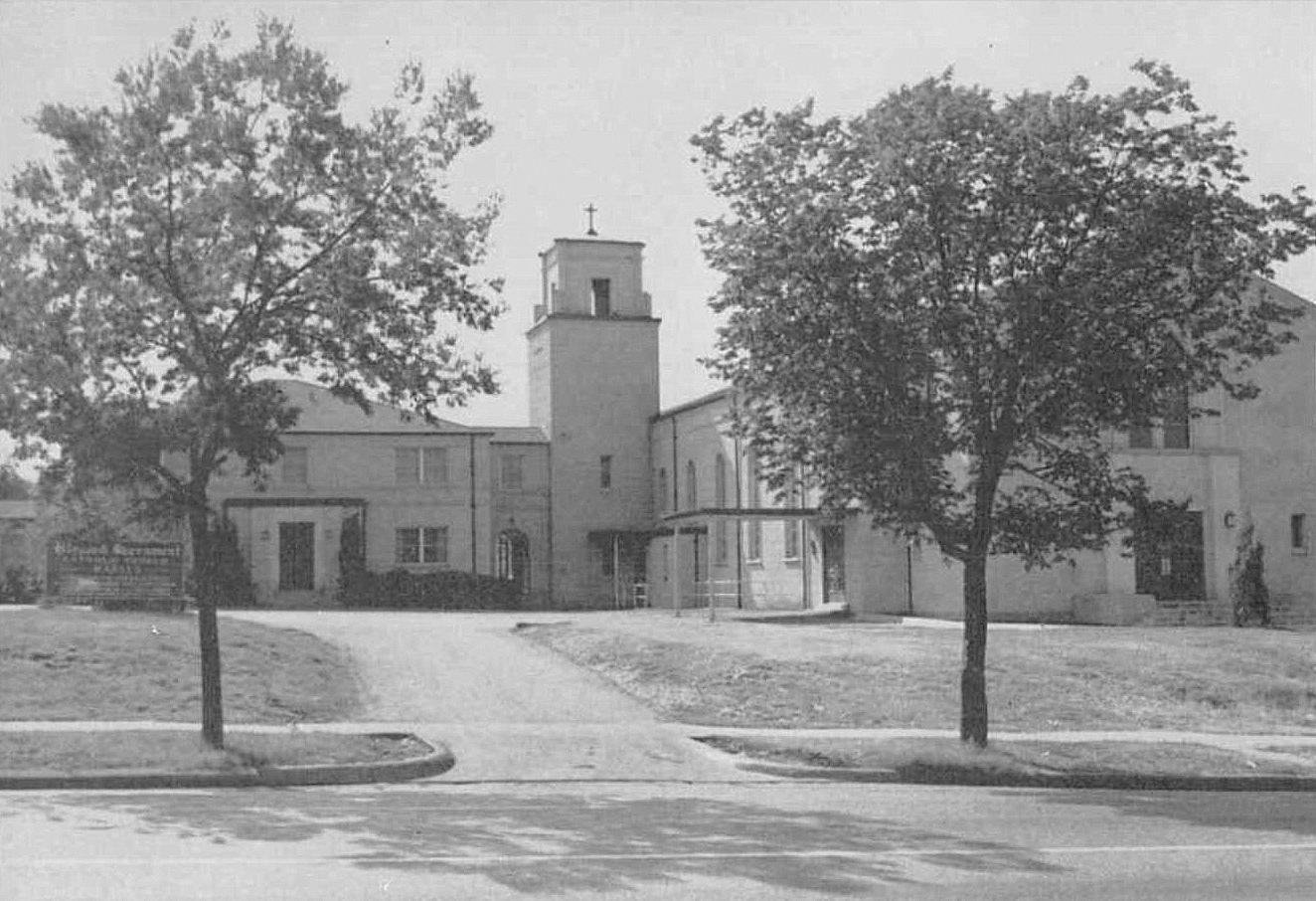
In 1961, Our Lady of Good Counsel was a fast-fading memory: a new 32-acre campus had been acquired and on it had been built the new (coed) Bishop Dunne High School. Mr. Dargan’s old house-turned-school-building was torn down a few years later, and the land became a parking lot for the Blessed Sacrament church next door (which had also seen many changes and a new building over the years). Today, the view of the land the Dargan house sat on 130 years ago looks like this. (The church looks like this.)
The church in 1930:
And in 1958 (from the LGC yearbook):
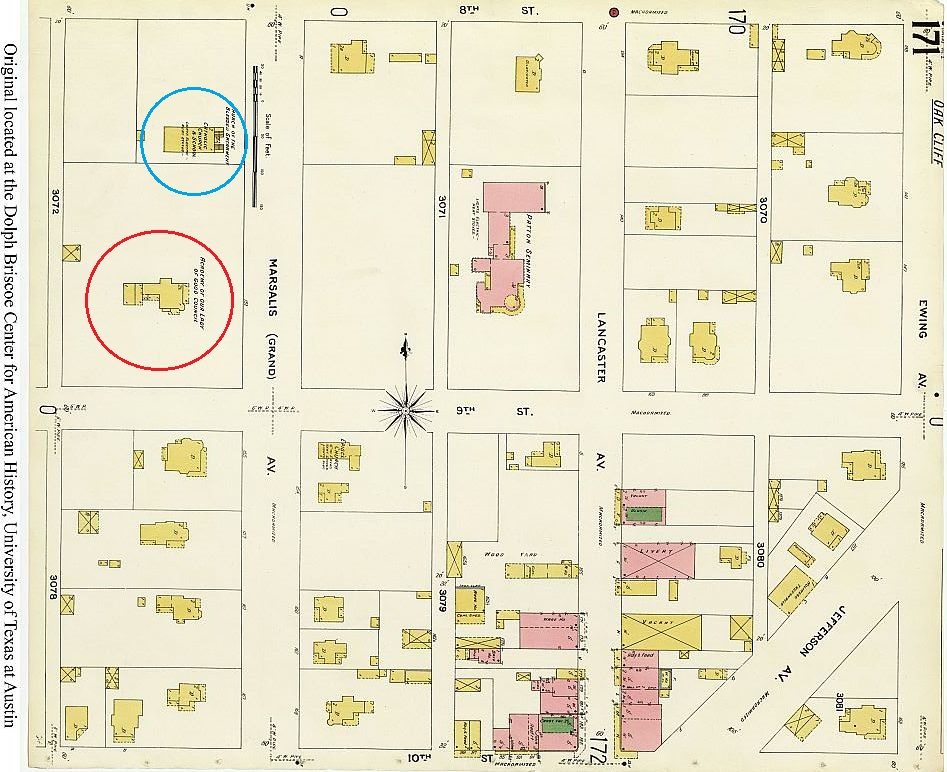
This visual aid will help give an idea of the acreage of both the school (circled in red) and the church (circled in blue), via the 1905 Sanborn map:
I’m still not sure why my aunt went there….
1958
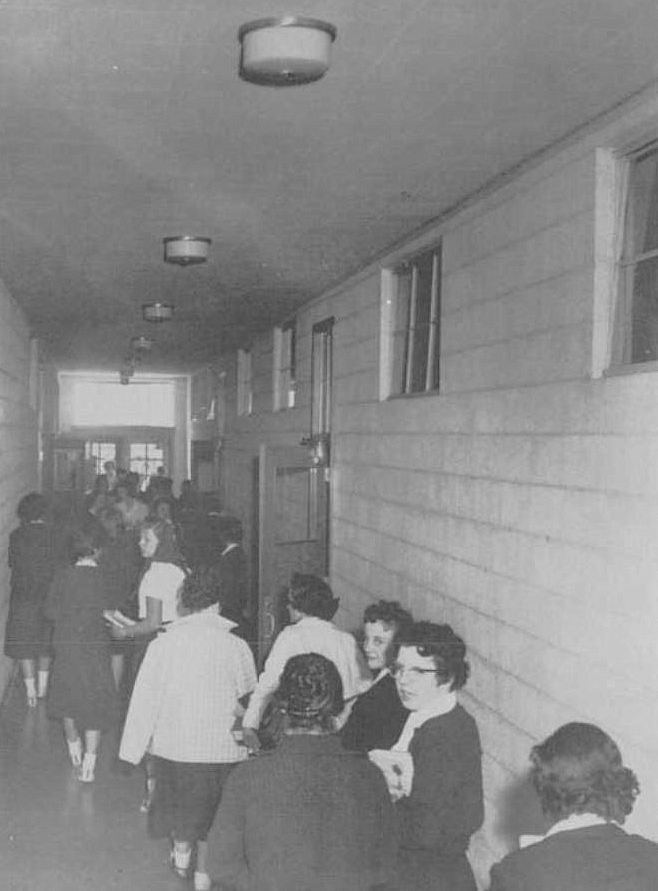
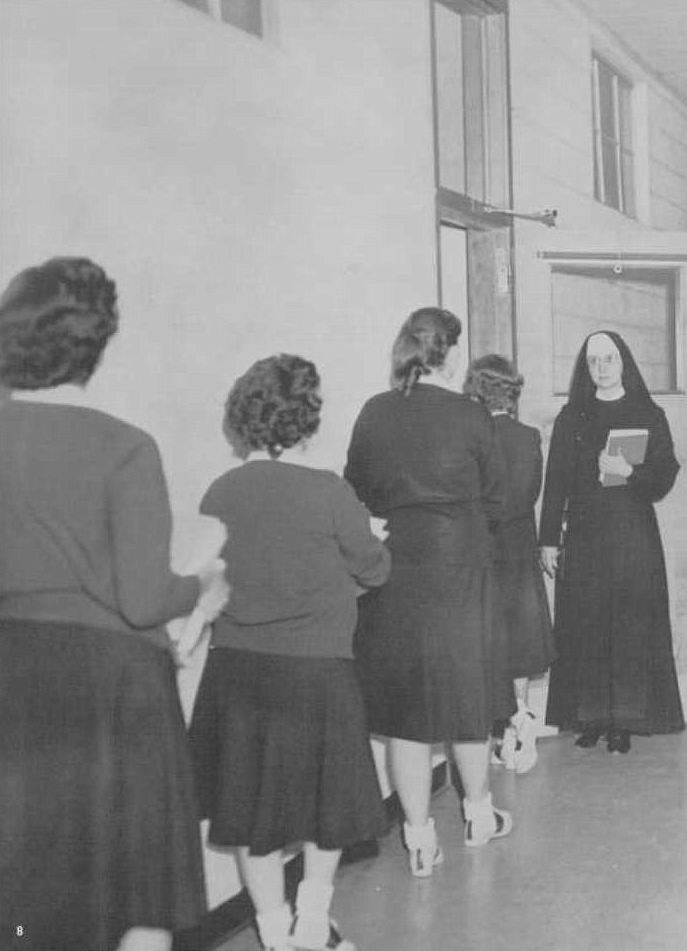
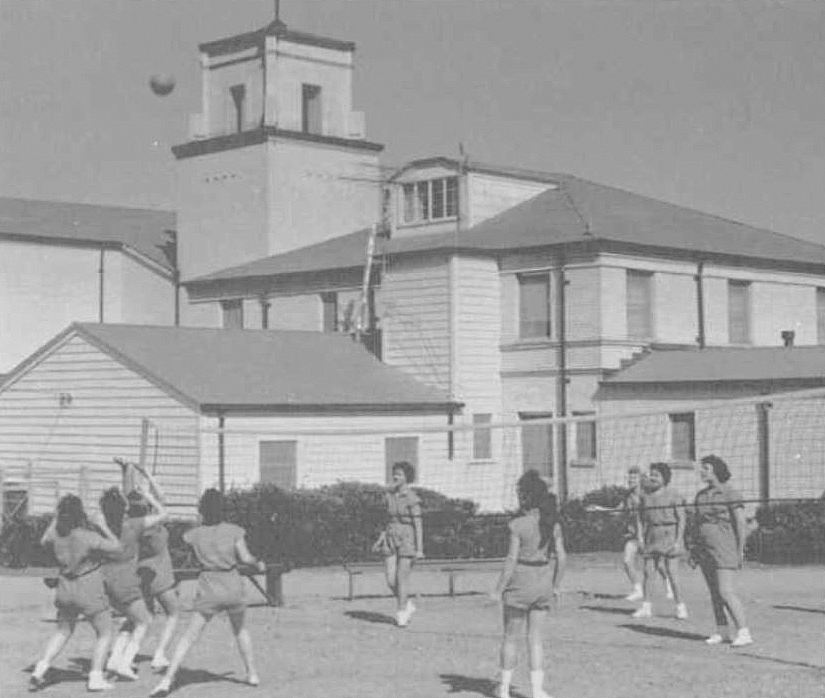
UPDATE: For those who might have wanted to see some interior photos, I didn’t find many, other than typical classroom shots, but here are some additional photos, a couple of which show the hallway.
Between classes, 1959:
Girls lining up to go into class, 1960:
Girls outside playing volleyball, 1960:
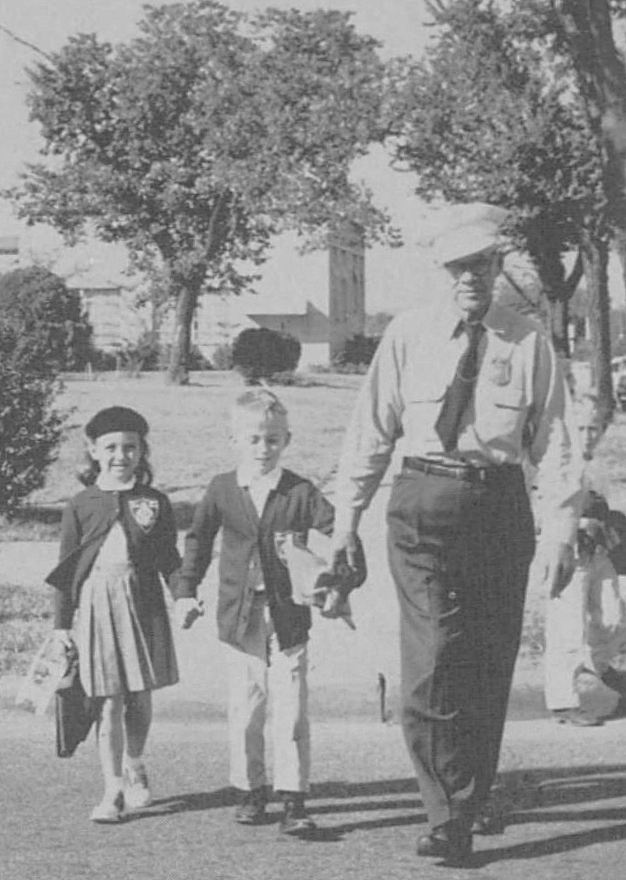
I had erroneously assumed that LGC was an all-girls 4-year high school; I believe it was a 12-year school, with boys and girls up to high school level, when it became girls-only. This photo appeared in the 1960 yearbook with the following caption: “The safety of all LGC students is the responsibility of the school as long as the students are on campus. For this reason, Officer H. A. Baxtley is available every day as a gracious escort for our little ‘Lions’ across the busy Ninth and Marsalis intersection.”
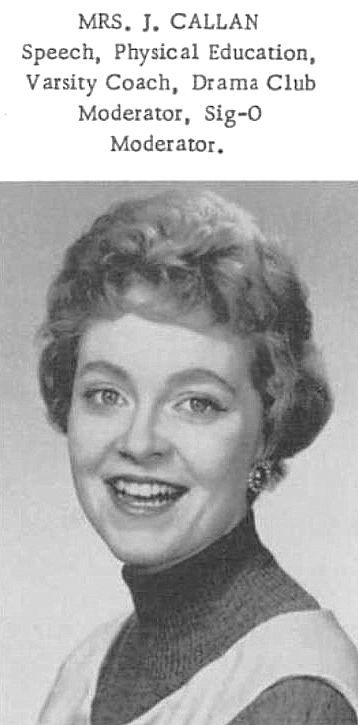
And finally, because I’m such a movie nerd who loves character actors, I was happily surprised to see that the actress K Callan was a 23-year-old drama teacher (etc.) at the school in 1959 before she entered the professional acting world of New York and Hollywood. (Callan was born in Dallas as Katherine “Kay” Borman and actually attended Our Lady of Good Counsel as a student before she taught there.) (UPDATE: Read K’s memories of her time at LGC in the comments, here.)
***
Sources & Notes
All photos of the school (except the one from 1905) are from various editions of Reveries, the yearbook for Our Lady of Good Counsel.
The 1902 photo was posted in the Dallas History Guild Facebook group.
The 1905 photo is from Dallas Rediscovered by William L. McDonald (p. 215), with the following credit: “Courtesy of Sister M. Adelaide Mars.”
The Blessed Sacrament Catholic Church still stands, at 231 N. Marsalis; their website is here.
Today is Bastille Day — seems right to post something about the “French Colonists” of LaRéunion. One of the leaders of the French and Swiss immigrants who settled briefly — and ultimately unsuccessfully — on the western banks of the Trinity in the mid-1850s was François Jean Cantegral, “President” of the colony and one of the Directors of the Franco-American Company. Cantegral arrived in Texas about 1855 with hopes of establishing a successful utopian community, but the land, the climate, and the lack of experienced farmers in the group led to its fairly quick demise. Some of the European colonists settled permanently in the young town of Dallas, some scattered to other parts of the United States, and several — including Monsieur Cantegral — returned to their homelands.
Cantegral returned to Paris where, according to an 1876 article in the Dallas Herald, in a mission to participate in the reform and political liberation of France, he served three terms as an “alderman of Paris” and was elected to the French Chamber of Deputies, serving in the French Parliament. In 1877, Cantegral — who apparently had warm feelings toward Dallas and its citizens — sent to the city an early edition of a newly issued map of Paris. On its presentation before the mayor and the city council, it was noted that, in following in the footsteps of his fellow countrymen LaSalle and Lafayette, the members of the French Colony at Réunion “joined hands in efforts to plant the seed of French civilization, French chivalry and French hospitality, alongside and in conjunction with their American brethren in the wilds of Texas” (quoted in TheDallasDailyHerald,March 21,1877 — see full article below).
It was noted that while living in the colony, Cantegral’s son, Simon Charles Cantegral, was born on March 2, 1856 — Texas Independence Day. He seemed quite proud of that. The map was presented in the names of Cantegral père and Cantegral fils. I wonder if that Paris map given to the City of Dallas in March, 1877 is still somewhere in the city archives?
Merci, François. Liberté, égalité, fraternité, from those of us back here in the wilds of Texas!
(Click articles to see larger images.)
Dallas Herald, May 5, 1876
Dallas Herald, March 21, 1877
***
Sources & Notes
Top image from The Dallas Morning News, April 26, 1903.
The two articles are from the Texas Digital Newspaper collection of the University of North Texas, via their Portal to Texas History. The collection contains thousands of issues of the Dallas Herald (not to be confused with the 20th-century Dallas Times Herald); it’s hard to stop reading them because they are so unbelievably fascinating — set aside a few hours and browse the Herald collection (1855-1887) here.
Yes, Cantegral Street was named after Mssr. Cantegral. The May 5, 1876 article above makes mention of the street:
Three years ago a beautiful street in Dallas, that running east of Floyd street Church and west of the Baptist College, was named in his honor and will remain a perpetual memorial of him in this town.
More on the La Reunion colony can be found in other Flashback Dallas posts here.
Until last week, I don’t think I’d ever heard the 1969 song “The Back Side of Dallas,” sung by Jeannie C. Riley, who had had the blockbuster hit “Harper Valley PTA” the previous year. How have I never heard this? I was going to post it last week until I realized that it would be better to wait until today, because of this line from the song: “Meet me in Dallas on June the 23rd, his letter read.” And here we are, June 23rd.
The song, written by Jerry Foster and Bill Rice, was released in October, 1969. It wasn’t the huge, crossover, multi-award-winning monster hit that “Harper Valley PTA” was, but it did earn Jeannie another Grammy nomination (she lost to Tammy Wynette’s “Stand By Your Man” — if you’re going to lose, that’s a pretty great performance to lose to!).
Like “Harper Valley PTA,” it was one of several songs of the era which brought country music into the somewhat seedy realm of 1960s American culture. “The Back Side of Dallas” is about a small-town girl who finds herself a lonesome “working girl” in Dallas, chain-smoking king-size cigarettes, drinking in dingy bars, and popping pills. This ain’t no Kitty Wells song, y’all. (I’d love to hear Miranda Lambert — who also has an incredible country voice — cover this.)
Jeannie C. Riley — born in Anson, Texas in 1945 — was one of the first certifiable sex symbols in country music, always gorgeous, outfitted in miniskirts and go-go boots, with sky-high hair teased to a fare-thee-well. AND she had an absolutely fantastic voice. Below is video of a 24-year-old Jeannie C. Riley singing “Back Side of Dallas” on Del Reeves’ Country Carnival in 1969 (Del Reeves had some greatsongs in the ’60s, but his TV persona was a little too Dean Martin-wannabe for my taste … and … oh dear … that set!):
*
I prefer the studio version, below. I’ve listened to this song dozens of times now, and I haven’t gotten tired of it yet!
*
And here’s Jeannie singing it in 2011, still sounding great! (Her thick Texas accent is the absolute best, and her laugh is fantastic.) She talks about the song a bit at the beginning with Jerry Foster, one of the writers of the song — the song itself starts at about the 3:10 mark.
*
And, to round out this “June the 23rd” post, a few photos of Jeannie C. — surely one of the most photogenic faces and bad-ass vocalists in the history of country music. As my father used to say, “hot damn.”
“Harper Valley PTA” — you know you want to hear it. This is a great live version she did on, I think, the Wilburn Brothers Show, with Harold Morrison on dobro.
*
Not that anyone’s going to confuse the two songs, but this song has nothing to do with the 1915 song of the same name by Adolphus Hotel orchestra leader Jack Gardner (which you can read about here).
I give you a 21-year-old Nolan Ryan soaking his pitching finger in pickle juice. As one does.
Years before the future Baseball Hall of Famer made it to DFW, young Nolan was the star pitcher of the New York Mets. He was prone to blisters on the middle finger of his pitching hand, so Mets trainer Gus Mauch put him on a strict pickle juice regimen of soaking the affected finger between innings to toughen the skin and prevent blisters from popping up at inopportune moments. And, of course, this weird pickle juice thing became really big news in May, 1968. Sportswriters jumped all over it, and a few began calling him “Pickle Brine Ryan,” because it sort of rhymes.
The delicatessen where Ryan’s pickle juice of choice was purchased tried to cash in on what they hoped would become a fad by placing jars of the brine in the window with a sign proudly proclaiming that they were the source of the famous “Mets’ Pitching Juice.” According to a UPI story, when another pickle company offered the Mets five gallons of their pickle juice, trainer Mauch responded, “Gosh, you could embalm a whole swimming team with five gallons!”
While teammates relax before a game, using anything handy for a pillow, New York Mets’ pitcher Nolan Ryan (left) soaks his pitching fingers in pickle juice. That’s right — pickle juice! Ryan says the juice toughens his fingers so that he doesn’t get blisters.
I wonder if he kept it up? By the time he got back home to Texas and signed with the Rangers, I’d love to know that he upped his brine game by using pickled jalapeño juice.
An earlier Nolan Ryan-related Flashback Dallas post — “Nolan Ryan’s Celebratory Pancake Breakfast — 1972” — is here.





















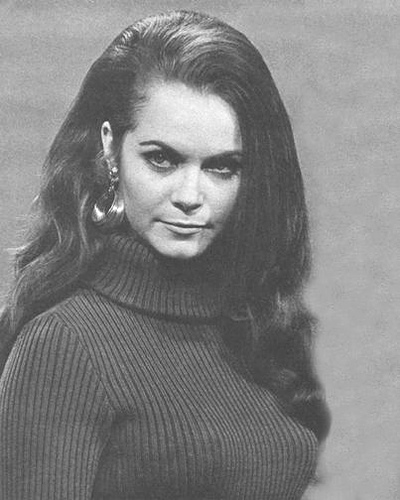 Jeannie C. Riley



 Flashback : Dallas