Flashback : Dallas

A Miscellany: History, Ads, Pop Culture

Category: Non-Celebs

Jim Conner, Not-So-Mild-Mannered RFD Mail Carrier
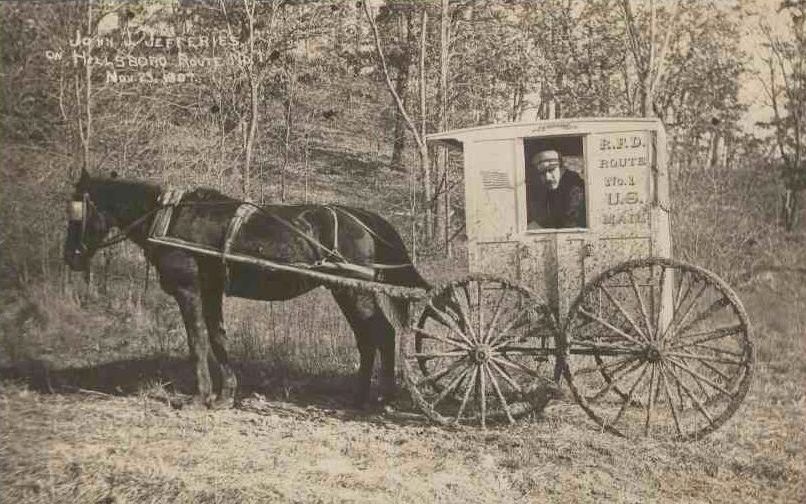
rfd_real-photo_1907-ebayAn RFD mail carrier… (click for larger image)

by Paula Bosse

The man in the photo below looks like every character actor working in Hollywood in the 1930s and ’40s.

conner-james-norton_mail-carrier_1940s

But he wasn’t an actor — he was a retired Dallas postal worker who began his career in 1901 as a rural mail carrier when the Rural Free Delivery (RFD) system was implemented in Dallas. (Before this, those who lived beyond the city limits — generally farmers — had to trek to a sometimes distant outpost — such as a general store — to pick up their mail.) RFD service began locally on October 1, 1901, and an 18-year old Jim Conner was one of six men hired to work the new mail routes beyond the city.

conner_FWregister_090101Fort Worth Register, Sept. 1, 1901

When Rural Free Delivery service began in Dallas, four rural post offices were closed: Lisbon, Wheatland, Five Mile, and Rawlins (the office at Bachman’s Branch, which Jim Conner’s route replaced).

In a 1940 interview with The Dallas Morning News, Conner talked about his early postal route (Route 5), which was 32 miles long; before the arrival of automobiles, he traveled on horseback, by horse cart, by buggy and cart, or by bicycle. The photo at the top shows what early RFD mail wagons looked like.

Jim’s route took him well beyond the city limits: out Cedar Springs to Cochran’s Chapel, to within a mile of Farmers Branch, and over to Webb’s Chapel by way of the “famous” Midway Church and School corner (which became Glad Acres Farm); he returned on Lemmon Avenue. It took him 8 hours if the weather was nice; if the weather was particularly bad, it could take 12 to 15 hours to complete his appointed rounds. He was paid $500 a year and was required to keep two horses, a cart, a buggy, and saddles. He retired in 1935.

**

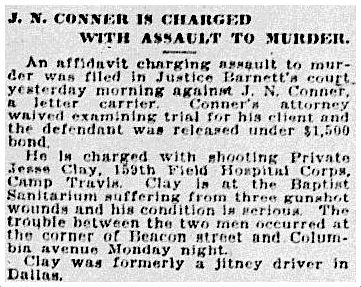
So. A delightfully nostalgic walk down memory lane with an avuncular-looking guy we all kind of feel we know. I thought I’d do a quick search to see if there was an obituary for Jim — there was: he died in 1956 at the age of 73, survived by his wife, 11 children (!), 22 grandchildren, and 3 great-grandchildren. But in addition to the obit, I found something else: a report of a shooting, an arrest, and a charge with “assault to murder.”
conner-charged_dmn_010218DMN, Jan. 2, 1918

What?!!

Though the account of the incident is described as being “somewhat vague,” on New Year’s Eve, 1918, Jim Conner shot a soldier named Jesse Clay after “words” were exchanged at the corner of Beacon and Columbia in Old East Dallas. There had been bad blood between the two in the past, and the New Year’s Eve situation apparently escalated quickly. Clay had been walking down the street with a lady-friend when Conner’s car came to a stop next to them. Clay (described as being drunk at the time) forced his way into the car, and Conner, fearful of being attacked, reached for a gun in the back seat. The two tussled and, after they were both out of the car, Conner saw that Clay also had a gun. This was when Conner shot him three times, intending, he said, to merely wound him. Clay shot back but missed. (The entire account, as it appeared in The Dallas Morning News on Jan. 1, 1918 can be read in a PDF here.)

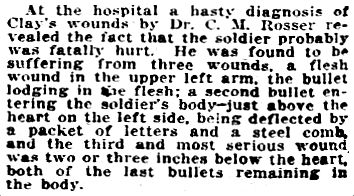
The soldier was badly injured, with two of the three shots hitting his chest. He was not expected to live. Conner had surrendered to police at the scene and was charged with “assault to murder.” The last report on this incident that I could find was on Jan. 3, in which Clay was described as being in “very critical condition.”

So what happened? As Conner spent a full career as a postal employee, it seems unlikely he was tried for murder. I used every possible combination of search words I could think of but found nothing more on this case. The story just disappeared. I did find a 1943 obituary for a Jesse P. Clay (killed while working on an Army Air Force Instructors School runway when he was struck by the wing of an airplane coming in for a landing), and it seems likely that it was the same guy — he was about the right age, he was a career military man, he lived in Dallas most of his life, and he was born in Kentucky. I assume the soldier in question (who would have been 37 at the time of the shooting) survived his gunshot wounds and that charges against Conner were either dismissed (with Conner pleading self-defense?) or settled (perhaps the military intervened to keep the story out of the press — this was during the height of WWI). Whatever actually happened, it seems that both men were able to move on from that really, really bad New Year’s Eve, a night I’m sure neither forgot.

My favorite little detail in the story of this sordid shooting was the line in the initial newspaper report in which it was revealed that one of the (potentially deadly) bullets was “deflected by a packet of letters and a steel comb.” How appropriate that the thing that probably saved mailman Jim Conner from a murder rap was “a packet of letters.” (…And a steel comb, but that doesn’t fit in with my narrative quite so well. Although Mr. Conner does look quite well-groomed.)
packet-of-letters_dmn_010118DMN, Jan. 1, 1918

***

Sources & Notes

Real-photo postcard of Hillsboro, Wisconsin RFD mail wagon is from eBay.

The full DMN account of the bizarre 1918 shooting can be read in a PDF, here.

An informative site on history of Rural Free Delivery — with lots of photos — can be found here.

“RFD”? Wiki’s on it, here.

*

Copyright © 2014 Paula Bosse. All Rights Reserved.
 

Wanted in Dallas: Refugee Children — 1940

refugee-children_rotarian_feb-1940

by Paula Bosse

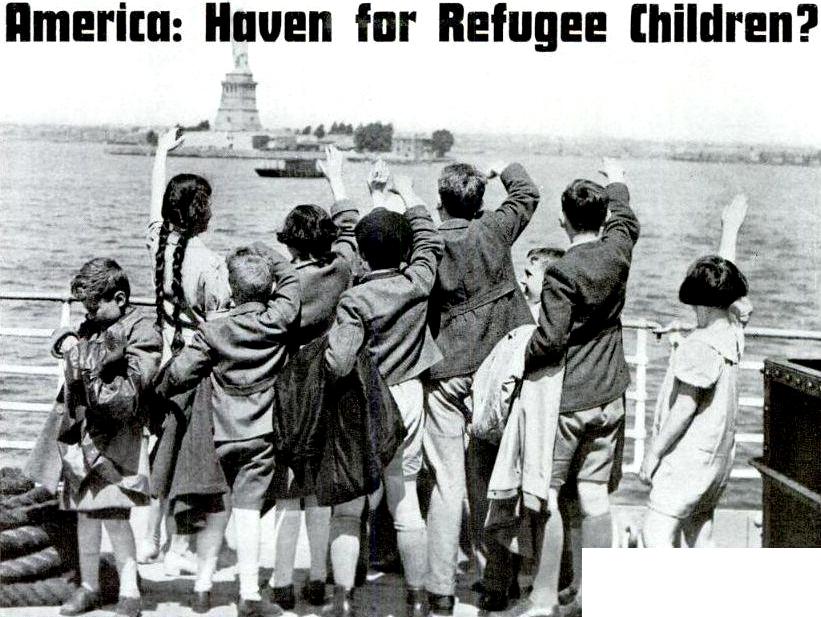
In the summer of 1940, a group called The Children’s Evacuation Committee of Texas was organized to bring child refugees to Dallas, even if it meant sending a ship across the Atlantic Ocean to get them. Its chairman was local businessman George Edgley, a transplanted Briton who owned a music shop and performed around town as an actor and musician.

The group was formed in response to the heavily publicized plight of English children living under the constant threat of attack during World War II. The situation was of great international concern, and plans were drawn up to evacuate the children to safety. The United States had agencies working to bring some of the children to America, and communities around the country were organizing at a grassroots level.

George Edgley took up the cause in Dallas and was the driving force behind The Children’s Evacuation Committee of Texas. He worked day and night to sign up potential foster families, worked with American and British politicians and humanitarian relief agencies, and traveled to Washington, DC to petition for special immigration allowances. He even pleaded with Congress to authorize a special ship to carry children from the UK to the Texas Gulf.

Some Dallasites were adamant that only British children would be considered. One Briton living in Dallas made the following statement at an early meeting:

It’s the Anglo-Saxon race against the world, […] and we want Anglo-Saxon children brought over here  — not material for fifth columnists. We want English-speaking children. (Dallas Morning News, June 27, 1940)

Edgley disagreed vehemently, insisting that a humanitarian project such as the one under consideration should not be limited to British children.

Numerous Dallas families signed up to offer their homes to refugee children. Many were willing to take any child that needed a temporary home, and most were prepared to adopt the child should his or her parents be killed in the war. There was, though, this unsettling read-between-the-lines sentence in one of the reports in The Dallas Morning News:

A few stipulated that the children should be free of hereditary defects, should be from good families and of certain nationalities or have eyes or hair of certain color. (DMN, July 21, 1940)

A big supporter of this effort was Miss Ela Hockaday, who worked to get her school’s alumnae and patrons to offer their homes to the displaced children. She herself had adopted the children of British novelist Vera Brittain for the duration of the war.

After weeks of determined effort, though, the inability to find a way to safely transport children en masse from the UK became an insurmountable roadblock. The bureaucracy and logistics proved to be too big a hurdle. Edgley turned his attention to working one-on-one with Dallas families who agreed to be responsible for paying the transportation costs of a child and providing for all of his or her needs until the war’s end. It would cost a local family a substantial $188 to assure a child’s privately-arranged temporary adoption (equivalent in today’s money to just over $2,200).

I’m not sure how many children found shelter from the war in Dallas, but the tireless efforts of George Edgley on their behalf are to be admired.

***

Sources & Notes

Top photo and headline “America: Haven for Refugee Children?” from the February, 1940 issue of The Rotarian. You can read the magazine’s take on the issue here.

If you would like more information on George Edgley’s campaign to relocate refugee children from war-torn England, please contact me.

The Life magazine story “U.S. Opens Its Homes and Heart to Refugee Children of England” (July 22, 1940), can be found here.

Some background on the evacuation of British children during World War II can be found here and here.

*

Copyright © 2014 Paula Bosse. All Rights Reserved.
 

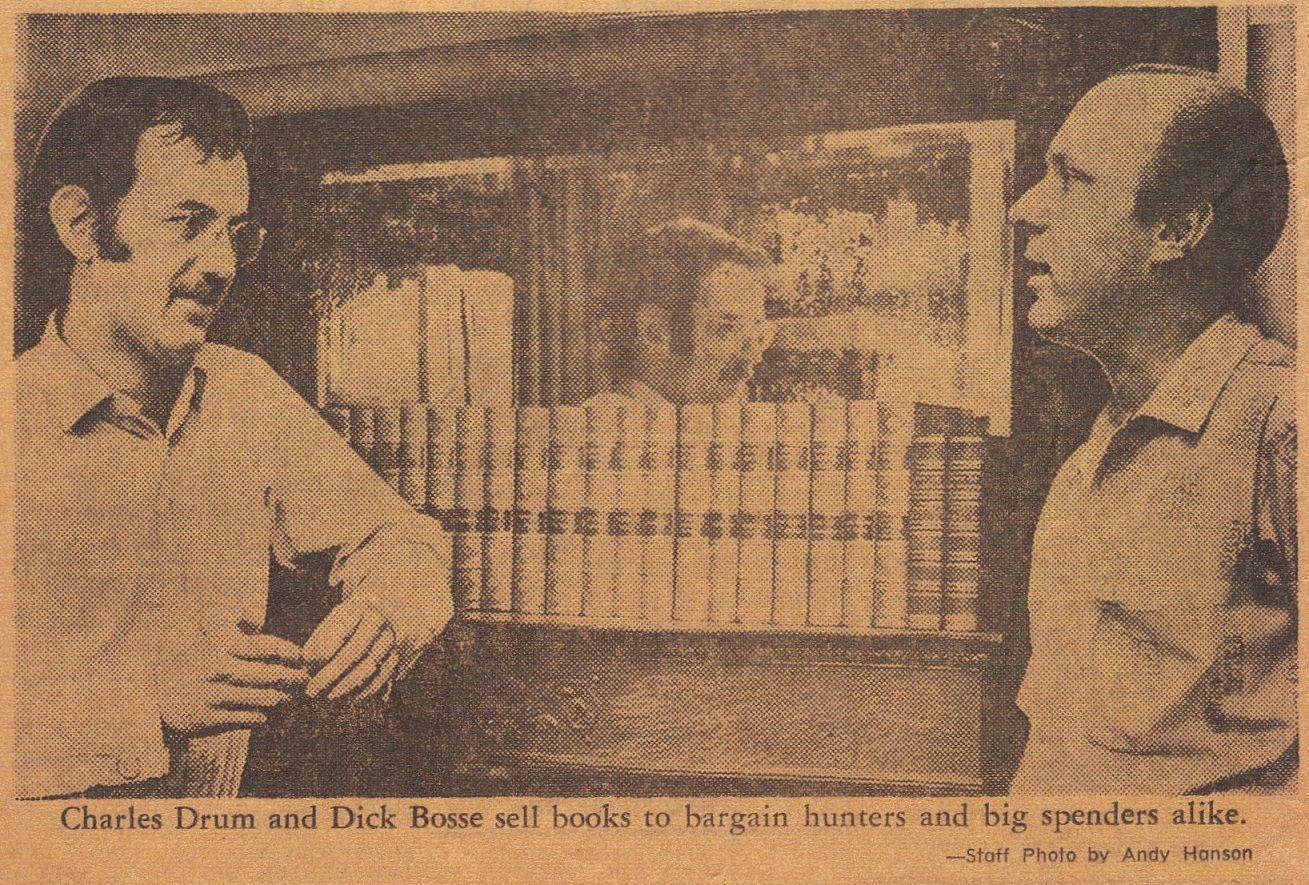
My Father, Dick Bosse — Dallas Bookman

PRB_nancy-sketch_sm

by Paula Bosse

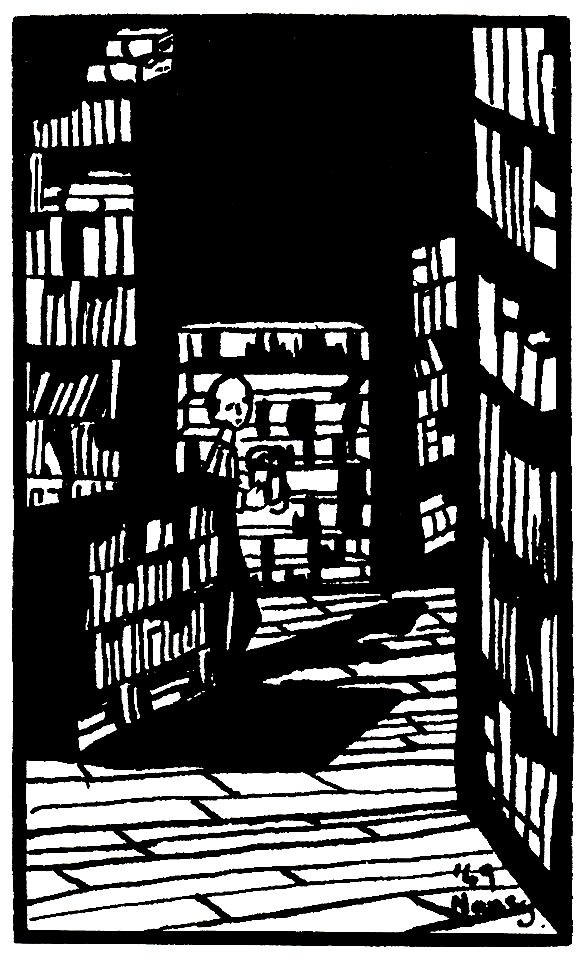
Dick Bosse was my father. When he died in 2000, he had managed (and later owned) The Aldredge Book Store for almost 45 years. He started working for founder Sawnie R. Aldredge, Jr. fresh off a half-hearted attempt at grad school. I’m sure he had no idea when he started working there (at $1.00 an hour) just how important a role the store would play in his life. My parents met at the store when my mother began working there, and they married a couple of years later. My brother and I spent countless hours there and practically grew up in the store. The Aldredge Book Store was a second home to my family, and looking back on all the time I spent there, all the books I read when I was bored, all the literati of the city I met who eventually popped in and sat around talking with my father over a cup of coffee or a beer, all the store cats I loved who became minor celebrities themselves — when I look back on all that, I realize how lucky my brother and I were to have had such interesting parents who brought us up in such an interesting place.

My father had a reputation as a stellar bookman but was known as much for his wit and humor as he was for his deep and wide-ranging knowledge of books, both rare and “chicken-fried.” He was one of the state’s top Texana experts, and his mailing list contained just about every major Texas author. The Aldredge Book Store was one of the oldest antiquarian bookstores in the Southwest, but my father was a remarkably unstuffy, unassuming, and down-to-earth bookseller.

I’ve been working off-and-on at collecting pithy catalog blurbs my father wrote over the years. The bulk of his sale catalogs were straight listings of antiquarian and out-of-print books, but he became fairly well-known in the Texas book trade for descriptions like these which he would insert throughout for his own amusement. I’ve left out the full bibliographical descriptions, but here are a few of my favorites. I realize some of these are a little esoteric, but this has been a fun project, and it’s nice to remember how funny my father was (bad puns and all). (I only wish I had been able to catalog like this when I worked as a rare books cataloger for an auction house!)

Adams, Ramon F. THE RAMPAGING HERD. The shit-kickers’ John Ciardi.

Brown, John Henry. LIFE & TIMES OF HENRY SMITH, The First American Governor of Texas. A rather nice copy, not one of the bugshit-encrusted remainders.

BULLETIN OF THE UNITED STATES FISH COMMISSION FOR 1891. A Texas piscatorial incunable.

Carter, Jimmy. KEEPING THE FAITH. Signed by the author, a former president.

Clary, Annie Vaughan. THE PIONEER LIFE. In HERD, but curiously not in SIXGUNS despite feuds, Texas Rangers, and Daddy popping caps on some badasses.

Clay, John. MY LIFE ON THE RANGE. Nice copy of the consensus bovine biggie.

Cravens, John Park. WITH FINGERS CROSSED: The Truth As Told In Texas. Apparently humor.

Devlin, John C. & Grace Naismith. THE WORLD OF ROGER TORY PETERSON, An Authorized Biography. Peterson, a student of blue bird mores, was known to Brandeis ornithologists as the goy of Jay sex.

Dobie, J. Frank. AS THE MOVING FINGER WRIT. Inscribed to “Mr. Moore,” in which 60-word inscription Dobie alludes (a frequent trick to prove he was not your run-of-the-mill shit-kicker) to Maugham and Schiller.

Eickemeyer, Rudolf. LETTERS FROM THE SOUTH WEST. Puny yankee sopping up the sun in El Paso & Santa Fe.

ENCYCLOPEDIA BRITANNICA. The twelfth edition (the eleventh edition with the supplements). Best encyclopedia in English executed prior to the American greaseballization.

Faulk, John Henry. FEAR ON TRIAL. HUAC to Hee-Haw.

Fuermann, George. RELUCTANT EMPIRE. Fine copy in dust jacket, signed by author and illustrator and marred only by one of those hideous goddam lick-in bookplates.

Gent, Peter. TEXAS CELEBRITY TURKEY TROT. Too much Peter; not enough Gent.

Hardin, John Wesley. THE LIFE OF JOHN WESLEY HARDIN. Mischievous preacher’s kid.

Hargrove, Lottie H. TEXAS HISTORY IN RHYME. Aarghh!

Hudson, Alfred Edward A’Courte. SELECTED BLOOD STUDIES ON SWINE. “Satisfying your antiquarian porcine hematological requisites since 1947.”

Koehler, Otto A. KU-WINDA (To Hunt). African safari by the Texas Beer Baron; well-illustrated, including some comely bare-breasted Somaliettes holding a “Join The Swing To Pearl” banner.

Long, Mary Cole Farrow. STRANGER IN A STRANGE LAND, From Beaufort, South Carolina, To Galveston Island Republic of Texas — A Biography of Judge James Pope Cole (1814-1866). Probably unknown to Heinlein.

McDonald, William. DALLAS REDISCOVERED: A Photographic Chronicle of Urban Expansion, 1870-1925. The reissue was in wraps and had a “perfect binding,” one of the more notable oxymorons of our time.

Pellowe, William C. S. (ed.). MICHIGAN METHODIST POETS. Enthusiasts of The Muse will be relieved to know that Michigan sprinklers are as fully gifted as their Texas colleagues.

Riley, B. F. HISTORY OF THE BAPTISTS OF TEXAS. Covers blemished, apparently sprinkled by a surly Methodist.

Rozelle, Robet V. (ed.). THE WENDY AND EMERY REVES COLLECTION. The greatest Dallas art coup since SMU acquired the wet-paint Spanish Masters collection of Al Meadows.

Schlesinger, Arthur M., Jr. A THOUSAND DAYS, John F. Kennedy in the White House. Most notable fawning since Bambi’s birth.

Slaughter, Bob. FOSSIL REMAINS OF MYTHICAL CREATURES. Profusely illustrated with photos and drawings by the author, apostate bar-fly now a distinguished scientist and sculptor. A grab-ass classic.

White, Owen P. MY TEXAS ‘TIS OF THEE. A nice enough copy except that a cretin at something called “Mary’s Book Nook” was a compulsive rubber-stamper.

 *

PRB-CD_dth_062368-putcamp

Above, my father, on the right, at the first location of the Aldredge Book Store on McKinney Avenue. The accompanying article by Luise Putcamp, Jr. is here.

*

PB-PRB

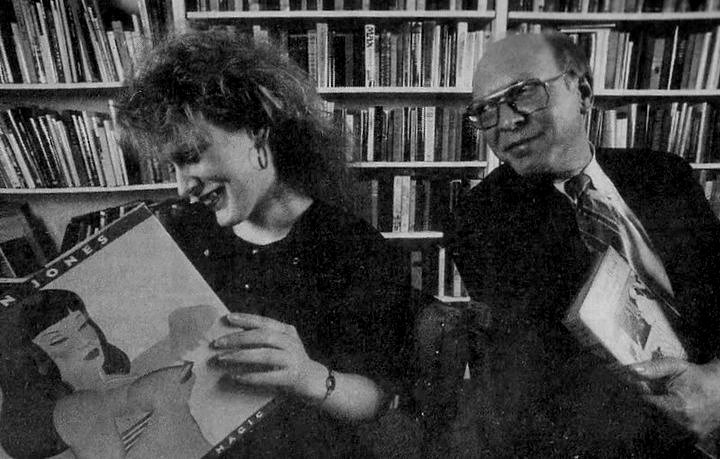
Above is one of my favorite photos of my father, taken in a small used bookstore I had on Lower Greenville Avenue. A newspaper editor thought it would be “cute” to have a photo of father-daughter booksellers. The photographer suggested I hold the newer, cutting-edge art book while my father held the older, obscure British arts journal. Of course, my father would have been more interested in the Allen Jones book, and I would have been more interested in The Yellow Book (a set of which my father gave to me for Christmas one year — and it was one of the best gifts I’ve ever received).

Today would have been my father’s 80th birthday. 80! I think of him all the time, and I miss him terribly. He was a wonderful guy, and — aside from the modest income — I think he would have said that a lifetime career as a bookseller was a pretty sweet deal.

***

Sources & Notes

When my father died in April, 2000, several appreciations of him appeared in print. If you would like to read the appreciations by his friends A. C. Greene (a very sweet tribute) and Lee Milazzo (my personal favorite — very funny), as well as the nice official obituary, they are all transcribed here

My brother, Erik Bosse, wrote a wonderful piece about our father for a catalog we issued after his death. The warm and amusing essay — as well as some of the crazy business cards my father took great joy in printing up — can be found here

Sketch at the top was done by Nancy C. Dewell (1969). Slightly larger than a business card, it arrived in the mail one day with a short note that read: “I don’t know your name. I think you are Mr. Aldredge. I would be pleased if you would accept my drawing of you in the bookshop. Sincerely, Nancy C. Dewell.” I can’t imagine a better likeness. I really, really love this.

Photo of me and my father from the Dallas Observer.

*

Copyright © 2014 Paula Bosse. All Rights Reserved.
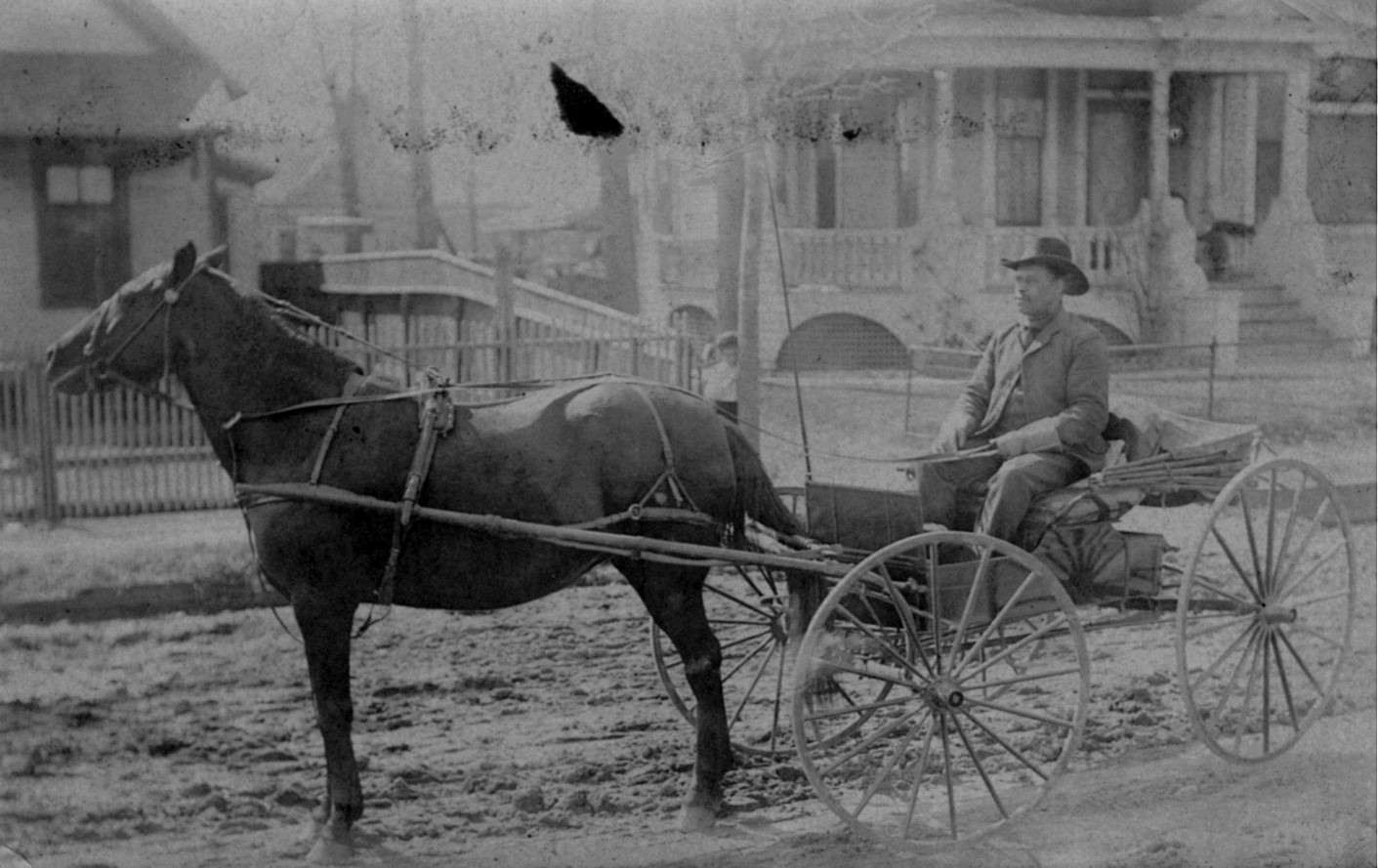
Jordan Moore

jordan-moore-buggy_c1905Jordan Moore, about 1905 (click for larger image)

by Paula Bosse

When wandering around the internet, one often encounters arresting images. Like the one above. There’s something about that photograph that grabs your attention. The stoic man in the buggy, the stiff, straight-standing horse, the child hiding behind the pole, the partial view of the porch of a fancy house, and the horrible, horrible condition of that street. The description reads simply: “Photograph of Jordan Moore seated in a horse-drawn carriage. Houses are visible in the background.” I wondered if I should know who Jordan Moore was, because the name wasn’t familiar. The photograph was in the collection that had been donated to the Dallas Historical Society by J. L. Patton, a prominent African-American educator. I found a few more photos of Mr. Moore in Patton’s collection, but I still had no idea who Jordan Moore was. So I did a little research.

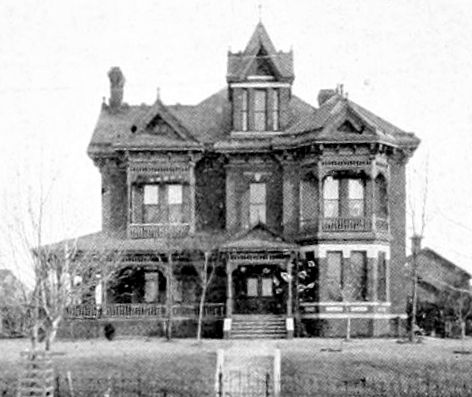
Jordan Moore was born in Virginia in 1863. At some point he made it to Texas, perhaps in the early 1880s, and then to Dallas a few years later. By 1893 he was working for Mrs. Miranda Morrill, who had moved to Dallas in 1886, following the death of her husband, Judge Amos Morrill. Though born in Tennessee, Mrs. Morrill had moved to Texas as a child in 1834 and had strong ties to the state (one of her uncles was a signer of the Texas Declaration of Independence). When she arrived in Dallas, she built an imposing mansion at Ross and Harwood and, as she had no children, she and her servants (as they were listed on census forms) had that huge house to themselves to ramble around in. Mrs. Morrill was a prominent mover-and-shaker in town, devoting her time and money to a host of worthy social causes. In her employ was Jordan Moore, who is listed variously as her coachman and yardman, and who resided on the property. He worked for her until she died in 1906 at the age of 80.

(Mrs. Morrill’s obituary is interesting for many reasons, but particularly because amongst her surviving family members were her half-brothers R. L. Moore and S. J. Moore, sons of Mrs. Morrill’s stepfather. I don’t know if Jordan Moore was born into slavery and was owned by members of Mrs. Morrill’s family, but it’s interesting that he shared a surname with his employer’s family.)

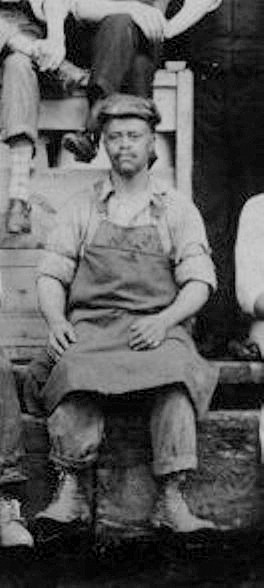
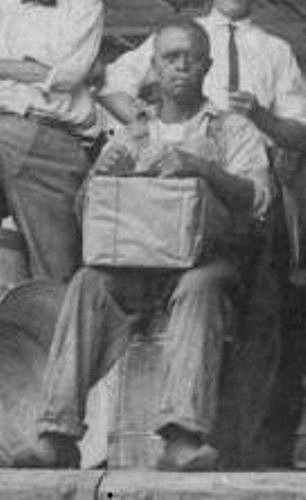
In 1907, after Mrs. Morrill’s death, Mr. Moore had moved to rooms elsewhere and went to work as a porter for the very large, very successful Huey & Philp Hardware Company at Griffin and Elm. Below are a couple of photographs of Moore and co-workers on the loading docks. He does not look very happy. He stayed at the job for 11 years but moved around from rooming house to rooming house — from Ross to Cochran to N. Harwood to Masten. (One of the captions on these photos states that Mr. Moore purchased a house on Cochran St. in 1900. I don’t think that’s correct. If he did buy a house, he doesn’t appear to have ever lived in it.)

Jordan Moore died on January 22, 1918, from complications of  diabetes. He was 54. He never married and had no children, and the friend he had been staying with when he died offered scant and approximate guesses as to dates and places when asked to supply them for the official death certificate.

I wondered why all these photos of a man who apparently left no family and had lived a fairly commonplace life had made their way into the personal collection of J. L. Patton, a principal at Booker T. Washington High School and a pioneer in education for African-American students in Dallas. And then I noticed that the name of the “informant” on the death certificate was Samuel Stanton, a long-time friend with whom Moore had been staying in his last days. Moore was the godfather of Mr. Stanton’s daughter, and Mr. Stanton’s daughter was Mr. Patton’s mother. Patton would have been 12 when Moore died, and he would certainly have remembered him — and one hopes he had fond memories of him.

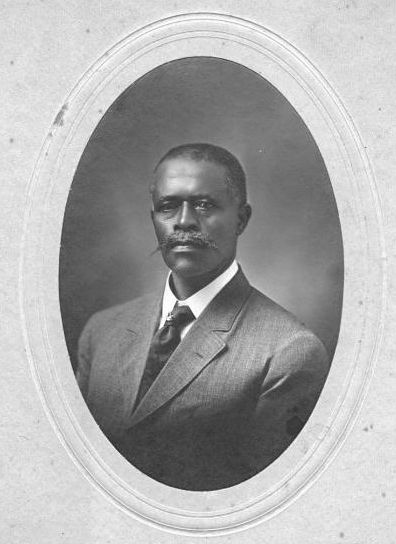
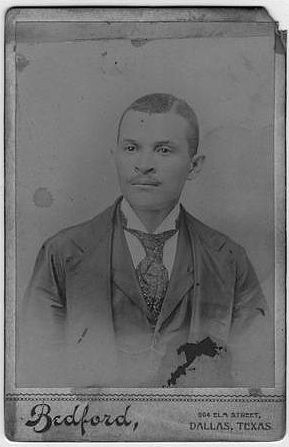
Jordan Moore was buried in Alpha Cemetery, one of the few “negro” cemeteries of the time, near the old freedmen’s town of Alpha, near present-day Preston and Alpha Road. Below are more photographs of Mr. Moore, now in the collection of the Dallas Historical Society.

jordan-moore-portrait_18901890

moore-loading-dock_c1905Mr. Moore (seated, second from left), Huey & Philp loading dock, ca. 1907

moore-det

moore-with-box_loading-dock_c1910Mr. Moore (seated, with box), Huey & Philp loading dock, ca. 1910-15

moore-box-det

jordan-moore-photo_c1910sca. 1910-15

morrill-house_1898Mrs. Morrill’s house at Ross & Harwood, 1894

morrill-house_lost-dallas_doty_dmnThe Morrill house — next stop: demolition, 1920

huey-philp_19091909 ad

huey-philp_1913_dmn_080212Huey & Philp Hardware Co., at Griffin and Elm — ca. 1913

***

Sources & Notes

Photos of Jordan Moore from the Dallas Historical Society’s J. L. Patton Collection, once viewable at UNT’s Portal to Texas History website. Top photo, c. 1905.

The first photo of Mrs. Morrill’s house at Ross and Harwood is from Clifton Church’s book Dallas, Texas Through a Camera (Dallas, 1894). (As an interesting aside, Church was married to Morrill’s niece.) In the book Dallas Rediscovered, the house is described thusly: “Mrs. Miranda Morrill’s dark, brooding residence, completed in 1886 by A. B. Bristol at the southwest corner of Harwood, was leveled in 1920 for construction of the First United Methodist Church.”

The second photo of the Morrill house is from Mark Doty’s book Lost Dallas (Charleston: Arcadia Publishing, 2012).

Huey & Philp Hardware Co. ad from Worley’s 1909 Dallas directory.

Lang & Witchell drawing of the Huey & Philp building is from a Dallas Morning News blog post by Steve Brown, here.

More on the accomplishments of J. L. Patton from the Handbook of Texas, here.

*

Copyright © 2014 Paula Bosse. All Rights Reserved.
 

The Margules Family’s Passover Seder

1-passover_djhsClick for larger image (Dallas Jewish Historical Society photo)

by Paula Bosse

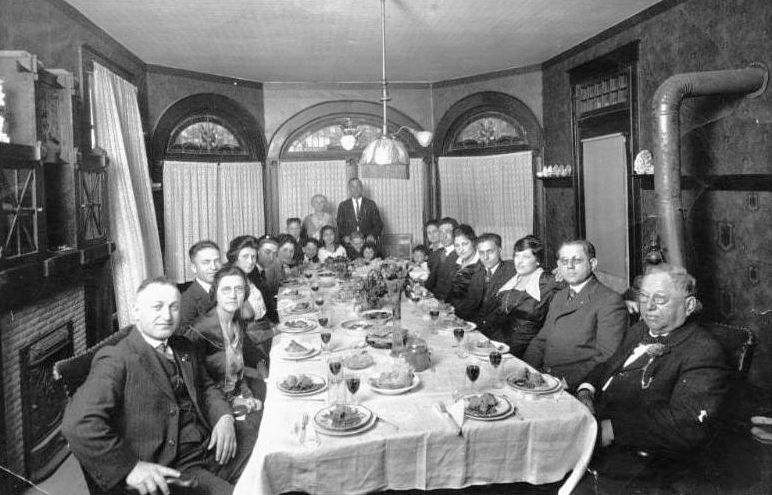
Above, a photograph of Passover seder, probably in the 1920s, taken at the South Dallas home of Sam and Dubbie Margules, with some (or all) of their nine children.

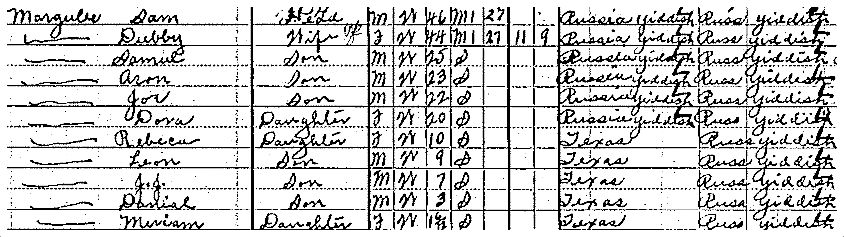
2-margules_census_1910(1910 Census — click for larger image)

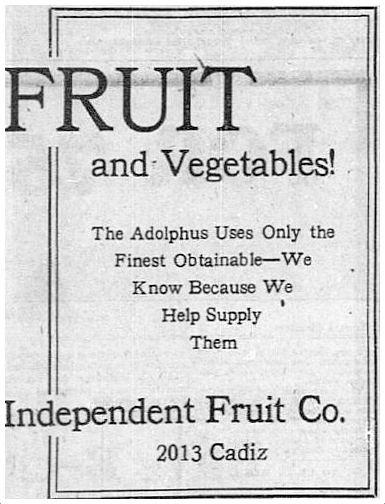
Sam Margules immigrated to the United States from Russia in the late 1880s. By the early 1890s he had made his way to Dallas and had begun working in the wholesale produce business. Once settled and on secure financial footing, he sent for his wife and four children (five more would be born in Dallas). In 1915, Sam established his own business, the Independent Fruit Co.

3-margule_ind-fruit-co_dmn_010116(1916)

4-margules_adolphus_dmn_101224(1924)

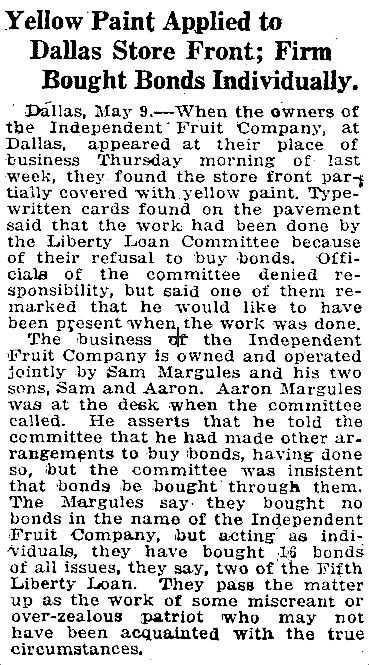
Even thought the Margules family seems to have had a happy and successful life in Dallas, there was one incident that must have been very unsettling for them. In the waning days of World War I, a Chicago trade publication reported an instance of vandalism against the Independent Fruit Co., perpetrated by a thuggish Liberty war bond committee. In what was clearly meant as intimidation, the shakedown “committee” had splashed yellow paint across the Margules storefront in the dead of night, as punishment for what they believed was the family’s refusal to purchase Liberty bonds. These attacks with yellow paint were a common occurrence around the country in those days (as was tarring and feathering!), and they were frequently directed at immigrants, as were nasty accusations that they were “slackers”  (a much-used pejorative at the time meaning “unpatriotic shirker” or even “coward”)

The family seems to have shrugged off the incident, but it must have been a frightening time for them. The Jewish community in Dallas was a large and thriving one, but there was always antisemitism to deal with, and the Ku Klux Klan’s rise to power in the 1920s was particularly difficult for Jews in Dallas. (Click article below to see larger image.)

5-margules_chicago-packer_051019(1919)

Sam Margules died in 1930 at the age of  67, a 40-year resident of Dallas. His wife, Dubbie, died in 1953 at the age of 90, survived by 18 grandchildren and 17 great-grandchildren.

***

Sources & Notes

Photo from the Dallas Jewish Historical Society — the full citation is here.

Ads from The Dallas Morning News.

Article on the yellow paint attack from The Chicago Packer, May 10, 1919.

A passage on other yellow paint attacks on America’s immigrants by Liberty Bond committees can be read here.

A lengthy article on “The Jews Who Built Dallas” by David Ritz  (D Magazine, Nov. 2008) can be read here.

Click top two pictures for larger images.

*

Copyright © 2014 Paula Bosse. All Rights Reserved.
 

Joe Yee Cafe: The Best Chop Suey in Town

joe-yee-cafe-extChop suey *and* famous chicken house…

by Paula Bosse

I came across the above image and was enthralled. I’ve never heard of the Joe Yee Cafe, but this (granted) idealized picture is wonderful. The postcards above and below were from the early 1950s, and if you are familiar with the generally run-down neighborhood around Columbia and Fitzhugh these days, you may well shed a tear that something this charming and picturesque has been gone for many, many years.

joe-yee-cafe-interior

I love the surprising color scheme of the restaurant’s interior — those fabulous purples and greens! (The colors are a bit unexpected because they so loudly clash with the bold tomato red of the exterior.)

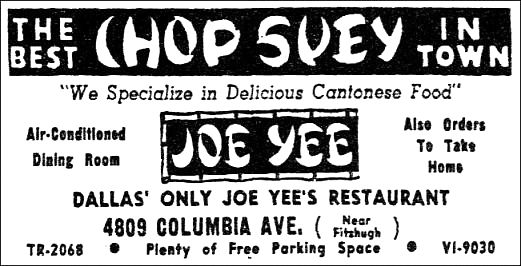
I did a little research to see what I could find out about Joe Yee’s Chinese restaurant. Seems that Mr. Yee’s cafe was in business by the 1930s, downtown, on Main Street near Field. It advertised steadily over the years, and its ads proudly proclaimed that the restaurant served “the best Chinese food you ever tasted” and was “completely air-conditioned.” Several newspaper accounts (particularly the society columns) mentioned it as a popular place for young people to grab a bite before and after dances at nearby downtown hotels. Business must have been pretty good for the place to have lasted so long at such a primo location. The cafe moved to the Columbia Street location in 1950 where it remained in business until at least late 1956 when a major fire struck.

joe-yee-cafe_matchbk

1938-joe-yee_dmn_1125381938

1943-joe-yee_dmn_0812431943

1953-joe-yee_dmn_0830531953

***

Sources & Notes

Top two early-’50s postcards are from the great Boston Public Library Tichnor Brothers Postcard Collection on Flickr, here.

In old photos of downtown Dallas one often sees “Chop Suey” signs along the streets. I’d love to know more about these restaurants in general, and about Chinese and Chinese-Americans in Dallas in the first half of the 20th century, if anyone can point me to a good source.

If background on Chop Suey is needed, might I point you to to the Wikipedia entry here, or the Snopes entry here.

*

Copyright © 2014 Paula Bosse. All Rights Reserved.
 

Munger’s Improved Continental Gin Company

continental-gin_munger-from-natl-reg-appA Dallas landmark… (click for larger image)

by Paula Bosse

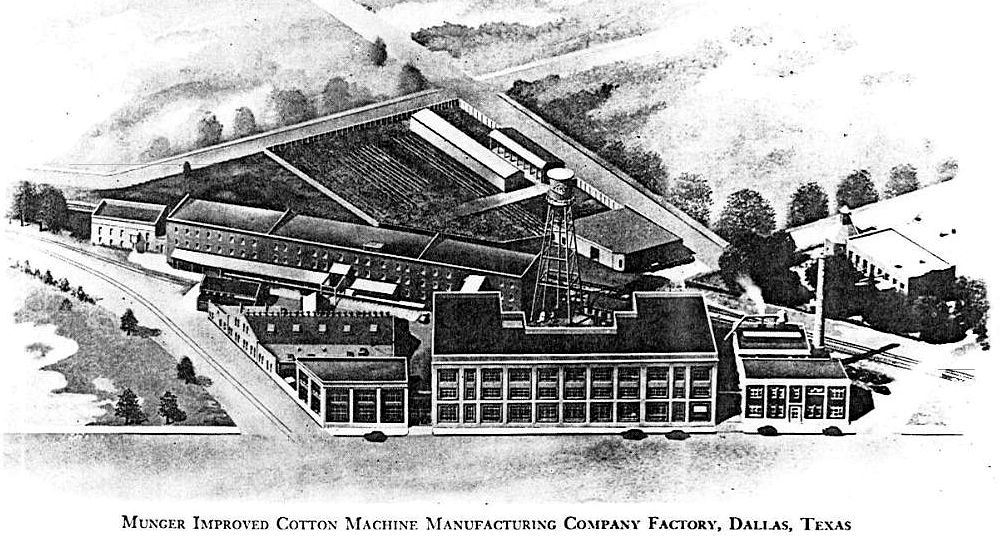
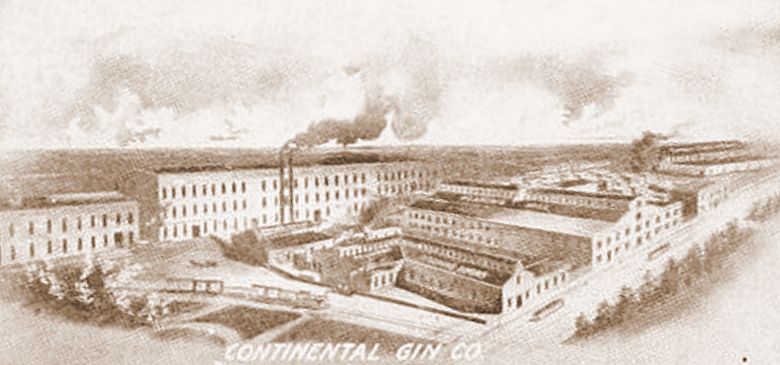
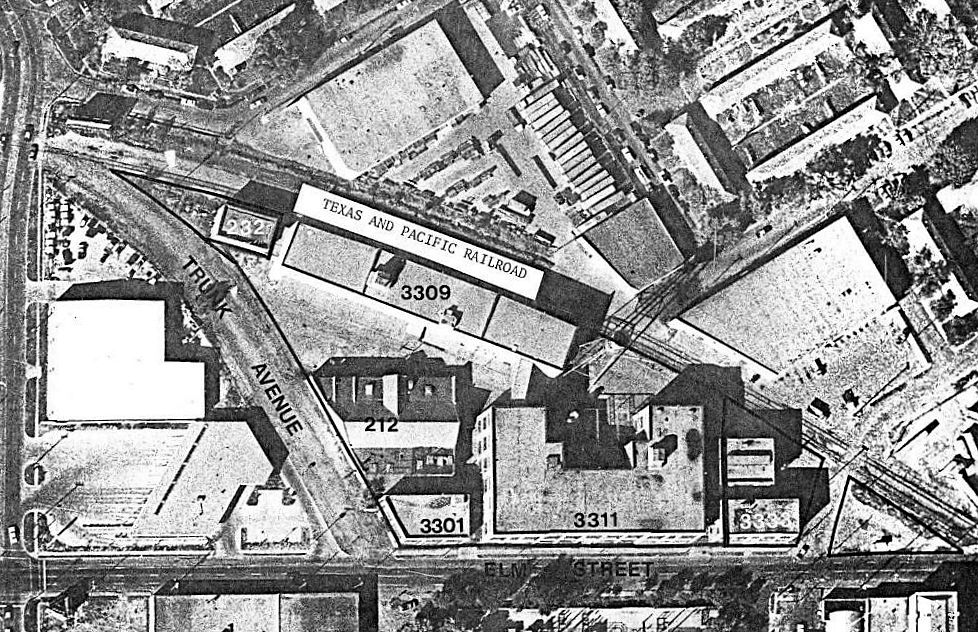
The Continental Gin Co. complex of buildings at Elm and Trunk is a Deep Ellum fixture which was successfully petitioned by the city in 1983 to be added to the National Register of Historic Places. No longer a manufacturing hub, it is now home to artists’ studios and residential lofts. The earliest of the buildings still standing were built in 1888 and the latest ones (the ones closer to Elm) were built in 1914. The company was incredibly successful, which was no surprise when one realizes that fully ONE-SIXTH of the world’s cotton grew within a 150-mile radius of Dallas at the time! It’s no wonder that Dallas was a hotbed of cotton gin manufacturing.

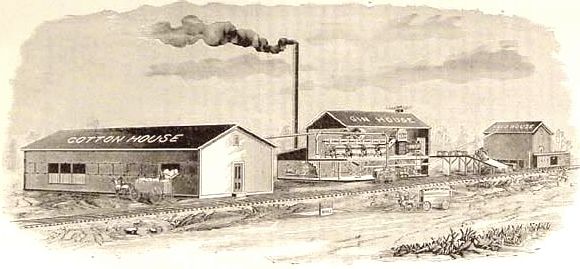
continental-gin_munger-drawing_Munger Catalogue and Price List, 1895

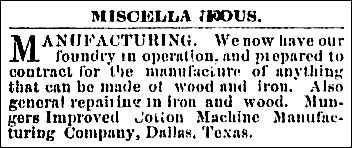
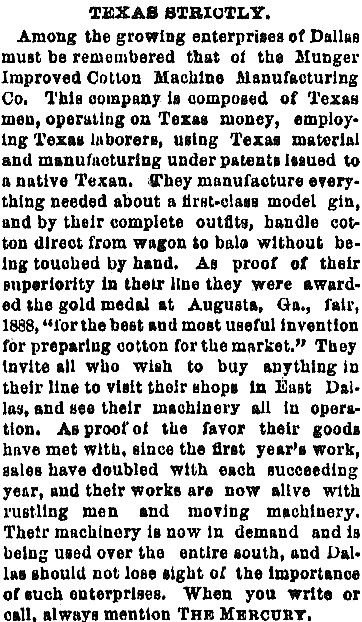
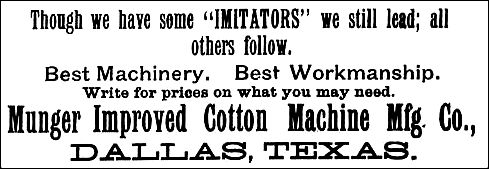
Robert S. Munger (yes, that Munger) patented several inventions that improved the cotton ginning process, and in 1888 he built a large manufacturing plant for his Munger Improved Cotton Machine Company. In 1900, after several extremely successful years, his company and several other companies that held important industry patents were absorbed by the Continental Gin Co. of Birmingham, Alabama, and, practically overnight, the Continental Gin Co. became the largest manufacturer of cotton gins in the United States. Munger retained a financial interest in the company, but he left the running of the business to his brother, S.I. Munger. R.S. Munger turned his creative talents to real estate and developed the exclusive Munger Place neighborhood. The Continental Gin Co. closed in 1962.

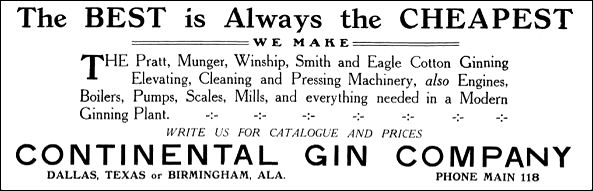
continental-gin-co_1912The Standard Blue Book of Texas, 1912-1914

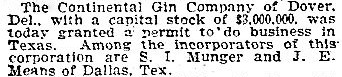
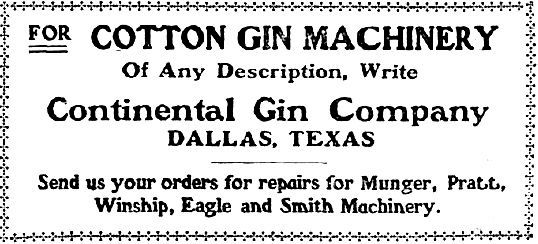
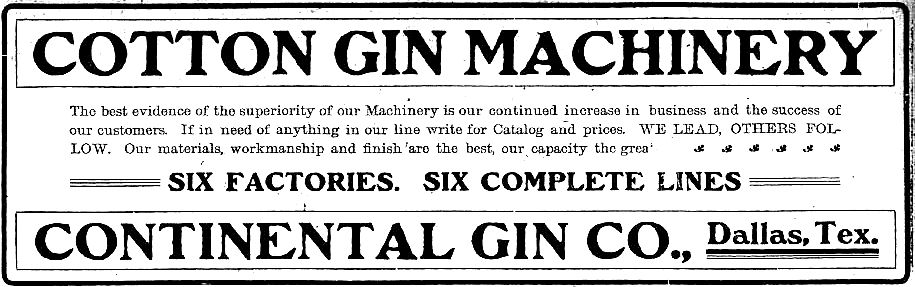
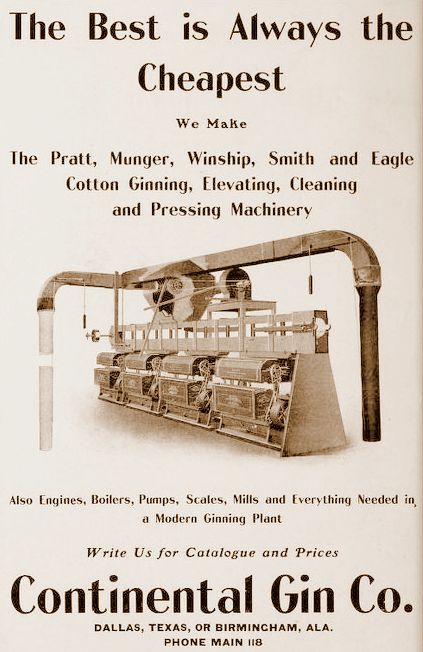
A few newspaper items regarding the Munger Improved Cotton Machine Company and the Continental Gin Company.

munger_dal-herald_101387The Dallas Herald, Oct. 13, 1887

munger_merc_053089The Southern Mercury, May 30, 1889

munger_merc_072892The Southern Mercury, July 28, 1892

munger_merc_041393The Southern Mercury, April 13, 1893

continental-gin_dmn_072600Change is imminent. (Dallas Morning News, July 26, 1900)
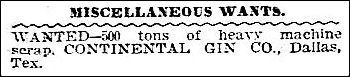
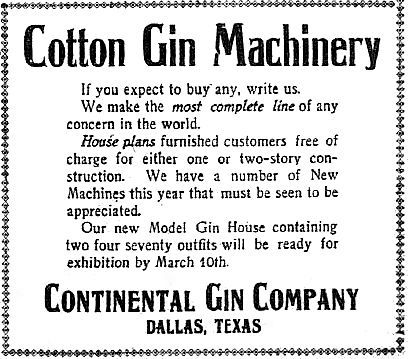
continental-gin_dmn_042001FIVE HUNDRED TONS! (DMN, Apri 20, 1901)

continental-gin_dmn_032203DMN, March 22, 1903

continental-gin_dmn_082005DMN, Aug. 20, 1905

continental-gin_dmn_060107DMN, June 1, 1907

continental-gin_worleys_1909Worley’s Dallas Directory, 1909

continental-gin_ad_dallas-police_1910Dallas Police, 1910

continental-gin-aerial-natl-reg-appPhotograph that accompanied the application to the National Register of Historic Places regarding the structures under consideration: 3301-3333 Elm St. and 212 & 232 Trunk Ave. (Landis Aerial Photography, 1980)

***

Sources & Notes

Handbook of Texas biography of Robert Sylvester Munger (1854-1923) is here.

The top image (which, by the way, took me FOREVER to find, is labeled as the Munger company, but the expansion would seem to indicate that this is the Continental Gin Company, after 1914. Whatever the case, it’s a great image!

That image and the aerial photograph of 1980 are included in the city’s application to have the complex included in the National Register of Historic Places, submitted in 1983. The detailed application — as a Texas Historical Commission PDF — can be accessed here.

The second image, of the early days of the Munger Improved Cotton Machine Company is from a bookseller’s online listing for Munger’s 13th Annual Catalogue and Price List (1895) — the item may still be available for a mere $435 and can be found here.

See an aerial view of what the area looks like today, via Google, here.

To see an incredible 1914 photograph of the buildings and the residential area to the north, see my post “The Continental Gin Complex — 1914,” here.

More on Robert S. Munger and more early company ads can be found in the post “R. S. Munger’s Cotton Gin Manufactory,” here.

*

Copyright © 2014 Paula Bosse. All Rights Reserved.


Mme. Koneman, High-Class Milliner

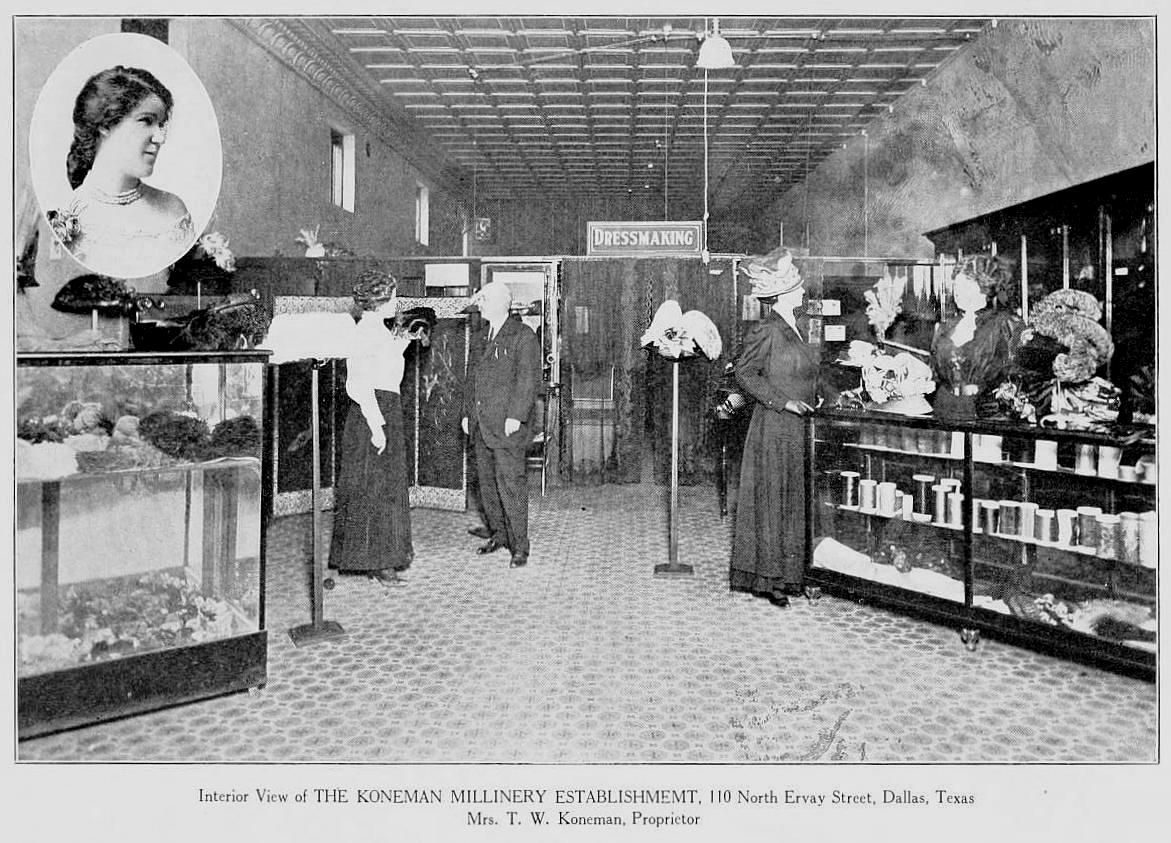
Madame Koneman’s fashion emporium, 1912 (click for larger image)

by Paula Bosse

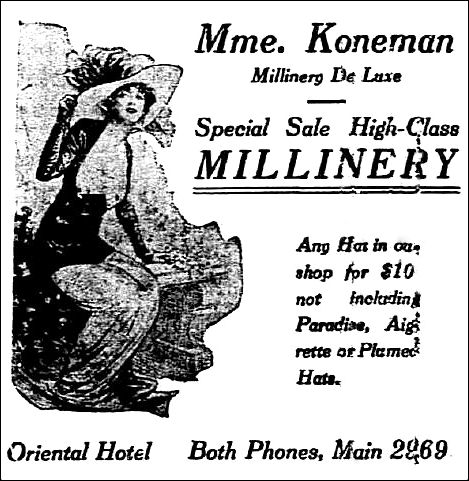
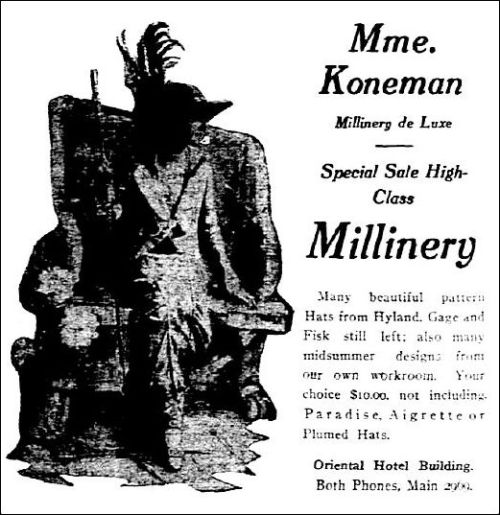
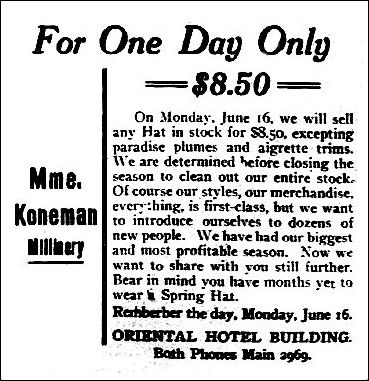
Behold, the Koneman Millinery Establishment, which actually looks a little plain for a millinery shop housed in the ornate Oriental Hotel building. When I see old ads or photos like this, I always wonder about the people pictured in them. I’m assuming that the woman in the oval inset at the left was the proprietess, “Mme. Koneman.” So who WAS she, this woman who had a “high-class” business that catered to a “high-class” clientele? I poked around a little and found these ads from 1913.

koneman-millinery_dmn_060113

koneman-millinery_dmn_060813

koneman-millinery_dmn_061413

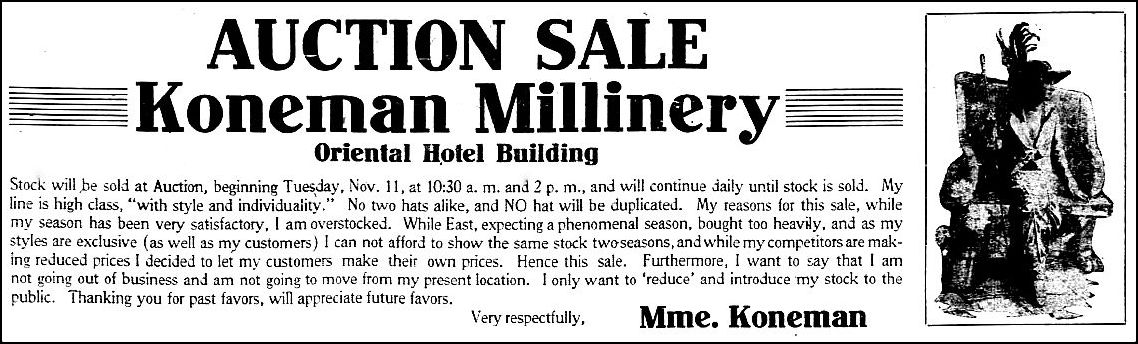
koneman-millinery_dmn_110913(click for larger image)

Ooh. Those last few sentences of the above ad seem a little defensive, as if she’s addressing nasty gossip. “Furthermore, I want to say that I am not going out of business.” When you see a sentence like that — in an advertisement — that sends up some furiously waving red flags. And … just one month after that ad, this miniscule tidbit in teeny-tiny letters appeared in the paper at the end of 1913:

Dallas Morning News, Dec. 21, 1913

Oh dear. D-I-V-O-R-C-E. And, guess what? There were no more ads for the millinery shop.

But, alarmingly, THIS appeared on the wire services on February 17, 1917:

Fort Worth Star-Telegram, Feb. 17, 1917

Oh DEAR! Shot by a widower with two children, who tried to kill both her and himself after he flew into a jealous rage in a New Orleans hotel lobby. Working with feathers and plumes and felt and velvet (probably) does not prepare one for being shot at!

Ten days after being shot, it was reported that the 36-year old Mrs. Koneman (whose first name was either “Matilda” or “Mathilda”) was released from the hospital in New Orleans. The jealous suitor, 40-year old Edgar J. Hargrave (or “Hargrove”), remained in the hospital, slowly recovering (but with a bullet still lodged in his head!). “Policemen expect to arrest Hargrave on a charge of shooting with intent to murder as soon as he is able to leave the institution.” He was an “oil salesman” from Houston.

One week later, Hargrave/Hargrove was released from the hospital and was transferred to Parish Prison where he awaited arraignment on attempted murder. Meanwhile, Matilda/Mathilda, a material witness in the case, had been arrested when the D.A. heard she was about to leave town. Out on a $650 bond, she was ordered to stay in the city until the arraignment.

On March 16, one month after being shot in the lobby of the Grunewald Hotel, Mrs. Koneman was in court recounting her near-death experience, and I’m sure the people back in Dallas were eating up every last morsel in the scandalous testimony about the spurned lover who tried to kill the divorcée who used to sell them great big hats with aigrette plumes in that bleakly unadorned hat shop over on Ervay!

koneman-testifies_dmn_031617-smDMN, March 16, 1917 (click for larger image)

(UPDATE: A reader kindly forwarded me a more detailed account of the shooting incident between the spurner and the spurnee, in a longer article from the New Orleans Times-Picayune (Feb. 17, 1917). Click here to read the article, with a blurry photo of Hargrave.)

And then — rather anticlimactically — the trail ran cold. What was the verdict? What happened to Edgar? Whither Mme. Koneman? Mrs. Koneman was reported to be living in Galveston at the time of the shooting, but by the summer of 1922 she was back in Dallas, checked into the Southland Hotel. The last shred of info I found about her was this classified ad from June, 1922, which raises even more questions.

DMN, June 15, 1922

I’m not really sure what this was all about, but it’s safe to say there would have been very few lags in the conversation between Dallas and California!

***

Top ad from The Standard Blue Book of Dallas, 1912-1914 (Dallas: A. J. Peeler & Co.).

“Dallas Woman Shot” article from the Fort Worth Star-Telegram, Feb. 17, 1917. This was a wire service story that was printed around the country, but, oddly enough, the news doesn’t seem to have made its way into the DMN until ten days after the shooting!

All other ads and articles from the Dallas Morning News. The Koneman Millinery ads were from 1913.

*

Copyright © 2014 Paula Bosse. All Rights Reserved.

Not Every ‘Good Luck Trailer Park’ Story Has a Happy Ending — 1964

chimp_fwst_012864Fort Worth Star-Telegram, Jan. 28, 1964

by Paula Bosse

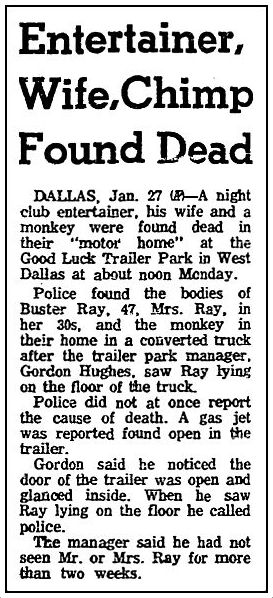
“Entertainer, Wife, Chimp Found Dead.” THAT is a headline.

Had I not known that the (ironically named) Good Luck Trailer Park on W. Commerce had been a favorite with visiting circus folk, I might have been a little more surprised by the weird circumstances reported in this article. As it was, I was only mildly surprised.

(I kind of think the chimp did it….)

***

Sources & Notes

Hats off to the Fort Worth Star-Telegram‘s headline writer. The story ran in the Star-Telegram on Jan. 28, 1964.

The victims — Harold Allen Ray and his wife Nadine (and unnamed monkey) — were later determined to have died of accidental carbon monoxide poisoning.

“Buster Raye” (stage name of Harold Ray) had been a comedian and master of ceremonies who seems to have played a lot of burlesque joints/strip clubs as the between-stripper entertainment. He was billed as “The Mighty Mite of Mirth.” In a Feb. 24, 1948 review of his act, The Bryan Eagle wrote:

Buster Raye, diminutive master of ceremonies, stole the show with a clever line of chatter punctuated with juggling, acrobatics, songs, imitations. His jokes were well handled with none of the vulgarity common to many floor shows.

I’m not sure where the monkey fits in.

buster-raye_corpus_042948Corpus Christi Caller-Times, April 29, 1948

*

Copyright © 2014 Paula Bosse. All Rights Reserved.


Atkins’ Rattlesnake Oil — Beware of Fraudulent Imitations!

by Paula Bosse

“From the Aboriginal Indians of this country — the early trappers — and pioneers learned that Rattle Snake Oil was the best remedy for rheumatism, pains, sprains, bruises, etc. Every cabin had its bottle hanging ready, from the rafters. The day will come when every house will have it again.”

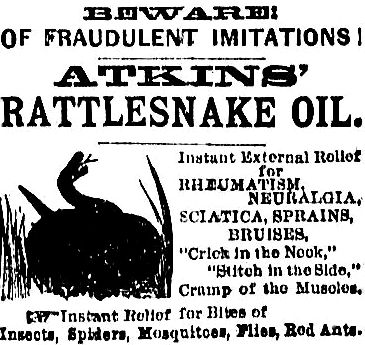
That little tidbit appeared under the heading “Folk-Lore” in the October 9, 1888 issue of the Dallas-based Southern Mercury newspaper. As there was no company name or product attached, it appeared to be a mere space-filling “factoid” rather than an advertisement. Conveniently, though, it was just a hop, skip, and a jump across three ink-smeared pages from a large ad for Atkins’ Rattlesnake Oil, an ad that warned the reader to “Beware of Fraudulent Imitations!” before it launched into a long list of testimonials from the once-weak and infirm. The ad ended with “Geo. T. Atkins, Dallas, Texas — For Sale by All Druggists.”

Southern Mercury, Oct. 9, 1888 (detail)

*

George T. Atkins was born in New York in 1837. Educated and having the bearing of a “trained businessman,” he drifted south and for some reason decided to join the Confederate army.

He was described by a fellow brigade member as a dark and handsome “compactly built” snappy dresser who “talked in a louder tone than the others, and [had] a peculiarly non-chalant, devil-may-care manner [that] emphasized his presence.” Atkins became a captain and quartermaster in the Fourth Kentucky Cavalry and though his position did not require participation on the battlefield, he was painted as something of a hot-dogging thrill-seeker: “[T]he gallant captain was frequently found in the ‘thickest of the fray,’ notably in the desperate battle at Saltville, where he recklessly and conspicuously rode up and down the lines, seeming determined to get himself killed.”

After the war, he eventually made his way to Texas with his family, arriving in Dallas in 1876 and settling into a large house at Ross Avenue and Masten Street (now St. Paul). At some point he opened a drugstore on Elm which seems to have been quite a successful enterprise. Perhaps it was his close proximity to drugs and medicinal compounds that prompted Atkins to launch his lengthy (and presumably lucrative) side-business as a snake oil manufacturer and salesman.

As far as I can tell, his “rattle snake oil” ads started around 1888. “Snake oil” has become a synonym for fraudulent wares sold by hucksters who know their products are ineffective but figure they can make a quick buck by grossly exaggerating — if not outright lying about — the magically curative properties of whatever it is they’re selling. As an actual “druggist,” Atkins probably had at least a little credibility compared to the other latter-day medicine-show men flogging their tonics and elixirs out of the back of a wagon before the law ran them out of town.

Southern Mercury, 1890 (det)

In fact, Atkins was, himself, such an expert flogger that his claim in ads that the United States Patent Office had officially ruled that his rattlesnake oil was “The Only True and Genuine Rattlesnake Oil” is automatically suspect, even though the editors of the Dallas Morning News (who, by the way, were no stranger to the popular and socially prominent Atkins, a man with, let’s not forget, a hefty newspaper advertising budget) published in its pages the following blurb (probably supplied by “the plaintiff”):

Dallas Morning News, Dec. 12, 1888

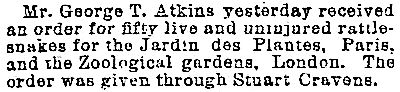
 1888 was a good year, and Atkins was riding a snake-oil wave of good publicity. There were even reports in the local papers that Dallas’ favorite herpetologically-inclined drugstore owner was hustling “live and uninjured rattlesnakes” to interested parties in Paris and London. I don’t know … maybe…. Probably just some more creative publicity.

DMN, June 3, 1888

Atkins continued to run his drugstore and sell his snake oil until 1892 when, out-of-the-blue, he was assigned to dig the Texas Trunk Railroad out of receivership. The appointment seemed a little odd, but Atkins was a savvy businessman and a charming and persuasive speaker (he occasionally spoke in front of the Dallas City Council in a manner described as “felicitous and lucid”) — he could easily have back-slapped his way into the job. Despite the fact that he had no background in the railroad business, he seems to have spent several fairly productive years in the position. (His son, by the way, legitimately worked his way up through the ranks of the M-K-T, from lowly freight clerk to powerful executive VP.)

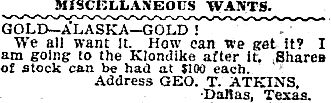
Eventually the railroad job ended and, in the waning years of the nineteenth century, Atkins seemed to be flailing a bit — he set the snake oil aside for a moment and placed an ad in the DMN classifieds soliciting investors to stake a claim in a Klondike gold scheme — at a mere $100 a share!

DMN, Aug. 8, 1897

 He continued in the rattlesnake oil biz until at least 1907, but at some point that began to fade away (or his inventory finally ran out), and he and his wife began running a boarding house. By 1918, though, he was tired of being a landlord and, at the age of 80, Atkins was finally ready to retire.

DMN, Oct. 20, 1918

The large 12-room house at Ross and Masten sold after spending a lengthy time on the market, and Atkins and his wife moved to Lemmon Avenue, where, ultimately, he died on August 8, 1920.

DMN, Aug. 9, 1920

 George T. Atkins placed COUNTLESS snake oil ads in newspapers for something like twenty years. Each ad had his name on it. Boldly. Proudly. And there’s nary a mention of the famous Atkins’ Rattle Snake Oil in his obit! That’s a shame, because, to me, that’s the single most interesting thing about the man. He was a career snake oil salesman! He was also one of Dallas’ very first advertising empresarios — an entrepreneur who had a natural flair for the creative hard-sell and knew how to wield it.

“TAKE NO SUBSTITUTE!”

*

Southern Mercury, Dec. 20, 1900 (click to enlarge)

***

Quotes about Atkins’ time in the Confederate army from Kentucky Cavaliers in Dixie, Reminiscences of a Confederate Cavalryman by George Dallas Mosgrove (Madison: University of Wisconsin Press/Bison Books, 1999 — originally published in 1895); pp. 116-117.

Atkins’ physical examination of his snake oil, published in Chemist and Druggist (1890) can be seen here.

More on the Texas Trunk Railroad here.

*

Copyright © 2014 Paula Bosse. All Rights Reserved.