Flashback : Dallas

A Miscellany: History, Ads, Pop Culture

Category: Local Personalities

Yehudi Menuhin and Antal Dorati: A Collaborative Friendship

menuhin-dorati_texas-week-mag_012547_sm
“Best friends” Menuhin and Dorati in Dallas, Jan. 1947

by Paula Bosse

When Antal Dorati was appointed conductor of the Dallas Symphony Orchestra in 1945, Dallas suddenly began to see a lot of violinist Yehudi Menuhin.

In a 1954 article about Yehudi Menuhin’s close ties to Dallas, John Rosenfield — the influential arts editor of The Dallas Morning News — wrote that when Menuhin was in town for a performance for the Civic Music Association in 1945, he was “casually asked” (probably by Rosenfield himself) what he thought of Antal Dorati as a possible conductor for the then-long-dormant Dallas Symphony Orchestra.

“He’s my best friend … he’s wonderful … he’s great,” said Yehudi, who was promptly carried around town to talk to businessmen again interested in re-forming the orchestra. (DMN, Sept. 5, 1954)

A short while later, Dorati was hired as musical director of the “new” Dallas Symphony Orchestra, and, as a result, best friend Yehudi was in and out of town frequently during Dorati’s four seasons in Dallas. Not only did he perform frequently as a soloist with the DSO, but it was not unheard of for Yehudi to sometimes drop by and sit in with the orchestra during rehearsals. Menuhin often stayed with Dorati when touring the central United States or based himself at the Melrose Hotel, which he used as a sort of mid-continent pied-à-terre.

One of the great passions the two men shared was a love for the music of Hungarian composer Bela Bartok. Dorati, born in Budapest, studied piano under Bartok and was a champion of his work throughout his career. Menuhin had performed Bartok’s Violin Concerto to great acclaim, and near the end of Bartok’s life, after the two men had met and bonded, Menuhin commissioned him to compose a sonata for violin.

Dorati and Menuhin often collaborated on performances featuring Bartok’s works, and when it was known that Dorati was all-but-signed to be the new DSO conductor, there was much speculation that Bartok himself might come to Dallas, but Bartok’s death in September, 1945 put an end to those hopes.

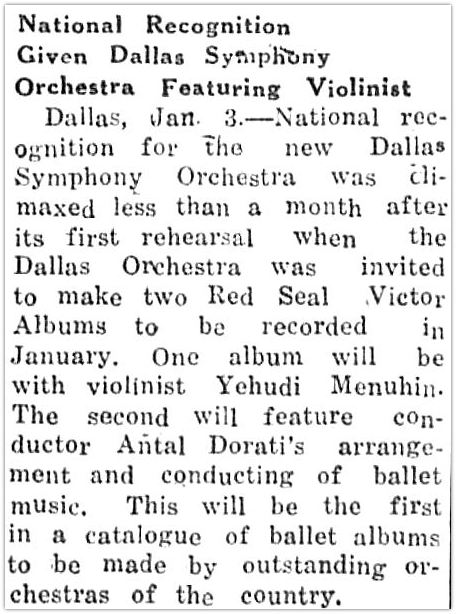
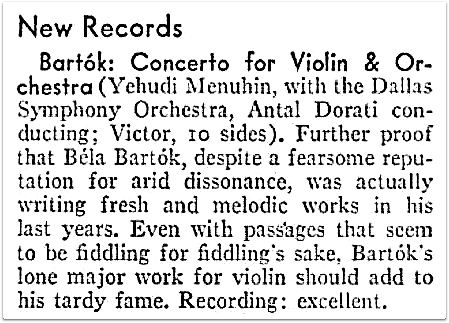
The first RCA Victor Red Seal recordings of Dorati’s Dallas Symphony Orchestra took place in January, 1946. One of the recordings featured Menuhin performing Bartok’s Concerto for Violin and Orchestra.

dorati-menuhin_denison-press_010446Denison Press, Jan. 4, 1946

Below, the first movement of the recording.


*
The second movement is here; the third movement is here.

The recording was well-received.

dorati-menuhin_time_061647_reviewTime  magazine, June 16, 1947

dorati-menuhin_time_061647RCA Victor ad, 1947

Of perhaps greater note, was the fact that Yehudi Menuhin conducted for the very first time in Dallas — the first orchestra he ever waved a baton at was the Dallas Symphony Orchestra, in 1946. No doubt because of their great friendship, Dorati coached the 30-year-old Menuhin on the finer points of conducting when the violin virtuoso expressed interest in learning what things were like on the other side of the podium. Menuhin first conducted the DSO on April 6 1946, for an invited audience.

menuhin_conductor_dso_santa-cruz-CA-sentinel_040746Santa Cruz (CA) Sentinel, Apr. 7, 1946

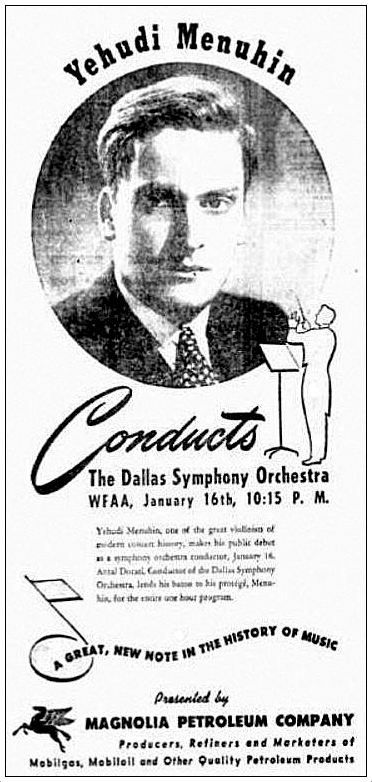
He was ready to go “public” on January 16, 1947, conducting the DSO for one of its regularly scheduled national broadcasts originating from WFAA.

menuhin_conductor_dso_dmn_011247Jan. 11, 1947

The text from the ad:

Yehudi Menuhin, one of the great violinists of modern concert history, makes his public debut as a symphony orchestra conductor, January 16. Antal Dorati, Conductor of the Dallas Symphony Orchestra, lends his baton to his protégé, Menuhin, for the entire one hour program.

Protégé!

Even though Menuhin insisted at the time that this brief foray into the world of conducting was fleeting and not a signal of any sort of career change, Yehudi Menuhin did go on later to direct many of the world’s great orchestras.

**

The friendship between Dorati and Menuhin lasted (from what I can tell) until Dorati’s death in 1988 (the decade-younger Menuhin died in 1999). They were personal friends and like-minded professional equals.

Between Menuhin and Antal Dorati, the Dallas Symphony Orchestra conductor, exists a friendship and a mutuality of musical aspiration that has resulted in outstanding musical collaborations. (John Rosenfield, DMN, Jan. 15, 1947)

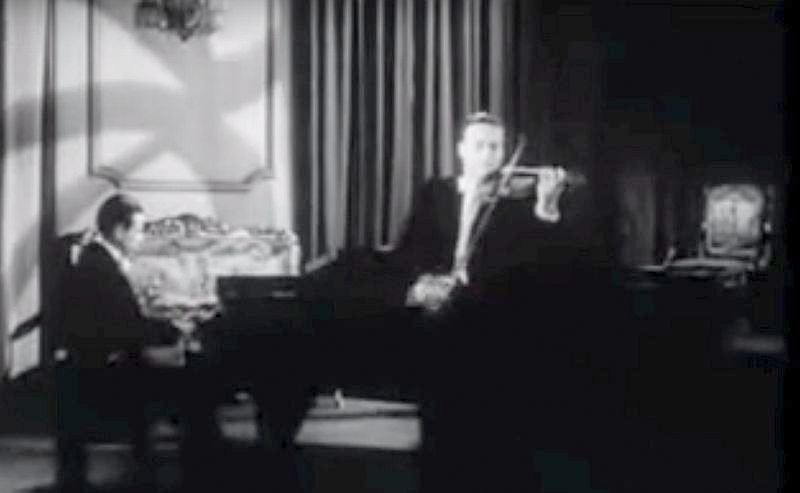
Below, the only film I’ve been able to find of the two men together, filmed in 1947 during the time when Dorati was engaged in Dallas (although this was not DSO-related and was filmed in Los Angeles). The piece being performed is Brahms’ Hungarian Dance No. 4; Dorati accompanies Menuhin on piano (you finally see him near the end!).

 *

menuhin-dorati_brahms_hungarian-danceDorati, Menuhin, 1947 (fuzzy screenshot)

dorati_menuhinYounger… (via Tutti Magazine)

dorati_menuhin_photoOlder…

***

Sources & Notes

Top photo of Menuhin and Dorati in preparation for Menuhin’s public debut as a conductor is from Texas Week magazine (Jan. 25, 1947), here.

The YouTube video of Brahms’ Hungarian Dance No. 4 was filmed at the Charlie Chaplin studios in Hollywood in the fall of 1947 (according to consumer reviews here).

Links-a-lot:

  • Yehudi Menuhin Wikipedia entry is here. His obituary is here.
  • Antal Dorati Wikipedia entry is here.
  • Bela Bartok Wikipedia entry is here.

More on Dorati can be found in my post “Antal Dorati, The Conductor Who Revived The Dallas Symphony Orchestra — 1945-1949,” here.

Click pictures and clippings for larger images.

*

Copyright © 2016 Paula Bosse. All Rights Reserved.

Antal Dorati, The Conductor Who Revived the Dallas Symphony Orchestra — 1945-1949

dorati-dso_texas-week-mag_081746-photo-sm
Antal Dorati, 1946 — on top of the world

 by Paula Bosse

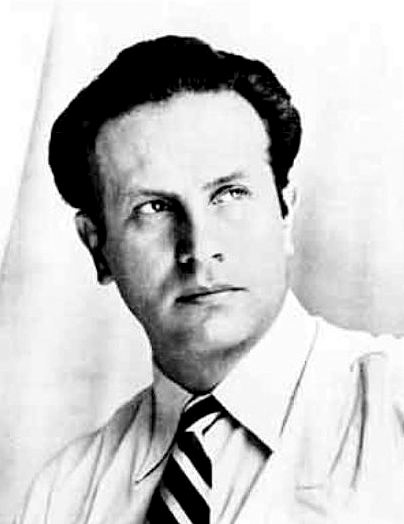
The news this week that the Dallas Symphony Orchestra’s musical director, Jaap van Zweden, was leaving town to pursue a glitzier gig was seen as an inevitable move to many of his disappointed fans. The DSO has been something of a springboard for conductors working their way up the conductor career ladder. Another celebrated conductor who spent a few years in Big D before rising to the heights of international acclaim was Hungarian-born Antal Dorati (1906-1988).

Dallas had classical music concerts in the 19th century, but the roots of what we now know as the Dallas Symphony Orchestra reach back to about 1900, under the direction of Hans Kreissig, who had settled in Dallas in 1887.

kreissig_dmn_011387Dallas Morning News, Jan. 13, 1897

For various reasons (lack of community interest, lack of financial support, etc.), some of these early seasons were truncated or suspended — there was a gap of several years after Kreissig’s tenure, for instance, and there were no performances during most of 1936 and 1937 because of activities surrounding the Texas Centennial and renovations to the Music Hall (the DSO performed at the Music Hall in Fair Park). The most noteworthy suspension of performances was during World War II when the symphony was “temporarily dissolved”: not only was the financial state of the organization not good at this time, but the war itself had depleted the ranks of the performers — the DSO shut down completely in 1942 because conductor Jacques Singer and several of his musicians had enlisted or were drafted. John Rosenfield, the arts editor of The Dallas Morning News and an ardent classical music lover, wrote often during this time how the loss of the DSO was a crushing cultural blow to the city.

When the war ended, Dallas’ music-lovers (and musicians) clamored for the return of the DSO. A search began for a conductor who was not only a superior musical director but who would also be able to build an orchestra from scratch; they found that man in 39-year-old Antal Dorati, a former student of Zoltan Kodaly and Bela Bartok who had made a name for himself as a musical director for ballet companies such as the Ballet Russe de Monte Carlo and the Ballet Theater — his DSO appointment was announced in the fall of 1945.

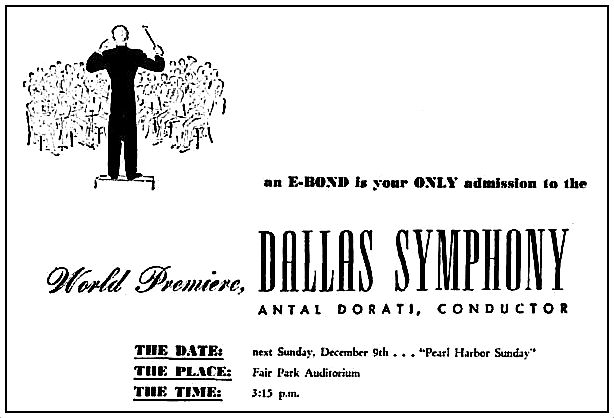
Somehow, in only two months, Dorati managed to put an orchestra together, prepare the season’s schedule, rehearse the musicians, and present the first performance of the “reborn” Dallas Symphony Orchestra on December 9, 1945.

ad_dso_dmn_120545-detDMN, Dec. 5, 1945

The response to that first concert was rapturous:

The crowd was somewhat stunned by the excellence of the ensemble that will bear Dallas’ name. To many, grown realistic or cynical in the years’ cultural struggles, the new orchestra was an unbelievably precious gift. Nothing so fine was expected by even the optimists. And it belonged to them with the promise that it would stay for all the time they could foresee. (John Rosenfield review, “Capacity Audience Thrills To Reborn Dallas Symphony, DMN, Dec. 10, 1945) 

During the intermission of this debut performance, Dorati was interviewed on the radio and had nice things to say about Dallas:

I fell in love with Dallas not last September when I was engaged but as far back as 1937. When I visited here year after year with the Ballet Theater. I said to myself that if I ever withdrew from the ballet and became a resident conductor for an American symphony, I would like it to be the Dallas Symphony Orchestra.” (DMN, Dec. 10, 1945)

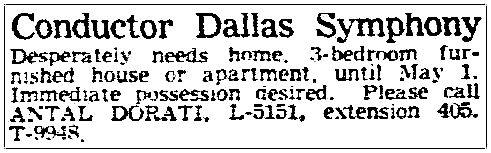
One little thing the Maestro was unable to accomplish, though, was to find a place for his family to live. The severe lack of postwar housing affected even the wealthy cultural elite!

dorati_classified-ad_dmn_121345
Dec. 13, 1945

And, with that, the DSO was back. It toured. A LOT. And made recordings. And appeared on national radio broadcasts. With Dorati at the helm, the Dallas Symphony Orchestra was making a name for itself and garnering a very positive national reputation.

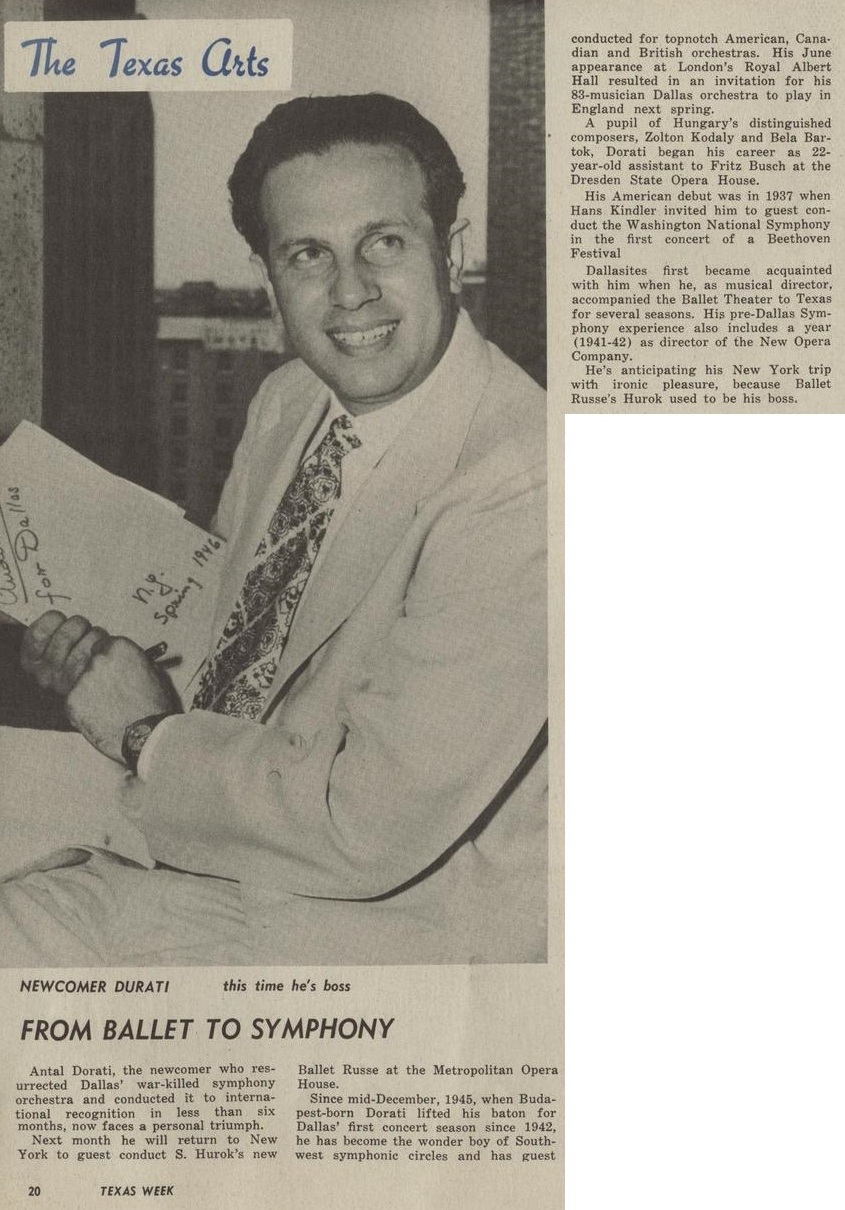
A typical article about the young, photogenic Dorati went something like the one below, in which Dorati was described as “the wonderboy of Southwest symphonic circles.”

dorati_dso_texas-week-mag_081746Texas Week, Aug. 17, 1946

After a fairly short but incredibly productive time in Dallas, Antal Dorati accepted the position of conductor of the Minneapolis Symphony Orchestra in January 1949. His successor, Walter Hendl (a startlingly “honest” obituary of the controversial Hendl appeared in the London Telegraph here), was appointed a few short weeks later, and Dorati’s final concert was April 3, 1949.

dorati_farewell_dmn_040349April 3, 1949

John Rosenfield’s melancholy review/farewell appeared the next day in The Dallas Morning News, and one imagines it tooks weeks for his tears to dry.

The spectacularly successful musical director and conductor, whose 4-season regime ended with an emotion-laden farewell concert, modestly disclaimed the founder’s role in Dallas Symphony history. The 1945-49 period was one of high-intentioned and nobly-adventurous endeavor….” (John Rosenfield, DMN, April 4, 1949)

And with that, the Maestro headed to Minneapolis, having built the post-war Dallas Symphony Orchestra into a nationally respected organization.

**

dorati_waco-news-tribune_120646
Waco News Tribune, Dec. 6, 1946

dorati_waco-news-tribune_121346Waco News Tribune, Dec. 13, 1946

dorati

dso_dmn_010449

***

Sources & Notes

Top photo and article from the Aug. 17, 1946 issue of Texas Week, the short-lived magazine that was sort of a Texas version of Life, via the Portal to Texas History, here. Text may have been written by Paul Crume.

Linksapalooza:

  • The Dallas Symphony Orchestra Wikipedia entry is here; the official DSO site is here; the Handbook of Texas entry is here.
  • The Antal Dorati Wikipedia entry is here; his official site is here.

Listen to pianist William Kapell perform Prokofiev’s Piano Concerto No. 3 in C major, Op. 26 with the Dallas Symphony Orchestra under the direction of Antal Dorati (recorded at the Fair Park Auditorium the same week he made his “Adios, Dallas!” announcement in Jan., 1949), here.

More on Dorati and his close friend Yehudi Menuhin in my post “Yehudi Menuhin and Antal Dorati: A Collaborative Friendship,” here.

And, yes, the correct spelling should be “Antal Doráti.”

*

Copyright © 2016 Paula Bosse. All Rights Reserved.
The Blue House on Browder

blue-house_homewardboundinc_2000
The Rosenfield house, in about 2000 (photo courtesy Homeward Bound, Inc.)

by Paula Bosse

Perhaps you’ve been following the recent brouhaha over the plans to demolish one of the last remaining 19th-century residences in the Cedars area, south of downtown — Robert Wilonsky of The Dallas Morning News has been covering the story here and here and here. The house is in terrible disrepair, but it has the beautiful details of the period, and it’s obvious that it was once a lovely house in a well-to-do neighborhood. Preservation Dallas posted this in-better-days photo on their Facebook page:

browder-house_preservation-dallas-FB-page

I thought I’d see what I could find about the history of the house — mainly I wanted to see if I could find who built it and when.

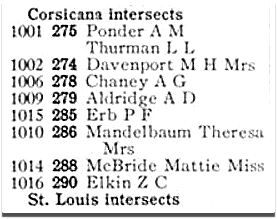
The house currently has the address 1423 Griffin, but before highways were built and streets were moved around, its address was 1015 Browder. Dallas changed almost every address in 1911, so I checked Jim Wheat’s very helpful scan of that year’s directory which tells us both the new and the old addresses of houses and businesses and also shows what cross-streets those addresses are between.

browder-house_1911-directory1911 directory, Browder Street

The original address of the Blue House was 285 Browder Street, between Corsicana and St. Louis. In 1911, P. F. Erb was living there.

Next, I checked the Sanborn maps. The earliest Sanborn map I could find which actually showed this part of Browder was the one from 1892. Here’s a detail showing the two-story frame house on the northwest corer of Browder and St. Louis, with Browder running horizontally along the top. The address is 285 Browder. (The house next to it is 169 St. Louis — more on that house later.)

sanborn_1892_285-browder_nw-corner-st-louis_sanborn-1892_sheet-21

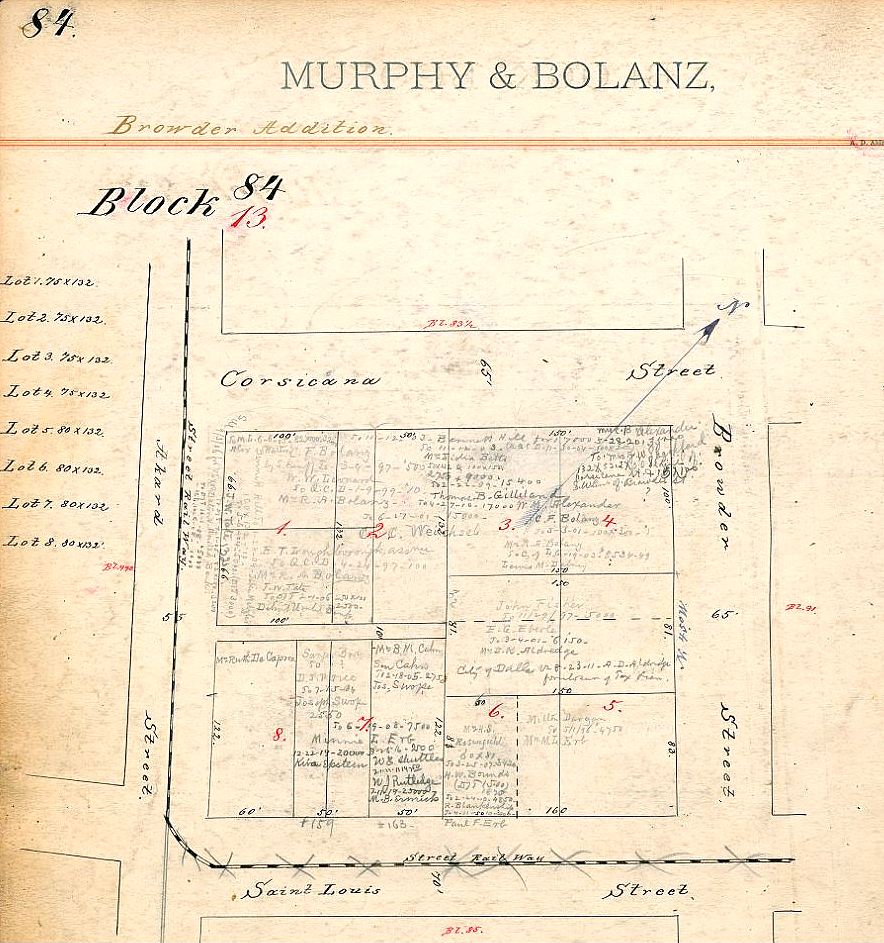
When you look at the full-page map this detail comes from (here), you’ll see larger numbers in the middle of the blocks. The block I’m interested in is block 84. Then I hopped over to the Murphy & Bolanz block book to see what I could find there. (I haven’t actually used this block book much, mostly because my old computer would not work with the plug-in required to view the pages, and it takes a while to figure out what you’re looking at.) When I clicked on “Block 84” in the index, I found this (click for larger image):

murphy-bolanz_block-13_block-84

Here’s the detail of the pertinent block:

murphy-bolanz_det

The names and other assorted scrawls indicate title change (I think). This page was very helpful, because it told me that this block was originally part of Browder/Browder’s Addition, and it was originally classified as Block 13. The lot in question is Lot 5 (and probably Lot 6, because Erb’s name shows up under both. So now I had terms to search on.

And then it was just a tedious slog through the Dallas Herald archives (not to be confused with the Dallas Times Herald archives), the Dallas Morning News archives, and old city directories. Here’s what I found.

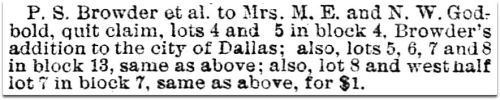
First mention of this particular parcel of land was in The Galveston News on March 24, 1883. P. S. Browder, a Browder family executor, transferred a lot of property — including the two lots I was interested in — to Mr. & Mrs. Nathan Godbold as part of a quitclaim deed (I’m probably not using the correct terminology here…). For one dollar.

1883-march_browder_galveston-news_032483_QUIT-CLAIMGalveston News, Mar. 24, 1883

A few inches of print over, the record shows that Godbold immediately sold Lots 5 and 6 to Dallas real estate czar Charles Bolanz (misspelled below). For $1,000.

1883-march_browder_galveston-news_032483_to-bolanzGalveston News, Mar. 24, 1883

A few months later, in July, it was reported that Bolanz had sold the adjoining two lots to T. S. Holden, a young man who worked as a salesman for a wholesale grocery firm but seemed to be engaged in land speculation on the side. (It’s a little odd that Bolanz sold it so quickly for a $200 loss, but I’m sure there was probably more to the story.)

1883-july_browder_galveston-news_070283_HOLDENGalveston News, July 2, 1883

At some point, these two lots were sold to Max Rosenfield, another young man who was buying up land in the hopes that its value would increase. From Dallas Rediscovered by William L. McDonald:

“The year 1884 also saw the opening of a new housing subdivision by two Jewish real estate speculators, Gerson Meyer and Max Rosenfield. Their development, bounded by Akard, Corsicana, Browder, and St. Louis streets, was sold primarily to Jewish families who had begun to arrive as early as 1872 as part of the ‘Corsicana crowd’ — the terminal merchants who followed the construction of the H&TC.”

[I couldn’t find anything else about this block being a “sub-division,” but there definitely was a “Rosenfield & Meyer’s Addition” in East Dallas as early as 1886 — see the bottom of this post for more information on Gerson Meyer and the Murphy & Bolanz map of their East Dallas addition.]

In the 1886 city directory, Max Rosenfield is listed as residing at 1118 Browder, which may well have been an address that lasted for a very, very short time — Browder is a very short street, and I wonder if Rosenfield was renumbering addresses in his new development. It does appear to be Lot 5 of the block he and Meyer were developing, though. (Henrietta Rosenfield, widow of Jonas Rosenfield, was Max’s mother, and she lived with or near Max for several years.)

1886_rosenfield_1886-directory_1118-browder1886 Dallas directory

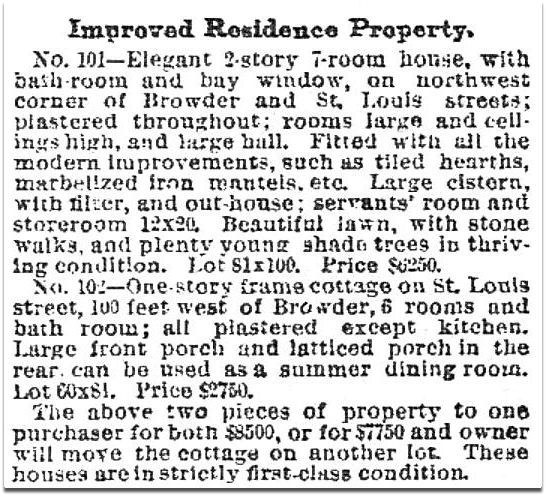
In early 1887, a For Sale ad appeared in the Herald — real estate agents Ducker  & Dudleigh were offering what appears to be Lots 5 and 6. By this time, houses had been built on both lots. (The  numbers 101 and 102 are confusing here, but the property being offered is the lot at the northwest corner of Browder and St. Louis and the lot adjoining it.) The price for the two-story house on Lot 5 was $6,250, which the Inflation Calculator adjusts to being about $166,000 in today’s money, taking into account inflation (but not taking into account Dallas’ outrageous real estate prices!).

1887_browder_dmn_050887-FOR-SALEDMN, May 8, 1887 (click for larger image)

It doesn’t look like either property sold, because a few months later, the 1888 directory showed Max still living in the Lot 5 house facing Browder and mother Henrietta living in the Lot 6 house at 169 St. Louis.

1888_rosenfield_1888-directory1888 Dallas directory

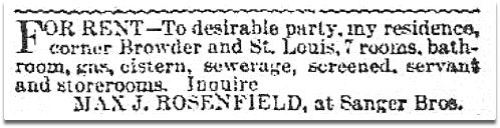
Rosenfield placed a For Rent ad in the paper in Feb. of 1889, offering his corner house on Browder.

1889_rosenfield_dmn_021389DMN, Feb. 13, 1889

This appears to have been when businessman Milton Dargan moved in. He is listed as moving into the house at about this time in the addenda section of late changes for the 1889 directory (directories were usually compiled in the year before they were actually published).

1889_dargan_1889-addenda-listing1889 Dallas directory

In that same directory, Rosenfield had moved in with his mother in the adjoining property.

1889_rosenfield_1889-directory1889 Dallas directory

At some point Dargan bought the corner house. Henrietta continued to live in the St. Louis-facing house until about 1892, when she moved in with Max at his new home on Akard.

And, finally, the “285” address shows up in a directory, in 1891.

1891_dargan_1891-directory1891 Dallas directory

Paul F. Erb bought the Browder house from Dargan in 1896 (he also bought the adjoining Lot 6 house facing St. Louis in 1910).

1897_erb_1897-directory1897 Dallas directory

And we’re back to Paul Erb, seen in the 1911 directory listing old and new addresses at 1015/285 Browder.

browder-house_1911-directory1911 Dallas directory

Yay!

**

That was a long way to go to establish a chain of ownership. (I’m sure it would have been faster and easier to have consulted city records.)

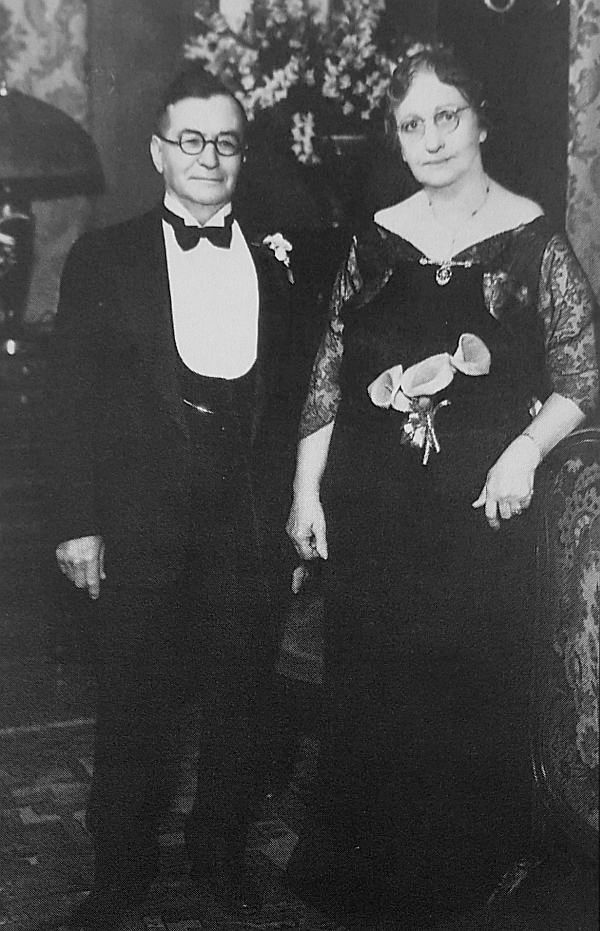
So. Without access to building permits, it looks as if Max Rosenfield (who, by the way, was the father of John Rosenfield — born Max John Rosenfield, Jr. — legendary arts critic for The Dallas Morning News) was the person who built the 130-year-old house now going through the process of probably being torn down soon. It appears to have been built in 1884 or 1885. In a 1935 Dallas Morning News article celebrating the 50th wedding anniversary of Mr. and Mrs. Max Rosenfield, the house is mentioned: “…their first home, a house built by Mr. Rosenfield and still standing on the northwest corner of Browder and St. Louis streets…” (see the article “Mr. and Mrs. M. J. Rosenfield To Observe 50th Anniversary,” DMN, Jan. 6, 1935).

Below is a photo of Max Rosenfield and his new bride, Jenny, probably taken the same year the house was built, 1885-ish, when Max was 26 years old.

rosenfields_ca-1885_ancestry

Thank you for building such a pretty  house, Mr. Rosenfield. Maybe some magnanimous person with deep pockets can have it moved to a new location and restore it to its former loveliness.

rosenfield-max_1935Mr. and Mrs. M. J. Rosenfield, on their 50th anniversary

**

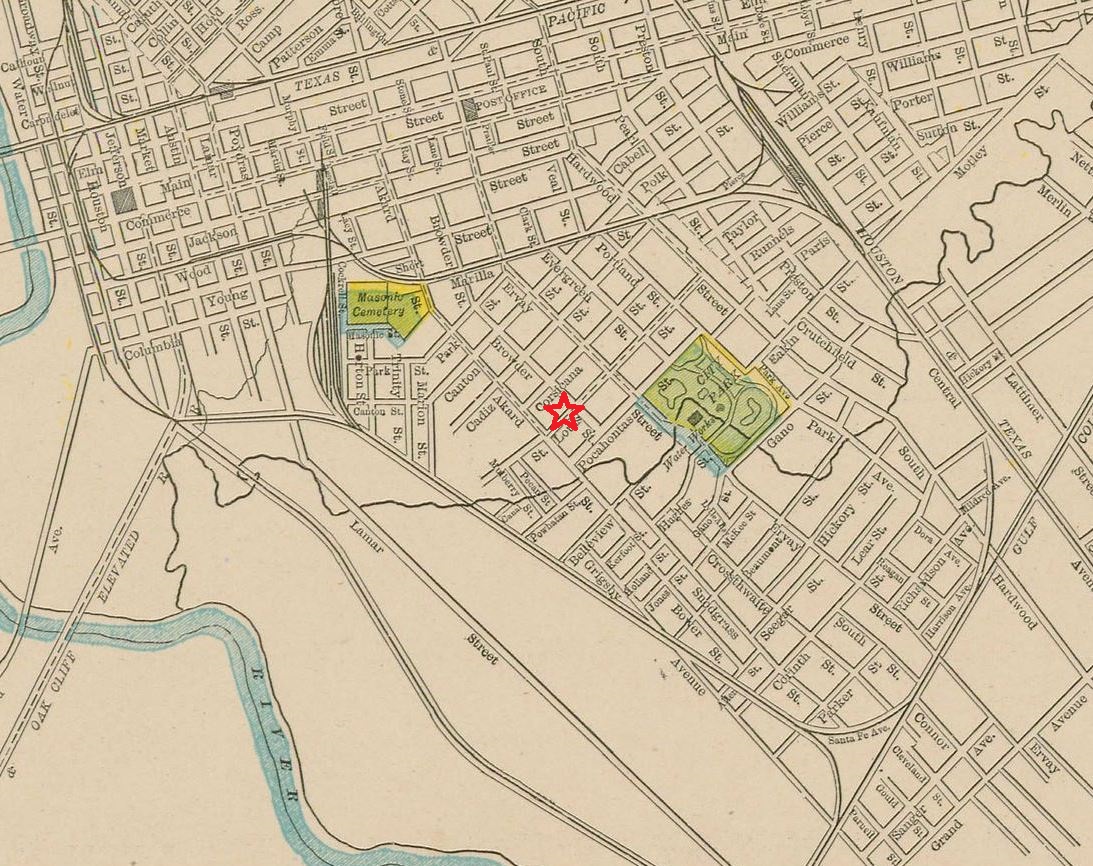
Here’s a detail of an 1893 map of the area, with the house in question marked.

browder-house_1893-map

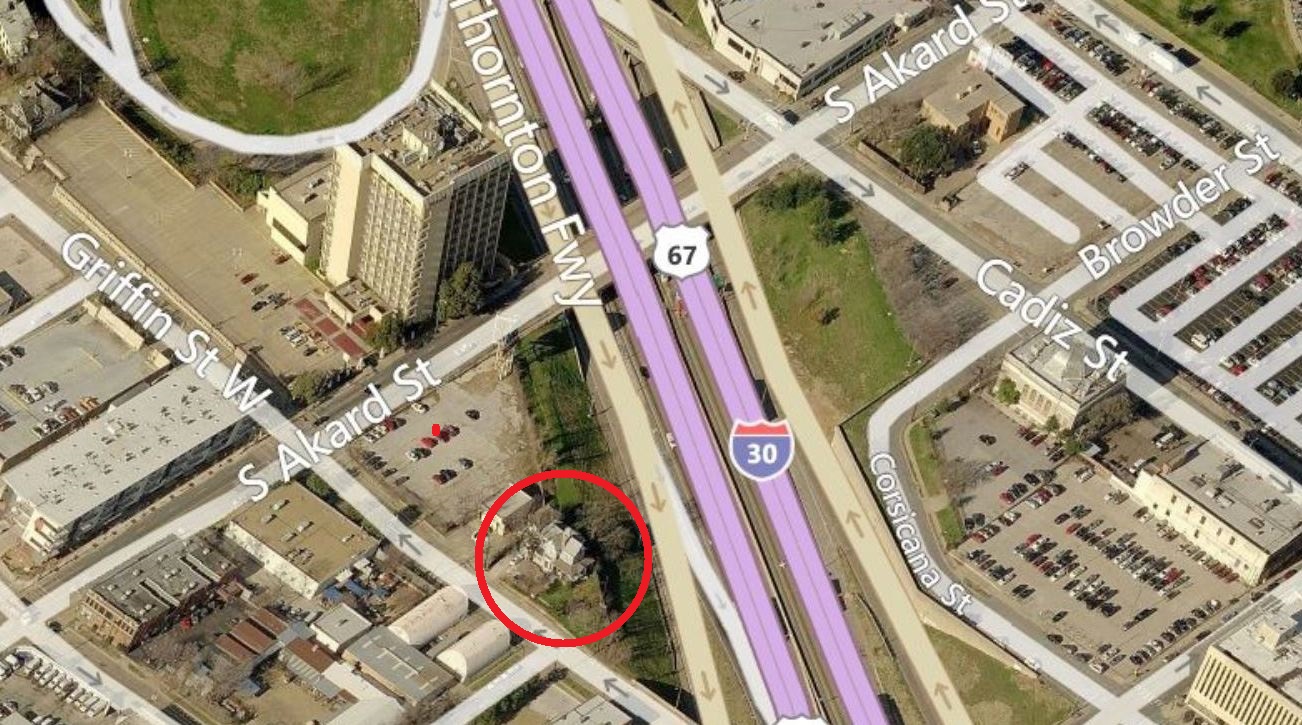
And here’s the lonely little house in its present hemmed-in location.

browder-house_bingBing Maps

***

Sources & Notes

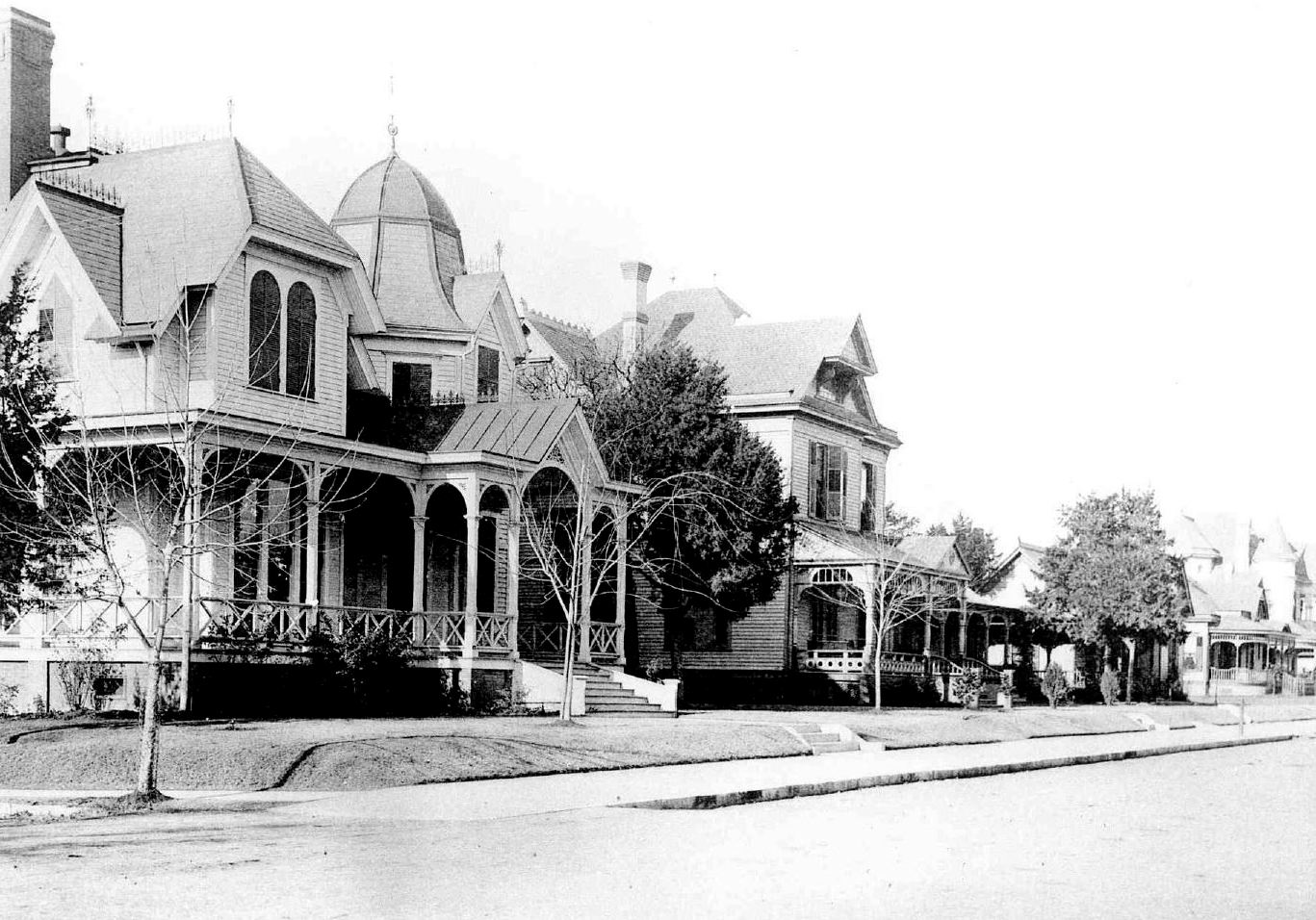
Top photo, taken around 2000, from Homeward Bound, Inc., used with permission. Homeward Bound, Inc. took over the house in 1986 (and owned it until October, 2015) for use as Trinity Recovery Center, a substance abuse treatment center. The organization tried hard to save the house, but, according to Homeward Bound, Inc. Executive Director Douglas Denton, when they approached Dallas’ Landmark Commission in the 1990s, “they were not interested in the building.” Thanks to Mr. Denton for allowing me to use this photo, which shows the beauty of the old house better than any other photo of it that I’ve seen. He points to the photo below as an example of what this Cedars neighborhood once looked like. The caption for the photo in McDonald’s Dallas Rediscovered (p. 125): “Looking north toward downtown along Browder Street near the corner of Cadiz, 1895. These homes, built in the early 1890s, began to be razed in the late 1930s and early 1940s for parking space in the expanding business district.” (Photo: Dallas Public Libary)

browder-near-cadiz_ca1895

This would have been about two blocks from the Rosenfield house. Imagine what that neighborhood once looked like!

Watch a news report on the outcry over the possible demolition of this house on the WFAA website, here.

The Dallas Morning News article on the 50th wedding anniversary of Mr. and Mrs. Max Rosenfield in which it is mentioned that Max built the house (“…their first home, a house built by Mr. Rosenfield and still standing on the northwest corner of Browder and St. Louis streets…”) is “Mr. and Mrs. M. J. Rosenfield To Observe 50th Anniversary” (DMN, Jan. 6, 1935).

Photo of the Rosenfields as a newly married couple found on Ancestry.com.

50th anniversary photo of Mr. and Mrs. Rosenfield is from the book John Rosenfield’s Dallas by Ronald L. Davis (Dallas: Three Forks Press, 2002).

All other sources as cited.

Max J. Rosenfield died in 1935 at the age of 76. His very interesting obituary (probably written by his son, John Rosenfield, amusements editor of The Dallas Morning News), can be found in the Dec. 2, 1935 edition of The News: “M. J. Rosenfield, Business Leader Many Years, Dies.”

It’s worth trying to figure out how to use the Murphy & Bolanz block books, courtesy of the Texas/Dallas History and Archives Division of the Dallas Public Library. Background on these very useful books can be found here.

If I’ve made any mistakes or have drawn any incorrect assumptions, please let me know!

browder-house_then-now

*

UPDATE: Max Rosenfield developed a real estate partnership with Gerson Meyer, both of whom worked for Sanger Bros. department store. They bought and sold real estate (often to fellow Sanger’s employees), apparently as a lucrative side-business (Rosenfield even conducted his real estate transactions from his Sanger Bros. office). They apparently had acquired enough land by 1886 to have their own “addition” — “Rosenfield and Meyer’s Addition” in East Dallas. The earliest mention I found of it was this ad from May, 1886.

rosenfield-and-meyer-addition_dmn_052786DMN, May 27, 1886

Their addition was in East Dallas. Below, the map from the Murphy & Bolanz block book (click for larger image):

rosenfield-and-meyers-addition_murphy-bolanz

Gerson Meyer (a Jewish German immigrant, just a couple of years older than Rosenfield), moved to St. Paul, Minnesota in 1897 and continued working for several years in men’s clothing.

If something looks too small, click it!

*

Copyright © 2016 Paula Bosse. All Rights Reserved.
 

Protected: David Bowie, Dallas Convention Center — 1978

This content is password-protected. To view it, please enter the password below.

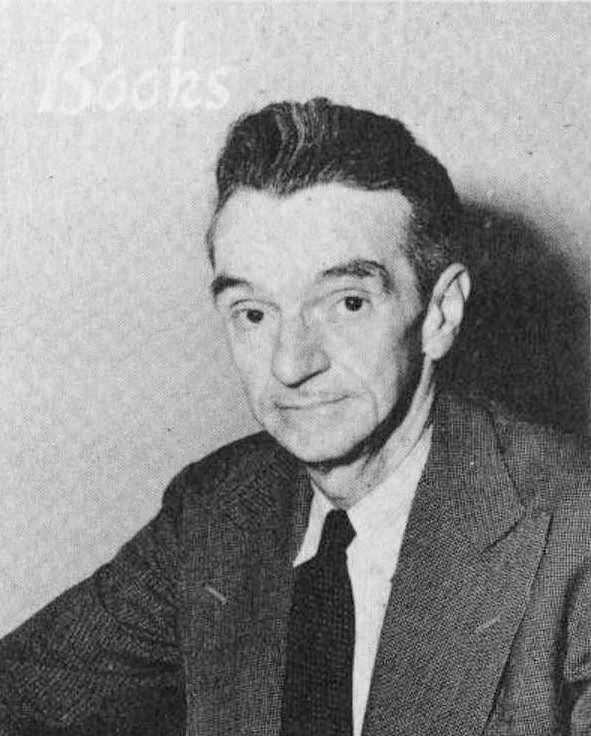
Ramon Adams: Violinist, Candy Manufacturer, Old West Expert

adams-ramon_texas-week-mag_090746_portal-photo_bwRamon F. Adams, 1946

by Paula Bosse

I’ve spent a fair amount of my adult life cataloging Texana books and ending descriptions with the bibliographic citations “Adams, HERD” or “Adams, SIX-GUNS.”* “Adams” was Ramon F. Adams, a respected and prolific writer and bibliographer specializing in the Old West and cowboy life. If you collect books on Texas and The West — or on cowboys and the cattle industry — you have Ramon Adams’ books on your shelves. And he lived in Dallas.

Ramon Adams was born in Moscow, Texas in 1889, near Houston, but left there as a young man to study and teach music. He was a professional violinist who played not only an occasional symphony gig, but after his years of teaching, he made a steady living playing in movie theater orchestras, accompanying silent films. While playing in the orchestra at the Rialto in Fort Worth, he even wore white tie and tails. When the Rialto musicians went on strike in 1923, he and his wife, Allie, moved to Dallas, and he played in the orchestras up and down theater row until the fateful day when he was cranking a stalled Model T Ford in an attempt to start it and broke his wrist. It never healed properly, and his days as a professional violinist came to an abrupt end.

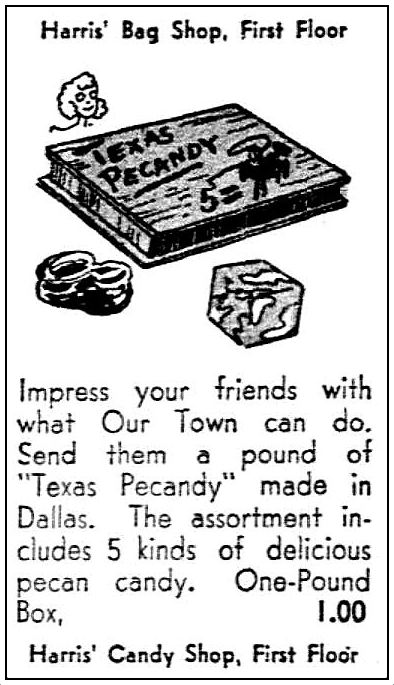
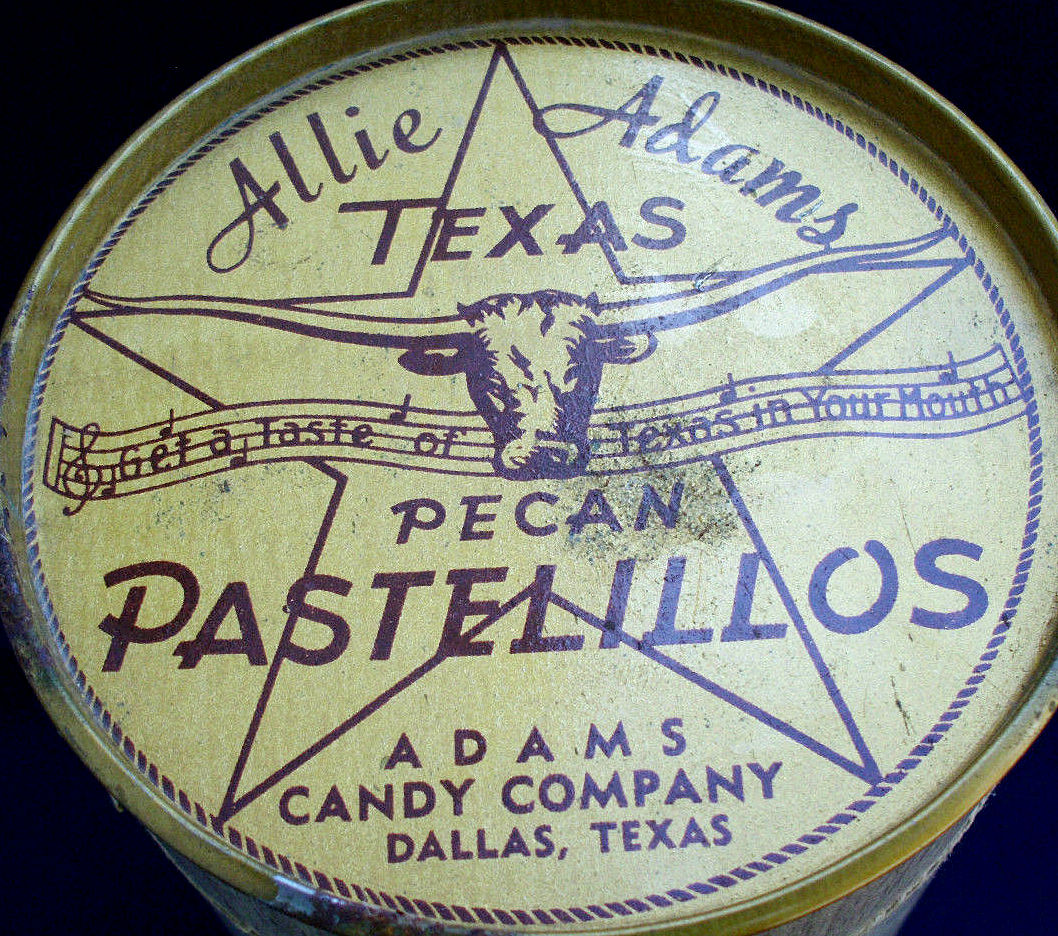
I never knew about his first career as a musician, and I never knew about his second career as a candy merchant! The Candy Years began when he and his wife bought a little candy store on Elm Street between the Melba and the Majestic, and it did such good business that, a few years later, he went into manufacturing and wholesaling candy. The Adams Candy Co. began its successful life in the 1930s, known for its widely available candies such as “Texas Pecandy” and for its “Burnt Offering” (“burnt almonds in chewy caramel and rich chocolate”), which was made specially for Neiman-Marcus.

pecandy_dmn_090940Sept. 1940

The runaway success of his candy business meant that when the Adamses sold the business in the mid-’50s (making, one assumes, a hefty profit) Ramon was able to devote his full attention to researching and writing about cowboy life and culture. He had been writing all along, in his spare time, but only in short bursts, usually at night, at the kitchen table. He had written several very long pieces for The Dallas Morning News in 1927 and 1928, but his first book, Cowboy Lingo, wasn’t published until 1936 — when he was 46 years old. And then the floodgates opened. When he died in 1976, his obituary noted that he had written 24 books — in addition to numerous articles for magazines and journals. He was the expert other experts consulted. And he lived in Dallas. And he made “Pecandy.”

**

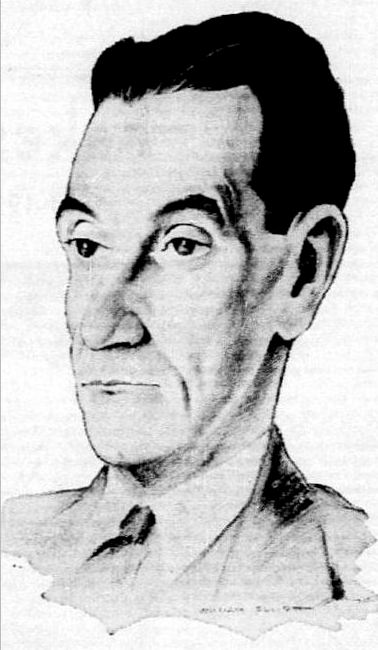
I love this 1936 caricature of Adams. (He looks an awful lot like Dr. Smith of Lost In Space here….)

adams-ramon_caricature_1936

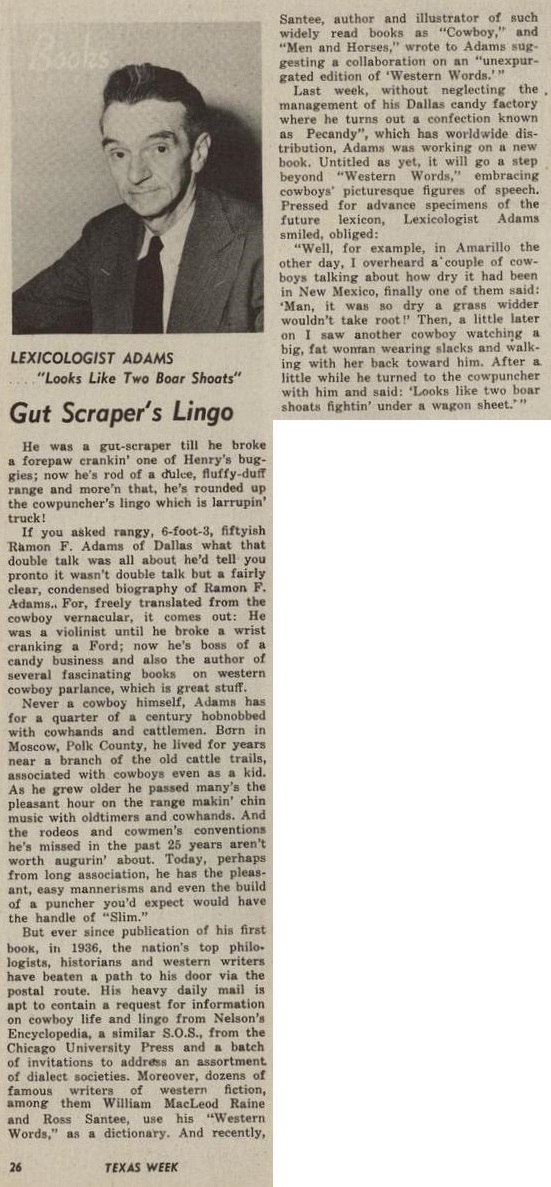
A pleasant little article on Adams, no doubt written by one of his many journalist friends, from 1946 (click for larger image):

adams-ramon_texas-week-mag_090746_portalTexas Week magazine, Sept. 7, 1946

And…

ad-adams-candy-co“Get a taste of Texas in your mouth!”

***

Sources & Notes

The Handbook of Texas entry on Ramon F. Adams is here.

A more comprehensive Biographical Note is on the page devoted to the Ramon Adams Collection, Texas/Dallas History & Archives, Dallas Public Library, here.

* “Adams, HERD” and “Adams, SIX-GUNS” is short-hand used by catalogers of books on Western Americana when noting that the book being cataloged is referenced in Ramon F. Adams’ book The Rampaging Herd: A Bibliography of Books and Pamphlets on Men and Events in the Cattle Industry (Norman: Univ. Oklahoma, 1959) or his book Six-Guns and Saddle Leather, A Bibliography of Books and Pamphlets on Western Outlaws and Gunmen (Norman: Univ. of Oklahoma, 1954).

*

Copyright © 2016 Paula Bosse. All Rights Reserved.

The First Woman to Swim the Channel Helped Search the Trinity for Drowned Victims — 1927

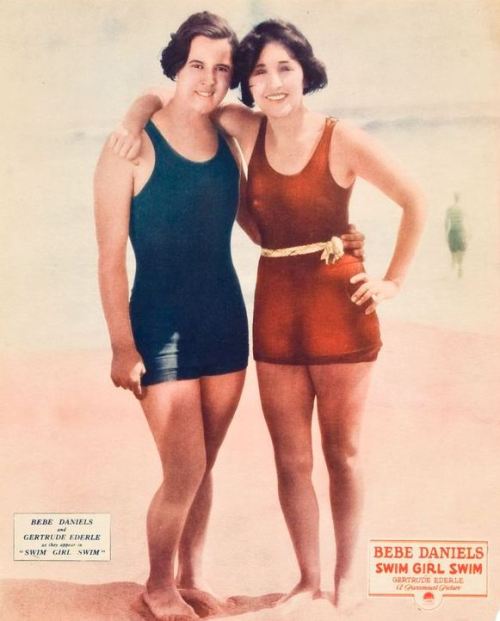
swim-girl-swim_haGertrude Ederle (l) with co-star, Dallas native Bebe Daniels / via HA.com

by Paula Bosse

In 1926, Gertrude Ederle, a 19-year-old American, became the first woman to swim the English Channel — her time of 14 hours and 39 minutes was the fastest time ever. She became an instant international celebrity. When she returned to New York, she was given the very first ticker-tape parade, and over two million people turned out to see her.

After this momentous achievement, Ederle turned for a while to entertainment. She made a cameo appearance in a (now lost) silent film called Swim, Girl, Swim (which, incidentally, starred two Dallas natives, Bebe Daniels and James Hall), and she also toured for a while with a vaudeville company.

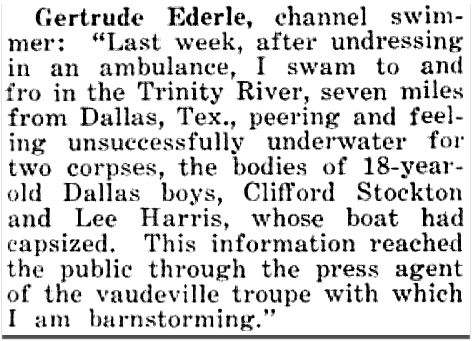
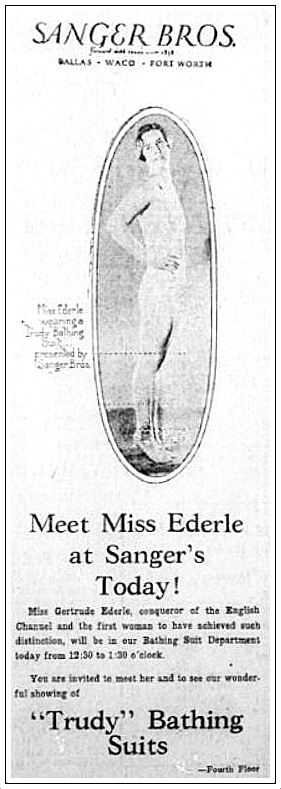
It was during one of these tours in April, 1927 that she arrived in Dallas, just as torrential rains began to fall. There was severe flooding along the West Fork of the Trinity, especially in the area of Record Crossing. The boat in which two young men were riding had capsized and they had been caught in the undertow and drowned. There had  been an unsuccessful search for their bodies, and I’m not sure who came up with the idea of contacting Miss Ederle, but someone did. Why NOT call in the world’s most famous swimmer to see if she could lend a hand while authorities dragged the river? Miss Ederle did, in fact, join in the underwater search, but the bodies were not found. I bet she never forgot that Dallas stop!

The news was reported in Time magazine:

trinity_bodies_time-mag_041827Time, April 18, 1927

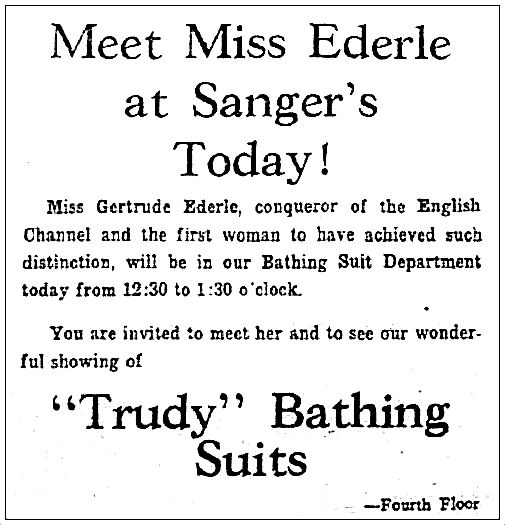
While in town, Trudy also squeezed in a personal appearance at Sanger Bros., hawking what looks to be her own line of swimsuits.

ederle_sangers_dmn_041427-det

ederle_sangers_dmn_041427Apr. 14, 1927

***

Sources & Notes

More on the Trinity River search can be found in The Dallas Morning News article “River Claims Two Victims; Gertrude Ederle Makes Vain Attempt to Recover Bodies” (DMN, April 5, 1927).

Newsreel footage of Gertrude Ederle can be seen here.

Photos of Ederle in action are here.

Ederle’s Wikipedia entry is here.

*

Copyright © 2016 Paula Bosse. All Rights Reserved.


Muriel Windham — An Oak Cliff Teenager’s 1940s Diary

muriel_colorMuriel, via Muriel Windham’s Diary

by Paula Bosse

About this time last year, Robert Wilonsky of The Dallas Morning News wrote an interesting article about a black-out imposed by the city of Dallas in January, 1942, just a few weeks after the attack on Pearl Harbor. In the middle of it, he linked to a diary entry written by a 14-year-old describing the event. For me, the most interesting thing about Wilonsky’s piece was the fact that someone had transcribed diary entries of a teenage girl growing up in Dallas in the 1940s. So I read the whole thing. And I loved it.

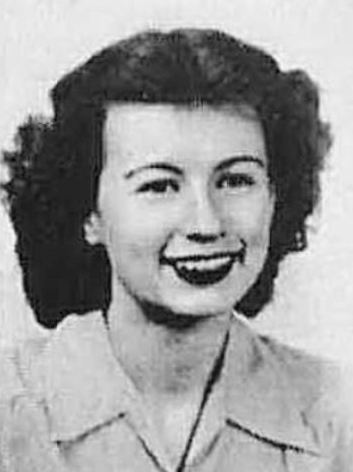
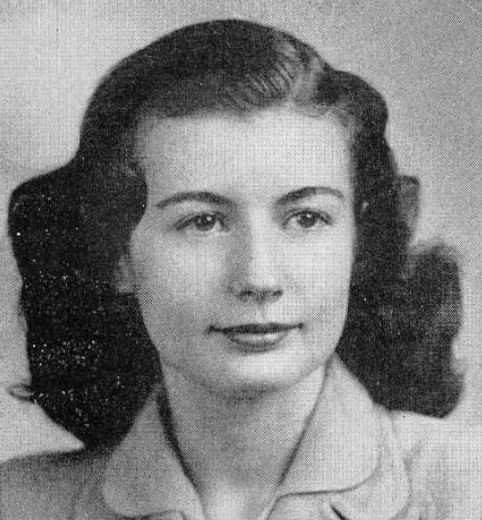
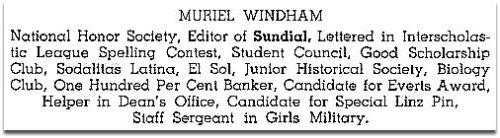
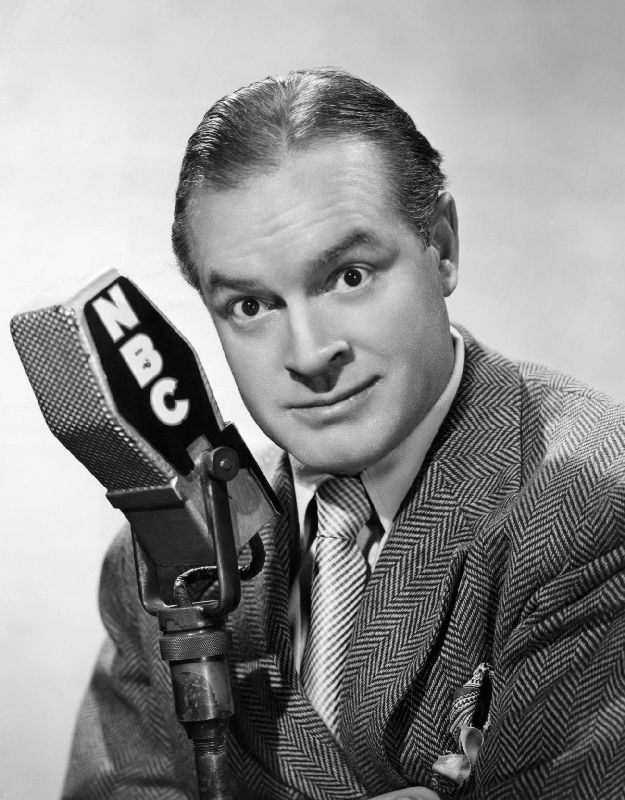
The teenager in question is Muriel Windham (1926-2005) who grew up in Oak Cliff and attended Peeler Elementary, Greiner Jr. High, and Sunset High School. She was a top student who was involved in lots of extracurricular activities, but her greatest joy was going to the movies and listening to comedians on the radio. She was absolutely obsessed — OBSESSED! — with Bob Hope. She attended SMU where she ultimately received a Master in English Literature degree and Master in Library Science degrees; she was head of the children’s department of the Dallas Public Library (as Muriel Brown) for many years and was a specialist in children’s literature. Somewhere in there she married G. W. Brown II and had three children.

But back to the diary. After her death in 2005, Muriel’s son David began transcribing his mother’s teenage diary — exactly as written, complete with misspellings and grammatical errors. It begins on January 1, 1940 (six weeks after she had turned 13) and ends in the summer of 1942. David Brown says he has years and years worth of her diaries — I hope he gets  back to transcribing them one day, because what’s on his blog now is utterly charming.

The diary is exactly like every other teenage girl’s diary. If you’re not of the female persuasion, you might not be able to handle the deep, deep plunge into teenybopperdom. It reads just like MY diary from when I was 13, except that my obsession wasn’t Bob Hope but a TV star from a 1970s TV show that might prove highly embarrassing were it to be revealed. If you have a low threshold for incessant mentions of Bob Hope by a moony adolescent or are not at all interested in entertainment of the early 1940s, this may not be for you. As I said, I loved it. I wish there were more Dallas-specific entries, because when those pop up, it’s pretty cool.

An introduction to the diary is here. The blog is written in reverse order — and it really should be read chronologically, so I suggest starting here at the very bottom and reading up the page; when it’s time for the next page, scroll down to the bottom and click  “Next Entries.” (You’ll get used to it.) There are 8 pages, and each entry is very short. It’s the perfect sort of thing to read when you stay in on a cold weekend. …But I’m not going to sugar-coat it: there is a LOT of Bob Hope to slog through! You’ve been warned!

**

muriel-windham_sunset-high-school_1943Muriel, 1943

muriel-windham_sunset-high-school_1944Muriel, 1944 — editor of the Sunset yearbook

muriel-windham_sunset-high-school_1944-clubsSenior, over-achiever — 1944 yearbook

***

Sources & Notes

Black and white photos are from the Sunset High School yearbook, the Sundial.

Muriel Windham Brown’s obituary can be read here.

Muriel does actually get to meet Bob Hope once or twice, but the diary entries stopped before a pretty incredible meeting on April 22, 1943 at a benefit to sell war bonds at the Dallas Country Club. There was even a short article in The Dallas Morning News which chronicled what must have been the biggest moment in her 16 years: “Hope Thrills Girl As He Sells Bonds” (DMN, April 23, 1943). A couple of sentences from the article:

In the hustle and bustle of his bond sale at Dallas Country Club Wednesday afternoon a pretty, young girl shyly stepped up to Hope and caused him to sink to his knees in a swoon as she whispered she would pay $10,000 for his autograph. […] Hope treated her beautifully. He sat her down on the platform, left the mike occasionally to dash over, feel her pulse, stroke her brow and leave a light kiss on her forehead. (DMN, April 23, 1943)

I can’t even imagine how stunned Muriel must have been! (Her father worked as an executive, mostly in insurance and banking, and I have a feeling that the $10,000 check came from his employer, not his own bank account.)

Muriel’s family lived at 817 Brooks. No movie theater was all that far away by streetcar.

muriel_817-brooksGoogle Maps

A few more photos as she made her way through Sunset and SMU are here.

And, well, I kind of feel I have to….

bob-hope

*

Copyright © 2016 Paula Bosse. All Rights Reserved.
 

The Eisenlohr Family and Dallas’ First Christmas Tree — 1874

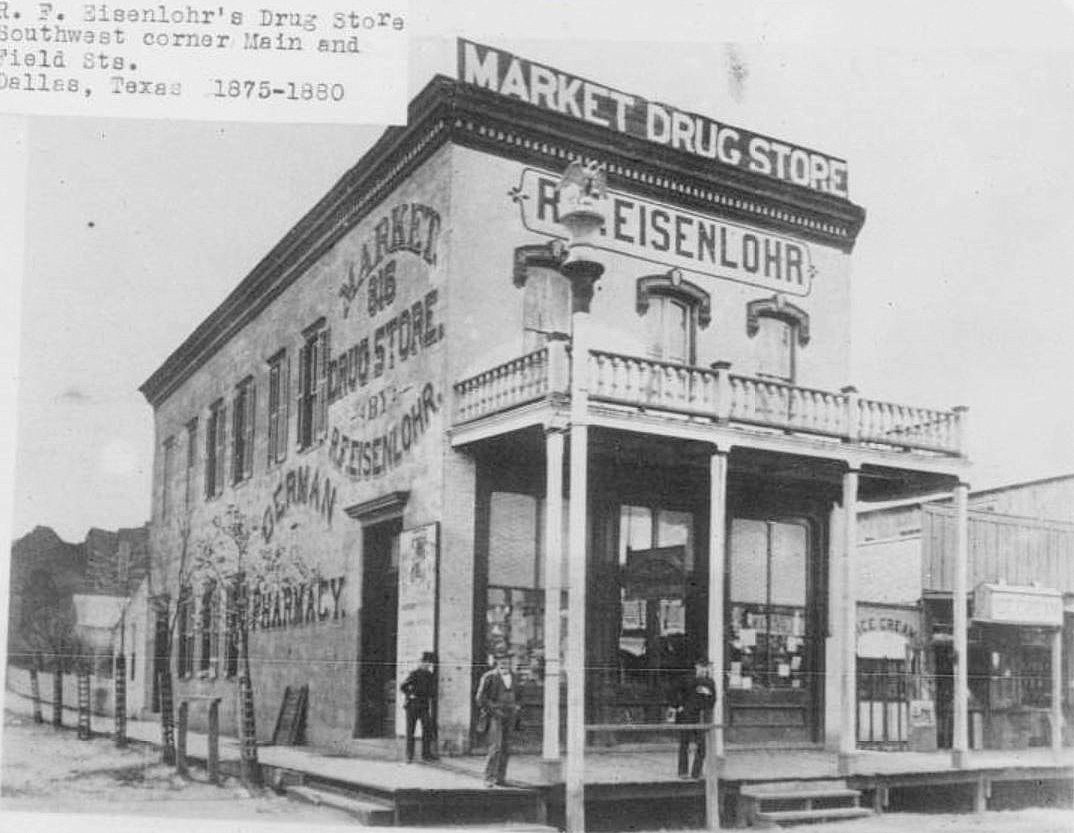
eisenlohr_1885_ebayThe Eisenlohr Market Drug Store, 1885 (click for larger image)

by Paula Bosse

According to the memories of Dallas artist E. G. Eisenlohr (1872-1961), his German-born parents brought the first decorated Christmas tree to Dallas in 1874 (or, according to a version of the story published a few years later, 1876). There had been Christmas trees in Dallas before this, but the Eisenlohrs’ tree may have been the first tree — or one of the first — to be brought inside and decorated with tinsel and ornaments.

According to E. G. Eisenlohr’s Christmas memories which appeared in The Dallas Morning News on Oct. 1, 1935:

The candles, holders and tinsel for that first Christmas tree in the village of Dallas in 1874 was ordered from the East. For days my mother baked cookies in the shapes of stars, ships, [and] boots [using] hand-carved molds, some more than 100 years old, that illustrated folk tales…. For days before Christmas Eve the children had been locked out of the room where Kris Kringle was decorating the tree and permitted to enter only after our parents played their Christmas concert and appeared at the window in answer to the cheers from the crowd in the streets. There may have been other trees in the village before we had ours but I have not heard of any and many persons said ours was the first here. I believe we had the first tinsel and glass decorations, for many persons told me later that their parents had told them of the decorated trees back in their old homes before they came to Texas.

eisenlohr-store_degolyer-lib_SMUThe store, ca. 1875-1880 (via DeGolyer Library, SMU)

But what kind of tree was it? According to Kenneth Foree’s 1946 News article about the Eisenlohr tree, it was “a beautiful cedar tree (cut from an Akard and Young thicket by moonlight when the children were asleep” (DMN, Dec. 24, 1946).

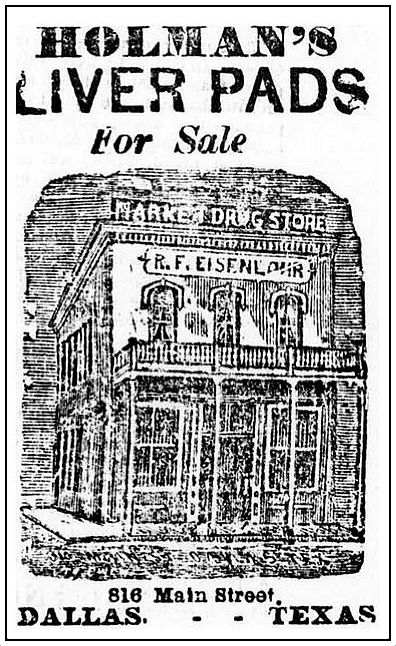
Eisenlohr’s father, Rudolph F. Eisenlohr, owned the Market Drug Store (seen above), which was at the southwest corner of Main and Field (the current view of that corner can be seen here, via Google Street View, and the 1885 Sanborn map of that block can be found here.) The family lived upstairs. Imagine that first decorated tree — actually inside someone’s home! — lit with candles in one of those upper windows, attracting a crowd of people below who had never before seen such a sight in the little village of Dallas.

eisenlohr_photoR. F. Eisenlohr (1846-1933)

eisenlohr_market-drug-store_dallas-herald_021877
The Dallas Herald, Feb. 18, 1877

eisenlohr_dallas-directory_1878
Dallas city directory, 1878

eisenlohr_nortons-union-intelligencer_102383
Norton’s Union Intelligencer, Oct. 23, 1883

***

Sources & Notes

More on this tree can be found in these three Dallas Morning News articles:

  • “Christmas of ’74 Featured by First Yule Tree in City — Intended for Eisenlohr Children, but Served for All of Youngsters ” (DMN, Oct. 1, 1935)
  • “Happy Citizens of the Little Town of Dallas Saw Their First Glass and Tinsel Ornaments in 1876 on a Tree Which Glittered Through the Eisenlohrs’ Window Upstairs Over Their Drug Store” (…that is one crazy-long headline…) by Mattie Lou Frye (DMN, Dec. 18, 1932)
  • “First Tree” (crazy-short headline…) by Kenneth Foree (DMN, Dec. 24, 1946)

Photo of the Eisenlohr store found on eBay.

More on artist E. G. Eisenlohr here and here.

*

Copyright © 2015 Paula Bosse. All Rights Reserved.
 

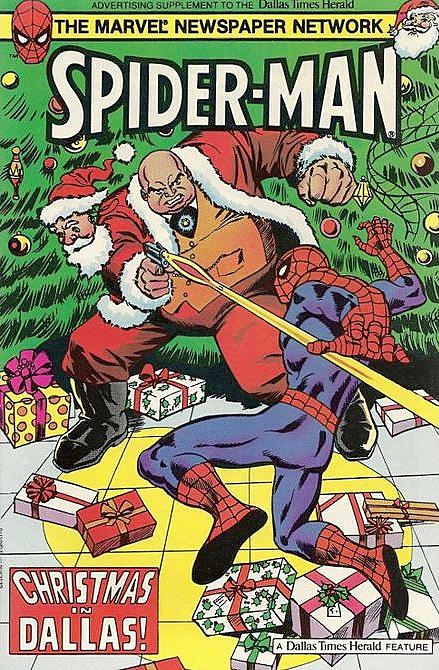
Spider-Man: Christmas in Dallas! (1983)

xmas_spider-man_cover_sm

by Paula Bosse

Remember when news photographer Peter Parker was covering a charity ball in Dallas? You  know, the one attended exclusively by millionaires from around the country who were raising money for orphans?

xmas_spider-man_intro(click for larger image) via Sense of Right Alliance blog

And then the Kingpin showed up dressed as Santa Claus and held the wealthy crowd for ransom, but Peter Parker managed to slip away and — whoa! — hey, Spider-Man appeared, and he and the Kingpin duked it out for awhile until an inventor of an anti-gravity device stepped in to aid the Webbed Wonder, and together they sent the Kingpin packing as he floated away, presumably into outer space. And, with Evil thwarted, Peter Parker was able to fly back home to spend Christmas morning with his beloved Aunt May. I’m sure you remember that! It was in all the (evening) papers.

This exciting adventure was told in a special give-away supplement included in a 1983 edition of The Dallas Times Herald. In the panels I’ve seen, there isn’t anything overtly Dallas-y, but that’s probably because the comic book aficionados who have scanned various pages are more interested in Spider-Man than in Dallas.

There are local ads, though. Like this one for Morgan Boots. (Is it too much to ask for them to have slipped a couple of special custom-designed sticky-soled boots onto Spider-Man’s Spidey-feet? Come on, Stan Lee!)

xmas_spider-man_morgan-boots-_1983(click for larger image)

***

Sources & Notes

“Spider-Man: Christmas in Dallas!” (by Jim Salicrup, Alan Kupperburg, and Mike Esposito) was issued as an advertising supplement by The Dallas Times Herald in 1983. I haven’t found a scan of the full mini-comic book online, but several panels are here and here and here (the first two of these linked blogs have scans of several of the local ads).

 Quite honestly, this looks like it could have been prepared for Anytown, USA (“Spider-Man: Christmas in [insert your city’s name here]”). I much preferred Captain Marvel’s visit to Dallas in the ’40s when there were Dallas-specific things EVERYWHERE: see my previous post “Captain Marvel Fights the Mole Men in Dallas — 1944” here.

Incidentally, tons of these are available on eBay right now — averaging about $5.00 each. Need one?

xmas_hulk_spider-man-xmas-in-dallas_1983

*

Copyright © 2015 Paula Bosse. All Rights Reserved.


Merry Christmas From the Dallas Police Department’s Parking Enforcement Squad

xmas_santa_DPDSanta on Elm Street (click for larger image)

by Paula Bosse

I don’t know what the story is behind this photograph of Santa Claus riding on the back of a three-wheeled motorcycle (they were used by the Dallas Police Department to patrol downtown streets for parking violations). Maybe Santa’s sleigh has broken down and he’s thumbed a ride to get to a scheduled event at a department store. Let’s hope it wasn’t the result of said sleigh being parked in a No Parking zone and a rather too strenuous ticket dispute by Mr. Claus necessitating a visit to the station to discuss the situation further. (Look at the brick-paved street!)

***

I’m not sure of the original source of this photo, but I want to thank reader Chris Walker for sending this to me. Thank you, Chris!

*

Copyright © 2015 Paula Bosse. All Rights Reserved.