Flashback : Dallas

A Miscellany: History, Ads, Pop Culture

Category: Local Personalities

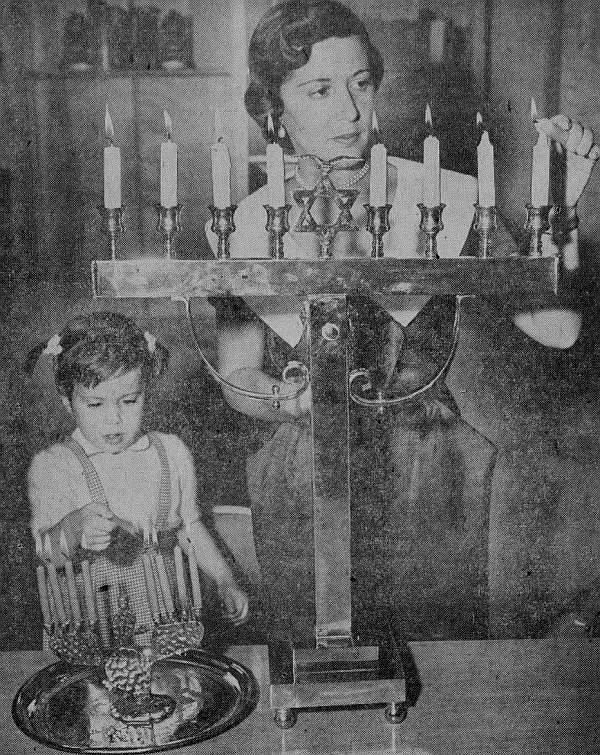
Lighting Menorahs — 1954

hanukkah_texas-jewish-post-122354

by Paula Bosse

Above, a photo of Gilla Silverman and her mother, Devora Halaban Silverman, wife of Rabbi Hillel Silverman, lighting menorahs during Hanukkah, 1954.

Happy Hanukkah!

***

Sources & Notes

Photo from the Dallas-Fort Worth Texas Jewish Post, Dec. 23, 1954. The entire 52-page issue of this special “Chanukah Issue” has been scanned and may be viewed at UNT’s Portal to Texas History site, here. (Click “zoom” to enlarge the pages, click arrows at right and left to move through the issue.)

Rabbi Hillel Silverman arrived in Dallas as the new rabbi at Congregation Shearith Israel in 1954 and was a popular and influential member of Dallas’ Jewish community for the decade or so he served here. He may be best known beyond Dallas as “Jack Ruby’s rabbi.”

Read about a 2009 return to the city by Rabbi Silverman in the Texas Jewish Post article by Dave Sorter, “A Golden Opportunity to Reunite” (Oct. 8, 2009), here.

The Texas Jewish Post article introducing Rabbi Silverman to its readership — “Dr. H. E. Silverman Appointed to Head Israel Pulpit” (July 8, 1954) — can found here.

An article focusing on the Ruby family and Dallas (Rabbi Silverman is interviewed) can be found in “Remembering JFK” by Steve North (Jewish Telegraphic Agency, via the Texas Jewish Post, Nov. 21, 2013), here.

*

Copyright © 2017 Paula Bosse. All Rights Reserved.

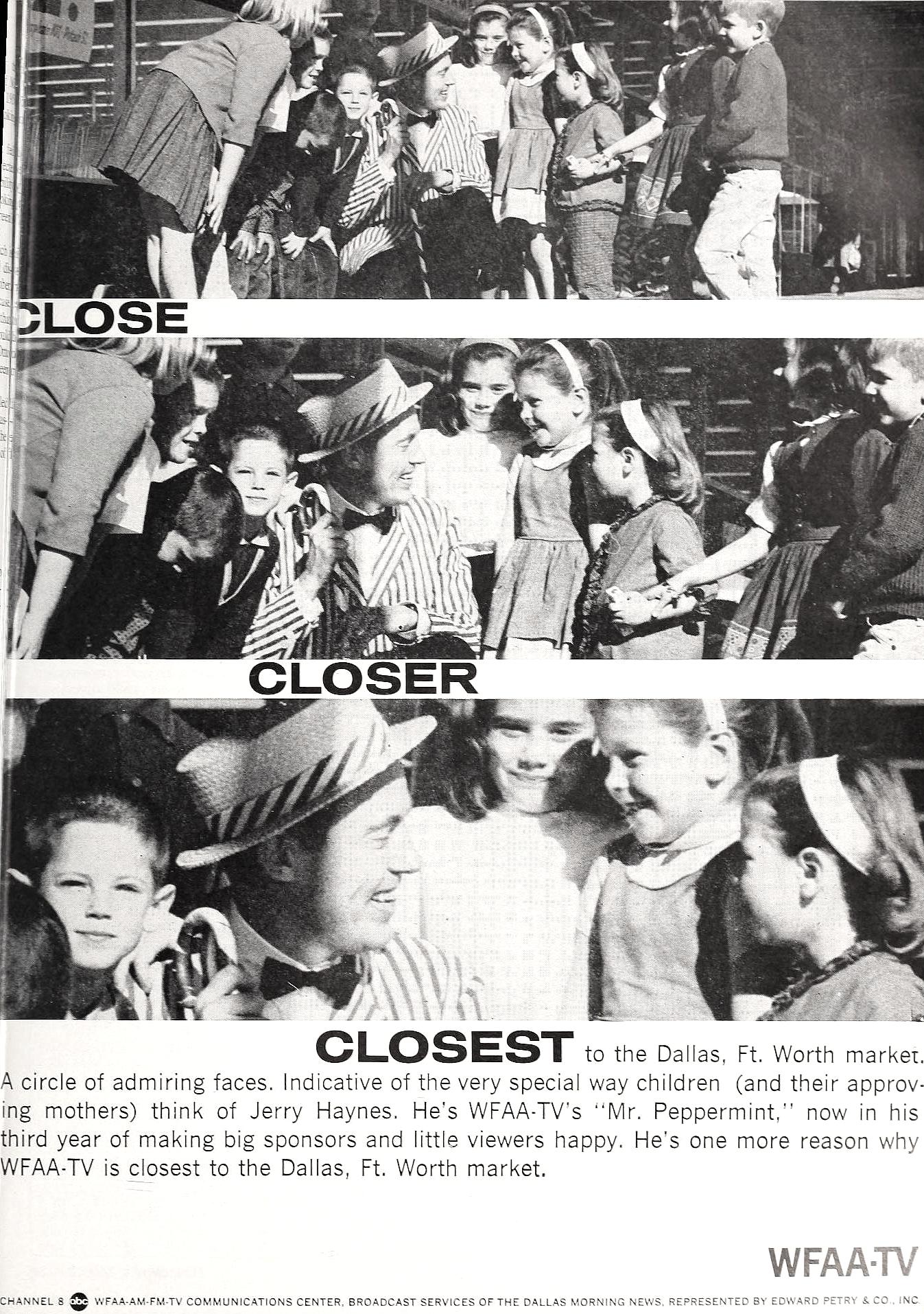
“Mr. Wiggly Worm Does Much More Than Wiggle”

mr-peppermint_sponsor-mag_112061-det

by Paula Bosse

My first crush was on Mr. Peppermint, and I really, really, really loved Mr. Wiggly Worm.

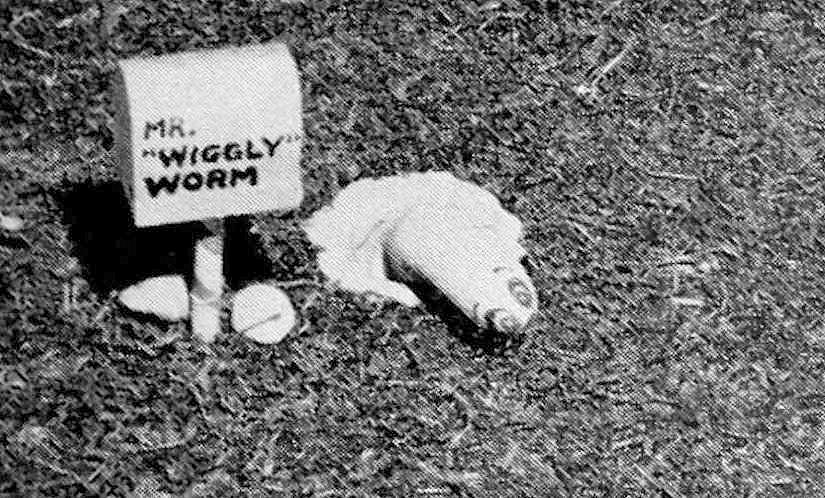
This is a rather unfortunate depiction of my childhood TV pal, but how can you not love a smiling wiggly worm with a mailbox?

mr-peppermint_sponsor-mag_112061_mr-wiggly-worm_det

mr-peppermint_sponsor-mag_021163_text

WFAA understood the appeal of Mr. W. W. They even built a whole broadcasting-trade-magazine ad around him. (Click to see it larger.)

mr-peppermint_sponsor-mag_021163Sponsor, Feb. 11, 1963

Here he is again:

mr-peppermint_sponsor-mag_112061
Sponsor, Nov. 20, 1961

Mr. W. W. stayed at home for this one, but here we see Mr. Peppermint out mingling with his adoring public.

mr-peppermint_broadcasting-mag_061063
Broadcasting, June 10, 1963

And, look, “Communications Center” — bet you haven’t heard that in a while!

communications-center_sponsor-mag_112061_det1961

***

Sources & Notes

These Mr. Peppermint advertisements were part of a series of WFAA-Channel 8 ads which ran for several years in television trade magazines.

Click pictures to see larger images.

*

Copyright © 2017 Paula Bosse. All Rights Reserved.
Newly Discovered Footage of Jack Ruby — 1960

jack-ruby_WFAA-1960_jones-collection_SMU_det

by Paula Bosse

The WFAA Telefilm Collection — part of the G. William Jones Film and Video Collection, housed at the Hamon Library at Southern Methodist University — is an incredible assemblage of film footage shot by WFAA cameramen, some of which was never included in Channel 8’s televised news stories; a lot of it is silent, filmed mostly as B-roll material. It’s a fascinating historical treasure trove of local and national (and international) events filmed between 1960 and 1978. Jeremy Spracklen — the collection’s Moving Image Curator — and his assistant, Scott Martin, regularly post entertaining short clips from this vast resource to social media.

Which brings us to the clip posted yesterday — Dec. 6, 2017 — which featured footage of a 1960 parade held in downtown Dallas at Christmastime, with shots of festively decorated Main Street and Elm Street, including nice views of the old Palace Theater. Watch it here on Vimeo.

The clip was posted last night on the Jones Collection’s Facebook page — before I watched it, I read the comment by Bert Harris: “Did you notice Jack Ruby combing his hair right toward the end of the clip?? Wild!!

What?!

Yes, at the very end of the short clip you see Jack Ruby (!) standing in a crowd of people in front of the W. A. Green department store combing his hair and adjusting his famous fedora. It’s very short, but it’s unmistakably Jack Ruby. You never know who’s going to pop up in these snippets of everyday life in Dallas, captured decades ago by WFAA cameramen! So now SMU has a few frames of what has just become historic film footage — footage which has probably been unseen for 57 years — there’s a good chance this never even aired and was merely B-roll footage. I never imagined it would be an exciting event to watch Jack Ruby comb his hair.

I contacted curator Jeremy Spracklen at SMU, and he was pretty excited about the discovery. He even cut a brand new clip this afternoon, isolating the Ruby footage and slowing it down considerably. It’s COOL. Here it is:

Below are some screen captures. I’ve had to lighten them a bit — click pictures to see larger images. Ruby and a friend are in the center of the first frames, then as the clip ends, he’s in the lower left corner.

Who is the guy with Ruby, and what is he holding in his hand? UPDATE: My first thought was that it might be Ruby’s roommate George Senator (from all accounts a good-natured guy who was perpetually out of work and out of cash — Ruby often helped him out, including inviting him to stay for a while at his apartment in early 1962). I didn’t really think he looked like the scarce few photos of him I’d found, but others in the comments below seem to think it might be him. He’s holding a Minox “spy” camera, which was an expensive tiny camera which had been sold for years in several stores in Dallas (and which was offered used in classified ads in The News in 1960 for $75 — about $125 today). By the man’s look of utter fascination with it, it appears that it probably belonged to Ruby. The man can be seen looking through it in the longer clip at the :50 mark. (See one of the first Minox ads found in a Dallas paper — sold by Linz Jewelers in 1951 — here, and in the year of this footage, in 1960, in a Neiman-Marcus ad, here, priced at $139.50, about $1,200 today.)

jack-ruby_WFAA-1960_jones-collection_SMU_2

jack-ruby_WFAA-1960_jones-collection_SMU_3

jack-ruby_WFAA-1960_jones-collection_SMU_4

jack-ruby_WFAA-1960_jones-collection_SMU_5

jack-ruby_WFAA-1960_jones-collection_SMU_6

***

Sources & Notes

The clip is compiled from WFAA news footage shot on November 26, 1960; it is from the WFAA Newsfilm Collection, held at the Hamon Arts Library, Southern Methodist University. The original clip (1:22) showing a holiday parade in downtown Dallas can be watched on Vimeo here; the slowed-down clip showing only the Jack Ruby footage can be watched on Vimeo here.

According to coverage of the event in the Dallas Times Herald (“Mile of Dimes Parade Lures Great and Small,” Nov. 27, 1960), the parade was the “Mile of Dimes” parade sponsored by the Dallas Junior Chamber of Commerce and the Salvation Army. It took place on Saturday, Nov. 26, 1960. In addition to the parade, there was a “show” staged on Elm and Ervay which had bands performing on the back of a flatbed truck. Two of the acts performing that day were the Joe Johnson combo and singer Jewel Brown — both of whom were mainstays in Ruby’s clubs: at the time of the parade, Johnson’s band was booked into a long run at the Vegas Club/Club Vegas in Oak Lawn, and Brown was appearing seven nights a week (!) at the Sovereign Club on Commerce Street (which Ruby would later rename “the Carousel Club” around March, 1961). So that explains why he was there, nonchalantly combing his hair on the street as his “employees” perform in front of him.

Footage of the musical performers begins at the 1:00 mark in the longer clip. Houston-born Jewel Brown can be seen at 1:07. She was pretty much a smash in Dallas, getting loads of good press; she later hit it big appearing with Louis Armstrong in Las Vegas — you can watch a fantastic clip of her singing here. Read a March, 1967 interview with her in which she discusses her working relationship with Ruby here.

ruby_band_1.09_jones-collection_SMU

Ruby was standing outside the W. A. Green department store at 1616 Elm Street, which was next door to the Wilson Building; the Palace Theater was directly across the street.

elm-street_1600-block_1961 directory1961 Dallas directory

In addition to the musical performers mentioned above, other celebrities appearing in the parade footage that day were actresses/sexpots Sheree North and Lynne Forrester, who were appearing in Clare Boothe Luce’s play “The Women” at Casa Manana (:34), and orchestra leader Freddy Martin, who was appearing at the Statler’s Empire Room (:45). According to the Times Herald article, one celeb who was also there that day was recent Olympian Cassius Clay (later known as Muhammad Ali), fresh from his gold-medal performance at the Olympics. Though wearing his U.S. Olympic team jacket, the 18-year-old future-legend somehow went unnoticed in the crowd which was apparently quite wrapped up in the musical offerings that day.

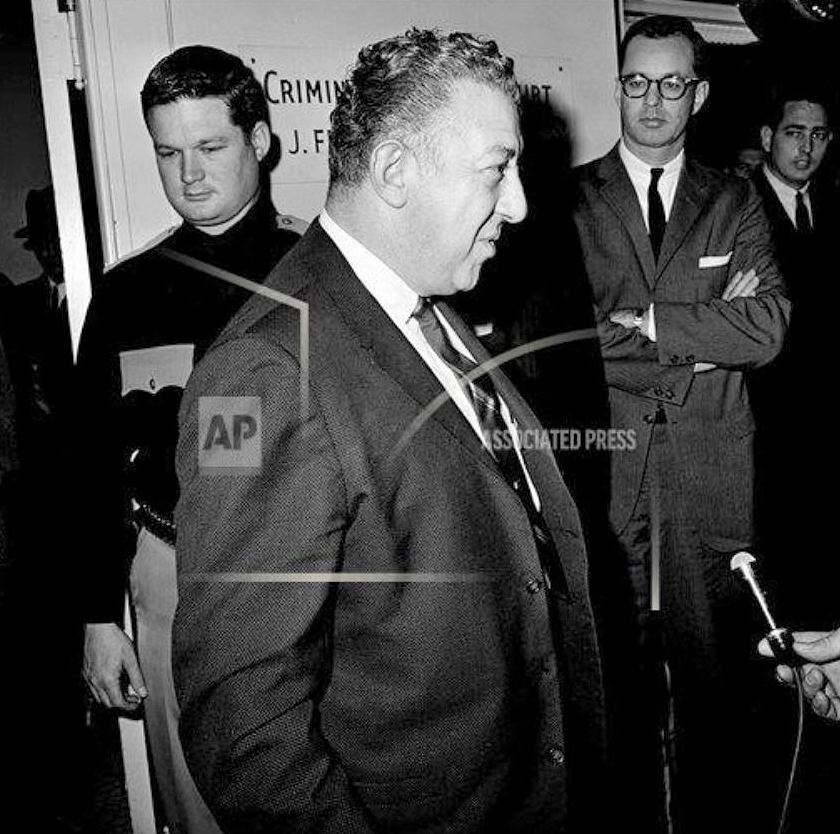
Here is a photo of George Senator, possibly the man standing next to Ruby. This photo was taken on Nov. 24, 1963 at the Dallas Police Station; it is from the Fort Worth Star-Telegram Collection, University of Texas at Arlington Libraries, UTA — more info is here (I have cropped and flipped this detail). Another photo of Senator from the same night can be seen on the Portal to Texas History site, here.

senator-george_FWST-collection_UTA_112463.det_flipped

And these two Associated Press photos were taken on March 9, 1964, showing Senator at the Jack Ruby trial.

senator-george_at-jack-ruby-trial_associated-press-website_030964_1

senator-george_at-jack-ruby-trial_associated-press-website_030964_2

*

I’ve mentioned the WFAA Newsfilm Collection several times — it is an amazing collection of WFAA-Channel 8’s archival news footage, out-takes, and B-roll material. Curator Jeremy Spracklen has been uploading bite-size segments to Twitter and Facebook — it’s a lot of cool stuff you’re probably not going to be able to find anywhere else. They’re very entertaining. Follow them on social media!

*

Copyright © 2017 Paula Bosse. All Rights Reserved.

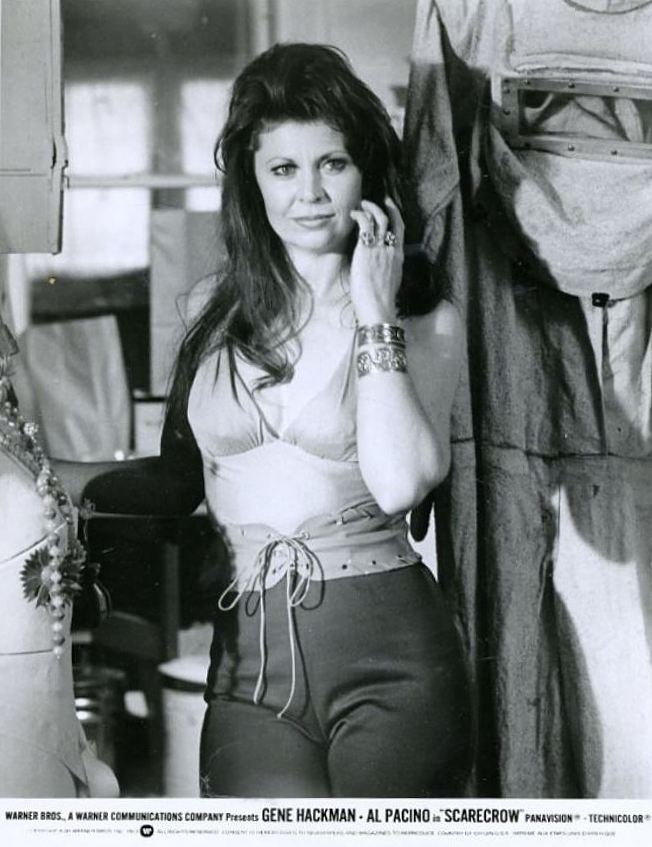
Ann Wedgeworth: 1934-2017

wedgeworth_ann

by Paula Bosse

The actress Ann Wedgeworth has died. If you don’t know her by her name, you probably know her by her face, or, even more likely, by her voice. I’m always impressed when actors are able to retain their natural accents without having to homogenize them to meet Hollywood standards, and Wedgeworth’s Texas accent was pretty thick. I would bet hard cash she reminds you of someone you know or someone in your own family.

Even though she had worked as an actor since she was a teenager — in school productions, small regional theaters, off-Broadway, Broadway, TV, soap operas, and movies — it was probably her short-lived role as Lana on Three’s Company which brought her to the attention of the widest audience.

Elizabeth Ann Wedgeworth was born in 1934 in Taylor County and spent her early years in Snyder and Perryton, Texas, where her father had been the superintendent of schools (her mother died when she was 2); she arrived in Dallas around 1946 when she was about 12 years old. Her father worked in conjunction with SMU and the Veteran’s Administration for a time before becoming a longtime employee of the City of Dallas; her stepmother was a student counselor at Highland Park Junior High School.

She attended high school in Highland Park, graduating from HPHS in 1950 (the same year as her school friend, Jayne Mansfield). She began her acting career when she was a teenager, racking up quite a lot of experience in Dallas theater productions and in a Colorado stock company. She focused on acting during college, which included both SMU and the University of Texas — she probably met her future husband Rip Torn in Austin, where he was a fellow actor who had been active in the UT theater program (and who was, incidentally, the cousin of future actress Sissy Spacek). The couple was married in Dallas in 1955, at the First Methodist Church (which I wrote about here). They lived in Killeen briefly until Torn’s military stint at Ford Hood was up, then they headed to New York City, where the couple began to find acting work fairly quickly. The two had one daughter and divorced in 1961; she remarried and had another daughter. (More about Ann Wedgeworth can be read in the Wikipedia entry here.)

Ann worked a lot, and, as I said, I’m pretty sure you’ve seen her in something. Though known mostly for her work in TV and movies, she won a Tony Award in 1978 for her role in Neil Simon’s Broadway play Chapter Two. Her breathlessly exuberant (and charmingly ditzy) acceptance speech is amusing (I am such a sucker for that accent!):


*
Ann Wedgeworth died on November 16, 2017; she was 83 years old.

*

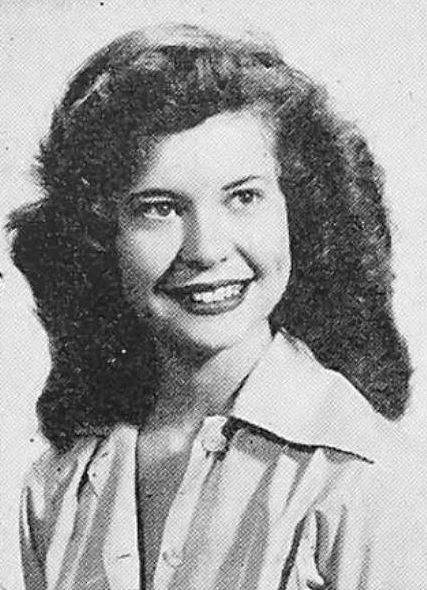
wedgeworth-ann_HPHS_sophomore-1948Highland Park High School sophomore, 1948

wedgeworth-ann_HPHS_junior_1949HPHS junior, 1949

wedgeworth-ann_HPHS_senior_1950
wedgeworth-ann_HPHS_senior_1950_info
HPHS senior, 1950

wedgeworth-ann_smu_freshman_1951SMU freshman, 1951

wedgeworth-ann_smu_campus_022252_photo
SMU sophomore, 1952

wedgeworth-ann_smu_campus_030552_cronyn
Appearing on national radio with Hume Cronyn, 1952

wedgeworth-torn_longview-news-journal_020655

wedgeworth-torn_longview-news-journal_020655_caption1955 announcement of her marriage to Rip Torn

wedgeworth-ann_scarecrow_1973Publicity photo for the 1973 movie “Scarecrow”

wedgeworth_pinterest

wedgeworth-ann

ann-wedgeworth
photo via Lipstick Alley

***

Sources & Notes

Ann Wedgeworth’s obituary in The Washington Post can be found here.

School photos are from Highland Park High School and Southern Methodist University yearbooks.

The photo of 18-year-old Ann with Hume Cronyn appeared in the SMU Campus newspaper on March 5, 1952. (I believe Ann came in second in the competition.)

The wedding announcement of Ann and Rip Torn appeared in the Longview Daily News  on Feb. 6, 1955. (Rip Torn was born Elmore Rual Torn, Jr. — as a kid he was actually known as “Skip” Torn. …Doesn’t have quite the same ring to it….)

Most photos and clippings are larger when clicked.

*

Copyright © 2017 Paula Bosse. All Rights Reserved.

Event: “Remixing the News” Screening at SMU

remixing_hamon-library-blog-header

by Paula Bosse

UPDATE: The screening was great! For those of you who might have missed this event — or who would like to see the films again — the one-hour program is airing on KERA-Channel 13’s “Frame of Mind” on Thurs. Nov. 16, 2017 at 10:30 p.m., with another airing at 2:00 a.m. on Nov. 20.

*

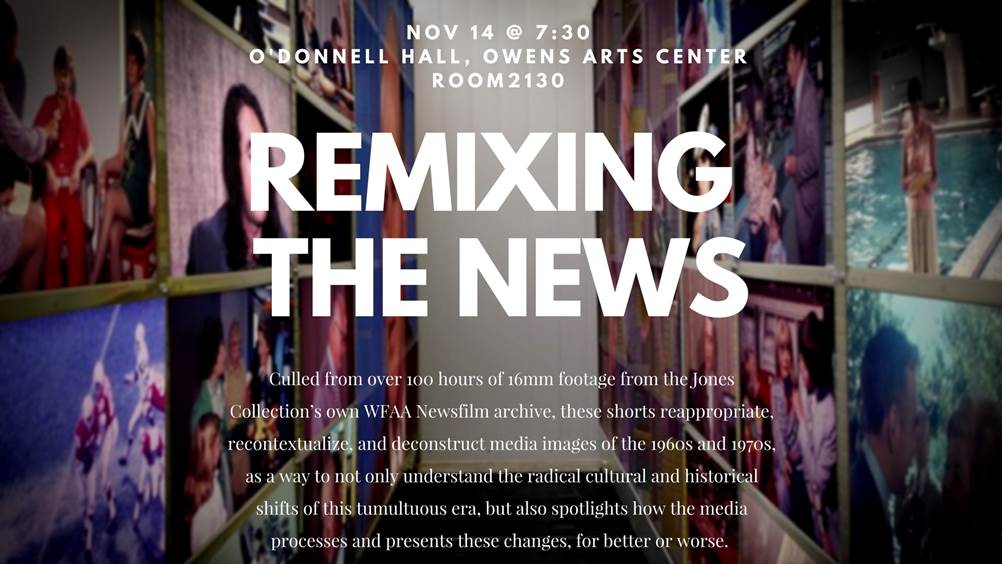
I’m really late announcing this event — WHICH TAKES PLACE TUESDAY, NOV. 14!! — but it sounds like something that people who are interested in Dallas history and/or video art would really enjoy: “Remixing the News,” presented by the G. William Jones Film and Video Collection at the Hamon Arts Library (SMU), in collaboration with KERA television and Dallas VideoFest.

So what is it?

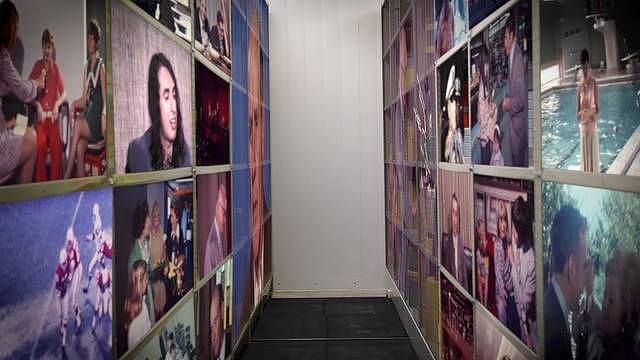
The Jones Collection at SMU includes the WFAA Newsfilm archive which contains what must be thousands of hours of 16mm film footage from the 1960s and ’70s, originally shot to be used as part of Channel 8 News broadcasts (this includes tons of B-roll footage shot to supplement the stories, but not always used in newscasts). As you can imagine, this is an unusual treasure trove of local news, history, and pop culture. I’ve dipped in and showcased some of the offerings in previous posts about the State Fair of Texas, and on Dallas appearances by Jimi Hendrix, Tiny Tim, and Glen Campbell.

Jeremy Spracklen, head curator of the Jones Collection, describes how this interesting local news archive was “reappropriated, recontextualized, and deconstructed” to become something altogether different:

We went in a unique direction in this — we did an experiment where we gave 10 local filmmakers a hard-drive with several hundred hours’ worth of footage on it and had them create their own interpretation of it. So, it is part history and part new video art.

I love this sort of thing. Eleven short films were produced by ten Texas filmmakers (Spracklen himself contributed two). Here are the films which will be shown Tuesday night, November 14:

  • “2,000 Hours in Dallas” by Jeremy Spracklen
  • “The Story of Jane X” by Christian Vasquez
  • “Dallas Circle” by Justin Wilson
  • “Lawmen & Cowpokes” by Gordon K. Smith
  • “History Lessons” by Steve Baker
  • “Beyond 10” by Carmen Menza
  • “Glass” by Madison McMakin
  • “Poofs are New” by Blaine Dunlap
  • “Divided” by Michael Thomas & Dakota Ford
  • “The Night in the Last Branches” by Michael Alexander Morris
  • “Echoes of the Past” by Jeremy Spracklen

The FREE advance screening of this collection (which will air at a later time on KERA’s long-running “Frame of Mind” series) will be held at SMU in the Owen Art Center on Tuesday, Nov. 14 (which might be TODAY!) — it begins at 7:30 p.m. After the screening, Bart Weiss, artistic director of the Video Association of Dallas, will host a Q&A with several of the filmmakers in attendance.

ALSO, Jeremy Spracklen tells me that those who are interested are invited to tour his very chilly subterranean film-archive lair after the event. So much Texas film history lurks beneath the SMU campus!

This event sounds great. Be there!

remixing-the-news_smu_hamon

“Remixing the News”

Presented by the G. William Jones Film and Video Collection, Hamon Arts Library, in collaboration with KERA and VideoFest

Date: Tuesday, November 14, 2017
Time: 7:30 p.m. – 9:00 p.m.

O’Donnell Hall, room 2130, Owen Arts Center (see map below)

FREE to the public

***

Resources & Notes

More on this event can be found on the SMU website here and on the Hamon Arts Library blog here; the Facebook event page is here.

The event is free, and parking on the SMU campus after 7:00 p.m. is also free. Parking at SMU scares me, but here is what Jeremy advises: “The closest parking is in the meters in front of the Meadows building (they are not active after 7:00), the ‘U’ lot just south of the building, and, if those are full, the Meadows Museum parking garage is open — it is just down Bishop Blvd. and about a 5-minute walk.”

His map is below, with the parking areas highlighted in red. (Click to see larger image.)

SMUCampusMapNamesBLK

More on the WFAA Newsfilm archive can be found in a Flashback Dallas post “How the News Got Made.”

One of the filmmakers who has contributed a film to this event is Blaine Dunlap — I have posted links to two of his films, both of which I really enjoyed: Sunset High School on Film — 1970″ (which he made while he was a Sunset student) and “‘Sometimes I Run’: Dallas Noir — 1973” (about a philosophizing downtown street cleaner).

More on “Frame of Mind” here.

*

Copyright © 2017 Paula Bosse. All Rights Reserved.


Our Lady of Good Counsel, Oak Cliff — 1901-1961

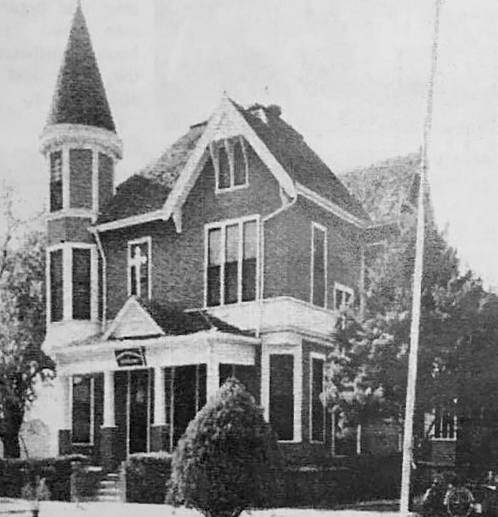
our-lady-of-good-counsel_1944-yrbkOur Lady of Good Counsel, 1944… (click for larger image)

by Paula Bosse

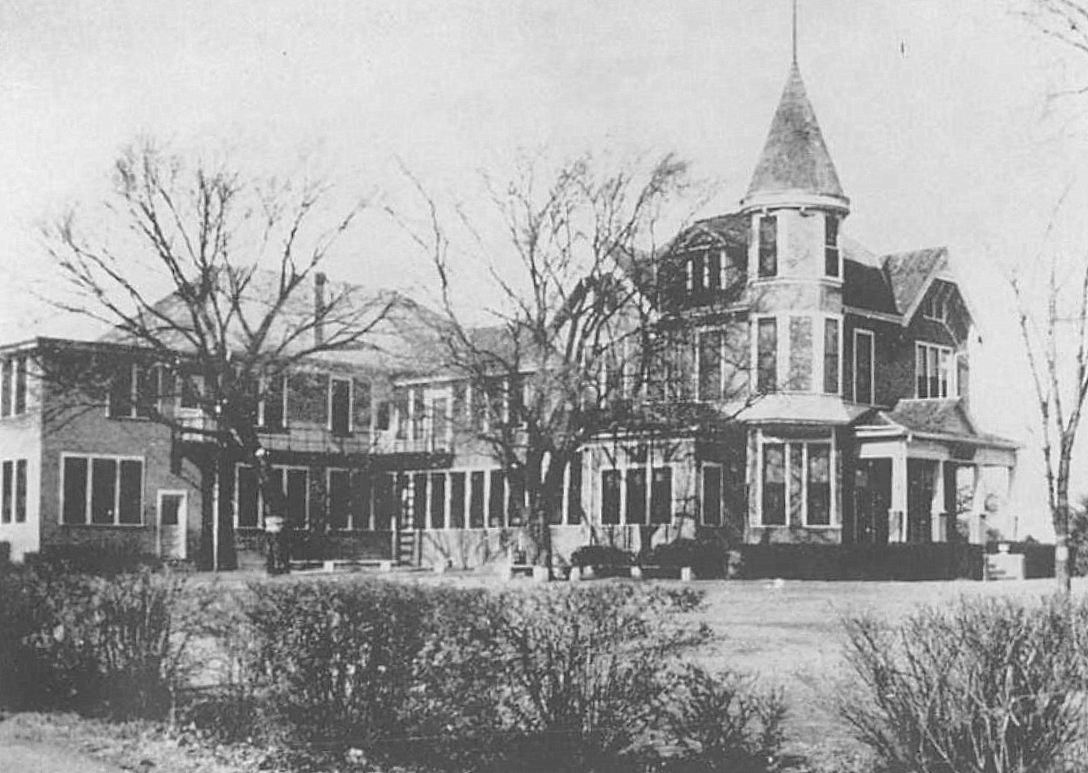
Talking to my aunt today reminded me that she briefly attended Our Lady of Good Counsel, the all-girls Catholic high school in Oak Cliff next to the Church of the Blessed Sacrament, at the northwest corner of North Marsalis (originally named Grand Avenue) and 9th Street. I’m still not sure why she went there (our family isn’t Catholic), but she seems to have enjoyed her time there for a year or two before she transferred to Crozier Tech.

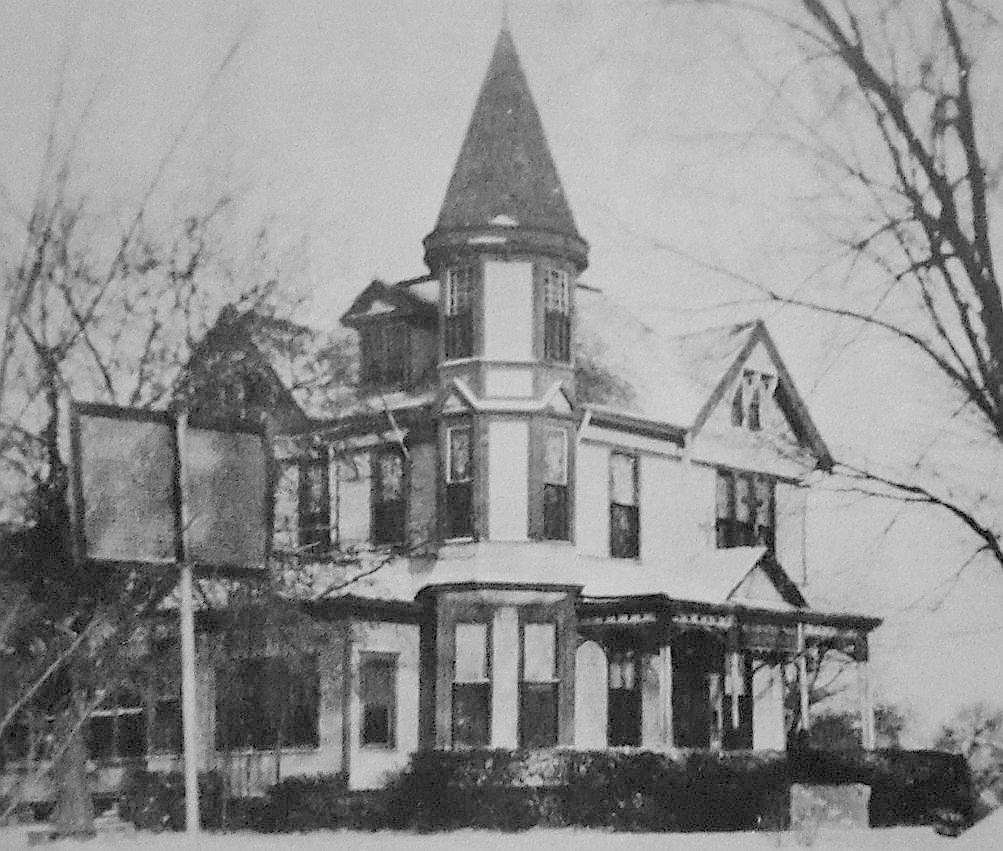
The school building was the former palatial home of wealthy businessman James T. Dargan, a one-time partner of Thomas L. Marsalis. The house was built about 1888, and according to Dallas Rediscovered author William L. McDonald, it was designed by the Dallas architectural firm of Stewart and Fuller.

dargan_1889-directory1889 Dallas directory

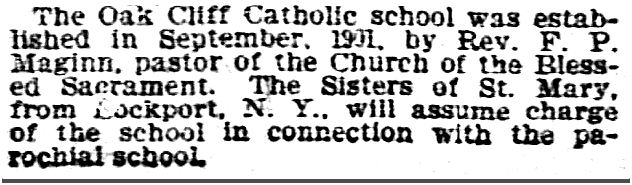
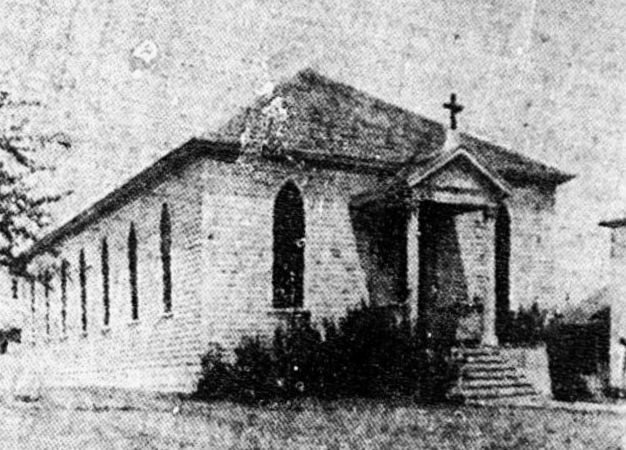
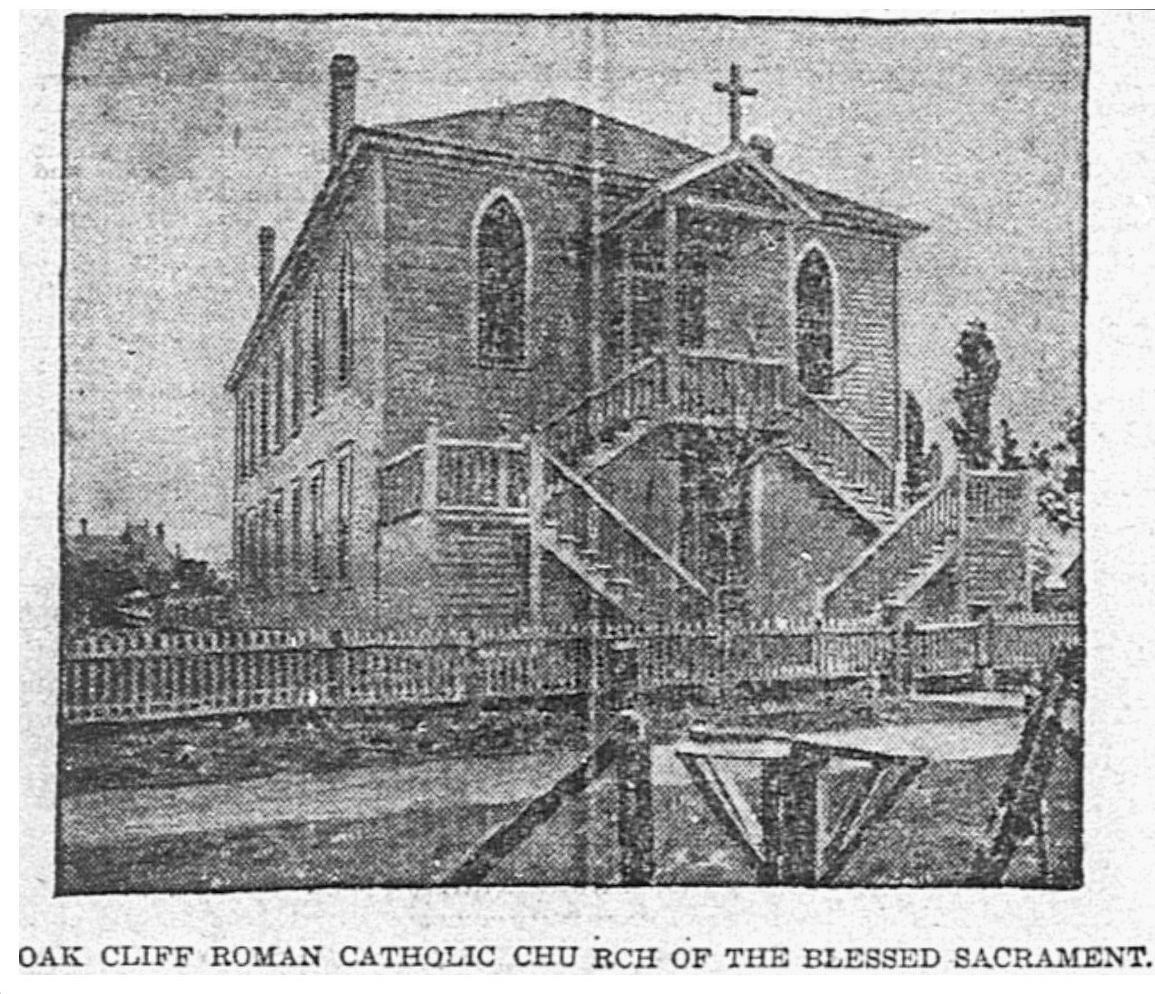
The church was holding services in Oak Cliff as early as 1901, and an affiliated school was established by Rev. Francis P. Maginn in September of that year. It appears that the Dargan house was acquired in 1902, the same year that the (new?) church building was dedicated in ceremonies officiated by Bishop E. J. Dunne.

Below, the new church can be seen in a photo which appeared in The Dallas Morning News on the day of its dedication in June, 1902 (all images are larger when clicked):

church-of-blessed-sacrament_dmn_061502_photoDMN, June 15, 1902

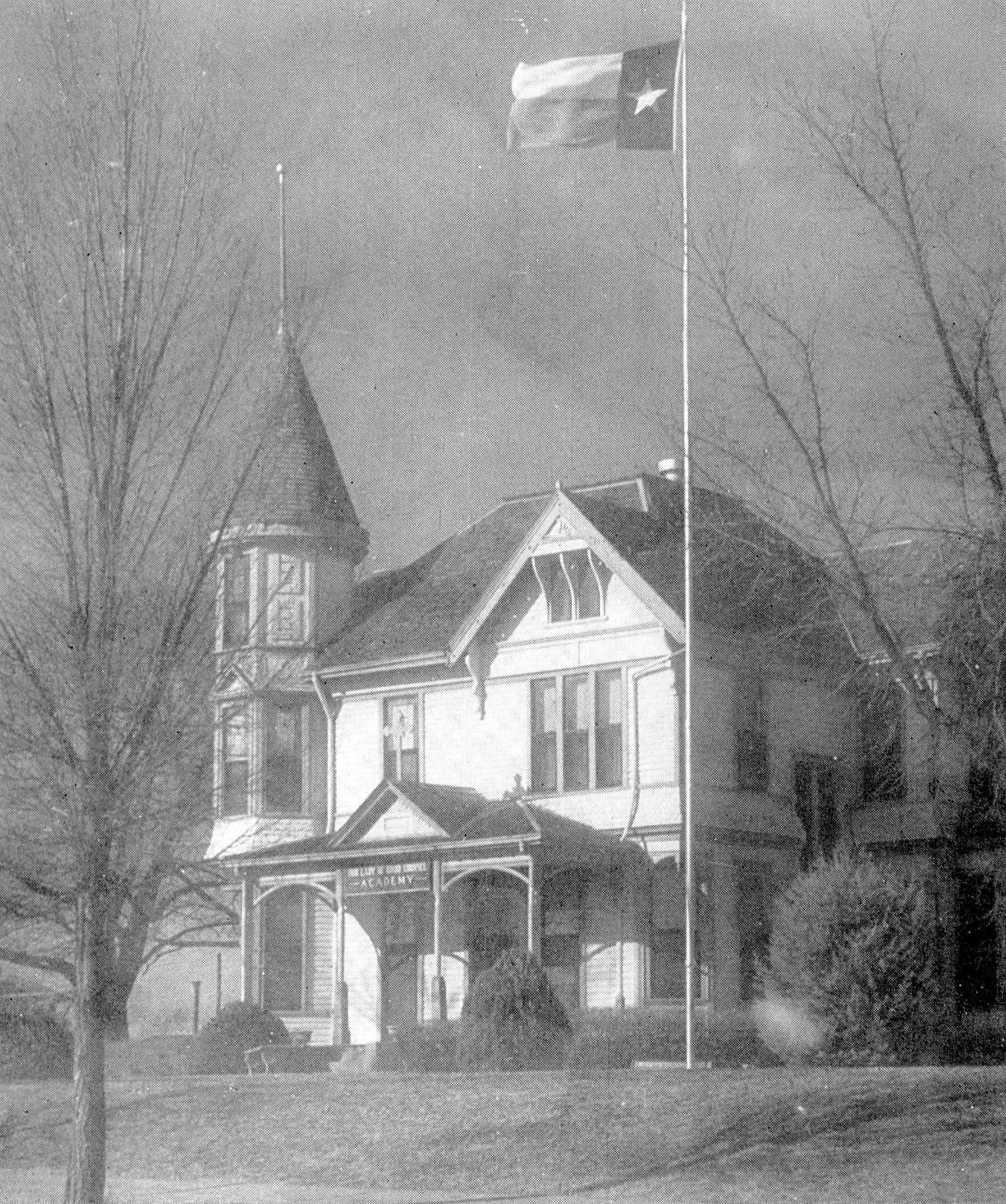
The neighboring school can be seen in these two early photos:

OLGC_ad_dallas-history-guild
Our Lady of Good Counsel, ca. 1902

our-lady-of-good-counsel_ca-1905_dallas-rediscovered
Our Lady of Good Counsel, ca. 1905

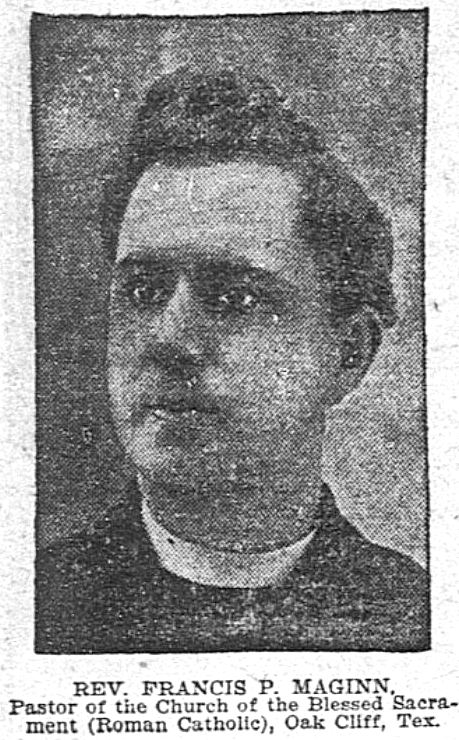
The school’s founder, Rev. F. P. Maginn:

maginn-francis-p_dmn_061502_church-of-blessed-sacrament
DMN, June 15, 1902

OLGC_dmn_042302DMN, April 23, 1902

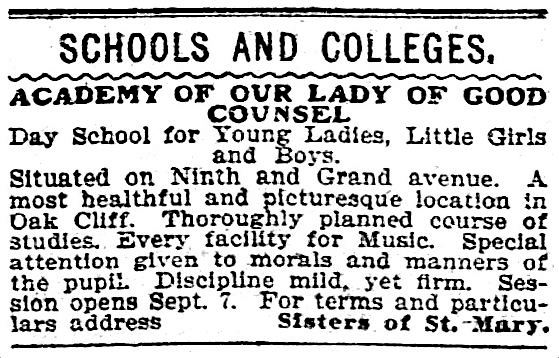
And an early ad for the school, from 1903 (“Discipline mild, yet firm”):

our-lady-of-good-counsel_1903-ad
1903

Here it is in 1942:

our-lady-of-good-counsel_1942-yrbk

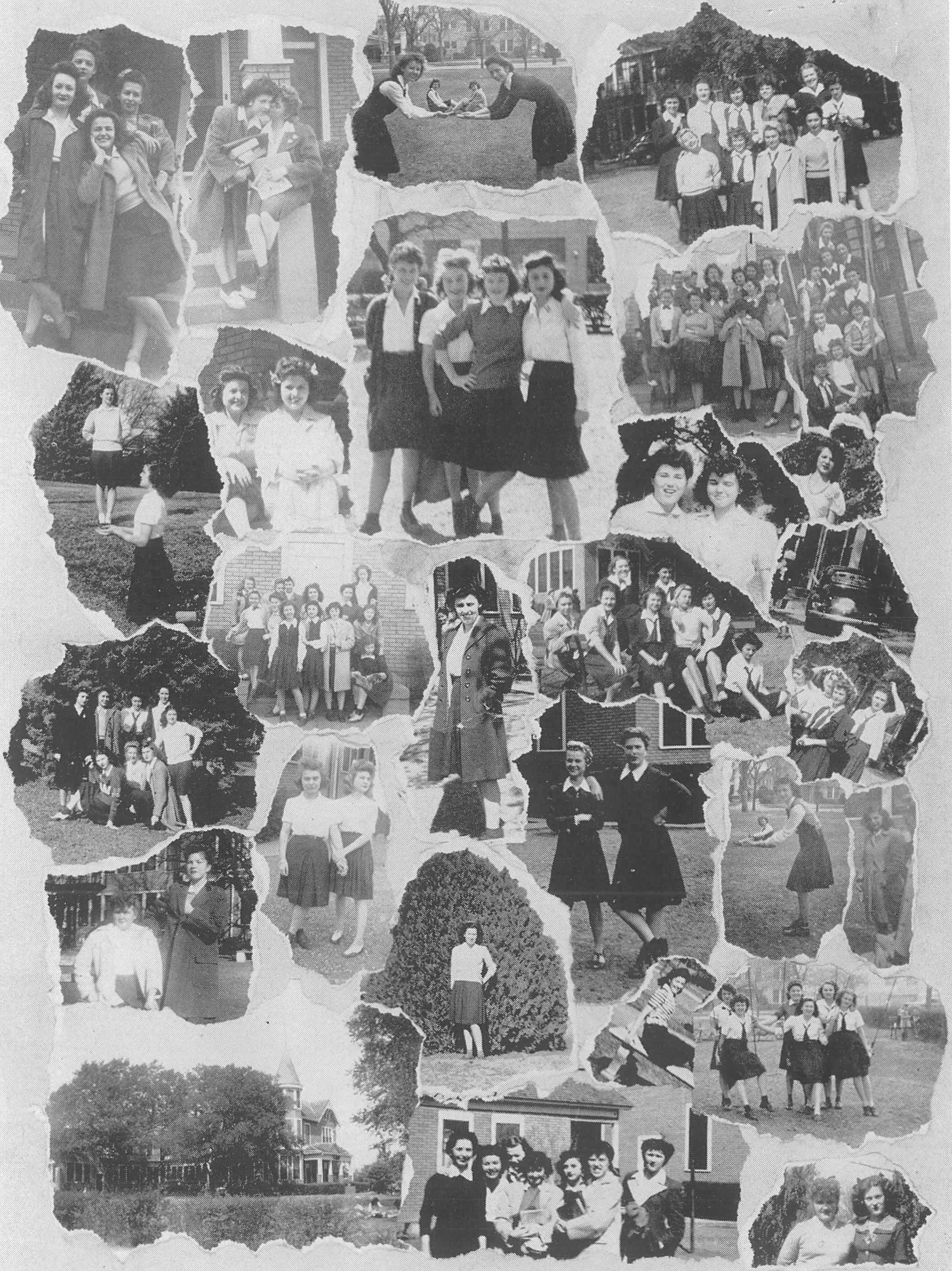
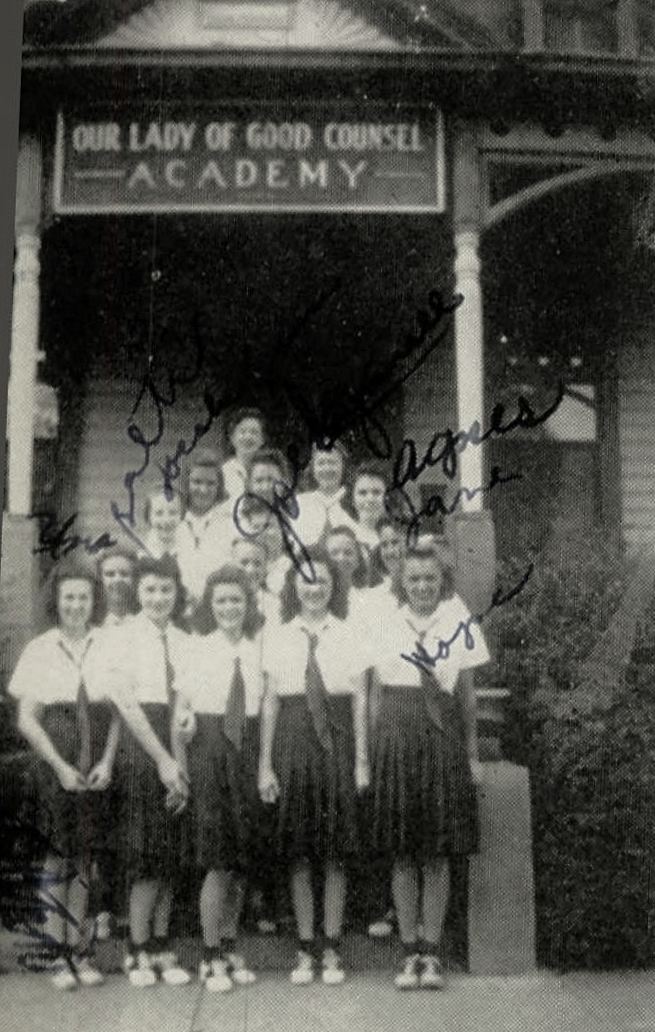
And here are some of the LGC high school students from 1944, looking bobby-soxer-y (with another view of the augmented house in the lower left corner):

our-lady-of-good-counsel_1944-yrbk_candids

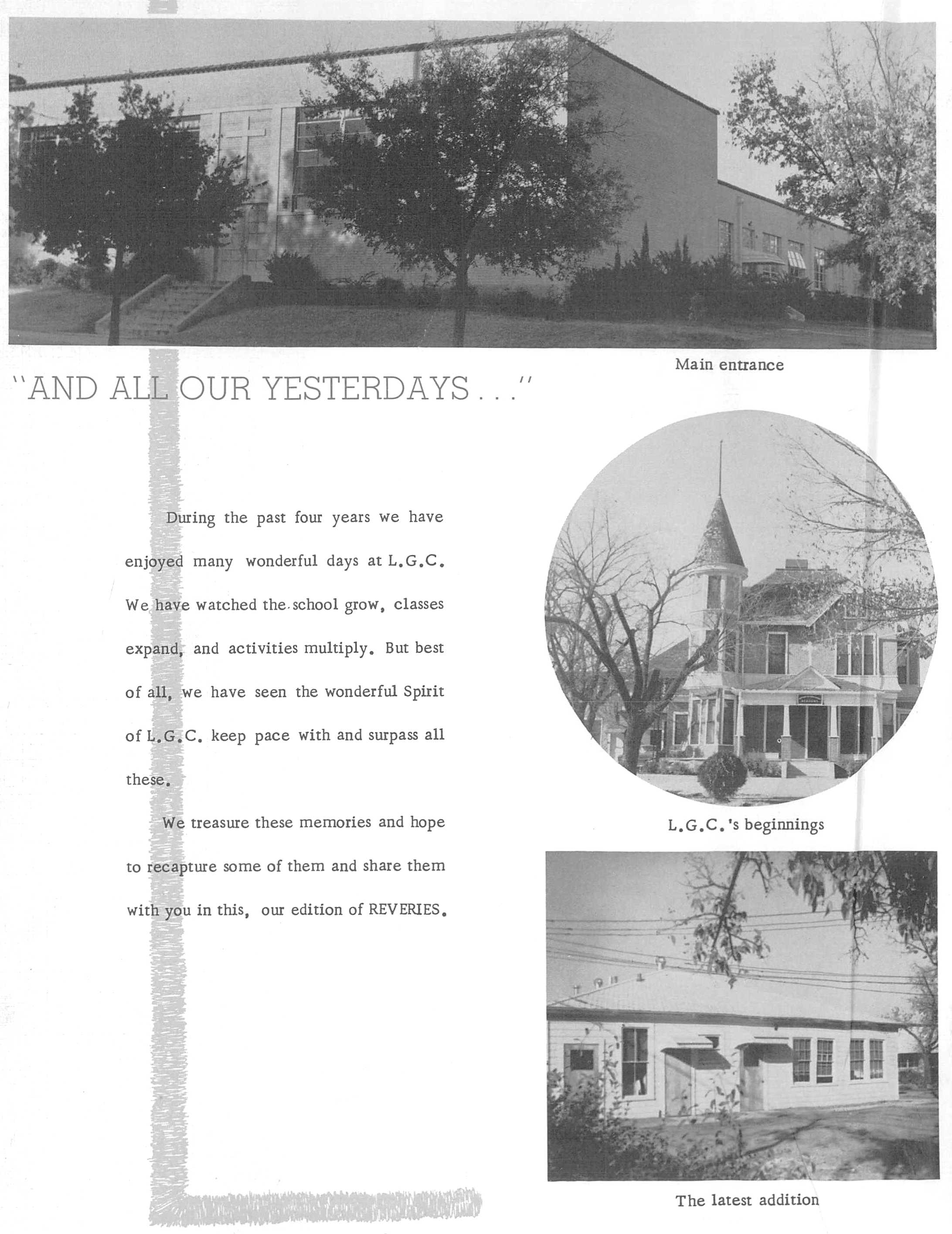
The newest additions to the building can be seen in the 1959 yearbook:

our-lady-of-good-counsel_1959-yrbk

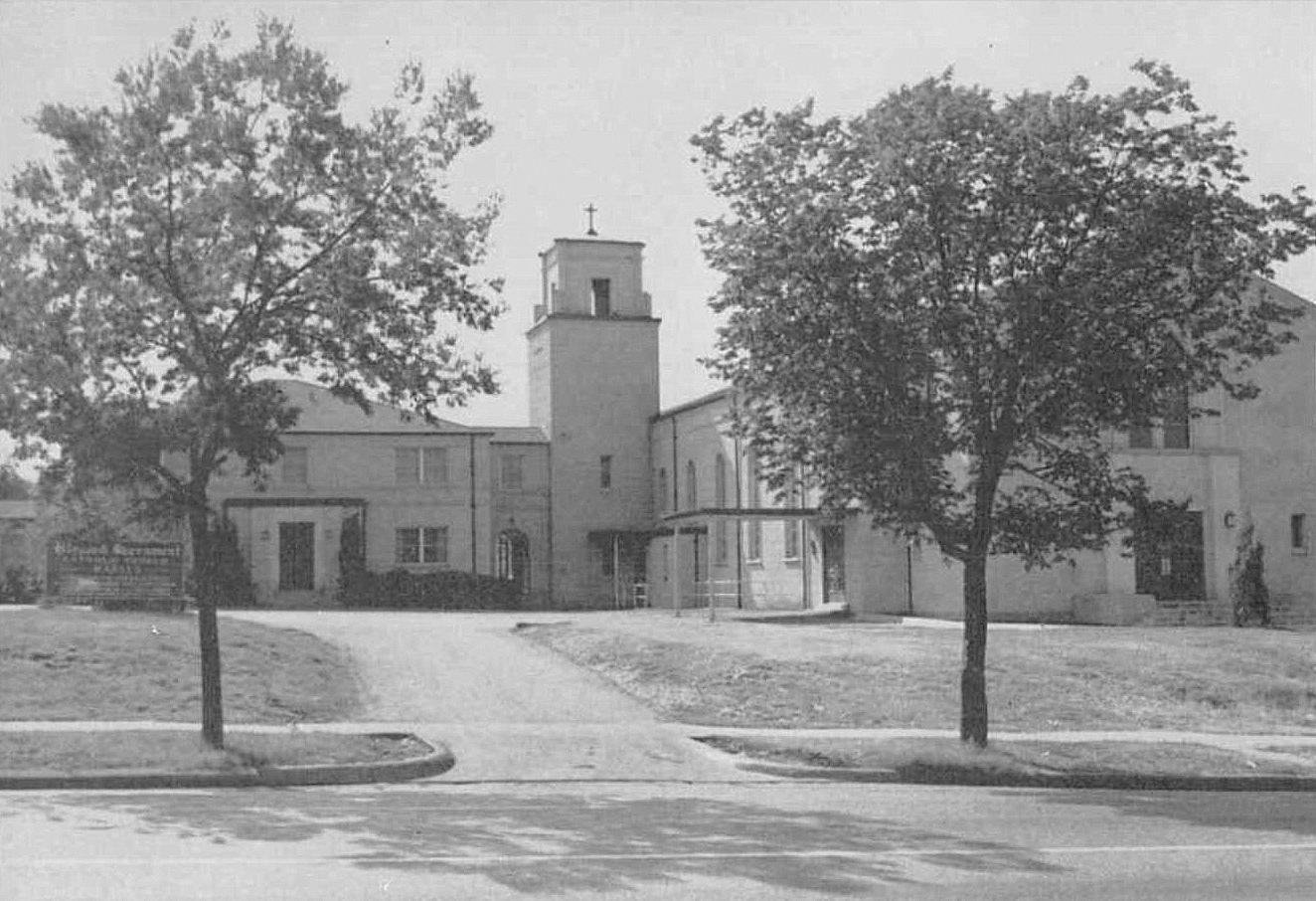
In 1961, Our Lady of Good Counsel was a fast-fading memory: a new 32-acre campus had been acquired and on it had been built the new (coed) Bishop Dunne High School. Mr. Dargan’s old house-turned-school-building was torn down a few years later, and the land became a parking lot for the Blessed Sacrament church next door (which had also seen many changes and a new building over the years). Today, the view of the land the Dargan house sat on 130 years ago looks like this. (The church looks like this.)

The church in 1930:

church-of-blessed-sacrament_1930

And in 1958 (from the LGC yearbook):

blessed-sacrament-church_OLGC-yrbk_1958

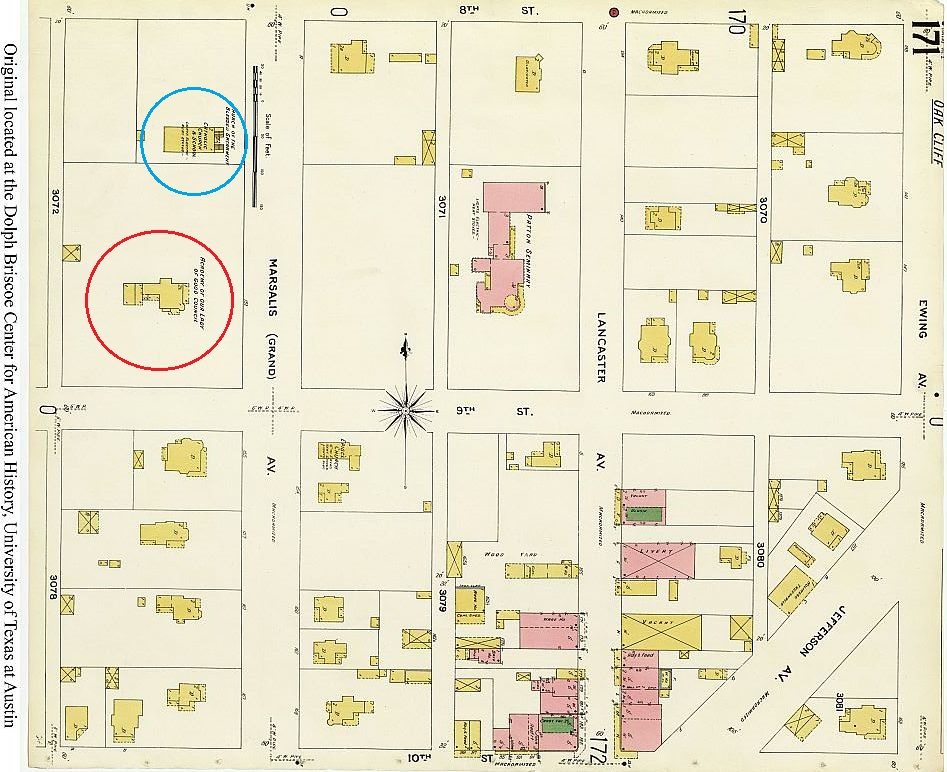
This visual aid will help give an idea of the acreage of both the school (circled in red) and the church (circled in blue), via the 1905 Sanborn map:

OLGC_sanborn_dallas-1905_sheet-171

I’m still not sure why my aunt went there….

OLGC_address_1958
1958

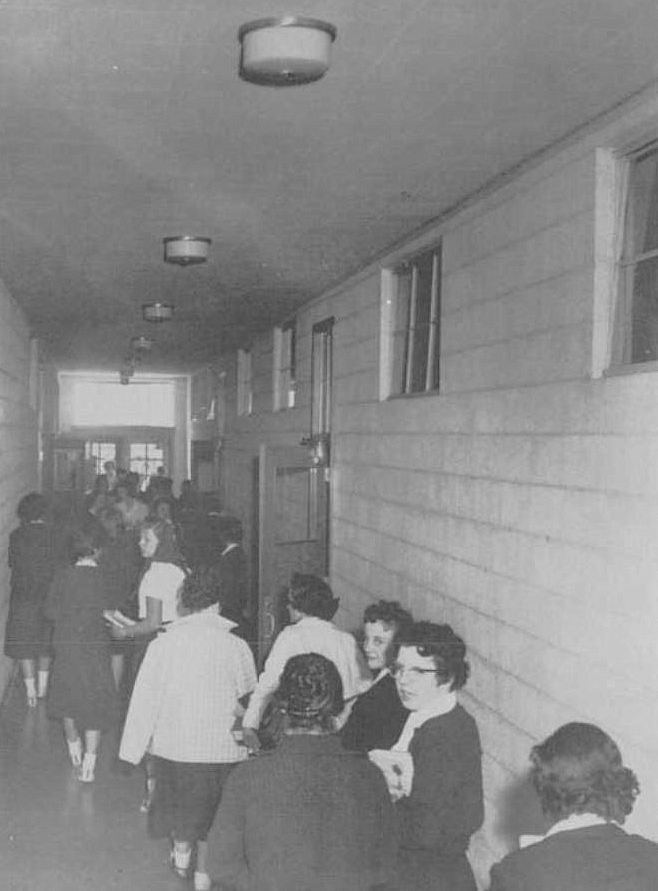
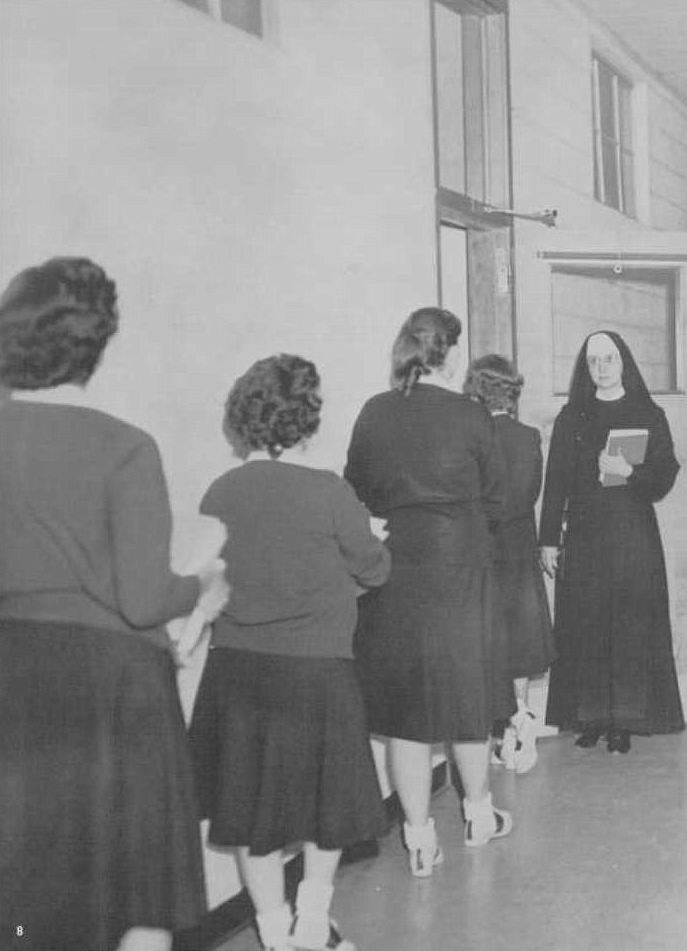
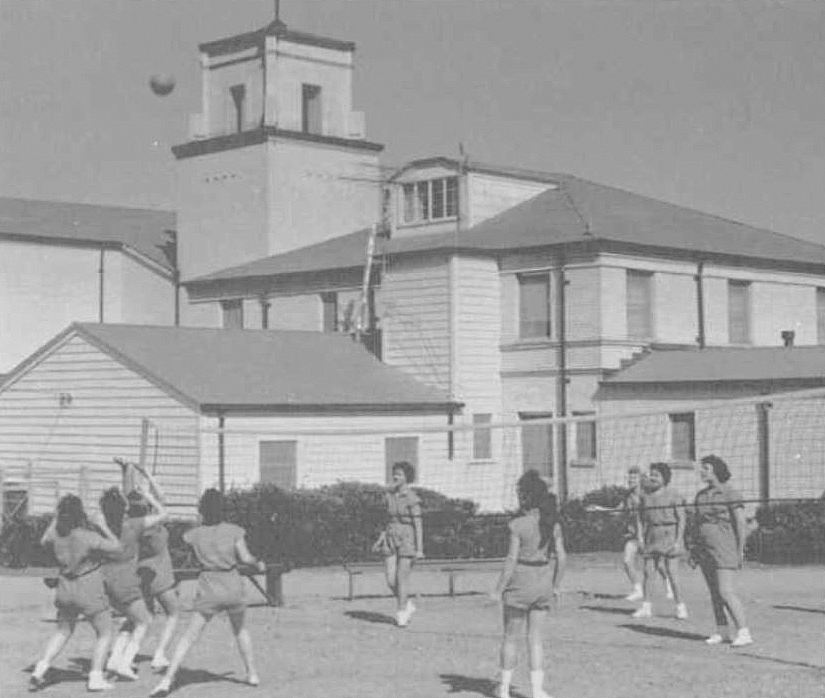
UPDATE: For those who might have wanted to see some interior photos, I didn’t find many, other than typical classroom shots, but here are some additional photos, a couple of which show the hallway.

Between classes, 1959:

OLGC_1959-yrbk_hallway

Girls lining up to go into class, 1960:

OLGC_1960-yrbk_hallway

Girls outside playing volleyball, 1960:

OLGC_1960-yrbk_volleyball

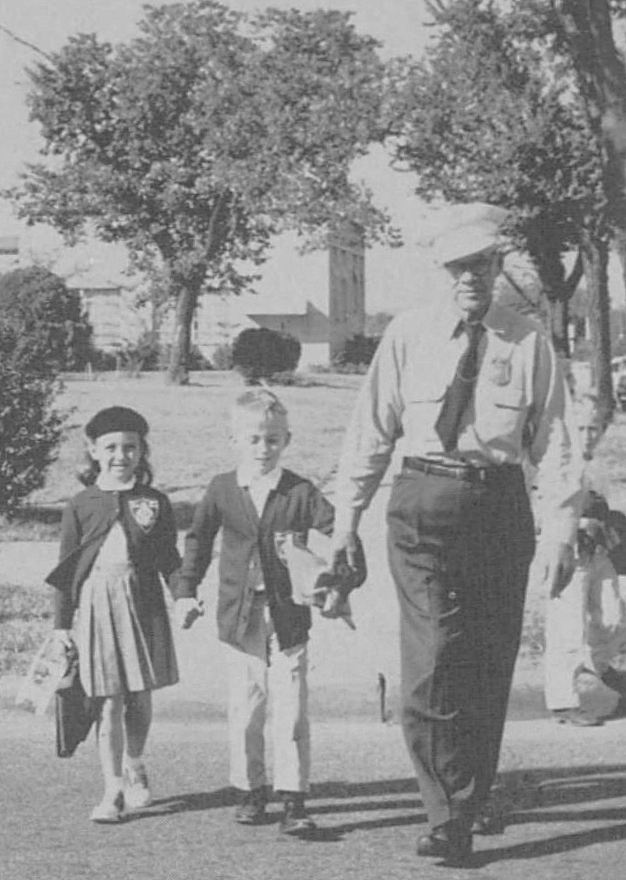
I had erroneously assumed that LGC was an all-girls 4-year high school; I believe it was a 12-year school, with boys and girls up to high school level, when it became girls-only. This photo appeared in the 1960 yearbook with the following caption: “The safety of all LGC students is the responsibility of the school as long as the students are on campus. For this reason, Officer H. A. Baxtley is available every day as a gracious escort for our little ‘Lions’ across the busy Ninth and Marsalis intersection.”

OLGC_1960-yrbk_crossing-guard

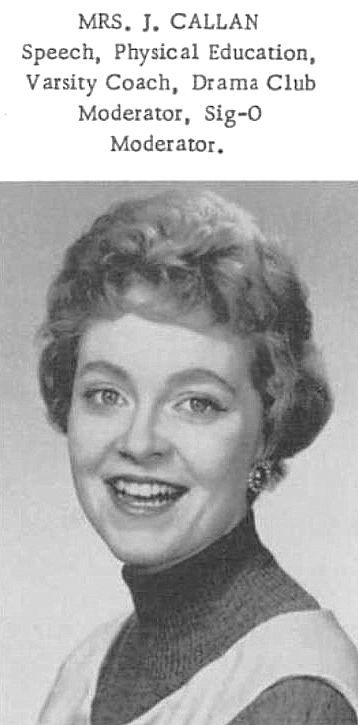
And finally, because I’m such a movie nerd who loves character actors, I was happily surprised to see that the actress K Callan was a 23-year-old drama teacher (etc.) at the school in 1959 before she entered the professional acting world of New York and Hollywood. (Callan was born in Dallas as Katherine “Kay” Borman and actually attended Our Lady of Good Counsel as a student before she taught there.) (UPDATE: Read K’s memories of her time at LGC in the comments, here.)

callan-k_our-lady-of-good-counsel_1959-yrbk_drama-teacher

callan-k_our-lady-of-good-counsel_1959-yrbk_drama-teacher_b

***

Sources & Notes

All photos of the school (except the one from 1905) are from various editions of Reveries, the yearbook for Our Lady of Good Counsel.

The 1902 photo was posted in the Dallas History Guild Facebook group.

The 1905 photo is from Dallas Rediscovered by William L. McDonald (p. 215), with the following credit: “Courtesy of Sister M. Adelaide Mars.”

The Blessed Sacrament Catholic Church still stands, at 231 N. Marsalis; their website is here.

olgc_1942-yrbk_girls_sign
1942

*

Copyright © 2017 Paula Bosse. All Rights Reserved.

“Sometimes I Run”: Dallas Noir — 1973

5-sometimes-I-run_stanley-maupin_hoseStanley Maupin at work…

by Paula Bosse

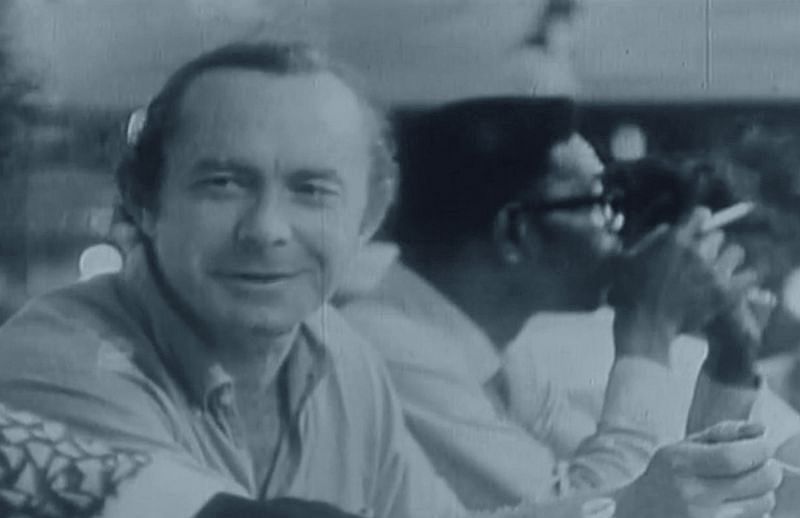
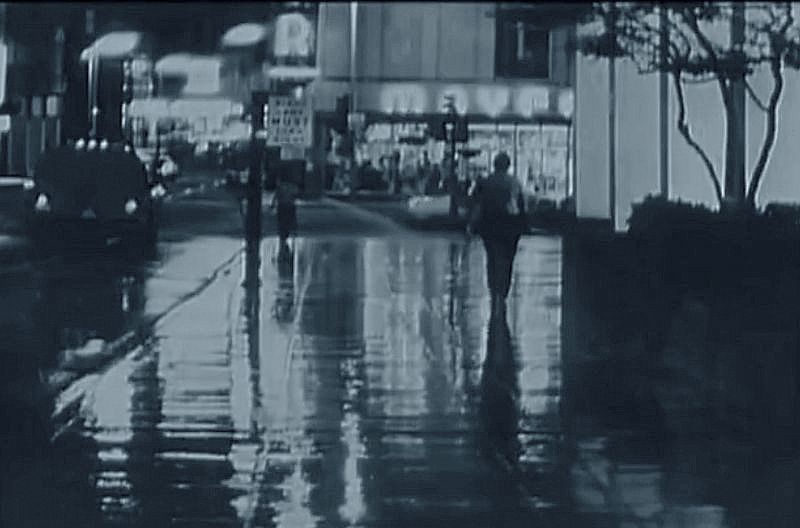
Several years ago, Robert Wilonsky wrote a Dallas Observer article about the short documentary “Sometimes I Run” — I watched it immediately afterward, and it’s stuck with me ever since. The 22-minute film, shot in 1973 by SMU film student Blaine Dunlap (who also made the fun 1970 Sunset High School film I wrote about earlier this year) shows Dallas Public Works Dept. street flusher Stanley Maupin at his job sweeping the downtown sidewalks late at night, accompanied by a soundtrack of jazz music and Maupin’s philosophical musings. It’s cool, gritty, seedy, nostalgic, and somehow life-affirming, all at the same time. Also, Dallas always looks best at night — the wet streets add a definite noir-ness to the overnight municipal goings-on which were happening when most Dallasites were home in bed. (See the bottom of this post for various sites on which you can watch the film in its entirety.)

It took the opening moments of this film to remind me that, yes, I DO remember (if vaguely) seeing that revolving beam of light shot from the “rocket” on top of the Republic Bank Building. You can see it at about :35. Also included in the film are Franklin’s, the Greyhound Bus station, the Capri movie theater, a late-night-diner, the Mayfair department store, the Municipal Building, Sanger-Harris, and much more. And while Maupin’s philosophical pronouncements might be a bit heavy-handed at times, I have to admit that I could listen to him talk for hours, if only to hear his accent, a Dallas-area trapping of the past that one doesn’t come across nearly often enough these days.

Here are a few screen captures.

2-franklins_sometimes-when-i-run

3-greyhound_stometimes-when-i-run

6-keep-dallas-clean_sometimes-when-i-run

7-diner_sometimes-when-i-run

8-diner-2_sometimes-when-i-run

9-mayfair_sometimes-when-i-run

10-city-hall_sometimes-when-i-run

11-repub-bank-bldg

***

Sources & Notes

The 44-year-old award-winning student film, “Sometimes I Run,” directed by Blaine Dunlap, can be seen in its entirety in several places online: on Vimeo (good sound and video), on YouTube (via South Carolina Arts Commission), and at the Texas Archive of the Moving Image (from the collection of the Dallas Municipal Archives). Sound by Ron Judkins, music by Ken Watson.

More on filmmaker Blaine Dunlap can be found in “Spotlight on Dallas Filmmakers: Blaine Dunlap” by Laura Treat, here.

I have tried to find some history on Stanley Maupin, but I didn’t come up with much. He lived in Irving as a boy, but as a teenager, he attended North Dallas High School and, later, McMurry College in Abilene.

maupin-stanley_NDHS_1953
North Dallas High School yearbook, 1953

maupin-stanley_mcmurry-college_1956_freshman_portalMcMurry College yearbook, 1956

Born in 1935, he appears to have died in 1985, perhaps in a shocking way (which I have been unable to verify) — see comments from his grandchildren in the YouTube video here.

Some background on the film can be found in an article by Don Clinchy, here.

Read a 1986 interview with Blaine Dunlap (by Bo Emerson, Atlanta Journal-Constitution, Oct. 24, 1986) here.

*

Copyright © 2017 Paula Bosse. All Rights Reserved.


Historic Neon: The Super-Cool Sigel’s Sign

sigels-neon-sign_greenville-ave_072717One of Dallas’ favorite neon signs… (photo: Paula Bosse)

by Paula Bosse

I stopped by Sigel’s liquor store the other day (as one does…) and saw this legendary Sigel’s sign, recently installed in its new home in the parking lot of the Sigel’s store on Greenville Avenue, between Lovers Lane and Southwestern Boulevard, across from the Old Town Shopping Center. I love this neon sign. (See a very large image of it here.)

The sign’s design can be traced back to Dallas artist Marvin M. Sigel (whose great-uncle Harry Sigel founded the business in 1905) — this Fabulous Fifties design was created around 1953 specifically for the then-new store at 5636 Lemmon Avenue (at Inwood). When that store closed in 2009, the sign was refurbished and moved up to the company’s Addison location until that store fell victim to the company’s bankruptcy and was closed. Here’s a video of the fabulous sign when it was in Addison, with close-ups of its flashing neon and dancing bubbles:


*

Marvin Meyer Sigel was born in Poland in 1932 and settled in Dallas in 1937 with his immigrant parents, both of whom had been doctors in Poland (his mother a dentist, his father an M.D.), although only his father continued to practice medicine in the United States. He lived in the vibrant Jewish enclave of South Dallas and went to Forest Avenue High School where he seems to have been a popular kid, interested in art, drumming, and ROTC. Below, a photo from the 1949 yearbook with the caption “Marvin ‘Hot Drums’ Sigel plays with the Swing Band.”

sigel-marvin_forest-avenue-high-school_drums_1949

His Forest Avenue High School senior photo, from 1949:

sigel-marvin_forest-avenue-high-school_1949

And his 1953 senior photo from the University of Texas:

sigel-marvin_university-of-tx_1953_senior

After studying art at both SMU (under Ed Bearden and DeForrest Judd) and the University of Texas and receiving his B.F.A. from UT in 1953, Sigel served a stint in the Eighth Army in Korea. Back in Dallas, he was remarkably active in the local art community — for decades — as both a fine artist and as an art instructor. He also worked for a while at Peter Wolf Associates, in advertising (on projects for companies like Braniff), and he even did a lot of the tedious paste-up work for Sigel’s ads (back when every picture of a bottle of wine or spirits had to be cut out individually and pasted into one of those huge ads!). But his passion was art, and at the same time he had those regular-paycheck gigs, he also managed to maintain a furious pace of painting new pieces to exhibit at a dizzying number of art shows. Below is an example of one of his watercolors, from 1957 (which was recently offered at auction by David Dike Fine Art). The title? “Cocktail Abstraction” — appropriate subject matter for a member of the Sigel family!

sigel-marvin_cocktail-abstraction_1957_david-dike-fine-art_jan-2016
“Cocktail Abstraction” by Marvin Sigel (1957)

When the Sigel’s Liquor store No. 7 opened at Lemmon & Inwood, it was suggested by family members that, hey, we have an artist in the family, let’s get Marvin to design a sign for us. According to Marvin, his cousin Sidney Sigel, who ran the company, probably just wanted a “rectangular sign with block letters,” but other family members wanted something newer and more exciting — something modern that would jump out of a sea of boring rectangular signs with block letters and draw attention. And it certainly did just that. If, as reports have it, that dazzling neon sign was designed in 1953, Marvin Sigel was only 21 years old!

When news broke 56 years later, in 2009, that the Lemmon & Inwood store was closing, there was a concerned uproar from the public about what would happen to the sign. Mr. Sigel was a bit taken aback by how much the people of Dallas had grown to love that sign and considered it a city landmark. Marvin Sigel, then 77 years old, said in a 2009 Dallas Morning News interview, “It was clever, but I figured it would be replaced by something more clever in a half-dozen years.”

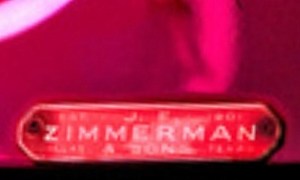
The sign was built by the venerable Dallas firm of J. F. Zimmerman & Sons (est. 1901) who for generations had installed decorative neon elements all around town and had built innumerable lighted signs for companies big and small — their work could be seen on the Mercantile Building’s wonderful tower, on the exterior of the downtown Titche’s store on Main Street, and in the instantly recognizable signs for places as varied as the Cotton Bowl, Big Town, and, presumably, various other Sigel’s stores around the city.

The sign which was moved from Store No. 7 at Lemmon & Inwood to Addison had on its pole a small plaque (seen here) which said:

This Non-Conforming Sign designed by Marvin Sigel was built in the early 1950s. It was moved from Dallas, TX at Lemmon Ave. & Inwood. After being granted a variance it was refurbished to Code and installed here in June of 2009. Sign refurbished and installed by Starlite Sign of Denton, TX.

Interestingly, the plaque on the new location of the sign has a slightly different text:

sigels-sign-plaque_greenville-ave_072717

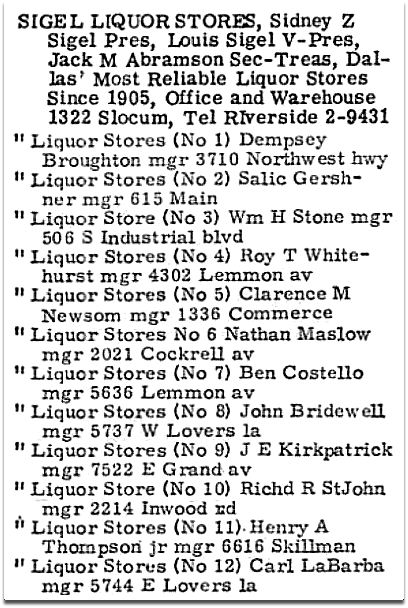
It appears that this is a different Sigel’s sign. In 1965, there were two Sigel’s stores on Lovers Lane: Store No. 8 was along the Miracle Mile on West Lovers Lane, near what is now the Dallas North Tollway, and Store No. 12 was on East Lovers Lane at Greenville (then near Louanns nightclub).

sigels-stores_1965-dallas-directory
1965 Dallas directory

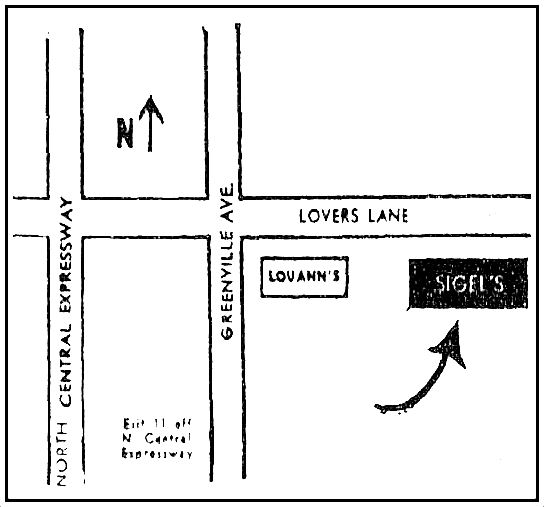
In an April 22, 2009 Dallas Morning News article by Jeffrey Weiss (“The Story Behind That Sigel’s Sign”), is this quote from Mr. Sigel’s son, David S. Z. Sigel, about the original sign at Lemmon & Inwood, with mention of another similar sign: “He created the designs for this sign, as well as a similar but smaller sign which stood outside the Lovers Lane store (where Central Market now stands) for many years.” Here’s a map from a November, 1964 grand opening ad for the new store at 5744 E. Lovers Lane:

lovers-lane_new-store_110664
Detail from a grand opening ad, Nov. 6, 1964

So is the sign currently standing in the parking lot of the Sigel’s Fine Wines & Great Spirits at 5757 Greenville Avenue the sign which originally stood only a short four-tenths of a mile away? I hope so! And if it is, welcome back to the neighborhood, cool sign!

Whichever sign this is, it is one of the greatest neon designs Dallas has ever had, and I’m so happy it’s survived for over a half-century, through phenomenal city growth, physical displacement, and even company bankruptcy.

Thanks, Marvin, for designing this wonderful sign! And thanks, Starlite Sign of Denton, for the beautiful refurbishing!

***

Sources & Notes
*

Top photo and photo of blue plaque taken by me on July 27, 2017 at the Sigel’s store at 5757 Greenville Avenue.

YouTube video by Andrew F. Wood, shot in Addison in 2013.

Sources for other images as noted.

The Zimmerman & Sons nameplate can be seen on the original Lemmon & Inwood sign here (click to enlarge), posted on Flickr by Tim Anderson (a detail of his photo can be seen below) (there is another Zimmerman nameplate posted in the comments on that Flickr page); what appears to be a Zimmerman plate is on the side of the sign at the Greenville Avenue location facing the store’s entrance, not on the side seen in my photo at the top.

zimmerman-nameplate_sigels-sign_lemmon-inwood_flickr-det

Please check out the Dallas Morning News article in the DMN archives titled “Sigel’s Sign Designer Surprised by Its Fame — Project for Family’s Liquor Store Wasn’t a Hit with Boss, He Recalls” by Jeffrey Weiss (April 28, 2009) in which Marvin Sigel discusses his famous sign.

Also, check out these related (online) DMN articles:

  • “Sigel’s Beverages, A 111-Year-Old Dallas Chain, Filed for Bankruptcy; Wants to Close 5 Stores” by Maria Halkias (Oct. 21, 2016), here
  • “Sigel’s Iconic Neon Sign Returning to Dallas After Years Wasting Away in Addison” by Robert Wilonsky (March 27, 2017), here

If anyone can verify that this sign is, in fact, the sign from Store No. 12 (Lovers & Greenville), please let me know!

UPDATE: Marvin Sigel died on Feb. 23, 2019 at the age of 87 (his obituary is on the Dallas Morning News website, here). After I wrote this post, Marvin’s son, David, contacted me to let me know his father had seen this and was delighted to know that people still appreciated his work. This was one of the most popular posts of the year. People absolutely still love your sign, Marvin! RIP.

sigels-sign_rain_bosse_121520photo: Paula Bosse, 2020

sigels-sign_night_bosse_121520photo: Paula Bosse, 2020

*

Copyright © 2017 Paula Bosse. All Rights Reserved.

“Dallas In the French Parliament” — 1876-77

french-colonists_dmn_042603

by Paula Bosse

Today is Bastille Day — seems right to post something about the “French Colonists” of La Réunion. One of the leaders of the French and Swiss immigrants who settled briefly — and ultimately unsuccessfully — on the western banks of the Trinity in the mid-1850s was François Jean Cantegral, “President” of the colony and one of the Directors of the Franco-American Company. Cantegral arrived in Texas about 1855 with hopes of establishing a successful utopian community, but the land, the climate, and the lack of experienced farmers in the group led to its fairly quick demise. Some of the European colonists settled permanently in the young town of Dallas, some scattered to other parts of the United States, and several — including Monsieur Cantegral — returned to their homelands.

Cantegral returned to Paris where, according to an 1876 article in the Dallas Herald, in a mission to participate in the reform and political liberation of France, he served three terms as an “alderman of Paris” and was elected to the French Chamber of Deputies, serving in the French Parliament. In 1877, Cantegral — who apparently had warm feelings toward Dallas and its citizens — sent to the city an early edition of a newly issued map of Paris. On its presentation before the mayor and the city council, it was noted that, in following in the footsteps of his fellow countrymen LaSalle and Lafayette, the members of the French Colony at Réunion “joined hands in efforts to plant the seed of French civilization, French chivalry and French hospitality, alongside and in conjunction with their American brethren in the wilds of Texas” (quoted in The Dallas Daily Herald, March 21, 1877 — see full article below).

It was noted that while living in the colony, Cantegral’s son, Simon Charles Cantegral, was born on March 2, 1856 — Texas Independence Day. He seemed quite proud of that. The map was presented in the names of Cantegral père and Cantegral fils. I wonder if that Paris map given to the City of Dallas in March, 1877 is still somewhere in the city archives?

Merci, François. Liberté, égalité, fraternité, from those of us back here in the wilds of Texas!

(Click articles to see larger images.)

cantegral_dallas-herald_050576
Dallas Herald, May 5, 1876

cantegral_paris_dallas-herald_032177
Dallas Herald, March 21, 1877

***

Sources & Notes

Top image from The Dallas Morning News, April 26, 1903.

The two articles are from the Texas Digital Newspaper collection of the University of North Texas, via their Portal to Texas History. The collection contains thousands of issues of the Dallas Herald (not to be confused with the 20th-century Dallas Times Herald); it’s hard to stop reading them because they are so unbelievably fascinating — set aside a few hours and browse the Herald collection (1855-1887) here.

Yes, Cantegral Street was named after Mssr. Cantegral. The May 5, 1876 article above makes mention of the street:

Three years ago a beautiful street in Dallas, that running east of Floyd street Church and west of the Baptist College, was named in his honor and will remain a perpetual memorial of him in this town.

More on the La Reunion colony can be found in other Flashback Dallas posts here.

Click articles to see larger images.

*

Copyright © 2017 Paula Bosse. All Rights Reserved.


“Meet Me in Dallas, On June the 23rd…”

jeannie-c-riley_flickrJeannie C. Riley

by Paula Bosse

Until last week, I don’t think I’d ever heard the 1969 song “The Back Side of Dallas,” sung by Jeannie C. Riley, who had had the blockbuster hit “Harper Valley PTA” the previous year. How have I never heard this? I was going to post it last week until I realized that it would be better to wait until today, because of this line from the song: “Meet me in Dallas on June the 23rd, his letter read.” And here we are, June 23rd.

The song, written by Jerry Foster and Bill Rice, was released in October, 1969. It wasn’t the huge, crossover, multi-award-winning monster hit that “Harper Valley PTA” was, but it did earn Jeannie another Grammy nomination (she lost to Tammy Wynette’s “Stand By Your Man” — if you’re going to lose, that’s a pretty great performance to lose to!).
Like “Harper Valley PTA,” it was one of several songs of the era which brought country music into the somewhat seedy realm of 1960s American culture. “The Back Side of Dallas” is about a small-town girl who finds herself a lonesome “working girl” in Dallas, chain-smoking king-size cigarettes, drinking in dingy bars, and popping pills. This ain’t no Kitty Wells song, y’all. (I’d love to hear Miranda Lambert — who also has an incredible country voice — cover this.)

back-side-of-dallas_jeannie-c-riley_label

Jeannie C. Riley — born in Anson, Texas in 1945 — was one of the first certifiable sex symbols in country music, always gorgeous, outfitted in miniskirts and go-go boots, with sky-high hair teased to a fare-thee-well. AND she had an absolutely fantastic voice. Below is video of a 24-year-old Jeannie C. Riley singing “Back Side of Dallas” on Del Reeves’ Country Carnival in 1969 (Del Reeves had some great songs in the ’60s, but his TV persona was a little too Dean Martin-wannabe for my taste … and … oh dear … that set!):

*

I prefer the studio version, below. I’ve listened to this song dozens of times now, and I haven’t gotten tired of it yet!

*

And here’s Jeannie singing it in 2011, still sounding great! (Her thick Texas accent is the absolute best, and her laugh is fantastic.) She talks about the song a bit at the beginning with Jerry Foster, one of the writers of the song — the song itself starts at about the 3:10 mark.

*

And, to round out this “June the 23rd” post, a few photos of Jeannie C. — surely one of the most photogenic faces and bad-ass vocalists in the history of country music. As my father used to say, “hot damn.”

jeannie-c-riley_motorcycle

jeannie-c-riley_3

jeannie-c-riley

jeannie-c-riley_2

***

Sources & Notes

Most, if not all, photos of JCR from Pinterest.

Record label image found here.

A biography of Jeannie C. Riley is here.

“Harper Valley PTA” — you know you want to hear it. This is a great live version she did on, I think, the Wilburn Brothers Show, with Harold Morrison on dobro.

*

Not that anyone’s going to confuse the two songs, but this song has nothing to do with the 1915 song of the same name by Adolphus Hotel orchestra leader Jack Gardner (which you can read about here).

*

Copyright © 2017 Paula Bosse. All Rights Reserved.