Flashback : Dallas

A Miscellany: History, Ads, Pop Culture

Category: Medical

Zap Those Extra Pounds Away in Mrs. Rodgers’ Electric Chair — 1921

ergotherapy_jewish-monitor_090921_detThrowing the switch in 3-2-1… (click for larger image)

by Paula Bosse

While looking for something completely unrelated (which is always the best way to find unexpected things), I came across this full-page ad which appeared in the Sept. 9, 1921 edition of The Jewish Monitor (click to see a larger image):

ergotherapy_jewish-monitor_090921

Why Be Fat When
E R G O T H E R A P Y
WILL REDUCE YOU?

Within the last few years a method of automatic exercise, known as the Bergonie treatment, has found favor among physicians abroad in the treatment of obesity and other chronic disorders.

One advantage is that with the Sinusoidal current, which is employed, very powerful muscular contractions may be induced without pain or sensation other than that due to the muscular contraction itself.

The Treatment chair is the last word in comfort. It is fitted to meet the physiologic needs of the body as well as being comfortable. The arm and leg electrodes are wide and comfortably curved to fit the arms and legs of the patient easily. 

ERGOTHERAPY

The Kellogg-Bergonie System of Battle Creek, Mich., will reduce you just where you wish to be reduced. No drugs, exercise or inconvenience. We will reduce you from one (1) to three (3) pounds per treatment and improve your physical condition. Trained nurses in attendance (under a registered physician’s supervision).

Treatments by Appointment Only

Hours for Men, 8 A.M. to 1 P.M.
Hours for Women, 1 P.M. to 6 P.M.
Phone X 5759
Ruth Rodgers, Mgr.
1614 1/2 Main Street, Dallas, Texas.

*

“The arm and leg electrodes are wide and comfortably curved” — there’s a line one doesn’t often encounter in an ad!

So what was this treatment of obesity that required “no drugs, exercise or inconvenience”? Well, basically, it was a low-voltage electric chair in which the naked, smock-draped “patient” reclined on wet towels and was covered with sandbags (which weighed up to 100 pounds). Electrodes were attached to the arms, legs, and abdomen. When the switch was flipped, electrically-provoked exercise began, and electric current caused muscular contractions (up to 100 a minute) without fatigue to the “exerciser.” All sorts of physiologic things were happening during these sessions, including a whole bunch of sweating. Patients would lose from 1 to 3 pounds during their time in the chair, hose themselves down and walk away refreshed.

Jean Albard Bergonié (1857-1925) was a French doctor/researcher/inventor who specialized in radiology in the treatment of cancer, and this odd electric chair was something of a departure from his oncology studies. It was used to treat a variety of ailments and conditions such as obesity, heart conditions, diabetes, “suppressed uric acid elimination,” and, later shell-shock. Professor Bergonié died in 1925 as the result of prolonged exposure to radium in his research to find a cure for cancer (in the years before his death, he had lost an arm and fingers to continual X-ray exposure). The Institut Bergonié continues in Bordeaux, France as a cancer research center.

So back to the chair. By the time of the 1921 ad above, Bergonié’s “ergotherapy” had become a weight-loss feature in beauty spas and salons. The ads I found mentioning the electric chair as something corpulent men and women of means might have seen in Dallas newspapers appeared between July and October of 1921, touting the miracle chair at Mrs. Ruth Rodgers’ beauty salon, The Old London Beauty Shoppe at 1614 ½ Main Street, a couple of doors from Neiman-Marcus.

ergotherapy_071721
July, 1921

I don’t know if it didn’t catch on or whether it just wasn’t mentioned in ads, but the chair made its final appearance in an Old London Beauty Shoppe ad in early October of the same year.

The splashiest news about Bergonié’s invention was a few months later, in early 1922, when it was revealed that the UK’s Queen Mary had availed herself of the chair in order to slim down in time for her daughter’s wedding, with Prof. Bergonié himself apparently operating the current flow. The best part of the lengthy and breathless article about the plump royal allowing herself to lie in this electric chair as she was rather unceremoniously weighted down with royal sandbags was this sentence:

[Mrs. David Lloyd George, the wife of the British prime minister] lost no time in telling Queen Mary all she knew about Professor Bergonie, the famous French ergotherapist, and his marvelous electric chair, which is said to jar fat from the human frame with the ease and almost the rapidity of a man peeling a tangerine.

Hey, I want that!

One would assume that sort of free publicity would be a boon to spas and salons offering State-side ergotherapy — I have a feeling Mrs. Rodgers had moved on by then and was probably kicking herself for concentrating on the more mundane treatment of wrinkles and sagging skin and the administering of marcel waves (her specialty).

Below, some views of The Chair over the years (all pictures larger when clicked).
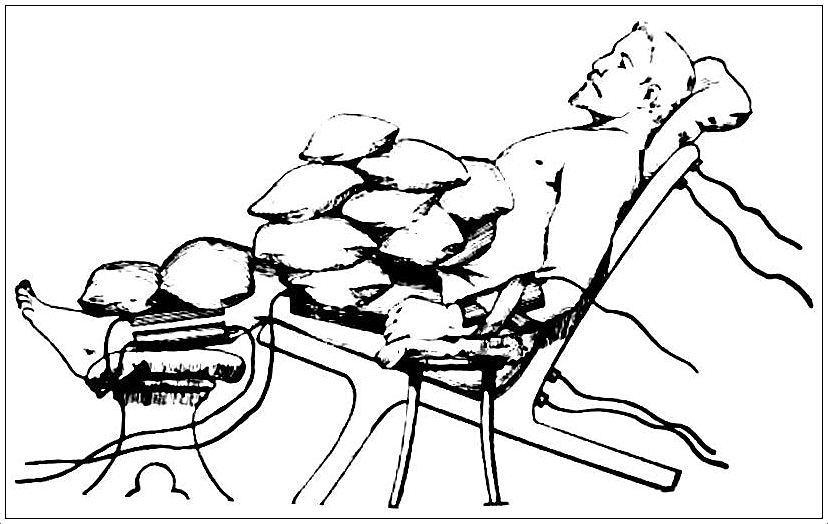
ergotherapy_1913-medical-bk_ebay

Above, a drawing from a 1913 medical book, found here.

*

ergotherapy_medical-record_050115

From the journal Medical Record, May 1, 1915.

*

bergonie-chair_shell-shock_electrical-experimenter_feb-1919

A World War I soldier being treated for shell-shock, from The Electrical Experimenter (Feb. 1919), here (continued here).

*

ergotherapy_012321
Jan., 1921

Ruth Rodgers was the proprietress of the Old London Beauty Shoppe (later the Old London School of Beauty Culture), which seems to have operated in Dallas from the ‘teens to at least the late-1930s. The location during the period of the ergotherapeutic chair was in the basement of 1614 Main Street.

*
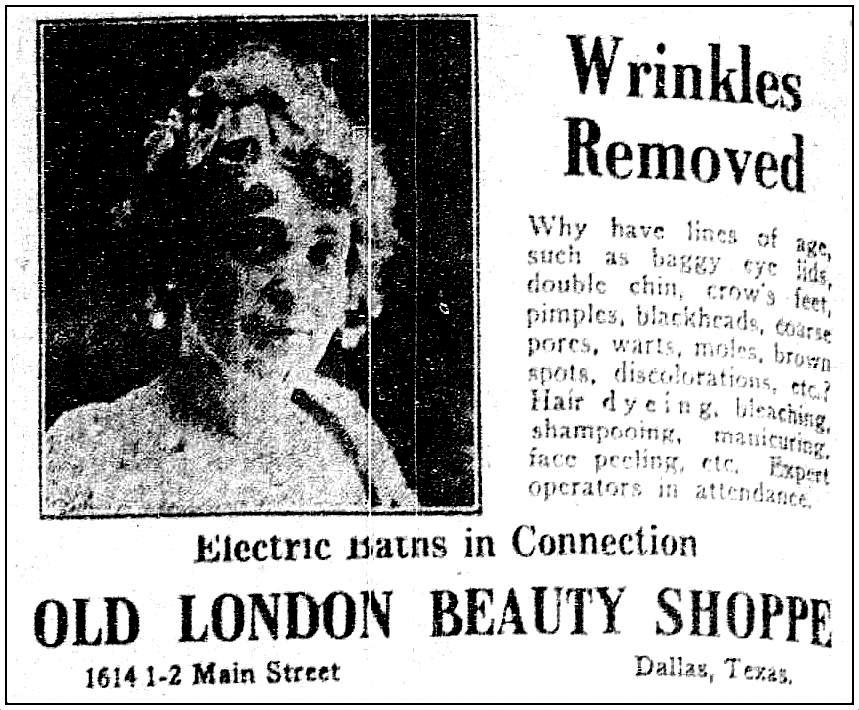
ergotherapy_dmn_081421
Aug., 1921

Mrs. Rodgers did it all. That might be her in the ad.

*

ergotherapy_081421
Aug., 1921

*

ergotherapy_082121
Aug., 1921

It’s a bit unusual seeing ads like this directed toward men.

*

ergotherapy_san-francisco-chronicle_092521
San Francisco Chronicle, Sept. 25, 1925

*

queen-mary_1922

Above, a very Aubrey Beardsley-esque depiction of the “distressingly stout” Queen Mary, ready to undergo her course of treatments. Read the full, widely-circulated article from February, 1922, “Queen Mary’s Jarring Anti-Fat Ordeal; Yearning for a Girlish Figure to Grace Her Daughter’s Wedding, the Queen-Mother Got One by Sitting in an Electric Chair and Losing 3½ Pounds a Week,” here. (They don’t write headlines like that anymore….) The photo below, showing the control panel, was also part of the article.

queen-mary_1922_battery

*

ergotherapy_ogden-standard-examiner_041826

The caption for this photo (which appeared five years after the cutting-edge Ruth Rodgers was offering it to Dallas patrons): “The new French electric chair on which one reclines in comfort while form-fitting electroids [sic] direct the fat-melting current, as demonstrated by Alice Harris, a stage beauty who must keep thin.” (Ogden Standard-Examiner, April 18, 1926)

*

And, finally, to bring this back to Dallas, the location of Mrs. Rodgers’ Old London Beauty Shoppe in 1921 — 1614½ Main Street (basement) — is circled (this building was later the Everts Jewelry store before it moved across the street to the north side of Main). To the left is Neiman-Marcus, at the corner of Main and Ervay. (Full view of this postcard, from the collection of the DeGolyer Library, SMU, is here.)

1614-main_n-m_degolyer_smu_det

***

Sources & Notes

Top photo is a detail from the ad below, which appeared in the Sept. 9, 1921 edition of The Jewish Monitor; it can be accessed via the Portal to Texas History, here.

Read a doctor’s account of just how Bergonie’s chair worked, in the article “Modern Treatment of Obesity” by Edward C. Titus (Medical Record, Jan. 24, 1920), here.

I’m not sure about the connection of this chair to J. H. Kellogg (the treatment in the ad was referred to as “The Kellogg-Bergonie System of Battle Creek, Mich.”). It appears that he and Bergonie might have developed similar chairs independently of one another and decided to form some sort of partnership — either by mutual agreement or court edict. Here is a photo of Kellogg’s “patented electrotherapy exercise bed” used in his Battle Creek sanitarium:

kellogg-chair
via Oobject (more Kellogg contraptions here)

And speaking of Mr. Kellogg, might I direct your attention to a previous Flashback Dallas post — “Electricity in Every Form — 1909” — here.

Click pictures for larger images

*

Copyright © 2016 Paula Bosse. All Rights Reserved.

Under the Paw of the Tiger: Taking the Cocaine, Morphine, and Opium “Cure” — 1890s

ad-dallas-ensor-institute_souv-gd_1894
“No cure, no pay…”

by Paula Bosse

In the 1890s, Dallas had a big cocaine problem. And a big morphine problem. And a big opium problem. In fact, the whole country did. Before the over-the-counter dispensing of these drugs was made illegal, they were easily obtained in any drugstore. Cocaine was especially cheap: a nickel or a dime (the equivalent of about two bucks in today’s money) could get you plenty. Things seem to have hit the breaking point in Dallas in 1892, with scads of lurid cautionary tales about crazed and doomed hopheads filling the papers, but the problem had been building for a while.

With this sudden surge in readily available opiates came a surge in institutions attempting to help the addicted kick their habit. Between 1893 and 1895 or 1896, there were three such places one could go to “take the cure” in Dallas: the Dallas Ensor Institute (which was located at what is now 1213 Elm Street, between Griffin and Field, where Renaissance Tower now stands), the Hagey Infirmary (in what is now the 2100 block of Main, just east of Pearl), and, most famously, the Keeley Institute (which for many years was on Hughes Circle in The Cedars, just south of Belleview, between S. Akard and S. Ervay). The first two  were gone after only a couple of years, but the Dallas branch of the then-famous Keeley Institute lasted in Dallas at a few different locations until at least 1936.

*

The text of the 1894 Dallas Ensor Institute ad above:

No Gold – No Mineral
The Dallas Ensor Institute
For the Cure of
Liquor, Morphine, Cocaine
and Tobacco Habits
No. 287 Elm Street,
Opened in the City of Dallas on the 1st day of July, 1893, and has successfully cured Two Hundred and Sixty-Three people all told, who are to-day sober men with the exception of three.
We Guarantee a Cure in every case, to the entire satisfaction of the patient, or it COSTS HIM NOTHING
REMEMBER, NO CURE, NO PAY.
Consultation Free and Correspondence Solicited.
Address Lock Box 367.
C. B. BEARD, Manager
Call and see us

*

The more widely known Keeley Institute opened in Dallas around 1895 (click ad for larger image).

keeley-institute_dmn_103195
Dallas Morning News, Oct. 31, 1895

The text is worth a read of its own:

keeley-institute_dmn_103195-det

It’s interesting that the Keeley ad and the Ensor ad both admit to being less than perfect in their success rate — to the tune of “three.” I wonder if they were the same three people?

keeley-institute_1899
1899

*

Even though the addiction rate was getting to be something of an epidemic — especially, it seems, among women — pharmacists were split on whether the city council should ban sales of these drugs except when ordered by a doctor. While all of them saw first-hand the hopeless addicts who came in every day proffering scrounged dimes, many were loath to lose the steady business — they were making a pretty good living. It wasn’t until about 1901 that the city council outlawed the sale of narcotics unless accompanied by a prescription; the State of Texas enacted a similar law four years later. Not that that stopped people from continuing to “hit the pipe” (a phrase I was surprised to see had been around in 1910), but it probably did save many lives in the days when addiction was not very well understood and was not very effectively treated.

***

Sources & Notes

Dallas Ensor Institute ad from the Souvenir Guide of Dallas (Dallas: D. M. Anderson Directory Co., 1894).

Interested in more on a druggy Dallas?

  • See an ad for the Hagey Infirmary in my post “Hagey Infirmary, No Patient Too Frail — 1894,” here.
  • See my post “‘Delusions of Affability’ — Marijuana in 1930s Dallas,” here.
  • And, heck, see my other cocaine-related post, “New Year, New Teeth — 1877” — about a dentist who might have been dipping into his own medicine chest a little too frequently — here.
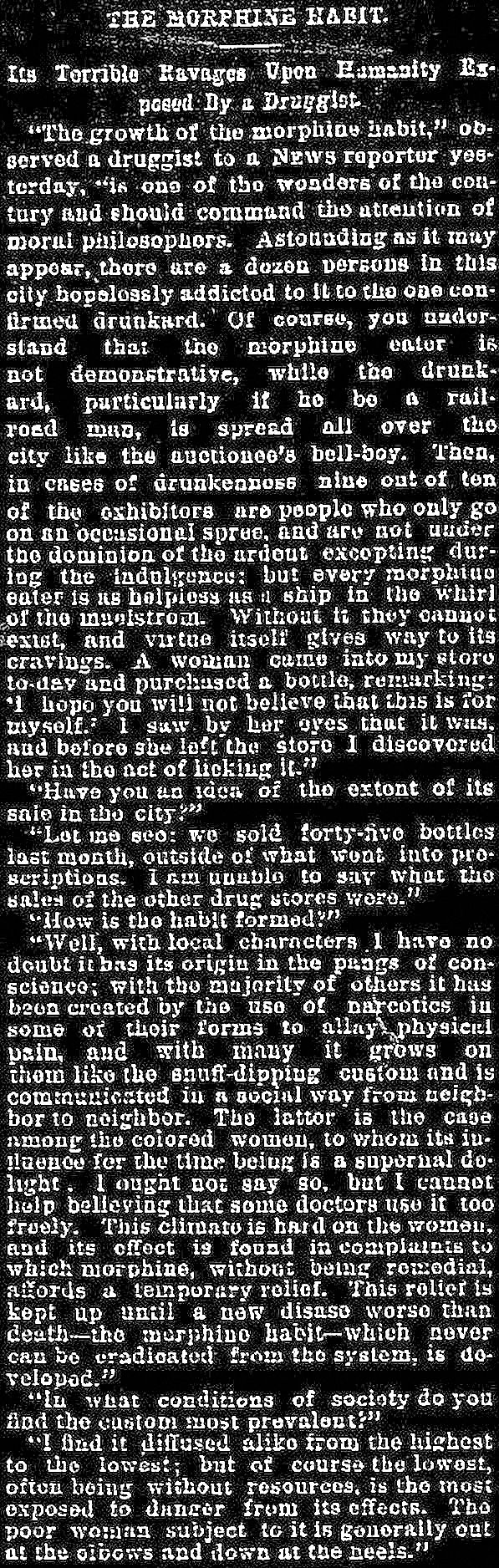
  • See the Dallas Morning News article “When Dope Sold Like Aspirin,” by Kenneth Foree (DMN, Sept. 5, 1951) for a really interesting look at Dallas during its first wave of drug problems. Imagine, if you will, the sight of a woman so in need of a fix that, despite having vehemently assured the druggist only moments earlier that the “medicine” she was purchasing was not for her, she began to lick the bottle before she even left the store. Cocaine is a hell of a drug….

A Dallas Morning News article which was cited by Kenneth Foree in the above article was this one, from 1887 (click to see a larger image):

morphine-habit_dmn_090587
DMN, Sept. 5, 1887

The song referenced in the Foree article mentioned above is “Take a Whiff on Me,” which Lead Belly — who played around Deep Ellum in the ‘teens and ’20s — recorded in the 1930s. One of the verses of the song sometimes called “Cocaine Habit Blues” has a Dallas shout-out: “Walked up Ellum and I come down Main / Tryin’ to bum a nickle just to buy cocaine / It’s oh, oh, baby take a whiff on me.” Hear his version of the song (and read the lyrics) here (the “Ellum” line is at the 1:29 mark).

Most images are larger when clicked.

*

Copyright © 2016 Paula Bosse. All Rights Reserved.


Lt. Mary L. Roberts, The “Angel of Anzio” — The First Woman Awarded the Silver Star

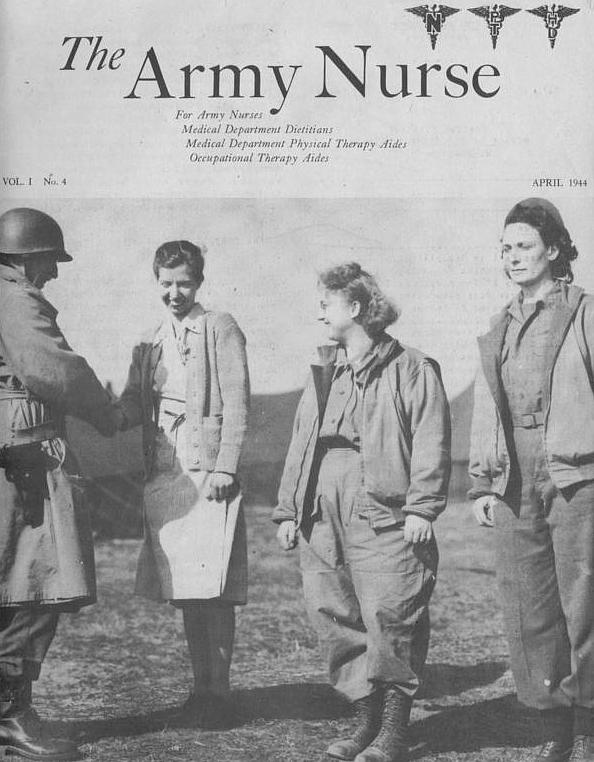
silver-star_feb-22-1945Roberts (left) and two fellow Army Nurse Corps nurses receiving the Silver Star

by Paula Bosse

The opening paragraph from a chapter in Tom Brokaw’s book The Greatest Generation:

There are so many impressive numbers connected to World War II that it’s difficult for one or two to catch your eye. Here are a few that caught me by surprise: more than sixty thousand women served in the Army Nurse Corps. Sixteen died as a result of enemy action. Sixty-seven nurses were taken prisoner of war. More than sixteen hundred were decorated for bravery under fire or for meritorious service.

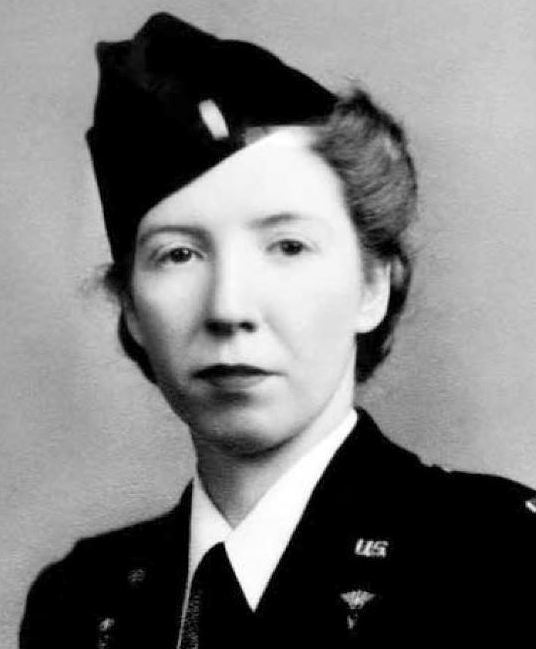
The chapter is titled “Mary Louise Roberts Wilson,” a profile of Mary L. Roberts, a Methodist Hospital nurse who enlisted in the Army Nurse Corps in 1942. She served with the 56th Evacuation Hospital Unit alongside many other medical professionals from Dallas (the unit — sometimes called the “Baylor Unit” — was organized by the Baylor University College of Medicine in Dallas). She knew she would be serving overseas in field hospitals in combat zones.

As far as seeing action, the worst of the worst for the 56th was on February 10, 1944 when their hospital tents on the Anzio beachhead in Italy were attacked by German long-range artillery shells for a full thirty minutes. Several operations were underway during the attack, and Roberts, the chief nurse of the operating tent, managed to keep a calm head and help to maintain as much order as possible.

“I wanted to jump under the operating table, but first we had to lower litter cases to the floor. Pieces of steel already were ripping through tents. There were four litters. I saw a patient on the operating table had his helmet near him so I put it over his head to give him that much protection.” (Mary L. Roberts, Dallas Morning News, Feb 23, 1944)

When the shelling ended, two enlisted men in the operating tent had been wounded, and elsewhere in the field hospital, two nurses had been killed and several other personnel wounded. As a result of their exceptional bravery, outstanding leadership, and “gallantry in action,” Roberts and two other nurses, 2nd Lt. Rita Virginia Rourke and 2nd Lt. Elaine Arletta Roe were awarded the Silver Star. No women had ever received the medal. As 1st Lt. Roberts had seniority, she was the first woman in history to be decorated for heroism in action.

Maj. General John P. Lucas surprised her and the other two nurses on Feb. 22, 1944 with an informal presentation of the medals at the same Anzio hospital that had been shelled only twelve days earlier. After the brief pinning ceremony, the nurses immediately returned to their duties, all feeling they were accepting acknowledgement for their team, not for themselves alone. Roberts spent 29 months overseas, and tended to more than 73,000 patients.

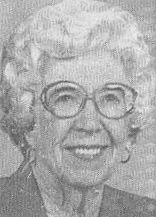
After the war, when Lufkin-native Mary Roberts returned home, she worked for almost 30 years as a nurse at a VA hospital in Dallas, and, rather late in life, she married fellow veteran Willie Ray Wilson. Mrs. Wilson died in 2001 at the age of 87. She was buried with full military honors.

roberts_texas-women-first_mcleroy_UTA1944 (Fort Worth Star-Telegram Archives, UTA)

roberts_dmn_022344-photo1944

roberts-cover_army-nurse_april-1944Presentation of the Silver Star at Anzio

roberts_obit-photoMary Roberts Wilson (1914-2001)

***

Sources & Notes

Top photo and first quote from The Greatest Generation by Tom Brokaw (New York: Random House, 1998).

For an exceedingly detailed history of the 56th Evacuation Hospital Unit, with several photographs, see here.

Articles on Mary Roberts from The Dallas Morning News archives:

  • “Baylor Unit In Action” (DMN, Aug. 26, 1942): photo of unit, including Roberts, working around an operating table
  • “Dallas Nurse, Two Others Win Medals” (DMN, Feb. 23, 1944): “The award, denoting exceptional bravery went to Lt. Mary L. (Pinky) Roberts, 1205 North Bishop, Dallas, Texas, chief nurse in an operating room hit by shell fragments.”
  • “Nurses of Dallas Unit Serving at Anzio Doing Jobs Cheerfully Despite Many Hardships” by Wick Fowler (DMN, March 31, 1944)
  • “Ends Military Career: WWII Recalled By Heroic Nurse” (DMN, July 26, 1964): photo and interview with Mary Roberts Wilson on her retirement from the U. S. Army Reserve
  • “Happiness Is Being Part of a Team” by Jane Ulrich Smith (DMN, May 16, 1972), photo and interview, on her retirement from the Veterans Administration Hospital
  • “Compassion Revisited: Nurse Reunites With GI She Treated For Serious Injuries In WWII” (DMN, Nov. 4, 1999): a reunion with former patient Dewey Ellard of Mobile, Alabama, brought together by Tom Brokaw
  • “Distinguished Career In Medicine Followed — WWII Gallantry — VA Hospital Honors Longtime Nurse — Who Won Silver Star in ’44” (DMN, Nov. 6, 2001): interview with the then-87-year-old Mrs. Wilson, published two-and-a-half weeks before her death
  • “Mary Wilson, ‘Angel of Anzio,’ Dies at 87 — WWII Nurse Known For Kindness Was Decorated For Bravery Under Fire” (DMN, Nov. 24, 2001)

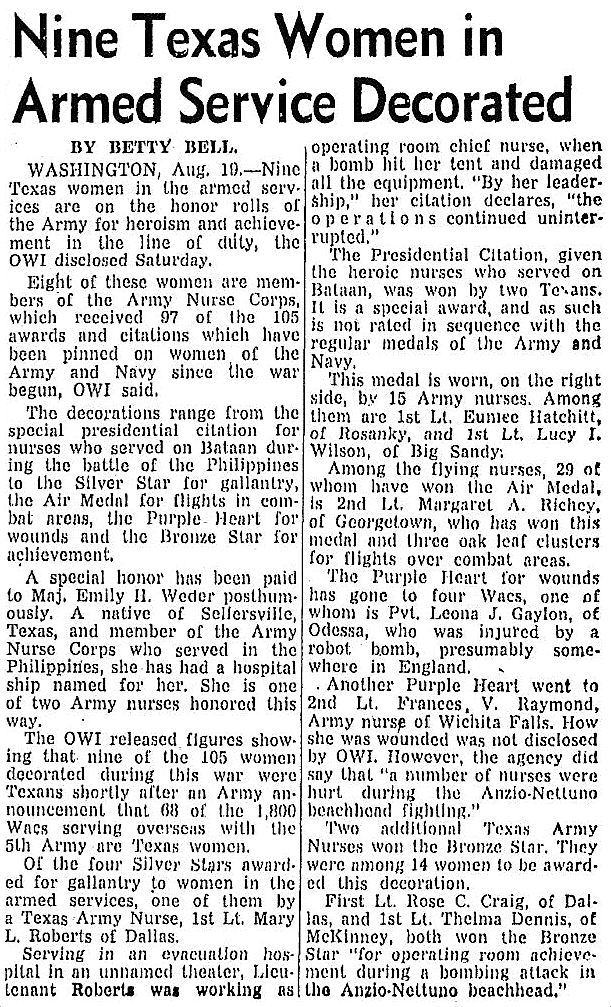
Other women who were honored in 1944 for heroism and achievement in the line of duty:

women_ww2_medals_FWST_082044Fort Worth Star-Telegram, Aug. 20, 1944

Click pictures and articles for larger images.

*

Copyright © 2016 Paula Bosse. All Rights Reserved.


Old Parkland — 1950

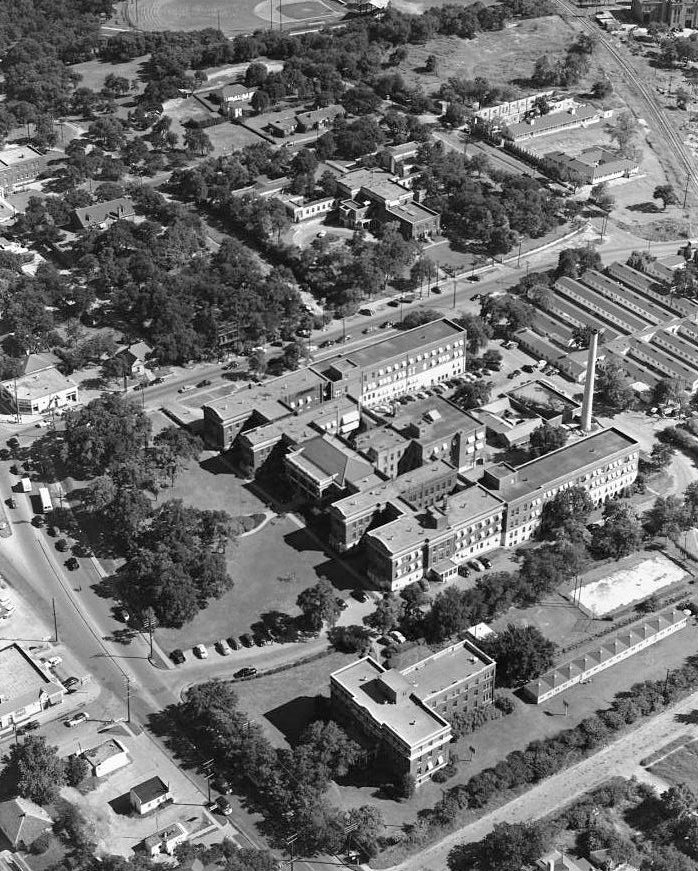
parkland_aerial_1950_utsw_smThe *OLD* Old Parkland… (click for larger image)

by Paula Bosse

Fantastic aerial view of Parkland Hospital, looking south toward Reverchon Park (you can see the baseball diamond at the very top, just west of the old Turtle Creek pump station — now the Sammons Center — in the upper right corner). Maple is running north and south at the left of the photograph, Oak Lawn, east and west, just above the center.

Here’s the same view today.

maple-oak-lawn_google-earthGoogle Earth

***

Sources & Notes

Photograph titled “Aerial view of Parkland Hospital on Maple with Southwestern Medical School adjacent,” is from the UT Arlington Special Collections Library, hosted on the UT Southwestern Archives Collection site, here. You can zoom in and see incredible magnified details here.

The photo was taken August 15, 1950, by an unknown photographer. It looks a lot like a photo by Squire Haskins, taken a couple of blocks south — see it in the previous Flashback Dallas post “Reverchon Park Flyover,” here.

*

Copyright © 2015 Paula Bosse. All Rights Reserved.


“Dallas … Undisputed Medical Center” — 1946

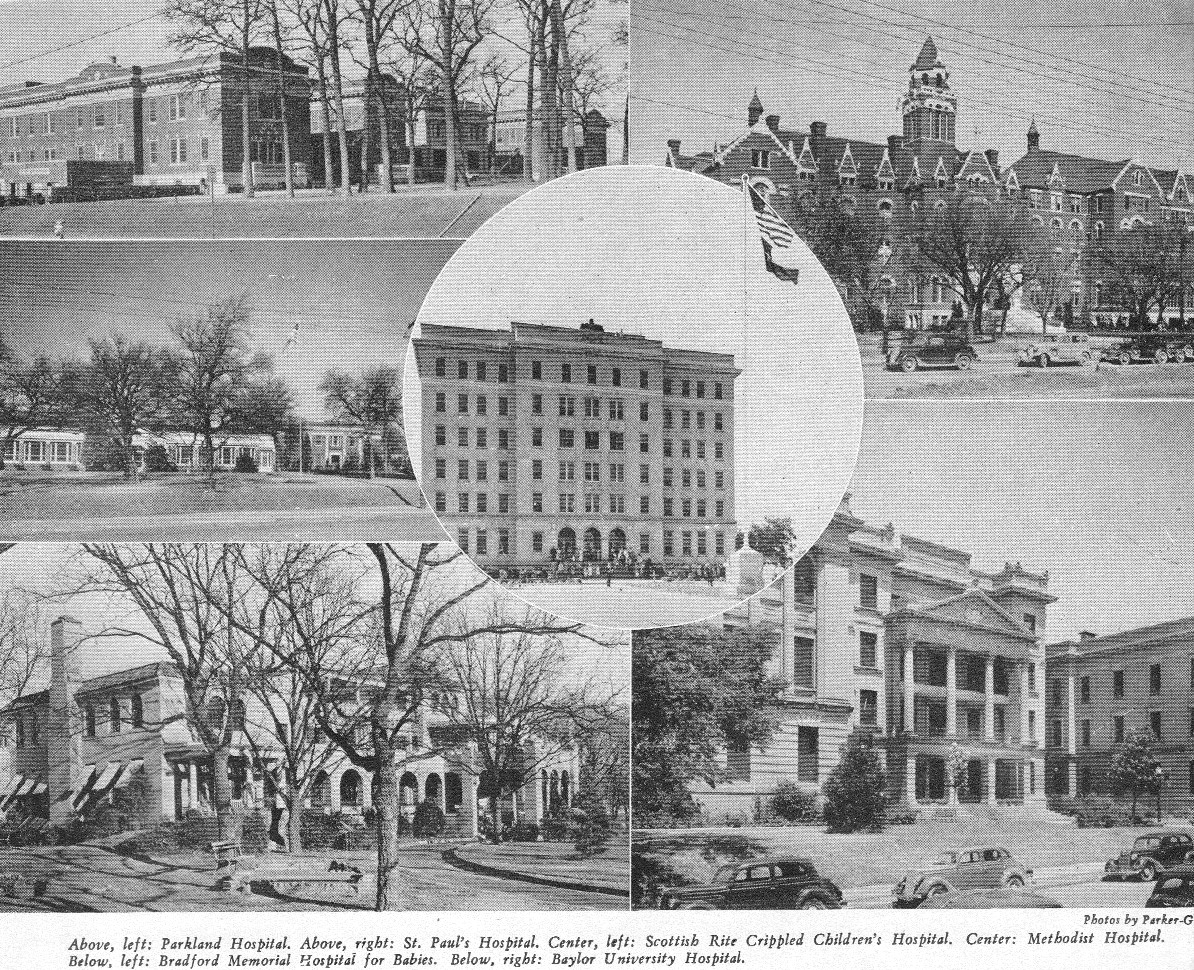
medical-centers_so-this-is-dallas_ca-1946_smSix of the city’s top facilities (click picture for larger image and caption)

by Paula Bosse

The photos above and the text just below are from a publication from about 1946 which was prepared for potential newcomers to the city in order to encourage them to move their businesses and/or residences to Dallas. This page focuses on the city’s superior medical centers, including Parkland Hospital, St. Paul’s Hospital, Scottish Rite Crippled Children’s Hospital, Methodist Hospital, Bradford Memorial Hospital for Babies, and Baylor University Hospital.

medical-centers_so-this-is-dallas_ca-1946-text

Locations of these and other “Hospitals and Dispensaries” can be found in this clipping from the 1946 Dallas city directory:

hospitals_1946-directory

***

Sources & Notes

Photo collage and text from “So This Is Dallas,” edited by Mrs. E. F. Anderson (Dallas: The Welcome Wagon, ca. 1946); photographs by Parker-Griffith.

Hospital listings from the 1945-46 Worley’s Greater Dallas (Texas) City Directory.

*

Copyright © 2015 Paula Bosse. All Rights Reserved.
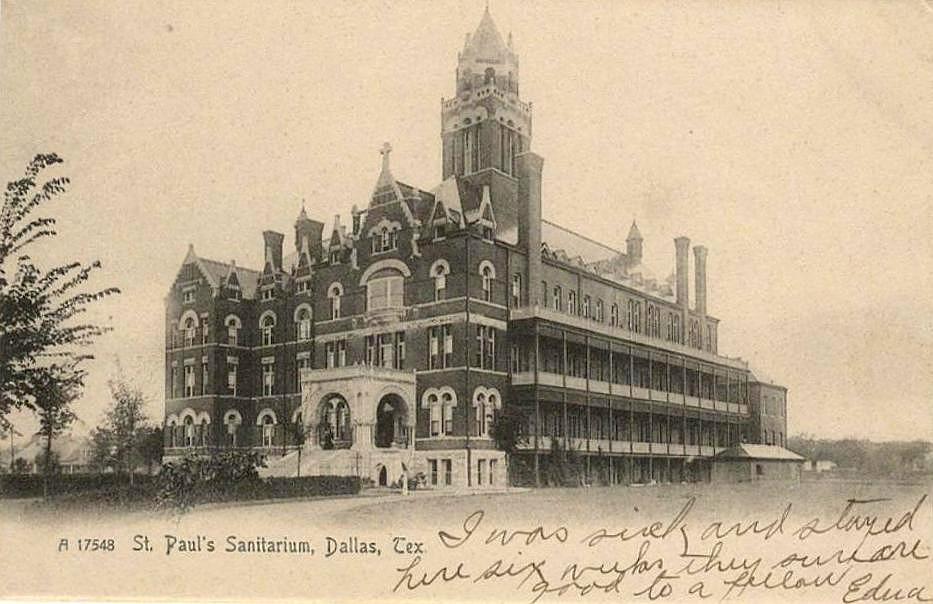
St. Paul’s Sanitarium — 1910

st-pauls_postcard_de-paul-univSt. Paul’s Sanitarium, located at Bryan & Hall (click for larger image)

by Paula Bosse

My posting has been infrequent as of late, due, in part, to obligations concerning a family member’s hospital stay. So, since I have a short time before I have to rush off to run errands and make visits, why not focus on a historic Dallas hospital?

St. Paul’s Sanitarium was opened in a small cottage on Hall Street in 1896 by the Daughters of Charity of St. Vincent de Paul, but it soon moved to the new large H. A. Overbeck-designed building on Bryan Street in 1898. In 1927 the name changed to St. Paul’s Hospital, and in 1958, the name changed again, this time to St. Paul Hospital. The imposing building and annex (and whatever other structures were contained in the complex) were demolished in 1968.

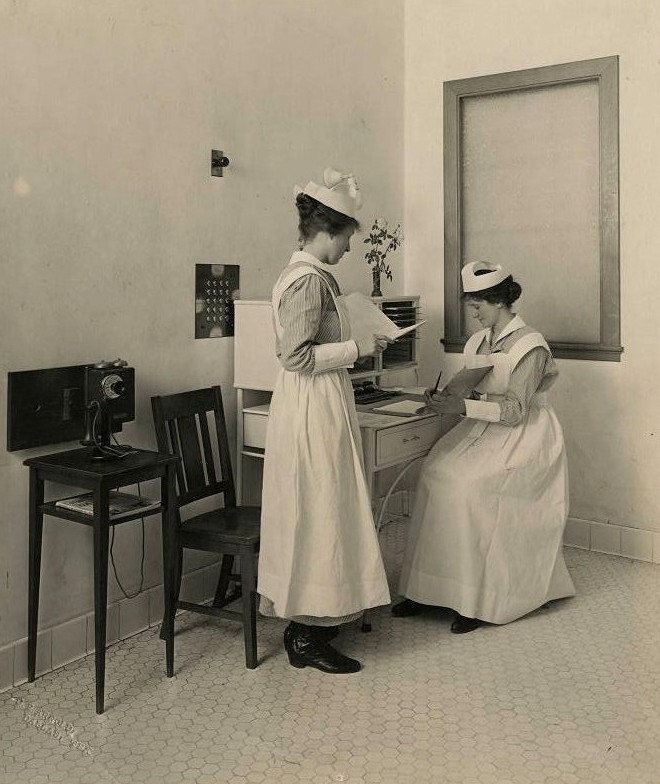
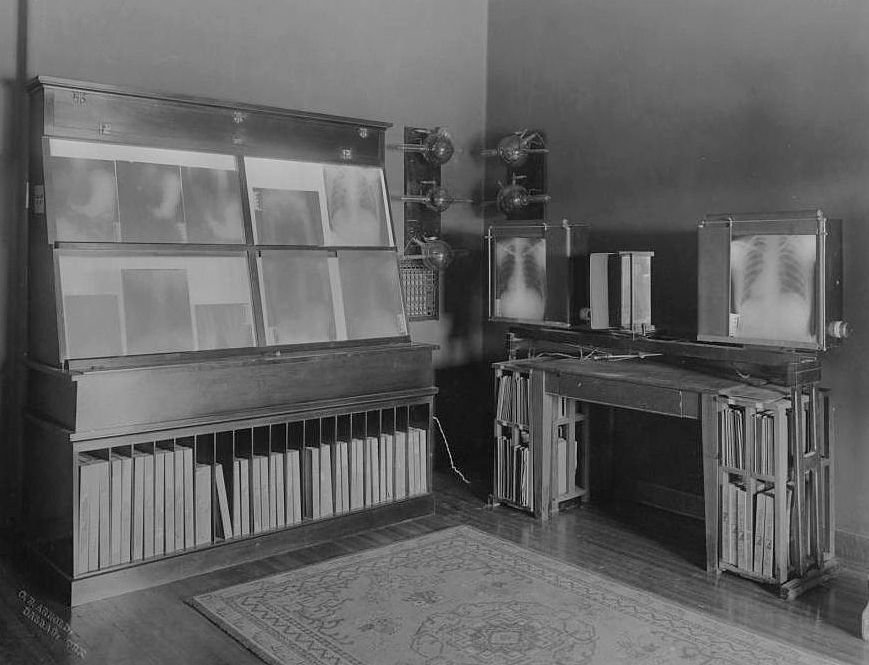
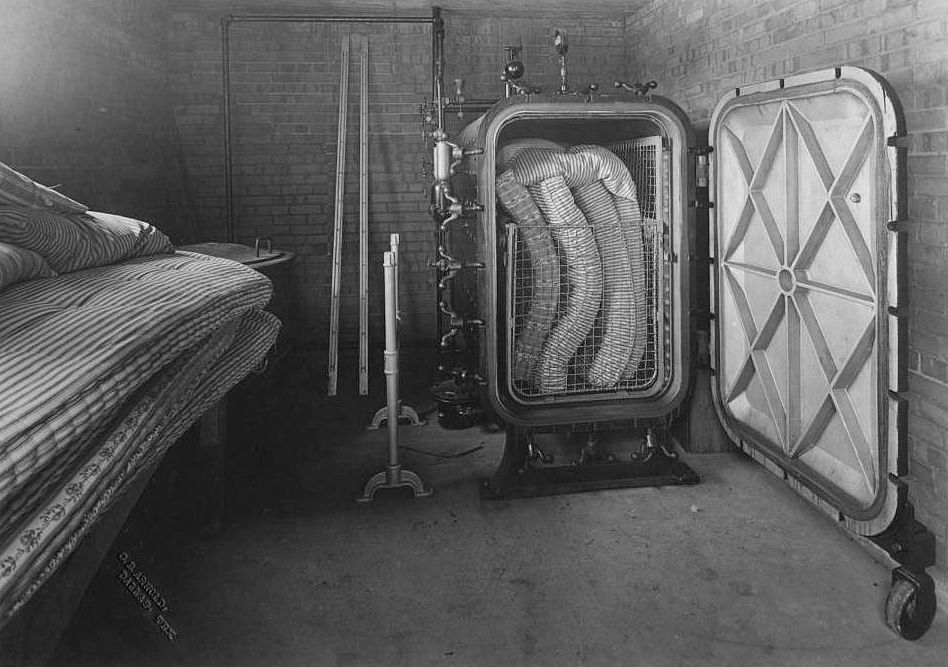
Below are several wonderful photographs taken inside the sanitarium around 1910 by one of Dallas’ best photographers, C. E. Arnold. They are from the St. Paul Hospital Collection in the UT Southwestern Library (click links below photos to see info about each picture).

*

st-pauls_nursing-stn_1910_utsw_smThe nursing station.

*

st-pauls_mexican-ward_1910_utswThe “Mexican Ward” (as noted on the back of the photograph).

*

st-pauls_sleeping-porch_1910_utswA patient ward on a screened-in sleeping porch.

*

st-pauls_waiting-room_1910_utswA waiting room.

*

st-pauls_xray-room_1910_utswThe x-ray room.

*

st-pauls_nurses-library_1910_utswThe nurses’ library. (I LOVE this photo! Check out the crazy typewriter stand attached to the desk — I’ve never seen anything like that before.)

*

st-pauls_student-nurses-dorm_1910_utswThe nurses’ dormitory on the top floor.

*

st-pauls_mattress-sterilization-room_1910_utswAnd, my favorite, the ominous-looking mattress sterilization room in what appears to be a dungeon.

*

st-pauls_flickr_coltera

**

UPDATE: Check out some fantastic historic photos of the hospital and its nurses contained in this UT Southwestern Medical Center publication, “St. Paul University Hospital, A Legacy of Caring,” here.

***

Top postcard is from the Vincentiana Postcard Collection, Special Collections and Archives, DePaul University Library, Chicago; it can be found here.

Bottom postcard, with the cheerful message from Edna, was found on Flickr, here.

All photographs are from the St. Paul Hospital Collection in the UT Southwestern Library. Other photos from this 1910 collection can be found here. (For fuller descriptions, click the linked text beneath the photos in this post.)

An interesting article on the photographer, Charles Erwin (C. E.) Arnold, and the technique used in capturing his interiors, can be found here.

A historical timeline of St. Paul’s can be found in a PDF here.

Wondering where St. Paul’s Sanitarium was located? It was at Bryan and Hall streets, across from Exall Park. Here is the location, from a 1919 map:

st-pauls_1919-map

All images larger when clicked.

*

Copyright © 2015 Paula Bosse. All Rights Reserved.

New Year, New Teeth — 1877

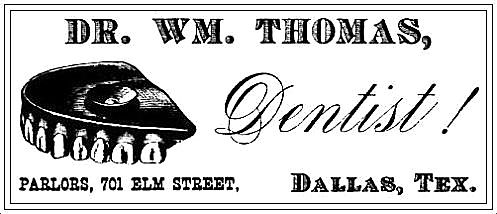
ad-dentist_1878-directoryThe exclamation mark is a nice touch — 1878

by Paula Bosse

It’s a new year. Time again to check if the women-folk in your household need a new set of false teeth!

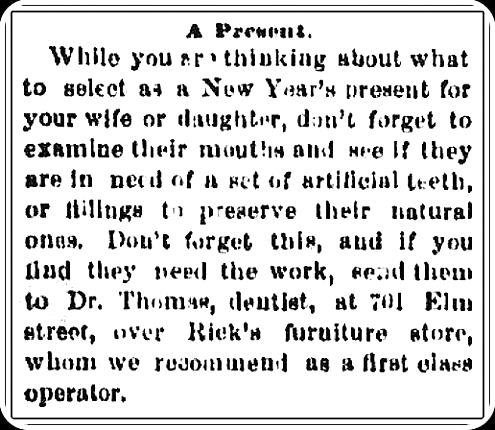
ad-dentist_new-year-gift_dal-herald-123077Dallas Herald, Dec. 30, 1877

A Present. While you are thinking about what to select as a New Year’s present for your wife or daughter, don’t forget to examine their mouths and see if they are in need of a set of artificial teeth, or fillings to preserve their natural ones. Don’t forget this, and if you find they need the work, send them to Dr. Thomas, dentist, at 701 Elm street, over Rick’s furniture store, whom we recommend as a first class operator.

(While you’re waiting for your wife’s new choppers to be installed in the doctor’s office upstairs, you can browse for a nice new stool for the spinet downstairs at Rick’s.)

*

But wait, there’s more. Dig a little deeper and you find this:

thomas-dentist_galveston-daily-news_072889Galveston Daily News, July 28, 1889

Whoa!

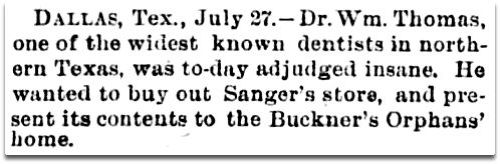
thomas-dentist_dmn_072889Dallas Morning News, July 28, 1889

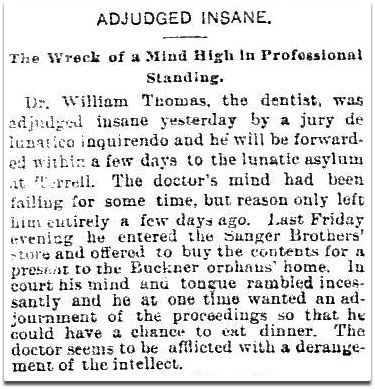
ADJUDGED INSANE: The Wreck of a Mind High in Professional Standing.

Dr. William Thomas, the dentist, was adjudged insane yesterday by a jury de lunatico inquirendo and he will be forwarded within days to the lunatic asylum at Terrell. The doctor’s mind had been failing for some time, but reason only left him entirely a few days ago. Last Friday evening he entered the Sanger Brothers’ store and offered to buy the contents for a present to the Buckner orphans’ home. In court his mind and tongue rambled incessantly and he at one time wanted an adjournment of the proceedings so that he could have a chance to eat dinner. The doctor seems to be affected with a derangement of the intellect.

I’m not quite sure what all that was about, how much time he spent in the Terrell “lunatic asylum,” or how “insane” the good doctor really was (I suspect he was using a lot of cocaine — see below). The only other mention of Dr. Thomas I found was a mention in the Buckner orphanage’s annual report of 1898 in which his name appeared in a group of doctors who were thanked for their services rendered to the children free of cost.

***

Sources & Notes

Top ad from the 1878 Dallas city directory.

Dr. Thomas probably wasn’t actually “insane.” I wonder if perhaps he hadn’t been dipping into his own medicine chest and availing himself of the cocaine that most dentists of the time used as a painkiller during dental procedures? An interesting article on doctors of the period self-medicating is here.

Happy New Year! And don’t forget to floss!

*

Copyright © 2015 Paula Bosse. All Rights Reserved.
“Every Gypsy in the Nation Knows About This” — 1951

gypsy_lawrence-young_green-young_baylor_feb-1951
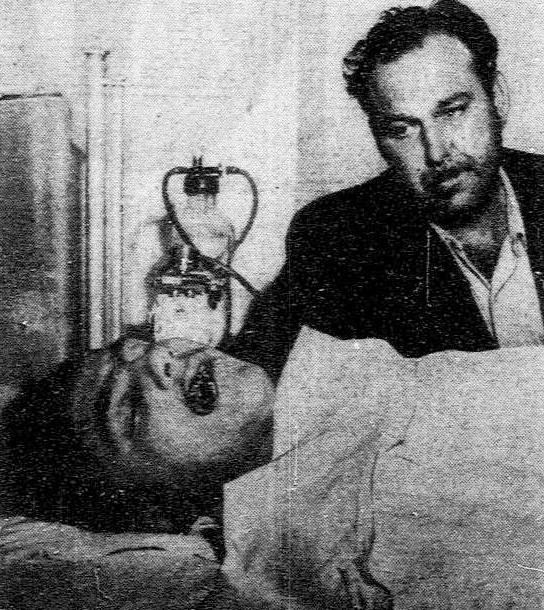
The “Gypsy youth” at the center of “tribal” unrest & his father, Baylor Hospital, 1951

by Paula Bosse

In the first few days of March, 1951, Dallas witnessed the influx of hundreds and hundreds of Gypsies into the city, all of whom had been summoned — from near and far — by a call put out over an effective and somewhat mysterious communications network. The reason? A teenage boy (referred to repeatedly as a “Gypsy youth”) had been shot in South Texas by a boy from another “tribe” (or clan, or family) — one family insisted the shooting was intentional, the other insisted it was an accident. This incident ballooned into a huge internecine feud. If the boy died, the “Green” tribe promised that there was “going to be a lot of shooting going on in Dallas” (Dallas Morning News, March 1, 1951). [Note: the word “Gypsy” is sometimes seen as a pejorative. I use it in this post purely in a historical context; it is not meant to be derogatory.]

In December of 1950, 14-year-old “Lawrence Young” (the anglicized name his family gave to authorities) had been walking along railroad tracks with other boys in Port Isabel, near Brownsville, when he was shot with a .22 caliber rifle by a 12-year-old, a Gypsy boy from another clan. The 12-year-old said the borrowed rifle had been malfunctioning and that, while hunting, the gun discharged unexpectedly, and a bullet hit Lawrence, whom the other boys thought was playing when he fell to the ground. Until they saw the blood. The bullet struck Lawrence in the back, near his left shoulder blade, and it lodged in his spine at the base of his skull. Police in Port Isabel determined that the shooting had been an accident. Lawrence’s family, however, said that the other boy had been jealous of Lawrence’s new car and had shot him on purpose. The boy was rushed to the hospital; his condition was not good.

After stays in hospitals in Galveston and Temple, Lawrence’s mother decided to move him to Dallas where she thought the medical care would be better. He was admitted to Baylor Hospital at the end of February. Relations had been tense between the two clans since the shooting, but the Evans clan (of which the 12-year-old boy was a member) had grudgingly agreed to pay for half of Lawrence’s medical bills. The decision by Lawrence’s family to move him to Dallas — where hospital care would be much more expensive — only made things worse between the two groups; the Green clan had heard that the Evans clan would not pay their share of what they felt would be an exorbitant bill. Tempers had been building and boiling for weeks, and by the time things moved to Dallas, things were about to explode.

Word of the increasingly volatile feud had spread, and Gypsies from several surrounding states began pouring into Dallas in a show of tribal support. The first reports estimated there might have been as many as 500 Gypsies in Dallas County, representing at least six different clans, each clan with strong loyalties to one of the two families. If the boy died, the Greens and their supporters promised that retaliation would be swift and deadly. The Evanses — and the clans friendly to them — were ready for whatever came their way. The threat of deadly violence in the streets of Dallas was a very real possibility (if a city could be an innocent bystander, that’s what Dallas was in this unusual situation).

The Dallas police were, understandably, worried. In an attempt to get the warring factions to leave town, homicide detective Captain Will Fritz was reduced to arresting several of the men on charges of vagrancy (“We can’t make them get out of Dallas, but we can keep arresting them for vagrancy until they move on,” Fritz said). Unfortunately, this was a pretty ineffective strategy.

Fifty or so “expensive automobiles” were parked outside Baylor as the time for Lawrence’s surgery approached. Men and women sat inside their cars waiting for a signal from a man they had placed inside the building who was to alert them from a window whether or not the boy had survived. If he died, things would get real bad, real fast. When police learned about the man inside the hospital, they arrested him. The boy was in critical condition prior to the surgery, and tensions among the factions continued to rise.

gypsy_lawrence-youngs-grandmother_baylor_feb-1951
Above, the boy’s grandmother, outside Baylor Hospital,
waiting for word on her grandson’s condition.

At some point, a man in Fort Worth who said he was a nephew of the King of the Gypsies in the United States intervened and worked as a sort of intermediary between the Gypsies and Fritz.

“I can’t promise there won’t be any shooting over there,” he told Fritz by telephone. “This thing has gone pretty far. But I will try to stop things where they are.”

“I don’t care how you settle this matter among yourselves,” Fritz replied, “Just do it out of Dallas County. We want no shooting here.”  (DMN, March 2, 1951)

Fritz agreed to release two men he had been holding (on non-vagrancy charges), hoping they would take word of the Fort Worth man’s “tribal council” involvement back to their people and calm the situation.

The surgery was, thankfully, successful. 

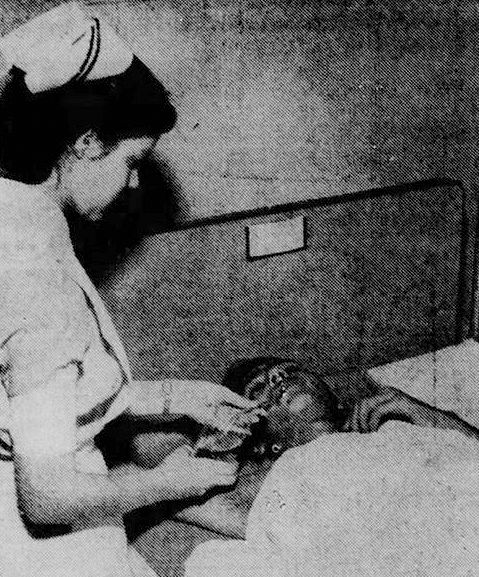
gypsy_mckinney-courier-gazette_030251Caption: “Gypsy Youth in Dallas Hospital — Lawrence Young, 14-year-old Gypsy youth gets a drink of water from a nurse at Dallas’ Baylor Hospital. Young was allegedly shot by another youthful Gypsy some two months ago near Brownsville, Texas. He was operated on at Baylor Hospital to have the bullet removed. Two Gypsy clans are reportedly watching with much interest to see that the youth recovers.” (NEA photo and wire report, from the McKinney Courier-Gazette, March 2, 1951)

*

To the relief of Dallas police, doctors said that Lawrence would recover — a major crisis had been averted, and the hundreds of Gypsies who had been camped around Dallas began to leave town. But just a few days later, a camp was discovered outside Garland, and twenty people were immediately arrested for vagrancy — they were photographed, fingerprinted, fined, and released, with the clear understanding that they needed to move on. ASAP. The next day, Sheriff Bill Decker announced they had packed up and left.:

“I don’t know where the road goes,” said Decker, “but it leads out of Dallas County.” (DMN, March 7, 1951)

*

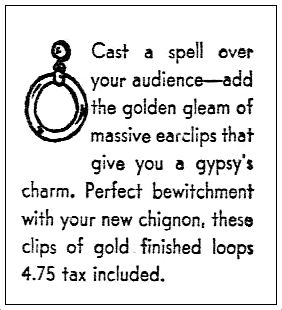
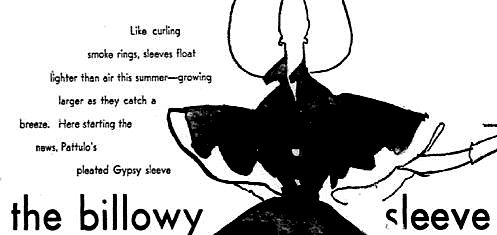
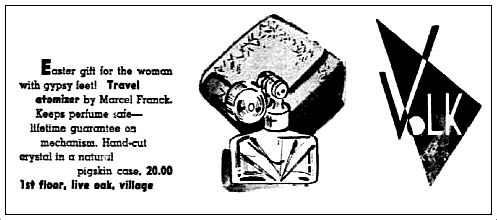
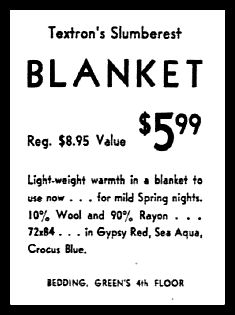
Gypsies were generally considered a menace by police departments around the country, as their arrival was usually accompanied by a rise in … questionable business practices. While these … business practices … were usually viewed negatively, it’s interesting to note that in 1950 and ’51 Gypsy “style” was everywhere. Ads for upscale department stores such as Neiman’s and A. Harris, for instance, were filled with Gypsy-inspired fashions — off-the-shoulder peasant blouses, scarves, gold bangles, dangly earrings, and exotic makeup. Cars and household items came in popular colors such as “Gypsy green,” “Gypsy red,” and even “Gypsy brown.” People might not have been excited by their … unorthodox business practices … but they sure loved the way they dressed and were attracted by the allure and romance of their rootless, “wandering” lifestyle.

gypsy_n-m_dmn_030551Neiman-Marcus ad — 1951

gypsy_n-m_dmn_041051Neiman-Marcus ad — 1951

gypsy_volk-ad_dmn_031051Volk ad — 1951

gypsy-green_w-a-green-ad_dmn_011851W. A. Green ad — 1951

***

For more on “Gypsy”/Romani/Romany/Roma culture and history, see the Wikipedia entry here; for issues concerning use of the word “Gypsy,” see here.

And for no other reason than to see how Gypsies were often stereotypically portrayed on pre-PC television, an episode of The Andy Griffith Show called “The Gypsies” can be watched on YouTube, here.

My favorite tidbit gleaned from this brief look into Gypsy culture was discovering that families and individuals with No Fixed Abode often communicated via the classifieds of, of all things, Billboard magazine.

*

Copyright © 2014 Paula Bosse. All Rights Reserved.
 

Baylor Hospital — 1909-1921

baylor_postcardClassic cars on Junius Street… (click for larger image)

by Paula Bosse

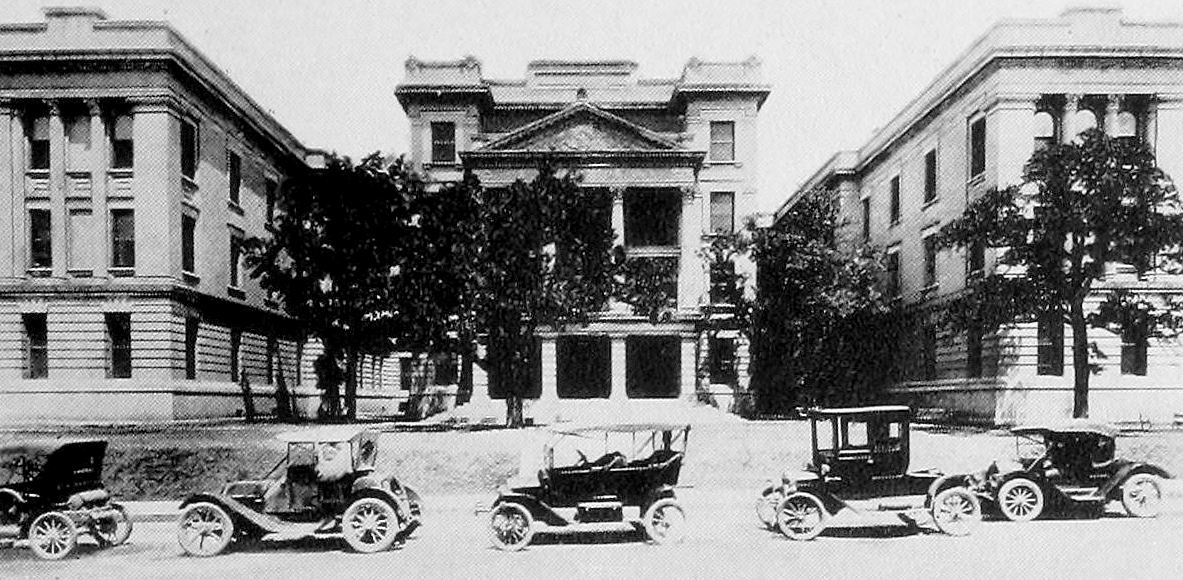
I originally thought the street in front of Baylor Hospital in this postcard was Gaston. But Baylor originally faced Junius Street (see it on a 1921 Sanborn map here), and, in fact, its address was 3315 Junius for many years. I had no idea.

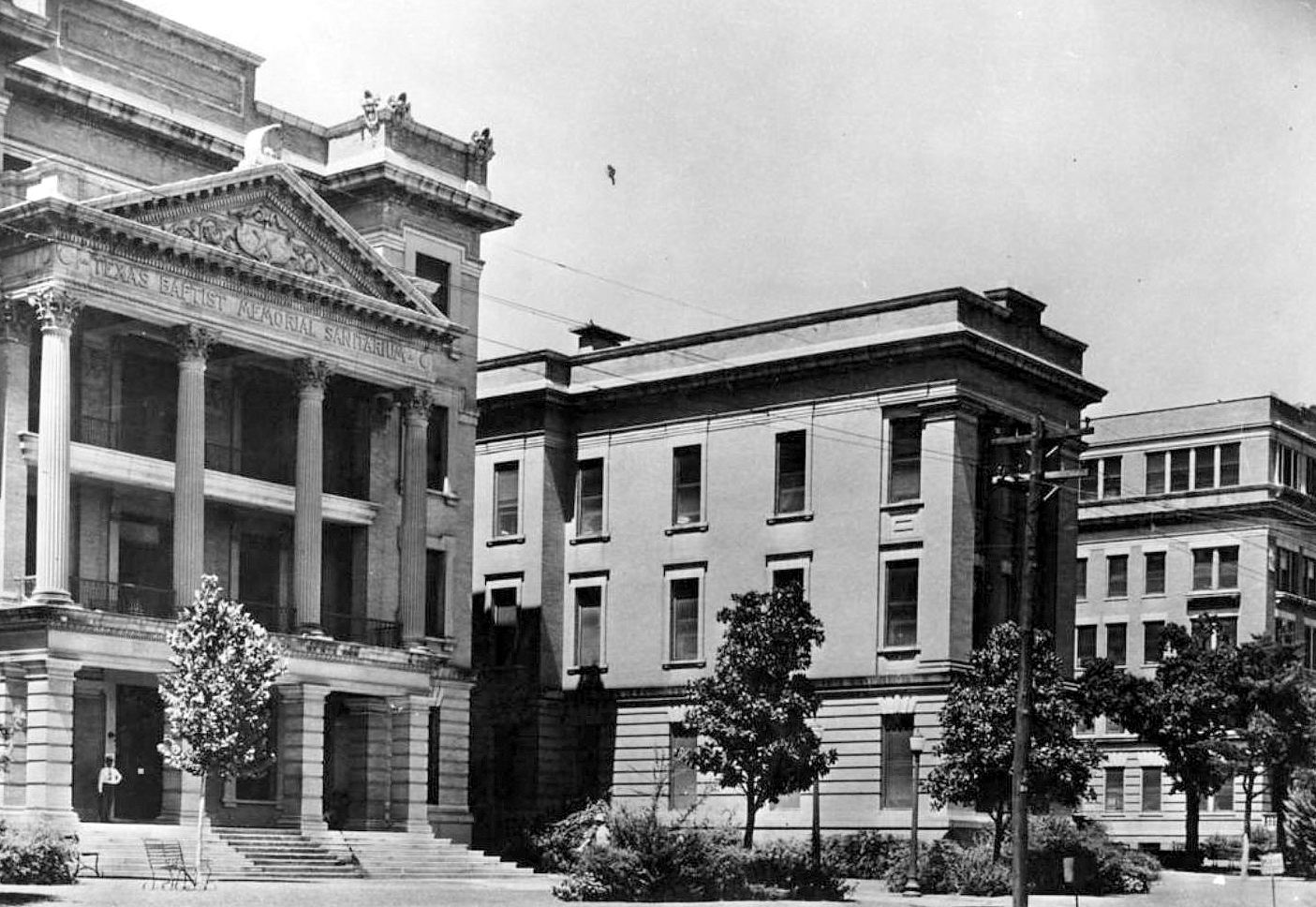
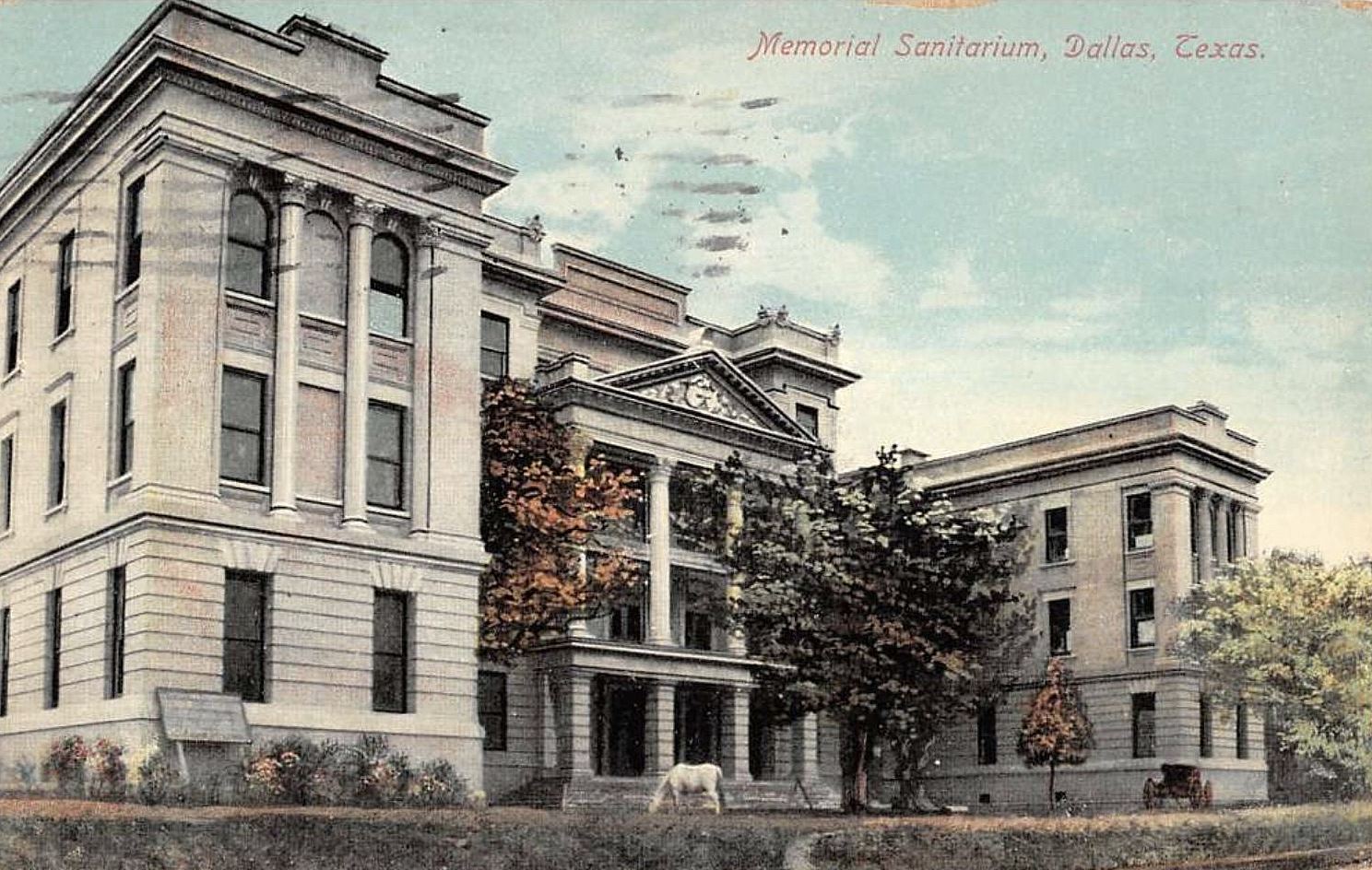
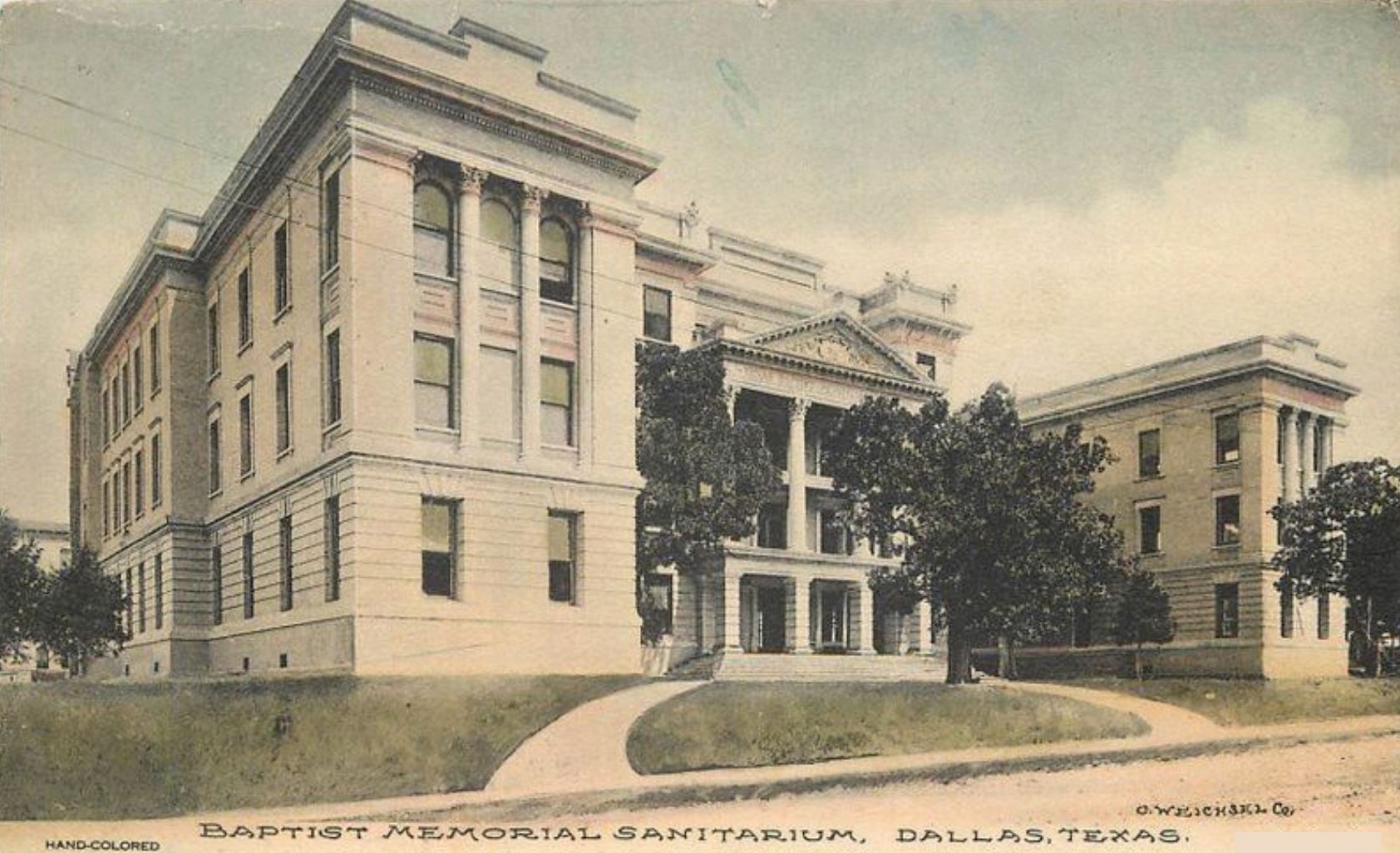
Below are a few more photos and postcards of the medical facility which eventually grew into Baylor Hospital (its Dallas roots go back to 1903, but the buildings seen in these images — buildings designed by noted Dallas architect C. W. Bulger & Co. — were built around 1909). Originally known as the “Texas Baptist Memorial Sanitarium,” it changed its name to the more familiar “Baylor Hospital” in 1920/1921 (and later became “Baylor University Hospital” in 1936). (More on the timeline of Baylor Hospital can be found here and here.)

baylor_postmarked-1919_ebaypostmarked 1919

Dig those cars.

baylor_baylor-univ-waco-yrbk_the-round-up_19171915

baylor-hospital_baptist-sanitarium_postcard

baylor_tx-baptist-memorial-sanitarium_ca-1912_UTSW-libraryca. 1912 (photo: UT Southwestern Library)

This is my favorite one: no cars, but there’s a horse grazing at the entrance!

baylor_horse_postmarked-1911_ebaypostmarked 1911

The postcard below was postmarked 1909, the year these new buildings opened. No cars, no horse, no people. 

baylor_postmarked-1909_ebay1909

And here is the brand new sanitarium, in a photograph that appeared in The Dallas Morning News less than a month after its official opening.

baylor-hospital_exterior_dmn_111009_clogensonDMN, Nov. 10, 1909

***

Sources & Notes

Postcards found on eBay.

The first black-and-white photo is from the 1917 Round-Up, the yearbook of Baylor University in Waco; the same image (uncolorized) appears in the digital archives of UT Southwestern, here, with the date 1915.

The second black-and-white photo is from the UT Southwestern Library archives, here.

The name-change of the Texas Baptist Memorial Sanitarium to Baylor Hospital was proposed in Nov. of 1920 and formally approved by the Board of Trustees of Baylor University in Waco on January 16, 1921. More about the major changes happening to the medical facility/facilities affected can be found in the article “Medical Center For Dallas Is Authorized by Texas Baptists” by Silliman Evans (Fort Worth Star-Telegram, Nov. 13, 1920), here.

Read a detailed description of the Texas Baptist Memorial Sanitarium in the Dallas Morning News article “Baptist Memorial Sanitarium, Just Completed at Dallas, Represents an Investment of More Than Four Hundred Thousand Dollars” (DMN, Nov. 10, 1909), here and here. There are several photographs taken inside and outside (and on top of) the brand new buildings.

*

Copyright © 2014 Paula Bosse. All Rights Reserved.

JFK’s “Last Hour In Dallas” — 1963

JFK_poster

by Paula Bosse

How is a city supposed to respond when it is suddenly plunged into the international spotlight? Does it grieve and try to forget, or does it grieve and capitalize? Dallas has had over 50 years to deal with/come to terms with the assassination of President Kennedy, but sometimes it seems as if the City of Dallas is still shell-shocked and isn’t quite sure how to acknowledge it on an official level. Let’s face it, Dallas is known to the rest of the world for one thing: the Kennedy assassination (and perhaps the TV show, and maybe the Cowboys). Yes, we have the justly-renowned Sixth Floor Museum, but it took 26 years to open it!

The cottage industry that sprang up in the wake of the Kennedy assassination has been big business for decades, some of it generated by people who live in Dallas, but most of it by people who have probably never even been to Texas. Since 1963, the “assassination literature” (…and, yes, it’s called that) has mushroomed, with local contributions coming from Dallasites whose brush with the President before, during, or after the events of November 22, 1963 have probably been pored over by numerous people either trying to understand why what happened happened or by people searching for hidden conspiracy clues to explain what really happened.

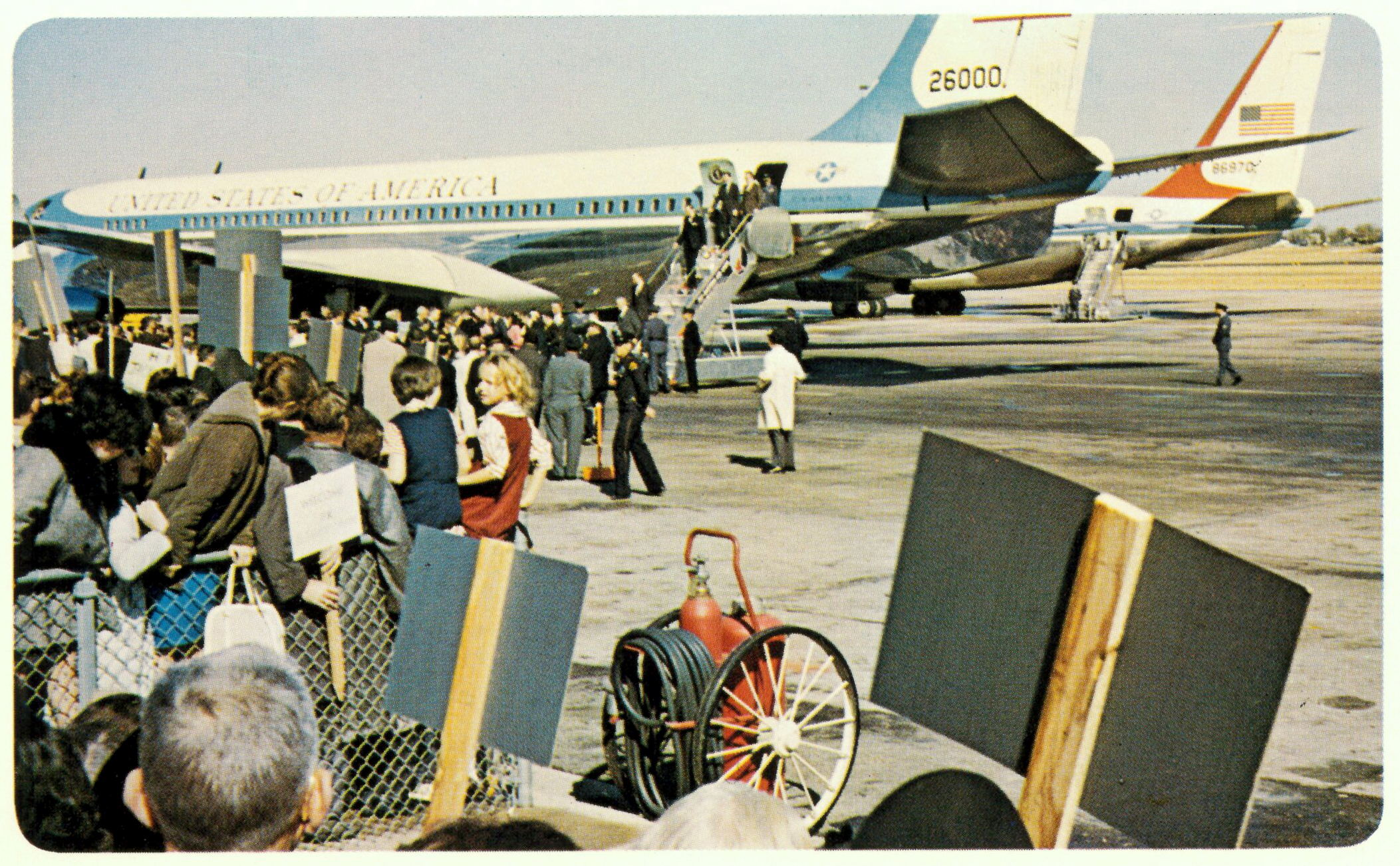
One local resident who added to the assassination literature was John E. Miller who took photos of the arrival of President and Mrs. Kennedy at Love Field and then apparently hot-footed it over to Parkland when the news of the shooting broke. These photos were issued as postcards in 1964 in a packet of 12. (Click pictures for larger images.)

JFK_envelope_frontAbove, the front of the envelope containing the cards; on the back: “A Real Picture Treat For Years To Come.”

JFK_card_01From the back of the card: “No. 1, Arrival of President’s Escort Plane at Love Field, Dallas, Texas.”

JFK_card_02“No. 2, Presidential and Escort Planes at Dallas’ Love Field landed shortly after this picture was taken.”

JFK_card_03“No. 3, President John F. Kennedy and party leaving airplane at Love Field. (Mrs. Kennedy — pink hat.)”

(UPDATE: The two little girls in the photos above and below are most likely Carolyn Jacquess, in blue, and Debby Massie, in red. Their little group arrived at the airport before the president’s plane arrived, walked through the terminal and out onto the tarmac, right to where the plane taxied up to the small crowd of about 100 people. Just like that. There was no special invitation, and, other than the chain-link fence, no real security.)

JFK_card_04“No. 4, President John F. Kennedy and Party in foreground at Dallas’ Love Field.”

JFK_card_05“No. 5, Vice-President Johnson, Governor Connally, Mrs. Kennedy (pink hat), other members of party at Dallas Love Field.”

JFK_card_06“No. 6, Vice-President Johnson, Governor Connally, Presidential Party and Newspaper Men, Love Field, Dallas.”

JFK_card_07“No. 7, Forming of Presidential Parade, Love Field, Dallas.”

JFK_card_08“No. 8, After Assassination, TV Unit arrives at Parkland Hospital in Dallas.”

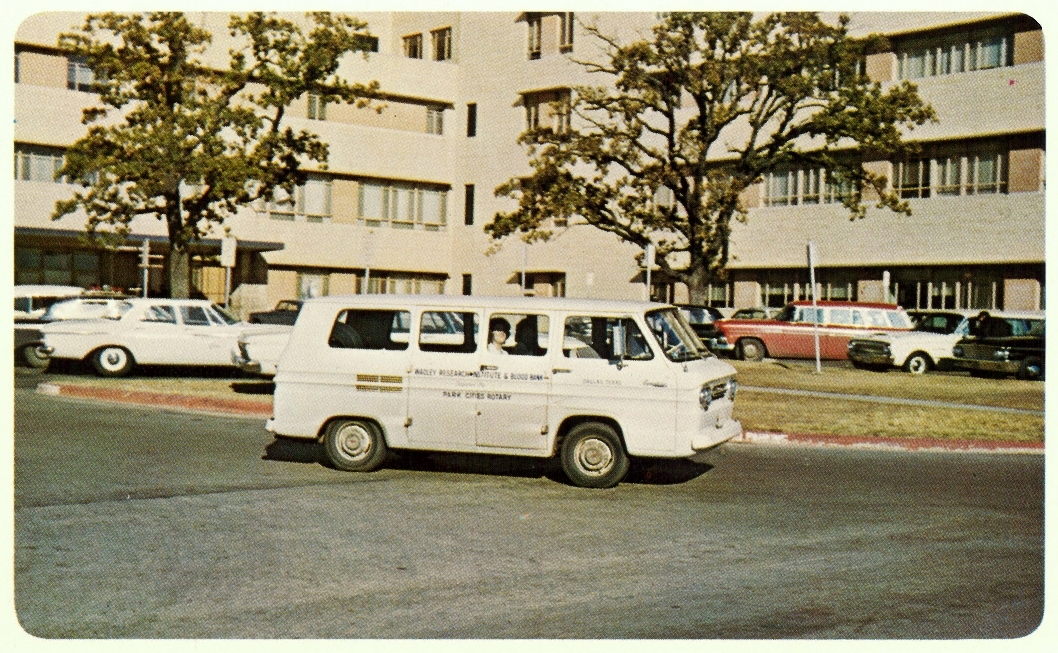
JFK_card_09“No. 9, Blood Bank Unit at Parkland Hospital on fatal day. Dallas, Texas.”

JFK_card_10“No. 10, Hearse carrying President John F. Kennedy’s body and Mrs. Kennedy from Parkland Hospital back to airplane at Love Field, Dallas.”

JFK_card_11“No. 11, Presidential plane awaiting President Kennedy’s body, Vice-President Johnson and Mrs. Kennedy, for return to Washington, D.C. (Note Presidential seal.)”

JFK_card_12“No. 12, Texas School Book Depository building from which authorities believe fatal shots were fired. (Note second window down on right corner of building.)”

***

Photos and captions © John E. Miller 1964, 3500 W. Davis, Dallas, Texas 75211. (Mr. Miller was a Dallas businessman who sold motor homes and trailers in Oak Cliff between 1945 and 1976. A photo of Mr. Miller is here).

Many thanks to “amyfromdallas” for scanning and contributing the images in this post. Thanks, Amy!

For other Flashback Dallas JFK-related posts, see here.

Click pictures for larger images.

*

Copyright © 2014 Paula Bosse. All Rights Reserved.